River Valley & Robertson Quay Neighbourhood Guide Singapore 2026: Property Prices, MRT and Investment Outlook

River Valley & Robertson Quay Neighbourhood Guide Singapore 2026: Property Prices, MRT and Investment Outlook

River Valley and Robertson Quay sit at the heart of Singapore’s most coveted residential precinct — District 9 (D09), Core Central Region (CCR). Sandwiched between the Singapore River to the south and the Orchard Road belt to the north, these two sub-precincts offer a rare combination: walkable waterfront lifestyle, genuine city-fringe connectivity (three MRT lines within 600 metres since the Thomson–East Coast Line opened in June 2023), internationally acclaimed schools, and a concentration of freehold and long-tenure leasehold condominiums that rarely appear in the Outside Central Region. This River Valley Robertson Quay neighbourhood guide Singapore 2026 covers property prices, MRT access, top schools, rental yields, capital growth trends, and everything a buyer or investor needs to know before committing to D09.

Quick Answer — River Valley & Robertson Quay at a Glance

  • District 9, CCR — one of Singapore’s three Core Central Region districts alongside D10 and D11.
  • New TEL stations (Great World TE15 and Havelock TE16) opened June 2023, fundamentally improving connectivity without new launches disrupting the area’s streetscape.
  • Private condo prices range from S$1,100,000 for a 1-bedroom to S$6,500,000+ for a 4-bedroom; average PSF runs S$2,600–S$3,200 for freehold stock.
  • Gross rental yields: 2.5%–2.9% for larger units, 3.4%–3.8% for 1-bedrooms — lower than OCR, but sustained by high-income expat tenants in finance, law, and tech.
  • Five-year capital growth (2021–2026): +11.8% to +14.6% across private condos, tracking the broader CCR PPI.
  • No new GLS site has been awarded in the River Valley / Robertson Quay sub-precinct since 2018 — supply scarcity is a structural investment thesis.
  • Singapore Citizens buying their first private property pay 0% ABSD; foreigners pay 60%. ABSD 20% applies for SC second-property purchases.

River Valley Robertson Quay — Where Is It and What Makes It Distinctive?

River Valley and Robertson Quay are planning sub-zones within the Museum Planning Area and River Valley Planning Area of URA’s Master Plan. Geographically, the area stretches from River Valley Road (the main artery) south to the Singapore River, and from Mohamed Sultan Road / Clemenceau Avenue in the west to the Orchard/Somerset boundary in the east.

What makes this precinct genuinely different from Singapore’s other CCR sub-markets (Orchard, Cairnhill, Ardmore) is its character. Where Orchard feels commercial and Ardmore is quiet enclave-landed, River Valley and Robertson Quay have a lived-in, convivial quality — dozens of independent restaurants, riverside bars, weekend arts markets at Clarke Quay, Fort Canning Park’s concert lawn, and a density of international schools and nurseries that reflects the long-established expat tenant community. Many of Singapore’s largest private banks, law firms, and regional headquarters cluster within a 2-kilometre radius, feeding consistent demand for high-specification rental accommodation.

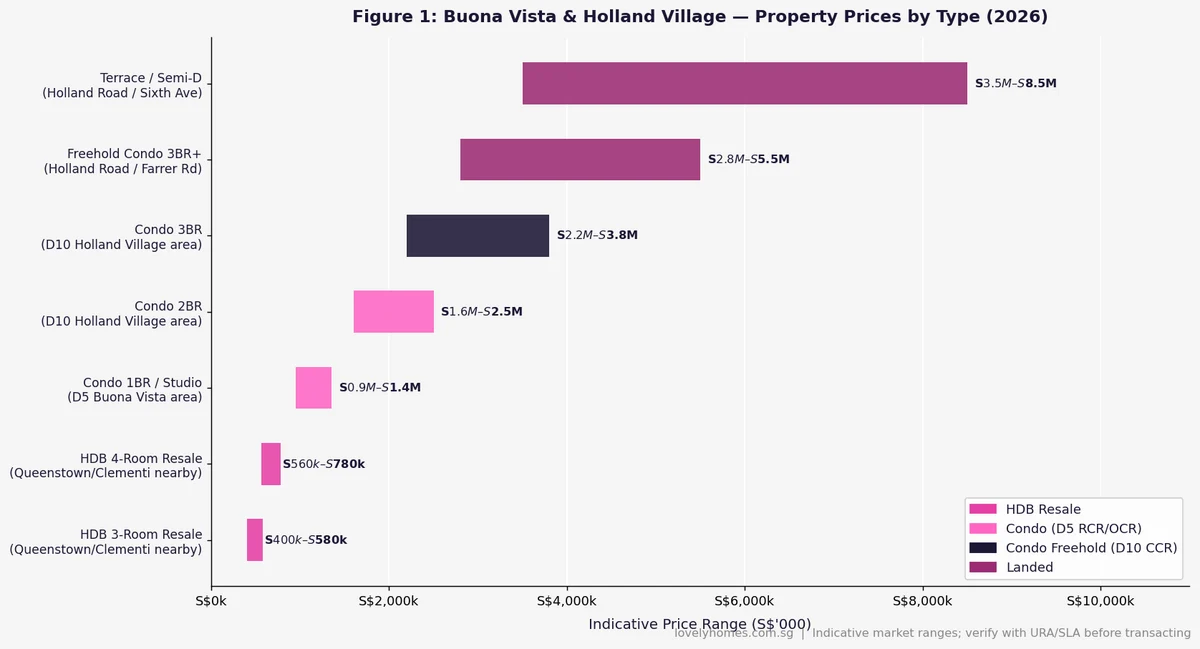
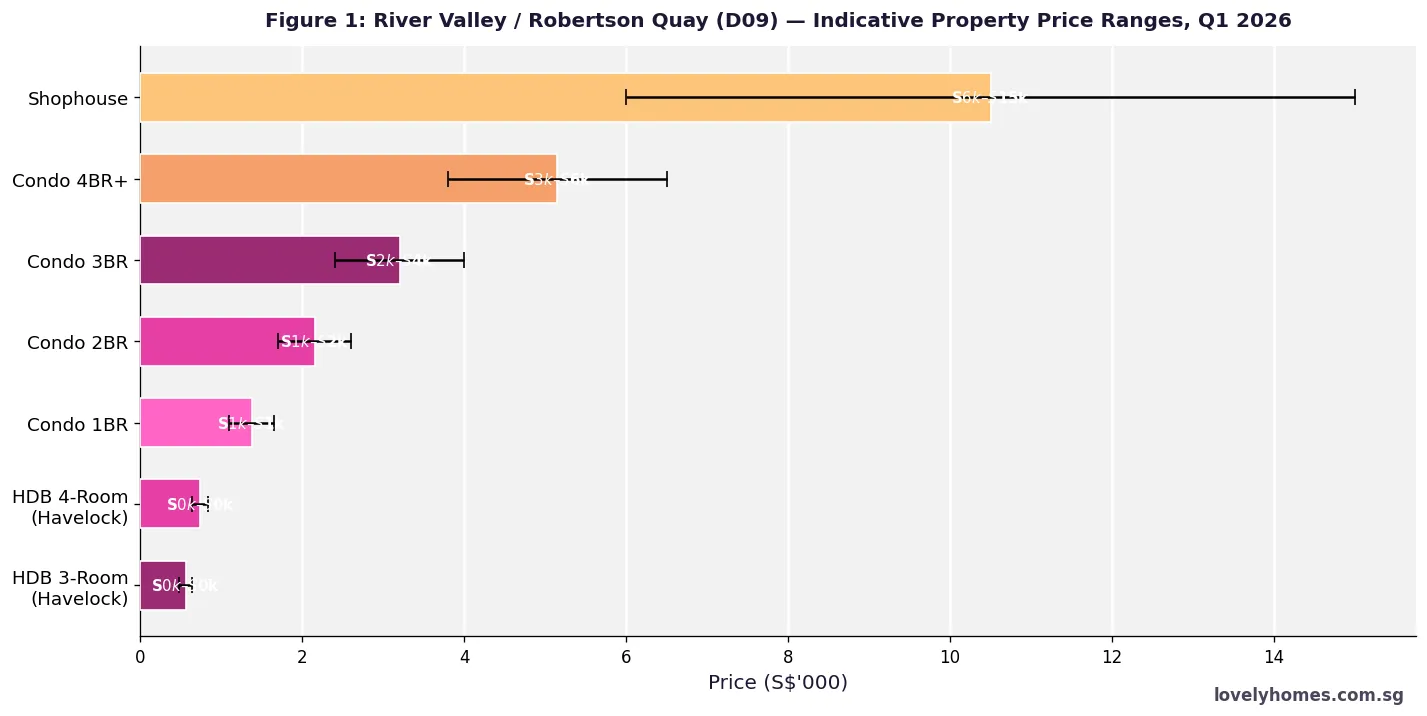
River Valley Robertson Quay D09 property price ranges 2026 — condo 1BR to shophouse, HDB Havelock
Figure 1: Indicative property price ranges in River Valley / Robertson Quay (D09), Q1 2026. Ranges reflect asking and transacted prices; actual pricing varies by unit, floor, and tenure.

MRT Connectivity — Three Lines Within Walking Distance

Prior to June 2023, District 9’s connectivity was widely cited as its one weakness relative to D10 or D11 — the nearest MRT stations (Somerset NS23 and Clarke Quay NE5) required a 10–15 minute walk from many River Valley condominiums. The opening of the Thomson–East Coast Line’s Stage 3 changed the calculus materially:

  • Great World (TE15 — TEL): Located on Kim Seng Road, a 5-minute walk from most River Valley condos along Kim Seng Road and Martin Road. Interchange planned with future Jurong Region Line extension in long-range planning; already connects to Orchard (TE14, 1 stop north) and the TEL’s eastern branches toward Marine Parade and Bayshore.
  • Havelock (TE16 — TEL): Serves the Havelock Road and Robertson Quay western edge; useful for residents in River Gate, Aspen Heights, and Havelock View Towers. Connects south toward Outram Park (TE17 — interchange with EWL and NEL) and Cantonment (TE18).
  • Fort Canning (DT20 — DTL): On the Downtown Line, this station is a 7–10 minute walk from Robertson Quay and links directly to Bugis (DT14/EW12), Downtown (DT17), and via interchange to Marina Bay, Buona Vista, and Expo.

For commuters to the CBD (Raffles Place, Shenton Way), the travel time from Great World TE15 to Marina Bay TE20 is approximately 8 minutes on the TEL — comparable to driving at peak hour and far more reliable. For residents working in the Orchard/Somerset belt, it is one stop. The TEL has repositioned River Valley from “slightly inconvenient” to “exceptionally well served”.

Schools in River Valley and Robertson Quay

River Valley Primary School (RVPS), located on River Valley Road, is the district’s anchor primary school and draws families from across Singapore willing to buy or rent in-zone to secure a Phase 2C ballot priority. The school is within the 1-kilometre priority zone for several major condominiums including The Avenir, Rivière, and Martin Modern.

At the secondary level, Gan Eng Seng School and Queenstown Secondary are accessible via the TEL. Singapore Management University (SMU) — one of Singapore’s six autonomous universities — is a 15-minute walk from Robertson Quay via Fort Canning; its proximity contributes to the area’s intellectual and professional character. For international families, the international schools cluster in the broader CCR zone (Orchard, Tanglin, Stevens) is accessible in 10–15 minutes.

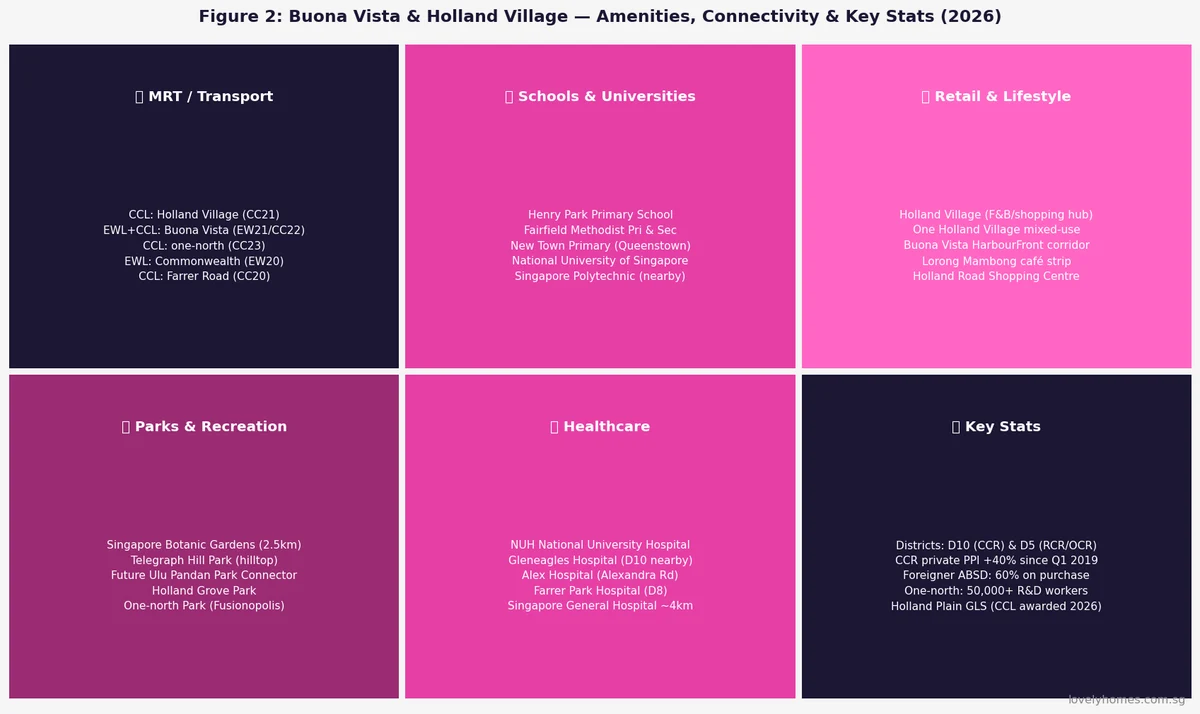
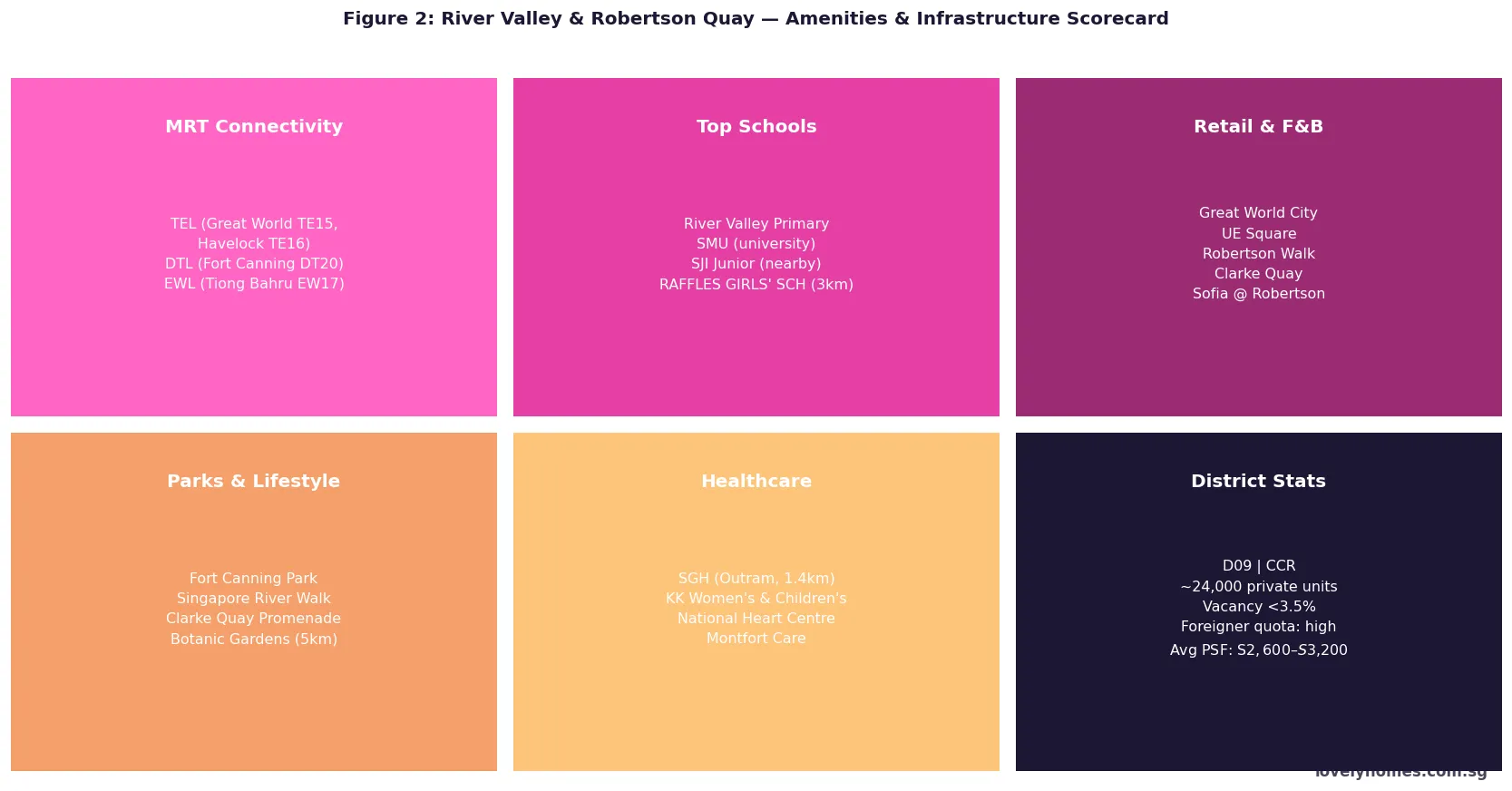
River Valley Robertson Quay amenities scorecard 2026 — MRT, schools, retail, parks, healthcare, district statistics
Figure 2: River Valley & Robertson Quay amenities and infrastructure scorecard.

Property Market Overview — D09 CCR Prices and Supply

District 9 is a near-exclusively private residential market. HDB flat supply in the area is negligible — the Havelock HDB estate on the western fringe has a small number of older flats, most of which are past their lease peak, but they represent a tiny fraction of the district’s housing stock. The dominant product is the private condominium — ranging from boutique freehold projects of 30–50 units to larger 99-year leasehold developments of 300–600 units.

Key benchmark projects:

  • The Avenir (freehold, D09, River Valley Close): 376 units across two 36-storey towers. Completed 2024. Benchmark PSF S$2,800–S$3,200. Developed by GuocoLand and Hong Leong Holdings.
  • Rivière (99yr leasehold, Jiak Kim Street): 455 units. Former Zouk site. TEL Great World station at doorstep. Benchmark PSF S$2,400–S$2,900. Frasers Property development.
  • Martin Modern (99yr leasehold, Martin Place): 450 units. GuocoLand. Benchmark PSF S$2,200–S$2,600.
  • The Waterfall, RV Altitude, One Draycott (freehold older stock): PSF S$2,000–S$2,500.

Transaction volume in D09 is thin by Singapore standards — typically 250–400 resale caveats per year — which means individual transactions can move the median PSF meaningfully. Freehold premium over 99-year leasehold in this precinct runs approximately 8–15%, narrower than the national average because the 99-year stock (Rivière, Martin Modern) is of very high quality with TEL access.

Property Type Indicative Price Range Indicative PSF Gross Yield (Est.) Tenure
HDB 3-Room (Havelock) S$480k – S$640k S$560–S$700 3.8% Leasehold (ageing)
HDB 4-Room (Havelock) S$640k – S$840k S$580–S$720 3.5% Leasehold (ageing)
Private Condo 1BR S$1.1M – S$1.65M S$2,400–S$3,000 3.4%–3.8% Freehold / 99yr
Private Condo 2BR S$1.7M – S$2.6M S$2,500–S$3,100 2.9%–3.3% Freehold / 99yr
Private Condo 3BR S$2.4M – S$4.0M S$2,600–S$3,200 2.5%–2.9% Freehold / 99yr
Private Condo 4BR+ S$3.8M – S$6.5M S$2,700–S$3,300 2.3%–2.7% Freehold / 99yr
Shophouse (Heritage) S$6M – S$15M S$5,500–S$9,000 1.8%–2.5% Freehold

Rental Market — Who Rents in River Valley and Robertson Quay?

The D09 rental market is structurally different from OCR precincts. Rather than young professionals on tight budgets seeking HDB rooms or studio apartments, the tenant pool in River Valley and Robertson Quay skews toward:

  • Expatriate finance and legal professionals — private banks, hedge funds, and international law firms cluster in the Marina Bay Financial Centre and Raffles Place, both reachable from Great World TE15 in under 12 minutes. Housing allowances of S$6,000–S$12,000 per month are common.
  • Senior corporate and tech executives — regional headquarters of multinational companies increasingly concentrate in the one-north/Tanjong Pagar corridor, accessible via the TEL.
  • International families — the area’s proximity to the international school belt (Tanglin Trust, UWCSEA East, ISS) makes it attractive to families with school-age children.

Median monthly rents in D09 for a 2-bedroom condominium run approximately S$5,800–S$7,500 (Q1 2026), reflecting a modest correction from the 2022–2023 rental peak of S$7,000–S$9,000 but still well above pre-pandemic levels. Vacancy in the precinct is estimated below 3.5% — reflecting tight supply and durable expat demand.

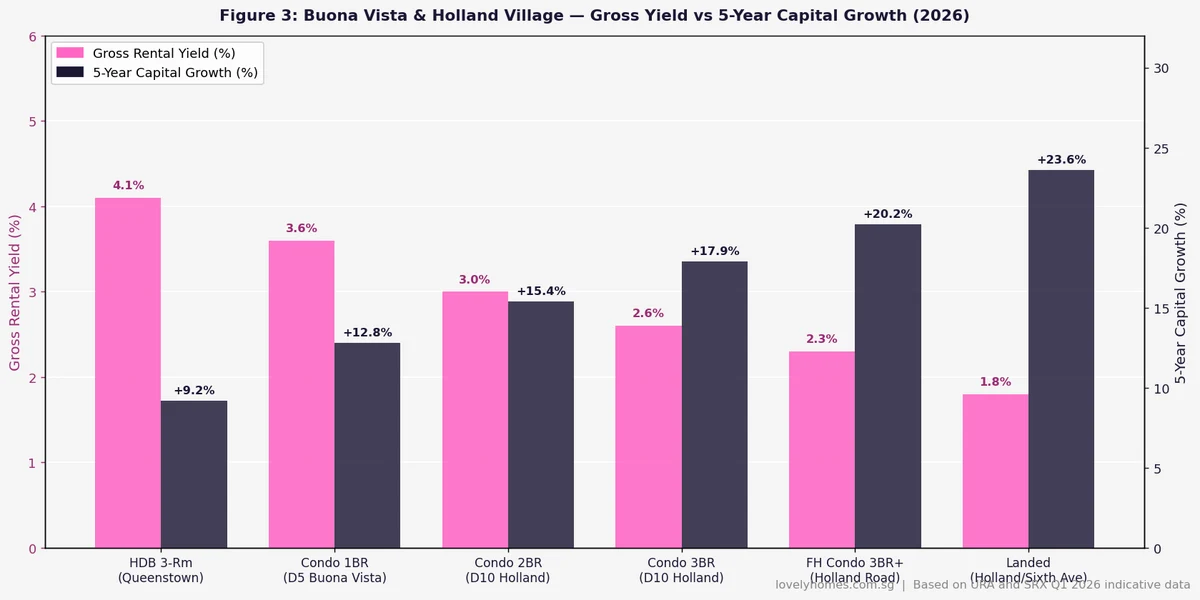
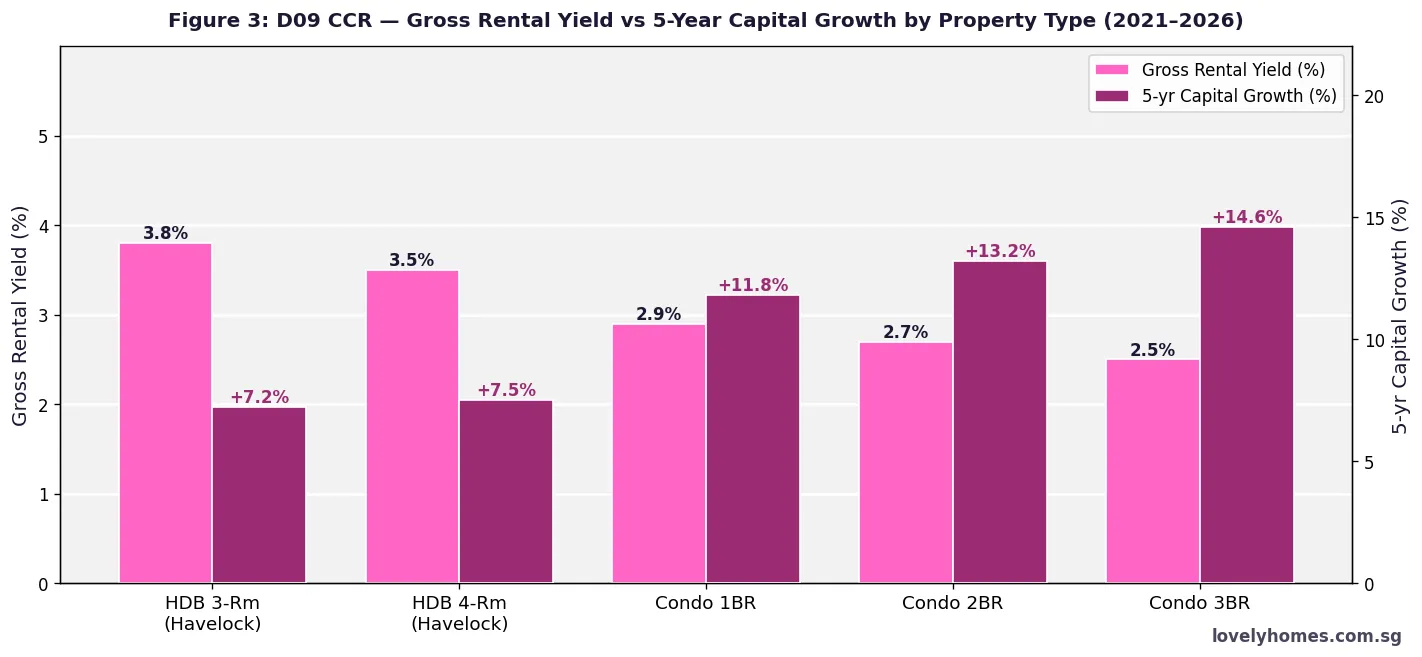
D09 CCR River Valley Robertson Quay gross rental yield vs 5-year capital growth 2021 to 2026 by property type
Figure 3: Gross rental yield and 5-year capital growth (2021–2026) for D09 CCR by property type. CCR yields are lower than OCR but paired with stronger capital growth for larger units.

🏠 Worked Example: Mr & Mrs Chua — SC Upgraders Buying Martin Modern 2BR

Profile: Mr & Mrs Chua, Singapore Citizens, joint income S$16,000/month. Currently own a Bishan 4-room HDB flat (MOP cleared, sold on 30 April 2026 for S$840,000). Buying a Martin Modern 2BR (99yr leasehold) at S$2,200,000. This is their first private property.

Stamp duty:

  • BSD on S$2,200,000: 1% × S$180k + 2% × S$180k + 3% × S$640k + 4% × S$500k + 5% × S$700k = S$1,800 + S$3,600 + S$19,200 + S$20,000 + S$35,000 = S$79,600
  • ABSD: Nil — SC couple, first private property (HDB sold before OTP granted)

Financing:

  • Purchase price: S$2,200,000 | LTV 75% → Bank loan: S$1,650,000
  • Monthly repayment at 3.0% p.a. 25yr: approximately S$7,832/month
  • TDSR: S$7,832 ÷ S$16,000 = 48.9% — PASS (within 55% limit)

Upfront cash/CPF required:

  • 25% down payment: S$550,000
  • BSD: S$79,600
  • Conveyancing fees: ~S$5,000
  • Total upfront: approximately S$634,600 (can partly draw from CPF OA after HDB CPF refund)

Investment projection: At +13.2% 5-year CCR growth (historical trend), the S$2.2M unit appreciates to approximately S$2.49M by 2031. Combined with net rental income (~S$5,800/month at 2.9% gross, less property tax and maintenance), the total return scenario is approximately S$290k capital + S$174k net rental = ~S$464k over 5 years. Past performance does not guarantee future results — see Disclaimer.

Investment Case — Why River Valley and Robertson Quay in 2026

The structural case for D09 rests on three pillars that are unique to this precinct. First, supply scarcity: unlike OCR planning areas such as Tampines or Sengkang where GLS sites are regularly released, the River Valley and Robertson Quay sub-zones are essentially built-out. URA has not awarded a GLS site in this immediate precinct since the Jiak Kim Street site (Rivière, awarded 2018). Future supply, if any, would likely come from en-bloc redevelopment — a slow, expensive process that takes 5–8 years from acquisition to launch.

Second, the TEL re-rating is still working through property values. Research from URA transaction data suggests that properties within 500 metres of new TEL stations in previously underserved areas have outperformed the broader CCR average by 2–4 percentage points per annum in the two to three years post-opening. The Great World and Havelock stations opened in June 2023, meaning the full impact may not yet be fully priced in.

Third, Singapore’s attraction as a global wealth hub continues to drive demand for the CCR’s top-end rental pool. Despite the 60% ABSD on foreigners (which has effectively removed foreign owner-occupier buyers from the market), Singapore’s population of ultra-high-net-worth individuals — many of whom now hold Permanent Residency or citizenship — continues to grow. Wealthy PRs buying a first or second property in D09 pay 5% or 30% ABSD respectively — meaningful but manageable given the capital quantum. Many still prefer D09 over offshore alternatives for personal use.

What Might Come Next for River Valley and Robertson Quay

This section is editorial opinion and forward-looking speculation, clearly labelled as such.

The URA Draft Master Plan 2025 identified the Greater Southern Waterfront (GSW) — a 2,000-hectare stretch from Pasir Panjang to Marina East — as a long-term transformation zone. River Valley and Robertson Quay sit at the northern edge of this precinct, and the eventual reconfiguration of the Tanjong Pagar port lands (expected 2027–2030 for the first phases) could draw more F&B, cultural, and lifestyle development southward along the Singapore River, extending the Robertson Quay “lifestyle zone” further toward the coast.

On the regulatory side, some market analysts have speculated that ABSD rates for foreigners (currently 60%) could be moderated if the US–Singapore bilateral economic relationship strengthens and if Singapore’s primary residential market cools further following the 60% ABSD introduction. However, there are no signals from the Ministry of National Development or the Ministry of Finance that any such change is imminent.

Frequently Asked Questions

Is River Valley a good place to buy property in Singapore?

River Valley and Robertson Quay offer a compelling combination of lifestyle, connectivity, and capital preservation that justifies the premium over OCR and RCR districts. The TEL opening in June 2023 resolved the precinct’s previous connectivity weakness. The absence of new GLS supply in the sub-zone for over seven years means that any further demand uplift — from population growth, wealth inflows, or the Greater Southern Waterfront transformation — would tighten an already scarce market. For buyers who can absorb the higher entry price (S$1.1M+ for a 1-bedroom) and do not need above-3% yield, D09 River Valley and Robertson Quay represents one of Singapore’s most defensible residential investments. It is not the right choice for buyers seeking high rental yield or affordable entry.

Which MRT stations serve River Valley and Robertson Quay?

Three MRT stations are within comfortable walking distance of the precinct. Great World (TE15, Thomson–East Coast Line) on Kim Seng Road serves the eastern River Valley portion; Havelock (TE16, TEL) serves Robertson Quay’s western side and the Havelock Road corridor. Fort Canning (DT20, Downtown Line) is a 7–10 minute walk from Robertson Quay via River Valley Road and is particularly useful for commuters heading toward Bugis, Promenade, or Buona Vista. Somerset (NS23, North–South Line) is a 12–15 minute walk from the northern edge of River Valley Road and provides access to Orchard and the NSL.

Can foreigners buy property in River Valley and Robertson Quay?

Foreigners can purchase private condominiums, apartments, and commercial shophouses in D09. However, since April 2023, foreigners pay 60% ABSD on any Singapore residential property purchase — a flat rate on the entire purchase price. On a S$2.5M condominium, that is S$1.5M in ABSD alone. Foreigners cannot purchase HDB flats, ECs (within MOP), or landed property (unless on Sentosa Cove or with specific SLA approval). Despite the 60% ABSD, a small number of ultra-high-net-worth foreign buyers continue to transact in CCR — particularly for trophy units above S$5M — typically sourced from family offices and private banking clients who view Singapore residential property as part of a broader wealth-preservation and residency strategy.

What are the best condominiums in River Valley and Robertson Quay?

The benchmark freehold projects in 2026 are The Avenir (River Valley Close, 376 units freehold, completed 2024, PSF S$2,800–S$3,200) and the established older-stock freehold buildings along River Valley Road including RV Altitude and The Grange. For 99-year leasehold, Rivière (Jiak Kim Street, 455 units, Frasers Property, adjacent to Great World TE15 station) and Martin Modern (Martin Place, 450 units, GuocoLand) are the contemporary benchmarks. Rivière in particular benefits from arguably the best direct TEL station access of any condominium in the precinct. Older boutique freehold projects (sub-100 units) can offer attractive value for buyers who prioritise freehold tenure and do not require a gymnasium or full facilities.

How does River Valley compare to Holland Village or Orchard?

All three sub-precincts sit within D09/D10 CCR, but each has a distinct character. River Valley and Robertson Quay offer the most vibrant street-level lifestyle — riverside F&B, Fort Canning Park, and the Singapore River waterfront — but at CCR prices and with smaller absolute retail mall footprints than Orchard. Holland Village (D10) has a village-in-the-city feel, lower density, and proximity to Buona Vista’s biomedical cluster. Orchard (D09/D10 border) offers the greatest retail density and brand-name condominium presence, but the immediate streetscape is less liveable. For families, Holland Village’s proximity to international schools (UWCSEA, AIS) is a draw that River Valley does not fully replicate. For young professionals and empty-nesters prioritising walkable lifestyle and CBD access, River Valley/Robertson Quay tends to win the comparison.

Is there any new HDB BTO supply in River Valley?

No. There is no HDB BTO supply in River Valley or Robertson Quay. The area is designated as a mature private residential precinct under the URA Master Plan. The only HDB stock in the broader D09 area is the existing Havelock Road HDB estate — older flats built in the 1970s and 1980s that transact at S$480,000–S$840,000 on the resale market. These Havelock flats are subject to lease decay risk given their age (remaining leases of 40–55 years as of 2026) and are generally not recommended for buyers seeking CPF-eligible long-tenure financing. For HDB BTO applicants interested in CCR-adjacent living at lower cost, the June 2026 BTO launch in Ang Mo Kio and Bukit Merah is the nearest available option.

Disclaimer: This guide is for general information purposes only and does not constitute financial, legal, or property investment advice. Property prices, rental yields, and market conditions change over time. All price ranges are indicative, based on public caveat data from the URA REALIS system and industry sources as at Q1 2026, and should not be relied upon as a valuation. Stamp duty rates are subject to change — verify current rates on the IRAS Stamp Duty page. Loan calculations are illustrative; consult a licensed mortgage broker and MAS guidelines before proceeding. LovelyHomes does not represent any property developer, agency, or agent.

×

Click anywhere outside the image to close

Singapore Prime District Property Guide 2026: D9, D10 and D11 Complete Buyer’s Guide

Singapore Prime District Property Guide 2026: D9, D10 and D11 Complete Buyer’s Guide

⚡ Quick Answer — Singapore Prime District Property 2026

  • Prime district refers to Districts 9, 10 and 11 — Singapore’s Core Central Region (CCR), covering Orchard, River Valley, Bukit Timah, Holland Village, Newton and Novena.
  • Prices range from approximately S$2,200 to S$5,500 psf for non-landed condominiums; Good Class Bungalows (GCBs) in D10 can exceed S$3,500 psf or S$30–S$65M per plot.
  • ABSD for foreigners buying in prime districts is 60% on residential property — making CCR far more expensive for non-Singapore Citizens than OCR or RCR alternatives.
  • CCR price growth since 2018 is +40% (URA PPI), lagging OCR’s +73% — but CCR’s rental yields (2.5–3.8%) and tenant quality (expats, HNW individuals) remain superior.
  • No ABSD exemption for prime districts specifically — buyer profile (SC, PR, foreigner) determines ABSD, not location.
  • Bank loans only for prime condos above S$4M; TDSR 55% applies; most buyers will need 25–40% cash/CPF downpayment.
  • Rental demand remains strong: D9/D10/D11 house the bulk of Singapore’s international community and senior expatriate workers.

What Are Singapore’s Prime Districts?

When property professionals and analysts refer to “prime” residential property in Singapore, they mean Districts 9, 10 and 11 — three postal districts that together constitute the Core Central Region (CCR) residential belt. Administered under Singapore’s Urban Redevelopment Authority (URA) planning framework, the CCR is distinguished by its central location, high land values, superior amenity density and a tenant pool dominated by international businesses, embassies and high-net-worth individuals.

District 9 covers Orchard Road, River Valley, Cairnhill, Killiney and the Somerset corridor — Singapore’s retail and entertainment spine. District 10 encompasses Bukit Timah, Holland Road, Holland Village, Balmoral, Tanglin and the Good Class Bungalow (GCB) enclave of Nassim Road and Dalvey Estate. District 11 spans Newton, Novena, Thomson, Moulmein and the Dunearn Road corridor — a quieter, hospital-cluster area with strong medical professional demand. Together, these three districts contain some of Singapore’s most prestigious addresses, and set the benchmark against which all other residential property is measured.

This guide covers what you need to know in 2026: current prices by type and district, URA price index trends, stamp duty calculations by buyer profile, financing constraints, rental dynamics, and a full worked example for a Singapore Citizen purchasing a S$3.5M D10 condominium.

Singapore prime district PSF price ranges 2026 — D9, D10, D11 residential and landed property per square foot
Figure 1: Prime district price per square foot ranges 2026 — D9 (Orchard/River Valley), D10 (Bukit Timah/Holland), D11 (Newton/Novena) for non-landed condominiums and landed housing. Source: URA REALIS, LovelyHomes research.

District 9 — Orchard and River Valley: Singapore’s Glamour Belt

District 9 commands the highest non-landed residential values in Singapore outside of Sentosa Cove. The Orchard Road corridor — stretching from Tanglin Mall to Plaza Singapura — anchors the district’s commercial identity, while the River Valley residential enclave (along River Valley Road, Kim Seng Road and Great World City) offers a slightly less frantic but equally prestigious residential address. Key developments in D9 include the freehold Ardmore Park (Scotts Road, ~S$4,200–5,500 psf), Claymore Connect, Cairnhill 16, and newer launches such as Haus on Handy and Orchard Sophia.

As at Q1 2026, URA REALIS data shows median non-landed transacted prices in D9 at approximately S$3,100–3,800 psf for newer freehold units and S$2,400–2,900 psf for 999-year leasehold or older freehold stock. Rental yields in D9 average 2.8–3.6% gross, supported by demand from multinational executives, banking professionals and the region’s diplomatic community. Studio and 1-bedroom units (400–700 sqft) targeting single expatriates rent for S$5,500–9,000 per month; 3-bedroom units (1,200–1,600 sqft) command S$8,000–14,000 per month in prime D9 buildings.

District 10 — Bukit Timah and Holland Village: GCBs and the Green Corridor

District 10 is arguably Singapore’s most prestigious postal district by land value and per-plot price. The Good Class Bungalow (GCB) Areas — including Nassim Road, Dalvey Estate, Swettenham Road, Ford Avenue and Bin Tong Park — are restricted to Singapore Citizens and house some of Singapore’s wealthiest individuals. GCBs in D10 have transacted at S$3,000–9,000 psf on land area, with entire plots changing hands at S$15M–S$65M. Under URA rules, GCBs must have a minimum land area of 1,400 sqm; demolition and rebuild is common, driving construction activity even in established enclaves.

For non-landed condominiums, D10 offers a range from established projects such as One Holland Village Residences (Holland Village MRT, ~S$3,100–3,600 psf), Leedon Green (Farrer Road, S$2,600–3,000 psf freehold), The Grange (S$3,000–3,500 psf) and boutique developments along Bukit Timah Road. The recently awarded Holland Plain GLS site (Sim Lian, S$1,491 psf ppr, April 2026) is expected to launch in Q3–Q4 2027 at indicative prices of S$3,100–3,800 psf, reinforcing D10’s CCR premium.

Proximity to international schools — United World College of South East Asia (UWCSEA), Anglo-Chinese School (International) and Tanglin Trust School — makes D10 especially attractive for families with school-age children. This factor consistently underpins rental demand even during market downturns.

District 11 — Newton and Novena: Medical Hub and Quiet Prestige

District 11 occupies the northern edge of the CCR belt, anchored by the Novena medical cluster (Tan Tock Seng Hospital, Mount Elizabeth Novena, KK Women’s and Children’s Hospital) and the Thomson/Newton MRT interchange. It is quieter and less trophy-centric than D9/D10, making it attractive to medical professionals, senior expats and buyers seeking CCR addresses at a slight PSF discount relative to Orchard or Bukit Timah.

Key non-landed developments in D11 include Pullman Residences (Newton Road, ~S$3,000–3,400 psf), The Atelier (Makeway Avenue, ~S$2,400–2,900 psf), and older leasehold stock along Thomson Road and Balestier. The Thomson-East Coast Line’s Stage 4 (TEL4) with Novena, Newton and Stevens stations puts D11 on Singapore’s most comprehensive transit corridor. Gross rental yields for D11 condominiums average 2.5–3.2%, with studios at S$3,800–5,500/month and 3-bedrooms at S$7,000–11,000/month.

District Coverage Area Non-Landed PSF Range (2026) Landed / GCB Avg Gross Yield Key MRT Stations
D9 Orchard, River Valley, Cairnhill, Somerset S$2,400–S$5,500 psf Limited (no GCB area) 2.8–3.6% Orchard, Somerset, Dhoby Ghaut (NSL/CCL/NEL)
D10 Bukit Timah, Holland, Balmoral, Nassim, Tanglin S$2,600–S$5,200 psf GCBs: S$3,000–9,000 psf land; S$15M–S$65M/plot 2.5–3.5% Holland Village (CC21/TE17), Farrer Road (CC28), Stevens (DT10/TE11)
D11 Newton, Novena, Thomson, Moulmein, Dunearn S$2,200–S$4,800 psf Semi-D / terrace: S$2,600–4,500 psf land 2.5–3.2% Newton (NSL/DTL), Novena (NSL), Thomson (TEL)

URA private residential price index by region 2018–2026 — CCR, RCR, OCR growth comparison
Figure 2: URA Private Residential Property Price Index — Core Central Region (CCR), Rest of Central Region (RCR) and Outside Central Region (OCR), rebased 2018 = 100. CCR +40%, RCR +49%, OCR +73% over 8 years. Source: URA.

CCR vs RCR vs OCR — Price Growth, Yield and What the Data Shows

A common question from buyers is why CCR — the premium region housing D9/D10/D11 — has recorded the lowest absolute price growth over the past eight years. URA’s Private Residential Property Price Index (rebased 2018=100) shows CCR at approximately 140 as at Q1 2026 (+40%), versus RCR at 149 (+49%) and OCR at 173 (+73%). The explanation lies in three structural factors.

First, CCR’s 2017–2019 base was already elevated. Before the 2018 cooling measures, CCR prices were at multi-year highs driven by foreign buyer demand and en bloc proceeds; the 60% ABSD imposed in April 2023 then sharply curtailed new foreign buyer activity, which had historically been a CCR price driver. Second, OCR’s strong growth was partly driven by the HDB upgrader cohort — Singapore Citizens paying zero ABSD on their first private purchase — who targeted affordable OCR mass market condos. CCR’s price floor (~S$2,000 psf) is already beyond many upgraders’ reach, narrowing the buyer pool. Third, the sheer volume of new OCR and RCR supply from government land sales in Tengah, Jurong, Woodlands and Punggol has compressed per-unit land cost for developers in those regions.

However, CCR’s lower capital growth must be read alongside rental dynamics. CCR’s tenant pool — primarily multinational corporations on housing allowances, and high-net-worth individuals — tends to sustain rental demand through economic cycles better than mass-market OCR. During the 2022–2023 rental surge, CCR rents climbed 30–40% in absolute terms, narrowing the yield disadvantage versus OCR.

Stamp Duty and Total Acquisition Cost in Prime Districts

Buying in the prime districts involves the same stamp duty framework applied across all Singapore residential property — Buyer’s Stamp Duty (BSD) administered by the Inland Revenue Authority of Singapore (IRAS) and Additional Buyer’s Stamp Duty (ABSD) at rates set by the Ministry of Finance. No premium or surcharge exists simply because a property is in D9/D10/D11; however, the higher absolute prices mean BSD dollars are substantially larger.

BSD rates effective from 15 February 2023: 1% on first S$180,000; 2% on next S$180,000; 3% on next S$640,000; 4% on next S$500,000; 5% on next S$1.5M; 6% on any balance above S$3M. For a S$5M prime district condominium, BSD alone is S$234,600.

ABSD rates (as at 25 May 2026): Singapore Citizens purchasing a first residential property — 0%; second property — 20%; third and subsequent — 30%. Singapore Permanent Residents: first property — 5%; second — 30%; third+ — 35%. Foreigners (all residential property) — 60%. Entities — 65%. A German national buying a S$5M Orchard condominium therefore pays S$234,600 BSD + S$3,000,000 ABSD = S$3,234,600 in stamp duties — 65% of the purchase price — before any legal costs, renovation or financing.

Total acquisition cost in Singapore prime district by buyer profile — BSD and ABSD at S$3M and S$5M
Figure 3: Total stamp duty (BSD + ABSD) by buyer profile for S$3M and S$5M prime district properties. Singapore Citizens buying their first property pay BSD only; foreigners face 60% ABSD. Source: IRAS.

Financing a Prime District Purchase — TDSR, LTV and Bank Loan Reality

All private condominium purchases in Singapore are subject to the Total Debt Servicing Ratio (TDSR) limit of 55% of gross monthly income, administered by the Monetary Authority of Singapore (MAS). At CCR price levels, this is often the binding constraint rather than the loan-to-value (LTV) cap.

For a S$3.5M condominium with a 75% LTV bank loan (S$2.625M) at 3.2% over 25 years, the monthly repayment is approximately S$12,748. A borrower would need minimum gross monthly income of S$23,178 to satisfy TDSR at 55%. Total upfront cash/CPF required (25% downpayment + 5% cash minimum + BSD S$154,600 + legal S$8,000–12,000) approximates S$1,050,000. This is the financial reality of prime district ownership and explains why many buyers are either existing asset-rich upgraders, HNW individuals, or institutional buyers.

CPF Ordinary Account (OA) savings may be used to pay the downpayment and monthly instalments for private property, subject to the Withdrawal Limit (WL) — 120% of the property’s Valuation Limit. For a S$3.5M valuation, the WL is S$4.2M; this effectively means CPF OA can fund the full loan until the borrower turns 55 or reaches the WL ceiling, whichever is earlier.

Worked Example: SC Couple Buying S$3.5M D10 Condominium

Mr and Mrs Goh are Singapore Citizens, both in their early 40s, with a joint gross monthly income of S$26,000. They currently own a HDB flat (MOP completed) which they plan to sell prior to completion of their private purchase, making this effectively their first private property (no ABSD applies as they will deregister ownership of the HDB).

Property: 3-bedroom, 1,249 sqft condominium in Holland Village (D10), purchase price S$3.5M. Freehold tenure.

BSD: 1% × S$180,000 (S$1,800) + 2% × S$180,000 (S$3,600) + 3% × S$640,000 (S$19,200) + 4% × S$500,000 (S$20,000) + 5% × S$2,000,000 (S$100,000) = S$144,600 BSD

ABSD: S$0 (SC, first private property after HDB sold)

Bank loan: 75% LTV = S$2,625,000 @ 3.00% fixed 2yr + floating thereafter, 25 years → S$12,474/month

TDSR check: S$12,474 / S$26,000 = 48.0% — within 55% TDSR limit. ✓

Upfront cash/CPF required: 25% downpayment S$875,000 (of which minimum 5% cash = S$175,000) + BSD S$144,600 + legal/disbursements est. S$10,500 + stamp certificate S$72 = approx. S$1,030,000 total

Note: If HDB is sold first (prior to private purchase completion), CPF OA refund and net sale proceeds can fund the downpayment and BSD — reducing the cash requirement substantially depending on outstanding HDB loan.

Why Prime District Property Matters — And Who It’s Really For

Singapore’s prime districts serve a structural role that goes beyond trophy ownership. D9/D10/D11 house the bulk of Singapore’s Grade A residential rental stock, which in turn supports the country’s ability to attract and retain senior multinational executives and wealthy international residents. The URA’s planning intent — preserving D9/D10/D11 as high-density, high-quality residential-commercial precincts — means future supply in these districts is constrained. GLS confirmed sites for CCR in the 1H 2026 GLS programme include only the Holland Plain site and Morrison Lane; there are no large-scale new CCR parcels equivalent to the OCR mega-projects in Jurong or Tengah.

For Singapore Citizens, prime districts offer a first-property opportunity with zero ABSD — but the entry price is S$2,200–3,000 psf minimum, meaning even a 1-bedroom unit costs S$1.2M–S$1.8M. The majority of SC buyers in D9/D10/D11 are upgraders from larger HDB flats or smaller private properties, with existing property equity supporting the jump. Permanent Residents face a 5% ABSD on their first purchase — a material S$60,000–S$150,000 cost on typical D9/D10/D11 units — which tends to push PR buyers toward the upper end of the mass market (D5, D15, D18) instead.

For foreign investors, the 60% ABSD remains prohibitive at CCR prices. A S$5M D9 unit now costs a foreign buyer S$8M all-in before financing. However, some ultra-HNW foreigners continue to purchase in D9/D10/D11 for estate planning, long-term Singapore residency or family lifestyle reasons, viewing the ABSD as a sunk cost against a generational asset. GCB purchases (freehold, D10) remain SC-only under the Residential Property Act, 1976.

What Might Come Next — Prime District Outlook H2 2026

Several factors may influence CCR pricing in the second half of 2026. First, the Federal Reserve rate path: MAS’s exchange rate-based monetary policy means SORA follows USD rate expectations; if the Fed begins cutting rates in late 2026, Singapore bank mortgage rates will ease, potentially unlocking additional buyer demand at current CCR price levels. Second, the Holland Plain GLS launch by Sim Lian (~Q3–Q4 2027) will set a new CCR price benchmark — market consensus is S$3,100–3,800 psf — and if it sells strongly, it may catalyse price momentum across surrounding D10 projects. Third, any changes to ABSD rates (currently at political equilibrium following April 2023 increases) are unlikely in the near term; the government has signalled ABSD as a demand management tool, not a revenue measure, and will only adjust in response to material price overheating.

The wild card for D10 specifically is the GCB market: GCB transactions in 2025 totalled 57 deals (S$2.1B) — near the historical average — and the market remains thin but liquid for the right plots. Any loosening of ABSD for SC buyers on their second property (currently 20%) would disproportionately benefit CCR, as SC upgraders are the largest buyer cohort for S$3M–S$5M prime district condominiums.

Frequently Asked Questions — Singapore Prime District Property 2026

Can foreigners buy property in D9, D10 or D11?

Yes, foreigners may purchase non-landed residential property (condominiums and apartments) in D9, D10 and D11 without restriction — but they must pay the 60% Additional Buyer’s Stamp Duty (ABSD) introduced in April 2023. Foreigners may not purchase landed residential property (including Good Class Bungalows) anywhere in Singapore without specific approval from the Singapore Land Authority (SLA), which is rarely granted outside of Sentosa Cove. Certain nationalities (US citizens, nationals of Iceland, Liechtenstein, Norway and Switzerland) benefit from FTA arrangements and pay 0% ABSD on their first residential property purchase, subject to compliance with the relevant free trade agreement terms.

What is the minimum price I should expect for a D9 or D10 condominium in 2026?

As at Q1–Q2 2026, the practical entry point for a studio or 1-bedroom unit in District 9 (Orchard/River Valley) is approximately S$1.4M–S$1.8M, reflecting unit sizes of 400–650 sqft at S$2,600–3,000 psf. In District 10 (Holland Village precinct), 1-bedrooms in newer developments (post-2020 TOP) begin at S$1.5M–S$2.2M. Larger 2-bedroom units (750–950 sqft) typically start at S$2.5M–S$3.5M across D9/D10/D11. Freehold units carry a 10–20% price premium over 99-year leasehold equivalents in the same location.

Is District 11 (Novena/Newton) cheaper than D9 and D10?

Generally yes — District 11 trades at a modest discount to D9 and D10, typically 8–15% lower in PSF terms for comparable unit types and age. This reflects D11’s less glamorous address (no Orchard Road, no Bukit Timah enclave), slightly longer walk to amenities in some sub-areas, and a more varied building quality mix. However, D11 still falls firmly within the CCR premium tier, and buildings adjacent to the Newton MRT interchange or Novena medical cluster command strong rents from medical professionals. The Thomson-East Coast Line (TEL) has added transit value to D11, partly closing the gap with D9/D10.

Are prime district properties good for rental investment in 2026?

Prime district properties offer lower gross yields (2.5–3.8%) than OCR mass market condos (3.5–5.0%), but the tenant profile is fundamentally different. CCR tenants are predominantly corporate-let expatriates and HNW individuals, who pay on time, cause less wear, and often renew for multi-year terms. Net yield after property tax (10–20% IRAS non-owner-occupier rate on Annual Value), maintenance fees (typically S$500–900/month for prime condos), and occasional vacancy can narrow to 1.8–2.8% net. For yield maximisation, OCR wins; for capital preservation, tenant quality and long-term asset liquidity, CCR prime districts remain the preferred institutional choice.

What is a Good Class Bungalow (GCB) and can I buy one in D10?

A Good Class Bungalow (GCB) is a landed residential property within one of 39 designated GCB Areas gazetted by the URA. GCBs must have a minimum land area of 1,400 sqm and are restricted to Singapore Citizens only — permanent residents and foreigners may not own GCBs without specific SLA approval, which is not granted in GCB Areas. District 10 hosts several of Singapore’s most exclusive GCB Areas, including Nassim Road, Dalvey Estate, Swettenham Road, Ford Avenue and Leedon Park. As at 2026, GCB asking prices range from S$20M (smaller, older rebuilds) to over S$60M for large freehold plots on Nassim Road.

Will cooling measures on prime districts ever be lifted?

The government has not signalled any plans to reduce the 60% ABSD for foreigners or the 20% ABSD for SC second-property buyers, both of which disproportionately affect prime district demand. The April 2023 ABSD increases were explicitly designed to cool the high-end residential market following a sustained post-pandemic surge. Any easing would most likely be incremental and targeted (e.g., reducing SC second-property ABSD from 20% to 15%, or adjusting PR rates), rather than wholesale removal. Buyers should plan on current ABSD rates remaining in place through at least 2027.

Related Articles

Disclaimer

This article is for general informational and educational purposes only. Property prices, stamp duty rates, MAS financing rules, URA planning guidelines and CPF policies are subject to change; readers should verify all figures with official sources including the Urban Redevelopment Authority (ura.gov.sg), Inland Revenue Authority of Singapore (iras.gov.sg), Monetary Authority of Singapore (mas.gov.sg), CPF Board (cpf.gov.sg) and Singapore Land Authority (sla.gov.sg). Nothing in this article constitutes financial, legal, tax or investment advice. Before purchasing any property, consult a licensed financial adviser, a practising lawyer and a CEA-registered property agent. LovelyHomes publishes this content in good faith but accepts no liability for decisions made in reliance on the information presented.

×Click image or press Esc to close

Integrated Developments in Singapore (2026): The 8 Marquee Projects

Integrated Developments in Singapore (2026): The 8 Marquee Projects

QUICK ANSWER

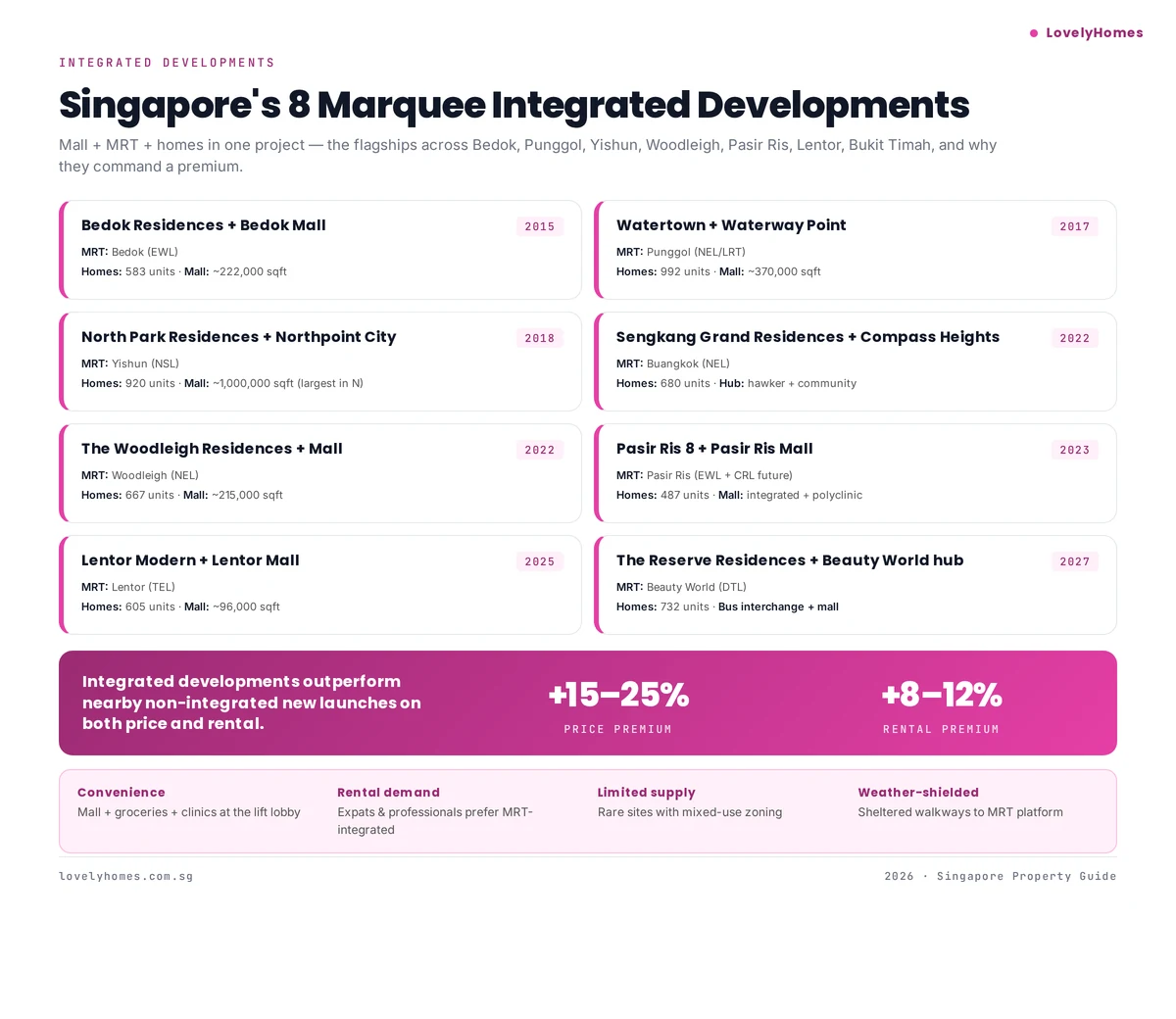
Integrated developments in Singapore combine residences + retail mall + MRT access (often with a bus interchange, hawker centre, or library) in one envelope. There are ~8 marquee examples — Bedok Residences, Watertown, North Park Residences, Sengkang Grand, The Woodleigh Residences, Pasir Ris 8, Lentor Modern, and The Reserve Residences. They command a 15–25% price premium and 8–12% rental premium over nearby non-integrated new launches.

Integrated developments are the closest private-property proxy for “convenience as a lifestyle” in land-scarce Singapore. Mall downstairs, MRT in the basement, hawker centre across the lift lobby — these projects have rewritten what “central” means in Singapore’s outer regions.

This guide covers what defines an integrated development, the eight marquee projects, and whether the price premium is justified. For broader context on new launches in different regions, see our CCR vs RCR vs OCR guide.

Singapore's 8 marquee integrated developments infographic
The 8 flagship integrated developments with price and rental premium data

What qualifies as an integrated development?

The URA definition is a white-site development with mixed uses designed and operated as a single project. In practice, the market label “integrated” requires:

  1. Residences — condominium or executive condo.
  2. Retail mall — usually 100,000+ sqft under the same envelope.
  3. Direct MRT connection — same basement or linked underpass.
  4. Often one or more of: bus interchange, hawker centre, community hub, library, polyclinic.

The 8 marquee integrated developments

Project TOP MRT Homes
Bedok Residences + Bedok Mall 2015 Bedok (EWL) 583
Watertown + Waterway Point 2017 Punggol (NEL) 992
North Park Residences + Northpoint City 2018 Yishun (NSL) 920
Sengkang Grand Residences + Hub 2022 Buangkok (NEL) 680
The Woodleigh Residences + Mall 2022 Woodleigh (NEL) 667
Pasir Ris 8 + Pasir Ris Mall 2023 Pasir Ris (EWL/CRL) 487
Lentor Modern + Lentor Mall 2025 Lentor (TEL) 605
The Reserve Residences + hub 2027 Beauty World (DTL) 732

Why they command a premium

  • Convenience capitalised. Groceries, clinics, dining, MRT, childcare, hawker — all within 150 m of your lift lobby.
  • Rental resilience. Expatriate and local tenants both gravitate to MRT-integrated projects.
  • Weather-shielded commute. Sheltered walkways to MRT platform matter in Singapore’s tropical climate.
  • Limited supply. URA zoning for white-site mixed-use is rare — new sites come infrequently and they’re oversubscribed.
  • Brand identity. Mall anchors (Frasers Property, CapitaLand, Far East) give projects lasting recognition.

The price premium in numbers

Metric Integrated development Nearby non-integrated new launch Premium
Launch PSF S$2,200–2,800 S$1,900–2,300 +15–25%
Rental PSF S$5.0–6.2 S$4.5–5.5 +8–12%
Occupancy (tenanted) ~94% ~89% +5 pp

Who should buy an integrated development

Good fit: dual-income couples with long hours, families with school-age children, investors seeking rental resilience, downsizers wanting walkability and amenity density.

Less ideal: buyers seeking maximum PSF efficiency (you’re paying for convenience), introverts who dislike the tenant churn from rental stock, and buyers requiring higher floor-to-ceiling height or landed-adjacent living.

Upcoming integrated projects to watch

  • The Reserve Residences (Beauty World) — 2027 TOP, 732 homes, bus interchange + mall.
  • Holland Village integrated (rumoured) — planning stage, circa 2030.
  • Jurong East integrated — Jurong Lake District masterplan includes potential mixed-use integrated sites from 2030 onwards.

Frequently asked questions

Are all mixed-use condos integrated developments?

No. Many condos have a convenience shop or small retail podium but lack a full mall and MRT link. The integrated label is reserved for projects with substantial mall + direct MRT.

Do integrated developments have worse privacy?

Mall foot traffic is in the podium; residential lobbies are typically on separate floors with independent lifts. Noise is well controlled in modern buildings. Privacy is comparable to a large mass-market condo.

Which integrated development has the best investment case in 2026?

Hard to generalise — each depends on purchase price vs forward rental. Lentor Modern and The Reserve Residences have infrastructure tailwinds (TEL and DTL + CRL future respectively). Watertown and North Park Residences are proven holdover performers with consistent rental. Always evaluate each case on its specific numbers.

Is the premium worth it?

Historical rental and capital performance say yes for long-term owners. For short-term flippers, the premium eats into returns — the advantage compounds over 10+ years of tenant demand resilience.

Disclaimer

This guide is for general information only. Estate pricing, upcoming launches, MRT opening dates, and masterplan details change over time. Always verify the latest HDB, URA, LTA and MND announcements before making property decisions. LovelyHomes is not a licensed property agent. For personalised advice, please engage a registered CEA agent.


Greater Southern Waterfront: The 2030+ Masterplan Explained (2026)

Greater Southern Waterfront: The 2030+ Masterplan Explained (2026)

QUICK ANSWER

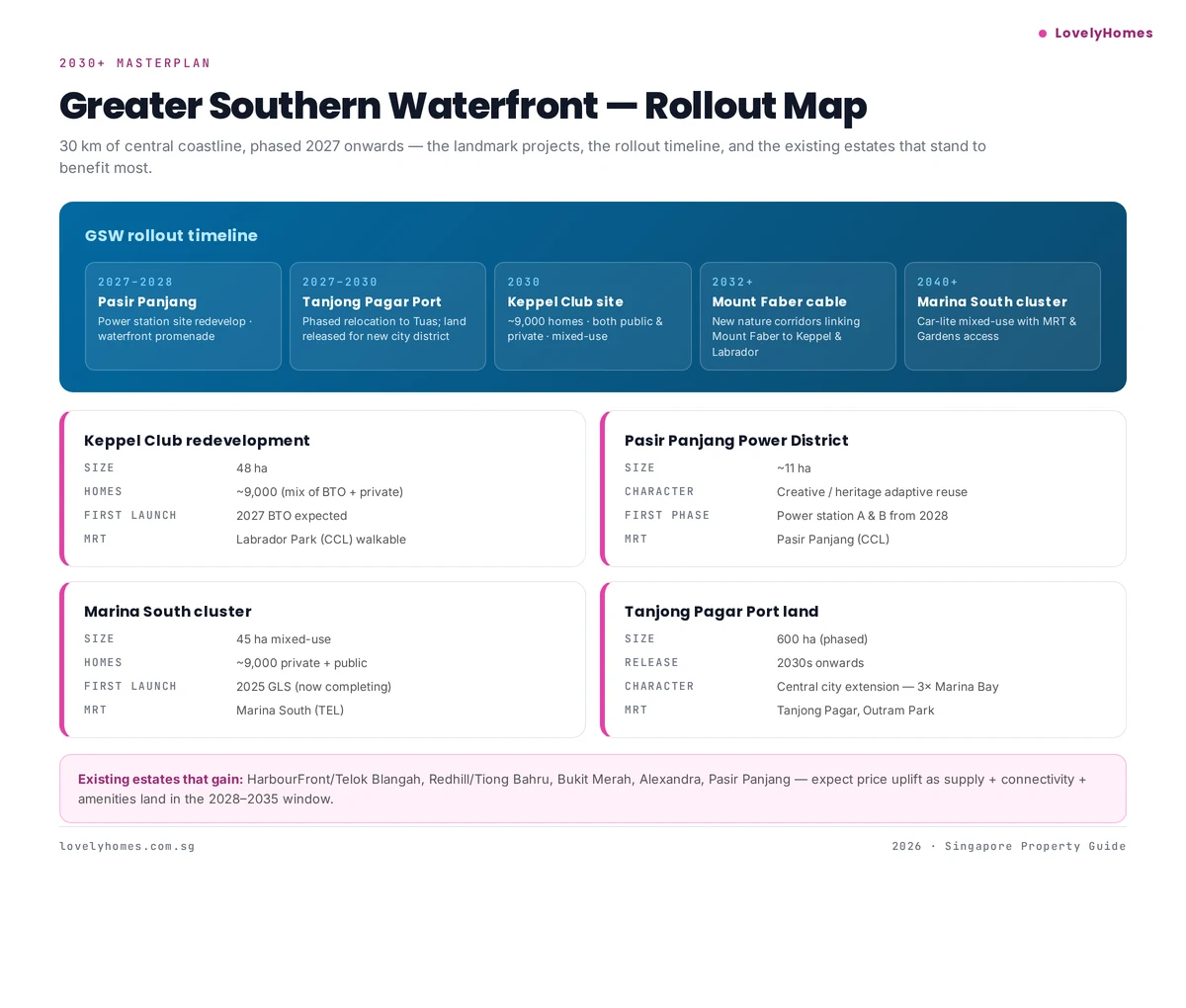
The Greater Southern Waterfront (GSW) is Singapore’s next major urban frontier — 30 km of coastline from Gardens by the Bay to Pasir Panjang, freed up by the Tanjong Pagar port relocation to Tuas (by 2027). ~2,000 ha will be released over 20–30 years, with Keppel Club redevelopment (9,000 homes, 2027+), Pasir Panjang power district (2028+), and the Marina South cluster (2025+ launches) the early anchors.

The GSW was first announced in the 2013 Land Use Plan and firmed up through successive URA Master Plans. It represents Singapore’s biggest redevelopment opportunity outside Marina Bay — about three times the land area of Marina Bay, and stretches along the entire central south coast. This guide covers the projects, timelines, and which existing estates stand to benefit most.

For broader market context, see our Singapore property market outlook 2026.

Greater Southern Waterfront rollout timeline and projects infographic
GSW rollout phases and the marquee projects per phase

Why the GSW exists

The driver is port relocation. Tanjong Pagar, Keppel, Pulau Brani, and Pasir Panjang container terminals are consolidating at Tuas Mega Port, which opens in phases from 2021 and completes by 2040. When Tanjong Pagar’s lease expires in 2027, about 325 hectares of prime central land is freed, plus another 600 ha as Pasir Panjang terminals phase out.

This land is the closest large redevelopment opportunity to the CBD. URA’s stated intent is a mix of residential, commercial, leisure, and nature — a “live-work-play-learn” district spanning the south coast.

The rollout timeline

Phase Timeline Focus
Phase 1 2025–2030 Marina South, Keppel Club, Pasir Panjang Power District
Phase 2 2030–2040 Tanjong Pagar port land, Keppel Terminal, integrated waterfront
Phase 3 2040+ Sentosa-Pulau Brani integration, Marina South expansion

The anchor projects

Keppel Club redevelopment (~2027+)

Keppel Club’s lease was not renewed; its 48-hectare site will deliver ~9,000 homes (mix of public and private), plus community and retail amenities. First BTO launches expected from 2027. The site is walkable to Labrador Park MRT (CCL).

Marina South cluster (2025+)

URA Government Land Sales launched Marina South plots from 2023. The district is planned as car-lite, with ~9,000 homes and mixed-use nodes. The Marina South MRT station (TEL) opened in 2022, anchoring access. Early private launches are already trading around S$2,500–S$2,800 PSF.

Pasir Panjang Power District (2028+)

The old Pasir Panjang “A” and “B” Power Stations will be adaptively reused as a creative and heritage district. Complementary uses include arts spaces, offices, dining, and retail. Pasir Panjang MRT (CCL) serves the site.

Tanjong Pagar port land (2030s+)

The largest phase — 325 ha released in the early 2030s, with comprehensive planning still underway. Expected to include major residential, commercial, leisure, and waterfront green spaces, anchored by Tanjong Pagar MRT (EWL).

Which existing estates benefit

  • HarbourFront / Telok Blangah — best early beneficiary, adjacent to Keppel Club and VivoCity, on the CCL.
  • Redhill / Tiong Bahru — direct access to the GSW corridor via EWL; property values already reflect partial uplift.
  • Bukit Merah — en bloc redevelopment activity is picking up; close to future GSW homes and offices.
  • Alexandra — commercial office supply will deepen; rental demand expected to rise.
  • Pasir Panjang — direct vicinity of Power District; landed property has already risen significantly.

What this means for buyers

GSW exposure isn’t a short-term play. The phases are 15+ years out, and the property market in Singapore is cyclical — don’t overpay for an asset expecting linear GSW-premium capture. The best approach is:

  1. Buy fundamentally sound property within 1–2 MRT stops of a confirmed GSW node.
  2. Hold 10+ years to ride multiple launches and infrastructure openings.
  3. Watch for new launches in Keppel Club (2027–2028) and Marina South (ongoing) — these could be early-cycle buys.

Frequently asked questions

When will I see GSW flats launched?

Keppel Club BTOs are expected from 2027. Marina South private condo GLS are already live. Major Tanjong Pagar land parcels come online early 2030s.

Is Sentosa part of GSW?

Sentosa and Pulau Brani will be integrated with the GSW vision in later phases (~2040+), with upgraded leisure, residential, and transport links.

Should I buy now to get GSW uplift?

GSW is a 20–30 year programme — buying specifically for the uplift requires long holding periods. If you’re buying to live AND benefit from GSW, HarbourFront, Telok Blangah, Redhill, Tiong Bahru, and Bukit Merah are reasonable targets. Always assess each property on its own merits — amenity, layout, tenure — not just masterplan exposure.

Disclaimer

This guide is for general information only. Estate pricing, upcoming launches, MRT opening dates, and masterplan details change over time. Always verify the latest HDB, URA, LTA and MND announcements before making property decisions. LovelyHomes is not a licensed property agent. For personalised advice, please engage a registered CEA agent.


Translate »