Singapore Property Rental Income Tax Guide 2026: IRAS Deductions, Rates and How to File

Singapore Property Rental Income Tax Guide 2026: IRAS Deductions, Rates and How to File

Quick Answer: Singapore Rental Income Tax 2026

  • All rental income from Singapore property is taxable under the Income Tax Act (Cap 134), administered by IRAS.
  • You may deduct allowable expenses — mortgage interest, property tax, fire insurance, routine repairs, agent fees — to arrive at net taxable rental income.
  • Capital costs cannot be deducted — no claims for renovations, major upgrades, furniture depreciation, or loan principal repayments.
  • Tax is levied at personal income tax rates — Singapore tax-resident rates (0–24%) apply; non-residents pay a flat 22% on net rental income.
  • Filing deadline: 18 April annually — declare via myTax Portal; IRAS auto-includes known data where available.
  • Late filing or non-declaration attracts penalties — up to 200% of tax undercharged plus potential prosecution under s.96 Income Tax Act.
  • HDB flat rental has slightly different rules — HDB room rental income is also taxable but sub-let approval and NCQ limits still apply (see our HDB Room Rental Guide 2026).

Owning an investment property in Singapore comes with one certainty beyond market cycles: your rental income is taxable. Whether you own a one-bedroom condominium in Tiong Bahru, a shophouse unit in Tanjong Pagar, or a landed property in Upper Bukit Timah that you lease out whilst residing abroad, the Inland Revenue Authority of Singapore (IRAS) expects you to declare that rental income each year.

Yet many Singapore landlords — especially first-time investors who upgraded from an HDB flat — under-declare or over-pay because they misunderstand which deductions IRAS allows. This guide sets out the complete picture: what qualifies as rental income, which expenses are deductible, how the tax is calculated, and how to file correctly by 18 April each year.

What Counts as Rental Income in Singapore?

Under section 10(1)(f) of the Income Tax Act, rental income includes all amounts received or receivable by a person in respect of the letting of any property located in Singapore. This covers:

  • Gross rent — the monthly or annual sum paid by your tenant under the tenancy agreement.
  • Lease premiums — any upfront lump-sum payment to secure the tenancy is spread over the lease term and taxed proportionately.
  • Furniture and fittings rent — if your tenancy agreement splits the total into “base rent” and a “furniture allowance”, both components are taxable rental income.
  • Reimbursed expenses — if your tenant pays your utility bills or property tax and these are included in the rent, the gross amount is your rental income (before the deduction).
  • Compensation for early termination — amounts received from tenants for breaking a tenancy early are treated as rental income for the period the tenancy was broken.

Rental income from overseas property is generally not taxable in Singapore (as Singapore uses a territorial tax system), provided the funds are not remitted into Singapore. From 1 January 2024, certain foreign-sourced income remitted to Singapore by individuals is taxable; consult a licensed tax adviser if you hold overseas investment property.
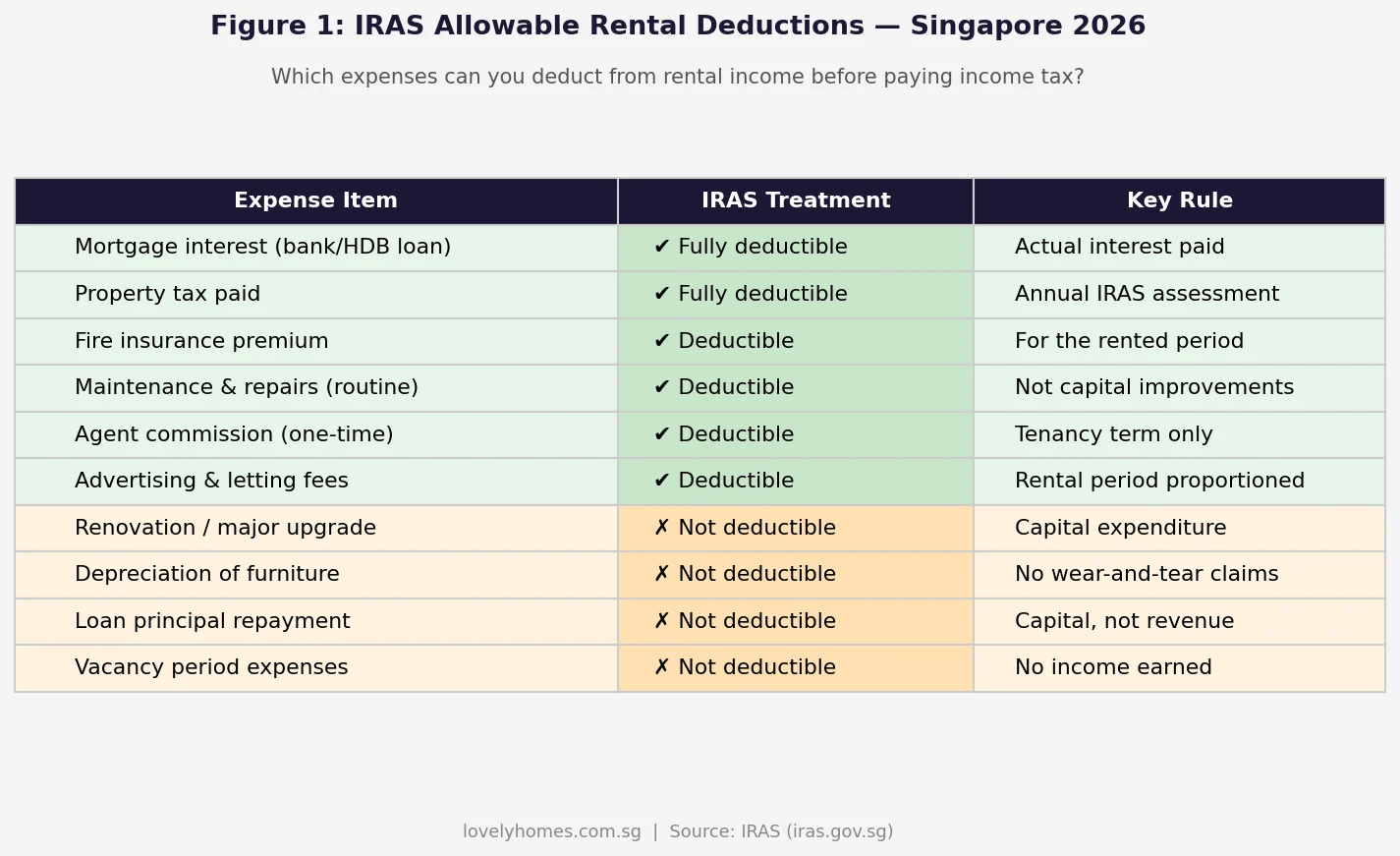
IRAS allowable rental deductions Singapore 2026 table showing mortgage interest property tax maintenance fees as deductible and renovation loan principal as non-deductible
Figure 1: IRAS Allowable vs Non-Allowable Rental Deductions — Singapore 2026. Source: IRAS (iras.gov.sg)

Allowable Deductions: What You Can Claim Against Rental Income

IRAS allows landlords to deduct expenses that are wholly and exclusively incurred in the production of rental income and are revenue in nature (not capital). The following are the main allowable deductions in 2026:

1. Mortgage Interest

The interest portion of your monthly bank or HDB loan repayment is fully deductible. Only the interest element qualifies — loan principal repayments are capital and cannot be deducted. If you have a floating-rate loan, use the actual interest charged each year. Most banks issue an annual statement splitting principal and interest for your records.

2. Property Tax

Annual property tax paid to IRAS on the investment property is deductible. Note: you are claiming the tax as an expense against rental income — this is separate from your residential property tax obligation on your own home. The deduction is for the property tax assessed on the rented property for the year.

3. Fire Insurance Premium

Fire insurance premiums covering the property during the rental period are allowable. If your policy covers a period spanning two tax years (e.g., July 2025 to July 2026), apportion the premium to the relevant year.

4. Routine Maintenance and Repairs

Costs of maintaining the property in its existing condition — plumbing repairs, repainting, replacing faulty fixtures — are deductible. Improvements that enhance the property’s value or extend its life (a new built-in wardrobe, a replacement air-conditioning system that upgrades the previous one) are capital expenditure and not deductible.

5. Agent Commission and Advertising

Letting fees paid to a licensed property agent, including a one-time commission upon signing the tenancy agreement, are deductible. Advertising costs (online listings, print advertisements) for finding tenants are similarly allowable. These are expenses incurred in earning the rental income.

6. Legal Fees for Tenancy

Solicitor’s fees for drafting or reviewing a tenancy agreement are deductible. Legal costs for acquiring or disposing of the property are capital and not deductible.

What You Cannot Deduct

IRAS explicitly disallows: renovation costs, capital improvements, furniture and fittings depreciation (Singapore has no wear-and-tear allowance for residential property), loan principal repayments, mortgage protection insurance premiums, costs incurred during vacancy periods when no rent is being earned, and any expense that is not wholly connected to earning the rental income.

How Singapore Income Tax Applies to Rental Income

Rental income does not attract a separate tax — it is added to your other assessable income (employment income, trade income, director’s fees) and taxed at your marginal personal income tax rate under the resident progressive rate schedule, effective Year of Assessment (YA) 2024 onwards:

Chargeable Income (SGD) Rate on Band Cumulative Tax
First $20,000 0% $0
Next $10,000 ($20K–$30K) 2% $200
Next $10,000 ($30K–$40K) 3.5% $550
Next $40,000 ($40K–$80K) 7% $3,350
Next $40,000 ($80K–$120K) 11.5% $7,950
Next $40,000 ($120K–$160K) 15% $13,950
Next $40,000 ($160K–$200K) 18% $21,150
Next $40,000 ($200K–$240K) 19% $28,750
Next $40,000 ($240K–$280K) 19.5% $36,550
Next $40,000 ($280K–$320K) 20% $44,550
Above $320,000 22% – 24% progressive

Non-resident landlords pay a flat 22% on net rental income with no personal reliefs available. This applies to individuals not ordinarily resident in Singapore for 183 days or more in the relevant year. Non-residents must also file a Singapore tax return and may be required to appoint a local tax agent.
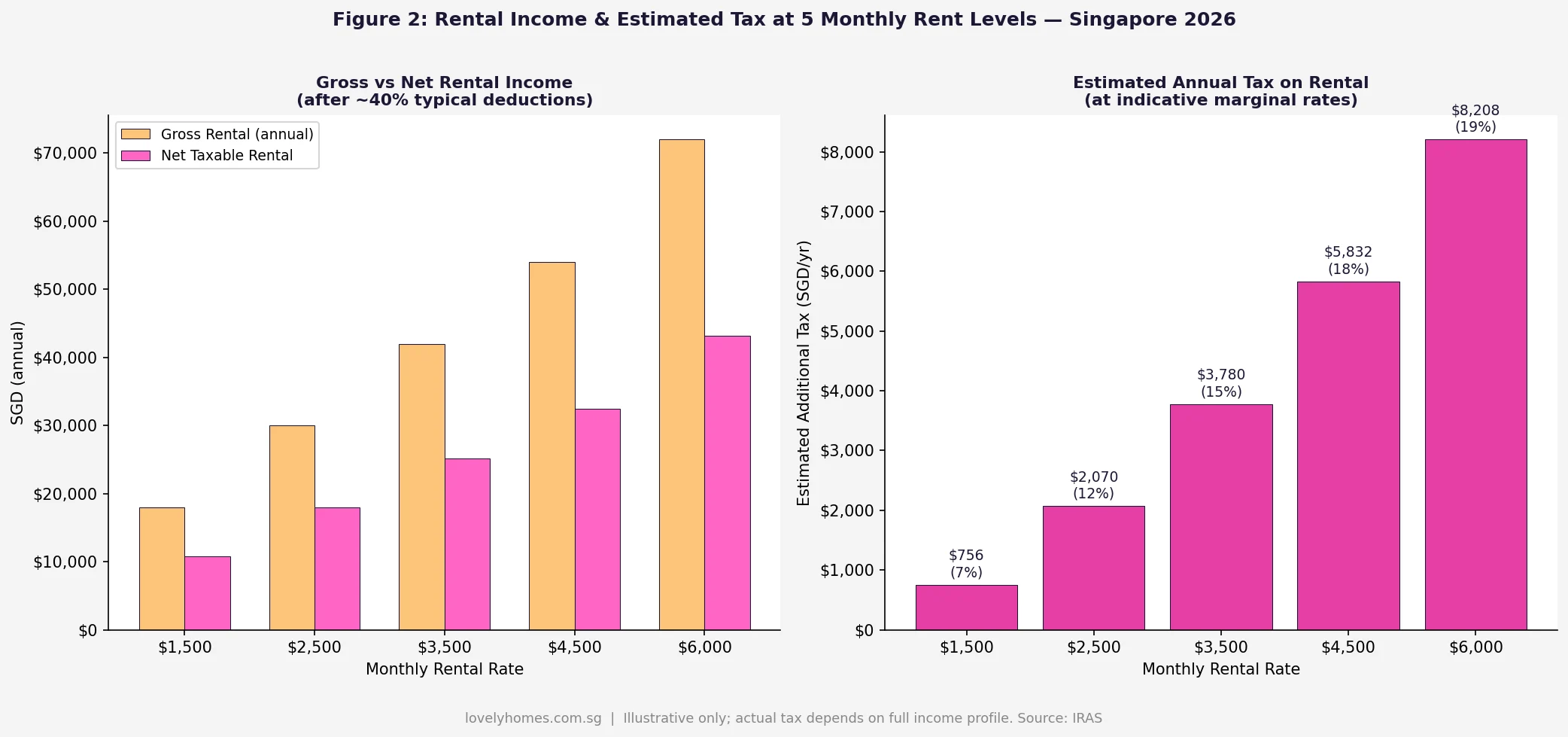
Rental income estimated annual tax at five monthly rent levels Singapore 2026 IRAS income tax
Figure 2: Gross vs Net Rental Income and Estimated Annual Income Tax at Five Monthly Rent Levels — Singapore 2026. Illustrative only; actual tax depends on your total chargeable income profile.

Worked Example: Renting Out a Private Condo in 2026

The Wong family — Singapore Citizens, joint owners of a 2-bedroom condominium in Kallang. Gross monthly rent: $3,200. Mr Wong earns $9,500/mth in employment income.

Item Amount
Gross annual rent (Jan–Dec 2025) $38,400
Less: Mortgage interest (POSB Home Loan statement) ($9,600)
Less: Annual property tax (non-owner-occupied) ($3,200)
Less: Fire insurance premium ($520)
Less: Routine maintenance / A/C servicing / plumbing ($1,100)
Less: Agent commission (1 month’s rent) ($3,200)
Net taxable rental income (YA 2026) $20,780
Mr Wong’s employment income (declared separately) $114,000
Total chargeable income (after personal reliefs ~$37,000) ~$97,780
Incremental tax on rental income at ~11.5% marginal rate ~$2,389/yr
Net rental income after tax (monthly) ~$1,516/mth

Key takeaway: after deductions and tax, Mr Wong nets approximately $1,516 per month from the $3,200 gross rent. This is not a criticism of property investment — the capital appreciation on the condo adds significantly to total returns — but it illustrates why landlords who model only gross rent make poor investment decisions.

How to File: IRAS myTax Portal Step by Step
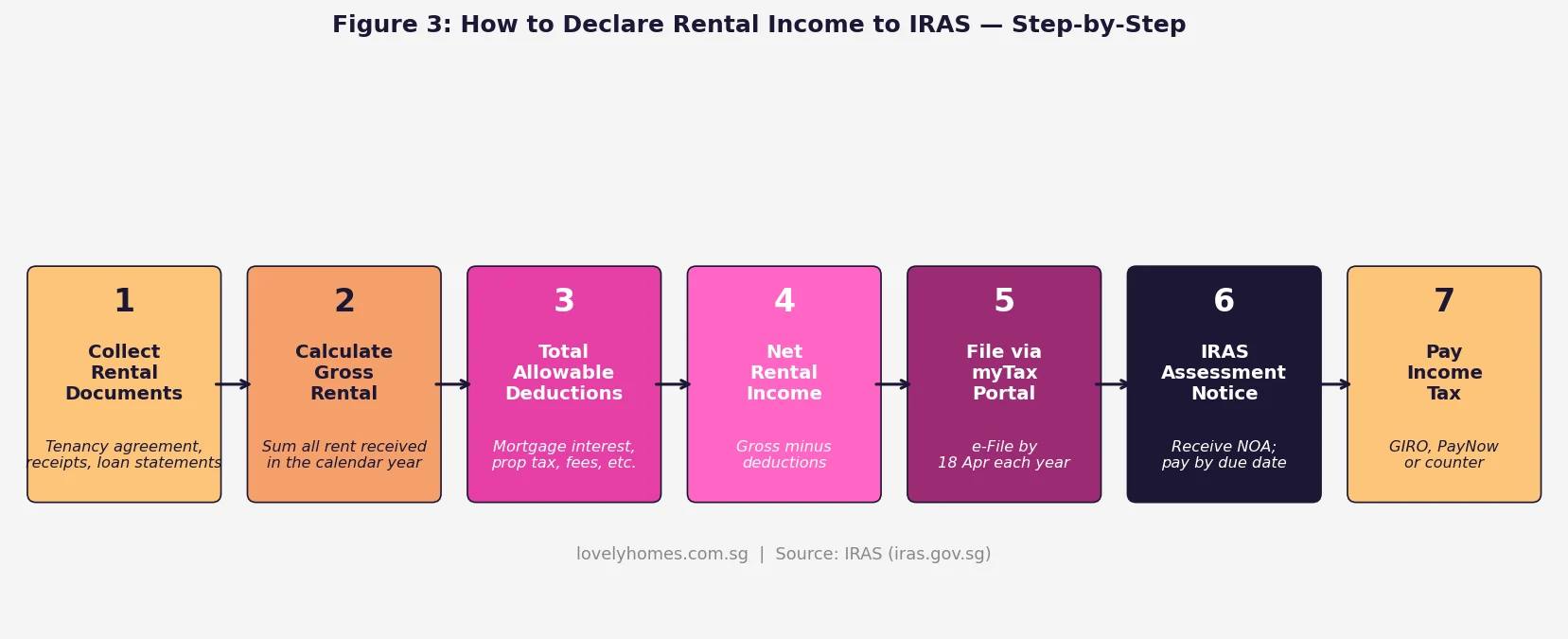
How to declare rental income to IRAS Singapore 2026 step by step myTax Portal filing process
Figure 3: Rental Income Tax Filing Process — Seven Steps from Documents to Tax Payment, Singapore 2026. Source: IRAS

IRAS auto-populates most employment income figures via the Auto-Inclusion Scheme (AIS), but rental income is not auto-included — landlords must declare it manually. The process in practice:

  1. Gather your documents by January of the filing year: tenancy agreement, bank loan annual statement (splitting principal and interest), IRAS property tax assessment, insurance policy, receipts for maintenance and agent fees.
  2. Log in to myTax Portal at mytax.iras.gov.sg using Singpass MFA.
  3. Navigate to “File Individual Income Tax (Form B1)” (for employees with rental income) or Form B (for self-employed) — complete the rental income section under “Other Income”.
  4. Enter gross rental income and each allowable deduction separately. IRAS will compute net rental income automatically.
  5. Submit by 18 April (e-filing; paper returns are due 15 April).
  6. Receive your Notice of Assessment (NOA) by post or via myTax Portal. Review for accuracy — you have 30 days from the NOA date to object if there is an error.
  7. Pay by the due date on the NOA — via GIRO, PayNow, internet banking, or at AXS/SingPost counters.

Tip: IRAS’s Rental Relief Framework introduced during the COVID-19 period (2020–2021) has fully expired. No rental income relief is available in YA 2026 under COVID measures.

Why Rental Income Tax Matters for Singapore Property Investors

Singapore has relatively low income tax rates compared with most developed markets — the top marginal rate of 24% (above $1M) is far below the UK’s 45%, Australia’s 47%, or Hong Kong’s 17% salaries tax. Even at the 15–18% band that most mid-income investors land in, the after-tax rental yield for a well-located condo is typically positive. However, failing to account for IRAS obligations when underwriting a property purchase leads to three common errors:

  • Overestimating net yield — a $3,200/mth gross rent may look like a 3.2% yield on a $1.2M property, but after allowable deductions and tax, the true cash yield is closer to 1.8–2.2%.
  • Missing deductions — many landlords forget to claim mortgage interest (the largest deductible item) because they use CPF OA funds for repayment and assume no cash changes hands. IRAS allows the interest deduction regardless of whether the repayment comes from CPF or cash.
  • Commingling ABSD strategy with tax strategy — if you held your HDB flat and purchased a condo (20% ABSD, with remission on HDB sale within 6 months), you must still declare rental income on the condo during the period you hold both properties. The ABSD framework and the rental income tax regime are entirely separate systems administered by different IRAS divisions.

For investors holding multiple properties, maintaining a separate rental income tracker for each property and reconciling it quarterly against bank statements is strongly recommended. This significantly simplifies April filing.

What Might Come Next: Rental Income Tax Outlook

The following is forward-looking speculation based on publicly available commentary and budget signals — it does not constitute tax advice.

IRAS has signalled no changes to the rental income tax framework for YA 2026 or YA 2027. However, two areas bear watching:

  • Foreign-sourced income changes: Following the 2022 changes that brought certain foreign passive income (dividends, interest) into the Singapore tax net when remitted, there is ongoing policy debate about whether foreign rental income should similarly be taxable upon remittance. As at June 2026, rental income from overseas properties remains outside Singapore’s tax net if not remitted, but high-net-worth landlords with overseas portfolios should monitor any Budget 2027 announcements.
  • Non-owner-occupied property tax alignment: The graduated non-owner-occupied property tax rates (10–20%, increased in 2023) may be reviewed in future budgets to further discourage speculative holding. Higher property tax would paradoxically increase allowable deductions for landlords, but would also compress investment yields.
  • Platform reporting: IRAS has been expanding its data-matching capabilities via MAS and regulatory partnerships. Rental income declared through platforms like 99.co, PropertyGuru, and Airbnb may eventually be subject to third-party reporting obligations similar to the GST framework for digital services.

Rental Income Tax in Context: Singapore vs Regional Peers

Singapore’s approach to taxing rental income is broadly aligned with other developed economies, but its relatively modest rates and clear deduction framework make it more landlord-friendly than most. In Malaysia, rental income above RM70,000 is taxed at 24%; in Australia, negative gearing laws allow interest losses to offset other income but the effective capital gains tax erodes returns on sale; in Hong Kong, property tax is levied as a flat 15% on net rental income (gross rent less 20% statutory allowance) regardless of actual expenses. Singapore’s expense-based deduction regime — whilst requiring more documentation — is generally more accurate and beneficial for highly leveraged investors with large mortgage interest deductions.

Frequently Asked Questions: Rental Income Tax Singapore 2026

Can I claim mortgage interest if I use CPF OA to pay my loan?

Yes. IRAS allows the deduction of mortgage interest regardless of whether you use CPF Ordinary Account funds or cash to service your loan repayments. You can obtain the annual mortgage interest figure from your bank’s annual statement or CPF Board’s online portal. Only the interest portion is deductible — not the principal reduction.

What if my property is vacant for part of the year? Can I still claim expenses?

Only expenses incurred during periods when the property is genuinely available for rent can be claimed. If the property is vacant between tenancies whilst you are actively seeking a new tenant, IRAS generally accepts a proportionate deduction. However, if the property is vacant because you are using it personally, renovating it, or simply leaving it idle, expenses during that period are not deductible. Keep records of advertising and agent correspondence to demonstrate active letting intent during vacancy.

Is rental income taxed if I rent out a room in my HDB flat?

Yes — all rental income from HDB flats and private property is taxable. For HDB flat room rentals, you must obtain HDB’s approval to sub-let, comply with the Non-Citizen Quota (NCQ), and declare the rental income to IRAS annually. You may deduct a proportionate share of allowable expenses (interest, property tax) corresponding to the rented portion. See our Singapore HDB Room Rental Guide 2026 for the full framework including NCQ limits and approval conditions.

Can I deduct renovation costs from rental income?

No. Renovation and improvement costs are capital expenditure and are not deductible against rental income under Singapore tax law. This applies even if the renovation was undertaken specifically to attract higher-paying tenants. IRAS distinguishes between revenue expenditure (maintaining the property in its existing state) and capital expenditure (enhancing or extending the property). Routine maintenance such as repainting, replacing like-for-like fixtures, and servicing appliances qualifies as revenue expenditure and is deductible; a full kitchen overhaul or bathroom extension does not.

What penalties apply if I under-declare rental income?

Under section 94 of the Income Tax Act, omitting income from a tax return without reasonable excuse attracts a penalty of twice the tax undercharged (200% penalty). Fraudulent under-declaration under section 96 can result in up to treble the tax undercharged plus a fine of up to $10,000 and imprisonment. IRAS has access to HDB records, URA caveats, and banking data — undeclared rental income identified through these channels is aggressively pursued. The most cost-effective approach is voluntary compliance and accurate declaration.

How does IRAS treat short-term rentals (e.g., Airbnb / serviced apartments)?

Short-term accommodation of private residential property — rentals shorter than three consecutive months per tenant — is generally not permitted under the Planning Act without URA approval, and HDB flats may not be sub-let on a short-term basis at all. Where such rentals are authorised (typically in government-approved short-stay projects), the income is taxable as rental income under the Income Tax Act. Platforms that facilitate short-stay bookings may be subject to IRAS data-matching. Unauthorised short-term rentals carry planning enforcement risk in addition to tax exposure.

Do joint owners each declare their share of rental income separately?

Yes. If a property is jointly owned, rental income and deductible expenses are allocated to each owner in proportion to their beneficial interest (ordinarily 50:50 for joint tenants, or as specified in a tenancy-in-common arrangement). Each owner declares their respective share independently in their personal income tax return. There is no joint filing option for property rental in Singapore. In practice, joint owner couples often find this beneficial if one spouse is in a lower tax bracket — the aggregate tax burden may be lower than if only the higher-earner declared the full rental income.

Disclaimer: This guide is for general educational purposes only and does not constitute tax, financial, or legal advice. Singapore tax law is subject to change; rates and rules above reflect the position as at June 2026. For specific advice on your rental income tax obligations, consult a qualified tax adviser or accredited tax practitioner (ATP) registered with IRAS. Official resources: iras.gov.sg, IRAS Rental Income and Expenses page.
×

Click anywhere or press Esc to close
Singapore EC Resale Guide 2026: Complete Guide to Buying an Executive Condominium Resale

Singapore EC Resale Guide 2026: Complete Guide to Buying an Executive Condominium Resale

Quick Answer: Singapore EC Resale 2026

  • ECs are a hybrid housing class — built by private developers but subject to HDB eligibility rules for the first 10 years. After 10 years from completion, they are fully privatised and open to all buyers including foreigners.
  • 5-year MOP before you can sell in the open market (to Singapore Citizens and PRs only). 10 years before foreigners may buy.
  • No HDB loan for EC resale — bank loan only, regardless of citizenship. CPF OA funds are available for SC and SPR buyers.
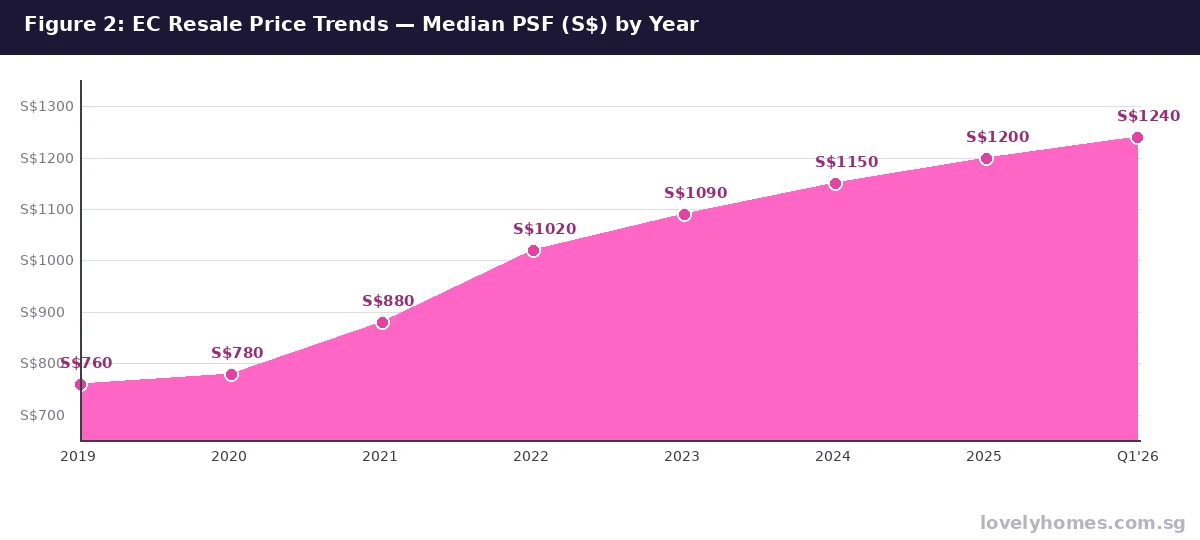
  • EC resale prices averaged S$1,200–S$1,240 per square foot (PSF) in Q1 2026, up from S$760 PSF in 2019 — a 63% increase over 7 years.
  • ABSD applies to EC resale purchases for 2nd-and-above properties; SC first-property buyers pay 0% ABSD even within the 5-to-10-year window.
  • No income ceiling for resale EC buyers — income limits only apply to new EC applications.
  • The Ethnic Integration Policy (EIP) applies to EC resale within the 5-to-10-year window (before full privatisation).
  • CPF withdrawal limits and the Withdrawal Limit (WL) / Valuation Limit (VL) framework apply to EC resale purchases the same way they do for private condos.

What Is an Executive Condominium and Who Administers EC Resale?

The Executive Condominium (EC) is a uniquely Singaporean housing class — sometimes called a “sandwich-class” product — built by private developers on land sold by the Housing and Development Board (HDB) at subsidised prices. ECs look identical to private condominiums from the outside, with full condo facilities (swimming pool, gymnasium, BBQ pits, guard house), but they carry a set of HDB-derived restrictions during the first decade of their existence.

HDB administers EC eligibility rules under the Housing and Development (Executive Condominium Housing Scheme) Act 1996 (Cap 129A). The Urban Redevelopment Authority (URA) tracks EC transaction data and publishes quarterly resale price statistics. The Inland Revenue Authority of Singapore (IRAS) administers stamp duties on EC resale transactions — Buyer’s Stamp Duty (BSD), Additional Buyer’s Stamp Duty (ABSD), and Seller’s Stamp Duty (SSD where applicable). This guide reflects rules as at June 2026.

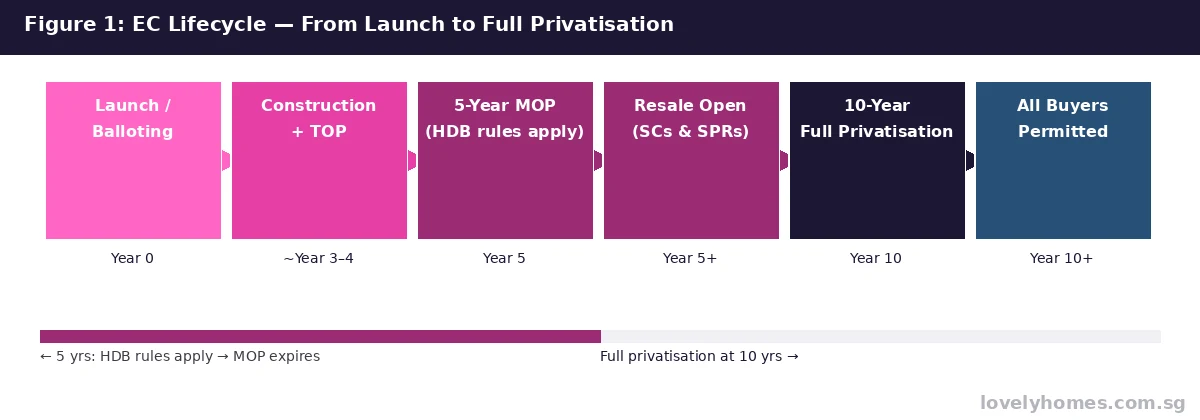
Singapore EC executive condominium lifecycle from launch to full privatisation 5 year MOP 10 year
Figure 1: The EC lifecycle — from HDB-controlled launch to full privatisation at year 10. The resale window opens at the 5-year MOP mark.

EC Resale: The Two Distinct Windows

Understanding the timeline is essential because EC resale operates under fundamentally different rules depending on when you buy:

Window 1 — After 5-Year MOP, Before 10-Year Full Privatisation

Once the EC’s 5-year MOP has been served (calculated from the date of the Temporary Occupation Permit, not key collection), the original HDB-scheme owner may sell to Singapore Citizens or Singapore Permanent Residents in the open market. During this window, HDB eligibility restrictions still apply:

  • Eligible buyers: Singapore Citizens and Singapore PRs only (foreigners cannot buy).
  • The Ethnic Integration Policy (EIP) applies — buyers must comply with the ethnic quota for the block and neighbourhood.
  • No income ceiling applies to resale buyers (income limits are only for new EC applicants).
  • Bank loan only — HDB loans are not available for any EC purchase, new or resale.

Window 2 — After 10-Year Full Privatisation

After 10 years from the EC’s completion (TOP date), the development is fully privatised and HDB restrictions are lifted entirely. From this point, the EC is treated identically to any private condominium for all purposes:

  • Eligible buyers: Singapore Citizens, Singapore PRs, foreigners, and companies.
  • No EIP applies.
  • ABSD at full private condo rates applies to foreigners (60% from February 2023).
  • Seller’s Stamp Duty (SSD) obligations for original buyers were served under private-condo rules.

EC Resale Price Trends 2019–2026

Singapore EC resale price trends median PSF 2019 to Q1 2026
Figure 2: EC resale median transacted price per square foot (PSF) 2019–Q1 2026. Prices rose 63% from S$760 PSF to S$1,240 PSF over seven years.

EC resale prices have outperformed many market segments over the post-COVID recovery and tightening cycle. The key drivers of EC resale price appreciation include:

  • Supply scarcity: EC launches are far fewer in number than HDB BTO launches, and the total stock of ECs is limited. With only a handful of projects entering the resale window each year, demand consistently outpaces supply.
  • Upgrader demand: ECs appeal primarily to HDB upgraders — households who have served their HDB MOP and are looking to move into condo-style living at a price point below new private launches. This demand is structural and persistent.
  • Location quality: Most ECs are sited in mature or established towns (Tampines, Sengkang, Jurong, Woodlands) with good MRT and bus connectivity, making them attractive as primary residences rather than pure investment plays.
  • No income ceiling at resale: Resale buyers face no income ceiling, unlike new EC applicants who are capped at S$16,000/month household income. This broadens the resale buyer pool considerably.

As at Q1 2026, industry figures show median EC resale prices at approximately S$1,200–S$1,240 PSF, with some mature-estate ECs transacting above S$1,400 PSF. This compares to typical new EC launch prices of S$1,350–S$1,500 PSF — meaning a well-located resale EC is often priced comparably to a new launch, but with the benefit of knowing the actual unit and finished state.

Eligibility, Restrictions and Stamp Duties

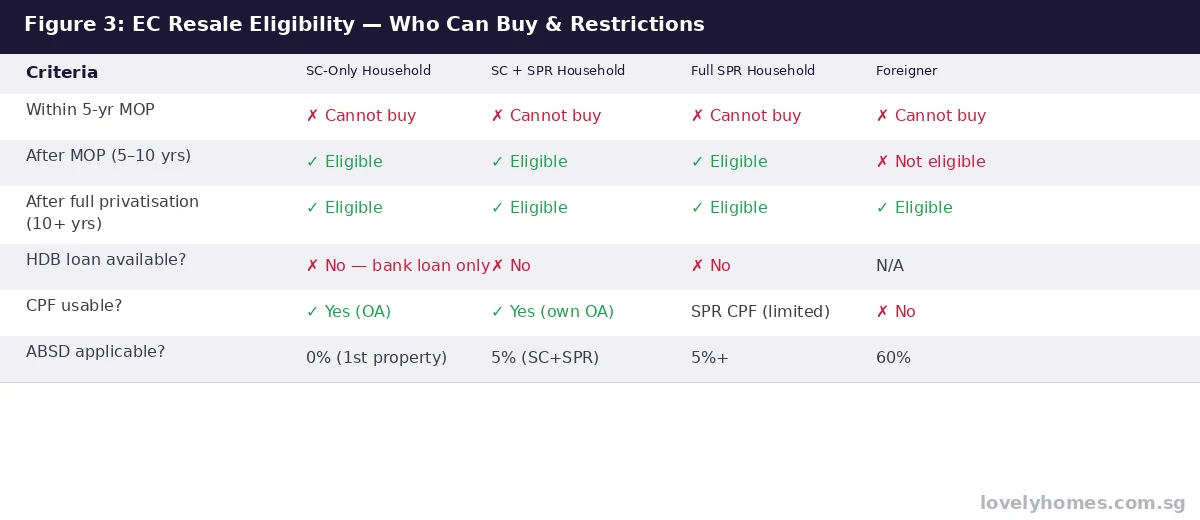
Singapore EC resale eligibility who can buy SC SPR foreigner MOP rules 2026
Figure 3: EC resale eligibility by buyer category and timing window — from MOP to full privatisation.
Buyer Profile 5–10 Yr Window After 10 Yrs ABSD (1st Property SC) ABSD (2nd Property SC)
SC only household Eligible Eligible 0% 20%
SC + SPR household Eligible Eligible 5% (on full purchase price) 20%+ (SC rate applies)
Full SPR household Eligible Eligible 5% 30%
Foreigner Not eligible Eligible 60% 60%
Singapore company Not eligible Eligible 35% 35%

Buyer’s Stamp Duty (BSD)

BSD applies to all EC resale purchases at the standard residential rates: 1% on the first S$180,000, 2% on the next S$180,000, 3% on the next S$640,000, 4% on the next S$500,000, 5% on the next S$1,500,000, and 6% on the remainder above S$3,000,000. BSD is administered by IRAS and must be paid within 14 days of the date of acceptance of the Option to Purchase (OTP).

CPF and Loan Rules

Bank loan only — HDB loans are not available for any EC purchase, including resale. The maximum Loan-to-Value (LTV) ratio is 75% of the property value (or purchase price, whichever is lower) for a first housing loan from a bank, subject to the Mortgage Servicing Ratio (MSR) of 30% of gross monthly income and the Total Debt Servicing Ratio (TDSR) of 55%, both administered by the Monetary Authority of Singapore (MAS).

CPF Ordinary Account (OA) funds may be used to service the loan and pay the downpayment for SC and SPR buyers, subject to the CPF Withdrawal Limit (WL) and Valuation Limit (VL) rules. Once CPF withdrawals hit the VL (equal to the lower of the purchase price or valuation), further withdrawal requires the property’s remaining lease to cover the youngest buyer to age 95.

The Resale Process: From OTP to Keys

The EC resale process is broadly similar to a private condominium resale and is governed by the Conveyancing and Law of Property Act (Cap 61) and standard Law Society of Singapore conditions of sale. Key milestones include:

Step Timeline Key Actions
1. Option to Purchase (OTP) Day 0 Seller grants OTP; buyer pays 1% option fee (typically). OTP is valid 14 days.
2. Exercise OTP Day 7–14 Buyer exercises OTP, pays 4% exercise fee (cash); BSD due within 14 days of exercise.
3. HDB resale checklist (if applicable) Day 7–14 Required if seller is an original HDB-scheme EC owner within the 5–10 year window.
4. Engage solicitors Day 7–21 Both parties engage conveyancing solicitors (same firm only with conflict-of-interest waiver).
5. Secure bank loan & CPF approval Week 2–6 Letter of Offer from bank; CPF OA withdrawal letter of authority.
6. Completion Week 8–12 Balance purchase price paid; keys handed over; SLA caveat registered.

Worked Example: The Lim Family, EC Resale in Sengkang

Mr and Mrs Lim are Singapore Citizens with a combined gross income of S$14,000/month. They are currently in HDB MOP (completed in March 2026) and are looking to upgrade to a 4-bedroom EC resale unit in Sengkang priced at S$1,480,000. The EC obtained its TOP in 2019 and has been in its resale window since 2024.

Stamp duties:

  • BSD: 1% x S$180,000 = S$1,800 + 2% x S$180,000 = S$3,600 + 3% x S$640,000 = S$19,200 + 4% x S$480,000 = S$19,200 = S$43,800
  • ABSD: 0% — SC household, first property (HDB sold simultaneously with EC purchase, remission applied)
  • Total stamp duties: S$43,800

Financing:

  • Bank loan: 75% LTV = S$1,110,000 (bank offers S$1,110,000 at 3.1% for 25 years)
  • Monthly instalment: approximately S$5,324/month; MSR = 38.0% — EXCEEDS 30% MSR cap
  • MSR adjustment: Maximum loan at 30% MSR = S$4,200/month. Reverse-engineer loan: approximately S$878,500 at 3.1% for 25 years.
  • Revised LTV: S$878,500 / S$1,480,000 = 59.4%. Downpayment: S$601,500 (5% cash S$74,000 + 20% CPF/cash S$226,000 + additional S$301,500).

Note: The Lims should explore a 30-year tenure — at 3.1% for 30 years, S$1,110,000 = approximately S$4,740/month (MSR 33.9%, still above cap). Even at 30 years, the MSR constraint limits their borrowing. The EC at S$1,480,000 may be at the upper end of their budget. A S$1,300,000 unit would produce MSR of ~30.0% (just within cap) at 30 years, making it the comfortable maximum.

Why ECs Represent a Compelling Upgrader Proposition

From a financial-planning perspective, ECs offer something private condominiums typically do not: the ability to tap CPF housing grants at the new-launch stage (up to S$30,000 for first-timer families), combined with private condo facilities and a historically strong resale trajectory. The “wait and see” option that many HDB upgraders exercise — waiting for EC resale after MOP rather than committing to new private — reflects the consensus that EC resale offers better value-for-money than a new private launch of comparable size and location.

For investors buying a fully privatised EC (post-10-year window), the product trades essentially as a private condominium with a slightly lower absolute price. Rental yields on mature ECs have ranged from 3.0% to 4.5% gross as at early 2026, broadly comparable to the OCR private condominium market.

What Might Come Next: EC Policy and Supply Outlook

This section is editorial speculation and does not constitute confirmed government policy.

The government has signalled its intent to calibrate EC supply to demand, with the 2H2026 Government Land Sales (GLS) programme including two EC sites. With approximately 5,000–6,000 new EC units expected to enter the market annually over 2026–2029 from recent launches, supply in the resale window should gradually increase. This may exert some moderation on the near-term price trajectory, though structural upgrader demand is expected to remain supportive. Any change to the income ceiling for new EC applicants (currently S$16,000/month) could affect the buyer pool for new launches without directly impacting resale eligibility.

Frequently Asked Questions

Can I use my CPF to buy an EC resale unit?

Yes, Singapore Citizens may use their CPF Ordinary Account (OA) savings to pay for the downpayment and service the mortgage on an EC resale purchase, subject to the CPF Withdrawal Limit (WL) and Valuation Limit (VL). The VL is equal to the lower of the purchase price or the property’s valuation at the time of purchase. Once CPF withdrawals reach the VL, you may only continue withdrawing if the property’s remaining lease covers the youngest buyer to at least age 95. Singapore PRs may use their CPF OA too, but the rules on VL and lease coverage apply equally to them.

Is ABSD payable on an EC resale purchase?

It depends on your profile and property count. For a Singapore Citizen purchasing their first residential property (i.e., the HDB flat has been or will be sold), ABSD is 0%. For a Singapore Citizen purchasing a second property, ABSD is 20% on the full purchase price. SC + SPR joint buyers pay 5% ABSD on any purchase. PRs purchasing their first property pay 5%; second property 30%. Foreigners pay 60% regardless of property count. ABSD is administered by IRAS and must be paid within 14 days of the OTP exercise date.

What is the difference between the EC MOP and the HDB MOP?

Both are 5-year periods, but they are measured from different dates. The HDB MOP for BTO flats is measured from the date of flat possession (key collection). The EC MOP is measured from the date the Temporary Occupation Permit (TOP) is issued for the development — not from when individual buyers receive their keys, and not from the Sales & Purchase agreement date. This means that if you purchased an EC before TOP was issued (i.e. at launch), your MOP countdown does not start until the building physically completes and receives its TOP.

Can an EC resale buyer get an HDB loan?

No. HDB concessionary loans are not available for any EC purchase — new or resale, within or outside the MOP window. This is a hard rule under the EC scheme: all EC financing must be through a licensed financial institution (bank or finance company). The absence of the HDB loan option means EC buyers must have at least 5% of the purchase price in cash (the minimum bank downpayment) and must qualify under the bank’s credit assessment, MSR, and TDSR criteria.

Does the Ethnic Integration Policy apply to EC resale?

Yes, but only within the 5-to-10-year window (before full privatisation). During this period, EC resale transactions are subject to the EIP quotas administered by HDB — the buyer’s ethnicity must not cause the EC block or neighbourhood to exceed its allocated proportion for that ethnic group. After full privatisation (10 years from TOP), the EIP ceases to apply and the EC trades as a fully private development with no ethnic quota restrictions. You can check EIP quota availability for a specific EC on the HDB e-Service portal.

What is the Seller’s Stamp Duty situation for EC resale sellers?

Seller’s Stamp Duty (SSD) for residential properties, administered by IRAS, applies when you sell within 3 years of purchase: 12% if sold in year 1, 8% in year 2, and 4% in year 3. For EC original owners, SSD is assessed from the date the Sales & Purchase agreement was signed (i.e. the launch purchase date). Since ECs typically have a 5-year MOP, any sale after MOP will be at least 5 years after purchase, well past the 3-year SSD window. For resale buyers who subsequently re-sell, the SSD clock restarts from their own purchase date.

Is there any income ceiling for buying an EC in the resale market?

No. The S$16,000/month household income ceiling only applies to applicants for new EC launches (where the developer applies HDB eligibility criteria at point of sale). It does not apply to EC resale buyers at any stage. A household earning S$50,000/month could freely purchase an EC resale unit after MOP without any income-related restriction. This is one of the key attractions of EC resale compared to applying for a new EC launch.

Related Articles

Disclaimer

This article is produced by the LovelyHomes Editorial Team for general information purposes only. It is not legal, tax, or financial advice. EC eligibility rules, stamp duty rates, and CPF withdrawal limits are subject to change; always verify current requirements with hdb.gov.sg, iras.gov.sg, and mas.gov.sg before committing to any property transaction. Consult a licensed financial adviser and conveyancing solicitor for advice tailored to your circumstances.

Singapore HDB Room Rental Guide 2026: Complete Guide to Renting Out Your HDB Room

Singapore HDB Room Rental Guide 2026: Complete Guide to Renting Out Your HDB Room

Quick Answer: HDB Room Rental Singapore 2026

  • No MOP required — you can rent out a room in your HDB flat immediately after taking possession; the Minimum Occupation Period applies only to whole-flat subletting.
  • HDB portal approval is required before any tenancy starts, including room rentals to non-citizens.
  • Non-Citizen Quota (NCQ): only 8% of flats in a neighbourhood and 11% in any block may house non-citizen, non-Malaysian tenants at any one time.
  • Malaysian citizens are NCQ-exempt — they may rent from any eligible HDB flat owner regardless of the quota.
  • Minimum tenancy is 6 months; maximum is 2 years per tenancy agreement (renewable).
  • Maximum occupancy for a 4-room or larger flat is 6 unrelated persons across all rooms.
  • All rental income is taxable under the Income Tax Act 1947; deductible expenses include mortgage interest, property tax, and maintenance fees.
  • IRAS filing deadline is 15 April each year for the preceding year’s rental income.

What Is HDB Room Rental and Who Administers It?

Renting out a room in your Housing Development Board (HDB) flat is one of the most tax-efficient ways to generate supplementary income in Singapore. Unlike renting out the entire flat — which requires the flat to have cleared its Minimum Occupation Period (MOP) — room rental has no MOP prerequisite. You can begin renting a spare bedroom the day after you collect your keys, provided you register the tenancy through the HDB e-Service portal and comply with the occupancy and quota rules administered by HDB.

HDB oversees room rental under the Housing and Development Act 1959 (Cap 129) and associated policies. The Inland Revenue Authority of Singapore (IRAS) governs the tax treatment of rental income under the Income Tax Act 1947. Both agencies updated their guidelines in 2024–2025; this guide reflects the rules as at June 2026.

Room rental is distinct from whole-flat subletting, which requires MOP clearance and a distinct approval process. For subletting of the entire flat, refer to our HDB Subletting Guide 2026.

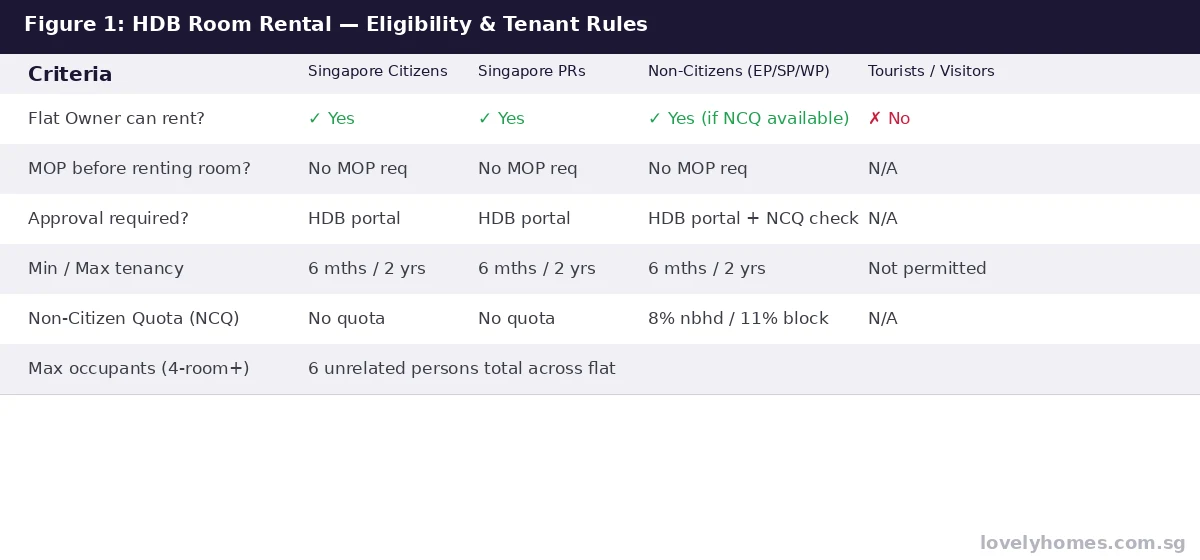
HDB room rental eligibility matrix Singapore 2026 who can rent to whom
Figure 1: HDB room rental eligibility and tenant rules across citizenship categories — including the NCQ.

HDB Room Rental Eligibility Rules

To rent out a room in your HDB flat, you must be a registered owner who satisfies all of the following conditions:

  • Flat ownership: You must be a registered owner of the flat (joint or sole). Tenants of HDB flats cannot sublet rooms.
  • Residency: At least one owner must continue to reside in the flat during the rental period. You cannot rent out all bedrooms and vacate — that constitutes whole-flat subletting and requires separate approval.
  • No MOP restriction for room rental: Unlike whole-flat subletting, there is no MOP period to serve before renting a room. This applies to BTO, resale, and DBSS flats.
  • Citizen/PR ownership: Only Singapore Citizens and Singapore Permanent Residents may own HDB flats.

Who Can Be Your Tenant?

Eligible tenants include Singapore Citizens, Singapore Permanent Residents, and non-citizens holding long-term passes such as Employment Passes (EP), S Passes, Work Permits (WP), Long-Term Visit Passes (LTVP), Student Passes, and Dependent’s Passes. Short-term visitors and tourists are not eligible. Non-citizens are subject to the Non-Citizen Quota (NCQ) — with the important exception that Malaysian citizens are NCQ-exempt.

Before commencing any tenancy with a non-citizen tenant, verify that NCQ slots are available for your block and neighbourhood, then register the tenancy on the HDB e-Service portal. Tenancies with Citizens and PRs do not require quota checks but must still be registered.

The Non-Citizen Quota (NCQ): How It Works

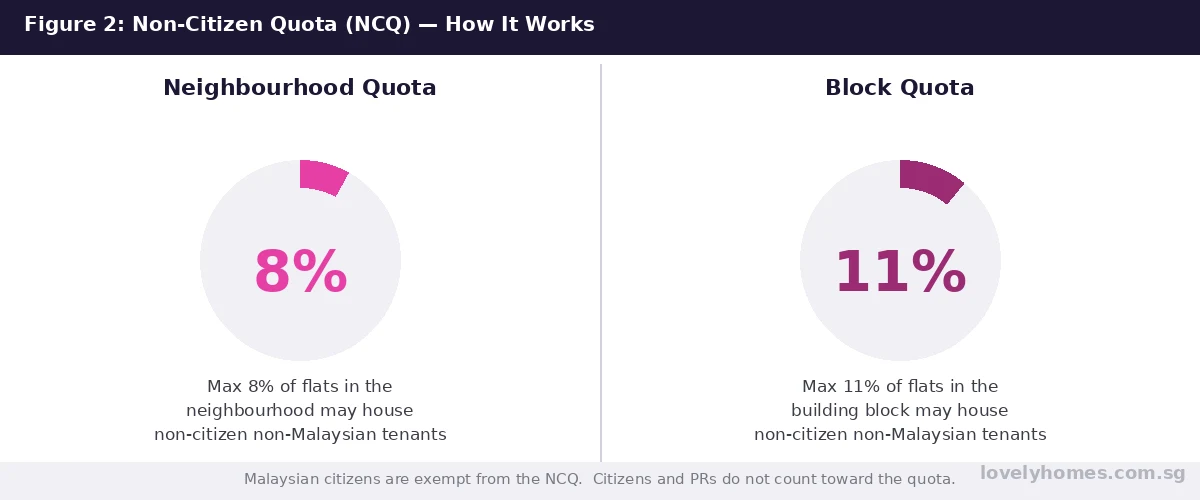
Non-Citizen Quota NCQ HDB room rental Singapore 8 percent neighbourhood 11 percent block
Figure 2: The NCQ caps — 8% neighbourhood, 11% block — apply to all non-citizen, non-Malaysian tenants in HDB room rentals.

The Non-Citizen Quota was introduced by HDB to maintain social integration in public housing estates and prevent over-concentration of foreign nationals in any single block or neighbourhood. Under the NCQ:

  • No more than 8% of all HDB flats in a neighbourhood may be occupied by non-citizen, non-Malaysian tenants at the same time.
  • No more than 11% of all HDB flats in any single block may be occupied by non-citizen, non-Malaysian tenants at the same time.

If either limit is reached, no new tenancy with a non-citizen, non-Malaysian tenant may commence in that neighbourhood or block until an existing occupancy clears. Malaysian citizens are entirely exempt from the NCQ. You can check real-time NCQ availability using the HDB NCQ portal.

Tenancy Duration and Registration

Each room rental tenancy must have a minimum duration of 6 months and a maximum of 2 years per agreement. Tenancies of less than 6 months — including Airbnb-style arrangements — are strictly prohibited and may result in compounding or flat confiscation. Registration is completed online via the HDB e-Service portal within 7 days of the tenancy start date.

Maximum Occupancy Limits

Flat Type Max. Occupants (All Rooms Combined) Notes
1-Room / 2-Room 4 unrelated persons Including the flat owner(s)
3-Room 6 unrelated persons Including the flat owner(s)
4-Room and above 6 unrelated persons Including the flat owner(s)
Executive / DBSS 6 unrelated persons Including the flat owner(s)
Studio Apartment Not eligible for room rental Intended for elderly residents only

The occupancy cap includes the flat owner(s) and all residents. A 4-room flat with two owner-occupiers can therefore accommodate at most 4 additional persons as tenants across all rooms.

Rental Income Tax: What You Must Declare to IRAS

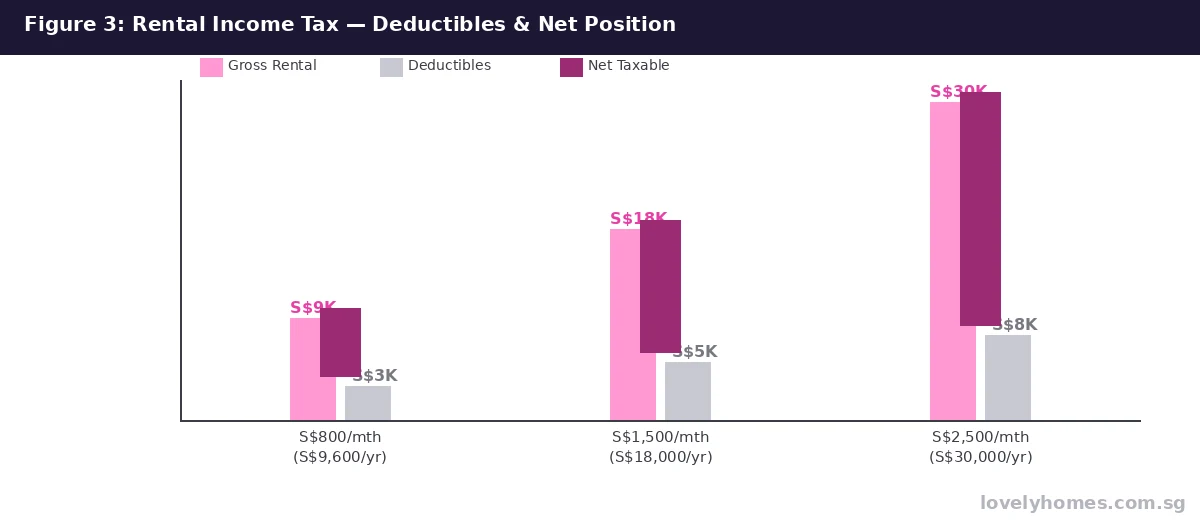
All rental income from HDB room rental is assessable income under the Income Tax Act 1947 administered by IRAS. There are no exemptions for small amounts or casual arrangements. IRAS allows a range of deductible expenses that significantly reduce your net taxable rental income.

HDB room rental income tax deductibles net taxable Singapore 2026
Figure 3: Gross rental income versus allowable deductibles and the net taxable position at three common rent levels.

What Is Taxable?

Your gross rental income includes all amounts received from tenants: monthly rent, any lump-sum advance payment, and reimbursements for utilities or services. Security deposits are not income when received but become income if forfeited.

Allowable Deductions

Deductible Expense Basis Notes
Mortgage interest Actual interest portion of HDB or bank loan payments Principal repayment is NOT deductible
Property tax Annual property tax paid to IRAS Deductible in full as a cost of letting
Maintenance and conservancy charges Monthly S&CC paid to Town Council Pro-rated to rental period if flat was partly vacant
Repairs and maintenance Revenue repairs to restore lettable condition Capital improvements are NOT deductible
Insurance premiums Fire/content insurance attributable to the rental Home Protection Scheme premiums are NOT deductible
Agent commission Fees to a licensed estate agent for securing the tenancy Deductible in full in the year paid

The net rental income is added to your other income and taxed at Singapore’s progressive personal income tax rates (0% on the first S$20,000 of chargeable income, up to 24% above S$1,000,000 effective from YA 2024).

When and How to File

Rental income must be declared annually in your income tax return via IRAS’s myTax Portal. The filing deadline is 15 April of the following year. Retain receipts and tenancy agreements for at least 5 years as IRAS may audit rental declarations.

Worked Example: The Tan Family, Tampines 4-Room

Mr and Mrs Tan are Singapore Citizens who own a 4-room HDB flat in Tampines. They have one spare room and decide to rent it to a Malaysian work-pass holder at S$1,500 per month from 1 April 2026.

Step 1 — Eligibility: No MOP required. NCQ check: Malaysian citizens are NCQ-exempt. HDB portal registration completed 29 March 2026.

Income calculation (Year of Assessment 2027, calendar year 2026):

  • Gross rental income: S$1,500 x 9 months (Apr–Dec 2026) = S$13,500
  • Mortgage interest (annual S$8,400, pro-rated 9/12): S$6,300
  • Property tax (annual S$720, pro-rated 9/12): S$540
  • Maintenance fees (S&CC S$56 x 9 months): S$504
  • Total allowable deductions: S$7,344
  • Net taxable rental income: S$13,500 minus S$7,344 = S$6,156

Tax impact: Mr Tan earns S$72,000/yr. Adding S$6,156 raises chargeable income to approximately S$78,156. Marginal rate: 7% (S$40K–S$80K band). Incremental tax: approximately S$431. Net monthly cash after all costs and taxes: approximately S$1,014/month.

Why HDB Room Rental Matters for Flat Owners

Singapore has one of the highest rates of homeownership in the world — roughly 90% of residents live in public housing. Room rental offers a way to monetise a spare bedroom without the complexity of selling or refinancing. Industry figures show median room rents ranging from S$900/month in non-mature estates to S$2,200/month in central areas as at early 2026. With Singapore’s economy drawing a continued influx of international professionals, demand for affordable HDB rooms is expected to remain resilient.

For retirees, room rental income can supplement CPF LIFE payouts and reduce dependence on drawing down CPF savings. The Silver Housing Bonus (SHB) scheme, administered by HDB, provides additional cash bonuses of up to S$30,000 for elderly flat owners who right-size to smaller flats.

What Might Come Next: Future Policy Considerations

This section is editorial speculation and does not constitute confirmed government policy.

Short-term rental platforms such as Airbnb remain prohibited in HDB flats, and HDB is expected to continue enforcing this restriction. IRAS is rolling out auto-assessment for rental income by 2027, cross-checking declared rental income against HDB portal tenancy registrations. Flat owners who have not been filing rental income should consider voluntary disclosure via IRAS’s myTax Portal before automated enforcement begins. The NCQ thresholds of 8% and 11% have remained unchanged since 2012 and selective adjustments in newer estates with lower foreign-national density remain a possibility, though no change has been signalled as at June 2026.

Frequently Asked Questions

Can I rent out my HDB room before completing the Minimum Occupation Period?

Yes. The MOP restriction applies only to renting out the entire flat (whole-flat subletting), not to individual rooms. Room rental may commence immediately after the flat is handed over to you, subject to HDB portal registration and compliance with tenant eligibility and NCQ rules. If you are in the MOP period, you must continue to reside in the flat.

My block’s Non-Citizen Quota is full. Can I still rent to my Malaysian colleague?

Yes. Malaysian citizens are entirely exempt from the Non-Citizen Quota. The NCQ applies only to non-citizens who are not Malaysian. Your Malaysian colleague does not count toward the 8% neighbourhood or 11% block quota regardless of the pass type they hold. You can proceed with registration on the HDB portal without a quota check for Malaysian tenants.

Does HDB rental income affect my CPF contributions?

No. Rental income from HDB room rental is not employment income and is not subject to CPF contributions. It is, however, assessable income under the Income Tax Act and must be declared to IRAS. CPF voluntary top-up contributions remain available regardless of whether you earn rental income.

What happens if I rent out my room without registering on the HDB portal?

Renting out a room without HDB portal registration is a breach of the HDB lease. Consequences include a formal warning and compounding fine of up to S$5,000 per breach. Repeated or serious violations can result in HDB compulsorily acquiring the flat at HDB’s assessed valuation, which may be below open-market value. HDB conducts enforcement raids and acts on complaints from neighbours and town councils.

Can I deduct renovation costs or furniture purchases against rental income?

Generally, no. IRAS distinguishes between capital expenditure (acquiring or improving an asset) and revenue expenditure (maintaining the asset in its existing condition). Only revenue repairs are deductible. Furniture purchases are capital in nature and are not deductible. For specific situations, seek advice from a qualified tax practitioner or consult IRAS’s e-Tax Guide on rental income at iras.gov.sg.

How do I calculate the deductible mortgage interest for a joint HDB loan?

For an HDB concessionary loan, your annual statement from HDB shows the principal and interest breakdown for each repayment. Add up the interest components paid during the calendar year — this is your deductible amount. For a bank loan, your bank provides an annual loan statement. If you jointly own the flat, each co-owner may only deduct interest in proportion to their ownership share.

Can I rent a room to a family member who is a foreigner?

Yes, provided the family member holds an eligible pass (EP, S Pass, WP, LTVP, DP, Student Pass) and the NCQ is not exhausted for your block and neighbourhood (unless the family member is Malaysian). You still need to register the tenancy on the HDB portal. Close family ties do not create any exemption from HDB’s room rental registration requirements, though there is no restriction on the commercial terms of the tenancy.

Related Articles

Disclaimer

This article is produced by the LovelyHomes Editorial Team for general information purposes only. It is not legal, tax, or financial advice. HDB rules and IRAS tax regulations are updated periodically; always verify current requirements on hdb.gov.sg and iras.gov.sg before entering into any tenancy agreement. For personalised tax advice, consult a qualified tax practitioner.

Singapore Private Property Buying Costs 2026: Complete All-In Cost Guide for Every Buyer Profile

Singapore Private Property Buying Costs 2026: Complete All-In Cost Guide for Every Buyer Profile

Quick Answer — Private Property Buying Costs at a Glance

  • Buying private property in Singapore involves three stamp duties: Buyer’s Stamp Duty (BSD), Additional Buyer’s Stamp Duty (ABSD), and — for resale within 3 years — Seller’s Stamp Duty (SSD, paid by the seller).
  • BSD is payable by every buyer on every property purchase, at progressive rates of 1%–6% on the purchase price or market value, whichever is higher.
  • ABSD ranges from 0% (Singapore Citizen first property) to 60% (foreigner) and is computed on the full price from the first dollar — it is not progressive.
  • Beyond stamp duties, buyers face legal fees (est. S$2,500–S$5,000), valuation (S$500–S$2,000), and agent commission for resale purchases (typically 1% + 9% GST).
  • The minimum cash downpayment for a private property bank loan is 5% of the purchase price; the total downpayment is 25% (5% cash + 20% cash or CPF).
  • Ongoing costs after purchase include property tax (administered by IRAS), MCST maintenance fees, mortgage servicing, and insurance.
  • All stamp duties must be paid within 14 days of exercising the Option to Purchase (OTP) or signing the Sale and Purchase Agreement (S&P), whichever is earlier.

What Are the Private Property Buying Costs in Singapore?

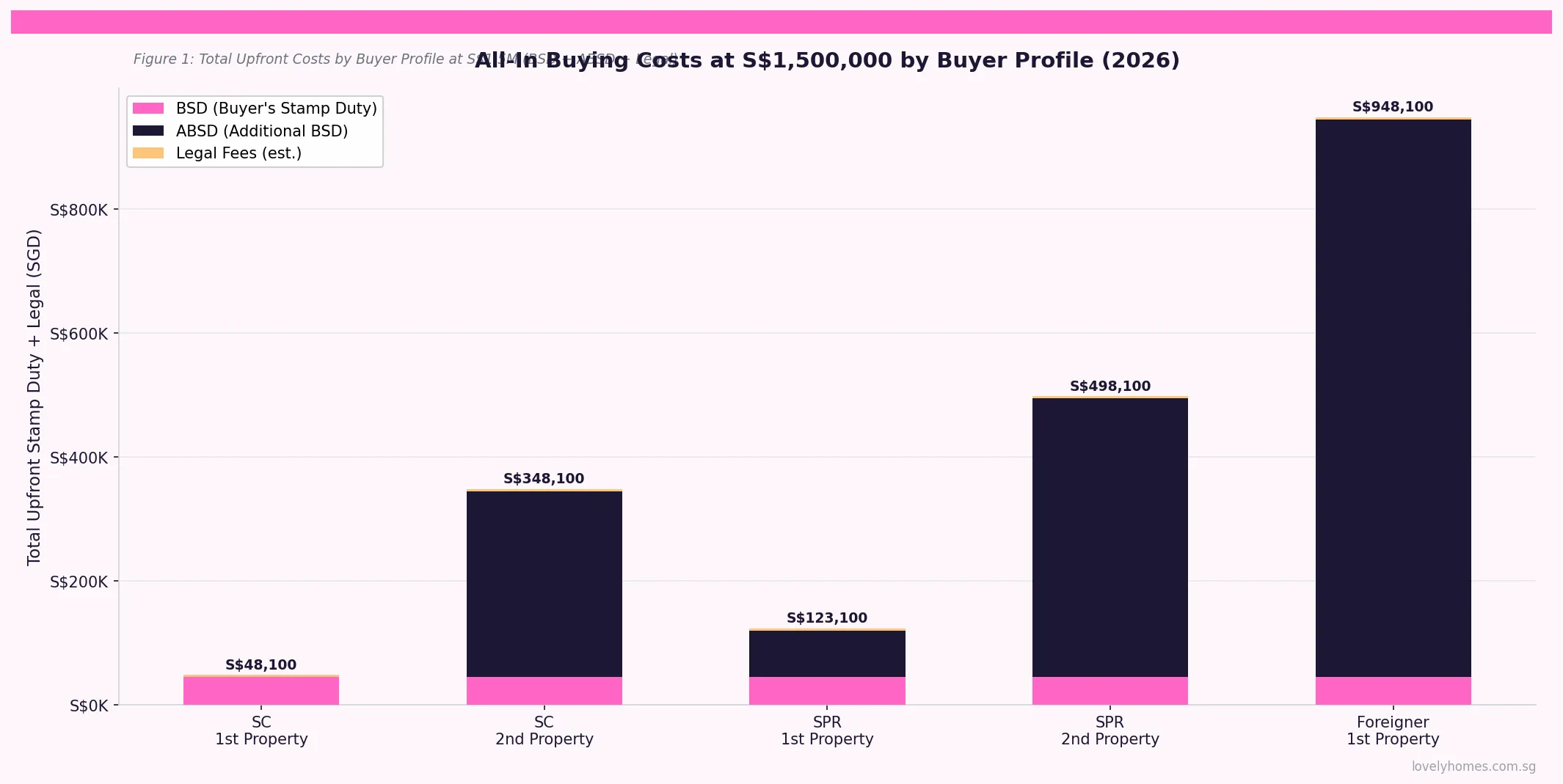
Purchasing private property in Singapore — whether a condominium, apartment, landed house, strata-titled shophouse, or commercial unit — involves a structured set of costs that go well beyond the headline purchase price. The Singapore government, through the Inland Revenue Authority of Singapore (IRAS), administers stamp duties that can represent a significant portion of the total outlay. For a foreigner buying a S$2 million condominium in 2026, the combined BSD and ABSD alone amount to S$1,269,600 — nearly two-thirds of the purchase price again.

This guide covers every material cost a private property buyer incurs in Singapore in 2026: upfront stamp duties, legal and professional fees, mortgage-related costs, and the ongoing holding costs that continue after completion. Costs are broken down for five buyer profiles — Singapore Citizen first property, Singapore Citizen second property, Singapore Permanent Resident (SPR) first property, SPR second property, and foreigner — at representative price points.

Singapore private property all-in buying costs by buyer profile at S$1.5M 2026
Figure 1: Total upfront costs (BSD + ABSD + legal fees) at S$1,500,000 for five buyer profiles. The SC first-property buyer pays S$48,100; the foreigner pays S$948,100. Source: IRAS; LovelyHomes, 2026.

Buyer’s Stamp Duty (BSD): What Every Buyer Pays

BSD is a compulsory tax administered by IRAS on every property purchase in Singapore. It applies to all buyers regardless of nationality, residency status, or how many properties they own. It is computed on the higher of the purchase price or the property’s market value as assessed by IRAS.

BSD uses a progressive rate structure. The rates for residential property in 2026 are:

Portion of Value BSD Rate BSD on This Band
First S$180,000 1% S$1,800
Next S$180,000 (S$180K–S$360K) 2% S$3,600
Next S$640,000 (S$360K–S$1.0M) 3% S$19,200
Next S$500,000 (S$1.0M–S$1.5M) 4% S$20,000
Next S$1,500,000 (S$1.5M–S$3.0M) 5% S$75,000
Amount exceeding S$3,000,000 6% Varies

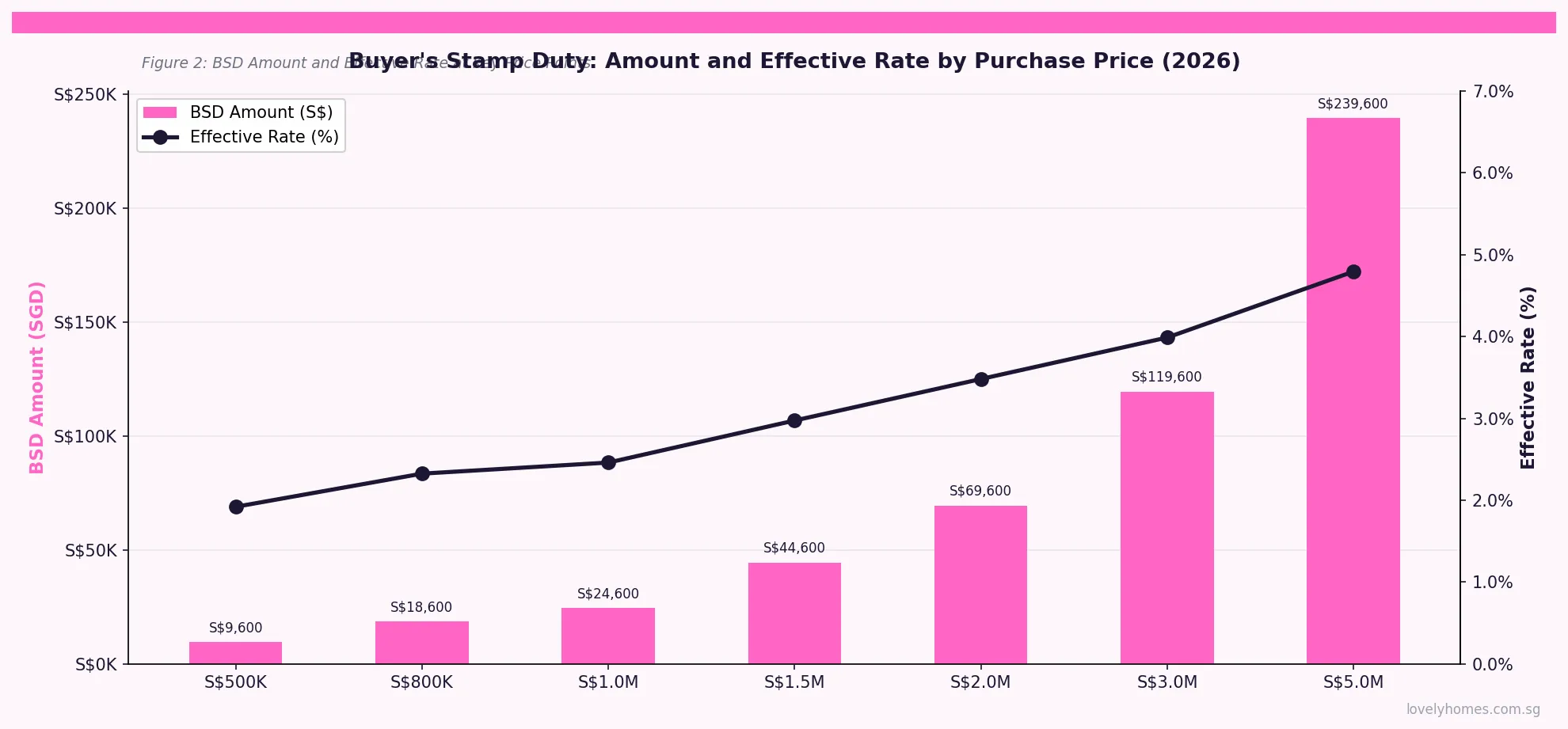
Using the above schedule, BSD on a S$1,500,000 purchase is S$44,600 (effective rate 2.97%); on a S$2,000,000 purchase it is S$69,600 (effective rate 3.48%); on a S$3,000,000 purchase it is S$119,600 (effective rate 3.99%). BSD is due to IRAS within 14 days of the Option to Purchase being exercised (or the date of the contract, whichever is earlier). Late payment attracts a penalty of 5% per annum on the unpaid amount.

BSD can be paid from CPF Ordinary Account (OA) funds, provided the property is residential and the CPF member is eligible. Most buyers use a combination of CPF OA and cash.

Buyer Stamp Duty amount and effective rate by purchase price Singapore 2026
Figure 2: BSD dollar amount (bars) and effective rate (line) at seven price points from S$500,000 to S$5,000,000. The 6% top rate kicks in above S$3,000,000. Source: IRAS; LovelyHomes, 2026.

Additional Buyer’s Stamp Duty (ABSD): The Nationality and Ownership Surcharge

ABSD is a flat-rate stamp duty levied on top of BSD, applied as a percentage of the full purchase price from the first dollar. Unlike BSD, ABSD is not progressive — the stated rate applies to the entire price. ABSD rates are determined by the buyer’s citizenship status and the number of residential properties they own at the time of purchase. The 2026 ABSD schedule, unchanged since the April 2023 round of cooling measures, is:

Buyer Profile 1st Property 2nd Property 3rd+ Property
Singapore Citizen 0% 20% 30%
Singapore Permanent Resident 5% 30% 30%
Foreigner (including most work pass holders) 60% 60% 60%
Entity (company, trust, collective investment scheme) 65% 65% 65%
Developer (housing developer licence) 35% (remittable on completion conditions)

What counts as “owning” a property for ABSD purposes? IRAS counts every residential property in Singapore in which you hold a legal or beneficial interest — including properties held jointly or as a co-owner, properties held through a trust, and properties inherited (even if you did not pay for them). Overseas property does not count. If you are a SC buying your second property, you will pay 20% ABSD on the full purchase price — S$300,000 on a S$1.5M purchase.

ABSD must also be paid within 14 days of exercising the OTP (or signing the S&P). Unlike BSD, ABSD cannot be paid from CPF — it must be paid entirely in cash. This is a crucial planning consideration for second-property buyers who may be CPF-rich but cash-light.

One key relief: Singapore Citizen married couples who own one residential property jointly may apply for ABSD remission when they sell the first property within 6 months of buying a new one. This remission restores the SC couple to effectively 0% ABSD on the second purchase. The 6-month clock starts from the completion of the new purchase.

Seller’s Stamp Duty (SSD): A Reminder for Buyers Who May Resell Quickly

Buyers should also be aware of the Seller’s Stamp Duty (SSD), which applies if the property is resold within three years of acquisition. SSD is paid by the seller, but it affects the resale market because sellers typically factor it into their pricing:

  • Sold within 1 year: 12% SSD
  • Sold within 2 years: 8% SSD
  • Sold within 3 years: 4% SSD
  • Sold after 3 years: 0% SSD

For buyers who contemplate flipping a property within 3 years, the combined SSD exposure can make the transaction economically unattractive. Planning a minimum 3-year hold eliminates SSD entirely.

Professional and Transaction Fees

Beyond stamp duties, buyers incur a set of professional fees for the conveyancing and mortgage process:

Fee Item Typical Range Who Pays Notes
Legal fees (conveyancing — buyer’s solicitor) S$2,500–S$5,000 Buyer Higher for complex transactions; covers OTP, S&P, title search, SLA registration
Valuation fee S$500–S$2,000 Buyer Required by bank for mortgage; Singapore Institute of Surveyors and Valuers (SISV) accredited valuer
Mortgage processing fee S$0–S$500 Buyer Many banks waive this; check with your lender
Agent commission (resale purchase) 1%–2% + 9% GST Buyer Not mandatory; buyer’s agent commission is separately negotiated. New launches: 0% (developer pays co-broke)
Property tax (pro-rated at completion) Varies Shared at completion Seller reimburses buyer for unused portion of pre-paid property tax

Downpayment and Loan Structure

For private property financed by a bank loan, MAS mandates a minimum downpayment of 25% of the purchase price (or market value, whichever is lower). The breakdown is:

  • 5% must be paid in cash (the Option Exercise Fee of 1% + the balance of 4% at exercise, or 5% at S&P signing for new launches)
  • The remaining 20% can be paid from CPF Ordinary Account, cash, or a combination
  • 75% maximum LTV (Loan-to-Value) — i.e., the bank loan covers up to 75% of the lower of price or value

For a second property, the LTV ceiling drops to 45%, meaning a downpayment of 55% — with a minimum of 25% in cash. For a third or subsequent property, the LTV is 35%, with a minimum 25% cash downpayment. MAS’s TDSR (Total Debt Servicing Ratio) framework caps total monthly debt obligations (including the new mortgage) at 55% of gross monthly income.

Full private property cost breakdown 5 buyer profiles S$2M Singapore 2026
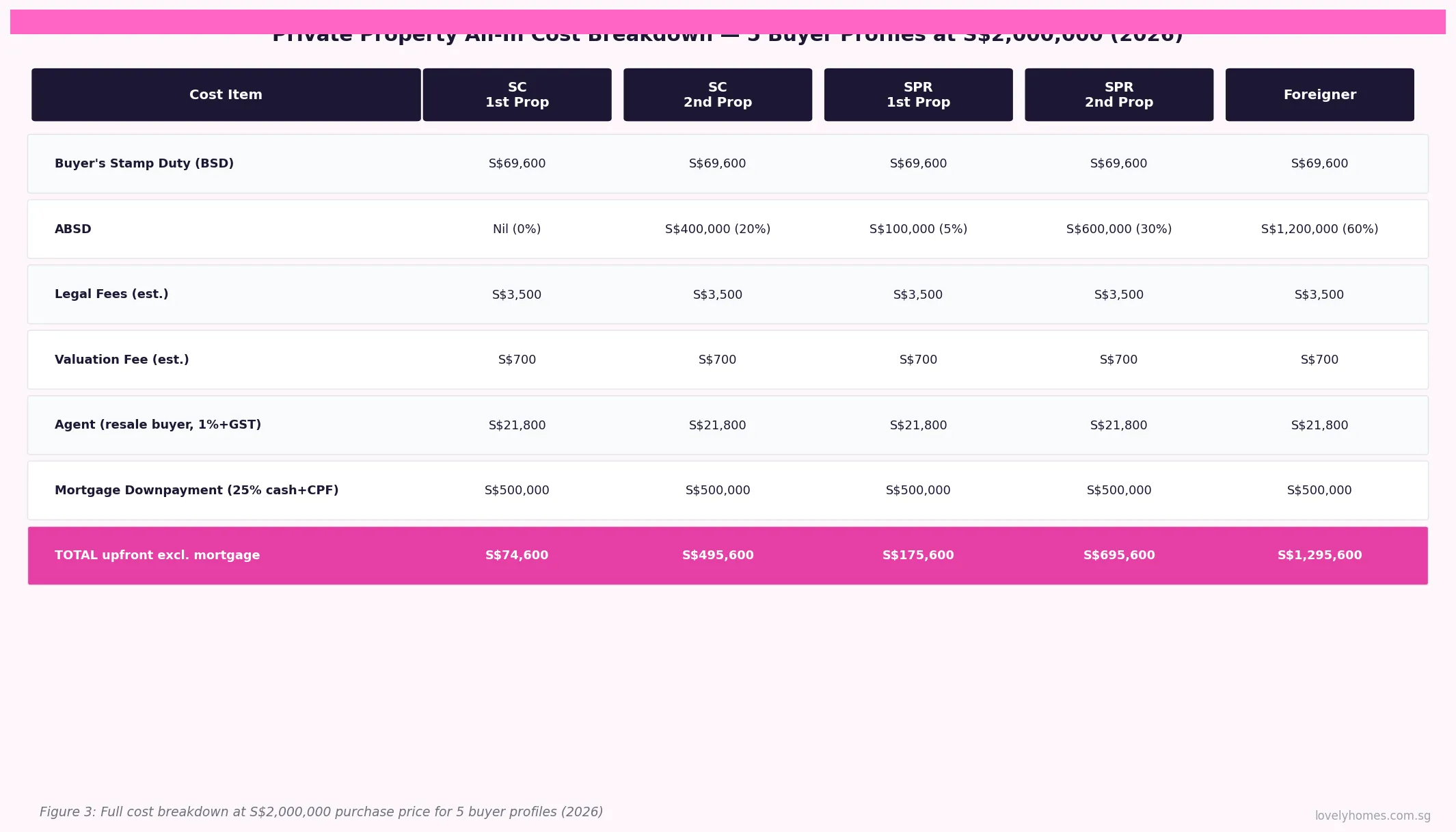
Figure 3: Complete upfront cost breakdown for five buyer profiles at S$2,000,000 (BSD + ABSD + legal + valuation + agent 1%). SC first-property buyers face S$74,600 beyond the downpayment; foreigners face S$1,295,600. Source: IRAS; LovelyHomes calculations, 2026.

Ongoing Ownership Costs After Completion

The upfront costs are only part of the picture. Once you own the property, several recurring costs apply:

Ongoing Cost Typical Annual Amount Administered By
Property Tax S$0–S$20,000+ (depends on AV and usage) IRAS
MCST Maintenance Fees (condo) S$3,000–S$30,000 (S$250–S$2,500/mth) MCST (management corporation)
Sinking Fund Contributions Included in MCST fees (10% of maintenance) MCST
Fire Insurance (mandatory for mortgaged property) S$100–S$400 Insurer (MAS-regulated)
Home Contents Insurance S$200–S$800 Optional; insurer
Utilities (electricity, water, gas) S$2,400–S$7,200 (S$200–S$600/mth) SP Group, PUB
Mortgage Servicing Based on loan amount, tenure, rate Bank (MAS-regulated)

Property tax is computed by IRAS on the property’s Annual Value (AV) — a notional figure representing the estimated annual rent the property would fetch unfurnished. Owner-occupied residential properties enjoy concessionary progressive rates starting at 0% on the first S$8,000 of AV. Investment or rented-out properties face higher non-owner-occupier rates. From 2025, IRAS adopted new AV ranges following a property market review.

Worked Example: The Rajan Family’s Private Property Purchase

Scenario: SC Joint Purchase, Second Property at S$2,100,000

Mr Rajan (Singapore Citizen) and Mrs Rajan (Singapore Citizen) currently own a Bishan HDB flat which they plan to sell within 6 months. They are buying a 3-bedroom resale condominium in District 15 (Marine Parade / East Coast) at S$2,100,000. Because they still own the HDB, ABSD at the SC second-property rate of 20% applies upfront; they will apply for ABSD remission after selling the HDB.

Cost Item Amount Notes
Purchase Price S$2,100,000 Market value confirmed S$2,100,000
BSD S$74,600 1%/2%/3%/4%/5% progressive; S$44,600 (on S$1.5M) + S$30,000 (5% × S$600K above S$1.5M)
ABSD (20% — SC 2nd property) S$420,000 Paid upfront in cash; ABSD remission applied after HDB sold within 6 months
ABSD Remission (refund after HDB sale) -S$420,000 Applied to IRAS within 6 months of completing new purchase; HDB must be sold first
Legal Fees (buyer) S$3,500 Conveyancing, SLA registration, title search
Valuation Fee S$800 Bank-appointed SISV valuer
Agent Commission (1% + 9% GST) S$22,890 Buyer’s agent for resale purchase
Downpayment (25% of S$2.1M) S$525,000 5% cash S$105,000 + 20% CPF/cash S$420,000
Bank Loan (75% LTV) S$1,575,000 @3.0% p.a., 30-year tenure, monthly S$6,639
TDSR Check S$6,639 / S$12,000 = 55.3% At the TDSR 55% ceiling — couple must clear any other debt obligations before completing
Net upfront cash outlay (before ABSD refund) S$626,790 BSD + ABSD + legal + val + agent + 5% cash DP
Net upfront after ABSD remission S$206,790 After S$420,000 ABSD refund once HDB sold within 6 months

Key risk: Mr and Mrs Rajan must sell the HDB within 6 months of completing the D15 purchase to qualify for ABSD remission. If they miss the window, the S$420,000 ABSD is forfeited. The transaction should be sequenced carefully with both their agent and solicitor to ensure the disposal timeline is locked in before exercising the OTP on the new purchase.

What This Means for Private Property Buyers in 2026

Singapore’s private property buying cost structure is deliberately designed to differentiate between residents buying their home and investors — domestic or foreign — seeking to accumulate property. The ABSD regime effectively creates three distinct cost environments: near-zero cost for SC first-timers; a moderate but significant surcharge for SC second-timers and SPR first-timers; and a prohibitively high 60% surcharge for foreigners.

In a peer-country comparison, Singapore’s residential property stamp duty regime is among the steepest globally for non-resident investors. Hong Kong’s stamp duty for non-permanent residents stands at 15%; Canada’s foreign buyers’ tax varies by province. Singapore’s 60% ABSD, introduced in April 2023, is explicitly designed to insulate the domestic housing market from speculative capital inflows.

For Singaporeans buying their first private property, the cost structure is relatively benign: BSD of 2.97%–3.99% at S$1.5M–S$3M is comparable to transaction costs in other major cities. The MCST fees, property tax, and financing costs are the recurring burden that deserves more careful modelling — a S$4,000/month mortgage, S$800/month MCST, and S$400/month property tax creates an all-in occupancy cost of S$5,200/month before utilities, which must be assessed against the TDSR of the purchasing household.

What Might Come Next

The following is editorial speculation and should not be relied upon for financial decisions.

The current ABSD regime, introduced in April 2023, has been in force for over three years. In that period, private residential transaction volumes involving foreigners have fallen dramatically. Some industry observers have speculated that the government may consider a modest easing of the foreigner rate if volumes remain suppressed to a degree that affects market liquidity in the luxury segment. However, the government has given no signal of any impending change, and Singapore’s housing policy framework has historically prioritised stability over volume. Any adjustment to ABSD would be announced by MND (Ministry of National Development) and MOF (Ministry of Finance) jointly and implemented immediately at announcement — there is no advance notice period.

Frequently Asked Questions

Can I pay ABSD using CPF Ordinary Account funds?

No. ABSD must be paid entirely in cash. Unlike BSD, which can be paid from your CPF OA for a residential property purchase, ABSD is not an allowable CPF withdrawal purpose. This makes ABSD a significant liquidity consideration for buyers who are CPF-rich but cash-light — for example, a Singapore Citizen buying a second property at S$1.5M would need S$300,000 in cash for ABSD alone, on top of the 5% cash downpayment of S$75,000, totalling S$375,000 in cash before legal fees.

What is the 14-day stamp duty deadline and what happens if I miss it?

BSD and ABSD must be paid to IRAS within 14 calendar days of the date you exercise the Option to Purchase (OTP) or sign the Sale and Purchase Agreement (S&P), whichever is earlier. For new launches, it is typically 14 days from the date of the S&P. If you miss this deadline, IRAS charges a penalty of 5% per annum on the unpaid stamp duty, accruing daily. For large ABSD amounts, even a few days’ delay can cost thousands of dollars in penalties. Your solicitor should be engaged well before the OTP exercise date to ensure the stamping is completed in time.

I am a foreigner but my spouse is a Singapore Citizen. Do we still pay 60% ABSD?

Yes and no. If you and your Singapore Citizen spouse are purchasing the property jointly, ABSD is charged at the rate applicable to the buyer with the highest ABSD liability — which in this case would be 60% for the foreigner. However, since 16 February 2023, there is no longer an ABSD remission for married couples with mixed citizenship (one SC and one foreigner) purchasing their first jointly-owned residential property. The full 60% ABSD applies. One common planning approach is for the SC spouse to purchase the property solely in their own name, in which case no ABSD applies (for their first property). This creates financing and ownership planning considerations that should be discussed with a solicitor.

Is valuation mandatory for all private property purchases?

Valuation is not required by law for every purchase, but it is effectively mandatory whenever you take a bank loan — the bank will appoint its own panel valuer to determine the market value before approving the LTV ratio. If the bank valuation comes in below the purchase price, the LTV is calculated on the lower valuation figure, meaning you must make up the difference in cash. For cash purchases, valuation is optional but advisable for ABSD calculation purposes (ABSD is charged on the higher of price or market value). IRAS can independently assess market value and charge ABSD accordingly.

Can I avoid paying agent commission as a buyer?

For new launch condominiums, developers typically pay the buyer’s agent commission through their co-broke arrangement; buyers pay no direct commission. For resale private properties, a buyer’s agent commission is customary (typically 1% + 9% GST) but not legally mandated. You may choose to transact without a buyer’s agent and negotiate directly with the seller’s agent; however, the seller’s agent represents the seller’s interests, not yours. CEA (Council for Estate Agencies) guidelines distinguish clearly between representing one or both parties. Using a buyer’s agent generally costs 1% but provides representation, market data, and negotiation support.

What ongoing property tax will I pay on a S$2M condominium?

Property tax is based on the Annual Value (AV) — IRAS’s estimate of the annual market rent the property could command, unfurnished. For a S$2M condominium, the AV might be approximately S$48,000–S$60,000 per annum depending on location and unit size. For owner-occupiers, the 2026 progressive rate yields approximately S$2,400–S$4,000/year at those AV levels. For non-owner-occupiers (renting out the unit), the non-OO rates apply and the annual property tax can be S$8,000–S$14,000 on the same AV. Check the IRAS property tax calculator at iras.gov.sg for an accurate estimate for your specific property.

For a new launch, when exactly do I pay BSD and ABSD?

For a new private residential launch, you typically pay a 5% booking fee to the developer upon selecting your unit (this secures the unit). BSD and ABSD are due within 14 days of signing the Sale and Purchase Agreement (S&P), which is typically issued 8 to 12 weeks after the booking date. This means you have roughly 2–3 months from booking to arrange the stamp duty cash — but do not leave it late. Your solicitor will handle the stamping electronically via IRAS e-Stamping and will liaise directly with IRAS on the calculation.

Disclaimer: This article is for general informational purposes only and does not constitute financial, legal, or taxation advice. Stamp duty rates, ABSD schedules, and MAS lending limits are subject to change by the Singapore government without notice and are typically effective immediately upon announcement. Readers should verify current rates directly with IRAS, mortgage eligibility with your bank and MAS, and CPF withdrawal rules with CPF Board. Worked examples use estimated figures for illustration; actual costs will vary by transaction. Consult a licensed property professional (CEA-registered) and a qualified financial adviser before making any property investment decision.

×

Click anywhere to close

HDB Resale Flat Prices Singapore 2026: Complete Guide to Trends, COV and Valuations

HDB Resale Flat Prices Singapore 2026: Complete Guide to Trends, COV and Valuations

Quick Answer: HDB Resale Flat Prices in Singapore 2026

  • 4-room flats transact at a national median of S$498,000 in Q1 2026, up from S$448,000 in 2024.
  • 5-room flats reached a median of S$610,000 in Q1 2026; Executive Maisonettes hit S$710,000.
  • Mature estates like Bukit Timah and Queenstown command 4-room premiums above S$700,000.
  • The HDB Resale Price Index (RPI) stood at 183.1 in Q1 2026, up 8.7 points from Q1 2020.
  • Cash Over Valuation (COV) is the amount paid above HDB’s assessed value — it must be paid in cash, not CPF.
  • HDB resale prices are moderated by the Minimum Occupation Period (MOP), lease decay, and proximity grants.
  • Prices are expected to grow modestly (1–3% annually) through 2026, supported by tight BTO supply and strong household formation.

What Are HDB Resale Flat Prices and How Are They Set?

When you purchase a Housing and Development Board (HDB) resale flat, you are buying from a private seller in the open market — not directly from HDB. The price is negotiated between buyer and seller, but must reflect market conditions and is informed by HDB’s Comparable Transaction data and the official valuation commissioned by the buyer’s bank or HDB loan officer.

Unlike BTO (Build-To-Order) flats, where HDB sets the selling price with subsidies applied, resale flat prices are driven by supply and demand. Factors include the flat’s lease remaining, floor level, renovation condition, proximity to MRT stations and top primary schools, estate amenities, and recent comparable transactions in the same block or vicinity.

HDB monitors and reports resale transaction data every quarter via the HDB Resale Price Index (RPI) and releases median transaction prices by flat type and town. This transparency helps buyers and sellers negotiate from an informed position.

HDB Resale Prices by Flat Type: 2024 vs Q1 2026

Resale prices have risen consistently across all flat types since 2020. The table below and Figure 1 compare median transacted prices in 2024 versus Q1 2026.

HDB resale median prices by flat type 2024 vs Q1 2026 Singapore bar chart
Figure 1: Median HDB resale prices by flat type — 2024 vs Q1 2026. Source: HDB Resale Statistics.
Flat Type 2024 Median Q1 2026 Median Change
2-Room Flexi S$285,000 S$295,000 +3.5%
3-Room S$315,000 S$348,000 +10.5%
4-Room S$448,000 S$498,000 +11.2%
5-Room S$570,000 S$610,000 +7.0%
Executive / Maisonette S$658,000 S$710,000 +7.9%

Source: HDB Resale Statistics. Figures are national medians; individual transactions vary by town, floor, and condition.

Understanding the HDB Resale Price Index (RPI)

The HDB Resale Price Index (RPI) is published by HDB every quarter. It tracks the overall movement of resale flat prices relative to a base period (Q1 2009 = 100). It is the closest equivalent to a benchmark price index for the HDB resale market — similar in concept to the URA Private Residential Property Index for the private market.

In Q1 2026, the RPI stood at 183.1, meaning resale prices are 83.1% higher in nominal terms than they were in Q1 2009. The rate of increase has slowed significantly since the sharp pandemic-era run-up of 2021–2022, when prices rose almost 25 points in two years. The market has since entered a plateau phase with modest quarterly gains of 0.2–0.4%.

HDB Resale Price Index trend Q1 2020 to Q1 2026 Singapore
Figure 2: HDB Resale Price Index (RPI), Q1 2020 – Q1 2026. Base: Q1 2009 = 100. Source: HDB Resale Statistics.

The RPI is a useful trend indicator but does not tell you what any specific flat will transact at. The HDB Resale Portal’s Check Past Resale Transactions tool gives block-level data, which is far more actionable for buyers negotiating a specific unit.

HDB Resale Prices by Town: Where Are Prices Highest?

Resale prices vary enormously by location. The same flat type can fetch more than double in a mature, well-connected estate versus a young non-mature town. Figure 3 shows indicative Q1 2026 median 4-room prices for the ten most actively transacted towns.

HDB resale 4-room flat median prices by town Q1 2026 Singapore
Figure 3: Indicative median 4-room HDB resale prices by town, Q1 2026. Source: HDB Resale Statistics and LovelyHomes analysis.

Bukit Timah (S$810,000), Queenstown (S$720,000), and Bishan (S$660,000) lead the premium tier, driven by central location, proximity to top primary schools (Nanyang, Henry Park, Raffles Girls’), and strong upgrader demand. At the other end, Sengkang (S$495,000) and Hougang (S$510,000) remain among the most affordable mature-ish estates with good MRT coverage.

What Drives HDB Resale Prices?

Understanding the key price drivers helps buyers estimate fair value and sellers price competitively. The main factors are:

1. Location and connectivity. Proximity to MRT stations (within 500 metres) adds a meaningful premium. Flats within 1 km of top primary schools command a further uplift due to the MOE P1 registration priority system — see our guide to buying near top schools.

2. Remaining lease. HDB flats are sold on 99-year leases from the date of construction. A flat with 70 years remaining is worth more than one with 50 years, because CPF usage is restricted for flats with shorter leases — specifically, if the flat’s remaining lease cannot cover the youngest buyer to age 95, CPF usage is prorated. Banks also apply stricter LTV ratios on short-lease flats. The HDB Lease Buyback Scheme and Lease Top-Up programme can extend some leases, but this remains a minority option.

3. Flat condition and renovation. Buyers frequently pay a S$20,000–S$80,000 premium for freshly renovated units with quality kitchen and bathroom fittings, versus an unrennovated unit in the same block. However, overbuilt or highly customised renovations do not recover their full cost at resale.

4. Floor level and orientation. High-floor units with unobstructed views or favourable orientations (e.g., north-south facing to minimise afternoon sun) attract 5–15% premiums over low-floor equivalents in the same block.

5. Flat size (actual square footage). HDB flat-type naming covers a range of actual sizes. A “4-room” flat can be anywhere from 80 to 110 square metres depending on the development era. Buyers should always divide the asking price by the actual size in square metres to compare on a per-square-metre basis.

6. HDB upgrading works. Flats that have completed the Home Improvement Programme (HIP) or Neighbourhood Renewal Programme (NRP) typically command a S$20,000–S$40,000 premium over pre-HIP equivalents, as buyers factor in avoided costs and improved common-area aesthetics.

Cash Over Valuation (COV) Explained

One of the most misunderstood concepts in HDB resale is Cash Over Valuation (COV). When a buyer agrees to pay a price higher than the official valuation of the flat (determined by an accredited valuer appointed by HDB, the buyer’s bank, or HDB’s own valuation office), the excess is the COV — and it must be paid entirely in cash. CPF Ordinary Account funds can only be used up to the officially assessed market value.

For example, if a flat is valued at S$550,000 but the negotiated transacted price is S$575,000, the COV is S$25,000. This S$25,000 must come from cash savings, not CPF. It is paid on top of the standard cash and CPF downpayments for the loan.

COV is common in popular estates and for well-renovated flats. Buyers should check the HDB Resale Portal at resale.hdb.gov.sg for recent transactions in the target block to gauge whether COV is likely and at what level before making an offer.

Worked Example: The Chew Family

Scenario: SC Couple Buying a 5-Room Flat in Tampines

Mr and Mrs Chew are Singapore Citizens. Mr Chew (34) earns S$6,200/month; Mrs Chew (33) earns S$5,100/month. Joint monthly income: S$11,300. They have S$120,000 in CPF Ordinary Account (combined) and S$60,000 in cash savings. They are first-time buyers and have never owned any property.

  • Target flat: 5-room HDB in Tampines, 92 sqm, lease commenced 2001 (remaining ~74 years), renovated 2022.
  • Negotiated price: S$640,000
  • Official valuation: S$618,000
  • COV: S$640,000 − S$618,000 = S$22,000 (cash, not CPF)
  • HDB loan (2.6% p.a., 25 years, LTV 80%): S$494,400 → monthly instalment S$2,240/month
  • MSR check: S$2,240 ÷ S$11,300 = 19.8% (below 30% MSR cap — PASS)
  • CPF downpayment: 20% × S$618,000 (valuation) = S$123,600 → covered by combined CPF OA of S$120,000 + S$3,600 top-up in cash
  • Cash required at exercise: COV S$22,000 + BSD S$12,950 + Legal S$2,800 + HDB admin fee S$80 + CPF shortfall S$3,600 = S$41,430
  • CPF Housing Grants applied: EHG S$50,000 (income S$11,300/mth, eligible) + Family Grant S$50,000 (resale 5-room) = S$100,000 total grants applied against purchase price via CPF OA

Result: The Chews’ effective net price after grants is S$540,000. Monthly instalment of S$2,240 is comfortably within the MSR. Their cash outlay of S$41,430 is manageable given their S$60,000 in savings. They retain approximately S$18,570 in liquid cash after the purchase.

Why HDB Resale Values Hold Up — and When They Don’t

Singapore’s public housing market has historically been resilient because HDB flats serve a fundamental shelter function for the majority of the population. Several structural factors support resale values:

Eligibility restrictions keep demand concentrated. Only Singapore Citizens and Permanent Residents may purchase HDB flats. This excludes the largest category of buyers (foreigners) who are entirely channelled into the private market. Within the eligible pool, demand is strong: household formation rates remain high, BTO supply takes 3–5 years to deliver, and the resale market is the only avenue for those needing a home now.

CPF integration creates a floor price. For most HDB buyers, CPF Ordinary Account savings constitute a large part of the downpayment. This effectively creates a price floor, as buyers are willing to commit CPF savings they might otherwise lose access to if they do not purchase a property. The CPF accrued interest mechanism means sellers must refund CPF usage plus accrued interest on sale, which effectively anchors the minimum sale price needed to recover the seller’s CPF commitment.

When values can soften. Short-lease flats (below 60 years remaining) face structural headwinds: CPF usage restrictions, tighter bank LTV, and lower pool of eligible buyers. Estates where residents have grown older without sufficient HIP investment, or where population resettlement has reduced catchment size, may also see below-average growth. A flat approaching 40–50 years of lease expiry may see steep valuation discounts.

What Might Come Next for HDB Resale Prices?

This section represents editorial analysis and forward-looking opinion, not a guarantee of future price performance.

The HDB resale market is likely to grow at a modest 1–3% annualised rate through 2026 and into 2027, based on the following dynamics. BTO supply delivered in 2023–2024 (from launches in 2020–2021) will start reaching MOP from 2025 onwards, gradually increasing resale supply. However, the June 2026 BTO exercise offering 6,900 flats in popular towns (Bishan, Bukit Merah, Ang Mo Kio) will only arrive on the resale market in 2031–2033 at the earliest.

Interest rate trends matter too. If the Singapore Overnight Rate Average (SORA) continues declining through 2026, bank loan attractiveness relative to the HDB loan (fixed at 2.6% p.a.) shifts. A sustained decline in SORA could bring more buyers back to the market, supporting demand for resale flats, particularly among those who prefer immediate occupation over the 3–5 year BTO wait.

Prime Location Public Housing (PLH) flats with 10-year MOPs, and any further cooling measures, could dampen speculative demand at the top end. However, the entry-level and mid-tier resale segments (3-room and 4-room in non-mature estates) appear structurally well-supported.

Summary Table: HDB Resale Prices at a Glance (Q1 2026)

Flat Type National Median Premium Town Range Affordable Town Range
2-Room Flexi S$295,000 S$380,000–S$450,000 S$220,000–S$270,000
3-Room S$348,000 S$480,000–S$650,000 S$280,000–S$330,000
4-Room S$498,000 S$650,000–S$900,000+ S$400,000–S$480,000
5-Room S$610,000 S$750,000–S$1,000,000+ S$490,000–S$570,000
Executive / Maisonette S$710,000 S$850,000–S$1,100,000+ S$580,000–S$660,000

Frequently Asked Questions: HDB Resale Flat Prices

How do I find out the recent transacted prices for a specific HDB block?

Use the HDB Resale Flat Prices tool on the official HDB website at resale.hdb.gov.sg. You can filter by town, flat type, street name, and period. The tool shows every registered resale transaction, including the transacted price, floor area, storey range, and flat model. This is the most reliable data source for gauging fair value for a specific unit. The URA Real Estate Information System (REALIS) also contains HDB transaction data for subscribers.

Are HDB million-dollar flats common, and what drives them?

HDB resale flats transacting above S$1,000,000 (colloquially called “million-dollar flats”) have become more frequent since 2022. They are overwhelmingly concentrated in mature central estates (Queenstown, Bishan, Toa Payoh, Ang Mo Kio) for large flat types (5-room, Executive Maisonette) on high floors with long remaining leases. In Q1 2026, approximately 80–120 units per quarter transact above S$1,000,000 — this represents less than 2% of total quarterly transactions and is not representative of the broader market. Most resale flats transact between S$300,000 and S$700,000.

Can I use CPF to pay COV?

No. Cash Over Valuation must be paid entirely in cash. CPF Ordinary Account funds can only be applied towards the purchase price up to the officially assessed valuation. If you agree to pay S$560,000 for a flat valued at S$540,000, the S$20,000 COV must come from your cash savings. This is an important planning point — buyers who have substantial CPF balances but limited cash savings may be unable to purchase a flat with a high COV without additional cash top-ups.

How does the Ethnic Integration Policy (EIP) affect resale prices?

The Ethnic Integration Policy (EIP) sets racial proportion limits for each HDB block and neighbourhood. If a block has already reached its Chinese, Malay, or Indian/Other quota for a given ethnic group, buyers of that ethnicity cannot purchase in that block — effectively reducing the pool of eligible buyers. When a block is at or near quota for a popular ethnic group, this can exert downward pressure on transacted prices because fewer buyers qualify. Conversely, a block with open quota availability across all ethnic groups attracts the widest buyer pool and tends to transact at or above comparable blocks with restricted quotas.

Does a shorter lease always mean a lower price?

Generally yes, but the discount is non-linear and depends on specific thresholds. Flats with more than 60 years remaining trade relatively normally. Once a flat’s remaining lease falls below 60 years, CPF restrictions begin to phase in — the amount of CPF that can be used is prorated based on how long the flat’s lease can cover the youngest buyer to age 95. Below 30 years remaining, the flat becomes effectively cash-only, dramatically reducing the buyer pool. Short-lease flats in desirable locations (e.g., Queenstown or Toa Payoh) may still trade at substantial absolute prices due to location premium, but will not appreciate at the same rate as longer-lease counterparts.

What happens to a flat’s price after HDB’s Selective En Bloc Redevelopment Scheme (SERS)?

When HDB announces a SERS for a block, the announcement itself typically causes an immediate uplift in nearby comparable flat prices as the market anticipates compensation plus new-flat allocation. However, SERS is administered selectively by HDB and cannot be applied for by residents — it is announced by HDB when redevelopment is deemed appropriate for planning reasons. Fewer than 5% of HDB estates have ever been selected for SERS, so it is not a reliable investment thesis for most buyers.

How do HDB resale prices compare internationally?

HDB resale flats remain remarkably affordable relative to comparable housing in global cities despite recent price growth. A national median 4-room flat at S$498,000 represents approximately 4–5 years of median household income for a dual-income SC couple — a price-to-income ratio that is far more favourable than Hong Kong, Sydney, or London. The key enabler is Singapore’s CPF-linked savings system, which channels mandatory pension contributions directly into housing affordability, and the Ethnic Integration Policy, which distributes demand across the island rather than concentrating it in a few prime postcodes.

Related Articles


Disclaimer: The information in this article is for general educational purposes only and does not constitute financial, investment, or legal advice. HDB resale flat prices, Resale Price Index figures, grant amounts, and loan parameters are subject to change. Always verify current data directly with the Housing and Development Board (hdb.gov.sg), CPF Board (cpf.gov.sg), IRAS (iras.gov.sg), and the Monetary Authority of Singapore (mas.gov.sg). Property transactions involve significant sums — engage a licensed housing agent accredited by the Council for Estate Agencies (CEA) and a solicitor for conveyancing before committing to any purchase.

Singapore CPF Accrued Interest for Property 2026: What You Owe Your CPF When You Sell

Singapore CPF Accrued Interest for Property 2026: What You Owe Your CPF When You Sell

Quick Answer: CPF Accrued Interest for Property

  • CPF accrued interest is the interest your CPF Ordinary Account (OA) would have earned had you not withdrawn the funds to buy property — currently 2.5% per annum.
  • When you sell your property, the CPF Board requires you to refund both the principal withdrawn and the full accrued interest back to your CPF OA — not to your bank account.
  • This reduces your net cash proceeds from the sale. A S$200,000 CPF draw held for 15 years accrues approximately S$84,600 in interest that must be returned to CPF.
  • The Valuation Limit (VL) caps total CPF usage at the lower of the property’s purchase price or current market value. A separate Withdrawal Limit (WL) may apply based on lease coverage to age 95.
  • Since September 2019, most buyers must set aside the Basic Retirement Sum (BRS — S$106,500 in 2026) before drawing CPF OA above the Valuation Limit.
  • CPF accrued interest exists to protect retirement adequacy: it ensures property investment does not permanently erode your retirement savings.
  • The refunded amount goes straight back into your CPF OA at 2.5%, where it continues compounding for retirement.

What Is CPF Accrued Interest?

Every Singaporean or Permanent Resident who uses Central Provident Fund (CPF) monies to buy property faces a concept that surprises many first-time sellers: accrued interest. The CPF Board does not charge you interest while you hold the property — but when you eventually sell, it expects the full opportunity cost of having used those retirement savings to be returned.

In plain terms, accrued interest is the amount your CPF OA would have grown at 2.5% per annum had you never withdrawn the funds. The Board administers this under the Central Provident Fund Act (Cap 36) and the associated CPF (Investment Schemes) Regulations. The policy exists for a straightforward reason: Singapore’s CPF is a compulsory retirement savings system. If property buyers could permanently deplete their OA without consequence, many Singaporeans would reach 65 with inadequate retirement savings.

The 2.5% floor rate has applied to CPF OA since January 2008 and is reviewed quarterly. As of the April–June 2026 quarter, the OA rate remains at 2.5% per annum. An additional 1% interest is earned on the first S$60,000 of combined CPF balances (capped at S$20,000 from OA), but this extra 1% does not apply to the CPF property withdrawal for accrued interest calculation purposes — only the base 2.5% accrues on property funds.

How Accrued Interest Is Calculated

The calculation is straightforward compound interest. For each CPF withdrawal used for property, accrued interest accumulates from the day of each payment until the date the funds are returned to CPF on sale or redemption:

Accrued Interest = Principal × ((1.025)n − 1)
where n = number of years since the withdrawal

In practice, most buyers make multiple CPF withdrawals over the loan tenure — each monthly CPF mortgage payment starts accruing interest from its withdrawal date. The total accrued interest is the sum across all individual withdrawals. The CPF Board’s My CPF portal provides a real-time running total under “Property” → “CPF Usage for Property.”

As an illustration, consider a buyer who drew S$150,000 from CPF at purchase and continued monthly payments of S$2,000 over 10 years. After 10 years, the initial S$150,000 would have accrued approximately S$40,900 in interest, while the monthly payments would each carry their own accrued interest based on how long ago they were drawn. The total CPF refund on sale would be well in excess of the S$174,000 principal drawn.

CPF accrued interest growth at 2.5% per annum over 25 years — Singapore property CPF rules
Figure 1: Accrued interest accumulation at 2.5% p.a. for four CPF principal amounts over 25 years. A S$300,000 CPF draw held for 20 years generates S$187,400 in accrued interest that must be returned to CPF on sale.

The Valuation Limit and Withdrawal Limit

Two separate caps govern how much CPF you can use on a property purchase. Understanding both prevents unpleasant surprises — particularly for buyers of older or shorter-lease properties.

Valuation Limit (VL)

The Valuation Limit is the lower of the purchase price or the property’s market value at the time of purchase. You may not use more CPF OA funds on the property than the VL, unless your combined CPF OA and Special Account balances meet or exceed the Full Retirement Sum (FRS — S$213,000 in 2026) — in which case you may draw up to 120% of VL. For most buyers who purchase below the FRS threshold, the VL effectively caps total CPF usage.

Why does this matter? If you overpay for a property — say you pay S$850,000 for a flat valued at S$820,000 — the VL is S$820,000, not your purchase price. Your CPF cannot bridge that S$30,000 gap in over-valuation; cash is required.

Withdrawal Limit (WL) for Properties Below 60 Years Remaining Lease

From May 2019, the CPF Board applies a further lease-based restriction. If the property’s remaining lease at the time of purchase does not cover the youngest buyer to at least age 95, the WL is pro-rated downward. For example, a 40-year-old buyer purchasing a property with 50 years of lease remaining would fall short of the age-95 threshold (50 years takes them to age 90, not 95). In such cases, the CPF withdrawal is pro-rated: the buyer can only use CPF up to an amount proportional to the lease years that do cover the household to age 95.

Properties with fewer than 20 years of remaining lease cannot use CPF at all. The CPF Housing Usage Calculator at cpf.gov.sg provides exact withdrawal limits for any property and buyer age combination.

BRS and FRS: The Retirement Set-Aside Rules

Since 1 September 2019, the CPF Board requires that before you can use CPF OA funds to service your mortgage beyond the Valuation Limit, you must have set aside the Basic Retirement Sum (BRS) in your CPF Special Account or Retirement Account. The BRS for 2026 is S$106,500. This rule was introduced specifically to ensure that frequent upgraders and investors do not repeatedly hollow out their retirement savings across successive property purchases.

For most first-time buyers well below the BRS threshold, this rule has little immediate impact — they are drawing CPF well within the VL, so the BRS set-aside is not triggered. The rule primarily affects buyers aged 35 and above who have made multiple property transactions and have significantly depleted their Special Account balances.

CPF accrued interest impact on net cash profit from property sale Singapore 2026
Figure 2: How CPF accrued interest erodes net cash profit over time. A property sold at S$1.6M after 20 years yields significantly less cash than the same property sold after 5 years, because a larger CPF refund (principal plus decades of accrued interest at 2.5% p.a.) must be returned to CPF.

Summary Table: CPF Property Rules at a Glance

Parameter Rule / Rate Key Notes
CPF OA Interest 2.5% p.a. (floor) Guaranteed; reviewed quarterly
Accrued Interest Rate 2.5% p.a. (same) Compounds annually on each withdrawal from date drawn
Valuation Limit Lower of purchase price or market value Can draw up to 120% VL if FRS met (S$213,000 in 2026)
Withdrawal Limit Pro-rated for leases <60 yrs No CPF use for <20 yrs remaining lease
BRS Set-Aside S$106,500 (2026) in SA/RA Required before drawing OA beyond VL (from Sept 2019)
Refund on Sale Principal + accrued interest Refund goes to CPF OA, not to seller’s bank
Net Cash to Seller Sale price − loan − CPF refund Cash profit can be zero even if property appreciated
CPF property withdrawal rules Singapore 2026 valuation limit withdrawal limit BRS
Figure 3: CPF property withdrawal rules at a glance — valuation limits, withdrawal limits, and BRS requirements for Singapore property buyers in 2026.

Worked Example: The Chua Family’s CPF Reality

Mr and Mrs Chua (Singapore Citizens, joint purchasers) bought a three-bedroom condominium in Bishan in January 2014 at S$1,350,000. They took a bank loan of S$1,012,500 (75% LTV). At purchase, the property was valued at S$1,350,000, so the VL was S$1,350,000. Neither had met the FRS at that time, so the BRS rule did not restrict their withdrawal.

Over 12 years, their CPF usage breaks down as follows:

  • Initial lump-sum CPF payment (downpayment): S$180,000 drawn in January 2014
  • Monthly CPF mortgage payments: S$2,800/month × 144 months = S$403,200 drawn progressively
  • Total CPF principal drawn: approximately S$583,200

By January 2026 (12 years later), the accrued interest on the initial S$180,000 draw alone is approximately S$180,000 × (1.02512 − 1) = S$55,400. The 144 monthly payments also each carry accrued interest from their respective withdrawal dates. Using the CPF Housing Usage Calculator, total accrued interest on all withdrawals by sale date is approximately S$109,500.

The Chuas sell in February 2026 at S$1,820,000. Their net position:

Item Amount
Sale Price S$1,820,000
Outstanding Mortgage Balance − S$398,000
CPF Principal Refund − S$583,200
CPF Accrued Interest Refund − S$109,500
Agent Commission (1%) − S$18,200
Legal & Other Selling Costs − S$5,500
Net Cash to Chuas S$705,600
CPF Refund returns to OA (combined) S$692,700

The S$470,000 gain (S$1,820,000 − S$1,350,000) splits roughly S$705,600 cash and S$692,700 back into CPF. The Chuas are not “poorer” — they have more CPF — but their liquid cash gain is less than the headline appreciation might suggest. Planning this number in advance is essential for anyone considering whether to upgrade, downgrade, or hold.

Why This Matters for Your Property Decisions

CPF accrued interest is one of the most misunderstood elements of Singapore property finance. Several important strategic considerations flow from understanding it correctly.

The cash-poor paper-rich problem. Many long-term property owners are surprised to find that a flat they bought for S$350,000 and sold for S$620,000 yields minimal cash because decades of CPF mortgage payments — all accruing at 2.5% — consume most of the apparent gain. The gain is real, but it goes back into CPF, not the bank account. For owners approaching 55 who plan to withdraw CPF as cash, this distinction narrows considerably — once CPF is returned after sale, it becomes withdrawable from 55 at the applicable rates.

Upgrading strategy. The CPF refund that goes back into your OA after a sale can be used to fund the downpayment on the next property. This gives upgraders a mechanism to “recycle” their CPF through property. However, each successive property restarts the accrued interest clock, so the compounding effect accelerates with each transaction. Buyers planning to sell within 5 years should carefully model whether the expected price appreciation offsets BSD, SSD (if applicable), agent fees, and the lost opportunity cost of the CPF accrued interest refund.

Decoupling and joint ownership. Spouses who hold a property jointly and wish to decouple (one transfers their share to the other) are not selling in the conventional sense, but a partial transfer still triggers a partial CPF refund proportional to the share transferred. This is an important cost to factor into any decoupling calculation. The relevant guide on joint property ownership rules in Singapore covers the full decoupling arithmetic.

Cash versus CPF for later payments. Some buyers choose to service later monthly mortgage instalments with cash rather than CPF OA, deliberately slowing the growth of accrued interest. This strategy can be useful for buyers who plan to sell within 5–7 years and want to maximise cash proceeds. However, it also reduces OA balance, which affects retirement adequacy. There is no single right answer — it depends on the buyer’s retirement planning horizon, expected holding period, and cash flow.

What Might Come Next

This section reflects informed analysis; it is not official CPF Board policy and should not be relied upon as financial advice.

The CPF Board periodically reviews its housing withdrawal rules in response to Singapore’s ageing demographics and retirement adequacy concerns. A possible future direction is a further tightening of the BRS/FRS set-aside thresholds — particularly for owners in the 55–65 age bracket who are using CPF to fund investment properties. The 2019 BRS rule was itself a tightening of the prior “CPF Minimum Sum” framework, and the Board has signalled that retirement adequacy remains a policy priority.

Some commentators have suggested that Singapore could eventually move towards a tiered accrued interest rate that adjusts based on holding period — charging a lower notional rate for long-term owner-occupiers and a higher rate for investment properties. This would be a significant structural change and would require legislative amendment. As of June 2026, no such proposal has been announced by the CPF Board or the Ministry of Manpower.

For current policy, buyers and sellers should refer to the CPF Board’s Home Ownership pages and consult a licensed financial adviser for personalised guidance.

FAQ: CPF Accrued Interest for Property

If I sell my property at a loss, do I still have to repay the CPF accrued interest?

Yes — the CPF refund obligation is not conditional on making a profit. You must return the principal plus accrued interest regardless of the sale outcome. If the net sale proceeds after clearing the mortgage are insufficient to cover the full CPF refund, you return whatever is available (the CPF Board will accept a shortfall if the property was sold at market value). You cannot be required to top up from other assets to meet the shortfall, but the remaining CPF debt is tracked and offsets future CPF top-ups.

Does CPF accrued interest apply to HDB flats purchased with a HDB loan?

Yes, the same accrued interest rules apply to HDB flat purchases whether financed by HDB loan or bank loan. When you sell an HDB flat, all CPF OA withdrawals used — including the initial downpayment, monthly instalments, and any renovation top-ups charged to CPF — accrue at 2.5% p.a. The HDB portal and the CPF My Account portal both show the running accrued interest total. One distinction for HDB buyers: Medisave is separate and is not counted toward property accrued interest.

Can I voluntarily repay CPF ahead of a sale to reduce accrued interest?

You cannot make a partial voluntary repayment of CPF used for property in order to reduce future accrued interest — the CPF Board only accepts the full refund at the time of property disposal or mortgage redemption. Some homeowners repay their bank mortgage ahead of schedule and then allow the property to be ‘unencumbered’, but this does not return CPF; the accrued interest clock continues running until the formal CPF refund is processed. If you fully redeem your bank loan, you can voluntarily refund the CPF used at that point, which stops the accrued interest clock — check the CPF Board’s procedures for voluntary property CPF refund.

Does accrued interest affect my CPF retirement account once it is returned?

Yes — the refunded principal and accrued interest go into your CPF OA (or SA/RA if you are 55 and above). Once in the OA, the funds earn 2.5% p.a. (or higher if the combined-balance bonus applies). If you are 55 or above, funds in your Retirement Account earn 4% p.a., making the CPF refund on sale even more valuable for retirement purposes. The bottom line is that the accrued interest mechanism transfers wealth from liquid cash to locked-away retirement savings rather than destroying it.

My property has appreciated significantly — will my CPF refund really affect my cash profit?

For strong appreciations over a short holding period, the CPF refund has a proportionally smaller impact. A property bought at S$800,000 in 2020 with S$200,000 CPF used (accrued interest ~S$27,000 after 6 years) sold at S$1,100,000 yields net cash of roughly S$873,000 before selling costs — the S$227,000 CPF refund is real but the S$300,000 price gain still nets significant cash. The impact is most pronounced when (a) holding periods are very long, (b) the property has appreciated modestly relative to CPF drawn, or (c) the mortgage balance is still high. Modelling your own CPF-adjusted proceeds before committing to a sale timeline is always worthwhile.

Do foreigners or PRs face the same CPF accrued interest rules?

Permanent Residents who have CPF OA balances may use their CPF to buy HDB flats (subject to eligibility) and resale private property (subject to Withdrawal Limit rules). The accrued interest rules apply identically to PRs. Foreign nationals do not have CPF accounts and therefore have no CPF accrued interest to consider — their entire purchase and sale proceeds are in cash. However, foreigners pay 60% ABSD on residential property purchases, which is a far more significant financial consideration. See our guide on the ABSD Singapore 2026 complete guide for full details.

How do I find out exactly how much CPF I have used and how much accrued interest has accumulated?

Log in to your CPF My Account portal at cpf.gov.sg using Singpass. Navigate to ‘My Dashboard’ → ‘Home Ownership’ → ‘Properties with CPF Withdrawals’. The portal shows a property-by-property breakdown of total CPF principal drawn, total accrued interest to date, and the refund amount applicable if you were to sell today. The figure updates daily. Both buyers and co-owners can view this for jointly-held properties. The CPF Board’s Housing Usage Calculator at cpf.gov.sg also lets you model future accrued interest projections for planning purposes.

Related Articles

Disclaimer

This article is for general informational purposes only and does not constitute financial, legal, or investment advice. CPF rules, interest rates, BRS/FRS/ERS thresholds, and housing policy are subject to change. Always verify current CPF rules at cpf.gov.sg and current MAS guidelines at mas.gov.sg. For personalised advice on CPF planning for property, consult a CPF-accredited financial planner or a licensed property professional registered with the Council for Estate Agencies (CEA). LovelyHomes.com.sg accepts no liability for reliance on the information provided herein.


Click anywhere to close

Translate »