HDB Resale Market Q1 2026: Prices Fall 0.6% in First Decline Since 2019

HDB Resale Market Q1 2026: Prices Fall 0.6% in First Decline Since 2019

HDB Resale Market Q1 2026: Prices Fall 0.6% in First Decline Since 2019

Quick Answer

  • The HDB Resale Price Index (RPI) fell 0.6% quarter-on-quarter in Q1 2026, from 203.6 in Q4 2025 to 202.3 — the first decline since Q2 2019.
  • The dip breaks a 27-quarter streak of flat or rising resale prices, signalling early-stage market cooling after years of post-pandemic appreciation.
  • Transaction volumes were 6,107 resale flats in Q1 2026, broadly in line with Q4 2025 levels — the price softening is driven by supply rather than a demand collapse.
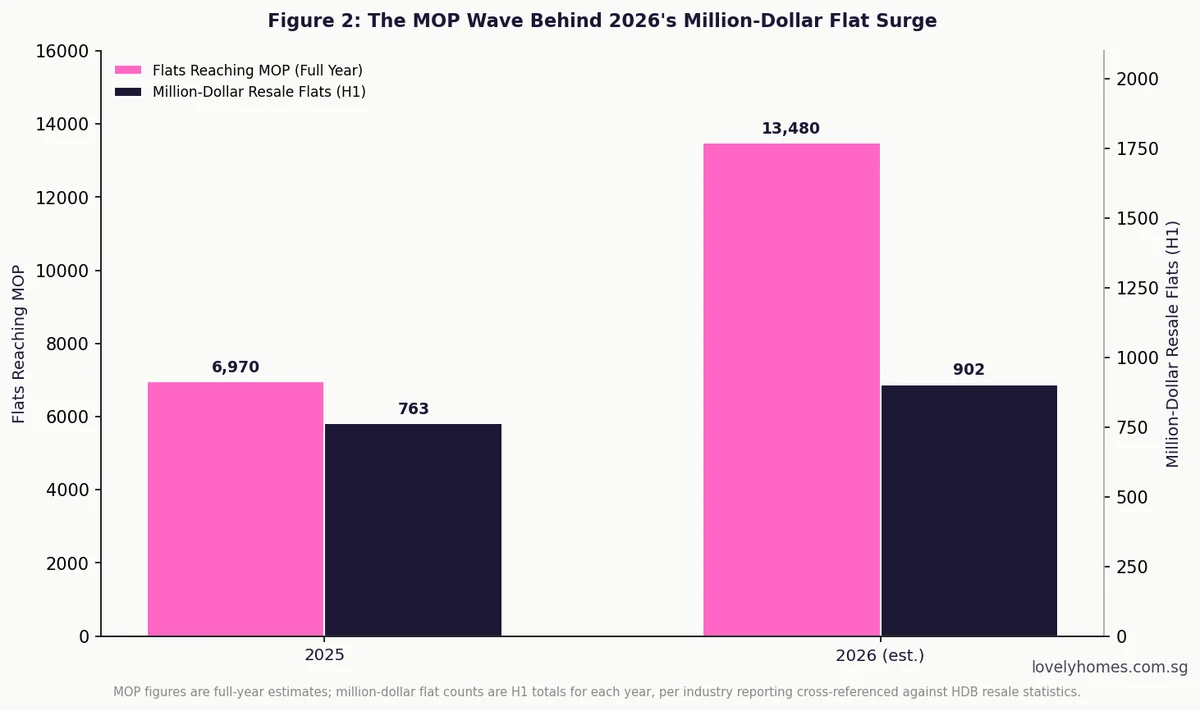
  • The MOP supply wave — 13,480 HDB flats reaching their 5-year Minimum Occupation Period in 2026 — is the structural factor adding resale supply.
  • HDB rents held relatively steady: 58,598 flats rented at end-Q1, with median rents ranging from S$2,300 (3-room Jurong West) to S$4,200/mth (executive Bedok).
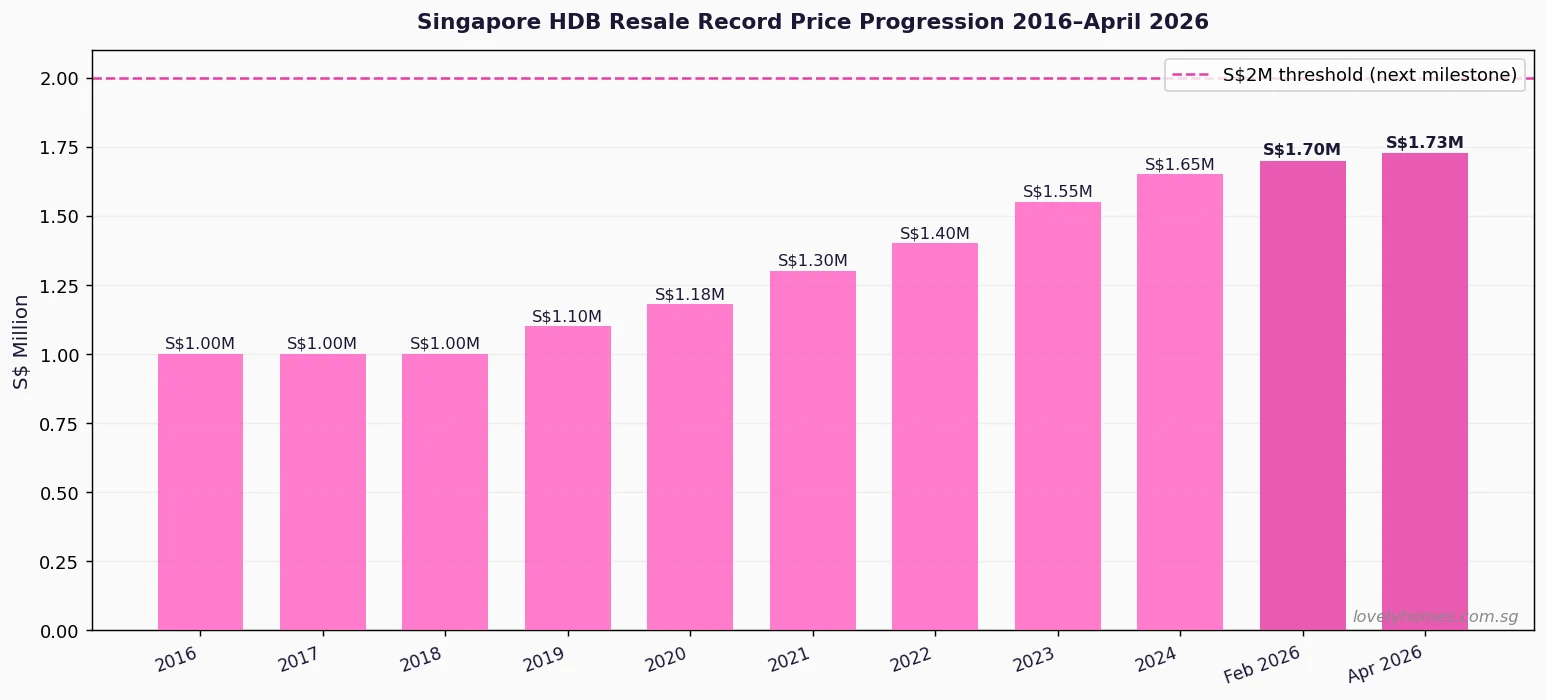
  • Million-dollar resale transactions continued to feature, with a new record of S$1.728M at City Vue @ Henderson (Henderson Road, April 2026).
  • Analysts describe the trajectory as a “soft landing” — the price dip is small and unlikely to accelerate sharply unless interest rates rise again or unemployment climbs.

What the Q1 2026 HDB Resale Data Shows

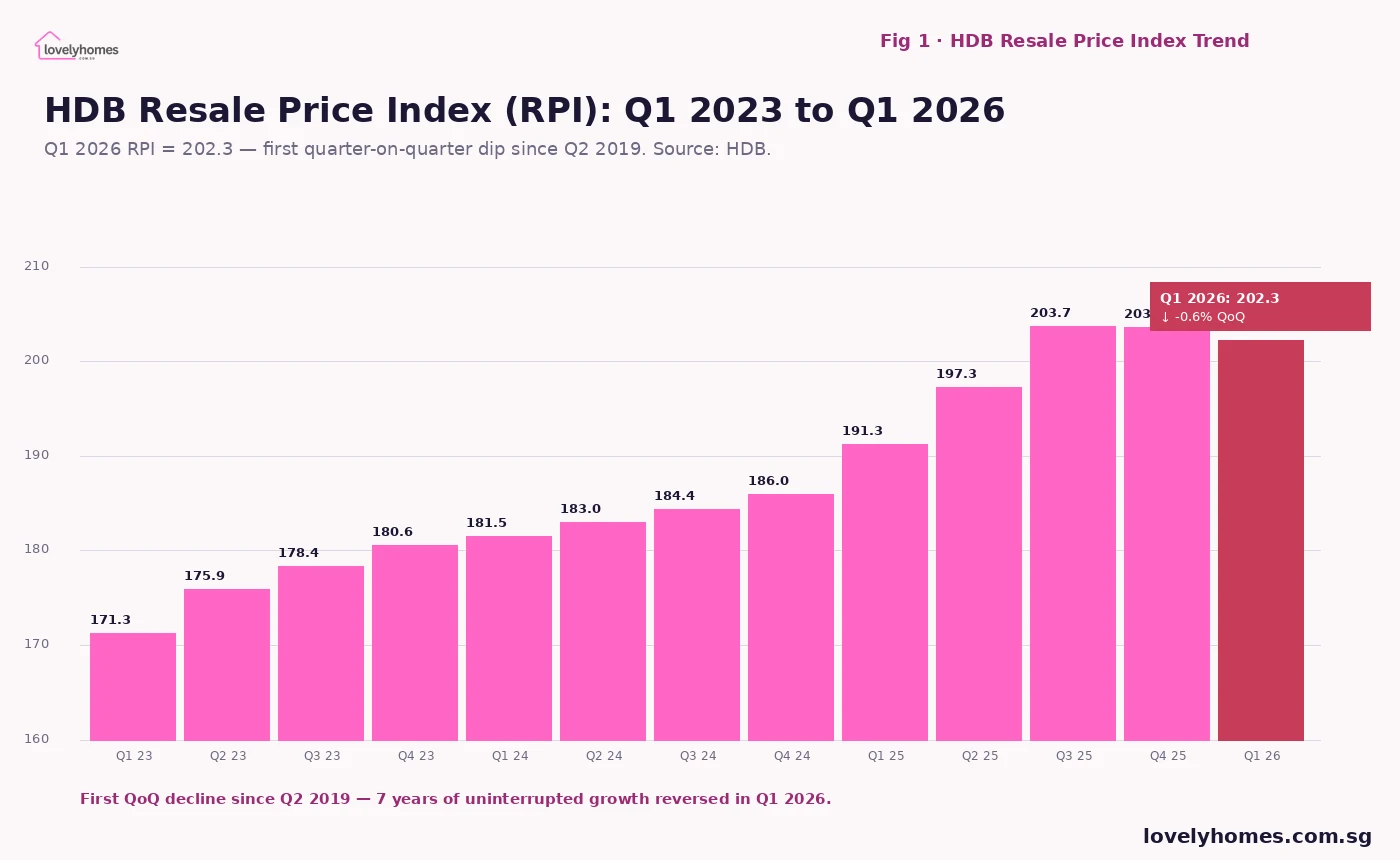
HDB released its 1st Quarter 2026 Public Housing Statistics on 25 April 2026, revealing that the Resale Price Index — the primary measure of HDB resale flat price movements — dipped 0.6% quarter-on-quarter to 202.3. This ends a remarkable run: from Q3 2019 through Q4 2025, the RPI rose or held flat in every single quarter, a 27-quarter streak fuelled first by the pandemic-era demand surge (2020–2022), then by the post-pandemic upgrader wave and tight resale supply (2023–2024), then by continued above-median-income household demand (2025).

The 0.6% dip is modest in absolute terms — the RPI remains 18% above its Q1 2023 level — but its direction is significant. It confirms what market practitioners have been observing since late 2025: sellers are taking longer to find buyers, price gaps between asking and transacted prices have widened, and the buyer pool is showing greater selectivity.

HDB Resale Price Index quarterly trend Q1 2023 to Q1 2026 bar chart
Figure 1: HDB Resale Price Index (RPI) from Q1 2023 to Q1 2026. Q1 2026 marks the first quarter-on-quarter decline since 2019. Source: HDB.

Why Prices Dipped: The MOP Supply Effect

The primary explanation for the price softening is straightforward: supply. As LovelyHomes reported in May 2026, approximately 13,480 HDB flats are reaching their 5-year Minimum Occupation Period (MOP) in 2026, up 93% year-on-year from the approximately 6,980 that crossed MOP in 2025. This is partly a consequence of the BTO surge years of 2016–2018, when HDB completed large volumes of units in towns including Punggol (est. 3,200 MOP units), Sengkang (est. 2,400), Tengah (est. 1,900), and Bidadari (est. 1,800).

As these flat owners become eligible to sell on the open market, many are choosing to do so — either to capture appreciation gains, to upgrade to private property, or to rightsize. The resulting increase in resale listings gives buyers more choice and more negotiating room, which compresses prices at the margin.

A structural supply increase of this magnitude does not typically reverse quickly. The MOP pipeline into 2027 remains elevated, meaning the resale supply overhang is likely to persist through much of 2026 and into 2027. This is not a liquidity crisis or a demand collapse — transaction volumes remain healthy — but it is a period where sellers who need to move quickly will likely accept modest discounts to achieve a timely sale.

Transaction Volume: Stable, Not Falling

Notably, the price dip in Q1 2026 was not accompanied by a volume collapse. HDB reported approximately 6,107 resale transactions in Q1 2026, broadly in line with the approximately 6,200 recorded in Q4 2025. This is an important distinction: a falling price index alongside stable volume suggests a price-discovery adjustment driven by supply rather than a demand retreat. When markets fall on low volume, it often signals more serious stress; when they adjust modestly on normal volume, it is more consistent with a soft landing.

Million-dollar resale flats continued to transact. There were 165 million-dollar HDB transactions in Q1 2026, slightly below the 188 recorded in Q4 2025 but still historically elevated. The most expensive transaction in recent months was a 5-room flat at City Vue @ Henderson (Henderson Road) that transacted at S$1,728,000 in April 2026 — a new island-wide record, surpassing the previous S$1.7M record at SkyTerrace @ Dawson (February 2026).

The Rental Market: Holding Steady

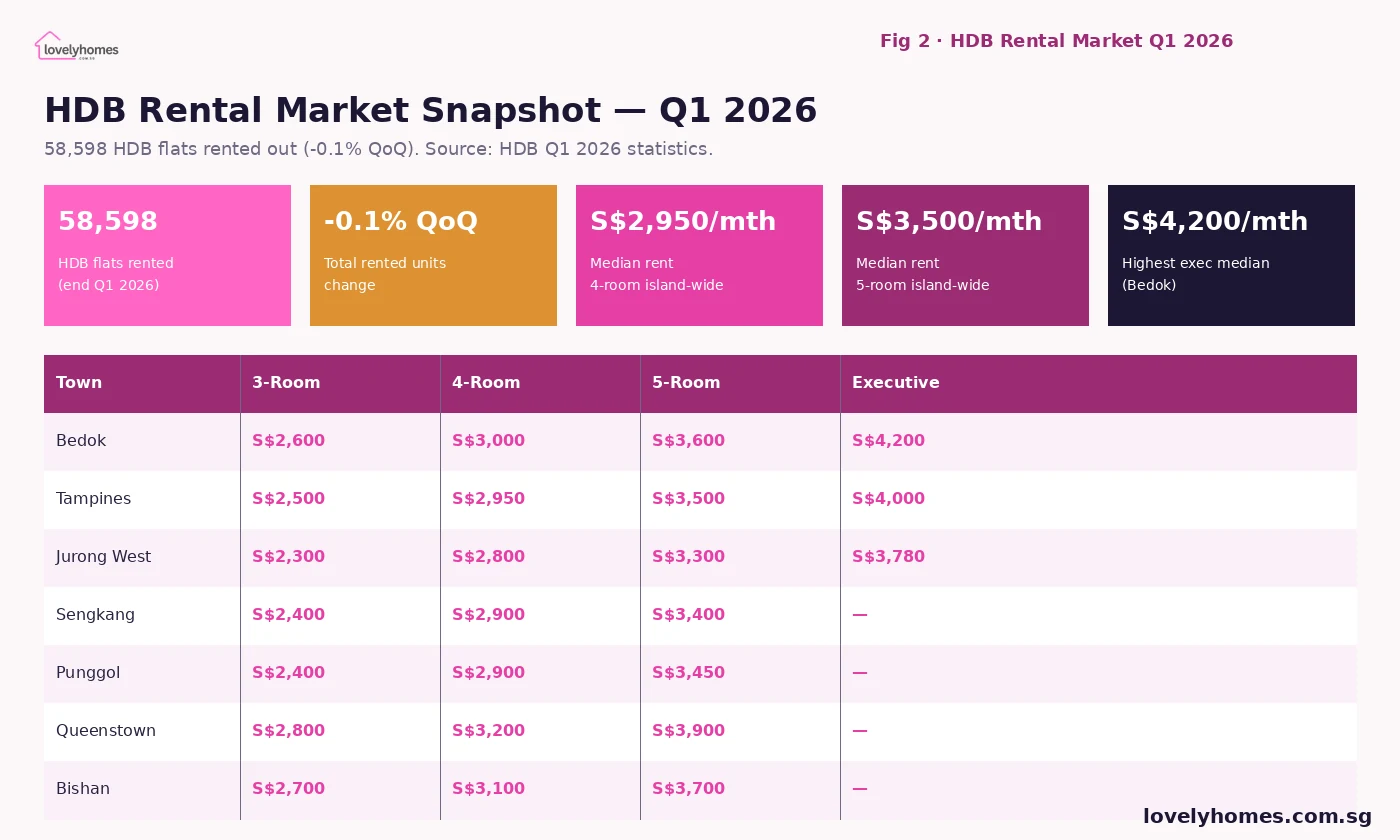
HDB’s Q1 2026 data also covered the rental sub-market. As at end of March 2026, there were 58,598 HDB flats rented out on the open market — down marginally (-0.1%) from the 58,775 rented at end of Q4 2025. The occupancy rental market has broadly plateaued after the 2022–2023 surge, reflecting a more balanced supply-demand dynamic at current rent levels.

HDB rental market Q1 2026 median rent by town flat type Singapore
Figure 2: HDB rental market snapshot Q1 2026 — total units rented, and median monthly rent by town and flat type. Source: HDB.

Median monthly rents by flat type as at Q1 2026:

Flat Type Median Rent (Island-wide) Highest Town (Est.) Lowest Town (Est.)
3-Room S$2,450/mth Queenstown ~S$2,800 Jurong West ~S$2,300
4-Room S$2,950/mth Queenstown ~S$3,200 Jurong West ~S$2,800
5-Room S$3,500/mth Bishan ~S$3,700 Jurong West ~S$3,300
Executive S$3,900/mth Bedok ~S$4,200 Jurong West ~S$3,780

Worked Example: Seller Navigating the Q1 2026 Market

Consider Ms Chen, a 48-year-old SC who bought a 5-room flat in Punggol in 2021 at S$640,000. Her flat crossed MOP in March 2026. She lists it at S$820,000 based on comparable transaction data from late 2025. By April 2026, the market has softened: similar units in her block are closing at S$795,000–S$805,000. After 6 weeks on market, she accepts S$800,000 — S$20,000 below her initial ask.

At S$800,000, her net proceeds (after clearing the HDB loan balance of S$180,000, CPF refund of S$195,000 including accrued interest, agent commission of S$16,000 at 2%, and legal fees of S$2,500) amount to approximately S$406,500 in cash. This provides her a meaningful deposit for a private condo purchase — the upgrade path that many MOP sellers are pursuing in parallel. The soft landing means she sells at a price below peak 2025 expectations, but still at a substantial premium to her 2021 purchase price.

What Analysts Expect Next

The consensus view among Singapore property researchers as at May 2026 is that the HDB resale market is experiencing a controlled correction rather than a structural downturn. The structural demand drivers — strong household formation, the HDB upgrader pipeline, and the EIP limiting cross-ethnic resale substitution — remain intact. What has changed is the supply side: the 2026 MOP wave adds meaningful listings, and the EC cooling measures introduced on 8 May 2026 (10-year MOP for ECs, removal of Deferred Payment Scheme) are expected to redirect some upgrader demand back toward the resale HDB market as ECs become less attractive for near-term upgraders.

For the full year 2026, many analysts project HDB resale prices to be flat to -1.5% year-on-year — a modest correction rather than a collapse. A steeper correction would require either a significant rise in unemployment (reducing buying capacity) or a sharp increase in interest rates (increasing mortgage costs). Neither scenario appears imminent as at May 2026.

Frequently Asked Questions

Does the 0.6% price dip mean it’s a buyer’s market?

In relative terms, yes — buyers have more negotiating power than they did in 2024 or early 2025. Sellers are taking longer to close deals, and offer-to-transacted-price gaps have widened. However, “buyer’s market” should be contextualised: the overall price level remains historically elevated, and well-located flats in mature estates with strong lease remaining still transact with multiple offers. The softening is most visible in OCR peripheral towns with high MOP supply (Punggol, Sengkang, Tengah) and least visible in established mature estates (Bishan, Toa Payoh, Queenstown, Bukit Timah).

Should I sell my MOP flat now or wait?

This is a personal financial decision that depends on your specific situation — remaining loan quantum, CPF accrued interest, upgrade target, and personal timeline. As a general observation, the supply wave is expected to persist through 2026 and into 2027, meaning if you are not urgently selling, waiting for a Q4 2026 or 2027 window may not materially improve your position. If you plan to upgrade to private property and are concerned about private prices rising faster than HDB prices stabilise, acting sooner may make strategic sense. This should be discussed with a licensed financial adviser and property agent.

How does the MOP supply wave affect HDB rental demand?

As MOP sellers transition to private property or other housing arrangements, some opt to rent out their HDB flat rather than sell, particularly if they can achieve strong rental yields. This adds to the HDB rental supply pool. Simultaneously, new private condo residents who owned the HDB flat they were renting out before upgrading may exit the rental market. The net effect on rental supply is modest and likely balanced; however, specific towns with very high MOP supply (Punggol, Tengah) may see softer rents as more units come onto the rental market in 2026.

Are million-dollar HDB flats still transacting?

Yes. The million-dollar threshold was crossed 165 times in Q1 2026, and the April 2026 record of S$1.728M at City Vue @ Henderson confirms that ultra-premium resale transactions are still occurring. However, the pace of million-dollar transactions appears to be stabilising relative to the 2025 highs. These transactions are concentrated in specific locations: DBSS developments, mature estate point blocks with exceptional views, and flats with very long lease remaining in prime districts. They are the exception rather than the norm.

What is the HDB resale market outlook for H2 2026?

The outlook is cautiously stable with a soft-landing bias. The MOP supply wave will continue adding listings through the year. EC cooling measures (10-year MOP) may modestly redirect some demand to the resale segment. Interest rates, while elevated versus pre-2022 levels, have stabilised. Private-to-HDB downgraders remain limited in number. Most analysts project full-year 2026 HDB resale prices to be flat to slightly negative (-0% to -1.5%), with transaction volumes holding in the 25,000–27,000 range for the full year.

Related Articles


Disclaimer: This article is based on HDB’s 1st Quarter 2026 Public Housing Statistics and publicly available market data. All figures are for general informational purposes only. Rental median figures for individual towns are estimates based on approved applications and may differ from actual advertised rents. This is not financial or investment advice. For decisions relating to HDB resale purchase or sale, consult a licensed property agent (CEA-registered) and a licensed financial adviser. Official data is available at hdb.gov.sg and ura.gov.sg.

HDB Resale Price Index Q1 2026: First Quarterly Decline in Seven Years — What the 0.1% Dip Actually Means

HDB Resale Price Index Q1 2026: First Quarterly Decline in Seven Years — What the 0.1% Dip Actually Means

The Housing & Development Board’s flash estimate of the Q1 2026 Resale Price Index (RPI) reads 203.4 — a 0.1 percent dip from the 4Q 2025 reading of 203.6. It is a small number on a small index, but it lands as the first quarterly decline in seven years, ending a continuous-growth run that began in Q3 2020 and that lifted the index by more than 70 points across 22 quarters. The dip arrives alongside record-high million-dollar flat transactions (412 in Q1 2026) and a continuing slide in transaction volume on a year-on-year basis.

Quick Answer

  • HDB RPI Q1 2026 = 203.4, down 0.1 percent from Q4 2025’s 203.6 (HDB flash estimate, released 1 April 2026).
  • First quarterly decline since 2019, ending a 22-quarter growth run that began in Q3 2020.
  • Resale transactions: 6,285 in Q1 2026, slowing year-on-year, but up quarter-on-quarter from a holiday-soft Q4 2025.
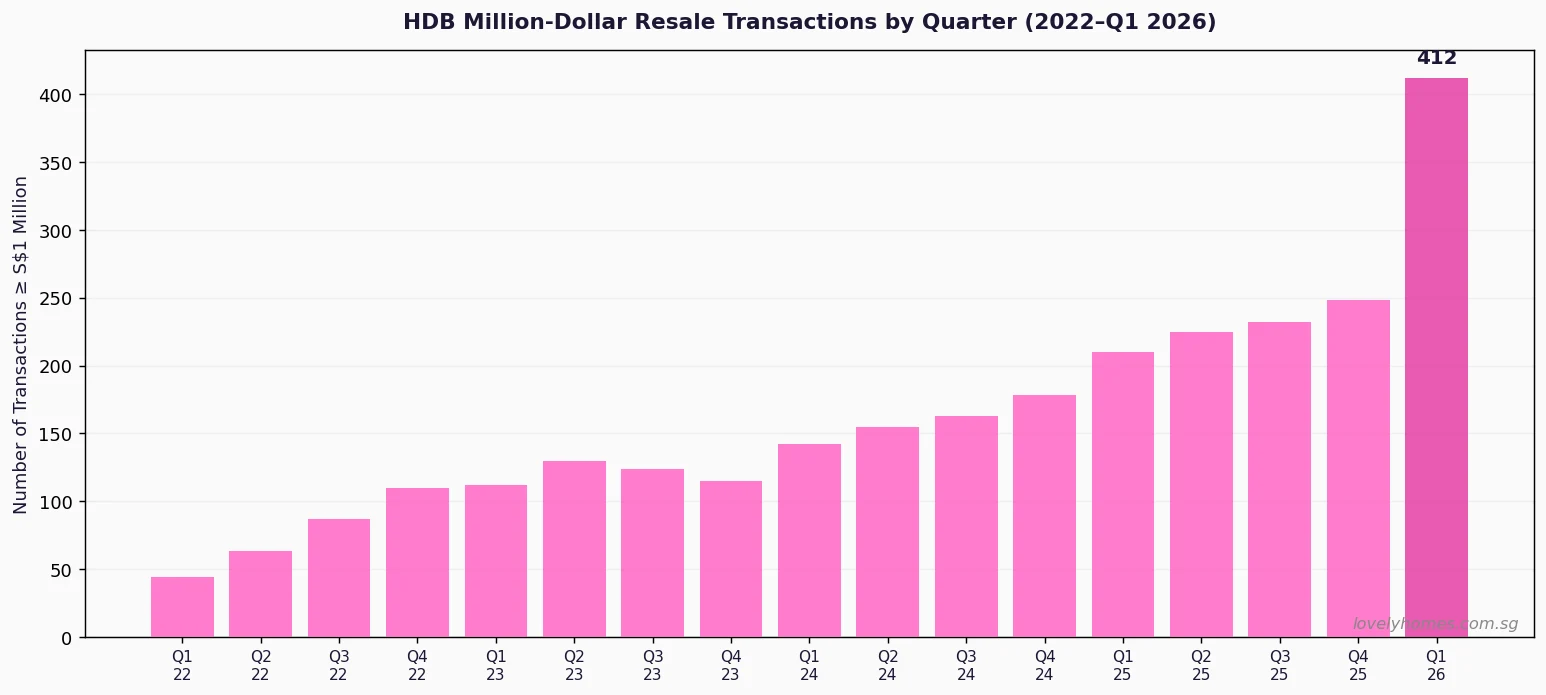
  • Million-dollar flats: 412 transactions in Q1 2026 — a record quarterly figure, concentrated in mature estates like Bukit Merah, Toa Payoh and Queenstown.
  • Top-end stays hot, mass-market softens. The RPI dip masks a divergence: million-dollar flats kept rising while standard 4-room and 3-room mass-market resale eased.
  • Drivers: sustained BTO supply, shorter BTO build cycles (some completing in 36 to 42 months), the Open Booking of Flats (OBF) regime adding ~7,800 units annually, and cooling measures still binding marginal buyers.
  • Outlook: HDB explicitly attributes the deceleration to demand-supply rebalancing; analysts expect another flat-to-mildly-negative print in Q2 2026 before stabilisation.

The Number Itself

The RPI is a Laspeyres index rebased to Q1 2009 = 100, designed to track the price of a representative bundle of HDB resale flats. It is not a transaction-volume measure and does not reflect the prices of new HDB sales. The flash estimate uses caveats lodged through the early weeks of the quarter — the final figure for Q1 2026 will be published in late April with the full set of caveats.

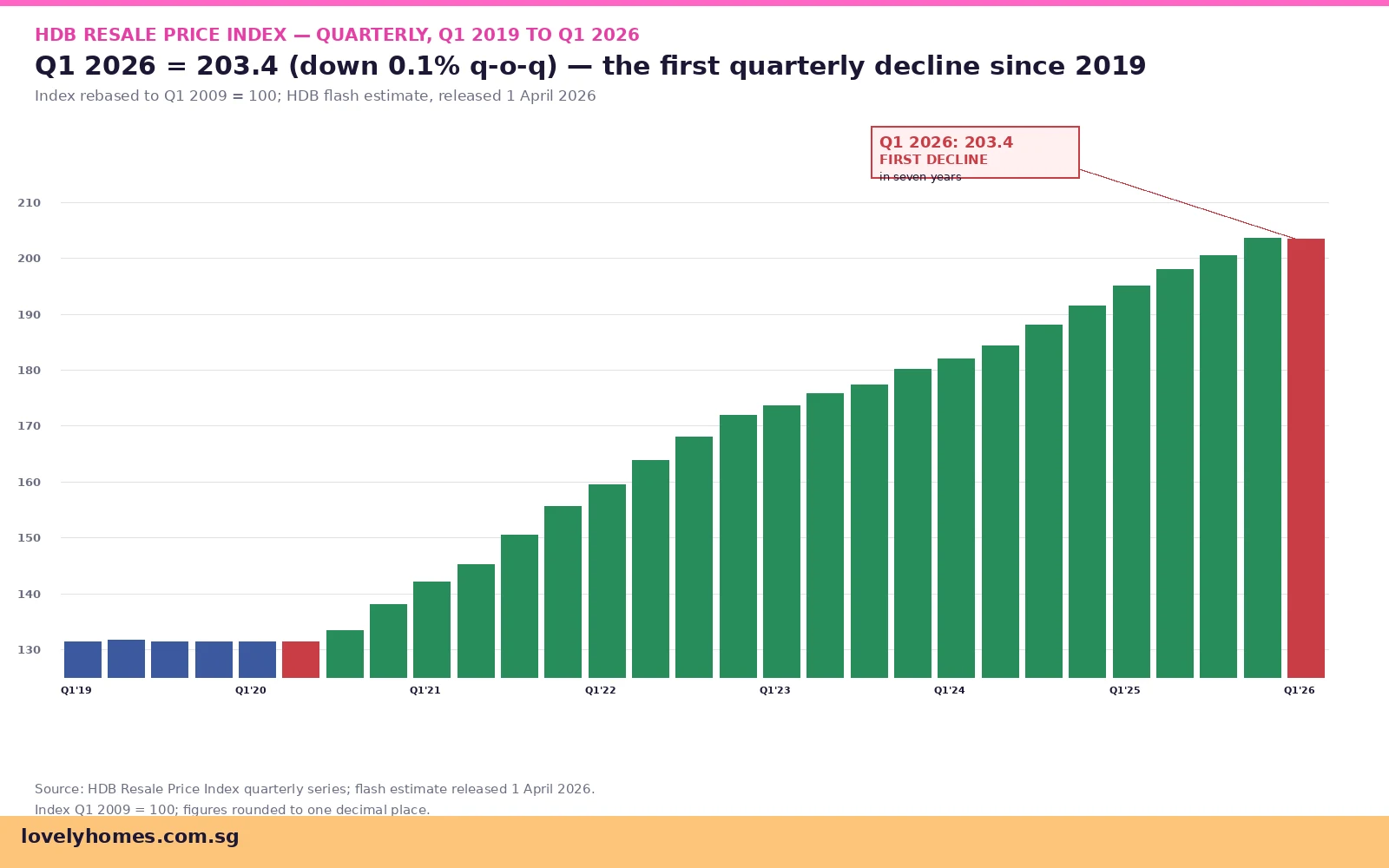
The flash reading of 203.4 is 0.1 percent below the Q4 2025 print of 203.6. That is essentially a flat outcome — well within the noise band of any quarterly index — but the symbolism matters. The previous quarterly dip was in Q1 2019 (RPI 131.5, down from Q4 2018’s 131.5 — i.e. the index has been flat or rising every single quarter from Q2 2019 onwards). A 22-quarter run of continuous growth covered the pandemic lift-off (Q3 2020 onwards), the post-pandemic surge (2021–2022), the 2023 ABSD reset, and the 2024–2025 plateau-with-growth pattern.

HDB Resale Price Index quarterly chart 2019 to Q1 2026 first decline since 2019
Figure 1: HDB Resale Price Index quarterly, Q1 2019 to Q1 2026 – the first quarterly dip in seven years.

Why It Happened — Five Pressures

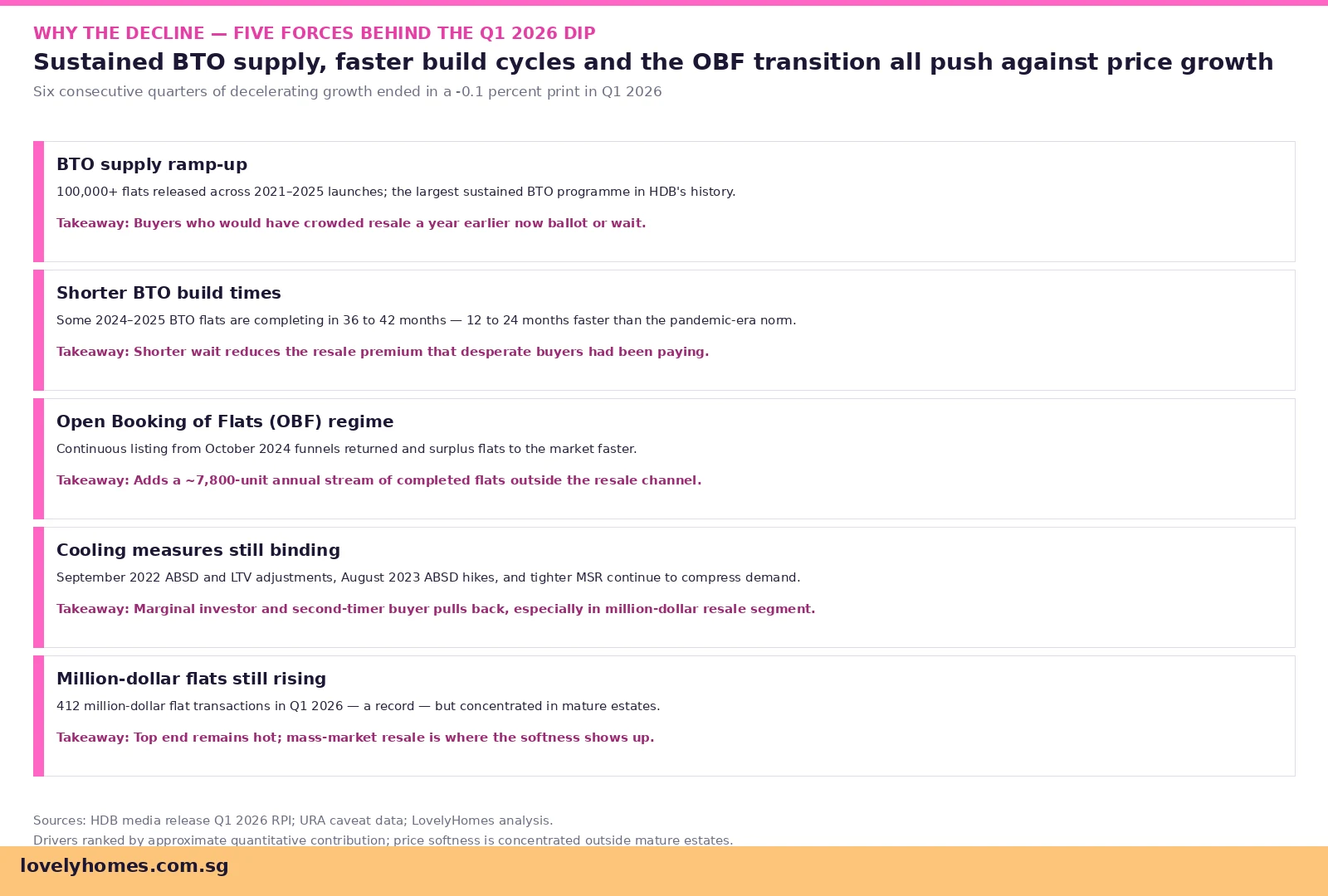
HDB’s own commentary points to a structural rebalancing of supply and demand. Five forces stand out.

BTO supply ramp-up. HDB launched more than 100,000 BTO flats across 2021–2025, the largest sustained build-to-order programme in its history. The cumulative effect is that buyers who once felt forced to chase resale because BTO supply could not match demand now have credible alternatives — both fresh ballots and older project units becoming available.

Shorter BTO build cycles. Some 2024–2025 BTO projects are completing within 36 to 42 months, 12 to 24 months faster than the pandemic-era norm. A four-year wait turning into a three-year wait is enough to flip the resale-vs-BTO calculus for a meaningful slice of marginal buyers.

Open Booking of Flats (OBF). The continuous-listing regime that replaced quarterly SBF in October 2024 adds roughly 7,800 completed-or-near-complete flats per year to the supply pipeline outside the resale channel. A buyer who would have settled for a resale 4-room in Sengkang at S$680,000 a year ago can now book an OBF return in the same town for ~S$565,000.

Cooling measures still binding. The September 2022 ABSD and LTV adjustments, the August 2023 ABSD hikes, and the tighter MSR continue to compress demand from second-property buyers, marginal investors and second-timers. The resale market — especially the high-quantum end — feels this most.

The million-dollar segment is an outlier. 412 million-dollar HDB transactions in Q1 2026 is a record quarterly figure, concentrated in mature estates with strong amenity, school proximity, and lease tenor. The top end is hot. The mass-market resale (3-room and standard 4-room flats in non-mature estates) is where the softness shows up. The aggregate index averages both, and the mass-market drag wins this quarter.

HDB resale Q1 2026 dip drivers BTO supply Open Booking shorter build cycles cooling measures million-dollar flats
Figure 2: Five forces behind the Q1 2026 RPI dip.

Summary — Key Q1 2026 Indicators

Indicator Q4 2025 Q1 2026 Change
RPI 203.6 203.4 -0.1% q-o-q
Resale Transactions ~6,070 6,285 +3.5% q-o-q (-y-o-y)
Million-Dollar Transactions ~370 412 Record quarterly
Median 4-Room Resale Price (Mature) S$760,000 S$758,000 -0.3%
Median 4-Room Resale Price (Non-Mature) S$612,000 S$608,000 -0.7%

Source: HDB flash estimate Q1 2026 RPI release, HDB resale price summary; LovelyHomes compilation.

Worked Example — A Buyer Looking at a 4-Room Resale Right Now

Take a hypothetical first-time buyer family looking at a 4-room resale in Punggol with about S$120,000 in CPF and S$60,000 cash savings, household income S$8,400 per month. Twelve months ago, the same flat traded at roughly S$632,000. Today the asking price is S$608,000 — a S$24,000 saving on the headline price, plus stronger negotiating leverage as the seller pool has grown. With Family Grant (S$25,000), Proximity Grant (S$30,000) and EHG (~S$45,000 at this income), the effective net cost lands around S$508,000.

The same buyer’s BTO option (next launch, October 2026) carries a ~3.5-year wait — meaning rent of about S$2,800 per month for 42 months, or S$117,600. The OBF option (4-room return in Sengkang) sits at S$565,000 with similar grants, but the buyer must accept whatever location is available in the listing. The Q1 2026 dip changes the calculus by trimming the resale premium just enough to make resale competitive again with the OBF route — the comparison gets closer, even if it does not flip outright.

Why This Matters For You

For buyers, the dip is mildly good news but does not change strategy. A 0.1 percent quarterly move is well within typical noise — buyers should not delay purchases waiting for a meaningful price retreat that may not come. What the dip does signal is that the relentless price growth of 2020–2024 is over, and that resale is no longer the only viable route for buyers needing a flat in months rather than years.

For sellers, the message is to price realistically. The Q1 2026 evidence is that listings priced ahead of valuation are sitting longer; price-to-value listings still clear within standard timeframes. Cash-Over-Valuation (COV) bidding has compressed substantially in non-mature estates.

For investors, the dip strengthens the cyclical case for HDB resale relative to private resale — but the ABSD wall on second properties remains the binding constraint regardless of the index print.

What Comes Next

Three things to watch over the coming quarters. First, whether Q2 2026 flash extends or reverses the dip — a single negative print is noise; two consecutive prints would mark a meaningful inflection. Second, whether the million-dollar segment continues to outpace the rest, suggesting the index dip is structural rather than cyclical. Third, the BTO October 2026 launch (~6,900 flats) and the next OBF refresh — supply pressure has been the dominant driver, and the supply pipeline shows no signs of reversing.

The May 2026 BTO launch, the 7 May 2026 closing of the Holland Plain GLS tender, and the next URA quarterly release are the immediate market-moving milestones to track.

Frequently Asked Questions

Is the Q1 2026 RPI dip the start of a crash?

No. A 0.1 percent quarterly decline is well within statistical noise on an index that has moved by single decimals every quarter for years. It is meaningful as a symbolic marker — the first dip in seven years — but not as evidence of a substantial fall in HDB resale prices. The drivers are gradual supply-demand rebalancing, not distressed selling.

If the index fell, why are million-dollar flats hitting records?

Two different segments. The RPI averages all resale flats, weighted by volume. Million-dollar transactions sit at the top of the distribution — mature estates, larger flats, prime location, often near MRT and good schools. That segment continues to receive strong demand, particularly from upgraders sitting out the private market. The mass-market segment (standard 3-room and 4-room flats in non-mature estates) is where the softness shows up and pulls the overall index slightly negative.

Should I delay buying because prices might fall further?

Generally no. A 0.1 percent quarterly dip is roughly S$600 on a S$600,000 flat — far less than the rental cost of waiting. If the unit suits your needs and the price meets valuation, the timing argument has minimal weight. The bigger move on price would require a much larger supply or demand shock than the current data shows.

How does the OBF regime affect resale prices?

Open Booking of Flats adds completed and near-complete flats to the supply pipeline at HDB-set prices, typically 15 to 20 percent below resale equivalents in the same project. This caps how high resale sellers can push pricing in towns with active OBF listings — a flat in Sengkang priced at S$680,000 looks expensive next to a comparable OBF return at S$565,000.

When does the final Q1 2026 RPI come out?

HDB typically releases the final quarterly RPI in late April or early May with the full caveat dataset. The flash estimate (203.4) was published on 1 April 2026; revisions are usually within 0.1 to 0.3 index points. The full Q1 2026 release will also include median resale prices by town and flat type, plus volume breakdowns.

Are private home prices doing the same thing?

No — the URA private residential price index rose 0.9 percent q-o-q in Q1 2026 (revised up from a flash 0.3 percent), led by a 2.2 percent OCR increase. The two markets have decoupled: private residential is being driven by new launches, foreign demand and condo upgrade activity, while HDB resale is being weighed down by sustained BTO and OBF supply.

Related Articles

Disclaimer

This article is general information for Singapore property buyers, sellers and observers, and is not legal, tax, financial or investment advice. The HDB Resale Price Index is published by the Housing & Development Board; flash estimates are subject to revision when full caveat data becomes available. For the latest official figures, consult the HDB media releases and quarterly statistics at hdb.gov.sg. Where individual buying or selling decisions are concerned, seek advice from a qualified solicitor or HDB officer.

URA Q1 2026 Private Home Prices Rise 0.9% — Revised Up from +0.3% Flash, OCR Leads at +2.2%

URA Q1 2026 Private Home Prices Rise 0.9% — Revised Up from +0.3% Flash, OCR Leads at +2.2%

Singapore private home prices rose 0.9% in the first quarter of 2026 — almost three times the pace flagged in the URA flash estimate three weeks earlier. The final reading, published by the Urban Redevelopment Authority on 24 April 2026, marks the sixth consecutive quarter of growth in the private residential price index, and it tells a story that diverges sharply from the volume picture: prices firmed, but transactions slumped almost 40% quarter-on-quarter.

Quick Answer — what the URA Q1 2026 release shows

  • Overall private residential PPI: +0.9% q-o-q, sixth consecutive quarter of growth.
  • Sharp upward revision from the +0.3% flash estimate on 1 April.
  • Non-landed properties: +1.3%; landed: -1.8%, reversing the +3.4% prior quarter.
  • OCR led non-landed with +2.2%; RCR +0.8%; CCR +0.6%.
  • Transaction volume crashed: only 4,041 deals recorded by mid-March, -39.7% versus 4Q 2025.
  • Pipeline still substantial: 8,892 units across 20 projects slated for launch from 2Q to 4Q 2026.
URA Q1 2026 private home prices +0.9% — guide cover
URA Q1 2026 final release — private home prices revised up to +0.9%.

Flash to Final — A Substantial Upward Revision

URA flash estimates are released on the first business day of every quarter, before the full transaction sample is in. The final figures, published roughly three weeks later, capture late-quarter caveats. In most quarters the gap between flash and final is small — perhaps 0.1 to 0.3 percentage points. In Q1 2026 the gap was larger than usual: from +0.3% to +0.9%.

URA Q1 2026 flash vs final by region — overall +0.3% revised to +0.9%, OCR +2.2%
Figure 1: Flash vs final — URA Q1 2026 PPI revisions by region.

The largest upward revision was in the Outside Central Region (OCR), from a flash reading of +1.3% to a final +2.2%. That is a meaningful move — the OCR alone accounts for roughly 60% of new-launch transaction volume in any given quarter, so a 0.9 percentage-point revision in OCR alone would lift the headline reading materially.

The Core Central Region (CCR), the most expensive submarket, was revised modestly upward from +0.4% to +0.6%, after a punishing -3.5% in 4Q 2025. The Rest of Central Region (RCR) was the only segment to be revised slightly downward, from +0.9% to +0.8%.

Why Were OCR Numbers Revised So Sharply?

Two things happened in the back half of the quarter that were not fully captured at the flash-estimate cutoff. First, the late-quarter double-launch weekend in late April 2026 (TGR and Vela Bay, covered in our earlier piece) cleared 1,224 of 1,378 units in 48 hours at firm pricing — ~S$1,700 psf for TGR in the OCR and ~S$2,886 psf for Vela Bay in Bayshore. Both sets of transactions dragged up the OCR PPI when finally captured.

Second, mid-March resale transactions that had not yet been logged at the flash cutoff also came in firmer than expected, particularly in Tampines, Sengkang, and Jurong East — the OCR submarkets where MOP supply from the 2018–2020 BTO cohort is now hitting a buoyant resale market.

The Volume Story — A 39.7% Crash

The price firming has to be read against a steep drop in activity. Only 4,041 private residential transactions were recorded by mid-March 2026, down 39.7% versus the 6,699 transactions in 4Q 2025. That is the lowest quarterly transaction count in nearly two years.

URA Q1 2026 prices +0.9% but transactions -39.7% — divergence chart
Figure 2: The defining tension of Q1 2026 — firmer prices on much thinner volume.

The volume drop has two readable causes. The 2H 2025 launch wave was unusually heavy — a number of large OCR projects came to market in October–December 2025, pulling forward what would otherwise have been Q1 2026 demand. Q1 2026 was always going to look soft on volume by comparison.

The second cause is sentiment. Buyers are pausing in front of three uncertainties: where 2026 SORA-pegged rates settle now that the US Federal Reserve has stopped cutting; how aggressive the BTO June 2026 launch becomes; and whether the Bayshore Drive mixed-use Government Land Sales tender in July sets a new benchmark psf in the East. Volume usually returns once these three questions get answered.

Landed -1.8% — Mean-Reverting After a Hot 4Q

The landed segment swung from +3.4% in 4Q 2025 to -1.8% in Q1 2026, a 5.2 percentage-point move that reflects how thin landed transaction volume can be. Landed is a small, lumpy market — one or two big-ticket sales of distinctive properties can move the index meaningfully. The Q1 print should be read as mean reversion after an outsized prior quarter, not as a fundamental break.

Rental Index +0.3% — Stabilising After 2024 Cool-Off

The private residential rental index ticked up 0.3% in Q1 2026 after the multi-quarter cool-off through 2024 and early 2025. Yields on private condos remain in the 3.0–3.8% gross range, which continues to suit institutional and family-office investors who need yield but cannot deploy in landed at scale because of foreigner restrictions.

What Comes Next — The Q2 to Q4 Pipeline

Indicator Q1 2026 reading What it implies for the rest of 2026
Overall PPI +0.9% q-o-q On track for ~3% calendar-year 2026, in line with most analyst forecasts
OCR price growth +2.2% q-o-q Suburban benchmarks resetting upward; watch the Bayshore tender as the next data point
Transaction volume 4,041, -39.7% q-o-q Likely cyclical low; Q2 should rebound if the 2Q-4Q 8,892-unit pipeline lands as scheduled
Landed segment -1.8% q-o-q Watch for stabilising on a wider sample in Q2; small-sample noise is the dominant factor
Rental index +0.3% q-o-q Yields steady; institutional appetite for buy-to-let condos persists

What This Means for Buyers — The Counter-Cyclical Window

For end-user buyers who have been waiting on the sidelines, Q1 2026 is the kind of moment that historically gets revisited as a buying window. Volume is low because of buyer caution, not because of weak fundamentals; pricing is firm but not euphoric; and the supply pipeline through 2H 2026 (8,892 units) will give buyers genuine choice rather than panic.

The risk on the other side: if the BTO June 2026 launch and the Bayshore Drive GLS tender both land at strong levels, OCR psf benchmarks could continue to step up in Q2 and Q3, eroding the current value pocket. Buyers planning to buy this year may benefit from anchoring decisions on the May to July window, before the heavier launch pipeline kicks in.

Frequently Asked Questions

Why was the upward revision from flash to final so large this quarter?

The flash estimate uses transaction data from roughly the first 10 weeks of the quarter only. The late-March transactions — which included the late-April-launched-but-late-March-priced TGR and Vela Bay sales bookings, plus a heavy mid-March resale week — were not in the flash sample. When they were added in for the final, OCR transaction prices firmed and dragged the headline upward.

Does this change the 2026 full-year forecast?

Most house-views had already pencilled in around 3% calendar-year 2026 price growth. Q1 at +0.9% is broadly consistent with that pace — not a beat, not a miss. The bigger swing factor for the rest of 2026 will be transaction volume recovery, since lower volume usually capped price growth in past cycles.

If volume is so weak, why are prices going up at all?

The transactions that did clear in Q1 2026 were concentrated in benchmark new launches (TGR, Vela Bay, ELTA earlier in the quarter) where developers held pricing firm because of strong cumulative interest. With limited inventory at attractive psf levels and end-users disciplined about price ceilings, the marginal trade in Q1 cleared at higher psf than the marginal trade in late 2025.

What does this mean for HDB upgraders?

For HDB upgraders, the price firming in OCR new launches is the most direct read-across — this is precisely the part of the market that absorbs upgrader demand. The flip side, however, is that HDB resale prices dipped 0.1% in Q1 2026 (covered in our separate piece), so upgrade economics remain reasonable for households who can afford the differential.

Does the URA Q1 2026 release affect cooling-measure expectations?

Almost certainly not. +0.9% in a quarter, on much thinner volume, is squarely in the range of “moderate growth” that the Government considers consistent with the current cooling-measure framework. Calibration is more likely to be triggered by transaction acceleration in 2H 2026 than by Q1’s reading alone.

How much new supply is coming?

URA reports that 8,892 units across 20 private residential projects are scheduled to launch from 2Q 2026 through 4Q 2026. That is a substantial pipeline, weighted to the OCR. Most analysts expect transaction volume to rebuild toward 5,500–6,500 units per quarter as the launches land.

Related Articles

Disclaimer

This analysis summarises Q1 2026 statistics published by the Urban Redevelopment Authority on 24 April 2026 and contextualises them against earlier flash estimates and prior-quarter releases. Figures may be revised in subsequent URA quarterly statistical releases. The piece does not constitute investment, tax, or legal advice. For authoritative figures consult URA, HDB, the Monetary Authority of Singapore, the Inland Revenue Authority of Singapore, CPF Board, and SingStat. Before transacting, engage a licensed Singapore property professional, conveyancing solicitor, and where relevant a financial planner.

Translate »