Singapore HDB Selling Guide 2026: Step-by-Step Process, Selling Costs, COV and Net Proceeds

Singapore HDB Selling Guide 2026: Step-by-Step Process, Selling Costs, COV and Net Proceeds

Quick Answer: Selling Your HDB Flat in 2026 — Key Facts

  • Minimum Occupation Period (MOP): 5 years for standard BTO and resale flats; 10 years for Plus/Prime BTO launched from February 2024. Must be completed before registering intent to sell.
  • Selling process: Register Intent to Sell → list flat → grant OTP (21-day validity) → buyer exercises OTP → HDB Resale Portal submission → completion. Typical timeline: 8–16 weeks.
  • COV (Cash Over Valuation): if agreed price exceeds HDB valuation, the difference is paid entirely in cash by the buyer. Obtain an HDB Value Report before issuing the OTP.
  • Selling costs: agent commission (1–2%), legal fees (~S$2,500–S$4,000), HDB admin fee (S$40). Total cash costs typically S$15,000–S$25,000 for a S$700K flat.
  • CPF refund: full CPF principal withdrawn plus accrued interest at 2.5% p.a. returns to your CPF OA — not a cash cost, but reduces your cash proceeds.
  • Seller’s Stamp Duty (SSD): 12% (Year 1), 8% (Year 2), 4% (Year 3) of sale price if you sell within 3 years. Zero after 3 years — most HDB sellers are unaffected as MOP exceeds SSD period.
  • After selling: 30-month wait to buy a new HDB flat from HDB directly. No restriction on buying an HDB resale flat on the open market.

Why HDB Sellers Need a Clear Strategy in 2026

Selling an HDB flat is one of the most significant financial decisions a Singapore household will make. The HDB resale market transacted over 25,000 flats in 2025, with median prices ranging from S$338,000 for a 2-room Flexi to nearly S$975,000 for Executive/Maisonette flats. In the first half of 2026 alone, 902 flats sold for S$1 million or more — a record.

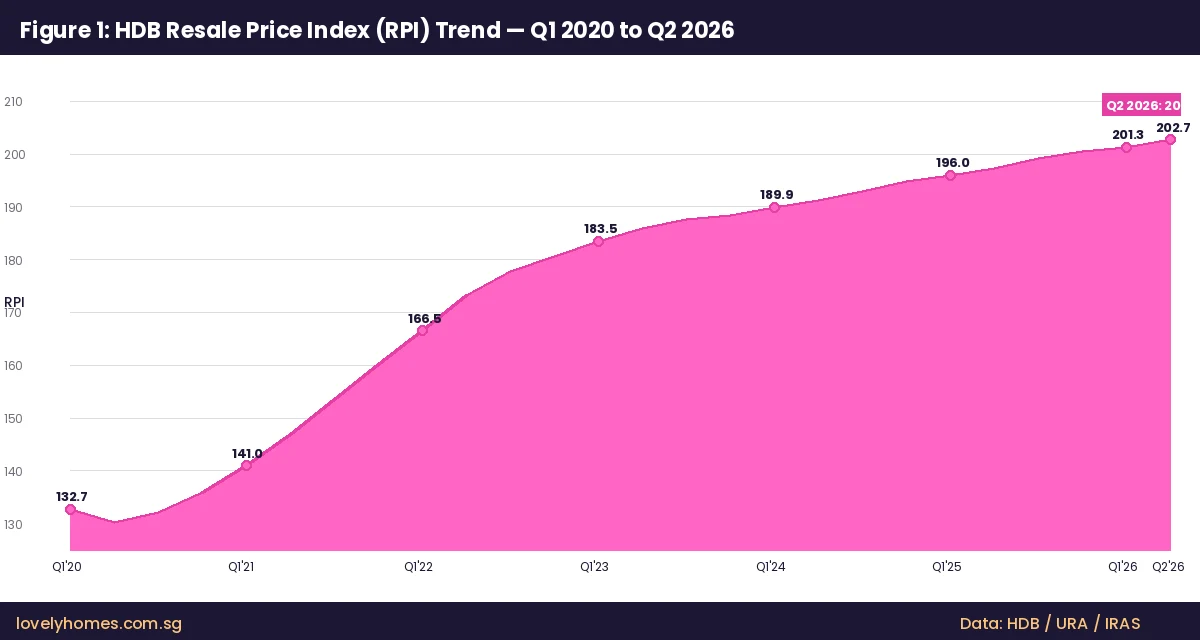
Yet the market is softening. The HDB Resale Price Index fell to 202.7 in Q2 2026 (down 0.3% quarter-on-quarter), the second consecutive quarterly decline — the first back-to-back drop since 2018–2019. For sellers, timing, pricing strategy, and a clear calculation of net proceeds are more important than ever.

This guide walks through the complete HDB selling process, the costs involved, what happens to your CPF and mortgage proceeds, and the rules you need to know before you hand over the keys.

Step 1: Check Your Eligibility — MOP and Other Requirements

Before marketing your flat, confirm you meet all eligibility requirements. The Minimum Occupation Period (MOP) is the most important gate.

Standard flats: 5 years from the date of key collection. If you collected keys on 15 August 2021, your MOP completes on 15 August 2026.

Plus and Prime BTO flats (launched from February 2024 onwards): 10-year MOP. These cover flats in locations deemed highly attractive — near MRT interchanges, city-fringe, or prime area — introduced to slow speculative resale of Government-subsidised units in these locations.

Additional checks: all owners and essential occupiers on the flat must meet citizenship and residency criteria; outstanding HDB loans must be discharged at completion; the flat must not be subject to enforcement action.

The 10-Step HDB Resale Selling Process

HDB resale selling process 10 steps 2026 Singapore OTP portal completion
Figure 1: HDB Resale Selling — 10 Steps from Intent to Completion (2026). Typical timeline: 8–16 weeks from OTP exercise to key handover.

Step 1 — Check MOP and eligibility: Confirm MOP completion via My HDBPage. Review outstanding loan balance and CPF withdrawal history to estimate net proceeds before committing to a price.

Step 2 — Register Intent to Sell (ITS): Submit via HDB Resale Portal. HDB prepares the flat’s valuation and confirms eligibility. ITS valid for 12 months; admin fee S$40 payable by seller.

Step 3 — Market and conduct viewings: List on property platforms via your agent. Prepare an inventory of included fittings. Be transparent about flat condition, remaining lease, and any outstanding arrears.

Step 4 — Negotiate price and COV: If the agreed price exceeds HDB’s valuation, the difference (COV) is paid entirely in cash by the buyer. Obtain an HDB Value Report before issuing the OTP.

Step 5 — Grant Option to Purchase (OTP): Issue the buyer a signed OTP. Option fee is by agreement (typically S$500–S$2,000; minimum S$1). OTP valid 21 calendar days — the buyer’s exclusive right to purchase.

Step 6 — Buyer exercises OTP: Buyer pays exercise fee and countersigns. If the buyer does not exercise within 21 days, OTP lapses and the option fee is forfeited to the seller.

Step 7 — Submit via HDB Resale Portal: Both parties submit their respective portions within 7 calendar days of OTP exercise. HDB assesses eligibility and confirms valuation.

Step 8 — Mortgage discharge: Your solicitor coordinates discharge of any outstanding mortgage. Balance is settled from sale proceeds at completion.

Step 9 — Completion appointment: Scheduled by HDB 4–8 weeks after portal approval. Attend in person (or via authorised solicitor). Sale price paid, mortgage discharged, flat transferred.

Step 10 — Receive proceeds and hand over keys: Net proceeds disbursed. CPF refund credited to your OA. Vacate on or before completion date.

Selling Costs and Net Proceeds

HDB resale selling costs net proceeds 2026 agent legal CPF refund mortgage waterfall
Figure 2: HDB Resale Selling Costs and Net Cash Proceeds for a S$630,000 4-Room Flat (2026). CPF refund and mortgage repayment are not cash costs — they return to your CPF OA and discharge your loan.

Direct Cash Selling Costs

Agent commission: no mandated rate; market norm is 1–2% of the sale price. On a S$700,000 flat this ranges from S$7,000 to S$14,000. The commission is negotiable and deductible for income tax purposes if the flat is investment property.

Legal fees: solicitor’s fees for conveyancing, CPF redemption, and mortgage discharge typically total S$2,500–S$4,000 all-in.

HDB admin fee: S$40 per party (S$40 buyer, S$40 seller) payable at completion.

Seller’s Stamp Duty: applies only if you sell within 3 years of acquisition: 12% (Year 1), 8% (Year 2), 4% (Year 3). Most HDB sellers pay zero as MOP (5 years) exceeds the SSD period.

CPF Refund — Returned to Your OA, Not a Cash Loss

All CPF OA funds withdrawn for the property — downpayment, stamp duty, and monthly instalments — must be refunded to your CPF OA on sale. The refund amount is the total principal withdrawn plus accrued interest at 2.5% p.a., compounded annually from each withdrawal date. This is not a penalty: it restores to your OA the interest it would have earned had the funds remained invested. You can use the refunded CPF for your next property purchase.

HDB Resale Prices: What to Expect in 2026

HDB resale median prices by flat type Q4 2025 vs Q2 2026 Singapore flash estimate
Figure 3: HDB Resale Median Prices by Flat Type — Q4 2025 vs Q2 2026 Flash Estimate. Source: HDB Flash Data, 1 July 2026. Indicative medians; actual prices vary by town and storey.

The HDB Resale Price Index (RPI) fell 0.3% to 202.7 in Q2 2026 — the second consecutive quarterly decline and the first back-to-back drop since 2018–2019. Transaction volume was approximately 6,268 units in Q2 2026, down year-on-year from peak 2023 levels. Despite the index softening, the million-dollar segment remains buoyant: 491 transactions at S$1M+ in Q2 2026, totalling 902 for the first half of 2026 — up 18.2% year-on-year.

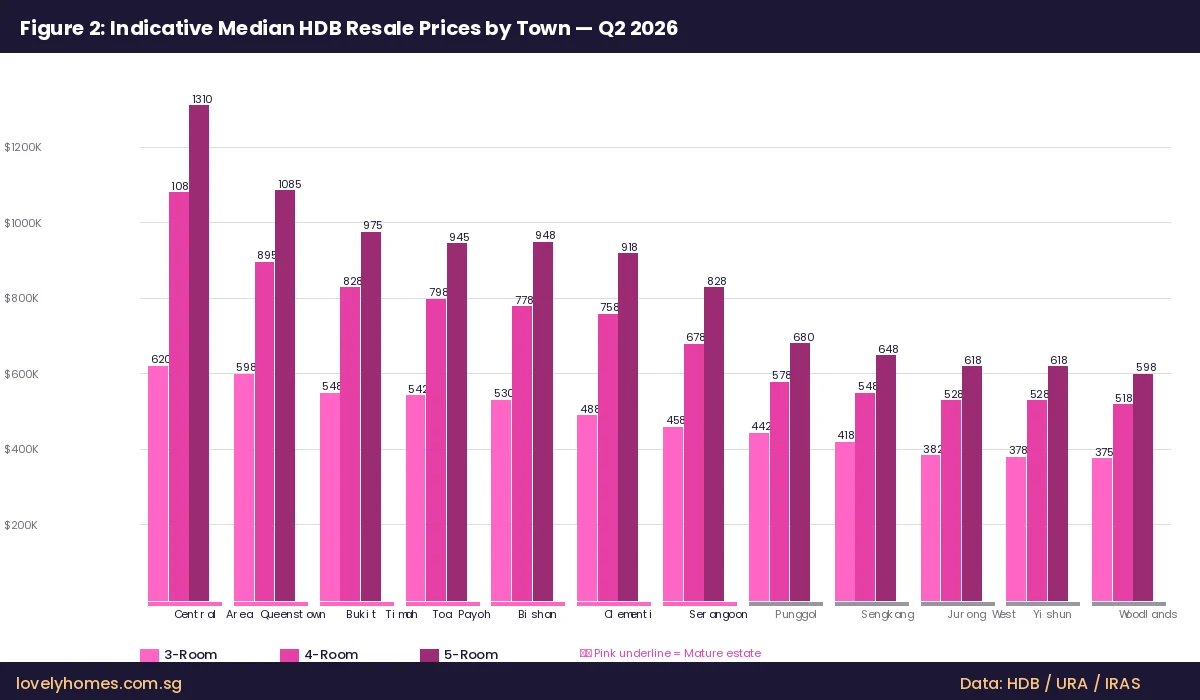
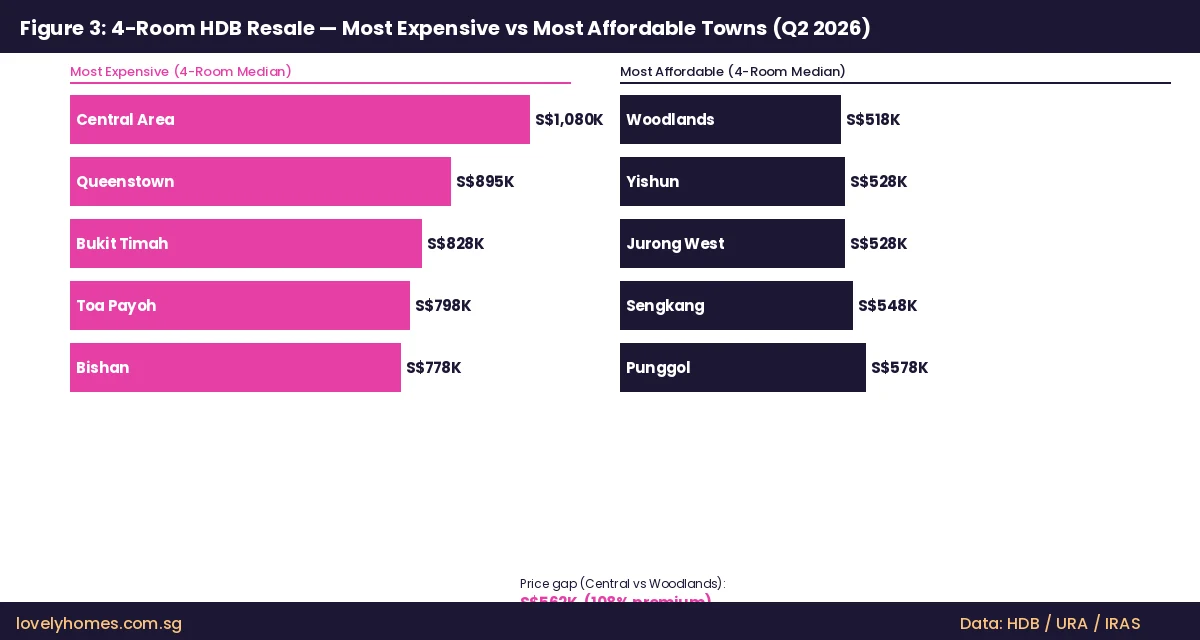
Mainstream 4-room flats in non-mature towns transact at S$550,000–S$680,000; comparable units in mature estates command S$680,000–S$820,000 and above. Sellers in non-mature towns face stiffer competition as BTO completions add supply.

Summary: HDB Resale Selling Reference Table

Item Detail Notes
MOP (standard) 5 years from key collection BTO, resale, DBSS
MOP (Plus/Prime) 10 years from key collection BTO from Feb 2024 exercise
ITS admin fee S$40 (seller) HDB Resale Portal; ITS valid 12 months
OTP option fee Typically S$500–S$2,000 Forfeited if buyer does not exercise
OTP validity 21 calendar days Exclusive purchase right for buyer
Portal submission Within 7 days of OTP exercise Both parties submit independently
Total timeline 8–16 weeks (OTP to completion) Can be faster for straightforward cases
Agent commission 1–2% of sale price Negotiable; no mandated rate
Legal fees S$2,500–S$4,000 Conveyancing + discharge disbursements
SSD 12% / 8% / 4% (Years 1–3) Zero after 3 years
CPF refund Principal + 2.5% p.a. accrued interest Returns to CPF OA; available for next purchase
Post-sale HDB wait 30 months (new flat from HDB only) No restriction on buying open-market resale

Worked Example: Ms Lim Sells Her 5-Room HDB in Ang Mo Kio

Ms Lim (Singapore Citizen) purchased a 5-room BTO in Ang Mo Kio in July 2018 at S$680,000, collecting keys in July 2019. MOP completed July 2024. She lists in May 2026 and agrees a sale price of S$950,000 in July 2026. HDB valuation: S$910,000; COV: S$40,000 (paid in cash by buyer).

Selling costs: agent commission 1.5% = S$14,250 | solicitor S$3,200 | HDB admin S$40 | SSD: S$0 (>3 years). Total cash costs: S$17,490.

Outstanding HDB mortgage balance at completion: S$310,000.

CPF refund (principal + accrued interest): CPF principal withdrawn S$195,000 + accrued interest at 2.5% p.a. over ~7 years = approximately S$38,500. Total: S$233,500 returned to CPF OA.

Net proceeds calculation:

  • Sale price: S$950,000
  • Less selling costs: −S$17,490
  • Less mortgage discharge: −S$310,000
  • Less CPF refund (to OA): −S$233,500
  • Net cash in hand: S$389,010
  • CPF OA receives: S$233,500 (available for next property purchase)
Key takeaway: Ms Lim’s S$950,000 sale price translates to S$389,010 in cash and S$233,500 returned to her CPF OA — a total realisable value of S$622,510. Always model your net-of-CPF, net-of-mortgage proceeds before committing to an upgrade plan.

Why Selling Strategy Matters in 2026

The second consecutive quarterly decline in the HDB RPI signals a shift from the 2022–2023 peak. Sellers who price accurately and understand their net proceeds are better positioned to time upgrades effectively. For those planning a move to private property, the six-month ABSD remission window is a critical constraint: buying first and selling HDB within six months allows the 20% ABSD to be refunded, but missing the window is costly.

For sellers in the mature-estate million-dollar bracket — Queenstown, Toa Payoh, Bishan — demand from buyers priced out of private property remains robust. Well-priced flats in these locations can still transact in weeks. In non-mature towns, longer marketing periods and more price negotiation should be expected.

What Might Come Next

Full Q2 2026 HDB resale statistics (detailed breakdown by town, flat type, and storey) are expected from HDB around 23 July 2026. This will refine pricing benchmarks significantly beyond today’s flash estimate. The private property market Q2 2026 data is expected from URA around 24 July 2026, which will also affect HDB upgrader sentiment.

The Government’s Plus and Prime BTO framework — with its 10-year MOP — will structurally reduce the resale supply of well-located flats from these exercises over the next decade. If the pipeline of Plus/Prime launches grows, it could tighten supply of highly sought-after locations in the medium-term resale market post-2034, providing a price floor for existing mature-estate stock.

Frequently Asked Questions

Should I sell my HDB flat first or buy a new property first?

Selling first avoids the risk of owning two properties simultaneously and paying the 20% Additional Buyer’s Stamp Duty (ABSD) on the second purchase for SC couples. However, it creates the risk of being between homes. The Government’s ABSD remission policy for SC couples allows you to buy a private property first, pay ABSD, then sell your HDB within six months and apply for a full refund — effectively enabling a ‘buy-first’ strategy with a large cash float. See our detailed HDB Upgrader Guide 2026 for the full analysis.

What is COV and must I accept an offer with COV?

COV (Cash Over Valuation) is the difference between the agreed sale price and HDB’s official valuation. The buyer pays this entirely in cash — it cannot be financed by a mortgage or CPF. As a seller, you are free to ask for any price; there is no legal obligation to sell at valuation. However, demanding a high COV in a softening market may prolong your flat’s time on the market. Obtain an HDB Value Report before issuing the OTP so both parties can negotiate with full knowledge of the valuation.

What happens to my CPF accrued interest when I sell?

When you sell, the full CPF principal withdrawn for the property, plus accrued interest at 2.5% p.a. (the CPF OA rate) compounded annually from each withdrawal date, must be refunded to your CPF OA. This is not a penalty — CPF Board restores the interest your OA would have earned had those funds not been withdrawn. The refund comes from your sale proceeds at completion. You can then use the refunded CPF for your next property purchase subject to CPF usage rules.

Can I stay in my flat after the completion date?

Generally, you must vacate on or before the completion date. However, you may negotiate a deferred completion arrangement with the buyer in the OTP: you agree to complete the sale but retain occupation for an additional one to three months, paying the buyer an agreed daily occupancy fee. HDB permits deferred completion arrangements of up to six months; beyond that, HDB’s prior approval is needed. This arrangement must be documented in writing at the OTP stage.

What is the 30-month waiting period and when does it apply?

After selling an HDB flat, there is a 30-month waiting period before you may purchase a new HDB flat directly from HDB (BTO, Sale of Balance Flat exercise, or any HDB-initiated sale). This rule does not apply to buying a resale HDB flat on the open market — you may do so immediately after your current flat’s completion, subject to eligibility. The 30-month rule prevents sequential subsidised-housing transactions that would undermine HDB’s housing subsidies framework.

Do I have to pay Seller’s Stamp Duty on my HDB flat?

Seller’s Stamp Duty (SSD) applies only if you sell within three years of acquiring the flat. Rates: 12% (Year 1), 8% (Year 2), 4% (Year 3) of sale price or market value, whichever is higher. Most HDB sellers are unaffected because the Minimum Occupation Period of five years exceeds the three-year SSD window. Sellers who acquired a flat through extraordinary means (inheritance, court order) should consult a solicitor, as IRAS may assess SSD in some cases.

Disclaimer: This article is for general informational purposes only and does not constitute legal, tax, or financial advice. HDB resale policies, CPF rules, stamp duty rates, and market data are subject to change. Information reflects guidance from HDB (hdb.gov.sg), IRAS (iras.gov.sg), and CPF Board (cpf.gov.sg) as at 7 July 2026. Always consult a licensed property agent, conveyancing solicitor, or HDB directly for advice specific to your circumstances.

HDB BTO Process 2026: Complete Step-by-Step Guide from HFE to Key Collection

HDB BTO Process 2026: Complete Step-by-Step Guide from HFE to Key Collection

×Click or press Esc to close
Quick Answer — HDB BTO Process 2026

  • Before you apply: you must hold a valid HDB Flat Eligibility (HFE) Letter from HDB’s MyHDBPage portal — it confirms your eligibility, grants, and loan quantum.
  • Exercises are now quarterly (approximately Feb, May, Aug, Nov each year), each covering several towns and flat types.
  • Application fee: S$10 non-refundable, applied within a 5–7-day window per exercise.
  • Ballot results are released approximately two months after the application period closes; you receive a queue position if successful.
  • Option fee at flat booking: S$500 for 2-Room Flexi, S$1,000 for 3-Room, S$2,000 for 4-Room and above.
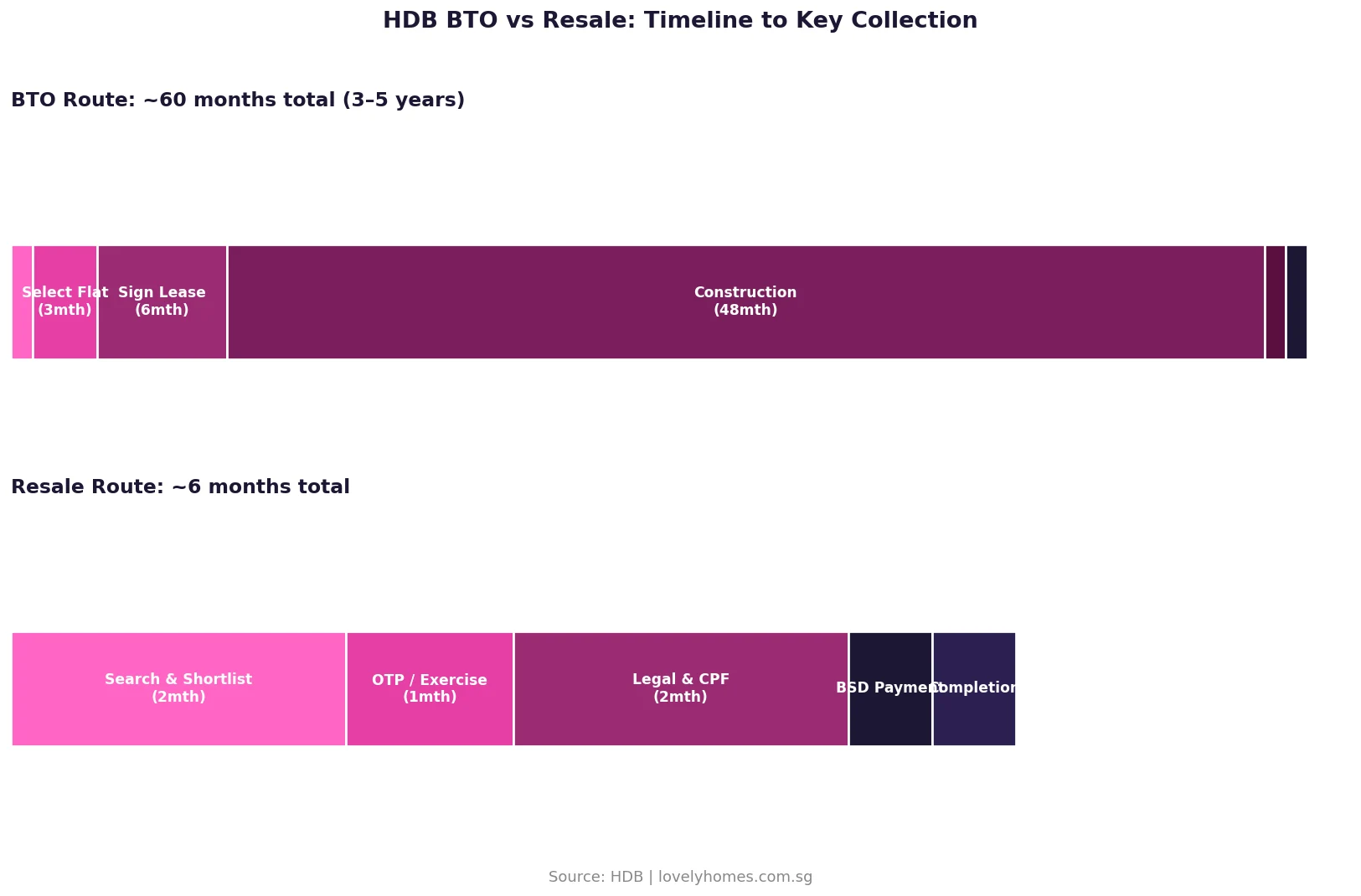
  • Construction wait: approximately 3–4.5 years from the booking date to Temporary Occupation Permit (TOP).
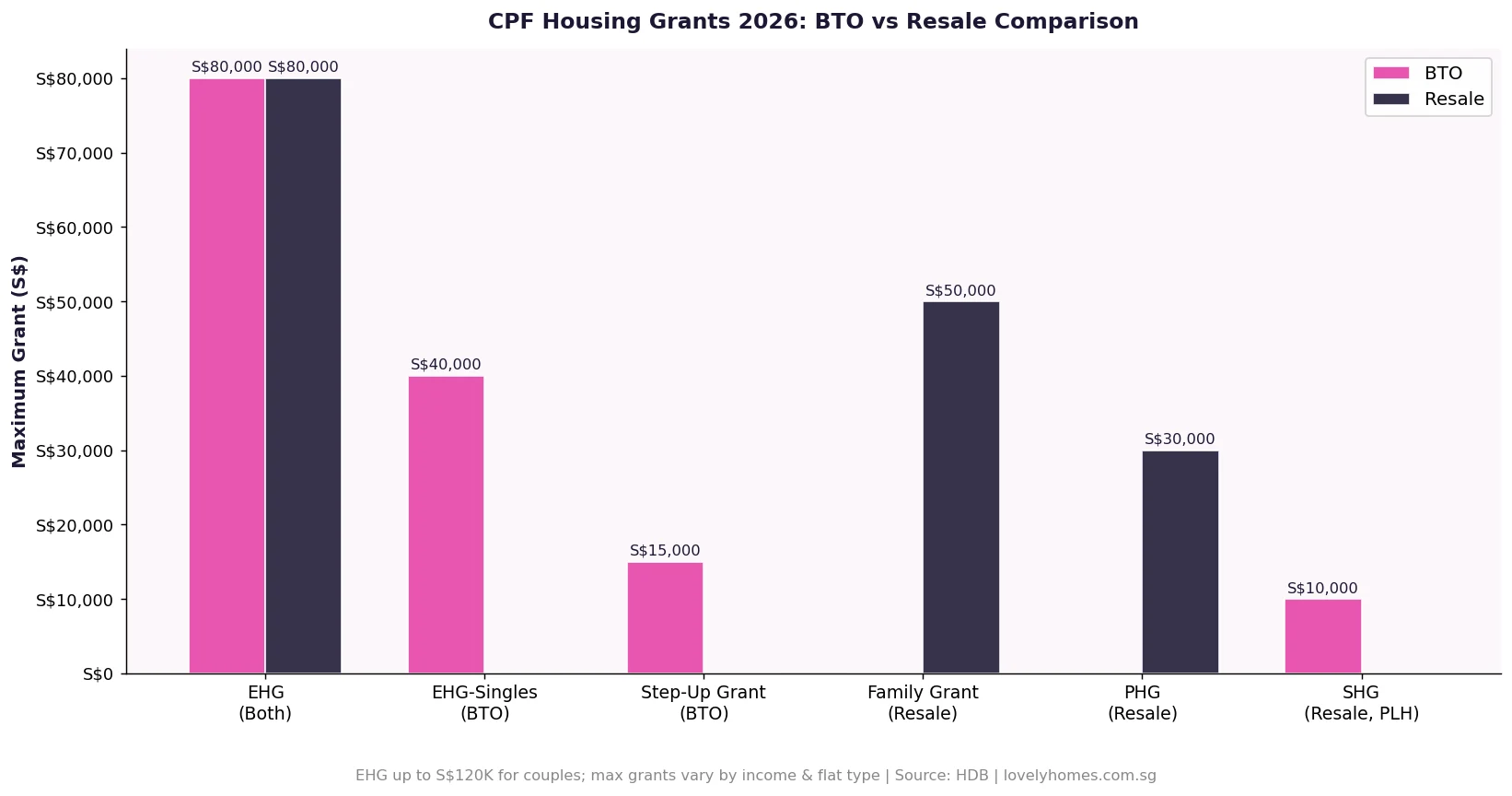
  • Key grants for BTO: the Enhanced CPF Housing Grant (EHG) up to S$80,000 for first-timer couples; no Family Grant (FG) or Proximity Housing Grant (PHG) for BTO purchases — those apply to resale flats only.
  • From application to keys: typically 4–6 years end-to-end, including the construction period.

What Is an HDB BTO Flat and Why Does It Exist?

Build-To-Order (BTO) is the Housing and Development Board’s (HDB’s) primary scheme for selling new public housing in Singapore. Rather than speculating on demand, HDB launches BTO exercises only after gauging the number of applicants during the application window. Flats are built only after sufficient uptake is confirmed, which is why the scheme is called “build to order.”

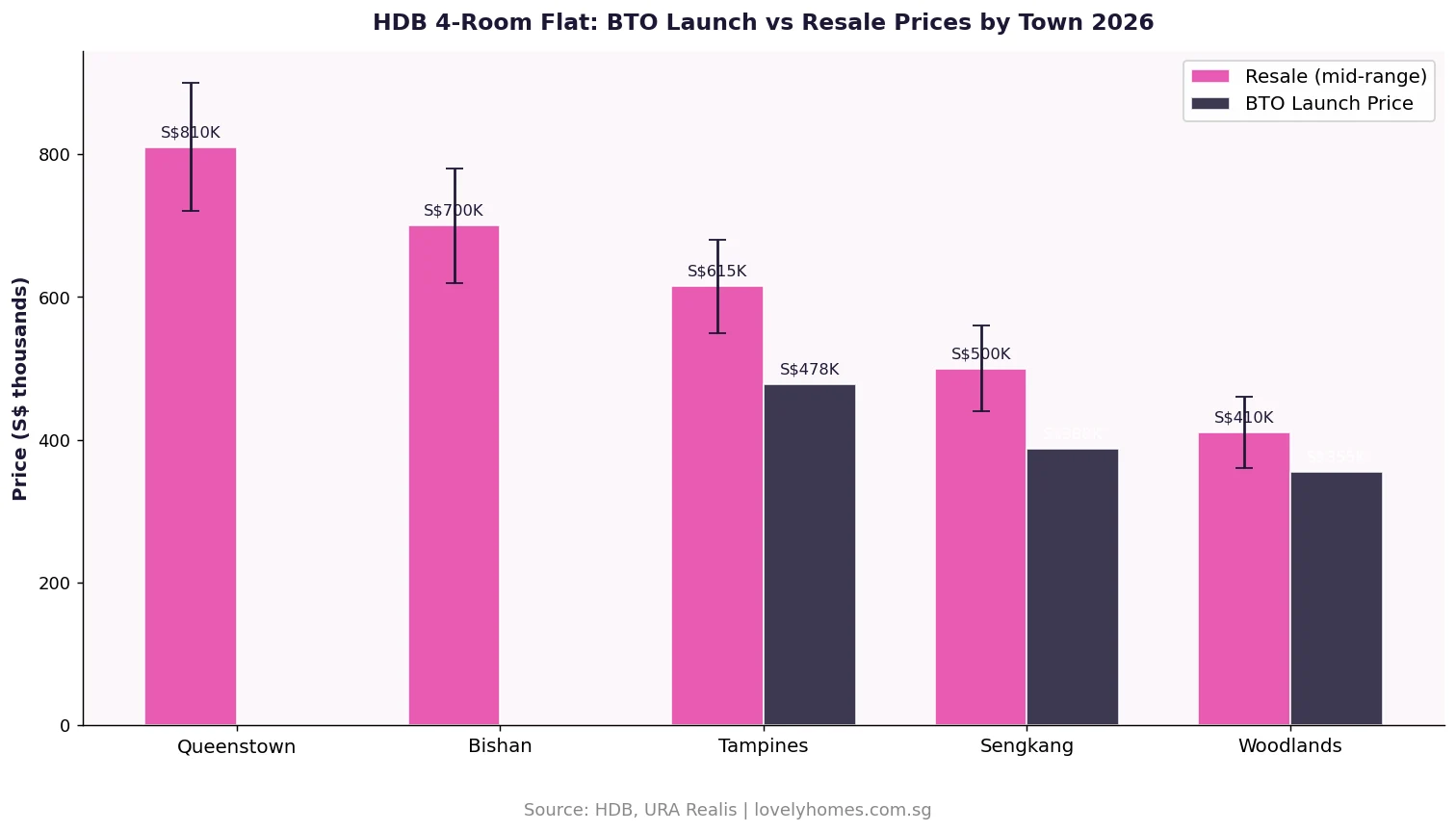
HDB administers the BTO programme under the Housing and Development Act. The scheme exists to keep public housing affordable — new BTO flats are priced significantly below market value, with prices set by HDB based on a “reasonable profit” model rather than open-market dynamics. In 2026, BTO prices for a new 4-Room flat in a non-mature estate typically range from S$350,000 to S$650,000, compared to resale prices of S$550,000 to S$800,000 for comparable flats in the same town.

Step-by-Step: The 10-Stage HDB BTO Journey

HDB BTO process 2026 step-by-step timeline from HFE letter to key collection
Figure 1: HDB BTO — The 10-Step Process from HFE to Keys (2026)

Step 1: Apply for Your HFE Letter

Since 9 May 2023, every buyer must hold a valid HDB Flat Eligibility (HFE) Letter before applying for any BTO flat. The HFE replaces the former HDB Loan Eligibility (HLE) letter and serves as a single-stop document confirming your eligibility to purchase a flat, the grants you qualify for, and — if you plan to use an HDB concessionary loan — the loan quantum available to you.

Apply via HDB’s MyHDBPage portal. Processing typically takes about two weeks. You will need to provide Singpass-verified income data (through IRAS and CPF), current CPF OA balances, and details of any existing properties owned.

Step 2: Monitor BTO Exercises and Choose Your Town

HDB announces BTO exercises quarterly via press releases and the HDB Flat Portal. Each exercise covers multiple towns across Singapore — both mature estates (such as Toa Payoh, Queenstown, Ang Mo Kio) and non-mature estates (such as Tengah, Kallang/Whampoa, Woodlands). Non-mature estate flats are generally priced lower and carry no eligibility restrictions for first-timer couples, but carry a stricter Minimum Occupation Period (MOP) of five years before resale.

You may only apply for one flat type in one town per exercise. Study the flat type, floor, orientation, and proximity to MRT and schools carefully at the sales launch brochure — these factors cannot easily be changed later.

Step 3: Submit Your Application and Pay the S$10 Fee

Applications are submitted via the HDB Flat Portal during a window that typically runs for 5–7 days. A non-refundable S$10 application fee is charged. You do not need to pay anything further at this stage.

Step 4: Check Your Ballot Results

HDB publishes ballot results approximately two months after the application period closes. Log in to MyHDBPage to see your queue number. A queue number does not guarantee a flat — it indicates your priority in the flat selection queue. If your number is not called in the current exercise, you are not penalised and may apply again in future exercises.

Step 5: Flat Selection and Booking

HDB invites applicants to book a flat based on their queue position, typically four or more weeks after ballot results are released. You will receive an appointment slot roughly two weeks in advance. At the booking appointment, you choose your specific unit (block, floor, stack), review the floor plan, and pay the Option Fee: S$500 for 2-Room Flexi, S$1,000 for 3-Room, and S$2,000 for 4-Room and larger. At this stage, your chosen grants (EHG, if eligible) are also confirmed.

Step 6: Sign the Agreement for Lease

Within nine months of booking your flat, HDB will invite you to sign the Agreement for Lease — the formal legal document committing both parties to the transaction. At signing, you will:

  • Pay the Buyer’s Stamp Duty (BSD) — typically from your CPF Ordinary Account (OA) — which for a S$560,000 flat comes to approximately S$11,400.
  • Make the downpayment: 20% of purchase price if using an HDB concessionary loan (payable from CPF OA), or at least 25% (5% minimum cash) if using a bank loan.
  • Your EHG grant (if applicable) will be credited to your CPF OA at this stage, reducing the net amount you need to draw from your own CPF savings.

Step 7: The Construction Period

Once the Agreement for Lease is signed, HDB proceeds with construction. The wait is typically 3–4.5 years from the booking date to TOP, though delays can extend this. During construction, you receive periodic status updates from HDB via MyHDBPage. There are no further progress payments for HDB concessionary loan holders — the HDB handles disbursements internally. Bank loan holders will have their bank disburse funds in stages as construction milestones are met, but this is handled automatically between HDB and the bank.

HDB BTO payment schedule milestones 2026 — option fee downpayment key collection
Figure 2: HDB BTO Payment Milestones — Illustrative for a S$560,000 4-Room Flat (2026)

Step 8: Inspect Your Flat

Before key collection, HDB will invite you to conduct a pre-completion inspection of your flat. At this appointment, you check for defects — cracks, misaligned fittings, water stains, and any incomplete works. Defects are logged on the HDB Defects Inspection Form, and HDB’s main contractor is required to rectify all valid defects before or shortly after key collection. A one-year Defects Liability Period (DLP) applies from the date of key collection.

Step 9: Key Collection

Key collection is the most anticipated milestone. At this appointment you receive the physical keys to your flat, pay any outstanding fees (such as the one-time administration charges), and take possession. From this date, the five-year Minimum Occupation Period (MOP) begins — during which you must live in the flat as your principal place of residence and cannot sell or rent out the entire flat.

Step 10: Renovation and Move-In

Before commencing any renovation, you must apply for an HDB Renovation Permit through the HDB Flat Portal. Major structural works (e.g., hacking walls, installing bay windows, altering wet areas) require additional approval. All renovation contractors must be registered with HDB. Work is typically completed within six to twelve weeks, after which you can move in. Renovations may only be carried out during stipulated hours (Monday to Saturday, 9 am to 5 pm; prohibited on Sundays and public holidays).

BTO Financing: HDB Loan vs Bank Loan

When financing your BTO flat, you choose between an HDB concessionary loan and a bank mortgage. The HDB loan charges a pegged rate (currently 2.60% per annum as at July 2026, pegged at 0.1% above the prevailing CPF OA interest rate of 2.50%), with an LTV of 80% and a maximum loan tenure of 25 years for the total remaining lease of the flat, or 65 years minus the oldest applicant’s age — whichever is shorter.

A bank loan typically offers a lower headline rate on fixed or SORA-linked packages, but the LTV is capped at 75% (requiring a minimum 5% cash downpayment) and refinancing is at the bank’s discretion. HDB also applies the Mortgage Servicing Ratio (MSR) of 30%: monthly repayments cannot exceed 30% of gross household income.

For more detail on financing, see our Singapore Housing Loan Guide 2026.

Summary: BTO, SBF, and Open Booking Compared

Feature BTO Exercise Sale of Balance Flats (SBF) Open Booking
What Is It? Brand-new flats built on demand Unsold BTO or returned flats Remaining SBF flats, ongoing
Waiting Time 3–4.5 years (under construction) Ready or near-ready (≤1 year) Immediate or very short
Ballot Required Yes — competitive Yes — competitive No — first-come, first-served
Price vs Resale 20–30% below 10–20% below Similar to SBF
Unit Choice High in early launches Limited Very limited
Grants Available EHG (up to S$80K) EHG (up to S$80K) EHG (up to S$80K)
Best For Patient first-timers wanting maximum subsidy Buyers who want quicker delivery Immediate housing need

Table 1: BTO vs Sale of Balance Flats (SBF) vs Open Booking — comparison as at July 2026.

HDB BTO vs SBF vs Open Booking comparison table 2026
Figure 3: BTO vs Sale of Balance Flats (SBF) vs Open Booking — At-a-Glance Comparison (2026)

Worked Example: Fatimah and Reza’s Tengah BTO Journey

Fatimah and Reza are a Singaporean citizen (SC) couple in their late 20s. Their combined monthly income is S$6,500. They apply for a 4-Room BTO flat in Tengah Glen at a purchase price of S$560,000 in the August 2025 exercise.

  • HFE Letter: applied via MyHDBPage in June 2025; HDB confirms eligibility, EHG of S$30,000 (income bracket S$6,001–S$6,500), and HDB loan quantum of S$448,000.
  • Application fee: S$10 at application in August 2025.
  • Ballot results: issued in October 2025; queue number 385 of 1,200 applicants for 4-Room in Tengah Glen — a competitive but viable position.
  • Flat booking: appointment in November 2025; select a 12th-floor unit facing the park. Option fee paid: S$2,000.
  • Sign Agreement for Lease (February 2026): BSD of S$11,400 paid from CPF OA. Downpayment 20% = S$112,000, offset by EHG S$30,000 credited to CPF OA → net CPF drawn from own savings: S$82,000.
  • HDB loan: S$448,000 at 2.60% p.a. over 30 years → monthly repayment approximately S$1,792; MSR = 27.6% (within 30% cap). Approved.
  • Estimated TOP: September 2029 (approximately 3.8 years of construction). Key collection estimated October–November 2029.
  • Total cash outlay: approximately S$2,000 (option fee) + S$0 at signing (no minimum cash for HDB loan holders) = S$2,000 cash. The balance comes from CPF OA and EHG grant. Renovation budget estimated at S$40,000–S$60,000 (cash or CPF).

What This Means for You

The BTO scheme remains the most cost-effective pathway to homeownership for Singaporean first-timers. The subsidy embedded in BTO pricing — often 20–30% below resale market value — is the most significant financial benefit available to eligible citizens, dwarfing the value of grants like the EHG.

The trade-off is time. A four-to-six-year wait from application to keys requires renters to budget for interim housing costs, or couples to time their applications around other life plans. Singapore’s CPF system is specifically designed to ease this wait: CPF OA savings accumulate at 2.50% per annum while you wait, growing your downpayment fund in parallel with HDB construction.

BTO is also increasingly competitive in popular towns and mature estates. Over-subscription rates for mature estate 4-Room flats regularly exceed 8-to-1. First-timers are given priority ballot positions (two ballot chances before being treated as second-timers), but patience and willingness to consider multiple towns remain critical success factors.

What Might Come Next

HDB is actively expanding the BTO supply pipeline as part of the government’s commitment to ease housing access. The 2026 BTO pipeline includes major new towns such as Tengah (the eco-town), Bayshore (East Coast waterfront), and continued launches in Kallang/Whampoa close to the city. Pricing for Plus and Prime flat categories — introduced in 2024 under HDB’s reclassification framework — carries additional restrictions (15-year MOP, subsidy clawback on resale) to moderate speculation in highly sought-after locations.

HDB has also signalled a shift towards more predictable, smaller-sized exercises rather than large twice-yearly launches, reducing the “all-or-nothing” ballot dynamic that has characterised BTO since the early 2000s. Watch for possible further reforms to the HFE system, grant eligibility rules, and income ceiling thresholds as the government responds to population ageing and wage growth trends through 2027.

Frequently Asked Questions

Can I apply for a BTO flat if my income exceeds S$14,000 per month?

No. The household income ceiling for purchasing a new HDB flat (BTO, SBF, or Open Booking) is S$14,000 per month for families and S$7,000 for singles. If your household income exceeds this ceiling, you are not eligible for any new HDB flat. You may, however, purchase a resale HDB flat on the open market — resale flats have no income ceiling — or an Executive Condominium (EC) if your household income is below S$16,000 per month. EC units are developed by private developers but are subject to HDB eligibility rules for the first ten years.

What happens if I miss my flat selection appointment?

If you miss your selection appointment without a valid reason, your queue number is forfeited and you lose the S$10 application fee. There is no penalty beyond this, but you will need to reapply in a future exercise and undergo the ballot process again. HDB does allow rescheduling within a narrow window if you contact them before your appointment date, so it is worth requesting a change early if you foresee a scheduling conflict.

Can I use CPF to pay for everything — the option fee, BSD, downpayment, and monthly repayments?

Almost, but not quite. The S$10 application fee is a cash payment. The option fee (S$500–S$2,000) paid at booking is also a cash payment, though HDB typically offsets this against the final purchase price. The BSD and downpayment can be paid from your CPF OA. Monthly HDB loan repayments can be serviced from CPF OA. However, no CPF OA monies can be used to pay ABSD (if applicable), Cash-Over-Valuation (COV) amounts, renovation costs, or property tax. For a first-timer purchasing a BTO flat at a price below the HDB Loan quantum, the CPF OA will typically cover the full downpayment and BSD with no need for cash beyond the option fee.

What is the Minimum Occupation Period (MOP) and what can I not do during it?

The MOP is five years from the date of key collection (or TOP, if HDB deems it appropriate). During the MOP you cannot sell your BTO flat on the open market, sublease the entire flat, nor purchase a private residential property in Singapore (or overseas in certain circumstances). You may, however, rent out individual rooms (subject to HDB approval and rules), and you are free to own foreign property in most cases. After the MOP, you may sell the flat on the HDB resale market, purchase a private property, or apply for another subsidised flat (though the resale levy will apply if you purchase another subsidised flat).

Can I back out after signing the Agreement for Lease?

Technically yes, but the financial consequences are severe. If you withdraw after signing the Agreement for Lease, you forfeit the option fee (S$500–S$2,000), may lose the administrative booking fee, and HDB may impose a debarment period — typically one year for a first withdrawal — during which you cannot apply for any new HDB flat. The debarment is two years for a second withdrawal. Given these penalties, withdrawing after signing is rare and should only be considered as a last resort after seeking legal advice.

What if construction is delayed beyond the estimated TOP date?

Construction delays are not uncommon, particularly for large developments or those in complex worksites. HDB will notify you of any revised TOP via MyHDBPage and by post. If the delay exceeds a specified threshold set out in the Agreement for Lease, you are entitled to late-delivery compensation: currently S$10 per day for studios and 2-room flats, and up to S$20 per day for 4-room and larger flats. This compensation is typically deducted from your final payment rather than paid in cash. Delays of more than 12 months are uncommon but have occurred, typically due to contractor insolvencies or major supply disruptions.

Related Articles

Disclaimer

This article is published by LovelyHomes Editorial Team for general informational purposes only and does not constitute financial, legal, or property advice. HDB BTO eligibility criteria, grant amounts, loan quantum limits, and process timelines are set by the Housing and Development Board (HDB) and are subject to change. Grant eligibility is also governed by CPF Board rules. Stamp duty obligations are administered by the Inland Revenue Authority of Singapore (IRAS). Readers should refer to official HDB, CPF, and IRAS sources for the most current information, and consult a licensed financial adviser or HDB-registered salesperson before making any property purchase decision. All figures cited are indicative as at July 2026 and may not reflect individual circumstances.

Singapore HDB Grants Guide 2026: EHG, Family Grant, PHG and All CPF Housing Grants Explained

Singapore HDB Grants Guide 2026: EHG, Family Grant, PHG and All CPF Housing Grants Explained

⚡ Quick Answer — HDB CPF Housing Grants at a Glance (2026)

  • Enhanced CPF Housing Grant (EHG): up to $120,000 for eligible couples; $60,000 for singles — applies to both BTO and resale flats, income ceiling $9,000/mth (couple).
  • CPF Family Grant (FG): $50,000–$60,000 for eligible SC-SC couples buying a resale flat; no income ceiling applies.
  • Proximity Housing Grant (PHG): up to $30,000 to live with or near parents/children — resale flats only.
  • Grants can be stacked: a first-timer SC couple buying a resale flat near parents could qualify for EHG + FG + PHG = up to $160,000 in total grants.
  • Grants are credited to CPF Ordinary Account (OA) and deducted from the purchase price; they reduce your outstanding loan and accrued interest.
  • Second-timers may still access PHG (resale only) and a reduced FG if one party is a first-timer.
  • All grants are administered by HDB and disbursed via CPF Board — you apply through the HDB Flat Portal after obtaining an HDB Flat Eligibility (HFE) letter.

What Are CPF Housing Grants?

CPF housing grants are cash subsidies that the Singapore Government channels through the Central Provident Fund (CPF) Ordinary Account to help eligible buyers afford Housing & Development Board (HDB) flats. Unlike the earlier Building & Construction Authority rebates or direct handouts, these grants go directly into the buyer’s CPF OA and are credited against the flat’s purchase price — reducing the loan quantum and, over the life of the mortgage, the accrued interest the buyer ultimately owes CPF.

The grant framework has evolved significantly since the early 2000s. The Additional CPF Housing Grant (AHG) and Special CPF Housing Grant (SHG) were consolidated and superseded on 11 September 2019 by the Enhanced CPF Housing Grant (EHG), which provides a single, tiered subsidy that scales down with household income. The Family Grant and Proximity Housing Grant, both introduced in 2015 for resale flat buyers, remain active. Together, these three grant streams — EHG, FG, PHG — form the backbone of Singapore’s HDB affordability architecture in 2026.

CPF housing grants types eligibility and maximum amounts Singapore 2026 table
Figure 1: CPF Housing Grants — types, eligibility and maximum amounts (2026). Source: HDB Singapore.

Enhanced CPF Housing Grant (EHG) — The Foundation Grant

The EHG, introduced in September 2019, is the primary income-based subsidy for first-timer buyers. Unlike its predecessors, the EHG applies to both new BTO flats and resale flats, eliminating a long-standing disparity where resale buyers received less support than BTO buyers. HDB administers the scheme; CPF Board disburses the funds.

EHG Eligibility Criteria

To qualify for EHG, the household must meet all of the following:

Criterion Couples / Families Singles (≥ 35 years old)
Citizenship At least one Singapore Citizen Singapore Citizen
Gross Monthly Income ≤ $9,000/month ≤ $4,500/month
Prior Housing Grant Must not have received AHG or SHG previously Same
Flat Type (BTO) Any HDB flat type (2-room Flexi to 5-room) 2-room Flexi (BTO) only
Flat Type (Resale) Any eligible resale flat 2-room or 3-room resale only
Continuous Employment At least one applicant employed for ≥ 12 months continuously Same

The EHG quantum scales inversely with income: buyers at the bottom of the income band receive the maximum grant, while those approaching the $9,000 ceiling receive the minimum. The grant is calculated based on the average gross monthly household income over the preceding 12 months.

Enhanced CPF housing grant EHG income ceiling versus grant amount Singapore 2026
Figure 3: Enhanced CPF Housing Grant (EHG) — income versus grant amount for couples and singles (2026). Source: HDB Singapore.

EHG Grant Amounts

For couples with a household income at or below $1,500/month, the maximum EHG is $120,000. The grant steps down by $5,000 for every additional $500 in household income until it reaches a minimum of $5,000 at the $8,500–$9,000 income band. Singles receive exactly half the couple quantum at each band (maximum $60,000 at ≤$750/month income). The EHG is credited to the buyer’s CPF OA and applied to the purchase price at completion.

CPF Family Grant (FG) — For Resale Flat Buyers

The CPF Family Grant targets first-timer buyers purchasing a resale HDB flat and does not have an income ceiling — making it accessible to middle-income households that earn too much for the EHG. The Family Grant replaced the Additional CPF Housing Grant (Resale) in 2015 and has remained structurally unchanged since.

Family Grant Amounts by Flat Type and Household Composition

Buyer Profile Resale Flat ≤ 3-room Resale Flat 4-room+
SC + SC Couple (first-timer) $60,000 $50,000
SC + PR Couple (first-timer SC) $40,000 $30,000
SC Single (≥ 35 yrs, first-timer) $30,000 $25,000

Where one spouse is a second-timer and the other is a first-timer, the couple may receive half the applicable Family Grant. The Family Grant is not available for BTO flats — that distinction is important for buyers weighing resale against new launches.

Proximity Housing Grant (PHG) — Living Near Loved Ones

The Proximity Housing Grant encourages multi-generational living arrangements by subsidising buyers who choose to live with, or within 4 kilometres of, their parents or children. Available for resale flats only, it was introduced in 2015 to address Singapore’s social goal of strengthening family ties and providing informal eldercare support networks.

PHG Amounts

Living Arrangement SC-SC Couple SC-PR or Single
Living with parents / child (in same flat) $30,000 $15,000
Living within 4 km of parents / child $20,000 $10,000

The PHG is granted based on the residential address of the parent or child at the time of application. There is no income ceiling. However, buyers must satisfy a 5-year occupation requirement: if they move away from the stated proximity within 5 years of flat completion, the grant is subject to clawback by HDB.

Maximum CPF housing grants by buyer profile Singapore 2026 bar chart EHG family grant PHG
Figure 2: Maximum CPF Housing Grants by buyer profile — EHG, Family Grant and PHG stacked (2026). Source: HDB Singapore.

Step-Up CPF Housing Grant (SHG)

The Step-Up CPF Housing Grant is a smaller, targeted subsidy of up to $15,000 for second-timer households who currently live in 2-room flats and are upgrading to a larger BTO flat (3-room or bigger) in a non-mature estate. Unlike EHG, FG and PHG — which are first-timer grants — SHG is specifically for second-timers making an upward move. The household income ceiling for SHG is $7,000 per month.

SHG is far less commonly used than the three main grants, but it plays an important role for low-income second-timer families who need more space but cannot afford private property.

Summary: All HDB Grants at a Glance

Grant Max Amount Income Ceiling BTO? Resale? First-timer?
EHG (couple) $120,000 $9,000/mth Yes
EHG (single) $60,000 $4,500/mth ✓ (2-room) ✓ (≤3-room) Yes
Family Grant (SC-SC) $60,000 None Yes (both)
Family Grant (SC-PR) $40,000 None Yes (SC spouse)
Proximity Housing Grant $30,000 None Both tiers
Step-Up Grant (SHG) $15,000 $7,000/mth ✓ (≥3-room) Second-timer

Worked Example: How Much Can a First-Timer Couple Receive?

📺 Case Study — the Wong Family

Profile: Mr and Mrs Wong, both Singapore Citizens, both first-timers. Combined gross income $6,200/month. Buying a 4-room resale flat in Ang Mo Kio for $650,000. Mrs Wong’s parents live in the same estate (within 4 km).

EHG: Income $6,200 → falls in $6,000–$6,500 band → EHG = $60,000.

Family Grant (FG): SC-SC couple, 4-room resale → $50,000 (no income ceiling).

Proximity Housing Grant (PHG): Living within 4 km of Mrs Wong’s parents → $20,000.

Total grants = $130,000 credited to their combined CPF OA.

Effective purchase price: $650,000 − $130,000 = $520,000.

HDB Loan (80% LTV on $520,000 effective): $416,000. Monthly instalment at 2.60% p.a. over 25 years ≈ $1,886/month. MSR check: $1,886 / $6,200 = 30.4% — marginally above 30% MSR. The couple reduces their loan to $390,000 using additional CPF savings, bringing the monthly instalment to $1,770/month (MSR 28.5%, PASS).

Key takeaway: Without the grants, the Wongs would need a $520,000 loan; with grants, their effective loan burden drops by 25%. Grants reduce lifetime accrued interest by an estimated $48,000 over 25 years.

Why Housing Grants Matter for Singapore’s Property Affordability

Singapore’s CPF housing grant framework is one of the most generous owner-occupier subsidy systems in developed Asia. The EHG alone — at up to $120,000 for eligible couples — represents roughly 15%–20% of the purchase price of a 4-room or 5-room flat in many non-mature estates. When stacked with the Family Grant and PHG, the aggregate subsidy can exceed $160,000, decisively reducing the loan quantum and monthly servicing burden for lower- and middle-income families.

The policy rationale is threefold. First, it sustains home-ownership rates: Singapore’s resident home-ownership rate has remained above 88% for over two decades, among the highest globally, partly because of demand-side grants that reduce the effective cost to buy. Second, grants embedded in CPF rather than cash reduce the risk of inflation in the resale market — sellers cannot directly “see” the grant quantum and adjust prices accordingly in the way they might with a cash handout. Third, by tiering EHG to income and removing the income ceiling on FG, HDB broadens access across the income spectrum: lower-income families get the largest EHG; middle-income families (who earn too much for EHG) still benefit from FG.

The PHG specifically addresses Singapore’s demographic challenge: with a rapidly ageing population, encouraging younger families to live near or with their parents reduces formal eldercare costs while maintaining social cohesion in mature estates. HDB data has historically shown a meaningful uptick in resale transaction volumes in estates with a large elderly population whenever PHG quantum is adjusted upward.

What Might Come Next: Grant Outlook

The EHG has not been adjusted since its introduction in September 2019. With Singapore’s median household income rising steadily — the median resident household income grew from $9,520 in 2019 to approximately $11,200 by 2025 — the real coverage of the EHG income ceiling has gradually eroded. An increasing share of first-timer households now earn above $9,000/month and are therefore ineligible for EHG even for their first BTO flat.

Industry observers anticipate that the next round of grant revisions could raise the EHG income ceiling or adjust the grant quantum bands, possibly linked to a broader review of BTO pricing and the housing affordability framework. HDB has historically reviewed grant levels every five to seven years. With the next review potentially due in 2025–2027, buyers with incomes close to the current ceilings should monitor MND/HDB announcements closely. Any upward revision to EHG or FG would directly benefit middle-income first-timers locked out of the current framework.

FAQ: HDB CPF Housing Grants 2026

Can I receive CPF housing grants for a BTO flat and a resale flat in my lifetime?

Only if you are a genuine first-timer for each purchase — which is almost never possible, since receiving the EHG for your BTO flat makes you a grant recipient and therefore ineligible for EHG again. However, you may qualify for PHG (resale only, no income ceiling) as a second-timer if you meet the proximity requirement. First-timer status resets only in very limited circumstances, such as divorce where neither party retains the flat and no grant was previously disbursed.

Does receiving a CPF housing grant affect how much I need to repay CPF when I sell?

Yes. Grants credited to your CPF OA are treated as CPF withdrawals. When you sell the flat, you must refund the principal grant amount plus accrued interest at the CPF OA rate (currently 2.5% per annum, compounded annually) back into your CPF account. This does not mean you “lose” the money — it remains in your CPF for retirement — but it does reduce the net cash proceeds you receive on sale. Buyers often underestimate this accrued-interest obligation, particularly for long holding periods.

Can I use CPF housing grants to pay for ABSD?

No. Additional Buyer’s Stamp Duty (ABSD) must be paid in cash within 14 days of signing the Agreement for Lease (for BTO) or the Sales & Purchase Agreement (for resale). CPF funds — including housing grants — cannot be used to pay ABSD, stamp duties, or Cash Over Valuation (COV). Only Buyer’s Stamp Duty (BSD) may be paid via CPF OA.

Can Singapore Permanent Residents (PRs) receive CPF housing grants?

PRs are ineligible for CPF housing grants on their own. However, a SC-PR couple buying their first resale HDB flat together qualifies for the Family Grant (reduced quantum — $30,000 for 4-room+, $40,000 for 3-room or smaller) provided the Singapore Citizen spouse is a first-timer. PRs are not eligible for EHG or PHG in their own right. PRs also cannot purchase new BTO flats.

What happens if I sell my flat within the Minimum Occupation Period (MOP)?

HDB grants are linked to the Minimum Occupation Period. If you sell your flat before satisfying the MOP (5 years for most BTO and resale flats; 10 years for PLH BTO flats under the Prime Location Public Housing model), you must refund all housing grants received, on top of repaying the CPF principal and accrued interest. Early sale also attracts resale levy obligations for subsidised flat owners.

Are grants available for Executive Condominiums (ECs)?

Yes, but only the Family Grant and an EC-specific variant. First-timer SC-SC couples buying a new EC may receive a Family Grant of $30,000. The EHG is not applicable to ECs. EC buyers must also satisfy the EC income ceiling of $16,000/month gross household income, and must not own or have disposed of any private residential property in the 30 months before the EC application.

How do I apply for CPF housing grants?

Grants are applied for through the HDB Flat Portal (flat.gov.sg) as part of the HDB Flat Eligibility (HFE) letter application — or via the Sales of Balance Flats / BTO application process. You do not need to file a separate grant application; HDB assesses your eligibility automatically based on the information submitted in the HFE or flat application. The HFE letter will specify the grants you qualify for and the indicative amounts before you commit to a purchase.

Disclaimer: This article is for general informational and educational purposes only. CPF housing grant eligibility criteria, income ceilings and grant amounts are set by the Housing & Development Board (HDB) and CPF Board and are subject to change. Readers should verify the latest terms at hdb.gov.sg and cpf.gov.sg before making any property purchase decision. This article does not constitute financial, legal or property advice. Consult a licensed property agent and financial adviser for personalised guidance.

HDB Resale Levy Singapore 2026: Amounts, Who Pays, Exemptions and How It Works

HDB Resale Levy Singapore 2026: Amounts, Who Pays, Exemptions and How It Works

HDB resale levy Singapore 2026 complete guide
Figure 0: HDB Resale Levy Singapore 2026 — Complete Guide to Amounts, Exemptions and How It Works

Quick Answer — HDB Resale Levy at a Glance

  • The HDB Resale Levy is a payment required when a second-timer household buys a new subsidised HDB flat or an Executive Condominium (EC) unit after previously enjoying a housing subsidy.
  • Levy amounts range from S$15,000 (for a 2-Room Flexi sold) to S$55,000 (for a DBSS flat sold), with EC buyers paying 5% of resale price (capped at S$55,000).
  • It is paid by deduction from the CPF refund when your first flat is sold — you do not write a cheque.
  • Exemptions apply if you bought your first flat on the resale market without any CPF Housing Grant, inherited the flat, or received it via a court order.
  • The levy does not apply when buying a private property — only a second subsidised HDB flat or EC triggers it.
  • Getting the levy wrong can delay your second flat booking and result in owing HDB cash if your CPF proceeds are insufficient.
  • From 3 March 2006, all levy amounts were fixed at the flat-type level — they are not a percentage of the first flat’s resale price (except for EC).

What Is the HDB Resale Levy?

The HDB Resale Levy is a subsidy recovery mechanism administered by the Housing & Development Board (HDB) under Singapore’s public housing framework. When the government provides a housing subsidy — such as the Central Provident Fund (CPF) Housing Grant, the Additional CPF Housing Grant (AHG), the Special CPF Housing Grant (SHG), or the Enhanced CPF Housing Grant (EHG) — it does so on the understanding that this benefit is tied to one subsidised flat per household. If that household later purchases a second subsidised flat or Executive Condominium unit, they are required to “return” a portion of the earlier subsidy benefit in the form of the resale levy.

The policy was introduced to ensure that public housing subsidies are targeted at households that genuinely need them and to maintain the long-term sustainability of Singapore’s public housing system. HDB administers the levy and collects it automatically at the point of sale of the first flat — it is not a separate bill sent to you but a deduction from your CPF Ordinary Account (OA) proceeds before they are refunded.

As at July 2026, the levy framework has remained stable since the flat-type rate schedule was fixed on 3 March 2006. Understanding it correctly is essential for any second-timer household planning to upgrade or right-size within the public housing system.

HDB resale levy amounts by flat type 2026 — S$15,000 to S$55,000 table
Figure 1: HDB Resale Levy Amounts by Flat Type Sold (2026). Fixed rates since 3 March 2006; EC applies a 5% rate with S$55,000 cap. Source: HDB Singapore.

Who Pays the HDB Resale Levy?

You are required to pay the resale levy if all three of the following conditions are met:

  1. You (or your co-applicant, spouse, or essential occupier) previously purchased a subsidised HDB flat — meaning you received a CPF Housing Grant, AHG, SHG, EHG, Step-Up CPF Grant, or bought directly from HDB at a subsidised price in a Build-To-Order (BTO) or Selective En-bloc Redevelopment Scheme (SERS) exercise.
  2. You subsequently sold that subsidised flat (or are in the process of doing so).
  3. You are now applying to buy a second subsidised flat from HDB — either a new BTO flat, a SERS flat, a Design, Build and Sell Scheme (DBSS) unit, or an Executive Condominium (EC) unit from a developer.

The key point is that the levy applies to subsidised second-time purchases only. If your second property is a private condominium, a landed home, a resale HDB flat (from the open market), or any commercial property, no resale levy is chargeable. Many upgraders mistakenly believe the levy applies whenever they buy a second property — it does not. It is specifically a tax on accessing public subsidies a second time.

Couples and Joint Applications

For married couples and joint flat buyers, the resale levy status of either party is taken into account. If either the main applicant or the co-applicant previously received a housing subsidy, the levy is applicable to the household. This prevents a household from circumventing the levy simply by swapping the person listed as main applicant on the second purchase. The rule is designed to capture the household’s cumulative subsidy benefit, not merely the individual’s.

Singles

Singles purchasing under the Single Singapore Citizen (SSC) scheme — eligible for 2-Room Flexi BTO flats — are also subject to the levy if they previously benefited from a housing subsidy. As the levy amount for a 2-Room Flexi flat is S$15,000, it is still a meaningful cost for solo buyers planning to upsize.

HDB Resale Levy Amounts (2026)

The levy amount depends on the type of flat you previously sold. Since 3 March 2006, the rates have been fixed at the following flat-type level:

Flat Type Sold (First Flat) Resale Levy Payable Notes
2-Room Flexi S$15,000 Applies to subsidised 2-Room Flexi BTO flats
3-Room S$30,000
4-Room S$40,000 Most common upgrader profile
5-Room S$45,000
Executive Flat S$50,000 HDB Executive flat (not EC)
DBSS Flat S$55,000 Design, Build and Sell Scheme (discontinued)
EC (Executive Condominium) 5% of resale price Capped at S$55,000; applies after the EC’s 5-year MOP when sold on the open market

One common source of confusion is that the levy is based on the type of flat you sold, not on its resale price. Whether you sold your 4-Room flat for S$500,000 or S$900,000, the levy is always S$40,000. The EC rule is the sole exception: there the levy is 5% of the EC’s resale price (i.e. the proceeds from selling the EC), subject to a maximum of S$55,000.

HDB resale levy bar chart by flat type Singapore 2026 — S$15,000 to S$55,000
Figure 2: Resale Levy by Flat Type (2026). The levy is flat-based, not price-based — except for EC where it is 5% of resale price, capped at S$55,000. Source: HDB Singapore.

How and When Is the Resale Levy Paid?

The resale levy is settled automatically at the completion of the sale of your first flat. HDB deducts the levy amount from the CPF Ordinary Account (OA) refund you would otherwise receive when the flat sale is completed. You do not receive a separate invoice from HDB and you do not make a cash payment at any counter.

Here is how the sequence works:

  1. Apply to buy second flat: When you apply for a BTO flat or EC as a second-timer, HDB identifies your levy status at the point of application.
  2. HDB confirms levy payable: HDB notifies you of the levy amount in the appointment letter for your second flat booking.
  3. First flat sold: On the day of the legal completion of your first flat sale, the CPF Board refunds your OA principal and accrued interest as usual — but before the refund is credited to you, HDB deducts the levy amount directly from those CPF proceeds.
  4. Balance returned: The net CPF refund (after levy deduction) is credited to your OA account.

What If Your CPF Refund Is Less Than the Levy Amount?

This can happen in rare situations — for instance, if the outstanding HDB loan and CPF accrued interest together consume most of the sale proceeds. In such cases, the shortfall must be made up in cash. HDB will require you to pay the difference out-of-pocket before the second flat booking proceeds. This is one reason why financial planning ahead of an upgrade is important: always model your net CPF position against the levy amount before committing to a second BTO application.

Who Is Exempt from the HDB Resale Levy?

Not everyone who has previously owned an HDB flat will be required to pay the resale levy. Key exemptions include:

  • Resale flat purchased without a CPF Housing Grant: If you bought your first flat on the open HDB resale market and did not receive any CPF Housing Grant (Family Grant, Enhanced Housing Grant, Proximity Housing Grant, or any earlier-generation grant), you are not a “subsidised” flat owner for levy purposes. The levy reflects subsidy recovery — without a subsidy, there is nothing to recover.
  • Inherited flat: If the flat was left to you in a will or through intestacy, you did not receive a direct purchase subsidy, so the levy does not apply.
  • Court order transfer: Flats transferred to one party as part of a divorce settlement are generally exempt because the transfer is not a voluntary purchase attracting a subsidy.
  • Private property purchasers: The levy applies only when the second purchase is a subsidised BTO flat or EC. Upgraders to private property are not subject to the levy — though they face ABSD (Additional Buyer’s Stamp Duty) instead.
  • Flat returned to HDB involuntarily: If your first flat was compulsorily acquired by the government (e.g. for road widening or MRT works), this is not considered a voluntary sale and the levy is not triggered.

HDB resale levy exemptions and second-timer rules Singapore 2026 — who pays vs exempt
Figure 3: Who Pays vs Who Is Exempt — HDB Resale Levy 2026. Source: HDB Singapore.

Worked Example: The Tan Family’s Second BTO Application

Scenario

Mr and Mrs Tan (both Singapore Citizens) purchased a 4-Room BTO flat in Tampines in January 2019 at S$420,000, using a CPF Housing Grant of S$40,000. They have fulfilled the 5-year Minimum Occupation Period (MOP) and sell the flat in July 2026 for S$710,000.

They are applying for a new 5-Room BTO flat in Tengah at a subsidised price of S$620,000 — a second subsidised HDB purchase, making them second-timers.

Levy Calculation

Flat type sold 4-Room
Resale Levy payable S$40,000
Sale price of 1st flat S$710,000
Outstanding HDB loan (est.) S$235,000
CPF principal + accrued interest refund S$278,000
Levy deducted from CPF refund – S$40,000
Net CPF refund after levy S$238,000
Net cash proceeds S$710,000 − S$235,000 (loan) − S$278,000 (CPF) = S$197,000 cash

The Tans’ second flat purchase proceeds normally. The S$40,000 levy is handled automatically by HDB and CPF Board; neither party needs to make a separate payment. The net cash received is S$197,000, which can go toward the downpayment and costs of the new flat.

Special Situations and Edge Cases

EC Owners Selling and Buying a Second BTO

If you bought an EC (fully privatised after 10 years) and now wish to purchase a new BTO flat, you are subject to the resale levy at 5% of the EC’s resale price, subject to a maximum of S$55,000. Because EC prices have risen significantly — many ECs in mature estates now resale at S$1.2M–S$1.8M — the effective levy is almost always the capped S$55,000. For example, an EC sold for S$1.4M would attract a levy of S$70,000 in the absence of the cap; the cap holds it at S$55,000.

SERS Flat Recipients

Households that received a replacement flat under the Selective En-bloc Redevelopment Scheme (SERS) are treated as having received a housing subsidy. If they subsequently wish to buy a second new flat from HDB or an EC, the levy applies based on the type of flat they were re-housed in.

Divorce and Reassignment of Flat Ownership

When a flat is transferred to a divorced spouse under a court order, that spouse is considered a second-timer if the transferred flat was a subsidised purchase. If they later apply for a new BTO flat, the levy will apply. Seeking early legal advice on how divorce asset division affects CPF and HDB subsidy status is advisable.

Concurrent Applications

Some second-timers apply for a BTO flat while still occupying their first flat. HDB allows this — but the levy is held in reserve and deducted at the point of the first flat’s sale completion. You must sell your first flat within 6 months of collecting the keys to the second (this is the standard condition for second-timers purchasing new flats).

Why the Resale Levy Matters for Your Upgrade Strategy

The resale levy is one of several interlocking costs that second-timer households must budget for when planning an upgrade within the public housing system. It is easy to overlook because it is deducted automatically from CPF, making it feel invisible — but it directly reduces the cash and CPF resources available for your second flat.

Consider the total cost of a 4-Room BTO upgrade: beyond the flat price itself, a second-timer household must account for the Buyer’s Stamp Duty (BSD) on the new flat, legal fees, potential income grant reductions (second-timers receive smaller EHG amounts than first-timers), renovation costs, and the S$40,000 resale levy. These costs collectively can reduce the effective CPF buffer you have on hand.

In contrast, upgrading to private property involves no resale levy — but attracts ABSD of 20% as a second property purchase (if you own the HDB flat at the time of buying private, and have not yet sold it). The ABSD on a S$1.5M private property would be S$300,000 — a very different magnitude. Households navigating this choice should consider the full cost picture of each route. Our ABSD Singapore 2026 Complete Guide and HDB Upgrader Guide 2026 cover the private-property upgrade path in detail.

Frequently Asked Questions — HDB Resale Levy 2026

Q1. Can I avoid the resale levy by selling my flat before applying for the BTO?

No. Your levy status is determined by your subsidy history, not by the sequence of sale and purchase. Whether you sell before or after booking the BTO flat, the levy still applies because you previously received a CPF Housing Grant. Selling early may give you more CPF OA funds to draw on, but it does not remove the levy obligation.

Q2. My spouse is a first-timer. Does the household still pay the levy?

Yes. HDB assesses the household as a unit. If either the main applicant or co-applicant has previously received a housing subsidy, the entire household is classified as a second-timer for levy purposes. There is no mechanism to apply as a “first-timer” household if one party is a second-timer. However, in this situation, the household may be eligible for a reduced levy in some cases — consult HDB directly for your specific profile.

Q3. Is the resale levy the same as the CPF accrued interest I must return?

No — these are two completely different obligations. CPF accrued interest (at 2.5% p.a.) is the amount you owe your own CPF account for the OA savings you withdrew to pay for the flat. It is returned to your OA upon sale — you are repaying yourself. The resale levy, in contrast, is paid to HDB as a subsidy recovery charge. Both deductions happen at the point of sale, but they serve entirely different purposes and go to different places.

Q4. Can I use CPF to pay the resale levy, or must it come from cash?

The levy is deducted automatically from the CPF OA refund you receive when your first flat is sold. You do not need to arrange a separate cash payment unless your CPF refund is insufficient to cover the levy — in which case HDB will require the shortfall in cash before releasing the booking fee for your new flat. Always check your estimated CPF refund against the applicable levy amount before committing to a second BTO booking.

Q5. Does the resale levy apply if I buy an EC as a first-time EC buyer but sold an earlier subsidised flat?

Yes. If you are buying an EC and you previously sold a subsidised HDB flat, the resale levy is payable. The EC levy is the higher of: 5% of the resale price of your sold flat or (if you are selling a non-EC subsidised flat) the flat-type levy amount — unless you are selling the EC itself, in which case it is 5% of the EC’s resale price (capped S$55,000). HDB’s levy assessment letter, issued before your EC booking, will specify the exact amount applicable to your situation.

Q6. Has the HDB resale levy changed recently? Will it increase?

The flat-type levy rates have been unchanged since 3 March 2006. As at July 2026, there has been no announcement by HDB or the Ministry of National Development (MND) of any impending change to the levy framework. Given that BTO prices have risen considerably since 2006, some analysts have speculated that a levy increase is overdue — but this is speculative. Decisions on the levy are policy matters resting with MND. Monitor HDB press releases and MND Budget announcements for any changes.

Q7. What happens if I cannot sell my first flat in time to pay the levy before the second flat completion?

Second-timers purchasing a new HDB flat must generally sell their existing flat within 6 months of collecting the keys to the new flat. If you have not sold your first flat by the time you need to complete the purchase of the new flat, HDB may defer key collection or require you to arrange an interim cash payment for the levy amount. Contact HDB directly if your sale is delayed — they may grant a time extension in genuine cases, but this is not guaranteed and is assessed case by case.

Related Articles

Disclaimer: The information in this article is intended for general educational purposes only. HDB policies, levy amounts, and eligibility rules can change. Always verify current requirements directly with the Housing & Development Board (HDB), the CPF Board, and the Ministry of National Development (MND). This article does not constitute financial, legal, or property advice. Consult a licensed property agent (CEA-registered), a qualified financial adviser, or a solicitor for advice specific to your situation.

×

Click anywhere outside to close
Singapore CPF for Property Guide 2026: How to Use Your OA, Valuation Limits and Accrued Interest Explained

Singapore CPF for Property Guide 2026: How to Use Your OA, Valuation Limits and Accrued Interest Explained

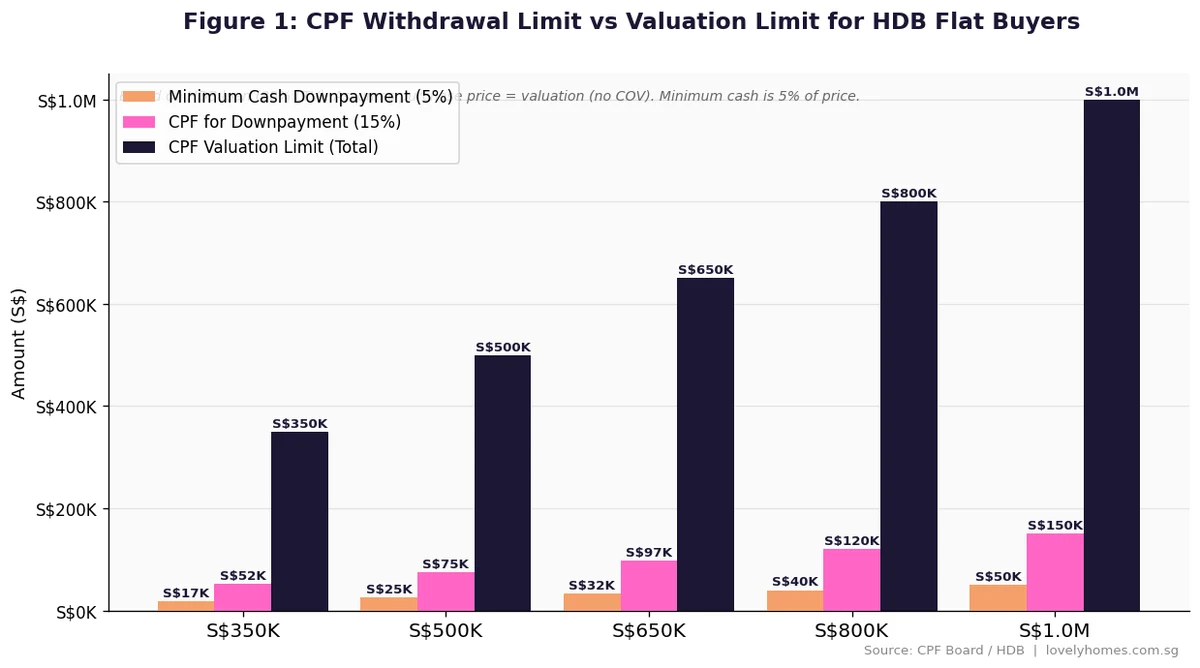
CPF for property Singapore — your Central Provident Fund Ordinary Account (CPF OA) is almost certainly your largest source of savings, and the rules governing how you can use it to buy a home are among the most misunderstood in Singapore’s property landscape. Buyers regularly assume they can use CPF for everything from their Additional Buyer’s Stamp Duty (ABSD) to their renovation bills — and are caught short at completion. Others sell a flat and are alarmed to see how much accrued interest has accumulated in their CPF ledger. This guide explains every rule, limit, and quirk in plain English.

Quick Answer — CPF for property at a glance

  • CPF OA can be used for downpayment, monthly loan instalments, Buyer’s Stamp Duty, and legal fees.
  • CPF OA cannot be used for ABSD (cash only), Cash Over Valuation, option fee, agent commission, or renovation.
  • Valuation Limit (VL): You may use CPF up to the purchase price or market value, whichever is lower.
  • Beyond VL: CPF can be used up to 120% of VL — but only if you have set aside the Full Retirement Sum (FRS).
  • Accrued interest rate: 2.5% p.a. compounded on all CPF withdrawn for property. On sale, principal + accrued interest is refunded to your CPF OA — it does not vanish.
  • Lease rule: Property must have at least 30 years’ remaining lease for CPF to be used; graduated limits apply between 30 and 60 years.
  • For the latest rules, check CPF Board’s official housing page.

What Is the CPF Ordinary Account and Why Is It Used for Property?

The CPF is Singapore’s mandatory social security savings scheme. Every employed Singapore Citizen and Permanent Resident contributes a percentage of their monthly wages into three accounts: the Ordinary Account (OA), Special Account (SA), and MediSave Account (MA). For most working-age Singaporeans, the OA accumulates the largest balance over time — and it earns a minimum guaranteed interest of 2.5% per annum, with an additional 1% on the first S$60,000 of combined CPF balances (with a cap of S$20,000 for OA).

The Government allows the OA to be used for housing because property ownership is a central pillar of Singapore’s social compact. By permitting CPF OA usage, the scheme effectively unlocks decades of compulsory savings for the single largest purchase most households will ever make. The trade-off is that money withdrawn from CPF for property must eventually be returned — with interest — to the account so it remains available for retirement.

CPF OA property usage table 2026 — can vs cannot pay: downpayment, BSD, ABSD cash only
Figure 1: CPF OA Usage for Property — What You Can and Cannot Pay (Source: CPF Board, IRAS 2026)

What Can You Use CPF OA For?

Your CPF OA balance can be applied to the following property-related expenses in 2026:

Downpayment: For an HDB flat purchased using an HDB loan, the minimum cash downpayment is 10% of the purchase price; the remaining 10% of the required 20% downpayment can come from CPF OA. For bank-financed purchases (HDB or private), the minimum cash downpayment is 5% of the purchase price (for loans up to 75% LTV), with the remaining 20% payable from CPF OA or cash.

Monthly loan repayments: Both HDB housing loan instalments and bank mortgage instalments can be paid from your CPF OA. HDB loans deduct directly via GIRO from your CPF OA. For bank loans, you must submit a CPF housing withdrawal application.

Buyer’s Stamp Duty (BSD): BSD can be paid from CPF OA — this is often overlooked by first-time buyers. At current rates, BSD on a S$600,000 HDB flat is approximately S$11,400, all of which can come from OA.

Legal and conveyancing fees: Solicitor fees for the purchase transaction are claimable from CPF OA, subject to the Valuation Limit rule.

What Cannot Be Paid with CPF OA?

Additional Buyer’s Stamp Duty (ABSD) is the most significant item. Regardless of how large your CPF OA balance is, 100% of your ABSD liability must be paid in cash. At 20% for a Singapore Citizen purchasing a second residential property, this means a cash outlay of S$320,000 on a S$1.6M condo — before any other costs. Buyers who have not ring-fenced this amount routinely find themselves in difficulty at the 14-day ABSD payment deadline.

Cash Over Valuation (COV) in the HDB resale market is another cash-only item. Where a buyer agrees to pay above the HDB assessed value, the excess (COV) cannot be financed by either HDB loan or CPF.

Option fees, booking fees, good faith deposits — the initial 1% OTP fee and any booking deposit for new launches must be paid in cash. CPF cannot be applied until the formal sales process is completed.

The Valuation Limit: How Much CPF Can You Use?

The Valuation Limit (VL) is the core rule governing total CPF usage on any single property. It is defined as the purchase price or the market value at the time of purchase, whichever is lower. You may use your CPF OA (and that of any co-owner or joint purchaser) to pay for the property purchase up to this limit.

Once cumulative CPF withdrawals (principal) reach the VL, no further CPF can be withdrawn for that property — unless you qualify for the 120% Valuation Limit extension.

To use CPF beyond the VL (up to 120% VL), the following conditions must be met:

  • The property must have a remaining lease of at least 60 years.
  • The property must have sufficient remaining lease to cover the youngest buyer to age 95.
  • The buyer must have set aside or be setting aside the Full Retirement Sum (FRS) in their CPF SA and OA combined (S$213,000 as at 1 January 2026).
CPF valuation limit and remaining lease eligibility rules 2026 — HDB and private property
Figure 2: CPF Valuation Limit & Lease Eligibility Rules — Singapore 2026 (Source: CPF Board, HDB)

The Lease Rule: Remaining Lease and Age

CPF usage for property is not just limited by the VL — it is also constrained by the remaining lease of the property, particularly relevant for resale HDB flats with shorter tenures.

The general framework is: the property’s remaining lease, at the time of purchase, must be sufficient to cover the youngest buyer to age 95. Where the remaining lease falls short of 60 years, a pro-rated withdrawal limit applies. The formula used is: (Remaining Lease / 65 years) × Valuation Limit. Below 30 years of remaining lease, CPF cannot be used at all.

In practical terms, most buyers of resale HDB flats in mature estates should verify remaining lease carefully. A 50-year-old flat with 49 years remaining means the youngest buyer must be under 46 to receive full CPF access. This has become increasingly relevant as older HDB estates approach their tipping points.

CPF Accrued Interest: The Most Misunderstood Rule

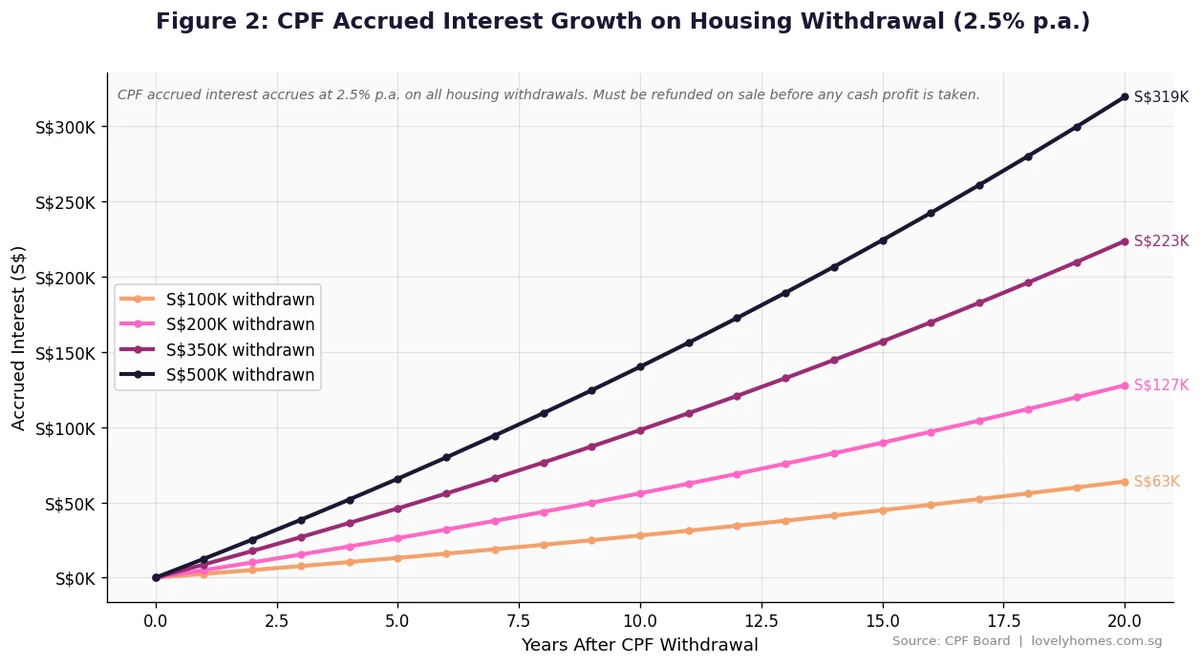
When you use CPF OA to buy a property, CPF Board tracks how much you have withdrawn. It then charges accrued interest on that amount at 2.5% per annum, compounded annually — the same rate your OA would have earned had the money remained in your account. The accrued interest accumulates throughout your period of ownership.

When you sell the property, the net sale proceeds must first be used to refund CPF the principal withdrawn plus all accrued interest. This refund goes back into your CPF OA — it is not a tax, fine, or fee. You are simply returning money to your own retirement savings with the interest it would have earned. The cash you receive after CPF refund, outstanding loan repayment, and transaction costs is your actual cash profit.

Many sellers are surprised by how large the CPF accrued interest sum is after 10–15 years of ownership. A S$150,000 CPF withdrawal grows to approximately S$191,000 after 10 years and S$244,000 after 20 years at 2.5% p.a. — meaning S$94,000 in accrued interest over 20 years returns to your CPF OA on sale.

CPF accrued interest chart 2026 — S$150,000 at 2.5% per annum over 0 to 25 years
Figure 3: CPF Accrued Interest Growth — S$150,000 OA Withdrawal at 2.5% p.a. Compounded (Source: CPF Board formula)

Summary: CPF Rules at a Glance

Rule / Limit What It Means Key Number (2026) Source
Minimum Cash Downpayment (HDB Loan) 10% of purchase price must be in cash; balance of 10% from CPF OA 10% cash HDB
Minimum Cash Downpayment (Bank Loan) 5% cash; next 20% from CPF OA or cash 5% cash MAS / CPF Board
Valuation Limit (VL) Total CPF withdrawable capped at lower of purchase price or market value 100% VL CPF Board
Beyond VL (120% cap) Additional CPF use if FRS met and lease ≥ 60 years 120% VL CPF Board
Minimum Remaining Lease Below 30 years: no CPF use; 30–59 years: pro-rated 30 years CPF Board
Accrued Interest Rate 2.5% p.a. compounded on all OA withdrawals for housing 2.5% p.a. CPF Board
ABSD Not payable via CPF — 100% cash Cash only IRAS
CPF Refund on Sale Principal + accrued interest refunded to CPF OA from sale proceeds Mandatory CPF Board

Worked Example: CPF in Action for a Resale HDB Purchase

The Tans — SC couple, combined income S$8,500/month, buying a 4-room resale flat in Tampines

Purchase price: S$640,000 | HDB valuation: S$625,000 | COV: S$15,000

Financing: HDB housing loan (LTV 80%) = S$500,000 loan; 20% downpayment = S$128,000

  • Minimum cash downpayment (10%): S$64,000 in cash
  • Remaining downpayment (10%): S$64,000 from CPF OA ✓
  • COV S$15,000: Cash only (cannot use CPF) ✓
  • BSD on S$640,000: S$12,600 — payable from CPF OA ✓
  • Legal fees (est.): S$2,800 — payable from CPF OA ✓
  • Total CPF used at purchase: S$64,000 + S$12,600 + S$2,800 = S$79,400
  • Monthly instalment at HDB loan 2.60% over 25 years: S$2,275/month (MSR 26.8% ✓ under 30%)

After 8 years (selling):

  • CPF principal withdrawn (downpayment + instalment contributions): S$218,000 (estimated)
  • Accrued interest at 2.5% p.a. over 8 years: approx. S$24,500
  • CPF refund required: S$242,500 (back into CPF OA — not a loss)
  • Outstanding HDB loan at sale: ~S$384,000
  • If sale price = S$780,000: Net cash after CPF refund + loan repayment: ~S$153,500

Why CPF Accrued Interest Is Not a Penalty

A common misconception is that CPF accrued interest represents a hidden cost of home ownership. It does not. The 2.5% p.a. accrued interest is precisely the return your OA would have earned had you not withdrawn the funds. When you sell and refund CPF, the money returns to your retirement account — meaning you have effectively used the property as an alternative vehicle for your CPF savings during the period of ownership.

The practical implication is that sellers should model their net cash position including the CPF refund, rather than treating the refund as pure cost. In a rising market, property appreciation typically far outstrips the accrued interest — the effective “cost” of using CPF is simply the opportunity cost of not having that money in your OA earning 2.5%. For most Singaporeans buying in a rising market, this is an excellent trade.

Where accrued interest does matter more acutely is for sellers in a flat or declining market, or for sellers who have held for a very long time at low appreciation. A 20-year hold with heavy CPF usage and modest appreciation can result in a smaller-than-expected cash payout — with the “profit” largely returned to CPF. This is not a loss, but it shapes the seller’s immediate liquidity position.

What Might Come Next for CPF and Property

CPF housing rules have been periodically tightened since the 2016 Enhanced Retirement Sum (ERS) framework was introduced. The Government’s stated trajectory is to gradually raise the retirement sums (BRS, FRS, ERS) each year by approximately 3.5%, which in turn raises the bar for the 120% VL extension. By 2030, the FRS is projected to exceed S$250,000, meaning buyers relying on the 120% rule will need substantially more CPF savings set aside.

There is ongoing policy discussion about the tension between property as a retirement asset and CPF as a retirement savings vehicle. The Retirement and Re-employment Act framework and the silver housing bonus schemes suggest the Government is nudging older Singaporeans to unlock property equity for retirement rather than relying on CPF alone. Buyers today should factor in that CPF usage rules may tighten further for properties with shorter remaining leases as the HDB lease decay issue becomes more pronounced in the 2030s and 2040s.

Frequently Asked Questions About CPF and Property

Can I use CPF to pay my ABSD?

No. The Additional Buyer’s Stamp Duty (ABSD) must be paid entirely in cash, regardless of how large your CPF OA balance is. IRAS has never permitted CPF to be used for ABSD since the duty was introduced in 2011. This is one of the most commonly misunderstood rules in Singapore property finance. If you are a Singapore Citizen buying a second property, you must have the full ABSD amount (currently 20% of purchase price) available in cash at the 14-day payment deadline after signing the Option to Purchase.

What happens to my CPF if I sell at a loss?

Even if you sell at a loss, you are still required to refund your CPF the principal withdrawn plus accrued interest — up to the available sale proceeds. If the net sale proceeds after repaying the outstanding loan are insufficient to cover the full CPF refund, you refund whatever is available. Any shortfall in the CPF refund does not need to be made up from your other savings — it is simply not refunded. However, this scenario (selling for less than you owe CPF + loan) is a genuine financial risk that buyers should model before purchasing.

Can I use my spouse’s CPF OA to buy property if they are not a co-owner?

No. Only registered co-owners of the property may use their CPF OA for that property. However, you can add a family member as a co-owner to allow their CPF to be used, subject to HDB and MAS eligibility rules. For private property, there is no prohibition on adding a spouse or family member as a co-owner, though stamp duty and legal implications should be reviewed with a solicitor. You cannot use someone else’s CPF even with their written consent unless they are a co-owner on the title.

Does buying a property with CPF affect my CPF LIFE annuity payout?

Indirectly, yes. Because CPF OA withdrawn for property (plus accrued interest) is refunded to CPF on sale, the funds that return to your account can then be transferred to the Retirement Account (RA) when you turn 55, boosting your CPF LIFE payout. However, if your property has not been sold by retirement age and you have drawn down heavily from OA, your CPF LIFE baseline payout may be lower if you have not independently met the Full Retirement Sum. The key planning point is to not assume that housing CPF withdrawals have no retirement impact — model your retirement savings position including expected CPF refund on eventual sale.

I bought an HDB flat and later upgraded to a private condo. Can I transfer remaining CPF usage from the HDB to the condo?

No. Your CPF housing withdrawals are tracked per property. When you sell the HDB flat, the CPF principal and accrued interest are refunded to your OA. Those funds are then available as fresh OA balance to be applied to the purchase of your next property. However, you do not “carry over” any unused CPF limit from the HDB flat — you start fresh with the new property’s own Valuation Limit. The refunded CPF balance effectively becomes available capital you can redeploy toward the condo’s downpayment and loan repayments.

Is there a limit on how much CPF I can use each month for loan repayments?

There is no separate monthly CPF withdrawal cap beyond the overall Valuation Limit rule. As long as your cumulative withdrawals (downpayment + BSD + legal fees + cumulative monthly instalments) have not reached the VL (or 120% VL if applicable), you may continue to pay monthly instalments from CPF OA. Once you hit the VL, all subsequent instalments must be paid in cash. For most buyers with moderate remaining OA balances or mid-priced properties, VL exhaustion typically occurs somewhere between 10 and 20 years of ownership — and only then does the monthly cash commitment escalate.

Can foreigners or PRs use CPF for property in Singapore?

Singapore Permanent Residents (PRs) contribute to CPF and may use their CPF OA to purchase HDB resale flats and private property, subject to the same VL, lease, and ABSD rules as Singapore Citizens. PRs face a 5% ABSD on their first residential property purchase (versus 0% for SC first property), which must be paid in cash. Foreigners are not CPF contributors and therefore have no CPF OA to access. All property acquisition costs for foreigners — downpayment, BSD, ABSD at 60%, legal fees — must be funded from cash or offshore financing.

Related Articles

Disclaimer: This article is for general informational purposes only. CPF housing rules, valuation limits, and retirement sum thresholds are updated periodically by the CPF Board and may change after the publication date of this article. All figures reflect the framework as at 3 July 2026. Readers should verify current rules at cpf.gov.sg and consult a licensed financial adviser or HDB-appointed solicitor before making any property purchase or CPF withdrawal decision. LovelyHomes does not provide financial or legal advice.

Singapore HDB Resale Buying Process Guide 2026: Step-by-Step from HFE to Keys

Singapore HDB Resale Buying Process Guide 2026: Step-by-Step from HFE to Keys

Quick Answer: HDB Resale Buying Process 2026

  • 10 steps from eligibility check to key collection — typically 8–12 weeks end to end.
  • HFE Letter first — apply for the HDB Flat Eligibility letter before searching; it covers loan eligibility, CPF grants, and flat eligibility in one application.
  • Option to Purchase (OTP) — option fee S$1–S$1,000; 21 calendar days to exercise; exercise fee S$1–S$5,000.
  • Resale application must be submitted by both buyer and seller within 7 days of OTP exercise.
  • COV (Cash-Over-Valuation) — if you agree to pay above HDB’s valuation, the excess is cash only; CPF cannot cover it.
  • CPF grants available: EHG (up to S$80K), Family Grant (up to S$80K), Proximity Housing Grant (up to S$30K) — stackable, subject to income ceilings.
  • Administering bodies: HDB (eligibility, valuation, approval), MAS (bank loans), IRAS (BSD).

Buying an HDB Resale Flat in 2026: What Has Changed

Purchasing an HDB resale flat remains one of the most common property transactions in Singapore — approximately 27,000–30,000 resale transactions occur each year. But the process has undergone material changes since 2021, most notably the introduction of the HDB Flat Eligibility (HFE) Letter in May 2023 (replacing the prior HDB Loan Eligibility letter and CPF Housing Grant eligibility check with a single, combined application), and the 15-month wait-out period for private property owners effective 30 September 2022.

This guide walks you through every step — from confirming eligibility to collecting your keys — using the current process as at July 2026. It covers who can buy, how to finance the purchase, what grants are available, how to navigate the OTP and resale application, and what costs to budget for.

HDB resale buying process 10 steps Singapore 2026 — from eligibility check to key collection
Figure 1: The 10-step HDB resale buying process in Singapore, 2026. Typical timeline: 8–12 weeks from OTP exercise to key collection. Source: HDB.

Step 1: Confirm Your Eligibility

Before anything else, you must verify that you and your co-applicant (if any) meet HDB’s eligibility criteria for purchasing a resale flat. The key conditions are:

Citizenship: At least one applicant must be a Singapore Citizen. A Permanent Resident may co-apply, but cannot purchase alone. Singapore Citizens who already own an HDB flat may only purchase a second HDB flat if they dispose of the first within 6 months of completing the resale purchase — they cannot hold two HDB flats simultaneously.

Minimum Occupation Period (MOP): If either applicant currently owns an HDB flat, that flat must have fulfilled its MOP (typically 5 years from date of possession for standard HDB flats; 10 years for Prime or Plus classification flats) before a resale purchase can proceed.

15-Month Wait-Out Period: If either applicant currently owns, or has within the preceding 15 months disposed of, a private residential property, they must wait at least 15 months from the date of disposal before they can purchase an HDB resale flat. This measure was introduced on 30 September 2022 and applies strictly — there are very limited exemptions.

Income ceiling: There is no income ceiling for the purchase of an HDB resale flat itself. Income ceilings apply only to grant eligibility (EHG: S$9,000 household/S$4,500 single; Family Grant: S$14,000; PHG: S$14,000) and HDB loan eligibility (S$14,000 household for concessionary loan).

Step 2: Apply for the HFE Letter

The HDB Flat Eligibility (HFE) Letter, introduced in May 2023, is the single most important document you will obtain before starting your flat search. It is issued by HDB and tells you: (a) whether you are eligible to buy an HDB flat; (b) how much HDB loan you qualify for; and (c) which CPF housing grants you are eligible for and in what amounts.

You apply for the HFE Letter via the HDB Flat Portal (homes.hdb.gov.sg). Processing typically takes 21 business days for HDB loan applicants and about 14 business days if you are seeking a bank loan. The HFE Letter is valid for 6 months from the date of issue. If you plan to take a bank loan rather than an HDB loan, you should also obtain an In-Principle Approval (IPA) from your preferred bank before making an offer — banks do not issue IPAs until after you have the HFE Letter for HDB resale transactions.

HDB strongly recommends — and estate agents have been instructed — that buyers obtain the HFE Letter before signing any OTP. Signing an OTP without a valid HFE Letter exposes you to the risk of being unable to complete the transaction if your financing falls through.

Step 3: Search and Negotiate

HDB resale transactions take place primarily through the HDB Resale Portal (resale.hdb.gov.sg), where sellers list their flats, and through licensed property agents on platforms such as PropertyGuru, 99.co, and the EdgeProp portal. Unlike the BTO process, there is no ballot — you negotiate directly with the seller and agree on a price. HDB does not prescribe or cap resale prices, which are determined entirely by market forces.

Once you identify a flat, check the HDB Resale Price data (available on the HDB and URA websites) to understand recent comparable transactions. Pay attention to the Cash-Over-Valuation (COV) — if you agree to pay more than HDB’s valuation, the excess must be paid in cash only. CPF cannot fund COV. As at July 2026, the median COV in mature estates has been running at S$20,000–S$60,000 depending on flat type and floor level.

CPF housing grants HDB resale buyers 2026 — EHG Family Grant PHG stacked bar chart by buyer profile
Figure 2: CPF Housing Grants available for HDB resale buyers by buyer profile (2026). EHG = Enhanced CPF Housing Grant; FG = Family Grant; PHG = Proximity Housing Grant. Source: HDB / CPF Board.

CPF Housing Grants for HDB Resale

HDB resale buyers — particularly first-timers — may be eligible for generous CPF Housing Grants that substantially reduce their effective purchase price. These grants are paid into your CPF Ordinary Account and deducted from the purchase price at completion, reducing the amount you need to borrow.

The Enhanced CPF Housing Grant (EHG) is the most substantial: up to S$80,000 for eligible couples (household income ≤S$9,000/month) and up to S$40,000 for singles (income ≤S$4,500/month). The EHG tapers based on income — households earning S$9,000 receive no EHG, while those earning S$1,500 or below receive the full amount. The Family Grant (up to S$80,000 for SC-SC couple buying a 4-room or smaller resale flat) and the Proximity Housing Grant (PHG) (up to S$30,000 if buying within 4km of parents or children, or S$20,000 if buying in the same town) are stackable on top of the EHG, subject to their respective income ceilings of S$14,000 household income.

CPF Housing Grants for HDB Resale Buyers — Maximum Amounts (2026)
Grant Max (SC-SC Couple) Max (SC-SPR Couple) Max (SC Single) Income Ceiling Stackable?
Enhanced CPF Housing Grant (EHG) S$80,000 S$60,000 S$40,000 S$9,000/mth (couple); S$4,500 (single) Yes
Family Grant (FG) S$80,000 (4-room or smaller) S$50,000 S$14,000/mth Yes
Proximity Housing Grant (PHG) S$30,000 (same town) / S$20,000 (4km) S$30,000 / S$20,000 S$15,000 / S$10,000 S$14,000/mth Yes
Step-Up CPF Housing Grant S$15,000 (2nd-timer buying 2-room) S$7,000/mth Limited

Steps 4–6: OTP, Exercise, and Resale Application

Once you and the seller agree on a price, the seller grants you an Option to Purchase (OTP). This is a standardised HDB document (not a private OTP — HDB prescribes the form). The option fee is negotiable between S$1 and S$1,000; this sum is paid to the seller at this stage. You then have 21 calendar days to decide whether to exercise the option.

To exercise the OTP, you pay the seller the exercise fee (negotiable between S$1 and S$5,000, less the option fee already paid). You should appoint an HDB-accredited solicitor at this point — HDB-approved conveyancing firms handle the legal transfer and ensure all conditions are met for a valid resale application. Note that the solicitor fees for an HDB resale are regulated and relatively modest compared to private residential conveyancing.

After exercising the OTP, both the buyer and the seller must each independently submit their portions of the HDB Resale Application via the HDB Resale Portal within 7 days of the OTP exercise date. The application is rejected if either party fails to submit within this window — there are no extensions. The buyer’s portion covers loan details, CPF usage, grant applications, and identity verification; the seller’s portion covers their existing loan redemption, CPF refund computation, and property condition declaration.

Steps 7–10: Valuation, Approval, and Key Collection

After both parties submit, HDB appoints an independent valuer. The valuation report is typically issued within 5–10 business days. If the agreed resale price exceeds the valuation, the difference is the COV — the buyer must pay this entirely in cash. CPF cannot cover COV. If the resale price is at or below valuation, there is no COV issue and the full price can be funded by CPF and/or loan.

HDB then reviews the application — checking buyer and seller eligibility, loan amounts, CPF usage, and grant amounts — and issues its approval in principle (also known as the Letter of Offer for HDB loans, or confirmation of grant disbursement). This review takes approximately 4–6 weeks. Once approved, HDB sets a resale completion appointment (usually 3–5 weeks later), at which both buyer and seller sign the final transfer documents, the seller’s outstanding loan is redeemed, CPF principal and accrued interest are refunded to the seller’s CPF account, and the buyer’s grants are applied to reduce the purchase price.

At completion, the buyer pays the remaining purchase price (after deducting CPF, loan, and grants), and keys are handed over. The HDB MOP clock begins on the date of resale completion, not the date of OTP or application.

HDB resale total upfront costs 2026 — downpayment BSD legal fees by price band bar chart
Figure 3: HDB resale total upfront costs for a Singapore Citizen first-time buyer using HDB loan (80% LTV), by price band. BSD = Buyer’s Stamp Duty. Source: HDB, IRAS.

Worked Example: The Tan Family Buying a 4-Room Resale in Tampines

Mr and Mrs Tan are both Singapore Citizens, both first-timers, with a combined gross monthly income of S$7,200. They wish to buy a 4-room resale flat in Tampines. They identify a unit at S$650,000 — the HDB valuation comes in at S$630,000, meaning COV of S$20,000 in cash.

Grants: EHG: household income S$7,200 → approximately S$45,000. Family Grant (SC couple, 4-room resale): S$80,000. PHG (buying in same town as Mrs Tan’s parents): S$30,000. Total grants: S$155,000.

Financing: HDB Loan (at valuation S$630,000); HDB Loan LTV 80% = S$504,000. Monthly repayment at HDB concessionary rate 2.60% p.a. over 25 years: approximately S$2,287/month. MSR check: S$2,287 / S$7,200 = 31.8% — slightly above the 30% MSR. The loan tenure would need to be extended to 27 years to reduce the monthly payment to S$2,147 (29.8%, within MSR).

Cash required: 20% downpayment on S$630,000 = S$126,000 (CPF/cash); COV S$20,000 cash; BSD on S$650,000: first S$180K × 1% + next S$180K × 2% + balance S$290K × 3% = S$1,800 + S$3,600 + S$8,700 = S$14,100 BSD (payable from CPF); Legal fees ~S$2,500. After grants of S$155,000 applied to purchase price, effective loan reduces further. Total cash required on completion day: approximately S$20,000 COV + S$2,500 legal = S$22,500 cash. The downpayment and BSD can be funded entirely from CPF OA.

HDB Resale Buying Process: Summary Checklist

10-Step HDB Resale Buying Process — Summary for 2026
Step Action Key Deadline Portal / Body
1 Confirm eligibility (MOP, citizenship, WOP) Before everything else HDB / self-check
2 Apply for HFE Letter ~2–3 weeks processing homes.hdb.gov.sg
3 Search, view flats, check RPI and COV HFE valid 6 months resale.hdb.gov.sg / portals
4 Receive OTP from seller; pay option fee OTP valid 21 days HDB standard form
5 Exercise OTP; appoint solicitor Within 21 days of OTP HDB-accredited law firm
6 Both parties submit Resale Application Within 7 days of OTP exercise resale.hdb.gov.sg
7 HDB valuation issued ~5–10 business days HDB-appointed valuer
8 HDB resale approval ~4–6 weeks HDB
9 Completion appointment: sign & pay ~3–5 weeks after approval HDB Hub / solicitor
10 Key collection; MOP clock starts Completion date HDB

Why the HFE Letter Changed the Process

Before May 2023, buyers had to separately apply for an HDB Loan Eligibility (HLE) letter (for loan quantum) and individually check grant eligibility through the CPF Board. These were separate processes with separate documentation requirements. The HFE Letter consolidated all three determinations — eligibility to buy, loan quantum, and grant amounts — into a single application with Myinfo integration that pre-populates most fields from government databases. This has reduced the administrative burden significantly and means that by the time a buyer reaches Step 3 (searching for a flat), they already have a comprehensive view of their purchasing power.

The practical implication is that the HFE Letter has become the de facto pre-qualification document for HDB resale transactions. Sellers and their agents increasingly request to see it before entertaining an offer — much like how banks request an IPA before accepting a purchase offer in private transactions. Buyers who have not yet obtained their HFE Letter are at a disadvantage in competitive situations.

What Might Change: HDB Resale in 2H 2026

This section is analytical and speculative; it does not represent government policy.

HDB resale prices fell by 0.3% in Q2 2026 — the second consecutive quarterly decline. Volumes were also down approximately 10% year-on-year. The moderation has been attributed to a combination of the 15-month wait-out period (removing a significant pool of upgrader demand), the large cohort of BTO completions in 2025–2026, and higher mortgage rates. If the moderation continues through 2H 2026, there may be political pressure to consider relaxations such as easing the wait-out period for specific buyer segments or adjusting the EC income ceiling to divert some demand from the resale market. These are speculative — HDB has not signalled any imminent changes. Full Q2 2026 resale transaction data is expected from HDB around 23 July 2026.

Frequently Asked Questions

Do I need to sell my current HDB flat before buying a resale?

You cannot own two HDB flats simultaneously (with limited exceptions for concurrent subletting). If you own an HDB flat and wish to buy a resale flat, you must either sell the existing flat within 6 months of the new resale completion, or ensure the existing flat’s MOP has been met and proceed under HDB’s approved conditions. Singapore Citizens who own a private property and wish to buy an HDB resale must also comply with the 15-month wait-out period from the date of disposing of the private property.

What is Cash-Over-Valuation (COV) and how much should I budget?

COV is the difference between the agreed resale price and HDB’s valuation of the flat. It must be paid entirely in cash — it cannot be covered by CPF, grants, or loans. As at mid-2026, COV in mature estates such as Tampines, Bishan, and Toa Payoh typically ranges from S$20,000 to S$80,000 for 4-room and 5-room flats, with premium units (high floors, well-maintained, near MRT) attracting COV at the upper end or beyond. In non-mature estates, COV is generally lower or even nil. Budget at least S$20,000–S$40,000 in liquid cash specifically for potential COV when considering a mature estate purchase.

Can I use CPF to pay BSD for an HDB resale flat?

Yes. Buyer’s Stamp Duty for an HDB resale flat can be paid from your CPF Ordinary Account. The BSD is assessed on the higher of the purchase price or valuation. For a flat priced at S$650,000 (with valuation at S$630,000), BSD is assessed on S$650,000: 1% on first S$180,000 + 2% on next S$180,000 + 3% on balance S$290,000 = S$14,100. This amount can be deducted from your CPF OA balance and paid directly to IRAS by your conveyancing solicitor. Note that Additional BSD (ABSD) does not apply to most HDB resale purchases by first-time buyers.

My HFE Letter has expired. Can I still exercise the OTP?

No — a valid HFE Letter is required at the point of submitting the HDB Resale Application (Step 6). If your HFE Letter expires before you submit the application, you will need to apply for a fresh one. The HFE Letter is valid for 6 months from the date of issue. Given that the HDB resale process from HFE application to key collection can take 3–6 months in total, it is best to time your HFE application so it remains valid through to at least the expected date of resale application submission. If you expect to search for a flat for several months, consider applying for the HFE Letter approximately 2–3 months before you plan to make serious offers.

Is a property agent required to buy an HDB resale flat?

No. HDB’s resale portal (resale.hdb.gov.sg) is designed to allow buyers and sellers to transact directly without agents. HDB provides standard OTP forms, step-by-step guided submissions, and appointment scheduling through the portal. That said, many buyers choose to engage a licensed property agent for negotiation support, flat search assistance, and procedural guidance — particularly first-timers unfamiliar with the process. If you engage an agent, ensure they hold a valid CEA practitioner licence. Agent commission for a buyer is negotiable; it is often 1% of the purchase price, sometimes waived or subsidised by the co-broking arrangement with the seller’s agent.

What happens if I back out after exercising the OTP?

Once you exercise the OTP, you are legally bound to complete the purchase on the agreed terms. If you withdraw after exercising, the seller is entitled to forfeit your option and exercise fees and may seek further damages depending on the circumstances. Unlike private residential transactions (which involve a more complex contractual structure under the Sale and Purchase Agreement), HDB resale OTPs are relatively straightforward — but the principle of contractual commitment applies equally. If you are genuinely uncertain about proceeding, it is better to let the OTP lapse (forfeiting only the option fee of up to S$1,000) rather than exercise it and then withdraw.

Related Articles

Disclaimer

This article is for general informational purposes and does not constitute legal, financial, or professional advice. HDB eligibility rules, CPF grant amounts, loan limits, and stamp duty rates are subject to change. All figures cited are accurate as at 3 July 2026. Readers should verify current rules with HDB (hdb.gov.sg), IRAS (iras.gov.sg), MAS (mas.gov.sg), and the CPF Board (cpf.gov.sg) before making any decisions. LovelyHomes is not a licensed property agent, financial adviser, or legal practitioner.

Translate »