Singapore HDB Minimum Occupation Period (MOP) 2026: Complete Guide — Rules, Restrictions and Upgrade Options

Singapore HDB Minimum Occupation Period (MOP) 2026: Complete Guide — Rules, Restrictions and Upgrade Options

Quick Answer: HDB MOP Singapore 2026

  • Standard HDB BTO and resale flats have a 5-year Minimum Occupation Period (MOP) counted from the date you collect the keys (TOP/possession date), not from when you sign the Sales & Purchase agreement.
  • Plus and Prime (PLH) classification flats introduced from the August 2024 BTO exercise have a longer 10-year MOP, reflecting their more desirable locations and heavier subsidy.
  • During MOP, you cannot sell your flat, rent out the entire flat, or purchase any other residential property in Singapore — including private property or an overseas residential investment.
  • You CAN rent out individual HDB bedrooms with prior HDB approval, and run approved home-based businesses from your flat during MOP.
  • Executive Condominiums (ECs) have a 5-year MOP before they can be sold to Singapore Citizens and PRs, and a 10-year window before they are fully privatised and open to foreign buyers.
  • Breaching MOP rules can result in compulsory acquisition of the flat by HDB at a value set by HDB — typically below market value. Criminal penalties may also apply under the Housing & Development Act.
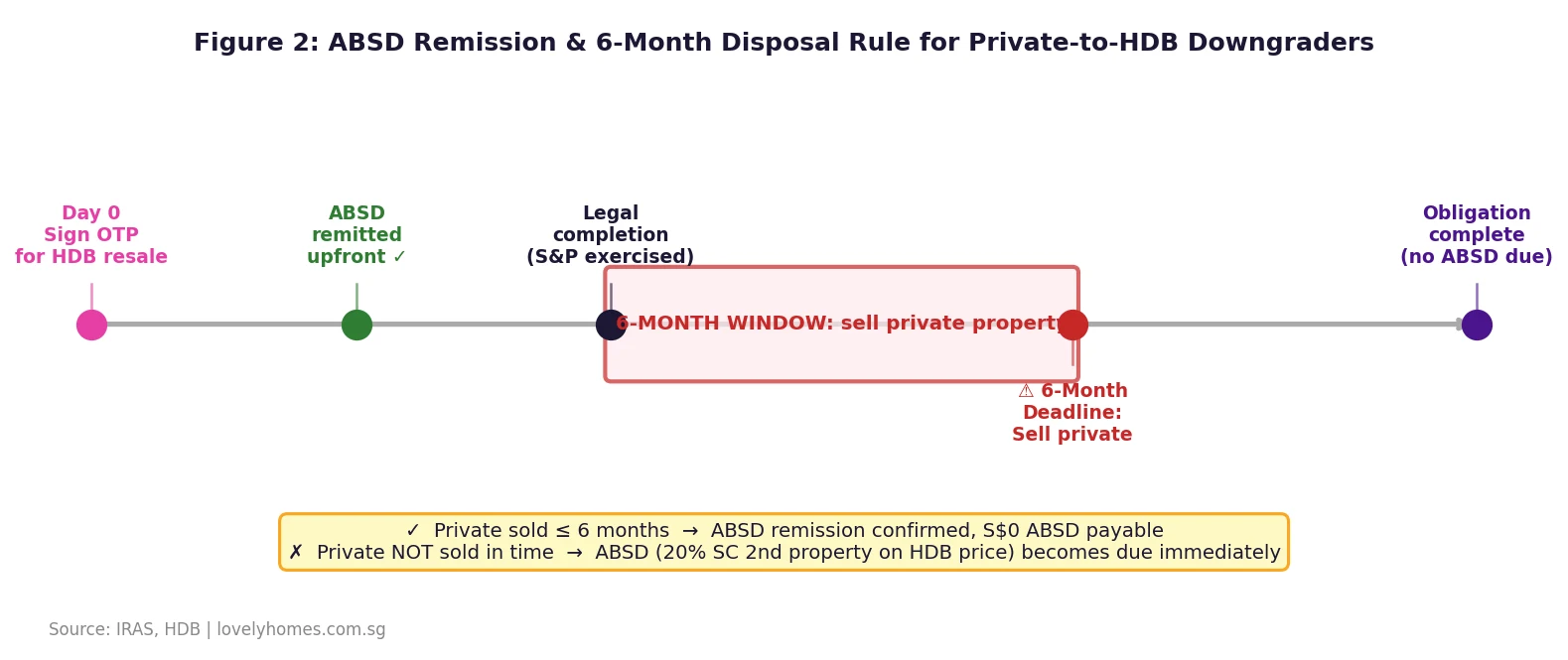
  • After MOP, you can sell the flat, upgrade to a private property, and — for HDB sellers upgrading to private — apply for ABSD remission if you complete the sale within 6 months of purchasing the private property.

What Is the HDB Minimum Occupation Period (MOP)?

The Minimum Occupation Period (MOP) is a statutory rule administered by the Housing & Development Board (HDB) that requires flat owners to physically occupy their HDB flat for a minimum period before they can sell it on the open market, rent it out entirely, or purchase other residential property in Singapore. The MOP is a key plank of Singapore’s public housing philosophy: HDB flats are subsidised national assets intended primarily as homes rather than investment vehicles, and the MOP is one mechanism through which HDB ensures flats remain owner-occupied.

The MOP was first introduced in the 1970s and has been refined multiple times since, most recently in 2024 with the introduction of the Plus and Prime flat classifications under the enhanced HDB framework. Understanding which MOP applies to your flat — and what you can and cannot do during that period — is critical before making any property decisions.

HDB MOP by flat type Singapore 2026 — Standard 5 years, Plus and Prime 10 years, EC 5 then 10 years
Figure 1: HDB Minimum Occupation Period by flat type, Singapore 2026. Plus and Prime classification flats (introduced from August 2024 BTO exercise) carry a 10-year MOP, double the Standard flat MOP. Source: HDB.

MOP Duration by Flat Type (2026)

Flat Type MOP Duration MOP Start Date Notes
Standard BTO Flat 5 years Date of key collection Applies to all pre-Aug 2024 BTO; continued for Standard classification from Aug 2024
Plus Classification BTO Flat 10 years Date of key collection From Aug 2024 BTO exercise; typically near MRT/town centres; subsidy clawback on resale
Prime / PLH Classification BTO Flat 10 years Date of key collection Central-location flats; subsidy clawback ~6–9% of resale price; income ceiling at resale
HDB Resale Flat 5 years Date of resale completion Fresh 5-year MOP runs from the date the resale transaction is completed (not from when the previous owner moved in)
Executive Condominium (EC) 5 years → 10 years Date of TOP At 5yr can sell to SC/PR; at 10yr fully privatised — open to foreigners (60% ABSD applies)
HDB Sale of Balance Flats (SBF) 5 years Date of key collection SBF flats unsold from previous BTO exercises; Standard classification MOP applies

Important note on the Plus and Prime MOP: The new 10-year MOP for Plus and Prime flats applies only to flats launched under the August 2024 BTO exercise onwards. Flats purchased in earlier exercises, even if they are in desirable locations that would now be classified as Plus or Prime, retain their original 5-year MOP. To confirm which classification applies to your flat, check your HDB flat portal or the original flat details under your BTO exercise.

What You Cannot Do During the HDB MOP

HDB MOP rules matrix 2026 — what you can and cannot do during the minimum occupation period
Figure 2: HDB MOP rules — allowed and prohibited activities during the Minimum Occupation Period. Source: HDB Housing & Development Act.

Selling the Flat

You cannot sell your HDB flat on the open resale market before your MOP is complete. This applies even if you face financial hardship — HDB does not grant MOP exemptions for distressed sellers. The only exception is a compulsory acquisition by HDB or by the State for public purposes, which is not initiated by the flat owner. If you attempt to sell before MOP, the transaction will be rejected by HDB’s system during the eligibility check.

Renting Out the Entire Flat

Renting out the entire flat (as a whole unit) is not allowed during MOP. This applies to both short-term and long-term rental arrangements. Platforms such as Airbnb and similar short-term rental services are also not permitted on HDB flats — the minimum lease tenure for any rental on HDB flats is three consecutive months. After MOP, whole-flat rental is allowed with HDB prior approval and is subject to the non-Malaysian foreign tenant quota.

Purchasing Other Residential Property in Singapore

During MOP, you and your co-owners on the flat cannot purchase any other private residential property in Singapore. This restriction extends to new launch condominiums, resale condominiums, Executive Condominiums (as a new buyer), landed property, and private apartments. Purchasing a second HDB flat is also not allowed during MOP.

Crucially, HDB’s definition of “residential property” in the MOP context refers to Singapore property only. There is no restriction on purchasing overseas residential property during MOP — only Singapore residential property is covered.

Purchasing a Second HDB Flat

HDB’s policy generally allows only one HDB flat per family nucleus at any time. Applying for a second BTO, SBF, or resale flat during MOP is not permitted. Once MOP is fulfilled, you may apply for a second HDB flat under specific schemes (e.g., the Studio Apartment scheme for elderly, or a new BTO after disposing of the first flat).

What You CAN Do During the HDB MOP

Rent Out Individual Rooms

Renting out individual bedrooms in your HDB flat (while you continue to live in the flat) is permitted during MOP, subject to HDB’s prior written approval. You must apply through the HDB Flat Portal before subletting. Each tenancy must be for a minimum of six months (for whole-flat subletting after MOP) or at least three months for room rental. Non-Malaysian foreign tenants are subject to the non-Malaysian quota: a maximum of two non-Malaysian foreign tenants per flat in the same block is the guideline, though HDB publishes real-time quota data by block.

Run Approved Home-Based Businesses

HDB permits flat owners to operate home-based businesses during MOP, subject to type and scale restrictions. Category 1 businesses (no employees visiting, no clients visiting, no signage) are allowed without prior approval. Category 2 businesses (up to two non-resident employees, clients may visit in small numbers) require prior approval from HDB. Manufacturing, food businesses, or any business that involves goods storage, noise, or frequent deliveries is not permitted.

Refinance to a Bank Loan

Switching from an HDB housing loan to a bank loan (or switching between bank loan packages) is allowed during MOP. There is no MOP restriction on refinancing decisions, and many flat owners take advantage of the 5-year MOP period to monitor interest rate movements and refinance when rates are favourable. MAS’s LTV and TDSR rules govern the refinancing terms.

When Does the MOP Start and End?

The MOP starts from the date you collect your keys (for BTO and SBF flats, this is the TOP date; for resale flats, this is the date of completion of the resale transaction — both milestones are reflected in your HDB Flat Portal). The MOP does not start from the date you sign the Sales & Purchase Agreement or from the date you pay the initial booking fee.

You can check your MOP end date in the HDB Flat Portal under “My Flat” → “Purchase Details”. The portal clearly shows whether your MOP has been fulfilled. Do not rely on verbal estimates from agents or CPF advisers — always verify on the portal directly.

One nuance: physical occupation is expected during MOP. HDB conducts periodic checks to ensure flat owners are residing in the flat. Extended overseas absences without HDB’s knowledge have been cited in compulsory acquisition cases. If you must be overseas for an extended period (e.g., for work), inform HDB and keep the flat in a lived-in condition.

Executive Condominium (EC): The Hybrid MOP Rules

Executive Condominium EC MOP and privatisation timeline Singapore 2026 — 5-year and 10-year milestones
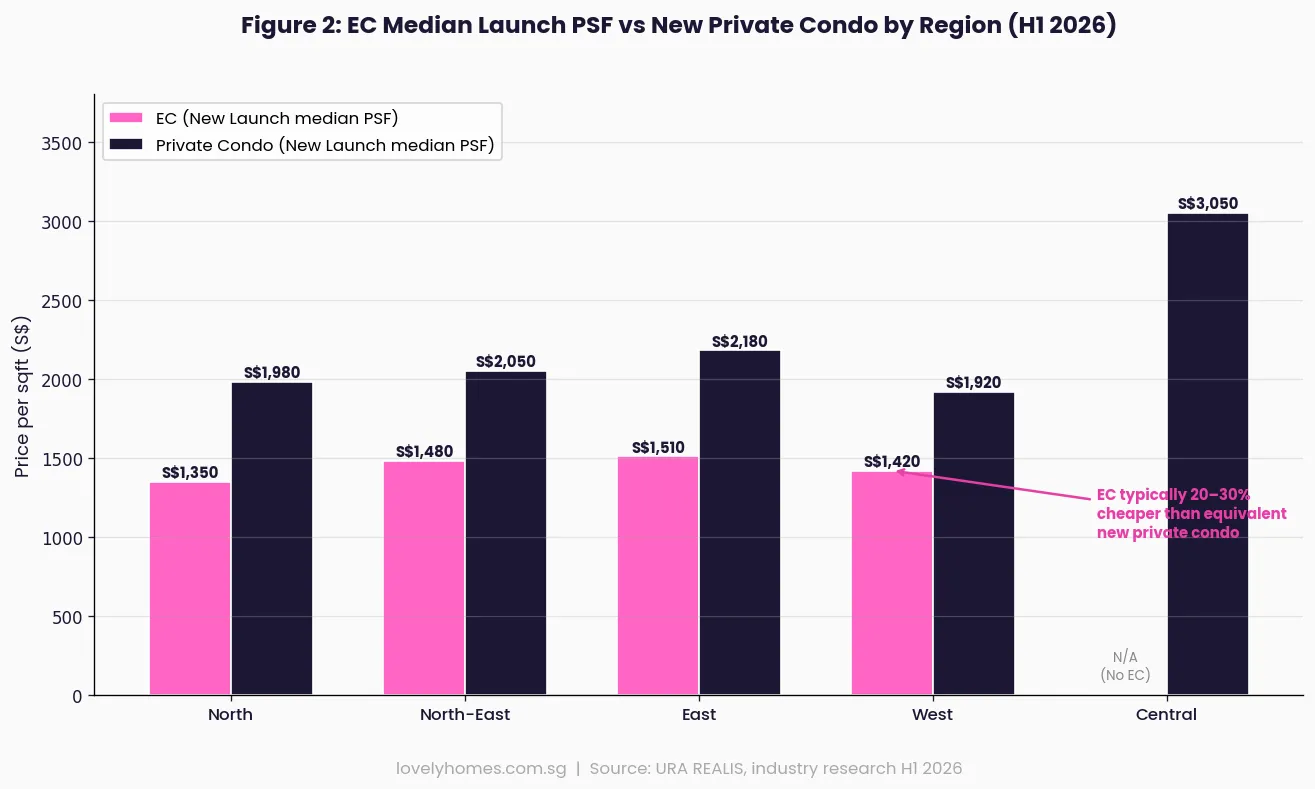
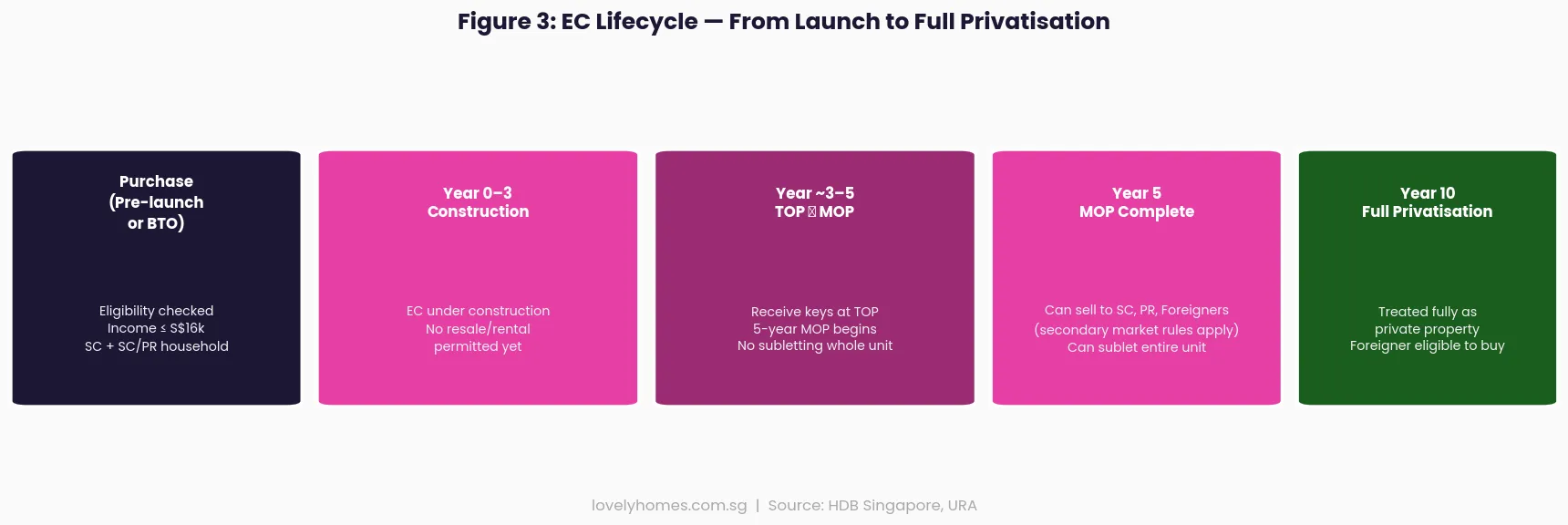
Figure 3: Executive Condominium MOP and privatisation timeline. During the first 5 years, EC owners face HDB-equivalent MOP restrictions. At the 5-year mark, ECs can be sold on the open market to SC and PR buyers. At 10 years, ECs are fully privatised and open to foreign buyers (60% ABSD applies). Source: HDB, URA.

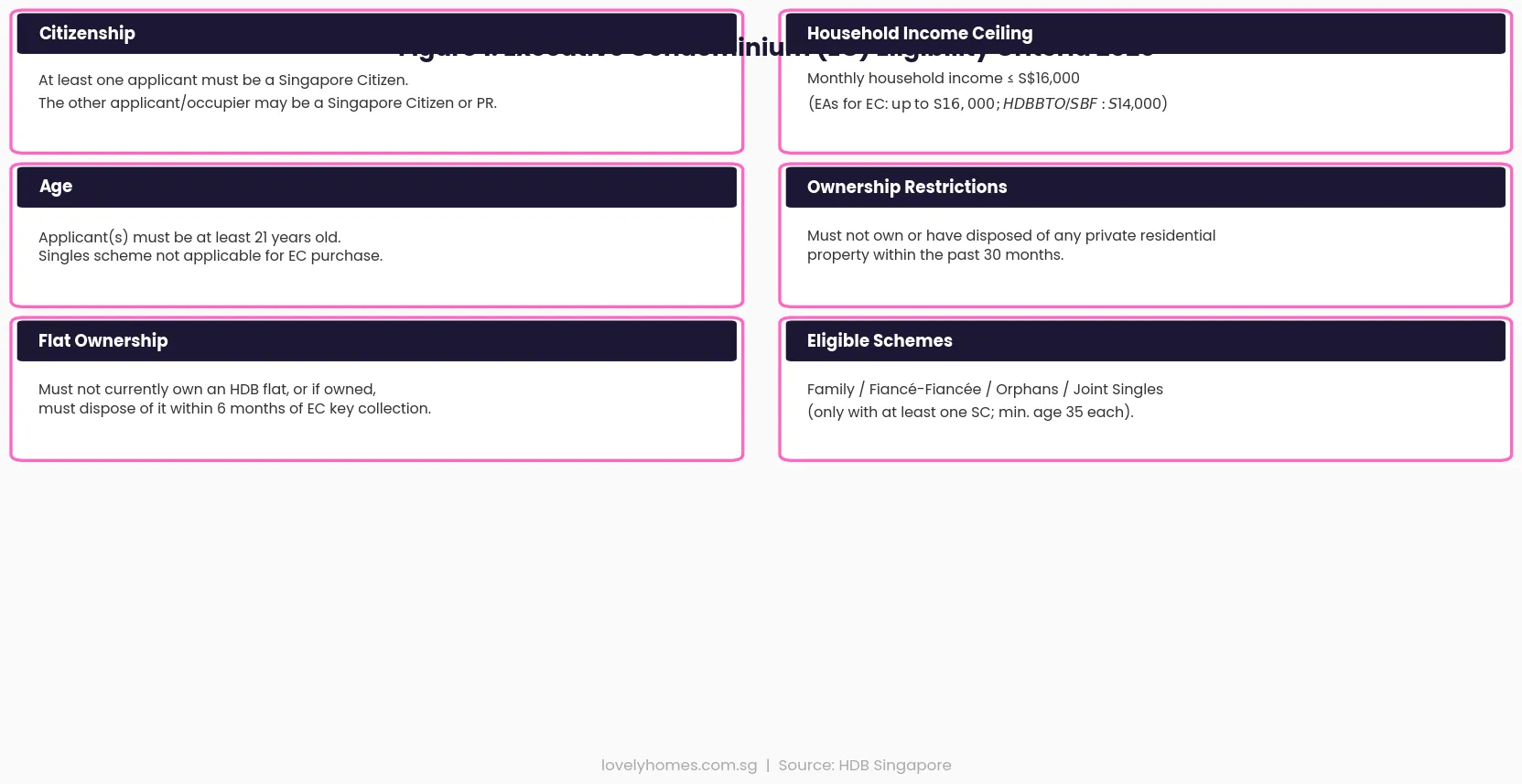
Executive Condominiums occupy a hybrid position between public and private housing. They are built by private developers but are sold at a subsidised price to qualifying buyers (income ceiling S$16,000 per month household income as of 2026). From a MOP standpoint, ECs are treated like HDB flats for the first 5 years:

During years 1–5: EC owners cannot sell their unit, rent out the whole unit, or purchase any other Singapore residential property. The rules are identical to HDB MOP. Critically, the 5-year MOP runs from the TOP date, not the booking date — for large EC projects, this can mean a 3–4 year gap between booking and TOP, followed by 5 more years of MOP, making the effective holding period 8–9 years from initial purchase commitment.

After year 5 (first privatisation): The EC can be sold on the open resale market to Singapore Citizens and Singapore PRs. It cannot yet be sold to foreigners, and ECs in the first 5–10 year window are not listed on the private market as “privatised condos” — they trade in a narrower SC/SPR market. ABSD rules for the buyer apply (5% for PR 1st property, 30% for PR 2nd+, etc.).

After year 10 (full privatisation): The EC is fully privatised and treated identically to a private condominium. Foreigners may purchase it, though the 60% foreigner ABSD applies. Owners may also rent the entire unit without prior HDB approval at this stage.

Plus and Prime Flat Additional Restrictions After MOP

The 2024 housing framework introduced substantive additional conditions for Plus and Prime classification flats beyond just the longer 10-year MOP. These are restrictions that run with the flat even after MOP and affect future resale:

Subsidy clawback: When you sell a Plus or Prime flat after your MOP, HDB claws back a portion of the subsidy embedded in the original purchase price — approximately 6–9% of the resale price, payable to HDB. This clawback is calculated as a percentage of the resale transaction price, not the original purchase price, so it increases in dollar terms as the flat appreciates.

Income ceiling for buyers: Buyers of Plus and Prime resale flats are subject to an income ceiling (the ceiling is the same as for BTO buyers — S$14,000/month for 4-room and larger Plus flats as of 2026). This narrows the pool of eligible resale buyers and may dampen price appreciation relative to Standard flats.

Ethnic Integration Policy (EIP): As with all HDB resale flats, EIP quotas apply — both block and neighbourhood levels. Buyers must check the relevant block’s EIP availability before submitting an offer.

After MOP: Your Property Upgrade Options

Once your MOP is fulfilled, your options expand significantly. The most common upgrade path is from HDB flat to private condominium. The timing of this upgrade carries stamp duty implications:

Option A — Sell HDB first, then buy private: You clear the HDB flat, receive sale proceeds (net of CPF refund), and purchase the private property as a “first property” — no ABSD for SC buyers, 5% ABSD for PR buyers. This is the most common and financially efficient path but requires temporary accommodation between the two transactions.

Option B — Buy private first, then sell HDB (concurrent ownership): As an SC buying private property while still owning an HDB flat (post-MOP), you pay 20% ABSD on the private property purchase. You then have six months from the private property’s completion (or from the purchase date for resale private properties) to sell the HDB flat and apply for an ABSD remission from IRAS. If the HDB is sold within six months, IRAS refunds the 20% ABSD. If you miss the six-month window, the 20% ABSD is forfeited.

The six-month window starts from either the issue of Temporary Occupation Permit (TOP) for a new private property or the date of exercise of the OTP for a resale private property. Given the complexity of timing, many HDB upgraders consult a lawyer and financial adviser before committing to Option B.

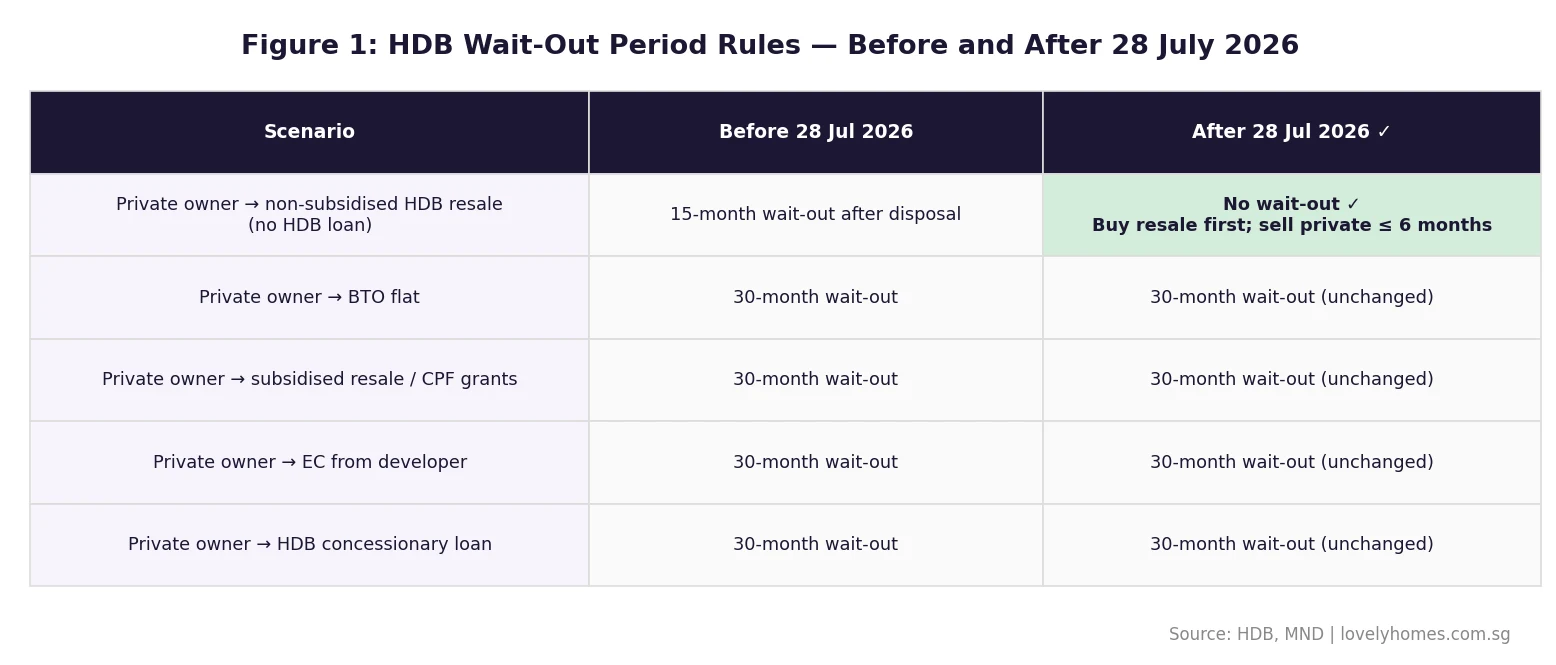
The 15-Month Wait-Out Period: From Private Back to HDB

The wait-out period is often confused with MOP. They are different rules targeting different situations. The 15-month wait-out period (introduced in September 2022) applies to private property owners who want to purchase an HDB resale flat. If you own or recently disposed of a private property, you must wait 15 months from the date of disposal before you can purchase an HDB resale flat.

This rule does not apply to HDB MOP — it is a separate downstream restriction. For example, if you complete your HDB MOP, sell your HDB flat, buy a private condo, and then later want to downgrade back to HDB, you must wait 15 months after selling the private condo before buying an HDB resale flat. This rule applies to both SC and PR private property owners.

Worked Example: The Tan Family’s Upgrade Journey

Mr and Mrs Tan (both Singapore Citizens) purchased a 4-room BTO flat in Punggol under the Standard classification in September 2019. They collected their keys in August 2021. Their MOP end date is therefore August 2026 — five years from key collection.

In March 2026, Mrs Tan checks the HDB portal and sees MOP will end in 5 months. The couple begin their private condo search. They find a 3-bedroom OCR resale condo in Jurong East priced at S$1.5M in June 2026.

They choose Option B (buy private first). As SC buying a second property: BSD ~S$42,600 + ABSD 20% = S$300,000. They pay S$342,600 in stamp duties. Their flat is still within MOP (keys August 2021, MOP August 2026 — they are just before MOP end), so HDB must confirm MOP end before they list the flat for sale.

After August 2026 (MOP fulfilled), they list their HDB flat. Sell it in October 2026 for S$780,000 — within the 6-month window from the condo OTP exercise date of June 2026. IRAS refunds the S$300,000 ABSD. Net stamp duty retained: S$42,600 BSD only. The family books temporary accommodation for 2 months while bridging the purchase and sale timelines.

Total net proceeds from HDB: S$780,000 − CPF refund S$220,000 (principal + accrued interest) − agent 1% S$7,800 − legal S$2,500 = net S$549,700 cash. The upgrade is financially viable.

Will MOP Rules Change?

The 10-year MOP for Plus and Prime flats is a relatively recent policy (from August 2024) and unlikely to be rolled back in the near term. If anything, the trend in Singapore public housing policy has been toward tightening MOP and adding post-MOP conditions rather than relaxing them, as the government works to ensure HDB flats remain primary homes rather than investment properties. The subsidy clawback mechanism for Plus and Prime flats may be extended to more flat types if HDB determines that Standard flat resale prices are diverging too sharply from BTO prices in certain areas. Buyers should model their long-term exit strategy under current rules and build in buffer for possible tightening.

Frequently Asked Questions

Can I stay overseas during my HDB MOP?

You are expected to physically occupy the flat during MOP, but there is no absolute rule against overseas travel. Extended absences (months or years) without HDB’s knowledge can attract scrutiny, and in confirmed cases of non-occupation, HDB may commence compulsory acquisition proceedings. If you need to relocate overseas temporarily for work (e.g., on a company secondment), inform HDB in writing and keep the flat utilities active. HDB conducts inspection exercises and spot checks and has compulsorily acquired flats where owners were clearly not residing in them during MOP.

Does my MOP reset if I add or remove an owner from the flat?

No — adding or removing an owner (for example, through marriage or divorce) does not reset the MOP clock. The MOP continues to run from the original key collection date. However, any change of ownership within MOP is a restricted transaction and must be approved by HDB. Not all ownership changes are approved during MOP — for example, transferring a flat to an ineligible person would be rejected. Consult HDB or a lawyer before any ownership change within the MOP window.

Can I buy an overseas investment property during MOP?

Yes. The HDB MOP restriction applies only to Singapore residential property. There is no restriction on purchasing overseas property (residential or commercial) during MOP. You are not required to declare overseas property purchases to HDB. However, if you are financing an overseas property purchase with a Singapore bank loan, that loan will be factored into your TDSR for future Singapore loan applications. From a Singapore tax perspective, rental income from overseas property is taxable in Singapore as foreign-sourced income if remitted to Singapore.

What happens if I breach the MOP?

A breach of MOP (typically: selling the flat, subletting the entire flat, or buying other residential property in Singapore without completing MOP) can result in HDB compulsorily acquiring the flat. HDB sets the acquisition price, which is typically the assessed market value minus a penalty deduction — in practice, this means the owner receives significantly less than the open-market value they would have received after MOP. In the most serious cases involving deliberate deception or fraud (e.g., falsely declaring occupancy), criminal charges may be brought under the Housing & Development Act, which carries fines of up to S$5,000 and/or imprisonment.

Does MOP apply to inherited HDB flats?

If you inherit an HDB flat from a deceased owner, the MOP of the original owner does not transfer to you as a fresh 5-year obligation. Instead, the inherited flat is subject to HDB’s estate rules — the eligible inheritor (e.g., a spouse or child who meets eligibility criteria) may retain the flat. If the inheritor already owns a flat, they may need to dispose of one within six months. Inherited flats that have not yet met MOP at the time of death are subject to HDB’s direction — in practice, HDB often allows the eligible inheritor to complete the remaining MOP. Always consult HDB’s estate administration team for inherited flat cases.

Can I buy a private property if my HDB is still within MOP and my spouse is not on the HDB title?

No — the restriction applies to the entire family nucleus (owner and spouse / co-habitant), not just the named owners on the HDB title. If one spouse is within MOP on an HDB flat, the other spouse (even if not on the HDB title) is also restricted from purchasing Singapore residential property. HDB looks at the family nucleus holistically. Attempting to buy private property in a non-owning spouse’s name to circumvent MOP is a known scheme that HDB and IRAS are alert to — it will be scrutinised and may result in both the stamp duty assessment and a referral for investigation.

Is there a MOP for HDB shophouses or commercial units?

No. MOP is specific to HDB residential flat units. HDB shophouses (commercial properties on the ground floor of HDB blocks) are governed by different rules and do not carry a MOP. Commercial properties generally do not have any MOP equivalent — you can sell or rent them freely at any time after purchase. The restrictions and ABSD rules that apply to residential property do not apply to commercial property purchases.

Related Articles

Disclaimer

This article provides general information about HDB MOP rules as at July 2026 and is not legal or financial advice. MOP durations, clawback percentages, and related policy conditions may change. Always verify current MOP status for your flat at hdb.gov.sg and check the specific BTO exercise details in your Lease Agreement. For estate planning, inheritance, and structural ownership changes, consult a Singapore-qualified lawyer. For ABSD remission eligibility, consult IRAS at iras.gov.sg.

Singapore HDB Ethnic Integration Policy (EIP) 2026: Quotas, SPR Limits and How It Affects Your Flat Purchase

Singapore HDB Ethnic Integration Policy (EIP) 2026: Quotas, SPR Limits and How It Affects Your Flat Purchase

When you decide to buy an HDB resale flat in Singapore, you may encounter an unusual hurdle that has no equivalent in most other housing markets: your ethnicity matters. The Ethnic Integration Policy (EIP), administered by the Housing & Development Board (HDB) since 1 March 1989, sets maximum proportions for each of Singapore’s three broad ethnic categories — Chinese, Malay, and Indian & Others — at both the block and neighbourhood level. If the sale of a flat would push the proportion of your ethnic group beyond the designated quota, HDB will not approve the transaction.

Understanding the EIP — how it works, who it affects, when a block is quota-full, and how the related Singapore Permanent Resident (SPR) Quota interacts with it — is essential for any resale HDB buyer, seller, or property professional in 2026.

Quick Answer — Key Takeaways

  • The EIP sets maximum ethnic proportions at two levels: the block (individual HDB building) and the neighbourhood (surrounding precinct).
  • Current quotas: Chinese up to 87% (block) / 84% (neighbourhood); Malay up to 25% (block) / 22% (neighbourhood); Indian & Others up to 15% (block) / 12% (neighbourhood).
  • EIP applies only to HDB resale transactions — not to new BTO flat applications, which are managed separately.
  • A buyer whose ethnic group has exceeded the block or neighbourhood quota cannot purchase a resale flat in that block or neighbourhood until the proportion drops back below the limit.
  • The SPR Quota is a separate restriction: SPR households are limited to 5% of units in any block and 8% in any neighbourhood in non-mature HDB estates.
  • Sellers can sell to any ethnically eligible buyer — the EIP restricts buyers, not sellers.
  • A flat in a quota-full block may be priced lower than comparable units in non-restricted blocks, as the pool of eligible buyers is smaller.
  • You can check whether a specific block is EIP- or SPR-quota-full using HDB’s online e-service before making an offer.

What Is the Ethnic Integration Policy?

The EIP was introduced by the Singapore government in 1989, during a period when natural market forces were producing ethnic concentration in certain HDB estates — reversing the government’s longstanding policy of distributing ethnic groups evenly across public housing. Before 1989, resale transaction patterns had allowed Chinese Singaporeans to cluster in newer, higher-demand estates, while Malay and Indian households remained concentrated in older estates. The EIP was HDB’s mechanism to enforce ethnic integration as a social policy objective, reflecting Singapore’s commitment to multiracialism as a founding principle of the nation.

The policy is administered by HDB under the Housing and Development Act. HDB sets the quota limits and updates them periodically (though they have been broadly stable for many years) based on Singapore’s national ethnic composition as measured by the Department of Statistics Singapore (SingStat).

EIP Block and Neighbourhood Quotas — The Numbers

HDB Ethnic Integration Policy 2026 block and neighbourhood quotas for Chinese Malay Indian Singapore
Figure 1: EIP Block and Neighbourhood Quotas (2026) versus approximate national ethnic composition. Source: HDB Ethnic Integration Policy guidelines; SingStat population data.

The current EIP quotas are set above the national composition to give headroom for natural movement while still preventing concentration. A block is considered quota-full for a particular ethnic group when adding one more household of that group would breach the block-level cap. At that point, only buyers of a different ethnic group (or mixed-race buyers whose reported ethnicity is in a different category) can purchase units in that block until existing residents move out and reduce the proportion.

The two-tier system (block + neighbourhood) means a buyer might face no restriction at the neighbourhood level but encounter a quota-full block — or vice versa. Both must be satisfied before HDB will approve the transaction.

Ethnic Group Block Quota Neighbourhood Quota Who Is Counted
Chinese 87% 84% SC and SPR registered as Chinese
Malay 25% 22% SC and SPR registered as Malay
Indian & Others 15% 12% SC and SPR registered as Indian, Eurasian, or Others
SPR Households (non-mature estates) 5% 8% SPR-only households (no SC members) — non-mature estates only

Who Is Affected and How?

HDB EIP and SPR Quota buyer eligibility matrix 2026 — SC SPR foreigner affected or not
Figure 2: Matrix showing how the EIP and SPR Quota affect different buyer profiles in 2026. Source: LovelyHomes editorial based on HDB guidelines.

The SPR Quota — A Separate Overlay

HDB SPR Quota 2026 — 5% block and 8% neighbourhood cap for Singapore Permanent Residents non-mature estates
Figure 3: SPR Quota limits for non-mature HDB estates: 5% per block and 8% per neighbourhood. The SPR Quota is separate from and additional to the EIP ethnic quotas. Source: HDB Singapore.

The Singapore Permanent Resident (SPR) Quota was introduced in 2010 and is a distinct policy from the EIP, though both are administered by HDB. The SPR Quota limits SPR-only households to 5% of units in a block and 8% in a neighbourhood, but only in non-mature HDB estates. Mature estates — broadly, estates established before 1990, such as Toa Payoh, Ang Mo Kio, and Queenstown — are exempt from the SPR Quota.

A household qualifies as “SPR-only” (i.e., subject to the SPR quota) if all owners and occupants are SPRs with no Singapore Citizens. Households that include at least one SC are not counted against the SPR Quota, even if the flat is primarily purchased by an SPR. This means an SC-SPR couple is exempt from the SPR Quota (though they still face the EIP ethnic quota for the SPR’s ethnicity classification).

How to Check EIP and SPR Quota Status Online

HDB provides a free e-service on its website that allows prospective buyers to check the EIP and SPR Quota status of a specific block before making an offer. The tool requires the block number and the buyer’s IC number (or similar identifier). It returns a clear indication of whether the buyer’s ethnic group is eligible to purchase in that block and neighbourhood at the time of enquiry. This check should be the first thing any resale buyer does after identifying a property of interest — before arranging viewings, making verbal offers, or paying any booking fees.

Note that quota status is dynamic: a block that is quota-full today may become eligible again in weeks if a unit in the over-represented ethnic group is sold to a buyer of a different ethnicity. Conversely, a block that is eligible today may become quota-full by the time you complete your Option to Purchase exercise.

Worked Example: The Ramanan Family — Indian SPR Couple in Punggol

Mr and Mrs Ramanan are a married couple of Indian ethnicity holding Singapore Permanent Residence. They wish to purchase a 4-room resale flat in Punggol, which is a non-mature estate. Before viewing, they check HDB’s e-service.

  • EIP check — Indian & Others quota: HDB’s e-service shows the specific block they are interested in has an Indian & Others proportion of 12% at block level — within the 15% block quota. They are eligible.
  • SPR Quota check: The same block has an SPR-only household proportion of 6.2% — above the 5% block cap. The Ramanan family, as an SPR-only household, cannot purchase in this block despite passing the EIP ethnicity check.
  • Resolution: Mr and Mrs Ramanan check an adjacent block in the same neighbourhood. That block has an SPR-only proportion of 3.8% and an Indian & Others proportion of 11.4% — both within limits. They proceed to make an offer on a unit there.

This example illustrates how the SPR Quota can be the binding constraint even when ethnicity is not an issue, and why checking both quotas before viewing is essential for SPR buyers in non-mature estates.

Impact on Flat Prices: When a Block Is Quota-Full

When a block is quota-full for the dominant ethnic group (typically Chinese), the pool of eligible buyers shrinks significantly — sometimes to just two or three per cent of potential buyers. This reduced marketability can suppress prices for those units relative to comparable flats in non-restricted blocks. Sellers may accept lower offers because their buyer pool is smaller. Conversely, buyers who happen to be of the rarer ethnicity eligible to purchase in a quota-full block may find better value in those units.

Industry observation suggests that the price discount for a flat in a quota-full Chinese block (where only Malay and Indian & Others buyers are eligible) can range from 3% to 8% below comparable non-restricted flats, depending on the estate and flat type. This is not an official figure from HDB or any regulator — it reflects observed transacted price trends — and buyers should form their own view.

EIP and New Launches (BTO Flats)

The EIP as described above applies to resale transactions. For new BTO flats, HDB manages ethnic integration differently: at the allocation stage, HDB applies similar ethnic proportion targets when assigning balloted flats to successful applicants. Buyers do not interact with the EIP directly when applying for a BTO flat — HDB handles the integration mechanically during the allocation process. Once allocated, the flat is subject to the standard Minimum Occupation Period (MOP) of five years before it can be sold on the resale market, at which point the EIP would apply to the buyer in the resale transaction.

What Might Come Next

The EIP has remained broadly unchanged since 1989, though quota levels have been adjusted marginally over the decades in line with shifting national demographic compositions. As Singapore’s population continues to evolve — with a declining Chinese majority share and growing Indian community share in newer cohorts — HDB may review quota levels periodically. The introduction of the SPR Quota in 2010 reflects the government’s willingness to add new layers to the integration framework as housing market dynamics shift. Whether the EIP will be extended or modified to address new demographic realities (such as multiracial households whose classification is more complex) is a policy question that HDB and the Ministry of National Development (MND) are best placed to address.

Frequently Asked Questions

Does the EIP apply if I am buying a new BTO flat directly from HDB?

Not in the same direct way. When you apply for a BTO flat, you do not check EIP quota status yourself — HDB manages ethnic integration during the allocation process administratively. However, the result is functionally similar: HDB ensures that no single ethnic group exceeds the policy proportions in any block. For resale flats, the responsibility shifts to the buyer to check EIP eligibility before making an offer. This is one of the key differences between the BTO and resale processes.

What happens if the block becomes quota-full after I make my offer but before HDB approval?

HDB assesses EIP eligibility at the point of resale application submission, not at the time of the initial offer. If the block became quota-full between your offer and your application, HDB may decline the transaction. This is why solicitors and experienced buyers recommend submitting the HDB resale application as quickly as possible after exercising the OTP. The window between OTP exercise and HDB approval submission is typically one to four weeks, during which quota status can change if another transaction is approved first.

Can a mixed-race (Eurasian or multiracial) buyer choose which ethnic category to use for EIP purposes?

No. Ethnic classification in Singapore follows the IC (identity card) classification, which is assigned at birth and follows the father’s ethnicity for Singapore Citizens. Mixed-race individuals may carry a dual classification in some circumstances, but for HDB and EIP purposes, the primary classification on their NRIC is used. If a buyer feels their classification is incorrect or outdated, they should first seek to update it with the Immigration & Checkpoints Authority (ICA) before applying to purchase a resale flat.

If I am an SC married to a foreigner, which ethnicity is counted for EIP?

For an SC-foreigner household, the flat ownership is registered in the SC’s name (foreigners cannot own HDB flats). The EIP is therefore assessed based on the SC’s ethnicity. The foreign spouse is listed as an approved occupant but not as an owner. This means the EIP constraint tracks the SC, not the foreigner’s nationality or ethnicity.

Does the SPR Quota apply if my household has one SC and one SPR?

No. The SPR Quota only applies to households where all registered owners and occupants are SPRs — i.e., there is no SC in the household. A household with at least one SC member is exempt from the SPR Quota (though the EIP ethnic quota still applies based on the SC’s ethnicity). This distinction is important for SC-SPR couples planning to buy in a non-mature estate.

Are there any exemptions to the EIP for certain types of buyers?

There are limited circumstances where HDB may grant an EIP exemption, but these are rare and not publicly detailed. Elderly Singaporeans wishing to live near family members, or specific compassionate cases, may apply for HDB’s consideration. In practice, the EIP is enforced consistently and buyers should not assume an exemption will be granted. The practical solution for most buyers facing a quota-full block is to expand their search to nearby blocks or different neighbourhoods where their ethnic group has quota space.

Can an SPR couple buy in a mature estate without facing the SPR Quota?

Yes. Mature estates (broadly, those established before 1990) are exempt from the SPR Quota. An SPR-only household can purchase a resale flat in a mature estate such as Toa Payoh, Queenstown, Ang Mo Kio, Bedok, or Clementi without the SPR Quota constraint. They would, however, still be subject to the standard EIP ethnic quota for the owner’s ethnicity. This makes mature estate resale flats generally more accessible for SPR buyers, though they typically command higher prices than comparable flats in non-mature estates.

Related Articles

Disclaimer: This article is produced for general informational purposes only and does not constitute legal, financial, or property advice. Ethnic Integration Policy quotas, SPR Quota limits, and HDB eligibility rules are administered by the Housing & Development Board and are subject to periodic review. Always verify current EIP and SPR Quota status for a specific block using HDB’s e-service at www.hdb.gov.sg before making any property purchase decisions. For personalised advice on your specific circumstances, consult a CEA-registered property salesperson or solicitor.

HDB BTO October 2026 Guide: All 7 Projects, Prices, Grants and Application Tips for Bedok Bayshore, Toa Payoh Caldecott, Yishun, Tengah and More

HDB BTO October 2026 Guide: All 7 Projects, Prices, Grants and Application Tips for Bedok Bayshore, Toa Payoh Caldecott, Yishun, Tengah and More

Quick Answer: HDB BTO October 2026 Key Facts

  • Total supply: approximately 7,970 flats across 7 projects in 6 towns.
  • Towns: Bedok (Bayshore ×2), Toa Payoh (Caldecott), Geylang (Mattar), Yishun (Chencharu), Tengah (Garden Avenue), Sembawang North.
  • Classification: Bedok Bayshore (Prime), Toa Payoh Caldecott (Prime), Geylang Mattar (Plus), Yishun/Tengah/Sembawang (Standard).
  • HFE letter deadline: Submit all supporting documents to HDB by 15 September 2026 to ensure your HDB Flat Eligibility (HFE) letter is ready for the October sales exercise.
  • Estimated 4-room prices: Standard (Yishun/Tengah) ~S$360K–S$400K; Plus (Geylang) ~S$500K–S$540K; Prime (Bedok/Toa Payoh) ~S$500K–S$555K.
  • MOP: 5 years for Standard; 10 years for Plus and Prime classifications.
  • Subsidy clawback: Plus and Prime flats are subject to a subsidy clawback on resale, calculated as a percentage of the resale price or value.
  • Hottest picks: Toa Payoh Caldecott (only Prime project; next to Caldecott MRT interchange); Bedok Bayshore (waterfront precinct; near East Coast Park).

Overview: Singapore’s Final BTO Launch of 2026

The October 2026 Build-To-Order (BTO) exercise is the final sales launch of the year and one of the largest in recent memory, with the Housing and Development Board (HDB) offering approximately 7,970 flats across seven projects in six towns. The October exercise completes the government’s 2026 BTO calendar, which has collectively offered around 19,600 new flats — matching HDB’s earlier public commitment to sustain high supply to moderate resale prices and address first-timer demand.

The exercise is notable for the geographic spread of its projects: it spans the sought-after east (Bedok’s new Bayshore waterfront precinct), the central region (Toa Payoh’s Caldecott precinct), an inner-city mixed area (Geylang’s Mattar neighbourhood near the Downtown Line), and the established growth corridors of Yishun and Tengah. For first-timer applicants who missed earlier launches, this is a high-stakes application exercise with a meaningful mix of price points and location quality.

HDB BTO October 2026 all 7 projects overview table classification units MRT prices
Figure 1: All 7 projects in the HDB BTO October 2026 exercise — location, classification, flat types, unit count, nearest MRT station and indicative 4-room prices. Prices are pre-launch market estimates and will be confirmed only when HDB releases official pricing during the sales exercise.

Project-by-Project Analysis

Bedok — Bayshore I & II Prime

The two Bedok Bayshore projects together supply 2,500 flats (1,640 and 860 units respectively) in the new Bayshore housing estate along Bayshore Drive, adjacent to East Coast Park. Both are served by Bayshore MRT station on the Thomson-East Coast Line (TEL), which provides direct access to the CBD via Marina Bay. The Bayshore precinct is a purpose-built waterfront residential neighbourhood — the first HDB estate developed in this part of Singapore — and the BTO flats sit alongside private condominiums and commercial amenities in a mixed-use environment.

Both projects carry Prime classification under HDB’s 2023 flat classification framework, meaning buyers are subject to a ten-year Minimum Occupation Period (MOP) and a subsidy clawback on resale. Flat types span 2-room Flexi, 3-room, and 4-room, with no 5-room units offered — reflecting the Prime classification’s intent to maximise accessibility for first-timers rather than offer larger investment-grade units. Indicative 4-room pricing is estimated at approximately S$500,000–S$520,000.

Toa Payoh — Caldecott Prime

The Toa Payoh Caldecott project is expected to be the single most competitive project in October 2026. With 1,430 units — comprising around 590 two-room Flexi flats, 580 four-room flats, and a tranche of public rental units — it occupies land immediately adjacent to Caldecott MRT station, the interchange between the Circle Line (CCL) and the Downtown Line (DTL). This provides unparalleled MRT connectivity in a mature estate known for its proximity to Bishan, Ang Mo Kio, and Novena.

Caldecott is the only Pure Prime project in this exercise. Indicative 4-room prices are estimated to start from approximately S$550,000, reflecting the mature estate premium and the exceptional MRT interchange location. The ten-year MOP and subsidy clawback apply. Ballot competition is expected to be intense — the June 2026 Queenstown Prime project saw approximately 8× first-timer ballot rates for 4-room units, and Caldecott may approach similar demand.

Geylang — Mattar Plus

The Geylang Mattar project offers approximately 440 flats near Mattar MRT station on the Downtown Line (DTL3), within walking distance of MacPherson and the MacPherson estate. Geylang carries Plus classification — a ten-year MOP and subsidy clawback — reflecting its central location and good MRT connectivity without meeting the full Prime threshold. Flat types are expected to be 2-room Flexi and 4-room, with indicative 4-room pricing around S$500,000–S$540,000. The Geylang Mattar neighbourhood is undergoing gradual upgrading, and the BTO project sits in an area with established hawker centres, schools, and neighbourhood commercial facilities.

Yishun — Chencharu Standard

The Yishun Chencharu project is the largest single project in the October 2026 exercise at 1,580 units. Flat types run the full range — 390 two-room Flexi, 80 three-room, 460 four-room, and 650 five-room units — making it the most options-rich project for buyers seeking larger flat types at Standard pricing. Chencharu is the fifth BTO project launched in this new Yishun sub-precinct, which HDB is systematically building out on the former Chencharu estate lands near Khatib MRT station. Standard classification means a five-year MOP and no subsidy clawback. Indicative 4-room prices are estimated around S$360,000–S$400,000 — among the most affordable in this exercise.

Tengah — Garden Avenue Standard

Tengah Garden Avenue continues the ongoing build-out of Tengah New Town, the first car-lite eco-town in Singapore’s western corridor. The project is expected to offer approximately 620 units with 3-room, 4-room, and 5-room flat types. Tengah’s future MRT stations on the Jurong Regional Line (JRL) are under construction; the nearest current public transport option is bus connectivity to Bukit Gombak and Bukit Batok MRT stations. Standard classification applies; indicative 4-room prices are approximately S$360,000–S$380,000. Tengah’s car-free town centre design and green corridors are a lifestyle draw for buyers who prioritise environment over MRT proximity.

Sembawang — North Standard

The Sembawang North project adds approximately 400 units in the northern growth corridor, near Canberra MRT on the North-South Line. Flat types are expected to include 2-room Flexi, 3-room, 4-room, and 5-room options. Standard classification; indicative 4-room prices around S$320,000–S$360,000 — the most affordable in this exercise. Sembawang has seen a consistent stream of BTO launches in recent years as HDB continues to develop the Sembawang New Town precinct. The area is served by Canberra Plaza (opened 2020), Sembawang Shopping Centre, and a growing number of amenities. Bus connectivity is the primary mode of access to the town centre from the BTO site.

HDB BTO October 2026 indicative 4-room prices and unit count by project bar chart
Figure 2: Left — Indicative 4-room BTO prices by town and classification. Right — Unit count by project. Prime projects (Bedok, Toa Payoh) are expected to command the highest ballot rates. Prices are indicative pre-launch estimates; actual prices will be confirmed by HDB at launch.

BTO Flat Classification — Standard, Plus and Prime in October 2026

The October 2026 exercise marks the third full year under HDB’s revised flat classification framework (Standard / Plus / Prime), which replaced the former Open Market / Prime Location Housing (PLH) and Mature / Non-Mature estate designations. The classification is determined by HDB based on locational advantage, transport connectivity, and proximity to the city centre:

Feature Standard Plus Prime
MOP 5 years 10 years 10 years
Subsidy clawback on resale None Yes (% of resale price) Yes (higher % of resale price)
Private property ownership during MOP Not allowed Not allowed Not allowed
Eligible buyers Usual HDB eligibility Only first-timers (for 95% of units at launch) Only first-timers (for 95% of units at launch)
Rental during MOP With HDB approval after 3 yrs (rooms only) Not allowed during MOP Not allowed during MOP
October 2026 projects Yishun, Tengah, Sembawang Geylang Mattar Bedok Bayshore, Toa Payoh Caldecott

A critical implication of Plus and Prime classification is the subsidy clawback: when you resell a Plus or Prime flat after the ten-year MOP, HDB recovers a percentage of the gross resale price. This amount is not refunded to you — it is recovered by HDB as a repayment of the additional subsidy embedded in the below-market launch price. For buyers who plan to sell their flat after MOP to unlock equity, the subsidy clawback meaningfully reduces net sale proceeds.

Grants — What First-Timers Can Receive in October 2026

First-timer Singapore Citizen households applying for BTO flats may be eligible for the following CPF housing grants:

Grant Maximum Amount Eligibility Income Ceiling
Enhanced CPF Housing Grant (EHG) S$80,000 (couple); S$40,000 (single) First-timer SC couple or single; buying new or resale HDB S$9,000/mth (couple); S$4,500/mth (single)
CPF Housing Grant — BTO S$40,000 (SC couple); S$20,000 (single) First-timer buying directly from HDB (BTO, SBF) S$14,000/mth
Step-Up CPF Housing Grant S$25,000 Second-timer moving from 2-room to larger BTO in non-mature/Standard estate S$7,000/mth
Proximity Housing Grant (Resale only) S$30,000 (couple); S$20,000 (single) Buying resale HDB within 4km of parents; does not apply to BTO Not applicable for BTO

For a qualifying SC first-timer couple with household income below S$9,000 per month, the maximum combined BTO grant (EHG + CPF Housing Grant) is S$120,000. This means a Yishun Standard 4-room BTO estimated at S$380,000 could effectively cost as little as S$260,000 after grants — making it among the most subsidised home-ownership options available in 2026.

HDB BTO October 2026 CPF housing grant EHG by buyer profile eligibility bar chart
Figure 3: Maximum CPF housing grant amounts by buyer profile and grant type for the October 2026 BTO exercise. SC couples (both first-timers) are eligible for the highest total grant quantum of up to S$120,000 for BTO. Grants are means-tested against average household income over the 12 months preceding application.

How to Apply — Key Steps and Dates

The October 2026 BTO application process follows the standard HDB BTO application procedure:

1. Obtain a valid HDB Flat Eligibility (HFE) Letter. An HFE letter confirms your eligibility to buy an HDB flat, the loan amount you qualify for, and the grants you may receive. HFE letters are valid for six months. HDB recommends applying for the HFE letter early — submit all required documents by 15 September 2026 to ensure your letter is processed before the October application window opens. Apply via the HDB Flat Portal at homes.hdb.gov.sg.

2. Select your project and flat type. When the October 2026 sales exercise opens (HDB will announce the exact application window), log into the HDB Flat Portal, browse available projects, and submit your application for one project and flat type.

3. Ballot and queue number. HDB conducts a computer ballot. First-timer SC applicants receive priority balloting status (two ballot chances before being deemed a second-timer). Your queue number determines the order in which you book a flat. A lower queue number (closer to 1) means you have first pick of available units within your shortlisted flat type.

4. Flat selection and signing of Agreement for Lease (AFL). When called for flat selection, you choose a specific unit, pay the option fee (typically S$2,000), and subsequently sign the Agreement for Lease and pay the down payment (5% of flat price from cash/CPF, plus stamp duty).

5. Keys collection. BTO construction timelines typically run 3–5 years. For most projects in non-mature towns (Yishun, Tengah, Sembawang), expected completion is 2029–2031. For Prime projects in mature areas, timelines may be shorter given higher development priority, though HDB has not yet released official completion estimates for the October 2026 projects.

Worked Example: The Wong Family Apply for Yishun Chencharu 4-Room

Scenario

Mr and Mrs Wong, both Singapore Citizens aged 28, are first-time home buyers. Combined gross monthly income: S$7,500/mth. Both are applying for the Yishun Chencharu 4-room BTO in October 2026.

Grant eligibility:

  • EHG (S$7,500/mth income → proportionate to income): approximately S$50,000
  • CPF Housing Grant (BTO, SC couple): S$40,000
  • Total grants: S$90,000

Estimated 4-room flat price: S$380,000

Effective price after grants: S$380,000 − S$90,000 = S$290,000

HDB Loan (90% LTV on post-grant price, subject to MSR):

  • Maximum HDB loan: 80% of flat price = S$304,000 (before grants reduce the price quantum; HDB loan is on flat price, grants reduce initial outlay)
  • Monthly instalment at HDB loan rate 2.6% p.a., 25 years on ~S$290,000: approximately S$1,320/mth
  • MSR check: S$1,320 / S$7,500 = 17.6% — well within the 30% MSR cap — PASS

Cash outlay at sign of AFL: approximately S$3,200 (option fee S$2,000 + legal S$1,200)

BSD payable: S$290,000 × 1% = S$2,900 (paid from CPF OA)

Estimated waiting time: approximately 3.5–4 years; expected keys collection 2030–2031.

For this couple, the Yishun BTO is an exceptionally affordable path to home ownership — the effective post-grant cost of S$290,000 for a new 4-room flat in a growth precinct compares favourably to current HDB resale 4-room prices in Yishun (~S$420,000–S$490,000).

What Might Come Next — BTO Supply and Policy Outlook

The October 2026 exercise completes the government’s publicly stated 19,600-flat target for 2026. For 2027, HDB is expected to announce the BTO supply target in January — industry observers anticipate a maintained high supply of 18,000–22,000 units given continued strong first-timer demand. The government has signalled that BTO supply will remain elevated until the HFE application-to-first-timer-receipt wait time is consistently below four years for most non-Prime projects.

The longer-term supply story for October 2026 buyers is positive: Bedok Bayshore (TEL fully operational 2025), Toa Payoh Caldecott (Caldecott interchange operational), and Yishun Chencharu (fifth project in a maturing precinct) will all benefit from continued infrastructure investment and precinct maturation during the waiting period. Tengah buyers face a longer MRT wait — the Jurong Regional Line stations serving Tengah are not expected to open until 2028–2029 — but the car-free town centre design and cycling-focused layout are increasingly valued by younger buyers.

Summary: October 2026 BTO At-a-Glance

Town Project Class Units MOP Est. 4-Room MRT
Bedok Bayshore I Prime 1,640 10 yrs ~S$510K Bayshore (TEL)
Bedok Bayshore II Prime 860 10 yrs ~S$510K Bayshore (TEL)
Toa Payoh Caldecott Prime 1,430 10 yrs ~S$555K Caldecott (CCL+DTL)
Geylang Mattar Plus ~440 10 yrs ~S$520K Mattar (DTL)
Yishun Chencharu Standard 1,580 5 yrs ~S$380K Near Khatib (NSL)
Tengah Garden Avenue Standard ~620 5 yrs ~S$370K Future JRL
Sembawang North Standard ~400 5 yrs ~S$340K Canberra (NSL)
Total ~7,970 HFE deadline: 15 September 2026

Frequently Asked Questions

What is the difference between Prime, Plus and Standard BTO flats in October 2026?

The classification reflects the locational advantage of each project and determines the restrictions placed on the flat. Prime flats (Bedok Bayshore, Toa Payoh Caldecott) carry a ten-year MOP, a subsidy clawback on resale, and a restriction on renting out the whole flat or any room during the MOP period. Plus flats (Geylang Mattar) have the same ten-year MOP and clawback, but the subsidy is calibrated as less than Prime. Standard flats (Yishun, Tengah, Sembawang) have a five-year MOP and no subsidy clawback — they behave like traditional BTO flats and can be resold on the open market at prevailing prices after the MOP. If you are buying primarily as a home rather than as an investment, the classification matters mainly for your lifestyle flexibility during MOP. If you intend to sell after five to seven years, Standard is strongly preferable.

Can I apply if I currently own a private property?

No. HDB BTO eligibility requires that you do not own a private residential property (in Singapore or overseas) at the time of application, and that you have not disposed of any private property within 30 months before the HDB flat application date. If you or your co-applicant own or recently sold a private property, you are ineligible to apply for a BTO flat. This 30-month wait-out period also applies if your private property is held through a company or other entities where you hold a significant interest. Check your eligibility carefully via the HDB Flat Eligibility portal before submitting an application.

What happens if my ballot number is beyond the available units — can I try again for free?

Yes. If you applied as a first-timer and your ballot number is beyond the available units (or you did not receive any ballot chance), you are considered to have made an unsuccessful attempt. Your first-timer priority status is not used up by simply not receiving a queue number low enough to select a flat. You retain your first-timer priority ballot chips for future exercises. However, if you receive a queue number and are called for flat selection but decline to select a flat, you lose one ballot chip and may be deemed a non-first-timer for subsequent exercises. HDB provides two priority ballot attempts for first-timer SC households before reclassifying them as second-timers.

Can Singapore Permanent Residents (SPRs) apply for October 2026 BTO flats?

SPRs cannot apply for BTO flats as the sole applicant or as two SPR co-applicants. However, a SPR can co-apply as a joint applicant with a Singapore Citizen spouse or family member under the Public Scheme or Fiance/Fiancee Scheme. In that case, the SC-SPR household is eligible to apply for Standard and Plus classification BTO flats but may not apply for Prime classification flats (which are restricted to SC households only at launch). The SC-SPR household also qualifies for a reduced set of CPF grants — for example, the CPF Housing Grant for BTO is capped at S$20,000 (rather than S$40,000 for SC-SC couples), and EHG applies at the SC first-timer level for the SC co-applicant only.

How is the EHG (Enhanced CPF Housing Grant) calculated — is it always S$80,000?

The EHG is means-tested. The maximum of S$80,000 (for SC couples) is only available to households with an average gross monthly income of S$1,500 or less. As income rises, the EHG tapers down in steps. At S$4,500/mth the EHG for a couple is approximately S$50,000; at S$6,000/mth it is approximately S$30,000; at S$9,000/mth (the income ceiling) it is S$5,000. Income is assessed as the average gross monthly household income over the 12 months preceding the flat application, including variable components such as overtime, commissions, and bonuses. Check the official HDB EHG calculator at hdb.gov.sg for your specific income band.

Can I buy a BTO flat on a single income if I am not applying as a single?

Yes, but your borrowing capacity and grant eligibility are assessed on the household’s combined income. If you are applying as a couple (Public Scheme or Fiance/Fiancee Scheme) but only one person is currently working, HDB assesses your income ceiling based on the working person’s income alone for grant purposes, but the MSR (Mortgage Servicing Ratio) of 30% is applied to the working person’s gross monthly income for loan affordability. At an income of S$4,000/mth, MSR 30% allows a monthly HDB loan repayment of up to S$1,200, which at 2.6% over 25 years supports a loan of approximately S$268,000. Combined with grants, this can comfortably support a 4-room BTO in a Standard estate like Yishun or Tengah.

Is there a priority ballot for applicants near the project location?

Yes, under certain conditions. HDB provides a Married Child Priority Scheme (MCPS) for applicants whose parents live in the same town or within 4km of the BTO project. MCPS allocates a portion of units (typically 30% for those in the same town, 15% for within 4km) to eligible applicants before the general ballot. This priority scheme is separate from the EHG and does not require an income ceiling. To qualify, both the applicant household and the parents’ household must be Singapore Citizens, and the parents must be registered at an HDB address in the applicable town or within 4km of the BTO site. There is no corresponding scheme for applicants working near the project — only family proximity qualifies.

Disclaimer: This article is for general informational and educational purposes only. Flat prices shown are indicative pre-launch estimates compiled from publicly available market commentary and are not official HDB figures. Actual flat prices, flat types, unit counts and specific project details will be confirmed only when HDB officially launches the October 2026 sales exercise. Grant eligibility and amounts are subject to HDB’s assessment of your specific household circumstances. Always verify eligibility, pricing, and grant quantum directly with HDB at hdb.gov.sg or homes.hdb.gov.sg before making any decision. This article does not constitute financial, legal, or housing advice.

Singapore HDB Inheritance and Transfer Guide 2026: Joint Tenancy, CPF Rules and Who Can Inherit

Singapore HDB Inheritance and Transfer Guide 2026: Joint Tenancy, CPF Rules and Who Can Inherit

Quick Answer: Singapore HDB Inheritance & Transfer Guide 2026

  • HDB flats held under Joint Tenancy (JT) pass automatically to the surviving owner by right of survivorship — no probate required and no Will can override this.
  • Flats held under Tenancy-in-Common (TIC) pass according to the deceased’s Will or, if there is no Will, the Intestate Succession Act (ISA). Muslim estates are governed by the Administration of Muslim Law Act (AMLA) and Faraid rules.
  • The deceased owner’s CPF principal and accrued interest used for the flat is refunded to their CPF account — not to the estate — and distributed to CPF nominees or the CPF Public Trustee.
  • Any outstanding HDB loan on the flat must be assumed by the inheriting owner (subject to HDB approval) or discharged; the flat cannot be retained if the inheritor cannot service the loan.
  • The inheritor must meet HDB eligibility criteria to retain the flat. Ineligible inheritors (including foreigners) must sell within 6 months or HDB may compulsorily acquire the flat.
  • Singapore Citizens generally have the widest inheritance eligibility; SPRs and family members in non-standard situations require case-by-case HDB assessment.
  • The Minimum Occupation Period (MOP) typically restarts from the date of the transfer for the new owner when the flat is transferred (other than via JT survivorship).
  • Making a Will and CPF nomination while alive is the single most important step HDB owners can take to ensure their wishes are carried out on death.

Introduction: When a HDB Owner Passes Away

The death of a Housing & Development Board (HDB) flat owner raises a series of consequential legal and practical questions: Who takes over the flat? What happens to the outstanding mortgage? Are there CPF refunds? How long does the process take? For the 1.1 million HDB households in Singapore, understanding the inheritance and transfer rules is not just academic — it is part of responsible property ownership and estate planning.

Singapore’s framework for HDB flat inheritance is governed by several bodies of law operating concurrently: HDB’s own eligibility and transfer rules, the Conveyancing and Law of Property Act which recognises the right of survivorship for Joint Tenancy, the Intestate Succession Act (ISA) which distributes estates without Wills, and — for Muslim Singaporeans — the Administration of Muslim Law Act (AMLA) and the principles of Faraid Islamic inheritance. The CPF Board administers the refund of CPF monies on death separately from the flat transfer.

HDB Flat Ownership Structures: Joint Tenancy vs Tenancy-in-Common

When two or more people purchase an HDB flat together, they must choose between two forms of co-ownership: Joint Tenancy (JT) or Tenancy-in-Common (TIC). The choice made at purchase has profound consequences on what happens to the flat when one owner dies.

Under Joint Tenancy, all owners hold the flat jointly without defined individual shares. The central legal feature of JT is the right of survivorship: on the death of any one joint tenant, that person’s interest in the flat automatically vests in the surviving joint tenant(s). No probate or letters of administration are required; no Will can override this automatic transfer. HDB flats purchased by couples are registered in Joint Tenancy by default.

Under Tenancy-in-Common, each owner holds a specified, separate share — for example, 50%/50% or 60%/40%. On the death of a TIC owner, their share forms part of their estate and is distributed according to their Will, or the ISA if they die intestate (without a Will). TIC must be specifically elected at the time of purchase or during ownership via a legal severance of the JT arrangement.

Singapore HDB Joint Tenancy vs Tenancy-in-Common comparison table — right of survivorship inheritance Will implications 2026
Figure 1: Joint Tenancy vs Tenancy-in-Common — seven key differences for HDB flat co-owners. Source: HDB, Singapore Law. Click to enlarge.

The Right of Survivorship: How Joint Tenancy Works on Death

The right of survivorship is a powerful legal mechanism that simplifies the transfer of HDB flats in the common scenario where a married couple owns a flat and one spouse passes away. When the first spouse dies, the surviving spouse automatically becomes the sole owner of the flat — there is no need to go through the courts, apply for probate, or even instruct a solicitor for the transfer itself (though an application must be made to HDB to update the records).

The process involves notifying HDB within 30 days of the death, submitting the death certificate, the original title deeds or relevant HDB documentation, and completing HDB’s survivorship transfer form. HDB will then update its records to reflect the surviving owner as the sole registered proprietor. The entire administrative process typically takes 3–6 weeks once documents are submitted.

The surviving JT owner inherits the flat subject to any outstanding HDB or bank loan. If the deceased was the primary borrower and the surviving spouse does not meet the bank’s income criteria to assume the sole loan, they may need to make other arrangements — including partial repayment, sourcing a guarantor, or selling the flat. It is advisable for couples to ensure both spouses are listed as co-borrowers on any mortgage to avoid this complication.

Tenancy-in-Common and the Intestate Succession Act

For flat owners holding the property under Tenancy-in-Common, the death of one owner requires a formal estate administration process before the flat can be transferred to the inheritor. If the deceased left a valid Will, executors named in the Will apply for a Grant of Probate from the Singapore High Court. If there is no Will, the next-of-kin applies for Letters of Administration. Both processes take 3–6 months on average for uncontested estates, though complex cases can take longer.

Where there is no Will, the ISA prescribes how the estate is distributed based on the family structure. For example, if the deceased leaves a spouse and children, the spouse receives 50% of the estate and the children share the remaining 50% equally. If only a spouse survives (no children, no living parents), the spouse receives the entire estate. The ISA does not apply to Muslim Singaporeans, whose estates are governed by Faraid rules under AMLA, administered through the Syariah Court for distribution certificates.

CPF and HDB on the Death of an Owner

CPF monies used to purchase an HDB flat do not form part of the flat’s transfer on death — they are handled separately by the CPF Board. When an owner dies, all CPF funds used to purchase the flat — including both the original principal withdrawn and the accrued interest at 2.5% p.a. compounded — must be refunded to the deceased’s CPF account. These funds are then distributed to CPF nominees (designated by the deceased via a CPF nomination form before death), or — if there is no nomination — to the Public Trustee for distribution under the Intestate Succession Act.

This CPF refund is separate from the flat’s ownership transfer. The inheritor who takes over the flat does not receive the deceased’s CPF monies as part of the flat — they receive only the flat itself, potentially subject to an outstanding mortgage. The CPF refund may significantly reduce the equity available in the flat if the loan is outstanding, as the CPF monies do not offset the mortgage on death.

If the flat has an outstanding HDB concessionary loan at the time of death, the surviving owner or inheritor must arrange with HDB to either assume the loan (if they qualify) or repay it. In some cases where the deceased had Home Protection Scheme (HPS) insurance (a mortgage-reducing insurance administered by CPF Board), the outstanding HDB loan may be discharged on death, passing the flat to the inheritor debt-free. All HDB flat owners with an outstanding HDB loan are required to maintain HPS cover, making this a meaningful protection for families.

HDB flat inheritance eligibility Singapore 2026 — who can retain an HDB flat SC spouse child PR sibling parents foreigners
Figure 2: HDB Inheritance Eligibility — who can retain an HDB flat and under what conditions. Green = generally eligible; Yellow = conditional/HDB approval required; Red = must sell. Source: HDB. Click to enlarge.

Who Can Retain an Inherited HDB Flat?

The right to retain an inherited HDB flat is subject to HDB’s standard eligibility criteria. The core principle is that HDB flats are public housing meant for Singapore citizens and permanent residents who meet the relevant conditions. Simply inheriting a flat does not guarantee the right to keep it if the inheritor does not meet HDB’s eligibility framework.

Singapore Citizen beneficiaries in a nuclear family context — such as a surviving SC spouse or adult SC children — generally have the widest eligibility to retain an HDB flat. However, they must not already own another HDB flat (subject to the non-concurrent ownership rule) and must not hold any private residential property at the time of inheritance (or must dispose of private property within 6 months). Singapore Permanent Resident inheritors are assessed on a case-by-case basis by HDB and face more restrictions. Foreigners (non-PRs) are not eligible to own HDB flats and must sell any inherited flat within 6 months; failure to do so can result in HDB compulsorily acquiring the flat.

Where a flat is inherited by a minor (below 21), HDB typically holds the flat in a statutory trust arrangement until the child reaches majority. A statutory trustee (often a parent or guardian) is appointed to manage the flat in the interim.

Applying to Transfer or Retain the HDB Flat

The formal process of applying to retain or transfer an HDB flat after a death involves several steps that typically span 3–9 months depending on the estate complexity, whether probate is required, and HDB’s processing time. The beneficiary or executor must submit an application to HDB with the death certificate, identity documents, Grant of Probate or Letters of Administration (if TIC), and supporting documents evidencing eligibility (e.g. income documents, CPF statement, private property declaration).

HDB will assess the application, verify eligibility, check for any outstanding charges or HDB loans on the flat, and — where the inheritor is taking over a loan — require the inheritor to meet the relevant debt servicing criteria. If approved, the transfer is completed via a legal instrument lodged with the Singapore Land Authority (SLA), and the Land Register is updated to reflect the new owner.

HDB inheritance process flowchart Singapore 2026 — steps from death notification to flat transfer outcomes
Figure 3: HDB Inheritance Process — from the owner’s passing to the three possible outcomes: retention, sale, or compulsory acquisition. Source: HDB, Singapore Law Society. Click to enlarge.

Selling an Inherited HDB Flat

Where the inheritor is ineligible to retain the HDB flat — either because they do not meet HDB’s eligibility criteria or because they choose to liquidate the asset — the flat must be sold on the open HDB resale market. The 6-month timeline begins from when ownership is formally transferred to the ineligible inheritor (not from the date of death), giving families some breathing room to arrange the estate and marketing process.

The sale proceeds are handled as follows: the outstanding HDB loan (if any) is repaid first from the sale price; CPF monies used by all owners over the flat’s ownership history are refunded (with accrued interest) to each respective owner’s CPF account or estate; legal and agent costs are deducted; and the net cash proceeds form part of the estate for distribution. If the flat was sold at the prevailing resale market price, the estate may receive a meaningful cash sum — particularly for flats in mature estates with substantial appreciation.

Scenario Ownership Type Legal Process Required Timeline (est.) MOP Reset?
SC surviving spouse (JT) Joint Tenancy Notify HDB; submit death cert + survivorship docs 3–6 weeks admin No (continuity)
SC child inheriting via Will (TIC) Tenancy-in-Common Grant of Probate + HDB transfer application 4–8 months Yes (from transfer date)
SC child inheriting — intestate (TIC) Tenancy-in-Common Letters of Administration + HDB transfer application 5–10 months Yes
PR beneficiary (TIC or JT estate) Either Probate/LOA + HDB case-by-case assessment 6–12 months Yes
Ineligible beneficiary — must sell Either Transfer to ineligible owner + list for HDB resale Must sell within 6 months of transfer N/A (sold)
Minor inheritor (below 21) Either Statutory trust arrangement via HDB; trustee appointed Until majority Assessed at age 21

Worked Example: The Lim Family — SC Widow Inheriting Under Joint Tenancy

David and Susan Lim are Singapore Citizens who purchased a 4-room HDB flat in Ang Mo Kio in 2015 under Joint Tenancy at S$450,000, financed by an HDB concessionary loan. Their outstanding HDB loan as at June 2026 is S$210,000. David passes away unexpectedly in June 2026 at age 58.

Step 1 — Survivorship: As the flat was held in JT, Susan automatically becomes the sole owner of the flat by right of survivorship. No probate is required. Susan notifies HDB within 30 days and submits the death certificate and survivorship transfer form.

Step 2 — CPF refund: David had used S$180,000 in CPF OA (principal) towards the flat purchase and monthly instalments over 11 years. Accrued interest on these CPF withdrawals at 2.5% p.a. amounts to approximately S$61,000. The total CPF refund of S$241,000 is credited back to David’s CPF account. As David made a CPF nomination naming Susan and their two adult children, the S$241,000 in David’s CPF is distributed per the nomination — not as part of the flat’s transfer.

Step 3 — Mortgage: David maintained Home Protection Scheme (HPS) insurance on the HDB loan. On his death, the outstanding S$210,000 HDB loan is discharged by HPS, passing the flat to Susan debt-free.

Outcome: Susan now owns the flat in sole name, free of mortgage, with the flat’s estimated resale value at ~S$620,000 (based on comparable resale transactions in the area in 2026). The net equity in the flat for Susan is approximately S$620,000 (since the CPF refund went to David’s CPF estate, not reducing the flat’s market value). The HDB admin process took approximately 5 weeks from death notification to registration of Susan as sole owner.

Key lesson: The combination of JT ownership, HPS insurance, and CPF nomination meant that the inheritance process was administratively simple and economically optimal for Susan. Had David not maintained HPS, Susan would have needed to service the S$210,000 loan herself from retirement savings or a new bank loan — a significant burden at age 56.

What This Means for HDB Flat Owners

Estate planning for HDB flat owners in Singapore is not a complex exercise, but it does require deliberate action rather than relying on defaults. The most important steps any HDB owner can take are: first, confirm the current ownership structure of their flat (JT or TIC) and whether it reflects their actual wishes; second, maintain a valid and up-to-date CPF nomination so that CPF monies reach the intended beneficiaries; third, consider making a Will to address any TIC share and other non-CPF assets; and fourth, ensure adequate HPS cover is maintained on any outstanding HDB loan to protect the family from the mortgage burden on death.

Joint Tenancy works well for most married couples as a default — it is simple, automatic, and avoids probate delays. However, for blended families, second marriages, business partners owning flats together, or Muslim families seeking Faraid-compliant distributions, Tenancy-in-Common provides greater flexibility and should be considered with legal advice.

What Might Come Next

There are no announced changes to Singapore’s HDB inheritance framework as at June 2026. The Law Reform Commission has previously considered but not implemented recommendations on simplifying intestate succession for HDB flats, and the Ministry of Law continues to review options for making probate processes faster and less costly for estates with modest assets. The digitisation of the Probate Court and HDB’s integrated estate management platform (accessible via MyHDBPage) has already reduced administrative timelines in recent years. HDB owners and estate practitioners should monitor any future legislative changes to the Probate and Administration Act, the Intestate Succession Act, and HDB’s Housing Policy as Singapore’s population ages and inheritance scenarios become more common.

Frequently Asked Questions: HDB Inheritance & Transfer

Can I change my HDB flat from Joint Tenancy to Tenancy-in-Common?

Yes. A Joint Tenancy in an HDB flat can be severed to become a Tenancy-in-Common through a legal process called a severance of joint tenancy. This involves instructing a solicitor to prepare and lodge the relevant instrument at the Singapore Land Authority. Both owners must consent to the severance. The legal costs typically range from S$1,500 to S$2,500 depending on the complexity. Once severed, each owner’s defined share (usually 50%/50% unless otherwise specified) can be bequeathed to beneficiaries via a Will, bypassing the right of survivorship. HDB’s approval may be required in some cases.

What if the deceased HDB owner did not leave a CPF nomination?

If the deceased did not make a CPF nomination, the CPF Board will transfer the CPF savings (including the refunded flat-related CPF monies) to the Public Trustee’s Office. The Public Trustee distributes these funds according to the Intestate Succession Act — meaning they follow the same intestate distribution rules as other estate assets (e.g., 50% to spouse, 50% to children). This process adds time and cost to the estate administration. It is strongly advisable to make a CPF nomination and to update it whenever family circumstances change.

Does the Minimum Occupation Period (MOP) restart when I inherit an HDB flat?

Generally yes, when a flat is transferred to a new owner via inheritance (other than a Joint Tenancy survivorship transfer, where the surviving owner continues the original MOP timeline), the MOP is assessed from the date the new owner takes legal title of the flat. For example, if you inherit a flat in June 2026, your 5-year MOP (or 10-year MOP for Plus/Prime flats purchased under the new classification rules) begins from June 2026. You must continue to occupy the flat and cannot sublet the whole flat or purchase any other residential property during the MOP period. Always confirm the specific MOP conditions with HDB when applying for the transfer.

What is the Home Protection Scheme (HPS) and is it compulsory?

HPS is a mortgage-reducing insurance administered by CPF Board that covers the outstanding HDB home loan in the event of the insured owner’s death, terminal illness, or total permanent disability. It is compulsory for all HDB flat owners with outstanding HDB concessionary loans who have CPF OA savings. For HDB flat owners with bank loans, HPS cover is not mandatory but CPF Board strongly recommends it. HPS premiums are payable from CPF OA and are relatively affordable. On the insured event (e.g., death), HPS discharges the outstanding loan balance up to the insured amount, passing the flat to the family debt-free. Reviewing your HPS coverage amount (especially if you have refinanced to a bank loan) is an important part of property ownership in Singapore.

Can a Muslim Singaporean’s HDB flat be distributed via Faraid rules?

Under Singapore law, a Muslim person’s estate — including any HDB flat held under Tenancy-in-Common — is governed by Faraid (Islamic inheritance law) as applied by the Syariah Court under the Administration of Muslim Law Act (AMLA), rather than the civil Intestate Succession Act. The Syariah Court issues an Inheritance Certificate specifying the Faraid shares to each beneficiary. For HDB flats under Joint Tenancy, however, the civil right of survivorship technically applies — a tension between civil and religious law that some Muslim families resolve by electing Tenancy-in-Common and making a Will consistent with Faraid requirements. Muslim HDB owners are strongly advised to consult both a Syariah lawyer and HDB to ensure their ownership structure and estate plans align with their religious obligations.

How long does the HDB inheritance transfer process typically take?

The timeline varies significantly by case type. For Joint Tenancy survivorship transfers — the simplest scenario — the HDB administrative process typically takes 3 to 6 weeks once all required documents are submitted. For Tenancy-in-Common cases where probate is needed, the Grant of Probate or Letters of Administration alone typically takes 3–6 months, after which the HDB transfer application takes a further 4–8 weeks. Complex estates involving disputes, overseas beneficiaries, or unusual eligibility circumstances can take 12–24 months or more. Throughout this period, the flat can generally continue to be occupied by eligible family members, though it cannot be sold or rented out until the transfer is completed and any applicable MOP is met.

Disclaimer: This article is produced by LovelyHomes Editorial for informational and educational purposes only. It does not constitute legal, estate planning, or financial advice. HDB eligibility rules, CPF policies, probate procedures, and Islamic inheritance law described are based on information current as at June 2026. These rules can change. In particular, individual circumstances vary greatly — factors including citizenship status, existing property ownership, outstanding loans, and family composition can materially affect outcomes. Always consult a licensed Singapore solicitor (for estate planning and probate matters), a Muslim law practitioner for Syariah-related estates, and refer to HDB, CPF Board, Ministry of Law, and Syariah Court of Singapore official sources.
×

Click anywhere outside to close

HDB BTO vs Resale Flat 2026: Complete Comparison — Prices, Grants, Waiting Time and New Classification Rules

HDB BTO vs Resale Flat 2026: Complete Comparison — Prices, Grants, Waiting Time and New Classification Rules

Quick Answer: HDB BTO vs Resale — Key Differences in 2026

  • BTO flats are sold directly by HDB at subsidised prices; resale flats are bought from existing HDB owners at market prices.
  • BTO typically takes 3–5 years from application to keys; resale flats can complete within 8–16 weeks.
  • Resale buyers qualify for more grants in total (up to S$230,000 for an SC couple) versus BTO (up to S$120,000 EHG only), but resale prices are generally higher.
  • BTO flats are brand new; resale flats are second-hand and vary significantly in age, condition, and remaining lease.
  • The new HDB classification — Standard, Plus, Prime — applies to BTO flats from August 2024 onwards, introducing longer resale restrictions for Plus and Prime flats.
  • Resale buyers must comply with the Ethnic Integration Policy (EIP) quota at point of purchase; BTO buyers face EIP only when they later sell.
  • Both BTO and resale flats are subject to a 5-year MOP (10 years for PLH flats), HDB loan eligibility rules, and the same TDSR/MSR framework.
  • For most first-time buyers with flexible timelines, BTO offers better value; for those with urgent housing needs or preferring mature-estate locations, resale may be more practical.

The decision between buying an HDB Build-To-Order (BTO) flat and a resale flat is one of the most consequential financial choices a Singapore household will make. Both routes lead to the same product — a Housing and Development Board flat — but the economics, timelines, and trade-offs are fundamentally different. BTO flats come at a subsidised price set by HDB, with a waiting period of three to five years; resale flats trade at market value with immediate occupancy. The introduction of the new Standard, Plus, and Prime flat classification from August 2024, combined with an increase in BTO supply and a moderation in resale prices following the 2023–2024 cooling cycle, has shifted the calculus for buyers in 2026. This guide walks through every key dimension of the comparison so you can make an informed decision.

HDB BTO vs resale comparison table 2026 — 12 key factors including price, waiting time, grants and MOP
Figure 1: HDB BTO vs Resale — 12 Key Factors Compared. Source: HDB, as at June 2026.

Price: BTO Subsidy vs Resale Market Value

The most obvious difference between BTO and resale is price. HDB sells BTO flats at a price that reflects a deliberate subsidy relative to market value. For a typical 4-room flat in a non-mature estate, a BTO price might be S$350,000–S$550,000 at launch, while a resale flat of similar size in the same town might transact at S$500,000–S$700,000. The gap narrows in mature estates, where BTO launches are rarer and resale supply is the only option for buyers who want to live in areas like Queenstown, Bishan, or Marine Parade.

It is important to note that BTO prices are not static: HDB adjusts BTO launch prices for each exercise based on prevailing market conditions, and the subsidy quantum (the gap between BTO price and estimated market value) has been explicitly referenced by HDB in its public communications as a policy instrument to keep public housing affordable. In 2025–2026, HDB increased BTO supply substantially — over 19,000 units are planned for 2026 across four exercises — as part of a concerted effort to reduce waiting times and moderate the resale price premium.

New flat classification impact on price. From August 2024, all new BTO flats are classified as Standard, Plus, or Prime. Plus flats (near MRT interchange, town centre) and Prime flats (city-fringe, Queenstown, Rochor) are sold at a deeper subsidy but carry a subsidy clawback mechanism on resale and stricter resale restrictions. Standard flats follow the traditional BTO framework. When comparing BTO to resale, ensure you understand which classification the BTO flat falls under, as it affects your net position on eventual resale.

Waiting Time: BTO vs Resale Completion

BTO construction timelines have improved since the post-pandemic supply chain delays of 2021–2022, but the typical wait remains three to five years from the launch exercise to key collection, and this excludes the time spent waiting for a ballot exercise in your preferred town. Popular towns with first-timer subscription rates of 2×–5× may require multiple attempts before a successful ballot. Add the construction period and many buyers face an effective six-to-seven-year wait from first application to occupancy.

Resale flats can complete within eight to sixteen weeks of exercising the Option to Purchase (OTP). Buyers who need housing immediately — couples with an imminent wedding, families moving out of parents’ flats, or those relocating for work — have only one viable HDB option: the resale market. The opportunity cost of the BTO waiting period also includes continued rental expenditure, which can total S$80,000–S$120,000 over a four-year wait at current market rates.

HDB BTO vs resale price ranges by flat type Singapore 2026
Figure 2: HDB BTO vs Resale Price Ranges by Flat Type, 2026. Source: HDB. BTO prices are indicative subsidised launch prices; resale prices are median transacted prices Q1 2026.

CPF Housing Grants: Where Resale Has the Edge

CPF housing grants are means-tested subsidies administered by HDB and disbursed from the Central Provident Fund (CPF) to help buyers finance their flat purchase. The grant landscape differs meaningfully between BTO and resale:

For BTO buyers, the primary grant is the Enhanced CPF Housing Grant (EHG), which provides up to S$120,000 for an SC couple earning a combined monthly income of S$1,500 or below, tapering to S$0 at income above S$9,000 per month. No additional grants apply for BTO purchases.

For resale buyers, three grants can stack: the EHG (up to S$80,000 for resale), the Family Grant (up to S$80,000 for SC couples buying a 4-room or smaller resale), and the Proximity Housing Grant (PHG) of up to S$30,000 for buyers choosing to live near parents or children. An SC couple at the lowest income bracket can receive up to S$230,000 in grants for a resale flat — nearly double the BTO maximum.

The higher grant quantum for resale partially offsets the higher purchase price. At mid-range incomes (combined S$7,000–S$8,000 per month), the effective all-in cost difference between BTO and resale may be narrower than headline prices suggest, once grants and the value of time saved (by avoiding the BTO waiting period) are factored in.

CPF housing grants BTO vs resale by buyer profile Singapore 2026
Figure 3: Maximum CPF Housing Grants — BTO vs Resale by Buyer Profile, 2026. Source: HDB. Grant amounts are income-tested; figures shown are maximums at lowest income bracket.

Flat Condition, Age, and Remaining Lease

BTO flats are handed over as bare concrete units — no flooring, no kitchen fittings, no bathroom tiles beyond the developer’s basic provision. A full renovation budget of S$40,000–S$80,000 is typical for a 4-room BTO flat. This is a significant additional cost that is sometimes overlooked in simple price comparisons.

Resale flats may require less renovation (in some cases none) if the existing fittings are in good condition. However, older flats — particularly those with 50 years or fewer remaining on their 99-year leases — carry meaningful risks. CPF withdrawal for older flats is restricted under the CPF property rules, and bank valuations may not fully support the asking price. HDB resale flats built in the 1980s and 1990s are now approaching the age at which lease decay begins to have a material effect on financing options and eventual resale value.

The New BTO Classification Framework

From August 2024, all new BTO flats are classified under HDB’s new Standard / Plus / Prime framework, replacing the previous Mature / Non-Mature categorisation for new launches. The key distinctions are:

Classification Locations Subsidy Level Resale Restriction Income Ceiling
Standard Heartland estates, non-central towns Standard subsidy Standard 5-yr MOP then open resale S$14,000/mth
Plus Near MRT interchange, town centre, amenity-rich sites Deeper subsidy 5-yr MOP + 10-yr restricted resale (SC/SPR only) + subsidy clawback S$14,000/mth
Prime City-fringe, central locations (Queenstown, Rochor) Deepest subsidy 10-yr MOP + restricted resale + subsidy clawback on sale S$14,000/mth

The subsidy clawback for Plus and Prime flats means that on eventual resale, a proportion of the subsidy received is returned to HDB. This reduces your net sale proceeds but is structured to prevent windfall gains from publicly subsidised flats. For buyers primarily motivated by investment upside, Standard flats or resale flats may offer better flexibility; for buyers prioritising lower entry cost and location quality, Plus or Prime BTO flats may still be the better long-term choice.

Worked Example: Lee Family — BTO vs Resale Decision

Scenario: Mr and Mrs Lee, SC Couple, Combined Income S$8,500/mth

The Lees are first-time buyers. They are considering two options: (A) a 4-room BTO flat in Tengah (Standard classification) at S$420,000, with an expected wait of 4 years from launch to keys; or (B) a 4-room resale flat in Bukit Batok at S$610,000, with completion expected in 12 weeks.

Option A: BTO — Tengah 4-Room Standard, S$420,000

BTO selling priceS$420,000
EHG (income S$8,500, SC couple, BTO)-S$35,000
Net price after grantS$385,000
HDB loan (80% of S$420,000)S$336,000
Monthly instalment (25yr @ 2.6%)~S$1,516/mth
MSR check (S$1,516 / S$8,500)17.8% — PASS
Estimated renovation budget (4-room BTO)S$55,000
Interim rental costs (4 years @ S$2,000/mth)S$96,000

Option B: Resale — Bukit Batok 4-Room, S$610,000

Resale priceS$610,000
EHG (resale, S$8,500/mth)-S$35,000
Family Grant (4-room or smaller, SC couple)-S$50,000
Proximity Housing Grant (if applicable, live near parents)-S$20,000
Net price after grantsS$505,000
HDB loan (80% of S$610,000)S$488,000
Monthly instalment (25yr @ 2.6%)~S$2,203/mth
MSR check (S$2,203 / S$8,500)25.9% — PASS (under 30%)
Renovation (existing condition — minimal)~S$15,000
Interim rental costs (0 — move in within 12 weeks)S$0

Comparison summary: Option A BTO total out-of-pocket over 4 years (before valuation appreciation): S$420K price + S$55K renovation + S$96K rental − S$35K grant = effective all-in entry cost ~S$536K. Option B resale: S$610K price + S$15K reno − S$105K grants = effective all-in ~S$520K. In this scenario, the Lees’ resale option is marginally cheaper in total outlay — driven by the larger grant stack and the elimination of four years of rental costs — though their monthly mortgage commitment is S$687/mth higher than the BTO.

What This Means for Buyers in 2026

The BTO versus resale decision in 2026 is more finely balanced than it was during the 2021–2022 resale price surge, when resale flats were trading at sharp premiums over BTO prices. The HDB resale price index recorded its first quarterly decline since Q2 2019 in Q1 2026 (down 0.1% quarter-on-quarter), while BTO supply has increased materially. Buyers who previously felt priced out of resale now have a more realistic comparison to make.

Several structural shifts make resale more attractive in 2026 than it has been in recent years. The new classification framework means that some BTO sites carry extended resale restrictions that limit eventual exit flexibility. Meanwhile, the grant system for resale has been left intact and continues to provide up to S$230,000 for qualifying first-timer couples. For buyers who prioritise a specific location — a mature town, proximity to ageing parents, or a well-established school cluster — resale remains the only viable route.

Conversely, buyers with flexible timelines and no urgent housing need continue to find BTO the better financial proposition in most non-mature towns. The government’s stated policy goal — ensuring that public housing remains within reach for first-timer households across a range of income levels — means BTO subsidies are unlikely to be withdrawn. The deeper subsidies attached to Plus and Prime flats, in particular, make BTO viable in locations that would otherwise be inaccessible to median-income households.

What Might Come Next

HDB has indicated that BTO waiting times should return to the pre-pandemic norm of three years or fewer for most projects by 2026–2027, as the construction backlog clears and new projects are designed from the outset with more efficient procurement. A shorter BTO waiting time would reduce one of the main deterrents to the BTO route. The October 2026 BTO exercise, expected to offer approximately 7,960 flats in six towns, will be the final exercise of the year and is likely to attract significant demand from buyers who held back during the 2025 exercises. On the resale side, the 2026 MOP cohort (13,480 flats) will continue to put new supply onto the resale market through the year, exerting some downward pressure on resale prices — a trend to watch for buyers on the fence between the two routes.

Frequently Asked Questions

Can I apply for a BTO flat if I currently own a private property?
No. If you own or have owned a private residential property within the 30 months preceding your HDB flat application — whether as sole owner, joint owner, or essential occupier — you are not eligible to apply for a new BTO flat. You must dispose of any private property at least 30 months before the BTO application date. This rule also applies if your spouse or any listed essential occupier owns a private property. The 30-month restriction does not apply to resale flats bought without HDB grants; however, if you apply for a resale flat with CPF housing grants, the same private property ownership restriction applies.
What is the difference between Plus and Prime BTO flats?
Both Plus and Prime flats are sold at a deeper subsidy than Standard flats and carry a subsidy clawback on resale. The difference is primarily one of location and the degree of restriction. Prime flats are located in city-fringe or central areas (such as Queenstown, Buona Vista, or Rochor) and carry a 10-year MOP plus restricted resale to eligible SC and SPR buyers only (not foreigners or entities). Plus flats are located near MRT interchanges, town centres, or amenity-rich sites in heartland towns, and carry a 5-year MOP followed by a period during which resale is restricted to eligible SC and SPR buyers only (with a clawback). Standard flats have a standard 5-year MOP with no additional resale restrictions after that point.
How does the EHG work for resale flats?
The Enhanced CPF Housing Grant for resale flats works on the same income-testing principle as BTO: the lower your household income, the higher the grant. However, the maximum EHG for a resale flat is S$80,000 (versus S$120,000 for BTO) for an SC couple. This is because resale buyers also qualify for the Family Grant (up to S$80,000 for 4-room or smaller) and the Proximity Housing Grant (up to S$30,000), making the aggregate grant potential higher for resale. The EHG is credited to your CPF Ordinary Account and can be applied toward the flat’s purchase price or the monthly mortgage. You do not receive EHG in cash.
Can a first-timer apply for both BTO and resale at the same time?
You may not hold an active BTO application and simultaneously exercise an Option to Purchase for a resale flat. The two processes are mutually exclusive in the sense that exercising the OTP for a resale flat will render your outstanding BTO application void (or you must withdraw the BTO application). However, you can be on the BTO ballot queue in one exercise while actively house-hunting for resale flats, provided you have not yet been balloted successfully or exercised any OTP. Many buyers do pursue both in parallel as a contingency strategy, and withdraw the less favourable option once a concrete choice is available.
Is there a price ceiling for resale flats eligible for grants?
Yes. The resale price ceiling for CPF housing grant eligibility is S$750,000 for the Family Grant and S$750,000 for the Proximity Housing Grant. There is no price ceiling for the EHG specifically, but the other grants require the resale price to be at or below S$750,000. If you purchase a resale flat above S$750,000, you may still qualify for the EHG (subject to income), but you will not be eligible for the Family Grant or PHG. Note that the S$750,000 threshold applies to the higher of the resale price or HDB’s assessed value of the flat.
What is the Deferred Income Assessment for BTO flats?
The Deferred Income Assessment (DIA) applies to couples applying for a BTO flat before they are officially married. Under the DIA, HDB will assess your income eligibility for grants at the point of key collection (rather than at the time of application), using the income you were earning during the 12-month period before key collection. This is useful for students or those who were not yet earning a full salary at application time. The DIA is only available for first-timer SC couples applying under the fiancé/fiancée scheme. If your income at the time of key collection is higher than at application, the DIA may result in a lower grant quantum — so plan accordingly.
Can I rent out a BTO flat immediately after MOP?
For Standard BTO flats, you may sublet individual bedrooms (room rental) from day one of ownership, and may sublet the whole flat after the 5-year MOP. For Plus flats, the same rules apply, but subletting the whole flat during the restricted resale period (after MOP but before the restriction expires) requires HDB approval, and HDB may impose additional conditions. For Prime BTO flats (which carry a 10-year MOP), the same subletting rules as PLH flats apply: whole flat subletting is permitted after MOP but is capped at 5 years in aggregate over your ownership period.
Disclaimer: The information in this article is for general educational purposes only and reflects HDB policies and grant amounts as at June 2026. HDB policies, grant quantum, and BTO classification rules may change; always verify current information at hdb.gov.sg and cpf.gov.sg. Price figures are illustrative and do not constitute a valuation. This article does not constitute financial or legal advice. Consult a licensed HDB-registered property agent or a qualified financial adviser for advice tailored to your specific circumstances.

Singapore HDB Subletting and Room Rental Guide 2026: Rules, Eligibility, Quota and How to Apply

Singapore HDB Subletting and Room Rental Guide 2026: Rules, Eligibility, Quota and How to Apply

Quick Answer: HDB Subletting Rules 2026

  • Whole flat rental requires HDB approval and completion of the 5-year Minimum Occupation Period (MOP); PLH flats require 10 years.
  • Room rental does not require HDB approval, but owners must notify HDB and stay within occupancy limits.
  • Eligible tenants include Singapore Citizens, PRs, and most valid pass holders (EP, S Pass, WP, LTVP+, DP).
  • Non-Malaysian foreign nationals are subject to a block/neighbourhood non-citizen quota. Check availability before committing to a foreign tenant.
  • Rental income from HDB flats is taxable; allowable deductions include mortgage interest, property tax, agent commission, and maintenance.
  • Stamp duty on tenancy agreements is borne by the tenant and calculated at 0.4% of annual rent per year of the lease.
  • Subletting without required HDB approval can result in compulsory acquisition of the flat at below-market prices.
  • As at Q1 2026, whole-flat 4-room HDB rents in mature estates range from S$2,800–S$3,800 per month; common rooms fetch S$700–S$1,100.

Singapore’s HDB subletting market is one of the most closely regulated rental ecosystems in the Asia-Pacific region. The Housing and Development Board (HDB), a statutory board under the Ministry of National Development, administers subletting rules for all 1.1 million HDB flats island-wide. Its objectives are twofold: to protect the social function of public housing as owner-occupied homes, and to preserve the ethnic and social integration that HDB estates are designed to foster. For flat owners who have fulfilled their ownership obligations, subletting — whether of the whole flat or individual rooms — is a permitted and often financially rewarding arrangement. This guide covers every rule, quota, application step, and tax implication you need to understand before listing your HDB flat on the rental market in 2026.

HDB subletting eligibility rules matrix — whole flat vs room rental comparison table 2026
Figure 1: HDB Subletting Rules — Whole Flat vs Room Rental. Source: HDB (Housing & Development Board), as at June 2026.

Understanding the Two Types of HDB Subletting

HDB distinguishes sharply between whole flat subletting — renting out the entire flat while you live elsewhere — and subletting of bedrooms — renting individual rooms to tenants while you continue to reside in the flat. The rules, approval requirements, and consequences differ materially between these two arrangements.

Whole flat subletting is governed by HDB’s subletting policy, which requires formal approval before the arrangement begins. You must have fulfilled the flat’s Minimum Occupation Period (MOP), and you must apply via the My HDBPage portal. HDB will assess the proposed tenancy, verify that the tenant nationality and headcount are within prescribed limits, and issue an approval letter. Each approval covers a tenancy of up to three years, after which you must renew. The key point: subletting without approval where approval is required exposes you to enforcement action, including — in the most serious cases — compulsory acquisition of the flat by HDB at below-market prices.

Room rental (subletting bedrooms while the owner remains resident) operates under a simpler framework. HDB approval is not required; however, you must register the arrangement via My HDBPage and ensure total headcount (owners and tenants combined) stays within your flat’s prescribed occupancy limit. Room rentals are also subject to the non-citizen subletting quota, and stamp duty rules apply in the same way as for whole-flat tenancies.

Minimum Occupation Period Requirements

The MOP for whole flat subletting mirrors the MOP for the right to sell: five years for standard BTO and resale HDB flats, counting from the date on which you received the keys. For flats classified as Prime Location Public Housing (PLH) — including certain Rochor and Queenstown sites — the MOP is 10 years. Executive Condominiums (ECs) have a separate MOP framework and are not governed by HDB subletting rules once the EC reaches 5 years from TOP, at which point it is treated as a privatised development.

PLH flats and subletting restriction. Prime Location Public Housing flats carry a 10-year MOP and an additional restriction: even after MOP, you may only sublet the whole flat for up to 5 years in aggregate over your ownership period. HDB introduced this rule in November 2021 to curb investment speculation in centrally located public housing.

Room rental (subletting individual bedrooms) has no MOP restriction. You may sublet rooms from day one of ownership, provided you are residing in the flat and the headcount limits are met. This makes room rental a popular arrangement for younger owners in the early years of their mortgage.

Eligible Tenants: Nationality and Pass Requirements

HDB maintains an approved list of eligible tenant groups. For both whole flat and room rental, the following categories are permitted:

  • Singapore Citizens (SC)
  • Singapore Permanent Residents (SPR)
  • Long-Term Visit Pass Plus holders (LTVP+)
  • Employment Pass (EP) holders
  • S Pass (SP) holders
  • Work Permit (WP) holders
  • Personalised Employment Pass (PEP) holders
  • Dependent Pass (DP) holders
  • Student Pass (SVP) holders — for room rental only

Visitor Pass and Short-Term Visit Pass holders are not eligible. Any person on a pass with fewer than three months remaining validity at tenancy commencement is also ineligible. Tourists and individuals on social visit passes may not be HDB tenants under any circumstances.

HDB flat occupancy limits and non-citizen subletting quota by flat type 2026
Figure 2: HDB Flat Occupancy & Non-Citizen Subletting Limits by Flat Type. Source: HDB, as at June 2026.

The Non-Citizen (Non-Malaysian) Subletting Quota

One of the more nuanced rules in HDB subletting is the non-citizen quota, commonly referred to as the non-Malaysian foreign tenant quota. This quota limits the proportion of non-Malaysian foreign nationals who may reside in any given HDB block or neighbourhood at any point in time. Malaysians are exempt from this quota because of Singapore’s longstanding demographic and historical ties with Malaysia.

HDB does not publish precise quota thresholds publicly for each estate, but landlords can verify whether a specific address is subject to quota restrictions via the My HDBPage portal before entering into any tenancy agreement. If the block is at or near its quota, HDB will not approve the tenancy or register the foreign national as an occupant.

Practical implication: if your block is popular with foreign tenant populations — often blocks near MRT stations, industrial zones, or international schools — check quota availability before committing to a non-Malaysian foreign national tenant. Failing to comply with the quota, whether intentionally or inadvertently, may result in HDB revoking your subletting approval.

The Application Process for Whole Flat Subletting

Applying to sublet your whole HDB flat is a straightforward process conducted through My HDBPage. The steps are:

  1. Log in to My HDBPage via your SingPass credentials and navigate to the subletting application under “Manage My Flat”.
  2. Submit tenant details: full name, NRIC or passport number, pass type and expiry date, and intended tenancy dates.
  3. HDB reviews the application and verifies eligibility. Processing typically takes three to five working days.
  4. Receive the approval letter. You must not allow the tenant to move in before receiving HDB’s written approval.
  5. Stamp the tenancy agreement with IRAS via the e-Stamping portal within 14 days of signing (if signed in Singapore) or 30 days (if signed overseas).
  6. Notify HDB of early termination if the tenancy ends before the approved period, via My HDBPage.

Stamp Duty on HDB Tenancy Agreements

Stamp duty on a tenancy agreement is governed by the Stamp Duties Act, administered by IRAS. The obligation to stamp falls on the tenant, unless contractually agreed otherwise. The formula is:

Tenancy Duration Stamp Duty Formula Example: S$2,800/mth, 24 months
Up to 1 year 0.4% of annual rent 0.4% x S$2,800 x 12 = S$134
1–3 years 0.4% x average annual rent x lease years 0.4% x S$2,800 x 12 x 2 = S$269
More than 3 years 0.4% x average annual rent x 4 (deemed) N/A for typical HDB 2-year tenancy
Room rental (per room agreement) Same formula applied to room rent amount if > S$1,000/mth 0.4% x S$1,100 x 12 = S$53

Stamp duty must be paid within 14 days of signing (in Singapore) or 30 days (overseas). Late stamping incurs a penalty of up to four times the unpaid duty.

Rental Income Tax: What HDB Landlords Must Declare

Rental income from HDB subletting — whether whole flat or room rental — is assessable income under the Income Tax Act and must be declared to IRAS in your annual personal income tax return. IRAS permits landlords to deduct allowable expenses against rental income:

  • Mortgage interest — only the interest component, not principal repayment.
  • Property tax — the annual tax levied on the flat by IRAS.
  • Fire insurance premium.
  • Maintenance and repair costs — not capital improvements or renovations.
  • Agent commission — if a licensed property agent facilitated the tenancy.
  • Furniture wear and tear — on an allowable depreciation basis, not full replacement cost.

For partial subletting (room rental), only a proportionate share of allowable expenses may be deducted, corresponding to the number of rooms sublet as a fraction of total rooms in the flat.

Indicative HDB room and whole flat rental price ranges Singapore Q1 2026
Figure 3: Indicative Singapore HDB Rental Ranges by Room Type, Q1 2026. Source: HDB Resale Portal transaction data. Actual rent varies by location, floor, condition and amenities.

Worked Example: 5-Room HDB Owner Subletting Two Rooms

Scenario: Mr and Mrs Tan, SC Couple — Bishan 5-Room HDB

Mr and Mrs Tan own a 5-room HDB flat in Bishan purchased in 2019. Their MOP was cleared in February 2024. They decide to sublet two bedrooms to offset their remaining HDB loan of S$450,000 at 2.6% per annum, equating to approximately S$2,038 per month.

Arrangement: Room rental — two bedrooms sublet; the Tans remain resident in the master bedroom. Total occupancy: 4 persons — within the 5-room flat’s prescribed limit of 9 persons.

Room 1 (common room, with A/C): S$1,150/mth
Room 2 (junior master, with A/C): S$1,500/mth
Total gross rental income per annumS$31,800
Proportionate deductible expenses (2 of 4 bedrooms = 50%):
  Mortgage interest (est. S$7,020 p.a.) x 50%S$3,510
  Property tax (est. S$1,700 p.a.) x 50%S$850
  Insurance and maintenance x 50%S$300
Total deductible expensesS$4,660
Net assessable rental incomeS$27,140
Estimated additional income tax (added to employment income at ~8% marginal rate)~S$2,170 p.a.

Stamp duty: Room 1 (12-mth lease, S$1,150/mth): S$1,150 x 12 x 0.4% = S$55. Room 2 (12-mth lease, S$1,500/mth): S$1,500 x 12 x 0.4% = S$72. Total: S$127 (borne by tenants under standard agreement terms).

Net monthly benefit: S$2,650/mth gross rental income minus approximately S$181/mth estimated tax cost leaves the Tans with approximately S$2,469/mth net — comfortably covering their S$2,038 monthly mortgage payment, with S$431/mth surplus.

What This Means for HDB Owners in 2026

The HDB rental market in 2026 remains favourable for landlords. Private rental supply has moderated as fewer expatriates take full-flat leases, and HDB flats — particularly in mature estates with MRT connectivity — continue to attract strong demand from both local and foreign tenants seeking affordable alternatives to private rentals.

The 13,480 HDB flats reaching their 5-year MOP in 2026 represent the largest single-year cohort to become MOP-eligible since 2020. Many owners are considering subletting the whole flat as part of an upgrade strategy: purchase a private property while the HDB flat generates rental income to offset the new mortgage, then sell the HDB within the ABSD remission window if applicable. This “bridge rental” strategy is legal and relatively common among upgraders, but requires careful timing to avoid ABSD clawback. See our ABSD remission guide for the full timing rules.

Room rental remains the most tax-efficient and legally low-friction subletting option for owner-occupiers. The absence of a formal HDB approval process, combined with the ability to start from day one of ownership, makes room rental attractive for younger owners in the early years of their mortgage. Common room rents in mature estates have held firm at S$900–S$1,400 per month inclusive of utilities, driven by demand from younger working professionals and foreign students attending universities in the Central and North regions.

What Might Come Next

HDB’s post-2022 policy adjustments have been focused primarily on the sales market rather than the rental market. However, policymakers have signalled awareness of affordability concerns in the rental sector. The February 2023 tightening of short-term letting rules — which strengthened the prohibition on Airbnb-style subletting of HDB flats for periods shorter than six months — was a reminder that HDB will act when rental patterns conflict with its social objectives. Future tightening could include stricter enforcement of occupancy limits, expanded PLH restrictions on subletting duration, or a broadening of the non-citizen quota framework to cover additional nationalities. For now, the rules described in this guide reflect HDB’s posture as at June 2026, and no changes to the subletting framework have been publicly signalled for the remainder of 2026.

Frequently Asked Questions

Can I sublet my whole HDB flat if I have not completed MOP?
No. Whole flat subletting requires you to have fulfilled the Minimum Occupation Period — five years for standard flats, ten years for PLH-designated flats. The MOP clock for BTO flats starts from the date you collect your keys. If you sublet your whole flat before MOP without HDB approval, you are in breach of HDB’s terms and conditions, and HDB may compulsorily acquire your flat at a price it determines — typically below market value.
Do I need HDB approval to rent out a room in my flat?
No formal approval is required for room rental, but you must notify HDB via My HDBPage. You must be residing in the flat yourself, and the total number of occupants must not exceed the prescribed limit for your flat type. You must also ensure any non-Malaysian foreign national tenant does not cause the block or neighbourhood to exceed its non-citizen quota. HDB will reject the registration if the quota is full for that nationality at your address.
Can foreigners rent HDB flats?
Yes, provided they hold an eligible pass (EP, S Pass, WP, DP, LTVP+, etc.) with at least three months’ remaining validity at tenancy commencement. However, non-Malaysian foreign nationals are subject to HDB’s non-citizen subletting quota. If the block or neighbourhood quota has been reached, HDB will not approve or register the tenancy of that foreign national. Landlords should check quota availability via My HDBPage before committing to a foreign tenant to avoid a situation where the tenancy agreement is signed but cannot be registered.
What happens if I sublet my HDB flat without required approval?
Subletting your whole HDB flat without HDB’s prior written approval is a serious breach. Enforcement actions escalate from written warnings and financial penalties to — in the most serious cases — compulsory acquisition of the flat at HDB’s assessed price, which is typically below market value. HDB conducts regular estate inspections and acts on public tip-offs. Subletting without approval is treated as a fundamental misuse of public housing resources, not a minor technical infraction.
Is rental income from my HDB flat taxable?
Yes. Rental income from HDB subletting must be declared to IRAS in your annual personal income tax return. You may deduct allowable expenses such as mortgage interest, property tax, fire insurance, agent commission, and maintenance costs. For partial subletting (room rental), only a proportionate share of these expenses is deductible. Capital expenditure — renovation, new air-conditioning installation, bathroom fitting — is generally not fully deductible, though a wear-and-tear allowance may apply to furnishings. IRAS provides detailed guidance at iras.gov.sg.
Can I increase rent mid-tenancy?
No, unless the tenancy agreement includes an explicit rent review clause permitting increases at specified intervals. A tenancy agreement is a legally binding contract, and unilaterally increasing rent outside its terms is a breach of contract that exposes you to a claim by the tenant. If you wish to revise the rent, negotiate a mutual variation to the agreement, have it signed by both parties, and stamp the variation document with IRAS. Alternatively, allow the fixed-term tenancy to expire and offer a new tenancy at the revised rent.
What is the maximum number of people allowed in my HDB flat?
HDB’s prescribed occupancy limits by flat type are: 2-Room Flexi — 4 persons; 3-Room — 6 persons; 4-Room — 6 persons; 5-Room — 9 persons; Executive — 9 persons. These limits apply to all persons physically residing in the flat — owners, authorised occupants, and tenants combined. HDB introduced these limits in 2012 to address overcrowding. For room rental, ensure that adding tenant headcount does not push the total above the prescribed limit for your flat type.
Disclaimer: The information in this article is for general educational purposes only and reflects HDB subletting rules as at June 2026. HDB policies may change; always verify current rules at hdb.gov.sg. Tax information is a general summary of IRAS rules; individual tax obligations depend on your specific circumstances. Stamp duty figures are illustrative. This article does not constitute legal, tax, or financial advice. Consult a licensed solicitor, a qualified tax adviser, or an HDB-registered property agent for advice tailored to your situation.

Translate »