Kallang Neighbourhood Guide Singapore 2026: HDB, Condos & the Kallang Alive Opportunity

Kallang Neighbourhood Guide Singapore 2026: HDB, Condos & the Kallang Alive Opportunity

📌 Quick Answer: Kallang Neighbourhood at a Glance

  • District: D12 (Rest of Central Region — RCR)
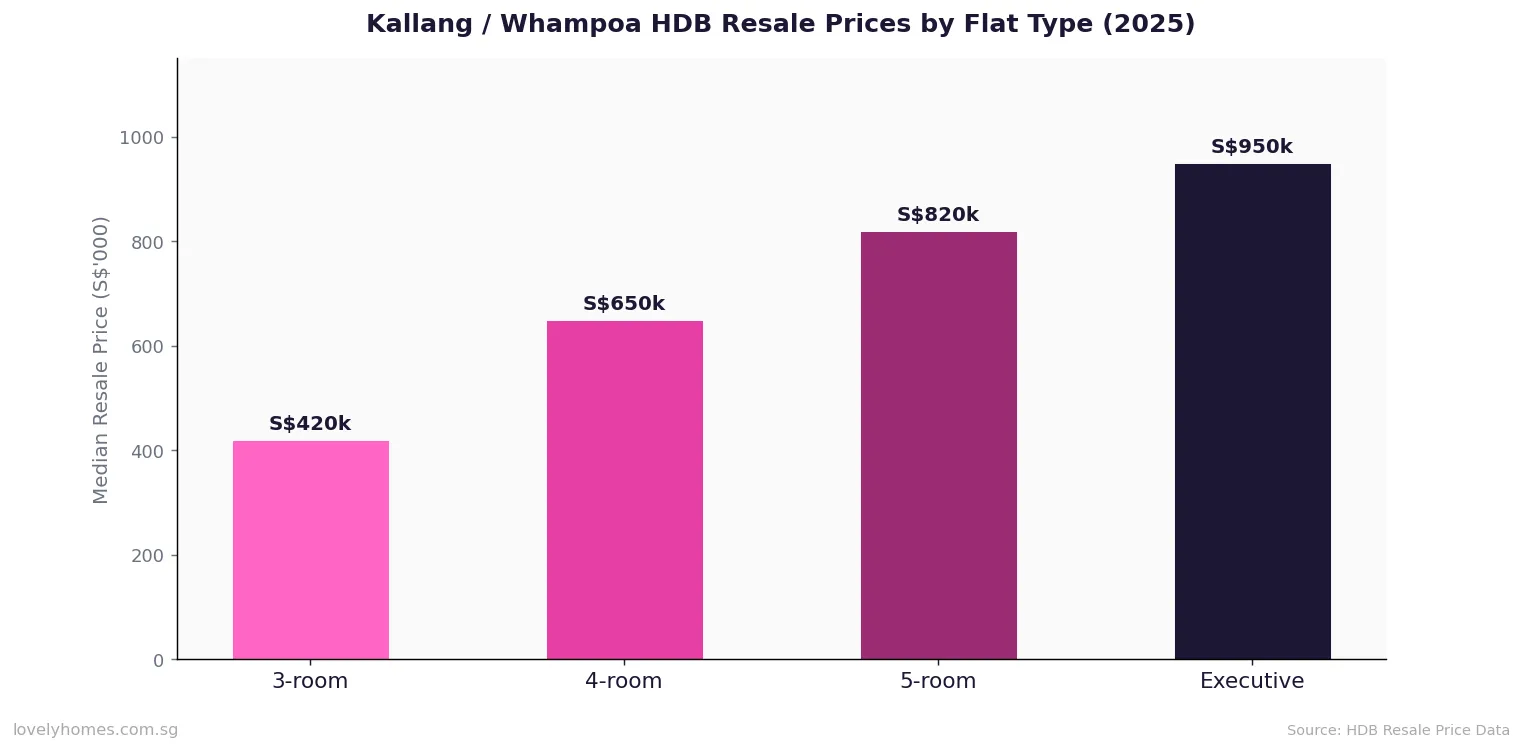
  • HDB resale median: S$420k (3-room) to S$820k (5-room) in 2025
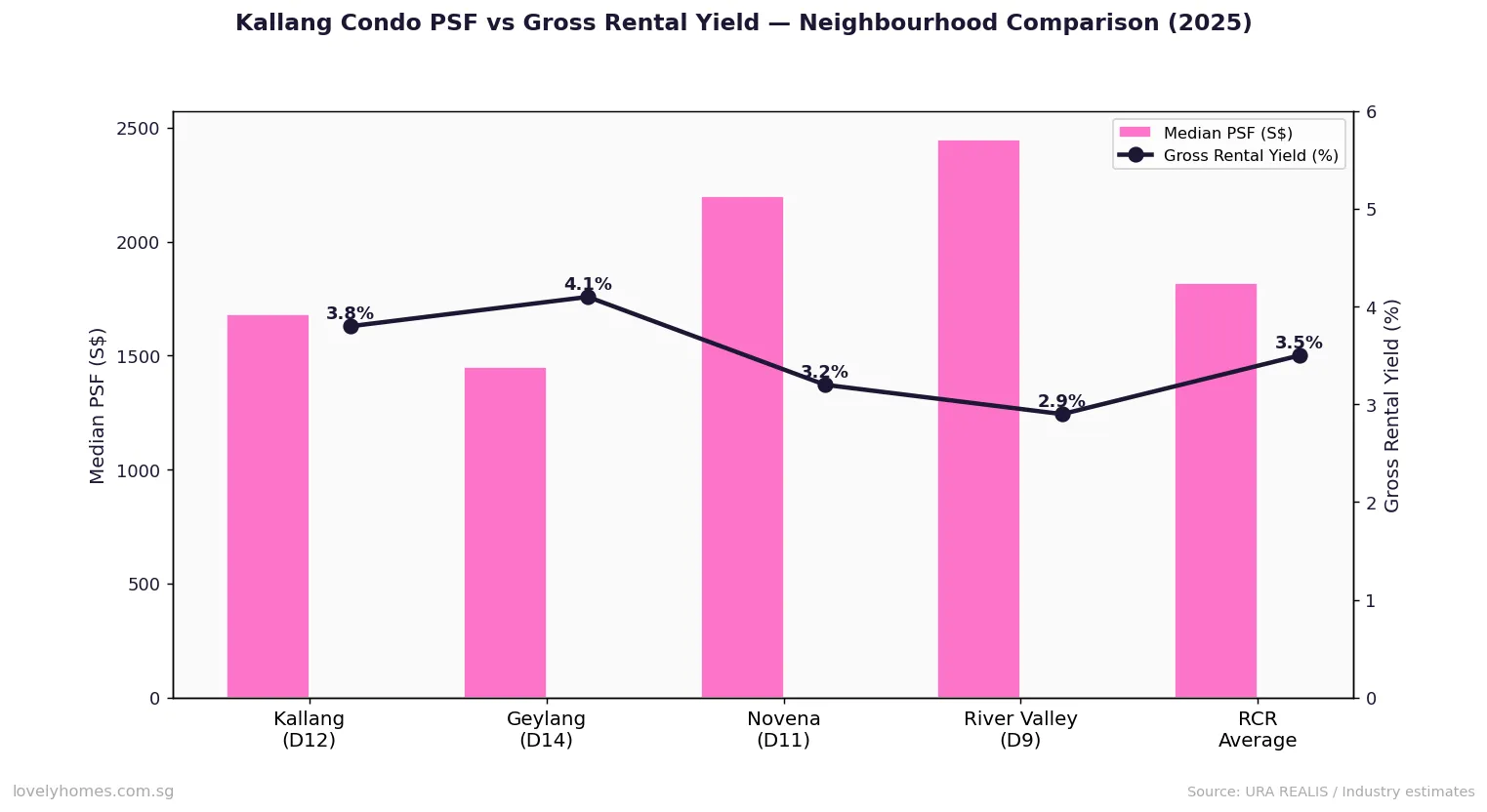
  • Private condo PSF: ~S$1,680 median; gross rental yield ~3.8%
  • Key catalyst: Kallang Alive masterplan — Singapore Sports Hub, Kampong Bugis, waterfront promenade
  • MRT access: Circle Line (Kallang, Bendemeer, Geylang Bahru) + East-West Line (Kallang)
  • Best for: Young professionals, investors targeting rental demand from the sports/events corridor
  • Upcoming supply: Peck Hay Road GLS tender (closes June 2026) — c.450 units near Farrer Park
  • Caution: Geylang sub-market noise; heritage conservation constraints in Jalan Besar sub-area

Introduction: Why Kallang Deserves a Second Look

Kallang sits at the intersection of Singapore’s sporting ambitions and urban regeneration agenda. Administered as part of the Central Region under the Urban Redevelopment Authority (URA), District 12 spans Kallang, Whampoa, Bendemeer, Geylang Bahru, and the Tanjong Rhu waterfront — a corridor that the Government has been systematically transforming since 2014 under the Kallang Alive masterplan.

For buyers and investors in 2026, Kallang presents a classic mid-cycle RCR proposition: proximity to the CBD and Orchard at a meaningful PSF discount to Districts 9–11, anchored by a Government-backed precinct upgrade that is still mid-execution. The Kampong Bugis long-term development site — earmarked for a car-lite, waterfront mixed-use precinct — is expected to add thousands of residents and further commercial activity to the corridor over the next decade.

This guide covers the full picture: HDB and private market pricing, the Kallang Alive catalyst, schools, transport, worked acquisition costs, and the investment case.

HDB Resale Market in Kallang / Whampoa

The Kallang and Whampoa housing estates sit under the Housing & Development Board (HDB) in the Central Region. Resale volumes in this sub-market are relatively low — fewer HDB blocks than OCR towns — which tends to keep prices supported. In 2025, median transacted prices ranged from approximately S$420,000 for a 3-room flat to over S$820,000 for a 5-room unit along the Tanjong Rhu or Whampoa Drive corridors. Executive flats are rare but command S$900k–S$1.0m when they appear.

Kallang Whampoa HDB resale prices by flat type 2025
Figure 1: Kallang & Whampoa HDB resale median prices by flat type (2025). Source: HDB resale transaction data.

Buyers should note that some Kallang HDB blocks are approaching or have crossed the 30-year MOP-plus threshold, and a handful of precincts have been earmarked for the Selective En-Bloc Redevelopment Scheme (SERS) — check the HDB portal before purchasing any resale flat in this area, as SERS selection changes the asset’s long-term value profile significantly.

CPF and HDB Loan Eligibility

Singapore Citizens and Permanent Residents purchasing HDB resale flats in Kallang may apply for HDB concessionary loans at 2.60% per annum (pegged at 0.1 percentage points above the CPF Ordinary Account rate of 2.50%). Enhanced CPF Housing Grants (EHG) of up to S$80,000 are available for first-timer families with a combined income at or below S$9,000 per month, subject to the flat’s remaining lease covering the youngest buyer to at least 95 years old. Given the older stock in Kallang, lease-decay must be carefully modelled for any flat with fewer than 70 years remaining.

Private Residential Market: Condos and PSF

The private condo market in D12 is characterised by a mix of older developments and more recent launches. Key projects include Kallang Riverside (2017), One Kallang Avenue developments, and resale stock along Tanjong Rhu Road. In 2025, median transacted PSF in D12 landed around S$1,680, compared with an RCR average of approximately S$1,820 — positioning Kallang as a value play within the Central Region.

Kallang condo psf rental yield neighbourhood comparison 2025
Figure 2: D12 Kallang private condo median PSF and gross rental yield versus neighbouring districts and the RCR average (2025). Source: URA REALIS / industry estimates.

Gross rental yields in D12 average around 3.8%, supported by strong demand from expatriate sports professionals, government employees at the nearby Health Sciences Authority and civil service agencies, and young professionals attracted by the precinct’s lifestyle credentials. The rental demand story is structural: the Singapore Sports Hub hosts more than 60 major events per year, and the upcoming Kampong Bugis precinct — when built — will add a substantial resident population within walking distance of Kallang MRT.

The Kallang Alive Masterplan: A Decade of Transformation

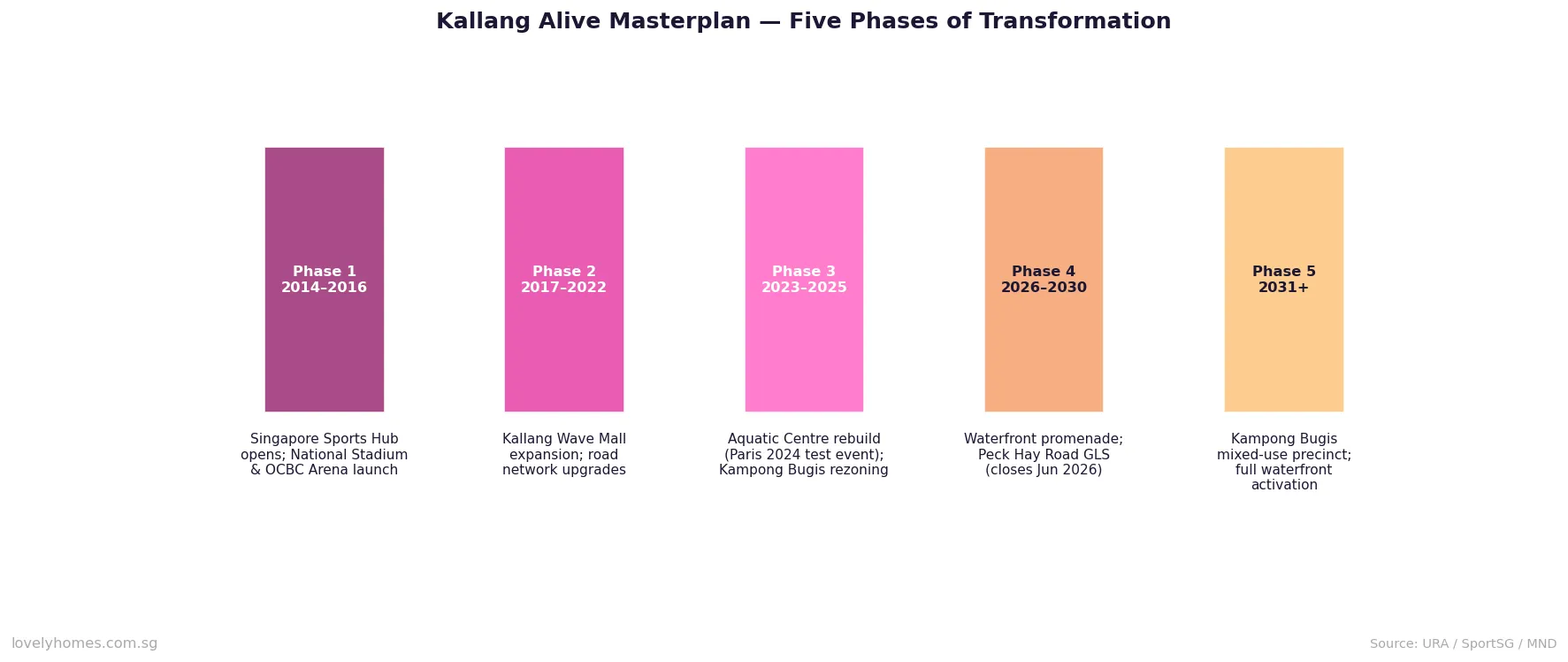
The Kallang Alive masterplan is a joint programme by the Ministry of National Development (MND), URA, and Sport Singapore (SportSG) to transform the 24-hectare Kallang precinct into Singapore’s premier live-work-play sports and lifestyle hub. It is one of the most consequential urban regeneration programmes in Singapore’s recent planning history, with a five-phase execution arc spanning 2014 to 2031 and beyond.

Kallang Alive masterplan five phases Singapore sports hub transformation
Figure 3: Kallang Alive masterplan — five phases of transformation (2014–2031+). Source: URA / SportSG / MND.

Phase 3 (2023–2025) saw the completion of the new Aquatic Centre, which hosted international test events ahead of the 2024 Paris Olympics qualifying circuit. Phase 4 (2026–2030) is now underway, with the waterfront promenade extension and the Peck Hay Road GLS tender (closing June 2026) expected to bring new private residential supply to the Farrer Park/Kallang fringe. Phase 5 looks ahead to the full buildout of Kampong Bugis — a 9-hectare waterfront site rezoned for mixed-use development under URA’s Master Plan 2025.

What the Masterplan Means for Property Values

Precinct-level masterplans in Singapore have a track record of delivering measurable PSF uplift. The Jurong Lake District (JLD) saw private condo PSF in Jurong East outperform the OCR average by 12–18 percentage points between 2013 and 2024. Analysts who track Kallang point to a similar dynamic: D12 PSF in 2019 was roughly 18% below the RCR average; by 2025 that gap had narrowed to approximately 8%. The narrowing reflects both masterplan progress and RCR-wide tightening, but the direction of travel is clear.

Transport Connectivity

Kallang benefits from two MRT lines: the East-West Line (EWL) at Kallang Station and the Circle Line (CCL) at Kallang, Bendemeer, and Geylang Bahru stations. The CCL connects directly to Marina Bay, Bishan, and Harbourfront without a transfer, while the EWL provides access to the CBD (City Hall: 5 stops) and Changi Airport (c.35 minutes). Bus connectivity is extensive, and the upcoming cycling/pedestrian infrastructure under Phase 4 of Kallang Alive will link the precinct to the Bishan–Ang Mo Kio Park network.

Schools Near Kallang

Within a 1–2 km radius of the Kallang/Whampoa precinct, buyers will find several well-regarded primary schools that are relevant for the Home Ownership Scheme Phase 1 (1km) and Phase 2 (2km) enrolment priority. St Andrew’s Junior School (1 km, SAP school) and Bendemeer Primary School sit within the core Kallang area. St Joseph’s Institution (secondary) and Raffles Institution (Bishan, 10 minutes by CCL) are nearby secondary options for families planning ahead.

Summary: Key Facts About Kallang in 2026

Metric Kallang D12 (2025/2026)
URA Planning Region Central Region (RCR)
District D12
HDB 4-room resale median S$650,000
Private condo median PSF ~S$1,680
Gross rental yield (private) ~3.8%
MRT lines EWL (Kallang), CCL (Kallang / Bendemeer / Geylang Bahru)
Key masterplan Kallang Alive (Phase 4 active)
Upcoming GLS Peck Hay Road (closes June 2026, ~450 units)
ABSD (SC 1st property) Nil (BSD only)
HDB loan rate 2.60% p.a. (concessionary)

Worked Example: Buying a Tanjong Rhu 2-Bedroom Condo

📊 Case Study: Ms Tan (SC, 35, First-Time Buyer) — S$1,580,000 2-Bedroom Condo, Tanjong Rhu Road

Purchase price: S$1,580,000
Buyer profile: Singapore Citizen, first property
Gross monthly income: S$9,500

Buyer’s Stamp Duty (BSD), administered by IRAS:

  • First S$180,000 × 1% = S$1,800
  • Next S$180,000 × 2% = S$3,600
  • Next S$640,000 × 3% = S$19,200
  • Next S$500,000 (balance to S$1.5m) × 4% = S$20,000… wait, S$1.58m – S$1.0m = S$580,000 at 4% = S$23,200
  • Remaining: Balance of S$80,000 at 4% = S$3,200 (total above S$1.5M at 4%)

Total BSD = S$47,800
Additional Buyer’s Stamp Duty (ABSD): Nil — SC first property
Bank loan (75% LTV): S$1,185,000 @ 3.75% p.a., 25-year tenure = ~S$6,119/mth
TDSR check: S$6,119 ÷ S$9,500 = 64.4% — FAILS TDSR (ceiling 55%). Buyer would need to earn at least S$11,125/mth, or purchase jointly with a co-borrower.
With co-borrower at S$6,000/mth combined income S$15,500: TDSR = 39.5% — PASS.
Downpayment (25%): S$395,000
Total upfront: ~S$443,000 (downpayment + BSD + legal/conveyancing ~S$4,000)

This worked example illustrates why single-income buyers in Kallang’s private market may find the TDSR a binding constraint at prevailing prices. The HDB resale market — accessible with a HDB concessionary loan — remains the practical entry point for solo buyers earning below S$11k per month. Our Singapore home loan guide walks through TDSR and MSR in full detail.

What This Means for Buyers and Investors

Kallang’s investment case in 2026 rests on three pillars. First, the masterplan execution risk is substantially behind us — the Sports Hub is complete, the Aquatic Centre is open, and the precinct’s lifestyle infrastructure is no longer a promise but a reality. Second, the Kampong Bugis and Peck Hay Road pipeline will attract newer, higher-specification stock that tends to re-rate the area’s price ceiling rather than compress existing values (as seen in the Marina One / Marina Bay district effect on D1/D2 pricing). Third, rental demand from the sports and events corridor is sticky and growing as Singapore’s international events calendar expands.

The risk to the thesis is D14 Geylang spillover, which some buyers perceive as a drag on D12 positioning. In practice, Tanjong Rhu and the Sports Hub precinct are well insulated by geography from Geylang’s entertainment belt, and the two micro-markets appeal to very different buyer profiles.

What Might Come Next for Kallang

Looking ahead, three developments bear watching. The Peck Hay Road GLS tender award (expected Q3 2026) will reveal what developers are willing to bid for land in the Farrer Park/Kallang fringe — a strong land rate would confirm upward pricing pressure. The Kampong Bugis planning brief is expected to be finalised by URA in 2027, at which point development applications should follow in short order. Finally, any revision to the Master Plan 2025 for the Kallang Sports Hub buffer zone — currently zoned Open Space — could unlock further mixed-use potential along the waterfront. These are speculative scenarios, but all point in the same direction.

❓ Frequently Asked Questions about Kallang Property

Is Kallang a good place to buy a condo in 2026?

Kallang offers a strong RCR value proposition in 2026, with private condo PSF running approximately 8% below the RCR average despite its central location and superior transport connectivity. The Kallang Alive masterplan is in active Phase 4 execution, and the Kampong Bugis precinct adds long-term upside. Buyers should factor in that D12 has fewer new launch options than D1–D5, so most purchases are resale. The TDSR constraint at prevailing prices means single buyers need an income of S$11,000+ per month to service a S$1.5M+ property without a co-borrower.

Which MRT stations serve Kallang?

The main stations are Kallang MRT (East-West Line, EW10) and Kallang MRT (Circle Line, CC10) — both at the same physical station, making it an interchange. Nearby CCL stations include Bendemeer (CC8) and Geylang Bahru (CC9), providing access to Bishan, Marymount, and Harbourfront without a line change. The EWL connects to Raffles Place and City Hall in under 10 minutes.

Can foreigners buy property in Kallang?

Foreigners may purchase private condominium units in Kallang, but are subject to a 60% Additional Buyer’s Stamp Duty (ABSD) on all residential property purchases (effective as at the 2023 cooling measures). HDB flats are not available to foreign nationals. Permanent Residents (PRs) buying a first private property pay 5% ABSD; a second property attracts 30% ABSD. Given the 60% ABSD, foreign demand for D12 is minimal, which means the market is almost entirely driven by Singapore Citizens and PRs — a structural positive for price stability.

What is the Kampong Bugis development plan?

Kampong Bugis is a 9-hectare waterfront site in Kallang/Tanjong Rhu that URA has identified for a car-lite, sustainable mixed-use precinct under the Master Plan 2025. The plan envisions residential, commercial, and community uses connected by a waterfront promenade extending to the Sports Hub. Development is expected to proceed in phases from the late 2020s onwards, pending URA finalisation of the planning brief. Once developed, Kampong Bugis is expected to add approximately 4,000–6,000 residential units to the Kallang corridor.

How does the Selective En-Bloc Redevelopment Scheme (SERS) affect Kallang HDB flats?

SERS is HDB’s programme to redevelop older housing estates, offering existing flat owners a replacement flat at a new site along with market-based compensation. Several Kallang and Whampoa HDB blocks have been selected for SERS over the years. If you are buying a resale flat in Kallang, check the HDB portal for any known SERS designations. A SERS selection effectively creates a de facto acquisition at compensation value — which may be favourable or unfavourable depending on the price paid and the replacement flat terms offered by HDB.

What are the best streets to buy in Kallang?

For lifestyle and masterplan upside, Tanjong Rhu Road and Stadium Boulevard / Stadium Crescent offer the best proximity to the Sports Hub waterfront and the anticipated Kampong Bugis uplift. For HDB buyers, Whampoa Drive and Boon Keng Road offer well-priced resale stock with strong CCL connectivity. The Bendemeer Road corridor suits buyers seeking new-ish private leasehold stock (e.g., Centro Residences) at a slight discount to the Tanjong Rhu premium.

What is the ABSD for a Singapore Citizen buying a first property in Kallang?

A Singapore Citizen purchasing their first residential property pays no ABSD — only Buyer’s Stamp Duty (BSD) applies. For a S$1,580,000 condo, BSD is approximately S$47,800 (calculated on the tiered rate schedule administered by IRAS: 1% on the first S$180k, 2% on the next S$180k, 3% on the next S$640k, and 4% on the remainder). Full ABSD rates for all buyer profiles are set out in our ABSD Singapore 2026 guide.

Disclaimer: This article is for general information purposes only and does not constitute financial, legal, or investment advice. Property prices, interest rates, ABSD rates, and government policies are subject to change. All figures cited are based on publicly available data from URA, HDB, and industry sources as at June 2026. Readers should verify all information with official sources — URA, HDB, IRAS, MAS — and consult a licensed property agent, financial adviser, and conveyancing solicitor before making any property decision.
×

Click anywhere outside to close

Yishun Neighbourhood Guide Singapore 2026: HDB Prices, CRL Phase 2 & Investment Outlook

Yishun Neighbourhood Guide Singapore 2026: HDB Prices, CRL Phase 2 & Investment Outlook

Quick Answer: Yishun in 2026 at a Glance

  • Location: District 27 (D27), Outside Central Region (OCR) — largest HDB town in Singapore’s north, adjacent to the Causeway corridor.
  • HDB resale prices (May 2026): 3-room S$230k–S$350k; 4-room S$310k–S$470k; 5-room S$420k–S$600k; EA/Jumbo S$540k–S$750k.
  • Private condo prices: 1BR S$650k–S$950k; 2BR S$900k–S$1.28M; 3BR S$1.2M–S$1.7M.
  • MRT: NSL — Yishun (NS13) and Khatib (NS14). CRL Phase 2 Yishun station expected ~2030, providing direct east-west connectivity.
  • Rental yield: Private condos 3.5–4.0%; HDB subletting gross 4.5–5.5% — among the highest in Singapore for public housing.
  • Affordability: One of Singapore’s most affordable OCR towns for families; median 4-room HDB resale ~S$440k as at Q1 2026.
  • Best for: First-time HDB buyers, young families prioritising budget and primary school proximity, and yield-focused investors.
  • Watch in 2026: CRL Phase 2 Yishun station land-use amendments and Northpoint City Phase 2 finalisation.

What Is Yishun and Where Is It?

Yishun is a large HDB new town in District 27 (D27), situated in the northern region of Singapore. It is bounded by Sembawang New Town to the north-west, Seletar Aerospace Park and Punggol to the east, Ang Mo Kio to the south, and the Woodlands corridor to the west. Developed by the Housing and Development Board (HDB) from the early 1980s following the demolition of the Nee Soon Kampung and rubber estates, Yishun was one of the original ring-towns planned under the Concept Plan 1971, designed to decentralise Singapore’s population away from the urban core.

Today, Yishun is home to approximately 220,000 residents across more than 65,000 HDB dwelling units, making it one of Singapore’s most populous single planning areas. The town is anchored by Northpoint City — the largest retail mall in Singapore’s north — and served by Khoo Teck Puat Hospital (KTPH), one of the country’s most modern general hospitals. For property buyers in 2026, Yishun represents a compelling entry point into the Singapore property market: HDB resale prices in D27 remain among the most affordable in the OCR, and the forthcoming Cross Island Line (CRL) Phase 2 is set to substantially upgrade the town’s east-west connectivity.

Property Prices in Yishun (D27): What You Can Expect in 2026

Yishun’s property market is dominated by HDB resale transactions, with private condominiums accounting for a smaller portion of the overall market than in other OCR towns. This supply structure keeps headline prices relatively affordable: the median 4-room HDB resale in Yishun was approximately S$440,000 in Q1 2026, compared to S$560,000 for the OCR average and S$800,000+ for Tiong Bahru.

Yishun District 27 property price ranges by type 2026 - HDB resale and private condo
Figure 1: Property price ranges for HDB (resale) and private condominiums in Yishun / District 27, May 2026. Source: HDB, URA Realis. Indicative transaction range. Prices in S$ thousands.

Private condominiums in Yishun include Eight Courtyards (D27, 99-year leasehold), Yishun Emerald, and North Park Residences — the last being an integrated development directly above Yishun MRT. North Park Residences commands a premium over standalone condos due to its MRT-integrated status, with 2BR units trading around S$1.1M–S$1.25M. Eight Courtyards, located off Yishun Avenue 6, offers more competitive pricing with 2BR units in the S$900k–S$1.1M range.

For buyers assessing the ABSD implications: Singapore Permanent Residents purchasing their first residential property pay 5% ABSD. Singapore Citizens pay no ABSD on their first property. On a S$1.1M Yishun condo, a SPR first-time buyer would pay BSD of S$29,400 plus ABSD of S$55,000 — a combined stamp duty outlay of S$84,400.

Property Type Indicative Range (May 2026) Notes
HDB 3-Room (resale) S$230k – S$350k Yishun Ring Road, Yishun Ave 4/6 clusters
HDB 4-Room (resale) S$310k – S$470k Median ~S$440k; newer 2000s blocks command upper range
HDB 5-Room (resale) S$420k – S$600k Yishun Ave 11 / Yishun St 61 larger blocks
HDB EA / Jumbo S$540k – S$750k Limited supply; higher demand from multi-gen families
Condo 1BR S$650k – S$950k North Park Residences premium at upper end
Condo 2BR S$900k – S$1.28M ~700–900 sqft typical
Condo 3BR S$1.2M – S$1.7M ~1,000–1,300 sqft

MRT, CRL Phase 2 and Transport in Yishun

Yishun is currently served by two North-South Line (NSL) stations: Yishun (NS13) and Khatib (NS14, 1.5km north of Yishun). The NSL provides direct access to Orchard (approximately 25 minutes from Yishun NS13), Raffles Place (31 minutes), and Jurong East (via the EWL from City Hall, approximately 55 minutes). While the NSL serves north-south travel well, Yishun has historically lacked direct east-west MRT connectivity — a journey to, say, Tampines requires a change at Bishan or Ang Mo Kio onto the Circle Line or a long bus ride.

The transformative development for Yishun transport is the Cross Island Line (CRL) Phase 2, which will add a Yishun station to the CRL network, providing a direct east-west connection to Ang Mo Kio (CRL), Serangoon, Pasir Ris, and eventually Changi Airport T5 at the eastern end, and to Tuah Merah and the western extension to Jurong. The Land Transport Authority (LTA) has indicated that CRL Phase 2 stations are targeted for opening around 2030. When complete, CRL Phase 2 will fundamentally change Yishun’s connectivity profile, making it accessible to both the eastern employment clusters (Changi Business Park, Tampines) and the western ones (one-north, Jurong Lake District) without changing trains.

Amenities, Schools and Lifestyle in Yishun

Yishun key amenities CRL connectivity schools and healthcare snapshot 2026
Figure 2: Yishun — MRT/transport, schools, retail, recreation, healthcare and key statistics snapshot for 2026. Source: LTA, HDB, MOH, URA. CRL Phase 2 = indicative opening 2030.

Schools: Yishun has a well-developed primary school ecosystem. Northland Primary (within 1km of many HDB blocks in the northern part of the estate), Yishun Primary, Ahmad Ibrahim Primary, and Huamin Primary are among the primary schools serving the town. For secondary education, Yishun Town Secondary, Ahmad Ibrahim Secondary, and Presbyterian High School are strong options. Yishun Innova Junior College (JC) is one of two JCs in the north, making Yishun a practical address for families with older children who wish to avoid long commutes to school. For polytechnic education, Republic Polytechnic is a 10-minute bus ride, and Singapore Polytechnic is accessible via the NSL to Jurong East.

Retail and dining: Northpoint City, completed in 2018 as an expansion and integration of the existing Northpoint and Yishun 10 retail nodes, is the anchor mall for the entire north of Singapore. With over 500 retail units, a Causeway Link bus terminal to Johor Bahru, a roof garden, a cinema, and a direct link to Yishun MRT, Northpoint City functions as a regional centre in its own right. The SAFRA Yishun clubhouse on Yishun Avenue 6 provides additional recreation, dining, and sports facilities for residents.

Healthcare: Khoo Teck Puat Hospital (KTPH), operated by the National University Health System (NUHS), is a 761-bed acute hospital on Yishun Central with a full suite of specialist services. KTPH is consistently ranked among Singapore’s highest-patient-satisfaction public hospitals and significantly enhances Yishun’s appeal for elderly residents and families with healthcare needs. The Yishun Polyclinic, operated by the Ministry of Health, provides primary healthcare at subsidised rates.

Nature and recreation: Lower Seletar Reservoir, a 640-hectare freshwater reservoir managed by PUB, forms the eastern boundary of Yishun town. The 6.5km Seletar Reservoir Park trail, Lower Seletar Reservoir Park, and the connector to the Northern Ridges park network give Yishun residents access to some of the most extensive green recreational space in Singapore’s public housing towns.

BTO Supply and Resale Price Trend in Yishun

Yishun BTO supply and HDB 4-room resale price trend 2019 to 2026
Figure 3: Yishun BTO units launched and HDB 4-room resale median price trend (2019–2026). Source: HDB. BTO units = indicative from launch announcements. 2026 = H1 2026 only.

HDB has been a consistent BTO supplier in Yishun, averaging approximately 1,000 units per launch exercise over the 2019–2025 period. This regular supply pipeline keeps the Yishun resale market relatively liquid: buyers who miss out on BTO ballots have a well-supplied resale market to turn to, and the resale price premium over BTO list prices (the so-called “BTO resale uplift”) in Yishun is more modest than in tighter-supply estates like Bishan or Queenstown. The median 4-room HDB resale price in Yishun rose from approximately S$340,000 in 2019 to S$440,000 in Q1 2026 — a 29% cumulative increase that broadly tracks the national HDB resale index growth over the same period, without the exceptional outperformance seen in central-region estates.

The 2023 HDB resale cooling measures — including the 15-month wait period for private property downgraders — impacted Yishun somewhat differently from other estates. As a popular destination for private-to-HDB downgraders seeking affordability, the wait period temporarily reduced a segment of Yishun’s buyer pool but did not cause sustained price decline because of broad-based demand from first-time HDB buyers in the north.

Worked Example: Buying an HDB 4-Room Resale Flat in Yishun

Buyer Profile: Lim couple (SC + SC, 31 + 29, combined monthly income S$9,200, first-time buyers)

Target: 4-room resale HDB at Yishun Avenue 11, asking S$440,000, remaining lease 73 years (built 2000).

CPF eligibility: Remaining lease 73 years + youngest buyer age 29 → 73 years well above the 95-year sum test. Full CPF OA withdrawal and full bank LTV (75%) available. HDB loan option available (up to 80% LTV at 2.60% p.a.).

Stamp duty: BSD on S$440,000 = S$4,200 (first S$180k @ 1%) + S$5,200 (S$260k @ 2%) = S$9,400. ABSD = nil (first property, SC buyers).

HDB loan scenario: Downpayment: 20% = S$88,000 (fully payable via CPF OA). Loan: S$352,000 @ 2.60% p.a. over 25 years → monthly instalment ≈ S$1,602. MSR: S$1,602 / S$9,200 = 17.4% — well within 30% cap.

Bank loan scenario: Downpayment: 25% = S$110,000 (min 5% cash = S$22,000; balance S$88,000 CPF). Loan: S$330,000 @ 3.10% fixed for 3 years, 25yr → monthly ≈ S$1,575. MSR: 17.1% PASS.

Total upfront cost (HDB loan): BSD S$9,400 + Conveyancing fees ~S$2,500 + Cash component (if any after CPF) ≈ S$11,900–S$22,000. This makes Yishun one of the most accessible entry points to HDB ownership in RCR/OCR Singapore.

CPF grant eligibility: Combined income S$9,200 ≤ S$14,000 cap → eligible for Enhanced CPF Housing Grant (EHG) of up to S$40,000 (SC-SC couple, no prior grants). EHG is credited to CPF OA and reduces cash outlay significantly. With EHG, effective purchase price is S$400,000.

Why Yishun Offers Structural Value for OCR Buyers

Several factors make Yishun a structurally sound OCR choice beyond pure affordability. First, as noted above, the CRL Phase 2 Yishun station is a genuine connectivity step-change that the market has not yet fully priced in. Historically, the completion of new MRT lines in Singapore has consistently resulted in a 5–15% price uplift for properties within 500m of new stations in the 12–18 months following announcement and opening. While CRL Phase 2 is still 4 years away, astute buyers who enter the market ahead of station opening can potentially benefit from this pre-completion re-rating.

Second, Yishun benefits from a strong anchor institution in KTPH, which functions as a major employer in the north and generates a stable rental demand base from healthcare professionals and visiting families. Third, Northpoint City’s status as a regional centre means that Yishun is less dependent on the CBD for employment and retail services than smaller OCR towns, creating a degree of local economic self-sufficiency that supports residential demand in a downturn.

When compared to international peer markets, Yishun’s median 4-room HDB at ~S$440k is remarkably affordable relative to household income. The median household income in Yishun’s planning area is approximately S$8,500–S$9,500/mth (SingStat census data), implying a price-to-income ratio of approximately 4.4x — one of the lowest in Singapore and far below the ratios in London, Sydney, or Hong Kong for comparable-quality public housing.

What Might Come Next for Yishun Property (2026 and Beyond)

The headline catalyst is, of course, CRL Phase 2. Beyond that, the HDB has flagged continued BTO supply in Yishun through its longer-term development pipeline, which may moderate further resale price appreciation relative to tighter-supply estates. However, CRL Phase 2 has the potential to offset this supply effect by widening the catchment of residents for whom Yishun is a practical address — particularly those employed in eastern Singapore, who currently find Yishun impractical due to the long NSL-plus-transfer journey times.

There is also a longer-term story around the Yishun Industrial Park corridor and the Seletar Aerospace Park (approximately 4km east), where ongoing industrial upgrading and the expansion of aerospace MRO (maintenance, repair and overhaul) activities create a specialised professional tenant base that could sustain private condo rentals in D27. Industry estimates suggest that Seletar Aerospace Park employs over 6,000 workers; as this corridor grows, demand for residential accommodation in the northern belt will grow with it.

Frequently Asked Questions about Yishun

Is Yishun safe and what is its reputation?

Yishun is a safe neighbourhood with crime rates in line with Singapore’s national average. Over the years, Yishun has attracted some negative social-media characterisation that overstates actual incidents; Singapore Police Force data consistently shows Yishun’s crime statistics to be unremarkable relative to similarly sized HDB towns. The neighbourhood has seen significant urban renewal in the last decade, with Northpoint City’s expansion, KTPH’s growth, and new BTO blocks replacing older stock. Residents and community groups have noted a positive shift in the town’s energy and demographic mix as younger families move in.

When will the CRL Phase 2 Yishun station open?

The Land Transport Authority (LTA) has indicated that Cross Island Line Phase 2, which extends the CRL from Bright Hill (Phase 1 western terminus) east and north to serve Ang Mo Kio, Serangoon North, Yishun, and eventually Changi Airport Terminal 5, is targeted for completion around 2030. The exact opening date is subject to construction progress and LTA’s rolling announcements. CRL Phase 2 will give Yishun residents a direct east-west connection that currently requires a multi-leg journey (NSL to Bishan, then CCL east, or NSL to Novena, then DTL). Property buyers considering Yishun specifically for the CRL uplift should note that the station has been confirmed by LTA in planning documents; however, station-opening date risk remains.

What CPF Housing Grants are available for Yishun HDB buyers?

First-time HDB buyers in Yishun can access the Enhanced CPF Housing Grant (EHG) of up to S$40,000 (for incomes up to S$4,500/mth per person or S$9,000/mth for couples), the Family Grant of up to S$50,000 for resale flats (SC-SC couple, first-timer), and the Proximity Housing Grant (PHG) of up to S$30,000 if buying near or with parents. For the latest grant amounts and income ceiling tables, refer to the HDB official portal and our CPF Housing Grants Guide 2026. Grants are credited to CPF Ordinary Account and reduce the cash outlay on purchase.

What are the best areas to buy within Yishun?

Buyers who prioritise MRT proximity and integrated living should focus on blocks near Yishun MRT (NS13) and North Park Residences (directly above the station). Blocks within 400m of the station command a 5–8% premium but offer the most walkable lifestyle. Families who prioritise quiet greenery and proximity to Lower Seletar Reservoir should look at Yishun Avenue 6 and the Yishun Street 61 cluster, which are set back from the main road and close to the reservoir park. Buyers looking for newer stock (post-2010 BTO) should target the Orchid Spring and Harmony Village BTO clusters in the southern part of Yishun near Khatib station.

How does Yishun compare to Sembawang for property buyers?

Yishun and Sembawang are neighbouring northern OCR towns with broadly similar price levels and demographics. The key differences are: Sembawang has a more village-like character with lower-density blocks and proximity to the Sembawang Hot Spring Park; Yishun has larger scale, better retail infrastructure (Northpoint City vs Sun Plaza), and the upcoming CRL Phase 2 connectivity advantage. Sembawang is slightly cheaper on a per-unit basis for 4-room HDB but has less retail and amenity depth. Buyers who value lifestyle completeness and transport connectivity tend to favour Yishun; those who want a quieter, more suburban feel at marginally lower cost tend to prefer Sembawang. For our full guide to Sembawang, see the Sembawang Neighbourhood Guide 2026.

Is Yishun a good area for rental investment in 2026?

Yishun private condominiums yield 3.5–4.0% gross rental income as at Q1 2026, slightly above the national average of 3.2% for private condos. Rental demand is anchored by KTPH healthcare workers, Seletar Aerospace Park professionals, and north-region families who prefer to rent before buying. Vacancy rates in Yishun are moderate, and the town’s affordability relative to central Singapore means it can attract tenants priced out of higher-cost areas. For property investment analysis including yield, capital growth, and exit-liquidity considerations, see our Singapore Property Investment Guide 2026.

What HDB flats can Malaysia workers who commute via the Causeway buy in Yishun?

Singapore Permanent Residents (SPRs) who commute from Johor Bahru can purchase HDB resale flats in Yishun provided they meet the standard eligibility criteria: the flat must be their primary residence in Singapore, and they must form a valid family nucleus. SPRs cannot purchase HDB new BTO flats (BTO is restricted to SC-SC or SC-SPR couples). Note that under the HDB non-citizen SPR quota scheme, each block and neighbourhood is subject to a cap on the proportion of flats owned by SPR households — this quota is checked at point of sale. As Yishun is a large town, SPR quota availability is generally not a constraint, but buyers should confirm with HDB at the time of purchase. The Causeway Link bus from Northpoint City to Johor Bahru takes approximately 45–60 minutes, making Yishun one of the more practical Singapore residential addresses for Malaysian commuters.

Related Articles

Disclaimer

The information in this article is intended for general educational purposes and reflects publicly available data and analysis as at June 2026. Property prices, grant amounts, stamp duty rates, CPF rules, and financing limits are subject to change and should be verified against official sources including the Urban Redevelopment Authority (URA), Housing and Development Board (HDB), Inland Revenue Authority of Singapore (IRAS), the CPF Board, the Land Transport Authority (LTA), and the Monetary Authority of Singapore (MAS). This article does not constitute financial, investment, or legal advice. Readers are advised to consult a licensed financial adviser, a HDB-registered solicitor, or a licensed property agent registered with the Council for Estate Agencies (CEA) before making any property decision.

Tiong Bahru Neighbourhood Guide Singapore 2026: Heritage Flats, Café Culture & Property Investment

Tiong Bahru Neighbourhood Guide Singapore 2026: Heritage Flats, Café Culture & Property Investment

Quick Answer: Tiong Bahru in 2026 at a Glance

  • Location: District 3 (D03), Rest of Central Region (RCR) — one of Singapore’s oldest and most storied neighbourhoods.
  • HDB resale prices (May 2026): 3-room S$470k–S$680k; 4-room S$640k–S$900k; heritage blocks sometimes exceed S$1M.
  • Private condo prices: 1BR S$780k–S$1.1M; 2BR S$1.1M–S$1.65M; 3BR S$1.55M–S$2.25M.
  • MRT: Tiong Bahru (CCL, CC26) — 10 minutes by CCL to Outram Park interchange (EWL/NEL/CCL).
  • Rental yield: Private condos 3.0–3.5%; HDB (subletting) 4.0–4.8% gross.
  • Heritage premium: Conservation HDB blocks command approximately 15% above comparable non-heritage RCR HDB.
  • Best for: Heritage enthusiasts, café-culture seekers, young professionals wanting RCR access at relatively lower quantum than Orchard or River Valley.
  • Watch in 2026: Greater Southern Waterfront masterplan may raise RCR premiums across D01–D04; CCL planned service improvements.

What Is Tiong Bahru and Why Does It Matter?

Tiong Bahru is a residential neighbourhood in District 3 (D03) of Singapore’s Rest of Central Region (RCR), bounded roughly by Outram Road to the north, Alexandra Road to the south, Havelock Road to the east, and Buona Vista to the west. Administered as part of the Queenstown planning area under the Urban Redevelopment Authority (URA), it holds the distinction of being the site of Singapore’s first public housing estate — a cluster of Art Deco walk-up flats constructed by the Singapore Improvement Trust (SIT) between 1936 and 1954.

Unlike most of Singapore’s HDB towns, Tiong Bahru never underwent wholesale redevelopment. Its distinctive curved frontages, spiral staircases, and shophouse-scale streetscape were gazetted as a conservation area by URA, and the neighbourhood has since evolved into a vibrant cultural precinct anchored by Tiong Bahru Market, a dense concentration of independent cafés, bakeries, and bookshops, and a resident community that prizes the area’s walkability and human scale.

For property buyers and investors in 2026, Tiong Bahru occupies a rare position: it combines genuine heritage character with strong RCR connectivity, proximity to Singapore General Hospital (SGH) and the Central Business District (CBD), and a supply-constrained HDB resale market where leasehold and conservation pressures create a genuine scarcity premium.

Property Prices in Tiong Bahru (D03): What You Can Expect in 2026

The D03 property market in May 2026 is split between an HDB resale segment with limited supply and strong demand from upgraders and heritage seekers, and a private condo market that benefits from proximity to Outram Park interchange and the ongoing Greater Southern Waterfront transformation.

Tiong Bahru District 3 property price ranges by type 2026 - HDB resale and private condo
Figure 1: Property price ranges for HDB (resale) and private condominiums in Tiong Bahru / District 3, May 2026. Source: HDB, URA Realis. Indicative transaction range. Prices in S$ thousands.

HDB 4-room resale flats in the heritage conservation blocks (Tiong Bahru Road, Guan Chuan Street, Lim Liak Street) have fetched between S$700k and S$950k in early 2026 — a 15–20% premium over comparable 4-room flats in nearby Queenstown or Buona Vista. The premium reflects the irreplaceable nature of the conservation stock: HDB has not built new units in Tiong Bahru since the 1980s, and the total conserved block count is fixed by URA’s conservation guidelines.

On the private side, condominiums such as Tiong Bahru Crest (D03, freehold), Regency Heights, and Stirling Residences (D03) command 2BR prices of S$1.1M–S$1.65M. The Additional Buyer’s Stamp Duty (ABSD) for a Singapore Citizen purchasing a second residential property is 20% of the purchase price (effective from 27 April 2023), which remains a significant cost consideration for investors.

Property Type Indicative Range (May 2026) Notes
HDB 2-Room (resale) S$360k – S$520k Mainly Tiong Bahru Road / Boon Tiong area
HDB 3-Room (resale) S$470k – S$680k Heritage blocks command upper range
HDB 4-Room (resale) S$640k – S$900k Conservation units can exceed S$950k
Condo 1BR / Studio S$780k – S$1.1M ~450–550 sqft, higher yield
Condo 2BR S$1.1M – S$1.65M ~700–900 sqft
Condo 3BR S$1.55M – S$2.25M ~1,000–1,300 sqft
Condo 4BR+ S$2.2M – S$3.5M+ Luxury / freehold premium

MRT Connectivity and Transport in Tiong Bahru

Tiong Bahru MRT station (CC26) sits on the Circle Line (CCL), giving residents direct access to Marina Bay Financial Centre in approximately 13 minutes, Botanic Gardens in 12 minutes, and Dhoby Ghaut in 11 minutes. The station is a 3–5 minute walk from most of the heritage precinct.

More importantly, Outram Park interchange — served by the East-West Line (EWL), North-East Line (NEL), and CCL — is two stops from Tiong Bahru (CC24). This makes the neighbourhood remarkably well connected for an RCR address: a resident can reach Changi Airport (EWL to Tanah Merah) in about 25 minutes, or Harbourfront (NEL) in 6 minutes. Bus routes 16, 64, 139, and 195 provide east-west coverage along Alexandra Road and Jalan Bukit Merah.

Amenities, Schools and Lifestyle: The Tiong Bahru Advantage

Tiong Bahru key amenities MRT connectivity schools and healthcare snapshot 2026
Figure 2: Tiong Bahru — MRT/transport, schools, retail, recreation, healthcare and key statistics snapshot for 2026. Source: LTA, HDB, MOH, URA.

Schools: The neighbourhood is served by Zhangde Primary School (1.1km) and Tiong Bahru Primary School, with Crescent Girls’ School (1.4km) and Gan Eng Seng School (0.6km from Outram Park) catering to secondary level. Raffles Girls’ Primary and Raffles Institution are within reasonable distance via CCL, making the area attractive to families who prioritise academic options.

Retail and dining: Tiong Bahru Plaza anchors modern retail with a Cold Storage supermarket, food courts, and mid-market fashion. Tiong Bahru Market and Food Centre — a two-storey wet market and hawker centre — draws residents and visitors alike, with stalls such as Tiong Bahru Hainanese Boneless Chicken Rice and Lor Mee achieving national recognition. The stretch of Yong Siak Street, Eng Hoon Street, and Tiong Poh Road hosts over 80 independent cafés, bookshops (BooksActually), and wine bars, giving the neighbourhood a character found nowhere else in Singapore.

Healthcare: Singapore General Hospital (SGH), one of Singapore’s largest tertiary care hospitals and the flagship campus of SingHealth, is 0.9km from Tiong Bahru MRT. This proximity is significant for elderly residents and makes the neighbourhood attractive for long-term owner-occupiers who value healthcare accessibility.

Price Trend: Tiong Bahru vs the Broader RCR Market

Tiong Bahru D03 property price index versus RCR and Singapore average 2019 to 2026
Figure 3: Tiong Bahru (D03) property price index versus the RCR private condo index and Singapore-wide HDB resale index, 2019–2026 (2019 = 100). Source: HDB, URA Realis. 2026 = Q1 2026 annualised estimate.

Tiong Bahru has outperformed both the RCR condo index and the national HDB resale average since 2019. The D03 HDB 4-room resale index stands at approximately 155 as at Q1 2026 (2019 = 100), compared to 140 for the RCR condo index and 143 for the national HDB average. This 8–9% outperformance over seven years reflects the supply constraint created by URA’s conservation policy: the total pool of conservation HDB flats in Tiong Bahru is fixed and cannot be expanded, which puts a structural floor under prices even in a cooling market.

The 2023 cooling measures (ABSD hike, Loan-to-Value tightening) did compress transaction volumes in the HDB resale market briefly, but Tiong Bahru’s unique supply characteristics meant that median prices declined by only 1–2% in late 2023 before recovering through 2024 and 2025. By contrast, mass-market OCR HDB estates saw median price corrections of 3–5%.

Worked Example: Buying a Heritage 4-Room HDB in Tiong Bahru

Buyer Profile: Ms Tan (Singapore Citizen, 36, first-time buyer, monthly income S$9,500)

Target: 4-room HDB resale on Lim Liak Street (conservation block), asking S$820,000, 64 years remaining lease (built 1959).

CPF withdrawal eligibility: With 64 years remaining lease and buyer age 36, sum of lease remaining at youngest owner’s age-95 = 64 + (95 – 36) = 123 years ≥ 95. Full CPF withdrawal and full bank LTV apply.

Stamp duty: BSD = S$4,200 (first S$180k @ 1%) + S$9,000 (next S$180k @ 2%) + S$11,200 (next S$640k @ 3% on S$460k) = S$24,200. ABSD nil (first property, Singapore Citizen).

Financing: CPF Ordinary Account (OA) balance S$80,000 used for downpayment; cash downpayment S$32,000 (minimum 5% cash for bank loans on HDB). Bank loan S$708,000 at 3.10% p.a. fixed for 3 years → HDB loan not available for resale flats with remaining lease above 99 years from construction; bank loan used. Monthly instalment: approx S$3,380/mth over 25 years.

MSR check: S$3,380 / S$9,500 = 35.6% — exceeds the 30% Mortgage Servicing Ratio cap for HDB flats financed by bank loans. Ms Tan must reduce her loan quantum or increase her cash downpayment. Increasing CPF/cash contribution by S$56,000 brings the loan to S$652k → monthly S$3,100 → MSR 32.6% — still over. She would need to adjust price, or buy with a co-borrower.

Key takeaway: RCR HDB at high quantum can be MSR-binding for single buyers on median incomes. A joint purchase with combined income of S$11,500/mth resolves this: S$3,100 / S$11,500 = 27.0% MSR — PASS. Total upfront cost: BSD S$24,200 + cash downpayment S$41,000 + legal/conveyancing ~S$3,500 = approximately S$68,700.

Why Tiong Bahru’s Heritage Premium is Structural, Not Speculative

Several factors make Tiong Bahru’s property values resilient in ways that speculative or trend-driven price premiums are not. First, URA’s conservation designation under the Planning Act is a legislative instrument — the gazette cannot be lifted without a formal degazetting process, which has never occurred for any residential conservation area in Singapore. This creates a hard supply ceiling on the conservation HDB stock. Second, the neighbourhood sits within the Greater Southern Waterfront (GSW) masterplan zone, a 30km coastal transformation from Pasir Panjang to Marina East that URA has been advancing since the 2019 Master Plan. The GSW will progressively improve the recreational and lifestyle amenity base of the D01–D04 corridor, providing a long-term uplift catalyst for RCR properties in that belt.

Third, and perhaps most importantly, Tiong Bahru benefits from what economists call a use value premium: residents genuinely want to live there for reasons beyond financial calculation. Neighbourhood attachment reduces voluntary turnover, keeps rental vacancies structurally low, and sustains the kind of community activation — weekend markets, cultural events, independent retail — that in turn attracts new residents. Singapore has very few neighbourhoods where this dynamic operates with the same intensity as Tiong Bahru.

What Might Come Next for Tiong Bahru Property (2026 and Beyond)

The next significant catalyst is the Greater Southern Waterfront’s rolling development timeline. URA has indicated that land parcels in the southern waterfront corridor will be released progressively from the mid-2020s onwards, with the Keppel Club and Keppel Harbour areas set for mixed-use transformation. If and when this materialises at scale, it will create a new live-work-play precinct on Tiong Bahru’s southern doorstep, potentially drawing additional demand to the neighbourhood. However, the construction timeline for major waterfront infrastructure typically spans a decade, so buyers who are primarily motivated by the GSW story should frame it as a 10–15 year thesis rather than an imminent re-rating.

On the transport side, the Land Transport Authority (LTA)’s Long-Term Plan Review has floated improvements to the CCL and a potential MRT service frequency increase. Any substantive improvement to CCL frequencies would materially reduce travel times from Tiong Bahru to the CBD and Marina Bay, further strengthening its RCR connectivity proposition.

Frequently Asked Questions about Tiong Bahru

Is Tiong Bahru HDB eligible for CPF usage and bank loans?

Yes, subject to the lease-remaining rules. For HDB resale flats with 60 or more years remaining, buyers can use CPF Ordinary Account savings and obtain bank loans up to the standard Loan-to-Value (LTV) limit (75% for first housing loan). Flats with less than 60 years’ lease are subject to pro-rated CPF withdrawal limits under the CPF Housing Scheme, and bank LTV is reduced. As at May 2026, most Tiong Bahru SIT-era flats have 63–70 years of lease remaining, so standard CPF and LTV rules generally apply for buyers under 45. Buyers should verify the exact lease commencement date from HDB’s flat listing before making any commitment. For a full breakdown of how CPF interacts with property purchase, see our CPF Housing Guide 2026.

Can foreigners buy HDB flats in Tiong Bahru?

No. Singapore Permanent Residents (SPRs) may purchase HDB resale flats, but only with at least one other SPR or Singapore Citizen co-owner, and the flat must be their primary residence. Foreign nationals (non-SPRs) cannot purchase HDB flats under any circumstances. Foreigners who wish to invest in Tiong Bahru property are restricted to private condominiums in the district, for which ABSD of 60% of the purchase price applies as at May 2026 (for foreign buyers). See our ABSD Complete Guide 2026 for the full rate table.

What is the TDSR limit and how does it affect Tiong Bahru buyers?

The Total Debt Servicing Ratio (TDSR) threshold, administered by the Monetary Authority of Singapore (MAS), caps all monthly debt obligations (including the new mortgage, car loans, student loans, and credit card minimums) at 55% of gross monthly income. For HDB resale flats financed by bank loans, a separate Mortgage Servicing Ratio (MSR) cap of 30% applies to the property loan alone. In Tiong Bahru, where HDB prices are among the highest in the RCR for public housing, MSR can be a binding constraint for single buyers earning below S$12,000/mth who are targeting 4-room heritage blocks above S$800k. See our TDSR and MSR Guide 2026 for detailed worked examples.

How does the heritage premium on Tiong Bahru HDB flats work in practice?

URA has gazetted the Tiong Bahru Conservation Area under the Planning Act. Conservation status affects physical renovations (owners must preserve the external facade and original architectural features and seek URA/HDB approval for structural changes) but does not impose any restriction on resale. The premium is entirely market-driven: buyers value the Art Deco character, the wide corridors, the curved frontages, and the irreproducibility of the stock. In practice, a 4-room conservation flat on Guan Chuan Street or Tiong Poh Road commands 10–20% above a comparable-size 4-room in a standard HDB block in Queenstown or Redhill. This premium has been persistent and widened during 2021–2023, though it compressed slightly with the 2023 resale cooling measures.

What are the best streets to buy in Tiong Bahru?

For heritage conservation blocks, the most sought-after streets are Tiong Bahru Road (nearest to the MRT and market), Guan Chuan Street, Lim Liak Street, and Moh Guan Terrace. These are the SIT-era walk-up blocks with Art Deco detailing. For private condominiums, One Jervois (D10 adjacent) and Tiong Bahru Crest (D03 freehold) are well regarded for their freehold tenure and proximity to Outram Park interchange. Buyers who prioritise quieter residential streets while maintaining proximity to the café precinct typically favour Eng Hoon Street and Yong Siak Street. Note that the busiest sections of Tiong Bahru Road itself see significant food-centre and market foot traffic, which can affect ambience for ground- and first-storey units.

Is Tiong Bahru a good area for rental investment?

Tiong Bahru private condominiums yield gross rentals of 3.0–3.5% as at Q1 2026, which is in line with the broader RCR average. Net yields after maintenance fees, property tax, and vacancy are typically 2.3–2.8%. The rental demand base is anchored by expatriate and professional tenants working in the CBD, Outram campus (SGH, Duke-NUS), and One-North, who value the neighbourhood lifestyle and transport connectivity. HDB flat subletting is available for eligible owners after occupying the flat for the minimum occupation period (MOP), and yields on HDB subletting are typically higher (4–5% gross) due to lower capital cost. Investors should factor in the lease remaining on HDB flats when modelling exit values, as lease decay becomes material below 60 years. For a full property investment framework, see our Singapore Property Investment Guide 2026.

How does Tiong Bahru compare to Queenstown for property buyers?

Both D03 (Tiong Bahru) and D03/D05 (Queenstown) fall within the RCR and share similar CCL connectivity. Queenstown offers newer HDB blocks (1970s–1990s) at slightly lower per-square-foot prices, a larger and more modern retail offering (Anchorpoint, IKEA Alexandra), and more HDB resale supply. Tiong Bahru offers the heritage premium, a more vibrant café and lifestyle scene, and closer proximity to SGH and the CBD. For buyers who prioritise lifestyle character and heritage cachet, Tiong Bahru commands a premium; for buyers who prioritise newer stock, more supply, and marginally lower prices, Queenstown is the stronger value proposition. Both share access to the Alexandra–Redhill bus corridor and the Outram Park interchange.

Related Articles

Disclaimer

The information in this article is intended for general educational purposes and reflects publicly available data and analysis as at June 2026. Property prices, stamp duty rates, CPF rules, and financing limits are subject to change and should be verified against official sources including the Urban Redevelopment Authority (URA), Housing and Development Board (HDB), Inland Revenue Authority of Singapore (IRAS), the CPF Board, and the Monetary Authority of Singapore (MAS). This article does not constitute financial, investment, or legal advice. Readers are advised to consult a licensed financial adviser, a HDB-registered solicitor, or a licensed property agent registered with the Council for Estate Agencies (CEA) before making any property decision.

Jurong East Neighbourhood Guide Singapore 2026: Property Prices, JLD Uplift, Schools and Investment Outlook

Jurong East Neighbourhood Guide Singapore 2026: Property Prices, JLD Uplift, Schools and Investment Outlook

Quick Answer: Jurong East 2026 — What Buyers and Investors Need to Know

  • Location: District 22 (D22), Outside Central Region (OCR). Well-connected on the East-West Line (EWL) and the incoming Jurong Region Line (JRL, ~2028).
  • JLD catalyst: Jurong Lake District (JLD) — 360 hectares — is Singapore’s largest mixed-use development outside the CBD. The URA has designated it as a second Central Business District, with URA’s 2H2026 GLS programme including a landmark JLD white site for tender in July 2026.
  • Property prices: HDB 4-room resale flats trade at S$370,000–S$530,000; OCR condos at S$1,050,000–S$1,480,000 (2BR) as at May 2026.
  • Rental yields: Condos in D22 yield 3.4–3.7% gross; HDB flats deliver higher at 4.3–5.1%.
  • 5-year HDB price growth: approximately +9.5% for 4-room flats — broadly in line with the national OCR trend.
  • JRL uplift thesis: the opening of JRL Phase 1 from approximately 2028 (J1 Jurong East as the key interchange) historically correlates with 8–15% price appreciation in proximate properties based on past MRT openings.
  • Retail and lifestyle: three major malls — JEM, Westgate, and IMM — plus Jurong Point, make Jurong East one of Singapore’s most self-contained suburban retail hubs.
  • Education: Ngee Ann Polytechnic and proximity to NUS and NTU create solid rental demand from students and academic professionals.

Jurong East: Location, Planning Context and Why It Matters

Jurong East is a mature HDB town in Singapore’s west, administered under District 22 of the Outside Central Region (OCR). It sits at the intersection of two major MRT lines — the East-West Line (EWL) at Jurong East station (EW24) and the future Jurong Region Line (JRL) at J1 — making it the gateway interchange for the western catchment. It borders Jurong West to the north-west, Clementi to the east, and Bukit Batok to the north.

What sets Jurong East apart from other OCR towns is the Jurong Lake District (JLD). In its Master Plan, the Urban Redevelopment Authority (URA) has designated the 360-hectare JLD — stretching from Jurong East MRT station to the Chinese and Japanese Gardens — as Singapore’s second CBD. The vision encompasses 100,000 new jobs, 20,000 new homes, a new integrated tourism development, and a network of car-lite streets around Jurong Lake Gardens. The June 2026 Government Land Sales programme confirmed a major JLD white site for tender in July 2026, capable of accommodating up to 1,200 residential units, at least 40,000 sqm of office space, and 44,000 sqm of complementary uses — marking a tangible next step in JLD’s realisation.

For property investors, the JLD story represents a medium-to-long-term structural re-rating of Jurong East and its immediate environs. The comparison most frequently drawn is to the Marina Bay Financial Centre development: Marina Bay residential properties within walking distance of the financial district saw significant price appreciation over the 2008–2018 development period. If JLD develops as planned — and the government’s investment in the JRL, Jurong Lake Gardens, and GLS pipeline suggests strong commitment — Jurong East’s pricing relative to the OCR average could narrow meaningfully over the next decade.

Connectivity: MRT and Public Transport

Jurong East’s transport infrastructure is already strong and improving. The East-West Line (EWL) connects Jurong East (EW24) to Raffles Place in approximately 32 minutes and to Changi Airport via transfer in around 50 minutes. The station is also served by a major integrated bus interchange handling cross-island routes. The Jurong Region Line (JRL), targeted to open in phases from approximately 2028, designates Jurong East as its J1 station — the key interchange with the EWL. The JRL’s three branches (Boon Lay Branch, Choa Chu Kang Branch, and Tengah Branch) will connect an estimated 150,000 residents in the Tengah, Choa Chu Kang, and Boon Lay corridors to Jurong East, substantially increasing footfall through the precinct. A future Jurong–Sembawang Line (JSL) — still in planning — has been identified in URA’s Long-Term Plan as eventually running through Jurong East, offering a cross-island link to the north.

Driving connectivity is similarly well-served. The Ayer Rajah Expressway (AYE), Pan Island Expressway (PIE), and Bukit Timah Expressway (BKE) intersect near Jurong East, providing fast access to the CBD (approximately 20–25 minutes off-peak), Changi (approximately 30–35 minutes), and the Second Link to Malaysia at Tuas. The proximity to the causeway is an important feature for Jurong East’s professional tenant pool, which includes engineers, logistics managers, and workers at Jurong Island’s petrochemical complex.

Jurong East D22 property price ranges 2026 — HDB 3-room to condo 3BR and EC resale horizontal bar chart
Figure 1: Property price ranges in Jurong East (District 22), May 2026. HDB 4-room resale flats trade at S$370k–S$530k; OCR condos at S$1.05M–S$2.0M. Source: HDB, URA.

Property Market: Prices, Types and Investment Profiles

Jurong East’s residential stock is predominantly HDB. The town has a well-established mix of 3-room, 4-room, 5-room, and executive apartment (EA) flats spread across estates like Yuhua, Toh Guan, Bukit Batok East (boundary), and the Jurong East town centre precincts. HDB 4-room resale flats in Jurong East currently trade at approximately S$370,000–S$530,000, with well-positioned units near Jurong East MRT or in high-floor blocks commanding the upper range. 5-room flats trade at S$490,000–S$680,000; executive apartments at S$620,000–S$880,000.

The private condominium supply in D22 is relatively thin compared to adjacent districts, which itself supports pricing. Key developments include J Gateway (99-year leasehold, 738 units, directly above Jurong East MRT), valued at approximately S$1,400–1,600 psf as at mid-2026; Vision (99-year, 294 units, Boon Lay Way/Jurong East Ave 1 corner), valued at approximately S$1,100–1,250 psf; and Lake Grandeur (99-year, 396 units, Jurong Lake area), valued at approximately S$1,050–1,200 psf. The scarcity of private supply in D22 — no new private residential GLS site in the immediate Jurong East precinct since J Gateway’s site was awarded in 2012 — means that the JLD GLS pipeline will be the first significant new supply in over a decade. New-build prices from the JLD white site (if awarded and launched) are expected to set new benchmarks for D22 pricing, potentially in the S$2,200–2,800 psf range based on comparable city-fringe mixed-use projects.

The EC resale market is represented primarily by Westwood Residences (EC, 480 units, Jurong West Ave 1, privatised 2024) trading at S$850,000–S$1,250,000, offering post-privatisation investors a mid-point between HDB and full private pricing.

Jurong East amenities connectivity snapshot 2026 — MRT schools retail parks healthcare D22 statistics
Figure 2: Jurong East key amenities and connectivity snapshot, 2026. JRL opens in phases from approximately 2028. Source: LTA, HDB, SingHealth.

Schools, Education and Family Amenities

Jurong East is well-served for families at all school levels. Within 2 km of the town centre, primary schools include Rulang Primary School (well-regarded, popular in the primary-one registration priority exercise), Shuqun Primary School, Yuhua Primary School, and Fuhua Primary School. Secondary schools include Yuhua Secondary and Chua Chu Kang Secondary. At the tertiary level, Ngee Ann Polytechnic is approximately 2 km east (Clementi Road), while NUS Kent Ridge is approximately 8 km and Nanyang Technological University (NTU) is approximately 10–15 minutes by bus or future JRL. The student rental demand from NTU in particular is a significant driver of D22 condo rental volume, particularly for 1-bedroom and small 2-bedroom units.

For retail, Jurong East is exceptional by suburban Singapore standards. The Jurong Gateway commercial precinct contains three integrated malls: JEM (248,000 sqft, Lendlease REIT), Westgate (342,000 sqft, CapitaLand), and the adjacent IKEA Tampines equivalent replaced by IMM (180,000 sqft factory outlet, Lendlease REIT). A further 4 km down the EWL, Jurong Point (398,000 sqft, Singapore’s largest suburban mall) serves the Boon Lay/Jurong West catchment. The combined retail density within 5 km of Jurong East MRT is among the highest of any OCR town in Singapore.

Healthcare is anchored by Ng Teng Fong General Hospital (NTFGH) — the 700-bed regional hospital replacing the former Alexandra Hospital Jurong for the western region, opened in 2015 — and the co-located Jurong Community Hospital (JCH) (228 beds for intermediate and long-term care). National University Hospital (NUH) is approximately 8 km via AYE, and the Jurong Medical Centre serves polyclinic-level primary healthcare for the precinct.

Rental Market and Investment Case

The Jurong East rental market is underpinned by three distinct tenant pools. First, NTU/NGP students and academic professionals — particularly relevant for 1BR and studio condos, commanding rents of approximately S$2,400–3,200/month for 1BR units. Second, Jurong Island and western industrial workers — engineers, petrochemical and logistics professionals who prefer to rent in the western corridor to minimise their commute. Third, expats from Malaysian corporates and cross-border professionals — Jurong East’s proximity to the Tuas Second Link (approximately 25 minutes by car) attracts a segment of Malaysian professionals and senior managers who commute daily or bi-weekly.

As at Q1 2026, gross rental yields in D22 are approximately: HDB 3-room 5.1%, HDB 4-room 4.7%, HDB 5-room 4.3%, condo 1BR 3.7%, condo 2BR 3.4%, EC resale 3.4%. These are modest compared to D11 medical cluster or D19 student-driven markets, but they are supported by genuine occupational demand rather than speculative vacancy churn. Vacancy rates in D22 private condos are estimated at approximately 4–6%, consistent with the national OCR private average of approximately 5% in Q1 2026.

Summary: Jurong East Investment Snapshot by Property Type

Property Type Price Range Gross Yield 5-Yr Growth Tenure
HDB 3-Room S$280k–S$410k ~5.1% +8.2% 99yr (HDB)
HDB 4-Room S$370k–S$530k ~4.7% +9.5% 99yr (HDB)
HDB 5-Room / EA S$490k–S$880k ~4.2% +9.9% 99yr (HDB)
Condo 1BR S$760k–S$1,050k ~3.7% +11.2% 99yr (leasehold)
Condo 2BR S$1,050k–S$1,480k ~3.4% +12.5% 99yr (leasehold)
Condo 3BR S$1,400k–S$2,000k ~3.1% +13.8% 99yr (leasehold)
EC (resale) S$850k–S$1,250k ~3.4% +10.6% 99yr (privatised)

Worked Example: First-Time Buyer Purchasing a Jurong East HDB 4-Room Resale

Case Study — Mr & Mrs Lim, Singapore Citizens, first-time HDB buyers

Household profile: Mr & Mrs Lim, both Singapore Citizens, joint gross income S$8,500/month. First-time HDB buyers (no prior property ownership). Target: purchase a 4-room HDB resale flat in Jurong East at S$490,000.

Grants: Joint income S$8,500/month qualifies for Enhanced Housing Grant (EHG) of S$25,000 (family income S$7,001–9,000 bracket); Proximity Housing Grant (PHG) of S$30,000 if purchasing within 4 km of parents. Total grants: S$55,000.

Effective purchase price after grants: S$490,000 − S$55,000 = S$435,000 (for CPF/loan computation purposes).

Stamp duties: BSD on S$490,000 = (S$180,000 × 1%) + (S$180,000 × 2%) + (S$130,000 × 3%) = S$1,800 + S$3,600 + S$3,900 = S$9,300. ABSD: nil (SC first property).

Financing: HDB Loan LTV 80% on S$490,000 = S$392,000 loan @ 2.6% p.a. 25 years → monthly instalment S$1,776. MSR check: S$1,776 ÷ S$8,500 = 20.9% — within 30% PASS.

Upfront cash required: 5% cash downpayment on S$490,000 = S$24,500. BSD S$9,300 (payable via CPF). Legal/valuation ~S$2,500. Total cash outlay: approximately S$27,000.

Monthly household finances: Mortgage S$1,776 (20.9% MSR) + conservancy charges ~S$80 + property tax ~S$120 = approximately S$1,976/month total property cost. At S$8,500 gross income, net take-home after CPF (employee contribution 20% = S$1,700) is approximately S$6,800/month, leaving comfortable headroom.

Jurong East D22 rental yield and 5-year capital growth by property type 2026 — HDB condo EC comparison
Figure 3: Jurong East gross rental yield and 5-year capital growth by property type, 2026. Condos have outperformed HDB on capital growth; HDB leads on yield. Source: URA, HDB.

Why Jurong East Matters to Property Investors in 2026

The JLD story is the most compelling single narrative in Singapore’s western residential market. No other OCR town has a comparable government-backed catalyst: a designated second CBD, a new MRT interchange (JRL J1), a landmark GLS white site under active tender, and the surrounding Jurong Lake Gardens — Singapore’s third national garden after Botanic Gardens and Gardens by the Bay — as a lifestyle anchor. Comparable transformations in Singapore’s history — the Marina Bay build-out from 2005 to 2018, the Dhoby Ghaut Circle Line opening in 2009 — consistently delivered residential price appreciation in the 8–20% range over a 3–5 year period following the key infrastructure milestones.

The practical investment case for most buyers today is straightforward: entry-level pricing in D22 remains accessible by OCR standards, yields are supportable, tenant demand is real, and the infrastructure spend committed by the government is unprecedented for any suburban town. The key risks are timeline slippage (JLD’s full development has a 20–30 year horizon) and interest rate sensitivity (a sustained SORA above 3.5% would compress condo yields to less than 2% net, making servicing costs uncomfortable).

What Might Come Next for Jurong East

The July 2026 JLD white site tender result will be the single most watched event in the Singapore western property market for the second half of 2026. A high bid — say S$1,800+ psf ppr — would signal developers’ confidence in JLD pricing and likely prompt a re-rating of existing D22 private condos. A below-expectation result could dampen enthusiasm but would not alter the structural story. The JRL’s opening in phases from approximately 2028, with J1 Jurong East as the key interchange, is widely expected to be the catalytic event for near-station premium appreciation. Investors monitoring the situation should also watch the Tengah New Town development (42,000 HDB flats planned, JRL-served) — as Tengah launches into the market from 2026 onwards, it will compete with Jurong East for western upgrader demand and may moderate Jurong East’s immediate-term HDB resale momentum.

Frequently Asked Questions: Jurong East Neighbourhood Guide 2026

Is Jurong East a good area to buy property in 2026?

Jurong East is one of the most strategically positioned OCR towns in Singapore for medium-to-long-term investors in 2026. The JLD development gives it a structural demand catalyst that most other OCR towns lack. Entry prices remain accessible (HDB 4-room resale at S$370k–S$530k; condo 2BR at S$1.05M–S$1.48M), yields are decent for the OCR, and the JRL interchange opening (~2028) provides a near-term price catalyst. The main caveat is that JLD is a very long-horizon project — buyers expecting a 1–2 year flip will likely be disappointed. The investment case is most compelling for buyers with a 5–10 year holding horizon who are simultaneously living in or near the area.

Which MRT stations serve Jurong East?

Jurong East is currently served by Jurong East MRT (EW24) on the East-West Line (EWL). It is an interchange station with a major bus hub. From July 2028 onwards (approximate), Jurong East will also be served by J1 Jurong East on the Jurong Region Line (JRL) — making it a two-line interchange. The JRL will connect Jurong East north to Choa Chu Kang and west to Boon Lay, significantly expanding the commuter catchment. A future Jurong–Sembawang Line (JSL) is referenced in URA’s Long-Term Plan Review but has no confirmed timeline. The EWL already connects Jurong East to the CBD (Raffles Place EW14) in approximately 32 minutes without a transfer.

Can PRs and foreigners buy property in Jurong East?

Singapore Permanent Residents (PRs) can purchase HDB resale flats in Jurong East subject to HDB eligibility criteria (PR households, no concurrent private property ownership, etc.) with a 5% ABSD on their first property. PRs cannot purchase new HDB BTO flats. For private condos (J Gateway, Vision, Lake Grandeur, Westwood Residences EC post-privatisation), PRs pay 5% ABSD on their first property and 30% on a second. Foreign nationals (non-PR) cannot own HDB flats at all, but may buy private condos at 60% ABSD. Given the 60% ABSD, foreign individual ownership of Jurong East condos is rare and concentrated among those using Singapore property as a long-term currency-diversification vehicle rather than a rental yield play.

What are the best condos to buy in Jurong East?

J Gateway (EW24 directly above station, 738 units, 99yr) is the most frequently cited for its unrivalled transport connectivity — with Jurong East MRT directly underfoot, rental demand from students and young professionals is among the strongest in D22. Vision (Boon Lay Way, 294 units, 99yr) offers a quieter residential setting with slightly lower psf and reasonable EWL access. Lake Grandeur (Jurong Lake area, 396 units, 99yr) is the best-positioned for JLD appreciation — walking distance to Jurong Lake Gardens and the future JLD commercial precinct. For buyers prioritising JLD capital upside over immediate rental yield, Lake Grandeur and the upcoming JLD GLS developments (once launched) represent the strongest bet. Note that all major D22 condos are leasehold (99-year), which affects long-term lease decay considerations for buyers with 30-year horizons.

How does Jurong East compare to Clementi and Bukit Batok for investment?

Clementi (D05 RCR boundary) benefits from NUS proximity, excellent CCL/EWL connectivity, and freehold land scarcity — it typically commands a 20–30% price premium over Jurong East for comparable property types. However, that premium already prices in much of the educational and transport uplift. Bukit Batok (adjacent OCR, D23) is more affordable — HDB 4-room resale at S$310,000–S$450,000 — and will benefit from the JRL Bukit Batok station, but lacks the JLD commercial anchor and has lower condo supply depth. For investors balancing yield, entry price, and structural upside, Jurong East sits in a superior position to Bukit Batok and offers better long-term appreciation potential than either D23 or the already-appreciated Clementi market.

Is there HDB BTO supply available in Jurong East in 2026?

Jurong East’s established HDB stock means BTO supply within the immediate town centre is limited. The 2026 HDB BTO exercise does not include a dedicated Jurong East precinct; the nearest June 2026 BTO projects are in Jurong West and Clementi. The primary acquisition route into Jurong East public housing is therefore the HDB resale market, which offers greater flexibility on flat type, floor, and move-in timeline but at market price (no BTO subsidy). Tengah New Town — a 42,000-flat new town directly adjacent to the JLD catchment — is receiving BTO allocations from 2024 onwards and represents an alternative for buyers seeking subsidised entry into the western corridor’s growth story, though at the cost of a longer wait time and MOP obligation.

Disclaimer: This article is for general educational and informational purposes only and does not constitute financial, investment, legal, or property advice. Property prices, MRT opening timelines, GLS programme details, HDB policies, and government development plans are subject to change without notice. JLD development timelines, JRL opening dates, and JSL plans referenced are based on publicly available URA and LTA announcements as at June 2026 and remain subject to revision. Readers should verify all information directly with the relevant authorities — URA, HDB, LTA, IRAS, and CPF Board — and consult a licensed professional before making any property decision.

Sembawang Neighbourhood Guide Singapore 2026: Property Prices, Schools, MRT and Investment Outlook

Sembawang Neighbourhood Guide Singapore 2026: Property Prices, Schools, MRT and Investment Outlook

Quick Answer — Sembawang at a Glance (2026)

  • District: D27, Outside Central Region (OCR). Predominantly HDB, with a small private condominium and EC segment.
  • MRT: North–South Line (NSL) — Sembawang (NS11), Canberra (NS12), Yishun (NS13). Approximately 15 minutes to Orchard Road.
  • Property prices: HDB 4-room resale S$470k–S$650k; condo 2-bedroom S$900k–S$1.32M; EC 4-bedroom S$1.25M–S$1.62M.
  • Gross rental yield: HDB 4-room ~4.8% p.a.; condo 2-bedroom ~3.2% p.a. — above-average for OCR.
  • 5-year HDB price growth: ~9.8% (4-room) — in line with the broader OCR HDB market.
  • June 2026 BTO: Approximately 2,000 new HDB units in Sembawang as part of the June 2026 exercise, including Nee Soon South Crescent — the largest allocation in the exercise.
  • Investment thesis: Proximity to the Johor Strait, upcoming RTS Link (Woodlands–JB, 2027) spillover, and NSC (Nee Soon Central) urban renewal make Sembawang a watch-list OCR name for long-term buyers.

Where Is Sembawang? A District Overview

Sembawang occupies the northernmost residential area of mainland Singapore, forming part of District 27 alongside neighbouring Yishun. The estate sits on the Johor Strait waterfront — a fact that shaped its character as a former British naval base, the site of HMS Terror and HMS Sultan, before being handed over to Singapore in 1971 and progressively redeveloped as an HDB new town from the 1970s onwards. Sembawang Park, located on the Johor Strait waterfront, preserves a small slice of that colonial-era landscape.

Today, Sembawang is administered by the Housing & Development Board as a mature HDB town, with approximately 60,000 residents housed predominantly in newer BTO flats and upgraded 1980s–1990s blocks. The private residential segment is modest: Parc Canberra EC (496 units, 99-year, launched 2019, MOP October 2024), The Brownstones EC (638 units, fully privatised), and a small cluster of strata-titled condominiums along Sembawang Drive and Admiralty Road West. Sembawang is not a headline district for luxury buyers, but it offers a compelling affordability-and-liveability proposition for first-time HDB buyers and yield-focused investors.

Sembawang Property Prices by Type (Q2 2026)

Prices below reflect Q2 2026 transaction data from the Urban Redevelopment Authority (URA) and HDB resale portal. All figures are indicative ranges and will vary by storey, facing and condition.

Sembawang District 27 property price ranges by type 2026 HDB condo EC Singapore
Figure 1: Sembawang (D27) Property Price Ranges by Type, Q2 2026. Source: URA, HDB.

HDB resale prices in Sembawang remain among the most affordable in the OCR for larger flat types. A 4-room resale flat typically transacts between S$470,000 and S$650,000 depending on storey and location; 5-room flats run S$600,000–S$820,000. Executive Apartments and Multi-Generation flats (where available) can reach S$720,000–S$950,000. The condo segment, dominated by Parc Canberra EC and The Brownstones, trades at S$900,000–S$1,320,000 for 2-bedroom units — pricing that aligns with upgraded OCR condominiums in Woodlands and Yishun rather than the tighter core OCR markets of Tampines or Bedok.

MRT Connectivity, Schools and Key Amenities

Sembawang is served by three North–South Line (NSL) stations — Sembawang (NS11), Canberra (NS12) and Yishun (NS13) — providing direct access to the city. Journey times from Sembawang MRT to Orchard Road (NS22) are approximately 25–28 minutes without interchange; to Woodlands Checkpoint (NS9) approximately 8–10 minutes for those with business or family ties across the Causeway.

The June 2027 opening of the Johor Bahru–Singapore Rapid Transit System (RTS) Link at Woodlands North (2 stops from Sembawang) is expected to increase demand for Sembawang and Woodlands properties from Johor-resident workers and families who commute to Singapore. Historical precedent from the opening of MRT extensions suggests a 5–15% property price uplift in the catchment area within 2 years of a new connectivity announcement materialising.

Sembawang key amenities 2026 MRT connectivity schools shopping parks healthcare Singapore
Figure 2: Sembawang — Key Amenities and Infrastructure at a Glance (2026).

The main retail anchor is Sun Plaza near Sembawang MRT, complemented by the newer Canberra Plaza (opened 2022) which houses a wet market, hawker centre, supermarket and F&B outlets. Northpoint City in neighbouring Yishun — the largest shopping mall in northern Singapore — is approximately 8 minutes by MRT. The Canberra Hawker Centre has quickly become one of northern Singapore’s most popular food destinations since opening in 2020.

For healthcare, Khoo Teck Puat Hospital (KTPH) in Yishun — 5 km from central Sembawang — is the primary acute hospital. The Admiralty Medical Centre (near Admiralty MRT, NS10) and Yishun Polyclinic serve as the primary care network. Schools within the catchment include Sembawang Primary, Canberra Primary, Canberra Secondary, Yishun Town Secondary, CHIJ St Joseph’s Convent and ITE College Central (Yishun campus).

Rental Yield and 5-Year Price Growth

Sembawang’s OCR location means it offers higher rental yields than CCR counterparts, driven by a combination of lower purchase prices and steady demand from NSF families (close to Sembawang Camp and Mandai precinct), Johor-side workers, and younger families priced out of more central estates.

Sembawang District 27 gross rental yield and 5 year price growth by property type 2026
Figure 3: Sembawang D27 — Gross Rental Yield vs 5-Year Price Growth by Property Type (Q2 2026). Source: URA, SRX, HDB.

HDB 3-room flats deliver the highest gross yield at approximately 5.1% p.a., reflecting the strong demand for affordable rental units from singles and young couples. EC units (Parc Canberra post-MOP, The Brownstones) offer a yield of approximately 3.0% — lower than HDB but with superior capital appreciation potential given their condo-equivalent finishes at OCR pricing. 5-year price growth for 4-room HDB flats runs at approximately 9.8%, consistent with the OCR HDB market average reported by HDB’s Resale Price Index (RPI reaching 216.3 in Q1 2026, up 41.2% from Q1 2021).

Sembawang vs Woodlands vs Yishun — Investment Comparison

Sembawang, Woodlands and Yishun form the northern residential triumvirate of Singapore. Each has a distinct investment profile. Woodlands commands a slight premium thanks to its Woodlands Regional Centre designation and the RTS Link station at Woodlands North — but higher prices compress yields. Yishun offers the most diversified amenity mix (Northpoint City, KTPH, Loop & Dine, Yishun Park Hawker Centre) but has a perception overhang that has historically kept prices lower than fundamentals might otherwise support. Sembawang sits between the two: less developed than Woodlands’ commercial node but benefiting from the same RTS Link proximity spillover, with prices that are still among the most affordable in the NSL corridor. For a first-time buyer prioritising yield and manageable entry cost, Sembawang offers a differentiated value proposition relative to the more competitive Tampines or Bishan markets.

Summary Table — Sembawang Property Overview 2026

Property Type Price Range (S$) Approx. PSF Gross Yield 5yr Growth
HDB 3-Room 350k–480k S$410–S$560 ~5.1% ~9.2%
HDB 4-Room 470k–650k S$400–S$550 ~4.8% ~9.8%
HDB 5-Room 600k–820k S$390–S$535 ~4.3% ~10.2%
HDB EA/EM 720k–950k S$370–S$510 ~4.0% ~9.5%
Condo 1-Bedroom 680k–980k S$1,200–S$1,500 ~3.8% ~8.5%
Condo 2-Bedroom 900k–1,320k S$1,150–S$1,450 ~3.2% ~9.0%
Condo 3-Bedroom 1,150k–1,680k S$1,100–S$1,400 ~2.8% ~9.5%
EC 4-Bedroom 1,250k–1,620k S$1,050–S$1,380 ~3.0% ~11.8%

Worked Example — Mr & Mrs Rajan Buying Sembawang 4-Room HDB Resale

Mr & Mrs Rajan are a Singapore Citizen couple. Joint gross income: S$8,200 per month. They plan to buy a 4-room HDB resale flat along Sembawang Drive for S$560,000. This is their first property. Combined CPF OA: S$75,000. They qualify for an Enhanced Housing Grant (EHG) of S$75,000 (income bracket S$8,001–S$9,000, per the HDB EHG schedule) and a Proximity Housing Grant (PHG) of S$30,000 (within 4 km of parents). Total grants: S$105,000.

  • Purchase price: S$560,000
  • HDB Loan (80% LTV): S$448,000
  • Downpayment (20%): S$112,000 — CPF OA S$75,000 + cash S$37,000
  • Grants applied: S$105,000 — EHG S$75,000 + PHG S$30,000 (reduce net outlay)
  • Monthly instalment (HDB loan, 2.6%, 25yr): S$2,028/month
  • MSR check: S$2,028 ÷ S$8,200 = 24.7% — PASS (threshold 30%)
  • BSD: 1% × S$180k + 2% × S$180k + 3% × S$200k = S$1,800 + S$3,600 + S$6,000 = S$11,400
  • ABSD: Nil (SC first property)
  • Legal fees: ~S$2,500
  • Total cash outlay: S$37,000 + S$11,400 + S$2,500 = ~S$50,900

The grants cover more than the CPF OA balance, meaning the Rajans’ effective upfront cash of ~S$51,000 is among the lowest feasible entry costs in the OCR market. At a 4.8% gross yield, a comparable Sembawang 4-room flat rented out would generate approximately S$2,688 per month — well above the S$2,028 monthly HDB loan instalment — confirming the estate’s investment-grade yield profile for future upgraders who may hold the flat as a rental asset post-MOP.

Is Sembawang a Good Place to Buy in 2026?

Sembawang is a solid choice for first-time HDB buyers and long-term OCR investors who prioritise affordability, community amenities and the NSL corridor’s proven long-term price trajectory. The key investment thesis rests on three legs: the RTS Link spillover (Woodlands North station from 2027, benefiting the entire northern corridor), the Nee Soon South urban renewal under HDB’s Remaking Our Heartland programme, and the June 2026 BTO supply absorption which, once MOP-cleared in 2031–2032, will add resale liquidity and benchmark new pricing for the estate. On a pure affordability-per-square-metre basis, Sembawang 4-room flats at S$400–S$550 psf remain significantly below the OCR HDB average of ~S$580–S$640 psf, suggesting room for mean reversion.

Risks to note: the estate’s northern periphery location means commute times to the Central Business District are relatively long (35–40 minutes by MRT). The private residential market is thin — Parc Canberra and The Brownstones are the primary liquid assets — which can widen bid-ask spreads and make exit timing less flexible than more liquid OCR markets like Tampines or Punggol.

Frequently Asked Questions

Is Sembawang a good place to buy property in 2026?

Yes, particularly for first-time HDB buyers and yield-focused investors. Sembawang offers some of the most affordable 4-room and 5-room HDB prices in the OCR corridor, strong grant eligibility (EHG up to S$80,000 for lower-income families), and above-average gross yields of 4.3–5.1% for HDB flat types. The June 2026 BTO exercise’s large Sembawang allocation (~2,000 units) signals HDB’s continued commitment to the estate. The RTS Link at Woodlands North (2027) is a medium-term catalyst for the entire NSL northern corridor.

What MRT stations serve Sembawang?

Three NSL stations cover the Sembawang estate: Sembawang (NS11), Canberra (NS12) and Yishun (NS13). From Sembawang MRT, journey time to Orchard Road (NS22) is approximately 26 minutes direct; to Raffles Place (NS26/EW14 interchange) approximately 35–38 minutes. From Canberra MRT (opened 2019), Orchard is approximately 24 minutes. There is no Downtown Line or Circle Line coverage in Sembawang, so NSL is the sole rail option — a consideration for buyers who work in eastern or western Singapore.

Can PRs and foreigners buy property in Sembawang?

Singapore Permanent Residents can purchase HDB resale flats in Sembawang but are not eligible to buy new BTO flats (only the Fiancé/Fiancée Scheme permits a non-citizen applicant, with restrictions). PRs pay 5% ABSD on their first residential property and 30% on their second. Foreigners can only purchase private residential property — they cannot buy HDB flats at all. For the private market in Sembawang (Parc Canberra, The Brownstones), foreigners pay 60% ABSD on any purchase. This effectively limits foreign buyers to the higher end of the market where yields can absorb the stamp-duty premium.

What are the best condos and ECs in Sembawang?

The most notable private and EC developments are Parc Canberra EC (496 units, 99-year leasehold, completed 2022, MOP cleared October 2024 — now resaleable on open market) and The Brownstones EC (638 units, 99-year, fully privatised). Both are well-maintained and reasonably priced relative to CCR and RCR condominiums. Outside the EC segment, there are limited private condo options within the Sembawang estate boundary — buyers seeking a broader private market choice tend to look at Yishun’s The Criterion EC, Skies Miltonia, or Eight Courtyards.

Sembawang vs Woodlands vs Yishun — which is best for investment?

Each estate has a different risk-reward profile. Woodlands offers the strongest near-term catalyst (RTS Link station directly in Woodlands North, Woodlands Regional Centre designation) but commands a price premium. Yishun has the best amenities (Northpoint City, KTPH) but has historically traded at a slight discount due to reputation. Sembawang offers the most affordable entry price in the corridor, the highest gross yields, and benefits from the same RTS Link spillover without Woodlands’ price premium. For a first-time buyer prioritising affordability and yield, Sembawang is the preferred starting point. For a buyer focused on capital appreciation and prepared to pay up, Woodlands is the stronger choice.

What is the HDB Minimum Occupation Period (MOP) for Sembawang flats?

Standard HDB BTO and resale flats in Sembawang carry a 5-year MOP from the date you collect keys. Plus and Prime classification flats have a 10-year MOP. During the MOP, you cannot sell the flat on the open market or rent out the entire flat (renting individual rooms is permitted under the HDB subletting rules). After MOP, you may sell the flat on the resale market, rent it out in full, or buy a private property whilst retaining the HDB flat (subject to ABSD on the private purchase). HDB flat owners who buy private property before selling the HDB flat are treated as holding two properties and pay SC second-property ABSD of 20%.

Related Articles

Disclaimer: This guide is for general information only and does not constitute financial, legal, or property advice. Property prices, rental yields, and grant eligibility figures are indicative and subject to change. Always verify transaction data on the URA and HDB portals, and consult a licensed property agent or financial adviser before making any purchase decision. HDB grant eligibility should be confirmed via the HDB HFE letter application.

Choa Chu Kang Neighbourhood Guide Singapore 2026: Property Prices, Schools, MRT and Investment Outlook

Choa Chu Kang Neighbourhood Guide Singapore 2026: Property Prices, Schools, MRT and Investment Outlook

Quick Answer — Choa Chu Kang Neighbourhood Guide 2026: Key Takeaways

  • Location: District 23 (D23), OCR (Outside Central Region); western Singapore, bordering Bukit Batok, Tengah new town, and Bukit Panjang.
  • MRT: Choa Chu Kang MRT (NS4) on the North-South Line; Bukit Gombak (NS3); Bukit Panjang DT1 nearby; Bukit Gombak NS3 within walking distance for residents in the eastern portion. Jurong Region Line (JRL) stop at Choa Chu Kang expected mid-2027.
  • Property prices: HDB 4-room resale S$420k–S$610k; HDB 5-room S$580k–S$810k; Condo 2BR S$870k–S$1,230k (Q1 2026 indicative).
  • Key catalyst: JRL opening (mid-2027 estimated) + Tengah new town 42,000 HDB flats — transforms the western corridor’s connectivity and long-term supply dynamics.
  • Schools: Yew Tee Primary, Teck Whye Primary, South View Primary, Choa Chu Kang Secondary; ITE College West within 2 km.
  • Yield: HDB 4-room gross yield ~4.5%; EC resale ~4.2%; condo 2BR ~3.4% — competitive for OCR.
  • Ideal for: Young SC families seeking value in a well-serviced OCR estate; HDB upgraders; long-term investors with a 10-year+ horizon aligned to JRL and Tengah catalysts.

Choa Chu Kang (CCK) sits at the western edge of Singapore’s OCR (Outside Central Region), in Planning Area D23. It is one of the largest and most self-contained public housing estates in Singapore, home to roughly 190,000 residents spread across the sub-precincts of Choa Chu Kang, Yew Tee, Keat Hong, and the newer blocks along Teck Whye and Limbang. The estate has evolved considerably since the first HDB blocks were completed in the 1980s — today it offers a full range of flat types, a private and executive condominium sub-market, one of Singapore’s largest single-structure suburban malls (Lot One Shoppers’ Mall), and access to the Bukit Panjang LRT’s 14-station loop network via the integrated Choa Chu Kang interchange.

Two structural shifts are reshaping CCK’s investment profile. The first is the Jurong Region Line (JRL), Singapore’s newest MRT line, which will station a stop at Choa Chu Kang (alongside Tengah, Boon Lay, and Jurong Industrial Estate). JRL Stage 1 is expected to open around mid-2027, connecting CCK directly to Jurong East interchange and, via interchange, to the East-West Line. The second is Tengah — a 700-hectare new town immediately to the south-east of CCK, where HDB will build approximately 42,000 flats over the next 15 years. Tengah’s car-free town centre and eco-corridors bring a qualitatively different demographic and aesthetic to the western corridor, and its residents will commute through or around CCK.

This guide sets out what buyers, investors, and sellers need to know about Choa Chu Kang property in 2026 — prices, transport connectivity, schools, investment fundamentals, and the worked numbers behind a typical purchase.

Choa Chu Kang property price ranges 2026 — HDB resale and condo prices D23 bar chart
Figure 1: Choa Chu Kang Property Price Ranges by Type, Q1 2026 (D23 OCR). HDB resale, EC resale, and private condo. Source: HDB, URA REALIS.

Choa Chu Kang Location and Planning Context

Choa Chu Kang occupies the far western flank of Singapore’s main island, bounded by Bukit Batok to the east, Tengah to the south-east, Lim Chu Kang Road to the north-west, and the Central Catchment Nature Reserve in the north. The planning area is divided into two HDB towns: Choa Chu Kang (the western and central portion) and Bukit Batok (the eastern portion), though the Yew Tee precinct in the north of D23 is administratively part of Choa Chu Kang town.

The area is designated by URA as OCR — Outside Central Region — meaning it sits in Singapore’s heartland pricing band, below the Core Central Region (CCR) and Rest of Central Region (RCR) bands that cover the central, prime, and city-fringe districts. OCR designation generally implies lower absolute prices and higher initial rental yields, in exchange for longer commute times to the CBD. The typical door-to-door commute from Choa Chu Kang MRT to Raffles Place is approximately 45–55 minutes via the NSL, depending on the time of day and interchange waits.

The JRL changes this calculus materially. Once operational, CCK will be directly connected to Jurong East — Singapore’s second CBD node and home to major employers in the finance, healthcare (Ng Teng Fong General Hospital), education (NTU, IME), and industrial tech sectors. Jurong East also connects to the East-West Line (EWL) for onward travel east or west. The JRL adds a direct, one-interchange route to Jurong East that avoids the current single-line dependency on the NSL.

MRT and Public Transport in Choa Chu Kang

The MRT infrastructure serving CCK consists of the following stations, with the JRL addition anticipated to significantly enhance connectivity:

Choa Chu Kang (NS4): The primary station, on the North-South Line (NSL). An integrated bus interchange and mall (Lot One) sit above and adjacent to the station, making it one of the most used interchange points in Singapore’s western region. From NS4, northbound trains reach Kranji (NS7) and Woodlands (NS9); southbound trains reach Bukit Gombak (NS3), Bukit Batok (NS2 / NS3), Jurong East (NS1 / EW24), and eventually the CBD via Orchard (NS22) or Raffles Place (EW14).

Bukit Gombak (NS3): Three to four minutes south of Choa Chu Kang by train; serves the eastern portion of D23 and the Bukit Gombak sub-precinct. Residents of HDB blocks along Bukit Batok East Avenue and Choa Chu Kang Avenue 5 are often within walking distance.

Bukit Panjang LRT (BP): The 14-station loop services Bukit Panjang town to the north-east of CCK, with the LRT’s southern terminus connecting to Bukit Panjang DTL station (Downtown Line) at BP1/DT1. While the LRT does not serve Choa Chu Kang directly, HDB residents in the northern CCK precincts near Teck Whye may use feeder buses to Bukit Panjang LRT, gaining access to the DTL for the Botanic Gardens, Stevens, and CBD corridor.

Jurong Region Line (JRL) — Choa Chu Kang Station: The JRL is Singapore’s seventh MRT line, under construction and expected to open in stages from mid-2027. The Choa Chu Kang station on the JRL will form an interchange with the existing NSL Choa Chu Kang station (NS4). The full JRL network connects Jurong Industrial Estate, Tengah, and Choa Chu Kang with Boon Lay and Jurong East, enabling a multi-line interchange hub at CCK for the first time. For residents employed in Jurong, the JRL eliminates the need to change trains at Jurong East.

Choa Chu Kang amenities and key statistics 2026 — MRT schools retail parks healthcare
Figure 2: Choa Chu Kang Key Amenities and Statistics — MRT, Schools, Retail, Parks, and Healthcare. JRL = Jurong Region Line, expected mid-2027.

Schools and Education in Choa Chu Kang

Choa Chu Kang’s school cluster is solid at the primary and secondary levels, though it lacks the concentration of prestigious brand-name schools found in central districts such as Novena or Bukit Timah. This is typical of OCR estates and is appropriately priced into the property market — families prioritising proximity to ACS, Methodist Girls’, or Nanyang Girls’ will look elsewhere, while families valuing space, affordability, and community are well served in CCK.

At the primary level, Yew Tee Primary School (along Yew Tee Road) and Teck Whye Primary are well regarded within the town. South View Primary serves the southern CCK precincts. Bukit Panjang Primary and West Spring Primary in the adjacent Bukit Panjang planning area are accessible by feeder bus.

At the secondary level, Choa Chu Kang Secondary School is the main secondary in the town. The ITE College West, located along Choa Chu Kang Ave 5 approximately 2 km from the NS4 station, serves vocational education for the entire western corridor. Its student population generates a consistent rental demand for nearby HDB flats from families relocating closer to the campus.

For higher education, Nanyang Technological University (NTU) — approximately 10–12 minutes by bus from Choa Chu Kang — is one of the key generators of long-term rental demand in the western corridor. NTU’s 33,000-student population, combined with NIE and NUS Research, sustains occupancy in the CCK and Jurong West resale and rental markets.

Choa Chu Kang Property Prices and Market Trends 2026

Choa Chu Kang is one of Singapore’s more affordably priced non-mature HDB estates, though its resale prices have risen in line with the national trend. The HDB Resale Price Index for OCR flats has increased approximately 8–12% per annum over 2021–2022, moderating to 5–8% in 2023–2024 and further to 3–5% YoY in Q1 2026. CCK-specific resale prices reflect these macro trends overlaid by its location characteristics.

HDB Resale: As of Q1 2026, 3-room flats in the estate trade in the S$295,000–S$440,000 range; 4-room flats S$420,000–S$610,000 (with Yew Tee units typically commanding a premium over inland CCK blocks); 5-room flats S$580,000–S$810,000; and Executive Apartment (EA) units S$740,000–S$980,000. Million-dollar HDB transactions in D23 are rare — the market remains structurally below the mature-estate pricing bands of Bishan, Queenstown, or Toa Payoh.

Executive Condominiums (EC) Resale: Several EC developments in CCK, including the fully privatised (post-10-year) Yew Mei Green and Jurong West’s neighbouring Esparina Residences, offer resale prices in the S$820,000–S$1,150,000 range for 3-bedroom units. ECs that have passed 10 years can be sold to foreigners, expanding the pool of potential buyers.

Private Condominiums: The private condo market in CCK is thin relative to Jurong West or Bukit Batok. Landmark developments include Kingsford Waterbay in Jurong (D22 border) and smaller boutique condos along Choa Chu Kang Road. Condo 2BR units range from S$870,000 to S$1,230,000; 3BR units from S$1,180,000 to S$1,620,000. New supply is expected from any JRL-corridor GLS tender awards, as developers position for the uplift associated with MRT line openings.

Choa Chu Kang Property Summary — Q1 2026

Property Type Indicative Price Range Approx PSF Gross Yield 5-Yr Growth
HDB 3-Room (resale) S$295k – S$440k S$340–S$510 psf ~4.9% +9.2%
HDB 4-Room (resale) S$420k – S$610k S$420–S$610 psf ~4.5% +9.8%
HDB 5-Room (resale) S$580k – S$810k S$430–S$600 psf ~4.1% +8.8%
HDB Exec Apartment (resale) S$740k – S$980k S$420–S$555 psf ~3.8% +8.2%
EC Resale (post-10yr, 99yr) S$820k – S$1,150k S$800–S$1,100 psf ~4.2% +10.4%
Condo 2BR (99yr) S$870k – S$1,230k S$1,050–S$1,480 psf ~3.4% +10.8%
Condo 3BR (99yr) S$1,180k – S$1,620k S$950–S$1,300 psf ~3.0% +9.5%

Worked Example: Mr & Mrs Rajan — Choa Chu Kang 4-Room Resale

Scenario: Mr & Mrs Rajan, both Singapore Citizens, joint gross monthly income S$8,200. First-time buyers, aged 30 and 28. Mr Rajan’s parents live in Choa Chu Kang (same town — PHG eligible). Purchasing a 4-room flat along Choa Chu Kang Ave 3, agreed price S$560,000. Taking HDB Concessionary Loan.

Grants (HFE letter):
EHG (household income S$7,501–S$9,000 band): S$45,000 — credited to CPF OA
PHG (parents in same town): S$30,000 — disbursed as cash at completion
Total grants: S$75,000

Stamp duty:
BSD on S$560,000: S$180k×1% = S$1,800 + S$180k×2% = S$3,600 + S$200k×3% = S$6,000 = S$11,400 BSD
ABSD: nil (SC purchasing first residential property)

Financing:
HDB Concessionary Loan (80% LTV): S$560,000 × 80% = S$448,000 loan
Monthly instalment @ 2.6% p.a., 25 years: ≈ S$2,028/mth
MSR: S$2,028 ÷ S$8,200 = 24.7% — PASS (≤30%)

Downpayment (20% = S$112,000):
EHG S$45,000 credited to CPF OA; assume CPF OA S$48,000 combined → CPF OA available S$93,000
Shortfall to be made up: S$112,000 − S$93,000 = S$19,000 cash
PHG S$30,000 cash grant offsets this entirely → net cash from own pocket: ~S$0 on downpayment

Other upfront cash:
BSD S$11,400 (payable from CPF OA if available, or cash) + Legal ~S$2,300 + Misc ~S$500 = ~S$14,200
After PHG S$30,000 cash: effective out-of-pocket cash = ≈ S$0 to S$4,000 (highly grant-subsidised purchase)

Choa Chu Kang rental yield vs 5-year capital growth by property type 2026 chart
Figure 3: Choa Chu Kang Rental Yield vs 5-Year Capital Growth by Property Type, 2026. HDB yields remain competitive at 3.8–4.9%; ECs and condos balance lower yields with stronger price growth.

Why Choa Chu Kang Makes Sense for Long-Term Property Investment

At its current price point, CCK offers one of the higher gross rental yields among Singapore OCR estates — HDB 4-room units generating approximately 4.5% gross yield, and EC resale stock at 4.2%. These yields compare favourably to more premium OCR areas such as Tampines East or Pasir Ris (where prices have risen more sharply), and significantly better than CCR condominiums (2–3% gross yield range).

The five-year capital growth story in CCK is moderate but consistent. HDB 3-room and 4-room prices have appreciated approximately 9–10% in five years, driven by the overall HDB resale market uplift rather than CCK-specific demand surges. The area has not experienced the headline price spikes of Queenstown or Bishan, which partly reflects its non-mature estate classification and partially the historical single-line (NSL) dependency for commuting.

The JRL changes the investment case substantively. Historical evidence from MRT line openings in Singapore — notably the DTL Stage 3 (2017), the TEL Stages 1–3 (2020–2023), and the NSL Woodlands extension (2002) — demonstrates a consistent pattern of 8–15% price uplift in properties within 800m of new stations in the 24 months surrounding opening. The CCK JRL station, forming an interchange with the existing NS4 station, qualifies as one of the most strategically positioned JRL stops. Investors who buy before the mid-2027 JRL opening are positioned ahead of this potential re-rating.

The Tengah caveat is worth acknowledging. The injection of 42,000 new HDB flats in Tengah over the next 15 years introduces a large competing supply of newer stock in an adjacent area. Tengah’s BTO flats — with their car-free precinct design, wider corridors, and proximity to Tengah MRT stations on both the JRL and the planned extensions — will appeal to the same demographic cohort as CCK buyers. This supply overhang is a structural limitation on CCK’s ability to outperform the OCR market average over the next decade.

What Might Come Next — CCK Property Outlook 2027 and Beyond

This section contains analytical perspective, not financial advice. Property investment outcomes are uncertain; readers should seek licensed professional guidance.

The single most important near-term event for CCK property is the JRL Stage 1 opening, anticipated around mid-2027. The LTA has not confirmed a precise opening date beyond “2027”. Buyers who transact in CCK in 2026 are effectively acquiring before the re-rating catalyst — a window that historically has offered better risk-adjusted entry points than post-opening purchases, when MRT uplift is already priced in.

Tengah BTO exercises — beginning in 2023 and continuing through 2030 — will progressively bring new housing stock online immediately south of CCK. The first Tengah MRT stations (JRL) will also serve residents of Tengah’s Plantation District, Brickland, and Forest Hill precincts. The net effect on CCK prices is a structural competition for the same buyer and renter pool, partially offset by CCK’s superior existing infrastructure maturity (Lot One mall, bus interchange, schools already in place).

GLS supply in the Choa Chu Kang and Tengah corridors is currently limited — the bulk of D23 private supply is expected to flow from Tengah-adjacent GLS sites when URA releases them for tender in the mid-2020s. Any tender award in the CCK or Tengah precinct will signal institutional confidence in the JRL re-rating thesis and may catalyse a further uplift in nearby resale values.

Frequently Asked Questions — Choa Chu Kang Property 2026

Is Choa Chu Kang a good place to buy property in Singapore?

CCK is a solid value proposition for buyers who prioritise space and affordability over prestige address or shorter CBD commute times. The estate is well-served, mature, and self-contained — Lot One mall, a full hawker ecosystem, good primary and secondary schools, and the NSL/LRT combination give it genuine liveability credentials. The JRL catalyst in mid-2027 adds a forward-looking price support argument. It is particularly attractive for young families with household incomes of S$7,000–S$10,000 per month who qualify for meaningful EHG and PHG grants, bringing the effective out-of-pocket outlay for a 4-room flat down to near-zero with the right grant combination. For investors with a long-term (10-year+) horizon, the JRL + Tengah adjacency story supports a buy-and-hold strategy, though the large Tengah supply pipeline limits aggressive capital growth assumptions.

What MRT stations serve Choa Chu Kang, and how long is the commute to the CBD?

The primary station is Choa Chu Kang (NS4) on the North-South Line. Bukit Gombak (NS3) is one stop south and serves the eastern CCK and Bukit Batok precincts. The Bukit Panjang LRT network connects to Bukit Panjang DTL (DT1) for access to the Downtown Line CBD corridor. The JRL Choa Chu Kang interchange station is under construction and expected by mid-2027. Commute times from NS4 to Raffles Place (EW14) via the NSL are approximately 45–55 minutes (direct train, no interchange required, but the NSL journey is long). Via the JRL to Jurong East and onward by EWL, commute times to the CBD will remain similar; however, access to the Jurong employment cluster drops to under 15 minutes from the JRL opening.

Can PRs or foreigners buy HDB flats in Choa Chu Kang?

Singapore Permanent Residents (SPRs) may purchase HDB resale flats in CCK provided they form an eligible family nucleus with at least one SPR. SPR-only households are generally restricted to 3-room or larger resale flats in non-mature estates, which CCK qualifies as. They do not qualify for the EHG (which requires at least one SC) but may be eligible for the Proximity Housing Grant (PHG) if one applicant is an SC. Foreigners (non-SC, non-SPR) are not permitted to purchase HDB flats under any scheme. They may purchase private condominiums in CCK subject to the standard 60% ABSD for foreigners, which significantly increases the effective purchase cost.

What are the best condominiums in the Choa Chu Kang / D23 area?

The private condo stock in CCK is sparser than in Jurong West or Bukit Batok. However, fully privatised EC developments offer attractive entry points for buyers seeking condo-level facilities at OCR prices. These include units in Yew Mei Green (fully privatised, 99-year tenure, walking distance to NS4), which have historically traded at competitive PSF relative to newer private launches. For new or recently completed private condos, buyers in the D23 corridor typically extend their search to adjacent D22 (Jurong West) or Bukit Batok to access the most active condo sub-markets. The JRL catalyst is expected to trigger new private condo supply in Tengah-adjacent sites over the next five years.

How does Choa Chu Kang compare to Jurong West or Bukit Panjang for property investment?

CCK, Jurong West (D22), and Bukit Panjang (D23 boundary) occupy similar OCR price tiers but have distinct investment profiles. Jurong West benefits from direct proximity to Jurong East (Singapore’s second CBD), NTU, and the Jurong Lake District pipeline, giving it stronger long-term capital growth credentials — particularly for private condominiums. Bukit Panjang benefits from the DTL connection (faster CBD access) and is generally priced at a modest premium to CCK for that reason. CCK’s key advantage over both is the forthcoming JRL interchange status — no other station in the western corridor gains a new MRT line interchange in 2027 in the same way. That makes CCK the JRL “value pick” among the three towns for buyers entering now.

What is the Minimum Occupation Period (MOP) for HDB flats in Choa Chu Kang?

All HDB resale flats in Choa Chu Kang are subject to a five-year Minimum Occupation Period from the date of key collection. During the MOP, the flat cannot be sold on the open market, and the entire flat cannot be rented out (individual rooms may be sublet subject to HDB approval and quota). The extended ten-year MOP applies only to Plus and Prime classification flats purchased directly from HDB under a BTO exercise — and to PLH (Public Flat Housing) model BTO flats launched before October 2024. Choa Chu Kang BTO flats launched since the classification framework (October 2024 onwards) fall under the Standard or Plus tier depending on location within the town; resale buyers are subject only to the standard five-year MOP regardless of the flat’s original BTO classification.

Related Articles on LovelyHomes

Disclaimer

This article is for general informational purposes only and does not constitute financial, legal, or property advice. Property prices, grant amounts, MRT timelines, and planning information are subject to change. MRT line opening dates (including the Jurong Region Line) are subject to LTA announcements. All price data is indicative and based on Q1 2026 market conditions; past performance does not guarantee future returns. Readers should verify information with the Housing and Development Board (www.hdb.gov.sg), the Urban Redevelopment Authority (www.ura.gov.sg), and the Land Transport Authority (www.lta.gov.sg), and consult a CEA-registered salesperson and/or licensed financial adviser before making any property decision.

×

Translate »