Singapore Mortgage Calculator 2026: TDSR, LTV & Monthly Repayment Guide

Singapore Mortgage Calculator 2026: TDSR, LTV & Monthly Repayment Guide

⚡ Quick Answer — Singapore Mortgage Calculator 2026

  • Your maximum monthly loan repayment for a bank loan must not exceed 55% of gross monthly income (Total Debt Servicing Ratio, or TDSR).
  • For HDB flats and Executive Condominiums, an additional MSR cap of 30% applies — meaning your HDB/EC loan repayment cannot exceed 30% of gross income.
  • Bank loans: maximum 75% LTV (first property); HDB concessionary loans: maximum 80% LTV but for HDB flats only.
  • At 3.5% p.a. over 25 years, a S$1,000,000 loan costs approximately S$5,012 per month.
  • The standard annuity formula determines monthly repayment: M = P × [r(1+r)^n] / [(1+r)^n − 1], where P = principal, r = monthly rate, n = months.
  • TDSR stress-tests use a floor rate of 4.0% — banks must ensure borrowers can still pass TDSR at 4.0% even if the offered rate is lower.
  • CPF Ordinary Account savings may be used to fund the downpayment and monthly repayments (subject to the CPF usage limits tied to the property’s remaining lease).
  • Always compare rates from at least 3 banks and check for lock-in periods, prepayment penalties, and rate re-pricing clauses before committing.

What Is a Singapore Mortgage Calculator and Why Do You Need One?

A Singapore mortgage calculator is a financial tool that computes your estimated monthly home loan repayment based on the loan amount, interest rate, and loan tenure. It is the starting point for any property purchase in Singapore — before you can assess affordability, check TDSR compliance, or compare loan packages across banks, you need to know what a given loan size will cost you each month.

In Singapore, the Monetary Authority of Singapore (MAS) regulates home lending through two key ratios: the Total Debt Servicing Ratio (TDSR) and, for HDB properties and Executive Condominiums (ECs), the Mortgage Servicing Ratio (MSR). Understanding both is essential before signing any Option to Purchase.

The Core Formula: How Monthly Repayment Is Calculated

Singapore bank home loans use the standard reducing-balance annuity method. The formula is:

M = P × [ r(1+r)^n ] / [ (1+r)^n − 1 ]

Where: M = monthly repayment; P = principal loan amount; r = monthly interest rate (annual rate ÷ 12); n = total number of monthly payments (years × 12).

At 3.5% p.a. over 25 years: r = 0.035 ÷ 12 = 0.002917; n = 300. For P = S$1,000,000: M = 1,000,000 × [0.002917 × (1.002917)^300] / [(1.002917)^300 − 1] ≈ S$5,012 per month.

Monthly Repayments at Common Loan Sizes (2026)
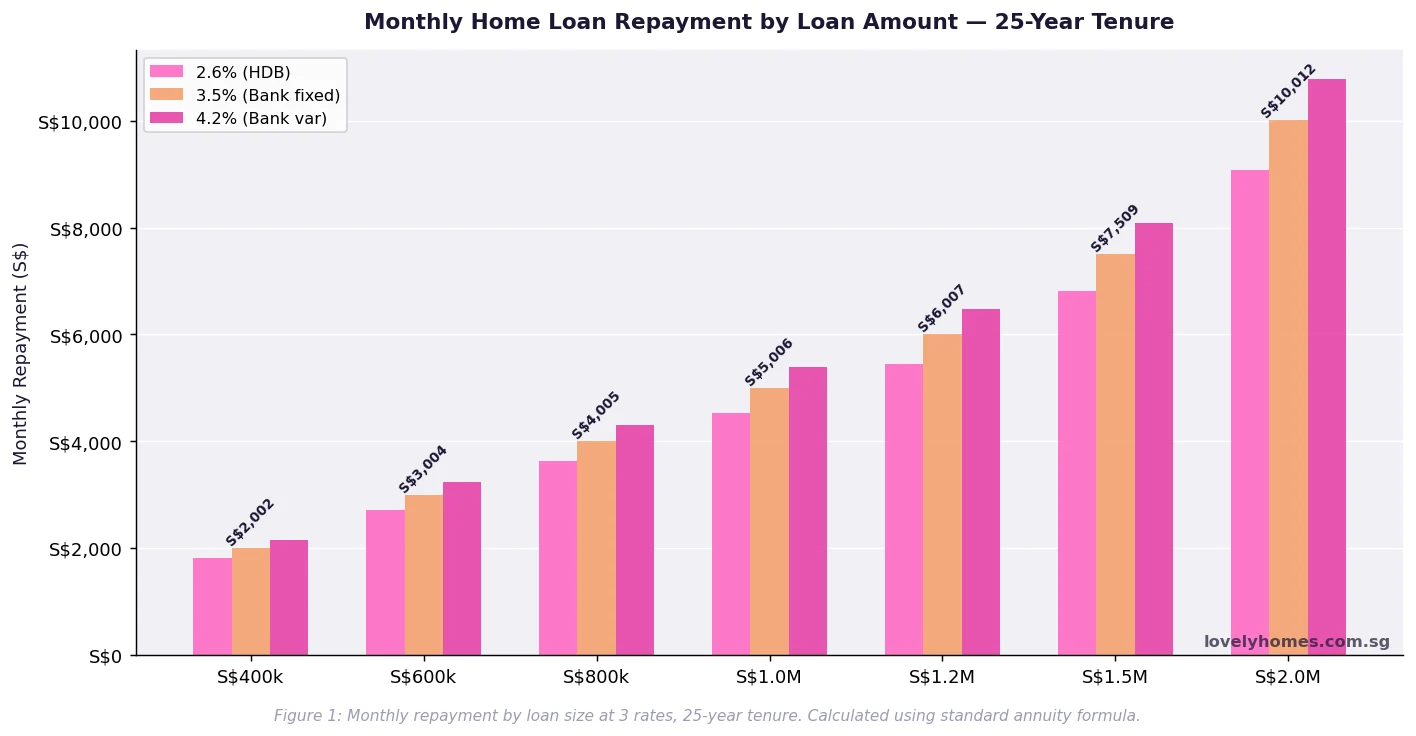
Singapore home loan monthly repayment by loan amount 2026 at different rates
Figure 1: Monthly home loan repayment by loan amount at 3 rates, 25-year tenure. Calculated using standard annuity formula.

At the prevailing 2026 range of bank fixed rates (approximately 3.2–3.9% p.a.) and HDB concessionary rate (2.6%), the chart above illustrates how steeply monthly costs rise with loan size. A S$800,000 loan at 3.5% costs S$4,010 per month — a figure that requires a combined gross monthly income of at least S$7,290 to pass TDSR at 55%. At S$1.5M, you need S$13,655+ in combined monthly income to pass TDSR.

TDSR: What It Is and How It Limits Your Loan

The Total Debt Servicing Ratio (TDSR) was introduced by MAS in 2013 and tightened to its current 55% threshold in 2022. TDSR measures the proportion of a borrower’s gross monthly income that goes toward servicing all debt obligations — not just the home loan, but also car loans, credit cards (30% of outstanding balance counts), personal loans, and other property loans.

The practical implication: if your gross household income is S$10,000 per month, your total debt repayments across all outstanding loans cannot exceed S$5,500 per month to qualify for a new bank home loan. If you already have a car loan of S$800/mth and credit card outstanding of S$5,000 (counted at S$1,500/mth for TDSR), your maximum new home loan repayment is S$5,500 − S$800 − S$1,500 = S$3,200/mth — even if you have enough income for more.

Banks are required by MAS to stress-test TDSR using a floor interest rate of 4.0%. This means that even if your actual loan rate is 3.0%, the bank runs your TDSR calculation at 4.0% to ensure affordability under rate increases. This effectively reduces maximum loan eligibility by approximately 5–8% compared to a simple calculation at the offered rate.

Maximum Loan Eligibility by Income
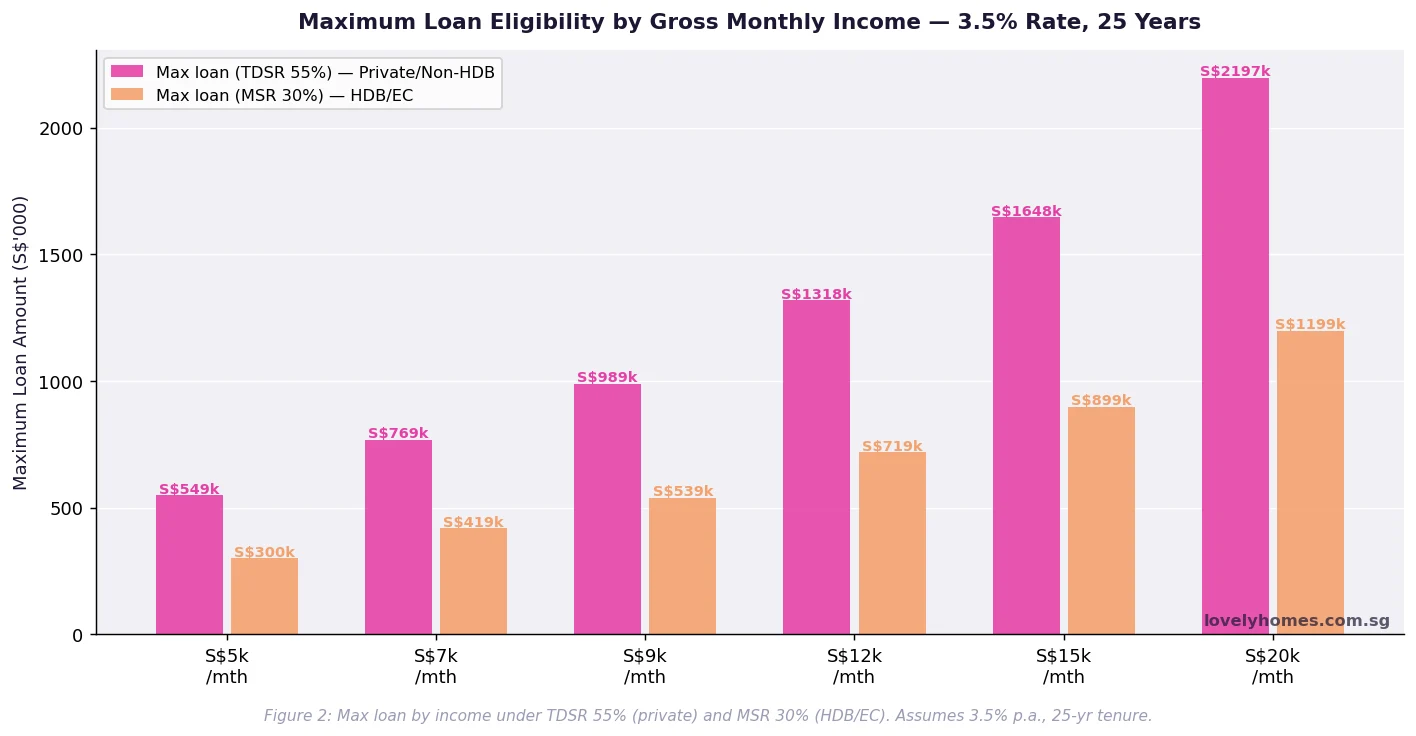
Singapore TDSR MSR maximum loan eligibility by gross monthly income 2026
Figure 2: Maximum loan eligibility by gross monthly income under TDSR 55% (private) and MSR 30% (HDB/EC). Assumes 3.5% p.a., 25-year tenure.

The chart makes clear the significant difference between the TDSR-governed private property market and the MSR-governed HDB/EC market. A household earning S$12,000 per month can in principle qualify for a bank loan of up to ~S$1.32M for a private condo under TDSR 55% — but if buying an HDB resale flat or EC, the MSR cap of 30% limits the same household to a loan of ~S$724,000.

MSR: The Additional Constraint for HDB Flats and ECs

The Mortgage Servicing Ratio (MSR) applies specifically to HDB residential flats and ECs. It caps the monthly repayment on the HDB or EC loan at 30% of gross monthly income — a stricter constraint than TDSR for these property types. Both TDSR and MSR must be satisfied simultaneously when purchasing HDB or EC.

For example, a household with S$9,000/mth gross income: TDSR allows up to S$4,950/mth total debt (55%); MSR caps the HDB loan component at S$2,700/mth (30%). The HDB loan must fit within S$2,700/mth — meaning a maximum HDB loan of approximately S$539,000 at 2.6% HDB rate over 25 years.

LTV Limits: How Much Can You Borrow?
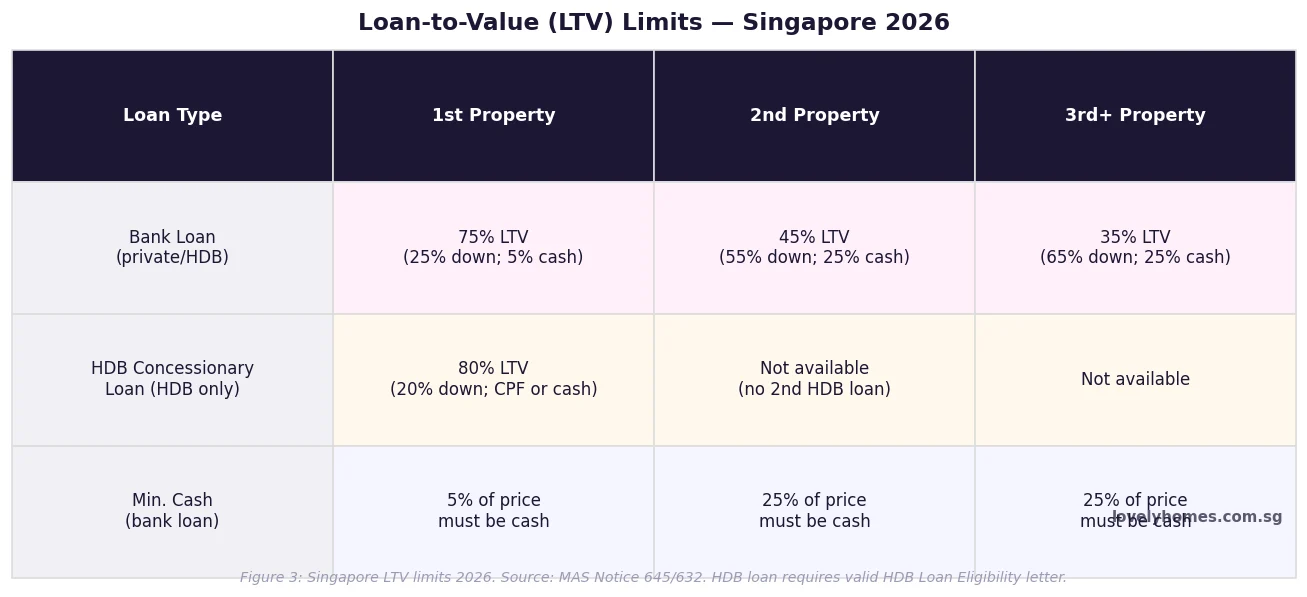
Singapore loan to value LTV limits 2026 bank versus HDB concessionary loan
Figure 3: Singapore LTV limits 2026 — bank vs HDB concessionary loan. Source: MAS Notice 645/632.

The Loan-to-Value (LTV) ratio is the maximum proportion of a property’s purchase price (or valuation, whichever is lower) that a lender will finance. In Singapore, LTV limits are set by MAS and depend on how many outstanding property loans a borrower holds at the time of purchase.

Summary Table: Key Mortgage Parameters for Singapore Home Buyers (2026)

Parameter Bank Loan (Private/HDB) HDB Concessionary Loan (HDB only)
Max LTV (1st property) 75% 80%
Min cash (1st property) 5% of price (cash only) Can be all CPF
TDSR cap 55% of gross income 55% (TDSR applies)
MSR cap (HDB/EC) 30% (HDB/EC only) 30%
Max loan tenure (< 65 yrs old) 30 years (condo); 25 years effective (HDB) 25 years
Stress-test floor rate 4.0% p.a. (MAS mandated) No stress test — fixed rate 2.6%
Eligibility for HDB loan Any borrower Must hold valid HLE; income ceiling applies
Repayment method CPF OA or cash CPF OA, HDB deduction, or cash

Worked Example: The Lim Family Buying Their First HDB

📌 Case Study: The Lim Family — 4-Room HDB Resale in Ang Mo Kio

Profile: Married couple, SC/SC, ages 32 and 30. Combined gross monthly income S$8,500. Buying a 4-room HDB resale flat in Ang Mo Kio at S$580,000. Eligible for Enhanced Housing Grant (EHG) of S$50,000 and Family Grant of S$50,000 (total grants S$100,000). Seeking HDB concessionary loan (HLE confirmed).

Step 1 — Loan amount: Purchase price S$580,000 minus grants S$100,000 = net S$480,000. HDB loan max 80% LTV of S$580,000 = S$464,000. But net after grants is S$480,000; applying 80% LTV to S$580,000 = S$464,000. Loan = S$464,000. Downpayment (20%) = S$116,000 — may be entirely from CPF OA.

Step 2 — Monthly repayment: HDB concessionary rate 2.6% p.a., 25-year tenure. M = 464,000 × [0.002167 × (1.002167)^300] / [(1.002167)^300 − 1] = S$2,094/mth.

Step 3 — MSR check: S$2,094 ÷ S$8,500 = 24.6% — below 30% MSR cap → PASS.

Step 4 — TDSR check: Assuming no other debt. S$2,094 ÷ S$8,500 = 24.6% — well below 55% TDSR → PASS.

Step 5 — BSD: First S$180,000 × 1% = S$1,800; next S$180,000 × 2% = S$3,600; remaining S$220,000 × 3% = S$6,600. Total BSD = S$12,000.

Total upfront cost: Downpayment S$116,000 (CPF) + BSD S$12,000 (CPF or cash) + legal fees ~S$3,000 + COV (if any) cash. Indicative upfront ≈ S$131,000 (mostly from CPF OA), with likely S$5,000–S$15,000 in cash for legal fees and any COV.

How Interest Rate Movements Affect Your Repayment

Singapore bank home loan rates are primarily linked to SORA (Singapore Overnight Rate Average), which replaced SIBOR/SOR as the benchmark rate in 2024. SORA is set daily by MAS and reflects the volume-weighted average rate of unsecured overnight SGD interbank transactions. Variable-rate packages are typically quoted as 3-month compounded SORA plus a spread (e.g., SORA + 0.75%). Fixed-rate packages lock the interest rate for 2–5 years before re-pricing.

As of mid-2026, the 3-month compounded SORA is approximately 2.8–3.0%, giving effective all-in variable rates of 3.55–3.75% for competitive packages. Fixed rates for 3-year locks are approximately 3.2–3.5%. The rate environment suggests that borrowers who locked in 2-year fixed rates in 2024 at ~3.8% are now approaching competitive re-pricing opportunities.

A 1% rise in interest rates on a S$1,000,000 loan over 25 years adds approximately S$500–S$560 per month to the repayment. Borrowers should stress-test their budgets at rates 1.5–2.0 percentage points above their current package to ensure they can absorb rate movements without TDSR breach.

What Might Change in Singapore Mortgage Regulation

MAS reviews TDSR and LTV parameters periodically as part of its macro-prudential framework. In a scenario of sustained high interest rates or rising household debt levels, further tightening (lower LTV caps, reduced TDSR thresholds) is possible. Conversely, if the property market softens significantly, regulators have historically relaxed restrictions to support demand. The 2022 TDSR reduction (from 60% to 55%) is the most recent change; the prior benchmark was 60% from 2013. Buyers should not assume current parameters will remain constant over a long holding period.

Forward-looking commentary is speculative and subject to MAS policy decisions which cannot be predicted.

Frequently Asked Questions

How do I use the TDSR formula to check my eligibility?

Calculate your total monthly debt obligations: add up all existing loan repayments (car loan, personal loan, credit card at 30% of outstanding balance, any other property loans). Then add the projected new home loan repayment. Divide the total by your gross monthly income. If the result is 0.55 or below, you pass TDSR. Banks calculate TDSR using a stress-test rate of 4.0% p.a., so use 4.0% when doing your own check to ensure accuracy. For joint borrowers, both gross incomes may be combined. However, if one borrower has existing debts, those are also included in the TDSR calculation against the combined income.

Can I use CPF to pay for my home loan repayments?

Yes, CPF Ordinary Account (OA) savings can be used for both the initial downpayment and ongoing monthly loan repayments on residential properties. There are three key limits to note. First, CPF usage is capped at the Valuation Limit (VL) — the lower of purchase price or market valuation. Second, once your CPF usage reaches the VL, further withdrawals require the property to have a remaining lease of at least 30 years and the remaining lease to extend beyond the youngest buyer’s age of 95. Third, CPF accrued interest (currently 2.5% p.a.) is added to the principal used, and this entire sum must be refunded to CPF on sale — reducing net cash proceeds. For HDB loans, CPF usage rules are more generous and integrated into the HDB payment process directly.

What is the difference between a fixed-rate and a variable-rate (SORA) home loan?

A fixed-rate package locks your interest rate for a defined period (typically 2–5 years), providing certainty over monthly repayments. After the fixed period, the loan re-prices to the bank’s prevailing rate — usually a SORA-linked package. A variable/SORA-linked package tracks the 3-month compounded SORA plus a spread. Your repayment fluctuates as SORA moves, but you benefit directly from rate cuts. In 2026, the choice between fixed and variable depends on your view of the SORA trajectory and your risk tolerance. Fixed packages are typically locked in for 2–3 years; leaving early incurs prepayment penalties of 1.0–1.5% of the outstanding loan amount. Always read the lock-in clause carefully before committing.

What happens if my TDSR exceeds 55% after I take the loan?

TDSR compliance is assessed at the point of loan application. Once the loan is granted and drawdown occurs, you are not in breach if your circumstances change (e.g., income drops, additional debt is taken on). However, if you wish to refinance to a new lender or take an additional loan, the new lender will re-assess TDSR at that point. If you fail TDSR, you cannot refinance or borrow more. Practically, this means maintaining a TDSR well below 55% is prudent — leaving buffer for life events such as job changes, medical expenses, or taking on a car loan. MAS requires banks to conduct TDSR reassessment when borrowers request loan top-ups or restructuring.

Is the HDB concessionary loan always better than a bank loan?

The HDB concessionary loan has a stable rate pegged at 0.1% above the CPF Ordinary Account rate — currently 2.6% p.a. — which provides predictability and does not carry lock-in penalties. However, bank loans often offer lower headline rates for the first 2–3 years (fixed packages at 3.0–3.5% have been available in recent cycles, and SORA packages can be lower still). The trade-off is rate risk after the fixed period. Practically: if you have limited cash reserves and need stability, the HDB loan is lower-risk. If you have buffer to absorb rate movements and can refinance actively, a bank loan may be cheaper over the full tenure. Once you take a bank loan for your HDB flat, you cannot switch back to an HDB loan on that property.

What is the maximum loan tenure in Singapore?

For bank loans, the maximum tenure is 30 years for private property (condo, landed) and effectively 25 years for HDB resale flats (banks may grant 30 years on paper but MAS caps the tenure at 25 years + borrower’s age ≤ 65, so younger buyers can access up to 30 years in practice). For HDB concessionary loans, the maximum is 25 years or up to age 65 for the youngest borrower, whichever is shorter. Longer tenures reduce monthly repayments but increase total interest paid significantly. A S$800,000 loan at 3.5% over 25 years costs S$321,500 in total interest; over 30 years it costs S$398,000 — S$76,500 more despite only S$490 lower monthly repayment.

Related Articles

Disclaimer

All loan calculations in this article are illustrative estimates based on the standard annuity formula. Actual monthly repayments, TDSR outcomes, and loan eligibility depend on each lender’s assessment criteria, prevailing interest rates at the time of application, borrower credit history, and MAS regulatory requirements in force at the time. Readers should not rely on these calculations as a guarantee of loan approval or as financial advice. Before applying for a home loan, consult a licensed mortgage broker, your preferred bank’s home loan officer, or a licensed financial adviser regulated by the Monetary Authority of Singapore (MAS). MAS home loan regulations: mas.gov.sg. CPF usage rules: cpf.gov.sg. HDB loan eligibility and HLE: hdb.gov.sg.

Singapore Stamp Duty Calculator 2026: BSD and ABSD Explained

Singapore Stamp Duty Calculator 2026: BSD and ABSD Explained

Singapore stamp duty is not a single charge — it is two separate taxes that stack on top of each other depending on who you are and what you already own. The Buyer’s Stamp Duty (BSD) applies to every residential purchase. The Additional Buyer’s Stamp Duty (ABSD) applies on top if you are buying a second property, if you are a Singapore Permanent Resident, or if you are a foreigner. Understanding both — and being able to calculate them accurately before you commit — is the single most important financial step in any Singapore property transaction.

This guide explains the 2026 BSD and ABSD rate schedules in full, shows you how to calculate your stamp duty liability step by step, and works through concrete examples at common price points. All figures reflect the rate schedules currently in force: the 2023 BSD schedule and the 27 April 2023 ABSD rates. For the authoritative source, always verify at iras.gov.sg/taxes/stamp-duty/for-property.

Quick Answer — Singapore Stamp Duty Calculator 2026

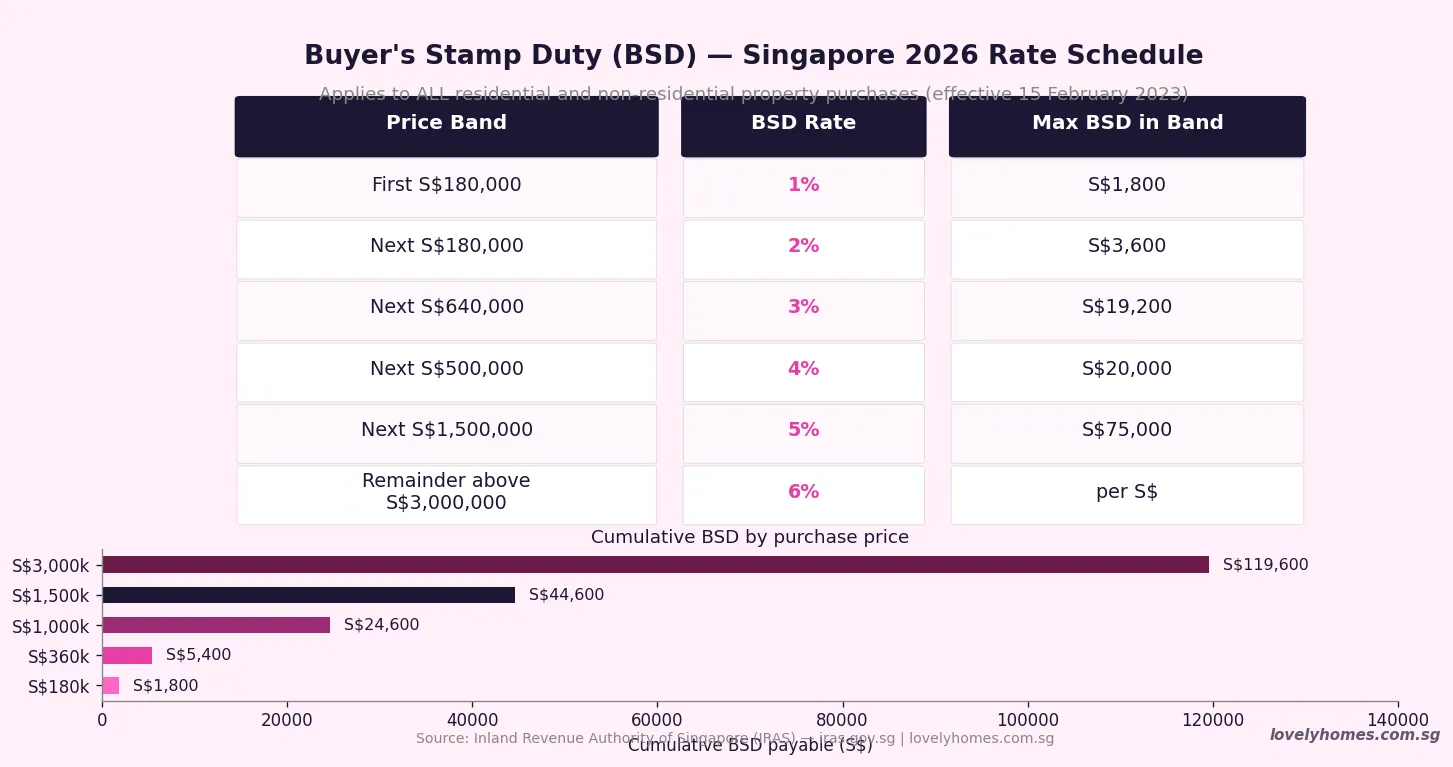
  • BSD applies to ALL buyers at the same progressive rate: 1% on first S$180k, 2% next S$180k, 3% next S$640k, 4% next S$500k, 5% next S$1.5M, 6% above S$3M.
  • ABSD stacks on top: Singapore Citizens pay 0% on their first property, 20% on a second, 30% on a third or more.
  • PRs pay 5% ABSD on a first property, 30% on a second, 35% on a third or more.
  • Foreigners pay 60% ABSD on any residential property.
  • For a S$1.5M property, a Singapore Citizen buying their first home pays BSD of S$44,600 — roughly 3% of the price. A foreigner buying the same property pays S$44,600 BSD plus S$900,000 ABSD.
  • BSD is typically payable within 14 days of signing the Option to Purchase (OTP); ABSD within 14 days of signing the Sale & Purchase Agreement, or within 14 days of exercising the OTP.
  • ABSD may be financed by CPF Ordinary Account for Singapore Citizens buying their first or subsequent homes, but BSD can also be paid from CPF OA.
  • Married SC/SPR couples may claim an ABSD remission on a second property if they dispose of the first within 6 months of purchase (or TOP for new launches).
  • Developers are subject to 35% ABSD with a remission available on residential development land if units are sold within the prescribed period.

What Is Buyer’s Stamp Duty (BSD)?

BSD is a tax levied by the Inland Revenue Authority of Singapore (IRAS) on the purchase or acquisition of property — residential and non-residential alike. It is calculated on the higher of the purchase price or the property’s market value. BSD has existed in Singapore since 1929 and was most recently revised upward in February 2023 when the Government added the 5% band (on the portion from S$1.5M to S$3M) and the 6% band (above S$3M) as part of its broader property market management effort.

BSD is non-negotiable: every buyer — Singapore Citizen, PR, foreigner, or entity — pays BSD. The rate schedule is progressive, meaning each increment of purchase price is taxed at its own marginal rate. The total BSD payable grows with the purchase price but as a percentage of price it rises only gradually because the higher rates apply only to the marginal portion above each threshold.

BSD Buyer Stamp Duty rates by price band Singapore 2026
Figure 1: BSD rate schedule by price band (2023 schedule, effective 15 February 2023) and cumulative BSD payable at selected purchase prices. Source: IRAS.

BSD Calculation — Step by Step

To calculate BSD manually, work through each price band in order and tax only the portion that falls within that band:

Price Band Rate Max BSD in Band
First S$180,000 1% S$1,800
Next S$180,000 2% S$3,600
Next S$640,000 3% S$19,200
Next S$500,000 4% S$20,000
Next S$1,500,000 5% S$75,000
Remainder above S$3,000,000 6%

Quick BSD shortcuts: For a S$1,000,000 purchase, BSD = S$1,800 + S$3,600 + S$19,200 + S$15,000 (S$500k × 3%) = S$24,600. For S$1,500,000: S$1,800 + S$3,600 + S$19,200 + S$20,000 = S$44,600. For S$2,000,000: S$44,600 + S$25,000 (S$500k × 5%) = S$69,600.

What Is Additional Buyer’s Stamp Duty (ABSD)?

ABSD is a separate tax introduced by the Government in December 2011, initially to cool a rapidly rising residential property market. It has been raised five times since — most recently and most significantly on 27 April 2023, when ABSD for foreigners doubled from 30% to 60% and rates for Singaporeans and PRs buying additional properties were substantially increased. ABSD is not a progressive tax: it applies at a flat percentage rate to the entire purchase price.

Unlike BSD, ABSD depends on who you are and how many residential properties you already own. “Already own” means at any point in the world — IRAS will ask for a statutory declaration confirming your existing property holdings, including overseas properties for the purpose of determining if you are an SC or PR “first-time” buyer.

ABSD Additional Buyer Stamp Duty rates by buyer profile Singapore 2026
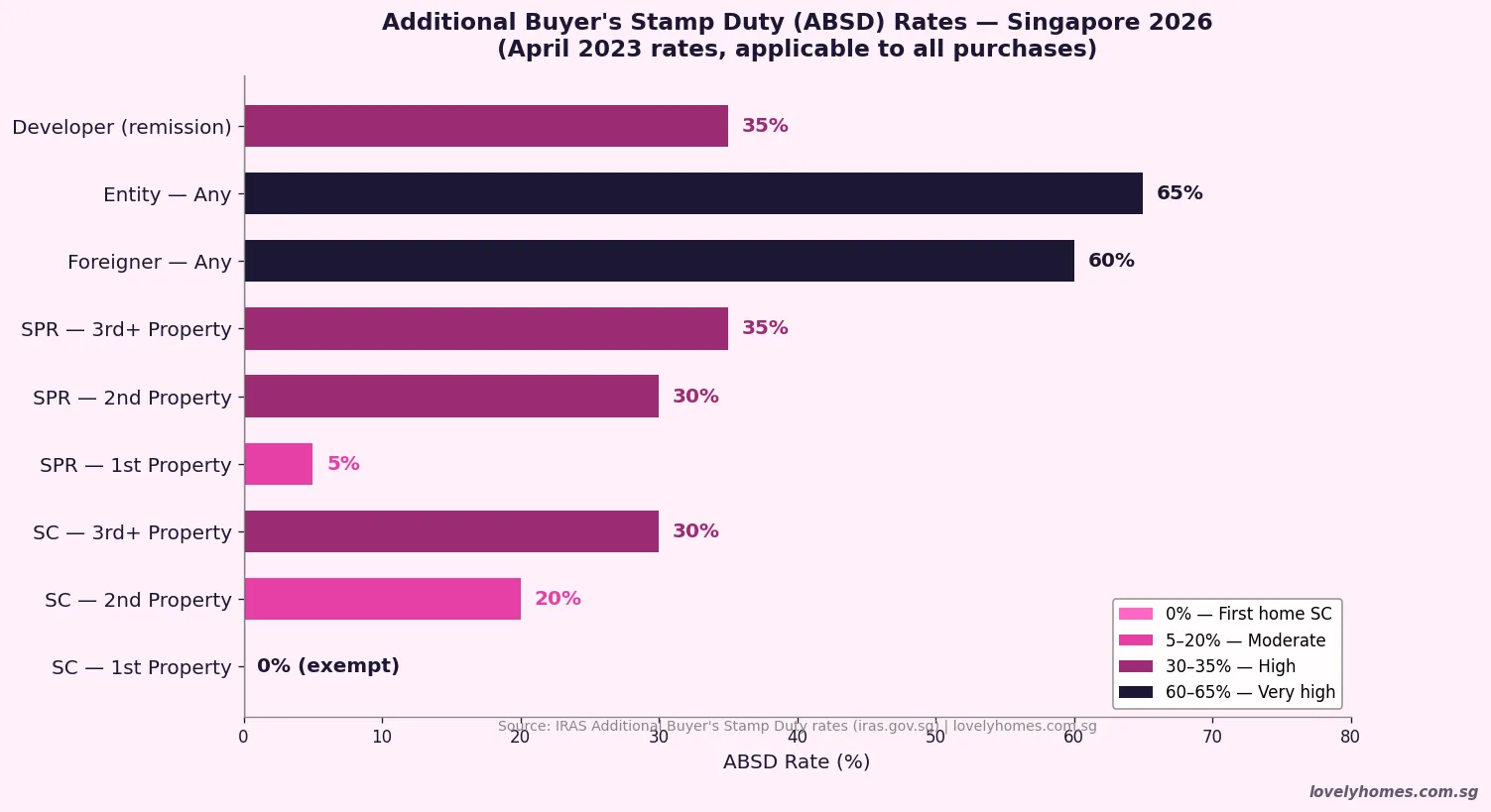
Figure 2: ABSD rates by buyer profile as at 27 April 2023. Rates are applied to the full purchase price. Source: IRAS.

ABSD by Buyer Profile — The Key Numbers

The table below summarises the complete 2026 ABSD rate schedule:

Buyer Profile 1st Property 2nd Property 3rd+ Property
Singapore Citizen (SC) 0% 20% 30%
Singapore Permanent Resident (SPR) 5% 30% 35%
Foreigner (non-SC, non-SPR) 60% 60% 60%
Entity (company, trust, etc.) 65% 65% 65%

Important nuance — joint purchases: When a property is bought jointly, the higher rate applies to the entire transaction. A Singapore Citizen buying with a foreigner spouse pays 60% ABSD on the whole purchase price — not a blended rate. This is one of the most commonly misunderstood aspects of ABSD and catches many buyers off guard.

Stamp Duty Worked Example — Three Buyer Profiles

The following three worked examples use a purchase price of S$1.5 million — a broadly representative price point for a mass-market private condominium in 2026.

Buyer A: SC purchasing first residential property
BSD: S$1,800 + S$3,600 + S$19,200 + S$20,000 = S$44,600
ABSD: 0% × S$1,500,000 = S$0
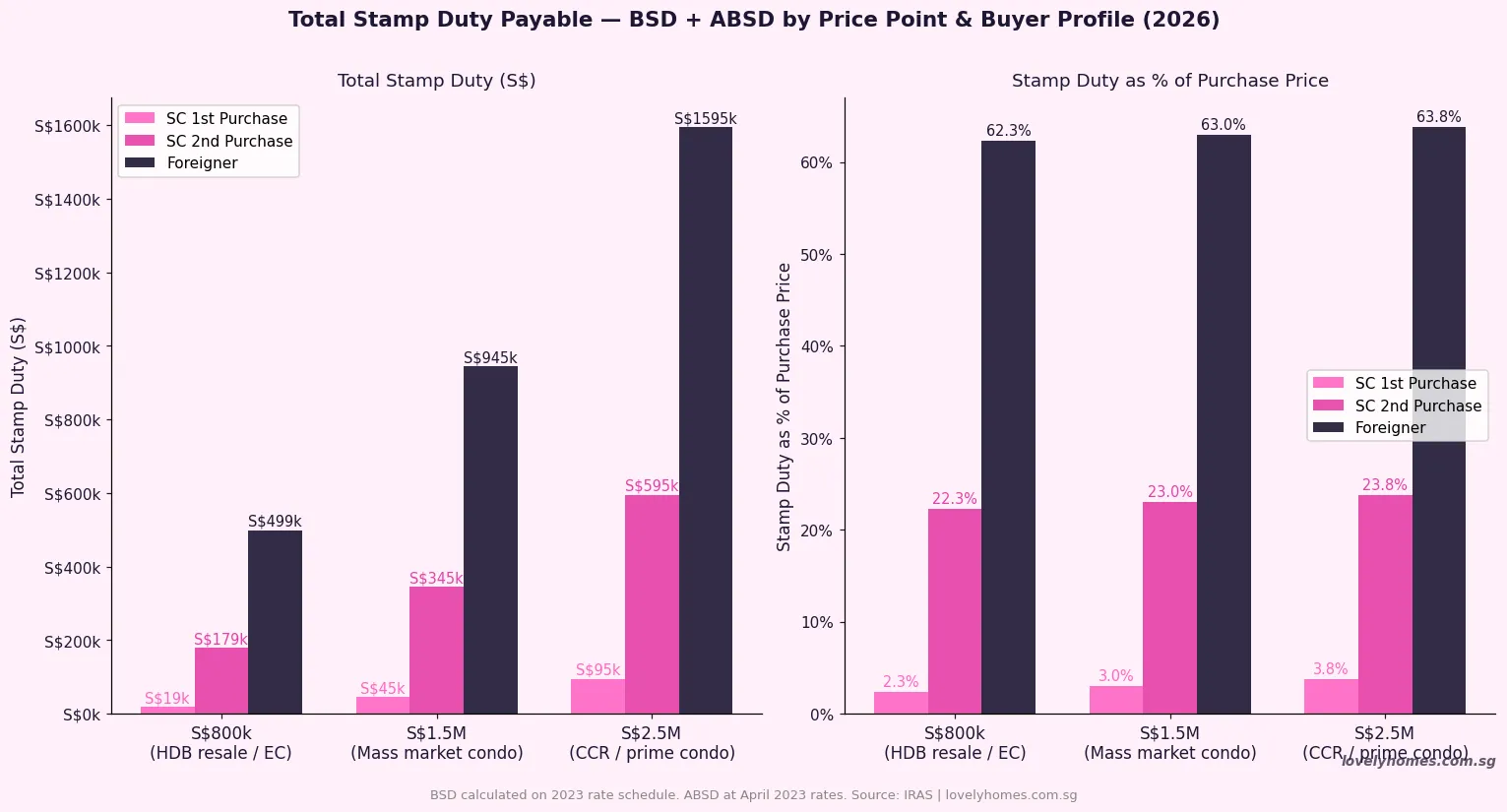
Total stamp duty: S$44,600 (about 2.97% of purchase price)

Buyer B: SC already owning one residential property (upgrader)
BSD: S$44,600 (same as Buyer A)
ABSD: 20% × S$1,500,000 = S$300,000
Total stamp duty: S$344,600 (about 22.97% of purchase price)

Buyer C: Foreigner (e.g. EP holder, British national)
BSD: S$44,600
ABSD: 60% × S$1,500,000 = S$900,000
Total stamp duty: S$944,600 (about 62.97% of purchase price)

The difference between Buyer A and Buyer C — on the same S$1.5M property — is S$900,000. This is why foreigners buying Singapore residential property typically need to buy at a meaningful discount to replacement cost for the investment to make financial sense.

Total stamp duty BSD plus ABSD payable by price point and buyer profile Singapore 2026
Figure 3: Total stamp duty (BSD + ABSD) payable by three buyer profiles at three purchase prices (S$800k, S$1.5M, S$2.5M). Left panel: absolute S$ amounts. Right panel: as a percentage of purchase price. Source: IRAS rates; calculations by LovelyHomes.

ABSD Remissions — When You Can Get It Back (or Avoid It)

ABSD paid upfront may be refunded under specific circumstances via ABSD remissions administered by IRAS. The key remissions applicable in 2026 are:

1. SC/SPR Married Couple Remission on Second Property

A married couple in which at least one spouse is a Singapore Citizen, and who together purchase a residential property as their second property, may apply for an ABSD remission — but only if they sell their first residential property within 6 months of the completion of the second purchase (for a completed property) or within 6 months of the TOP of the new property (for an uncompleted unit). The refund is of the ABSD paid on the second purchase. Both spouses must be co-owners on the second purchase to qualify.

This remission is critically important for HDB flat owners considering upgrading to a private property: you must either sell first (and thus hold no property at exercise) or invoke the remission route by selling within 6 months. Many upgraders prefer to sell first to avoid committing S$300,000–S$600,000 of ABSD upfront.

2. Developer ABSD Remission on Residential Development Land

Property developers purchasing land for residential development are subject to 35% ABSD (as entities pay 65%, but licensed developers on qualifying residential land are subject to 35%) with a remission available if the project is completed and all units are sold within the prescribed period — typically 5 years from the date of acquisition for most sites. Projects that do not sell all units within the deadline will have a clawback of the remitted ABSD with interest, which is why Singapore developers have a strong incentive to price aggressively as the deadline approaches.

3. Remissions for Housing Developers — ABSD (Housing Developers) Regime

Under specific circumstances, including the development of public housing or certain integrated developments, additional remission mechanisms may apply. These are complex and project-specific; the developer’s solicitors will advise on eligibility at the time of tender or acquisition.

When Is Stamp Duty Payable?

BSD must be paid within 14 days of signing the OTP (or the Sale & Purchase Agreement if no OTP was issued). ABSD must be paid within 14 days of exercising the OTP (i.e., signing the Sale & Purchase Agreement) or within 14 days of signing the OTP itself if there is no separate exercise. In practice, your solicitor will advise on the precise deadline for your transaction and manage payment on your behalf.

Failing to pay on time attracts penalties: IRAS charges a late payment penalty of up to 10% of the stamp duty amount, plus interest. The clock starts from the execution date, not from when you receive the demand. Most Singapore conveyancing firms send a reminder before the deadline and arrange payment via e-stamping through the IRAS portal.

Paying Stamp Duty Using CPF

Both BSD and ABSD may be paid from the CPF Ordinary Account (OA), subject to the property being eligible for CPF usage. This is a significant benefit for Singapore Citizens and PRs who have built up CPF savings — it means stamp duty does not need to be funded entirely from cash. However, remember that all CPF withdrawals for property are subject to the CPF accrued interest rule: when the property is eventually sold, the CPF principal plus accrued interest (currently 2.5% per annum) must be refunded to your CPF OA before you receive your cash proceeds. This means ABSD paid from CPF today has a compounding cost over the holding period.

Why Stamp Duty Matters for Your Investment Analysis

Stamp duty is not a trivial transaction cost in Singapore — for a second property buyer, it represents a significant upfront capital commitment that materially affects the economics of property investment. A Singapore Citizen buying a second S$2M condominium pays S$69,600 BSD plus S$400,000 ABSD — a combined S$469,600 that is non-refundable (absent the married-couple remission). To break even on that investment, assuming the property appreciates at 3% per annum and the buyer holds for five years, the property needs to appreciate from S$2M to approximately S$2.37M just to recover the stamp duty — before financing costs, maintenance, property tax, and any renovation expenditure.

This is precisely the calculation that has driven the shift in Singapore’s private property market since 2023: the effective entry cost for second-property investors and foreigners has increased substantially, which explains the divergence between first-home buyer activity (robust, because 0% ABSD for SCs) and investor activity (more selective, because the hurdle rate is significantly higher).

Peer comparison: in Hong Kong, the equivalent additional stamp duty for non-residents was set at 30% in 2023 and has since been partially relaxed. Australia charges a foreign buyers’ stamp duty surcharge of 7%–8% at the state level in most jurisdictions. Singapore’s 60% ABSD for foreigners is among the highest residential property transaction taxes in the world.

What Might Come Next — Stamp Duty Outlook

There is no official signal as of July 2026 that the Government intends to revise ABSD rates downward in the near term. The property market has been absorbing the 2023 rates with transaction volumes moderating but prices remaining broadly resilient — particularly in the Core Central Region (CCR), where wealthier buyers have shown a willingness to pay the premium. The Government has made clear that its priority is affordability for Singapore Citizens purchasing their first home, not the investment segment.

What could prompt a revision? Two scenarios are most discussed: first, a sharp cyclical downturn in Singapore residential prices that threatens economic stability and household wealth; second, a regulatory decision that ABSD is no longer necessary as a cooling measure because the market has structurally rebalanced. Neither condition currently applies. The most that market observers speculate is a modest easing of SPR ABSD rates — from 5% to a lower figure for first purchases — if SPR numbers and integration policy makes this desirable. Any changes would be announced in a Budget Statement or a dedicated MAS/MOF press release with immediate effect.

Summary — Key Stamp Duty Facts for 2026

Item Key Fact
BSD — Who pays All buyers, residential and non-residential
BSD — Administered by Inland Revenue Authority of Singapore (IRAS)
BSD — Current schedule 1%/2%/3%/4%/5%/6% (effective 15 Feb 2023)
ABSD — SC first property 0% (exempt)
ABSD — SC second property 20% of purchase price
ABSD — Foreigner 60% of purchase price (any residential property)
ABSD — Joint purchase higher rate Highest applicable rate governs entire purchase
Payment deadline (BSD & ABSD) 14 days from signing OTP / S&P Agreement
CPF usable for stamp duty? Yes — from CPF OA, subject to CPF accrued interest rule

Frequently Asked Questions

Does BSD apply to HDB flat purchases?

Yes. BSD applies to every property purchase in Singapore, including HDB resale flats and Build-to-Order (BTO) flats when they are first purchased from HDB. BTO buyers pay BSD on the flat purchase price. Because BTO prices are typically well below S$500,000, the BSD amount is modest — usually S$4,800–S$11,800 for a 4-room or 5-room BTO flat. Resale HDB buyers pay BSD on the resale price (or valuation, if higher). BSD can be paid from the CPF Ordinary Account for HDB flat purchases.

Is ABSD payable on industrial or commercial property?

No. ABSD applies only to residential property. Commercial properties (shophouses, office units, industrial units, strata retail) are subject to BSD only. This distinction is significant for investors: buying a commercial property as a second or third purchase does not trigger ABSD, whereas buying a residential property as a second or third purchase does. This is one reason some Singapore property investors look at commercial assets as a way to deploy capital without incurring the second-property ABSD surcharge.

If I own an overseas property, does that count for ABSD?

For Singapore Citizens and PRs, overseas properties generally do not count when determining the ABSD property count. ABSD counts residential properties situated in Singapore. This means a Singaporean who owns a flat in London can still buy their first Singapore property as an “SC first purchase” at 0% ABSD. However, you must still make a statutory declaration of your property holdings, and IRAS’s lawyers will verify the position. The rules are complex and it is advisable to seek professional legal advice if you own overseas property and are unsure of your ABSD status.

Can I use SRS funds to pay stamp duty?

No. The Supplementary Retirement Scheme (SRS) funds can only be used for investments in specific SRS-approved instruments (such as shares, unit trusts, and insurance) and for retirement withdrawals. Property stamp duties — neither BSD nor ABSD — are an eligible use of SRS funds. Only CPF OA funds can be used to pay stamp duty on eligible property purchases.

I am an Employment Pass holder buying my first property in Singapore. What stamp duty do I pay?

An Employment Pass (EP) holder who is not a Singapore Citizen or PR is treated as a foreigner for stamp duty purposes and pays the full 60% ABSD plus BSD on any residential property purchase. There is no ABSD exemption for EP holders, long-term pass holders, or Entrepass holders. The Government introduced specific relaxations for nationals of certain countries under Free Trade Agreements (the USA, nationals of Iceland, Liechtenstein, Norway, and Switzerland under the EUSFTA-equivalent bilateral arrangements), where the ABSD is reduced to 15% — but these are narrow categories. All other foreigners pay 60%.

What happens if I underpay or make an error on my stamp duty calculation?

IRAS takes stamp duty compliance seriously. If you underpay — whether through an honest calculation error or a deliberate understatement of the property count — IRAS can issue an assessment for the unpaid amount plus a penalty of up to 400% of the unpaid duty. Voluntary disclosure (contacting IRAS before they identify the discrepancy) results in reduced penalties. Your conveyancing solicitor is required to verify stamp duty calculations before submission, which is the primary safeguard against errors in practice.

Related Articles

Disclaimer

This article is produced by LovelyHomes for general information purposes only and does not constitute tax, legal, or financial advice. Stamp duty rates and rules are set by the Government of Singapore and administered by the Inland Revenue Authority of Singapore (IRAS). While every effort has been made to ensure accuracy as at the date of publication (2 July 2026), readers should verify all figures directly with IRAS at iras.gov.sg and obtain independent professional advice — from a licensed conveyancing solicitor and/or a tax adviser — before making any property purchase decision.

Translate »