River Valley Green Parcel C GLS 2026: Top Bid S$1,730 psf ppr Sets New River Valley Benchmark

River Valley Green Parcel C GLS 2026: Top Bid S$1,730 psf ppr Sets New River Valley Benchmark

×Enlarged viewClick anywhere outside to close

Quick Answer: River Valley Green Parcel C GLS 2026

  • Tender closed: 18 June 2026. The site received 4 bids, all above S$700 million — exceptional confidence from developers in the River Valley / District 9 market.
  • Top bid: A joint venture between Sunway MCL and CSC Land Group submitted the highest bid of S$750.6 million at S$1,730 psf per plot ratio (ppr) — a new land rate record for the River Valley and Zion precinct.
  • The site: 123,958 sq ft, Gross Plot Ratio 3.5, maximum GFA 433,854 sq ft, located steps from Great World MRT (Thomson-East Coast Line). Estimated yield: approximately 500 units.
  • Expected development: Sunway MCL and CSC Land plan twin 36-storey residential towers. Formal URA award is pending; launch expected 2027–2028.
  • Buyer implications: Higher land cost translates to higher new launch prices in the precinct — industry analysts project future launch prices of S$3,200–S$3,800 psf for this site.

River Valley Green Parcel C: The Last GLS Site in the Great World Precinct

The River Valley Green (Parcel C) Government Land Sales tender closed on 18 June 2026 at 12:00 noon, drawing four bids from established developers — all above S$700 million. The site is the final residential plot to be carved out of the River Valley Green precinct along River Valley Road, bookending a sequence of GLS sales that has transformed the stretch between Great World City and Zion Road.

URA launched the site in April 2026 as part of the 1H2026 GLS programme. At 123,958 sq ft with a GPR of 3.5, it can yield approximately 470–500 residential units. The site occupies a prime position within District 9 (CCR — Core Central Region), within a five-minute walk of Great World MRT Station on the Thomson-East Coast Line, and is flanked by the already-launched River Valley Green developments.

The Bids: A New Land Rate Benchmark for River Valley
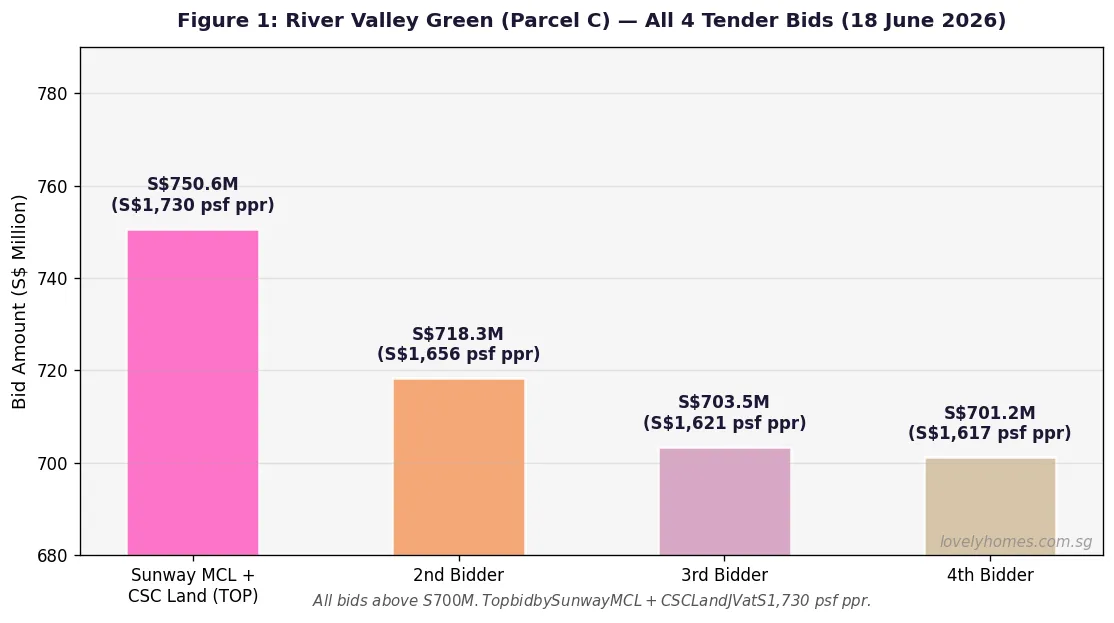
River Valley Green Parcel C GLS tender bids June 2026 all four bids S$1730 psf ppr
Figure 1: All Four Tender Bids — River Valley Green (Parcel C), Closed 18 June 2026
Bidder Bid (S$ Million) Land Rate (S$ psf ppr) Premium vs 2nd Bid
Sunway MCL + CSC Land JV (Top Bidder) S$750.6M S$1,730 +4.5% above 2nd
2nd Bidder ~S$718.3M ~S$1,656
3rd Bidder ~S$703.5M ~S$1,621
4th Bidder ~S$701.2M ~S$1,617

The tight clustering of bids — with only S$49.4M separating the top from the bottom bid, and all four above S$700M — reflects strong consensus among developers on the site’s land value. The top bid of S$1,730 psf ppr is approximately 22% higher than the land rate achieved at the most recent comparable River Valley Green tender, and sets a new benchmark for the Zion / River Valley precinct.

How This Compares to Recent CCR Land Sales
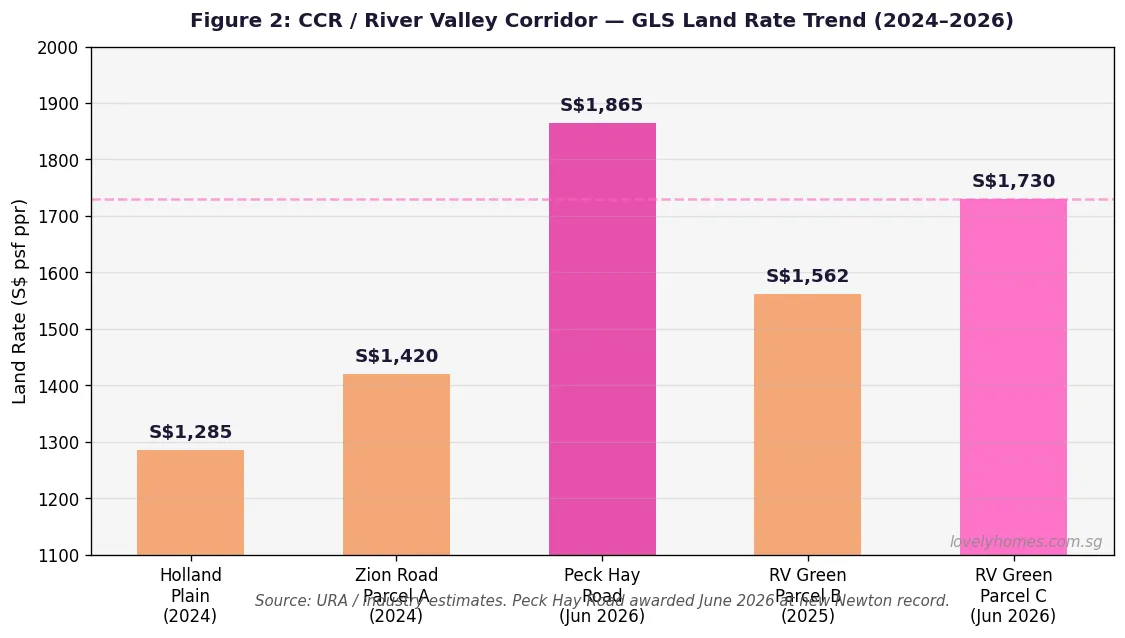
CCR GLS land rate comparison 2024 to 2026 River Valley Peck Hay Road Zion
Figure 2: CCR / River Valley Corridor GLS Land Rate Trend (2024–2026)

The S$1,730 psf ppr land rate also trails Peck Hay Road (awarded June 2026 at S$1,865 psf ppr — a new Newton precinct record), placing River Valley Green Parcel C firmly within the upper tier of Singapore’s CCR land market but not at the absolute frontier. The Peck Hay Road site, also in CCR District 11, attracted stronger bids due to its Newton / Cairnhill adjacency and higher-value catchment. The River Valley site, while slightly less premium in location, benefits from the Thomson-East Coast Line connectivity and the established Great World City mixed-use ecosystem.

In comparison, Zion Road Parcel A cleared at approximately S$1,420 psf ppr in 2024, meaning the Parcel C award represents land value appreciation of roughly 22% over that two-year period — consistent with the overall premium property price appreciation of 10–15% across the same period.

What Sunway MCL and CSC Land Plan for the Site

In a joint press release issued on 18 June 2026, Sunway MCL and CSC Land confirmed that if awarded the site, they intend to develop a 500-unit premium residential project comprising twin 36-storey towers. This is the second joint venture between the two developers following their collaboration on ELTA along Clementi Avenue 1 (501 units, launched February 2025). The developers did not disclose pricing but noted their commitment to delivering a premium product reflecting the site’s strategic location and land cost. Formal URA award is expected within weeks of the tender close; launch is anticipated in 2027 or early 2028 subject to planning approvals and construction commencement.

What This Means for Buyers in the River Valley / District 9 Market

Higher land cost at GLS almost always translates into higher launch prices — developers need to recover land, construction, and holding costs, and build in a profit margin. With land at S$1,730 psf ppr and construction costs running at approximately S$600–S$800 psf, industry analysts project break-even prices around S$2,800–S$3,000 psf. A typical developer margin of 15–20% on a prime CCR product would place launch prices in the range of S$3,200–S$3,800 psf. For a 1,000 sq ft unit, that translates to S$3.2M–S$3.8M — firmly above the average SC first-property buyer’s budget, and targeted primarily at SC second-property buyers (20% ABSD), SPR buyers (5% ABSD for 1st property), and overseas purchasers who already pay 60% ABSD on any Singapore condo.

For existing owners in the River Valley, Zion Road, and Great World precinct, the strong GLS result is broadly positive — it reinforces the ceiling for comparable units in the secondary market and supports resale prices in the precinct.

Frequently Asked Questions: River Valley Green Parcel C GLS

What is a GLS tender and what happens next?

A Government Land Sales (GLS) tender is the process by which Singapore’s government — via the Urban Redevelopment Authority (URA) or HDB — sells public land to private developers for residential or mixed-use development. After the tender closes, URA evaluates all bids and formally awards the site, typically within two to four weeks. The developer then pays the accepted bid price, commences planning and design, applies for planning permission, and eventually launches the development for sale — a process that typically takes 18–36 months from GLS award to sales launch.

What does “psf ppr” mean and how does it relate to end prices?

“Per square foot per plot ratio” (psf ppr) is the standard unit for land pricing in Singapore GLS. It normalises land cost across sites of different sizes and densities. To estimate the impact on end unit prices: multiply the land rate (S$1,730) by the GPR (3.5) to get the land cost per square foot of gross floor area — approximately S$4,955 psf GFA. Add construction (S$600–S$800 psf), financing, and marketing costs, plus developer margin, to arrive at approximate launch prices of S$3,200–S$3,800 psf net sellable area.

When will this development launch for sale?

Based on the typical timeline from GLS award to sales launch, the development is expected to launch in 2027 or early 2028. The developers will need to obtain planning approval, finalise design, set up the showflat, and receive the Controller of Housing’s Sale Licence before selling any units. Singapore buyers who are interested should monitor URA’s new sales data and property portals for VIP preview announcements, which typically occur one to three months before the official launch.

Can foreigners buy units in this development?

Yes. Condominiums are open to all buyers including foreigners, subject to ABSD. Foreigners pay ABSD of 60% as at 2026, in addition to Buyer’s Stamp Duty. On a S$3.5M unit, a foreigner would pay BSD of approximately S$184,600 plus ABSD of S$2,100,000 — total stamp duty of S$2,284,600. The high ABSD rate introduced in April 2023 has substantially dampened foreign demand for Singapore condominiums, making CCR new launches now more dependent on Singapore Citizen and SPR buyers than in prior cycles.

Are there any upcoming GLS sites in the River Valley area?

Parcel C is the final GLS residential site in the River Valley Green precinct. The broader 2H2026 GLS programme includes sites in other growth corridors — Jurong Lake District, Tengah, and Bayshore — but no further River Valley or Zion Road residential plots have been announced. Any future supply in this precinct would be from redevelopment of private sites or collective sales (en bloc), which are individually negotiated and not part of the GLS programme. The next significant CCR GLS event to watch is the formal award of River Valley Green Parcel C by URA, expected in late June or early July 2026.
Disclaimer: Bid figures for the 2nd, 3rd, and 4th bidders in the River Valley Green Parcel C tender are estimates based on industry sources at time of publication; only the top bid of S$750.6 million by Sunway MCL and CSC Land has been confirmed via developer press release. Formal URA award is pending. Projected launch prices are analyst estimates and are not representations or warranties. Verify all figures with URA at ura.gov.sg before making any investment decision.

Singapore Property Mortgage Guide 2026: SORA, Fixed vs Floating, LTV and Refinancing

Singapore Property Mortgage Guide 2026: SORA, Fixed vs Floating, LTV and Refinancing

×Enlarged viewClick anywhere outside to close

Quick Answer: Singapore Property Mortgage Guide 2026

  • Benchmark rate: 3-Month Compounded SORA has fallen from a ~3.5% peak in mid-2024 to ~1.07% in June 2026, the sharpest rate drop since the 2020 pandemic era.
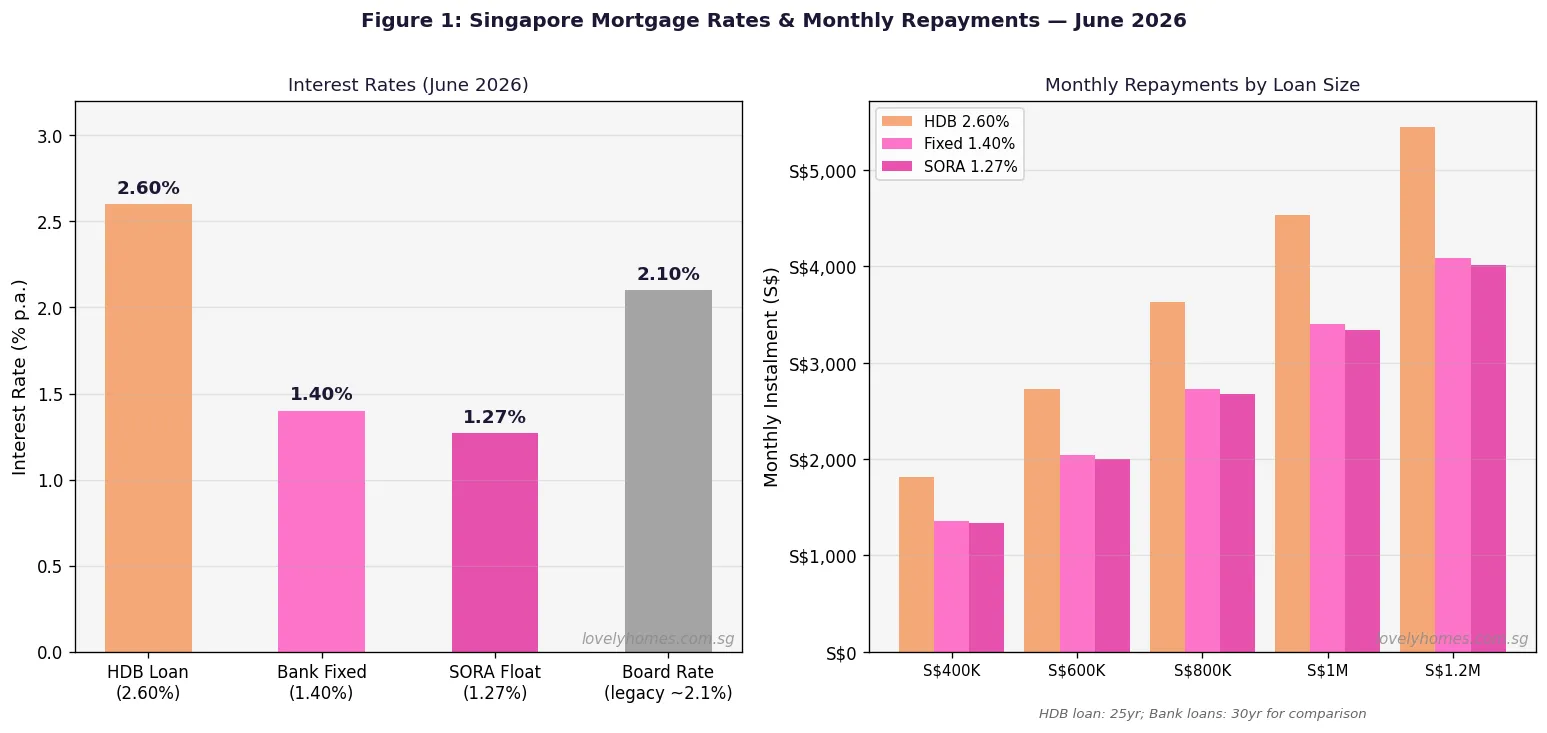
  • Best rates now: Bank fixed rates start at 1.35–1.40% p.a. for private property; SORA-pegged floating rates begin at ~1.27% p.a. (3M SORA + 0.20%). HDB Concessionary Loan remains at 2.60%.
  • LTV limits: 75% for a first private property bank loan; 80% for an HDB Concessionary Loan. MAS stress-tests TDSR at 4% p.a. regardless of actual rate.
  • Fixed vs floating: Fixed rates offer certainty for 1–3 years; floating (SORA) packages could cost less now but carry rate-reset risk. Most analysts forecast SORA at 0.7%–1.2% through 2026.
  • Repricing vs refinancing: Repricing (same bank) is cheaper but offers fewer options; refinancing (new bank) takes longer but can yield better rates and cashback offers.
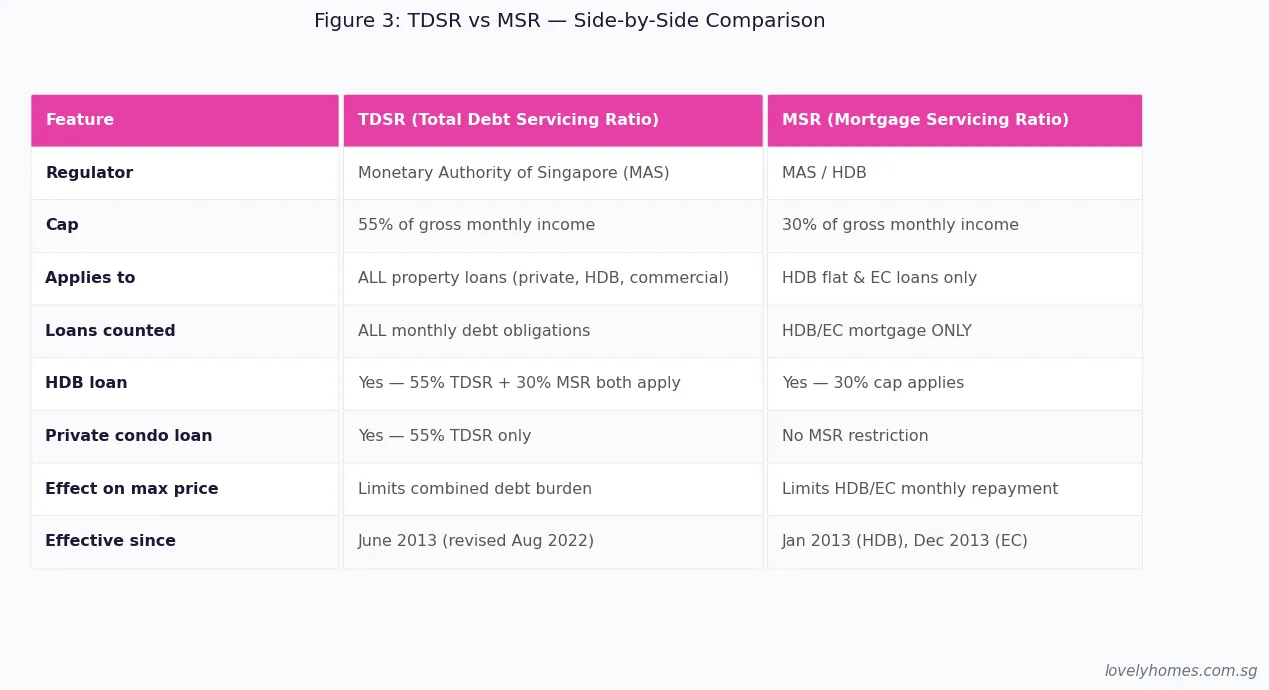
  • TDSR and MSR: Total Debt Servicing Ratio capped at 55% of gross income. Mortgage Servicing Ratio capped at 30% for HDB flat purchases. Both are regulated by MAS.

How Singapore Property Mortgages Work

A property mortgage in Singapore is a secured loan where the property itself serves as collateral. When you take a bank mortgage, the bank registers a legal charge over the property via the Singapore Land Authority (SLA). If you default, the bank has the right to repossess and sell the property to recover the outstanding loan.

The Monetary Authority of Singapore (MAS) regulates mortgage lending through Notices MAS 632 (banks) and MAS 1115 (finance companies). Key parameters include the Loan-to-Value (LTV) ratio, Total Debt Servicing Ratio (TDSR), and Mortgage Servicing Ratio (MSR). These rules apply to all financial institutions licensed to offer mortgage products in Singapore, ensuring borrowers are not over-leveraged.

The HDB Concessionary Loan is a separate product offered by the Housing & Development Board at a fixed rate of 2.60% per annum (0.1 percentage points above the CPF OA rate, currently 2.5%). It is available only for HDB flat purchases by eligible applicants and carries a higher LTV ceiling of 80% but is limited to HDB resale and BTO flats.

Singapore Mortgage Rates in June 2026

Singapore mortgage rates June 2026 comparison HDB fixed SORA floating monthly repayments
Figure 1: Singapore Mortgage Rates (June 2026) and Monthly Repayments by Loan Size — HDB Loan vs Fixed Rate vs SORA Floating
Loan Type Rate (June 2026) Lock-In Monthly on S$800K / 30yr Best For
HDB Concessionary Loan 2.60% p.a. (fixed) None S$3,218 / mth HDB flat buyers who want certainty
Bank Fixed (2-year) 1.35–1.40% p.a. 2 years S$2,666 / mth Buyers wanting rate certainty for 2 years
Bank Fixed (3-year) 1.50–1.60% p.a. 3 years S$2,757 / mth Buyers wanting longer-term certainty
SORA Floating (3M+0.20%) ~1.27% p.a. now None or 1–2yr ~S$2,617 / mth Buyers comfortable with rate movement
Board Rate (legacy) ~2.10% p.a. Varies S$2,996 / mth Avoid — opaque and usually uncompetitive

Rates sourced from published bank rate sheets and PropertyNet.sg (week of 15 June 2026). Monthly repayments calculated at 30-year tenure for illustration. Actual rates vary by loan quantum, LTV, and bank assessment. HDB Concessionary Loan calculated at 25 years as it is unavailable beyond that tenure.

SORA: Singapore’s Mortgage Benchmark Explained

SORA — the Singapore Overnight Rate Average — replaced the Singapore Interbank Offered Rate (SIBOR) and Swap Offer Rate (SOR) as the primary interest rate benchmark for Singapore-dollar financial products. The transition was completed in 2021 under MAS guidance. SORA is a backward-looking rate: it is calculated daily as the volume-weighted average rate of unsecured overnight transactions in the Singapore wholesale interbank market, published each business day by MAS.

For mortgages, banks typically use either the 1-Month Compounded SORA (1M SORA, currently ~1.16%) or the 3-Month Compounded SORA (3M SORA, currently ~1.07%) as the reference rate, to which they add a fixed bank spread (typically 0.20%–0.80%). Your effective rate resets monthly or quarterly depending on the package. Unlike SOR, SORA has no embedded credit or liquidity risk premium, making it more stable.

Singapore SORA 3-month compounded rate history 2022 to 2026
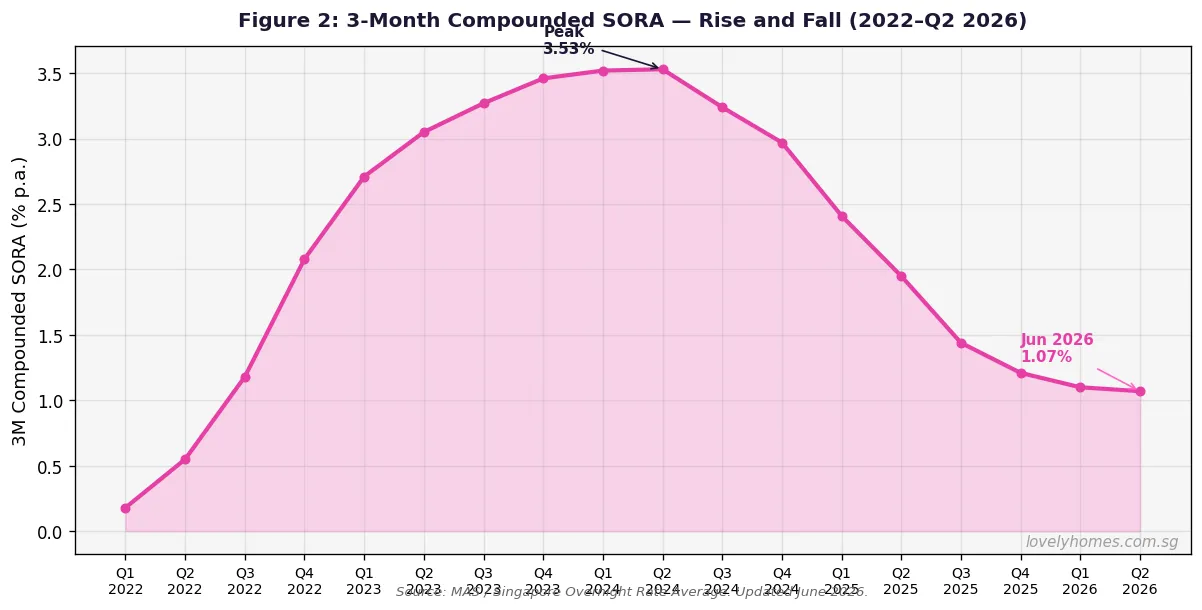
Figure 2: 3-Month Compounded SORA — Rise and Fall from 2022 to Q2 2026 (Source: MAS)

The 3M Compounded SORA peaked at approximately 3.52% in Q1–Q2 2024 as the US Federal Reserve held rates at 40-year highs. From mid-2024 through 2025, the US Fed began cutting rates, Singapore rates followed, and by June 2026 the 3M SORA has settled at ~1.07% — a 68% reduction from its peak. Industry analysts forecast 3M SORA to remain in the 0.7%–1.2% band through end-2026, barring unforeseen macroeconomic shocks.

Fixed vs Floating: How to Decide

The right choice depends on your risk tolerance, your mortgage tenure, and your view on rates. Consider these factors:

Choose a fixed rate if: you are on a tight budget and need payment certainty; you are buying with a co-borrower and want to avoid any surprises; your TDSR is near the 55% cap; or you are buying a new launch with a long construction period and want to lock in today’s rates now.

Choose a SORA floating rate if: SORA is at a cyclical low and you believe rates will not rise significantly; you have a financial buffer to absorb higher instalments; your loan tenure is short (under 15 years); or you plan to refinance or sell within the lock-in period and want the flexibility of a nil or short lock-in.

In June 2026, with 3M SORA at ~1.07% and fixed rates starting at 1.35%, floating packages are marginally cheaper now. However, the fixed-floating spread is only about 0.10%–0.30%. On an S$800,000 loan, that difference is approximately S$400–S$800 per year — modest relative to the certainty fixed provides. Most financial advisers recommend fixing for at least two years to ride out any near-term uncertainty.

LTV Limits and Downpayment Requirements

Scenario Maximum LTV Minimum Downpayment Cash Portion
First bank loan, no outstanding loans 75% 25% (5% cash + 20% cash/CPF) 5% minimum
Second bank loan (1 existing loan) 45% 55% (25% cash + 30% cash/CPF) 25% minimum
Third+ bank loan (2+ existing loans) 35% 65% (25% cash + 40% cash/CPF) 25% minimum
HDB Concessionary Loan (HDB flat) 80% 20% (cash or CPF) No minimum cash

These LTV limits assume the loan tenure does not extend beyond the borrower’s 65th birthday, and that no property loan remains outstanding on the HDB flat being sold (in the case of upgraders). Buyers who have not yet sold their existing property before taking a new mortgage fall under the higher LTV tier temporarily.

Repricing vs Refinancing: Choosing at Lock-In Expiry

Repricing versus refinancing Singapore home loan comparison 2026
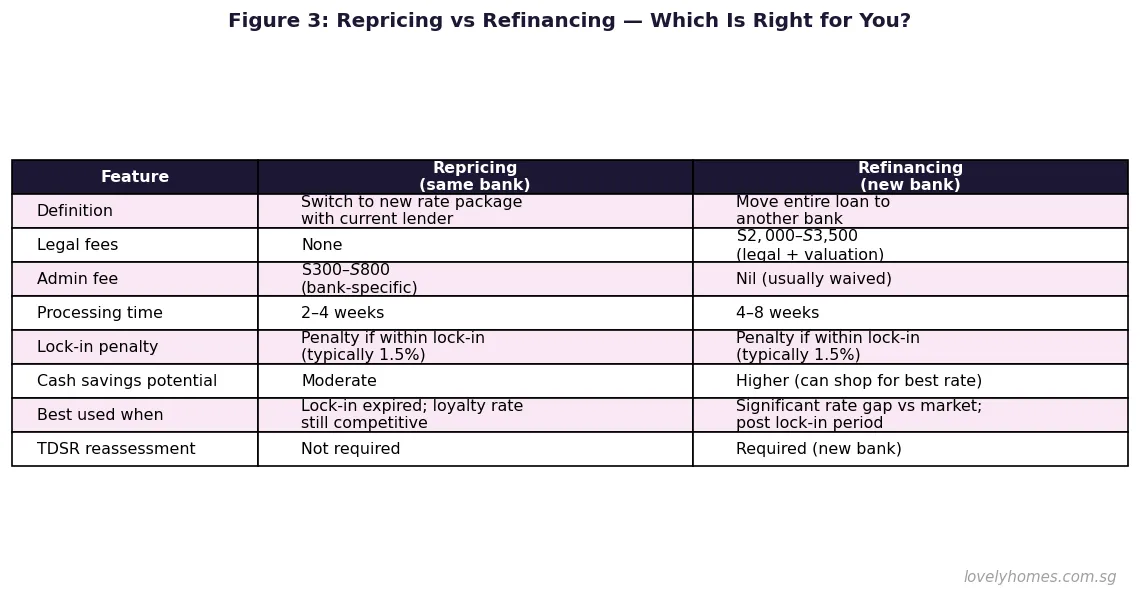
Figure 3: Repricing vs Refinancing — Key Differences and When to Choose Each

When your mortgage lock-in period expires — typically after one to three years — you face two choices: reprice with your current bank (switch to a new package, fee ~S$300–S$800, no legal process) or refinance to a new bank (full legal process, fees S$2,000–S$3,500, but potentially better rates and cashback incentives). The break-even analysis is straightforward: if the annual saving from switching rates exceeds the legal and admin costs, refinancing makes financial sense. On an S$800,000 loan, a 0.30% rate improvement saves approximately S$2,400 per year — enough to cover legal fees in 1–2 years.

Banks competing for refinancing customers often offer cashback of S$1,000–S$3,000 or fee absorption on legal and valuation costs. These incentives effectively lower the refinancing break-even to under six months in many cases. Re-assess your mortgage every time your lock-in expires, or at least every two to three years.

Worked Example: Ng Family Refinancing in 2026

Mr and Mrs Ng bought their Bishan condo in 2022 for S$1,450,000 with a bank mortgage of S$1,087,500 at a fixed rate of 1.80% for two years, which rolled onto SORA + 0.50% in early 2024 (peak SORA ~3.52%, effective rate ~4.02%). Their monthly instalment jumped from S$3,930 to S$5,191. Their lock-in expired in March 2026.

Scenario Rate Monthly Instalment Annual Cost
Current (SORA+0.50%, board revert) ~1.57% now (was 4.02%) S$3,523/mth S$42,276
Reprice with same bank (new 2-yr fixed) 1.40% S$3,418/mth S$41,016
Refinance to new bank (2-yr fixed + S$2K cashback) 1.35% S$3,386/mth S$40,632 (–legal+cashback)

Outstanding loan (March 2026): approximately S$958,000 (after ~4 years of repayments). By refinancing to the best market rate of 1.35% with a S$2,000 cashback, the Ngs save approximately S$1,640 per year versus repricing, and approximately S$1,644 per year versus staying on the current revert rate. Legal fees of S$2,800 are covered in approximately 1.5 years of savings. The Ngs choose to refinance. Total saving over the 2-year fixed period: approximately S$3,300 net of costs.

Why This Matters in Singapore’s 2026 Rate Environment

The SORA rate cycle of 2022–2026 was a defining event for Singapore property owners. Mortgage costs more than doubled between mid-2022 and mid-2024, squeezing affordability and prompting a wave of careful cash-flow planning. The subsequent easing — SORA back to 2022-era lows — has provided significant relief. For buyers entering the market in mid-2026, current rates represent one of the most favourable financing windows since the post-COVID era.

MAS continues to use macroprudential tools (LTV limits, TDSR, ABSD) rather than interest rate policy to manage property market risks. This means Singapore mortgage rates are largely driven by global rates — primarily the US Federal Reserve’s policy — rather than local inflation alone. With the Fed expected to hold or cut modestly through 2026, analysts broadly expect 3M SORA to stay below 1.5% for the remainder of the year.

What Might Come Next for Singapore Mortgage Rates

The consensus among local bank economists is that SORA will remain in the 0.7%–1.2% band through end-2026, with the next potential increase contingent on any unexpected re-acceleration of US inflation or a significant weakening of the Singapore dollar. If the Fed were to hike rates again in response to a fresh inflationary episode, SORA could rise back toward 2%–2.5% within six to twelve months. Buyers on floating SORA packages should maintain a financial buffer equal to at least three to six months of mortgage instalments to absorb any rate shock. For those on fixed packages, the certainty is already baked in — focus on planning for the re-pricing at lock-in expiry.

Frequently Asked Questions: Singapore Property Mortgages 2026

Can I switch from an HDB loan to a bank loan?

Yes, but the switch is a one-way door. Once you refinance an HDB Concessionary Loan to a bank mortgage, you cannot switch back to the HDB loan. Before making this move, compare the total interest cost over your remaining tenure carefully. The HDB loan at 2.60% is currently above the best bank rates of 1.35–1.40%, but it comes with no lock-in period, allows you to use CPF OA freely, and does not require a legal process or valuation. For smaller loan balances in later stages of the mortgage, the cost saving from switching may not justify the hassle and loss of flexibility.

What is the TDSR and how is it calculated?

The Total Debt Servicing Ratio (TDSR) is a MAS regulatory framework that caps all monthly debt obligations — including mortgage, car loan, personal loan, and credit card minimums — at 55% of gross monthly income. For a joint purchase, the combined income is used. Banks must stress-test the TDSR at a floor rate of 4% per annum (or the actual contracted rate, whichever is higher) when calculating the maximum loan quantum. This means even if you can access a 1.27% SORA mortgage today, the bank models your repayment capacity at 4%, ensuring you remain serviceable if rates rise.

Can I use CPF to pay my monthly mortgage?

Yes. CPF Ordinary Account (OA) funds can be used to service monthly mortgage instalments on private property and HDB flats, subject to the Valuation Limit (VL) and Withdrawal Limit (WL) rules. Once your cumulative CPF withdrawals reach the Valuation Limit (100% of the lower of purchase price or bank valuation), you must set aside the Basic Retirement Sum (BRS) before withdrawing further. Beyond the Withdrawal Limit (120% of the VL), CPF withdrawals are stopped entirely. Accrued interest at 2.5% p.a. on all CPF drawn must be refunded on eventual sale.

What is a lock-in period and what happens if I break it early?

A lock-in period is a contractual commitment to keep your mortgage with the same bank for a specified duration — typically one to three years. If you refinance, fully repay, or make significant partial prepayments (usually above 10–20% of the outstanding balance) within the lock-in, the bank charges a prepayment penalty of approximately 1.0%–1.5% of the amount repaid. Always read the mortgage letter carefully. For a S$1,000,000 loan, a 1.5% penalty represents S$15,000 — a significant cost that can erode any rate savings from early refinancing.

Should I take a longer or shorter loan tenure?

A longer tenure (e.g., 30 years) lowers your monthly instalment and improves TDSR headroom, but results in substantially more interest paid over the life of the loan. A shorter tenure means higher monthly payments but lower total interest cost and faster equity build-up. The optimal tenure depends on your cash flow needs, retirement timeline, and opportunity cost of capital. If you have surplus savings earning more than 1.35% (e.g., in Singapore Savings Bonds or T-bills), there may be limited benefit to over-paying the mortgage. Conversely, if you are paying high-interest credit card debt, that should be retired first.

How often can I refinance my mortgage?

There is no regulatory limit on how often you can refinance, but practically, you should refinance at each lock-in expiry to avoid penalties and maximise savings. Most borrowers refinance every two to three years. Frequent refinancing to exploit small rate differences is rarely economical once legal fees and admin costs are accounted for — the minimum rate saving worth refinancing for is typically 0.25%–0.30% per annum on a loan of S$500,000 or above. Always calculate the break-even period before committing to a new lender.

What is the MSR and when does it apply?

The Mortgage Servicing Ratio (MSR) is a tighter constraint that applies specifically to HDB flat purchases and Executive Condominium (EC) purchases (during the initial launch phase). MSR caps the monthly mortgage instalment at 30% of gross monthly income — stricter than the 55% TDSR cap. MSR applies to the mortgage for the HDB flat or EC only; other debt obligations are captured under TDSR. For a household with S$10,000 gross income, MSR limits the HDB mortgage instalment to S$3,000/month, which at 2.60% over 25 years equates to a maximum loan of approximately S$667,000.

Disclaimer: This article is for general informational purposes only and does not constitute financial or mortgage advice. Interest rates are indicative only and change daily. Always obtain formal mortgage advice from a licensed mortgage broker or banker, and verify current rates and MAS regulatory requirements at mas.gov.sg. CPF usage rules are governed by the CPF Board at cpf.gov.sg. Stamp duty obligations should be confirmed with IRAS at iras.gov.sg before committing to any property purchase.

Singapore New Launch Condo Buying Guide 2026: Everything You Need to Know Before You Sign

Singapore New Launch Condo Buying Guide 2026: Everything You Need to Know Before You Sign

×Enlarged viewClick anywhere outside to close

Quick Answer: New Launch Condo Buying Guide 2026

  • What it is: A new launch condo is sold directly by the developer, typically before or during construction. You pay in stages as the building progresses.
  • Key costs: Buyer’s Stamp Duty (BSD) of up to 6% plus Additional Buyer’s Stamp Duty (ABSD) ranging from 0% (Singapore Citizens buying their first property) to 60% (foreigners) — due within 14 days of exercising the OTP.
  • No valuation: Unlike resale, new launches do not require a bank valuation. You finance up to 75% of the purchase price via a bank loan.
  • Wait time: Expect two to five years for the keys if buying under construction. Completed units (TOP) are available for immediate occupation.
  • ABSD remission for upgraders: Singapore Citizen couples selling their HDB flat within six months of the new purchase can claim back the 20% ABSD paid on their second property.
  • 2026 landscape: CCR new launch prices have trended upward, with recent GLS awards (River Valley Green Parcel C at S$1,730 psf ppr) signalling higher future launch prices in prime locations.

What Is a New Launch Condo?

A new launch condominium is a private residential development sold directly by a licensed developer — not by a previous owner. In Singapore, new launches are typically marketed during two windows: pre-launch (exclusive VIP previews before the official sales gallery opens) and the official launch (when all units are released to the public).

Unlike a resale transaction where you buy from an individual who has already lived in or rented out the unit, a new launch is a developer-to-buyer sale. The Urban Redevelopment Authority (URA) regulates the developer and the sale under the Housing Developers (Control and Licensing) Act (Cap. 130). Developers must obtain a Sale Licence before selling any units.

New launches come in two forms. Under-construction projects are the most common: the development has received planning approval but has not obtained TOP (Temporary Occupation Permit). You pay progressively as construction milestones are met — a legally governed payment schedule under the Sale and Purchase Agreement (S&PA). Completed new launches (projects that have just obtained TOP) require full payment upfront, similar to a resale transaction, but you are buying directly from the developer with no prior owner.

Who Can Buy a New Launch Condo in Singapore?

Private residential property (including condominiums and apartments) is largely open to all buyers, subject to Additional Buyer’s Stamp Duty (ABSD) and certain landed property restrictions. The Residential Property Act (Cap. 274) restricts foreigners from buying landed residential property without prior SLA approval, but condominiums are freely purchasable by foreigners — albeit at a steep ABSD rate of 60% as at 2026.

The table below summarises eligibility and ABSD rates for a new launch condo purchase:

New launch condo BSD and ABSD stamp duty costs by buyer profile Singapore 2026
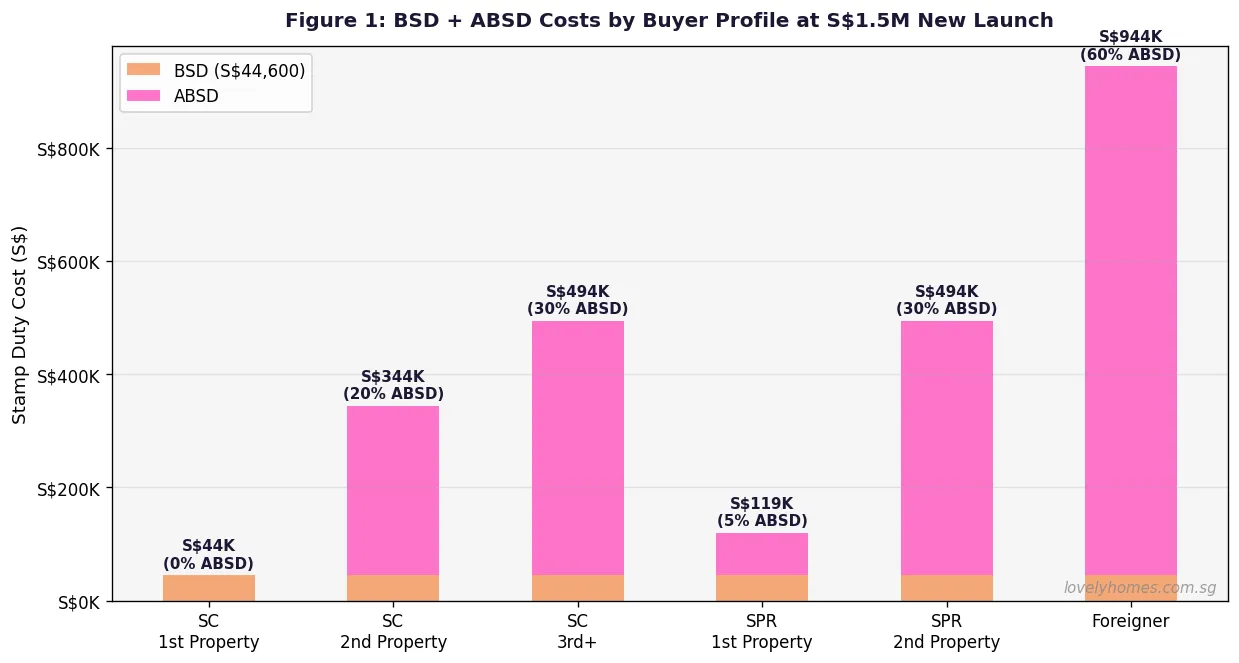
Figure 1: BSD + ABSD Stamp Duty Costs by Buyer Profile at S$1.5M New Launch Condo (June 2026 Rates)
Buyer Profile ABSD Rate (2026) BSD on S$1.5M ABSD on S$1.5M Total Stamp Duty
Singapore Citizen — 1st property 0% S$44,600 S$0 S$44,600
Singapore Citizen — 2nd property 20% S$44,600 S$300,000 S$344,600
Singapore Citizen — 3rd+ property 30% S$44,600 S$450,000 S$494,600
Singapore Permanent Resident — 1st 5% S$44,600 S$75,000 S$119,600
Singapore Permanent Resident — 2nd+ 30% S$44,600 S$450,000 S$494,600
Foreigner (any property) 60% S$44,600 S$900,000 S$944,600

BSD rates: 1% on first S$180,000; 2% on next S$180,000; 3% on next S$640,000; 4% on next S$500,000; 5% on next S$1.5M; 6% on remainder. ABSD rates effective from 27 April 2023. Source: IRAS.

The New Launch Buying Process: Step by Step

Buying a new launch condo follows a structured legal process governed by the Controller of Housing and the Sale and Purchase Agreement. Here are the key stages:

  1. Engage a property solicitor: Appoint a law firm to advise on the S&PA before you commit. Legal fees for a new launch are typically S$2,500–S$4,500.
  2. Obtain an AIP (Approval-in-Principle) from your bank: Most developers require this before you can book a unit. Your bank assesses your TDSR (Total Debt Servicing Ratio, capped at 55%) and MSR (Mortgage Servicing Ratio, 30% for HDB flats) to determine the maximum loan.
  3. Pay the Booking Fee: Upon selecting your unit, you pay 5% of the purchase price in cash as a booking fee. The developer issues you an Option to Purchase (OTP).
  4. Exercise the OTP (within 3 weeks): Within 21 days, you must exercise the OTP by signing the S&PA and paying the remaining 15% downpayment (cash or CPF Ordinary Account). Total upfront: 20% (5% cash + 15% cash/CPF).
  5. Pay BSD and ABSD: Due within 14 days of exercising the OTP. These must be paid before the S&PA can be stamped by IRAS. Failure to pay on time incurs a penalty of up to four times the stamp duty.
  6. Drawdown mortgage: Once the S&PA is stamped, your bank releases the loan. For under-construction units, the loan is drawn down progressively.
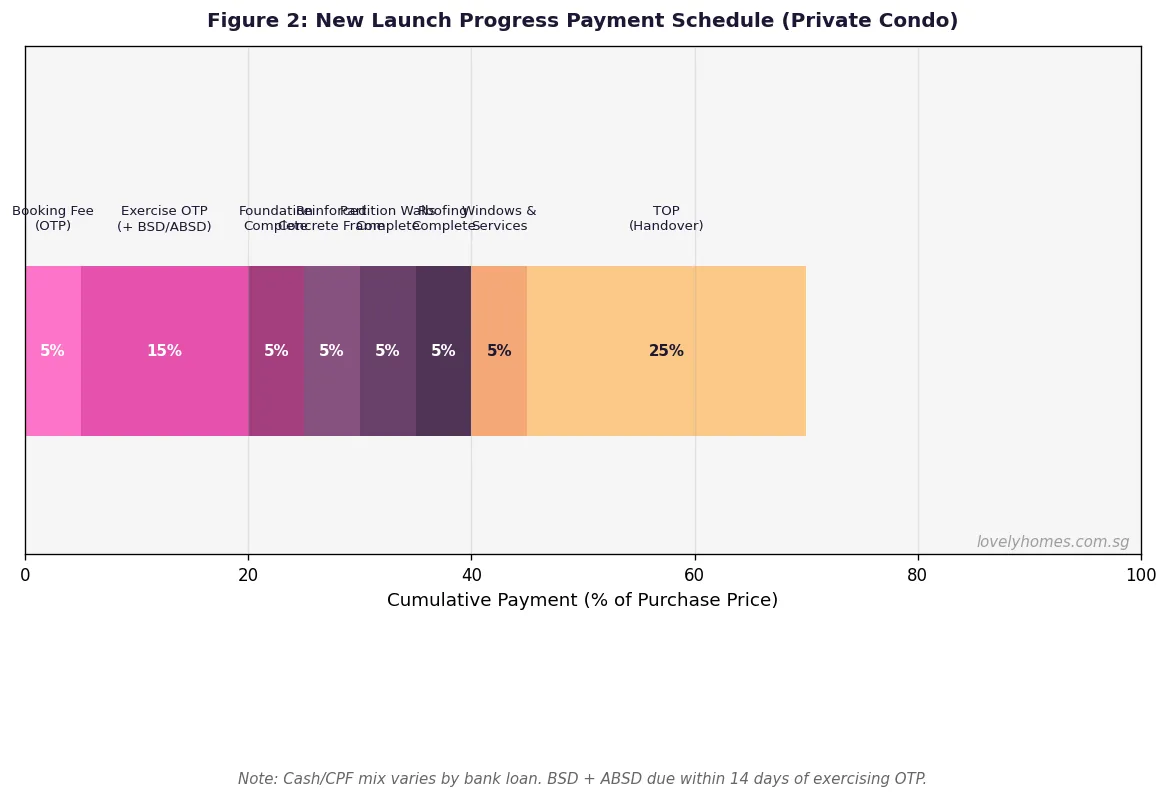
  7. Progress payments: As the developer completes each construction stage, the corresponding payment instalment is due. See Figure 2 below.
  8. TOP and key collection: When the building receives its Temporary Occupation Permit, you collect your keys and do a defects inspection. The final 5% is typically withheld as a defects retention sum, released at the Certificate of Statutory Completion (CSC) stage.
New launch condo progress payment schedule Singapore 2026
Figure 2: Progress Payment Schedule for a New Launch Condo Under Construction (Typical Private Residential Project)

For a completed new launch (unit at TOP or CSC), the entire purchase price is due at completion — typically 20% downpayment upfront and 80% financed by the bank. This is similar to a resale transaction in timing, but the Deferred Payment Scheme (DPS), if offered, allows you to defer the balance of the downpayment to TOP, paying only the booking fee upfront.

Financing a New Launch: LTV, TDSR and CPF

Banks can lend up to 75% of the purchase price for a new launch condo (the first loan, assuming no existing property loans). This is the Loan-to-Value (LTV) ratio set by the Monetary Authority of Singapore (MAS).

Your loan quantum is also constrained by the TDSR: total monthly debt obligations — including the new mortgage, car loans, personal loans, and credit card minimums — must not exceed 55% of gross monthly income. MAS requires banks to stress-test the TDSR at 4% per annum, regardless of the actual rate offered, to ensure you can service the loan even if rates rise.

CPF Ordinary Account (CPF OA) funds can be used for:

  • The 15% balance of the downpayment (after paying 5% cash)
  • Monthly mortgage instalments (reduces the cash you need each month)
  • Legal fees and stamp duty (BSD only — ABSD cannot be paid with CPF)

Note that CPF withdrawals accrue interest at 2.5% per annum (the CPF OA rate). When you eventually sell the property, all CPF principal drawn plus accrued interest must be refunded to your CPF account before you can pocket any cash proceeds.

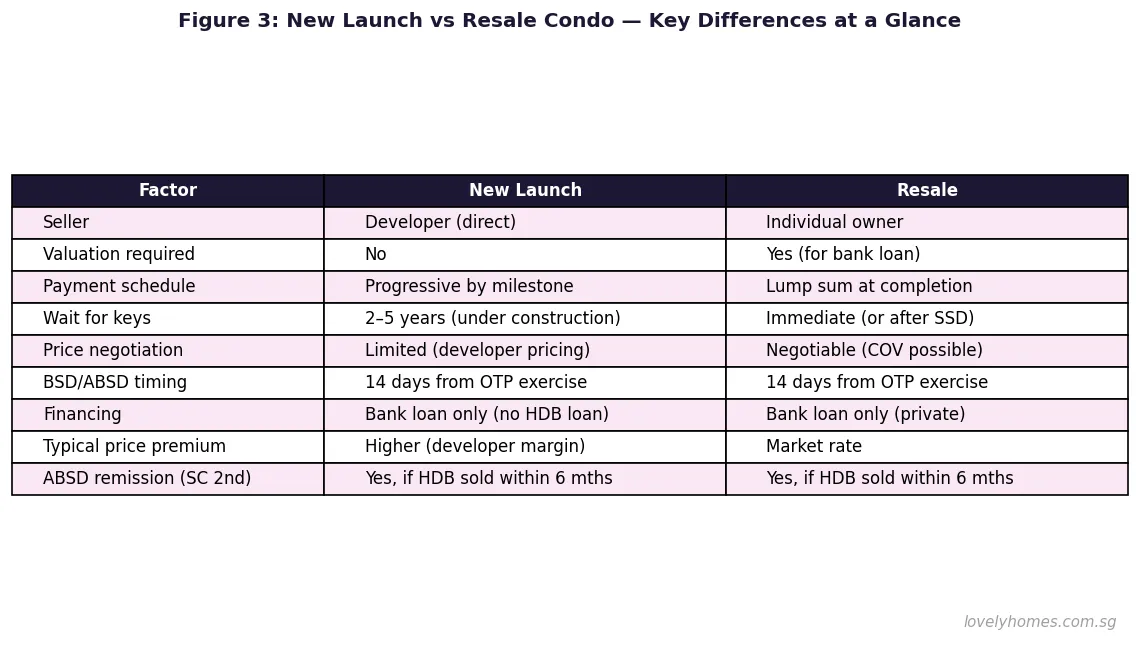
New Launch vs Resale Condo: Key Differences

New launch condo versus resale condo comparison Singapore 2026
Figure 3: New Launch vs Resale Condo — Key Differences at a Glance (Singapore 2026)

Choosing between a new launch and a resale condo involves trade-offs across price, wait time, financing, and negotiation power. New launches are priced by the developer — there is limited room for negotiation, though unit selection, floor level, and stack choice are typically available. Resale condos are priced by individual sellers and are often open to negotiation, including Cash Over Valuation (COV) in sellers’ markets or discounts in buyers’ markets.

On financing, new launches do not require a bank valuation — you borrow against the purchase price. For resale units, the bank will commission an independent valuation; if the bank’s valuation is lower than the agreed price, you must fund the shortfall in cash (COV cannot be financed).

Worked Example: SC Couple Buying a S$1.8M New Launch in the OCR

Mr and Mrs Tan are a Singapore Citizen couple. They currently own an HDB flat in Tampines (with three years left before MOP). They wish to purchase a 3-bedroom new launch condo in the Outside Central Region priced at S$1,800,000 as their second property. Here is the full cost breakdown:

Item Amount Notes
Booking fee (5% cash) S$90,000 Paid on unit selection
Balance downpayment (15%) S$270,000 Cash or CPF OA, due on OTP exercise
Buyer’s Stamp Duty (BSD) S$54,600 Due within 14 days of OTP exercise
ABSD (20% — SC 2nd property) S$360,000 Due within 14 days; refundable on remission
Legal fees (solicitor) S$3,200 Approximate
Bank loan (75% LTV) S$1,350,000 @2.8% 30yr = S$5,578/mth
Monthly TDSR (S$12,000 gross income) S$5,578 (46.5%) Below 55% cap — PASS

ABSD Remission Plan: As a Singapore Citizen couple, the Tans are entitled to a full ABSD remission if they sell their HDB flat within six months of the new launch’s Temporary Occupation Permit (TOP) date. They must apply to IRAS for the remission within six months of TOP. If successful, IRAS refunds S$360,000 — reducing the net stamp duty outlay to just S$54,600 (BSD only). The six-month window begins at TOP, not at the purchase date, giving upgraders time to plan their HDB sale around the completion of their new unit.

Total cash needed before remission: S$90,000 + S$54,600 + S$360,000 + S$3,200 = S$507,800 (of which S$270,000 can be CPF).

Total cash needed after remission: S$507,800 − S$360,000 = S$147,800 (net of CPF drawdown).

Why New Launches Matter in Singapore’s 2026 Property Market

New launches remain a cornerstone of Singapore’s private property market. URA data shows 17,032 private residential units were unsold at end Q1 2026 — a substantial pipeline, yet concentrated in certain segments and locations. Developers have been selective about launches, absorbing units from completed projects before launching new ones, which has kept absorption rates healthy.

Land acquisition costs directly influence new launch prices. The recent Government Land Sales (GLS) results are instructive: the River Valley Green Parcel C site closed on 18 June 2026 with a top bid of S$1,730 psf ppr — a new benchmark for the River Valley and Zion precinct. Translated to end-buyer prices, analysts project launches on this site could command S$3,200–S$3,800 psf, making it among the priciest new launches in 2027–2028.

For first-time SC buyers, new launches in the OCR and RCR remain the most accessible entry point into private property. ABSD at 0% on a first purchase, coupled with current bank fixed rates at 1.35–1.40% and SORA-pegged rates at ~1.27%, make 2026 a financially favourable environment compared to the 3%+ rate environment of 2024.

What Might Come Next for New Launches

The GLS pipeline for 2H2026 is set to add further supply in growth corridors including Jurong Lake District and Tengah. As completed CCR projects are absorbed, developers are likely to accelerate new launches in 2027, particularly in the RCR where demand from HDB upgraders remains strong. Watch for the formal award of River Valley Green Parcel C — when the project eventually launches (est. 2027–2028), it will set a new price ceiling for District 9 condominiums. URA Q2 2026 flash estimates, due in early July, will provide the next major data point on whether price momentum is moderating.

Frequently Asked Questions: New Launch Condo Singapore 2026

Can I use my HDB flat as collateral for a new launch condo loan?

No. HDB flats cannot be used as collateral for private property loans. Your bank will assess your eligibility purely on income, existing liabilities, and the Loan-to-Value limits set by MAS. Your HDB flat is considered a separate asset. If you still have an outstanding HDB loan, it will be factored into your TDSR calculation, reducing the maximum loan amount for your new launch purchase.

Is there a minimum cash requirement when buying a new launch?

Yes. At least 5% of the purchase price must be paid in cash as the booking fee. If your LTV is limited to 75%, the remaining 20% downpayment (after the 5% booking) can be paid using CPF OA funds. Additionally, ABSD cannot be paid with CPF — it must be funded in cash. For SC second-property buyers at the S$1.5M–S$2M price range, the ABSD alone can represent S$300,000–S$400,000 in cash outlay (refundable on remission).

What happens if I miss the 14-day deadline to pay BSD and ABSD?

Under the Stamp Duties Act, stamp duty must be paid within 14 days of the date of execution of the Sale and Purchase Agreement (in Singapore) or within 30 days if the agreement is executed overseas. Late payment incurs a penalty of up to four times the outstanding stamp duty. IRAS does consider applications for remission of late payment penalties on a case-by-case basis, but this is not guaranteed. Engage your solicitor well in advance to ensure stamp duty is paid on time.

Can foreigners buy a new launch condo in Singapore?

Yes, with restrictions. Foreigners can freely buy non-landed private residential properties such as condominiums and apartments, subject to paying ABSD at 60% of the purchase price as at 2026. Foreigners cannot purchase landed residential property (terrace houses, semi-detached, bungalows) without prior approval from the Singapore Land Authority (SLA) under the Residential Property Act. The 60% ABSD rate, introduced in April 2023, has significantly reduced foreign buyer activity — accounting for under 5% of new launch transactions in 2025–2026.

What is the Deferred Payment Scheme (DPS) and how does it work?

The Deferred Payment Scheme (DPS) applies to completed new launch units (those that have already obtained TOP). Under DPS, you pay only a small initial amount (typically 5–10% of the purchase price) at booking, and defer the remaining balance until you exercise the OTP and arrange financing. This gives buyers a window of 3–6 months to sell an existing property and arrange their finances before committing fully. DPS is offered at the developer’s discretion and typically carries a slight price premium over the normal payment scheme. It is not available for under-construction projects.

How are new launch condo prices set? Can I negotiate?

New launch prices are set by the developer, guided by recent comparable sales, land cost, construction cost, and projected profit margins. Developers typically release units at carefully calibrated prices by stack, floor, and facing, often with a price ladder (higher floors cost more). There is limited room to negotiate the base price, though you may negotiate on inclusions, car park allocation, or fit-out upgrades. Buyers do, however, benefit from developer incentives such as early-bird discounts, stamp duty absorption (increasingly rare post-2023 ABSD hikes), and legal fee rebates during soft launches.

What should I check before signing the Option to Purchase?

Before signing the OTP for any new launch, verify the following: (1) the developer’s Sale Licence number (from the Controller of Housing at the Ministry of National Development); (2) that the development charge and differential premium, if any, have been paid and the Grant of Written Permission is in order; (3) your AIP is confirmed and the loan quantum covers 75% of the purchase price; (4) your solicitor has reviewed the S&PA, particularly the defects liability period, the completion milestone schedule, and the developer’s liability for delays; and (5) you have a clear plan for BSD, ABSD, and downpayment financing, with cash reserves confirmed. Do not sign under pressure — the standard OTP gives you 21 days to exercise, and legitimate developers do not pressure you to sign immediately.

Disclaimer: This article is for general informational purposes only and does not constitute financial, legal, or property advice. Stamp duty rates, LTV limits, and ABSD rules are subject to change by the Singapore government. Always verify current rates with the Inland Revenue Authority of Singapore (IRAS) at iras.gov.sg, the Urban Redevelopment Authority (URA) at ura.gov.sg, and the Monetary Authority of Singapore (MAS) at mas.gov.sg. Consult a licensed property solicitor, mortgage broker, and financial adviser before committing to any property purchase.

Singapore Property Agent Commission Guide 2026

Singapore Property Agent Commission Guide 2026

⚡ Quick Answer: Property Agent Commission Singapore 2026

  • Agent commission is negotiable — there are no legally fixed rates in Singapore. Industry benchmarks exist but are not mandated.
  • HDB resale sellers typically pay 1%–2%; HDB resale buyers typically pay 0%–1% of purchase price, plus 9% GST.
  • Private property sellers typically pay 1%–2%; private property buyers typically pay 0%–1%, plus 9% GST.
  • New launch condo buyers pay nothing — the developer pays the buyer’s agent commission directly (typically 1%–3% of purchase price).
  • Rental transactions: landlords and tenants each typically pay half a month’s rent for leases under 24 months; one month’s rent for longer leases.
  • All agents must be CEA-licensed and must sign a Client’s Agreement (CA) with you before conducting any work on your behalf — mandated under the Estate Agents Act.
  • Verify your agent at cea.gov.sg before signing anything. An unlicensed “agent” cannot legally claim commission and may expose you to fraud risk.

Property Agent Commission in Singapore: Who Pays What and Why

In Singapore’s property market, agent commission is one of the largest transaction costs after stamp duties — yet it remains one of the least understood. Unlike stamp duty, which is set by law and published in IRAS schedules, agent commission has no statutory fixed rate. The Council for Estate Agencies (CEA), which regulates all property agents under the Estate Agents Act (Cap. 95A), has never mandated a specific commission percentage. Instead, it publishes broad guidelines and requires that all commissions be agreed in writing via a Client’s Agreement before an agent begins work.

This means that the rates you see quoted — 1% for HDB buyers, 2% for private sellers — are industry convention rather than law. In practice, they are widely observed but negotiable, particularly for high-value transactions or where a single agent represents both buyer and seller (co-broking arrangements).

Understanding the standard rates, who pays whom, and what the commission covers can help you plan your transaction budget accurately and negotiate confidently.

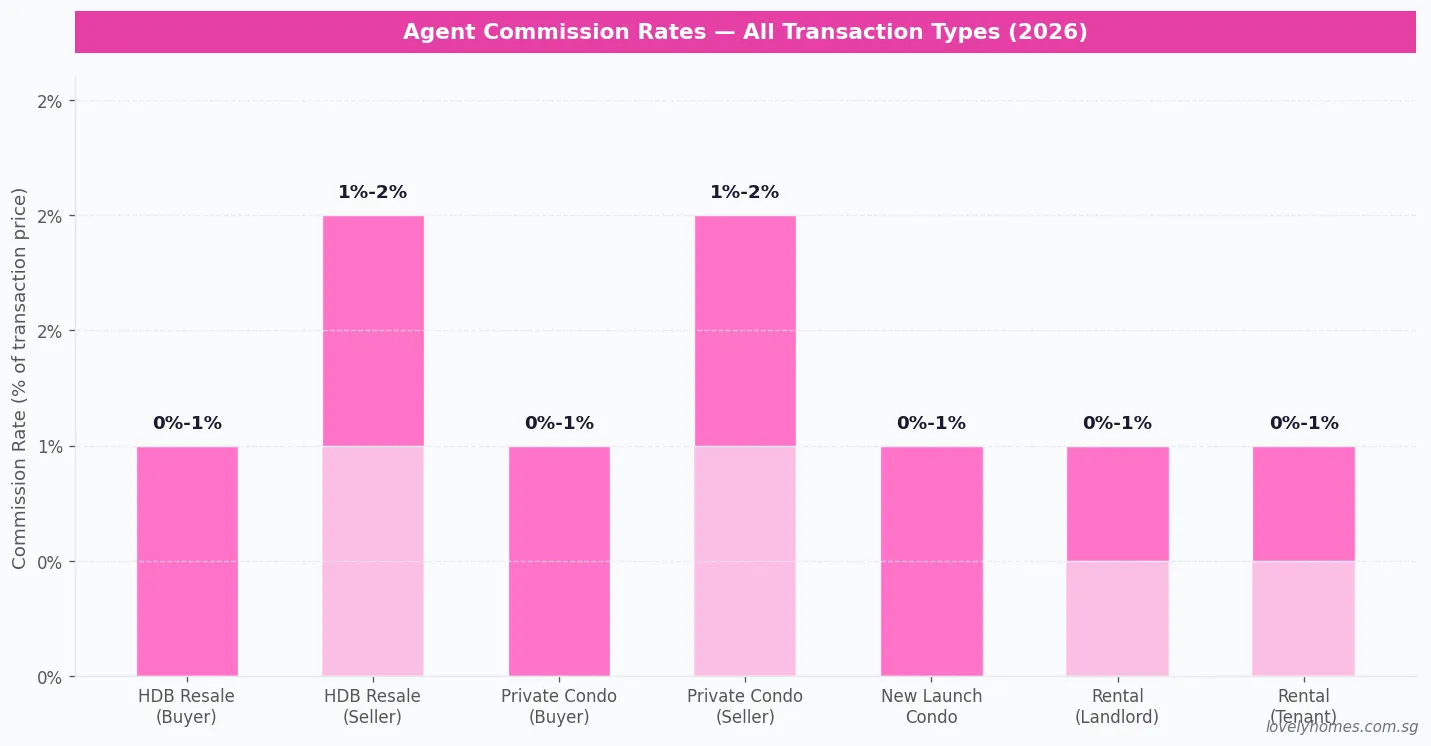
Singapore property agent commission rates 2026 — all transaction types including HDB, private condo, and rental
Figure 1: Industry benchmark commission rates by transaction type. All rates are subject to negotiation and exclusive of 9% GST. New launch buyer commission is paid by the developer, not the buyer. Source: CEA guidelines; LovelyHomes research.

Commission Rates by Transaction Type

HDB resale transactions: For buyers, the industry benchmark is 0% to 1% of the purchase price; many HDB buyers negotiate the buyer-side commission down or even to zero, since developers do not incentivise buyer agents the way new-launch projects do. For sellers, the benchmark is 1% to 2%. A seller paying 2% on an S$620,000 HDB flat will pay S$12,400 plus 9% GST = S$13,516.

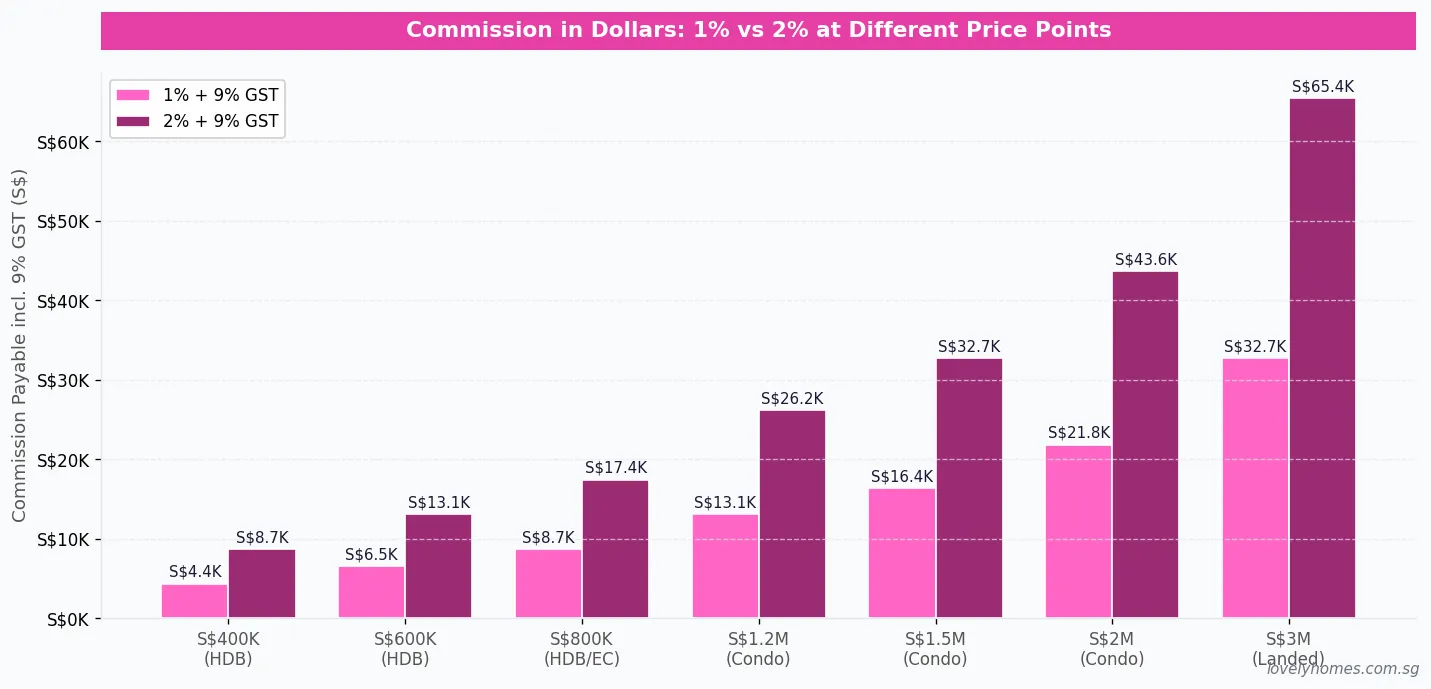
Private residential (resale condominiums, apartments, landed): For buyers, 0%–1% is typical. For sellers, 1%–2% is typical. Co-broking is standard — each agent receives their respective commission from their own client. At S$2,000,000, a seller paying 2% pays S$43,600 inclusive of GST.

New launch condominiums: Buyers pay nothing — developer commission structures compensate the buyer’s agent directly, typically at 1%–3% of the purchase price depending on developer marketing budget. This is why agents are often more enthusiastic about showing new launches than resale properties. The commission comes from the developer’s marketing spend, which is embedded in the developer’s pricing model.

Rental transactions: The standard for leases of 24 months or less is one month’s rent split equally between the landlord’s agent and the tenant’s agent (0.5 months each, plus GST). For leases longer than 24 months, the benchmark rises to one month’s rent each. Short-term rentals or corporate leases may attract different structures negotiated case by case.

GST note: Property agents are GST-registered if their annual turnover exceeds the GST registration threshold. As of 1 January 2024, GST is charged at 9%. Always confirm whether a quoted commission is inclusive or exclusive of GST.

Singapore property agent commission in dollars 2026 — at different price points, 1% vs 2% plus 9% GST
Figure 2: Commission payable in absolute dollar terms (inclusive of 9% GST) at 1% and 2% for a range of property prices. The left bar in each pair is 1% (buyer-side benchmark); the right bar is 2% (seller-side upper benchmark). Source: LovelyHomes calculation.

Commission Summary Table

Transaction Type Buyer Pays Seller / Landlord Pays Basis Notes
HDB resale flat 0%–1% of purchase price 1%–2% of sale price % of transacted price Both + 9% GST. Negotiable.
Private condo / apartment resale 0%–1% of purchase price 1%–2% of sale price % of transacted price Both + 9% GST. Negotiable.
Landed property resale 0%–1% of purchase price 1%–2% of sale price % of transacted price Both + 9% GST. Negotiable.
New launch condominium Nil (paid by developer) Developer pays buyer agent 1%–3% Developer marketing budget Buyer incurs no direct commission cost.
Residential rental (≤24 mths) 0.5 mth rent + GST 0.5 mth rent + GST Per-lease Split 50/50 between landlord agent and tenant agent.
Residential rental (>24 mths) 1 mth rent + GST 1 mth rent + GST Per-lease Higher commission for longer commitments.

CEA Licensing and the Client’s Agreement

Every person conducting estate agency work in Singapore must hold a valid salesperson registration or estate agency licence issued by the Council for Estate Agencies (CEA), established under the Estate Agents Act 2010. The CEA maintains a public register at cea.gov.sg where anyone can look up an agent’s registration number, licence status, agency affiliation, and disciplinary history.

Before an agent may commence any work on your behalf — searching for properties, arranging viewings, submitting offers — they are required by the CEA Code of Practice to provide and have you sign a Client’s Agreement (CA). The CA specifies the scope of work, the agreed commission rate, and the duration of the engagement. Signing the CA creates a binding contract. Without a signed CA, any commission claim by the agent is difficult to enforce.

If an agent pressures you to make an offer or view properties without first providing a CA, this is a CEA breach and a red flag. You should decline and find another agent.

CEA agent verification 6-step process — how to check a Singapore property agent is licensed in 2026
Figure 3: Six-step process for verifying a property agent via the CEA Public Register. Red flags in the final column indicate situations where you should cease dealings immediately. Source: CEA Estate Agents Act Cap 95A; LovelyHomes.

Worked Example: The Nair Family Sells Their D15 Condo

Mr and Mrs Nair decide to sell their freehold 3-bedroom condominium in District 15 (East Coast area). The property is listed at S$2,200,000 and eventually transacts at S$2,150,000.

They engage a seller’s agent at a negotiated commission of 1.5% (rather than the 2% upper benchmark), inclusive of marketing costs. Their buyer transacts through a separate buyer’s agent at 1% (paid by the buyer).

Commission calculation for the Nairs (sellers): S$2,150,000 × 1.5% = S$32,250. Add 9% GST = S$32,250 × 1.09 = S$35,152.50.

Commission calculation for the buyer: S$2,150,000 × 1% = S$21,500. Add 9% GST = S$21,500 × 1.09 = S$23,435.

The Nairs save S$10,750 pre-GST by negotiating from 2% to 1.5%. The saving is meaningful — equivalent to roughly one additional monthly mortgage payment.

Negotiation tip: Commission is most negotiable when (a) the property is priced competitively and likely to move quickly, (b) you offer exclusivity to one agent rather than engaging multiple agents simultaneously, or (c) you are conducting both a sale and purchase simultaneously through the same agency. Use these levers before signing the Client’s Agreement.

Why Agent Commission Matters: Singapore in Context

At first glance, 1%–2% might sound modest. But on a S$2,000,000 private condominium, the combined buyer and seller commission (at 1% + 2%) totals S$60,000 before GST — S$65,400 inclusive of GST. That is a material transaction cost, often comparable to two to three months of gross household income for many Singapore buyers.

Unlike in some markets where buyer agents are paid from a shared commission pool, Singapore’s market structure is transparent: each side typically pays their own agent. This reduces conflicts of interest but means buyers who forgo representation on new launches (where they pay nothing for a buyer’s agent) are effectively subsidising the developer’s marketing cost through the purchase price.

The CEA has discussed introducing more formal commission disclosure requirements in recent consultations, though no regulatory change had been announced as at June 2026. Buyers and sellers should nonetheless insist on a written, signed Client’s Agreement specifying the exact commission before any agent commences work on their behalf.

What Might Change in Agent Commission Rules

The CEA periodically reviews its Code of Practice for professional standards. Industry observers have noted ongoing discussion about whether a formal commission disclosure framework — similar to what exists in Australia — should be introduced to increase transparency. As at June 2026, commission rates remain entirely negotiable with no mandatory disclosure beyond what must appear in the Client’s Agreement. Buyers should monitor CEA announcements for any changes to co-broking standards or commission disclosure obligations.

Frequently Asked Questions

Is agent commission legally fixed in Singapore?

No. The Council for Estate Agencies (CEA) does not prescribe fixed commission rates. What it mandates is that any agreed commission must be documented in a signed Client’s Agreement before the agent commences work. The rates quoted throughout this article — 1%, 2%, half a month’s rent — are industry conventions that have become widely expected but are legally negotiable. An agent cannot demand a specific rate; the rate is whatever you and the agent agree and document.

Do I need a buyer’s agent when buying a new launch condo?

No, you do not — but having one costs you nothing because the developer pays the buyer’s agent commission directly. A buyer’s agent for a new launch can help you compare projects, assess floor plans, check price comparables, and advise on unit selection without charging you any fee. Using a buyer’s agent for new launches is therefore generally rational from a cost perspective.

Can one agent represent both buyer and seller (dual representation)?

Yes, but with restrictions. The CEA code permits an agent to act for both parties in a transaction (known as dual representation or co-broking by the same agent), but the agent must inform both parties, obtain their written consent, and act fairly to both sides. In practice, many experienced buyers and sellers prefer independent agents to avoid any conflict of interest. If a single agent represents both sides, it is common for the commission arrangement to be negotiated down to reflect the reduced workload.

What is the CEA Client’s Agreement and is it compulsory?

The Client’s Agreement (CA) is a written contract between you and your agent that specifies the scope of work (e.g., marketing your property, sourcing a tenant), the agreed commission, the duration of the engagement, and the agent’s obligations under the CEA Code of Practice. Signing the CA is compulsory under CEA rules before the agent may commence any estate agency activity on your behalf. Without a signed CA, the agent cannot legally enforce a commission claim if the transaction is completed.

What if I find a buyer myself — do I still owe commission?

It depends on your Client’s Agreement. If you signed an exclusive CA with an agent for a specified period, and you introduce a buyer yourself during that exclusive period, the agent may still be entitled to commission under the terms of the agreement. If you have a non-exclusive CA, and you find a buyer independently without the agent’s involvement, you may be able to argue no commission is owed — but the exact terms of your signed CA govern. Always read the CA carefully before signing, particularly the exclusivity clause.

How do I check if my agent is properly licensed?

Visit the CEA Public Register at cea.gov.sg/public-register and search by the agent’s name or registration number (which all agents are required to display on namecards, marketing materials, and messaging). Verify the status shows “Active”, check the estate agency affiliation matches what the agent told you, and review any disciplinary records. This takes under two minutes and is strongly recommended before signing any agreement.

Is agent commission subject to GST?

Yes, for GST-registered agents. As of 1 January 2024, GST in Singapore is charged at 9%. If your agent or their agency is GST-registered (mandatory once their annual turnover exceeds S$1 million), they will charge GST on top of the agreed commission. This means a 2% commission on a S$1,500,000 property becomes S$30,000 + 9% GST = S$32,700. Always clarify whether quoted commission rates are inclusive or exclusive of GST before signing the Client’s Agreement.

Related Articles


Disclaimer: This article is for general informational purposes only and does not constitute professional real estate, financial, or legal advice. Commission rates are industry benchmarks and are subject to negotiation. All agents must be CEA-licensed; verify at cea.gov.sg. For official guidance on estate agency regulation, refer to the Council for Estate Agencies at cea.gov.sg and the IRAS GST guidelines at iras.gov.sg.

Singapore TDSR Guide 2026: Total Debt Servicing Ratio Explained

Singapore TDSR Guide 2026: Total Debt Servicing Ratio Explained

⚡ Quick Answer: TDSR Singapore 2026

  • TDSR stands for Total Debt Servicing Ratio — a MAS rule capping all monthly debt repayments at 55% of gross monthly income.
  • All debts count: mortgage, car loan, personal loan, student loan, credit line, renovation loan — every obligation.
  • HDB and EC buyers face two limits: TDSR 55% (all debts) and MSR 30% (the HDB/EC mortgage alone).
  • Gross income is used, including CPF. Variable income (commission, bonuses) is typically haircut by 30%.
  • TDSR was reduced from 60% to 55% on 30 September 2022 — the tightening that cooled the 2022 market.
  • Banks stress-test at a slightly higher rate than your actual rate to ensure you can cope with rate rises.
  • Exceeding 55% = loan declined — no exceptions under MAS Notice 645 for residential property loans.

What Is TDSR and Why Did MAS Introduce It?

The Total Debt Servicing Ratio (TDSR) is a financial prudential measure introduced by the Monetary Authority of Singapore (MAS) on 29 June 2013 under MAS Notice 645. It requires every MAS-regulated financial institution in Singapore to verify that a borrower’s aggregate monthly debt obligations — across all loans, not just the new mortgage — do not exceed 55% of gross monthly income before extending a property loan.

The policy was created in response to a prolonged low-interest-rate environment that was encouraging households to borrow heavily for property. Without TDSR, a borrower could theoretically obtain a mortgage even if their total monthly repayments consumed 80% or more of their income. TDSR closed that gap by introducing a single universal ceiling enforced across all lenders simultaneously.

On 30 September 2022, MAS tightened the TDSR from 60% to its current 55%, as part of a package of property cooling measures. This 5-percentage-point reduction effectively cut maximum loan sizes by approximately 8-10% and is credited with contributing to the slower price growth seen in 2023 through 2025.

TDSR breakdown: example monthly debt obligations versus MAS 55% cap, Singapore 2026
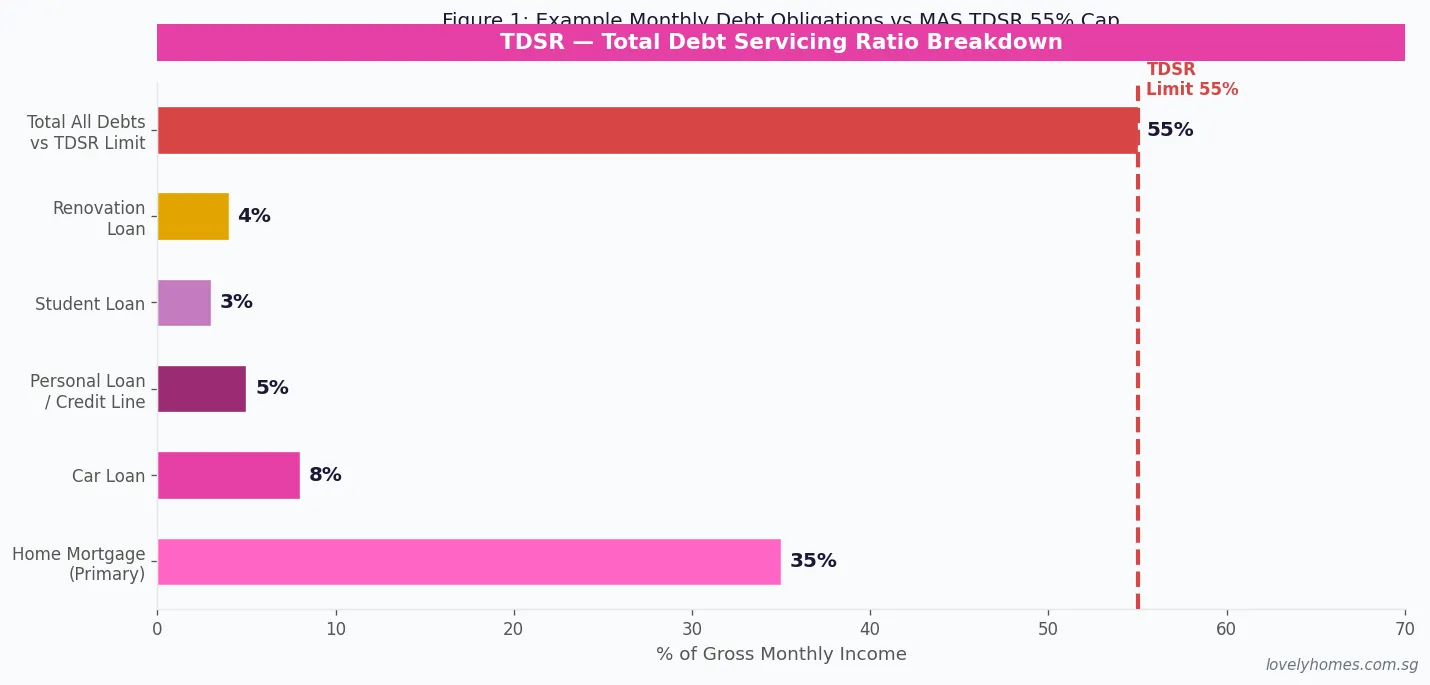
Figure 1: Illustrative household with S$10,000 gross monthly income. The bars show how individual debts each consume a share of income, and how the 55% TDSR ceiling constrains the total. Source: MAS Notice 645; illustration by LovelyHomes.

How TDSR Is Calculated

The TDSR formula is:

TDSR = Total Monthly Debt Obligations ÷ Gross Monthly Income × 100
Must be ≤ 55% for a residential property loan to be approved under MAS Notice 645.

Gross monthly income includes fixed salary (before CPF deduction), allowances, and discounted variable pay. Variable components — commissions, overtime, bonuses, rental income — are typically reduced by 30% (i.e., the bank counts only 70% of such income). Self-employed borrowers must provide at least two years of IRAS Notices of Assessment; the bank uses the lower of the two-year average or the latest year’s net trade income, often with a further haircut.

Total monthly debt obligations covers: the proposed new property mortgage (at the bank’s applicable stress-test rate, which may be 0.5%–1% above your actual rate), all existing property loans, car hire purchase instalments, personal loan repayments, student loan repayments, credit card minimum payments (typically 5% of outstanding balance per month), and renovation loans.

If you own another property with an outstanding mortgage, that entire monthly repayment is included in your TDSR calculation for any new loan application. This is the key reason why owning multiple properties progressively reduces your borrowable amount on each subsequent purchase.

TDSR affordability chart: maximum property price by gross monthly income, Singapore 2026
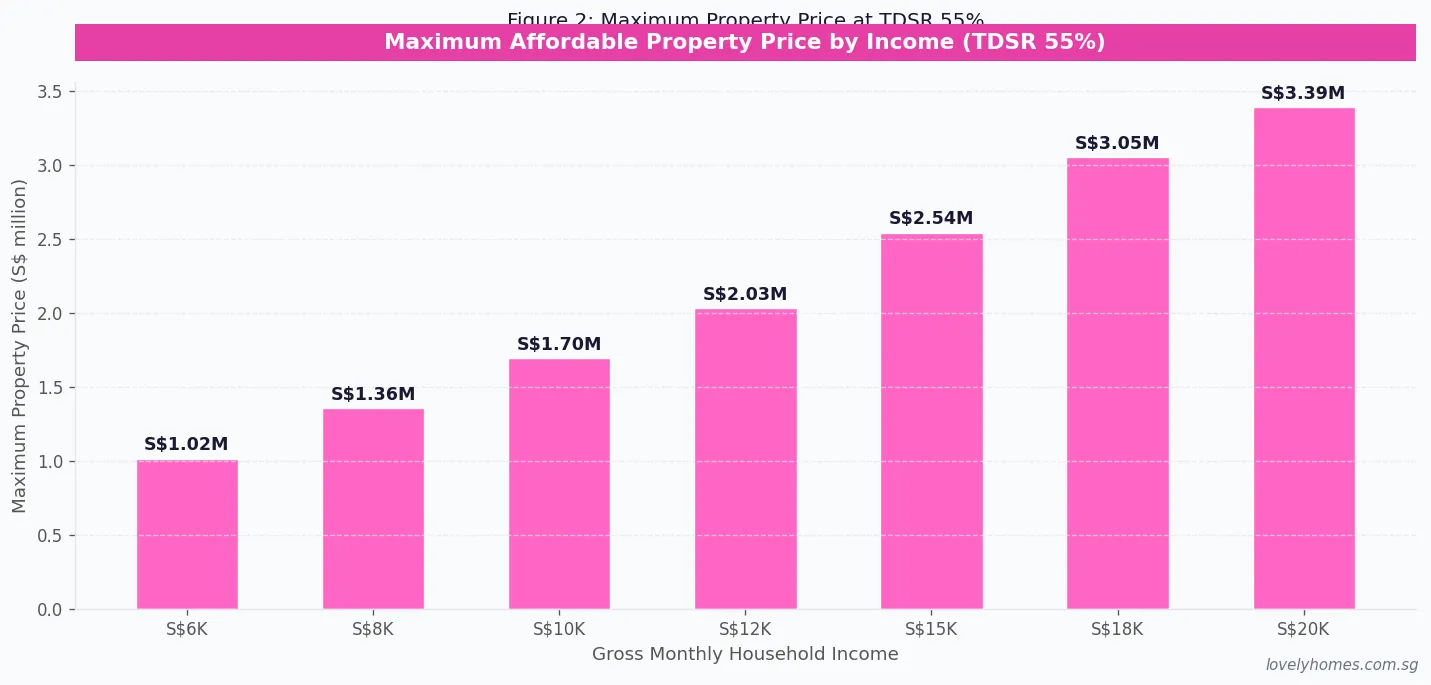
Figure 2: Maximum property price at TDSR 55% with no other debts, 30-year bank loan at 3.2% p.a., 75% LTV. The chart shows the affordability ceiling for clean-balance-sheet borrowers. Source: LovelyHomes calculation.

TDSR for Different Property Types

The TDSR framework applies to all property loans extended by MAS-regulated financial institutions, but the practical constraints differ by property type:

Private residential (condominiums, apartments, landed homes): TDSR 55% applies. There is no separate MSR restriction. LTV starts at 75% for a first property, falling to 45% and 35% for second and subsequent properties respectively.

HDB resale flats (bank loan): Both TDSR 55% and MSR 30% apply simultaneously. MSR requires that the monthly HDB mortgage payment alone must not exceed 30% of gross income. MSR is usually the binding constraint for most HDB buyers since 30% is typically hit before the 55% TDSR ceiling.

HDB resale flats (HDB loan): The HDB Concessionary Loan is administered by HDB, not subject to MAS Notice 645 in the same way, but HDB applies its own 30% MSR equivalent. The HDB loan rate is pegged at 0.1% above the CPF OA rate, currently 2.6% per annum (effective 1 January 2026).

Executive Condominiums: Both TDSR 55% and MSR 30% apply at point of purchase. After the five-year mark, once an EC is privatised, resale buyers are only subject to TDSR (no MSR restriction).

Commercial and industrial property: TDSR applies but MAS sets the cap for non-residential property loans at 60% — a more lenient threshold than the 55% residential cap.

TDSR vs MSR comparison table — Total Debt Servicing Ratio vs Mortgage Servicing Ratio Singapore 2026
Figure 3: TDSR vs MSR side-by-side across eight dimensions. For HDB and EC buyers, both ratios apply simultaneously — the more restrictive constraint governs. Source: MAS Notice 645, MAS Notice 632; LovelyHomes.

TDSR and MSR — Summary Table

Loan / Property Type TDSR Cap MSR Cap LTV (1st Prop.) Notes
Private condo / landed (1st property) 55% None 75% 5% cash + CPF for balance of DP
Private condo / landed (2nd property) 55% None 45% 25% cash mandatory downpayment
Private condo / landed (3rd+ property) 55% None 35% 25% cash mandatory downpayment
HDB resale flat (bank loan) 55% 30% 75% Both caps apply; MSR typically binds first
HDB resale flat (HDB loan) N/A 30% 80% No cash DP required; CPF OA used
Executive Condominium (at launch) 55% 30% 75% 5% cash booking fee; MSR applies
Commercial / industrial property 60% None Up to 70% Higher TDSR cap for non-residential loans

Worked Example: Mr and Mrs Ong Buy Their First Private Condo

Mr and Mrs Ong are a Singapore Citizen couple. Combined gross monthly income: S$12,000 (Mr Ong S$7,500 fixed; Mrs Ong S$4,500, of which S$2,000 is commission).

Existing debts: car hire purchase S$850 per month; personal loan S$300 per month.

Target property: OCR 3-bedroom condo at S$1,500,000. Bank loan 75% LTV = S$1,125,000 over 30 years at 3.2% p.a. Monthly repayment: approximately S$4,862.

Income adjustment: Mrs Ong’s S$2,000 commission is haircut by 30% (bank counts S$1,400). Qualifying income = S$7,500 + S$2,500 fixed + S$1,400 variable = S$11,400 per month.

TDSR calculation: Total obligations = S$4,862 (new mortgage) + S$850 (car) + S$300 (personal) = S$6,012 per month. TDSR = S$6,012 ÷ S$11,400 = 52.7% — below the 55% cap. Loan approved (subject to credit assessment and valuation).

Sensitivity: If the Ongs wished to buy at S$1,700,000 instead (loan S$1,275,000, repayment ~S$5,517), total obligations would rise to S$6,667, giving TDSR = 58.5% — which exceeds 55%. The S$1,700,000 purchase would be declined unless they clear the car loan (saving S$850/mth) or increase their qualifying income.

Lesson: A single car loan can cost you S$200,000+ in purchasing power. Clearing non-housing debts before applying for a mortgage is one of the most effective ways to maximise your TDSR headroom.

Why TDSR Matters: Singapore in Global Context

Singapore’s TDSR framework is widely regarded as one of the most comprehensive income-based mortgage controls in the Asia-Pacific region. Countries like Australia and the UK use similar debt-to-income concepts in their macroprudential toolkits, but Singapore’s version is legally binding on all lenders — there is no discretion to override it for high-net-worth clients or particularly creditworthy borrowers.

The practical effect is a structurally cautious mortgage market. Singapore mortgage arrears remain among the lowest in Asia, and the 2022 cooling measures (which included the TDSR tightening) contributed to a soft-landing scenario rather than a sharp price correction. For buyers, this means the market is protected from speculative excess, but also that stretching to buy at the top of your affordability range carries real interest-rate risk if rates rise post-purchase.

What Might Change in TDSR Policy

MAS reviews the TDSR threshold as part of its broader macroprudential toolkit, typically alongside reviews of LTV limits and stamp duty rates. With the 3-month compounded SORA having eased to approximately 1.0% in early 2026, some market observers have speculated whether MAS might loosen the TDSR to 60% if sustained rate normalisation persists. However, as at June 2026, no public consultation or announcement has been made. Prospective buyers should plan all financing decisions on the current 55% threshold and not rely on any anticipated easing.

Frequently Asked Questions

Does CPF count as income in the TDSR formula?

The gross monthly income used in TDSR is your gross salary before CPF deduction. CPF contributions are not separately added — they are already implicit in the gross figure. However, CPF OA contributions do help service the mortgage (reducing your cash outlay), which gives HDB buyers and those using CPF for loan repayment meaningful payment relief even though the income figure itself is unchanged in the TDSR calculation.

Can I exclude a loan that will be fully paid in six months?

Some banks will exclude short-term residual debt (typically fewer than 6 to 12 months remaining) from the TDSR calculation at their discretion, since such obligations will not affect long-term serviceability. Policies differ by bank. If your car loan has only a few months left, it is worth asking your mortgage banker whether it will be included. Alternatively, fully clearing the loan before applying can improve your TDSR ratio — and often has an outsized positive impact on your maximum loan quantum.

What if my TDSR exceeds 55%?

A bank is required under MAS Notice 645 to decline your application if TDSR exceeds 55%. There is no exception or waiver for residential property loans. Your options are to: (a) make a larger downpayment to reduce the loan amount and therefore the monthly mortgage obligation; (b) clear existing debts before applying; (c) choose a lower-priced property; or (d) add a co-borrower whose income improves the combined TDSR, provided that person’s debts do not make things worse.

How is TDSR calculated for the self-employed?

Banks require at least two years of IRAS Notices of Assessment and, for incorporated businesses, audited or signed financial statements. Qualifying income is typically the lower of the two-year average or the most recent year’s net trade income. Many banks apply an additional haircut of 20–30% on top of this. Self-employed borrowers should expect their qualifying income to be assessed conservatively, which reduces their maximum mortgage relative to a salaried employee with the same stated earnings.

Does TDSR apply when I refinance?

Yes. Refinancing is a new loan application and must satisfy TDSR at the time of application. If your financial circumstances have changed since your original purchase — new debts, a drop in income — you may find you fail the current TDSR test even if you passed it years ago. This is an important practical risk for borrowers on fixed-rate packages coming up for repricing who intend to switch lenders.

Is TDSR the same as DSCR?

No. TDSR is a consumer-lending rule for individuals applying for property loans in Singapore. DSCR (Debt Service Coverage Ratio) is a commercial-lending metric used for corporate or commercial real estate loans; it measures whether a property’s net operating income covers its debt service. A residential buy-to-let investor is subject to TDSR on the individual borrower side; a developer or company owning commercial property typically uses the DSCR framework instead.

Joint purchase — is TDSR calculated on combined income?

Yes. Joint borrowers’ incomes are pooled and their debts are also pooled. This generally allows a couple to qualify for a much larger loan than either could secure individually. However, if one co-borrower carries significant debts (a large car loan, for instance), those debts also enter the combined TDSR calculation and reduce the joint loan quantum. Both parties will need to provide full income and liability documentation.

Related Articles


Disclaimer: This article is for general informational purposes only and does not constitute financial, tax, or legal advice. TDSR rules and MAS policies are subject to change without notice. All borrowers should seek independent advice from a licensed financial adviser or mortgage broker, and verify current rules directly with the Monetary Authority of Singapore at mas.gov.sg and the Housing & Development Board at hdb.gov.sg.

Translate »