Singapore HDB Renovation Guide 2026: Costs, Rules, Timeline and Grants
Quick Answer — HDB Renovation 2026 at a glance
- HDB flat owners may renovate only after receiving keys and HDB’s written consent for regulated works.
- Total renovation budgets for a 4-room HDB flat typically range from S$30,000 to S$80,000 in 2026.
- Works requiring HDB approval include wall hacking, toilet alterations, and carpentry; most require the contractor to be registered with HDB.
- BTO flat owners face a Goodwill Repair Allowance from HDB (up to S$3,000 for defects) separate from renovation.
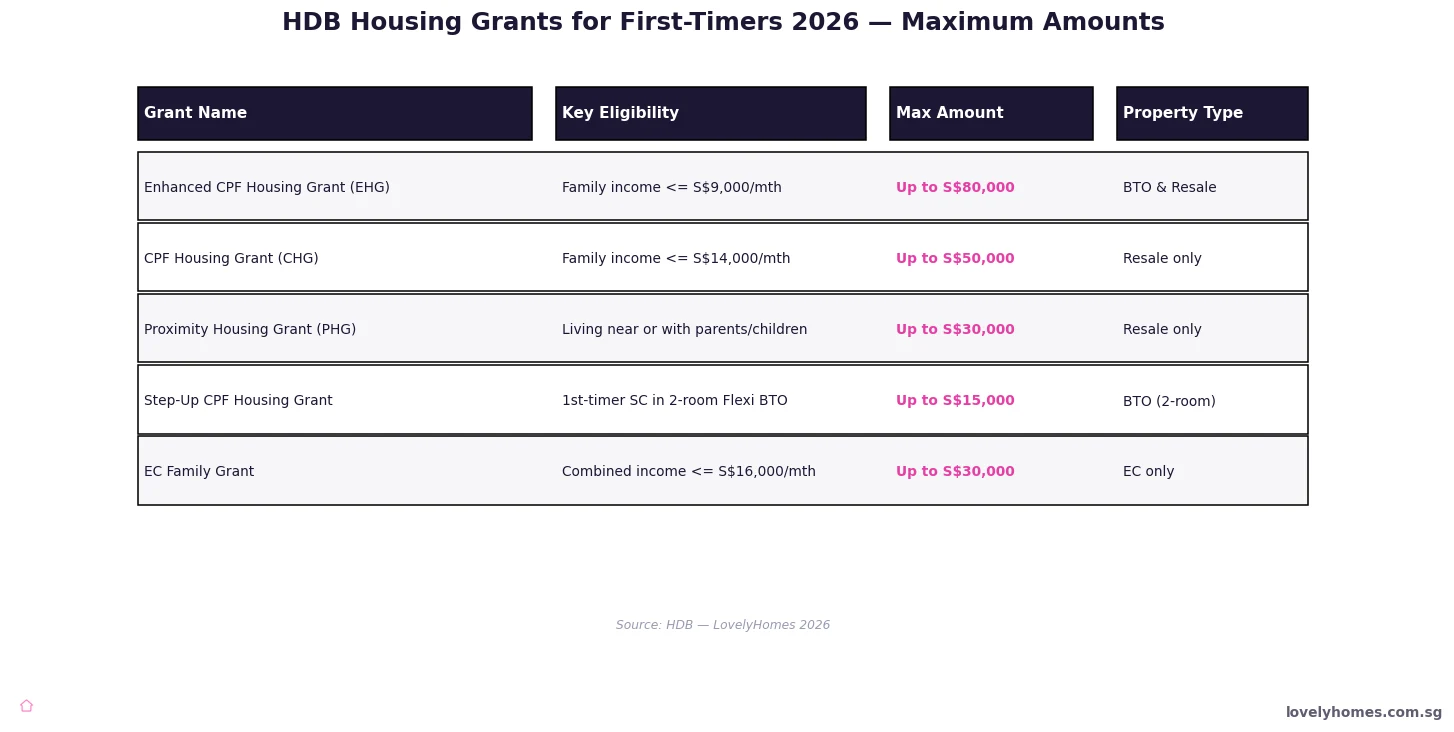
- Enhanced Housing Grant (EHG), CPF Housing Grant (CHG), and the Step-Up CPF Housing Grant apply to the purchase price only — not renovation costs.
- Interest-free Renovation Loans are available from banks (up to 6× monthly income, max S$30,000), repayable over 1–5 years.
- Noise-producing work (drilling, hacking) is restricted to Mondays–Saturdays, 09:00–17:00 and prohibited on Sundays and public holidays.
- The HDB renovation timeline typically runs 8–13 weeks from design to handover.
What Is an HDB Renovation?
An HDB renovation is any construction or alteration work carried out within a Housing and Development Board (HDB) flat after the owner takes possession of the keys. Unlike private condominiums, HDB flats are public housing units sold under a 99-year leasehold tenure by the Singapore government, and they come with a set of rules administered by HDB under the Housing and Development Act. These rules exist to preserve the structural integrity of public housing blocks, protect neighbouring residents, and ensure that any alterations meet safety standards.
Renovations range from purely cosmetic works — painting a wall or replacing light fittings — to comprehensive gut-renovations involving new flooring throughout, a full kitchen overhaul, bathroom retiling, and custom carpentry. The extent of the works, the type of contractor engaged, and the specific flat type (BTO, Resale, Executive, or DBSS) all affect what approvals you need, what restrictions apply, and how much you can expect to spend.
Who Governs HDB Renovation Rules?
Two agencies govern renovation rules in Singapore:
- HDB (Housing and Development Board) — sets rules for HDB flats specifically: which works require its approval, which contractors must be registered under the Renovation Contractor Registration Scheme (RCRS), and restrictions on timing, materials, and structural alterations.
- BCA (Building and Construction Authority) — issues Building Plan (BP) approvals for more significant structural changes, such as adding a new floor or significantly altering waterproofing layers.
For the majority of HDB renovations, HDB’s in-house approval suffices. You or your contractor can submit the application via HDB’s e-Services portal at hdb.gov.sg. Turnaround is typically 3–10 working days, though complex structural requests may take longer.
HDB Renovation Cost Breakdown (2026)
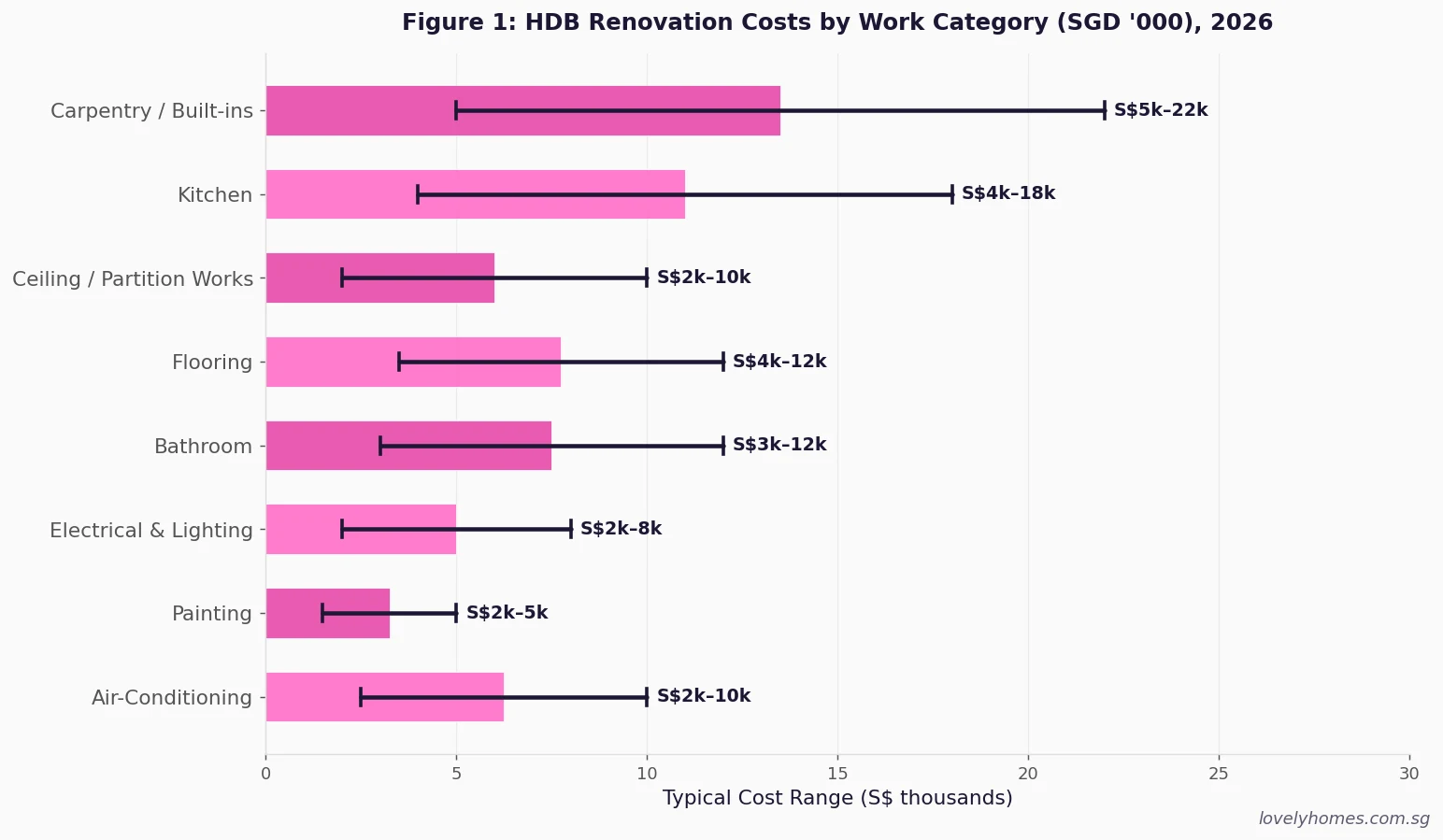
Based on industry data compiled from HDB-registered renovation contractors and consumer surveys, the following cost ranges apply to a standard 4-room HDB flat (approximately 90 sq m) in 2026. These are starting estimates; final costs depend heavily on materials chosen (e.g., homogeneous tile vs. marble vs. engineered wood), the contractor’s labour rates, and the extent of defect rectification required.
| Renovation Category | Typical Range (4-room HDB) | Key Cost Drivers |
|---|---|---|
| Flooring (all rooms) | S$3,500–S$12,000 | Material: vinyl vs. homogeneous tile vs. timber; area size |
| Carpentry & Built-ins | S$5,000–S$22,000 | Number of cabinets; solid wood vs. laminate; wardrobe sliding doors |
| Kitchen | S$4,000–S$18,000 | Cabinet type, countertop material (quartz vs. laminate), appliances |
| Bathroom(s) | S$3,000–S$12,000 | Number of bathrooms, fixture quality, waterproofing works |
| Electrical & Lighting | S$2,000–S$8,000 | Number of new points; LED downlights; smart switches |
| Painting (full flat) | S$1,500–S$5,000 | Paint grade; primer coat; feature wall treatment |
| Ceiling & Partitions | S$2,000–S$10,000 | False ceiling area; partition walls; skim-coat plastering |
| Air-Conditioning | S$2,500–S$10,000 | Number of fan coil units; brand (Daikin/Mitsubishi/Panasonic); inverter vs standard |
| Total (all-in, typical 4-room) | S$30,000–S$80,000 | Comprehensive renovation; excludes furniture and appliances |
Source: Industry estimates, 2026. Costs are inclusive of GST (9%). HDB renovation loan covers up to S$30,000; amounts above require personal savings or a personal loan.
Works That Require HDB Approval
HDB draws a clear line between works that are freely permitted and those that require formal approval. Broadly speaking, anything that affects the structural integrity of the building, alters plumbing or electrical systems beyond routine replacement, or changes the internal layout requires HDB’s written consent before work begins. Proceeding without approval can result in a reinstatement order (HDB can require you to undo the changes at your own cost) and, in serious cases, a fine under the Housing and Development Act.
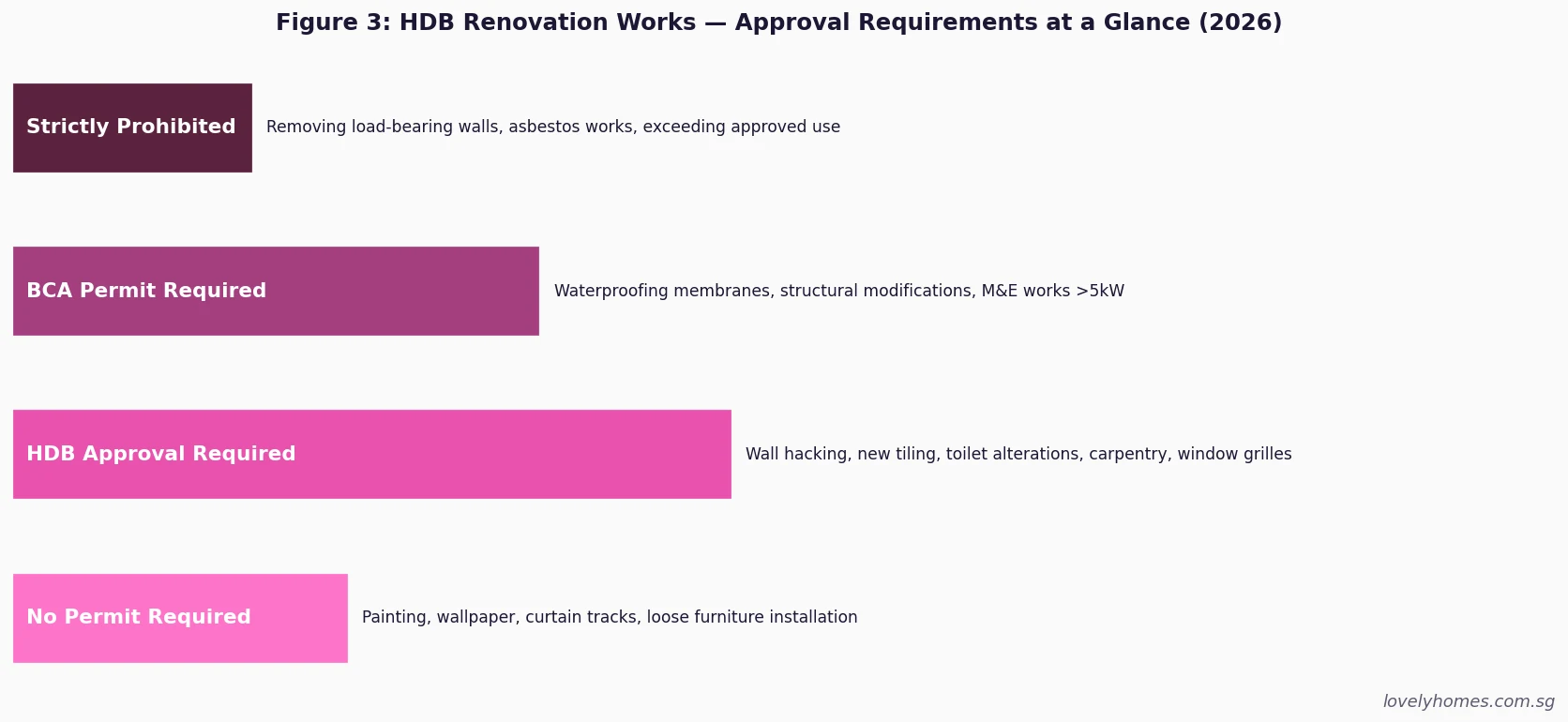
The table below summarises the key categories:
| Category | Common Works Included | What You Need |
|---|---|---|
| No Approval Needed | Painting, wallpaper, curtain tracks, floating shelves, loose furniture, light fittings (like-for-like replacement) | Nothing — proceed freely |
| HDB Approval Required | Hacking walls (non-structural), re-tiling, toilet and bathroom alterations, new built-in carpentry, window grilles, wet kitchen works | HDB-registered contractor + e-Services approval (3–10 working days) |
| BCA Permit Required | Waterproofing membrane layer, structural modifications, electrical works >5kW, changes to common areas | BCA Building Plan approval + qualified person (QP) |
| Strictly Prohibited | Removing load-bearing or party walls, adding rooms above approved height, asbestos removal (old pre-1990 flats), changing flat to non-residential use | Cannot be approved — do not proceed |
Hiring a Renovation Contractor: The HDB RCRS Explained
For any work requiring HDB approval, you must engage a contractor registered under the Renovation Contractor Registration Scheme (RCRS), administered by HDB. The RCRS ensures that contractors meet minimum competency standards, carry adequate insurance, and are aware of HDB’s renovation rules. You can verify a contractor’s RCRS registration status via HDB’s website before signing any contract.
The RCRS has two tiers: Tier 1 contractors can handle more extensive works (including structural and waterproofing), while Tier 2 contractors handle standard renovation works. Most homeowners hiring a general renovation contractor for a full-flat renovation will be dealing with a Tier 1 RCRS firm.
Practical tip: Always obtain at least three quotations from different RCRS-registered contractors, and ensure each quotation itemises the scope of work clearly. Ambiguous quotations that list “renovation works” as a lump sum make it difficult to compare pricing or resolve disputes later.
The HDB Renovation Process: Step by Step
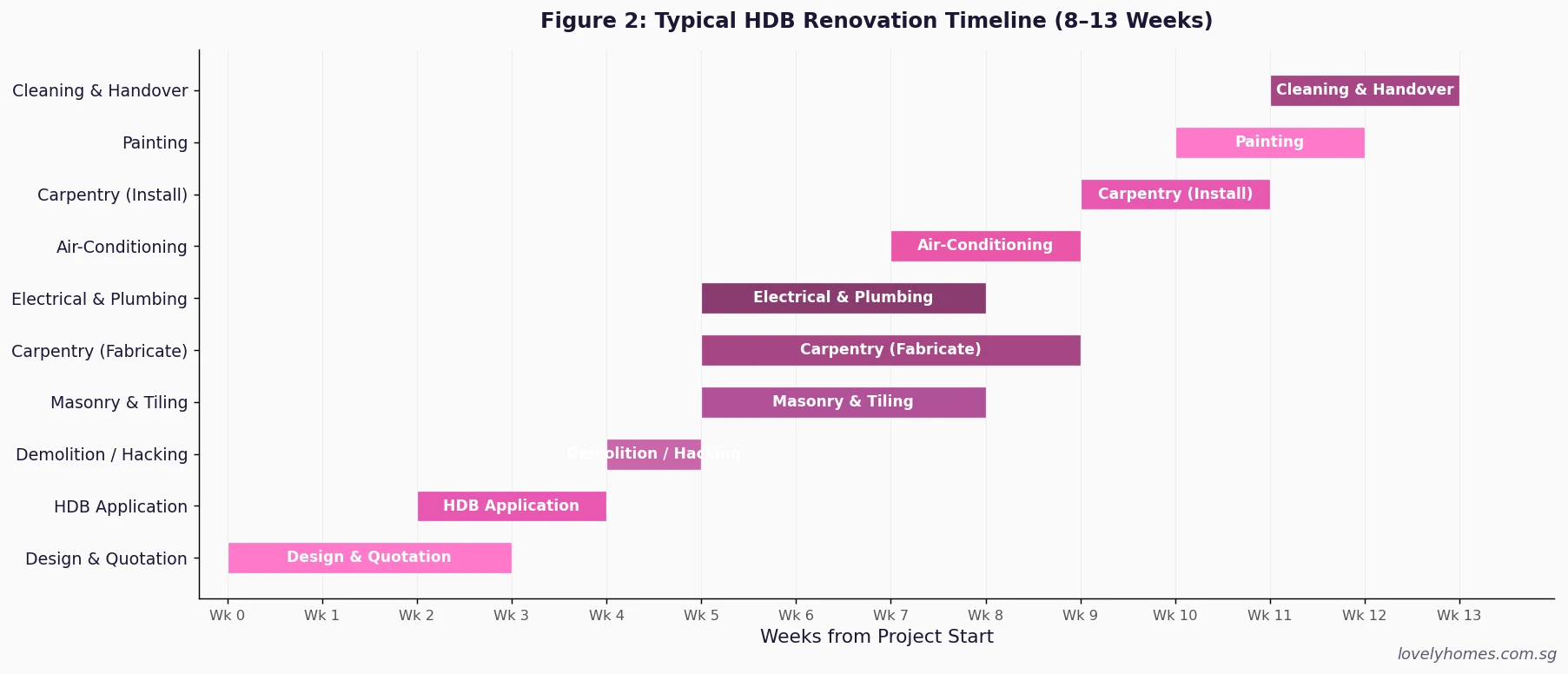
- Design and Consultation (Weeks 1–3): Engage an interior designer (ID) or renovation contractor. Present your wishlist, obtain a proposed floor plan, select materials, and receive a quotation. This phase often involves 2–4 rounds of revision.
- HDB Approval Application (Weeks 2–4): Your contractor submits the renovation application via HDB’s e-Services portal on your behalf. HDB typically responds within 3–10 working days. Commence work ONLY after receiving written approval.
- Demolition and Hacking (Week 4–5): Removal of existing tiles, walls (subject to approval), fixtures, and fittings. This is the noisiest phase — restricted to weekdays and Saturdays, 09:00–17:00 per NEA rules.
- Masonry, Tiling and Waterproofing (Weeks 5–8): Laying new tiles in wet areas (kitchen, bathrooms) and all rooms. Waterproofing of wet areas is critical — poor waterproofing is one of the most common sources of leakage disputes between neighbours.
- Carpentry Fabrication (Weeks 5–9): Custom carpentry is typically fabricated off-site (at the contractor’s workshop) while other works proceed. Allow 3–5 weeks for fabrication of a full set of kitchen and bedroom cabinetry.
- Electrical and Plumbing (Weeks 5–8): New electrical points, DB board upgrades, plumbing rerouting, and air-conditioning trunking. Electrical works must be carried out by a licensed electrical worker (LEW).
- Air-Conditioning Installation (Weeks 7–9): Installation of indoor fan coil units and outdoor compressor; trunking and drainage; tested and commissioned.
- Carpentry Installation (Weeks 9–11): Built-in cabinets, wardrobes, kitchen cabinets, and TV console are fitted on-site once masonry and tiling are complete.
- Painting (Weeks 10–12): Walls and ceilings painted after carpentry and major works; typically 2 coats primer + 2 finish coats.
- Cleaning and Handover (Weeks 12–13): Post-renovation cleaning, defect walk-through, and handover of keys. Ensure all defects noted during walk-through are rectified before full payment is released.
HDB Renovation Rules You Must Know
Beyond the approval requirements, HDB imposes a set of specific rules that apply during the renovation process:
- Work Hours: Renovation work that generates noise (hacking, drilling, hammering) is restricted to Mondays–Saturdays, 09:00–17:00. Work is prohibited on Sundays and gazetted public holidays. Non-noisy works (painting, carpentry installation) may be carried out outside these hours if neighbours are not disturbed.
- Duration Limits: HDB sets a maximum renovation period: 3 months for new flats and 1 month for resale flats (for HDB-approved works specifically). Extensions can be requested if needed.
- Toilets: In HDB flats, the toilet floor must not be hacked more than 50mm below the structural floor slab. This is a common cause of disputes — contractors who hack too deep can inadvertently damage the slab, causing leaks to the flat below.
- Wet Areas — Waterproofing: All wet area works (bathrooms, kitchen) must include proper waterproofing. HDB recommends using contractors who have completed HDB’s waterproofing module training.
- Balcony Enclosure: Enclosing a balcony or service yard with windows or glass panels requires HDB’s approval and must comply with approved glass specifications for safety.
- Flooring: You cannot lay flooring directly on the structural floor slab without the required screed base. Using self-levelling compound is acceptable; significant changes to floor thickness may affect door thresholds and must be planned for.
Financing Your HDB Renovation
Renovation costs for a typical 4-room HDB flat can range from S$30,000 to S$80,000, which is a significant outlay for most households. Singapore offers several financing options:
1. Bank Renovation Loan: Most major Singapore banks — DBS, OCBC, UOB, Standard Chartered, and others — offer unsecured renovation loans specifically for HDB and private properties. Key parameters in 2026: loan amount up to 6× your monthly income or S$30,000, whichever is lower; interest rates range from 3.8% to 5.0% p.a. (effective rate); repayment periods of 1–5 years. These are unsecured personal loans — no collateral required and no impact on your HDB loan or CPF balance.
2. Personal Savings: The cheapest option (no interest). For a S$50,000 renovation financed entirely from savings, a couple putting aside S$2,000/month could accumulate the funds in 25 months. Renovation is best planned well before key collection.
3. CPF Ordinary Account (OA): CPF OA funds cannot be used for renovation costs. They may only be applied to the flat purchase price, BSD/ABSD stamp duties, and legal fees. This is a common misconception — your renovation costs must be paid in cash or financed via a bank renovation loan.
4. Government Grants: There are no direct renovation subsidies for standard HDB flats. However, the Home Improvement Programme (HIP) — managed by HDB for blocks aged 27 years or more — funds essential upgrading of common areas and select internal works (bathroom fittings, spalling concrete repairs) at HDB’s cost. Check hdb.gov.sg to see if your block is on the HIP schedule.
Worked Example: Full 4-Room HDB Renovation in Bishan, 2026
Mr and Mrs Tan, both Singapore Citizens in their early 30s, purchased a resale 4-room HDB flat in Bishan for S$720,000 in June 2026. They budget S$65,000 for a full renovation. Here is how their renovation finances play out:
| Item | Cost (SGD) | Notes |
|---|---|---|
| Flooring (full flat, homogeneous tile) | S$9,500 | 90 sq m × S$105/sq m installed |
| Kitchen (new cabinets + quartz top + hob/hood) | S$14,000 | Retile + new cabinets + integrated hood |
| Bathrooms ×2 (full retile + new fittings) | S$12,000 | S$6,000 per bathroom, waterproofed |
| Carpentry (master BD wardrobe + kids BD + TV console + study shelving) | S$16,000 | Custom built-ins, 4 pieces |
| Electrical (new points + DB board + smart switches) | S$4,800 | LEW-certified; 6 new power points + 12 lights |
| Air-Conditioning (3 units, Daikin inverter) | S$4,200 | Living + 2 bedrooms; installed with trunking |
| Painting (full flat, 2+2 coats) | S$2,800 | Including feature wall treatment in living room |
| False Ceiling (living + dining) | S$3,500 | Cornice and L-box cove lighting |
| Total Renovation Cost | S$66,800 | Inclusive of 9% GST |
| Bank Renovation Loan (S$30,000 at 4.2% EIR, 3yr) | S$887/month | Remaining S$36,800 from savings |
Total monthly loan repayment of S$887 represents approximately 10.4% of their combined monthly household income of S$8,500 — well within a comfortable range. Their mortgage (HDB loan at 2.6% for S$560,000 over 25 years) is S$2,527/month (MSR 29.7%). Combined monthly obligations are S$3,414, or 40.2% of income — still manageable.
Common Renovation Pitfalls and How to Avoid Them
Renovation disputes are unfortunately common in Singapore. The most frequent problems involve contractors who disappear after collecting an initial deposit (contractor run-off), poor waterproofing leading to leaks into neighbouring flats, and work that does not match what was quoted. To protect yourself: always use an RCRS-registered contractor; pay deposits in stages (typically 10% on signing, 40% on commencement, 40% on completion, 10% retention); check the contractor’s track record on HDB’s list and consumer review platforms; and retain a small amount until all defects are rectified.
For disputes, you may escalate to the Consumers Association of Singapore (CASE) or file a Small Claims Tribunal application for amounts up to S$20,000. HDB can also be contacted if the contractor has violated RCRS rules, which may result in the contractor’s deregistration.
What Might Come Next: HDB Renovation Policy in 2026 and Beyond
Singapore’s HDB renovation framework has been relatively stable but there are several areas to watch. First, the Green Mark push from BCA: there are ongoing discussions about making energy-efficient appliances (inverter air-conditioning, LED lighting) a prerequisite for renovation approval in new BTO flats — akin to the mandatory energy labels already in force for appliances. Second, waterproofing standards: following a number of high-profile leakage disputes in 2024–2025, HDB is reviewing whether waterproofing work should require an independent inspection certificate before sign-off. Third, the Universal Design standard, already mandatory for new BTO layouts, may eventually extend to resale renovation guidelines, requiring wider doorways and grip-friendly bathroom fixtures for ageing-in-place.
Frequently Asked Questions
Can I renovate my HDB flat before I receive the keys?
No. Renovation work may only commence after you have collected the keys to your flat and received HDB’s written approval for the specific works you plan to carry out. This applies to both BTO and resale flats. Attempting to carry out works before key collection — even with a contractor who has access — is a breach of HDB’s terms and can result in penalties.
How long does HDB take to approve a renovation application?
HDB typically approves straightforward renovation applications within 3–10 working days via the e-Services portal. Applications involving structural changes, balcony enclosures, or works that require BCA input may take longer — sometimes 2–4 weeks. It is advisable to submit the application as early as possible so approval arrives before your preferred commencement date.
Is there a noise curfew for HDB renovation works?
Yes. Renovation works that generate noise — including hacking, drilling, sawing, and hammering — must be carried out between 09:00 and 17:00, Mondays to Saturdays only. Work is strictly prohibited on Sundays and gazetted public holidays. Non-noisy works such as painting and installation of pre-fabricated carpentry pieces may be carried out during other hours, provided they do not disturb neighbouring residents. Violations can be reported to HDB and may attract a fine.
Can I use my CPF OA to pay for renovation?
No. CPF Ordinary Account (OA) savings cannot be used to pay for renovation costs. CPF OA may only be applied to the purchase price of the flat, Buyer’s Stamp Duty (BSD), Additional Buyer’s Stamp Duty (ABSD), and legal conveyancing fees. All renovation costs must be paid in cash, or financed through a bank renovation loan (unsecured personal loan). This is one of the most commonly misunderstood rules among first-time HDB buyers.
What happens if I renovate without HDB approval?
Carrying out regulated works without HDB’s approval is a serious breach of HDB’s policies. HDB can issue a Reinstatement Order requiring you to undo all unauthorised works at your own cost and within a specified timeframe. Failure to comply with a reinstatement order can result in HDB engaging contractors to carry out the reinstatement work and billing you for it. In addition, your RCRS-registered contractor may lose their registration, and you may face a fine under the Housing and Development Act. There have also been cases where banks have added conditions to mortgage approvals pending resolution of HDB reinstatement orders.
How do I find a reputable HDB renovation contractor?
Start with HDB’s official list of RCRS-registered contractors at hdb.gov.sg. This confirms the contractor is licensed for HDB work. Beyond that, seek recommendations from friends, family, or neighbours who have recently renovated; read reviews on consumer platforms (being aware that reviews can be gamed); and obtain at least three itemised quotations. Visit the contractor’s showroom or completed projects if possible. Always pay in structured progressive stages, and ensure the signed contract specifies completion dates, penalties for delay, and a defect liability period (typically 12 months).
What is the HDB Goodwill Repair Allowance for BTO flats?
The Goodwill Repair Allowance (GRA) is an HDB-administered fund available to BTO flat buyers to address minor defects found during the Defects Inspection Period (typically the first year after key collection). HDB provides up to S$3,000 to cover rectification costs for qualifying defects (spalling concrete, faulty tiles, plumbing issues). This is separate from your renovation budget. Report defects via the HDB Mobile App and HDB will arrange for the main contractor to rectify them — or, if the main contractor is unavailable, you may use the GRA to hire your own contractor. The GRA is NOT a renovation grant; it only covers genuine construction defects.
Related Articles
- HDB Resale Price Guide 2026: What You Pay by Town
- HDB BTO Ballot Guide 2026: How to Apply and Win a Flat
- Condo vs HDB Singapore 2026: Which Should You Buy?
- Singapore First-Timer Property Guide 2026
- Singapore Property Conveyancing Guide 2026: Legal Fees, Timeline and Tips
- ABSD Singapore 2026: Complete Guide to Additional Buyer’s Stamp Duty
Disclaimer
This article is for general informational purposes only and does not constitute professional advice. Renovation costs, HDB approval requirements, and grant details are subject to change. Always verify current rules and approval requirements directly with HDB (hdb.gov.sg) and consult a licensed renovation contractor, financial adviser, or legal professional before proceeding with any renovation or financing commitment. LovelyHomes is an independent editorial publication and is not affiliated with HDB, BCA, or any government body.