
Singapore HDB Eligibility Guide 2026: Who Can Buy an HDB Flat?
Quick Answer: Who Can Buy an HDB Flat in Singapore?
- Singapore Citizens (SC) with an eligible family nucleus or as a single aged 35+ can buy most HDB flat types.
- Singapore Permanent Residents (PR) can purchase HDB resale flats (not BTO) together with an SC or another PR, subject to the Ethnic Integration Policy (EIP) quota.
- Foreigners are not eligible to own HDB flats under any scheme.
- Income ceiling: S$14,000/month for most BTO flat types and family purchase schemes; S$7,000 for singles buying BTO.
- Ethnic Integration Policy: resale purchases are subject to ethnic group quotas per block and neighbourhood.
- Minimum Occupation Period (MOP): 5 years for Standard flats; 10 years for Plus and Prime classification flats.
- HDB Flat Eligibility (HFE) letter: required before making any BTO application or resale OTP exercise.
- Ownership restriction: you generally cannot own both an HDB flat and private residential property at the same time.
What Is HDB Eligibility?
In Singapore, public housing flats developed by the Housing & Development Board (HDB) account for approximately 80% of the resident population’s homes. Access to these flats is not universal — HDB administers a detailed eligibility framework that controls who may purchase, what type of flat they may buy, how much they may pay, and when they may sell or upgrade. This framework exists to ensure that subsidised public housing is directed towards Singapore residents who genuinely need it, and to prevent speculative activity in a housing market that is central to social stability.
Eligibility is assessed across five main dimensions: citizenship, family nucleus, income ceiling, ownership history, and property ownership. Prospective buyers must satisfy all applicable criteria simultaneously. The check begins with obtaining a HDB Flat Eligibility (HFE) letter — a mandatory pre-application assessment that HDB issues after reviewing the applicant’s MyInfo data, CPF records, and existing property ownership.

HDB Purchase Schemes: A Complete Overview
HDB administers several distinct purchase schemes, each designed for a different household configuration. Each scheme has its own eligibility criteria; an applicant must qualify under exactly one scheme at the time of application.
Public Scheme
The most common scheme. Eligibility requires a family nucleus comprising at least one Singapore Citizen and at least one other SC or PR listed as an essential occupant or co-owner. The household’s gross monthly income must not exceed S$14,000 (S$21,000 for extended families occupying larger flat types). Eligible for all BTO flat types (2-room Flexi through 5-room) and resale flats.
Fiancé/Fiancée Scheme
Allows a couple who are engaged but not yet married to apply for an HDB flat together, provided they are both SCs or one is SC and one is PR. They must solemnise their marriage before collecting keys. If the marriage does not proceed, they may be required to return or sell the flat under HDB’s terms. The income ceiling and flat type eligibility mirrors the Public Scheme.
Orphans Scheme
For SC applicants who are orphans and whose parents were SCs or PRs. The applicant must include at least one sibling who is an SC or PR as a co-owner or essential occupant. Income ceiling is S$14,000. Applicable to both BTO and resale flats.
Single Singapore Citizen Scheme
Unmarried or divorced SC aged 35 and above may purchase a 2-Room Flexi flat in any BTO estate under this scheme, or a resale flat of any size (subject to EIP). The income ceiling is S$7,000 per month for BTO applications. For resale flats, there is no income ceiling. A single SC cannot purchase a 3-room or larger BTO flat under this scheme, though they may purchase resale flats of any type without an income ceiling.
Non-Citizen Family Scheme
For a Singapore Citizen who wishes to include a non-SC/non-PR spouse (i.e., a foreigner) as an occupant — not a co-owner — in an HDB flat application. The foreigner spouse must have resided in Singapore for at least one year before the application. Only resale flats are eligible under this scheme; BTO flats are not available. The SC applicant must be the sole owner.
Joint Singles Scheme
Two or more SC singles, each aged 35 or above, may jointly purchase an HDB resale flat together. This scheme does not require a family nucleus or marital relationship. An income ceiling of S$7,000 per person applies for BTO applications; resale has no income ceiling. The co-owners may later separate their arrangement if one marries or moves out, subject to HDB’s prevailing policies.
PR (Permanent Resident) Resale
PRs who form a family nucleus with an SC or another PR may purchase HDB resale flats (not BTO), subject to the Ethnic Integration Policy (EIP) quota. PRs must have held PR status for at least 3 years before applying to purchase a resale flat. There is no income ceiling for PR resale purchases. PRs are generally not eligible for CPF Housing Grants on resale purchases, though specific grants such as the Proximity Housing Grant may apply in some cases.

Income Ceiling: The Most Commonly Misunderstood Rule
The income ceiling is assessed on the gross monthly household income of all owners and essential occupants. It includes base salary, commissions, bonuses (annualised and divided by 12), and other regular income. CPF contributions from both employer and employee are included in the gross figure. If any family member’s income is variable (e.g., a self-employed person), HDB uses the average gross monthly income over the past 12 months.
The S$14,000 ceiling applies to most BTO applications under the Public Scheme and is assessed at the point of application. For Executive Condominiums (ECs), which are co-developed by private developers and HDB, the income ceiling is higher at S$16,000. Singles applying for BTO flats are assessed at a ceiling of S$7,000. For resale flat purchases, there is no income ceiling — though income affects CPF Housing Grant quantum eligibility.
The Ethnic Integration Policy (EIP): Resale Quotas
The Ethnic Integration Policy, introduced in 1989, ensures that no single ethnic group dominates any HDB block or neighbourhood. It does this by setting upper limits on the proportion of units in each block and in each neighbourhood that may be owned by a particular ethnic group. When a seller lists a resale flat, HDB checks whether the proposed buyer’s ethnic group would exceed the block- or neighbourhood-level quota. If the quota is breached, the sale cannot proceed to that buyer.

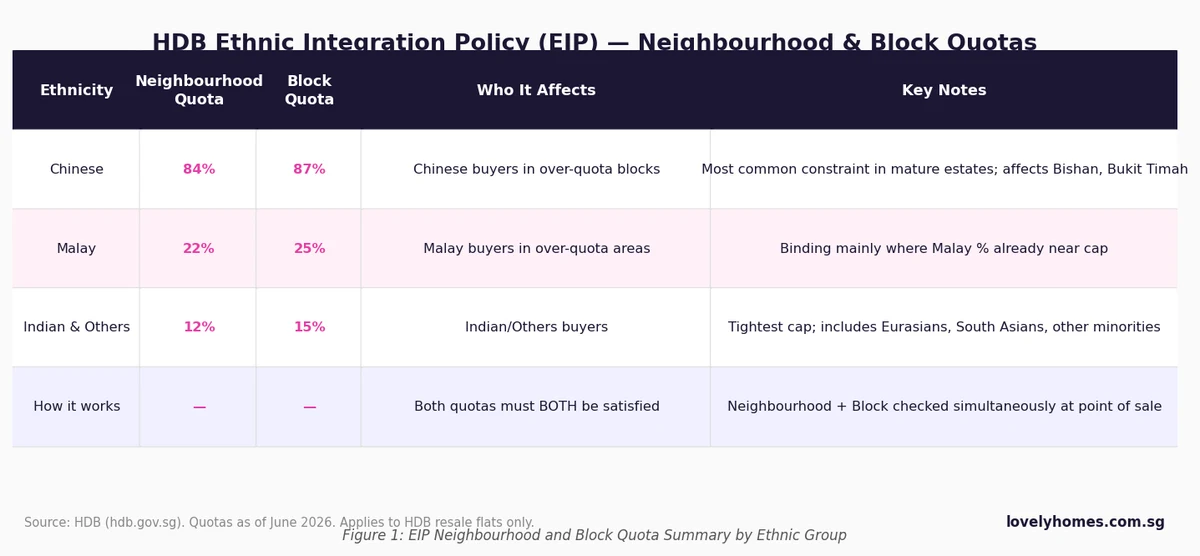
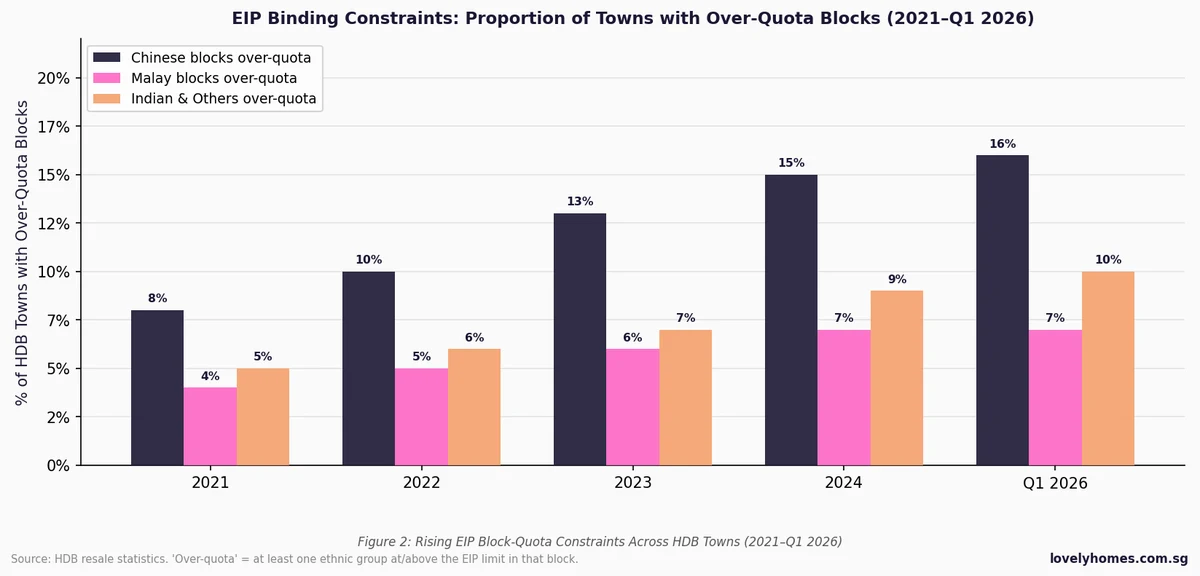
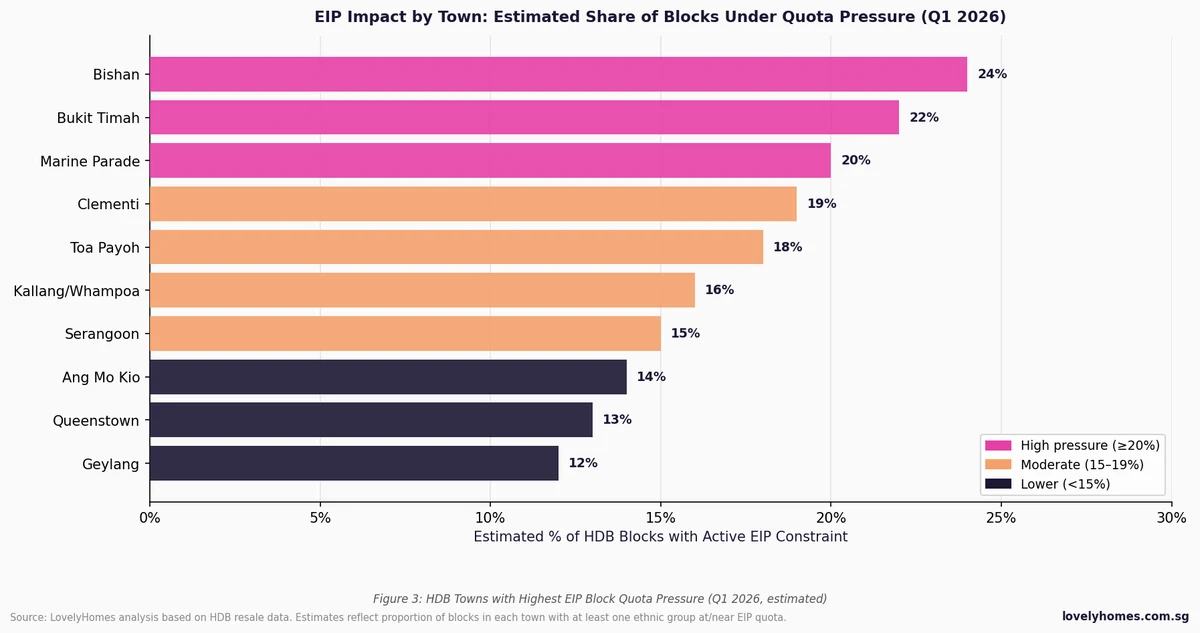
As at 2026, the approximate EIP quotas are: Chinese — 84% at neighbourhood level, 87% at block level; Malay — 22% neighbourhood, 25% block; Indian and Others — 12% neighbourhood, 15% block. These figures reflect the general population composition and are reviewed by HDB periodically. A practical consequence for buyers is that in some sought-after estates, popular 4- or 5-room resale flats may not be eligible for purchase by certain ethnic groups if the quota is full. Buyers should check the EIP status of specific units with HDB before making an offer.
Property Ownership Restrictions
HDB flat owners — and their essential occupants — are generally not permitted to own private residential property concurrently. The rule operates as follows:
For BTO purchases: at the point of application, none of the owners or essential occupants may own any private residential property in Singapore or overseas. Any such property must be disposed of before the HDB flat application is submitted.
For resale purchases: owners and essential occupants must dispose of any private residential property within 6 months of the HDB resale completion.
After the Minimum Occupation Period (MOP) is fulfilled, owners may purchase a private residential property while retaining the HDB flat — provided the HDB flat is not being rented out in its entirety (whole-flat subletting is only permitted under specific HDB approval and post-MOP conditions).
MOP: The Minimum Occupation Period
The MOP is the mandatory period an HDB owner must live in the flat as their primary residence before they may sell it on the open market, rent it out in full, or purchase private residential property. Under the Standard classification (applicable to most existing HDB flats), the MOP is 5 years. For flats classified as Plus (launched from 2H 2024 — desirable locations close to MRT, town centres) the MOP is 10 years. For flats classified as Prime (launched from 2H 2024 — most central, heavily subsidised locations), the MOP is also 10 years with additional restrictions including a compulsory subsidy clawback on resale.
Worked Example: The Lim Family’s BTO Application Journey
Case: Mr and Mrs Lim — SC couple, first-time buyers, Tengah BTO application
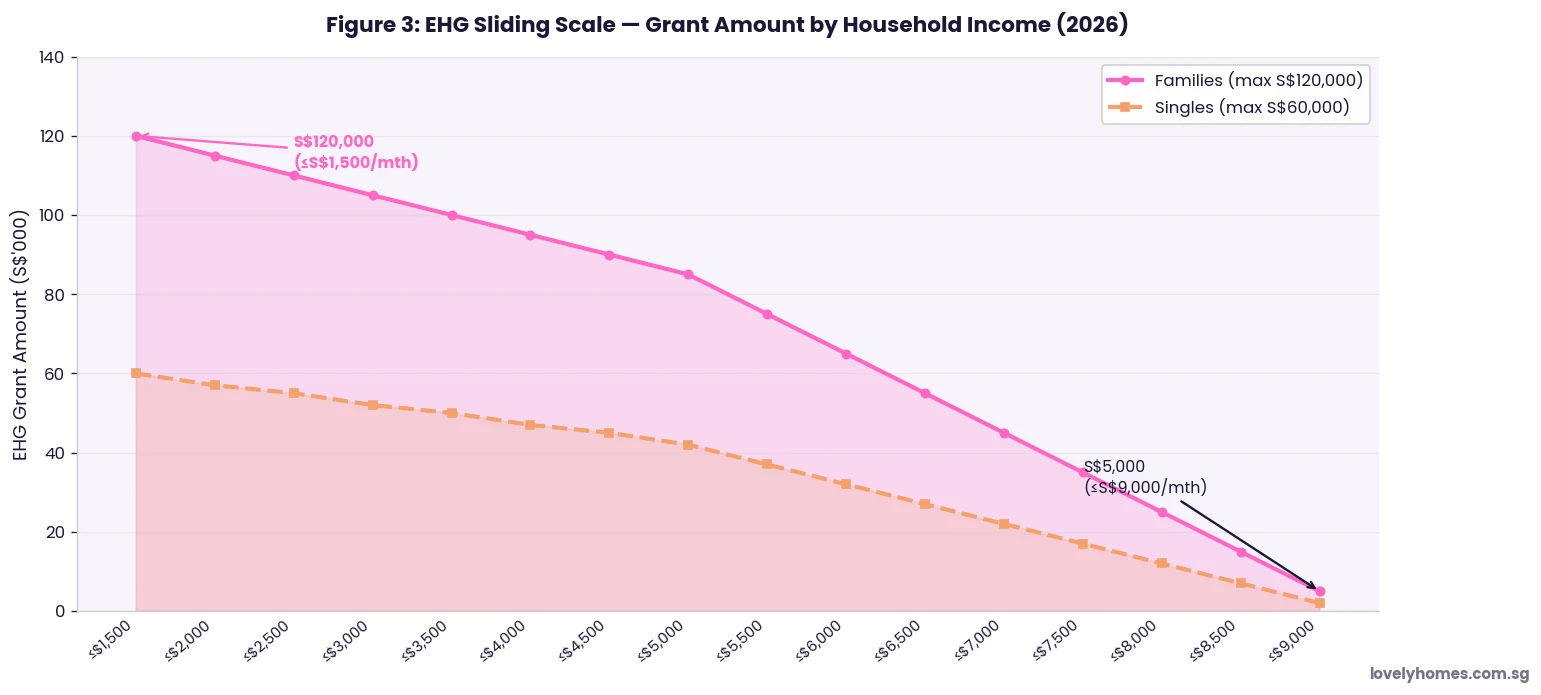
EHG is subject to meeting HDB’s eligibility criteria at the time of flat application. Grant amounts are indicative; verify at hdb.gov.sg.
Why This Matters: HDB as Social Infrastructure
HDB eligibility rules exist because the Singapore government views public housing as a critical social leveller. The system channels significant fiscal subsidies — through land pricing, CPF Housing Grants, concessionary HDB loan rates, and construction costs — to residents who genuinely need affordable housing. Without eligibility controls, speculative demand could overwhelm the system and prevent genuine first-time buyers from accessing the subsidies.
The 2024 introduction of the Standard/Plus/Prime classification system reflects an evolution in this philosophy: recognising that different HDB locations carry very different inherent locational value (and thus subsidy), the government has imposed differentiated restrictions (higher MOP, income ceilings, and clawback) on the most desirable estates to maintain a level of fairness and prevent HDB flats from becoming purely investment vehicles.
What Might Come Next
The HDB eligibility framework has been remarkably stable in its core structure since the 1980s, but individual parameters shift over time. Income ceilings were last raised in 2019 (from S$12,000 to S$14,000 for families). The Plus/Prime classification is being rolled out gradually as new BTO exercises launch; observers expect it to cover a significant proportion of new supply in the coming years. The government may revisit single-buyer eligibility — currently restricted to 2-Room Flexi BTO — particularly as the proportion of single-person households in Singapore continues to rise.
Frequently Asked Questions
Can a Singapore PR buy a BTO flat directly?
No. PRs cannot apply for BTO flats directly. PRs may only purchase HDB flats on the resale market, and only after holding PR status for at least 3 years. They must form an eligible family nucleus (e.g., PR + SC, or PR + PR with at least one child who is an SC or PR), and the purchase is subject to the Ethnic Integration Policy quota. There is no income ceiling for resale purchases, but EHG and most CPF Housing Grants are generally not available to PRs buying resale flats (certain grants like the Proximity Housing Grant may apply).
What is the HDB Flat Eligibility (HFE) letter and why do I need it?
The HFE letter is a mandatory eligibility assessment issued by HDB through the MyHDBPage portal. It consolidates in one document: whether you are eligible to purchase an HDB flat, the maximum HDB loan you qualify for, and the CPF Housing Grants you are entitled to. You must have a valid HFE letter before you can submit a BTO application or exercise an OTP for a resale flat. The HFE letter is valid for 9 months from the date of issue. It replaced the old system of separate eligibility and loan letters in 2023, simplifying the process for applicants.
Can I own an HDB flat and a private property at the same time?
Generally, no — during the MOP. While you are serving the Minimum Occupation Period (5 or 10 years depending on classification), you and all listed owners and essential occupants may not own any private residential property in Singapore or overseas. After the MOP is fulfilled, you may purchase a private residential property and retain your HDB flat simultaneously. However, whole-flat HDB subletting (renting out the entire flat) is only permitted under HDB’s specific subletting approval scheme and is restricted to SC owners. Subletting individual rooms is permitted post-MOP with HDB approval.
How is the income ceiling calculated for variable-income earners?
HDB uses the gross monthly income for applicants on fixed salaries. For variable-income earners — including commission-based employees, business owners, and freelancers — HDB typically uses the average of the past 12 months of income as declared in NOA (Notice of Assessment from IRAS) and other supporting documents. Gross income includes employer CPF contributions. If you have recently changed jobs or your income has dropped significantly, you should apply with the most recent 12-month average; HDB may exercise discretion in borderline cases. Seek HDB’s advice directly via the HFE letter application process.
What happens if I exceed the income ceiling after I buy the flat?
The income ceiling is assessed only at the point of application — it is not an ongoing condition. Once you have been granted eligibility and purchased the flat, there is no mechanism for HDB to claw back your eligibility or grants simply because your income subsequently rises above the ceiling. The ceiling is a gate for access to the subsidised market, not a permanent constraint on your income trajectory. However, if you are applying for a new grant or a second HDB flat in future, your income at that time will again be assessed against the prevailing income ceiling.
Can singles in Singapore buy a 3-room or larger HDB flat?
Under the Single SC Scheme (for those aged 35 and above), singles may only apply for 2-Room Flexi BTO flats. However, singles may purchase resale flats of any flat type on the open market, subject to the EIP quota and standard resale eligibility criteria — there is no flat-size restriction for resale. Joint Singles (two or more SCs each aged 35+) purchasing resale flats together may also buy any flat size. The government has resisted expanding BTO access beyond 2-Room Flexi for singles, though this is a recurring topic in public debate.
What is the EIP and how do I check if I can buy a specific flat?
The Ethnic Integration Policy (EIP) sets upper limits on the proportion of units in each HDB block and neighbourhood that may be owned by buyers of a particular ethnic group. Before making an offer on a resale flat, you can check whether your ethnic group has headroom to purchase the specific unit by using HDB’s EIP and SPR Quota Check tool on the HDB website (hdb.gov.sg). If the quota is full at either the block or neighbourhood level for your ethnic group, the sale cannot proceed to you — the seller must find a buyer from an eligible ethnic group. This check is free and immediate.