Condo vs HDB Singapore 2026: The Upgrader’s Complete Decision Framework
- HDB resale costs significantly less upfront (10% downpayment, HDB loan at 2.6%, CPF grants up to S$120,000) but carries MOP restrictions (5–10 years before rental/sale) and 99-year lease limitations.
- Private condominiums require a minimum 25% downpayment (5% cash), bank loans only (no HDB loan), and no CPF housing grants — but offer immediate rental flexibility, freehold options and typically higher long-term capital gains in OCR/RCR markets.
- ABSD: Singapore Citizens pay 0% ABSD on their first residential property whether HDB or private. Retaining an existing HDB flat and buying a private condo triggers 20% ABSD on the private purchase.
- Capital growth over 10 years: OCR condos +73%, RCR +58%, CCR +40%, HDB mature estates +52%, landed +82% (URA/HDB estimates).
- Monthly cost gap is substantial: a comparable S$650k HDB resale 4-room costs ~S$2,781/month total; a S$1.5M OCR condo costs ~S$6,126/month — a S$3,345/month premium for the condo lifestyle.
- Rental yield is broadly similar (HDB 3.5–4.5%, OCR condo 3.5–4.0%) but HDB subletting requires completion of MOP and HDB’s prior approval.
- The right choice depends on your income, existing property ownership, investment horizon and lifestyle priorities — there is no universal answer.
Condo vs HDB — Why This Is Singapore’s Most Important Property Decision
For most Singapore families, the decision between buying a Housing Development Board (HDB) resale flat and a private condominium is the single largest financial choice they will make. The two asset classes differ not just in price, but in financing rules, government intervention, rental flexibility, resale eligibility, CPF usage, and long-term wealth outcomes. In 2026, with HDB resale prices stabilising (Q1 2026 Resale Price Index: 203.4, −0.1% — first quarterly decline in seven years) and private property prices having climbed 73% in OCR markets since 2018, the trade-offs have never been starker.
This guide — structured for Singapore Citizens and Permanent Residents considering either an outright upgrade from public to private housing, or a first purchase in 2026 — breaks down costs, financing constraints, capital growth data, rental rules, ABSD implications and a full worked example comparing like-for-like outcomes over a 10-year horizon. We draw on data from the HDB, Urban Redevelopment Authority (URA), Monetary Authority of Singapore (MAS), Inland Revenue Authority of Singapore (IRAS) and CPF Board.

How Financing Differs — HDB Loan vs Bank Loan
The most fundamental structural difference between buying HDB and buying private is the loan source. HDB resale flat buyers (who meet income eligibility requirements) may take an HDB Concessionary Loan at 2.60% per annum — a rate pegged to the CPF Ordinary Account (OA) interest rate (2.5%) plus 0.1%. This rate has remained stable since September 2022 and is reviewed quarterly. In contrast, private condominium buyers must use a bank loan; bank fixed rates as at May 2026 range from approximately 2.7–3.2% (2-year fixed) with floating rates (SORA + spread) at approximately 2.8–3.5% effective after lock-in.
The HDB loan’s advantage is stability: no repricing risk, no lock-in penalties, and the ability to switch to a bank loan at any time without penalty. The HDB loan’s LTV is 80% of the lower of purchase price and valuation, versus bank loans at 75% LTV for private property. This means HDB buyers need only a 10% cash/CPF downpayment (with 5% being cash) versus the 25% private downpayment (5% cash minimum). However, the HDB loan is only available to eligible buyers (Singapore Citizens and some PR categories) for HDB properties; it cannot be used for private condominiums, Executive Condominiums (ECs) or landed housing.
For private property purchases, MAS’s Total Debt Servicing Ratio (TDSR) of 55% is the binding constraint. A S$1.5M condo with 75% LTV bank loan (S$1,125,000) at 3.0% over 25 years costs S$5,339/month — requiring minimum gross monthly income of S$9,707 at the 55% TDSR. Add maintenance fees (~S$550/month) and property tax (~S$237/month) and total monthly cost reaches ~S$6,126 — meaningful for middle-income Singapore families.
CPF Housing Grants — A Major HDB Advantage
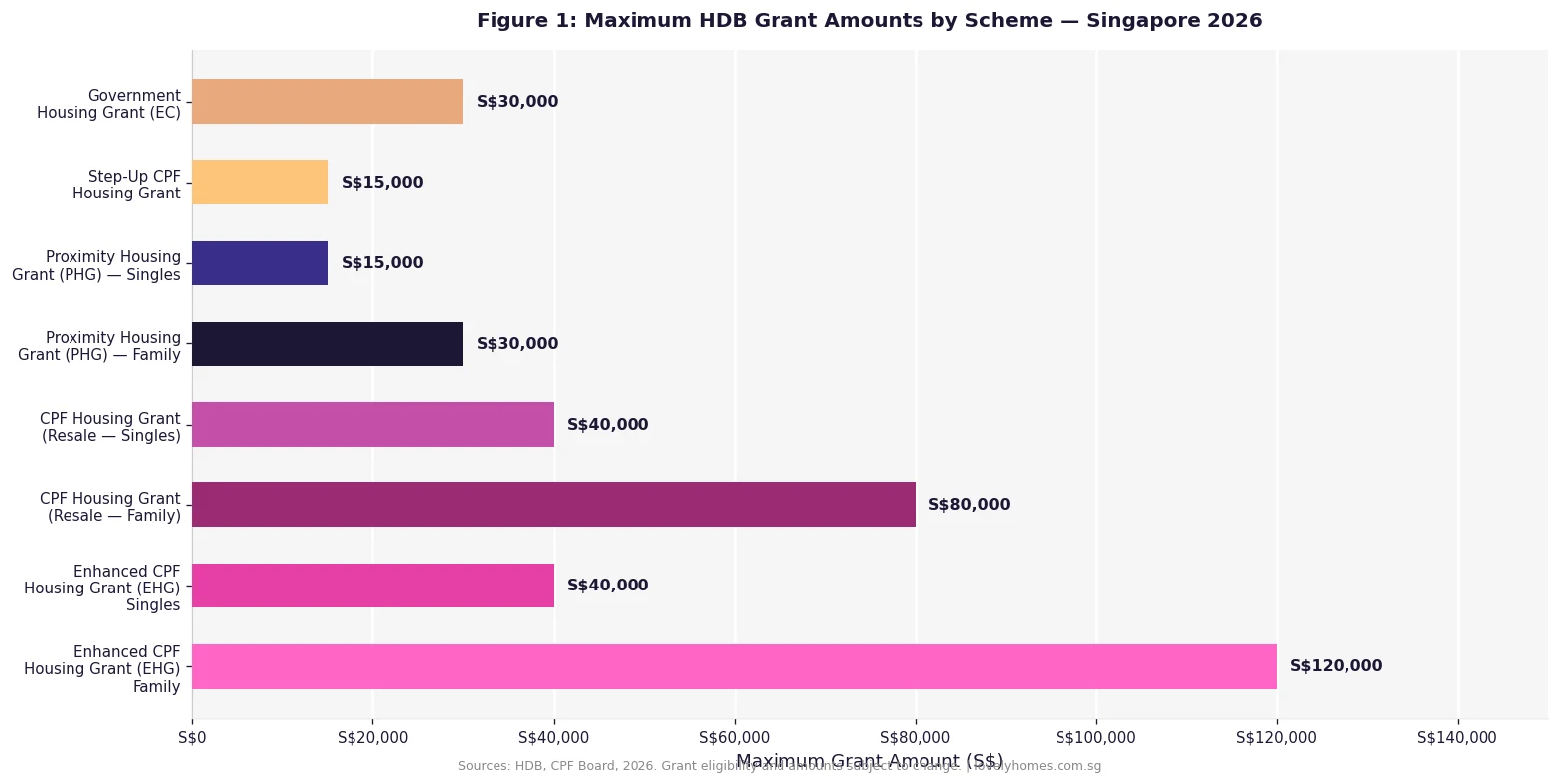
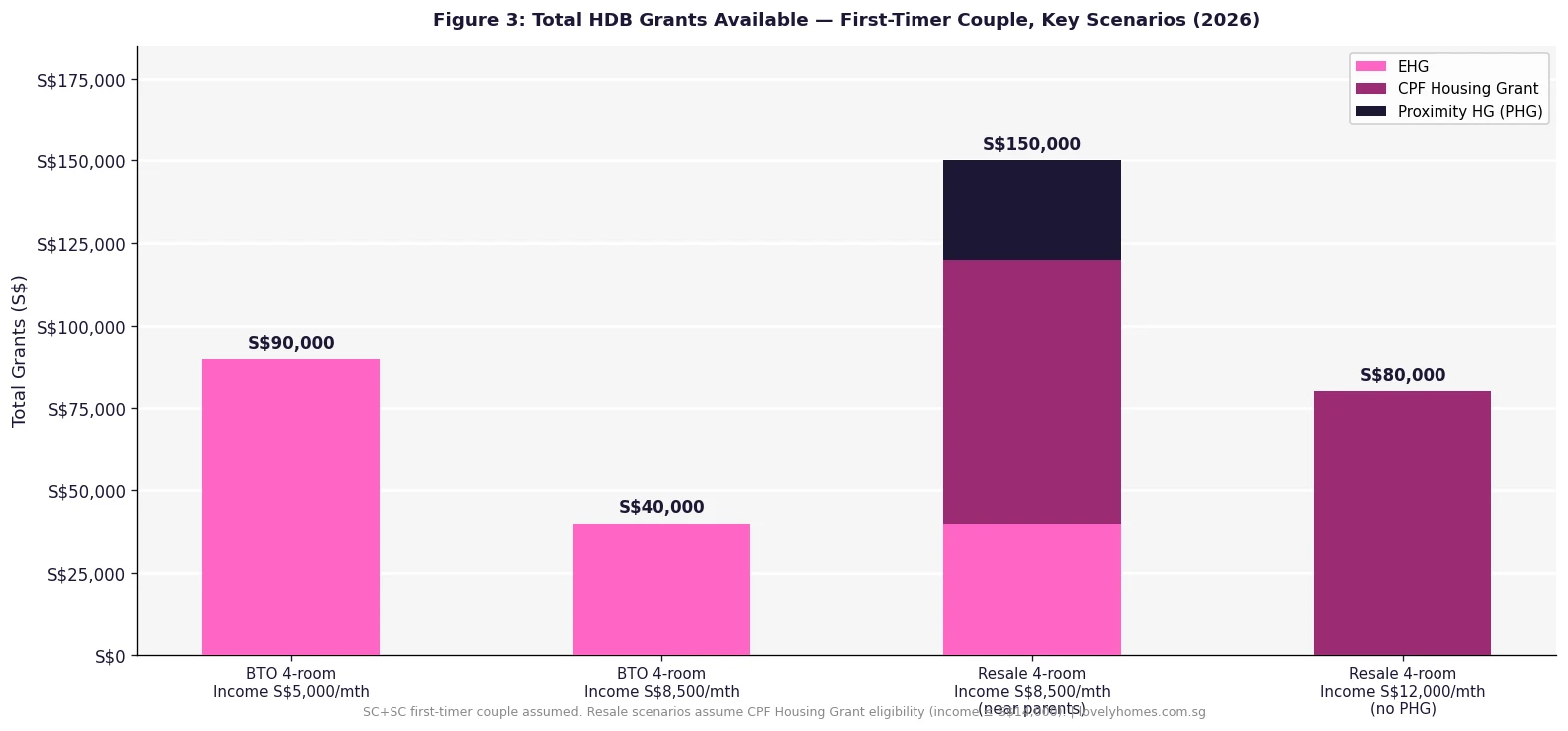
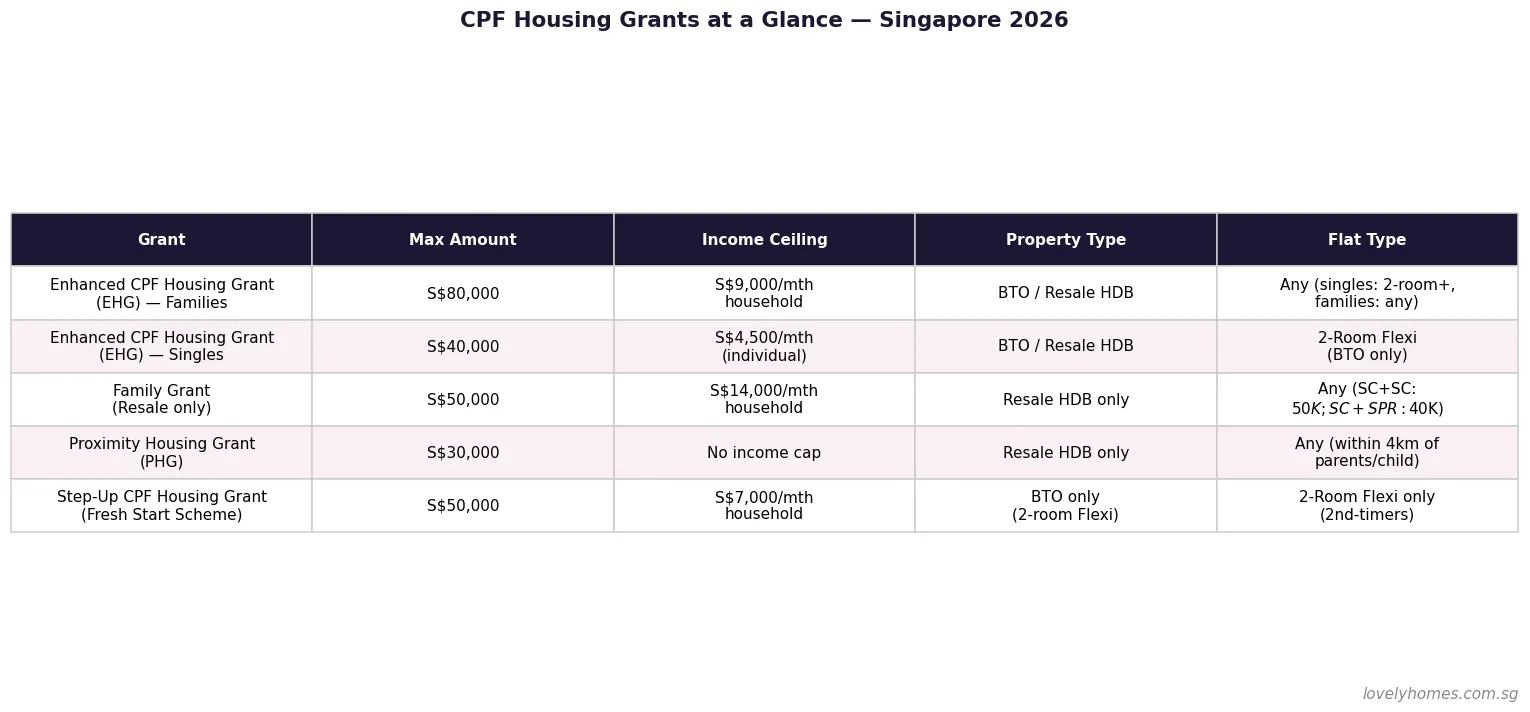
One of the most frequently overlooked advantages of HDB resale flat purchases is access to CPF Housing Grants, administered by the Housing Development Board. These grants are available to eligible Singapore Citizen households and do not need to be repaid on sale (though they are returned to CPF with accrued interest). In 2026, the main grants available for HDB resale buyers are:
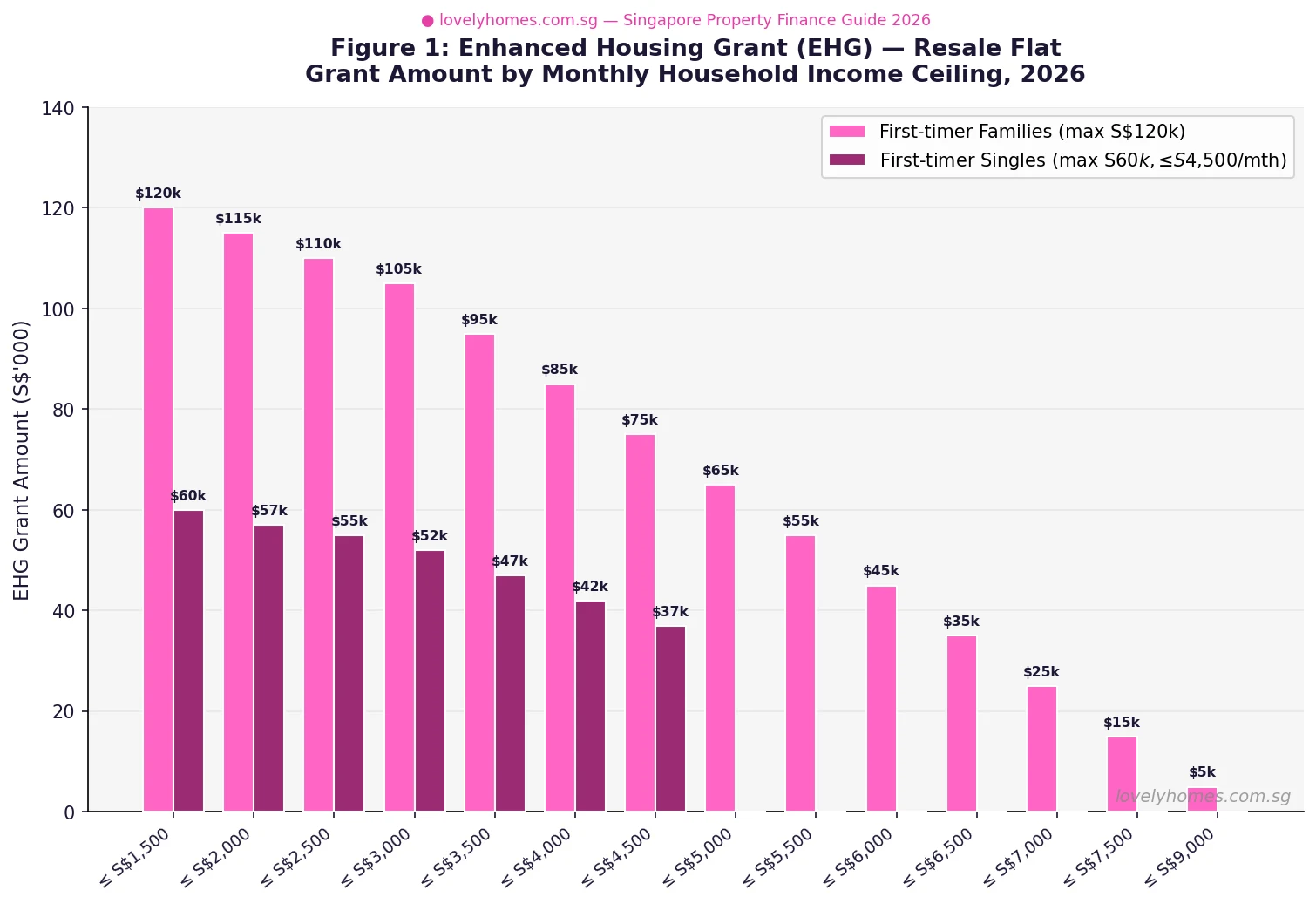
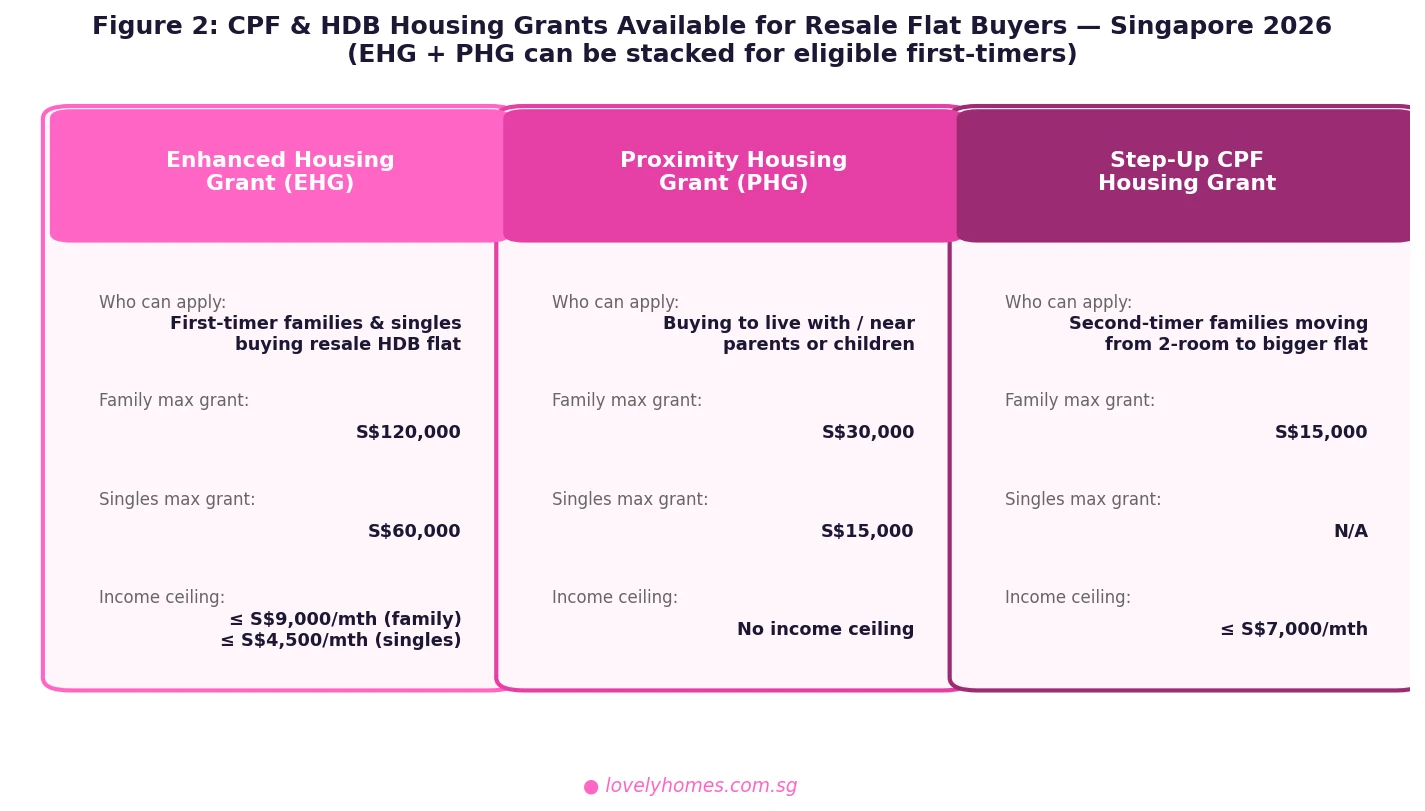
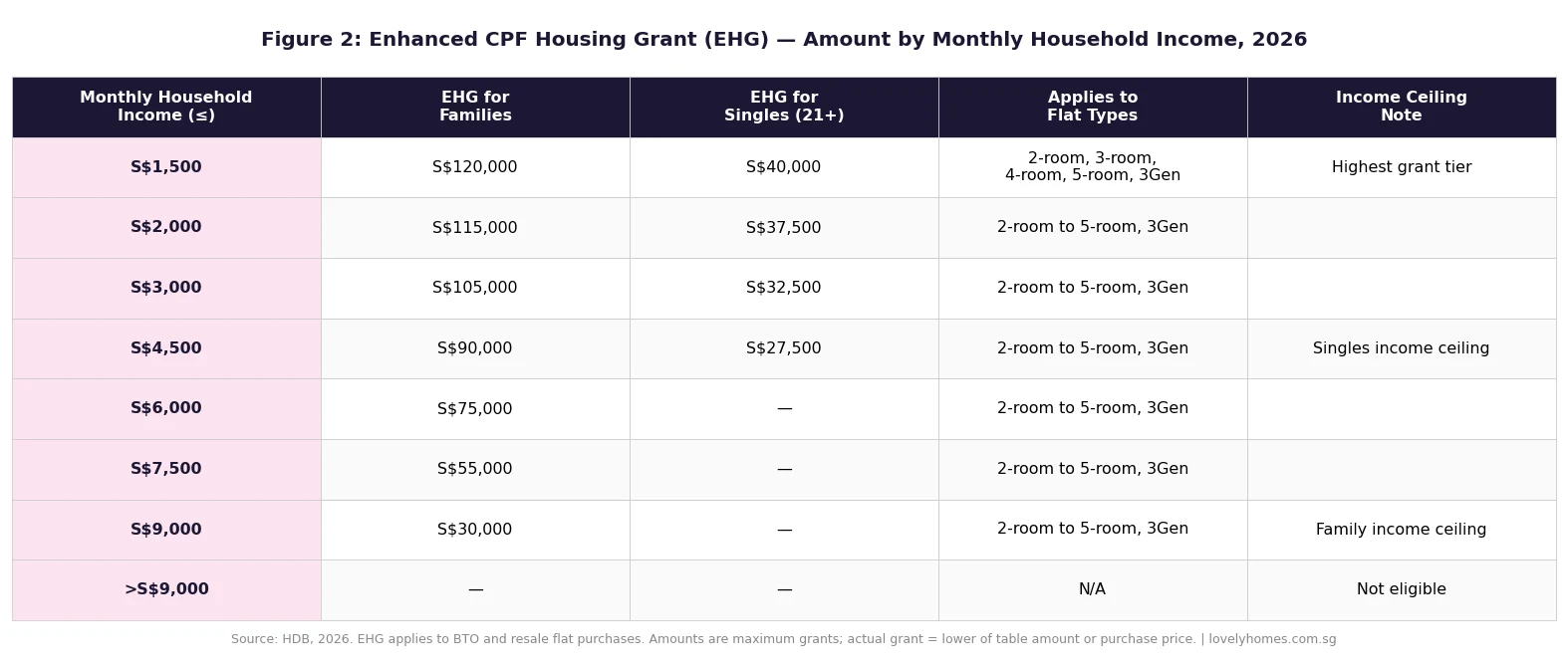
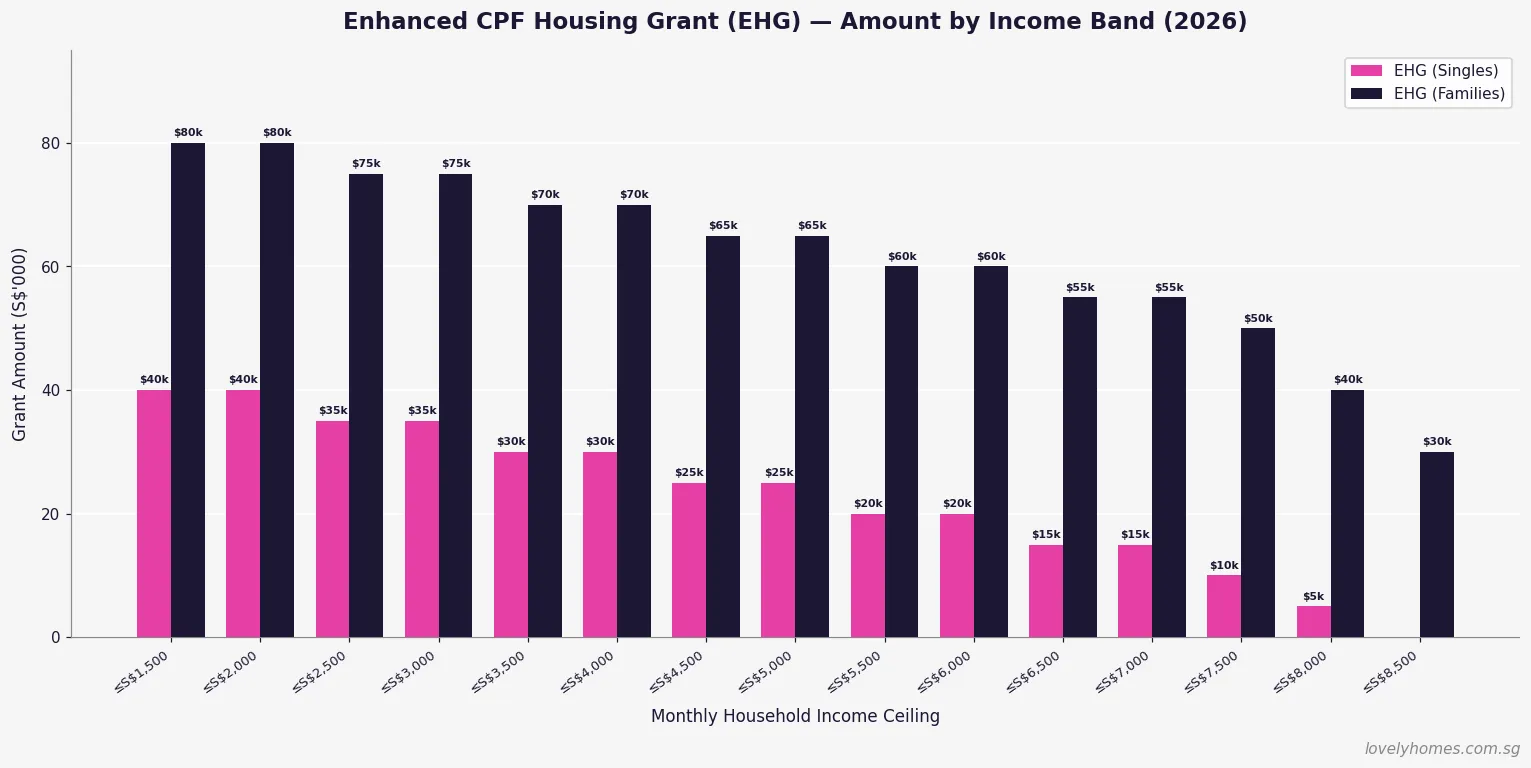
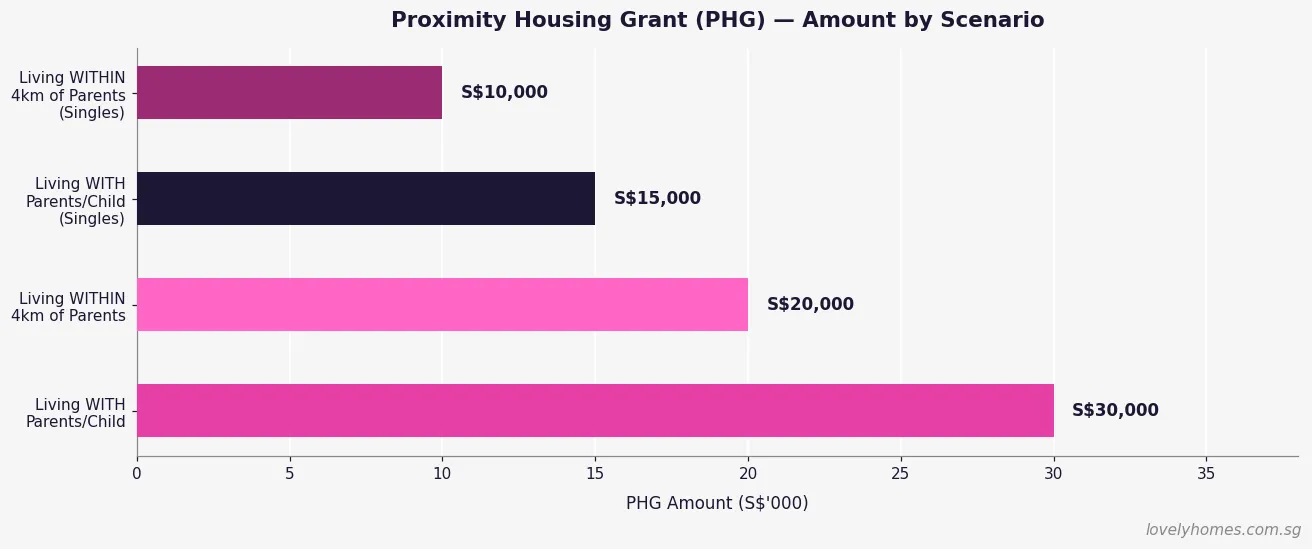
The Enhanced CPF Housing Grant (EHG) provides up to S$120,000 for families (joint income ≤ S$9,000/month) and up to S$60,000 for singles (income ≤ S$4,500/month). The Proximity Housing Grant (PHG) provides S$30,000 for buyers living with parents/married child (or S$20,000 for living within 4km). The Step-Up CPF Housing Grant provides S$15,000 for second-timer SC families upgrading from a 2-room Flexi flat.
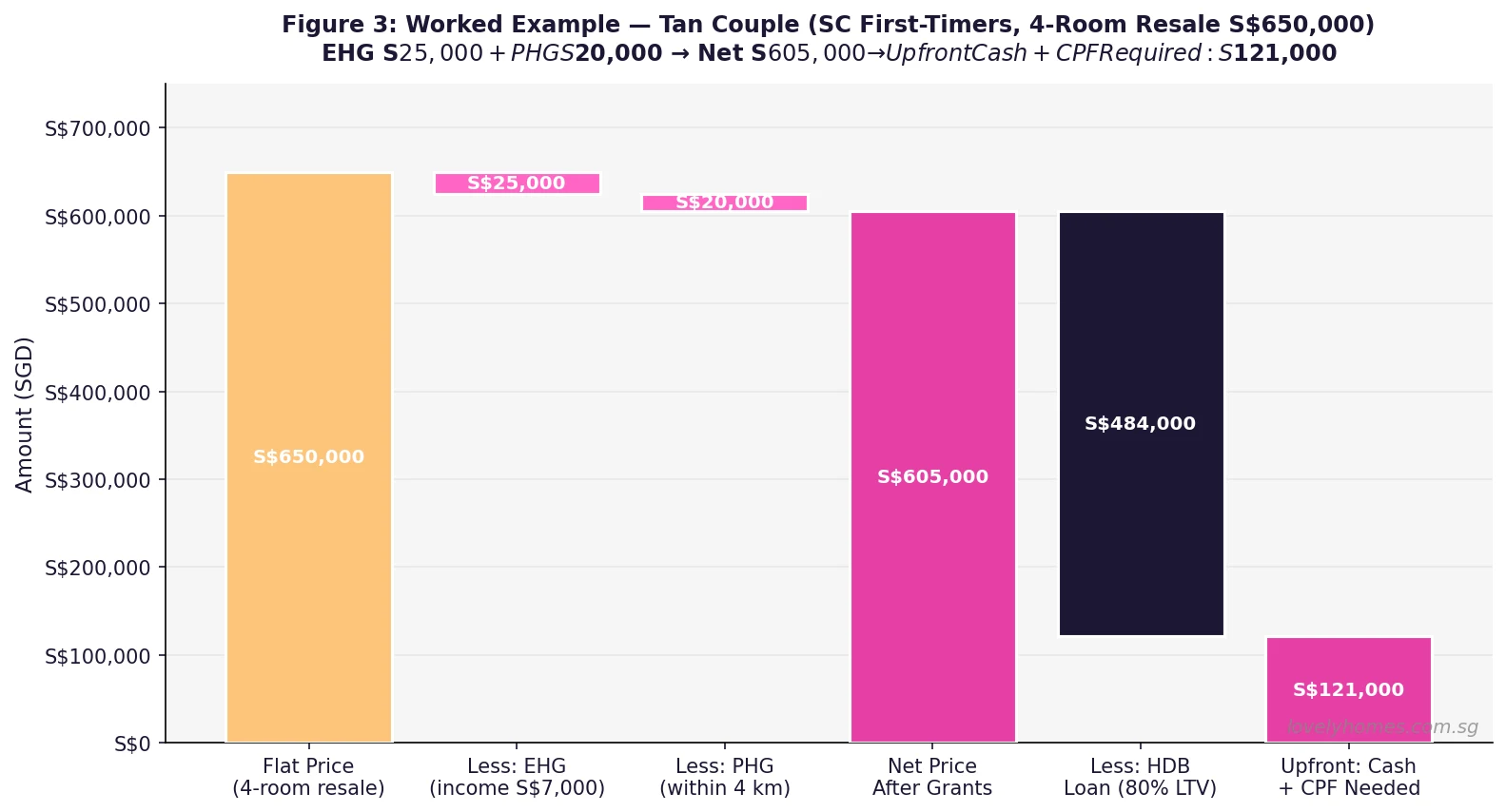
These grants are entirely absent for private condominium purchases. A SC couple earning S$8,000/month who buys a S$650k HDB resale flat may receive EHG S$35,000 + PHG S$20,000 = S$55,000 in grants — meaningfully reducing their net purchase cost to S$595,000, or their CPF/cash outlay after HDB loan. The same couple buying a S$1.5M condo receives nothing from government and must fund the full 25% (S$375,000) from their own CPF/cash savings.
| Parameter | HDB Resale (4-Room S$650k) | Private Condo OCR (S$1.5M) |
|---|---|---|
| Loan Type | HDB Concessionary (2.60%) or bank | Bank only (2.7–3.5%) |
| Max LTV | 80% (HDB loan) / 75% (bank) | 75% (bank) |
| Min Downpayment | 10% (5% cash, 5% CPF/cash) | 25% (5% cash, 20% CPF/cash) |
| BSD | ~S$8,700 | ~S$39,600 |
| ABSD (SC 1st prop) | S$0 | S$0 |
| CPF Housing Grants | Up to S$120k (EHG) + PHG | None |
| Monthly Repayment | ~S$2,651 (HDB loan 25yr) | ~S$5,339 (bank 3.0%, 25yr) |
| Property Tax (annual) | ~S$660 (owner-occupier rate) | ~S$2,844 (est. AV S$40k) |
| Maintenance | ~S$75/mth (S&CC) | ~S$550/mth (management fee) |
| Total Monthly Cost | ~S$2,781 | ~S$6,126 |
| MOP restriction | 5–10 years (classification-dependent) | None (immediate full rental allowed) |
| Rental permitted during MOP | Bedrooms only (with HDB approval) | Full unit (Strata Title Act applies) |
| Tenure | 99-year HDB lease | 99-year or Freehold |

Capital Growth — Who Has Won Over 10 Years?
The data unambiguously shows that OCR private condominiums and landed property have delivered stronger capital appreciation than HDB resale flats and CCR prime condos over the decade 2016–2026. URA REALIS data and HDB Resale Price Index tracking indicate OCR private non-landed property appreciated approximately +73%, landed (terrace and semi-D) approximately +82%, RCR condos +58%, HDB mature estates +52%, and CCR prime condos +40%.
However, raw capital growth figures must be adjusted for acquisition costs and ABSD where applicable. A SC second-timer who pays 20% ABSD (S$300,000 on a S$1.5M condo) needs the condo to appreciate more than S$300,000 before they break even relative to having bought an HDB — a 20% price rise is needed before any net gain appears. Conversely, for a first-time SC buyer (0% ABSD on both HDB and condo), the private OCR condo’s faster capital growth trajectory means that if held for 10 years, the private condo would typically generate meaningfully higher absolute gains on a like-for-like equity basis — but with a much higher absolute equity commitment at the start.
The key variable that academic research on Singapore property consistently highlights is the leverage ratio. A S$650k HDB with 80% loan uses S$130k equity to control a S$650k asset. A S$1.5M condo with 75% loan uses S$375k equity to control a S$1.5M asset. At the same 50% price appreciation, the HDB generates S$325k on S$130k equity (2.5× return); the condo generates S$750k on S$375k equity (2.0× return). Lower-priced assets with higher LTV often outperform on an equity-return basis, even if nominal capital gain is lower.
The Upgrader’s ABSD Trap — And How to Avoid It
The most critical ABSD consideration for HDB owners upgrading to private property is timing. If a Singapore Citizen sells their HDB flat before purchasing a private condominium — or purchases the private condo under an OTP (Option to Purchase) with completion before the HDB sale is exercised — they qualify as a “first-time private property buyer” paying 0% ABSD. However, if they retain the HDB flat while buying private, they are buying their second residential property and must pay 20% ABSD.
This distinction can save hundreds of thousands of dollars. On a S$1.5M OCR condo, the difference is S$300,000. The challenge is the transitional period — selling the HDB first creates a gap during which the family may need to rent temporarily, or the purchase of the private property is contingent on the HDB sale completing within a very tight timeline (typically within 6 months of obtaining the HDB Flat Eligibility (HFE) letter or within the OTP validity). Many upgrader families use a bridging loan or negotiate a longer completion period to manage this window.

Worked Example: Mr and Mrs Tan — HDB or Condo Over 10 Years?
Mr and Mrs Tan are Singapore Citizens, joint gross monthly income S$12,000. They currently rent and are buying their first home. They have CPF OA savings of S$120,000 combined and cash savings of S$80,000. They are comparing two options in Tampines/Pasir Ris (D18).
Option A: HDB Resale 4-Room (Tampines, mature estate), S$690,000
EHG grant (income S$12k/mth — above S$9k limit — so no EHG eligible). BSD: S$9,300. HDB loan 80% = S$552,000 @ 2.60% 25yr = S$2,500/month. MSR: S$2,500/S$12,000 = 20.8% ✓ (below 30%). CPF: S$9,300 BSD + S$138,000 downpayment (20%) = S$147,300 from CPF/cash (all within CPF OA S$120k + cash S$27,300). Total upfront ~S$147,300. Monthly: S$2,500 repayment + S$70 S&CC + S$58 property tax (owner-occupier) = S$2,628/month. After 10 years at +52% appreciation: est. S$1,049,000 valuation, outstanding loan ~S$363,000, net equity ~S$686,000 (from initial S$138,000 equity = 4.97× return on equity).
Option B: OCR Private Condo (Tampines/Pasir Ris area), S$1,350,000
BSD: S$37,200. ABSD: S$0 (SC, first property). Bank loan 75% = S$1,012,500 @ 3.0% 25yr = S$4,802/month. TDSR: S$4,802/S$12,000 = 40.0% ✓ (below 55%). Cash/CPF needed: S$337,500 downpayment (25%) + S$37,200 BSD + S$8,500 legal = S$383,200. Available: S$120k CPF + S$80k cash = S$200k — shortfall of S$183,200. The Tans cannot afford the private condo at this income and savings level without additional equity (e.g., gifts, investments). If they wait 3 years and save an additional S$180,000, the condo becomes feasible — but the property price may have moved. At +73% over 10yr: est. S$2,335,000 valuation, outstanding loan ~S$668,000, net equity ~S$1,667,000 (from initial S$337,500 equity = 4.94× return on equity).
Conclusion for the Tans: HDB is the only feasible option today given savings. On equity-return basis, both options generate roughly comparable returns (~5×) over 10 years if the condo option were available — the private condo generates more absolute gain (S$1.667M vs S$686k equity) but requires nearly 2.5× more equity at entry and generates 2.3× higher monthly costs. For the Tans, HDB now is demonstrably better than deferring until they can afford private.
Why This Matters — The Policy Context Behind the Choice
Singapore’s bifurcated residential market — public housing (administered by HDB) and private residential property — is a deliberate policy architecture. HDB flats are subsidised, built on State land and subject to resale restrictions specifically to ensure affordability and equitable access to housing. Private condominiums are market-priced, subject only to stamp duties and MAS financing rules, and serve as the vehicle for investment-grade residential real estate in Singapore’s economy.
The government’s consistent message since the 2021–2023 cooling measures is that the HDB market should remain primarily for owner-occupiers, not speculative investment, while the private market should remain accessible to Singaporeans who can afford it without excessive leverage. The 20% ABSD for second-property SC buyers is a deliberate friction to prevent HDB-to-condo upgrading being used as a property speculation vehicle — ensuring that upgraders who buy private typically sell their HDB first and consolidate ownership.
Compared to peer cities, Singapore’s public housing model is exceptional: 79% of residents live in HDB flats, and HDB resale prices have broadly outperformed consumer price inflation over the past 30 years. For the majority of Singapore families, the HDB resale market remains the optimal primary housing choice for financial stability and household formation. Private property is best considered when the family has sufficient surplus beyond HDB ownership, or when investment returns on private assets materially exceed the ABSD cost of entry.
What Might Come Next — Condo vs HDB Dynamics in H2 2026
The Q1 2026 HDB resale price decline (−0.1% — the first since Q2 2019) is being watched closely by market participants. A continuation of the softening trend in H2 2026 could narrow the price gap between mature-estate HDB resale and entry-level OCR condominiums, making the upgrade decision more financially accessible for a wider cohort. Conversely, if SORA rates ease (Fed rate cuts expected late 2026 under consensus forecasts), bank mortgage rates for private property would fall, reducing the monthly cost gap between HDB and condo ownership.
The June 2026 BTO exercise (approximately 6,900 flats in Sembawang, Bishan, Punggol, Queenstown and Tengah, with the new Standard/Plus/Prime classification) will also influence the resale market: buyers who receive BTO allocations will defer resale flat purchases, potentially softening HDB resale demand further in H2 2026. Watch the July 2026 HDB flash estimates for Q2 2026 RPI data as the next inflection point.
Frequently Asked Questions — Condo vs HDB Singapore 2026
Can I buy a private condo and keep my HDB flat?
Yes — but you will pay 20% Additional Buyer’s Stamp Duty (ABSD) on the private condominium purchase, as it becomes your second residential property. On a S$1.5M condo, that is S$300,000 in ABSD alone. Additionally, you must ensure you can satisfy the TDSR (55%) on both your HDB loan and the new condo mortgage simultaneously. Many upgraders choose to sell their HDB flat first to avoid ABSD, then use the net proceeds (after CPF refund and outstanding loan repayment) to fund the private condo downpayment. The timing requires careful legal coordination between the two transactions.
Is HDB resale a better investment than private property?
The answer depends on the buyer profile and time horizon. For first-time SC buyers with moderate incomes, HDB resale typically delivers better equity returns because of the lower equity-entry requirement (10% vs 25% downpayment), CPF housing grants (which effectively subsidise the acquisition cost) and the HDB loan’s stable 2.6% rate. Over 10 years, HDB mature estate appreciation of ~52% is competitive with CCR prime condos (~40%) and not far behind RCR (~58%). Only OCR mass market condos and landed significantly outperform HDB resale in recent capital growth terms. However, HDB’s 99-year lease decay, MOP restrictions and absence of en bloc potential cap its long-term ceiling in ways that freehold private property does not face.
What happens to my CPF if I sell my HDB flat to buy a condo?
When you sell your HDB flat, all CPF monies used for the purchase (principal withdrawn + accrued interest at the CPF OA rate of 2.5% per annum) are refunded to your CPF Ordinary Account first, before you receive any cash proceeds. If your sale proceeds are S$750,000 but your CPF refund (principal + accrued interest) is S$350,000 and your outstanding HDB loan is S$250,000, your cash proceeds are S$150,000. These CPF refunds can then be reused for the downpayment on a private condo — CPF can be withdrawn for private property up to the CPF Withdrawal Limit (120% of the property’s Valuation Limit). Many upgraders underestimate CPF accrued interest on older HDB flats, reducing their net cash-in-hand more than expected.
Are there income requirements to buy a private condo?
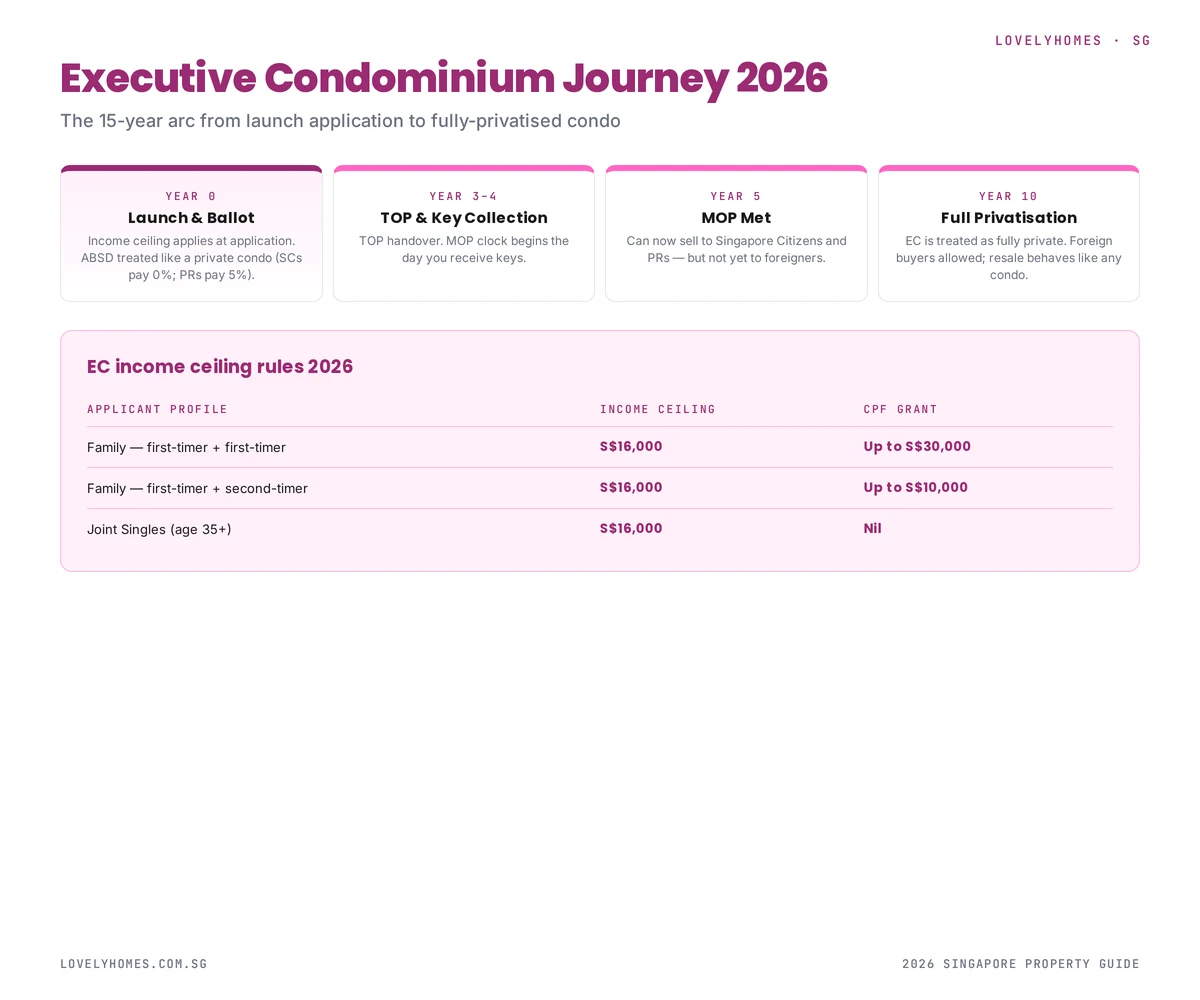
There is no government-mandated income ceiling for purchasing private residential property in Singapore — unlike HDB BTO or EC purchases, which have income ceilings of S$7,000–S$16,000/month depending on flat type. However, the MAS Total Debt Servicing Ratio (TDSR) of 55% effectively enforces an income threshold: for a S$1.5M condo with 75% LTV bank loan at 3.0%, the minimum gross monthly income needed to satisfy TDSR is approximately S$9,700 (assuming no other debt). For a S$2M condo, the minimum income rises to approximately S$13,000/month. The TDSR includes all recurring debt obligations (existing loans, car loans, credit cards), so buyers with significant other debt will need higher incomes.
Can a Singapore PR buy HDB resale and private condo?
Singapore Permanent Residents (PRs) may purchase HDB resale flats, subject to the following restrictions: at least one PR applicant must be eligible (e.g., bought under the PR Public Scheme — two PR holders applying together) and must satisfy the Non-Citizen Quota (NCC — typically 5% of total HDB flats per precinct for PRs). PRs may not buy HDB BTO directly. For private condominiums, PRs may purchase non-landed residential property, subject to 5% ABSD on their first property and 30% ABSD on any subsequent residential property from April 2023. PRs may not purchase landed residential property (including terrace houses, semi-Ds and GCBs) without specific SLA approval.
How do I decide whether to upgrade to condo now or wait?
The decision framework we recommend covers four variables: (1) Affordability today — can you fund the 25% downpayment + BSD from CPF + cash without depleting your emergency reserves? (2) ABSD exposure — if retaining HDB, is the investment case strong enough to absorb 20% ABSD? (3) Income trajectory — will the monthly condo commitment (~S$5,000–8,000/month for most OCR condos) remain sustainable through a job change or interest rate rise? (4) Opportunity cost — what else could you do with the downpayment capital (REITs at ~5–7% yield, index funds, Singapore Savings Bonds)? If all four pass, upgrading now rather than waiting has historically been the better choice in Singapore’s property market — timing the market has cost many prospective buyers more than they saved.
Related Articles
- ABSD Singapore 2026: Complete Guide to Additional Buyer’s Stamp Duty
- CPF for Property Purchase Singapore 2026: OA Withdrawal, Limits and Accrued Interest
- CPF Housing Grant for Resale Flats Singapore 2026: EHG, PHG and Step-Up Grant
- Singapore Home Loan Interest Rates 2026: SORA vs Fixed Rate Complete Guide
- Rental Yield vs Capital Gain Singapore 2026: The Property Investor’s Decision Framework
- HDB Lease Decay Singapore 2026: CPF Limits, Bank LTV and What Buyers Must Know
- TDSR and MSR Singapore 2026: Complete Guide to Loan Servicing Ratios
Disclaimer
This article is for general informational and educational purposes only. HDB policies, stamp duty rates, CPF rules, MAS financing requirements and property prices are subject to change; always verify current figures with official sources including the Housing Development Board (hdb.gov.sg), Inland Revenue Authority of Singapore (iras.gov.sg), Monetary Authority of Singapore (mas.gov.sg), CPF Board (cpf.gov.sg) and Urban Redevelopment Authority (ura.gov.sg). Capital growth and rental yield figures cited are illustrative estimates based on broad market data and individual property outcomes will vary. Nothing in this article constitutes financial, legal, tax or investment advice. Before making any property purchase decision, consult a licensed financial adviser, a practising Singapore lawyer and a CEA-registered property agent. LovelyHomes publishes this content in good faith and accepts no liability for decisions made in reliance on the information presented.