Real Estate Crowdfunding Singapore 2026: Fractional Property Investment, Risks and How It Works

Real Estate Crowdfunding Singapore 2026: Fractional Property Investment, Risks and How It Works

Quick Answer: Real Estate Crowdfunding in Singapore

  • Real estate crowdfunding (also called fractional property investment) lets multiple investors pool capital, often from as little as a few thousand dollars, to collectively own a share of a property through a platform, rather than buying a whole property outright.
  • Most platforms use a Special Purpose Vehicle (SPV) that holds legal title to the property; investors buy shares or notes in the SPV rather than the property itself, and receive a pro-rata share of rental income and any capital gain on sale.
  • Platforms offering this in Singapore are generally regulated activity under the Securities and Futures Act (SFA), and typically need a Capital Markets Services (CMS) licence from the Monetary Authority of Singapore (MAS), or must operate under a specific exemption.
  • Buyer’s Stamp Duty (BSD) and Additional Buyer’s Stamp Duty (ABSD) generally do not apply in the same way as a direct purchase, since investors are typically buying shares in an SPV rather than the property directly, though this depends on the exact structure used.
  • CPF savings cannot be used for these investments, and they are not covered by any deposit protection scheme, unlike a bank savings account.
  • Key risks include illiquidity (no ready secondary market to exit early), platform risk (the platform operator itself could face financial difficulty), concentration risk (your money is tied to one or a few specific properties, not a diversified portfolio), and the usual property market risks of vacancy and price decline.
  • Compared with an SGX-listed REIT, crowdfunding platforms are far less liquid and typically carry higher platform-specific risk, but may offer exposure to a specific property or asset class a REIT does not hold.

What Is Real Estate Crowdfunding?

Real estate crowdfunding, sometimes marketed as fractional property investment or fractional ownership, is a model that allows a group of investors to collectively fund the purchase of a property, or a share in one, through an online platform. Rather than a single buyer taking on the full purchase price, legal responsibilities and risk of an entire property, the investment is broken into smaller units that individual investors can buy into, often starting from a few thousand Singapore dollars rather than the hundreds of thousands typically required for direct property ownership. The properties involved can range from commercial units and shophouses to residential developments, and increasingly include overseas properties marketed to Singapore-based investors seeking geographic diversification.

The appeal is straightforward: it lowers the capital barrier to property investment, allows diversification across several smaller stakes instead of one large illiquid asset, and removes much of the hands-on landlord responsibility, since the platform or its appointed manager typically handles leasing, maintenance and tenant management. The trade-offs, covered in detail below, are just as important to understand before committing capital.

How real estate crowdfunding and fractional property investment is structured in Singapore 2026
Figure 1: The general structure behind a typical real estate crowdfunding or fractional ownership deal.

How the Investment Structure Typically Works

Most platforms operating in this space in Singapore use a Special Purpose Vehicle (SPV), typically a private company set up specifically to hold legal title to one property or a small portfolio. Investors do not buy the property directly; instead, they subscribe for shares or debt notes issued by the SPV, with the size of their stake determining their proportional entitlement to rental income and, eventually, sale proceeds. Some platforms use a trust structure instead of a company, with investors holding units in the trust, but the underlying logic is the same: your legal relationship is with the investment vehicle, not directly with the physical property.

Because investors are buying securities (shares, notes or trust units) rather than directly acquiring real property, this activity generally falls within the scope of the Securities and Futures Act (SFA), administered by MAS. A platform facilitating this kind of offering typically needs to hold a Capital Markets Services (CMS) licence covering the relevant regulated activity (such as dealing in capital markets products, or providing a fund management or crowdfunding service), or rely on a specific regulatory exemption. Before investing through any platform, it is worth checking the MAS Financial Institutions Directory to confirm the platform, or the entity actually making the offer, holds the appropriate licence or exemption, since operating an unlicensed regulated activity is itself a red flag about the platform’s legitimacy.

Rental Income, Fees and Exit Mechanics

While the property is held, rental income collected from tenants is typically distributed to investors pro-rata to their shareholding, usually on a monthly or quarterly basis, after deducting property-level expenses (maintenance, property tax, insurance) and the platform’s management or asset management fee. Fee structures vary by platform but commonly include an upfront placement or acquisition fee (often a percentage of the amount raised), an ongoing annual asset management fee, and a performance or disposal fee taken from any capital gain when the property is eventually sold. These fees compound over the holding period and should be read carefully in the offer document, since they directly reduce net returns to investors.

Exiting an investment before the property is sold is usually the hardest part of this model. Unlike an SGX-listed REIT, which can be bought or sold within seconds during market hours, most real estate crowdfunding platforms offer little to no secondary market for investors wanting to sell their stake early. Some platforms operate an internal matching board where investors can list their shares for other users to buy, but this is generally thin, uncertain and may only execute at a discount, if at all. Investors should treat capital committed to these platforms as locked in until the underlying property is sold, which is typically planned for a specific holding period (often three to seven years) set out at the time of the offering, though actual timing depends on market conditions and platform decisions.

Comparison of direct property ownership REIT and real estate crowdfunding Singapore 2026
Figure 2: How real estate crowdfunding compares with direct ownership and an SGX-listed REIT across key features.

Crowdfunding vs REIT vs Direct Ownership

The closest, more familiar comparison for most Singapore investors is a Real Estate Investment Trust (REIT) listed on the SGX. A REIT pools capital from many investors into a professionally managed portfolio of income-producing properties, is highly liquid since units trade daily on the exchange, and is regulated under both MAS’s REIT framework and SGX’s listing rules, which impose ongoing disclosure and governance obligations far more extensive than most private crowdfunding platforms. The trade-off is that REIT investors have no say over which specific properties are bought or sold, since that sits entirely with the REIT manager, and returns reflect a diversified portfolio rather than a single asset’s performance.

Direct property ownership sits at the other end of the spectrum: full control, the ability to use CPF savings (subject to the usual Housing scheme rules for eligible properties), and the potential to occupy the property yourself, but requiring substantially more capital, exposure to Buyer’s Stamp Duty and, where applicable, Additional Buyer’s Stamp Duty, and far lower liquidity than a REIT. Real estate crowdfunding sits in between: lower capital requirements than direct ownership, but far less liquid than a REIT, with returns concentrated in one or a handful of specific assets rather than spread across a large portfolio, and less regulatory scrutiny than a listed REIT typically faces.

Tax Treatment for Individual Investors

Rental income distributions received by an individual investor through a crowdfunding SPV are generally treated as taxable income in Singapore, and should be declared accordingly, though the exact tax character (rental income versus dividend, depending on how the SPV is structured and how distributions are made) can affect the specific treatment, so investors should check the platform’s tax guidance or consult a tax adviser. Singapore does not impose a general capital gains tax, so a gain made on eventual sale of the underlying property, and distributed to investors, is not typically taxed as a capital gain in the investor’s hands, though gains could be treated as taxable income if the activity is considered a trade rather than a passive investment. Investors in overseas property crowdfunding deals should also be aware that the source country may impose its own withholding tax on rental income or capital gains before amounts are distributed back to Singapore-based investors.

Key Risks to Understand Before Investing

  • Illiquidity: capital is generally locked in for the planned holding period, with little to no reliable way to exit early.
  • Platform risk: if the platform operator itself becomes insolvent or ceases operations, the process for investors to recover their interest in the underlying SPV can become complicated and drawn out, even if the property itself retains value.
  • Concentration risk: unlike a REIT’s diversified portfolio, a crowdfunding investment is usually tied to one specific property, so a single vacancy, tenant default or local market downturn has an outsized impact on returns.
  • No CPF usage and no deposit protection: these are not eligible for CPF Housing scheme use, and are not covered by the Singapore Deposit Insurance Scheme that protects bank deposits.
  • Regulatory and cross-border risk: for overseas property deals, investors take on foreign legal, currency and tax risk on top of the platform and property risk, and enforcement of investor rights in a foreign jurisdiction can be far harder than for a Singapore-based asset.
  • Return projections are not guarantees: illustrative yield and capital gain figures shown in marketing material are projections, not promises, and actual rental income and sale prices depend on real market conditions at the time.

Summary: Real Estate Crowdfunding Facts at a Glance

Question Short Answer
What do I actually own? Shares, notes or units in an SPV/trust that holds the property, not the property directly.
Can I use CPF? No, CPF Housing scheme rules do not apply to these investments.
Does BSD/ABSD apply? Generally not to the investor directly, since they are buying securities, not the property itself.
Is my capital protected? No deposit protection scheme applies; capital is at risk like any investment.
Who regulates these platforms? MAS, typically requiring a Capital Markets Services licence or applicable exemption.
How liquid is my investment? Generally illiquid; expect to hold until the property is sold.

Worked Example: A S$10,000 Fractional Investment

Profile: Mr Lim invests S$10,000 through a platform into an SPV holding a share of a commercial property, on a planned 5-year holding period, with an illustrative projected rental yield of 5.5% per annum.

Step 1 – Annual rental distribution: at a projected 5.5% yield, Mr Lim’s illustrative annual rental distribution before platform fees is S$550.

Step 2 – Cumulative rental income over 5 years: assuming a broadly stable yield, total rental distributions over the holding period come to approximately S$2,750 before fees and tax.

Step 3 – Exit sale: at the end of the 5-year period, the property is sold and Mr Lim’s proportional share of the sale proceeds reflects his original S$10,000 stake plus an illustrative 12% capital gain, for an exit value of approximately S$11,200.

Total illustrative return: S$2,750 (rental income) + S$1,200 (capital gain) = S$3,950 over 5 years on a S$10,000 investment, before platform fees and applicable tax, an illustrative total return of roughly 39.5% or about 7% per annum non-compounded. This is a hypothetical scenario only; actual rental income and exit price depend entirely on the specific property, tenancy and market conditions, and could be lower, including a partial or full loss of capital.

Worked example returns from a S$10,000 real estate crowdfunding investment Singapore 2026
Figure 3: Illustrative breakdown of the worked example above.

Why This Matters for Singapore Investors

Real estate crowdfunding fills a genuine gap for investors who want direct property exposure without the capital outlay, stamp duty and hands-on management that direct ownership demands, and who find a REIT’s fully diversified, professionally managed portfolio less appealing than backing a specific asset they can evaluate themselves. This makes the model attractive as a smaller, satellite allocation within a broader portfolio, rather than a core holding, particularly given the illiquidity and concentration risk involved. Investors should size any allocation to these platforms accordingly, treat published yield and capital gain projections as estimates rather than guarantees, and do the same due diligence on the platform’s regulatory standing and track record that they would apply to any other unlisted investment.

What Might Come Next

The following is informed speculation, not confirmed policy. As MAS continues to refine its regulatory approach to digital and fractionalised investment products, including ongoing work on tokenised assets and digital securities more broadly, it is plausible that clearer, more standardised rules specific to real estate crowdfunding platforms could develop over time, potentially including enhanced disclosure or secondary market requirements to address the liquidity gap. Growing investor appetite for smaller-ticket, diversified property exposure may also encourage more platforms to explore semi-liquid structures, such as periodic redemption windows, though no such standard has become widespread in Singapore as at this writing.

Frequently Asked Questions

Is real estate crowdfunding regulated in Singapore?

Yes, generally. Because investors are typically buying shares, notes or units in an SPV or trust, this usually falls under the Securities and Futures Act, and the platform or offering entity typically needs a Capital Markets Services licence from MAS, or must rely on a specific exemption. Always verify a platform’s regulatory status before investing.

Can I use my CPF Ordinary Account savings for this?

No. CPF Housing scheme rules only apply to direct purchases of eligible residential property, not to shares, notes or units in a crowdfunding SPV or trust.

What happens to my investment if the platform shuts down?

This depends on how the SPV or trust is structured and where legal title sits. In a well-structured deal, the property is held by an SPV independent of the platform operator, so investors retain their interest even if the platform ceases operations, though the practical process of managing the asset and eventually exiting can become far more complicated. This is exactly why checking the legal structure and platform track record before investing matters.

How is this different from buying an SGX-listed REIT?

A REIT holds a diversified portfolio of properties, is highly liquid since units trade daily on the exchange, and is subject to extensive MAS and SGX disclosure requirements. Crowdfunding platforms typically expose you to one or a handful of specific properties, are far less liquid, and generally carry less standardised regulatory scrutiny than a listed REIT.

Do I pay Buyer’s Stamp Duty on a crowdfunded investment?

Generally no, because the investor is typically buying securities in an SPV rather than acquiring the property directly. However, the exact stamp duty treatment depends on the specific legal structure of each deal, so this should be confirmed in the offer document or with a tax adviser.

Can I sell my stake before the property is sold?

Usually only with difficulty. Most platforms do not offer a robust secondary market, so investors should generally plan to hold until the underlying property is sold at the end of the planned holding period, rather than assuming they can exit on demand.

Is rental income from these investments taxable?

Generally yes, distributions of rental income to individual investors are treated as taxable income in Singapore, though the precise characterisation can depend on the SPV structure. Singapore does not have a general capital gains tax, so a distributed capital gain on sale is not usually taxed as such, though this should always be confirmed for your specific situation.

Disclaimer: This article is for general informational purposes only and is not financial or investment advice. Real estate crowdfunding and fractional property investment carry capital risk, including possible loss of the amount invested, and are not covered by any deposit protection scheme. Always verify a platform’s regulatory status with the Monetary Authority of Singapore (MAS), read the full offer document, and seek independent financial advice before investing.
×

Click anywhere outside to close

Singapore REITs Investment Guide 2026: How to Invest in Property Through the Stock Market

Singapore REITs Investment Guide 2026: How to Invest in Property Through the Stock Market

Singapore REITs investment guide 2026 — full guide hero image
Singapore REITs Investment Guide 2026 — owning Singapore property without buying a unit.

Quick answer — S-REITs in 30 seconds

  • A Singapore Real Estate Investment Trust (S-REIT) is an SGX-listed vehicle that owns income-producing real estate and is required by law to distribute at least 90% of its taxable income to unit holders.
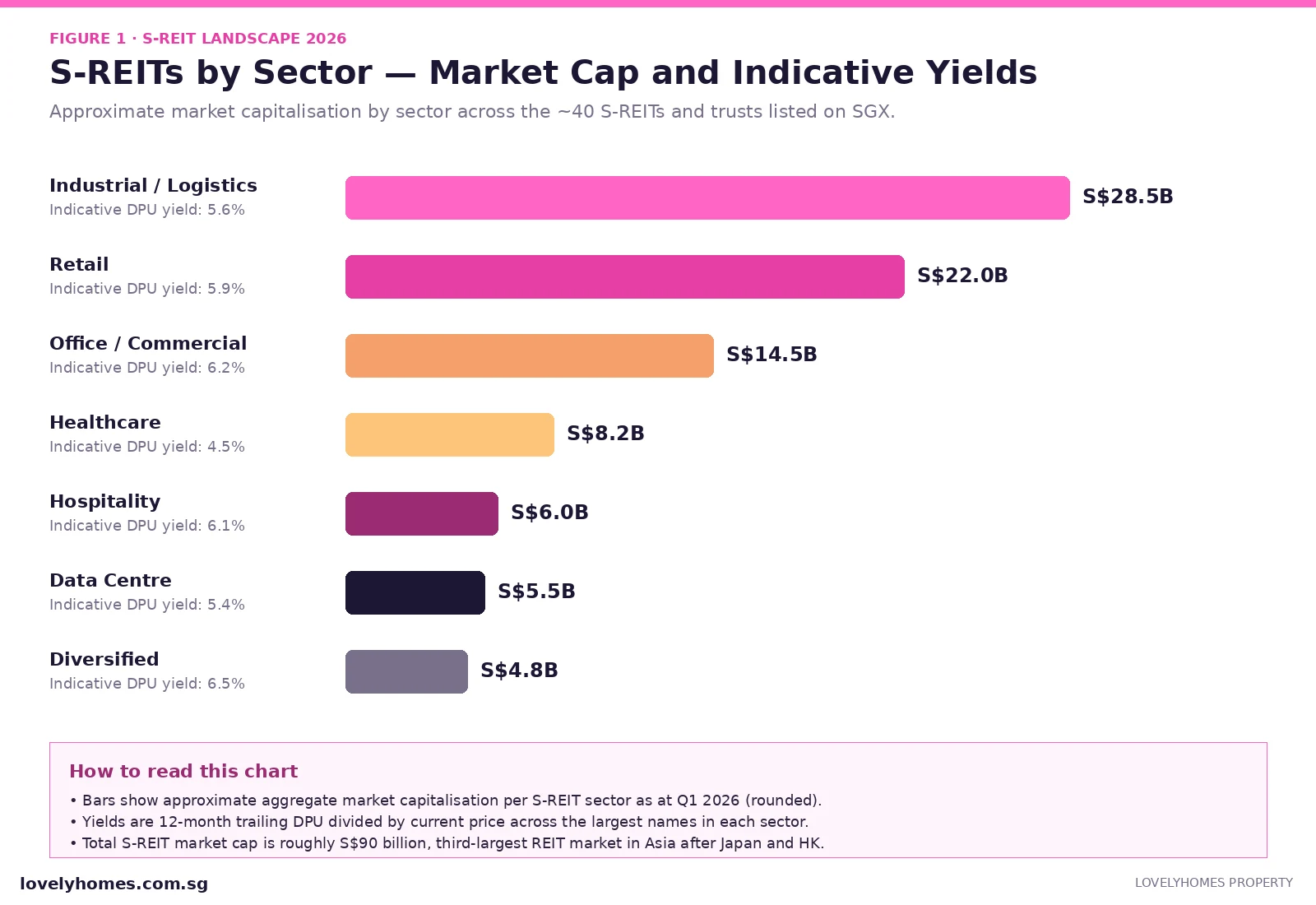
  • Around 40 S-REITs and stapled trusts are listed on the Singapore Exchange, with combined market cap roughly S$90 billion — the third-largest REIT market in Asia.
  • Indicative distribution per unit (DPU) yields sit at 5–6.5% across most S-REITs in 2026, against ~3.0–3.8% gross rental yields on direct condos.
  • S-REIT distributions to retail Singapore investors are tax-exempt at the investor level, and there is no BSD or ABSD on REIT unit purchases.
  • Minimum entry can be as low as one board lot (typically S$1,000–2,500), versus ~S$200,000 cash + CPF for a S$1M condo.
  • S-REITs trade like shares — settlement T+2, daily liquidity — so the lock-in risk of direct property does not apply.
  • You don’t choose the tenants, the manager does. You also don’t get the leverage of a 75% mortgage on a personal balance sheet.
  • Risks include sector concentration, refinancing risk on REIT debt, and price volatility driven by SGS yields and the SORA curve.

What is an S-REIT, exactly?

An S-REIT is a pooled investment vehicle, structured as a unit trust, that owns and manages a portfolio of income-producing real estate — shopping malls, office towers, logistics warehouses, hotels, hospitals, data centres, or a mix of these. The trust is listed on the Singapore Exchange (SGX) and trades just like a share. When you buy a unit of an S-REIT, you buy a slice of the underlying portfolio’s rental income and net asset value.

The key feature that distinguishes a REIT from a property holding company is the tax pass-through: as long as the trust distributes at least 90% of its taxable income to unit holders, that income is exempt from corporate tax at the trust level. The Inland Revenue Authority of Singapore (IRAS) further exempts these distributions from personal income tax for individual Singapore investors. The result is yield that flows from rents into your bank account with no tax leakage along the way — provided you remain an individual retail investor (different rules apply for institutions and non-residents).

S-REITs were introduced in Singapore in 2002, when the Monetary Authority of Singapore (MAS) and SGX rolled out the regulatory framework. The first listing — CapitaLand Mall Trust, now CapitaLand Integrated Commercial Trust — set a template that has been replicated 40-plus times since. Today the universe spans purely domestic plays (Frasers Centrepoint Trust, Suntec REIT) all the way to globally diversified industrial and data-centre REITs (Mapletree Industrial Trust, Keppel DC REIT) sponsored by listed Singapore developers.

Singapore REITs sector breakdown 2026 — market cap and yield by sector
Figure 1 · S-REIT market cap by sector and indicative DPU yields, Q1 2026.

How S-REITs make money (and how you make money from them)

An S-REIT generates revenue almost entirely from rents and service charges on the buildings it owns. Operating costs — property management fees, marketing, repairs, utilities recovered from tenants, the REIT manager’s base + performance fees — are deducted to get to net property income. Interest on the REIT’s debt is then paid; what remains is distributable income. Unit holders are paid out quarterly or semi-annually, depending on the trust.

Total return for a unit holder therefore has two components. The first is the distribution yield (the DPU divided by your purchase price), which is the income piece. The second is capital appreciation or depreciation of the units themselves, which moves with the trust’s net asset value (NAV) per unit and broader interest-rate sentiment. Over long holding periods, total returns are anchored to the underlying real estate’s rental growth and the discipline of the REIT manager. Over shorter periods, S-REIT prices can swing meaningfully on every change in SORA and SGS yields, which is the price volatility you accept in exchange for the liquidity advantage.

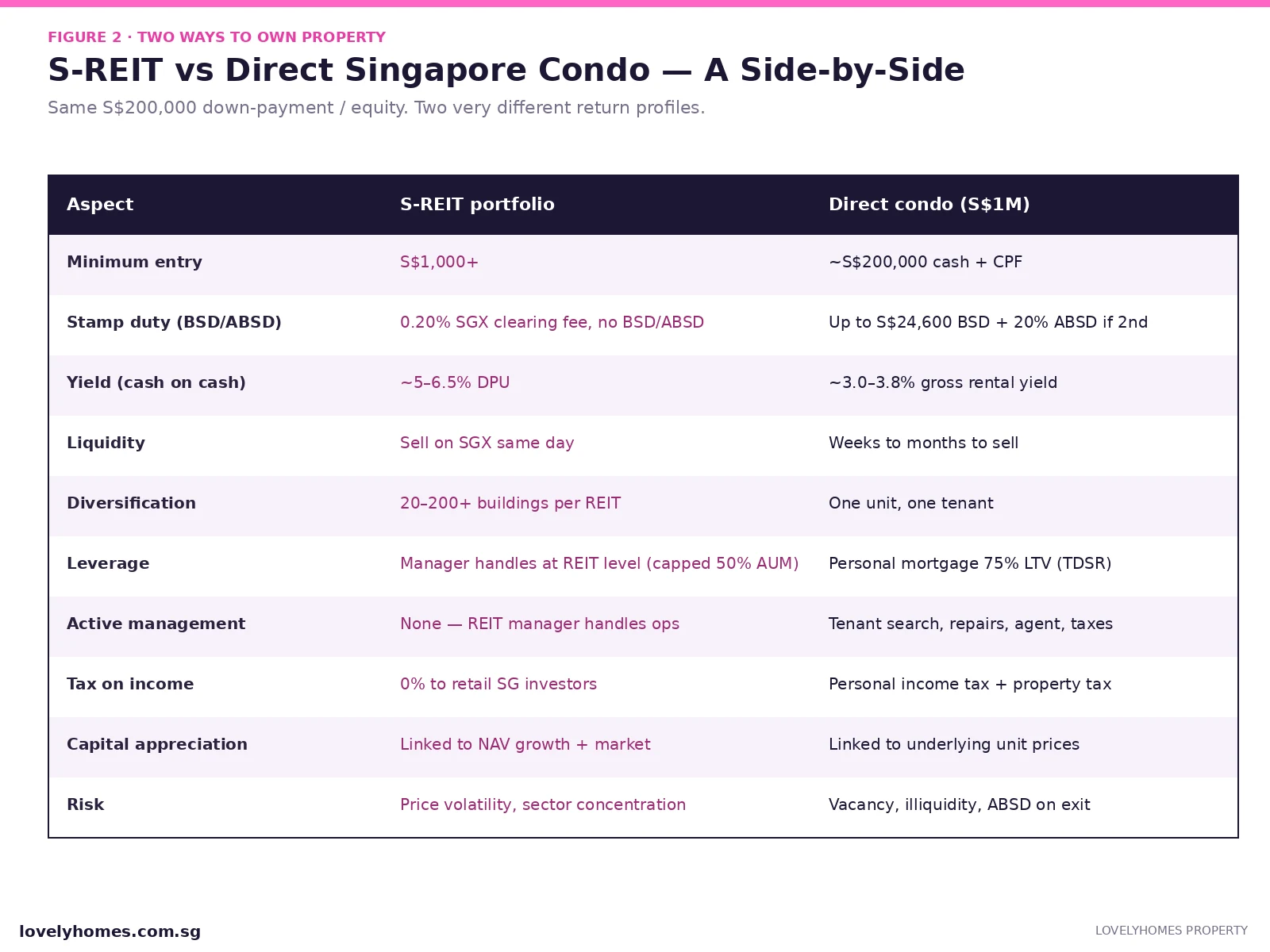
S-REIT vs direct Singapore condo — a side-by-side

The cleanest way to think about S-REITs is as a competing route into Singapore property exposure. Most retail buyers default to a single-unit private condo because it is the path of least resistance — the developer markets it, you sign for it, you collect rent. The S-REIT route requires opening a brokerage account and buying units, but eliminates a long list of frictions.

S-REIT vs direct condo Singapore 2026 comparison table
Figure 2 · Same S$200,000 of equity. Two very different return profiles, liquidity, and tax treatments.

Three differences stand out. First, stamp duty: a Singapore Citizen buying a S$1M condo as a second property pays roughly S$24,600 in BSD plus S$200,000 in ABSD — over a fifth of the purchase price walks out the door before they have collected a single dollar of rent. The S-REIT investor pays roughly 0.20% in SGX clearing/transfer charges and the broker’s commission. Second, liquidity: a condo takes months to list, market, exercise OTP, and complete; S-REIT units settle T+2 on SGX. Third, diversification: a single condo is one tenant’s whim away from zero rent for three months; a typical industrial S-REIT owns 100+ buildings across multiple geographies.

The case for direct property has not gone away. Direct property gives you control of the asset, lets you draw 75% bank leverage at your personal credit, lets you live in the asset rent-free, and historically has tracked Singapore’s housing-market price index quite closely. The case for the S-REIT is that, for the same dollar of equity, you typically get higher cash-on-cash income, daily liquidity, and zero stamp-duty drag.

The S-REIT yield story versus alternatives

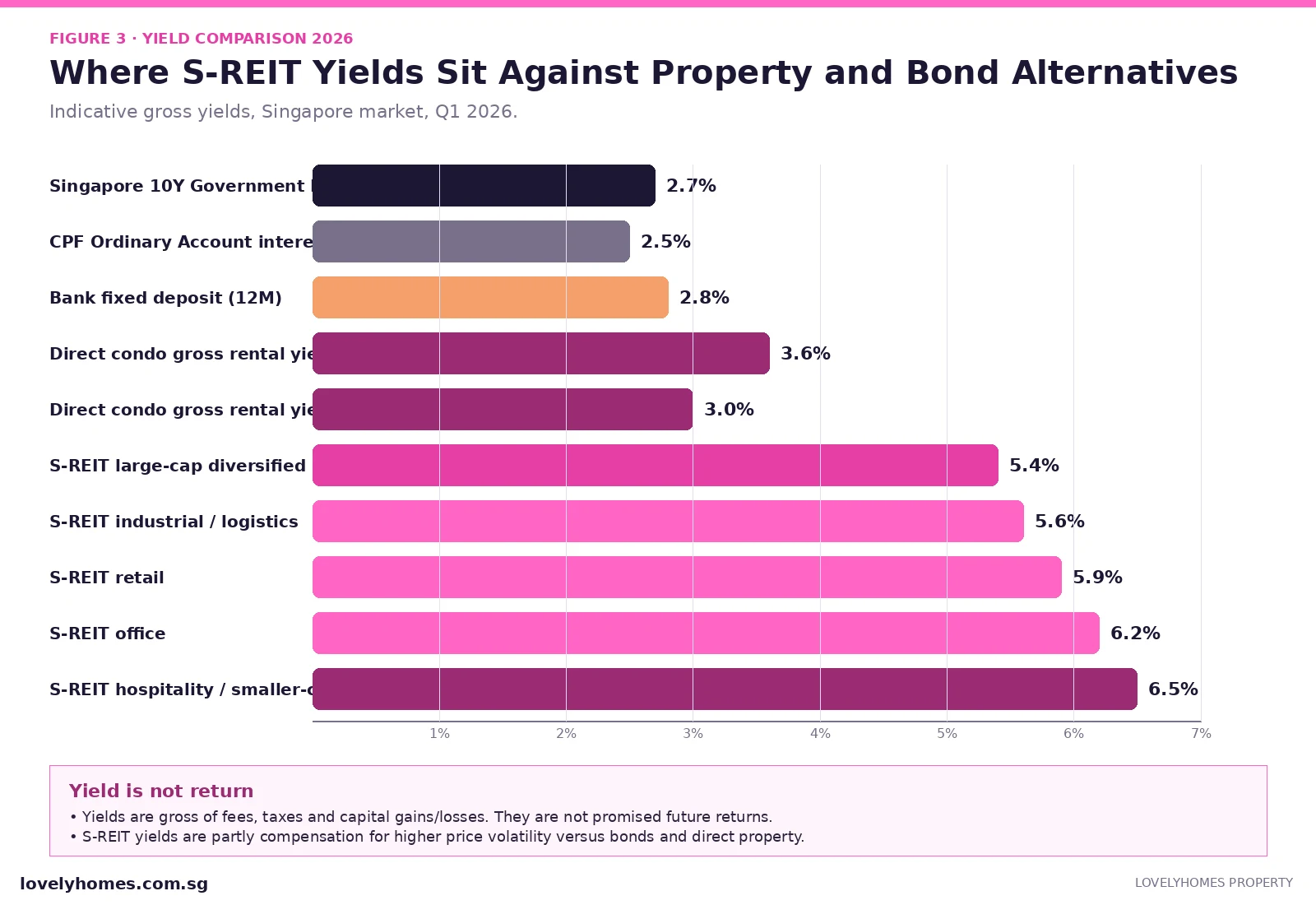
Yield is the headline reason most investors look at S-REITs. In a world where the Singapore 10-year government bond pays around 2.7% and a CPF Ordinary Account compounds at 2.5%, an S-REIT yield in the 5.5–6.5% range looks attractive. The right way to read these numbers is as yield premium — the spread above the risk-free rate that compensates you for taking equity-like risk.

S-REIT yield 2026 vs bond and CPF and rental yield comparison Singapore
Figure 3 · Indicative gross yields, Singapore market, Q1 2026.

Three caveats are worth holding in mind. The 5–6.5% headline yield is gross of price volatility — S-REIT unit prices can fall 15–25% in a year of rising rates, which means the cash-on-cash yield on your purchase price can be very different from the yield-on-paper an investor sees if they buy mid-correction. Yields are also not promised future returns; managers can cut DPU when occupancy or rental reversion turns negative, as several office and hospitality REITs did during 2020–2021. Finally, the headline yield does not include broker commissions, withholding tax for non-residents, or the bid-ask spread on smaller-cap names.

How to buy S-REITs — practical mechanics

The mechanics in 2026 are simple but worth getting right. You need three things: a Central Depository (CDP) account with SGX (free to open, requires NRIC/FIN, takes a few business days), a brokerage account (DBS Vickers, OCBC Securities, UOB Kay Hian, Tiger, Moomoo, IBKR all offer SGX access), and a Singapore-dollar settlement account at your bank. Once those are in place, you log into the broker, search for the REIT’s stock code, and place a buy order — limit orders are recommended over market orders for less-liquid names.

Most S-REITs trade in board lots of 100 units. With unit prices typically in the S$0.80–S$3.50 range, that puts the practical entry at around S$80–S$350 per board lot. There is no minimum to start; you can buy a single board lot of one REIT and add to it monthly. Many investors use a dollar-cost averaging approach — fixed monthly contributions into a small basket of REITs — which smooths the price-volatility risk over time.

The four real risks to underwrite

Before deploying capital, walk through four specific risks each REIT faces, and check the latest annual report or quarterly disclosure to see how the manager is positioned.

1. Interest-rate / refinancing risk

S-REITs are leveraged vehicles. The MAS caps aggregate leverage at 50% of total assets (raised from 45% in 2020 and made permanent in 2022). That debt has to be rolled. When SORA spikes, refinancing the next tranche of expiring debt costs more, and DPU compresses. The cleanest way to read this is to check weighted average debt cost, weighted average debt maturity, and the fixed-rate coverage in the latest results presentation — well-managed REITs disclose all three.

2. Sector / geography concentration

A retail REIT owning only Singapore suburban malls is fine in normal times and very exposed during a tourism collapse. A logistics REIT with US warehouses is fine in normal times and exposed to USD/SGD currency moves. Diversifying across at least three S-REIT sub-sectors (typically industrial + retail + office or data centre) is a practical hedge against single-sector shocks.

3. Manager incentive risk

The REIT manager is paid a base fee on assets under management plus a performance fee linked to DPU growth. This is well-aligned in good times and can become misaligned if managers push for acquisitions just to grow AUM. Look for managers with internal ownership, transparent unit-issuance discipline, and a track record of value-accretive acquisitions rather than dilutive ones.

4. Property-specific risk

A REIT’s biggest tenant going bankrupt, a major asset failing the BCA’s Green Mark recertification, or a leasehold running down without a top-up — all of these are real, individual-property risks that can hit DPU faster than macro factors. Mitigate by owning diversified REITs (no single tenant > 5–10% of rents) and check that lease expiry profiles are well staggered.

S-REIT taxation for Singapore investors

Tax treatment is a quiet but meaningful part of the S-REIT case. For an individual Singapore tax resident:

  • Distributions are tax-exempt at the unit-holder level — no personal income tax to declare.
  • Capital gains on unit sales are not taxed — Singapore has no capital gains tax, and S-REIT units are treated like other listed securities.
  • No GST on unit purchases or sales.
  • No property tax — that is paid by the REIT at the asset level and already reflected in the distributable income figure.
  • No ABSD or BSD, since unit ownership is not direct real-estate ownership.

For a Singapore corporate investor, distributions are subject to corporate tax. For a non-resident individual, distributions attract a 10% withholding tax under MAS’s 2026 framework, which is a meaningful drag versus the resident treatment. Tax rules can change; always verify with IRAS or a qualified tax adviser before sizing a position.

Worked example — building a S$200,000 S-REIT portfolio

Take a Singapore Citizen with S$200,000 of investible savings (separate from emergency fund, separate from CPF Ordinary Account property allocation). They want Singapore property exposure but cannot stomach the ABSD on a second condo.

Allocation Sector S$ amount Indicative yield Annual DPU
Industrial / logistics REIT (large-cap) Logistics warehousing S$60,000 5.6% S$3,360
Retail REIT (Singapore-focused) Suburban malls S$50,000 5.9% S$2,950
Office REIT (Grade A CBD) Singapore offices S$40,000 6.2% S$2,480
Data centre REIT (global) Data centres S$30,000 5.4% S$1,620
Healthcare REIT (defensive) Hospitals S$20,000 4.5% S$900
Total portfolio 5 sectors S$200,000 5.65% S$11,310

That portfolio yields roughly S$11,310 a year in tax-free DPU, paid quarterly or semi-annually depending on the manager. Compare with the same S$200,000 deployed as the down-payment on an S$800,000 OCR condo with a 75% mortgage: ~S$24,000 in BSD plus, if it is a second property, S$160,000 in ABSD — meaning you would only have S$16,000 left of the S$200,000 to cover legal fees, valuation, and the cash portion of the down-payment. The condo path requires another S$140,000+ in cash to actually transact.

What this means for you

For most Singapore retail investors, S-REITs are not a substitute for a primary residence — that home should still be your first property and your primary anchor in Singapore real estate. But for the second dollar of property exposure, S-REITs are usually the more efficient route. The stamp-duty drag on a second condo is so heavy that it takes years of rental income to recoup; an S-REIT portfolio compounds from day one. The trade-off is that S-REIT prices move daily — you have to be psychologically comfortable watching unit prices drop 10–15% in a tightening cycle without panic selling.

A reasonable rule of thumb: keep your primary residence as the base, then consider S-REITs (rather than a second condo) for the next S$100,000–S$500,000 of property allocation. Above that level, the case for direct property — leverage, control, the ability to live in or rent out a unit — starts to compete more strongly with the S-REIT route. Decoupling and ABSD-avoidance strategies have their place, but most households arrive at the S-REIT route via simple arithmetic.

What might come next

Three structural shifts are worth tracking through 2026 and beyond. The MAS leverage cap (50%) and minimum interest coverage ratio (1.5x) are set to be reviewed periodically; any tightening would compress acquisition pipelines, while any easing would increase DPU growth optionality. The data-centre sub-sector continues to attract sponsor interest as AI compute demand reshapes industrial real estate; expect more S-REITs to lean toward this segment. And the Singapore office market is in the middle of a quiet repricing as hybrid work patterns stabilise — Grade A CBD assets remain bid, but secondary office is under structural pressure that should show up in DPU revisions.

Two regulatory tweaks under discussion at MAS — both flagged in industry consultation papers but not yet enacted as of April 2026 — could reshape the asset class. One is a possible adjustment to the 90% distribution requirement to give managers more flexibility on retention for AEI (asset enhancement initiative) capex. The other is a potential review of REIT manager fee structures to better align with unit-holder outcomes. Both would be modestly positive for long-term unit holders if implemented thoughtfully.

Frequently asked questions

Are S-REIT distributions really tax-free for Singapore investors?

For Singapore tax-resident individual investors holding S-REIT units in a personal capacity, distributions are exempt from personal income tax under IRAS rules. This does not apply to Singapore companies, partnerships, or non-residents (who face withholding tax). Always confirm the current IRAS guidance for your specific tax-residency status.

How do S-REITs differ from REIT ETFs?

An S-REIT is an individual trust that owns specific buildings. A REIT ETF (e.g. listed Lion-Phillip S-REIT ETF, NikkoAM-StraitsTrading Asia ex-Japan REIT ETF) holds a basket of REITs and rebalances on a defined index. ETFs trade lower yields after fees but offer one-ticker diversification. New investors often start with a REIT ETF and migrate to direct REIT picks once they’re comfortable reading the financials.

Can I use my CPF Ordinary Account to buy S-REITs?

S-REITs listed on SGX are eligible under the CPF Investment Scheme (CPFIS-OA), subject to the 35% stocks limit. Distributions paid into your CPFIS account are credited back to OA and continue to earn the OA floor rate. Note that capital losses from CPFIS are not tax-deductible the way personal cash investments would be in some other markets — Singapore has no capital gains tax in either case.

What yield should I aim for when buying S-REITs?

Yield is a function of price; a higher yield often signals higher perceived risk. A reasonable target band in 2026 is 5.5–6.5% for diversified large-cap S-REITs. Yields above 8% are usually a warning sign — the market is pricing in a DPU cut. Yields below 4.5% are typically defensive, low-volatility names where investors are paying up for stability.

What happens to my S-REIT units if the REIT manager is removed?

Unit holders have the right under the trust deed to vote out a manager (typically with a supermajority). The asset portfolio is owned by the trust itself, not the manager — so a change of manager is messy but does not zero out the unit value. This protection is one reason MAS regulates REIT managers heavily; the framework is designed to keep unit-holder interests primary.

Should I buy individual S-REITs or a REIT ETF first?

If you have time to read 2–3 annual reports per quarter, individual S-REITs let you tailor sector exposure and earn a slightly higher yield after fees. If you want a low-maintenance core position, a REIT ETF is a sensible starting point — you get instant diversification across 20–30 names with one trade.

How do S-REITs perform in a recession?

It depends heavily on sector. Industrial and healthcare REITs tend to be defensive (long leases, essential tenants). Hospitality and retail REITs tend to be cyclical (tourism, discretionary spend). In the 2020 COVID drawdown, the FTSE Straits Times REIT Index fell roughly 30% peak-to-trough before recovering most losses by mid-2021. Holding period and sector mix matter more than market timing.

Disclaimer: This article is general information only, not personalised investment advice. S-REITs carry market risk, sector concentration risk, and refinancing risk; unit prices can fall meaningfully and DPU is not guaranteed. Yields and market-cap figures are indicative as at Q1 2026 and will move; always verify current data on the relevant SGX disclosure pages and the Monetary Authority of Singapore (MAS) at mas.gov.sg. Tax treatment depends on your residency and circumstances — consult IRAS at iras.gov.sg or a licensed financial adviser. SingStat at singstat.gov.sg publishes housing-market and macro data referenced in this article. This article does not endorse any specific REIT or fund.

Translate »