Singapore Rental Market Guide 2026: HDB and Condo Rents, Yields and Outlook Explained

Singapore Rental Market Guide 2026: HDB and Condo Rents, Yields and Outlook Explained

Quick Answer: Singapore Rental Market 2026

  • Singapore’s private residential rental index rose 0.3% in Q1 2026 (URA), recovering from a 0.5% dip in Q4 2025, but remains below the 2023 peak.
  • HDB rental index eased 0.1% in Q1 2026, continuing a gradual softening from the 2023 high after two years of elevated rents.
  • Median rents in Q1 2026: HDB 4-room S$2,600/mth, condominium 2-bedroom S$3,600/mth (OCR), condominium 3-bedroom S$5,200/mth.
  • Gross rental yields remain attractive for HDB (4.7–5.6%) compared with private condominiums in Core Central Region (CCR) (2.6%).
  • Rising supply from 2024–2025 completions is the dominant dampener; landlords must price competitively in 2026.
  • Demand drivers: foreign professional workforce (Employment Pass/S Pass holders), expat families on education visas, and domestic upgraders waiting for new homes to complete.
  • Short-term rentals (fewer than 3 months) remain prohibited for residential properties in Singapore under URA regulations.
  • Landlords must declare rental income on their annual income tax returns to IRAS; allowable deductions include mortgage interest, property tax, and maintenance fees.

Understanding Singapore’s Rental Market

Singapore’s residential rental market is one of Asia’s most closely watched — shaped by a unique interplay of government-controlled HDB supply, private condominium completions, immigration policy, and one of the highest proportions of home ownership in the world (approximately 89%). Unlike many global cities, Singapore’s rental sector is comparatively small: most residents own their HDB flats. The rental pool is disproportionately driven by the expatriate workforce and a domestic segment of upgraders temporarily between properties.

The Urban Redevelopment Authority (URA) tracks the Private Residential Rental Index quarterly; HDB separately tracks the HDB Rental Index. Both indices are released alongside quarterly real estate statistics — the primary authoritative source for rental market data. The Q1 2026 URA statistics confirmed that private rental growth has moderated after the exceptional surge of 2021–2023, when the market rose over 50% from its COVID-era trough on the back of a supply drought and surging foreign workforce arrivals.

Rental Index Trend: 2020–2026

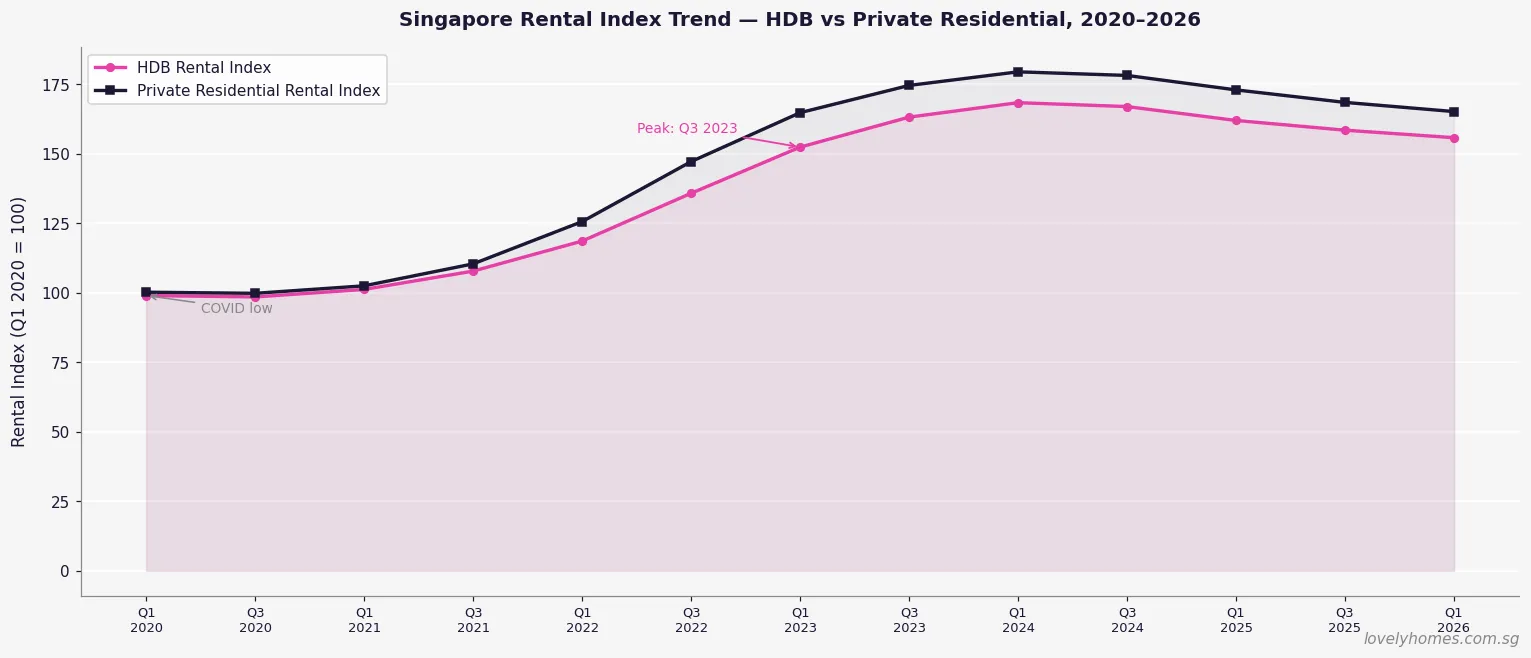
The rental cycle of this decade is one of the most dramatic in Singapore’s property history. From a base of approximately 100 in early 2020, the HDB Rental Index rose to a peak of approximately 163 by mid-2023 before softening. Private residential rents peaked near 175 in mid-2023. As at Q1 2026, both indices have retreated — the HDB index to approximately 156, the private residential index to approximately 165 — representing a correction of roughly 4–6% from peak.
Singapore rental index trend 2020 to 2026 - HDB vs private residential rental index
Figure 1: Singapore HDB and Private Residential Rental Index trend, Q1 2020 – Q1 2026 (Q1 2020 = 100). Sources: URA, HDB quarterly real estate statistics.

The correction has been driven primarily by supply normalisation — a wave of private condominium completions in 2024–2025 (including several large integrated developments) added significant rental stock to the market, while post-COVID foreign workforce growth moderated as global companies trimmed headcount in 2024–2025. Nevertheless, rents remain approximately 55% higher in absolute terms than pre-COVID levels for most property types.

Median Monthly Rents by Property Type, Q1 2026

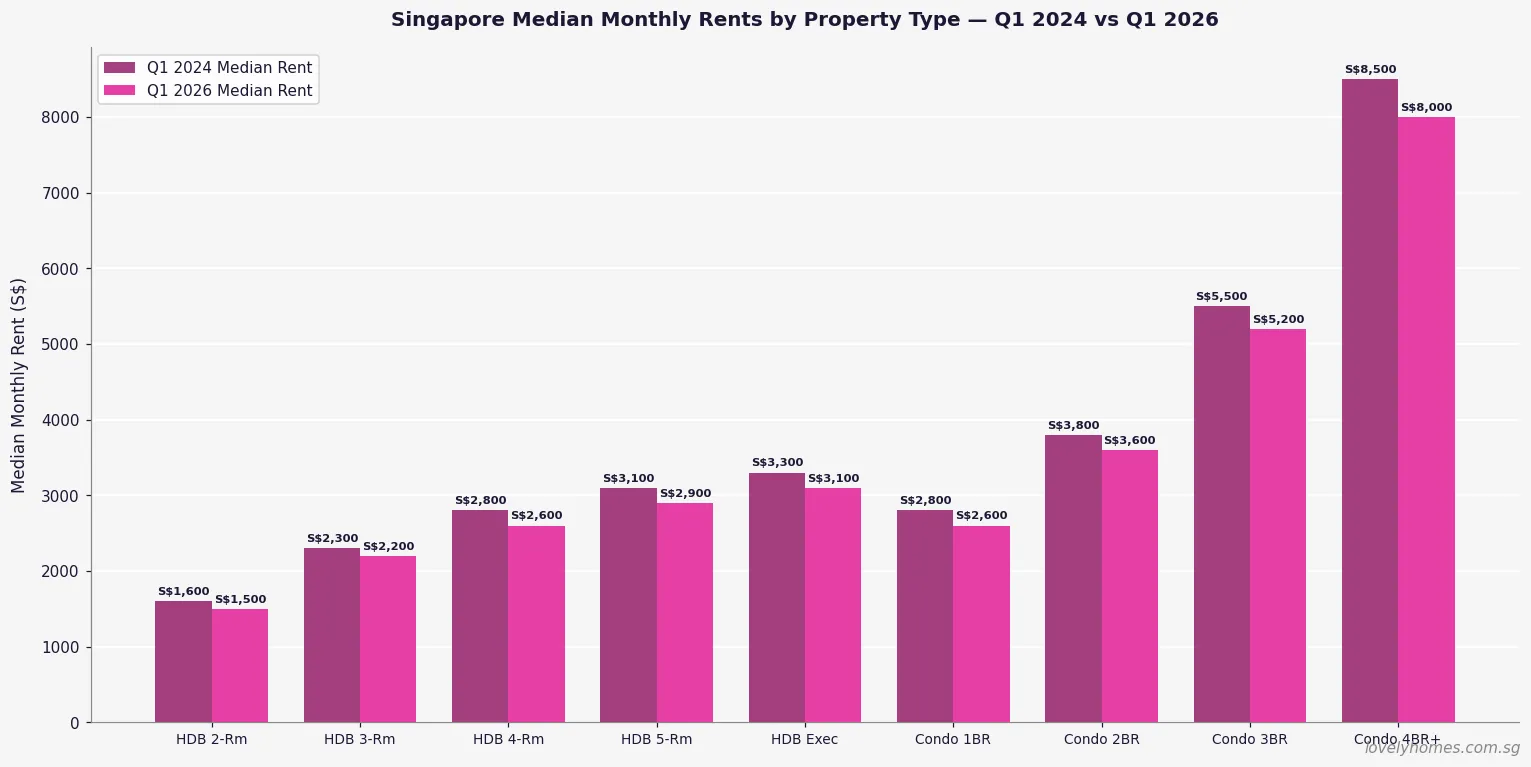
Industry figures from Q1 2026 show median monthly rents across property types as follows. HDB room types continue to offer the most accessible entry point for tenants, while Core Central Region (CCR) condominiums command a substantial premium reflecting proximity to the CBD and top international schools.
Singapore median monthly rents 2026 - HDB and condo by room type Q1 2024 vs Q1 2026
Figure 2: Singapore median monthly rents Q1 2024 vs Q1 2026 by property type. All figures are indicative medians; individual transacted rents vary by location, floor, condition, and furnishing.

Key observations from the Q1 2026 data: HDB 3-room rents have eased from approximately S$2,300/mth in Q1 2024 to approximately S$2,200/mth, a modest 4.3% decline. Private condominium 3-bedroom rents have softened more noticeably from approximately S$5,500/mth to S$5,200/mth (−5.5%). Executive flat rents remain relatively sticky at approximately S$3,100/mth, reflecting persistently high demand from larger families displaced from the HDB resale market by the 15-month wait.

Gross Rental Yields by Property Type

Gross rental yield is calculated as annual rent divided by market value. In Singapore’s context, it is an imperfect but useful comparator — particularly when set against the CPF Ordinary Account rate of 2.5% p.a. and typical bank mortgage rates of 3.0–3.7% p.a. in 2026. Properties yielding below the mortgage rate require careful cash flow modelling; properties yielding above 4.5% can generate positive carry even at current financing costs.
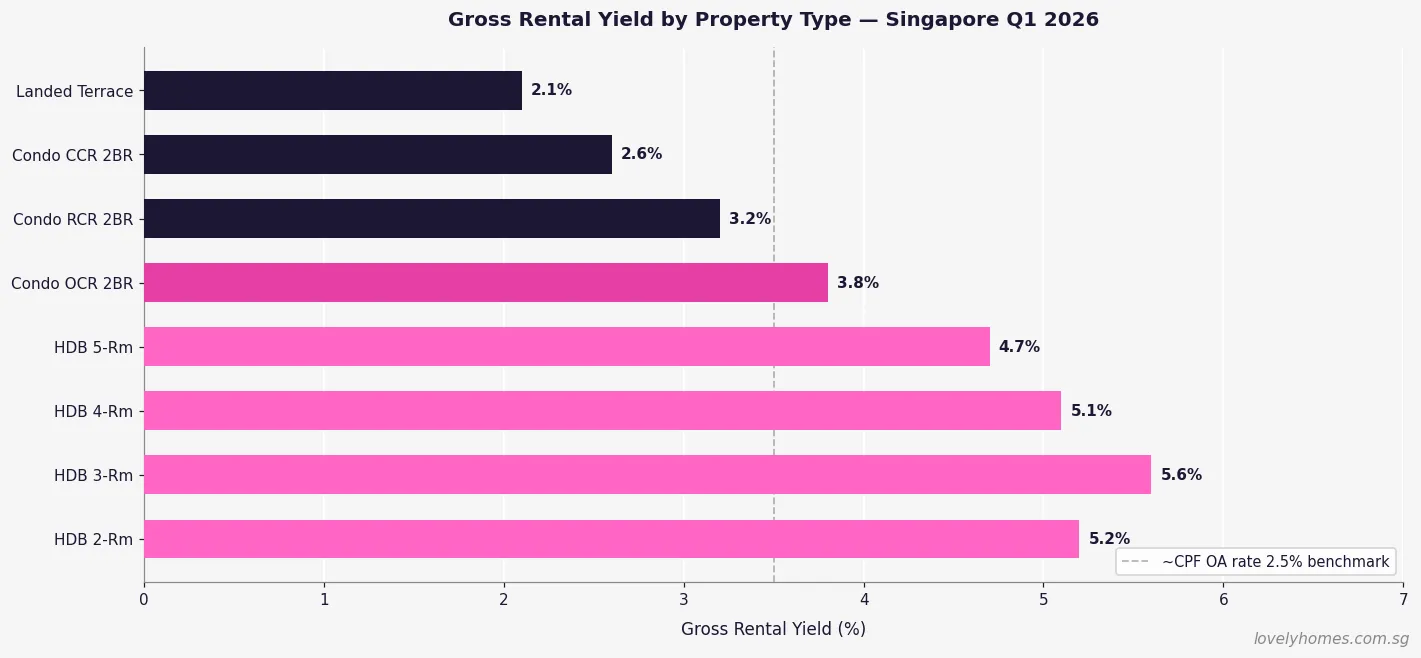
Singapore rental yield by property type 2026 - HDB condo landed gross yield comparison
Figure 3: Gross rental yield by property type, Singapore Q1 2026. Yields are gross — deduct mortgage interest, property tax, management fees, vacancy, and maintenance for net yield calculations.

HDB flats deliver the highest gross yields precisely because their prices are regulated and their transacted values remain significantly below equivalent private condominiums. A well-located 3-room HDB in Toa Payoh with a transacted rent of S$2,200/mth and a resale value of approximately S$470,000 generates a gross yield of approximately 5.6% — among the highest in Singapore’s residential market. However, HDB landlords face non-citizen quota constraints (8% or 11% per block/neighbourhood) and must comply with the Minimum Occupation Period (MOP) rules and HDB approval requirements. See our comprehensive HDB Rental Guide 2026 for full details.

Landlord Obligations and Legal Framework

Residential tenancies in Singapore are governed primarily by contract law — there is no Residential Tenancies Act equivalent to those in the United Kingdom or Australia. The standard Tenancy Agreement is a contractual document prepared by either party’s lawyer or the property agent. Key regulatory requirements for landlords include:

  • Stamp duty on tenancy agreements: The tenant is liable to pay stamp duty on the tenancy agreement via IRAS e-Stamping. The rate is 0.4% of the total rent for leases of 1–4 years; for leases exceeding 4 years, the rate is 4% of the average annual rent. In practice, landlords should confirm the stamp duty is paid within 14 days of signing, as IRAS treats it as a condition for the agreement to be legally admissible in court.
  • Short-term rental prohibition: URA regulations prohibit the use of private residential properties for accommodation for periods of fewer than 3 consecutive months. Platforms such as Airbnb, Agoda (short-stay listings), and similar are prohibited for residential properties. Violations carry fines of up to S$200,000 per offence.
  • HDB subletting rules: HDB flat owners who have completed their Minimum Occupation Period (MOP) may sublet their whole flat or individual bedrooms, subject to HDB approval, non-citizen quota compliance, and the maximum occupancy limits (8 persons per flat until 31 December 2026 under the current temporary relaxation).
  • Property tax: Landlords pay property tax at non-owner-occupier rates (typically 10–20% of the Annual Value for private properties, 10% for HDB), which is a deductible expense against rental income.
  • Rental income tax: Rental income is taxable as personal income in Singapore. Allowable deductions include mortgage interest, property tax, fire insurance premiums, maintenance fees, and depreciation of approved furniture at 20% per annum declining balance.

Summary: Singapore Rental Market at a Glance, 2026

Property Type Typical Monthly Rent Gross Yield Key Tenant Profile
HDB 2-room S$1,400–S$1,600 ~5.2% Singles, young couples
HDB 3-room S$2,000–S$2,400 ~5.6% Small families, couples
HDB 4-room S$2,400–S$2,800 ~5.1% Families, expat workers
HDB 5-room S$2,600–S$3,200 ~4.7% Families, management expats
Condo 1-bedroom (OCR) S$2,400–S$2,800 ~3.8% Young professionals
Condo 2-bedroom (OCR) S$3,200–S$4,000 ~3.8% Couples, small families
Condo 2-bedroom (CCR) S$4,500–S$6,500 ~2.6% Senior expat executives
Landed Terrace S$6,000–S$10,000 ~2.1% High-net-worth families

Worked Example: Mr Rajan Buys a 3-Room HDB to Rent Out in Ang Mo Kio

Mr Rajan, a Singapore Citizen, purchased a 3-room HDB resale flat in Ang Mo Kio in August 2021 for S$450,000. His MOP completed in August 2026 and he immediately lists it for whole-flat rental while upgrading to a condominium. Key figures:

  • Purchase price: S$450,000 in August 2021.
  • MOP completion: August 2026 (5 years from key collection).
  • Estimated market rent (Q1 2026): S$2,100–S$2,300/mth for a well-maintained 3-room in Ang Mo Kio.
  • Monthly gross income: S$2,200/mth (midpoint).
  • Annual gross rent: S$26,400.
  • Gross yield: S$26,400 / S$450,000 = 5.9% (calculated on original purchase price; current AV-based valuation ~S$480,000 gives ~5.5%).
  • Property tax (non-owner-occupier): Annual Value approximately S$24,000; property tax approximately S$2,400/yr at 10%.
  • Mortgage interest (if outstanding loan S$150,000 at 2.6%): ~S$3,900/yr (deductible).
  • Net rental income (estimated): S$26,400 − S$2,400 (property tax) − S$3,900 (interest) − S$1,200 (maintenance, insurance) = approximately S$18,900/yr, taxable at Mr Rajan’s personal income rate.
  • Stamp duty on 12-month tenancy at S$2,200/mth: 0.4% × S$26,400 = S$105.60 (tenant’s liability but landlords confirm this is paid).

The non-citizen quota check (8% neighbourhood / 11% block) must be confirmed with HDB before signing the Tenancy Agreement. HDB approval is required for whole-flat rental; approval is typically granted within 3–5 business days via the HDB Resale Portal.

What Might Come Next for Singapore Rents

The 2026 rental market is characterised by a bifurcation: HDB rents are gradually softening as more MOP flats come onto the rental market and demand moderates, while premium private rents in the CCR are proving stickier, supported by a resilient pool of senior expatriate tenants who cannot or will not rent HDB. The key upside risk to the softening thesis is a reversal in Singapore’s technology and financial services hiring cycle — any rebound in Employment Pass issuances (which fell in 2024–2025 under tighter Fair Consideration Framework scrutiny) would tighten rental supply rapidly given the low vacancy rates in well-located projects. The key downside risk is continued elevated completions through 2026–2027 from the record launch years of 2021–2022, which will maintain supply pressure on mid-market condominiums.

For investors evaluating rental yield against price appreciation potential, the OCR condominium segment offers the most balanced risk-reward in 2026: gross yields of approximately 3.5–4.0% are competitive with bank deposit rates after factoring in leverage, while capital value upside from Jurong Lake District and Cross Island Line catalysts provides a medium-term appreciation thesis. See our Singapore Property Investment Guide 2026 for a full cross-asset comparison.

Frequently Asked Questions

Are Singapore rents going up or down in 2026?

Singapore’s rental market is in a gradual softening phase in 2026. According to URA Q1 2026 data, the private residential rental index rose 0.3% quarter-on-quarter — a marginal recovery after a 0.5% dip in Q4 2025 — but remains below the 2023 peak. HDB rents eased 0.1% in Q1 2026. The dominant factors are increased supply from 2024–2025 completions and moderating foreign workforce demand. Most market observers expect rents to remain broadly flat to slightly lower through 2026, with premium CCR properties proving more resilient than mass-market OCR condominiums and HDB flats.

Can I Airbnb my Singapore condo or HDB flat?

No. URA regulations prohibit the use of private residential properties for short-term accommodation of fewer than 3 consecutive months. This applies equally to condominiums, landed properties, and HDB flats. Listing a Singapore residential property on Airbnb, Agoda short-stay, or similar platforms is a regulatory offence carrying fines of up to S$200,000 per offence. HDB additionally prohibits subletting to short-term visitors regardless of platform. The minimum tenancy period for all residential properties in Singapore is 3 months.

Do I need to declare rental income to IRAS?

Yes. Rental income is taxable as personal income in Singapore and must be declared on your annual Income Tax return. IRAS requires landlords to report gross rent received, then deduct allowable expenses: mortgage interest (on the loan for the rented property), property tax paid, fire insurance premiums, cost of maintenance and repairs (but not capital improvements), management fees, and furniture depreciation at 20% per annum declining balance on approved items. Failure to declare rental income attracts penalties of up to 200% of the tax undercharged. See IRAS’s guide at iras.gov.sg for the current rental income declaration checklist.

What is the non-citizen quota for HDB rentals?

HDB imposes a Non-Citizen Quota (NCQ) to preserve the social mix of HDB estates. The quota limits the proportion of HDB flats in each block and neighbourhood that may be rented to non-Malaysia foreigners (i.e., all non-citizens who are not Malaysian citizens). The limits are 8% at the neighbourhood level and 11% at the block level. If either quota has been met, the landlord cannot rent to a non-Malaysian foreigner regardless of HDB approval status. Malaysia citizens are exempt from the NCQ. Singapore PRs count as citizens for NCQ purposes. Always check the NCQ status on the HDB website before signing any Tenancy Agreement with a foreign tenant.

What is a diplomatic clause in a tenancy agreement?

A diplomatic clause (or Diplomatic Break Clause) is a contractual provision that allows the tenant to terminate the tenancy early if they are relocated or transferred out of Singapore by their employer — typically with 2 months’ written notice after the first year of the lease. It is commonly requested by expatriate tenants and their employers. Landlords generally accept diplomatic clauses for premium properties where the tenant pool is predominantly expatriate. The clause should specify the minimum tenancy period before it can be activated (typically 12 months), the notice period, and whether any penalty or notice fee applies. If the tenant exercises the clause, they forgo the security deposit for the unused period — the exact mechanism is a matter of negotiation.

How is stamp duty on a tenancy agreement calculated?

Stamp duty on a Tenancy Agreement is calculated under the Stamp Duties Act (Cap. 312). For a lease of 1–4 years, the duty is 0.4% of the total rent payable over the tenancy period. For a lease exceeding 4 years, the duty is 4% of the average annual rent. Example: a 12-month lease at S$3,500/mth = total rent S$42,000; stamp duty = 0.4% × S$42,000 = S$168. Payment is due within 14 days of signing via the IRAS e-Stamping portal. The stamp duty is the tenant’s liability by default, but the Tenancy Agreement may specify otherwise. An unstamped tenancy agreement is inadmissible as evidence in court, though the tenancy itself remains contractually enforceable as between the parties.

What is a typical security deposit for a Singapore rental?

The market convention in Singapore is one month’s rent as security deposit for every year of tenancy — so a 1-year lease typically requires a 1-month deposit, and a 2-year lease requires a 2-month deposit. For leases with a diplomatic clause, landlords sometimes negotiate a 2-month deposit for a 1-year lease as additional security against early termination. There is no statutory cap on the security deposit amount in Singapore — it is entirely a matter of negotiation. The deposit should be held in a separate client account by the agent or returned directly to the landlord, and must be refunded within 14 days after the end of the tenancy (less any deductions for damage or unpaid rent, supported by receipts and a condition report).

Related Articles

Disclaimer: This article is intended for general informational purposes only and does not constitute legal, tax, or financial advice. Rental figures, yields, and index data cited are based on information available as at 7 June 2026 and are subject to change. Individual rental outcomes depend on property location, condition, furnishing level, and prevailing market conditions. Readers should consult a licensed Singapore real estate agent (CEA-registered), a Monetary Authority of Singapore (MAS) licensed financial adviser, and IRAS for personalised rental income tax guidance. Authoritative references: URA (ura.gov.sg), HDB (hdb.gov.sg), IRAS (iras.gov.sg), CEA (cea.gov.sg).

Rental Yield Singapore 2026: Complete Guide to Gross, Net and Location-Adjusted Yields

Rental Yield Singapore 2026: Complete Guide to Gross, Net and Location-Adjusted Yields

Understanding gross yield, net yield and leveraged returns is essential before committing capital to any Singapore investment property. This guide breaks down the numbers honestly.

Quick Answer

  • Gross rental yield in Singapore ranges from about 2.0% (landed) to 4.2% (HDB 3-room OCR) as of Q1 2026.
  • Net yield — after property tax, maintenance, agent fees and vacancy — is typically 0.9–1.4 percentage points lower than gross.
  • OCR condos (Jurong, Bukit Batok, Tampines, Sengkang) generally offer the best risk-adjusted net yields at 1.9–2.6% for condominiums.
  • HDB flats deliver the highest gross yields but come with restrictions: only Singapore Citizens and Permanent Residents may own them as investment vehicles through the resale market.
  • Leveraged net yields (30% equity down on a condo) can reach 7–10% in the early years — but this figure omits loan interest costs, which must be modelled separately.
  • The break-even period (years to recover purchase price via rent alone) ranges from ~38 years for an HDB flat to over 90 years for a landed property — reinforcing that rental income complements but does not drive Singapore property returns.
  • The Total Debt Servicing Ratio (TDSR) caps mortgage obligations at 55% of gross monthly income; rental income from the property counts only at a 30% haircut in TDSR calculations.

What Is Rental Yield and Why Does It Matter?

Rental yield is the annual rental income expressed as a percentage of the property’s purchase price or market value. It is the primary metric Singapore investors use to compare the income-generating efficiency of different asset classes — condominiums, HDB resale flats, commercial shophouses and industrial units — against each other and against fixed-income alternatives such as Singapore Savings Bonds (currently ~2.8% p.a.) or the CPF Ordinary Account rate (2.5%).

The Urban Redevelopment Authority (URA) publishes quarterly rental indices for private residential properties, and the Housing and Development Board (HDB) tracks the HDB Rental Index — both of which feed into the rental yield calculation. As of Q1 2026, private residential rents are broadly stable after a post-pandemic surge that saw CCR rents rise over 45% between 2021 and 2023. The correction phase has softened yields slightly from their 2022 peaks, but the OCR and RCR remain attractive relative to interest rates.

Gross Rental Yield by Property Type

Gross rental yield uses contract rent (what the tenant actually pays) divided by the property’s transacted or current market price. It ignores all costs on the landlord’s side.

Gross rental yield by property type Singapore 2026 horizontal bar chart
Figure 1: Indicative gross rental yield by property type — Singapore Q1 2026. Source: URA rental caveats; SingStat.

Key observations from the data:

  • HDB 3-room OCR flats lead at ~4.2% gross, because median transaction prices remain moderate (S$450k–S$580k for non-mature estates) while monthly rents of S$2,200–S$2,500 remain robust, driven by PRs and upgraders who cannot yet buy a condo.
  • OCR 1BR condominiums (≤500 sq ft) typically achieve 3.3–3.7%, with median transacted prices of S$800k–S$1.05M and rents of S$2,800–S$3,200/month.
  • CCR 2BR units in Districts 9, 10, 11 deliver gross yields of only 2.2–2.6%, reflecting premium transaction prices of S$2.5M–S$3.5M against rents that have softened from 2022 peaks as expat headcount stabilises.

Net Rental Yield: What You Actually Pocket

Net yield strips out all landlord-side costs: property tax (levied by IRAS at 10–20% of Annual Value for non-owner-occupied residential property since 1 January 2023), maintenance and sinking fund, property management or agent fees (one month’s rent per tenancy for a 12-month lease, amortised annually), and a vacancy allowance of approximately 4–6% for the typical between-tenancy gap.

Gross vs net rental yield comparison table Singapore 2026
Figure 2: Gross yield vs net yield and implied break-even period — Singapore Q1 2026.

The deduction gap between gross and net yield widens as property value rises, because Annual Value assessments by IRAS scale with rental evidence in the district, while absolute maintenance costs rise more slowly. A Sentosa Cove villa carrying S$180,000 in annual gross rent might have an Annual Value of S$150,000, generating a property-tax bill of ~S$22,500 at the 15% non-owner-occupied tier — a disproportionate cost for a S$12M asset yielding only 1.5% gross.

Location-Adjusted Yields: OCR vs RCR vs CCR

Singapore’s three market regions — Outside Central Region (OCR), Rest of Central Region (RCR) and Core Central Region (CCR) — display structurally different yield profiles driven by tenant demographics, supply-demand dynamics and capital value trajectories.

Region Typical Tenant Avg Gross Yield (2BR) Avg Net Yield (2BR) Vacancy Risk
OCR PRs, young professionals, upgraders 3.0–3.5% 1.9–2.5% Low–Moderate
RCR Mid-tier expats, dual-income households 2.7–3.1% 1.7–2.2% Moderate
CCR Senior expats, C-suite, institutional 2.2–2.6% 1.3–1.8% Moderate–High

OCR condominiums have historically offered the best combination of rental stability and yield depth for individual investors. Districts 19 (Serangoon, Hougang), 22 (Jurong West), 23 (Bukit Batok, Hillview) and 27 (Yishun, Sembawang) consistently rank among the top-yielding non-landed private residential submarkets.

Worked Example: 2BR OCR Condo, S$1.1M

Worked example net rental yield 2BR OCR condo S$1.1M Singapore 2026
Figure 3: Worked example — 2BR OCR condo purchased at S$1.1M, monthly rent S$3,200 (Jurong/Bukit Batok area).

Worked Example: The Tan Family’s Investment Property

Mr and Mrs Tan — both Singapore Citizens, owning one HDB flat — purchase a second property, a 2BR OCR condo at S$1,100,000 in Bukit Batok, for investment. This is their second residential property, triggering a 20% ABSD charge of S$220,000 payable within 14 days of the option being exercised. They plan to rent it out immediately.

  • Purchase price: S$1,100,000
  • BSD: S$30,600 (1% on S$180k + 2% on S$180k + 3% on S$640k + 4% on S$100k)
  • ABSD (SC 2nd property, 20%): S$220,000
  • Total acquisition cost: S$1,350,600
  • Monthly rent: S$3,200 | Annual gross rent: S$38,400
  • Annual deductions: property tax ~S$3,100 + maintenance ~S$2,400 + agent fee (amortised) ~S$1,600 + vacancy allowance ~S$1,920 + repairs/insurance ~S$1,200 = S$10,220
  • Annual net rental income: S$28,180
  • Gross yield on purchase price: 3.49%
  • Net yield on purchase price: 2.56%
  • Net yield on total acquisition cost (incl. ABSD + BSD): 2.09%

The ABSD drag is significant: when measured against total acquisition cost including ABSD, the net yield falls to 2.09% — well below the current Singapore Savings Bond rate of ~2.8%. This is the economic reality of owning a second residential property in Singapore. The investment case depends on capital appreciation — historically strong — rather than rental income alone.

HDB Rental Yield: The Special Case

HDB flats cannot be purchased as direct investments by most buyers: you must intend to occupy the flat, and only after the 5-year Minimum Occupation Period (MOP) — or 10 years for Plus/Prime classification flats — may you rent out the entire unit. That said, after MOP, many households do move to a private property and rent out the HDB flat, effectively converting it to an income asset.

Gross yields on HDB resale flats in non-mature estates (Punggol, Sengkang, Sembawang, Yishun) tend to be the highest in Singapore’s residential market at 3.8–4.5%, because resale prices have moderated while rents remain firm. The key restriction is that the tenant must also be a Singapore Citizen, PR, or hold a valid Employment Pass, Work Permit or Student Pass — and the flat cannot be sublet to more than 6 occupants without HDB approval.

Leveraged Yield: Handle With Care

When financed with a bank loan (maximum LTV 75% for a first private property; 45% for a second property under existing MAS guidelines), the return on equity deployed can look dramatically higher. For the Tan family’s example above: equity deployed of S$330,000 (30% downpayment) + S$220,000 ABSD + S$30,600 BSD = S$580,600 total cash outflow. Against an annual net rent of S$28,180, the leveraged yield on cash deployed is ~4.8% — better, but the loan interest (at current SORA-pegged rates of roughly 3.6–4.0% effective) must be deducted before any true profit is made. At 75% LTV on S$1.1M = S$825,000 loan at 3.8% for 25 years, annual interest in year 1 is approximately S$31,350 — which exceeds the annual net rent. The property is cash-flow negative until rents rise or the loan is substantially paid down.

What This Means for You: Is Singapore Property Worth Buying for Yield?

The honest answer, for most individual investors, is: not primarily for yield. Singapore property generates competitive income only if you own it free and clear (no mortgage) and have navigated the ABSD correctly (first property, or HDB after MOP). For leveraged investors or those paying ABSD on second/third properties, the rental income rarely covers holding costs in the near term.

The investment thesis for Singapore residential property has historically rested on capital appreciation — with the URA Private Residential Price Index rising approximately 3.8% per annum compounded over 20 years — augmented by rental income as a partial carry offset. Viewed that way, a 2.5% net yield on a leveraged position that appreciates at 3–4% per annum generates a total return of 5.5–6.5%, which compares reasonably well to a Singapore REIT yielding 5–6% with lower capital upside.

The structural advantages of direct property investment remain: leverage (not available in REITs), CPF usage (for the first property), exemption from capital gains tax (absent a finding of trading intent by IRAS), and the psychological comfort of a tangible, Singapore-based asset.

What Might Come Next for Singapore Rental Yields

Several structural forces could compress or expand rental yields over 2026–2028. On the supply side, MAS and URA have projected ~40,000 private residential units in the pipeline, with significant completions in 2026–2027. This supply overhang is most acute in the OCR, where the bulk of GLS sites have been awarded. On the demand side, Singapore’s S Pass and Employment Pass headcount — the backbone of the expat rental pool — is sensitive to global economic conditions and the pace of multinational relocations to Singapore. In a downside scenario where global firms retrench Asian headcount, CCR and RCR rents would feel the pressure first.

Interest rates remain the most important swing factor: a 100 basis-point fall in SORA over 2026–2027 would turn many currently cash-flow-negative second properties cash-flow-positive, potentially releasing pent-up investment demand. The converse — a rate spike — would further widen the gap between gross yield and financing cost.

Frequently Asked Questions

How is rental yield calculated in Singapore?

Gross rental yield = (annual rent ÷ property purchase price) × 100. For example, a condo bought at S$1.2M generating S$3,500/month rent has a gross yield of (S$42,000 ÷ S$1,200,000) × 100 = 3.5%. Net yield further deducts property tax (administered by IRAS), maintenance fees, agent commissions and a vacancy allowance — typically reducing the headline figure by 1.0–1.4 percentage points.

What is a “good” rental yield in Singapore?

Context matters enormously. In the current interest-rate environment (effective mortgage rates 3.5–4.0%), a gross yield below 3.5% on a mortgaged property means the rental income will not cover financing costs in the early years of the loan. A net yield above 2.5% is generally considered solid for a private residential property in Singapore. For HDB flats held after MOP, gross yields of 3.8–4.5% in non-mature estates are achievable and are broadly competitive with Singapore Savings Bonds or CPF rates.

Do I need to declare rental income to IRAS?

Yes. Rental income from Singapore properties is assessable income under the Income Tax Act (Cap. 134) and must be declared in your annual income tax return. You may deduct allowable expenses — mortgage interest, property tax, maintenance fees, agent commissions, fire insurance, and wear-and-tear on furnishings (at 20% of the cost of fittings under IRAS’s deemed-expense basis). IRAS offers two deduction methods: actual expenses (you must keep receipts) or a simplified 15% deemed-expense deduction of gross rental income.

Can I use CPF to finance an investment property?

Yes, subject to limits. CPF Ordinary Account savings may be used for the downpayment and monthly mortgage instalment on a private residential property (bank loan only — CPF cannot be used with an HDB concessionary loan for a private property purchase). However, for a second property, the Valuation Limit and Withdrawal Limit rules under the CPF Housing Withdrawal Scheme apply, and any CPF used attracts accrued interest that must be refunded to your CPF account upon sale. This accrued interest — compounding at 2.5% per annum from the date of each withdrawal — can significantly erode the net sale proceeds if the property is held for many years.

Is the rental income counted in TDSR for my next purchase?

Rental income from investment properties counts towards TDSR calculations, but only at a 30% haircut. That is, if you receive S$3,200/month in rent, only S$960/month is counted as eligible income for TDSR purposes. This conservative treatment, mandated by MAS, is intended to prevent investors from using projected rental income to qualify for larger loans than their employment income alone would support. You must also provide documentary evidence — a signed tenancy agreement — for the rental income to be included.

What are the ABSD implications of buying a second property for rental?

If you are a Singapore Citizen purchasing your second residential property (including condominiums, landed homes, or HDB resale flats), you pay 20% ABSD on the full purchase price, payable within 14 days of the Option to Purchase being exercised. This is a significant upfront cash cost — S$220,000 on a S$1.1M property — that meaningfully dilutes rental yield when measured against total acquisition cost. Singapore Permanent Residents purchasing a second residential property pay 30% ABSD. Foreigners pay 65% ABSD on any residential property. The ABSD is administered by IRAS and there is no remission for investment purposes.

How does Singapore rental yield compare to REITs?

Singapore-listed REITs (S-REITs) currently yield 5.5–7.0% in dividend terms for diversified and industrial sub-sectors, and 4.5–5.5% for retail-focused trusts — well above the 2.0–3.5% net yield available on direct residential property. However, S-REITs do not benefit from leverage in the hands of the individual investor (the REIT itself is leveraged at 30–45% gearing), CPF cannot be used to buy REITs in the same way as CPF investment scheme rules apply, and historical capital appreciation has been more muted. Many Singapore investors hold both — residential property for capital appreciation and CPF-backed stability, S-REITs for income stream and liquidity.

Related Articles


Disclaimer: Rental yield figures in this article are derived from publicly available URA rental caveats, HDB rental transaction data and SingStat as at Q1 2026. They are indicative and will vary by specific unit, floor, facing, condition and negotiated rent. This article is for general information only and does not constitute financial, investment or tax advice. Readers should consult a licensed financial adviser (MAS-regulated), a property tax specialist and IRAS official guidance before making any investment decision. For authoritative data, refer to the URA Real Estate Information System (REALIS), HDB’s InfoWeb resale portal, IRAS property tax guidelines, and MAS’s property loan rules at mas.gov.sg.

Translate »