Singapore Stamp Duty Guide 2026: BSD, ABSD and SSD Explained
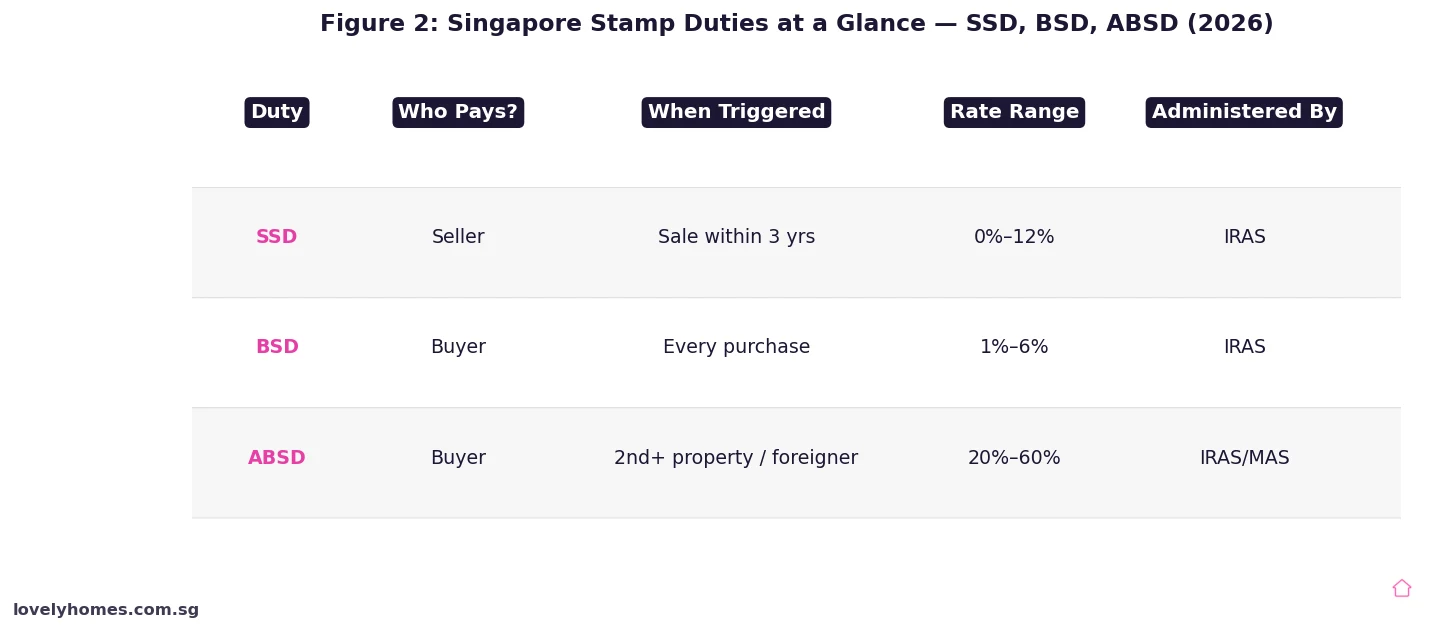
- Singapore levies three main property stamp duties: Buyer’s Stamp Duty (BSD), Additional Buyer’s Stamp Duty (ABSD), and Seller’s Stamp Duty (SSD).
- BSD is payable by all buyers. It follows a six-tier progressive scale ranging from 1% on the first S$180,000 to 6% on the portion above S$2.5 million (effective 15 February 2023).
- ABSD applies on top of BSD for certain buyer profiles. Singapore Citizens (SC) pay 20% on a 2nd property and 30% on a 3rd or subsequent property. Foreigners pay 60%; entities pay 65% (effective 27 April 2023).
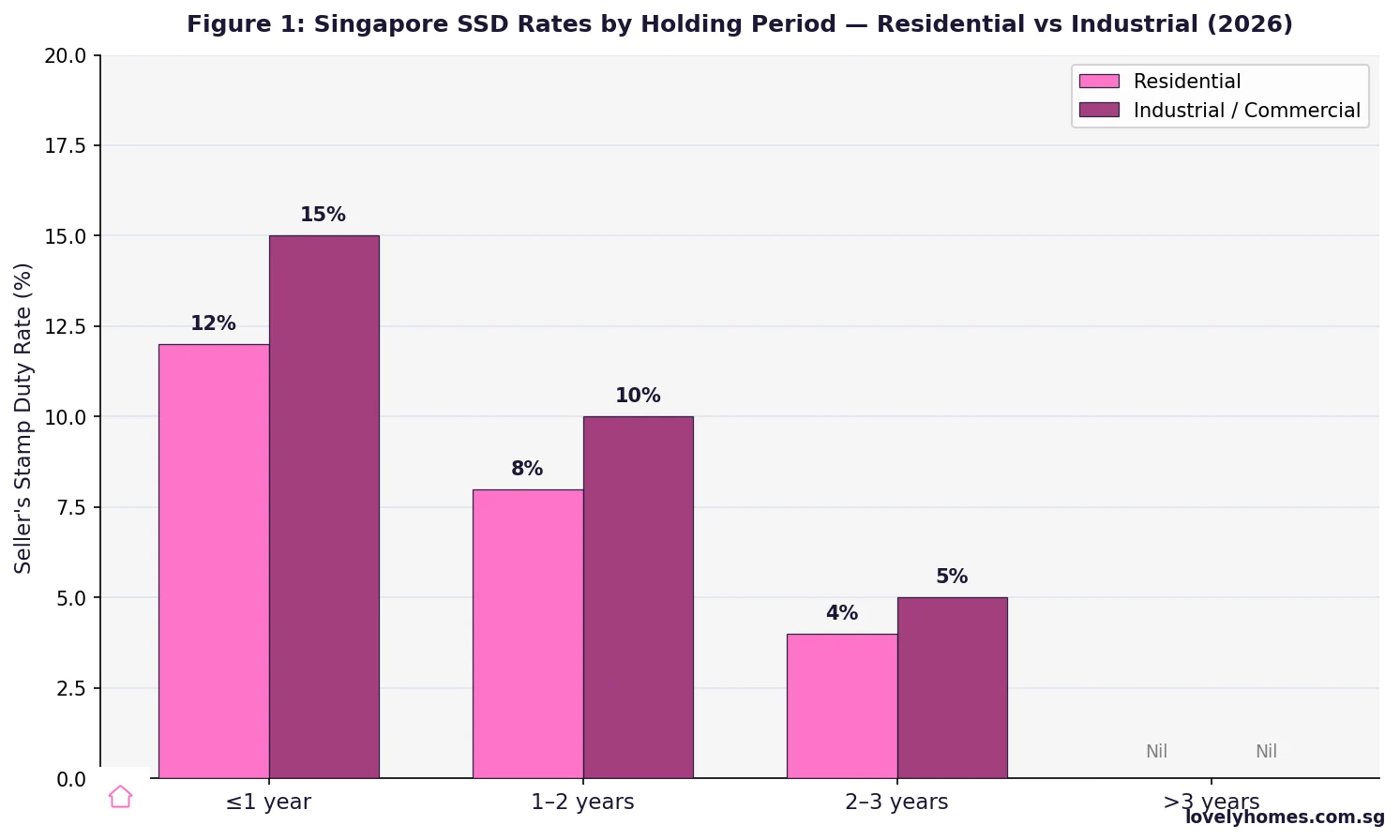
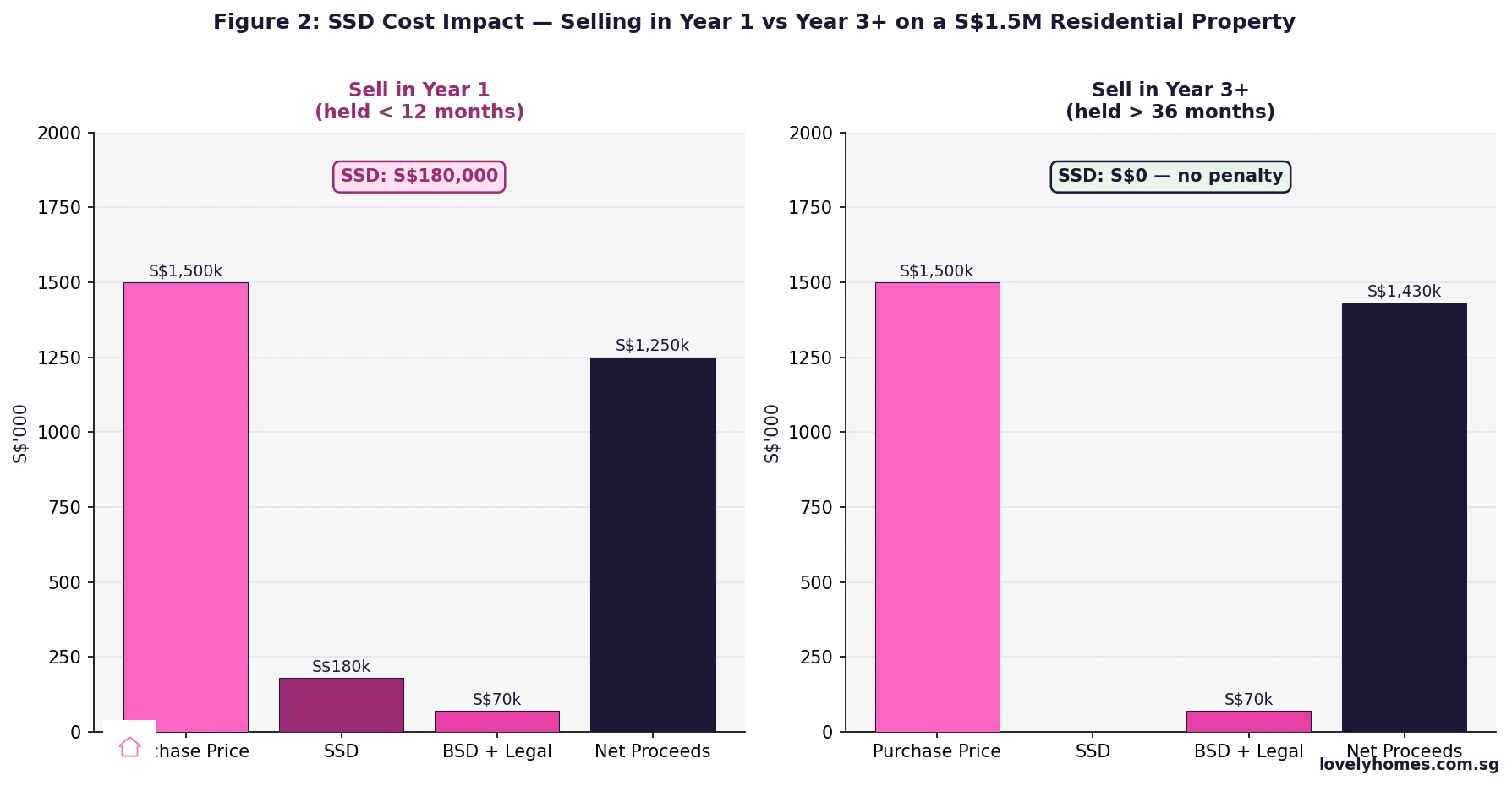
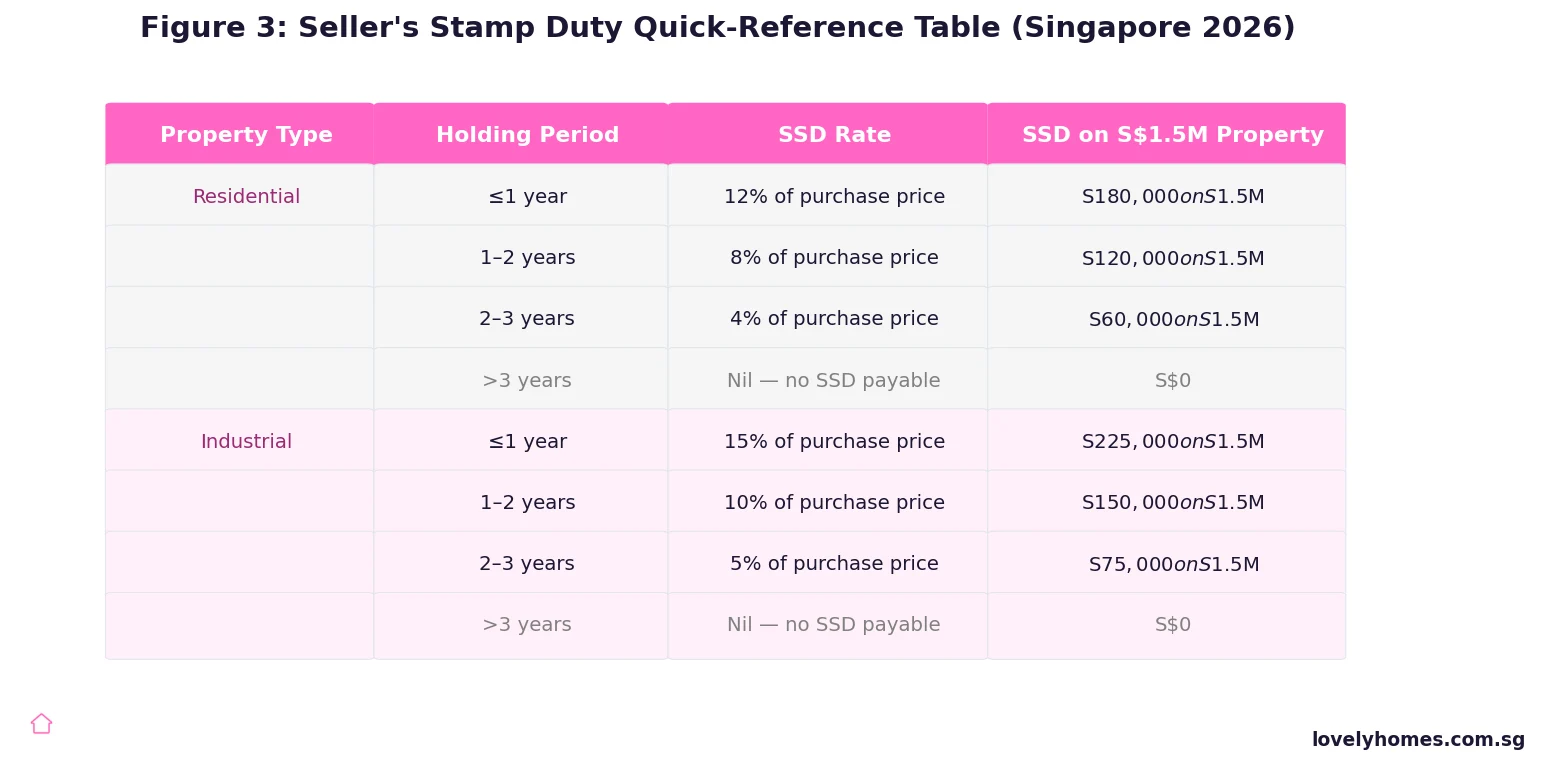
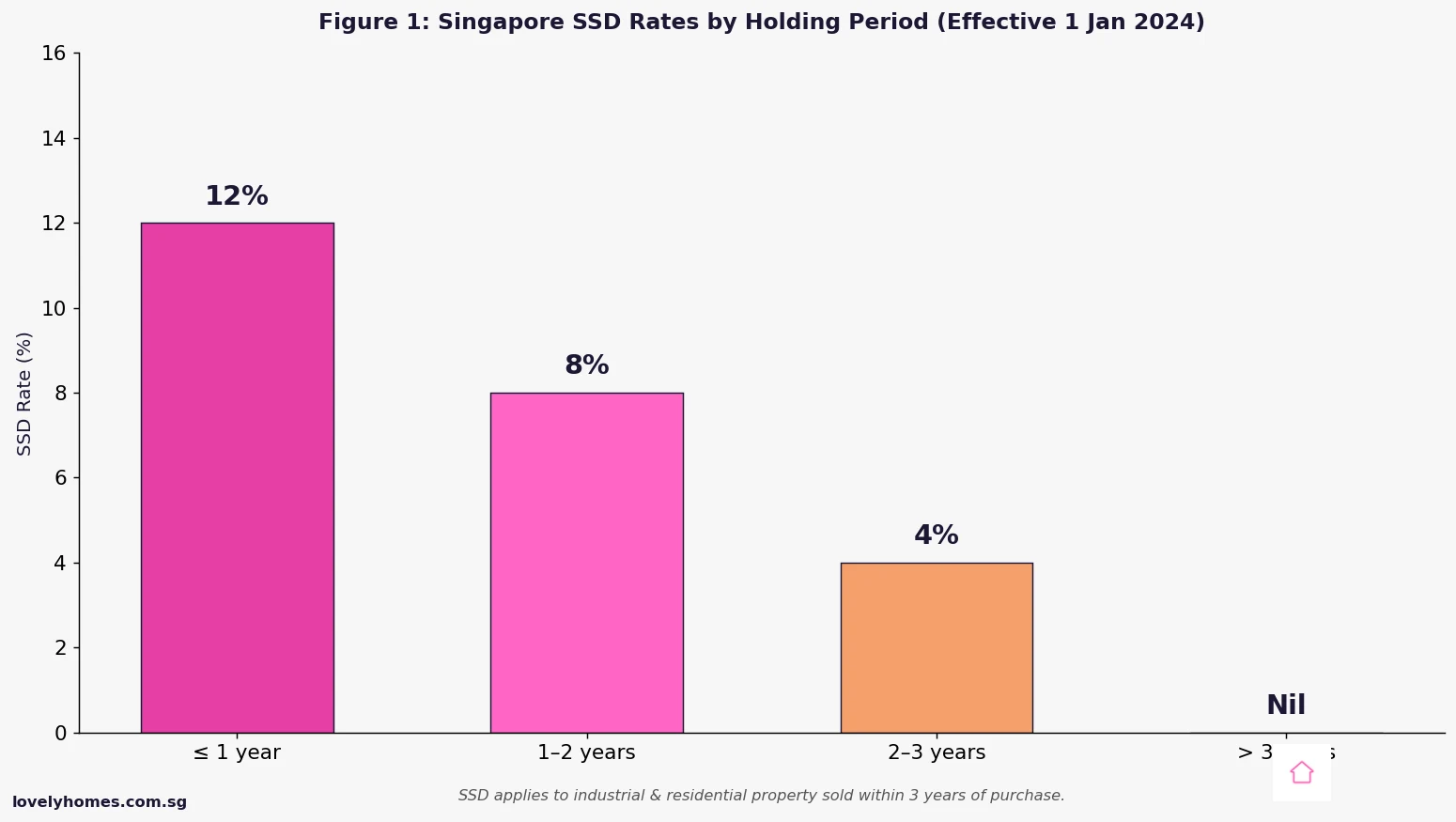
- SSD is payable by sellers who dispose of a residential property within 3 years of purchase: 12% in year 1, 8% in year 2, and 4% in year 3.
- BSD and ABSD are due within 14 days of exercising the Option to Purchase (OTP). SSD is due within 14 days of legal completion of sale.
- ABSD cannot be paid using CPF Ordinary Account (OA) funds — it must be settled in cash. BSD, however, may be paid from CPF OA for eligible purchases.
- Qualifying SC upgraders who sell their existing HDB flat or private property within a prescribed window may claim an ABSD remission, effectively recovering the ABSD paid on their second property.
- All stamp duty is administered by the Inland Revenue Authority of Singapore (IRAS) via its e-Stamping portal.
- BSD is computed on the higher of the purchase price or the market value of the property.
- Both residential and non-residential properties are subject to BSD; ABSD and SSD apply only to residential properties unless stated otherwise.
What Is Stamp Duty? Singapore’s Property Stamp Duties Explained
Stamp duty is a tax levied on documents that evidence certain legal transactions — in the context of Singapore property, that means the instruments (Option to Purchase, Sale and Purchase Agreement, Transfer document) used to buy, sell, or lease real estate. The Inland Revenue Authority of Singapore (IRAS) administers all property stamp duties under the Stamp Duties Act (Chapter 312). Payment is made online via the e-Stamping portal at myTax.iras.gov.sg.
There are three distinct stamp duties that Singapore property buyers and sellers need to understand: Buyer’s Stamp Duty (BSD), Additional Buyer’s Stamp Duty (ABSD), and Seller’s Stamp Duty (SSD). Each has a different purpose, rate structure, and payment timeline. This guide consolidates everything in one place — from rate tables to worked examples — so you can plan your property transaction with clarity and confidence.
A note on scope: BSD and ABSD apply to the buyer at the point of purchase. SSD applies to the seller if the property is disposed of within a stipulated holding period. These duties are separate from annual Property Tax, which is an ongoing yearly levy based on the Annual Value (AV) of the property.
Buyer’s Stamp Duty (BSD) — Rates, Computation and Examples
Buyer’s Stamp Duty is payable by every purchaser of real property in Singapore — residential or non-residential — without exception. The current six-tier progressive scale took effect on 15 February 2023, when the Ministry of Finance introduced two additional top tiers as part of property market stabilisation measures.
BSD is computed on the higher of the purchase price or the market value of the property. If a buyer pays S$1.4 million for a property that IRAS values at S$1.45 million, BSD is computed on S$1.45 million.
| Property Value Tranche | BSD Rate | Max BSD for Tranche | Cumulative BSD |
|---|---|---|---|
| First S$180,000 | 1% | S$1,800 | S$1,800 |
| Next S$180,000 | 2% | S$3,600 | S$5,400 |
| Next S$640,000 | 3% | S$19,200 | S$24,600 |
| Next S$500,000 | 4% | S$20,000 | S$44,600 |
| Next S$1,000,000 | 5% | S$50,000 | S$94,600 |
| Remainder (above S$2.5M) | 6% | — | S$94,600 + 6% on excess |
As the table above makes clear, BSD is not flat — the effective rate rises with price. A buyer paying S$500,000 pays an effective BSD of 1.92%, while a buyer paying S$3 million pays an effective rate of 4.15%. The progressive structure means the rate on the last dollar spent is meaningfully higher than the average rate paid across the whole purchase price.

BSD payment is due within 14 days of exercising the OTP (for private property) or signing the Sale and Purchase Agreement (for HDB resale). It may generally be paid using CPF Ordinary Account (OA) funds for eligible properties. Non-payment or late payment attracts a penalty of up to four times the amount unpaid under the Stamp Duties Act.
Non-residential properties (commercial, industrial) follow the same six-tier BSD scale from 15 February 2023 onwards. Prior to that date, the non-residential scale topped out at 4% — the additional tiers introduced in February 2023 apply equally to both residential and non-residential purchases.
Additional Buyer’s Stamp Duty (ABSD) — Rates by Buyer Profile
Additional Buyer’s Stamp Duty is a demand-side policy instrument that the government has used repeatedly since its introduction in December 2011 to moderate investment demand in residential property and prioritise owner-occupation. Unlike BSD, ABSD does not apply to all buyers equally — the rate depends on the residency status and property count of the purchaser. ABSD is levied on residential property only.
The current ABSD rates, which took effect on 27 April 2023 following a further round of property cooling measures, are as follows:
| Buyer Profile | ABSD Rate | ABSD on S$1M | ABSD on S$2M |
|---|---|---|---|
| Singapore Citizen — 1st property | 0% | Nil | Nil |
| Singapore Citizen — 2nd property | 20% | S$200,000 | S$400,000 |
| Singapore Citizen — 3rd & subsequent | 30% | S$300,000 | S$600,000 |
| Singapore Permanent Resident — 1st property | 5% | S$50,000 | S$100,000 |
| Singapore Permanent Resident — 2nd property | 30% | S$300,000 | S$600,000 |
| Singapore Permanent Resident — 3rd & subsequent | 35% | S$350,000 | S$700,000 |
| Foreigner (any residential property) | 60% | S$600,000 | S$1,200,000 |
| Entity (company, LLP, trust) | 65% | S$650,000 | S$1,300,000 |
The property count is assessed at the individual buyer level, not the household level. If a married SC couple jointly own one property each, a second joint purchase counts as the 2nd property for each spouse — a point that catches many buyers by surprise. For married couples where each spouse holds one property, decoupling or using the remission route may be worth exploring.
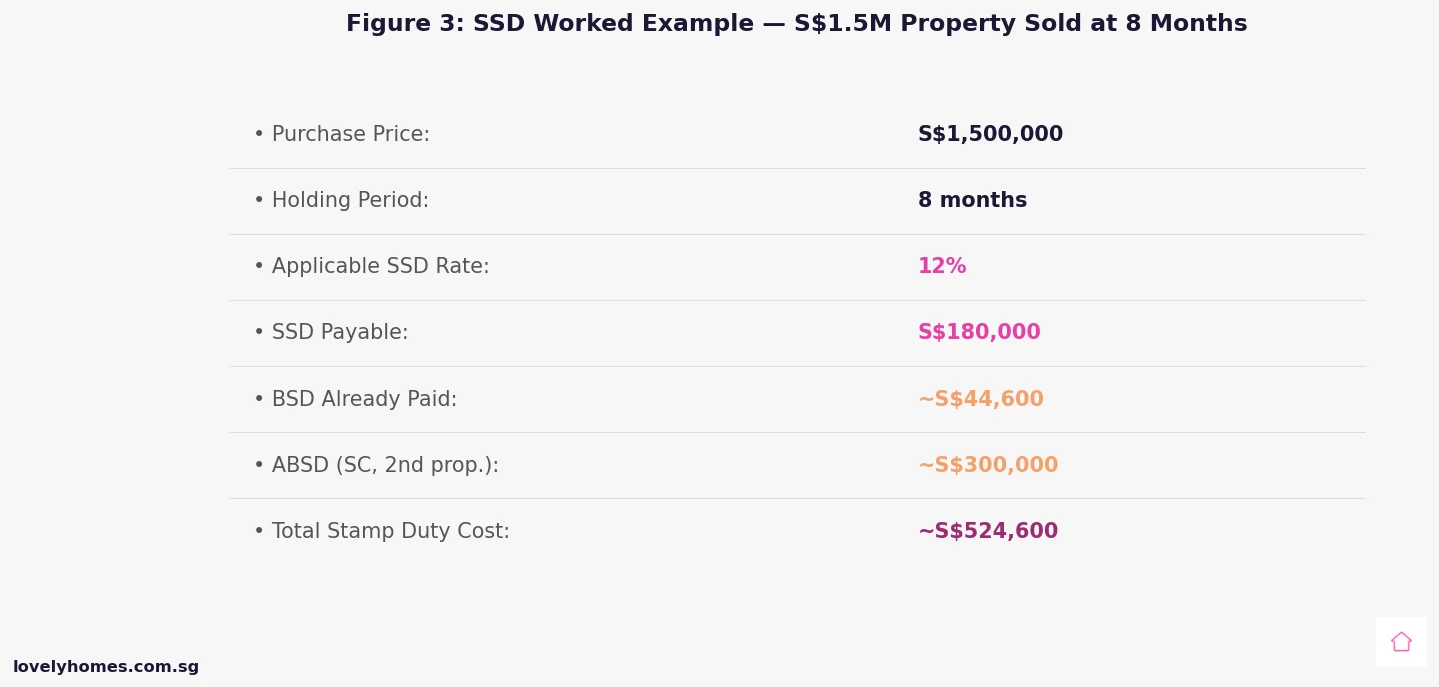
ABSD is computed on the same basis as BSD — the higher of purchase price or market value — and must be paid within 14 days of exercising the OTP. Critically, ABSD cannot be paid using CPF OA funds — it is a cash-only obligation. At the rates currently in force, an SC buying a S$1.5M second property owes S$300,000 in ABSD cash, before accounting for BSD and the down payment.

Housing developers who purchase residential land for development may claim a remission on ABSD, subject to the condition that all units are sold within 5 years of acquiring the land (3 years for smaller developments). From 27 April 2023, the developer ABSD rate rose to 35% (35% upfront, with partial remission on sale completion), raising the carrying cost of unsold inventory significantly.
For a deeper dive into ABSD — including the upgrader remission mechanics and worked examples for each buyer profile — see our Singapore ABSD Complete Guide 2026.
Seller’s Stamp Duty (SSD) — Rates and Holding Period Rules
Seller’s Stamp Duty is a disincentive to short-term property flipping. Introduced in 2010 and recalibrated several times since, SSD in its current form (effective 11 March 2017) applies to sellers of residential property disposed of within 3 years of acquisition. It does not apply to HDB flats (HDB has separate rules against disposal within the Minimum Occupation Period) or to non-residential property purchases.
The holding period for SSD purposes is measured from the date the OTP is exercised (i.e., the date of the Sale and Purchase Agreement, not the date of legal completion). Key SSD rates for residential property:
| Holding Period | SSD Rate | SSD on S$1.2M Sale | SSD on S$1.8M Sale |
|---|---|---|---|
| Sold within 1 year | 12% | S$144,000 | S$216,000 |
| Sold in year 2 (more than 1, up to 2 years) | 8% | S$96,000 | S$144,000 |
| Sold in year 3 (more than 2, up to 3 years) | 4% | S$48,000 | S$72,000 |
| Sold after 3 years | Nil | — | — |
SSD is payable by the seller and is due within 14 days of the date of the instrument (i.e., the Sale and Purchase Agreement or transfer document at completion). It is computed on the higher of the sale price or the market value. Late payment attracts a penalty under the Stamp Duties Act.
There are exemptions. SSD does not apply to a transfer of residential property by way of gift between spouses or between lineal descendants (subject to IRAS approval), nor to court-ordered transfers arising from divorce proceedings. A property that is compulsorily acquired by the government is also exempt.

ABSD Remissions — When You Can Get ABSD Back
Not all ABSD paid is lost forever. IRAS administers two principal remissions that allow qualifying buyers to recover ABSD paid on a second residential purchase.
1. SC or SC/SPR Couple Upgrader Remission. A married couple comprising at least one SC who buys a replacement private property while still owning a first residential property may claim a remission of ABSD paid on the second purchase, provided they sell the first property within 6 months of purchasing the replacement (or within 6 months of the replacement property’s Temporary Occupation Permit, for new launches under construction). The remission covers the full 20% ABSD paid — which, at today’s property prices, frequently represents several hundred thousand dollars.
2. SC Couple Remission (Both First-Time). A married couple where both are SC and neither owns any other residential property is treated as a single unit buying their first property, so ABSD is nil from the outset — no remission is needed.
For full details on how remissions are computed, which documents IRAS requires, and the deadlines that must be met to avoid losing the refund, see our Singapore Stamp Duty Remission Guide 2026.
Worked Example: Complete Stamp Duty Liability for Two Scenarios
To bring the numbers to life, consider Mr and Mrs Lim — a Singapore Citizen married couple. They currently own a 4-room HDB flat in Toa Payoh purchased in 2019. They are evaluating two scenarios for upgrading to an OCR condominium priced at S$1.5 million.
Scenario A: Sell HDB first, then buy condo (1st property). After selling their HDB flat, neither spouse owns any residential property. BSD on S$1.5M = S$44,600. ABSD = S$0 (SC, 1st property). Total stamp duty = S$44,600. BSD may be paid via CPF OA.
Scenario B: Buy condo first, claim upgrader ABSD remission, sell HDB within 6 months. At time of purchase, each spouse owns the HDB flat — so this is their 2nd residential property. BSD = S$44,600. ABSD = 20% × S$1,500,000 = S$300,000 (cash only). Total stamp duty paid upfront = S$344,600. If they sell the HDB within 6 months of purchasing the condo, IRAS will refund S$300,000 ABSD — leaving net stamp duty at S$44,600, the same as Scenario A. However, the S$300,000 must be held in cash (not CPF) for up to 6 months, which has a real financing and opportunity cost.
Scenario C: Retain HDB, buy condo (2nd property — no remission intended). Same BSD S$44,600 plus ABSD S$300,000. No remission planned. Total permanent stamp duty burden = S$344,600. The S$300,000 ABSD is sunk cost. The combined investment may still make financial sense if rental yield and capital appreciation projections justify the outlay — but it requires significantly more cash upfront and affects TDSR calculations.
This example illustrates why the sequencing and timing of property transactions matters enormously in Singapore’s stamp duty environment. The choice of whether to sell before buying, buy before selling, or hold both permanently has six-figure financial consequences.
How to Pay Stamp Duty — IRAS e-Stamping Portal
All stamp duty for Singapore property transactions is paid electronically via the IRAS e-Stamping portal (accessible at myTax.iras.gov.sg). In practice, the buyer’s law firm handles the computation and payment on the buyer’s behalf as part of the conveyancing process. The steps are straightforward: the firm uploads the instrument, computes the duty, and processes payment from the client’s funds prior to the 14-day deadline.
Buyers who transact without a law firm (rare in Singapore) must stamp the document themselves. Late stamping attracts a penalty of up to four times the unpaid duty. If IRAS determines that the declared purchase price undervalues the property, it may assess the duty on market value instead, and the difference (plus penalties) becomes payable immediately.
What Might Come Next — Stamp Duty Outlook
Property cooling measures in Singapore have historically been responsive to market conditions. ABSD has been adjusted upwards seven times since its introduction in 2011. The current rates — particularly the 60% foreigner ABSD — are the highest ever. Analysts and market observers broadly expect the government to maintain these elevated rates as long as private residential property prices continue to rise, but may calibrate them if transaction volumes fall significantly or global economic conditions shift. SSD and BSD, by contrast, have been more stable — the BSD top-tier additions in February 2023 were the first BSD change in a decade. Market participants should monitor MOF and IRAS announcements, particularly around Budget season each February, for any adjustments.
Frequently Asked Questions
Can I use CPF to pay ABSD?
No. ABSD must be paid entirely in cash. This is a firm rule — CPF Ordinary Account funds cannot be used to meet the ABSD obligation, even if you have sufficient funds in your CPF OA. BSD, by contrast, may be paid from CPF OA for qualifying residential property purchases, subject to the applicable CPF withdrawal limits and property type eligibility. The distinction matters enormously at today’s ABSD rates: a foreigner buying a S$2M property must have S$1.2M in cash earmarked for ABSD alone.
When exactly is BSD/ABSD due?
For private property, BSD and ABSD must be stamped (paid) within 14 days of the date the OTP is exercised. For HDB resale transactions, the deadline is 14 days from the date of the Sale and Purchase Agreement. If the instrument is executed outside Singapore, the 14-day clock runs from the date the document is received in Singapore. Late payment attracts penalties of up to four times the unstamped duty. Your law firm will typically ensure this deadline is met as part of the conveyancing process, but buyers should be aware of the obligation in case of any procedural delays.
Does ABSD apply to HDB flats?
HDB flats purchased directly from the HDB (BTO, resale) are subject to ABSD only when the buyer already owns other residential property. An SC buying their first property — whether HDB or private — pays no ABSD. An SC buying an HDB resale flat as a second residential property would theoretically face 20% ABSD; however, in practice, HDB’s eligibility rules generally preclude ownership of both an HDB flat and a private residential property simultaneously (because of the MOP and concurrent private property ownership restrictions). A more common scenario is an SPR purchasing an HDB resale flat as their first property — this attracts 5% ABSD. For details see our HDB Resale Eligibility Guide 2026.
How is SSD computed if I inherited the property?
If you acquired a property by inheritance rather than by purchase, the acquisition date for SSD purposes is the date of the deceased’s death, not the date of the grant of probate or transmission to you. If you sell the inherited property within 3 years of the date of death, SSD is payable at the applicable rate. This catches some beneficiaries by surprise — if the estate takes 12 months to administer, you may already be in year 2 of the SSD holding period before you have legal title. An exemption applies to transfers that are part of a compulsory acquisition by the government. Consult a solicitor before selling an inherited property within the 3-year window.
What happens if I undervalue the property on the stamp duty form?
IRAS computes stamp duty on the higher of the purchase price and the market value. If IRAS assesses the market value to be higher than the declared purchase price, it will issue a Notice of Assessment for the additional duty and impose a penalty of up to four times the underpaid amount. Purchasers who knowingly understate the purchase price to reduce stamp duty face criminal penalties under the Stamp Duties Act. In the normal course of arm’s-length transactions, this is rarely an issue — stamp duty is simply computed on the agreed price and confirmed against a bank valuation report. The rule exists to prevent artificial deflation of declared prices in related-party or distressed transactions.
Is BSD payable on commercial property?
Yes. BSD applies to all real property in Singapore — residential, commercial, and industrial. ABSD and SSD, however, apply only to residential property. So a buyer purchasing an office unit or shophouse pays BSD at the six-tier scale but owes no ABSD (regardless of how many properties they own) and faces no SSD if they sell the commercial property within 3 years. This makes commercial property relatively more attractive on a stamp-duty basis for buyers who already own residential properties and would otherwise face significant ABSD. Note: industrial SSD (separate from residential SSD) applies to industrial property disposed of within 3 years of acquisition — rates are 15% (year 1), 10% (year 2), 5% (year 3).
Related Articles
- Singapore ABSD Complete Guide 2026 — Rates, Profiles and Remissions
- Singapore Stamp Duty Remission Guide 2026 — ABSD Upgrader Refunds Explained
- Singapore Seller’s Stamp Duty (SSD) Guide 2026 — Rates, Rules and Worked Examples
- Singapore Option to Purchase (OTP) Guide 2026 — Rights, Timelines and Costs
- Using CPF for Property in Singapore 2026 — OA Withdrawal Limits and Rules
- Singapore Property Buying Checklist 2026 — Complete Step-by-Step Guide
- Singapore Property Market Outlook H2 2026 — Price Trends and Analysis
Disclaimer
This article is for general informational and educational purposes only. Stamp duty rates, rules, and eligibility criteria are subject to change by the Ministry of Finance and IRAS. The worked examples and figures in this guide are based on rates effective as at 4 August 2026. Always verify the current rates at iras.gov.sg before any transaction, and engage a qualified Singapore solicitor for legal advice specific to your circumstances. LovelyHomes is not a legal or financial adviser.