Jurong Lake District White Site 2026: Town Hall Link GLS Tender, 1,200 Homes and CRL CR19

Jurong Lake District White Site 2026: Town Hall Link GLS Tender, 1,200 Homes and CRL CR19

Quick Answer: JLD Town Hall Link White Site at a Glance

  • Site: Town Hall Link, Jurong Lake District (JLD), adjacent to the Jurong Town Hall national monument.
  • Total GFA: 186,139 sqm — one of the largest mixed-use sites launched in Singapore in recent years.
  • Residential: up to 1,200 private residential units.
  • Office: minimum 40,000 sqm — anchoring JLD’s ambition as the largest business node outside the city centre.
  • Complementary uses: up to 44,000 sqm for retail, serviced apartments, hotel, sports, community and medical facilities.
  • Connectivity: integrated with Jurong East MRT interchange (EWL/NSL), future JRL JE5 station, and upcoming CRL CR19 station (planned 2032).
  • Tender closes: 17 November 2026.
  • Why it matters: the White site designation gives developers flexibility to configure uses — residential, commercial, or mixed — based on market conditions at launch, making it one of Singapore’s most strategically significant land sales of 2026.

URA Launches JLD White Site: Singapore’s Most Anticipated 2H 2026 GLS Tender

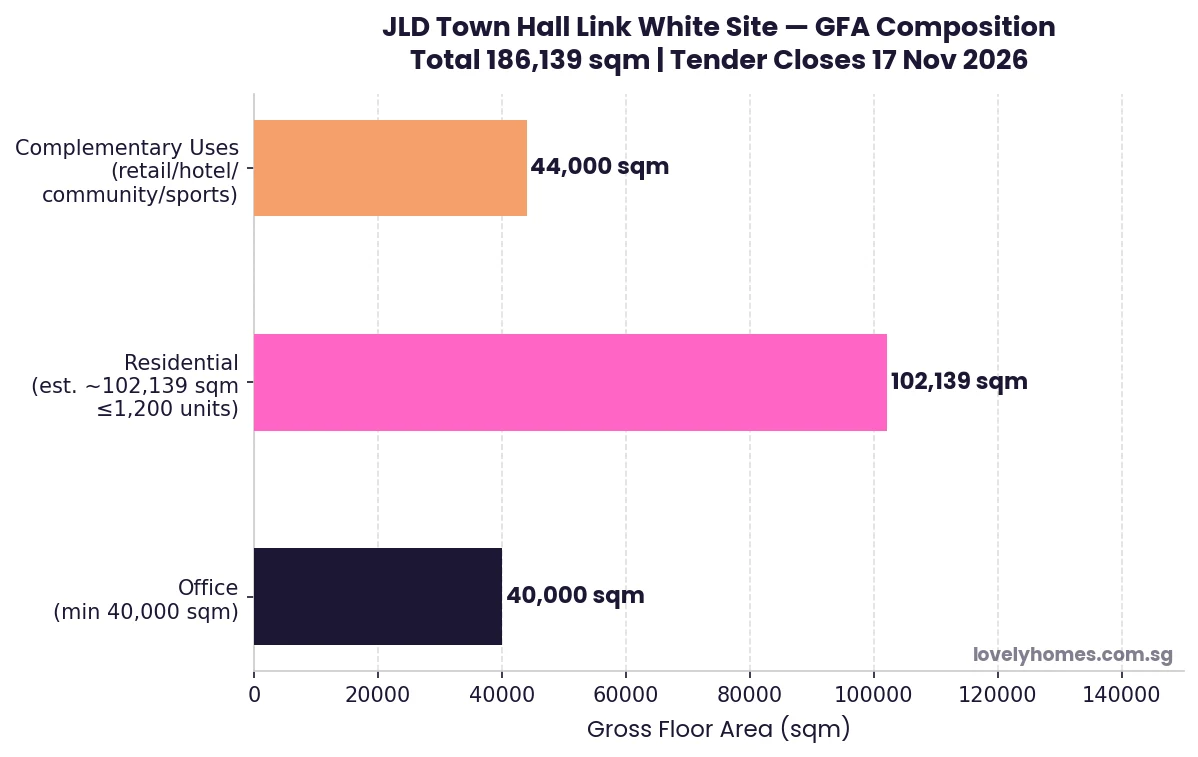
The Urban Redevelopment Authority (URA) launched the tender for a White site at Town Hall Link in the Jurong Lake District (JLD) on 3 July 2026, marking one of the most significant Government Land Sales (GLS) moves of the year. At 186,139 sqm of total potential Gross Floor Area (GFA) — comprising a minimum 40,000 sqm of office, up to 1,200 private residential units, and 44,000 sqm of complementary uses — this site has the potential to define the next chapter of Singapore’s western regional centre.

The tender forms part of the Confirmed List for the 2H 2026 GLS Programme and will close at 12 noon on 17 November 2026. It comes less than two weeks after URA released its Q2 2026 property price flash estimate showing the overall private residential PPI rising a modest 0.5% — a market context that is stable enough for developers to bid with confidence, but not so frothy as to suggest over-payment risk.

JLD is Singapore’s flagship decentralisation initiative: a vision to create a vibrant live-work-play precinct in the western part of Singapore that can absorb commercial, residential, and civic activity without adding further pressure on the already-congested central business district. The Town Hall Link site occupies a prime position within this vision — sited next to the Jurong Town Hall national monument, directly connected to the Jurong East MRT interchange, and in the future path of two new MRT lines.

What Is a White Site?

A White site in Singapore’s GLS framework is a land parcel that developers may develop for any combination of uses permitted under the Master Plan, subject to a minimum requirement for one or more specified uses. Unlike purpose-specific GLS sites (e.g., residential-only or commercial-only), a White site allows developers to calibrate the use mix based on their read of market conditions at the time of design and launch.

For the Town Hall Link site specifically, the conditions are: minimum 40,000 sqm office; up to 1,200 residential units; and up to 44,000 sqm for complementary uses. The developer awarded the site will have latitude to decide the precise mix of hotel, serviced apartments, retail, community facilities, and sports/recreation components — creating significant design flexibility in exchange for the commitment to deliver a meaningful commercial core.

White sites have historically attracted strong bidding interest in Singapore because they reduce the development risk associated with committing entirely to a single use in a market that can shift between residential launch and commercial occupation. The last major White site in JLD — the site that became J Gateway and the surrounding cluster — generated keen bidding when it was first introduced.
Jurong Lake District JLD Town Hall Link white site GFA breakdown office residential complementary 2026

Figure 1: Town Hall Link White Site — indicative GFA breakdown by use. Total 186,139 sqm. Source: URA pr26-53, 3 July 2026.

The JLD Masterplan: Context for This Site

JLD’s transformation has been driven by two decades of sustained government investment in infrastructure and planning. The revitalised Jurong Lake Gardens (90 hectares) provides the greenery spine at the district’s heart. Two new MRT lines are changing the connectivity calculus dramatically:

  • Jurong Region Line (JRL): JE5 station at Jurong East and JE6 station at International Business Park (planned to open 2028).
  • Cross Island Line (CRL): CR19 station at the heart of the new JLD precinct (planned to open 2032).

The addition of CRL is particularly significant: it will provide a direct east-west connection from JLD to Ang Mo Kio, Pasir Ris, and eventually Changi — transforming what has historically been perceived as a “western” destination into a genuinely cross-island node. For the Town Hall Link site, the multi-level pedestrian connections to Jurong East MRT interchange and the upcoming CR19 station mean that residents and office workers at this development will enjoy arguably the best public transport connectivity of any mixed-use site currently on the GLS market.

The site sits next to the Jurong Town Hall, a gazetted national monument. This adjacency imposes design constraints — any development will need to respect the monument’s visual and physical setting — but also provides a distinctive civic character that differentiates the JLD precinct from purely commercial developments elsewhere.

Development Mix Analysis

Use Component GFA (sqm) Status Commentary
Office 40,000 minimum Mandatory Anchors JLD’s role as business node; positions site as corporate headquarters address
Private Residential Up to ~102,139 (est.), max 1,200 units Optional (developer discretion) 1,200 units at typical 80–90 sqm average ≈ 102,000 sqm; adds residential critical mass to district
Complementary Uses Up to 44,000 Optional (developer discretion) Can include: retail, hotel, serviced apartments, sports/recreation, medical clinics, community facilities, visitor attractions
Total GFA 186,139 One of Singapore’s largest mixed-use GLS sites

At 1,200 residential units, this would represent one of Singapore’s larger single-site condominium developments — comparable in scale to recent developments like Canninghill Piers (696 units) and Lentor Modern (605 units), but notably larger. The scale is appropriate for JLD’s ambition to create residential density that sustains the commercial base.

Key Catalysts and Infrastructure Timeline

The development that occupies this site will benefit from a series of planned catalysts over the 2026–2035 horizon:

Catalyst Timeline Impact on Site
JRL JE5 (Jurong East) and JE6 (International Business Park) Phased opening, 2027–2028 Improved east-west connectivity within JLD; connects IBP to Jurong East interchange
New Science Centre at JLD Expected by 2027 Adds visitor attraction and civic anchor to the precinct; drives weekend footfall
Jurong Gateway Hub (bus interchange + office + retail + community club + library + sports) Expected by 2028 Integrated civic hub immediately adjacent; dramatically increases JLD’s daytime and evening population
CRL CR19 station at JLD Planned 2032 Cross-island connectivity; potential 15% to 20% capital value uplift for residential units at this site based on historical TEL/MRT proximity premiums

Residential Investment Angle: 1,200 Units in JLD

If the awarded developer proceeds with the full 1,200-unit residential allocation, this will be among the more significant new private residential supply additions to JLD since the area last saw major development activity in the 2013–2017 era (J Gateway, Westwood Residences, Lake Grande, Twin Vew). JLD has historically commanded a premium relative to other OCR locations — driven by the live-work-play narrative, the lake setting, and the Jurong East MRT interchange’s accessibility to both the western industrial belt and the central business district via the East-West Line.

A new-launch condo at this site, post-CRL connectivity, could plausibly target $2,000–$2,400 psf based on the trajectory of comparable new launches in OCR/RCR boundary locations in 2025–2026. The tender price paid by the developer will be the key determinant of eventual launch pricing — a high land bid will translate into a premium launch price, while a competitive-but-measured bid could allow the developer to price attractively and generate strong take-up. The tender close date of 17 November 2026 gives the market approximately four and a half months to assess these dynamics.

What This Means for the Broader Market

The JLD White Site launch is a policy signal as well as a commercial opportunity. URA’s decision to include a major White site in the 2H 2026 Confirmed List — rather than deferring it to the Reserve List — indicates confidence that developer demand is sufficient to support a committed bid within the current market cycle. The White site mechanism also signals flexibility: if the residential market softens before design completion, the developer can weight the mix toward commercial and serviced apartment uses.

For existing JLD residential owners — in projects like J Gateway, Lake Grande, Twin Vew, and the upcoming The LakeGarden Residences — the Town Hall Link development represents both an opportunity (improved amenity and connectivity as the precinct builds out) and a risk (increased residential supply within the immediate catchment). On balance, the infrastructure and amenity uplift from the New Science Centre, Jurong Gateway Hub, and CRL CR19 is likely to outweigh the supply effect, particularly for well-located existing units.

What Might Come Next

The following is editorial commentary — not official guidance.

Bidding for the Town Hall Link site is expected to attract Singapore’s larger developers and possibly joint ventures. The scale of the site (186,139 sqm) requires significant capital — a land price in the S$1.5–S$2.5 billion range would not be surprising, depending on the assumed residential launch pricing and the developer’s commercial income projections. International developers with Asian regional headquarters-in-a-hub ambitions could also consider the mandatory 40,000 sqm office component as a corporate campus opportunity.

The CRL CR19 station opening in 2032 is a known future catalyst — developers will model this into their land bid assumptions. A project that launches residential units in 2028–2029 (assuming a 2027 tender award, 1-year design/approval, and early 2028 launch) would be telling buyers that their units will be CRL-connected by the time they reach the 5-year mark of ownership.

Frequently Asked Questions

What does “White site” mean for buyers of the eventual development?

A White site designation affects the developer’s design choices, not individual buyers’ rights. When the eventual development is launched for sale, buyers will purchase units in a standard private condominium development. They will benefit from the mixed-use amenities — retail, food and beverage, possibly a hotel or serviced apartment building within the same development — that result from the White site configuration. The White site label itself conveys no special lease conditions or restrictions on buyers beyond the standard conditions of a freehold or 99-year leasehold private condominium.

When will the residential units at Town Hall Link be available for sale?

The tender closes 17 November 2026. Assuming the tender is awarded in Q1 2027, and accounting for design, planning approval, and construction timelines, the earliest a residential launch could realistically occur is late 2027 or 2028. Physical completion (Temporary Occupation Permit) would likely follow in 2030–2032. Prospective buyers interested in this development should monitor URA and the awarded developer’s announcements in 2027.

How does the JLD CRL station affect property values nearby?

Historical evidence from Singapore MRT openings — most recently the Thomson-East Coast Line (TEL) stages 1–4 and the Downtown Line — suggests that residential properties within 500 metres of a new MRT station tend to appreciate by 8–15% relative to comparable properties further away in the 3–5 years following station opening. The effect is partially priced in ahead of the opening as buyers and investors anticipate the connectivity uplift. For CR19 (planned 2032), properties in the immediate JLD precinct likely already incorporate some forward-looking CRL premium in 2026. The full premium crystallises as the opening date approaches and actual connectivity is confirmed.

Is the Town Hall Link site freehold or leasehold?

GLS sites in Singapore are typically sold on 99-year leasehold terms. The Town Hall Link site is expected to follow this standard. Buyers of units in the eventual development will hold 99-year leasehold titles, with the lease commencement date tied to the date of the land award. Leasehold tenure is the norm for new GLS-sourced developments in Singapore; the premium-location attributes of the site — MRT connectivity, JLD masterplan, CRL uplift — are expected to sustain long-term value notwithstanding the leasehold structure.

What other major GLS sites were launched in 2H 2026?

The 2H 2026 GLS Confirmed List provides a total of 4,745 private residential units. In addition to the Town Hall Link White site, URA also launched sites at Lorong Puntong/Sin Ming Avenue (~140 units, TEL Bright Hill MRT, tender closes 15 September 2026) and Kitchener Link (~145 units, Reserve List, Farrer Park MRT NEL). The full 2H 2026 GLS programme — including industrial and commercial sites — is available on the URA website at ura.gov.sg/land-sales.

Related Articles

Disclaimer

This article is for general informational purposes only and does not constitute financial or investment advice. Details of the Town Hall Link White site are sourced from URA press release pr26-53 (3 July 2026) and the URA website. Developer bidding, design outcomes, launch pricing, and project timelines are speculative editorial commentary and do not represent commitments by URA or any developer. For authoritative site details and tender conditions, refer to ura.gov.sg. Consult a licensed financial adviser before making any property investment decision.
URA Q2 2026 Singapore Property Price Index: Market Softens as CCR Rebounds

URA Q2 2026 Singapore Property Price Index: Market Softens as CCR Rebounds

Quick Answer: URA Q2 2026 PPI Flash Estimate

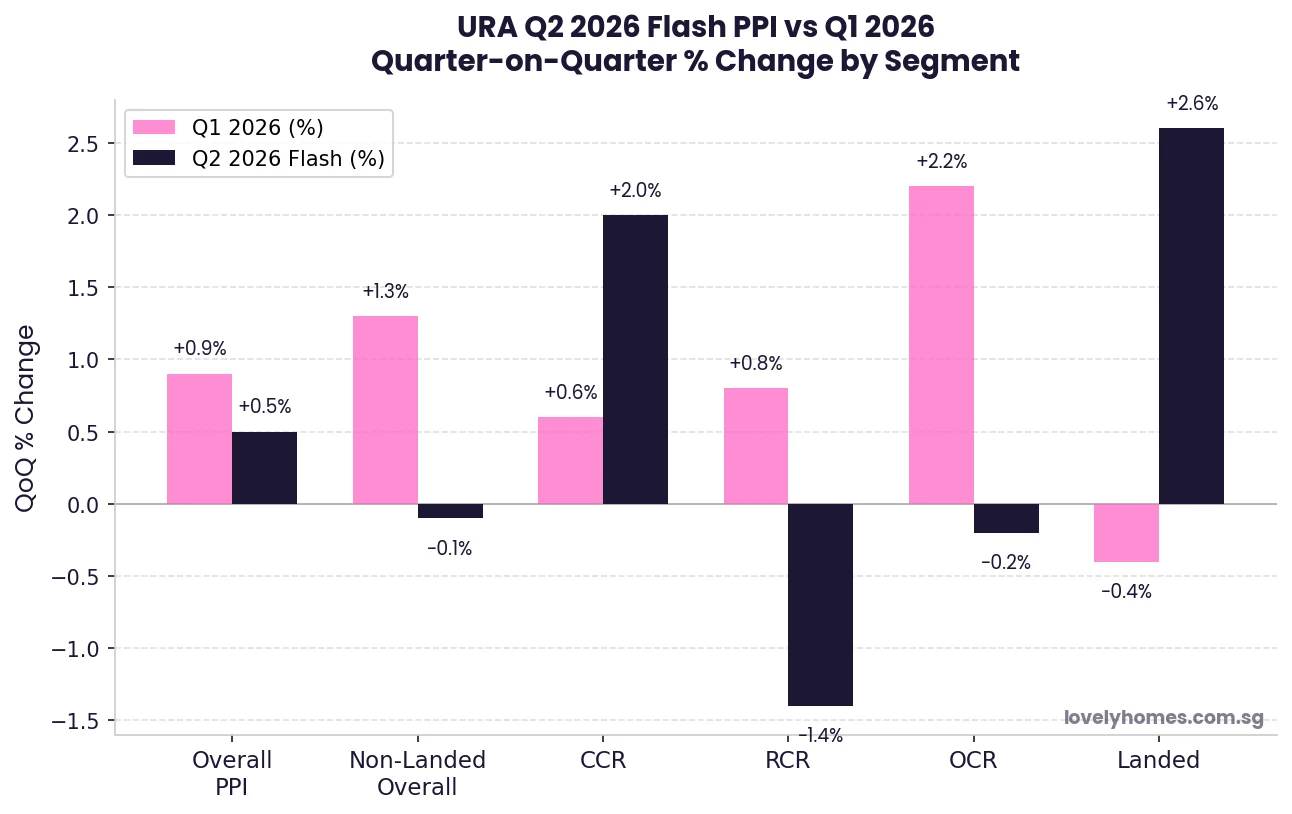
  • Overall PPI: +0.5% QoQ — a deceleration from +0.9% in Q1 2026. Prices are still rising but at a slower pace.
  • Core Central Region (CCR) rebounded: +2.0% (vs +0.6% in Q1 2026) — luxury segment recovering after two quarters of underperformance.
  • Rest of Central Region (RCR): −1.4% (vs +0.8% in Q1) — notable reversal; high-priced new launches in this segment may have peaked.
  • Outside Central Region (OCR): −0.2% (vs +2.2% in Q1) — mass market segment cools after a strong Q1.
  • Landed properties: +2.6% (vs −0.4% in Q1) — sharp rebound in the landed segment, driven by supply scarcity.
  • Transaction volume: 5,420 units (up to mid-June) — broadly comparable to Q1’s 5,413. No supply glut or demand collapse.
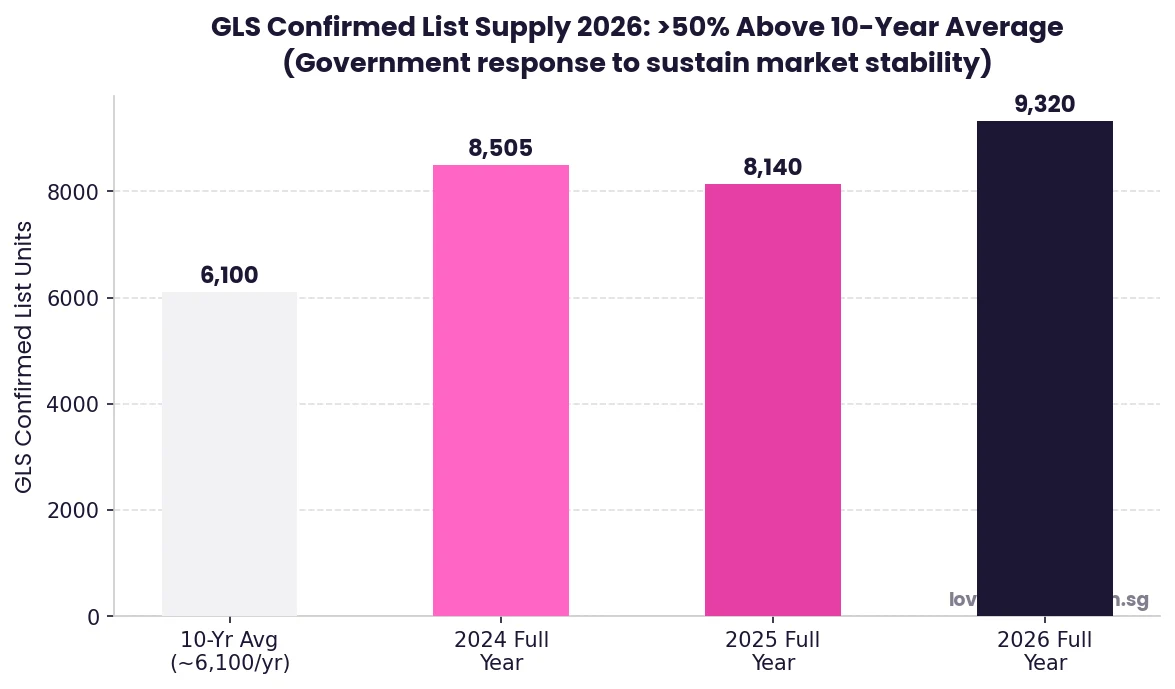
  • Government response: 2H 2026 Confirmed List GLS supply = 4,745 units; full-year 2026 Confirmed List = 9,320 units, over 50% above the 10-year average.
  • Full Q2 statistics will be released by URA on 24 July 2026.

Singapore Q2 2026 Private Residential Property Prices: A Measured Softening

Singapore’s private residential property market continued its gradual moderation in the second quarter of 2026, according to the flash estimate released by the Urban Redevelopment Authority (URA) on 1 July 2026. The overall Private Residential Property Price Index (PPI) rose by 0.5% on a quarter-on-quarter basis — a visible step down from the 0.9% gain recorded in Q1 2026 and a world away from the 3%+ quarterly swings seen during the 2021–2022 boom.

The headline figure conceals a striking divergence beneath the surface: the Core Central Region (CCR) — Singapore’s luxury prime district covering the traditional Central Business District fringe, Orchard Road, and Sentosa Cove — rebounded strongly with a 2.0% gain, while the Rest of Central Region (RCR) and Outside Central Region (OCR) recorded modest declines of 1.4% and 0.2% respectively. Landed properties, which had dipped 0.4% in Q1, surged 2.6% in Q2 — reflecting the structural supply scarcity of this asset class.

The flash estimate is based on transaction prices submitted for stamp duty payment and developer sales data from 1 April 2026 up to mid-June 2026. The full Q2 2026 real estate statistics — covering HDB resale, rental, and the complete development pipeline — will be published by URA on 24 July 2026.

URA Q2 2026 private residential property price index flash estimate QoQ by segment CCR RCR OCR Singapore

Figure 1: URA Q2 2026 PPI flash estimate — quarter-on-quarter % change by segment, compared to Q1 2026. Source: URA press release pr26-51, 1 July 2026.

Segment-by-Segment Analysis

Segment Q1 2026 QoQ % Q2 2026 Flash QoQ % Direction
Overall PPI +0.9% +0.5% ↓ Deceleration
Non-Landed Overall +1.3% −0.1% ↓ Turned Negative
CCR (Core Central Region) +0.6% +2.0% ↑ Sharp Recovery
RCR (Rest of Central Region) +0.8% −1.4% ↓ Sharp Reversal
OCR (Outside Central Region) +2.2% −0.2% ↓ Turned Negative
Landed Properties −0.4% +2.6% ↑ Sharp Rebound

CCR rebound: The 2.0% CCR gain in Q2 is the strongest single-quarter reading for this segment since early 2024. The CCR has historically lagged the OCR/RCR recovery because foreign buying — the CCR’s key demand driver — was hit hardest by the April 2023 cooling measures (which raised the foreigners’ ABSD from 30% to 60%). The Q2 2026 recovery suggests that either (a) some internationally mobile buyers are re-engaging despite the 60% ABSD, or (b) domestic upgrader demand from Singaporeans and PRs is filling the luxury segment. The URA’s full Q2 data release on 24 July will shed more light on the transaction mix.

RCR contraction: The −1.4% RCR reading is notable. The RCR has been the market’s most active new-launch corridor, with several high-profile projects launching in 2025–2026 at elevated per-square-foot prices. A reversion in Q2 may reflect buyers’ price resistance after the aggressive pricing of some recent launches, combined with increased competition from HDB upgraders who are now also being drawn by improving BTO supply timelines.

Landed recovery: The 2.6% landed rebound follows a brief Q1 pause. Singapore’s landed housing supply is essentially fixed — there is virtually no new landed housing land being released — and as such, landed prices reflect pure demand dynamics. The Q2 strength likely reflects pent-up demand from local ultra-high-net-worth families who had been watching the market from the sidelines.

Transaction Volume: Stable, Not Surging

Sale transaction volume for Q2 2026 (up to mid-June) totalled 5,420 units, broadly comparable to Q1 2026’s 5,413 units. This stability is significant: it indicates that the market is transacting at a healthy pace without the frenzied turnover of 2021–2022 (when quarterly volumes regularly exceeded 6,000–7,000 units). A market that transacts steadily at moderate volumes — without speculative churning — is precisely what Singapore’s property policy framework has been calibrated to achieve.

The comparable volume across Q1 and Q2, combined with decelerating overall price growth, is broadly consistent with URA’s characterisation of the market as “broadly stable.” There is no sign of a demand-side collapse, nor of a renewed speculative surge.

Government Policy Response: GLS Supply Elevated

In its press release accompanying the Q2 2026 flash estimate, URA noted that the Government is sustaining a high and steady supply of private housing through the Government Land Sales (GLS) Programme. Key supply data:

  • 2H 2026 Confirmed List: 4,745 private residential units to be launched.
  • Full-year 2026 Confirmed List: 9,320 units — over 50% higher than the past 10-year annual average of approximately 6,100 units.
  • Total pipeline (including ECs): around 61,000 private residential units expected to be completed over the next few years.
GLS confirmed list supply 2026 versus 10 year average Singapore government land sales

Figure 2: GLS Confirmed List supply — 2026 full year at 9,320 units is more than 50% above the 10-year average, reflecting the government’s commitment to market stability. Source: URA.

What This Means for Property Buyers and Sellers

For buyers, the Q2 2026 data reinforces a cautious but constructive outlook. The market is not in free fall, but neither is it in a runaway boom. Price growth is positive but subdued at the overall level, meaning buyers who act carefully — securing financing, doing diligent market research, and buying at realistic prices — are unlikely to face an immediately adverse market movement. The government’s elevated GLS supply commitment over the coming years means that the supply pipeline will continue to exert a moderating influence on prices in the medium term.

For sellers, the divergence between CCR strength and RCR/OCR softness matters. Sellers of mass-market condominiums in the RCR and OCR face a more challenging environment than they did in early 2026, when Q1 showed strong gains. Setting realistic asking prices — based on recent comparable transactions rather than the 2021–2022 peak — will be critical to achieving timely sales.

URA reminds buyers that “the macroeconomic outlook remains highly uncertain,” and that “households are advised to exercise prudence when purchasing property and taking out mortgage loans.” In a global environment where interest rates remain elevated and economic uncertainty persists, this is sound counsel.

What Might Come Next

The following is analytical commentary — not official guidance.

The Q2 2026 flash PPI reading, combined with the full-year supply trajectory, suggests the most likely scenario is continued modest positive overall price growth through H2 2026 — perhaps in the +0.2% to +0.8% range per quarter — with the CCR outperforming and OCR/RCR remaining relatively flat or slightly negative. A material downside scenario (sharp price falls) would require a severe external shock — a global recession, a sharp rise in Singapore unemployment, or a significant tightening of MAS monetary conditions. None of these appear imminent as at early July 2026.

The June 2026 JLD White Site tender launched by URA (Town Hall Link; tender closes 17 November 2026) adds a significant new mixed-use supply node to the western corridor. Investor sentiment around this site will be a useful bellwether for developer confidence in the H2 2026 market — a strong bid premium would signal that private developers remain bullish despite the moderating price environment.

Frequently Asked Questions

What is the URA PPI and how is it calculated?

The URA Private Residential Property Price Index (PPI) measures the change in prices of private residential properties in Singapore on a quarterly basis. It is compiled by URA using transaction data from stamp duty submissions and developer sale returns, covering all private residential transactions (both new sales and resale). The index uses a hedonic regression model that controls for property characteristics (size, location, floor level, age) to isolate pure price change from changes in the mix of properties transacted. The flash estimate, released around the first day of the following quarter, is a preliminary reading based on transactions up to mid-quarter; the full estimate, released three to four weeks later, incorporates complete quarter data and may differ from the flash figure.

Why did CCR prices rise so sharply in Q2 2026?

The CCR’s 2.0% rebound likely reflects a combination of factors: (1) limited new CCR supply coming to market in Q2 2026, creating upward price pressure on the available stock; (2) renewed demand from Singapore Citizens and PRs upgrading to prime-district condominiums, partially replacing the foreign demand that was curtailed by the 2023 cooling measures; and (3) the delayed effect of earlier GLS site launches around the Orchard / River Valley / Marina Bay corridors. The CCR has historically been more volatile than OCR/RCR — large individual transactions can move the segment average. The full Q2 data release on 24 July 2026 will clarify whether this rebound is broad-based or driven by a handful of high-value transactions.

What is 61,000 units in pipeline mean for future prices?

URA’s announcement that approximately 61,000 private residential units (including executive condominiums) are expected to be completed “in the next few years” represents a substantial supply pipeline. As a reference point, annual demand for private homes in Singapore has typically ranged from 8,000 to 13,000 units per year over the past decade. A pipeline of 61,000 units spread over approximately 5–6 years implies a continued period of elevated completions that is expected to moderate demand-supply imbalances and limit sharp price appreciation. This is a deliberate policy signal from the government: it is committed to keeping supply well ahead of demand to prevent the kind of price spike seen in 2021–2022.

Should I buy now or wait for the full Q2 data on 24 July 2026?

For most buyers, the difference between the flash estimate and the full Q2 data release (on 24 July 2026) will be immaterial to their purchase decision. The flash estimate is generally close to the final figure. Waiting for the full release — if you are ready to buy and have found a suitable property — is unlikely to reveal a dramatically different picture. More meaningful than the index number is individual property pricing relative to comparable transactions, your personal financing capacity, and your long-term holding horizon. The PPI is a broad market average; individual properties in specific locations can diverge significantly from the average.

Is now a good time to invest in Singapore property given this data?

This article does not constitute financial advice. The Q2 2026 data presents a mixed but broadly stable picture: limited overall price growth, elevated supply pipeline, divergent performance across segments. For owner-occupiers, Singapore property remains a significant but generally sound long-term asset — the fundamentals (limited land, stable governance, strong rule of law, robust demand from domestic upgraders) are intact. For investors, the combination of elevated ABSD (for second-property and foreign purchases), 4% SSD on early disposals, moderate rental yields (typically 2.5%–3.5% for private condominiums), and elevated mortgage rates means that the return calculus is tighter than it was in 2019 or 2021. Independent financial advice from a licensed professional is strongly recommended before making any investment property decision.

Related Articles

Disclaimer

This article is for general informational purposes only and does not constitute financial or investment advice. Property market data is sourced from URA press release pr26-51 (1 July 2026) and supplementary URA publications. All analysis and projections are LovelyHomes editorial commentary and should not be relied upon as predictions of future prices or market movements. For authoritative data, refer to www.ura.gov.sg. Before making any property purchase or investment decision, consult a licensed financial adviser and a licensed real estate salesperson registered with the Council for Estate Agencies (CEA).

URA GLS 1H2026: New Residential Sites at Lorong Puntong/Sin Ming Avenue and Kitchener Link

URA GLS 1H2026: New Residential Sites at Lorong Puntong/Sin Ming Avenue and Kitchener Link

⚡ Quick Answer: URA 1H2026 GLS — Two New Sites Released 25 June 2026

  • On 25 June 2026, URA released two new residential sites under the 1H2026 GLS Programme.
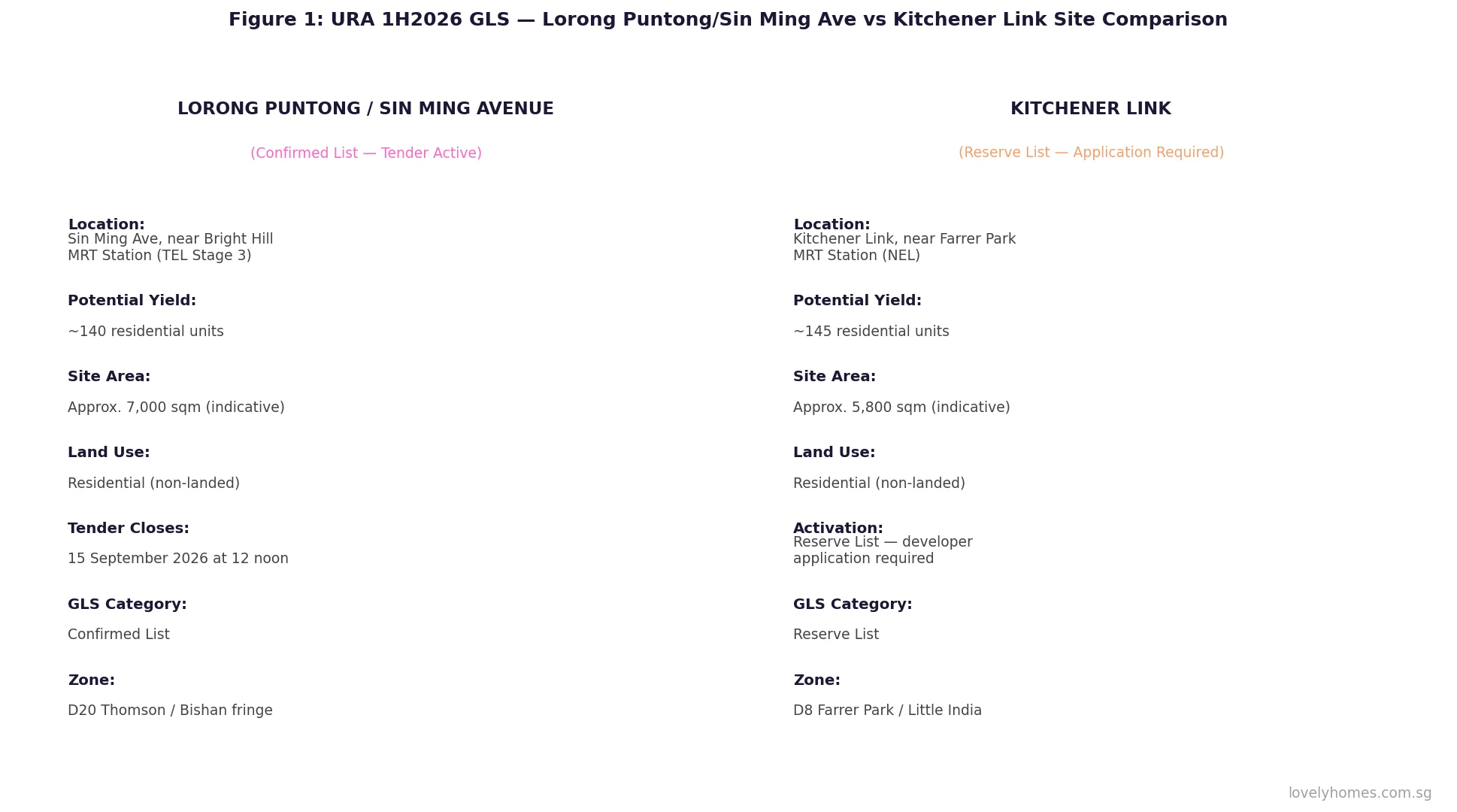
  • Lorong Puntong / Sin Ming Avenue — near Bright Hill MRT (TEL Stage 3), ~140 units, Confirmed List, tender closes 15 September 2026.
  • Kitchener Link — near Farrer Park MRT (NEL), ~145 units, Reserve List (developer application required).
  • Combined potential yield: approximately 285 new private residential units.
  • Lorong Puntong is part of the Sin Ming residential transformation adjacent to the Bright Hill MRT interchange; Kitchener Link taps Farrer Park’s strong healthcare-driven rental market.

URA Releases Two GLS Sites on 25 June 2026

The Urban Redevelopment Authority (URA) announced on 25 June 2026 the release of two residential sites for sale under the first half of 2026 (1H2026) Government Land Sales Programme. The two sites — at Lorong Puntong/Sin Ming Avenue in Bishan and at Kitchener Link near Farrer Park — represent different tiers of the GLS mechanism: the Sin Ming site is on the Confirmed List (it will be tendered regardless of developer interest), while Kitchener Link is on the Reserve List (a developer must first submit a sufficiently high application price to trigger the tender).

These releases form part of Singapore’s broader housing supply pipeline. The 1H2026 GLS programme was announced in December 2025 with 5,050 private residential units and 3,455 executive condominium (EC) units on offer — a total pipeline of approximately 8,505 units across both Confirmed and Reserve Lists. The Lorong Puntong and Kitchener Link releases bring two additional parcels in the 1H2026 programme to market.

URA GLS June 2026 site comparison Lorong Puntong Sin Ming Avenue versus Kitchener Link residential sites

Figure 1: Key facts comparison — Lorong Puntong/Sin Ming Avenue (Confirmed List) versus Kitchener Link (Reserve List). Source: URA, 25 June 2026.

Site 1: Lorong Puntong / Sin Ming Avenue — Bright Hill MRT Catchment

The Lorong Puntong/Sin Ming Avenue site is located in the Sin Ming planning area, within the broader Bishan/Upper Thomson precinct. Its most significant attribute is proximity to Bright Hill MRT station — the Thomson-East Coast Line (TEL) Stage 3 station that serves the Sin Ming/Upper Thomson Road corridor and will also connect to the Cross Island Line (CRL) when the CRL’s eastern extension opens. Sin Ming Avenue has historically been a light industrial and automotive area; the release of a residential GLS site here is a deliberate planning signal that URA is guiding the gradual residential transformation of the Sin Ming corridor as TEL and CRL connectivity uplift its residential attractiveness.

The site can potentially yield approximately 140 residential units. Industry expectations for the bid quantum fall in the range of S$680–820 psf per plot ratio (ppr), based on comparable land transactions in the D20 catchment. The tender closes on 15 September 2026 at 12 noon. A successful award in Q4 2026 would position a new launch for 2027–2028 at estimated prices of S$2,000–2,400 psf, if comparable to existing condos such as those along Thomson Road and Upper Thomson.

Site 2: Kitchener Link — Farrer Park Reserve List Addition

The Kitchener Link site is within the Farrer Park planning area in District 8, adjacent to Farrer Park MRT station on the North East Line (NEL). Farrer Park has seen steady demand from healthcare workers employed at nearby Connexion (the integrated medical hub) and Tan Tock Seng Hospital. As a Reserve List site, Kitchener Link will only be tendered if a developer submits an acceptable minimum-price application to URA — a demand-sensing mechanism that prevents oversupply when market sentiment is weak.

The site can potentially yield approximately 145 residential units. Comparable land in D8 has transacted in the S$1,050–1,200 psf ppr range in recent tender cycles, suggesting a potential launch price of S$2,100–2,500 psf for a new development here, consistent with resale values in the Farrer Park condo market today.

1H2026 GLS Programme: Where These Sites Fit

Site List Type Est. Units Key Transport Tender / Status
Lorong Puntong / Sin Ming Ave Confirmed ~140 Bright Hill MRT (TEL) Closes 15 Sep 2026
Kitchener Link Reserve ~145 Farrer Park MRT (NEL) Application required
Peck Hay Road (awarded Jun 2026) Confirmed ~220 Newton MRT (NSL/DTL) Awarded Jun 2026
River Valley Green Parcel C (awarded Jun 2026) Confirmed ~350 Havelock MRT (TEL) Awarded Jun 2026
JLD White Site (launched Jul 2026) White Site ~1,200+ Jurong Lake District Launched Jul 2026

The June 2026 GLS releases follow a busy first half for URA land sales. River Valley Green Parcel C was awarded in June 2026 (to CDL at approximately S$1,325 psf ppr), and Peck Hay Road near Newton was also awarded in June. The Jurong Lake District white site was formally launched in July 2026. Against this backdrop, Lorong Puntong and Kitchener Link represent smaller, more surgical supply additions rather than market-moving mega-sites.

What This Means for Buyers and Investors

For buyers evaluating resale condos in the Sin Ming/Upper Thomson and Farrer Park micro-markets, the GLS releases signal new supply entering in 2027–2028 (assuming a standard 3–4 year construction timeline from award to Temporary Occupation Permit). This may create modest pricing competition for older resale stock at launch in those years. However, for capital appreciation investors, the Sin Ming GLS release is a positive long-term signal: URA’s conversion of industrial land to residential use endorses the Bright Hill MRT’s transformative effect on the corridor, and buyers who enter the precinct now may benefit from the full value uplift before new supply arrives.

For the Kitchener Link site, triggering depends on developer confidence in the D8 condo market. If CCR/RCR sentiment remains stable through late 2026, it is likely a developer will submit a trigger application in H2 2026 or H1 2027.

Frequently Asked Questions

What is the difference between a Confirmed List and Reserve List GLS site?

A Confirmed List site is put out for public tender by URA regardless of developer interest — it will be sold. A Reserve List site is only tendered if a developer submits a minimum acceptable price application first. This two-track system lets URA release supply systematically (Confirmed) while maintaining a buffer of ready-to-activate land that responds to actual market demand (Reserve). Reserve List sites are not “less desirable” — they are simply a policy mechanism to avoid releasing land faster than the market can absorb.

When could a new condo at the Sin Ming/Lorong Puntong site launch for sale?

If the Lorong Puntong/Sin Ming Avenue tender closes 15 September 2026 and is awarded in Q4 2026, a developer would typically spend 12–18 months on planning approvals and design before a sales launch. An early preview or public launch could therefore occur in late 2027 or early 2028, with keys (Temporary Occupation Permit) expected by 2030–2031 based on standard construction timelines. Buyers should monitor URA’s tender award announcements and developer project registration notices.

Can foreigners buy units in the new condos developed on these sites?

Yes. Both sites are zoned non-landed private residential, and resulting condominiums are open to Singapore Citizens, Permanent Residents, and foreigners — subject to applicable ABSD rates. Foreign buyers currently pay 60% ABSD. Singapore Citizens pay no ABSD on a first property purchase, and 20% ABSD on a second. The ABSD framework applies uniformly to new launches and resale private condominiums.

How does the Kitchener Link Reserve List site get triggered?

A developer must submit a formal written application to URA with a minimum acceptable price. If URA finds the application price acceptable, it launches a public tender within approximately 8 weeks. The triggering developer then competes openly against other bidders — there is no guaranteed right of purchase just from submitting the trigger application. If no developer submits an acceptable application price, the site remains dormant on the Reserve List.

Where can I find the full URA press release for these two GLS sites?

The official URA press release (pr26-49, 25 June 2026) is available at the URA website under Media Releases. The Lorong Puntong/Sin Ming Avenue tender details are listed under URA’s sites-for-tender page, and the Kitchener Link details appear on the sites-for-application page. Both pages are accessible at ura.gov.sg. The eDeveloper’s Packets with full conditions of tender are available for purchase through URA’s One-Stop Developer Portal.

Related Articles

Disclaimer: This article is for general information purposes only and is based on URA press release pr26-49 (25 June 2026) and publicly available GLS data. Indicative tender bid and launch price estimates reflect LovelyHomes’ own analysis and do not constitute financial or investment advice. Readers should verify all GLS details directly with the Urban Redevelopment Authority (ura.gov.sg) before making any property purchasing or investment decision.

Novena Neighbourhood Guide Singapore 2026: D11 Medical Hub, Prices & Investment Outlook

Novena Neighbourhood Guide Singapore 2026: D11 Medical Hub, Prices & Investment Outlook

⚡ Quick Answer: Novena Neighbourhood D11 at a Glance

  • District 11 (D11) — Newton and Novena planning areas in the Core Central Region (CCR). Almost entirely private residential.
  • Freehold condos average S$2,600–3,200 psf in Q1 2026; 99-year leasehold condos range from S$2,100–2,600 psf.
  • Medical hub demand: Mount Elizabeth Hospital, Mount Elizabeth Novena Hospital, and Tan Tock Seng Hospital (TTSH) generate sustained rental demand from healthcare professionals and medical tourists.
  • MRT connectivity: Novena (North South Line) and Newton (NSL + Downtown Line) provide direct access to Raffles Place, Marina Bay, and Orchard Road.
  • Gross rental yield: approximately 2.5%–3.2% for condos, comparable to other prime CCR districts.
  • Supply constraint: no new Government Land Sales (GLS) sites have been released in D11 since 2019, reinforcing price resilience for existing freehold stock.
  • Ideal buyer: upgraders, medical professionals, expatriate tenants, long-term capital preservation investors.

What Makes Novena Singapore’s Medical Hub Precinct?

Novena sits within District 11 — one of Singapore’s most established and tightly held residential precincts. Bounded roughly by Thomson Road to the north, Bukit Timah Road to the west, Newton Circus to the south, and Balestier Road to the east, D11 is home to a cluster of private hospitals that is unmatched anywhere else on the island. Mount Elizabeth Hospital on Orchard Road, its sister facility Mount Elizabeth Novena Hospital on Novena Rise, and Tan Tock Seng Hospital on Moulmein Road together form Singapore’s largest private medical hub. This concentration of world-class healthcare institutions is not just a lifestyle amenity — it is a structural driver of residential demand.

Medical professionals, hospital support staff, and visiting doctors on short-term rotations all need housing within comfortable distance of these facilities. International patients and their families, many from across Southeast Asia, the Middle East, and China, often prefer to base themselves in Novena rather than Orchard so they can be close to treatment. The result is a rental market that is unusually resilient even during broader property downturns, because hospital activity does not follow the economic cycle in the same way that corporate leasing does.

Beyond healthcare, Novena offers the quiet residential character of the old Central Region without the intensity of Orchard Road. United Square on Thomson Road is Singapore’s best-known education mall, drawing families with school-age children. Novena Square 1 and 2 and Square 2 along Thomson Road provide everyday retail and dining. St. Joseph’s Institution International, Anglo-Chinese School (Primary), and the Singapore Chinese Girls’ School are all within close proximity, adding an education premium on top of the medical one.

D11 Property Price Ranges — What Buyers Pay in 2026

D11 Novena property price ranges by type Q1 2026 — HDB resale and condo PSF bar chart

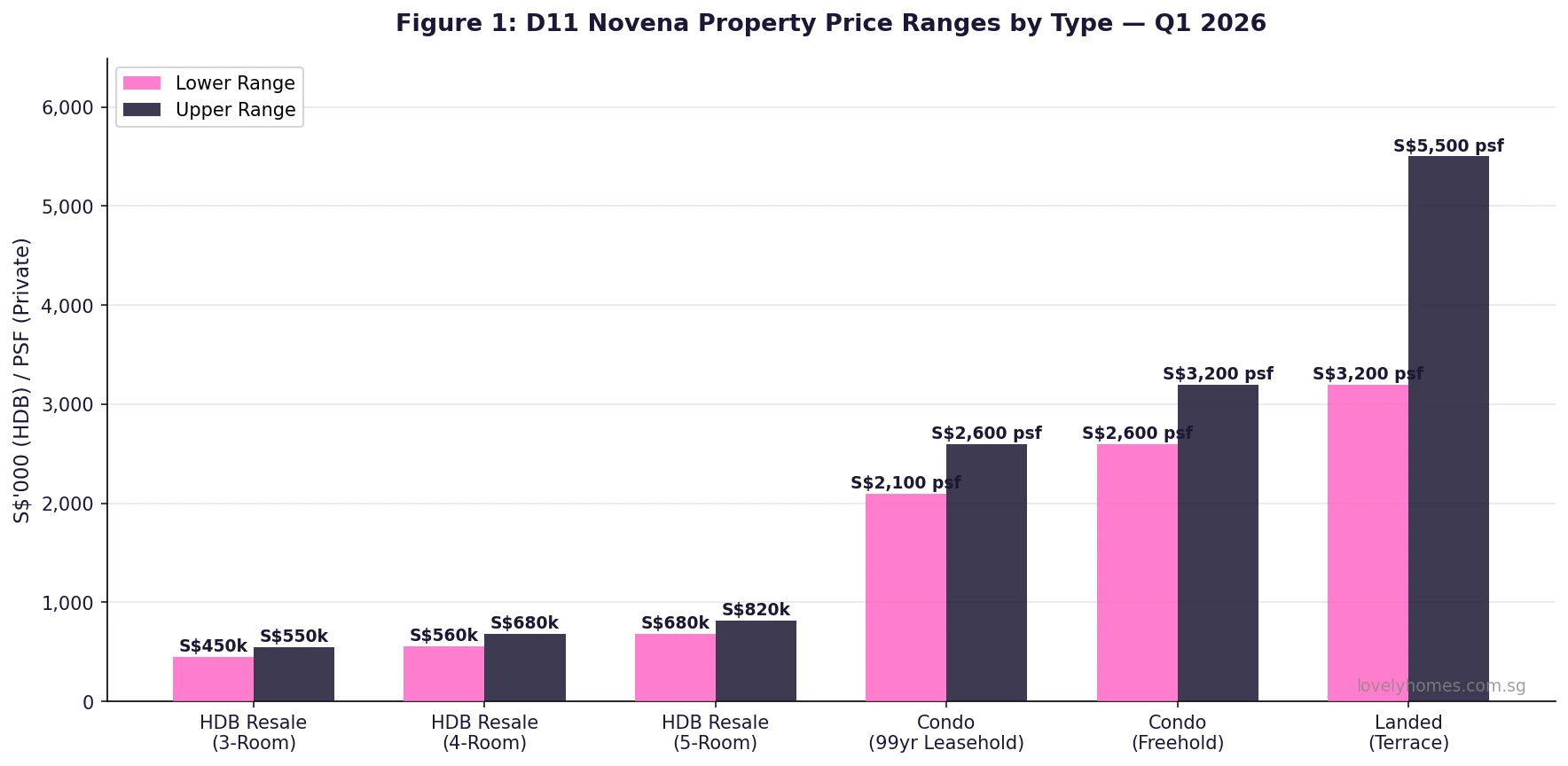
Figure 1: D11 Newton/Novena residential property price ranges by type — Q1 2026. HDB resale figures reflect fringe estates (Moulmein/Thomson). Sources: URA REALIS, HDB Resale Portal Q1 2026.

District 11 is overwhelmingly private residential. The handful of HDB resale flats that fall within or immediately adjacent to the planning area — mainly in the Moulmein and Newton fringe — transact at a premium to equivalent flat types elsewhere, given their central address. A 4-room HDB resale in this catchment has fetched S$560,000–680,000 in Q1 2026, reflecting the locational scarcity: only a few hundred HDB flats exist across the entire D11 footprint.

The dominant residential product in D11 is the private condo. Freehold condos — which make up the majority of stock given the age of development — have held between S$2,600 and S$3,200 psf in Q1 2026. Key developments such as City Square Residences (freehold, Kitchener Road), Novena Regency (freehold, Thomson Road), and The Trizon (freehold, off Mount Sinai) sit in this range. Newer 99-year developments have traded at a 15–20% discount to equivalent freehold stock, at S$2,100–2,600 psf, reflecting the leasehold haircut that remains deeply ingrained in Singapore buyer psychology.

Landed property in D11 — predominantly terrace and semi-detached houses in the Upper Thomson and Spring Road areas — commands S$3,200–5,500 psf on land area depending on remaining lease, configuration, and orientation. Good Class Bungalow (GCB) plots in the adjacent Ridout Road and Nassim areas start well above S$15 million for eligible parcels.

Property Type Typical Size Price From Price To Notes
HDB Resale (3-Room) 65–70 sqm S$450,000 S$550,000 Moulmein/Newton fringe only
HDB Resale (4-Room) 90–100 sqm S$560,000 S$680,000 Moulmein/Newton fringe only
Condo 1-Bed (FH) 45–55 sqm S$1,200,000 S$1,600,000 Strong rental demand from medical staff
Condo 2-Bed (FH) 75–95 sqm S$1,700,000 S$2,400,000 Most liquid unit type in D11
Condo 3-Bed (FH) 120–150 sqm S$2,800,000 S$4,200,000 Family-friendly, education catchment
Landed Terrace (FH) 150–200 sqm land S$3,200 psf land S$5,500 psf land Only Singapore Citizens eligible

Location and Connectivity: MRT, TEL and Road Networks

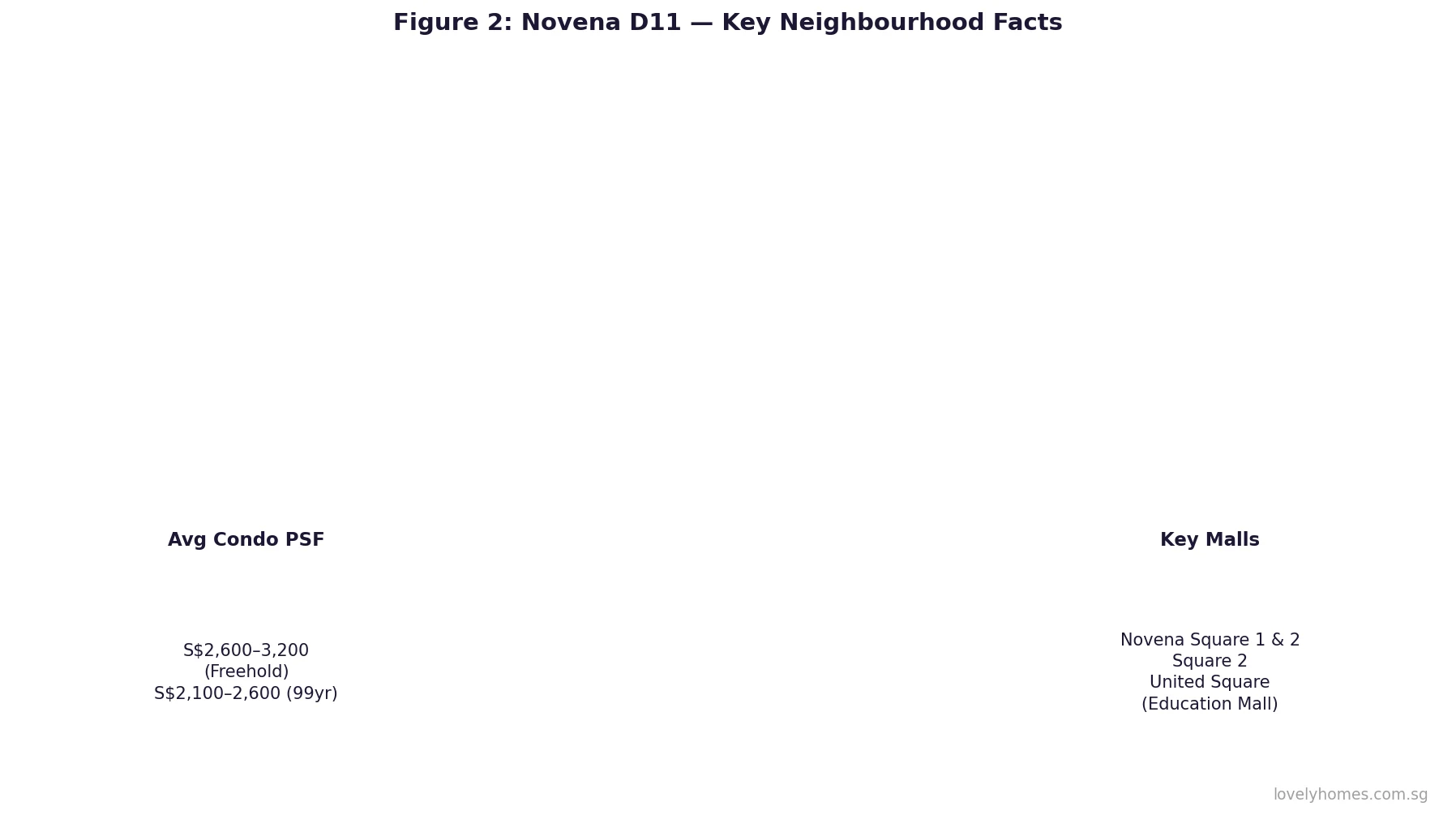
Novena neighbourhood key facts 2026 — district D11 MRT lines medical hub condo yields and malls

Figure 2: Novena D11 — key neighbourhood facts for property buyers and investors, 2026.

Novena station on the North South Line (NSL) gives residents a 4-minute train ride to Toa Payoh and a 6-minute ride to Orchard. Newton interchange station — one of only five interchange stations on the NSL — connects to the Downtown Line (DTL), enabling direct access to Buona Vista, one-north, and the Botanic Gardens without a transfer. Journey times to Raffles Place run at approximately 13–15 minutes, making D11 one of the best-connected residential precincts for CBD workers in Singapore.

The Thomson-East Coast Line (TEL) has further enhanced D11’s connectivity position without D11 itself sitting on the new line. Stevens interchange (TEL + DTL, opened December 2022) is a 5-minute drive or short bus ride from Novena, linking residents to TE1 (Woodlands North) and the full TEL corridor south through Stevens, Napier, Orchard Boulevard, and Orchard into the eastern spine. For Novena residents, TEL Stage 4’s opening in 2024 — connecting Founders’ Memorial, Tanjong Rhu, and the East Coast corridor — extended journey time savings for those commuting eastward.

By road, the Central Expressway (CTE) entrance at Moulmein Road provides fast north-south access. The Pan Island Expressway (PIE) junction at Adam Road is under 10 minutes from Novena. These road links are especially valued by residents who need to reach Changi Airport, the western industrial corridor, or the north.

The Medical Hub Premium: Why Hospitals Drive Novena Property Values

Singapore’s position as Southeast Asia’s foremost medical tourism destination directly benefits D11 landlords. Mount Elizabeth Novena Hospital — a 333-bed private tertiary hospital opened in 2012 by Parkway Pantai — anchors the Novena Specialist Centre cluster along Irrawaddy Road, home to more than 200 specialist clinics. Tan Tock Seng Hospital, Singapore’s second-largest public acute care hospital with approximately 1,700 beds, generates thousands of shift-based healthcare workers who need residential options within cycling or walking distance.

The practical implication is a rental market that outperforms broader D11 yield expectations in the sub-S$5,000/month segment. A typical 1-bedroom freehold condo (50–55 sqm) in Novena commands S$3,800–4,500/month, yielding approximately 2.8–3.2% gross on an acquisition cost of S$1.4–1.6 million. Two-bedroom units (80–95 sqm) attract medical families and senior specialists, renting at S$5,500–7,000/month for a gross yield of 2.5–3.0% on a S$2.0–2.4 million entry price.

This yield compression relative to fringe districts reflects the capital value premium commanded by CCR freehold stock — buyers are partly paying for capital preservation and the scarcity of new supply, not just income return. Investors who entered D11 between 2017 and 2020 and chose freehold units are now sitting on total returns (rental + capital appreciation) of approximately 30–45% over six years, comfortably outperforming CPF Ordinary Account returns and most balanced investment portfolios.

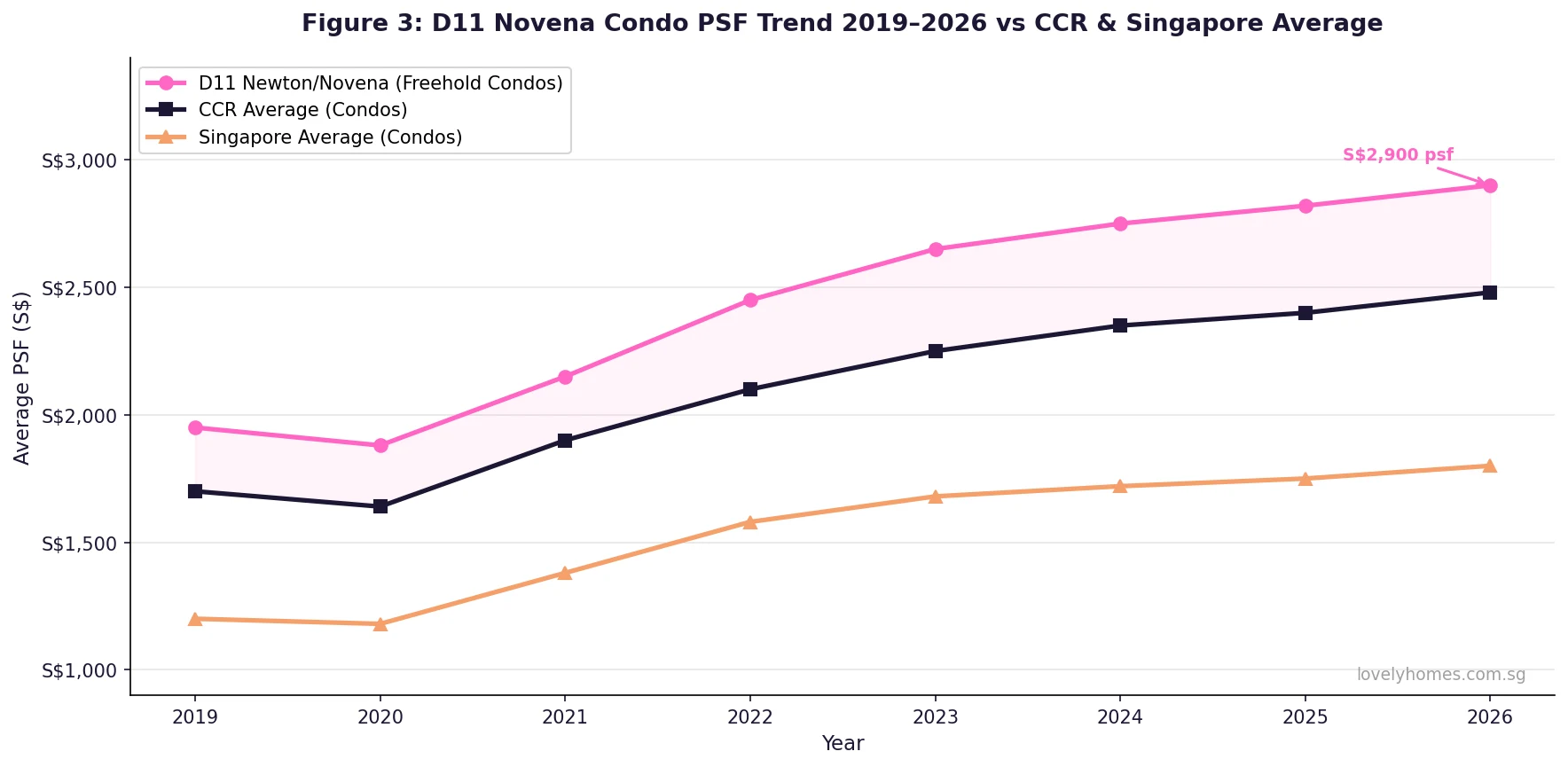
D11 Condo Price Trend 2019–2026

D11 Novena condo PSF trend 2019 to 2026 versus CCR and Singapore average line chart

Figure 3: D11 Newton/Novena average condo PSF trend 2019–2026 versus CCR and Singapore overall average. Source: URA REALIS, LovelyHomes analysis.

The chart above illustrates D11’s trajectory over the past seven years. Starting from roughly S$1,950 psf in 2019, freehold D11 condos contracted slightly during the pandemic-affected 2020 period before recovering strongly through 2021–2022 on the back of Singapore’s post-Covid reopening and a structural shift in buyer demand toward quality freehold assets. By 2023, D11 average freehold condo PSF had crossed S$2,600 psf for the first time. The 2022 and 2023 ABSD increases tempered transaction volumes — particularly for foreigners and second-property buyers — but did not dent per-unit pricing meaningfully, as supply in D11 is too constrained for any oversupply dynamic to emerge.

The shaded pink band in Figure 3 represents the D11 freehold premium over the broader CCR average. This premium has widened from approximately S$250 psf in 2019 to over S$420 psf in Q1 2026, reflecting both the structural scarcity of freehold stock in D11 and growing buyer preference for fully private, low-density living with minimal commercial encroachment.

Worked Example: Buying a 2-Bedroom Freehold Condo in Novena

📋 Case Study: Mr & Mrs Lee (SC/SC) — 2-Bed Freehold Condo, Novena, S$2,100,000

Profile: Singapore Citizens, first property purchase for both, combined gross income S$14,000/month. Buying a 2-bedroom freehold condo in Novena at S$2,100,000 for owner-occupation, no existing properties.

  • ABSD: S$0 (SC buying first residential property — no ABSD)
  • BSD (Buyer’s Stamp Duty):
    • 1% on first S$180,000 = S$1,800
    • 2% on next S$180,000 = S$3,600
    • 3% on next S$640,000 = S$19,200
    • 4% on next S$500,000 = S$20,000
    • 5% on next S$600,000 = S$30,000 (i.e. 2,100k less 1,500k threshold)
    • Total BSD: S$74,600 (effective 3.55%)
  • Loan: 75% LTV = S$1,575,000. At 3.5% p.a. over 25 years → monthly repayment ≈ S$7,882
  • TDSR check: S$7,882 / S$14,000 = 56.3% — exceeds the 55% TDSR limit. FAIL.
  • Resolution: Increase down payment to 35% (S$735,000), reducing loan to S$1,365,000 (65% LTV). Monthly repayment ≈ S$6,830. TDSR = 48.8% — PASS.
  • Or: Look at 99yr leasehold option at S$1,750,000 — TDSR at 75% LTV = S$6,568/mth = 46.9% — PASS with standard down payment.
  • Total upfront (with increased 35% down payment + BSD + legal fees ~S$8,000): approximately S$817,600

This example illustrates that D11 freehold condos at S$2M+ often push buyers to the TDSR boundary. Buyers with household income below S$13,000/month should model carefully before committing to prime CCR property at full 75% LTV.

What This Means for You: Investment Outlook for Novena 2026

D11’s investment case rests on three pillars: supply scarcity, institutional demand from the medical cluster, and the freehold tenure of the majority of its stock. No new GLS residential sites have been released in D11 since 2019, and URA’s long-term planning approach for the Novena area — classified as a Medical and Healthcare Hub in the 2019 Concept Plan — is to intensify medical uses rather than add residential supply. This means existing condo owners benefit from a structurally undersupplied rental market.

Peer-country comparison is instructive: Singapore’s medical tourism arrivals have recovered to pre-2020 levels and are projected to grow at 6–8% per year through 2030, according to Singapore Tourism Board data. Bangkok’s Sukhumvit medical precinct and Kuala Lumpur’s Bangsar medical cluster — both D11 comparators — trade at significantly lower absolute values but have shown similar rental demand dynamics when anchored by hospital clusters.

The 2023 ABSD increase to 20% for Singapore Citizens purchasing their second property has been the primary headwind, reducing the pool of upgrader-investors who would previously have held a D11 condo as a rental asset. However, institutional landlords, family offices, and HNW individuals — many of whom hold D11 property through structures exempt from or partially insulated from ABSD — have partially absorbed this demand withdrawal. Transaction volumes in D11 are lower than 2021–2022 peaks but prices have held firm.

For owner-occupiers, Novena remains one of Singapore’s best-value CCR living addresses on a “livability per dollar spent” basis: lower psf than Orchard/River Valley (D09/D10), with arguably better day-to-day amenities (healthcare, education, F&B) and equivalent MRT connectivity. First-time buyers with sufficient income ($13,000+/month household) priced out of Orchard condos will increasingly look to D11 freehold units as a value entry point into the CCR.

What Might Come Next for Novena?

URA’s Draft Master Plan 2025 (public consultation 2025–2026) has not released any residential-zoned GLS parcels within D11. The long-term direction for Novena is healthcare intensification: the Novena Health City vision positions the precinct as a full-service integrated medical district, with possible expansion of outpatient facilities and specialist centres along Irrawaddy Road and Balestier. Any rezoning of existing commercial or industrial sites in the area for residential use would be a meaningful catalyst — but industry observers see this as unlikely before 2030.

In the shorter term, the broader TEL completion in 2025 (Stages 4–5) and the continued growth of the Cross Island Line (CRL) network — which brings better connectivity to D11 feeder suburbs — are expected to sustain buyer appetite for CCR property including D11. If Singapore’s government chooses to recalibrate ABSD for second properties (reducing the 20% SC rate) as part of a future cooling-measures review, D11 would be among the prime beneficiaries given its investor-grade stock base.

Frequently Asked Questions: Buying Property in Novena

Are there HDB flats available in Novena for purchase?

Very few. D11 is almost entirely private residential, with only a small number of HDB resale flats in the Moulmein and Thomson fringe of the district. Buyers seeking public housing close to D11 typically look at nearby Toa Payoh (D12) or Novena-adjacent blocks in Moulmein Road. There are no BTO launches planned for D11 given the Master Plan’s designation of the area as a Medical and Healthcare Hub.

Can foreigners buy property in Novena?

Foreigners (non-Singapore Citizens and non-Permanent Residents) may purchase private condominiums (strata-titled, non-landed) in D11, including Novena, subject to paying Additional Buyer’s Stamp Duty (ABSD) of 60% on the purchase price as of April 2023. Landed property in D11 is restricted to Singapore Citizens only, with limited exceptions requiring Singapore Land Authority (SLA) approval for Permanent Residents in non-GCB landed categories.

What is the ABSD rate for a second property purchase in Novena?

As at 1 July 2026, a Singapore Citizen purchasing a second residential property pays ABSD of 20% on the purchase price. A Permanent Resident buying a first property pays 5% ABSD. A foreign buyer pays 60%. There is no ABSD for a Singapore Citizen purchasing their first residential property. For a D11 condo priced at S$2.0 million, the ABSD for a SC second-property purchase would be S$400,000 — a significant holding cost that most investors factor into their return model before committing.

What is the typical rental yield for condos in Novena?

Gross rental yields for condominiums in D11 Newton/Novena typically range from 2.5% to 3.2% per year in 2026, depending on unit size, floor level, and age of development. Smaller 1-bedroom units (45–55 sqm) tend to achieve the highest yields (2.9–3.2%) due to strong demand from single medical professionals, while larger 3-bedroom family units yield closer to 2.5% gross. Net yields after maintenance fees, property tax, and agent fees are typically 0.5–0.8% lower than gross.

What is the Minimum Occupation Period (MOP) for a condo in D11?

Private condominiums do not have a Minimum Occupation Period (MOP) requirement. Only HDB flats are subject to MOP (5 years for Standard flats, 10 years for Prime and Plus BTO flats). Private condo owners may rent out their unit from day one of ownership, provided they comply with URA tenancy regulations including the 3-month minimum rental period. This makes D11 condos immediately income-generating for buyers who intend to lease the property out.

How does Novena compare to Orchard Road (D09/D10) for property investment?

Novena (D11) generally offers lower entry prices than Orchard (D09) and River Valley (D10) at equivalent quality levels, with freehold condos in D11 averaging S$2,600–3,200 psf versus D09/D10 freehold at S$3,200–4,500 psf. Rental yields are comparable (2.5–3.2% across both zones). D11 benefits from the medical hub demand driver, which is more stable than the expatriate corporate demand that historically underpinned D09/D10 rentals. Buyers seeking CCR exposure with lower absolute outlay and a differentiated demand driver typically favour D11 over D09/D10.

Is Novena suitable for families with school-age children?

Yes — D11 is one of Singapore’s best-positioned districts for families prioritising education access alongside healthcare. Anglo-Chinese School (Primary) is located off Barker Road within the district. The Singapore Chinese Girls’ School (SCGS) is on Emerald Hill in adjacent D10. St. Joseph’s Institution International (SJI International) on Malcolm Road serves the international school market. United Square on Thomson Road is Singapore’s premier education-focused mall, housing enrichment centres, tuition providers, and learning-focused retail. Proximity to the Botanic Gardens (5 minutes by car) adds park space for families.

Related Articles

Disclaimer: This article is for general information purposes only and does not constitute financial, legal, or property advice. Property prices, stamp duty rates, HDB eligibility rules, and mortgage terms are subject to change. All figures cited are indicative based on publicly available URA REALIS data and industry analysis as at Q1/Q2 2026. Readers should verify current rules with the Urban Redevelopment Authority (ura.gov.sg), Housing & Development Board (hdb.gov.sg), Inland Revenue Authority of Singapore (iras.gov.sg), and seek advice from a licenced property agent, mortgage broker, and solicitor before making any property transaction decision.

East Coast Neighbourhood Guide Singapore 2026: D15 Prices, TEL Impact & Investment Outlook

East Coast Neighbourhood Guide Singapore 2026: D15 Prices, TEL Impact & Investment Outlook

×

Click outside or press Esc to close

District 15 (D15) — Singapore’s East Coast corridor — has long been one of the most sought-after residential addresses in the city-state. Anchored by Katong, Marine Parade, Siglap, Tanjong Katong, and the new Bayshore precinct, D15 blends Peranakan heritage, beachfront lifestyle, and increasingly, world-class MRT connectivity following the Thomson-East Coast Line (TEL) Stage 4 opening. This guide covers D15 property prices, HDB resale data, condo psf trends, TEL impact, investment outlook, and what to know before buying in 2026.

Quick Answer — East Coast D15 at a Glance (2026)

  • District 15 covers Katong, Marine Parade, Siglap, Tanjong Katong, Joo Chiat, and the upcoming Bayshore precinct.
  • HDB 4-room resale flats in D15 typically trade between S$520,000 and S$780,000 in Q1 2026.
  • Condo median psf ranges from ~S$2,100 psf (OCR fringes) to S$2,900+ psf (seafront / TEL-adjacent units).
  • TEL Stage 4 (seven stations opened June 2024) has cut commute times from East Coast to the CBD by 20–30 minutes.
  • Bayshore Road GLS site remains one of the most anticipated future launch sites along the Coast.
  • D15 rental yields for 2-bedroom condos average 3.0–3.8%, underpinned by strong expat and young-professional demand.
  • No freehold supply pipeline — almost all new launches are 99-year leasehold, elevating the premium for freehold pockets like Tanjong Katong Road.

What Is District 15 and Who Administers Property Here?

District 15 is one of Singapore’s 28 traditional postal districts, spanning the eastern corridor from Geylang Serai through Marine Parade, Siglap, and Bayshore to the fringe of D16 (Bedok). The Urban Redevelopment Authority (URA) administers land use planning, while HDB manages the substantial public-housing stock along Marine Parade Road, Siglap Plain, and the Lengkong areas. Marine Parade is one of Singapore’s older HDB towns, built out from the early 1970s on reclaimed land; this heritage gives D15 its unique mix of mature HDB estates, conservation shop-houses, private condos, and landed enclaves.

The district falls within the Rest of Central Region (RCR) under URA’s planning framework, meaning it is neither as expensive as the Core Central Region (CCR) nor as affordable as the Outer Central Region (OCR). This RCR positioning makes D15 attractive to both owner-occupiers who want an urban lifestyle and investors who see a price gap versus Districts 9, 10, and 11.

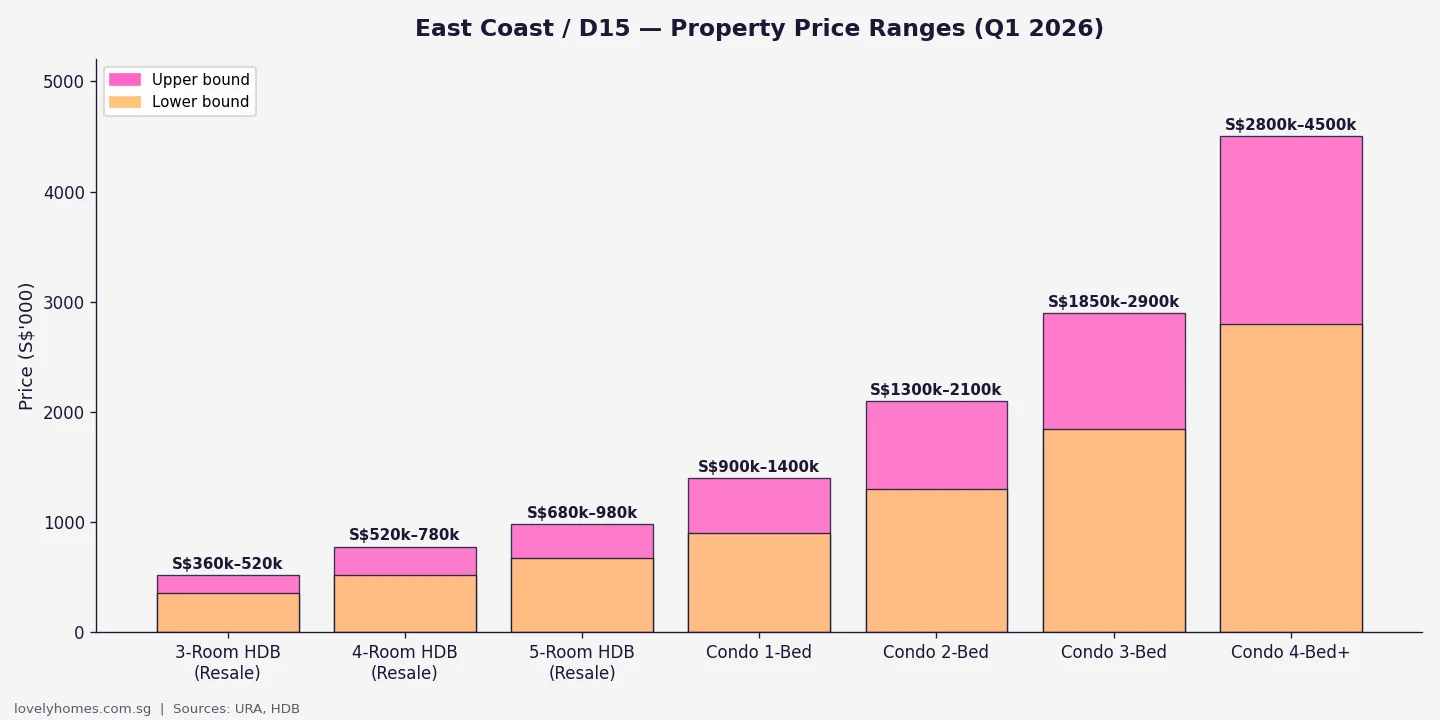
D15 Property Price Ranges — Q1 2026

East Coast D15 property price ranges by type Q1 2026 HDB resale and condo
Figure 1: D15 East Coast property price ranges by type — Q1 2026. Sources: URA REALIS, HDB Resale Portal.

The D15 market is a tale of two submarkets. On the public housing side, Marine Parade’s mature HDB stock — 3-room, 4-room, and 5-room flats — trades at premiums well above the national median given their central location, sea views, and proximity to the new TEL stations. On the private side, a wide range of condos from 1980s-vintage developments to brand-new launches commands psf rates broadly in line with the RCR average, with TEL-adjacent and seafront addresses commanding a further 10–20% premium.

Property Type Typical Price Range (Q1 2026) Key Driver
HDB 3-Room Resale S$360k – S$520k Location, floor, TEL proximity
HDB 4-Room Resale S$520k – S$780k Sea view, high floor, age
HDB 5-Room Resale S$680k – S$980k Corner units, premium storey
Condo 1-Bedroom S$900k – S$1.4M Rental yield-driven
Condo 2-Bedroom S$1.3M – S$2.1M Most liquid size, expat demand
Condo 3-Bedroom S$1.85M – S$2.9M Family-size demand, school proximity
Condo 4-Bed / Penthouse S$2.8M – S$4.5M+ Scarcity, sea view, freehold tenure

The TEL Effect — How Thomson-East Coast Line Stage 4 Changed Everything

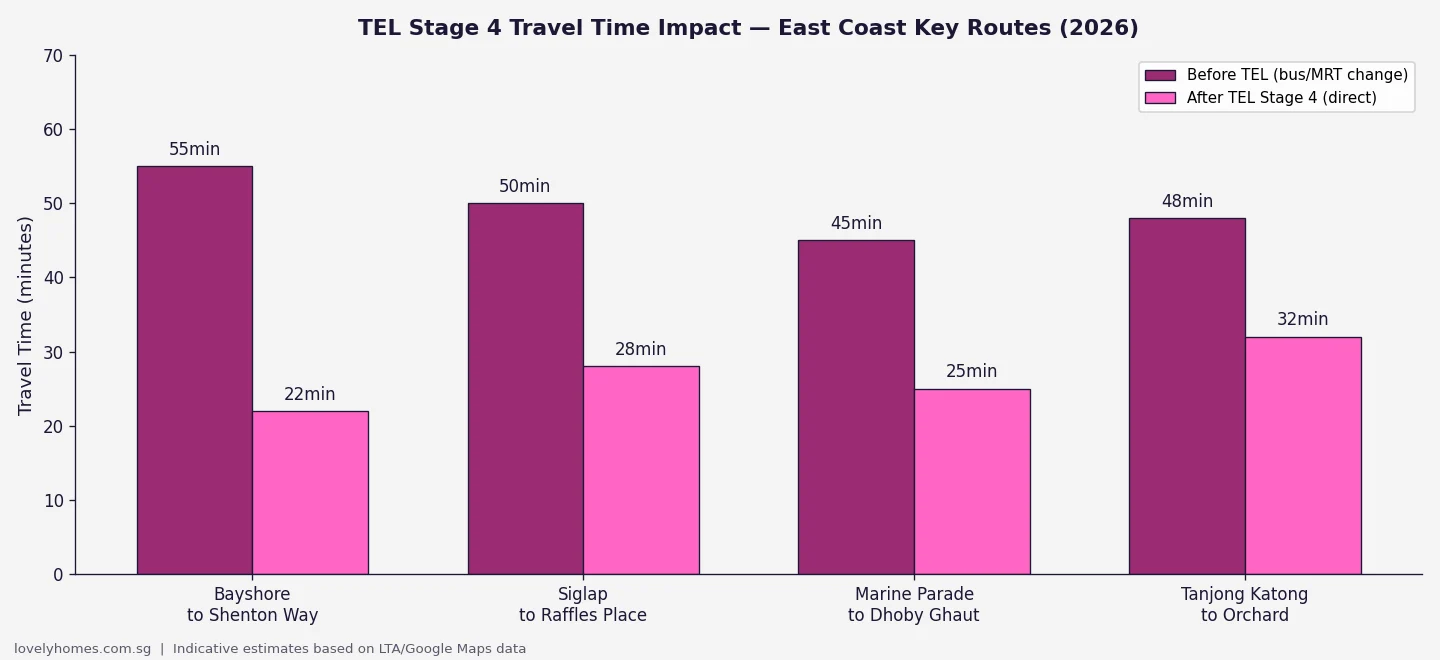
Before the Thomson-East Coast Line (TEL) Stage 4 opened in June 2024, East Coast residents faced a familiar frustration: despite living close to the city geographically, the absence of direct rail meant a bus-heavy commute or a drive. TEL Stage 4 introduced seven stations — Tanjong Rhu, Katong Park, Tanjong Katong, Marine Parade, Marine Terrace, Siglap, and Bayshore — fundamentally re-rating the district’s accessibility from “car-dependent” to “MRT-convenient”.

TEL Stage 4 travel time comparison East Coast to CBD 2026
Figure 2: TEL Stage 4 — indicative travel time reduction on key East Coast routes to the CBD (2026). Sources: LTA, Google Maps estimates.

The connectivity uplift has translated into measurable price momentum. Industry data suggests properties within 500 metres of a TEL Stage 4 station saw median psf appreciation of 8–12% in the 18 months following the line’s opening. The Bayshore precinct in particular — the eastern-most TEL stop in Stage 4 — has been flagged by URA as a future growth node, with rezoning planned for higher-density residential and mixed-use development along Bayshore Road.

Neighbourhood Character: Katong, Marine Parade, Siglap and Bayshore

Katong and Joo Chiat form the cultural heart of D15. Peranakan shop-houses line East Coast Road, with restaurants, heritage shopfronts, and boutique hotels giving the sub-precinct a character found nowhere else in Singapore. Property here — particularly freehold terraces and conservation shop-houses — commands a significant premium and rarely trades. Buyers who can afford the entry price acquire a genuinely irreplaceable asset.

Marine Parade is the most accessible sub-precinct, anchored by Marine Parade Road and its mature HDB precincts. Parkway Parade mall, the iconic East Coast Park, and a well-established network of amenities make this the most family-friendly address in D15. HDB resale prices here have historically tracked 10–20% below equivalent units in Bishan or Queenstown despite the beachfront lifestyle advantage — a gap that has since narrowed following TEL connectivity.

Siglap retains a village atmosphere that residents guard fiercely. Low-rise landed housing, a strong café culture along Upper East Coast Road, and proximity to good schools (CHIJ Katong, St Patrick’s School, Victoria School) make Siglap a perennial favourite for families. The new Siglap TEL station has changed the calculus for buyers who previously shied away due to the bus-only access to the city.

Bayshore is D15’s newest growth story. Located at the eastern fringe before the district transitions into D16, Bayshore benefits from both the East Coast Park Connector and its namesake MRT station. URA’s plans for Bayshore point towards higher-density condo development on the southern fringe, and a future Government Land Sales (GLS) site on Bayshore Road is anticipated to anchor the precinct’s transformation into a vibrant mixed-use node.

Condo PSF Trends — D15 vs RCR and Singapore Average (2019–2026)

D15 East Coast condo PSF trend vs RCR Singapore average 2019 to 2026
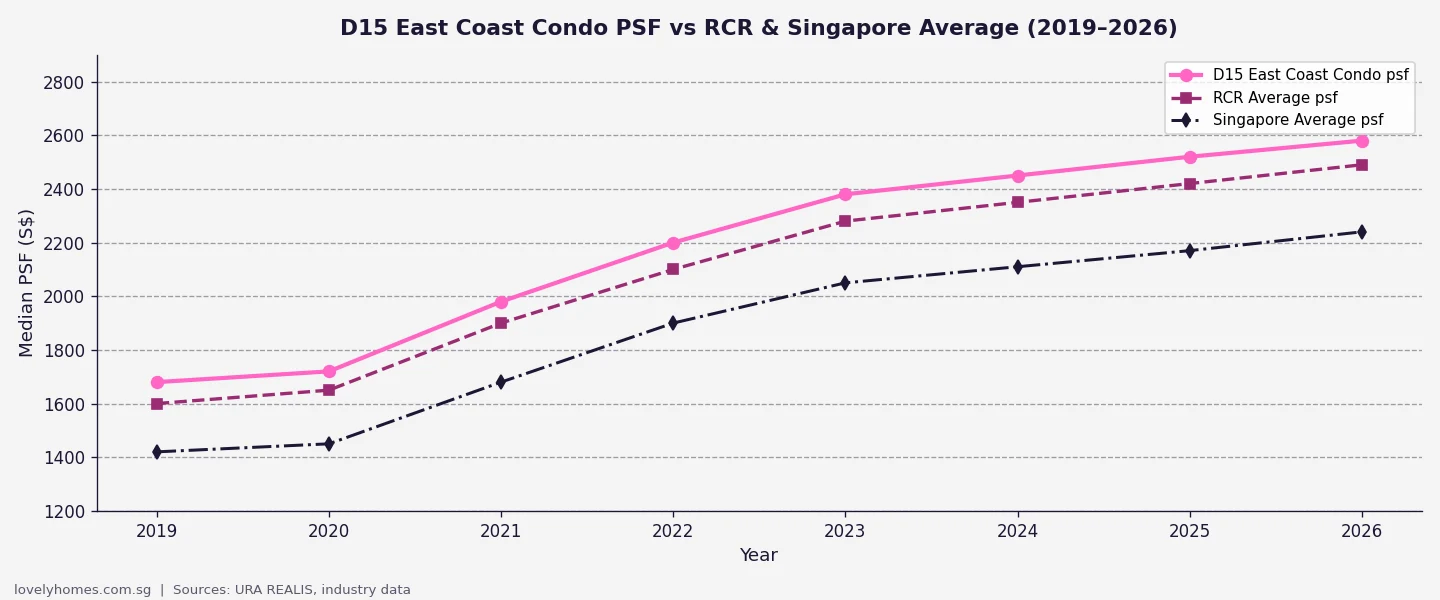
Figure 3: D15 East Coast condo median psf vs RCR average and Singapore average (2019–2026). Sources: URA REALIS, industry data.

D15 condo prices have outpaced the Singapore average since 2021, partly driven by the TEL anticipation effect and partly by a shrinking freehold supply pool. By Q1 2026, D15 median psf sits at approximately S$2,580, which is modestly above the RCR average of S$2,490. This premium is structural — D15 has very little land for new development, so supply is constrained to occasional en-bloc rebuilds and infill GLS sites. The scarcity premium is likely to persist through the medium term.

Schools and Amenities in the East Coast

D15 is one of Singapore’s most amenity-rich districts. Key schools within or adjacent to the district include CHIJ Katong Primary, Tao Nan School, Victoria School, St Patrick’s School, Dunman High School, Temasek Secondary, and the Canadian International School (Tanjong Katong campus). The density of well-regarded schools within the 1-km and 2-km radii is a primary reason why family-sized 3- and 4-bedroom condos in D15 command a durable premium over equivalent units in less educationally dense districts.

For daily living, Parkway Parade, i12 Katong, Siglap Centre, and the East Coast Road stretch of independent restaurants, café chains, and hawker centres provide comprehensive retail and dining coverage. East Coast Park — Singapore’s most-used waterfront recreational space — runs the entire southern flank of the district, offering cycling, barbecue, sea sports, and camping facilities that are essentially impossible to replicate in inland districts.

Worked Example — Buying a D15 Condo in 2026

Profile: Ms Lim, Singapore Citizen, first-time buyer, age 33, monthly income S$9,800. She is considering a 2-bedroom resale condo in Tanjong Katong at S$1,680,000.

Cost Item Amount (S$) Notes
Purchase Price 1,680,000 Resale condo, D15
Buyer’s Stamp Duty (BSD) 53,400 Tiered: 1-6% on S$1.68M
ABSD (First Property, SC) 0 First property, SC — ABSD waived
25% Minimum Downpayment 420,000 5% cash + 20% cash/CPF
Bank Loan (75% LTV) 1,260,000 At ~3.8% p.a., 25 yr — est. monthly S$6,512
TDSR Check 66.5% S$6,512 / S$9,800 = 66.4% — FAILS TDSR 55%
Verdict Budget shortfall at S$9,800/mth single income. Ms Lim would need S$11,840/mth or a lower purchase price of ~S$1.3M, or a joint purchase. At S$1.3M: monthly repayment ~S$5,030; TDSR 51.3% — PASS.

This illustrates why D15 private property is increasingly a dual-income or high-income play, and why the HDB resale market remains the entry point of choice for single buyers at the S$8,000–S$10,000 income level.

Investment Case — Why East Coast Remains Compelling

D15’s investment appeal rests on three durable pillars. First, supply scarcity: unlike Jurong, Tengah, or Woodlands — districts where URA can release greenfield GLS sites at scale — D15’s private land is almost entirely built up, limiting new supply to occasional en-bloc redevelopments. This structural supply cap underpins prices even when transaction volumes soften. Second, lifestyle premium: East Coast Park, the coastal cycling paths, and the district’s café/dining culture create a quality-of-life premium that resonates with high-income locals and expats alike, supporting rental demand even when the broader market softens. Third, TEL optionality: the Bayshore precinct is still in the early stages of its transformation; investors who buy ahead of the anticipated GLS site award and subsequent launch are positioning for a significant uplift event in the 2027–2029 window.

What Might Come Next for East Coast (2026–2028)

This section reflects editorial analysis and should not be taken as a forecast or financial advice. The most significant near-term catalyst is the anticipated Bayshore Road GLS site, which is expected to attract developer interest given its direct TEL Bayshore station frontage and sea-view orientation. If awarded at a land rate above S$1,300 psf ppr, it would reset benchmark pricing for the eastern precinct. A second catalyst is the progressive ageing of Marine Parade’s HDB stock — a large cohort of flats are entering or approaching the 40-year mark, which historically triggers either en-bloc potential or Selective En Bloc Redevelopment Scheme (SERS) interest from HDB. Finally, the completion of the Greater Southern Waterfront masterplan, though primarily a D03–D04 story, may redirect some premium coastal living demand eastward to D15 as the western waterfront supply comes online.

Frequently Asked Questions

Is D15 East Coast a good area to buy property in Singapore?
D15 is consistently rated among Singapore’s most liveable districts for owner-occupiers. For investors, the structural supply scarcity, TEL connectivity uplift, and lifestyle premium make it a compelling hold. The principal risk is the high entry price — affordability constraints mean the pool of eligible buyers is thinner than in OCR districts, which can lead to longer marketing periods when selling. Buyers should ensure their holding horizon is at least 5–7 years to ride out any market cycles.
What is the cheapest way to enter the D15 market?
The most affordable entry point is a 3-room HDB resale flat in the Marine Parade or Joo Chiat sub-precincts, which can be acquired from around S$360,000 to S$520,000. For private property, older 99-year leasehold condos in the Tanjong Rhu or Haig Road areas can be found from S$900,000 to S$1.1M for a 1-bedroom unit, though buyers should pay close attention to remaining lease before purchasing, particularly for CPF usage eligibility.
How has TEL Stage 4 affected property prices in East Coast?
Industry data suggests that properties within 500 metres of the seven new TEL Stage 4 stations saw median psf appreciation of 8–12% in the 18 months following the June 2024 opening. The impact was sharpest at Siglap (where the station is the first MRT access ever) and Bayshore (future GLS catalyst). Properties further from the stations — particularly older landed in the Siglap interior — saw more modest appreciation as they were already priced for their lifestyle rather than connectivity premium.
What rental yield can I expect from a D15 condo?
For a 2-bedroom condo in D15 priced at S$1.5M–S$1.8M, gross rental yield is typically in the 3.0–3.8% range (S$4,500–S$5,500/month rent). 1-bedroom units can achieve slightly higher yields (3.5–4.0%) given their lower entry price relative to achievable rents. The East Coast’s popularity with expatriate families and the international school catchment (especially Canadian International School) provides a relatively stable tenant base. Net yield after maintenance fees, property tax, and vacancy periods is typically 2.2–3.0%.
Are there any new launch condos planned for D15?
The supply pipeline is thin, which is precisely the investment case. The most anticipated future launch is on a Bayshore Road GLS site, which remains unawarded as of mid-2026 but is expected to enter the 2H2026 GLS Confirmed or Reserve List. En-bloc redevelopments of older condos along Haig Road and Tanjong Rhu Road are also being quietly monitored by developers, though achieving the 80% owner consent threshold under Singapore’s Land Titles (Strata) Act remains challenging in a rising market where existing owners are reluctant to sell.
Can foreigners buy property in D15?
Foreigners can purchase strata-titled private residential properties (condos and apartments) in D15 without restriction, subject to the 60% Additional Buyer’s Stamp Duty (ABSD) on top of the standard progressive Buyer’s Stamp Duty (BSD). This makes foreign buying in D15 — or anywhere in Singapore — extremely expensive. HDB flats are restricted to Singapore Citizens and qualifying Permanent Residents only. Landed properties in D15 require specific approval from the Singapore Land Authority (SLA) for foreign nationals.
What schools are within 1 km of Marine Parade MRT station?
Marine Parade MRT (TEL) is within or near the 1-km school registration radius of CHIJ Katong Primary and Tao Nan School, both of which are consistently popular with families. Dunman High School and Victoria School (secondary) are also close by. Buyers purchasing specifically for school proximity should verify the precise distance against the Ministry of Education (MOE) school enrollment exercise dates, as the radius is measured from the child’s registered home address to the school gate.

Related Articles


Disclaimer: This article is produced by the LovelyHomes Editorial Team for informational purposes only and does not constitute financial, legal, or real estate advice. Property prices, stamp duty rates, and government policies are subject to change. All figures are indicative and sourced from publicly available data from the Urban Redevelopment Authority (URA), Housing and Development Board (HDB), Inland Revenue Authority of Singapore (IRAS), and the Monetary Authority of Singapore (MAS). Readers should consult a licensed property agent, financial adviser, or solicitor before making any property investment decision. Stamp duty calculations should be verified against the IRAS Tax Calculator at iras.gov.sg.
Translate »