Conservation Shophouses Singapore 2026: Buying, Restoring and Investing in Heritage Property

Conservation Shophouses Singapore 2026: Buying, Restoring and Investing in Heritage Property

A conservation shophouse is one of roughly 7,200 gazetted heritage units that the Urban Redevelopment Authority (URA) protects under the Conservation Programme that began in 1989. The buildings are easy to recognise — narrow frontage, deep floor plate, ornate plasterwork or Peranakan tile facade, three or four storeys, and the famous five-foot way. The investment story is harder to read. Shophouses sit at an unusual intersection of three regulatory regimes — URA conservation guidelines, the Residential Property Act, and commercial-property stamp duty rules — and the rules around who can buy, what they can do with it, and how it is taxed depend almost entirely on the zoning of the unit.

Quick Answer

  • ~7,200 gazetted shophouses across nine historic conservation districts including Chinatown, Tanjong Pagar, Joo Chiat, Kampong Glam and Little India.
  • Zoning is the single most important variable. Commercial-zoned shophouses can be bought by foreigners without ABSD or Residential Property Act approval. Residential-zoned shophouses require LDAU approval and attract ABSD.
  • Mixed-use is the typical reality. Many shophouses are commercial on the ground floor and residential above; ABSD applies only on the residential gross floor area portion.
  • Prime CBD shophouses traded at S$5,500 to S$8,000 psf in 2024-2025. The market cooled in 2025 after MAS and IRAS scrutiny on suspicious-buyer transactions; 2026 pricing has stabilised but transaction volume is roughly half of the 2023 peak.
  • Restoration costs S$400 to S$1,000 psf. URA-permitted, heritage-compliant restoration is mandatory; non-compliant works can attract enforcement and fines under the Planning Act.
  • Yields are modest. Residential shophouse yields run 1.5 to 2.5 percent; commercial yields 3 to 4 percent; boutique-hotel shophouses 4 to 6 percent (when operating).
  • Financing is harder than condo lending. Commercial loans cap at 60 percent LTV with shorter tenors; residential mortgages still apply TDSR / MSR. Specialist lenders dominate the segment.
  • The buyer pool is narrow. Family offices, ultra-high-net-worth individuals, and Family Trust structures are the main buyers; the segment is illiquid and capex-heavy.

The Backdrop — How Conservation Came About

Singapore began gazetting buildings under the Conservation Master Plan in 1989. The motivation was a recognition that the country had quietly demolished much of its pre-war urban fabric in the development push of the 1960s, 70s and 80s. The first batch of conservation buildings included blocks in Chinatown, Tanjong Pagar, Boat Quay and Kampong Glam. Over the next three decades the gazette expanded to include Joo Chiat, Geylang, Little India, Emerald Hill and pockets along Beach Road, Bukit Pasoh, Balestier and Tiong Bahru’s earliest pre-war stock.

The legal mechanism is straightforward. Once a building is gazetted under the Planning Act and listed in the URA’s conservation portfolio, the owner must obtain URA approval before any external alteration, addition or demolition. The interior is more flexible — owners can refit floor plates, add lifts, and re-plan internal partitions, but the facade, party walls, roof line, five-foot way colonnade and any specific feature called out in the conservation guidelines (timber stairs, decorative tiles, original plaster mouldings) must be preserved.

Conservation shophouses Singapore 2026 districts map Kampong Glam Joo Chiat Chinatown Little India Tanjong Pagar
Figure 1: Where Singapore’s conservation shophouses sit – approximately 7,200 gazetted units across nine historic districts.

Zoning — The Variable That Drives Everything

Whether a foreigner can buy a particular shophouse, whether ABSD applies, what financing is available and what the unit can be used for all flow from the URA Master Plan zoning. The four common configurations:

100 percent commercial. The whole unit is gazetted commercial — typically the entire ground-floor and upper-floor envelope. These are the shophouses that foreigners and family offices have flocked to since the late 2010s, because the Residential Property Act does not apply, no ABSD is payable on purchase, and the asset can be held in a corporate or trust structure with relative ease. Acceptable uses include offices, F&B, retail, professional services and (sometimes) hotel-use under a separate licence.

Mixed-use. Ground floor commercial, upper floors residential — the original design intent of most pre-war shophouses, where the merchant lived above the shop. ABSD here is apportioned on gross floor area: the residential portion is treated as residential property, the commercial portion is exempt. Foreigners can buy if the entire unit is gazetted commercial-overlay, but cannot if the residential GFA exceeds the threshold without LDAU approval.

100 percent residential. The shophouse is entirely zoned for residential use. This is the rarest profile in the prime CBD belt but more common in Joo Chiat / Katong and Emerald Hill. Foreigners need approval from the Land Dealings (Approval) Unit under the Residential Property Act, and ABSD applies as for any residential acquisition. Residential mortgage rules including TDSR and MSR apply.

Hotel-use conservation. A small subset, mostly along Tanjong Pagar / Duxton, Bukit Pasoh and Kampong Glam, where a shophouse cluster has been redeveloped or licensed for boutique hotel operation. Buyer profile is hospitality investors; financing is through specialist lenders.

Conservation shophouse Singapore 2026 zoning commercial mixed-use residential foreigner eligibility ABSD
Figure 2: Shophouse zoning – what you can do with the unit and which buyer profiles can purchase, by use class.

Pricing — From the 2023 Peak to the 2026 Stabilisation

Shophouse pricing peaked in 2023, when prime CBD units changed hands at S$7,000 to S$9,500 psf and total transaction volume hit roughly S$2.0 billion across the year. The 2024 cycle saw a noticeable cooling — partly because the highest-end deals moved offshore as buyers digested the 2023 ABSD hike on residential property, partly because financing tightened with elevated US rates, and significantly because the Monetary Authority of Singapore and the Inland Revenue Authority of Singapore opened scrutiny of suspicious shophouse transactions involving complex offshore vehicles. The 2024 money-laundering case that froze hundreds of millions of dollars of Singapore property included shophouses in the affected portfolio.

By 2026, prime CBD shophouse pricing has stabilised at S$5,500 to S$8,000 psf depending on location and condition. Joo Chiat and Katong residential shophouses sit at S$3,000 to S$5,000 psf. Geylang and Little India fringe transactions can clear under S$2,800 psf. Transaction volume is approximately half the 2023 peak.

Summary — Conservation Shophouse Indicators, 2024 to 2026

Year Total Volume (S$ B) Prime CBD psf Joo Chiat / Katong psf Notable
2023 ~S$2.0B S$7,000-9,500 S$3,200-5,500 Peak cycle; family offices dominant.
2024 ~S$1.1B S$6,200-8,500 S$3,000-5,200 Money-laundering investigation; scrutiny of offshore buyers.
2025 ~S$0.95B S$5,800-7,800 S$2,900-4,800 Volume bottom; ‘cleaner’ deals as enhanced KYC took hold.
Q1 2026 ~S$0.30B S$5,500-8,000 S$3,000-5,000 Stabilised pricing; heritage-restored stock commanding ~10% premium.

Sources: URA caveat data 2023-2026, EdgeProp transaction archives, MAS Financial Stability Review 2024 and 2025.

Restoration — The Hidden Capex

The headline transaction price never tells the full story. A shophouse acquired in fair-restored condition might need only S$200 to S$300 psf of refurbishment for tenant fit-out. A “shell” shophouse — original timber elements, weathered facade, dilapidated roof — typically requires S$700 to S$1,000 psf of restoration. The work is regulated. Owners must engage a qualified person, submit drawings to URA, secure conservation approval, and then secure separate Building & Construction Authority (BCA) permits for structural works. The timeline is typically 9 to 18 months from purchase to completion.

Common restoration line items include: facade repair and re-rendering (heritage plasterwork is irreplaceable; specialist applicators charge S$300 to S$500 psf of facade), timber roof and structural rafters, rear extension with URA approval (a critical floor-area lever), modern services (air-conditioning, new electricals, plumbing, fire-safety), interior reconfiguration (lifts can be inserted but must be free-standing within the conservation envelope), and party-wall and rainwater works.

Worked Example — A 2,800 sqft Tanjong Pagar Commercial Shophouse

To make the deal economics tangible, take a hypothetical 2,800 square-foot, three-storey, commercial-zoned conservation shophouse in Tanjong Pagar. Assume acquisition in early 2026 at S$6,500 psf, a full heritage restoration over 12 months, and a 10-year hold thereafter.

Acquisition at S$6,500 x 2,800 = S$18.20 million. Buyer’s Stamp Duty on commercial property is roughly 5 percent at this price band — about S$910,000. Legal, valuation and due diligence add another S$180,000. Restoration at S$700 psf x 2,800 sqft = S$1.96 million.

Total capital deployed at end of restoration is approximately S$21.25 million. Add 10 years of holding costs (commercial property tax at 10 percent of annual value, building insurance, MCST equivalents on shared structures, intermittent maintenance) at an estimated S$120,000 per annum, or S$1.20 million over 10 years. Add net financing cost — a 60 percent loan-to-value commercial mortgage at 5 percent interest, partly offset by net rental income of about S$45,000 per month at 80 percent occupancy. The financing cost net of rent over 10 years is in the order of S$1.50 million.

Total capital deployed over the full 10-year horizon: S$23.95 million. If the shophouse reprices to S$7,800 psf in 2036 (a 20 percent capital appreciation over 10 years), the gross sale value is S$21.84 million; net of selling costs (~3 percent) it is roughly S$21.18 million. Cumulative net rental over the 10-year hold is about S$3.6 million. Net 10-year return is therefore approximately +S$0.85 million — a modest +3.5 percent on capital deployed. A bull case at S$9,500 psf in 2036 would return roughly +S$5.7 million on the same capital — a meaningful, if not dramatic, outcome.

Conservation shophouse Singapore 2026 economics acquisition restoration holding costs worked example 10-year hold
Figure 3: Total deal economics for a 2,800 sqft Tanjong Pagar conservation shophouse over a 10-year hold, including restoration and exit scenarios.

Why This Matters for You

Three observations follow from the way the segment trades in 2026.

First, the foreigner-friendly route is real but narrowing. Commercial-zoned shophouses remain outside the Residential Property Act and free of ABSD, but enhanced KYC, source-of-funds verification, and beneficial-ownership disclosure now apply at much lower thresholds than five years ago. A foreign family office buying a S$15 million shophouse in 2026 will face significantly more documentation than in 2021. Buyers who cannot produce auditable wealth and tax-paid origins will struggle to clear the deal.

Second, restoration discipline separates winners from losers. The 10-year economics in the worked example are sensitive to restoration overrun, vacancy, and rental compression. Owners who engage experienced QPs, scope works tightly with URA early, and phase tenancy alignment can take meaningful capex out. Owners who treat the shophouse as a vanity project frequently overrun by 30 to 50 percent on restoration.

Third, the asset is illiquid and capex-heavy — a long-hold bet. The buyer pool is narrow, the holding obligations are real, and the realised return profile is more akin to a mid-cap commercial REIT than a residential investment property. Buyers seeking liquidity should look elsewhere; buyers prepared to hold for 10 to 20 years and treat the asset as a heritage-capital allocation tend to find the segment rewarding.

What Might Come Next

Two threads are worth tracking. URA has signalled a willingness to expand the conservation gazette to include early post-war stock — Tiong Bahru art-deco walk-ups beyond the existing pocket, mid-century low-rise blocks in Bukit Timah Road and Balestier — as a way of preserving Singapore’s later 20th-century heritage. Any expansion would create a fresh inventory of conservation properties, possibly under different zoning rules to the pre-war shophouse stock.

The second is government grant programmes for heritage restoration. URA’s Conservation Activation grants and the National Heritage Board Heritage Awards have already provided modest co-funding for exemplar restorations. Industry submissions to the 2025 Master Plan public consultation argued for a structured restoration grant system, capped per unit, with quality benchmarks. Whether the government adopts a formal grant-by-design programme will materially affect restoration economics for owner-occupiers and family trusts.

Frequently Asked Questions

Can a foreigner buy any shophouse without restrictions?

No. Only commercial-zoned shophouses can be bought by foreigners without prior approval under the Residential Property Act. Mixed-use shophouses with significant residential gross floor area, and 100 percent residential shophouses, require approval from the Land Dealings (Approval) Unit. Foreigners include all non-Singapore Citizens, including Permanent Residents.

Does ABSD apply to a commercial-zoned shophouse?

No. Additional Buyer’s Stamp Duty is a residential-property tax. A wholly commercial-zoned shophouse attracts only standard Buyer’s Stamp Duty on a commercial scale. For mixed-use shophouses, ABSD applies only on the residential floor area portion, apportioned by IRAS using gross floor area weights. A conveyancing solicitor and IRAS confirmation should be obtained before exchange.

What can I change about a conservation shophouse?

Almost everything internal — floor plates, internal walls, services, lifts, layouts — subject to BCA structural and fire-safety approvals. Almost nothing external without URA approval. The facade, five-foot way colonnade, roof line, party walls, and any specific element called out in the conservation guidelines (decorative tiles, plasterwork, timber elements) must be preserved or restored under a qualified person’s stewardship. Even paint colour can be regulated in some districts.

What kind of yield should I expect?

It depends on use and location. Commercial-zoned shophouses leased to F&B or office tenants typically return 3 to 4 percent gross. Mixed-use yields are 2 to 3 percent. Residential-zoned shophouses are 1.5 to 2.5 percent. Boutique-hotel shophouses can return 4 to 6 percent when operating, but face significant capex obligations and operational risk.

How is a shophouse financed?

Commercial shophouses are typically financed at 60 percent loan-to-value through commercial mortgages with 15 to 20-year tenors. Residential-zoned shophouses use residential mortgages subject to TDSR (55 percent) and MSR where applicable. Specialist lenders dominate the heritage-property segment because valuations require unusual expertise (heritage condition, restoration backlog, lease profile). Cash-buyer transactions are common at the top end.

Are conservation shophouses a good investment for a first-time buyer?

Generally no. The asset is illiquid, capex-heavy, requires specialist financing, and rewards a long hold of 10 to 20 years. A first-time investor with ordinary capital is better served by a smaller, liquid residential or commercial unit. Shophouses tend to suit family offices, Family Trust structures, ultra-high-net-worth individuals, and dedicated heritage investors who can underwrite the restoration risk and the holding obligations.

What did the 2024 money-laundering case mean for the segment?

Several conservation shophouses were among the assets frozen in the 2024 case where multiple foreign nationals were charged in connection with a S$3 billion money-laundering investigation. The fallout was twofold: enhanced KYC at banks and conveyancing firms, and an MAS-led tightening of source-of-funds documentation for any property transaction over a defined threshold. The segment has not been blacklisted, but it now operates under closer scrutiny for cross-border buyers.

Related Articles

Disclaimer

This article is general information for Singapore property buyers and not legal, tax, valuation or planning advice. URA conservation guidelines, the Residential Property Act, ABSD apportionment, and commercial-property tax treatment are subject to change. Always verify current rules at the official Urban Redevelopment Authority portal (ura.gov.sg), the Inland Revenue Authority of Singapore (iras.gov.sg), and the Land Dealings (Approval) Unit (sla.gov.sg) before making any acquisition decision. For complex situations (cross-border buyers, family-trust structures, hospitality use), seek advice from a licensed conservation architect, conveyancing solicitor and tax advisor.

Foreign Buyer Guide Singapore 2026: Eligibility, ABSD, Sentosa Cove & Financing

Foreign Buyer Guide Singapore 2026: Eligibility, ABSD, Sentosa Cove & Financing

Buying property in Singapore as a foreigner is far from straightforward. The Republic runs one of the world’s tightest foreign-buyer regimes — a combination of the Residential Property Act, a 60% Additional Buyer’s Stamp Duty (ABSD), restrictive bank lending, and outright bans on most landed land and HDB flats. Yet thousands of foreigners do still buy here every year, drawn by Singapore’s rule of law, currency stability, and long-term capital story. This guide explains exactly what is allowed, what it costs, and how to plan the purchase without expensive surprises.

Throughout we use UK/Singapore English. All figures reflect rules in force as of April 2026 and the cooling-measures regime introduced on 27 April 2023. For the latest position, always cross-check the Singapore Land Authority Residential Property Act page, the IRAS stamp-duty page, and your appointed Singapore lawyer.

Quick Answer — foreign buyer guide at a glance

  • Foreigners can buy condominiums, approved strata-landed units and apartments in Singapore.
  • Foreigners cannot buy HDB flats or new Executive Condominiums (ECs) under the EC scheme.
  • Mainland landed property requires Singapore Land Authority approval — very rarely granted.
  • Sentosa Cove is the only landed enclave foreigners may own, and only for owner-occupation.
  • ABSD: 60% on any residential purchase — first or fifth.
  • Buyer’s Stamp Duty (BSD): progressive 1–6% on top of ABSD.
  • Bank financing is typically capped at 50% LTV for foreign buyers, with shorter tenures and a higher rate spread.
  • FTA nationals (US citizens; citizens and PRs of Iceland, Liechtenstein, Norway and Switzerland) get Singapore-Citizen ABSD treatment.
  • Singapore CPF cannot be used — the entire down payment and stamp duty must come from offshore cash or banked-in funds.

Who counts as a “foreign buyer” in Singapore?

A “foreigner” for property purposes is any individual who is not a Singapore Citizen and not a Singapore Permanent Resident. Foreigners may be on long-term passes (Employment Pass, S Pass, EntrePass, Dependant’s Pass, Long-Term Visit Pass), Tech.Pass / ONE Pass holders, or simply non-residents. Pass-holder status is irrelevant to property law — what matters is whether you hold a Singapore IC as a Citizen or PR.

Companies and trusts are treated separately. A Singapore-incorporated entity buying residential property is still subject to ABSD at 65% (5% non-remittable for licensed housing developers, the remainder remittable in limited circumstances). A foreign-incorporated entity is treated as foreign throughout. Buying through a company structure, in 2026, generally costs more ABSD than buying personally — not less. We discuss this in the section on entity purchases below.

What foreigners can and cannot own — Residential Property Act in plain English

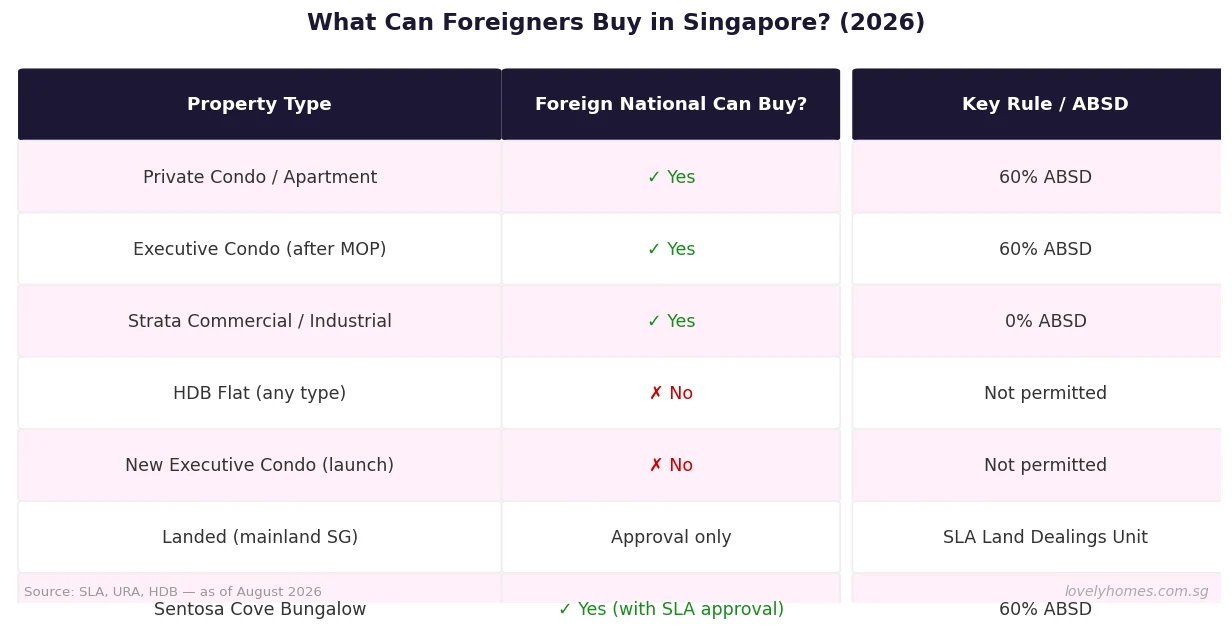
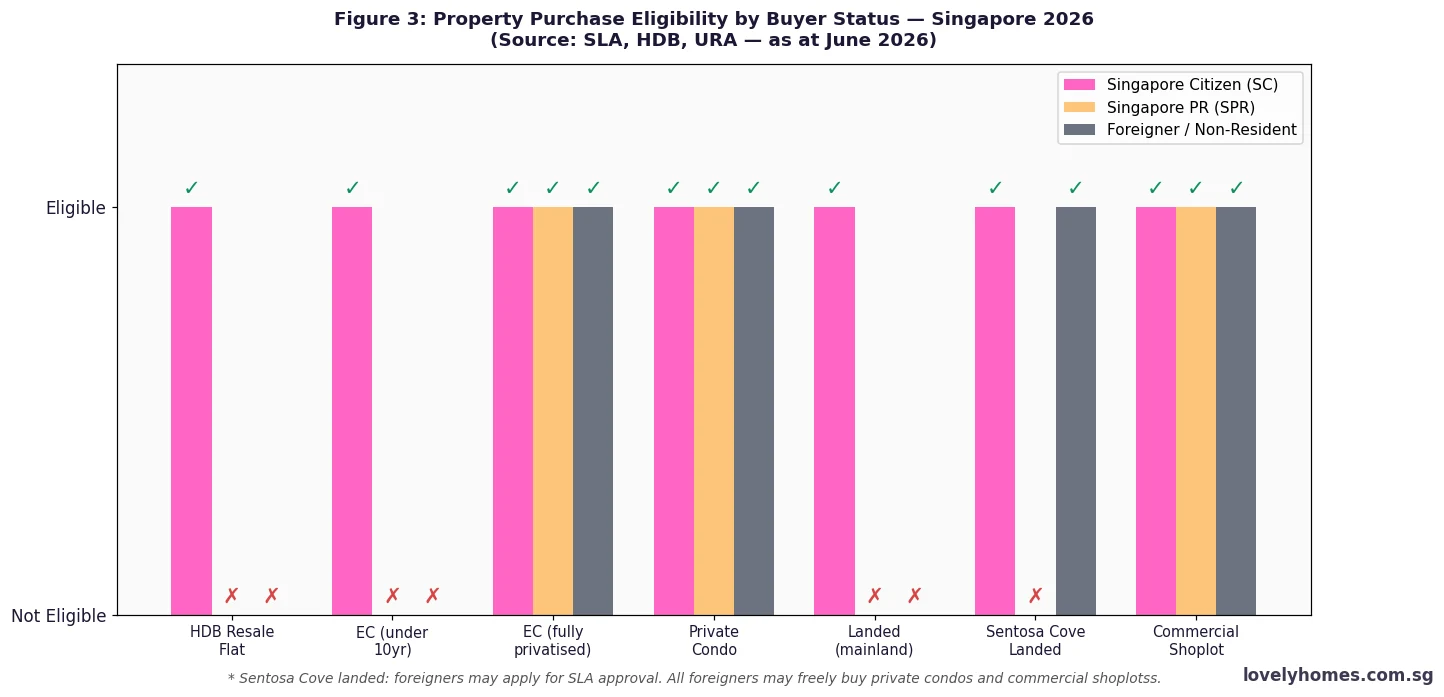
The Residential Property Act 1976 (RPA), administered by the Singapore Land Authority (SLA), is the single most important law for any foreign buyer. It distinguishes between “non-restricted residential property” (which foreigners may buy freely) and “restricted residential property” (which they generally may not). The matrix below sets out where each common Singapore property type sits.

Foreign buyer guide Singapore 2026 eligibility matrix — what foreigners can and cannot own
Figure 1: Residential Property Act eligibility for foreign buyers (April 2026).

To translate the matrix into practical advice:

  • Condominiums — the dominant foreign-buyer asset class in Singapore. Any apartment in a condominium that has been gazetted as “non-restricted residential property” is open to foreign buyers without SLA approval. Almost every modern private condominium qualifies.
  • Apartments in non-condo flat buildings — legal for foreigners only where the building is at least 6 storeys and has been classified as a condominium development by URA. Older walk-up apartments and converted houses often do not qualify.
  • Executive Condominiums (ECs) — a hybrid public-private housing form. Under the EC scheme (the first 10 years from TOP) ECs are off-limits to foreigners entirely. Once an EC is fully privatised (10 years post-TOP), it trades as a private condominium and foreign buyers are welcome.
  • HDB flats — both BTO and resale. Foreigners cannot buy HDB flats under any circumstance. A foreigner married to a Singapore Citizen may live in an HDB flat owned by the SC spouse, but cannot be on title.
  • Landed property on the mainland — bungalows, semi-detacheds, terraces, town-houses, and cluster landed are all “restricted property”. A foreigner needs SLA approval, granted rarely and only on substantial economic-contribution grounds. Most applications are refused.
  • Sentosa Cove — the one landed exception. Under a long-standing concession, a foreigner may own one detached, semi-detached or terrace dwelling at Sentosa Cove for owner-occupation. Investment letting and holiday-rental use are not permitted; SLA can act on covenant breaches.
  • Commercial and industrial property — shophouse upper floors zoned commercial, B1/B2 industrial, retail and office strata units are not “residential” and therefore not within the RPA. Foreigners may buy freely. ABSD does not apply, although GST and other taxes do.

Free Trade Agreement (FTA) nationals — the citizenship “shortcut”

Singapore’s FTA framework with five countries treats those nationals (and in some cases their permanent residents) as Singapore Citizens for ABSD purposes:

  • Citizens of the United States of America;
  • Citizens and PRs of Iceland, Liechtenstein, Norway and Switzerland.

An eligible US citizen buying their first Singapore residential property therefore pays 0% ABSD, not 60%. This is a documentary entitlement — you must declare it on the e-stamping portal and produce the supporting passport/identification at stamping. The FTA exemption does not remove the Residential Property Act restrictions on landed property: an American buyer still cannot purchase a mainland bungalow without SLA approval.

The 60% ABSD — the single biggest cost

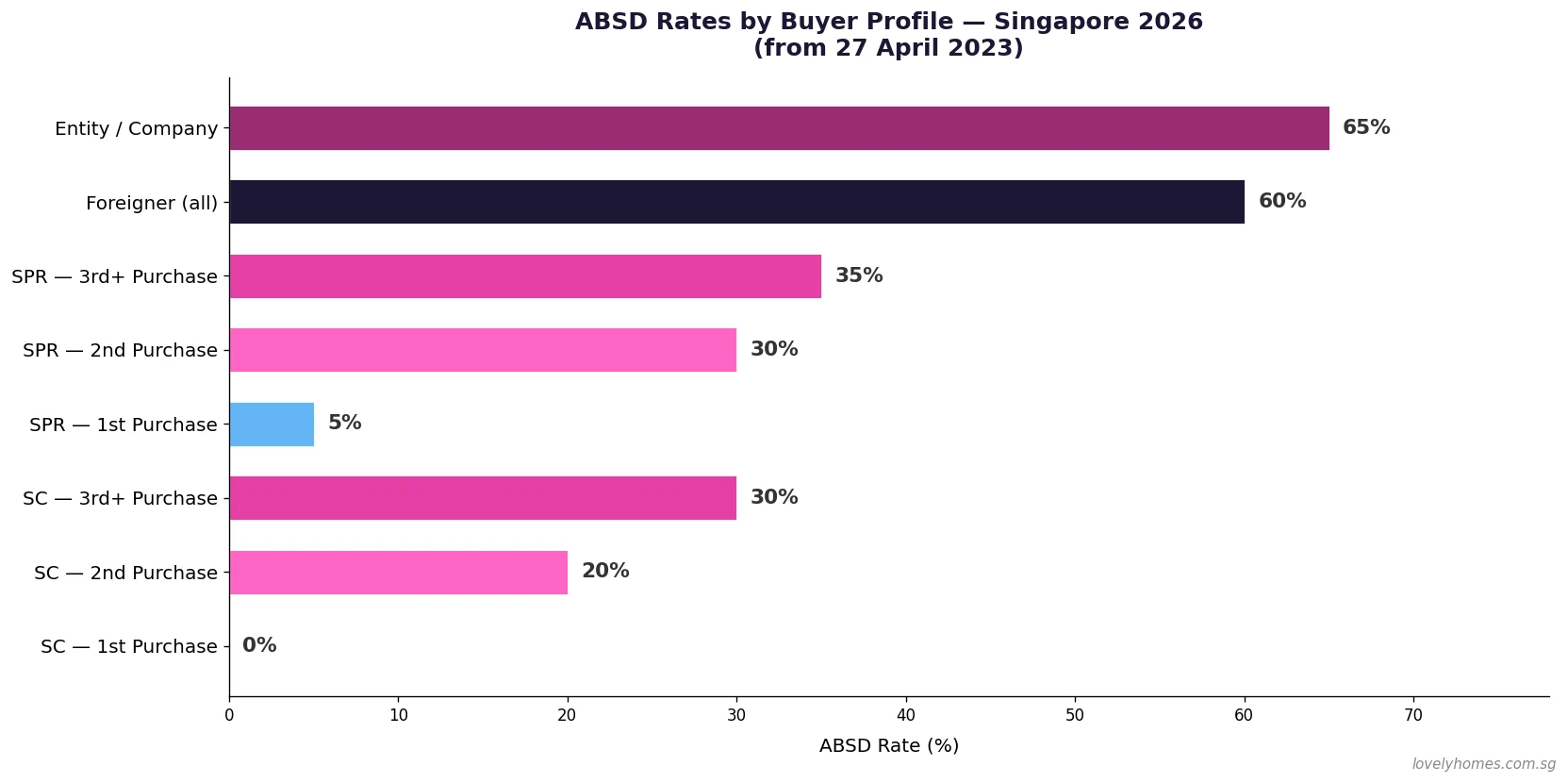
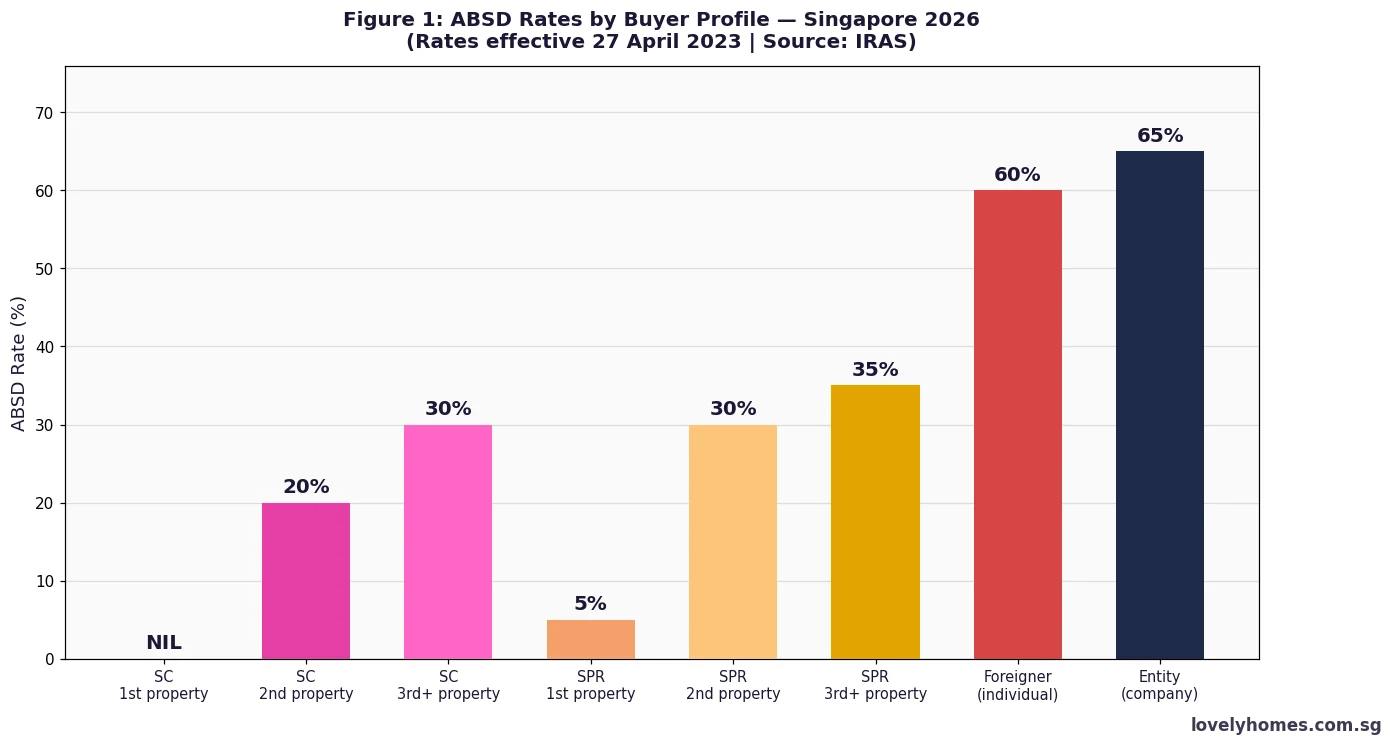
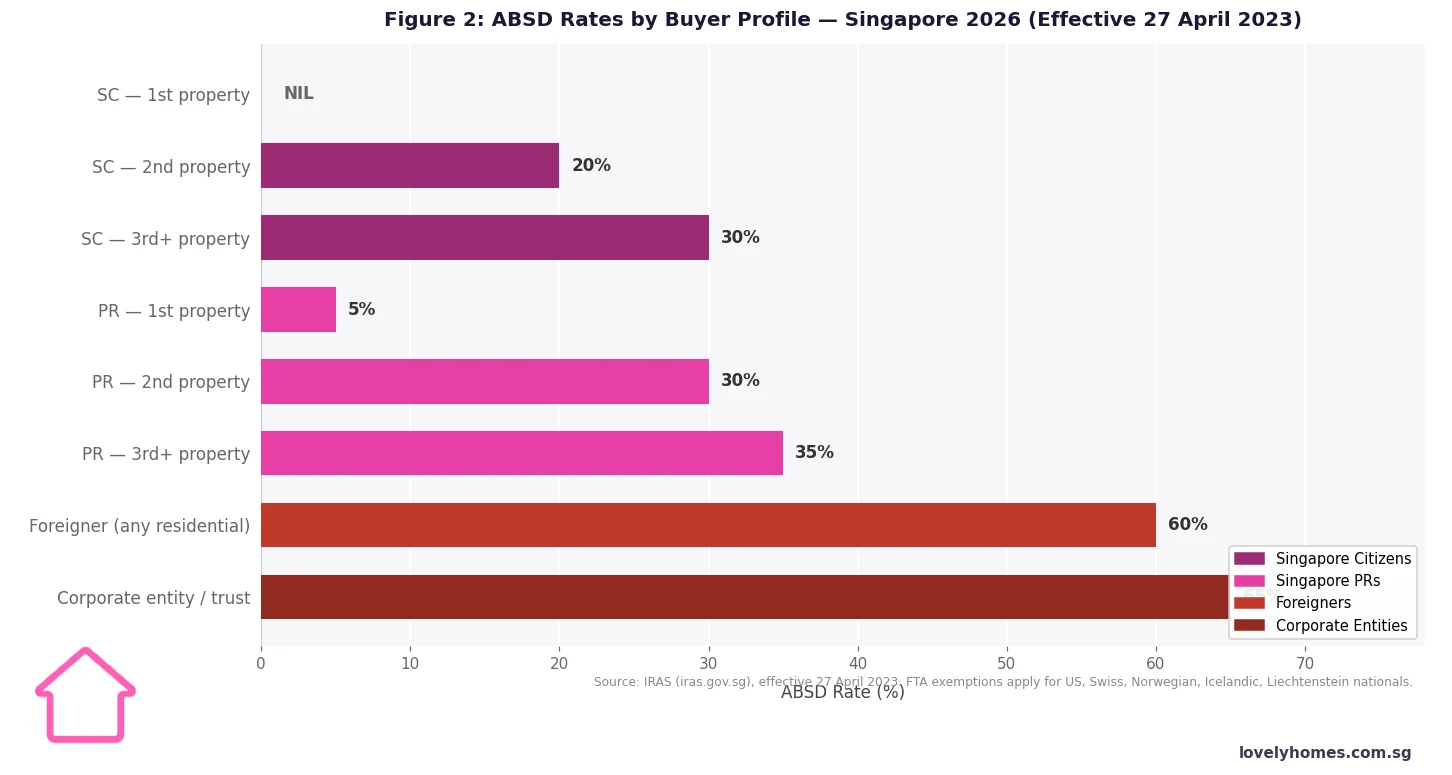
The Additional Buyer’s Stamp Duty (ABSD) is a flat-rate transaction tax on residential property purchases. For a foreign buyer in 2026, it is 60% of the purchase price or market value, whichever is higher. There is no “first property” discount — the rate applies whether it is the buyer’s first or twentieth Singapore property.

Foreign buyer guide Singapore 2026 — ABSD by buyer profile, foreigner 60% rate
Figure 2: ABSD on residential property by buyer profile, applicable to OTPs granted on or after 27 April 2023.

For full mechanics on ABSD — remissions, calculation rules, payment deadlines — see our complete ABSD Singapore guide. Two foreign-buyer-specific points are worth highlighting here.

Mixed-nationality matrimonial home remission

An SC married to a foreigner who buys a single matrimonial home jointly may apply for ABSD remission, paying ABSD at SC rates instead of foreigner rates. The conditions are strict:

  • The couple must be legally married before the OTP is granted.
  • The property must be held jointly as their only residential property between the two of them.
  • Application must be made within 14 days of the document attracting duty (usually the OTP).
  • If either spouse already owns another residential property, that property must be sold within six months.

The remission is one of the most powerful planning tools available to mixed-nationality couples. It can change a S$2 million purchase from S$1.2 million ABSD to zero, but the conditions must be observed precisely — an OTP signed in one party’s sole name disqualifies the remission, even if the title is later joint.

Decoupling and structuring

“Decoupling” — restructuring an existing co-owned property into a single-owner property so the freed spouse may buy a second residence at first-property rates — is a separate, intricate strategy primarily relevant to Singapore Citizen and PR couples, not foreigners. Where one spouse is foreign, the freed-up purchase still attracts the 60% rate and decoupling rarely helps. See our decoupling guide for the full mechanics.

Buyer’s Stamp Duty — on top of ABSD

Every property buyer in Singapore pays Buyer’s Stamp Duty (BSD), a progressive duty that ranges from 1% to 6% on residential purchases:

Price band BSD rate (residential)
First S$180,000 1%
Next S$180,000 2%
Next S$640,000 3%
Next S$500,000 4%
Next S$1,500,000 5%
Above S$3,000,000 6%

BSD is calculated on the full purchase price; ABSD is then added on top. Both must be paid within 14 days of signing the OTP/Sale & Purchase Agreement. Late payment attracts penalties at IRAS’s stated rate. For a fuller worked example, see our Buyer’s Stamp Duty Singapore 2026 guide.

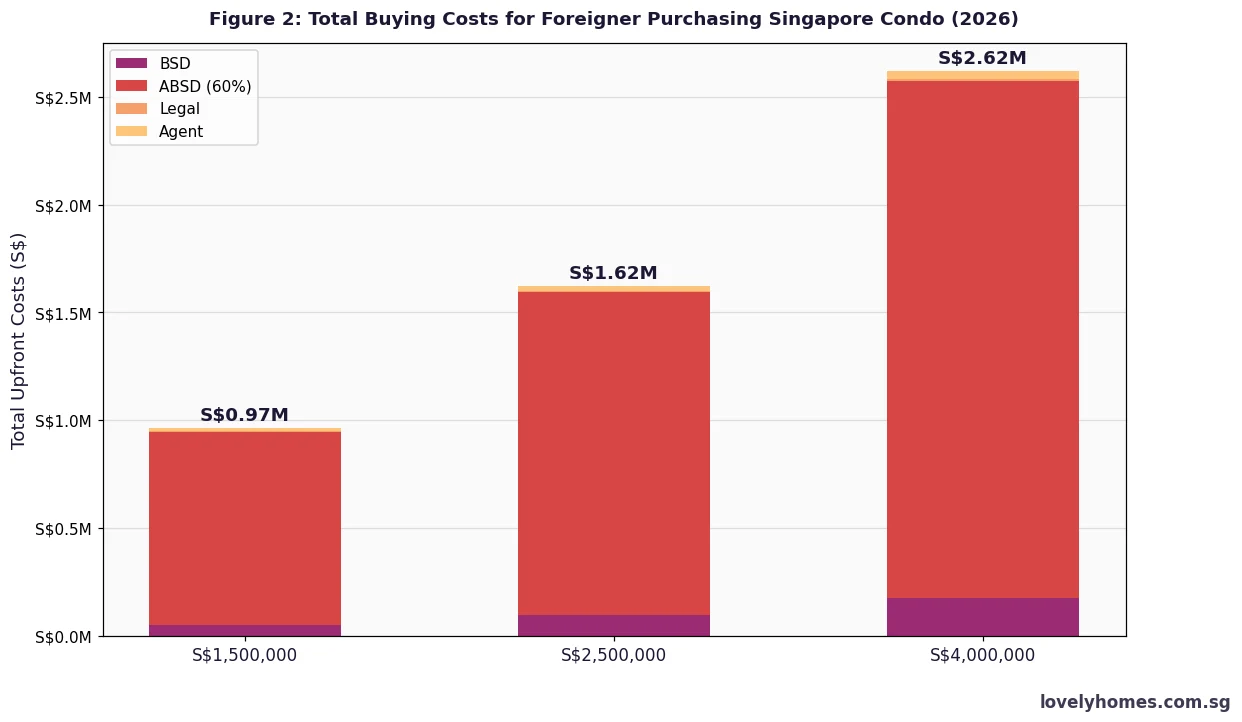
Worked example — S$2,500,000 freehold condo, foreign buyer

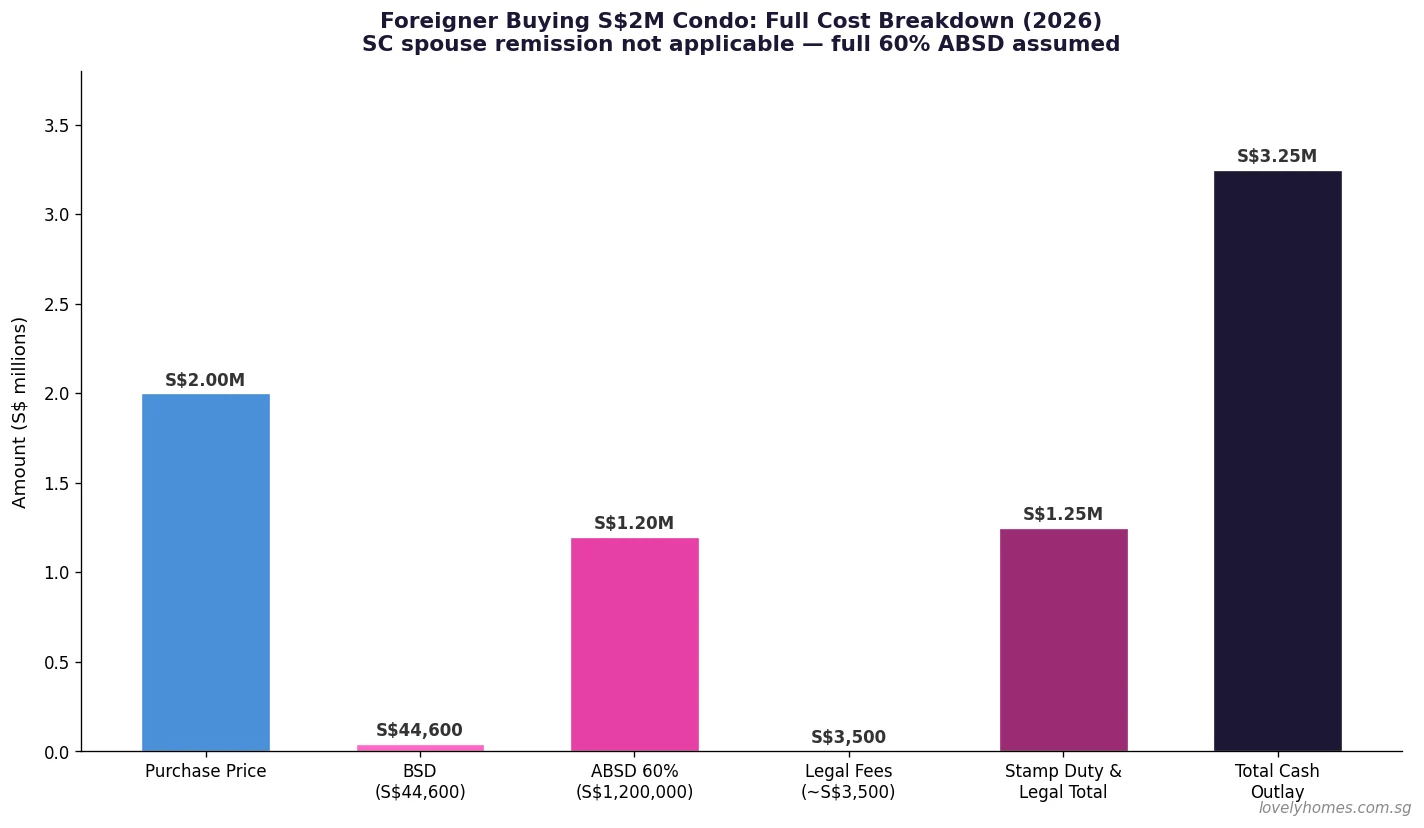
Take a freehold two-bedroom condominium in District 9 priced at S$2,500,000. The buyer is a foreign professional with no Singapore Citizen or FTA-eligible spouse. The full day-1 stack looks like this:

Foreign buyer guide Singapore 2026 — S$2.5M condo cost breakdown stack
Figure 3: Day-1 cash and CPF demand for a foreign buyer purchasing a S$2.5 million Singapore condominium.

The mathematics is brutal but unambiguous. On a S$2.5 million purchase, the foreign buyer faces:

  • Down payment at 50% LTV (foreigner cap): S$1,250,000;
  • BSD on S$2.5 million: S$89,600;
  • ABSD at 60%: S$1,500,000;
  • Conveyancing legal fees, valuation report, mortgagee fees: S$4,000–5,000;
  • Buyer-side commissions (where engaged): typically S$25,000.

Total day-1 cash and CPF (CPF being unavailable to foreigners, this is all cash): approximately S$2.87 million for a S$2.5 million unit. Singaporean buyers see roughly 35–38% upfront cost on a comparable purchase; foreign buyers see 115%. Plan accordingly.

Financing as a foreign buyer

Three financing realities sit on top of the stamp-duty position:

  1. Loan-to-Value (LTV) caps are tighter. Singaporean and PR borrowers can typically obtain up to 75% LTV on a first private property loan. Foreigner LTVs from local banks (DBS, OCBC, UOB) commonly cap at 50–55%, with some private-banking arrangements going higher subject to total relationship assets. Read our Singapore home loan guide 2026 for the LTV framework, MAS notice 632 caps and the broader picture.
  2. The TDSR still applies. The Total Debt Servicing Ratio caps total debt repayments at 55% of gross monthly income. Foreign buyers are stress-tested at the same 4% medium-term floor rate as residents, but lenders may apply income haircuts on overseas earnings (typically 30%). Our TDSR & MSR guide sets out the calculation in full.
  3. Loan tenures are typically shorter. Local banks frequently cap foreign-buyer tenures at 25 years (vs 30 for residents) and the loan must mature before age 65 in most cases. The combination of lower LTV and shorter tenure means the monthly instalment is materially higher than a comparable resident loan on the same unit.

We strongly recommend obtaining in-principle approval (IPA) from at least two banks before signing the OTP. The IPA is a written confirmation of the maximum loan you qualify for at current rates and is honoured for 30–60 days. Without an IPA, you may sign an OTP, fail bank approval, and forfeit the 1% option money.

Sentosa Cove — the one landed door open to foreigners

Sentosa Cove is a 117-hectare residential enclave on Sentosa Island, opened to foreign buyers in 2004 as a deliberate exception to the Residential Property Act. Around 2,000 detached, semi-detached and terrace homes plus a smaller number of condominiums sit on the cove, with private waterfront berths attached to many of the bungalows. The 99-year leases run from 2004 onwards, so most properties have 70–80 years of unexpired tenure as of 2026.

The conditions on foreign ownership at Sentosa Cove are restrictive:

  • One foreign person/family may own one Sentosa Cove dwelling (additional Cove condos are bought through the standard condo route);
  • The dwelling must be used for owner-occupation; renting out is not permitted under the RPA exemption;
  • Re-sale to another foreign buyer is permitted, subject to the same one-dwelling rule;
  • ABSD at 60% still applies on the purchase — the RPA exemption only relieves the foreign-ownership prohibition, not the duty.

Sentosa Cove prices in 2026 reflect the Cove’s small-supply / large-cheque-buyer dynamics: detached homes in the S$15–40 million range, semi-detached and terrace from around S$8 million. Most listings transact privately. Buyers should ensure their lawyer confirms the unit’s “non-restricted” status with SLA before signing the OTP.

Buying through a company or trust — usually a worse deal in 2026

Some foreign buyers ask whether a Singapore-incorporated company or family trust offers a better entry path. In 2026 the answer is generally no:

  • Entity ABSD is 65% on residential purchases — 5 percentage points higher than the foreigner-individual rate;
  • The 5-percentage-point “non-remittable” portion is paid even by licensed housing developers;
  • Beneficial ownership of residential property by a foreign-controlled entity is monitored by SLA;
  • Bank lending to a special-purpose vehicle is treated as foreigner financing for LTV purposes.

Entities continue to make sense for commercial and industrial portfolios, where ABSD does not apply. They make less sense for a single residential purchase in nearly every case. Always take Singapore tax and structuring advice before buying through any non-natural-person vehicle.

Summary table — foreign-buyer rule snapshot 2026

Item Position for a foreign individual buyer
Condo / approved apartment Allowed; no SLA approval
HDB flat Not allowed
EC under the EC scheme (first 10 years) Not allowed
EC after privatisation Allowed; treated as private condo
Mainland landed SLA approval required — rare
Sentosa Cove landed One dwelling, owner-occupation only
ABSD rate 60% on every residential purchase
BSD rate 1–6% progressive
CPF use Not available
Typical bank LTV cap 50–55%
FTA-national exception US, IS, LI, NO, CH treated as SC for ABSD
Matrimonial home remission Available where SC spouse is on title

Why this matters — how Singapore compares

A 60% buyer-side stamp duty is one of the highest punitive rates on foreign property buying anywhere in the world. For comparison: Hong Kong’s Buyer’s Stamp Duty (BSD) for non-permanent residents is currently 7.5%; Australia’s federal foreign-purchaser surcharge plus state foreign-investor stamp duties run to 7–15% combined; the United Kingdom’s non-resident SDLT surcharge tops out at 17% on residential property; Canada has imposed a two-year moratorium on most foreign residential purchases altogether. None of those regimes approach Singapore’s 60% ABSD plus 6% BSD.

The policy intent is explicit: the Government uses ABSD as a deliberate brake on foreign capital in private residential property, prioritising owner-occupier affordability for Singaporeans. Industry figures show that foreign-buyer share of private home transactions has fallen from roughly 7% in 2020 to under 2% since the 27 April 2023 increase — the market has adjusted, and the floor has held. For the broader cooling-measures context see our cooling-measures timeline.

What might come next

The 60% rate has been in force since April 2023 with no public signal of relaxation. Two scenarios are conceivable in 2026–2028 but speculative:

  1. Targeted relaxation for high-end inventory. If unsold high-end CCR stock continues to overhang the market, the Government could cut the foreigner rate selectively (for example through an enhanced FTA list or a top-tier-residency property programme). Industry submissions during the 2025–2026 budget cycle have raised this. There is no policy commitment.
  2. Tighter screening of trust and corporate structures. Conversely, if hidden beneficial-ownership cases attract attention (the recent S$3 billion money-laundering case is widely cited), the Government could tighten reporting on non-natural-person buyers and family-trust transfers.

For active updates as policy moves see our Laws, Regulations & Policies and Property News sections.

Frequently Asked Questions

As an Employment Pass holder, am I a “foreigner” for property purposes?

Yes. Pass status is not relevant; only Singapore Citizenship or PR moves you out of the foreign-buyer category. EP, S Pass, EntrePass, Tech.Pass, ONE Pass and Dependant’s Pass holders all pay 60% ABSD on residential purchases.

Can I buy a Singapore property remotely without coming on-shore?

Yes, although it is harder. The OTP and Sale & Purchase Agreement can be signed via Power of Attorney (POA) to a Singapore lawyer, but most banks will require a physical signing of the loan documents and original passport sighting at the branch. KYC requirements at the lawyer’s end have also tightened — expect to provide certified copies of passport, address proof, and source-of-funds documentation.

If I become a Singapore PR after I sign the OTP, can I claim a refund of the foreigner ABSD?

No. The buyer profile at the date the document attracts duty (usually the OTP date) is what determines ABSD. Becoming a PR or SC subsequently does not unlock a remission. If your PR application is in advanced stages, time the OTP carefully — in edge cases waiting six to twelve weeks can change the rate by 30–55 percentage points.

Can I buy a Sentosa Cove property as an investment to rent out?

No. The Residential Property Act exemption that opens Sentosa Cove to foreign owners is conditional on owner-occupation. Letting out a Sentosa Cove dwelling acquired under the foreign-buyer concession breaches the covenant and SLA can act, including unwinding the transaction.

What is the difference between a “non-restricted” and “restricted” residential property?

“Non-restricted” residential property is condominiums, approved apartments, and strata-landed in approved condominium developments. Foreigners may buy these without SLA approval. “Restricted” residential property is mainland landed (detached, semi-detached, terrace, town-house, cluster), as well as some HDB flats and apartments in non-condo flat buildings. Foreigners need SLA approval, granted rarely. The Sentosa Cove concession is the main exception.

Will I be liable for Singapore property tax and rental income tax?

Yes. Property tax is owed by the owner regardless of citizenship and runs at owner-occupier or non-owner-occupier rates depending on use. Rental income from a Singapore property is Singapore-source income and is taxable in Singapore at non-resident rates (currently 24% on net rental income for non-residents, after deductible expenses). See our Singapore property tax guide for the full rate ladder.

If I sell within three years, do I pay Seller’s Stamp Duty?

Yes, on the same basis as Singaporean sellers. SSD is 12% / 8% / 4% on the holding-period bands in years 1, 2, and 3, dropping to 0% from year 4. See our Seller’s Stamp Duty Singapore 2026 guide for worked examples and remission rules.

Related reading on LovelyHomes

Disclaimer: This guide is for general information only and does not constitute legal, tax, or financial advice. Eligibility under the Residential Property Act, ABSD remissions and bank-lending caps are fact-specific and change over time. Always verify the current position with the Singapore Land Authority, the IRAS Stamp Duty page, the Monetary Authority of Singapore and a licensed Singapore conveyancing lawyer before signing any OTP or Sale & Purchase Agreement.

Foreigner Buying Property in Singapore: ABSD 60%, Restrictions & Sentosa Cove (2026)

Foreigner Buying Property in Singapore: ABSD 60%, Restrictions & Sentosa Cove (2026)

Quick answer
Foreigners in Singapore can buy private condos (subject to ABSD 60% on any residential purchase). They cannot buy HDB flats or new BTO / EC. Landed property on the mainland requires approval from the Land Dealings Approval Unit (LDAU); Sentosa Cove landed is open to foreigners with SLA approval. Five nationalities enjoy citizen-equivalent stamp-duty treatment via Free Trade Agreements: US, Switzerland, Liechtenstein, Iceland, Norway.

Singapore has always segmented residential property access by buyer profile. Since April 2023, the rules on foreign buyers have been the tightest they’ve ever been: 60% ABSD on any residential purchase — a near-doubling from the 30% pre-cooling-measure level.

This guide sets out what foreigners can and cannot buy in 2026, the full stamp-duty stack, landed approval process, and the FTA carve-out that makes five nationalities much better off. If you’re close to PR, read our PR property purchase rules for the 3-year HDB wait path.

Foreigner property matrix — HDB, BTO, condo, landed, Sentosa Cove, plus ABSD tiers
What a foreigner can and cannot buy in Singapore, with 2026 ABSD stack.

What a foreigner can (and cannot) buy

Property type Foreigner? Notes
Private condominium (non-landed) Yes Freehold or leasehold. ABSD 60%.
Executive Condominium (new, within 10-yr MOP+privatisation) No Only SG citizens/PRs can buy new ECs. Foreigners may buy after 10-year privatisation.
HDB resale flat No Not a foreign-ownership property.
HDB BTO / Plus / Prime No SG citizens only, with spouse requirements.
Landed — mainland Singapore With approval Must apply to the Land Dealings Approval Unit (LDAU) under the Residential Property Act. Rare, case by case.
Landed — Sentosa Cove Yes with SLA approval The only legal route for foreign ownership of landed in Singapore. Normally granted for owner-occupation.
Commercial / industrial property Yes Outside the Residential Property Act. No ABSD but different duty/GST treatment.

ABSD 2026 — the full stack

Buyer profile 1st residential 2nd residential 3rd+ residential
SG Citizen 0% 20% 30%
SG PR 5% 30% 35%
Foreigner 60% 60% 60%
Entity (company, trust) 65% 65% 65%

ABSD sits on top of the standard Buyer’s Stamp Duty (up to 6% at the top band in 2026). For the BSD calculation see our BSD guide.

The FTA citizen-equivalent carve-out

Under Free Trade Agreements, nationals of the following countries are treated as SG citizens for BSD/ABSD on residential property:

  • United States of America
  • Switzerland
  • Liechtenstein
  • Iceland
  • Norway

An American citizen on their first SG residential purchase pays 0% ABSD — the same as a Singapore citizen. IRAS requires a written claim at stamping with supporting documents.

Landed property rules

Under the Residential Property Act, landed property is restricted to citizens by default. Foreigners (and sometimes PRs) need approval from the Land Dealings Approval Unit (LDAU) within the Singapore Land Authority. LDAU approval is case by case, weighs economic contribution, and is rarely granted for pure investment purposes.

Sentosa Cove is the exception: LDAU has historically approved foreign applications fairly readily, for owner-occupation, on the 99-year landed stock.

Loans, LTV and CPF

Bank loans

Foreigners can borrow from local and foreign banks subject to the standard TDSR framework (55% of gross income). Maximum LTV is 75% for the first loan, 45% for the second, 35% for the third, unchanged from the resident framework.

CPF

Not applicable — CPF accounts require PR or citizen status. Foreigners fund the 25% down-payment entirely in cash.

Rental income and exit

Rental income is taxable in Singapore under the non-resident flat 24% rate (or progressive if resident). Capital gains on resale are not taxed. Seller’s Stamp Duty applies if the property is sold within three years — see our SSD guide.

Frequently asked questions

Can a foreigner buy a shoebox unit?

Yes — any private non-landed, subject to ABSD 60%. Our shoebox guide explains the trade-offs.

Can a foreigner inherit landed property?

Yes — but the inheritor must obtain LDAU approval to continue holding it. Without approval, they must dispose within a stipulated window.

What if I’m a dual national?

The strictest relevant nationality generally governs. If one passport gives citizen-equivalent treatment (FTA list), IRAS will honour it with documentation.

Can I use a company to avoid the 60% foreigner ABSD?

No — entities attract 65% ABSD (higher than foreigner). IRAS will look through beneficial ownership, and mis-structuring is treated as evasion.


This guide is for general information only and is accurate as of April 2026. Singapore property rules, taxes and cooling measures change frequently — always verify current figures with URA, IRAS, HDB or a licensed professional before committing. LovelyHomes is not a financial, legal or tax advisor.


Translate »