Orchard Road & Somerset Neighbourhood Guide Singapore 2026: Property Prices, MRT and Investment Outlook

Orchard Road & Somerset Neighbourhood Guide Singapore 2026: Property Prices, MRT and Investment Outlook

×Click anywhere or press Esc to close

Orchard Road and Somerset form the heart of Singapore’s Core Central Region (CCR). District 9 is synonymous with premium shopping malls, five-star hotels, top private schools, and a deeply liquid residential market populated by both wealthy locals and high-net-worth expatriates. Whether you are buying your first private home, upgrading from the HDB heartlands, or managing an investment portfolio, District 9 represents a distinct value proposition: scarcity, prestige, and sustained long-term capital appreciation.

This guide covers District 9 property prices in 2026, the MRT network serving Orchard and Somerset, top schools, lifestyle amenities, rental yields, a detailed investor analysis, and a worked example for upgraders. All data reflects Q1 2026 URA Realis statistics and publicly available industry information.

Quick Answer — Orchard Road & Somerset at a Glance

  • Location: District 9, Core Central Region (CCR). Bounded by Scotts Road (north), River Valley Road (south), Clemenceau Avenue (west), Dhoby Ghaut (east).
  • Property type mix: ~55% leasehold condos, ~45% freehold condos; no significant HDB supply in Orchard proper (limited HDB estates in Somerset fringes).
  • Typical condo prices: 1BR S$1.1–1.8M; 2BR S$1.8–3.0M; 3BR S$2.6–4.5M; 4BR+ S$4.2–7.0M (Q1 2026).
  • Average non-landed PSF: S$2,500–S$3,500 (freehold premium: +15–25% vs 99-yr equivalents).
  • MRT: NSL Orchard (NS22), NSL/TEL Orchard (TE14 — twin interchange), NSL Somerset (NS23), DTL Stevens (DT10), CCL Botanic Gardens (CC19).
  • Rental market: Vacancy <3% CCR-wide; strong expat demand from finance, tech, and diplomatic community; gross yields 2.7–3.5%.
  • 5-year capital growth: +14–18% for condos; freehold units show stronger upside, especially post-en-bloc premium.
  • ABSD note: Foreign buyers pay 60% ABSD on any residential property here — Singapore Citizen upgraders face 20% on a second property.

Where Exactly Is Orchard Road / Somerset — District 9 Defined

District 9 in Singapore’s URA postal district system covers the Orchard Road corridor and its immediate surrounds: Orchard, Somerset, River Valley, and the Cairnhill / Scotts Road residential enclave. It sits squarely in the CCR — the market segment that includes the most expensive residential land in Singapore.

The district is bounded to the north by Scotts Road and Dunearn Road, to the south by River Valley Road, to the west by Holland Road near its junction with Clemenceau Avenue, and to the east by the Dhoby Ghaut / Bras Basah interchange. Key residential precincts include Cairnhill (freehold conservation houses and condos), Scotts Road (ultra-luxury residential), Leonie Hill / Anthony Road (mid-to-upper-tier condos), Somerset / Oxley Road (denser condo belt), and River Valley (hybrid commercial-residential strip with shophouse clusters).

For the adjacent River Valley and Robertson Quay precinct, see our dedicated River Valley & Robertson Quay Neighbourhood Guide 2026. For the District 10 corridor (Holland Village, Tanglin, Buona Vista), see our Buona Vista & Holland Village Guide.

Property Prices in District 9 — Orchard & Somerset 2026

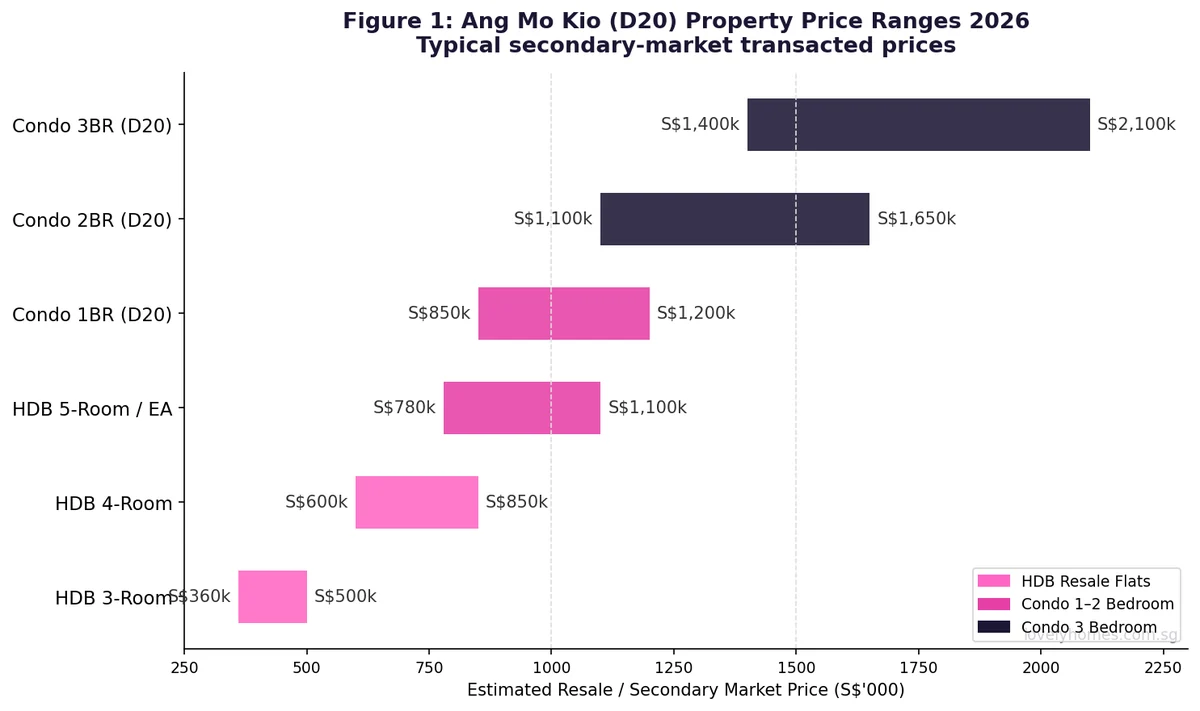
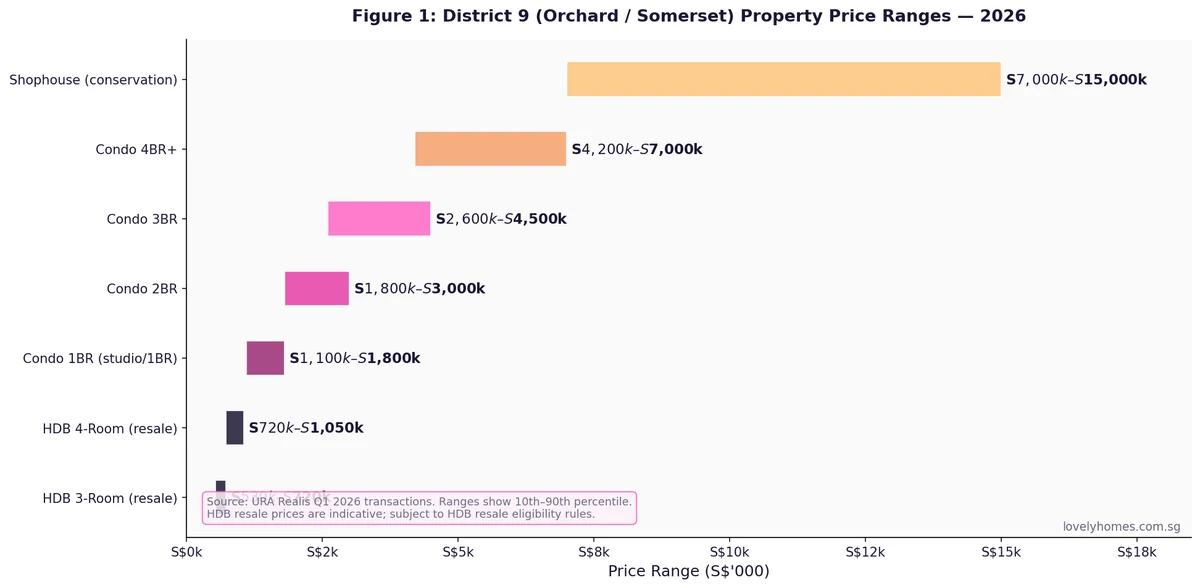
District 9 Orchard Somerset property price ranges 2026 — HDB resale condo shophouse
Figure 1: District 9 property price ranges by type — Q1 2026. Source: URA Realis. Ranges reflect 10th–90th percentile of transacted prices.

The typical price entry points in Orchard / Somerset are among the highest in Singapore outside of Sentosa Cove. A 1-bedroom or studio unit — favoured by investors and young expatriate professionals — transacts between S$1.1 million and S$1.8 million. At the upper end, a 4-bedroom-plus condo in a quality freehold development on Scotts Road or Cairnhill Circle commands S$4.2 million to S$7 million.

Conservation shophouses in the precinct (primarily along Orchard Road’s side streets and the Emerald Hill enclave) represent a distinct asset class: 2,200–4,500 sq ft of strata area, no ABSD for commercial and mixed-use strata titles, and scarcity driven by heritage conservation rules. Prices range from S$7 million to S$15 million or more for larger units on premium lots.

Price per square foot (PSF) benchmarks (Q1 2026):

Development / Type Tenure Approx PSF (Q1 2026) Notes
Cairnhill / Scotts Rd luxury Freehold S$3,200–S$4,500 Boulevard 88, Gramercy Park
Orchard / Somerset mid-upper Freehold S$2,600–S$3,500 Skyline @ Orchard, 8 Hullet
River Valley mid-tier condos 99-yr S$2,200–S$2,800 Martin Modern, The Avenir
HDB resale (Somerset fringes) 99-yr S$700–S$950 Limited supply; very few D09 HDB flats
Conservation shophouse Freehold/999-yr S$3,000–S$5,000+ Emerald Hill, Orchard surrounds

MRT Connectivity — Why D09 Is a Multi-Line Hub

District 9 is one of the best-served MRT districts in Singapore, sitting at the convergence of four lines. This multi-line access underpins the area’s sustained rental demand from expatriates who typically require CBD proximity and do not own cars.

The North-South Line (NSL) serves Orchard (NS22) and Somerset (NS23). Orchard is a major interchange and the line’s most commercially prominent station, with connections to the grade-level Orchard Road shopping belt. From Orchard, Raffles Place is 5 minutes; Marina Bay is 8 minutes.

The Thomson-East Coast Line (TEL) opened its Stage 2 in August 2021, delivering a new Orchard station (TE14) directly adjacent to the NSL Orchard station. The TEL gives direct access south to Great World (TE15), Havelock (TE16), Maxwell (TE18), and Shenton Way (TE19/DTL CE1) — cutting commute times to the Marina Bay financial corridor. Northwards, the TEL connects to Stevens (TE11), Caldecott (TE9), and eventually Woodlands North (TE2).

The Downtown Line (DTL) station at Stevens (DT10) is a short cab or walk from the northern fringe of D09 (Scotts Road/Dunearn Road). This line serves Bugis, Promenade, Bayfront, and the western corridor through Buona Vista and Clementi.

The Circle Line (CCL) station at Botanic Gardens (CC19) serves the western edge of the district, providing access to one-north (CC23), Harbourfront (CC29/NE1), and the eastern CCL loop.

Schools, Healthcare, and Lifestyle

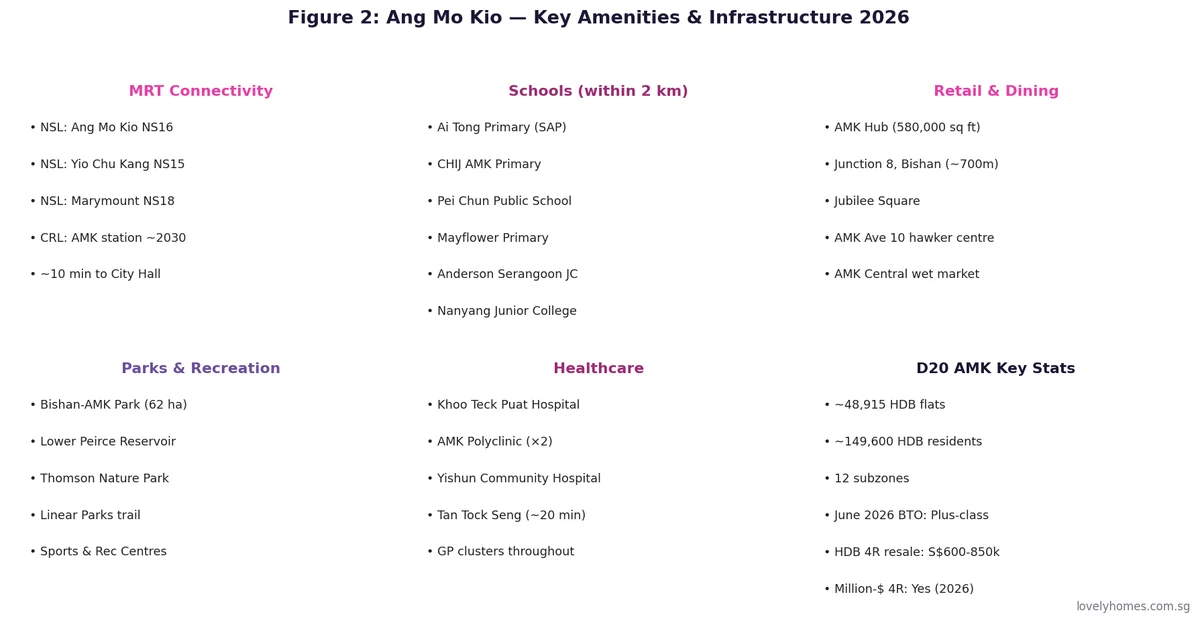
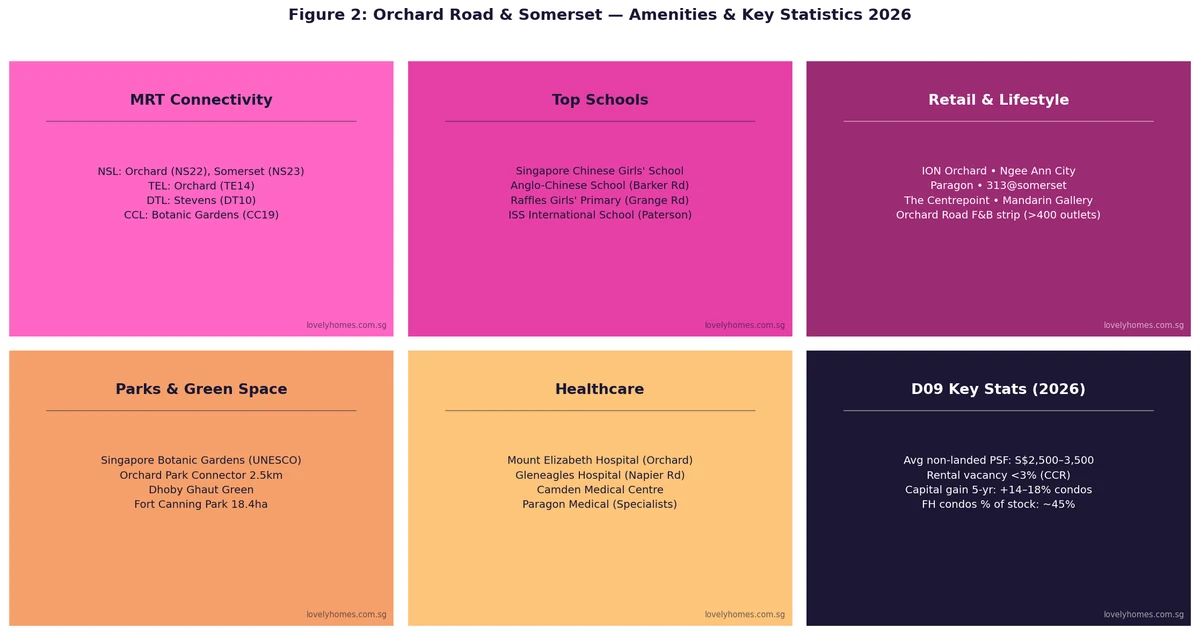
Orchard Road Somerset amenities grid 2026 — MRT schools retail parks healthcare statistics
Figure 2: Orchard Road & Somerset — amenities and key statistics, 2026.

Top primary schools within 1–2km: Raffles Girls’ Primary School (Grange Road, 0.9km from Orchard MRT) is perennially over-subscribed and has a significant influence on residential demand within its 1km balloting radius. Singapore Chinese Girls’ School (Springleaf Avenue, primary campus) and Anglo-Chinese School (Barker Road, primary) are also within the broader D09/D11 catchment.

International schools: ISS International School (Paterson Road) sits directly within the district, drawing enrolments from the large expatriate community in the Orchard and River Valley condos. GESS International School (Bukit Timah Road, nearby) and EtonHouse International School (Mountbatten Road) are within reasonable distance.

Healthcare: Mount Elizabeth Hospital on Orchard Road is one of Singapore’s premier private hospitals, specialising in oncology, cardiology, and complex surgical procedures. Gleneagles Hospital (Napier Road, ~1.2km) is another major private facility. Camden Medical Centre is a specialist-only medical building on Orchard Road itself. For emergency and specialist care, Singapore General Hospital (Outram) is accessible via the TEL in under 10 minutes.

Retail and F&B: The Orchard Road corridor hosts ION Orchard (Capitaland’s flagship mixed-use development), Ngee Ann City, Paragon, Mandarin Gallery, 313@Somerset, The Centrepoint, Knightsbridge, and Forum The Shopping Mall — more than 2.5 million sq ft of retail within 1.5km. The area’s F&B scene ranges from hawker centres at Killiney Road and Takashimaya Food Hall to Michelin-starred restaurants at Mandarin Oriental and Shangri-La Hotel.

Green space: The Singapore Botanic Gardens (UNESCO World Heritage Site, 82ha) is accessible via CCL Botanic Gardens, providing a world-class green lung immediately to the west of the district. Fort Canning Park (18.4ha) sits at the eastern edge of D09, offering a historic hilltop park connecting to Dhoby Ghaut and Clarke Quay. The Orchard Park Connector (2.5km) links the precinct to MacRitchie.

Rental Market and Investment Case

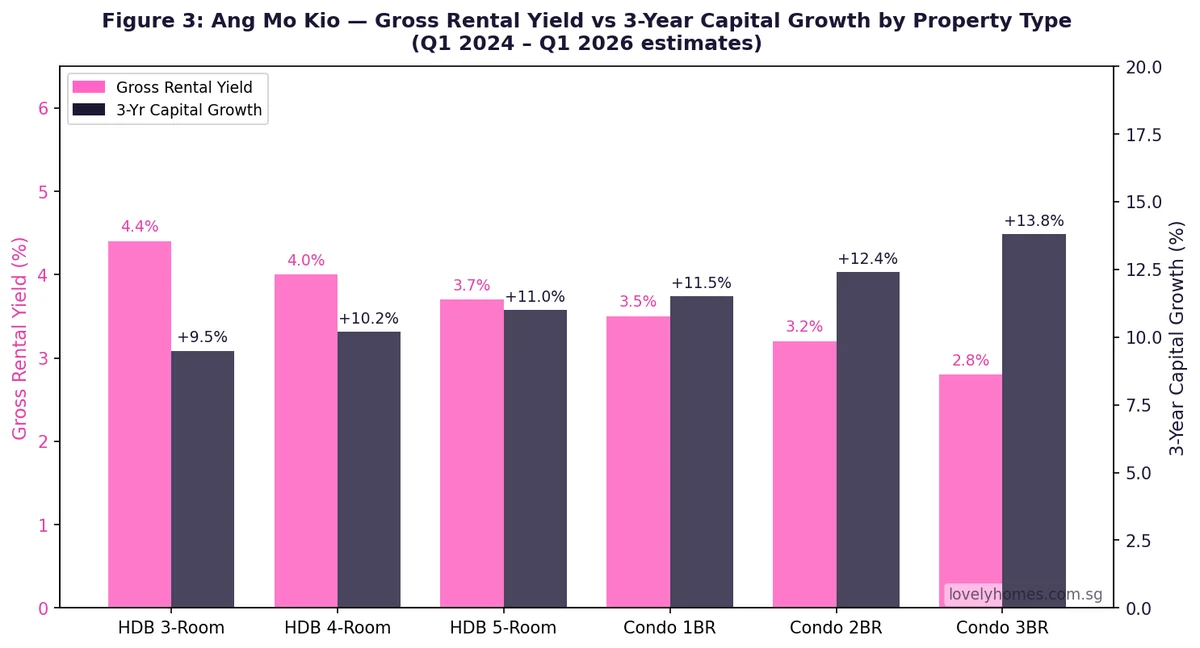
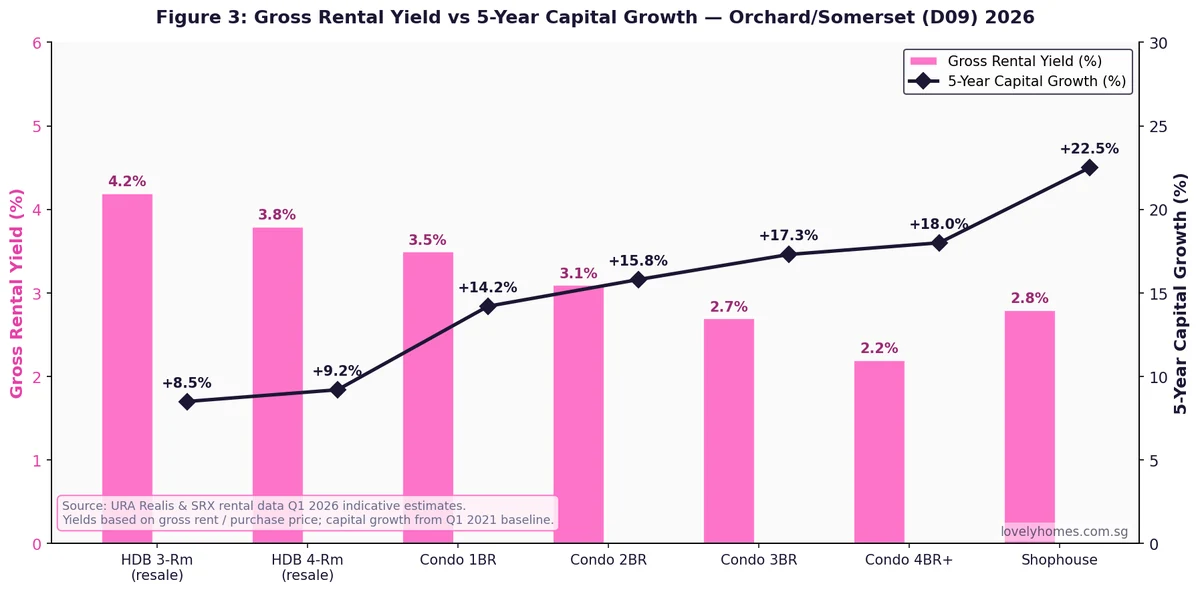
Orchard Somerset District 9 gross rental yield vs 5-year capital growth 2026
Figure 3: Gross rental yield vs 5-year capital growth by property type — District 9 (Orchard/Somerset), 2026.

The Orchard / Somerset rental market is driven primarily by expatriate demand from Singapore’s finance, technology, and international trading sectors, supplemented by diplomatic and media professionals. Vacancy rates across the CCR have held below 3% since 2022, reflecting tightened expat supply (fewer new completions in D09 in the 2023–2025 cycle) and sustained rental growth.

Gross rental yields in D09 typically run 2.2–3.5% depending on unit type, reflecting the high absolute purchase prices. The 1-bedroom segment commands the highest gross yield (approximately 3.5%) because monthly rentals for 1BR units are relatively strong (S$3,500–S$6,500/month) relative to purchase prices. The 4-bedroom-plus segment yields less on a gross basis (approximately 2.2%) but benefits most from capital appreciation — freehold trophy assets in D09 showed 18–22% 5-year price growth.

The long-term investment thesis for D09 rests on land supply constraints. There are no new GLS residential sites in the Orchard Road core; all new supply must come from en-bloc redevelopment of ageing freehold buildings. Historically, en-bloc activity in D09 has been lumpy and infrequent, which means supply shocks are rare. The CCR Private Property Index has risen approximately 40% since Q1 2019 — a compounded annual growth rate of around 5.5%.

Worked Example: SC Upgrader Buying a 2BR Freehold Condo in D09

Mr & Mrs Teo are Singapore Citizens. They have sold their Tampines 5-room HDB flat (received CPF accrued interest refund, net cash proceeds S$380,000). Joint income S$17,000/month. They want to buy a 2-bedroom freehold condo on River Valley Road at S$2,200,000. They now hold zero residential properties after the HDB sale.

  • Purchase price: S$2,200,000 (freehold, District 9)
  • BSD: S$74,600
  • ABSD: S$0 (SC first private property after HDB sale)
  • Total stamp duty: S$74,600
  • Loan (75% LTV, bank): S$1,650,000 @ 3.0% p.a., 25-year tenure
  • Monthly instalment: approximately S$7,832/month
  • TDSR check: S$7,832 / S$17,000 = 46.1% — within the 55% TDSR ceiling ✓
  • 5% mandatory cash (on bank loan): S$110,000
  • CPF OA drawdown (down payment balance): up to Valuation Limit (S$2,200,000 × 100% = S$2,200,000 — no restriction for private property first purchase by buyers under 55)
  • Estimated total cash required at exercise of OTP: BSD S$74,600 + 1% OTP deposit S$22,000 + 5% cash component S$110,000 = approximately S$206,600 plus legal fees (~S$3,500–5,000).
  • Monthly running costs: Mortgage S$7,832 + maintenance fees (est. S$500–S$800/month) + property tax (annual value ~S$36,000 → non-owner-occupied tax ~S$1,080/yr if rented; owner-occupied ~S$260/yr)

At a 3.1% gross rental yield on S$2.2M, the property could generate approximately S$5,683/month gross rent if rented out — covering approximately 73% of the mortgage outlay. After deducting management fees, maintenance, and vacancy allowance, the net cash shortfall for a buy-to-let investor would be approximately S$2,500–S$3,000/month on this particular scenario. Most D09 buyers are therefore hybrid occupier-investors who intend to live in the property for several years before potentially renting it out.

Is Orchard Road / Somerset a Good Buy in 2026?

For Singapore Citizens and PRs buying their primary residence, D09 offers a compelling value proposition if you value proximity to Orchard Road amenities, top schools in the 1km radius, and multi-line MRT access. The scarcity of new supply in the immediate Orchard precinct means existing freehold buildings tend to hold and grow value well over a 5–10 year horizon.

For pure investors managing yield expectations, the mathematics are tighter than in the OCR. A D09 condo at S$2.5M will typically yield 2.8–3.2% gross — meaningfully lower than a comparable Tampines or Bedok condo at 3.8–4.2%. The case for D09 as an investment property is therefore primarily a capital appreciation story, not a yield story.

For foreign nationals considering a purchase here, the 60% ABSD makes D09 residential property a prohibitively expensive investment at current prices — unless the property will serve as a long-term primary residence in Singapore. On a S$3M property, the total upfront cost including BSD and ABSD exceeds S$2.1M in stamp duty alone. See our ABSD Complete Guide 2026 for how FTA nationals (US citizens, Swiss nationals) can mitigate this.

What Might Change in Orchard & Somerset — The Forward View

The following is analytical speculation, not official policy.

The URA’s long-term masterplan has consistently designated Orchard Road as Singapore’s premier lifestyle and shopping corridor. In the 2023 URA Concept Plan, there is mention of injecting more mixed-use and residential components into the Orchard belt — particularly along the Somerset-Dhoby Ghaut stretch — to enliven the area and support permanent resident activity. If implemented, this could bring some new residential supply to the district over the 2030–2040 horizon, but the planning quantum is unlikely to materially alter the current supply dynamics.

The TEL full opening (Stage 4 and beyond) will continue to enhance D09’s connectivity, particularly southwards to the Greater Southern Waterfront precincts. Any rebalancing of demand from the Sentosa / Harbourfront precinct back to the Orchard corridor would be a positive for D09 capital values.

Frequently Asked Questions

Is Orchard Road a good place to buy property in 2026?

For Singapore Citizens and PRs, yes — particularly if you are buying for long-term capital appreciation and benefit from the lifestyle amenities (top-tier retail, world-class healthcare, park access) and premium school catchments (Raffles Girls’ Primary 1km zone). For pure yield investors or foreign buyers facing 60% ABSD, the numbers are significantly harder. D09 suits owner-occupier-investors with a 7–10 year or longer investment horizon.

Which MRT lines serve Orchard Road and Somerset?

Four MRT lines serve D09. The North-South Line (NSL) serves Orchard (NS22) and Somerset (NS23). The Thomson-East Coast Line (TEL) provides a second Orchard interchange station (TE14), giving direct access south to the CBD and Shenton Way. Stevens (DT10) on the Downtown Line serves the Scotts/Dunearn Road fringe of the district. Botanic Gardens (CC19) on the Circle Line is at the western edge. This multi-line coverage gives D09 residents arguably the best public transport access of any residential district outside the CBD itself.

Can foreigners buy property in Orchard Road?

Yes — foreigners can purchase private condominiums and apartments in Singapore, including in District 9. However, the ABSD at 60% applies regardless of which property it is or whether it is the buyer’s first or fifth. Foreigners cannot purchase HDB flats. Citizens of the US, Switzerland, Iceland, Liechtenstein, and Norway receive SC-equivalent ABSD treatment under their respective Free Trade Agreements. Landed property in Singapore is generally restricted to Singapore Citizens; foreigners require LDAU approval to purchase landed residential property.

What are the best condominiums in Orchard / Somerset?

Benchmark developments in D09 include: Boulevard 88 (Freehold, Cuscaden Road — ultra-luxury, S$4,000–5,500 psf), Gramercy Park (Freehold, Grange Road — S$3,200–4,000 psf), The Avenir (Freehold, River Valley Road — S$2,800–3,200 psf, 376 units), 8 Hullet (Freehold, Hullet Road, boutique), Skyline @ Orchard Boulevard (Freehold, S$2,800–3,400 psf), and Martin Modern (99-yr, Martin Place — S$2,200–2,600 psf, GuocoLand, sold-out at launch). The “best” condo depends on your priority: yield, capital growth, prestige, or lifestyle fit.

How does District 9 compare to District 10 (Holland / Tanglin) as an investment?

Both districts sit in the CCR and share many characteristics (premium prices, expat rental demand, freehold stock, strong school catchments). D09 (Orchard) typically commands a PSF premium of S$200–400 over D10 (Holland Village / Tanglin) at comparable quality, reflecting its higher street-presence value, superior MRT connectivity, and denser retail-F&B ecosystem. D10 tends to offer larger unit sizes for the same budget and has traditionally attracted family-oriented buyers (larger condos, proximity to the Botanic Gardens, established landed belt). For investors focused on yield vs price, D10 is slightly more favourable; for pure capital appreciation, the two are closely matched historically.

Is there new HDB supply in Orchard Road or Somerset?

No. There is no planned HDB BTO supply in the Orchard Road or Somerset core. The very limited HDB stock that exists in the D09 area (primarily older estates on the margins, e.g. near Cairnhill) was built decades ago and rarely comes on the resale market. The Somerset-Dhoby Ghaut belt is fully committed to private residential and commercial development. HDB upgraders moving into D09 are typically accessing the private resale condominium market, not HDB flats.

Related Articles


Disclaimer: This guide is for general informational purposes only and does not constitute financial, legal, or tax advice. Property prices, yields, and market conditions change. Always verify the latest figures with URA Realis and HDB Resale Portal. Consult a licensed financial adviser and conveyancing lawyer before any property transaction. Stamp duty figures are indicative — verify with IRAS before transacting.

Buona Vista & Holland Village Neighbourhood Guide Singapore 2026: Property Prices, MRT and Investment Outlook

Buona Vista & Holland Village Neighbourhood Guide Singapore 2026: Property Prices, MRT and Investment Outlook

Quick Answer: Buona Vista & Holland Village in 60 Seconds

  • Districts: Holland Village sits in District 10 (D10, Core Central Region); Buona Vista / one-north spans Districts 5 and 10 (RCR/CCR border).
  • MRT: Holland Village (CC21, Circle Line); Buona Vista (EW21/CC22, EWL + CCL interchange); one-north (CC23, CCL) — three CCL stations within the precinct.
  • Private condo prices (2026): D5/RCR condos S$1,600k–S$2,500k (2BR); D10/CCR freehold condos S$2,800–S$5,500+ psf.
  • Investment thesis: CCR freehold scarcity premium; one-north employment cluster (50,000+ R&D workers); NUS proximity; strong expat rental demand from biomedical and tech sectors.
  • Key development: Holland Plain GLS site on the CCL corridor will add ~280 new homes, tightening an already supply-constrained sub-market.
  • Schools: Henry Park Primary (highly sought after), Fairfield Methodist Primary and Secondary, New Town Primary within 1–2 km.
  • Foreigner ABSD: 60% on any residential property purchase. Singapore Citizens pay ABSD only from their second property (20%).
  • Rental yield: 2.3%–4.1% gross depending on property type; vacancy rate below 4% for D10 CCR units.

What Makes Buona Vista & Holland Village Special?

Buona Vista and Holland Village occupy a rare and privileged pocket of Singapore’s property map. Stretching from the leafy residential lanes of Holland Road through the buzz of Holland Village to the research campuses of one-north and the National University of Singapore, this corridor blends old-Singapore charm, world-class connectivity, and future-proof employment density in a way that very few districts can match.

Holland Village itself — a cluster of cafés, boutiques and restaurants along Lorong Liput and Lorong Mambong — has been a magnet for expatriates, young professionals and affluent local families since the 1980s. The area is administered by the Urban Redevelopment Authority (URA) under the Buona Vista planning area in the Master Plan 2019 and remains zoned primarily for residential and mixed use. There is virtually no new supply on the horizon west of Holland Road, which keeps prices structurally elevated.

Buona Vista, centred on the EWL/CCL interchange at Buona Vista MRT (EW21/CC22), is a different beast: denser, tech-forward, and anchored by the one-north business park — a 200-hectare R&D hub developed by JTC Corporation that houses Biopolis, Fusionopolis, Mediapolis, and JTC LaunchPad, home to over 50,000 biomedical, ICT and media workers. The NUS Kent Ridge and Queenstown campuses add a perennial student and faculty rental pool that keeps vacancy exceptionally low.

Property Prices in 2026: D10 and D5 at a Glance

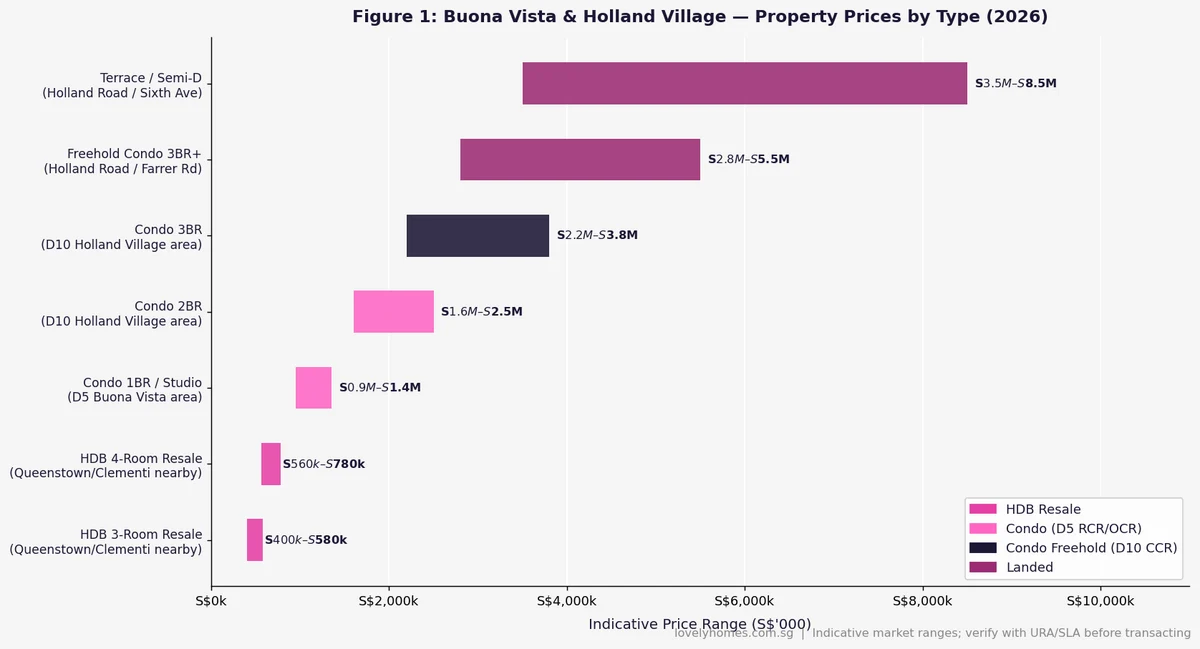
Prices across the Holland Village–Buona Vista corridor are among the highest outside the Orchard/River Valley core. The table below summarises indicative 2026 transaction ranges, and Figure 1 visualises the full spectrum by property type.

Buona Vista Holland Village property prices by type 2026 — D10 and D5 price ranges chart
Figure 1: Buona Vista & Holland Village — Property Prices by Type (2026). Source: URA Realis, SRX, industry data. Indicative ranges; verify with URA/SLA before transacting.
Property Type Typical Price Range PSF (Indicative) Gross Yield Tenure
HDB 3-Room Resale (Queenstown/Clementi) S$400k–S$580k S$520–S$680 psf 4.1% 99-yr leasehold
Condo 1BR / Studio (D5 Buona Vista) S$950k–S$1,350k S$1,800–S$2,200 psf 3.6% 99-yr / freehold mix
Condo 2BR (D10 Holland Village area) S$1,600k–S$2,500k S$2,400–S$3,200 psf 3.0% Freehold dominant
Condo 3BR (D10 Holland Village area) S$2,200k–S$3,800k S$2,600–S$3,600 psf 2.6% Freehold dominant
Freehold Condo 3BR+ (Holland Rd / Farrer Rd) S$2,800k–S$5,500k S$2,900–S$3,800 psf 2.3% Freehold
Terrace / Semi-Detached (Holland Rd / Sixth Ave) S$3,500k–S$8,500k S$1,200–S$2,400 psf 1.8% Freehold dominant

MRT Connectivity: Three CCL Stations and the EWL/CCL Interchange

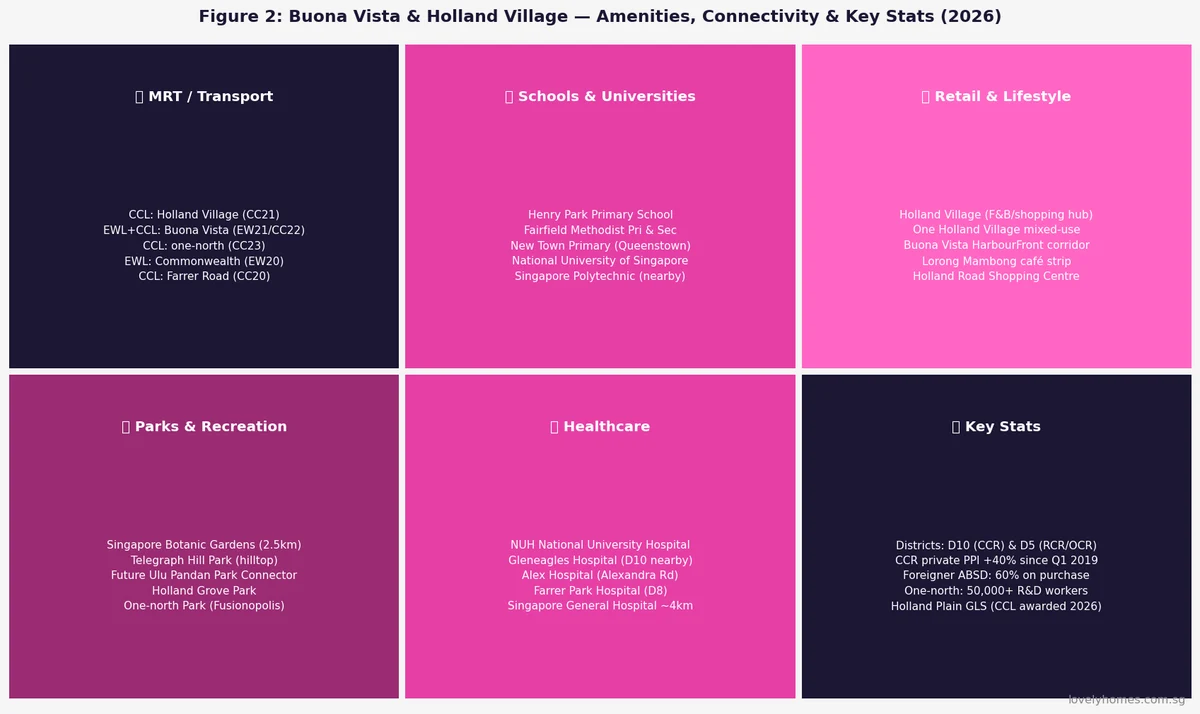
The Holland Village–Buona Vista corridor is served by three Circle Line (CCL) stations and the key East–West Line (EWL) interchange — a level of public transport density that rivals the Orchard Road corridor. Holland Village MRT (CC21) delivers residents to Bishan in 18 minutes, Dhoby Ghaut in 15 minutes, and Harbourfront in 12 minutes on the CCL. Buona Vista MRT (EW21/CC22) is the critical interchange: the CCL connects east to Marina Bay and west to Harbourfront, while the EWL whisks commuters to the CBD in 12 minutes and to Changi Airport in 35 minutes. one-north MRT (CC23) gives immediate access to the Fusionopolis and Biopolis employment cluster without walking more than 300 metres. Figure 2 provides a full amenities overview.

Buona Vista Holland Village amenities connectivity key statistics 2026 — MRT schools retail parks healthcare
Figure 2: Buona Vista & Holland Village — Amenities, Connectivity & Key Statistics (2026). Source: LTA, Ministry of Education, URA.

Schools and Education: Henry Park Primary, Fairfield Methodist and NUS

The precinct’s schools are a primary driver of HDB upgrader and family-condo demand. Henry Park Primary School, located on Holland Avenue, is one of Singapore’s most sought-after schools under the Ministry of Education (MOE) Primary 1 registration exercise. Fairfield Methodist Primary and Secondary sit within 1 km of Holland Village MRT, making them a natural Phase 2B priority for families living in the immediate precinct. New Town Primary in Queenstown is another popular option for families on the Buona Vista side. The National University of Singapore’s Kent Ridge campus — one of Asia’s top research universities — generates a constant base of academic, research and graduate tenant demand that keeps rental vacancy well below the national average.

The Holland Plain GLS and Supply Dynamics

One of the most consequential developments in the Holland Village property market in 2025–2026 has been the award of the Holland Plain Government Land Sale (GLS) site. The site, located on the CCL corridor adjacent to the Holland Village MRT station, will deliver an estimated 280 new residential units in a mixed-use configuration that is expected to complement the existing One Holland Village Residences development. Under URA’s planning parameters for the Holland Planning Area, no additional large-scale GLS sites are envisaged in the near term, meaning that the Holland Plain site is likely the last significant new-build opportunity in the sub-market for many years. This structural supply scarcity is one reason why D10 freehold condos in this precinct have outperformed the broader CCR Private Property Price Index (PPI) since the last cooling-measure cycle.

Rental Market: Expatriate and R&D Worker Demand

Holland Village and Buona Vista benefit from two distinct but complementary tenant pools. The first is the traditional expatriate community — multinational corporation (MNC) employees, foreign academics and regional executives — who have made Holland Village a perennial favourite for its café culture, international schools proximity and CCL access to the CBD. The second, newer pool comprises biomedical and technology workers based at one-north (Biopolis, Fusionopolis, Mediapolis, JTC LaunchPad), many of whom prefer to live within a five-minute CCL or cycling commute of their workplace. Together, these two pools keep vacancy below 4% for D10 CCR units and sustain gross yields of 2.3%–3.6% even at current elevated price levels. The Singapore Tourism Board (STB) and Economic Development Board (EDB) have both confirmed that one-north’s tenant and employee base will continue to grow as Singapore expands its biomedical manufacturing capacity under the Research, Innovation and Enterprise (RIE) 2030 plan.

Gross Yield vs Capital Growth: The Investment Case

Buona Vista Holland Village gross rental yield vs 5-year capital growth by property type 2026
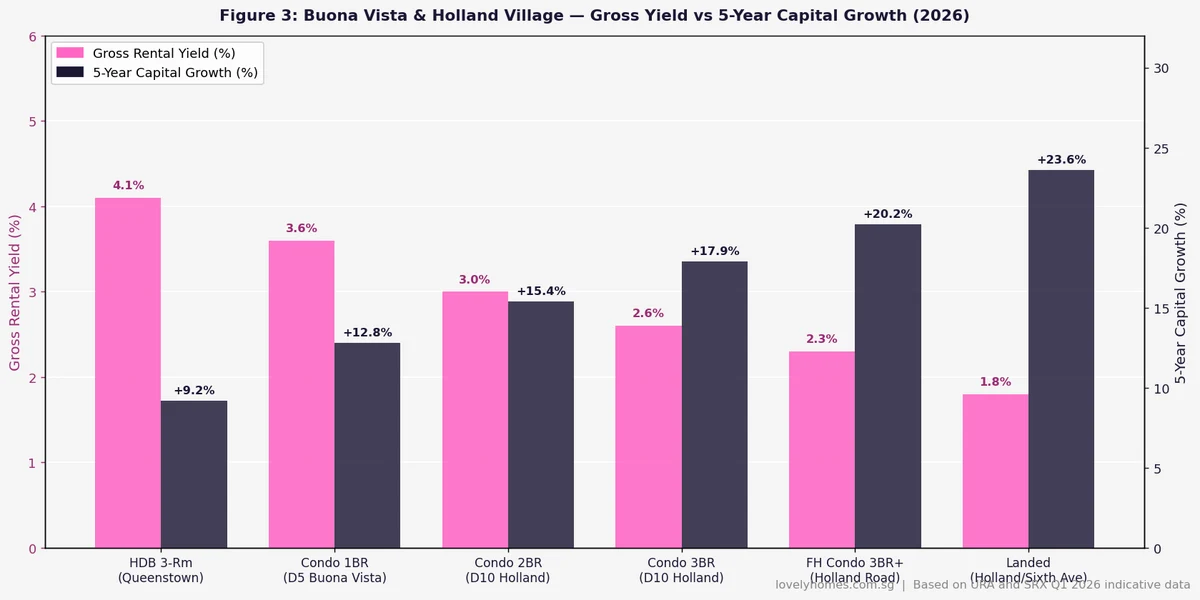
Figure 3: Buona Vista & Holland Village — Gross Yield vs 5-Year Capital Growth by Property Type (2026). Source: URA Realis, SRX Q1 2026 indicative data. Past performance is not a guarantee of future returns.

As Figure 3 illustrates, the corridor follows the classic inverse relationship between yield and capital growth: lower-priced HDB units in the Queenstown precinct offer the best rental yield (4.1%) but the lowest capital appreciation over five years (+9.2%); freehold landed properties on Holland Road deliver the weakest yield (1.8%) but the strongest capital growth (+23.6%) owing to the scarcity of freehold landed stock in this part of the island. Investors seeking a balance typically target D10 CCR condos in the 2BR–3BR range, which historically offer 5-year capital appreciation of 15%–18% while maintaining gross yields above 2.5% — sufficient to service a mortgage at a debt-servicing ratio below 55% under the Monetary Authority of Singapore’s (MAS) Total Debt Servicing Ratio (TDSR) framework.

Worked Example: SC Couple Upgrading to D10 Holland Village Condo

Mr and Mrs Chong are Singapore Citizens, both aged 38. Their joint monthly gross income is S$17,500. They currently own a Queenstown 4-room HDB flat which they plan to sell before completing a purchase of a 2-bedroom freehold condominium in Holland Road at S$2,400,000. This is their first private property purchase.

Stamp duty: Buyer’s Stamp Duty (BSD) at IRAS rates: 1% on first S$180k (S$1,800) + 2% on next S$180k (S$3,600) + 3% on next S$640k (S$19,200) + 4% on next S$500k (S$20,000) + 5% on remainder S$900k (S$45,000) = BSD S$89,600. Additional Buyer’s Stamp Duty (ABSD): nil — SC couple, first private property. Total stamp duty: S$89,600.

Financing: Maximum LTV for bank loan on private property with one outstanding HDB loan: 75% (HDB sold first, so no concurrent loan). Max bank loan: S$1,800,000. Assume S$1,800,000 at 3.0% p.a. over 25 years = S$8,537/month. TDSR = S$8,537 / S$17,500 = 48.8%. PASS (below MAS 55% cap).

CPF usage: From CPF Ordinary Accounts: up to Withdrawal Limit (120% of Valuation Limit, i.e. S$2,880,000) — however, net OA balance must cover 5% downpayment on top of the cash 5% for bank loans: minimum 20% OA contribution (S$480,000 combined).

Upfront cash outlay: 5% cash (S$120,000) + BSD (S$89,600) + legal fees (~S$3,500) = approximately S$213,100 cash. HDB sale proceeds and CPF savings fund the OA portion and remaining downpayment.

Timeline: OTP signed, 14-day window to pay BSD; SPA exchange within 8 weeks; completion estimated 10–12 weeks after SPA (resale). HDB flat must be sold before collecting keys to private property to enjoy ABSD remission as upgrader (Inland Revenue Authority of Singapore provides a 3-year window from date of private property purchase).

What This Means for You

Holland Village and Buona Vista occupy a structural sweet spot that is difficult to replicate elsewhere in Singapore. The combination of freehold land tenure (a significant scarcity across Asia’s most expensive city-states), CCL and EWL dual-line access, a world-class employment cluster at one-north, Singapore’s top-ranked university on the doorstep, and a lifestyle precinct that has anchored the expatriate community for decades means that both sub-markets have historically held value better than the broader CCR average during property downturns while outperforming in upswings.

For Singaporean buyers, the key constraint is affordability: D10 CCR entry prices start at around S$1.6M for a 2BR condo, requiring a household income of at least S$14,000–S$16,000/month at current interest rates to stay within the TDSR. For Permanent Residents (PRs), the 5% ABSD on a first purchase is manageable relative to the long-term capital appreciation trajectory. For foreigners, the 60% ABSD makes direct residential ownership economically challenging unless the buyer plans to hold for 10 or more years — though many continue to do so given Singapore’s rule-of-law and currency stability advantages.

What Might Come Next

Several forward-looking factors could influence the Buona Vista and Holland Village markets between 2026 and 2030. First, the completion of the Holland Plain GLS development (estimated 2028–2029) will introduce approximately 280 new CCL-adjacent units into a market that has seen little new supply in a decade — this could create a short-term moderation in resale asking prices while the new project is marketed and absorbed. Second, the RIE 2030 plan’s continued investment in one-north, combined with JTC’s expansion of LaunchPad and Mediapolis, is expected to add further employment density to the Buona Vista sub-market, which structurally supports both rental and capital values. Third, any policy changes to Singapore’s ABSD regime — particularly foreign buyer rates — would disproportionately affect this corridor, given its high historical foreign-buyer participation. Buyers and investors should monitor URA policy announcements and the Singapore Budget (tabled in February each year) for any changes.

Frequently Asked Questions: Buona Vista & Holland Village

Is Holland Village a good place to buy property in Singapore?

Holland Village is widely regarded as one of Singapore’s most desirable residential sub-markets. The combination of freehold land tenure, Circle Line MRT (CC21) connectivity, proximity to the CBD (15 minutes), and a vibrant café-and-dining street precinct makes it attractive to both owner-occupiers and buy-to-let investors. The chief constraint is cost — D10 CCR condos typically start at S$1.6M for a 2-bedroom unit — but capital appreciation over the past decade has significantly outpaced inflation and Singapore Government Securities returns. Buyers who can afford the entry price and plan to hold for five-plus years have historically been well rewarded.

Which MRT stations serve Holland Village and Buona Vista?

The corridor is served by three Circle Line (CCL) stations: Holland Village MRT (CC21), Buona Vista MRT (EW21/CC22) — which is also an EWL interchange — and one-north MRT (CC23). Commonwealth MRT (EW20) on the EWL provides another option for the Queenstown fringe of the precinct. This multi-line coverage means that residents can reach Marina Bay in 20 minutes, Orchard Road in 12 minutes, and Changi Airport in approximately 35 minutes without a transfer.

Can Singapore Permanent Residents and foreigners buy property here?

Yes. Both Singapore PRs and foreigners can purchase private condominiums and apartments in the Holland Village and Buona Vista precinct (HDB flats are restricted to eligible Singapore Citizens and PRs, and only resale HDB flats — not BTO — may be purchased by PRs, subject to eligibility rules). Singapore PRs pay ABSD of 5% on their first residential property and 30% on subsequent properties. Foreigners pay ABSD of 60% on any residential property purchase, a rate introduced in April 2023 under the URA/MAS cooling measures framework and reaffirmed in the 2024 and 2025 Budgets. Good Class Bungalows (GCBs) in the prime districts are restricted to Singapore Citizens only under the Residential Property Act (RPA).

What are the best residential developments in Holland Village and Buona Vista?

In the Holland Village precinct, One Holland Village Residences (freehold, mixed-use, 296 residential units completed 2022, PSF S$2,800–S$3,400) is the newest landmark development. Leedon Green (99-year, 638 units, D10, PSF S$2,400–S$2,900) and Parvis (freehold, 248 units, Holland Hill) are also well-regarded. On the Buona Vista side, The Rochester (99-year, within one-north campus) and Vista (99-year, near Buona Vista MRT) serve the R&D worker demographic. Buyers should independently verify current availability and pricing with the developer or through the URA Realis caveats database before making any transaction decisions.

How does Holland Village compare to Orchard Road and Novena?

Holland Village, Orchard Road and Novena all fall within the Core Central Region (CCR), but they serve quite different buyer profiles. Orchard (D9) commands the highest absolute PSF (S$3,000–S$4,500+ for new condos) and attracts luxury buyers and ultra-high-net-worth investors. Novena (D11) is a medical and institutional hub with some of Singapore’s most prestigious addresses near the Tan Tock Seng Hospital cluster. Holland Village (D10) tends to attract lifestyle-oriented buyers — those who prioritise the precinct’s street culture, school proximity and CCL access over pure prestige. Capital appreciation profiles are broadly similar across all three CCR sub-markets over a 5–10 year horizon, but Holland Village has historically been less volatile than Orchard during property downturns due to its stable expatriate tenant base.

Is there HDB housing near Holland Village?

There are no HDB flats within the Holland Village precinct itself — the area is almost entirely private residential. However, the adjacent Queenstown Planning Area and Clementi New Town both have substantial HDB stock within 1–2 km of Buona Vista MRT (EW21/CC22). Resale HDB flat prices in Queenstown (D3/D5 fringe) typically range from S$400k–S$780k for 3–4-room flats. The HDB does not offer BTO launches in the immediate Holland Village area; any future public housing in this precinct would be subject to URA Master Plan revisions. Buyers seeking HDB proximity to Buona Vista should focus on the Queenstown, Clementi or Dover precincts rather than Holland Village itself.

Related Articles on LovelyHomes


Disclaimer: This article is produced by LovelyHomes for general informational purposes only and does not constitute financial, legal or property advice. All property prices, rental yields, capital growth figures and stamp duty calculations are indicative and based on publicly available URA, HDB and SRX data as at Q1 2026. Figures may have changed by the time you read this article. Before making any property transaction, readers should verify all information with the Urban Redevelopment Authority (ura.gov.sg), the Inland Revenue Authority of Singapore (iras.gov.sg), the CPF Board (cpf.gov.sg), and consult a licensed property professional, financial adviser and/or solicitor. Property investment carries risk, including the risk of capital loss. Past performance does not guarantee future results.

×

River Valley & Robertson Quay Neighbourhood Guide Singapore 2026: Property Prices, MRT and Investment Outlook

River Valley & Robertson Quay Neighbourhood Guide Singapore 2026: Property Prices, MRT and Investment Outlook

River Valley and Robertson Quay sit at the heart of Singapore’s most coveted residential precinct — District 9 (D09), Core Central Region (CCR). Sandwiched between the Singapore River to the south and the Orchard Road belt to the north, these two sub-precincts offer a rare combination: walkable waterfront lifestyle, genuine city-fringe connectivity (three MRT lines within 600 metres since the Thomson–East Coast Line opened in June 2023), internationally acclaimed schools, and a concentration of freehold and long-tenure leasehold condominiums that rarely appear in the Outside Central Region. This River Valley Robertson Quay neighbourhood guide Singapore 2026 covers property prices, MRT access, top schools, rental yields, capital growth trends, and everything a buyer or investor needs to know before committing to D09.

Quick Answer — River Valley & Robertson Quay at a Glance

  • District 9, CCR — one of Singapore’s three Core Central Region districts alongside D10 and D11.
  • New TEL stations (Great World TE15 and Havelock TE16) opened June 2023, fundamentally improving connectivity without new launches disrupting the area’s streetscape.
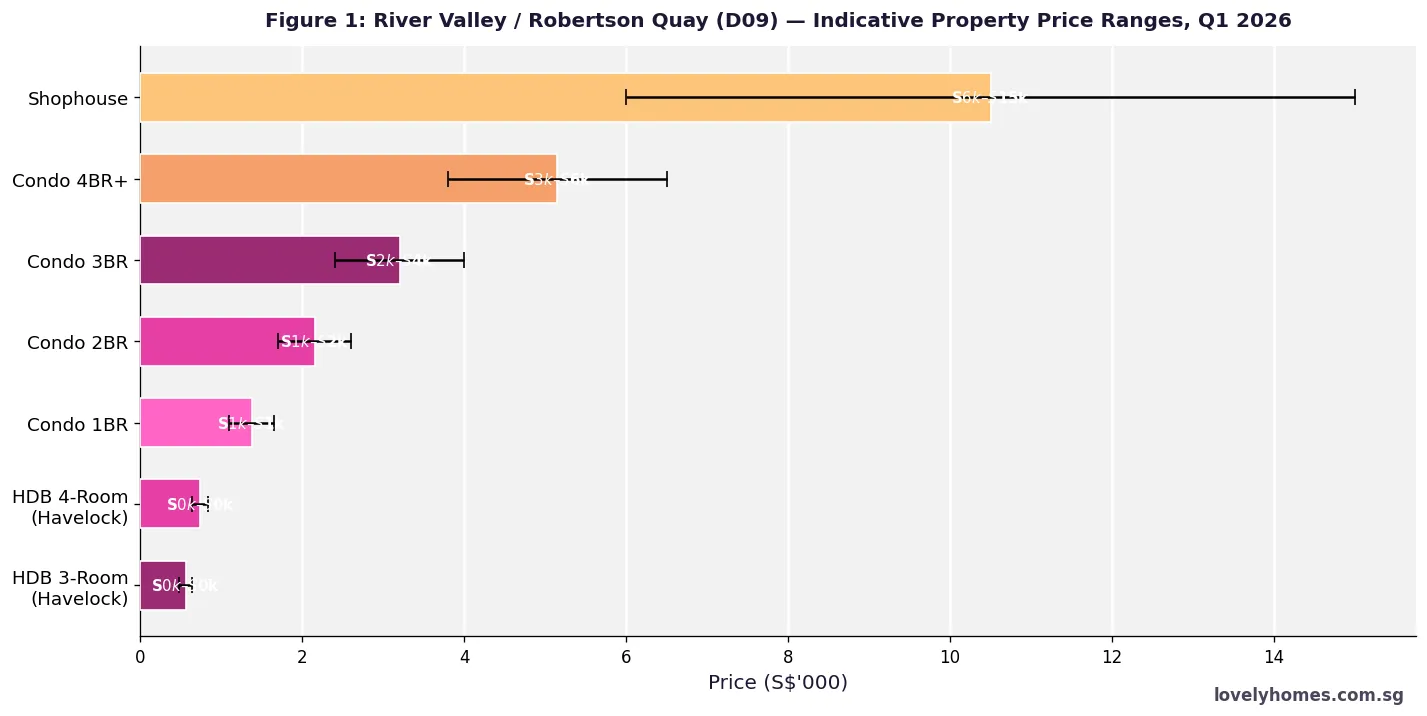
  • Private condo prices range from S$1,100,000 for a 1-bedroom to S$6,500,000+ for a 4-bedroom; average PSF runs S$2,600–S$3,200 for freehold stock.
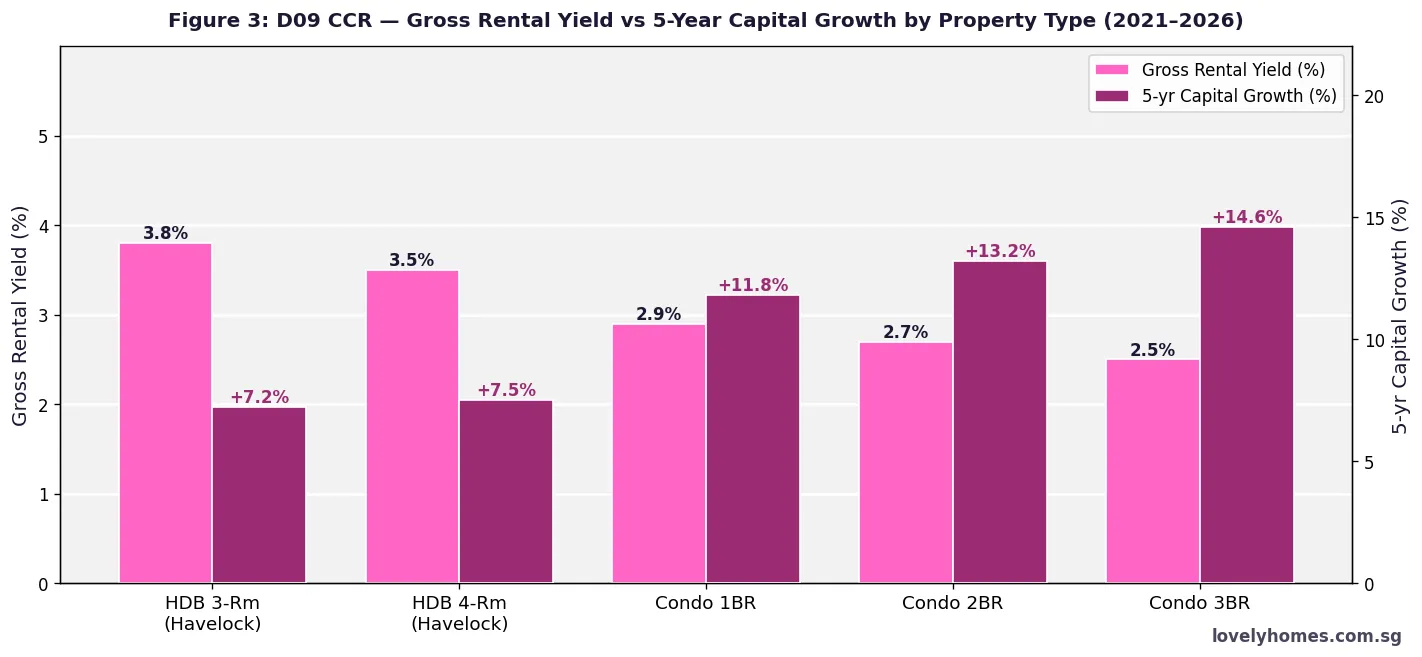
  • Gross rental yields: 2.5%–2.9% for larger units, 3.4%–3.8% for 1-bedrooms — lower than OCR, but sustained by high-income expat tenants in finance, law, and tech.
  • Five-year capital growth (2021–2026): +11.8% to +14.6% across private condos, tracking the broader CCR PPI.
  • No new GLS site has been awarded in the River Valley / Robertson Quay sub-precinct since 2018 — supply scarcity is a structural investment thesis.
  • Singapore Citizens buying their first private property pay 0% ABSD; foreigners pay 60%. ABSD 20% applies for SC second-property purchases.

River Valley Robertson Quay — Where Is It and What Makes It Distinctive?

River Valley and Robertson Quay are planning sub-zones within the Museum Planning Area and River Valley Planning Area of URA’s Master Plan. Geographically, the area stretches from River Valley Road (the main artery) south to the Singapore River, and from Mohamed Sultan Road / Clemenceau Avenue in the west to the Orchard/Somerset boundary in the east.

What makes this precinct genuinely different from Singapore’s other CCR sub-markets (Orchard, Cairnhill, Ardmore) is its character. Where Orchard feels commercial and Ardmore is quiet enclave-landed, River Valley and Robertson Quay have a lived-in, convivial quality — dozens of independent restaurants, riverside bars, weekend arts markets at Clarke Quay, Fort Canning Park’s concert lawn, and a density of international schools and nurseries that reflects the long-established expat tenant community. Many of Singapore’s largest private banks, law firms, and regional headquarters cluster within a 2-kilometre radius, feeding consistent demand for high-specification rental accommodation.

River Valley Robertson Quay D09 property price ranges 2026 — condo 1BR to shophouse, HDB Havelock
Figure 1: Indicative property price ranges in River Valley / Robertson Quay (D09), Q1 2026. Ranges reflect asking and transacted prices; actual pricing varies by unit, floor, and tenure.

MRT Connectivity — Three Lines Within Walking Distance

Prior to June 2023, District 9’s connectivity was widely cited as its one weakness relative to D10 or D11 — the nearest MRT stations (Somerset NS23 and Clarke Quay NE5) required a 10–15 minute walk from many River Valley condominiums. The opening of the Thomson–East Coast Line’s Stage 3 changed the calculus materially:

  • Great World (TE15 — TEL): Located on Kim Seng Road, a 5-minute walk from most River Valley condos along Kim Seng Road and Martin Road. Interchange planned with future Jurong Region Line extension in long-range planning; already connects to Orchard (TE14, 1 stop north) and the TEL’s eastern branches toward Marine Parade and Bayshore.
  • Havelock (TE16 — TEL): Serves the Havelock Road and Robertson Quay western edge; useful for residents in River Gate, Aspen Heights, and Havelock View Towers. Connects south toward Outram Park (TE17 — interchange with EWL and NEL) and Cantonment (TE18).
  • Fort Canning (DT20 — DTL): On the Downtown Line, this station is a 7–10 minute walk from Robertson Quay and links directly to Bugis (DT14/EW12), Downtown (DT17), and via interchange to Marina Bay, Buona Vista, and Expo.

For commuters to the CBD (Raffles Place, Shenton Way), the travel time from Great World TE15 to Marina Bay TE20 is approximately 8 minutes on the TEL — comparable to driving at peak hour and far more reliable. For residents working in the Orchard/Somerset belt, it is one stop. The TEL has repositioned River Valley from “slightly inconvenient” to “exceptionally well served”.

Schools in River Valley and Robertson Quay

River Valley Primary School (RVPS), located on River Valley Road, is the district’s anchor primary school and draws families from across Singapore willing to buy or rent in-zone to secure a Phase 2C ballot priority. The school is within the 1-kilometre priority zone for several major condominiums including The Avenir, Rivière, and Martin Modern.

At the secondary level, Gan Eng Seng School and Queenstown Secondary are accessible via the TEL. Singapore Management University (SMU) — one of Singapore’s six autonomous universities — is a 15-minute walk from Robertson Quay via Fort Canning; its proximity contributes to the area’s intellectual and professional character. For international families, the international schools cluster in the broader CCR zone (Orchard, Tanglin, Stevens) is accessible in 10–15 minutes.

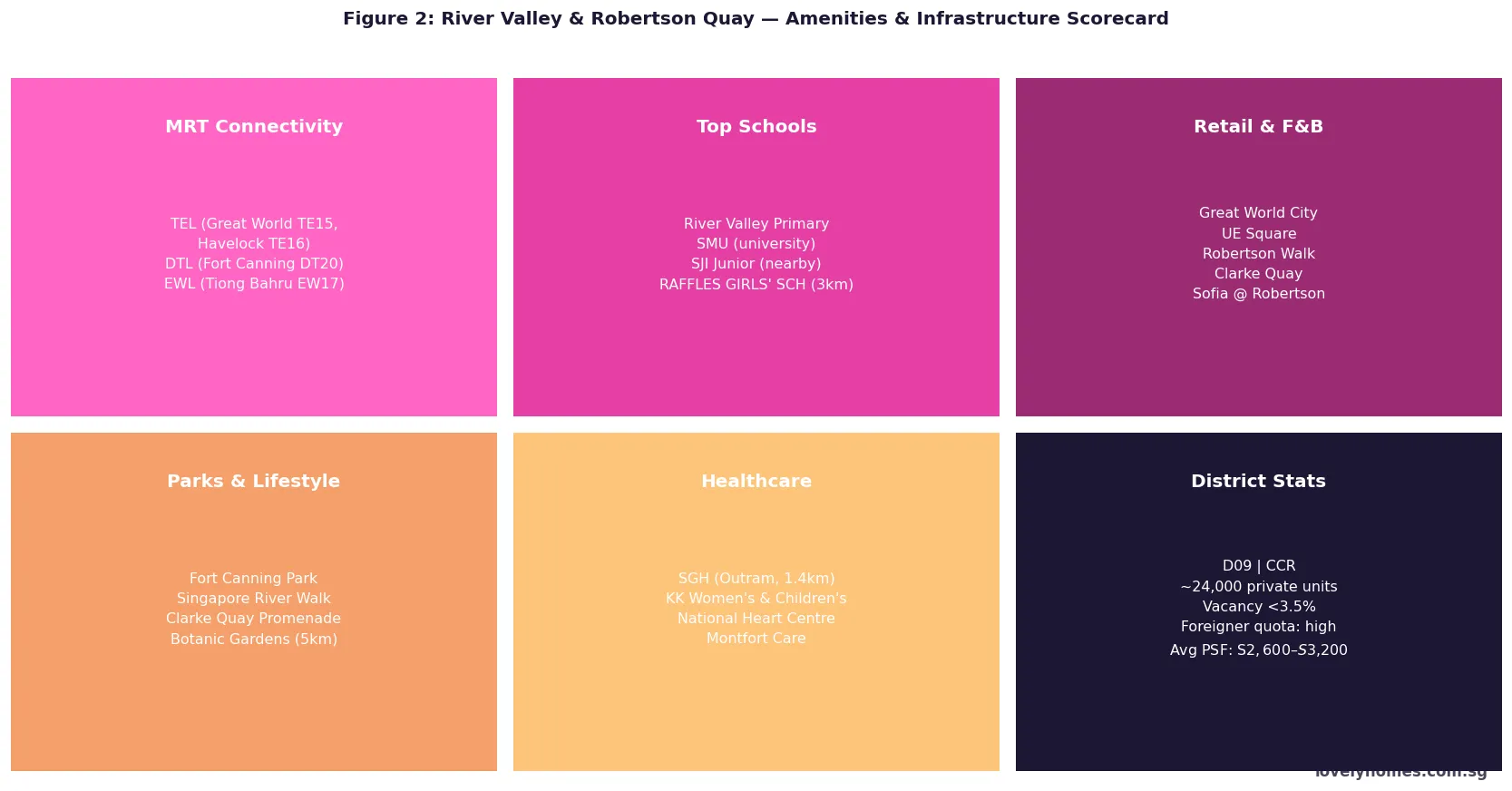
River Valley Robertson Quay amenities scorecard 2026 — MRT, schools, retail, parks, healthcare, district statistics
Figure 2: River Valley & Robertson Quay amenities and infrastructure scorecard.

Property Market Overview — D09 CCR Prices and Supply

District 9 is a near-exclusively private residential market. HDB flat supply in the area is negligible — the Havelock HDB estate on the western fringe has a small number of older flats, most of which are past their lease peak, but they represent a tiny fraction of the district’s housing stock. The dominant product is the private condominium — ranging from boutique freehold projects of 30–50 units to larger 99-year leasehold developments of 300–600 units.

Key benchmark projects:

  • The Avenir (freehold, D09, River Valley Close): 376 units across two 36-storey towers. Completed 2024. Benchmark PSF S$2,800–S$3,200. Developed by GuocoLand and Hong Leong Holdings.
  • Rivière (99yr leasehold, Jiak Kim Street): 455 units. Former Zouk site. TEL Great World station at doorstep. Benchmark PSF S$2,400–S$2,900. Frasers Property development.
  • Martin Modern (99yr leasehold, Martin Place): 450 units. GuocoLand. Benchmark PSF S$2,200–S$2,600.
  • The Waterfall, RV Altitude, One Draycott (freehold older stock): PSF S$2,000–S$2,500.

Transaction volume in D09 is thin by Singapore standards — typically 250–400 resale caveats per year — which means individual transactions can move the median PSF meaningfully. Freehold premium over 99-year leasehold in this precinct runs approximately 8–15%, narrower than the national average because the 99-year stock (Rivière, Martin Modern) is of very high quality with TEL access.

Property Type Indicative Price Range Indicative PSF Gross Yield (Est.) Tenure
HDB 3-Room (Havelock) S$480k – S$640k S$560–S$700 3.8% Leasehold (ageing)
HDB 4-Room (Havelock) S$640k – S$840k S$580–S$720 3.5% Leasehold (ageing)
Private Condo 1BR S$1.1M – S$1.65M S$2,400–S$3,000 3.4%–3.8% Freehold / 99yr
Private Condo 2BR S$1.7M – S$2.6M S$2,500–S$3,100 2.9%–3.3% Freehold / 99yr
Private Condo 3BR S$2.4M – S$4.0M S$2,600–S$3,200 2.5%–2.9% Freehold / 99yr
Private Condo 4BR+ S$3.8M – S$6.5M S$2,700–S$3,300 2.3%–2.7% Freehold / 99yr
Shophouse (Heritage) S$6M – S$15M S$5,500–S$9,000 1.8%–2.5% Freehold

Rental Market — Who Rents in River Valley and Robertson Quay?

The D09 rental market is structurally different from OCR precincts. Rather than young professionals on tight budgets seeking HDB rooms or studio apartments, the tenant pool in River Valley and Robertson Quay skews toward:

  • Expatriate finance and legal professionals — private banks, hedge funds, and international law firms cluster in the Marina Bay Financial Centre and Raffles Place, both reachable from Great World TE15 in under 12 minutes. Housing allowances of S$6,000–S$12,000 per month are common.
  • Senior corporate and tech executives — regional headquarters of multinational companies increasingly concentrate in the one-north/Tanjong Pagar corridor, accessible via the TEL.
  • International families — the area’s proximity to the international school belt (Tanglin Trust, UWCSEA East, ISS) makes it attractive to families with school-age children.

Median monthly rents in D09 for a 2-bedroom condominium run approximately S$5,800–S$7,500 (Q1 2026), reflecting a modest correction from the 2022–2023 rental peak of S$7,000–S$9,000 but still well above pre-pandemic levels. Vacancy in the precinct is estimated below 3.5% — reflecting tight supply and durable expat demand.

D09 CCR River Valley Robertson Quay gross rental yield vs 5-year capital growth 2021 to 2026 by property type
Figure 3: Gross rental yield and 5-year capital growth (2021–2026) for D09 CCR by property type. CCR yields are lower than OCR but paired with stronger capital growth for larger units.

🏠 Worked Example: Mr & Mrs Chua — SC Upgraders Buying Martin Modern 2BR

Profile: Mr & Mrs Chua, Singapore Citizens, joint income S$16,000/month. Currently own a Bishan 4-room HDB flat (MOP cleared, sold on 30 April 2026 for S$840,000). Buying a Martin Modern 2BR (99yr leasehold) at S$2,200,000. This is their first private property.

Stamp duty:

  • BSD on S$2,200,000: 1% × S$180k + 2% × S$180k + 3% × S$640k + 4% × S$500k + 5% × S$700k = S$1,800 + S$3,600 + S$19,200 + S$20,000 + S$35,000 = S$79,600
  • ABSD: Nil — SC couple, first private property (HDB sold before OTP granted)

Financing:

  • Purchase price: S$2,200,000 | LTV 75% → Bank loan: S$1,650,000
  • Monthly repayment at 3.0% p.a. 25yr: approximately S$7,832/month
  • TDSR: S$7,832 ÷ S$16,000 = 48.9% — PASS (within 55% limit)

Upfront cash/CPF required:

  • 25% down payment: S$550,000
  • BSD: S$79,600
  • Conveyancing fees: ~S$5,000
  • Total upfront: approximately S$634,600 (can partly draw from CPF OA after HDB CPF refund)

Investment projection: At +13.2% 5-year CCR growth (historical trend), the S$2.2M unit appreciates to approximately S$2.49M by 2031. Combined with net rental income (~S$5,800/month at 2.9% gross, less property tax and maintenance), the total return scenario is approximately S$290k capital + S$174k net rental = ~S$464k over 5 years. Past performance does not guarantee future results — see Disclaimer.

Investment Case — Why River Valley and Robertson Quay in 2026

The structural case for D09 rests on three pillars that are unique to this precinct. First, supply scarcity: unlike OCR planning areas such as Tampines or Sengkang where GLS sites are regularly released, the River Valley and Robertson Quay sub-zones are essentially built-out. URA has not awarded a GLS site in this immediate precinct since the Jiak Kim Street site (Rivière, awarded 2018). Future supply, if any, would likely come from en-bloc redevelopment — a slow, expensive process that takes 5–8 years from acquisition to launch.

Second, the TEL re-rating is still working through property values. Research from URA transaction data suggests that properties within 500 metres of new TEL stations in previously underserved areas have outperformed the broader CCR average by 2–4 percentage points per annum in the two to three years post-opening. The Great World and Havelock stations opened in June 2023, meaning the full impact may not yet be fully priced in.

Third, Singapore’s attraction as a global wealth hub continues to drive demand for the CCR’s top-end rental pool. Despite the 60% ABSD on foreigners (which has effectively removed foreign owner-occupier buyers from the market), Singapore’s population of ultra-high-net-worth individuals — many of whom now hold Permanent Residency or citizenship — continues to grow. Wealthy PRs buying a first or second property in D09 pay 5% or 30% ABSD respectively — meaningful but manageable given the capital quantum. Many still prefer D09 over offshore alternatives for personal use.

What Might Come Next for River Valley and Robertson Quay

This section is editorial opinion and forward-looking speculation, clearly labelled as such.

The URA Draft Master Plan 2025 identified the Greater Southern Waterfront (GSW) — a 2,000-hectare stretch from Pasir Panjang to Marina East — as a long-term transformation zone. River Valley and Robertson Quay sit at the northern edge of this precinct, and the eventual reconfiguration of the Tanjong Pagar port lands (expected 2027–2030 for the first phases) could draw more F&B, cultural, and lifestyle development southward along the Singapore River, extending the Robertson Quay “lifestyle zone” further toward the coast.

On the regulatory side, some market analysts have speculated that ABSD rates for foreigners (currently 60%) could be moderated if the US–Singapore bilateral economic relationship strengthens and if Singapore’s primary residential market cools further following the 60% ABSD introduction. However, there are no signals from the Ministry of National Development or the Ministry of Finance that any such change is imminent.

Frequently Asked Questions

Is River Valley a good place to buy property in Singapore?

River Valley and Robertson Quay offer a compelling combination of lifestyle, connectivity, and capital preservation that justifies the premium over OCR and RCR districts. The TEL opening in June 2023 resolved the precinct’s previous connectivity weakness. The absence of new GLS supply in the sub-zone for over seven years means that any further demand uplift — from population growth, wealth inflows, or the Greater Southern Waterfront transformation — would tighten an already scarce market. For buyers who can absorb the higher entry price (S$1.1M+ for a 1-bedroom) and do not need above-3% yield, D09 River Valley and Robertson Quay represents one of Singapore’s most defensible residential investments. It is not the right choice for buyers seeking high rental yield or affordable entry.

Which MRT stations serve River Valley and Robertson Quay?

Three MRT stations are within comfortable walking distance of the precinct. Great World (TE15, Thomson–East Coast Line) on Kim Seng Road serves the eastern River Valley portion; Havelock (TE16, TEL) serves Robertson Quay’s western side and the Havelock Road corridor. Fort Canning (DT20, Downtown Line) is a 7–10 minute walk from Robertson Quay via River Valley Road and is particularly useful for commuters heading toward Bugis, Promenade, or Buona Vista. Somerset (NS23, North–South Line) is a 12–15 minute walk from the northern edge of River Valley Road and provides access to Orchard and the NSL.

Can foreigners buy property in River Valley and Robertson Quay?

Foreigners can purchase private condominiums, apartments, and commercial shophouses in D09. However, since April 2023, foreigners pay 60% ABSD on any Singapore residential property purchase — a flat rate on the entire purchase price. On a S$2.5M condominium, that is S$1.5M in ABSD alone. Foreigners cannot purchase HDB flats, ECs (within MOP), or landed property (unless on Sentosa Cove or with specific SLA approval). Despite the 60% ABSD, a small number of ultra-high-net-worth foreign buyers continue to transact in CCR — particularly for trophy units above S$5M — typically sourced from family offices and private banking clients who view Singapore residential property as part of a broader wealth-preservation and residency strategy.

What are the best condominiums in River Valley and Robertson Quay?

The benchmark freehold projects in 2026 are The Avenir (River Valley Close, 376 units freehold, completed 2024, PSF S$2,800–S$3,200) and the established older-stock freehold buildings along River Valley Road including RV Altitude and The Grange. For 99-year leasehold, Rivière (Jiak Kim Street, 455 units, Frasers Property, adjacent to Great World TE15 station) and Martin Modern (Martin Place, 450 units, GuocoLand) are the contemporary benchmarks. Rivière in particular benefits from arguably the best direct TEL station access of any condominium in the precinct. Older boutique freehold projects (sub-100 units) can offer attractive value for buyers who prioritise freehold tenure and do not require a gymnasium or full facilities.

How does River Valley compare to Holland Village or Orchard?

All three sub-precincts sit within D09/D10 CCR, but each has a distinct character. River Valley and Robertson Quay offer the most vibrant street-level lifestyle — riverside F&B, Fort Canning Park, and the Singapore River waterfront — but at CCR prices and with smaller absolute retail mall footprints than Orchard. Holland Village (D10) has a village-in-the-city feel, lower density, and proximity to Buona Vista’s biomedical cluster. Orchard (D09/D10 border) offers the greatest retail density and brand-name condominium presence, but the immediate streetscape is less liveable. For families, Holland Village’s proximity to international schools (UWCSEA, AIS) is a draw that River Valley does not fully replicate. For young professionals and empty-nesters prioritising walkable lifestyle and CBD access, River Valley/Robertson Quay tends to win the comparison.

Is there any new HDB BTO supply in River Valley?

No. There is no HDB BTO supply in River Valley or Robertson Quay. The area is designated as a mature private residential precinct under the URA Master Plan. The only HDB stock in the broader D09 area is the existing Havelock Road HDB estate — older flats built in the 1970s and 1980s that transact at S$480,000–S$840,000 on the resale market. These Havelock flats are subject to lease decay risk given their age (remaining leases of 40–55 years as of 2026) and are generally not recommended for buyers seeking CPF-eligible long-tenure financing. For HDB BTO applicants interested in CCR-adjacent living at lower cost, the June 2026 BTO launch in Ang Mo Kio and Bukit Merah is the nearest available option.

Disclaimer: This guide is for general information purposes only and does not constitute financial, legal, or property investment advice. Property prices, rental yields, and market conditions change over time. All price ranges are indicative, based on public caveat data from the URA REALIS system and industry sources as at Q1 2026, and should not be relied upon as a valuation. Stamp duty rates are subject to change — verify current rates on the IRAS Stamp Duty page. Loan calculations are illustrative; consult a licensed mortgage broker and MAS guidelines before proceeding. LovelyHomes does not represent any property developer, agency, or agent.

×

Click anywhere outside the image to close

Novena & Newton Neighbourhood Guide Singapore 2026: Property Prices, Schools, MRT and Investment Outlook
Novena & Newton Neighbourhood Guide Singapore 2026: Property Prices, Schools, MRT and Investment Outlook

Quick Answer: Novena & Newton at a Glance (2026)

  • District 11 (D11) — Core Central Region (CCR) planning area covering Newton, Novena, Moulmein, and the Thomson fringe. One of Singapore’s most established and medically significant residential precincts.
  • Private condominiums range from approximately S$1.1M (1-bedroom) to S$4.0M+ (3-bedroom), with PSF typically running S$2,200–S$3,500 depending on freehold vs 99-year tenure and proximity to the MRT.
  • HDB resale flats exist in limited supply in the Moulmein and Whampoa fringe sub-zones: 3-room S$520k–S$700k, 4-room S$680k–S$950k — rare, and frequently transact at or above valuation.
  • MRT super-connected: Newton (NS21/DT11) is an interchange between the North-South Line (red) and Downtown Line. Novena (NS20) and Stevens (DT10/TE11) provide additional North-South and Thomson–East Coast Line access. Orchard is one stop from Newton.
  • Singapore’s premier medical cluster — Tan Tock Seng Hospital (TTSH), Mount Elizabeth Novena Hospital, Thomson Medical Centre, and Farrer Park Hospital all sit within the Novena planning area or on its boundary, underpinning a structurally deep pool of specialist and expatriate demand.
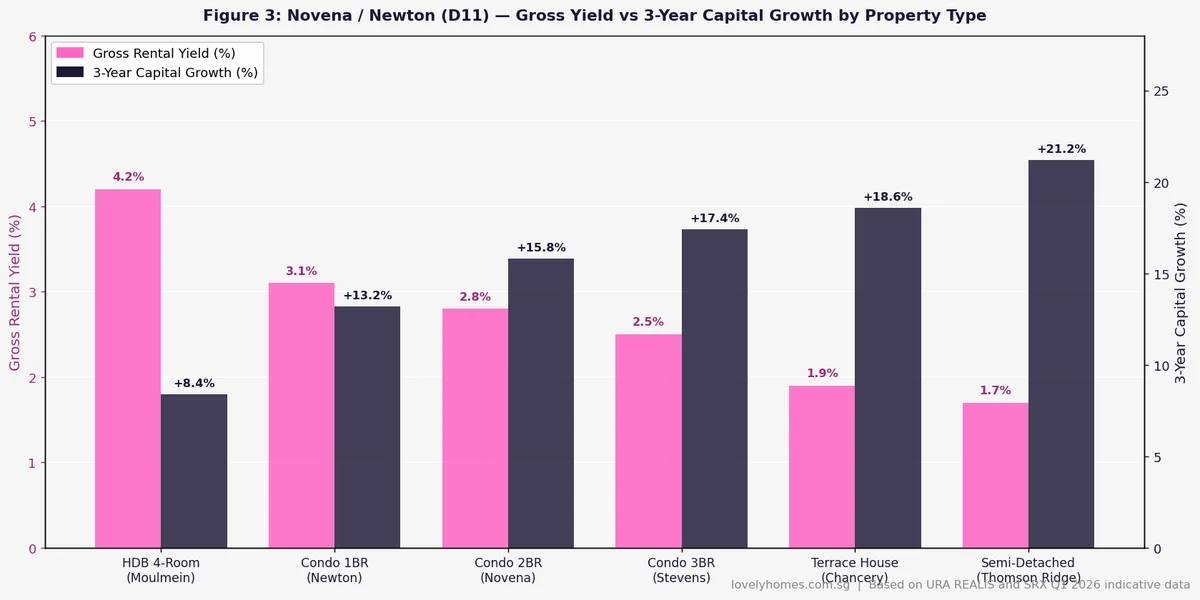
  • Gross rental yield for condos is 2.5–3.1% — low relative to the OCR, but consistent with CCR norms; HDB in Moulmein achieves 4.0–4.2%.
  • 3-year capital appreciation (Q1 2023–Q1 2026): private condos +13–17%, landed +18–21%, underpinned by land scarcity, school proximity, and the medical cluster’s structural expat-tenant demand.
  • ABSD: Singapore Citizens pay 0% on a first property, 20% on a second; PRs pay 5% on a first, 30% on a second; foreigners pay 60% on any residential property.
  • TDSR limit of 55% of gross monthly income caps the bank loan quantum. At D11 prices of S$2M+, most buyers will need a household income of at least S$14,000–S$18,000 per month for a 2-bedroom purchase.
  • Best suited for: upgrading SC/SPR couples prioritising prestige address and school proximity; expatriate tenants in the medical and financial sectors; long-hold capital-appreciation investors who accept lower initial yield.

What Are Novena and Newton? Singapore’s Medical and Prestige CCR Hub

Novena and Newton are two adjacent sub-zones within District 11 (D11), one of Singapore’s eleven Core Central Region (CCR) planning areas administered by the Urban Redevelopment Authority (URA). Together, they form what market commentators often refer to as Singapore’s “medical mile” — a concentrated cluster of major private and restructured hospitals that has, over the past two decades, generated a structurally resilient pool of specialist doctors, medical-industry professionals, and expatriate patients who rent or own nearby. The planning area also encompasses Moulmein, Balestier, and the lower Thomson corridor.

Newton MRT station (NS21/DT11) is one of Singapore’s busiest interchange stations, sitting at the junction of the North-South Line (red line) and Downtown Line (blue line). This puts residents one stop from Orchard Road and four stops from Raffles Place, making D11 a default choice for finance-sector professionals who need daily access to the CBD. Novena MRT (NS20) adds a second NSL node one stop south of Newton, directly outside Square 2 and Velocity at Novena Square — the district’s primary retail corridor.

Unlike Districts 9 and 10, which have seen a significant influx of ultra-luxury new launches aimed at foreign buyers, D11 retains a strongly local-owner-and-long-term-expat-renter character. The presence of reputable schools within 1–2 km — Anglo-Chinese School (Junior), St Joseph’s Institution Junior, and Singapore Chinese Girls’ School — makes the area a perennial target for families with primary-school-age children, tightening the secondary resale market during periods of demand.

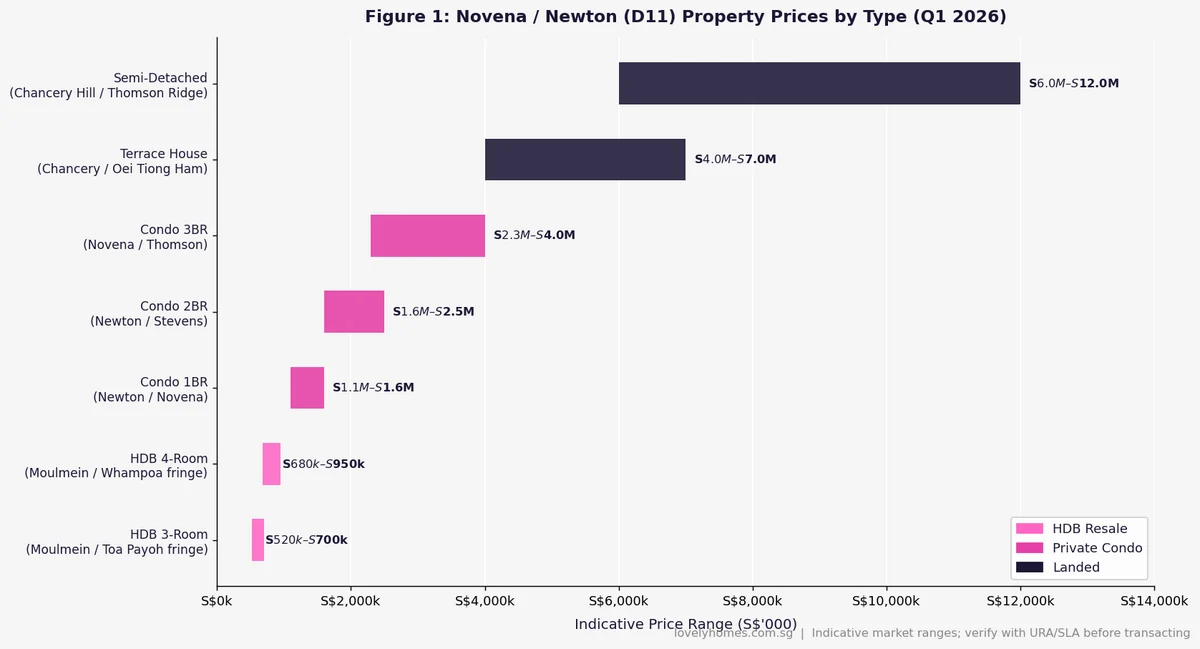
Novena Newton D11 property prices by type HDB condo landed Singapore 2026
Figure 1: Indicative property price ranges by type in Novena / Newton (D11), Q1 2026. Sources: URA REALIS, SRX, SLA caveats. Prices are indicative market ranges; verify against current caveat data before transacting.

MRT Connectivity: Newton, Novena and Stevens

D11 residents enjoy some of the best multi-line MRT access in Singapore. The three stations serving the district connect four separate rail lines:

Newton (NS21 / DT11): The North-South Line and Downtown Line interchange. From Newton, Orchard is one stop south on the NSL (approximately 3 minutes); City Hall is four stops; Raffles Place five stops. On the DTL, Botanic Gardens is two stops west, and the line connects through to the Tech and Education Corridor via one-north and further east to Marina Bay. Newton Circus, the historic hawker centre, sits at street level next to the station — a rare piece of Singapore food heritage in a CCR district.

Novena (NS20): One NSL stop north of Newton, directly below Velocity @ Novena Square and Square 2. Tan Tock Seng Hospital (TTSH) is a five-minute walk. This station is particularly convenient for residents in the mid-Novena condo cluster (including The Atelier, Pullman Residences Newton, and Park Eleven).

Stevens (DT10 / TE11): An interchange between the Downtown Line and the Thomson–East Coast Line (TEL), opened in 2022. Stevens gives D11 residents direct access to the TEL, which runs north through Woodlands and south to Marina Bay and eventually Changi Airport by TEL Stage 4 (expected late 2026). Stevens is particularly useful for residents in the upper Novena and lower Thomson sub-zone, and for those accessing Raffles Girls’ Primary or Anglo-Chinese School at Barker Road.

The Medical Cluster: Four Major Hospitals in One Planning Area

No other residential district in Singapore can claim four major hospitals within its boundaries. This concentration is not coincidence — URA’s Master Plan deliberately zoned Novena as Singapore’s medical cluster, reflecting a deliberate policy decision to create critical mass in private and public healthcare provision. The four anchor institutions are:

  • Tan Tock Seng Hospital (TTSH) — Singapore’s second-largest acute-care hospital, a public restructured hospital under the National Healthcare Group (NHG), with approximately 1,700 beds. TTSH employs several thousand medical professionals, a significant portion of whom live within a 10-minute commute in D11.
  • Mount Elizabeth Novena Hospital — IHH Healthcare’s flagship Singapore facility, a 333-bed super-specialty private hospital that attracts regional medical tourism from Indonesia, Malaysia, Vietnam, and beyond. The hospital’s specialist-practice model generates a deep pool of high-income doctor-tenants seeking proximity to their clinic rooms.
  • Thomson Medical Centre — Singapore’s oldest private hospital, specialising in women’s health and paediatrics. Recently expanded, it serves a loyal base of obstetricians and paediatricians whose young-family clients often seek school-proximity rental accommodation nearby.
  • Farrer Park Hospital — A private multi-specialty hospital at the southern edge of the planning area, also home to a medical suites tower catering to specialist practices. Its proximity to the Little India MRT and the Farrer Park area gives it a distinct multi-community patient base.

Taken together, these four institutions generate structural, counter-cyclical demand for D11 rentals. Even during economic downturns that dampen CBD corporate demand, the medical cluster sustains occupancy for the district’s rental condominiums — a dynamic that distinguishes D11 from purely finance-sector CCR precincts like D9 or D1.

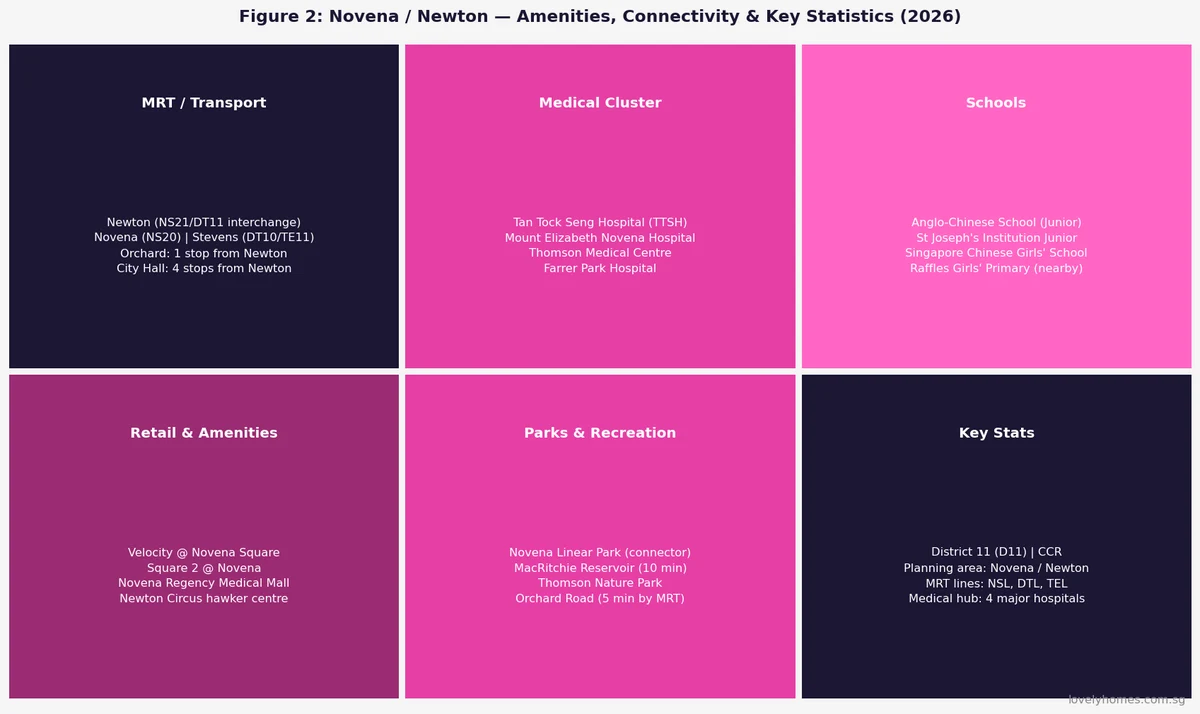
Novena Newton D11 amenities connectivity schools medical hub Singapore 2026
Figure 2: Novena / Newton (D11) — connectivity, medical cluster, schools, retail, and key statistics, 2026. Sources: LTA, MOE, NEA, SingStat.

Schools Near Novena and Newton

One of D11’s enduring strengths as a residential choice for Singaporean families is the concentration of well-regarded primary and secondary schools within the 1 km and 2 km school-registration boundaries. The most notable are:

  • Anglo-Chinese School (Junior) — at Barker Road, within 1.5 km of most Novena and Newton condominiums. A sought-after Methodist mission school with strong alumni connections to ACS(I) and ACS(Barker Road) downstream.
  • St Joseph’s Institution Junior (SJIJ) — at Malcolm Road, a Catholic mission school with consistently strong Primary School Leaving Examination (PSLE) outcomes and good secondary-school pathway alignment to SJI.
  • Singapore Chinese Girls’ School (SCGS) — Clemenceau Avenue, approx. 1.5 km. Independent school with through-train secondary programme; a strong draw for Chinese-educated families.
  • Raffles Girls’ Primary School — at Anderson Road (nearby Thomson), within the broader Thomson/Novena catchment for families willing to commute one MRT stop.
  • Balestier Hill Primary — directly in the Novena planning area; serves the HDB and mid-tier condo resident base in the Moulmein sub-zone.

The 1 km registration priority for Primary 1 places creates a tangible premium on properties within that radius of the most sought-after schools. Buyers who are specifically targeting school proximity should confirm current home-school distances with the Ministry of Education (MOE) Schoolfinder tool, as boundaries are verified at the time of registration, not at the time of purchase.

Property Prices in D11: What Are Buyers Paying in 2026?

D11 sits squarely in CCR territory, which means prices are governed by a different dynamic from the OCR or even most of the RCR. The URA Private Residential Property Price Index (PPI) for CCR rose approximately 40% from Q1 2019 to Q1 2026 — compared with roughly 73% for OCR over the same period — reflecting the fact that CCR values were already elevated when the mass-market surge began in 2020–2021.

Property Type Indicative Price Range (2026) Indicative PSF Typical Tenure Gross Yield
HDB 3-Room (Moulmein) S$520,000 – S$700,000 N/A (HDB) Remaining lease 4.0–4.5%
HDB 4-Room (Moulmein) S$680,000 – S$950,000 N/A (HDB) Remaining lease 3.8–4.2%
Condo 1-Bedroom S$1,100,000 – S$1,600,000 S$2,200–S$3,200 Freehold / 99-yr 2.8–3.1%
Condo 2-Bedroom S$1,600,000 – S$2,500,000 S$2,300–S$3,400 Freehold / 99-yr 2.5–2.8%
Condo 3-Bedroom S$2,300,000 – S$4,000,000 S$2,400–S$3,500 Freehold / 99-yr 2.3–2.6%
Terrace House S$4,000,000 – S$7,000,000 Freehold / 999-yr 1.7–1.9%
Semi-Detached S$6,000,000 – S$12,000,000 Freehold / 999-yr 1.6–1.8%

Noteworthy transactions in Q1 2026 include a 2-bedroom freehold unit at The Atelier (Makeway Avenue) at approximately S$2,650 psf, and a 3-bedroom at Pullman Residences Newton at approximately S$2,890 psf. These benchmark levels reflect freehold CCR mid-tier pricing in a market where supply is tight — The Atelier is fully sold, and no new CCR D11 project has been launched since 2022.

Rental Market: Who Rents in D11?

The D11 rental market draws from three distinct tenant pools, each with different lease preferences and rental budgets:

Medical specialists and allied health professionals form the most structurally stable segment. Specialist doctors at Mount Elizabeth Novena typically earn between S$300,000 and S$1M+ per annum; many prefer proximity to their clinic rooms and will hold long-term leases of 2–3 years. They tend to prefer 2–3 bedroom units in the S$5,500–S$8,000 per month range, either in freehold boutique blocks or established condominiums within a 10-minute walk of the Novena medical cluster.

Finance and professional services expatriates value proximity to Orchard and the CBD. Newton’s direct NSL access to Raffles Place makes it attractive for banking and consulting professionals on corporate leases. This segment typically targets 2–3 bedroom units at S$5,000–S$9,000 per month, with a preference for larger units in the S$6,500–S$8,500 range.

Local upgrader-investors purchase smaller 1-bedroom or studio units to rent to young professionals or medical interns. Yields of 2.8–3.1% are modest by Singapore standards, but the capital appreciation history and the structural tenant demand make D11 a defensible long-hold asset class.

Vacancy rates in D11 have remained below 4% for most of 2023–2026, despite the national private residential vacancy rate edging up to approximately 6% as completions from the elevated 2022–2023 GLS pipeline were absorbed. The medical-cluster effect is the primary reason D11 has outperformed broader CCR vacancy metrics.

Worked Example: Mr & Mrs Chen — Upgrading from HDB to Novena Freehold Condo

Profile: Singapore Citizen couple; joint gross monthly income S$18,000; currently own a Bishan 4-room HDB flat (MOP cleared in March 2025, estimated value S$880,000). They plan to sell the HDB first, then buy a freehold 2-bedroom condo in Novena as their next home.

Target property: The Atelier (Makeway Avenue), 2-bedroom freehold, 797 sq ft, est. S$2,100,000 (approx. S$2,635 psf).

ABSD: S$0 — selling HDB first means they hold zero residential properties at the OTP date. As SCs buying their first private property, no ABSD applies.

Buyer’s Stamp Duty (BSD): On S$2,100,000: 1% on S$180k = S$1,800 + 2% on S$180k = S$3,600 + 3% on S$640k = S$19,200 + 4% on S$500k = S$20,000 + 5% on S$600k = S$30,000 = S$74,600.

Maximum bank loan (LTV 75%): S$1,575,000. Minimum cash downpayment: 5% of S$2.1M = S$105,000. Remaining 20% = S$420,000 (CPF OA eligible).

After HDB sale: Estimated net proceeds after CPF accrued interest refund and outstanding HDB loan = approximately S$320,000 in CPF (OA) + S$85,000 cash. That S$320k CPF covers the 20% cash-or-CPF portion (S$420k minus HDB CPF refund scenario); they need approximately S$205,000 additional CPF or cash from savings.

Monthly repayment: S$1,575,000 at 3.0% over 25 years ≈ S$7,468 per month. TDSR = S$7,468 ÷ S$18,000 = 41.5% — well within the 55% cap.

Total upfront costs: BSD S$74,600 + legal fees est. S$5,200 + buyer disbursements S$1,000 + cash downpayment balance est. S$105,000 minimum cash = approx. S$185,800 cash needed at completion (balance drawn from CPF OA).

Note: CPF accrued interest, outstanding HDB loan, and exact CPF OA balance will affect the above. Engage a licensed conveyancing lawyer and CPF Board before committing.

Investment Case: Why Novena / Newton D11 Holds Its Value

For property investors, D11 presents an unusual risk-return profile: lower initial gross yield (2.5–3.1% for condos) than OCR properties, but a set of structural demand factors that have historically cushioned price corrections and supported above-average capital appreciation.

The medical-cluster effect is the single most important structural driver. Singapore’s ageing population and the Government’s long-term plans to expand Singapore’s position as a regional medical hub mean TTSH and Mount Elizabeth Novena are likely to employ more, not fewer, specialists over the coming decade. Each new specialist joining a hospital in Novena is a potential landlord’s tenant.

The school-proximity premium creates a second demand floor. Parents who specifically buy within 1 km of Anglo-Chinese School (Junior) or St Joseph’s Institution Junior are making a 6–7 year commitment tied to their child’s primary school journey. This embeds a captive, sticky demand segment that does not respond elastically to minor market wobbles.

Finally, supply scarcity in D11 is a structural feature, not a temporary condition. Unlike the OCR or even parts of the RCR, D11 has very limited GLS or redevelopment land available for new private residential launches. The last significant new launches — The Atelier (2019) and Pullman Residences Newton (2020) — are fully sold. Without new supply, the resale and rental market is self-reinforcing for existing owners.

Novena Newton D11 gross rental yield vs 3-year capital growth by property type 2026
Figure 3: Gross rental yield vs 3-year capital growth by property type in D11 (Q1 2026). Sources: URA REALIS, SRX indicative data. Past performance does not guarantee future returns.

What Might Come Next for Novena and Newton?

This section represents forward-looking analysis and should not be taken as investment advice. All projections are speculative.

The Thomson-East Coast Line (TEL) Stage 4 — connecting the existing TEL network to Changi Airport and completing the full loop — is expected around late 2026 to early 2027. Stevens (TE11) will benefit from increased through-traffic as more passengers use the TEL for their daily commute, further embedding the station’s interchange value and supporting property demand in the upper Novena sub-zone.

URA’s Master Plan 2025 Concept Plan signals continued investment in Singapore’s healthcare and biomedical research clusters. Any expansion of the Novena medical cluster — whether a new hospital wing at TTSH, an expanded Mount Elizabeth Novena, or new outpatient specialist facilities — would deepen the structural tenant pool and support rental values.

A potential wildcard is the future of the Moulmein HDB precinct. If any of the older Moulmein estates are earmarked for the Voluntary Early Redevelopment Scheme (VERS) in the coming decade, displaced residents would receive government compensation and might seek nearby private rentals, creating a temporary demand spike for D11 condos. This is speculative at present.

Frequently Asked Questions

Is Novena / Newton a good area to buy property in Singapore?

Novena and Newton (District 11) are among Singapore’s most resilient CCR districts for long-term property ownership. The combination of tri-line MRT connectivity (NSL, DTL, TEL), proximity to four major hospitals, and strong school catchment areas (ACS Junior, SJIJ, SCGS) creates a structurally stable demand environment. Gross rental yields of 2.5–3.1% for private condos are lower than OCR norms, but capital appreciation has been consistent: D11 CCR condos recorded approximately 13–17% price growth from Q1 2023 to Q1 2026. The area is best suited for long-hold investors and upgrading families seeking prestige address, school proximity, and counter-cyclical medical-cluster demand. Short-term flippers who need immediate yield should look to higher-yielding OCR districts instead.

Which MRT stations serve Novena and Newton, and how long does it take to reach Orchard and the CBD?

Three MRT stations serve D11 directly. Newton (NS21/DT11) is the most central — one stop from Orchard Road (approximately 3 minutes on the NSL), four stops from City Hall (approximately 10 minutes), and five stops from Raffles Place (approximately 12 minutes). Novena (NS20) is one NSL stop north of Newton, outside Velocity @ Novena Square and Tan Tock Seng Hospital. Stevens (DT10/TE11) serves the upper Novena and lower Thomson sub-zone and connects to the Thomson-East Coast Line, useful for accessing Marina Bay and (from late 2026) Changi Airport directly. Journey times assume normal weekday conditions; check LTA TransitLink MRT Journey Planner for current timetables.

Can foreigners or PRs buy property in Novena / Newton?

Yes, with significant ABSD differences. A Singapore Permanent Resident (SPR) buying their first private property in D11 pays 5% ABSD; on their second property, 30%. A foreigner (non-PR individual) pays 60% ABSD on any residential property purchase, regardless of whether it is their first or subsequent. At D11 condo prices of S$1.5M–S$3M, a 60% ABSD can add S$900,000–S$1.8M to the purchase cost, which effectively prices most individual foreign buyers out of the market unless they have exceptional capital reserves. Citizens of Iceland, Liechtenstein, Norway, Switzerland, and the United States may qualify for reduced ABSD rates under Free Trade Agreement National Treatment provisions — always verify eligibility with your conveyancing lawyer before signing an OTP. Full ABSD rates and remission schemes are covered in our ABSD Singapore 2026 guide.

What are the best condominiums to buy in the Novena / Newton area?

As of Q1 2026, the most transacted and benchmarked condominiums in D11 include: The Atelier (Makeway Avenue — freehold, 120 units, last transacted at approximately S$2,600–S$2,700 psf for 2-bedrooms), Pullman Residences Newton (Dunearn Road — 99-year leasehold, 340 units, approximately S$2,700–S$2,900 psf), Park Eleven (Balmoral Road — freehold boutique, popular with medical professionals), Visioncrest (Oxley Walk — freehold, larger units popular with families), and Lincoln Suites (Lincoln Road — freehold, studio and 1-bedroom popular with specialist tenants). Buyers should note the tenure difference: freehold condos in D11 typically command a 5–10% PSF premium over comparable 99-year leasehold units, which is narrower than in some other districts, reflecting the floor supported by medical-cluster demand.

How does D11 Novena compare with D9 Orchard or D10 Buona Vista / Holland Village?

D9 (Orchard/River Valley) skews more towards ultra-luxury and international buyer demand; PSF in D9 CCR typically runs S$3,000–S$5,000+ for the newest towers, with transactions heavily influenced by foreigner purchases and investment holding rather than owner-occupation. D10 (Bukit Timah/Holland Village) overlaps with D11 on the school-premium dynamic but has a different character — more landed property, GCB territory, and the Holland Village lifestyle corridor. D11 Novena is arguably the most owner-occupied and domestically demand-driven of the three CCR districts; its medical cluster and school proximity make it stickier in downturns. For pure capital appreciation, D9’s proximity to Orchard may edge ahead in boom cycles; for structural tenant demand and supply scarcity, D11 compares favourably. Our Singapore Prime District Property Guide 2026 covers D9, D10, and D11 side by side.

Are there HDB flats in Novena / Newton, and how do I buy one?

Yes, but in very limited supply. The Moulmein and Whampoa fringe sub-zones within D11 have a small stock of HDB resale flats, most built in the 1980s and 1990s. These are popular with buyers who want a CCR address and excellent MRT connectivity at a lower absolute price than private condos. Key points: (1) HDB resale flats are subject to the standard 5-year Minimum Occupation Period (MOP) rule if bought with an HDB loan or CPF grants; (2) SPRs may buy HDB resale flats subject to HDB eligibility criteria; (3) foreigners may not buy HDB flats. Because these flats are old, buyers should check remaining lease tenure carefully — CPF usage and bank loan LTV are progressively restricted as the remaining lease falls below 60 years. Our HDB Lease Decay guide explains the CPF and financing implications in full detail.

What is the income requirement to buy a Novena or Newton condo?

Under the Total Debt Servicing Ratio (TDSR) framework administered by the Monetary Authority of Singapore (MAS), total monthly debt obligations (including the new mortgage) may not exceed 55% of gross monthly income. At D11 condo entry prices of approximately S$1.5M (1-bedroom) with a 75% LTV bank loan of S$1.125M at 3.0% over 25 years, the monthly repayment is approximately S$5,330, requiring a minimum gross monthly income of approximately S$9,690 to pass TDSR (assuming no other debt). For a 2-bedroom at S$2.1M with a S$1.575M loan, the repayment is approximately S$7,468/month, requiring a minimum household gross income of approximately S$13,578/month. These are minimum TDSR pass levels; banks typically prefer buyers whose mortgage sits at 40–45% of income to allow buffer. See our TDSR and MSR Singapore 2026 guide for the full methodology.

Disclaimer: This guide is for general information and educational purposes only. It does not constitute financial, legal, or investment advice. Property prices, rental yields, and government policies change frequently. Always verify current figures directly with the Urban Redevelopment Authority (URA) REALIS caveat database, HDB, the Inland Revenue Authority of Singapore (IRAS), CPF Board, and the Monetary Authority of Singapore (MAS) before making any property decision. Engage a licensed conveyancing lawyer, mortgage broker, and if necessary an independent financial adviser before transacting.
×

Click anywhere outside to close

Bedok Neighbourhood Guide Singapore 2026: Property Prices, Schools, MRT and Investment Outlook

Bedok Neighbourhood Guide Singapore 2026: Property Prices, Schools, MRT and Investment Outlook

Quick Answer: Bedok at a Glance (2026)

  • District 16 (D16) — Singapore’s largest mature HDB estate by population, in the east, covering Bedok, Kembangan, Chai Chee, Tanah Merah, and the emerging Bayshore precinct.
  • HDB resale prices: 3-room S$390,000–S$540,000; 4-room S$540,000–S$770,000; 5-room S$650,000–S$900,000; Executive Apartment S$760,000–S$980,000.
  • Private condominiums: 1-bedroom S$680,000–S$960,000; 2-bedroom S$960,000–S$1.38M; 3-bedroom S$1.35M–S$1.9M; largely OCR classification.
  • MRT connectivity: East–West Line (EWL) at Kembangan, Eunos, Bedok, and Tanah Merah; Downtown Line (DTL) at Bedok North; Thomson–East Coast Line (TEL) Stage 4 at Bedok South (expected to open in late 2026).
  • Gross rental yield: HDB 4-room 4.0–4.6%; private condo 3.0–3.8% — among the highest yields for a mature estate in Singapore.
  • 3-year capital growth (Q1 2023–Q1 2026): HDB resale +8.8–9.2%; private condo +10.8–12.4%.
  • Lifestyle drawcard: East Coast Park (15 km of beachfront, cycling, water sports) is Bedok’s single most powerful lifestyle asset and a direct driver of rental demand from expatriates and young families.
  • Bayshore catalyst: The upcoming Bayshore precinct — anchored by the Bedok South TEL station and the new Vela Bay development — is expected to transform the eastern tip of D16 into a coastal mixed-use neighbourhood.
  • Schools: St Anthony’s Primary, Poi Ching School, Bedok Green Primary, Temasek Junior College, and Victoria School are within or adjacent to the planning area.
  • June 2026 BTO: No BTO projects are located in the Bedok planning area itself in June 2026; nearby supply is limited to the broader East Region pipeline.

What Is Bedok? Singapore’s Largest Mature HDB Town

Bedok is a planning area in Singapore’s East Region administered by the Urban Redevelopment Authority (URA), covering roughly 1,060 hectares between the Pan-Island Expressway (PIE) to the north and the East Coast Parkway (ECP) and seafront to the south. As one of Singapore’s oldest housing towns — developed progressively from the 1960s onward under the Housing and Development Board (HDB) — Bedok contains a substantial stock of mature public housing, an established private condo belt along the East Coast Road and Kembangan corridors, and, at its south-eastern edge, the emerging Bayshore precinct that is expected to reshape D16’s investment profile through the late 2020s.

Administratively, Bedok falls within District 16 (D16) and is classified as Outside Central Region (OCR) for property pricing purposes. OCR classification means that buyer’s stamp duty rates are the same as any other district, but that HDB upgraders selling a subsidised flat to purchase an OCR private condo do so at a lower price point than equivalent CCR or RCR acquisitions. This makes D16 a natural entry point for the upgrader market, and the D16 private condo resale pool reflects this: units in Bedok typically achieve faster absorption than CCR equivalents at similar absolute prices.

The planning area is subdivided into sub-zones including Bedok North, Bedok South, Bedok Reservoir, Chai Chee, Kembangan, and the Tanah Merah sub-zone. Each carries a distinct character: Bedok North is the denser public-housing heartland; Kembangan is the semi-landed and older private condo pocket; Bedok South and Bayshore Road are where the TEL transformation is most keenly felt; and the Chai Chee industrial cluster sits to the north-west, providing light-industrial employment within walking or cycling distance of the HDB estates.

Bedok D16 property prices HDB resale condo by type Singapore 2026
Figure 1: Indicative property price ranges by type in Bedok / D16 (Q1 2026). Sources: HDB Resale Portal, URA REALIS, SRX.

Property Market Overview: HDB, Private Condos and the Bayshore Outlook

HDB Resale Flats

Bedok’s HDB resale market is broad and liquid. The town has a full range of flat types, from 3-room units in older blocks (some dating to the 1970s and 1980s, with remaining lease of 50–60 years) to 5-room and Executive Apartment flats in the newer Bedok Reservoir and Tanah Merah precincts. Buyers should be attentive to remaining lease on older flats: HDB’s rules for CPF usage and bank loan quantum are increasingly lease-length sensitive, with units below 30 years’ remaining lease facing significant CPF withdrawal restrictions. Buyers should confirm the computed lease age on any unit before committing to an Option to Purchase (OTP).

The 4-room segment is the most actively traded, with Q1 2026 median transacted prices ranging from S$540,000 in the north of the town (Bedok North Road estates) to S$770,000 for larger, higher-floor units in sought-after blocks near the Bedok Interchange or Kembangan MRT. The record for a 4-room unit in Bedok remains in the S$850,000–S$900,000 range for a high-floor, renovated Kembangan block facing the reservoir.

Private Condominiums

Bedok’s private condo stock clusters along three corridors: the East Coast Road / Upper East Coast Road belt (an established mix of freehold and 99-year leasehold projects including Savannah CondoPark, The Glades, and Cote D’Azur); the Bayshore Road / Marine Parade fringe (where older leasehold estates benefit from East Coast Park frontage); and the emerging Bedok South sub-zone, where the TEL Bedok South station is drawing fresh developer and investor interest. PSF benchmarks for D16 condo resales range from approximately S$1,350–S$1,800 psf for well-maintained 99-year leasehold stock and S$1,500–S$2,200 psf for freehold or large-site freeholds near East Coast Park.

The Bayshore Precinct

The most significant structural change to D16’s investment landscape is the Bayshore precinct, a URA-planned mixed-use coastal neighbourhood centred on the new TEL Bedok South MRT station. The first major residential development in the precinct is Vela Bay by SingHaiyi Group, awarded through a Government Land Sale on a 99-year leasehold basis. Vela Bay is expected to set a new PSF benchmark for D16, with industry observers anticipating launch prices in the S$2,000–S$2,400 psf range — a significant premium above existing D16 condo resale benchmarks. A second, larger mixed-use GLS site at Bayshore Drive (closing July 2026) would add an integrated retail-residential development anchored at an MRT station, further consolidating the precinct. Buyers considering the Bayshore precinct should note that new-launch prices are typically higher than nearby resale equivalents; the investment case rests on the TEL connectivity premium and the long-term uplift from precinct maturation.

Bedok amenities MRT EWL TEL schools parks East Coast Park healthcare 2026
Figure 2: Bedok — amenities, transport links, schools, and lifestyle highlights (2026).

Connectivity: MRT, Bus and the TEL Transformation

Bedok’s existing MRT coverage is strong. The East–West Line (EWL) runs through the heart of the town with four stations: Kembangan (EW6), Eunos (EW7), Bedok (EW5), and Tanah Merah (EW4). Tanah Merah is also an interchange where the EWL branches to Changi Airport via the Expo branch, making it the principal connection point for Bedok residents travelling to the airport (approximately 12 minutes from Tanah Merah to Changi Airport). From Bedok station, travel times by EWL are approximately: Paya Lebar 5 minutes, City Hall 19 minutes, Raffles Place 21 minutes.

The Downtown Line (DTL) provides coverage in the northern part of the planning area through Bedok North (DT29) station, connecting residents directly to the Tampines, MacPherson, and Buona Vista corridors without changing trains. DTL travel time from Bedok North to Bugis is approximately 25 minutes; to Marina Bay approximately 30 minutes.

The most transformative connectivity development is the Thomson–East Coast Line (TEL) Stage 4, which includes the new Bedok South station adjacent to the Bayshore Road precinct. TEL Stage 4 is expected to open in late 2026, linking Bedok South directly northward to Stevens, Newton (NSL interchange), and ultimately Woodlands. From Bedok South, TEL travel times will be approximately 20 minutes to Marina Bay (TEL Gardens by the Bay station), and the line will provide a new, single-seat connection to the Orchard and Newton/Novena corridors. Properties within 500 m of Bedok South TEL are already commanding a visible premium in anticipation of the opening.

Schools and Family Amenities

Bedok’s school offering is solid without reaching the rarefied heights of the Bukit Timah or Queenstown clusters. Key primary schools within the planning area include St Anthony’s Primary School (Catholic mission school, 1-km zone often competitive), Poi Ching School (distinguished by a strong DSA track record in sports and the arts), Bedok Green Primary, and Red Swastika School (Buddhist tradition, very popular with Bedok families). For secondary and post-secondary, Temasek Junior College (consistently a top JC by A-level performance) and Victoria School (integrated programme with Victoria Junior College) are within reach. The Singapore University of Technology and Design (SUTD) campus at Changi Road (D16/D16-adjacent) and Temasek Polytechnic (Tampines, nearby) make D16 attractive to families with polytechnic-bound children.

Beyond schools, Bedok’s amenity profile is built on East Coast Park — Singapore’s most popular beachfront recreational area — and the Bedok Interchange hawker centre, consistently cited as one of Singapore’s most beloved food destinations (char kway teow, oyster omelette, laksa). Bedok Mall (2013 rebuild, 215 units, directly above Bedok MRT) serves daily retail needs, and the Chai Chee cluster contains a nascent food and beverage scene popular with younger residents.

Summary: Key Property Parameters in Bedok / D16 (2026)

Property Type Indicative Price Range Indicative PSF Gross Yield Notes
HDB 3-Room Resale S$390,000 – S$540,000 S$470 – S$680 4.4 – 4.8% Check remaining lease; older blocks from 1970s
HDB 4-Room Resale S$540,000 – S$770,000 S$510 – S$740 4.0 – 4.6% Most liquid segment; wide selection
HDB 5-Room Resale S$650,000 – S$900,000 S$490 – S$700 3.6 – 4.2% Premium for Kembangan / reservoir views
HDB Executive Apt S$760,000 – S$980,000 S$500 – S$680 3.4 – 3.8% Limited supply; older leasehold stock
Private Condo 1BR S$680,000 – S$960,000 S$1,350 – S$1,850 3.6 – 4.0% Bayshore Rd / Kembangan 99-yr leasehold
Private Condo 2BR S$960,000 – S$1,380,000 S$1,400 – S$1,900 3.0 – 3.6% Mix of freehold and 99-yr; ECP proximity premium
Private Condo 3BR S$1,350,000 – S$1,900,000 S$1,300 – S$1,800 2.8 – 3.2% East Coast Road corridor; strong expat rental demand

Worked Example: Mr & Mrs Rajan — First-Time SC Buyers Purchasing a Bedok 4-Room HDB Resale

Profile: Mr & Mrs Rajan, Singapore Citizens, joint monthly income S$9,200. First-time flat buyers, no prior HDB ownership. Purchasing a 4-room resale flat in Bedok North for S$645,000. Both are below 30 years of age with CPF Ordinary Account balances of S$35,000 (Mr) and S$28,000 (Mrs).

Grant eligibility: Enhanced Housing Grant (EHG) — joint income S$9,200/mth; EHG for family: approximately S$30,000 (income ceiling S$9,000 gives EHG S$35,000; at S$9,200 they fall just into the lower tier, approximately S$30,000). Proximity Housing Grant (PHG): if parents live within 4 km, PHG up to S$20,000 may be available. Assuming PHG S$20,000: total grants S$50,000.

Buyer’s Stamp Duty (BSD): 1% on first S$180,000 = S$1,800 | 2% on next S$180,000 = S$3,600 | 3% on S$285,000 = S$8,550. Total BSD = S$13,950.

Additional Buyer’s Stamp Duty (ABSD): Nil — SC couple, first residential property.

Financing: HDB loan at 2.6% per annum (pegged to CPF OA rate + 0.1%). Maximum LTV 80% of lower of valuation or purchase price; assume valuation = purchase price. Loan quantum: S$645,000 less 20% downpayment S$129,000 less grants S$50,000 = loan required S$466,000. Monthly instalment at 2.6% over 25 years ≈ S$2,112/mth. Mortgage Servicing Ratio (MSR) = S$2,112 / S$9,200 = 22.9% — PASS (well below the 30% cap set by MAS).

Upfront cash required: 20% downpayment S$129,000 (may be covered by CPF OA: S$35,000 + S$28,000 = S$63,000 available; remaining S$66,000 is cash); grants S$50,000 credited to HDB loan; BSD S$13,950 (payable from CPF); buyer’s legal fees approximately S$2,400. Estimated cash upfront: approximately S$70,000.

Rental scenario: 4-room HDB resale flats in Bedok North achieve S$2,400–S$2,800/mth in the open market, implying a gross yield of approximately 4.4–5.2% on this purchase price. Subletting rules apply: owner-occupiers who have met MOP (5 years) may sublet individual rooms or the whole flat subject to HDB approval and income declaration.

Why Bedok Makes Sense for Property Investors

Bedok occupies a structurally attractive position in Singapore’s residential market: it offers high rental yields relative to purchase price, strong tenant demand from both the local HDB upgrader cohort and expatriate families drawn to East Coast Park, and a genuine catalytic event in the TEL Bayshore opening that most comparable OCR mature estates lack. Unlike newer OCR towns such as Punggol or Tengah, Bedok benefits from an established retail and F&B ecosystem, mature schools with known results, and a proximity to the Marina Bay financial district (approximately 20 minutes by EWL) that younger, high-earning professionals value.

The investment case for HDB resale in D16 is straightforward: at S$540,000–S$700,000 for a 4-room flat, buyers are acquiring a central-east asset with an implied gross yield of 4.0–4.6% and a capital growth track record of approximately +9% over the past three years. This yield-growth combination is rare in Singapore’s mature estates, where many comparable towns (Bishan, Queenstown, Toa Payoh) offer lower yields and/or lower absolute growth rates due to already-elevated entry prices. For private condo investors, the 1-bedroom and 2-bedroom segments offer yields of 3.6–4.0% — competitive with OCR equivalents in Tampines or Jurong West, but with the added narrative of the Bayshore precinct and TEL connectivity lift on the horizon.

Bedok D16 gross rental yield vs 3-year capital growth HDB condo property types 2026
Figure 3: Bedok / D16 gross rental yield versus 3-year capital growth by property type (Q1 2023–Q1 2026). Sources: HDB, URA REALIS, SRX indicative data.

What Might Come Next for Bedok Property

The most concrete near-term catalyst is the TEL Stage 4 opening (expected late 2026). When Bedok South station activates, properties within 500 m — particularly along Bayshore Road and the adjacent condo developments — are expected to see an immediate boost to rental yields (via improved commuter access) and to resale prices (via the TEL premium). Singapore’s historical TEL and DTL opening data suggest that properties within 500 m of a new MRT station capture an average 3–6% PSF lift in the first 12 months of operation, tapering as the premium is absorbed into valuations.

Medium-term, the Bayshore Drive mixed-use GLS site (tender closing July 2026) represents the most significant land sales event for D16. If awarded and developed, this integrated development will add retail space, bus interchange facilities, and up to 1,280 residential units to the precinct — roughly doubling the neighbourhood’s private residential supply while anchoring a new commercial hub. The scale of the development means that competition between Vela Bay and the Bayshore Drive project in the launch market could moderate prices relative to a scenario where only Vela Bay was available; prospective buyers tracking the precinct should monitor the tender result.

Longer term, the URA Master Plan 2025 (details released progressively through 2025–2026) designates the East Region for sustained residential and mixed-use intensification, with Bedok as an anchor mature town supporting new supply at Bayshore and along the Tanah Merah–Changi Coast corridor. The retirement of older D16 HDB blocks (some reaching end-of-lease in the 2040s–2050s) will reduce supply over the very long term — a structural positive for remaining leasehold and freehold stock.

Frequently Asked Questions: Bedok Property 2026

Is Bedok a good place to buy a flat in 2026?
Yes — Bedok is a well-established, high-demand mature estate with strong fundamentals. The combination of good schools, East Coast Park, multiple MRT options, and the upcoming TEL Bedok South opening makes it attractive for both owner-occupiers and investors. For HDB buyers, the 4-room resale market offers competitive entry prices (S$540,000–S$770,000) with strong rental yield potential of 4.0–4.6%. The main risks are lease decay on older blocks (some pre-1980 HDB units have less than 55 years remaining, which affects CPF usage and bank loan eligibility) and the possibility that the Bayshore new-launch pipeline creates short-term competition for rental tenants.
Which MRT stations serve Bedok and how far is it from the city?
Bedok is served by four EWL stations (Kembangan EW6, Eunos EW7, Bedok EW5, Tanah Merah EW4), one DTL station (Bedok North DT29), and — from late 2026 — TEL Bedok South. From Bedok EWL station, travel to Raffles Place is approximately 21 minutes; to Paya Lebar interchange approximately 5 minutes. From Bedok North DTL, travel to Buona Vista is approximately 20 minutes. The TEL Bedok South station will add a high-frequency north–south connection once open, reducing travel time to Orchard Road to approximately 25 minutes without changing trains.
What is the Minimum Occupation Period (MOP) for HDB flats in Bedok?
Standard HDB flats in Bedok (classified as Standard classification under the post-2024 HDB framework) carry a 5-year Minimum Occupation Period (MOP) from the date of flat completion (for BTO) or purchase completion (for resale). During the MOP, owners must live in the flat and may not rent out the entire unit (individual room subletting may be permitted with HDB approval and a minimum lease period of 6 months). After MOP, owners may sell the flat on the open resale market or rent it out in full, subject to HDB’s prevailing subletting guidelines. There are no Plus or Prime classification flats in Bedok’s current stock — those classifications apply to newer BTO projects in certain locations — so the standard 5-year MOP applies to all Bedok HDB flats currently available for resale.
How does Bedok compare to Tampines and Marine Parade for property investment?
All three are mature OCR east-region estates, but they differ meaningfully. Tampines has a Regional Centre employment anchor and the upcoming Tampines North 21,000-unit HDB pipeline (supply headwind); it offers comparable HDB prices to Bedok but slightly lower condo yields. Marine Parade / Katong (D15) sits at the OCR–RCR boundary, offers higher PSF (S$1,600–S$2,400 for condos), stronger freehold content, and the TEL Marina Parade and Marine Terrace stations already open — at a higher entry price point. Bedok’s competitive advantage over Tampines is the Bayshore precinct catalyst and proximity to East Coast Park; over Marine Parade, it is lower entry prices and higher gross HDB yields. For income-seeking investors at lower entry points, Bedok’s HDB market is arguably the most attractive of the three.
Can Singapore Permanent Residents and foreigners buy property in Bedok?
Permanent Residents (PRs) may purchase private condominiums and apartments in Bedok without restriction, at the applicable ABSD rates (5% on first purchase, 30% on second or subsequent). PRs may not purchase new HDB flats directly; they may purchase HDB resale flats after meeting eligibility criteria (among them, owning a PR status for at least 3 years for family nucleus purchases). Foreign nationals (non-PRs) may purchase private condominiums and apartments only — not HDB flats or landed residential property — at an ABSD rate of 60%. In the Bayshore precinct, both foreign buyers and PRs may purchase private condominiums at the applicable ABSD rates. Given the 60% ABSD levy on foreigners, D16 private condo buyers are predominantly Singapore Citizens and PRs.
What is the Bayshore precinct and how will it affect Bedok property values?
The Bayshore precinct is a URA-planned coastal mixed-use neighbourhood at the south-eastern edge of D16, anchored by the new TEL Bedok South MRT station. The first residential development, Vela Bay by SingHaiyi Group, is expected to launch in the S$2,000–S$2,400 psf range, setting a new benchmark for D16. A second, larger mixed-use GLS site at Bayshore Drive (tender close July 2026) would add retail, a bus interchange, and up to 1,280 residential units. The precinct is expected to draw a new demographic of younger, higher-income residents and expatriate tenants who value coastal living and TEL connectivity — broadly positive for existing D16 condo values in the 500 m–1.5 km catchment. However, the short-term addition of new supply could apply modest downward pressure on rents for comparable existing units in the immediate vicinity until precinct absorption is complete.
Are there any risks specific to buying older HDB flats in Bedok?
Yes — several. First, lease decay: Bedok has a significant stock of flats built before 1985 with less than 60 years of remaining lease. HDB’s Lease Buyback Scheme (LBS) and CPF usage rules become increasingly restrictive as remaining lease falls below 30 years, limiting resale liquidity for the oldest stock. Second, VERS (Voluntary Early Redevelopment Scheme): the government has signalled that some older estates may be offered an early en-bloc-style buyout under VERS when lease approaches end — this can be both an upside (premature liquidity) and a downside (uncertainty about tenure). Third, valuation sensitivity: older blocks may receive lower valuations than Cash Over Valuation (COV) figures suggest, as valuers apply lease-adjusted depreciation. Buyers should request an independent valuation from HDB or a licensed valuer before committing. Flats built after 1990 with 70+ years remaining lease carry materially lower lease-decay risk.
Disclaimer: All property prices, rental yields, and capital growth figures are indicative estimates based on publicly available transaction data from HDB, URA REALIS, and SRX as at Q1 2026. They are provided for general informational and educational purposes only and do not constitute advice for any specific property transaction. Property markets are volatile; past performance does not guarantee future results. BSD and ABSD calculations are illustrative, verified against IRAS published rates (BSD effective 15 February 2023; ABSD rates effective 27 April 2023). Grant quantum figures are indicative and subject to HDB’s prevailing eligibility criteria, which may change. Readers should consult a licensed conveyancing lawyer, a Council for Estate Agencies (CEA)-registered salesperson, and a qualified financial adviser before making any property decision. For authoritative data, refer to URA (ura.gov.sg), HDB (hdb.gov.sg), IRAS (iras.gov.sg), CPF Board (cpf.gov.sg), and MAS (mas.gov.sg).
×

Click anywhere outside to close

Bukit Timah Neighbourhood Guide Singapore 2026: Property Prices, Schools, DTL MRT and Investment Outlook

Bukit Timah Neighbourhood Guide Singapore 2026: Property Prices, Schools, DTL MRT and Investment Outlook

Quick Answer: Bukit Timah at a Glance (2026)

  • District 21 (D21) — prime residential enclave on Singapore’s western flank, spanning Beauty World, Hillview, Sixth Avenue, King Albert Park, and Upper Bukit Timah.
  • Private condominiums range from approximately S$1.85M (1-bedroom) to S$3.2M+ (3-bedroom), with PSF of S$1,900–S$3,100 depending on proximity to the MRT and leasehold tenure.
  • Landed property commands S$3.2M–S$5.5M (terrace), S$5M–S$9M (semi-detached), S$8M–S$20M (detached/bungalow), and S$15M–S$65M+ for Good Class Bungalows (GCBs).
  • MRT connectivity: Downtown Line (DTL) serves Beauty World, King Albert Park, Sixth Avenue, Tan Kah Kee, and Botanic Gardens (interchange with Circle Line).
  • Top-ranked schools cluster within 1–2 km: Methodist Girls’ School, Pei Hwa Presbyterian Primary, Ngee Ann Primary, Nanyang Girls’ High, Hwa Chong Institution, and National Junior College.
  • Gross rental yield is 2.5–3.2% for private condos and 1.5–2.0% for landed — modest by Singapore standards, but offset by strong capital appreciation.
  • 3-year capital growth (Q1 2023–Q1 2026): private condos +12–17%, landed property +18–22%, reflecting land scarcity and school premium.
  • Beauty World Integrated Development — URA’s planned mixed-use precinct anchored at Beauty World MRT — is the primary near-term catalyst for the area.
  • Bukit Timah Nature Reserve (163 ha of primary rainforest) and the Rail Corridor (24 km greenway) underpin D21’s enduring lifestyle and environmental premium.
  • ABSD applies at the standard rates — Singapore Citizens pay 0% ABSD on their first property; foreigners pay 60%; permanent residents pay 5% on their first and 30% on their second.

What Is Bukit Timah? Singapore’s Premier Green-Corridor District

Bukit Timah is not a single housing estate — it is a planning area administered by the Urban Redevelopment Authority (URA), encompassing several distinct residential sub-zones across District 21 (D21). These include Beauty World, Hillview, Dairy Farm, King Albert Park, Sixth Avenue, and Upper Bukit Timah, each carrying its own character: Beauty World is a DTL-anchored, mid-market private condo enclave undergoing transformation; Sixth Avenue and King Albert Park sit within the established bungalow-and-condo belt; Upper Bukit Timah is the gateway to the nature reserves; and the broader Bukit Timah Road corridor hosts Singapore’s highest concentration of Good Class Bungalows outside the traditional Nassim–Tanglin corridor.

The area sits at the boundary between the Core Central Region (CCR) and the Rest of Central Region (RCR), with some sub-zones classified as Outside Central Region (OCR). Condo buyers should note that classification determines ABSD remission rules under Seller’s Stamp Duty (SSD) as well as which HDB upgrading pathways apply. Most private condominiums in the Sixth Avenue–King Albert Park corridor are CCR; those in the Hillview–Beauty World subzone are OCR or RCR. URA’s published CCR/RCR/OCR boundaries should be verified against individual project address codes before purchasing.

Bukit Timah D21 property prices by type condo landed GCB Singapore 2026
Figure 1: Indicative property price ranges by type in Bukit Timah / D21 (Q1 2026). Sources: URA REALIS, SRX, SLA caveats.

Property Market Overview: What You Can Buy in D21

Private Condominiums

Bukit Timah’s private condo market spans a wide band. At the affordable end, leasehold projects in the Hillview and Beauty World sub-zones — such as Forett at Bukit Timah (99-year, 633 units) and the upcoming Beauty World Integrated Development — offer 1-bedroom units from approximately S$950,000 to S$1.35M and 2-bedroom units from S$1.4M to S$2.2M. Moving up the Bukit Timah Road corridor toward Sixth Avenue and King Albert Park, freehold projects command a significant premium: Mayfair Modern (99-year, 171 units), Daintree Residence (99-year, 327 units), and The Linq @ Beauty World (99-year, 120 units) have transacted at S$1,900–S$2,600 psf. For larger 3-bedroom units in the Sixth Avenue belt, buyers should budget S$2.0M–S$3.2M. Freehold new-sale stock at these addresses has been limited, making the resale market the primary channel in 2026.

Landed Property

Landed housing defines Bukit Timah’s prestige. Intermediate terraces in the Eng Kong, King Albert Park, and Swiss Club precincts currently trade at S$3.2M–S$5.5M. Semi-detached houses along Dunearn Road and the Hillside Drive pocket command S$5M–S$9M depending on plot size and renovation state. Detached bungalows (outside GCB areas) range from S$8M upwards, while Good Class Bungalows — Singapore’s most tightly regulated residential class, restricted to Singapore Citizens under the Residential Property Act 1976 and URA GCB planning parameters — begin at approximately S$15M for older stock in Coronation Road West and climb to S$65M+ for prime garden-fronting plots on Gallop Road, Cluny Hill, or Nassim Road (the latter technically a D10 GCB area but frequently compared). GCBs require a minimum plot area of 1,400 sqm and may not be subdivided; URA grants planning permission on a case-by-case basis.

HDB Resale Flats

Public housing in D21 is limited. A small number of older HDB blocks exist near the Beauty World area, with 3-room units trading at approximately S$430,000–S$580,000. Buyers seeking the Bukit Timah school catchment on a public housing budget typically look at Holland Drive (D10, adjoining precinct) or Clementi (D5) instead. The scarcity of HDB supply within Bukit Timah planning area itself is a structural driver of the private-condo premium in the sub-zone.

Bukit Timah amenities MRT schools parks healthcare Singapore 2026
Figure 2: Bukit Timah — amenities, transport links, schools, and lifestyle infrastructure (2026).

Connectivity: Getting Around from Bukit Timah

The Downtown Line (DTL) transformed Bukit Timah when it opened in 2015–2016. Five stations serve the planning area and its immediate surroundings: Beauty World (DT5), King Albert Park (DT6), Sixth Avenue (DT7), Tan Kah Kee (DT8), and Botanic Gardens (DT9) — the last of these offering an interchange with the Circle Line (CC19), giving residents a direct connection to the Marina Bay financial district in approximately 25 minutes. Travel times: Bugis 18 minutes, Raffles Place/City Hall 22 minutes, Marina Bay 24 minutes, Changi Airport (via DTL to EWL) approximately 55 minutes.

Bus connectivity along Bukit Timah Road (routes 67, 75, 170, 171, 173, 174, and the express 190) supplements the DTL and serves commuters travelling south toward Orchard and north toward Bukit Panjang. Driving access is via the Pan-Island Expressway (PIE) at the Clementi interchange (approximately 3 km west of Beauty World) and the Bukit Timah Expressway (BKE), which feeds directly into the North–South Corridor under construction.

The North–South Corridor (NSC), Singapore’s largest road project, is expected to reduce travel times from Bukit Timah to the city centre by an estimated 15 minutes when opened. While the NSC primarily benefits motorists rather than public transport users, reduced road congestion along Dunearn and Bukit Timah roads will ease parking pressure around the DTL stations.

Schools: Singapore’s Deepest Education Cluster

No discussion of Bukit Timah property is complete without acknowledging the education premium. The D21 planning area and its immediate surrounds host an extraordinary concentration of top-ranked primary and secondary schools. Within 1 km of the Sixth Avenue–King Albert Park corridor: Methodist Girls’ School (Primary and Secondary, established 1887, SАПР School), Pei Hwa Presbyterian Primary, and Nanyang Girls’ High School. Within 1.5 km of Beauty World MRT: Ngee Ann Primary and Bukit Timah Primary. Within 2 km of Botanic Gardens station: Hwa Chong Institution (IP/JC, consistently among Singapore’s top-ranked schools), National Junior College (NJC), and Singapore Chinese Girls’ School (SCGS, integrated programme available).

The MOE Primary 1 registration framework uses proximity as a key balloting criterion for Singapore Citizens and Permanent Residents. Parents who purchase or rent property within 1 km of a sought-after school by the Phase 2C Supplementary ballot window gain a measurable admission advantage. This mechanism has historically sustained — and widened — the pricing gap between D21 properties and comparable units elsewhere. Buyers who purchase expressly for school proximity are advised to verify catchment boundaries directly with the school and MOE, as boundaries are periodically revised.

Summary: Key Property Parameters in Bukit Timah / D21 (2026)

Property Type Indicative Price Range Indicative PSF Gross Yield Tenure / Notes
Private Condo 1BR (Beauty World / Hillview) S$950k – S$1.35M S$1,850 – S$2,400 2.9 – 3.2% Mostly 99-yr leasehold OCR/RCR
Private Condo 2BR (Sixth Ave / King Albert Park) S$1.4M – S$2.2M S$1,950 – S$2,700 2.6 – 3.0% Mix of freehold & 99-yr CCR/RCR
Private Condo 3BR (Upper Bukit Timah) S$2.0M – S$3.2M S$2,100 – S$3,100 2.4 – 2.8% CCR / RCR freehold premium
Terrace House (2-storey) S$3.2M – S$5.5M S$900 – S$1,600 (land) 1.6 – 2.0% Freehold / 999-yr; SC/SPR eligible
Semi-Detached House S$5.0M – S$9.0M S$700 – S$1,350 (land) 1.4 – 1.8% Freehold; SLA approval for PRs
Bungalow / Detached (non-GCB) S$8M – S$20M S$600 – S$1,200 (land) 1.2 – 1.6% Freehold; SLA approval required for PRs
Good Class Bungalow (GCB) S$15M – S$65M+ S$450 – S$1,000+ (land) 0.8 – 1.2% SC only; 15 GCB areas; min 1,400 sqm

Worked Example: Mr & Mrs Wong — HDB Upgrader Buying Forett at Bukit Timah 2BR Resale

Profile: Mr & Mrs Wong, Singapore Citizens, joint monthly income S$16,000. MOP cleared on Clementi HDB in October 2025; proceeds from HDB sale available. Purchasing a 2-bedroom resale unit at Forett at Bukit Timah (99-year leasehold) for S$1,950,000 as their first private property.

Buyer’s Stamp Duty (BSD): 1% on first S$180,000 = S$1,800 | 2% on next S$180,000 = S$3,600 | 3% on next S$640,000 = S$19,200 | 4% on next S$500,000 = S$20,000 | 5% on remaining S$450,000 = S$22,500. Total BSD = S$67,100.

Additional Buyer’s Stamp Duty (ABSD): Nil — SC couple purchasing their first private property after disposal of HDB flat. (ABSD would be 20% = S$390,000 if HDB is retained.)

Financing: Maximum LTV 75%; bank loan S$1,462,500. At 3.0% per annum over 25 years: monthly instalment ≈ S$6,930. TDSR = S$6,930 / S$16,000 = 43.3% — PASS (below the 55% cap set by MAS).

Upfront cash required: 25% downpayment S$487,500 (of which 5% must be cash; 20% may be CPF OA) + BSD S$67,100 + buyer’s legal fees ≈ S$7,800 = approximately S$562,400 total upfront.

Rental scenario: If Mr & Mrs Wong occupy the unit, comparable 2BR leases in Forett and surrounds achieve S$4,200–S$4,800/mth, implying a gross yield of approximately 2.6–2.9%. The investment case rests more on capital preservation and appreciation (3-yr growth: approximately +14%) than on pure rental income.

Why Bukit Timah Matters for Property Investors

Bukit Timah stands apart from Singapore’s other residential districts on two structural fundamentals: land scarcity and institutional demand. The combination of the GCB belt (which accounts for a significant share of D21’s land area but can never be redeveloped into mass-market housing), the nature reserve buffer (permanently protected by the National Parks Board), and the school cluster creates a supply ceiling that no amount of government land sales can overcome. URA has not released a GLS site in the core Bukit Timah planning area since the late 2010s; the only development pipeline is the Beauty World Integrated Development, which will add residential and commercial GFA without materially increasing land supply for the broader district.

Institutionally, the area draws Singapore’s most sought-after tenant profile: expatriate families on education-linked housing allowances (typically S$8,000–S$20,000/mth for housing), high-net-worth Singaporeans consolidating landed assets, and buyers from Malaysia and the broader region who prize Bukit Timah for its cultural familiarity and proximity to top schools. Compared with prime Central regions such as Orchard or Sentosa Cove, Bukit Timah offers stronger day-to-day liveability (nature access, established food culture, proximity to the city without the noise) at a modest PSF discount — typically 20–30% below CCR Orchard Road equivalents.

Bukit Timah D21 gross rental yield vs 3-year capital growth by property type 2026
Figure 3: Bukit Timah / D21 gross rental yield versus 3-year capital growth by property type (Q1 2023–Q1 2026). Sources: URA REALIS, SRX indicative data.

What Might Come Next: Beauty World, the Rail Corridor and the NSC

Several catalysts could alter D21’s pricing trajectory in the 2026–2032 window. The most concrete is the Beauty World Integrated Development, the subject of a URA master plan that envisions a mixed-use hub at the Beauty World MRT station combining retail, a bus interchange, a community centre, public spaces, and a private residential component. While the tender for the residential parcel has not yet been awarded as at May 2026, market observers expect the eventual launch to set a new PSF benchmark for the Beauty World sub-zone and revitalise the ageing shophouse and F&B strip along Upper Bukit Timah Road.

The Rail Corridor — a 24 km linear park running from Tanjong Pagar Railway Station north to Woodlands — passes directly through Bukit Timah, bisecting the Hillview and Dairy Farm sub-zones. The National Parks Board has progressively upgraded the corridor with cycling paths, rest nodes, and ecological regeneration works. Properties directly adjacent to the Rail Corridor have, anecdotally, commanded a 3–8% premium over otherwise comparable units since the southern section opened. Further greening works scheduled for 2026–2028 may extend this premium further into the Dairy Farm stretch.

The North–South Corridor, expected to complete in stages from 2027 onward, will introduce dedicated bus lanes connecting Bukit Timah to the city and Woodlands, reducing travel times by an estimated 10–15 minutes. While the NSC’s primary beneficiaries are the northern estates, the throughput relief on Bukit Timah Road will improve the driving experience for D21 residents for the first time in a decade. Speculative note: some analysts anticipate that improved accessibility may modestly compress the traditional pricing gap between D21 and the comparable RCR Holland–Buona Vista corridor — or, alternatively, attract a new wave of buyers who previously considered D21 inconveniently positioned for daily commutes.

Frequently Asked Questions: Bukit Timah Property 2026

Is Bukit Timah a good area to buy property in Singapore?
Yes — Bukit Timah is widely regarded as one of Singapore’s most desirable residential districts. The combination of top-ranked schools, low-density living, Bukit Timah Nature Reserve, and strong capital appreciation over the past decade makes it particularly attractive for families and long-term investors. That said, entry prices are high (from approximately S$1.85M for a small condo), rental yields are relatively modest (2.5–3.2% for condos), and the investment case is primarily capital growth and lifestyle rather than income-generating rental returns.
Which MRT stations serve Bukit Timah?
The Downtown Line (DTL) is the primary MRT line serving Bukit Timah, with five stations: Beauty World (DT5), King Albert Park (DT6), Sixth Avenue (DT7), Tan Kah Kee (DT8), and Botanic Gardens (DT9). Botanic Gardens station provides an interchange with the Circle Line (CC19), offering residents direct connections to Marina Bay, Dhoby Ghaut, and the rest of the CCL ring. There is no NSL or EWL station within the Bukit Timah planning area itself; residents needing those lines typically connect at Botanic Gardens or travel to Clementi or Buona Vista (EWL) by bus or feeder taxi.
Can foreigners or Permanent Residents buy property in Bukit Timah?
Foreigners and Permanent Residents can freely purchase private condominiums and apartments in Bukit Timah without additional approval. For landed residential property (terrace, semi-detached, detached), Singapore PRs require Singapore Land Authority (SLA) approval, which is granted selectively based on economic contribution criteria. Good Class Bungalows (GCBs) are restricted to Singapore Citizens only under the Residential Property Act 1976 and the URA GCB planning parameters — they cannot be purchased by PRs or foreigners under any circumstances. All non-citizen buyers pay Additional Buyer’s Stamp Duty (ABSD): foreigners at 60%, PRs at 5% on their first property and 30% on a second or subsequent property.
What are the best condominiums to buy in Bukit Timah in 2026?
The answer depends on your budget and investment objective. For capital appreciation in the Beauty World sub-zone, Forett at Bukit Timah (99-yr, 633 units, well-managed, wide unit mix) offers competitive entry PSF. For the school catchment play (Methodist Girls’, Nanyang Girls’), resale units in the Sixth Avenue–King Albert Park corridor command a premium but have historically delivered stronger capital growth. For freehold exposure with an established development track record, the Mayfair Modern and Daintree Residence corridor is well-regarded. Buyers are advised to engage an independent qualified property adviser (QSM or licensed estate agent under the Council for Estate Agencies) for unit-specific due diligence before transacting.
How does Bukit Timah compare to Holland Village / Buona Vista for property investment?
Both areas sit at the CCR–RCR border and share a high-quality lifestyle profile, but they serve somewhat different buyer segments. Holland Village / Buona Vista (D10/D5 fringe) benefits from Circle Line (CC21) and EWL (Buona Vista) connectivity, the one-north employment cluster (Biopolis, Fusionopolis, Mediapolis), and a vibrant F&B scene. Bukit Timah (D21) has stronger school proximity (Hwa Chong, Methodist Girls’, NJC), larger landed housing stock, and nature access. PSF in the Holland–Buona Vista corridor for a comparable condo is broadly similar (S$2,100–S$2,900 psf), with Holland V freehold stock at a premium. For families with school-age children, D21 generally edges ahead; for young professionals and investment-grade rental returns, Holland–Buona Vista competes effectively.
What is a Good Class Bungalow (GCB) and where are the GCB areas in Bukit Timah?
A Good Class Bungalow is a category of residential land defined by URA with strict planning controls: minimum plot size 1,400 sqm, maximum plot coverage 40%, maximum building height 2 storeys (with attic), and no sub-division. They are the most prestigious form of landed housing in Singapore and are restricted exclusively to Singapore Citizens under the Residential Property Act 1976. In and around the Bukit Timah planning area, GCB areas include Coronation Road West, Leedon Park, Eng Neo Avenue, King Albert Park, Holland Park, Gallop Road, Cluny Hill, Victoria Park, and Ridout Road. Prices currently range from approximately S$15M for older detached bungalows in Coronation Road West to over S$65M for prime Gallop Road or Cluny Hill plots. Transactions are infrequent and typically negotiated privately.
Will the Beauty World Integrated Development affect property values nearby?
Most market observers expect the Beauty World Integrated Development to have a positive effect on surrounding property values, particularly for condo units within 500 m of Beauty World MRT station. The transformation of the dated Beauty World Centre and surrounding shophouse blocks into a modern mixed-use precinct with improved public spaces, retail, and connectivity is expected to lift the sub-zone’s perceived liveability. The extent of the uplift will depend on the eventual residential launch price — if the integrated development itself prices above existing resale benchmarks (currently S$1,900–S$2,200 psf in the Beauty World sub-zone), it will push comparables upward. Development timing remains subject to URA tender and construction schedule, which as at May 2026 has not been finalised.
Disclaimer: All property prices, rental yields, and capital growth figures in this article are indicative estimates based on publicly available transaction data from URA REALIS, SRX, HDB, and SLA as at Q1 2026. They are provided for general informational purposes only and should not be relied upon as advice for any specific transaction. Property markets fluctuate; past performance does not guarantee future results. BSD and ABSD calculations are illustrative and verified against IRAS published rates effective 15 February 2023 for stamp duty and 27 April 2023 for ABSD. Readers should consult a licensed conveyancing lawyer, a Council for Estate Agencies (CEA)-registered salesperson, and a qualified financial adviser before making any property decision. For authoritative data, refer to URA (ura.gov.sg), IRAS (iras.gov.sg), HDB (hdb.gov.sg), CPF Board (cpf.gov.sg), and MAS (mas.gov.sg).
×

Click anywhere outside to close

Translate »