HDB Resale Procedure Guide 2026: Step-by-Step for Buyers and Sellers

HDB Resale Procedure Guide 2026: Step-by-Step for Buyers and Sellers

Quick Answer: HDB Resale in 2026 — Key Facts

  • Who manages HDB resale: the Housing & Development Board (HDB) via the HDB Resale Portal (my.hdb.gov.sg).
  • Process duration: typically 8–14 weeks from OTP exercise to legal completion.
  • Option to Purchase (OTP): validity up to 21 calendar days; option fee S$1–S$1,000 (non-refundable); exercise fee S$1–S$5,000.
  • Both parties must submit resale application within 7 days of OTP exercise — failure may invalidate the transaction.
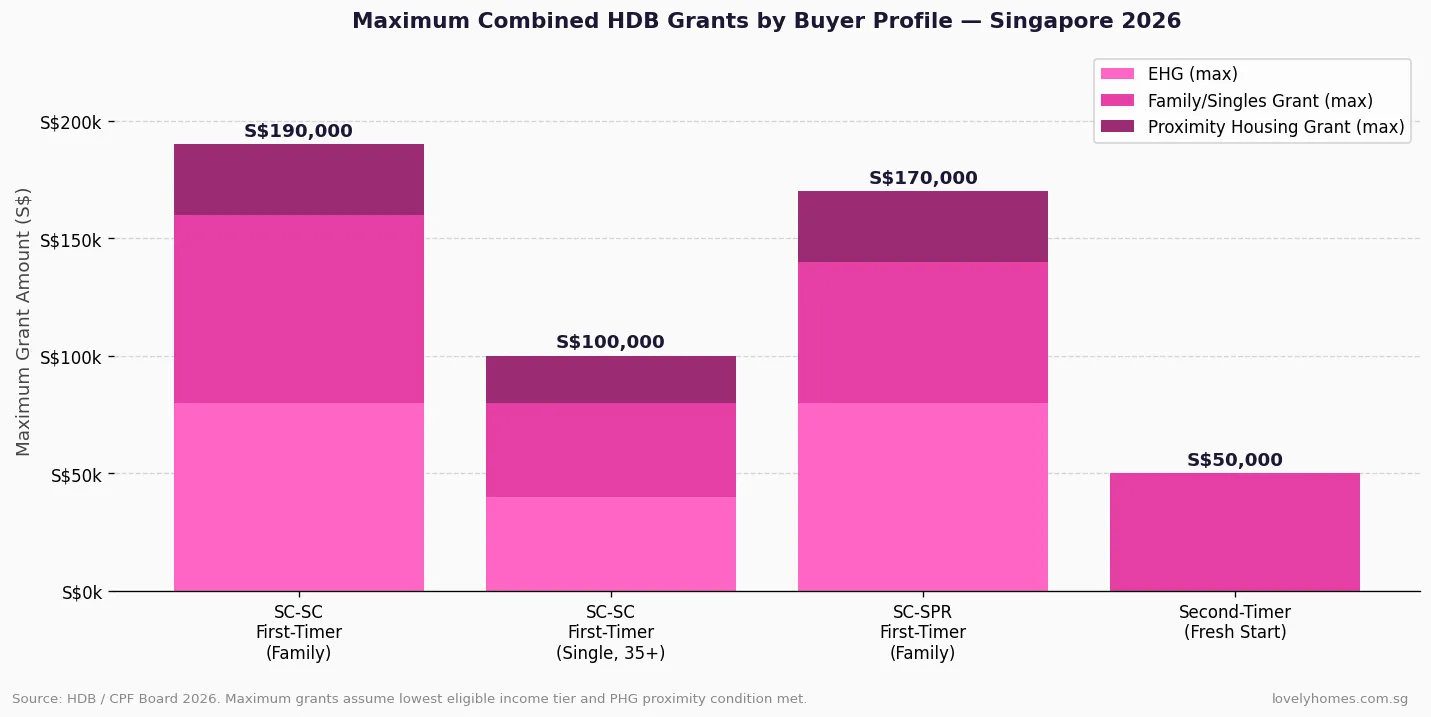
  • Grants available: EHG (up to S$120,000), Family Grant (up to S$50,000), Proximity Housing Grant (S$20,000–S$30,000), Singles Grant — subject to eligibility.
  • Minimum Occupation Period (MOP): sellers must have occupied the flat for the MOP (typically 5 years) before listing for resale. Prime and Plus flats have enhanced MOP rules.
  • Ethnic Integration Policy (EIP): buyers must ensure the resale does not breach HDB’s EIP quota for the block and neighbourhood before exercising the OTP.
  • HDB loan vs bank loan: HDB loan offers up to 80% LTV at the concessionary rate (2.6% p.a. as at 2026); bank loans offer up to 75% LTV but competitive variable rates.

What Is the HDB Resale Market?

HDB resale flats are Housing & Development Board flats that have completed their Minimum Occupation Period (MOP) and are being sold by existing flat owners on the open market — as opposed to new BTO (Build-To-Order) or SBF (Sale of Balance Flats) exercises directly from HDB. The resale market offers buyers immediate availability and greater locational choice than BTO exercises, but at higher prices and without the benefit of the new-flat purchase price.

As at the second quarter of 2026, the HDB resale market is active: the HDB regularly publishes resale transaction data showing strong demand across mature and non-mature estates alike. Understanding the resale procedure thoroughly — from the first portal registration through to the handover of keys — is essential for both buyers and sellers navigating this market.

The HDB Resale Portal (accessible via my.hdb.gov.sg with a Singpass login) is the single platform through which all HDB resale transactions are managed. Both buyers and sellers must use this portal, and all key milestones — Intent to Sell, Intent to Buy, resale application, valuation request, and approval confirmation — flow through it.

HDB resale 8-step process guide Singapore 2026

Figure 1: HDB resale transaction — 8 core steps from registration to completion. Source: HDB, LovelyHomes.

Step 1: Register Intent to Sell (Seller) and Intent to Buy (Buyer)

Sellers must register their Intent to Sell (ITS) on the HDB Resale Portal before marketing the flat. This registration is valid for 12 months and can be done at any time — there is no fee. Once the ITS is active, the portal generates an indicative valuation range, a list of financial planning requirements, and eligibility details including whether any co-owners need to be involved. Sellers cannot grant an OTP to a buyer before registering ITS.

Buyers register their Intent to Buy (ITB) on the portal. This is where eligibility checks are made: HDB verifies whether the buyer meets the citizenship and family nucleus requirements, whether the EIP quota is available at the target flat, and whether the buyer has a valid HDB Loan Eligibility (HLE) letter or a bank Approval In Principle (AIP). The ITB is also valid for 12 months.

Both registrations can be done concurrently — buyers and sellers do not need to find each other before registering. In practice, most buyers register ITB first (to get their finances ready) before actively searching for a flat.

Step 2: Secure Financing — HLE Letter or Bank AIP

Before proceeding to the OTP stage, buyers must have their financing in place. There are two routes:

Feature HDB Concessionary Loan Bank Loan
Maximum LTV 80% of lower of valuation/price 75% of lower of valuation/price
Interest rate (2026) 2.6% p.a. (pegged to CPF OA rate + 0.1%) Variable; fixed/floating packages from ~2.5%–3.8% p.a.
MSR limit 30% of gross monthly household income 30% of gross monthly household income (HDB flats)
TDSR 55% (applies in conjunction with MSR) 55%
Cash down payment Minimum 20% (CPF OA can cover) Minimum 25% (5% must be in cash)
Eligibility SC/SC or SC/SPR households; income ceiling S$14,000/mth All eligible flat buyers
Prepayment penalty None Depends on package (typically 1.5% for fixed-rate packages)

A HDB Loan Eligibility (HLE) letter must be obtained from HDB before the buyer can proceed if using an HDB loan. The HLE is valid for 6 months and must be renewed if it lapses before the OTP is exercised. For bank loans, an Approval In Principle (AIP) from the bank serves the equivalent role.

The Mortgage Servicing Ratio (MSR) cap of 30% of gross household income applies specifically to HDB flat purchases. This is more restrictive than the general TDSR of 55% — buyers with higher incomes buying higher-priced resale flats may find the MSR the binding constraint on their loan quantum.

Step 3: Negotiate Price and Grant the Option to Purchase (OTP)

Once buyer and seller agree on a price, the seller issues an Option to Purchase. The OTP is a legally binding option contract: the buyer pays an option fee (S$1 to S$1,000 at the seller’s discretion) in exchange for the right to purchase the flat at the agreed price within the OTP validity period.

The OTP validity period must be at least 7 calendar days and no more than 21 calendar days. This gives the buyer time to exercise the option (i.e., formally commit to buy) while providing a brief cooling-off window. A buyer who decides not to exercise the option forfeits the option fee but has no further obligation to proceed.

Key negotiating points at this stage include: whether the seller agrees to include any fittings (air-conditioners, kitchen cabinets, curtain tracks), the completion timeline, and the allocation of expenses such as property tax for the partial year. These should be documented in the OTP or in a separate Schedule of Fixtures.

Step 4: Exercise the Option to Purchase

To exercise the OTP, the buyer signs the OTP and pays the exercise fee (S$1 to S$5,000) to the seller. Once exercised, the transaction is legally binding on both parties — neither party can withdraw without facing legal consequences. The exercise fee forms part of the overall purchase price (i.e., it is not a separate cost on top of the agreed price).

Before exercising, the buyer should: (a) confirm the EIP quota is available (this can be checked on the HDB Resale Portal using the flat’s postal code), (b) confirm the flat’s resale levy status if upgrading from a subsidised flat, and (c) confirm the CPF and cash amounts needed for completion. Exercising the OTP without completing these checks can result in a failed transaction and forfeiture of the exercise fee.

HDB resale transaction timeline weeks end to end Singapore 2026

Figure 2: Typical HDB resale timeline — ~14 weeks end-to-end from registration to completion. The longest phase is HDB processing (5–8 weeks). Source: HDB, LovelyHomes.

Step 5: Submit Resale Application (Both Parties, Within 7 Days)

After the OTP is exercised, both the buyer and seller must each submit their respective halves of the resale application on the HDB Resale Portal within 7 days of the OTP exercise date. This is a strict requirement — failure by either party to submit within 7 days may cause the application to lapse and require the OTP to be re-issued.

The buyer’s application requires: confirmation of financing (HLE letter or bank AIP), CPF withdrawal details, grant applications (EHG, Family Grant, etc.), and SPR/citizenship verification. The seller’s application requires: confirmation of bank loan redemption details (if there is an outstanding mortgage), CPF refund instructions, and details of any co-owners.

HDB will send an SMS or email to both parties confirming receipt of the complete application and providing an estimated processing timeline.

Step 6: HDB Valuation and Financial Endorsement

For buyers using an HDB concessionary loan, HDB commissions an official valuation of the flat. This valuation determines the loan quantum and the maximum CPF amount that may be used — the LTV ceiling is applied against whichever is lower, the agreed price or the HDB valuation. If the agreed price exceeds the HDB valuation (i.e., there is a Cash-Over-Valuation, or COV), the excess must be paid entirely in cash — CPF cannot be used for COV.

Cash-Over-Valuation became a significant market dynamic in the 2021–2023 resale boom, when median COV for 4-room resale flats in mature estates reached S$30,000–S$60,000. In a more moderate 2026 market, COV remains common in sought-after areas (central districts, near MRT) but has compressed from peak levels.

For bank loan buyers, the bank conducts its own valuation for lending purposes. The buyer should discuss the valuation outcome with the bank’s mortgage specialist before endorsing the financial plan.

Step 7: Resale Approval by HDB

HDB processes the resale application and checks that all eligibility conditions are met: flat ownership rules, EIP compliance, income ceiling (for grants), CPF withdrawal limits, MOP completion, and resale levy (if applicable for second-subsidised-flat buyers). Processing typically takes 5–8 weeks from the complete application date.

HDB notifies both buyer and seller by SMS and email once the resale is approved in principle and a completion appointment is set. At this stage, the conveyancing lawyers for both parties also receive documents to prepare for the transfer of title at completion.

Step 8: Completion Appointment at HDB Hub

The final step is the completion appointment, held at HDB Hub in Toa Payoh (or virtually for eligible straightforward cases). At this appointment:

  • Buyer and seller (or their lawyers) sign the Transfer Deed transferring ownership.
  • CPF refunds to the seller’s CPF OA account are processed (CPF monies used toward the original flat purchase must be returned with accrued interest).
  • The sale proceeds (net of CPF refund, outstanding mortgage redemption, and any resale levy) are disbursed to the seller.
  • Stamp duties (BSD, and ABSD if applicable) are confirmed as paid.
  • Keys are handed over, and the buyer takes possession of the flat.

The entire process from OTP exercise to completion typically takes 8–12 weeks, though complex cases (outstanding mortgage redemptions, CPF disputes, estate matters) may take longer.

HDB resale buyer upfront cost breakdown Singapore S$550,000 flat 2026

Figure 3: Typical upfront costs for a buyer of a S$550,000 4-room HDB resale flat — excluding grants and CPF housing schemes. Source: HDB, IRAS, LovelyHomes calculations.

HDB Resale Grants: Reducing Your Out-of-Pocket Cost

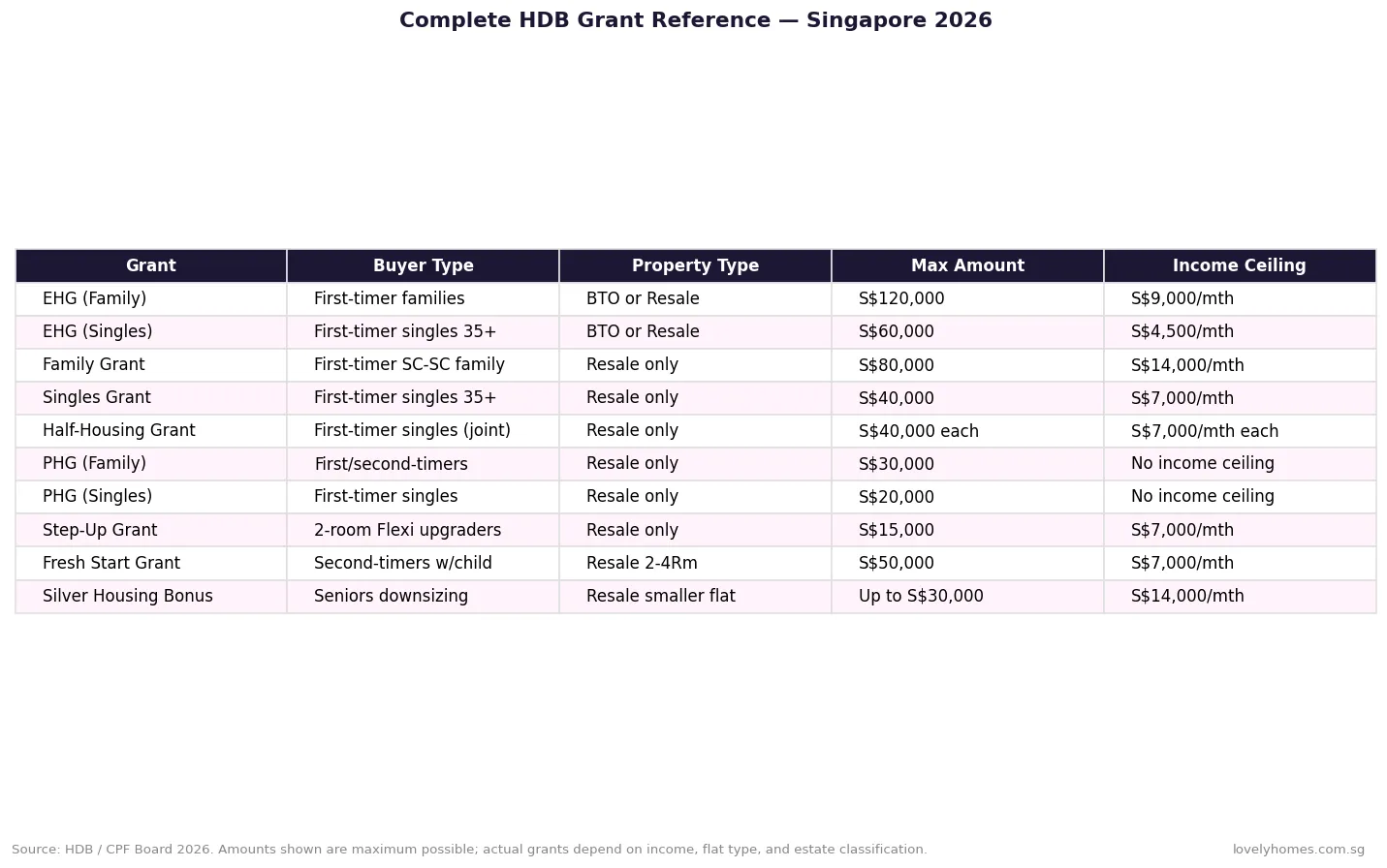
Eligible first-timer buyers of HDB resale flats may receive substantial CPF grants from HDB to reduce the effective purchase price. The main grants in 2026 are:

Grant Maximum Amount Key Eligibility Conditions
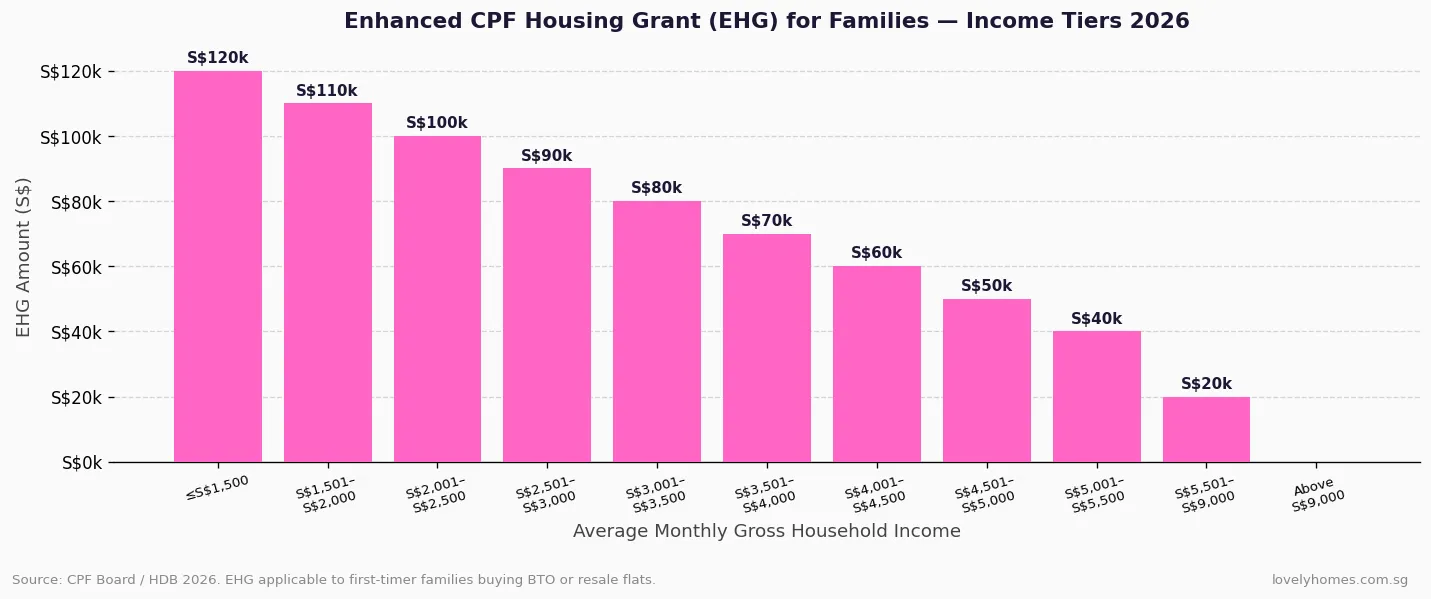
Enhanced CPF Housing Grant (EHG) S$120,000 (families); S$60,000 (singles) At least one first-timer applicant; monthly household income ≤ S$9,000 (families) or ≤ S$4,500 (singles); must buy flat that meets income-tiered price ceiling
Family Grant S$50,000 (SC/SC, 4-room and smaller); S$40,000 (SC/SC, 5-room and larger) At least one SC applicant; first-timer buying with SC or SPR spouse/fiancé; income ≤ S$14,000/mth
Half-Housing Grant S$25,000 (4-room and smaller); S$20,000 (5-room and larger) One first-timer, one second-timer applicant in the same household
Proximity Housing Grant (PHG) S$30,000 (moving to be near parents/children within 4km) SC or PR; living within 4km or in the same town as parents or married child; conditions apply
Singles Grant S$40,000 (SC, 4-room and smaller); S$25,000 (SC, 5-room and larger) Singapore Citizen aged 35+; first-timer single; resale flat only; income ≤ S$7,000/mth

Grants are disbursed directly by HDB into the buyer’s CPF OA account and can only be used toward the flat purchase — they cannot be withdrawn as cash. Buyers who receive grants are subject to a resale grant clawback if they sell the flat within 5 years of the grant. Planning the long-term holding horizon is therefore important when maximising grants.

Worked Example: Mr and Mrs Tan’s First HDB Resale Flat

Case Study — 4-room Jurong West Resale, S$550,000

Profile: Mr Tan (SC, 29) and Mrs Tan (SC, 28), first-timer household, combined gross income S$7,500/mth, no existing property.

Target flat: 4-room HDB resale in Jurong West (District 22), agreed price S$550,000. HDB valuation: S$545,000. COV = S$5,000 (to be paid in cash).

Grants:

  • EHG: income S$7,500/mth → S$55,000 (income band S$7,001–S$8,000 for families)
  • Family Grant (SC/SC, 4-room): S$50,000
  • Total grants: S$105,000 — credited to CPF OA

Effective purchase cost after grants: S$550,000 − S$105,000 = S$445,000

Financing: HDB loan at 80% of S$545,000 (valuation) = S$436,000 maximum; MSR check: S$436,000 at 2.6% over 25 years ≈ S$1,982/mth. MSR = 30% × S$7,500 = S$2,250. S$1,982 ≤ S$2,250 → MSR PASS.

Upfront cash/CPF needed (excluding grants):

  • Down payment (20% of S$545,000 valuation): S$109,000 — payable from CPF OA or cash
  • COV: S$5,000 — must be cash (cannot use CPF for COV)
  • BSD: (S$180k×1%) + (S$180k×2%) + (S$190k×3%) = S$1,800 + S$3,600 + S$5,700 = S$11,100 (payable via CPF OA)
  • Legal fees (buyer’s conveyancing): ~S$2,500
  • OTP option fee (non-refundable): up to S$1,000
  • Total cash minimum: ~S$8,500 (COV + legal + option fee)
  • CPF OA used: ~S$109,000 + S$11,100 = S$120,100 (offset by S$105,000 grants → net CPF outflow ~S$15,100 if grants insufficient; actual depends on existing CPF OA balance)

This illustrates why first-timer couples with combined income around S$7,500/mth can often purchase a resale 4-room flat in a non-mature estate with relatively modest cash upfront, provided grants are maximised.

What This Means for Buyers and Sellers in 2026

The HDB resale market in mid-2026 is characterised by solid but moderating demand. With the BTO backlog largely cleared and significant new flat supply coming onstream, buyers have more choices than in the 2021–2022 peak. Resale prices in non-mature estates such as Jurong West, Woodlands, and Sengkang have stabilised or softened modestly, while mature estates — particularly those near Thomson-East Coast Line (TEL) stations — continue to command premiums.

For sellers, the 14-week timeline to completion means planning is critical, especially if the sale proceeds are needed to fund a new home purchase. Sellers should align OTP issuance with their own housing timeline to avoid a gap period. Where a new purchase is concurrent, engaging a conveyancing lawyer who can coordinate both transactions is strongly recommended.

For buyers, the combination of a higher-priced resale market and HDB’s 80% LTV cap means the absolute cash and CPF commitment is substantial. Maximising eligible grants — particularly the EHG and Family Grant — is the single most effective way to reduce upfront costs. Buyers should apply for the HLE letter well in advance and factor in the COV risk for popular precincts.

What Might Come Next

The following is analytical commentary based on publicly available signals — not official guidance.

HDB’s June 2026 BTO exercise produced 6,952 flats across 7 projects, with the Prime-classified Berlayar Rise (Bukit Merah) oversubscribed at 4.5× and Lakeview Cascadia (Bishan) at 4.7×. The continued strong demand for Prime and Plus flats signals that buyers remain willing to accept the enhanced MOP and clawback conditions for well-located flats. Over the medium term, as these new Prime/Plus flats reach their MOP in the early 2030s, they will add an entirely new tier of resale transactions subject to the Prime/Plus resale conditions — including clawback on subsidy.

HDB has signalled it will continue to release BTO supply at elevated levels to address the demand backlog. As supply catches up with demand over 2026–2028, resale prices — particularly in non-mature estates — are expected to moderate gradually. Buyers with a long-term horizon and flexibility on location have a strengthening case to wait for upcoming BTO exercises, while those needing immediate occupation continue to turn to the resale market.

Frequently Asked Questions

Can I buy an HDB resale flat without an HLE letter?

Yes — if you are using a bank loan rather than an HDB concessionary loan, you do not need an HLE letter. You would instead provide your bank’s Approval In Principle (AIP) letter as part of the resale application. However, you will need to have registered your Intent to Buy on the HDB Resale Portal and confirmed your financing method before the OTP is issued. If you wish to switch from a bank loan to an HDB loan at any point before completion, you would need to obtain an HLE letter at that stage — switching mid-way can delay the completion timeline.

What is Cash-Over-Valuation (COV) and how does it affect my purchase?

Cash-Over-Valuation (COV) is the difference between the agreed resale price and the HDB or bank valuation of the flat, when the agreed price is higher than the valuation. Because CPF and HDB loan proceeds are capped at a percentage of the lower of the valuation or the agreed price, any COV must be paid entirely in cash. For example, if the agreed price is S$680,000 but HDB’s valuation is S$650,000, the S$30,000 COV must be paid in cash. Buyers should budget for COV when purchasing in popular precincts where demand regularly pushes prices above HDB’s assessed value — checking recent transaction prices on the HDB website before negotiating helps set realistic expectations.

What happens if the HDB resale application lapses?

An HDB resale application lapses if both parties do not submit within 7 days of the OTP exercise, or if required documents are not provided within HDB’s stipulated timeframe. A lapsed application means the transaction does not proceed; the seller is not obligated to return the option fee and exercise fee, and both parties may face legal liability depending on which party caused the lapse. To prevent this, ensure both parties understand the 7-day submission window, and engage conveyancing lawyers before the OTP is exercised — they can guide both parties through the submission process efficiently.

How long does a seller have to vacate the flat after completion?

The transfer of possession happens at the completion appointment. From the completion date, the seller is typically required to vacate the flat immediately or within a very short grace period agreed in the OTP. In practice, seller and buyer may negotiate a short leaseback arrangement (where the seller continues to occupy for a few weeks post-completion as a tenant) if both parties agree and the terms are documented. Such arrangements must be disclosed to HDB as they may affect certain ownership rules. The flat must be vacant and in the agreed condition (with agreed fittings left in place) by the agreed possession date.

Can a Singapore Permanent Resident (SPR) buy an HDB resale flat?

Yes, Singapore Permanent Residents may purchase HDB resale flats — but with important restrictions. An SPR cannot buy an HDB resale flat alone; they must purchase with an SC spouse, child, or parent (i.e., the household must include at least one SC under the family scheme). SPRs applying under the Non-Citizen Spouse Scheme or the Non-Citizen Family Scheme with at least one SC member can proceed. Fully SPR households (no SC member) cannot buy HDB resale flats. SPRs also pay ABSD on the resale purchase (5% for an SPR purchasing a first residential property), while SCs buying their first residential property pay no ABSD.

What is the Resale Levy and when does it apply?

The HDB Resale Levy is a levy payable by second-timer buyers — those who have previously purchased a subsidised HDB flat (BTO, DBSS, or bought a resale flat with CPF housing grants) and now wish to purchase a second subsidised flat. The levy ranges from S$15,000 (2-room) to S$55,000 (5-room), must be paid in cash (not CPF), and is deducted from the sale proceeds of the first flat if the first flat is sold to HDB. The resale levy applies regardless of whether the second purchase is a BTO or a resale flat purchased with grants. Detailed levy amounts by flat type are covered in our dedicated HDB Resale Levy guide.

Do I need a lawyer for an HDB resale transaction?

Yes. Both buyer and seller in an HDB resale transaction are required to engage licensed conveyancing lawyers to represent their respective interests. Lawyers handle the OTP preparation and review, HDB portal submissions, CPF withdrawal applications, BSD and ABSD stamping, title transfer documentation, and coordination with the seller’s bank (for mortgage redemption). HDB maintains a list of conveyancing law firms and recommended panels for HDB transactions. Legal fees for an HDB resale transaction typically range from S$1,800 to S$3,000 for standard cases.

Related Articles

Disclaimer

This article is for general informational purposes only and does not constitute legal, financial, or housing advice. HDB resale eligibility criteria, grant amounts, interest rates, MOP requirements, and administrative procedures are set by the Housing & Development Board (HDB), IRAS, and the CPF Board and may change without prior notice. Readers should refer to official sources — www.hdb.gov.sg, www.iras.gov.sg, and www.cpf.gov.sg — for authoritative and up-to-date information. Before any property transaction, consult a licensed conveyancing solicitor and a qualified financial adviser.

Seller’s Stamp Duty Singapore 2026: Complete Guide to SSD Rates, Holding Periods & Exemptions

Seller’s Stamp Duty Singapore 2026: Complete Guide to SSD Rates, Holding Periods & Exemptions

Quick Answer: Singapore SSD at a Glance

  • What is SSD? Seller’s Stamp Duty is a tax charged by IRAS when you sell a residential property within 3 years of buying it.
  • Current rates (properties purchased on/after 11 March 2017): Year 1 = 12%, Year 2 = 8%, Year 3 = 4%, after 3 years = Nil.
  • Calculated on: the higher of the sale price or market value — you cannot avoid SSD by under-declaring the price.
  • Who pays: the seller, not the buyer. SSD must be paid within 14 days of the sale contract date.
  • Commercial and industrial property: separate SSD rates apply; commercial property currently has no SSD.
  • Key exemptions: death of owner, divorce court order, en-bloc collective sale, HDB upgrading exercises, certain government acquisition.
  • Industrial SSD: 15%/10%/5% for Years 1/2/3 (effective 11 March 2023 for industrial properties).
  • Why it exists: introduced to curb short-term speculative “flipping” and protect housing market stability.

What Is Seller’s Stamp Duty (SSD)?

Seller’s Stamp Duty (SSD) is a stamp duty levied by the Inland Revenue Authority of Singapore (IRAS) on sellers who dispose of residential properties within a specified holding period after purchase. Unlike Buyer’s Stamp Duty (BSD) and Additional Buyer’s Stamp Duty (ABSD) — which the buyer pays on acquisition — SSD falls entirely on the seller. It is part of Singapore’s suite of property market stabilisation measures, designed to discourage speculative short-term trading that can inflate prices and reduce affordability for genuine owner-occupiers.

SSD applies to residential properties only: HDB flats, private condominiums, executive condominiums (ECs), terraced houses, semi-detached houses, and bungalows all fall within scope. Commercial shophouses, offices, industrial buildings, and strata retail units are treated separately under the industrial-property SSD framework introduced in 2011 and last updated in March 2023.

The Ministry of Finance (MOF) and IRAS jointly administer SSD policy. Rates and holding-period windows have been adjusted several times since SSD was first introduced on 20 February 2010, and understanding which era applies to a given transaction is critical — sellers who purchased property at different points in time face materially different SSD exposure.

Singapore residential SSD rates 2026 by year of sale bar chart

Figure 1: Residential SSD rates 2026 — properties purchased on/after 11 March 2017. Source: IRAS.

SSD Rate History: How the Rules Have Evolved

Singapore’s SSD has been tightened and loosened in tandem with each property market cycle. Understanding the history is essential because the era in which a property was purchased determines the applicable rate schedule — these do not update retrospectively.

February 2010 — SSD introduced. A flat 1% SSD was applied on residential properties sold within one year of purchase. This was a modest initial measure aimed at checking the most acute short-term flipping.

August 2010 — First tightening. The holding period was extended to 3 years and rates were raised: Year 1 = 3%, Year 2 = 2%, Year 3 = 1%. The government wanted to extend the disincentive horizon.

January 2011 — Major escalation. Rates jumped sharply: Year 1 = 16%, Year 2 = 12%, Year 3 = 8%, Year 4 = 4% (holding period extended to 4 years). This era lasted until March 2017.

March 2017 — Current framework. The 4-year window was trimmed to 3 years and top rates were reduced: Year 1 = 12%, Year 2 = 8%, Year 3 = 4%. This partial easing recognised the market had cooled following the 2013–2015 cooling measures. Properties purchased on/after 11 March 2017 fall under this framework.

The April 2023 cooling measures — which raised ABSD substantially for second-property buyers and foreigners — did not change residential SSD rates. Industrial property SSD was separately restructured in March 2023 to align more closely with the residential framework.

SSD cooling measure eras comparison 2011 versus 2017 reform total exposure

Figure 2: SSD eras — the 2017 reform shortened the holding window from 4 to 3 years and reduced the cumulative rate burden. Source: IRAS, MOF.

Current SSD Rates in Detail (2026)

For any residential property purchased on or after 11 March 2017, the SSD rates are as follows:

Year of Sale Holding Period at Sale SSD Rate Example (S$1.2M property)
Year 1 Sold within 12 months of purchase 12% S$144,000
Year 2 Sold in months 13–24 8% S$96,000
Year 3 Sold in months 25–36 4% S$48,000
After Year 3 Sold after 36 months Nil S$0

The SSD is calculated on whichever is higher — the agreed sale consideration or the property’s open market value as assessed by IRAS. This prevents artificial under-pricing of transactions between related parties.

The “year” is counted from the date of purchase (specifically, the date of the Sale and Purchase Agreement, or the date of the Option to Purchase if exercised). A property bought on 1 April 2024 sold on 31 March 2025 is in Year 1; sold on 2 April 2025, it enters Year 2. Getting the date calculation right — down to the day — materially affects the tax bill.

Payment of SSD is due within 14 days of the date of the contract to sell (or date of transfer if there is no formal contract). Late payment attracts penalties and interest charges from IRAS.

What Is SSD Calculated On?

SSD is assessed on the higher of: (a) the actual sale price agreed between buyer and seller, or (b) the open market value of the property as determined by IRAS at the time of sale. The practical effect is that artificially depressed selling prices do not reduce SSD liability — IRAS will use market value instead.

For most arm’s-length market transactions, the sale price is the market value, so there is no difference. However, where a property is sold between related parties (family members, or a company to a director), IRAS typically commissions its own valuation to verify. Sellers should obtain an independent valuation before transacting in such circumstances to avoid a surprise SSD reassessment.

In cases where the property is partially gifted (e.g., the seller receives S$500,000 for a property worth S$1M, with the remainder as a gift), IRAS treats the full market value of S$1M as the basis for SSD — the gift portion does not reduce the SSD calculation.

Singapore SSD payable in dollars by property price and year of sale 2026

Figure 3: SSD payable in absolute S$ terms across three price points — the tax is substantial in Years 1 and 2 even at moderate property values. Source: IRAS, LovelyHomes calculations.

Key SSD Exemptions

Not every sale within the 3-year window triggers SSD. IRAS recognises a set of circumstances where requiring SSD would be inequitable. The main exemptions are:

Exemption Conditions Who to Apply To
Death of owner Property is transferred to the estate or beneficiaries following the owner’s death IRAS (estate executor applies)
Divorce / separation order Property is transferred pursuant to a court order in divorce or separation proceedings IRAS with supporting court order
En-bloc / collective sale Property sold as part of an en-bloc (collective sale) exercised under the Land Titles (Strata) Act Automatically exempted by IRAS on production of the collective sale order
Compulsory acquisition Land or property compulsorily acquired by the government under the Land Acquisition Act IRAS notified by acquiring authority
HDB upgrading / SERS HDB flat acquired by HDB under SERS (Selective En-bloc Redevelopment Scheme) or similar exercises HDB administers; automatic
Certain matrimonial transfers Transfer to or from a spouse during the course of marriage (not divorce) — partial relief only; specific conditions apply IRAS advance ruling recommended

Notably, financial hardship is not an automatic SSD exemption. If a seller must sell early due to retrenchment or mortgage default, SSD still applies unless one of the listed exemptions is met. Sellers in distress should consult a property lawyer to explore whether any exemption is available before proceeding with a sale.

Industrial Property SSD (2026)

A separate SSD framework covers industrial properties — factories, warehouses, light industrial space, and business parks. This framework was introduced in January 2013 and was significantly revised with effect from 11 March 2023, when the MOF extended the industrial SSD holding period to match the residential framework:

Year of Sale SSD Rate (Industrial) Applicable To
Year 1 15% Industrial properties purchased on/after 11 March 2023
Year 2 10%
Year 3 5%
After Year 3 Nil All industrial property purchases

Industrial SSD rates are notably higher than residential rates — the government treats speculative activity in industrial property with particular concern given its importance to business productivity. Commercial properties (offices, shophouses, retail units) currently attract no SSD in Singapore.

Worked Example: Calculating SSD Before You Sell

Case Study — Mr Tan’s D5 Condo

Background: Mr Tan (Singapore Citizen) purchased a 2-bedroom condo in the Buona Vista area for S$1,200,000 on 15 March 2024 (OTP date). His job changed and he needs to relocate; he accepts an offer of S$1,280,000 on 20 February 2026.

Holding period calculation:

  • Purchase date: 15 March 2024
  • Sale date: 20 February 2026
  • Duration: 23 months 5 days → Year 2 (13–24 months)

SSD computation:

  • Higher of sale price (S$1,280,000) vs market value — assume arm’s-length transaction so S$1,280,000 applies.
  • Year 2 rate: 8%
  • SSD payable: S$1,280,000 × 8% = S$102,400
  • SSD due within 14 days of 20 February 2026: by 6 March 2026.

What if Mr Tan waits until after 15 March 2027 (i.e., holds for more than 3 years)?

  • Assuming the property appreciates modestly to S$1,310,000 by March 2027.
  • SSD: Nil. He saves S$102,400 in SSD, in exchange for holding 13 more months.
  • Net gain from waiting: S$30,000 (appreciation) + S$102,400 (SSD saved) = S$132,400 — significant for a 13-month wait.

This illustrates why the 3-year SSD window is a powerful behavioural anchor: even a modest price gain can be outweighed by SSD in Year 2, making it economically rational to hold.

SSD vs ABSD: Understanding the Difference

SSD and ABSD are both stamp duties on residential property transactions, but they serve different purposes and fall on different parties:

Feature SSD ABSD
Who pays Seller Buyer
Purpose Curb short-term speculation / flipping Cool demand; differentiate by residency status and property count
Time-dependency Yes — decreases with holding period; zero after 3 years No — flat rate on acquisition, regardless of how long buyer intends to hold
Maximum rate (residential, 2026) 12% (Year 1) Up to 60% (foreigners, any residential property)
Administered by IRAS IRAS
Applies to Residential + industrial property Residential property only (different rates for SCs, PRs, foreigners)

A property transaction can involve both SSD (payable by the seller) and ABSD (payable by the buyer) simultaneously. For example, a seller disposing of a condo within Year 2 of ownership (SSD: 8%) sells to a foreigner (ABSD: 60%). The total stamp-duty burden across both parties at a S$1.5M price point: seller pays S$120,000 SSD; buyer pays S$900,000 ABSD. These are legally separate obligations borne by separate parties, though in practice the combined tax burden may influence the negotiated sale price.

What Does This Mean for Property Sellers in 2026?

With residential property prices having risen materially since 2020, and with SSD remaining at its post-2017 structure through 2026, there are several practical implications for sellers:

First, the 3-year holding period is a real constraint. Sellers who purchased a resale condo in mid-2024 at the market peak may find that selling in mid-2026 still attracts 8% SSD on a potentially lower sale price — a double adverse outcome. Patience past the 3-year mark is financially rational for most sellers who are not under financial duress.

Second, en-bloc candidates require careful SSD analysis. If a strata development proceeds to collective sale, individual unit owners may have purchased at different points in time. Those who bought within 3 years of the en-bloc completion are SSD-exempt under the collective sale exemption, but only if the sale is completed (not merely approved) within the relevant window.

Third, gifting property to family members does not avoid SSD. If a parent bought a condominium in 2024 and attempts to transfer it to an adult child in 2025 as a gift, IRAS will still assess SSD on the market value at the time of transfer. The gift exemption does not extend to SSD (unlike some other jurisdictions).

What Might Come Next for Singapore SSD?

The following section represents analytical commentary based on publicly available signals — it is not government guidance.

As at July 2026, there has been no announcement of changes to the residential SSD framework. The market remains broadly stable: URA’s Q2 2026 flash estimate shows the private residential price index rose just 0.5% quarter-on-quarter, decelerating from 0.9% in Q1 2026. This suggests the government sees no immediate need to further tighten the SSD framework to address speculative activity.

Were prices to accelerate sharply — driven by strong en-masse foreign demand or a sudden speculative upcycle — the government’s historical playbook (most recently demonstrated in April 2023) suggests it would first deploy ABSD increases or LTV tightening before revisiting SSD, which is a blunter instrument.

A possible policy evolution that industry observers have discussed is the introduction of a sliding-scale SSD that integrates with ABSD and BSD into a unified transaction-tax framework. As yet, this has not been mooted officially. The current three-lever approach (SSD + BSD + ABSD) remains the operative framework for the foreseeable future.

Frequently Asked Questions

Do I pay SSD on an HDB flat?

Yes. SSD applies to HDB flats in exactly the same way as private residential properties. If you sell your HDB flat within 3 years of the date of purchase (or the date of the Temporary Occupation Permit for new BTO flats), you are liable for SSD at 12%/8%/4% for Years 1/2/3 respectively. However, if HDB compulsorily acquires your flat under SERS or similar exercises, you are exempt. Note that HDB’s own Minimum Occupation Period (MOP) of 5 years means most HDB sellers are already beyond the SSD window before they are even eligible to sell on the open market — so SSD is rarely an issue in practice for standard HDB resale transactions.

I am selling a property bought in 2012 — which SSD rates apply?

Any property purchased between 14 January 2011 and 10 March 2017 is subject to the then-current framework: a 4-year holding period with rates of 16%/12%/8%/4% for Years 1/2/3/4 respectively. However, if you purchased in 2012 and are selling in 2026, you have well exceeded the 4-year window — SSD is Nil. Only sellers who purchased in the 2012–2022 period and sold promptly would have faced these older rates. As at 2026, all pre-2017 purchase dates are beyond their respective SSD windows.

Can I get SSD remission if I am retrenched and cannot afford the mortgage?

Financial hardship is not a legislated SSD exemption in Singapore. Unlike some other countries that allow compassionate remissions, IRAS currently provides no general hardship exemption for SSD. If you are facing forced sale due to retrenchment, medical emergency, or financial difficulty, you should consult a property lawyer to determine whether any of the specific exemptions (e.g., divorce, death) apply to your situation. You may also consider requesting a payment plan from IRAS, though SSD is not automatically deferred. Engaging a lawyer before signing any sale contract is strongly recommended if SSD will create a significant financial burden.

How is SSD paid — is it deducted from sale proceeds automatically?

SSD is not automatically deducted. It is the seller’s legal obligation to file and pay the SSD to IRAS within 14 days of the date of the contract of sale (typically the date on which the buyer exercises the Option to Purchase). The conveyancing lawyer acting for the seller will typically compute the SSD, prepare the stamping documents, and arrange payment from the sale proceeds at completion. The SSD amount is effectively deducted from the sale proceeds at the point of legal completion, coordinated by the seller’s solicitor. You should ensure your conveyancing lawyer calculates SSD correctly and builds it into the net proceeds computation before you commit to a sale price.

Does SSD apply to properties held under a company or trust?

Yes. SSD applies to corporate entities and trusts that hold residential property in the same way as it applies to individual sellers. A company or trust that purchased a residential property in 2024 and sells it in 2025 is liable for 12% SSD on the higher of sale consideration or market value. This is relevant for family investment holding companies and real estate investment structures. There is no corporate exemption from SSD; entities are treated on the same basis as individual owners for the purposes of the holding-period calculation.

What is the difference between the SSD “Year 1” calculation for a property bought on 1 April 2024?

Year 1 SSD applies when the property is sold within the first 12 calendar months from the date of purchase. For a property bought on 1 April 2024 (using the date of the signed Option to Purchase as the purchase date), Year 1 ends on 31 March 2025. A sale contract signed on 31 March 2025 falls in Year 1 (12% SSD); one signed on 1 April 2025 enters Year 2 (8% SSD). The difference of a single day can reduce SSD liability at S$1.5M from S$180,000 to S$120,000 — a saving of S$60,000. Sellers should confirm the exact purchase date and holding-period boundary with their conveyancing lawyer before signing the Option to Purchase for the sale.

Does SSD apply if I am selling to my own company?

Yes. Selling a property to a related company — including one you own or control — does not exempt the transaction from SSD. IRAS looks through related-party arrangements and will assess SSD on the open market value if the agreed consideration is below market. Where you sell a property to your company within 3 years of purchase, SSD applies at the full market value. This is a common trap in restructuring transactions: what looks like an internal reorganisation from a commercial perspective is still a taxable disposal for SSD purposes.

Related Articles

Disclaimer

This article is for general informational purposes only and does not constitute tax, legal, or financial advice. SSD rates, exemptions, and administrative procedures are set by the Inland Revenue Authority of Singapore (IRAS) and the Ministry of Finance (MOF) and may change without prior notice. Readers should refer to the official IRAS website (www.iras.gov.sg) and the Stamp Duties Act for authoritative information. Before entering into any property transaction, you are strongly encouraged to seek independent advice from a licensed conveyancing solicitor and a qualified financial adviser.

HDB 2-Room Flexi Flat Singapore 2026: Complete Guide for Singles and Seniors

HDB 2-Room Flexi Flat Singapore 2026: Complete Guide for Singles and Seniors

Quick Answer — HDB 2-Room Flexi Flat at a Glance

  • What it is: A compact HDB flat type (approx. 36–45 sqm) with flexible lease options, designed for seniors aged 55 and above or eligible singles aged 35 and above.
  • Lease flexibility: Seniors may choose a short lease of 15, 20, 25, 30, 35, 40 or 45 years; singles and couples buy on the standard 99-year lease.
  • BTO price range: From approximately S$45,000 (senior, 15-year lease, non-mature estate) to S$140,000 (single, 99-year lease, non-mature estate BTO). Resale 2-room flats are priced by the open market.
  • Who can buy: SC singles (35+), SC/SPR couples where at least one is SC, and SC households aged 55+ (short-lease sub-type).
  • Income ceiling: S$7,000/mth for singles; S$14,000/mth for households.
  • Grants available: Enhanced Housing Grant (EHG) up to S$80,000 for eligible first-timers; Proximity Housing Grant (PHG) up to S$30,000 for resale buyers near family.
  • CPF usage: CPF Ordinary Account savings may be used for downpayment and monthly instalments, subject to CPF withdrawal limits and the flat’s remaining lease covering the youngest buyer to age 95.
  • MOP: Standard 5 years for regular 2-room Flexi flats; subletting of the whole flat is not allowed during MOP.
  • Resale restriction: Short-lease flats (below 99 years) may only be sold back to HDB — they are not on the open resale market.
  • Key regulator: All 2-Room Flexi applications are managed by the Housing & Development Board (HDB) at hdb.gov.sg.

What Is the HDB 2-Room Flexi Flat?

The HDB 2-Room Flexi flat is a purpose-designed public housing type introduced in 2015 to replace the earlier 2-room flat. Measuring between 36 and 45 square metres, it is the smallest flat type offered in Singapore’s public housing system. The “Flexi” in its name refers to the scheme’s most distinctive feature: eligible buyers aged 55 and above may opt for a short, right-sized lease rather than committing to the standard 99-year term.

The 2-Room Flexi was designed primarily in response to Singapore’s rapidly ageing population and the Government’s broader policy aim of allowing seniors to right-size their housing expenditure. A senior who no longer needs a large flat — or who wishes to monetise equity from an existing property — can purchase a short-lease 2-Room Flexi for a fraction of the cost of a standard flat, freeing up capital for retirement while remaining in the public housing ecosystem.

At the same time, the scheme remains open to younger singles aged 35 and above on a 99-year lease basis, giving unmarried Singaporeans their first route to public homeownership without the need to form a household with another person. This makes the 2-Room Flexi structurally significant as the only HDB flat type that a single Singaporean citizen aged 35 or above may purchase directly from HDB in a Build-To-Order (BTO) exercise.

HDB 2-Room Flexi BTO prices by lease option 2026 bar chart
Figure 1: HDB 2-Room Flexi BTO Indicative Prices by Lease Option (2026). Prices are for non-mature estate BTO exercises and will vary by project location, storey and prevailing grant deductions. Source: HDB.

Two Sub-Types of the 2-Room Flexi Flat

The 2-Room Flexi scheme comprises two distinct sub-types, which differ fundamentally in lease term, eligible buyers and exit options:

Feature Standard Lease (99yr) Short Lease (15–45yr)
Who may apply SC singles (35+), SC/SPR couples SC households aged 55+
Lease term 99 years (from land grant) 15, 20, 25, 30, 35, 40 or 45 years (buyer’s choice)
Indicative BTO price From ~S$138,000 (non-mature) From ~S$45,000 (15yr, non-mature)
CPF usage Yes, subject to lease-CPF rules Yes, subject to lease-CPF rules
Resale on open market Yes, after 5-year MOP No — must be sold back to HDB
Subletting (whole flat) After MOP, with HDB approval Not permitted
Key grant available EHG (up to S$80k), PHG Silver Housing Bonus (SHB)

Short-lease buyers should note the critical exit restriction: unlike standard 99-year flats, a flat purchased on a short lease cannot be sold on the open resale market after the MOP. Instead, it must be returned to HDB at the end of the chosen lease term (the flat effectively reverts to HDB), or it may be sold back to HDB before lease expiry if the owner wishes to exit early. This means short-lease 2-Room Flexi flats carry zero capital appreciation potential and are explicitly designed as consumption housing rather than investment assets.

Eligibility — Who Qualifies?

The Housing & Development Board (HDB) sets out clear eligibility conditions for the 2-Room Flexi scheme. As at 2026, the key criteria are:

HDB 2-Room Flexi eligibility matrix 2026
Figure 2: HDB 2-Room Flexi Eligibility Matrix (2026). Sources: HDB, CPF Board. Conditions are subject to change; verify at hdb.gov.sg before applying.

For the Standard 99-Year Lease (Singles and Couples)

  • Citizenship: At least one applicant must be a Singapore Citizen. SPR singles may not apply for a BTO 2-Room Flexi; they may only purchase on the resale market.
  • Age: At least 35 years of age for singles; standard family nucleus formation rules apply for couples (21 years and above).
  • Income ceiling: Gross monthly household income must not exceed S$7,000 for singles or S$14,000 for households (combined all income sources).
  • Property ownership restriction: Applicants must not own or have disposed of any private residential property (local or overseas) within the 30 months preceding application.
  • Existing HDB flat: Singles who currently own an HDB flat and are applying as first-time applicants may still be eligible, subject to conditions regarding the sale of the existing flat.

For the Short Lease (Seniors Aged 55+)

  • Citizenship: Singapore Citizens only.
  • Age: All applicants must be aged 55 or above at point of application.
  • Chosen lease term: The lease selected must cover the youngest applicant to at least age 95. For a 55-year-old, the minimum viable lease is therefore 40 years (55 + 40 = 95). HDB enforces this as a hard minimum.
  • Income ceiling: S$14,000/mth household (same as standard). No income ceiling applies if buyers intend to monetise their flat through the Silver Housing Bonus (SHB) scheme.
  • Existing property: Senior applicants may proceed even if they currently own an HDB flat, provided they commit to selling the existing flat (or subletting where applicable) within a prescribed period after collecting keys.

CPF Usage and Loan Mechanics

CPF Ordinary Account (OA) savings may be used to fund both the downpayment and monthly loan repayments for 2-Room Flexi purchases, subject to the CPF lease coverage requirement: the flat’s remaining lease must be able to cover the youngest buyer to age 95 for full CPF usage to be available.

For a 99-year BTO flat, this is rarely a constraint for applicants under 60. For short-lease buyers, the arithmetic matters. A 60-year-old buying a 35-year lease flat (lease ends when buyer is 95) meets the threshold exactly, allowing full CPF usage. A 60-year-old buying a 30-year lease (expires at 90) does not meet the threshold and will face CPF withdrawal limits, meaning more cash is required for the purchase.

The HDB Concessionary Loan at 2.60% per annum is available for eligible buyers of 2-Room Flexi flats, subject to the standard HLE (HDB Loan Eligibility) letter application and the Mortgage Servicing Ratio (MSR) test: monthly repayments must not exceed 30% of gross monthly household income.

Grants Available for 2-Room Flexi Buyers

Grant Who It Applies To Maximum Amount Eligibility Condition
Enhanced Housing Grant (EHG) First-timer SC buying BTO or resale S$80,000 (individual) / S$160,000 (family) Income ≤ S$9,000/mth; continuous employment ≥12 months
Family Grant SC/SC or SC/SPR couples, resale S$50,000 (SC/SC) / S$40,000 (SC/SPR) First-timer family nucleus; income and property conditions apply
Proximity Housing Grant (PHG) Resale buyers living near/with parents S$30,000 (within 4km) / S$20,000 (same town) At least one applicant lives within 4km of parents/children
Silver Housing Bonus (SHB) Seniors selling existing flat to right-size Up to S$30,000 cash bonus 55+; sold existing flat; purchase ≤ 3-room flat; top up to CPF RA
Singles Grant SC single buying resale ≤ 5-room S$25,000 35+, first-timer, income ≤ S$7,000/mth

Grant stacking rules are complex and income-dependent. As a general principle, BTO buyers may access the EHG only (Family Grant is for resale), while resale buyers may stack the Family Grant, EHG and PHG subject to eligibility. Full grant conditions are published by HDB at hdb.gov.sg and change periodically in line with policy reviews.

HDB 2-Room Flexi purchase price versus net cost after grants 2026
Figure 3: HDB 2-Room Flexi — Indicative Purchase Price vs Net Cost After Grants, by Buyer Profile (2026). Sources: HDB, CPF Board. Amounts are indicative; actual grants depend on household income, citizenship status and first-timer eligibility at point of application.

Worked Example: Senior Buying a 2-Room Flexi (Short Lease)

Case Study — Mr Tan (SC, 62), Right-Sizing to a 2-Room Flexi

Profile: Mr Tan, Singapore Citizen aged 62, retired, monthly income S$1,800 (CPF LIFE payout). Currently owns a 4-room HDB flat in Bishan (sold for S$720,000, net proceeds after CPF refund: S$210,000 cash). No outstanding housing loan.

Target: 2-Room Flexi BTO, Hougang estate (non-mature), 35-year lease (youngest occupier Mr Tan, aged 62 → lease expires at age 97 → meets the age-95 threshold for full CPF usage). Indicative BTO price: S$100,000.

Silver Housing Bonus (SHB) eligibility:

  • Sold 4-room flat: ✓
  • Right-sizing to ≤ 3-room: ✓
  • Top-up to CPF Retirement Account (RA): required for SHB disbursement
  • SHB amount: S$20,000 cash (subject to RA top-up of S$60,000 minimum from sale proceeds)

Financing:

  • Purchase price: S$100,000
  • Less EHG (income S$1,800/mth, eligible): S$20,000 (indicative; exact amount determined by HDB based on income at time of application)
  • Net purchase: S$80,000
  • HDB loan (80% LTV): S$64,000 @ 2.60% over 25 years
  • Monthly repayment: ~S$291/mth
  • MSR check: S$291 / S$1,800 = 16.2% — PASS

Upfront cash:

  • 20% downpayment: S$16,000 (payable via CPF OA, as lease covers to age 97)
  • BSD on S$100,000: 1% × S$100,000 = S$1,000
  • Legal and admin fees: ~S$1,500
  • Total cash needed: approximately S$2,500 (remaining from CPF OA and cash)

Outcome: Mr Tan retains approximately S$210,000 net cash from the sale of his Bishan flat, gains S$20,000 SHB cash, and moves into a new flat with monthly repayments of S$291 — effectively freeing up substantial retirement capital while maintaining HDB homeownership in a new estate close to existing community networks.

Note: SHB amounts, EHG amounts, CPF withdrawal limits and HDB loan eligibility are all subject to prevailing HDB policy at time of application. The above is a simplified indicative illustration only.

What the 2-Room Flexi Scheme Means for Singapore’s Housing Market

The 2-Room Flexi scheme plays a structural role in Singapore’s housing policy architecture. For seniors, it provides a formal right-sizing pathway that releases larger flats back to the resale pool — supporting supply for young families who need more space. For singles, it is the de facto entry point into HDB ownership, filling a gap left by the original public housing framework that was designed around family nuclei.

Internationally, Singapore’s right-to-buy-back policy for short-lease flats is unusual. Most countries with public housing allow open-market resale of all units regardless of lease structure. Singapore’s decision to ring-fence short-lease stock within the HDB system prevents speculative resale of taxpayer-subsidised elderly housing and keeps the scheme’s fiscal cost manageable — but it also means seniors must plan carefully: once a short-lease flat is purchased, capital is largely locked in until the lease expires or the flat is sold back to HDB at a regulated price.

Looking ahead, the Government has signalled continued refinement of the Flexi scheme as the population ages. The Lease Buyback Scheme (LBS) — which allows seniors to sell part of their remaining lease back to HDB in exchange for CPF RA top-ups — complements the Flexi scheme and is likely to be expanded further. Seniors nearing retirement should consider modelling both options (right-sizing via 2-Room Flexi vs staying in their existing flat and using LBS) as part of a holistic retirement planning exercise.

Frequently Asked Questions

Can a single person buy a 2-Room Flexi flat?

Yes. Singapore Citizens aged 35 and above who are single may purchase a 2-Room Flexi flat on the standard 99-year lease basis, either through a BTO exercise or on the open resale market. This is one of the very few HDB flat types available to singles. SPR singles may only purchase 2-Room Flexi flats on the resale market (not BTO). The income ceiling for single applicants is S$7,000/mth gross. Grant eligibility (EHG, Singles Grant for resale) depends on first-timer status, income and other conditions set by HDB. Note that under the HDB eligibility framework, singles purchasing a 2-Room Flexi BTO may only apply in non-mature estates — mature estate BTO exercises for 2-Room Flexi flats are reserved for seniors (55+) on the short-lease sub-type.

Can I sell my 2-Room Flexi flat on the open market?

It depends on the lease type. If you purchased a standard 99-year lease 2-Room Flexi flat, you may sell it on the open HDB resale market after completing the 5-year Minimum Occupation Period (MOP) — the same rules as any other HDB resale flat, subject to EIP quotas and SPR quota restrictions. However, if you purchased a short-lease 2-Room Flexi flat (15–45 year lease), it cannot be sold on the open market at any time. It may only be returned to HDB at the end of the chosen lease or sold back to HDB before lease expiry at a regulated price. This is a critical distinction that buyers must understand before committing.

What is the Minimum Occupation Period for a 2-Room Flexi flat?

The Minimum Occupation Period (MOP) for a 2-Room Flexi flat is 5 years from the date of key collection (or from the date the last registered occupier moves in, if later). During the MOP, the entire flat may not be sublet, though individual rooms may be rented out with HDB’s prior approval. The MOP requirement applies regardless of whether the flat is purchased on a 99-year or short-lease basis. After completing the MOP, the 99-year lease flat may be listed for open-market resale; the short-lease flat may only be returned to HDB. There is no provision to reduce the MOP for 2-Room Flexi flats under current policy.

How does the Silver Housing Bonus work with the 2-Room Flexi?

The Silver Housing Bonus (SHB) is a cash incentive for seniors who right-size from a larger HDB flat to a smaller one (3-room or smaller, including the 2-Room Flexi). Eligible seniors receive a cash bonus of up to S$30,000, paid by HDB, when they use a portion of their flat sale proceeds (typically S$60,000 or more) to top up their CPF Retirement Account (RA) — which in turn boosts their monthly CPF LIFE payouts in retirement. The SHB is designed to be used in conjunction with a 2-Room Flexi purchase: a senior sells their 4- or 5-room flat, receives the SHB cash bonus, tops up their CPF RA for higher LIFE payouts and moves into a new, fully subsidised Flexi flat. The exact SHB amount depends on the total CPF RA top-up made and prevailing policy parameters at time of application. Full details at hdb.gov.sg.

Can I use CPF to buy a 2-Room Flexi short-lease flat?

Yes, CPF Ordinary Account (OA) savings may be used for the downpayment and monthly loan repayments, but only if the flat’s remaining lease is sufficient to cover the youngest buyer to age 95. For example, a 58-year-old buying a 37-year lease flat (58 + 37 = 95) satisfies the threshold and can use CPF OA in full. A 60-year-old buying a 30-year lease flat (expires at age 90) does not meet the threshold and faces CPF withdrawal restrictions, requiring more cash out of pocket. Buyers should model the CPF usage calculation before selecting their preferred lease term, and HDB’s loan eligibility framework should be confirmed via an HLE application before committing to a BTO ballot or resale OTP.

What happens to the flat when the short lease expires?

When a short-lease 2-Room Flexi flat’s lease expires, ownership of the flat reverts to HDB. There is no compensation payable to the former buyer — the flat’s value was fully priced into the discounted purchase price, and the buyer would have received use of the property for the entire chosen lease period. This is analogous to an annuity: the buyer “spent” the purchase price buying the right to live in the flat for a defined number of years. If the owner passes away before the lease expires, the remaining lease value may be inherited by eligible successors (typically a spouse) subject to HDB’s inheritance and transfer rules. The Estate will not receive residual cash value for the remaining lease.

Are 2-Room Flexi flats available in mature estates?

2-Room Flexi BTO flats are launched in both mature and non-mature estates, but with different restrictions. In non-mature estates, both singles (99-year lease) and seniors (short lease) may apply. In mature estates, the BTO 2-Room Flexi allocation is typically prioritised for seniors aged 55 and above on the short-lease sub-type, with a smaller quota for singles. Applications by singles in mature-estate BTO exercises compete in a higher-demand ballot environment. For the open resale market, there are no estate restrictions — singles and couples may purchase any available 2-Room Flexi resale flat islandwide, subject to EIP and SPR quota availability in the target block. Mature estate 2-Room Flexi resale flats command a premium of 20–40% over comparable non-mature estate units due to location and amenity access.

Related Articles

Disclaimer

The information in this article is provided for general informational and educational purposes only as at July 2026 and does not constitute financial, legal or property advice. HDB eligibility conditions, grant amounts, lease rules and CPF usage limits are set by the Housing & Development Board, CPF Board and relevant government agencies and are subject to change without notice. The worked example figures are indicative only and will differ based on individual circumstances. Readers should refer to HDB (hdb.gov.sg), CPF Board (cpf.gov.sg) and IRAS (iras.gov.sg) for authoritative and current information, and should consult a CEA-registered property agent and a licensed financial adviser before making any housing or retirement planning decision.

×

Click anywhere or press Esc to close

Kovan Neighbourhood Guide Singapore 2026: HDB Prices, Condos & Investment Outlook

Kovan Neighbourhood Guide Singapore 2026: HDB Prices, Condos & Investment Outlook

Quick Answer — Kovan / D19 at a Glance

  • District: D19 (Hougang, Kovan, Serangoon North); served by North East Line (NEL) at Kovan (NE13) and Hougang (NE14) stations.
  • HDB resale: 4-room flats range from S$510,000–S$620,000; 5-room from S$660,000–S$760,000 (Q1 2026).
  • Condos: Non-landed private homes trade at S$1,450–S$1,700 psf, a meaningful 25–30% discount to RCR average.
  • Rental yield: Approximately 3.3–3.6% for Kovan-area condos; strong tenant demand from families and young professionals.
  • Schools: Maris Stella High School, CHIJ St Joseph’s Convent, Kovan Primary School and Montfort Secondary within close reach.
  • Investment catalyst: The Cross Island Line (CRL) Serangoon North station (Phase 1, 2030) will add a second MRT line to the broader D19 corridor.
  • Upcoming supply: Limited new-launch condo pipeline in the immediate Kovan/Hougang precinct keeps resale values supported.
  • Buyer profile: HDB upgraders, families seeking mature estate amenities, and investors targeting OCR rental demand.
  • BSD: On a S$1.5M condo, Buyer’s Stamp Duty totals S$44,600; ABSD is S$0 for Singapore Citizens buying their first property.
  • Next step: Apply for HDB Loan Eligibility (HLE) or bank pre-approval; engage a CEA-registered agent to access HDB resale portal.

What Is the Kovan / D19 Neighbourhood?

Kovan is a mature residential precinct in District 19, nestled in the north-eastern quadrant of Singapore between the more bustling Serangoon and the HDB heartlands of Hougang. Administered by the Hougang–Punggol Town Council (under the broader Aljunied GRC and Hougang SMC divisions), D19 spans Hougang, Kovan, Serangoon North and parts of Upper Serangoon — a broad swathe of land that mixes older public housing, low-density walk-up apartments, newer private condominiums and some semi-detached and terrace houses.

The estate gained a reputation for quiet, laid-back living: tree-lined streets, local coffeeshops, community markets and the charming Kovan F&B hub along Upper Serangoon Road. Unlike the more commercially dense Serangoon or Toa Payoh, Kovan retains a neighbourhood feel, making it a consistent favourite among families who want amenity access without city-centre noise and pricing.

The North East Line (NEL) has anchored the estate’s connectivity since 2003. Kovan MRT (NE13) sits roughly in the centre of the precinct, while Hougang MRT (NE14) serves the broader HDB heartland to the north. The upcoming Cross Island Line (CRL) — with a Serangoon North station planned under Phase 1 (expected 2030) — will add a second MRT line to the broader D19 corridor, strengthening connectivity to Pasir Ris, Jurong and the city core.

D19 Kovan HDB resale price ranges by flat type Q1 2026
Figure 1: Kovan / D19 HDB Resale Price Ranges by Flat Type, Q1 2026 (S$’000). Source: HDB, industry transaction data. Ranges reflect lower-to-upper end of transacted prices.

HDB Resale Market in Kovan and Hougang

The bulk of public housing in D19 is concentrated in Hougang estate, one of Singapore’s largest and most established HDB towns. Hougang Central and Hougang Street areas contain mostly 3-room to executive apartment blocks built in the 1980s and 1990s, with a smaller supply of newer 4-room and 5-room flats dating from the 2000s. Kovan itself has limited HDB stock — the precinct is dominated more by walk-up apartments and private condominiums — but buyers seeking HDB ownership in D19 typically look at Hougang Ave 2, Hougang Ave 8, Upper Serangoon Road and the Hougang Central cluster.

As at Q1 2026, median transacted prices in D19 for HDB resale flats are as follows: 3-room flats range between S$330,000 and S$420,000 depending on floor level, facing and lease remaining; 4-room flats fall in the S$510,000–S$620,000 band, with prime upper-floor units in sought-after blocks pushing past S$600,000; 5-room flats and executive apartments trade between S$660,000 and S$760,000, and the very best executive apartments (rare in D19) have tested S$920,000.

The HDB resale market in D19 has been steady rather than spectacular. The estate does not attract the speculative frenzy of D3 (Tiong Bahru) or D10 (Bukit Timah), but precisely this stability makes it appealing to genuine owner-occupiers. Resale flat buyers should note that all purchases are subject to the HDB Ethnic Integration Policy (EIP) and the Singapore Permanent Resident (SPR) quota, both of which limit supply in individual blocks and neighbourhoods and can affect resale timing.

Kovan D19 neighbourhood key facts 2026 at a glance
Figure 2: Kovan / D19 Neighbourhood Key Facts at a Glance (2026). Sources: URA, HDB, MOE school portal.

Private Condominiums in Kovan D19

The private residential market in Kovan is anchored by a cluster of well-regarded condominiums, most built in the 2000s to mid-2010s. Key developments include:

  • The Minton (Hougang St 11, 1,145 units, TOP 2013) — one of the largest private developments in D19; swimming pools, recreational facilities; 4–5 min walk to Hougang MRT.
  • Kovan Melody (Kovan Road, 778 units, TOP 2007) — established estate, good rental demand; 6 min walk to Kovan MRT.
  • Kovan Residences (Upper Serangoon Road, 393 units, TOP 2013) — freehold tenure; one of the area’s premium addresses.
  • The Scala (Serangoon Ave 3, 468 units, TOP 2013) — adjacent to NEX mall and Serangoon MRT interchange; technically D19/D13 border.

Transacted PSF across these developments ranges from S$1,450 to S$1,700 in Q1 2026, with freehold units (notably Kovan Residences) commanding a 12–15% premium over leasehold stock. This represents a roughly 25–30% discount to the RCR average (approximately S$2,300–S$2,500 psf) — a meaningful value proposition for buyers who want private housing without paying CCR or RCR prices.

Rental demand is supported by the estate’s family-friendly character, school proximity and NEL connectivity. A 3-bedroom unit at The Minton or Kovan Melody typically commands S$4,200–S$5,200/mth in 2026, translating to gross rental yields of approximately 3.3–3.6%. These are modest by CCR standards but comparable to other OCR-fringe estates.

Schools and Education

D19’s school roster is one of its strongest selling points for family buyers. Within the 1km registration radius of Kovan MRT or Hougang Central, buyers can access:

School Type Distance from Kovan MRT Notable
Kovan Primary School Primary ~600m SAP school; bilingual programme
Xinghua Primary School Primary ~900m Established, strong CCA programme
CHIJ St Joseph’s Convent Girls’ Primary (mission) ~1.2km MOE school, strong pastoral tradition
Maris Stella High School Independent (boys) ~1.1km Consistently top-ranked independent school
Montfort Secondary School Secondary ~1.4km SAP school; strong performing arts
Serangoon Garden Secondary Secondary ~2km Near Serangoon Gardens precinct

Maris Stella High School in particular has long driven family buyer demand in the Kovan precinct. As an independent all-boys school with direct-admission and talent programmes, it consistently attracts families who prioritise secondary school options at point of primary registration. The 1km radius around Kovan MRT encompasses Maris Stella’s registration zone, making addresses near Upper Serangoon Road and Kovan Road especially sought-after for family buyers.

Amenities and Lifestyle

Kovan’s retail scene is deliberately low-key. The area’s character is defined by its Kovan food enclave — a cluster of independent F&B outlets, local eateries, cafés and neighbourhood shops along Kovan Road and Upper Serangoon Road, stretching roughly between Kovan MRT and Hougang MRT. This strip has gentrified quietly over the past decade and now includes artisan coffee shops, Japanese restaurants, local hawker favourites and weekend farmers’ market pop-ups.

For larger retail needs, residents have quick access to:

  • Heartland Mall Kovan — a medium-sized suburban mall at Kovan MRT, anchored by Fairprice and a mix of F&B and services.
  • Hougang Mall — near Hougang MRT; NTUC FairPrice anchor, cinema and family dining.
  • NEX Mall Serangoon — two stops away on the NEL; one of the largest suburban malls in Singapore with 580,000 sq ft of retail, a rooftop pet pool and family entertainment.

Parks and green spaces include Hougang Stadium, the tree-lined corridors of Kovan Road and the Serangoon Park Connector, which connects to the broader round-island park connector network. The Punggol Waterway is one NEL stop further and provides a riverside recreational option that many D19 residents treat as their extended backyard.

Connectivity: NEL and the Coming CRL Uplift

The North East Line (NEL) is D19’s primary rail artery. From Kovan MRT (NE13), the NEL runs direct to:

  • Serangoon interchange (NE12) — 1 stop, connection to CCL and Bishan
  • Dhoby Ghaut (NE6) — 6 stops, interchange with NSL and CCL (city centre)
  • Outram Park (NE3) — 9 stops, connection to EWL and TEL (city fringe)

Journey time from Kovan to Raffles Place is approximately 25–30 minutes by train — competitive with many CCR and RCR addresses when accounting for door-to-door travel. The NEL’s operational frequency of approximately 2.5 minutes during peak hours makes it one of the more reliable commuter lines.

The transformative catalyst for D19’s medium-term investment story is the Cross Island Line (CRL). CRL Phase 1, currently under construction, includes a Serangoon North station that will sit approximately 1.5km west of Kovan MRT, within the broader D19 corridor. When completed (expected around 2030), this station will offer a direct cross-island rail connection from Hougang / Serangoon North through Punggol, Ang Mo Kio, Bright Hill, Clementi, West Coast and on to Changi — dramatically reducing transfer requirements for residents who currently commute to the north-west or south-west.

Research by the Urban Redevelopment Authority (URA) and independent property analysts consistently shows MRT proximity within 500m commands a 5–12% price premium for private residential properties. The CRL effect, though not yet priced in for Kovan proper (Kovan MRT is NEL, not CRL), is expected to lift values in Serangoon North sub-zones within D19 over the 2027–2032 period as construction activity and station footprints become visible.

D19 Kovan condo PSF trend vs RCR and Singapore average 2019 to 2026
Figure 3: D19 Kovan / Serangoon Condo PSF Trend vs RCR and Singapore Average (2019–2026 estimate). Sources: URA realis, industry transaction data.

Investment Outlook for Kovan D19

From a property investment standpoint, D19 sits in a compelling mid-tier position: established enough to have deep rental demand and school-driven owner-occupier interest, but not yet priced to perfection in the way that D11 (Novena) or D9 (Orchard) are. The PSF discount to RCR (~25–30%) and to CCR (~40–45%) creates a valuation buffer that appeals to value-oriented investors.

The supply picture is favourable. There are no major new-launch condominium sites in the immediate Kovan/Hougang precinct in URA’s 2H 2026 GLS Confirmed List. The most proximate recent supply came from Kovan Jewel and a handful of boutique freehold developments. This supply scarcity, combined with steady rental demand (especially from families with children at Maris Stella and Kovan Primary), supports occupancy rates of 92–95% in well-managed D19 condominiums.

Risks to monitor include: broader Singapore macro headwinds (higher-for-longer interest rates compressing buyer affordability); the ABSD regime (which makes multiple-property investment expensive for Singapore Citizens and essentially prohibitive for Singapore Permanent Residents and foreigners); and the five-year Seller’s Stamp Duty (SSD) holding-period requirement, which locks in investors for a minimum period before tax-free disposal is possible. Buyers should also note that ABSD for a Singapore Citizen’s second property is 20%, significantly raising the cost of entry for investors who already own one property.

Worked Example: Buying a 4-Room HDB Resale Flat in Hougang

Case Study — Lim Couple (SC/SC), First HDB Resale Purchase

Profile: Mr and Mrs Lim, Singapore Citizens, both aged 33, combined gross household income S$7,200/mth, no existing property ownership.

Target: 4-room HDB resale flat, Hougang Ave 8, Blk 418C (5th floor), 92 sqm, lease commencing 1993 (72 years remaining).

Agreed price: S$578,000.

CPF Housing Grants available:

  • Enhanced Housing Grant (EHG): S$30,000 (income S$7,200/mth, both first-timers)
  • Family Grant (resale, SC/SC): S$50,000
  • Total grants: S$80,000

Financing (HDB loan):

  • Purchase price: S$578,000
  • Less grants: S$80,000
  • Net purchase price: S$498,000
  • HDB loan (80% LTV): S$462,400 @ 2.60% p.a. over 25 years
  • Monthly repayment: approximately S$2,099/mth
  • MSR check: S$2,099 / S$7,200 = 29.2% — PASS (must be ≤30%)

Stamp duty:

  • BSD on S$578,000: 1% × S$180k + 2% × S$180k + 3% × S$218k = S$1,800 + S$3,600 + S$6,540 = S$11,940
  • ABSD: S$0 (SC, first property)

Upfront cash required:

  • 20% downpayment (cash + CPF): S$115,600; CPF OA (assumed S$60,000 each) covers S$80,000 → cash S$35,600
  • BSD in cash: S$11,940
  • Legal and admin fees: ~S$2,500
  • Total cash outlay: approximately S$50,040

Note: Actual grant amounts depend on household income, citizenship status and eligibility checks by HDB at point of application. TDSR and MSR calculations are indicative; engage an HDB officer or licensed mortgage broker for a precise assessment.

What the Numbers Mean for Buyers

Kovan / D19 offers a rare combination in Singapore’s property market: school-belt proximity, mature estate amenities, NEL connectivity and pricing that remains accessible to HDB upgraders and first-time private property buyers alike. The Lim couple’s example illustrates how an S$578,000 4-room resale flat — with maximum grants reducing the effective loan to S$462,400 — delivers an MSR of 29.2% at a S$7,200/mth combined income, leaving meaningful financial headroom for living expenses, savings and future property goals.

For investors, the S$1,450–S$1,700 psf price band for Kovan condominiums compares favourably to equivalent-quality stock in D13 (Serangoon) or D14 (Geylang/Eunos), while offering better school catchment and a quieter living environment. The CRL uplift story — though not yet a reality — gives D19 a medium-term catalyst that many other mature OCR estates lack.

What might come next for Kovan? URA’s long-term planning maps indicate densification of the Upper Serangoon Road corridor, with some existing industrial and mixed-use sites potentially rezoned for residential or mixed-development use over the next decade. Any rezoning announcements would act as material catalysts for land value and, consequently, resale prices in the immediate vicinity.

Frequently Asked Questions

Is Kovan a good area to live in Singapore?

Yes, Kovan is consistently rated as one of Singapore’s most liveable mature OCR estates. Its combination of North East Line connectivity, reputable schools (Maris Stella High, Kovan Primary), a vibrant independent F&B scene, low-density residential character and competitive property prices make it particularly popular with families. It lacks the commercial density of Toa Payoh or Tampines but offers a quieter, more residential lifestyle that many owner-occupiers prefer. The upcoming Cross Island Line Serangoon North station (Phase 1, ~2030) will further strengthen its connectivity case.

What are HDB resale flat prices in Hougang / Kovan 2026?

As at Q1 2026, 4-room HDB resale flats in the Hougang / Kovan D19 area are transacting in the range of S$510,000–S$620,000. 5-room flats and executive apartments fetch S$660,000–S$760,000. 3-room flats — increasingly limited in supply — range from S$330,000 to S$420,000. Premium units with long remaining leases (70+ years), high floors or desirable block facings tend to transact at the upper end or occasionally above the range. All HDB resale transactions require an Option to Purchase (OTP) and are subject to EIP and SPR quota restrictions.

Can foreigners buy property in Kovan / D19?

Foreigners (non-Singapore Citizens and non-Permanent Residents) are prohibited from purchasing HDB flats under any circumstances. For private condominiums in D19 — such as The Minton, Kovan Melody or Kovan Residences — foreigners may purchase subject to paying Additional Buyer’s Stamp Duty (ABSD) of 60% of the purchase price (as at January 2024, per IRAS). This is in addition to Buyer’s Stamp Duty (BSD) of approximately S$43,800–S$54,600 on a S$1.5M unit. Singapore Permanent Residents buying their first property pay 5% ABSD. The cost burden makes foreign investment in private condominiums in D19 generally marginal on a yield basis, though some investors still proceed for capital appreciation or estate-planning reasons.

Which condos are near Kovan MRT?

The closest condominiums to Kovan MRT (NE13) include Heartland Mall Kovan (retail, not residential), Kovan Melody (~650m, 778 units, leasehold 99yr, TOP 2007), Kovan Residences (~800m, 393 units, freehold, TOP 2013) and The Scala (~1.2km towards Serangoon). Further along Hougang Ave, The Minton (1,145 units, leasehold, TOP 2013) is approximately 1km from Hougang MRT. There are no major new-launch condominiums currently available for purchase in the immediate Kovan/Hougang precinct as at July 2026; the nearest new-launch pipeline is in Tampines North and the Greater Plantation Loop.

How does the CRL Serangoon North station affect D19 property values?

The Cross Island Line (CRL) Phase 1 Serangoon North station is expected to open around 2030 and will sit approximately 1.5km from Kovan MRT within the broader D19 corridor. Property research consistently shows that MRT stations within 500m of a development command a 5–12% premium over comparable properties without such proximity. Properties directly adjacent to the Serangoon North station box (likely between Upper Serangoon Road and Ang Mo Kio Ave 3) stand to benefit most. Kovan proper (served by the existing NEL) is less directly exposed, but improved network connectivity across D19 broadly supports price floors and rental demand. Buyers who can identify future station catchment areas ahead of station opening often capture the best appreciation.

What CPF Housing Grants are available for HDB resale in D19?

First-timer Singapore Citizens buying an HDB resale flat in D19 may be eligible for the Enhanced Housing Grant (EHG) — up to S$80,000 for individuals or S$160,000 for families depending on household income — and the Family Grant of up to S$50,000 (SC/SC couple) or S$40,000 (SC/SPR couple). The Proximity Housing Grant (PHG) of up to S$30,000 is available when buying within 4km of parents or children. Grants are administered by HDB and disbursed directly against the purchase price or loan. Full details on eligibility conditions, income ceilings and grant stacking rules are covered in our HDB CPF Housing Grant Guide 2026.

What is the Minimum Occupation Period (MOP) for Kovan HDB flats?

All HDB flats in D19 — whether Standard, Plus or Prime classification — are subject to a Minimum Occupation Period (MOP) before the flat can be sold on the open resale market or rented out entirely. For Standard flats in Hougang / Kovan, the MOP is 5 years from date of key collection (or from the date the last occupier moves in, if applicable). Plus flats (a newer classification introduced in August 2024) carry a 10-year MOP. Prime flats have a 10-year MOP with a subsidy clawback on resale. The HDB does not classify existing Hougang and Kovan flats as Prime; they are generally Standard or Plus depending on specific project and location. Full MOP rules are detailed in our HDB MOP Complete Guide 2026.

Related Articles

Disclaimer

The information in this article is provided for general informational purposes only as at July 2026 and does not constitute financial, legal or property investment advice. Property prices, HDB resale figures, PSF data and grant amounts are indicative based on available URA, HDB and industry transaction data and may differ from actual conditions at time of purchase. All property transactions in Singapore are subject to prevailing stamp duty rates (ABSD, BSD, SSD), HDB eligibility rules, CPF Board regulations and financial institution lending criteria. Readers should consult a CEA-registered property agent, a licensed mortgage adviser and where appropriate a qualified lawyer before making any property purchase decision. For authoritative information, refer to the Urban Redevelopment Authority (ura.gov.sg), Housing & Development Board (hdb.gov.sg), Inland Revenue Authority of Singapore (iras.gov.sg) and the Monetary Authority of Singapore (mas.gov.sg).

×

Click anywhere or press Esc to close

URA GLS 1H2026: New Residential Sites at Lorong Puntong/Sin Ming Avenue and Kitchener Link

URA GLS 1H2026: New Residential Sites at Lorong Puntong/Sin Ming Avenue and Kitchener Link

⚡ Quick Answer: URA 1H2026 GLS — Two New Sites Released 25 June 2026

  • On 25 June 2026, URA released two new residential sites under the 1H2026 GLS Programme.
  • Lorong Puntong / Sin Ming Avenue — near Bright Hill MRT (TEL Stage 3), ~140 units, Confirmed List, tender closes 15 September 2026.
  • Kitchener Link — near Farrer Park MRT (NEL), ~145 units, Reserve List (developer application required).
  • Combined potential yield: approximately 285 new private residential units.
  • Lorong Puntong is part of the Sin Ming residential transformation adjacent to the Bright Hill MRT interchange; Kitchener Link taps Farrer Park’s strong healthcare-driven rental market.

URA Releases Two GLS Sites on 25 June 2026

The Urban Redevelopment Authority (URA) announced on 25 June 2026 the release of two residential sites for sale under the first half of 2026 (1H2026) Government Land Sales Programme. The two sites — at Lorong Puntong/Sin Ming Avenue in Bishan and at Kitchener Link near Farrer Park — represent different tiers of the GLS mechanism: the Sin Ming site is on the Confirmed List (it will be tendered regardless of developer interest), while Kitchener Link is on the Reserve List (a developer must first submit a sufficiently high application price to trigger the tender).

These releases form part of Singapore’s broader housing supply pipeline. The 1H2026 GLS programme was announced in December 2025 with 5,050 private residential units and 3,455 executive condominium (EC) units on offer — a total pipeline of approximately 8,505 units across both Confirmed and Reserve Lists. The Lorong Puntong and Kitchener Link releases bring two additional parcels in the 1H2026 programme to market.

URA GLS June 2026 site comparison Lorong Puntong Sin Ming Avenue versus Kitchener Link residential sites

Figure 1: Key facts comparison — Lorong Puntong/Sin Ming Avenue (Confirmed List) versus Kitchener Link (Reserve List). Source: URA, 25 June 2026.

Site 1: Lorong Puntong / Sin Ming Avenue — Bright Hill MRT Catchment

The Lorong Puntong/Sin Ming Avenue site is located in the Sin Ming planning area, within the broader Bishan/Upper Thomson precinct. Its most significant attribute is proximity to Bright Hill MRT station — the Thomson-East Coast Line (TEL) Stage 3 station that serves the Sin Ming/Upper Thomson Road corridor and will also connect to the Cross Island Line (CRL) when the CRL’s eastern extension opens. Sin Ming Avenue has historically been a light industrial and automotive area; the release of a residential GLS site here is a deliberate planning signal that URA is guiding the gradual residential transformation of the Sin Ming corridor as TEL and CRL connectivity uplift its residential attractiveness.

The site can potentially yield approximately 140 residential units. Industry expectations for the bid quantum fall in the range of S$680–820 psf per plot ratio (ppr), based on comparable land transactions in the D20 catchment. The tender closes on 15 September 2026 at 12 noon. A successful award in Q4 2026 would position a new launch for 2027–2028 at estimated prices of S$2,000–2,400 psf, if comparable to existing condos such as those along Thomson Road and Upper Thomson.

Site 2: Kitchener Link — Farrer Park Reserve List Addition

The Kitchener Link site is within the Farrer Park planning area in District 8, adjacent to Farrer Park MRT station on the North East Line (NEL). Farrer Park has seen steady demand from healthcare workers employed at nearby Connexion (the integrated medical hub) and Tan Tock Seng Hospital. As a Reserve List site, Kitchener Link will only be tendered if a developer submits an acceptable minimum-price application to URA — a demand-sensing mechanism that prevents oversupply when market sentiment is weak.

The site can potentially yield approximately 145 residential units. Comparable land in D8 has transacted in the S$1,050–1,200 psf ppr range in recent tender cycles, suggesting a potential launch price of S$2,100–2,500 psf for a new development here, consistent with resale values in the Farrer Park condo market today.

1H2026 GLS Programme: Where These Sites Fit

Site List Type Est. Units Key Transport Tender / Status
Lorong Puntong / Sin Ming Ave Confirmed ~140 Bright Hill MRT (TEL) Closes 15 Sep 2026
Kitchener Link Reserve ~145 Farrer Park MRT (NEL) Application required
Peck Hay Road (awarded Jun 2026) Confirmed ~220 Newton MRT (NSL/DTL) Awarded Jun 2026
River Valley Green Parcel C (awarded Jun 2026) Confirmed ~350 Havelock MRT (TEL) Awarded Jun 2026
JLD White Site (launched Jul 2026) White Site ~1,200+ Jurong Lake District Launched Jul 2026

The June 2026 GLS releases follow a busy first half for URA land sales. River Valley Green Parcel C was awarded in June 2026 (to CDL at approximately S$1,325 psf ppr), and Peck Hay Road near Newton was also awarded in June. The Jurong Lake District white site was formally launched in July 2026. Against this backdrop, Lorong Puntong and Kitchener Link represent smaller, more surgical supply additions rather than market-moving mega-sites.

What This Means for Buyers and Investors

For buyers evaluating resale condos in the Sin Ming/Upper Thomson and Farrer Park micro-markets, the GLS releases signal new supply entering in 2027–2028 (assuming a standard 3–4 year construction timeline from award to Temporary Occupation Permit). This may create modest pricing competition for older resale stock at launch in those years. However, for capital appreciation investors, the Sin Ming GLS release is a positive long-term signal: URA’s conversion of industrial land to residential use endorses the Bright Hill MRT’s transformative effect on the corridor, and buyers who enter the precinct now may benefit from the full value uplift before new supply arrives.

For the Kitchener Link site, triggering depends on developer confidence in the D8 condo market. If CCR/RCR sentiment remains stable through late 2026, it is likely a developer will submit a trigger application in H2 2026 or H1 2027.

Frequently Asked Questions

What is the difference between a Confirmed List and Reserve List GLS site?

A Confirmed List site is put out for public tender by URA regardless of developer interest — it will be sold. A Reserve List site is only tendered if a developer submits a minimum acceptable price application first. This two-track system lets URA release supply systematically (Confirmed) while maintaining a buffer of ready-to-activate land that responds to actual market demand (Reserve). Reserve List sites are not “less desirable” — they are simply a policy mechanism to avoid releasing land faster than the market can absorb.

When could a new condo at the Sin Ming/Lorong Puntong site launch for sale?

If the Lorong Puntong/Sin Ming Avenue tender closes 15 September 2026 and is awarded in Q4 2026, a developer would typically spend 12–18 months on planning approvals and design before a sales launch. An early preview or public launch could therefore occur in late 2027 or early 2028, with keys (Temporary Occupation Permit) expected by 2030–2031 based on standard construction timelines. Buyers should monitor URA’s tender award announcements and developer project registration notices.

Can foreigners buy units in the new condos developed on these sites?

Yes. Both sites are zoned non-landed private residential, and resulting condominiums are open to Singapore Citizens, Permanent Residents, and foreigners — subject to applicable ABSD rates. Foreign buyers currently pay 60% ABSD. Singapore Citizens pay no ABSD on a first property purchase, and 20% ABSD on a second. The ABSD framework applies uniformly to new launches and resale private condominiums.

How does the Kitchener Link Reserve List site get triggered?

A developer must submit a formal written application to URA with a minimum acceptable price. If URA finds the application price acceptable, it launches a public tender within approximately 8 weeks. The triggering developer then competes openly against other bidders — there is no guaranteed right of purchase just from submitting the trigger application. If no developer submits an acceptable application price, the site remains dormant on the Reserve List.

Where can I find the full URA press release for these two GLS sites?

The official URA press release (pr26-49, 25 June 2026) is available at the URA website under Media Releases. The Lorong Puntong/Sin Ming Avenue tender details are listed under URA’s sites-for-tender page, and the Kitchener Link details appear on the sites-for-application page. Both pages are accessible at ura.gov.sg. The eDeveloper’s Packets with full conditions of tender are available for purchase through URA’s One-Stop Developer Portal.

Related Articles

Disclaimer: This article is for general information purposes only and is based on URA press release pr26-49 (25 June 2026) and publicly available GLS data. Indicative tender bid and launch price estimates reflect LovelyHomes’ own analysis and do not constitute financial or investment advice. Readers should verify all GLS details directly with the Urban Redevelopment Authority (ura.gov.sg) before making any property purchasing or investment decision.

Translate »