Singapore Property Cooling Measures 2026: Full Buyer Impact Guide
- Singapore has five categories of property cooling measures in force in 2026: ABSD (Additional Buyer’s Stamp Duty), SSD (Seller’s Stamp Duty), LTV (Loan-to-Value) limits, TDSR (Total Debt Servicing Ratio) and MSR (Mortgage Servicing Ratio).
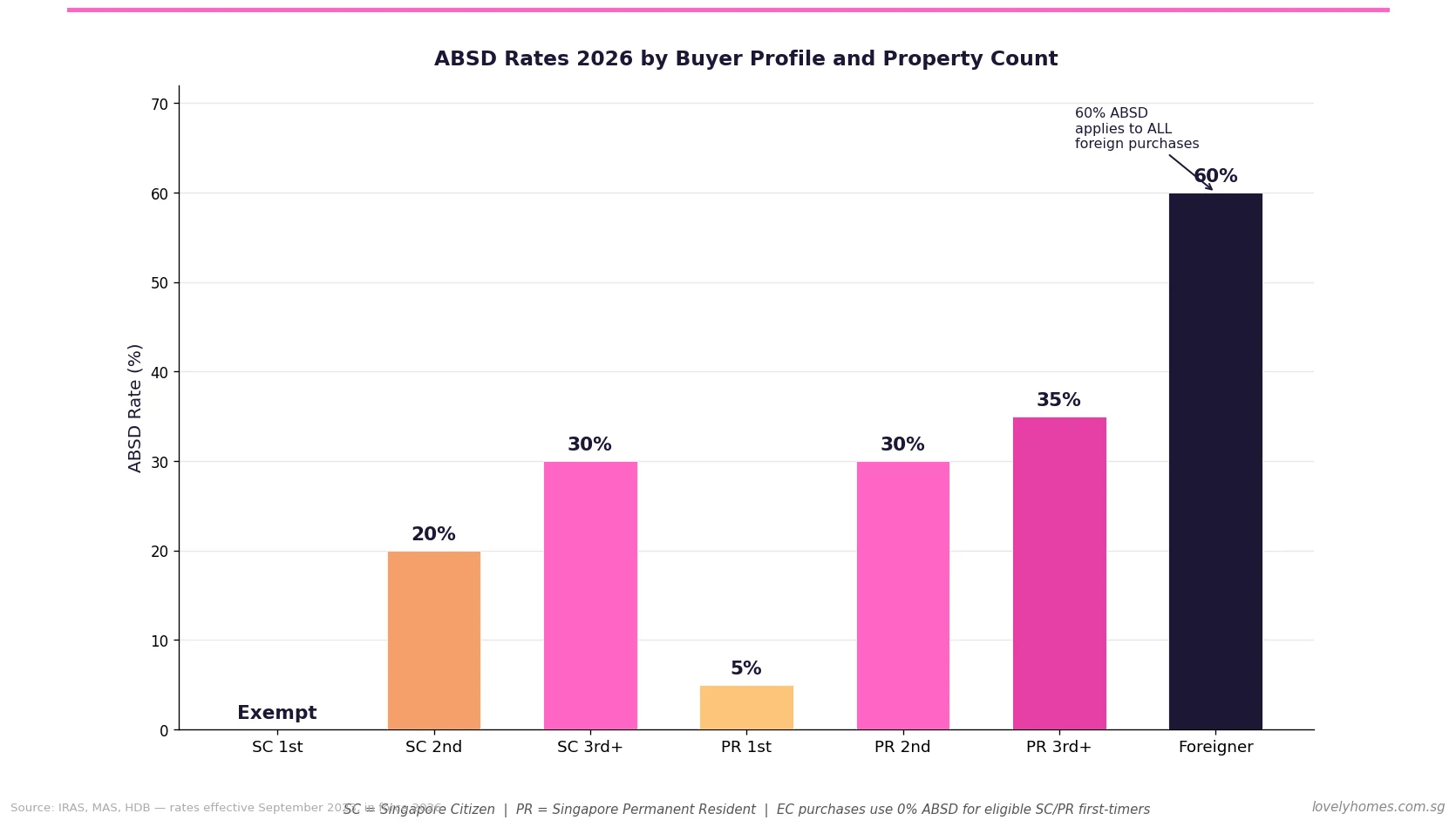
- Singapore Citizens buying their first residential property pay 0% ABSD. Their second property attracts 20% ABSD; their third or subsequent, 30%.
- Singapore Permanent Residents pay 5% ABSD on their first property and 30% on a second. Foreigners pay a flat 60% ABSD on all residential purchases.
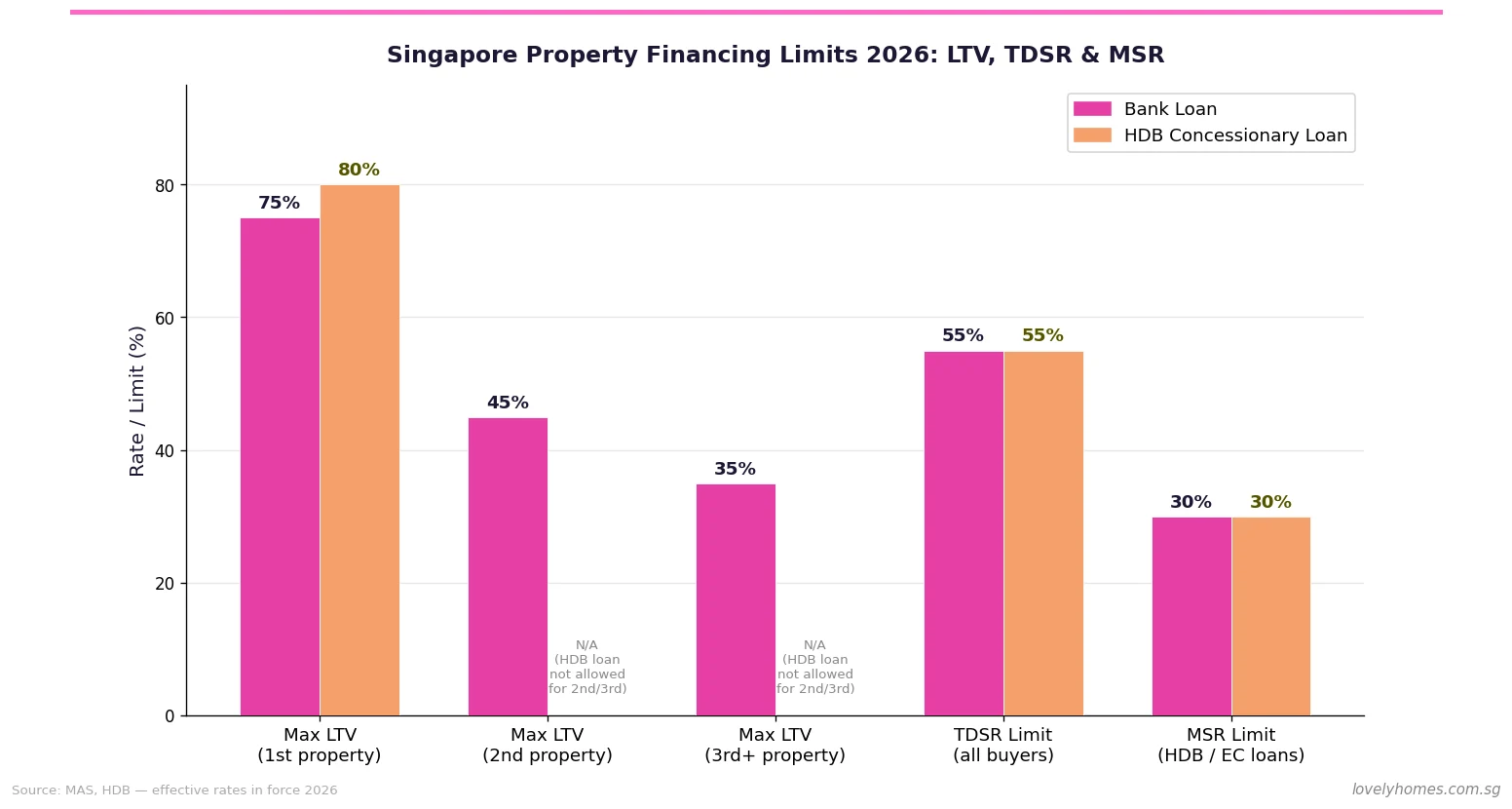
- TDSR caps total monthly debt obligations at 55% of gross income for all buyers. MSR applies an additional 30% cap specifically to HDB and EC loans.
- The maximum bank LTV for a first property is 75%, falling to 45% for a second and 35% for a third or subsequent property.
- ABSD remission is available for married Singapore Citizen upgraders who sell their existing HDB or private property within 6 months of purchasing the replacement unit.
Singapore’s property cooling measures are not a single rule. They are an interlocking system of five distinct policy instruments, each designed to target a different mechanism of demand or speculative risk. Together, they determine how much stamp duty you pay upfront, how much you can borrow, and how much it costs you to sell quickly. Understanding which tool affects which buyer profile is the essential first step in any property decision made in 2026.
This guide does not duplicate the comprehensive ABSD deep-dive or the historical timeline of cooling measure changes since 2009. Instead, it takes a buyer-profile approach: it works through each of the five instruments and then maps their combined effect on five distinct buyer types — the Singapore Citizen first-timer, the SC upgrader, the PR first-timer, the property investor (SC or PR buying a second or third property), and the foreign buyer. For each profile, the analysis includes specific SGD figures, the key constraints that bind most tightly, and the legitimate structural options available within the framework.
The Five Cooling Measure Tools
1. Additional Buyer’s Stamp Duty (ABSD)
ABSD is the most visible and most discussed cooling measure. Administered by the Inland Revenue Authority of Singapore (IRAS), ABSD is payable within 14 days of signing the Option to Purchase (OTP) or the Sale and Purchase Agreement, whichever is earlier. It is payable in cash only — CPF Ordinary Account funds cannot be used to pay ABSD.
Rates as of 2026 (unchanged since the September 2023 revision that doubled most rates):
- Singapore Citizens: 0% (1st property), 20% (2nd), 30% (3rd and subsequent)
- Singapore PRs: 5% (1st), 30% (2nd), 35% (3rd and subsequent)
- Foreigners: 60% on all residential purchases
- Entities (companies, trusts): 65% on all residential purchases
- ECs (Executive Condominiums): SC and PR first-timer buyers are exempt from ABSD for an EC — the standard EHG grant eligibility conditions apply
ABSD remission for upgraders: A married couple where at least one is a Singapore Citizen may purchase a private residential property while still owning an existing HDB flat or private property, and apply for an upfront ABSD remission (for a HDB upgrader) or a refund of the 20% SC second-property ABSD (for a private upgrader) — provided the existing property is sold within 6 months of the new property’s purchase completion. The remission system is important for the upgrader profile discussed below.
2. Seller’s Stamp Duty (SSD)
SSD is the exit tax — it penalises rapid resale of residential property. Administered by IRAS, SSD applies to all residential property in Singapore (including HDB flats) sold within three years of purchase. The rates are:
- Sold within 1 year: 12% of the sale price or market value (whichever is higher)
- Sold within 1–2 years: 8%
- Sold within 2–3 years: 4%
- Held for 3 years or more: 0% SSD
SSD affects all buyer profiles equally — it is a function of holding period, not citizenship. For HDB resale flats, the separate Minimum Occupation Period (MOP) of 5 years (or 10 years for Plus and Prime model flats) provides a parallel restriction that prevents resale regardless of SSD status.
3. Loan-to-Value (LTV) Limits
LTV limits, set by the Monetary Authority of Singapore (MAS), cap how much you can borrow relative to the lower of the purchase price or the property’s market valuation. For bank loans, the limits are:
- 1st residential property: 75% LTV (i.e., minimum 25% cash and/or CPF downpayment)
- 2nd residential property: 45% LTV
- 3rd and subsequent: 35% LTV
For HDB concessionary loans (available only to eligible SC buyers for HDB resale and BTO flats), the LTV is 80%, and at least 10% of the purchase price (or the shortfall between valuation and price) must be paid in cash. HDB loans are not available for private property or for buyers who already own a property.
4. Total Debt Servicing Ratio (TDSR)
TDSR, introduced in June 2013 and tightened in December 2021 (from 60% to 55%), caps the proportion of a borrower’s gross monthly income that can go towards servicing all debt obligations — including the new mortgage, car loans, personal loans, credit card balances and any other monthly financial commitments. The limit is 55% for all property loan types.
TDSR stress-testing uses a medium-term interest rate of 4.0%–4.5% for private properties (above the actual loan rate), meaning the TDSR test is more restrictive than a simple monthly payment calculation at today’s rates. This ensures borrowers remain serviceable if interest rates rise.
5. Mortgage Servicing Ratio (MSR)
MSR applies only to loans for HDB flats and Executive Condominiums purchased directly from developers (new ECs). It caps the monthly mortgage payment at 30% of gross monthly income. MSR is a tighter constraint than TDSR for HDB and EC buyers — a buyer who passes the TDSR test at 55% may still fail the MSR test at 30% if the mortgage repayment alone exceeds that threshold.
Cooling Measures at a Glance — Summary Table
| Measure | Who It Targets | Rate / Limit (2026) | Administered By |
|---|---|---|---|
| ABSD | Repeat buyers, PRs, foreigners | 0% (SC 1st), 20% (SC 2nd), 30% (SC 3rd+), 5% (PR 1st), 30% (PR 2nd), 35% (PR 3rd+), 60% (foreigner) | IRAS |
| SSD | All sellers within 3 years | 12% (yr 1), 8% (yr 2), 4% (yr 3), 0% (yr 4+) | IRAS |
| LTV (bank loan) | All buyers using bank financing | 75% (1st), 45% (2nd), 35% (3rd+) | MAS |
| LTV (HDB loan) | SC buyers of HDB only | 80% (1st HDB only) | HDB / MAS |
| TDSR | All property buyers | 55% of gross monthly income (stress-tested at 4.0–4.5%) | MAS |
| MSR | HDB flat and new EC buyers | 30% of gross monthly income | MAS / HDB |
Worked Example: Four Buyer Profiles Buying the Same S$1.5 Million Condo
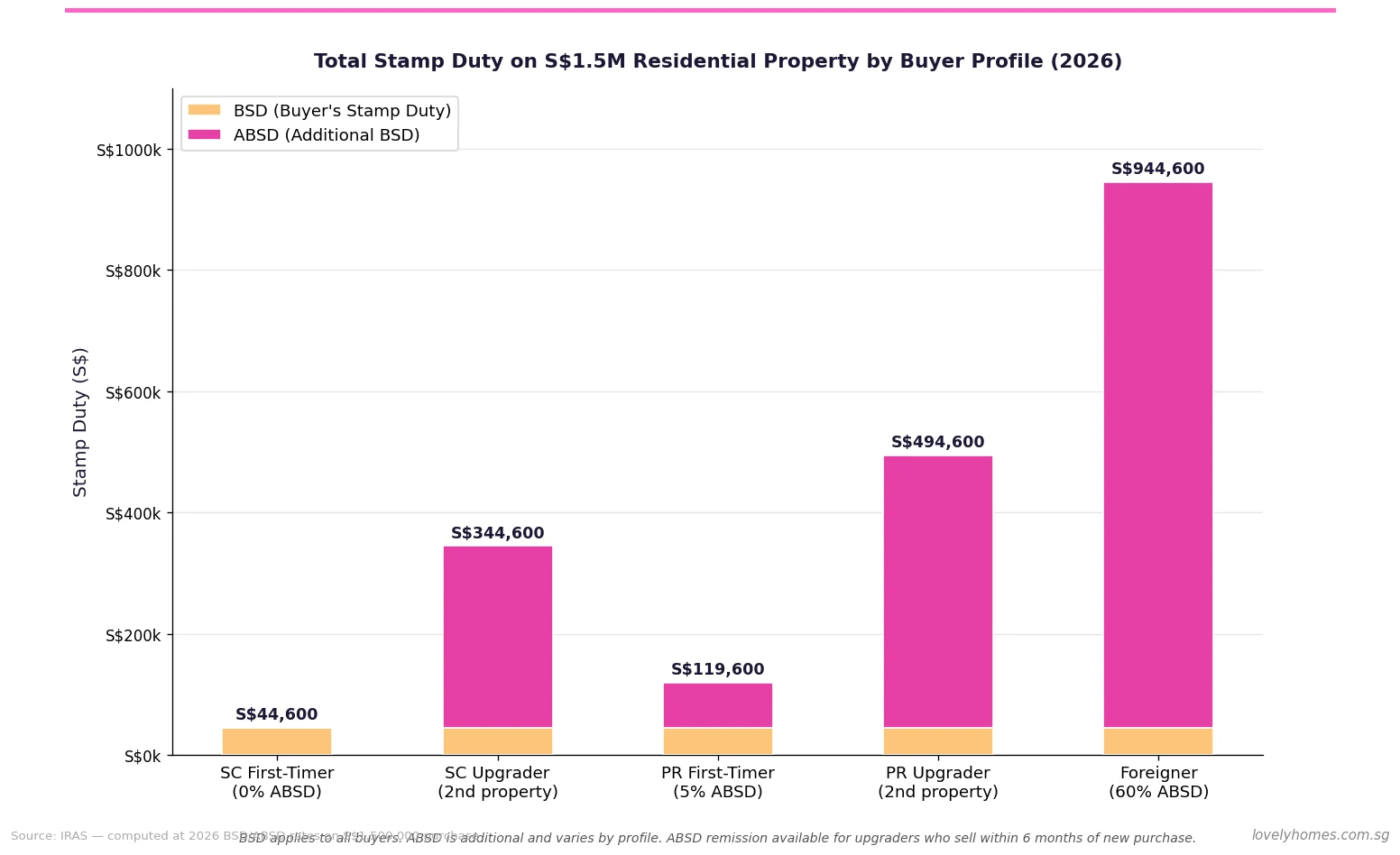
To make the impact of cooling measures concrete, consider four buyers each purchasing the same S$1.5 million OCR condominium unit. Buyer’s Stamp Duty on S$1.5 million is fixed at S$44,600 (1% × S$180k + 2% × S$180k + 3% × S$640k + 4% × S$500k). Each buyer then faces a different ABSD liability and different financing constraints.
Profile A — Mr Lim (SC, first-timer, single, age 32, income S$8,000/month):
- ABSD: 0% — total stamp duty: S$44,600
- Bank LTV 75% → loan S$1,125,000; downpayment S$375,000 (5% OTP cash + 20% CPF/cash)
- Monthly repayment (30yr, 3.5%): ~S$5,051; TDSR: 63.1% — FAILS TDSR
- Extend to 35yr: ~S$4,722; TDSR: 59.0% — still FAILS TDSR
- Reduce loan by S$100k (larger downpayment, loan S$1,025,000): ~S$4,173/mth, TDSR: 52.2% — PASSES. Or seek a co-borrower.
- Key binding constraint: income insufficient for S$1.5m solo on S$8k/month — needs top-up of capital or a co-borrower.
Profile B — Mr and Mrs Tan (SC couple upgrading, income S$18,000/month, selling existing HDB):
- ABSD: 20% (2nd property for SC) = S$300,000 cash upfront; remission applicable if HDB sold within 6 months of OTP completion
- Total stamp duty without remission: S$344,600; with remission (after HDB sale): effectively S$44,600
- Bank LTV 75% → loan S$1,125,000; downpayment S$375,000 (partly from HDB sale proceeds)
- Monthly repayment (30yr, 3.5%): ~S$5,051; TDSR: 28.1% — PASSES TDSR comfortably
- Key binding constraint: must fund S$300,000 ABSD upfront in cash, then recover via remission after HDB sale. Timing risk if HDB sale is delayed.
Profile C — Ms Wong (PR, first-timer, income S$15,000/month):
- ABSD: 5% = S$75,000; total stamp duty: S$119,600
- Bank LTV 75% → loan S$1,125,000; downpayment S$375,000
- Monthly repayment (30yr, 3.5%): ~S$5,051; TDSR: 33.7% — PASSES TDSR
- Key binding constraint: S$75,000 ABSD in cash on top of downpayment. No CPF usage for ABSD. Enough liquidity is the main hurdle.
Profile D — Mr Schneider (German national, income S$30,000/month, cash-rich investor):
- ABSD: 60% = S$900,000; total stamp duty: S$944,600
- Effective purchase cost: S$2,444,600 on a S$1.5 million unit
- At S$5,000/month rental yield (3.8% gross on S$1.5m): net yield after ABSD amortised over 10yr hold ≈ 1.2% per annum — economically unviable as a pure investment
- Key binding constraint: 60% ABSD makes residential property ownership economically irrational for most foreigners unless purely for owner-occupation or very long-term capital preservation.
Why Singapore’s Cooling Measures Are Built to Last
Singapore’s cooling measures are sometimes characterised as temporary interventions pending correction. The evidence suggests otherwise. The suite has been in continuous operation since 2009, with periodic calibration (mostly tightening) rather than wholesale removal. The September 2023 revisions doubled ABSD for most non-first-timer buyer groups and raised the foreigner rate from 30% to 60% — the sharpest single adjustment since the measures began.
The policy rationale sits at three levels. First, demand management: ABSD and SSD directly cool speculative demand from repeat buyers and short-term traders. Second, financial stability: TDSR and LTV limits constrain household leverage, limiting contagion from any future correction in property prices to the banking system. Third, social equity: the HDB public housing system — the housing pathway for approximately 78% of Singapore’s resident population — depends on price-to-income ratios remaining accessible. Cooling measures on the private market reduce the risk of runaway private price inflation spilling into the HDB resale market and pricing out younger Singaporean households.
Compared to peer markets, Singapore’s framework is among the most comprehensive. Hong Kong’s ABSD-equivalent (the Buyer’s Stamp Duty and the New Residential Stamp Duty) was suspended for non-permanent residents in February 2024, leading to a spike in foreign buying. Australia uses state-based foreign investor surcharges that vary from 3% to 8% — a fraction of Singapore’s 60%. Canada’s national foreign buyer ban, introduced in January 2023, is categorical rather than price-based. The Singapore approach — calibrated rates rather than bans — preserves a functioning market while managing excess demand, a deliberate design choice consistent with the city-state’s broader philosophy of market mechanisms with targeted intervention.
What Might Come Next — Policy Calibration Risks
No announcement of cooling measure changes is expected imminently. MAS and the Ministry of National Development (MND) have signalled that they will monitor conditions closely and act if market data warrants. Several conditions could trigger a recalibration, in either direction:
Tightening risk: If surging GLS land costs translate into sharp private condo price increases that push first-timer affordability below threshold, policymakers may raise the SC first-timer ABSD from 0% (currently exempt) or tighten TDSR further. They may also introduce income-related thresholds for ABSD exemption, as some analysts have suggested.
Easing risk: If SORA continues declining and private property demand weakens materially — evidenced by sustained price declines in URA’s quarterly price indices — MAS and MND could selectively relax ABSD for PRs (already done once, briefly, for the luxury segment in an earlier cycle) or adjust the MSR threshold upwards for EC buyers. This is the less likely scenario in 2026, given that private prices are still rising and HDB resale prices, while cooling slightly, remain well supported.
For a complete chronological record of every cooling measure change since 2009, see Singapore Property Cooling Measures Timeline 2009–2026.
Frequently Asked Questions
Can I pay ABSD using my CPF Ordinary Account?
No. ABSD must be paid entirely in cash. It cannot be funded from CPF savings, including the Ordinary Account. The ABSD is payable within 14 days of signing the Option to Purchase or the Sale and Purchase Agreement, whichever is earlier. By contrast, Buyer’s Stamp Duty (BSD) — the base stamp duty payable by all buyers — can be paid using CPF OA funds for private properties, subject to the CPF withdrawal rules in force. For HDB resale and BTO flats, both BSD and any applicable ABSD must be paid in cash.
How does the ABSD remission work for SC upgraders?
An ABSD remission is available to married couples where at least one party is a Singapore Citizen and neither spouse currently owns more than one residential property. When such a couple purchases a private residential property while still owning an existing property (e.g., an HDB flat or a private condo), they must pay the 20% ABSD upfront. However, if they sell the existing property within 6 months of the date of purchase completion (for a new launch) or within 6 months of the date of signing the OTP (for a completed unit), IRAS will refund the ABSD paid, less S$1 processing fee. The 6-month window is strict — a one-day delay can result in forfeiture of the remission. HDB upgraders should note that the sale of the HDB flat, not merely the receipt of HDB proceeds, must be completed within the period. Check IRAS’s official ABSD remission guidance for the latest conditions.
Does ABSD apply to commercial property purchases?
No. ABSD applies only to residential property in Singapore. Commercial properties — offices, shophouses, industrial units, retail units and mixed-use developments where the residential component does not exist or is not being acquired — are not subject to ABSD. The surge in commercial investment sales in H1 2026 is partly explained by this fact: institutional investors seeking income-producing real estate in Singapore can acquire commercial assets without the ABSD burden that makes residential investment uneconomical for non-first-timers. Shophouses — heritage conservation buildings that typically combine a ground-floor commercial component with upper-floor residential space — are classified by IRAS based on the primary use of the property at the time of purchase. Buyers of shophouses should seek a specific tax ruling if in doubt about ABSD applicability.
How is TDSR stress-tested, and what rate does the bank use?
MAS requires financial institutions to stress-test mortgage applications at a medium-term interest rate rather than the prevailing contract rate. As of 2026, the stress-test rate for residential property loans is typically 4.0%–4.5% — significantly above the actual contracted rate, which for most floating-rate SORA-pegged loans sits closer to 3.0–3.7% all-in. This means a buyer whose TDSR passes at today’s actual repayment amount might still fail if the stress-tested repayment exceeds 55% of income. When planning your financing, always calculate affordability at the stress-test rate, not the current headline rate. Banks will not lend above this threshold regardless of your actual income or assets.
Are there any legal ways to reduce ABSD exposure?
Within the framework as it stands in 2026, the main legitimate approaches are: (1) SC upgrader remission — sell the existing property within 6 months of the new purchase completion, as described above; (2) EC route for first-timers — SC and eligible PR couples buying an Executive Condominium directly from a developer are exempt from ABSD, and ECs typically carry a lower launch price than comparable private condominiums in the same district; (3) Property held under a single name — in some structuring scenarios, a married couple can designate one spouse as the sole buyer of a second property (if the other spouse is a first-timer on paper), though this has specific eligibility conditions and does not work once both spouses own property; (4) Decoupling — where a joint-owned property is transferred to a single owner’s name, freeing the departing spouse to purchase a new property at the lower ABSD rate for a first-time buyer. Decoupling has been significantly curtailed by stamp duty rules and income-related limitations. Always consult a licensed property lawyer and financial adviser before proceeding — the rules are precise, and errors are costly.
How do cooling measures affect the HDB resale market specifically?
Cooling measures affect the HDB resale market primarily through the MSR (30%), which caps how much of monthly income can go towards the HDB mortgage, and the LTV limit for HDB loans (80%) and bank loans (75% for first-time HDB buyers). ABSD does not apply to the purchase of a first HDB resale flat by Singapore Citizens, but PRs buying their first HDB pay 5% ABSD. The HDB’s own Minimum Occupation Period (5 years for standard flats, 10 years for Plus and Prime model flats) operates in parallel with SSD to prevent short-term speculation. Sellers of HDB resale flats who have not met MOP must seek HDB’s approval before listing, and subletting before MOP is only allowed in specific circumstances. See the HDB Resale Price Guide 2026 for a full overview of how these rules interact with current market pricing.
Related Articles
- ABSD Singapore 2026: Complete Guide to Additional Buyer’s Stamp Duty
- Singapore Property Cooling Measures Timeline 2009–2026
- Singapore First-Timer Property Guide 2026: Step-by-Step Roadmap
- Singapore Buyer’s Stamp Duty 2026: Complete Calculator and Guide
- Singapore Property Conveyancing Guide 2026: Legal Fees and Timeline
- Singapore Investment Sales H1 2026: What S$31 Billion Tells Us
- Buying a Condo in Singapore 2026: Complete Guide
Disclaimer: This article is for general informational purposes only and does not constitute financial, tax or legal advice. Stamp duty rates, financing limits and policy rules cited are based on publicly available information as at August 2026 and are subject to change without notice. Always verify current rates with IRAS, MAS and HDB directly, and consult a licensed conveyancing lawyer, mortgage broker and financial adviser before making any property transaction decision. Individual circumstances vary and the examples in this article are illustrative only.