Singapore Condo Resale Guide 2026: Step-by-Step Buyer’s Complete Guide

Singapore Condo Resale Guide 2026: Step-by-Step Buyer’s Complete Guide

Quick Answer: Buying a Resale Condo in Singapore — Key Facts

  • Who can buy: Singapore Citizens, Permanent Residents, and foreigners may all purchase private resale condominiums — but ABSD rates differ dramatically by profile
  • Minimum cash outlay: At least 5% of purchase price in cash; the remaining 20% of downpayment can be CPF OA
  • Timeline: Approximately 10–12 weeks from Option to Purchase (OTP) to completion and key collection
  • BSD: Progressive 1–6% on purchase price, payable by all buyers; SC first property ABSD = S$0
  • Key eligibility check: TDSR (Total Debt Servicing Ratio) capped at 55%; no MSR applies for private property
  • Foreigner ABSD: 60% on purchase price as at 2026 — substantially increases total outlay
  • No MOP: Private condos have no Minimum Occupation Period; you may rent out immediately or sell at any time (but Seller’s Stamp Duty applies if sold within 3 years)
  • New vs resale: Resale condos offer immediate occupation, negotiable price, and visible condition — often priced at a discount to new launches in the same area

Buying a resale condominium in Singapore is the most straightforward route into the private residential property market. Unlike new launches, which require you to pay progressively as construction progresses, a resale unit lets you see exactly what you are buying, negotiate directly with the seller, and move in as soon as the transaction completes — typically within 10–12 weeks. That said, the process involves a specific sequence of legal, financial, and administrative steps that every buyer should understand before signing anything.

This guide walks you through the full condo resale purchase journey, from getting your finances in order to collecting your keys, explaining every cost, timeline, and regulatory check that applies in 2026. Whether you are a first-time buyer, an upgrader, or a Singapore Permanent Resident (SPR) navigating your first private property purchase, this is the definitive reference.

Figure 1: Singapore condo resale 8-step purchase process — from AIP to completion
Figure 1: The 8-step Singapore condo resale purchase process. Total timeline approximately 10–12 weeks from Option to Purchase to legal completion. Source: URA, conveyancing practice norms.

Step 1: Set Your Budget and Get an Approval-in-Principle (AIP)

Before you view a single property, you need a firm number in your head — and a bank’s provisional agreement to lend it. The Approval-in-Principle (AIP), sometimes called In-Principle Approval (IPA), is a letter from a bank confirming the maximum loan amount it will offer you based on your income, existing debts, and credit profile. It is not a committed loan offer, but it is the most reliable anchor you have for your property budget.

The two financial frameworks that govern how much you can borrow in Singapore are the Total Debt Servicing Ratio (TDSR) and the Loan-to-Value (LTV) limit:

Framework Rule Implication for Buyer
TDSR Monthly debt repayments ≤ 55% of gross monthly income Includes all loans: mortgage, car, personal, student. Stress-tested at the higher of actual rate + 0.5% or a floor rate set by the bank
LTV (1st property loan, 30yr) 75% of lower of purchase price or valuation Minimum 25% downpayment; 5% must be cash
LTV (2nd outstanding property loan) 45% 55% downpayment; 25% must be cash
LTV (3rd+ outstanding property loan) 35% 65% downpayment; 25% must be cash
Max loan tenure (private) 30 years; subject to age-65 cap Loan tenure ends when youngest borrower turns 65; longer tenures reduce monthly repayments but increase total interest

Get AIPs from at least two or three banks — rates and offered amounts can vary meaningfully. Processing typically takes 3–5 business days. Note that the AIP lapses after 30–90 days (varies by bank), so do not apply too early.

Step 2: Understand Your Full Stamp Duty Liability Before You Bid

Stamp duty is computed on the purchase price (or market valuation if higher) and is payable within 14 days of signing the OTP. For private resale condominiums, two duties apply: Buyer’s Stamp Duty (BSD) for all buyers, and Additional Buyer’s Stamp Duty (ABSD) for buyers who are not Singapore Citizens purchasing their first residential property.

Buyer Profile BSD (on purchase price) ABSD On S$1.5M — Total Stamp Duty
SC, 1st property 1%–6% progressive 0% S$43,600
SC, 2nd property Same 20% S$343,600
SC, 3rd+ property Same 30% S$493,600
SPR, 1st property Same 5% S$118,600
SPR, 2nd+ property Same 30% S$493,600
Foreigner (any) Same 60% S$943,600
Entity / trust Same 65% S$1,018,600

The BSD progressive scale on a S$1,500,000 purchase: 1% on first S$180,000 = S$1,800; 2% on next S$180,000 = S$3,600; 3% on next S$640,000 = S$19,200; 4% on next S$500,000 = S$20,000. Total BSD = S$44,600. (Note: the 5% tier applies on value above S$1.5M; the 6% tier applies above S$3M.)

Figure 2: Singapore condo resale upfront costs by buyer profile — BSD, ABSD, downpayment comparison
Figure 2: Total upfront cost breakdown for four buyer profiles at S$1,500,000 purchase price, with 75% LTV bank loan. Note: ABSD for foreigner (60%) dominates and nearly equals the property price. Source: IRAS, MAS guidelines.
Key Takeaway: For Singapore Citizens buying their first property, ABSD is zero — the entire stamp duty bill is BSD alone, which at S$1.5M works out to approximately S$43,600 or 2.9% effective rate. For foreigners, the 60% ABSD makes Singapore one of the most expensive markets globally for foreign residential buyers. Always compute your personal ABSD liability before any negotiation.

Step 3: Search for Your Property and Make an Offer

Private resale condominiums transact through the URA REALIS database (which records all caveats), property listing portals (PropertyGuru, 99.co), and via property agents. When searching, look up URA REALIS for recent transacted prices in your target building — this is your most reliable benchmark for market value and will help you assess whether a listed price is reasonable or inflated.

Key things to investigate before making an offer include: the remaining lease (for leasehold condos); the Annual Value (AV) as assessed by IRAS (affects property tax); whether the unit is subject to any caveats, legal charges, or mortgages (your conveyancing solicitor will conduct a title search); the Management Corporation Strata Title (MCST) financial health (ask for the last two AGM minutes and the sinking fund balance); and any pending special levies that could increase monthly maintenance fees post-purchase.

Step 4: Option to Purchase (OTP) — The Formal Offer

When you agree on a price, the seller issues you an Option to Purchase (OTP). Signing and returning the OTP with the option fee locks in the deal:

1

Option fee (1% of price): Paid in cash when you receive the OTP. This fee is held by the seller. If you exercise the OTP, it forms part of your deposit. If you do not exercise it within the option period (usually 14 days), you forfeit the option fee — so do not sign if you are not serious.

2

Exercise fee (4% of price): Paid in cash or CPF when you exercise the OTP — i.e., when you formally confirm purchase by signing and returning the OTP within the option period. Together, the 1% + 4% = 5% constitutes your initial downpayment cash tranche.

3

Remaining 20% of downpayment: Due at legal completion, from cash or CPF OA after the 5% initial deposit.

Step 5: Appoint a Conveyancing Solicitor

You must appoint a Singapore-licensed conveyancing solicitor to act for you in the purchase. Your solicitor will: conduct title searches to confirm the seller has clean title; check for encumbrances, mortgages, and caveats; prepare the Sale and Purchase Agreement (SPA); coordinate with the bank and seller’s solicitors; handle stamp duty submission to IRAS; and manage the legal completion on the agreed date.

Legal fees for a resale condo transaction typically range from S$3,500 to S$6,500, depending on complexity and the firm. Some banks offer free legal conveyancing if you take their mortgage — compare this offer against independent solicitor rates.

Step 6: Bank Valuation and Formal Loan Offer

Once the OTP is exercised, your bank will commission a formal property valuation by a licensed RICS/AVA-accredited valuer. This is separate from your AIP — it is a binding document that determines the maximum amount the bank will lend (75% of valuation or purchase price, whichever is lower). If the bank valuation comes in below your agreed purchase price, you must top up the shortfall entirely in cash — it cannot be covered by CPF or the loan.

After valuation, the bank issues a formal Letter of Offer (LO). Review the interest rate structure carefully: most banks in 2026 offer floating-rate packages pegged to SORA (the Singapore Overnight Rate Average) or fixed-rate packages for 2–3 years before floating. As at mid-2026, prevailing bank mortgage rates for new loans are in the 3.0–3.7% range depending on package and tenure.

Step 7: Legal Completion

On the completion date (agreed in the SPA, typically 8–10 weeks after OTP exercise), your solicitor coordinates fund transfers from CPF, your bank, and your own cash account to the seller’s solicitor. The total payment disbursed covers: the purchase price minus any deposits already paid; BSD and ABSD (already paid to IRAS directly); and any outstanding amounts. Simultaneously, any mortgage over the property is discharged by the seller’s bank and your own mortgage is registered. The Certificate of Title is issued in your name.

Step 8: Key Collection and First-Year Ownership Costs

On or shortly after completion, you collect the keys from the seller’s solicitor or the seller directly. At this point the property is yours. However, ongoing ownership costs begin immediately:

Cost Item Frequency Typical Amount (1,000 sqft condo)
Property tax Annual (IRAS) S$1,200–S$3,200 (based on Annual Value)
MCST maintenance fee Monthly S$280–S$600 (Management Fund)
MCST sinking fund Monthly S$30–S$80 (share of Sinking Fund)
Home insurance Annual S$200–S$600 (basic fire + contents)
Mortgage repayment Monthly Depends on loan amount and rate

Figure 3: Singapore resale condo transaction volume versus URA price index 2019–2026
Figure 3: Singapore private resale condo transaction volume (bars) vs URA Private Residential Price Index, non-landed (line), 2019–2026. 2026 volume is Q1+Q2 annualised. Sources: URA REALIS, URA PPI.

Resale vs New Launch: How to Choose in 2026

Figure 3 shows that resale transaction volumes peaked in 2022 (17,200 units) before moderating as prices hit all-time highs and higher interest rates compressed affordability. By mid-2026, the resale market has stabilised, with the Q2 2026 URA flash estimate showing overall private prices up just 0.5% quarter-on-quarter — a signal that the market is absorbing elevated price levels without sharp correction or fresh exuberance.

For buyers deciding between a resale unit and a new launch in 2026, the key trade-offs are: resale offers immediate occupation, disclosed condition, and typically a discount of 10–20% per square foot compared to new launches in the same vicinity; new launches offer deferred payment via the Progressive Payment Scheme, brand-new fittings, and in some cases longer remaining lease. In a rising-rate environment, the progressive payment structure of new launches is less compelling as the interest-servicing obligation on bridge financing grows. In 2026, resale condos offer compelling value in many districts — particularly CCR, where new launches are sparse and resale prices have softened relative to their 2022 peaks.

What Might Come Next for the Condo Resale Market

This section reflects editorial analysis and forward-looking commentary only. It should not be read as investment advice.

The URA Q2 2026 flash estimate revealed a CCR rebound of +2.0% QoQ against a softening RCR and OCR. If this trend sustains, savvy resale buyers targeting the CCR may have a narrowing window before CCR prices re-accelerate. The URA’s 2H 2026 GLS Confirmed List releases 4,745 units — a meaningful supply addition, but concentrated in RCR and OCR; CCR supply remains constrained. The mid-year data points suggest the two-year period of price consolidation (2024–mid-2026) may be in its final stages, though the trajectory of global interest rates remains the key variable. Buyers who complete purchases in Q3–Q4 2026 may benefit from current price softness.

Worked Example: Resale Condo Purchase — Full Cost Breakdown

Scenario: Mr and Mrs Lim (SC/SC, married couple), purchasing first home together

Property: 3-bedroom resale condo, D19 Serangoon, 1,200 sqft, listed at S$1,850,000. Bank valuation: S$1,820,000 (lower of two).

BSD (on S$1,820,000): 1%×S$180k + 2%×S$180k + 3%×S$640k + 4%×S$820k = S$1,800 + S$3,600 + S$19,200 + S$32,800 = S$57,400

ABSD: S$0 — SC first residential property

Downpayment:
— LTV: 75% of S$1,820,000 = bank loan S$1,365,000
— 25% downpayment on S$1,820,000 = S$455,000
— Of which 5% must be cash: S$91,000; remaining S$364,000 can be CPF OA

TDSR check: Combined income S$12,000/mth. At 3.5% for 25 years: monthly repayment on S$1,365,000 ≈ S$6,840. TDSR = 6,840/12,000 = 57.0% — exceeds 55% cap. Solution: extend tenure to 30 years or reduce loan. At 30yr: S$6,130/mth = TDSR 51.1% PASS.

Short-price issue: Purchase price (S$1,850,000) exceeds valuation (S$1,820,000). Shortfall of S$30,000 must be paid in cash — cannot use CPF.

Total cash required at completion:
— 5% option money paid (already paid): S$92,500 (5% of S$1,850,000 as negotiated)
— Shortfall: S$30,000
— Balance downpayment (20% of S$1,820,000 minus already-paid cash): funded from CPF OA
— BSD: S$57,400 (paid separately to IRAS, cash or CPF)
— Legal fees: ~S$5,200
Estimated total cash outlay: ~S$155,000–S$185,000 depending on CPF OA balance available

Lesson: Always check whether the bank valuation will match your offer price. A valuation shortfall can derail affordability if cash reserves are tight.

Frequently Asked Questions: Singapore Condo Resale Purchase

Can I use my CPF to pay for a resale condo?

Yes, CPF Ordinary Account (OA) savings may be used for: the downpayment (except the first 5% which must be cash), monthly mortgage repayments, and BSD/ABSD (you can instruct IRAS to debit your CPF OA for stamp duties, subject to having sufficient balance). However, CPF usage for property is subject to the CPF usage limit — you can use CPF only up to the Valuation Limit (VL, which is the lower of purchase price or valuation) and subject to the accrued interest rule: all CPF OA funds used, plus accrued interest at the CPF OA rate (currently 2.5% per annum compound), must be refunded to your CPF when you sell the property. Buyers with significant CPF usage from a prior HDB flat should obtain a CPF statement to understand how much OA is available before committing.

Is there a Minimum Occupation Period for resale condos?

No — private condominiums, whether purchased as new launches or resale, have no Minimum Occupation Period. You may rent out the unit immediately after purchase (though check your development’s by-laws regarding short-term rental via platforms), or sell it at any time. However, the Seller’s Stamp Duty (SSD) applies if you sell within 3 years of purchase: SSD is 12% (sold in Year 1), 8% (Year 2), or 4% (Year 3), computed on the higher of selling price or market value. Hold for at least 3 years to avoid SSD entirely.

What checks should I do on the MCST before buying a resale condo?

The MCST (Management Corporation Strata Title) is the body corporate that manages the common areas of the development. Before buying, request from the seller or managing agent: the last two AGM minutes (to understand any disputes, special levy proposals, or major works planned); the current sinking fund balance (adequate reserves = lower risk of special levies); the monthly maintenance fee quantum; and whether any arrears are owed by the unit. Your conveyancing solicitor will conduct a title search but will not necessarily review MCST financial health — that is your due diligence responsibility.

What happens if I need to sell before 3 years?

Selling within 3 years of purchase triggers SSD: 12% (Year 1), 8% (Year 2), 4% (Year 3), computed on the selling price or market value, whichever is higher. On a S$1.5M condo sold in Year 2, the SSD would be S$120,000 — a significant drag that can wipe out any appreciation gained. Genuine hardship cases (financial difficulty, death, divorce) may be considered for remission by the IRAS on application, but remission is not guaranteed and not a planning assumption. Buyers who are uncertain about their 3-year commitment should factor SSD into their exit scenario modelling.

Can a Singapore Permanent Resident (SPR) buy a resale condo?

Yes. SPRs may purchase private condominiums without restriction. However, SPRs pay ABSD of 5% on their first residential property purchase and 30% on second and subsequent purchases. An SPR married to a Singapore Citizen and purchasing jointly may be eligible for a remission of the ABSD (refunded after satisfying a 5-year joint ownership condition) under the ABSD Remission for Married Couples scheme. Check the current IRAS ABSD remission conditions before structuring your purchase.

How is the bank valuation determined and what if it differs from the asking price?

The bank appoints an RICS/AVA-accredited independent valuer who inspects the property and analyses recent comparable transactions in the same development and surrounding area from URA REALIS. The valuation is an arm’s-length professional opinion — it can come in above, at, or below the agreed purchase price. If it comes in below: the bank lends 75% of the valuation (not the purchase price), and you must fund the shortfall entirely in cash. If it comes in above: the bank still lends 75% of purchase price (the lower figure), but you face no shortfall. Banks typically complete valuations within 3–5 business days of being instructed.

What are the tax obligations after buying a resale condo?

After purchase, you are liable for annual Property Tax assessed by IRAS based on the property’s Annual Value (AV) — the estimated annual rental income. Owner-occupiers enjoy a preferential progressive rate (0% on first S$8,000 AV, rising to 23% on AV above S$100,000 as at 2026). Landlords (non-owner-occupied) face higher rates. IRAS will send you an annual property tax bill. Additionally, rental income is subject to Singapore income tax — you must declare rental income and can deduct allowable expenses such as mortgage interest, MCST fees, and repairs. Consult a tax professional for your specific situation.

Disclaimer: This guide is for general information and educational purposes only. Stamp duty rates, LTV limits, TDSR rules, and CPF usage policies are accurate as at July 2026 and subject to change by IRAS, MAS, CPF Board, and HDB. The worked example is illustrative only; individual transactions will vary. Nothing herein constitutes financial, investment, legal, or property advice. Consult a licensed property agent, conveyancing solicitor, and independent financial adviser before making any purchase decision. Official sources: IRAS, MAS, URA, CPF Board.

×

Click anywhere to close

Singapore Condo Buying Guide for HDB Upgraders 2026: Complete Roadmap from HDB to Private Property

Singapore Condo Buying Guide for HDB Upgraders 2026: Complete Roadmap from HDB to Private Property

Quick Answer: HDB Upgrader Buying a Condo in 2026

  • ABSD of 20% applies to Singapore Citizens buying a second property whilst still holding their HDB flat — but a full remission is available if you sell the HDB within 6 months of the condo completion date.
  • Sequence matters most: sell HDB first and you pay 0% ABSD on the condo; buy condo first and you pay 20% upfront (then claim remission), but you must fund the ABSD amount out of pocket or cash proceeds initially.
  • CPF OA can pay for the condo once your HDB flat’s CPF accrued interest is refunded on sale — but timing the liquidity is critical.
  • No income ceiling for private condo — unlike EC, there is no household income cap on purchasing a private condominium.
  • TDSR 55% applies — your total monthly debt obligations (all loans) cannot exceed 55% of gross monthly income; your mortgage alone typically maxes out at 30–40% of income in practice.
  • MAS 30-month wait does not apply to upgraders who previously received a CPF Housing Grant — that restriction applies only to subsequent HDB flat purchases, not private property.
  • Typical all-in cash needed for a $1.3M–$1.5M condo: $80K–$130K cash at OTP and exercise, before CPF usage.

Upgrading from an HDB flat to a private condominium is one of the most financially significant moves a Singapore household can make. For many middle-income families, the HDB flat accumulated over a decade of mortgage repayments and CPF contributions represents their largest asset — and the upgrade decision involves a careful choreography of timing, tax planning, CPF allocation, and loan qualification.

In 2026, the roadmap for HDB upgraders has become more nuanced than ever. The Additional Buyer’s Stamp Duty (ABSD) framework, the Total Debt Servicing Ratio (TDSR), and the 6-month HDB sale window for ABSD remission create a set of interdependent constraints that require advance planning — ideally 12–18 months before the intended purchase date. This guide walks through every step of the process, with practical numbers drawn from Singapore’s current property market.

Understanding Your ABSD Position as an HDB Upgrader

The first and most consequential decision for any HDB upgrader is whether to sell the HDB flat before or after buying the private condo. This choice determines your ABSD liability and cash-flow requirements at the point of condo purchase.

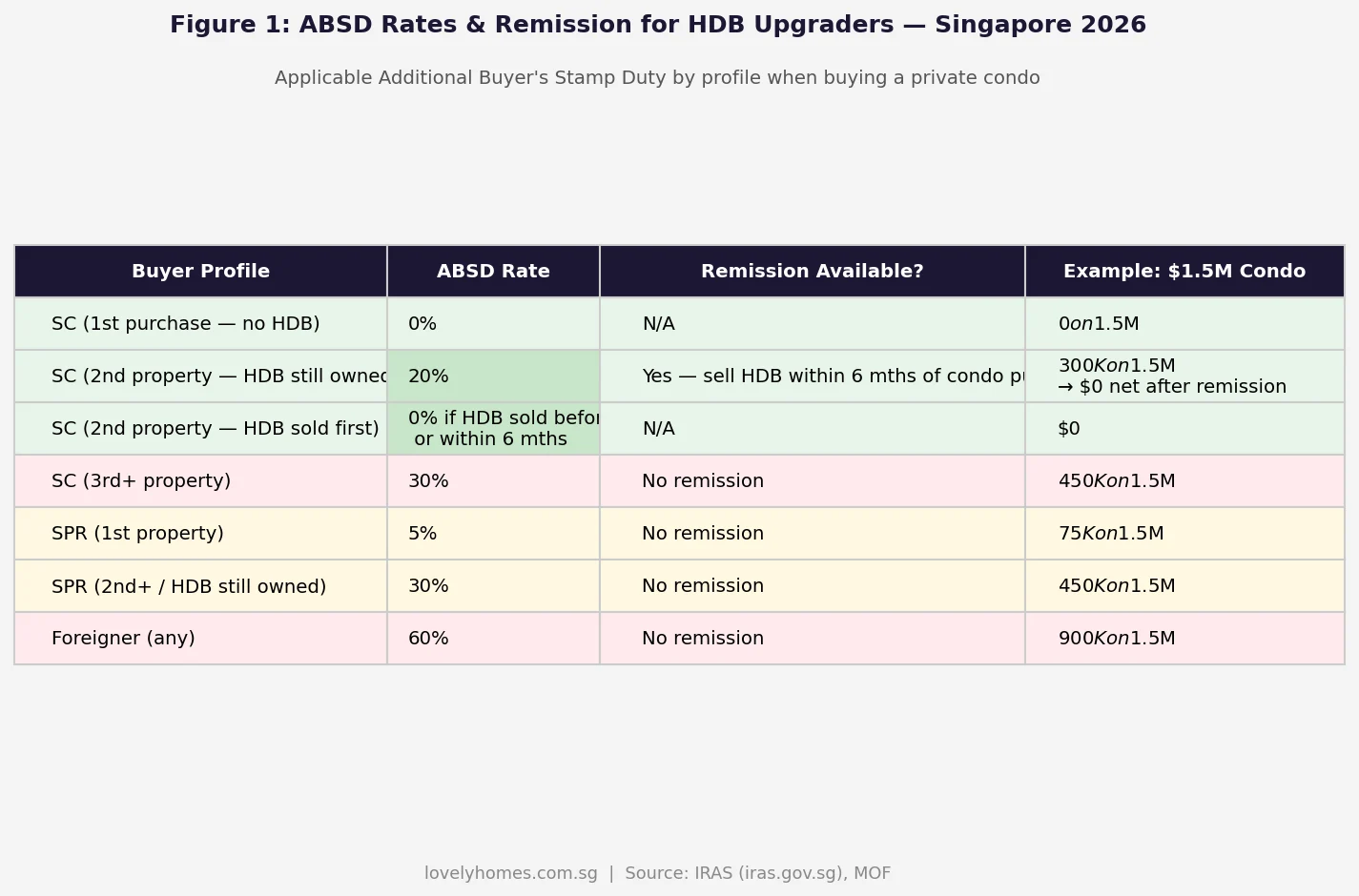
ABSD rates for HDB upgraders buying private condo Singapore 2026 remission table by buyer profile
Figure 1: ABSD Rates and Remission Eligibility for HDB Upgraders by Buyer Profile — Singapore 2026. Source: IRAS (iras.gov.sg), Ministry of Finance

Strategy A: Sell HDB First, Then Buy Condo

If you sell your HDB flat and receive the proceeds before completing the purchase of a private condominium, the condo counts as your first private property purchase. A Singapore Citizen pays 0% ABSD in this scenario. The trade-off is that you must secure interim accommodation — typically renting a private condo or staying with family — during the gap between HDB sale completion and new condo key collection. The rental expense during this bridging period can range from $2,500 to $5,000 per month depending on location and unit size.

This strategy is particularly attractive when the upgrader is buying a new launch condo where key collection is 3–4 years away. The HDB can be sold when the TOP (Temporary Occupation Permit) is imminent, capturing appreciation on the HDB flat whilst avoiding ABSD entirely.

Strategy B: Buy Condo First, Sell HDB Within 6 Months of TOP

Singapore Citizens buying a second property pay 20% ABSD upfront (effective from 27 April 2023, under the 2023 cooling measures). However, a married SC couple where at least one spouse is buying their first private property is eligible for an ABSD remission — the full 20% is refunded if the HDB flat is sold within 6 months of the condo’s TOP (for new launches) or within 6 months of the condo’s date of purchase (for resale condos).

The critical point: you must pay the ABSD first and apply for refund afterwards. On a $1.4M condo, this means funding $280,000 out of pocket (or from bridging finance) that you will recover only after selling the HDB. Ensure your combined CPF OA balances and cash savings can support this exposure.

Strategy C: SPR Upgraders

Singapore Permanent Residents face a more restrictive ABSD environment. SPR buyers pay 5% ABSD on their first private property — even if they already own an HDB flat (which, for ABSD purposes, counts as a residential property). SPRs who hold an HDB flat and buy a condo are treated as purchasing a second property (30% ABSD) with no remission available. SPR households considering an upgrade to private property should consult a qualified tax adviser about the cost implications, or consider applying for Singapore Citizenship before upgrading.

Financial Qualification: Can You Afford the Upgrade?

Once your ABSD strategy is clear, the next question is loan eligibility. The Monetary Authority of Singapore (MAS) property cooling measures set binding financial limits:

Rule Limit What It Means for Upgraders
TDSR 55% max All monthly debt obligations ÷ gross income ≤ 55%
LTV (bank loan) 75% max 25% down payment required (5% must be cash)
MSR N/A for private condo 30% MSR rule applies only to HDB loans and EC loans
Stress test rate MAS medium-term rate +0.5% Banks typically use 4.0–4.5% notional rate for TDSR calculations
Loan tenure Max 30 years (to age 65) Older borrowers face shorter tenures; affects monthly instalment

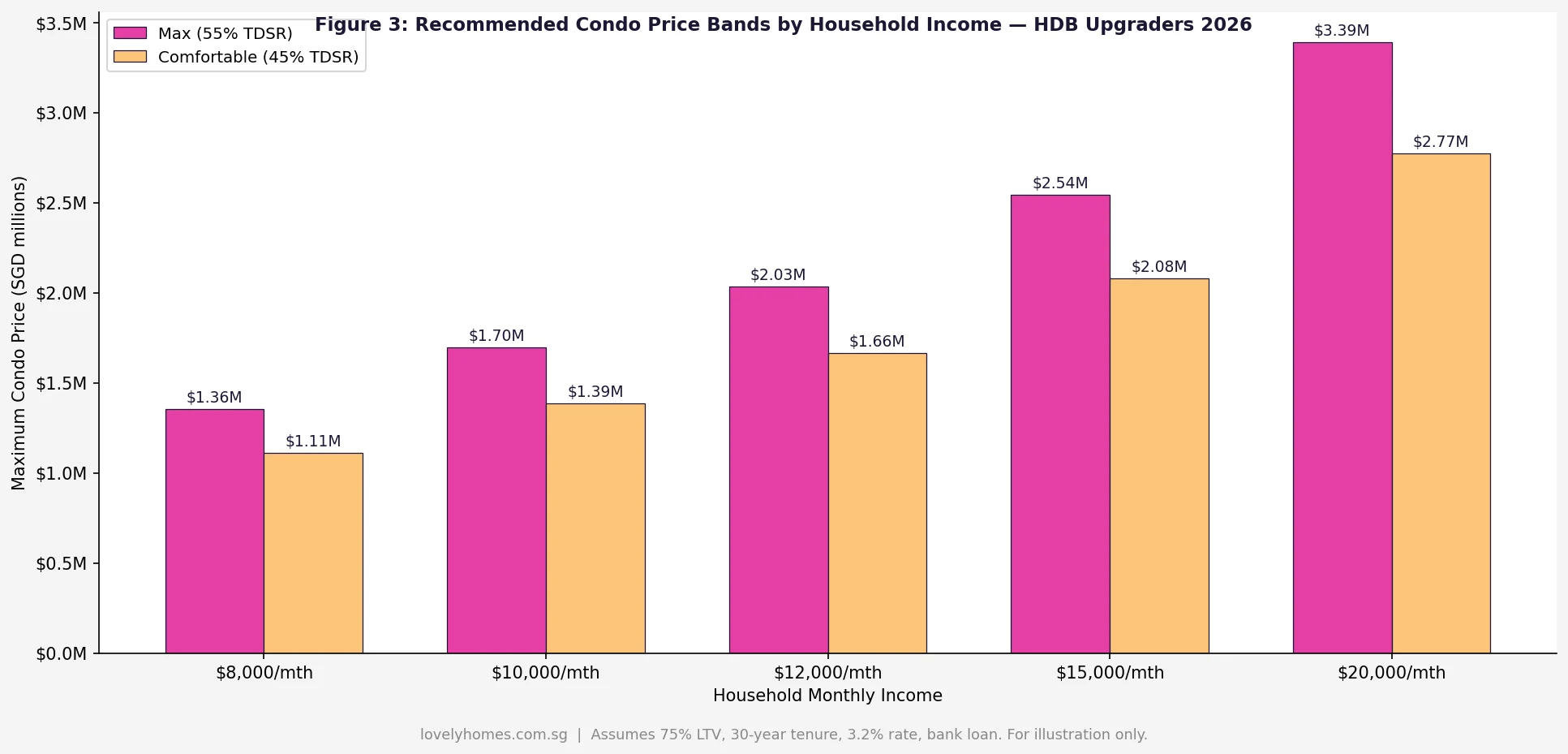
Maximum condo price by household income for HDB upgraders Singapore 2026 TDSR 55 percent affordability chart
Figure 3: Recommended Condo Price Bands by Household Monthly Income — HDB Upgraders 2026. Assumes 75% LTV, 30-year tenure, 3.2% rate. For illustration only.

The 10-Step Upgrader Roadmap

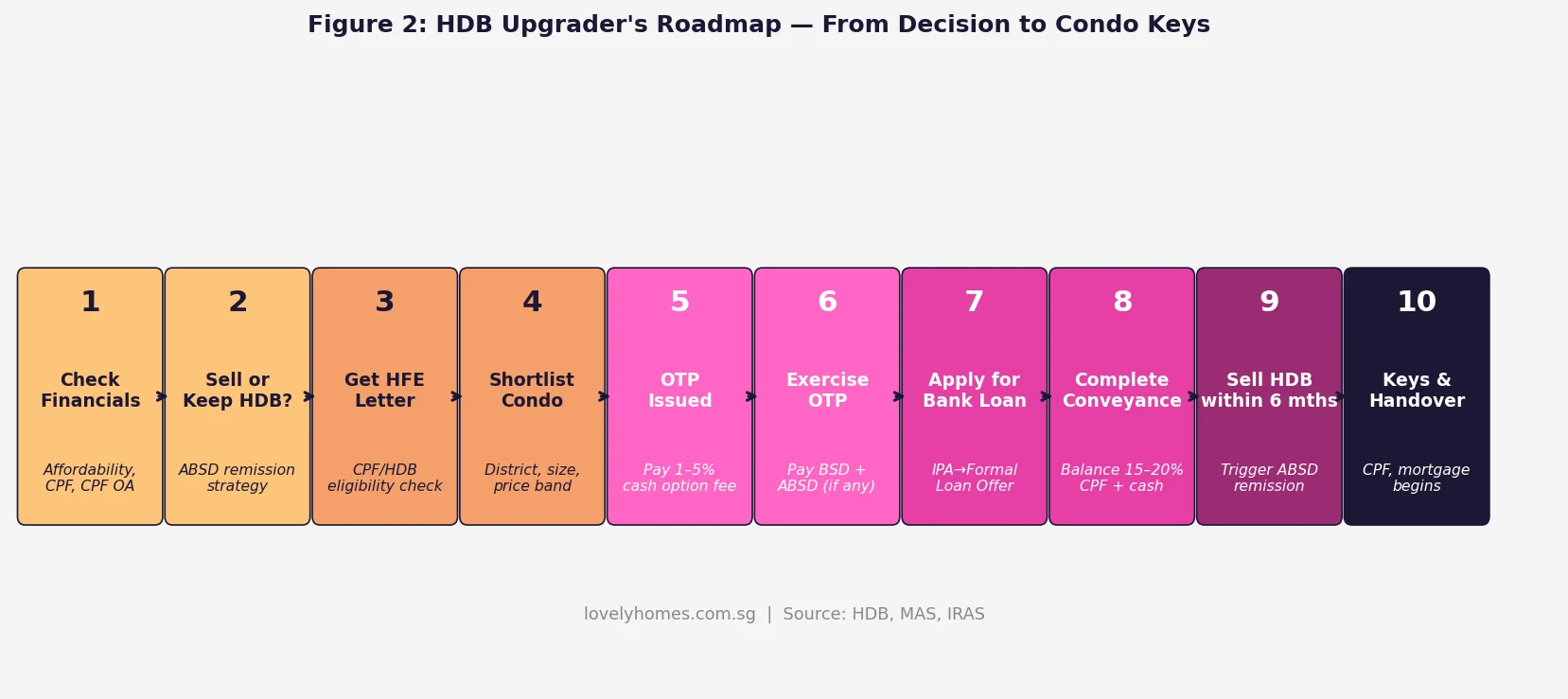
HDB upgrader condo buying roadmap 10 steps decision to keys Singapore 2026
Figure 2: HDB Upgrader’s 10-Step Roadmap from Decision to Condo Keys — Singapore 2026

The roadmap above captures the sequential decisions an HDB upgrader must navigate. The two most critical junctures — ABSD strategy (Step 2) and OTP exercise (Step 6) — have time-limited consequences that are difficult to reverse. Build a minimum 6-month planning runway before committing to an OTP.

Understanding the CPF Component of Your Upgrade

Most HDB upgraders have been servicing their HDB mortgage using CPF Ordinary Account (OA) funds. When you sell the HDB flat, the CPF amount withdrawn (principal) plus accrued interest at 2.5% per annum must be returned to your CPF OA before you receive any net cash proceeds. After this refund, your CPF OA balance is typically replenished significantly — and these funds can immediately be applied to the new condo purchase.

Example: a couple who bought their Tampines 5-room HDB flat in 2015 for $450,000 and have withdrawn $280,000 from their combined CPF OA (including accrued interest at 2.5%) over 11 years will have an accrued interest component of approximately $55,000 — meaning the CPF refund on sale is $280,000 principal + $55,000 interest = $335,000, which goes back into their OA. This OA balance can then be used as part of the 25% down payment on the new condo. See our detailed CPF Accrued Interest Guide 2026 for the full calculation framework.

Worked Example: The Lim Family’s HDB-to-Condo Upgrade

Singapore Citizens Mr and Mrs Lim, aged 38 and 36. Combined monthly income: $13,000. Selling Sengkang 5-room HDB (valued $600K). Target: 3-bedroom resale condo in D19 (Punggol/Sengkang corridor), asking $1,450,000.

Item Amount
Condo purchase price $1,450,000
Buyer’s Stamp Duty (BSD) $44,600
ABSD (SC 2nd property, 20%) $290,000 (paid upfront, refunded after HDB sale)
Legal fees (conveyancing) ~$3,200
Cash at OTP (1% option fee) $14,500
Cash at exercise (4% + BSD + ABSD) $396,400
Bank loan (75% LTV) $1,087,500
Monthly instalment (3.2%, 30yr) $4,685/mth
TDSR check: $4,685 / $13,000 36.0% ✔ PASS
HDB sale proceeds
HDB sale price $600,000
Less: Outstanding HDB loan balance ($82,000)
Less: CPF OA refund (principal + accrued interest) ($310,000)
Net cash from HDB sale $208,000
Net cash position after ABSD remission ($290K refunded) $498,000 cash + $310,000 CPF OA

In this scenario, the Lims need approximately $410K of liquid funds at the point of condo exercise (before HDB sale proceeds arrive). If their combined cash savings and existing CPF OA balances are insufficient to bridge this gap, they may consider a bridging loan from a bank — typically at 5–6% per annum, used for a short period of 3–6 months until the HDB sale is completed and ABSD is refunded.

Key Timing Rules You Cannot Miss

Singapore’s ABSD remission framework contains two non-negotiable deadlines that upgraders frequently misjudge:

  • 6-month sale window for resale condo: if you purchase a resale condo whilst owning the HDB, you must complete the sale of your HDB within 6 months from the condo’s option exercise date. Missing this deadline forfeits the 20% ABSD remission permanently — IRAS does not grant extensions.
  • 6-month window from TOP for new launch: for a new launch condo, the 6-month HDB sale window runs from the date of the condo’s TOP or from the date of issue of the Certificate of Statutory Completion (CSC), whichever is earlier. Most buyers align HDB sale completion with the month of TOP collection to optimise cash flow.
  • HDB Minimum Occupation Period (MOP): your HDB flat must have fulfilled its MOP (typically 5 years from key collection date or TOP, whichever is earlier) before you are permitted to sell it on the open market. Verify your HDB MOP completion date before committing to a condo timeline that depends on HDB sale proceeds.

Why Upgrading Still Makes Sense in 2026

Despite higher ABSD rates and a TDSR framework that has tightened debt capacity compared with pre-2021, the HDB-to-condo upgrade remains one of the most financially rational moves in the Singapore property journey. Four factors support this view as at mid-2026:

  • HDB resale prices near peak: the HDB Resale Price Index reached 183.1 in Q1 2026, up from 131.5 in Q1 2020 — a 39% nominal gain. An upgrader selling a 5-room Tampines or Bishan flat today captures near-peak pricing on an asset that carries significant maintenance risk as it ages. See our HDB Resale Flat Prices Guide 2026 for current market data by town.
  • Private condo supply cycle: with 42,561 private units in the pipeline as at Q1 2026 (of which 17,032 remain unsold), supply is elevated relative to the historical average. This supports price stability in the near term and reduces the risk of a sharp price spike catching upgraders off-guard.
  • Condo rental yield as hedge: an upgrader who buys a condo and rents it out (Strategy A — living in HDB until MOP, then renting out the condo) benefits from rental income that helps service the mortgage. Current condo rental yields in the OCR are approximately 3.0–3.8% gross, which can cover most or all of the monthly bank instalment at 75% LTV.
  • Intergenerational wealth transfer: private property is transferable to heirs without the MOP-related restrictions that apply to HDB flats. For families building intergenerational wealth in Singapore’s constrained land environment, private property ownership remains a cornerstone asset.

What Might Come Next: Upgrader Market Outlook

The following is speculative commentary for planning purposes only.

The key policy risk for HDB upgraders is a further increase in ABSD rates for second-property purchases. The 2023 cooling measures raised the SC second-property ABSD from 12% to 20% — a significant step that dampened upgrader volumes in the resale condo market through late 2023. As at mid-2026, transaction volumes have stabilised but the government has signalled no plans to relax ABSD. An upgrader who is within 12 months of MOP completion should note that any further rate increase would significantly raise the cost of Strategy B (buy condo first, claim remission later).

The Bank of Singapore’s interest rate outlook for 2026–2027 suggests SORA-linked floating rates may ease modestly from current levels of approximately 3.0–3.4%. Even a 50 basis point reduction in effective mortgage rates from a $1.4M loan improves monthly cash flow by approximately $460/mth — a meaningful difference in household affordability.

Frequently Asked Questions: HDB Upgrader Buying a Condo

Can I use my CPF OA to pay for the condo down payment while still holding the HDB?

Yes. CPF OA funds can be used for the new condo purchase whilst you still own your HDB flat, subject to the CPF Board’s Basic Retirement Sum (BRS) or Full Retirement Sum (FRS) rules depending on your age. If you are below 55, you may use CPF OA funds freely for the condo up to the Valuation Limit. If you are 55 or older, CPF rules require you to retain a minimum amount in your Retirement Account. Consult the CPF Board’s online calculator or a financial adviser before committing.

What happens if I cannot sell my HDB within 6 months and miss the ABSD remission deadline?

You forfeit the ABSD remission permanently. IRAS does not grant extensions or case-by-case waivers under the current policy framework. Missing the 6-month deadline means you have permanently paid 20% ABSD (for SC 2nd property) with no refund. This is precisely why careful planning of the HDB sale timeline — engaging a listing agent immediately after the condo OTP is issued — is essential. Do not rely on the full 6 months as buffer; aim to complete the HDB sale within 4–5 months to allow for unexpected delays.

If only one spouse is on the HDB, and the other spouse has never owned property, can they buy a condo as a first purchase (0% ABSD)?

No. The ABSD rules are assessed at the household level for married couples in Singapore. If either spouse owns a residential property (including the HDB flat), both spouses are treated as second-property purchasers for ABSD purposes on any joint purchase. Even if only one spouse is listed on the HDB and the other is not, a joint condo purchase by both attracts 20% ABSD. If the non-HDB-owning spouse purchases the condo as a sole owner, the ABSD treatment depends on whether they personally own any residential property — but the couple’s intent to use the property as a family home may be considered by IRAS.

Should I choose a new launch condo or a resale condo for my upgrade?

Both have merits. A new launch condo gives you 3–5 years before TOP, during which you can continue living in the HDB flat (if MOP is satisfied) and saving towards the down payment and ABSD buffer. You also benefit from the progressive payment scheme — disbursing the purchase price in stages as construction milestones are reached, reducing upfront capital outlay. A resale condo gives immediate possession, which suits upgraders who want to rent it out right away for yield, or who have already sold the HDB flat and need accommodation. The stamp duty and legal timeline for a resale condo is typically 8–12 weeks from OTP issue to completion. See our Private Property Resale Process Guide 2026 for a detailed walkthrough.

Can I still qualify for an HDB housing grant after buying a private condo?

No. Once you have purchased a private residential property in Singapore, you are permanently debarred from purchasing a new HDB flat (BTO or DBSS) or receiving HDB housing grants. You may still purchase an HDB resale flat under certain conditions (as an SC, after the relevant waiting period following private property disposal), but you will not be eligible for the Enhanced CPF Housing Grant (EHG) or Proximity Housing Grant (PHG) if you have previously owned private property. This is an important one-way door in the Singapore housing journey — understand that the upgrade to private property is largely irreversible from the HDB subsidy perspective.

Is there a minimum income to buy a condo in Singapore?

There is no statutory minimum income requirement to purchase a private condominium in Singapore. However, the TDSR of 55% effectively sets a practical floor — at a 3.2% mortgage rate over 30 years, the minimum household income needed to service a $1M bank loan is approximately $3,900/mth (using 55% TDSR). Most upgraders targeting a $1.2M–$1.5M condo with a 75% LTV loan require combined household income of $9,000–$12,000/mth to comfortably satisfy TDSR with some headroom. The affordability chart in Figure 3 provides a range of price-to-income scenarios.

Can I use a bridging loan to fund the ABSD gap between condo exercise and HDB sale?

Yes. Most Singapore banks offer bridging loans specifically for this scenario — to bridge the period between condo OTP exercise (when ABSD is due) and HDB sale completion (when proceeds arrive). A bridging loan is typically capped at 25% of the property value, charged at around 5–6% per annum, and must be fully repaid within 6 months. The interest cost for a $290,000 ABSD bridging loan at 5.5% for 4 months is approximately $5,350 — a relatively modest cost compared with the $290,000 ABSD amount being refunded. Some upgraders instead use a combination of personal savings and unsecured credit lines; discuss your specific cash-flow needs with your bank’s mortgage specialist before committing.

Disclaimer: This guide is for general educational purposes only and does not constitute financial, legal, or property advice. Singapore property regulations, ABSD rates, and CPF rules are subject to change. All figures are illustrative and based on conditions as at June 2026. Consult a licensed property agent, mortgage specialist, or legal adviser for advice specific to your circumstances. Official resources: hdb.gov.sg, iras.gov.sg, mas.gov.sg, cpf.gov.sg.
×

Click anywhere or press Esc to close

Translate »