Singapore Condo Subletting Guide 2026: Leases, Tenant Rights, Stamp Duty and IRAS Tax

Singapore Condo Subletting Guide 2026: Leases, Tenant Rights, Stamp Duty and IRAS Tax

Subletting a private condominium in Singapore is one of the most common ways property owners generate rental income — but the process involves more legal and financial obligations than many landlords realise. From drafting a legally sound tenancy agreement, to stamping it with the Inland Revenue Authority of Singapore (IRAS) within 14 days, to declaring rental income in your annual income tax return, every step carries rules that are worth understanding before you hand over the keys.

This guide covers the complete private condo subletting process in Singapore for 2026: tenant screening, tenancy agreement essentials, stamp duty on leases, IRAS rental income tax, the rights and obligations of landlords and tenants, deposit and handover procedures, and the rules on minimum lease periods. It also explains how private condo subletting differs from HDB subletting, where different rules apply. All information reflects the regulatory framework as at 20 August 2026. For definitive guidance, consult IRAS, Small Claims Tribunals, and a licensed real estate salesperson or solicitor.

Quick Answer — Private Condo Subletting at a Glance

  • No HDB-style restriction: private condominium owners do not need HDB approval to sublet. The only governmental restrictions are on minimum lease duration and foreign tenant eligibility.
  • Minimum lease period: 3 consecutive months for private residential property. Short-stay rentals (Airbnb, serviced apartment-style) under 3 months are not permitted for private residential units under Urban Redevelopment Authority (URA) guidelines.
  • Foreign tenant ICA requirement: a foreign tenant must hold a valid Immigration & Checkpoints Authority (ICA)-issued pass with at least 6 months remaining validity — for example, an Employment Pass, S Pass, Work Permit, Long-Term Visit Pass, or Student Pass.
  • Stamp duty on lease: IRAS charges 0.4% of the annual rent for leases exceeding one year (0.4% of total rent for leases up to one year). Payable within 14 days of signing. By convention, the tenant pays, but this can be negotiated.
  • Rental income tax: landlords must declare rental income in their annual income tax return. Allowable deductions include mortgage interest, property tax, fire insurance, maintenance, and agent commissions.
  • Security deposit: there is no statutory maximum; the market convention is one month’s rent for every year of lease, capped at two months for typical two-year leases.
  • STB disputes: tenancy deposit and rent disputes involving amounts up to S$30,000 can be heard by the Small Claims Tribunals without need for a lawyer.

Private Condo vs HDB Subletting — Key Differences

Before diving into the private condo rules, it is worth noting what makes HDB subletting different. HDB owners who have completed their Minimum Occupation Period and wish to sublet the entire flat must obtain HDB approval, the subtenants must be Singapore Citizens or Permanent Residents (with limited exceptions for certain non-citizens), and the subletting period is subject to a minimum of six months and a maximum quota. None of these requirements apply to private condominium subletting. A private condo owner may sublet to a Singapore Citizen, a Permanent Resident, or a foreigner holding a valid ICA pass, for any duration of three months or more, without seeking any government approval.

HDB subletting rules are discussed separately in the LovelyHomes HDB guides; the remainder of this article focuses exclusively on private residential property.

Rental Rates in 2026 — What the Market is Paying

Singapore’s private residential rental market softened modestly in 2025 and into 2026 after the sharp post-pandemic surge of 2022–2023. URA’s Private Residential Rental Index declined approximately 1.2% in Q1 2026 quarter-on-quarter, partly reflecting new condominium completions that increased available supply. Despite this correction, rents remain substantially above their 2019 levels, and well-located units in the Outside Central Region (OCR) continue to command strong demand from professionals relocating to Singapore.
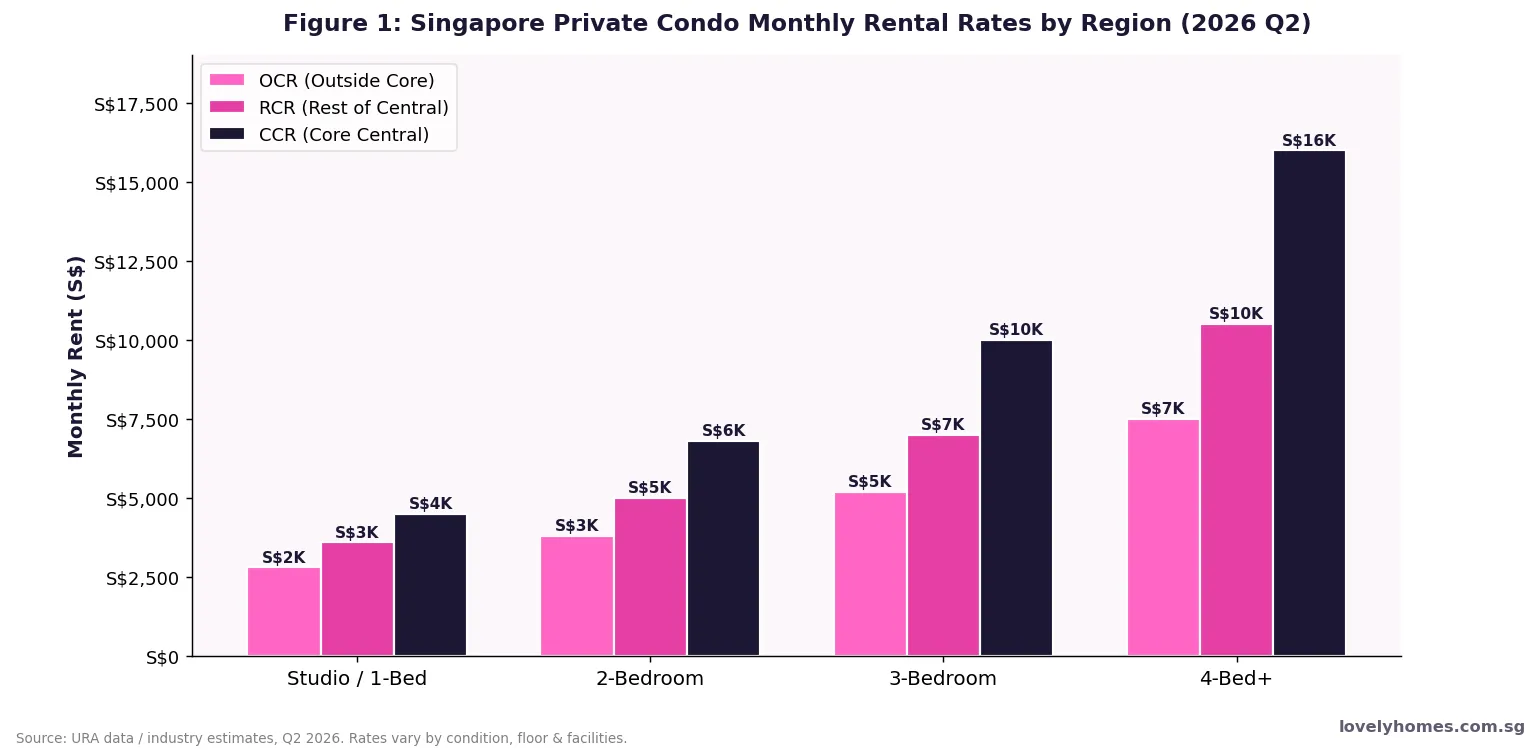
Singapore private condo monthly rental rates by region 2026 — Studio to 4-bedroom in OCR, RCR and CCR
Figure 1: Indicative monthly rental rates for private condominiums by region and bedroom type, Q2 2026. Actual rents vary by condition, floor level, facilities, and proximity to MRT. Source: URA data / industry estimates.

Before You Sublet — Four Pre-Market Checks

Before listing your unit, four checks protect you from compliance issues later. First, review your mortgage loan agreement. While banks in Singapore do not typically restrict residential subletting on standard loan agreements (unlike commercial property), some older loan agreements contain clauses requiring bank notification. Read your loan terms or call your bank’s mortgage hotline to confirm.

Second, check your condominium’s Management Corporation Strata Title (MCST) by-laws. Some MCSTsimpose rules on tenant registration, visitor access cards, or moving-in procedures; a handful have also attempted to restrict subletting to specific subtenant profiles. While MCST by-laws cannot override your right to sublet at law, understanding them avoids disputes with the management council.

Third, ensure the unit meets basic safety and habitability standards. Landlords in Singapore are responsible for ensuring that smoke detectors are functional, electrical fittings are safe, and plumbing is in working order at the start of the tenancy. Failure to maintain safety standards can expose you to liability if a tenant is injured.

Fourth, confirm your MCST’s position on short-term rentals. Since URA’s position is that short-stay rentals (less than three consecutive months per tenant) are not permitted for private residential units, some MCSTshave taken active steps to enforce this — including installing surveillance and notifying URA of suspected violations. Compliance is not optional, and violations can result in enforcement action.

The 7-Step Subletting Process
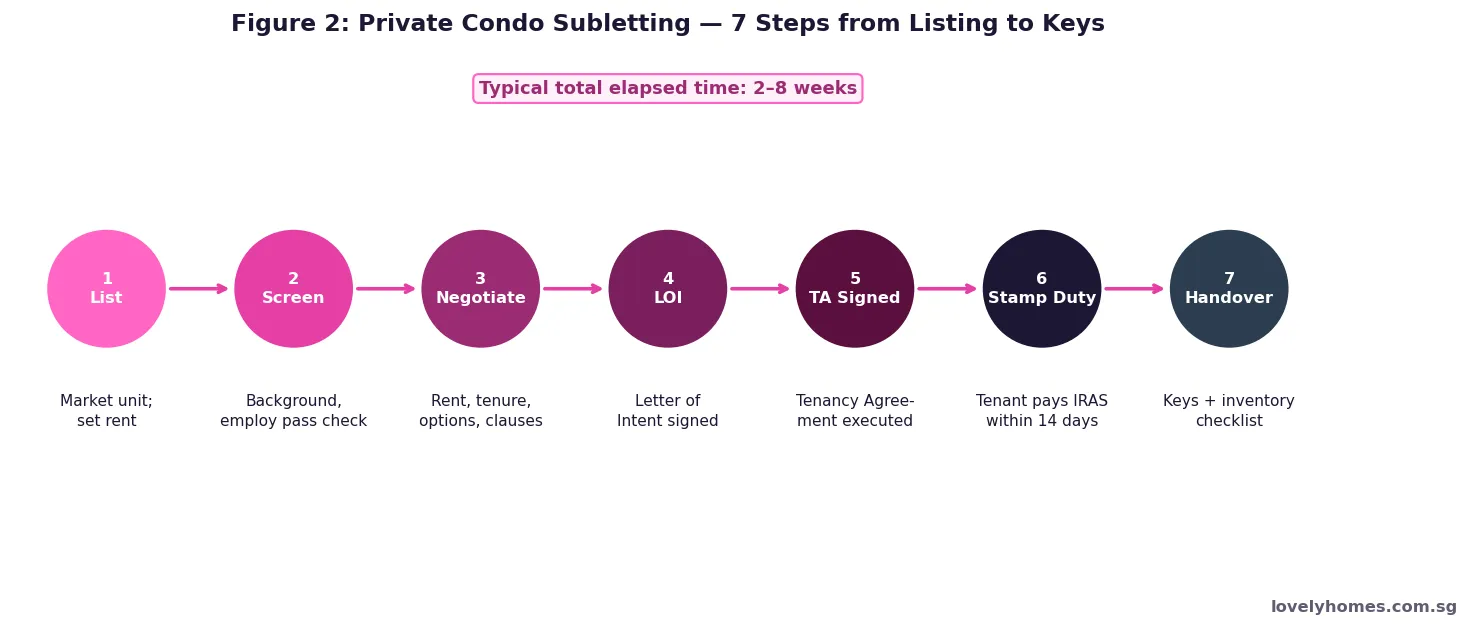
Singapore private condo subletting process — 7 steps from listing to key handover
Figure 2: The seven steps from listing to key handover for a private condo subletting. Typical elapsed time: 2–8 weeks depending on how quickly a tenant is found and documents are exchanged.

The process begins with marketing the unit. Most landlords use a licensed real estate salesperson (under the Council for Estate Agencies, or CEA) to list on PropertyGuru or SRX, show the unit, and screen tenants. The agent’s commission for a tenancy is typically one month’s rent for a one-year lease or a half month for shorter tenancies, paid by the landlord; for two-year leases, the convention varies. Once a tenant is found, a Letter of Intent (LOI) is signed, usually accompanied by a good-faith deposit of one month’s rent. The landlord then has a brief window (typically 10–14 days) to accept the LOI and sign the Tenancy Agreement (TA). Once the TA is signed, the tenant has 14 days to stamp it with IRAS. Keys are handed over on the commencement date, accompanied by a detailed inventory and condition checklist.

The Tenancy Agreement — What Must Be in It

Singapore law does not prescribe a mandatory standard form for private residential tenancy agreements, but the Consumer Association of Singapore (CASE) and the Real Estate Developers’ Association of Singapore (REDAS) publish template TAs that are widely used. A well-drafted TA should include: the full names and NRIC/FIN/passport numbers of all tenants; the rental amount, payment method, and due date; the lease commencement and expiry dates; the security deposit amount and refund conditions; a clause on air-conditioner servicing responsibility (by convention, the landlord services the units once or twice a year, and the tenant cleans the filters); a pet policy; a diplomatic clause (allowing the tenant to terminate early after a stipulated minimum period, typically 12–14 months into a 24-month lease, on two months’ written notice); and a handover clause specifying the condition in which the unit must be returned.

One clause landlords often overlook is the reinstatement clause — specifying which modifications the tenant may or may not make (e.g., hanging pictures, installing shelving) and whether the tenant must restore the unit to its original condition on vacating. Without this clause, disputes over reinstatement are common and difficult to resolve.

Foreign Tenant Eligibility — ICA Requirements

A foreign tenant — anyone who is not a Singapore Citizen or Permanent Resident — must hold a valid ICA-issued pass at the time the lease is signed and throughout the tenancy. The pass must have a minimum of six months remaining validity when the tenancy begins. Acceptable passes include: the Employment Pass, S Pass, Work Permit, EntrePass, Personalised Employment Pass (PEP), Long-Term Visit Pass (LTVP), Student Pass (issued by ICA for international schools or universities), and the Dependent’s Pass. Tourist visas and short-term visit passes do not qualify for residential tenancy agreements.

Landlords should take a photocopy (or photograph) of the tenant’s pass at the time the TA is signed and retain it for the duration of the tenancy. If a tenant’s pass is not renewed and expires during the tenancy, the landlord should address this promptly — an overstayer cannot lawfully reside in a tenanted property and the landlord should not continue receiving rent from an individual who is in Singapore without a valid pass.

Stamp Duty on Tenancy Agreements

Every tenancy agreement for a Singapore residential property must be stamped with IRAS within 14 days of execution (signing). The stamp duty rates are: 0.4% of the total rent for leases of one year or less; and 0.4% of the annual rent for leases exceeding one year (note: this is the same rate but applied only to one year’s rent, not the total lease amount). For example, a two-year lease at S$5,200 per month produces annual rent of S$62,400; stamp duty is 0.4% × S$62,400 = S$249.60, rounded up to S$250. By convention, the tenant bears the stamp duty cost, though the parties are free to allocate it otherwise in the TA. IRAS operates an e-Stamping portal at iras.gov.sg/e-stamping; the stamping takes approximately 10 minutes online and payment is by credit card or PayNow.

IRAS Rental Income Tax — What Every Landlord Must Know

Rental income from a Singapore property is taxable income in Singapore regardless of whether the landlord is a tax resident. Singapore Citizens, Permanent Residents, and long-term residents who are tax-resident declare rental income annually in their Form B1 (for employment income plus rental) or Form B (for self-employed persons). The deadline is 15 April each year for paper returns, or 18 April for e-filing.

The good news for landlords is that IRAS allows a substantial range of deductions against gross rental income. Allowable deductions include: mortgage interest (only the interest component, not the principal repayment); property tax (the IRAS-assessed annual property tax on the unit); fire insurance premiums; the cost of repairs and maintenance (not improvements); agent commissions; and the cost of furnishing that wears out over the tenancy (under IRAS’s wear-and-tear allowance). The net rental income — gross rent minus allowable deductions — is added to the landlord’s other assessable income and taxed at the applicable marginal rate. Singapore resident individuals are taxed at rates from 2% to 24% depending on total income. Non-resident landlords are taxed at a flat rate of 22% on net rental income (or 15% of gross rent if lower, at IRAS’s option).
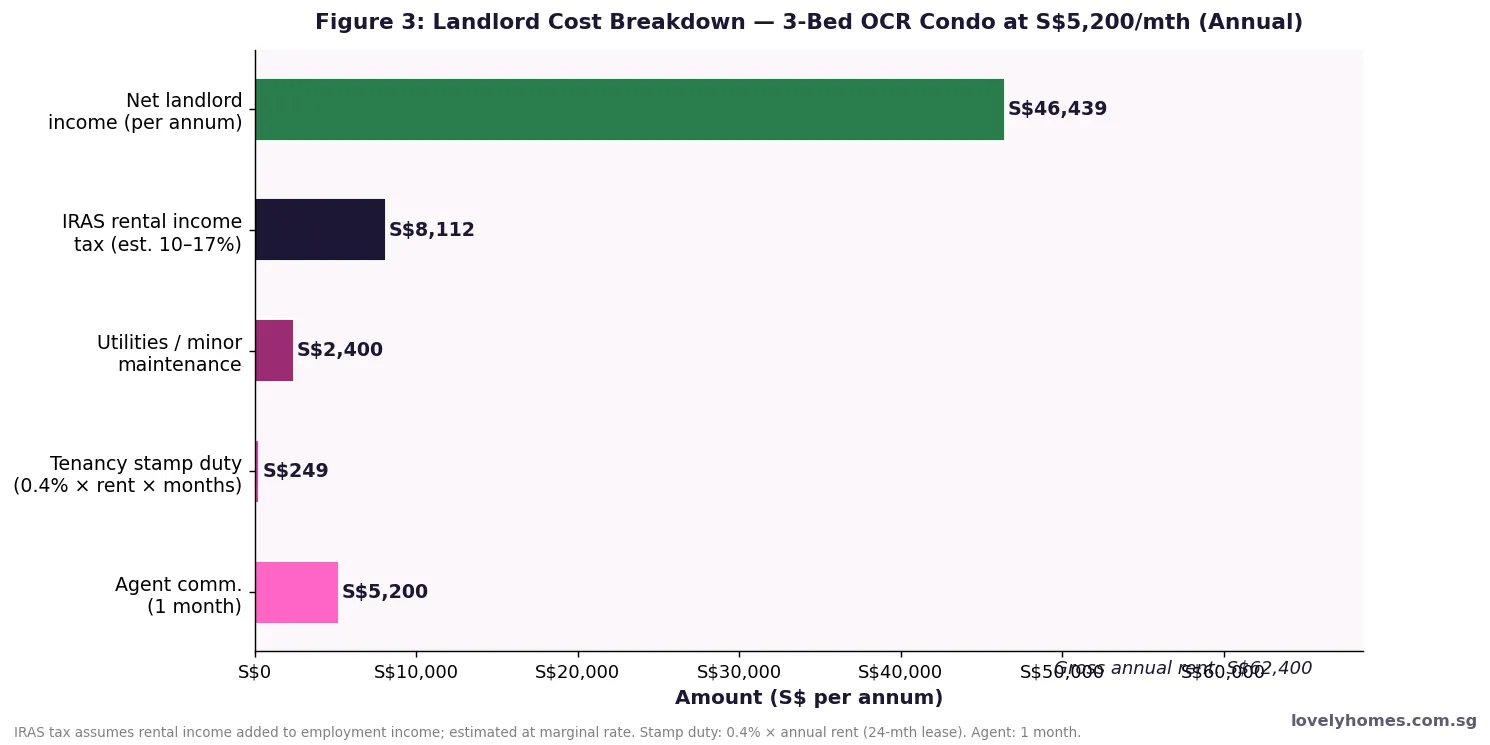
Singapore condo landlord cost breakdown — agent fees stamp duty IRAS tax and net income at S$5200 per month
Figure 3: Indicative annual landlord cost breakdown for a 3-bedroom OCR condo rented at S$5,200 per month on a 24-month lease. IRAS tax estimated at ~13% effective marginal rate on net rental income. Source: IRAS guidelines, industry estimates.

Security Deposit, Condition Report, and Handover

Singapore law does not set a statutory maximum or minimum security deposit for private residential tenancies. The market convention is one month’s rent per year of lease, typically capped at two months. For a standard two-year lease, the security deposit is thus two months’ rent — S$10,400 for a S$5,200/month unit. The deposit is held by the landlord and must be returned within 14 days of the tenancy expiring or being terminated, less any deductions for unpaid rent, damages beyond fair wear and tear, outstanding utility bills, or unreturned access cards.

The most effective tool for avoiding deposit disputes is a thorough condition report (also called an inventory checklist) signed by both parties at move-in and at move-out. Photographs — timestamped, ideally with a shared cloud folder — are invaluable. The checklist should note the condition of every wall, floor, fixture, fitting, and appliance. Any existing damage should be documented and acknowledged before the tenant moves in; any new damage at move-out is then unambiguous and easier to price. The Small Claims Tribunals can resolve deposit disputes involving amounts up to S$30,000, making formal court action unnecessary for most residential tenancy disputes.

Item Landlord’s Responsibility Tenant’s Responsibility
Air-conditioner servicing (periodic) ✓ By convention (1–2× per year) Regular cleaning of filters
Structural repairs ✓ Always Not applicable
Fair wear and tear ✓ Accepted; no deduction from deposit Not liable
Damage beyond fair wear and tear Not responsible ✓ Liable; deducted from deposit
Utilities (electricity, water, gas) Not responsible after handover ✓ Tenant’s account; tenant pays
Stamp duty on TA Negotiable (landlord may agree to share) ✓ By convention, tenant pays
MCST maintenance fees ✓ Landlord pays (as the subsidiary proprietor) Not responsible
Agent commission (to find tenant) ✓ By convention, landlord pays 1 mth rent Some agents charge tenant too — verify upfront

Worked Example

Worked Example: Mr Ahmad SC, 3BR OCR Condo at S$5,200/mth, 24-Month Lease

Situation: Mr Ahmad, a Singapore Citizen, owns a three-bedroom condominium in Buona Vista (OCR) with a current market value of S$1,800,000. He has an outstanding bank mortgage of S$900,000 at 3.5% per annum, giving monthly interest of approximately S$2,625. Annual property tax (owner-investor, non-owner-occupier rate): S$7,440. He rents the unit to a Japanese national on an Employment Pass at S$5,200/month on a two-year lease commencing 1 September 2026. Agent commission: one month’s rent S$5,200, paid on signing.

Annual income and tax:

  • Gross annual rent: 12 × S$5,200 = S$62,400
  • Less mortgage interest: 12 × S$2,625 = S$31,500
  • Less property tax (non-owner rate, AV ~S$48,000): S$7,440
  • Less agent commission (amortised over 2 years): S$5,200 ÷ 2 = S$2,600/yr
  • Less fire insurance: ~S$180/yr
  • Less air-con servicing (twice a year): ~S$300/yr
  • Net taxable rental income: S$62,400 − S$42,020 = S$20,380/yr
  • Assuming Mr Ahmad’s other employment income puts him in the 11.5% marginal bracket, IRAS tax on rental income: ~S$2,344/yr
  • Net rental cash: approximately S$18,036/yr (S$1,503/mth above all running costs)

Stamp duty: tenant pays 0.4% × S$62,400 = S$250 within 14 days of signing.

Deposit: two months’ rent = S$10,400, held by Mr Ahmad and returned within 14 days of end of tenancy less any valid deductions.

Diplomatic clause: after 12 months, tenant may terminate on 2 months’ written notice. If tenant invokes this at month 13, Mr Ahmad returns the deposit less any deductions and finds a new tenant, incurring another agent commission of one month’s rent.

Short-Term Rentals — What Is and Is Not Allowed

URA’s position on short-term private residential rentals has been consistent since 2017: the minimum rental period for a private residential unit is three consecutive months per occupant. This means platforms like Airbnb, Booking.com, or any serviced-apartment arrangement where guests stay for fewer than three months are not permitted at a private condominium unit. Violations can result in URA enforcement action, including fines, and many MCSTshave additionally adopted by-laws to enforce the three-month minimum through access card controls and visitor registration systems.

Serviced apartments, on the other hand, are a separately approved use class under URA’s planning framework and are subject to different rules. A private condominium cannot be converted to a serviced apartment without URA’s formal change-of-use approval, which is very rarely granted for strata-titled units in a standard condominium development.

What Might Come Next for Private Rental Regulation

The Singapore government has signalled an interest in strengthening tenant protection in the private residential rental market. Policy discussions in 2024 and 2025 touched on the possibility of a formal residential tenancy framework — analogous to legislation in Australia, the United Kingdom, and Hong Kong — that would codify minimum notice periods, deposit caps, and repair obligations. As at August 2026, no such legislation has been enacted, and private residential tenancies continue to be governed primarily by contract law. Landlords and tenants should monitor announcements from the Ministry of Law and the Ministry of National Development for any legislative changes in this space.

FAQ — Singapore Condo Subletting 2026

Do I need to inform my bank before subletting my mortgaged condo?

Most standard residential mortgage agreements in Singapore do not prohibit subletting, but some include a notification or consent clause. Read your loan agreement carefully, or contact your bank’s mortgage services team to confirm. Failure to comply with a notification clause is technically a breach of the loan agreement, though banks rarely enforce this unless the property is in arrears. To be safe, a brief written notification to your bank (without waiting for a formal response) is a prudent step, particularly if your loan was taken out with a specific owner-occupation clause.

Can I sublet my private condo to a foreign domestic worker (FDW)?

A Foreign Domestic Worker (FDW) holding a Work Permit issued specifically for domestic work cannot independently rent a residential property in Singapore — they are required to reside with their employer. An FDW’s work permit is tied to their employer’s residence. Therefore, an FDW cannot be the named tenant on a tenancy agreement for a private residential unit in their own right. This is different from, say, an Employment Pass or S Pass holder, who may rent a residential unit independently.

What happens if my tenant stops paying rent?

If a tenant is in arrears, you should first send a written notice of arrears specifying the overdue amount and giving the tenant a deadline (typically 14 days) to pay. If payment is still not made, you may serve a formal notice to terminate the tenancy for breach of contract (if your TA includes such a clause) or pursue a claim at the Small Claims Tribunals for the arrears amount. For amounts above S$30,000 or where the tenant refuses to vacate, you will need to engage a solicitor and apply to the High Court for a writ of possession. Self-help remedies — such as changing the locks or removing the tenant’s belongings — are illegal in Singapore and can expose the landlord to civil and criminal liability.

Is the rent I receive overseas as a non-resident landlord taxable in Singapore?

Yes. Rental income sourced from a Singapore property is taxable in Singapore regardless of where the landlord resides. Non-resident landlords — those who are not Singapore tax residents — are taxed at a flat rate of 22% of net rental income (or 15% of gross rent, whichever is lower). Non-resident landlords must file a Singapore income tax return annually. The IRAS has a non-resident taxpayer portal and specific guidance for overseas property owners. Singapore also has an extensive tax treaty network that may reduce withholding tax obligations in the landlord’s country of residence — check the applicable bilateral treaty.

What is a diplomatic clause and should I include one?

A diplomatic clause (also called a break clause) gives the tenant the right to terminate the lease early if they are required to leave Singapore — for example, due to job relocation, retrenchment, or an employer’s recall. The clause typically allows termination after a minimum period (usually 12–14 months into a two-year lease) on two months’ written notice. Including a diplomatic clause is standard market practice in Singapore because many tenants are expatriate professionals whose employment can change quickly. Refusing to include one may make your property less attractive to the expatriate pool of tenants, which comprises a significant portion of the demand for private condo rentals. From the landlord’s perspective, the clause provides certainty: you know the earliest point at which the tenant can exit and can plan accordingly.

Does subletting affect my property tax?

Yes, but only if you previously claimed the owner-occupier property tax rate. When you sublet your entire private condominium, you become an investor-landlord and IRAS will reassess your property tax at the higher non-owner-occupier rate. The non-owner-occupier rate is 10–20% of the Annual Value (AV) for the relevant AV band, compared to the owner-occupier rate of 0–16%. For a typical city-fringe condo with AV of S$48,000, the difference is approximately S$5,160 per year (owner: ~S$2,280 vs non-owner: ~S$7,440). You must notify IRAS of the change in occupancy status when you rent out the property. Failure to do so and continuing to claim the owner-occupier concession is a compliance breach and can result in back-taxes and penalties.

Disclaimer: This article is for general information only and does not constitute legal, tax, or financial advice. Rental regulations, IRAS tax rules, URA guidelines, ICA pass requirements, and Small Claims Tribunals procedures are subject to change. Always verify current rules directly with the Urban Redevelopment Authority (ura.gov.sg), the Inland Revenue Authority of Singapore (iras.gov.sg), the Immigration & Checkpoints Authority (ica.gov.sg), and a licensed real estate salesperson or solicitor. LovelyHomes is not responsible for reliance on information in this article.
Singapore HDB Flat Inheritance Guide 2026: CPF Nomination, Transmission and Estate Rules

Singapore HDB Flat Inheritance Guide 2026: CPF Nomination, Transmission and Estate Rules

When a Singapore Housing & Development Board (HDB) flat owner dies, the flat does not automatically pass to surviving family members the way many people assume. Whether the flat is transferred, sold, or administered by a government body depends on whether the owner made a CPF nomination, an HDB Flat Nomination, or neither. Understanding the distinction — and acting on it while still alive — is one of the most important estate-planning steps any HDB flat owner can take.

This guide explains every pathway in plain language, sets out the eligibility rules a beneficiary must satisfy to keep an inherited flat, walks through the transmission process step by step, and answers the questions HDB owners most commonly ask. All information reflects Housing & Development Board rules, CPF Board procedures, and Public Trustee Office (PTO) practice as at 20 August 2026. Always verify current requirements directly with HDB, CPF Board, and the Public Trustee Office.

Quick Answer — HDB Flat Inheritance at a Glance

  • Three pathways exist: CPF nomination (if flat was bought using CPF), HDB Flat Nomination (if flat was bought with cash or the CPF nomination does not cover the flat), and Public Trustee or probate (if no nomination was made).
  • CPF nomination overrides your will for the CPF component of the flat’s value. An HDB Flat Nomination similarly overrides your will for the flat itself.
  • No inheritance tax and no estate duty apply in Singapore. Estate duty was abolished on 15 February 2008.
  • The beneficiary must meet HDB eligibility to keep the flat. A Singapore Citizen or Singapore Permanent Resident with no other private property may generally retain the flat; a foreigner or a beneficiary who owns private property must sell.
  • If the owner dies within the Minimum Occupation Period (MOP), the MOP clock does not restart — it continues from the original purchase date.
  • Multiple beneficiaries may jointly inherit a flat, but all must meet HDB eligibility or the flat must be sold.
  • Typical processing time: 3–9 months for a clear nomination; 6–24 months if the Public Trustee is involved; longer if the estate is contested.

The Three HDB Inheritance Pathways Explained

How an HDB flat is dealt with when its owner dies is determined primarily by whether a valid nomination exists and what kind of nomination it is. The flat does not form part of the deceased’s general estate in the same way a bank account does — it has its own transfer rules that sit alongside, and sometimes override, a will.

Pathway 1 — CPF Nomination

Most HDB flat purchases involve CPF Ordinary Account (OA) savings, either as the down payment, for monthly repayments, or both. When CPF savings are used, the CPF Board becomes a mortgagee. On the owner’s death, the CPF Board pays the outstanding CPF principal plus accrued interest back to the CPF estate (or to the nominated person if a CPF nomination is in place). That CPF money does not go to the flat’s beneficiary directly — it goes to the nominated CPF beneficiary in cash, not as a share of the flat.

What this means in practice: the CPF nomination determines what happens to the CPF money, while the HDB Flat Nomination (or the will, or intestacy rules) determines what happens to the flat itself. The two are separate. A flat owner who used CPF to buy the flat should therefore make both a CPF nomination and an HDB Flat Nomination to ensure both the cash component and the flat are directed as intended.

Pathway 2 — HDB Flat Nomination

The HDB Flat Nomination Scheme, administered by HDB, allows an owner to nominate one or more persons to receive the flat on death. Unlike a will, an HDB nomination is registered directly with HDB and takes effect automatically — it does not need to go through probate. The nominated person (the “nominee”) must be a Singapore Citizen or Permanent Resident who meets HDB’s eligibility criteria at the time of the owner’s death.

An owner can nominate the flat to multiple persons in specified shares, or solely to one person. Where shares are nominated, all nominated persons must jointly meet the eligibility criteria. The nomination can be updated at any time by submitting a new HDB Flat Nomination form; the latest signed nomination supersedes all previous ones.

Pathway 3 — No Nomination: Public Trustee or Probate

Where no valid HDB Flat Nomination exists and the deceased did not leave a will, the Intestate Succession Act (Cap 146) determines who inherits the flat. In this scenario, a family member must either obtain Letters of Administration from the court (which typically takes 6–18 months) or apply to the Public Trustee Office if the estate is straightforward and under the monetary threshold. The PTO will administer the estate, collect the assets, and distribute them according to the intestacy order: spouse first, then children, then parents, then siblings, and so on.

If a will exists but no HDB nomination, the flat passes under the will — but the executor must apply for a Grant of Probate before the flat can be transferred. This is slower and more expensive than an HDB nomination, which bypasses probate entirely for the flat.

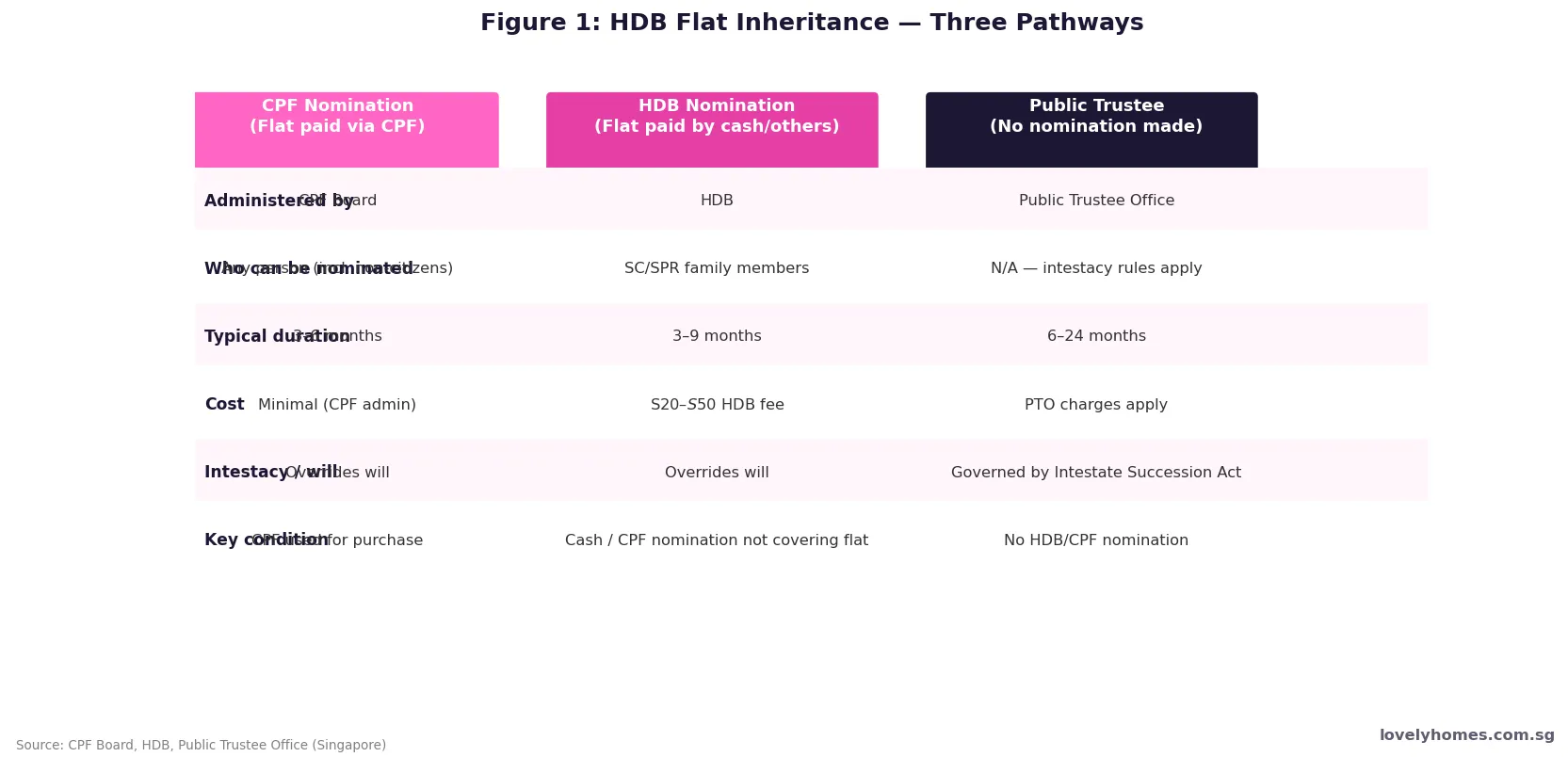
HDB flat inheritance pathways — CPF nomination vs HDB nomination vs Public Trustee
Figure 1: The three HDB flat inheritance pathways and the government body that administers each. Source: CPF Board, HDB, Public Trustee Office.

Timeline: How Long Does Each Pathway Take?

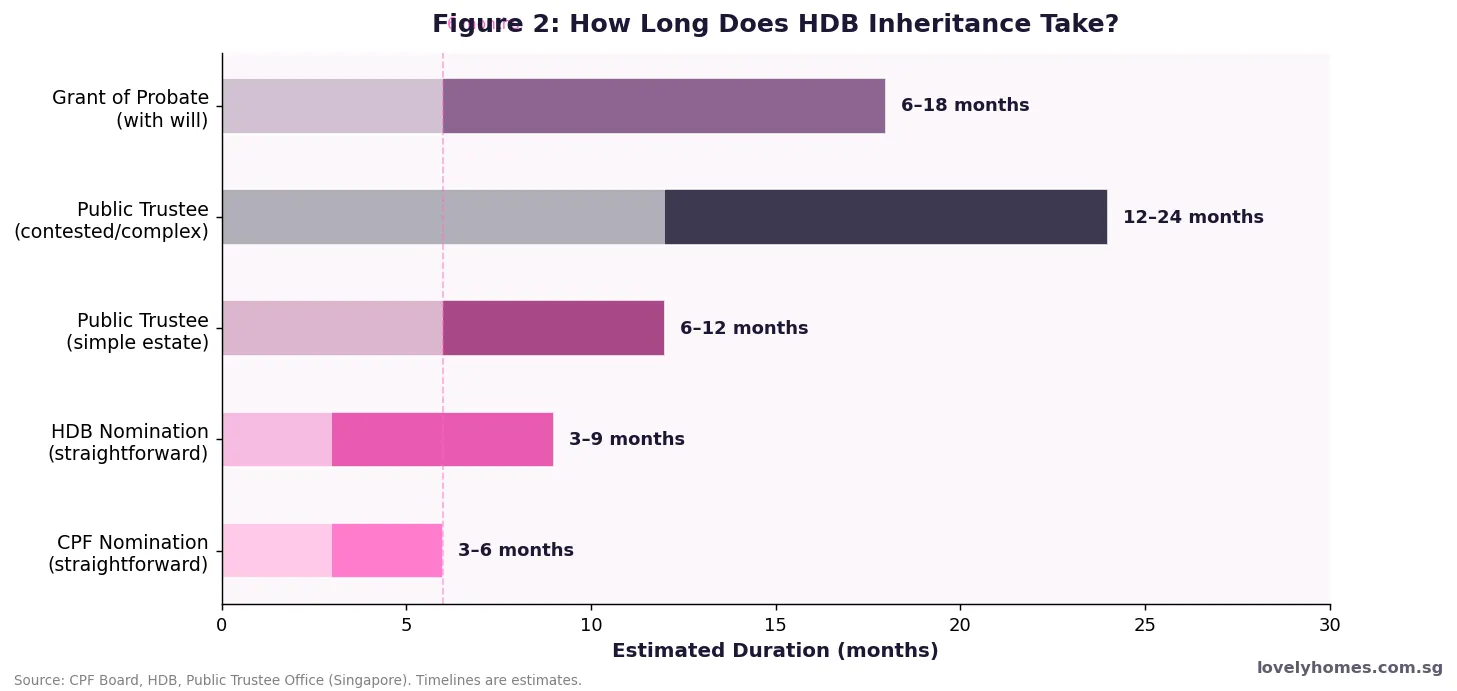
Processing time varies considerably. A clean CPF nomination with a straightforward HDB Flat Nomination can be completed in three to six months from the date of death. The Public Trustee pathway, by contrast, can take six months for a simple, uncontested estate or extend beyond two years if there are disputes, overseas assets, or complex beneficiary situations. The Grant of Probate pathway (testate estate with a will) typically takes six to eighteen months depending on court workload and the complexity of the estate.

During the period of administration, the surviving co-owner (if any) may continue to live in the flat. If the deceased was the sole owner, HDB will generally not require the other occupants to vacate immediately, but the situation should be formally regularised as quickly as possible.

HDB inheritance timeline — how long each pathway takes in months
Figure 2: Estimated processing times by inheritance pathway. Timelines are indicative; complex estates take longer. Source: HDB, Public Trustee Office.

Can the Beneficiary Keep the HDB Flat?

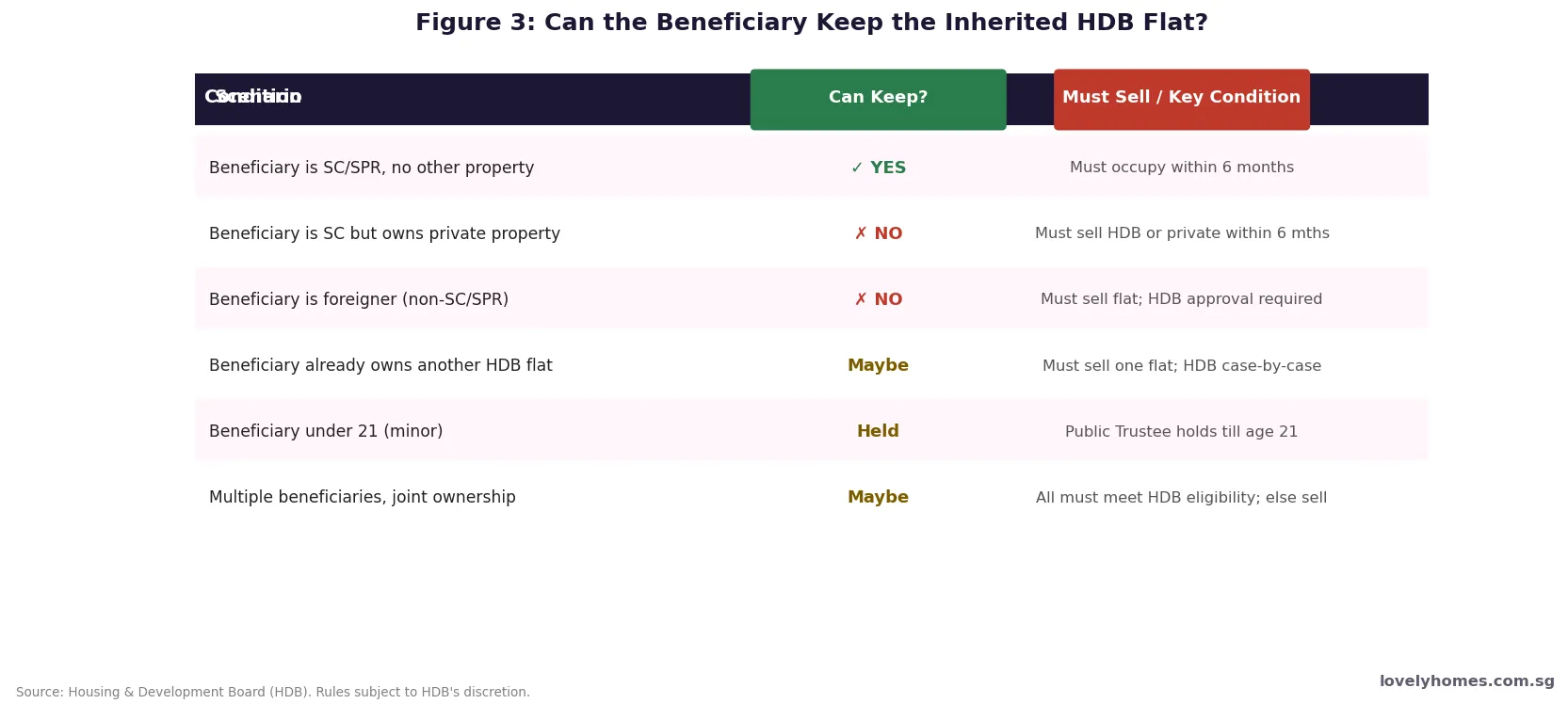
Even where a valid nomination directs the flat to a named beneficiary, that beneficiary must satisfy HDB’s eligibility conditions before HDB will consent to the transfer. If the beneficiary does not qualify, the flat must generally be sold and the proceeds distributed. This is one of the most common surprises families face — a loving parent may have nominated a child who owns a private condominium, only for HDB to require that child to sell one property.

The key eligibility rules as at 2026 are as follows. First, the beneficiary must be a Singapore Citizen or Permanent Resident (foreigners cannot hold HDB flats). Second, the beneficiary must form a valid family nucleus with the deceased or another SC/SPR — for example, a spouse, child, parent, or sibling. Third, if the beneficiary already owns a private residential property in Singapore or overseas, they must sell either the HDB flat or the private property within six months of the flat being transferred to them. Fourth, if the beneficiary is a minor (under 21), the flat is held by the Public Trustee until the minor reaches majority. Fifth, if multiple beneficiaries jointly inherit and not all meet the criteria, HDB assesses the matter on a case-by-case basis and may require a sale.

Can beneficiary keep inherited HDB flat — eligibility rules table
Figure 3: At-a-glance eligibility matrix for common inheritance scenarios. Source: HDB. Always confirm with HDB directly for your specific situation.

The Transmission Process — Step by Step

Once the appropriate documents are in order, the HDB transmission process follows a structured series of steps. The first step is to notify HDB of the death by submitting the death certificate and the relevant supporting documents (the nomination form, or the Grant of Probate, or the Letters of Administration). HDB will then assess the eligibility of the nominated beneficiary. If the beneficiary qualifies, HDB issues a letter of acceptance and the transfer is registered with the Singapore Land Authority (SLA). If the beneficiary does not qualify or chooses to sell, HDB facilitates the sale and disburses the proceeds accordingly.

Administrative costs are modest: HDB charges a conveyancing fee of around S$20 to S$50 for the flat transfer. If the beneficiary engages a private solicitor to manage the estate, legal fees typically range from S$500 to S$3,000 depending on complexity. The PTO charges a sliding-scale fee based on the value of the estate assets administered, which can amount to 1–2.5% of the estate’s gross value.

Estate Duty, Taxes, and the Minimum Occupation Period

Singapore abolished estate duty on 15 February 2008. There is no inheritance tax and no capital gains tax on property in Singapore. A beneficiary who receives an HDB flat pays no tax simply by virtue of inheriting it. If the beneficiary subsequently sells the flat in the open market, the sale proceeds are not subject to income tax. Seller’s Stamp Duty (SSD) does not apply to HDB flat sales (SSD applies only to private residential properties held for four years or fewer).

One important point concerns the Minimum Occupation Period. If the deceased owner died before the MOP expired, the MOP clock does not restart for the beneficiary. The beneficiary must wait out the remaining MOP from the date the flat was first purchased, not from the date of inheritance. A beneficiary who inherits a flat with two years remaining in its MOP must live in the flat for those two years before they are eligible to sell or rent it out.

Scenario Outcome for Beneficiary Key Condition or Restriction
SC beneficiary, no other property May keep flat Must occupy within 6 months of transfer
SC beneficiary, owns private property Must sell one 6-month window to dispose of either HDB or private property
SPR beneficiary, no other property May keep flat (HDB case-by-case) Subject to HDB’s prevailing SPR eligibility rules
Foreigner beneficiary Must sell flat Foreigners cannot hold HDB flats; HDB arranges sale
Minor beneficiary (under 21) PTO holds flat Released to beneficiary upon turning 21; MOP rules apply
Multiple beneficiaries, mixed eligibility HDB case-by-case May require all eligible parties to buy out ineligible parties, or sale
No eligible beneficiary Flat sold by HDB Proceeds distributed under intestacy rules or will

Worked Example

Worked Example: Mr Tan SC Sole Owner, Dies Without HDB Nomination

Situation: Mr Tan, a Singapore Citizen, purchased a 4-room HDB flat in Tampines in 2018 for S$450,000. He paid a S$30,000 CPF down payment and has been making monthly repayments of S$1,500 from CPF OA. By 2026, the outstanding HDB loan is S$280,000, and the CPF principal withdrawn (including monthly repayments) totals S$130,000, with accrued CPF interest of S$18,000. The flat’s current market value is approximately S$680,000. Mr Tan dies in August 2026 without having made an HDB Flat Nomination, but he did make a CPF nomination directing his CPF savings to his wife, Mrs Tan (SC).

What happens:

  • CPF Board pays S$148,000 (S$130,000 principal + S$18,000 accrued interest) from the CPF estate to Mrs Tan per the CPF nomination. This is a cash payment, not a flat transfer.
  • The flat itself — because there is no HDB Flat Nomination — passes under the Intestate Succession Act. Since Mr Tan is survived by a spouse and children, the wife receives half the estate and the children share the other half.
  • Mrs Tan engages a solicitor and applies for Letters of Administration. The process takes approximately 9 months.
  • Mrs Tan is the sole named beneficiary eligible to retain the flat (the children are minors). HDB agrees to transfer the flat solely to Mrs Tan, who satisfies the eligibility criteria.
  • Outstanding HDB loan of S$280,000 is assumed by Mrs Tan; she must meet HDB’s loan-to-value and financial criteria.
  • Total costs: PTO/legal fees approximately S$3,500; HDB conveyancing fee S$38.
  • Lesson: Had Mr Tan made an HDB Flat Nomination directing the flat to Mrs Tan, the 9-month probate process could have been avoided and the estate settled in approximately 4–5 months.

Estate Planning: What HDB Owners Should Do Now

The practical lesson from every case study is the same: make your nominations. An HDB flat owner should make both a CPF nomination (directing the CPF savings) and a separate HDB Flat Nomination (directing the flat itself). The two nominations complement each other and together ensure that neither component of your most valuable asset is left to intestacy rules or a protracted court process.

The CPF nomination is made online at the CPF website or in person at a CPF Service Centre. The HDB Flat Nomination is submitted to HDB — forms are available at HDB Hub or online via the HDB Portal. Both nominations should be reviewed whenever family circumstances change: marriage, divorce, birth of children, death of a nominee. A stale nomination that names a deceased person as the nominee creates exactly the complications it was meant to prevent.

Beyond nominations, flat owners should also consider whether their flat’s ownership structure — joint tenancy versus tenancy-in-common — fits their estate planning intentions. Joint tenancy means the surviving co-owner automatically inherits the flat’s full interest on the other owner’s death (right of survivorship), bypassing both nominations and the will. Tenancy-in-common means each owner holds a defined share that passes according to the nomination or will.

What Might Come Next for HDB Inheritance Rules

HDB’s eligibility rules for inheriting flats have remained broadly stable in recent years, but the policy tension between preserving HDB as a home-ownership scheme for eligible residents and accommodating modern family structures (blended families, overseas beneficiaries, beneficiaries with mixed property portfolios) is an ongoing one. Future rule changes — such as extended time windows for beneficiaries to divest a private property, or relaxed eligibility for SPR beneficiaries — cannot be ruled out. Flat owners with complex family situations should monitor HDB’s circular updates and consult HDB directly rather than relying solely on any published guide.

FAQ — HDB Flat Inheritance

Does a will override an HDB Flat Nomination?

No. An HDB Flat Nomination takes precedence over a will for the flat it covers. If you have nominated Person A in your HDB Flat Nomination but your will says the flat should go to Person B, the flat goes to Person A. This is why estate lawyers in Singapore strongly advise that your HDB nomination and your will be aligned, and that both be updated whenever family circumstances change. CPF nominations similarly override a will for the CPF savings component.

What if the nominated beneficiary dies before the flat owner?

If the sole nominated beneficiary predeceases the flat owner and the owner does not update the nomination, the nomination lapses and the flat falls back into the estate — governed by the will (if any) or the Intestate Succession Act. HDB will not attempt to contact the deceased beneficiary’s family. This is one of the most common pitfalls: owners make a nomination and then forget to update it when the nominated person dies. Review your nomination every few years and after any significant family event.

Can I nominate a non-family member to inherit my HDB flat?

The HDB Flat Nomination Scheme generally requires the nominated person to be a family member who forms a valid family nucleus with the owner — for example, a spouse, parent, child, or sibling. You cannot typically nominate a friend or a colleague. However, a CPF nomination (which covers the cash value of CPF savings used in the flat) can be made in favour of any person, including non-family members. That person would receive the CPF cash, not the flat itself.

What happens if the flat is still under a bank or HDB loan when the owner dies?

The outstanding loan does not disappear on the owner’s death. If the beneficiary inherits and retains the flat, they take over the loan obligations. For an HDB loan, the beneficiary must meet HDB’s loan eligibility criteria to assume the loan. For a bank mortgage, the bank will typically require the estate or the beneficiary to refinance or settle the outstanding amount. Most homeowners should carry term life insurance or mortgage protection insurance precisely to ensure the loan can be discharged if they die unexpectedly.

Does the Minimum Occupation Period restart when a flat is inherited?

No — the MOP does not restart. The clock continues from the date the flat was originally purchased (or the date the keys were collected for a BTO flat). If Mr Tan bought a flat in January 2023 (5-year MOP) and died in January 2026 after only three years, the beneficiary must occupy the flat until at least January 2028 before selling. The beneficiary cannot sublet the whole flat during the remaining MOP either, as the same occupation rules apply.

Are there any taxes payable on an inherited HDB flat?

There is no inheritance tax and no estate duty in Singapore (abolished 15 February 2008). The beneficiary pays no tax on receiving the flat. If the beneficiary later sells the flat, the sale proceeds are not subject to income tax or capital gains tax. Buyer’s Stamp Duty (BSD) would apply to a subsequent buyer of the flat in the normal way, but the seller (the beneficiary) does not bear BSD. Seller’s Stamp Duty (SSD) does not apply to HDB flats.

Disclaimer: This article is for general information only and does not constitute legal, estate-planning, or financial advice. HDB inheritance rules, CPF nomination procedures, and Public Trustee Office requirements are subject to change. Always verify current rules directly with the Housing & Development Board (hdb.gov.sg), the CPF Board (cpf.gov.sg), the Public Trustee Office (pto.mlaw.gov.sg), and a licensed solicitor. Eligibility decisions rest with HDB and are made on a case-by-case basis. LovelyHomes is not responsible for reliance on information in this article.
Singapore Property Renovation Guide 2026: HDB Rules, Costs, Permits and Renovation Loan Explained

Singapore Property Renovation Guide 2026: HDB Rules, Costs, Permits and Renovation Loan Explained

Whether you have just collected the keys to your new HDB flat, completed your MOP and are preparing to resell, or are refreshing a resale condo ahead of moving in, a renovation in Singapore involves navigating a specific set of rules, permits, and cost benchmarks that every homeowner should understand before engaging a contractor. Get it wrong, and you risk fines from HDB, stop-work orders from the Building and Construction Authority (BCA), or a renovation that looks impressive but adds little resale value.

This guide covers the full landscape of Singapore property renovation in 2026: HDB rules and what needs approval, BCA permits for structural work, realistic cost ranges by flat type and scope, the HDB Renovation Loan, timelines to plan around, and an evidence-based look at which renovation types deliver the strongest return on investment (ROI) at resale.

Quick Answer — Singapore Renovation 2026 at a Glance

  • HDB renovations require an HDB-registered contractor and — for certain works — advance written approval from HDB.
  • Structural works (hacking beams, columns, load-bearing walls) are prohibited in HDB flats regardless of approval status.
  • BCA permits are required for additions and alterations to private property that affect the building structure, external appearance, or gross floor area.
  • Costs range from S$18,000 for a basic 2-room HDB refresh to S$185,000+ for a premium condo 3-bedroom renovation.
  • Renovation Loan: up to S$30,000 for HDB flat owners, at interest rates from 5.5%–6.5% p.a. (check with your bank).
  • Duration: typically 8–16 weeks for a full flat; carpentry lead times of 6–10 weeks are the most common schedule bottleneck.
  • Best ROI renovations (by resale uplift relative to cost): kitchen refacing, bathroom remodelling, flooring replacement, and a fresh full repaint.

HDB Renovation Rules: What You Need to Know

HDB renovation rules exist to protect the structural integrity of blocks, ensure the safety of residents above and below, maintain the external facade of the estate, and prevent noise and disruption beyond acceptable hours. The rules apply regardless of whether you own a BTO flat, a resale flat, or a Design, Build and Sell Scheme (DBSS) flat.

The core requirements are:

  • Use an HDB-registered renovation contractor. All HDB renovation work must be carried out by a contractor on HDB’s approved register. Working with an unregistered contractor voids your rights under any HDB dispute resolution process and may result in fines. You can verify registration at the HDB renovation portal.
  • Submit a Renovation Permit application through your contractor’s HDB-registered account before commencing works that require approval.
  • Work hours: Monday–Friday 9:00 am–6:00 pm; Saturday 9:00 am–1:00 pm. No renovation work on Sundays or public holidays.
  • Inform your neighbours at least 3 working days before renovation commences (HDB policy; many MCSTs have their own protocols for private condos).
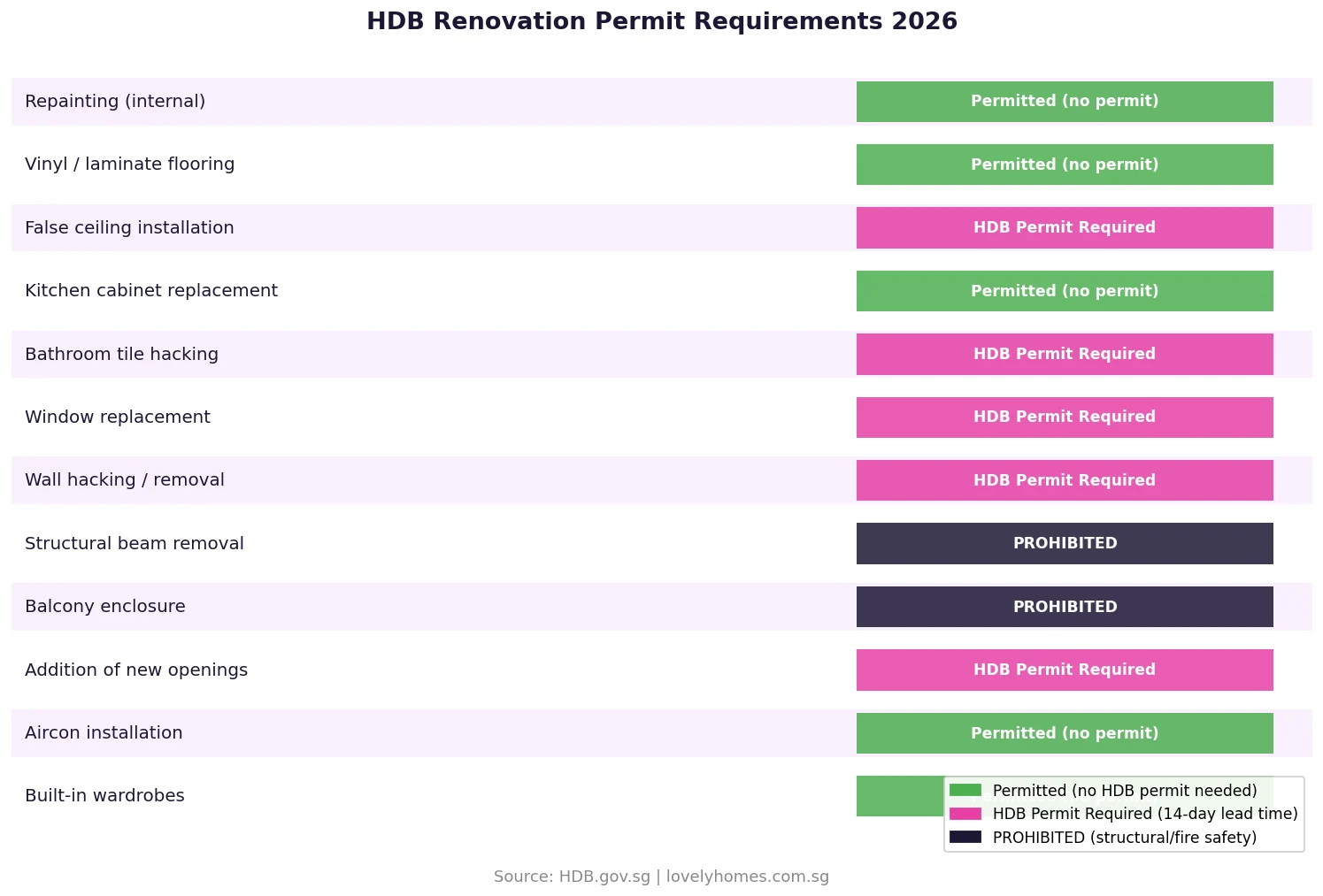
HDB renovation permit requirements 2026 — permitted, permit required, and prohibited renovation works
Figure 1: HDB renovation works categorised by permit requirement: no permit needed (pink), HDB permit required (orange), and prohibited (navy).
Renovation Type HDB Rule Notes
Painting (walls, ceilings) No permit needed Any colour; no structural impact
Wallpaper / wall panels No permit needed Must not damage structural surfaces
Built-in carpentry (wardrobes, TV console) No permit needed Contractor must be HDB-registered
Kitchen cabinets / countertops No permit needed Replacing like-for-like; plumbing changes need permit
Flooring (overlay, no hacking) No permit needed Vinyl overlay on tiles — no hacking needed
Flooring (hacking and relaying tiles) HDB Permit Required Submit via contractor’s account before starting
Bathroom fittings (sink, WC, shower screen) No permit for like-for-like Moving waste pipes = permit required
Hacking non-structural internal walls HDB Permit Required HDB confirms wall classification first
Hacking structural walls / beams / columns Prohibited No exceptions — structural integrity risk
Window grille installation / replacement HDB Permit Required Must meet HDB bar-spacing standards
Air-conditioning installations No permit for standard split units Outdoor unit placement must comply with HDB guidelines
Electrical rewiring (minor) No permit; must use licensed electrician SP PowerGrid licence required for main panel work

BCA Permits for Private Property Renovation

For private property (condominiums, landed homes, commercial units), the Building and Construction Authority (BCA) administers the approvals framework under the Building Control Act. Unlike HDB rules, which regulate the use of approved contractors and specific work types, BCA permits focus on structural safety, gross floor area, and external facade changes.

Works that typically require a BCA permit (Addition and Alteration, or A&A works) include:

  • Any structural alteration (adding or removing load-bearing elements, changing structural openings)
  • Extensions that increase gross floor area (GFA)
  • Changes to the external facade or roof of landed property
  • Swimming pool installations at landed property
  • Major electrical or mechanical system upgrades in commercial units

For condominium owners, all renovation work must also comply with the Management Corporation Strata Title (MCST) by-laws. Most MCSTs require homeowners to submit renovation plans and obtain written MCST approval before any work begins, and to pay a renovation deposit (typically S$1,000–S$5,000) refunded upon satisfactory completion without damage to common areas.

Renovation Costs by Flat Type and Scope

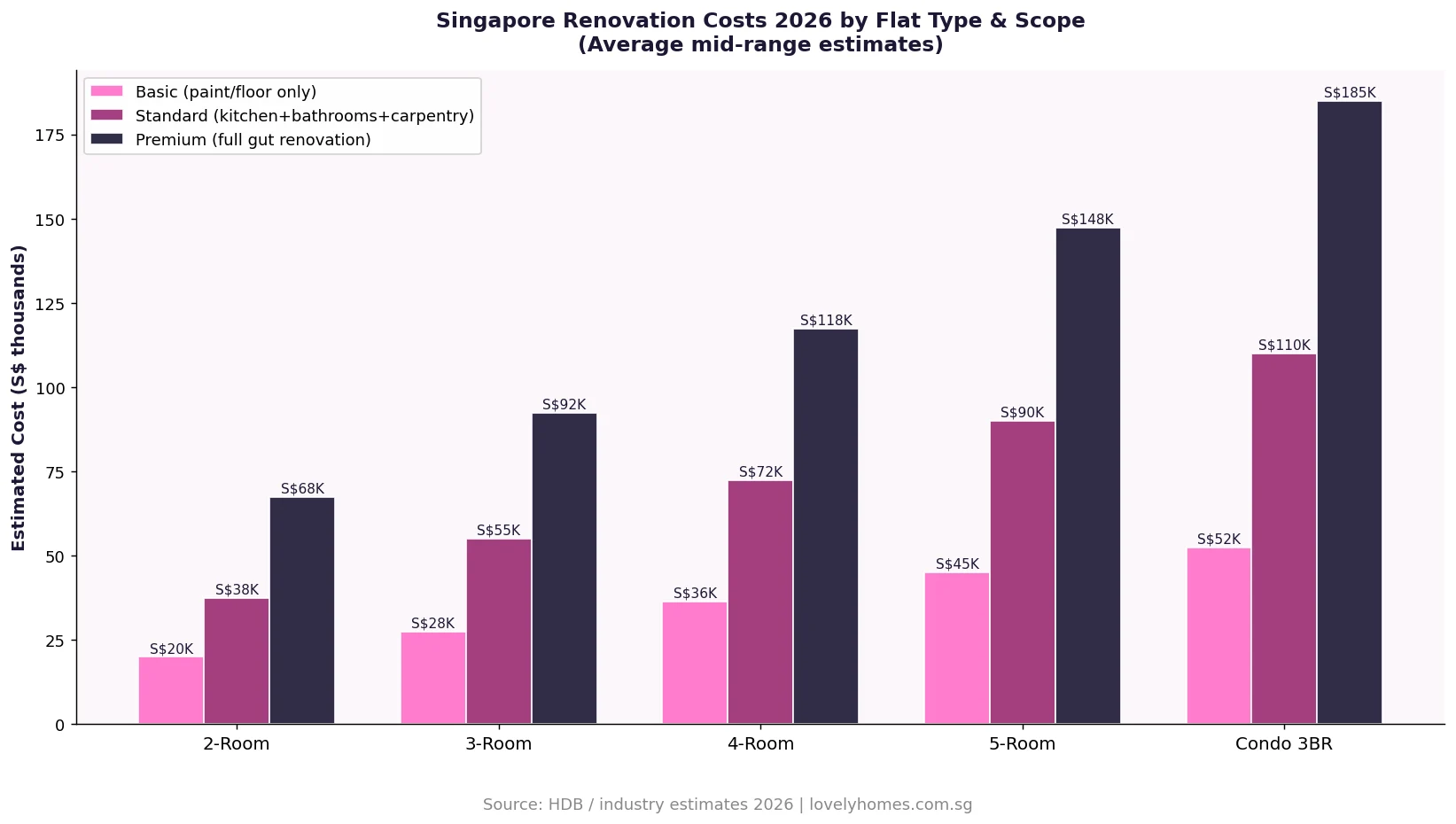
Renovation costs in Singapore vary enormously depending on the size of the unit, the scope of works, and the finish level targeted. The figures below reflect market rates as at mid-2026 based on indicative quotations from HDB-registered contractors. They exclude furniture, electrical appliances, and curtains, which are typically supplied separately.

Singapore renovation costs 2026 by flat type and scope — HDB and condo renovation cost ranges
Figure 2: Estimated renovation cost ranges (S$) by flat type and renovation scope — Basic (mainly cosmetic), Standard (full wet works and carpentry), and Premium (bespoke finishes throughout).
Property Type Basic Renovation (S$) Standard Renovation (S$) Premium Renovation (S$)
HDB 2-Room (35–45 sqm) 18,000–25,000 30,000–45,000 50,000–70,000
HDB 3-Room (65–75 sqm) 25,000–35,000 45,000–60,000 70,000–100,000
HDB 4-Room (90–100 sqm) 32,000–42,000 58,000–75,000 95,000–130,000
HDB 5-Room / EA (110–145 sqm) 40,000–55,000 72,000–95,000 120,000–160,000
Condo 2-Bedroom (65–80 sqm) 35,000–50,000 65,000–85,000 110,000–150,000
Condo 3-Bedroom (90–120 sqm) 48,000–65,000 85,000–115,000 150,000–220,000

What the tiers mean:

  • Basic renovation covers repainting, vinyl flooring overlay (no hacking), replacement of bathroom fittings and kitchen tap/sink, and basic built-in storage in one or two rooms. Typically 8–10 weeks to complete.
  • Standard renovation includes full hacking and retiling of bathrooms and kitchen, installation of full kitchen cabinetry with solid surface countertop, carpentry throughout all bedrooms, feature wall treatment in living room, false ceiling with LED lighting, and air-conditioning installation. Typically 12–16 weeks.
  • Premium renovation encompasses all standard works plus imported tiles, bespoke joinery with soft-close mechanisms and premium hardware, kitchen island, walk-in wardrobe, feature wall with natural stone or specialty panels, smart home integration, and designer sanitary ware. 16–20 weeks or more.

The HDB Renovation Loan

HDB flat owners who need financing for their renovation can apply for an HDB Renovation Loan through participating financial institutions. Key terms as at August 2026:

  • Maximum loan amount: S$30,000 (or 6 months’ gross household income, whichever is lower)
  • Eligibility: HDB flat owners; at least one applicant must be a Singapore Citizen or Permanent Resident; flat must be under the applicant’s name
  • Loan tenor: up to 5 years
  • Interest rate: typically 5.5%–6.5% p.a. (fixed or floating; compare rates across OCBC, UOB, DBS, Standard Chartered)
  • Monthly repayment example: S$30,000 at 6% p.a. over 5 years = approximately S$580/month
  • Approved works: must be used for renovation works carried out by HDB-registered contractors; loan funds disbursed directly to the contractor after works inspection

Private property owners can use personal loans or renovation loans offered by banks (not HDB), which typically allow borrowing up to 6× monthly income, up to S$30,000, at broadly similar interest rates.

Renovation ROI: Which Works Add the Most Value at Resale

Not all renovation dollars are created equal. A premium renovation that costs S$150,000 does not necessarily add S$150,000 to your resale price — and in the HDB resale market especially, over-renovating above the neighbourhood price ceiling can result in negative ROI, where the renovation cost exceeds the premium buyers are willing to pay.

Singapore property renovation ROI 2026 by renovation type — range from full repaint to full gut renovation
Figure 3: Estimated resale ROI range and typical cost by renovation type. The dot on each range bar indicates the midpoint ROI. A fresh full repaint often delivers the highest ROI relative to cost.

General principles that hold across the Singapore resale market:

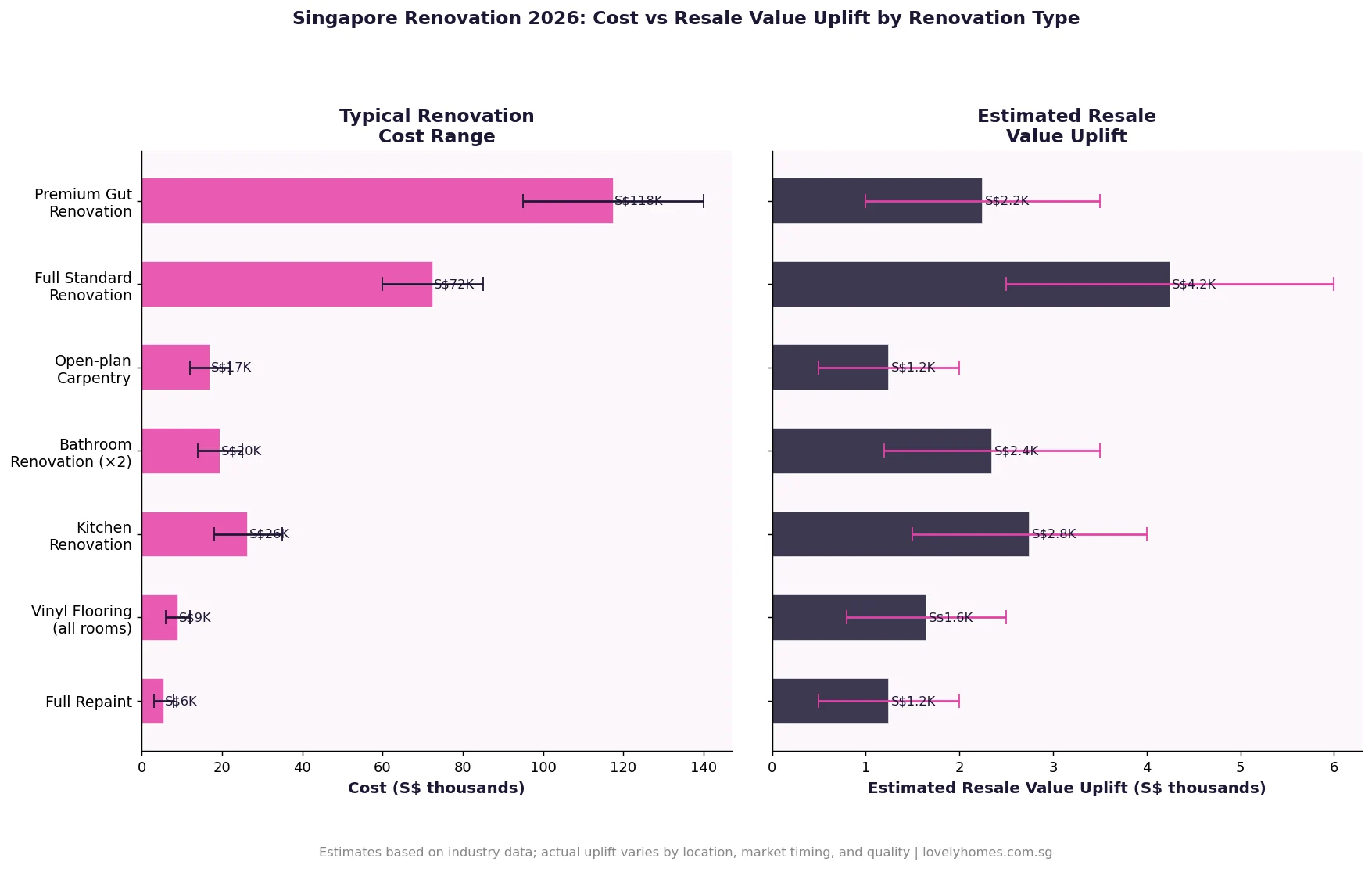
  • Kitchens and bathrooms sell flats. Buyers consistently rank clean, functional kitchens and bathrooms as the top priority. A bathroom remodel at S$15,000–S$20,000 typically commands a premium of S$15,000–S$30,000 or more in the HDB resale market, making it one of the highest-ROI renovations in absolute terms.
  • Repainting is the highest-ROI cosmetic upgrade. A full repaint of a 4-room flat costs S$2,500–S$4,500 and can lift perceived value by 5%–12% by making the flat feel newer and well-maintained. At S$550,000 resale, a 5% uplift = S$27,500 on a S$4,000 spend.
  • Flooring matters. Replacing old mosaic tiles with vinyl plank flooring (S$8,000–S$12,000) upgrades the look of the entire flat and appeals strongly to younger buyers. ROI of 8%–18% relative to cost is commonly observed.
  • Over-specified kitchens rarely pay back. A Häfele full-imported kitchen at S$45,000 in a S$450,000 flat is unlikely to recover its cost. Buyers in that price bracket expect a functional kitchen, not a luxury one.
  • Open-plan conversions (hacking the wall between kitchen and living room) are high-risk. They require HDB permit approval, add S$15,000–S$25,000 in costs, and appeal to a subset of buyers. If your buyer prefers a separate kitchen (common among families with elderly members), the conversion may reduce marketability.

Worked Example: Ms Tan — selling her Bishan 4-Room HDB flat after MOP

Ms Tan’s 4-room flat is 12 years old. She purchased it at S$370,000 and is targeting a resale at S$720,000. Market comparables show recently transacted flats in her block at S$700,000–S$740,000 — a standard finish range.

Renovation plan (standard scope, targeting resale within 3 months):

  • Full repaint (4 rooms + common areas): S$3,800
  • Bathroom retiling and new fittings (2 bathrooms): S$22,000
  • Kitchen hacking, retiling, new cabinets with quartz countertop: S$28,000
  • Vinyl plank flooring (bedrooms and living room): S$9,500
  • False ceiling with LED downlights (living and dining): S$5,200
  • Minor carpentry (master bedroom built-in wardrobe): S$6,500
  • Total renovation cost: S$75,000

Resale outcome: After renovation, the flat transacted at S$735,000 — S$35,000 above the pre-renovation comparable median. Net renovation benefit = S$35,000 uplift at an outlay of S$75,000. However, the renovation also allowed Ms Tan to sell at top-of-market speed (16 days on the market vs. average 45 days for unrenovated flats in her block), reducing holding costs and the risk of a prolonged sale at a lower price.

Renovation Loan used: Ms Tan borrowed S$30,000 via UOB Renovation Loan at 6.0% over 3 years (S$913/month), repaid fully on completion of the sale. Total interest paid = approximately S$2,860.

Renovation Timelines and Planning Tips

Renovation projects in Singapore typically follow this sequence:

  • Week 1–2: Hacking (tiles, walls where permitted). Noisiest phase — schedule within HDB allowed hours.
  • Week 2–4: Plumbing, electrical conduit laying, plastering.
  • Week 4–6: Tiling (wet areas first), waterproofing, window grilles.
  • Week 6–10: Carpentry fabrication off-site (cabinets, wardrobes — this is where most delays occur).
  • Week 10–12: Carpentry installation, painting, flooring.
  • Week 12–14: Air-conditioning, light fittings, final touches, snag inspection.

The single most reliable way to compress the schedule is to finalise your carpentry design before the main contractor starts hacking, so fabrication can begin in parallel. Many homeowners also run a parallel procurement track for appliances (ovens, hobs, refrigerators) so delivery aligns with carpentry installation.

Choosing a Renovation Contractor

For HDB flats, all renovation works must be carried out by a contractor registered with HDB. You can search HDB’s renovation contractor directory on the HDB InfoWEB. When shortlisting, ask each contractor for:

  • Proof of HDB registration (registration number and expiry date)
  • A full itemised quotation — not a lump-sum figure
  • References from at least two recent projects in a similar flat type
  • Their renovation permit application timeline and workflow
  • Payment schedule (industry norm: 20% deposit, progress payments, 5%–10% final retention)

Avoid contractors who ask for more than 20%–30% upfront, cannot provide an itemised quotation, or pressure you to sign before the permit is approved.

What Might Change for Renovations in 2026–2027

HDB has been progressively tightening rules around noise levels and renovation hours in high-density estates. In 2025, HDB trialled a decibel monitoring pilot in selected blocks in Punggol and Tengah to identify repeat hacking offenders. Industry observers expect these monitoring standards to be formalised and extended to all HDB towns by 2027, potentially shortening permitted hacking hours or requiring noise-dampening shrouding for heavy hacking works. Homeowners planning major renovations should factor this into their contractor selection — asking specifically about noise control practices.

BCA is also reviewing the A&A permit threshold for landed property additions, with proposed changes to streamline minor facade alterations for terrace and semi-detached homes. These changes are expected to reduce permit processing times from 6–8 weeks to 2–3 weeks for qualifying minor works.

Frequently Asked Questions

Can I start renovation immediately after collecting HDB flat keys?

Not immediately. Your HDB-registered contractor must first obtain the required Renovation Permit(s) from HDB before any chargeable works can begin. The permit application is submitted online by your contractor and typically approved within 3–5 working days for standard works. Painting and minor non-permit works (such as installing curtain rods or shelf brackets) can begin while the permit is pending. Hacking, tiling, and any structural involvement must wait for permit approval.

What happens if I carry out unauthorised renovation works in my HDB flat?

HDB takes unauthorised renovation seriously. Depending on the nature of the breach, penalties can range from written warnings and mandatory rectification (at the owner’s cost) to fines of up to S$5,000 under the Housing and Development Act. For structural breaches — such as hacking a structural wall — HDB may require the owner to engage a Professional Engineer (PE) to assess and remediate the damage at the owner’s full expense, which can easily run to S$30,000–S$80,000. HDB also maintains records of renovation violations, which can affect future applications for flat-related approvals.

Do I need MCST approval for my condo renovation?

Yes. Almost all condo MCSTs require prior written approval before any renovation works begin. The standard process is: submit your renovation plans and contractor details to the managing agent; pay a renovation deposit (S$1,000–S$5,000, refundable); receive written approval specifying permitted hours, noise restrictions, and waste disposal requirements. Works that affect the common property — changing external windows, modifying air-conditioning compressor locations, altering plumbing stacks — typically require additional MCST approval and may need a BCA permit as well.

Can I claim renovation costs against income tax?

No. Renovation costs for your owner-occupied residential property are not deductible for personal income tax purposes in Singapore. However, if you own the property as a rental investment and incur renovation costs to maintain the property in its income-earning condition, those costs may be deductible against rental income under IRAS’s rules for rental expense deductions. Capital expenditure that improves the property beyond its original condition is not deductible; revenue expenditure on repairs and maintenance is. Consult a tax professional or refer to the IRAS rental expense guide for the applicable distinction.

What is the maximum I can borrow on an HDB Renovation Loan?

As at August 2026, the maximum HDB Renovation Loan is S$30,000 or six times your monthly household income, whichever is lower. For a household with a combined income of S$6,000/month, the income cap is S$36,000 — so the S$30,000 cap applies. The loan must be used exclusively for renovation works carried out by an HDB-registered contractor and supported by invoices. The bank disburses funds directly to the contractor, not to you. Applications are processed by participating banks (DBS, OCBC, UOB, Standard Chartered, and others); compare interest rates as they vary by institution and promotion.

How long do I have to complete renovation after collecting BTO keys?

HDB does not set a strict deadline for completing renovation after key collection, but the Renovation Permit has a validity period (typically one year from issuance, extendable). Practically, most BTO buyers complete their renovation within 3–6 months of key collection. If your renovation will take significantly longer — for example, because you are waiting for a customised furniture lead time — ensure your contractor extends the permit validity before it lapses. A lapsed permit means all subsequent work is technically unauthorised until a new permit is obtained.

Disclaimer: This article provides general guidance only and does not constitute professional legal, financial, or construction advice. HDB renovation rules, BCA permit requirements, and renovation loan terms change from time to time. Always verify current HDB rules at hdb.gov.sg, BCA permit requirements at bca.gov.sg, and IRAS rental expense deduction rules at iras.gov.sg before committing to any renovation programme. Renovation costs are indicative estimates; obtain written quotations from at least three HDB-registered contractors before committing.

Singapore Buyer’s Stamp Duty (BSD) Complete Guide 2026: All Bands, Rates and Calculations

Singapore Buyer’s Stamp Duty (BSD) Complete Guide 2026: All Bands, Rates and Calculations

Buyer’s Stamp Duty (BSD) is the tax every property buyer in Singapore pays at the point of purchase — whether you are buying a Housing Development Board (HDB) flat, a private condominium, a landed home, an industrial unit, or a commercial shophouse. Unlike the Additional Buyer’s Stamp Duty (ABSD), which is an extra layer applied selectively based on citizenship and property count, BSD applies to every single property transaction in Singapore without exception.

This guide covers everything you need to know about BSD in 2026: the full six-band residential rate table, the non-residential rate table, how BSD is calculated on the higher of purchase price or market value, key exemptions and remissions, how BSD interacts with ABSD and the Seller’s Stamp Duty (SSD), and a fully worked example with all arithmetic shown. All figures reflect rates in force as at 18 August 2026. Always verify current rates on the IRAS BSD page.

Quick Answer — BSD at a Glance

  • Who pays: every buyer of any Singapore property (residential, commercial, industrial, or land).
  • Residential BSD bands (2026): 1% → 2% → 3% → 4% → 5% → 6% across six progressive bands up to the full purchase price.
  • New 6% band (from 15 February 2023): applies to the portion of purchase price above S$3,000,000 for residential property only.
  • Non-residential BSD: four bands capped at 4% (no 5% or 6% tier).
  • Basis: higher of the purchase price or the market value of the property.
  • Deadline: payable within 14 days of signing the Option to Purchase (OTP) or Sale and Purchase Agreement (S&P).
  • Payment method: cash (CPF OA can be used to reimburse after stamping for residential property).
  • BSD is separate from ABSD: ABSD is an additional layer; BSD is always owed regardless of how many properties you own.

What is BSD and Why Does It Exist?

BSD is a transaction tax administered by the Inland Revenue Authority of Singapore (IRAS). It is governed by the Stamp Duties Act (Cap 312) and applies to instruments executed in Singapore for the transfer, conveyance, or assignment of immovable property. The duty has existed in some form since Singapore’s colonial era; the current progressive residential rate structure, expanded to six bands in February 2023, reflects the Government’s stated intent to make the tax more equitable — those buying higher-value properties pay a proportionally higher effective rate.

BSD is not a wealth tax, a capital gains tax, or a cooling measure. It is a revenue-raising duty applied proportionately to the transaction value. The proceeds go to the Consolidated Fund. Because BSD is a cost of entry rather than a deterrent (unlike ABSD), it does not vary by citizenship, residency status, or the number of properties owned.

Residential BSD Rate Table 2026

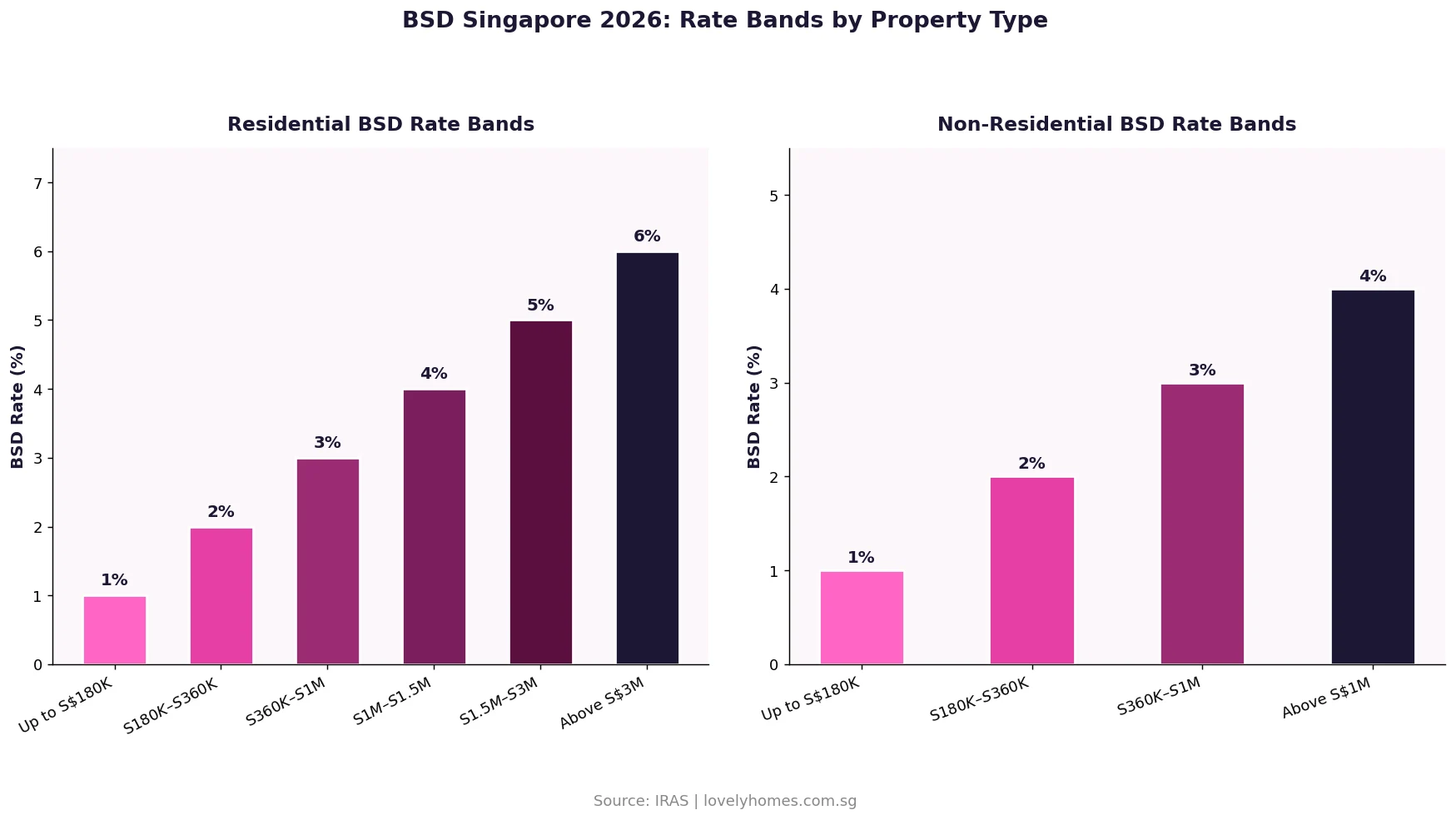
The residential BSD applies to the purchase of any residential property — HDB flats, private apartments and condominiums, Executive Condominiums (ECs), landed homes, and strata-titled mixed-use units classified as residential. The six progressive bands are applied to successive slices of the purchase price:

BSD Singapore 2026 rate bands — residential vs non-residential comparison chart
Figure 1: Residential BSD rate bands (1%–6%, six tiers) compared with non-residential BSD bands (1%–4%, four tiers).
Purchase Price (Residential) BSD Rate Maximum BSD on Band
First S$180,000 1% S$1,800
Next S$180,000 (S$180,001–S$360,000) 2% S$3,600
Next S$640,000 (S$360,001–S$1,000,000) 3% S$19,200
Next S$500,000 (S$1,000,001–S$1,500,000) 4% S$20,000
Next S$1,500,000 (S$1,500,001–S$3,000,000) 5% S$75,000
Remainder above S$3,000,000 6% No cap

The cumulative BSD on a S$3,000,000 residential property is S$1,800 + S$3,600 + S$19,200 + S$20,000 + S$75,000 = S$119,600, for an effective rate of 3.99%. Every additional dollar above S$3M is taxed at the marginal rate of 6%.

BSD Dollar Amounts and Effective Rates by Purchase Price

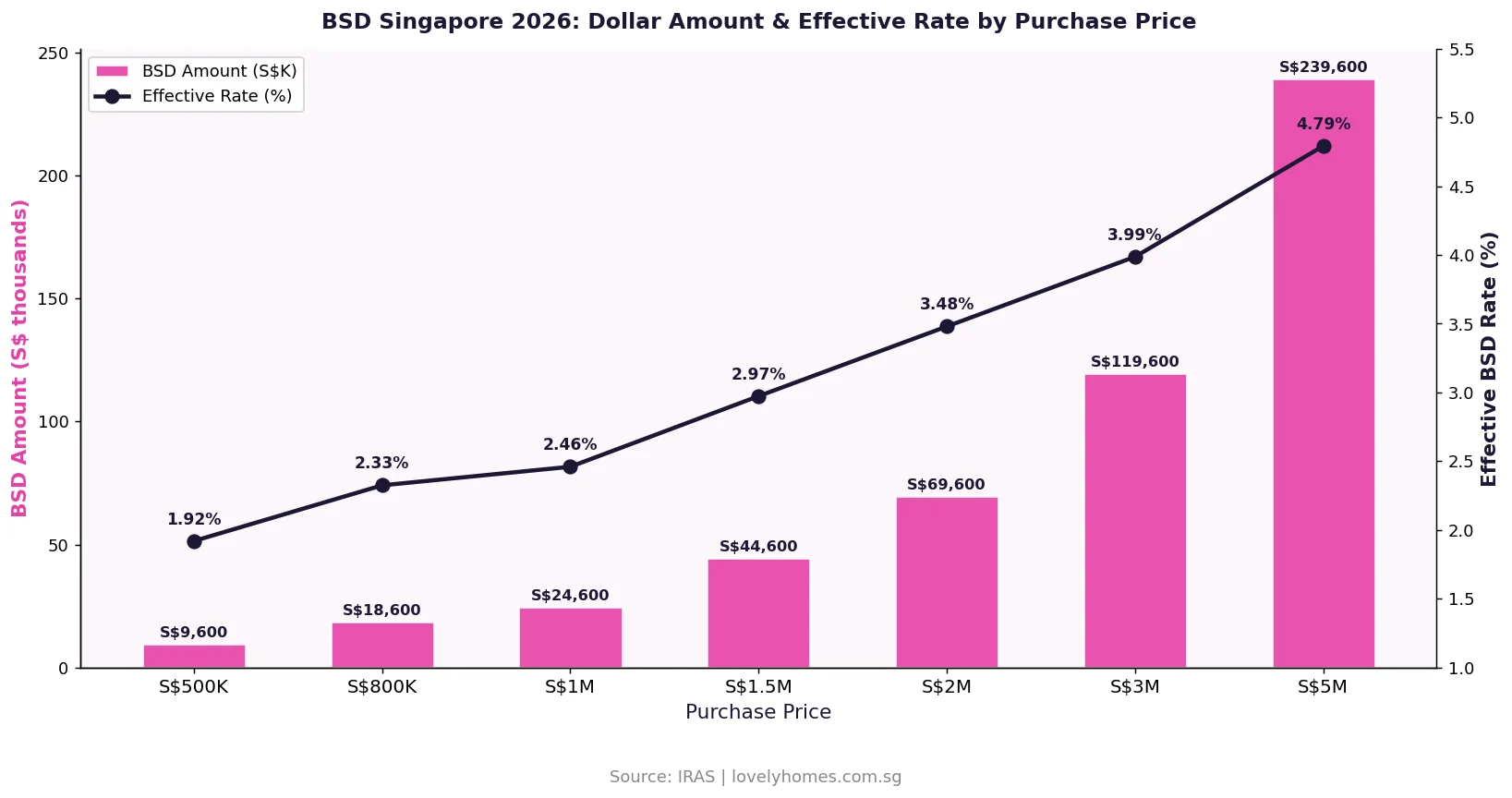
The progressive structure means the effective BSD rate rises as the purchase price increases, but always remains below the top marginal rate. The chart below maps BSD payable and the effective rate across the price spectrum most Singapore buyers encounter:

BSD Singapore 2026 dollar amount and effective rate at key property price points from S$500K to S$5M
Figure 2: BSD payable (bar, left axis) and effective BSD rate (line, right axis) at purchase prices from S$500,000 to S$5,000,000.

Key reference points worth remembering:

  • S$500,000 HDB flat: BSD = S$9,600 (effective 1.92%)
  • S$1,000,000 private apartment: BSD = S$24,600 (effective 2.46%)
  • S$1,500,000 condo (common OCR price point): BSD = S$44,600 (effective 2.97%)
  • S$2,000,000 condo: BSD = S$69,600 (effective 3.48%)
  • S$3,000,000 at the 6% threshold: BSD = S$119,600 (effective 3.99%)
  • S$5,000,000 GCB or penthouse: BSD = S$239,600 (effective 4.79%)

Non-Residential BSD Rate Table 2026

Commercial shophouses, office units, retail space, industrial factories and warehouses, and land not classified as residential all attract BSD under the non-residential rate table. Importantly, the non-residential scale tops out at 4% — there is no 5% or 6% tier regardless of purchase price. This makes high-value commercial property transactions proportionally cheaper to stamp than equivalent-value residential purchases.

Purchase Price (Non-Residential) BSD Rate Maximum BSD on Band
First S$180,000 1% S$1,800
Next S$180,000 (S$180,001–S$360,000) 2% S$3,600
Next S$640,000 (S$360,001–S$1,000,000) 3% S$19,200
Remainder above S$1,000,000 4% No cap

A commercial shophouse purchased at S$5,000,000 would attract BSD of S$1,800 + S$3,600 + S$19,200 + (S$4,000,000 × 4%) = S$184,600 (effective 3.69%), compared with S$239,600 (effective 4.79%) for a S$5,000,000 residential property. The saving of S$55,000 partially explains why some investors prefer commercial real estate for their second and subsequent property purchases — they also avoid ABSD, which does not apply to commercial and industrial property.

How BSD Is Calculated: The Higher-of Rule

BSD is assessed on the higher of the purchase price agreed between buyer and seller, or the market value of the property as determined by IRAS. In practice:

  • For resale properties, IRAS may compare the transacted price against its own valuation database. If IRAS determines the property was acquired at below market value (for example, between related parties), BSD will be assessed on the higher market value figure.
  • For new launch properties (buying directly from a developer), the developer’s sale price is typically the basis, since it is an arm’s-length commercial transaction.
  • For transfers between related parties (spouses, parents and children, companies and directors), IRAS almost always applies market value rather than the consideration stated in the instrument.

This means a gift of property — even if the stated consideration is S$1 — is still subject to BSD on the full market value. There is no gift exemption from BSD for related parties.

BSD and ABSD: How They Interact

BSD and ABSD are separate levies, calculated independently, and payable together at stamping. They share the same 14-day deadline and the same payment mechanism. The key interaction points are:

  • Both apply to the same price basis (higher of purchase price or market value), so your BSD and ABSD are calculated on the same figure.
  • ABSD is a remittable tax in some scenarios (upgrader remission, married couple remission); BSD is generally not remittable except in the specific exemptions listed below.
  • BSD cannot be paid from CPF at the point of stamping, but ABSD also cannot. Both must be paid in cash first; CPF OA funds can then be drawn for BSD reimbursement (for residential property) after the stamping receipt is obtained.
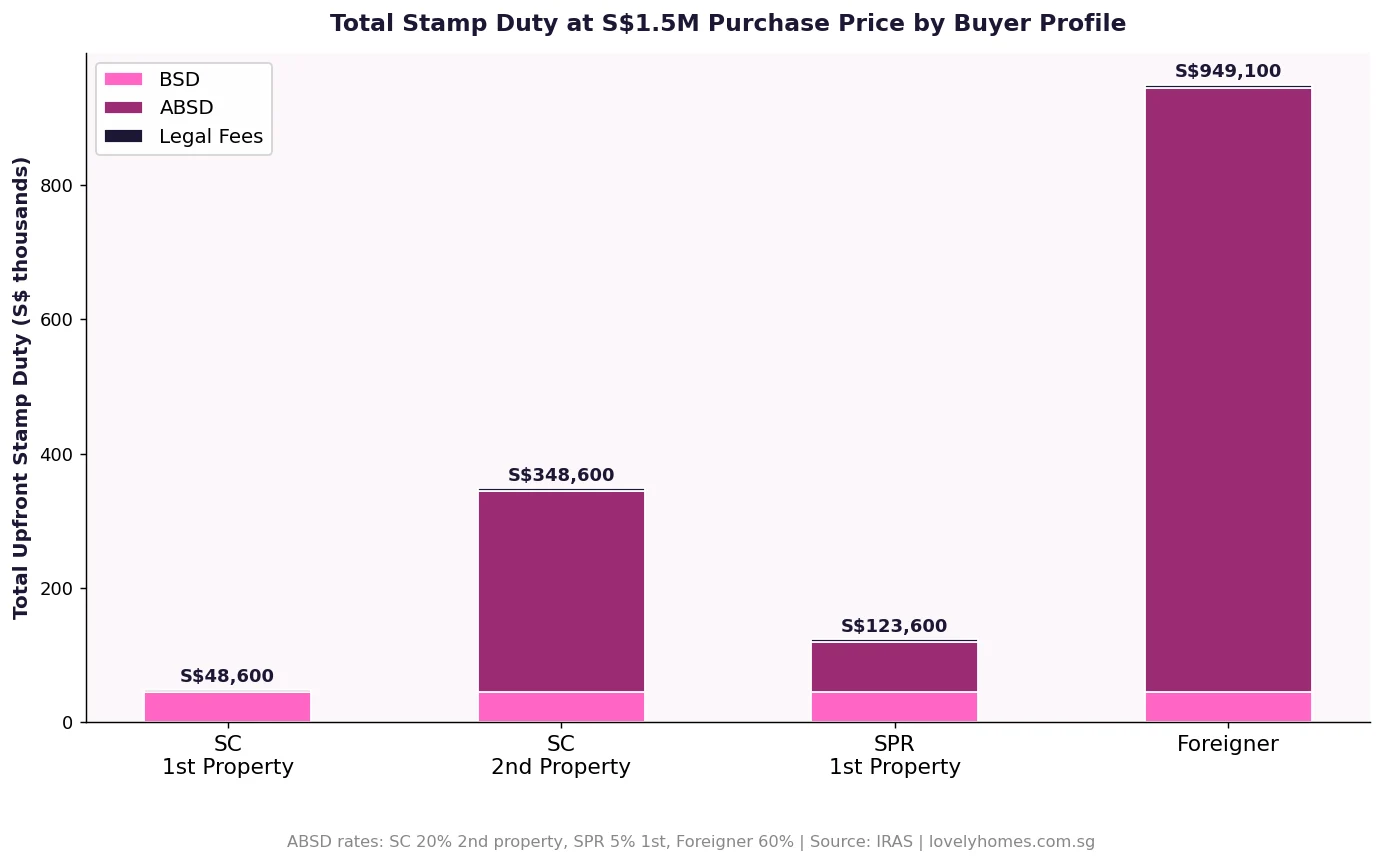
Total stamp duty BSD plus ABSD comparison at S$1.5M purchase price for Singapore Citizens, PRs and foreigners
Figure 3: Total stamp duties (BSD + ABSD) payable at S$1,500,000 for four buyer profiles — highlighting how ABSD multiplies the cost for second-property buyers and foreigners.

BSD Exemptions and Remissions

There are a small number of circumstances in which BSD does not apply or is reduced:

  • Compulsory acquisition by the Government: where the State acquires your property under the Land Acquisition Act, no BSD is payable on the acquisition instrument.
  • Transfers consequent on divorce: court-ordered transfers of matrimonial property between divorcing spouses are exempt from BSD under Section 22A of the Stamp Duties Act.
  • Transfers by will or intestacy: property passing on death to a beneficiary is not subject to BSD (estate duty was abolished in 2008; stamp duty on death transfers is also not applicable).
  • Registered charities: certain transfers to or from registered charities may attract remission under IRAS administrative concessions.
  • HDB upgrading schemes: transfers under specific HDB Housing and Development Board upgrading or SERS (Selective En-bloc Redevelopment Scheme) arrangements may receive administrative remissions.

Note: the Free Trade Agreement (FTA) national treatment that reduces ABSD for US, Swiss, and Icelandic/Norwegian/Liechtenstein nationals does not reduce BSD — BSD is a universal baseline tax unaffected by FTA provisions.

BSD Payment: Deadlines, Methods and Penalties

BSD must be paid within 14 calendar days from the date the instrument of transfer is signed (or the OTP is exercised, for resale properties). For new launch purchases, the trigger date is typically the date of the Sale and Purchase Agreement.

Payment is made through the IRAS e-Stamping portal (stamp.iras.gov.sg). Your conveyancing lawyer normally handles this on your behalf, drawing the funds from your conveyancing account. The IRAS system generates a stamping certificate confirming duty paid, which must be produced at lodgement of the title transfer.

Late payment of BSD attracts a penalty of up to four times the unpaid BSD, at IRAS’s discretion. Penalties are typically lower for short delays with no prior history, but the risk of even a few days’ delay is significant given the multiplier. Most buyers avoid this entirely by ensuring sufficient funds are deposited with their law firm well before the 14-day deadline.

Worked Example: Mr and Mrs Chong — Singapore Citizens, purchasing a S$2,200,000 resale condominium in District 11 as their first property

BSD calculation (residential, 6-band progressive):

  • First S$180,000 × 1% = S$1,800
  • Next S$180,000 × 2% = S$3,600
  • Next S$640,000 × 3% = S$19,200
  • Next S$500,000 × 4% = S$20,000
  • Next S$700,000 × 5% = S$35,000 (S$1,500,001 to S$2,200,000)
  • Total BSD = S$79,600 (effective rate: 3.62%)

ABSD: Singapore Citizens buying their first property pay 0% ABSD. Total ABSD = S$0.

Other upfront costs: legal fees ~S$5,500; CPF OA contribution towards BSD ~S$79,600 (drawn after stamping); bank loan at 75% LTV = S$1,650,000; cash downpayment 5% = S$110,000; CPF/cash combined downpayment 25% = S$550,000.

Total stamp duty: S$79,600. Payable within 14 days of OTP exercise via IRAS e-Stamping. Conveyancing lawyers collect from the buyer’s conveyancing account before lodging caveat at SLA.

BSD History: The Introduction of the 6% Band

BSD existed for decades with a simpler three-band structure (1%/2%/3%). In February 2018, the Government added a fourth band at 4% for the portion above S$1,000,000. The most recent change came on 15 February 2023, when the Government announced — as part of the same package that doubled ABSD for foreigners — two new residential BSD bands: 5% on the slice between S$1,500,001 and S$3,000,000, and 6% on the remainder above S$3,000,000. Non-residential BSD gained a 4% top band (above S$1,000,000) at the same time, replacing the old 3% cap.

The stated rationale was to make Singapore’s property transaction taxes more progressive, ensuring that buyers of very high-value properties — typically ultra-high-net-worth individuals — contribute proportionally more to government revenue. The 6% residential band had an immediate and visible impact on the Singapore prime property market, narrowing price growth in the above-S$3M segment relative to the mass-market OCR in 2023 and 2024.

What BSD Means for Buyers in 2026

BSD is a non-negotiable cost of property ownership in Singapore. Unlike ABSD, there is no strategy to avoid it — it applies regardless of citizenship, residency, or investment structure. The practical implications for different buyer groups are:

  • First-time HDB buyers: BSD on a S$400,000–S$700,000 flat is S$7,600–S$15,100 (effective 1.9%–2.2%) — meaningful but manageable relative to the total purchase.
  • Mass-market condo buyers (OCR, S$1.0M–S$1.8M): BSD of S$24,600–S$59,600 (effective 2.46%–3.31%). At S$1.5M, BSD alone is S$44,600 — a material addition to the downpayment and ABSD budget.
  • Mid-tier condo buyers (RCR, S$2M–S$3M): BSD of S$69,600–S$119,600 (effective 3.48%–3.99%). The 5% band adds significantly to the cost of buying at this tier versus five years ago.
  • Prime/luxury buyers (CCR, above S$3M): BSD plus the 6% tier means a S$5M property attracts S$239,600 in BSD alone. For foreigners, adding 60% ABSD (S$3,000,000) makes the total stamp duty S$3,239,600 — larger than most properties’ downpayments.

What Might Come Next for BSD

BSD rates have been raised three times since 2018. Each time, the Government has cited the need for a more progressive transaction tax and used the change as part of a broader property cooling package. As Singapore’s private residential market has remained resilient through 2026 — with URA’s Q2 2026 private residential price index showing continued but moderating growth — there is no immediate indication that the six-band structure will be revised upward in the near term.

However, if the above-S$3M luxury segment sees renewed price acceleration or if foreign buying volumes rise materially despite the 60% ABSD, the Government may consider further raising the 6% BSD band (to 7% or higher) or narrowing the threshold above which it applies. Buyers purchasing above S$3M should factor in the possibility that BSD could rise further if market conditions shift, though no such change is signalled as at August 2026.

Frequently Asked Questions

Is BSD payable on a HDB flat purchase?

Yes. BSD applies to every property purchase in Singapore, including HDB resale flats and new BTO flat purchases from HDB. The same six-band residential rate table applies. For a typical 4-room resale HDB flat at S$550,000, BSD would be S$10,600 (effective rate 1.93%). HDB does not provide a BSD exemption; however, first-time eligible buyers purchasing an HDB flat with an HDB loan may use their CPF Ordinary Account to reimburse BSD after paying it in cash.

Do I pay BSD when buying a commercial shophouse or industrial unit?

Yes, but under the non-residential rate table, which caps at 4%. A commercial shophouse at S$3,000,000 attracts BSD of S$1,800 + S$3,600 + S$19,200 + (S$2,000,000 × 4%) = S$104,600 (effective 3.49%). Crucially, commercial and industrial property purchases do not attract ABSD, making them attractive to investors seeking a second or third property without the 20%–60% ABSD surcharge. BSD still applies at these non-residential rates.

Can I use CPF to pay BSD?

Not directly at the point of payment. BSD (and ABSD) must be paid in cash first, within 14 days of the instrument being signed. However, after stamping is complete and you have obtained the stamping certificate, you can apply to use your CPF Ordinary Account to reimburse the BSD paid — but only for residential property, and subject to the CPF withdrawal limits for your age and the remaining lease of the property. Your conveyancing lawyer will typically handle the CPF reimbursement application as part of the completion process.

What is the BSD on a S$1,800,000 private condominium?

Using the six-band residential table: 1% × S$180,000 = S$1,800; 2% × S$180,000 = S$3,600; 3% × S$640,000 = S$19,200; 4% × S$500,000 = S$20,000; 5% × S$300,000 (from S$1,500,001 to S$1,800,000) = S$15,000. Total BSD = S$59,600 (effective rate 3.31%). If you are a Singapore Citizen buying this as your second property, ABSD of 20% × S$1,800,000 = S$360,000 would also be payable, bringing total stamp duty to S$419,600.

Is BSD payable on a new launch condominium?

Yes. BSD is payable on the Sale and Purchase Agreement (S&P) for a new launch. The 14-day clock starts from the date the S&P is signed (usually within two weeks of exercising the OTP). The purchase price stated in the S&P is the BSD basis. If the developer grants a rebate (for example, a furniture voucher or partial stamp duty absorption), the rebated consideration — not the headline price — forms the BSD basis, provided the rebate is properly reflected in the S&P. Always check your S&P carefully with your conveyancing lawyer to ensure the stamped consideration accurately reflects the true price paid.

How does BSD apply to en-bloc sale proceeds?

In an en-bloc (collective sale), it is the developer buying the site who pays BSD, not the individual subsidiary proprietors (owners) who are selling. The developer pays BSD on the collective sale price (land price plus any differential premium) under the non-residential rate table (since the transaction is land, not a completed residential unit). Individual owners receive their proceeds net of the collective sale committee’s costs; no BSD is payable by the outgoing owners on their sale.

What happens if I miss the 14-day BSD payment deadline?

IRAS imposes penalties for late stamping of up to four times the unpaid BSD. In practice, IRAS has discretion over the penalty level. A short delay for a first-time offence may attract a smaller penalty, but there is no guaranteed grace period. If you realise the deadline will be missed, you or your lawyer should contact IRAS proactively before the deadline to explain the circumstances. Voluntary disclosure before IRAS pursues the matter typically results in lower penalties. The risk of any late payment is that the unstamped instrument is inadmissible as evidence in Singapore courts, which can complicate title transfer proceedings.

Disclaimer: This article is for general information only and does not constitute legal, tax, or financial advice. BSD rates, bands, and remission rules are set by IRAS and may change. Always verify current BSD rates on the IRAS BSD page and consult a licensed conveyancing lawyer before entering into any property transaction. CPF withdrawal rules are governed by the CPF Board; refer to cpf.gov.sg for the latest guidance.

Singapore Property Seller’s Complete Guide 2026: OTP, Timeline, Costs and Proceeds

Singapore Property Seller’s Complete Guide 2026: OTP, Timeline, Costs and Proceeds

Selling a property in Singapore involves a legal process that most people will go through only a handful of times in their lives. Whether you are selling a resale HDB flat, a condominium, or a landed home, the steps from decision to receiving your proceeds follow a structured sequence — one where mistakes at any stage can cost tens of thousands of dollars or delay completion by weeks.

This guide walks you through the complete selling process in 2026: from deciding to sell and appointing a property agent, through the Option to Purchase (OTP) and Sales and Purchase Agreement, all the way to receiving your sale proceeds and understanding exactly what comes back to you after CPF, mortgage repayment, agent commission, and stamp duties.

Quick Answer — Singapore Property Selling: Key Facts 2026

  • The standard selling timeline for resale HDB or private property is 4 to 6 months from decision to completion
  • HDB sellers must satisfy the Minimum Occupation Period (MOP) of 5 years (or 10 years for Prime and Plus classification flats) before selling
  • Seller’s Stamp Duty (SSD) applies to private property sold within 3 years of purchase: 12% (year 1), 8% (year 2), 4% (year 3)
  • Agent commission for HDB sellers: typically 1–2% of sale price; condo: 1–2% (negotiable); landed: 1–2%
  • CPF Ordinary Account funds used for the purchase must be refunded — with accrued interest at 2.5% p.a. — before you receive any cash proceeds
  • The OTP grants the buyer 14 calendar days to decide whether to exercise (HDB: 21 days); the seller is bound for that period
  • Completion (from S&P signing) for resale HDB: approximately 8 weeks; private property: typically 10–12 weeks
  • Legal conveyancing fees: S$2,000–S$4,000 for HDB; S$2,500–S$5,000+ for private property

Step 1: Decide to Sell — and Check Your Eligibility

Before instructing an agent or starting viewings, two eligibility checks must be completed. For HDB sellers, the most critical is the MOP. Under HDB rules, a flat purchased directly from HDB (BTO, DBSS, or direct sale) must be occupied for a minimum of five years from the date the keys are collected before it can be sold on the open resale market. For Prime Location Public Housing (PLH) and Plus model flats introduced from late 2021, the MOP is ten years. Selling before MOP is a criminal offence under the Housing and Development Act and can result in compulsory acquisition of the flat and other penalties.

For private property sellers, the eligibility question is Seller’s Stamp Duty. SSD was calibrated in January 2017 to discourage short-term flipping of residential property. If you sell within three years of purchase, SSD is payable at the rates below.

Singapore property selling timeline from decision to proceeds 2026
Figure 1: Typical Singapore property selling timeline — from decision to cash proceeds. HDB resale adds HDB approval steps (HFE Letter verification, HDB resale portal submission) between OTP and completion. Source: HDB, CEA.

Step 2: Valuation and Listing — Setting the Right Price

Pricing accurately is the single most important decision a seller makes. An overpriced listing sits on the market, accrues carrying costs (mortgage, maintenance fees, property tax), and acquires a stigma as buyers wonder what is wrong with it. An underpriced listing leaves money on the table. Getting it right requires a Comparative Market Analysis (CMA) — a structured review of recent transactions for comparable properties in the same estate or district, same flat type or size, and similar age and condition.

For HDB sellers, URA’s HDB Resale Statistics portal provides free access to actual transacted prices by town, flat type, storey range, and month. Use this data to identify the price band for your flat before allowing any agent to quote you a price. Agents sometimes inflate initial price estimates to win the listing — so cross-check every agent’s recommended listing price against the data yourself.

For private property, URA’s Property Data portal contains detailed transaction histories by project. Supplement this with a professional valuation from an IRAS-approved valuer if you are in doubt, particularly for older or unusual properties where comparables are scarce.

Step 3: Seller’s Stamp Duty — Know Your Exposure Before You List

Seller’s Stamp Duty is a critical cost that many sellers either forget or underestimate. It applies to residential properties (private only — HDB resale is not subject to SSD). The rates in force from 11 January 2017 are:

Seller Stamp Duty SSD rates by holding period Singapore 2026
Figure 2: Seller’s Stamp Duty (SSD) rates for private residential property by holding period. Effective 11 January 2017. Source: IRAS.
Holding Period SSD Rate SSD on S$1,500,000 Sale SSD on S$2,500,000 Sale
Up to 1 year 12% S$180,000 S$300,000
More than 1 year, up to 2 years 8% S$120,000 S$200,000
More than 2 years, up to 3 years 4% S$60,000 S$100,000
More than 3 years Nil S$0 S$0

SSD is calculated on the higher of the sale price or market value. It is payable by the seller within 14 days of the date the OTP is exercised or the S&P Agreement is signed. IRAS administers SSD via its Stamp Duty portal. If SSD applies to your planned sale, model it explicitly into your net proceeds calculation before you list — it is a very large number at 12% on a S$2 million property.

Step 4: The Option to Purchase (OTP)

The OTP is the first legally binding document in any resale property transaction. Understanding it is essential for sellers.

When a buyer makes an offer that you accept, you grant them an OTP in exchange for an option fee. For private property, the option fee is negotiated — typically 1% of the purchase price, though it can be less for new launches or more for competitive situations. For HDB resale, HDB caps the option fee at S$1,000. The OTP grants the buyer the exclusive right to purchase your property at the agreed price, within a specified window (14 days for private property, 21 days for HDB).

During the option period, you cannot sell to anyone else or accept another offer. If the buyer exercises the OTP (pays the exercise fee and returns the signed copy), a binding Sale and Purchase Agreement comes into existence. If the buyer does not exercise, the OTP lapses, you keep the option fee, and you are free to sell to another party.

For HDB resale, the seller must obtain an HDB Resale Checklist acceptance before granting the OTP. Both buyer and seller submit declarations via the HDB Resale Portal. After the OTP is exercised, both parties have 8 weeks to register the resale application with HDB.

Step 5: Conveyancing and Completion

Once the OTP is exercised, your conveyancing lawyer takes over to complete the legal transfer of title. For private property, the buyer’s lawyer and seller’s lawyer correspond on the Sale and Purchase Agreement, conduct title searches, address outstanding caveats, and coordinate the CPF and bank discharge of your existing mortgage. Completion typically occurs 10 to 12 weeks after the S&P is signed.

At completion, the following typically happen simultaneously: the buyer pays the balance purchase price (via the bank’s loan drawdown and their own CPF OA funds); your outstanding mortgage is discharged and your mortgagee releases the property; CPF refunds your accrued principal and interest from the buyer’s funds; and after all deductions, the net cash proceeds are remitted to you.

Step 6: Net Proceeds — What You Actually Receive

The gap between the headline sale price and the cash you receive in your bank account after completion is often a shock to first-time sellers. Here is how to model it:

HDB seller net proceeds waterfall CPF refund agent commission 2026
Figure 3: Illustrative HDB seller’s net proceeds waterfall. Sale price S$720K, CPF OA principal used S$220K plus accrued interest S$68K. Agent commission 2%. Source: CPF Board / HDB.
Proceeds Component HDB Example (S$720K sale) Private Condo Example (S$1.5M sale)
Gross sale price S$720,000 S$1,500,000
Less: CPF OA refund (principal + accrued interest) (S$288,000) (S$450,000)
Less: Outstanding mortgage discharge (S$0) (fully paid) (S$700,000)
Less: Agent commission (2% + 9% GST) (S$15,696) (S$32,700)
Less: Legal fees (seller’s conveyancing) (S$2,000) (S$3,500)
Less: HDB admin fee / miscellaneous (S$800) (S$0)
Net cash to seller S$413,504 S$313,800

The CPF refund is the item that surprises most sellers. Under CPF rules, all funds withdrawn from your Ordinary Account for housing — the initial downpayment, the monthly mortgage servicing amounts, and any lump-sum top-ups — must be refunded with accrued interest at 2.5% per annum upon sale. This money goes back to your CPF account, not into your bank account. So a seller who used S$220,000 of CPF and held the flat for 15 years might owe S$288,000 back to their CPF account at completion — even if the flat appreciated handsomely, a large portion of the paper gain goes back to CPF, accessible only for retirement or another property purchase.

HDB vs Private: Key Differences for Sellers

The mechanics of selling differ meaningfully between HDB and private property. The table below summarises the most important distinctions:

Factor HDB Resale Private Property (Condo / Landed)
MOP requirement 5 years (10 for PLH/Plus) None
Seller’s Stamp Duty Not applicable 12%/8%/4% if sold within 3 years
OTP option period 21 days 14 days (negotiable)
HDB approval required Yes — HDB Resale Portal submission No
Completion timeline 8 weeks after HDB registration 10–12 weeks after S&P
Valuation required HDB/SRX valuation (for CPF/loan purposes) Bank or IRAS valuation
Resale Levy (if buying subsidised flat next) Yes — S$15,000 to S$50,000 depending on flat type Not applicable
ABSD on next purchase May apply if buying before existing flat is sold May apply — plan carefully with sell-first strategy

Worked Example: Mr and Mrs Tan Sell Their Bishan 4-Room HDB Flat

Mr and Mrs Tan are Singapore Citizens who purchased a 4-room HDB flat in Bishan in June 2020 via the open resale market for S$590,000. They used a bank loan (S$442,500 at 75% LTV) and S$120,000 from their combined CPF OA. They have been servicing S$2,100 per month from CPF OA. As of August 2026 (6 years and 2 months of ownership), the MOP of 5 years has been satisfied.

  • Sale price agreed: S$780,000
  • Outstanding bank loan: S$312,000 (after 74 months of repayment)
  • CPF OA principal used: S$120,000 (downpayment) + S$2,100 × 74 months = S$275,400 total principal
  • CPF accrued interest at 2.5% p.a.: approximately S$34,000
  • Total CPF refund: S$309,400
  • Agent commission (2% + 9% GST): S$17,004
  • Legal fees: S$2,200
  • HDB admin fee: S$800
  • Net cash to Mr and Mrs Tan: S$780,000 – S$312,000 – S$309,400 – S$17,004 – S$2,200 – S$800 = S$138,596
  • CPF account top-up: S$309,400 (returned to their combined OA — available for future property purchase or retirement)

The Tans pocket S$138,596 in cash and have S$309,400 restored to their CPF accounts — a total economic gain of S$447,996 on a property that cost them S$590,000 six years ago, representing a 75.9% nominal return. The cash component, however, is much more modest at 17.8% of the sale price — a reminder that CPF recycling is a significant feature of the Singapore property selling experience.

Agent vs DIY: Should You Sell Without an Agent?

Singapore’s HDB and private resale markets do not legally require a licensed property agent (or Co-Broke Service / CBS for HDB). You can sell your HDB flat directly through the HDB Resale Portal as a DIY transaction, and private property through your conveyancing lawyer. The benefit is saving the agent commission — typically 1–2% of sale price — which on a S$1 million property amounts to S$10,000–S$20,000.

The risks are real, though. Negotiating effectively against buyers represented by experienced agents, writing and managing the OTP correctly, handling viewings and screening serious buyers from time-wasters, and navigating HDB’s administrative submissions are all tasks where professional help has tangible value. DIY is most viable when you have previous experience, when the property is straightforward and in high demand, and when you are willing to invest significant time. For most first-time sellers, the commission is well-spent insurance against costly errors.

What Might Come Next

For sellers active in H2 2026, the market environment is one of moderating prices (particularly for HDB resale and private OCR/RCR) and still-healthy volume. This is a reasonable time to sell if you have held for the requisite period — the market has not collapsed, but the risk of further softening in 2027 as BTO MOP supply increases is real. Private sellers who bought in 2019 to 2021 during the pre-cooling-measures run-up will have seen the strongest gains; those who bought in 2022 to 2024 may need to hold longer to realise meaningful appreciation. SSD for private sellers who bought after mid-2023 remains an active consideration: the three-year clock runs from the date the OTP was granted to you as a buyer, not the date you moved in.

FAQ: When does the Minimum Occupation Period (MOP) start for HDB?

The MOP begins on the date you collect the keys to your flat — not the signing date of the Sales and Purchase Agreement, not the HDB appointment date, and not the date you move in. The five-year MOP period runs from key collection to key collection plus five years. For BTO flats, this is straightforward. For resale flats, the MOP restarts from the date you as the new owner collect the keys after completion of your purchase, regardless of how long the previous owner occupied the flat.

FAQ: Can I rent out my flat during the MOP while planning to sell after?

For whole-flat subletting, you must first satisfy the MOP before applying for HDB’s permission to sublet. Room rental (subletting of individual bedrooms) is permitted during the MOP subject to HDB approval and conditions. You may not use the MOP period to simultaneously rent out the whole flat and purchase another property — that would amount to owning two properties, which violates HDB rules unless you are an approved private property owner who has given up your subsidy.

FAQ: What happens if the buyer pulls out after exercising the OTP?

If a buyer exercises the OTP (that is, pays the exercise fee and returns the signed document), a binding contract exists. If the buyer subsequently defaults — fails to complete on the scheduled completion date — you as the seller have legal remedies including: forfeiture of the deposit paid, specific performance action, and damages. In practice, most failed completions are resolved through negotiation and a revised completion date rather than litigation. Engage your conveyancing lawyer immediately if your buyer signals difficulty completing.

FAQ: Do I pay tax on the profit from selling my property?

Singapore does not impose a capital gains tax on residential property profits for owner-occupiers and most individual investors. The gains are yours to keep, subject to CPF refund obligations. However, if IRAS determines that you are trading in property — buying and selling repeatedly for profit in a manner that constitutes a business — the gains may be taxed as income. This is a case-by-case assessment. Selling one or two properties over a lifetime is almost never caught by this rule; serial short-term flippers may be. Seller’s Stamp Duty (for private property held under 3 years) is a separate tax on the transaction, not on gains.

FAQ: How do I calculate the CPF accrued interest I owe on sale?

CPF accrued interest is calculated at 2.5% per annum (the prevailing Ordinary Account rate) on the principal CPF amounts withdrawn, compounded monthly from the date each withdrawal was made. CPF Board provides an indicative CPF housing refund calculator on their website at cpf.gov.sg. The actual figure is confirmed by CPF Board during the conveyancing process. It is important to model this early — for long-held properties with substantial CPF usage, the accrued interest can exceed S$100,000.

FAQ: Can I sell my HDB flat and immediately buy a private condo?

Yes, provided you have satisfied the MOP on your HDB flat. Once you sell (or even once you have exercised the OTP to sell, provided you notify HDB), you are no longer counted as an HDB flat owner and can purchase private property without triggering the ABSD that would otherwise apply for owning two residential properties simultaneously. Timing is critical: if you buy the private property before your HDB flat is formally sold (OTP exercised by the buyer), you will own two properties simultaneously and ABSD applies. Most upgraders use the sell-first, buy-second approach or the married couple ABSD remission scheme to manage this sequencing.

FAQ: What is the Resale Levy and do I have to pay it?

The Resale Levy is a charge imposed by HDB on sellers of a subsidised flat (BTO or DBSS) who subsequently buy another subsidised flat (a second or third BTO, an EC, or a DBSS). It does not apply if your next purchase is a resale HDB flat or private property. The levy ranges from S$15,000 for a sold two-room flat to S$50,000 for a sold five-room or executive flat. It is payable from the proceeds of the sale at the HDB appointment. If you are selling your first subsidised flat and planning to buy a resale flat instead of a new BTO, no levy applies.

Related Articles

Disclaimer: This guide is for general information only and does not constitute legal, financial, or property advice. CPF rules, stamp duty rates, HDB administrative requirements, and market conditions change over time. Always verify current requirements at hdb.gov.sg, cpf.gov.sg, and iras.gov.sg, and engage a licensed conveyancing lawyer and CEA-registered property agent before proceeding with any transaction.

Translate »