HDB Resale Market Q2 2026: Price Index Falls -0.3% as Million-Dollar Flat Sales Hit Record High

HDB Resale Market Q2 2026: Price Index Falls -0.3% as Million-Dollar Flat Sales Hit Record High

Singapore’s HDB resale market delivered a paradox in the second quarter of 2026: prices fell for the second consecutive quarter, yet million-dollar flat transactions hit their highest-ever quarterly count. Understanding both trends, and what sits beneath them, is essential for any buyer, seller, or investor making decisions in the second half of 2026.

This analysis draws on HDB’s official Q2 2026 public housing data (published 24 July 2026) and URA’s Q2 2026 real estate statistics to give you a ground-level view of where the market stands and where it is heading.

Quick Answer — HDB Resale Q2 2026 at a Glance

  • HDB Resale Price Index (RPI): 202.7 — a decrease of 0.3% QoQ (second consecutive quarterly decline)
  • Total resale transactions Q2 2026: 6,396 units — up 1.8% from Q1’s 6,285
  • Million-dollar flat sales Q2 2026: 491 transactions — a new quarterly record, up 19.5% QoQ
  • Average price of million-dollar flats: S$1,147,216 — down slightly (-0.3%) from Q1
  • Share of million-dollar flats in total resale: 7.7% (up from 6.5% in Q1)
  • Top towns by volume: Jurong West, Punggol, Sengkang, Tampines, Woodlands
  • BTO supply in 2026: approximately 19,600 flats planned across three sales exercises
  • Private residential comparison: overall private PPI +0.5% QoQ (landed +2.5%; most non-landed segments flat or negative)

The Resale Price Index: Two Consecutive Quarterly Declines

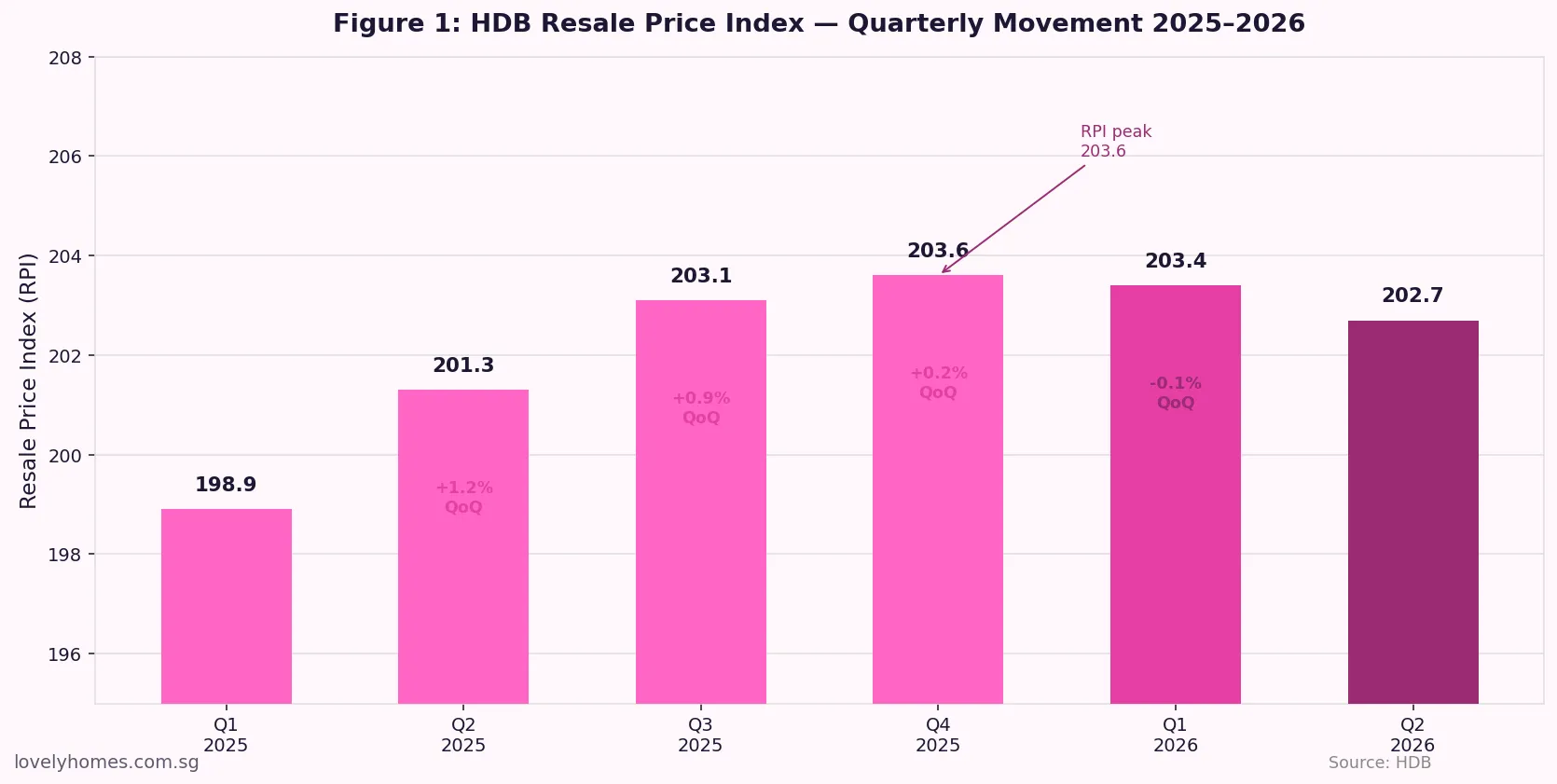
The HDB Resale Price Index for Q2 2026 came in at 202.7 — a decrease of 0.3% from 203.4 in Q1 2026. This follows a 0.1% decline in Q1 2026 from the Q4 2025 peak of 203.6. Taken together, the RPI has now shed 0.9 index points, or 0.44%, from its peak.

To put that in perspective: the RPI has not entered a sustained downward correction. The peak reached in Q4 2025 followed one of the strongest recovery runs in the HDB resale market’s history. Over the calendar year 2025, the RPI rose from 198.9 to 203.6 — a gain of 4.7 index points, or roughly 2.4%. The current two-quarter softening represents a very modest retracement, not a crash.

What is driving the softness? Two structural factors are at play. First, a significant volume of BTO flats completed in 2022 and 2023 are reaching their five-year Minimum Occupation Period (MOP) and flowing onto the resale market as sellers who bought at subsidised prices look to cash out. This supply pressure is most visible in the OCR and newer estates. Second, affordability constraints are biting: the TDSR and MSR frameworks cap borrowing, and rising resale prices over 2024 and 2025 mean that fewer first-time buyers can stretch to larger or better-located flats.
HDB Resale Price Index quarterly movement 2025 to 2026
Figure 1: HDB Resale Price Index — quarterly movement 2025 to Q2 2026. Source: HDB.

Million-Dollar Flat Sales: A Record That Needs Context

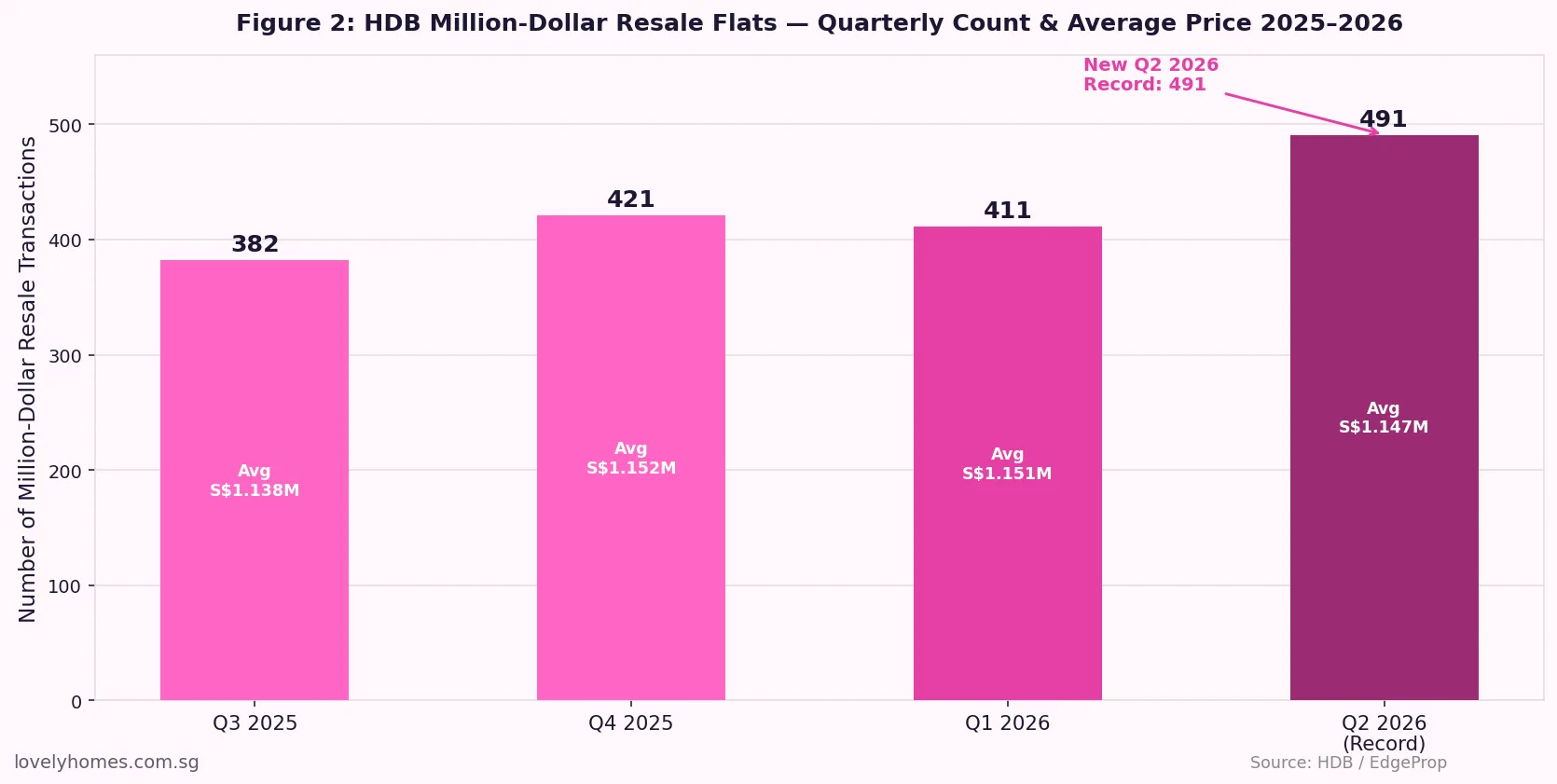
The headline that grabbed attention in Q2 2026 was the record 491 million-dollar resale transactions — up from 411 in Q1 2026 and well above the previous quarterly record. At first glance, a falling RPI alongside a record number of million-dollar sales seems contradictory. The explanation lies in market segmentation.

The HDB resale market is not one market — it is several markets stacked on top of each other. Larger flat types (five-room and executive) in prime or sought-after locations (Bishan, Queenstown, Toa Payoh, Buona Vista, Kallang) have continued to command strong prices because demand from asset-rich buyers or upgraders downsizing from private property remains robust. These are precisely the buyers most likely to cross the million-dollar threshold. Meanwhile, the broader market — four-room and below, in the OCR towns — experienced the softening that pulled the aggregate RPI downward.

The average price of million-dollar flats softened marginally, from S$1,150,651 in Q1 2026 to S$1,147,216 in Q2 2026. This 0.3% decline in average price, alongside a 19.5% surge in volume, confirms that more flats crossed the million-dollar mark at prices just above the threshold rather than the upper end of the premium segment rising sharply.
HDB million-dollar resale flat transactions Q3 2025 to Q2 2026 quarterly record
Figure 2: HDB million-dollar resale flat transactions by quarter, Q3 2025 to Q2 2026. Average price shown per bar. Source: HDB, EdgeProp.

Transaction Volume and Top Towns

At 6,396 resale transactions, Q2 2026 volume rose 1.8% from Q1’s 6,285 — a modest quarter-on-quarter improvement that nonetheless keeps the annual run rate above 25,000 transactions for the second year running. Volume held up despite the price softening, suggesting that buyers who had been waiting on the sidelines returned once prices began to moderate.

The top five HDB towns by resale volume in Q2 2026 were Jurong West, Punggol, Sengkang, Tampines, and Woodlands, collectively accounting for 35.7% of all transactions. These are predominantly OCR towns characterised by high BTO supply, relatively younger flat stock coming off MOP, and strong demand from first-time buyers priced out of the central region. Their dominance in volume statistics helps explain the RPI softness: OCR transactions, which skew lower in absolute price, are pulling the aggregate index down even as CCR and prime RCR transactions remain strong.
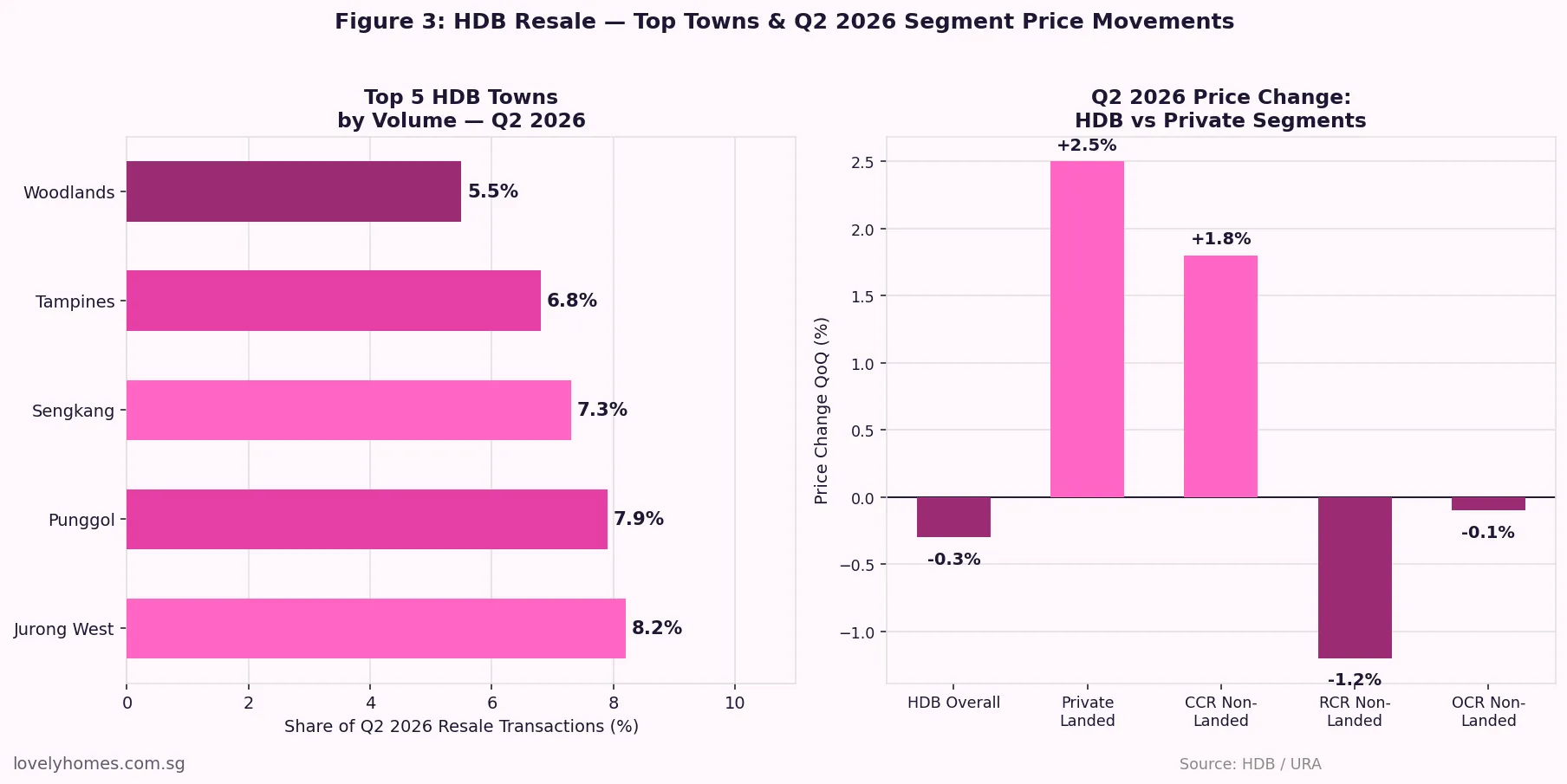
Figure 3 top HDB towns by resale volume Q2 2026 and segment price changes comparison
Figure 3: Top HDB towns by share of Q2 2026 resale volume (left) and Q2 2026 price movements across HDB and private residential segments (right). Source: HDB, URA.

HDB vs Private Residential: A Tale of Two Markets

Comparing the HDB resale market with private residential in Q2 2026 reveals an interesting divergence. The overall private residential Property Price Index rose 0.5% QoQ — apparently stronger than HDB’s -0.3%. But the private sector figure masks sharp segmentation of its own.

Segment Q2 2026 QoQ Price Change Context
HDB Resale (overall) -0.3% Second consecutive quarterly decline; OCR BTO supply overhang
Private Landed +2.5% Strong demand, very limited supply; reversal of Q1’s -0.4%
Private Non-Landed CCR +1.8% Foreign and high-net-worth demand; luxury segment resilient despite 60% ABSD
Private Non-Landed RCR -1.2% Mass-market competition from HDB and OCR condos; supply from recent completions
Private Non-Landed OCR -0.1% Broadly flat; same supply pressures as HDB but mitigated by upgrader demand
Private Residential Rental +0.7% Rental market recovering after sharp corrections in 2024; vacancy 6.4%

The private market’s +0.5% aggregate figure is heavily influenced by the landed segment’s 2.5% bounce and CCR’s 1.8% gain — segments where supply is tightest and buyers are least price-sensitive. The HDB market’s softness reflects the same affordability pressure visible in RCR and OCR private condos. In this sense, the two markets are telling the same story: the upper end holds, the mid-to-mass market moderates.

BTO Supply Pipeline: The Structural Overhang

HDB plans to launch approximately 19,600 BTO flats in 2026 across three sales exercises (February, June, and October). Of these, over 4,000 units are expected to have waiting times of under three years — a deliberate policy response to the BTO queue bottleneck that stretched to five years or longer for some estates during the COVID disruption years of 2020 to 2022.

The medium-term implication for the resale market is straightforward. The cohort of flats built in 2021 to 2023 — many of which were bought as emergency “market rate” BTO applications during the queue crisis — will reach MOP in the period from 2026 to 2028. This flow of supply is expected to maintain moderate price pressure on resale HDB, particularly in the OCR, for at least the next two years. Sellers in these estates who bought at subsidised BTO prices with a relatively short wait will still profit handsomely; buyers entering the resale market should expect continued modest price softening, which actually works in their favour.

Worked Example: Buying a Million-Dollar 5-Room Flat in Bishan

Mrs Rahman, a Singapore Citizen, is purchasing a 35-year-old 5-room flat in Bishan from an upgrader for S$1,100,000. She is 42, has an HDB loan eligibility (HLE), and plans to use a bank loan. Her husband’s gross monthly income is S$9,500; hers is S$5,500. Here is how the numbers work:

  • Purchase price: S$1,100,000
  • BSD: S$31,100 (1% on first S$180K + 2% on next S$180K + 3% on next S$640K + 4% on next S$100K)
  • ABSD: Nil (first residential property for both, Singapore Citizens)
  • Bank loan (75% LTV): S$825,000 — bank stress-test rate 4.0%, 25-year tenure, monthly instalment S$4,358
  • MSR check (HDB rule): S$4,358 / S$15,000 = 29.1% (below 30% MSR cap — PASS)
  • TDSR check: S$4,358 / S$15,000 = 29.1% (below 55% TDSR cap — PASS)
  • Downpayment (25%): S$275,000 — minimum 5% cash (S$55,000) + balance CPF OA (S$220,000)
  • Total upfront costs: S$275,000 (DP) + S$31,100 (BSD) + legal S$4,500 = S$310,600
  • CPF caveat: Flat has 65 years remaining. CPF usage is not restricted (above 60-year threshold). If the flat were below 60 years remaining, CPF withdrawal would be prorated.

The transaction qualifies comfortably, but it is worth noting that the S$55,000 minimum cash requirement must come from the buyer’s own savings — no CPF OA funds can substitute for this tranche. This is the single most common stumbling block for buyers stretching to the million-dollar segment.

What This Means for Buyers and Sellers

For buyers: the two-quarter price softening in the HDB resale market is a genuine opportunity window, particularly in the OCR. Estate towns such as Punggol, Sengkang, and Woodlands that dominate volume figures are seeing the largest supply overhang — which means the most negotiating headroom. Buyers should still model their TDSR and MSR carefully using stressed interest rates (4.0%+), and should factor in the CPF accrued interest obligation that will need to be refunded on eventual resale. Read our TDSR and MSR complete guide before applying for any bank loan.

For sellers: if you are considering selling a resale HDB flat, Q3 and Q4 2026 may prove to be better windows than Q3 2027, when additional BTO MOP supply is expected to hit the market. Volume in the S$800K–S$1.1M segment remains strong, and the million-dollar record demonstrates that premium flats in desirable locations are still attracting robust demand. Price your property accurately against recent comparables — the days of 20% premiums over asking are gone for most estates.

What Might Come Next

The trajectory for the second half of 2026 is moderately bearish for the HDB resale RPI in the near term, with a stabilisation expected in 2027 as the BTO MOP supply overhang begins to thin. Several external factors could shift this scenario: a sharper-than-expected global slowdown that prompts interest rate cuts could ease monthly instalment burdens and re-energise demand; conversely, any re-acceleration of inflation would force rates higher and squeeze affordability further. The October 2026 BTO launch will be closely watched — if demand for short-wait-time flats is strong, it may absorb some of the pressure from the resale pipeline. The Government has reiterated its commitment to maintaining a high and steady supply of public housing and has ruled out rolling back cooling measures in the current environment.

FAQ: Is the HDB resale market in a downturn?

Not in any structural sense. Two consecutive quarterly declines of -0.1% and -0.3% amount to a combined drop of approximately 0.44% from the Q4 2025 peak. By comparison, the market rose roughly 2.4% over all of 2025. This is a modest price correction, not a market collapse. Volume remains healthy at over 6,300 transactions per quarter. The correction is supply-driven and concentrated in the OCR, not a sign of deteriorating demand fundamentals.

FAQ: Why are million-dollar HDB flat sales at a record if prices are falling?

Market segmentation is the answer. The HDB resale market covers everything from three-room flats in Woodlands at S$300,000 to five-room executive flats in Queenstown at S$1.3 million. The aggregate RPI captures the average across all flat types and locations. When OCR volume dominates (as it does), the aggregate index is pulled lower even if the premium segment (large flats in mature, central estates) is holding or rising. In Q2 2026, 7.7% of all resale transactions crossed the million-dollar mark — which is itself a record share.

FAQ: Should I buy HDB resale now or wait for prices to fall further?

Timing the market is notoriously difficult, and the answer depends heavily on your personal circumstances. If you need housing now, the current softening is a reasonable entry point — particularly in high-supply OCR towns where negotiating headroom is greatest. If you are buying primarily as an investment and can afford to wait, there may be slightly more supply-driven softening to come over the next two to three quarters. What you should absolutely not do is wait indefinitely: HDB public housing exists to provide affordable, stable homes, and the risk of waiting for a lower price while interest rates, inflation, or policy changes shift the goalposts is real.

FAQ: Does the falling HDB RPI mean private property is a better buy?

Not necessarily. Private non-landed prices in the RCR fell 1.2% in Q2 2026 — worse than HDB’s -0.3%. OCR private condos were broadly flat. The landed segment rose 2.5%, but that is accessible only to Singapore Citizens and Permanent Residents with significant capital. HDB resale remains considerably cheaper on a per-square-foot basis than comparable private alternatives and carries no ABSD for first-time citizen buyers. The comparison depends on your profile, budget, and long-term plans.

FAQ: How does the BTO supply pipeline affect resale prices?

When BTO flats reach their five-year Minimum Occupation Period, sellers who bought them at subsidised prices enter the resale market. Since their entry cost is far below market, they can price competitively and still generate a healthy profit. This supply pressure — particularly in the OCR towns where BTO volume was highest during 2021 to 2023 — is the primary structural driver of the current price softening. The pressure should begin to ease in 2028 to 2029 as that cohort thins out.

FAQ: What is the outlook for HDB resale in H2 2026?

Industry watchers broadly expect the RPI to remain range-bound in the region of 200 to 203, with a possible further quarter or two of marginal declines before stabilising. Volume is expected to hold up, driven by the steady flow of owner-occupier demand and upgraders. Million-dollar flat transactions are likely to maintain elevated levels given the structural shift in the share of larger, well-located flats trading at or above that threshold. Any government intervention — whether additional cooling measures or stimulus — would materially change this outlook.

Related Articles

Disclaimer: This analysis is for general information only and is not financial or investment advice. Property prices can rise and fall. All figures are drawn from HDB and URA official releases (July 2026) and third-party research. Always verify current data on hdb.gov.sg and ura.gov.sg, and consult a licensed property agent or financial adviser before making any property decision.
Singapore Leasehold vs Freehold Property Guide 2026: Price Premiums, CPF Rules and What to Buy

Singapore Leasehold vs Freehold Property Guide 2026: Price Premiums, CPF Rules and What to Buy

Quick Answer: Leasehold vs Freehold at a Glance

  • Three tenure types exist in Singapore: freehold (ownership in perpetuity), 999-year leasehold (effectively freehold for practical purposes), and 99-year leasehold (the most common for new private residential launches and HDB flats).
  • Freehold costs more upfront: industry figures show freehold non-landed condominiums typically command a 8–18% price premium over comparable 99-year leasehold properties in the same district, depending on location and age.
  • HDB flats are always leasehold: all HDB flats are on 99-year leases from the date of construction. You cannot own an HDB flat on a freehold basis.
  • CPF rules differ by remaining lease: properties with fewer than 60 years remaining on the lease attract CPF usage restrictions. Below 20 years, no CPF can be used at all.
  • Financing is affected at low lease terms: HDB loans are not available for flats with under 20 years remaining; bank financing is restricted for properties with short leases relative to the buyer’s age.
  • Lease decay is real but gradual: price discounts due to a short remaining lease are most pronounced below 60 years and accelerate sharply below 30 years. Above 60 years, the market generally treats leasehold and freehold as broadly equivalent in terms of financing and CPF eligibility.
  • En bloc potential favours leasehold: older 99-year leasehold properties in prime locations can be attractive candidates for collective sale (en bloc), which can deliver a premium to market value. Freehold sites are also acquired for en bloc but at different pricing dynamics.
  • For most owner-occupiers, tenure is secondary to location and price: a well-located 99-year flat in a mature estate typically outperforms a poorly-located freehold property over any reasonable holding period.

Understanding Singapore’s Property Tenure System

Singapore’s property tenure system is rooted in English land law and is administered by the Singapore Land Authority (SLA). Three forms of tenure exist for private residential property: freehold, 999-year leasehold, and 99-year leasehold.

Freehold means the land is owned absolutely by the titleholder, with no fixed expiry date. In law, freehold land reverts to the state only if the owner dies intestate with no heirs. As at 2026, approximately 30% of Singapore’s private residential properties are freehold or 999-year leasehold. Many of these are older developments in central districts such as D9, D10, D11 and D15, as well as Conservation Areas where the government has preserved the historical character of the built environment.

999-year leasehold is a colonial-era form of tenure that was commonly granted before the 1960s. For all practical purposes, a 999-year lease is indistinguishable from freehold in terms of financing, CPF eligibility and market pricing. A buyer today purchasing a 999-year leasehold property with, say, 940 years remaining will never face any lease-related constraints in their lifetime or those of their descendants.

99-year leasehold is the dominant tenure for most of Singapore’s private residential land released under the Government Land Sales (GLS) programme since the 1970s. New condominium launches on GLS sites are therefore almost always 99-year leasehold, as are all HDB flats and Executive Condominiums (ECs). The 99-year clock starts from the date the lease is issued by the state, which is typically close to the TOP date for new launches.

Freehold vs 99-year leasehold price premium by district Singapore 2026 D9 D10 D15 D19
Figure 1: Freehold price premium over comparable 99-year leasehold condominiums by district in 2026. The premium is highest in mass-market and OCR districts where leasehold supply dominates and freehold alternatives are scarce, and lower in CCR districts where both tenure types are abundant.

CPF Rules: How Remaining Lease Affects What You Can Use

The CPF Board applies a set of rules that link your eligibility to use Ordinary Account (OA) savings for a property purchase to the remaining lease of that property. These rules were tightened progressively in 2019 and remain in force as at August 2026.

The overarching principle is that the remaining lease at the time of purchase must be able to cover the youngest buyer to age 95. This is applied as follows. If the remaining lease is 60 years or more, the CPF Board imposes no restriction on OA usage — you can use your CPF OA to fund the downpayment, the loan repayments, and other allowable costs up to the Valuation Limit. This applies to the overwhelming majority of new launches and most resale condominiums less than 39 years old.

Where the remaining lease is between 20 and 59 years, the CPF OA usage is prorated. The formula is: CPF limit as a percentage of the property value equals the remaining lease divided by the reference lease of 95 minus the youngest buyer’s age. For example, a buyer aged 35 purchasing a property with 50 years remaining can use CPF up to: 50/(95-35) = 50/60 = 83.3% of the purchase price or valuation. Below 20 years of remaining lease, CPF cannot be used at all for the property purchase.

CPF withdrawal eligibility by remaining lease Singapore 2026 buyer aged 35 prorated above 60 years
Figure 2: CPF OA withdrawal eligibility as a percentage of purchase price by remaining lease for a buyer aged 35. Full CPF access requires at least 60 years remaining. Below 20 years, no CPF can be used. Prorated access applies in between.

Financing: How Banks Treat Leasehold Properties

Banks in Singapore apply their own lending policies on top of MAS LTV rules when assessing loans for leasehold properties. The key constraint is loan tenure: most banks require the loan to be repaid before the property lease expires, subject to a minimum remaining lease at loan maturity. In practice, this means:

For a 99-year leasehold condominium with, say, 78 years remaining, a buyer aged 35 applying for a 30-year loan would leave 48 years on the lease after the loan is repaid — which is generally acceptable. However, for a property with 45 years remaining, the same 30-year loan would leave only 15 years of lease, below what many banks consider adequate security. Banks will typically reduce the loan tenure or the quantum in such cases, effectively requiring a larger downpayment.

HDB concessionary loans impose additional restrictions: HDB does not provide loans for flats with fewer than 20 years remaining on the lease. For flats between 20 and 59 years remaining, HDB’s loan quantum is also subject to the CPF prorating rules described above.

Price Premiums and Investment Considerations

The freehold premium in Singapore is real but contested. Freehold land is inherently scarce — the government does not release new freehold GLS sites — so older freehold developments hold a structural scarcity premium. In central districts (D9, D10, D11), where many freehold developments are Conservation properties or legacy buildings, the premium can be modest (8–11%) because the buildings themselves are ageing and require capital expenditure. In more suburban districts (D15, D19, D20), the premium can be higher (14–18%) because freehold alternatives are genuinely rare, so the scarcity commands a broader bid.

However, from a total-returns perspective, many studies of Singapore residential prices over the past two decades have found that well-located 99-year leasehold condominiums have outperformed freehold properties in absolute terms. This is because 99-year leasehold GLS sites are typically well-planned with good transport connectivity, while freehold developments are often older, built to lower gross floor area ratios, and lacking modern amenity standards. Location, connectivity and project quality tend to outweigh tenure over a 5–10 year holding period for a typical owner-occupier.

For investors with longer time horizons or en bloc aspirations, the calculus changes. An older 99-year leasehold development on a large freehold-equivalent plot in a prime location can attract collective sale interest as the lease erodes. En bloc collective sales can deliver 20–40% premiums above individual market value in some cases, depending on the development baseline rate, plot ratio uplift and prevailing land demand. Freehold developments are not immune to en bloc pressure — many freehold sites have been collectively sold in Singapore — but the pricing dynamics and developer appetite differ.

Freehold vs 99-year leasehold private non-landed price index Singapore 2016 to 2026 URA
Figure 3: Illustrative private non-landed residential price index for freehold and 99-year leasehold properties in Singapore (2016 = 100), based on URA REALIS transactional data and industry analysis. Both tenure types have appreciated meaningfully; leasehold indices reflect greater volume from new GLS supply cycles.

Summary Comparison: Freehold vs 99-Year Leasehold (2026)

Factor Freehold / 999-Year 99-Year Leasehold
Upfront price 8–18% premium in most districts Lower entry price; dominant in GLS pipeline
CPF eligibility Full CPF access (no restriction) Full access if 60+ years remain; prorated 20–59 years; none below 20 years
Bank financing Standard LTV/TDSR apply; full tenure flexibility Loan tenure constrained by remaining lease at maturity
En bloc potential Developer interest; pricing dynamics differ Higher en bloc momentum as lease erodes in prime locations
State acquisition risk Compulsory acquisition at market value; no lease expiry Lease expires; building must be returned to state at end of lease
Supply scarcity High; no new freehold GLS sites released Abundant; most new launches are 99-year leasehold
HDB flats Not available — HDB flats are always leasehold All HDB flats are 99-year leasehold
Short-term returns (5–10 yr) Strong; location and scarcity underpin value Often comparable or superior for well-located GLS projects

Worked Example: Comparing a Freehold and Leasehold Purchase in District 15

Mr and Mrs Lim, Singapore Citizens in their early 40s, are considering two units in the East Coast area. Option A is a freehold two-bedroom condominium unit priced at S$1,480,000 in a 30-year-old development. Option B is a 99-year leasehold two-bedroom unit in a newer development (15 years old, 84 years remaining lease) priced at S$1,260,000. Both offer similar floor areas and are within 500 metres of each other.

Upfront costs — Option A (Freehold):
Purchase price: S$1,480,000.
BSD: S$42,600.
ABSD: Nil (first private property for both SCs).
Bank loan (75% LTV): S$1,110,000. Cash downpayment (5%): S$74,000. CPF downpayment: S$296,000.
Legal fees: ~S$3,800.
Total upfront: approximately S$420,400 (cash S$74,000 + CPF S$296,000 + BSD/legal S$46,400 in cash or CPF).

Upfront costs — Option B (99-year, 84 years remaining):
Purchase price: S$1,260,000.
BSD: S$35,600.
ABSD: Nil.
Bank loan (75% LTV): S$945,000. Cash downpayment (5%): S$63,000. CPF downpayment: S$252,000.
Legal fees: ~S$3,500.
CPF eligibility: 84 years remaining is well above 60-year threshold — full CPF access. PASS.
Total upfront: approximately S$354,100 (cash S$63,000 + CPF S$252,000 + BSD/legal S$39,100).

Monthly commitment comparison:
Option A at 3.5% over 30 years: ~S$4,984/month.
Option B at 3.5% over 30 years: ~S$4,241/month.
Monthly saving with Option B: ~S$743.

Price break-even analysis:
To justify the S$220,000 price premium for the freehold unit, Mr and Mrs Lim need Option A to outperform Option B by that margin over their holding period. Over 10 years at 1.5% per annum additional appreciation on the freehold unit, the gap closes to approximately S$168,000 — not quite closing the premium. Over 15 years at 2% per annum additional appreciation, the premium is essentially erased. The conclusion: the freehold premium is not guaranteed to be recovered within a typical 10-year holding period, particularly for an older building with higher maintenance costs.

Why This Matters: Tenure, Policy and Long-Term Wealth

Singapore’s approach to land tenure reflects a deliberate policy choice by the state to retain long-term control over land use and redevelopment. By issuing 99-year leases for most GLS land, the government retains the ability to reconfigure land use as Singapore’s needs evolve over generations, without compensating landowners for the underlying land value. This is a fundamental structural reality of the Singapore property market: unlike most Western countries, there is a finite duration to most private property ownership.

For wealth planning purposes, the key implication is that freehold property can be held across multiple generations without the complication of lease expiry, whereas 99-year leasehold property is ultimately a depreciating asset whose residual value approaches zero as the lease nears expiry. In practice, almost no privately-held 99-year leasehold development in Singapore has yet reached lease expiry — the oldest leases date from the 1960s and are still in the 30–40 years remaining range. As more leases approach the 30-year and below threshold, the market will price in lease decay more aggressively, and both the CPF restrictions and financing limitations will affect a larger proportion of resale transactions.

What Might Come Next: Leasehold Policy Outlook

The government has signalled, through periodic Parliamentary responses, that there is no plan to introduce a blanket lease extension programme similar to that of Hong Kong (where the government offered 50-year lease renewals in 1997). HDB’s Voluntary Early Redevelopment Scheme (VERS) and the legacy SERS programme are the primary mechanisms for addressing ageing flats, but both are selective and not available to all estates. This means buyers of older HDB resale flats with under 60 years remaining should not plan their financial returns around the assumption of a lease extension.

For private properties, individual freehold extensions of 99-year leasehold land are theoretically available from SLA but are rare and expensive (typically at market rate for the additional lease years, often hundreds of thousands of dollars per unit). The practical mechanism for older 99-year leasehold private developments is en bloc collective sale to a developer who will clear and redevelop the site. This has historically delivered meaningful premiums to unit holders, but is contingent on 80% consent from the MCST, market appetite, and urban planning parameters.

Frequently Asked Questions

Is a 999-year leasehold property the same as freehold for practical purposes?

For all practical purposes, yes. A 999-year leasehold property is treated identically to a freehold property by banks, the CPF Board, and the market. The lease term is so long that no buyer, lender or regulator needs to factor in lease decay. In valuation practice, 999-year leasehold and freehold properties are assessed as equivalent, and you will not face CPF restrictions or financing limitations based on the tenure type. The only theoretical distinction is that a freehold titleholder owns the land absolutely, whereas a 999-year leaseholder has a lease from the state.

Can I use CPF to buy an old HDB flat with fewer than 60 years remaining?

Yes, but with a prorated limit. If the remaining lease is between 20 and 59 years, your CPF usage is capped at (remaining lease / (95 minus your age)) as a percentage of the purchase price or valuation. For example, a buyer aged 40 purchasing an HDB flat with 45 years remaining can use CPF up to 45/(95-40) = 81.8% of value. If the remaining lease is below 20 years, no CPF can be used at all. Note that HDB’s concessionary loan is also unavailable for flats with under 20 years remaining. These restrictions are designed to ensure CPF savings are used for assets that will cover the buyer into retirement.

Does lease tenure affect ABSD or BSD calculations?

No. ABSD and BSD are computed on the purchase price or market value, whichever is higher, with no adjustment for lease tenure. A freehold property and a 99-year leasehold property of identical value attract the same BSD and ABSD. However, the fact that freehold properties typically command a higher price than comparable leasehold properties will result in higher absolute BSD and ABSD liabilities for freehold purchases. The tenure itself has no direct bearing on the stamp duty rate applied by IRAS.

If I buy a 99-year leasehold property and the lease expires, what happens?

At the end of the lease, ownership of the land and all structures on it reverts to the state at no cost. The property owner receives no compensation for the land value. In practice, this scenario is unlikely to affect most current owners: the vast majority of 99-year leasehold developments in Singapore were launched from the 1970s onwards, meaning the earliest leases will not expire until the 2070s. Long before expiry, the government or MCST will typically facilitate SERS, VERS or en bloc redevelopment. However, buyers of units in developments with, say, 30–40 years remaining should factor the eventual reversion into their financial planning.

Is buying freehold always a better investment than 99-year leasehold?

Not necessarily. Investment returns in Singapore property are driven primarily by location, connectivity, supply-demand dynamics and unit quality, not tenure alone. Many well-located 99-year leasehold condominiums near MRT stations in mature estates have delivered stronger total returns over 10–15 year holding periods than freehold counterparts in less accessible locations. The freehold premium may or may not be recovered depending on holding period, rental income and capital appreciation. For most owner-occupiers with a 5–15 year horizon, the tenure decision is secondary to buying a well-located, well-priced property that meets their lifestyle needs.

What is the VERS and how does it apply to HDB owners?

The Voluntary Early Redevelopment Scheme (VERS) is an HDB programme that allows residents of selected older HDB estates to vote on whether to return their flats to HDB in exchange for compensation, earlier than the lease expiry date. VERS is selective — not all estates are eligible — and requires a high proportion of residents to agree. Unlike the older SERS programme, which offered direct replacement flats, VERS compensation is monetary and the form and quantum of assistance for alternative housing are still being finalised by HDB. As at August 2026, VERS has not been rolled out to any estate on a full basis. Buyers of older HDB resale flats should not factor VERS payouts into their financial planning with certainty.

Related Articles

Disclaimer

This article is for general information and educational purposes only and does not constitute financial, legal or property advice. Tenure rules, CPF eligibility, financing conditions, and government policies are subject to change. Price premiums and market observations are indicative and based on industry data; they do not constitute a guarantee of future performance. Always consult a licensed financial adviser, conveyancing solicitor and the relevant government agencies before making any property purchase decision. Official sources: Singapore Land Authority (sla.gov.sg), CPF Board (cpf.gov.sg), HDB (hdb.gov.sg), URA (ura.gov.sg).

Singapore TDSR & MSR Borrowing Limits Guide 2026: How Much Can You Borrow?

Singapore TDSR & MSR Borrowing Limits Guide 2026: How Much Can You Borrow?

Quick Answer: TDSR & MSR at a Glance

  • TDSR 55%: The Total Debt Servicing Ratio caps all your monthly debt repayments at 55% of gross monthly income. Introduced by MAS in 2013 and tightened to 55% in September 2022.
  • MSR 30%: The Mortgage Servicing Ratio applies only to HDB and Executive Condominium (EC) loans, capping the housing loan instalment at 30% of gross monthly income.
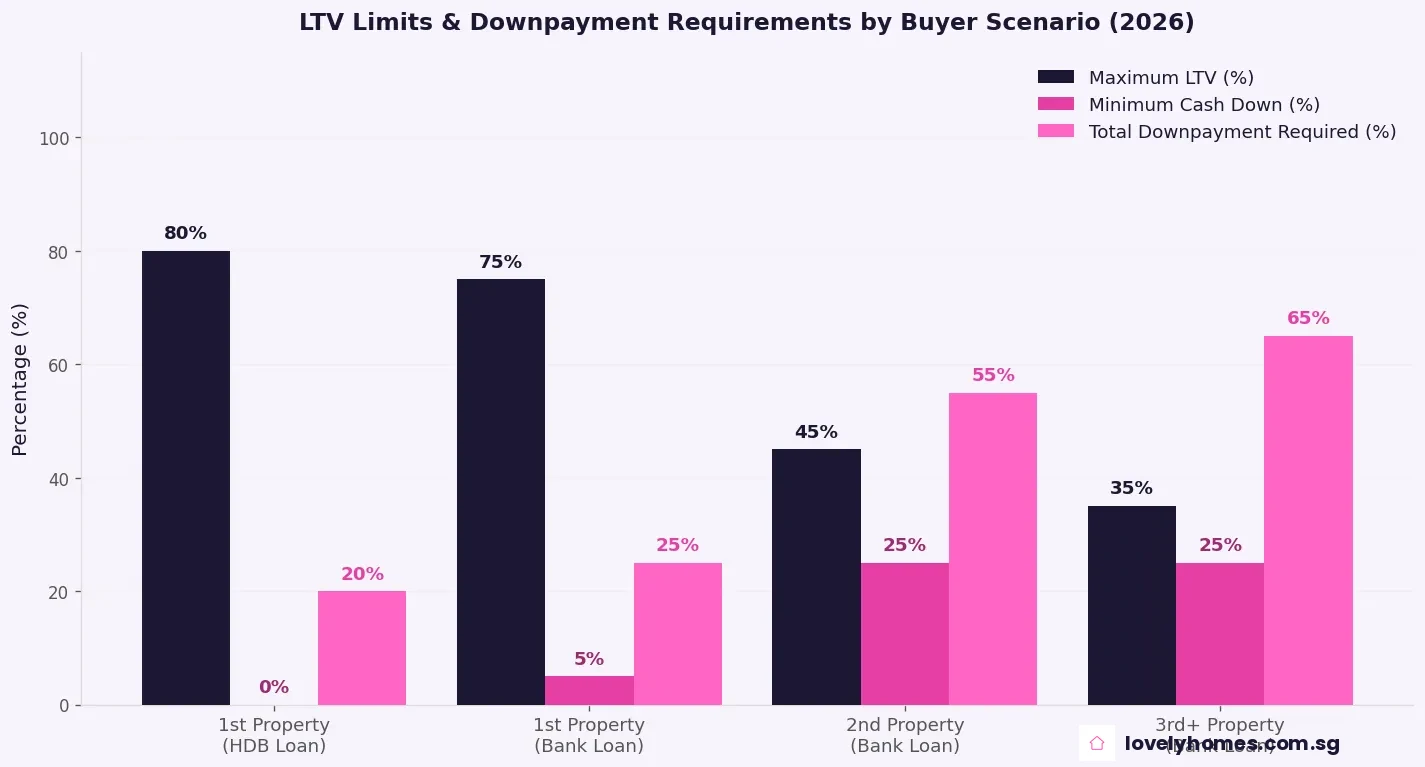
  • LTV limits: First property (bank loan) 75%; first property (HDB loan) 80%; second property 45%; third and subsequent 35%.
  • Stress-test rates: Bank loan TDSR calculations use the higher of the actual rate or 4% p.a. (floating), or 3% p.a. (fixed). HDB loans are assessed at 2.6% p.a. actual rate.
  • Minimum cash: Bank loans require at least 5% cash for a first property; 25% cash for a second or subsequent property.
  • Both rules stack: For HDB and EC purchases with a bank loan, BOTH TDSR and MSR must be satisfied simultaneously. The binding constraint is whichever gives the lower maximum loan.
  • Variable income: MAS requires lenders to apply a 30% haircut to variable or commission-based income (e.g. bonuses, overtime) when computing TDSR.
  • Existing debt matters: Car loans, personal loans, student loans and outstanding credit card balances all reduce how much you can borrow for a property loan.

What Is TDSR and Why Does It Exist?

The Total Debt Servicing Ratio (TDSR) is a borrowing framework administered by the Monetary Authority of Singapore (MAS) under MAS Notice 632. It was introduced in June 2013 to prevent households from over-borrowing against their incomes, and it applies to all property loans granted by financial institutions in Singapore — including banks, merchant banks and finance companies.

In practical terms, TDSR means that the total of all your monthly debt repayments — your housing loan instalment plus every other loan you service — must not exceed 55% of your gross monthly income. This 55% ceiling was tightened from 60% in September 2022 as part of a broader package of cooling measures aimed at moderating property demand. If your combined debt obligations would breach this threshold, the lender is required to reduce or reject the loan.

The TDSR framework applies to loans for any property purchase: HDB resale flats, private condominiums, landed homes, and commercial property. What changes depending on the property type is whether the Mortgage Servicing Ratio (MSR) also comes into play.

What Is MSR and When Does It Apply?

The Mortgage Servicing Ratio is a tighter, property-specific rule that sits inside the TDSR framework. MSR caps the monthly instalment on a housing loan used to purchase an HDB flat or an Executive Condominium (EC) at no more than 30% of the borrower’s gross monthly income. It applies to both HDB concessionary loans and bank loans where the security is an HDB flat or an EC.

MSR does not apply to private condominium purchases. For private property, only TDSR binds. This is a common source of confusion: many buyers assume a 30% limit applies to all property loans, but in reality the 30% cap is exclusive to the public and EC market. A buyer of a private apartment is free to commit up to 55% of income to total debt servicing, provided the housing loan does not push combined repayments above that ceiling.

If you are buying an EC with a bank loan, you must satisfy both TDSR (55%) and MSR (30%) at the same time. In practice, MSR is almost always the binding constraint for EC buyers, because 30% is more restrictive than 55%.

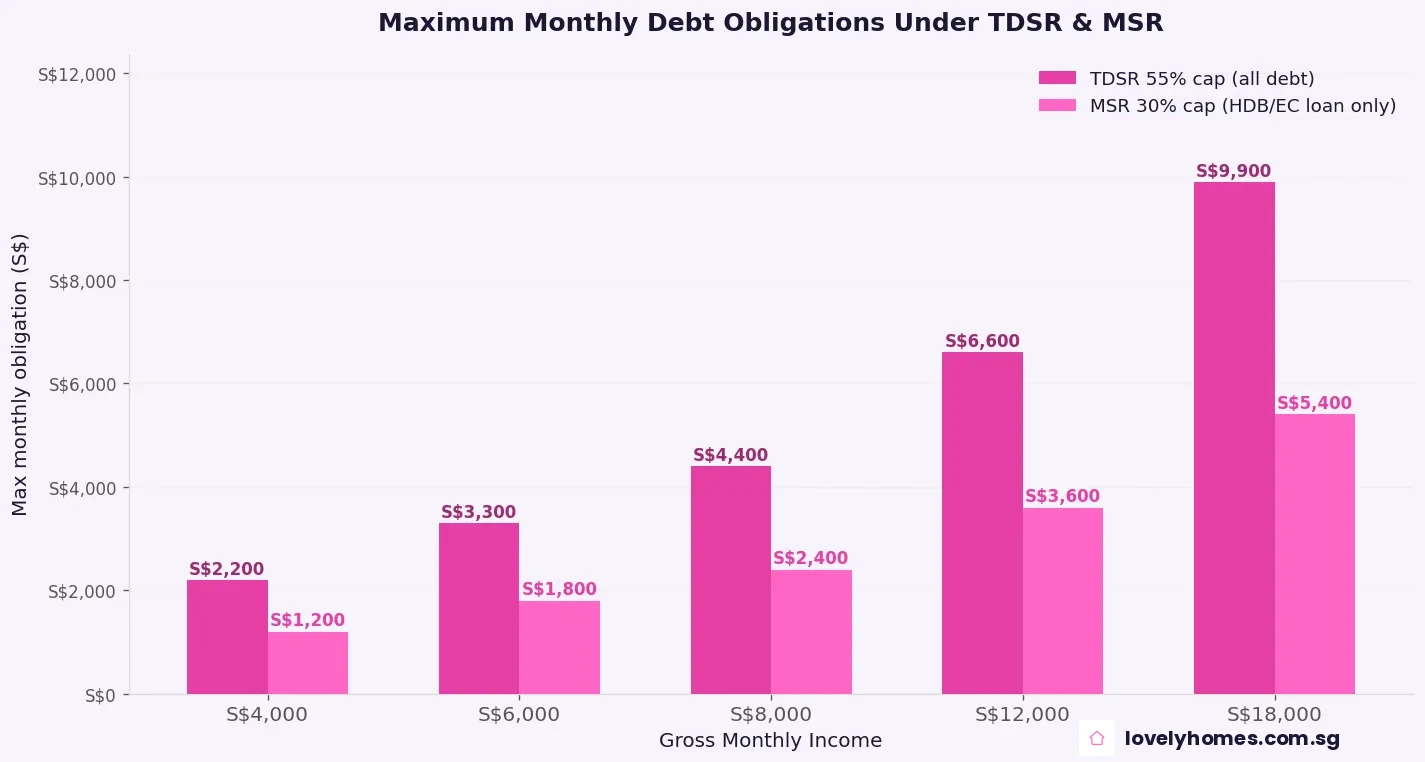
TDSR 55% vs MSR 30% maximum monthly debt obligations by gross monthly income Singapore 2026
Figure 1: Maximum monthly debt obligations under TDSR (55%) and MSR (30%) for gross monthly incomes of S$4,000 to S$18,000. MSR applies only to HDB and EC loans; TDSR applies to all property types.

LTV Limits: How Much Can You Borrow?

The Loan-to-Value (LTV) ratio sets the maximum loan amount as a percentage of the property’s purchase price or market valuation, whichever is lower. LTV rules are set by MAS and the HDB and operate independently of TDSR — both must be satisfied, and the lower of the two maximum loan amounts applies.

For a first residential property purchased with a bank loan, the LTV limit is 75%, meaning you can borrow up to three-quarters of the property value and must fund the remaining 25% from your own resources. Of that 25%, at least 5% must be paid in cash; the balance can come from CPF Ordinary Account (OA) savings. For second properties, the LTV drops sharply to 45%, with a minimum cash requirement of 25% of the purchase price. For third and subsequent properties, the LTV is 35%.

For HDB concessionary loans, the LTV is 80%, and HDB does not impose a minimum cash downpayment — the entire downpayment can be funded from CPF OA. This makes HDB loans particularly accessible for buyers with limited cash savings but healthy CPF balances.

LTV limits and downpayment requirements by buyer scenario Singapore 2026 first second third property
Figure 2: LTV limits and downpayment requirements by buyer scenario in Singapore 2026. Bank loans require 5% cash for first property and 25% cash for second or subsequent properties.

How TDSR Is Computed: What Counts as Debt?

Understanding what income and debt figures your bank will use is critical to knowing your real borrowing limit. The following guidelines apply under MAS Notice 632.

Income included in TDSR calculation: Fixed monthly salary, regular allowances confirmed by the employer, rental income (after a 30% haircut), and investment income (after a 30% haircut). Variable income such as commissions, bonuses and overtime is eligible but subject to a 30% haircut — meaning only 70% of your average variable income over the past 12 months is recognised.

Debt counted in TDSR: All monthly loan repayments must be included: the proposed housing loan instalment (calculated at the stress-test rate — see below), car loans, personal loans, outstanding credit card balances (counted at 5% of the outstanding balance per month, or the minimum monthly repayment if higher), student loans, and other secured or unsecured borrowings. Investment property loan instalments also count, even if the property is tenanted and generating rental income.

Debt excluded from TDSR: Insurance premiums, utility bills, hire-purchase agreements for vehicles entered into before 26 August 2013, and medisave contributions are excluded from the TDSR computation.

Stress-Test Rates: Why Your Maximum Loan Is Lower Than You Think

Banks do not use the actual prevailing interest rate when computing your TDSR. Instead, MAS requires them to use a stress-test rate — a notional higher rate designed to ensure you can still service the loan if interest rates rise. The stress-test rates currently prescribed under MAS Notice 632 are:

  • For floating-rate loans (e.g. SORA-pegged): the higher of the prevailing floating rate plus 1 percentage point, or 4% p.a.
  • For fixed-rate loans: the higher of the prevailing fixed rate, or 3% p.a.

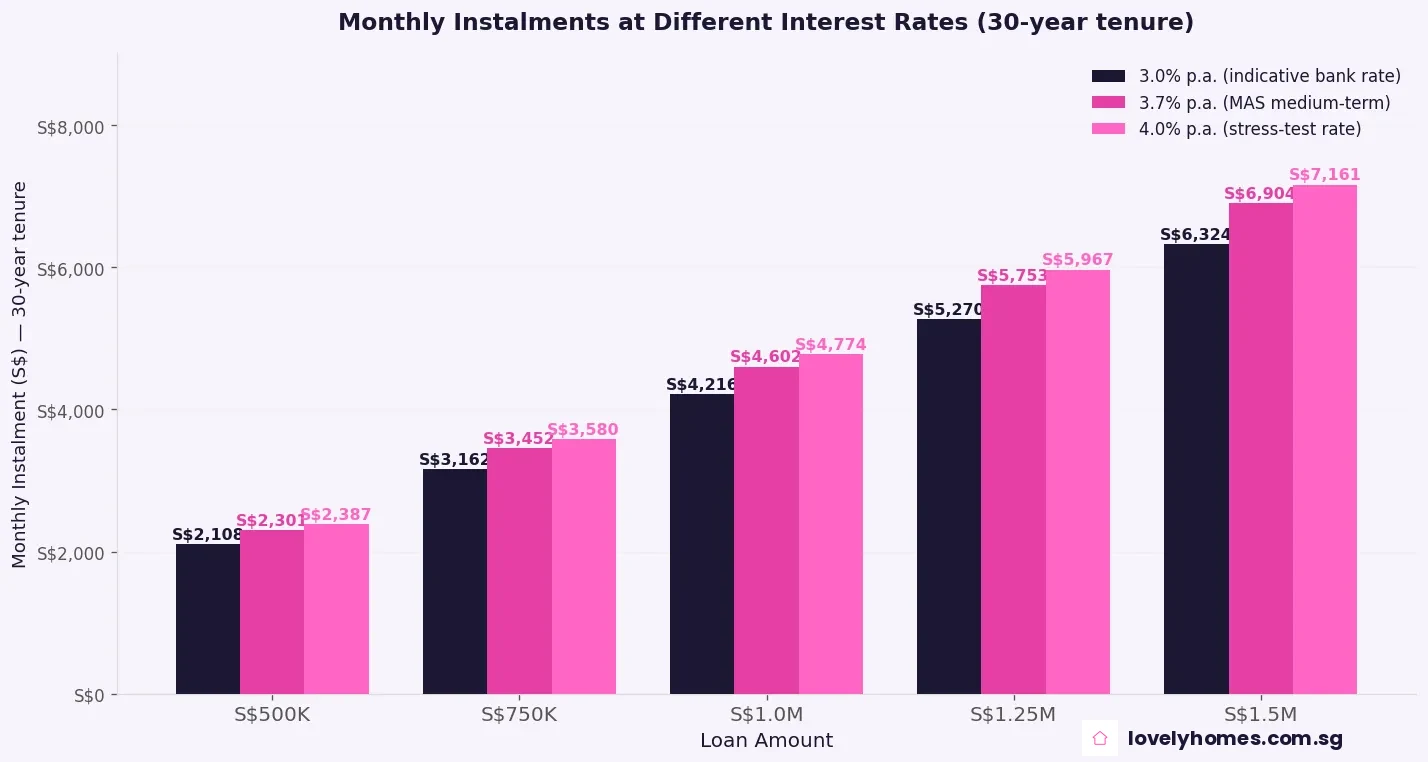
In practice, with SORA currently well below 3%, the 4% floor is the binding constraint for most floating-rate borrowers. This means your maximum eligible loan is calculated assuming you are already paying instalments at 4% p.a., even if the rate on offer today is significantly lower. This is a deliberate policy choice by MAS to build a buffer against rising rates.

Monthly instalments at different interest rates 3% 3.7% 4% stress test Singapore property loan 30-year tenure
Figure 3: Monthly instalments at 3.0% (indicative bank rate), 3.7% (MAS medium-term benchmark) and 4.0% (stress-test rate) for loan amounts from S$500,000 to S$1.5 million on a 30-year tenure. TDSR is assessed at the stress-test rate, not the actual rate.

Summary: TDSR & MSR Rules at a Glance (2026)

Rule Limit Applies To Administered By
TDSR 55% of gross monthly income All property loans (HDB, private, commercial) MAS (Notice 632)
MSR 30% of gross monthly income HDB and EC loan instalments only MAS / HDB
LTV (1st property, bank) 75% of value Bank loan for any property MAS
LTV (1st property, HDB loan) 80% of value HDB concessionary loan only HDB
LTV (2nd property, bank) 45% of value Any second property bank loan MAS
LTV (3rd+ property, bank) 35% of value Third or subsequent property MAS
Minimum cash (1st, bank) 5% of purchase price First property bank loan MAS
Minimum cash (2nd/3rd+, bank) 25% of purchase price Second and subsequent properties MAS

Worked Example: TDSR, MSR and LTV in Action

Mr and Mrs Wong are Singapore Citizens. Their combined gross monthly income is S$11,000 (Mr Wong S$7,000 fixed salary; Mrs Wong S$4,000 fixed salary). They have a car loan with a monthly instalment of S$900. They wish to purchase a 4-room HDB resale flat in Tampines for S$635,000. They are evaluating both an HDB concessionary loan and a bank loan on a 25-year tenure.

HDB concessionary loan scenario:
LTV 80%: maximum loan = S$635,000 x 80% = S$508,000.
Monthly instalment at 2.6% p.a. over 25 years: approximately S$2,305/month.
MSR check: S$2,305 / S$11,000 = 20.9% — well within the 30% MSR limit. PASS.
TDSR check: (S$2,305 + S$900) / S$11,000 = 29.1% — well within the 55% TDSR limit. PASS.
Minimum downpayment: 20% = S$127,000 (can be fully funded from CPF OA; no minimum cash required for HDB loans).

Bank loan scenario:
LTV 75%: maximum loan = S$635,000 x 75% = S$476,250.
Stress-test rate at 4% p.a. over 25 years: monthly instalment = approximately S$2,508/month.
MSR check: S$2,508 / S$11,000 = 22.8% — within 30% MSR limit. PASS.
TDSR check (stress test): (S$2,508 + S$900) / S$11,000 = 30.98% — within 55% TDSR limit. PASS.
Actual instalment at 3.5%: approximately S$2,383/month.
Minimum downpayment: 25% = S$158,750; of which at least 5% cash = S$31,750 (balance S$127,000 from CPF OA).

In this scenario, TDSR and MSR are easily met for both loan types. The practical constraint is the LTV: the HDB loan allows borrowing S$508,000 versus S$476,250 for the bank loan. Buyers who have CPF OA savings but limited cash liquidity will find the HDB loan more accessible (no minimum cash downpayment). Buyers with strong CPF balances and competitive fixed-rate offers from banks may prefer the bank loan to obtain a potentially lower effective rate.

Why These Rules Matter for Singapore Property Buyers

Singapore’s TDSR and MSR framework is among the most comprehensive borrower-protection regimes in the region. The rules serve two distinct purposes. First, they protect households from the financial distress that follows over-borrowing: a borrower who commits 70% of income to debt servicing has almost no buffer for unexpected expenses, job loss, or rising interest rates. Second, they cool speculative demand by making it harder to pyramid property loans across multiple properties without meaningful income growth.

In practice, buyers frequently misjudge how tightly the rules bind. A family with S$12,000 combined gross income and a S$1,500/month car loan can only allocate S$5,100 to housing (TDSR: S$6,600 minus S$1,500 car). At the 4% stress-test rate on a 30-year tenure, that limits the loan to approximately S$1.07 million — well below the 75% LTV on many private condominiums in the Outside Central Region. Knowing your TDSR headroom before you start viewing properties prevents disappointment.

Peer-country context: Hong Kong’s TDSR equivalent caps at 50% (with a 60% ceiling at higher LTV thresholds), and Australia imposes a 3 percentage-point serviceability buffer above the applicable rate under APRA guidelines. Singapore’s 55% TDSR with a 4% stress-test floor is broadly in line with international standards — firm enough to prevent excess, flexible enough not to freeze out creditworthy middle-income buyers.

What Might Change Next: Forward-Looking Considerations

MAS reviews the TDSR stress-test rates periodically. With the global rate cycle having peaked in 2023 and benchmark rates declining through 2025 and into 2026, some commentators have speculated that MAS may soften the 4% floor for floating-rate loans if SORA remains suppressed. However, as at August 2026, MAS has given no indication of adjusting TDSR parameters, and the existing framework is viewed as the appropriate long-term calibration. Buyers should plan on the basis of existing rules rather than anticipated relaxation.

The MSR 30% limit for HDB and EC loans has been stable since its introduction in 2013. Any increase in income ceilings for HDB flats or ECs (currently S$14,000 per month for standard HDB; S$16,000 for ECs) would expand the pool of eligible buyers without adjusting the MSR percentage itself.

Frequently Asked Questions

Does TDSR apply if I am buying a property under a sole name while my spouse has no income?

Yes. TDSR is applied to the borrower or borrowers named on the loan application. If you are the sole borrower, your gross monthly income alone is used. Your spouse’s income is only included if they are a co-borrower on the loan. Adding a co-borrower with income can increase your eligible loan amount, but both parties become jointly liable for the debt. If your spouse has no income and you are the sole earner, only your income is recognised by the lender.

How does rental income affect TDSR?

Rental income from an investment property is recognised in TDSR calculations, but only at 70% of its value (a 30% haircut, consistent with the treatment of other variable income). You will need to provide tenancy agreements, tax documents, or a lender-accepted declaration to have rental income recognised. Note that the full outstanding loan on the tenanted property (including its monthly instalment) still counts as debt in your TDSR calculation, so the net benefit of rental income on your TDSR position depends on the rental yield relative to the loan instalment.

Does MSR apply to EC purchases with a bank loan?

Yes. ECs are classified as public housing for the first 10 years (until privatisation), and MAS applies MSR to any bank loan used to purchase an EC during this period. This means your monthly EC loan instalment must not exceed 30% of gross monthly income, regardless of whether a bank or the developer is financing the purchase. For buyers comparing ECs with private condominiums, this is a material difference: the same gross income unlocks a meaningfully larger private loan under TDSR alone.

What happens to my TDSR if I have an outstanding renovation loan?

Renovation loans are unsecured personal loans and count in full toward your TDSR calculation. If you took a S$50,000 renovation loan repayable over 5 years at S$900/month, that S$900 reduces your TDSR headroom for the proposed mortgage. It is therefore advisable to either fully repay renovation and personal loans before applying for a property loan, or factor them into your borrowing plan from the outset. Most banks will decline or reduce a property loan application where existing debt already consumes a significant portion of the 55% ceiling.

Can I use my CPF savings to reduce the loan amount and improve my TDSR position?

Absolutely. Making a larger CPF downpayment reduces the loan principal, which in turn reduces the monthly instalment and therefore the TDSR ratio. For example, if you put 40% down using CPF OA rather than the minimum 20%, the loan drops from 80% to 60% of the property value, cutting the monthly instalment roughly proportionally. However, note that CPF savings earmark a 2.5% p.a. accrued interest charge: when you sell the property, the CPF board recoups the principal plus all accrued interest, which reduces your net sale proceeds. Using CPF to improve TDSR does not eliminate this cost.

Are there any exemptions from TDSR?

MAS provides a limited TDSR exemption for owner-occupier purchases where the outstanding loan amount does not exceed S$200,000. In practice, very few Singapore properties are priced low enough to benefit from this exemption. There is no general TDSR exemption for first-time buyers, for purchases of HDB flats, or for any particular nationality or residency status. The exemption for purely commercial properties (non-residential) is governed separately under a different MAS notice, and is generally not applicable to residential purchases.

Related Articles

Disclaimer

This article is for general information purposes only and does not constitute financial, legal or mortgage advice. TDSR, MSR and LTV rules are subject to change by MAS and HDB at any time. Borrowing limits depend on your individual financial profile, income documentation, and the specific property and loan product. Always consult a licensed financial adviser and your bank before committing to any property purchase or loan. Official sources: MAS (mas.gov.sg) and HDB (hdb.gov.sg).

Singapore Property Gifting and Inheritance Guide 2026: Wills, CPF, Stamp Duty and What Families Must Know

Singapore Property Gifting and Inheritance Guide 2026: Wills, CPF, Stamp Duty and What Families Must Know

Quick Answer: Property Gifting and Inheritance in Singapore — 8 Key Facts

  • Singapore has no estate duty or inheritance tax — abolished on 15 February 2008 by the Inland Revenue Authority of Singapore (IRAS).
  • CPF monies are not part of your estate; they go to CPF nominees (or the Public Trustee if no nomination is made) under the CPF Act — not your Will.
  • Property held as joint tenants passes automatically to the surviving owner by right of survivorship — no probate is required for that share.
  • Property held as tenants in common requires a grant of probate (or letters of administration) to transfer the deceased’s share.
  • Inheritance via a Will or intestate succession does not attract ABSD — the transfer is not a purchase.
  • A deed of gift (transfer during your lifetime) does attract BSD on the market value, and may attract ABSD if the recipient already owns property.
  • CPF accrued interest (2.5% p.a. on all CPF OA used for a property) must be refunded to the original owner’s CPF OA on any sale or transfer — even on inheritance.
  • Muslim property owners in Singapore are also subject to Faraid (Islamic inheritance law), administered through the Syariah Court — special rules apply.

Introduction: Why Property Transfer Rules Matter in Singapore

Property is typically the single largest asset in a Singapore household’s balance sheet. When ownership changes — whether through a parent’s passing, a gift between spouses, or a lifetime transfer to children — the legal, tax, and CPF implications can be significant and are frequently misunderstood. Many families discover the consequences only after a transaction has already occurred, when options are limited and costs cannot be reversed.

Singapore’s rules on property transfer are spread across several statutes: the Intestate Succession Act (Cap 146) for estates without a Will; the Wills Act (Cap 352) for estates with one; the Stamp Duties Act (Cap 312) for BSD and ABSD; the CPF Act (Cap 36) for CPF monies; and the Land Titles Act (Cap 157) for the mechanics of registration. This guide brings together all the key rules in one place, with concrete examples and the stamp duty implications of each route.

A core principle to understand at the outset: receiving property through death carries no ABSD; receiving it through a gift during the giver’s lifetime may. This distinction shapes every piece of property estate-planning advice in Singapore.

I. No Estate Duty and No Inheritance Tax in Singapore

Singapore abolished estate duty on 15 February 2008. Before that date, estates above a certain threshold paid a levy on their value at death. Today, there is no estate duty, no inheritance tax, and no wealth tax in Singapore. This makes Singapore one of the most inheritance-tax-efficient jurisdictions in the world for property owners.

However, “no inheritance tax” does not mean “no costs at death.” The estate administration process — obtaining a grant of probate or letters of administration, transferring the property title at the Singapore Land Authority (SLA), and dealing with any CPF obligations — involves professional fees, court fees, and in some cases stamp duty on the transfer to beneficiaries. Understanding these costs helps families plan efficiently.

For comparison: the United Kingdom levies inheritance tax at 40% on estates above £325,000 (approximately S$560,000 as at August 2026). Australia, Canada, and New Zealand have no federal inheritance tax but may impose capital gains tax on inherited assets on disposal. Singapore’s framework is considerably simpler and lower-cost for most estates.

II. The 4 Routes by Which Property Passes in Singapore

There are four main pathways by which ownership of a Singapore property can change hands — each with different procedural requirements and stamp duty implications:

4 ways property passes in Singapore joint tenancy will intestate deed of gift comparison 2026
Figure 1: The 4 Routes by Which Singapore Property Passes — Key Differences at a Glance. Source: Intestate Succession Act, Land Titles Act, CPF Act

Route A — Joint Tenancy (Right of Survivorship)

When two or more people own a property as joint tenants (the default under Singapore land law unless specified otherwise), the property automatically passes to the surviving joint tenant(s) on the death of one owner. No probate or letters of administration are required. The surviving owner simply notifies the Singapore Land Authority (SLA) by lodging a Statutory Declaration of Death and a copy of the death certificate. The process typically takes a few weeks and costs a few hundred dollars in SLA fees and professional charges.

Critically, there is no ABSD and no BSD on a right-of-survivorship transfer. It is not a purchase in the legal sense. This is one of the most tax-efficient ways for a married couple to hold property — particularly where both are Singapore Citizens and the property is their only home.

Route B — Will (Tenants in Common)

If the deceased owned their share of the property as a tenant in common (explicitly specified in the title deed), their share passes according to their Will. A grant of probate must be obtained from the High Court — or the Family Justice Courts for smaller estates — before the executor can transfer the property title to the beneficiary. The process typically takes 4–8 weeks for straightforward estates, longer if the Will is contested. There is no ABSD and no BSD on a transfer of property to a beneficiary under a Will.

Route C — Intestate Succession (No Will)

If a person dies without a Will (intestate), their assets — including their share of any property held as tenants in common — are distributed according to the Intestate Succession Act (ISA). For non-Muslim Singaporeans, the ISA provides a statutory distribution order: if the deceased has a spouse and children, the spouse receives half and the children share the other half equally. If there are no children, the spouse receives everything. If there is neither spouse nor children, the estate passes to parents, then siblings, and so on. Letters of administration must be obtained to administer the estate — a process similar to probate but without a Will. No ABSD or BSD is payable on the transfer.

Muslim property owners are subject to Faraid (Islamic inheritance law), which prescribes fixed shares for specific heirs under Syariah law. The Syariah Court Assistance Scheme and MUIS (Majlis Ugama Islam Singapura) can provide guidance.

Route D — Deed of Gift (Inter Vivos Transfer)

A deed of gift is a legal document by which a property owner transfers ownership of a property to another person during their lifetime, for no monetary consideration (or for a consideration below market value). This approach is sometimes used for estate planning purposes — for example, transferring a property to an adult child while still alive to ensure clarity over ownership. However, it is not tax-free:

  • BSD is payable on the higher of the consideration or the market value of the property.
  • ABSD is payable based on the recipient’s buyer profile — just as if they had purchased the property at full market value.
Key planning insight: If your goal is to pass a property to a child who already owns property, a deed of gift will trigger ABSD at 20% (if the child is a Singapore Citizen buying their second property). If the property passes instead through your Will after death, the child receives it with no ABSD at all. This difference of potentially hundreds of thousands of dollars makes the timing of any transfer critical.

III. Stamp Duty Implications — BSD and ABSD by Transfer Type

The stamp duty treatment of each transfer type is one of the most practically important issues for Singapore property owners and their families. The table and chart below summarise the key positions as at August 2026:

BSD ABSD stamp duty property inheritance gift deed Singapore 2026 comparison chart
Figure 2: Buyer’s Stamp Duty (BSD) and ABSD by Transfer Type — Illustrative S$1.5 Million Property, Singapore Citizen Buyer 2026. Source: IRAS, BSD rates (20 Feb 2023), ABSD rates (27 Apr 2023)
Transfer Type BSD Payable? ABSD Payable? Probate Required?
Inheritance via Will No No Yes (grant of probate)
Intestate (no Will) No No Yes (letters of administration)
Right of survivorship (joint tenancy) No No No
Deed of gift — recipient’s 1st property (SC) Yes, on market value No No
Deed of gift — recipient’s 2nd property (SC) Yes, on market value Yes — 20% on market value No
Spousal gift SC to SC — sole property Yes, on market value No (remission available) No
Sale below market value Yes, on higher of price or market value Based on buyer profile No

The ABSD remission for spousal transfers is available where a Singapore Citizen transfers their sole property to their Singapore Citizen spouse, and the spouse does not own any other residential property. The remission is administered by IRAS and must be applied for — it is not automatic. Full details are in the Stamp Duties Act and IRAS’s published guidance.

IV. CPF Monies — A Separate Universe

One of the most commonly misunderstood aspects of Singapore estate planning is that CPF monies are not part of your legal estate. The CPF Act (Cap 36) creates a completely separate regime: CPF savings — including the CPF OA balance, Special Account, Medisave Account, and Retirement Account — are distributed to named nominees as specified in a CPF nomination, not according to your Will and not according to the Intestate Succession Act.

If you have not made a CPF nomination, your CPF savings are paid to the Public Trustee, who distributes them under the Intestate Succession Act (for non-Muslims) or Muslim Inheritance Law (for Muslims). This process can be slower and more bureaucratic than a direct CPF nomination. The practical advice is simple: file a CPF nomination. It takes approximately 15 minutes online via my.cpf.gov.sg and costs nothing.

CPF nominations cover the CPF savings balance. They do not directly determine what happens to a property that was bought using CPF money — the property itself still passes under the Will, intestate rules, or right of survivorship as applicable. What they do determine is the CPF OA balance that remains after the CPF accrued interest obligation has been settled.

V. CPF Accrued Interest — The Often-Overlooked Obligation

If a property was purchased using CPF Ordinary Account funds, an accrued interest obligation accumulates throughout the period of ownership. The CPF Board charges 2.5% per annum on the CPF principal withdrawn, compounding annually. This accrued interest must be refunded to the original owner’s CPF OA upon sale or transfer of the property — regardless of whether the transfer is a sale, gift, or inheritance.

CPF accrued interest property Singapore refund OA 2.5 percent annual growth over time chart 2026
Figure 3: CPF Accrued Interest Grows Significantly Over Time — S$300,000 CPF OA Used at Purchase. Source: CPF Board (2.5% p.a. OA interest rate), LovelyHomes analysis

As the chart shows, a S$300,000 CPF drawdown at purchase grows to a refund obligation of approximately S$404,000 after 15 years and S$539,000 after 25 years. This is money that must go back to the CPF OA — it cannot be distributed to heirs as cash. Families planning to pass property to their children should factor this into the estate plan, especially where the property was substantially CPF-financed and the CPF proceeds would be needed for the deceased’s retirement funding.

Special note on inherited HDB flats: If an HDB flat passes to an heir and the heir plans to sell it rather than retain it, the CPF accrued interest obligation on the original owner’s CPF drawdown must be settled from the sale proceeds. The heir’s own CPF cannot be used to settle someone else’s CPF accrued interest.

VI. HDB-Specific Rules for Inheritance

HDB flat inheritance is subject to additional rules beyond the standard property transfer framework, because HDB flats carry eligibility criteria and occupancy restrictions.

When an HDB flat owner passes away, the eligible heir(s) — typically the surviving spouse, children, or parents — may retain the flat only if they meet HDB’s eligibility criteria at the time of transfer. The key conditions are:

  • The heir must be a Singapore Citizen or Permanent Resident.
  • If the heir already owns a private residential property, they must dispose of it within 6 months of taking over the HDB flat.
  • HDB’s eligibility schemes (e.g., Public Scheme, Fiancé/Fiancée Scheme) must be met if a new household is formed.
  • If no eligible heir exists, or if all eligible heirs decline to retain the flat, HDB may buy back the flat at market valuation.

The 30-month wait-out period that normally applies to private property owners buying HDB resale does not apply to inherited HDB flats. An heir can take over an inherited HDB flat regardless of whether they own or recently owned a private property, though the 6-month disposal condition applies.

VII. Worked Example — Two Scenarios for a S$1.5 Million Condo

Mr Tan (Singapore Citizen, aged 62) owns a S$1.5 million freehold condominium in District 15, purchased in 2012 for S$900,000. He used S$300,000 from his CPF Ordinary Account. The remaining mortgage is fully paid off. Accrued CPF interest over 14 years at 2.5% p.a. ≈ S$124,000. Total CPF refund obligation: S$424,000.

Scenario A — Mr Tan passes away, property passes to his wife (SC) via joint tenancy:

  • Title passes automatically by right of survivorship — no probate, no BSD, no ABSD.
  • SLA lodgement fee approximately S$380.
  • CPF refund: S$424,000 goes to Mr Tan’s CPF OA (which then passes to his CPF nominees — likely his wife, if nominated).
  • Wife’s net position: property worth S$1.5M in her name; CPF proceeds (S$424,000) to her own CPF via nomination. Zero stamp duty.

Scenario B — Mr Tan wishes to gift the condo to his son (SC, already owns 1 property) via deed of gift during his lifetime:

  • BSD on S$1.5M: S$44,600 (payable by the son as recipient).
  • ABSD: son is a SC acquiring his second residential property → 20% × S$1.5M = S$300,000 (payable by the son).
  • CPF refund obligation on transfer: S$424,000 must be refunded to Mr Tan’s CPF OA at the point of transfer.
  • Total immediate cost to family: BSD S$44,600 + ABSD S$300,000 = S$344,600 in stamp duty alone.

The contrast is stark. Leaving the property via a Will at death costs the son zero stamp duty; gifting it during Mr Tan’s lifetime costs S$344,600 in ABSD and BSD. Unless there is a compelling non-tax reason for the lifetime gift — for example, protecting the asset from creditors, or addressing a specific family situation — the inheritance route is almost always more efficient from a stamp duty perspective.

VIII. What This Means for Singapore Property Owners

The three most actionable steps for any Singapore property owner concerned about estate planning are straightforward. First, check how your property is held — if you own jointly with your spouse, is it as joint tenants (right of survivorship) or tenants in common (share passes by Will/intestate)? If you want automatic transfer on death, joint tenancy is the simpler route. Second, file a CPF nomination if you have not already done so. Third, make a Will — even a simple one — so that your specific intentions are documented, particularly for any property held as tenants in common, any bank accounts, and any other assets outside the CPF.

If you are considering gifting a property to a family member during your lifetime, model the ABSD and BSD impact carefully before proceeding. In most cases where the recipient already owns property, the stamp duty cost of a lifetime gift is so large that waiting and passing the property through a Will — or restructuring ownership to joint tenancy — is the significantly more tax-efficient approach.

IX. What Might Come Next

The stamp duty treatment of family transfers has been a topic of periodic policy debate in Singapore. There has been no public indication from the Ministry of Finance or IRAS as at August 2026 of planned changes to the ABSD treatment of deed-of-gift transactions. The ABSD remission framework for spouses remains as last updated in April 2023. Any future changes — for example, an expanded spousal remission or an ABSD concession for transfers between parents and children — would be announced via the annual Budget Statement.

It is also worth noting that as Singapore’s baby boomer cohort ages, the quantum of residential property changing hands through inheritance is set to increase substantially over the next two decades. Estate administration firms and law firms specialising in wills and probate have noted a material uptick in demand, a trend likely to continue through the late 2020s and 2030s.

Frequently Asked Questions: Property Inheritance and Gifting in Singapore

Is there inheritance tax on property in Singapore?

No. Singapore abolished estate duty with effect from 15 February 2008. There is no inheritance tax, no estate duty, and no capital gains tax in Singapore. Property received by a beneficiary through a Will or through intestate succession is received entirely free of any transfer tax. This means that — unlike in the UK, US, or many European jurisdictions — the full value of a Singapore property estate passes to the beneficiaries without any IRAS levy on the transmission itself.

Can I pass my HDB flat to my adult child?

Yes, subject to conditions. The heir must meet HDB’s eligibility criteria to retain the flat — they must be a Singapore Citizen or Permanent Resident, and the new household must qualify under one of HDB’s eligibility schemes. If the heir already owns a private property, they must sell it within 6 months of taking over the HDB flat. If no eligible heir wishes to retain the flat, HDB will buy it back at market value. Note that the HDB inheritance process is managed directly through HDB’s branches and does not go through SLA in the same way as private property transfers.

What is CPF accrued interest and do I need to repay it on an inherited property?

When CPF Ordinary Account funds are used to purchase a property, the CPF Board levies interest at 2.5% per annum on the amount withdrawn, compounding annually. This accrued interest — which is notional, in the sense that it was foregone investment return in the CPF account — must be refunded to the original owner’s CPF OA when the property is sold or transferred. On inheritance, the accrued interest obligation is settled from the sale proceeds if the property is sold, or from the estate’s liquid assets if the property is retained by the heir. The heir’s own CPF cannot be used to settle the deceased’s accrued interest obligation.

What is the difference between joint tenancy and tenants in common?

Joint tenancy means all owners hold the property together as a single undivided whole — no one owner holds a defined percentage. On the death of one owner, their “interest” automatically transfers to the surviving owners without probate. Tenants in common means each owner holds a defined share (e.g. 50/50, or 60/40), and each share can be dealt with independently — including being left to beneficiaries under a Will or passing under the Intestate Succession Act. You can change the ownership type from joint tenancy to tenants in common (called severance of joint tenancy) by lodging a unilateral notice with SLA, and vice versa by executing a Deed of Mutual Consent. Both owners’ consent is required to convert from tenants in common to joint tenancy.

Can I gift my property to avoid stamp duty?

No — gifting a property during your lifetime does not avoid stamp duty. BSD is payable on the market value of the property at the time of the gift, and ABSD is payable based on the recipient’s buyer profile (SC, PR, or foreigner) and the number of residential properties they already own. In most cases where the recipient already owns property, the stamp duty cost of a deed of gift is substantial. The only stamp-duty-efficient way to pass property to a family member who already owns property is to leave it through a Will (or via right of survivorship), as inheritance via Will or intestate succession does not attract BSD or ABSD.

What happens if someone passes away without a Will in Singapore?

If the deceased was not Muslim, their estate — including their share of any property held as tenants in common — is distributed according to the Intestate Succession Act (ISA, Cap 146). The ISA sets out a fixed hierarchy: surviving spouse and children each receive a share (50% to spouse, 50% equally among children if both exist); if only a spouse, they take the entire estate; if only children, they share equally; and so on up the family tree. A family member must apply for Letters of Administration at the Family Justice Courts to administer the estate. If the deceased was Muslim, the Syariah Court and MUIS govern the distribution under Faraid (Islamic inheritance law).

Do foreign heirs pay ABSD when inheriting Singapore property?

No. The transfer of property to a beneficiary under a Will or via intestate succession is not treated as a purchase under the Stamp Duties Act, and therefore does not attract ABSD — regardless of the beneficiary’s nationality or residency status. However, if a foreign heir subsequently sells the inherited property and then buys another Singapore residential property, they would pay ABSD at the foreigner rate (currently 60%) on that subsequent purchase. The inheritance itself is stamp-duty-free, but future acquisitions are not exempt.

Disclaimer: This article is for general information only and does not constitute legal, tax, or financial advice. Singapore property law, CPF rules, and stamp duty policy are complex and subject to change. The examples in this article are illustrative and based on rates and rules as at August 2026 — always verify current rates with official sources. For advice specific to your estate planning, CPF nominations, Will drafting, or stamp duty position, consult a qualified Singapore lawyer, a CPF Board-authorised service provider, or a licensed tax adviser. Official information is available from: IRAS at iras.gov.sg; CPF Board at cpf.gov.sg; HDB at hdb.gov.sg; Singapore Statutes Online at sso.agc.gov.sg.

×

Click anywhere to close

Singapore Leasehold vs Freehold Guide 2026: What Every Buyer Needs to Know

Singapore Leasehold vs Freehold Guide 2026: What Every Buyer Needs to Know

Quick Answer — 10 Things to Know

  • Freehold property grants perpetual ownership; 99-year leasehold ownership returns to the state when the lease expires.
  • Freehold condos typically command a 7–12% price premium over comparable 99-year leasehold units in the same area (Q2 2026 data).
  • 999-year leasehold titles — common in older Districts 9, 10 and 11 — trade almost identically to freehold in practice.
  • HDB flats are always 99-year leasehold; you cannot buy a freehold HDB flat.
  • The value gap between freehold and aging leasehold widens significantly once a 99-year lease has fewer than 40 years remaining.
  • CPF can be used to buy private leasehold property as long as the remaining lease covers the youngest buyer to age 95. Below 30 years remaining, CPF usage for private property is blocked entirely.
  • Bank financing (75% LTV) is generally available for most leasehold properties; restrictions may apply for very short leases.
  • For long-term capital appreciation, freehold land in prime districts has historically outperformed 99-year leasehold — but recent data shows the gap narrowing in the OCR.
  • Older 99-year leasehold condos now face lower en bloc consent thresholds under the August 2026 Land Titles (Strata) Act amendments.
  • The 99-year lease question is ultimately about timing: a new leasehold launch with 95+ years remaining is a very different asset from a 1985 development with 58 years left.

What Leasehold and Freehold Actually Mean in Singapore Law

In Singapore, all land is ultimately owned by the state — either the government or the Singapore Land Authority (SLA). When you “buy” a property, you are buying the right to occupy and use the land for a specified period. That period is your tenure.

Freehold (or fee simple) means your right to the land has no stated expiry. It does not mean the government can never acquire your land — the State Lands Act and the Land Acquisition Act preserve compulsory purchase powers — but absent such action, freehold land passes to your heirs indefinitely. Freehold property in Singapore is, practically speaking, permanent ownership.

99-year leasehold means the lease from the state runs for 99 years from its grant date. Once it expires, the land reverts to the state. Most 99-year leaseholds were granted from the 1960s onward as Singapore developed its housing stock. A flat in Toa Payoh with a 1972 lease start has around 45 years remaining as at 2026 — a very different proposition from a 2022 launch with 95 years left.

999-year leasehold titles exist mainly in older districts — Districts 9, 10 and 11 — and date from the colonial era when the British Crown granted very long leases. 999 years is, in practical terms, indistinguishable from freehold: no buyer alive today will ever see such a lease expire. The market prices 999-year leasehold almost identically to freehold in the same district.

The Urban Redevelopment Authority (URA) and SLA maintain the national land register. When a lease enters its final 30 years, CPF Board and MAS rules begin to restrict financing — a built-in warning system designed to protect buyers from becoming trapped in unlendable, non-CPF-eligible stock.

Singapore condo median prices by tenure and region Q2 2026 leasehold vs freehold comparison
Figure 1: Median transacted prices (S$ psf) for condos by tenure and region, Q2 2026. Freehold commands a 7–11% premium across all regions. Source: URA REALIS.

The Price Gap: How Much More Does Freehold Cost?

As at Q2 2026, across all three URA market regions, freehold condominiums command a measurable premium over 99-year leasehold comparables. In the Core Central Region (CCR — Districts 9, 10, 11, 1 and 2), the median transacted price for freehold condos was approximately S$2,950 per square foot (psf) versus S$2,650 psf for 99-year leasehold stock: a gap of about 11.3%. In the Rest of Central Region (RCR), the differential was S$2,100 psf freehold versus S$1,920 psf 99-year leasehold, a premium of about 9.4%. In the Outside Central Region (OCR), freehold units achieved about S$1,620 psf compared with S$1,510 psf for 99-year leasehold equivalents — a narrower gap of roughly 7.3%.

The narrowing premium in the OCR reflects the upgrader demographic. Many families buying their first private property after an HDB MOP are focused on the absolute quantum — keeping the all-in price within S$1.5–2M — rather than tenure. In the CCR, by contrast, the buyer base skews toward investors and ultra-high-net-worth individuals who place a structural premium on perpetual land ownership.

999-year leasehold properties in Districts 9–11 typically trade within 2–5% of freehold equivalents. Some older 999-year leasehold blocks command a slight discount simply because of age and condition; tenure itself is not the driver at that time horizon.

How Leasehold Values Decay Over Time

A 99-year leasehold property does not lose value at a constant rate of one year’s worth of lease per calendar year. The relationship is non-linear, and is governed primarily by the financing and CPF eligibility rules that constrain who can buy the property as the lease shortens.

Singapore 99-year leasehold value decay curve compared to freehold benchmark
Figure 2: Illustrative leasehold value decay relative to a freehold benchmark. Values are indicative. Source: LovelyHomes analysis, CPF Board guidelines.

There are three critical thresholds:

  • 60+ years remaining: CPF can be used in full up to the Valuation Limit. Banks lend freely at 75% LTV. The discount to freehold is cosmetic (5–10%) and driven primarily by perception rather than financing constraints.
  • 30–59 years remaining: CPF usage is prorated — the amount you can withdraw depends on the ratio of remaining lease to the number of years the youngest buyer needs the property to cover to age 95. Banks may price in additional risk. The discount to freehold widens to 15–30% depending on location.
  • Under 30 years remaining: CPF Board prohibits the use of CPF Ordinary Account funds for private properties with fewer than 30 years of lease remaining. Bank financing becomes difficult and expensive. The buyer pool shrinks dramatically to cash buyers. Discounts of 40–60% below freehold equivalent are not unusual.

CPF Withdrawal Rules: The Financing Cliff

The CPF Board’s rules on using Ordinary Account (OA) savings for private property turn on one central question: does the remaining lease of the property cover the youngest buyer to age 95? If yes, CPF can be used up to the Valuation Limit. If the answer is no but the lease still covers the youngest buyer to age 80, CPF can be used on a pro-rated basis. Below 30 years remaining on a private property, CPF usage stops entirely.

CPF withdrawal rules by remaining lease for Singapore private property table
Figure 3: CPF Ordinary Account withdrawal eligibility by remaining lease. Source: CPF Board, MAS (as at 7 August 2026).

For a 35-year-old buyer, age 95 minus 35 equals 60: the property needs at least 60 years of lease remaining for full CPF use. A 99-year leasehold launched in 2026 would still have 99 years at purchase — full CPF use is unaffected. But that same unit will reach the 60-year threshold in 2065, when the buyer is 74 — well past most resale horizons. The constraints only bite future buyers at that point, which is why the market discounts older leasehold stock relative to new launches.

Freehold vs Leasehold: A Worked Example

Mr and Mrs Wong are a Singapore Citizen (SC) couple, aged 35 and 33, upgrading from their Tampines HDB flat after their MOP. They have identified two comparable 3-bedroom condos in the RCR:

  • Option A — Freehold: River Valley, 1,100 sq ft, S$2.3M (S$2,091 psf). Built 2010, freehold title.
  • Option B — 99yr leasehold: Toa Payoh, 1,100 sq ft, S$2.09M (S$1,900 psf). Built 2005, 78 years remaining on a 99-year lease.
Cost Item Option A — Freehold S$2.3M Option B — 99yr LH S$2.09M
Purchase Price S$2,300,000 S$2,090,000
Buyer’s Stamp Duty (BSD — IRAS tiers) S$76,600 S$69,200
ABSD (1st property, SC couple) S$0 S$0
Legal Fees (estimated) S$3,500 S$3,200
Total Upfront Outlay S$2,380,100 S$2,162,400
Freehold Premium S$217,700 (10.1% of price)
Bank Loan (75% LTV, 3.5%, 25yr) S$1,725,000 → S$8,640/mth S$1,567,500 → S$7,845/mth
TDSR (combined income S$22,000/mth) 39.3% — within 55% cap 35.7% — within 55% cap
CPF eligibility check Freehold — full CPF use 78yr remaining → youngest buyer (33) to age 111 > 95 — full CPF use ✓

The leasehold option saves S$217,700 upfront and approximately S$795/month in mortgage repayments. Over a 10-year hold, that represents roughly S$95,400 in instalment savings. The freehold premium delivers a capital floor and broader future buyer pool — the trade-off is a real cash outlay today that may or may not be recovered on resale, depending on market conditions over the holding period.

En Bloc Potential: The Leasehold Wild Card

One argument for 99-year leasehold condominiums is their en bloc (collective sale) potential. As leasehold condos age toward the 30–40-year mark, the economics of redevelopment become compelling: the land is depreciating, maintenance costs rise, and the government’s Land Titles (Strata) Act (administered by the Ministry of Law) allows a super-majority of owners to sell the entire development collectively. En bloc payouts often deliver a premium of 20–30% above open-market values.

The August 2026 Land Titles (Strata) (Amendment) Bill (tabled 4 August 2026) lowered consent thresholds for older developments: from 80% to 70% for developments aged 40–59 years, and to 65% for those aged 60 or more. For a typical 1980s 99-year leasehold condo now in its mid-40s, this makes collective sale meaningfully easier to achieve — an additional argument for buying into the older leasehold segment at a discount, provided the building fundamentals support it.

Investment Perspective: What the Data Shows

Over the ten years from 2015 to 2025, URA transaction data shows freehold condo prices in the CCR appreciating by approximately 22%, while 99-year leasehold equivalents in the same region appreciated by approximately 18%. The gap is real but modest. In the OCR, the difference was almost negligible: both freehold and leasehold OCR condos appreciated by approximately 38–40% over the same period, as the upgrader story drove both tenure classes upward.

What this means practically: the freehold premium is largely a store-of-value premium, not a capital-return premium. An investor who bought a well-located 99-year leasehold in 2015 and sold in 2025 would have captured nearly identical returns to a comparable freehold investment. The spread becomes material only when: (a) the lease is already aging significantly (fewer than 60 years remaining), or (b) the holding period is long enough for lease decay to compound meaningfully against the asset.

What Might Come Next

The most likely near-term development is lease renewal policy evolution. As the first generation of 1980s leasehold condos begins to approach the 60-year mark from the mid-2040s, pressure will mount for a more structured framework — whether through site-specific lease top-ups, en bloc facilitation, or entirely new models. The government has signalled that blanket lease extensions are not automatic, but it has also made clear that it does not want entire housing estates to become unliveable before policy responds.

A second variable is the ABSD regime. If ABSD rates on investment properties moderate over the next decade, the investor segment — currently heavily penalised at 60% for foreigners and 20–30% for multiple-property citizens — could return to the private condo market with renewed preference for freehold stock, widening the tenure premium once again.

Finally, the CPF rules themselves may evolve. The current CPF lease-coverage formula dates from 2019. As Singapore’s population ages — by 2030, an estimated 23% will be over 65 — the 95-year coverage benchmark may need recalibration, potentially expanding CPF eligibility for mid-lease properties and boosting their liquidity.

Summary: Leasehold vs Freehold at a Glance

Factor Freehold New 99yr Leasehold (>60yr left) Aging 99yr Leasehold (<40yr left)
Typical price vs freehold Baseline 7–12% lower 20–40%+ lower
CPF Ordinary Account Full (up to VL) Full (up to VL) Prorated or blocked
Bank LTV 75% standard 75% standard Reduced / difficult
Buyer pool on resale Broad Broad Cash buyers / thin
En bloc potential Yes (high land value) Yes (lower threshold at 40yr) High if >40yr old
10yr capital appreciation (CCR) ~22% (2015–2025) ~18–22% Compressed by lease decay
Long-term risk Negligible Low High

Related Articles

Frequently Asked Questions

Is freehold always better than leasehold in Singapore?

Not necessarily. Freehold property offers perpetual ownership and a structural floor on value, but the premium you pay at purchase (7–12% on average) is real and may not be fully recovered on resale, especially in the OCR where upgrader demand focuses on quantum over tenure. Leasehold property with a long remaining lease (60+ years) carries minimal practical disadvantage for most owner-occupiers on a 5–15 year horizon. The calculus changes significantly for property with fewer than 40 years of lease remaining, where financing and CPF constraints compress the buyer pool and depress valuations.

Can foreigners buy freehold property in Singapore?

Foreigners can buy freehold private condominiums and apartments freely, subject to the Additional Buyer’s Stamp Duty (ABSD) of 60% on the purchase price (effective 27 April 2023). Freehold landed property in Singapore is restricted to Singapore Citizens and Permanent Residents — a foreign buyer requires approval from the Land Dealings (Approval) Unit (LDAU) of the Singapore Land Authority, and approvals are rarely granted outside Sentosa Cove. HDB flats, which are all leasehold, are not available to foreigners.

Does tenure affect the CPF Ordinary Account amount I can use?

Yes, in two ways. First, for private property, the CPF Board requires the remaining lease to cover the youngest buyer to age 95 for full OA usage up to the Valuation Limit. If the lease runs out before the youngest buyer reaches 95, the usable CPF amount is prorated accordingly. Second, if the remaining lease is below 30 years on a private property, CPF OA funds cannot be used at all. For HDB flats, the relevant rule is whether the flat can be mortgaged for the normal loan tenure — flats with very short remaining leases may not qualify for HDB concessionary loans.

What is the difference between 99-year and 999-year leasehold?

In practical terms, very little for a buyer today. 999-year leaseholds were granted mainly during the colonial period and are common in Districts 9, 10 and 11. For a typical residential buyer, a 999-year leasehold flat is functionally equivalent to freehold. Prices in the market reflect this: 999-year leasehold properties in the same area trade within 2–5% of freehold, versus 7–12% below for new 99-year leasehold. For formal legal or institutional finance purposes, true freehold (estate in fee simple) has a technical edge, but this rarely affects a residential buyer’s experience.

Should I worry about lease expiry on a recently-launched 99-year leasehold condo?

If you are buying a 99-year leasehold launched in 2024 or 2025, the lease will not expire until 2123 or 2124. For an owner-occupier buying today, this is not a near-term concern: assuming a 10–20-year hold, you would sell the property with 79–89 years remaining, which still attracts a broad buyer base, full CPF eligibility, and standard bank financing. The lease becomes a meaningful concern only if you plan to hold for 40+ years or if you are buying an older leasehold resale property. Always check the actual lease start date — not the construction date — before purchasing a resale leasehold condo.

Is 999-year leasehold considered freehold for CPF purposes?

The CPF Board applies the same lease-coverage test to 999-year leasehold as to any other leasehold property. However, because 999 years will always comfortably exceed the “youngest buyer plus 95 years” threshold for any living person, 999-year leasehold is in practice treated identically to freehold for CPF withdrawal purposes. For IRAS stamp duty calculations, 999-year leasehold is classified as leasehold — not freehold — but this distinction does not affect the BSD or ABSD rates, which apply the same way to both tenure types.

Can I use CPF to pay BSD or ABSD on a leasehold property?

No. CPF Ordinary Account funds cannot be used to pay Buyer’s Stamp Duty (BSD) or Additional Buyer’s Stamp Duty (ABSD) for any property, freehold or leasehold. These stamp duties must be paid in cash — BSD within 14 days of signing the Sale and Purchase Agreement (private property), ABSD by the same deadline. BSD is computed on a tiered schedule applied to the purchase price or valuation (whichever is higher), administered by IRAS. ABSD is a flat-rate surcharge based on buyer profile and property count, also administered by IRAS.

Disclaimer

This article is for general informational purposes only and does not constitute property, legal, tax or financial advice. Property prices, CPF rules, stamp duty rates, MAS financing rules and government policies cited are based on publicly available data and guidelines as at 7 August 2026 and may change. Verify current rates and rules with IRAS (iras.gov.sg), CPF Board (cpf.gov.sg), URA (ura.gov.sg) and MAS (mas.gov.sg) before making any property purchase decision. Engage a licensed property agent (CEA-registered), solicitor and independent financial adviser where appropriate.

Translate »