Long Island Singapore Preparatory Works 2026: What It Means for East Coast Property

Long Island Singapore Preparatory Works 2026: What It Means for East Coast Property

Source: URA / HDB Press Release pr26-50, 30 June 2026 — “Preparatory works for ‘Long Island’ project to commence from end-2026”

Key Takeaways: Long Island Preparatory Works 2026

  • What: Preparatory marine works for Singapore’s large-scale ‘Long Island’ coastal protection and land reclamation project, to begin end-2026 off East Coast Park
  • Phase 1: ~570 ha, west of Bedok Jetty, starts end-2026; 7km long, up to 1km wide, at least 130m from shoreline
  • Phase 2: ~155 ha, east of Bedok Jetty — deferred until after the Southeast Asian (SEA) Games 2029
  • Public impact: Beaches at East Coast Park remain open throughout; near-shore swimming continues; sea sports (especially kiteboarding) will be temporarily displaced
  • Environmental study: Water quality expected to meet marine criteria; minor impacts on coral and seagrass beds; dust and sediment managed by silt screens and EMMP
  • Property implications: East Coast (D15) property holders should view Long Island as a long-term positive catalyst — ultimately creating new land, extended waterfront, and a future reservoir adjacent to Singapore’s most liveable eastern corridor
  • Full reclamation: The preparatory works area is NOT the final Long Island profile; detailed plans will be developed through further technical studies and public engagement over the coming years

Singapore took a significant step forward on its most ambitious coastal infrastructure project on 30 June 2026, when the Urban Redevelopment Authority (URA) and the Housing & Development Board (HDB) jointly announced that preparatory marine works for the ‘Long Island’ project will begin from end-2026. For property owners and buyers along the East Coast corridor — particularly in District 15 (D15), Bedok (D16), and the Tampines/Pasir Ris eastern stretch — the announcement marks the formal start of a multigenerational transformation that will ultimately reshape Singapore’s entire southern coastline.

LovelyHomes has previously covered the Greater Southern Waterfront (GSW) — the western bookend of Singapore’s coastal transformation — in our Tanjong Pagar Neighbourhood Guide and East Coast Neighbourhood Guide. Long Island is the eastern counterpart: a critical flood protection measure that will eventually create new land and a future reservoir east of Bedok, protecting the entire East Coast from rising sea levels over the coming century.
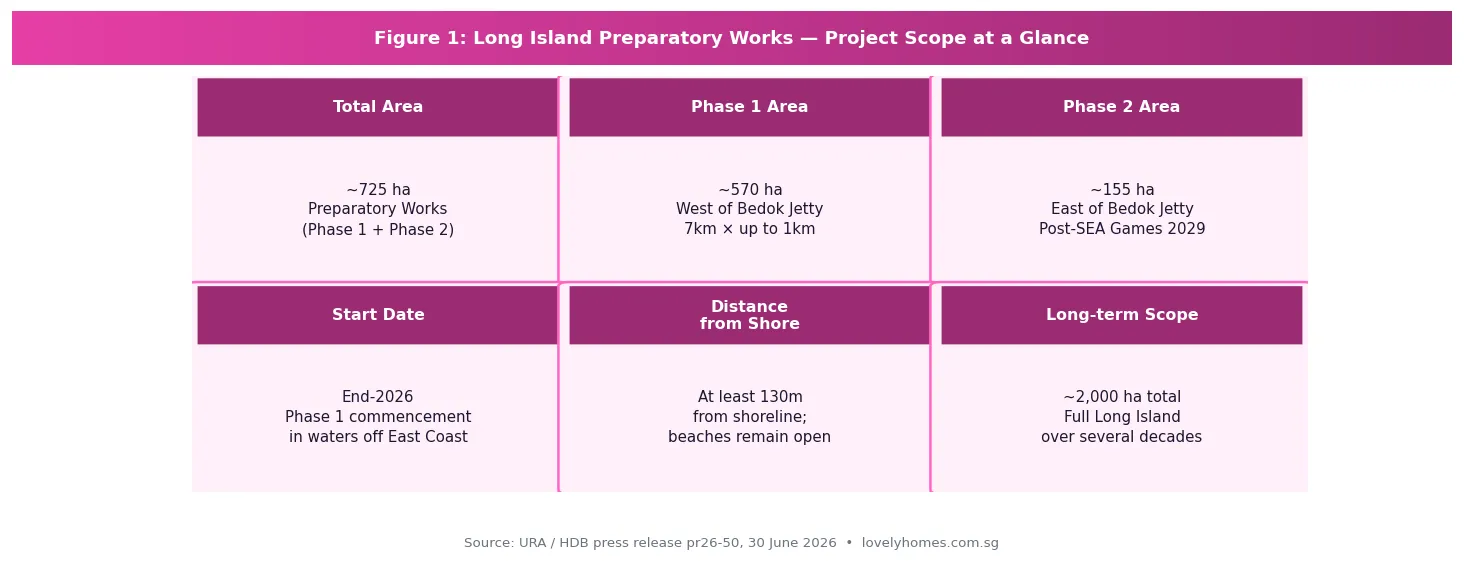
Figure 1: Long Island preparatory works project scope — Phase 1 and Phase 2 areas and timeline
Figure 1: Long Island preparatory works — project scope, Phase 1 and Phase 2 parameters, and long-term scale. Source: URA / HDB press release pr26-50, 30 June 2026.

What Are the Preparatory Works, Exactly?

Long Island is Singapore’s planned response to climate change and rising sea levels along its vulnerable East Coast. The full project — which will ultimately involve major land reclamation to create a new island and a freshwater reservoir — is a decades-long undertaking. What begins at end-2026 is the preparatory phase: essential marine construction works that lay the groundwork for eventual reclamation, but do not yet constitute reclamation itself.

The preparatory works involve three primary activities: removal of seabed obstructions (historical debris, hazards); construction of temporary sand bunds (underwater containment structures); and sand infilling within the bunded areas. These works will take place entirely offshore, at least 130 metres from the shoreline, and will be clearly demarcated by silt screens and floating barriers visible from the beach.

The works are split into two phases:

Phase Location Area Dimensions Timing
Phase 1 Waters west of Bedok Jetty ~570 ha ~7km long × up to 1km wide Commences end-2026
Phase 2 Waters east of Bedok Jetty ~155 ha TBC After SEA Games 2029 completion
Full Long Island Entire East Coast offshore zone ~2,000+ ha (indicative) TBC through technical studies Over several decades

The deferral of Phase 2 until after the 2029 SEA Games is a deliberate accommodation: the waters east of Bedok Jetty are currently used for water sports and will host major aquatic events for the SEA Games. This sequencing shows that the government is managing the project’s community impact thoughtfully — a signal that should give East Coast residents some comfort about near-term disruption.

Environmental Findings: What the Study Revealed

HDB commissioned a formal Environmental Study covering the preparatory works, consulting nature groups on scope. The study’s key findings are reassuring for the majority of East Coast users:

Water quality: No significant changes expected; water will continue to meet Singapore’s prevailing marine water quality criteria throughout the works.

Currents and waves: Slight localised changes near Bedok Jetty are expected to have minimal impact on near-shore activities. Swimming can continue along the entire East Coast stretch.

Air quality and visibility: Up to minor visual impact from sand infilling operations; intermittent sediment plumes and dust are expected, mitigated by silt screen deployment and active dust monitoring under the Environmental Monitoring and Management Plan (EMMP).

Biodiversity: Some coral and seagrass beds found near the work site may experience short-term, localised impact from sediment plumes. However, the majority of coral and seagrass — including Sisters’ Islands Marine Park — is assessed as largely unaffected. HDB has committed to EMMP monitoring throughout.

Sea sports displacement: This is the most tangible near-term impact for active East Coast users. Kiteboarding is most affected; other sea sports face minor to moderate displacement. Agencies are working with affected user groups to identify alternative sites within the sea space east of Bedok Jetty in the interim.

Key Takeaway: The environmental study concludes that preparatory works will have manageable, temporary, and localised impacts — not the large-scale ecological disruption that some stakeholders had feared. Beaches remain open. Swimming is unaffected. The most significant disruption is displacement of marine leisure activities, particularly kiteboarding, which will require temporary relocation.

What This Means for East Coast Property Buyers and Owners

For property owners in the East Coast corridor — covering D15 (Katong, Tanjong Katong, Marine Parade), D16 (Bedok, Siglap, Upper East Coast), and the eastern planning areas (Tampines, Pasir Ris, Changi) — the Long Island announcement is a long-term positive with a short-term noise caveat.

Short-term (2026–2029): Managed Disruption

The preparatory works will generate visible marine activity offshore — construction vessels, sand infilling operations, and temporary bunds. From the shoreline, this will be noticeable but distant (at least 130m offshore). Air quality impacts are expected to be minor and intermittent. Beaches remain open. The practical implication for property values is minimal in the short term: these works are a public infrastructure programme, not a lifestyle degradation, and they come with an explicit government commitment to environmental monitoring and mitigation.

Medium-term (2029–2035): Planning Uplift Begins

As the preparatory phase completes and the URA begins formal planning for Long Island’s reclamation profile, the East Coast will progressively benefit from the same planning-uplift dynamic that has historically preceded major Singapore waterfront transformations. When Marina Bay was being planned in the 1980s and 1990s, property in D1 and D2 began appreciating in anticipation of the new precinct long before a single building was complete. Long Island represents a similar, though slower, catalyst for the D15/D16 corridor.

Long-term (2035+): Transformative Uplift

When the full Long Island reclamation creates new land along the East Coast — including a future reservoir — the implications for D15 and D16 property are substantial: extended waterfront promenade access, reduced flood risk (supporting insurance and bank valuations), new residential parcels potentially creating supply (a risk to existing owners) but also major new amenity and connectivity (a positive for the precinct as a whole). The 2026 URA Q2 price data already showed D15 benefiting from TEL Stage 4 connectivity; the Long Island catalyst is additive to this structural tailwind over the 2030s and beyond.

Horizon Impact on East Coast Property Key Risk
2026–2029 (prep works) Neutral to marginally negative optics; no material price impact expected Marine activity visible from beachfront; minor sea-sport disruption
2029–2035 (early planning) Positive sentiment as Long Island masterplan solidifies; planning uplift begins Timeline may slip; full reclamation profile remains unconfirmed
2035+ (reclamation & beyond) Transformative — new waterfront, reduced flood risk, new amenity corridors New residential supply on Long Island may moderate prices on existing stock

Public Engagement and What Comes Next

The URA reiterated in the 30 June 2026 announcement that Singapore’s commitment to public engagement on Long Island planning remains firm. The government has engaged more than 14,000 people to date on Long Island’s vision. From end-2026, a new phase of public engagement will invite Singaporeans to shape key planning topics including recreational uses along the new coastline, the design of the future reservoir, and the character of new precincts that will eventually emerge.

Crucially, the URA clarified that the area used for preparatory works is not the final Long Island land profile. The reclamation profile will be determined through subsequent technical studies — covering environmental impact assessments for the actual reclamation, engineering studies, and further public engagement — expected to take several more years. Main reclamation works will only commence after these studies are complete and mitigation measures are determined.

The Environmental Study report was published for public feedback for four weeks from 30 June 2026. Members of the public may view it and submit feedback at go.gov.sg/long-island.

Frequently Asked Questions: Long Island and East Coast Property

Will the preparatory works affect East Coast Park beach access?

No. All beaches along East Coast Park will remain open throughout the preparatory works. Near-shore swimming can continue along the entire stretch of the East Coast. Exercise paths and tracks for jogging and cycling also remain fully accessible. The works are offshore (at least 130m from the shoreline) and cordoned off for public safety. Safety advisories will be posted at East Coast Park and on government agency websites.

How might Long Island affect property values in D15 and D16?

In the short term (2026–2029), the preparatory works are unlikely to have a material impact on property values in D15 (Marine Parade, Katong, Tanjong Katong) or D16 (Bedok, Upper East Coast, Siglap). The works are offshore, temporary, and environmentally monitored. In the medium to long term, Long Island is broadly a positive catalyst for the East Coast corridor — creating new waterfront, improved flood protection, and eventually new amenities. However, buyers should note that full Long Island reclamation is decades away and carries execution and timeline uncertainty. Purchase decisions should be based on the neighbourhood’s existing merits, with Long Island treated as optionality, not a near-term price driver.

What is the difference between the preparatory works and the main Long Island reclamation?

The preparatory works (beginning end-2026) involve seabed clearance, temporary bund construction, and sand infilling — foundational marine works that create the conditions for eventual reclamation without being the reclamation itself. The area used for preparatory works is not the final land profile of Long Island. The main reclamation works — which will actually create the new island — will only commence after the government completes further technical studies, determines mitigation measures, and incorporates feedback from additional public engagement rounds. This could be many years away. Think of the preparatory works as clearing and grading a site before construction, not as the construction itself.

Will Long Island create new HDB or private residential areas in the future?

Long Island’s ultimate land use profile — including any residential development — has not been finalised. The URA has noted that planning will incorporate findings from technical studies and public engagement, and that the government retains flexibility to meet evolving national needs. Historically, Singapore’s reclaimed land has been used for a mix of residential, commercial, and infrastructure purposes. It is reasonable to expect that some Long Island land will eventually be developed for housing, but the specific profile, tenure, and density remain undecided. Any residential development on Long Island is likely to be 15–25 years away.

Can I still use East Coast Park for water sports during the works?

Most water sports can continue, but with some adjustment. Near-shore swimming is unaffected. However, sea sports that require more sea space — particularly kiteboarding — will be the most significantly impacted, as the Phase 1 work area covers much of the sea space west of Bedok Jetty. Agencies are working with affected groups to identify alternative sites, including the sea space east of Bedok Jetty (until Phase 2 begins post-2029). Recreational paddling, kayaking, and water skiing in near-shore areas should be largely unaffected, though users should maintain safe distances from vessels and the cordoned work area.
Disclaimer: This article is an editorial summary of URA/HDB press release pr26-50 (30 June 2026). All project details, timelines, areas, and environmental findings cited are drawn from that official source. Property value commentary reflects editorial analysis only and does not constitute investment advice. Long Island timelines are subject to change by the Singapore Government. Readers should consult official sources — go.gov.sg/long-island, URA, HDB — and qualified property professionals before making property decisions based on this or any infrastructure announcement.

×

Click anywhere to close

East Coast Neighbourhood Guide Singapore 2026: D15 Prices, TEL Impact & Investment Outlook

East Coast Neighbourhood Guide Singapore 2026: D15 Prices, TEL Impact & Investment Outlook

×

Click outside or press Esc to close

District 15 (D15) — Singapore’s East Coast corridor — has long been one of the most sought-after residential addresses in the city-state. Anchored by Katong, Marine Parade, Siglap, Tanjong Katong, and the new Bayshore precinct, D15 blends Peranakan heritage, beachfront lifestyle, and increasingly, world-class MRT connectivity following the Thomson-East Coast Line (TEL) Stage 4 opening. This guide covers D15 property prices, HDB resale data, condo psf trends, TEL impact, investment outlook, and what to know before buying in 2026.

Quick Answer — East Coast D15 at a Glance (2026)

  • District 15 covers Katong, Marine Parade, Siglap, Tanjong Katong, Joo Chiat, and the upcoming Bayshore precinct.
  • HDB 4-room resale flats in D15 typically trade between S$520,000 and S$780,000 in Q1 2026.
  • Condo median psf ranges from ~S$2,100 psf (OCR fringes) to S$2,900+ psf (seafront / TEL-adjacent units).
  • TEL Stage 4 (seven stations opened June 2024) has cut commute times from East Coast to the CBD by 20–30 minutes.
  • Bayshore Road GLS site remains one of the most anticipated future launch sites along the Coast.
  • D15 rental yields for 2-bedroom condos average 3.0–3.8%, underpinned by strong expat and young-professional demand.
  • No freehold supply pipeline — almost all new launches are 99-year leasehold, elevating the premium for freehold pockets like Tanjong Katong Road.

What Is District 15 and Who Administers Property Here?

District 15 is one of Singapore’s 28 traditional postal districts, spanning the eastern corridor from Geylang Serai through Marine Parade, Siglap, and Bayshore to the fringe of D16 (Bedok). The Urban Redevelopment Authority (URA) administers land use planning, while HDB manages the substantial public-housing stock along Marine Parade Road, Siglap Plain, and the Lengkong areas. Marine Parade is one of Singapore’s older HDB towns, built out from the early 1970s on reclaimed land; this heritage gives D15 its unique mix of mature HDB estates, conservation shop-houses, private condos, and landed enclaves.

The district falls within the Rest of Central Region (RCR) under URA’s planning framework, meaning it is neither as expensive as the Core Central Region (CCR) nor as affordable as the Outer Central Region (OCR). This RCR positioning makes D15 attractive to both owner-occupiers who want an urban lifestyle and investors who see a price gap versus Districts 9, 10, and 11.

D15 Property Price Ranges — Q1 2026

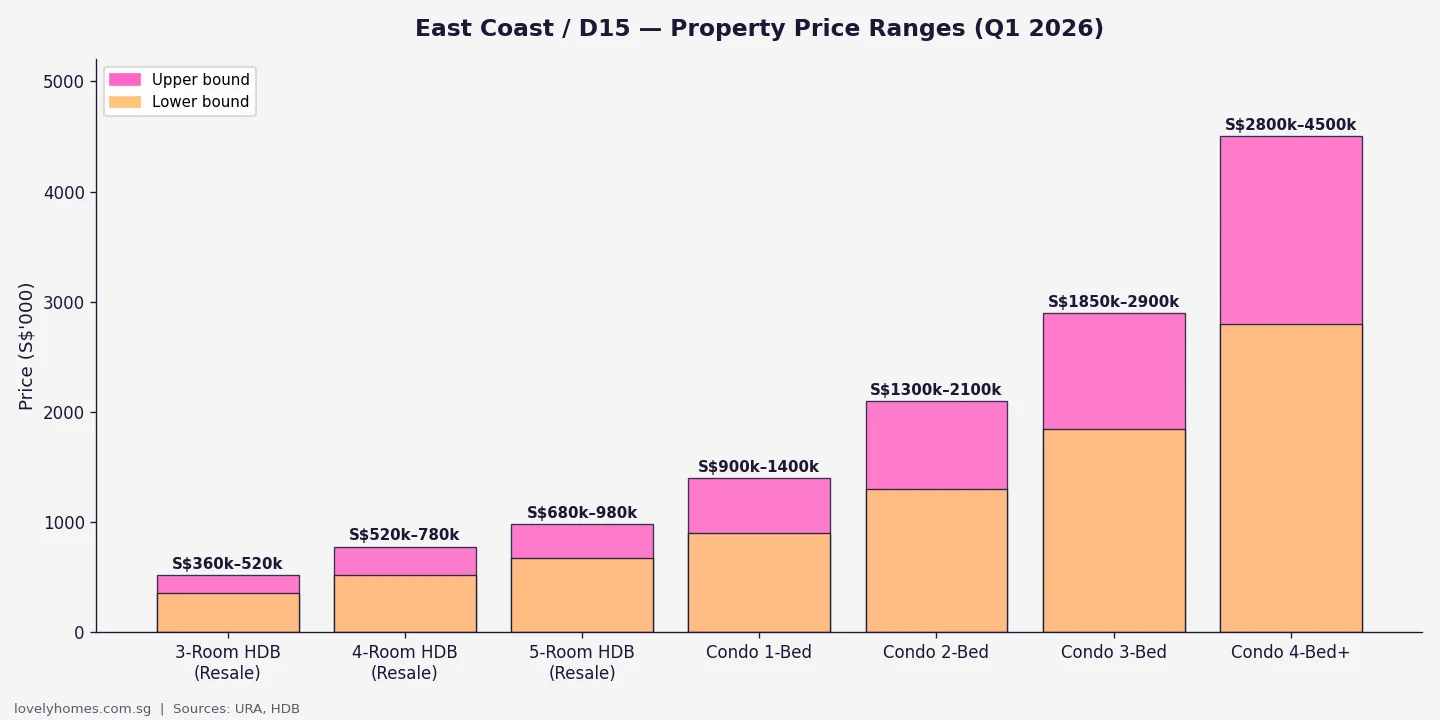
East Coast D15 property price ranges by type Q1 2026 HDB resale and condo
Figure 1: D15 East Coast property price ranges by type — Q1 2026. Sources: URA REALIS, HDB Resale Portal.

The D15 market is a tale of two submarkets. On the public housing side, Marine Parade’s mature HDB stock — 3-room, 4-room, and 5-room flats — trades at premiums well above the national median given their central location, sea views, and proximity to the new TEL stations. On the private side, a wide range of condos from 1980s-vintage developments to brand-new launches commands psf rates broadly in line with the RCR average, with TEL-adjacent and seafront addresses commanding a further 10–20% premium.

Property Type Typical Price Range (Q1 2026) Key Driver
HDB 3-Room Resale S$360k – S$520k Location, floor, TEL proximity
HDB 4-Room Resale S$520k – S$780k Sea view, high floor, age
HDB 5-Room Resale S$680k – S$980k Corner units, premium storey
Condo 1-Bedroom S$900k – S$1.4M Rental yield-driven
Condo 2-Bedroom S$1.3M – S$2.1M Most liquid size, expat demand
Condo 3-Bedroom S$1.85M – S$2.9M Family-size demand, school proximity
Condo 4-Bed / Penthouse S$2.8M – S$4.5M+ Scarcity, sea view, freehold tenure

The TEL Effect — How Thomson-East Coast Line Stage 4 Changed Everything

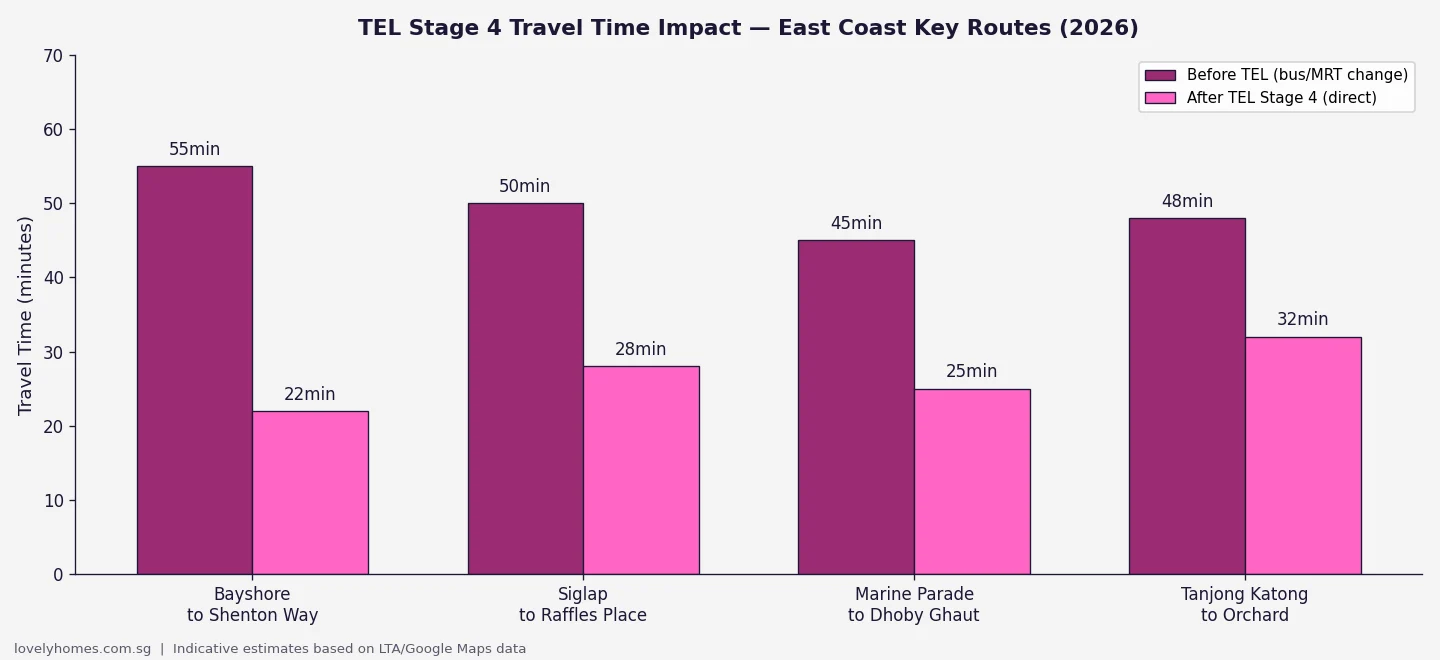
Before the Thomson-East Coast Line (TEL) Stage 4 opened in June 2024, East Coast residents faced a familiar frustration: despite living close to the city geographically, the absence of direct rail meant a bus-heavy commute or a drive. TEL Stage 4 introduced seven stations — Tanjong Rhu, Katong Park, Tanjong Katong, Marine Parade, Marine Terrace, Siglap, and Bayshore — fundamentally re-rating the district’s accessibility from “car-dependent” to “MRT-convenient”.

TEL Stage 4 travel time comparison East Coast to CBD 2026
Figure 2: TEL Stage 4 — indicative travel time reduction on key East Coast routes to the CBD (2026). Sources: LTA, Google Maps estimates.

The connectivity uplift has translated into measurable price momentum. Industry data suggests properties within 500 metres of a TEL Stage 4 station saw median psf appreciation of 8–12% in the 18 months following the line’s opening. The Bayshore precinct in particular — the eastern-most TEL stop in Stage 4 — has been flagged by URA as a future growth node, with rezoning planned for higher-density residential and mixed-use development along Bayshore Road.

Neighbourhood Character: Katong, Marine Parade, Siglap and Bayshore

Katong and Joo Chiat form the cultural heart of D15. Peranakan shop-houses line East Coast Road, with restaurants, heritage shopfronts, and boutique hotels giving the sub-precinct a character found nowhere else in Singapore. Property here — particularly freehold terraces and conservation shop-houses — commands a significant premium and rarely trades. Buyers who can afford the entry price acquire a genuinely irreplaceable asset.

Marine Parade is the most accessible sub-precinct, anchored by Marine Parade Road and its mature HDB precincts. Parkway Parade mall, the iconic East Coast Park, and a well-established network of amenities make this the most family-friendly address in D15. HDB resale prices here have historically tracked 10–20% below equivalent units in Bishan or Queenstown despite the beachfront lifestyle advantage — a gap that has since narrowed following TEL connectivity.

Siglap retains a village atmosphere that residents guard fiercely. Low-rise landed housing, a strong café culture along Upper East Coast Road, and proximity to good schools (CHIJ Katong, St Patrick’s School, Victoria School) make Siglap a perennial favourite for families. The new Siglap TEL station has changed the calculus for buyers who previously shied away due to the bus-only access to the city.

Bayshore is D15’s newest growth story. Located at the eastern fringe before the district transitions into D16, Bayshore benefits from both the East Coast Park Connector and its namesake MRT station. URA’s plans for Bayshore point towards higher-density condo development on the southern fringe, and a future Government Land Sales (GLS) site on Bayshore Road is anticipated to anchor the precinct’s transformation into a vibrant mixed-use node.

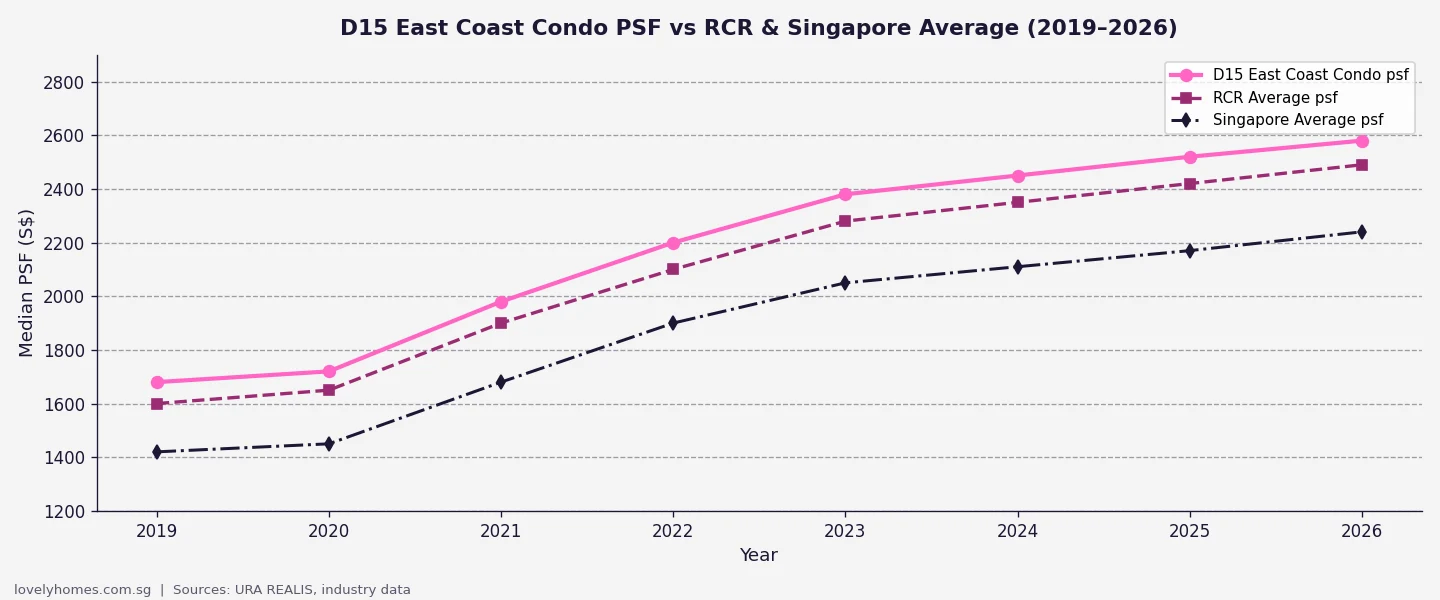
Condo PSF Trends — D15 vs RCR and Singapore Average (2019–2026)

D15 East Coast condo PSF trend vs RCR Singapore average 2019 to 2026
Figure 3: D15 East Coast condo median psf vs RCR average and Singapore average (2019–2026). Sources: URA REALIS, industry data.

D15 condo prices have outpaced the Singapore average since 2021, partly driven by the TEL anticipation effect and partly by a shrinking freehold supply pool. By Q1 2026, D15 median psf sits at approximately S$2,580, which is modestly above the RCR average of S$2,490. This premium is structural — D15 has very little land for new development, so supply is constrained to occasional en-bloc rebuilds and infill GLS sites. The scarcity premium is likely to persist through the medium term.

Schools and Amenities in the East Coast

D15 is one of Singapore’s most amenity-rich districts. Key schools within or adjacent to the district include CHIJ Katong Primary, Tao Nan School, Victoria School, St Patrick’s School, Dunman High School, Temasek Secondary, and the Canadian International School (Tanjong Katong campus). The density of well-regarded schools within the 1-km and 2-km radii is a primary reason why family-sized 3- and 4-bedroom condos in D15 command a durable premium over equivalent units in less educationally dense districts.

For daily living, Parkway Parade, i12 Katong, Siglap Centre, and the East Coast Road stretch of independent restaurants, café chains, and hawker centres provide comprehensive retail and dining coverage. East Coast Park — Singapore’s most-used waterfront recreational space — runs the entire southern flank of the district, offering cycling, barbecue, sea sports, and camping facilities that are essentially impossible to replicate in inland districts.

Worked Example — Buying a D15 Condo in 2026

Profile: Ms Lim, Singapore Citizen, first-time buyer, age 33, monthly income S$9,800. She is considering a 2-bedroom resale condo in Tanjong Katong at S$1,680,000.

Cost Item Amount (S$) Notes
Purchase Price 1,680,000 Resale condo, D15
Buyer’s Stamp Duty (BSD) 53,400 Tiered: 1-6% on S$1.68M
ABSD (First Property, SC) 0 First property, SC — ABSD waived
25% Minimum Downpayment 420,000 5% cash + 20% cash/CPF
Bank Loan (75% LTV) 1,260,000 At ~3.8% p.a., 25 yr — est. monthly S$6,512
TDSR Check 66.5% S$6,512 / S$9,800 = 66.4% — FAILS TDSR 55%
Verdict Budget shortfall at S$9,800/mth single income. Ms Lim would need S$11,840/mth or a lower purchase price of ~S$1.3M, or a joint purchase. At S$1.3M: monthly repayment ~S$5,030; TDSR 51.3% — PASS.

This illustrates why D15 private property is increasingly a dual-income or high-income play, and why the HDB resale market remains the entry point of choice for single buyers at the S$8,000–S$10,000 income level.

Investment Case — Why East Coast Remains Compelling

D15’s investment appeal rests on three durable pillars. First, supply scarcity: unlike Jurong, Tengah, or Woodlands — districts where URA can release greenfield GLS sites at scale — D15’s private land is almost entirely built up, limiting new supply to occasional en-bloc redevelopments. This structural supply cap underpins prices even when transaction volumes soften. Second, lifestyle premium: East Coast Park, the coastal cycling paths, and the district’s café/dining culture create a quality-of-life premium that resonates with high-income locals and expats alike, supporting rental demand even when the broader market softens. Third, TEL optionality: the Bayshore precinct is still in the early stages of its transformation; investors who buy ahead of the anticipated GLS site award and subsequent launch are positioning for a significant uplift event in the 2027–2029 window.

What Might Come Next for East Coast (2026–2028)

This section reflects editorial analysis and should not be taken as a forecast or financial advice. The most significant near-term catalyst is the anticipated Bayshore Road GLS site, which is expected to attract developer interest given its direct TEL Bayshore station frontage and sea-view orientation. If awarded at a land rate above S$1,300 psf ppr, it would reset benchmark pricing for the eastern precinct. A second catalyst is the progressive ageing of Marine Parade’s HDB stock — a large cohort of flats are entering or approaching the 40-year mark, which historically triggers either en-bloc potential or Selective En Bloc Redevelopment Scheme (SERS) interest from HDB. Finally, the completion of the Greater Southern Waterfront masterplan, though primarily a D03–D04 story, may redirect some premium coastal living demand eastward to D15 as the western waterfront supply comes online.

Frequently Asked Questions

Is D15 East Coast a good area to buy property in Singapore?
D15 is consistently rated among Singapore’s most liveable districts for owner-occupiers. For investors, the structural supply scarcity, TEL connectivity uplift, and lifestyle premium make it a compelling hold. The principal risk is the high entry price — affordability constraints mean the pool of eligible buyers is thinner than in OCR districts, which can lead to longer marketing periods when selling. Buyers should ensure their holding horizon is at least 5–7 years to ride out any market cycles.
What is the cheapest way to enter the D15 market?
The most affordable entry point is a 3-room HDB resale flat in the Marine Parade or Joo Chiat sub-precincts, which can be acquired from around S$360,000 to S$520,000. For private property, older 99-year leasehold condos in the Tanjong Rhu or Haig Road areas can be found from S$900,000 to S$1.1M for a 1-bedroom unit, though buyers should pay close attention to remaining lease before purchasing, particularly for CPF usage eligibility.
How has TEL Stage 4 affected property prices in East Coast?
Industry data suggests that properties within 500 metres of the seven new TEL Stage 4 stations saw median psf appreciation of 8–12% in the 18 months following the June 2024 opening. The impact was sharpest at Siglap (where the station is the first MRT access ever) and Bayshore (future GLS catalyst). Properties further from the stations — particularly older landed in the Siglap interior — saw more modest appreciation as they were already priced for their lifestyle rather than connectivity premium.
What rental yield can I expect from a D15 condo?
For a 2-bedroom condo in D15 priced at S$1.5M–S$1.8M, gross rental yield is typically in the 3.0–3.8% range (S$4,500–S$5,500/month rent). 1-bedroom units can achieve slightly higher yields (3.5–4.0%) given their lower entry price relative to achievable rents. The East Coast’s popularity with expatriate families and the international school catchment (especially Canadian International School) provides a relatively stable tenant base. Net yield after maintenance fees, property tax, and vacancy periods is typically 2.2–3.0%.
Are there any new launch condos planned for D15?
The supply pipeline is thin, which is precisely the investment case. The most anticipated future launch is on a Bayshore Road GLS site, which remains unawarded as of mid-2026 but is expected to enter the 2H2026 GLS Confirmed or Reserve List. En-bloc redevelopments of older condos along Haig Road and Tanjong Rhu Road are also being quietly monitored by developers, though achieving the 80% owner consent threshold under Singapore’s Land Titles (Strata) Act remains challenging in a rising market where existing owners are reluctant to sell.
Can foreigners buy property in D15?
Foreigners can purchase strata-titled private residential properties (condos and apartments) in D15 without restriction, subject to the 60% Additional Buyer’s Stamp Duty (ABSD) on top of the standard progressive Buyer’s Stamp Duty (BSD). This makes foreign buying in D15 — or anywhere in Singapore — extremely expensive. HDB flats are restricted to Singapore Citizens and qualifying Permanent Residents only. Landed properties in D15 require specific approval from the Singapore Land Authority (SLA) for foreign nationals.
What schools are within 1 km of Marine Parade MRT station?
Marine Parade MRT (TEL) is within or near the 1-km school registration radius of CHIJ Katong Primary and Tao Nan School, both of which are consistently popular with families. Dunman High School and Victoria School (secondary) are also close by. Buyers purchasing specifically for school proximity should verify the precise distance against the Ministry of Education (MOE) school enrollment exercise dates, as the radius is measured from the child’s registered home address to the school gate.

Related Articles


Disclaimer: This article is produced by the LovelyHomes Editorial Team for informational purposes only and does not constitute financial, legal, or real estate advice. Property prices, stamp duty rates, and government policies are subject to change. All figures are indicative and sourced from publicly available data from the Urban Redevelopment Authority (URA), Housing and Development Board (HDB), Inland Revenue Authority of Singapore (IRAS), and the Monetary Authority of Singapore (MAS). Readers should consult a licensed property agent, financial adviser, or solicitor before making any property investment decision. Stamp duty calculations should be verified against the IRAS Tax Calculator at iras.gov.sg.

Thomson-East Coast Line Property Guide Singapore 2026: Best Districts & Investment Opportunities

Thomson-East Coast Line Property Guide Singapore 2026: Best Districts & Investment Opportunities

The Thomson-East Coast Line property guide Singapore 2026 is your complete reference for buying, investing, or upgrading along Singapore’s newest MRT trunk line. The TEL, operated by SMRT under the Land Transport Authority’s network, is the first line to run from the deep north of Singapore — Woodlands North — all the way to the eastern seaboard at Sungei Bedok, connecting eight of Singapore’s twenty-eight districts in a single continuous line. For property buyers, the TEL represents both a connectivity premium already priced into northern and eastern districts and a genuine price-growth runway in catchment areas where development is still maturing.

Quick Answer — TEL Property in 2026 at a Glance

  • The TEL runs 43 stations across 5 phases; all phases are operational as of November 2024
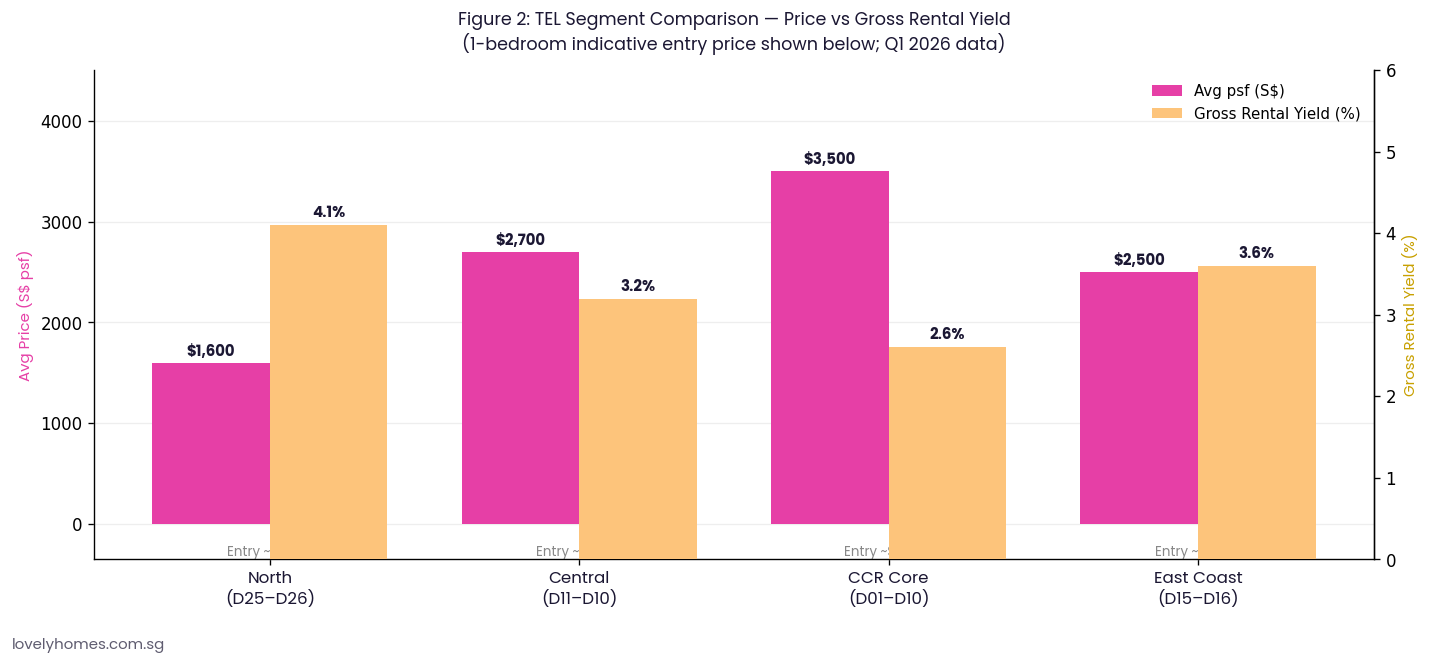
  • North segment (D25–D26): entry prices from S$1.2M–S$1.8M for 1–2 bedroom condos; gross yields 3.8–4.3%
  • Prime central segment (D10–D11): average transaction prices S$2,900–S$3,800 psf; yields compress to 2.5–3.2%
  • East Coast segment (D15–D16): sweet spot for yield investors — S$2,200–S$2,600 psf with yields 3.5–4.0%
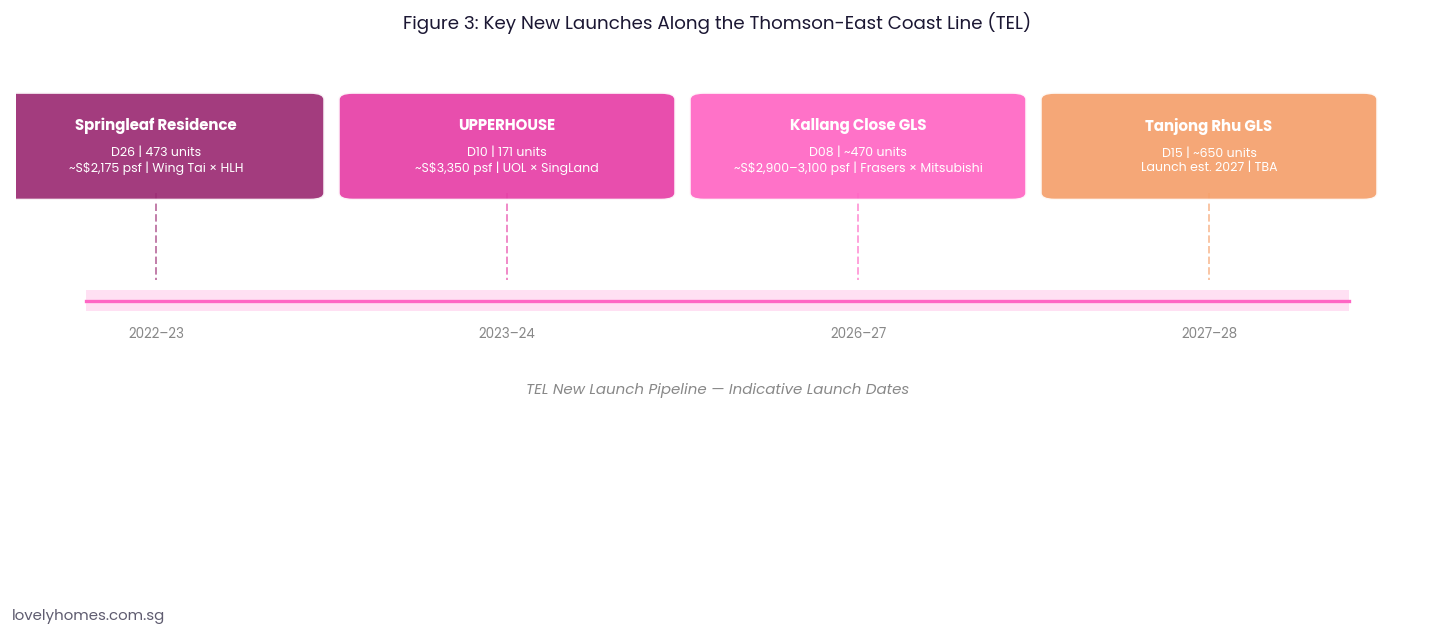
  • Three active new launches along the TEL corridor in 2026: Springleaf Residence (D26), UPPERHOUSE (D10), and the Kallang Close GLS
  • The TEL’s opening in D15 (Katong, Marine Parade, Tanjong Rhu) added a 6–12% price premium to catchment condos within 500m, per URA caveat analysis
  • Investors should note: TEL East Coast properties fall under the Rest of Central Region (RCR) and Core Central Region (CCR) frameworks for ABSD and LTV calculations
  • The Tanjong Rhu GLS site (D15) — first new land release in the area in 28 years — signals major upcoming supply in a historically undersupplied waterfront node

What Is the Thomson-East Coast Line?

The Thomson-East Coast Line is the sixth MRT line on Singapore’s Mass Rapid Transit network. Planned by the Land Transport Authority and built in five phases, the TEL broke ground in 2015 and reached full network connection in November 2024 when the final phase linking Bedok South to Sungei Bedok opened, completing the 43-station, approximately 43-kilometre corridor. Unlike older lines that were retrofitted through existing urban fabric, the TEL was master-planned as a north-south-east spine: it reaches previously MRT-unserved residential catchments in Woodlands, Upper Thomson, and the East Coast, while also adding new stations in the premium central districts of Stevens, Napier, and Orchard Boulevard.

The LTA’s long-term transport planning has established a clear correlation between MRT station proximity and private residential price premiums. Researchers at the National University of Singapore’s Institute of Real Estate and Urban Studies have documented average premiums of 5–15% for private properties within 500 metres of a station, with new lines generating the strongest uplift in the two to three years around opening. The TEL’s staged opening created sequential pricing events across its catchments, and property investors who tracked the LTA’s construction timeline were able to position ahead of each phase.

The TEL in Five Segments: A Property Investor’s Map

For analytical purposes, the TEL’s 43 stations divide into five investment segments, each with distinct supply, pricing, and yield characteristics.

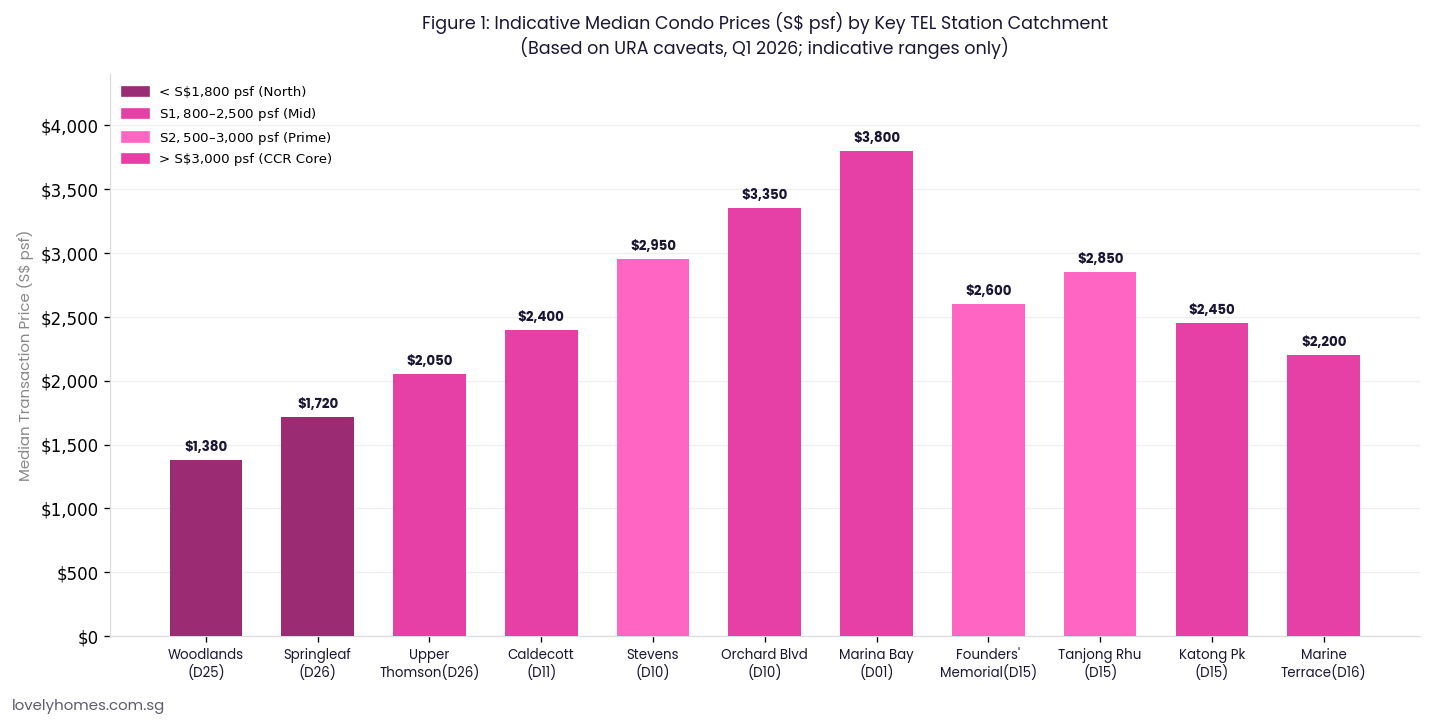
Median condo prices psf by TEL station catchment Singapore 2026 Q1 URA caveats
Figure 1: Indicative median condo transaction prices (S$ psf) by key TEL station catchment area, based on URA caveat data for Q1 2026. The gradient from north (D25–D26) to central CCR reflects Singapore’s established price geography.

Segment 1 — The North (D25–D26): Woodlands to Springleaf

The northern anchor of the TEL serves Woodlands (D25) and Upper Thomson/Mandai (D26). This is the most affordable segment on the line, with median condo transaction prices in the S$1,300–S$1,800 psf range as of Q1 2026 (URA caveats). The key residential projects here are Woodlands-area condos such as The Woodleigh Residences and Canberra Crescent developments, alongside the more recent Springleaf Residence at Upper Thomson. Springleaf Residence — a Wing Tai Holdings and Hong Leong Holdings joint venture — launched at an average S$2,175 psf and achieved 92% sold at launch, validating strong homebuyer demand in the D26 corridor.

Investment fundamentals for the north segment: rental yields are the highest on the TEL, typically 3.8–4.3% gross for 1-bedroom and 2-bedroom units, driven by the presence of international school catchments (Woodlands International School, Singapore Sports School), and the Woodlands Regional Centre transformation under URA’s long-range master plan. Entry prices for 1-bedroom units start from approximately S$850,000–S$1,000,000, making this the most accessible entry point on the line for investors under S$1M. The Woodlands–Johor Bahru RTS Link, due to complete in end-2026, is an additional demand catalyst: cross-border workers commuting from Singapore to the Johor Bahru Bukit Chagar terminus will increasingly seek rental accommodation at or near Woodlands MRT.

Segment 2 — Upper Thomson to Caldecott (D20, D11): The Middle Ground

Between Springleaf and the Orchard stretch, the TEL passes through Upper Thomson Road, the Caldecott interchange (linking to the Circle Line), and Stevens (linking to the Downtown Line). This segment includes Districts 20, 11, and the western edge of D10. Caldecott and Stevens are immediately adjacent to premium private residential estates including Bukit Timah, Holland Road, and the Nassim/Tanglin clusters — traditionally among the most expensive residential districts in Singapore.

The Stevens station, in particular, serves as a gateway to the Good Class Bungalow belt in D10 and the UOL-SingLand UPPERHOUSE at Orchard Boulevard development (101 units, 99-year leasehold, average S$3,350 psf, launched 2024). The connectivity addition of the TEL here — bringing a direct one-seat ride from Stevens all the way to Marina Bay and the East Coast — solidified premium pricing in a corridor that was already well-served by car ownership. For buyers, the TEL has made D10–D11 properties accessible to a broader pool of non-car-owning tenants, improving rental sustainability for high-end CCR units.

Segment 3 — The CCR Core (D01–D10): Orchard to Marina Bay

The TEL’s central stations — Napier, Orchard Boulevard, Great World, Havelock, Outram Park (interchange), Maxwell, Shenton Way, and Marina Bay — traverse the very heart of Singapore’s Core Central Region. Median transaction prices in this segment range from S$2,900 psf (Havelock/Great World catchment) to S$3,800 psf (Orchard Boulevard environs), with top CCR addresses in Orchard exceeding S$4,500 psf. The key driver here is not yield — gross rental yields compress to 2.4–3.0% as capital values are elevated — but capital preservation and long-run appreciation in freehold or near-freehold assets.

The CCR core is where the ABSD differential matters most acutely. Foreigners buying in this segment pay 60% ABSD, which has materially shifted the buyer mix since April 2023 towards Singapore Citizens and PRs on investment purchases. URA Q1 2026 caveats show that CCR transactions remain below their 2021–2022 peak volumes, but median prices have held firm, suggesting that existing CCR owners are not distressed and are holding for long-term appreciation rather than selling at discounts.

Segment 4 — East Coast (D15): Katong to Marine Terrace

The TEL’s East Coast segment — from Tanjong Rhu to Marine Parade and Siglap — is arguably the most exciting investment corridor on the line in 2026. This is a historically low-supply, high-demand residential area. The East Coast has long commanded rental and lifestyle premiums driven by the concentration of international schools (SAS, CIS, UWCSEA East, EtonHouse), the East Coast Park, and a café-and-food-culture character that attracts young expatriate and local professional tenants. Before the TEL, the area had no MRT connectivity at all — residents relied entirely on buses and private transport. The arrival of Katong Park, Marine Parade, and Marine Terrace stations in 2023 was transformative.

URA caveat analysis shows that East Coast condos within 500 metres of the new TEL stations transacted at S$2,400–S$2,700 psf in Q1 2026, representing a 6–12% premium over comparable units further from the stations. Gross rental yields for 1-bedroom units in Katong and Marine Parade run at 3.5–4.1%, benefitting from high expatriate rental demand. The 2025 Tanjong Rhu GLS — the first government land sale in the area in 28 years — will eventually add supply, but the timeline to completion is 3–5 years, leaving the existing stock to absorb near-term rental demand.

Segment 5 — Far East (D16): Bedok to Sungei Bedok

The terminal segment, from Bedok South through Siglap, Bayshore, and Sungei Bedok, represents the TEL’s newest frontier. Bayshore Road — the subject of a significant GLS tender launched by the URA in March 2026, with a S$1.9–2.1B bid estimate and a 1,280-unit mixed-use integrated development — will be the anchor new launch for this segment. This site has MRT integration built into the development brief, meaning future residents will have a covered walk directly from their lobby to Bedok South MRT. The catchment here currently trades at S$1,900–S$2,300 psf, offering the best price-to-TEL-connectivity value on the entire line for medium-term investors who are comfortable with a 2–3 year supply wait.

TEL segment comparison price psf versus gross rental yield Singapore condo 2026
Figure 2: TEL segment comparison — average price psf against gross rental yield and indicative 1-bedroom entry price (Q1 2026). The north and east segments offer the superior yield profile; the CCR core delivers capital preservation and prestige.

Summary Table: TEL Segments at a Glance

Segment Districts Median psf (Q1 2026) Gross Yield Entry 1BR (~S$) Best For
North (Woodlands–Springleaf) D25–D26 S$1,300–1,800 3.8–4.3% S$850K–1.0M Yield-focused; RTS uplift play
Mid-North (Thomson–Caldecott) D20–D11 S$2,050–2,400 3.0–3.5% S$1.2M–1.5M Balanced; school proximity
CCR Core (Orchard–Marina Bay) D01–D10 S$3,000–3,800 2.5–3.0% S$2.2M–3.5M Capital preservation; prestige
East Coast (Katong–Marine Parade) D15 S$2,400–2,700 3.5–4.1% S$1.5M–1.8M Expat rental; lifestyle premium
Far East (Bayshore–Sungei Bedok) D16 S$1,900–2,300 3.6–4.0% S$1.1M–1.4M Medium-term upside; Bayshore GLS

Worked Example: Comparing Two TEL Investment Scenarios

To illustrate how the TEL’s price geography affects investor outcomes, consider two hypothetical purchasers buying in April 2026, each with a S$1.8M budget for a 2-bedroom investment unit (Singapore Citizen, first private property, no ABSD).

Option A — East Coast (D15), near Marine Parade MRT: 2BR, 700 sqft at S$2,500 psf = S$1.75M. BSD payable to IRAS: ~S$55,600. Monthly mortgage (75% LTV, S$1.31M at SORA+0.75% = ~3.70%, 25 years): ~S$6,720. Monthly rental income at 3.7% gross yield: ~S$5,390. Net monthly cash flow (before management fee, property tax, sinking fund): −S$1,330 per month. Capital appreciation target: 4–6% per annum over a 7-year hold. Total return (conservative 4% p.a. appreciation + cumulative rental income): estimated IRR of approximately 8–10% over a 7-year hold.

Option B — North (D26), near Springleaf MRT: 2BR, 800 sqft at S$1,850 psf = S$1.48M. BSD payable to IRAS: ~S$43,000. Monthly mortgage (75% LTV, S$1.11M at 3.70%, 25 years): ~S$5,700. Monthly rental at 4.1% gross: ~S$5,060. Net cash flow: −S$640 per month (significantly better than Option A). Capital appreciation at a more conservative 3% p.a. over 7 years. IRR: approximately 7–9%, with a stronger monthly cash flow during the hold period. Option B also leaves S$320K of the budget unused, which could service emergencies or fund a second property later.

Neither option is inherently superior — the trade-off is between location prestige and rental resilience (Option A) versus cash-flow comfort and lower entry risk (Option B). Both outperform a typical fixed deposit or Singapore Savings Bond over a 7-year horizon on a total return basis, based on current market data.

New launch condos along Thomson-East Coast Line TEL pipeline 2026 2027 Singapore
Figure 3: Key new launch projects along the TEL corridor — indicative launch dates and entry pricing. The pipeline includes both live launches and upcoming sites from the Government Land Sales programme.

Why the TEL Matters for Property Investors in 2026

Singapore’s MRT network has historically been the single most reliable infrastructure driver of residential price premiums. The TEL is unique in that it opened across a decade (2019–2024), meaning different catchments are at very different stages of the price-uplift cycle. The north segment is still absorbing the connectivity premium as the Johor Bahru RTS Link nears completion; the East Coast is in the early-mid stage of its premium maturation; and the CCR core stations are fully priced in. For investors, the implication is clear: the North and East Coast segments still offer the better forward-looking return profile relative to entry price.

URA’s Q1 2026 full statistics (released 25 April 2026) showed that private residential prices rose 0.9% quarter on quarter, with the Rest of Central Region — which encompasses much of the East Coast TEL corridor — outperforming the Core Central Region in transaction volume. This divergence suggests that RCR properties, including East Coast condos, are currently absorbing more buyer demand than the premium CCR market, consistent with a pricing cycle where affordability-conscious buyers are moving down the price curve from CCR into RCR catchments along connective infrastructure like the TEL.

What Might Come Next Along the TEL

Looking forward, three developments warrant investor attention. First, the Bayshore Drive GLS (URA tender, closing July 2026) will be the defining new launch for the Far East segment. With 1,280 units and an MRT-integrated brief, the eventual project will set a new price benchmark for D16, potentially pushing neighbouring resale values upward in anticipation. Second, the Tanjong Rhu GLS — where the site was awarded in late 2025 — will bring the first new private development to the Tanjong Rhu waterfront in three decades; market estimates place the launch price at S$3,200–3,500 psf, consistent with D15 premium waterfront comparable transactions. Third, URA’s ongoing Draft Master Plan 2025 consultations include proposals to intensify the East Coast Park corridor and the Katong precinct, which, if implemented, could further bolster lifestyle premiums in the Marine Parade and Siglap catchments.

Frequently Asked Questions

Which TEL station has the best investment value in 2026?

For yield-focused investors, the Upper Thomson and Springleaf catchments (D26) currently offer the best combination of gross yield (3.8–4.3%), reasonable entry price (from S$1.2M for 2BR), and near-term demand catalysts from the Johor Bahru RTS Link. For capital appreciation, Marine Parade and Katong Park (D15) are the standout stations — still absorbing the TEL connectivity premium with a supply shortage that will persist until the Tanjong Rhu GLS project completes circa 2029–2030. For lifestyle owner-occupiers, Stevens and Orchard Boulevard (D10) offer unsurpassed centrality and school proximity at a premium entry point.

How much of a premium do TEL station properties command over non-MRT units?

Research from the Institute of Real Estate and Urban Studies at NUS estimates that properties within 500 metres of a new MRT station command a 5–15% price premium over comparable properties 800–1,500 metres away, with the premium being largest in the first two to three years after the station opens and in areas with low existing MRT coverage (such as the East Coast before the TEL). Properties integrated directly with a station (ground-level covered link) command a further 3–7% premium, per URA caveat analysis. For the East Coast segment, which had zero prior MRT coverage, the observed premium has been at the higher end of the 8–12% range for 500m-radius properties.

Are there new launch condos available along the TEL right now?

As of April 2026, active new launches along the TEL corridor include Springleaf Residence (D26, near Springleaf MRT, 473 units, 92% sold at launch at ~S$2,175 psf by Wing Tai and Hong Leong Holdings) and UPPERHOUSE at Orchard Boulevard (D10, near Orchard Boulevard MRT, 171 units at ~S$3,350 psf by UOL and Singapore Land Group). The Kallang Close GLS site (near Bendemeer MRT, an adjacent north-south TEL interchange station) is expected to launch circa 2027–2028 at S$2,900–3,100 psf by Frasers Property and Mitsubishi Estate. For the East Coast, the Tanjong Rhu waterfront site is in development and expected to preview approximately 2027.

How does ABSD apply to TEL property purchases by foreigners?

Foreigners purchasing any residential property in Singapore — including condos along the TEL — pay 60% ABSD on the full purchase price, regardless of whether it is their first or subsequent property. This applies equally to CCR Orchard Boulevard units and to more affordable East Coast apartments. The 60% rate, introduced in April 2023, has effectively priced most foreign investors out of the Singapore residential market. Singapore Permanent Residents buying their first private property pay 5% ABSD; their second residential property attracts 30% ABSD. Singapore Citizens pay 0% on a first private purchase and 20% on a second. All ABSD is administered by the Inland Revenue Authority of Singapore and is payable within 14 days of exercising the Option to Purchase.

What is the Johor Bahru RTS Link and why does it matter for TEL D25–D26 properties?

The Rapid Transit System (RTS) Link is a cross-border rail connection between Woodlands North MRT (the TEL’s northernmost station) and Bukit Chagar in Johor Bahru, Malaysia, scheduled for completion in late 2026. The RTS Link will allow commuters to travel between Singapore and Johor Bahru in approximately 5 minutes by rail, replacing a congested road crossing that currently takes 30–90 minutes in peak hours. For property investors, the RTS Link is a demand multiplier: Singaporeans working in Johor Bahru’s rapidly developing Iskandar Malaysia economic region, as well as Malaysians working in Singapore who choose to commute rather than rent, both anchor rental demand at or near Woodlands North and Woodlands MRT. Industry data suggests rental demand for 1BR and 2BR units within a 10-minute walk of Woodlands MRT could increase 15–25% once the RTS Link is fully operational.

How do I find resale condos near a specific TEL station?

The most reliable data source for resale condo transactions near any TEL station is the Urban Redevelopment Authority’s real estate information system at URA REIS. You can search by postal district or project name to see actual caveated transaction prices, floor area, and date of transaction. For a broader property search including current listings, URA’s public portal at ura.gov.sg provides planning information and the latest approved development details for each district. Cross-referencing URA caveats with listing prices gives you a reliable indication of the price gap (or premium) being applied by sellers in each catchment.

Related Articles

Disclaimer

This article is for general informational purposes only and does not constitute financial, legal, or property investment advice. All price per square foot figures, yield estimates, and transaction data referenced are indicative, based on publicly available URA caveat records and industry analysis, and are subject to change. Property values may go up or down. ABSD and stamp duty rates are administered by IRAS and are subject to revision. Consult a licensed property professional and a qualified financial adviser before making any investment decision.


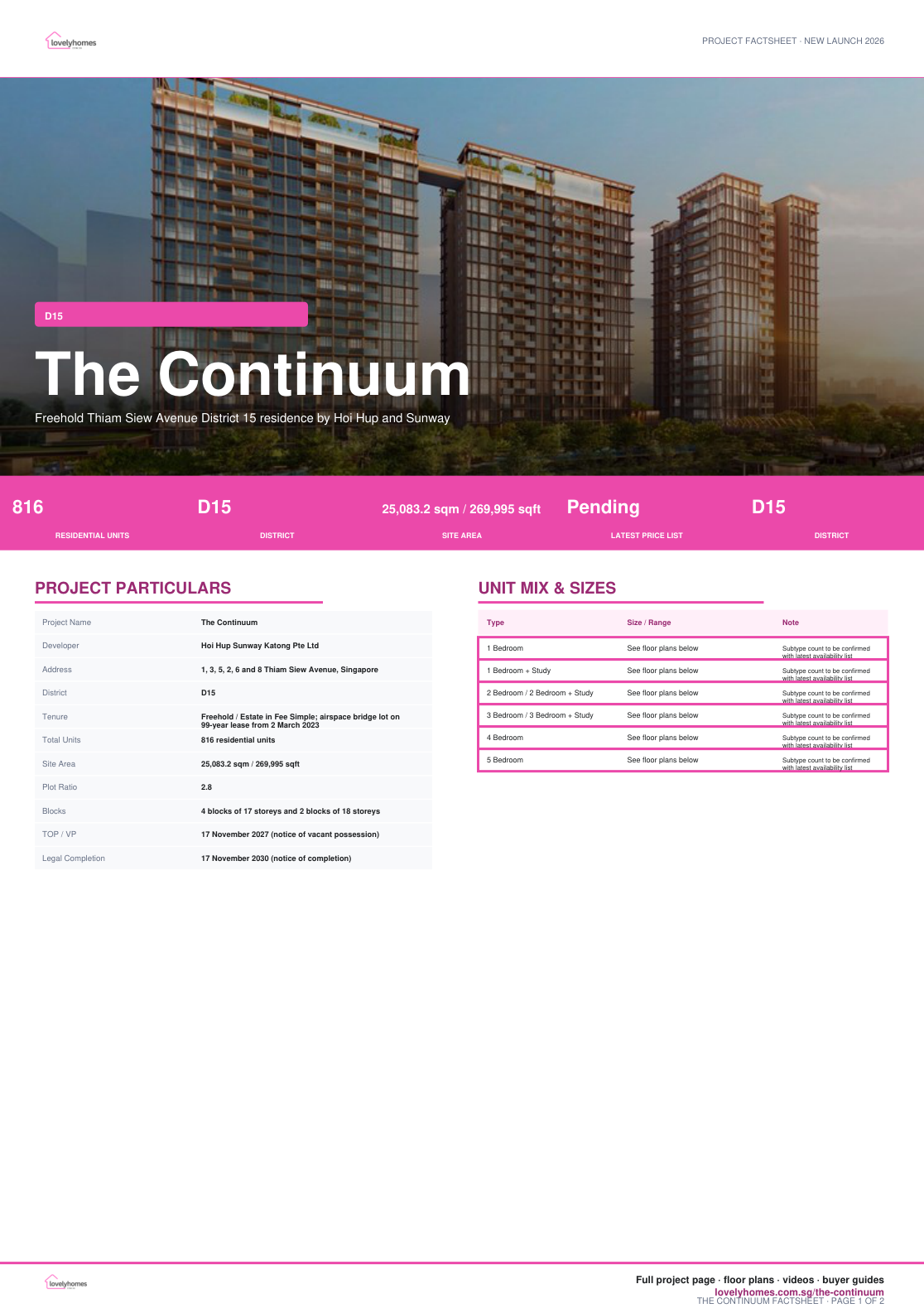
The Continuum

The Continuum


NEW LAUNCH · THIAM SIEW AVENUE · DISTRICT 15

The Continuum

Freehold Thiam Siew Avenue District 15 residence by Hoi Hup and Sunway
D15
District
Freehold / Estate in Fee Simple
Tenure
17 November 2027
TOP / VP
816
Total Units
816
Residential Units
D15
District
25,083.2 sqm / 269,995 sqft
Site Area
From S$1.378M
Current From Price

Why The Continuum

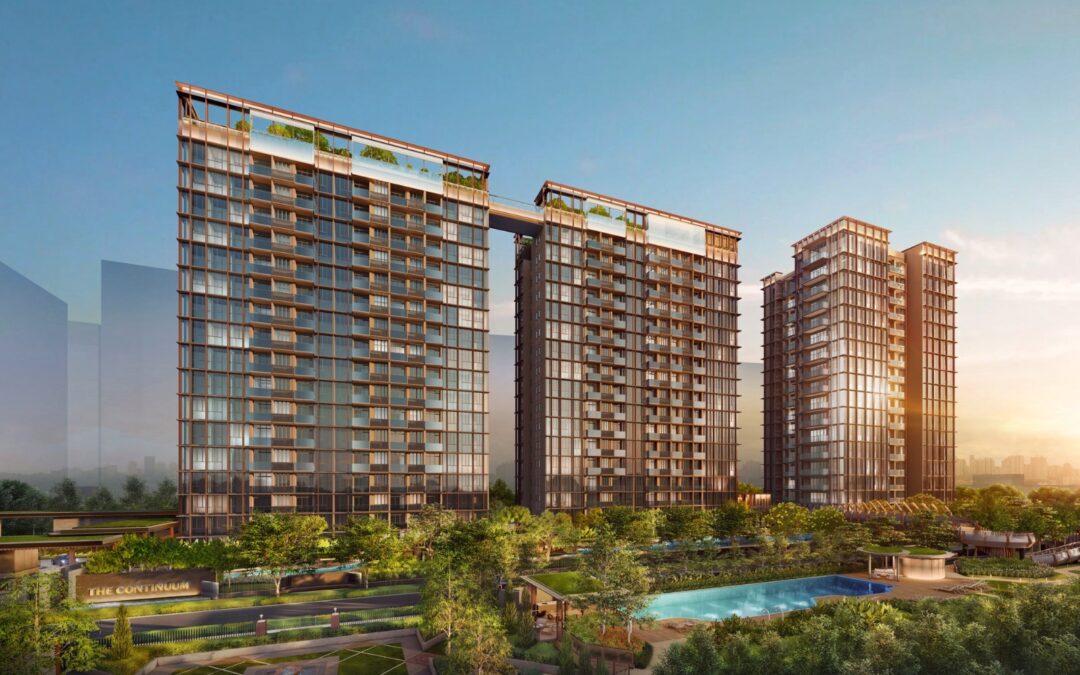
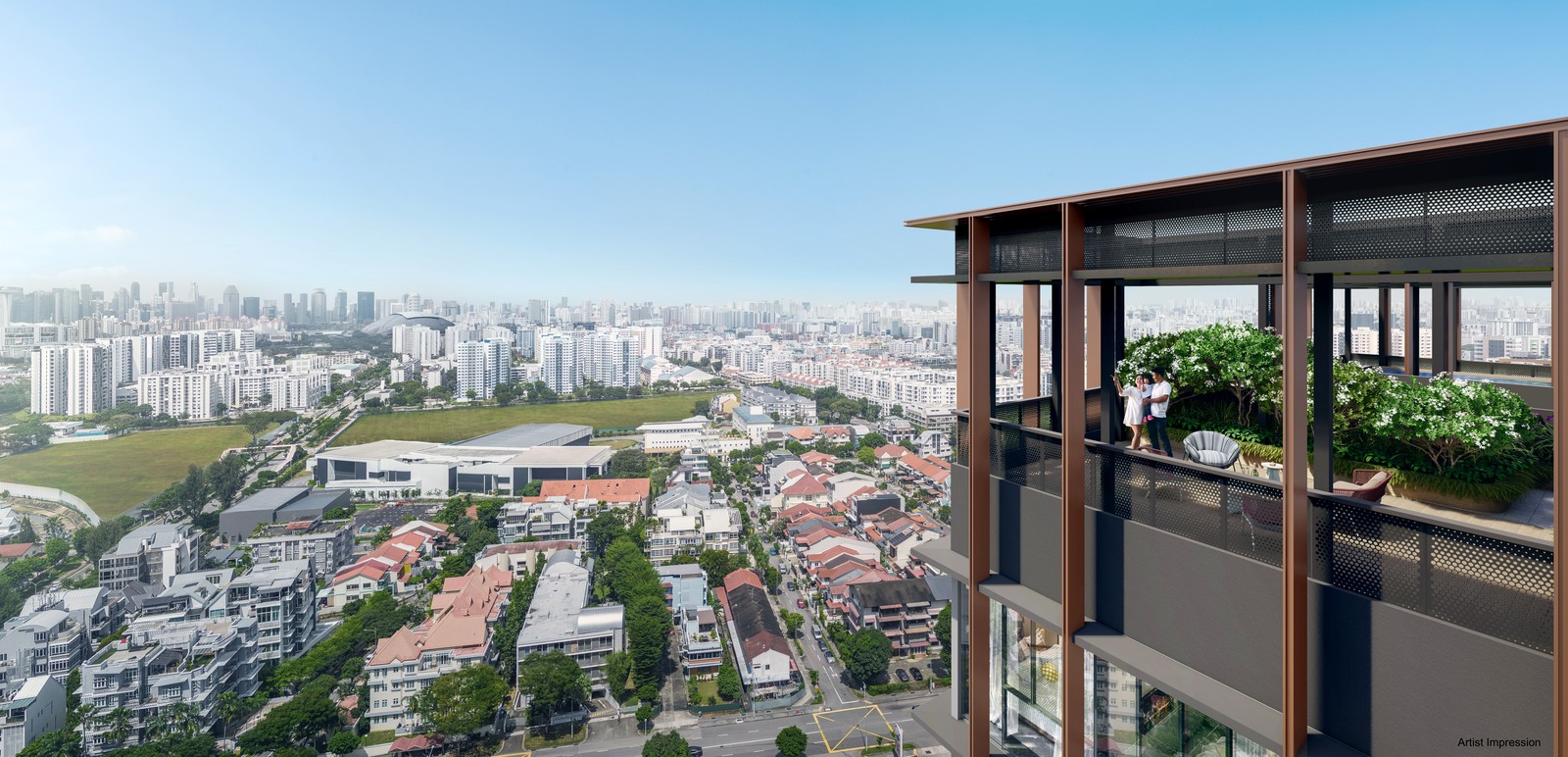
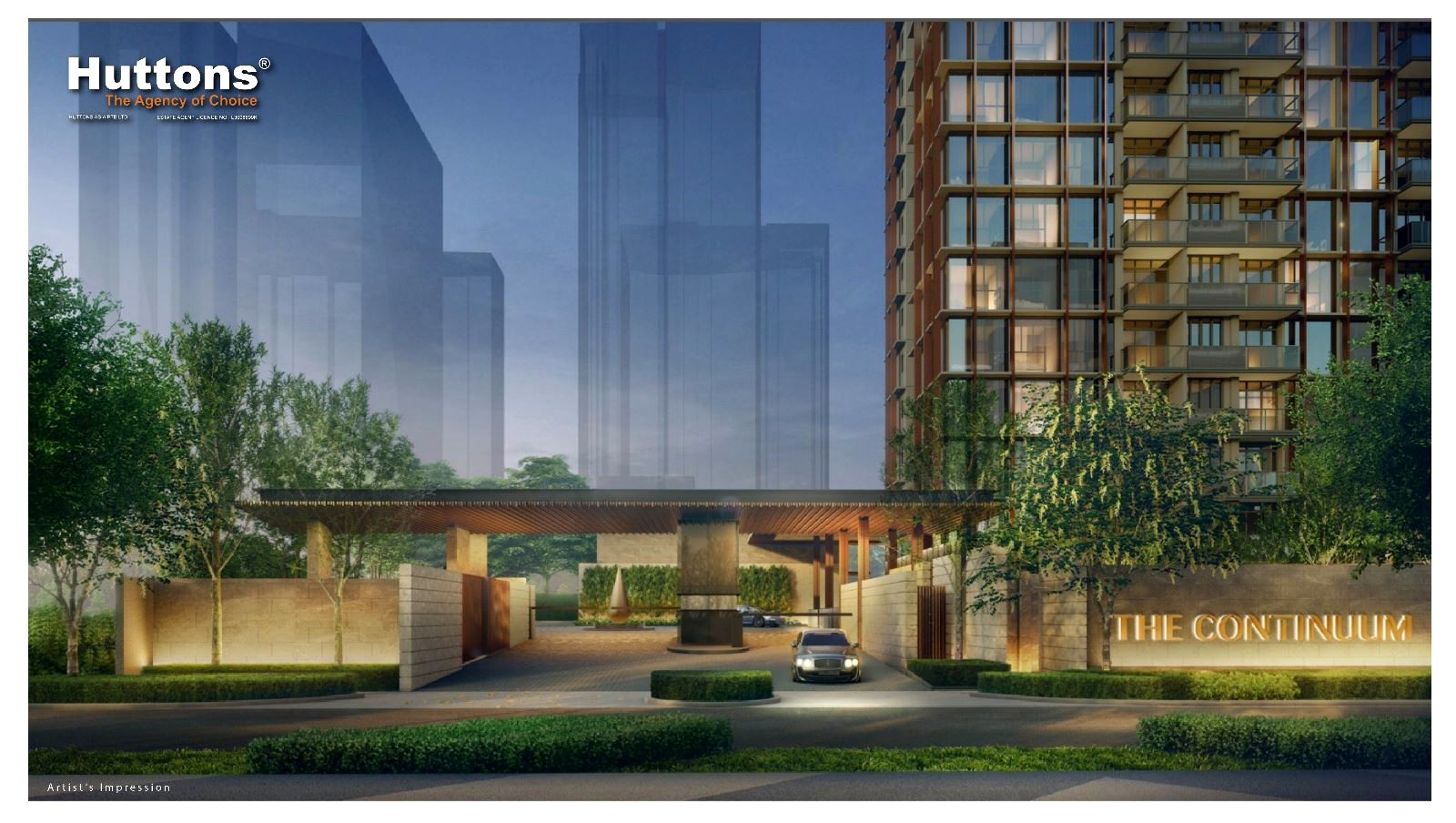
The Continuum The Continuum is a freehold District 15 residence across Thiam Siew Avenue, pairing Katong and Joo Chiat lifestyle access with 816 homes and a broad mix from compact layouts to larger private-lift homes.

01 · Address

D15 Location

1, 3, 5, 2, 6 and 8 Thiam Siew Avenue, Singapore

02 · Scale

816 residential units

4 blocks of 17 storeys and 2 blocks of 18 storeys

03 · Tenure

Freehold / Estate in Fee Simple; airspace bridge lot on 99-year lease from 2 March 2023

Confirm the latest availability before shortlisting.

Project At-a-Glance

Project Name The Continuum
Developer Hoi Hup Sunway Katong Pte Ltd
Address 1, 3, 5, 2, 6 and 8 Thiam Siew Avenue, Singapore
District D15
Tenure Freehold / Estate in Fee Simple; airspace bridge lot on 99-year lease from 2 March 2023
Total Units 816 residential units
Site Area 25,083.2 sqm / 269,995 sqft
Plot Ratio 2.8
Blocks 4 blocks of 17 storeys and 2 blocks of 18 storeys
TOP / VP 17 November 2027 (notice of vacant possession)
Legal Completion 17 November 2030 (notice of completion)

Viewing Preparation

Use the factsheet, selected floor plans and site plan below to compare the north and south plots, unit positions and larger-format layouts.

Confirm current pricing, stack availability and final specifications before booking.

Unit Mix and Sizes

Bedroom Type Size / Range Availability Note
1 Bedroom See floor plans below Subtype count varies by latest balance-unit list
1 Bedroom + Study See floor plans below Subtype count varies by latest balance-unit list
2 Bedroom / 2 Bedroom + Study See floor plans below Subtype count varies by latest balance-unit list
3 Bedroom / 3 Bedroom + Study See floor plans below Subtype count varies by latest balance-unit list
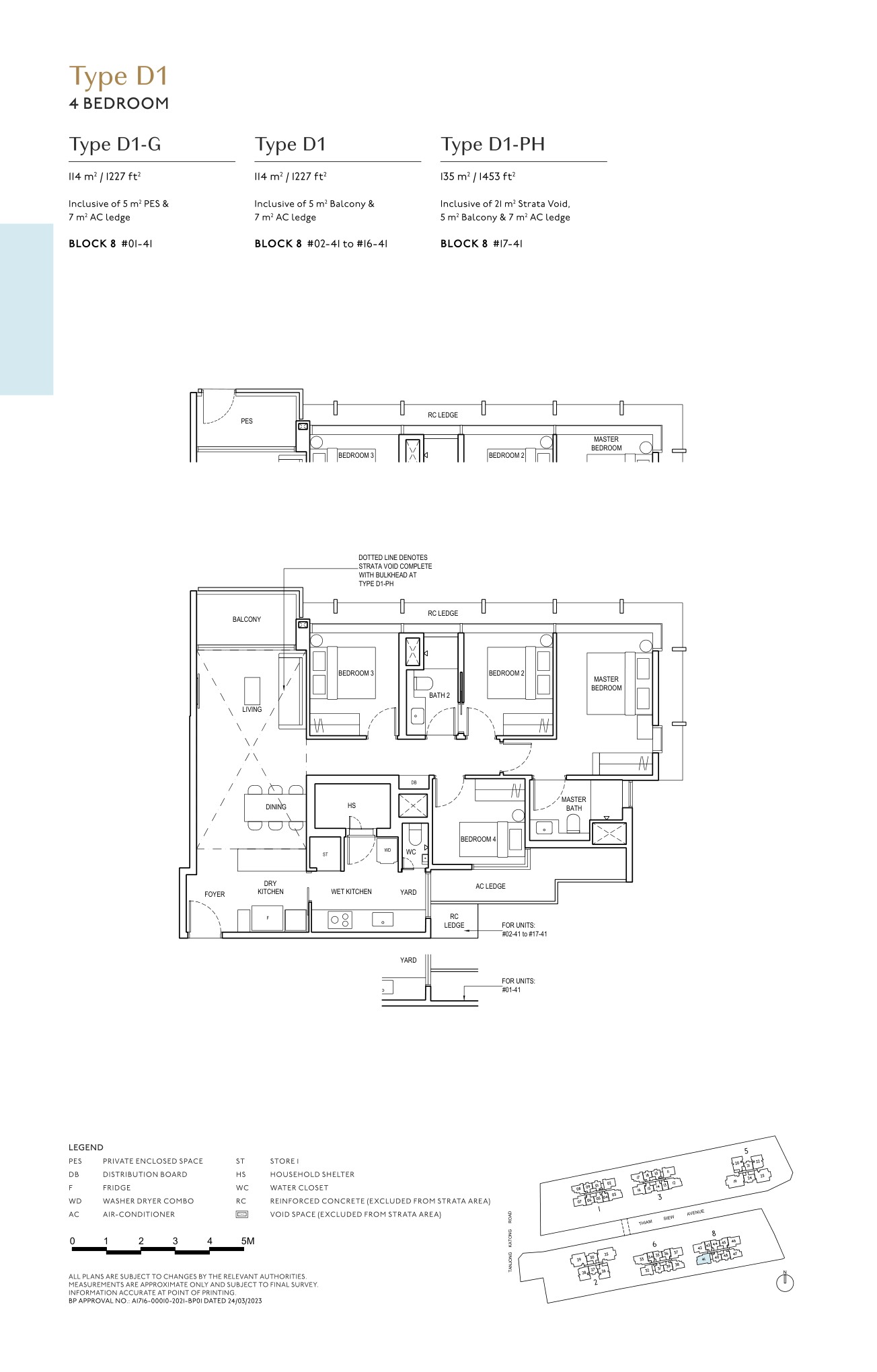
4 Bedroom See floor plans below Subtype count varies by latest balance-unit list
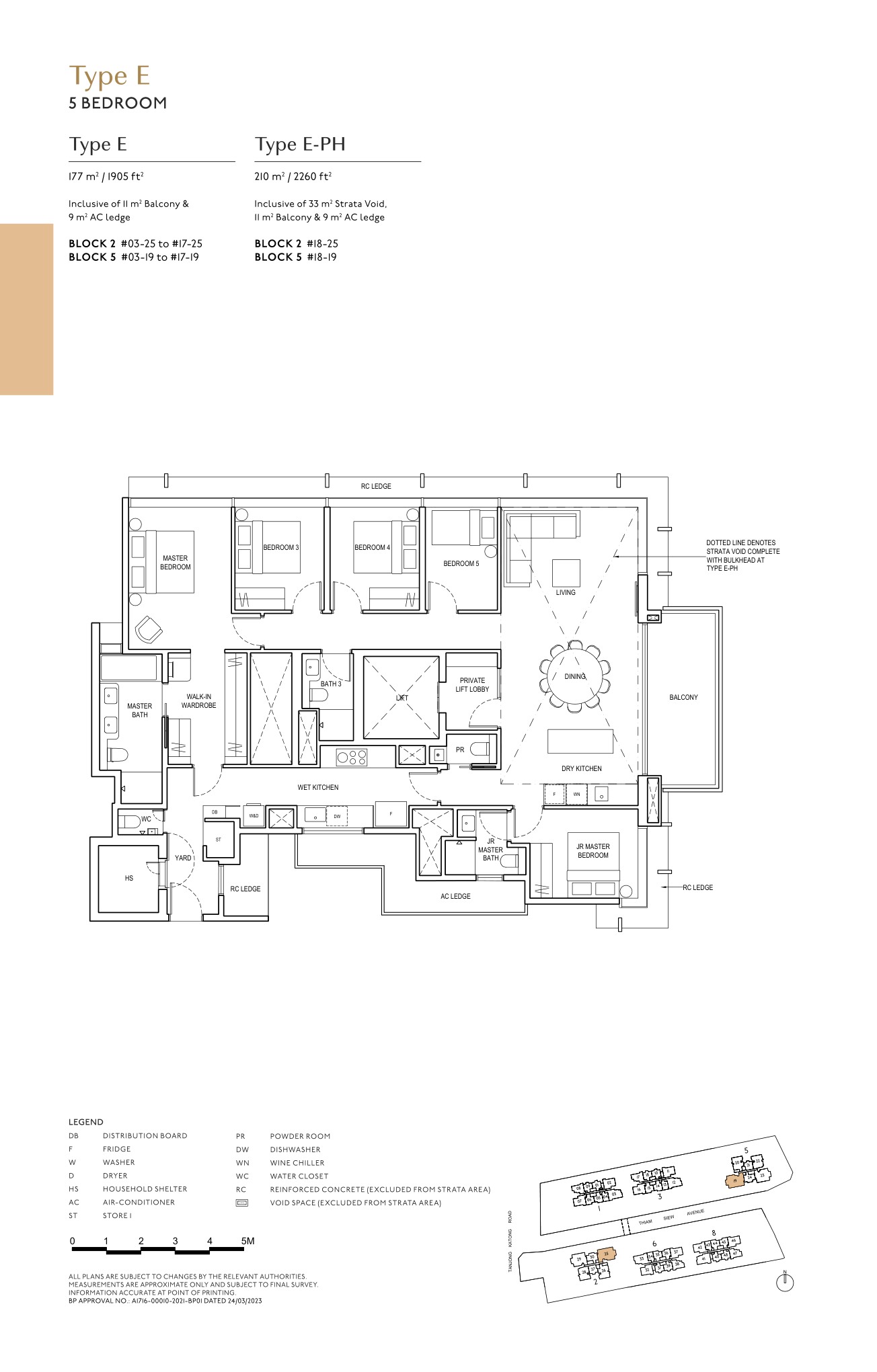
5 Bedroom See floor plans below Subtype count varies by latest balance-unit list

Unit areas and availability may change. Confirm the latest stack, price and size information before shortlisting.

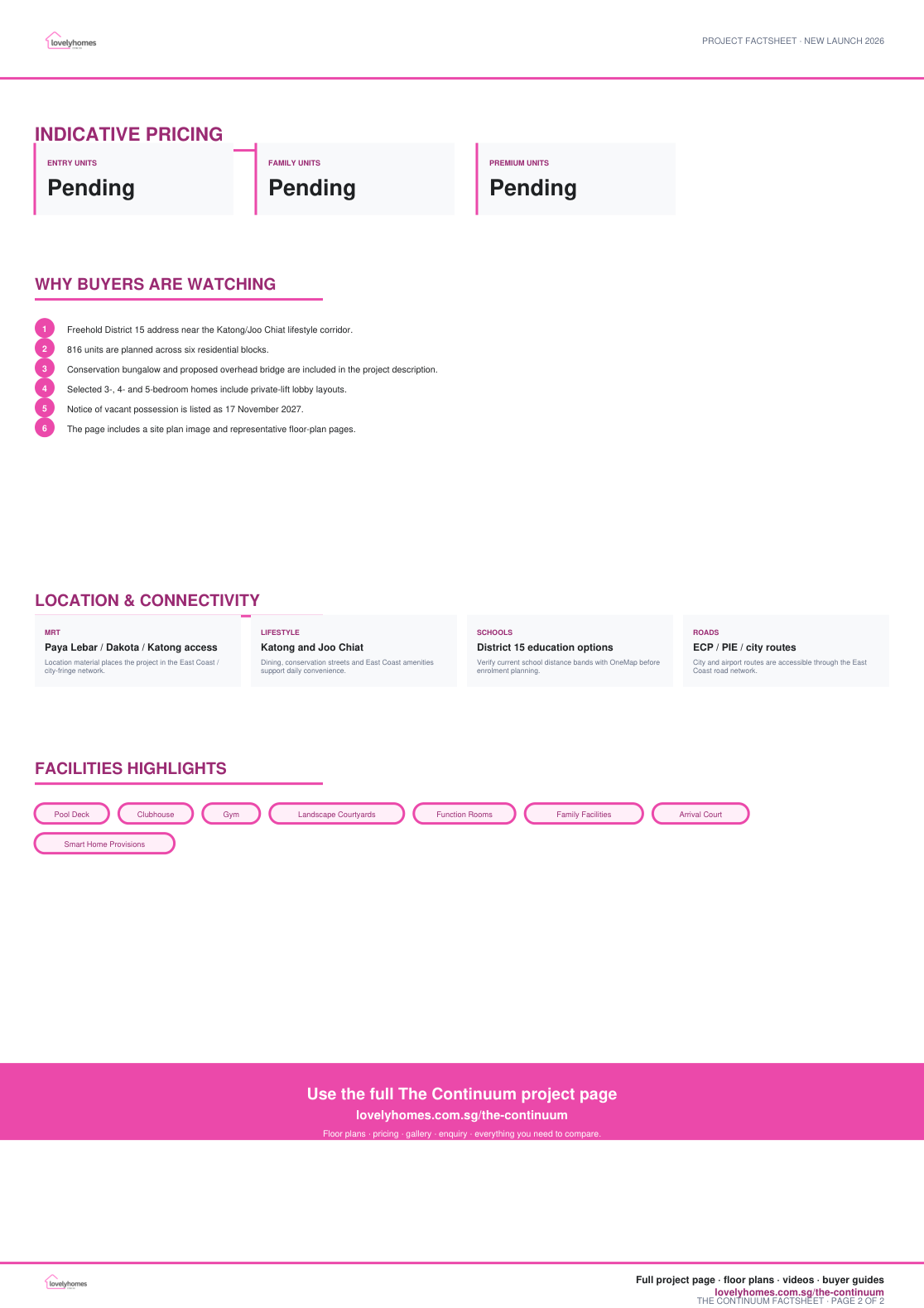
Indicative Pricing

Entry Units
From S$1.378M

1BR + Study, 560 sqft

3BR Units
From S$2.880M

3BR, 1,076-1,141 sqft

Larger Units
From S$3.653M

4BR; 5BR from S$5.487M

Available units from S$1.378M; 3BR from S$2.880M, 3BR+Study from S$3.372M, 4BR from S$3.653M, 4BR Premier from S$4.481M and 5BR from S$5.487M. Source: The Continuum public price list updated 7 Mar 2026, accessed 29 Apr 2026.

Why Buyers Are Watching

  1. 1
    Freehold District 15 address near the Katong/Joo Chiat lifestyle corridor.
  2. 2
    816 units are planned across six residential blocks.
  3. 3
    Conservation bungalow and proposed overhead bridge are included in the project description.
  4. 4
    Selected 3-, 4- and 5-bedroom homes include private-lift lobby layouts.
  5. 5
    Notice of vacant possession is listed as 17 November 2027.
  6. 6
    The page includes a site plan image and representative floor-plan pages.

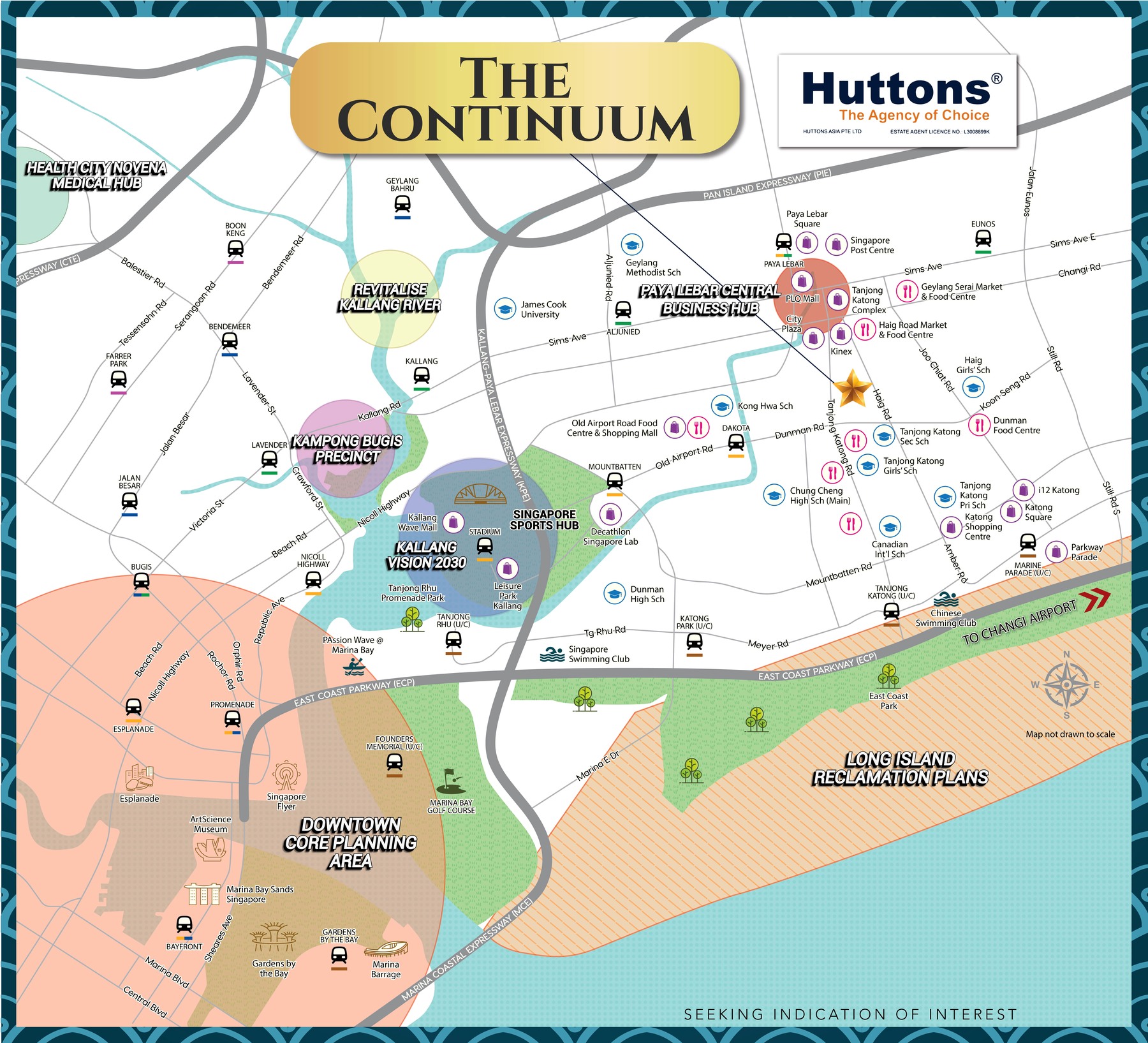
Location and Connectivity

MRT

Paya Lebar / Dakota / Katong access

Location material places the project in the East Coast / city-fringe network.

Lifestyle

Katong and Joo Chiat

Dining, conservation streets and East Coast amenities support daily convenience.

Schools

District 15 education options

Verify current school distance bands with OneMap before enrolment planning.

Roads

ECP / PIE / city routes

City and airport routes are accessible through the East Coast road network.

The Continuum location map

Schools Nearby

School Planning Confirm current school distance bands and eligibility with OneMap and MOE before relying on any school-distance claim.

Lifestyle and Amenities

Daily Convenience

Review nearby retail, food, transport and park connections before shortlisting stacks.

Neighbourhood Fit

Compare the surrounding precinct with your commute, school and lifestyle needs.

Viewing Check

Confirm walking routes, traffic patterns and future works during your site visit.

Site Plan

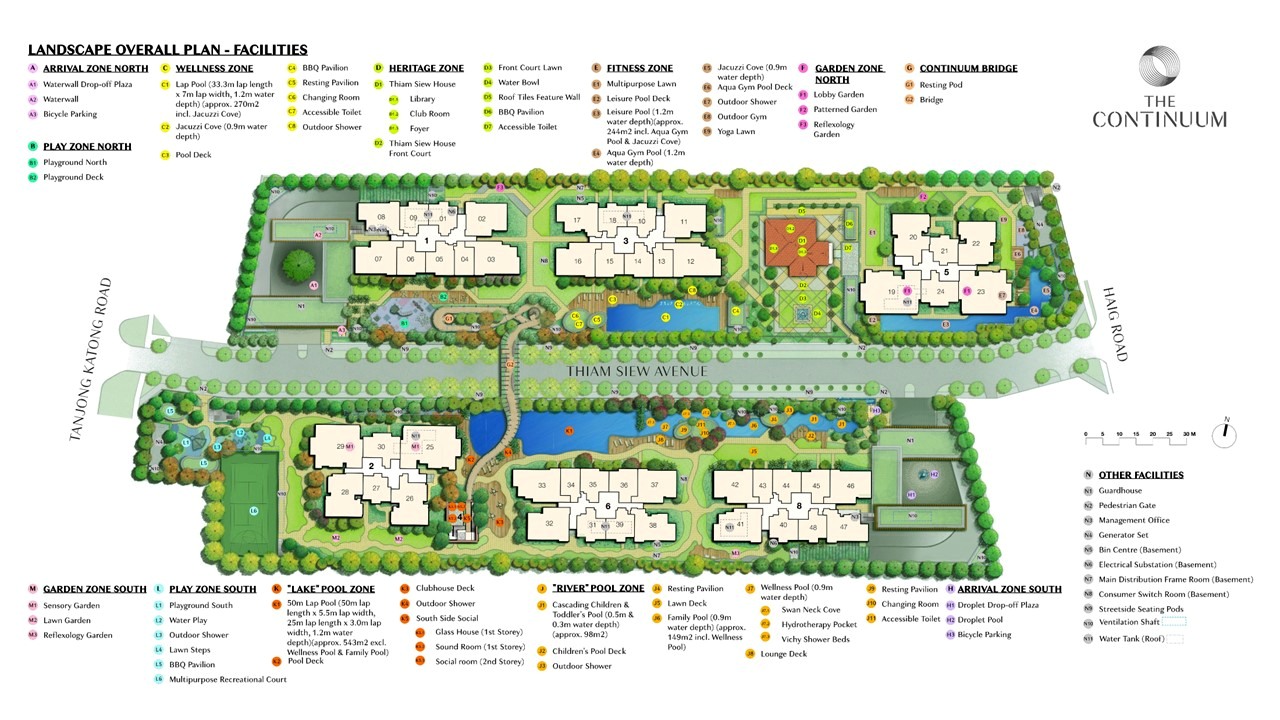
The Continuum actual site plan

Actual site plan showing blocks, facilities, access points and internal landscaping.

Floor Plans (Selected)

Representative actual floor plans by unit type. The full floor-plan PDF belongs in the download button below this section.

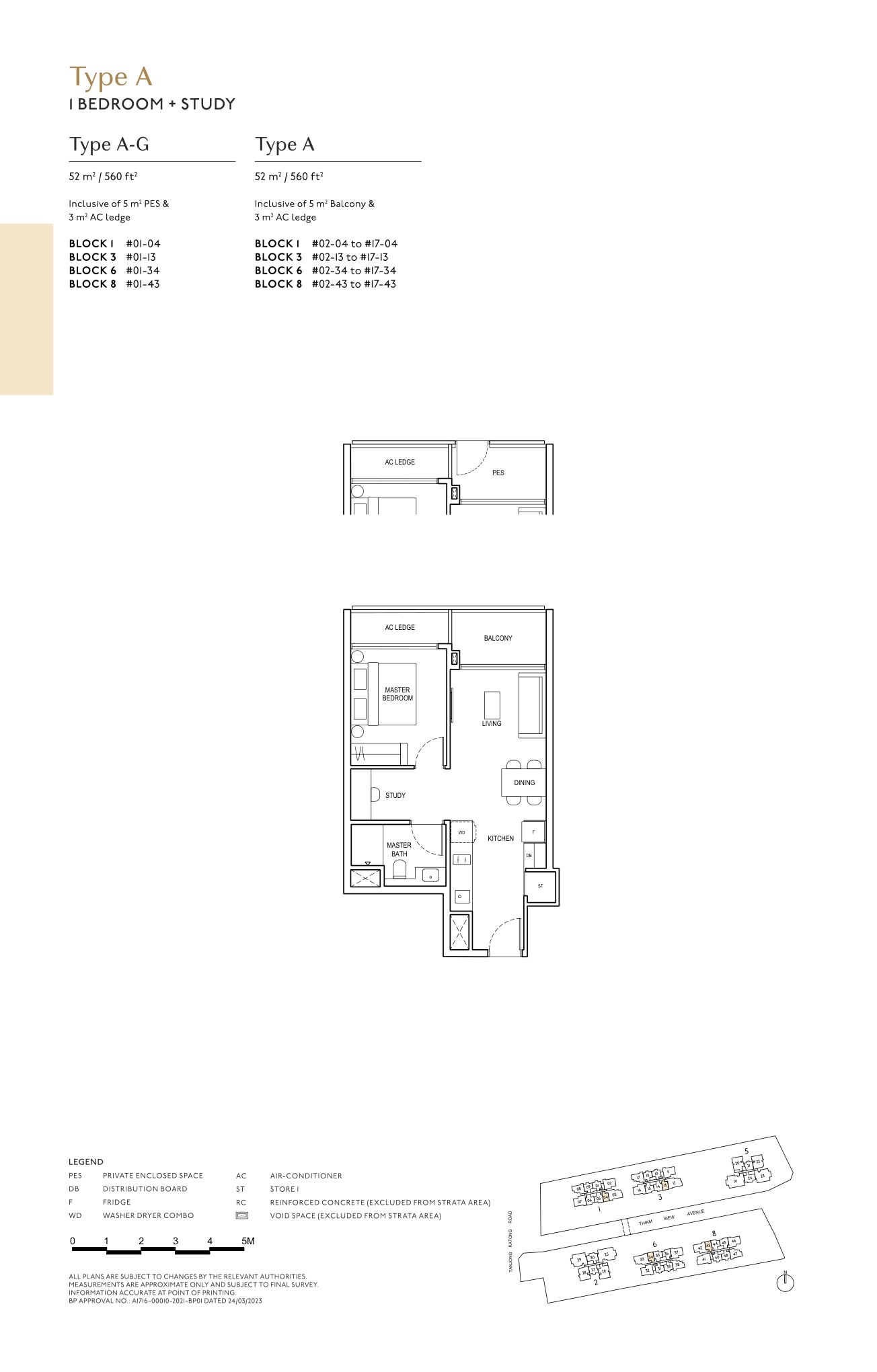
The Continuum 1 Bedroom Type A floor plan

1 Bedroom Type A
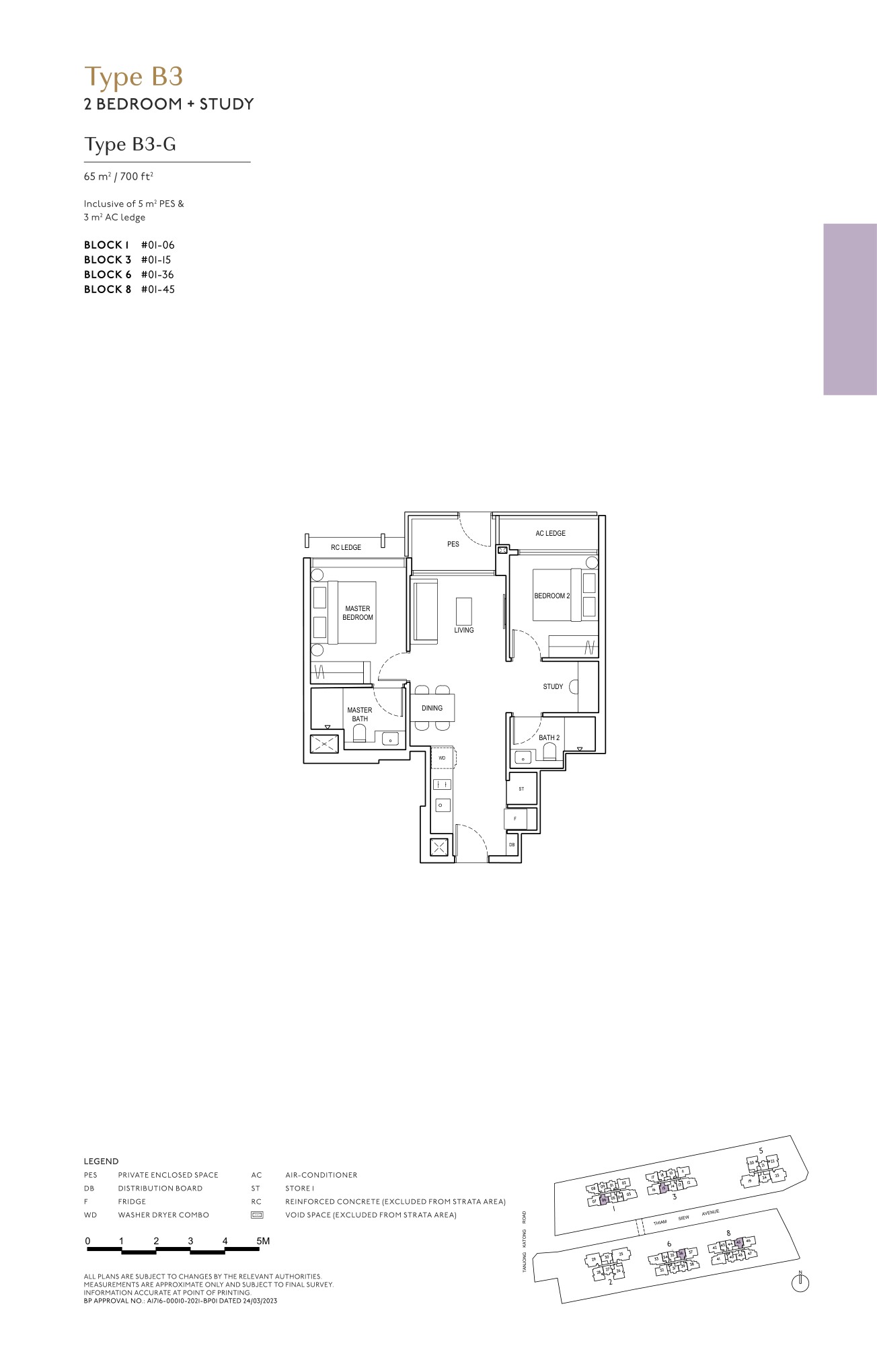
The Continuum 2 Bedroom + Study Type B floor plan

2 Bedroom + Study Type B
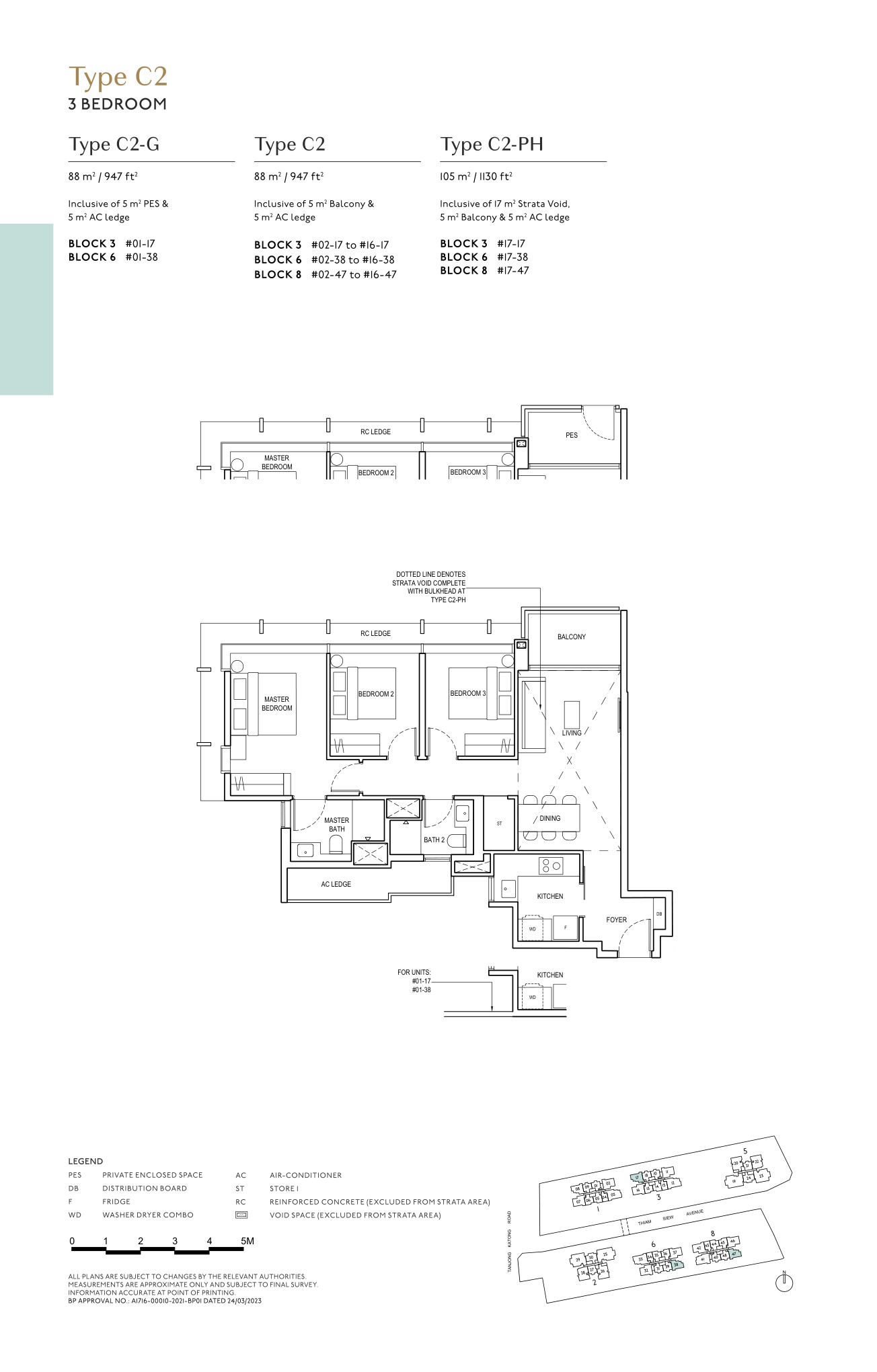
The Continuum 3 Bedroom Type C floor plan

3 Bedroom Type C
The Continuum 4 Bedroom Type D floor plan

4 Bedroom Type D
The Continuum 5 Bedroom Type E floor plan

5 Bedroom Type E
Full Floor Plans PDF
Selected layout pages prepared as a clean PDF download.

Download Full Floor Plan PDF

Elevation and Stack Chart

Refer to the site plan, selected layouts and full floor-plan PDF for stack orientation, floor levels and facing checks.

Facilities (30+)

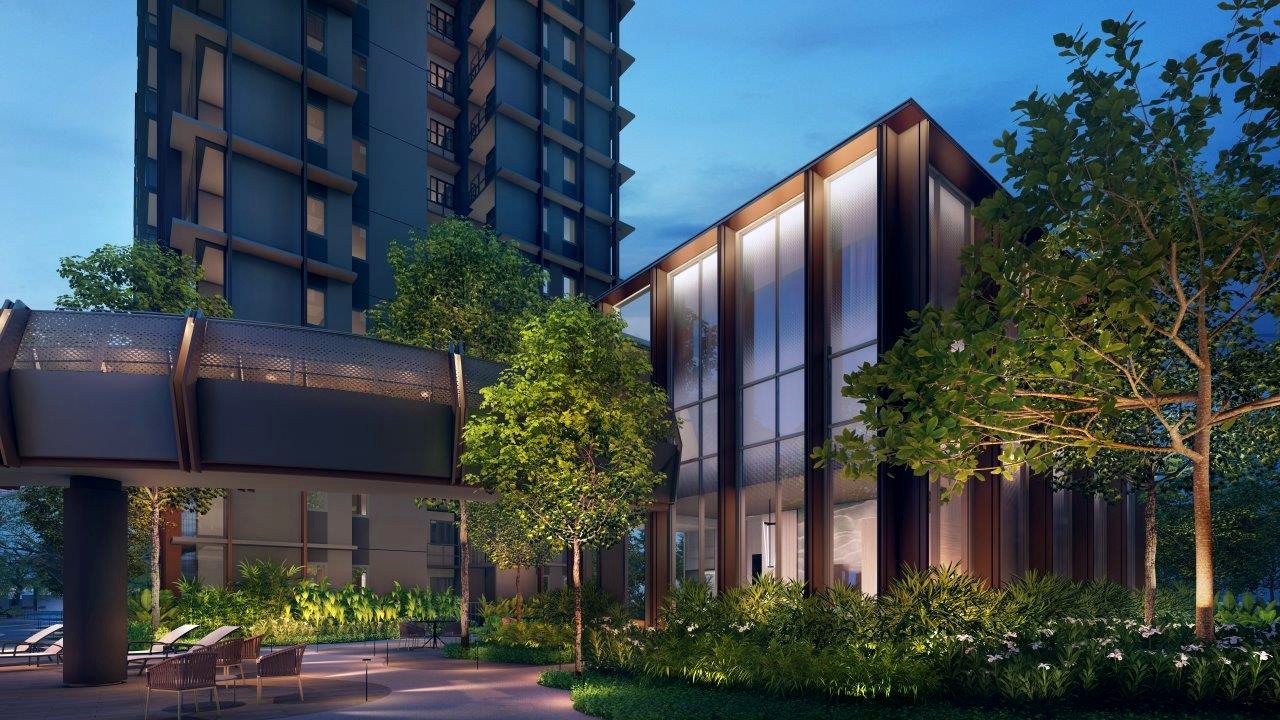
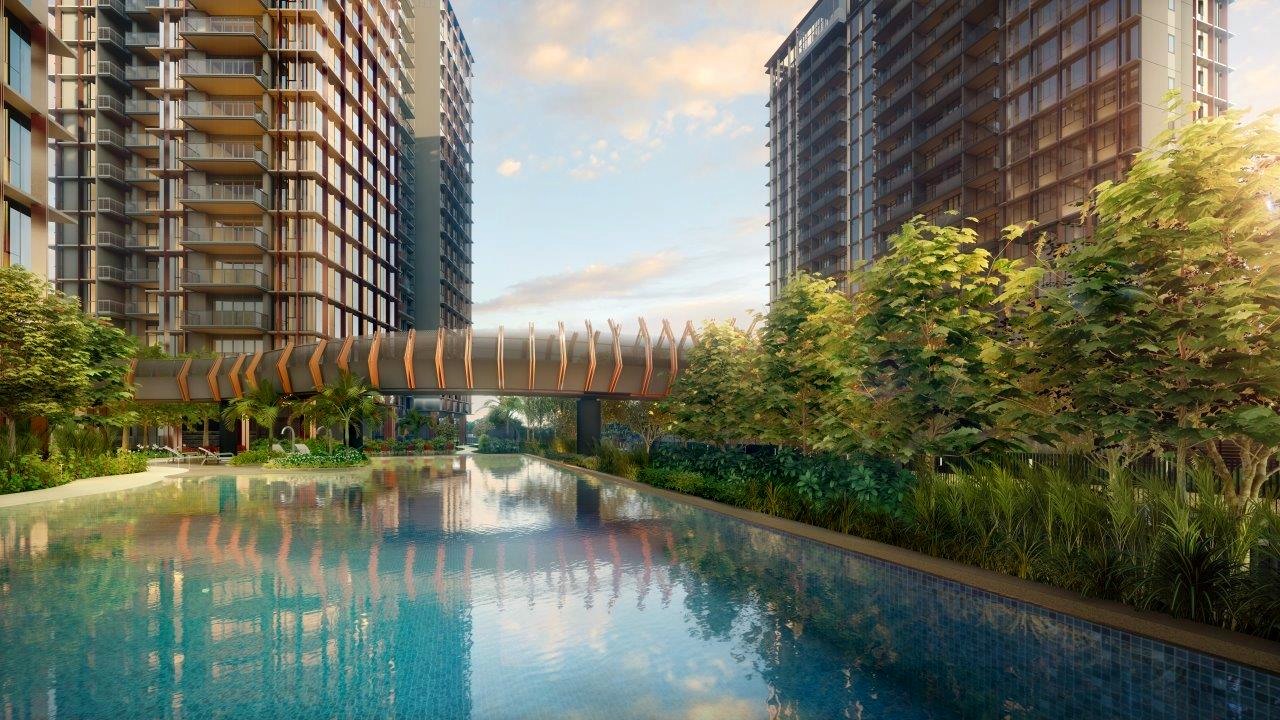
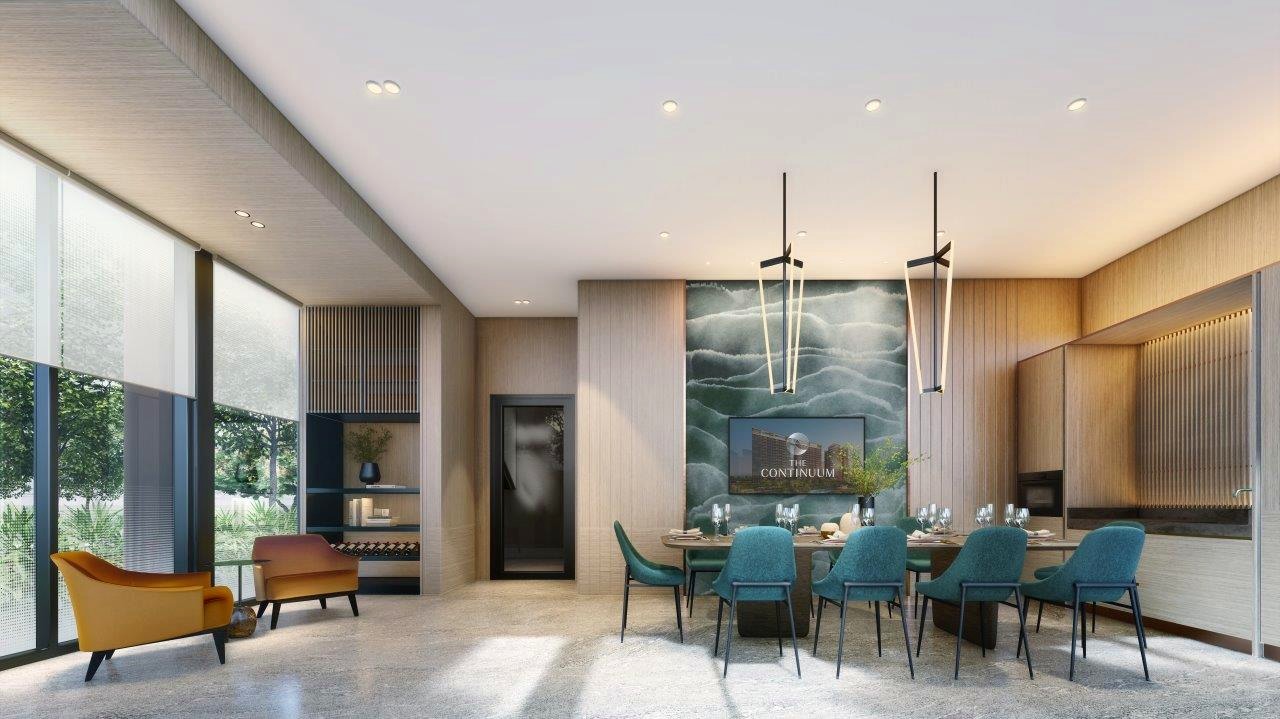
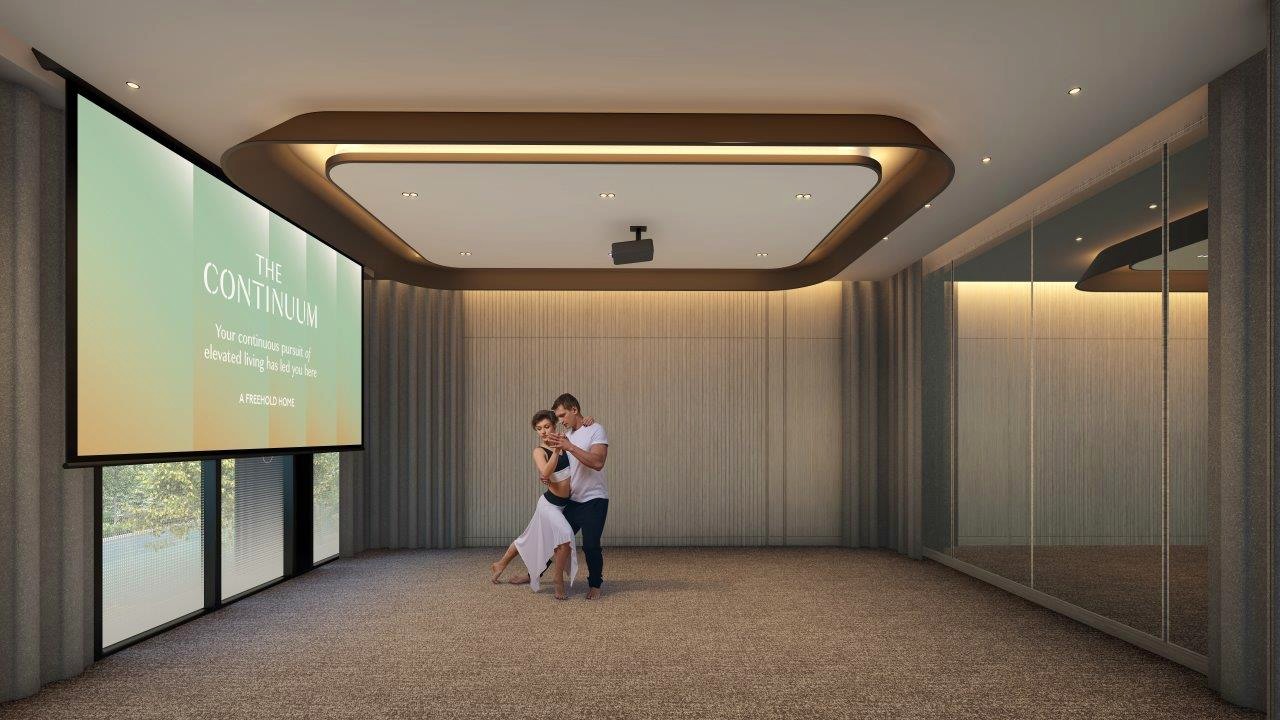
Pool DeckClubhouseGymLandscape CourtyardsFunction RoomsFamily FacilitiesArrival CourtSmart Home Provisions

Gallery

Developer and Consultant Team

Hoi Hup Sunway Katong Pte Ltd

Before committing, verify the latest developer licence, project account details and contractual documents with the appointed sales team.

Sustainability and Specifications

Specifications, finishes, smart-home provisions and sustainability ratings vary by unit. Refer to the latest developer brochure and sale documents for final approved details.

Project Timeline

Launch / Sales Phase Live new-launch project page
TOP / Vacant Possession 17 November 2027 (notice of vacant possession)
Legal Completion 17 November 2030 (notice of completion)

Project Factsheet

A shareable 2-page PDF snapshot of everything on this page — bring it to viewings, forward it to family.

Download the Full Sales Pack

PDF · Factsheet

The Continuum Factsheet

2-page project factsheet with key facts, unit mix and buyer notes.

Download Factsheet

PDF · Floor Plans

Full Floor Plans

Selected floor-plan pages and layouts for quick comparison.

Download Floor Plans

Image · Site Plan

Site Plan

Site plan showing blocks, facilities and arrival points.

Download Site Plan

Frequently Asked Questions

Where is The Continuum located?
1, 3, 5, 2, 6 and 8 Thiam Siew Avenue, Singapore
Who is the developer?
Hoi Hup Sunway Katong Pte Ltd
How many units are there?
816 residential units
What is the current from-price?
Available units start from S$1.378M based on the public price list updated 7 Mar 2026. Confirm stack-specific pricing, discounts and availability before shortlisting.

Ready to see The Continuum in person?

Request current availability, developer pricing, showflat slots and financing checks.

Enquire Now

Related Buying Guides

ABSD Singapore 2026

Stamp-duty planning before purchase.

Condo Buying Guide

Budget, timeline and financing basics.

Property Investment

Holding cost and exit considerations.

Disclaimer: Prices, availability, areas, specifications and timelines may change without notice. Buyers should verify all details with the developer-appointed sales team and relevant authorities before committing.

Translate »