Singapore Property Buyers Checklist 2026: Complete Step-by-Step Guide for HDB and Private Property Buyers
Quick Answer: Singapore Property Buyers Checklist 2026
- Singapore property buyers need a valid HDB Flat Eligibility (HFE) Letter (for HDB) or Approval-in-Principle (AIP) (for private) before making any offer.
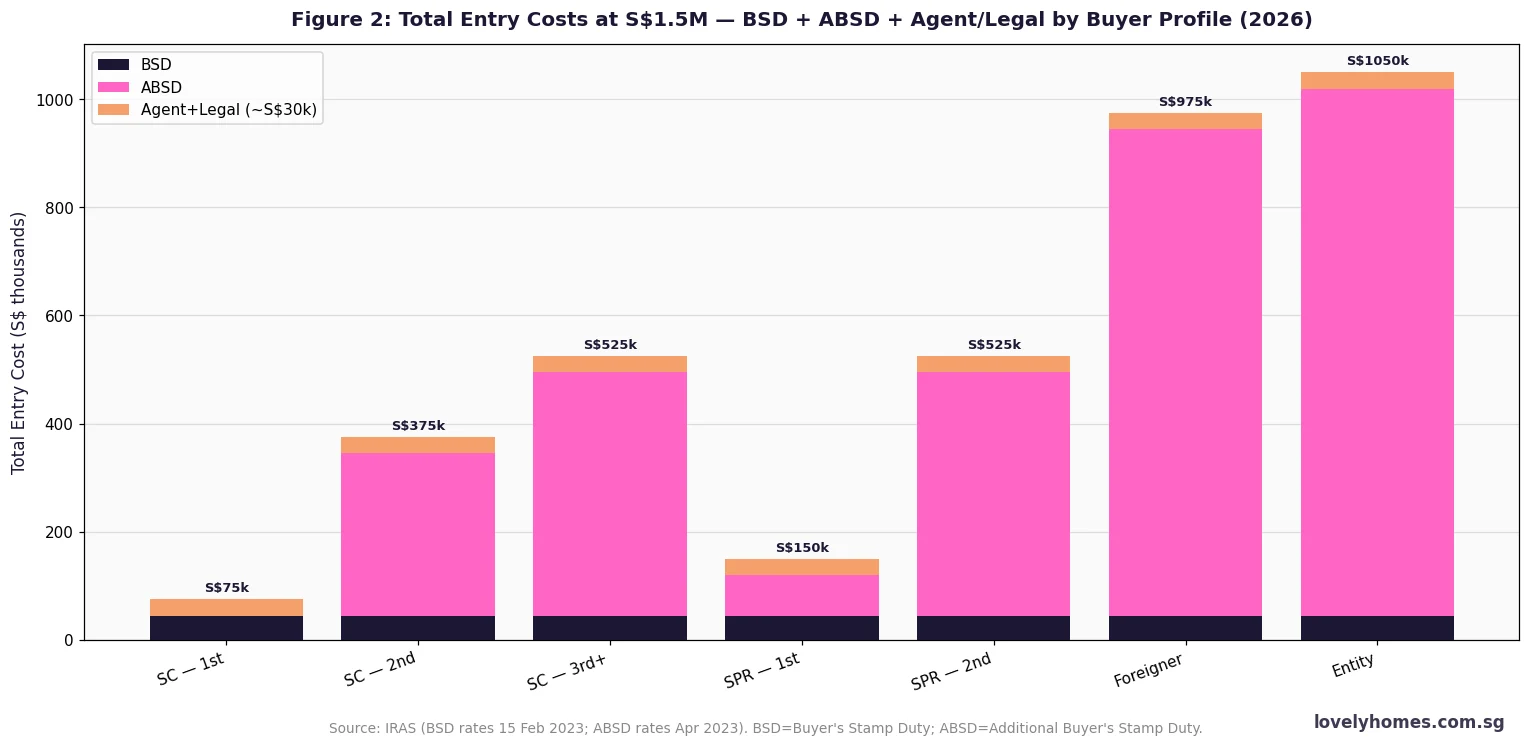
- Buyer’s Stamp Duty (BSD) is payable within 14 days of signing the Option to Purchase. For a S$1.5M property, BSD is approximately S$44,600.
- Additional Buyer’s Stamp Duty (ABSD) applies to second and subsequent properties, and to SPRs on their first purchase. Singapore Citizens buying their first property pay no ABSD.
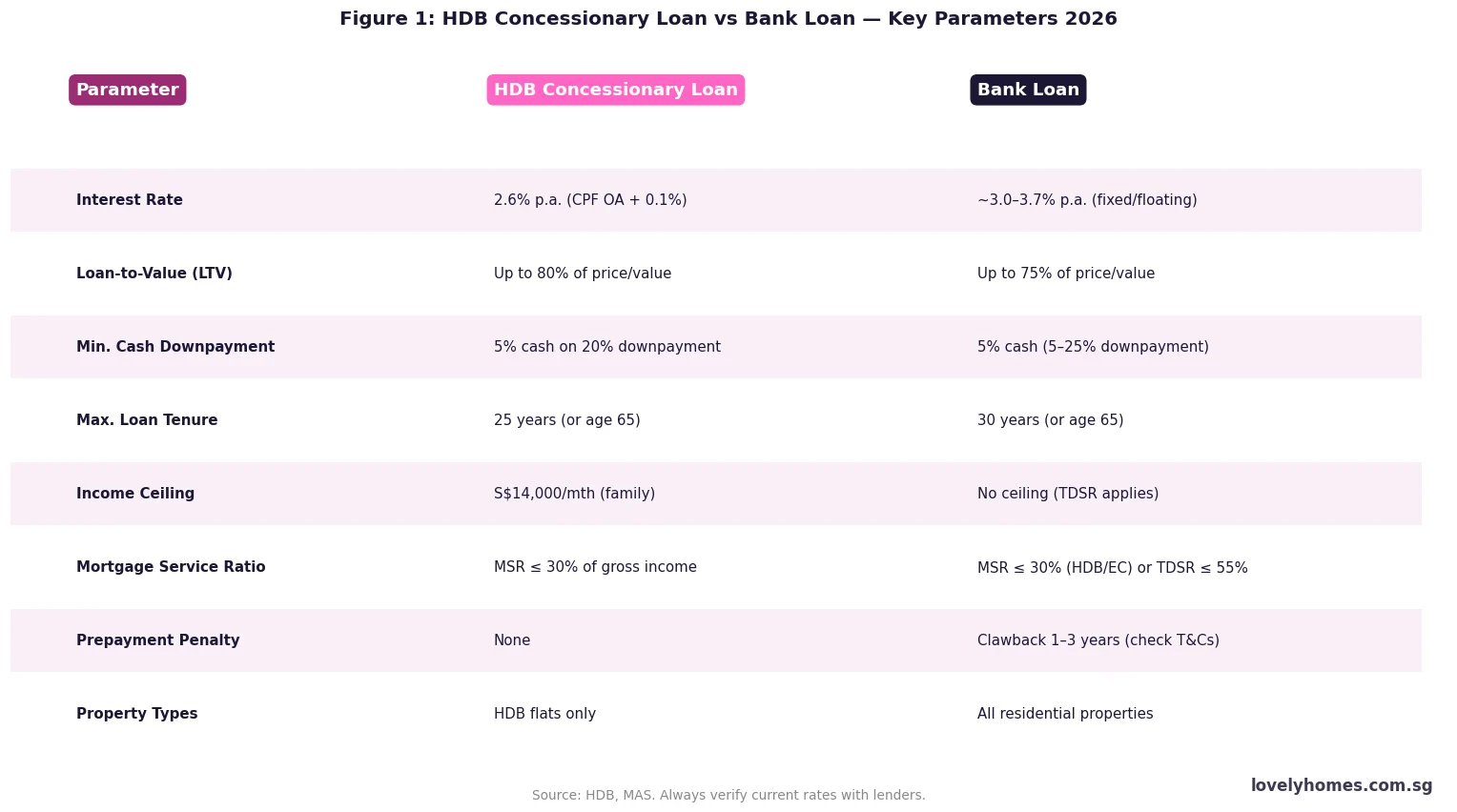
- The Total Debt Servicing Ratio (TDSR) cap is 55% of gross monthly income. For HDB loans, the Mortgage Servicing Ratio (MSR) cap is 30%.
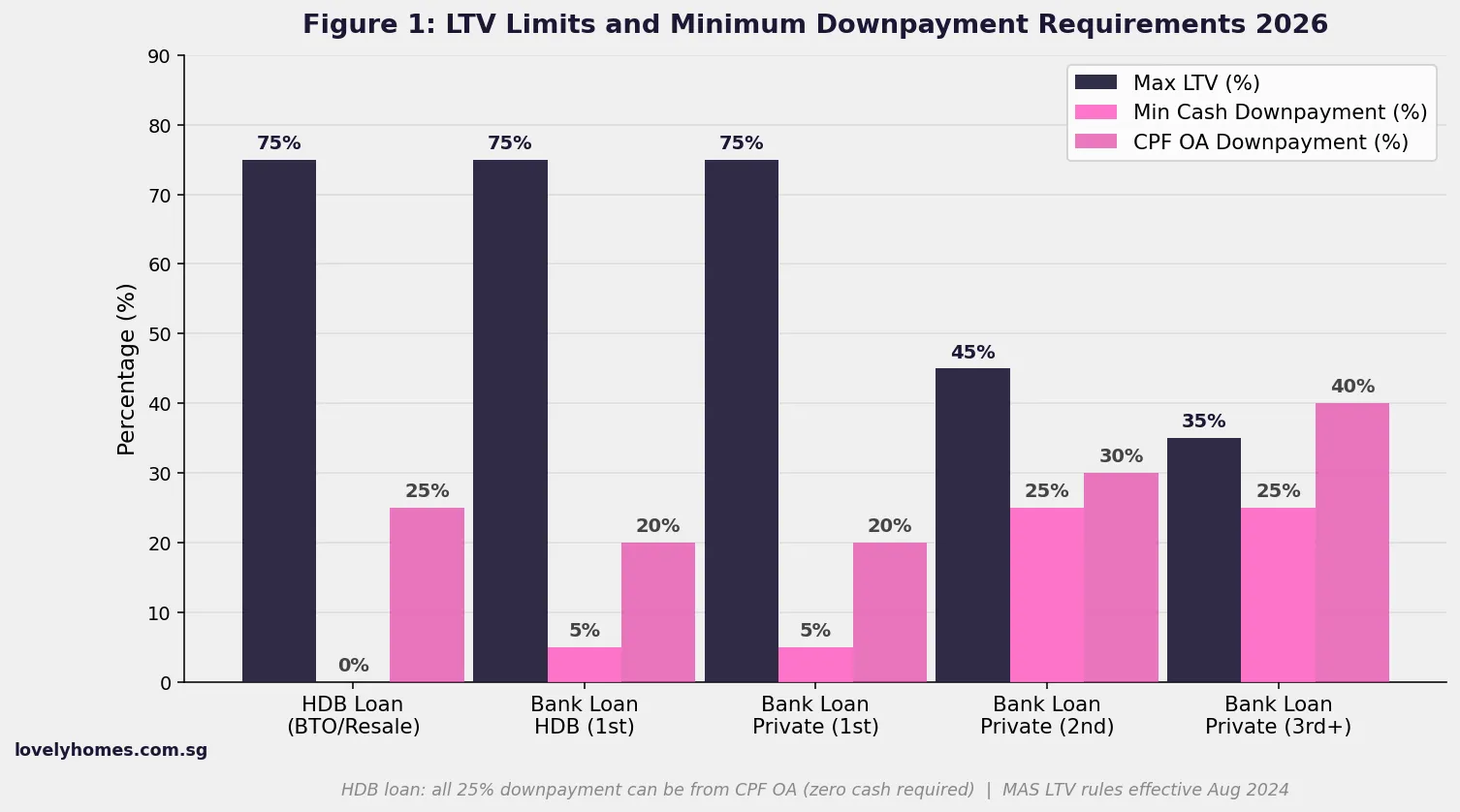
- HDB buyers need a minimum cash outlay of 5% for bank loans; the remainder of the downpayment may be from CPF OA.
- Private property completions follow a 10- to 12-week timeline from OTP exercise; BTO flats take 4–5 years from selection.
- Legal fees for a S$1.5M property typically run S$3,500–S$5,000 for conveyancing.
- Hire a CEA-registered agent (verify at cea.gov.sg) and engage an independent conveyancing solicitor separate from the seller’s.
I. Why a Property Buyers Checklist Matters in 2026
Buying property in Singapore is the largest financial commitment most households will ever make. A typical OCR condominium in 2026 transacts at between S$1.1 million and S$2.0 million; an HDB resale flat in a prime town can breach S$900,000. Yet the buying process involves more than a dozen discrete steps spread across multiple government agencies, financiers, and legal professionals — and missing any single one can cost thousands of dollars in penalties or stamp duties, or forfeit an Option to Purchase.
This checklist consolidates every step that property buyers in Singapore need to complete, from the initial financial health check to the moment keys are handed over. It applies to both HDB (resale and Build-to-Order) and private residential property (new launch and resale). Where rules differ between the two, both are stated explicitly.
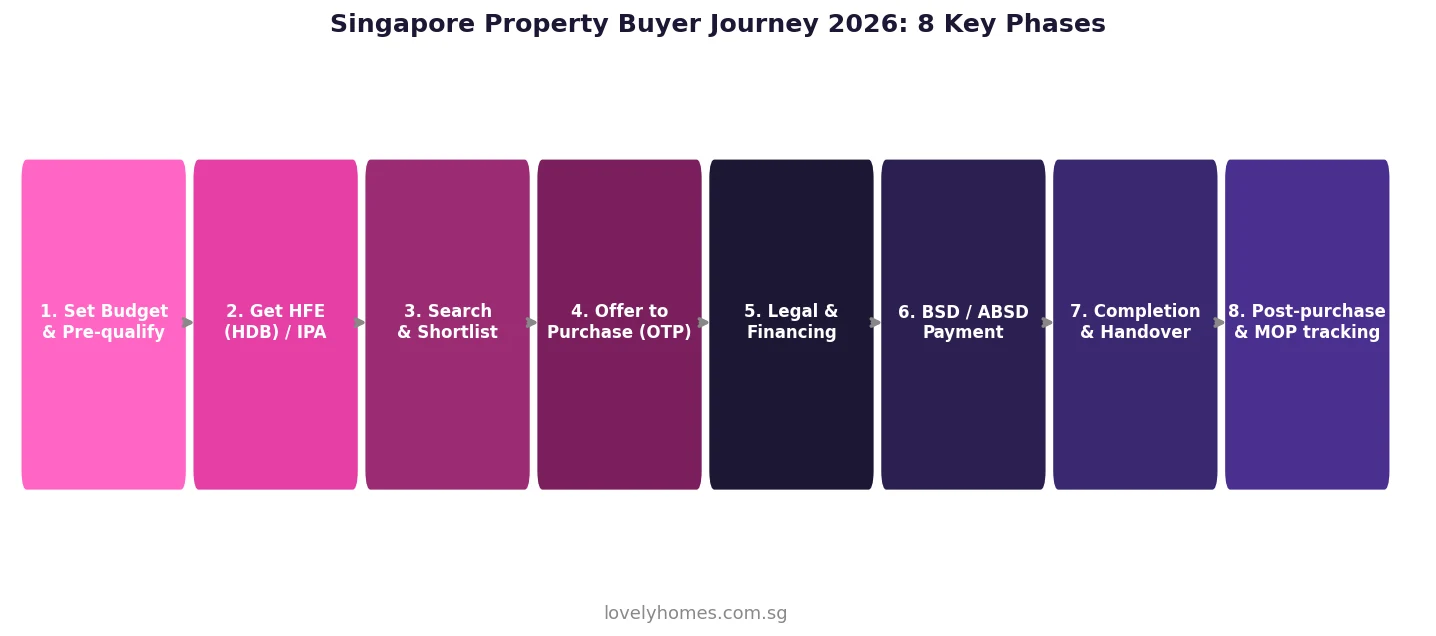
II. Phase 1 — Set Your Budget and Eligibility
Before viewing a single property, every buyer should run through a financial and eligibility checklist. This phase sets the parameters for everything that follows.
Financial ceiling checks
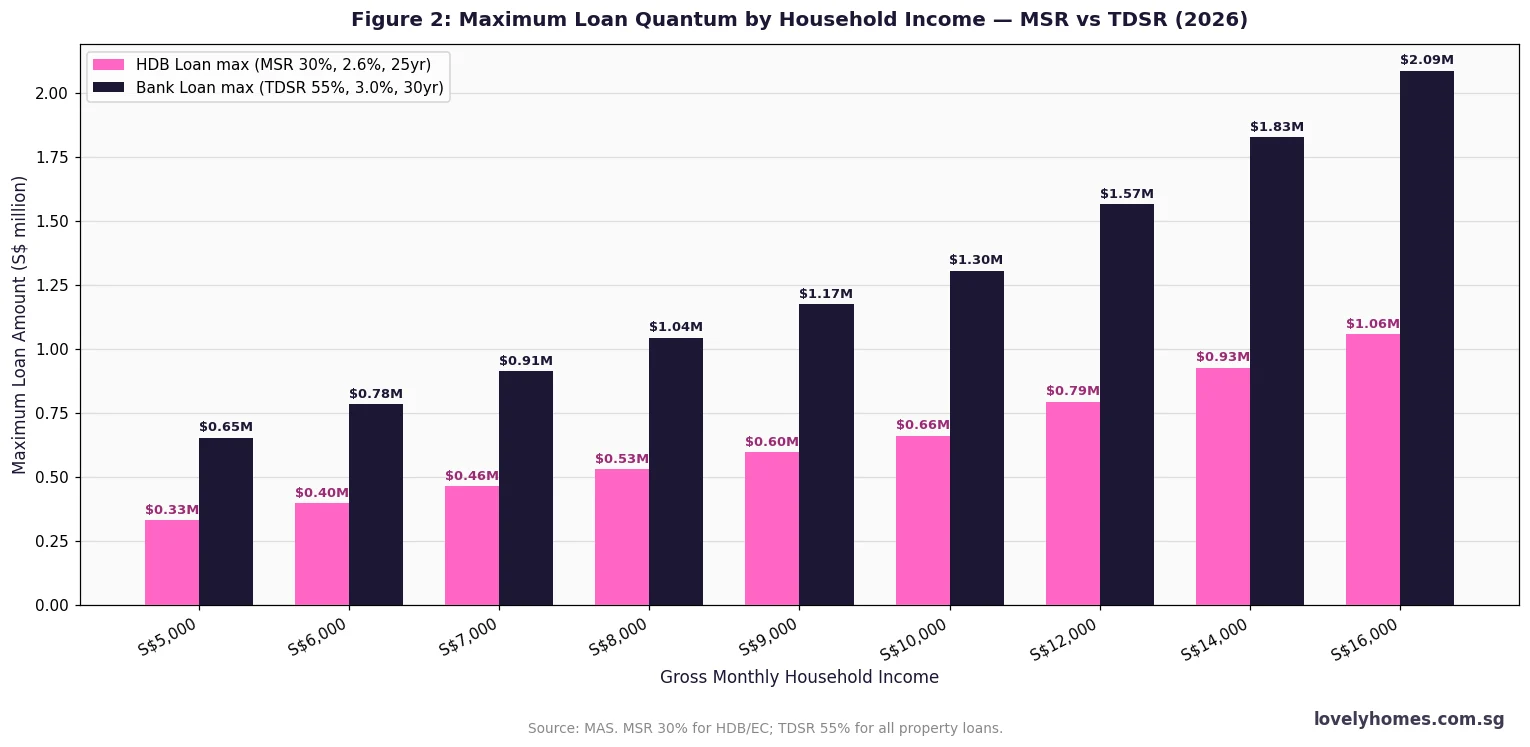
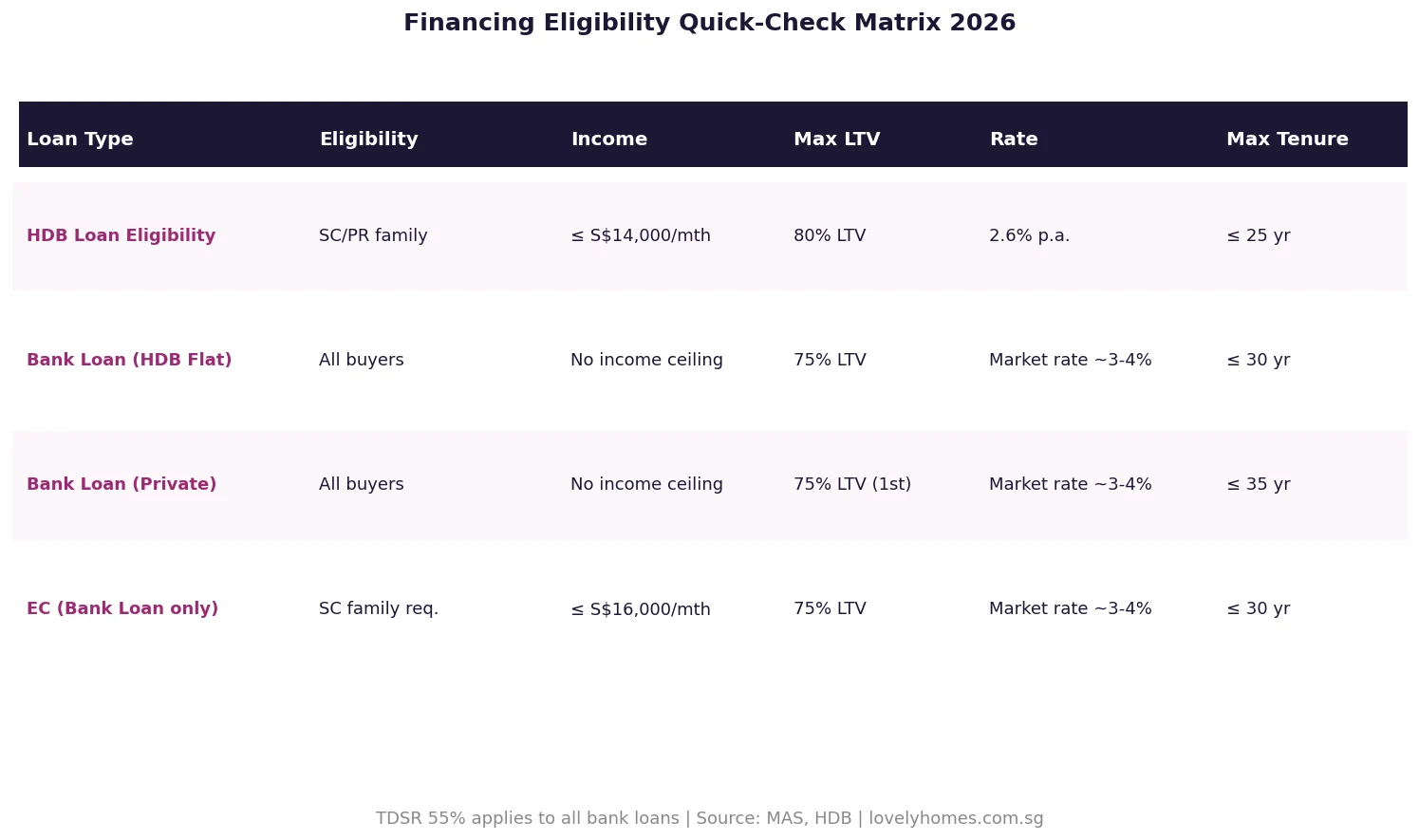
Your maximum loan quantum is determined by the TDSR (55% of gross monthly income for bank loans) and the MSR (30% for HDB loans on HDB flats). Your CPF Ordinary Account balance, less any accrued interest owed, determines how much CPF you can deploy toward the downpayment and monthly repayments. For private property, the CPF Withdrawal Limit (WL) caps how much you can ever draw from CPF for a given property based on its remaining lease at time of purchase — buyers of leasehold properties with fewer than 60 years remaining face proration.
Stamp duty exposure
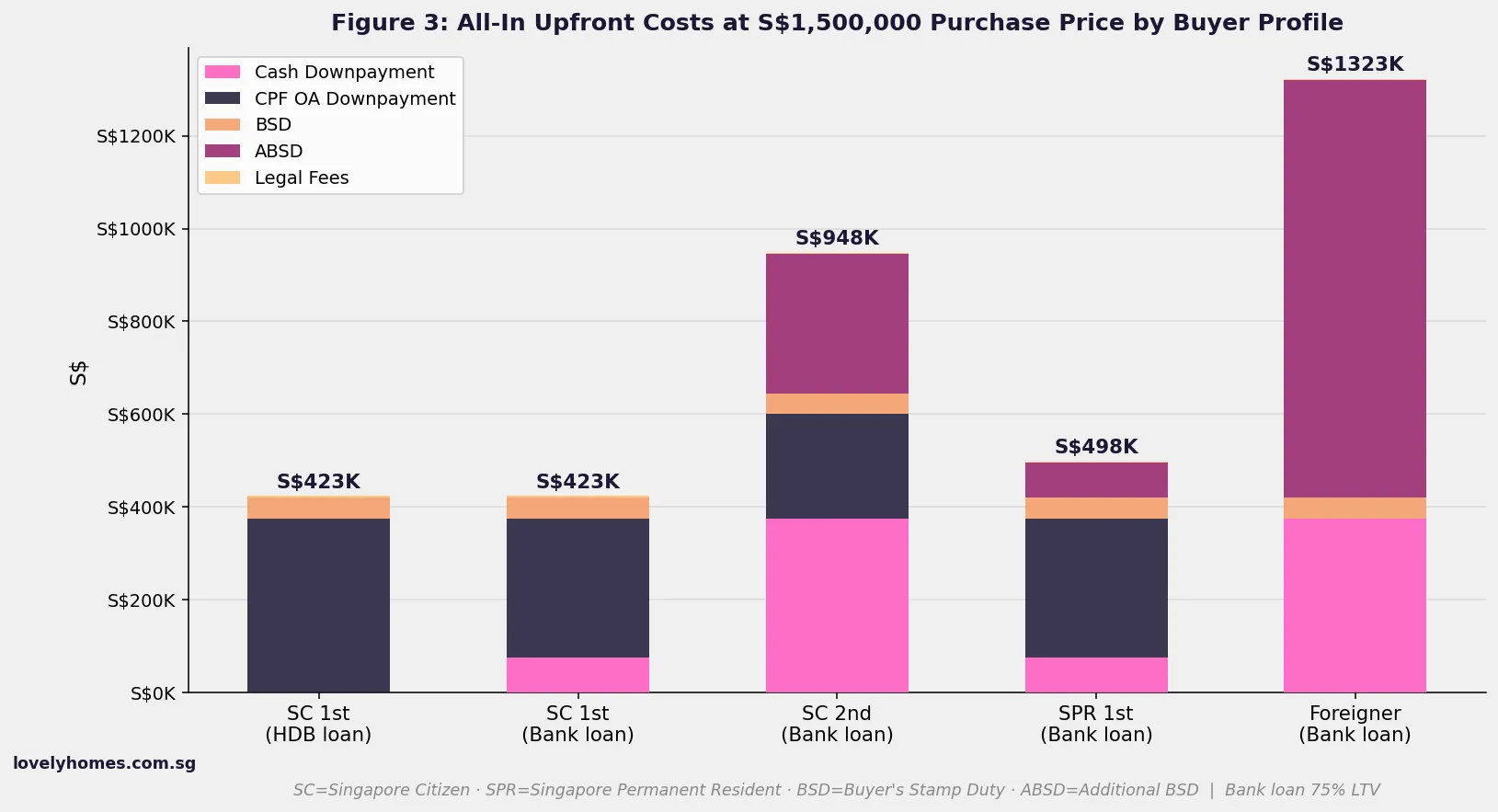
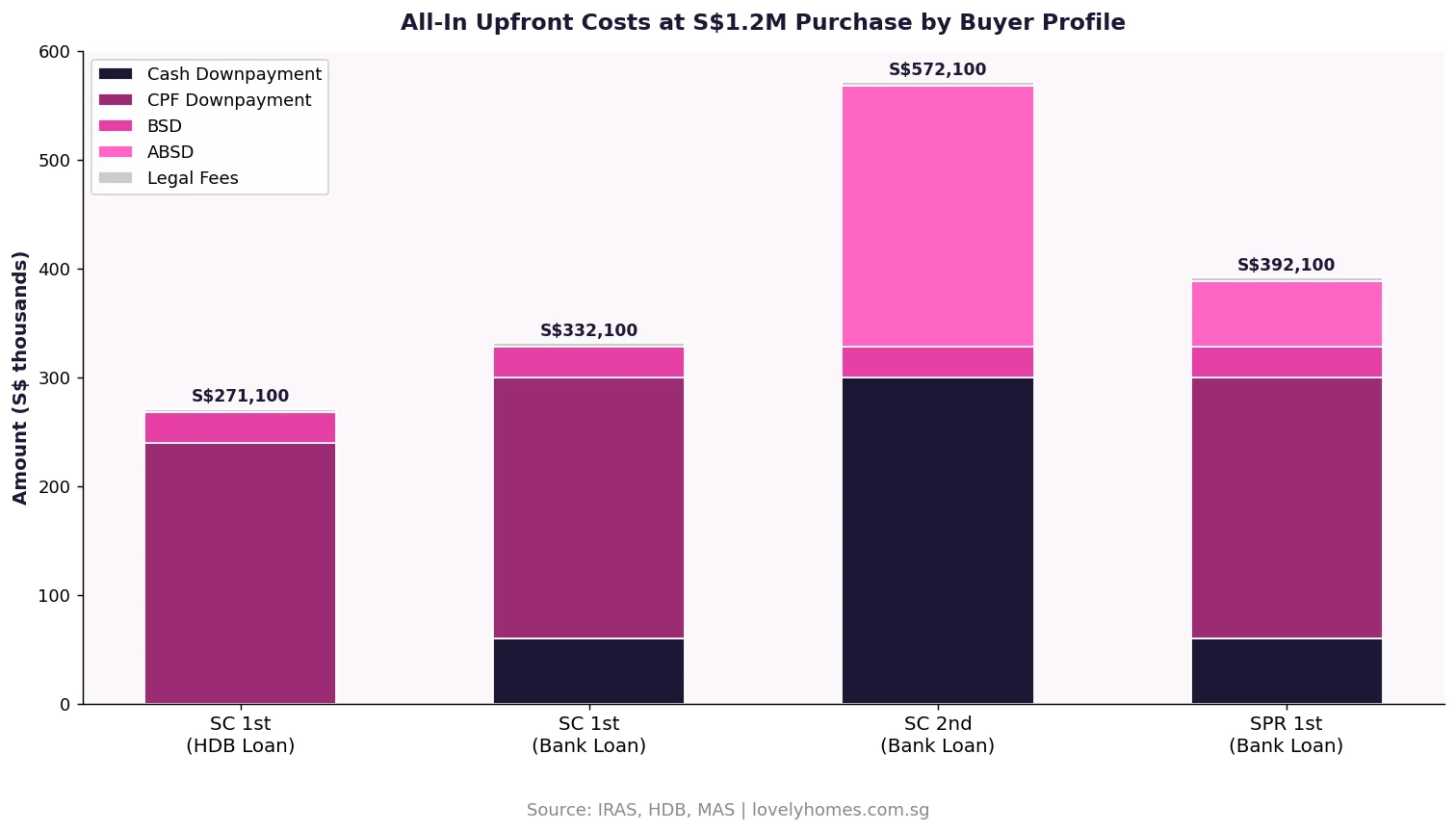
Compute your BSD and ABSD before you set your price limit. BSD on a S$1.5M property is S$44,600 (effective rate 2.97%). A Singapore Citizen buying a first property owes nil ABSD; a first-property SPR buyer owes 5% (S$75,000 on S$1.5M). These sums must come from cash or CPF within 14 days of signing the OTP — they cannot be folded into the loan. Budget for them upfront.
- Calculate maximum loan (TDSR 55% / MSR 30% for HDB)
- Check CPF OA balance and Ordinary Account statement
- Compute BSD and ABSD amounts for target price range
- Confirm citizenship/PR status and ABSD profile
- Check if HDB MOP has been satisfied (if upgrading from HDB)
- Confirm Resale Levy position (if buying a second subsidised flat)
III. Phase 2 — Secure Financing and Get Pre-Approval
For HDB flats, buyers must obtain a valid HDB Flat Eligibility (HFE) Letter from HDB before booking or submitting an application. The HFE Letter is digital, valid for 6 months, and confirms your eligibility to buy an HDB flat, the maximum loan quantum from HDB, and any CPF Housing Grants you qualify for. The application is submitted through the HDB Flat Portal and typically takes up to 30 working days.
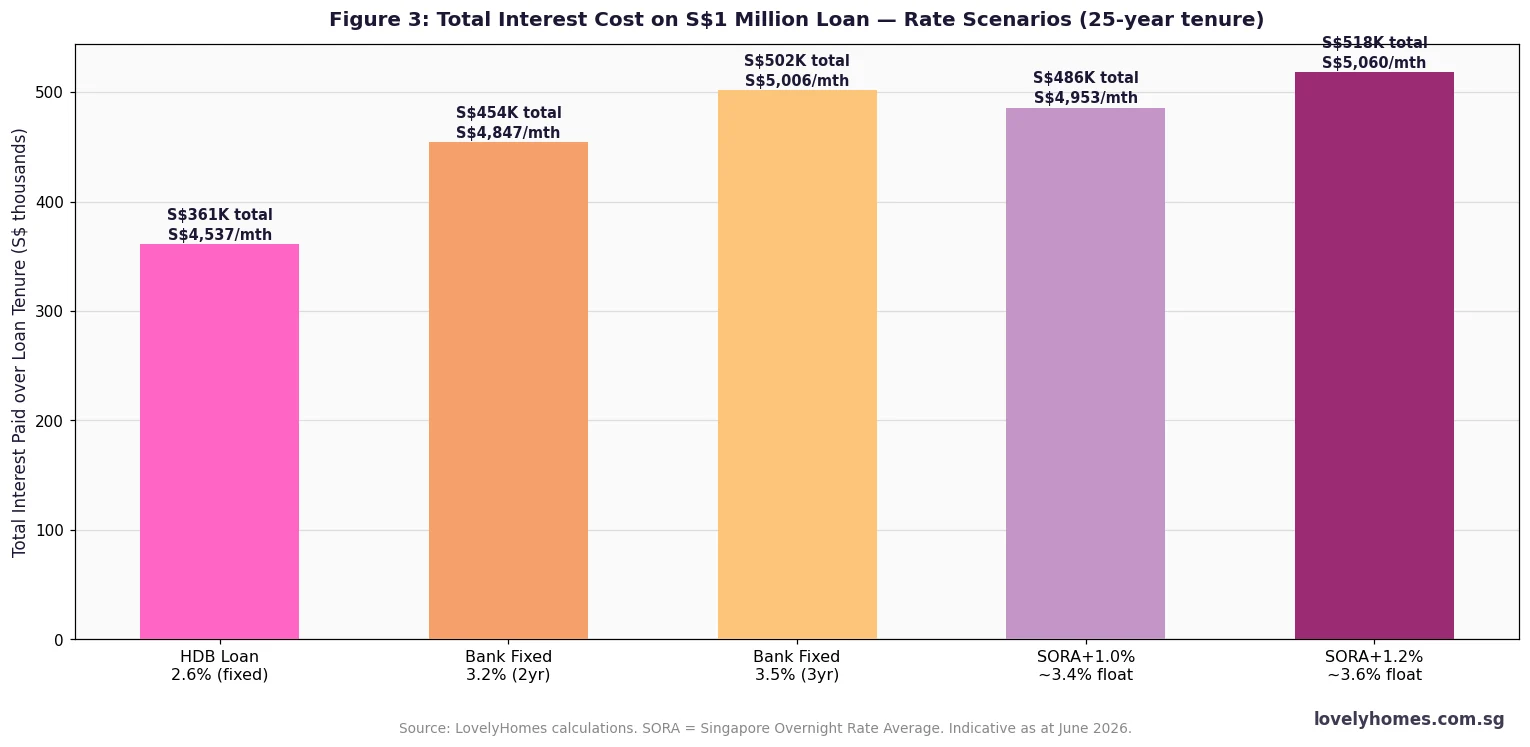
For bank loans — whether for HDB resale or private property — obtain an Approval-in-Principle (AIP) letter from your chosen bank. The AIP is not binding but gives you a credible upper limit when negotiating. It is typically valid for 30 days and can be renewed. Shop at least two to three banks; interest rate differentials of even 0.2% on a S$1M loan compound to over S$20,000 across a 25-year tenure.
- Apply for HFE Letter at HDB Flat Portal (allow 30 working days)
- Obtain AIP from at least 2 banks if taking a bank loan
- Compare fixed-rate vs floating-rate packages across tenures
- Check TDSR and MSR at the stress-test rate (AIP rate + 0.5–1%)
- Confirm CPF usage eligibility for the target property’s lease tenure
IV. Phase 3 — Property Search and Due Diligence
With financing confirmed, begin your search. For HDB BTO, register interest for the exercise that suits your flat type and town preference, noting that Plus and Prime classification flats carry a 10-year Minimum Occupation Period (MOP) versus the standard 5-year MOP. For resale, instruct a CEA-registered agent (verify at cea.gov.sg) or conduct a direct search via the HDB Resale Portal. For private, engage a licensed agent; new launches require a separate appointment and balloting process.
Due diligence for every property should cover: title search at Singapore Land Authority (SLA) to confirm no encumbrances; checking outstanding maintenance arrears with the MCST (for condominiums); verifying the remaining lease term; and inspecting for defects, especially in older HDB blocks and resale condominiums.
- Verify agent’s CEA registration number at cea.gov.sg
- Request SLA title search (confirm no caveats, mortgages, or court orders)
- For condo: request MCST sinking fund balance and outstanding maintenance arrears
- Check remaining lease (especially for properties below 60 years)
- Verify HDB eligibility scheme for resale (public scheme, singles, etc.)
- Run URA property research to see comparable transacted prices
V. Phase 4 — Option to Purchase, BSD and ABSD
When you and the seller agree on price, the seller issues an Option to Purchase (OTP). The OTP is a legal instrument granting you the exclusive right to buy the property at the stated price, within a specified option period (typically 14 days for HDB resale; up to 21 days for private). You pay an option fee (1% for private; S$1,000–S$5,000 for HDB depending on flat type) to secure it. Exercising the OTP requires paying the exercise fee (4% for private, net of option fee; up to 10% for OTP exercise for private).
Both BSD and ABSD are assessed on the higher of the purchase price or market value. IRAS’s e-Stamping portal (iras.gov.sg) must be used to pay. BSD and ABSD are due within 14 days of signing the OTP (or within 30 days of exercising it, for private property completing later). Late payment attracts a penalty of up to 4× the stamp duty payable, so this deadline is absolute.
- Review OTP terms (price, completion date, conditions, vacant possession)
- Pay option fee within agreed deadline to secure OTP
- Engage conveyancing solicitor (separate from seller’s law firm)
- Pay BSD via IRAS e-Stamping within 14 days of signing OTP
- Pay ABSD (if applicable) at same time as BSD
- Exercise OTP by paying exercise fee within the option period
VI. Phase 5 — Legal Completion and Financing Drawdown
Once the OTP is exercised, your solicitor lodges a caveat with the Singapore Land Authority to protect your interest in the property. For HDB resale, the HDB Resale Portal is the primary platform: both buyer and seller submit their portions, and HDB conducts its eligibility checks before approving the resale. For private property, completion typically follows within 8–12 weeks of OTP exercise, culminating in the legal completion date when ownership transfers.
At legal completion, the bank drawdown funds are used to pay the seller’s outstanding mortgage (if any), with the balance going to the seller. Your solicitor handles the flow of funds. CPF contributions drawn for the purchase are submitted by your solicitor via the CPF Board portal. Ensure your CPF investment account has sufficient OA balance — CPF Board takes 2–3 business days to process withdrawal requests.
- Confirm loan offer letter terms with bank (lock-in, penalty, package details)
- Accept bank’s loan offer and arrange fire insurance (mandatory for mortgaged properties)
- Instruct CPF Board to release CPF OA funds (via solicitor)
- Caveat lodged by solicitor at SLA
- For HDB: complete HDB Resale Checklist; attend HDB appointment if required
- Confirm completion date and prepare for vacant possession inspection
VII. Phase 6 — Pre-Completion Inspection and Key Collection
Before accepting keys, conduct a thorough defect inspection. For new private launches, developers are legally obligated to rectify defects within one year of Temporary Occupation Permit (TOP). For resale properties, the principle is caveat emptor (buyer beware) — inspect carefully and document all defects before signing vacant possession. A professional property inspector typically charges S$400–S$800 for a thorough report.
On the legal completion date (for private) or the HDB appointment date (for resale), keys are handed over and the purchase is complete. Notify relevant parties: inform your employer of your change of address, update NRIC with ICA, apply for conservancy/maintenance fee giro arrangements, and arrange home contents insurance. For HDB buyers, remember that the MOP clock starts from the date of key collection, not from any earlier date.
- Conduct pre-completion defect inspection; document with photos
- Confirm all agreed furniture and fittings are present (if furnished sale)
- Ensure utilities are transferred (SP Group for electricity and gas)
- Update NRIC address with ICA within 28 days of moving in
- Note MOP start date (for HDB buyers)
- Arrange home contents insurance and home protection scheme (for HDB with CPF loan)
VIII. Summary Checklist Table
| Phase | Key Action | Deadline / Authority | HDB | Private |
|---|---|---|---|---|
| 1. Budget | Calculate TDSR/MSR and stamp duty | Before any offer | Yes | Yes |
| 2. Financing | HFE Letter / AIP | Before OTP / 30 working days | HFE via HDB Portal | AIP from bank |
| 3. Search | SLA title search, MCST check | Before offer | HDB Resale Portal | SLA / conveyancer |
| 4. OTP & Stamp | Option fee → BSD/ABSD payment | 14 days from OTP signing | IRAS e-Stamp | IRAS e-Stamp |
| 5. Legal | Caveat, CPF drawdown, loan drawdown | Before completion | HDB appointment | Solicitor-led |
| 6. Keys | Defect list, NRIC update, MOP date | Completion day | HDB appointment | Completion date |
IX. Worked Example — Mr & Mrs Kumar: Buying a Private Condo in Tampines
Scenario: First-property purchase, OCR 3-bedroom condo, S$1,500,000
Buyer profile: Mr & Mrs Kumar, both Singapore Citizens, first property purchase. Combined gross monthly income: S$14,000.
TDSR check: Maximum monthly loan repayment at 55% TDSR = S$7,700/month. Stress-test rate 4.0%. At 4.0% over 30 years, S$7,700/month services a loan of approximately S$1,614,000. Actual loan at 75% LTV = S$1,125,000. Monthly repayment at 3.2% 30yr = S$4,856/month. TDSR = 34.7% — well within 55% cap.
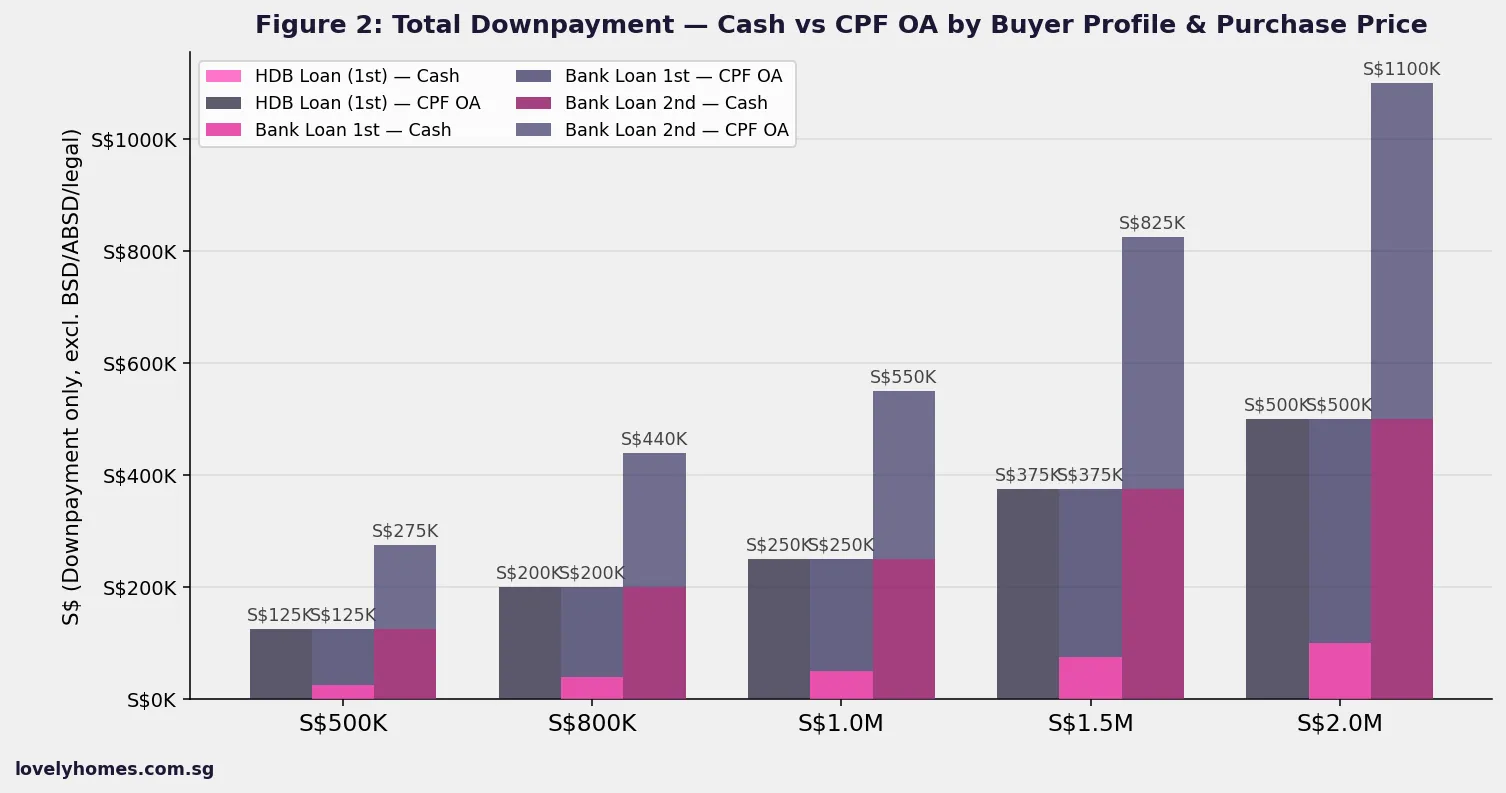
Downpayment: 25% of S$1,500,000 = S$375,000. Minimum 5% cash = S$75,000. Remaining 20% CPF OA = S$300,000.
BSD: First S$180,000 × 1% = S$1,800; next S$180,000 × 2% = S$3,600; next S$640,000 × 3% = S$19,200; next S$500,000 × 4% = S$20,000. Total BSD = S$44,600. ABSD = nil (first property, SC).
Legal fees: approximately S$4,000 (conveyancing) + S$500 (CPF lodgement) = S$4,500.
Total upfront outlay: Cash S$75,000 + CPF S$300,000 + BSD S$44,600 + legal S$4,500 = S$424,100.
Timeline: AIP obtained in 3 days. OTP signed: 1 March 2026. BSD paid: 14 March 2026. OTP exercised: 19 March 2026. Caveat lodged: 20 March 2026. Legal completion: 25 June 2026 (approximately 98 days from OTP).
X. Why This Checklist Matters: The Cost of Missed Steps
Singapore’s stamp duty and property financing rules carry penalties that are disproportionately large relative to the underlying transaction. A buyer who misses the 14-day BSD deadline faces a penalty of up to four times the BSD payable — on a S$1.5M property, that is up to S$178,400 in penalties on top of the S$44,600 BSD itself. An HDB buyer who fails to obtain their HFE Letter before exercising the OTP may forfeit their option fee entirely. A borrower who underestimates their TDSR exposure may find their bank loan offer reduced or withdrawn after the OTP is signed, leaving them in breach of contract.
The 2024 MAS update to LTV limits (HDB loan reduced from 80% to 75% in August 2024) added S$25,000 to the minimum cash requirement on a S$500,000 HDB resale flat. Buyers who had planned their finances before August 2024 and purchased after it sometimes found themselves short at the OTP exercise stage. This underscores why the financial check must be done at current rates, not rates remembered from a friend’s transaction a year earlier.
XI. What May Change in 2027 and Beyond
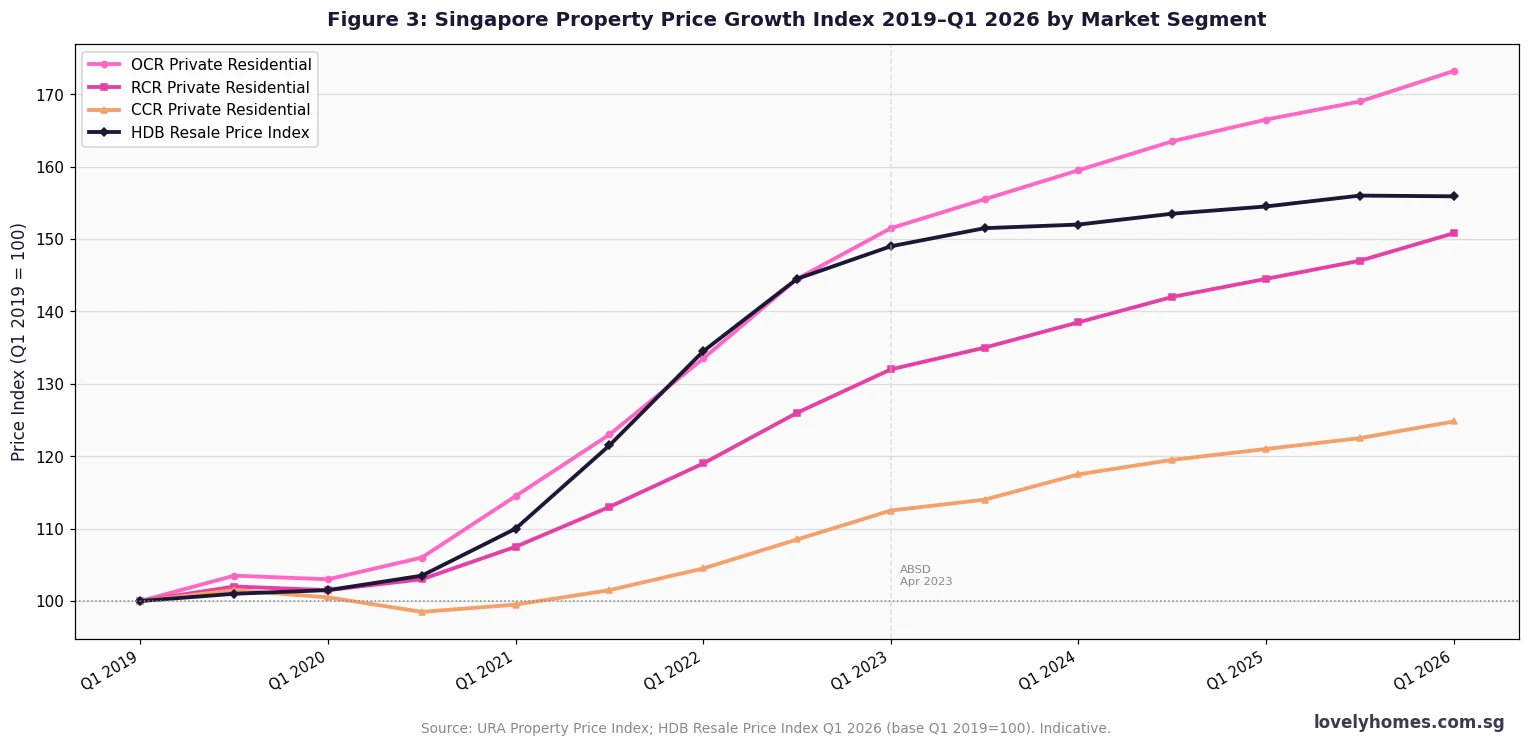
The MAS’s macro-prudential stance in 2026 remains cautious. Property prices have continued to rise modestly in 2026, and ABSD rates for foreigners remain at 60% following the April 2023 hike. Any easing of cooling measures would require a sustained period of price moderation, which has not yet materialised in the private market. Buyers planning to buy in 2027 should monitor MAS and HDB announcements, particularly around the ABSD remission framework (which is reviewed periodically) and BTO supply pipelines. The government’s target of ~100,000 HDB flats delivered between 2022–2025 is on track; any supply shortfall could push resale prices higher and tighten the BTO-to-resale price gap further.
XII. Frequently Asked Questions
Can I use my CPF to pay BSD and ABSD?
Yes, for residential property, both BSD and ABSD can be paid from your CPF Ordinary Account, provided the payment is made via the IRAS e-Stamping portal and your solicitor requests the CPF release correctly. However, the funds must be available in your OA at the time of payment. If your OA balance is insufficient, you must top it up in cash before the 14-day deadline. Note that payment of BSD and ABSD from CPF OA reduces the balance available for the downpayment and monthly servicing, so plan the sequencing carefully with your solicitor.
What happens if the seller refuses to complete after I have exercised the OTP?
If the seller backs out after the OTP has been exercised, the buyer is entitled to specific performance (a court order compelling the seller to complete the sale) or damages. In practice, specific performance is rarely sought for residential property in Singapore; most buyers negotiate a return of all monies paid plus a penalty sum, which under standard OTP terms is typically the option fee and exercise fee forfeited by the seller plus additional damages. You should engage your solicitor immediately and preserve all correspondence. For HDB resale, HDB’s approval of the resale application is required before completion — if HDB has already approved it, the seller’s refusal may also trigger HDB administrative consequences.
Is there a cooling-off period after I exercise the OTP?
No. Under Singapore law, there is no statutory cooling-off period for residential property purchases. Once you sign the OTP, you are contractually bound to proceed if you exercise it. The option period (typically 14 to 21 days for private property) is the window during which you can choose not to exercise — doing so forfeits only the option fee paid. Once you exercise the OTP by paying the exercise fee, both parties are legally bound to complete the transaction. This is why due diligence — financing, legal review, inspection — must happen during the option period, not after exercise.
Do I need a property agent? Can I buy without one?
You are not legally required to engage a property agent in Singapore. HDB resale buyers can transact directly via the HDB Resale Portal without an agent; private property buyers can negotiate directly with developers or sellers. However, an unrepresented buyer bears full responsibility for due diligence, price negotiation, OTP drafting, and liaison with HDB or the developer. For first-time buyers or those unfamiliar with the process, a CEA-registered agent adds practical value. If you choose to self-transact, engage a conveyancing solicitor early — they handle the legal completion regardless of agent involvement.
How does the ABSD remission work if I sell my existing property?
Singapore Citizens who own one residential property and buy a second before selling the first must pay ABSD of 20% upfront. However, if they sell their first property within 6 months of the new property’s purchase (or completion for new launches), they may apply to IRAS for a remission (refund) of the ABSD paid. The remission is not automatic — a formal application must be made within the stipulated window. Married couples where one spouse is a Singapore Citizen and the other is an SPR or foreigner may also qualify for remission under specific conditions. The remission only applies to the ABSD paid on the second purchase; BSD is not remitted.
What is the fire insurance requirement and is it mandatory?
Fire insurance is mandatory for any property purchased with a bank loan in Singapore. The insured value must cover the reinstatement cost of the building structure (not the market value of the property). Banks typically arrange fire insurance as part of the loan package, and the premium is collected with the first loan repayment. For HDB flats bought with an HDB loan, the HDB Home Protection Scheme (HPS) is compulsory — this is a mortgage-reducing insurance product that settles your outstanding HDB loan if you die, suffer total permanent disability, or contract a terminal illness. The annual HPS premium is deducted from your CPF OA. Home contents insurance (covering your belongings, fixtures, and fittings) is separate and voluntary but strongly recommended.
When does the HDB Minimum Occupation Period (MOP) start?
The MOP for an HDB flat starts from the date you collect the keys — that is, the date of physical possession, not the date of the application, the signing of the Agreement for Lease, or any earlier administrative milestone. For BTO flats, that is the date of key collection at the HDB Hub or branch office. For resale flats, it is the date of the HDB-appointed completion. The standard MOP is 5 years. Flats in Plus or Prime (PLH) classifications have a 10-year MOP. During the MOP, owners cannot sell the flat on the open market, sublet the entire flat, or purchase private residential property. Room rental within the flat is allowed from the date of key collection, subject to HDB’s prevailing subletting rules.
Click anywhere to close