Singapore HDB Plus & Prime Classification Guide 2026: Standard, Plus and Prime Explained

Singapore HDB Plus & Prime Classification Guide 2026: Standard, Plus and Prime Explained

Quick Answer: HDB Plus & Prime Classification 2026

  • Three tiers: Standard, Plus and Prime — introduced from 22 October 2024 for new BTO flats and applicable resale transactions.
  • Minimum Occupation Period: Standard = 5 years; Plus and Prime = 10 years.
  • Resale restriction: Plus and Prime flats can only be sold to eligible buyers with household income at or below S$14,000 per month.
  • Rental restriction: Plus and Prime flat owners cannot rent out the entire flat — individual rooms may be rented after MOP.
  • Subsidy clawback: Plus flats attract a 6%–9% clawback on resale; Prime flats attract a 9% clawback payable to HDB on resale.
  • Higher grants: Plus and Prime buyers receive higher CPF Housing Grants to compensate for additional restrictions.
  • Geographic logic: Standard = general HDB estates; Plus = near MRT interchanges or well-connected nodes; Prime = central locations and mature estates.
  • Purpose: The tiered framework aims to keep public housing affordable across all income brackets while reducing speculative premiums on well-located HDB flats.

I. What Is the HDB Plus & Prime Classification System?

Singapore’s Housing & Development Board administers the world’s most successful public housing programme, housing over 80% of Singapore’s resident population. As land constraints intensify and well-located BTO sites grow scarcer, the HDB introduced a landmark policy overhaul in 2024: the Standard, Plus and Prime classification framework.

Announced by Minister for National Development Desmond Lee on 20 September 2023 and implemented from the October 2024 BTO exercise, the framework assigns every new BTO flat to one of three tiers based on the flat’s location, accessibility and proximity to amenities. The tier determines the buyer’s obligations for occupation, rental and resale, with more centrally located flats carrying longer hold periods and stricter resale conditions.

The policy addresses a longstanding tension in Singapore’s public housing market: flats in prime or centrally located estates command substantial resale premiums, allowing early buyers to profit considerably from a heavily subsidised asset. The Plus and Prime tiers reduce this premium by doubling the MOP to 10 years, imposing an income ceiling on future buyers, and levying a clawback on resale — ensuring that a portion of the capital gain flows back to the public purse rather than accruing entirely to the flat owner.
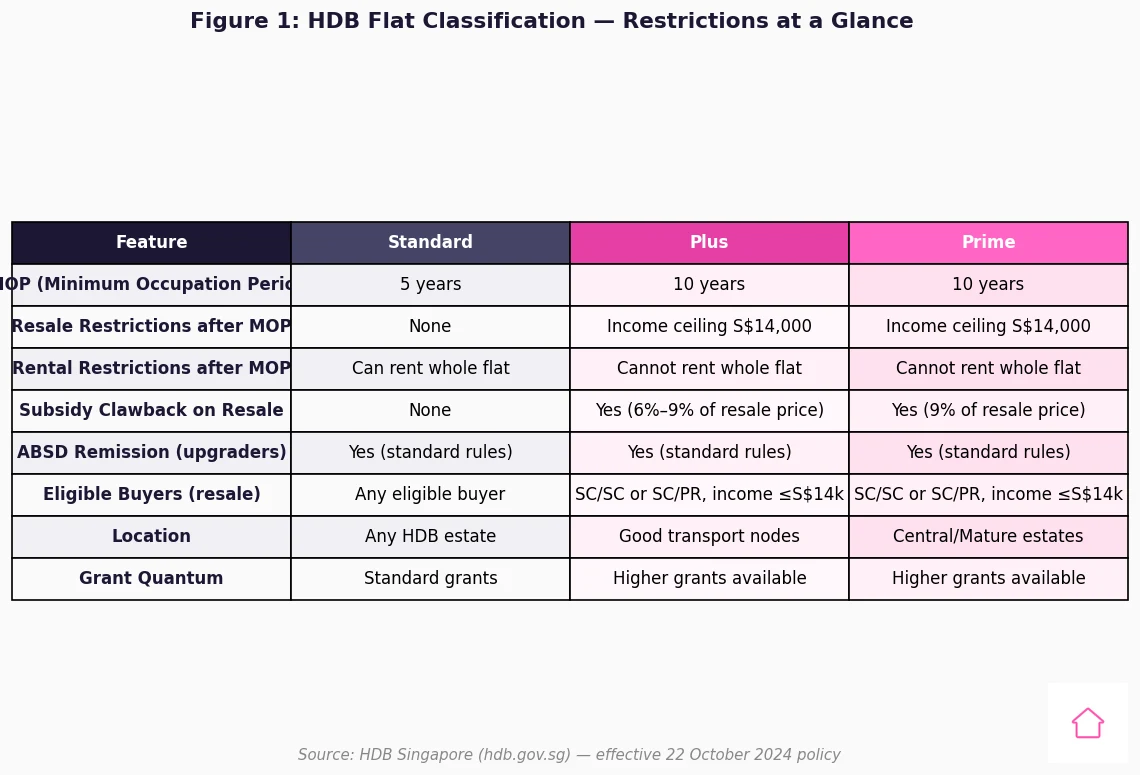
HDB Standard Plus Prime classification comparison table 2026 — MOP, restrictions, resale levy and eligibility
Figure 1: HDB Flat Classification at a Glance — Standard, Plus and Prime restrictions compared (Source: HDB Singapore, effective 22 October 2024)

II. Standard Flats — The Baseline Tier

Standard flats are the broadest category and follow the rules most Singaporeans are familiar with. They carry the original five-year Minimum Occupation Period: you must live in the flat as your principal place of residence for at least five continuous years before you are permitted to sell on the open resale market. There are no restrictions on the income of the buyer at the point of resale — any eligible HDB buyer may purchase a Standard flat on the resale market.

Standard flats also permit whole-flat rental once the MOP is satisfied, meaning an owner who has met the five-year occupation requirement may apply to HDB to rent out the entire flat. This flexibility is not available to Plus or Prime flat owners. No subsidy clawback applies on the resale of a Standard flat. Standard flats are located across all HDB estates but generally occupy sites that do not command a premium for centrality or transport connectivity — typically outer estates such as Woodlands, Sembawang, Sengkang and Punggol, though Standard flats also exist within mature towns where they are not classified Plus or Prime.

III. Plus Flats — Enhanced Restrictions for Well-Connected Sites

Plus flats occupy an intermediate tier. They are situated near MRT interchanges, town centres or nodes with above-average connectivity and amenities, but not in the premium core central location that defines Prime. The October 2024 BTO exercise introduced Plus flats in towns such as Kallang/Whampoa, Queenstown and specific sites in mature estates with outstanding transport access.

Buyers of Plus flats must satisfy a 10-year Minimum Occupation Period before selling on the resale market. After this period, Plus flat sellers can only transact with buyers who meet standard HDB eligibility requirements and whose household income does not exceed S$14,000 per month. Plus flat owners may rent out individual bedrooms but cannot rent out the whole flat — a restriction that applies permanently even after the MOP is satisfied.

Upon resale, a subsidy clawback ranging from approximately 6% to 9% of the transacted resale price is payable to HDB. The exact clawback rate depends on the original purchase price and the subsidy quantum embedded in that price — HDB will compute the clawback amount at the point of each resale transaction. To compensate, Plus flat buyers receive higher CPF Housing Grants than comparable Standard flat buyers, calibrated upward to reflect the longer holding obligation and reduced liquidity.

IV. Prime Flats — Maximum Restrictions for Central and Mature Estate Sites

Prime flats are the most tightly restricted tier. They occupy the most desirable HDB locations: centrally situated estates, highly connected sites near the CBD, or areas historically commanding the highest HDB resale premiums. Toa Payoh, Queenstown, Kallang, Bishan and certain city-fringe locations have been designated Prime. As the programme matures, HDB expects to designate additional BTO sites as Prime where they meet the locational criteria.

Prime flat buyers face a 10-year MOP — the same as Plus. After satisfying the MOP, sellers may only transact with buyers whose household income is at or below S$14,000 per month. The whole-flat rental ban also applies permanently. The subsidy clawback on Prime flats is set at 9% of the resale price — somewhat higher than Plus flats — to account for the greater capital gain potential in central locations. Prime flat buyers receive the highest CPF Housing Grant quantum in the entire HDB framework to make central-location ownership accessible to qualifying households.
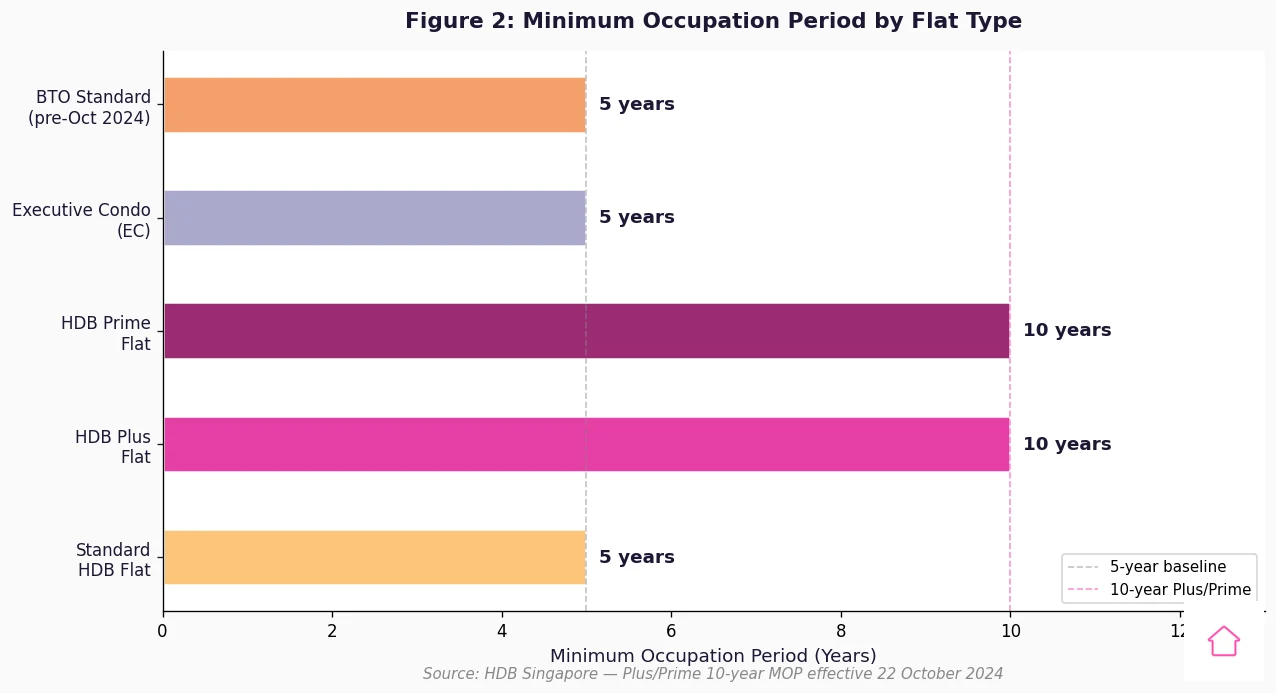
HDB MOP comparison by flat type Standard Plus Prime Executive Condo 2026 bar chart
Figure 2: Minimum Occupation Period by HDB Flat Type — Standard 5 years vs Plus/Prime 10 years (Source: HDB Singapore)

V. Eligibility and Grant Mechanics

The income ceiling for purchasing a new BTO flat — regardless of tier — remains S$14,000 per month for families and S$7,000 for singles applying under the Single Singapore Citizen scheme. The income ceiling relevant to Plus and Prime resale transactions is also S$14,000, meaning buyers whose household income exceeds this threshold are ineligible to purchase a Plus or Prime flat on the resale market even after the MOP.

Grant eligibility follows the standard HDB framework. The Enhanced CPF Housing Grant (EHG) of up to S$120,000 for new BTO (income at or below S$9,000 per month), the Family Grant of up to S$50,000 for resale, and the Proximity Housing Grant (PHG) of up to S$30,000 for buyers living near parents or children all remain available. For Plus and Prime flats, the EHG quantum is calibrated to be higher than for equivalent Standard flats, reflecting the longer MOP obligation. Buyers should confirm the exact grant quantum with HDB at the application stage, as amounts are reviewed each BTO exercise.

The resale levy — applicable to second-timer buyers purchasing a new subsidised flat after having already enjoyed one housing subsidy — remains unchanged by the Plus/Prime framework. A second-timer buying a Plus BTO flat still pays the standard resale levy based on the flat type of their previous subsidised flat, ranging from S$15,000 for a 2-room up to S$55,000 for an Executive flat.
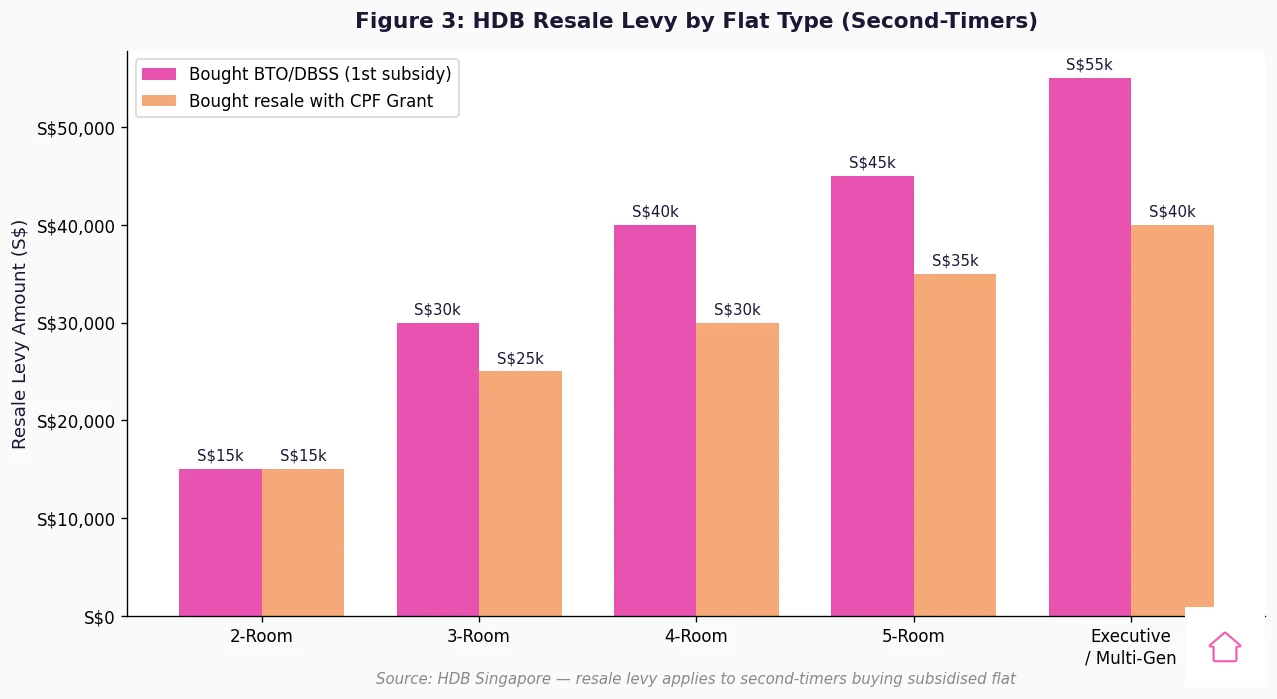
HDB resale levy amounts by flat type 2026 second-timers grouped bar chart
Figure 3: HDB Resale Levy Amounts by Flat Type for Second-Timers — Applicable Regardless of Standard, Plus or Prime Classification (Source: HDB Singapore)

VI. Summary Comparison Table

Feature Standard Plus Prime
MOP 5 years 10 years 10 years
Resale income ceiling None S$14,000/mth S$14,000/mth
Whole-flat rental (post-MOP) Permitted with HDB approval Not permitted Not permitted
Room rental (post-MOP) Permitted Permitted (owner must occupy) Permitted (owner must occupy)
Subsidy clawback on resale None ~6%–9% of resale price 9% of resale price
CPF Housing Grants Standard quantum Higher quantum Highest quantum
Typical locations Outer and general HDB estates Near MRT interchanges, town centres Central locations, mature estates
Introduced Legacy (all pre-Oct 2024 BTO) October 2024 BTO exercise October 2024 BTO exercise

VII. Worked Example — The Plus Flat Buyer in Queenstown

Mr & Mrs Chen are a Singapore Citizen couple, combined household income S$9,500 per month, applying for a Plus 4-room BTO flat in Queenstown in the February 2025 BTO exercise. Indicative flat price: S$620,000 (after government subsidy).

Grants received: EHG S$40,000 (income S$9,500, qualifying for mid-tier EHG for Plus flat) + Family Grant S$50,000 (SC+SC, 4-room equivalent) = S$90,000 total grants. Effective price paid after grants: S$530,000.

Financing: HDB concessionary loan at 2.6% per annum (LTV 80%). Loan amount: S$424,000. Monthly instalment on a 25-year loan: approximately S$1,924. MSR on S$9,500 household income = 20.3% — well within the 30% Mortgage Servicing Ratio cap.

BSD payable: 1% on first S$180,000 = S$1,800; 2% on next S$180,000 = S$3,600; 3% on next S$260,000 = S$7,800. Total BSD: S$13,200 (payable in cash or CPF).

At resale (10 years later, estimated): Assuming a resale price of S$850,000, the subsidy clawback is approximately 7.5% = S$63,750 payable to HDB at completion. The Chens also repay CPF principal + 2.5% accrued interest into their CPF Ordinary Account. Net cash in hand depends on outstanding loan balance and total CPF accrued interest at that date.

Key risk to note: The income ceiling of S$14,000 at resale restricts the buyer pool. Buyers planning to sell exactly at year 10 should factor in buyer pool depth and income distribution in Queenstown at that future point when planning their finances.

VIII. Why the Plus/Prime System Exists — Policy Context

Before October 2024, Singapore’s HDB resale market had seen growing divergence between price appreciation of well-located flats and those in outer estates. Mature-estate and central-location flats — particularly in Queenstown, Toa Payoh and Kallang/Whampoa — regularly transacted at S$1 million or more, with some 5-room flats approaching S$1.5 million. This created a perception that public housing in desirable locations had become a speculative vehicle rather than a housing utility, undermining one of HDB’s founding principles: that public housing should be affordable and accessible.

The Plus/Prime framework attacks this problem from two directions. First, the 10-year MOP discourages speculative flipping: a buyer must commit to a decade of owner-occupation. Second, the subsidy clawback ensures that a portion of the state subsidy embedded in the initial purchase price is returned to HDB when the flat is sold, recycling capital for future public housing programmes.

IX. What Might Come Next

As at August 2026, HDB has indicated that the Plus/Prime framework will continue to expand. Future BTO exercises will designate additional sites as Plus or Prime where the locational criteria are met. Analysts expect that as the Bayshore Drive and Greater Southern Waterfront sites mature, some of the new HDB developments in those areas may attract Prime designation given their coastal frontage and proximity to the city.

There has been industry discussion — as yet unconfirmed by HDB — about whether the framework might eventually be applied to resale transactions in designated Prime locations: specifically, whether resale buyers of pre-October 2024 legacy flats in Prime estates might face income ceiling restrictions. As at the date of publication, these restrictions apply only to new BTO flats purchased under the Plus/Prime classification and to future resale of those specific flats. Buyers purchasing legacy resale flats in Queenstown or Toa Payoh are not subject to any income ceiling or clawback.

X. Frequently Asked Questions

Can I sell a Plus or Prime flat to a buyer whose income exceeds S$14,000?

No. The income ceiling of S$14,000 per month applies strictly to the purchasing household’s combined income at the time of the resale transaction. If you attempt to transact with a buyer whose income exceeds S$14,000, HDB will not approve the resale application. This restriction narrows the buyer pool relative to Standard flats, which have no income ceiling at resale. Buyers planning to sell their Plus or Prime flat after the 10-year MOP should price this liquidity discount into their financial planning from the outset.

When does the 10-year MOP start — from key collection or from application?

The MOP is measured from the date of key collection (the date you receive the keys to the flat and it is registered in your name), not from the date of ballot success or application. For BTO flats, key collection typically occurs three to five years after the ballot date, given construction lead times. So if you collect keys in January 2026, your 10-year MOP expires in January 2036.

Can I convert a Plus flat to a Standard flat to avoid the restrictions?

No. The classification is permanently attached to the flat at the point of designation. There is no mechanism to reclassify a Plus or Prime flat as Standard once it has been built and allocated. This is deliberate: the restrictions must follow the flat, not the owner, to ensure that future resale buyers are also bound by the same conditions.

What happens to the subsidy clawback if I sell my Plus flat at a loss?

HDB computes the clawback as a percentage of the actual transacted resale price, not the original purchase price or the market value. If you sell at a price lower than your original purchase price, the clawback percentage still applies on the actual sale price. HDB has indicated that the clawback is waived only in exceptional circumstances, such as compulsory acquisition by HDB. In practice, most Plus/Prime flat sellers in central locations are unlikely to transact at a loss given the subsidy embedded in the initial purchase.

Does the Plus/Prime framework affect Executive Condominiums (ECs)?

No. ECs are a distinct housing type governed by the Housing Developers (Control and Licensing) Act, not the HDB Act. They are developed and sold by private developers on 99-year leasehold land sold by HDB. ECs carry a separate five-year MOP before the unit can be sold on the open market; after ten years, the EC is fully privatised. The Plus/Prime HDB framework does not affect EC restrictions.

Can Plus and Prime flat owners sublet rooms while still within the MOP?

No. During the MOP, Plus and Prime flat owners may not sublet any part of the flat — neither the whole unit nor individual rooms. The HDB’s subletting rules require the MOP to be satisfied before any subletting application can be submitted. After the 10-year MOP, room rental is permitted provided the flat owner continues to occupy the flat as their principal place of residence and holds a valid subletting permit from HDB. Whole-flat rental remains permanently prohibited for Plus and Prime flats.

I am a permanent resident buying a Plus flat with my SC spouse — are we subject to the restrictions?

Yes. The Plus and Prime restrictions apply to the flat itself, not solely to the citizen owner. An SC/PR couple purchasing a Plus BTO flat will be bound by the 10-year MOP, the income ceiling at resale, the whole-flat rental ban, and the subsidy clawback in exactly the same way as an SC/SC household. The restrictions follow the flat through its entire life on the market.

Disclaimer: This article is intended as general information and educational reference only. It does not constitute legal, financial or housing advice. HDB policies, grant amounts, income ceilings, clawback rates and classification criteria may change. Always verify current requirements directly with the Housing & Development Board at hdb.gov.sg before making any housing decision. Consult a licensed financial adviser or property professional for advice specific to your circumstances.
Singapore HDB Grants Guide 2026: EHG, Family Grant, PHG and All CPF Housing Grants

Singapore HDB Grants Guide 2026: EHG, Family Grant, PHG and All CPF Housing Grants

Housing grants are among the most powerful tools the Singapore government uses to help first-time and eligible buyers afford a public housing flat. The CPF Housing Grant framework — administered jointly by HDB and the CPF Board — has evolved significantly over the years, consolidating older schemes into a simpler structure while increasing maximum amounts. As at August 2026, eligible SC+SC couples buying a Build-to-Order flat can receive up to S$120,000 in grants; resale buyers can receive up to S$80,000 (EHG) plus a Family Grant of up to S$50,000 and a Proximity Housing Grant of up to S$30,000 — a potential total of S$160,000 or more for the right buyer. This guide unpacks every grant, its eligibility conditions, the income ceiling that applies, and how multiple grants can be stacked.

Quick Answer — HDB Grants Singapore 2026: Key Facts

  • The Enhanced CPF Housing Grant (EHG) is the primary means-tested grant, worth up to S$120,000 for SC+SC BTO buyers and S$90,000 for SC+SC resale buyers. Income ceiling: S$9,000/mth (household).
  • The Family Grant (FG) is available for resale flat buyers only — up to S$50,000 for SC+SC couples buying a 4-room or larger flat. Income ceiling: S$14,000/mth.
  • The Proximity Housing Grant (PHG) gives up to S$30,000 for buying near or with parents or children. No income ceiling for the S$20,000 variant.
  • The Step-Up CPF Housing Grant (S$15,000) assists second-timers in 2-room or studio apartments moving to a 3-room resale flat.
  • The Singles Grant (up to S$25,000) is available to SC singles aged 35 and above buying a resale flat.
  • Grants are credited to your CPF Ordinary Account — they cannot be withdrawn as cash and must be used for the flat purchase.
  • Multiple grants can be stacked by eligible buyers; the total grant quantum can significantly reduce the effective purchase price.
  • Grant eligibility is assessed at the time of HDB application; the HFE Letter confirms what you qualify for before you exercise any OTP.

How HDB Housing Grants Work

All HDB CPF Housing Grants are funded by the government and disbursed through the Central Provident Fund (CPF) system. When you are assessed as eligible, the grant amount is credited directly into your CPF Ordinary Account. From there, it can be used to offset the purchase price of the flat: it counts towards the CPF component of your downpayment, and the remainder of your purchase can then be financed through your CPF OA balance, an HDB concessionary loan, or a bank loan.

Crucially, grants credited to your CPF OA are subject to the standard CPF accrued interest rules. When you eventually sell the flat, you must refund the grant amount plus the accrued interest (calculated at the CPF OA interest rate of 2.5% per annum) back to your CPF account. This refund is retained in your CPF for retirement purposes — it does not go back to the government. This means the grant genuinely reduces your purchase cost but does carry a future CPF refund obligation that affects your net sale proceeds.

Grant eligibility is confirmed via the HDB Flat Eligibility (HFE) Letter, which you must obtain before exercising an Option to Purchase. The HFE Letter is the definitive document — if it says you qualify for S$80,000 EHG and S$50,000 Family Grant, those amounts are locked in for your transaction provided your circumstances do not change materially before completion.

The Enhanced CPF Housing Grant (EHG) — The Cornerstone Grant

Enhanced CPF Housing Grant (EHG)

Introduced: September 2019 (replaced Enhanced Additional CPF Housing Grant and Special CPF Housing Grant)
Administered by: HDB and CPF Board
Who qualifies: First-timer applicants (families or singles) who are Singapore Citizens, or SC+PR families where both are buying their first subsidised flat
Maximum amount: S$120,000 (SC+SC buying BTO); S$90,000 (SC+SC buying resale); S$60,000 (SC+PR buying resale)
Income ceiling: S$9,000 per month (household gross income for families); S$4,500/mth for singles
Key condition: At least one applicant must have been continuously employed for at least 12 months before the HFE Letter application. Self-employed applicants may qualify with 12 months of CPF contributions.

The EHG replaced two earlier grant schemes in 2019: the Enhanced Additional CPF Housing Grant (EAHG) and the Special CPF Housing Grant (SHG). The consolidation was designed to simplify the grant landscape and provide a single sliding-scale grant that increases as household income falls, giving the highest support to those who need it most.

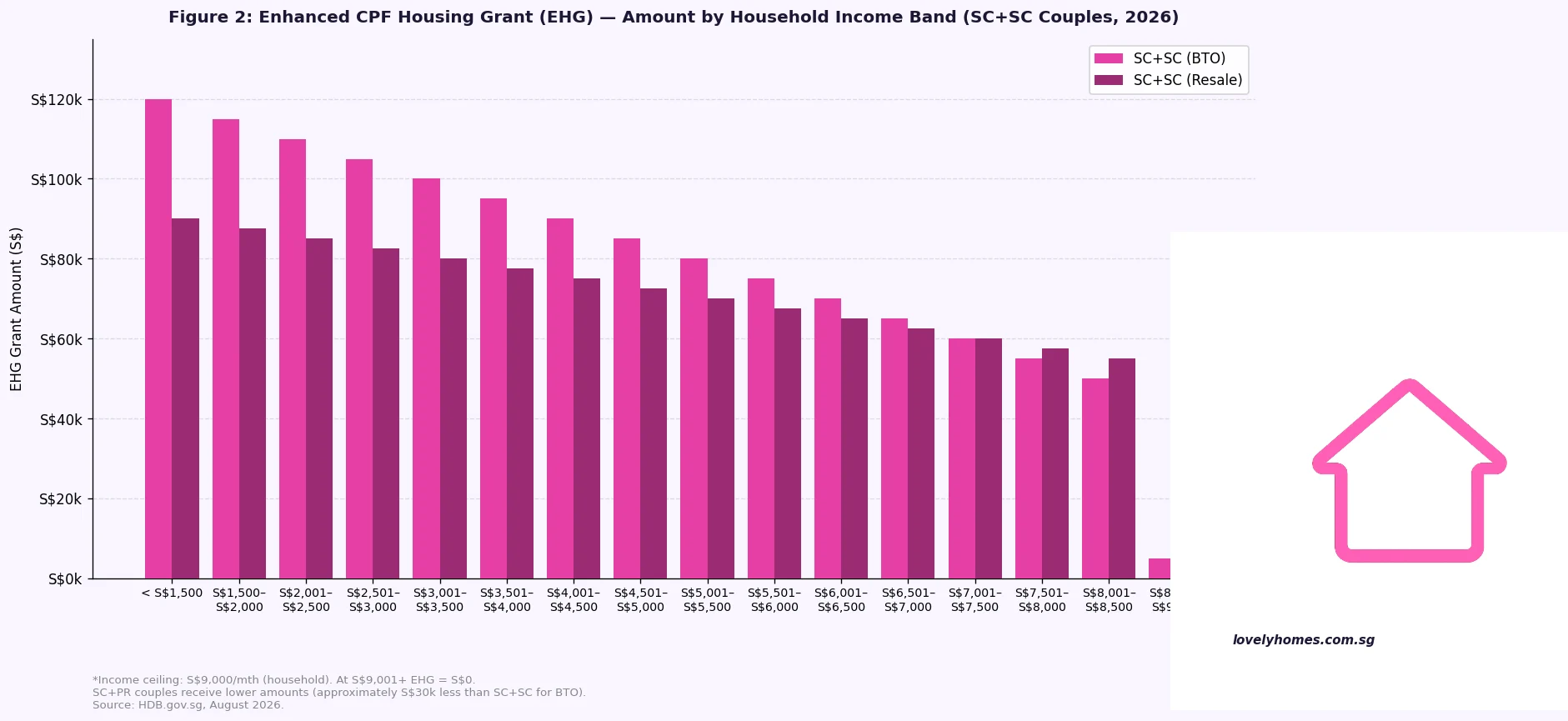
Figure 2: Enhanced CPF Housing Grant EHG amount by household income 2026
Figure 2: EHG Grant Amount by Household Income Band — SC+SC Couples, BTO vs Resale (2026). The grant scales down as income rises; at S$9,001/mth, EHG = S$0. Source: HDB.gov.sg, LovelyHomes editorial.

The EHG scales down in S$500 income brackets. A family earning below S$1,500 per month receives the maximum S$120,000 (BTO) or S$90,000 (resale). Each additional S$500 of household income reduces the grant by approximately S$5,000. At S$9,000/mth, the grant reaches a minimum; above S$9,001, no EHG is payable. For SC+PR couples, the grant is lower across all income bands — approximately S$30,000 less than the equivalent SC+SC couple for BTO, and proportionally reduced for resale.

The “continuous employment” requirement is worth understanding carefully. HDB requires that at least one applicant has been in continuous employment (or self-employment with CPF contributions) for a minimum of 12 months before the HFE Letter application date. If you recently changed jobs, returned from overseas employment, or started your own business less than 12 months ago, your eligibility may be affected. HDB assesses the most recent 12 months of income; if your income fluctuates (for example, due to commission or bonus payments), HDB uses the average monthly income over the 12 months.

The Family Grant (FG) — For Resale Flat Buyers

Family Grant (FG)

Who qualifies: First-timer SC+SC or SC+PR families (married or co-habiting) buying a resale HDB flat
Maximum amount: S$50,000 (SC+SC, 4-room or larger flat); S$40,000 (SC+PR, 4-room or larger); S$40,000 (SC+SC, 2/3-room flat); S$30,000 (SC+PR, 2/3-room flat)
Income ceiling: S$14,000 per month (household)
Can be stacked with EHG: Yes — both are available to first-timer families buying resale

The Family Grant is available only for resale purchases — BTO buyers do not receive a separate Family Grant. It is a flat quantum grant (not scaled with income) available to all eligible families up to the income ceiling of S$14,000 per month. This makes the Family Grant a meaningful supplement for middle-income families who earn above the EHG ceiling but still qualify for the Family Grant.

For example, a SC+SC couple with a household income of S$10,000/mth buys a 5-room resale flat. They do not qualify for EHG (income exceeds S$9,000). But they fully qualify for the S$50,000 Family Grant. If their parents live within 4km, they could additionally receive the PHG of S$20,000, giving a total grant of S$70,000 from just two grants with no EHG eligibility.

The Proximity Housing Grant (PHG) — Living Near Family

Proximity Housing Grant (PHG)

Who qualifies: SC or PR buyers of resale flats, buying near or with parents/children who are Singapore Citizens
Amounts: S$30,000 (co-locating in the same flat as parents/child); S$20,000 (buying within 4km of parents/child’s flat)
Income ceiling: S$14,000/mth for the S$30,000 variant; no income ceiling for the S$20,000 variant
Can be stacked: Yes — with EHG and Family Grant

The PHG was introduced in August 2015 to encourage multi-generational living and help families live near one another. The 4km proximity is measured from the buyer’s new flat to the parents’ or child’s flat by the shortest accessible route. HDB verifies this at the application stage. If both the 4km rule and same-building criteria could apply, only the higher S$30,000 amount is paid.

The absence of an income ceiling for the S$20,000 PHG variant is a notable feature: even a high-income buyer (earning, say, S$20,000/mth) who does not qualify for EHG or the Family Grant can still receive S$20,000 PHG simply by buying within 4km of a parent or child who is a Singapore Citizen. This makes PHG one of the most broadly accessible grants in the HDB system.

The Step-Up CPF Housing Grant — Supporting Upgraders in 2-Room Flats

Step-Up CPF Housing Grant

Who qualifies: Second-timer SC+SC couples currently living in a 2-room Flexi flat or Studio Apartment (SA), buying a 3-room resale flat
Amount: S$15,000
Income ceiling: S$7,000 per month (household)
Flat restriction: Must buy a resale 3-room flat (not BTO, not 4-room or larger)

The Step-Up Grant is a targeted measure for lower-income households currently in the smallest HDB flats who need to upsize. Because these buyers are second-timers, they do not qualify for the first-timer EHG or Family Grant. The Step-Up Grant provides meaningful support — S$15,000 — to enable this specific transition. Recipients of the Step-Up Grant are typically older couples whose children have grown and moved out, or younger couples who initially bought a 2-room flat under the Short Lease or Standard Lease scheme and now need more space.

The Singles Grant — For Single Singaporeans Buying Resale

Singles Grant

Who qualifies: Single SC, aged 35 and above, buying a resale HDB flat under the Single SC Scheme; or a joint purchase of two singles (SC+SC), each first-timer
Amount: S$25,000 (for 4-room or larger resale flat); S$20,000 (for 2-room or 3-room resale flat)
Income ceiling: S$7,000 per month (individual income)
Can be stacked with PHG: Yes

Singles buying HDB resale flats under the Single SC Scheme became eligible for the Singles Grant in 2013, with enhancements over the years. The grant recognises that singles — who cannot apply for BTO flats larger than 2-room flexi — are often priced out of the resale market without some form of support. A single SC buyer aged 35 who earns S$5,000/mth and buys a 4-room resale flat near a parent can receive S$25,000 (Singles Grant) + S$20,000 (PHG within 4km) = S$45,000 total, meaningfully reducing their upfront cash and CPF requirements.

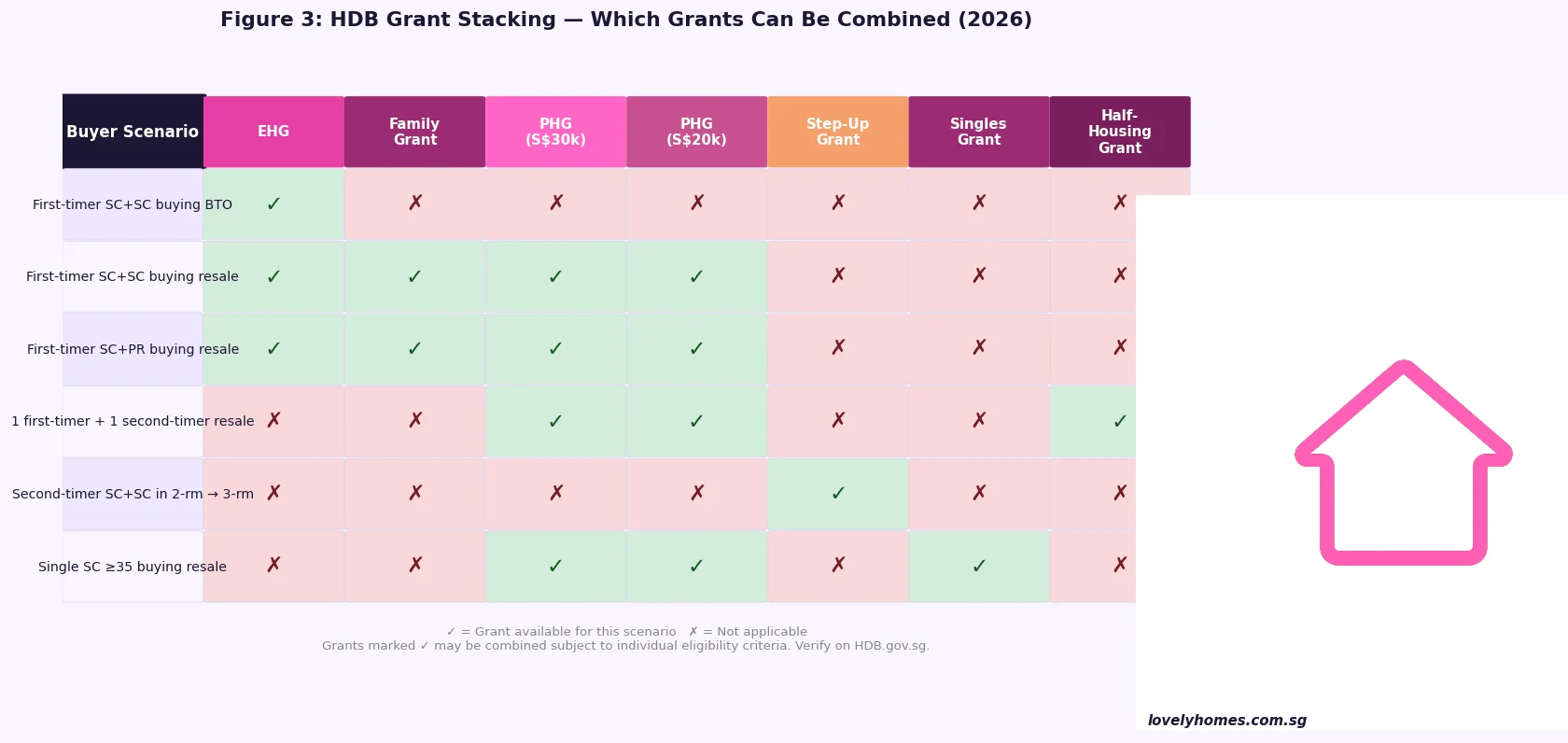
Grant Stacking: Which Grants Can Be Combined?

Figure 3: HDB grant stacking matrix Singapore 2026
Figure 3: HDB Grant Stacking Matrix — which grants can be combined by buyer scenario (2026). Source: HDB.gov.sg, LovelyHomes editorial.

Grant stacking — receiving multiple grants simultaneously — is one of the most important aspects of HDB grant planning. The matrix above summarises which grants apply to which buyer scenarios. In practice, the most powerful stacking opportunities are for first-timer SC+SC families buying a resale flat near parents. Such a family with a household income of S$7,500/mth could qualify for EHG (approximately S$65,000 at this income band) + Family Grant (S$50,000) + PHG within 4km (S$20,000) = S$135,000 in total grants. Applied against a S$650,000 resale flat, this reduces the effective out-of-pocket cost dramatically.

Second-timers have far more limited grant access. By definition, they have already received a housing subsidy (either a BTO subsidy or an earlier CPF Housing Grant). HDB policy deliberately limits repeat subsidies, so second-timers can typically only access the Step-Up Grant or PHG, not EHG or Family Grant. If one partner is a first-timer and the other is a second-timer, the Half-Housing Grant applies — equal to half of the Family Grant quantum — acknowledging the mixed entitlement status of the couple.

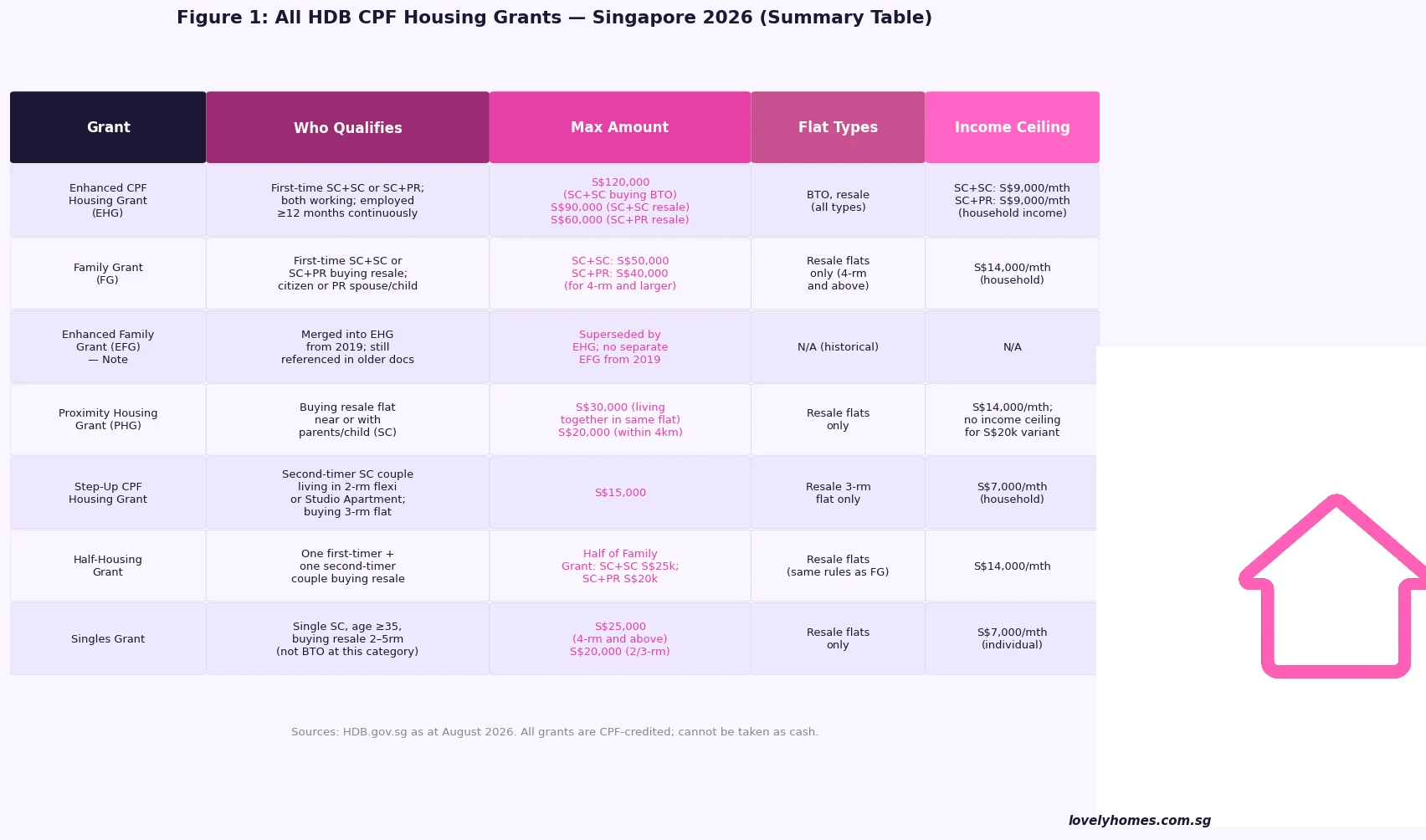
Figure 1: All HDB CPF housing grants Singapore 2026 summary table
Figure 1: All HDB CPF Housing Grants — Summary Table for Singapore 2026. Income ceilings, maximum amounts, flat types and stackability at a glance. Source: HDB.gov.sg.

Worked Example: How Three Grants Stack for a First-Timer Family

Scenario: SC+SC First-Timer Couple with PHG Eligibility, Middle-Income Bracket

Buyers: Mr and Mrs Ng, both SC, married, first-timer HDB buyers. Both employed.
Household income: S$8,200/mth (Mr Ng S$5,000 + Mrs Ng S$3,200)
Flat: 5-room HDB resale, Woodlands, agreed price S$680,000
Parents: Mr Ng’s parents live in Marsiling — within 4km of the Woodlands flat
Employment: Both continuously employed > 12 months

EHG Entitlement (SC+SC resale, income S$8,200/mth):
At S$8,001–S$8,500 income band (HDB table): EHG = approximately S$50,000

Family Grant (SC+SC, 5-room resale): S$50,000

Proximity Housing Grant (within 4km of Mr Ng’s parents): S$20,000
Note: No income ceiling for this variant.

Total grants: S$50,000 + S$50,000 + S$20,000 = S$120,000
All S$120,000 credited to CPF OA before completion.

Financing (HDB Concessionary Loan, 25-year tenure):
Purchase price: S$680,000
HDB loan ceiling: 80% of assessed value (assuming value = S$680,000): S$544,000
Grant credit: S$120,000 → CPF OA balance used for 10% downpayment: S$68,000 (partly from grants)
Cash downpayment (remaining 10% after CPF): S$0 if CPF OA + grants ≥ S$68,000 (likely satisfied)
Monthly repayment @2.6% p.a., S$544,000, 25 years: approximately S$2,477/mth
MSR: S$2,477 / S$8,200 = 30.2% — slightly over 30%. Adjust: extend tenure to 30 years → S$2,177/mth → MSR 26.5% PASS

BSD on S$680,000:
1%×S$180k + 2%×S$180k + 3%×S$320k = S$1,800 + S$3,600 + S$9,600 = S$15,000
ABSD: S$0 (first property, SC+SC)

Net effective purchase cost: S$680,000 (price) − S$120,000 (grants) = S$560,000 funded by loan + CPF balance + cash.
The grants represent a 17.6% reduction in effective cost, achieved through three legally stackable grant streams.

CPF Accrued Interest — The Important Caveat

One aspect of CPF grants that buyers sometimes overlook is the accrued interest obligation. When you use CPF OA funds (including grant credits) to purchase a flat and later sell it, you must refund the full CPF amount used plus the accrued interest calculated at 2.5% per annum — the CPF OA interest rate — back to your CPF account. This applies to all CPF OA withdrawals for housing, including grant amounts.

For the Ng family above: if they sell the flat after 10 years, they must refund S$120,000 (grants) × (1.025)^10 − S$120,000 = approximately S$33,700 in accrued interest, plus the accrued interest on their own CPF contributions. This is not a repayment to the government — it goes back into their own CPF retirement savings — but it does reduce the cash proceeds they receive at sale. Understanding this mechanics is important when planning whether to buy a resale flat, how long to hold it, and how the CPF grant affects your eventual net proceeds.

Grants Not Available for Resale Flats: What BTO Offers That Resale Does Not

The EHG is nominally available for both BTO and resale purchases, but the quantum is higher for BTO buyers. A SC+SC couple earning S$5,000/mth receives S$100,000 EHG on a BTO flat but only S$75,000 on a resale flat (illustrative figures from the HDB EHG table). This gap reflects the government’s desire to channel demand towards BTO flats, which are sold at an explicit subsidy below market value. The upshot for buyers comparing BTO versus resale: if EHG eligibility is high, the total financial advantage (lower price + higher EHG) of BTO may outweigh the convenience of the resale market, especially for patient first-timer couples who can wait four to six years.

What Might Change: HDB Grant Policy Outlook 2026–2027

HDB grant structures in Singapore have been adjusted multiple times over the past decade, generally in an upward direction as the government responds to rising property prices. The most recent major revision was the introduction of the EHG in 2019, which substantially increased maximum grant amounts for lower-income buyers. As at August 2026, there are no announced changes to the grant framework, though policymakers have signalled continued focus on housing affordability for first-timer families.

One area to watch is the treatment of grants for Singles. The 2013 extension of grants to singles, and subsequent expansions, reflect a gradual recognition of changing household structures. Further extensions — for example, allowing singles to access larger BTO flats with grant support — have been discussed in policy circles but not yet implemented. Any change in this area would materially affect the resale market for studio and 2-room flat types, where single buyers are a significant demand segment.

Frequently Asked Questions

Can I receive a grant even if I earn above S$9,000 per month?

Yes — if your income exceeds the EHG ceiling of S$9,000/mth, you no longer qualify for the EHG, but you may still qualify for the Family Grant (income ceiling S$14,000/mth) and the Proximity Housing Grant (S$20,000 variant has no income ceiling). This means a couple earning S$12,000/mth buying a resale 4-room flat near a parent could still receive S$50,000 (Family Grant) + S$20,000 (PHG) = S$70,000 in total grants, despite being ineligible for EHG. Always check all three grant streams, not just EHG, before assuming you receive nothing.

What happens to my grant if my circumstances change before completion?

HDB assesses grant eligibility at the time of resale application. If your circumstances change materially before completion — for example, if your income increases significantly, you divorce, or one party’s citizenship status changes — HDB may reassess your eligibility. In practice, minor income fluctuations after the HFE Letter is issued do not normally result in grant clawback, but major changes can. It is prudent to inform HDB immediately if your household composition or income changes substantially after your HFE Letter is issued. HDB’s officers will advise whether a reassessment is needed.

Do grants affect how much I can borrow?

Grants affect your CPF OA balance positively (they increase the CPF funds available for downpayment and monthly repayments) but do not directly affect your loan quantum. The maximum HDB loan is 80% of the lower of the assessed value or purchase price, regardless of grants. Bank loan quantum is determined by TDSR, income, and Loan-to-Value ratios — grants are not factored in. However, because grants reduce the effective amount you need to finance, they lower your monthly loan repayment burden and may help you pass the MSR (30%) or TDSR (55%) tests that could otherwise be binding.

What is the Half-Housing Grant and when does it apply?

The Half-Housing Grant applies when exactly one partner in a couple is a first-timer and the other is a second-timer (previously received HDB housing subsidy). The grant is equal to half the applicable Family Grant quantum: S$25,000 for SC+SC couples buying a 4-room or larger resale flat (half of S$50,000) and S$20,000 for SC+PR couples in the same category. It cannot be stacked with the full Family Grant — it replaces it. The EHG may still be available to the first-timer partner’s income contribution, subject to eligibility. HDB assesses the first-timer’s individual income for EHG in these mixed-status couples, not the household income.

If we receive the PHG by buying near parents, do our parents need to still be living nearby after we move in?

Yes. The PHG carries a co-location or proximity requirement that must be maintained for a minimum period after the flat purchase. If you received the S$30,000 co-location PHG (buying in the same building as your parents), you are required to co-locate for at least five years. If you received the S$20,000 within-4km PHG, you are required to maintain that proximity for five years. If your parents or you move away from the qualifying proximity during this period, HDB may require repayment of the PHG. The five-year condition is enforced; HDB may conduct checks during this period. Always factor this requirement into your housing plans — particularly if your parents have health conditions that may require residential care.

Can foreigners or PRs alone buy an HDB flat and receive grants?

No. HDB flats can only be purchased by eligible Singapore Citizens (and PRs in specific circumstances). PRs alone cannot buy a new HDB flat — they can only buy a resale flat as part of a SC+PR household. The SC must be the primary applicant. Grants require at least one SC applicant; the EHG for SC+PR couples is lower than for SC+SC couples. Foreigners who are not PRs cannot buy HDB flats at all, new or resale. This framework is enshrined in the Housing and Development Act and has not changed materially in recent years.

Are grants available for EC (Executive Condo) purchases?

No. CPF Housing Grants — EHG, Family Grant, PHG, Step-Up Grant, and Singles Grant — are not available for Executive Condo (EC) purchases. ECs are hybrid developments classified as private property after their 10-year privatisation period, and they are priced higher than HDB flats accordingly. While the EC income ceiling (S$16,000/mth) is higher than BTO income ceilings, the absence of grants is a significant trade-off. Buyers choosing between an EC and a resale HDB flat should model the net cost carefully, factoring in the grant support available for resale that is absent for ECs. See our Executive Condo Singapore 2026: Complete Guide for a full EC breakdown.

Related Articles

Disclaimer

This article is produced for general informational and educational purposes only. CPF Housing Grant eligibility criteria, income ceilings, and grant amounts are subject to change by the Housing & Development Board (HDB) and CPF Board. All figures quoted reflect publicly available information as at August 2026. Readers should verify current grant eligibility, amounts, and conditions at HDB.gov.sg and CPF.gov.sg before making any property decision. This article does not constitute financial, legal, or property advice. Readers are advised to engage a licensed property agent (registered with the Council for Estate Agencies) and, where appropriate, a financial adviser licensed by the Monetary Authority of Singapore for transaction-specific guidance.

×

Click anywhere outside image to close

Leasehold vs Freehold Property Singapore 2026: Which Tenure Should You Buy?

Leasehold vs Freehold Property Singapore 2026: Which Tenure Should You Buy?

Quick Answer — Leasehold vs Freehold in Singapore

  • Leasehold (typically 99 years) means you own the property but not the land — ownership reverts to the state when the lease expires.
  • Freehold (or 999-year leasehold) means the land is yours in perpetuity, with no expiry date on your rights.
  • Freehold properties trade at a 7–15% premium over comparable 99-year leasehold units, depending on the segment and location.
  • CPF usage is restricted for leasehold properties where the remaining lease falls below 35 years at the time of purchase.
  • Bank LTV tightens progressively as lease shortens — a property with fewer than 30 years remaining may be ineligible for conventional mortgage financing.
  • For most HDB upgraders and first-time private buyers, a well-located 99-year leasehold offers a strong value proposition with comparable short-to-medium term returns.
  • Freehold properties are preferred for generational wealth transfer, estate planning, and long-hold investment strategies.
  • All stamp duties (ABSD, BSD, SSD) and property tax apply equally to both tenure types.

What Do Leasehold and Freehold Mean in Singapore?

In Singapore, almost all land is owned by the state. When you purchase a leasehold property, you acquire the right to occupy and use the land for a fixed period — most commonly 99 years from the date the land was first sold, though 999-year and 9,999-year leaseholds also exist, primarily from colonial-era grants. When the lease expires, the land (and anything on it) reverts to the Singapore Land Authority (SLA).

A freehold title, by contrast, grants the owner perpetual rights to the property and the underlying land. In practice, the Singapore government retains the power of compulsory acquisition at any time under the Land Acquisition Act, though owners receive statutory compensation. For this reason, freehold in Singapore should be understood as effectively permanent ownership rather than an absolute guarantee against government acquisition.

About 80% of Singapore’s private residential stock is leasehold, the overwhelming majority on 99-year terms. HDB flats are uniformly 99-year leasehold.

Leasehold vs freehold key differences comparison table Singapore 2026
Figure 1: Leasehold vs Freehold — key criteria comparison. Source: SLA, CPF Board, MAS guidelines; analysis by LovelyHomes.

Pricing: How Much Extra Does Freehold Cost?

The freehold premium is real but varies significantly by market segment. In the Core Central Region (CCR) — districts 9, 10, 11 and Marina Bay — freehold and 999-year properties consistently command 10–15% more per square foot than equivalent 99-year condos. This is partly because CCR buyers tend to be wealthier, longer-hold investors who place a higher premium on permanency. In the Outside Central Region (OCR), where most upgraders and HDB buyers shop, the freehold premium compresses to around 5–8% because the vast majority of available stock is 99-year leasehold, reducing the scarcity premium of freehold units.

HDB flats are uniformly 99-year leasehold — there is no freehold HDB equivalent. For landed property such as terrace houses, semi-detached and bungalows, freehold titles carry a more pronounced premium of up to 15–20% for comparable plots, reflecting the appeal of perpetual land ownership for families building generational wealth.

Freehold property price premium over leasehold by segment Singapore 2026
Figure 2: Indicative freehold price premium over 99-year leasehold by segment. Based on URA caveat data 2024–2025. CCR = Core Central Region; RCR = Rest of Central Region; OCR = Outside Central Region. Source: URA Realis, LovelyHomes analysis.

CPF and Bank Financing: The Lease-Remaining Rules

One of the most practically important differences between leasehold and freehold does not appear in the sales brochure — it shows up at the bank and CPF Board application stages. The CPF Valuation Limit (VL) rule requires that when you use CPF savings to buy a private leasehold property, the remaining lease at the time of purchase must be able to cover the youngest buyer to age 95. If the lease cannot run that long, your CPF usage is proportionally restricted.

For example, if a 40-year-old buyer purchases a property with 55 years of lease remaining, the lease would only carry them to age 95 (55 + 40 = 95, exactly meeting the threshold). Any shorter lease would trigger a CPF usage cap. The CPF Board uses a linear formula: the usable CPF amount is capped at a fraction equal to the lease-remaining-to-95 divided by the full lease life, applied to the property’s Valuation Limit.

For HDB flats, CPF use is further governed by the joint HDB-CPF lease-shortening rules introduced in 2019. Broadly, HDB flats with fewer than 20 years of lease remaining cannot be purchased using CPF at all.

On the bank financing side, Monetary Authority of Singapore (MAS) Notice 632 sets LTV limits that effectively tighten as a leasehold property ages. A property with 30 years or fewer remaining is treated very conservatively, and conventional mortgage products are typically unavailable below 20–25 years remaining. Freehold properties carry no such constraints — the maximum 75% LTV applies for life.

Bank LTV and CPF usability by lease remaining Singapore 2026
Figure 3: Illustrative bank LTV and CPF usability as lease shortens. Exact limits depend on buyer age and the youngest-buyer-to-95 formula. Source: MAS Notice 632, CPF Board guidelines; LovelyHomes analysis.

Capital Appreciation: Does Freehold Always Win?

The widely-held belief that freehold properties always outperform leasehold over the long run is partially correct but oversimplified. In Singapore’s land-scarce, high-demand environment, location dominates tenure over 10–20 year holding periods. A 99-year condominium in Bishan or Tampines near an MRT station has routinely outperformed a freehold development in a less accessible district over equivalent periods.

Where the gap widens dramatically is at lease-decay inflection points. Properties crossing the 60-year, 50-year, and 40-year remaining thresholds often experience a structural correction in capital appreciation as the CPF and LTV restrictions begin to narrow the buyer pool. A 99-year leasehold condo purchased new in 2000 is now about 75 years old — still financeable, still CPF-eligible for most buyers. But in 15 years (60 years remaining), the buyer pool for the same property will start to compress, and by the 40-year mark, appreciation is likely to reverse into depreciation.

Freehold properties sidestep this curve entirely. Their value trajectory is driven purely by locational demand, development density, and macro conditions — not by a built-in depreciation clock. This makes freehold especially appealing as an estate planning vehicle for families who intend to hold across generations.

En Bloc Potential: A Leasehold Advantage?

One area where older leasehold developments can outperform is en bloc (collective sale) potential. When a 99-year leasehold development is approaching 30–40 years of age, the land plot often becomes attractive for redevelopment — especially if the gross floor area (GFA) allowed under the Master Plan has increased since the original development. Owners may receive a substantial windfall above market value as the developer acquires the site and demolishes the existing building to construct a new development.

Freehold developments can also go en bloc, but developers typically pay a higher land premium for them. In practice, the calculus is similar — owners receive a premium; the key variable is always land value relative to replacement cost, not tenure per se. The Land Titles (Strata) Act 2018 amendments set the 80% consent threshold for developments over 10 years old (90% for those under 10 years), applying equally to both tenure types.

Summary Table: Leasehold vs Freehold Decision Framework

Factor Leasehold (99-yr) Freehold / 999-yr Winner
Entry price 5–15% lower Premium pricing Leasehold
CPF eligibility (new buy) Full (if lease covers youngest to 95) Full, no restriction Draw
CPF eligibility (ageing property) Restricted below 35 yrs No restriction ever Freehold
Bank LTV Reduces as lease shortens Always 75% Freehold
Short-term returns (10 yr) Location-driven; comparable Location-driven; comparable Draw
Long-term returns (30+ yr) Lease decay erodes value No built-in depreciation Freehold
Property tax Same AV-based rates Same AV-based rates Draw
ABSD / BSD / SSD Same rates apply Same rates apply Draw
Estate / generational planning Lease will eventually expire Can be held indefinitely Freehold
En bloc potential High at 25–40 yr mark Possible; land cost higher Draw

Worked Example: The Tans Buy a Condo

Mr and Mrs Tan are Singapore Citizens (SC) in their late thirties looking to purchase a second private property after selling their HDB flat. They have a combined income of S$15,000 per month and are considering two comparable 3-bedroom condominiums in Queenstown:

  • Option A — Leasehold: 3-bedroom, 1,100 sq ft, 99-year leasehold (70 years remaining), asking S$1.85 million (S$1,682 psf)
  • Option B — Freehold: 3-bedroom, 1,100 sq ft, freehold, asking S$2.05 million (S$1,864 psf) — approximately 11% premium

Stamp duty (both options): The Tans are SC second-property buyers. ABSD rate = 20%. BSD on S$1.85M = S$49,600; ABSD = S$370,000. Total stamp duty on Option A: S$419,600. On Option B (S$2.05M): BSD S$55,600 + ABSD S$410,000 = S$465,600.

Bank financing: Option A (70 years remaining) is fully financeable — 75% LTV gives a maximum loan of S$1.3875M. Option B: also 75% LTV, maximum loan S$1.5375M. TDSR at S$15,000/mth income, assuming no other debts: maximum monthly obligation S$10,500 (70% × income). At 3.3% for 25 years, S$1.3875M loan ≈ S$6,755/mth — well within TDSR. ✓

CPF: Both properties are well above the 35-year threshold at time of purchase, so full CPF Ordinary Account savings are available for both options.

10-year outlook: If the Tans hold for 10 years and the market appreciates at 3% per annum for both properties: Option A would be worth approximately S$2.49M; Option B approximately S$2.75M. The difference — S$260,000 — roughly equals the initial price premium paid for the freehold, net of compounding. At the 10-year mark, the leasehold property will have 60 years remaining (still well above CPF/LTV thresholds), so the buyer pool remains strong.

Conclusion for the Tans: At their age and timeframe (likely selling within 15–20 years), the freehold premium is unlikely to deliver a meaningful outperformance over the well-located leasehold. If they intend to hold past the 30-year mark or pass the property to children, freehold delivers clearer long-term value. If budget is the primary constraint, the leasehold option preserves over S$200,000 in upfront capital.

What This Means for You: A Buyer’s Decision Tree

Choosing between leasehold and freehold ultimately comes down to three questions. First: how long do you intend to hold? If your horizon is under 15 years, the freehold premium is unlikely to pay back on purely capital-appreciation grounds — a well-located 99-year leasehold near a transport node will outperform a poorly-located freehold. Second: what is your estate planning priority? If you want to pass the property to your children and grandchildren without restriction, freehold is the cleaner vehicle — there is no lease clock ticking. Third: are you buying an older property? A 99-year leasehold with only 50 years remaining is a fundamentally different proposition from a newly-launched one — the CPF restrictions, LTV headwinds, and resale pool compression all intensify from the 60-year mark downwards.

For most Singaporeans buying a first or second private property in their thirties or forties, a new or near-new 99-year leasehold in a strong location is a rational, wealth-building choice. For those seeking permanence, family legacies, or who are buying older secondary-market units with significant lease decay, freehold delivers structural advantages that compound materially over multi-decade holding periods.

What Might Change

The URA has occasionally reviewed land tenure policy for specific use cases — for example, the 2021 decision to offer 99-year leasehold sites for industrial use only. Residential policy has remained stable for several decades. One area to watch is the potential extension of lease top-ups: the Lease Top-Up (LTU) scheme under HDB allows very long-staying residents to extend short leases in specific circumstances, but this does not apply broadly to private leasehold stock. Any regulatory change that normalised private leasehold top-ups would significantly affect the relative value of ageing 99-year condominiums, though no such proposal has been announced as at May 2026.

Frequently Asked Questions

Can I use CPF to buy a freehold property?

Yes. There are no CPF restrictions on freehold properties — you can use your Ordinary Account (OA) savings up to the Valuation Limit of the property without any lease-related cap. For leasehold properties, CPF usage is restricted if the remaining lease cannot cover the youngest buyer to at least age 95 at the time of purchase.

Is a 999-year leasehold the same as freehold?

For practical purposes, a 999-year leasehold behaves almost identically to freehold — no living buyer will outlast the lease. Banks apply the same LTV rules, CPF imposes no restrictions, and market pricing treats 999-year leaseholds as equivalent to freehold in most cases. The key distinction is theoretical: technically, the land reverts to the state in year 999, but this will not occur within any realistic planning horizon.

Do HDB flats have any freehold option?

No. All HDB flats are 99-year leasehold. There is no freehold HDB equivalent in Singapore. The government’s rationale is that freehold HDB flats would complicate future estate planning, urban renewal, and equitable access — the flat is intended as subsidised housing for the duration of the 99-year lease, not as a perpetual estate asset.

Does ABSD apply differently to leasehold vs freehold?

No — Additional Buyer’s Stamp Duty (ABSD), Buyer’s Stamp Duty (BSD), and Seller’s Stamp Duty (SSD) are all computed identically on both tenure types. ABSD is charged on the purchase price or market value (whichever is higher), regardless of whether the property is leasehold or freehold. The ABSD rates for 2026 — 0% (SC first property) to 65% (entities buying residential property) — apply to all residential property.

What happens when a 99-year leasehold expires?

When a 99-year lease expires, the land and all structures on it revert to the state (SLA) at no compensation, unless the lease is extended or the government acquires the site under the Land Acquisition Act before expiry. In practice, no private 99-year leasehold development launched in Singapore’s post-independence era has yet reached expiry — the earliest post-1960s launches will hit their 99-year mark around 2055–2075. The government has signalled through the Selective En Bloc Redevelopment Scheme (SERS) that ageing HDB estates may be redeveloped with compensation, but no equivalent guarantee exists for private leasehold developments.

Can the government acquire freehold property?

Yes. The Land Acquisition Act empowers the Singapore government to acquire any land — including freehold — for public purposes. Owners receive statutory compensation assessed at market value. The government has exercised this power for MRT lines, public housing development, and roads. While freehold titles carry no expiry date, they do not grant immunity from compulsory acquisition. In practice, the Singapore government compensates at or above market rates, and large-scale residential acquisitions of private freehold property are uncommon.

How do I check the tenure of a property before buying?

The most reliable source is the URA Space portal (map.ura.gov.sg) where you can click on any private residential development to see the tenure type and commencement date. The SLA’s Land Titles Registry also records tenure on the issued title document. Alternatively, your conveyancing solicitor will verify tenure as part of the standard due-diligence process before you exchange OTP.

Related Articles

Disclaimer

This article is for general informational and educational purposes only. It does not constitute financial, legal, or property advice. Stamp duty rates, CPF rules, LTV limits, and other regulatory thresholds cited reflect publicly available guidance from the Inland Revenue Authority of Singapore (IRAS), CPF Board, Monetary Authority of Singapore (MAS), Singapore Land Authority (SLA), and Urban Redevelopment Authority (URA) as at May 2026. Rules may change — readers should verify current rates with the relevant statutory boards and consult a licensed financial adviser, conveyancing solicitor, or accredited mortgage broker before making any property decision.


Click anywhere outside to close

Translate »