by Lovelyhomes Editorial Team | Apr 24, 2026 | Investment Analysis, Market News, Price Trends, Property News, Property Trends
Singapore’s private residential property market began 2026 on a note of careful consolidation. The Urban Redevelopment Authority’s flash estimate for Q1 2026, released on 1 April, recorded a 0.3% quarter-on-quarter increase in the overall private residential price index — the softest quarterly growth in six quarters and a meaningful deceleration from the 0.6% gain seen in Q4 2025. Yet beneath this headline restraint lie important divergences across segments and regions that tell a more nuanced story.
Key Market Signals — Q1 2026
- Overall private residential prices: +0.3% q-o-q (slowest growth in 6 quarters)
- Non-landed segment: +1.0% q-o-q — strong rebound from Q4 2025’s slight dip
- OCR leads: +1.3% q-o-q — suburban condos remain the demand driver
- CCR recovery: +0.4% q-o-q — reverses the -3.5% slide of Q4 2025
- Transactions: ~4,041 units — down 39.7% q-o-q from a high Q4 2025 base
- New launch take-up: Several Q1 launches sold over 90% on launch weekend
Singapore Private Residential Market — Q1 2026
Flash estimate figures released 1 April 2026 by the Urban Redevelopment Authority
| Overall Price Change (q-o-q) |
+0.3% — slowest growth in 6 quarters |
| Non-Landed Prices (q-o-q) |
+1.0% — rebound from -0.2% in Q4 2025 |
| Landed Prices (q-o-q) |
-1.8% — reversal from +3.4% in Q4 2025 |
| Core Central Region (CCR) |
+0.4% — reversal from -3.5% decline in Q4 2025 |
| Rest of Central Region (RCR) |
+0.9% — after +0.7% in Q4 2025 |
| Outside Central Region (OCR) |
+1.3% — strongest regional performer |
| Total Transactions (Q1 2026) |
~4,041 units — down 39.7% q-o-q from 6,699 in Q4 2025 |
| New Launch Take-up Highlight |
Several Q1 launches achieved >90% take-up at launch weekend |
| 2026 Launch Pipeline |
~17 projects / ~8,100 units — approx. 30% fewer than 2025 |
Key Takeaway
Private residential prices in Singapore remain in positive territory in Q1 2026, with non-landed homes leading a modest recovery. Transaction volumes fell sharply from a high Q4 2025 base but demand at quality new launches remained resilient.
Source: URA flash estimate — ura.gov.sg — 1 April 2026
 lovelyhomes.com.sg
Non-Landed Segment Rebounds; Landed Dips
The Q1 2026 data reveals a clear bifurcation between the non-landed and landed segments. Non-landed private homes (condominiums and apartments) posted a 1.0% quarter-on-quarter price gain — a healthy rebound from the marginal 0.2% decline recorded in Q4 2025. Landed homes, in contrast, retreated 1.8% after a strong 3.4% surge in the preceding quarter. The landed pullback is consistent with the typical volatility in that segment, which trades on thin volumes and is sensitive to single large transactions.
For most buyers and investors focused on the condominium market, the non-landed rebound is the more relevant signal. The data suggests that underlying demand for well-located private apartments remains positive, supported by a constrained 2026 launch pipeline and steady household formation among Singapore’s resident population.
OCR Leads; CCR Stages a Recovery
The Outside Central Region (OCR) — Singapore’s suburban heartland comprising districts such as Tampines, Jurong, Tengah, Sengkang, Upper Thomson, and Woodlands — delivered the strongest price performance of any region in Q1 2026 at +1.3% quarter-on-quarter. This reflects sustained demand from HDB upgraders, first-time private buyers, and families attracted to the OCR’s larger unit sizes and more accessible price quantum. Several OCR launches in late 2025 and early 2026 recorded impressive sales velocity; with the 2026 pipeline lean in this segment, competition for quality suburban new launches is likely to remain brisk.
The Rest of Central Region (RCR), covering districts like Bishan, Toa Payoh, Queenstown, River Valley, and parts of Novena, posted a 0.9% gain — a tick up from the 0.7% seen in Q4 2025, suggesting mid-market city-fringe product continues to attract steady demand from owner-occupiers and investors seeking a balance of accessibility and price growth.
The Core Central Region (CCR) — comprising the prime districts of Sentosa, Orchard, Holland, Tanglin, Marina Bay, and the financial district — staged a notable recovery with a +0.4% quarter-on-quarter gain, directly reversing the -3.5% decline of Q4 2025. The Q4 2025 weakness was largely attributed to a normalisation after a period of elevated prime-market activity and the impact of the 60% foreign buyer ABSD, which has materially suppressed international demand since April 2023. The Q1 2026 recovery suggests domestic CCR demand — led by Singapore Citizens, PRs, and Free Trade Agreement-eligible nationals including US citizens and Swiss nationals — is stabilising the top end of the market.
Transaction Volume Down on a High Base
Total private home transactions fell to approximately 4,041 units in Q1 2026, a 39.7% decline from the 6,699 units transacted in Q4 2025. The sharp percentage drop sounds alarming but should be read with important context: Q4 2025 was an unusually active quarter, boosted by a high concentration of new project launches in the second half of 2025 (including multiple large OCR and RCR projects that sold strongly). The Q1 2026 volume is closer to a normalised quarterly run-rate rather than an indication of distress.
Of the six developments launched in Q1 2026, several achieved take-up rates exceeding 90% on their respective launch weekends — a clear signal that buyer demand remains calibrated to the right product at the right price point. The cautionary note, however, is that with only approximately 17 projects and 8,100 units anticipated in the 2026 full-year pipeline (a 30% reduction on 2025’s approximately 11,000+ units), the aggregate transaction volume for 2026 is expected to be structurally lower than in prior years — not because demand has collapsed, but because supply is meaningfully constrained.
What This Means for Buyers in 2026
For prospective buyers, the Q1 2026 data paints a picture of a market in consolidation rather than in correction. Prices are neither accelerating dangerously nor sliding materially. The government has signalled no intention to introduce additional cooling measures in the near term, with the existing 60% foreign buyer ABSD and 55% TDSR cap continuing to provide structural support for affordability among genuine owner-occupiers.
For buyers considering the OCR, the combination of +1.3% price growth and a thin 2026 pipeline suggests that well-located suburban launches — particularly those with MRT proximity — are likely to see sustained demand. Projects such as Springleaf Residence (Upper Thomson, TEL, 941 units) and Pinery Residences (Tampines) illustrate the kind of connected suburban product that has been absorbing the bulk of OCR demand in early 2026. For CCR buyers, the segment’s Q1 recovery after a period of weakness opens a potential re-entry window for domestic buyers who have been waiting on the sidelines.
The full Q1 2026 URA report (incorporating complete sales data beyond the preliminary caveat cut-off) is expected in late April 2026. Buyers and investors should monitor the final figures alongside the HDB Resale Price Index, which is released in the same cycle, for a complete picture of how the private-public residential market relationship is evolving.
Related Guides
Disclaimer: Market data in this article is drawn from the URA flash estimate released 1 April 2026. Final figures will be published in the full URA quarterly release (typically 3–4 weeks after flash estimate). This article is for informational purposes only and does not constitute investment or financial advice.
by Lovelyhomes Editorial Team | Apr 24, 2026 | Market News, Property News, Property Trends
If you have been waiting for the right moment to enter Singapore’s private residential market, the numbers in 2026 are telling a story worth paying attention to. This year is shaping up to be the quietest year for new private condo launches in at least three years — with an estimated 17 projects and approximately 8,100 units entering the market, compared with roughly 23 projects and over 11,000 units in 2025. A 30% reduction in new supply is not a footnote; it is the defining market dynamic that every prospective buyer and investor needs to factor into their planning.
2026 New Launch Pipeline at a Glance
- Approximately 17 private residential projects (18 including ECs) expected in 2026
- Total unit supply: ~8,100 units — roughly 30% below 2025’s ~11,000+
- OCR suburban projects dominate the pipeline — more than half of all units
- Several early 2026 launches already recording 90%+ take-up at launch weekend
- Key launches still to come: Springleaf Residence, UPPERHOUSE, W Residences Marina View, and others in D1, D9, D10, D26
- EC pipeline: ~5 projects expected, catering to the HDB upgrader segment
Singapore New Launch Condo Pipeline 2026
Estimated supply vs prior years — as at April 2026
| 2026 New Launch Estimate |
~17 private residential projects / ~8,100 units |
| 2025 Launches (actual) |
~23 projects / ~11,000+ units |
| Year-on-Year Change |
Approximately -30% in unit supply |
| 2024 Launches (actual) |
~8,000–9,000 units (comparable to 2026) |
| OCR Share (2026 pipeline) |
Majority — over 50% of units in suburban locations |
| CCR Share (2026 pipeline) |
Smaller share — constrained by 60% foreign ABSD, GLS scarcity |
| Key OCR Projects (2026) |
Springleaf Residence, Pinery Residences, Rivelle Tampines EC |
| Key CCR/RCR Projects (2026) |
UPPERHOUSE Orchard Blvd, W Residences Marina View, 21 Anderson |
| Strong Take-Up Threshold |
Several 2026 launches recording >90% on launch weekend |
Key Takeaway
With roughly 30% fewer new units launching in 2026 versus 2025, well-located projects are experiencing strong buyer interest. Buyers who wait too long risk limited availability at quality launches.
Source: Industry data, URA pipeline reports — April 2026
lovelyhomes.com.sg
Why is 2026 Supply so Constrained?
The 2026 supply tightness is largely a function of the Government Land Sales (GLS) programme cycle and the typical 3–5 year development period between site award and launch. Many of the sites sold during the 2019–2020 period have already launched (contributing to the busy 2023–2025 pipeline), while the sites awarded in 2022–2023 are still under construction and will not be market-ready until 2027 or beyond in many cases. The result is a natural valley in the launch calendar during 2026.
Compounding the GLS timing effect, Singapore’s construction costs and labour constraints have added 6–12 months to typical development timelines for several projects originally slated for 2025 launches that have slipped into 2026 or later. Meanwhile, the government has been measured in its GLS supply releases — calibrating site offerings against market conditions to avoid both over-supply and price spikes — meaning the pipeline for the near-term is already largely set.
OCR Dominates, CCR Gets Premium Boutique Projects
The geographic distribution of the 2026 pipeline skews heavily toward the OCR. More than half of the anticipated new units are in suburban locations, reflecting the GLS programme’s allocation of residential sites in growth areas such as Tengah, Tampines North, Jurong Lake District, Canberra, and Upper Thomson. This is broadly consistent with the government’s stated objective of providing well-served housing near employment hubs and public transport nodes.
In the OCR, the standout offering this year is Springleaf Residence — GuocoLand’s 941-unit nature-integrated development at Upper Thomson Road, just 110 metres from Springleaf MRT on the Thomson-East Coast Line. The project’s biodiversity-conservation design concept and a conserved heritage building make it architecturally unlike anything else in the suburban pipeline. At this stage, the Upper Thomson corridor is also set to benefit from the broader Springleaf new town development planned by URA, which will add community amenities, green corridors, and township infrastructure around the site over the coming decade.
In the CCR and RCR, the 2026 picture is one of boutique quality over quantity. UPPERHOUSE at Orchard Boulevard — the 301-unit UOL Group and Singapore Land Group collaboration at 22 Orchard Boulevard — is among the most keenly anticipated CCR launches of the year, offering a genuinely rare Orchard Boulevard address with low unit density and Swiss-Italian material specifications. W Residences Marina View, a 683-unit branded residence by IOI Properties atop a 360-room W Hotels property in Marina Bay District 1, represents an entirely new product category for Singapore: a luxury branded residence tower that brings five-star hotel services into an owner-occupied residential framework. At 237 metres, it is also set to be among the tallest residential towers in the republic.
Strong Demand Meets Leaner Supply: What Happens to Prices?
Early 2026 market data suggests that the combination of constrained new supply and sustained demand from domestic buyers is creating a productive tension in the new launch segment. The Q1 2026 URA flash estimate recorded a 0.3% quarter-on-quarter price increase overall, with the OCR leading at +1.3% q-o-q. This is a market in measured growth, not a speculative spike — the structural constraints of the ABSD framework and the TDSR limit mean Singapore’s residential market cannot achieve the kind of runaway appreciation seen in some other global cities.
For buyers, the implication of a lean 2026 pipeline is straightforward: there are fewer opportunities to choose from, and the best-positioned units (MRT-proximate stacks, larger configurations, view-facing orientations) are likely to be absorbed quickly at launch. The pattern seen at Pinery Residences — a 588-unit Tampines West project that sold 92.5% of units at an average of S$2,546 per square foot at its launch weekend in early 2026 — indicates buyers are prepared to commit decisively when the product offering is right.
The Executive Condo Opportunity in 2026
For eligible HDB upgraders, the 2026 EC pipeline presents a compelling alternative to private condos. Five EC projects are expected in 2026, including Rivelle Tampines EC and projects near Sembawang and the Plantation Close area. ECs are sold at prices typically 20–30% below comparable private condos in the same location, and first-timer HDB upgraders who purchase directly from the developer are not required to pay ABSD even if they still own their HDB flat. The income ceiling for EC applications is S$16,000 in combined gross monthly household income.
As EC projects privatise after 10 years from their TOP, they typically achieve capital appreciation comparable to private condos in the same district. For value-conscious upgraders who can qualify, the 2026 EC pipeline deserves serious attention — particularly given the tighter supply of private OCR launches this year.
Looking Ahead: What to Expect from H2 2026
The majority of the 2026 new launches are expected in the second half of the year. Buyers who have done their research, secured their In-Principle Approval, and identified their preferred district and project type are best placed to act quickly when launches are announced. With limited inventory in both OCR and CCR segments, waiting for conditions to “improve” is a strategy that carries its own risks in a supply-constrained year.
The government’s consistent message has been that there are no plans for additional cooling measures unless private home prices show an unsustainable spike exceeding 10% year-on-year. With Q1 2026 growth at 0.3% for the quarter, the current trajectory does not suggest intervention is imminent. The next data checkpoint will be the full Q1 2026 URA report expected later in April, followed by the Q2 2026 flash estimate in July.
Related Guides
Disclaimer: Pipeline estimates in this article are based on publicly available project information, GLS award records, and industry data as at April 2026. Actual launch dates and unit counts are subject to change at developer’s discretion. This article is for informational purposes only and does not constitute investment advice. Source: URA — ura.gov.sg.

by Lovelyhomes Editorial Team | Apr 24, 2026 | Financial Planning, Home Loans & Mortgages
For most Singaporeans, the home loan is the largest financial commitment of their lives — and in a market where private condo prices now range from S$1.2 million to S$4 million and beyond, getting the loan structure right can save (or cost) hundreds of thousands of dollars over a 25–30 year mortgage. This guide covers everything you need to know about home loans in Singapore in 2026: how much you can borrow, what the rates look like, how to compare packages, and how to build the strongest possible loan application.
Quick Answer — Singapore Home Loan Basics 2026
- Maximum LTV: 75% for first private property (5% cash + 20% CPF/cash); 45% if holding an existing property
- TDSR cap: Total monthly debt repayments cannot exceed 55% of gross monthly income
- Typical fixed rates (2026): 2.5%–3.5% p.a. for 2–3 year lock-in packages
- SORA benchmark: 3-month SORA fluctuates; total SORA-linked rate approximately 3.3%–3.8% in April 2026
- Maximum loan tenure: 30 years (or limited so borrower does not exceed age 65 at loan end)
- IPA (In-Principle Approval): Obtain before visiting any showflat — it defines your budget precisely
Singapore Home Loan Key Parameters 2026
Private residential properties — framework in force as at 24 April 2026
| Maximum LTV (first property) |
75% — bank loan; 80% — HDB concessionary loan (for HDB flats) |
| Maximum LTV (if holding 1 property) |
45% bank loan |
| Maximum LTV (if holding 2+ properties) |
35% bank loan |
| Minimum Cash Down Payment |
5% of purchase price (first property, 75% LTV) |
| Total Debt Servicing Ratio (TDSR) |
55% of gross monthly income — all debt obligations |
| Mortgage Servicing Ratio (MSR) |
30% of gross income — applies to HDB and EC loans only |
| Stress Test Rate |
Typically 4% p.a. or prevailing rate + 2%, whichever is higher |
| Typical Fixed Rate (2026) |
~2.5%–3.5% p.a. (3-year package) — compare across banks |
| Typical SORA-linked (2026) |
3M SORA + spread (~0.7%–0.9%); total ~3.3%–3.8% p.a. |
| Max Loan Tenure |
30 years (private); 25 years if borrower age at end of tenure >65 |
Source: MAS Regulations + MND / bank rate surveys — 24 April 2026
lovelyhomes.com.sg
How Much Can You Borrow? LTV, TDSR, and Stress Tests Explained
Your maximum home loan in Singapore is determined by three overlapping constraints. The most restrictive of the three sets your actual limit.
1. Loan-to-Value (LTV): For a private property loan from a bank, the LTV ceiling is 75% of the purchase price or market value (whichever is lower) for buyers with no outstanding property loans. This means a maximum loan of S$1.387 million on a S$1.85 million purchase. If you hold an existing property loan (e.g., you are buying a second property before selling the first), the LTV drops sharply to 45%, requiring a 55% down payment. These LTV rules are set by MAS and apply uniformly across all banks.
2. Total Debt Servicing Ratio (TDSR): Your total monthly repayments across all debts — home loan, car loan, personal loan, credit card minimum payment, student loan — must not exceed 55% of your gross monthly income. Banks assess TDSR at a stress-tested rate (the higher of 4% p.a. or the prevailing rate plus 2%) to ensure your repayment capacity holds under adverse rate conditions. A joint applicant’s income can be combined; however, guarantors’ income typically cannot be included for TDSR purposes.
3. Loan Tenure Cap: Banks impose a maximum tenure of 30 years, subject to the borrower not exceeding age 65 at loan maturity. A 45-year-old borrower is therefore limited to a 20-year tenure; a 35-year-old can take the full 30 years. Shorter tenure = higher monthly instalment but lower total interest paid. Longer tenure = lower monthly instalment but significantly higher total interest cost over the life of the loan.
Down Payment: What You Need in Cash vs CPF
At 75% LTV, the required down payment is 25% of the purchase price. Of this 25%, at least 5% must be in cash (hard cash — not CPF, not bank loan). The remaining 20% can be funded from any combination of cash and CPF Ordinary Account (OA) savings. This means a buyer purchasing a S$2 million condo must have at least S$100,000 in cash available on the day of OTP exercise, plus access to S$400,000 in additional cash and/or CPF OA for the remaining down payment component.
For upgraders who have just sold an HDB, the CPF OA refund (principal + accrued interest) can provide a significant top-up — in many cases, several hundred thousand dollars — making the 20% non-cash component relatively manageable. The critical cash requirement is the minimum 5%.
Fixed Rate vs SORA-Linked: Which Package is Right for You?
The Singapore Overnight Rate Average (SORA) replaced SIBOR as the benchmark rate for floating-rate home loans from 2021 onwards. As of April 2026, the 3-month compounded SORA sits in the range of approximately 2.5%–3.0%, with bank spreads of 0.7%–0.9%, producing effective all-in SORA-linked rates of approximately 3.3%–3.8% per annum. Fixed-rate packages for 2–3 year lock-in periods are broadly competitive at 2.5%–3.5% p.a. depending on the bank and loan quantum.
Fixed Rate vs SORA-Floating — When Each Makes Sense
| Package Type |
Rate Profile |
Best For |
Key Risk |
| Fixed Rate (2–3 yr lock-in) |
Rate fixed for 2–3 yrs, then reverts to board/SORA |
Buyers who want payment certainty; rate rising environment |
Early repayment penalty during lock-in |
| SORA Floating |
Rate moves monthly with 3-month SORA + spread |
Buyers expecting rates to fall; short hold period |
Payment volatility; budgeting harder |
| Fixed + SORA Hybrid |
First 2 yrs fixed, then SORA |
Hedge approach; balance of certainty and flexibility |
Transition risk if SORA spikes after lock-in expires |
| HDB Concessionary Loan (HDB only) |
2.6% p.a. flat (CPF OA rate + 0.1%); 80% LTV |
HDB flat buyers; first-timers with limited cash |
Only for HDB flats; not available for private property |
Key Takeaway
As at April 2026, fixed rates are broadly competitive with SORA-linked packages. Buyers planning a >5-year hold with stable income generally benefit from a 2-year fixed package for predictability, then re-finance at the end of the lock-in.
Source: MAS / bank surveys — April 2026
lovelyhomes.com.sg
Worked Example — S$1.85m New Launch Purchase
The following illustrates the full upfront financial requirement for a Singapore Citizen couple buying their first private property (a new launch condo at S$1.85 million) after selling their HDB flat.
Worked Example — S$1.85m New Launch Condo Purchase (SC, First Property)
| Item |
Amount |
Basis |
| Purchase Price |
S$1,850,000 |
New launch indicative price |
| Down Payment (25%) |
S$462,500 |
5% cash (S$92,500) + 20% CPF/cash (S$370,000) |
| Buyer’s Stamp Duty (BSD) |
~S$62,100 |
Progressive BSD table; paid in cash within 14 days of OTP |
| ABSD (SC 1st property) |
S$0 |
0% for Singapore Citizen first purchase |
| Loan Amount (75% LTV) |
S$1,387,500 |
Subject to TDSR and stress test |
| Monthly Instalment (3% fixed, 30 yr) |
~S$5,849/month |
Estimated; varies by bank and package |
| TDSR threshold (55% rule) |
Monthly income ≥ S$10,635 (combined, all debts) |
To support the above instalment with zero other debt |
| Legal / Conveyancing (est.) |
~S$3,500–S$5,000 |
One-time cost; varies by law firm |
| Total Upfront Cash Required |
~S$100,000–S$110,000 |
5% cash down + BSD + legal (CPF funds balance) |
Key Takeaway
A Singapore Citizen couple with a combined gross monthly income of S$12,000 can comfortably qualify for a S$1.387 million home loan on a S$1.85 million first property, using CPF OA for the 20% non-cash component of the down payment.
Source: IRAS + MAS + Bank estimates — 24 April 2026
lovelyhomes.com.sg
How to Secure the Best Home Loan: A Step-by-Step Approach
1. Pull your credit report: Before approaching any bank, request your credit report from Credit Bureau Singapore (CBS). A credit score above 1,844 (AA or BB grade) gives you the strongest negotiating position. Clear any outstanding small debts that may drag down your score.
2. Compile your income documents: The standard package is your most recent 3 months’ payslips, latest CPF contribution history statement (12 months), Notice of Assessment (NOA) for the past 2 years, and your NRIC. Self-employed buyers need their NOA for 2 years plus certified management accounts or bank statements. Commission-based earners typically have their variable income haircut by 30% for TDSR calculation.
3. Obtain IPAs from at least 3 banks: Compare the IPA quantum, the indicative rate offered, and the lock-in terms. Banks compete actively for quality home loan customers; do not accept the first offer. Use a mortgage broker if you prefer to have the comparison done for you, but be aware they receive referral fees and may not compare all available options.
4. Read the fine print on lock-in periods and clawback: Most competitive fixed-rate packages have a 2–3 year lock-in during which early redemption triggers a penalty (typically 1.5% of the outstanding loan). Check also for legal fee subsidies, valuation fee waivers, and free conversion clauses — these can save S$3,000–S$8,000 in the first year and are worth negotiating.
5. Consider a mortgage offset account: Some banks offer a 100% offset account facility that links your current account balance to your mortgage principal. Funds parked in this account reduce your effective interest cost dollar for dollar. This is particularly valuable for buyers who accumulate savings quickly or receive occasional large bonuses.
Using CPF for Your Home Loan
Your CPF Ordinary Account can be used to fund (a) the initial down payment (the non-cash component of the 25%), (b) the BSD, (c) monthly mortgage instalments up to the Valuation Limit, and (d) legal fees. The key rule is the CPF Usage Limit for private property:
- If the property’s remaining lease covers the youngest buyer to age 95, full CPF usage is permitted up to the property’s Valuation Limit.
- If the remaining lease does NOT cover the youngest buyer to age 95 but covers at least 60 years, CPF usage is capped pro-rata.
- If the remaining lease is less than 30 years, CPF cannot be used at all.
For new launch condos (99-year leasehold, purchased in 2026), the lease will comfortably cover the youngest buyer to age 95 in the vast majority of cases, so full CPF usage is available. Remember: when you sell the property, all CPF monies drawn must be returned to your OA with accrued interest — this is not optional and is enforced automatically by the CPF Board upon completion of sale.
Frequently Asked Questions
Can I take a loan from HDB and a bank simultaneously?
No. The HDB concessionary loan (2.6% p.a., 80% LTV) is available only for HDB flats. Private property purchases must use a bank loan. You cannot hold an HDB loan and a bank mortgage on a private property simultaneously; the two loan types are for distinct property classes.
How does SORA work for home loans?
The Singapore Overnight Rate Average (SORA) is published daily by MAS and represents the weighted average overnight unsecured borrowing rate among banks. Most banks use the 3-month compounded SORA (3M Compounded SORA), which is smoothed and less volatile than the daily rate. Your mortgage rate = 3M Compounded SORA + bank spread. Both components change over time; your monthly instalment adjusts accordingly, typically quarterly. Check the MAS SORA statistics page for the latest published rate.
What is the stress test rate and why does it matter?
Banks assess your TDSR at the higher of (a) 4% p.a. or (b) the prevailing rate plus a 2% buffer. This “stress test rate” is typically higher than the actual rate you will pay, so the loan amount you are approved for is lower than what you could technically service at today’s market rate. This is a deliberate prudential measure to ensure borrowers can still service the loan if rates rise significantly.
Can I refinance during the lock-in period?
You can, but you will typically incur an early redemption penalty of 0.75%–1.5% of the outstanding loan balance. After the lock-in period expires, you are free to re-price (switch to a new package with the same bank) or refinance (move to a different bank) without penalty. Most active mortgage managers review their loan package at the end of every lock-in period.
Does a larger down payment lead to a better rate?
Not directly in Singapore’s home loan market. Unlike some markets where LTV directly influences the mortgage rate, Singapore banks generally offer the same rate bands across LTV ranges (within the MAS limit). However, a larger down payment reduces your loan quantum, which may bring you within a bank’s “premium package” tier (typically loans above S$1.5 million attract slightly different product options). Focus more on the total-cost comparison between packages than on trying to optimise the down payment size for rate purposes.
Related Guides
Disclaimer: All information in this article is for general educational purposes only and does not constitute financial, legal, or mortgage advice. Loan rates, LTV limits, CPF rules, and MAS regulations are subject to change. Always obtain a personalised In-Principle Approval from a licensed bank and consult a licensed financial adviser before committing to any home loan. Interest rates quoted are indicative as at April 2026 and will vary by bank, product, and applicant profile.

by Lovelyhomes Editorial Team | Apr 24, 2026 | Buying Guide, Condo Buying Guide
Upgrading from an HDB flat to a private condominium is the most common property milestone in Singapore. For a Singapore Citizen couple who bought their HDB in the early 2010s, the combination of substantial HDB appreciation, accumulated CPF savings, and rising household income has made condo upgrading more achievable than it has ever been — but the transaction is still the most financially consequential decision most families will make. Getting the sequencing wrong can cost S$300,000 or more in avoidable Additional Buyer’s Stamp Duty (ABSD). This guide walks you through every step, from checking your eligibility to collecting your new keys.
Quick Answer — HDB to Condo Upgrade at a Glance
- Minimum Occupation Period (MOP): You must have fulfilled 5 years’ MOP before selling your HDB flat
- ABSD — Sell First: Zero ABSD if you sell your HDB before purchasing the condo
- ABSD — Buy First: 20% ABSD upfront, claimable if you sell the HDB within 6 months (SC couples only)
- LTV for second property: 45% maximum loan-to-value (55% down payment required) if you still hold the HDB at the time of condo purchase
- CPF usage: Your CPF OA (refunded from HDB sale + current balance) can fund the new condo’s down payment and monthly mortgage
- 2026 market context: Private prices up 0.3% q-o-q in Q1 2026; just ~8,100 new launch units in the 2026 pipeline — act with research but without panic
HDB to Condo Upgrade — Cost Snapshot
Illustrative example: SC couple selling 4-room HDB, buying S$1.85m resale condo
| HDB Resale Proceeds (est.) |
S$550,000 (net after CPF refund + accrued interest) |
| Cash-over-Valuation (if any) |
S$0–S$50,000 (typical in current market) |
| Down Payment (25%, 5% cash) |
S$462,500 (S$92,500 cash + S$370,000 CPF/cash) |
| Buyer’s Stamp Duty (BSD) |
~S$44,100 (on S$1.85m, paid in cash) |
| ABSD — Sell First scenario |
S$0 (no second property held simultaneously) |
| ABSD — Buy First scenario |
S$370,000 (20% on S$1.85m — claimable if sold within 6 mths) |
| Legal / Conveyancing (est.) |
~S$3,000–S$5,000 |
| Total Upfront (Sell First) |
~S$95,000–S$100,000 cash + CPF OA |
Source: IRAS stamp duty tables + CPF Board rules — 24 April 2026
lovelyhomes.com.sg
Step 1 — Check Your HDB Eligibility: Has Your MOP Been Met?
The first gateway to upgrading is the Minimum Occupation Period. For most HDB flats (BTO and resale), the MOP is 5 years from the date you collect the keys. You cannot sell your HDB flat, rent out the entire flat, or purchase a private property — whether in Singapore or overseas — until your MOP has been fulfilled. This applies to both joint owners.
Exceptions exist for certain special categories (e.g., divorce, death of owner, financial hardship), but these require HDB approval. For the vast majority of upgraders, the path is straightforward: wait out the MOP, then proceed. Check your MOP completion date on the HDB website or via the My HDBPage portal.
Step 2 — The Critical Decision: Sell First or Buy First?
This is the most consequential decision in the entire upgrader journey. It determines whether you pay S$0 or potentially hundreds of thousands of dollars in ABSD, and it shapes your entire financing plan. There is no universally right answer, but there is a framework for making the decision.
Option A — Sell First (Recommended for most upgraders)
You sell your HDB flat first, collect the proceeds, clear your HDB loan (if any), and receive your CPF refund (principal drawn plus accrued interest). You are then in the position of a first-time private property buyer: clean title history, 75% LTV (25% down payment), and zero ABSD as a Singapore Citizen buying your first private property. The trade-off is a temporary housing gap — you need somewhere to stay between selling the HDB and moving into the new condo. Options include renting privately, staying with family, or timing the HDB sale to coincide with a condo’s TOP date.
Option B — Buy First (ABSD Remission Route)
An SC couple can purchase a replacement private home while still owning the HDB flat, pay the 20% ABSD upfront, and then apply for a remission from IRAS after selling the HDB — provided the HDB is sold within 6 months of the condo’s purchase date (or 6 months after the condo’s TOP date for uncompleted projects). If the conditions are met, IRAS refunds the full 20% ABSD. The advantage is continuity of housing with no displacement. The risks are: (1) LTV drops to 45% because you hold two properties; (2) the 6-month sale deadline creates pressure; (3) if you miss the deadline for any reason, the ABSD is forfeited.
Important: Only SC-SC or SC-SPR couples qualify
The ABSD remission for replacement property purchases applies only to married couples where at least one spouse is a Singapore Citizen. Single buyers and SPR-SPR couples do not qualify for this remission. Always verify your eligibility with your conveyancing lawyer before relying on this route.
Sell First vs Buy First — Side-by-Side Comparison
| Factor |
Sell First |
Buy First (with Remission) |
| ABSD payable upfront |
S$0 |
S$370,000 (20% on S$1.85m) |
| ABSD recoverable? |
N/A — no ABSD paid |
Yes, if HDB sold within 6 months of new purchase |
| Interim housing needed? |
Likely yes — bridge gap between sale and move-in |
No — can stay in HDB until new condo TOP or handover |
| Bridging loan required? |
Possibly (for IPA lapse or timing gap) |
Usually no; but servicing 2 mortgages concurrently is a risk |
| Financial flexibility |
Full sales proceeds available before next purchase |
Tie-up of capital; dual mortgage risk |
| Ideal for |
Buyers who want a clean break; financial discipline preferred |
Families who need continuity of housing; confident of selling HDB within 6 months |
| Risk |
Temporary displacement; may miss specific launch |
ABSD remission application not guaranteed; timing pressure |
Key Takeaway
For most HDB upgraders, Sell First eliminates ABSD entirely and reduces financial risk. Buy First suits families who cannot afford temporary displacement and are confident in selling their HDB within 6 months.
Source: IRAS / CPF Board — 24 April 2026
lovelyhomes.com.sg
Step 3 — Understanding Your Finances: How Much Can You Afford?
The upgrader’s budget equation has three inputs: net HDB sale proceeds, current CPF OA balance, and borrowing capacity. Here is how each works.
Net HDB proceeds: Your gross HDB sale price minus (a) the outstanding HDB loan balance (if any), (b) the CPF principal withdrawn plus accrued interest at 2.5% per annum (this is refunded back to your CPF OA, not paid in cash), (c) legal and conveyancing costs, and (d) agent commission (typically 1–2% of sale price). The cash proceeds are what remains after all of the above — in a fully-paid-up HDB bought in 2010, this could be substantial cash plus a large CPF refund.
CPF OA balance (post-refund): Once your HDB is sold, all CPF OA monies drawn for the purchase (plus 2.5% p.a. accrued interest) are returned to your OA. This refreshed CPF balance can be applied toward the down payment and monthly instalments of the new condo. Note: the CPF Usage Rules for private property limit how much you can use depending on the remaining lease of the property and your age at the time of purchase. For a 99-year leasehold condo with >60 years remaining, the full Valuation Limit applies.
Loan eligibility (TDSR): Your Total Debt Servicing Ratio must not exceed 55% of your gross monthly income across all outstanding debt obligations. For most salaried couples in dual-income households, this is not the binding constraint. The loan quantum for a private property is subject to a 75% LTV (Sell First) or 45% LTV (Buy First while HDB still held). At 75% LTV, a S$1.85 million condo requires a S$462,500 down payment (25%), of which at least 5% (S$92,500) must be in cash.
Step 4 — Buyer’s Stamp Duty: What You Will Pay
BSD is payable by every buyer — it applies regardless of whether you hold any other property. It is calculated on the higher of the purchase price or the market value of the property, using the progressive table below.
BSD Rates in Singapore 2026
| Purchase Price Band |
BSD Rate |
BSD on That Band |
| First S$180,000 |
1% |
S$1,800 |
| Next S$180,000 (S$180k–S$360k) |
2% |
S$3,600 |
| Next S$640,000 (S$360k–S$1m) |
3% |
S$19,200 |
| Next S$500,000 (S$1m–S$1.5m) |
4% |
S$20,000 |
| Next S$1,500,000 (S$1.5m–S$3m) |
5% |
S$75,000 max in this band |
| Above S$3,000,000 |
6% |
Variable |
Key Takeaway
BSD on a S$1.85 million condo = S$1,800 + S$3,600 + S$19,200 + S$20,000 + (S$350,000 × 5%) = S$1,800 + S$3,600 + S$19,200 + S$20,000 + S$17,500 = ~S$62,100.
Source: IRAS — iras.gov.sg/taxes/stamp-duty — 24 April 2026
lovelyhomes.com.sg
Step 5 — New Launch vs Resale: Which Route for Upgraders?
New launch condos offer the Progressive Payment Scheme (PPS), where you pay in stages as construction milestones are reached. This creates a natural cash-flow buffer: you do not need the full loan amount drawn down on day one, giving you time to sell your HDB and rebuild savings before full monthly instalments begin. The trade-off is a 3–4 year wait for TOP, during which you may need to rent. New launches in Singapore’s 2026 pipeline are heavily subscribed — popular projects such as Pinery Residences achieved a 92.5% launch-weekend take-up rate in early 2026 — so acting decisively at launch is important for choice units.
Resale condos offer immediate occupation, avoiding the rental gap entirely. You can time the HDB sale to coincide with resale condo completion in as little as 8–12 weeks. The full loan amount is drawn down from day one, so your monthly commitment is immediate. Resale units in popular districts (15, 19, 23, 26) may command a premium over new launches on a per-square-foot basis, but you avoid the risk of TOP delays and the uncertainty of unit quality before handover.
Step 6 — Executive Condominiums: The Upgrader’s Middle Ground
Executive Condominiums (ECs) are a hybrid product developed by private developers but sold at subsidised prices to HDB upgraders. They are subject to an eligibility framework (Monthly Household Income ceiling: S$16,000; you must not have owned private property in the preceding 30 months; at least one applicant must be SC or PR), but if you qualify, ECs offer condo-standard facilities at prices typically 20–30% below comparable private condos in the same area. ABSD is not payable when buying a new EC directly from the developer, even if you still own your HDB flat — a significant advantage over the private condo route.
The 2026 EC pipeline includes Rivelle Tampines EC and projects in Sembawang and Plantation Close. These are worth considering for eligible upgraders who prioritise value over prime CCR address.
Step 7 — Getting Your In-Principle Approval (IPA)
Before signing any Option to Purchase (OTP), secure an In-Principle Approval (IPA) from your bank. An IPA gives you a formal indication of the loan quantum, interest rate, and tenure the bank is willing to offer, based on your income documents and credit profile. Having an IPA in hand at the showflat means you know your exact budget envelope and can make a confident, irreversible decision when the OTP is presented. Note that an IPA is not a formal Letter of Offer — the bank will conduct a full assessment when you submit a formal loan application — but it is the closest proxy available before a specific unit is identified. Most banks issue IPAs within 2–3 business days. Compare rates across at least 3 banks, including fixed-rate (typically 2.5–3.5% in 2026), floating SORA-linked, and fixed-SORA hybrid packages.
Step 8 — The Legal Process: From OTP to Keys
For a new launch condo, the process runs: (1) exercise the OTP (1% booking fee) → (2) sign the Sale & Purchase Agreement within 3 weeks (typically 4–9% more paid) → (3) engage a conveyancing lawyer → (4) pay BSD (and ABSD if applicable) within 14 days of OTP exercise → (5) progress payments as per the PPS schedule over the construction period → (6) collect keys at TOP → (7) complete final payment and receive Certificate of Statutory Completion. The conveyancing lawyer handles stamp duty payments, title searches, bank loan drawdown, and final completion. Budget S$3,000–S$5,000 in legal fees for a standard new-launch purchase.
2026 Market Context — Is Now the Right Time?
The Q1 2026 URA flash estimate showed a modest 0.3% quarter-on-quarter increase in private residential prices, with the OCR (where most upgrader condos are priced) leading at +1.3% q-o-q. The 2026 launch pipeline is significantly constrained at approximately 8,100 units across 17 projects, down 30% from 2025. This supply tightness tends to sustain prices and take-up rates at quality launches, as seen in the strong weekend sales figures at Pinery Residences (92.5% sold) in Q1 2026.
For upgraders, the current environment suggests a window of stable prices with limited new supply — not a runaway market, but also not a buyer’s market in the traditional sense. Prioritise location, unit type, and fit-for-purpose over speculation. The best condo purchase for an upgrader family is one they can comfortably afford and intend to occupy for at least 5 years.
Frequently Asked Questions
Can I own an HDB and a condo at the same time?
Yes, but only after fulfilling the HDB MOP. An SC or SPR can hold both an HDB flat and a private property simultaneously after MOP, subject to paying 20% ABSD (SC) or 30% ABSD (SPR) on the private purchase. You must then sell the HDB within the prescribed timeframe to claim ABSD remission (SC couples only). You cannot own an HDB and a private property at the same time before MOP — this would breach HDB ownership rules.
Does CPF need to be returned when I sell my HDB?
Yes. All CPF monies withdrawn for the HDB purchase (including the principal and accrued interest at 2.5% p.a.) are automatically returned to your CPF OA upon sale. You do not get this cash in hand; it goes back into your CPF OA. However, you can then re-use this CPF OA balance for the new condo purchase, subject to CPF usage rules for private properties.
What is the maximum loan for a condo if I still own my HDB?
If you hold an existing property (including an HDB flat) at the time of the condo purchase, the maximum LTV for a bank loan is 45% — meaning a 55% down payment is required, of which 25% must be in cash. This is a significant constraint and one of the key reasons most upgraders prefer the Sell First strategy.
Can I use my CPF to pay for the condo if the remaining lease is short?
CPF usage for private property is subject to the Lease Remnant Restriction: the property’s remaining lease must cover the youngest buyer to age 95. For most new-launch 99-year leasehold condos, this requirement is easily satisfied. Shorter-lease or older resale properties may restrict CPF usage or trigger a pro-rated cap. Check the CPF online calculator or consult your conveyancing lawyer.
What if I miss the 6-month ABSD remission deadline?
If you fail to sell your HDB within the 6-month window, the ABSD is not refunded. It is permanently forfeited. IRAS does grant extensions in exceptional circumstances (e.g., death of a co-owner), but these are discretionary and not guaranteed. If you are buying first, build in a buffer and engage a property agent to market your HDB promptly after exercising the condo OTP.
Related Guides
Disclaimer: This guide is for general information only and does not constitute financial, legal, or tax advice. ABSD rates, LTV limits, CPF rules, and HDB eligibility conditions are subject to change. Always verify current figures on the IRAS website and CPF Board, and consult a licensed property agent and conveyancing solicitor before proceeding.
by Lovelyhomes Editorial Team | Apr 24, 2026 | Condo New Launches, New Launches
Orchard Boulevard · District 10 · CCR
UPPERHOUSE 傲杰嘉苑
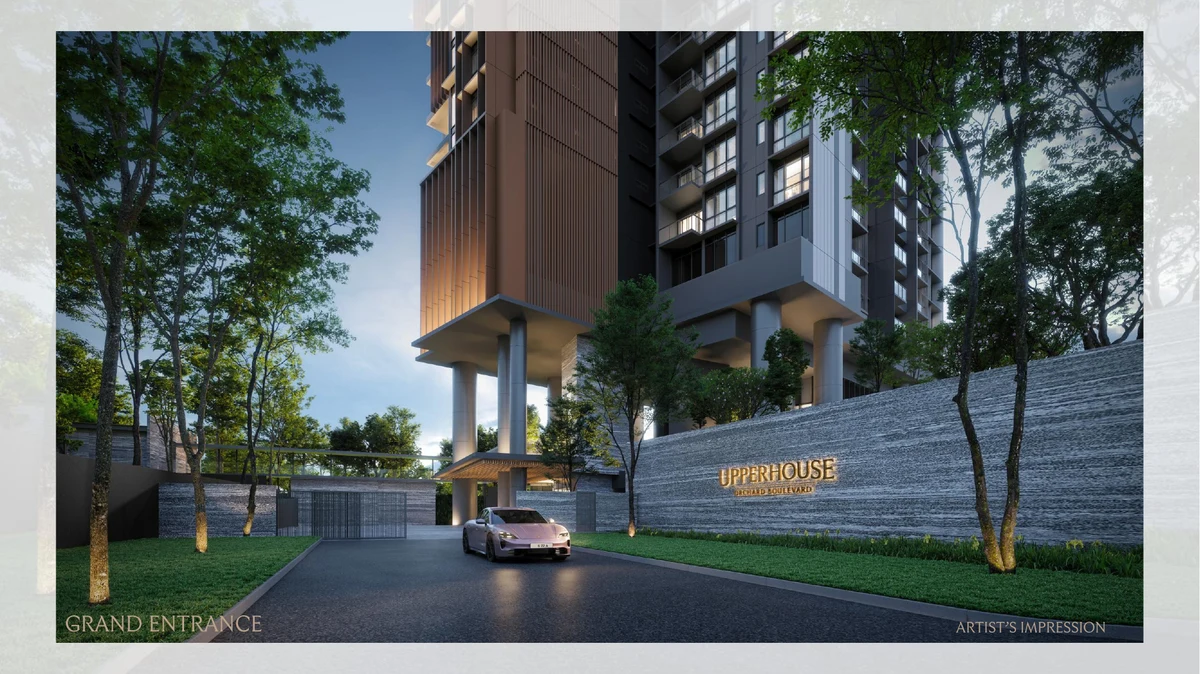
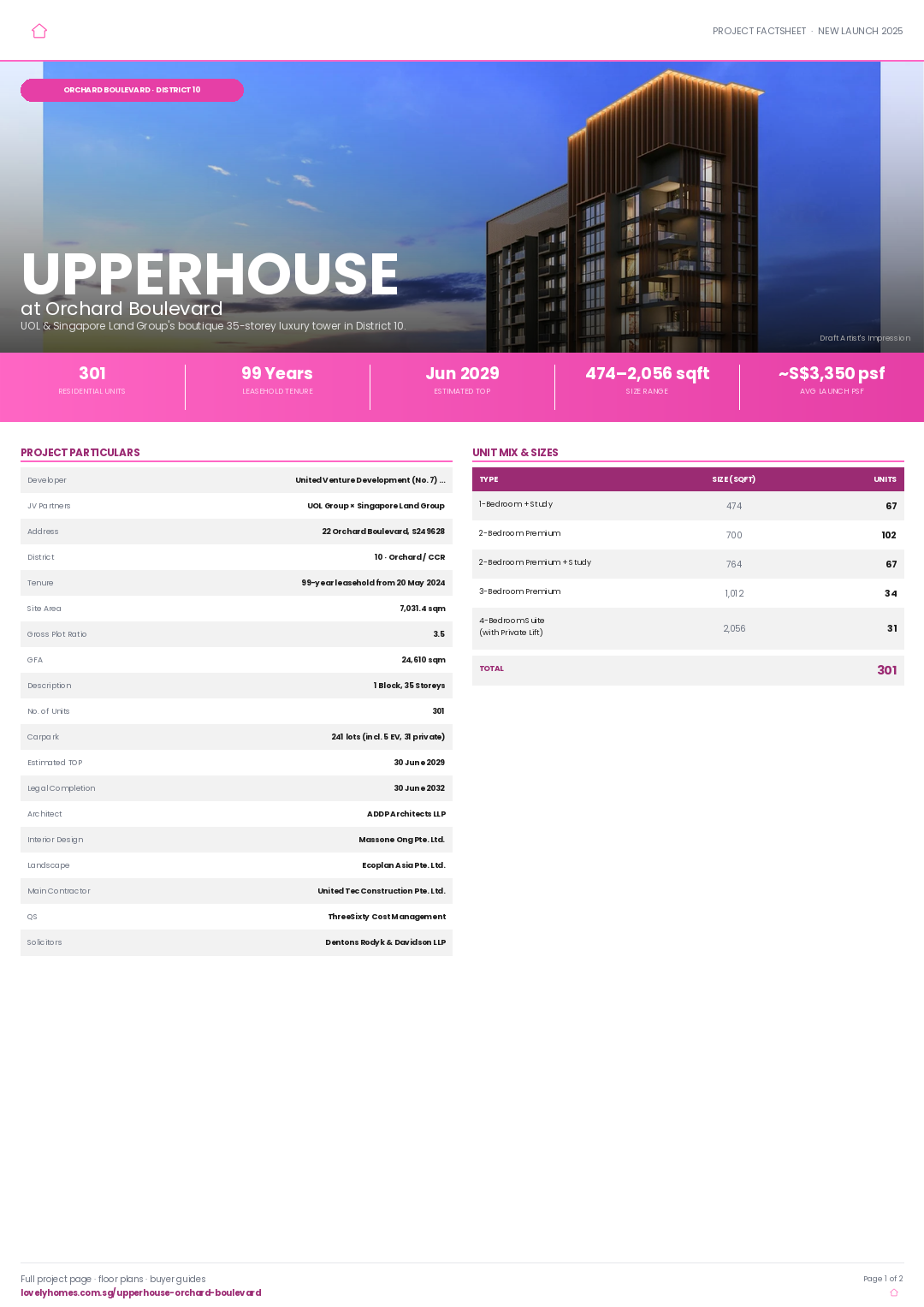
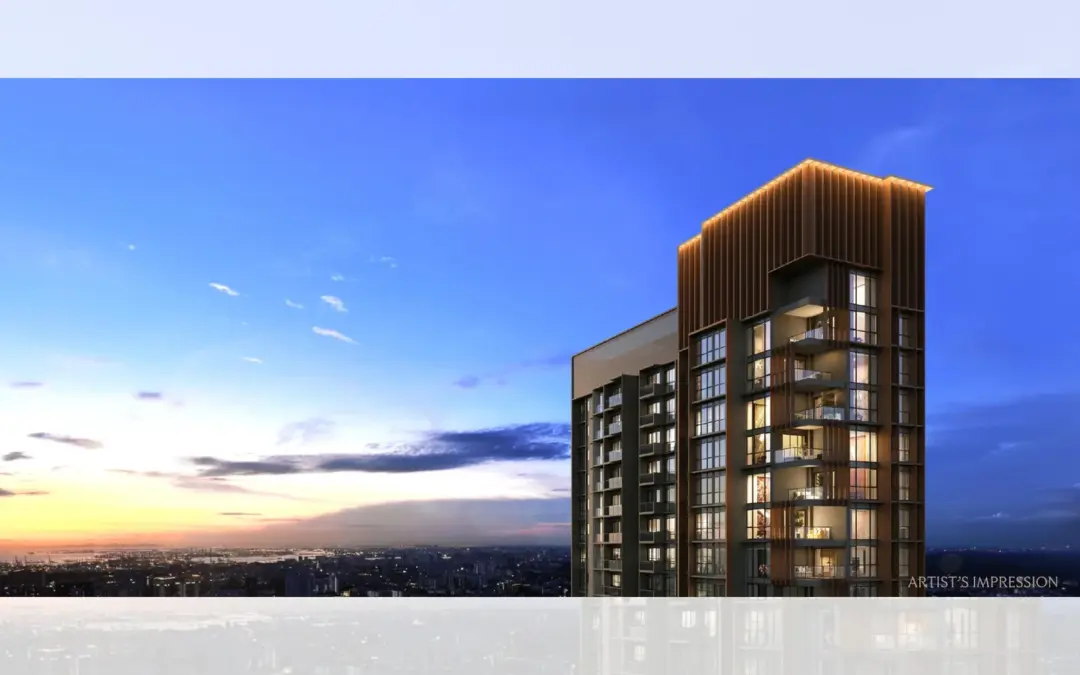
UOL & Singapore Land Group’s boutique 35-storey luxury tower at 22 Orchard Boulevard — 301 residences defining the new benchmark for D10 living.
99 Years
Leasehold Tenure
Why UPPERHOUSE
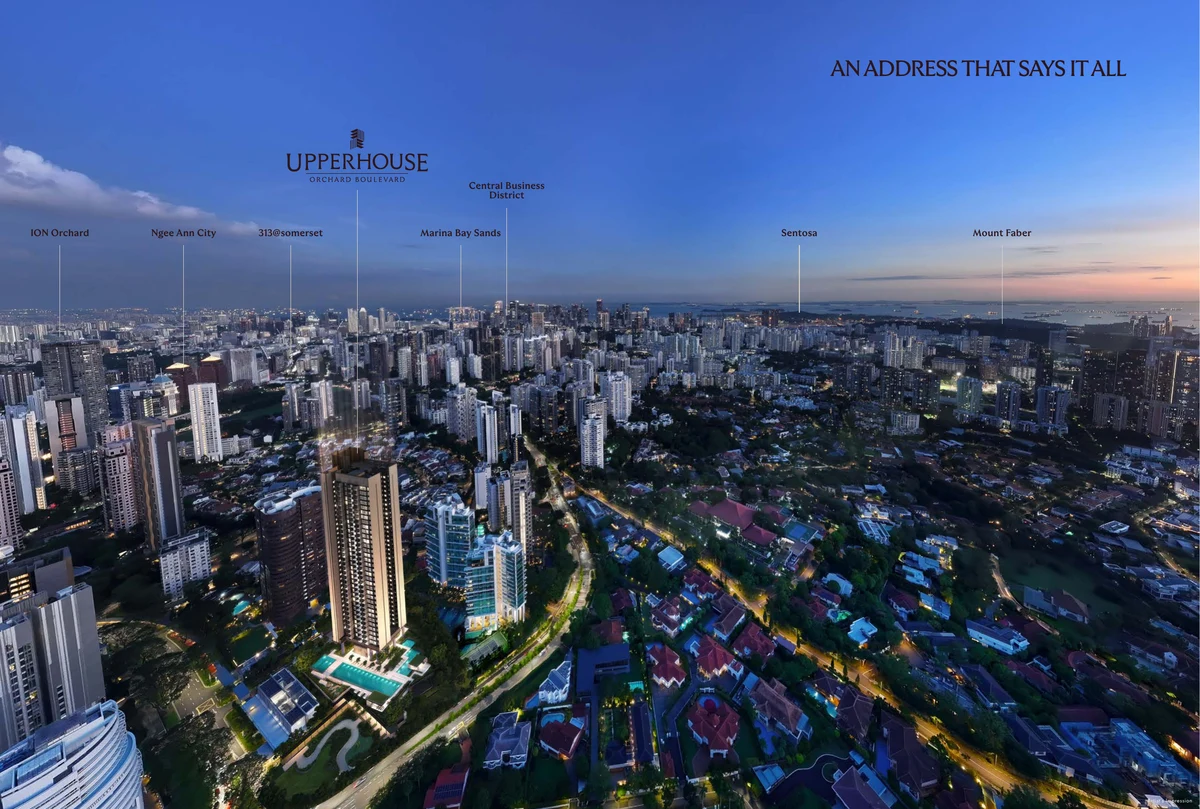
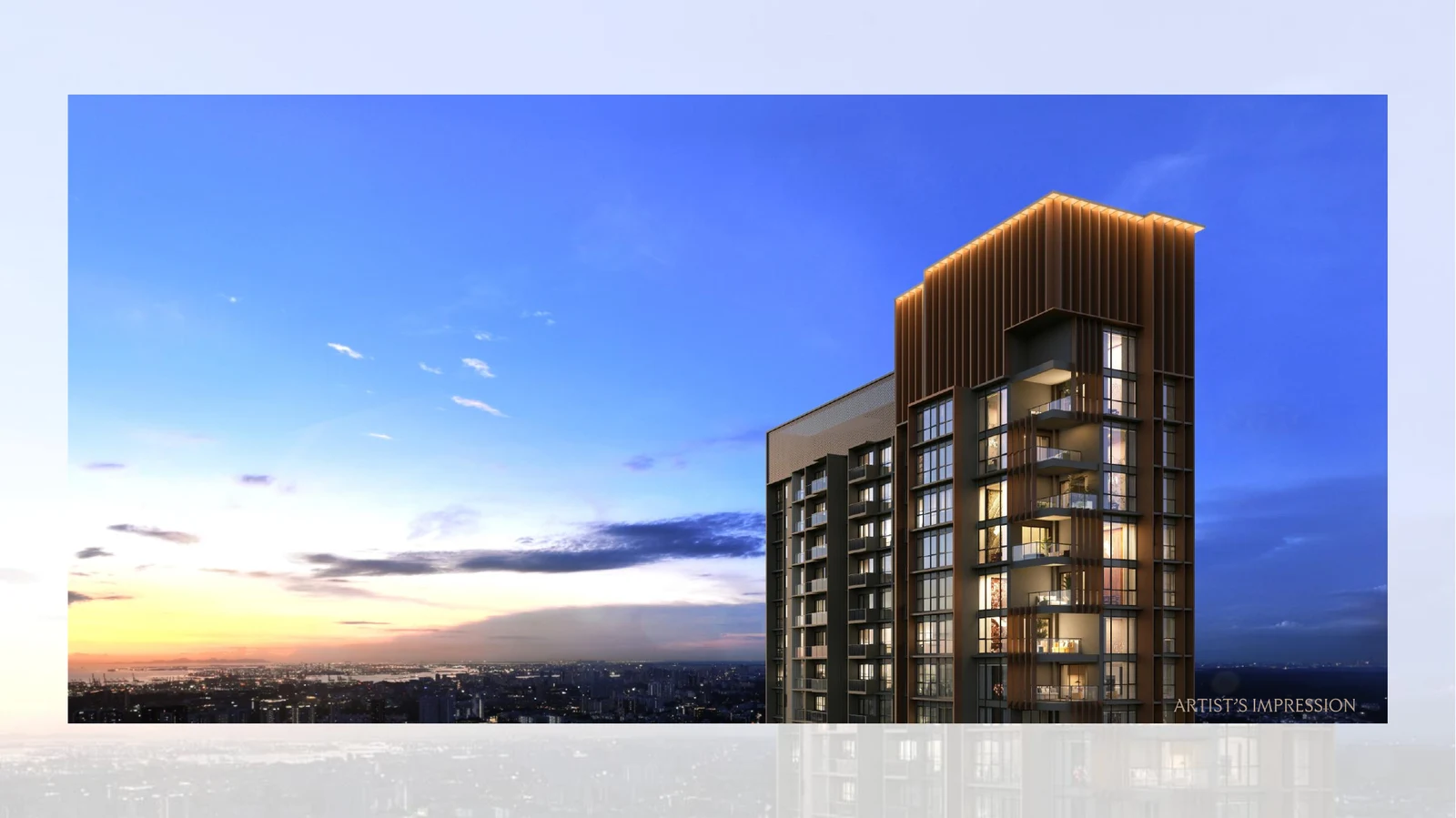
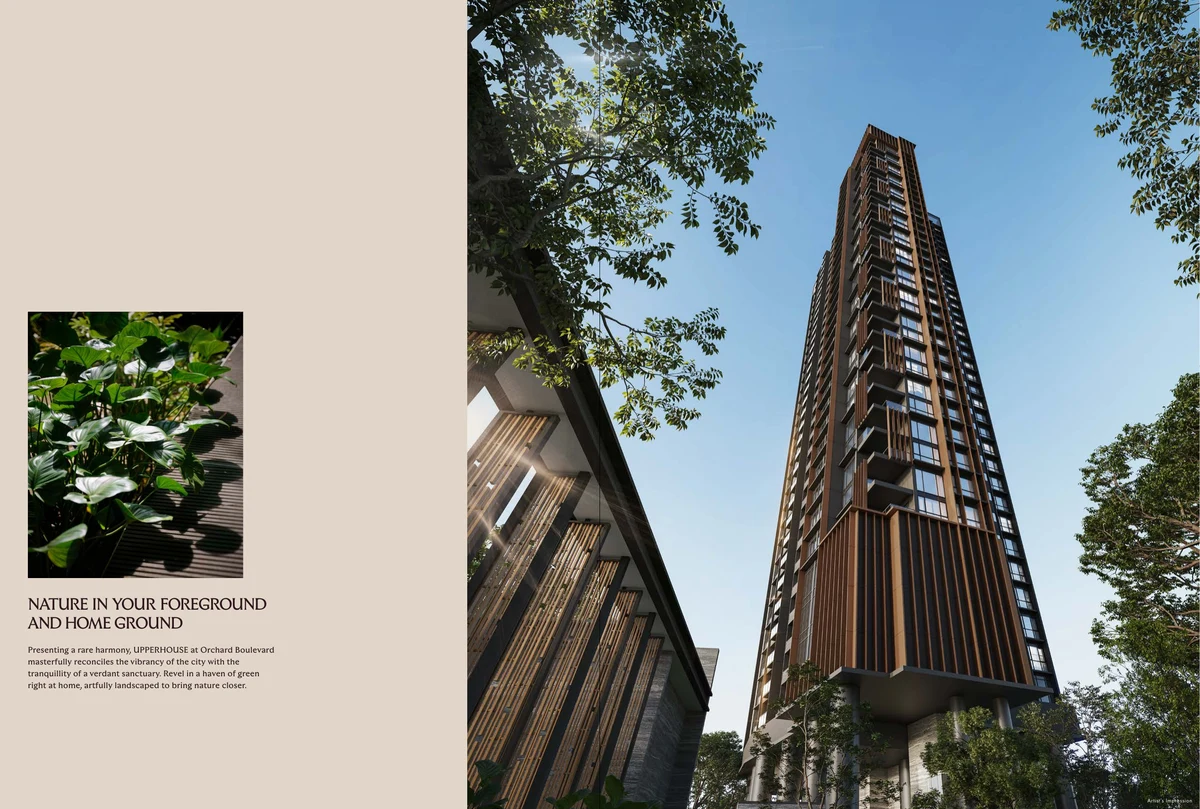
UPPERHOUSE at Orchard Boulevard (傲杰嘉苑) sets a new standard for boutique luxury living within Singapore’s most coveted district. Developed by the UOL Group and Singapore Land Group — two of Singapore’s most respected property names — this 35-storey residential tower at 22 Orchard Boulevard occupies a prime address with sweeping views across the Orchard Road corridor and the verdant Nassim Hill precinct.
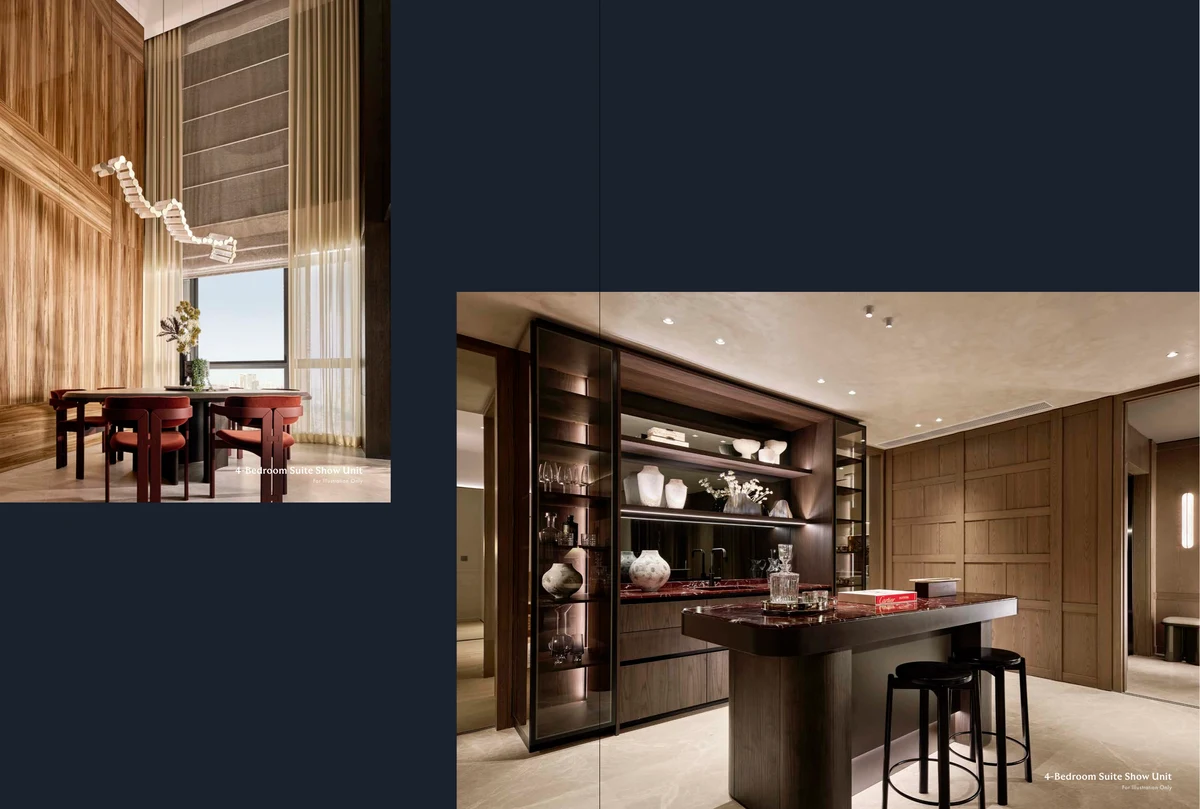
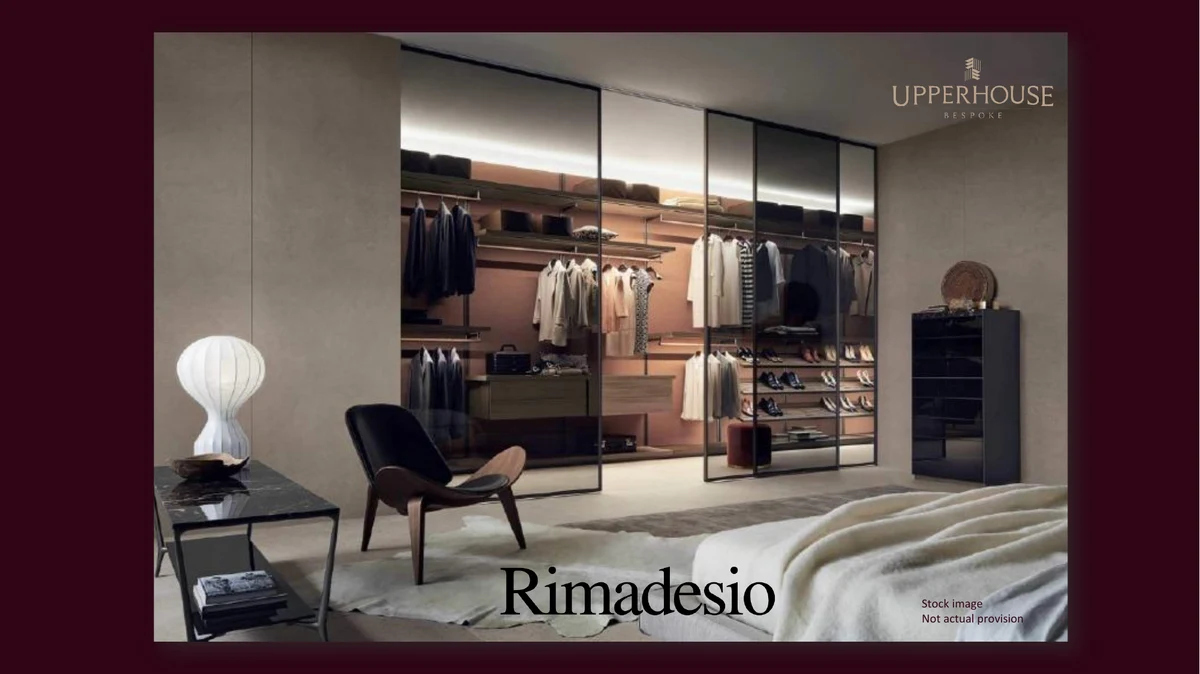
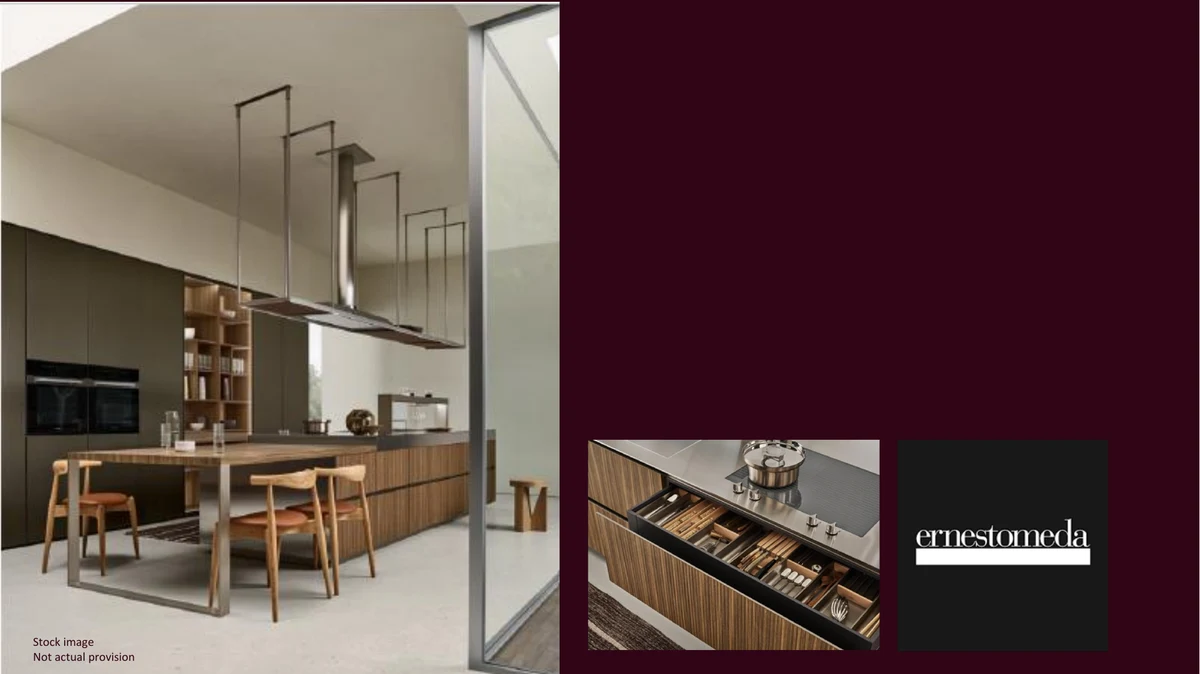
With just 301 residences across five bedroom configurations, from the 474 sq ft 1-Bedroom + Study to the 2,056 sq ft 4-Bedroom Suite with private lift and carpark lot, every unit reflects the painstaking material curation for which ADDP Architects and interior designer Massone Ong are known. Italian and European finishes throughout — Ernestomeda kitchens, Rimadesio and Caccaro wardrobes, Turkish marble flooring — signal a product standard comparable to freehold boutique offerings at similar price points.
01 · Address
Singapore’s Most Coveted Postcode
22 Orchard Boulevard sits within the ultra-prime D10 corridor, steps from the Botanic Gardens UNESCO World Heritage Site and within walking distance of Orchard MRT and Newton MRT.
02 · Developer Pedigree
UOL & SingLand — A 60-Year Legacy
The JV between UOL Group and Singapore Land Group brings decades of premium residential development expertise, including The Tre Ver, Avenue South Residence, and 8 Saint Thomas.
03 · Rarity
Boutique Scale in a Land-Scarce District
With only 301 units on a 7,031 sq m site, UPPERHOUSE is one of the smallest new launches in D10 in recent years — offering genuine scarcity premium in Singapore’s most resilient sub-market.
Project At-a-Glance
| Project Name |
UPPERHOUSE at Orchard Boulevard (傲杰嘉苑) |
| Developer |
United Venture Development (No. 7) Pte. Ltd. — JV of UOL Group Limited & Singapore Land Group Limited |
| Address |
22 Orchard Boulevard, Singapore 249628 |
| District |
10 (CCR) |
| Tenure |
99 Years commencing 20 May 2024 |
| Site Area |
7,031.4 sq m |
| Gross Plot Ratio |
3.5 |
| Permissible GFA |
24,610 sq m |
| Configuration |
1 Block of 35 Storeys + Commercial at 1st Storey |
| Total Units |
301 residential units |
| Est. TOP (NOVP) |
30 June 2029 |
| Est. Legal Completion |
30 June 2032 |
| Architect |
ADDP Architects LLP |
| Landscape |
Ecoplan Asia Pte. Ltd. |
| Interior Design |
Massone Ong Pte. Ltd. |
| Main Contractor |
United Tec Construction Pte. Ltd. |
Unit Mix and Sizes
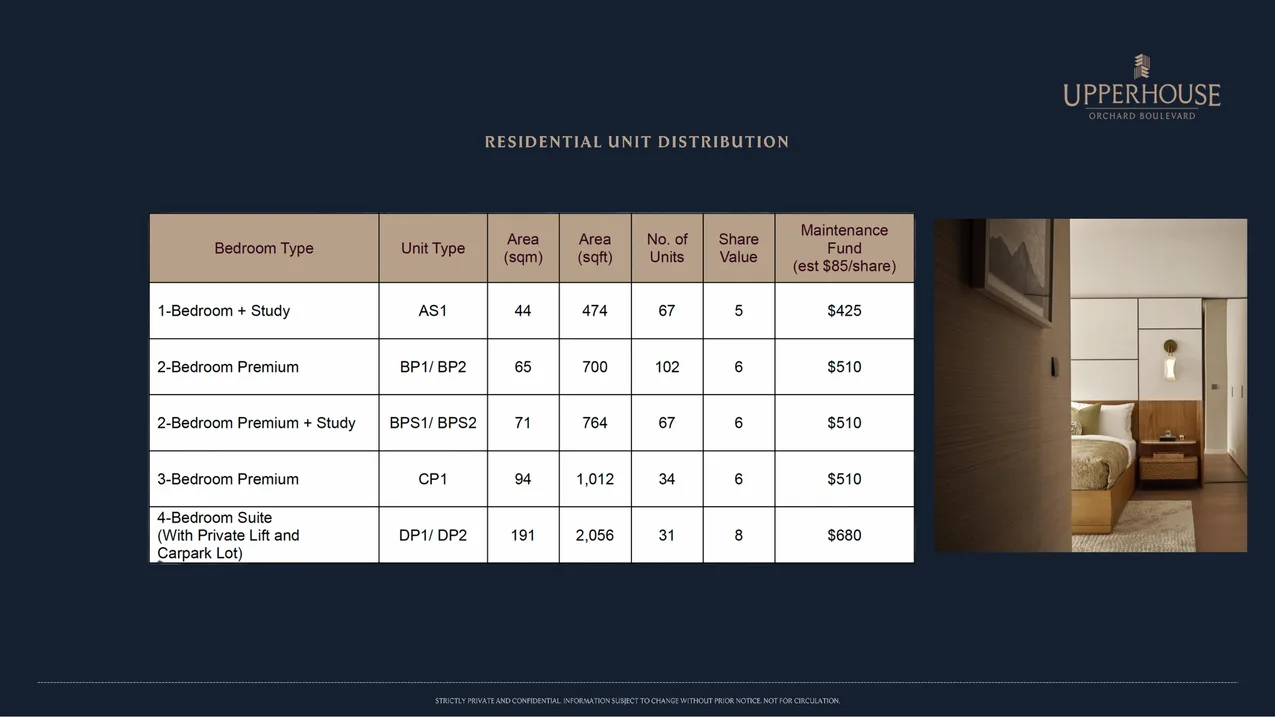
| Bedroom Type |
Unit Type |
Size (sqft) |
Size (sqm) |
Units |
% of Total |
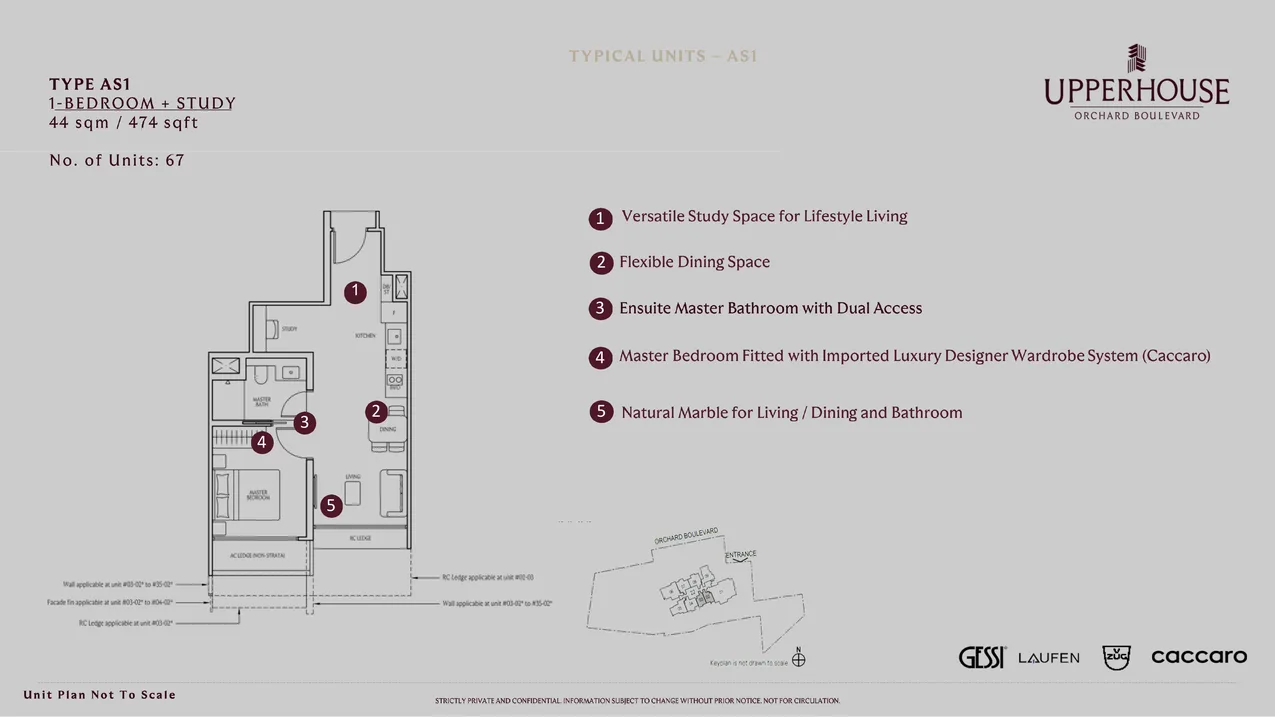
| 1-Bedroom + Study |
AS1 |
474 |
44 |
67 |
22.3% |
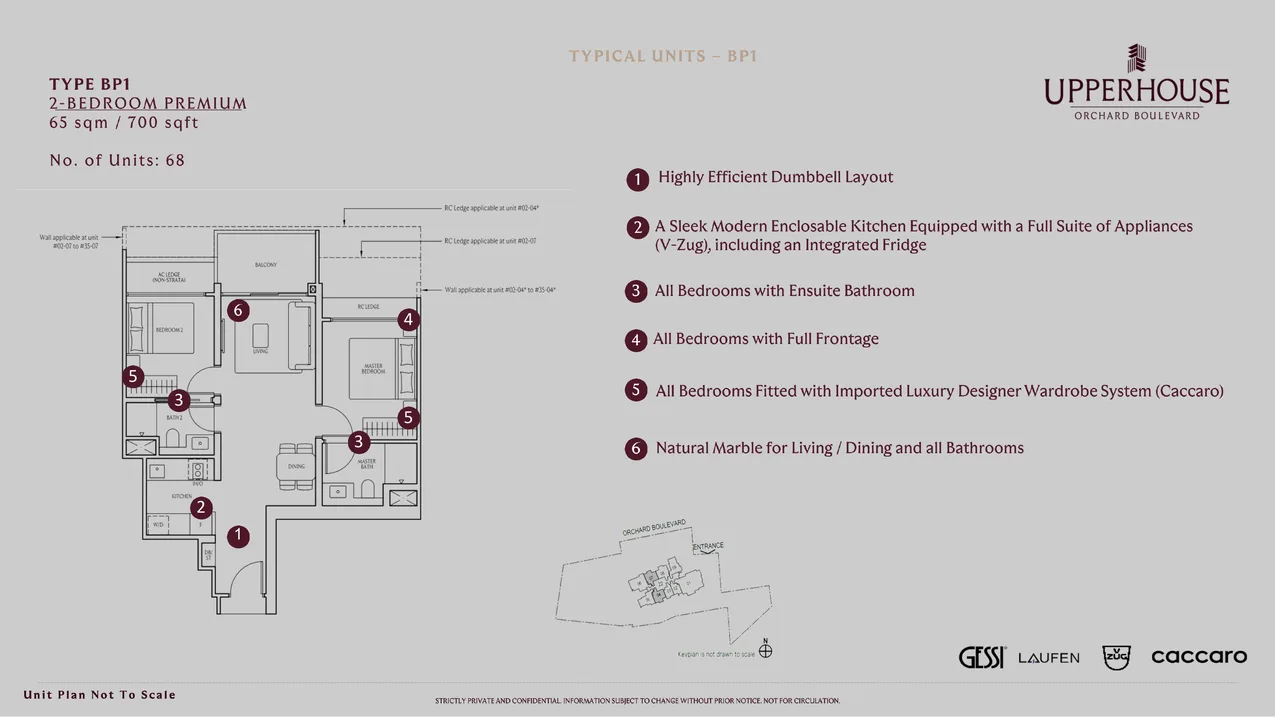
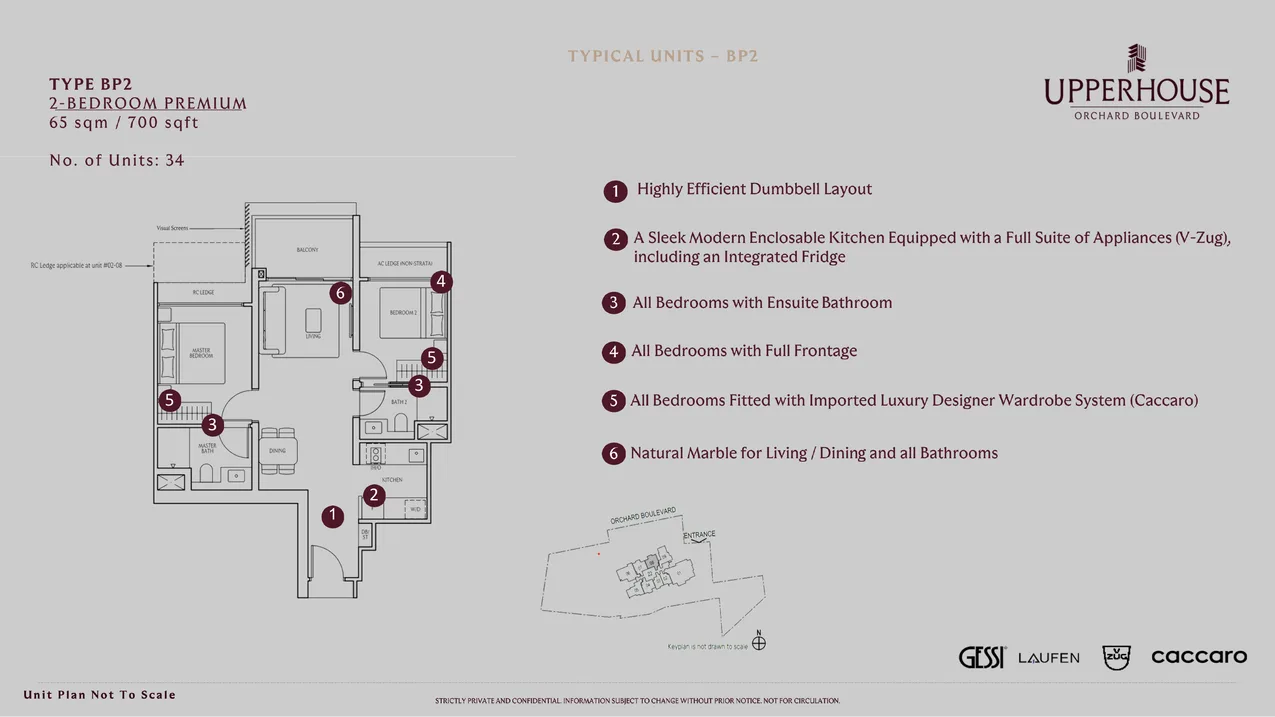
| 2-Bedroom Premium |
BP1 / BP2 |
700 |
65 |
102 |
33.9% |
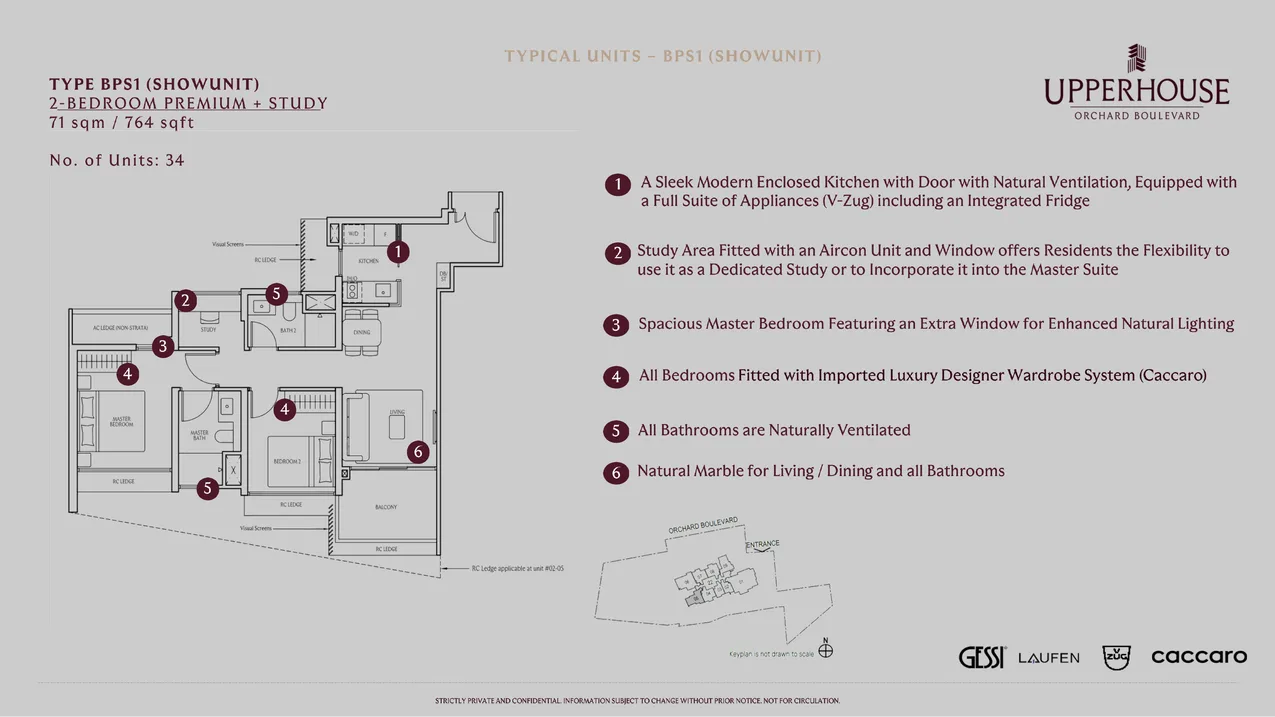
| 2-Bedroom Premium + Study |
BPS1 / BPS2 |
764 |
71 |
67 |
22.3% |
| 3-Bedroom Premium |
CP1 |
1,012 |
94 |
34 |
11.3% |
| 4-Bedroom Suite (with Private Lift) |
DP1 / DP2 |
2,056 |
191 |
31 |
10.3% |
| Total |
— |
474 – 2,056 |
44 – 191 |
301 |
100% |
| Maintenance fees estimated at S$85 per share value per month. 1BR+S: S$425/mo; 2BR/2BR+S/3BR: S$510/mo; 4BR Suite: S$680/mo. The 4BR Suite includes a dedicated private carpark lot. |
D10 luxury boutique: 301 units across two 32-storey towers, 99-yr leasehold from 2024, premium specifications and large penthouse layouts.
Indicative Pricing
1-Bedroom + Study (474 sqft)
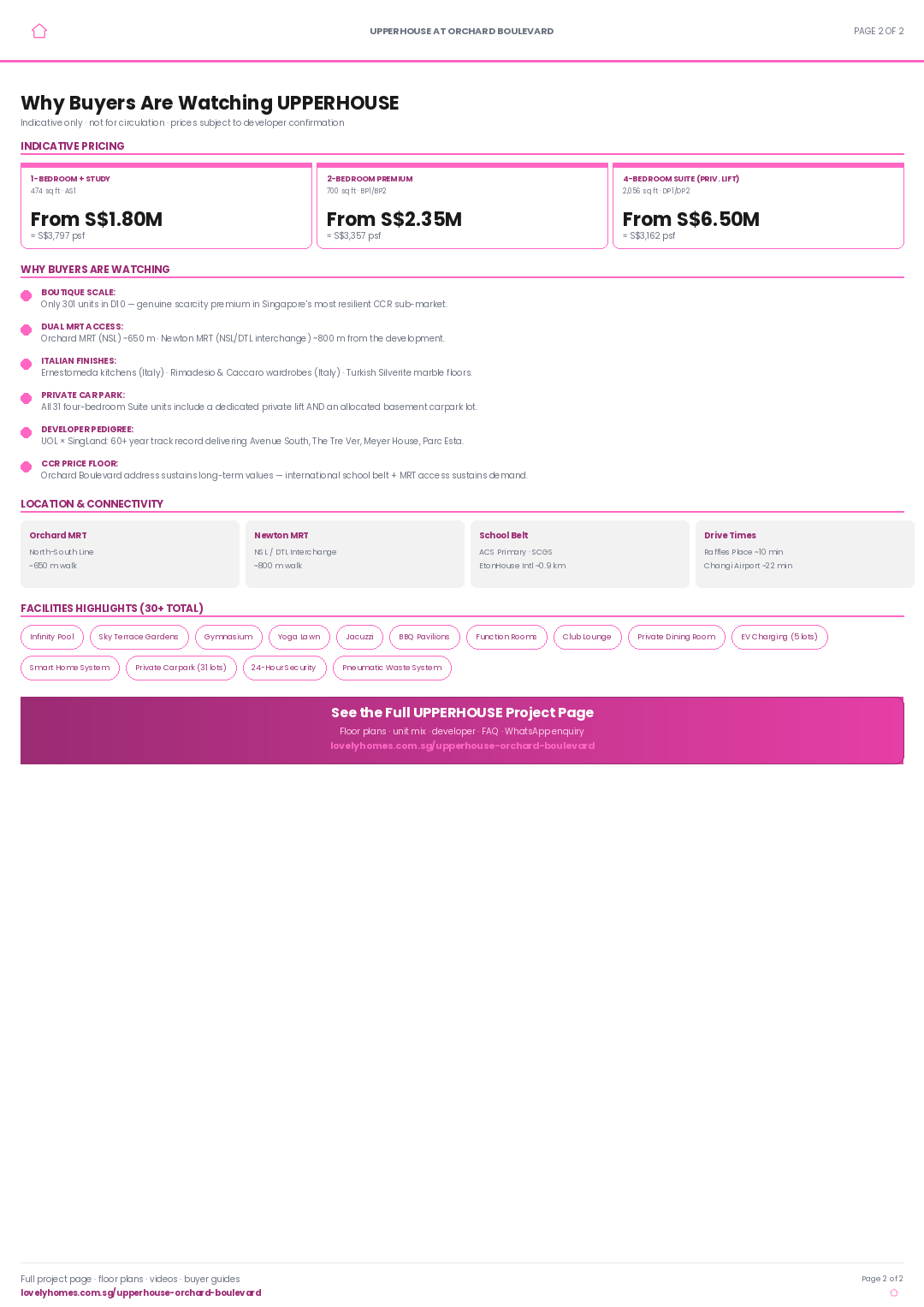
From S$1.80M
≈ S$3,797 psf
2-Bedroom Premium (700 sqft)
From S$2.35M
≈ S$3,357 psf · avg S$3,350 psf across development
4-Bedroom Suite (2,056 sqft)
From S$6.50M
≈ S$3,162 psf · private lift + carpark lot included
All prices are indicative and subject to change without notice. Final prices are set by the developer at the time of sale. Figures are before ABSD, BSD, and legal fees. See our ABSD 2026 guide and BSD guide for stamp duty calculations.
Why Buyers Are Watching
- 1Only 301 units in the entire development. UPPERHOUSE is one of the most boutique new launches D10 has seen — ensuring a tight, manageable community and genuine rarity of supply in Singapore’s most resilient CCR sub-market.
- 2Dual MRT access within 800 m. Orchard MRT (North-South Line) and Newton MRT (North-South / Downtown Line interchange) are both within a ten-minute walk, placing residents on direct routes to Raffles Place, Marina Bay, and Changi Airport.
- 3Developer track record is among Singapore’s strongest. UOL Group and Singapore Land Group together have delivered more than 50 premium residential projects including Meyer House, The Tre Ver, and Avenue South Residence.
- 4Italian and premium European finishes throughout. Kitchens by Ernestomeda (Italy), wardrobes by Rimadesio and Caccaro (Italy), marble flooring from Turkey, and Poliform walk-in wardrobes in the 4-Bedroom Suite.
- 54-Bedroom Suite includes a dedicated carpark lot. An increasingly rare inclusion in CCR launches — all 31 units of DP1/DP2 type include a private lift and an allocated basement carpark lot.
- 6Direct proximity to international schools belt. EtonHouse International School (~0.9 km), ISS International School (~1.2 km), and others within 1–2 km.
- 735-storey roofline captures city and greenery views. Upper floors face the Nassim Hill / Botanic Gardens green corridor on one side and the Orchard Road skyline on the other.
- 8Smart home system across all 301 units. Including smart community control at lobby level, video intercom, and EV charging provisions in the basement carpark.
Location and Connectivity
Transport
Orchard MRT (NSL)
North-South Line direct to City Hall, Raffles Place, and Marina Bay. ~650 m walk from the development entrance.
Transport
Newton MRT (NSL/DTL)
Dual-line interchange giving additional access via the Downtown Line — Little India, Bugis, Expo, Changi Airport. ~800 m walk.
Lifestyle
Orchard Road Belt
ION Orchard, Scotts Square, Wheelock Place, Takashimaya, and Cold Storage Newton all within a 5-minute walk.
Nature
Botanic Gardens
UNESCO World Heritage Site under 1 km. The MacRitchie Treetop Walk is accessible via Stevens MRT (DTL/TEL), a 10-minute ride.
Schools Nearby
| Pre-school |
Learning Vision @ Orchard · Pat’s Schoolhouse Claymore |
| Primary (within 1 km) |
Anglo-Chinese School (Primary) ⭐ · St Joseph’s Institution Junior |
| Primary (within 2 km) |
Singapore Chinese Girls’ Primary · St Margaret’s Primary |
| Secondary |
Anglo-Chinese School (Barker Road) · Singapore Chinese Girls’ School · St Joseph’s Institution |
| Tertiary / JC |
Raffles Girls’ Primary · Raffles Institution (Bishan) · RI (JC) |
| International |
EtonHouse International School (Orchard) ~0.9 km · ISS International School ~1.2 km · Finnish School in Singapore ~1.5 km |
Lifestyle and Amenities
Wellness and Recreation
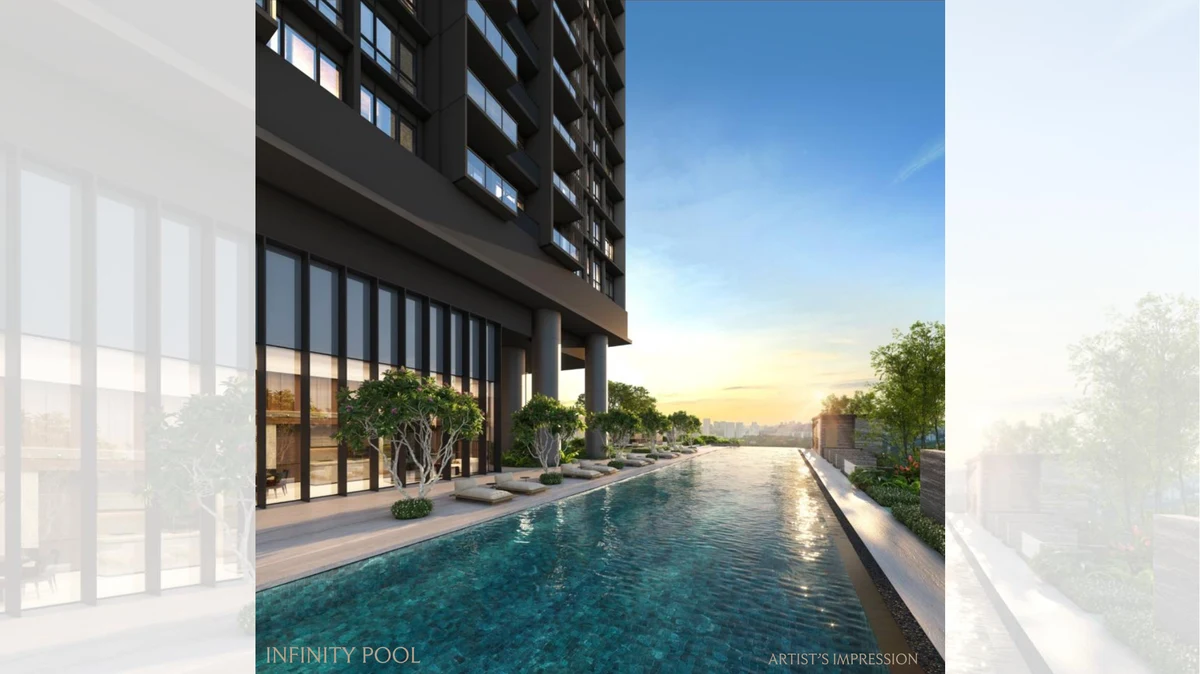
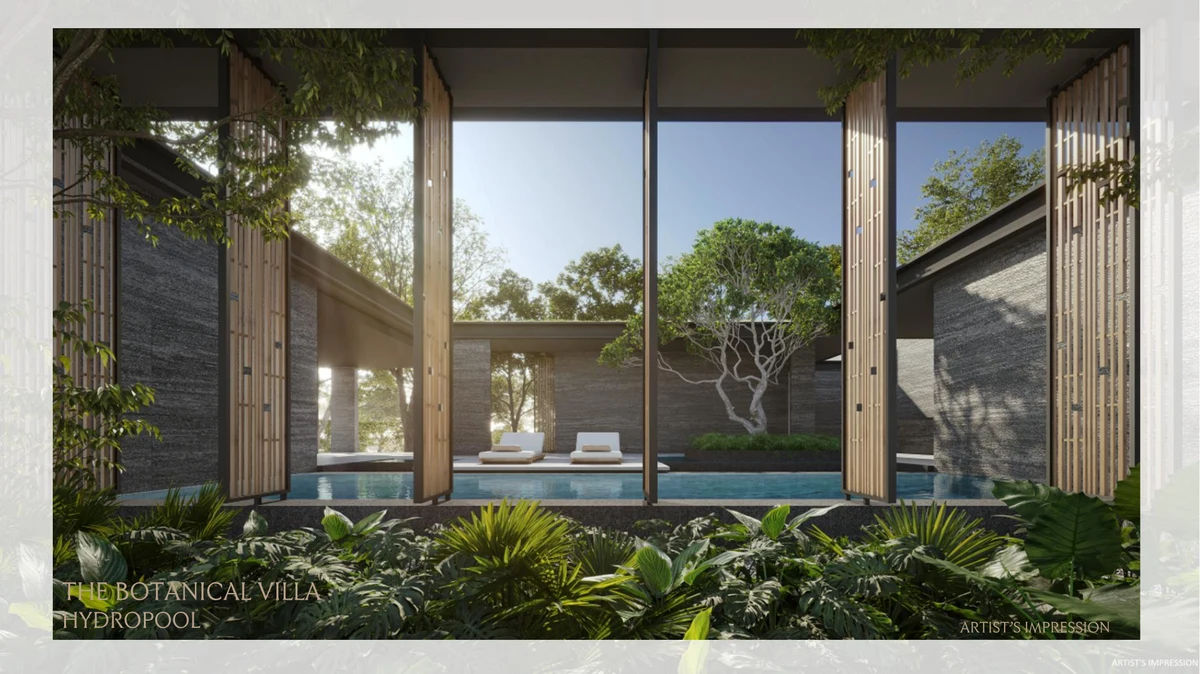
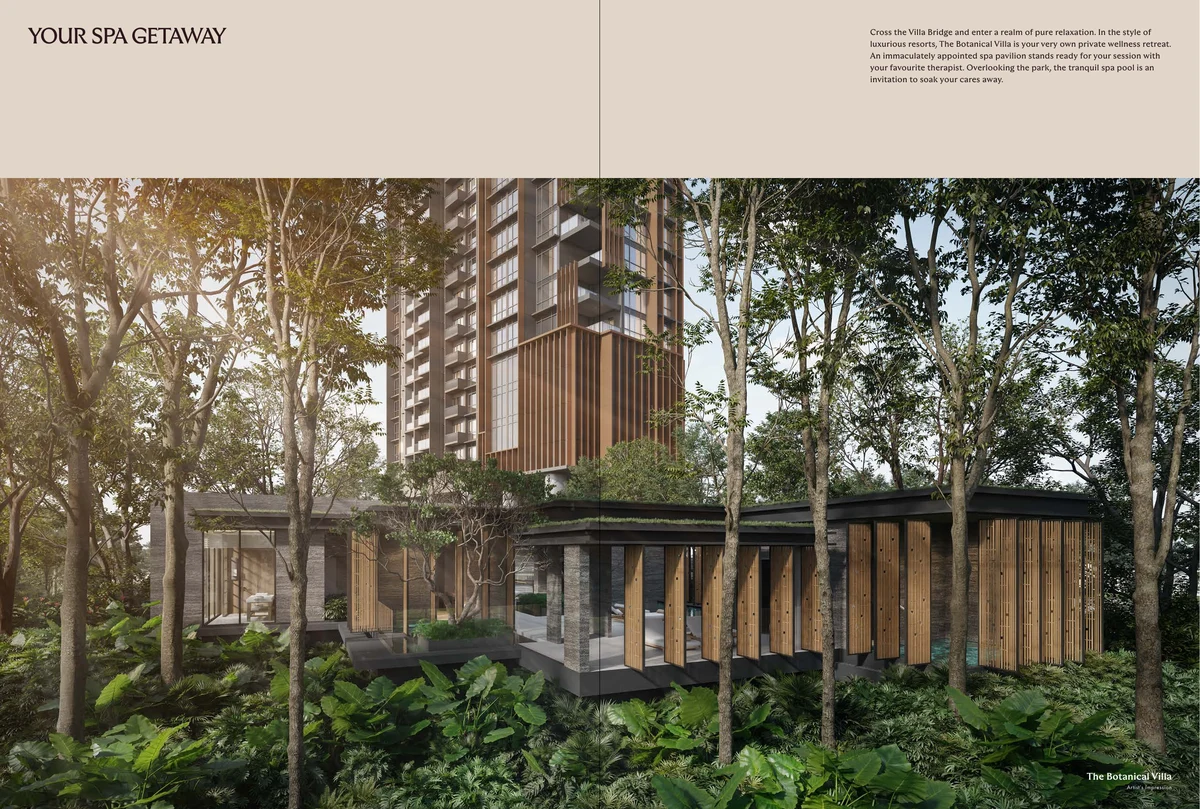
Infinity pool with city views, sky terrace gardens, fully equipped gymnasium, yoga lawn, and function rooms for resident events — all within a boutique 301-unit community.
Dining and Retail
Commercial podium at the 1st Storey will house curated F&B and retail tenants. Orchard Road’s full retail corridor — from ION to Takashimaya — is within a five-minute walk.
Greenery and Connectivity
The Singapore Botanic Gardens UNESCO World Heritage Site is under 1 km away. The Orchard Road streetscape and the MacRitchie Treetop Walk are accessible via Stevens MRT.
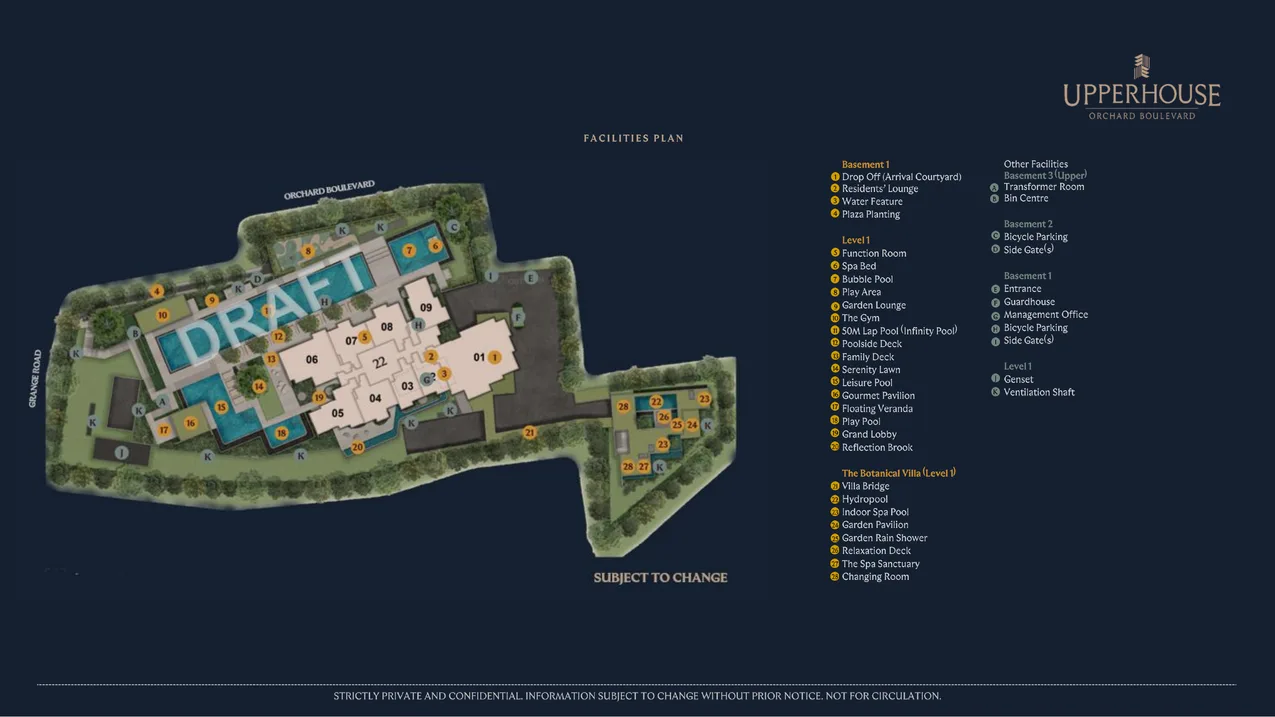
Site Plan
Site plan · indicative only · subject to developer confirmation
Floor Plans (Selected)
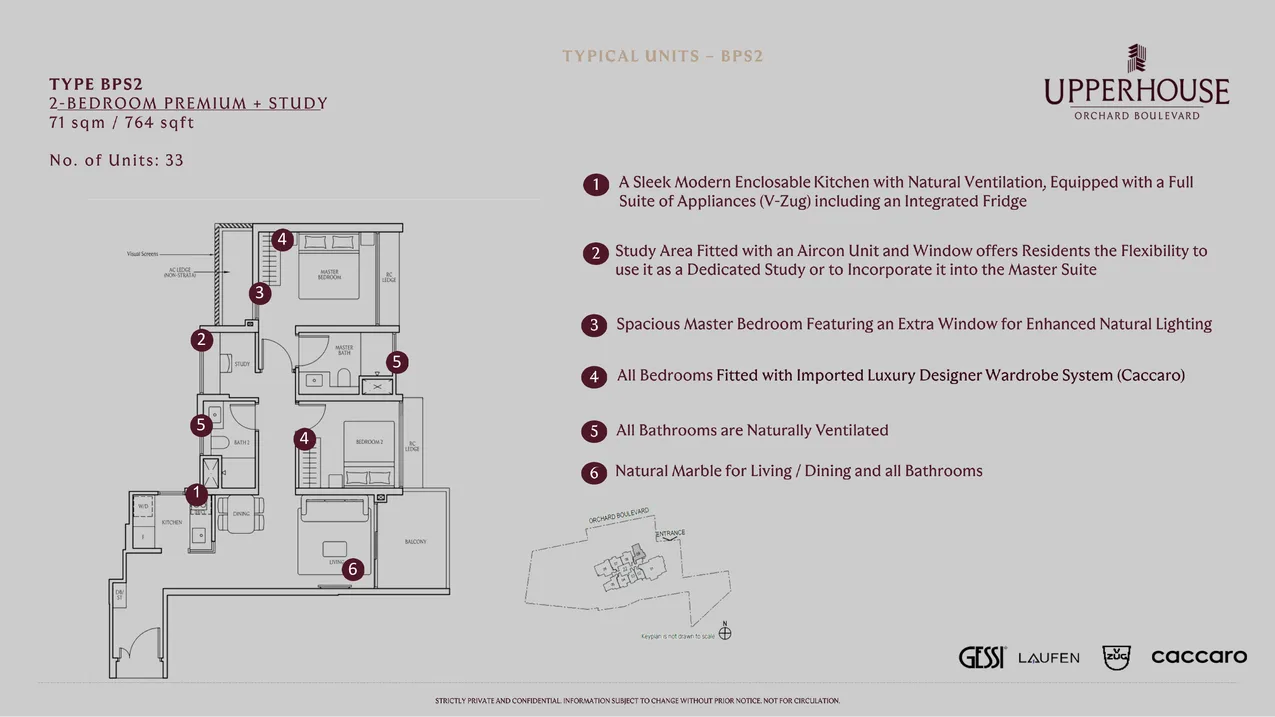
A representative plan from each bedroom type. Download the full PDF below for all stack-by-stack layouts including 1BR+S, 2BR Premium, 2BR+S, 3BR Premium, and 4BR Suite with private lift.
1-Bedroom + Study (AS1) · 474 sqft / 44 sqm
2-Bedroom Premium (BP1) · 700 sqft / 65 sqm
2-Bedroom Premium + Study (BPS1) · 764 sqft / 71 sqm
3-Bedroom Premium (CP1) · 1,012 sqft / 94 sqm
4-Bedroom Suite with Private Lift (DP1) · 2,056 sqft / 191 sqm
Full Floor Plans PDF
All stack-by-stack floor plans with balcony dimensions — AS1, BP1/BP2, BPS1/BPS2, CP1, DP1/DP2.
Download PDF
Elevation and Stack Chart
Elevation and stack chart · indicative only · subject to developer confirmation
Facilities (30+)
Infinity PoolSky Terrace GardensGymnasiumYoga LawnJacuzziChildren’s PoolBBQ PavilionsFunction RoomsClub LoungePrivate Dining RoomCo-Working LoungeGourmet KitchenConcierge LobbyLandscaped DeckReflection PoolGarden PavilionSun DeckPutting GreenBicycle BaysEV Charging (5 lots)Private Carpark (31 lots)3-Level Basement CarparkSmart Home SystemVideo Intercom24-Hour SecurityCCTV SurveillancePneumatic Waste SystemMail RoomParcel LockersManagement Office
Developer and Consultant Team
United Venture Development (No. 7) Pte. Ltd. — a UOL Group and Singapore Land Group joint venture
United Venture Development (No. 7) Pte. Ltd. (the developer) is a special-purpose vehicle jointly owned by UOL Group Limited and Singapore Land Group Limited (SingLand) — two SGX-listed companies with a combined residential portfolio exceeding 10,000 units across Singapore. Past landmark projects include The Tre Ver, 8 Saint Thomas, Avenue South Residence, Parc Esta, and Meyer House.
| Architect |
ADDP Architects LLP |
| Landscape Architect |
Ecoplan Asia Pte. Ltd. |
| Project Interior Design |
Massone Ong Pte. Ltd. |
| Main Contractor |
United Tec Construction Pte. Ltd. |
| Quantity Surveyor |
ThreeSixty Cost Management Pte. Ltd. |
| Conveyancing Solicitors |
Dentons Rodyk & Davidson LLP |
| Project Account Bank |
CIMB Bank Berhad (Account No. 2001052392) |
Sustainability and Specifications
- BCA Green Mark Compliance: Designed to meet BCA Green Mark standards with energy-efficient building envelope, LED lighting throughout common areas, and water-efficient fixtures in all units.
- Smart Home Management System: Every unit is equipped with a smart home management system for access control, lighting, air-conditioning, and security management.
- EV Charging Infrastructure: Five EV charging points installed in the basement carpark, with ducting provisions for future expansion.
- Premium Materials: Silverite Marble (Turkey) in living and dining areas, engineered timber flooring in bedrooms, Ernestomeda kitchen systems (Italy), and Caccaro/Rimadesio wardrobe systems (Italy).
- Acoustic Performance: Motorised acoustic blinds in master bedrooms and selected living areas — noise-attenuating and thermally efficient in Singapore’s equatorial climate.
- Pneumatic Waste System: Automated waste collection via pneumatic chutes reduces lorry traffic and improves hygiene across the development.
Project Timeline
2024
Land Award & Licence
Jun 2025
Official Sales Launch
2025–2028
Construction Phase
30 Jun 2029
Estimated TOP
30 Jun 2032
Legal Completion
Project Factsheet
A shareable 2-page PDF snapshot — bring it to viewings, share with family.
Download the Full Sales Pack
PDF · 2 pages · 381 KB
UPPERHOUSE Factsheet
2-page LovelyHomes project factsheet — share with family, bring to viewings.
Download Factsheet
PDF · floor plans
Full Floor Plans
All stack-by-stack floor plans — AS1, BP1/BP2, BPS1/BPS2, CP1, DP1/DP2.
Download Floor Plans
PDF · location map
Location Map
High-resolution location overview — Orchard MRT, Newton MRT, schools, amenities.
Download Map
Frequently Asked Questions
Where is UPPERHOUSE located?
UPPERHOUSE at Orchard Boulevard is located at 22 Orchard Boulevard, Singapore 249628, in District 10 (CCR). It is within walking distance of Orchard MRT (North-South Line, ~650 m) and Newton MRT (North-South / Downtown Line interchange, ~800 m), and approximately 1 km from the Singapore Botanic Gardens UNESCO World Heritage Site.
Who is the developer of UPPERHOUSE?
UPPERHOUSE at Orchard Boulevard is developed by United Venture Development (No. 7) Pte. Ltd., a joint venture between UOL Group Limited and Singapore Land Group Limited (SingLand). Both are SGX-listed companies with a combined residential portfolio exceeding 10,000 units across Singapore. Past landmark projects include The Tre Ver, 8 Saint Thomas, Avenue South Residence, Parc Esta, and Meyer House.
What is the tenure of UPPERHOUSE?
UPPERHOUSE is a 99-year leasehold development, with the lease commencing 20 May 2024. Legal completion is estimated at 30 June 2032, meaning buyers will have approximately 91 years remaining on the lease at legal completion.
What bedroom types are available and how many units are there?
There are 301 residential units across five configurations: 1-Bedroom + Study (67 units, 474 sq ft), 2-Bedroom Premium (102 units, 700 sq ft), 2-Bedroom Premium + Study (67 units, 764 sq ft), 3-Bedroom Premium (34 units, 1,012 sq ft), and 4-Bedroom Suite with Private Lift (31 units, 2,056 sq ft). The 4-Bedroom Suite units include a dedicated private carpark lot.
What is the indicative price range?
Indicative prices start from approximately S$1.80 million for the 1-Bedroom + Study (474 sq ft) at the launch average of approximately S$3,350 psf. 2-Bedroom Premium units (700 sq ft) are indicatively priced from approximately S$2.35 million. The 4-Bedroom Suite (2,056 sq ft) is indicatively from approximately S$6.50 million. All prices are subject to change and are before stamp duty, legal fees, and other costs.
When is the expected TOP for UPPERHOUSE?
The estimated date of Vacant Possession (TOP) is 30 June 2029. Legal completion is expected by 30 June 2032. These are estimates by the developer and are subject to construction progress and regulatory approvals from the Building and Construction Authority (BCA).
Is UPPERHOUSE subject to ABSD?
Yes. ABSD (Additional Buyer’s Stamp Duty) applies to the purchase of UPPERHOUSE. Singapore Citizens buying their first property pay 0% ABSD; second property 20%; third and subsequent 30%. Singapore Permanent Residents pay 5% for their first property and 30% for subsequent. Foreigners pay 60% ABSD. See our
complete ABSD guide for full details and worked examples.
Can foreigners buy UPPERHOUSE?
Yes. UPPERHOUSE is an unrestricted private residential development and is open to Singapore Citizens, Permanent Residents, foreigners, and corporate entities. Foreigners are subject to 60% ABSD as of 27 April 2023. See our
foreigners’ property purchase guide for full details.
What are the maintenance fees?
Estimated maintenance fees are approximately S$85 per share value per month. 1-Bedroom + Study (5 share values): S$425/month. 2-Bedroom and 2-Bedroom + Study and 3-Bedroom Premium (6 share values): S$510/month. 4-Bedroom Suite (8 share values): S$680/month. Actual amounts will be set by the Management Corporation after TOP.
Are there commercial units at UPPERHOUSE?
The development is zoned “Residential with Commercial at 1st Storey.” The commercial podium on the ground floor will house curated F&B and retail tenants. Commercial units are not available for individual purchase.
How does UPPERHOUSE compare to other recent D10 launches?
UPPERHOUSE is one of the most boutique new launches D10 has seen with just 301 units on a 7,031 sq m site. Its pricing of approximately S$3,350 psf positions it competitively against other 2024–2025 prime launches including 19 Nassim (similar psf, freehold). The UOL/SingLand developer pedigree and Orchard Boulevard address provide a long-term price floor that typical 99-year projects outside the CCR do not enjoy.
Ready to see UPPERHOUSE in person?
Register your interest today and our editorial team will connect you with a licensed property consultant for a complimentary project briefing and showflat tour.
WhatsApp Enquiry
Related Buying Guides
ABSD Singapore 2026
Complete guide to Additional Buyer’s Stamp Duty rates, worked examples, and remission scenarios.
Read Guide →
Buyer’s Stamp Duty 2026
BSD rates, calculation methodology, and how BSD interacts with ABSD for Singapore property purchases.
Read Guide →
Freehold vs 99-Year Leasehold
The real price of time — Bala’s Table, lease decay, and whether the freehold premium is worth paying in D10.
Read Guide →
TDSR and Borrowing Limits
How much can you actually borrow in Singapore? TDSR, MSR, and LTV rules explained with worked examples.
Read Guide →
CPF for Property Purchase
Using CPF OA savings for private condos — withdrawal limits, accrued interest, and what buyers often miss.
Read Guide →
New Launch vs Resale Condo
Progressive payment advantages, ABSD timing, and which option suits your investment horizon in 2026.
Read Guide →
DISCLAIMER: All information on this page is compiled from publicly available sources and developer-issued marketing materials for informational purposes only. Prices, unit mix, specifications, and timelines are indicative and subject to change without notice. This page does not constitute an offer or solicitation to buy or sell any property. Buyers should conduct their own due diligence and seek advice from a licensed property agent and legal counsel before making any purchase decision. LovelyHomes.com.sg is an independent editorial platform and does not represent any developer, marketing agent, or agency. Agency Licence: L3010858B.