Singapore Property Conveyancing Guide 2026: Legal Fees, Timeline & Tips
Quick Answer: Property Conveyancing in Singapore
- Conveyancing is the legal process of transferring ownership of real property from seller to buyer; in Singapore it is governed by the Land Titles Act (Cap 157) and administered through the Singapore Land Authority (SLA).
- For private property, you should appoint a property lawyer as soon as you sign the Option to Purchase (OTP). If you are using CPF savings or a bank mortgage, a lawyer is legally required.
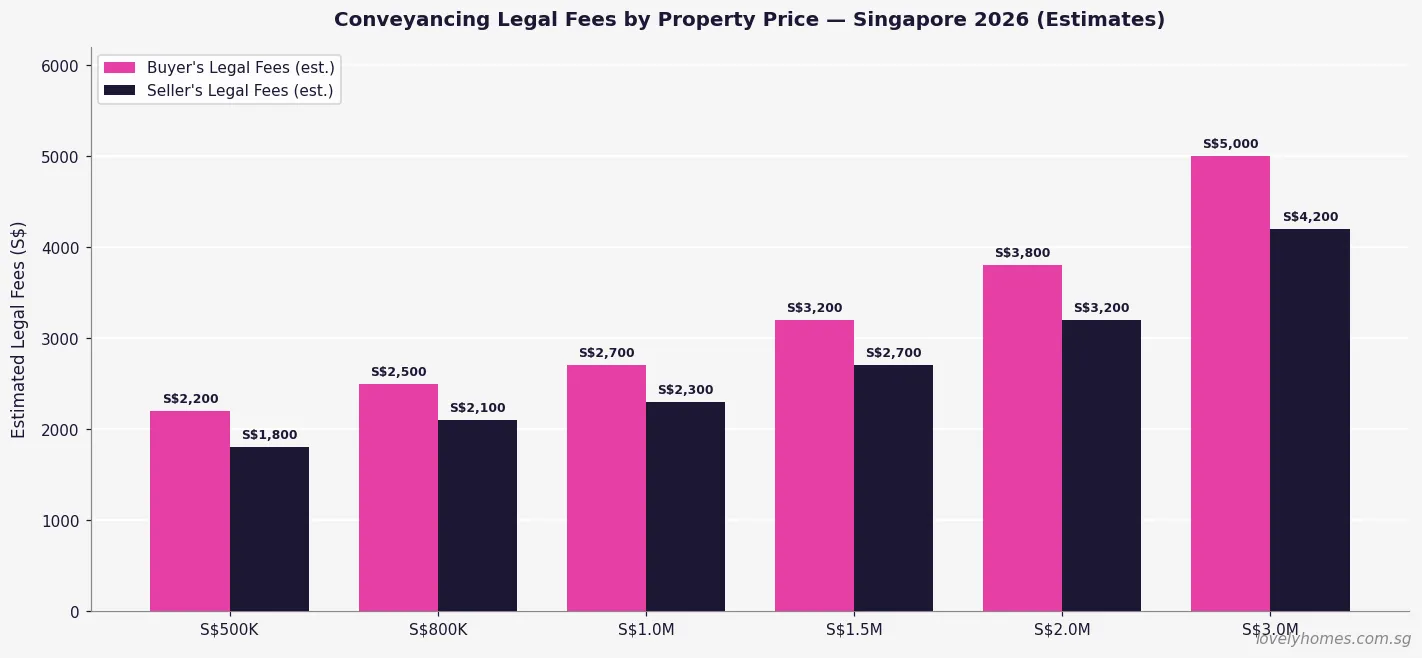
- Legal fees for a S$1.5M private condo typically run S$2,500–S$3,500 for the buyer and S$2,000–S$3,000 for the seller, on top of disbursements (title searches, registration fees, caveat lodgement) of S$1,200–S$2,000.
- The full private property conveyancing process takes approximately 8–12 weeks from OTP exercise to completion. HDB resale conveyancing is longer — typically 5–8 months — because it involves HDB’s own approval pipeline.
- Buyer’s Stamp Duty (BSD) must be paid within 14 days of exercising the OTP (for completed properties) or within 14 days of signing the S&P Agreement, whichever is earlier. ABSD must be paid at the same time.
- Seller’s Stamp Duty (SSD) applies if the property is sold within 3 years of purchase: 12% (year 1), 8% (year 2), 4% (year 3). SSD is computed on the higher of the sale price and the property’s market value.
- Joint representation (one law firm acting for both buyer and seller) is permissible where there is no conflict of interest, and is common in straightforward residential transactions — it reduces total legal fees.
What Is Property Conveyancing?
Conveyancing is the branch of law concerned with the legal transfer of property rights from one person to another. In Singapore, every sale and purchase of real property must be recorded on the land register maintained by the Singapore Land Authority (SLA) under the Land Titles Act (Cap 157, 2004 Rev Ed). The act of registering the transfer, mortgage, and any charges (including CPF charges) on that register is what your property lawyer actually does. Until registration is complete, the title does not legally pass to the buyer, which is why conveyancing is not optional — it is the mechanism by which you become a legal property owner.
The legal profession’s role in conveyancing is governed by the Legal Profession Act and the Legal Profession (Professional Conduct) Rules. Only advocates and solicitors of the Singapore Bar may conduct conveyancing for clients. Conveyancing practitioners are subject to the Law Society of Singapore’s practice directions, including those on client monies, title insurance, and anti-money-laundering checks (required under the Estate Agents Act and the Legal Profession (Conveyancing) Rules).
When Do You Need a Property Lawyer?
Singapore law does not require a buyer to appoint a lawyer for a pure cash purchase of private property with no mortgage and no CPF usage. In practice, however, this is vanishingly rare: the vast majority of buyers take a bank mortgage, use CPF Ordinary Account (OA) savings, or both — and for either of these, a lawyer is legally required. The bank’s in-house or panel lawyers act for the mortgagee (the bank) and also typically act for the buyer under a joint representation arrangement, reducing fees. If you use CPF, the CPF Board must be a party to the transaction, and your lawyer handles the CPF charge registration as part of the standard conveyancing package.
For HDB flat purchases, HDB provides its own conveyancing service for first-timer buyers of new flats at no additional cost. For resale HDB flat transactions, buyers and sellers must each appoint their own lawyers (HDB does not accept joint representation for resale). Private property buyers and sellers may use the same firm (joint representation) if there is no conflict of interest, which is common in uncomplicated transactions.
The Conveyancing Process: Step by Step
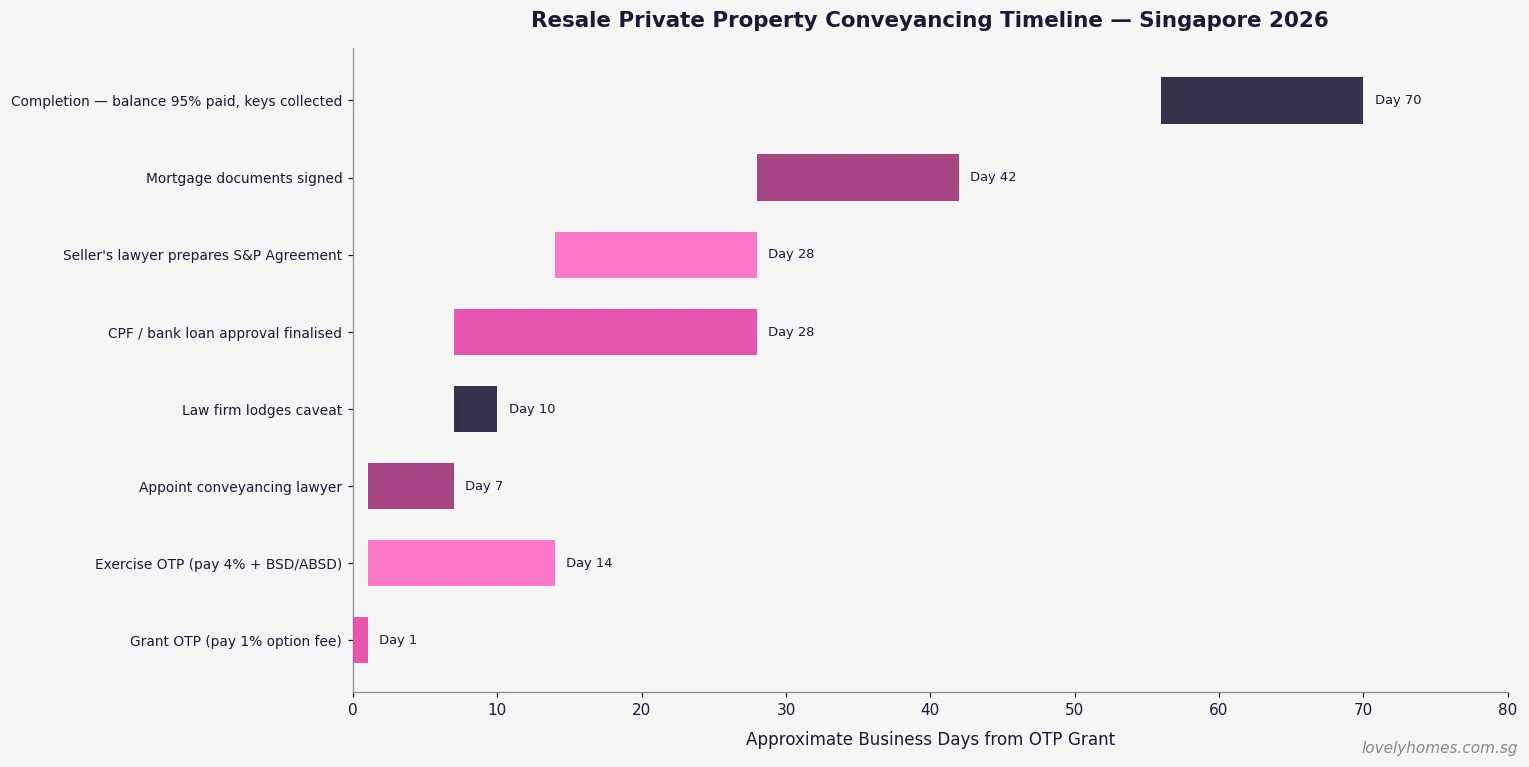
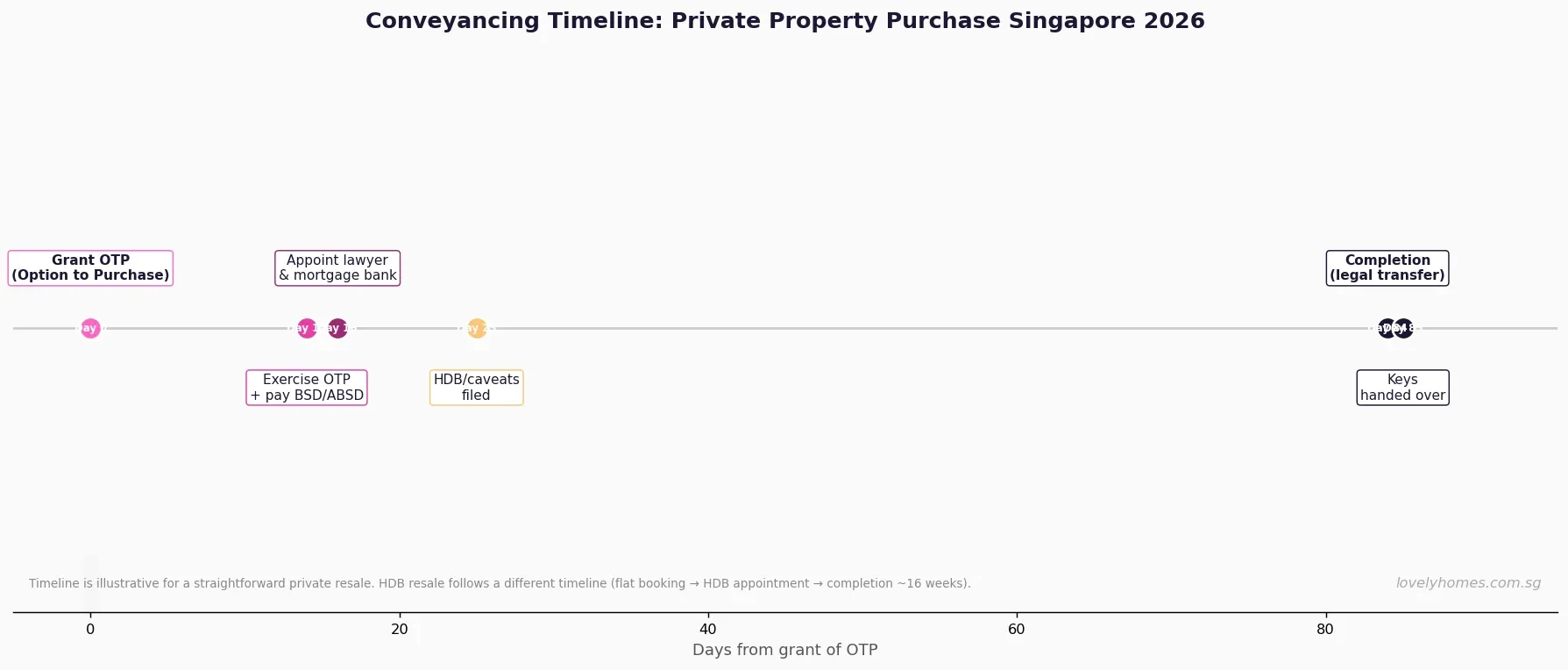
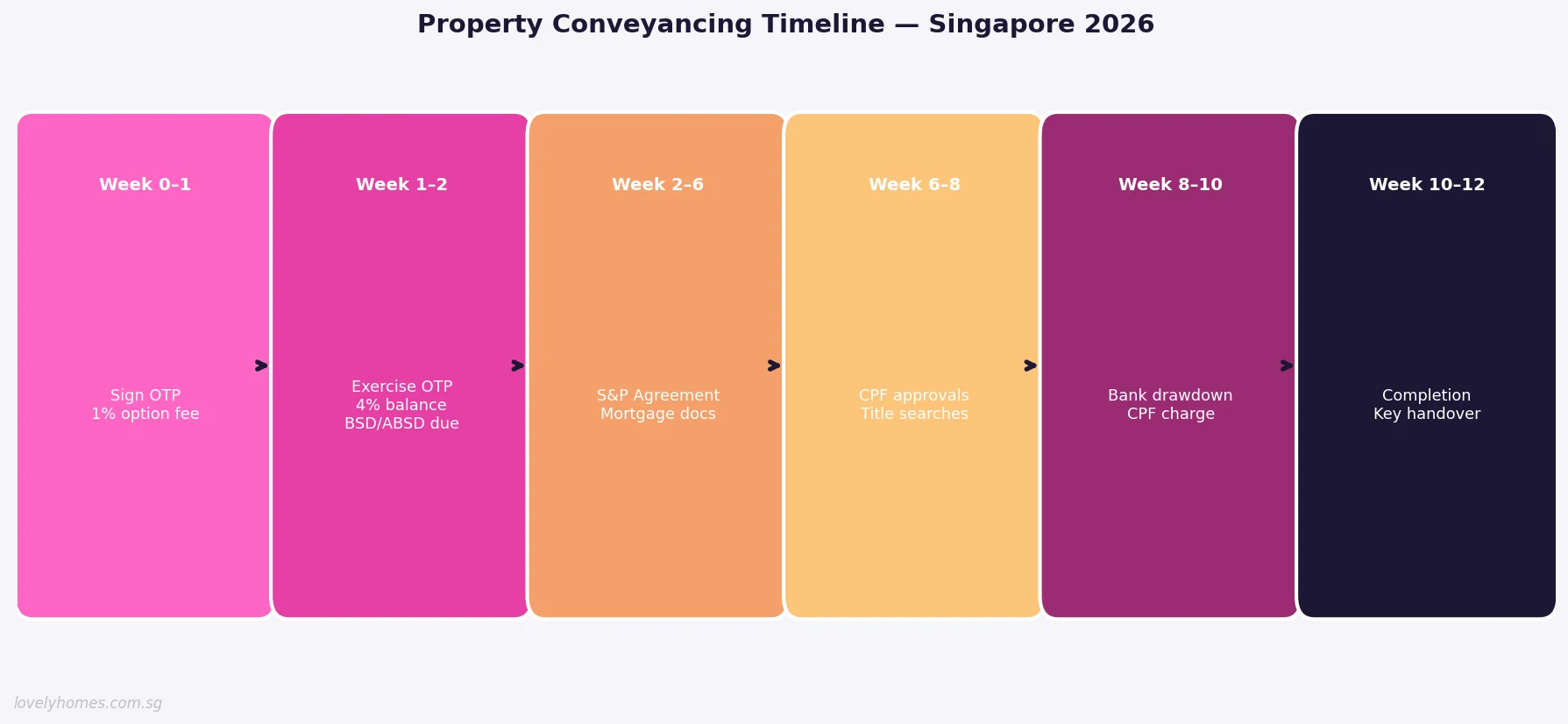
The private property conveyancing process in Singapore follows a predictable sequence, with most transactions completing within 8–12 weeks. HDB resale transactions are managed partly through the HDB portal and take considerably longer.
Step 1 — Option to Purchase (OTP)
The transaction starts when the seller grants the buyer an OTP in exchange for a 1% option fee (typically). The OTP is a unilateral contract: only the seller is bound to sell; the buyer has the option but not the obligation to proceed. The option period is typically 14 days for private property (extendable by agreement). During this window, the buyer should appoint a lawyer, arrange financing in principle, and complete due diligence searches.
Step 2 — Exercising the OTP
If the buyer proceeds, they exercise the OTP by delivering the signed acceptance copy to the seller’s lawyer and paying the balance of the initial deposit — typically 4%, bringing the total initial deposit to 5%. The balance 5% may be funded from CPF OA or cash. At exercise, BSD and ABSD become due to IRAS within 14 days. Failure to pay stamp duties on time attracts penalties and interest under the Stamp Duties Act.
Step 3 — Sale and Purchase Agreement
Once the OTP is exercised, the parties’ lawyers prepare the formal Sale and Purchase Agreement, which sets out completion conditions, representations, warranties, and the completion date. The S&P Agreement will include standard Law Society conditions of sale, clauses on title, encumbrances, vacant possession, and completion accounts. Your lawyer will conduct title searches through the Integrated Land Information Service (INLIS) to verify ownership, check for caveats, confirm that there are no encumbrances you have not been told about, and ensure the property is not subject to any URA planning restrictions affecting intended use.
Step 4 — CPF and Bank Approvals
If CPF is being used, your lawyer submits the necessary forms to the CPF Board to obtain approval for the CPF withdrawal and the registration of the CPF charge. The CPF Board’s processing typically takes 2–4 weeks. Simultaneously, the bank prepares the Letter of Offer, Facility Agreement, and Mortgage document. Your lawyer reviews and explains the mortgage terms to you, and you execute the documents before a solicitor as required under the Legal Profession (Professional Conduct) Rules.
Step 5 — Requisitions and Searches
Before completion, your lawyer runs the full suite of property searches: bankruptcy search on the seller (to confirm they can pass clear title), building plan search (to ensure there are no unauthorised structures), and road and drainage reserves search (to check for any government acquisition that might affect the property). These disbursements typically total S$400–S$700.
Step 6 — Completion
On completion day, the balance of the purchase price is paid to the seller’s solicitors in exchange for the duly executed Transfer and vacant possession. The buyer’s lawyer immediately lodges the Transfer and Mortgage for registration with the SLA via the electronic lodgement system. Once registered, the buyer becomes the legal owner on the land register. The keys are typically handed over at or shortly after completion.
Legal Fees: What You Will Pay
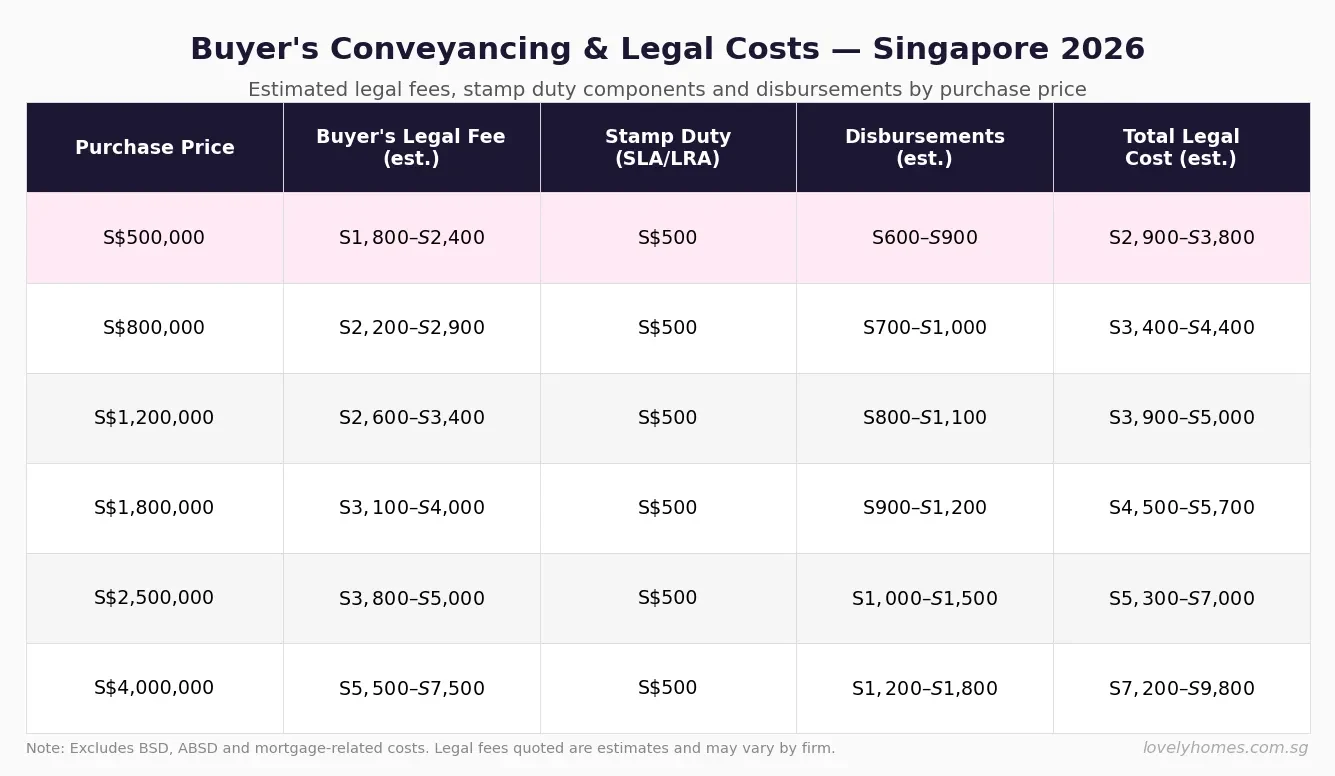
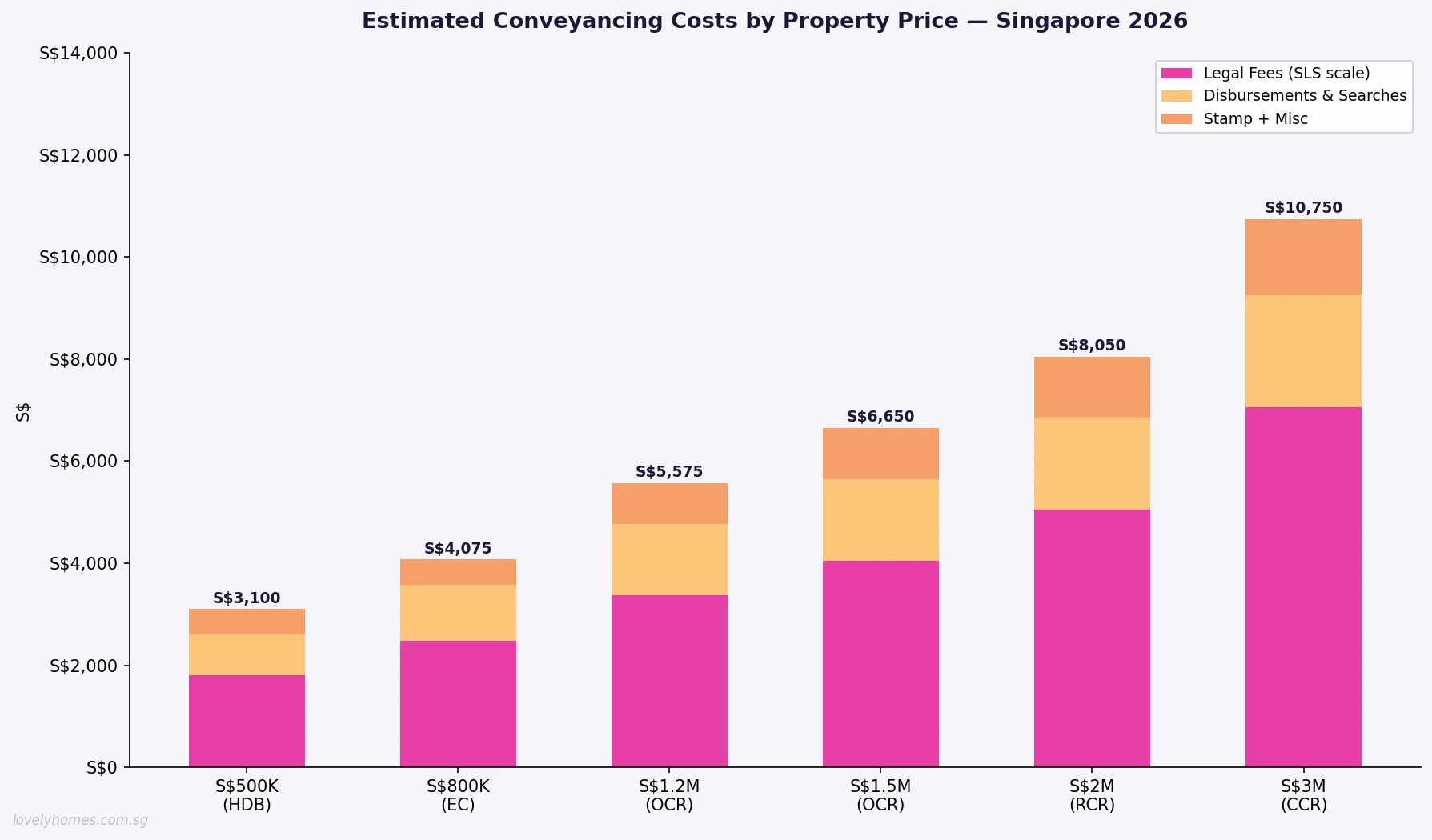
The Law Society’s mandatory fee scale for conveyancing was abolished in 2009. Since then, fees are negotiated between lawyers and clients. The table below shows typical market rates in 2026 based on the legacy SLS scale, which remains an informal reference point:
| Property Price | Est. Buyer Legal Fees | Est. Disbursements | Stamp/Misc | Total Estimate |
|---|---|---|---|---|
| S$500,000 (HDB) | S$1,800–S$2,200 | S$700–S$900 | S$400–S$600 | S$2,900–S$3,700 |
| S$800,000 (EC) | S$2,300–S$2,800 | S$900–S$1,200 | S$400–S$600 | S$3,600–S$4,600 |
| S$1,200,000 (OCR) | S$2,800–S$3,300 | S$1,100–S$1,500 | S$700–S$900 | S$4,600–S$5,700 |
| S$1,500,000 (OCR) | S$2,900–S$3,500 | S$1,400–S$1,700 | S$900–S$1,100 | S$5,200–S$6,300 |
| S$2,000,000 (RCR) | S$3,800–S$4,500 | S$1,600–S$2,000 | S$1,000–S$1,300 | S$6,400–S$7,800 |
| S$3,000,000 (CCR) | S$5,500–S$6,500 | S$2,000–S$2,500 | S$1,200–S$1,600 | S$8,700–S$10,600 |
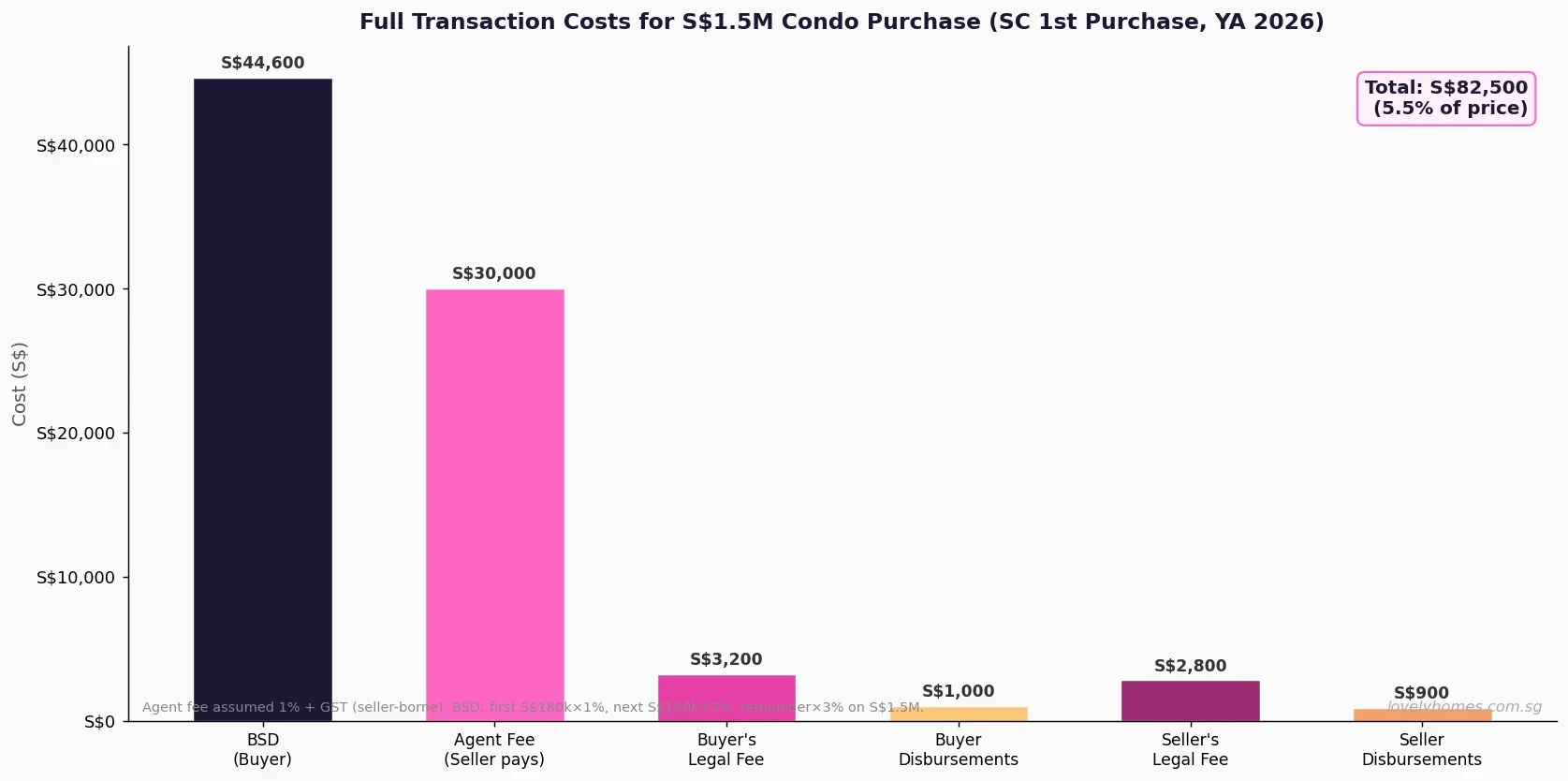
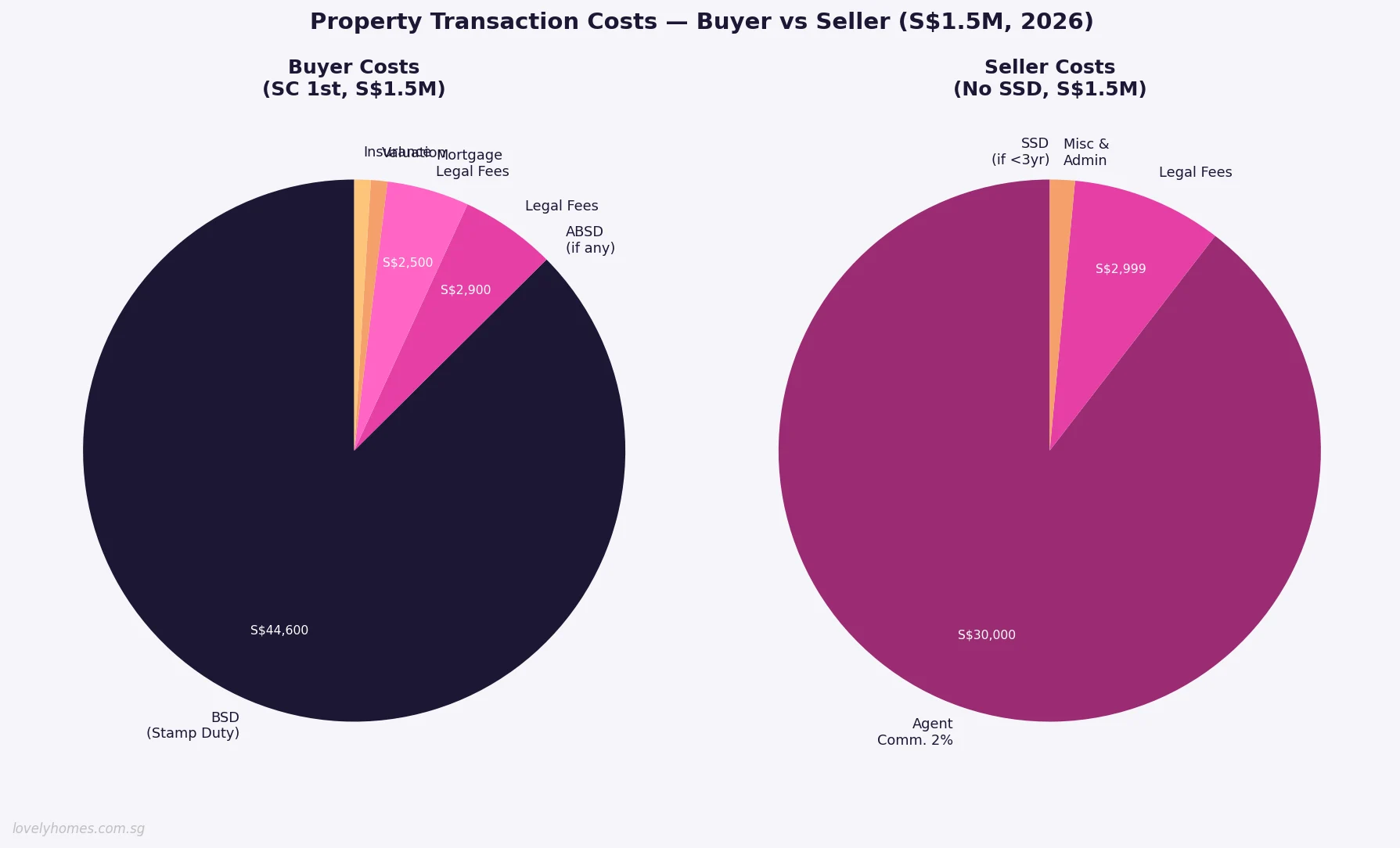
Seller’s legal fees run roughly S$2,000–S$4,500 depending on property value, covering the preparation of the Transfer and handling the mortgage redemption. Agent commissions (typically 1%–2% of sale price for the seller) are a separate commercial cost and are not part of conveyancing per se. For context, the seller of a S$1.5M condo paying 2% commission pays S$30,000 to their agent — a larger sum than their legal fees.
Stamp Duties: BSD, ABSD, and SSD
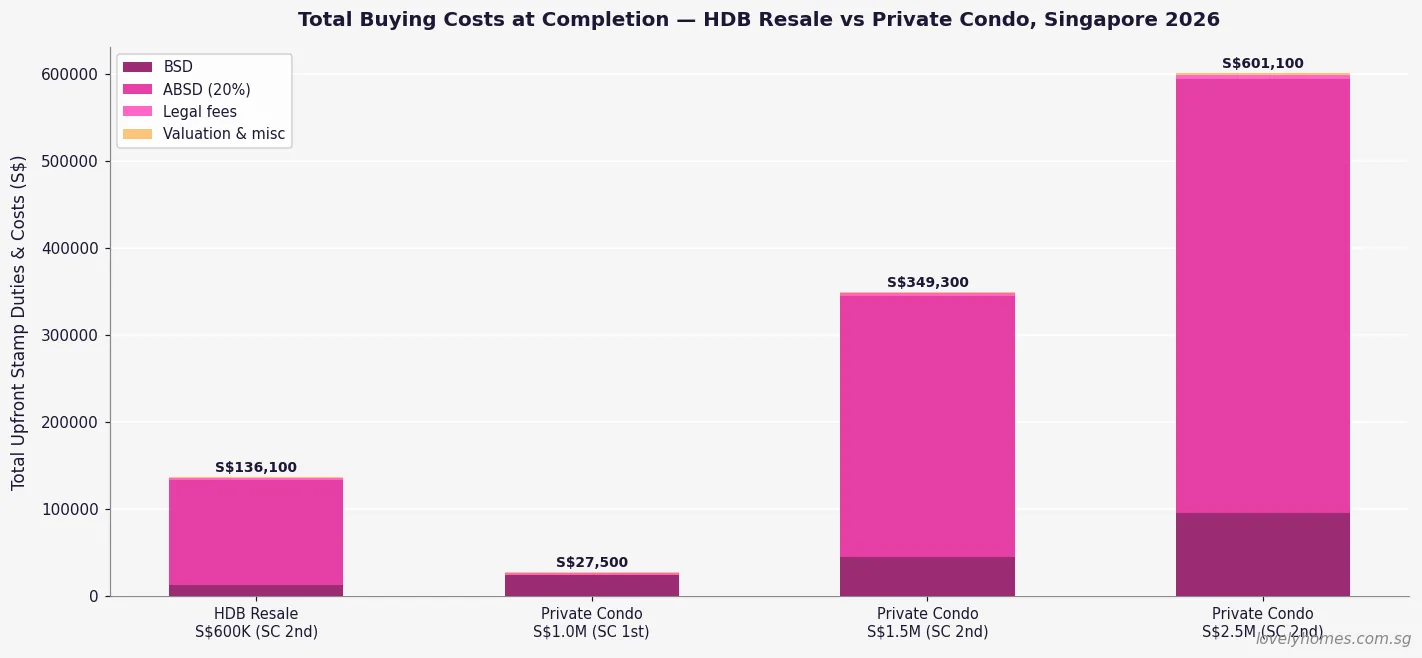
Stamp duties are a significant transaction cost that your lawyer administers but that the client pays. The Inland Revenue Authority of Singapore (IRAS) levies three main types relevant to property transactions. Buyer’s Stamp Duty (BSD) is payable by every buyer on every property purchase — there are no exemptions. ABSD applies to buyers who are not SC first-timers: PRs pay 5% on a first property, SCs pay 20% on a second property, and foreigners pay 60%. Both BSD and ABSD must be paid within 14 days of exercising the OTP or signing the S&P Agreement. Seller’s Stamp Duty (SSD) is levied on sellers who dispose of a residential property within 3 years of acquisition — at 12% (year 1), 8% (year 2), or 4% (year 3). SSD was substantially tightened in April 2023 (holding period extended from 1 year at 4% to 3 years at tiered rates) as part of a package of cooling measures. For a detailed breakdown of ABSD rates and remissions, see our complete ABSD guide.
HDB Resale vs Private — Key Conveyancing Differences
HDB resale conveyancing follows a distinct process managed partly through the HDB Resale Portal, which all parties (buyer, seller, and their respective lawyers) must use to submit applications, upload documents, and schedule the final HDB Resale Completion Appointment. The approximate timeline for an HDB resale from OTP exercise to key collection is 5–8 months, much longer than the 8–12 weeks typical for private property. This is because HDB’s approval involves eligibility checks, CPF valuation checks, and the scheduling of the Resale Completion Appointment, which must be booked at HDB’s Hub at Toa Payoh. Legal fees for HDB resale conveyancing are generally lower than for private property because the title is simpler (no freeholds, no complex encumbrances), running S$1,800–S$2,500 for the buyer. For more detail on the HDB resale process, see our HDB resale price and process guide.
Worked Example: Buying a S$1.5M OCR Condo
Case Study: Ms Tan — S$1,500,000 OCR Condo, SC First-Timer
Profile: Ms Tan (SC), 35 years old, gross monthly income S$9,500. First residential property purchase. CPF OA balance: S$120,000. Cash savings: S$350,000.
Stamp Duties (payable to IRAS within 14 days of OTP exercise):
- BSD on S$1,500,000: (1%×S$180K) + (2%×S$180K) + (3%×S$640K) + (4%×S$500K) = S$1,800 + S$3,600 + S$19,200 + S$20,000 = S$44,600
- ABSD (SC first property): S$0
Conveyancing (payable to her lawyer over the course of the transaction):
- Buyer’s legal fees: ~S$3,100
- Mortgage legal fees (joint representation with bank): ~S$2,500
- Disbursements (title searches, INLIS, caveat, CPF charge registration): ~S$1,600
- Valuation fee (required by bank): ~S$500
- Miscellaneous (photocopying, couriers): ~S$200
- Total conveyancing costs: ~S$7,900
Financing breakdown:
- Purchase price: S$1,500,000
- Bank loan (75% LTV): S$1,125,000 (3.4% p.a. SORA-based, 25-year term)
- Downpayment (25%): S$375,000 = cash S$75,000 (5%) + CPF OA S$120,000 + residual cash S$180,000
- Monthly instalment (est.): S$5,590 | TDSR: S$5,590 ÷ S$9,500 = 58.8% — slightly above the 55% cap
- Adjustment needed: Ms Tan would need to either reduce the loan (larger CPF/cash input), extend tenure to 30 years (~S$5,040/mth, TDSR 53% PASS), or increase her income. A co-borrower (e.g., her partner) would allow joint TDSR assessment.
Total day-1 outlay: S$375,000 (downpayment) + S$44,600 (BSD) + S$7,900 (conveyancing) = S$427,500. This is within her S$350,000 cash savings combined with CPF S$120,000 = S$470,000 total resources. The transaction is feasible if the TDSR issue is resolved by extending the loan tenor to 30 years.
Choosing a Property Lawyer: What to Look For
Not all property lawyers in Singapore are equally experienced in the conveyancing niche. Here are the factors most buyers should evaluate before appointing. First, look for a firm that handles residential conveyancing regularly — some general practice firms do conveyancing only occasionally and may be slower or less familiar with current INLIS query protocols or HDB Resale Portal procedures. Second, ask upfront for a fee quote in writing that distinguishes between professional fees and disbursements — reputable firms will provide this without hesitation. Third, check whether the firm is on your bank’s panel of solicitors; if it is not, you will need to engage separate lawyers for the mortgage, effectively doubling legal fees. Most major Singapore banks maintain panels of approved firms. Finally, check the Singapore Law Society’s Find a Lawyer directory (lawsociety.org.sg) to verify that your chosen solicitor holds a valid practising certificate.
What Might Change Next?
The digitalisation of Singapore’s conveyancing pipeline has accelerated in recent years. SLA’s e-Lodgement system processes most land registry filings electronically, and the CPF Board’s digital portal has significantly reduced the time for CPF charge approvals. Looking ahead, the Law Society’s Law Reform and Revision Committee has indicated interest in reviewing professional fee guidelines — potentially introducing a new non-mandatory reference fee scale to improve market transparency for consumers. Separately, the proposed expansion of the Singapore Land Authority’s Digital Infrastructure platform may eventually allow buyers to track their property title status in near-real time. Neither reform is yet law as at August 2026.
Frequently Asked Questions
Do I need separate lawyers for the purchase and the mortgage?
Not necessarily. Under the Law Society’s practice directions, one law firm may act for both the buyer and the mortgagee bank in the same transaction, provided there is no conflict of interest and the client’s informed consent is obtained. This is called joint representation, and it is the norm in straightforward residential transactions. The firm will charge a single combined fee covering both the conveyancing and the mortgage work. You should confirm that the firm is on your bank’s panel — if it is not on the panel, the bank may insist on appointing its own panel firm for the mortgage work, and you will be charged separately for each.
When exactly must I pay BSD and ABSD?
BSD and ABSD must be paid to IRAS within 14 days of exercising the OTP (for completed private properties where the OTP is the binding instrument) or within 14 days of signing the S&P Agreement for a new launch developer sale, whichever is earlier. Your lawyer will calculate the exact figures and arrange payment through IRAS’s electronic stamp duty system (e-Stamping). Late payment attracts a penalty of S$10 or 10% of the unpaid duty, whichever is greater, plus interest of up to 6% per annum from the date the duty was due. For stamp duty rates see our complete stamp duty guide.
What is a caveat and why does my lawyer lodge one?
A caveat is a notice registered on the land register by your lawyer on your behalf, serving as a public record that you have an equitable interest in the property (arising from the S&P Agreement). Once lodged, no further dealings on the title can be registered without first notifying the caveator. The caveat protects you in the window between signing the S&P Agreement and completion — it prevents the seller from fraudulently selling the property to a second buyer or granting a second mortgage without your knowledge. Caveats are electronically lodged through SLA’s e-Lodgement system at a registration fee of S$64.45 (2026 rate). Your lawyer typically lodges the caveat within days of OTP exercise.
What is the difference between legal title and equitable title?
Singapore uses the Torrens title system, under which registration with SLA confers indefeasible legal title — meaning once registered, your ownership is guaranteed by the state and cannot be challenged except in cases of fraud. Before registration, the signed S&P Agreement gives you equitable title, which is enforceable against the seller in court but is not yet recognised on the land register. This is why the caveat is important: it protects your equitable interest until registration converts it to legal title. For practical purposes, you are the legal owner of the property only from the moment the Transfer is registered at SLA, which typically occurs on or just after completion day.
Can I appoint an overseas law firm to handle Singapore conveyancing?
No. Singapore property conveyancing must be conducted by a Singapore-qualified advocate and solicitor holding a valid practising certificate issued by the Singapore Supreme Court. Foreign-qualified lawyers or law firms — even those with Singapore offices — may not conduct conveyancing unless they hold the relevant Singapore qualifications. This rule protects the integrity of the Torrens title system and ensures that all practitioners are subject to the Law Society’s disciplinary jurisdiction and the Conveyancing Rules’ client account safeguards.
What is Seller’s Stamp Duty and how do I avoid it?
Seller’s Stamp Duty (SSD) is levied on the seller (not the buyer) when a residential property is sold within 3 years of acquisition. The rates as at 2026 are: 12% of the higher of the sale price or market value if sold in the first year; 8% in the second year; 4% in the third year. SSD does not apply if the property is sold after 3 years from the date of acquisition. The acquisition date is the date you exercised the OTP (or for a new launch, the date of the S&P Agreement, not TOP). To avoid SSD entirely, hold the property for at least 3 years. There are limited remissions — for example, if the seller has passed away and the property is transferred to the estate — but commercial transactions do not qualify for remission.
How long does HDB resale conveyancing take compared to private property?
Private property conveyancing typically completes in 8–12 weeks from OTP exercise to key collection. HDB resale conveyancing is substantially longer — usually 5–8 months from OTP exercise — because it involves HDB’s eligibility assessment, CPF Board processing, HDB Resale Portal submissions from both parties’ lawyers, and the scheduling of the HDB Resale Completion Appointment at HDB Hub. During this period, both buyer and seller must respond promptly to HDB’s documentation requests. Delays in obtaining financial documents, resolving flat condition disputes, or scheduling the completion appointment can extend the timeline further. Buyers of HDB resale flats should factor in this waiting period when planning their move or managing the sale of their existing property.
Related Articles
- ABSD Singapore 2026: Complete Guide to Additional Buyer’s Stamp Duty
- Singapore Stamp Duty Guide 2026: BSD, ABSD, and SSD Explained
- Singapore First-Timer Property Buying Guide 2026
- Using CPF to Buy Property in Singapore 2026
- HDB Resale Price and Process Guide 2026
- 10-Step Private Property Buying Procedure 2026
- Condo vs HDB Singapore 2026: Which Should You Buy?
Disclaimer: This article is for general informational purposes only and does not constitute legal advice. Conveyancing fees, stamp duty rates, CPF rules, and SLA registration procedures are subject to change. Readers should obtain independent legal advice from a Singapore-qualified advocate and solicitor and verify current rates and procedures with official sources — SLA.gov.sg, IRAS.gov.sg, LawSociety.org.sg, CPF.gov.sg, and MAS.gov.sg — before proceeding with any property transaction.