Renting a Condo in Singapore 2026: Complete Guide to Leases, Costs and Tenant Rights

Renting a Condo in Singapore 2026: Complete Guide to Leases, Costs and Tenant Rights

Quick Answer — Renting a condo in Singapore at a glance

  • Median condo rent in 2026: S$3,100–S$5,700/month depending on unit size and region
  • URA private residential rental index fell 1.2% in Q1 2026 as new supply enters the market
  • Minimum legal tenancy for private property: 3 months (short-term rentals under 3 months are prohibited)
  • Upfront costs: typically 1+1 month security deposit + half-month agent commission
  • Stamp duty on tenancy agreement: 0.4% × annual rent × number of years
  • Landlord must supply a functional, habitable unit; tenant pays utilities and minor repairs
  • Look for a diplomatic clause if your stay may be cut short — usually exercisable after month 12
  • The non-citizen quota (NCQ) limits foreign tenants in HDB estates to 8% per neighbourhood and 11% per block — condo rentals have no NCQ restriction

Renting a condominium in Singapore is the entry point for most expatriates, professionals on employment passes, and Singaporeans who are in between home ownership. It is also increasingly attractive to local upgraders who sell their HDB flat but want flexibility before committing to a private purchase. In 2026, the rental market has shifted in tenants’ favour: vacancy rates have edged up to around 7%, the Urban Redevelopment Authority (URA) reported a 1.2% quarterly decline in the private residential rental index in Q1 2026, and landlords in many districts are now negotiating where they once insisted. This guide explains how renting a condo in Singapore actually works — from understanding what a unit costs across different regions, to signing a legally compliant tenancy agreement, to knowing your rights as a tenant when things go wrong.

The Singapore Private Rental Market in 2026

Singapore’s private residential rental market is administered indirectly by the URA, which tracks rental transactions and publishes quarterly price and rental indices. Unlike HDB rentals, private condo rentals are not subject to nationality quotas — a landlord may rent to any nationality with a valid pass or PR status. The market is therefore more internationalised, with a significant proportion of tenants being expatriates on Employment Passes (EP) or S Passes, as well as Singaporeans awaiting new-launch completion.

After an extraordinary run-up of over 40% in rental values between 2021 and 2023 — driven by post-pandemic return of expats, supply constraints, and HDB delays — the market began softening in late 2023 and has continued to normalise. As at Q1 2026, private residential rents remain elevated against 2019 levels but are declining gradually as the pipeline of 17,032 unsold units (URA Q1 2026) and completions from 2022–2024 launches add supply. Vacancy has widened to an estimated 7%, giving tenants meaningful negotiating leverage for the first time in years.

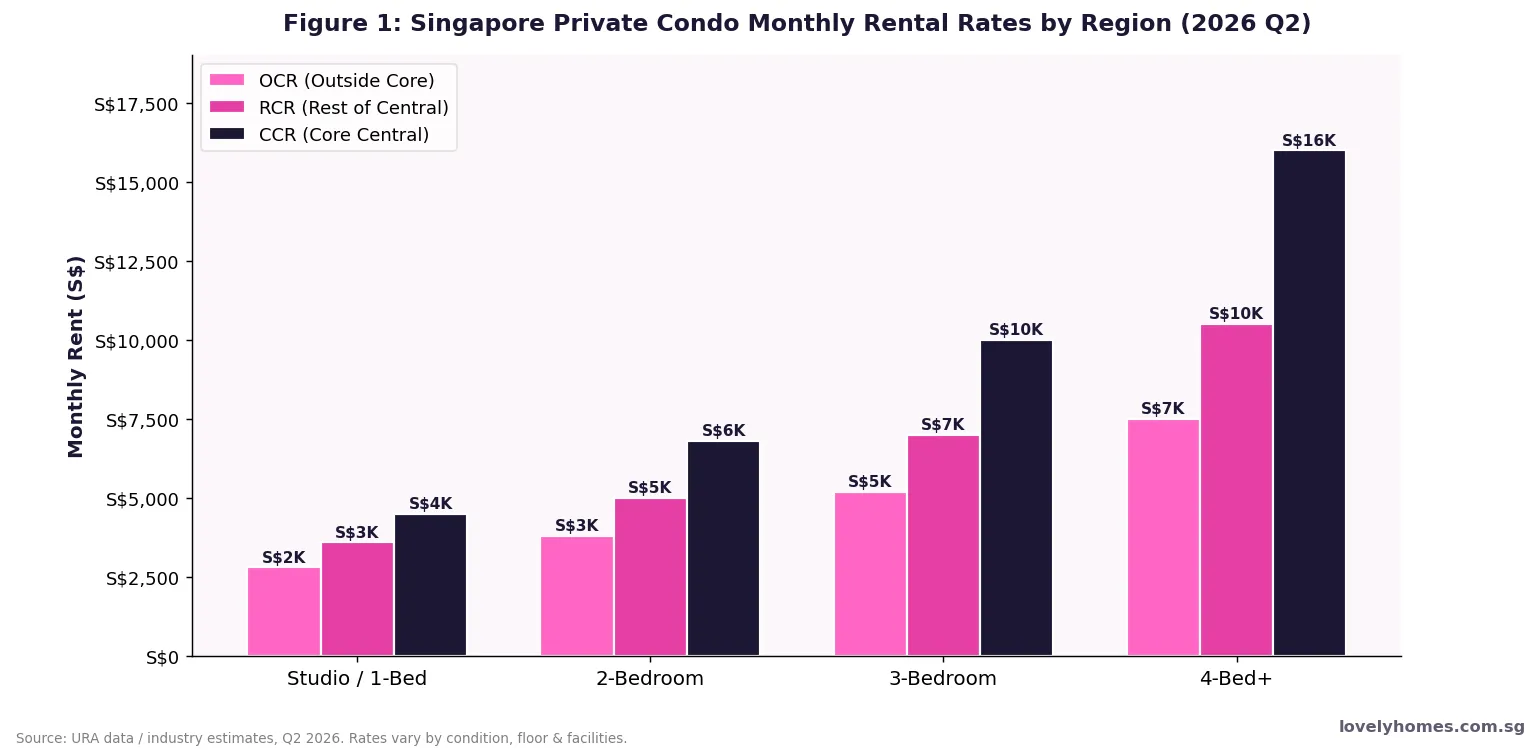
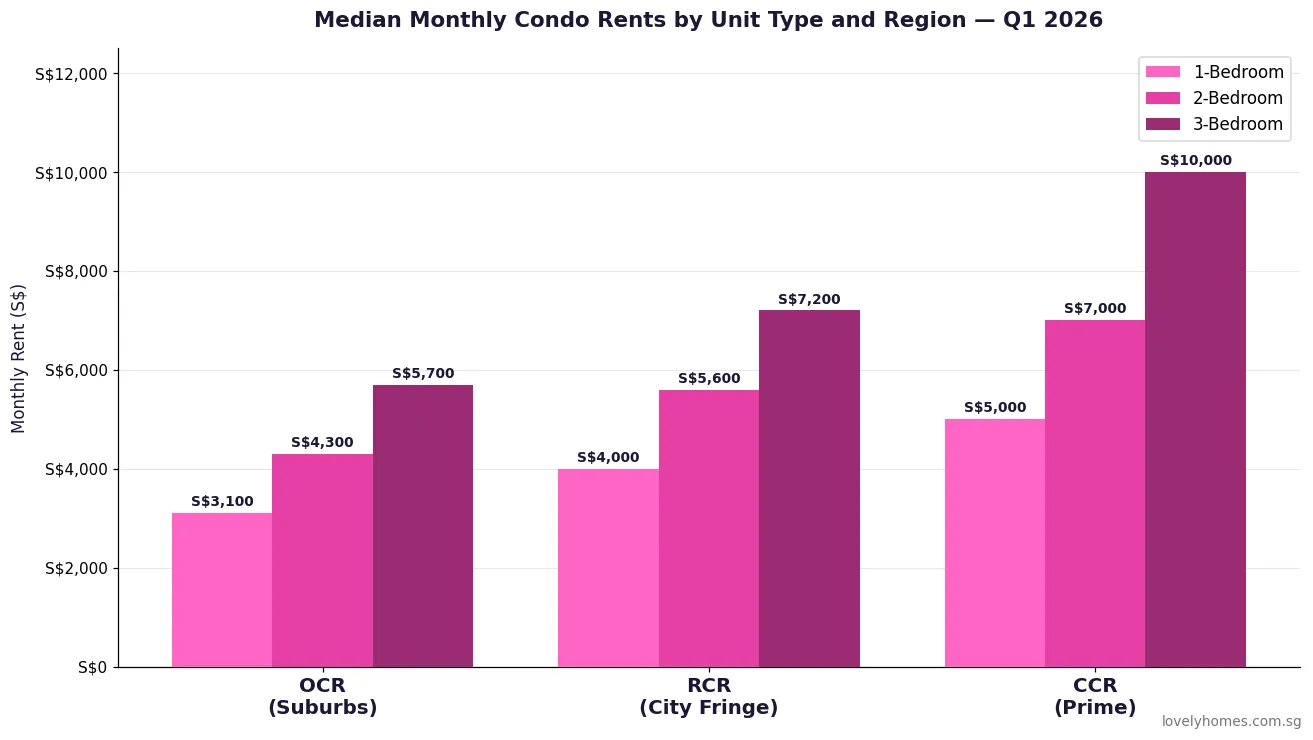
Singapore condo median rental rates by unit type and region 2026
Figure 1: Median monthly condo rents by unit type and region, Q1 2026. OCR = Outside Central Region (suburbs); RCR = Rest of Central Region (city fringe); CCR = Core Central Region (prime). Source: URA, industry estimates.

Condo Rental Rates by Region and Unit Type

Rental rates vary significantly by district, unit size, floor level, and age of development. The URA divides Singapore into three broad rental markets: the Core Central Region (CCR), covering Districts 9, 10, 11, and the Downtown Core; the Rest of Central Region (RCR), covering city-fringe areas such as Queenstown, Bishan, Toa Payoh, and Geylang; and the Outside Central Region (OCR), covering mass-market suburbs such as Punggol, Sengkang, Tampines, Woodlands, and Jurong.

Unit Type OCR (Suburbs) RCR (City Fringe) CCR (Prime)
Studio / 1-Bedroom S$2,800–S$3,500/mth S$3,500–S$4,500/mth S$4,000–S$6,000/mth
2-Bedroom S$3,800–S$5,000/mth S$4,800–S$6,500/mth S$5,500–S$9,000/mth
3-Bedroom S$5,000–S$6,500/mth S$6,000–S$8,500/mth S$7,500–S$14,000/mth
4-Bedroom / Penthouse S$6,500–S$9,000/mth S$7,500–S$12,000/mth S$10,000–S$25,000+/mth

These are indicative ranges for units in good condition within well-maintained developments. Older freehold condos in established CCR districts (such as Nassim Road or Ardmore Park) can command premiums well above the ranges shown. Conversely, mass-market condos in OCR estates near an MRT station but without premium fittings typically sit at the lower end. Furnished units command a premium of roughly 10–20% over unfurnished equivalents, though most condo landlords provide at minimum white goods and air-conditioning units.

Types of Condo Available for Rent

Singapore’s private residential market offers several distinct product types under the broad “condo” umbrella. A standard condominium is a multi-unit strata development of six or more floors with full facilities — swimming pool, gym, function room, and 24-hour security. An apartment block (fewer than five floors, no mandatory facilities) is technically different from a condominium under the Planning Act but is marketed identically. Landed property — terraces, semi-detached, detached houses — is rented by Singaporeans and permanent residents with ease, but foreigners require approval from the Singapore Land Authority under the Residential Property Act to rent non-condominium landed property; condo units are fully open to foreigners.

Serviced apartments, though physically similar to condos, operate under a hotel licence and are typically rented on weekly or monthly terms. They sit outside the standard tenancy framework and carry no stamp duty obligation but command significant rent premiums for the flexibility and daily services included. They are a popular bridge while a new expatriate’s permanent housing is arranged.

Step-by-Step Rental Process

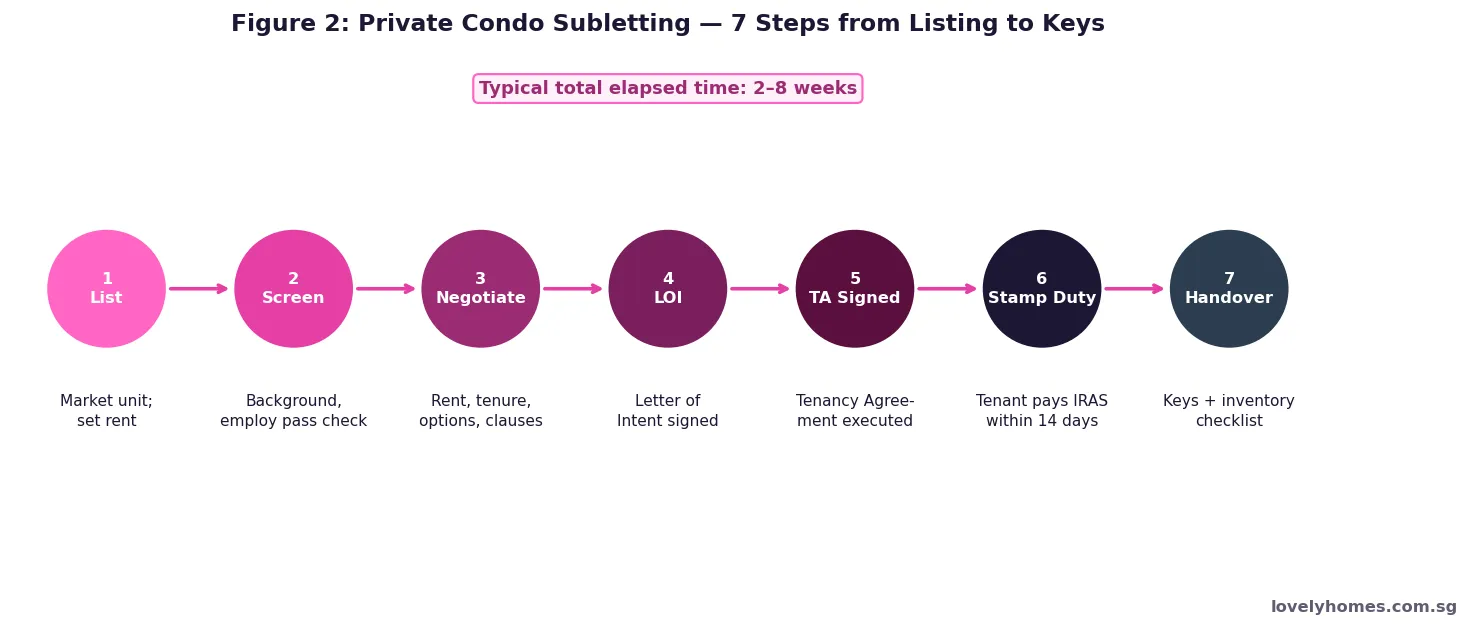
Renting a condo in Singapore follows a reasonably standardised process, though timelines can compress or extend depending on landlord circumstances and market conditions.

Step 1 — Search and shortlist. Most tenants search on PropertyGuru, 99.co, or STProperty. View three to five properties in person before making an offer. Pay attention to maintenance standards, lift lobby cleanliness, pool condition, and the responsiveness of the management corporation (MCST) — all signal how well-managed the development is.

Step 2 — Letter of Intent (LOI). Once you identify a unit, you submit a Letter of Intent — a one-page document specifying the agreed rent, tenancy term, move-in date, and any special requests (additional parking, pet clause, specific appliances). The LOI is accompanied by a good-faith deposit equal to one month’s rent. The landlord has three to seven days to sign or counter-propose.

Step 3 — Tenancy Agreement (TA). Once the LOI is agreed, the landlord’s solicitor (or the landlord directly) prepares the Tenancy Agreement. This is the binding legal contract. Review it carefully — particularly the diplomatic clause, the inventory schedule, the repair obligations, and any early termination penalties. Once signed, both parties pay the stamp duty on the TA.

Step 4 — Stamp duty and move-in. The tenant (or landlord, depending on agreement) stamps the TA with the Inland Revenue Authority of Singapore (IRAS) at 0.4% of the annual rent multiplied by the number of years of the tenancy. On the move-in date, the balance of the security deposit is paid and a thorough condition check of the unit is conducted and documented.

Rental Yields — Understanding the Landlord’s Perspective

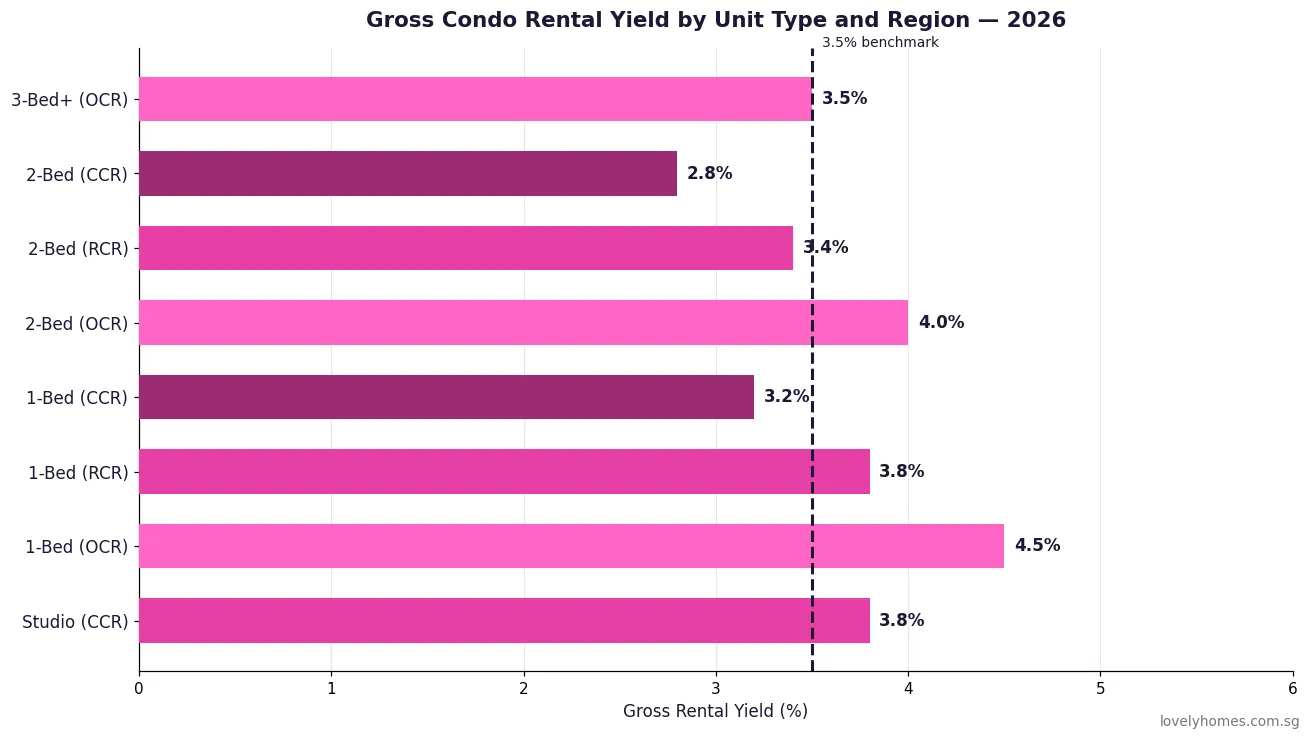
Gross rental yield is the annual rent divided by the purchase price of the property. Understanding yields helps tenants appreciate why landlords price units the way they do, and can be a useful data point in negotiations — a landlord who bought at the peak of 2022–2023 faces significant yield compression and may be more flexible on rent than official asking prices suggest.

Gross condo rental yield by unit type and region Singapore 2026
Figure 2: Gross rental yield by unit type and region, 2026. Smaller units in OCR outperform on yield; prime CCR condos yield the least but attract higher-income tenants. Source: industry estimates based on URA transaction data.

Costs to Budget For as a Tenant

The headline monthly rent is not the only cost a prospective condo tenant must account for. Before signing, budget for the following upfront payments.

Security deposit: The market convention is one month’s security deposit per year of tenancy. A standard two-year tenancy therefore requires a two-month security deposit — typically paid in two instalments: one at LOI stage and one at TA signing. The deposit is held by the landlord and returned within 14 days of vacating (subject to any deductions for damage beyond fair wear and tear).

Agent commission: For a two-year or longer lease, the tenant typically pays half a month’s commission to the tenant’s agent, and the landlord pays one month to the landlord’s agent. For shorter leases, commission structures vary. Always clarify this before engagement — some co-broking arrangements shift the full commission to the tenant.

Stamp duty on tenancy agreement: The rate is 0.4% of the total rent payable. For a two-year tenancy at S$4,500/month, this works out to S$4,500 × 12 × 2 × 0.4% = S$432. This is typically paid by the tenant within 14 days of signing the TA.

Utilities: Utilities (electricity, water, gas) are the tenant’s responsibility in virtually all private condo tenancies. In 2026, a typical 2BR condo unit incurs electricity costs of approximately S$120–S$220/month depending on air-conditioning usage. The Open Electricity Market (OEM) allows tenants to choose between retailers for potentially lower rates.

Cost Item Typical Amount Who Pays Timing
Security deposit (2yr lease) 2 months’ rent Tenant At LOI + at TA signing
Agent commission 0.5–1 month’s rent Tenant (0.5) + Landlord (1) At TA signing
Stamp duty on TA 0.4% × annual rent × years Usually tenant Within 14 days of TA signing
First month’s rent 1 month’s rent Tenant On move-in date
Utilities connection S$100–S$200 deposit Tenant Before move-in
Minor maintenance Varies Tenant (fair wear & tear) Throughout tenancy

Tenancy Agreement — Key Clauses to Negotiate

The Tenancy Agreement is a standard-form document in Singapore, often based on the Law Society’s approved template, but landlords routinely customise it. As a tenant, pay particular attention to the following clauses before signing.

Diplomatic clause: This entitles the tenant to terminate the lease early if they receive a confirmed repatriation or job transfer. The standard form allows exercise after the first 12 months of a 24-month lease, with two months’ written notice. Not all landlords will agree to this, especially for shorter leases. If you are on an Employment Pass that could be cancelled, insist on this clause.

Repair obligations: The landlord is generally responsible for structural repairs and maintaining fixed installations such as built-in kitchen appliances, water heaters, and air-conditioning systems in working order. The tenant is responsible for day-to-day maintenance — changing light bulbs, maintaining cleanliness, and repairing damage caused by the tenant. The TA should specify a cost threshold (commonly S$150–S$300) below which the tenant handles repairs without recourse to the landlord.

Pet clause: Most condo tenancy agreements prohibit pets by default. If you have a pet, negotiate the pet clause in the LOI stage — do not assume goodwill after signing. Landlords who agree often require an additional deposit.

Subletting: Subletting without written landlord consent is a breach of the TA. If you may need to sublet a room, negotiate an express subletting clause at the outset. Note that subleasing to more than six unrelated persons in a condo unit breaches the Urban Redevelopment Authority’s occupancy cap regulations.

Worked Example: Mr Rajesh, Renting a 3-Bedroom OCR Condo

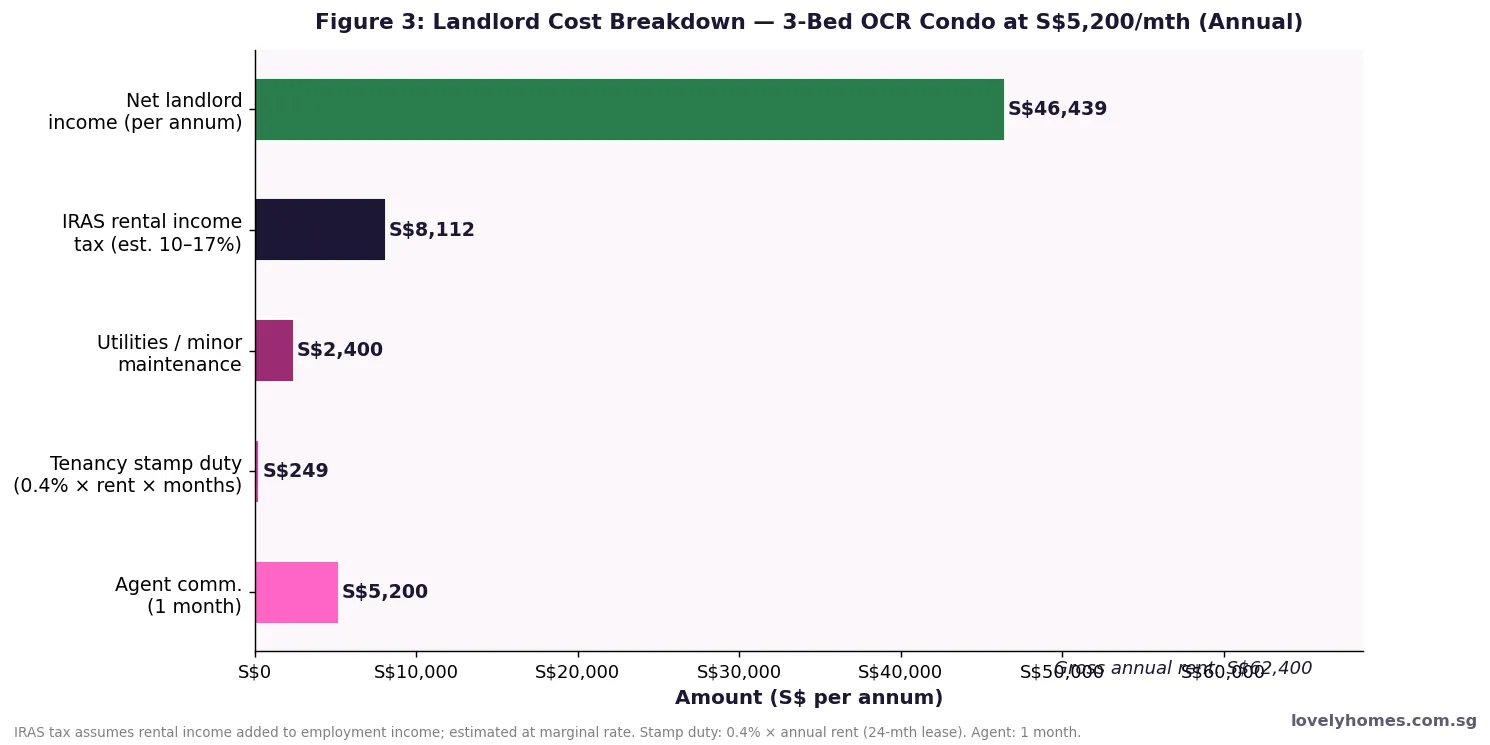
Mr Rajesh is a Malaysian national on an Employment Pass, earning S$12,000/month. He is relocating from a company-provided serviced apartment to a self-arranged private condo for a 24-month lease starting 1 August 2026. He identifies a 3-bedroom, 1,300 sq ft condo unit in Sengkang (OCR) at S$5,200/month (unfurnished).

Upfront costs:

  • Good-faith deposit at LOI: S$5,200 (1 month)
  • Balance security deposit at TA signing: S$5,200 (2nd month of 2-month deposit)
  • First month’s rent: S$5,200
  • Stamp duty: S$5,200 × 12 × 2 × 0.4% = S$499
  • Tenant agent commission (0.5 month): S$2,600
  • Utilities connection deposit: S$150
  • Total upfront: approximately S$18,849

Ongoing monthly: Rent S$5,200 + estimated utilities S$200 = S$5,400/month. This represents 45% of Mr Rajesh’s gross income, within the comfort range for a single-income expat household. He negotiated a diplomatic clause exercisable after month 14 with two months’ written notice, which his employer agreed to support if repatriation is required.

Market check: The landlord originally listed at S$5,500/month. Because vacancy in the OCR rental market has widened and two similar units in the same development are vacant, Mr Rajesh’s agent negotiated S$5,200 — a S$300/month or S$7,200 saving over the two-year lease. This illustrates the current market dynamic: asking prices are often negotiable by 5–8% for quality tenants willing to commit to longer terms.

The Market Shift: What the Rental Index Tells Us

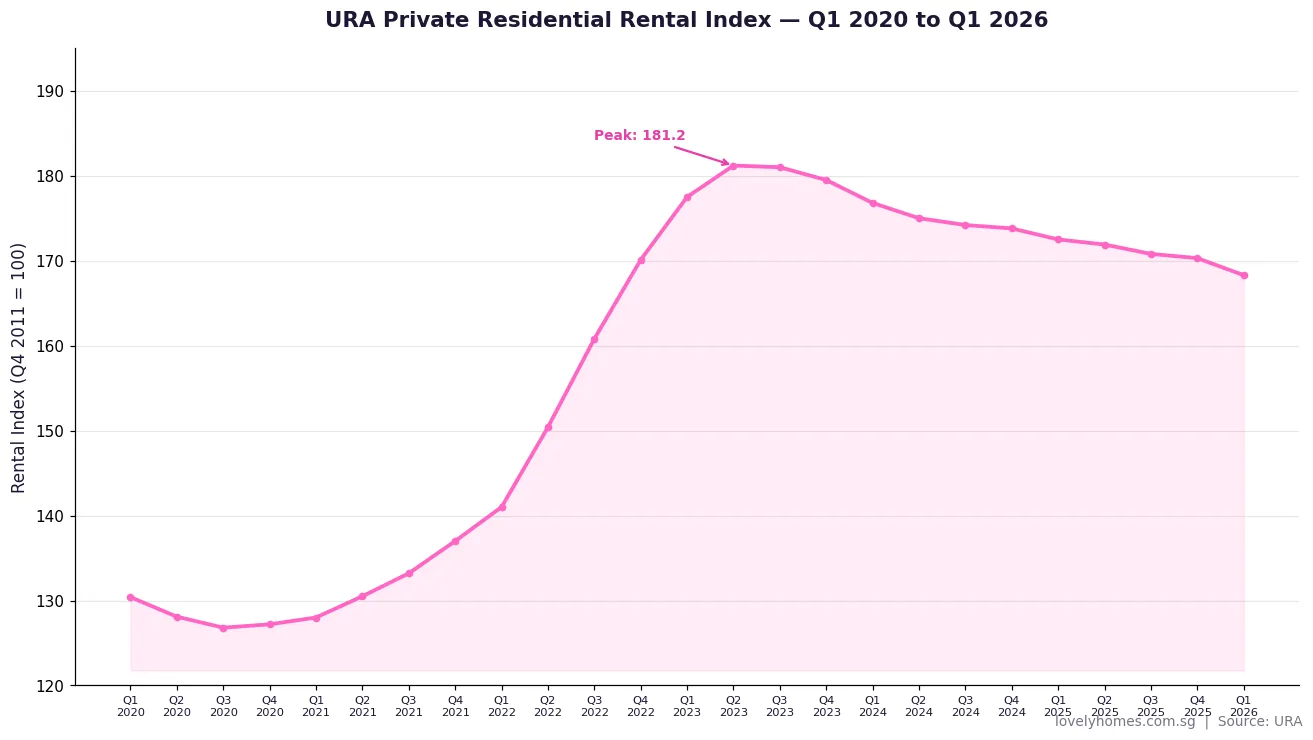
URA private residential rental index trend Q1 2020 to Q1 2026
Figure 3: URA Private Residential Rental Index, Q1 2020 to Q1 2026. After peaking in early 2023, rents have declined for eight consecutive quarters. The index remains approximately 29% above Q1 2020 levels. Source: URA.

The URA private residential rental index peaked around Q1 2023 at approximately 181.5 (base Q4 2011 = 100). It has since declined to around 168.3 in Q1 2026 — a fall of about 7.3% from peak — but remains some 29% above Q1 2020 pre-pandemic levels. This context matters for tenants: rents are lower than the 2023 frenzy but are not at pre-2021 levels, and the rate of decline has slowed. A sustained oversupply scenario would push rents further down; conversely, if global business activity picks up and EP inflows accelerate, the market could tighten again by late 2026 or 2027.

What Might Come Next — Rental Market Outlook

The short-to-medium outlook for Singapore condo rentals in 2026 and 2027 leans modestly in tenants’ favour. Three supply-side factors support further gentle softening: the completion pipeline from 2022–2024 new launches continues to deliver units; the 2H 2026 Government Land Sales programme announced in June 2026 will add further medium-term supply; and the 17,032 unsold private units as at Q1 2026 represent a substantial buffer. On the demand side, the Singapore labour market remains tight with EP inflows expected to hold at current levels, which should provide a floor under rental demand.

That said, the era of 8–15% annual rental increases is clearly over for now. Tenants in 2026 should expect flat to modestly declining rents in OCR and RCR areas, while CCR prime districts — where international tenant budgets are less price-sensitive — may see more stable or even firmer rents if global financial activity sustains. Tenants renewing leases expiring in mid-2026 should push firmly for discounts of 5–10% versus their 2024 contracted rates.

Frequently Asked Questions

Can a foreigner rent a condo in Singapore?

Yes. Foreigners with a valid pass (Employment Pass, S Pass, Dependent Pass, Long-Term Visit Pass, or Student Pass) may rent any private condo unit without restriction. There is no nationality quota on private condo rentals, unlike HDB estates which are subject to the non-citizen quota. Foreigners may not rent landed property (terrace, semi-detached, or detached house) without approval from the Singapore Land Authority under the Residential Property Act, but this restriction does not apply to condominium units.

What is the minimum tenancy period for a condo?

The minimum tenancy for a private residential property in Singapore is three consecutive months. Short-term rentals of less than three months — including Airbnb-style arrangements — are illegal for private residential units under the Planning Act. Penalties for illegal short-term rentals are severe: landlords face fines of up to S$200,000 for each infringement. Serviced apartments that are licensed as hotels operate under different rules and may rent on daily or weekly terms.

How much is stamp duty on a condo tenancy agreement?

Stamp duty on a Tenancy Agreement is payable to the Inland Revenue Authority of Singapore (IRAS) at a rate of 0.4% of the total rent payable over the lease term. The formula is: Annual Rent × Number of Years × 0.4%. For a 2-year lease at S$4,800/month, the calculation is S$4,800 × 12 × 2 × 0.4% = S$461. Stamp duty must be paid within 14 days of signing the TA. Either the landlord or the tenant may pay — it is negotiable but conventionally the tenant’s responsibility. The stamped TA is the enforceable document for any dispute resolution in the Singapore courts.

What is a diplomatic clause and do I need one?

A diplomatic clause (also called a “relocation clause”) entitles the tenant to terminate the lease early if they receive a confirmed job transfer, repatriation, or redundancy. In Singapore, the standard diplomatic clause allows the tenant to break a 2-year lease after 12 months by giving two months’ written notice and providing documentary evidence (e.g., a letter from the employer). The clause is named “diplomatic” because it was originally designed for embassy and diplomatic personnel but is now used widely by all corporate tenants on Employment Passes. If there is any chance you may be relocated during your lease, insist on a diplomatic clause before signing — it cannot easily be added after the TA is executed.

Who is responsible for air-conditioning servicing?

The landlord is responsible for ensuring the air-conditioning units are in working order at the commencement of the tenancy. During the tenancy, the maintenance obligation depends on the TA wording. Most standard TAs require the tenant to service the air-conditioning units every three months and maintain them in working order for normal wear and tear, while the landlord is responsible for major repairs (compressor failure, refrigerant recharging) that exceed the minor repair threshold (typically S$150–S$300). Always ensure the TA specifies who pays for which type of air-con repair to avoid disputes.

Can my landlord increase the rent mid-tenancy?

No. Once a Tenancy Agreement is signed and stamped, the agreed rent is contractually fixed for the duration of the lease. The landlord cannot unilaterally increase the rent during the tenancy term. Rent may only be renegotiated at renewal. This is one key reason to sign a longer lease in a falling rental market — it locks in your current rate and protects against any potential reversal. Conversely, in a rising rental market, signing a shorter lease preserves your ability to relocate to a lower-priced unit or negotiate more aggressively at expiry.

How do I get my security deposit back?

At the end of the tenancy, both landlord and tenant (or their agents) conduct a check-out inspection against the original check-in inventory report. The landlord has 14 days from the end of the tenancy to return the deposit (or the agreed balance). Deductions may only be made for damage beyond fair wear and tear — meaning damage caused by misuse, negligence, or accident, not ordinary ageing. If the landlord disputes deductions, the tenant can escalate to the Small Claims Tribunal (SCT) — the SCT hears rental disputes up to S$30,000 and does not require legal representation. Always photograph the unit thoroughly at both check-in and check-out and keep all written communications with the landlord.

Related Articles

Disclaimer: This article is intended as general information only and does not constitute legal or financial advice. Rental market figures are indicative estimates based on URA published data and industry surveys as at Q1–Q2 2026 and may differ from individual transactions. Tenancy law, stamp duty rates, and regulatory requirements may change — always verify current figures with the Inland Revenue Authority of Singapore (IRAS), the Urban Redevelopment Authority (URA), and a qualified property lawyer before entering into any tenancy. LovelyHomes does not act as a property agent and does not endorse any landlord, developer, or property service provider.

Singapore Rental Market Guide 2026: HDB and Condo Rents, Yields and Outlook Explained

Singapore Rental Market Guide 2026: HDB and Condo Rents, Yields and Outlook Explained

Quick Answer: Singapore Rental Market 2026

  • Singapore’s private residential rental index rose 0.3% in Q1 2026 (URA), recovering from a 0.5% dip in Q4 2025, but remains below the 2023 peak.
  • HDB rental index eased 0.1% in Q1 2026, continuing a gradual softening from the 2023 high after two years of elevated rents.
  • Median rents in Q1 2026: HDB 4-room S$2,600/mth, condominium 2-bedroom S$3,600/mth (OCR), condominium 3-bedroom S$5,200/mth.
  • Gross rental yields remain attractive for HDB (4.7–5.6%) compared with private condominiums in Core Central Region (CCR) (2.6%).
  • Rising supply from 2024–2025 completions is the dominant dampener; landlords must price competitively in 2026.
  • Demand drivers: foreign professional workforce (Employment Pass/S Pass holders), expat families on education visas, and domestic upgraders waiting for new homes to complete.
  • Short-term rentals (fewer than 3 months) remain prohibited for residential properties in Singapore under URA regulations.
  • Landlords must declare rental income on their annual income tax returns to IRAS; allowable deductions include mortgage interest, property tax, and maintenance fees.

Understanding Singapore’s Rental Market

Singapore’s residential rental market is one of Asia’s most closely watched — shaped by a unique interplay of government-controlled HDB supply, private condominium completions, immigration policy, and one of the highest proportions of home ownership in the world (approximately 89%). Unlike many global cities, Singapore’s rental sector is comparatively small: most residents own their HDB flats. The rental pool is disproportionately driven by the expatriate workforce and a domestic segment of upgraders temporarily between properties.

The Urban Redevelopment Authority (URA) tracks the Private Residential Rental Index quarterly; HDB separately tracks the HDB Rental Index. Both indices are released alongside quarterly real estate statistics — the primary authoritative source for rental market data. The Q1 2026 URA statistics confirmed that private rental growth has moderated after the exceptional surge of 2021–2023, when the market rose over 50% from its COVID-era trough on the back of a supply drought and surging foreign workforce arrivals.

Rental Index Trend: 2020–2026

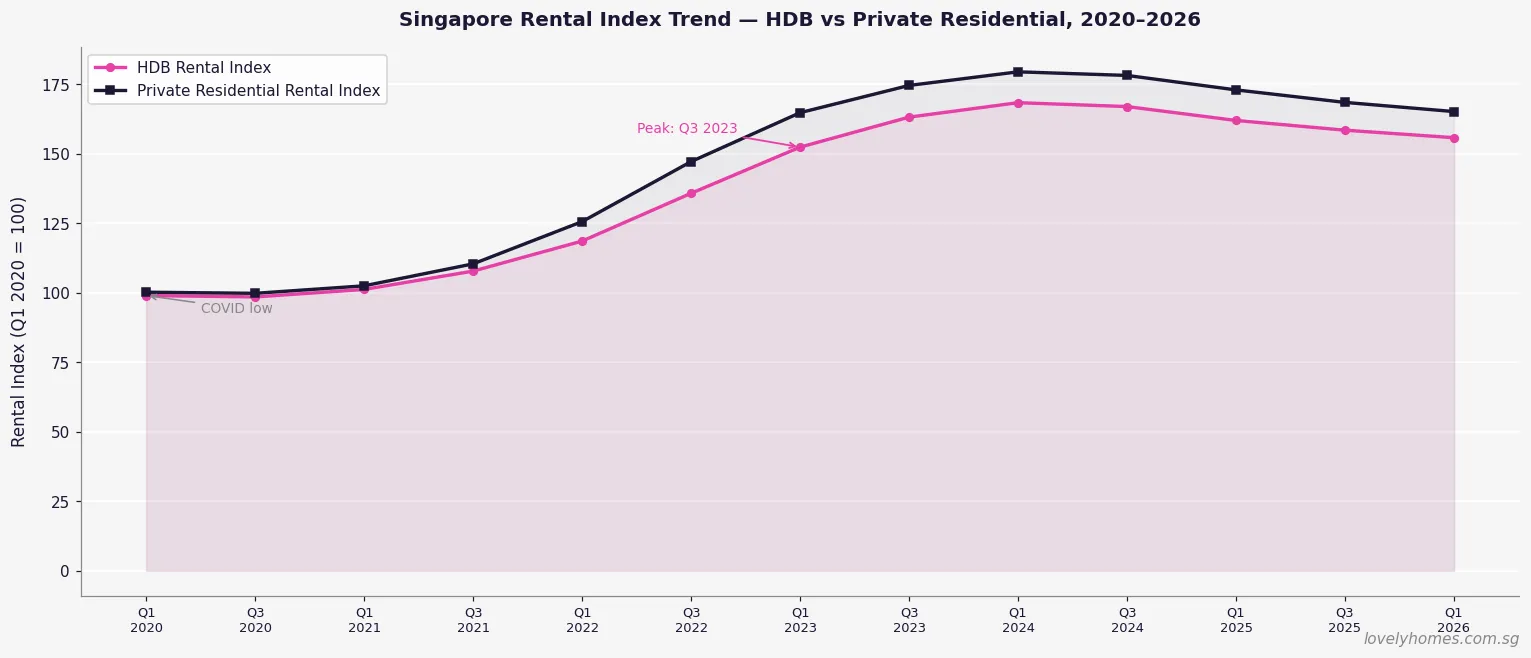
The rental cycle of this decade is one of the most dramatic in Singapore’s property history. From a base of approximately 100 in early 2020, the HDB Rental Index rose to a peak of approximately 163 by mid-2023 before softening. Private residential rents peaked near 175 in mid-2023. As at Q1 2026, both indices have retreated — the HDB index to approximately 156, the private residential index to approximately 165 — representing a correction of roughly 4–6% from peak.

Singapore rental index trend 2020 to 2026 - HDB vs private residential rental index
Figure 1: Singapore HDB and Private Residential Rental Index trend, Q1 2020 – Q1 2026 (Q1 2020 = 100). Sources: URA, HDB quarterly real estate statistics.

The correction has been driven primarily by supply normalisation — a wave of private condominium completions in 2024–2025 (including several large integrated developments) added significant rental stock to the market, while post-COVID foreign workforce growth moderated as global companies trimmed headcount in 2024–2025. Nevertheless, rents remain approximately 55% higher in absolute terms than pre-COVID levels for most property types.

Median Monthly Rents by Property Type, Q1 2026

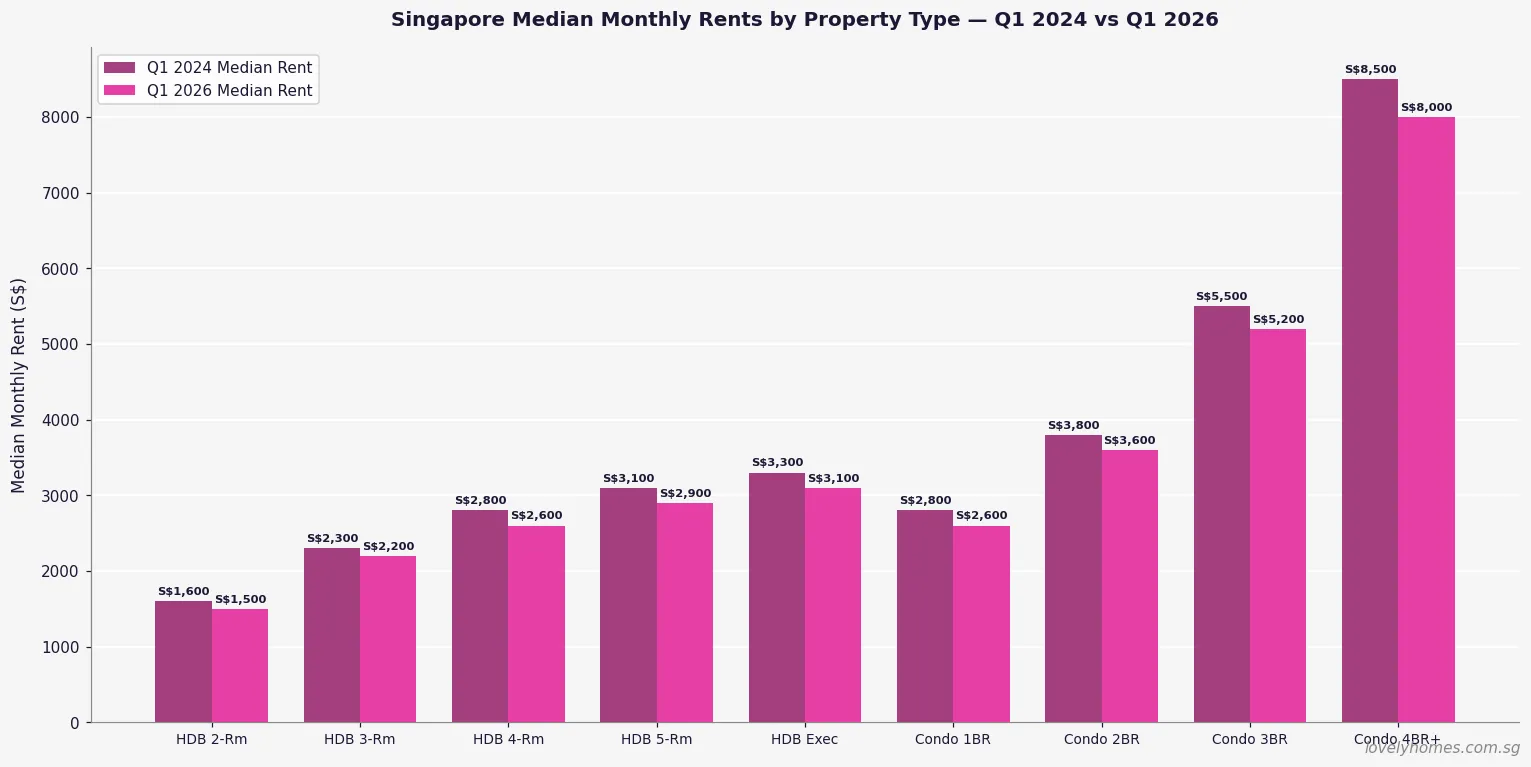
Industry figures from Q1 2026 show median monthly rents across property types as follows. HDB room types continue to offer the most accessible entry point for tenants, while Core Central Region (CCR) condominiums command a substantial premium reflecting proximity to the CBD and top international schools.

Singapore median monthly rents 2026 - HDB and condo by room type Q1 2024 vs Q1 2026
Figure 2: Singapore median monthly rents Q1 2024 vs Q1 2026 by property type. All figures are indicative medians; individual transacted rents vary by location, floor, condition, and furnishing.

Key observations from the Q1 2026 data: HDB 3-room rents have eased from approximately S$2,300/mth in Q1 2024 to approximately S$2,200/mth, a modest 4.3% decline. Private condominium 3-bedroom rents have softened more noticeably from approximately S$5,500/mth to S$5,200/mth (−5.5%). Executive flat rents remain relatively sticky at approximately S$3,100/mth, reflecting persistently high demand from larger families displaced from the HDB resale market by the 15-month wait.

Gross Rental Yields by Property Type

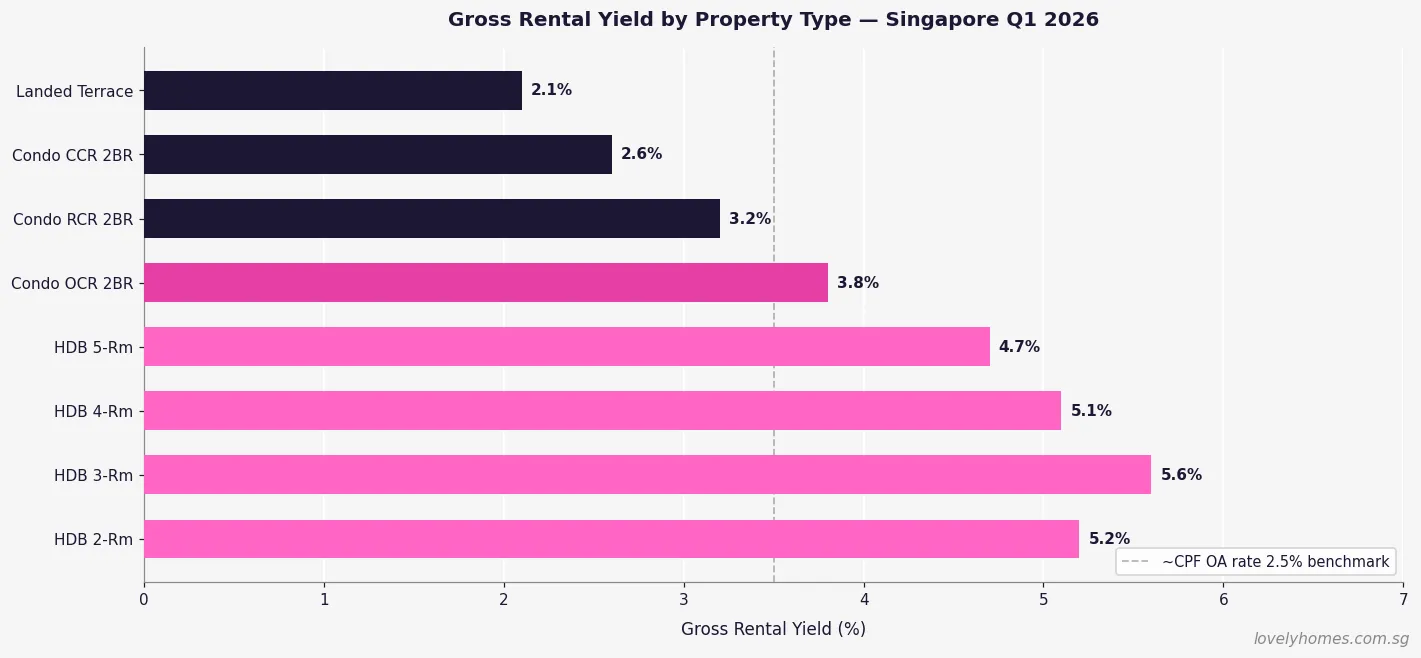
Gross rental yield is calculated as annual rent divided by market value. In Singapore’s context, it is an imperfect but useful comparator — particularly when set against the CPF Ordinary Account rate of 2.5% p.a. and typical bank mortgage rates of 3.0–3.7% p.a. in 2026. Properties yielding below the mortgage rate require careful cash flow modelling; properties yielding above 4.5% can generate positive carry even at current financing costs.

Singapore rental yield by property type 2026 - HDB condo landed gross yield comparison
Figure 3: Gross rental yield by property type, Singapore Q1 2026. Yields are gross — deduct mortgage interest, property tax, management fees, vacancy, and maintenance for net yield calculations.

HDB flats deliver the highest gross yields precisely because their prices are regulated and their transacted values remain significantly below equivalent private condominiums. A well-located 3-room HDB in Toa Payoh with a transacted rent of S$2,200/mth and a resale value of approximately S$470,000 generates a gross yield of approximately 5.6% — among the highest in Singapore’s residential market. However, HDB landlords face non-citizen quota constraints (8% or 11% per block/neighbourhood) and must comply with the Minimum Occupation Period (MOP) rules and HDB approval requirements. See our comprehensive HDB Rental Guide 2026 for full details.

Landlord Obligations and Legal Framework

Residential tenancies in Singapore are governed primarily by contract law — there is no Residential Tenancies Act equivalent to those in the United Kingdom or Australia. The standard Tenancy Agreement is a contractual document prepared by either party’s lawyer or the property agent. Key regulatory requirements for landlords include:

  • Stamp duty on tenancy agreements: The tenant is liable to pay stamp duty on the tenancy agreement via IRAS e-Stamping. The rate is 0.4% of the total rent for leases of 1–4 years; for leases exceeding 4 years, the rate is 4% of the average annual rent. In practice, landlords should confirm the stamp duty is paid within 14 days of signing, as IRAS treats it as a condition for the agreement to be legally admissible in court.
  • Short-term rental prohibition: URA regulations prohibit the use of private residential properties for accommodation for periods of fewer than 3 consecutive months. Platforms such as Airbnb, Agoda (short-stay listings), and similar are prohibited for residential properties. Violations carry fines of up to S$200,000 per offence.
  • HDB subletting rules: HDB flat owners who have completed their Minimum Occupation Period (MOP) may sublet their whole flat or individual bedrooms, subject to HDB approval, non-citizen quota compliance, and the maximum occupancy limits (8 persons per flat until 31 December 2026 under the current temporary relaxation).
  • Property tax: Landlords pay property tax at non-owner-occupier rates (typically 10–20% of the Annual Value for private properties, 10% for HDB), which is a deductible expense against rental income.
  • Rental income tax: Rental income is taxable as personal income in Singapore. Allowable deductions include mortgage interest, property tax, fire insurance premiums, maintenance fees, and depreciation of approved furniture at 20% per annum declining balance.

Summary: Singapore Rental Market at a Glance, 2026

Property Type Typical Monthly Rent Gross Yield Key Tenant Profile
HDB 2-room S$1,400–S$1,600 ~5.2% Singles, young couples
HDB 3-room S$2,000–S$2,400 ~5.6% Small families, couples
HDB 4-room S$2,400–S$2,800 ~5.1% Families, expat workers
HDB 5-room S$2,600–S$3,200 ~4.7% Families, management expats
Condo 1-bedroom (OCR) S$2,400–S$2,800 ~3.8% Young professionals
Condo 2-bedroom (OCR) S$3,200–S$4,000 ~3.8% Couples, small families
Condo 2-bedroom (CCR) S$4,500–S$6,500 ~2.6% Senior expat executives
Landed Terrace S$6,000–S$10,000 ~2.1% High-net-worth families

Worked Example: Mr Rajan Buys a 3-Room HDB to Rent Out in Ang Mo Kio

Mr Rajan, a Singapore Citizen, purchased a 3-room HDB resale flat in Ang Mo Kio in August 2021 for S$450,000. His MOP completed in August 2026 and he immediately lists it for whole-flat rental while upgrading to a condominium. Key figures:

  • Purchase price: S$450,000 in August 2021.
  • MOP completion: August 2026 (5 years from key collection).
  • Estimated market rent (Q1 2026): S$2,100–S$2,300/mth for a well-maintained 3-room in Ang Mo Kio.
  • Monthly gross income: S$2,200/mth (midpoint).
  • Annual gross rent: S$26,400.
  • Gross yield: S$26,400 / S$450,000 = 5.9% (calculated on original purchase price; current AV-based valuation ~S$480,000 gives ~5.5%).
  • Property tax (non-owner-occupier): Annual Value approximately S$24,000; property tax approximately S$2,400/yr at 10%.
  • Mortgage interest (if outstanding loan S$150,000 at 2.6%): ~S$3,900/yr (deductible).
  • Net rental income (estimated): S$26,400 − S$2,400 (property tax) − S$3,900 (interest) − S$1,200 (maintenance, insurance) = approximately S$18,900/yr, taxable at Mr Rajan’s personal income rate.
  • Stamp duty on 12-month tenancy at S$2,200/mth: 0.4% × S$26,400 = S$105.60 (tenant’s liability but landlords confirm this is paid).

The non-citizen quota check (8% neighbourhood / 11% block) must be confirmed with HDB before signing the Tenancy Agreement. HDB approval is required for whole-flat rental; approval is typically granted within 3–5 business days via the HDB Resale Portal.

What Might Come Next for Singapore Rents

The 2026 rental market is characterised by a bifurcation: HDB rents are gradually softening as more MOP flats come onto the rental market and demand moderates, while premium private rents in the CCR are proving stickier, supported by a resilient pool of senior expatriate tenants who cannot or will not rent HDB. The key upside risk to the softening thesis is a reversal in Singapore’s technology and financial services hiring cycle — any rebound in Employment Pass issuances (which fell in 2024–2025 under tighter Fair Consideration Framework scrutiny) would tighten rental supply rapidly given the low vacancy rates in well-located projects. The key downside risk is continued elevated completions through 2026–2027 from the record launch years of 2021–2022, which will maintain supply pressure on mid-market condominiums.

For investors evaluating rental yield against price appreciation potential, the OCR condominium segment offers the most balanced risk-reward in 2026: gross yields of approximately 3.5–4.0% are competitive with bank deposit rates after factoring in leverage, while capital value upside from Jurong Lake District and Cross Island Line catalysts provides a medium-term appreciation thesis. See our Singapore Property Investment Guide 2026 for a full cross-asset comparison.

Frequently Asked Questions

Are Singapore rents going up or down in 2026?

Singapore’s rental market is in a gradual softening phase in 2026. According to URA Q1 2026 data, the private residential rental index rose 0.3% quarter-on-quarter — a marginal recovery after a 0.5% dip in Q4 2025 — but remains below the 2023 peak. HDB rents eased 0.1% in Q1 2026. The dominant factors are increased supply from 2024–2025 completions and moderating foreign workforce demand. Most market observers expect rents to remain broadly flat to slightly lower through 2026, with premium CCR properties proving more resilient than mass-market OCR condominiums and HDB flats.

Can I Airbnb my Singapore condo or HDB flat?

No. URA regulations prohibit the use of private residential properties for short-term accommodation of fewer than 3 consecutive months. This applies equally to condominiums, landed properties, and HDB flats. Listing a Singapore residential property on Airbnb, Agoda short-stay, or similar platforms is a regulatory offence carrying fines of up to S$200,000 per offence. HDB additionally prohibits subletting to short-term visitors regardless of platform. The minimum tenancy period for all residential properties in Singapore is 3 months.

Do I need to declare rental income to IRAS?

Yes. Rental income is taxable as personal income in Singapore and must be declared on your annual Income Tax return. IRAS requires landlords to report gross rent received, then deduct allowable expenses: mortgage interest (on the loan for the rented property), property tax paid, fire insurance premiums, cost of maintenance and repairs (but not capital improvements), management fees, and furniture depreciation at 20% per annum declining balance on approved items. Failure to declare rental income attracts penalties of up to 200% of the tax undercharged. See IRAS’s guide at iras.gov.sg for the current rental income declaration checklist.

What is the non-citizen quota for HDB rentals?

HDB imposes a Non-Citizen Quota (NCQ) to preserve the social mix of HDB estates. The quota limits the proportion of HDB flats in each block and neighbourhood that may be rented to non-Malaysia foreigners (i.e., all non-citizens who are not Malaysian citizens). The limits are 8% at the neighbourhood level and 11% at the block level. If either quota has been met, the landlord cannot rent to a non-Malaysian foreigner regardless of HDB approval status. Malaysia citizens are exempt from the NCQ. Singapore PRs count as citizens for NCQ purposes. Always check the NCQ status on the HDB website before signing any Tenancy Agreement with a foreign tenant.

What is a diplomatic clause in a tenancy agreement?

A diplomatic clause (or Diplomatic Break Clause) is a contractual provision that allows the tenant to terminate the tenancy early if they are relocated or transferred out of Singapore by their employer — typically with 2 months’ written notice after the first year of the lease. It is commonly requested by expatriate tenants and their employers. Landlords generally accept diplomatic clauses for premium properties where the tenant pool is predominantly expatriate. The clause should specify the minimum tenancy period before it can be activated (typically 12 months), the notice period, and whether any penalty or notice fee applies. If the tenant exercises the clause, they forgo the security deposit for the unused period — the exact mechanism is a matter of negotiation.

How is stamp duty on a tenancy agreement calculated?

Stamp duty on a Tenancy Agreement is calculated under the Stamp Duties Act (Cap. 312). For a lease of 1–4 years, the duty is 0.4% of the total rent payable over the tenancy period. For a lease exceeding 4 years, the duty is 4% of the average annual rent. Example: a 12-month lease at S$3,500/mth = total rent S$42,000; stamp duty = 0.4% × S$42,000 = S$168. Payment is due within 14 days of signing via the IRAS e-Stamping portal. The stamp duty is the tenant’s liability by default, but the Tenancy Agreement may specify otherwise. An unstamped tenancy agreement is inadmissible as evidence in court, though the tenancy itself remains contractually enforceable as between the parties.

What is a typical security deposit for a Singapore rental?

The market convention in Singapore is one month’s rent as security deposit for every year of tenancy — so a 1-year lease typically requires a 1-month deposit, and a 2-year lease requires a 2-month deposit. For leases with a diplomatic clause, landlords sometimes negotiate a 2-month deposit for a 1-year lease as additional security against early termination. There is no statutory cap on the security deposit amount in Singapore — it is entirely a matter of negotiation. The deposit should be held in a separate client account by the agent or returned directly to the landlord, and must be refunded within 14 days after the end of the tenancy (less any deductions for damage or unpaid rent, supported by receipts and a condition report).

Related Articles

Disclaimer: This article is intended for general informational purposes only and does not constitute legal, tax, or financial advice. Rental figures, yields, and index data cited are based on information available as at 7 June 2026 and are subject to change. Individual rental outcomes depend on property location, condition, furnishing level, and prevailing market conditions. Readers should consult a licensed Singapore real estate agent (CEA-registered), a Monetary Authority of Singapore (MAS) licensed financial adviser, and IRAS for personalised rental income tax guidance. Authoritative references: URA (ura.gov.sg), HDB (hdb.gov.sg), IRAS (iras.gov.sg), CEA (cea.gov.sg).

Tenancy Agreement Singapore 2026: A Landlord and Tenant’s Complete Guide to the Rental Contract

Tenancy Agreement Singapore 2026: A Landlord and Tenant’s Complete Guide to the Rental Contract

Last updated 28 April 2026. Reflects IRAS lease stamp duty rules current as at FY2026 and standard market norms reported by URA’s quarterly rental statistics.

Quick Answer — 30-second takeaways

  • A Singapore tenancy agreement is the binding contract between a landlord and tenant. It is governed by Singapore contract law and the principles of the Civil Law Act and the Conveyancing and Law of Property Act.
  • Standard residential terms are 12 or 24 months. Anything shorter than 3 months risks being treated as serviced accommodation, which is regulated separately.
  • Security deposit: typically 1 month’s rent per year of lease, capped at 2 months. Refundable within 14 days of handover, less reasonable deductions.
  • Diplomatic clause: standard on 24-month leases, lets the tenant terminate after 12 months on 2 months’ notice if posted out of Singapore.
  • Lease stamp duty (LSD): 0.40% of total rent across the lease term, payable by the tenant within 14 days of execution, e-stamped at iras.gov.sg.
  • Minor repairs cap: tenant pays first S$150–S$250 of any repair; landlord pays the excess. Aircon servicing 3-monthly is the tenant’s cost.
  • Disputes ≤ S$30,000 can be heard at the Small Claims Tribunals (SCT) with both parties’ consent. Larger disputes go to the State Courts.

What a tenancy agreement is — and what it isn’t

A tenancy agreement (often abbreviated TA) is the written contract that creates a legal lease between a property owner (the landlord) and an occupant (the tenant). It records the parties, the property, the term, the rent, the deposit, and the rules for living in and looking after the home.

Singapore does not have a dedicated Residential Tenancy Act. Tenancy agreements are governed by general contract law, supplemented by the Civil Law Act 1909, the Conveyancing and Law of Property Act 1886, and — for HDB rentals — by the rules of the Housing and Development Board. This means that what is “standard” in a Singapore tenancy is largely set by market practice and by widely-used template clauses, not by statute. Landlords and tenants who do not read every clause carefully can find themselves bound by terms the other side considers normal but they did not expect.

A tenancy agreement is not a Letter of Intent (LOI). The LOI is the pre-contract document the prospective tenant submits with a good-faith deposit. The TA is the binding lease that follows once the LOI is accepted. Stamp duty is payable on the TA, not the LOI.

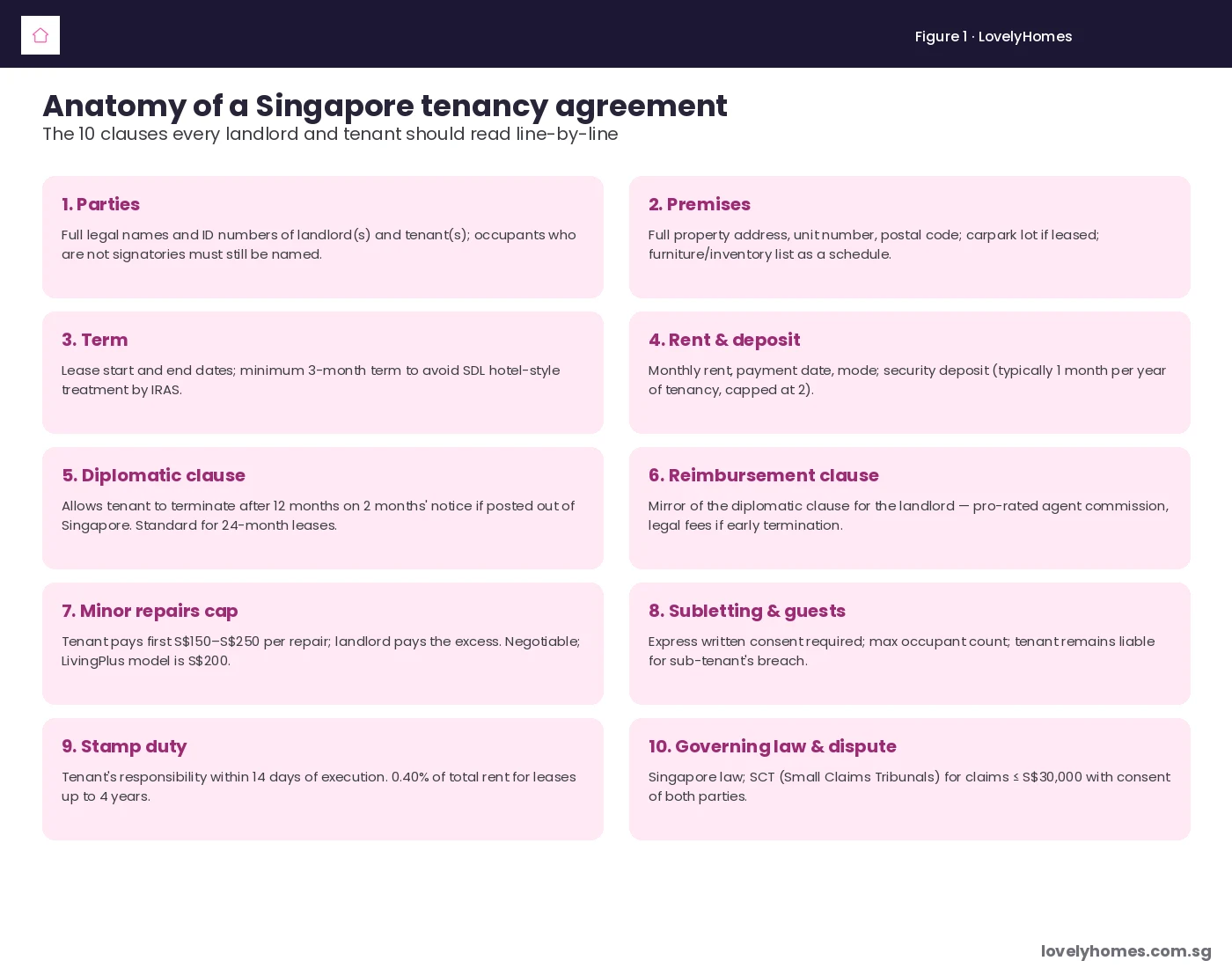
Singapore tenancy agreement 2026 — 10 key clauses every landlord and tenant should read line by line
Figure 1: The 10 clauses that do most of the work in a Singapore tenancy agreement.

Who can be a landlord, and who can be a tenant

For private property, any property owner can lease their unit, subject to building by-laws and the conditions of any mortgage. The Urban Redevelopment Authority requires a minimum lease of 3 months for private residential property; below that threshold the lease is treated as short-stay accommodation and is generally not allowed unless the unit is licensed serviced apartment stock.

For HDB flats, the rental rules are stricter:

  • The flat must have met its Minimum Occupation Period (MOP), which is typically 5 years for new flats and 5 years for resale flats with grant.
  • The owner must apply for HDB approval to rent out the whole flat or individual rooms.
  • Rentals to non-citizen households must respect the Ethnic Integration Policy (EIP) and Singapore Permanent Resident (SPR) quota.
  • Maximum 6 unrelated occupants per flat (4 for 1- and 2-room flats).
  • The minimum rental period is 6 months for whole-flat HDB rentals.

Tenants can be Singapore Citizens, Permanent Residents, work-pass holders, students or any other lawfully present individual. For non-resident tenants, landlords must verify that the tenant holds a valid pass throughout the lease — leasing to an individual without a valid pass is an offence under the Immigration Act.

The 10 clauses that do all the work

A typical Singapore residential TA runs to 8–14 pages. Most of the legal heavy-lifting happens in ten clauses, summarised in Figure 1 above and explored below.

Term and renewal

The lease term is fixed: it has a defined start date and end date. Holding-over (continuing to occupy after expiry without a new TA) creates a tenancy at will, which is terminable on short notice and offers neither party much protection. Most landlords negotiate renewal 2–3 months before expiry; the LSD on the renewal lease must be re-stamped at the new rent.

Rent and security deposit

Rent is payable monthly in advance. The market norm for the security deposit is 1 month’s rent per year of lease, capped at 2 months. The deposit secures the landlord against damage beyond fair wear and tear, unpaid rent, and unpaid utility bills. It is refunded within 14 days of handover, less itemised deductions. Disputes over deposit deductions are the single most common Singapore tenancy dispute, and the Small Claims Tribunals see hundreds each year.

Diplomatic clause and reimbursement clause

The diplomatic clause allows a tenant to terminate after 12 months on 2 months’ written notice if they are required to leave Singapore (typically because of a job posting or visa cancellation). It is market-standard on 24-month leases and rare on 12-month leases. The mirror is the reimbursement clause: if the tenant terminates early, they must reimburse the landlord on a pro-rated basis for the agent’s commission and legal fees of the original lease.

Minor repairs cap

Tenants are responsible for minor repairs up to a contractual cap, typically S$150–S$250 per item. Landlords pay the excess. The clause prevents petty disputes about light bulbs and tap washers, while keeping major repairs (aircon compressor failure, roof leaks, structural defects) on the landlord’s account. Air-conditioner servicing every 3 months is the tenant’s cost; receipts must be produced at handover.

Inventory and handover

An inventory list — usually a schedule attached to the TA — records every item of furniture, every appliance, and every fixture provided. At move-in, both parties walk through and sign off. At move-out, deductions for missing or damaged items are calculated against this list. Photo evidence at both ends saves arguments.

Stamp duty clause

The TA will state which party is responsible for paying lease stamp duty. By Singapore market practice and IRAS guidance, the tenant pays. Failure to e-stamp within 14 days exposes the lease to a penalty of 4 times the duty or S$10, whichever is higher, and the unstamped lease is inadmissible as evidence in a Singapore court (the duty must be paid before the lease can be relied on in litigation).

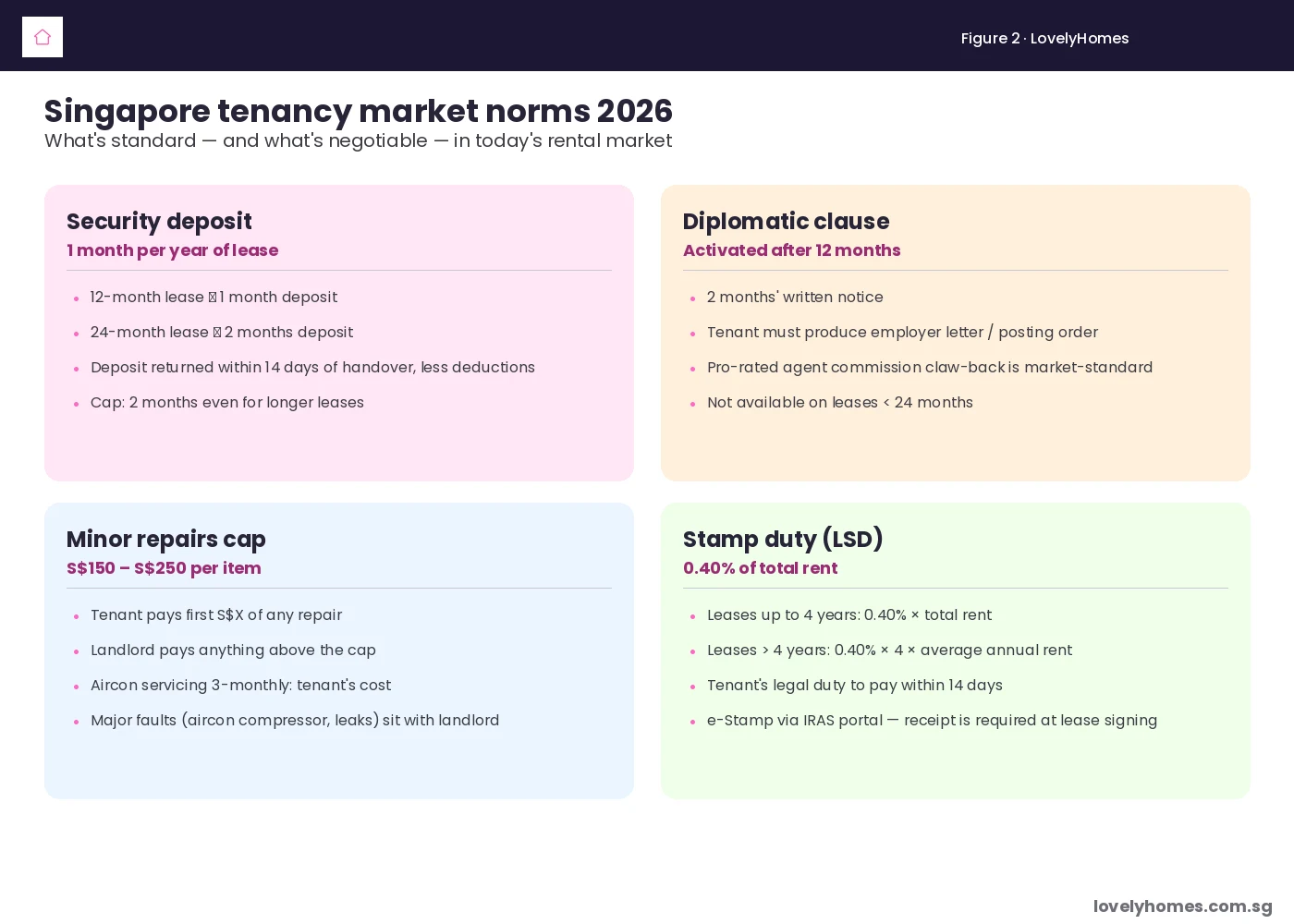
Singapore tenancy agreement 2026 — market norms for deposit, diplomatic clause, minor repairs cap, and stamp duty
Figure 2: The four “norms” most often negotiated — deposit, diplomatic clause, repairs cap, and stamp duty.

Lease stamp duty: the maths

Lease stamp duty (LSD) is the only tax on a Singapore tenancy. It is levied at 0.40% of total rent across the lease term, capped at four times the average annual rent for leases longer than 4 years. The duty is the tenant’s legal obligation under section 33 of the Stamp Duties Act, payable within 14 days of execution.

Lease term Stamp duty formula Notes
≤ 4 years 0.40% × total rent across the term Most common; covers all 12- and 24-month leases
> 4 years 0.40% × 4 × average annual rent Caps the duty for long leases
Lease with premium / variable rent BSD-style staircase rates apply to premium; LSD on the rent component Rare in residential — common in commercial
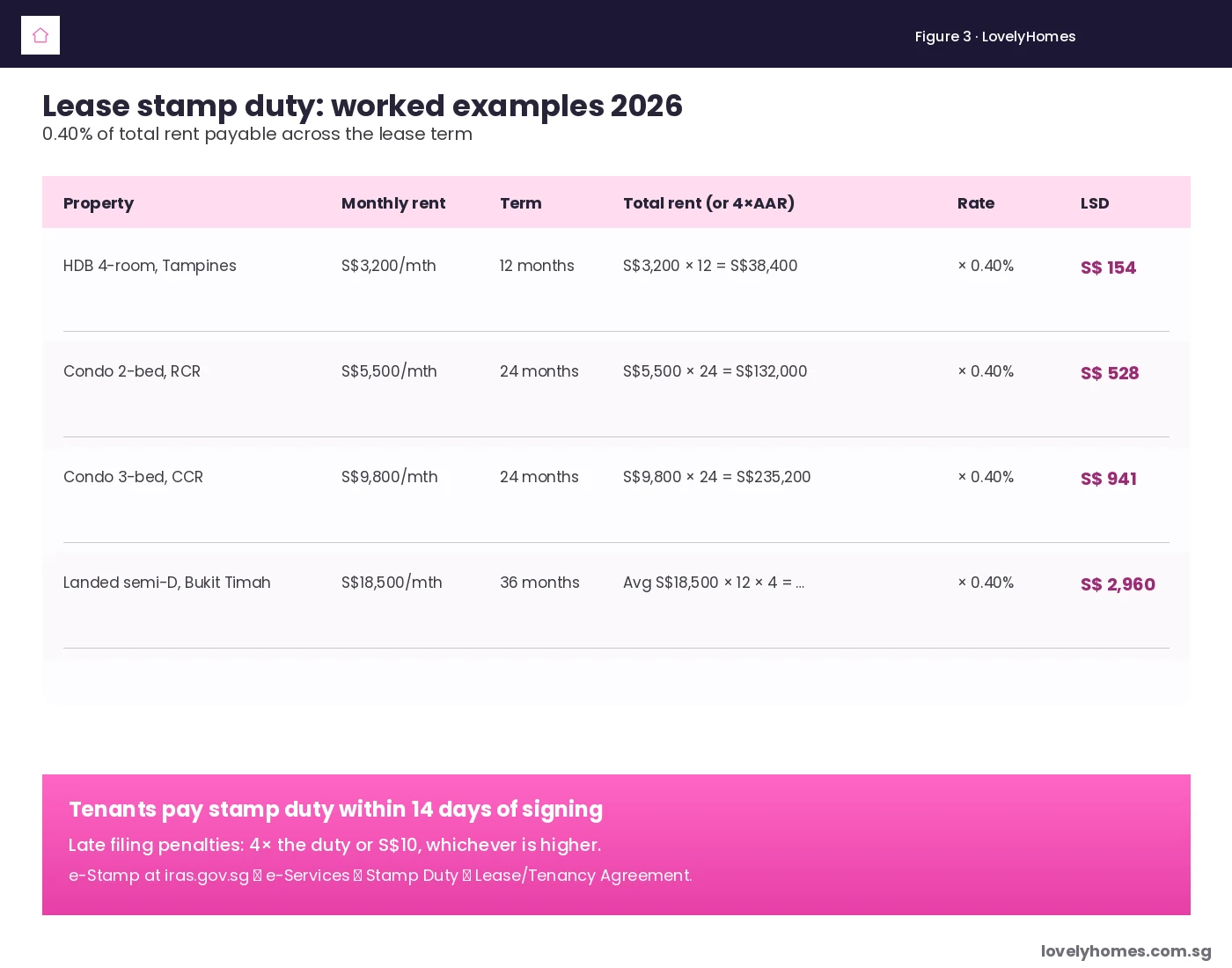
Singapore lease stamp duty worked examples 2026 for HDB, condo and landed properties
Figure 3: Worked LSD examples across HDB and private property at 2026 market rents.

The IRAS portal e-stamps the lease in real time. The tenant pays via PayNow, eNETS or credit card, prints the certificate, and brings the original to the lease signing. Many landlords now make production of the e-stamp certificate a precondition to handing over keys — a sensible safeguard, because once keys are handed over the landlord’s leverage drops sharply.

Negotiating the lease — what to push on, what to leave alone

Singapore tenancy agreements are negotiable. The points that move most often:

  • Diplomatic clause activation date. Tenants often ask for activation at month 9 instead of month 12. Landlords typically refuse. The 12-month default holds.
  • Minor repairs cap. Tenants ask for S$300; landlords often want S$150. The S$200 LivingPlus number is the comfortable middle.
  • Whitegoods inclusion. Whether refrigerator, washer, dryer, microwave, oven, vacuum and rice cooker are included is line-by-line negotiation. List each item by brand and model in the inventory schedule.
  • Repainting before handover. A clause requiring the tenant to repaint before move-out used to be standard. It is increasingly replaced by a fixed reinstatement fee (S$300–S$800) plus normal wear-and-tear treatment.
  • Pet clause. “No pets” is the default. Tenants with pets must negotiate a specific carve-out and an additional deposit. HDB has its own approved-breed list for flats.
  • Smoking. “No smoking inside the unit” is now standard, and landlords reasonably claim against deposit if walls and curtains carry residual smoke odour.

What happens if things go wrong

The Singapore framework for tenancy disputes is informal but well-trodden:

  • Small Claims Tribunals (SCT). Hears disputes ≤ S$20,000 (or up to S$30,000 with both parties’ consent in writing) for tenancies of up to 2 years. Hearings are tenant- and landlord-friendly: no lawyers in the courtroom, fees from S$10, decisions usually within 4–6 weeks. The most common claims are deposit deductions, damage to inventory, and unpaid rent.
  • State Courts. Larger disputes, longer leases, and complex commercial-residential overlaps. Lawyers represent both sides; costs follow the event.
  • HDB and the Housing & Estate Disputes Resolution Centre. For HDB rental disputes specifically, HDB will mediate before parties resort to the SCT.
  • Mediation via the Singapore Mediation Centre. Voluntary and confidential. Useful where the parties want to preserve a working relationship — for example, a landlord who wants the tenant to stay another year.

What this means for you

For tenants: read every clause. Push back on anything ambiguous. Pay LSD on time and keep the certificate. Photograph the unit on move-in and move-out. Save every WhatsApp message about repairs — these are evidence in any future SCT claim.

For landlords: use a template TA from a Singapore conveyancing lawyer (not a generic internet template). Check the tenant’s pass status throughout the lease. Inspect the unit twice during a 24-month lease — once at month 6, once at month 18 — with proper notice. Reply in writing to repair requests. The landlord’s deposit deduction is much harder to defend in the SCT if the inspection trail is thin.

What might come next

The Ministry of National Development has been studying the case for codifying residential tenancy law in Singapore — the United Kingdom, Australia and several jurisdictions in continental Europe have moved in this direction. As at April 2026, no draft Bill has been tabled. The likeliest medium-term reforms are: a statutory deposit scheme along the lines of the UK Tenancy Deposit Scheme; a standard tenancy agreement template published by URA or HDB; and clearer rules on the deductibility of fair wear and tear. None of these are imminent, but landlords and tenants who structure their TAs around the existing market norms are well-positioned for any future statutory framework.

Frequently asked questions

Who pays the property agent’s commission?

Singapore market practice is that each side pays its own agent. The landlord pays the landlord’s agent (typically 1 month of annual rent on a 24-month lease, half a month on a 12-month lease). The tenant typically pays the tenant’s agent only on shorter or smaller-rent leases (under S$3,500/month) where the landlord’s agent’s fee is too thin to share. CEA’s Code of Ethics and Professional Client Care requires written disclosure of who pays whom before any signing.

Can a tenant break the lease before the diplomatic clause activates?

Only if the landlord agrees, or if the landlord is in fundamental breach (uninhabitable conditions, refusal to make repairs, harassment). Otherwise, an early termination is a breach of contract. The tenant remains liable for rent until the landlord re-lets the unit; the security deposit is forfeited; the original agent’s commission is clawed back pro-rata. Most landlords are willing to release a tenant if a replacement tenant on equivalent terms is presented.

Can the landlord enter the property without notice?

No. The TA grants the tenant exclusive possession. The landlord may enter only with reasonable notice (typically 24 hours in writing) and at reasonable times, except in emergencies (fire, flood, gas leak). Repeated unannounced visits are a breach of the covenant for quiet enjoyment and can support a tenant’s claim for damages.

What if the tenant has overstayed or won’t leave?

Self-help eviction is unlawful in Singapore. The landlord must give the contractual notice (or, if the lease has expired, a notice to quit), and if the tenant still does not leave, file for a Writ of Possession at the State Courts. Locking the tenant out, removing belongings, or cutting utilities is a criminal offence under the Protection from Harassment Act 2014 and the Distress Act 1872.

Does GST apply to residential rent?

No. Residential rent is exempt from GST under the Fourth Schedule to the GST Act. GST applies only to commercial leases — and only when the landlord is GST-registered (i.e., turnover above S$1 million in a 12-month period).

Can a tenant sub-let to a third party?

Only with the landlord’s written consent. Most TAs have an express anti-subletting clause. Even where consent is given, the head tenant remains liable to the landlord for the sub-tenant’s behaviour, rent and damage. For HDB rentals, all sub-letting must additionally have HDB approval; unauthorised sub-letting is a serious offence and can result in compulsory acquisition of the flat.

Is a verbal lease enforceable?

A verbal residential lease for 3 years or less is technically enforceable under the Conveyancing and Law of Property Act, but in practice it is almost impossible to prove the terms. For any lease over 3 years, the law requires a written, signed deed, registered with the Singapore Land Authority. As a landlord or tenant, you should never proceed without a written, e-stamped TA.

Disclaimer. This article is general guidance only and does not constitute legal advice. Singapore tenancy law is governed by the Civil Law Act 1909, the Conveyancing and Law of Property Act 1886, the Stamp Duties Act 1929, the Small Claims Tribunals Act 1984, and HDB regulations for public housing. Always read your specific tenancy agreement carefully and consult a licensed Singapore lawyer for high-value or unusual terms. Verify lease stamp duty rates against iras.gov.sg, HDB rental approval rules against hdb.gov.sg, and URA short-stay rules against ura.gov.sg.
Tenancy Agreement
Rental
Lease Stamp Duty
Singapore Property
Renting Guide
Diplomatic Clause
Security Deposit
Landlord
Tenant
HDB Rental

Translate »