Quick Take: Berlayar Drive GLS — What You Need to Know
Single bid only — Hong Leong Holdings-GuocoLand JV was the sole bidder; analysts had expected 4–6 bids.
New RCR land price record — S$1,515 psf ppr surpasses Holland Plain (S$1,491 psf ppr, May 2026).
Total bid: S$576 million for a 99-year leasehold site of ~271,932 sqft yielding ~415 units.
Second sole-bid GLS of 2026 — Holland Plain (Sim Lian Group, May 2026) was the first.
Location: ~7 min walk to Telok Blangah MRT, near VivoCity, within Greater Southern Waterfront masterplan.
Berlayar Estate masterplan: ~10,000 homes total (7,000 HDB + 3,000 private) along Singapore’s southern coast.
Bid exceeded analyst projections of S$1,100–S$1,450 psf ppr by approximately 4.5%.
What Happened: The Berlayar Drive Tender Result
The Urban Redevelopment Authority (URA) closed the tender for the Berlayar Drive Government Land Sale (GLS) site on 4 August 2026, recording a single bid of S$576 million — or approximately S$1,515 per square foot per plot ratio (psf ppr) — submitted by a joint venture comprising Hong Leong Holdings and GuocoLand. The bid is the highest ever achieved for a Rest of Central Region (RCR) residential GLS site.
The result surprised the market on two counts: the thin participation (analysts had forecast four to six bids), and the price (the sole bidder paid above the top of the projected range). The site was released under Singapore’s 1H 2026 Confirmed List GLS Programme.
Figure 1: 2026 Sole-Bid GLS Tenders — Land Price Comparison. Berlayar Drive (S$1,515 psf ppr) sets new RCR record. Source: URA, industry analysts.
The Site: Waterfront Land in a Transforming Precinct
The Berlayar Drive site is a 99-year leasehold plot of approximately 271,932 sq ft within the nascent Berlayar Estate — a HDB-planned mixed-tenure waterfront neighbourhood in Bukit Merah, part of Singapore’s Greater Southern Waterfront (GSW) masterplan. The development will yield an estimated 415 private residential units.
Connectivity is a core draw: the future development is approximately a 7-minute walk from Telok Blangah MRT station (Circle Line), with Labrador Park MRT also nearby. VivoCity, Alexandra Retail Centre, and the upcoming HarbourFront redevelopment are all within easy reach. The Berlayar Estate masterplan envisions approximately 10,000 homes in total — around 7,000 public housing units and 3,000 private units — alongside 10 hectares of parks and green corridors.
The first BTO project in Berlayar Estate, Berlayar Residences, was launched in October 2025 (~1,000 flats). The Berlayar Drive GLS site (together with the earlier Telok Blangah Road GLS site) will account for more than one-third of the estate’s planned private residential supply. The most recent comparable private development in the immediate area — The Reef at King’s Dock, launched 2021 — has since sold out entirely.
A Year of Cautious Developer Participation
Berlayar Drive is the second 2026 GLS site to attract only a single bid. In May 2026, Sim Lian Group submitted the lone offer of S$454 million (S$1,491 psf ppr) for the Holland Plain site (~510 homes). Both outcomes reflect a broader pattern of more selective developer land banking, driven by elevated construction costs, tighter financing conditions, and ABSD headwinds on buyer demand.
Yet in both cases, the winning bidder priced the land above or near the upper end of analyst expectations — suggesting that for the right site with a compelling long-term narrative, developer conviction remains strong even in a cautious climate.
GLS Site
Date Closed
Bidder
No. of Bids
Bid (S$M)
psf ppr
Est. Units
Holland Plain
May 2026
Sim Lian Group
1
S$454M
S$1,491
~510
Berlayar Drive
4 Aug 2026
HL-GuocoLand JV
1
S$576M
S$1,515
~415
Marina Gdns Crescent
Jan 2024
GuocoLand-led consortium
1
S$770M
S$984
~790
Worked Example: Indicative Buyer Price at Launch
Projecting Future Launch Prices from Land Cost
Land cost per unit (S$576M / 415 units)~S$1,388,000
Est. construction cost (~S$480 psf on ~950 sqft avg)~S$456,000
Marketing, finance, design, other (~12%)~S$220,000
Implied breakeven~S$2,064,000 per unit
Developer margin (~20–25% on costs)~S$413,000–S$516,000
Indicative launch ASP (2BR ~950 sqft)S$2,500,000–S$2,580,000 (~S$2,630–S$2,716 psf)
These figures are indicative industry estimates based on comparable RCR land and construction costs. Actual pricing will be set by the developer. Independent research is strongly recommended.
What This Means for Buyers
The new RCR land cost benchmark at S$1,515 psf ppr will pull up price expectations for future launches in the Berlayar precinct and the wider Bukit Merah corridor. A development acquired at this land cost is likely to launch at well above S$2,500 psf for compact units. For buyers already tracking the GSW story, the tender result signals that entry-level pricing in the precinct may rise further before more supply comes to market. For the broader RCR resale market, a new GLS land record typically nudges comparable second-hand prices upward as sellers recalibrate their expectations.
The bifurcation in Singapore’s land market is now clearly visible: story-driven, location-advantaged sites continue to attract premium bids even from a single developer, while less differentiated suburban sites see thinner interest. Berlayar Drive falls firmly in the former camp.
What to Watch Next
Watch for URA’s formal acceptance of the bid (typically within a few weeks of tender close), and for any planning application submitted by the developer, which would give further clues on unit mix and development concept. LovelyHomes will continue tracking Berlayar Estate as HDB progresses its masterplan and as the private development takes shape — follow our New Launches section for updates as they emerge.
Frequently Asked Questions
What does psf ppr mean and why is it relevant to buyers?
PSF ppr (per square foot per plot ratio) measures the effective cost of a GLS site relative to how much floor space it can legally accommodate. A higher psf ppr means the developer is paying more per unit of buildable area, which pushes up the break-even price and ultimately the selling price of completed units. The Berlayar Drive land cost of S$1,515 psf ppr — the highest ever for an RCR GLS site — is a strong forward indicator that the eventual launch prices will be significantly higher than prior launches in the area.
Is a sole bid a negative sign for the project?
Not necessarily. A sole-bid outcome signals that only one developer saw the risk-reward profile as compelling at the prevailing market conditions — but the fact that the winning bid exceeded analyst price projections by 4.5% suggests Hong Leong-GuocoLand has strong conviction in the Berlayar location. Historical sole-bid GLS outcomes in Singapore have produced some successful projects (e.g., The Reef at King’s Dock, developed from the Keppel Club site). The thin bidder field is more a reflection of broader developer caution than a verdict on the site itself.
When might the Berlayar Drive condo launch for sale?
After URA formally accepts the GLS bid, the developer typically needs 12–24 months to complete planning, design, and sales licensing before launching. A plausible launch window is late 2027 to mid-2028, subject to URA planning approval timelines and market conditions. LovelyHomes will update when the developer files a development application or announces a showflat preview.
What is the Greater Southern Waterfront and why does it matter for property?
The Greater Southern Waterfront (GSW) is Singapore’s most ambitious urban transformation project — a ~2,000-hectare regeneration of the former southern port and industrial coastline. It will deliver tens of thousands of new homes, parks, and commercial spaces over decades, linking precincts from Pasir Panjang through Keppel, Tanjong Pagar, and Marina South. For buyers, it represents a long-horizon capital appreciation thesis: owning property in a precinct at an early stage of a government-led transformation with strong connectivity, waterfront, and greenery credentials.
How does ABSD affect demand for a high-priced RCR launch like this?
At indicative launch prices of S$2,500,000–S$2,580,000 per unit, the buyer profile shifts toward Singapore Citizens and PRs purchasing a second or subsequent property (ABSD 20–30%), investors, and — for foreigners — those who can absorb the 60% ABSD on a S$2.5M+ purchase (total stamp duty approaching S$1.5M). The developer’s marketing strategy will need to focus on owner-occupier first-time and upgrader buyers (who pay 0–5% ABSD) and may price smaller units to maximise SC owner-occupier accessibility. ABSD at current rates constrains investor demand significantly for higher-priced units.
Disclaimer: This article is an editorial summary based on publicly available information from URA, 99.co, and industry sources. Price projections are indicative estimates only and do not constitute investment advice. Conduct independent research and consult a licensed property professional before any purchase decision. Source data: URA (ura.gov.sg).
Quick Answer: BTO Applications in 2026 — Key Points at a Glance
What BTO means: Build-To-Order (BTO) flats are new HDB flats sold at government-subsidised prices during four annual exercises (typically February, May, August and November). Buyers commit upfront and wait 3–5 years for construction.
Priority balloting: First-timers receive two ballot chances versus one for second-timers, significantly improving their odds in oversubscribed launches.
Income ceilings: S$7,000/month for 2-room Flexi flats in mature or Plus-classified locations; S$14,000/month for most 3-room to executive flat types.
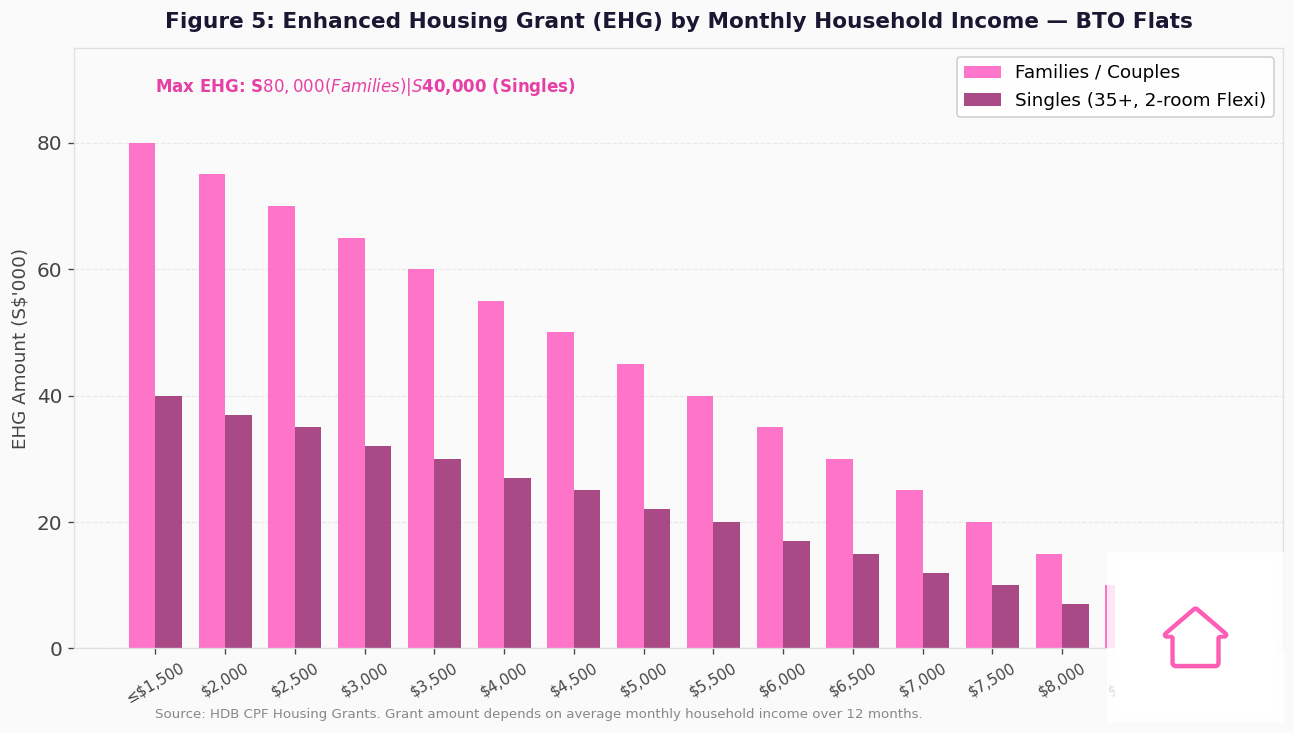
Enhanced Housing Grant (EHG): Up to S$80,000 for eligible families; up to S$40,000 for eligible singles. Income-scaled and administered by CPF Board.
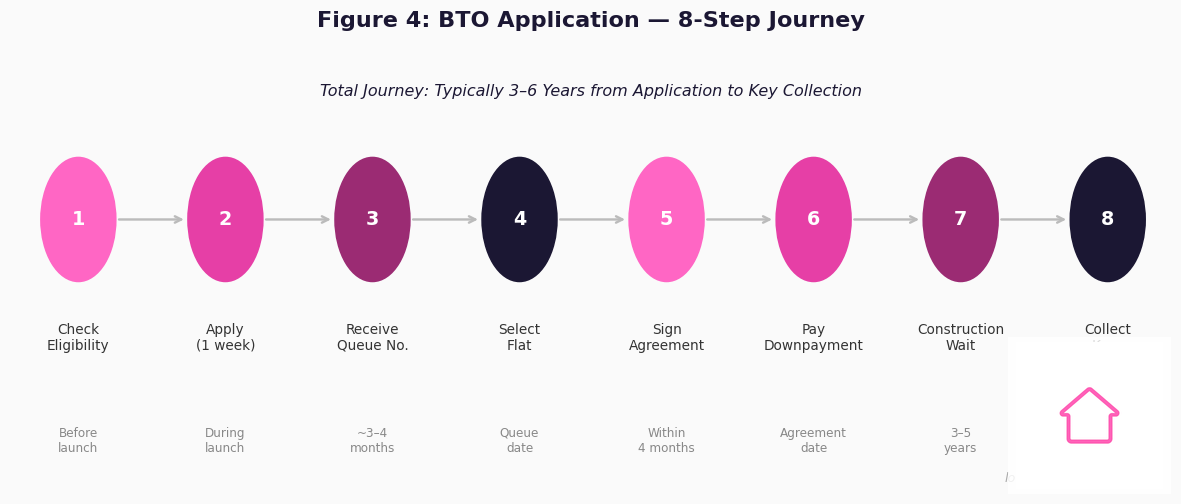
Total timeline: From application to key collection is typically 3–6 years, including the construction wait. This requires careful long-term financial planning.
New classification from 2024: HDB’s Standard / Plus / Prime framework replaced the Mature / Non-Mature distinction. Plus and Prime flats carry additional resale restrictions and subsidy clawback conditions.
MOP: Five-year Minimum Occupation Period for Standard flats before the flat can be sold on the open market or rented out in its entirety.
What is a BTO Flat — and How Does the Scheme Work?
Build-To-Order (BTO) flats are new public housing units offered by the Housing and Development Board (HDB) at prices set below comparable private market rates, reflecting a direct government subsidy. Unlike buying an existing flat on the resale market, BTO buyers do not move in immediately — they commit to a flat that has yet to be built, then wait for construction to complete before collecting their keys.
The BTO scheme is the primary vehicle through which Singapore Citizens (and, in limited circumstances, Singapore Permanent Residents) access new, affordable public housing. It was introduced in 2001 to replace the earlier Registration for Flats system, allowing HDB to build flats closer to actual demand, reducing unsold inventory and the government’s financial exposure.
HDB administers eligibility, the ballot, construction, and key collection. The CPF Board manages housing grants and CPF contribution tracking used in the purchase. The Ministry of National Development (MND) sets overarching housing policy, including the annual BTO supply target. The Inland Revenue Authority of Singapore (IRAS) handles Buyer’s Stamp Duty (BSD), which applies even to new BTO flats.
Figure 4: The BTO journey spans 8 key steps across 3–6 years from application to key collection. Understanding each stage reduces surprises and aids financial planning. Source: HDB, lovelyhomes.com.sg.
BTO Eligibility: Who Can Apply?
To apply for a BTO flat, you must satisfy HDB’s eligibility criteria at the time of application. The requirements have been updated in tandem with the 2024 HDB flat classification reform, which replaced the Mature/Non-Mature distinction with a Standard/Plus/Prime framework carrying differentiated subsidies and resale conditions.
Citizenship: At least one applicant must be a Singapore Citizen for most BTO flat types. Two Singapore Permanent Residents forming a household are generally limited to the HDB resale market; SPR families with at least one SC spouse may apply for BTO flats under specific schemes. Singles must be SC, aged 35 or above, and may only apply for 2-room Flexi flats under the Single Singapore Citizen (SSC) Scheme.
Age: Applicants must be at least 21 years old (35 for singles buying under the SSC Scheme or the Joint Singles Scheme).
Family nucleus: You must form an eligible family nucleus — for example, a married or engaged couple, parent-and-child family, multi-generational household, or an eligible singles arrangement.
Property ownership: Applicants must not own or have disposed of any private property (local or overseas) within 30 months before the BTO application. Existing HDB flat owners wishing to upgrade to a new BTO flat are subject to additional conditions, including selling their existing flat within six months of the new flat’s key collection.
Income ceiling: S$7,000/month for singles applying under the SSC Scheme for 2-room Flexi flats; S$14,000/month for families buying 3-room to executive flat types in Standard or Plus locations. The income ceiling is assessed based on the average gross monthly household income over 12 months.
How the BTO Ballot Works
BTO applications are made online during the sales exercise launch window, which is typically open for approximately one week. HDB publishes the flat types, locations, indicative prices, and application details in advance of each exercise. There is no fee to apply.
Ballot priority: HDB’s computerised ballot gives first-timer applicants two ballot chances, significantly improving their odds compared to second-timers who receive one chance. Within the first-timer pool, additional sub-priority is extended to multi-generational families, married couples with children applying under the Parenthood Priority Scheme (PPS), and essential workers applying in their work zone.
Oversubscription: Oversubscription rates vary considerably by project location, flat type, and classification. Four-room and five-room flats in Plus or Prime locations in central areas regularly see application-to-unit ratios of 5 to 15 or higher. Standard flats in less central towns are typically less oversubscribed, offering first-timers a realistic chance of securing a queue number within one or two applications.
Queue number: If selected in the ballot, you receive a queue number. Lower numbers are invited earlier to select their preferred unit from remaining inventory. As selection progresses, unit choice narrows — applicants with higher queue numbers face reduced choice, and in oversubscribed launches some applicants may find no suitable units remaining when their number is called.
Figure 5: Enhanced Housing Grant (EHG) amounts by monthly household income for BTO flat purchases. Families are eligible for up to S$80,000; singles for up to S$40,000. Income is assessed as the average gross monthly household income over 12 months. Source: HDB, CPF Board, lovelyhomes.com.sg.
Flat Selection, Agreement for Lease and Downpayment
When your queue number is reached, HDB issues an invitation to attend a flat selection appointment — conducted either in person at HDB Hub or virtually. You select a specific unit (block, floor, orientation, facing) from inventory remaining at the time of your appointment.
After selecting your flat, you sign the Agreement for Lease and pay a booking fee of approximately 5% of the flat price, payable using CPF Ordinary Account (OA) savings or cash. The remaining 15% of the purchase price (net of CPF Housing Grants) is paid in instalments during the construction period, using CPF OA and/or cash as progress payment requests are issued at defined construction milestones.
At Temporary Occupation Permit (TOP) — when the building is structurally complete — HDB invites you for key collection. You pay the final balance (if any), sign the lease, and collect your keys. Legal fees are payable at this stage.
CPF Housing Grants for BTO Flats
The CPF Housing Grant framework for BTO flats centres on the Enhanced Housing Grant (EHG), which replaced the previous combination of the Additional CPF Housing Grant (AHG) and Special CPF Housing Grant (SHG). The EHG is income-tested, tiered, and applies to both BTO and resale flat purchases by eligible first-timer households.
Grant
Applicable Flat Type
Maximum Amount
Income Ceiling
Enhanced Housing Grant (EHG) — Families
BTO and Resale
S$80,000
S$9,000/month or below
Enhanced Housing Grant (EHG) — Singles
2-room Flexi BTO and Resale
S$40,000
S$4,500/month or below
Singles Grant
Resale only (not BTO)
S$25,000
S$7,000/month
Family Grant
Resale only (not BTO)
S$50,000 (SC+SC couple)
S$14,000/month
Proximity Housing Grant (PHG)
Resale only (not BTO)
S$30,000
S$14,000/month
Note: The Family Grant and Proximity Housing Grant are available for resale flat purchases only, not BTO. BTO buyers’ main grant is the EHG. Households earning S$9,000/month receive S$5,000 EHG; those earning S$1,500/month or less receive the maximum S$80,000. The grant is credited at key collection and reduces the amount financed by loan or CPF.
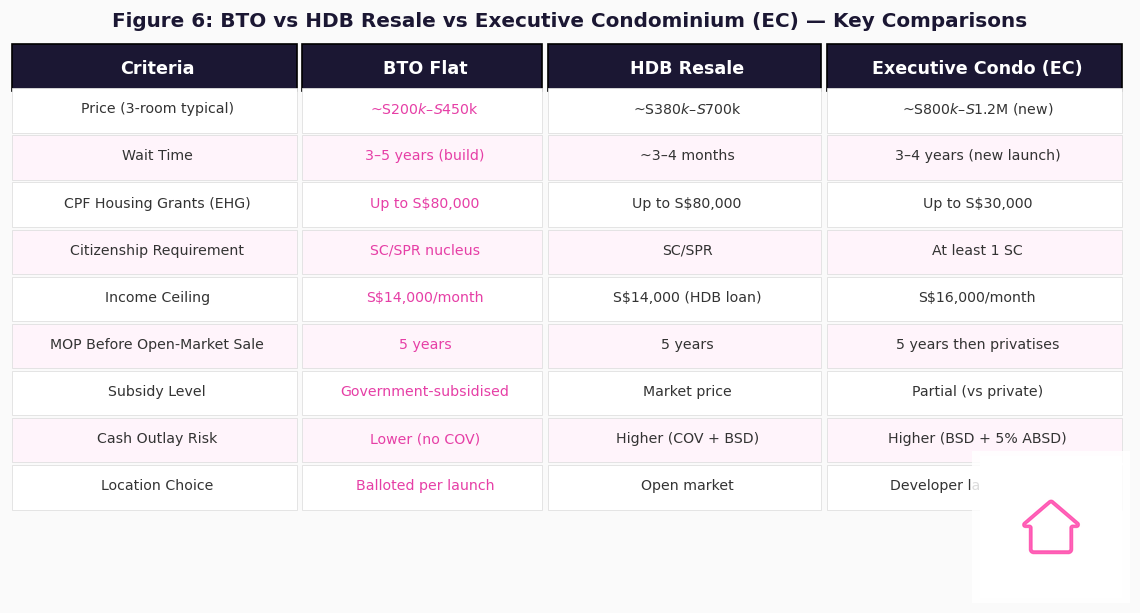
Figure 6: Comparing the key features of BTO flats, HDB resale flats, and Executive Condominiums (ECs) in Singapore 2026. Each route involves distinct trade-offs in price, timeline, grants eligibility and resale conditions. Source: HDB, lovelyhomes.com.sg.
BTO vs Resale vs Executive Condominium: At a Glance
Choosing between a BTO flat, a resale flat, or an Executive Condominium (EC) depends on your timeline, financial capacity, location needs, and long-term plans. BTO flats offer the lowest entry price and highest grant eligibility but require a 3–5 year wait. Resale flats are available quickly but at market prices, with potential Cash Over Valuation (COV) risk. ECs occupy a middle ground — privately built but subject to HDB income and eligibility conditions, with a 5-year Minimum Occupation Period (MOP) before privatisation and sale to foreigners becomes possible. Figure 6 above summarises the key differentiators.
Worked Example: Mr & Mrs Tan Applying for a 4-Room Tengah BTO
Profile: Both Singapore Citizens, combined gross monthly income S$5,000. First-timer applicants. Ages 28 and 27.
BTO flat: 4-room flat, Tengah (Standard classification). Indicative price: S$390,000. Estimated wait: 4 years.
EHG: Income S$5,000/month → EHG = S$55,000 (family, income-scaled). Credited at key collection.
Down payment (20%): S$390k × 20% = S$78,000. Net of EHG: effective down payment from CPF/cash = S$78,000 − S$55,000 = S$23,000. Assuming CPF OA balance of S$25,000 at key collection (built up over 4 construction years), the Tans can cover the down payment entirely from CPF OA.
Booking fee (at flat selection): ~5% = S$19,500 (from CPF OA or cash); credited towards purchase price.
Net cash at key collection: BSD S$6,300 + legal fees ~S$2,500 = approximately S$8,800 in cash. The EHG and CPF OA cover the remaining obligations. Without the grant, the Tans would need to fund S$78,000 down payment from savings — the EHG reduces their effective purchase price to S$335,000.
Why the BTO Route Matters in 2026
The BTO scheme remains Singapore’s most affordable entry point to home ownership. For eligible first-timer families at median income levels, the combination of government-subsidised prices and EHG grants can reduce the effective purchase price by S$50,000–S$100,000 compared to comparable resale flats.
However, the construction delays experienced during the COVID-19 period — which pushed some BTO completion dates out by one to two years beyond original estimates — highlighted the risks of the BTO model. HDB has since accelerated construction pipelines and moved to earlier contractor appointment, but buyers should build contingency planning into their BTO journey. The 2024 Standard/Plus/Prime classification also introduces new nuances: Plus-classified BTO flat buyers face a 10-year MOP (versus 5 for Standard), restrictions on sub-letting, and a requirement to return a proportion of resale proceeds to HDB above a prescribed threshold — reflecting the higher subsidies embedded in these locations.
What Might Come Next for BTO
HDB has committed to launching 19,000–20,000 BTO flats annually through the mid-2020s to address the supply backlog accumulated in prior years, with a focus on Standard flats in growing towns such as Tengah, Kallang/Whampoa, and the Greater Southern Waterfront precinct. Industry observers anticipate potential refinements to the priority ballot framework — particularly regarding the treatment of applicants who have repeatedly been unsuccessful despite multiple applications. The government has also signalled ongoing review of the Plus/Prime subsidy and resale restriction model, with the first cohort of Plus flats expected to reach MOP in the early 2030s. Buyers should monitor MND and HDB announcements for any policy changes affecting upcoming sales exercises.
Frequently Asked Questions: BTO Application 2026
How many times can I apply for BTO before losing first-timer priority status?
You retain first-timer status until you are actually offered a unit and sign the Agreement for Lease, or until you have previously purchased a subsidised HDB flat. Simply applying multiple times — even if you receive and decline queue numbers — does not immediately strip you of first-timer priority, though HDB may deduct a ballot chance after a certain number of declined offers (currently, two declined queue number offers result in losing one ballot chance). The safest approach is to apply seriously to each exercise and, if you receive a queue number, assess carefully before declining, as each decline reduces your future advantage.
What happens if I miss my flat selection appointment?
If you miss your scheduled flat selection appointment without prior arrangement with HDB, you may forfeit your queue number for that exercise. HDB does allow rescheduling under exceptional circumstances — such as a medical emergency or overseas work travel — but you must notify HDB in advance and provide supporting documentation. If your queue number is forfeited, you will need to reapply in a subsequent BTO exercise. Given that obtaining a queue number may take multiple exercises for popular flat types, missing a selection appointment is a costly outcome that should be avoided through careful diary management and early appointment of a solicitor.
Can I sell or rent out my BTO flat before the MOP is completed?
The Minimum Occupation Period (MOP) for Standard BTO flats is 5 years from the date of key collection. During this period, you may not sell the flat on the open market, rent out the entire flat, or purchase another HDB flat. You may, however, rent out spare bedrooms (subject to HDB approval and applicable limits on the number of tenants). Plus-classified BTO flats carry a 10-year MOP, reinforcing the long-term commitment required when purchasing in subsidised high-value locations. Violations of the MOP carry financial penalties and may result in HDB compulsorily acquiring the flat.
How are BTO flat prices set — and are they genuinely below market value?
HDB sets BTO prices using a market-minus-discount approach: it benchmarks comparable private and resale properties in the same area, then applies a subsidy to arrive at the BTO selling price. The subsidy is larger for Standard classification flats (lower-value areas) and smaller for Plus or Prime flats (higher-value locations), reflecting HDB’s commitment to keeping BTO prices affordable across the income spectrum. Industry analysis consistently shows that BTO flats at launch are priced 20–40% below comparable resale HDB flats in the same town, and substantially below equivalent private properties. However, the actual benefit realised by the buyer is partly tied to the MOP — if you hold for 5 or more years before selling, you benefit from the full price appreciation; some of this is recouped by HDB for Plus/Prime flats through the subsidy recovery mechanism.
What is the difference between Standard, Plus and Prime BTO flats under the 2024 classification?
From the October 2024 BTO exercise, HDB replaced the Mature/Non-Mature classification with a three-tier framework. Standard flats are located in less central areas, carry a standard subsidy, and have a 5-year MOP with no subsidy clawback on resale. Plus flats are in more accessible or better-served locations with a higher subsidy (meaning a lower purchase price), but carry a 10-year MOP, restrictions on whole-flat sub-letting, and a requirement to return to HDB a proportion of the resale proceeds above a prescribed threshold if sold within a defined period. Prime flats are in the most central, high-value locations (such as near the city centre), carry the largest subsidies, and have the most stringent resale conditions, including income restrictions on future buyers of the resold flat. Buyers should review the specific conditions for the flat classification of any BTO project before applying.
Can Singapore Permanent Residents apply for BTO flats?
Singapore Permanent Residents (SPRs) face significant restrictions on BTO flat eligibility. An SPR household applying as a family must include at least one Singapore Citizen (SC) spouse or child; two SPR applicants forming a family without an SC component generally cannot apply for new BTO flats from HDB. SPR families that do include at least one SC may apply under the relevant scheme. Single SPRs cannot apply for BTO flats. The more accessible route for SPR households is the open HDB resale market, where eligibility conditions are less restrictive, though grant eligibility is also more limited than for SC households.
Disclaimer: This article is intended for general information only and does not constitute financial, legal or property advice. BTO policies, income ceilings, grant amounts, flat classification rules and HDB procedures are subject to revision. Always verify current information directly with the Housing and Development Board (hdb.gov.sg), the CPF Board (cpf.gov.sg), and the Ministry of National Development (mnd.gov.sg). Consult a licensed financial adviser or CEA-registered property professional for personalised guidance.
Quick Answer — CPF Housing Grants at a glance (2026)
Singapore Citizens buying an HDB flat may qualify for up to S$190,000 in CPF housing grants (EHG + Family Grant + Proximity Housing Grant combined).
Grants do not need to be repaid — they are funded by the Government and credited directly against the flat purchase price.
The Enhanced CPF Housing Grant (EHG) is the largest grant: up to S$80,000 for couples, up to S$40,000 for eligible singles. It applies to both BTO and resale flats.
The Family Grant (up to S$30,000) and Proximity Housing Grant (up to S$30,000) apply to resale flat purchases only.
Your grant eligibility is confirmed in your HDB HFE Letter. You must obtain an HFE letter before applying for any HDB flat.
Income ceilings: S$9,000/month for EHG (couples); S$14,000/month for Family Grant; no ceiling for PHG.
Grants are not transferable to private property — they apply exclusively to HDB flat purchases.
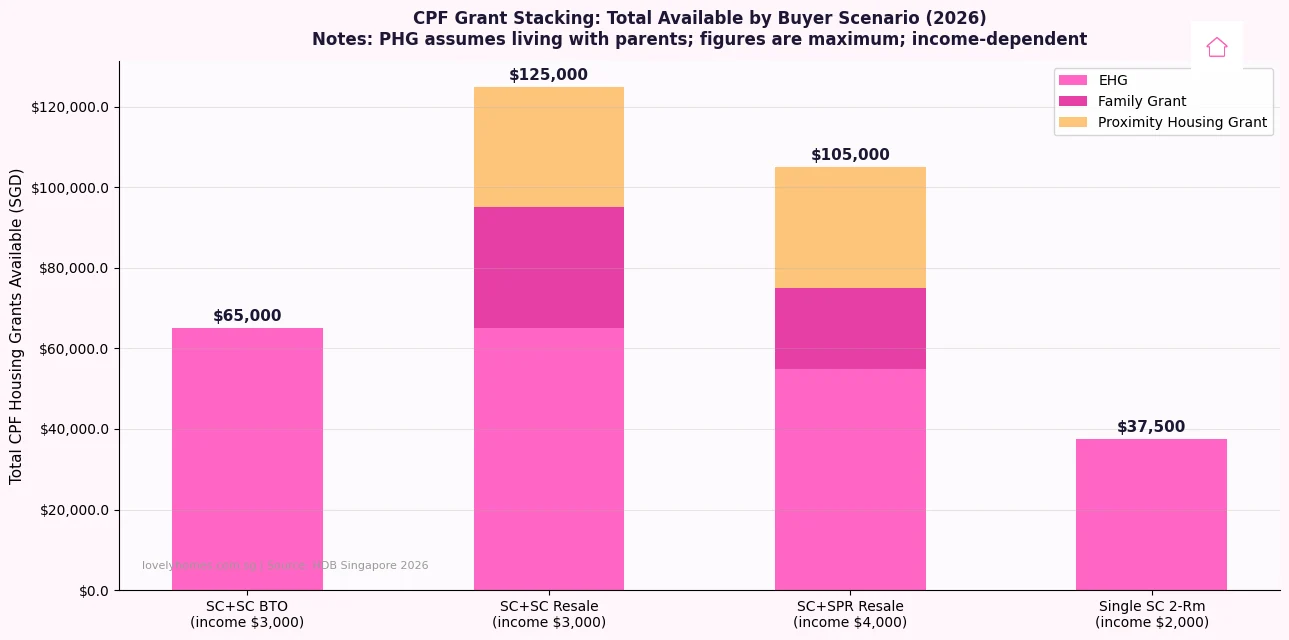
CPF housing grants are one of the most powerful but least understood tools in Singapore’s housing system. For a first-timer couple on a combined income of S$3,000/month buying a resale flat near their parents, total grants can reach S$125,000 — a sum that meaningfully reduces both the flat price and the mortgage they need to service for the next 25 years. Yet many eligible buyers under-claim or miss grants entirely because they do not understand which schemes apply to their specific profile.
This guide covers every CPF housing grant available in 2026, how to calculate what you qualify for, how the grants stack with one another, and how they interact with the HDB concessionary loan. All figures reflect the framework administered by the Housing & Development Board (HDB) and the Central Provident Fund (CPF) Board as at 31 July 2026.
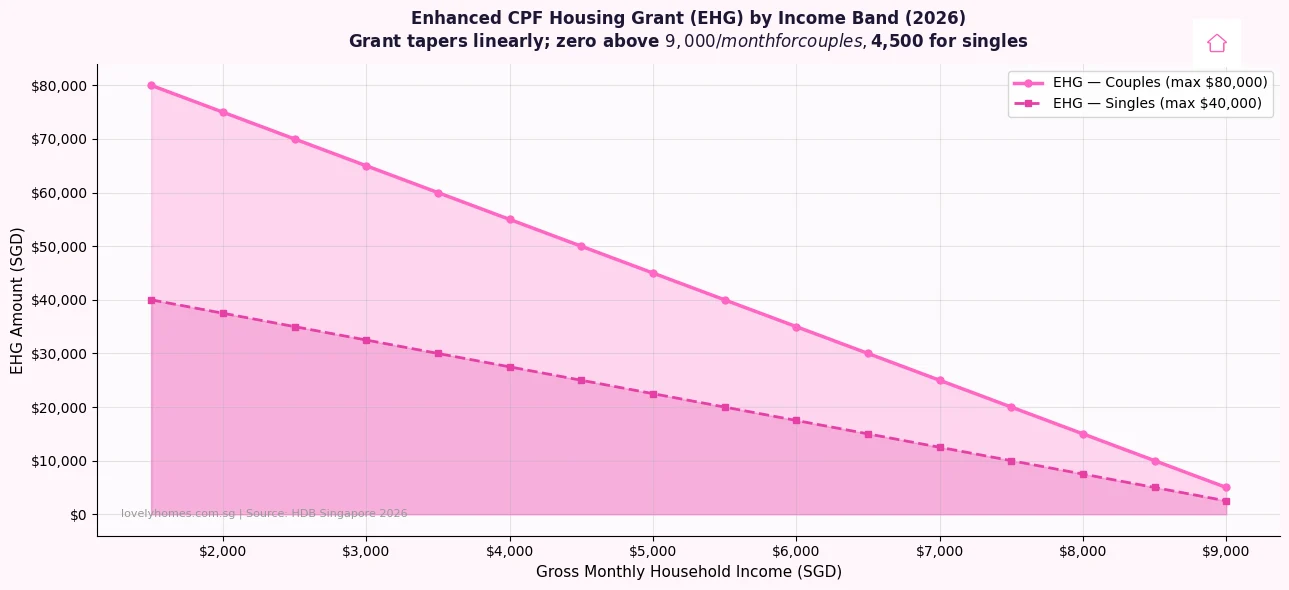
Figure 1: EHG amount by gross monthly household income (2026). The grant tapers linearly from S$80,000 at S$1,500/month to S$5,000 near the S$9,000 ceiling for couples.
What Are CPF Housing Grants?
CPF housing grants are direct subsidies paid by the Singapore Government to eligible HDB flat buyers. Unlike the HDB concessionary loan (which must be repaid with interest) or CPF Ordinary Account savings (which are your own money that must be refunded with accrued interest when you sell), grants are free money. They are credited at the point of flat booking or resale completion and applied directly to reduce the purchase price, which in turn reduces the loan quantum you need to service.
Grants are funded from the Singapore Government’s budget allocation for housing affordability and are not drawn from the CPF fund pool itself. Despite being called “CPF housing grants,” the CPF Board administers the disbursement, but the grants are Government expenditure. This distinction matters because grants received do not attract CPF accrued interest — only the CPF OA savings you use toward the flat purchase do.
The Five Main CPF Housing Grants in 2026
1. Enhanced CPF Housing Grant (EHG)
The EHG is the flagship grant, introduced in September 2019 to replace both the Special CPF Housing Grant (SHG) and the Additional CPF Housing Grant (AHG) for new flat buyers. It is now available for both BTO and resale flat purchases, making it the first grant to apply universally regardless of flat type.
The EHG is income-tiered. For first-timer couples earning up to S$9,000/month: the grant ranges from S$5,000 (at the S$9,000 income ceiling) to S$80,000 (at or below S$1,500/month). The formula is linear — every additional S$1,000 in monthly household income reduces the EHG by approximately S$10,000. For eligible singles aged 35 and above under the Single Singapore Citizen scheme, the EHG is half the couple amount: up to S$40,000 for incomes at or below S$4,500/month.
Critical condition: to qualify for EHG, at least one applicant must not have previously received an EHG, SHG, or AHG. There is also a work requirement — at least one applicant must be employed continuously for the 12 months immediately before the flat application.
2. Additional CPF Housing Grant (AHG — Resale Only)
The AHG for resale flats is a legacy grant now superseded for BTO purchases by the EHG. For resale flat purchases only, first-timer families earning at or below S$5,000/month may receive the AHG (up to S$40,000) in addition to the EHG. This stacking of EHG + AHG is specifically designed to support lower-income families who need to buy on the resale market because BTO wait times (3–5 years) are not compatible with their immediate housing needs.
Note: the AHG for resale is distinct from the old AHG that applied to BTO purchases, which was discontinued when the EHG launched.
3. Family Grant
The Family Grant applies exclusively to resale flat purchases by first-timer and second-timer families. The amount depends on citizenship composition:
Buyer Profile
Family Grant (Resale)
Income Ceiling
SC + SC (first-timer couple)
S$30,000
None
SC + SPR (first-timer couple)
S$20,000
None
SC or SC+SC (second-timer couple)
S$15,000
None
SC + SPR (second-timer couple)
S$10,000
None
The Family Grant has no income ceiling, which makes it accessible to all HDB buyers in the resale market regardless of earnings. However, it does require a qualifying family nucleus and that neither applicant previously received a Family Grant or Half-Housing Grant for the same flat type.
4. Proximity Housing Grant (PHG)
The PHG is designed to encourage multi-generational living and reduce inter-generational distance. It applies to resale flat purchases only. The grant is tiered by how close the buyer lives to their parents (or parents-in-law) or children:
Living Arrangement
PHG Amount
Income Ceiling
Living with parents / parents-in-law (in the same flat)
S$30,000
None
Living within 4 km of parents / parents-in-law
S$20,000
None
Living with children (in the same flat)
S$10,000
None
Living within 4 km of children
S$10,000 (same unit) / S$20,000 (within 4 km)
None
The PHG is stackable with the Family Grant and EHG for resale purchases. A couple buying a resale flat near their parents could receive EHG + Family Grant + PHG simultaneously, bringing total grants to S$80,000 + S$30,000 + S$30,000 = S$140,000 if they are on a low income.
5. Step-Up CPF Housing Grant
The Step-Up Grant (S$15,000) specifically targets second-timer families who currently live in a 2-Room Flexi or smaller HDB flat (bought with housing subsidies) and are upgrading to a 3-Room or larger resale flat. Income ceiling: S$7,000/month. This grant acknowledges that a family’s circumstances improve over time and that the move from a small starter flat to a larger home deserves targeted support. Unlike the Family Grant which is available to all second-timers, the Step-Up Grant is exclusively for this transitional scenario.
Figure 2: Total CPF grant amounts across four buyer scenarios (2026). A low-income SC+SC couple buying resale near parents can stack up to S$125,000 in grants.
Grant Eligibility Matrix: Which Grant Applies to Which Flat Type
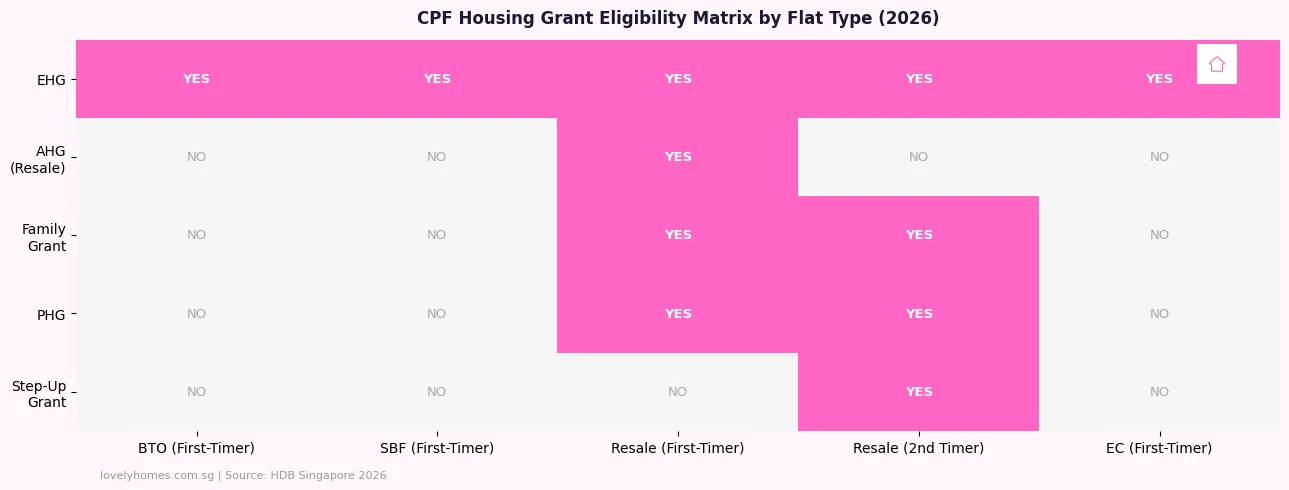
Figure 3: CPF housing grant eligibility by flat type. Resale flat buyers have access to the widest range of grants, including Family Grant and PHG not available for BTO.
Summary: All Grants at a Glance
Grant
Max Amount
BTO?
Resale?
Income Ceiling
Citizenship
Enhanced CPF Housing Grant (EHG)
S$80,000 (couples) S$40,000 (singles)
Yes
Yes
S$9,000/mth (couples) S$4,500/mth (singles)
At least 1 SC
AHG (Resale)
S$40,000
No
Yes
S$5,000/mth
At least 1 SC
Family Grant
S$30,000 (SC+SC)
No
Yes
None
At least 1 SC
Proximity Housing Grant (PHG)
S$30,000
No
Yes
None
At least 1 SC
Step-Up CPF Housing Grant
S$15,000
No
Yes (3-Rm+)
S$7,000/mth
At least 1 SC
EHG (EC)
S$30,000 (tiered)
EC only
No
S$9,000/mth
At least 1 SC
Worked Example: The Wong Family at S$3,000/month Income
Mr and Mrs Wong are a married Singapore Citizen couple, both first-timers. Their combined gross monthly income is S$3,000. They want to buy a 4-Room resale HDB flat near Mrs Wong’s parents in Tampines (within the same block).
EHG: Income S$3,000/month → EHG = S$65,000 (couples, tapering from S$80,000 at S$1,500 to S$5,000 at S$9,000).
Family Grant: SC+SC first-timer resale → S$30,000.
PHG: Living with parents (same flat) → S$30,000. (Note: the Wongs are buying to live with Mrs Wong’s parents; parents apply for the PHG on their side if they are the purchasers. Here, the Wongs buy the resale flat and the parents move in — PHG of S$30,000 applies to the Wongs’ purchase.)
HDB loan (80% LTV on S$395,000 net): approximately S$316,000 → monthly instalment ~S$1,444/month at 2.6% p.a. over 25 years, payable from CPF OA.
Minimum cash required at exercise: 1% OTP deposit = S$5,200. Balance 19% from CPF OA (S$93,800 less grants already applied).
This example demonstrates the transformative effect of grant stacking for lower-income first-timers. Without grants, the Wongs would need to fund S$104,000 (20% of S$520,000) from CPF and cash, plus service a S$416,000 loan at S$1,901/month — an 80% higher monthly payment than the grant-assisted scenario.
How Grants Interact with CPF OA Savings and Accrued Interest
One nuance that many buyers miss: grants reduce the flat price at the point of purchase, but they do not attract CPF accrued interest. Your CPF OA savings used toward the flat, however, do attract the prevailing CPF OA interest rate (2.5% p.a.) on the amount withdrawn, compounded annually. When you eventually sell the flat, the CPF Board requires you to refund the principal withdrawn plus the accrued interest back into your CPF OA before you receive any net cash proceeds.
Because grants are not CPF OA funds but Government subsidies, no accrued interest accumulates on the grant portion. The practical implication: using grants to reduce your flat price is strictly better than using CPF OA savings, because the grant portion carries zero future repayment obligation.
Second-Timer Grant Restrictions and the 30-Month Rule
Second-timer buyers — those who have previously purchased a subsidised HDB flat or received a housing grant — face reduced or nil grant eligibility for a second HDB purchase. HDB’s general rule is that second-timers must wait 30 months from the date of disposal of the first subsidised flat before purchasing another HDB flat with subsidies. Some grant schemes (Family Grant, Step-Up Grant) are available to second-timers under specific conditions; the EHG is not available to second-timers. Always verify your second-timer status via the HDB HFE letter before budgeting on grants.
What Might Come Next: Grant Evolution in Singapore’s Housing Policy
As at July 2026, Singapore’s CPF housing grant framework has been relatively stable since the EHG’s introduction in 2019. However, two policy pressures suggest evolution is possible: rising resale flat prices in prime estates (where even lower-income buyers face S$600,000–S$800,000 price points), and the expanding Prime Location Public Housing (PLH) model which restricts resale to Singapore Citizens only for 10 years. There is ongoing discussion among housing researchers about whether the PHG could be extended to BTO purchases to encourage multi-generational flat selection from the outset. No announcement has been made as at this guide’s publication date.
Can I use CPF housing grants to buy a private condominium?
No. CPF housing grants — the EHG, Family Grant, PHG, Step-Up Grant, and all related HDB schemes — apply exclusively to HDB flat purchases. They cannot be used toward a private condominium, landed property, or Executive Condominium after the EC has been privatised. If you are buying a new EC (before privatisation), a scaled-down EHG may apply, but the Family Grant and PHG do not. Private property buyers may still use their CPF Ordinary Account savings toward the purchase, but those savings attract accrued interest obligations, not grants.
Do I need to repay CPF housing grants if I sell my HDB flat?
No. CPF housing grants are non-repayable Government subsidies. Unlike CPF OA savings (which must be refunded with accrued interest to your CPF OA account when you sell), grants do not need to be repaid. However, if you sell a subsidised HDB flat and then buy another subsidised flat, the second purchase will typically not attract the same grants (particularly the EHG), because most grants are available only to first-timers. Selling and buying again does not “reset” your grant entitlement unless HDB explicitly designates a new category for second-timers.
Can singles receive CPF housing grants?
Yes, but with restrictions. Single Singapore Citizens aged 35 and above may receive the EHG for singles (up to S$40,000) when buying a 2-Room Flexi BTO flat or any size resale flat. The income ceiling for singles is S$4,500/month. Singles are not eligible for the Family Grant or PHG (which require a family nucleus), but may apply for a reduced PHG under certain conditions if moving near their parents. The Step-Up Grant is available to eligible singles who own a 2-Room Flexi flat and are upgrading.
What is the income used to calculate CPF housing grants?
HDB uses the gross monthly household income for the 12 months immediately preceding the flat application. This includes all income sources: employment income, self-employment income, rental income, and overseas income. The 12-month average is calculated and compared against the income ceiling. Bonuses, director’s fees, and commission income are included. CPF contributions (both employee and employer) are not deducted for this calculation — HDB uses the gross figure before CPF deduction. Individuals with zero income (e.g., homemakers) are recorded at zero; the total is the combined household figure of all persons listed on the flat application.
Can both the buyer and seller of a resale flat receive grants in the same transaction?
Grant eligibility is assessed independently for buyer and seller. The buyer of a resale flat may receive the EHG, Family Grant, and/or PHG as applicable to their profile. The seller has no grant entitlements in relation to the sale — grants are a buyer-side benefit. If the seller is using their sale proceeds to purchase another subsidised HDB flat, they would apply for grants in that subsequent purchase. The fact that the buyer receives S$125,000 in grants does not affect the sale price negotiation — grants reduce the effective cost to the buyer but do not change what the seller receives.
How are grants disbursed — cash or CPF?
CPF housing grants are credited directly to your CPF Ordinary Account at the point of flat booking (for BTO) or upon completion (for resale). They are not paid in cash. The credited amount is then used toward the flat purchase together with your other CPF OA savings, reducing the loan quantum required. Because grants are added to your CPF OA rather than paid directly to the seller, they are subject to standard CPF housing withdrawal rules — you must have sufficient CPF OA balance to cover the required down payment after the grant is applied. Critically, because grants arrive in your CPF OA, they also carry no accrued interest obligation when the flat is eventually sold.
What happens to my CPF housing grants if my flat application is cancelled?
If you cancel a BTO flat application before booking (i.e., before grants are formally disbursed), your grant entitlement is preserved — cancellation at the application stage does not consume your first-timer grant status. However, if you have already booked a flat and grants have been credited to your CPF OA, then you cancel or forfeit the flat, the situation becomes more complex: HDB will recover the grant from your CPF OA, and depending on the circumstances, your first-timer status and future grant eligibility may be affected. For resale transactions, if the OTP lapses before completion, grants that have not been formally disbursed are simply not paid. Always check with HDB directly if you are in a cancellation scenario.
Disclaimer
This article is for general informational purposes only. CPF housing grant amounts, income ceilings, and eligibility conditions are subject to revision by the Singapore Government. Always verify current grant entitlements directly with the Housing & Development Board (HDB) and the CPF Board through the HDB My Flat Journey portal and your HDB Flat Eligibility (HFE) letter. This article does not constitute financial, legal, or housing advice.
The HDB Flat Eligibility (HFE) letter replaced the old HDB Loan Eligibility (HLE) letter from 9 May 2023.
You must have a valid HFE letter before submitting a BTO application, selecting a resale flat, or exercising an Option to Purchase (OTP).
An HFE letter is issued within 14 working days and is valid for 9 months.
It covers in one document: flat eligibility, CPF housing grant eligibility, and HDB concessionary loan eligibility.
The application is done entirely online via HDB My Flat Journey (MFJ) using SingPass; all co-applicants must consent.
Income ceiling for most grants: S$14,000/month for couples; S$7,000/month for singles (select flat types).
HDB concessionary loan LTV: up to 80%; bank loan LTV: up to 75%.
If you are buying an HDB flat in Singapore — whether a new Build-To-Order (BTO) flat, a Sale of Balance Flat (SBF), or a resale flat from the open market — the HDB Flat Eligibility (HFE) letter is the gateway document that determines what you can buy, how much you can borrow from HDB, and how much in CPF housing grants you qualify for. Without it, you cannot proceed to application.
This guide explains exactly what the HFE letter is, who needs it, how to apply step by step, what to do if your application is rejected, and how to use your HFE letter once you have it. All figures reflect the rules administered by the Housing & Development Board (HDB) as at 31 July 2026.
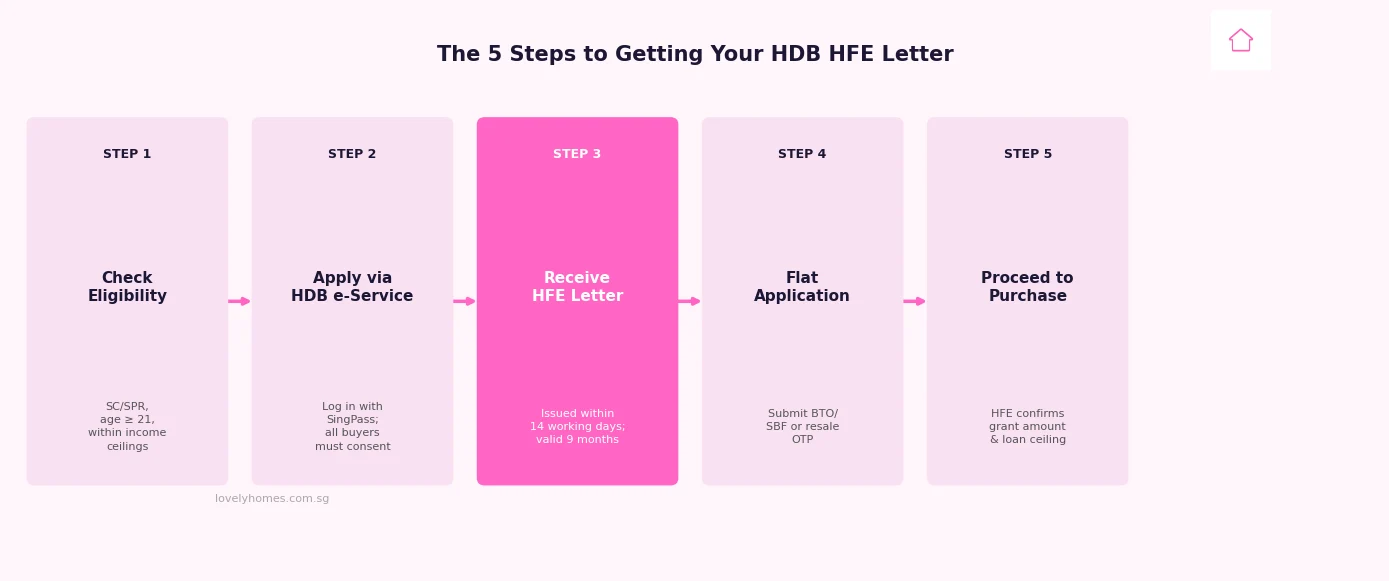
Figure 1: The 5 steps to obtaining your HDB HFE Letter — from eligibility check to flat purchase.
What is the HDB HFE Letter?
The HDB Flat Eligibility (HFE) letter is an integrated eligibility assessment issued by HDB. Prior to 9 May 2023, buyers had to obtain separate documents: a Housing Loan Eligibility (HLE) letter for HDB loans, a CPF housing grant eligibility check, and a general flat eligibility check. The HFE letter consolidates all three into a single, time-limited document. HDB administers it; the CPF Board and the Monetary Authority of Singapore (MAS) inform the underlying eligibility rules for grants and loan-to-value (LTV) caps respectively.
The HFE letter tells you three things before you spend a single dollar:
Which HDB flat types you are eligible to purchase (BTO, SBF, resale, or Executive Condominium).
The CPF housing grants you qualify for — the Enhanced CPF Housing Grant (EHG), Additional CPF Housing Grant (AHG, resale), Family Grant, Proximity Housing Grant (PHG), and Step-Up CPF Housing Grant.
Whether you qualify for an HDB concessionary loan and the maximum loan quantum HDB will extend to you based on your income, CPF balances, and existing property.
Who Needs an HFE Letter?
You need a valid HFE letter if you intend to:
Apply for a new flat under a BTO, SBF, or Open Booking exercise;
Register intent to buy a resale HDB flat; or
Exercise an Option to Purchase (OTP) for a resale flat.
You do not need an HFE letter if you are buying a private condominium or landed property — that falls outside HDB’s remit entirely. However, if you intend to use CPF Ordinary Account (OA) savings toward a private property purchase, you will need a CPF withdrawal application separately.
Eligibility Criteria: Who Can Apply?
To be eligible for an HFE letter, you and your co-applicant(s) must meet HDB’s flat eligibility conditions. The core criteria are citizenship and family nucleus requirements — HDB does not sell new flats to individuals; a qualifying family nucleus is the fundamental test. The following applies as at 2026:
Criterion
Requirement (General)
Citizenship
At least one applicant must be a Singapore Citizen (SC). Co-applicants may be SC or Singapore Permanent Resident (SPR). Foreigners may not purchase HDB flats.
Age
All applicants must be at least 21 years old (single or widowed orphan schemes: 35 years old).
Family nucleus
Must form a qualifying family nucleus: married couple, fiancé/fiancée couple, parent(s) with child(ren), siblings, or single (35+, specific schemes only).
Property ownership
Must not own or have disposed of any HDB flat, DBSS flat, or private residential property in the 30 months before application (resale) or flat application (BTO).
Income ceiling
Combined gross monthly household income ≤ S$14,000 for most schemes; ≤ S$7,000 for singles (2-Room Flexi BTO). Executive Condominiums: ≤ S$16,000.
Previous housing subsidies
Second-timer restrictions apply if you have previously received a CPF housing grant or purchased a subsidised flat.
CPF Housing Grants Available via the HFE Letter
The HFE letter is the gateway to CPF housing grants. These grants are funded by the Singapore Government and administered through HDB. The amount you receive is calculated based on your household income, citizenship composition, and flat type. Grants are used to offset the purchase price directly — they reduce the amount you need to pay in cash or CPF OA, or they reduce your outstanding mortgage with HDB.
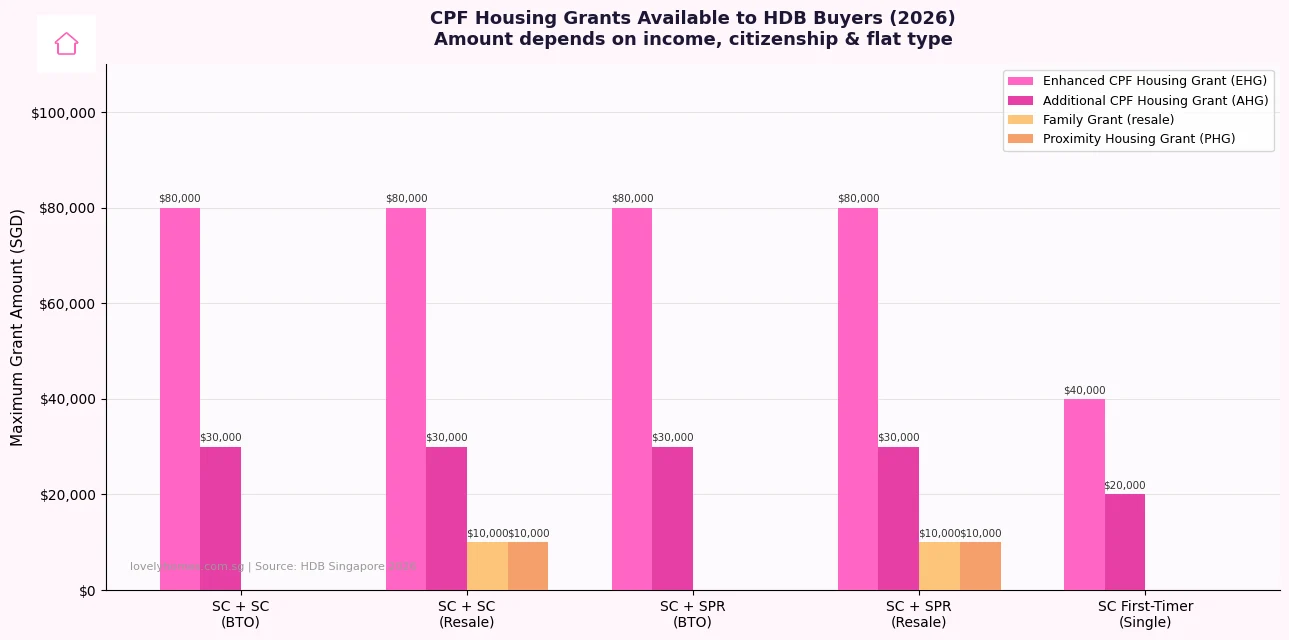
Figure 2: Maximum CPF housing grant amounts by buyer profile and flat type (2026). Actual amounts depend on income tier.
Enhanced CPF Housing Grant (EHG)
The EHG is the largest grant available and replaced the Special CPF Housing Grant (SHG) and Additional CPF Housing Grant (AHG) for new flat purchases. It is available to first-timer families earning ≤ S$9,000/month. The maximum is S$80,000 for couples earning up to S$1,500/month; the grant tapers to S$5,000 for incomes near the S$9,000 ceiling. Critically, EHG can be used toward both BTO and resale HDB flats — the grant amount is determined at application based on the preceding 12 months’ income.
Additional CPF Housing Grant (AHG — Resale)
The AHG for resale flat purchases (up to S$40,000) applies to first-timer families earning ≤ S$5,000/month who are buying a resale flat. It is used alongside the EHG to give lower-income buyers meaningful purchasing power in the resale market without requiring a new BTO flat.
Family Grant
The Family Grant (up to S$30,000 for SC+SC couples, S$20,000 for SC+SPR couples) applies to resale flat purchases. It does not have an income ceiling but does require a qualifying family nucleus. It is used with the EHG for resale purchases.
Proximity Housing Grant (PHG)
The PHG (up to S$30,000 for living with parents; S$20,000 for living within 4 km of parents) is available for resale flat purchases only. It has no income ceiling. The PHG is designed to encourage multi-generational living and reduce the burden on Singapore’s public transport and caregiving infrastructure.
Step-Up CPF Housing Grant
The Step-Up Grant (S$15,000) is specifically for second-timer families who currently live in a 2-Room or smaller HDB flat and are moving to a 3-Room or larger resale flat. Income ceiling: S$7,000/month. This grant bridges the gap for families who have already used previous housing subsidies.
HDB Concessionary Loan vs Bank Loan: What the HFE Tells You
Once the HFE letter is issued, it also states your eligibility for the HDB concessionary loan. This loan charges an interest rate pegged at 0.1% above the prevailing CPF Ordinary Account (OA) interest rate, which has been 2.5% per annum since 1999 — giving an effective rate of 2.6% p.a. (as at July 2026). This is generally lower than bank mortgage rates, which in mid-2026 have drifted between 3.2–3.7% p.a. for 2-year fixed packages.
Key differences the HFE letter determines:
Feature
HDB Concessionary Loan
Bank Loan
Max LTV (new flat)
80% of purchase price
75% of purchase price / valuation
Interest rate (Jul 2026)
2.6% p.a. (CPF OA + 0.1%)
3.2–3.7% p.a. (market rates)
Down payment (cash)
None required (can be fully CPF)
Minimum 5% in cash
Eligibility restriction
Must not own private property; income ceiling applies
Assessed by lender on TDSR/MSR
Refinancing
No — fixed for life of loan
Refinanceable after lock-in period
Prepayment penalty
None
May apply within lock-in
HDB’s LTV cap of 80% means you must fund the remaining 20% from CPF OA savings and/or cash. If your CPF OA balance is sufficient, you may pay no cash at all at the point of purchase — a critical advantage for first-time buyers.
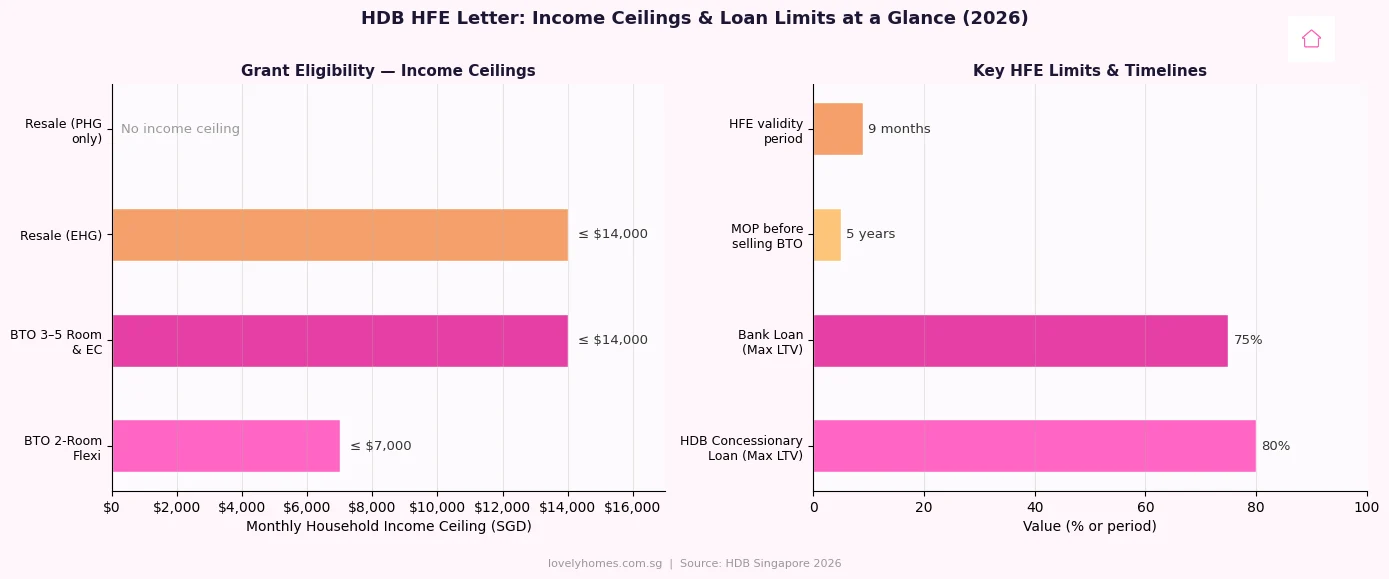
Figure 3: HDB HFE letter income ceilings and key borrowing limits at a glance.
How to Apply for the HFE Letter: Step by Step
The entire HFE application process is handled online through HDB’s My Flat Journey (MFJ) portal. There is no physical form, no queue at the HDB Hub, and no in-person interview required for a standard application. Here is the process in full:
Step 1 — Check flat eligibility. Log in to HDB My Flat Journey with SingPass. Use the online self-assessment tool to confirm you meet the basic eligibility criteria before investing time in the full application.
Step 2 — Initiate the HFE application. All co-applicants must log in and give their digital consent via SingPass. HDB will draw on Myinfo data (income records from IRAS, CPF balances, property ownership records) automatically. You do not need to upload payslips separately if your employer reports income through SingPass Myinfo.
Step 3 — Wait for processing. HDB targets a turnaround of 14 working days. Complex cases (self-employed applicants, overseas income, undischarged bankrupts) may take longer. You will be notified via the MFJ portal and by SMS/email when the letter is ready.
Step 4 — Receive and review your HFE letter. The letter will state: (a) flat types you may purchase; (b) grant amounts you qualify for; (c) whether you are eligible for an HDB concessionary loan and the maximum loan ceiling. Review it carefully — the loan ceiling is calculated conservatively and may differ from your actual borrowing capacity under TDSR.
Step 5 — Proceed to flat application or OTP exercise. Your HFE letter is valid for 9 months from the date of issue. You must submit your BTO/SBF application, register intent to buy, or exercise the OTP within this window. If it lapses, you must reapply.
Worked Example: The Lim Family’s HFE Journey
Mr and Mrs Lim are a Singapore Citizen couple, both aged 30, getting married in October 2026. Their combined gross monthly income is S$7,200. They want to apply for a BTO 4-Room flat in Tengah (OCR). Here is how the HFE letter plays out for them:
Eligibility: Married couple, both SC, income ≤ S$14,000 — eligible for BTO.
EHG: Combined income S$7,200/month → EHG = S$25,000 (grant tapers; full S$80,000 is for ≤ S$1,500/month couples).
HDB concessionary loan: Maximum loan quantum is calculated at approximately 30% of monthly income × loan tenure in months. At S$7,200/month income and 25-year tenure: roughly S$720,000 ceiling (subject to TDSR and MSR). The 4-Room BTO in Tengah is estimated at S$490,000 — well within the loan ceiling.
Down payment required: 20% × S$490,000 = S$98,000. EHG of S$25,000 offsets the purchase price → effective amount to fund: S$73,000 from CPF OA. If CPF OA balance is sufficient, zero cash required at purchase.
Monthly instalment (HDB loan 2.6% p.a., 25 yr): Loan = S$465,000 (S$490,000 less S$25,000 EHG) × 0.8 = S$372,000 → approximately S$1,700/month, payable entirely from CPF OA.
This example illustrates why the HFE letter is not bureaucracy for its own sake — it gives buyers a precise financial picture before they commit to a flat.
Minimum Occupation Period (MOP) and Why It Matters
Once you purchase an HDB flat, you are subject to a Minimum Occupation Period (MOP) before you can sell or rent out the entire flat. The MOP for most HDB flats is 5 years from the date you collect your keys. For new BTO flats in prime locations under the Prime Location Public Housing (PLH) model, the MOP is extended to 10 years. The HFE letter does not state the MOP directly, but the flat type it confirms eligibility for will determine which MOP applies.
Understanding MOP is critical for buyers who may wish to upgrade to a private property in the medium term. The MOP clock starts only from key collection — not from the BTO application date or the signing of the sale agreement. For a BTO flat with a typical 3–5 year construction period, a buyer applying in 2026 might not complete their MOP until 2033 or 2034.
What if Your HFE Letter is Rejected or Shows Lower Entitlements?
An HFE letter may come back with lower grant amounts than expected, or it may indicate ineligibility entirely. Common reasons include: income exceeding the ceiling; a previous HDB flat disposal within the 30-month window; undischarged debts to HDB from a prior flat; or a co-applicant who owns private property. If you believe an error has been made, you may appeal in writing to HDB within 30 days of the letter’s issuance date, providing documentary evidence (IRAS tax assessments, CPF statements, deed of sale for previous property, etc.).
What This Means for You: HFE as a Planning Tool
The HFE letter is best understood not as an obstacle but as a planning tool. By applying early — before you even know which BTO exercise you want to ballot for — you gain five advantages: (1) you know your maximum loan ceiling under the HDB concessionary rate; (2) you have exact grant figures to plug into your financial model; (3) you avoid the risk of exercising an OTP and then discovering you cannot access the loan or grants you assumed; (4) the 9-month validity window gives you two full BTO ballot cycles to use it; and (5) it demonstrates to property agents and sellers that you are a financially ready buyer.
What Might Come Next: HFE and the Evolving HDB Landscape
As at July 2026, HDB has signalled an ambitious BTO pipeline for the remainder of 2026 and into 2027, with projects in Tengah, Kallang/Whampoa, and Queenstown expected in the October 2026 exercise. The PLH model continues to expand to more prime-location sites, which will carry a 10-year MOP and subsidy clawback on resale. Buyers should consider whether PLH restrictions align with their 10–15 year plans before balloting.
There is also ongoing discussion around whether the income ceilings for grants will be adjusted in the next Budget. The S$14,000 combined income ceiling has been in place since 2019; with median household incomes rising, a revision upward has been speculated. No official announcement has been made as at this article’s publication date.
Yes — you need a valid HFE letter before you can register your Intent to Buy (ITB) on the HDB Resale Portal. The ITB is the first step in the resale process and must be completed before the seller can register their Intent to Sell. Without a valid HFE letter, you cannot proceed with the resale transaction. The HFE letter for resale purchases also confirms your eligibility for the Family Grant, AHG (resale), and PHG.
How long is the HFE letter valid, and can I renew it?
An HFE letter is valid for 9 months from the date of issuance. If you do not complete your purchase or flat application within this window, you must reapply for a new HFE letter. There is no formal “renewal” — each application is a fresh assessment based on current income and circumstances. If your income has changed significantly (promotion, job change, becoming self-employed), your new HFE letter may reflect different grant amounts or loan ceiling figures. There is no fee to apply for or reapply for an HFE letter.
What is the difference between the HFE letter and the old HLE letter?
The Housing Loan Eligibility (HLE) letter was the predecessor document, phased out on 9 May 2023. It covered only HDB loan eligibility and did not include a full grant eligibility assessment or flat eligibility determination. Buyers previously had to navigate three separate checks: HLE, a grant eligibility tool on HDB’s website, and a flat eligibility self-assessment. The HFE letter consolidates all three. One practical difference: the HFE letter requires all co-applicants to give SingPass consent simultaneously, which the HLE did not strictly enforce.
Can singles apply for an HFE letter and purchase an HDB flat?
Yes, but with restrictions. Singapore Citizens aged 35 and above may apply under the Single Singapore Citizen (SSC) scheme for a 2-Room Flexi BTO flat (income ceiling S$7,000/month) or resale flats of any type. The EHG for singles is up to S$40,000. Singles may not purchase 3-Room or larger BTO flats under the SSC scheme. Divorced or widowed Singapore Citizens with children may apply under the Orphan Scheme or other applicable schemes with different eligibility conditions. SPR singles cannot purchase new HDB flats.
Does an HFE letter mean I am guaranteed an HDB concessionary loan?
No — the HFE letter indicates your eligibility for the HDB concessionary loan and the maximum ceiling, but the final loan offer is made only at the point of flat booking (BTO) or after valuation (resale). Between the HFE issuance and your actual flat purchase, your financial circumstances may change (income drop, new liabilities, default on another loan). HDB will re-assess your loan quantum at disbursement. You should also be aware that the HDB loan amount is subject to the Mortgage Servicing Ratio (MSR) cap of 30% of gross monthly income and the Total Debt Servicing Ratio (TDSR) cap of 55%.
What happens to my HFE letter if I miss the BTO ballot or do not find a suitable resale flat?
Nothing happens automatically — the HFE letter simply remains valid until it expires at the end of its 9-month window. You can use it for any number of BTO applications or Intent to Buy registrations during that period. If the HFE letter expires before you complete a purchase, you reapply. There is no penalty for an unused HFE letter, nor is there a limit on how many times you may apply. The only cost is the 14-working-day wait for each new letter.
Can I use an HFE letter for an Executive Condominium (EC)?
Yes. The HFE letter also covers Executive Condominium purchases. However, ECs are developed and sold by private developers under a hybrid scheme — HDB sets eligibility rules, but the developer signs the Sales and Purchase Agreement. The income ceiling for ECs is S$16,000/month. ECs do not qualify for the HDB concessionary loan (you must take a bank loan), but eligible buyers may receive the EHG (capped depending on income). ECs are subject to a 5-year MOP from key collection, after which they may be sold on the open market to Singapore Citizens and PRs, and become fully privatised after 10 years.
Disclaimer
This article is for general informational purposes only and does not constitute legal, financial, or housing advice. Eligibility conditions, grant amounts, income ceilings, loan-to-value limits, and interest rates are subject to change without notice. Always verify current figures directly with the Housing & Development Board (HDB), the Central Provident Fund Board (CPF Board), and the Monetary Authority of Singapore (MAS). For loan-specific advice, consult a licensed financial adviser or mortgage broker.
Rental Stamp Duty (RSD) is a tax administered by IRAS on tenancy agreements for property in Singapore. It applies to virtually all signed rental agreements, whether residential or commercial.
The standard rate is 0.4% of the total rent payable for leases of up to one year. For leases exceeding one year, the rate still works out to approximately 0.4% of the average annual rent, but the calculation base changes — making longer leases proportionally cheaper per dollar of rent.
Legally, the tenant pays RSD, but landlords and tenants may contractually agree otherwise. The obligation to stamp the agreement within the prescribed deadline remains regardless of who bears the cost.
Deadline: 14 days from signing if the tenancy agreement is executed in Singapore; 30 days if signed overseas. Late payment attracts penalties of up to four times the original stamp duty.
Payment is made via IRAS e-Stamping at mytax.iras.gov.sg. The stamped agreement serves as legally admissible evidence in court; an unstamped tenancy agreement cannot be produced as evidence without first paying the outstanding duty (plus penalty).
Exemptions are narrow: certain government-to-government leases and specific short-term licence arrangements may be exempt, but most residential and commercial tenancies are stampable.
Rental stamp duty is separate from and in addition to GST on rent (if the landlord is GST-registered), and should not be confused with ABSD/BSD on property purchases.
What is Rental Stamp Duty and Why Does It Exist?
Stamp duty in Singapore has a long history rooted in colonial taxation: the original principle was that documents conveying rights — whether over property, shares, or contracts — should bear a “stamp” as evidence that a duty had been paid to the Crown. Today, Rental Stamp Duty (RSD) — formally called “lease duty” under the Stamp Duties Act (Cap. 312) — is the charge IRAS imposes whenever a tenancy agreement or lease is executed for property located in Singapore.
Unlike BSD and ABSD, which fall on property purchases, RSD is a tax on the right to occupy rather than the right to own. Its effect is relatively modest in absolute dollar terms compared with purchase stamp duties, but it is frequently misunderstood — particularly by tenants who may not realise they are legally required to pay it, and by landlords who may not realise that an unstamped tenancy agreement is inadmissible in court should a dispute arise.
IRAS administers RSD under the Stamp Duties Act and has digitised the entire process through its e-Stamping Portal. Since 2017, physical revenue stamps have been abolished; all stamping is done electronically, and a Certificate of Stamp Duty (or Digital Stamp) is generated upon payment.
Figure 1: Rental Stamp Duty by Monthly Rent and Lease Term 2026. For all lease terms shown, the duty is 0.4% of the average annual rent (or total rent for ≤12 months). A S$7,000/month lease incurs S$336 stamp duty regardless of whether the lease is 12, 24 or 36 months — the duty is effectively annual. Source: IRAS Stamp Duties Act 2026.
How RSD is Calculated: The Three Lease-Term Formulas
Singapore’s Stamp Duties Act prescribes the duty rate based on the lease term. The rate is expressed as a fixed monetary charge per S$250 (or part thereof) of “chargeable rent” — which in practice simplifies to the percentages most property practitioners use.
Lease Term
Chargeable Rent Base
Effective Rate
Formula
Up to 1 year
Total rent for the entire lease
0.4%
0.004 × (monthly rent × number of months)
Over 1 year up to 3 years
Average Annual Rent (AAR)
0.4% of AAR
0.004 × (total rent ÷ number of years)
Over 3 years
4× Average Annual Rent
0.4% × 4× AAR
0.004 × 4 × (total rent ÷ number of years)
In practical terms, for the most common residential lease length of 12 or 24 months, the stamp duty works out to 0.4% of the annual rent. A S$3,500/month 12-month lease has total rent of S$42,000; duty = 0.4% × S$42,000 = S$168. A S$3,500/month 24-month lease has AAR of S$42,000; duty = 0.4% × S$42,000 = S$168. The duty is identical: longer leases within the 1–3 year band do not incur higher total stamp duty.
For leases over 3 years, the multiplier of 4× the AAR effectively applies a penalty on very long-term leases. A S$5,000/month 5-year lease would have AAR = S$60,000; duty = 0.4% × 4 × S$60,000 = S$960. This is significantly higher than a S$5,000/month 36-month lease (AAR = S$60,000; duty = 0.4% × S$60,000 = S$240).
Where a lease includes an option to renew, IRAS takes the view that the full expected lease term — including the renewal period — should be used to determine the chargeable rent base, unless the renewal is genuinely at the tenant’s option with no assurance from the landlord. This is a common area of dispute, and tenants and landlords should take specific legal advice on complex renewal clauses.
Figure 2: How to Calculate and Pay Rental Stamp Duty in Singapore 2026. The four-step process: identify lease term → compute chargeable rent base → apply 0.4% rate → pay via IRAS e-Stamping within 14 days (Singapore) or 30 days (overseas). Source: IRAS Stamp Duties Act (Cap. 312).
Who Pays: Legal Obligation vs Contractual Practice
Under the Stamp Duties Act, the person liable to pay stamp duty on a lease is the lessee — the tenant. This is the default legal position. However, Singapore law does not prohibit parties from contractually agreeing that the landlord will bear the cost of stamping instead. Many commercial leases, for example, provide that the landlord stamps the agreement and the stamp duty is absorbed as part of the landlord’s cost of leasing.
In residential lettings, standard practice in Singapore varies. A typical HDB or condo tenancy agreement often states that the tenant pays the stamp duty; in practice, some landlords absorb it, particularly in competitive rental markets. Regardless of who pays, the legal obligation to ensure the agreement is stamped rests on the tenant. If a landlord promises to stamp but fails to do so, the tenant — not the landlord — faces the legal consequences: an unstamped agreement cannot be produced as evidence in court without first paying the outstanding duty plus a late-payment penalty.
This is a particularly important point for tenants who are new to Singapore. Rental contracts are legally binding once signed, but if the agreement is not stamped, neither party can rely on it in formal dispute resolution (e.g., in the Small Claims Tribunal or civil court) without first remedying the stamping deficiency.
How to Pay: The IRAS e-Stamping Process
IRAS requires all stamp duty on leases to be paid electronically through its e-Stamping Portal at mytax.iras.gov.sg. The process is straightforward:
First, log in using Singpass (for individuals with a Singpass account) or CorpPass (for companies). Second, navigate to “Stamp a Document” and select “Lease” as the document type. Third, enter the details of the tenancy agreement — property address, lease commencement date, monthly rent, lease duration, and any additional rent components (such as a maintenance contribution or parking charge, which may or may not be included in the chargeable rent depending on their nature). Fourth, confirm the computed stamp duty and make payment via PayNow, GIRO, or credit/debit card. IRAS immediately generates a Digital Stamp (a PDF certificate bearing the stamp reference number), which should be appended to the original tenancy agreement.
Foreign tenants or landlords without Singpass may use the Stamp Duty Calculator on IRAS’s website to compute the duty and then authorise a Singapore-registered solicitor or property agent to stamp on their behalf. The stamping must still be completed within the prescribed 14-day (Singapore execution) or 30-day (overseas execution) window.
Late Payment, Penalties and Unstamped Documents
IRAS imposes penalties for failure to stamp a lease agreement within the prescribed period. The penalty scale under the Stamp Duties Act is:
Delay Period
Penalty
Up to 3 months late
S$10 or the unpaid duty, whichever is higher
Over 3 months but not more than 6 months late
S$25 or 4× unpaid duty, whichever is higher
Over 6 months late
S$50 or 4× unpaid duty, whichever is higher
In addition to the monetary penalty, an unstamped document has serious evidentiary consequences. Section 52 of the Evidence Act provides that an unstamped instrument that should have been stamped is not admissible in evidence in civil proceedings until the stamp duty — together with any penalty — has been paid. In practice, this means that a landlord seeking to enforce a tenancy agreement in the Small Claims Tribunal or District Court, or a tenant seeking to rely on the lease to resist an unlawful eviction, may find their key document inadmissible until they have first remedied the stamping deficiency. Parties can often remedy this by paying the outstanding duty and penalty immediately before or during proceedings, but this adds cost and delay.
Variable Rent, Turnover Rent, and Inclusive vs Exclusive Clauses
Stamp duty on leases with variable rent — such as commercial leases tied to turnover (a percentage of the tenant’s sales) — is a more complex area. IRAS’ position is that the stamp duty should be computed on the highest annual rent payable, including variable components, at the time the lease is signed. Where the variable component is genuinely unascertainable, the parties may seek an assessment from IRAS.
Rent that is described as inclusive of maintenance charges or service charges is typically fully chargeable for stamp duty purposes if it is paid as a single lump sum under the lease. Landlords who break out maintenance charges as a separate contractual payment (not part of the “rent” clause in the tenancy agreement) may reduce the chargeable rent base, but this must be reflected accurately in the agreement — IRAS can disregard artificial arrangements that separate components of what is economically a single rent payment.
Rental incentives such as rent-free periods at the start of a lease reduce the total rent payable and therefore reduce the chargeable rent base. A 24-month lease at S$4,000/month with one month rent-free has effective rent of S$4,000 × 23 = S$92,000; AAR = S$46,000; stamp duty = 0.4% × S$46,000 = S$184 (not 0.4% × S$48,000 = S$192).
Figure 3: RSD Amount and Total Rent for Common Lease Scenarios 2026. The stamp duty (left bars) remains constant whether the lease is 12, 24, or 36 months — because the formula uses average annual rent. The total rent (right axis, dashed line) doubles and triples correspondingly. Source: IRAS Stamp Duties Act.
Worked Example: The Ramirez Family’s HDB Lease
📊 Worked Example — Mr and Mrs Ramirez, Tenant
Mr and Mrs Ramirez (Employment Pass holders) are renting a 4-room HDB flat in Tampines from Mr Lim (SC landlord) at S$3,800/month for 24 months commencing 1 August 2026. The tenancy agreement was signed in Singapore on 28 July 2026.
Step 1 — Identify lease term: 24 months. This falls in the “over 1 year, up to 3 years” band. Chargeable rent base = Average Annual Rent (AAR).
Step 2 — Compute AAR: Total rent = S$3,800 × 24 = S$91,200. Number of years = 2. AAR = S$91,200 ÷ 2 = S$45,600.
Step 3 — Apply rate: RSD = 0.4% × S$45,600 = S$182.40. IRAS rounds up to the nearest S$1, so payable = S$183.
Step 4 — Deadline: Agreement signed in Singapore on 28 July 2026. Deadline = 28 July + 14 days = 11 August 2026. The Ramirez family (or their agent) must log in to mytax.iras.gov.sg and pay S$183 by 11 August 2026.
Responsibility: Under the tenancy agreement, the stamp duty is stated to be the tenant’s liability. Mrs Ramirez logs in via Singpass, selects “Stamp a Document → Lease”, enters the property address (HDB flat in Tampines), monthly rent (S$3,800), lease period (24 months), and pays S$183 via PayNow. She downloads the Digital Stamp and attaches it to the signed tenancy agreement. Both she and Mr Lim retain a copy.
What if they forget? If they stamp on 15 September 2026 (48 days late), the penalty for delay up to 3 months = maximum of S$10 or the unpaid duty. Duty = S$183. Penalty = S$183 (duty) + S$183 (penalty, since S$183 > S$10) = S$366 total. If they leave it 7 months, the penalty is 4× the unpaid duty = S$183 × 4 = S$732, paid in addition to the original duty of S$183 = S$915 total.
RSD on Commercial Property and Industrial Leases
Rental stamp duty applies equally to commercial and industrial leases — offices, retail shops, F&B units, factories, and warehouses. The same formula and deadline rules apply. Commercial leases often involve higher rent quantum and longer lease terms (3–5 years is common), meaning the “over 3 years” penalty multiplier (4× AAR) comes into play more frequently.
For commercial leases, it is standard practice for the landlord’s or tenant’s lawyers to handle the stamping at the time of execution, and the stamp duty cost is typically factored into lease negotiations. Commercial tenants should also note that if they sub-let part of the premises to a sub-tenant, the sub-lease is independently stampable — the stamp duty on the head lease does not cover the stamp duty on the sub-lease.
What Might Change in Singapore Rental Stamp Duty Rules
Singapore’s stamp duty regime is periodically reviewed as part of broader property market management. RSD rates have remained at 0.4% for decades — the most significant recent changes to Singapore’s stamp duty landscape have been on the purchase side (ABSD rounds in 2021, 2022, and 2023), not the lease side.
There are no publicly announced plans as at July 2026 to change RSD rates. However, the government has in recent years shown willingness to adjust property-related taxes quickly and without advance notice when market conditions warrant. Tenants and landlords entering multi-year leases should factor in that stamp duty regulations may change at renewal.
IRAS has also been digitalising its stamp duty administration progressively. The full move to e-Stamping was completed in 2017, and IRAS now processes the vast majority of stamp duty transactions without human review. Automated flagging of anomalous arrangements (suspiciously low rent, excessive rent-free periods, or rent structures that appear to understate chargeable rent) is improving. Parties should ensure their lease agreements accurately reflect the true economic rent.
Summary: Key Rental Stamp Duty Facts 2026
Item
Detail
Governing law
Stamp Duties Act (Cap. 312), administered by IRAS
Applies to
All signed tenancy agreements / leases for Singapore property
Rate (≤1 year lease)
0.4% of total rent
Rate (1–3 year lease)
0.4% of average annual rent (AAR)
Rate (>3 year lease)
0.4% × 4 × AAR (effectively 1.6% of AAR)
Who pays (by law)
Tenant (lessee) — contractually may be varied
Deadline (SG execution)
14 days from date of signing
Deadline (overseas execution)
30 days from date of signing
Payment channel
IRAS e-Stamping Portal (mytax.iras.gov.sg)
Penalty (up to 3 mths late)
S$10 or unpaid duty, whichever is higher
Penalty (3–6 mths late)
S$25 or 4× unpaid duty, whichever is higher
Penalty (>6 mths late)
S$50 or 4× unpaid duty, whichever is higher
Consequence of no stamping
Tenancy agreement inadmissible in court (Evidence Act, s.52)
GST on stamp duty?
No — stamp duty is a government tax, not subject to GST
Frequently Asked Questions
Does rental stamp duty apply to HDB flats sublet to non-citizens?
Yes. Rental stamp duty applies to all tenancy agreements for property in Singapore, regardless of whether the property is an HDB flat, a private condominium, a landed home, or a commercial unit. The citizenship or residency status of the landlord or tenant does not affect whether stamp duty is payable. Note, however, that HDB flat subletting has its own separate regulatory requirements — HDB must approve the subletting, and there are restrictions on who can rent an HDB flat and for how long. These HDB subletting rules are administered by HDB and are separate from the stamp duty obligation administered by IRAS.
Is stamp duty payable on a verbal or oral tenancy agreement?
No — stamp duty under the Stamp Duties Act is payable on written instruments (documents), not on oral agreements. A purely verbal tenancy arrangement does not attract stamp duty because there is no written document to stamp. However, this does not mean that oral tenancies are advisable: an oral tenancy agreement is extremely difficult to enforce in practice because neither party can produce a written contract in dispute resolution. IRAS cannot compel stamping of a document that does not exist. If the parties subsequently reduce the oral agreement to writing, that written document becomes stampable at that point. In practice, almost all residential tenancies in Singapore involve a written tenancy agreement, making stamp duty applicable in the overwhelming majority of cases.
Does rental stamp duty apply to short-term rentals like Airbnb?
Short-term rentals — typically defined as leases of fewer than 3 months for residential property in Singapore — occupy a complex regulatory space. First, under the Planning Act and HDB regulations, residential property in Singapore (HDB flats, condominiums, landed homes) may not legally be rented out for periods of less than 3 consecutive months. Short-term platforms such as Airbnb are therefore generally prohibited for residential property in Singapore. If a tenancy agreement for less than 3 months is signed (illegally, for residential property), it would technically be stampable under the Stamp Duties Act since the Act does not exclude short-term agreements. However, enforcing the tenancy itself would be problematic given the underlying regulatory breach. For commercial serviced apartments and licensed hotels, different rules apply and stamp duty on any written rental agreement would still be applicable.
If the rent is paid partly in cash and partly as a service charge, is all of it stampable?
This depends on how the tenancy agreement is structured. If a single monthly figure is described as “rent” in the contract, the entire amount is chargeable for stamp duty purposes. If the agreement separately itemises a “maintenance fee” or “service charge” as a genuinely distinct component — not part of the rent clause — IRAS may, depending on the specific facts, agree that the separate charge is not part of the chargeable rent. However, IRAS scrutinises arrangements where rent is split into components that appear artificial. If the effect is that the tenant pays a combined sum for the right to occupy the property and it is economically equivalent to rent, IRAS may treat the whole as chargeable. Parties wishing to structure leases with service charges separated from rent for stamp duty purposes should obtain specific advice from their solicitors and be prepared to justify the arrangement if queried.
What happens if the tenant breaks the lease early and the agreed rent is never fully paid?
Stamp duty is assessed at the time the tenancy agreement is executed — based on the contractually agreed rent for the full lease term — not based on the rent actually paid if the lease is terminated early. If a tenant signs a 24-month lease at S$4,000/month (stamp duty = S$192), pays 6 months, then breaks the lease, the stamp duty already paid is not refunded. IRAS does not retrospectively adjust stamp duty for lease breaks. The stamp duty is a tax on the right created by the document at execution, not a tax on the economic benefit eventually received. This is one reason why tenants should be cautious about committing to long lease terms with high rent — beyond the financial exposure of the rent itself, the stamp duty is crystallised upfront.
Can the stamp duty be paid by the landlord’s property agent on behalf of the tenant?
Yes. A licensed property agent or solicitor may handle the e-Stamping process on behalf of either party. The agent or solicitor logs into the IRAS e-Stamping Portal using their own credentials and stamps the document on the client’s behalf, then passes the Digital Stamp to the parties. The agent’s stamping on behalf of the tenant does not change the legal liability — the tenant remains legally responsible for ensuring stamping occurs within the deadline. Property agents in Singapore routinely handle the stamping as part of their transaction coordination service. Note that if the agent fails to stamp on time, any penalty falls on the legally liable party (the tenant), not the agent — though the tenant may have a separate claim against the agent for negligence if the agent explicitly undertook to handle stamping and failed to do so.
Disclaimer: The information in this article is provided for general educational purposes only and reflects the Stamp Duties Act (Cap. 312) and IRAS guidelines as publicly available up to July 2026. Stamp duty rates, deadlines, penalty scales, and administrative procedures are subject to change without notice. Nothing in this article constitutes legal, financial, or tax advice. Readers should verify stamp duty obligations directly with IRAS or seek advice from a qualified solicitor or tax professional before executing any tenancy agreement. Official IRAS resources: iras.gov.sg — Stamp Duty: Renting a Property. For property-related regulatory guidance: ura.gov.sg and hdb.gov.sg.