Singapore Property Selling Guide 2026: Costs, Process and Net Proceeds Explained

Singapore Property Selling Guide 2026: Costs, Process and Net Proceeds Explained

Quick Answer: Selling Property in Singapore 2026

  • The typical private property selling process takes 12–16 weeks from listing to completion. For HDB flats, the HDB-managed resale process adds administrative steps and typically takes 16–24 weeks from Option to Purchase to key handover.
  • Seller’s Stamp Duty (SSD) applies to private residential properties sold within four years of purchase (for properties bought on or after 4 July 2025): 16% in Year 1, 12% in Year 2, 8% in Year 3 and 4% in Year 4. HDB flats are not subject to SSD but must satisfy the Minimum Occupation Period (MOP) before resale.
  • Agent commission for sellers is typically 1% to 2% of the sale price, negotiable. It is not fixed by law but is governed by the Council for Estate Agencies (CEA) Code of Ethics. No commission is payable until a valid transaction is completed.
  • When you sell a property in which CPF Ordinary Account funds were used for the purchase, you must refund the CPF principal used plus accrued interest (at 2.5% p.a. compounded) before any cash proceeds are available to you.
  • Legal fees for a private property sale are typically S$2,500–S$5,000; for HDB resale, S$1,500–S$2,800. Conveyancing lawyers handle the title transfer, mortgage discharge and CPF charge release.
  • There is no capital gains tax in Singapore on property disposals. However, if IRAS determines that a seller is a property trader (buying and selling frequently for profit), gains may be assessed as income and taxed at the applicable income tax rate.
  • Upon completion, your proceeds flow in this order: mortgage redemption → CPF refund with accrued interest → agent commission → legal fees → net cash to seller.

Should You Sell? The Pre-Sale Decision

Deciding to sell a Singapore property involves more than agreeing on an asking price. Before you appoint an agent or list a property, three questions must be answered: Have you satisfied the applicable holding-period rules? What will the net proceeds look like after repaying CPF, the mortgage and transaction costs? And — if you own an HDB flat and plan to purchase a private property after selling — what are the ABSD implications of your next move?

For HDB flat owners, the key holding-period rule is the Minimum Occupation Period (MOP): five years for Standard flats, ten years for Plus and Prime flats introduced under the 2024 classification. You may not list your HDB flat for resale until the MOP is satisfied. Violating the MOP by selling prematurely (including sub-letting the entire flat during the MOP without HDB approval) can result in compulsory acquisition of the flat at the purchase price — a severe financial penalty.

For private residential property owners, the governing holding-period rule is the Seller’s Stamp Duty (SSD). Selling within the prescribed period triggers an SSD bill payable by the seller within 14 days of the disposal. For properties bought before 4 July 2025, the SSD holding period is three years; for those bought on or after 4 July 2025, it is four years. At SSD rates of up to 16%, selling too early can eliminate any capital gain and more.

Singapore property selling costs by property type 2026 — HDB resale, private condo and landed breakdown of agent commission, legal fees and misc
Figure 1: Indicative selling costs by property type — excluding SSD and CPF refund. Source: LovelyHomes estimates based on CEA standard commissions and typical legal fees (2026).

Stage 1: Pre-Sale Preparation

Before listing, you should complete four tasks. First, confirm your MOP or SSD position. For HDB sellers, log in to the HDB Flat Portal to verify the exact MOP end date. For private property owners, calculate the four-year SSD holding period from the date of the Option to Purchase or Sale and Purchase Agreement — not the date of legal completion.

Second, obtain a formal valuation. HDB sellers must submit a Request for Value through the HDB portal — this valuation determines the benchmark for Cash Over Valuation (COV) discussions. Private property sellers typically rely on comparative market analyses from agents and, for bank refinancing purposes, formal valuations commissioned by lenders.

Third, appoint a CEA-registered agent. The Council for Estate Agencies (CEA) maintains the Public Register of property agents (cea.gov.sg/public-register). You should verify your agent’s registration before signing an Exclusive Listing Agreement. The agreement specifies commission rate, exclusivity period, and the agent’s obligations — read it carefully before signing.

Fourth, consider decluttering, repainting and minor repairs. Data from industry surveys consistently shows that well-presented properties sell 10–15% faster and closer to the asking price than properties in poor condition. For HDB flats especially, fresh paint and clean common areas make a material difference in a competitive resale market.

Stage 2: Listing, Marketing and Negotiation

Once listed, your agent will market the property on portals (PropertyGuru, 99.co, SRX) and conduct viewings. A professionally photographed listing — including a virtual tour for private properties — is no longer optional in the current market; buyers routinely shortlist on the basis of photographs before agreeing to a physical viewing.

Negotiations typically proceed through the agent. Buyers will make verbal offers, and you may counter. Key negotiation levers include the asking price, the option fee quantum (typically 1% for private, S$1–S$10,000 for HDB), the option exercise period, the completion timeline, and what fixtures and fittings are included. For private property, it is common for sellers to grant a 14-day Option to Purchase after agreeing on the price and basic terms.

An important discipline: do not accept more than one option fee from different buyers for the same property at the same time. Granting multiple options simultaneously is unlawful. Once you accept an option fee and issue an Option to Purchase, the buyer has the exclusive right to exercise it within the validity period.

Singapore property selling process 2026 — 5 stages from pre-sale preparation through listing, OTP, exercise and completion
Figure 2: The Singapore property selling process — five stages from pre-sale preparation to key handover. Source: LovelyHomes, based on CEA procedures and HDB/URA guidelines (2026).

Stage 3: Granting the Option to Purchase (OTP)

For private property, the Option to Purchase is a bilateral agreement that grants the buyer an exclusive right to purchase at the agreed price within a specified period (typically 14 days). Upon receiving the option fee (usually 1% of the purchase price), you sign and date the OTP. You cannot sell the property to anyone else during the option period. If the buyer does not exercise the option by the deadline, the option lapses and you retain the option fee as compensation.

For HDB resale flats, HDB prescribes a standard OTP format. The seller grants the option after the HDB Flat Eligibility (HFE) letter has been issued to the buyer and the Request for Value submitted. The option fee for HDB is between S$1 and S$1,000 (negotiable), and the option exercise fee is between S$1 and S$5,000 (for 4-room and smaller) or S$1 and S$10,000 (for 5-room and larger). The total of option fee plus exercise fee must not exceed S$5,000 or S$10,000 respectively. The HDB OTP has a 21-day validity: the buyer has 14 days to decide and 7 days after exercise to register the resale application with HDB.

Stage 4: Exercise, S&P Agreement and BSD/ABSD

When the buyer exercises the Option to Purchase, they pay the balance of the agreed deposit (typically 4–9% for private property; the exercise fee for HDB). For private property, the parties then execute a formal Sale and Purchase (S&P) Agreement drafted by the buyer’s conveyancing lawyers. The seller’s lawyers review and negotiate the S&P terms.

The buyer must pay Buyer’s Stamp Duty (BSD) and Additional Buyer’s Stamp Duty (ABSD, if applicable) within 14 days of exercising the Option. This is the buyer’s obligation, not the seller’s — but understanding it matters to sellers because it can affect how quickly a buyer is willing or able to complete the transaction.

For HDB resale, after the buyer exercises the option, both parties submit the resale application through the HDB Resale Portal. HDB verifies eligibility, processes the CPF withdrawals and housing grant (if any), and sets the completion date — typically 8–10 weeks after the resale application is accepted.

Stage 5: Completion and Net Proceeds

Completion day (or key collection day for HDB) is when legal ownership transfers. On completion, the proceeds flow in a prescribed order:

  1. Mortgage redemption — the outstanding loan balance is repaid to the bank (or HDB). The bank simultaneously releases the mortgage charge on the title.
  2. CPF refund — the CPF Board is repaid the principal withdrawn for the property plus accrued interest at 2.5% per annum (compounded annually). This refund goes back into your CPF Ordinary Account, not to you in cash.
  3. Legal fees and disbursements — conveyancing and title search fees paid to your solicitors.
  4. Agent commission — typically deducted from proceeds or paid on completion date.
  5. Net cash to seller — the residual after all the above deductions.

Sellers are sometimes surprised to discover that their CPF refund obligation (including decades of compounded accrued interest) absorbs a substantial portion of the sale proceeds. For a property held for 15 years with CPF heavily used, the CPF refund may exceed the original CPF principal withdrawn by 30–40%.

Singapore property selling net proceeds waterfall 2026 — sale price minus agent commission, legal fees, mortgage discharge and CPF refund with accrued interest
Figure 3: Net proceeds waterfall — selling a S$1.8M private condominium with no SSD and a S$600,000 outstanding loan. Source: LovelyHomes worked example (2026).

Selling Costs at a Glance

Cost Item HDB Resale Private Condo Landed Property Payable By
Agent Commission ~1% (negotiable) ~1–2% (negotiable) ~1–2% (negotiable) Seller
Legal / Conveyancing S$1,500–S$2,800 S$2,500–S$4,500 S$3,500–S$6,000 Seller
HDB Admin Fee S$40 (resale levy admin) Seller
SSD (if within hold period) Nil (HDB exempt) Up to 16% Up to 16% Seller
CPF Refund (principal + interest) Yes — full refund required Yes — full refund required Yes — full refund required Seller (to CPF Board)
Mortgage Early Redemption Nil (no prepayment penalty on HDB loans) Check loan documents; typically nil after lock-in period Check loan documents Seller
Property Agent Registration Both agent and seller must use CEA-registered agents

Worked Example: Selling a Bishan 5-Room HDB Flat

Scenario: Mr and Mrs Lim, both Singapore Citizens, purchased their 5-room HDB flat in Bishan in June 2019 for S$450,000 using an HDB concessionary loan of S$360,000 (fully repaid by 2026) and CPF Ordinary Account withdrawals totalling S$200,000 over the seven-year holding period. In August 2026, they receive an offer of S$780,000. Their MOP was satisfied in June 2024.

CPF refund obligation: CPF principal used = S$200,000. Accrued CPF interest at 2.5% p.a. compounded over 7 years = approximately S$37,500. Total CPF refund to CPF Board: S$237,500. This amount re-enters their CPF Ordinary Account — it is not lost, but it is not available as liquid cash.

Agent commission (1%): 1% × S$780,000 = S$7,800.

Legal fees: approximately S$2,500.

HDB admin fee: S$40.

SSD: Nil — HDB flats are not subject to SSD.

Mortgage outstanding: Nil — fully repaid.

Net cash proceeds calculation:

Item Amount
Sale Price +S$780,000
CPF Refund (principal + interest) −S$237,500
Agent Commission (1%) −S$7,800
Legal Fees −S$2,500
HDB Admin Fee −S$40
Net Cash Proceeds S$532,160

The Lims walk away with S$532,160 in cash, plus S$237,500 back in their CPF OA. Their next move determines ABSD exposure: if they buy a private condo as their sole property (having sold the HDB), they pay 0% ABSD as SC buying a first residential property. If they retain the HDB and buy a private condo as a second property, they pay 20% ABSD — approximately S$300,000 on a S$1.5M condo. Selling first and buying second, with the 6-month overlap remission if needed, is therefore the financially dominant sequence for most upgraders.

Why This Matters: The Upgrade vs. Retain Calculation

The ABSD framework has fundamentally altered the upgrade decision for HDB owners. Before April 2023, a Singapore Citizen buying a second property paid 12% ABSD. At S$1.5 million, that was S$180,000 — significant but potentially manageable for a dual-income household with substantial HDB equity. After April 2023, the same transaction costs S$300,000 in ABSD — roughly equivalent to two years of median household income.

This has driven a structural shift in upgrader behaviour. Increasingly, HDB sellers opt to complete their HDB sale before purchasing their next home, accepting a period of rental tenancy (or temporary stay with family) to avoid the ABSD surcharge. This “sell first, buy later” approach has the incidental effect of increasing HDB resale supply and, by removing one source of demand from the private market, moderating private property prices — which is, of course, precisely the policy intention.

The SSD tightening of July 2025 (extending the holding period from three to four years) similarly reinforces long-term ownership. A private property investor who purchased in 2024 and wishes to exit in 2027 now faces 8% SSD rather than nil — adding a S$100,000–S$200,000 friction cost on a typical mid-market transaction.

What Might Change: Outlook for Sellers in 2026–2027

As at August 2026, no relaxation of SSD or ABSD has been announced. Private residential prices have been rising at a modest pace — 0.9% in Q1 2026 and approximately 0.8% in Q2 2026 — suggesting the government sees no imminent need to stimulate market activity through measure relaxation.

Sellers considering whether to hold or exit in 2026–2027 should note two supply-side dynamics. First, the GLS pipeline remains active: the 2H 2026 Confirmed List contains nine sites, and completions from 2023–2025 launches are adding supply through 2026–2028. Second, the June 2025 revision to the HDB Minimum Occupation Period for Plus and Prime flat types (extended to ten years) will continue to lock in HDB supply for years to come, keeping resale volumes for newer flats subdued.

For sellers who are approaching the end of their SSD holding period on private properties bought in 2022–2023, the fourth year of holding (now relevant for post-July-2025 purchases) may become a timing consideration. Sellers of properties bought in 2021 or earlier who have fully cleared the (then) three-year SSD window are in the most liquid position.

Frequently Asked Questions

Can I sell my HDB flat if I still have an outstanding HDB loan?

Yes. The outstanding HDB loan is repaid on completion using the sale proceeds. The sequence on key handover day is: sale proceeds arrive at the conveyancing account → HDB loan is redeemed in full → CPF principal and accrued interest are refunded to the CPF Board → legal fees and agent commission are deducted → the remaining cash is released to the seller. You do not need to clear the HDB loan before listing the flat for sale. However, you must have satisfied the Minimum Occupation Period (five years for Standard; ten years for Plus/Prime) before you can list. If you have a negative equity situation (unlikely on HDB flats given their price trajectory), you would need to top up the shortfall in cash to complete the sale.

Does selling my HDB flat and buying a private condo trigger ABSD?

No — provided you sell your HDB flat before you purchase the private condominium. A Singapore Citizen with no other property ownership pays 0% ABSD on the purchase of a first private residential property. The sequence matters: if you purchase the condo first and then sell the HDB, you own two properties simultaneously, and you will be assessed 20% ABSD on the condo purchase price. You may subsequently apply for an ABSD remission from IRAS after the HDB sale completes, provided the HDB is sold within six months of the private property’s Temporary Occupation Permit (TOP) or the date of purchase (for completed units). The remission is not automatic — you must file a claim with IRAS.

What happens to my CPF savings when I sell my property?

When a CPF-charged property is sold, the CPF Board must be refunded the full CPF principal withdrawn for that property plus accrued interest at 2.5% per annum (compounded annually from the date each withdrawal was made). This refund is deposited back into your CPF Ordinary Account — it is not a loss, but it is not cash-in-hand. On a property held for many years with large CPF withdrawals, the accrued interest component can be substantial. For example, S$200,000 of CPF used over ten years at 2.5% compounded produces approximately S$55,750 in accrued interest — total refund S$255,750, all back into CPF. You can subsequently use this CPF OA balance for your next property purchase, subject to CPF withdrawal limits.

Is there capital gains tax on property sales in Singapore?

Singapore does not have a capital gains tax. Gains on the sale of residential property are generally not taxable. However, IRAS monitors property transactions and may assess gains as income if it concludes that the seller is engaged in property trading (i.e., buying and selling properties with the primary intention of making a profit, rather than for personal use or long-term investment). Indicators that IRAS considers include frequency of purchases and sales, holding period, financing method, reasons for purchase, and whether the property was self-occupied. If IRAS categorises your gains as trading income, they are taxable at your marginal income tax rate. Most owner-occupiers and genuine long-term investors do not face this risk.

Can I sell a HDB flat before the MOP if I move overseas?

Generally no. The HDB Minimum Occupation Period applies regardless of where you live. You may not sell your flat, rent out the entire flat, or transfer ownership during the MOP without HDB’s approval, and such approval is rarely granted except in exceptional hardship circumstances. If you are posted overseas by your employer, the permitted approach is to sublet your flat (with HDB approval) subject to HDB subletting rules — not to sell it. Selling during MOP results in compulsory acquisition of the flat at the original purchase price, with you forfeiting any grant subsidies received and potentially being barred from applying for another HDB flat for a period.

What is the correct procedure for terminating an Exclusive Listing Agreement with an agent?

An Exclusive Listing Agreement binds the seller to one agent for the exclusivity period stated in the agreement, typically one to three months. To terminate early, you should give written notice to the agent. If the agent has performed their duties (conducting viewings, marketing the property) and you terminate without cause before the exclusivity period ends, you may be liable for a partial commission or reasonable marketing expenses. If the agent has breached the agreement (e.g., failing to conduct viewings, misrepresenting the property) you have grounds to terminate without liability. Disputes between sellers and agents may be referred to the CEA (Council for Estate Agencies) for mediation or adjudication.

Related Articles

Disclaimer: This article is for general informational purposes only and does not constitute legal, tax or financial advice. All figures, timelines, fees and regulatory requirements cited are based on information available as at August 2026 and are subject to change. SSD, ABSD and BSD computations should be verified with IRAS (iras.gov.sg). HDB transaction procedures should be confirmed via the HDB Resale Portal and HDB InfoWEB (hdb.gov.sg). Readers should engage a licensed conveyancing lawyer and a CEA-registered property agent for all property transactions. Official sources: IRAS (iras.gov.sg), HDB (hdb.gov.sg), CEA (cea.gov.sg), CPF Board (cpf.gov.sg), URA (ura.gov.sg).

Singapore Property Selling Guide 2026: HDB & Private Condo

Singapore Property Selling Guide 2026: HDB & Private Condo

⚡ Quick Answer: Selling Your Property in Singapore 2026 — Key Points

  • Agent Commission: Regulated by the Council for Estate Agencies (CEA). For HDB resale, sellers typically pay 1–2% of the sale price. For private property, seller commission is negotiable, commonly 1–2%.
  • Seller’s Stamp Duty (SSD): Applies if you sell within three years of purchase — 12% (Year 1), 8% (Year 2), or 4% (Year 3). No SSD after three years. SSD applies equally to HDB resale and private residential property.
  • CPF Refund Obligation: All CPF principal used plus accrued interest at 2.5% p.a. must be refunded to your CPF Ordinary Account on completion. This can significantly reduce your net cash proceeds.
  • HDB Resale Timeline: From listing to key handover typically takes 16–20 weeks, including the HDB approval process of four to six weeks. Private property transactions are faster at 10–16 weeks.
  • Minimum Occupation Period (MOP): You cannot sell an HDB flat before completing the five-year MOP. Private property has no MOP (though SSD applies within three years).
  • Upgrading / Downsizing and ABSD: If you are selling one property and buying another simultaneously, timing matters for ABSD. SC sellers buying a second property before completing the sale of the first will incur ABSD on the second purchase (currently 20% for SCs), which is refundable only if the first property is sold within six months.
  • HDB Resale Levy: Sellers who have previously received a housing subsidy (e.g., bought a BTO or EC) and are purchasing a second subsidised HDB flat may need to pay a Resale Levy of S$15,000–S$55,000 on the new purchase.
  • Legal Fees: Sellers pay legal fees for conveyancing and loan redemption, typically S$1,500–S$4,000 depending on property type and complexity.
  • URA Flash Q2 Data: Private home prices rose 0.5% in Q2 2026 (URA flash estimate); HDB resale prices fell 0.3%. A moderating market may mean sellers need to price competitively in 2H 2026.
  • Engage a CEA-registered agent: Always verify your agent’s licence via the CEA Public Register before signing any contract. Never pay an upfront fee to an agent.

Overview: The Singapore Property Selling Process

Selling a property in Singapore — whether an HDB resale flat, a private condominium, or a landed home — involves a structured set of legal and administrative steps governed by the Housing Development Board (HDB) for public housing, the Singapore Land Authority (SLA) for titles, and the Council for Estate Agencies (CEA) for estate agent conduct. Understanding the sequence, costs, and obligations is essential to maximising your net proceeds and avoiding unnecessary penalties such as the Seller’s Stamp Duty (SSD).

The selling process broadly follows the same arc for HDB resale and private property: appoint an agent, set a price (backed by a formal valuation), market the property, grant an Option to Purchase (OTP) or sign a Sale and Purchase Agreement (S&P), complete HDB or legal conveyancing, and then attend the completion appointment to hand over the keys. The key differences lie in the involvement of HDB as an approving party (for resale flats), the timeline, legal costs, and the potential Resale Levy.

Figure 1: Singapore property seller cost comparison — HDB resale versus private condo 2026
Figure 1: Singapore Property Seller Cost Comparison — HDB Resale vs Private Condo (2026). Source: HDB, IRAS, CEA 2026.

Step 1: Appoint a CEA-Registered Property Agent

All property agents in Singapore must be registered with the Council for Estate Agencies (CEA). Before signing an Exclusive Estate Agency Agreement or any form of agreement with an agent, verify their registration status on the CEA Public Register. An agent’s salesperson registration number and the estate agency they represent are publicly searchable.

For HDB resale, seller commission of 1–2% of the final sale price is the prevailing market rate, though it is not regulated by a fixed tariff — negotiation is permitted. For private property, commission is similarly negotiable. Agents typically absorb marketing costs (portal listings, print advertisements, open-house events, photography) from their commission. Never pay an upfront marketing fee as a separate charge before a sale is completed.

An Exclusive Estate Agency Agreement (for a defined marketing period, typically four to eight weeks) gives the appointed agent the exclusive right to market your property. Signing with multiple agents on a co-broke basis is also possible but may reduce urgency and accountability. Sellers should clarify commission structure, marketing plan, and co-broke terms in writing before signing.

Figure 2: 8-step Singapore property selling process 2026 — from appointing agent to completion
Figure 2: The 8-Step Singapore Property Selling Process (2026). Source: HDB, CEA, SLA 2026.

Step 2: Price Your Property — The Valuation Anchor

Pricing a property accurately is the most important commercial decision a seller makes. Overpricing lengthens the time-on-market, reduces serious buyer enquiries, and can ultimately result in a lower sale price than if the property had been priced correctly from the outset. Underpricing may result in a quick sale but at a cost to the seller.

For HDB resale flats, registered agents and buyers can check recent transaction prices on the HDB Resale Flat Prices portal. For private property, recent caveat data is available on the URA website and major property portals. A formal valuation — conducted by a licensed appraiser from the Singapore Institute of Surveyors and Valuers (SISV) — provides an independent market value assessment that can support price negotiations and the buyer’s CPF/bank loan application.

For HDB resale flats, there is no official price ceiling — sellers may ask whatever price the market will bear. However, if the agreed price exceeds the HDB valuation, the buyer must fund the COV entirely in cash, which narrows the buyer pool significantly. Pricing at or just above valuation typically maximises qualified interest.

Step 3: Seller’s Stamp Duty — How to Avoid a Costly Mistake

The Seller’s Stamp Duty (SSD) was introduced by the Ministry of Finance in 2010 and most recently revised in March 2017 to its current structure. It applies to both HDB resale flats and private residential properties sold within three years of the date of purchase. The rates are: 12% of the sale price or market value (whichever is higher) if sold in Year 1 (within 12 months); 8% in Year 2 (13–24 months); and 4% in Year 3 (25–36 months). No SSD applies after 36 months of ownership. SSD is administered by the Inland Revenue Authority of Singapore (IRAS) and must be paid within 14 days of executing the S&P Agreement or OTP exercise date.

On a S$1,000,000 property sold within Year 1, the SSD alone amounts to S$120,000 — nearly wiping out typical equity gains if the property was purchased with a standard 25% down payment. Sellers should calculate their SSD exposure carefully before committing to a sale date, and consider whether deferring the sale by a few months would eliminate or reduce the duty.

Figure 3: Seller stamp duty by holding period and worked example of net proceeds Singapore 2026
Figure 3: SSD Rate by Holding Period (left) and Worked Example of Net Proceeds (right). Source: IRAS, HDB, CPF Board 2026.

Step 4: The OTP, Deposit, and Completion Process

Once a buyer is found and a price is agreed, the seller grants the buyer an OTP. For HDB resale, the option fee is capped at S$1,000 (buyer’s initial payment); the balance deposit of up to 5% of the agreed price is paid on exercise of the OTP. For private property, the S&P Agreement (drafted by the seller’s solicitors) typically sets a 1% booking fee and a 4% balance deposit on signing of the S&P. Both buyer and seller then proceed through their respective legal and HDB portal processes until the completion date, which is mutually agreed and typically falls 10–16 weeks (private) or 16–20 weeks (HDB) after the OTP is granted.

On the completion date, the seller’s solicitors (or HDB, in the case of a resale flat) release the net proceeds to the seller after settling: the outstanding mortgage, CPF principal and accrued interest refund, agent commission (if deducted from proceeds), legal fees, and any outstanding property tax. The balance is transferred to the seller by cheque or bank transfer.

Summary Table: HDB Resale vs Private Condo — Key Selling Differences

Factor HDB Resale (Seller) Private Condo / Landed
Who Approves the Transaction HDB (via Resale Portal) Singapore Land Authority (SLA) + solicitors
MOP Before Selling 5 years from key collection None (SSD applies within 3 years)
Agent Commission (Seller) 1–2% (market norm) 1–2% (negotiable)
SSD (Year 1 / 2 / 3) 12% / 8% / 4% 12% / 8% / 4%
Legal Fees (Seller) ~S$1,500–S$2,500 ~S$2,500–S$4,000
CPF Refund Required Yes Yes
Resale Levy (if applicable) S$15,000–S$55,000 Not applicable
Timeline: Listing to Completion ~16–20 weeks ~10–16 weeks
HDB Approval Required Yes (~4–6 weeks) No
Property Tax (Seller’s obligation) Settled pro-rated to completion date Settled pro-rated to completion date

Worked Example: Mr and Mrs Phua Sell Their 5-Room Bishan HDB (7 Years Old)

💼 Worked Example: SC+SC Sellers, 5-Room Bishan HDB Resale

Seller Profile: Mr and Mrs Phua; purchased flat 7 years ago at S$580,000 with HDB loan; now selling to upgrade to a private condo

Agreed Sale Price: S$850,000 (above the 7-year-old BTO original price of S$580,000; no SSD as held >3 years)

Outstanding HDB Loan (approx): S$326,000 (after 7 years of repayments on original S$435,000 loan @ 2.60% over 25 years)

CPF OA Principal Used to Date (est.): S$154,000; Accrued Interest (7 years @ 2.5% p.a., estimated): S$14,600 → Total CPF refund: S$168,600

Cost Breakdown at Completion:

  • Agent Commission (1.5%): S$12,750
  • Legal Fees (HDB-prescribed): S$1,800
  • HDB Admin / Registration Fee: S$80
  • Property Tax (pro-rated, seller’s share): ~S$450
  • SSD: S$0 (held 7 years — no SSD liability)

Calculation of Net Cash Proceeds:

  • Sale Price: S$850,000
  • Less: HDB Loan Settlement: (S$326,000)
  • Less: CPF Refund (principal + interest): (S$168,600)
  • Less: Agent Commission: (S$12,750)
  • Less: Legal + admin fees: (S$2,330)
  • Net Cash Proceeds: ~S$340,320

The CPF refund of S$168,600 goes back to the Phua’s CPF OA — which can immediately be used towards the down payment on their next property purchase. The S$340,320 net cash can supplement the new purchase or be retained as emergency funds.

Note on Upgrading ABSD: If the Phuas buy their private condo before completing the HDB sale, they would face ABSD of 20% on the condo (as SCs buying a 2nd property) — approximately S$200,000–S$300,000 on a typical OCR condo price. This would be remitted only if the HDB is sold within 6 months of the private condo’s Temporary Occupation Permit (TOP) or the condo purchase completion (whichever is later). Sellers are strongly advised to sequence the sale before the purchase where possible, to avoid the upfront ABSD liability.

Why This Matters: Timing Your Sale in a Moderating Market

The Singapore property market in mid-2026 presents a nuanced picture for sellers. HDB resale prices have declined for two consecutive quarters — down 0.1% in Q1 2026 and a further 0.3% in Q2 2026, marking the first back-to-back quarterly decline since 2018. This does not signal a property crash — transaction volumes remain healthy — but it does mean sellers should price realistically and be prepared for longer marketing periods than in 2023 or 2024.

Private condo prices, by contrast, remain firm, with URA flash estimates showing a 0.5% increase in Q2 2026. The full Q2 private property data (due 24 July 2026) and HDB full resale data (~23 July 2026) will provide a sharper picture of which segments are strengthening and which are softening. Sellers of private property in the Core Central Region (CCR) and Rest of Central Region (RCR) may find conditions supportive, while Outside Central Region (OCR) sellers face more competition from newly TOPped projects.

What Might Come Next for Property Sellers

The HDB October 2026 BTO exercise — covering Bedok, Geylang, Sembawang, Tengah, Toa Payoh, and Yishun — will introduce fresh BTO supply and draw first-time buyers away from the resale market in those towns. Resale sellers in those specific areas may find demand softer in the fourth quarter of 2026. Meanwhile, approximately 13,484 HDB flats are reaching their MOP in 2026, expanding the pool of sellers — and the pool of buyers who now qualify to purchase a resale flat using their MOP-unlocked CPF and sale proceeds.

On the private side, the July 2026 launch of Dunearn House (the first Turf City precinct launch) at prices from S$1.475 million could redirect some buyer attention towards new launches in the CCR, adding competitive pressure to resale sellers of CCR condos in the same price bracket.

Frequently Asked Questions

Do I need to pay agent commission as a seller?

For HDB resale flats, the prevailing market norm is for sellers to pay their appointed agent a commission of 1–2% of the agreed sale price upon completion. This is not a fixed statutory rate — it is negotiable between the seller and the agent. CEA regulations require agents to disclose their commission clearly in writing before acting. Buyers may also engage their own buyer’s agent, with commission arrangements negotiated separately. There is no obligation on the seller to pay commission to the buyer’s agent, though co-broke arrangements (where the seller’s agent splits commission with a buyer’s agent) are common and typically absorbed within the seller’s agreed rate.

Can I sell my HDB flat before the MOP ends?

No. HDB flats cannot be sold on the resale market before the five-year Minimum Occupation Period (MOP) is completed. The MOP runs from the date you collect the keys. Breaching the MOP by attempting to sublease the entire flat or transferring ownership is a serious offence under the Housing and Development Act. Exceptional circumstances (such as divorce, financial hardship, or owners who are migrating) may result in HDB-assisted disposal through specific schemes, but these are subject to HDB’s approval and significant restrictions. There is no equivalent MOP for private properties, though the SSD applies within the first three years.

What is the Resale Levy, and when does it apply?

The HDB Resale Levy is a payment required from sellers of a subsidised HDB flat (BTO, Design, Build and Sell Scheme/DBSS, or Executive Condominium at the point of privatisation) who wish to buy a second subsidised HDB flat or EC. It is designed to ensure that the housing subsidy is shared more equitably across the public housing population. The levy amount ranges from S$15,000 (for a 2-room BTO flat) to S$55,000 (for a 5-room/Executive flat). It is payable upon purchase of the next subsidised flat and can be deducted from CPF proceeds or the sale proceeds of the first flat. Resale buyers of a resale flat (buying non-subsidised) do not trigger the Resale Levy.

How is the CPF accrued interest refund calculated?

When you sell your property, all CPF principal withdrawn from your Ordinary Account (OA) for the purchase — plus accrued interest at the CPF OA rate of 2.5% per annum — must be refunded to your CPF OA. The interest compounds annually from the date each withdrawal was made. For example, if you withdrew S$100,000 from CPF OA nine years ago, the accrued interest at 2.5% p.a. (compounded) would be approximately S$24,886. This amount is refunded to your CPF OA, not paid out as cash. The CPF refund can then be used towards your next property purchase. You can check your CPF usage and estimated refund amount via the CPF Board’s member portal.

Can I sell my property and buy another one at the same time to avoid ABSD?

In principle, yes — but the sequencing and timing are critical. If you sell your existing property first and complete the sale before purchasing a new one, you return to a “no-property” position and your next purchase is treated as a first purchase (no ABSD for SC first-timers). If you buy before you sell, you incur ABSD as a second property buyer (20% for SCs), which is refunded only if you sell the first property within six months of the new property’s Temporary Occupation Permit issuance (for new launches) or the completion date (for resale private). The timing window is tight — particularly if you are buying a new launch with a TOP date two to three years away. Bridging loans are available but expensive. Sellers planning to upgrade should work through the ABSD timeline carefully with a solicitor or licensed financial adviser before committing to either transaction.

How long does it take to sell an HDB flat from listing to completion?

The typical timeline for an HDB resale transaction is 16–20 weeks from the date the seller registers the Intent to Sell on the HDB Resale Portal to the completion date. The marketing period (finding a buyer) is not included in this count — it can range from a few days to several months depending on pricing and demand. Once the OTP is exercised, both parties have approximately four to six weeks to await HDB’s processing and approval, followed by a further four to six weeks for the completion appointment to be scheduled. The full process from Intent to Sell registration to key handover is therefore most accurately described as three to five months in total, assuming a buyer is found within the first four to eight weeks of marketing.

What taxes does a seller pay when selling property in Singapore?

The primary tax a seller may face is the Seller’s Stamp Duty (SSD): 12% (Year 1), 8% (Year 2), or 4% (Year 3), NIL thereafter — based on the holding period from the date of purchase to the date the OTP is exercised. There is no Capital Gains Tax (CGT) in Singapore — property gains are not taxed as income. Property tax for the calendar year is apportioned between buyer and seller at the completion date based on the Annual Value (AV) assessed by IRAS. For owner-occupied residential property, the property tax rate is progressive and lower than for non-owner-occupied property. Sellers should pay their outstanding property tax before completion to avoid it being flagged as a caveat on title.

Disclaimer: This article provides general information on the process and costs of selling residential property in Singapore. It does not constitute legal, financial, tax, or property advice. Information reflects publicly available data from the Housing Development Board (HDB), Inland Revenue Authority of Singapore (IRAS), CPF Board, Council for Estate Agencies (CEA), and Singapore Land Authority (SLA) as at July 2026. Stamp duty rates, commission structures, and regulatory requirements are subject to change at any time. Readers should verify all information with the relevant government agencies and seek independent legal and financial advice before proceeding with any property sale. LovelyHomes.com.sg is not affiliated with any government agency.

Singapore Property Selling Guide 2026: How to Sell Your HDB, Condo or Landed Property — Step by Step

Singapore Property Selling Guide 2026: How to Sell Your HDB, Condo or Landed Property — Step by Step

Singapore property selling guide 2026 — complete step-by-step guide for HDB flat, condo and landed property sellers
Quick Answer — Key Takeaways

  • There is no capital gains tax in Singapore — profit from a property sale is not taxed unless IRAS deems you a property trader.
  • Seller’s Stamp Duty (SSD) applies if you sell within 3 years of purchase: 12% (under 1 year), 8% (1–2 years), 4% (2–3 years), 0% thereafter.
  • HDB flat sellers effectively never pay SSD because the 5-year Minimum Occupation Period (MOP) exceeds the 3-year SSD window.
  • All CPF Ordinary Account (OA) monies used for the property must be refunded upon sale — principal plus accrued interest at 2.5% per annum.
  • Agent commission is typically 2% for HDB resale and 1–2% for private property (negotiable; no government-mandated rate).
  • SC married couples who buy a new private property before selling their HDB flat pay ABSD 20% upfront but may claim a remission if the HDB is sold within 6 months.
  • The HDB resale process takes approximately 8–12 weeks; private property completion typically runs 10–16 weeks after OTP exercise.
  • Sellers must file the Resale Checklist (HDB) or grant an Option to Purchase (private) as the formal first step — verbal agreements are not binding.

What This Guide Covers

Selling a property in Singapore is a structured, multi-step process governed by the Housing and Development Board (HDB), the Urban Redevelopment Authority (URA), the Inland Revenue Authority of Singapore (IRAS), and the Singapore Land Authority (SLA). Whether you are selling an HDB flat, a private condominium or landed home, understanding your obligations — and your costs — before you sign anything will protect both your timeline and your net proceeds.

This guide walks through every stage of the selling process: from registering your intent to sell through to collecting your sale proceeds. We cover Seller’s Stamp Duty (SSD), CPF Ordinary Account refunds, agent commission, legal fees, the ABSD remission for upgraders, and what the numbers actually look like at three common price points.

Step 1: Confirm Your Eligibility to Sell

HDB Flat Sellers

Before listing your HDB flat, confirm that you have fulfilled the Minimum Occupation Period (MOP). Under HDB rules, the MOP is generally five years from the date of flat collection (key collection) for BTO and resale flats, and 10 years for Prime Location Public Housing (PLH) flats in areas such as Rochor, Central, and River Peaks. Flats under the Plus category (introduced from the October 2024 BTO exercise onwards) also carry a 10-year MOP.

Once your MOP is satisfied, register your Intent to Sell on the HDB Resale Portal at least seven days before granting any Option to Purchase (OTP). HDB uses this window to flag eligibility issues — for example, outstanding upgrading contributions or HDB loan arrears — before any buyer is committed.

Private Property Sellers

There is no waiting period for selling private residential property, but you must check whether SSD applies (see Section 3 below). If you purchased the property as an investment under a corporate entity, the Additional Conveyance Duties (ACD) regime administered by IRAS may also be relevant. Most owner-occupier sellers are unaffected by ACD, which primarily targets equity interest transfers.

Step 2: Appoint an Agent and Set a Price

In Singapore, sellers of private property engage their own agent and pay their own commission. For HDB resale transactions, the seller’s agent is also typically paid by the seller. The Council for Estate Agencies (CEA) licences all property agents in Singapore; you may verify any agent’s registration at the CEA Public Register.

Commission is negotiable — there is no statutory rate. Market practice is approximately 2% of the sale price for HDB flats and 1–2% for private property. For very high-value or difficult-to-move properties, the rate may be negotiated higher. Some sellers opt for a fixed fee arrangement. Always confirm the agreed commission in writing before signing any appointment letter.

Setting the right asking price requires reviewing recent comparable transactions (available free via URA’s REALIS portal and HDB’s public resale flat transaction data). Overpricing slows your sale; underpricing erodes your equity position.

Step 3: Seller’s Stamp Duty (SSD) — Know Your Exposure Before You List

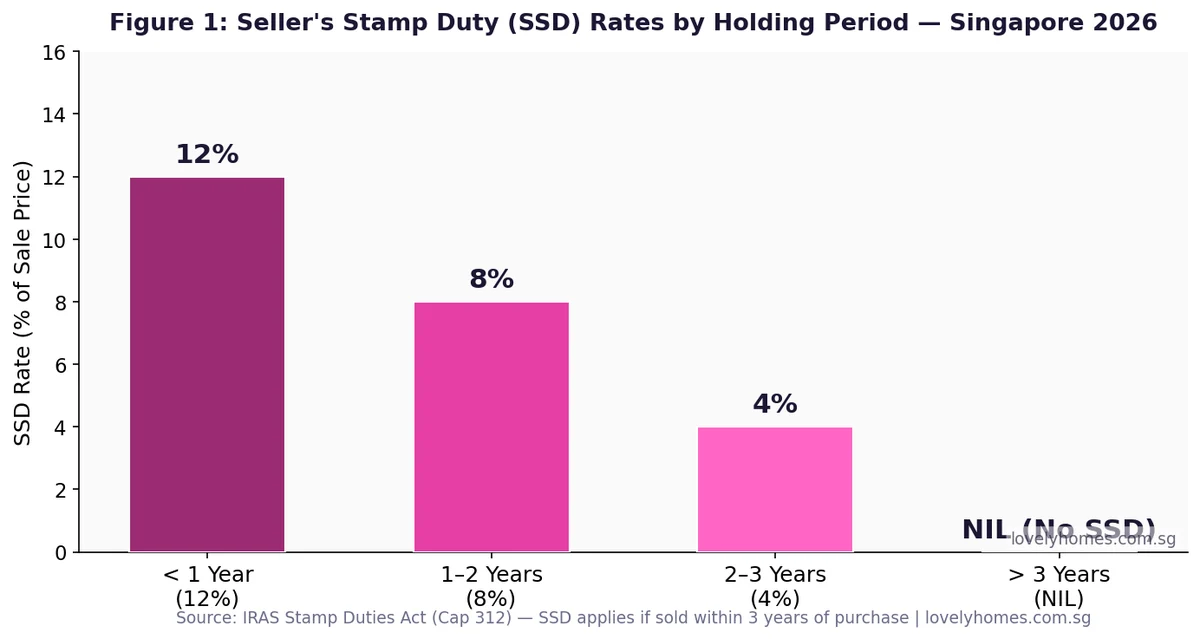
SSD is administered by IRAS under the Stamp Duties Act (Cap 312). It was reimposed in January 2011 and refined in March 2017, when the current three-year, three-tier structure took effect. SSD applies to all residential properties — HDB flats, condominiums, and landed homes alike — sold within three years of purchase.

Seller's Stamp Duty SSD rates by holding period Singapore 2026 — bar chart showing 12% under 1 year, 8% 1 to 2 years, 4% 2 to 3 years, NIL after 3 years
Figure 1: SSD Rates by Holding Period — Singapore 2026. Holding period is measured from the date of purchase to the date of the sale contract (OTP date for private; HDB Resale Application date for HDB). Source: IRAS.
Holding Period SSD Rate Example: Property Sold at S$1,200,000 Who This Affects Most
Less than 1 year 12% S$144,000 Short-term flippers; forced sellers
1 year to 2 years 8% S$96,000 Sellers whose circumstances changed
2 years to 3 years 4% S$48,000 Early investors; job relocation sellers
3 years or more NIL S$0 Most owner-occupiers and long-term investors

SSD is calculated on the higher of the sale price or the market value assessed by IRAS at the time of sale. It is payable by the seller within 14 days of the sale contract date (OTP exercise date for private property, or HDB Resale Application date for HDB transactions). Late payment attracts a penalty of up to four times the unpaid duty.

Practical note for HDB sellers: Because the HDB MOP is five years and SSD applies only within three years, HDB flat sellers who complete their MOP will never be subject to SSD. The SSD window closes at the three-year mark; the MOP does not open until the five-year mark.

Hardship exemptions exist but are rarely granted. IRAS considers genuine financial distress, medical incapacity, or divorce — the applicant must demonstrate that the sale was necessitated by a circumstance beyond their control.

Step 4: CPF Ordinary Account Refund — How Accrued Interest Works

When you use CPF savings to purchase a property, you are borrowing from your own retirement account. To prevent erosion of retirement savings, the CPF Board requires that upon sale, all CPF monies withdrawn for the property are refunded to your CPF OA — including the interest those monies would have earned had they remained in the OA. This “accrued interest” accrues at the prevailing CPF OA interest rate, currently 2.5% per annum (guaranteed floor rate as of 2026).

The refund sequence is: (1) principal CPF withdrawn, (2) accrued interest. Only after this refund do you receive your net cash proceeds. For sellers who purchased many years ago with large CPF drawdowns, the accrued interest component can be substantial.

Illustration: If you drew S$200,000 from CPF OA to purchase a property in January 2019 and sell it in June 2026 (7.4 years), the accrued interest is approximately S$200,000 × 2.5% × 7.4 = S$37,000. Your CPF refund is therefore S$237,000, not S$200,000. This money goes back into your CPF OA and will be available for your next property purchase or for retirement withdrawal at age 55+.

The accrued interest is not a penalty; it is simply the return of the compounded interest your CPF savings would have earned in the OA. Sellers sometimes mistake this for a “profit tax” — it is not. It does, however, reduce your net cash-in-hand on sale, which matters if you need cash for your next purchase’s downpayment.

Summary of Key Seller Obligations

Obligation Administered by When Due Penalty for Default
Register Intent to Sell (HDB) HDB ≥ 7 days before OTP Cannot proceed with sale
Pay SSD (if applicable) IRAS Within 14 days of contract Up to 4× unpaid duty
Repay outstanding HDB loan HDB At legal completion Completion delayed
Refund CPF OA principal + accrued interest CPF Board At legal completion Sale proceeds withheld
Discharge caveat (if private property) SLA At legal completion Title cannot pass
Pay agent commission CEA-licenced agent At legal completion Civil action by agent
Pay conveyancing legal fees Seller’s solicitor At legal completion Files withheld

Step 5: Understanding Your Net Proceeds

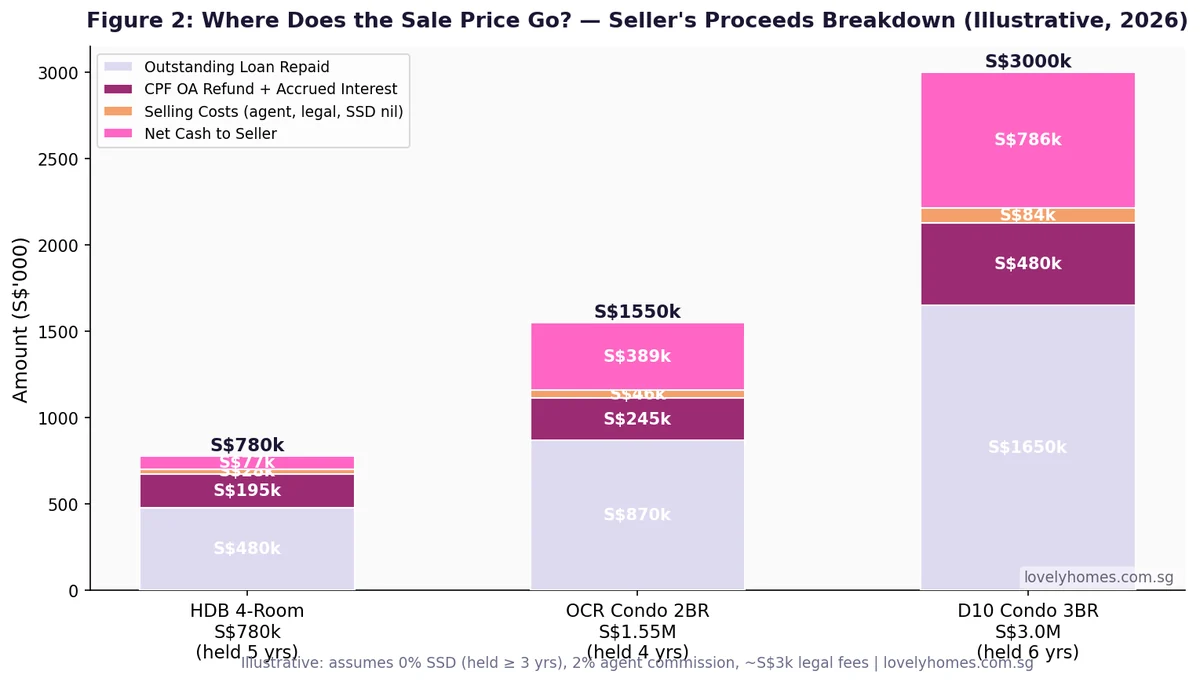
Your net cash proceeds from a property sale are what remains after repaying all outstanding obligations. Most sellers are surprised to find that the headline sale price bears little resemblance to the cash they actually receive, particularly if the property was heavily financed and CPF funds were used extensively.

Seller net proceeds breakdown by property price point HDB 4-Room condo OCR D10 stacked bar chart Singapore 2026
Figure 2: Where Does the Sale Price Go? — Seller’s Proceeds Breakdown at Three Price Points (Illustrative, 2026). Assumes 0% SSD (held ≥ 3 years), 2% agent commission, and ~S$3k legal fees. Actual figures vary by loan balance, CPF drawdown history, and tenure.

The chart above shows three illustrative scenarios for a seller who has held the property for more than three years (SSD = nil). In every case, the outstanding loan repayment is the single largest deduction. The CPF refund (principal plus accrued interest) is the second largest. Net cash to the seller ranges from S$77,000 on an HDB flat to S$786,000 on a prime district condominium — which underscores why understanding your equity position before listing is critical.

Step 6: Selling Costs — Agent, Legal, and Sundry Fees

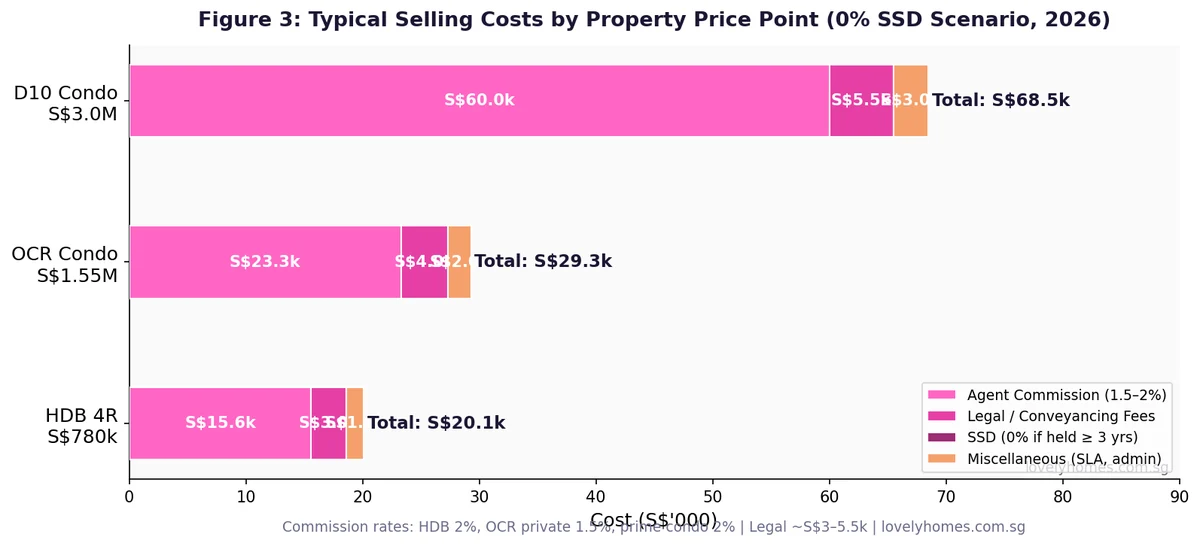
Selling costs breakdown agent commission legal SSD by property price point Singapore 2026 horizontal stacked bar chart
Figure 3: Typical Selling Costs by Property Price Point (0% SSD Scenario, 2026). The largest variable cost is agent commission, which is fully negotiable. SSD = nil for properties held ≥ 3 years.

Selling costs in Singapore are modest by regional standards, but they still add up:

  • Agent commission: The dominant selling cost. Typically 2% of the sale price for HDB (both seller and buyer each pay their own agent). For private property, 1–2% is standard. On a S$3 million condominium at 2%, commission is S$60,000.
  • Conveyancing legal fees: S$2,000–S$4,500 for most standard transactions. Solicitors in Singapore generally follow the Law Society scale but are free to quote fixed fees. Complex transactions (e.g., partial CPF pledging, foreign seller, multiple mortgagees) may cost more.
  • HDB administrative fees: For HDB resale, an administrative fee of S$80 is charged at the Resale Completion Appointment.
  • SLA caveat withdrawal: If you lodged a caveat as buyer (common for private property), the caveat must be withdrawn at sale. Fee: S$64.45 via the SLA e-filing portal.
  • SSD (if applicable): As described above — 0% if held ≥ 3 years, up to 12% for sub-one-year sales.

Worked Example: Mr & Mrs Goh — Selling HDB, Upgrading to Private

Mr and Mrs Goh are Singapore Citizens, married, with a combined monthly income of S$15,000. They purchased a 5-room Bishan HDB flat in January 2019 at S$600,000 via an HDB concessionary loan (80% LTV). They have fulfilled their MOP (January 2024) and wish to sell in June 2026 and purchase an Outside Central Region (OCR) condominium unit.

HDB Sale Proceeds Breakdown (Sale price S$920,000):

Item Amount Notes
Sale price S$920,000 Agreed transacted price
Less: Outstanding HDB loan (S$376,000) Approx balance after 7.5 years at 2.6% p.a.
Less: CPF OA principal refund (S$120,000) Total CPF drawn for downpayment + instalments
Less: CPF accrued interest (S$22,200) ~2.5% p.a. on S$120k × 7.4 years
Less: Agent commission (2%) (S$18,400) Seller pays own agent
Less: Legal / conveyancing fees (S$2,800) Seller’s solicitor
Less: SSD NIL Held > 3 years; MOP confirmed cleared
Net cash to Mr & Mrs Goh S$380,600 Available for next purchase + cash savings

Next Step — OCR Condo Purchase (S$1,350,000): After selling the HDB first, Mr and Mrs Goh own zero residential properties. As Singapore Citizens purchasing their first private property, ABSD is nil. BSD on S$1.35M is S$37,200 (progressive rates up to 4% above S$1M). Bank loan at 75% LTV = S$1,012,500 at 3.0% p.a. over 25 years = S$4,800/month. TDSR: S$4,800 ÷ S$15,000 = 32% — comfortably within the 55% threshold. Cash upfront: S$337,500 (downpayment) + S$37,200 (BSD) = S$374,700 — funded from the S$380,600 net HDB sale proceeds. The transaction is feasible without additional savings.

ABSD Remission for SC Married Couples — The “Buy First, Sell Later” Option

Some upgraders prefer to secure their new private property before selling the HDB to avoid a gap period where they are without a home. Under the current rules (effective April 2023), a Singapore Citizen married couple buying a second residential property must pay ABSD at 20%. However, they may apply to IRAS for an ABSD remission if the HDB flat is sold within six months of the purchase of the private property (for a completed unit) or within six months of the private property’s Temporary Occupation Permit (TOP) date (for an uncompleted unit).

This is a powerful option but carries risk: if the HDB sale falls through or is delayed beyond the six-month window, the ABSD is forfeited. On a S$1.35 million purchase, ABSD at 20% is S$270,000. Couples considering this route must maintain sufficient liquidity to fund the ABSD upfront while awaiting the refund.

What This Means for Property Sellers in 2026

Singapore’s property market in Q1 2026 recorded private residential price growth of 0.9% (URA), with the Outside Central Region leading at 2.2% gains. HDB resale prices remain elevated, with a five-room flat at Henderson Road transacting at S$1.728 million in April 2026 — the highest-ever HDB resale price. In this environment, sellers generally hold the advantage, but the SSD and ABSD frameworks mean that timing your sale matters enormously. Selling within the three-year SSD window destroys value fast; holding beyond three years and structuring your purchase correctly (sell first or use remission carefully) preserves it.

What Might Come Next

The MAS Financial Stability Review (November 2025) flagged property market resilience but noted that elevated interest rates and slowing transaction volumes in the CCR warranted monitoring. Industry analysts suggest that the government is unlikely to ease cooling measures in 2026 absent a material correction in prices — meaning the SSD and ABSD frameworks should be treated as fixed parameters for planning purposes at least through 2027. Any revision to the ABSD remission window (currently six months) would require a formal policy announcement from the Ministry of Finance and IRAS.

Frequently Asked Questions

Can I use CPF to pay agent commission or legal fees when selling?

No. CPF savings cannot be used directly to pay agent commission or legal fees for a property sale. These costs must be paid in cash. CPF can only be used for property-related purposes at the point of purchase — specifically downpayment, monthly instalments, and BSD/ABSD (subject to timing rules). Upon sale, your CPF OA receives the principal refund plus accrued interest, which then becomes available for future property purchases or CPF-approved uses.

Is there any tax on the profit I make from selling my property?

Singapore does not levy a capital gains tax. Profit from the sale of a private residential property or HDB flat is generally not taxable. However, IRAS retains the discretion to treat gains as income if you are deemed to be carrying on a business of property trading — characterised by a pattern of frequent, short-hold purchases and sales with profit intent. Owner-occupiers and genuine long-term investors are almost never subject to this treatment. SSD is the government’s primary disincentive against short-term speculation and is entirely separate from income tax.

What happens to my CPF accrued interest when I sell? Is it lost?

The accrued interest is not lost — it goes back into your CPF OA, where it continues to earn the 2.5% guaranteed rate (with the additional 1% on the first S$60,000 of combined CPF balances). If you are below 55, you can use the CPF OA funds for your next property purchase. If you are 55 or above, the refund first tops up your Retirement Account to the Full Retirement Sum (S$213,000 in 2026), and any excess in the OA can be used for property or withdrawn. The accrued interest does reduce your cash-in-hand at sale, which is why planning your equity position before listing is important.

If I sell my HDB flat, can I buy a private property immediately?

Yes. Once your HDB flat is sold and the legal completion has taken place, you no longer own an HDB flat and your residential property count drops accordingly. Singapore Citizens purchasing their first private property pay no ABSD. Singapore Permanent Residents purchasing their first private property pay 5% ABSD. However, note that CPF proceeds from the HDB sale are returned to your CPF OA and are not accessible as cash on the day of completion — they typically post to your OA within a few working days. Ensure your cash flow for the new property’s downpayment is sourced accordingly.

What is the difference between the Option to Purchase (OTP) and the Sale & Purchase Agreement (S&P)?

The OTP is a contractual right granted by the seller to the buyer, giving the buyer a period (typically 14 days for private property) to decide whether to exercise the option. The option fee (typically 1% of the purchase price) is paid when the OTP is granted. If the buyer exercises the OTP, they pay the exercise fee (typically 4%), bringing the total deposit to 5%. The Sale & Purchase Agreement (S&P) is the binding contract executed upon exercise of the OTP, setting out all terms of the transaction including the completion date (usually 8–12 weeks). For HDB resale, the equivalent process uses a standardised OTP issued by HDB and submitted through the HDB Resale Portal — there is no separate S&P document.

How does SSD apply if I inherited the property?

SSD is based on the original purchase date of the property, not the date of inheritance. If the deceased purchased the property in March 2024 and you inherited it and sell it in May 2026 (approximately 2 years), SSD at 8% would apply. This catches many beneficiaries off guard. The SSD holding period is not reset by the change in ownership via inheritance. Beneficiaries who inherit property that is within the SSD window should factor this into their estate planning and timing decisions. There is no automatic exemption for inherited properties.

Do I need to pay property tax up to the day of completion?

Yes. Property tax is levied on an annual basis by IRAS and is the seller’s liability up to the date of legal completion. Your solicitor will apportion the property tax between seller and buyer in the completion account — the buyer reimburses the seller for property tax from the completion date to the end of the calendar year (or whatever period the annual tax covers). This apportionment is standard practice and will appear in your completion account prepared by your conveyancing lawyer. Owner-occupier rates (0% on the first S$8,000 AV, 4% on the next S$47,000 AV) typically mean property tax is modest for residential sellers.

Related Articles


Disclaimer: This article is for general informational purposes only and does not constitute legal, financial, tax, or property advice. Property transactions in Singapore are governed by a complex and evolving framework of legislation and regulations administered by HDB, URA, IRAS, CPF, MAS, CEA, and SLA, among others. All figures, rates, and timelines cited are accurate as at 1 June 2026 based on publicly available sources, but may change. Always consult a licensed property agent, conveyancing solicitor, and financial adviser before proceeding with any property transaction. For official guidance, refer to: hdb.gov.sg, iras.gov.sg, cpf.gov.sg, ura.gov.sg.

Translate »