Buyer’s Stamp Duty (BSD) Singapore: Complete Guide 2026
📌 Quick Answer: BSD in Singapore (2026)
- What: Buyer’s Stamp Duty (BSD) is a tax levied on all property purchases in Singapore, paid by the buyer. It applies to every transaction — residential and non-residential — regardless of nationality or residency status.
- Who collects it: The Inland Revenue Authority of Singapore (IRAS), under the Stamp Duties Act (Cap. 312).
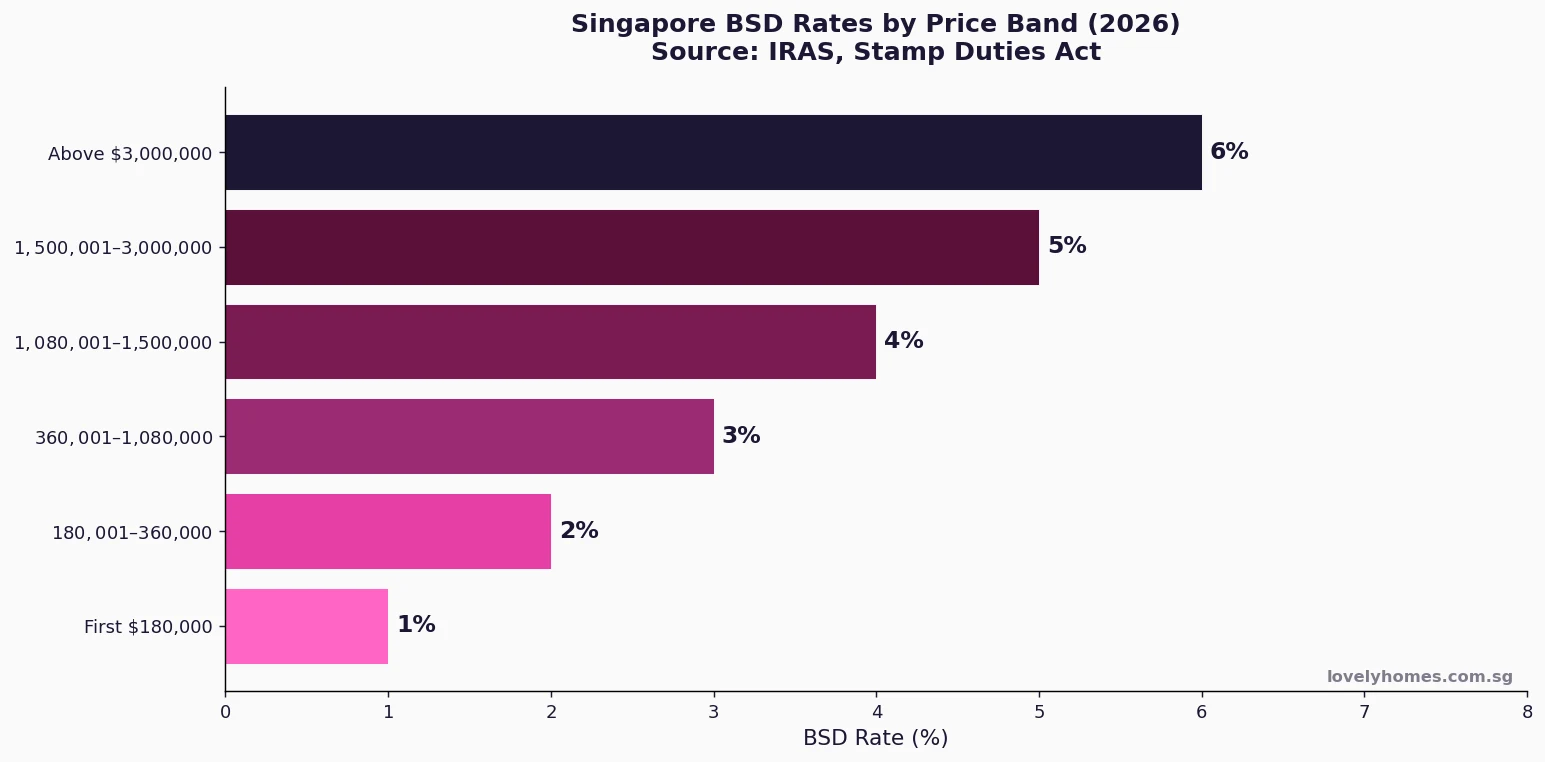
- Rates (2026): 1%–6% on a progressive scale across six price bands, from the first $180,000 to amounts above $3,000,000.
- When to pay: Within 14 days of signing the Option to Purchase (OTP) or Sale & Purchase Agreement (SPA), whichever is earlier.
- Difference from ABSD: BSD is the base stamp duty all buyers pay. ABSD is an additional layer imposed on certain buyers (second properties, PRs, foreigners). Both are separate charges.
- Example: On a $1.5M condo, BSD = $43,800 (effective rate ~2.92%). A Singaporean citizen buying their first property pays only BSD; a Singaporean buying their second pays BSD + 20% ABSD on top.
- Exemptions: Licensed developers purchasing land for immediate development, certain intra-family transfers (subject to conditions), and HDB flats purchased directly from HDB under specific schemes may qualify for remission.
What is Buyer’s Stamp Duty (BSD)?
Buyer’s Stamp Duty — commonly abbreviated as BSD — is a mandatory tax that every property purchaser in Singapore must pay to the government upon acquiring any interest in immovable property. Administered by IRAS under the Stamp Duties Act (Cap. 312), BSD has been a core feature of Singapore’s tax architecture since the modern stamp duty framework was established in the 1960s. It is entirely separate from Additional Buyer’s Stamp Duty (ABSD), which was introduced in December 2011 as a demand-cooling measure and applies only to certain buyer categories.
BSD applies to all property types — private residential condominiums, HDB resale flats, landed houses, shophouses, commercial units, and industrial properties. There is no nationality exemption: Singaporean citizens, Permanent Residents (PRs), foreigners, and companies all pay BSD on every qualifying transaction. What changes across buyer profiles is not BSD itself, but the ABSD layer added on top.
In July 2023, the Ministry of Finance significantly revised BSD rates for higher-value properties. From 15 February 2023, the top marginal BSD rate increased from 4% to 6% for amounts above $3,000,000, with a new 5% band introduced for the $1,500,001–$3,000,000 tranche. These changes were part of a broader effort to maintain progressive taxation and were the most significant BSD revision in over a decade.
BSD Rate Structure 2026: The Six Progressive Bands
As of 15 February 2023 (rates unchanged through 2026), BSD is computed on a sliding-scale basis. The rate does not apply uniformly to the entire purchase price — it applies to each band separately, like income tax brackets. The full six-band schedule is as follows:
| Purchase Price Band | BSD Rate | BSD Payable on Band |
|---|---|---|
| First $180,000 | 1% | Up to $1,800 |
| Next $180,000 ($180,001–$360,000) | 2% | Up to $3,600 |
| Next $720,000 ($360,001–$1,080,000) | 3% | Up to $21,600 |
| Next $420,000 ($1,080,001–$1,500,000) | 4% | Up to $16,800 |
| Next $1,500,000 ($1,500,001–$3,000,000) | 5% | Up to $75,000 |
| Remaining amount (above $3,000,000) | 6% | Unlimited |
For non-residential properties (commercial units, industrial spaces), a separate but similarly progressive scale applies. For the residential rates above to apply, the property must be classified as residential under the Stamp Duties Act. Mixed-use properties are assessed by the predominant use.
The rates effective from 15 February 2023 were set via the Stamp Duties (Amendment) Act 2023. Prior to that date, the top BSD rate was 4%, which applied to all amounts above $1,080,000. The two new bands — the 5% band ($1.5m–$3m) and 6% band (above $3m) — were introduced simultaneously with ABSD hikes for SC second-property buyers (from 17% to 20%) and foreigners (from 30% to 60%), making early 2023 the single most significant episode of property-related tax tightening in Singapore’s post-2013 history.
How to Calculate BSD: Step-by-Step
BSD is computed by applying the relevant rate to each price band in sequence. The formula for the most common residential purchase price ranges is as follows. For a property at purchase price P:
- If P ≤ $180,000: BSD = P × 1%
- If $180,001 ≤ P ≤ $360,000: BSD = $1,800 + (P − $180,000) × 2%
- If $360,001 ≤ P ≤ $1,080,000: BSD = $5,400 + (P − $360,000) × 3%
- If $1,080,001 ≤ P ≤ $1,500,000: BSD = $27,000 + (P − $1,080,000) × 4%
- If $1,500,001 ≤ P ≤ $3,000,000: BSD = $43,800 + (P − $1,500,000) × 5%
- If P > $3,000,000: BSD = $118,800 + (P − $3,000,000) × 6%
IRAS also provides an online BSD Calculator at iras.gov.sg where buyers can compute their exact liability. The calculation is based on the higher of the purchase price or the market value of the property — an important caveat for transactions where a property may be purchased at below-market value (for example, in related-party transfers).
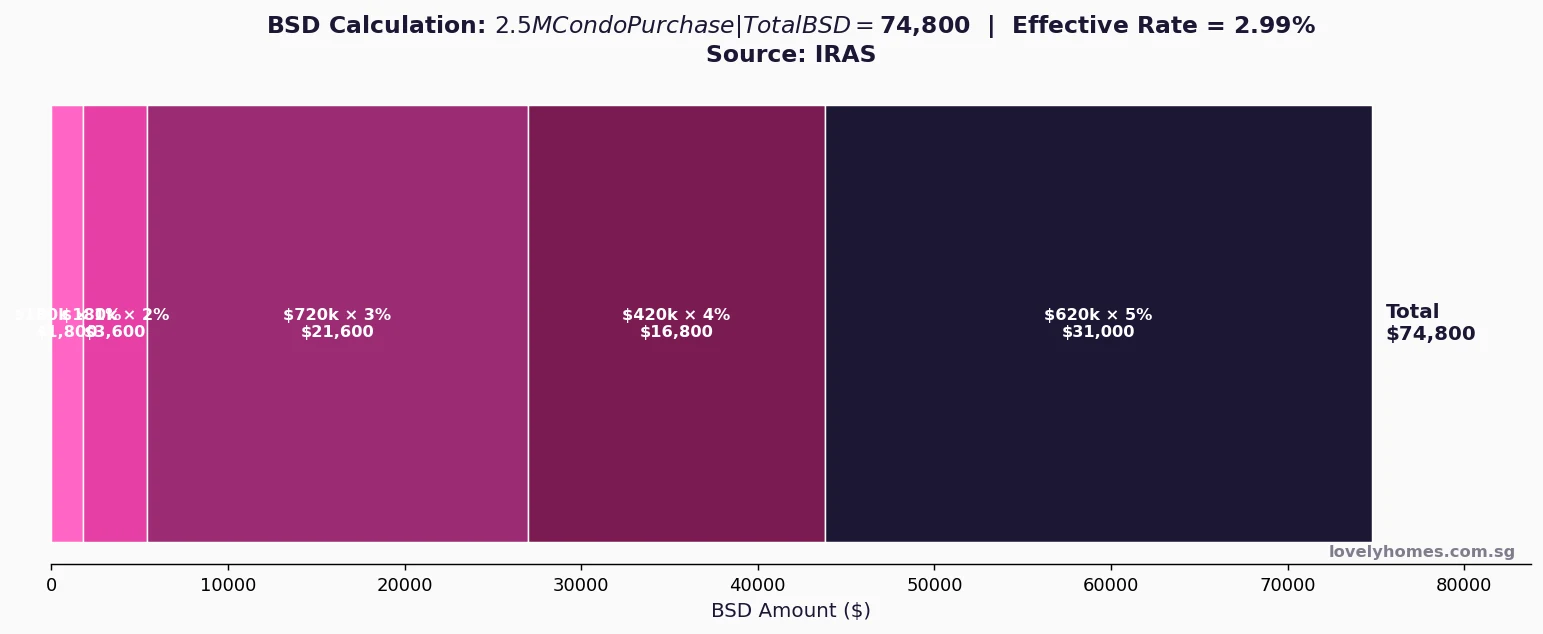
Worked Example: Buying a $2.5M Condo
Let us trace the BSD computation for a Singaporean citizen purchasing a $2,500,000 private condominium as their first property in July 2026.
| Price Band | Amount Taxed | Rate | BSD Due |
|---|---|---|---|
| First $180,000 | $180,000 | 1% | $1,800 |
| $180,001–$360,000 | $180,000 | 2% | $3,600 |
| $360,001–$1,080,000 | $720,000 | 3% | $21,600 |
| $1,080,001–$1,500,000 | $420,000 | 4% | $16,800 |
| $1,500,001–$2,500,000 | $1,000,000 | 5% | $50,000 |
| Total BSD | $2,500,000 | $93,800 |
Effective BSD rate: $93,800 ÷ $2,500,000 = 3.75%.
ABSD payable: $0 (Singaporean citizen buying first property).
Total stamp duty outlay: $93,800.
Had the same buyer been purchasing their second property, ABSD of 20% would apply: $2,500,000 × 20% = $500,000. Combined stamp duty = $93,800 (BSD) + $500,000 (ABSD) = $593,800 — more than six times the BSD-only liability. This gap illustrates why ABSD dominates the conversation for repeat buyers, even though BSD is the foundational charge that cannot be avoided.
BSD vs ABSD: Understanding the Difference
One of the most common points of confusion for property buyers — especially first-timers — is the relationship between BSD and ABSD. They are legally distinct taxes imposed under the same Stamp Duties Act but with different policy objectives.
BSD is a revenue tax — it has existed in some form since Singapore’s colonial era and is designed to generate government revenue from property transactions proportional to the value transacted. It is fiscally efficient and broadly accepted as a transaction cost. ABSD, by contrast, is a corrective tax — introduced in December 2011 when private residential property prices were rising sharply, to moderate investment demand and ensure housing remains broadly affordable. ABSD rates are politically calibrated and have been raised multiple times (in 2013, 2018, 2021, and 2023) to maintain the cooling effect as market conditions changed.
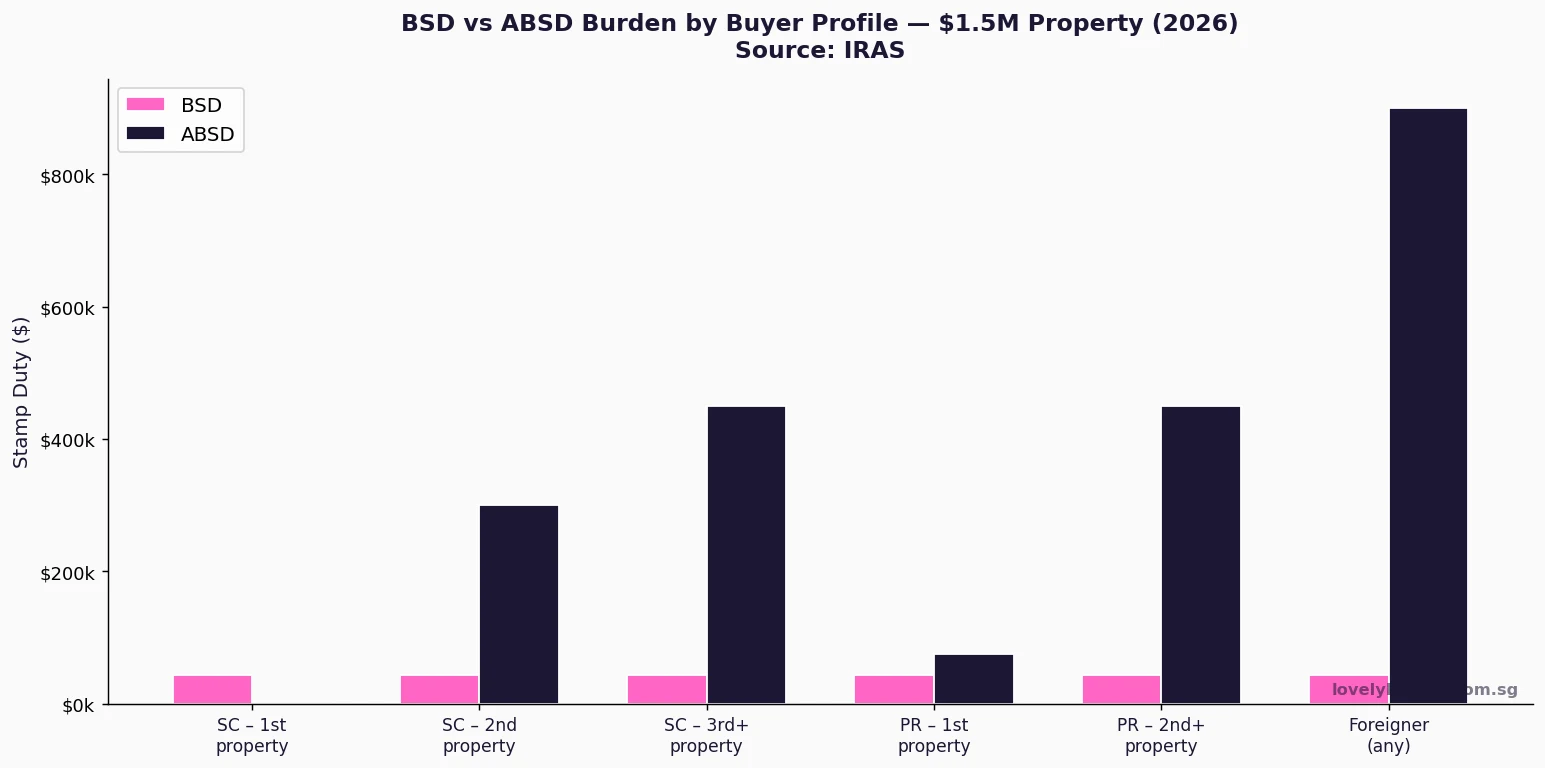
| Buyer Profile | BSD ($1.5M) | ABSD Rate | ABSD ($1.5M) | Total |
|---|---|---|---|---|
| Singapore Citizen — 1st property | $43,800 | 0% | $0 | $43,800 |
| Singapore Citizen — 2nd property | $43,800 | 20% | $300,000 | $343,800 |
| Singapore Citizen — 3rd+ property | $43,800 | 30% | $450,000 | $493,800 |
| Singapore PR — 1st property | $43,800 | 5% | $75,000 | $118,800 |
| Singapore PR — 2nd+ property | $43,800 | 30% | $450,000 | $493,800 |
| Foreigner (any property) | $43,800 | 60% | $900,000 | $943,800 |
| Entity (company) | $43,800 | 65% | $975,000 | $1,018,800 |
BSD Payment: Deadline, Method, and Late Payment Penalty
BSD must be paid within a strict statutory timeframe:
- If the document is signed in Singapore: within 14 days of execution.
- If signed overseas: within 30 days of its receipt in Singapore.
Payment is made through IRAS’s e-Stamping portal (estamping.iras.gov.sg), which allows buyers or their lawyers to assess the duty online and pay via PayNow, GIRO, or cheque. In practice, BSD is almost always handled by the conveyancing solicitor — buyers simply receive a statement showing the computed duty and the corresponding deduction from their CPF savings or cash proceeds at completion.
Late payment carries a penalty of up to 4× the unpaid stamp duty (under Section 46 of the Stamp Duties Act). In practice, IRAS typically charges a tiered penalty: a flat $10 for lateness up to three months, then 10% of the unpaid duty thereafter, escalating further for sustained non-compliance. This penalty regime makes prompt payment by conveyancing solicitors an industry standard — late BSD is extremely rare in normal residential transactions.
BSD on HDB Resale Flats
BSD applies equally to HDB resale flat purchases. The rates are identical to those for private residential property. On a $700,000 four-room HDB resale flat — a typical price in mature estates in 2026 — the BSD computation is: $1,800 + $3,600 + $21,600 + (($700,000 – $360,000) × 3%) = $1,800 + $3,600 + $10,200 = $15,600. The effective rate is 2.23%.
HDB flat purchases directly from HDB (Build-to-Order or resale allocation) are assessed at the HDB selling price or valuation, whichever is higher, in the same way as private transactions. CPF Ordinary Account savings can be used to pay BSD on HDB resale flat purchases, provided the buyer’s CPF balance is sufficient and the flat qualifies under the relevant HDB CPF usage rules. This makes BSD largely invisible to first-time HDB buyers, as the charge is deducted seamlessly from CPF at completion.
BSD on Non-Residential Properties
For commercial, industrial, and other non-residential properties, BSD rates are different (and generally lower than the post-2023 residential rates). As of 2026, the non-residential BSD schedule is:
| Purchase Price Band | BSD Rate |
|---|---|
| First $180,000 | 1% |
| Next $180,000 | 2% |
| Next $640,000 | 3% |
| Remaining amount | 4% |
This is notable because, unlike residential BSD, the non-residential schedule was not changed in February 2023. A $5M commercial shophouse therefore attracts a lower effective BSD rate than a $5M luxury residential apartment. This differential reflects the government’s deliberate policy of not applying the same cooling framework to commercial property — the ABSD regime does not apply to commercial transactions, and even the base BSD is structured to be less onerous for commercial buyers.
BSD Exemptions and Remissions
Several categories of buyers may qualify for BSD remission (a partial or full reduction), as opposed to an exemption (total non-imposition). The distinction matters: remissions are granted after duty is assessed, and the buyer applies for remission via the e-Stamping portal. Key categories include:
- Licensed housing developers: Under the Housing Developers (Control and Licensing) Act, developers purchasing residential land for immediate residential development may apply for BSD remission, typically up to 100%, subject to conditions including a development timeline requirement.
- HDB flat purchases under specific schemes: Certain HDB assistance schemes provide partial BSD relief for first-time buyers in specific income bands — these are administered by HDB and not directly by IRAS.
- Intra-family transfers at below-market value: Where a property is transferred between immediate family members at a consideration below market value, BSD is assessed on the higher market value. A full remission is not available in this scenario; BSD must be paid on the full market value unless the transfer qualifies as a gift (which has its own stamp duty treatment).
- Dissolution of estates: Property passing on death (via will or intestacy) is generally stamp-duty-exempt, though transfers to beneficiaries following estate administration may attract BSD if they constitute a conveyance on sale.
What BSD Means for Your Property Budget
Unlike ABSD — which for a Singaporean first-time buyer is zero — BSD is an unavoidable acquisition cost. It should be factored into every property purchase budget as a non-negotiable line item, similar to conveyancing fees or home insurance. At the price points most common in the Singapore private residential market in 2026 (approximately $1.2M–$2.5M for a typical new-launch or resale condo), BSD ranges from approximately $27,000 to $93,800, representing 2.1%–3.75% of the purchase price.
Unlike conveyancing fees, BSD cannot typically be financed through a bank mortgage — it must be paid in cash or from CPF at the time of stamp duty assessment. Buyers who are CPF-dependent should verify their Ordinary Account balance before committing, as BSD alone can consume a meaningful portion of the CPF balance available for down payment.
BSD is also fully absorbed into the total property cost for the purpose of computing ABSD (where applicable) — i.e., ABSD is calculated on the purchase price, not on the purchase price net of BSD. This means BSD does not reduce your ABSD exposure, and the two taxes compound.
What Might Change: BSD Outlook for 2026–2028
The current BSD rate structure — including the two new bands introduced in February 2023 — was presented by the Ministry of Finance as a durable reform rather than a temporary adjustment. Unlike ABSD rates (which the government has described as calibrated to market conditions and potentially adjustable), BSD is treated as a structural revenue measure. As such, near-term changes to BSD rates appear unlikely based on public statements through mid-2026.
That said, several factors bear watching. First, if private residential transaction volumes continue the moderation observed since mid-2023 (when ABSD hikes sharply reduced foreign and investor demand), there may be political pressure to review the upper BSD bands, which now make luxury residential property in Singapore among the most stamp-duty-intensive jurisdictions in the Asia Pacific. Second, any significant HDB resale price correction — which could stress affordability for upgraders relying on CPF — might prompt targeted BSD concessions for first-time HDB buyers. These remain speculative; as at July 2026, IRAS has signalled no imminent change to the BSD framework.
BSD Frequently Asked Questions
Is BSD different from stamp duty?
In informal usage, “stamp duty” in Singapore often refers to BSD specifically, because BSD is the stamp duty all buyers pay. Technically, stamp duty is the overarching category that includes BSD, ABSD, Seller’s Stamp Duty (SSD), and other instruments. When a conveyancer or property agent says “stamp duty”, they generally mean BSD unless the context involves ABSD or SSD. It is worth asking for clarification if in doubt.
Can I use CPF to pay BSD?
Yes — CPF Ordinary Account savings can be used to pay BSD on both HDB resale flat purchases and private property purchases, subject to the prevailing CPF usage rules. For private residential property, CPF usage for BSD is permitted provided the property is on a leasehold of at least 30 years at the time of purchase and satisfies other CPF Board requirements. The payment is deducted from CPF at completion and handled by your conveyancing solicitor via the CPF e-payment system. You cannot use CPF Medisave or Special Account for BSD.
When exactly must BSD be paid?
The payment deadline for BSD is 14 calendar days from the date of execution of the dutiable document (typically the Sale & Purchase Agreement or the Option to Purchase once exercised) if the document is signed in Singapore, or 30 calendar days from the date the document is received in Singapore if it was signed abroad. In almost all residential transactions, your conveyancing solicitor will handle BSD payment and ensure it is made within the deadline. Buyers are advised to appoint their conveyancing solicitor promptly upon exercising their OTP to avoid any risk of late payment.
Does BSD apply when I inherit a property?
In general, property passing on death — by will, intestacy, or through a trust — is not subject to BSD if it is truly a succession and not a sale. However, where a beneficiary receives a property and later transfers it to another person for consideration (even below market value), BSD applies on the transfer. Estates in the process of administration may encounter BSD on specific legal instruments — the precise treatment depends on the nature of each document. A conveyancing solicitor or estate lawyer with stamp duty expertise should be consulted for complex estate situations.
Is BSD negotiable or can it be split with the seller?
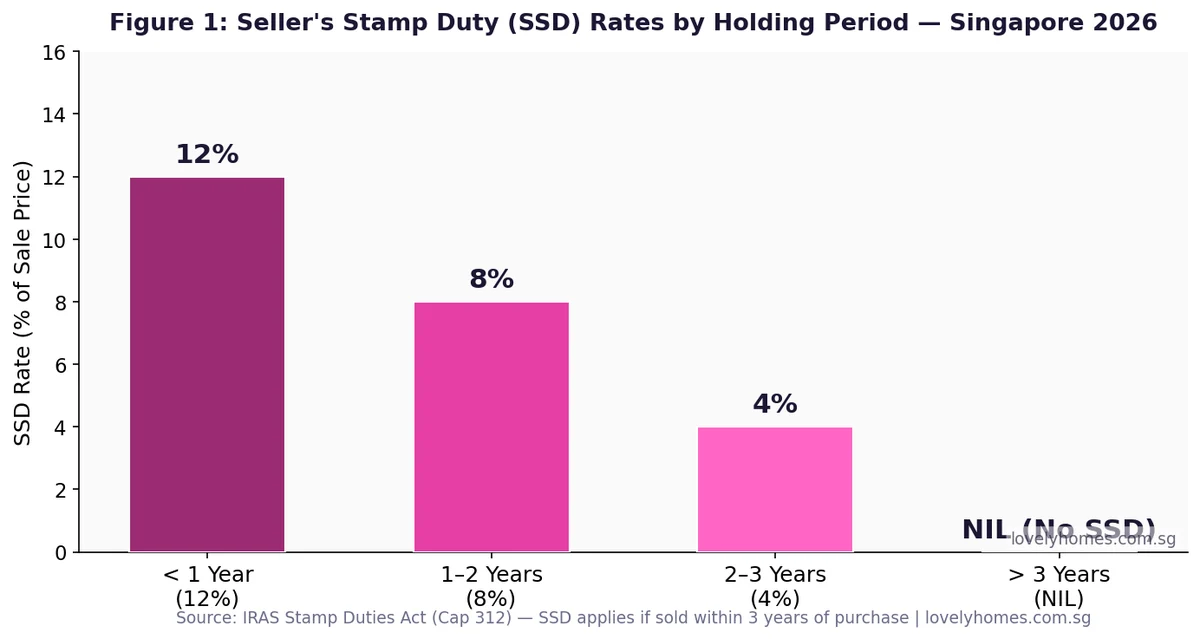
No. BSD is a statutory tax imposed on the buyer and cannot be negotiated away or split with the seller. The seller bears a separate cost — Seller’s Stamp Duty (SSD) — if they are selling within the SSD holding period (currently three years). Some buyers in private treaty negotiations attempt to have the seller absorb part of the BSD through a price reduction, but legally, the obligation to pay BSD rests solely with the buyer. Any arrangement to have the seller “pay BSD” is effectively a price concession, and IRAS will still assess BSD on the contract price or market value, whichever is higher.
Does BSD apply to new launch condos bought directly from developers?
Yes. All purchases of new launch private residential units — including direct sales from developers under the Housing Developers (Control and Licensing) Act — are subject to BSD at the standard residential rates. The BSD is assessed on the agreed purchase price in the Sale & Purchase Agreement. Developers typically inform buyers of the BSD amount payable at the signing of the SPA, and the buyer’s solicitor arranges payment. BSD for new launches follows the same 14-day deadline as resale transactions and can be paid from CPF subject to the usual rules.
How is BSD treated for tax deduction or accounting purposes?
For individual buyers purchasing property for personal occupation, BSD is a capital expense and is not tax-deductible against income tax. For investors and companies purchasing property as an investment or for business use, BSD forms part of the cost of acquisition of the property and is therefore included in the cost base for the purpose of computing gains on a subsequent disposal — though Singapore does not currently impose a capital gains tax on property (other than the SSD mechanism for short holding periods). For companies subject to corporate income tax, BSD may form part of the depreciable cost of the property under specific accounting standards. Professional tax advice should be sought for complex corporate or investment structures.
Related Articles
- ABSD Singapore 2026: Complete Guide to Additional Buyer’s Stamp Duty
- Singapore Seller’s Stamp Duty (SSD) Complete Guide 2026
- TDSR and MSR Singapore 2026: Complete Guide to Loan Eligibility
- CPF for Property in Singapore: How to Use Your Ordinary Account
- Property Decoupling in Singapore 2026: A Complete Guide
- Freehold vs Leasehold Property in Singapore: 2026 Guide
- Home Equity Loan Singapore 2026: How to Unlock Property Value
Disclaimer
This article is intended as general educational information about Buyer’s Stamp Duty in Singapore and does not constitute legal, tax, or financial advice. BSD rates, remission conditions, and administrative procedures are governed by the Stamp Duties Act (Cap. 312) and IRAS guidelines, which may be updated by the relevant authorities. Always verify the current rates and applicable rules at iras.gov.sg or consult a qualified Singapore conveyancing solicitor, tax advisor, or financial planner before making any property purchase decision. LovelyHomes does not warrant the completeness or currency of any figures cited herein.