Singapore Stamp Duty Calculator 2026: BSD and ABSD Explained

Singapore Stamp Duty Calculator 2026: BSD and ABSD Explained

Singapore stamp duty is not a single charge — it is two separate taxes that stack on top of each other depending on who you are and what you already own. The Buyer’s Stamp Duty (BSD) applies to every residential purchase. The Additional Buyer’s Stamp Duty (ABSD) applies on top if you are buying a second property, if you are a Singapore Permanent Resident, or if you are a foreigner. Understanding both — and being able to calculate them accurately before you commit — is the single most important financial step in any Singapore property transaction.

This guide explains the 2026 BSD and ABSD rate schedules in full, shows you how to calculate your stamp duty liability step by step, and works through concrete examples at common price points. All figures reflect the rate schedules currently in force: the 2023 BSD schedule and the 27 April 2023 ABSD rates. For the authoritative source, always verify at iras.gov.sg/taxes/stamp-duty/for-property.

Quick Answer — Singapore Stamp Duty Calculator 2026

  • BSD applies to ALL buyers at the same progressive rate: 1% on first S$180k, 2% next S$180k, 3% next S$640k, 4% next S$500k, 5% next S$1.5M, 6% above S$3M.
  • ABSD stacks on top: Singapore Citizens pay 0% on their first property, 20% on a second, 30% on a third or more.
  • PRs pay 5% ABSD on a first property, 30% on a second, 35% on a third or more.
  • Foreigners pay 60% ABSD on any residential property.
  • For a S$1.5M property, a Singapore Citizen buying their first home pays BSD of S$44,600 — roughly 3% of the price. A foreigner buying the same property pays S$44,600 BSD plus S$900,000 ABSD.
  • BSD is typically payable within 14 days of signing the Option to Purchase (OTP); ABSD within 14 days of signing the Sale & Purchase Agreement, or within 14 days of exercising the OTP.
  • ABSD may be financed by CPF Ordinary Account for Singapore Citizens buying their first or subsequent homes, but BSD can also be paid from CPF OA.
  • Married SC/SPR couples may claim an ABSD remission on a second property if they dispose of the first within 6 months of purchase (or TOP for new launches).
  • Developers are subject to 35% ABSD with a remission available on residential development land if units are sold within the prescribed period.

What Is Buyer’s Stamp Duty (BSD)?

BSD is a tax levied by the Inland Revenue Authority of Singapore (IRAS) on the purchase or acquisition of property — residential and non-residential alike. It is calculated on the higher of the purchase price or the property’s market value. BSD has existed in Singapore since 1929 and was most recently revised upward in February 2023 when the Government added the 5% band (on the portion from S$1.5M to S$3M) and the 6% band (above S$3M) as part of its broader property market management effort.

BSD is non-negotiable: every buyer — Singapore Citizen, PR, foreigner, or entity — pays BSD. The rate schedule is progressive, meaning each increment of purchase price is taxed at its own marginal rate. The total BSD payable grows with the purchase price but as a percentage of price it rises only gradually because the higher rates apply only to the marginal portion above each threshold.
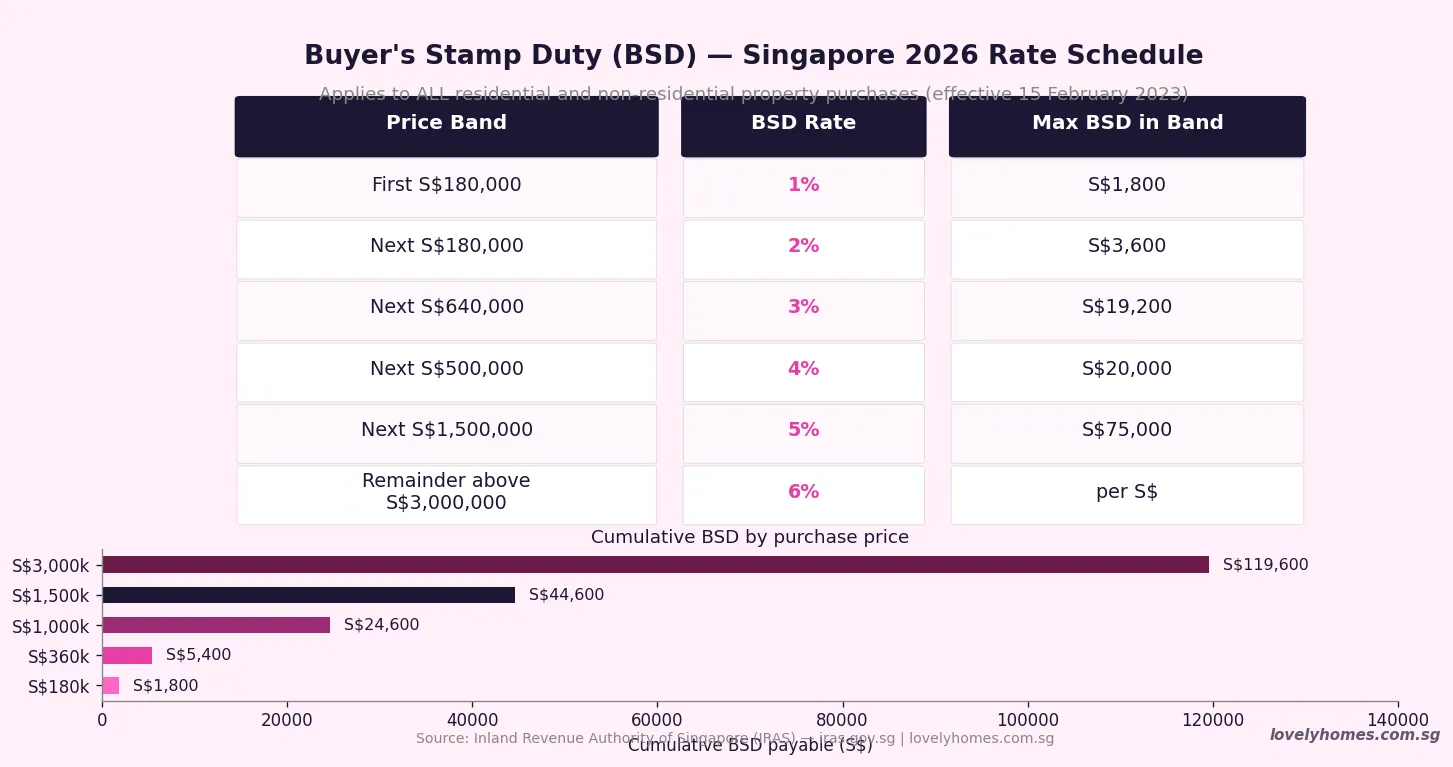
BSD Buyer Stamp Duty rates by price band Singapore 2026
Figure 1: BSD rate schedule by price band (2023 schedule, effective 15 February 2023) and cumulative BSD payable at selected purchase prices. Source: IRAS.

BSD Calculation — Step by Step

To calculate BSD manually, work through each price band in order and tax only the portion that falls within that band:

Price Band Rate Max BSD in Band
First S$180,000 1% S$1,800
Next S$180,000 2% S$3,600
Next S$640,000 3% S$19,200
Next S$500,000 4% S$20,000
Next S$1,500,000 5% S$75,000
Remainder above S$3,000,000 6%

Quick BSD shortcuts: For a S$1,000,000 purchase, BSD = S$1,800 + S$3,600 + S$19,200 + S$15,000 (S$500k × 3%) = S$24,600. For S$1,500,000: S$1,800 + S$3,600 + S$19,200 + S$20,000 = S$44,600. For S$2,000,000: S$44,600 + S$25,000 (S$500k × 5%) = S$69,600.

What Is Additional Buyer’s Stamp Duty (ABSD)?

ABSD is a separate tax introduced by the Government in December 2011, initially to cool a rapidly rising residential property market. It has been raised five times since — most recently and most significantly on 27 April 2023, when ABSD for foreigners doubled from 30% to 60% and rates for Singaporeans and PRs buying additional properties were substantially increased. ABSD is not a progressive tax: it applies at a flat percentage rate to the entire purchase price.

Unlike BSD, ABSD depends on who you are and how many residential properties you already own. “Already own” means at any point in the world — IRAS will ask for a statutory declaration confirming your existing property holdings, including overseas properties for the purpose of determining if you are an SC or PR “first-time” buyer.
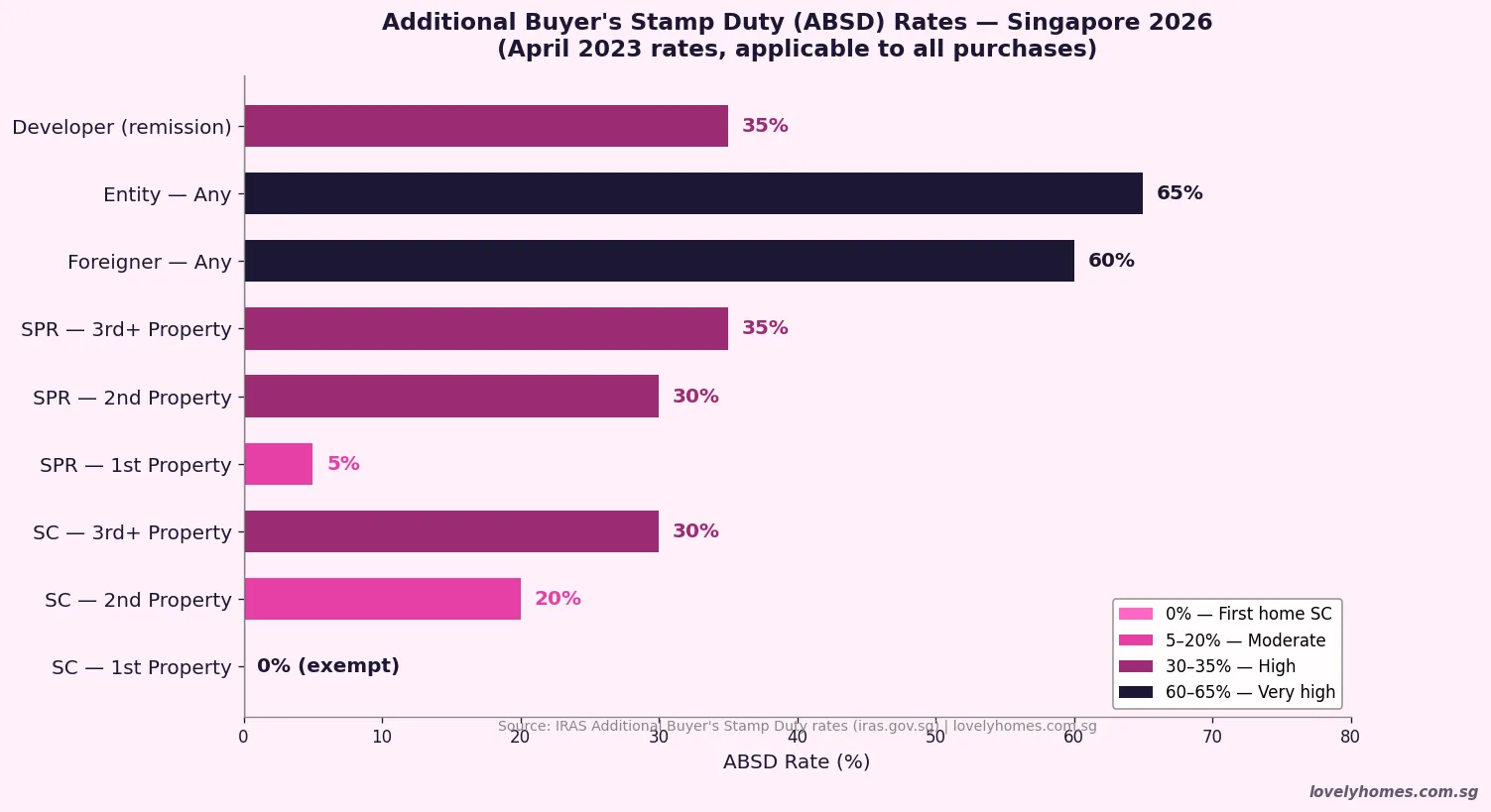
ABSD Additional Buyer Stamp Duty rates by buyer profile Singapore 2026
Figure 2: ABSD rates by buyer profile as at 27 April 2023. Rates are applied to the full purchase price. Source: IRAS.

ABSD by Buyer Profile — The Key Numbers

The table below summarises the complete 2026 ABSD rate schedule:

Buyer Profile 1st Property 2nd Property 3rd+ Property
Singapore Citizen (SC) 0% 20% 30%
Singapore Permanent Resident (SPR) 5% 30% 35%
Foreigner (non-SC, non-SPR) 60% 60% 60%
Entity (company, trust, etc.) 65% 65% 65%

Important nuance — joint purchases: When a property is bought jointly, the higher rate applies to the entire transaction. A Singapore Citizen buying with a foreigner spouse pays 60% ABSD on the whole purchase price — not a blended rate. This is one of the most commonly misunderstood aspects of ABSD and catches many buyers off guard.

Stamp Duty Worked Example — Three Buyer Profiles

The following three worked examples use a purchase price of S$1.5 million — a broadly representative price point for a mass-market private condominium in 2026.

Buyer A: SC purchasing first residential property
BSD: S$1,800 + S$3,600 + S$19,200 + S$20,000 = S$44,600
ABSD: 0% × S$1,500,000 = S$0
Total stamp duty: S$44,600 (about 2.97% of purchase price)

Buyer B: SC already owning one residential property (upgrader)
BSD: S$44,600 (same as Buyer A)
ABSD: 20% × S$1,500,000 = S$300,000
Total stamp duty: S$344,600 (about 22.97% of purchase price)

Buyer C: Foreigner (e.g. EP holder, British national)
BSD: S$44,600
ABSD: 60% × S$1,500,000 = S$900,000
Total stamp duty: S$944,600 (about 62.97% of purchase price)

The difference between Buyer A and Buyer C — on the same S$1.5M property — is S$900,000. This is why foreigners buying Singapore residential property typically need to buy at a meaningful discount to replacement cost for the investment to make financial sense.
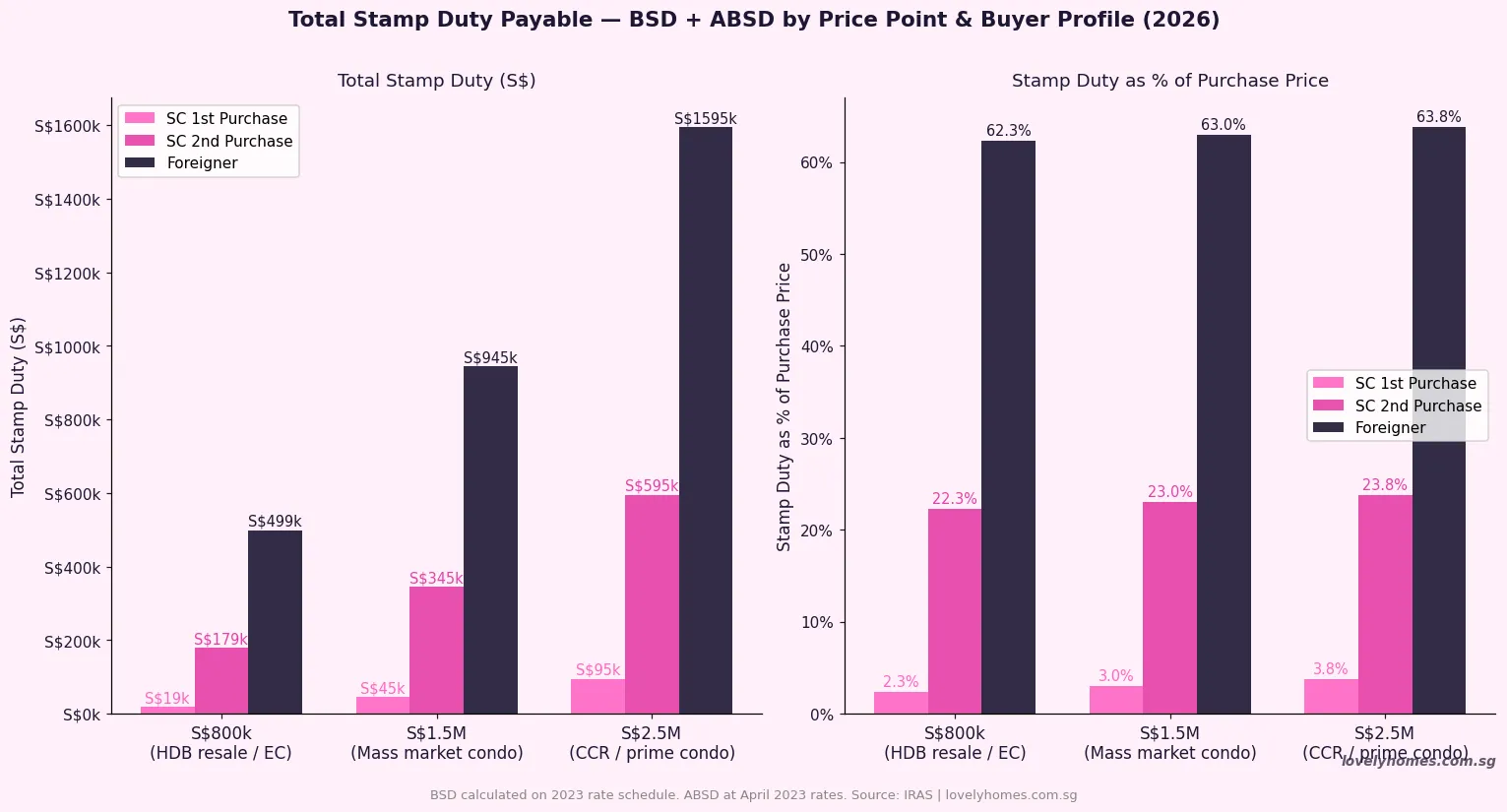
Total stamp duty BSD plus ABSD payable by price point and buyer profile Singapore 2026
Figure 3: Total stamp duty (BSD + ABSD) payable by three buyer profiles at three purchase prices (S$800k, S$1.5M, S$2.5M). Left panel: absolute S$ amounts. Right panel: as a percentage of purchase price. Source: IRAS rates; calculations by LovelyHomes.

ABSD Remissions — When You Can Get It Back (or Avoid It)

ABSD paid upfront may be refunded under specific circumstances via ABSD remissions administered by IRAS. The key remissions applicable in 2026 are:

1. SC/SPR Married Couple Remission on Second Property

A married couple in which at least one spouse is a Singapore Citizen, and who together purchase a residential property as their second property, may apply for an ABSD remission — but only if they sell their first residential property within 6 months of the completion of the second purchase (for a completed property) or within 6 months of the TOP of the new property (for an uncompleted unit). The refund is of the ABSD paid on the second purchase. Both spouses must be co-owners on the second purchase to qualify.

This remission is critically important for HDB flat owners considering upgrading to a private property: you must either sell first (and thus hold no property at exercise) or invoke the remission route by selling within 6 months. Many upgraders prefer to sell first to avoid committing S$300,000–S$600,000 of ABSD upfront.

2. Developer ABSD Remission on Residential Development Land

Property developers purchasing land for residential development are subject to 35% ABSD (as entities pay 65%, but licensed developers on qualifying residential land are subject to 35%) with a remission available if the project is completed and all units are sold within the prescribed period — typically 5 years from the date of acquisition for most sites. Projects that do not sell all units within the deadline will have a clawback of the remitted ABSD with interest, which is why Singapore developers have a strong incentive to price aggressively as the deadline approaches.

3. Remissions for Housing Developers — ABSD (Housing Developers) Regime

Under specific circumstances, including the development of public housing or certain integrated developments, additional remission mechanisms may apply. These are complex and project-specific; the developer’s solicitors will advise on eligibility at the time of tender or acquisition.

When Is Stamp Duty Payable?

BSD must be paid within 14 days of signing the OTP (or the Sale & Purchase Agreement if no OTP was issued). ABSD must be paid within 14 days of exercising the OTP (i.e., signing the Sale & Purchase Agreement) or within 14 days of signing the OTP itself if there is no separate exercise. In practice, your solicitor will advise on the precise deadline for your transaction and manage payment on your behalf.

Failing to pay on time attracts penalties: IRAS charges a late payment penalty of up to 10% of the stamp duty amount, plus interest. The clock starts from the execution date, not from when you receive the demand. Most Singapore conveyancing firms send a reminder before the deadline and arrange payment via e-stamping through the IRAS portal.

Paying Stamp Duty Using CPF

Both BSD and ABSD may be paid from the CPF Ordinary Account (OA), subject to the property being eligible for CPF usage. This is a significant benefit for Singapore Citizens and PRs who have built up CPF savings — it means stamp duty does not need to be funded entirely from cash. However, remember that all CPF withdrawals for property are subject to the CPF accrued interest rule: when the property is eventually sold, the CPF principal plus accrued interest (currently 2.5% per annum) must be refunded to your CPF OA before you receive your cash proceeds. This means ABSD paid from CPF today has a compounding cost over the holding period.

Why Stamp Duty Matters for Your Investment Analysis

Stamp duty is not a trivial transaction cost in Singapore — for a second property buyer, it represents a significant upfront capital commitment that materially affects the economics of property investment. A Singapore Citizen buying a second S$2M condominium pays S$69,600 BSD plus S$400,000 ABSD — a combined S$469,600 that is non-refundable (absent the married-couple remission). To break even on that investment, assuming the property appreciates at 3% per annum and the buyer holds for five years, the property needs to appreciate from S$2M to approximately S$2.37M just to recover the stamp duty — before financing costs, maintenance, property tax, and any renovation expenditure.

This is precisely the calculation that has driven the shift in Singapore’s private property market since 2023: the effective entry cost for second-property investors and foreigners has increased substantially, which explains the divergence between first-home buyer activity (robust, because 0% ABSD for SCs) and investor activity (more selective, because the hurdle rate is significantly higher).

Peer comparison: in Hong Kong, the equivalent additional stamp duty for non-residents was set at 30% in 2023 and has since been partially relaxed. Australia charges a foreign buyers’ stamp duty surcharge of 7%–8% at the state level in most jurisdictions. Singapore’s 60% ABSD for foreigners is among the highest residential property transaction taxes in the world.

What Might Come Next — Stamp Duty Outlook

There is no official signal as of July 2026 that the Government intends to revise ABSD rates downward in the near term. The property market has been absorbing the 2023 rates with transaction volumes moderating but prices remaining broadly resilient — particularly in the Core Central Region (CCR), where wealthier buyers have shown a willingness to pay the premium. The Government has made clear that its priority is affordability for Singapore Citizens purchasing their first home, not the investment segment.

What could prompt a revision? Two scenarios are most discussed: first, a sharp cyclical downturn in Singapore residential prices that threatens economic stability and household wealth; second, a regulatory decision that ABSD is no longer necessary as a cooling measure because the market has structurally rebalanced. Neither condition currently applies. The most that market observers speculate is a modest easing of SPR ABSD rates — from 5% to a lower figure for first purchases — if SPR numbers and integration policy makes this desirable. Any changes would be announced in a Budget Statement or a dedicated MAS/MOF press release with immediate effect.

Summary — Key Stamp Duty Facts for 2026

Item Key Fact
BSD — Who pays All buyers, residential and non-residential
BSD — Administered by Inland Revenue Authority of Singapore (IRAS)
BSD — Current schedule 1%/2%/3%/4%/5%/6% (effective 15 Feb 2023)
ABSD — SC first property 0% (exempt)
ABSD — SC second property 20% of purchase price
ABSD — Foreigner 60% of purchase price (any residential property)
ABSD — Joint purchase higher rate Highest applicable rate governs entire purchase
Payment deadline (BSD & ABSD) 14 days from signing OTP / S&P Agreement
CPF usable for stamp duty? Yes — from CPF OA, subject to CPF accrued interest rule

Frequently Asked Questions

Does BSD apply to HDB flat purchases?

Yes. BSD applies to every property purchase in Singapore, including HDB resale flats and Build-to-Order (BTO) flats when they are first purchased from HDB. BTO buyers pay BSD on the flat purchase price. Because BTO prices are typically well below S$500,000, the BSD amount is modest — usually S$4,800–S$11,800 for a 4-room or 5-room BTO flat. Resale HDB buyers pay BSD on the resale price (or valuation, if higher). BSD can be paid from the CPF Ordinary Account for HDB flat purchases.

Is ABSD payable on industrial or commercial property?

No. ABSD applies only to residential property. Commercial properties (shophouses, office units, industrial units, strata retail) are subject to BSD only. This distinction is significant for investors: buying a commercial property as a second or third purchase does not trigger ABSD, whereas buying a residential property as a second or third purchase does. This is one reason some Singapore property investors look at commercial assets as a way to deploy capital without incurring the second-property ABSD surcharge.

If I own an overseas property, does that count for ABSD?

For Singapore Citizens and PRs, overseas properties generally do not count when determining the ABSD property count. ABSD counts residential properties situated in Singapore. This means a Singaporean who owns a flat in London can still buy their first Singapore property as an “SC first purchase” at 0% ABSD. However, you must still make a statutory declaration of your property holdings, and IRAS’s lawyers will verify the position. The rules are complex and it is advisable to seek professional legal advice if you own overseas property and are unsure of your ABSD status.

Can I use SRS funds to pay stamp duty?

No. The Supplementary Retirement Scheme (SRS) funds can only be used for investments in specific SRS-approved instruments (such as shares, unit trusts, and insurance) and for retirement withdrawals. Property stamp duties — neither BSD nor ABSD — are an eligible use of SRS funds. Only CPF OA funds can be used to pay stamp duty on eligible property purchases.

I am an Employment Pass holder buying my first property in Singapore. What stamp duty do I pay?

An Employment Pass (EP) holder who is not a Singapore Citizen or PR is treated as a foreigner for stamp duty purposes and pays the full 60% ABSD plus BSD on any residential property purchase. There is no ABSD exemption for EP holders, long-term pass holders, or Entrepass holders. The Government introduced specific relaxations for nationals of certain countries under Free Trade Agreements (the USA, nationals of Iceland, Liechtenstein, Norway, and Switzerland under the EUSFTA-equivalent bilateral arrangements), where the ABSD is reduced to 15% — but these are narrow categories. All other foreigners pay 60%.

What happens if I underpay or make an error on my stamp duty calculation?

IRAS takes stamp duty compliance seriously. If you underpay — whether through an honest calculation error or a deliberate understatement of the property count — IRAS can issue an assessment for the unpaid amount plus a penalty of up to 400% of the unpaid duty. Voluntary disclosure (contacting IRAS before they identify the discrepancy) results in reduced penalties. Your conveyancing solicitor is required to verify stamp duty calculations before submission, which is the primary safeguard against errors in practice.

Related Articles

Disclaimer

This article is produced by LovelyHomes for general information purposes only and does not constitute tax, legal, or financial advice. Stamp duty rates and rules are set by the Government of Singapore and administered by the Inland Revenue Authority of Singapore (IRAS). While every effort has been made to ensure accuracy as at the date of publication (2 July 2026), readers should verify all figures directly with IRAS at iras.gov.sg and obtain independent professional advice — from a licensed conveyancing solicitor and/or a tax adviser — before making any property purchase decision.

Singapore Annual Property Tax Guide 2026: Annual Value, IRAS Rates and 2026 Rebate Explained

Singapore Annual Property Tax Guide 2026: Annual Value, IRAS Rates and 2026 Rebate Explained

🏠 Quick Answer: Singapore Property Tax 2026

  • Property tax is administered by IRAS and is charged on all Singapore real estate annually, including HDB flats, private condominiums, landed homes, and commercial premises.
  • Annual Value (AV) is the estimated gross annual rent your property could fetch if rented out unfurnished — this is the tax base, not the market price.
  • Owner-occupiers enjoy subsidised rates starting at 0% on the first S$12,000 AV, rising progressively to 32% above S$140,000 AV.
  • Investment/rental properties face much higher non-owner-occupier (non-OO) rates: 12%–36% progressive, with no zero-rate band.
  • 2026 rebate: 15% off for owner-occupied HDB flats; 10% off (capped at S$500) for owner-occupied private properties.
  • Payment deadline is 31 January of each year. IRAS sends tax bills in December for the following calendar year.
  • You can appeal your AV within 30 days of the date of the Valuation Notice if you believe it is incorrect.
  • HDB flats typically pay S$0–S$300/year as an owner-occupier; a high-floor CCR condo could pay S$2,000–S$10,000+ as a non-owner-occupier.

What Is Property Tax in Singapore?

Property tax is an annual levy imposed by the Inland Revenue Authority of Singapore (IRAS) on all Singapore real estate — from HDB flats and executive condominiums to freehold condominiums, landed houses, and commercial buildings. Unlike stamp duties (one-time taxes payable on purchase), property tax recurs every calendar year for as long as you own the property.

The legal authority is the Property Tax Act (Cap. 254). IRAS administers the tax, determines the Annual Value of every property in Singapore, and issues tax bills each December. The bill covers the entire following calendar year (January to December), with payment due by 31 January.

Unlike income tax, property tax is charged regardless of whether you actually earn rental income from the property. An owner living in his own home pays property tax — just at the preferential owner-occupier rates. An investor who leaves a condo vacant still pays the full non-owner-occupier rate.

Annual Value (AV): The Tax Base

The cornerstone of Singapore’s property tax system is the Annual Value (AV) — not the market price of your property. IRAS defines AV as the estimated gross annual rent a property would command on the open market if let in its unfurnished state, excluding furniture, fittings, and service charges.

IRAS determines AV by referencing actual comparable rental transactions in the same building or nearby comparable developments. For HDB flats, IRAS analyses registered HDB rental contracts; for private condominiums, it cross-references URA’s Realis caveats database. AV is reviewed continuously and can change when rental markets shift significantly.

You can check your property’s current AV free of charge via the IRAS “View Property Summary” digital service at myTax.iras.gov.sg. You will need your Singpass login. For a broader view of comparable rental transactions used to set AVs, the URA Renting Property portal publishes registered rental contract data quarterly.

Typical AV ranges for 2026 (illustrative, IRAS-assessed):

Property Type Typical AV Range (S$ p.a.) Owner-OO Tax Non-OO Tax
HDB 2-room flat $6,600 – $7,800 $0 – $0 $792 – $936
HDB 3-room flat $8,400 – $9,600 $0 – $0 $1,008 – $1,152
HDB 4-room flat $9,600 – $11,400 $0 $1,152 – $1,368
HDB 5-room flat $12,000 – $14,400 $0 – $96 $1,440 – $1,728
1BR condo (OCR) $18,000 – $22,000 $240 – $560 $2,160 – $2,640
2BR condo (OCR) $24,000 – $32,000 $800 – $1,440 $2,880 – $3,840
2BR condo (CCR) $36,000 – $52,000 $2,000 – $4,440 $4,320 – $6,240
Landed terrace $60,000 – $90,000 $5,800 – $11,600 $11,040 – $19,440
Good Class Bungalow $140,000 – $300,000+ $36,800+ $50,400+
Singapore property tax effective rate comparison owner-occupier vs investment 2026
Figure 1: Effective property tax rate at various Annual Value levels — owner-occupier (pink) vs investment property (navy). At AV $30,000 (typical OCR 2BR condo), an owner-occupier pays an effective rate of ~2.7% while an investor pays 12%. Source: IRAS, LovelyHomes analysis.

The Two Property Tax Rate Schedules

Owner-Occupier (OO) Rates — Effective 1 January 2025

If you live in the property as your principal place of residence, you qualify for the owner-occupier rate, the most favourable schedule. You may only have one owner-occupier property at a time. To claim the OO rate on your private property, you must notify IRAS and you will lose the OO concession for any other property you own.

Annual Value Band (S$) Marginal Rate Tax on Band Cumulative Tax
First $12,000 0% $0 $0
Next $28,000 ($12,001–$40,000) 4% $1,120 $1,120
Next $10,000 ($40,001–$50,000) 6% $600 $1,720
Next $25,000 ($50,001–$75,000) 10% $2,500 $4,220
Next $10,000 ($75,001–$85,000) 14% $1,400 $5,620
Next $15,000 ($85,001–$100,000) 20% $3,000 $8,620
Next $40,000 ($100,001–$140,000) 26% $10,400 $19,020
Above $140,000 32% Progressive $19,020+

For most Singaporeans in HDB flats, AV falls below S$14,400. Owners of a 4-room flat with AV ~S$10,500 pay zero property tax under the owner-occupier schedule.

Non-Owner-Occupier (Non-OO) Residential Rates — Effective 1 January 2025

If you own a residential property that you do not live in — whether rented out, left vacant, or held as a second home — you pay the non-owner-occupier rate. This applies to all Buy-to-Let investors, owners of multiple private properties, and HDB flat owners who have rented out their entire flat.

Annual Value Band (S$) Marginal Rate Tax on Band Cumulative Tax
First $30,000 12% $3,600 $3,600
Next $15,000 ($30,001–$45,000) 20% $3,000 $6,600
Next $15,000 ($45,001–$60,000) 28% $4,200 $10,800
Above $60,000 36% Progressive $10,800+

Non-Residential Property Rates

Commercial properties, industrial units, offices, and shophouses are taxed at a flat 10% of AV regardless of owner-occupancy status. There is no progressive schedule for non-residential properties.

Annual property tax payable by Singapore property type HDB condo landed 2026
Figure 2: Annual property tax payable in S$ by property type and occupancy status (2026). HDB owner-occupiers pay S$0–S$100; a CCR condo investor with AV $44,000 pays S$6,600/year. Source: IRAS rates, LovelyHomes calculations.

The 2026 Property Tax Rebate

As part of the Government’s cost-of-living support measures, IRAS is granting a one-off property tax rebate for 2026:

  • Owner-occupied HDB flats: 15% rebate on the property tax payable, automatically credited against the bill.
  • Owner-occupied private residential properties: 10% rebate, capped at S$500 per property.

The rebate is applied automatically — you do not need to apply. It appears as a credit on your December 2025 property tax bill (covering calendar year 2026). For an HDB 4-room flat owner who would otherwise pay S$0, the rebate has no dollar impact. For a private condo owner paying S$3,000 in property tax, the rebate saves S$300 (10%), bringing the bill to S$2,700.

Singapore property tax 2026 rebate HDB private and rate history chart
Figure 3: (Left) 2026 property tax rebate savings by property type — HDB owners save up to S$45 at 15%; private property owners save up to S$500 at 10%. (Right) Top marginal rate trajectory 2013–2026 — owner-occupier top rate climbed from 6% to 32% between 2022 and 2025; non-OO from 10% to 36%. Source: IRAS, Singapore Budget.

Rate Progression History: How We Got Here

Singapore’s property tax rates have risen sharply since 2022 as the government sought to moderate a surging residential market and reduce speculative demand. The changes came in three stages:

  • 2013: Owner-occupier top rate was 6%; non-OO was 10% flat.
  • February 2022 Budget: Announced major rate hikes effective 1 January 2023 — OO top bracket up to 20%, non-OO up to 27%.
  • February 2023 Budget: Second round of increases effective 1 January 2024 — OO top rate up to 24%, non-OO up to 34%.
  • February 2024 Budget: Final tranche effective 1 January 2025 — OO top rate reaches 32%, non-OO reaches 36%.

These increases were explicitly framed by the Ministry of Finance as wealth redistribution measures: those who own expensive properties — particularly investors holding multiple units — should contribute more to Singapore’s fiscal coffers. Most HDB owner-occupiers were deliberately shielded by the zero-rate band on the first S$12,000 AV.

Worked Example: Property Tax Across Three Buyer Profiles

Case Study: The Chens — Three Properties, Three Tax Bills

Property A — HDB 4-room flat, Tampines (Owner-Occupied)
AV: S$10,800. Tax: 0% × S$10,800 = S$0. After 15% HDB rebate: still S$0. Property tax is not a meaningful cost for HDB owner-occupiers in 2026.

Property B — 2-bedroom condo, Pasir Ris OCR (Rented out at S$2,600/month)
AV: Approximately S$31,200 (IRAS uses comparable rental of S$2,600/mth × 12 = S$31,200).
Non-OO tax: 12% × S$30,000 + 20% × S$1,200 = S$3,600 + S$240 = S$3,840/year.
Effective rate: 12.3% of AV. Annual rental income: S$31,200. Tax as % of gross rent: 12.3%.

Property C — 3-bedroom condo, Orchard CCR (Owner-Occupied, not rented)
AV: S$78,000 (comparable CCR 3BR rental ~S$6,500/mth).
OO tax: S$0 × S$12k + 4% × S$28k + 6% × S$10k + 10% × S$25k + 14% × S$3k
= S$0 + S$1,120 + S$600 + S$2,500 + S$420 = S$4,640/year.
After 10% private rebate (capped S$500): S$4,640 − S$464 = S$4,176.
If not owner-occupied: 12% × S$30k + 20% × S$15k + 28% × S$15k + 36% × S$18k = S$3,600 + S$3,000 + S$4,200 + S$6,480 = S$17,280/year — a S$13,104 annual difference, underscoring the significant benefit of the owner-occupier status.

How to Check, Appeal, and Pay Your Property Tax

Checking your AV: Log in to myTax.iras.gov.sg with Singpass and navigate to “View Property Summary”. This shows your current AV, the tax payable, and the last AV revision date. The service is free.

Appealing your AV: If you believe your AV is too high, you may file an objection with IRAS within 30 days of the Valuation Notice date. Submit evidence of comparable rentals (signed tenancy agreements for similar units in the same block or nearby) via the IRAS Object to Annual Value digital service. IRAS will review and notify you of its decision. If still dissatisfied, you may appeal to the Valuation Review Board (VRB) — an independent tribunal — within 30 days of IRAS’s written decision.

Paying your bill: Payment is due by 31 January each year. IRAS offers GIRO (monthly GIRO instalments spread across the year), PayNow, AXS, SAM, internet banking, and cheque. Paying by GIRO avoids the lump-sum January payment. Late payment attracts a 5% penalty on the unpaid amount, plus additional 1% per month thereafter.

What Property Tax Means for Investors and Landlords

For Buy-to-Let investors, property tax is a deductible expense against rental income for income tax purposes. An investor owning a condo earning S$36,000/year in rent and paying S$6,600 in property tax can deduct the S$6,600 against the S$36,000 gross rental income before computing individual income tax liability, alongside other allowable expenses (mortgage interest, maintenance fees, repairs, and agent commission).

However, the sharp non-OO rate increases since 2023 have meaningfully compressed net rental yields. An OCR condo with AV S$28,000 generating S$28,000 gross rent now pays S$3,360 property tax (non-OO) — that’s 12% of gross rent consumed immediately, before mortgage, maintenance, and vacancy. Gross yields of 4–5% compress further once property tax is factored in.

International comparison: Singapore’s property tax regime is more aggressive than Hong Kong’s (which charges a flat 15% on net rental income) but less heavy than the UK’s (where stamp duty surcharges and income tax rates can exceed 50% of rental income for higher-rate taxpayers). The ABSD and high non-OO property tax together signal that Singapore intends to keep the residential market primarily owner-occupier.

What Might Come Next

The government has signalled that the 2025 rates are the “final tranche” of the three-stage increase announced in 2022. No further rate hikes are publicly planned as at June 2026. However, Annual Values are reviewed continuously — if rental markets soften materially (as they did slightly in early 2026 with URA’s private rental index dipping -1.2% QoQ in Q1 2026), IRAS may lower AVs, which would reduce tax bills. Conversely, if rents rise, AVs follow.

The one-off 2026 rebate for HDB and private owner-occupiers is not guaranteed to recur in 2027 — it was explicitly framed as a cost-of-living support measure tied to the Singapore Budget. Owners should plan their finances on the full pre-rebate rate as a conservative baseline.

Frequently Asked Questions

If I live in my HDB flat, do I really pay zero property tax?

Yes, in most cases. HDB flats have Annual Values between S$6,600 (2-room) and S$14,400 (5-room executive). The owner-occupier rate is 0% on the first S$12,000 of AV. A 5-room flat with AV S$13,200 attracts 4% on S$1,200 = just S$48/year. After the 15% HDB rebate in 2026, the bill reduces to approximately S$41. For a standard 4-room flat with AV S$10,500, the tax is genuinely S$0.

I own two properties — can I get the owner-occupier rate on both?

No. The owner-occupier rate may only be applied to one property at a time — the one you actually reside in as your principal place of residence. Your second property will be taxed at the non-owner-occupier rate regardless of whether it is rented out or left vacant. You should notify IRAS which property is your principal residence via the “Apply for Owner-Occupier Tax Rates” service at myTax.iras.gov.sg.

How is Annual Value determined for a brand-new development with no rental history?

For newly completed developments, IRAS references rental transactions from comparable properties in the same area. If the building itself has no rental history, IRAS looks at similar-size units in nearby developments of comparable age, location, and facilities. The AV is typically set conservatively for the first year and revised once actual rental data is available. Developers of new launches do not pay property tax during construction; the tax liability begins from the date the Temporary Occupation Permit (TOP) is issued.

My tenant is paying rent. Can I deduct the property tax from my rental income for income tax purposes?

Yes. Property tax paid on a rental property is a deductible expense under Section 14 of the Income Tax Act. You deduct the actual property tax paid during the year from your gross rental income when computing your net rental income assessable for personal income tax. You may also deduct mortgage interest (on the portion attributable to the rental property), maintenance and management fees, fire insurance premiums, and cost of repairs — but not capital improvements. Keep IRAS payment receipts as documentation.

I have just sold my property mid-year — do I still owe property tax for the full year?

Property tax is a liability of the owner at the start of each calendar year (1 January). If you sell mid-year, the buyer and seller conventionally apportion the property tax on a pro-rata daily basis as part of the completion accounts, managed by the conveyancing lawyers. IRAS does not issue a partial-year bill — the annual bill remains in the seller’s name until the property is transferred. After completion, IRAS updates the ownership record and future bills go to the buyer. The apportionment in the completion accounts is a private contractual matter between buyer and seller.

Does ABSD or SSD affect my property tax?

No. ABSD (Additional Buyer’s Stamp Duty) and SSD (Seller’s Stamp Duty) are one-time transactional taxes applied at purchase or sale. Property tax is a separate recurring annual obligation based on the Annual Value of the property. ABSD and SSD do not count as property tax, and the payment of one does not affect the other. However, owning multiple properties increases your aggregate property tax burden since each additional property (typically non-owner-occupied) attracts the higher non-OO rate of 12%–36%.

What happens if I miss the 31 January property tax deadline?

IRAS imposes an immediate 5% late payment penalty on the unpaid amount. If the tax remains unpaid after the penalty notice, an additional 1% per month is charged. Persistent non-payment can lead to IRAS registering a charge on your property title, garnishing your bank account, or taking legal action. If you anticipate difficulty paying, contact IRAS before the due date to arrange an instalment plan — IRAS is generally flexible with genuine hardship cases, especially if you contact them proactively before the deadline.

Related Articles

Disclaimer

This article is for general informational purposes only and does not constitute tax, legal, or financial advice. Property tax rates, Annual Values, rebate arrangements, and IRAS administrative procedures are subject to change by the Singapore government at any time. Readers should verify current rates directly with the IRAS Property Tax portal and consult a licensed tax advisor or property lawyer for guidance specific to their circumstances. IRAS may be contacted at 1800-356-8300 (toll-free) or via the Ask Jamie chatbot at myTax.iras.gov.sg.

Rental Yield Singapore 2026: Complete Guide to Gross, Net and Location-Adjusted Yields

Rental Yield Singapore 2026: Complete Guide to Gross, Net and Location-Adjusted Yields

Understanding gross yield, net yield and leveraged returns is essential before committing capital to any Singapore investment property. This guide breaks down the numbers honestly.

Quick Answer

  • Gross rental yield in Singapore ranges from about 2.0% (landed) to 4.2% (HDB 3-room OCR) as of Q1 2026.
  • Net yield — after property tax, maintenance, agent fees and vacancy — is typically 0.9–1.4 percentage points lower than gross.
  • OCR condos (Jurong, Bukit Batok, Tampines, Sengkang) generally offer the best risk-adjusted net yields at 1.9–2.6% for condominiums.
  • HDB flats deliver the highest gross yields but come with restrictions: only Singapore Citizens and Permanent Residents may own them as investment vehicles through the resale market.
  • Leveraged net yields (30% equity down on a condo) can reach 7–10% in the early years — but this figure omits loan interest costs, which must be modelled separately.
  • The break-even period (years to recover purchase price via rent alone) ranges from ~38 years for an HDB flat to over 90 years for a landed property — reinforcing that rental income complements but does not drive Singapore property returns.
  • The Total Debt Servicing Ratio (TDSR) caps mortgage obligations at 55% of gross monthly income; rental income from the property counts only at a 30% haircut in TDSR calculations.

What Is Rental Yield and Why Does It Matter?

Rental yield is the annual rental income expressed as a percentage of the property’s purchase price or market value. It is the primary metric Singapore investors use to compare the income-generating efficiency of different asset classes — condominiums, HDB resale flats, commercial shophouses and industrial units — against each other and against fixed-income alternatives such as Singapore Savings Bonds (currently ~2.8% p.a.) or the CPF Ordinary Account rate (2.5%).

The Urban Redevelopment Authority (URA) publishes quarterly rental indices for private residential properties, and the Housing and Development Board (HDB) tracks the HDB Rental Index — both of which feed into the rental yield calculation. As of Q1 2026, private residential rents are broadly stable after a post-pandemic surge that saw CCR rents rise over 45% between 2021 and 2023. The correction phase has softened yields slightly from their 2022 peaks, but the OCR and RCR remain attractive relative to interest rates.

Gross Rental Yield by Property Type

Gross rental yield uses contract rent (what the tenant actually pays) divided by the property’s transacted or current market price. It ignores all costs on the landlord’s side.

Gross rental yield by property type Singapore 2026 horizontal bar chart
Figure 1: Indicative gross rental yield by property type — Singapore Q1 2026. Source: URA rental caveats; SingStat.

Key observations from the data:

  • HDB 3-room OCR flats lead at ~4.2% gross, because median transaction prices remain moderate (S$450k–S$580k for non-mature estates) while monthly rents of S$2,200–S$2,500 remain robust, driven by PRs and upgraders who cannot yet buy a condo.
  • OCR 1BR condominiums (≤500 sq ft) typically achieve 3.3–3.7%, with median transacted prices of S$800k–S$1.05M and rents of S$2,800–S$3,200/month.
  • CCR 2BR units in Districts 9, 10, 11 deliver gross yields of only 2.2–2.6%, reflecting premium transaction prices of S$2.5M–S$3.5M against rents that have softened from 2022 peaks as expat headcount stabilises.

Net Rental Yield: What You Actually Pocket

Net yield strips out all landlord-side costs: property tax (levied by IRAS at 10–20% of Annual Value for non-owner-occupied residential property since 1 January 2023), maintenance and sinking fund, property management or agent fees (one month’s rent per tenancy for a 12-month lease, amortised annually), and a vacancy allowance of approximately 4–6% for the typical between-tenancy gap.

Gross vs net rental yield comparison table Singapore 2026
Figure 2: Gross yield vs net yield and implied break-even period — Singapore Q1 2026.

The deduction gap between gross and net yield widens as property value rises, because Annual Value assessments by IRAS scale with rental evidence in the district, while absolute maintenance costs rise more slowly. A Sentosa Cove villa carrying S$180,000 in annual gross rent might have an Annual Value of S$150,000, generating a property-tax bill of ~S$22,500 at the 15% non-owner-occupied tier — a disproportionate cost for a S$12M asset yielding only 1.5% gross.

Location-Adjusted Yields: OCR vs RCR vs CCR

Singapore’s three market regions — Outside Central Region (OCR), Rest of Central Region (RCR) and Core Central Region (CCR) — display structurally different yield profiles driven by tenant demographics, supply-demand dynamics and capital value trajectories.

Region Typical Tenant Avg Gross Yield (2BR) Avg Net Yield (2BR) Vacancy Risk
OCR PRs, young professionals, upgraders 3.0–3.5% 1.9–2.5% Low–Moderate
RCR Mid-tier expats, dual-income households 2.7–3.1% 1.7–2.2% Moderate
CCR Senior expats, C-suite, institutional 2.2–2.6% 1.3–1.8% Moderate–High

OCR condominiums have historically offered the best combination of rental stability and yield depth for individual investors. Districts 19 (Serangoon, Hougang), 22 (Jurong West), 23 (Bukit Batok, Hillview) and 27 (Yishun, Sembawang) consistently rank among the top-yielding non-landed private residential submarkets.

Worked Example: 2BR OCR Condo, S$1.1M

Worked example net rental yield 2BR OCR condo S$1.1M Singapore 2026
Figure 3: Worked example — 2BR OCR condo purchased at S$1.1M, monthly rent S$3,200 (Jurong/Bukit Batok area).

Worked Example: The Tan Family’s Investment Property

Mr and Mrs Tan — both Singapore Citizens, owning one HDB flat — purchase a second property, a 2BR OCR condo at S$1,100,000 in Bukit Batok, for investment. This is their second residential property, triggering a 20% ABSD charge of S$220,000 payable within 14 days of the option being exercised. They plan to rent it out immediately.

  • Purchase price: S$1,100,000
  • BSD: S$30,600 (1% on S$180k + 2% on S$180k + 3% on S$640k + 4% on S$100k)
  • ABSD (SC 2nd property, 20%): S$220,000
  • Total acquisition cost: S$1,350,600
  • Monthly rent: S$3,200 | Annual gross rent: S$38,400
  • Annual deductions: property tax ~S$3,100 + maintenance ~S$2,400 + agent fee (amortised) ~S$1,600 + vacancy allowance ~S$1,920 + repairs/insurance ~S$1,200 = S$10,220
  • Annual net rental income: S$28,180
  • Gross yield on purchase price: 3.49%
  • Net yield on purchase price: 2.56%
  • Net yield on total acquisition cost (incl. ABSD + BSD): 2.09%

The ABSD drag is significant: when measured against total acquisition cost including ABSD, the net yield falls to 2.09% — well below the current Singapore Savings Bond rate of ~2.8%. This is the economic reality of owning a second residential property in Singapore. The investment case depends on capital appreciation — historically strong — rather than rental income alone.

HDB Rental Yield: The Special Case

HDB flats cannot be purchased as direct investments by most buyers: you must intend to occupy the flat, and only after the 5-year Minimum Occupation Period (MOP) — or 10 years for Plus/Prime classification flats — may you rent out the entire unit. That said, after MOP, many households do move to a private property and rent out the HDB flat, effectively converting it to an income asset.

Gross yields on HDB resale flats in non-mature estates (Punggol, Sengkang, Sembawang, Yishun) tend to be the highest in Singapore’s residential market at 3.8–4.5%, because resale prices have moderated while rents remain firm. The key restriction is that the tenant must also be a Singapore Citizen, PR, or hold a valid Employment Pass, Work Permit or Student Pass — and the flat cannot be sublet to more than 6 occupants without HDB approval.

Leveraged Yield: Handle With Care

When financed with a bank loan (maximum LTV 75% for a first private property; 45% for a second property under existing MAS guidelines), the return on equity deployed can look dramatically higher. For the Tan family’s example above: equity deployed of S$330,000 (30% downpayment) + S$220,000 ABSD + S$30,600 BSD = S$580,600 total cash outflow. Against an annual net rent of S$28,180, the leveraged yield on cash deployed is ~4.8% — better, but the loan interest (at current SORA-pegged rates of roughly 3.6–4.0% effective) must be deducted before any true profit is made. At 75% LTV on S$1.1M = S$825,000 loan at 3.8% for 25 years, annual interest in year 1 is approximately S$31,350 — which exceeds the annual net rent. The property is cash-flow negative until rents rise or the loan is substantially paid down.

What This Means for You: Is Singapore Property Worth Buying for Yield?

The honest answer, for most individual investors, is: not primarily for yield. Singapore property generates competitive income only if you own it free and clear (no mortgage) and have navigated the ABSD correctly (first property, or HDB after MOP). For leveraged investors or those paying ABSD on second/third properties, the rental income rarely covers holding costs in the near term.

The investment thesis for Singapore residential property has historically rested on capital appreciation — with the URA Private Residential Price Index rising approximately 3.8% per annum compounded over 20 years — augmented by rental income as a partial carry offset. Viewed that way, a 2.5% net yield on a leveraged position that appreciates at 3–4% per annum generates a total return of 5.5–6.5%, which compares reasonably well to a Singapore REIT yielding 5–6% with lower capital upside.

The structural advantages of direct property investment remain: leverage (not available in REITs), CPF usage (for the first property), exemption from capital gains tax (absent a finding of trading intent by IRAS), and the psychological comfort of a tangible, Singapore-based asset.

What Might Come Next for Singapore Rental Yields

Several structural forces could compress or expand rental yields over 2026–2028. On the supply side, MAS and URA have projected ~40,000 private residential units in the pipeline, with significant completions in 2026–2027. This supply overhang is most acute in the OCR, where the bulk of GLS sites have been awarded. On the demand side, Singapore’s S Pass and Employment Pass headcount — the backbone of the expat rental pool — is sensitive to global economic conditions and the pace of multinational relocations to Singapore. In a downside scenario where global firms retrench Asian headcount, CCR and RCR rents would feel the pressure first.

Interest rates remain the most important swing factor: a 100 basis-point fall in SORA over 2026–2027 would turn many currently cash-flow-negative second properties cash-flow-positive, potentially releasing pent-up investment demand. The converse — a rate spike — would further widen the gap between gross yield and financing cost.

Frequently Asked Questions

How is rental yield calculated in Singapore?

Gross rental yield = (annual rent ÷ property purchase price) × 100. For example, a condo bought at S$1.2M generating S$3,500/month rent has a gross yield of (S$42,000 ÷ S$1,200,000) × 100 = 3.5%. Net yield further deducts property tax (administered by IRAS), maintenance fees, agent commissions and a vacancy allowance — typically reducing the headline figure by 1.0–1.4 percentage points.

What is a “good” rental yield in Singapore?

Context matters enormously. In the current interest-rate environment (effective mortgage rates 3.5–4.0%), a gross yield below 3.5% on a mortgaged property means the rental income will not cover financing costs in the early years of the loan. A net yield above 2.5% is generally considered solid for a private residential property in Singapore. For HDB flats held after MOP, gross yields of 3.8–4.5% in non-mature estates are achievable and are broadly competitive with Singapore Savings Bonds or CPF rates.

Do I need to declare rental income to IRAS?

Yes. Rental income from Singapore properties is assessable income under the Income Tax Act (Cap. 134) and must be declared in your annual income tax return. You may deduct allowable expenses — mortgage interest, property tax, maintenance fees, agent commissions, fire insurance, and wear-and-tear on furnishings (at 20% of the cost of fittings under IRAS’s deemed-expense basis). IRAS offers two deduction methods: actual expenses (you must keep receipts) or a simplified 15% deemed-expense deduction of gross rental income.

Can I use CPF to finance an investment property?

Yes, subject to limits. CPF Ordinary Account savings may be used for the downpayment and monthly mortgage instalment on a private residential property (bank loan only — CPF cannot be used with an HDB concessionary loan for a private property purchase). However, for a second property, the Valuation Limit and Withdrawal Limit rules under the CPF Housing Withdrawal Scheme apply, and any CPF used attracts accrued interest that must be refunded to your CPF account upon sale. This accrued interest — compounding at 2.5% per annum from the date of each withdrawal — can significantly erode the net sale proceeds if the property is held for many years.

Is the rental income counted in TDSR for my next purchase?

Rental income from investment properties counts towards TDSR calculations, but only at a 30% haircut. That is, if you receive S$3,200/month in rent, only S$960/month is counted as eligible income for TDSR purposes. This conservative treatment, mandated by MAS, is intended to prevent investors from using projected rental income to qualify for larger loans than their employment income alone would support. You must also provide documentary evidence — a signed tenancy agreement — for the rental income to be included.

What are the ABSD implications of buying a second property for rental?

If you are a Singapore Citizen purchasing your second residential property (including condominiums, landed homes, or HDB resale flats), you pay 20% ABSD on the full purchase price, payable within 14 days of the Option to Purchase being exercised. This is a significant upfront cash cost — S$220,000 on a S$1.1M property — that meaningfully dilutes rental yield when measured against total acquisition cost. Singapore Permanent Residents purchasing a second residential property pay 30% ABSD. Foreigners pay 65% ABSD on any residential property. The ABSD is administered by IRAS and there is no remission for investment purposes.

How does Singapore rental yield compare to REITs?

Singapore-listed REITs (S-REITs) currently yield 5.5–7.0% in dividend terms for diversified and industrial sub-sectors, and 4.5–5.5% for retail-focused trusts — well above the 2.0–3.5% net yield available on direct residential property. However, S-REITs do not benefit from leverage in the hands of the individual investor (the REIT itself is leveraged at 30–45% gearing), CPF cannot be used to buy REITs in the same way as CPF investment scheme rules apply, and historical capital appreciation has been more muted. Many Singapore investors hold both — residential property for capital appreciation and CPF-backed stability, S-REITs for income stream and liquidity.

Related Articles


Disclaimer: Rental yield figures in this article are derived from publicly available URA rental caveats, HDB rental transaction data and SingStat as at Q1 2026. They are indicative and will vary by specific unit, floor, facing, condition and negotiated rent. This article is for general information only and does not constitute financial, investment or tax advice. Readers should consult a licensed financial adviser (MAS-regulated), a property tax specialist and IRAS official guidance before making any investment decision. For authoritative data, refer to the URA Real Estate Information System (REALIS), HDB’s InfoWeb resale portal, IRAS property tax guidelines, and MAS’s property loan rules at mas.gov.sg.

Translate »