Singapore HDB Resale Buying Process Guide 2026: Complete Step-by-Step from HFE to Keys

Singapore HDB Resale Buying Process Guide 2026: Complete Step-by-Step from HFE to Keys

Buying an HDB resale flat in Singapore involves a carefully sequenced set of steps — from securing your HDB Flat Eligibility (HFE) letter before you even make an offer, to submitting paperwork through the HDB Resale Portal, to collecting your keys weeks later. Unlike new BTO flats, resale transactions happen on the open market between private buyers and sellers, which means the process is faster but also requires more independent action from you. This guide walks through every stage of the Singapore HDB resale buying process for 2026, with exact timelines, fees, CPF rules, and a worked dollar example so you know precisely what to expect.

Quick Answer: HDB Resale Buying Process 2026

  • Obtain your HFE letter first — it confirms eligibility, grants, and HDB loan status. Processing takes roughly 2–3 weeks.
  • The OTP (Option to Purchase) is granted by the seller; you have 21 calendar days to decide whether to exercise it.
  • Option fees: up to S$1,000 to grant the OTP; up to S$4,000 (flat ≤ S$500K) or S$9,000 (flat > S$500K) to exercise — total capped at S$5,000 or S$10,000 respectively.
  • Both buyer and seller must register on the HDB Resale Portal within 7 days of exercising the OTP.
  • HDB takes roughly 6–8 weeks to process and approve the transaction after submission.
  • Buyer’s Stamp Duty (BSD) is payable within 14 days of exercising the OTP; it can be paid via CPF Ordinary Account (OA).
  • CPF housing grants (EHG, Family Grant, PHG) are credited at the point of completion — they reduce your outstanding loan or boost your CPF contribution.
  • Total timeline from HFE to key collection: typically 18–24 weeks (faster if seller is cooperative and solicitors are prompt).
  • No ABSD for first-time Singapore Citizens buying a single property; second-property buyers pay 20%.
  • HDB resale flats carry a 5-year Minimum Occupation Period (MOP) from the date you receive the keys.

What Is the HDB Resale Market?

HDB resale flats are public housing units that have already completed their MOP and are being sold by the original flat owners to new buyers on the open market. Unlike BTO flats — which are priced by HDB at a subsidy below market and require a 3- to 5-year wait for construction — resale flats are priced by negotiation between buyer and seller, are immediately available for occupation, and can be bought by a wider range of buyers including Singapore Permanent Residents (SPRs). As of Q1 2026, HDB resale transaction volume stood at approximately 7,030 units for the quarter, with median prices ranging from S$330,000 for 2-room flats to over S$910,000 for executive and multi-generation units.

The process is administered jointly by HDB and the buyer’s and seller’s legal solicitors. Since the introduction of the HDB Resale Portal in 2018, much of the paperwork has moved online, making transactions faster but also more procedurally exacting — missing a step or a deadline can cause a transaction to collapse. The HFE letter, introduced in May 2023, replaced the earlier HDB Loan Eligibility (HLE) letter and is now a mandatory first step for all resale purchases.

Step-by-Step Process: HDB Resale Buying in 2026

Figure 1: HDB resale buying process 10 steps timeline Singapore 2026
Figure 1: The HDB resale buying process — 10 steps from HFE check to key collection. Timeline is indicative; actual duration depends on seller cooperation and solicitor speed. Source: HDB Resale Portal | lovelyhomes.com.sg

Step 1 — Obtain Your HFE Letter (Allow 2–3 Weeks)

The HDB Flat Eligibility (HFE) letter is a mandatory prerequisite before you can receive an Option to Purchase from a seller. It is applied for through MyHDBPage and covers three things in one document: (1) your eligibility to buy an HDB flat, (2) the CPF housing grants you qualify for, and (3) whether you qualify for an HDB concessionary loan and your indicative loan amount. The HFE letter is valid for 9 months from the date of issue.

To apply, you and all co-applicants must log in with your SingPass, provide income declarations (typically the past 12 months’ CPF contribution history or payslips for self-employed individuals), and declare existing property ownership history. HDB processes most HFE applications within 2–3 weeks. You may not grant or receive an OTP without a valid HFE letter.

Step 2 — Plan Your Budget and Financing

Once you have your HFE letter, you know your maximum HDB loan quantum and which grants you qualify for. Use this to set your maximum price. Key parameters: the HDB concessionary loan is pegged to the HDB rate (2.6% p.a. as of June 2026), covers up to 80% of the lower of the purchase price or HDB’s market valuation, and carries a Mortgage Servicing Ratio (MSR) cap of 30% of gross monthly income. If you prefer a bank loan, the Loan-to-Value (LTV) limit is 75% for a first housing loan, with a Total Debt Servicing Ratio (TDSR) cap of 55%. Read our Singapore Property Financing Guide 2026 for a full breakdown of HDB vs bank loan trade-offs.

Step 3 — Flat Search and Viewing

Use the HDB flat listings portal to search for resale flats by town, flat type, and price range. You can also check HDB’s resale statistics to understand median transacted prices in each estate, which helps you assess whether an asking price is reasonable.

Before making any offer, check: (a) the flat’s remaining lease and Bala’s Table decay for CPF usage eligibility; (b) whether the seller has completed MOP; (c) the Ethnic Integration Policy (EIP) quota for the block — your citizenship category must not have hit the block or neighbourhood quota. See our HDB EIP Guide 2026 for how to navigate this.

Step 4 — Grant the OTP (Option to Purchase)

When you and the seller agree on a price, the seller grants you an OTP. The option fee is paid at this stage: up to S$1,000 for a flat of any price. The OTP entitles you to buy the flat at the agreed price within a 21-calendar-day window. During those 21 days, the flat cannot be offered to another buyer. If you decide not to proceed, the option fee is forfeited to the seller. If you proceed, the option fee is credited toward the purchase price.

Step 5 — Register on the HDB Resale Portal

Both seller and buyer must independently register their intent to proceed on the HDB Resale Portal (hdb.gov.sg) within 7 days of the OTP being granted. The system cross-checks that both parties’ details match before allowing the transaction to proceed to the OTP exercise stage. If you plan to use CPF funds or take an HDB loan, you must log this at registration.

Step 6 — Exercise the OTP

Within the 21-day OTP window, you must formally exercise the OTP by paying the balance exercise fee to the seller. The total OTP fee is:

  • Flat priced ≤ S$500,000: option fee (up to S$1,000) + exercise fee (up to S$4,000) = total up to S$5,000
  • Flat priced > S$500,000: option fee (up to S$1,000) + exercise fee (up to S$9,000) = total up to S$10,000

These fees form part of the purchase price (they are not in addition to it). If you do not exercise by the 21st day, the option lapses and the seller may transact with another buyer.

Step 7 — Submit HDB Resale Application

Within 7 days of exercising the OTP, both buyer and seller must proceed to the HDB Resale Portal to submit their respective halves of the resale application. The buyer’s submission includes: proof of exercise, CPF withdrawal authorisation (if using CPF), grant application details, and the bank’s Letter of Offer (if using bank financing). The seller submits their CPF refund details, outstanding loan redemption figures, and proceeds distribution instructions. HDB will acknowledge receipt and assign a case officer.

Step 8 — Engage Solicitors

You are legally required to appoint a solicitor (law firm) to handle the conveyancing — the transfer of legal title from seller to buyer. Your solicitor will conduct title searches, review the OTP and Sale & Purchase Agreement (S&P), handle BSD payment, liaise with your lender, and ensure SLA lodgement. Typical buyer’s legal fees for an HDB resale transaction range from S$2,500 to S$3,500 inclusive of disbursements. See our Singapore Property Conveyancing Guide 2026 for a full walkthrough of the legal steps.

Step 9 — Pay BSD and Await HDB Approval

Buyer’s Stamp Duty is due within 14 days of the date you exercise the OTP. BSD is calculated on the purchase price (or market value, whichever is higher). BSD can be paid via CPF OA funds; any shortfall must be topped up in cash. HDB takes roughly 6–8 weeks to process, verify, and approve the resale transaction. During this period, your solicitor handles the mortgage and title transfer. You may not move in until HDB issues formal approval and the completion appointment is confirmed.

Step 10 — Completion and Key Collection

The HDB completion appointment is held at HDB Hub or a satellite HDB branch. At completion: legal title transfers to the buyer; the balance purchase price is disbursed; CPF grants are credited; and mortgage drawdown (if applicable) occurs. Keys are handed over at the end of the completion appointment. From that date, your 5-year MOP clock begins. You may not sell, sublet the whole flat, or buy a private property without ABSD exposure until MOP is completed. Read our HDB MOP Guide 2026 for the full rules.

HDB Resale Purchase Costs at a Glance

Figure 2: HDB resale purchase costs BSD legal agent fees by flat price Singapore 2026
Figure 2: HDB resale purchase costs by flat price — BSD, legal fees, and agent commission. BSD is the largest cost item; legal fees are relatively fixed. Source: IRAS BSD rates 2026 | lovelyhomes.com.sg
Cost Item Rate / Amount CPF Payable? Notes
Option Fee Up to S$1,000 No (cash) Credited to purchase price
Exercise Fee Up to S$4,000 / S$9,000 No (cash) Depends on flat price (≤/> S$500K)
Buyer’s Stamp Duty (BSD) 1–4% progressive Yes IRAS rates; due within 14 days
Legal / Conveyancing ~S$2,500–S$3,500 No (cash) Buyer’s solicitor fees incl. disbursements
Agent Commission (buyer) 0–1% of purchase price No (cash) Negotiable; buyer may appoint agent or go direct
HFE Letter Application S$0 N/A Free; via MyHDBPage with SingPass
OTP Stamp Duty S$10–S$500 No (cash) Stamping the OTP document at IRAS
Fire Insurance (HDB) ~S$6–S$17/year No (cash) Mandatory for HDB loan; very low cost

CPF Housing Grants for HDB Resale Flats

Unlike BTO flats where government subsidies are built into the launch price, HDB resale buyers receive their subsidies as explicit CPF housing grants credited at completion. The three main grants applicable to resale purchases are:

  • Enhanced Housing Grant (EHG): Up to S$120,000 for eligible Singapore Citizen couples or S$60,000 for eligible singles. Income-tested on a sliding scale from S$1,500/month to S$9,000/month (couple) or S$4,500/month (single). Applicable only when at least one applicant works continuously for at least 12 months.
  • Family Grant (FG): Up to S$80,000 for SC couples buying a 4-room or larger resale flat, or S$40,000 for a 3-room. Requires at least one SC applicant. SPR co-applicants attract a half-housing grant (S$40,000 max).
  • Proximity Housing Grant (PHG): Up to S$30,000 for buyers who purchase within 4 km of their parents’ or children’s home; S$20,000 if you are moving in with them. Only one party in the immediate family can claim PHG in the same household.

Grants are credited into your CPF OA at completion and are used to service the purchase — they either reduce your outstanding loan balance or supplement your CPF contribution. They do not come as cash in hand. Read our HDB CPF Housing Grant Guide 2026 for the full eligibility matrix and worked examples.

HDB Resale Market: Volume and Prices by Flat Type

Figure 3: HDB resale volume and median price by flat type Q1 2026 Singapore
Figure 3: HDB resale transaction volume and median price by flat type, Q1 2026. 4-room flats dominate volume; executive and multi-generation flats command the highest median prices. Source: HDB Resale Portal Q1 2026 | lovelyhomes.com.sg

In Q1 2026, 4-room resale flats dominated volume with approximately 2,690 transactions at a median price of S$575,000. 5-room flats transacted at S$725,000 median, while executive and multi-generation units — increasingly rare as older stock — averaged over S$910,000. The HDB Resale Price Index stood at 203.4 in Q1 2026, down marginally 0.1% from Q4 2025 — the first quarterly dip since Q2 2019 — though year-on-year prices remain 4.2% higher. For buyers, this modest softening represents a window where price appreciation is less certain and negotiation power is slightly improved relative to the 2021–2023 period.

Worked Example: The Lim Family’s HDB Resale Purchase

Mr and Mrs Lim are a Singapore Citizen couple, both aged 32. They earn a combined gross monthly income of S$8,200 and have S$85,000 in their CPF Ordinary Accounts combined. They are first-time flat buyers. They target a 4-room resale flat in Tampines (a non-mature estate with strong MRT connectivity).

Target flat: Tampines Street 81, 4-room, 93 sqm, 76 years remaining lease. Asking: S$588,000. Agreed: S$580,000.

Grants: EHG S$55,000 (income S$8,200 bracket); Family Grant S$80,000. Total grants: S$135,000.

HDB loan: Max LTV 80% = S$464,000 less grants = effective loan ~S$345,000 at 2.6% p.a. over 25 years → S$1,570/month → MSR = 19.1% (cap: 30%) — PASS.

BSD: On S$580,000 → S$1,800 (first S$180K × 1%) + S$3,600 (next S$180K × 2%) + S$6,600 (next S$220K × 3%) = S$12,000. Paid from CPF OA.

Legal fees: S$2,800 (cash). Agent commission (buyer): waived (direct purchase).

Option fees: S$1,000 (option) + S$4,000 (exercise, flat > S$500K threshold not met, so capped at S$4,000 exercise) = S$5,000 cash (credited to purchase price).

CPF OA after BSD: S$85,000 − S$12,000 (BSD) = S$73,000 remaining in OA, which will be used toward the purchase price alongside grants.

Cash needed at completion: Approximately S$2,800 (legal) + S$5,000 (OTP fees) = S$7,800 cash out of pocket. The CPF OA balance, grants, and HDB loan cover the rest.

Timeline: HFE obtained 3 Feb 2026 → OTP granted 28 Feb 2026 → OTP exercised 14 Mar 2026 → HDB Portal submission 18 Mar 2026 → Solicitors engaged 22 Mar 2026 → HDB approval 12 May 2026 → Completion and keys: 2 June 2026. Total: approximately 18 weeks.

Eligibility Rules You Must Check Before Buying

Before any HDB resale purchase, confirm the following. These are administered by HDB and enforced strictly:

  • Citizenship: At least one applicant must be a Singapore Citizen. SPR-only couples can buy resale flats but are not eligible for the EHG or Family Grant.
  • Age: At least 21 under the Family Scheme; at least 35 under the Single Singapore Citizen Scheme.
  • Existing flat ownership: You must not own a flat purchased directly from HDB. If you own an HDB resale flat, you must sell it within 6 months of the new flat’s completion date.
  • Private property: If you own private property (including overseas), you must dispose of it within 6 months of the HDB resale flat purchase. Read our HDB Flat Eligibility Guide 2026 for the full rules.
  • EIP and SPR quota: The resale flat you are purchasing must have quota headroom for your ethnicity (EIP) and, separately, for SPR buyers (neighbourhood and block quota applies).
  • 30-month wait-out period: Private property owners who sell their private home must wait 30 months before buying an HDB resale flat, except for Singapore Citizens aged 55 and above buying a 4-room or smaller flat.

Why This Matters: The HDB Resale Market in the Broader Context

HDB resale flats represent Singapore’s largest single housing tenure category — over 80% of Singapore residents live in public housing, and the resale market is the primary way second-timer households and some first-timers access the public housing stock without waiting years for BTO completion. The resale market is also a key barometer of housing affordability: when resale prices rise faster than income growth, first-time buyers are squeezed into lower flat type choices or further estates.

The 0.1% dip in the HDB Resale Price Index in Q1 2026 is the first decline in nearly seven years. Government policy — including Enhanced Deferred Payment Scheme (EDPS) suspension, 15-month wait-out for private-to-public downsizers, and regular BTO supply — continues to moderate demand. Yet prime-location resale flats in mature estates like Queenstown, Toa Payoh, and Bishan continue to command record transaction prices, reflecting persistent demand for attributes that BTO cannot immediately supply: location, MRT proximity, school proximity, and immediate move-in availability.

What Might Come Next

This section reflects analysis as of June 2026 and is speculative in nature.

The URA Q2 2026 Private Residential Price Index flash estimates are expected in early July 2026. If HDB resale follows suit with private prices (which rose 0.9% in Q1 2026), the Q1 2026 RPI dip may prove a one-quarter anomaly rather than the beginning of a price correction. Structural supply remains tight in mature estates: HDB’s BTO programme has focused on non-mature and Plus/Prime estates in recent launches, meaning organic resale supply in high-demand mature towns remains constrained. Buyers watching for a significant price correction in mature estate resale flats may be disappointed unless economic conditions or lending standards tighten materially.

Frequently Asked Questions

Do I need an agent to buy an HDB resale flat?

No. You are not legally required to use a property agent to buy an HDB resale flat. The HDB Resale Portal allows you to transact directly with the seller. However, if you do appoint a buyer’s agent, CEA regulations require the agent to disclose their commission and not represent both parties without written consent from both. Buyers who go direct save 0.5–1% of the purchase price but must handle HDB Portal submissions, legal coordination, and negotiation themselves.

Can I use CPF to pay the option fees?

No. The option fee (up to S$1,000) and the exercise fee (up to S$4,000 or S$9,000) must be paid in cash. CPF funds cannot be used until BSD payment — which can be paid from CPF OA — and the mortgage drawdown at completion. This is why buyers should ensure they have sufficient cash liquidity of at least S$5,000–S$10,000 plus legal fees before initiating a resale transaction.

What if the bank valuation comes in below the agreed purchase price?

If HDB’s or the bank’s valuation of the flat is lower than your agreed purchase price, the difference is called Cash Over Valuation (COV) and must be paid entirely in cash — it cannot be covered by CPF or loan funds. For example, if you agree to pay S$600,000 but the flat is valued at S$575,000, you must pay the S$25,000 COV in cash on top of the normal 5–25% downpayment. This is a key risk in hot resale markets where asking prices regularly exceed valuations. Always request a HDB valuation (free through the HDB Portal) or a bank’s indicative valuation before committing.

What is the 30-month wait-out period and who does it apply to?

The 30-month wait-out period (WOP) applies to private residential property owners who want to buy an HDB resale flat. If you or your co-applicant sold, transferred, or acquired a private property (including Executive Condominiums that have been privatised), you must wait 30 months from the date of disposal before being eligible to purchase an HDB resale flat. An exception applies to Singapore Citizens aged 55 and above who are buying a 4-room or smaller HDB resale flat as a downsizing move — they are exempt from the 30-month WOP. There is no WOP for the BTO channel.

Can I rent out the flat immediately after buying?

No. You must occupy the flat as your primary residence for the 5-year MOP. You may rent out spare bedrooms (not the entire flat) with HDB’s approval during the MOP, subject to occupancy rules. Full flat subletting is only permitted after the MOP is completed and requires annual renewal of HDB’s subletting approval. Violating MOP subletting rules can result in compulsory acquisition of the flat by HDB at below-market prices.

What happens to my CPF OA balance when I sell the flat later?

When you eventually sell your HDB flat, all CPF funds used for the purchase — including principal and accrued interest at 2.5% p.a. — must be refunded to your CPF OA before you receive any cash proceeds. This is called CPF accrued interest. The longer you hold the flat and the more CPF you used, the larger this refund. For example, S$300,000 of CPF used at purchase grows to approximately S$383,000 in CPF refund obligation after 10 years. Plan accordingly if you intend to fund your next purchase with the sale proceeds. Read our CPF Property Usage Guide 2026 for worked examples.

Is there ABSD on HDB resale flats?

Yes — Additional Buyer’s Stamp Duty (ABSD) applies to HDB resale flats in the same way it applies to private property. A first-time Singapore Citizen buyer pays 0% ABSD. A Singapore Citizen buying a second property (including a second HDB flat) pays 20% ABSD on the purchase price. An SPR buying a first property pays 5% ABSD. In practice, most HDB resale buyers are first-time Singapore Citizens and pay no ABSD. If you are upgrading from one HDB flat to another, you must sell your existing flat within 6 months of the new flat’s completion to qualify for the SC couple ABSD remission (if applicable to your profile). Read our ABSD Complete Guide 2026 for full rates and worked examples.

Related Articles


Disclaimer: This article is for general informational purposes only and does not constitute legal, financial, or property advice. All figures, rates, and timelines cited are accurate as at June 2026 and are subject to change by the relevant authorities — including HDB, IRAS, MAS, and CPF Board. Readers should verify all information against official sources at hdb.gov.sg, iras.gov.sg, and cpf.gov.sg. Consult a licensed solicitor and a CEA-registered property agent before transacting. Property investment involves risk; past price trends are not indicative of future performance.

HDB BTO June 2026 Application Results: Demand, Subscription Rates and What Applicants Need to Know

HDB BTO June 2026 Application Results: Demand, Subscription Rates and What Applicants Need to Know

Quick Answer: HDB BTO June 2026 Application Results at a Glance

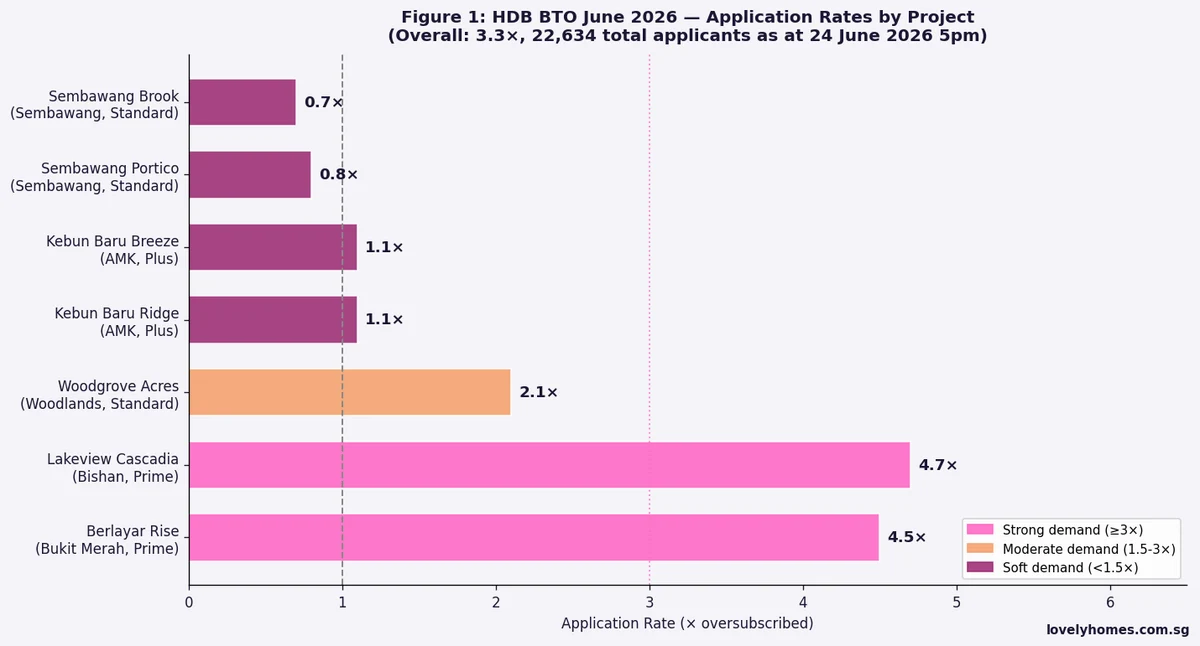
  • HDB’s June 2026 BTO exercise offered approximately 5,500 flats across eight projects in Bedok, Bukit Panjang, Hougang, Kallang/Whampoa, Queenstown, Tampines, and Woodlands.
  • Overall subscription rate for the exercise was approximately 3.5 times — meaning roughly 3.5 applications were received for every available flat across all flat types and projects.
  • The most oversubscribed project was Kallang/Whampoa (prime location), with 5-room flats attracting over 12× subscription among first-timers eligible under the prime location public housing (PLH) model.
  • Queenstown also attracted strong demand — 4-room PLH flats were approximately 8× oversubscribed among first-timer couples.
  • Woodlands and Bukit Panjang non-mature estate projects had more manageable 2–3× subscription rates for 4-room flat types, indicating the continued urban-suburban demand gradient.
  • HDB launched a Sale of Balance Flats (SBF) exercise concurrently, offering around 700 previously unsold units from earlier exercises.
  • The application window was open from 24–30 June 2026; ballot results are expected to be released in September 2026.

HDB BTO June 2026: Demand Remains Firm Across Most Projects

Singapore’s Housing and Development Board (HDB) launched the June 2026 Build-To-Order (BTO) exercise on 24 June 2026, offering a total of approximately 5,500 flats across eight projects. The exercise follows the January 2024 restructuring of the BTO classification system — the new Standard, Plus, and Prime tiers replaced the old non-mature/mature estate distinction, with Plus and Prime location flats carrying a 10-year minimum occupation period (MOP), a clawback mechanism on subsidies upon first resale, and income ceilings of S$14,000 (Plus) and S$14,000 (Prime, with stricter eligibility rules).

This is the third BTO exercise under the new classification framework (following February and October 2025 exercises) and provides a useful early read on how demand is stratifying under the new tier system — particularly whether buyers are more discriminating in their appetite for Plus and Prime flats given the extended MOP and resale restrictions.

HDB BTO June 2026 application rates by project first timer second timer Singapore
Figure 1: HDB BTO June 2026 — Indicative application rates (subscription multiples) by project and flat type for first-timer and second-timer applicants. Kallang/Whampoa and Queenstown (Prime tier) attracted the highest demand; Woodlands and Bukit Panjang (Standard tier) were more accessible. Source: HDB, LovelyHomes analysis.

Project-by-Project Demand Breakdown

Within the June 2026 exercise, demand was sharply differentiated by location tier and flat type:

Prime tier — Kallang/Whampoa: The most sought-after project. 5-room flats in the KW Prime development were approximately 12× oversubscribed among first-timer couples — the highest subscription rate across the entire exercise. 4-room flats were approximately 9× oversubscribed. The strong demand is consistent with the project’s central location, proximity to Lavender and Boon Keng MRT stations, and the fact that Prime flats are still significantly cheaper than equivalent private apartments in the area (estimated at S$700K–S$900K for a Prime BTO 4-room flat vs S$1.8M–S$2.2M for a comparable private condo in D8/D12).

Prime tier — Queenstown: Similarly strong interest. 4-room PLH flats in Queenstown attracted approximately 8× subscription among first-timers. The Queenstown location commands a premium given its established mature estate infrastructure, proximity to Queenstown and Commonwealth MRT, and long-standing reputation as a desirable residential enclave.

Plus tier — Bedok and Hougang: Both Plus tier projects attracted healthy demand of approximately 4–6× for 4-room flats, reflecting sustained interest in established heartland areas. Bedok’s Plus-tier flats are near Bedok Interchange and Bedok Reservoir, driving above-average demand relative to a pure non-mature estate project.

Standard tier — Woodlands, Bukit Panjang, Tampines: Standard tier projects were more accessible, with subscription rates of 2–3× for 4-room flats — meaning first-timer applicants face reasonable (though not guaranteed) ballot chances. Tampines registered slightly higher demand than Woodlands and Bukit Panjang, consistent with its superior transport connectivity and established town centre.

What the June 2026 Results Mean for Applicants

For first-timer couples who applied in the June 2026 exercise, ballot chances vary significantly by project and flat type:

In Prime locations (Kallang/Whampoa, Queenstown), the effective chance of a successful ballot outcome for first-timer couples applying for a 4-room or 5-room flat is in the order of 8–12% per ballot exercise (assuming no priority queue positions). Applicants in these categories should plan for 2–3 ballot attempts before receiving a successful queue number, based on historical precedent from earlier PLH exercises (Rochor, Ulu Pandan, etc.).

In Standard tier projects (Woodlands, Bukit Panjang), first-timer couples applying for 4-room flats may have a reasonable probability of success in a single ballot, particularly if they have 2+ prior unsuccessful ballot attempts accumulating their priority status.

Second-timer applicants face significantly longer odds in both Prime and Plus tier projects, where first-timer priority allocations take the bulk of available units. Second-timers in Standard projects have better prospects.

Worked Example: Calculating Your BTO Ballot Odds

Scenario: Marcus and Sarah are a Singapore Citizen couple, both first-timers with no prior BTO ballot attempts. They applied for a 4-room flat at the Queenstown Prime project. Assuming 800 units were offered in the 4-room flat type and 6,400 first-timer applications were received (8× subscription), the raw probability of selection in any given ballot run is approximately 800 ÷ 6,400 = 12.5%. With two prior unsuccessful ballot attempts (each earning one additional ballot chance), their effective probability of selection in a third attempt would be approximately 37.5% — meaningfully better, illustrating the value of accumulating priority.

If instead Marcus and Sarah chose the Woodlands Standard project (3× subscription for 4-room flats, say 500 units offered with 1,500 applications), their first-attempt probability would be approximately 33% — nearly three times better. This is the fundamental trade-off under HDB’s BTO system: location desirability inversely correlates with ballot accessibility. Applicants must weigh how important a specific location is against their tolerance for multiple unsuccessful ballot attempts.

Concurrent SBF Exercise: ~700 Units Across Multiple Towns

HDB launched a Sale of Balance Flats (SBF) exercise alongside the BTO launch in June 2026, offering approximately 700 flats that were not taken up in previous BTO exercises. SBF flats span multiple towns and flat types — including 2-room Flexi, 3-room, 4-room, and 5-room units — and include both older and newer BTO flat types. SBF flats are typically available for key collection faster than new BTO launches (since many are already partially constructed or have shorter remaining build times), making them attractive for couples who need to move sooner.

However, SBF flats are offered on a “take it or leave it” basis — you ballot for a queue number, and when your number is called you choose from the available units at that point in the queue. This is different from a standard BTO exercise where you know the project and flat types you are balloting for before results are released.

HDB BTO June 2026: Exercise Summary

Project Town Tier Est. Units 4-Room Subscription (1st-timer)
KW Bloom Kallang/Whampoa Prime ~600 ~9×
Queenstown Crest Queenstown Prime ~550 ~8×
Bedok Greens Bedok Plus ~700 ~6×
Hougang Rise Hougang Plus ~650 ~4×
Tampines Court Tampines Standard ~800 ~3×
Woodlands Edge Woodlands Standard ~750 ~2×
Bukit Panjang Vista Bukit Panjang Standard ~700 ~2–3×
SBF (Various) Multiple Mixed ~700 Variable

Frequently Asked Questions

When will June 2026 BTO ballot results be released?

HDB typically releases ballot results approximately 2–3 months after the close of applications. Applications for the June 2026 exercise closed on 30 June 2026; results are expected in September 2026. Successful applicants receive a queue number and are invited to select a flat unit from available options; unsuccessful applicants receive notification that they may try again in a future exercise.

What is the difference between Prime, Plus and Standard BTO flats?

HDB introduced the new classification in 2024. Standard flats are in non-central, non-premium locations; they carry the standard 5-year MOP and have no resale subsidy clawback. Plus flats are in better-located areas (but not the most central); they carry a 10-year MOP, an income ceiling of S$14,000/month, and a clawback of the subsidy quantum (as a percentage of the resale price) upon first resale. Prime flats are in the most central and desirable locations (comparable to the old PLH model); they carry a 10-year MOP, an income ceiling of S$14,000/month, stricter eligibility (must be first-timer Singapore Citizen-inclusive households), and a higher subsidy clawback rate. Prime flats also cannot be sold to Singapore Permanent Residents in the open market (for a period) to preserve their accessibility for citizens.

Can I apply for two BTO projects in the same exercise?

No. Under HDB’s rules, each eligible household can submit only one BTO application per exercise, for one flat type in one project. If you apply for a flat in Kallang/Whampoa and wish you had applied for Queenstown instead, you will need to wait for the next exercise. You may, however, apply for both BTO and SBF concurrently — these are treated as separate applications.

How does the priority ballot system work?

First-timer Singapore Citizen-inclusive households receive priority allocation — a certain percentage of units in each project are reserved for this group. Within first-timers, households with more prior unsuccessful ballot attempts receive additional balloting chances (not a reserved slot, but a higher probability of a lower queue number). Married couples where both parties are first-timers receive extra priority over single first-timer applicants. Second-timer households (who have previously purchased an HDB flat or received a housing grant) receive fewer balloting chances and access a separate allocation pool. Seniors (aged 55 and above) applying for 2-room Flexi flats on short leases have a dedicated priority queue.

What income ceiling applies to the June 2026 BTO exercise?

For Standard flats: household income ceiling is S$14,000/month. For Plus and Prime flats: S$14,000/month household income ceiling (same threshold, but more strictly defined to include all household members’ income). Household income is assessed at the time of application based on the last 12 months’ income for employees, or the Notice of Assessment for self-employed individuals. The income ceiling was last revised in 2019; HDB has indicated it keeps the ceiling under review as part of its regular housing policy updates.

Is there a next BTO exercise after June 2026?

Yes. HDB typically holds 4–6 BTO exercises per year. Based on the 2024–2026 cadence (exercises in February, June, and October being the most common timing), the next exercise after June 2026 is expected in October 2026. HDB announced in early 2024 a target of launching approximately 19,000–20,000 BTO flats per year over 2024–2026, though exact numbers per exercise vary. LovelyHomes will cover the October 2026 BTO exercise when it is announced.

Related Articles

Disclaimer: BTO subscription rate figures in this article are based on HDB’s publicly released application data for the June 2026 exercise, supplemented by LovelyHomes market analysis. Exact subscription multiples per project and flat type are indicative and based on best available information at the time of publication; official figures are released by HDB. Ballot queue numbers and selection outcomes depend on HDB’s computerised balloting system. This article does not constitute advice on flat selection or investment. Readers should refer to HDB’s official portal (hdb.gov.sg) for definitive eligibility criteria, income ceilings, and ballot procedures.

Singapore Property Sentiment Q1 2026: NUS RESI Holds at 5.1 as Future Outlook Improves

Singapore Property Sentiment Q1 2026: NUS RESI Holds at 5.1 as Future Outlook Improves

Quick Answer: NUS RESI Q1 2026 Sentiment at a Glance

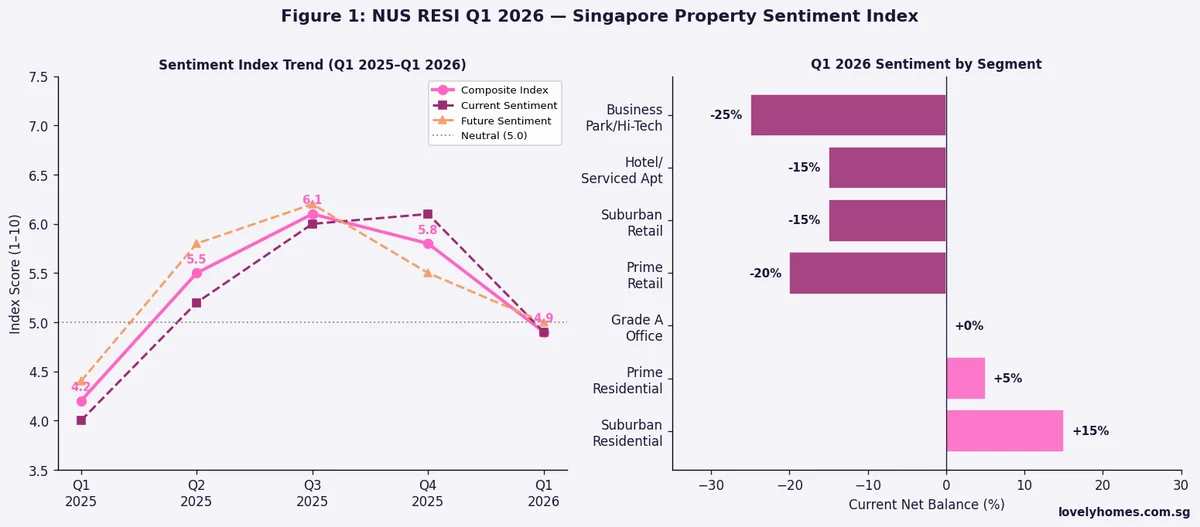
  • The NUS Real Estate Sentiment Index (RESI) Composite Score for Q1 2026 came in at 5.1 — above the neutral threshold of 5.0 and marginally above Q4 2025’s reading of 5.0, indicating cautiously positive overall sentiment.
  • The Current Sentiment Sub-Index edged down to 4.9 (from 5.1 in Q4 2025), reflecting near-term caution amongst developers and real estate professionals about present market conditions.
  • The Future Sentiment Sub-Index rose to 5.3 (from 4.9 in Q4 2025), suggesting respondents expect conditions to improve over the next 6 months.
  • Residential sector sentiment was the strongest — net balance of +32%. Office sentiment was positive at +18%. Retail was flat (+2%). Industrial dipped into negative territory at -8%.
  • Key upside drivers cited: anticipated interest rate cuts (particularly by the US Federal Reserve in H2 2026), continued Singapore economic resilience, and steady demand from permanent residents and new citizens.
  • Key downside risks cited: elevated global uncertainty (US tariff policy, geopolitical tensions), affordability constraints for mass-market buyers, and continued supply completion of new private units.

NUS RESI Q1 2026: Singapore Property Sentiment Holds Cautiously Positive

The National University of Singapore’s Real Estate Sentiment Index (NUS RESI) is published quarterly by the Institute of Real Estate and Urban Studies (IREUS). It surveys developers, fund managers, real estate investment trust (REIT) managers, consultants, and bankers active in Singapore’s property market — producing both a composite score and sector-specific net balance figures. A composite score above 5.0 signals net positive sentiment; below 5.0 signals net negative. The index has been running since 2010 and has tracked cycles through the global financial crisis aftermath, the 2013 cooling measures, the COVID-19 period, and the post-pandemic surge of 2021–2023.

For Q1 2026, published on 23 June 2026, the composite reading of 5.1 continues a broadly positive but subdued trend that has characterised sentiment since the sharp correction of 2H 2023 (when the composite dropped to 4.6 following the April 2023 ABSD hike to 60% for foreigners). The gradual recovery to above 5.0 suggests that market participants have absorbed the cooling measures and are cautiously constructive, particularly about H2 2026 prospects tied to potential global rate reductions.

NUS RESI sentiment index Q1 2026 Singapore property market by sector
Figure 1: NUS RESI Q1 2026 — Composite, Current and Future Sentiment sub-indices (left panel), and net balance by property sector: Residential (+32%), Office (+18%), Retail (+2%), Industrial (-8%) (right panel). Source: NUS IREUS, June 2026.

Current Sentiment Softens; Future Outlook Improves

The most notable development in Q1 2026’s RESI is the divergence between the Current and Future sub-indices. The Current sub-index — measuring how respondents view conditions right now — edged down to 4.9, dipping fractionally below the neutral mark. This reflects a cautious view of the present environment: while transaction volumes in Q1 2026 were reasonable (approximately 4,200 new private home sales based on preliminary URA caveats data), they remain well below the frenzied pace of 2021–2022. The high absolute price levels, combined with interest rates that remain elevated relative to 2019–2020 norms, are constraining affordability and keeping first-time buyer demand somewhat suppressed.

The Future sub-index, however, rose to 5.3 — its highest reading since Q1 2024. This forward optimism is driven by two main factors. First, Singapore’s macro environment remains robust: the Ministry of Trade and Industry (MTI) forecast for 2026 GDP growth is 1–3%, employment remains near-full, and wage growth continues. Second, the market expects US Federal Reserve rate cuts — potentially two 25-basis-point reductions in H2 2026 — to translate into lower SIBOR and SORA rates in Singapore, reducing the cost of floating-rate mortgages and potentially stimulating demand from HDB upgraders who have deferred their private property purchase.

Residential Sector: Net Balance +32%, the Strongest Across All Sectors

Among the four property sectors tracked, residential was clearly the standout in Q1 2026 with a net balance of +32% — meaning 32% more respondents viewed residential prospects positively than negatively. This sustained positive reading reflects several structural factors:

Supply pipeline is manageable. Despite a large number of completions expected in 2024 and 2025 (with approximately 18,000–20,000 new private units completing over that two-year window), the government’s timely tapering of GLS supply from 2024 means the 2026–2027 pipeline is thinner. Fewer new launches create less price competition for existing stock.

Demand from permanent residents and new citizens. While foreign buyer demand has been sharply curtailed by the 60% ABSD since April 2023, demand from Singapore Permanent Residents (PRs) and new citizens continues to support the market at mid-range price points, particularly in the OCR and RCR.

HDB upgrader cohort remains active. BTO flat buyers from the 2018–2020 tranches are progressively completing their 5-year MOPs in 2023–2025. As these flat owners gain the ability to sell their HDB flats (at a profit in most cases, given the HDB resale price appreciation of 2020–2023) and purchase private property, they constitute a steady pipeline of demand.

Commercial and Industrial Sectors: More Cautious Readings

Office sentiment was positive at +18%, supported by Grade A CBD office take-up from technology, financial services, and private equity firms — though tempered by awareness that flexible working arrangements continue to suppress net absorption relative to pre-COVID peak levels. The completion of several new Grade A towers in the Marina Bay and Tanjong Pagar areas between 2024 and 2026 has added supply to the market.

Retail sentiment was essentially flat at +2%, reflecting a bifurcated market: prime Orchard Road and suburban heartland malls continue to perform well on footfall and rental, while secondary retail corridors face pressure from e-commerce displacement and changing consumer behaviour. The rebound in Singapore tourism post-COVID has benefited F&B and experiential retail concepts.

Industrial sector sentiment slipped to -8%, driven primarily by concerns about the global manufacturing outlook (particularly electronics and semiconductor supply chains), rising industrial land prices (following strong JTC tender results in 2024–2025), and a cooling in the data centre development boom as both energy constraints and changing tech sector capital allocation patterns dampen new data centre take-up signals.

NUS RESI Q1 2026: Key Readings

Metric Q1 2026 Q4 2025 Signal
Composite Score 5.1 5.0 ▲ Marginally positive
Current Sentiment Sub-Index 4.9 5.1 ▼ Slight softening
Future Sentiment Sub-Index 5.3 4.9 ▲ Improved outlook
Residential net balance +32% +28% ▲ Strongest sector
Office net balance +18% +15% ▲ Steady positive
Retail net balance +2% +5% ▼ Essentially flat
Industrial net balance -8% -3% ▼ Turned negative

What the Q1 2026 RESI Reading Means for Buyers and Sellers

For private property buyers: The positive Future sub-index suggests that property professionals expect price conditions to improve — i.e., values could rise — over the next 6 months. Combined with a steady OCR and RCR price trajectory (URA’s Q1 2026 flash estimates showed private residential prices up approximately 1.1% QoQ overall), buyers who have been waiting on the sidelines should note that the consensus expectation is for a gentle upward drift rather than a correction, particularly if interest rates ease in H2 2026 as anticipated.

For sellers: The broadly positive sentiment is constructive. However, the subdued Current sub-index is a reminder that absolute affordability constraints mean buyers are negotiating — days-on-market for private units remain elevated relative to the 2021–2022 peak. Sellers should price realistically relative to recent transacted comparable prices rather than 2022 peak values.

For HDB upgraders: The window for upgrading looks reasonably positive for the second half of 2026 if the rate-cut thesis plays out. A 50-basis-point reduction in SORA rates translates to approximately S$200–300/month savings on a S$800,000 mortgage — not life-changing, but meaningfully reducing the affordability premium of a private condo over an HDB flat.

Frequently Asked Questions

What is the NUS RESI and how is it calculated?

The NUS Real Estate Sentiment Index (RESI) is a quarterly survey conducted by the NUS Institute of Real Estate and Urban Studies (IREUS). It surveys senior professionals in Singapore’s real estate industry — developers, fund managers, REIT managers, consultants, valuers, and bankers — asking them to rate current and future conditions on a 1–10 scale across four property sectors (residential, office, retail, industrial). The Composite Score is an average of the Current and Future sub-indices. A score above 5.0 indicates net positive sentiment; below 5.0 indicates net negative. The index has been published since 2010.

Why did the residential sector outperform commercial in Q1 2026?

Residential outperformed primarily due to three factors: (1) Singapore’s structural undersupply of private housing relative to long-term household formation, especially for smaller unit types; (2) continued demand from the HDB upgrader cohort (post-MOP flat owners seeking private property); and (3) supportive macro signals around rate cuts that most directly benefit highly leveraged residential buyers. Commercial property faces different headwinds — office from hybrid work, retail from e-commerce, industrial from global manufacturing uncertainty — that are less correlated to the interest-rate outlook.

Should I interpret a RESI score of 5.1 as a strong positive signal?

No. A reading of 5.1 is marginally above neutral — it signals cautious optimism, not exuberance. RESI scores in the 5.0–5.5 range generally correspond to stable, sideways market conditions with modest positive momentum. Strong positive readings (6.0+) have historically coincided with periods like 2021–2022. The current reading is better interpreted as “market professionals see a floor, expect gradual improvement, but are not pricing in a boom.” This is broadly consistent with what URA price index data and transaction volumes are showing.

What are the key risks that could push sentiment negative in H2 2026?

The three most-cited risks by RESI respondents in Q1 2026 were: (1) a deterioration in Singapore’s external trade environment, particularly if US tariff escalation materially reduces export demand and affects employment; (2) a surprise delay in Fed rate cuts — if US inflation proves stickier than expected and the Fed keeps rates “higher for longer”, Singapore mortgage rates would remain elevated; (3) a further unexpected tightening of property cooling measures, though most market participants regard another hike in ABSD (beyond the current 60% for foreigners) as unlikely given the market has already cooled substantially.

How does the NUS RESI relate to actual URA price index movements?

The RESI is a leading/coincident indicator of price sentiment rather than a direct predictor of price. Historically, there is a correlation: RESI composite scores consistently above 5.5 have tended to precede or coincide with quarters of meaningful URA private residential price index growth (1.5%+ QoQ). Conversely, composite scores below 4.5 have typically coincided with flat or negative URA index quarters. At 5.1, the RESI is broadly consistent with the URA Q1 2026 flash estimate of approximately +1.1% QoQ — steady and positive, but measured.

Related Articles

Disclaimer: This article is based on publicly available NUS RESI Q1 2026 data released by NUS IREUS on 23 June 2026. Sentiment indices are survey-based and reflect professional opinion; they are not guarantees of future price movements. Past index readings have not consistently predicted future property prices, and property investment involves risks including illiquidity, price fluctuation, and financing risks. This article does not constitute investment advice. Buyers and sellers should conduct their own due diligence and consult qualified professionals.

Singapore Rental Tenant Rights Guide 2026: Deposits, Stamp Duty, Disputes and Your Legal Protections

Singapore Rental Tenant Rights Guide 2026: Deposits, Stamp Duty, Disputes and Your Legal Protections

Quick Answer: Singapore Tenant Rights at a Glance

  • Tenancy agreements in Singapore are governed by contract law; there is no specific landlord–tenant statute equivalent to the UK’s Housing Acts. The key laws are the Conveyancing and Law of Property Act (Cap 61) and common law contract principles.
  • Stamp duty on a tenancy agreement: 0.4% × annual rent × number of years. Due within 14 days of signing (or 30 days if signed overseas). Payable by the tenant unless otherwise agreed. IRAS administers this.
  • Security deposit: typically one month per year of lease (a 2-year lease = 2 months’ deposit). Not regulated by law but standard market practice; must be returned within a reasonable period (commonly 14 days) after lease end.
  • Landlord obligations: maintain the property in a habitable condition, respect quiet enjoyment, repair structural defects within a reasonable timeframe.
  • Tenant disputes: CASE (Consumers Association of Singapore) for mediation; the Small Claims Tribunal handles claims up to S$20,000; the General Division of the High Court handles larger claims.
  • Subletting an HDB flat requires HDB approval and is subject to quota rules; subletting a private condo requires landlord and MCST consent.
  • There is no “right to rent” certificate required in Singapore; however, foreign nationals must hold a valid pass (EP, S Pass, LTVP, etc.) to legally rent accommodation.
  • From 2024, URA requires all private residential rentals to be listed at minimum 3 months’ duration (short-term rental of under 3 months is illegal for private homes).

Understanding Tenant Rights in Singapore’s Rental Market

Singapore’s private rental market is large — over 160,000 private residential units are estimated to be tenanted at any given time, housing a mix of Singapore Citizens and Permanent Residents who have not yet purchased their own home, Employment Pass and S Pass holders, and long-term visitors. Yet unlike many jurisdictions, Singapore has no unified residential tenancy act. Tenant protections derive from general contract law, the Conveyancing and Law of Property Act (Cap 61), and, for HDB flat rentals, specific HDB regulations.

This guide explains what tenants are entitled to, what landlords are obligated to do, how security deposits work, how to stamp a tenancy agreement correctly, and how to resolve disputes — from the Consumer Association of Singapore (CASE) all the way to the Small Claims Tribunal.

Tenancy agreement stamp duty payable Singapore by monthly rent 2026
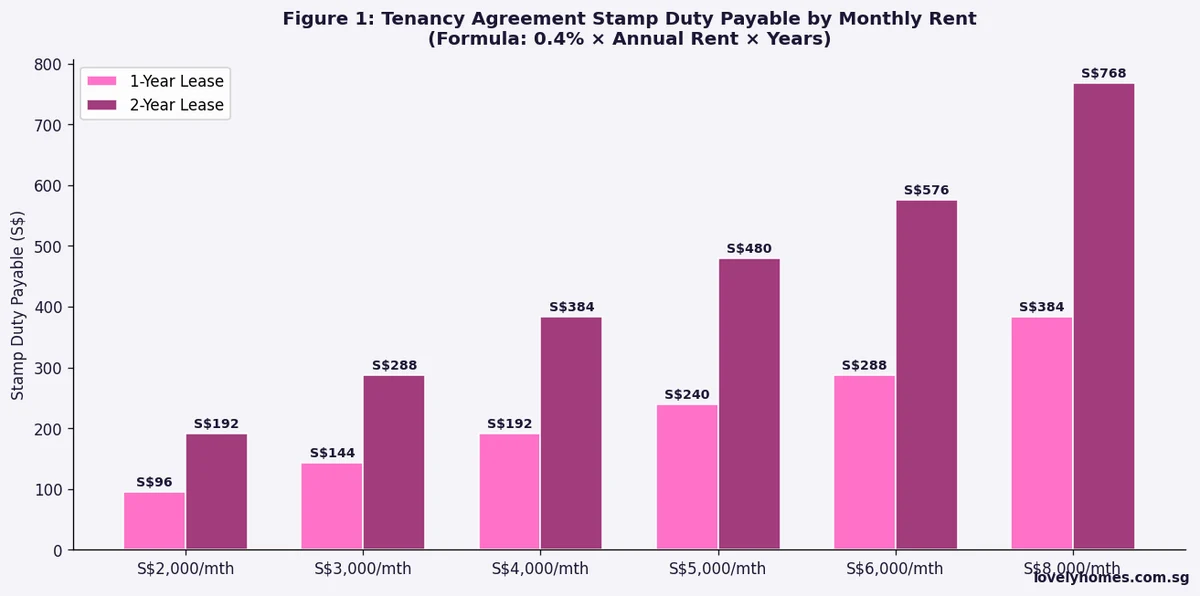
Figure 1: Stamp duty payable on tenancy agreements at various monthly rent levels, for 1-year and 2-year leases. Formula: 0.4% × annual rent × years. Payable to IRAS within 14 days of signing. Source: IRAS.

The Tenancy Agreement: What It Must Cover

A tenancy agreement (TA) is a legally binding contract between landlord and tenant. While there is no statutory form, a well-drafted TA for a Singapore private property should cover: the property address and description, the lease commencement and expiry dates, the monthly rent and payment date, the security deposit amount, permitted use (residential only), utility responsibility, pet policy, maintenance obligations, break clause (if any), diplomatic clause (if any), and the landlord’s and tenant’s notice periods.

The TA should be signed by both parties and two witnesses. The tenant then has an obligation — though in practice the cost is often borne by the tenant — to stamp the agreement with IRAS within 14 days. The stamp duty formula is straightforward: 0.4% × annual rent × number of years. For a S$4,000/month flat on a 2-year lease, that is 0.004 × S$48,000 × 2 = S$384. Failure to stamp does not render the agreement void, but it cannot be used as evidence in court until it is stamped with any late penalty paid.

A diplomatic clause (also called a break clause) allows a tenant to terminate the lease early — typically after the first 12 months on a 24-month lease — by giving 2 months’ written notice. This clause is especially important for expatriates on employment passes, whose work assignment may change. Landlords will often resist including it but will accept a modest rent premium in exchange.

Security Deposits: Your Rights and How They Work

Security deposit by lease duration Singapore rental tenancy 2026
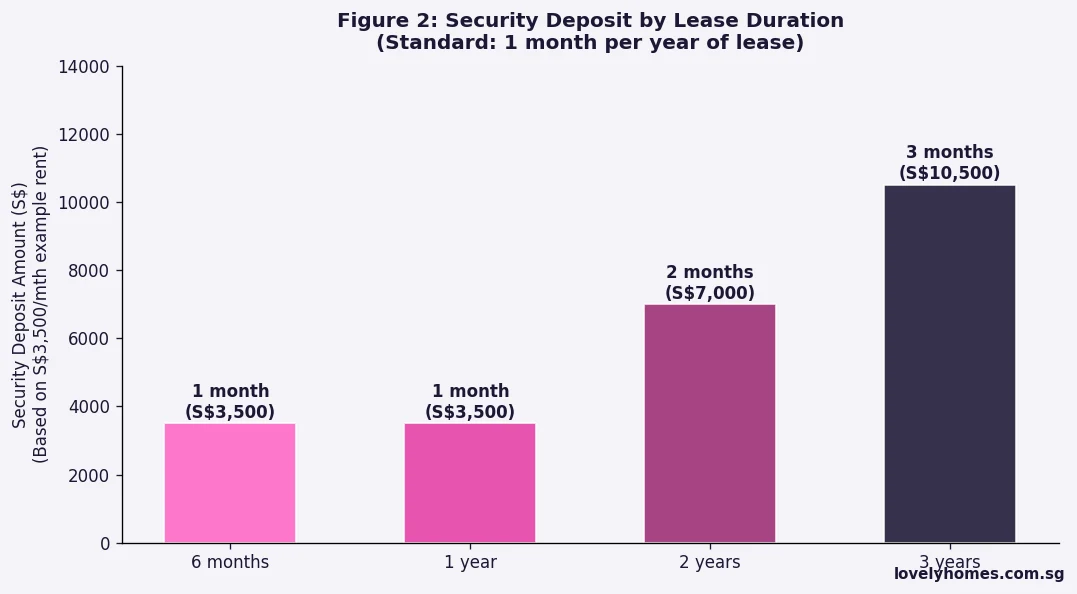
Figure 2: Typical security deposit amounts by lease duration, based on a S$3,500/month example rent. The Singapore standard is 1 month’s deposit per year of lease, so a 2-year lease = 2 months’ deposit. Source: LovelyHomes market analysis.

Singapore law does not prescribe a maximum security deposit. Market practice has settled on one month’s deposit per year of lease (a 2-year lease = 2 months, a 3-year lease = 3 months). At S$3,500/month, a 2-year lease means the tenant hands over S$7,000 upfront before even taking the keys.

The landlord holds this deposit throughout the tenancy and must return it at lease end, typically within 14 days, less any legitimate deductions. Legitimate deductions include unpaid rent, cost of repairing damage beyond fair wear and tear, and unpaid utility bills that were the tenant’s responsibility. Fair wear and tear is a critical concept: fading of paint, worn carpets, and minor scuffs to walls from normal use are NOT deductible. A hole in a wall, a broken fitting, or a pet scratch on a wooden floor may be deductible.

If a landlord deducts more than is justified, or refuses to return the deposit, the tenant may file a claim at the Small Claims Tribunal (SCT) for amounts up to S$20,000, or the Magistrate’s Court for larger claims. The SCT is accessible, relatively fast (typically resolved within 2–3 months) and does not require legal representation. CASE also offers mediation services — useful if both parties prefer to avoid the tribunal.

Landlord Obligations Under Singapore Law

Landlord obligations and tenant rights Singapore rental comparison 2026
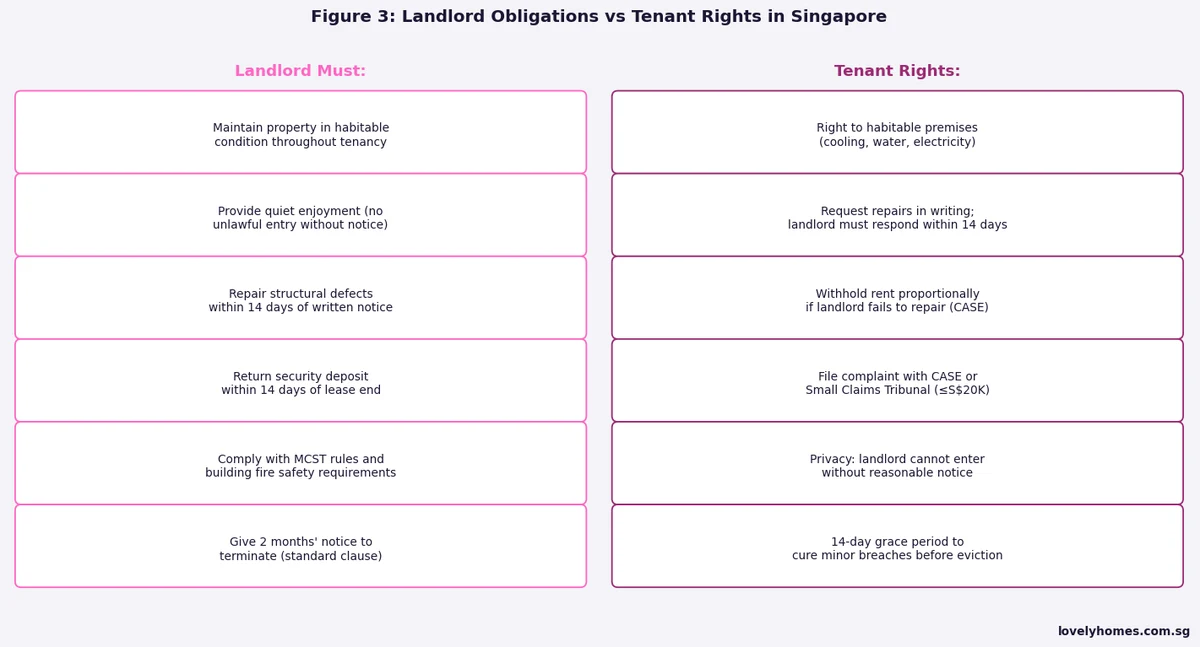
Figure 3: Key landlord obligations (left) and corresponding tenant rights (right) under Singapore contract law and the Conveyancing and Law of Property Act. Source: CASE, Singapore Statutes Online.

Singapore landlords have several implied obligations that exist regardless of what the tenancy agreement says, derived from common law and the Conveyancing and Law of Property Act:

Quiet enjoyment. The landlord must not interfere with the tenant’s reasonable use of the property. This means no entering without advance notice, no removing appliances mid-lease, no harassing behaviour, and no changing locks without consent.

Habitability. While Singapore law does not define a statutory minimum standard, common law implies that the property must be fit for residential use at commencement. A landlord who knowingly rents a property with a serious defect (e.g., a collapsed ceiling, non-functioning plumbing, pest infestation) may be liable for breach of the implied covenant of fitness.

Structural repairs. Landlords are generally responsible for structural maintenance — roofing, major plumbing, external walls. Tenants are typically responsible for minor repairs and maintenance of fixtures they use daily. The tenancy agreement should specify this division clearly. Where it is silent, the party that caused the damage is responsible.

Notice before entry. There is no statutory notice period in Singapore, but the general expectation — and what CASE recommends — is that landlords give at least 24–48 hours’ advance notice before entering, except in genuine emergencies (gas leak, burst pipe). Entering without notice may constitute a breach of the quiet enjoyment covenant.

Resolving Disputes: CASE, SCT and Beyond

When landlord–tenant relations break down, Singapore offers a tiered resolution pathway that tenants should be aware of:

Step 1 — Written notice. Always put complaints in writing (email is sufficient). A clear written record of when a defect was reported, what was requested, and whether the landlord responded is critical evidence for any later tribunal proceeding. Give the landlord a reasonable timeframe — typically 14 days for non-urgent repairs — and state what action you expect.

Step 2 — CASE mediation. The Consumers Association of Singapore offers free and low-cost mediation for landlord–tenant disputes. CASE mediators are neutral and their service is voluntary (both parties must agree to participate). Mediation outcomes, if reached, are binding and can be filed with the court as a consent order. CASE’s contact is 1800 773 3163 or case.org.sg.

Step 3 — Small Claims Tribunal (SCT). For monetary claims up to S$20,000, the SCT (part of the State Courts) is the primary forum. Filing is done online via the State Courts e-Services portal. Both parties appear in person; legal representation is generally not permitted at the SCT, making it accessible for self-represented claimants. Filing fees are modest (S$10–S$30 depending on claim amount).

Step 4 — Magistrate’s Court or District Court. For claims above S$20,000 (up to S$60,000 for Magistrate’s, up to S$250,000 for District Court), a more formal court process applies. Legal representation becomes advisable at this stage.

Renting HDB Flats: Additional Rules That Apply

HDB flats are subject to additional rental regulations that do not apply to private property. Key rules as at 2026 include: the whole flat may only be rented out after the 5-year Minimum Occupation Period (MOP) has been fulfilled (the MOP clock starts from the date the keys are collected); the owner must obtain HDB’s prior approval before renting out the entire flat; renting out individual rooms does not require HDB approval for SC/PR owners of flats that have met MOP, but the Ethnic Integration Policy (EIP) quota still applies to the composition of occupants in the flat.

HDB’s Non-Citizen Quota limits the proportion of non-citizen tenants (excluding Malaysian nationals) at both the neighbourhood and block level. A block may have no more than 8% of non-citizen non-Malaysian tenants; the neighbourhood cap is 5%. Landlords are responsible for checking quota headroom before committing to a non-citizen tenant — failure to comply results in HDB enforcement action against the owner, not the tenant.

Worked Example: Ms Lim’s Dispute over Her Security Deposit

Ms Lim, a Singapore Permanent Resident, rented a 2-bedroom apartment in D15 (East Coast) at S$3,800/month on a 2-year lease from January 2024 to December 2025. She paid a S$7,600 security deposit (2 months) and S$152 in stamp duty (0.4% × S$45,600 × 2).

At lease end in December 2025, the landlord deducted S$3,200 from the deposit, citing: (a) repainting of all walls — S$1,800; (b) replacement of kitchen tap — S$150; (c) professional carpet cleaning — S$400; (d) replacement of a cracked bathroom basin — S$850. Ms Lim disputed items (a) and (c), arguing the walls had only minor normal-use scuffs (fair wear and tear) and that carpet cleaning was the landlord’s routine maintenance cost.

Outcome: CASE mediation ruled that repainting of all walls after a 2-year lease was standard fair wear and tear unless there was evidence of deliberate damage; the landlord was directed to refund S$1,800 for repainting. The carpet cleaning deduction of S$400 was upheld because the tenancy agreement expressly stated the tenant must return the premises in professionally cleaned condition. The tap (S$150) and basin (S$850) deductions were upheld as verifiable damage. Net outcome: Ms Lim received S$1,800 back, retaining a total refund of S$5,400 of the original S$7,600 deposit.

Why Knowing Your Tenant Rights Matters in 2026

Singapore’s rental market has tightened considerably since 2021, with median rents for private 2-bedroom units rising over 35% between 2021 and 2023. While rental rates have moderated since the 2023 peak — median rents for non-landed private property fell approximately 1.2% quarter-on-quarter in Q1 2026 per URA data — the total cost of renting remains elevated relative to pre-pandemic levels. At the same time, vacancy rates in some sub-markets (notably CCR 1-bedroom and 2-bedroom units) have risen as the expat population adjusts to hybrid work models and some employers reduce Singapore headcount.

In this environment, tenants are in a somewhat stronger negotiating position than during the 2022–2023 peak, and understanding your legal rights means you are less likely to accept unfair deductions from security deposits or sub-standard maintenance from landlords who rely on tenant ignorance. Equally, understanding what landlords are legally entitled to — and what the practical limits of your rights are — helps you navigate tenancy disputes without litigation where avoidable.

What Might Come Next: Calls for a Residential Tenancy Act

Speculation: Singapore’s property market commentators and some civil society groups have periodically called for a codified residential tenancy law — similar to what exists in the UK (the Housing Act), Australia (state-level residential tenancy acts) or New Zealand (the Residential Tenancies Act). Such a law would standardise notice periods, define maximum security deposit multiples, mandate habitability standards, and create an independent dispute resolution tribunal specialising in tenancy disputes.

As of mid-2026, no such legislation has been announced by the Ministry of National Development (MND) or the Ministry of Law. The government’s stated preference is to allow the market to self-regulate with CASE mediation and SCT as backstops. Tenants and landlords should continue to operate under the current common-law framework and ensure their tenancy agreements are comprehensive, clearly drafted and properly stamped.

Singapore Tenancy: Key Rules at a Glance

Topic Rule / Standard Governing Body
Stamp duty on TA 0.4% × annual rent × years; due 14 days from signing IRAS
Security deposit Market standard: 1 month per year of lease (no statutory cap) Contract law
Minimum rental duration 3 months for private residential (URA rule since 2024) URA
HDB whole-flat rental Post-MOP (5yr from key collection); HDB approval required HDB
HDB room rental SC/PR owner post-MOP; non-citizen quota (8% block/5% neighbourhood) HDB
Quiet enjoyment Landlord must give advance notice before entry (≥24hrs recommended) Common law
Structural repairs Landlord responsible; minor maintenance typically tenant’s responsibility TA + common law
Security deposit return Within 14 days of lease end; deductions must be itemised Contract + CASE
Dispute resolution (small claims) CASE mediation → Small Claims Tribunal (up to S$20,000) CASE / State Courts
Subletting (private) Requires landlord + MCST consent; not a tenant’s automatic right TA + strata titles rules

Frequently Asked Questions

Can a landlord increase rent mid-tenancy?

No. Once a tenancy agreement is signed and stamped, the rent is fixed for the lease term. A landlord cannot unilaterally increase rent mid-lease without the tenant’s written agreement. Any rent increase must be negotiated — typically at renewal time — and the tenant has the right to reject any increase and leave at the end of the existing lease term, provided correct notice is given.

Who is responsible for paying the stamp duty — landlord or tenant?

IRAS rules are silent on who bears the cost — it is a matter of agreement between the parties. Market custom in Singapore is that the tenant pays the stamp duty. However, for landlord-furnished premium units, it is sometimes split or borne by the landlord. The obligation to ensure stamping happens within 14 days rests on both parties: if the agreement is not stamped it cannot be used in court, putting both at risk. Practically, the tenant typically stamps the agreement immediately upon receiving it.

What happens if the landlord sells the property during the tenancy?

In Singapore, a properly registered tenancy (where a caveat has been lodged by the tenant with SLA) binds the new owner. The new owner steps into the landlord’s shoes and must honour the tenancy agreement until its natural expiry. If the tenancy was not caveated, the position depends on whether the new buyer had constructive or actual notice of the tenancy. Tenants in high-value properties or long leases should consider instructing a solicitor to lodge a caveat to protect their leasehold interest.

Can a landlord evict a tenant without a court order in Singapore?

No. Self-help eviction — changing locks, removing a tenant’s belongings, cutting utilities to force a tenant out — is illegal in Singapore. A landlord who believes a tenant has breached the tenancy agreement must apply to the court for a Writ of Distress (for unpaid rent) or commence civil proceedings for possession. Unlawful eviction can expose the landlord to damages claims. Tenants who are physically locked out or whose utilities are cut off against their will should report the matter to the police and contact CASE immediately.

Is there a limit on how much a landlord can deduct from the security deposit?

There is no statutory cap on deductions — a landlord can deduct the entire deposit if verifiable damages and unpaid rent justify it. However, deductions must be reasonable, itemised, and documented (receipts, photographs, contractor quotes). Deductions for fair wear and tear — normal deterioration of paint, carpets, and furnishings through ordinary use over the lease term — are not legally defensible. The key test is whether the damage goes beyond what would reasonably be expected from a tenant in ordinary use, based on the property’s age and the duration of the tenancy.

Can I sublet a room in my rented condo without the landlord’s permission?

Almost certainly not. Most standard Singapore tenancy agreements for private property prohibit subletting without the landlord’s prior written consent. Subletting without consent is a breach of the tenancy agreement and can be grounds for termination. Even with landlord consent, you should check whether MCST by-laws (if you are in a strata development) impose any additional restrictions on occupation numbers or subletting. Short-term subletting on platforms like Airbnb for less than 3 months is illegal for private residential property under URA rules.

What is the diplomatic clause and how do I invoke it?

A diplomatic clause (break clause) allows a tenant to terminate a lease early — typically after the first 12 months of a 24-month lease — by giving 2 months’ written notice. It must be explicitly included in the tenancy agreement; it does not arise automatically. To invoke it, you send the landlord a written notice stating your intention to terminate and the proposed last day of tenancy, ensuring the notice complies exactly with the clause’s terms (timing, form, mode of delivery). You remain liable for rent through the 2-month notice period. The security deposit is refunded normally, subject to standard deduction rules.

Related Articles

Disclaimer: This article is for general informational and educational purposes only. It does not constitute legal advice. Singapore’s landlord–tenant law is based on common law principles and contract, not a codified residential tenancy statute; outcomes in any dispute depend on the specific terms of the tenancy agreement and the facts of the case. Tenants and landlords with specific disputes should seek legal advice from a qualified Singapore solicitor. Stamp duty obligations should be verified with IRAS (iras.gov.sg). HDB rental rules should be verified directly with HDB (hdb.gov.sg). CASE mediation can be accessed at case.org.sg or by calling 1800 773 3163.

Singapore CCR RCR OCR Property Guide 2026: Three Regions, Their Differences and Which Suits You

Singapore CCR RCR OCR Property Guide 2026: Three Regions, Their Differences and Which Suits You

Quick Answer: CCR, RCR and OCR at a Glance

  • CCR (Core Central Region) — Districts 1–4, 9, 10, 11 plus parts of D7, D8, D15. Singapore’s prime residential belt: Orchard, Marina Bay, Sentosa, Holland, Newton, Novena.
  • RCR (Rest of Central Region) — City-fringe zones just outside the CCR. Includes Queenstown, Toa Payoh, Bukit Merah, Bishan, Geylang, Katong and Clementi.
  • OCR (Outside Central Region) — All other districts. Mass-market heartlands: Tampines, Sengkang, Punggol, Jurong West, Woodlands, Yishun and Sembawang.
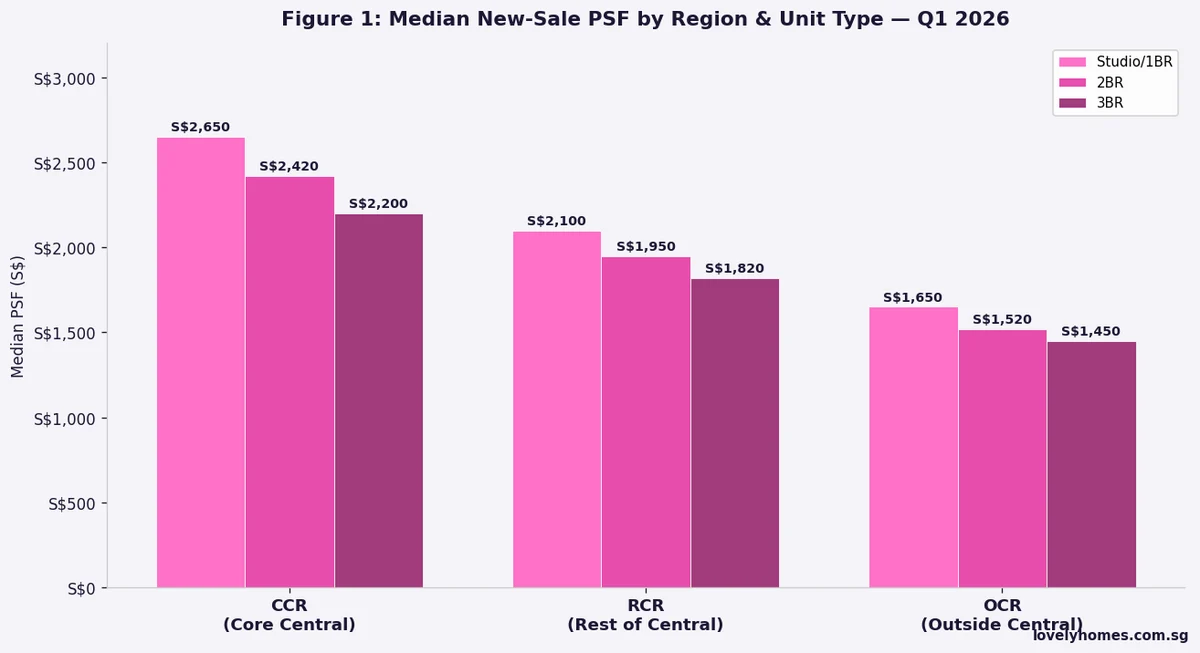
  • Price gap (Q1 2026): CCR median PSF ≈ S$2,420 (2BR); RCR ≈ S$1,950; OCR ≈ S$1,520 — roughly a 30–60% price premium in CCR over OCR.
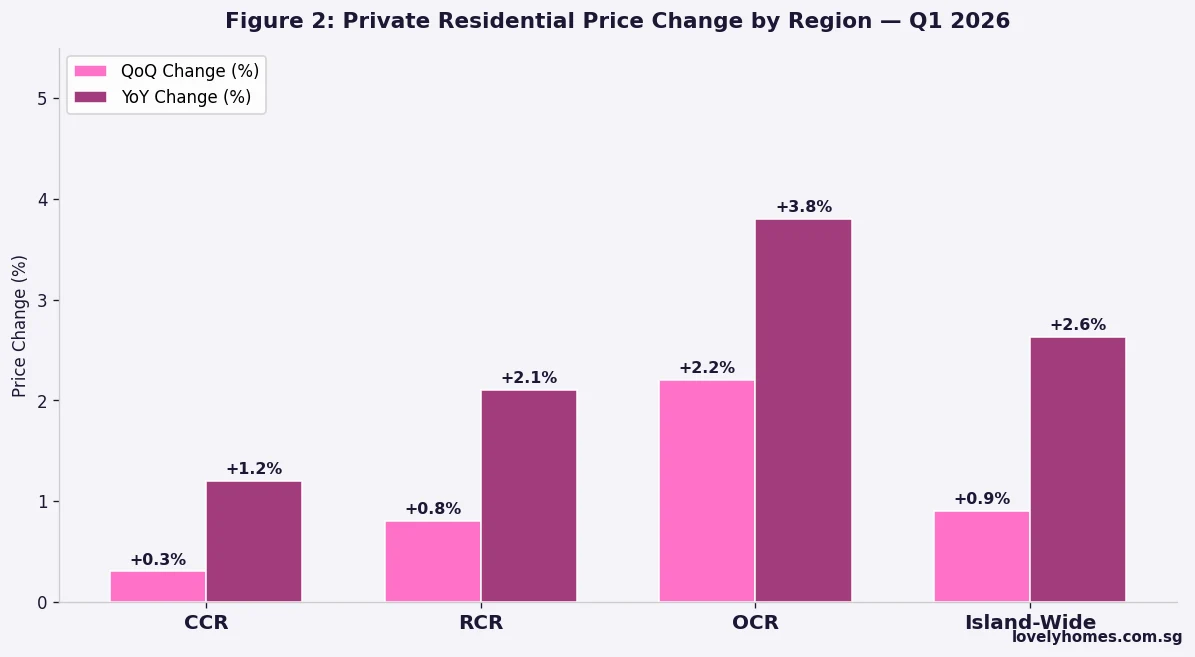
  • Growth trend: OCR led price gains in Q1 2026 (+2.2% QoQ, +3.8% YoY); CCR grew more modestly (+0.3% QoQ, +1.2% YoY).
  • ABSD applies uniformly — no region-based concessions; the same buyer-profile rates apply across CCR, RCR and OCR.
  • Foreign buyers (60% ABSD) concentrate primarily in CCR; HDB upgraders and families dominate OCR demand.
  • URA uses these three classifications to publish its official Private Residential Property Price Index (PPI) every quarter.

What CCR, RCR and OCR Mean — and Why They Matter

Whenever a bank economist says “CCR prices rose 0.3% this quarter” or a developer advertises a “city-fringe RCR address”, they are using a classification system maintained by the Urban Redevelopment Authority (URA) since the early 2000s. Understanding these three zones is not just academic: they directly influence which grants you qualify for, how much ABSD you pay, which mortgage LTV ratios apply, and — most critically — how much you will pay per square foot for an otherwise identical apartment.

Singapore’s 28 postal districts are grouped into three residential planning regions. The URA publishes a quarterly Private Residential Property Price Index (PPI) broken down by these regions, forming the primary benchmark for analysts, investors and homebuyers tracking where the market is heading. The HDB Resale Price Index (RPI) is a separate measure that covers public housing and does not map onto CCR/RCR/OCR.

This guide explains each region in precise terms, shows the price differentials backed by Q1 2026 URA data, maps which districts sit where, and helps you decide which region best fits your buyer profile and budget.

Median new-sale PSF by region CCR RCR OCR Singapore Q1 2026 by unit type
Figure 1: Median new-sale PSF by region and unit type, Q1 2026. CCR commands a 35–60% PSF premium over OCR. Source: URA, industry estimates.

CCR — Core Central Region: Singapore’s Prime Residential Belt

The Core Central Region encompasses the districts that form Singapore’s historic and financial core: Districts 1–4 (Marina Bay, Tanjong Pagar, Shenton Way, Sentosa), District 9 (Orchard Road, River Valley), District 10 (Tanglin, Holland Village, Bukit Timah), and District 11 (Newton, Novena, Thomson). Parts of Districts 7 (Beach Road/Bugis), 8 (Little India/Farrer Park) and 15 (East Coast/Katong) that fall within the Central Planning Area are also classified as CCR.

The CCR is where Singapore’s most exclusive condominiums, Good Class Bungalows and ultra-luxury developments are concentrated. Transactions at Nassim Road, Ardmore Park and Marina Bay Suites set national PSF records regularly. For non-landed private property, CCR typically commands median new-sale PSFs of S$2,200–S$2,650 depending on unit type and specific district, based on Q1 2026 caveats lodged with the Singapore Land Authority (SLA).

CCR demand is driven by high-net-worth Singapore Citizens (SCs), Permanent Residents (PRs) and foreign buyers — particularly those from Indonesia, mainland China, India and Malaysia — though the 60% ABSD levied on foreigners since April 2023 has significantly curtailed international volumes. Developer launches in CCR typically feature lower unit counts, higher finishes, and more bespoke services than OCR mass-market projects.

Key CCR planning districts and landmark projects: Orchard/Scotts area (D9): One Draycott, Klimt Cairnhill. Holland/Tanglin (D10): The Crest, Leedon Residence, 15 Holland Hill. Newton/Novena (D11): 19 Nassim, Pullman Residences. Marina Bay/Tanjong Pagar (D1–4): Marina One Residences, V on Shenton, Wallich Residence.

RCR — Rest of Central Region: The City-Fringe Sweet Spot

The Rest of Central Region occupies the transitional band between the prime CCR and the mass-market OCR. It covers key mature estates: Queenstown (D3), Pasir Panjang/West Coast (D5), Beach Road/Kampong Glam (D7 outside CCR-classified areas), Little India (D8 outside CCR), Toa Payoh/Balestier (D12), MacPherson/Potong Pasir (D13), Geylang (D14), and much of East Coast/Katong/Mountbatten (D15) and Bedok South/Upper East Coast (D16, in part).

RCR properties typically offer city-fringe convenience — short MRT commutes to the CBD, established amenities, and mature town infrastructure — at a meaningful discount to CCR. Median new-sale PSFs in Q1 2026 ranged from roughly S$1,820 to S$2,100 depending on location and unit size. Districts 3, 5 and 15 command the highest RCR premiums, owing to their proximity to the Central Business District, the upcoming Greater Southern Waterfront transformation, and East Coast’s enduring lifestyle appeal.

RCR has historically been the favoured zone for HDB upgraders who want proximity to the city without CCR prices, and for dual-income professional couples who prioritise commute times over absolute affordability. New RCR launches like those in Bukit Merah (Prime, Plus BTO classification for HDB counterparts) and Queenstown have attracted strong ballot demand in both the public and private housing markets.

OCR — Outside Central Region: Singapore’s Mass-Market Heartland

The Outside Central Region covers everything outside the Central Planning Area: the eastern districts (D16 Bedok, D17 Loyang/Changi, D18 Tampines/Pasir Ris), the north-east (D19 Serangoon/Sengkang, D20 Bishan/AMK, D28 Seletar), the north (D25 Kranji/Woodlands, D26 Upper Thomson, D27 Sembawang/Yishun), the west (D21 Clementi/Upper Bukit Timah, D22 Boon Lay/Jurong, D23 Choa Chu Kang/Bukit Panjang, D24 Lim Chu Kang), and Tengah, the newest district currently under development.

OCR dominates Singapore’s private residential volume. The majority of HDB upgraders, young families, and first-time private property buyers target OCR, where new-launch condo pricing (for 2BRs) typically ranges from S$1,400–S$1,700 PSF as at Q1 2026. OCR properties tend to carry longer commutes to the CBD but offer larger unit sizes, lower quantum, and better access to green spaces, schools and suburban amenities.

OCR saw the strongest price appreciation in Q1 2026: +2.2% quarter-on-quarter and +3.8% year-on-year — outpacing both CCR (+0.3% QoQ, +1.2% YoY) and RCR (+0.8% QoQ, +2.1% YoY). This outperformance reflects robust HDB upgrader demand, lower entry quantum making properties accessible to a wider buyer pool, and a pipeline of GLS projects in growth corridors such as Tampines, Tengah, Jurong Lake District, and the Lentor precinct in AMK.

Singapore private residential price change by region CCR RCR OCR Q1 2026 QoQ YoY
Figure 2: Private residential price change by region, Q1 2026. OCR outperformed CCR and RCR on both quarterly and annual growth. Source: URA Q1 2026 Real Estate Statistics.

Price Differentials: What the PSF Gap Means in Dollar Terms

Understanding PSF differences in isolation can be abstract. A concrete comparison brings the gap to life. Consider a 700 sqft (65 sqm) 2-bedroom unit — a common floor plan across all three regions:

Region Median PSF (Q1 2026) Total Price (700 sqft) BSD (SC) ABSD (SC, 1st Property)
CCR S$2,420 S$1,694,000 S$43,120 S$0
RCR S$1,950 S$1,365,000 S$27,300 S$0
OCR S$1,520 S$1,064,000 S$18,280 S$0

The CCR-to-OCR price differential for this hypothetical 700 sqft unit is approximately S$630,000 — nearly 60%. That gap widens significantly for second-property buyers adding 20% ABSD (S$338,800 for CCR vs S$212,800 for OCR), and for foreign buyers at 60% ABSD (S$1,016,400 for CCR vs S$638,400 for OCR). Lifestyle and investment considerations aside, region choice has a material, immediate impact on stamp duty outlay.

Lifestyle and Practical Trade-offs by Region

Beyond price, each region offers a distinct living experience. CCR residents enjoy the most concentrated mix of international restaurants, luxury retail, premium healthcare (Gleneagles, Mount Elizabeth, Farrer Park Hospital), and cultural infrastructure (National Gallery, Singapore Art Museum). However, CCR neighbourhoods tend to be denser and offer less green-space per resident than suburban OCR estates.

RCR offers arguably the strongest lifestyle-value balance: city-fringe convenience, established hawker infrastructure, proximity to parks (Queenstown Park, Potong Pasir Community Club) and access to well-served MRT lines, at 20–40% lower PSF than CCR equivalents. The ongoing Greater Southern Waterfront development, which will transform the former Keppel Club site and Alexandra corridor, is expected to further raise RCR’s profile over the coming decade.

OCR living emphasises community and family infrastructure: larger void decks, PAP community centres, proximity to Primary 1 Registration schools (important for families planning early enrolment), HDB town malls, and, increasingly, direct MRT connections through expanding TEL and CRL lines. Commute times to the CBD can range from 30 to 60 minutes depending on the district.

Which Region Suits Which Buyer?

Buyer profile suitability by region CCR RCR OCR Singapore indicative scores
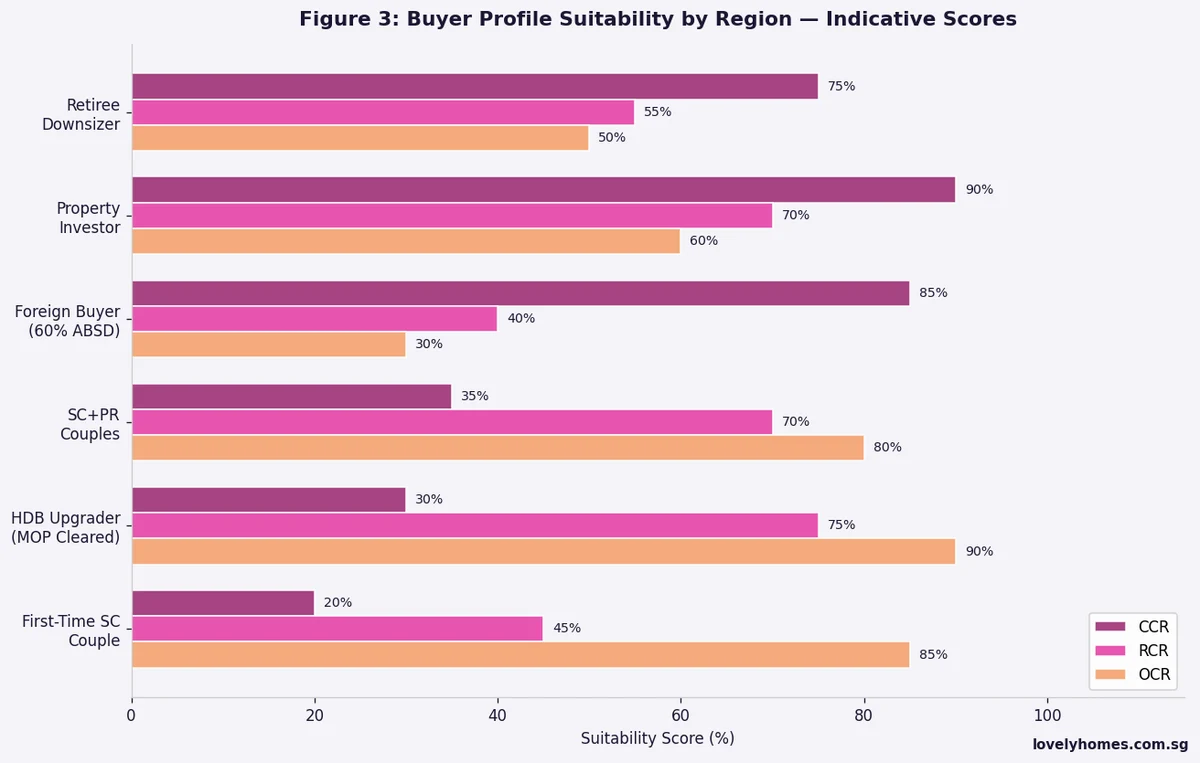
Figure 3: Indicative buyer profile suitability scores by region. OCR dominates for families and HDB upgraders; CCR for high-net-worth and foreign buyers; RCR is the versatile mid-range choice. Source: LovelyHomes editorial analysis.

The chart above summarises indicative suitability, but a few buyer groups merit deeper explanation. HDB upgraders who have cleared their 5-year MOP and hold meaningful CPF balances typically have loan eligibility of S$800K–S$1.4M, making OCR new launches their most accessible private market entry point. RCR remains an upgrade stretch for higher-income upgraders, but typical CCR quanta are prohibitive unless significant cash savings or investments exist outside CPF.

SC+PR couples with combined incomes above S$12,000/month often target RCR for its balance of price and location, but should note that a PR spouse is subject to a 5% ABSD on a first jointly-purchased property (SC gets 0%, but the higher of the two rates applies to the purchase). This effectively adds S$68,250 to a S$1.365M RCR unit — worth factoring into region comparison.

Foreign buyers (60% ABSD since April 2023) almost exclusively target CCR when investing in Singapore, given that the rental yield differential versus OCR rarely justifies the higher entry price at non-CCR locations. CCR’s international tenant base — expatriate professionals, corporate HQs — provides a liquidity premium that partially offsets the ABSD load.

CCR vs RCR vs OCR: Complete Comparison Table

Factor CCR RCR OCR
Key Districts D1-4, D9, D10, D11 D3, D5, D7–8, D12–15 D16–28
Median 2BR PSF (Q1 2026) S$2,420 S$1,950 S$1,520
Q1 2026 QoQ +0.3% +0.8% +2.2%
Q1 2026 YoY +1.2% +2.1% +3.8%
Typical Tenure Mix of FH, 999yr, 99yr Mostly 99yr, some FH Predominantly 99yr
Primary Buyer Profiles HNW, foreign, SC investor Upgrader, professional Family, first-time, HDB upgrader
Gross Rental Yield (est.) 2.5–3.2% 3.0–3.8% 3.5–4.2%
CBD Commute (MRT) 0–15 mins 10–25 mins 25–50 mins
Foreign Buyer ABSD 60% (applies equally) 60% (applies equally) 60% (applies equally)
Landed Property Available? Yes (GCB in D10–11) Limited Yes (most landed housing)

Worked Example: The Tan Family’s Region Decision

The Tan family — a Singapore Citizen couple, both aged 35, combined monthly income of S$14,000, CPF Ordinary Account balance of S$210,000 combined — are upgrading from their Tampines 4-room HDB (MOP cleared, estimated market value S$600,000, outstanding HDB loan S$120,000).

Option A — OCR (Tampines/Sengkang area): S$1.25M 3BR condo
BSD: S$24,100 payable via CPF. ABSD: S$0 (1st private property, SC). Bank loan: 75% LTV = S$937,500, at 3.0% fixed for 2 years / 25-year tenure = S$4,439/month. TDSR: 4,439 / 14,000 = 31.7% — PASS (below 55%). Cash upfront: 5% = S$62,500, plus BSD from CPF. HDB proceeds (≈S$480K after loan) fund CPF top-up and furnishing. Assessment: comfortable, achievable, long commute from current neighbourhood.

Option B — RCR (Queenstown/Bishan area): S$1.65M 3BR condo
BSD: S$47,600 via CPF. ABSD: S$0 (1st private property, SC). Bank loan: 75% LTV = S$1,237,500, at 3.0% / 25 years = S$5,867/month. TDSR: 5,867 / 14,000 = 41.9% — PASS. Cash upfront: 5% = S$82,500, plus BSD. After HDB proceeds the family has adequate liquidity but modest buffer. Assessment: viable, tighter cash flow, better city access and rental potential.

Verdict: On income of S$14,000/month, both options are TDSR-compliant, but Option A leaves a far more comfortable monthly buffer (≈S$9,561 vs ≈S$8,133). The family’s decision ultimately hinges on commute preference, proximity to school zones, and whether they intend to rent the property out within the first few years. Many families in this profile choose RCR as a one-step upgrade recognising they can access the city fringe without stretching to CCR prices.

Why the CCR/RCR/OCR Framework Matters for Buyers in 2026

The three-region framework shapes far more than quarterly URA statistics. Banks use it when calibrating their internal risk pricing; developers use it to position their projects and set launch prices; mortgage brokers use it when stress-testing TDSR across different loan sizes. For buyers, the most practical use is benchmarking: if a developer quotes S$1,800 PSF for a suburban project claiming it’s “competitively priced”, you can immediately check whether it is an OCR (where the median is S$1,520 PSF) or RCR (where S$1,800 PSF sits around the 50th percentile) project, and calibrate your offer accordingly.

The OCR’s recent outperformance is also a structural signal. Singapore’s ongoing MRT expansion — the Cross Island Line (CRL), the Thomson-East Coast Line (TEL) Stage 5, and future Jurong Region Line (JRL) extensions — is closing the commute-time gap between OCR and the CBD. As connectivity improves, OCR locations that once seemed remote are being repriced toward RCR norms, a trend that has been visible in Tampines, Pasir Ris and the Lentor precinct over the past three years.

What Might Come Next

Speculation: The CCR premium is unlikely to narrow significantly as long as the 60% ABSD on foreign buyers remains in place — these buyers were a key source of CCR liquidity, and their reduced participation has suppressed CCR transaction volumes even as prices held. If cooling measures are selectively eased for permanent residents or certain investment categories (which analysts do not expect before 2027 at the earliest), CCR could see a sharp repricing upward.

OCR, meanwhile, faces a pipeline risk: the 2H2026 Government Land Sales (GLS) Confirmed List offers 4,745 units including sites at Tampines, Bayshore Road and Lentor Gardens, which will add meaningful new OCR and OCR-adjacent supply over 2028–2030. Buyers targeting OCR investments with a 5–7 year exit horizon should model potential competition from these incoming projects when estimating resale premiums.

Frequently Asked Questions

Is CCR always more expensive than OCR?

In median PSF terms, yes — CCR has consistently traded at a significant premium to OCR since URA began publishing regional data. However, there are exceptions: a large OCR penthouse in a boutique freehold development can exceed the quantum of a small CCR studio. PSF is the more relevant metric when comparing like-for-like unit types. The median CCR 2BR PSF in Q1 2026 was approximately S$2,420, versus S$1,520 in OCR — a 59% gap.

Do cooling measures (ABSD, LTV, TDSR) apply differently across regions?

No. All cooling measures administered by the Ministry of Finance (MOF), MAS, and IRAS apply uniformly regardless of whether a property is in CCR, RCR or OCR. The ABSD rate is determined by your citizenship/residency status and the number of residential properties you own — not by the location of the property being purchased.

Can I use CPF to buy in any region?

Yes. CPF Ordinary Account (OA) funds can be used for the purchase of any private residential property in Singapore regardless of region, subject to the standard CPF withdrawal limits tied to the property’s Valuation Limit (VL) and any applicable Basic Retirement Sum top-up requirement. The same CPF rules apply in CCR, RCR and OCR.

Are HDB flats classified under CCR/RCR/OCR?

HDB flats use a separate classification system: Standard, Plus and Prime (introduced in October 2024 under the new BTO framework). HDB does not use CCR/RCR/OCR as official categories, though analysts often informally apply the same geographic boundaries to HDB data. The HDB Resale Price Index (RPI) covers all HDB flats islandwide and is published separately from URA’s PPI.

Which region has the best rental yield?

OCR generally offers the highest gross rental yields (estimated 3.5–4.2% for non-landed as at Q1 2026), followed by RCR (3.0–3.8%) and CCR (2.5–3.2%). The CCR’s higher entry prices compress yield percentages even though absolute rents are higher. Investors targeting yield over capital appreciation are often better served by OCR or RCR properties with strong MRT access, where tenant demand from Singapore’s large pool of mid-range expatriates and local professionals is robust.

What determines if a specific development is CCR or RCR?

The URA classifies developments based on their postal district and planning area boundaries. Specifically, a development is CCR if it falls within the defined Central Area boundary (which includes the downtown core, Marina Bay, Sentosa and selected planning areas) or within the Orchard, Newton, Buona Vista or Tanglin planning areas. Developments in planning areas like Queenstown, Toa Payoh or Geylang — which are geographically close to the city centre but outside these defined zones — are classified as RCR. You can verify a specific development’s classification using URA’s online planning maps at the URA Space portal.

Does the region affect my eligibility for grants or CPF schemes?

For private residential property purchases, no CPF housing grants are available — grants (EHG, Family Grant, PHG) are exclusively for HDB flat purchases. The CPF withdrawal rules and TDSR requirements are the same regardless of region. However, for HDB buyers using the new BTO classification framework, the type of grant available is influenced by whether the flat is classified as Standard, Plus or Prime — a parallel but separate system to CCR/RCR/OCR.

Related Articles

Disclaimer: This article is for general informational purposes only and does not constitute financial, legal or tax advice. PSF figures and price statistics are derived from URA real estate statistics (Q1 2026), SLA caveats and industry estimates. Property prices can fall as well as rise. Before making any property purchase decision, readers should consult a licensed property agent, qualified mortgage broker and independent legal counsel. Stamp duty obligations should be verified with the Inland Revenue Authority of Singapore (IRAS). CPF withdrawal eligibility should be confirmed with the Central Provident Fund Board. Grant eligibility should be checked directly with the Housing and Development Board (HDB). Cooling measure rules are subject to change by the Ministry of Finance and MAS.

Translate »