Singapore Property Due Diligence Guide 2026: Title Search, URA Zoning, Legal Requisitions and What Every Buyer Must Check

Singapore Property Due Diligence Guide 2026: Title Search, URA Zoning, Legal Requisitions and What Every Buyer Must Check

Property due diligence in Singapore is the structured process of verifying every material fact about a property before you exercise the Option to Purchase (OTP). Skip it, and you risk buying a flat encumbered by a neighbour’s registered easement, a condo subject to a drainage reserve that prevents extension, or a resale HDB unit where the previous owner left behind outstanding Management Corporation fees. This guide walks you through every check — what it is, who runs it, and what a failure means for your purchase.

Quick Answer — Property Due Diligence at a Glance

  • Due diligence covers 10 distinct checks spanning legal title, planning, physical condition, and financial encumbrances.
  • The title search (run by your solicitor) reveals mortgages, caveats, and encumbrances registered against the property at the Singapore Land Authority (SLA).
  • URA Master Plan zoning tells you what the land is approved for — critical if you are buying a shophouse or a property in a conservation area.
  • Legal requisitions go to 8–12 government agencies (URA, HDB, LTA, NEA, BCA, PUB, NParks, SCDF) and typically take 2–3 weeks to return.
  • A bank valuation below your OTP price means the shortfall must be funded in cash — CPF and loan proceeds are capped at the lower of price or valuation.
  • CPF withdrawal for private property is restricted if the remaining lease is short; check this before committing.
  • Defects inspection costs S$400–S$800 and should always be done before exercising the OTP for a resale property.

What Is Property Due Diligence and Why Does It Matter?

In Singapore’s property market, the OTP commits you legally to the purchase once exercised. You will forfeit your option fee (typically 1% of the purchase price for private properties) if you walk away after granting. For high-value transactions, this can mean losing S$15,000–S$30,000 or more if you discover a problem after the OTP is signed but before you exercise it — and substantially more if you exercise and then discover defects or legal complications.

Due diligence is your window to uncover these problems before you are locked in. Singapore’s Torrens title system (administered by SLA under the Land Titles Act) means that most legal interests are registered on the land register and are therefore discoverable — but only if you look. Unregistered interests such as verbal agreements, side letters, or informal easements are not discoverable through a title search and represent a residual risk in all real estate transactions.

Your conveyancing solicitor handles the bulk of the legal checks once the OTP is granted. But several steps — particularly the physical inspection, the URA zoning check, and the CPF remaining-lease calculation — are things you should carry out before signing the OTP, while you still have negotiating leverage and can still walk away cleanly.
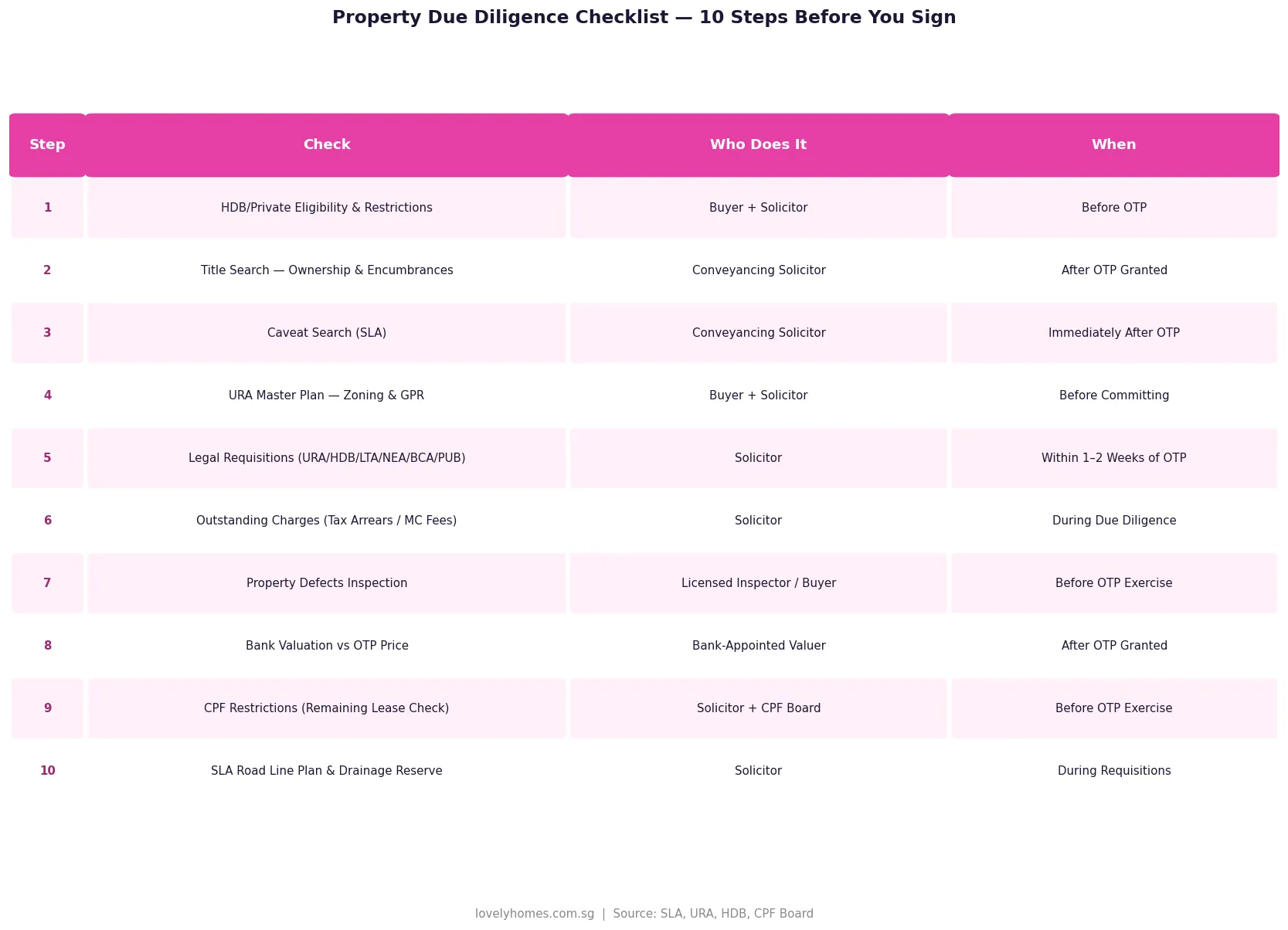
Property due diligence checklist 10 steps before signing OTP Singapore 2026
Figure 1: The 10-step property due diligence checklist every Singapore buyer should complete before or immediately after signing the OTP. Steps 1, 4, 7, and 9 should be completed before signing; Steps 2, 3, 5, 6, 8, and 10 are completed by your solicitor after the OTP is granted.

Step 1: Establishing Ownership and Basic Eligibility

Before signing anything, confirm the identity of the legal owner using the SLA’s Integrated Land Information Service (INLIS). You can pay S$5 to search by property address and obtain the registered proprietor’s name. Discrepancies between the SLA record and the seller’s identity should be flagged immediately to your solicitor. For HDB resale, log on to the HDB Resale Portal to check eligibility — specifically the Ethnic Integration Policy (EIP) quota for the block and neighbourhood, and whether the seller has fulfilled the Minimum Occupation Period (MOP) and is entitled to sell.

For private property, confirm whether there are any Qualifying Certificate (QC) obligations on the seller (relevant for foreign developer-owned properties) or any Additional Buyer’s Stamp Duty (ABSD) implications on your own buyer profile. Our ABSD Singapore 2026 Complete Guide covers this in full.

Step 2: Title Search — What the Land Register Reveals

A title search is run by your conveyancing solicitor using SLA’s land register. It reveals every registered interest on the title at that moment: mortgages, caveats, cautions, restrictions, and in some cases, easements. The search is conducted both at the time of the OTP and again shortly before completion to ensure no new interests have been registered in the interim.

Mortgages registered against the title must be discharged on completion — your solicitor will direct the sale proceeds to the seller’s bank and obtain a formal discharge before the transfer is registered in your name. Caveats lodged by the seller’s previous buyer (who never completed) must also be removed before you can take clean title. Restrictive covenants — which may limit use to residential purposes, prohibit subdivision, or require consent for structural alterations — bind all subsequent owners and can significantly affect a property’s development potential.
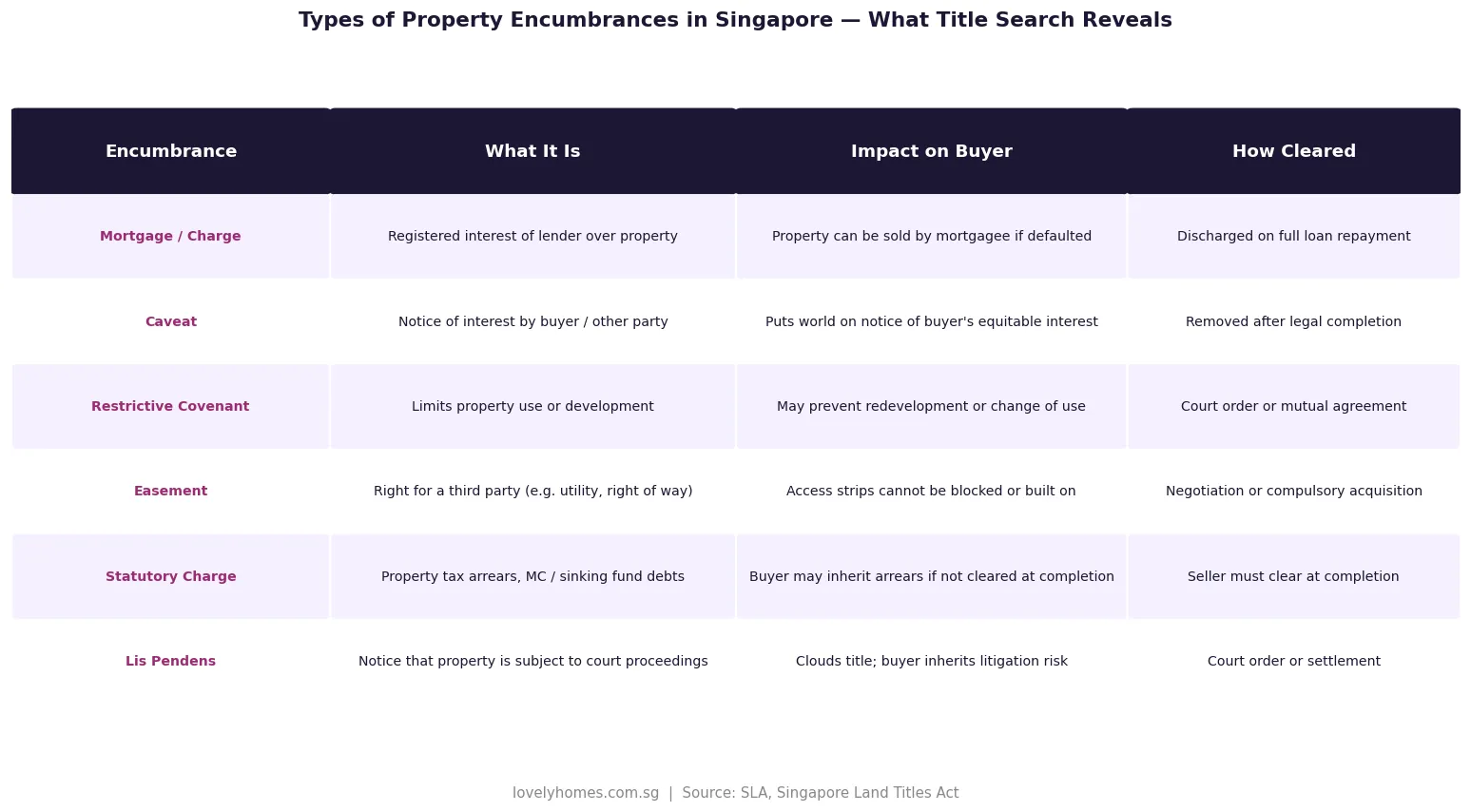
Types of property encumbrances Singapore title search reveals mortgages caveats easements statutory charges
Figure 2: Six categories of encumbrance that a Singapore title search may reveal. All must be resolved before legal completion; Lis Pendens and restrictive covenants require careful legal advice before you commit.

Step 3: Lodging Your Caveat After the OTP

Once you have signed the OTP and paid the option fee, your solicitor should lodge a caveat against the property on your behalf as soon as practicable. This caveat notifies the world that you have an equitable interest in the property as the pending purchaser. Without a caveat, a dishonest seller could theoretically sign a second OTP for the same property with another buyer, or the seller’s creditors could register a charge that clouds the title before you complete. SLA charges S$64.45 per caveat as at 2026. The caveat is removed by SLA upon completion and registration of the transfer in your name.

Step 4: URA Master Plan — Zoning, GPR and Allowable Use

The Urban Redevelopment Authority (URA) publishes the Master Plan 2019, which designates every parcel of land in Singapore with a zone and, for most zones, a Gross Plot Ratio (GPR). The GPR determines how much development is permitted — a site with a 1.4 GPR can have a total gross floor area of 1.4 times the land area, while a 2.8 GPR allows twice that.

For most buyers purchasing an existing strata title unit (condo, HUDC), the URA zone is primarily relevant for future redevelopment potential — a higher GPR means a more valuable en-bloc site and a potentially higher collective sale pay-out. For buyers of landed property or shophouses, the zone governs what you can build, extend, or convert. A mixed-use shophouse in a Conservation Area, for example, requires URA approval for any alteration and must retain the heritage facade — renovation costs and timelines are substantially higher.
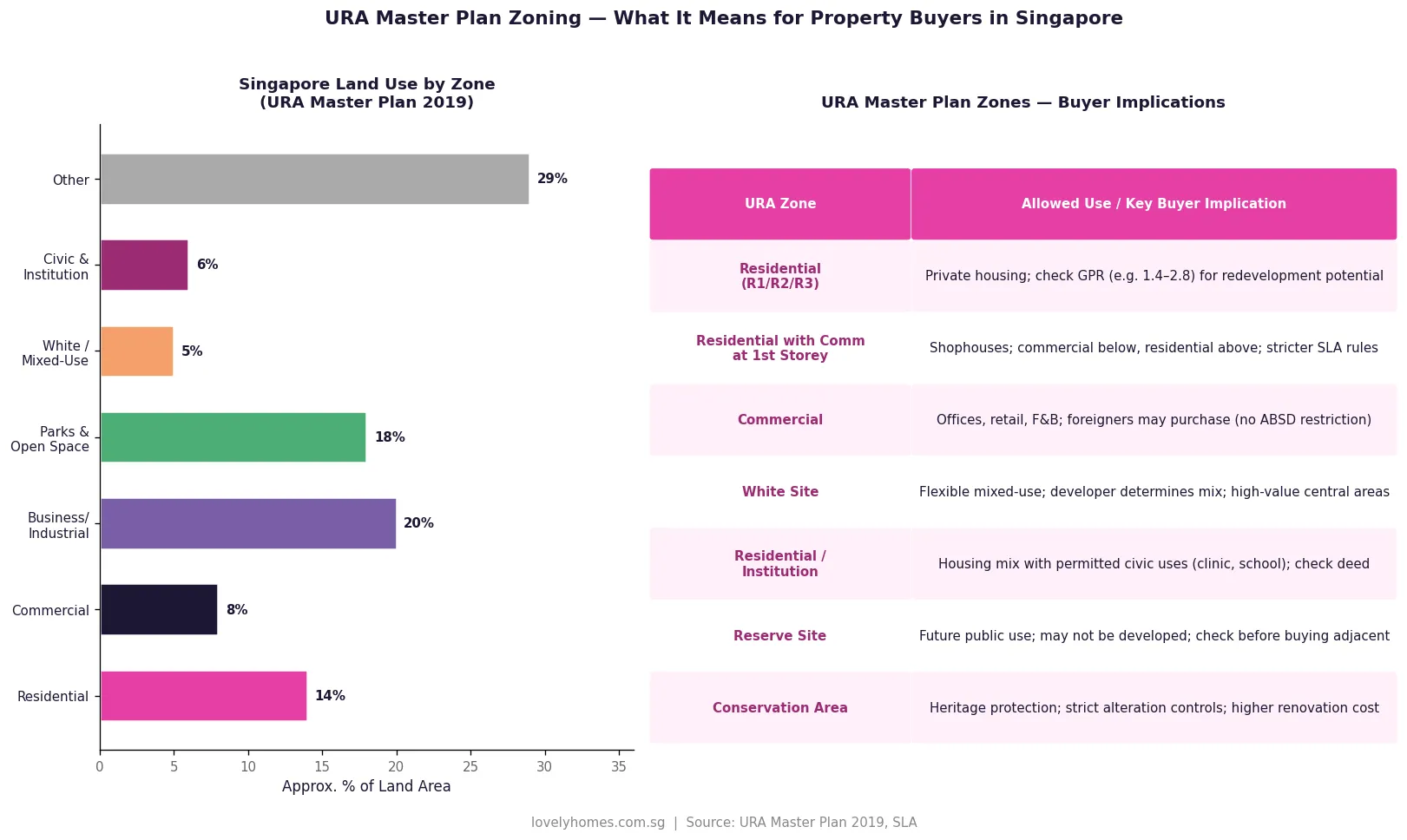
URA Master Plan zones Singapore residential commercial white site buyer implications 2026
Figure 3 (left) illustrates the approximate distribution of Singapore’s land by URA Master Plan zone. The table (right) explains the practical implications for property buyers under each major zone type.

Step 5: Legal Requisitions — Eight Government Agencies in One Sweep

Legal requisitions are formal enquiries that your solicitor sends to government agencies after the OTP is granted. They are mandatory on all private property transactions and are standard practice for HDB resale transactions as well. The agencies typically covered are URA (planning permission history, road lines), HDB (resale approval, outstanding loans), Land Transport Authority (road line plans, MRT land acquisition, drainage reserves), National Environment Agency (pollution control orders), Building and Construction Authority (structural safety notices, building plan approvals), Public Utilities Board (sewerage connections, drainage reserves), National Parks Board (gazetted trees), and Singapore Civil Defence Force (fire safety certificates). Requisitions typically take 2–3 weeks to return. A drainage reserve from PUB, for example, means a strip of land along a boundary must remain clear for drainage access — any permanent structure within it may need to be removed. These findings are not deal-breakers in themselves, but they affect what you can do with the property and should factor into your negotiation and renovation plans.

Outstanding Charges: Property Tax, Maintenance, and Sinking Fund

Two categories of financial obligation attach to a Singapore property and can, if unpaid, transfer to the new owner as a statutory charge on the land. Property tax is levied by the Inland Revenue Authority of Singapore (IRAS) annually on the Annual Value of the property. If the seller has arrears, IRAS can pursue them as a debt secured against the property. Your solicitor will obtain an IRAS property tax certificate confirming no arrears as at completion, and any balance of the current year’s tax will be apportioned between buyer and seller. Management Corporation (MCST) fees and sinking fund contributions apply to all strata-title properties. These cover building maintenance, security, and the sinking fund for major repairs. Your solicitor obtains a certificate from the MCST confirming all charges are current; any arrears are deducted from the sale proceeds.

Charge / Obligation Levied By Consequence of Arrears How Resolved at Completion
Property Tax IRAS Statutory charge on land; IRAS can pursue buyer Deducted from sale proceeds; IRAS issues clearance
MCST Maintenance Fees Management Corporation Debt against property; MCST has statutory lien Deducted from sale proceeds; MCST issues clearance
Sinking Fund Arrears Management Corporation Same as maintenance fees Deducted from sale proceeds; MCST issues clearance
HDB Outstanding Loan HDB HDB must be paid off before title transfers Discharged from sale proceeds at completion
Town Council S&CC HDB Town Council Council may pursue buyer; HDB will not process resale with arrears Seller must clear all arrears before HDB processes resale
Statutory Agency Orders PUB, NEA, BCA Outstanding order may pass to new owner Solicitor flags via requisitions; buyer negotiates with seller

Property Defects Inspection: What to Check Before You Exercise the OTP

A physical inspection by a professional building inspector examines structural integrity, mechanical and electrical systems, water ingress, and finishes. In Singapore, professional inspection fees typically range from S$400 to S$800 for a standard condo unit and S$800 to S$1,500 for a landed property. Key areas inspected include: structural walls and columns for cracks or movement; ceiling and floor slabs for water staining indicating leaks from above; windows for proper sealing; air-conditioning systems; plumbing; electrical outlets; and tiling for hollow spots or grout failure. If the inspection reveals defects, you have three options: negotiate a price reduction reflecting the cost of repair; require the seller to make good before completion; or accept the property as-is if the defects are cosmetic only.

Bank Valuation vs OTP Price: When the Numbers Don’t Match

Your bank appoints its own valuer to assess the property’s market value independently of the OTP price you have agreed. If the bank’s valuation comes in below the OTP price, your loan and CPF usage are capped at the lower valuation figure. The shortfall must be funded entirely in cash. For example: if you agree to buy a property at S$1.5 million but the bank values it at S$1.45 million, the S$50,000 shortfall cannot be funded via CPF or loan. On top of the standard cash outlay, you must produce an additional S$50,000 in cash. To mitigate this risk: ask your solicitor to engage the bank early for an indicative valuation before you sign the OTP. Our Singapore Property Financing Guide 2026 explains LTV ratios and CPF interaction in detail.

CPF Restrictions: Remaining Lease and the Age Equation

For private property, the CPF Board imposes restrictions on how much CPF can be used depending on the property’s remaining lease. The key rule: CPF OA savings can be used up to the applicable percentage of the lower of purchase price or valuation, provided the lease covers the youngest buyer to at least age 95. Where the lease falls short of that threshold, the CPF usage limit is pro-rated. Always compute the remaining lease-to-55 figure before committing to a purchase. A 1970s leasehold development with 47 years remaining may have severe CPF restrictions that alter the entire financing arithmetic. For HDB flats, separate rules apply — we cover these in our CPF Property Usage Guide 2026.

Worked Example: Ms Yeoh’s D15 Condo Purchase

Profile: Ms Yeoh (Singapore Citizen, 38, gross income S$9,500/month), buying her first private property — a District 15 freehold 2-bedroom condo resale, 969 sqft, OTP price S$1.5 million.

Eligibility (Step 1): Freehold, no EIP or HDB restrictions. First property — ABSD S$0, BSD S$44,600 (payable via CPF).

URA zoning (Step 4): Residential (GPR 1.4, 12-storey block). No conservation area, no road line plan issues. En-bloc potential noted but not material to current purchase.

Requisitions (Step 5): PUB returns a 1.5-metre drainage reserve along the northern boundary. This affects ground-floor garden units but not Ms Yeoh’s high-floor unit. URA: no outstanding development charges. LTA: no road widening planned.

Outstanding charges: IRAS reveals S$2,400 in property tax arrears. Solicitor directs seller to clear from sale proceeds. MCST clearance: all fees current.

Defects inspection (Step 7): Professional inspector (S$550 fee) finds 3 defects: hairline crack in bedroom wall (cosmetic, repair S$200); faulty fan coil in main bedroom (repair S$400); hollow tiles in wet kitchen, 12 tiles (re-grout S$350). Ms Yeoh negotiates a S$1,000 price reduction; seller agrees, OTP price revised to S$1.499 million.

Bank valuation (Step 8): Bank values property at S$1.48 million — S$19,000 below revised OTP. Cash top-up required: S$19,000. Loan: 75% LTV of S$1.48M = S$1.11 million at 3.1% over 30 years = S$4,740/month. TDSR: S$4,740 / S$9,500 = 49.9% — below the 55% cap, PASS.

CPF (Step 9): Freehold property, no remaining-lease restriction. CPF OA balance S$85,000 used for BSD (S$44,600) and partial down payment.

Total cash outlay: 1% option fee S$14,990 + 4% exercise balance S$59,960 + valuation shortfall S$19,000 + legal fees S$4,800 + defects inspector S$550 + valuation fee S$450 = approximately S$99,750 in cash, plus S$44,600 CPF for BSD.

Why This Matters for Singapore Property Buyers

Singapore’s regulatory framework provides unusually strong protections compared to other property markets in the region. SLA’s Torrens system gives indefeasibility of title — once a transfer is registered, you generally cannot be dispossessed by a prior unregistered interest. But indefeasibility does not protect against interests that were registered before your title, or against physical defects that no government agency records. The combination of high transaction taxes (BSD up to 6% plus potentially ABSD), legal costs, renovation costs, and agent commissions means that the total cost of getting a Singapore property transaction wrong can easily exceed S$100,000 on a S$1.5 million purchase. Due diligence is genuine risk management, not a bureaucratic hurdle.

International buyers, particularly those from markets where verbal agreements are common and title insurance is the norm, should note that Singapore does not have a title insurance market in the US sense. Your protection comes from the rigour of the Torrens register and from the due diligence process your solicitor runs. Engaging an experienced Singapore-qualified conveyancing solicitor is arguably the most important due-diligence step of all. For the full conveyancing process, see our Singapore Property Conveyancing Guide 2026.

What Might Come Next: Digital Due Diligence and Faster Requisitions

SLA has been progressively digitising Singapore’s land register and making INLIS data more accessible. The OneMap platform (jointly maintained by SLA and the Singapore Government) now overlays URA Master Plan zoning, road line plans, and SLA land boundaries on a single geospatial interface, reducing the time needed to assemble basic due diligence information. Looking forward, it is plausible that AI-assisted requisition processing could reduce the current 2–3-week response time for legal requisitions to days, allowing faster and more efficient property transactions without compromising thoroughness. The Ministry of Law has also been exploring reforms to simplify conveyancing procedures, though no specific timeline has been announced as at mid-2026.

Frequently Asked Questions

Can I do the due diligence myself, or do I need a solicitor?

You can and should personally carry out Steps 1, 4, and 7 (ownership check via INLIS, URA zoning check, and physical inspection) before signing the OTP. However, Steps 2, 3, 5, 6, 8, and 10 require a licensed solicitor who has access to SLA’s full search system and the authority to issue formal legal requisitions to government agencies. Attempting to run title searches or lodge caveats without a solicitor is inadvisable and, for most instruments, not legally permissible for a layperson. Solicitor fees for conveyancing typically range from S$2,500 to S$6,000 depending on the transaction value and complexity.

What if the legal requisitions reveal a drainage reserve on the property?

A drainage reserve means PUB has a right of access over a strip of land (typically 1–3 metres wide along a boundary) for drainage maintenance. You cannot build permanent structures over the reserve. For high-floor condo units, this is generally not material — it affects the site boundary but not your unit. For landed properties or ground-floor units with garden access, it can restrict extension plans. You should factor this into your renovation budget and negotiate accordingly. A drainage reserve does not void the purchase and is not grounds to rescind the OTP, but it may affect the market value of the property if significant.

How long do I have to exercise the OTP after signing it?

For private resale property, the OTP is valid for 14 days from the date of grant (unless the parties agree a longer period). Within those 14 days, you must exercise the OTP by signing the acceptance copy and paying the exercise fee (typically 4% of the purchase price for private property, making the total deposit 5%). You cannot extend the OTP unilaterally — it requires the seller’s agreement. This 14-day window is precisely why you should complete the physical inspection and URA zoning check before signing the OTP, not after. For HDB resale, the OTP validity period is also typically 14 days from the date of grant.

Does due diligence differ for HDB resale flats?

Several checks are HDB-specific. For resale HDB flats, you must verify the seller has fulfilled the MOP (5 years for standard BTO and resale flats, 10 years for Prime Location Public Housing flats), check the Ethnic Integration Policy quota for the block and neighbourhood, confirm there are no outstanding Town Council service and conservancy charges, and ensure the seller’s HDB loan (if any) will be fully discharged at completion. Legal requisitions for HDB resale are processed through the HDB Resale Portal rather than through individual agency requisitions. You should also confirm the flat’s remaining lease and its impact on CPF and loan eligibility. Our HDB Resale Buying Process Guide 2026 covers the full HDB-specific process.

Can a seller misrepresent the condition of the property and what recourse do I have?

Singapore property transactions follow the principle of caveat emptor — let the buyer beware — for physical condition. However, sellers have a duty not to make fraudulent or negligent misrepresentations about material facts. If a seller actively conceals a known structural defect (for example, paints over a crack that was flagged in a prior structural report) and you can prove this, you may have a claim under the Misrepresentation Act or in tort. The practical challenge is proving knowledge and concealment. This is why a professional defects inspection creates a contemporaneous record before completion. For serious defects discovered after completion, seek legal advice promptly as time limits apply.

Do I need a separate building inspection for a new launch condo?

For new launch properties, you take possession at the point of vacant possession, typically 3–5 years after the OTP for off-plan purchases. At vacant possession, the developer issues a formal defects list period (often 12 months) during which they must rectify any defects reported. You should still conduct a thorough inspection at vacant possession with a professional inspector — the developer’s obligation to rectify only applies to defects formally reported within the defects period. After the defects period expires, rectification becomes your responsibility and can be costly for structural or waterproofing issues.

What is the SLA Road Line Plan and why does it matter for landed property buyers?

The SLA Road Line Plan (RLP) shows the planned final boundary of a road adjacent to or affecting the property. If your property sits within the planned road reserve, a portion of your land — typically at the front setback — may eventually be acquired by LTA for road widening. The acquisition is compulsory and is compensated at market value under the Land Acquisition Act, but the timing is uncertain. For landed properties, an RLP reservation affects how close to the boundary you can build and may reduce the effective usable area of the site. Your solicitor flags this in the LTA requisition response, and you should factor it into your purchase decision accordingly.

Related Articles


Disclaimer: This article is for general informational purposes only and does not constitute legal, financial or professional advice. Property transactions in Singapore involve complex legal and financial considerations. Always engage a Singapore-qualified solicitor, a licensed property agent, and a bank or financial adviser for advice specific to your circumstances. For the authoritative position on any matter, refer to the Singapore Land Authority (sla.gov.sg), the Urban Redevelopment Authority (ura.gov.sg), HDB (hdb.gov.sg), the Inland Revenue Authority of Singapore (iras.gov.sg), and the CPF Board (cpf.gov.sg).
June 2026 BTO Results: Berlayar Rise and Lakeview Cascadia Dominate With 4.5-4.7 Times Oversubscription

June 2026 BTO Results: Berlayar Rise and Lakeview Cascadia Dominate With 4.5-4.7 Times Oversubscription

The June 2026 Build-To-Order (BTO) sales exercise closed on 24 June 2026 after five days of applications, confirming a pattern that has defined Singapore’s public housing market all year: Prime-classified projects in central and mature estates are dramatically oversubscribed, while Standard projects in the north and north-east attract softer demand — in some cases failing to reach full first-timer subscription. Here is the complete picture.

Quick Answer — June 2026 BTO Results at a Glance

  • 6,952 flats launched across 7 projects in Ang Mo Kio, Bishan, Bukit Merah, Sembawang, and Woodlands.
  • Total applications: 22,634 — overall subscription rate of 3.3 times (as at 5pm, 24 June 2026).
  • Star project: Berlayar Rise (Bukit Merah, Prime) — 8,824 applications, 4.5× oversubscribed. Nearly 40% of all applications in the exercise.
  • Runner-up: Lakeview Cascadia (Bishan, Prime) — 5,799 applications, 4.7× for certain flat types.
  • Weakest demand: Sembawang Portico and Sembawang Brook — first-timer family rates fell below 1× for all 3-room and larger flat types.
  • Singles demand surge: Woodgrove Acres (Woodlands) 2-bedroom flexi units hit 17.8× for first-timer singles.
  • More than 2,500 flats offered have wait times of three years or less under HDB’s expedited build programme.

The Full Project-by-Project Breakdown

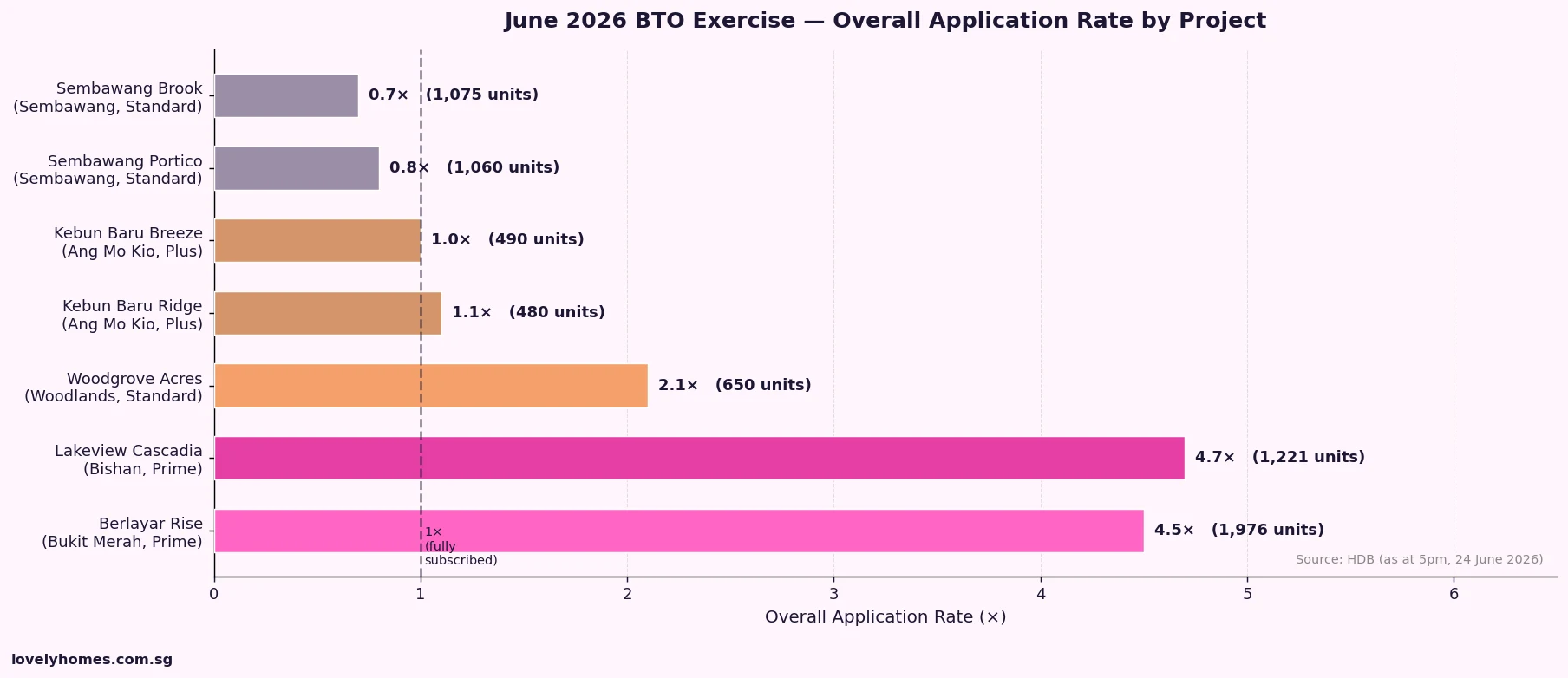
June 2026 BTO exercise application rate by project bar chart — Berlayar Rise, Lakeview Cascadia, Woodgrove Acres, Kebun Baru, Sembawang
Figure 1: Overall application rate by project, June 2026 BTO exercise (as at 5pm, 24 June 2026). Source: HDB Singapore.
Project Town Classification Units Applications Overall Rate
Berlayar Rise Bukit Merah Prime 1,976 8,824 4.5×
Lakeview Cascadia Bishan Prime 1,221 5,799 4.7×
Woodgrove Acres Woodlands Standard ~650 ~2× (singles 17.8×)
Kebun Baru Ridge Ang Mo Kio Plus ~480 ~1.1× (3-room 2T: 22.9×)
Kebun Baru Breeze Ang Mo Kio Plus ~490 ~1.0×
Sembawang Portico Sembawang Standard ~1,060 <1× (families)
Sembawang Brook Sembawang Standard ~1,075 <1× (families)

Source: HDB. Application rates as at 5pm, 24 June 2026. Woodgrove Acres, Kebun Baru, and Sembawang project unit counts are approximate; official HDB breakdown shows total 6,952 units across all 7 projects.

Berlayar Rise: The Greater Southern Waterfront Magnet

Berlayar Rise in Bukit Merah accounted for nearly 40% of all applications in the June exercise — a remarkable concentration of demand in a single project. The draw is straightforward: this is a Prime-classified development integrated with Telok Blangah MRT station on the Circle Line, positioned squarely within the Greater Southern Waterfront (GSW) transformation precinct. Prices for 4-room flats are estimated to start from around S$580,000 — a figure that, while elevated for public housing, represents a meaningful discount to what an equivalent private resale unit in the Telok Blangah/Bukit Merah corridor would cost (typically S$1.2–1.6 million for a comparable size).

The Prime designation means buyers are subject to the standard Prime location conditions: a 10-year Minimum Occupation Period (MOP), an income ceiling of S$14,000 for families, and subsidy clawback on resale (estimated at approximately 14%, based on the precedent set by the nearby Berlayar Residences project). For buyers who can meet those conditions and want a foothold in the GSW story, Berlayar Rise offers compelling long-term value. The development sits near the future Telok Blangah market and hawker centre, and the broader GSW transformation — connecting Keppel, Harbourfront, and Pasir Panjang — is a generational urban-planning project that will unfold over the next 15–20 years.

Prime vs Plus vs Standard: A Market Verdict

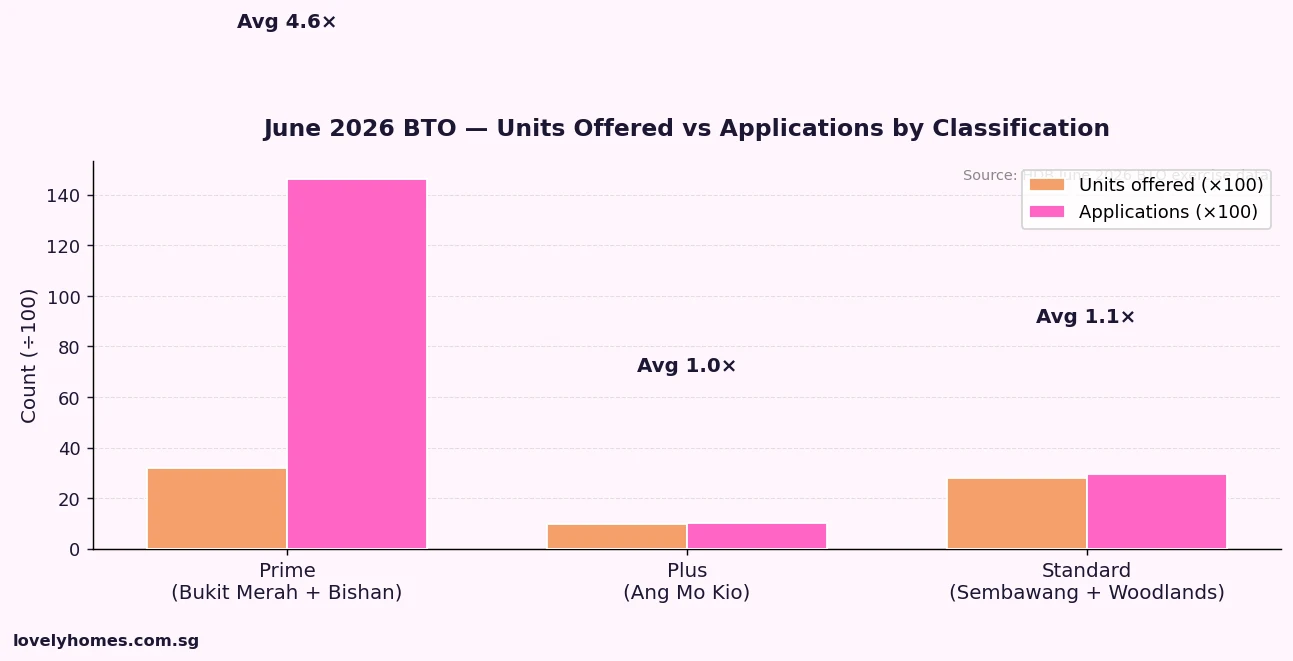
June 2026 BTO units offered versus applications by Prime Plus Standard classification chart
Figure 2: Units offered vs applications by BTO classification — June 2026 exercise. Prime projects (Bukit Merah + Bishan) absorbed the majority of demand despite representing fewer units. Source: HDB.

The June 2026 results are the clearest data point yet that Singapore’s three-tier BTO classification system (Prime, Plus, Standard) is functioning broadly as intended — but with some unintended consequences at the Standard end.

Prime projects (Berlayar Rise and Lakeview Cascadia) together offered 3,197 units but attracted approximately 14,623 applications — an average rate of 4.6 times. This is precisely the outcome the Government anticipated when it introduced the classification: demand for centrally located, well-connected projects is intense, and the subsidy recovery and MOP conditions are not deterring buyers who value location above all else.

Plus projects (Kebun Baru Breeze and Ridge in Ang Mo Kio) sat at approximately 1× overall subscription for first-timer families — marginally fully subscribed, which means successful ballots are likely but not certain for this cohort. The Plus designation was designed to sit between Prime and Standard in both location quality and subsidy level, and the Ang Mo Kio projects are genuinely well-located (D20, established mature estate, near Yio Chu Kang and Ang Mo Kio MRT). The lukewarm response may reflect the Plus conditions — 6-year MOP and clawback provisions — deterring the upgrader segment that has traditionally been the main buyer of Ang Mo Kio BTO flats.

Standard projects in Sembawang fell below full subscription for families. This is consistent with the market’s verdict on northern Singapore’s accessibility: despite the upcoming Cross Island Line (CRL) timeline, Sembawang remains a long commute for most CBD workers. The two projects together offered over 2,100 units — the largest supply block in the exercise — but attracted insufficient family demand to be oversubscribed. Unsuccessful ballot applicants from more competitive projects will likely be allocated here under HDB’s concession scheme.

The Singles Story: Woodlands Breaks Records

The most striking single data point in the June exercise was Woodgrove Acres in Woodlands: 2-bedroom flexi flats — the designated flat type for first-timer singles — were 17.8 times oversubscribed. This is an extraordinary figure that reflects both the shortage of BTO supply for singles (who are restricted to 2-bedroom flexi flats) and the growing demographic weight of single-person households in Singapore. The government has been incrementally expanding singles’ eligibility for BTO housing, but the 17.8× rate suggests the supply pipeline for singles remains severely constrained relative to demand.

What This Means for BTO Applicants

For applicants who were unsuccessful in the Berlayar Rise and Lakeview Cascadia ballots, the practical options are to re-apply in the October 2026 BTO exercise (details not yet announced), consider the concession flat allocation scheme which may direct them to Sembawang, or explore the HDB resale market where wait times are zero. Resale prices in mature estates have risen, but the Enhanced CPF Housing Grant (EHG) is available for resale purchases and can offset up to S$120,000 of the purchase price for eligible first-timers.

For families considering Sembawang, the below-1× first-timer rate means that applicants in this tranche are virtually guaranteed a flat if they apply — a rare situation in the BTO context. The trade-off is location and commute time, but Sembawang does offer genuine value: 4-room BTO flats in Standard Sembawang projects are typically priced in the S$330,000–S$430,000 range, representing the lowest entry point into new public housing available anywhere in the exercise.

What Might Come Next

The October 2026 BTO exercise is expected to launch in mid-October. HDB has indicated it will continue offering at least one Prime project per exercise to maintain supply at the most competitive tier. Industry observers expect the next Prime project to be in the Queenstown or Geylang/Kallang corridor, given the land parcels currently under preparation. For the Sembawang and Woodlands Standard supply overhang, HDB may consider adjusting pricing or flat-type mix in future launches to better match demand.

Frequently Asked Questions

What happens if a BTO project is undersubscribed?

If a BTO project does not receive sufficient applications to fill all available units within a flat type during the initial application period, HDB opens unsold flats for Sale of Balance Flats (SBF) exercises or re-offers them in subsequent BTO exercises. For the Sembawang Standard projects in June 2026, HDB’s concession flat scheme may direct unsuccessful applicants from oversubscribed projects to take up these units, often with a priority queue position. Buyers who accept concession flats in less popular projects lose the right to re-ballot in the same exercise but gain a guaranteed flat allocation.

What is the subsidy clawback for Berlayar Rise (Prime)?

The exact clawback percentage for Berlayar Rise has not yet been officially confirmed by HDB, but based on the precedent of the nearby Berlayar Residences (a Prime project from the October 2025 exercise), the clawback is estimated at approximately 14% of the resale price on first resale after the 10-year MOP. This means that if you sell a Berlayar Rise flat in 2036+ at, say, S$900,000, approximately S$126,000 would be clawed back by HDB before you receive your net sale proceeds. The clawback is intended to recover some of the Prime location subsidy from sellers who benefit from the price appreciation in the GSW area. Always check the specific clawback terms in your sales agreement.

Can first-timer singles apply for Berlayar Rise or Lakeview Cascadia?

First-timer singles (aged 35 and above) may apply for 2-bedroom flexi flats in Prime and Plus projects, subject to the same income ceiling (S$7,000 per month for singles) and the additional MOP/clawback conditions. However, the quota for singles in Prime projects is limited, and competition for 2-bedroom flexi units in Prime projects is historically intense. The June 2026 exercise did not publicly disclose the singles-specific application rate for Berlayar Rise or Lakeview Cascadia, but based on past exercises, 2-bedroom flexi units in Prime projects typically see subscription rates well above 5×.

What is the Minimum Occupation Period for these projects?

The MOP varies by classification: Prime projects (Berlayar Rise, Lakeview Cascadia) have a 10-year MOP. Plus projects (Kebun Baru Breeze and Ridge in Ang Mo Kio) have a 6-year MOP. Standard projects (Woodgrove Acres, Sembawang Portico, Sembawang Brook) have the standard 5-year MOP. During the MOP, owners cannot sell the flat on the open market or rent out the entire flat. Partial renting of individual rooms is permitted after an owner has fulfilled occupation requirements. The longer MOP for Prime and Plus projects is part of the policy design to moderate speculative demand and ensure these subsidised flats serve genuine owner-occupiers over the medium term.

When will the October 2026 BTO exercise launch?

HDB typically announces each BTO exercise approximately one month before applications open. Based on the 2025–2026 schedule, the October 2026 exercise is likely to open for applications in mid-to-late October 2026, with flat details announced in mid-September 2026. LovelyHomes will cover the October 2026 BTO launch as soon as HDB releases official details. You can subscribe to HDB’s e-alerts at homes.hdb.gov.sg to be notified when new launches are announced.

Related Articles

Disclaimer: Application rates and project details are sourced from HDB Singapore (as at 5pm, 24 June 2026) and industry reporting. Figures are subject to change as HDB publishes final ballot results. Subsidy clawback estimates are indicative based on comparable projects and are not official HDB figures for Berlayar Rise. Always refer to HDB’s official flat listings and consult a licensed property agent or HDB directly before making any application or purchase decision. LovelyHomes is not affiliated with HDB or any property agency.

Singapore Condo Sinking Fund and Maintenance Fee Guide 2026: What Every Owner Needs to Know

Singapore Condo Sinking Fund and Maintenance Fee Guide 2026: What Every Owner Needs to Know

When Singaporeans talk about the monthly cost of owning a condominium, they usually quote the mortgage repayment. What often gets overlooked — until the first few months after moving in — are the maintenance fee and sinking fund levy: two mandatory monthly contributions that every strata-titled condo owner must pay to the Management Corporation Strata Title (MCST). Together, these can add S$300 to S$1,200 per month to the cost of condo ownership, and failing to pay them has real legal consequences. This guide explains exactly what these charges are, how they are set, what they pay for, and how to plan for them when buying a condo in Singapore.

Quick Answer — Condo Fees at a Glance

  • Maintenance fee: monthly contribution for day-to-day estate running costs (security, cleaning, utilities, landscaping).
  • Sinking fund levy: monthly contribution to a reserve for major capital expenditure (lift replacement, roof waterproofing, facade repainting).
  • Both are collected by the MCST, the legal body representing all owners in a strata development.
  • Contributions are set at the Annual General Meeting (AGM) based on unit share value — larger units pay more.
  • Typical total condo fee (maintenance + sinking fund): S$300–S$1,200/month, depending on development size, age, and facilities.
  • The sinking fund must be maintained at a minimum of 10% of the preceding year’s management fund under the BMSMA.
  • Non-payment can result in MCST filing a court order against the owner. There is no grace period in law.
  • Governed by the Building Maintenance and Strata Management Act (BMSMA), administered by the Commissioner of Buildings (COB) under HDB.

What Is the MCST and Who Sets the Fees?

Every strata-titled development in Singapore — from a two-unit walk-up to a 1,000-unit mega-project — is governed by a Management Corporation Strata Title (MCST). The MCST is a body corporate constituted automatically when the strata title plan is registered with the Singapore Land Authority (SLA). It has its own legal personality: it can sue, be sued, hold property, and enter contracts.

The MCST is governed by a Management Council, elected by subsidiary proprietors (owners) at the AGM. The Council sets annual budgets for two distinct funds: the Management Fund (covering day-to-day operations) and the Sinking Fund (covering capital expenditure). Individual owner contributions to each fund are proportional to their unit’s share value — an integer assigned to each lot at the time of development based on floor area and usage. A 1,500 sqft unit might have a share value of 10; a 600 sqft studio might have a share value of 5. Your monthly levy is therefore your unit’s share value divided by the total share values of all units in the development, multiplied by the total annual budget for that fund, divided by 12.

The legal framework governing all of this is the Building Maintenance and Strata Management Act (BMSMA), Cap. 30C. Key rules include: the sinking fund must hold at least 10% of the management fund budget; the MCST must prepare audited accounts annually; and owners who are in arrears can have their contribution recovered as a civil debt.

Feature Management Fund Sinking Fund
Purpose Day-to-day operations Long-term capital expenditure reserve
Examples of use Security, cleaning, gardening, utilities Lift replacement, waterproofing, facade repainting
BMSMA minimum No statutory minimum set Must equal at least 10% of management fund budget
Planning horizon Annual (reset each year) Cumulative — builds over time; does not reset
Typical monthly levy S$200–S$1,200 (varies by unit size) S$30–S$200 (10–15% of management fee)
Recoverable on sale? No — stays with MCST No — stays with MCST

Maintenance Fee — What It Covers

The maintenance fee (sometimes called the management fee or conservancy charge) finances the Management Fund, which covers the development’s recurring, day-to-day operating costs. These typically include:

Security services (24-hour guardpost, patrols, CCTV monitoring), cleaning and housekeeping of common areas, landscaping and horticultural maintenance, utility bills for common area lighting and lifts, pool and gymnasium upkeep (water treatment, equipment servicing), insurance for the building fabric and common property, property management agent fees, and routine maintenance and minor repairs. For luxury developments with concierge services, valet parking, or hotel-grade amenities, the management fund also covers these premium services — which is why fees in such projects can reach S$900+ per month for a large unit.

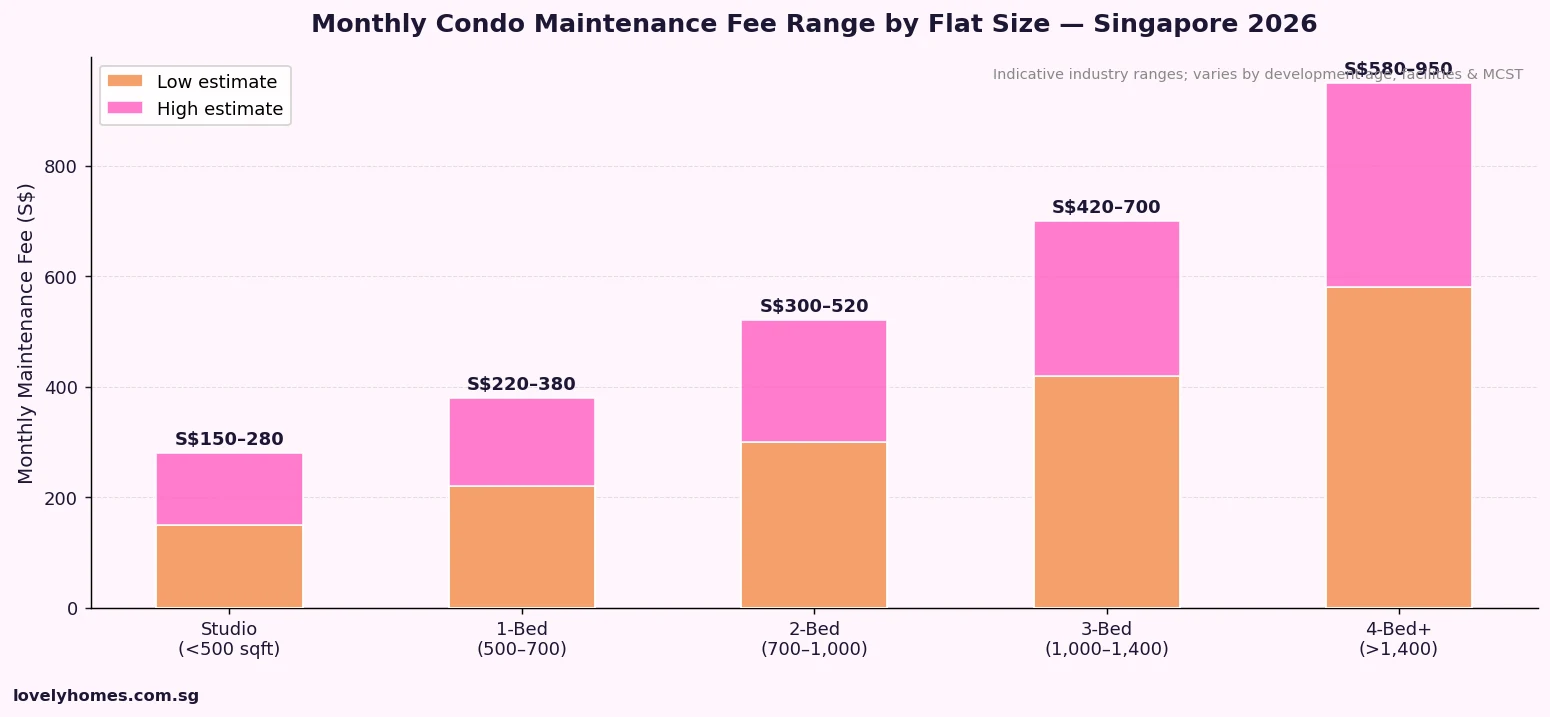
Monthly condo maintenance fee range by flat size Singapore 2026
Figure 1: Indicative monthly maintenance fee range by unit size — Singapore private condominium 2026. Actual amounts vary by development age, facilities, and MCST budget.
Unit Size Typical Monthly Maintenance Fee Key Variables
Studio / 1-bed (<500–700 sqft) S$150–S$380 Older projects, fewer facilities: lower end
2-bedroom (700–1,000 sqft) S$300–S$520 Most common resale condo bracket
3-bedroom (1,000–1,400 sqft) S$420–S$700 City-fringe projects with full facilities
4-bed / large unit (>1,400 sqft) S$580–S$950 CCR luxury projects at high end
Penthouse / duplex (>2,000 sqft) S$900–S$1,500+ Top-tier city projects, concierge, valet

Sinking Fund — What It Covers and Why It Matters

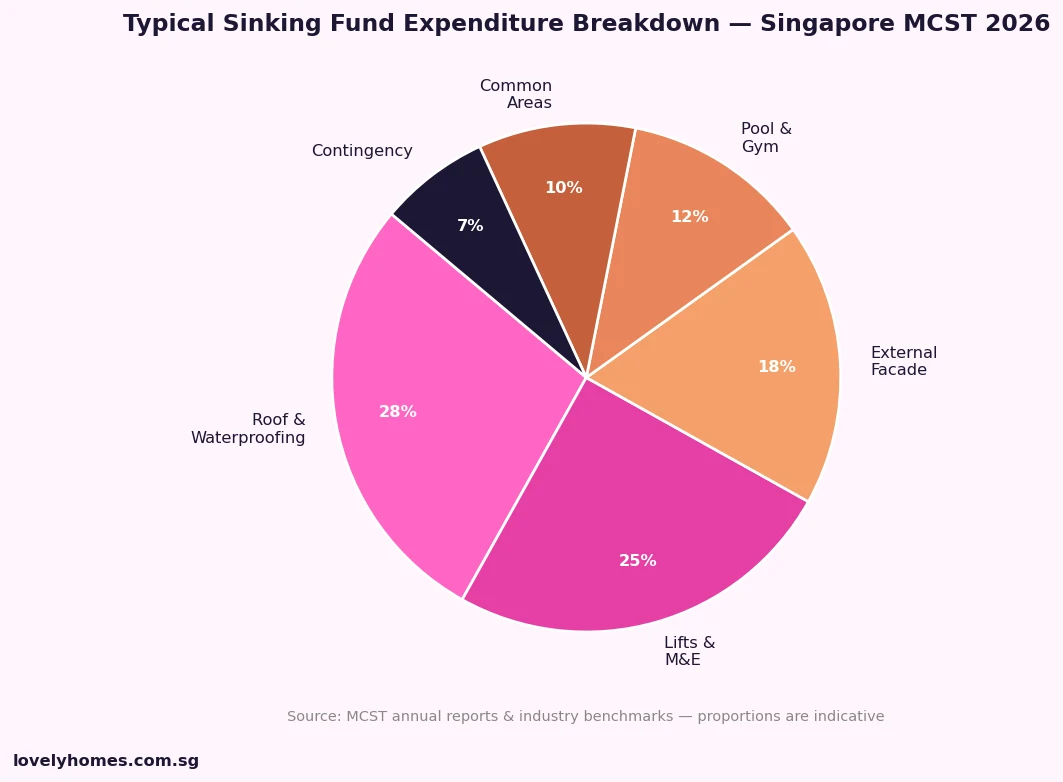
The sinking fund is a long-term capital reserve. Where the management fund covers ongoing operating costs, the sinking fund accumulates money for expenditure that is infrequent but extremely expensive — the kind of expenditure that cannot be funded from a single year’s management budget without creating a financial crisis for the MCST. Examples include: full lift replacement (typically every 20–25 years, S$200,000–S$500,000 per lift), external facade repainting (every 5–7 years for projects with extensive external surfaces), roof waterproofing membrane replacement, major mechanical and electrical (M&E) infrastructure overhaul, and swimming pool resurfacing.

Singapore condo MCST sinking fund expenditure breakdown pie chart 2026
Figure 2: Typical sinking fund expenditure allocation by category — Singapore MCST 2026. Proportions vary significantly by development age and building system profile.

The BMSMA requires the sinking fund to be maintained at a minimum of 10% of the preceding year’s management fund amount. In practice, well-managed MCSTs maintain a sinking fund that is a multiple of this minimum — particularly for older developments approaching major capital expenditure cycles. A prudent MCST will commission a 5-year capital expenditure plan and set sinking fund contributions accordingly. Buyers of older condos (15+ years old) should always ask for the current sinking fund balance and the 5-year capex plan before purchasing, as a depleted sinking fund may result in a special levy — a one-time extraordinary contribution demanded of all owners to fund urgent repairs.

Worked Example — Monthly Fees for a 3-Bedroom Condo in Clementi

Mr and Mrs Tan are purchasing a 1,100 sqft 3-bedroom resale condominium in Clementi (District 5) for S$1,580,000. The development has 320 units, was built in 2008, and has a shared value allocation of 8 for their unit. Total share values across all units sum to 2,240. The MCST’s annual budgets are: Management Fund S$1,680,000; Sinking Fund S$210,000.

Item Calculation Monthly Amount
Management Fund contribution (8 ÷ 2,240) × S$1,680,000 ÷ 12 S$500
Sinking Fund contribution (8 ÷ 2,240) × S$210,000 ÷ 12 S$62.50
Total monthly MCST levy S$562.50

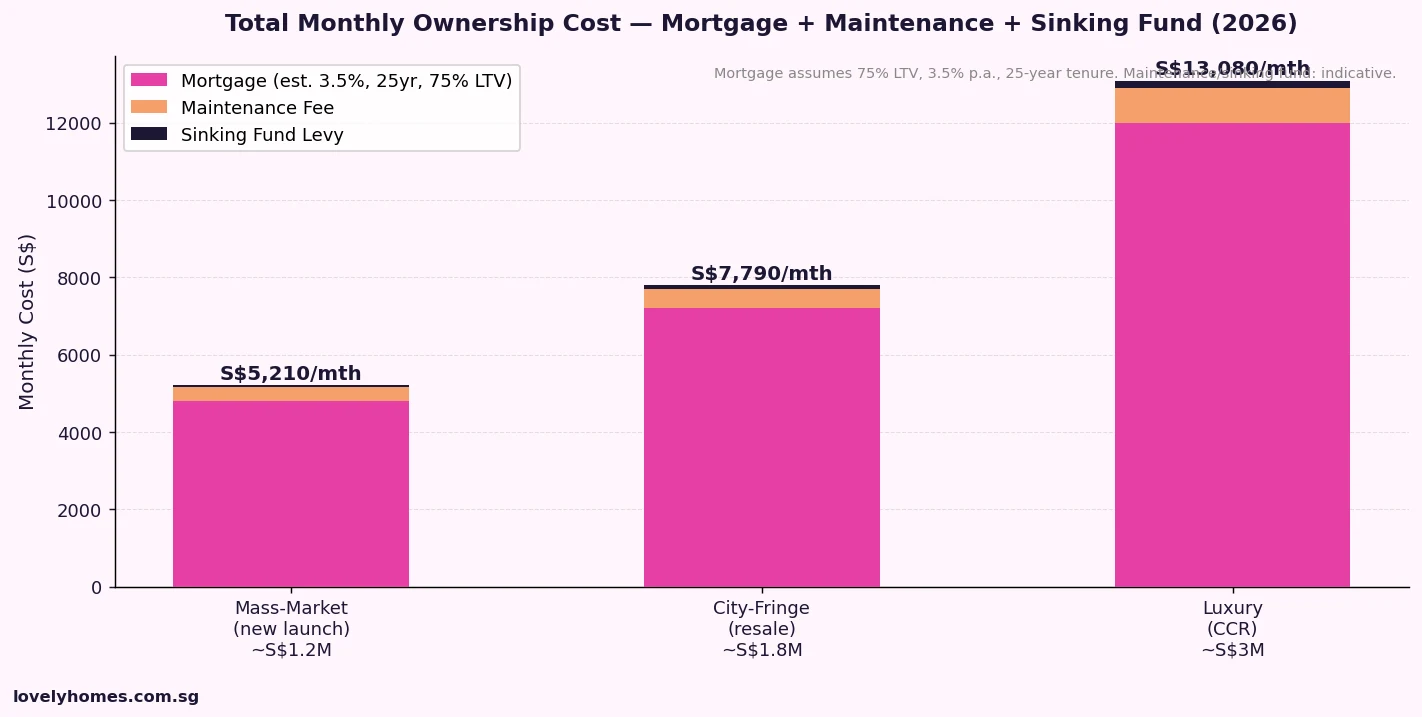
On top of this, the Tans’ estimated monthly mortgage repayment on a bank loan of S$1,185,000 (75% LTV) at 3.5% over 25 years is approximately S$5,926. Their total monthly ownership cost is therefore approximately S$6,488. When running TDSR calculations, the bank will factor in the maintenance fee as a financial commitment — check with your mortgage adviser on how this is treated.

Total Monthly Ownership Cost — Mortgage, Maintenance and Sinking Fund

Total monthly condo ownership cost Singapore 2026 — mortgage plus maintenance fee plus sinking fund
Figure 3: Estimated total monthly cost of owning a condo at three market segments — Singapore 2026. Mortgage assumes 75% LTV, 3.5% p.a., 25-year tenure.

What Happens If You Don’t Pay?

MCST contributions are not optional. Under Section 40 of the BMSMA, unpaid contributions (whether management fund or sinking fund) are a debt recoverable by the MCST in the same way as any civil debt. The MCST can file a Magistrate’s Court claim for outstanding amounts and, if judgment is obtained, apply for enforcement including attachment of the owner’s bank accounts or garnishment of rental income. The MCST also has the right to charge interest on late contributions at a rate fixed in its by-laws (commonly 10–12% per annum).

For landlords renting out their unit, unpaid MCST contributions remain the owner’s liability — not the tenant’s. If a seller has outstanding arrears at the point of property transfer, the arrears must be settled before the strata certificate of title is transferred. In practice, the conveyancing lawyers for both sides will conduct an MCST search to confirm that no arrears exist before completion.

Checking Sinking Fund Health Before You Buy

Before committing to a resale condo purchase, particularly in an older development, always request the following from the seller’s lawyers or directly from the MCST:

The current sinking fund balance (a healthy reserve is generally more than 3× the annual sinking fund budget); the 5-year capital expenditure plan (if available — well-run MCSTs have one); any pending special levies that have been voted on at an AGM but not yet collected; and the MCST financial statements for the past two years. A development with a healthy sinking fund and a documented capital plan is significantly lower risk than one that is underfunded and approaching major lift or roof works. In the latter case, you may be buying into an imminent S$10,000–S$50,000 special levy per unit.

What This Means for Condo Buyers in 2026

Condo maintenance fees have risen materially over the past three years, driven by higher labour costs for security and cleaning personnel, increased utility tariffs, and the generally higher cost of building materials for maintenance works. Industry data suggests average maintenance fees in mass-market condos have increased by 10–20% since 2022. For buyers underwriting their total monthly cost of ownership, this trend means that the maintenance fee is no longer a rounding error — it is a genuine budget line item that deserves the same scrutiny as the mortgage rate.

For investment buyers, maintenance fees directly affect net rental yield. A S$4,500/month rental on a unit with S$600/month in MCST fees represents a net operating yield (before mortgage) of about 3.2% on a S$1.5 million purchase — meaningful compression compared to the gross yield of 3.6%. Understanding and modelling the net yield after maintenance and sinking fund is essential for any investment analysis.

What Might Come Next

The COB has been increasingly attentive to poorly managed MCSTs. In 2024, the Building and Construction Authority (BCA) and COB jointly issued updated guidance on sinking fund adequacy, pushing MCSTs toward more rigorous 5-year planning. There is also ongoing discussion in the property management industry about whether the statutory minimum sinking fund (10% of management fund) is adequate for older developments — some practitioners argue it should be raised to 15–20% for projects over 20 years old. If such a change were legislated, monthly sinking fund levies would rise accordingly. Buyers of properties approaching their 15–20 year mark should factor in this regulatory risk.

Frequently Asked Questions

Can the management fee change from year to year?

Yes. The MCST Council proposes the annual budget at each AGM, and subsidiary proprietors vote on it. If costs have risen — for example, because security guard wages have increased or a landscaping contract was renewed at a higher rate — the management fee will be adjusted upward. Conversely, if the MCST finds cost savings, fees can decrease. In practice, fees rarely decrease; they tend to rise gradually with inflation. Buyers should ask for the last three years of AGM minutes to understand the fee trajectory of any development they are considering purchasing.

What is a special levy and when can the MCST charge one?

A special levy is an extraordinary, one-time contribution that the MCST can demand from all owners to fund urgent capital expenditure that cannot be covered by the existing sinking fund balance. Special levies require approval by a resolution at a general meeting (either an AGM or an Extraordinary General Meeting). They are most common in older developments where the sinking fund is under-provisioned and a major repair (such as lift replacement or waterproofing) is overdue. Special levies can range from S$5,000 to S$50,000 per unit depending on the size of the development and the scope of work. For this reason, checking the sinking fund balance before purchasing is critical.

Do maintenance fees apply to Executive Condominiums (ECs)?

Yes. Executive Condominiums are privately managed after the 10-year mark and are subject to the same BMSMA rules as private condominiums. During the initial period when HDB retains certain oversight, the management corporation is still constituted and maintenance fees apply from the date of key collection. EC buyers should budget for maintenance fees in the same way as any private condo buyer. EC maintenance fees are often somewhat lower than comparable private condos because ECs are typically built without the premium facilities found in luxury private developments, but the difference is not dramatic for mass-market comparisons.

Can landlords pass maintenance fees on to tenants?

In Singapore’s private residential tenancy market, there is no legal prohibition on a landlord including maintenance fees in the rent (i.e., charging a gross rent inclusive of the condo fee). In practice, however, most residential leases are structured on a net basis — the landlord pays the MCST contributions from the rental income and quotes the rent as an all-in figure. Some tenancy agreements explicitly state that maintenance fees are the landlord’s responsibility. Whatever the arrangement, the legal obligation to pay the MCST remains with the owner — the MCST cannot pursue the tenant for arrears.

How does share value affect my monthly levy?

Share value is a fixed integer assigned to each lot in the strata title plan at the time of development. It is broadly proportional to floor area but is also influenced by unit type and usage. A larger unit will have a higher share value and therefore pay a proportionally higher monthly levy. Share value cannot be changed by the MCST — it is set in the strata plan lodged with SLA and can only be altered by a unanimous resolution of all subsidiary proprietors followed by an amendment to the strata plan. Before buying, you can find out a unit’s share value by requesting the strata title plan from the developer, property agent, or MCST.

Is the sinking fund transferable when I sell?

No. The sinking fund belongs to the MCST, not to any individual owner. When you sell your unit, the accumulated sinking fund contributions you have made over the years remain with the MCST for the benefit of the development as a whole. You do not receive a refund of your share of the sinking fund balance on completion of sale. This is one reason why buying into a development with a healthy, well-funded sinking fund is in your interest even if you plan to sell within a few years — the sinking fund supports the quality of the common property, which in turn supports property values.

Where can I find out the exact maintenance fee before I buy?

For new launch condominiums, the developer is required to provide an estimated monthly maintenance fee in the sales documentation. For resale condos, the actual fee is best confirmed by requesting a copy of the latest MCST notice of contribution (which sets out the monthly levy per share value) or by asking the seller’s lawyer to conduct an MCST search. The MCST search will confirm the contribution rate, any arrears on the specific unit, and the sinking fund balance. This search is a standard step in any Singapore property conveyancing and costs approximately S$150–S$200.

Related Articles

Disclaimer: This article is for general informational and educational purposes only and does not constitute legal, financial, or property management advice. MCST contribution rates, sinking fund balances, and BMSMA requirements are subject to change and vary by development. Always verify actual maintenance fees with the relevant MCST, confirm current statutory requirements with the Commissioner of Buildings (HDB Strata Management portal), and obtain independent legal and financial advice before purchasing any property. LovelyHomes is not a licensed property management, legal, or financial advisory firm.

Buyer’s Stamp Duty Singapore 2026: Complete Guide to BSD Rates, Calculation and Remissions

Buyer’s Stamp Duty Singapore 2026: Complete Guide to BSD Rates, Calculation and Remissions

Buyer’s Stamp Duty (BSD) is the foundational property transaction tax that every buyer in Singapore must pay, regardless of nationality, residency status, or how many properties they own. Unlike the Additional Buyer’s Stamp Duty (ABSD) — which targets second-and-subsequent-property buyers and foreigners — BSD is universal. Whether you are a first-time Singapore Citizen buying a public housing flat or a foreign investor acquiring a luxury penthouse, BSD applies equally. Get it wrong in your budget, and you will face an unexpected six-figure bill at the point of signing.

This guide covers everything you need to know about BSD in 2026: the current rates, exactly how the duty is calculated, what is included in the taxable base, how it differs from ABSD, and the complete picture of stamp duty costs for different buyer profiles. All rates reflect the framework introduced on 15 February 2023 for residential property and remain in force as at the date of publication. For official confirmation, always consult the IRAS Stamp Duty for Property page.

Quick Answer — BSD at a Glance

  • BSD applies to every buyer — Citizens, PRs, foreigners, companies, and trusts alike.
  • Residential rates: 1% → 2% → 3% → 4% → 5% → 6% in progressive tiers (w.e.f. 15 Feb 2023).
  • Non-residential rates: 1% → 2% → 3% (simpler three-tier structure, w.e.f. 20 Feb 2018).
  • Taxable base is the higher of the purchase price or the property’s open market value.
  • BSD must be paid within 14 days of signing the Option to Purchase (OTP) or Sale & Purchase Agreement.
  • BSD for a S$1.5 million condo: S$44,600 (effective rate: 2.97%).
  • BSD for a S$3 million condo: S$109,600 (effective rate: 3.65%).
  • BSD is administered by the Inland Revenue Authority of Singapore (IRAS).

What Is BSD and Why Does It Exist?

Buyer’s Stamp Duty is a documentary tax levied on instruments related to the purchase of property in Singapore. It has existed in Singapore law since the country was a British colony and is codified in the Stamp Duties Act (Cap. 312), administered by IRAS. In contrast to ABSD — which was introduced in December 2011 purely as a demand-management cooling measure — BSD is a revenue instrument: it is part of Singapore’s general tax base and applies to virtually all property acquisitions, not just speculative or investment-driven ones.

BSD was most recently restructured for residential property on 15 February 2023, when the Government added two new upper tiers (5% and 6%) targeting high-value transactions above S$1.5 million and S$3 million respectively. Prior to that, the top residential rate was 4%. The change was targeted at luxury-end transactions and was announced alongside the same cooling-measure package that raised ABSD rates significantly. You can read about the full cooling-measures context in our ABSD Singapore 2026 Complete Guide.

BSD Rates for Residential Property in Singapore (2026)

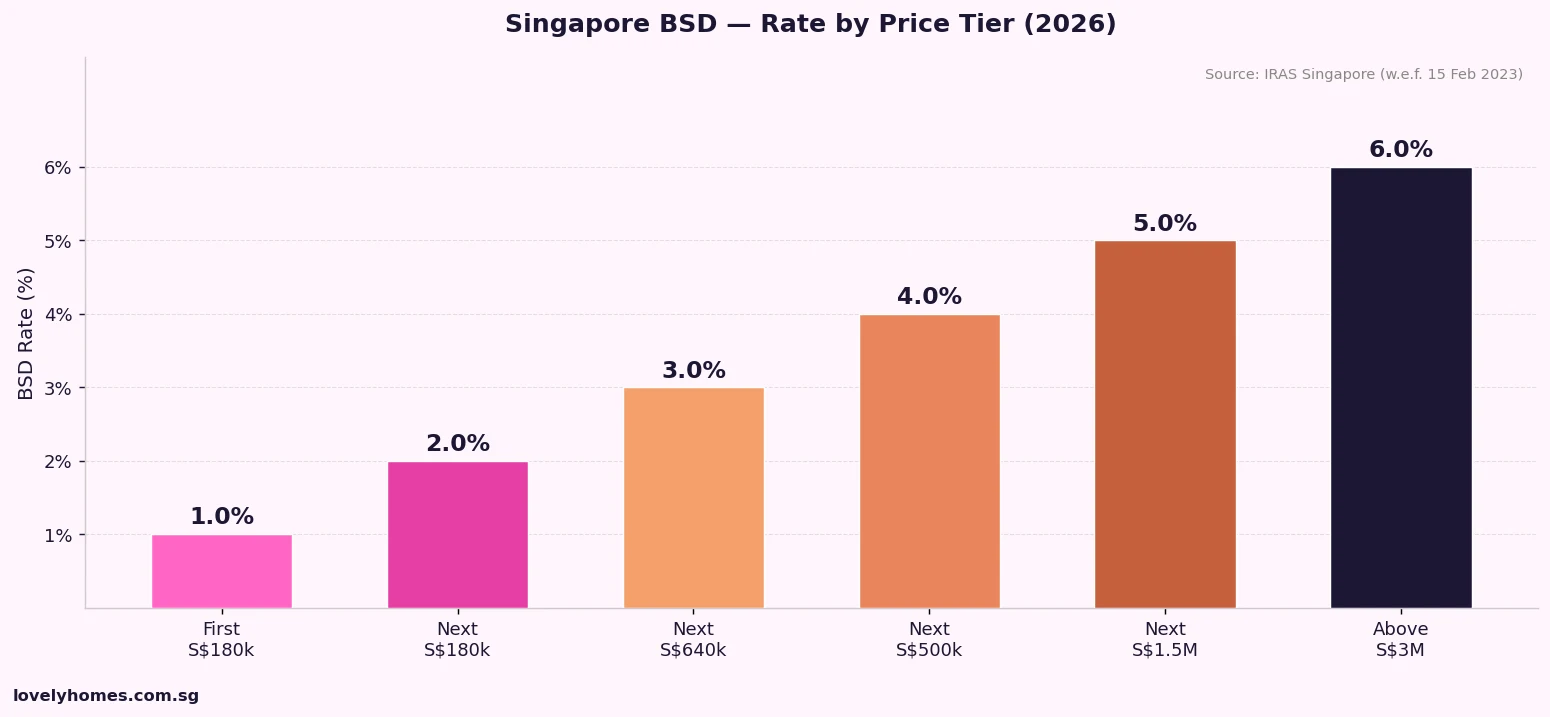
The current residential BSD rate schedule is progressive, meaning each tier applies only to the portion of the purchase price (or market value, if higher) that falls within that band. The table below sets out the tiers in full.

Singapore BSD rate by price tier 2026 bar chart — 1% to 6% progressive
Figure 1: BSD rate by purchase-price tier for residential property — effective 15 February 2023. Source: IRAS Singapore.
Purchase Price (or Market Value) Tier BSD Rate Maximum BSD from This Tier
First S$180,000 1% S$1,800
Next S$180,000 2% S$3,600
Next S$640,000 3% S$19,200
Next S$500,000 4% S$20,000
Next S$1,500,000 5% S$75,000
Amount exceeding S$3,000,000 6% Uncapped

Source: IRAS Singapore. Rates effective 15 February 2023.

The cumulative BSD cap for a S$3 million property — the last tier before the 6% rate kicks in — is S$109,600. For every dollar above S$3 million, the marginal BSD rate is 6%. A S$5 million property, for instance, attracts BSD of S$109,600 + 6% × S$2,000,000 = S$229,600.

BSD for Non-Residential Property (Industrial, Commercial, Mixed-Use)

Non-residential property — offices, shops, industrial units, mixed-use strata titles, and HDB shophouses — attracts a simpler three-tier BSD structure that has been in place since 20 February 2018.

Purchase Price Tier BSD Rate
First S$180,000 1%
Next S$180,000 2%
Amount exceeding S$360,000 3%

Non-residential BSD is therefore considerably less progressive than its residential counterpart. A S$2 million commercial unit attracts BSD of: 1% × S$180,000 + 2% × S$180,000 + 3% × S$1,640,000 = S$1,800 + S$3,600 + S$49,200 = S$54,600 — compared to S$64,600 for a residential property at the same price. Notably, non-residential property is exempt from ABSD, making it an important consideration for investors who have already consumed their ABSD-free residential quota.

How BSD Is Calculated — Step by Step

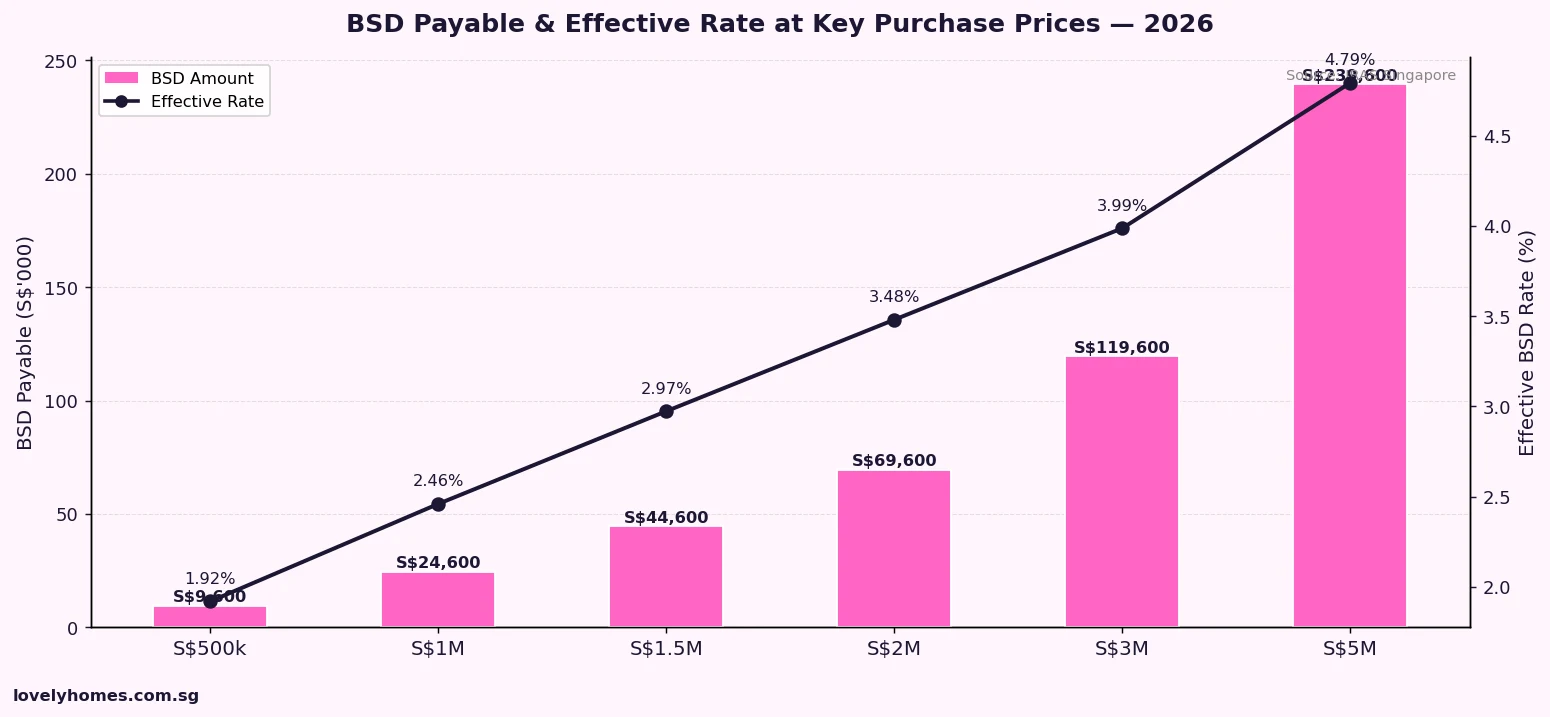
BSD is calculated on a progressive basis, applying each tier’s rate only to the portion of value that falls within that band. The taxable base is the higher of the agreed purchase price and the property’s open market value as assessed by IRAS. In practice, for arm’s-length transactions, these figures are usually the same. Where a buyer acquires at below market value — for example, from a related party — IRAS will assess BSD on the market value.

BSD payable and effective rate at key purchase prices Singapore 2026
Figure 2: BSD payable (bars, left axis) and effective BSD rate (line, right axis) at six key purchase prices — Singapore residential property 2026.

The chart above illustrates a key feature of BSD’s progressive structure: the effective rate (total BSD as a percentage of purchase price) rises gradually but never reaches the 6% marginal rate. Even at S$5 million, the effective rate is approximately 4.6%. This distinguishes BSD from ABSD, where — for a foreigner — the entire purchase price is taxed at a flat 60%.

Worked Example — S$1,580,000 Resale Condominium

Mr and Mrs Lim are Singapore Citizens purchasing a resale 3-bedroom condominium in Clementi for S$1,580,000 as their first property. Here is the full BSD calculation:

Price Tier Tier Limit Rate BSD for This Tier
First S$180,000 1% S$1,800
Second S$180,000 2% S$3,600
Third S$640,000 3% S$19,200
Fourth S$500,000 4% S$20,000
Fifth S$80,000 (remaining) 5% S$4,000
Total BSD S$1,580,000 Effective 3.04% S$48,600

Since this is the Lims’ first residential property and both are Singapore Citizens, their ABSD is S$0. Their total stamp duty outlay is therefore S$48,600. This must be paid within 14 days of exercising the OTP. BSD is typically paid via IRAS’s myTax Portal (e-Stamping). Their lawyer will ordinarily manage this on their behalf as part of the conveyancing process.

If this were instead the Lims’ second residential property, they would also owe ABSD at 20% × S$1,580,000 = S$316,000, bringing total stamp duty to S$364,600. The BSD component is identical regardless of how many properties they own.

BSD vs ABSD — Understanding the Key Difference

BSD and ABSD are two distinct taxes that can apply simultaneously to the same transaction. The confusion between them is understandable — both are calculated as a percentage of the purchase price and both are paid to IRAS — but they serve entirely different purposes and have very different rate structures.

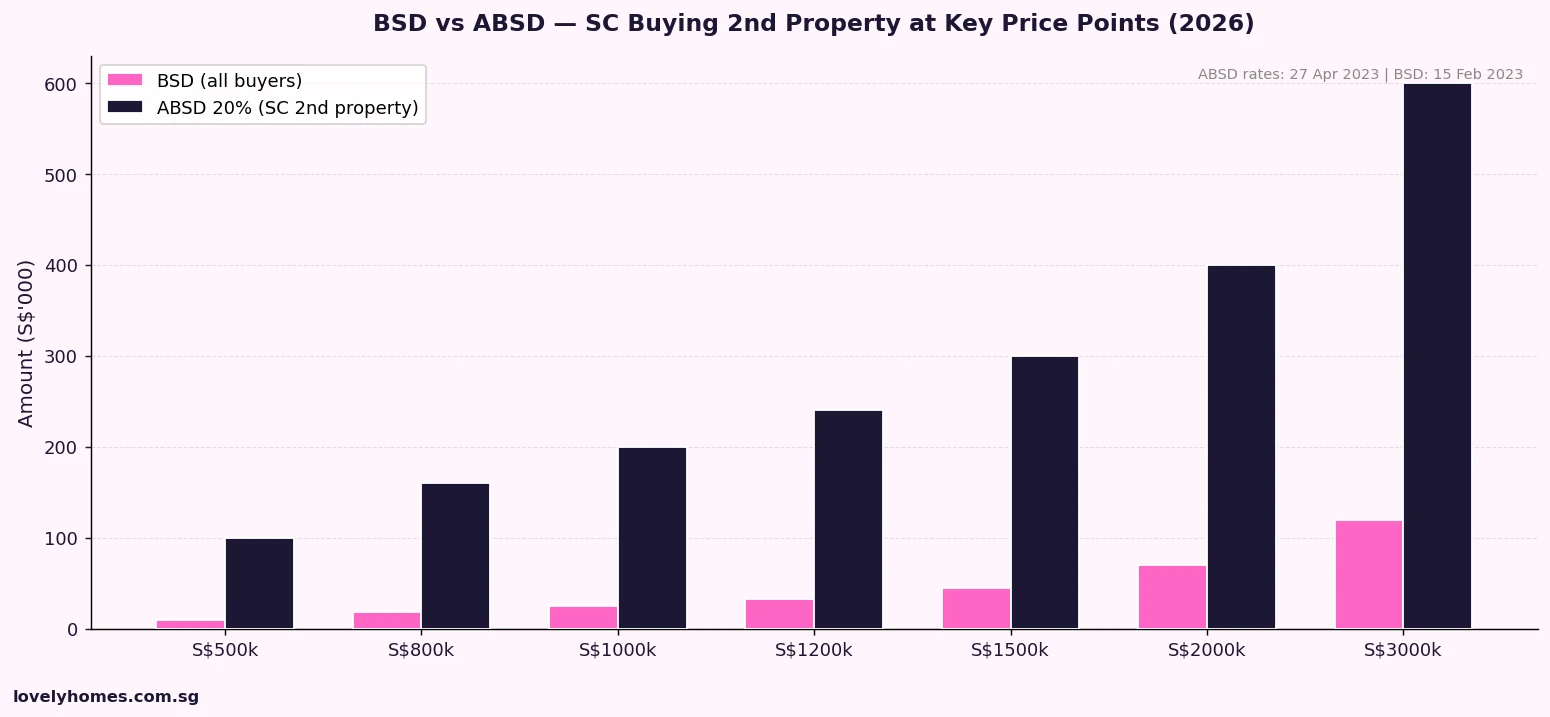
BSD versus ABSD comparison Singapore citizen buying second property 2026 bar chart
Figure 3: BSD (universal) vs ABSD at 20% (SC buying a second property) at key purchase prices — Singapore 2026.
Feature Buyer’s Stamp Duty (BSD) Additional Buyer’s Stamp Duty (ABSD)
Who pays? All buyers Selected profiles only (see ABSD guide)
Policy purpose Revenue instrument (general tax) Demand-management cooling measure
Rate structure Progressive (1–6%) Flat rate on full purchase price (0–65%)
Maximum rate 6% (marginal, above S$3M) 65% (entities & trusts)
Remissions available? Very limited (developer builds only) Yes — married SC/SPR upgrader, developers, etc.
Applies to HDB? Yes Yes (but HDB buyers are usually SC 1st-timers at 0%)
Non-residential? Yes (1%/2%/3% structure) No — ABSD does not apply to non-residential

The practical upshot: for most Singapore Citizens buying their first property, BSD is the only stamp duty they pay. For all other buyer profiles — PRs, foreigners, second-time and subsequent Singapore Citizen buyers, and entities — both BSD and ABSD apply simultaneously. To model your full stamp duty liability, use our ABSD Complete Guide, which includes full worked scenarios for every buyer profile.

Total Stamp Duty by Buyer Profile — S$1.5 Million Residential Property

Buyer Profile BSD ABSD Rate ABSD Amount Total Stamp Duty
SC — 1st property S$44,600 0% S$0 S$44,600
SC — 2nd property S$44,600 20% S$300,000 S$344,600
SC — 3rd+ property S$44,600 30% S$450,000 S$494,600
SPR — 1st property S$44,600 5% S$75,000 S$119,600
SPR — 2nd+ property S$44,600 30% S$450,000 S$494,600
Foreigner — any property S$44,600 60% S$900,000 S$944,600
Entity / Trust S$44,600 65% S$975,000 S$1,019,600

BSD = S$44,600 on S$1.5M (1%×S$180k + 2%×S$180k + 3%×S$640k + 4%×S$500k). ABSD rates: 27 April 2023 framework. SC = Singapore Citizen; SPR = Singapore Permanent Resident.

When and How to Pay BSD

BSD must be paid within 14 days of signing the instrument that triggers the liability. For private residential property, the trigger is typically the Option to Purchase (OTP) or, if no OTP is issued, the Sale and Purchase Agreement (S&P). For HDB flats, the trigger is the signing of the HDB Agreement for Lease.

Payment is made through IRAS’s e-Stamping Portal (accessible via myTax Portal). In practice, your conveyancing lawyer will handle the stamping on your behalf as part of the standard legal process. The stamp certificate is generated electronically and must be produced at completion. Late payment attracts penalties of up to 4× the duty payable under Section 46 of the Stamp Duties Act.

BSD Remissions and Exemptions

Unlike ABSD, BSD has very limited remission provisions. The most relevant situations where BSD may not apply in full are:

Developer remissions for building residential property: Property developers who purchase residential land or existing residential property for the purpose of constructing and selling new residential units may apply to IRAS for BSD remission. This is a specific commercial exception designed to avoid double taxation in the development chain — it does not apply to individual buyers.

Transfers between spouses and immediate family members: The Stamp Duties Act provides for concessionary treatment in limited intra-family transfers, but these are narrow and do not eliminate BSD — they may affect the valuation base or trigger date. Consult a property lawyer before relying on any such arrangement.

HDB Resale Levy and BSD interaction: BSD applies normally to HDB resale flat purchases. There is no interaction between the HDB Resale Levy and BSD — they are entirely separate obligations.

In short: for the vast majority of buyers, there are no BSD remissions. Budget for BSD in full.

What BSD Means for Buyers in 2026

BSD’s restructuring in February 2023 materially increased the cost of high-value acquisitions. A buyer of a S$3 million property now pays S$109,600 in BSD alone — up from S$74,600 under the pre-February 2023 structure, a S$35,000 increase. For S$5 million properties, the increase is S$65,000. These are meaningful sums that affect both the budgeting and the financing of such transactions.

In the broader context of property affordability, BSD at the sub-S$1.5 million residential price range — where most HDB upgraders and first-time private property buyers transact — is relatively modest: S$44,600 on S$1.5 million is 2.97% of the purchase price. The real pinch of Singapore’s stamp duty system comes from ABSD, not BSD. For buyers planning their first property purchase with CPF Housing Grants and a bank loan, BSD is a known, budgetable cost that fits within standard conveyancing estimates.

Singapore’s BSD structure compares favourably with many comparable jurisdictions. Hong Kong charges a flat-rate stamp duty of up to 15% for non-first-time buyers. Australia’s stamp duty is state-based and can reach 5–6% of property value at lower price points. Singapore’s progressive structure, where the 6% rate only applies to the marginal amount above S$3 million, is notably more buyer-friendly at the S$1–2 million range where most transactions occur.

What Might Come Next

BSD rates for residential property have been adjusted three times in the past decade (2018, 2021, and 2023). Each adjustment has moved in one direction: upward, particularly at the high end of the market. If the Government continues its stated objective of moderating luxury segment demand and narrowing the wealth-effects gap between high-end and mass-market property, further BSD increases above S$3 million cannot be ruled out.

Conversely, at the sub-S$1.5 million end — where most owner-occupier transactions occur — there is no political appetite to raise BSD, given the Government’s ongoing commitment to ensuring that public and private housing remains accessible to ordinary Singaporeans. Any future BSD changes are therefore likely to be targeted at the top of the market only. As always, changes to stamp duty rates take effect immediately on the date of announcement and apply to all OTPs granted on or after that date.

Frequently Asked Questions

Does BSD apply to HDB flat purchases?

Yes. BSD applies to all residential property purchases in Singapore, including HDB resale flats, BTO flats (on the Agreement for Lease), and Executive Condominium units. There is no HDB exemption from BSD. For a typical 4-room resale flat at S$550,000, BSD would be: 1%×S$180k + 2%×S$180k + 3%×S$190k = S$1,800 + S$3,600 + S$5,700 = S$11,100.

Is BSD the same as ABSD?

No. They are two separate taxes paid to IRAS on the same transaction. BSD is universal (all buyers, all properties) and progressive (1–6%). ABSD is a surcharge that applies only to selected buyer profiles — foreigners, entities, PRs buying a first property, and all buyers from their second property onward — and is charged as a flat rate on the entire purchase price. You always pay BSD; you only pay ABSD if your buyer profile attracts it. See our ABSD Singapore 2026 Guide for the full rate schedule.

Can BSD be paid using CPF?

Yes, BSD can be paid from your CPF Ordinary Account (OA) for HDB flat purchases. For private residential property, CPF OA funds can also be used to pay BSD, but only after meeting the CPF Minimum Sum requirements and subject to CPF withdrawal limits. In practice, many buyers use cash for stamp duties to preserve their CPF balance for the monthly mortgage servicing — consult your financial planner or mortgage adviser on the optimal approach.

What happens if BSD is paid late?

Under Section 46 of the Stamp Duties Act, late payment penalties are substantial. The penalty is a multiple of the duty payable, depending on the length of the delay: one to three times the duty for delays up to six months, and up to four times for longer delays. In extreme cases, IRAS has the power to seek a court order to enforce payment. In practice, your conveyancing lawyer will ensure that BSD is stamped within the 14-day window. Late stamping almost always results from buyers attempting to handle the stamping themselves without legal assistance.

Does BSD apply to the purchase of a share in a property?

Yes. Where a buyer acquires a fractional share in a property — for example, a 50% interest in a jointly owned private property — BSD is calculated on the proportionate market value of the property that corresponds to the share being acquired. The progressive BSD tiers apply to the full market value of the underlying property first, and the resulting duty is then apportioned to the share acquired. This means the effective BSD rate on a 50% share of a S$2 million property is calculated as if the full S$2 million were the taxable base, then halved — not calculated on S$1 million at a lower tier. IRAS guidance on this is set out in their e-Stamping FAQ.

Is BSD refundable if the sale falls through?

BSD that has been paid on a stamped instrument is generally not refundable if the sale subsequently fails to complete. However, if the instrument itself is rescinded before it takes legal effect — for example, if the OTP lapses without exercise — and the buyer can demonstrate to IRAS that no property changed hands, a refund application under Section 22 of the Stamp Duties Act may be possible. The application must be made within six months of the date of the instrument. IRAS assesses each case on its facts. Always take legal advice before assuming a refund is available.

Do foreign buyers in Singapore pay more BSD than locals?

No. BSD rates are identical for all buyers regardless of nationality or residency status. A Singapore Citizen and a foreign national buying the same S$2 million property both pay exactly the same BSD — S$64,600. The difference in overall stamp duty cost arises entirely from ABSD, which for a foreigner is 60% of the purchase price (S$1,200,000 on a S$2M purchase) versus 0% for a Singapore Citizen buying their first home. This is why total stamp duty for a foreigner buying a S$2 million property (S$1,264,600) is dramatically higher than for a first-time SC buyer (S$64,600).

Related Articles

Disclaimer: This article is for general informational purposes only and does not constitute tax, legal, or financial advice. BSD rates and payment rules are governed by the Stamp Duties Act and IRAS administrative guidelines, which may be amended at any time. Always refer to the IRAS official website for the most current rates and verify your stamp duty liability with a licensed conveyancing lawyer or property tax adviser before transacting. LovelyHomes is not a licensed tax or legal advisory firm.

Singapore Rental Income Tax Guide 2026: IRAS Rules, Deductions and What Every Landlord Must Declare

Singapore Rental Income Tax Guide 2026: IRAS Rules, Deductions and What Every Landlord Must Declare

If you own a Singapore property and collect rent, that income is taxable — and IRAS expects you to declare it accurately each year. Yet many landlords either over-pay by missing legitimate deductions, or under-declare by misunderstanding what counts as gross rental income. This guide covers everything a Singapore landlord needs to know about rental income tax in 2026: what is taxable, what you can deduct, how progressive income tax rates apply, when non-residents pay a flat rate, and exactly how to file with IRAS — with a full worked dollar calculation.

Quick Answer: Singapore Rental Income Tax 2026

  • Rental income from Singapore properties is taxable under the Income Tax Act, administered by IRAS.
  • Gross rental income includes rent, furniture/fittings allowances paid by tenant, and any service charges you receive.
  • Key deductible expenses: mortgage interest (not principal), property tax, agent commission, insurance, and maintenance/repairs.
  • Mortgage principal repayment is not deductible — only the interest portion qualifies.
  • Net rental income (gross rent minus allowable deductions) is added to your other chargeable income and taxed at progressive rates up to 24% (YA2026).
  • For non-resident landlords, rental income is taxed at 22% (flat rate, regardless of amount).
  • Filing deadline: 18 April (e-filing) for income earned in the preceding calendar year.
  • HDB flat subletters must obtain HDB approval before subletting; failure to declare rental income is an IRAS offence.
  • Overseas property rental income is generally not taxable in Singapore unless remitted to Singapore through a Singapore partnership or business.
  • IRAS may conduct rental income compliance checks — keeping good records is essential.

What Counts as Rental Income in Singapore?

Under the Income Tax Act (Cap. 134), rental income is defined as income arising from the letting of immovable property in Singapore. This includes not just the monthly rent but all amounts you receive in connection with the tenancy. Specifically, IRAS includes the following as taxable rental income:

  • Monthly rent (whether paid in advance, in arrears, or as lump sum)
  • Furniture and fittings allowances paid directly to the landlord by the tenant
  • Service charges or maintenance charges collected by the landlord and not passed directly to a management corporation
  • Rental deposits that are applied as rent or that the landlord retains (deposits returned in full are not income)
  • Any consideration for granting, renewing, extending, or surrendering a lease

Notably, the security deposit is not income at the point of collection — it is the tenant’s money held in trust. Only if you retain part or all of the deposit at the end of the tenancy (as compensation for damage or unpaid rent) does it become taxable in that Year of Assessment. Similarly, amounts paid by a tenant directly to a third-party service provider (e.g., PUB utility bills in the tenant’s name) are not your income.

Allowable Deductions Against Rental Income

Singapore’s IRAS allows landlords to deduct revenue expenses that are incurred wholly and exclusively in the production of rental income. Capital expenses — improvements that extend the life or fundamentally alter the property — are generally not deductible (though you may claim an annual allowance on qualifying plant and machinery). The distinction between repairs (revenue, deductible) and improvements (capital, not deductible) is one of the most contested areas in rental tax disputes.

Figure 1: Deductible vs non-deductible rental expenses IRAS Singapore 2026
Figure 1: Deductible vs non-deductible rental expenses under IRAS rules (Singapore 2026). Mortgage interest is deductible; principal repayment is not. Source: IRAS | lovelyhomes.com.sg

Deductible Expenses

Mortgage interest: The interest portion of your home loan repayment is deductible in the year it is paid or accrued. You must obtain a statement from your bank each year showing the breakdown of principal and interest — most Singapore banks provide this as an annual mortgage statement or at the borrower’s request. Only interest on a loan taken to acquire or improve the property qualifies; refinancing costs (legal fees, valuation fees) are deductible as a revenue expense in the year incurred.

Property tax: Annual property tax paid to IRAS on the rental property is deductible. If you are renting out only part of the property (e.g., subletting spare bedrooms in your own home), only the proportionate share of property tax applicable to the sublet area is deductible.

Estate agent or property management commission: Commission paid to a CEA-registered agent for securing tenants is deductible. If you pay a property management company an ongoing monthly management fee, this is also deductible.

Insurance: Fire insurance, landlord’s liability insurance, and home contents insurance (where the landlord — not tenant — bears the premium) are deductible. Mortgage-linked MRTA or MLTA insurance premiums are not deductible against rental income.

Repairs and maintenance: Costs of maintaining the property in its existing state — plumbing repairs, painting, replacing broken fittings, and routine servicing — are deductible. Replacing a broken air conditioner with an equivalent unit is a repair; adding a new ducted air conditioning system where none existed before is a capital improvement and is not immediately deductible (though it may qualify for plant and machinery allowance).

Furniture and fittings — deemed deduction for HDB rooms: For HDB flat owners subletting individual rooms, IRAS allows a deemed deduction of S$150 per month per sublet room for furniture and fittings, without the need to produce receipts. For private property landlords letting the whole unit furnished, you may claim an annual allowance of 20% of the cost of qualifying furniture and fittings each year (over 5 years), or the actual replacement cost when items are replaced.

Non-Deductible Expenses

  • Mortgage principal repayment: Only the interest component is deductible. The principal reduces your loan balance and is considered a capital repayment — it creates a capital asset (equity in the property) and therefore cannot be expensed against rental income.
  • Capital improvements: Additions or alterations that increase the value or extend the useful life of the property (e.g., installing a lift, adding a new bathroom, full gutting and rebuilding) are capital in nature and not immediately deductible.
  • Renovation and reinstatement costs borne by tenant: If your tenant bears the cost of renovation or reinstatement directly, this is not your expense to claim.
  • Personal expenses: Costs that are partly personal — such as a home office deduction for a property you also use personally — are not allowable unless you can clearly demarcate the portion used exclusively for rental.

How Rental Income Is Taxed: Progressive Rates

Net rental income (after deductions) is added to your total chargeable income for the Year of Assessment (YA) and taxed at Singapore’s progressive personal income tax rates. The YA is the year following the income year — so rental income earned in calendar year 2025 is assessed in YA2026. Singapore’s personal income tax rates are among the more moderate in the Asia-Pacific region for middle incomes, but the top marginal rate was raised to 24% for chargeable income above S$1 million from YA2024 onwards.

Figure 2: Singapore personal income tax rates marginal rates by income band YA2026
Figure 2: Singapore personal income tax — marginal rates by chargeable income band (YA2026). Most landlords with one rental property fall in the 7–18% marginal range. Source: IRAS | lovelyhomes.com.sg
Chargeable Income (S$) Marginal Rate Tax on Band (S$) Cumulative Tax (S$)
First S$20,000 0% 0 0
Next S$10,000 2% 200 200
Next S$10,000 3.5% 350 550
Next S$40,000 7% 2,800 3,350
Next S$40,000 11.5% 4,600 7,950
Next S$40,000 15% 6,000 13,950
Next S$40,000 18% 7,200 21,150
Next S$40,000 19% 7,600 28,750
Next S$40,000 19.5% 7,800 36,550
Next S$40,000 20% 8,000 44,550
Next S$180,000 23% 41,400 85,950
Next S$500,000 23.5% 117,500 203,450
Above S$1,000,000 24%

Worked Example: Mr Chen’s Rental Income Calculation

Mr Chen is a Singapore Citizen, aged 45, working as a finance manager earning S$120,000 per year. He owns a 2-bedroom condominium in District 15 which he lets out fully furnished at S$3,800 per month. His mortgage on the property is S$1.4 million outstanding at 3.0% per annum (bank loan). Here is how his rental income is assessed for YA2026 (income year 2025):

Figure 3: Singapore rental income tax calculation gross rent to net tax payable waterfall
Figure 3: Rental income tax calculation — from gross rent to net tax payable (illustrative). Mortgage interest is the largest deduction for leveraged landlords. Source: IRAS | lovelyhomes.com.sg

Step 1 — Gross rental income: S$3,800 × 12 = S$45,600

Step 2 — Allowable deductions:

  • Mortgage interest (3% on S$1.4M, interest portion in Year 1): S$10,200
  • Property tax (Annual Value S$36,000 × 10% owner-occupier rate — but since fully let out, taxed at 12%): S$3,600 (illustrative; actual depends on AV)
  • Agent commission (secured 2-year tenancy at 1 month’s rent): S$3,800 ÷ 2 = S$1,900 (apportioned to 2025) + S$1,900 (renewal in 2024, deducted 2025) — total S$4,142 (illustrative)
  • Fire insurance: S$420
  • Maintenance and repairs: S$1,200
  • Furniture and fittings wear and tear (20% p.a. on S$9,000 of qualifying items): S$1,800
  • Total deductions: S$21,362

Step 3 — Net rental income: S$45,600 − S$21,362 = S$24,238

Step 4 — Total chargeable income: Employment income S$120,000 + Net rental S$24,238 = S$144,238, less earned income relief S$3,000 and CPF relief (capped) S$15,300 = total chargeable income approximately S$125,938.

Step 5 — Tax on chargeable income (YA2026): On S$125,938, the progressive tax calculation yields approximately S$12,700 total tax (effective rate ~10.1%). Without the rental deductions, chargeable income would be S$148,476 yielding tax of approximately S$17,600 — a saving of roughly S$4,900 from claiming legitimate deductions.

Special Rules for HDB Flat Subletting

HDB flat owners who sublet bedrooms (not the whole flat) must first obtain HDB’s approval before any subletting commences. This applies even if the subletting is to family members. HDB approval is granted for up to 2 years at a time and requires that the flat owner continues to reside in the flat. Income earned from approved bedroom subletting is taxable. The S$150-per-room-per-month deemed deduction for furniture and fittings applies.

If you own an HDB flat and have completed MOP, you may sublet the entire flat (subject to HDB approval and subletting quotas for foreigners). Whole-flat subletting income is taxed in the same way as private property rental income: gross rent minus allowable deductions, added to chargeable income. Subletting an HDB flat without HDB’s approval is a breach of the Housing & Development Act and can result in compulsory acquisition of the flat — independent of the IRAS tax liability.

Non-Resident Landlords: Flat 22% Withholding Tax

If you are a non-resident individual for tax purposes — broadly, someone who spends fewer than 183 days in Singapore in the basis year — your Singapore rental income is taxed at a flat rate of 22% on the gross rental income. You may still claim allowable deductions; the 22% applies to your net chargeable rental income. If you are a Singapore Citizen or Permanent Resident who is temporarily overseas (e.g., on an overseas posting), your Singapore tax residency status is assessed by IRAS on a case-by-case basis — most citizens on short overseas postings retain Singapore tax resident status.

Foreign companies or entities receiving Singapore rental income are subject to corporate tax at 17% on net rental income, subject to qualifying deductions and the standard corporate income tax framework.

Overseas Property Rental Income

Singapore operates on a territorial basis of taxation. Rental income from overseas properties is generally not taxable in Singapore — regardless of whether you remit the funds to Singapore — provided the income is not received through a Singapore partnership or business structure. For most individual Singapore resident landlords with overseas investment properties, the rental income from those overseas properties is assessed and taxed in the jurisdiction where the property is located, not in Singapore.

An exception arises if the overseas rental income is received through a Singapore-registered partnership, in which case it forms part of the partnership’s Singapore-sourced income and is taxable here. Individuals who use Singapore-incorporated investment holding companies to hold overseas properties should seek specific tax advice on the foreign-sourced income exemption provisions.

Filing Obligations and Deadlines

Rental income must be declared in your annual income tax return filed with IRAS. The key deadlines are:

  • 15 April — paper return deadline (Form B or B1)
  • 18 April — e-filing deadline via myTax Portal (strongly recommended; auto-saves and provides immediate acknowledgement)
  • IRAS may issue a notice of assessment based on information it holds; if the notice is incorrect, you have 30 days to object in writing.

You should retain rental income and expense records (bank statements, mortgage statements, receipts, tenancy agreements, and HDB approval letters where applicable) for at least 5 years after the YA in which the income was earned. IRAS has the power to raise estimated assessments if returns are not filed, and may impose penalties of up to 200% of the underpaid tax in cases of deliberate under-declaration.

Why This Matters: Rental Income Tax Is Widely Under-Optimised

Many Singapore landlords pay more rental income tax than necessary simply because they do not claim all allowable deductions. The single most commonly missed deduction is mortgage interest — particularly for landlords who received the property as a gift or inheritance and later mortgaged it, or who refinanced and forgot to track the interest breakdown. The second most commonly missed deduction is agent commission, particularly when the commission was paid across a year boundary. IRAS does not proactively inform landlords of missed deductions — the obligation to claim is entirely on the taxpayer.

Conversely, IRAS has increased its cross-referencing of HDB subletting approvals with declared rental income since 2022. Landlords who have approved subletting on record but who do not declare the corresponding rental income are at risk of compliance action. If you have missed declaring rental income in a prior year, IRAS’s Voluntary Disclosure Programme allows you to come forward with reduced penalties.

What Might Come Next

This section reflects analysis as of June 2026 and is speculative in nature.

With Singapore private residential rents having fallen approximately 1.2% quarter-on-quarter in Q1 2026 (after the sharp rises of 2022–2023), the net rental income of many leveraged landlords is narrowing. If mortgage interest rates remain elevated relative to the peak rent years, some landlords may find their rental properties generating a net loss for tax purposes — which, subject to IRAS’s anti-avoidance rules, could be carried forward to offset future rental income. A review of the deemed S$150-per-room deduction for HDB subletting (unchanged for many years) may be warranted as renovation and furniture costs have risen significantly since this figure was set.

Frequently Asked Questions

Can I deduct the full mortgage repayment from my rental income?

No. Only the interest portion of your mortgage repayment is deductible against rental income. The principal component reduces your loan balance and builds your equity — it is a capital item, not a revenue expense, and IRAS does not allow it as a deduction. To find your interest portion, request an annual loan statement from your bank; most Singapore banks provide a breakdown of principal and interest for each repayment month.

What if my rental property is vacant for part of the year — do I still pay tax?

You only pay tax on income actually received. If your property is vacant for, say, 3 months, you declare 9 months of rental income. However, during the vacant period, deductible expenses such as mortgage interest and property tax continue to accrue. IRAS allows you to deduct expenses proportionate to the period the property was available for letting — meaning expenses during a vacancy where you were actively seeking a new tenant are deductible. Expenses during a period when the property was taken off the market for personal use are not deductible.

I sublet two bedrooms in my HDB flat. Do I need to declare this income?

Yes. All rental income from approved HDB bedroom subletting is taxable. You must declare it in your annual income tax return. For each sublet room, you may claim the deemed deduction of S$150 per month for furniture and fittings without producing receipts. You may also claim your proportionate share of mortgage interest, property tax, and actual maintenance costs attributable to the sublet rooms. If you rent two rooms at S$1,200 per room per month in a 4-room flat, your gross rental income is S$28,800 per year and your deemed furniture deduction is S$3,600 (S$150 × 2 rooms × 12 months).

Is rental income subject to GST?

Residential property rental is exempt from Goods and Services Tax (GST). You do not need to charge GST on rent collected from residential tenants, and you cannot claim input GST on expenses related to residential rental. Commercial property rental, however, is a taxable supply for GST purposes — if your taxable turnover (including commercial rental) exceeds S$1 million per year, you must register for GST. Mixed-use properties (partly residential, partly commercial) require proportional GST treatment; seek specific advice from an IRAS-registered GST agent.

Can I claim renovation costs as a deduction?

It depends on the nature of the renovation. Repairs and maintenance that restore the property to its original condition — repainting, fixing plumbing, replacing broken tiles like for like — are revenue expenses and are deductible in the year incurred. Improvements that add new features, increase the property’s value, or extend its useful life — installing a new air conditioning system, adding built-in wardrobes where none existed, or extending a room — are capital expenditure and are not deductible as a revenue expense. Some items of qualifying plant and machinery (e.g., air conditioning units, kitchen appliances let with the property) may qualify for capital allowances spread over 3 years at the accelerated rate.

What happens if I forget to declare rental income from a prior year?

IRAS has a Voluntary Disclosure Programme (VDP) that allows taxpayers who discover past under-declarations to come forward voluntarily. Under the VDP, penalties are reduced significantly — typically waived or capped at 5% of the additional tax payable — compared to penalties of up to 200% if IRAS discovers the under-declaration through an audit. To make a VDP disclosure, you file a revised return or write to IRAS explaining the error and the correct amount. It is far better to disclose proactively than to wait for IRAS to contact you, as the VDP penalty concessions are only available if IRAS has not already commenced an audit of your account.

Do I pay tax if I rent my property to a family member at below-market rent?

You declare the actual rent received, not the market rent, when letting to family members at a concessionary rate. There is no IRAS rule requiring you to impute market rent on below-market tenancies with family members — unlike some other jurisdictions. However, if the arrangement results in a net loss (expenses exceed concessionary rent), IRAS may disallow the loss on the basis that the rental was not commercially conducted. If the property is genuinely available for letting at market rates and a family member happens to be the tenant at a reduced rate, keeping documentation of the commercial basis of the arrangement is prudent.

Related Articles


Disclaimer: This article is for general informational purposes only and does not constitute tax, legal, or financial advice. All tax rates, deduction rules, and filing deadlines cited are based on IRAS guidance as at June 2026 and are subject to change. Readers should verify current rules at iras.gov.sg and consult a registered tax professional or accountant before filing. The worked examples are illustrative; actual tax liability depends on individual circumstances, applicable reliefs, and IRAS’s assessment.

Translate »