Singapore MCST Guide 2026: Management Fees, Sinking Fund, By-Laws and Your Rights as a Condo Owner

Singapore MCST Guide 2026: Management Fees, Sinking Fund, By-Laws and Your Rights as a Condo Owner

Quick Answer: Singapore MCST and Condo Management 2026

  • MCST stands for Management Corporation Strata Title — the legal body that owns and manages common property in every privatised strata development in Singapore.
  • Management Council (MC) is elected by all unit owners at the Annual General Meeting (AGM) and is responsible for running the estate on their behalf.
  • Two statutory funds: the Management Fund (day-to-day operations) and the Sinking Fund (capital expenditure reserve, minimum 10% of total contributions under BMSMA).
  • Typical fees range from S$200–S$600/month for a 2–3 bedroom unit, depending on development size, facilities, and location.
  • By-laws are the rules governing unit owners’ rights and obligations — breach can result in fines of up to S$5,000 under the Building Maintenance and Strata Management Act (BMSMA).
  • Dispute resolution follows a clear pathway: raise with MC → formal complaint → Strata Titles Board (STB) mediation → STB Order (legally binding).
  • Legislation: the BMSMA (Cap. 30C) governs all strata management in Singapore, administered by the Building and Construction Authority (BCA).

What Is an MCST? The Legal Foundation of Condo Living

Every private strata development in Singapore — be it a condo, mixed development, or strata-titled commercial building — is governed by a Management Corporation Strata Title, commonly abbreviated as MCST. The MCST is not a service provider or a management company: it is a statutory body corporate created automatically by law when a strata development’s subsidiary strata certificates of title are issued. In plain terms, the moment you become a subsidiary proprietor (i.e., a unit owner) in a strata development, you automatically become a member of the MCST. You have voting rights, you share in the obligations, and you benefit from the management of common property.

The legal framework is the Building Maintenance and Strata Management Act (BMSMA), Chapter 30C of Singapore’s statutes. The BMSMA is administered by the Building and Construction Authority (BCA) under the Ministry of National Development (MND). It prescribes how MCSTs are constituted, how they manage funds, how by-laws are made and enforced, and how disputes are resolved. For buyers and investors, understanding the MCST is not optional — it directly affects your monthly costs, your rights in the estate, and your ability to renovate or use your unit.

The Management Council: Who Runs Your Condo?

The day-to-day affairs of the MCST are delegated to the Management Council (MC), a committee of elected subsidiary proprietors. Under BMSMA, the MC must have a minimum of 3 members and a maximum of 14, and council members must be unit owners (or nominees of corporate owners). The MC is elected at the AGM, which must be held within 15 months of the previous AGM.

The MC holds significant authority: it sets the annual budget, approves expenditure from both the Management Fund and Sinking Fund, engages and supervises the Managing Agent (MA), enforces by-laws, grants or denies renovation approvals, and represents the MCST in legal matters. In practice, the MC also exercises considerable informal authority over the day-to-day “feel” of an estate — how promptly maintenance issues are addressed, how strictly by-laws are enforced, how transparently accounts are reported to owners.

Most MCSTs engage a professional Managing Agent (MA) — a licensed company that handles operational tasks on the MC’s behalf, including maintenance scheduling, security rostering, contractor management, accounting, and AGM administration. The MA operates under a service contract and is accountable to the MC, not to individual unit owners. Disputes with the MA are resolved through the MC.

Management Fund and Sinking Fund: Your MCST Levies Explained

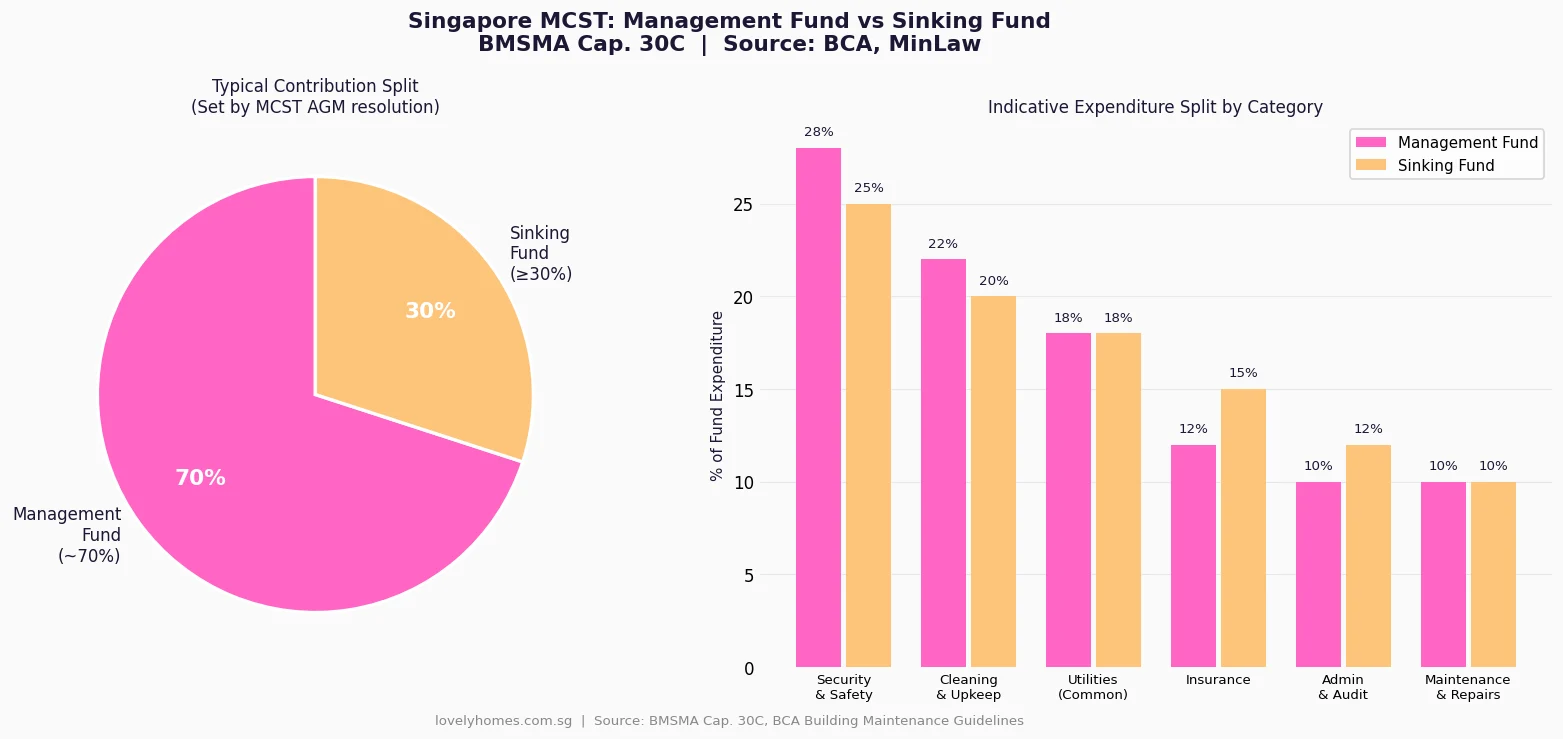
Every subsidiary proprietor pays monthly contributions (commonly called “maintenance fees”) to the MCST. Under BMSMA, these contributions are split between two statutory funds:

The Management Fund covers recurring operational costs: security services, cleaning, common area utilities (lifts, lighting, pool pumps), landscaping, insurance (fire and public liability), administration, audit fees, and routine minor repairs. Think of this as the MCST’s operating budget.

The Sinking Fund is a capital reserve for major future expenditure: lift overhauls, façade waterproofing, roof replacement, mechanical and electrical system replacements, pool refurbishment, road resurfacing, and similar major works. BMSMA requires that the Sinking Fund must receive contributions equivalent to at least 10% of the total contributions collected (i.e., at least one-tenth of the combined Management Fund and Sinking Fund contributions must go to the Sinking Fund). Most well-managed developments set a higher target — 25–35% of total contributions — to build an adequate reserve.
Singapore MCST management fund sinking fund breakdown BMSMA
Figure 1: MCST Management Fund vs Sinking Fund — Typical Contribution Split and Indicative Expenditure Categories. Source: BMSMA Cap. 30C, BCA Building Maintenance Guidelines.

Contributions are allocated per unit according to share values — a number assigned to each unit based on its area and type when the development is first surveyed. A larger unit typically carries a higher share value and pays a proportionately larger monthly contribution. Share values are fixed and cannot be changed without a unanimous resolution.

How Much Are MCST Fees? A Guide by Condo Type

MCST fees vary enormously across Singapore’s condo landscape. Key factors include the number of units in the development (more units spread fixed costs over a larger base, reducing per-unit fees), the range of facilities (pools, gyms, tennis courts, concierge all cost money to maintain), the age of the development (older buildings have higher maintenance costs), and the quality of financial management by the MC.
Singapore MCST annual fees by condo type 2026 indicative range
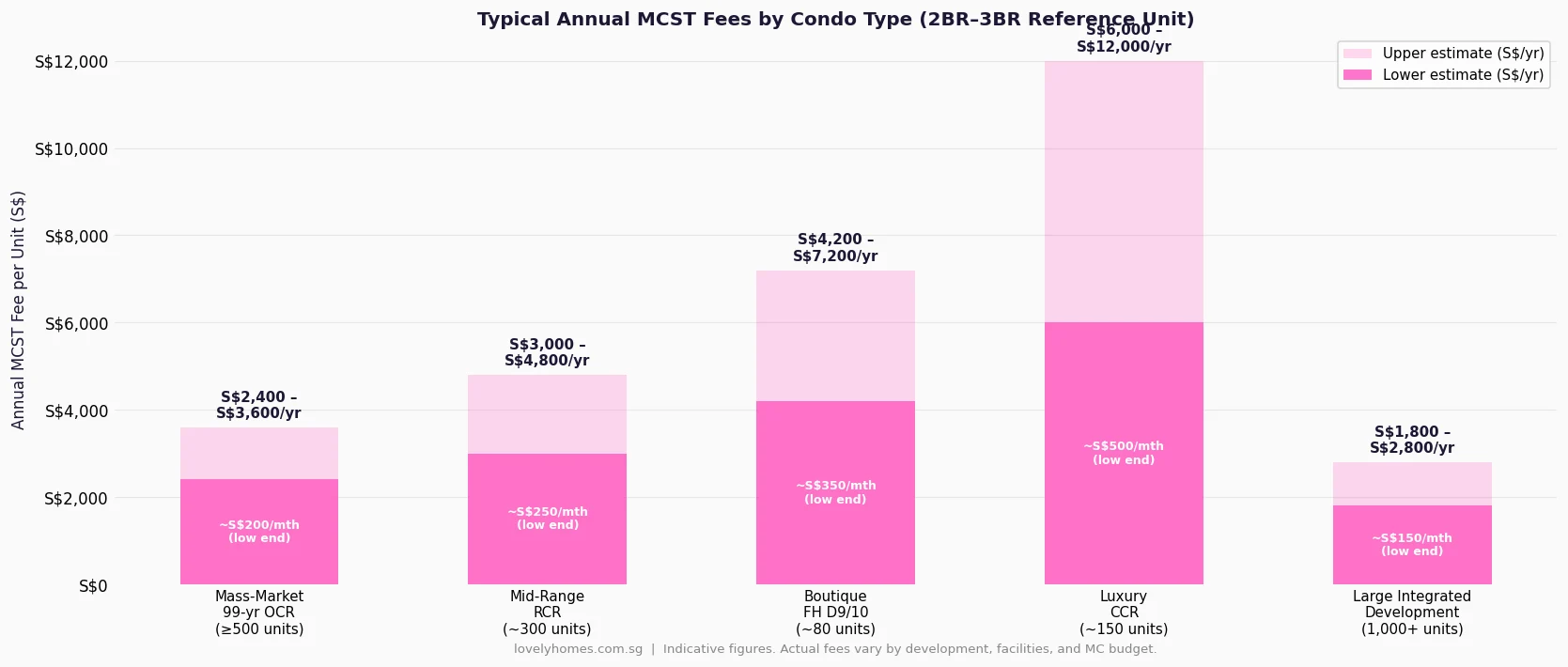
Figure 2: Indicative Annual MCST Fees per Unit by Condo Type (2BR–3BR Reference Unit), 2026. Figures are estimates based on typical fee structures; actual fees depend on each development’s budget.

As a general benchmark: a mass-market OCR condominium with 500 or more units and standard facilities (pool, gym, BBQ area) might charge S$200–S$300 per month for a 3BR unit. A mid-range RCR development with around 300 units and a fuller facility suite (multiple pools, function rooms, tennis court) might charge S$250–S$400 per month. A boutique freehold development in Districts 9 or 10 with 80 units and concierge services might charge S$350–S$600 or more per month — the smaller the development, the fewer units to share fixed costs.

Buyers should always request and study the MCST’s audited financial statements (particularly the Sinking Fund balance and adequacy ratio) before purchasing any resale unit. A development with an underfunded Sinking Fund is a red flag — owners will face either a special levy or deteriorating maintenance when major capital works are required.

By-Laws: The Rules of Strata Living

MCST by-laws govern the obligations and restrictions on subsidiary proprietors and their tenants and visitors. Singapore law establishes two tiers of by-laws. The Model By-Laws, set out in the Fourth Schedule of BMSMA, apply automatically to all strata developments and cover fundamentals: prohibiting nuisance to neighbours, keeping common areas clean, not obstructing stairways and corridors, maintaining smoke and cooking fumes within units, and not damaging common property.

Developments may additionally pass additional by-laws by ordinary resolution at an AGM. These can cover matters such as pet policies (breed or size restrictions), short-term rental rules (many condos have by-laws restricting Airbnb-style rentals to a minimum 3-month or 6-month tenancy), renovation hours and noise restrictions, car park allocation rules, and use of facilities. Critically, additional by-laws cannot override the BMSMA or conflict with it — a by-law purporting to ban all pets entirely, for example, may be challengeable as unreasonable.

Breach of by-laws can result in fines of up to S$5,000 per breach under BMSMA, imposed by order of the Strata Titles Boards (STB). In practice, MCSTs typically issue written warnings first; formal enforcement action is reserved for persistent or serious breaches.

Renovation Approvals: What You Need the MCST’s Permission For

If you own a strata unit, you generally have the right to carry out renovation works within your unit, subject to certain approvals and restrictions. Works that affect common property — balcony modifications, structural walls that may be shared, roof access, plumbing in common risers — require MCST approval in addition to any Building and Construction Authority (BCA) or Urban Redevelopment Authority (URA) permits. Internal reconfigurations (knocking down non-structural internal walls, replacing flooring, kitchen refits) typically do not require MCST approval but must comply with time and noise restrictions in the by-laws.

A common area of confusion is the aircon ledge and balcony enclosure. These are typically common property, meaning any modification (enclosing, expanding, adding screens) requires MCST approval. Unauthorised enclosures are one of the most frequent by-law enforcement issues in Singapore condominiums. Always confirm with the MC in writing before commencing any works that touch external walls, balconies, or roof areas.

Summary: Key MCST Rules at a Glance

Topic Rule / Key Point Legislation / Source
MCST formation Automatically formed when strata title issued; all unit owners are members BMSMA s. 29
Management Council size 3–14 members elected at AGM; must be unit owners or nominees BMSMA s. 53
AGM frequency Must be held annually; not more than 15 months since last AGM BMSMA s. 27
Sinking Fund minimum At least 10% of total contributions; MC can set higher target BMSMA s. 38
By-law breach fines Up to S$5,000 per breach, by STB order BMSMA s. 32
Common property works Require MCST written consent; MC can set conditions BMSMA s. 37
Dispute resolution STB mediation → STB Order → High Court appeal (law only) BMSMA Part VI
Quorum for ordinary resolution ≥30% of total share values represented at a general meeting BMSMA s. 75
Pets Governed by by-laws; model by-laws do not prohibit pets; additional by-laws may impose restrictions BMSMA 4th Schedule
Short-term rentals Permitted subject to by-laws and URA regulations; many MCSTs have by-laws requiring minimum 3–6 month tenancy URA guidelines

Worked Example: Mr Tan’s S$9,000 Balcony Dispute

Mr Tan owns a 3BR unit in a mid-range RCR condominium. His balcony faces a pleasant courtyard and he wishes to enclose it with floor-to-ceiling glass panels to create a larger living area. He proceeds without MCST consent and engages a contractor who completes the works over two weekends.

The MC sends a formal notice of breach under the by-laws: the balcony is common property under the strata plan, and any modification requires prior written MCST approval. The MC orders the works to be removed at Mr Tan’s expense within 30 days. Mr Tan disputes this — he argues the panels are removable and he is not damaging the building.

The MC applies to the Strata Titles Boards (STB) for an order requiring reinstatement. At mediation, the STB mediator helps both parties reach a compromise: Mr Tan may retain the glass enclosure provided it is a fully removable system (no drilling into structural walls), an engineer certifies it does not affect load-bearing elements, and he pays a S$500 administrative fee to the MCST. Without compromise, a formal STB Order could have required full reinstatement at an estimated cost of S$8,000–S$12,000 in contractor fees, plus a potential fine of up to S$5,000.

Lesson: always obtain MCST written approval before any works touching common property. The cost of a dispute far exceeds the inconvenience of applying in advance. For guidance on tenant-related strata disputes, see our Rental Tenant Rights Guide 2026.

Dispute Resolution: The Strata Titles Boards (STB)

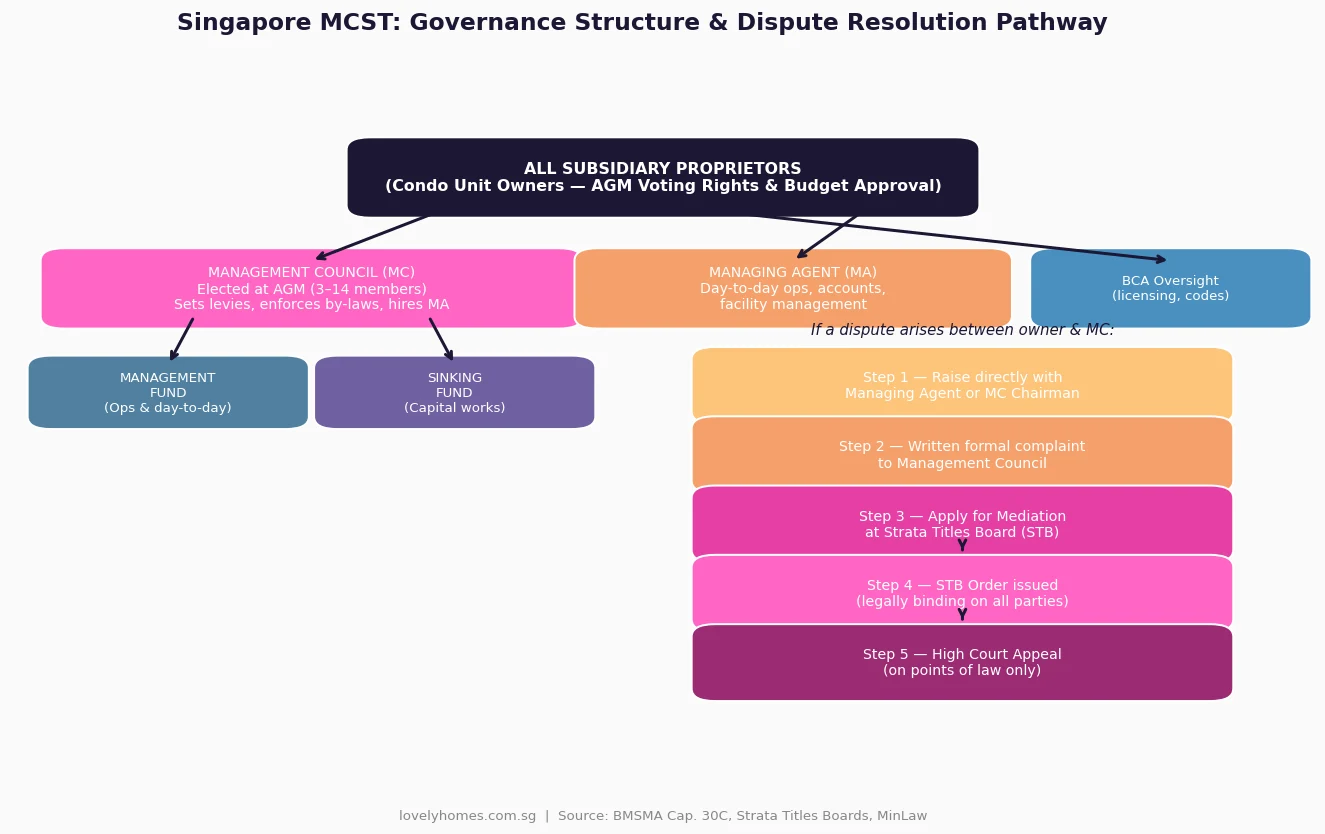
When a dispute arises between a subsidiary proprietor and the MCST (or between two unit owners about strata matters), Singapore provides a dedicated tribunal: the Strata Titles Boards (STB), established under BMSMA and administered by the Ministry of Law (MinLaw). STB proceedings are designed to be accessible and affordable — filing fees are modest, legal representation is optional, and the process is less adversarial than court litigation.

Common STB applications include: orders requiring the MCST to carry out maintenance works; disputes about by-law enforcement or breach penalties; objections to special levies; disputes about the allocation of car park lots; and applications to invalidate decisions made at AGMs where proper notice was not given. The STB first attempts mediation — parties meet with a mediator in a structured session. If mediation fails, the STB constitutes a formal hearing panel, receives evidence, and issues an Order. STB Orders are legally binding and enforceable in the courts. Appeal lies to the High Court, but only on questions of law.
Singapore MCST governance structure dispute resolution pathway STB BMSMA
Figure 3: Singapore MCST Governance Structure and Dispute Resolution Pathway — from unit owners through Management Council to Strata Titles Boards. Source: BMSMA Cap. 30C, MinLaw.

What Might Change: BMSMA Review and Future Reforms

The BMSMA was comprehensively amended in 2010 and has been updated periodically since. BCA periodically reviews strata management regulations in response to industry feedback and changing market conditions. Areas of ongoing discussion as at mid-2026 include: tightening rules on managing agents’ qualifications and licensing; improving transparency of MCST financial reporting to unit owners; and clarifying the rules on short-term rental by-laws in the context of Singapore’s broader short-term rental regulatory framework. Buyers should monitor BCA and MinLaw announcements for any legislative updates that might affect their rights and obligations as condo owners.

Frequently Asked Questions About Singapore MCSTs

Can the MCST increase maintenance fees without my consent?

Yes. The Management Council has the authority to set the annual budget and the contribution amounts (maintenance fees) required from each unit owner, subject to approval at the AGM by ordinary resolution. An ordinary resolution requires a simple majority of votes cast (by share value) at a general meeting. If you disagree with a fee increase, you can vote against it at the AGM or requisition an extraordinary general meeting to challenge it. Practically speaking, however, fee increases are usually incremental and reflect genuine cost increases — MCSTs that chronically underfund their budgets end up with deteriorating estates and greater special levy calls down the line.

What is a special levy and when can the MCST impose one?

A special levy is a one-time additional contribution imposed on all unit owners to fund a specific capital expenditure that has arisen unexpectedly or that the Sinking Fund is insufficient to cover. Common triggers include emergency structural repairs, lift replacements ahead of schedule, or the costs of defending the MCST in legal proceedings. Under BMSMA, a special levy must be approved by ordinary resolution at a general meeting. The amount allocated to each unit is based on share value. Special levies are a red flag in developments that have historically underfunded their Sinking Fund — which is why buyers should always check the Sinking Fund balance and recent spending history before purchasing a resale unit. A healthy Sinking Fund protects against special levies.

What happens if I stop paying my MCST fees?

Unpaid MCST contributions are a debt owed to the MCST. Under BMSMA, the MCST has a statutory lien over your unit for unpaid contributions — it can register this lien with the Singapore Land Authority (SLA) and ultimately pursue recovery through the courts. If you are selling your unit, solicitors acting on the sale will identify any outstanding MCST arrears, which must be settled before completion. Persistent non-payment can also result in the MCST applying to the STB for enforcement orders. There is no grace period prescribed in law, though most MCSTs will issue demand letters before proceeding to formal enforcement action.

Can I attend an AGM and vote even if I have outstanding MCST fees?

Under BMSMA, unit owners who are in arrears of contributions may be denied the right to vote at a general meeting. Specifically, a subsidiary proprietor is not entitled to vote at any general meeting if any contribution payable in respect of their lot has been in arrears for more than 30 days before the date of the meeting. You retain the right to attend and speak, but you lose voting rights until the arrears are cleared. This is an important incentive for timely payment, particularly for contentious AGM resolutions such as special levies or managing agent contract renewals.

My neighbour is violating the condo by-laws — what can I do?

The primary enforcement mechanism for by-law breaches is through the MCST, not individual unit owners. You should first report the breach in writing to the Managing Agent or Management Council, providing clear details (date, nature of breach, evidence where available). The MC has the authority and obligation to investigate and take enforcement action. If the MC fails to act on a legitimate complaint, you can raise the matter at the AGM or requisition an extraordinary general meeting. As a last resort, you may apply to the STB directly under BMSMA section 111 for an order requiring the MC to take enforcement action. The STB process is designed to be accessible — you do not need a lawyer to file an application.

Can I rent out my condo unit on Airbnb or short-term rental platforms?

Short-term rental of private residential properties in Singapore is regulated by URA under its Short-Term Accommodation (STA) Framework. As at 2026, private residential properties listed for short-term rental must meet URA’s requirements, including a minimum rental period of three consecutive months per tenant. Many MCSTs additionally pass by-laws imposing their own minimum tenancy periods or restricting short-term rentals entirely within their estates. You should check both URA’s current STA guidelines and your specific development’s by-laws before listing your property. Breach of URA regulations can result in fines, and breach of MCST by-laws can result in STB enforcement. For the rental rules from the tenant’s perspective, see our Singapore Rental Tenant Rights Guide 2026.

I want to buy an en bloc / collective sale — how does the MCST factor in?

In an en bloc (collective sale), the MCST plays a key administrative role but does not initiate or block the sale. The en bloc process is governed by the Land Titles (Strata) Act (LTSA), not BMSMA. Owners seeking a collective sale form a collective sale committee (CSC), separate from the MC. The CSC must obtain consent from subsidiary proprietors holding 80% of total share value (for developments over 10 years old) or 90% (for developments under 10 years old) before applying to the STB for a sale order. Dissenting owners can file objections with the STB. The MC continues to manage the estate throughout the en bloc process, including collecting maintenance fees and addressing day-to-day repairs, until the sale is completed and the strata title scheme is wound up.

Related Articles

Disclaimer: This article is for general informational purposes only and does not constitute legal, financial, or property advice. Information on BMSMA provisions is based on the Act as at June 2026; amendments may occur — readers should verify against the current statutes at sso.agc.gov.sg and consult the Building and Construction Authority (bca.gov.sg), the Strata Titles Boards (mlaw.gov.sg/strata-titles-boards), or a qualified lawyer for advice specific to their strata development and circumstances.

Singapore Property Market Forecast 2H 2026: Price Outlook, Key Risks and What Buyers Should Know

Singapore Property Market Forecast 2H 2026: Price Outlook, Key Risks and What Buyers Should Know

Quick Answer: Singapore Property Market Forecast 2H 2026

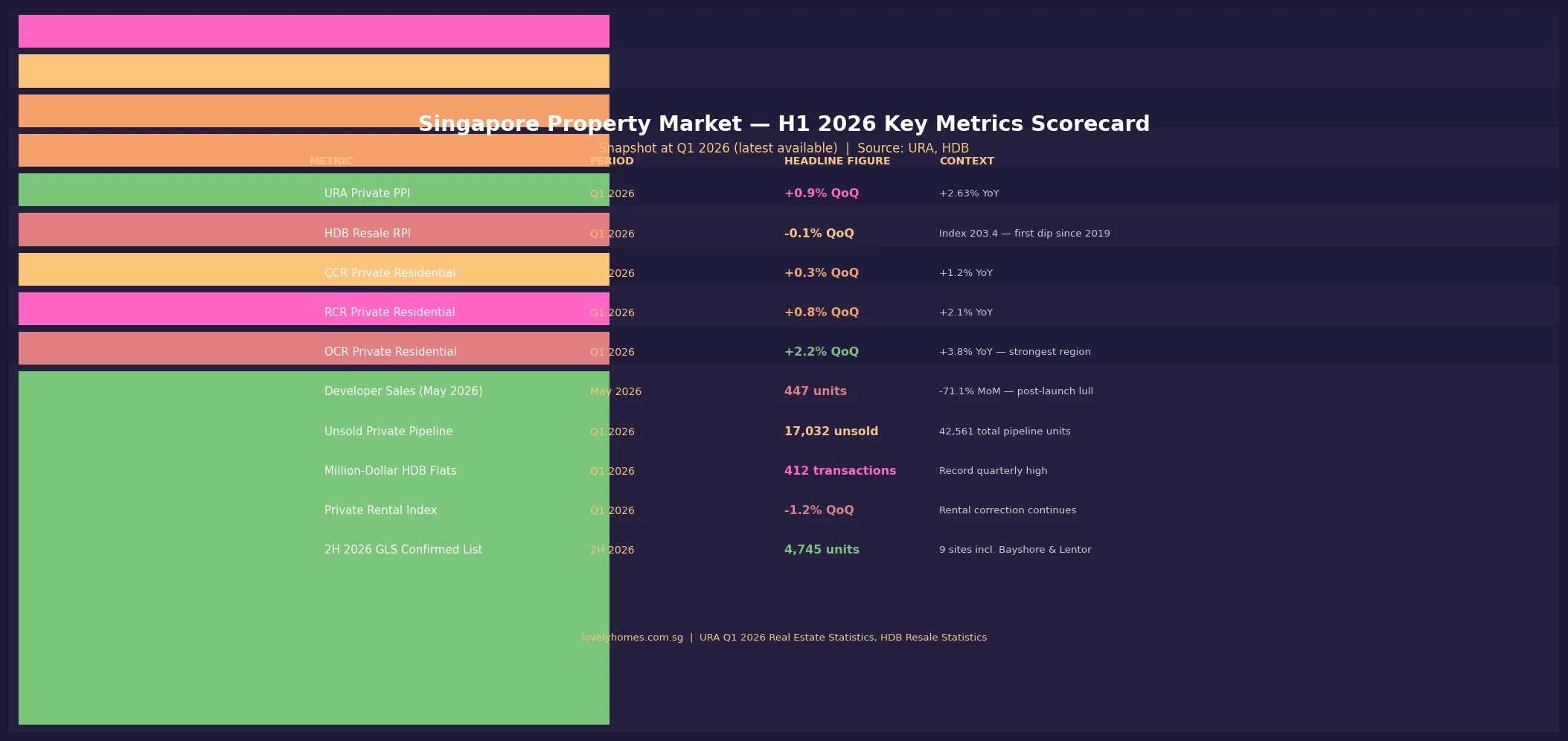
  • Private residential prices rose 0.9% QoQ and 2.63% YoY in Q1 2026, with the Outside Central Region (OCR) leading at +2.2% QoQ — price growth is positive but moderating.
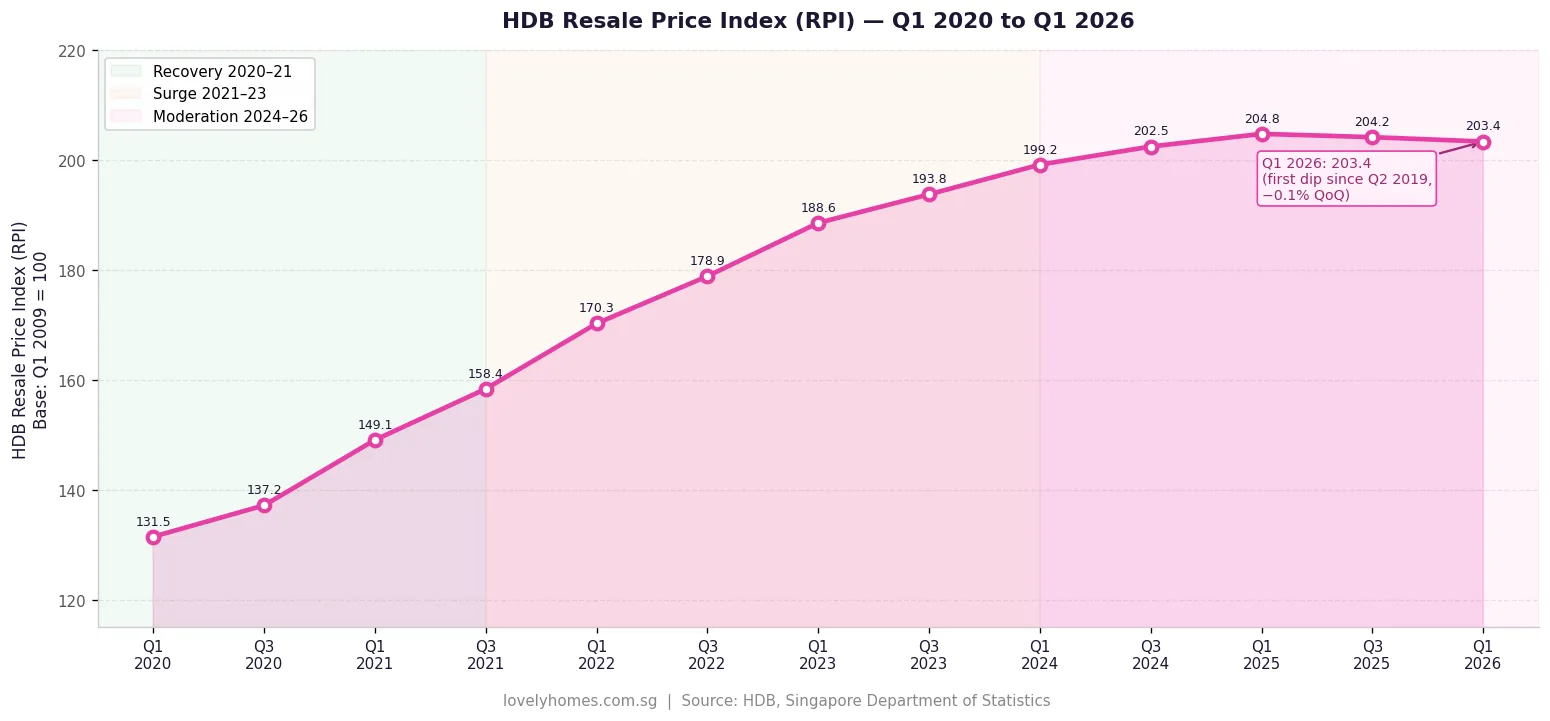
  • HDB resale recorded its first quarterly dip (-0.1% QoQ) since Q2 2019; index sits at 203.4. Not a crash — more of a pause after a five-year run.
  • 2H 2026 GLS launches 9 confirmed-list sites (4,745 units), adding meaningful supply to OCR and RCR. Pricing discipline from developers is expected.
  • Key risk: interest rates remain elevated at 3.0–3.5% for bank mortgages; affordability is stretched for many first-time buyers.
  • Key catalyst: any US Federal Reserve rate cut signals would unlock significant pent-up demand — watch the September and December 2026 Fed meetings.
  • For buyers: fundamentals remain sound — Singapore’s employment is near-full, rental demand supports investment yield, and supply is finite. Timing the market is less reliable than time in the market.
  • URA Q2 2026 Flash Estimates are expected in early July 2026 and will be the next major data point.

H1 2026 in Review: Where the Singapore Property Market Stands

As the calendar turns to the second half of 2026, Singapore’s property market presents a nuanced picture. Private residential prices continued their gradual upward trajectory in Q1 2026, with the Urban Redevelopment Authority (URA) reporting a Property Price Index (PPI) increase of 0.9% quarter-on-quarter — a modest but consistent gain that extends a trend stretching back to the post-pandemic recovery that began in mid-2020. On a year-on-year basis, the private residential index is up 2.63%, a pace that is firm but well below the double-digit growth seen during the post-pandemic surge of 2021 to 2023.

The Housing Development Board’s Resale Price Index (RPI), however, told a slightly different story. At 203.4 in Q1 2026, the HDB resale market recorded a 0.1% quarterly decline — the first such dip since Q2 2019. This is not alarming in isolation: the index had surged more than 54% since its 2019 trough, and a modest pause is consistent with natural market digestion. What it does signal is that the exceptional run of HDB resale price appreciation is transitioning into a more measured phase.

Singapore property market H1 2026 key metrics scorecard URA HDB data
Figure 1: Singapore Property Market H1 2026 Key Metrics Scorecard — URA Q1 2026 Real Estate Statistics and HDB Resale Statistics.

Private Residential Market: A Three-Speed Story

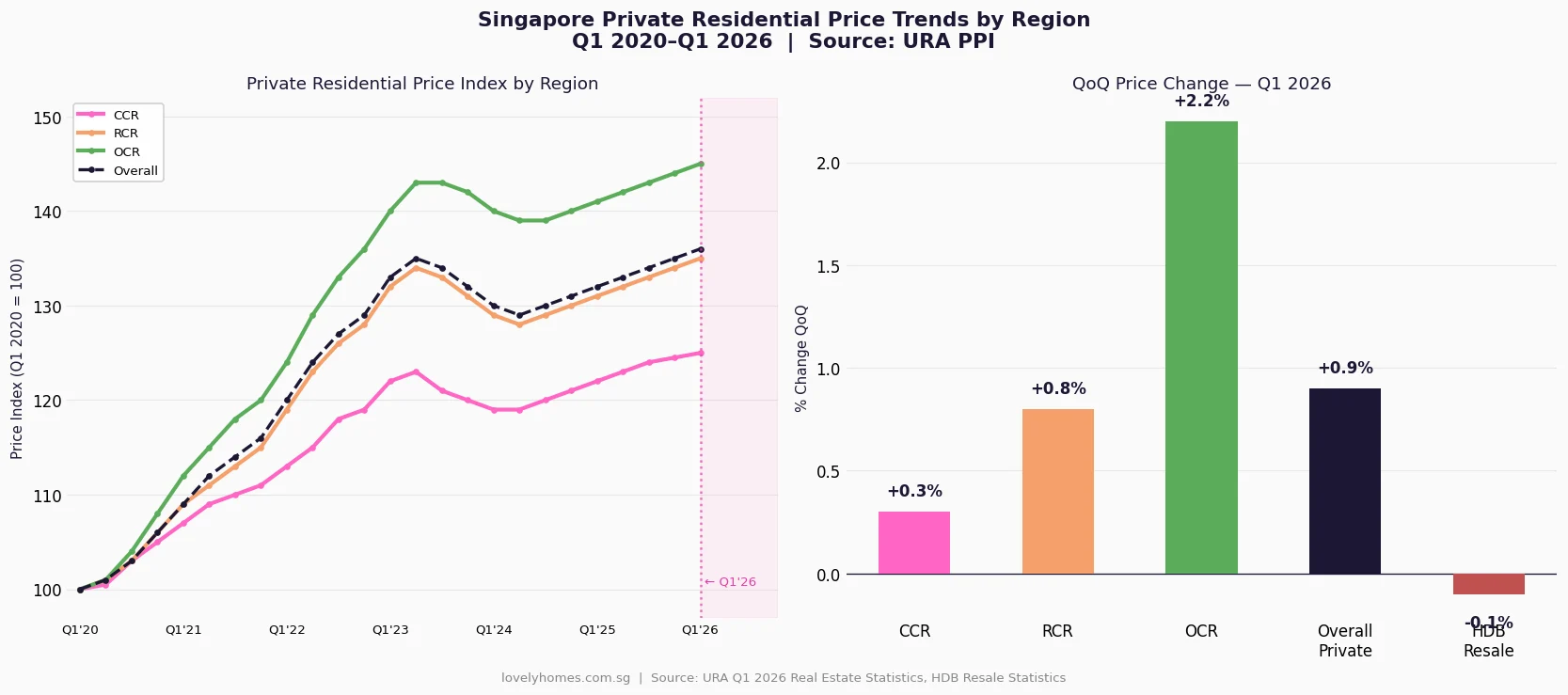
The defining characteristic of Singapore’s private residential market in 2026 is regional divergence. The three planning zones administered by URA — the Core Central Region (CCR), Rest of Central Region (RCR), and Outside Central Region (OCR) — have performed at markedly different speeds in 2026.

The OCR is the undisputed pace-setter. A 2.2% quarterly gain in Q1 2026, following similar momentum in late 2025, reflects genuine demand from HDB upgraders — a cohort whose Minimum Occupation Period (MOP) clears in waves and who target mass-market new launches in the S$1.3M–S$1.8M range. The 2H 2026 GLS programme deliberately concentrates supply here (Tampines Street 94, Bayshore Road), which should moderate any further sharp price acceleration without causing a price correction.

The RCR recorded 0.8% QoQ growth — solid mid-field performance driven by a mix of first-time private buyers, professionals, and some foreign-related buying in the city-fringe. River Valley Green Parcel C (awarded June 2026 at a top bid of approximately S$1,730 psf ppr) is the headline indicator of developer confidence in this zone.

The CCR grew just 0.3% QoQ, a subdued reading that reflects several headwinds: the 60% Additional Buyer’s Stamp Duty (ABSD) on foreigners that has been in place since April 2023 continues to suppress international transaction volumes; and the global macro uncertainty discussed in the risk section below has weighed on ultra-high-net-worth discretionary buying. That said, CCR is not in distress — it remains a long-term beneficiary of Singapore’s family office growth and wealth inflows.

Singapore private residential price index CCR RCR OCR Q1 2026 regional trends
Figure 2: Singapore Private Residential Price Index by Region (Q1 2020–Q1 2026) and QoQ Change for Q1 2026. Source: URA Q1 2026 Real Estate Statistics.

HDB Resale Market: A Healthy Pause, Not a Reversal

Singapore’s HDB resale market has been one of the defining investment stories of the 2020s. From a low point in 2019 (RPI ≈ 132), prices surged to an index of 203.4 by Q1 2026 — a 54% cumulative increase. The Q1 2026 dip of 0.1% QoQ is, in that context, the market catching its breath after an exceptional run rather than a structural reversal.

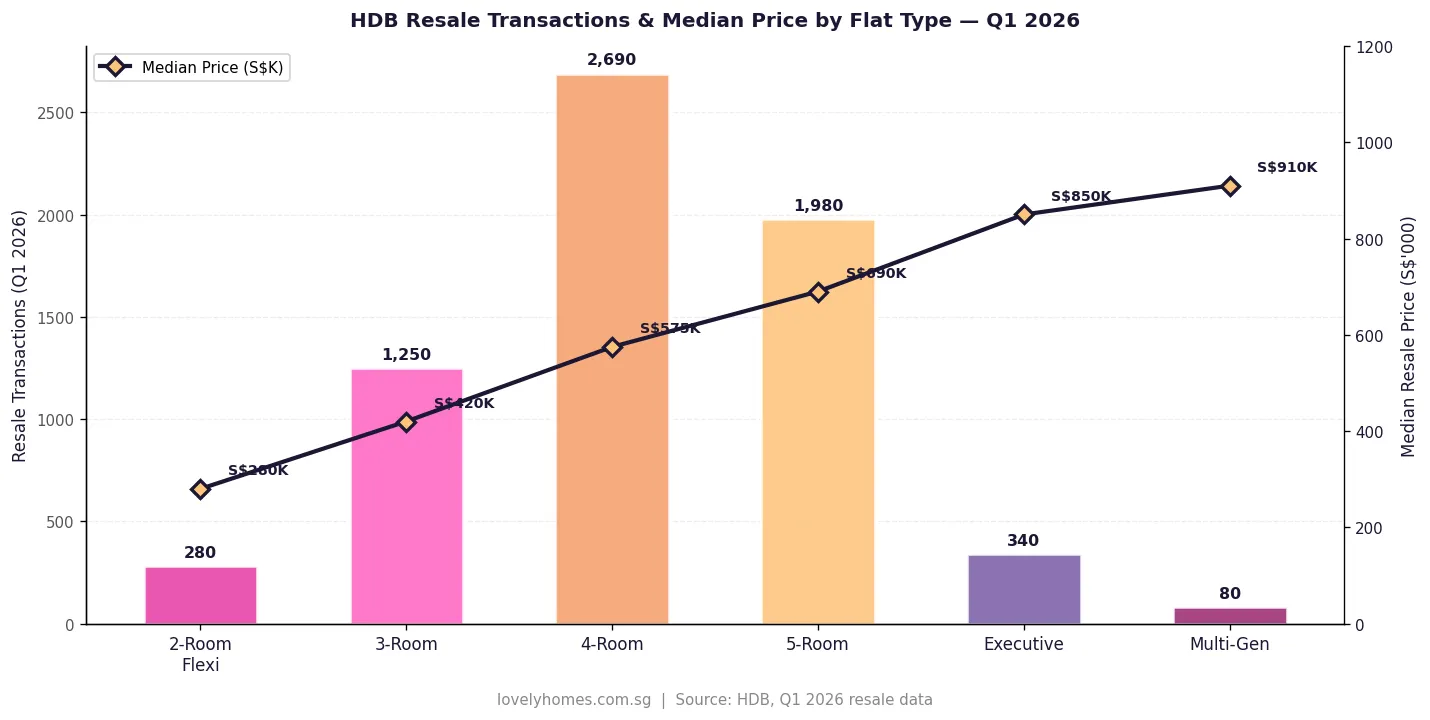
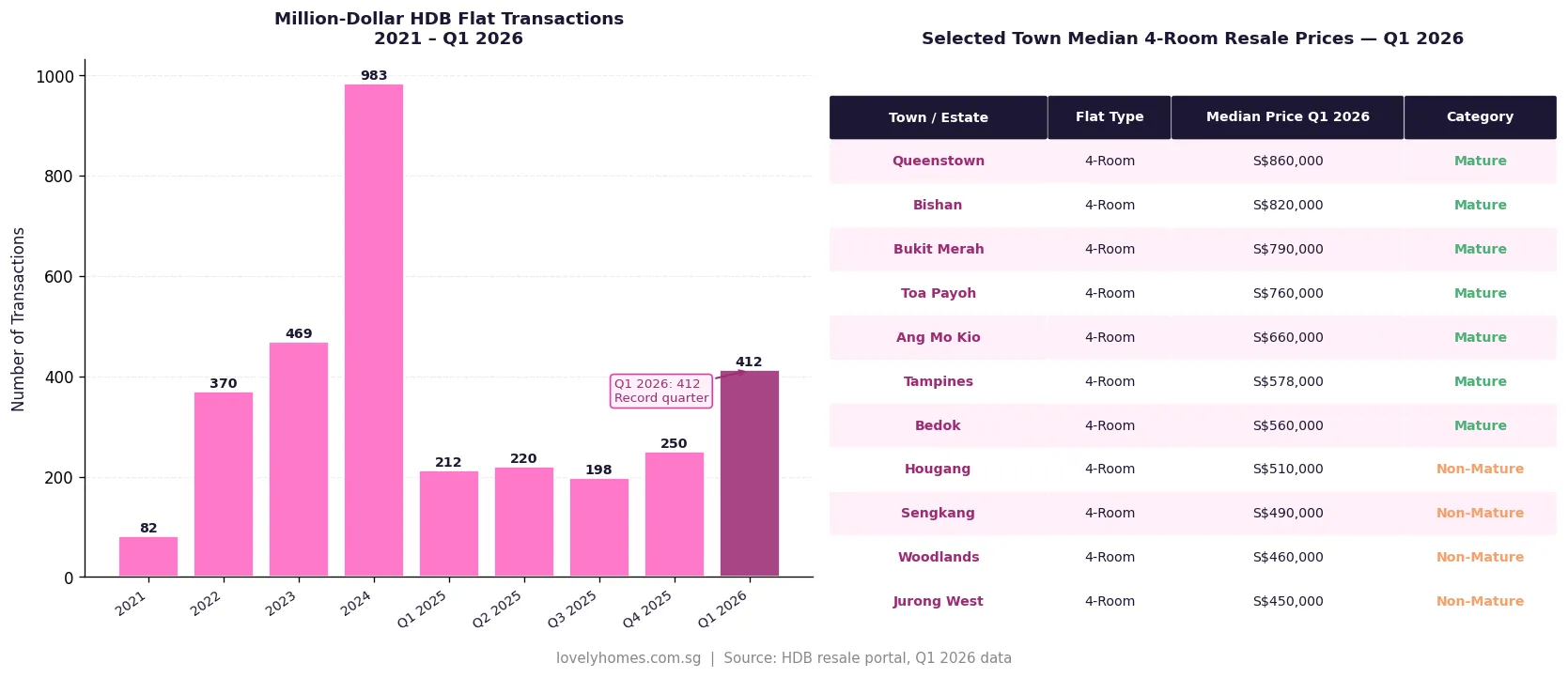
Two counterintuitive data points reinforce this view. First, million-dollar HDB transactions reached a record quarterly high of 412 in Q1 2026 — indicating that at the premium end of the resale market (large mature-estate flats, high-floor units in sought-after towns), demand remains fierce. Second, overall HDB resale transaction volumes for Q1 2026 remained healthy, with four-room flats accounting for the largest share (approximately 2,690 transactions in Q1 2026 alone) at a median price of around S$575,000.

For 2H 2026, the HDB resale market is likely to remain range-bound rather than sharply appreciating or correcting. MOP cohorts from the 2016–2019 BTO launches are gradually clearing, releasing units back to the resale market — but supply from this channel is relatively thin compared to the 2013–2016 peak cycle. Demand remains supported by couples who cannot access BTO (due to income ceiling, citizenship mix, or urgency) and Permanent Residents who remain ineligible to buy BTO directly.

Developer Sales and the New Launch Pipeline

Developer sales activity is the indicator most directly shaped by new launch timing. The monthly data tells a story of feast and famine: January to April 2026 saw 1,120, 895, 1,348 and 1,548 units sold respectively — solid months driven by a cluster of project launches. May 2026 crashed to 447 units (-71.1% month-on-month), not because demand evaporated, but because there were few projects launching that month.

The pipeline going into 2H 2026 remains substantial. URA data shows 17,032 unsold units in the private pipeline as of Q1 2026 (total pipeline including units not yet launched: 42,561). The 2H 2026 GLS Confirmed List adds nine further sites including Lentor Gardens Parcel A and B, Bayshore Road, Tampines Street 94, and an EC site at Jurong East. These launches are phased across 2H 2026 into 2027, so the impact on completed supply will be felt primarily in 2028–2030.

Rental Market: Correction Underway, Yields Compressing

Singapore’s private residential rental market began correcting in 2024 after a record two-year surge and that correction extended into 2026. The URA rental index fell 1.2% QoQ in Q1 2026, following declines across 2024 and 2025. In absolute terms, rents remain significantly above their pre-pandemic levels — a 2BR in D15 that rented for S$2,800/month in 2019 may still command S$4,200–S$4,800/month in 2026 depending on specification — but the exceptional post-pandemic pricing has normalised.

For investors, this rental correction compresses gross yields. A S$1.5M 2BR in the RCR yielding S$4,500/month gross generates a gross yield of approximately 3.6%, which is broadly comparable to bank deposit rates in 2026. Net yield after management fees, property tax, and maintenance is lower — making the case for property investment in 2026 primarily a capital appreciation thesis rather than a pure income play.

2H 2026 Market Outlook Summary

Segment Base Case Bull Case Bear Case
Private Residential (Overall) +1%–2% for full year 2026 +3%–4% if rates ease and demand recovers Flat to -1% if global recession deepens
OCR (Mass Market) Continues outperforming; +2%–3% YoY +4%–5% with strong HDB upgrader demand Supply pressure from GLS launches moderates gains
RCR (City Fringe) Steady +1%–2% YoY +3% with new launch interest Flat if affordability ceiling is hit
CCR (Core Central) Sideways to +1%; foreign buyer ABSD drag +2%–3% if ABSD reviewed or wealth inflows surge -1%–2% if global HNW sentiment deteriorates
HDB Resale ±0.5% QoQ; range-bound in H2 +1%–2% if upgrader demand stays robust -1% if affordability stress bites flat demand
Private Rental Further -2%–4% as supply catches up Stabilises if employment influx resumes Deeper correction if expat headcount falls

Worked Example: The Chen Family — Buy in 2H 2026 or Wait?

Mr and Mrs Chen are Singapore Citizens in their early 30s. They have cleared their HDB MOP on their Bishan 4-room flat and are looking to upgrade to a 3-bedroom OCR condo. They have combined income of S$13,500 per month, CPF OA savings of S$180,000, and cash of S$120,000.

They are eyeing a 3BR at an upcoming OCR launch in Q3 2026 priced at S$1.65M. Under the ABSD SC couple remission scheme, they can purchase the new condo and claim a full refund of the 20% ABSD (S$330,000) provided they sell their HDB flat within six months of the condo purchase date.

Key numbers: BSD S$47,600 (payable from CPF); ABSD S$330,000 (cash, but refundable within six months of HDB sale); 5% cash S$82,500; legal fees ~S$5,500. Bank loan: 75% LTV = S$1,237,500 at 3.2% over 30 years → monthly repayment approximately S$5,338. TDSR = S$5,338 ÷ S$13,500 = 39.5% (PASS, under 55%). Total cash needed upfront: ~S$208,000 (cash component + ABSD float pending HDB sale).

Should they wait? If OCR prices rise another 2% by Q1 2027, the same unit would cost S$1,683,000 — an additional S$33,000. If interest rates fall 50 bps by then, monthly repayments fall by ~S$300/month. The calculus slightly favours acting when they are ready rather than trying to time the market precisely, provided the ABSD remission window can be managed. See our guide on ABSD remission for SC couples for the full rules.

What Might Come Next: Risks and Catalysts for 2H 2026

The Singapore property market operates at the intersection of domestic fundamentals (employment, wage growth, HDB upgrader cohorts) and global macro forces (US interest rates, geopolitical risk, capital flows). For the second half of 2026, both sides of that equation are in play.

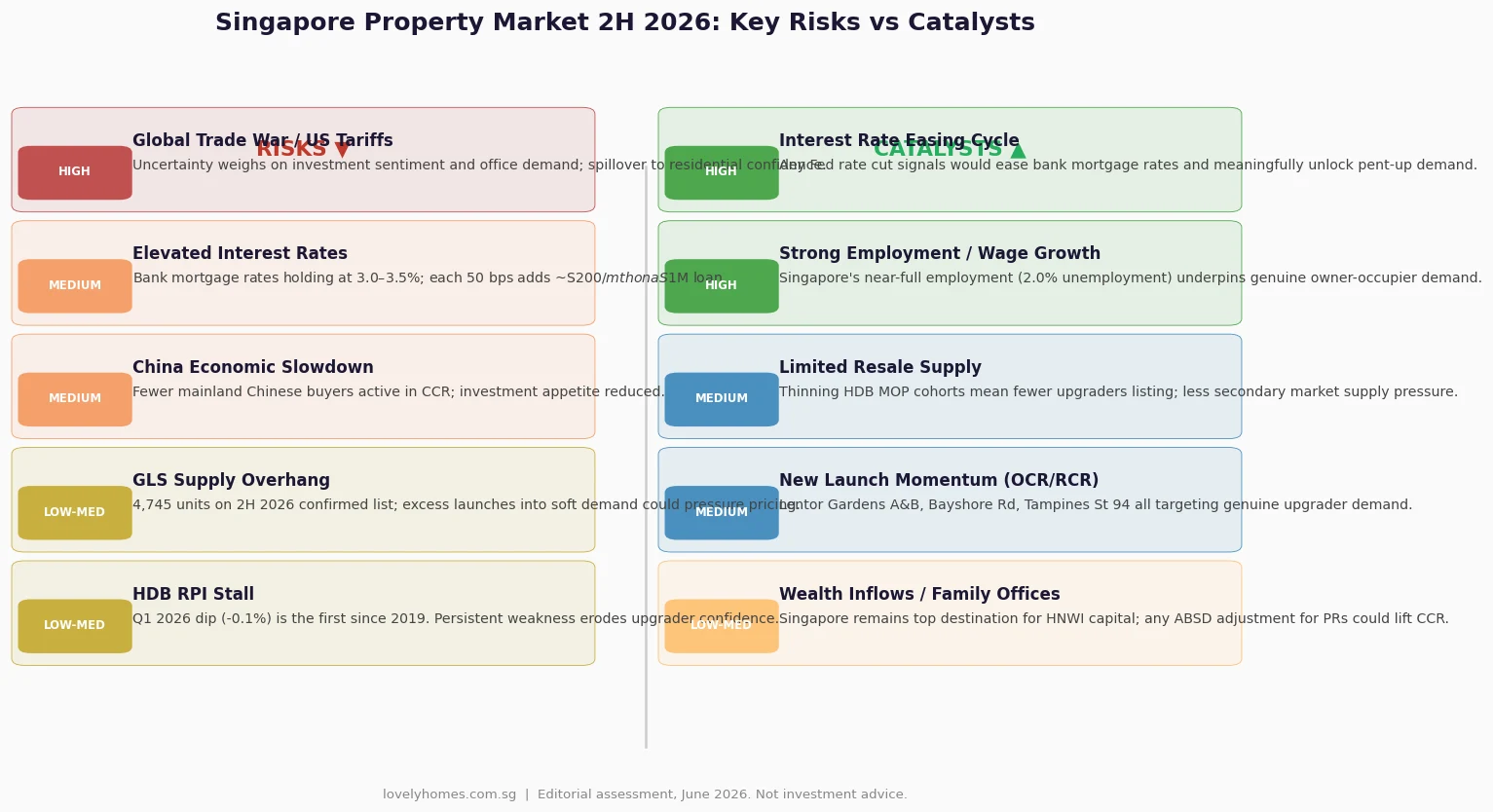
Key downside risks include the persistence of elevated interest rates — if the US Federal Reserve holds rates through 2026 without cutting, Singapore bank mortgage rates (which track SORA and swap rates) will remain in the 3.0–3.5% range, keeping affordability stretched. Continued global trade disruptions from US tariff policy create a dampening effect on business investment sentiment and, indirectly, on expatriate headcounts and rental demand. China’s economic slowdown reduces the pool of Chinese-origin buyers who were historically active in the CCR.

Key upside catalysts include the prospect of Fed rate cuts in September or December 2026 — even one 25-basis-point cut would move Singapore’s forward rates and boost buyer confidence. Singapore’s own fundamentals remain strong: the unemployment rate is approximately 2.0%, wage growth is positive, and the Government’s managed-supply approach via the GLS programme means developers are not flooding the market with distressed inventory. Any relaxation of ABSD for permanent residents (which has been debated, though there is no official signal) would be an immediate CCR and RCR catalyst.

Singapore property market second half 2026 risks catalysts analysis
Figure 3: Singapore Property Market 2H 2026 — Key Risks vs Catalysts. Editorial assessment as at June 2026. Not investment advice.

Frequently Asked Questions

Will Singapore property prices drop in 2H 2026?

A broad price correction in 2H 2026 is not the base-case scenario for most analysts. Singapore’s property market is underpinned by limited land supply, robust employment, and the Government’s disciplined GLS programme which calibrates supply to demand. The most likely outcome for 2H 2026 is modest positive growth in the private residential segment (0%–2% for the full year in a base case) and range-bound movement in HDB resale. A sharp correction would require a confluence of events unlikely to materialise simultaneously: a major spike in unemployment, a severe global financial shock, and a government decision to release large additional land supply. None of these is the current outlook.

When will the URA Q2 2026 Flash Estimates be released?

Based on URA’s established release pattern, the Q2 2026 Flash Estimates for the private residential property price index are expected in the first week of July 2026 — likely 1 or 2 July. The full Q2 2026 real estate statistics (including detailed regional breakdowns, rental index, and developer sales data) typically follow approximately three to four weeks later. The flash estimate gives a preliminary QoQ price change figure; the full release provides granular transaction and rental data. LovelyHomes will publish a dedicated analysis article as soon as the data is available.

What does the HDB resale -0.1% dip in Q1 2026 actually mean for sellers?

A -0.1% quarterly change in the HDB Resale Price Index is, in practical terms, negligible. On a S$600,000 flat, it represents a S$600 notional price movement — far smaller than the typical negotiation buffer in any individual transaction. What it signals is a shift in market psychology: buyers are less willing to pay premiums above valuation (Cash-Over-Valuation, or COV), and the exceptional seller’s market conditions of 2021–2024 have normalised. Sellers should still expect good prices — the index is 54% above its 2019 trough — but they should set realistic expectations and price to comparable transactions rather than aspirationally. For guidance on reading HDB data, see our HDB Resale Price Index Guide.

Is this a good time to buy a private property in Singapore?

This depends entirely on your personal financial circumstances, intended holding period, and purpose. If you are buying for genuine owner-occupation (primary home or long-term family residence), timing the market precisely is less important than buying within your means — ensuring your TDSR is comfortable, that you have adequate cash reserves, and that your loan tenor is appropriate. If you are buying as an investment (rental yield or capital appreciation), you need to stress-test the numbers at current mortgage rates (3.0–3.5%) and assess whether the rental yield justifies the carrying cost. For a personalised assessment, consult a licensed financial adviser and a property professional. See also our Singapore Property Financing Guide for a full breakdown of LTV, TDSR, and MSR rules.

How does the 2H 2026 GLS supply affect new launch prices?

The 2H 2026 Government Land Sales Confirmed List adds nine sites capable of yielding approximately 4,745 private and EC units. This is a substantial supply injection, particularly into the OCR and RCR. In theory, more supply means developers compete harder for buyers, which moderates launch prices. In practice, Singapore developers rarely slash prices — they tend to phase launches to match demand and hold firm on pricing. The more likely outcome is that new launches in 2H 2026 are priced at modest premiums (5%–8%) to recent comparables rather than at exceptional premiums. Buyers interested in specific sites such as Lentor Gardens Parcels A and B, Bayshore Road, or Tampines Street 94 should monitor the URA tender awards and developer launch announcements as they are made throughout 2H 2026. Full details of all 2H GLS sites are in our 2H 2026 GLS Programme Guide.

What is the ABSD rate for Singapore Citizens buying a second property in 2026?

A Singapore Citizen purchasing a second residential property pays 20% ABSD on the purchase price or market value, whichever is higher. This is paid in cash (CPF cannot be used for ABSD). For SC couples who own an HDB flat, the 20% ABSD on their second private property can be refunded under the SC Couple ABSD Remission Scheme, provided the HDB flat is sold within six months of the completion of the private property purchase. The full rules are detailed in our ABSD Remission Guide and Complete ABSD Singapore 2026 Guide.

How do I track the Singapore property market between official URA releases?

Between URA quarterly releases, you can monitor real-time trends through several free sources. The URA REALIS portal (accessible via My SingPass) provides transaction-level data for private residential properties. The HDB Resale Flat Prices portal shows individual HDB transactions. SRX Property and EdgeProp Singapore publish weekly market commentaries based on caveats lodged. The Business Times Real Estate section and Channel NewsAsia Property cover major announcements and tender results. For a guide on how to interpret the data you find, see our HDB Resale Price Index Guide and CCR RCR OCR Property Guide.

Related Articles

Disclaimer: This article is for general informational purposes only and does not constitute financial, investment, or property advice. All property market data is sourced from the Urban Redevelopment Authority (URA) and Housing Development Board (HDB) official releases as at Q1 2026. Property prices, interest rates, and government policies can change — readers should refer to the latest official URA (ura.gov.sg), HDB (hdb.gov.sg), MAS (mas.gov.sg), and IRAS (iras.gov.sg) publications and consult a licensed financial adviser or property professional before making any property-related decision. Past price performance is not indicative of future results.

HDB BTO vs Resale Flat 2026: Complete Comparison — Prices, Grants, Waiting Time and New Classification Rules

HDB BTO vs Resale Flat 2026: Complete Comparison — Prices, Grants, Waiting Time and New Classification Rules

Quick Answer: HDB BTO vs Resale — Key Differences in 2026

  • BTO flats are sold directly by HDB at subsidised prices; resale flats are bought from existing HDB owners at market prices.
  • BTO typically takes 3–5 years from application to keys; resale flats can complete within 8–16 weeks.
  • Resale buyers qualify for more grants in total (up to S$230,000 for an SC couple) versus BTO (up to S$120,000 EHG only), but resale prices are generally higher.
  • BTO flats are brand new; resale flats are second-hand and vary significantly in age, condition, and remaining lease.
  • The new HDB classification — Standard, Plus, Prime — applies to BTO flats from August 2024 onwards, introducing longer resale restrictions for Plus and Prime flats.
  • Resale buyers must comply with the Ethnic Integration Policy (EIP) quota at point of purchase; BTO buyers face EIP only when they later sell.
  • Both BTO and resale flats are subject to a 5-year MOP (10 years for PLH flats), HDB loan eligibility rules, and the same TDSR/MSR framework.
  • For most first-time buyers with flexible timelines, BTO offers better value; for those with urgent housing needs or preferring mature-estate locations, resale may be more practical.

The decision between buying an HDB Build-To-Order (BTO) flat and a resale flat is one of the most consequential financial choices a Singapore household will make. Both routes lead to the same product — a Housing and Development Board flat — but the economics, timelines, and trade-offs are fundamentally different. BTO flats come at a subsidised price set by HDB, with a waiting period of three to five years; resale flats trade at market value with immediate occupancy. The introduction of the new Standard, Plus, and Prime flat classification from August 2024, combined with an increase in BTO supply and a moderation in resale prices following the 2023–2024 cooling cycle, has shifted the calculus for buyers in 2026. This guide walks through every key dimension of the comparison so you can make an informed decision.

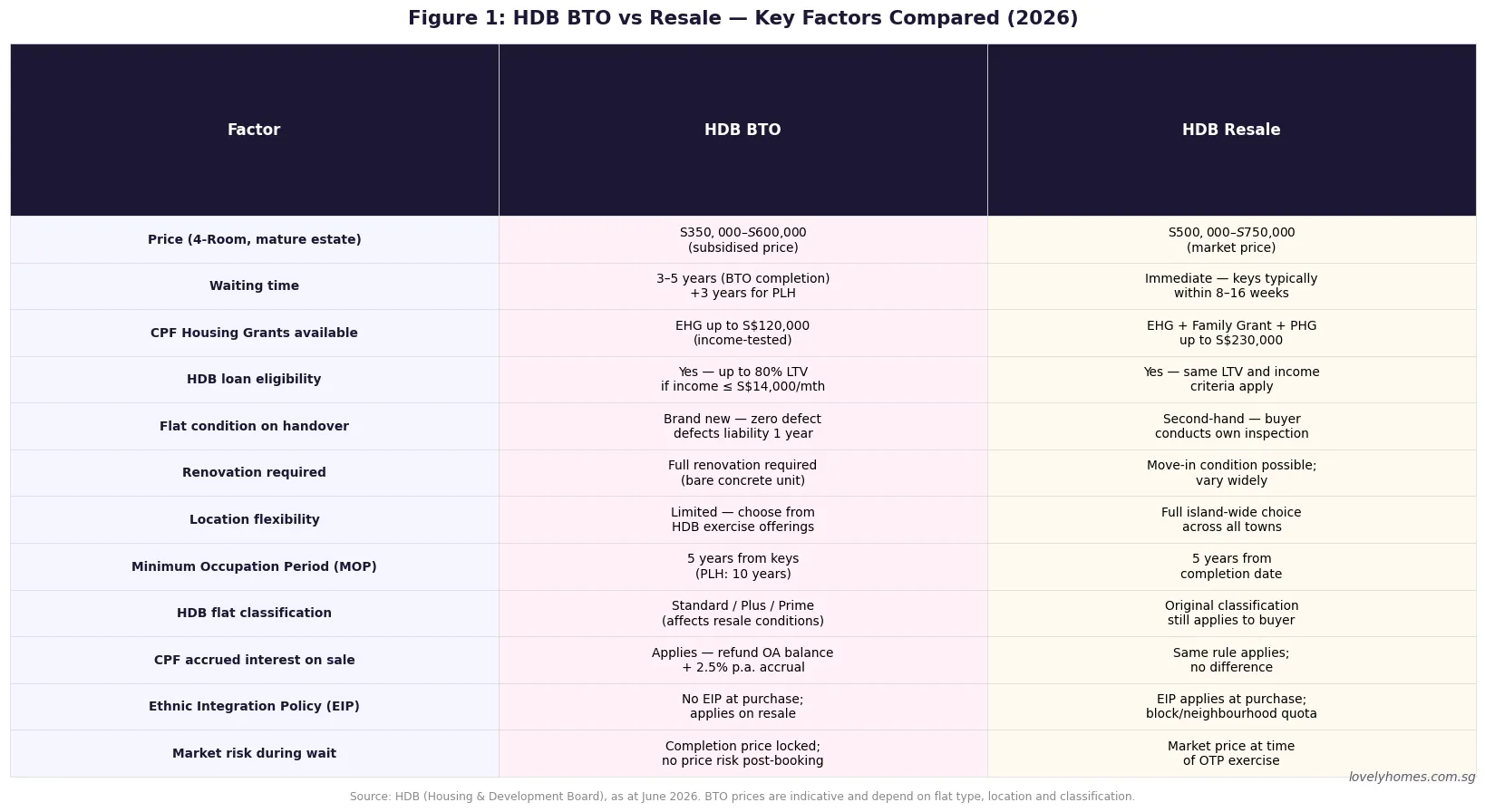
HDB BTO vs resale comparison table 2026 — 12 key factors including price, waiting time, grants and MOP
Figure 1: HDB BTO vs Resale — 12 Key Factors Compared. Source: HDB, as at June 2026.

Price: BTO Subsidy vs Resale Market Value

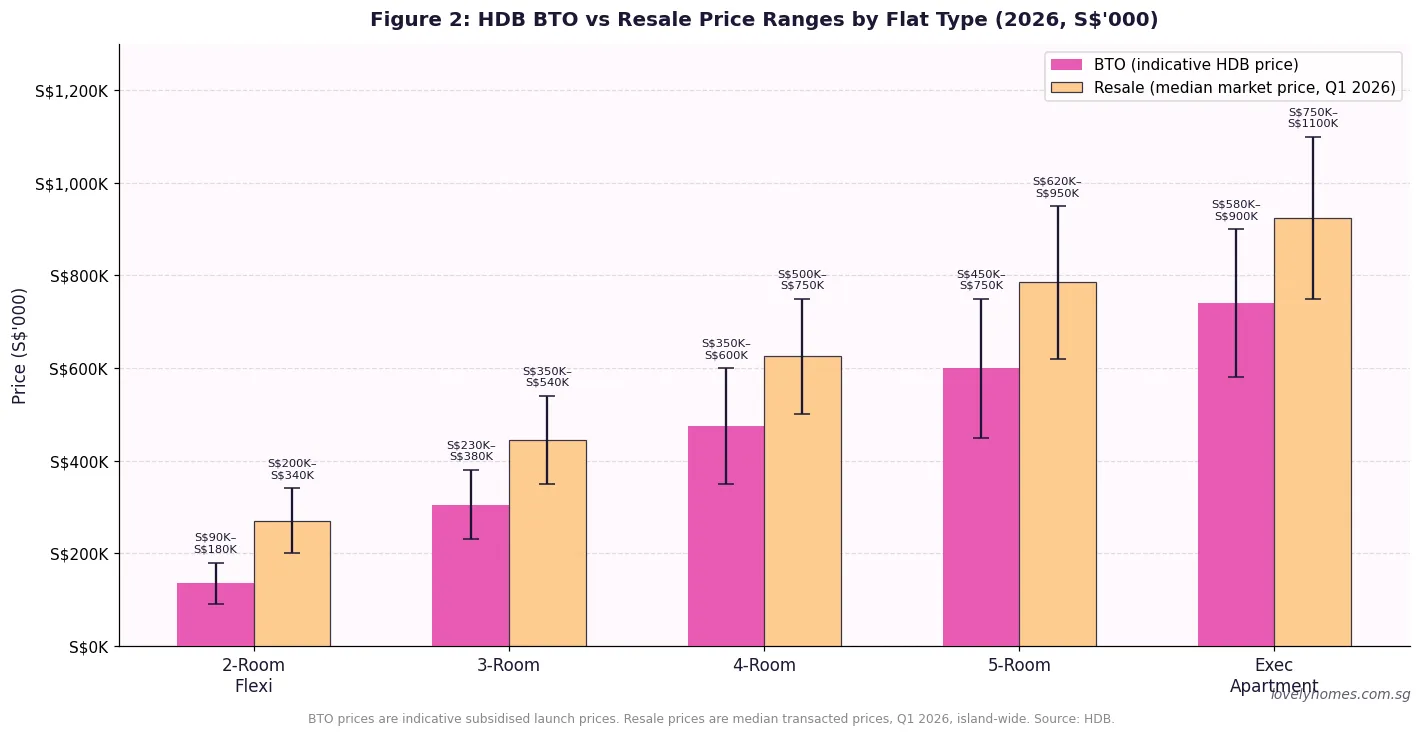
The most obvious difference between BTO and resale is price. HDB sells BTO flats at a price that reflects a deliberate subsidy relative to market value. For a typical 4-room flat in a non-mature estate, a BTO price might be S$350,000–S$550,000 at launch, while a resale flat of similar size in the same town might transact at S$500,000–S$700,000. The gap narrows in mature estates, where BTO launches are rarer and resale supply is the only option for buyers who want to live in areas like Queenstown, Bishan, or Marine Parade.

It is important to note that BTO prices are not static: HDB adjusts BTO launch prices for each exercise based on prevailing market conditions, and the subsidy quantum (the gap between BTO price and estimated market value) has been explicitly referenced by HDB in its public communications as a policy instrument to keep public housing affordable. In 2025–2026, HDB increased BTO supply substantially — over 19,000 units are planned for 2026 across four exercises — as part of a concerted effort to reduce waiting times and moderate the resale price premium.

New flat classification impact on price. From August 2024, all new BTO flats are classified as Standard, Plus, or Prime. Plus flats (near MRT interchange, town centre) and Prime flats (city-fringe, Queenstown, Rochor) are sold at a deeper subsidy but carry a subsidy clawback mechanism on resale and stricter resale restrictions. Standard flats follow the traditional BTO framework. When comparing BTO to resale, ensure you understand which classification the BTO flat falls under, as it affects your net position on eventual resale.

Waiting Time: BTO vs Resale Completion

BTO construction timelines have improved since the post-pandemic supply chain delays of 2021–2022, but the typical wait remains three to five years from the launch exercise to key collection, and this excludes the time spent waiting for a ballot exercise in your preferred town. Popular towns with first-timer subscription rates of 2×–5× may require multiple attempts before a successful ballot. Add the construction period and many buyers face an effective six-to-seven-year wait from first application to occupancy.

Resale flats can complete within eight to sixteen weeks of exercising the Option to Purchase (OTP). Buyers who need housing immediately — couples with an imminent wedding, families moving out of parents’ flats, or those relocating for work — have only one viable HDB option: the resale market. The opportunity cost of the BTO waiting period also includes continued rental expenditure, which can total S$80,000–S$120,000 over a four-year wait at current market rates.

HDB BTO vs resale price ranges by flat type Singapore 2026
Figure 2: HDB BTO vs Resale Price Ranges by Flat Type, 2026. Source: HDB. BTO prices are indicative subsidised launch prices; resale prices are median transacted prices Q1 2026.

CPF Housing Grants: Where Resale Has the Edge

CPF housing grants are means-tested subsidies administered by HDB and disbursed from the Central Provident Fund (CPF) to help buyers finance their flat purchase. The grant landscape differs meaningfully between BTO and resale:

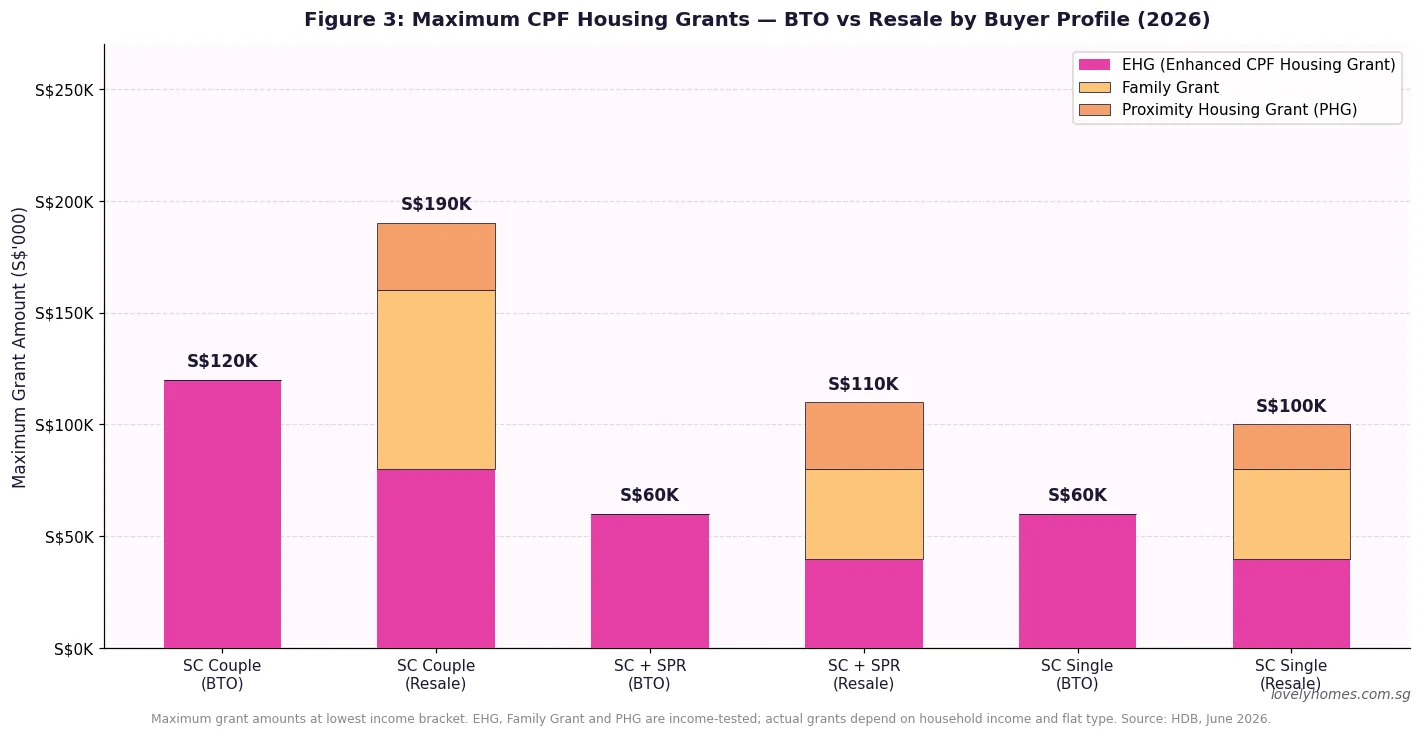
For BTO buyers, the primary grant is the Enhanced CPF Housing Grant (EHG), which provides up to S$120,000 for an SC couple earning a combined monthly income of S$1,500 or below, tapering to S$0 at income above S$9,000 per month. No additional grants apply for BTO purchases.

For resale buyers, three grants can stack: the EHG (up to S$80,000 for resale), the Family Grant (up to S$80,000 for SC couples buying a 4-room or smaller resale), and the Proximity Housing Grant (PHG) of up to S$30,000 for buyers choosing to live near parents or children. An SC couple at the lowest income bracket can receive up to S$230,000 in grants for a resale flat — nearly double the BTO maximum.

The higher grant quantum for resale partially offsets the higher purchase price. At mid-range incomes (combined S$7,000–S$8,000 per month), the effective all-in cost difference between BTO and resale may be narrower than headline prices suggest, once grants and the value of time saved (by avoiding the BTO waiting period) are factored in.

CPF housing grants BTO vs resale by buyer profile Singapore 2026
Figure 3: Maximum CPF Housing Grants — BTO vs Resale by Buyer Profile, 2026. Source: HDB. Grant amounts are income-tested; figures shown are maximums at lowest income bracket.

Flat Condition, Age, and Remaining Lease

BTO flats are handed over as bare concrete units — no flooring, no kitchen fittings, no bathroom tiles beyond the developer’s basic provision. A full renovation budget of S$40,000–S$80,000 is typical for a 4-room BTO flat. This is a significant additional cost that is sometimes overlooked in simple price comparisons.

Resale flats may require less renovation (in some cases none) if the existing fittings are in good condition. However, older flats — particularly those with 50 years or fewer remaining on their 99-year leases — carry meaningful risks. CPF withdrawal for older flats is restricted under the CPF property rules, and bank valuations may not fully support the asking price. HDB resale flats built in the 1980s and 1990s are now approaching the age at which lease decay begins to have a material effect on financing options and eventual resale value.

The New BTO Classification Framework

From August 2024, all new BTO flats are classified under HDB’s new Standard / Plus / Prime framework, replacing the previous Mature / Non-Mature categorisation for new launches. The key distinctions are:

Classification Locations Subsidy Level Resale Restriction Income Ceiling
Standard Heartland estates, non-central towns Standard subsidy Standard 5-yr MOP then open resale S$14,000/mth
Plus Near MRT interchange, town centre, amenity-rich sites Deeper subsidy 5-yr MOP + 10-yr restricted resale (SC/SPR only) + subsidy clawback S$14,000/mth
Prime City-fringe, central locations (Queenstown, Rochor) Deepest subsidy 10-yr MOP + restricted resale + subsidy clawback on sale S$14,000/mth

The subsidy clawback for Plus and Prime flats means that on eventual resale, a proportion of the subsidy received is returned to HDB. This reduces your net sale proceeds but is structured to prevent windfall gains from publicly subsidised flats. For buyers primarily motivated by investment upside, Standard flats or resale flats may offer better flexibility; for buyers prioritising lower entry cost and location quality, Plus or Prime BTO flats may still be the better long-term choice.

Worked Example: Lee Family — BTO vs Resale Decision

Scenario: Mr and Mrs Lee, SC Couple, Combined Income S$8,500/mth

The Lees are first-time buyers. They are considering two options: (A) a 4-room BTO flat in Tengah (Standard classification) at S$420,000, with an expected wait of 4 years from launch to keys; or (B) a 4-room resale flat in Bukit Batok at S$610,000, with completion expected in 12 weeks.

Option A: BTO — Tengah 4-Room Standard, S$420,000

BTO selling priceS$420,000
EHG (income S$8,500, SC couple, BTO)-S$35,000
Net price after grantS$385,000
HDB loan (80% of S$420,000)S$336,000
Monthly instalment (25yr @ 2.6%)~S$1,516/mth
MSR check (S$1,516 / S$8,500)17.8% — PASS
Estimated renovation budget (4-room BTO)S$55,000
Interim rental costs (4 years @ S$2,000/mth)S$96,000

Option B: Resale — Bukit Batok 4-Room, S$610,000

Resale priceS$610,000
EHG (resale, S$8,500/mth)-S$35,000
Family Grant (4-room or smaller, SC couple)-S$50,000
Proximity Housing Grant (if applicable, live near parents)-S$20,000
Net price after grantsS$505,000
HDB loan (80% of S$610,000)S$488,000
Monthly instalment (25yr @ 2.6%)~S$2,203/mth
MSR check (S$2,203 / S$8,500)25.9% — PASS (under 30%)
Renovation (existing condition — minimal)~S$15,000
Interim rental costs (0 — move in within 12 weeks)S$0

Comparison summary: Option A BTO total out-of-pocket over 4 years (before valuation appreciation): S$420K price + S$55K renovation + S$96K rental − S$35K grant = effective all-in entry cost ~S$536K. Option B resale: S$610K price + S$15K reno − S$105K grants = effective all-in ~S$520K. In this scenario, the Lees’ resale option is marginally cheaper in total outlay — driven by the larger grant stack and the elimination of four years of rental costs — though their monthly mortgage commitment is S$687/mth higher than the BTO.

What This Means for Buyers in 2026

The BTO versus resale decision in 2026 is more finely balanced than it was during the 2021–2022 resale price surge, when resale flats were trading at sharp premiums over BTO prices. The HDB resale price index recorded its first quarterly decline since Q2 2019 in Q1 2026 (down 0.1% quarter-on-quarter), while BTO supply has increased materially. Buyers who previously felt priced out of resale now have a more realistic comparison to make.

Several structural shifts make resale more attractive in 2026 than it has been in recent years. The new classification framework means that some BTO sites carry extended resale restrictions that limit eventual exit flexibility. Meanwhile, the grant system for resale has been left intact and continues to provide up to S$230,000 for qualifying first-timer couples. For buyers who prioritise a specific location — a mature town, proximity to ageing parents, or a well-established school cluster — resale remains the only viable route.

Conversely, buyers with flexible timelines and no urgent housing need continue to find BTO the better financial proposition in most non-mature towns. The government’s stated policy goal — ensuring that public housing remains within reach for first-timer households across a range of income levels — means BTO subsidies are unlikely to be withdrawn. The deeper subsidies attached to Plus and Prime flats, in particular, make BTO viable in locations that would otherwise be inaccessible to median-income households.

What Might Come Next

HDB has indicated that BTO waiting times should return to the pre-pandemic norm of three years or fewer for most projects by 2026–2027, as the construction backlog clears and new projects are designed from the outset with more efficient procurement. A shorter BTO waiting time would reduce one of the main deterrents to the BTO route. The October 2026 BTO exercise, expected to offer approximately 7,960 flats in six towns, will be the final exercise of the year and is likely to attract significant demand from buyers who held back during the 2025 exercises. On the resale side, the 2026 MOP cohort (13,480 flats) will continue to put new supply onto the resale market through the year, exerting some downward pressure on resale prices — a trend to watch for buyers on the fence between the two routes.

Frequently Asked Questions

Can I apply for a BTO flat if I currently own a private property?
No. If you own or have owned a private residential property within the 30 months preceding your HDB flat application — whether as sole owner, joint owner, or essential occupier — you are not eligible to apply for a new BTO flat. You must dispose of any private property at least 30 months before the BTO application date. This rule also applies if your spouse or any listed essential occupier owns a private property. The 30-month restriction does not apply to resale flats bought without HDB grants; however, if you apply for a resale flat with CPF housing grants, the same private property ownership restriction applies.
What is the difference between Plus and Prime BTO flats?
Both Plus and Prime flats are sold at a deeper subsidy than Standard flats and carry a subsidy clawback on resale. The difference is primarily one of location and the degree of restriction. Prime flats are located in city-fringe or central areas (such as Queenstown, Buona Vista, or Rochor) and carry a 10-year MOP plus restricted resale to eligible SC and SPR buyers only (not foreigners or entities). Plus flats are located near MRT interchanges, town centres, or amenity-rich sites in heartland towns, and carry a 5-year MOP followed by a period during which resale is restricted to eligible SC and SPR buyers only (with a clawback). Standard flats have a standard 5-year MOP with no additional resale restrictions after that point.
How does the EHG work for resale flats?
The Enhanced CPF Housing Grant for resale flats works on the same income-testing principle as BTO: the lower your household income, the higher the grant. However, the maximum EHG for a resale flat is S$80,000 (versus S$120,000 for BTO) for an SC couple. This is because resale buyers also qualify for the Family Grant (up to S$80,000 for 4-room or smaller) and the Proximity Housing Grant (up to S$30,000), making the aggregate grant potential higher for resale. The EHG is credited to your CPF Ordinary Account and can be applied toward the flat’s purchase price or the monthly mortgage. You do not receive EHG in cash.
Can a first-timer apply for both BTO and resale at the same time?
You may not hold an active BTO application and simultaneously exercise an Option to Purchase for a resale flat. The two processes are mutually exclusive in the sense that exercising the OTP for a resale flat will render your outstanding BTO application void (or you must withdraw the BTO application). However, you can be on the BTO ballot queue in one exercise while actively house-hunting for resale flats, provided you have not yet been balloted successfully or exercised any OTP. Many buyers do pursue both in parallel as a contingency strategy, and withdraw the less favourable option once a concrete choice is available.
Is there a price ceiling for resale flats eligible for grants?
Yes. The resale price ceiling for CPF housing grant eligibility is S$750,000 for the Family Grant and S$750,000 for the Proximity Housing Grant. There is no price ceiling for the EHG specifically, but the other grants require the resale price to be at or below S$750,000. If you purchase a resale flat above S$750,000, you may still qualify for the EHG (subject to income), but you will not be eligible for the Family Grant or PHG. Note that the S$750,000 threshold applies to the higher of the resale price or HDB’s assessed value of the flat.
What is the Deferred Income Assessment for BTO flats?
The Deferred Income Assessment (DIA) applies to couples applying for a BTO flat before they are officially married. Under the DIA, HDB will assess your income eligibility for grants at the point of key collection (rather than at the time of application), using the income you were earning during the 12-month period before key collection. This is useful for students or those who were not yet earning a full salary at application time. The DIA is only available for first-timer SC couples applying under the fiancé/fiancée scheme. If your income at the time of key collection is higher than at application, the DIA may result in a lower grant quantum — so plan accordingly.
Can I rent out a BTO flat immediately after MOP?
For Standard BTO flats, you may sublet individual bedrooms (room rental) from day one of ownership, and may sublet the whole flat after the 5-year MOP. For Plus flats, the same rules apply, but subletting the whole flat during the restricted resale period (after MOP but before the restriction expires) requires HDB approval, and HDB may impose additional conditions. For Prime BTO flats (which carry a 10-year MOP), the same subletting rules as PLH flats apply: whole flat subletting is permitted after MOP but is capped at 5 years in aggregate over your ownership period.
Disclaimer: The information in this article is for general educational purposes only and reflects HDB policies and grant amounts as at June 2026. HDB policies, grant quantum, and BTO classification rules may change; always verify current information at hdb.gov.sg and cpf.gov.sg. Price figures are illustrative and do not constitute a valuation. This article does not constitute financial or legal advice. Consult a licensed HDB-registered property agent or a qualified financial adviser for advice tailored to your specific circumstances.

Singapore HDB Subletting and Room Rental Guide 2026: Rules, Eligibility, Quota and How to Apply

Singapore HDB Subletting and Room Rental Guide 2026: Rules, Eligibility, Quota and How to Apply

Quick Answer: HDB Subletting Rules 2026

  • Whole flat rental requires HDB approval and completion of the 5-year Minimum Occupation Period (MOP); PLH flats require 10 years.
  • Room rental does not require HDB approval, but owners must notify HDB and stay within occupancy limits.
  • Eligible tenants include Singapore Citizens, PRs, and most valid pass holders (EP, S Pass, WP, LTVP+, DP).
  • Non-Malaysian foreign nationals are subject to a block/neighbourhood non-citizen quota. Check availability before committing to a foreign tenant.
  • Rental income from HDB flats is taxable; allowable deductions include mortgage interest, property tax, agent commission, and maintenance.
  • Stamp duty on tenancy agreements is borne by the tenant and calculated at 0.4% of annual rent per year of the lease.
  • Subletting without required HDB approval can result in compulsory acquisition of the flat at below-market prices.
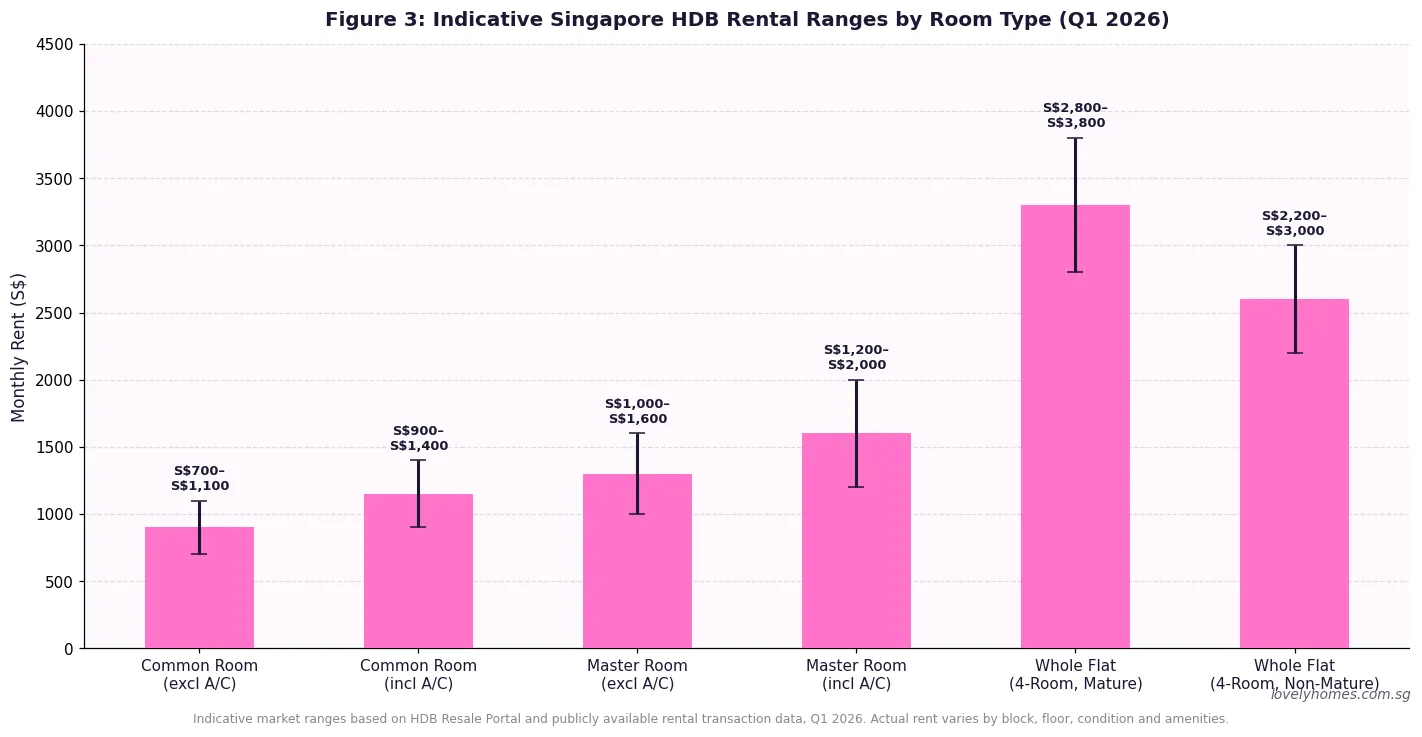
  • As at Q1 2026, whole-flat 4-room HDB rents in mature estates range from S$2,800–S$3,800 per month; common rooms fetch S$700–S$1,100.

Singapore’s HDB subletting market is one of the most closely regulated rental ecosystems in the Asia-Pacific region. The Housing and Development Board (HDB), a statutory board under the Ministry of National Development, administers subletting rules for all 1.1 million HDB flats island-wide. Its objectives are twofold: to protect the social function of public housing as owner-occupied homes, and to preserve the ethnic and social integration that HDB estates are designed to foster. For flat owners who have fulfilled their ownership obligations, subletting — whether of the whole flat or individual rooms — is a permitted and often financially rewarding arrangement. This guide covers every rule, quota, application step, and tax implication you need to understand before listing your HDB flat on the rental market in 2026.

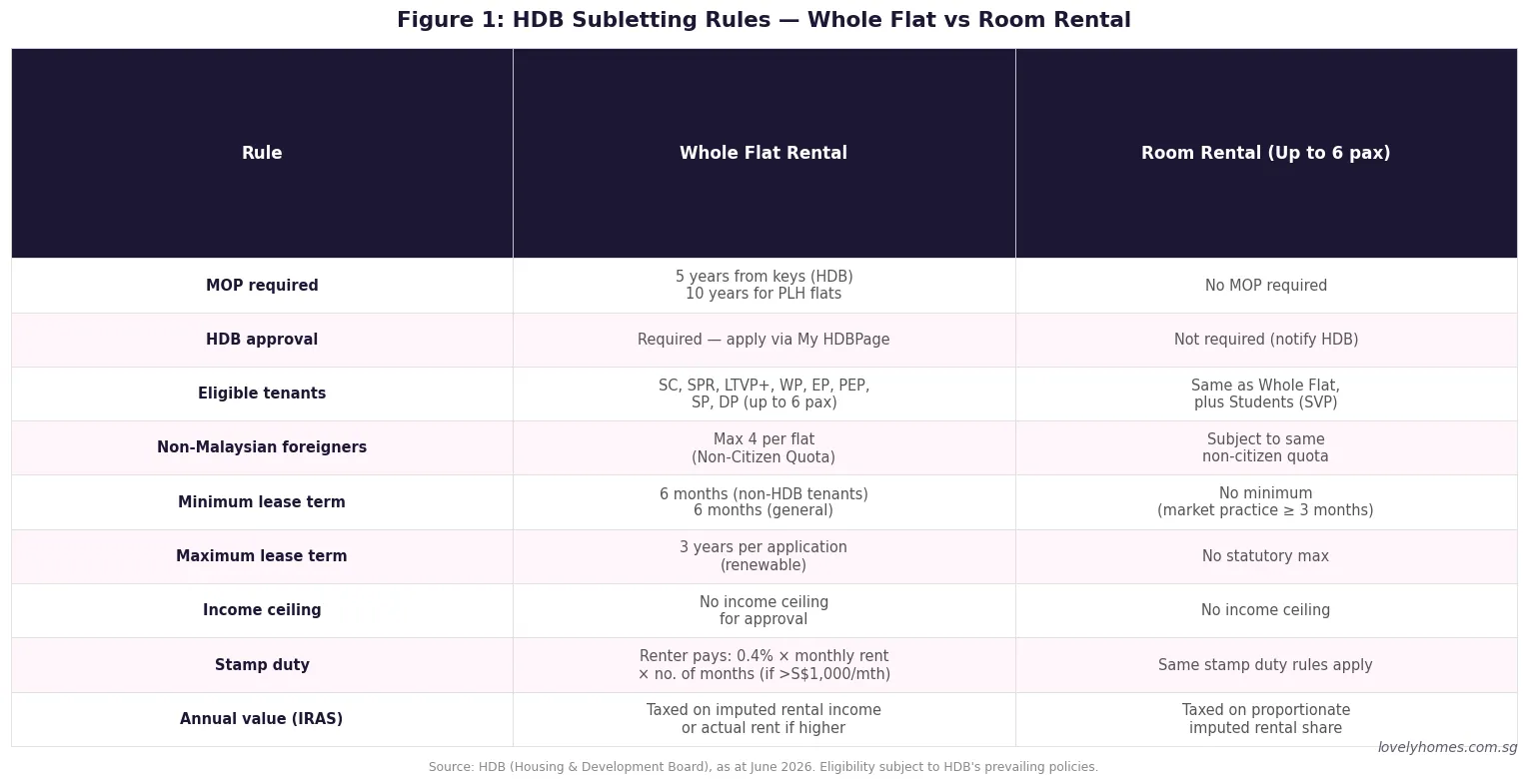
HDB subletting eligibility rules matrix — whole flat vs room rental comparison table 2026
Figure 1: HDB Subletting Rules — Whole Flat vs Room Rental. Source: HDB (Housing & Development Board), as at June 2026.

Understanding the Two Types of HDB Subletting

HDB distinguishes sharply between whole flat subletting — renting out the entire flat while you live elsewhere — and subletting of bedrooms — renting individual rooms to tenants while you continue to reside in the flat. The rules, approval requirements, and consequences differ materially between these two arrangements.

Whole flat subletting is governed by HDB’s subletting policy, which requires formal approval before the arrangement begins. You must have fulfilled the flat’s Minimum Occupation Period (MOP), and you must apply via the My HDBPage portal. HDB will assess the proposed tenancy, verify that the tenant nationality and headcount are within prescribed limits, and issue an approval letter. Each approval covers a tenancy of up to three years, after which you must renew. The key point: subletting without approval where approval is required exposes you to enforcement action, including — in the most serious cases — compulsory acquisition of the flat by HDB at below-market prices.

Room rental (subletting bedrooms while the owner remains resident) operates under a simpler framework. HDB approval is not required; however, you must register the arrangement via My HDBPage and ensure total headcount (owners and tenants combined) stays within your flat’s prescribed occupancy limit. Room rentals are also subject to the non-citizen subletting quota, and stamp duty rules apply in the same way as for whole-flat tenancies.

Minimum Occupation Period Requirements

The MOP for whole flat subletting mirrors the MOP for the right to sell: five years for standard BTO and resale HDB flats, counting from the date on which you received the keys. For flats classified as Prime Location Public Housing (PLH) — including certain Rochor and Queenstown sites — the MOP is 10 years. Executive Condominiums (ECs) have a separate MOP framework and are not governed by HDB subletting rules once the EC reaches 5 years from TOP, at which point it is treated as a privatised development.

PLH flats and subletting restriction. Prime Location Public Housing flats carry a 10-year MOP and an additional restriction: even after MOP, you may only sublet the whole flat for up to 5 years in aggregate over your ownership period. HDB introduced this rule in November 2021 to curb investment speculation in centrally located public housing.

Room rental (subletting individual bedrooms) has no MOP restriction. You may sublet rooms from day one of ownership, provided you are residing in the flat and the headcount limits are met. This makes room rental a popular arrangement for younger owners in the early years of their mortgage.

Eligible Tenants: Nationality and Pass Requirements

HDB maintains an approved list of eligible tenant groups. For both whole flat and room rental, the following categories are permitted:

  • Singapore Citizens (SC)
  • Singapore Permanent Residents (SPR)
  • Long-Term Visit Pass Plus holders (LTVP+)
  • Employment Pass (EP) holders
  • S Pass (SP) holders
  • Work Permit (WP) holders
  • Personalised Employment Pass (PEP) holders
  • Dependent Pass (DP) holders
  • Student Pass (SVP) holders — for room rental only

Visitor Pass and Short-Term Visit Pass holders are not eligible. Any person on a pass with fewer than three months remaining validity at tenancy commencement is also ineligible. Tourists and individuals on social visit passes may not be HDB tenants under any circumstances.

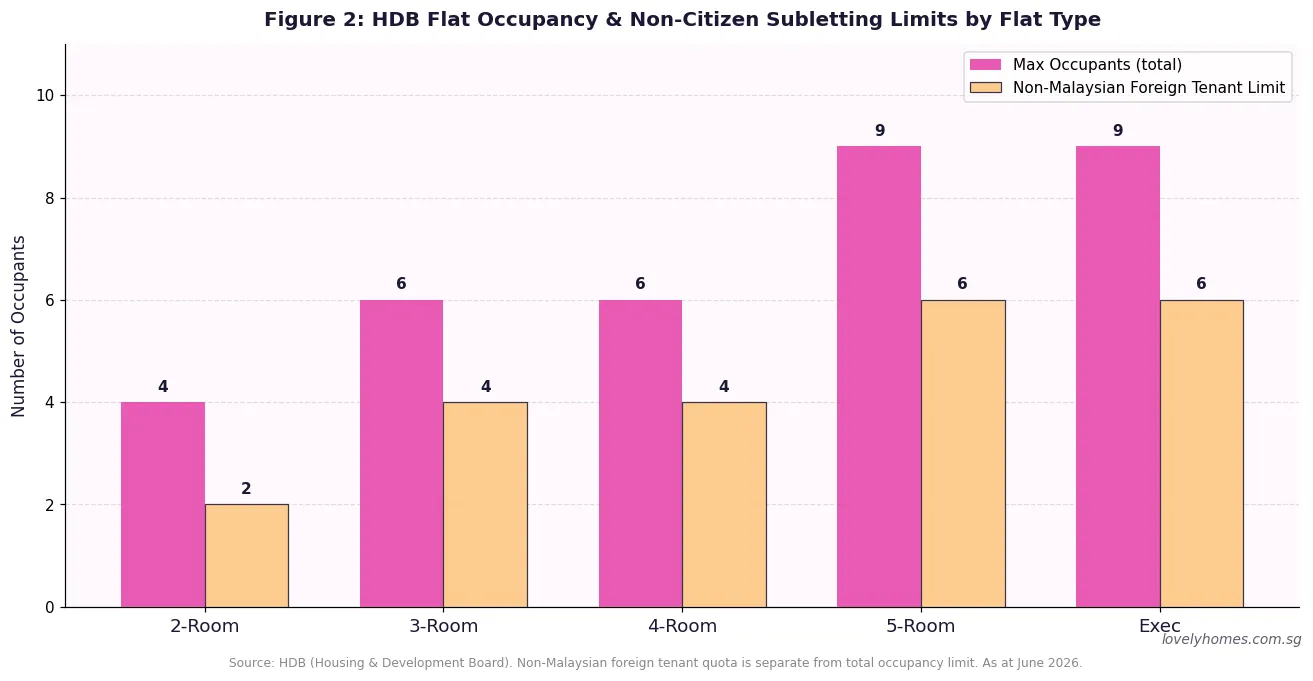
HDB flat occupancy limits and non-citizen subletting quota by flat type 2026
Figure 2: HDB Flat Occupancy & Non-Citizen Subletting Limits by Flat Type. Source: HDB, as at June 2026.

The Non-Citizen (Non-Malaysian) Subletting Quota

One of the more nuanced rules in HDB subletting is the non-citizen quota, commonly referred to as the non-Malaysian foreign tenant quota. This quota limits the proportion of non-Malaysian foreign nationals who may reside in any given HDB block or neighbourhood at any point in time. Malaysians are exempt from this quota because of Singapore’s longstanding demographic and historical ties with Malaysia.

HDB does not publish precise quota thresholds publicly for each estate, but landlords can verify whether a specific address is subject to quota restrictions via the My HDBPage portal before entering into any tenancy agreement. If the block is at or near its quota, HDB will not approve the tenancy or register the foreign national as an occupant.

Practical implication: if your block is popular with foreign tenant populations — often blocks near MRT stations, industrial zones, or international schools — check quota availability before committing to a non-Malaysian foreign national tenant. Failing to comply with the quota, whether intentionally or inadvertently, may result in HDB revoking your subletting approval.

The Application Process for Whole Flat Subletting

Applying to sublet your whole HDB flat is a straightforward process conducted through My HDBPage. The steps are:

  1. Log in to My HDBPage via your SingPass credentials and navigate to the subletting application under “Manage My Flat”.
  2. Submit tenant details: full name, NRIC or passport number, pass type and expiry date, and intended tenancy dates.
  3. HDB reviews the application and verifies eligibility. Processing typically takes three to five working days.
  4. Receive the approval letter. You must not allow the tenant to move in before receiving HDB’s written approval.
  5. Stamp the tenancy agreement with IRAS via the e-Stamping portal within 14 days of signing (if signed in Singapore) or 30 days (if signed overseas).
  6. Notify HDB of early termination if the tenancy ends before the approved period, via My HDBPage.

Stamp Duty on HDB Tenancy Agreements

Stamp duty on a tenancy agreement is governed by the Stamp Duties Act, administered by IRAS. The obligation to stamp falls on the tenant, unless contractually agreed otherwise. The formula is:

Tenancy Duration Stamp Duty Formula Example: S$2,800/mth, 24 months
Up to 1 year 0.4% of annual rent 0.4% x S$2,800 x 12 = S$134
1–3 years 0.4% x average annual rent x lease years 0.4% x S$2,800 x 12 x 2 = S$269
More than 3 years 0.4% x average annual rent x 4 (deemed) N/A for typical HDB 2-year tenancy
Room rental (per room agreement) Same formula applied to room rent amount if > S$1,000/mth 0.4% x S$1,100 x 12 = S$53

Stamp duty must be paid within 14 days of signing (in Singapore) or 30 days (overseas). Late stamping incurs a penalty of up to four times the unpaid duty.

Rental Income Tax: What HDB Landlords Must Declare

Rental income from HDB subletting — whether whole flat or room rental — is assessable income under the Income Tax Act and must be declared to IRAS in your annual personal income tax return. IRAS permits landlords to deduct allowable expenses against rental income:

  • Mortgage interest — only the interest component, not principal repayment.
  • Property tax — the annual tax levied on the flat by IRAS.
  • Fire insurance premium.
  • Maintenance and repair costs — not capital improvements or renovations.
  • Agent commission — if a licensed property agent facilitated the tenancy.
  • Furniture wear and tear — on an allowable depreciation basis, not full replacement cost.

For partial subletting (room rental), only a proportionate share of allowable expenses may be deducted, corresponding to the number of rooms sublet as a fraction of total rooms in the flat.

Indicative HDB room and whole flat rental price ranges Singapore Q1 2026
Figure 3: Indicative Singapore HDB Rental Ranges by Room Type, Q1 2026. Source: HDB Resale Portal transaction data. Actual rent varies by location, floor, condition and amenities.

Worked Example: 5-Room HDB Owner Subletting Two Rooms

Scenario: Mr and Mrs Tan, SC Couple — Bishan 5-Room HDB

Mr and Mrs Tan own a 5-room HDB flat in Bishan purchased in 2019. Their MOP was cleared in February 2024. They decide to sublet two bedrooms to offset their remaining HDB loan of S$450,000 at 2.6% per annum, equating to approximately S$2,038 per month.

Arrangement: Room rental — two bedrooms sublet; the Tans remain resident in the master bedroom. Total occupancy: 4 persons — within the 5-room flat’s prescribed limit of 9 persons.

Room 1 (common room, with A/C): S$1,150/mth
Room 2 (junior master, with A/C): S$1,500/mth
Total gross rental income per annumS$31,800
Proportionate deductible expenses (2 of 4 bedrooms = 50%):
  Mortgage interest (est. S$7,020 p.a.) x 50%S$3,510
  Property tax (est. S$1,700 p.a.) x 50%S$850
  Insurance and maintenance x 50%S$300
Total deductible expensesS$4,660
Net assessable rental incomeS$27,140
Estimated additional income tax (added to employment income at ~8% marginal rate)~S$2,170 p.a.

Stamp duty: Room 1 (12-mth lease, S$1,150/mth): S$1,150 x 12 x 0.4% = S$55. Room 2 (12-mth lease, S$1,500/mth): S$1,500 x 12 x 0.4% = S$72. Total: S$127 (borne by tenants under standard agreement terms).

Net monthly benefit: S$2,650/mth gross rental income minus approximately S$181/mth estimated tax cost leaves the Tans with approximately S$2,469/mth net — comfortably covering their S$2,038 monthly mortgage payment, with S$431/mth surplus.

What This Means for HDB Owners in 2026

The HDB rental market in 2026 remains favourable for landlords. Private rental supply has moderated as fewer expatriates take full-flat leases, and HDB flats — particularly in mature estates with MRT connectivity — continue to attract strong demand from both local and foreign tenants seeking affordable alternatives to private rentals.

The 13,480 HDB flats reaching their 5-year MOP in 2026 represent the largest single-year cohort to become MOP-eligible since 2020. Many owners are considering subletting the whole flat as part of an upgrade strategy: purchase a private property while the HDB flat generates rental income to offset the new mortgage, then sell the HDB within the ABSD remission window if applicable. This “bridge rental” strategy is legal and relatively common among upgraders, but requires careful timing to avoid ABSD clawback. See our ABSD remission guide for the full timing rules.

Room rental remains the most tax-efficient and legally low-friction subletting option for owner-occupiers. The absence of a formal HDB approval process, combined with the ability to start from day one of ownership, makes room rental attractive for younger owners in the early years of their mortgage. Common room rents in mature estates have held firm at S$900–S$1,400 per month inclusive of utilities, driven by demand from younger working professionals and foreign students attending universities in the Central and North regions.

What Might Come Next

HDB’s post-2022 policy adjustments have been focused primarily on the sales market rather than the rental market. However, policymakers have signalled awareness of affordability concerns in the rental sector. The February 2023 tightening of short-term letting rules — which strengthened the prohibition on Airbnb-style subletting of HDB flats for periods shorter than six months — was a reminder that HDB will act when rental patterns conflict with its social objectives. Future tightening could include stricter enforcement of occupancy limits, expanded PLH restrictions on subletting duration, or a broadening of the non-citizen quota framework to cover additional nationalities. For now, the rules described in this guide reflect HDB’s posture as at June 2026, and no changes to the subletting framework have been publicly signalled for the remainder of 2026.

Frequently Asked Questions

Can I sublet my whole HDB flat if I have not completed MOP?
No. Whole flat subletting requires you to have fulfilled the Minimum Occupation Period — five years for standard flats, ten years for PLH-designated flats. The MOP clock for BTO flats starts from the date you collect your keys. If you sublet your whole flat before MOP without HDB approval, you are in breach of HDB’s terms and conditions, and HDB may compulsorily acquire your flat at a price it determines — typically below market value.
Do I need HDB approval to rent out a room in my flat?
No formal approval is required for room rental, but you must notify HDB via My HDBPage. You must be residing in the flat yourself, and the total number of occupants must not exceed the prescribed limit for your flat type. You must also ensure any non-Malaysian foreign national tenant does not cause the block or neighbourhood to exceed its non-citizen quota. HDB will reject the registration if the quota is full for that nationality at your address.
Can foreigners rent HDB flats?
Yes, provided they hold an eligible pass (EP, S Pass, WP, DP, LTVP+, etc.) with at least three months’ remaining validity at tenancy commencement. However, non-Malaysian foreign nationals are subject to HDB’s non-citizen subletting quota. If the block or neighbourhood quota has been reached, HDB will not approve or register the tenancy of that foreign national. Landlords should check quota availability via My HDBPage before committing to a foreign tenant to avoid a situation where the tenancy agreement is signed but cannot be registered.
What happens if I sublet my HDB flat without required approval?
Subletting your whole HDB flat without HDB’s prior written approval is a serious breach. Enforcement actions escalate from written warnings and financial penalties to — in the most serious cases — compulsory acquisition of the flat at HDB’s assessed price, which is typically below market value. HDB conducts regular estate inspections and acts on public tip-offs. Subletting without approval is treated as a fundamental misuse of public housing resources, not a minor technical infraction.
Is rental income from my HDB flat taxable?
Yes. Rental income from HDB subletting must be declared to IRAS in your annual personal income tax return. You may deduct allowable expenses such as mortgage interest, property tax, fire insurance, agent commission, and maintenance costs. For partial subletting (room rental), only a proportionate share of these expenses is deductible. Capital expenditure — renovation, new air-conditioning installation, bathroom fitting — is generally not fully deductible, though a wear-and-tear allowance may apply to furnishings. IRAS provides detailed guidance at iras.gov.sg.
Can I increase rent mid-tenancy?
No, unless the tenancy agreement includes an explicit rent review clause permitting increases at specified intervals. A tenancy agreement is a legally binding contract, and unilaterally increasing rent outside its terms is a breach of contract that exposes you to a claim by the tenant. If you wish to revise the rent, negotiate a mutual variation to the agreement, have it signed by both parties, and stamp the variation document with IRAS. Alternatively, allow the fixed-term tenancy to expire and offer a new tenancy at the revised rent.
What is the maximum number of people allowed in my HDB flat?
HDB’s prescribed occupancy limits by flat type are: 2-Room Flexi — 4 persons; 3-Room — 6 persons; 4-Room — 6 persons; 5-Room — 9 persons; Executive — 9 persons. These limits apply to all persons physically residing in the flat — owners, authorised occupants, and tenants combined. HDB introduced these limits in 2012 to address overcrowding. For room rental, ensure that adding tenant headcount does not push the total above the prescribed limit for your flat type.
Disclaimer: The information in this article is for general educational purposes only and reflects HDB subletting rules as at June 2026. HDB policies may change; always verify current rules at hdb.gov.sg. Tax information is a general summary of IRAS rules; individual tax obligations depend on your specific circumstances. Stamp duty figures are illustrative. This article does not constitute legal, tax, or financial advice. Consult a licensed solicitor, a qualified tax adviser, or an HDB-registered property agent for advice tailored to your situation.

Singapore HDB Resale Market Guide 2026: Price Trends, What Drives Values and How to Read HDB Data

Singapore HDB Resale Market Guide 2026: Price Trends, What Drives Values and How to Read HDB Data

The HDB resale market in Singapore is one of the most transparent and data-rich property markets in the world. HDB publishes quarterly resale price indices, transacted price data by flat type and town, and volume statistics — yet most buyers and sellers never go beyond checking the headline figure. This guide teaches you how to read the data properly, what drives HDB resale prices in different estates, and what the Q1 2026 numbers actually mean for your buying or selling strategy.

Quick Answer — HDB Resale Market at a Glance (Q1 2026)

  • The HDB Resale Price Index (RPI) stood at 203.4 in Q1 2026, a −0.1% quarter-on-quarter dip — the first decline since Q2 2019 and a sign of market moderation after six years of growth.
  • Total HDB resale transactions in Q1 2026 were approximately 6,620 flats, with 4-room flats the most transacted at 2,690 units.
  • Median prices ranged from S$280,000 for 2-room Flexi flats to S$910,000 for multi-generation flats.
  • 412 HDB flats transacted at S$1 million or above in Q1 2026, a new quarterly record.
  • Mature estates (Queenstown, Bishan, Bukit Merah, Toa Payoh) continued to command median 4-room prices of S$760,000–S$860,000 — substantially above non-mature estates at S$450,000–S$510,000.
  • The 15-month wait-out period for private property sellers buying HDB resale (introduced April 2023) continues to suppress some upgrader demand in the mid-range segment.
  • URA Q2 2026 flash estimates for private property are expected in early July 2026; comparable HDB resale data will follow approximately two weeks later.

What Is the HDB Resale Price Index (RPI) and How Is It Compiled?

The HDB Resale Price Index is a quarterly statistic published by the Housing & Development Board that measures the change in resale prices of HDB flats over time. The base period is Q1 2009 = 100. An RPI of 203.4 in Q1 2026 means that the average price of an HDB resale flat is approximately 103.4% higher than it was in Q1 2009 — or, expressed differently, prices have more than doubled over 17 years.

The RPI is a mix-adjusted index. Rather than simply averaging transaction prices — which would be distorted by changes in the mix of flat types transacted each quarter — HDB uses a hedonic regression methodology that controls for flat type, storey range, floor area, estate, and remaining lease. This makes the RPI a more reliable indicator of underlying price change than raw median price movements.

The RPI is distinct from the median transacted price, which is the midpoint of all resale prices in a given period and is influenced by the mix of flats transacted. A quarter with unusually high sales of large 5-room flats in mature estates will show a higher median price even if underlying prices have not changed. The RPI strips out this compositional effect. For understanding whether prices are rising or falling, the RPI is the right metric; for understanding how much to pay for a specific flat type in a specific estate, median transacted prices and psf figures are more useful.

HDB Resale Price Index RPI trend Q1 2020 to Q1 2026 Singapore property market
Figure 1: HDB Resale Price Index from Q1 2020 to Q1 2026. The three shaded phases show the pandemic-era recovery (2020–21), the surge driven by construction delays and demand spillover (2021–23), and the current moderation phase (2024–26). The Q1 2026 reading of 203.4 represents the first quarterly dip since Q2 2019.

Reading HDB Resale Volume: What Transaction Counts Tell You

Volume data — the number of resale transactions in a given period — is a leading indicator of market sentiment. Volumes typically rise when sentiment is bullish (buyers are willing to transact), and fall when buyers are cautious or when supply alternatives (BTO launches, new private launches) absorb demand. HDB publishes resale volume data monthly via the HDB Resale Flat Prices dataset on data.gov.sg, updated within approximately two weeks of the end of each month.

In Q1 2026, total HDB resale volumes were approximately 6,620 transactions. The 4-room flat segment dominated at 2,690 transactions, followed by 5-room at 1,980. 3-room flats at 1,250 and executive/multi-gen flats at 420 combined make up the remainder. The dominance of 4-room flats reflects both the breadth of stock — 4-room flats are the most common type in the HDB inventory — and the preference of first-timer upgrader families for this size.

HDB resale transactions volume and median price by flat type Q1 2026 Singapore
Figure 2: HDB resale transactions (bars, left axis) and median transacted price (diamonds, right axis) by flat type in Q1 2026. The 4-room flat is both the most transacted segment and the anchoring data point for most market comparisons. Multi-generation flats show the highest median price but the smallest volume by some margin.

What Drives HDB Resale Prices in Different Estates?

The single largest driver of HDB resale prices is estate classification — specifically, whether the flat is in a mature or non-mature estate. HDB classifies 24 of its 26 towns as either mature or non-mature; the two newest, Tengah and Bidadari (Woodleigh), sit in between. Mature estates include Queenstown, Toa Payoh, Bishan, Bukit Merah, Ang Mo Kio, Clementi, Tampines, Marine Parade, Kallang/Whampoa, Geylang, Bedok, Serangoon, Hougang (partial), and Pasir Ris. Non-mature estates include Woodlands, Jurong West, Bukit Batok, Bukit Panjang, Choa Chu Kang, Sembawang, Sengkang, Punggol, and Yishun.

Within the mature-non-mature distinction, five further factors determine the price premium or discount a specific block commands:

MRT and transport connectivity is the most consistent price driver in Singapore research. Flats within a 5-minute walk of an MRT station typically command a 5–15% premium over comparable flats in the same estate further from the station, depending on the line, the interchange status, and the destination accessibility. The Thomson-East Coast Line has boosted prices in previously underserved areas such as Woodlands North and Caldecott.

Remaining lease has become increasingly important since the introduction of the CPF remaining-lease framework in 2019. Flats with fewer than 60 years of lease remaining are significantly harder to finance with CPF, and many banks apply stricter LTV limits. In practice, this suppresses demand and prices for older flats in mature estates, while newer BTO cohorts completing their MOP in the same estate attract a premium.

School catchment drives demand in proximity to popular primary schools with competitive phases 2A and 2B registration. Flats within 1 kilometre of consistently over-subscribed primary schools — such as Raffles Girls’ Primary, Nan Hua Primary, and Catholic High Primary — command a measurable premium, particularly among families with primary-school-aged children making buying decisions in Q4 and Q1.

Block storey and flat orientation account for a further 3–8% variance within the same block. High-floor corner units with unobstructed city or greenery views can command premiums substantially above median, while low-floor units facing a car park or multi-storey car park trade at a discount.

Recent upgrader activity and MOP waves create localised price effects. When a large BTO project completes its 5-year MOP in a non-mature estate, the sudden availability of relatively new flats for resale can temporarily suppress prices for that flat type in that town as supply increases. Conversely, in a mature estate where no new BTO completions are due, scarcity sustains prices.

Town-by-Town Analysis: Mature vs Non-Mature Estate Pricing

The table below summarises median 4-room resale prices for selected towns in Q1 2026, sourced from HDB’s resale portal data. These figures represent the midpoint of all registered resale transactions for that flat type in that town in the quarter and are indicative only — individual block, floor, and remaining lease will cause material variation within any estate.

Town / Estate Classification Median 4-Room Price (Q1 2026) Approx. Median PSF
Queenstown Mature S$860,000 ~S$930
Bishan Mature S$820,000 ~S$890
Bukit Merah Mature S$790,000 ~S$860
Toa Payoh Mature S$760,000 ~S$820
Ang Mo Kio Mature S$660,000 ~S$715
Tampines Mature S$578,000 ~S$625
Bedok Mature S$560,000 ~S$605
Hougang Non-Mature S$510,000 ~S$555
Sengkang Non-Mature S$490,000 ~S$530
Woodlands Non-Mature S$460,000 ~S$500
Jurong West Non-Mature S$450,000 ~S$487

The Million-Dollar HDB Flat Phenomenon: What Is Driving It?

In Q1 2026, 412 HDB resale flats transacted at S$1 million or above — a new record for a single quarter. This compares with 82 transactions in the whole of 2021, 370 in 2022, 469 in 2023, and 983 in 2024. The trajectory is clear: what was once a curiosity has become a structural feature of Singapore’s resale market.

The drivers of million-dollar HDB transactions are well-documented by HDB and academic researchers. The vast majority of million-dollar transactions involve large flat types (5-room, executive, and multi-generation) in mature estates with strong MRT accessibility. Queenstown, Bishan, Toa Payoh, Kallang/Whampoa, and Bukit Merah account for a disproportionate share of such transactions. Floor level and remaining lease also matter: high-floor executive flats with 80–90 years of lease remaining in well-maintained blocks trade at significant premiums.

The broader macro context matters too. The April 2023 cooling measures (which raised ABSD for second-property Singapore Citizens from 17% to 20% and for foreigners from 30% to 60%) suppressed some private property demand and redirected a portion towards the HDB resale market. At the same time, the 15-month wait-out period for private property owners purchasing HDB resale flats means that private-to-public downgraders face a meaningful waiting cost, which tends to push up the price they are willing to pay when they can transact. These two dynamics — more buyers competing for top-tier HDB resale flats and a constrained supply of such units — sustain million-dollar transaction volumes even as overall HDB prices plateau.

Million dollar HDB flat transactions trend 2021 to Q1 2026 and town median prices Singapore
Figure 3 (left): Million-dollar HDB resale transactions by year/quarter. Q1 2026 set a new quarterly record of 412 transactions. Figure 3 (right): Selected town median 4-room resale prices, Q1 2026 — illustrating the wide price range across mature and non-mature estates.

How to Use HDB Resale Data for Buying and Selling Decisions

The most important data source for any HDB buyer or seller is the HDB Resale Flat Prices dataset, available free at data.gov.sg. This dataset lists every registered HDB resale transaction by address (block and street), flat type, storey range, floor area (sqm), resale price, remaining lease, and month of registration. Updated monthly with approximately a 2–4 week lag, it is the primary reference for any price benchmarking exercise.

For a seller, the process is: identify all 4-room resale transactions in your block and neighbouring blocks over the past 6–12 months. Isolate the transactions by storey range (high, mid, low) closest to your own floor. Compute the median price and median psf. Compare your flat’s specifications (floor area, remaining lease, renovation state) against those comparables to arrive at a pricing range. A well-renovated high-floor unit with 75+ years remaining lease should price at or above the top quartile of comparables; an older low-floor unit below the median.

For a buyer, the same dataset allows you to compute the Cash Over Valuation (COV) — the difference between the transacted price and the HDB-assessed value — though COV is not published directly. Instead, compare the transacted price against the HDB valuation you receive after submitting an Intent to Buy. If transacted prices for comparable units consistently exceed valuations by S$20,000–S$50,000, factor that COV into your cash planning: COV must be paid in cash, not CPF.

Our Singapore HDB Resale Price Index Guide 2026 covers how to interpret RPI movements in full, while our HDB Resale Buying Process Guide 2026 walks through the full transaction process from HFE application to key collection.

Worked Example: The Lim Family’s Resale Pricing Strategy

Profile: Mr and Mrs Lim (Singapore Citizens), sellers of a 5-room HDB flat in Ang Mo Kio, 1,291 sqft, Floor 12–14, MOP cleared January 2024. They purchased at S$520,000 in 2019 and used S$150,000 CPF (with S$40,000 accrued interest by 2026) and an HDB loan at 2.6%.

Market benchmarking: Using the data.gov.sg dataset, they identify 18 transactions of 5-room flats in their estate over the past 12 months: floors 07–09 ranged from S$580,000–S$620,000; floors 10–14 ranged from S$610,000–S$665,000; floor 15+ ranged from S$650,000–S$700,000. Median for their storey band: S$635,000.

Their flat’s specifications: 76 years remaining lease (2026). Recently renovated kitchen and bathrooms (2022, S$35,000 spend). North-facing with corridor view (modest discount). No outstanding Town Council arrears.

Pricing decision: Given renovation premium but below-median orientation, they price at S$638,000 — fractionally above the storey-band median. They receive two offers: S$625,000 (no agent, cash-light buyer) and S$640,000 (buyer using CPF and bank loan). They accept the second offer.

Net proceeds calculation: Gross S$640,000 − outstanding HDB loan (S$195,000) − CPF refund with accrued interest (S$190,000) − legal fees (S$2,500) = approximately S$252,500 net cash to the Lims after completion. They use this as the down payment for an RCR resale condo, subject to the 15-month wait-out period (they are SPR buyers) not applying to them as Singapore Citizens without a pre-existing private property interest.

Why This Matters: HDB as a Wealth Accumulation and Affordability Tool

The HDB resale market occupies a unique position globally: it is simultaneously a public housing programme and a significant component of household wealth for the majority of Singapore residents. More than 80% of Singapore residents live in HDB flats, and for most of them, the flat represents the single largest asset on the household balance sheet. Understanding how to read market data, price correctly, time the market cycle, and manage the proceeds of a resale transaction is therefore a financial literacy issue with material consequences.

The Q1 2026 RPI dip of −0.1% is modest and may not persist, but it represents the first evidence of supply catching up with demand after the extraordinary 2021–2023 surge. The June 2026 BTO launch of 6,952 flats across 7 projects — including Plus and Prime-category flats in Lakeview/Shunfu and Kallang/Whampoa — will provide further supply that, upon TOP in 5–6 years, adds to the MOP pipeline. Buyers considering a resale flat today should factor in this medium-term supply trajectory when assessing whether to pay a market-rate or below-market price in a particular estate.

For sellers, the plateau in overall RPI does not mean all estates are equally flat: the data shows continued strength in well-located mature estates and continued moderation in non-mature estates where BTO supply has been most generous. Estate-level and block-level analysis, not national headline figures, should drive pricing decisions.

What Might Come Next: URA Q2 Flash Estimates and HDB Policy Watch

The URA Q2 2026 private residential property flash estimates are expected in the first week of July 2026, with HDB’s comparable Q2 resale statistics following approximately two weeks later. These will be the first quarterly data points to reflect a full quarter of market activity since the June 2026 BTO launch and the Lorong Puntong GLS tender (launched June 2026, tender close expected mid-July 2026). Industry observers are watching whether the modest Q1 2026 RPI dip translates into a sustained trend or whether volumes and prices recover in Q2 driven by year-end school-allocation planning by families.

On the policy front, the Ministry of National Development has indicated no immediate plans to adjust existing HDB resale market measures. The 15-month wait-out period and the PLH 10-year MOP rules introduced in May 2026 are expected to remain in place for the foreseeable future. Any relaxation would likely require evidence of a sustained demand-driven price correction, which the Q1 2026 data alone does not provide.

Frequently Asked Questions

What does the RPI −0.1% in Q1 2026 mean in practical terms?

A −0.1% quarter-on-quarter change in the RPI means that, controlling for flat type, storey range, floor area, estate, and remaining lease, the average resale price in Q1 2026 was marginally lower than in Q4 2025. In absolute terms, a flat that would have been worth S$650,000 at the Q4 2025 pricing level is now worth approximately S$649,350 at Q1 2026 pricing — a difference of S$650. This is a statistical signal of a turning point rather than a meaningful financial impact on any individual transaction. The significance is in the directionality: it is the first decline in six years and suggests the period of sustained price growth has paused, if not reversed. Whether this becomes a sustained trend depends on supply (BTO completions, MOP waves) and demand (income growth, interest rates, immigration policy) dynamics over the next 2–4 quarters.

How do I find the actual transacted prices for flats near the one I want to buy?

The most direct source is the HDB Resale Flat Prices dataset on data.gov.sg, updated monthly. You can download the full dataset as a CSV and filter by block, street, flat type, and storey range. Alternatively, the HDB Resale Portal (myHDBPage) provides a built-in comparable transaction search for buyers with an active Intent to Buy. The HDB Resale Portal also shows HDB’s assessed valuation for each flat, which you can compare against recent transacted prices to gauge the current COV level. SRX and 99.co also aggregate this data in more user-friendly dashboards, though they typically have a 1–3 week lag relative to data.gov.sg.

Is the 15-month wait-out period for private property sellers buying HDB resale still in force?

Yes. The 15-month wait-out period, introduced on 30 September 2022, requires a person who has disposed of a private residential property (whether by sale, gift, or compulsory acquisition) to wait 15 months before submitting an Intent to Buy for an HDB resale flat. This applies to both the main applicant and all listed occupiers. The period is measured from the date of disposal (typically the legal completion date for a sale, or the date of distribution for a gift). There are limited exceptions: persons over 55 buying a 4-room or smaller flat are exempt. The measure was introduced to reduce private-to-public downgrader demand pressure on the HDB resale market and remains in force as at June 2026.

How does the remaining lease of an HDB flat affect its resale value?

Remaining lease affects resale value through two direct channels. First, CPF withdrawal is restricted for flats with fewer than 60 years remaining lease, which narrows the pool of eligible buyers and reduces their purchasing power — the immediate effect is a discount to market. Second, bank financing may be more restrictive for short-lease flats, as banks apply LTV adjustments when the property’s remaining lease at the end of the loan term is below certain thresholds. Empirically, research shows that HDB flats lose value more rapidly once remaining lease falls below 60 years, and the effect accelerates below 40 years. For sellers, a flat with 80–90 years remaining trades at a meaningful premium over an otherwise identical flat with 55–60 years remaining.

Can Singapore Permanent Residents buy HDB resale flats, and are there restrictions?

Singapore Permanent Residents (SPRs) can purchase HDB resale flats but face additional restrictions compared to Singapore Citizens. SPRs cannot purchase new BTO flats (except as part of a household with at least one SC). For resale, the SPR household must have obtained a valid HDB Flat Eligibility (HFE) letter, which is granted if the SPR has held PR status for at least 3 years. SPRs are subject to ABSD of 5% on their first residential property, and if buying as a single SPR, they must be at least 35 years old. SPR households are also subject to the Ethnic Integration Policy quota when purchasing resale flats. Our HDB Flat Eligibility Guide 2026 covers SPR eligibility in full.

What CPF grants can I use when buying an HDB resale flat?

HDB resale buyers may be eligible for the Enhanced Housing Grant (EHG), Family Grant, and Proximity Housing Grant (PHG), subject to household income ceilings and eligibility criteria. For a first-timer SC couple buying a resale flat, the maximum combined grants can reach up to S$230,000 (EHG S$120,000 + Family Grant S$80,000 + PHG S$30,000) at the lowest income tier. The EHG is income-tested and tapers from a maximum of S$120,000 for households earning S$1,500 or less per month to S$0 for those earning above S$9,000. Unlike BTO grants, resale grants are not subject to a flat-type restriction — they can be applied to any flat type in any estate. Our CPF Housing Grant Guide 2026 explains each grant scheme in detail.

Is ABSD payable when buying an HDB resale flat?

Yes. ABSD applies to HDB resale flats in the same way as private residential properties. A Singapore Citizen buying their first residential property (including an HDB resale flat) pays 0% ABSD. A Citizen buying a second residential property pays 20% ABSD on the purchase price. A Singapore PR buying their first residential property pays 5% ABSD. Because ABSD is calculated on the full purchase price and must be paid in cash (CPF cannot be used), the ABSD liability can be material — 20% of S$580,000 on a Tampines 4-room resale would be S$116,000 in cash. For SC couples where one spouse owns private property, the ABSD remission scheme may allow recovery of the ABSD if the private property is sold within 6 months of the HDB resale completion.

Related Articles


Disclaimer: This article is for general informational purposes only and does not constitute financial, legal or professional advice. HDB resale prices are indicative and based on publicly available data; individual transaction prices will vary significantly by block, storey, remaining lease, and flat condition. Always verify prices using official sources including HDB’s Resale Flat Prices dataset at data.gov.sg, and seek advice from a licensed property agent and financial adviser before transacting. For HDB eligibility and grants, refer to hdb.gov.sg. For ABSD and stamp duty matters, refer to iras.gov.sg.

Translate »