
Singapore HDB Resale Procedure Guide 2026: Step-by-Step for Buyers and Sellers

Singapore HDB Resale Procedure Guide 2026: Step-by-Step for Buyers and Sellers

Quick Answer: HDB Resale in 2026 — Key Points at a Glance

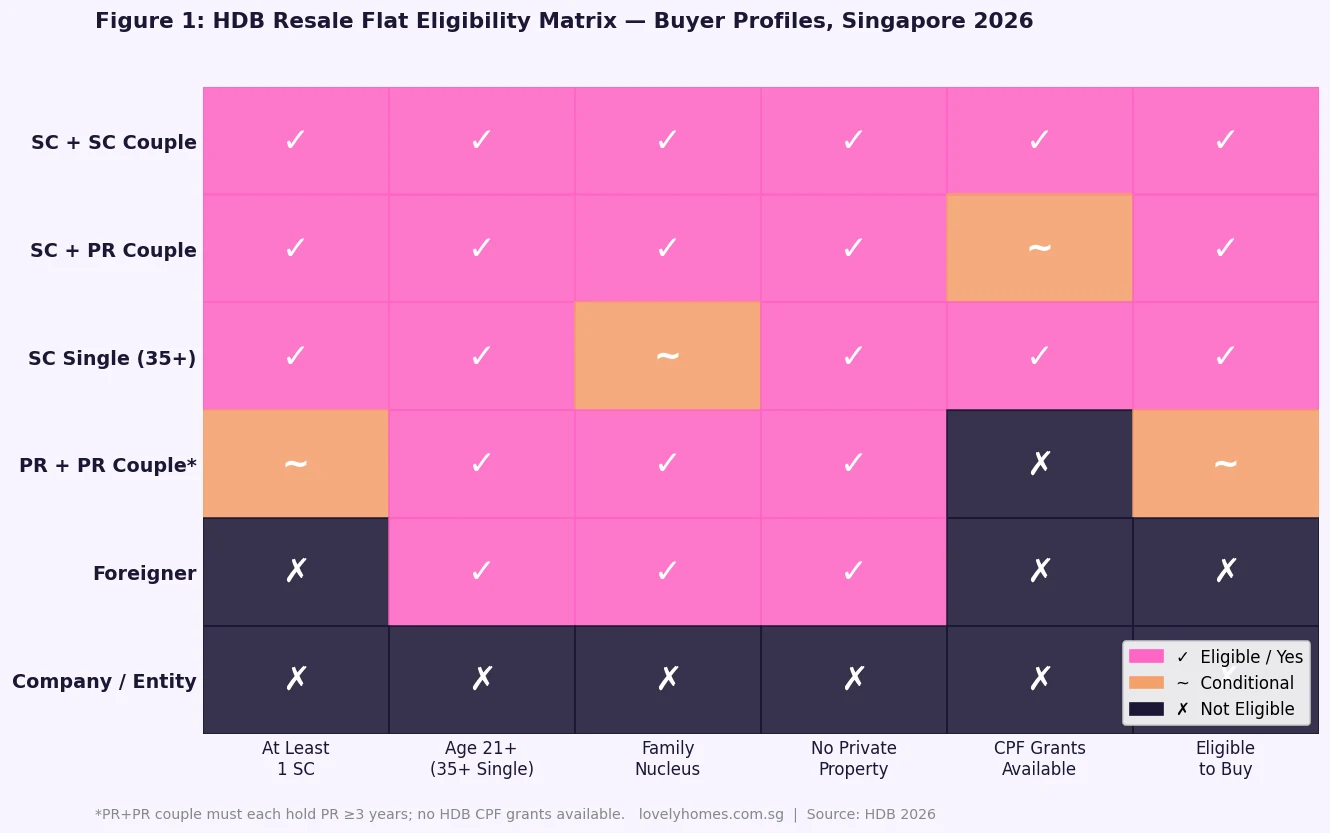
  • Who can buy: Singapore Citizens (SC) and Permanent Residents (SPR) who form an eligible family nucleus. At least one applicant must be SC for most schemes. No private property ownership within 30 months.
  • 10-step process: From eligibility check through key collection, the full process typically spans 3–4 months after the Option to Purchase (OTP) is granted.
  • OTP mechanics: Seller grants the OTP upon receiving a 1% option fee (cash). Buyer has 21 calendar days to exercise it by paying an additional 4%. Total deposit = 5% of purchase price.
  • Stamp duty deadlines: Buyer’s Stamp Duty (BSD) and any Additional Buyer’s Stamp Duty (ABSD) must be paid within 14 days of exercising the OTP.
  • Cash Over Valuation (COV): If the agreed price exceeds HDB’s assessed value, the difference is COV — payable entirely in cash. CPF and loans cannot cover COV.
  • Application window: Both buyer and seller must submit their resale applications via the HDB Flat Portal within 7 days of OTP exercise. HDB approval takes approximately 8 weeks.
  • HDB loan income ceiling: S$14,000/month for families. Above this, buyers must take a bank loan.

What is an HDB Resale Flat — and Who Oversees the Process?

An HDB resale flat is a public housing unit sold by an existing owner on the open market, as opposed to a Build-To-Order (BTO) flat purchased directly from the Housing and Development Board at a subsidised price. Resale flats offer immediate or near-term occupation (subject to the 3–4 month processing period), access to more established locations, and a wider choice of unit types — including larger flat sizes such as 5-room and executive flats that are rarely available in new BTO exercises.

The Housing and Development Board (HDB) administers buyer and seller eligibility, the Minimum Occupation Period (MOP), the resale application and approval process, and housing loan eligibility. The Inland Revenue Authority of Singapore (IRAS) collects Buyer’s Stamp Duty and Additional Buyer’s Stamp Duty. The Council for Estate Agencies (CEA) licenses and regulates property agents involved in the transaction. The Central Provident Fund (CPF) Board oversees the use of CPF Ordinary Account (OA) savings for the purchase price and, in some cases, for monthly loan repayments.

Understanding which body governs which step — and the strict deadlines attached to each — is the foundation of a smooth HDB resale transaction.
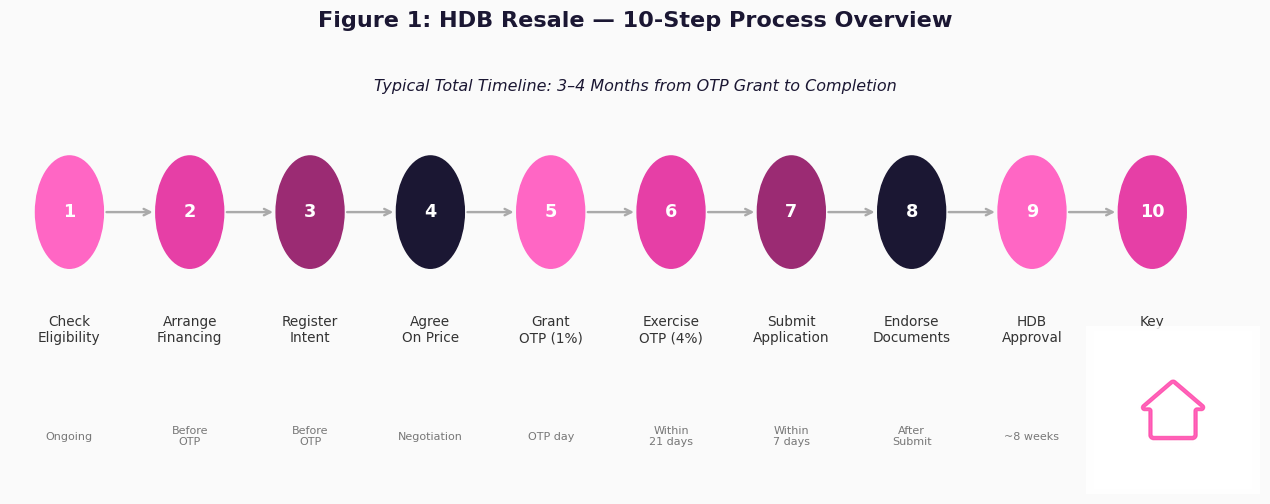
Singapore HDB resale procedure 2026 10-step process overview infographic
Figure 1: The HDB resale procedure involves 10 distinct steps from eligibility check to key collection, typically spanning 3–4 months from OTP grant to completion. Source: HDB, lovelyhomes.com.sg.

Eligibility Requirements for HDB Resale

Before proceeding, both buyers and sellers must confirm their eligibility under HDB’s framework. Sellers must have satisfied the five-year Minimum Occupation Period (MOP) before listing a flat that was purchased directly from HDB or under a resale grant. Buyers must meet citizenship, family nucleus, and (if using an HDB loan) income ceiling requirements.

Citizenship: At least one buyer must be a Singapore Citizen. SPR families may purchase resale flats but receive no priority in newer BTO exercises. Single Singapore Citizens aged 35 and above may purchase 2-room Flexi flats under the Single Singapore Citizen Scheme, or 5-room and smaller resale flats in non-mature estates in certain conditions.

Family nucleus: Acceptable family nuclei include married or engaged couples, parent-and-child families, children orphaned before 35, and the Joint Singles Scheme (two eligible SC singles aged 35+). The family nucleus requirement ensures public housing reaches genuine households.

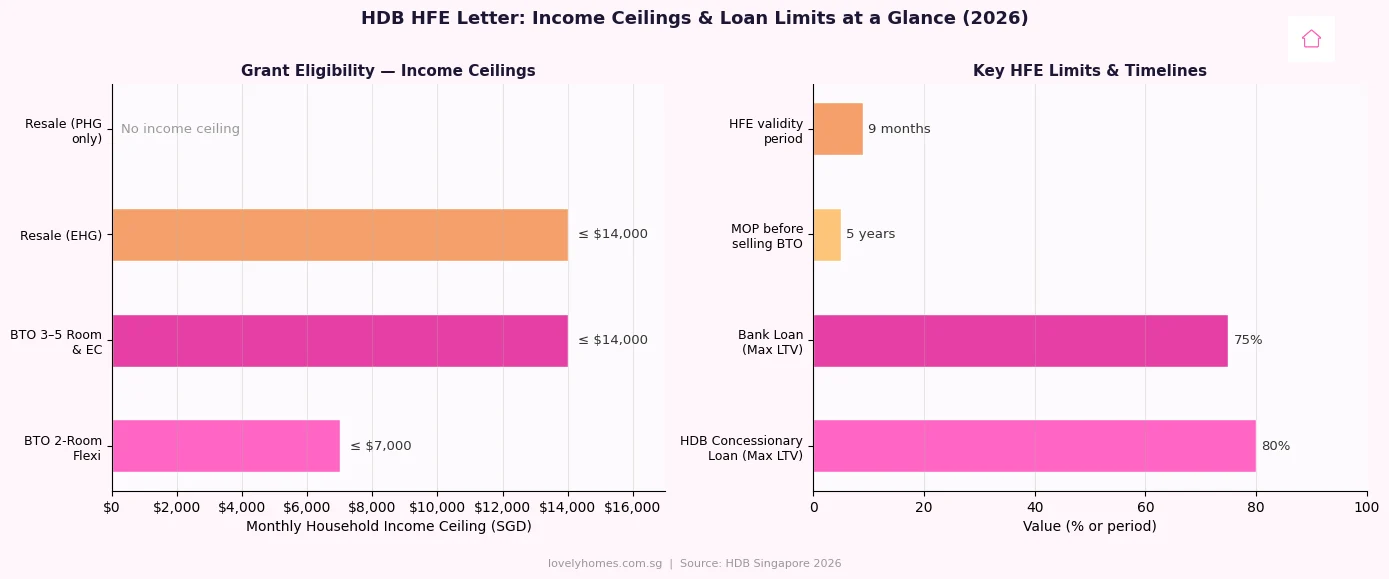
Income ceiling for HDB housing loan: S$14,000/month combined gross income for families; S$7,000 for singles. If household income exceeds the applicable ceiling, you must finance your purchase with a bank loan. There is no income ceiling simply to buy a resale flat — the ceiling only triggers when applying for an HDB concessionary loan or certain CPF Housing Grants.

Property ownership restriction: Buyers must not own any private residential property (local or overseas) at the time of application, and must not have disposed of any private property within 30 months before the resale application date.

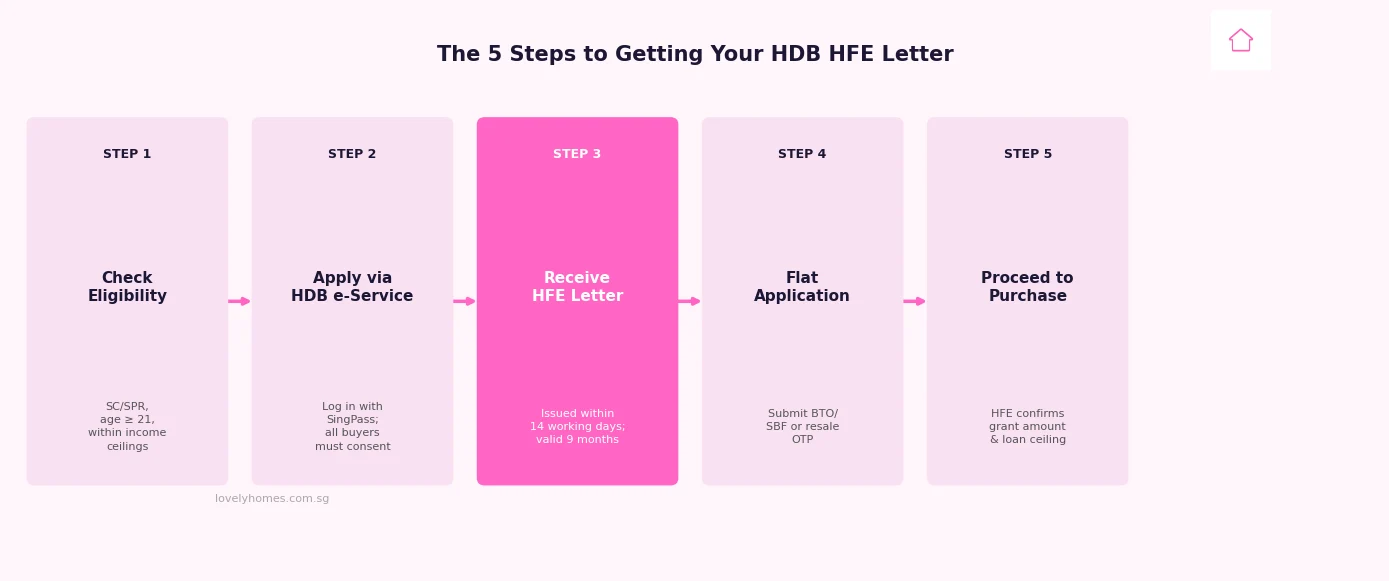
HFE Letter: If you intend to use an HDB housing loan or CPF Housing Grants, you must obtain a valid HDB Flat Eligibility (HFE) letter before the OTP stage. Apply via the HDB Flat Portal at hdb.gov.sg. The HFE letter confirms your eligibility, the loan quantum you qualify for, and any grants you are entitled to.

Step-by-Step: The 10-Stage HDB Resale Process

The HDB resale process unfolds across ten distinct stages, each with its own actors, documents, and deadlines. Buyers and sellers typically engage separate law firms and, optionally, CEA-registered property agents to navigate the process.

Step 1 — Check eligibility. Use HDB’s eligibility checker and apply for your HFE letter if you plan to use an HDB loan or grants. This step should be completed well before you start viewing flats.

Step 2 — Arrange financing. Obtain an HFE letter (for HDB loan) or an In-Principle Approval (IPA) from a bank. The IPA indicates how much the bank is prepared to lend and at what indicative rate. Having pre-approved financing strengthens your negotiating position.

Step 3 — Register intent on HDB Flat Portal. Sellers register their intent to sell; buyers register their intent to buy. This activates the resale portal for your transaction and confirms that both parties are eligible to proceed.

Step 4 — Negotiate and agree on price. Buyer and seller negotiate the transaction price. Check recent resale transaction data via HDB’s Resale Statistics and URA’s REALIS portal (ura.gov.sg) to benchmark the price. Note that if the agreed price exceeds HDB’s valuation, the difference (COV) must be paid entirely in cash.

Step 5 — Seller grants the OTP. The seller issues the Option to Purchase and receives a 1% option fee from the buyer (minimum $1, maximum 1% of the agreed price). This fee is non-refundable if the buyer does not exercise the OTP.

Step 6 — Buyer exercises the OTP. Within 21 calendar days of the OTP date, the buyer pays an additional 4% of the agreed price to exercise the option. The total deposit (1% + 4% = 5%) is credited towards the purchase price at completion. If the buyer does not exercise, the 1% option fee is forfeited and the seller may proceed with other buyers.

Step 7 — Submit resale application. Within 7 days of exercising the OTP, both buyer and seller independently submit their portions of the resale application via the HDB Flat Portal. Required documents include identity documents, the OTP, HFE letter (buyer), and financial data.

Step 8 — Endorse resale documents. HDB issues the resale documents for endorsement, including the Certificate of Eligibility. Both parties (and their solicitors) review and sign the required documents.

Step 9 — HDB approval. HDB reviews the application and issues an approval notice, typically within approximately 8 weeks of submission. The approval notice contains the completion date.

Step 10 — Completion and key collection. On the scheduled completion date, the buyer pays the balance of the purchase price (using CPF OA and/or cash), legal fees are settled, and keys are handed over at HDB Hub or via a virtual appointment. The buyer becomes the registered owner upon completion.
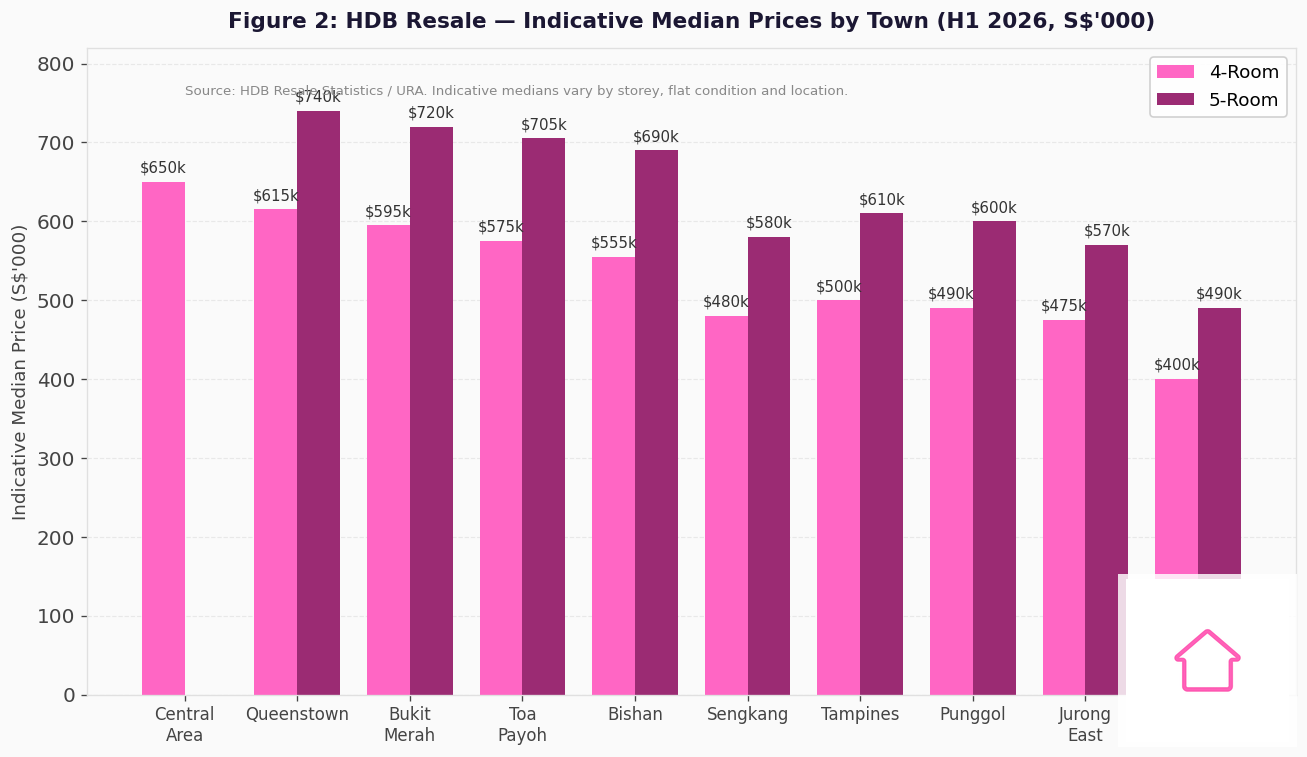
HDB resale median prices by town Singapore H1 2026 4-room and 5-room flat bar chart
Figure 2: Indicative HDB resale median prices by town, H1 2026. Central-area and mature-estate flats command significant premiums. Figures are indicative and vary by storey, flat condition and exact location. Source: HDB Resale Statistics, lovelyhomes.com.sg.

Option to Purchase: Mechanics, Deadlines and Risks

The Option to Purchase is a legally binding contract that gives the buyer the exclusive right — but not the obligation — to purchase the flat at the agreed price within the option period. Understanding its mechanics is critical, as several major financial commitments are triggered by the OTP date.

1% option fee: Paid by the buyer to the seller upon grant of OTP. This sum is deducted from the purchase price at completion if the buyer proceeds. It is forfeited entirely if the buyer does not exercise.

21-day exercise window: The buyer has 21 calendar days from the OTP date to decide whether to proceed. This period allows time to finalise financing, conduct legal due diligence, and confirm CPF usage. Do not grant or exercise an OTP before securing your In-Principle Approval or HFE letter.

4% exercise fee: Paid when exercising the OTP. Combined with the 1% option fee, the buyer has now paid 5% of the purchase price as a deposit. This sum is credited towards the purchase price at completion.

7-day submission window: Within 7 days of OTP exercise, both buyer and seller must submit their portions of the resale application to HDB. Missing this deadline can delay the entire transaction and may require the parties to restart certain steps.

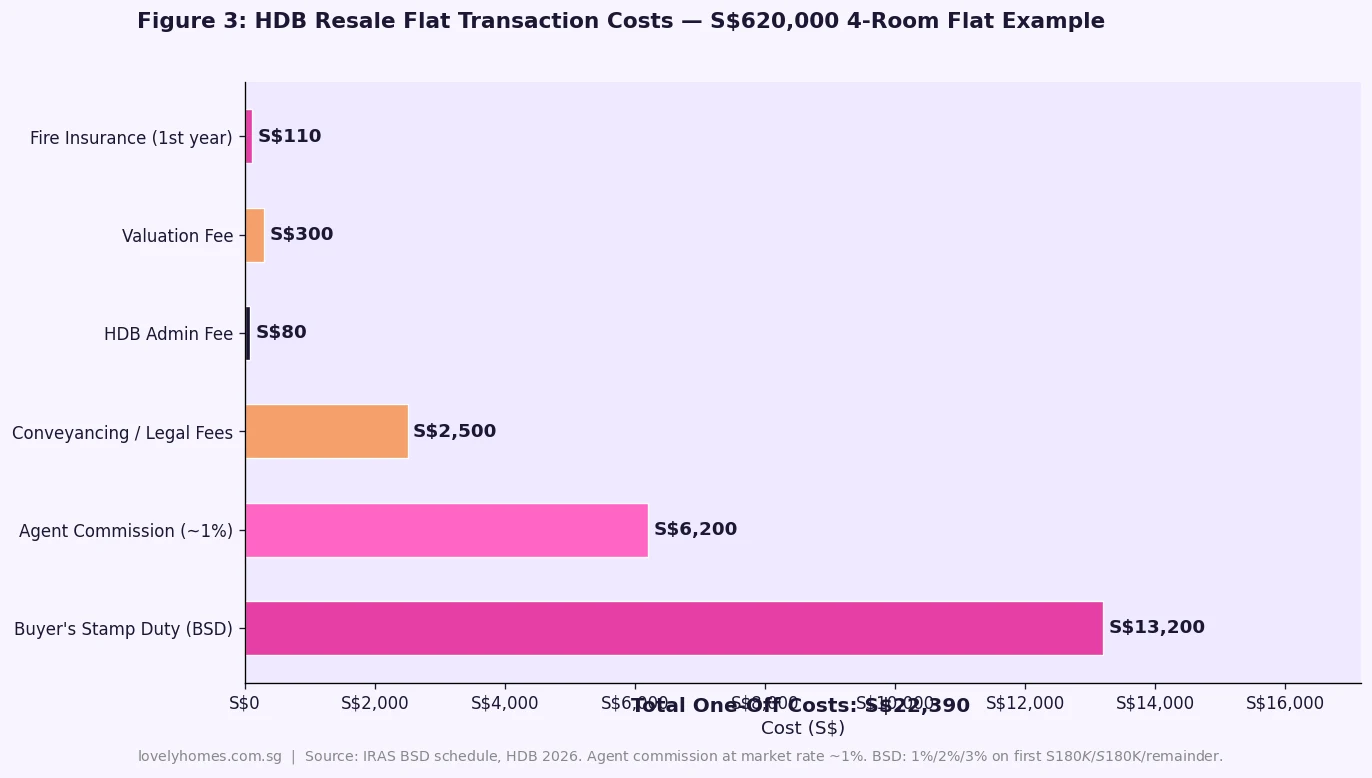
Stamp duty deadline: BSD (and ABSD, if applicable) must be paid to IRAS within 14 days of the OTP exercise date — not from completion. For a S$720,000 resale flat, BSD totals S$16,200. Penalties apply for late payment.
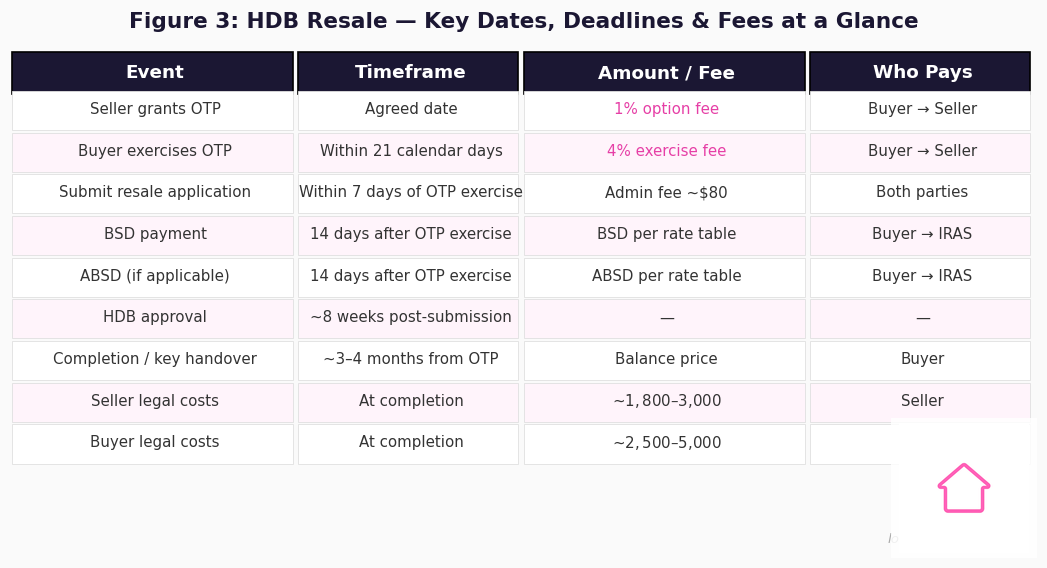
HDB resale OTP timeline key dates deadlines and fees at a glance table infographic
Figure 3: HDB resale key dates, deadlines, and fees from OTP grant through to completion. Source: HDB, IRAS, lovelyhomes.com.sg.

Stamp Duty, COV and Upfront Costs

Buyers of HDB resale flats are subject to Buyer’s Stamp Duty (BSD) on all properties and, depending on their citizenship status and number of properties owned, Additional Buyer’s Stamp Duty (ABSD).

BSD Tier (as at 3 August 2026) Rate BSD on S$720,000 Flat
First S$180,000 1% S$1,800
Next S$180,000 2% S$3,600
Next S$640,000 3% S$10,800 (on S$360k portion)
Total BSD (S$720,000 flat) S$16,200

ABSD rates in 2026: Singapore Citizens pay 0% ABSD on their first residential property, 20% on their second, and 30% on their third and beyond. Singapore Permanent Residents pay 5% on their first and 30% on their second. Foreigners pay 60% on all purchases. ABSD is calculated on the higher of the purchase price or market value, and must be paid within the same 14-day window as BSD.

Cash Over Valuation (COV): HDB conducts a valuation of the flat during the resale process. If the agreed transaction price exceeds this valuation, the difference is considered COV. COV cannot be financed by an HDB or bank loan, nor can it be paid using CPF OA savings. It must be paid entirely in cash. Buyers should factor COV risk into their cash-available calculation before entering into an OTP.

Financing Your HDB Resale Purchase

Buyers may finance an HDB resale flat using an HDB concessionary loan, a bank loan, or a combination of CPF savings and cash. The Mortgage Servicing Ratio (MSR) cap of 30% of gross monthly income applies to both HDB and bank loans for HDB flat purchases, limiting the maximum loan quantum. The Total Debt Servicing Ratio (TDSR) cap of 55% of gross monthly income also applies, covering all debt obligations.

HDB loan: Fixed interest rate of 2.6% per annum (0.1% above CPF Ordinary Account rate as at 2026). Maximum LTV is 80% of the lower of the purchase price or valuation. Requires an HFE letter. Allows flexible early repayment. Available only to SC and SPR buyers meeting income ceiling requirements.

Bank loan: Rates are typically SORA-based, currently ranging from approximately 3.0–4.0% per annum for typical packages in 2026. Maximum LTV is 75% for the first housing loan (50% for second, 35% for third and beyond). Requires an IPA from the bank. May offer more competitive rates in a low-rate environment but carries repricing risk.

Worked Example: The Lim Family Buying S$720,000 Queenstown Resale Flat

Profile: Mr & Mrs Lim, both Singapore Citizens, combined gross monthly income S$9,000. First residential property. Mr Lim aged 38, Mrs Lim aged 36.

Property: 5-room HDB resale flat, Queenstown. Agreed price: S$720,000. HDB valuation: S$710,000. COV = S$10,000.

BSD: 1% × S$180k = S$1,800 + 2% × S$180k = S$3,600 + 3% × S$360k = S$10,800 = S$16,200

ABSD: S$0 (first property, both SC)

HDB loan: 80% LTV = S$576,000 @ 2.6% p.a., 25-year tenure. Monthly repayment ≈ S$2,617. MSR check: S$2,617 ÷ S$9,000 = 29.1% < 30% ✓. TDSR check: S$2,617 ÷ S$9,000 = 29.1% < 55% ✓ (no other debts assumed).

Down payment: 20% × S$720k = S$144,000 (from CPF OA, assumed sufficient).

  • Day 0 (OTP grant): Cash option fee = S$7,200 (1%)
  • Day 21 (OTP exercise): Cash exercise fee = S$28,800 (4%)
  • Within 14 days of exercise: BSD S$16,200 + COV S$10,000 = S$26,200 (cash)
  • At completion: Remaining CPF OA used: S$144,000 − S$7,200 − S$28,800 = S$108,000. Legal fees: ~S$3,800 (cash). HDB loan S$576,000 disbursed directly to seller.

Total upfront cash required: approximately S$66,200 (S$7,200 + S$28,800 + S$26,200 + S$3,800 + S$300 for HDB admin). CPF OA covers the remaining S$108,000 of the down payment at completion.

Why the HDB Resale Market Matters in 2026

HDB resale prices have risen consistently since 2021, driven by supply constraints during the COVID-19 construction pause, strong upgrader demand from the large cohort of BTO buyers who completed their MOP, and a preference among buyers for larger, immediately available flats in established locations. The resale market serves a critical function: it provides housing for Singaporeans who need a home faster than BTO timelines allow, particularly newlyweds, growing families, and those with elderly parents nearby.

Industry figures show that resale median prices for 5-room flats in central areas now regularly breach the S$700,000 mark, with prime Queenstown and Bishan transactions exceeding S$800,000 for desirable units. For prospective buyers, this underscores the importance of understanding COV risk, having sufficient cash reserves, and calibrating loan quantum carefully against the MSR ceiling.

For sellers, the strong market represents an opportunity to realise significant appreciation — but proper understanding of CPF accrued interest (which must be returned to your CPF account upon sale) and outstanding loan balances is essential to accurately calculate net proceeds.

What Might Come Next for HDB Resale

Industry observers anticipate that HDB may introduce targeted policy refinements if resale flat prices for standard flat types in mature estates continue to trend above S$700,000 at the median. Potential measures discussed include extending the MOP for certain flat types, adjusting the CPF usage limits for older flats, or introducing enhanced grant frameworks to moderate demand in specific segments. The government has consistently stated that maintaining housing affordability is a key policy objective, and the full resale market cycle — including cooling measures — should be considered in long-term financial planning. These remain speculative; buyers should rely on current official policies at HDB and IRAS when transacting.

Frequently Asked Questions: HDB Resale Procedure 2026

Can Singapore Permanent Residents buy HDB resale flats?

Yes, Singapore Permanent Residents (SPRs) may purchase HDB resale flats, subject to forming an eligible family nucleus. A family comprising two SPRs (without an SC) may purchase a resale flat, though they are not eligible for the most favourable CPF Housing Grants, which are reserved for SC households. SPRs pay a higher ABSD rate (5% on first, 30% on second property) compared to SCs. Note that SPRs cannot buy BTO flats directly from HDB — only resale flats on the open market.

What happens if I miss the 7-day window to submit the resale application after exercising the OTP?

The 7-day submission window after OTP exercise is strictly enforced. If both parties fail to submit on time, the resale application cannot proceed under that OTP, and the transaction may need to restart with a new OTP. This effectively means the buyer forfeits the 5% deposit (1% + 4%) unless both parties agree to an extension and can justify the delay to HDB. Property agents and solicitors routinely track these deadlines; ensure your legal advisers are appointed before the OTP stage.

Can I use CPF Ordinary Account savings to pay the option fee and exercise fee?

No. The option fee (1%) and exercise fee (4%) paid at the OTP stage must be paid in cash. CPF OA savings can only be used at the completion stage — specifically to pay the down payment (above the loan quantum), partial BSD in some cases, and subsequent monthly loan repayments (subject to HDB or bank approval). This means you need at least 5% of the purchase price in cash available before entering into an OTP. For a S$720,000 flat, that is S$36,000 in cash, plus BSD and legal fees.

How is HDB’s valuation of a resale flat determined, and what if the market price is higher?

HDB engages a Certified Appraiser (registered with the Singapore Institute of Surveyors and Valuers) to conduct a market valuation of the flat, typically shortly after the resale application is submitted. The valuation is based on comparable transactions, flat condition, storey, and location. If the agreed price exceeds the valuation, the difference is Cash Over Valuation (COV) — the buyer must pay this entirely in cash (no CPF, no loan). Sellers typically price above valuation in a strong market; buyers who cannot accommodate COV may need to negotiate the price down to valuation or seek a flat where the transaction price matches or falls below the assessed value.

What is the difference between an HDB resale flat and a Design, Build and Sell Scheme (DBSS) flat?

Design, Build and Sell Scheme (DBSS) flats were a now-discontinued category of public housing developed by private developers but sold under HDB rules. They are indistinguishable from standard HDB resale flats in terms of the resale procedure — DBSS flats go through the same HDB resale process, are subject to the same MOP, and can be purchased using CPF OA and HDB loans. The DBSS scheme produced 13 projects between 2006 and 2012; no new DBSS projects have been launched since. Buyers will encounter DBSS flats on the resale market like any other HDB unit.

How long does HDB approval take, and can the completion date be accelerated?

HDB approval for a resale application currently takes approximately 8 weeks from the submission date, provided all documents are in order and there are no eligibility issues. The completion date is set by HDB in the approval notice — typically 6–8 weeks after approval, giving a total end-to-end timeline of approximately 3–4 months from OTP exercise. Completion dates generally cannot be significantly accelerated, as HDB coordinates across multiple parties (buyer, seller, solicitors, CPF Board). Sellers who need to synchronise with a new home purchase should factor this timeline carefully into their planning.

Disclaimer: This article is provided for general information only and does not constitute legal, financial, or property advice. HDB resale policies, stamp duty rates, CPF rules, and grant frameworks are subject to change. Always verify current policies directly with the Housing and Development Board (hdb.gov.sg), the Inland Revenue Authority of Singapore (iras.gov.sg), the CPF Board (cpf.gov.sg), and consult a licensed solicitor or CEA-registered property professional for advice specific to your situation.
Singapore Property Buying Checklist 2026: Step-by-Step Guide for HDB, EC and Condo Buyers

Singapore Property Buying Checklist 2026: Step-by-Step Guide for HDB, EC and Condo Buyers

Buying property in Singapore is one of the most significant financial decisions a household makes. The process involves government eligibility rules, loan approvals, legal documentation, stamp duty payments, and a carefully timed sequence of steps — and getting any one of them wrong can cause delays, penalties, or lost deposits. This comprehensive checklist covers every stage of the Singapore property buying process in 2026, from working out your budget through to collecting your keys, for HDB flats, executive condominiums (ECs), and private condominiums.

Quick Answer — Singapore Property Buying Checklist

  • Stage 1 (Pre-purchase): check eligibility, obtain HFE Letter or bank IPA, confirm budget and ABSD profile
  • Stage 2 (Offer & financing): grant OTP, pay 1% booking fee, engage lawyer, confirm loan, pay BSD/ABSD within 14 days
  • Stage 3 (Legal process): sign S&P Agreement, drawdown loan, complete title search, await completion
  • Stage 4 (Completion): pay balance 19% (or balance purchase price), sign transfer documents, pay remaining stamp duty
  • Stage 5 (Key collection): receive keys, inspect property, register title, set up property tax and utilities
  • Total timeline: 8–16 weeks for private/resale; 3–5 years for BTO flats

Before You Start: Establishing Your Budget and Eligibility

Every Singapore property purchase begins with a clear-eyed assessment of what you can afford and what you are eligible to buy. Singapore’s property market is structured around specific eligibility rules — citizenship status, marital status, income ceilings, and prior property ownership all determine which types of property you can purchase, and at what stamp duty rates.

The two frameworks that govern affordability for mortgage borrowers are the Total Debt Servicing Ratio (TDSR) and, for HDB flats and ECs, the Mortgage Servicing Ratio (MSR). TDSR caps total debt obligations at 55% of gross monthly income (using a stress-tested rate of at least 4.0% p.a.); MSR caps housing loan repayment for HDB/EC at 30% of gross monthly income. See our TDSR & MSR Guide 2026 for the full breakdown.

For ABSD planning, confirm how many residential properties you and your co-purchaser currently own. A Singapore Citizen buying their first property pays 0% ABSD; buying a second pays 20%; buying a third pays 30%. For Singapore PRs, the first property attracts 5% ABSD. These are upfront, non-negotiable costs that must be paid in cash (CPF cannot be used for ABSD). See our ABSD Complete Guide 2026.

Stage 1: Pre-Purchase Checklist (1–4 Weeks)

This stage covers the groundwork before you make any offer on a property. Completing it thoroughly saves significant time and stress later in the process.

HDB purchases — HFE Letter: Apply for an HDB Flat Eligibility (HFE) Letter at the HDB website (MyHDBPage portal). This single letter tells you which HDB flats you are eligible to buy, your CPF grant amounts, your HDB loan eligibility, and the maximum HDB loan quantum. The HFE Letter is valid for 6 months and is mandatory before exercising any OTP for an HDB flat. Allow 2–3 weeks for processing.

Private/EC purchases — Bank IPA: Apply for an In-Principle Approval (IPA) from your preferred bank(s) before making any offer. The IPA tells you your maximum loan quantum and is typically valid for 30 days. It is not legally required before signing an OTP, but it is strongly advisable — discovering post-OTP that you cannot secure financing risks losing your 1% booking fee.

CPF check: Log in to your CPF account and confirm your OA balance. For HDB purchases, your CPF OA can cover the downpayment and monthly instalments. For private property, CPF OA usage is subject to the Valuation Limit and Withdrawal Limit rules.

Property search and shortlisting: Research your target neighbourhoods and property types. Confirm the remaining lease (critical for CPF usage and bank loan eligibility on resale properties), check URA Master Plan zoning, and look at recent transaction data from URA’s REALIS portal.

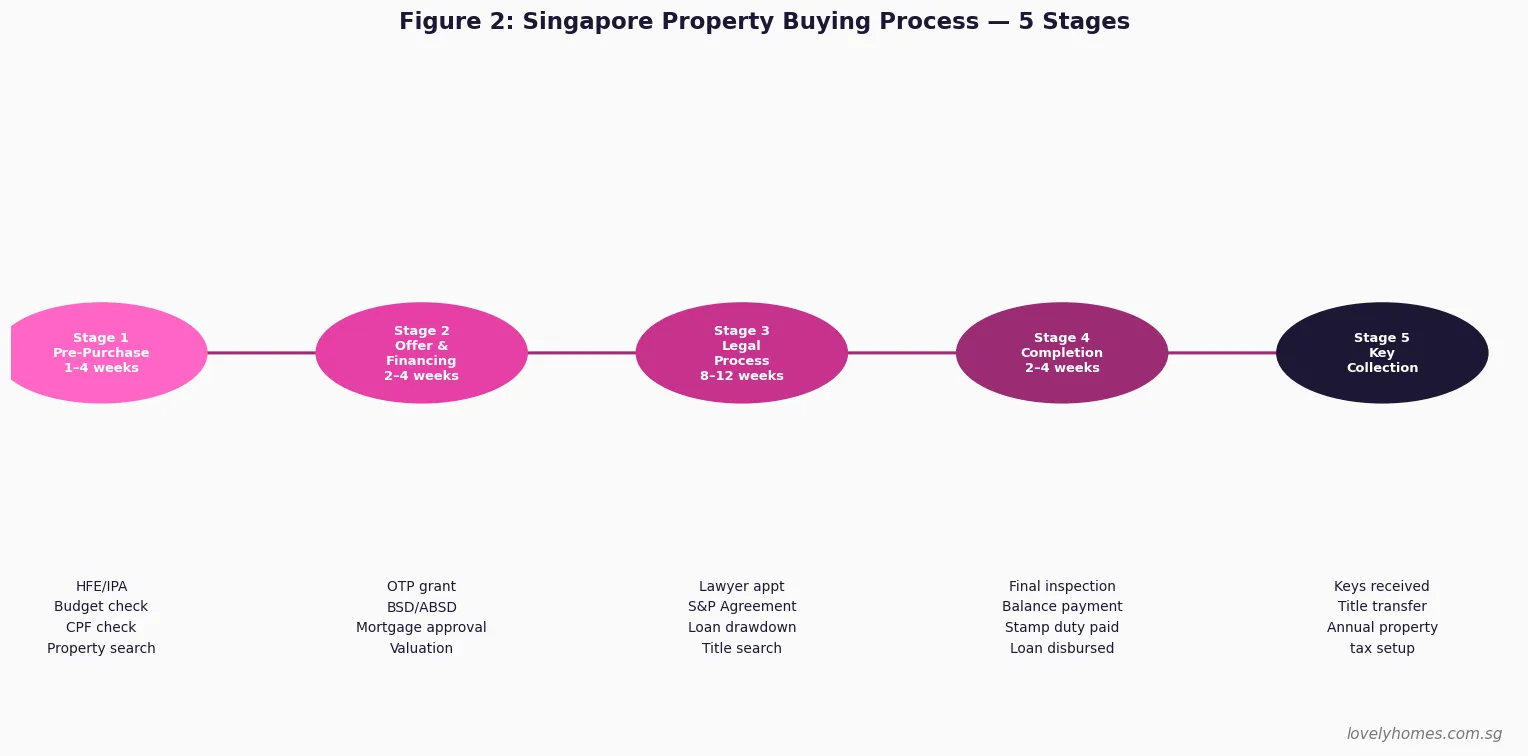
Singapore property buying process 5 stages — pre-purchase to key collection 2026
Figure 2: Singapore property buying process — 5 stages from pre-purchase to key collection. Private/resale completion takes 8–16 weeks; BTO completion takes 3–5 years. Source: HDB, SLA, IRAS.

Stage 2: Making an Offer — OTP and Financing (2–4 Weeks)

Once you identify a property, the process moves quickly. In Singapore, the formal process of making an offer starts with the Option to Purchase (OTP).

Granting the OTP: The seller grants you the OTP upon receipt of a 1% booking fee (of purchase price), paid in cash. The OTP is a legal option giving you the exclusive right to purchase the property within the option period, typically 14 days for private property and 21 days for HDB resale.

BSD and ABSD payment deadline: Stamp duty (both BSD and ABSD) must be paid within 14 days of exercising the OTP (or signing the S&P Agreement). Failure to pay on time incurs penalties. IRAS administers stamp duty and accepts payment via e-Stamping on the IRAS website. Importantly, ABSD must be paid in cash only — CPF cannot be used for ABSD. BSD may be paid from CPF OA.

Engaging a property lawyer: Appoint a conveyancing lawyer as soon as the OTP is received. Your lawyer will conduct a title search, advise on any encumbrances on the property, prepare the Sale and Purchase Agreement, and coordinate the completion process. Legal fees for a standard private property purchase are typically S$2,500–S$4,500.

Confirming bank loan: Submit your formal loan application to the bank (not just IPA). The bank will order a valuation of the property. If the valuation comes in lower than the purchase price, your loan amount is based on the valuation figure — the “valuation shortfall” must be topped up in cash or CPF from your own funds. This is why many experienced buyers commission their own valuation before offering a price.

Exercising the OTP: Pay the additional 4% exercise fee (i.e. 1% booking + 4% exercise = 5% of purchase price) at the time you exercise the OTP within the option period. For private property, this is typically 5% of the purchase price. For HDB resale, the exercise fee to HDB is the balance of the deposit up to 5% (cash or CPF).

Understanding Upfront Costs: What You Actually Need at Each Stage

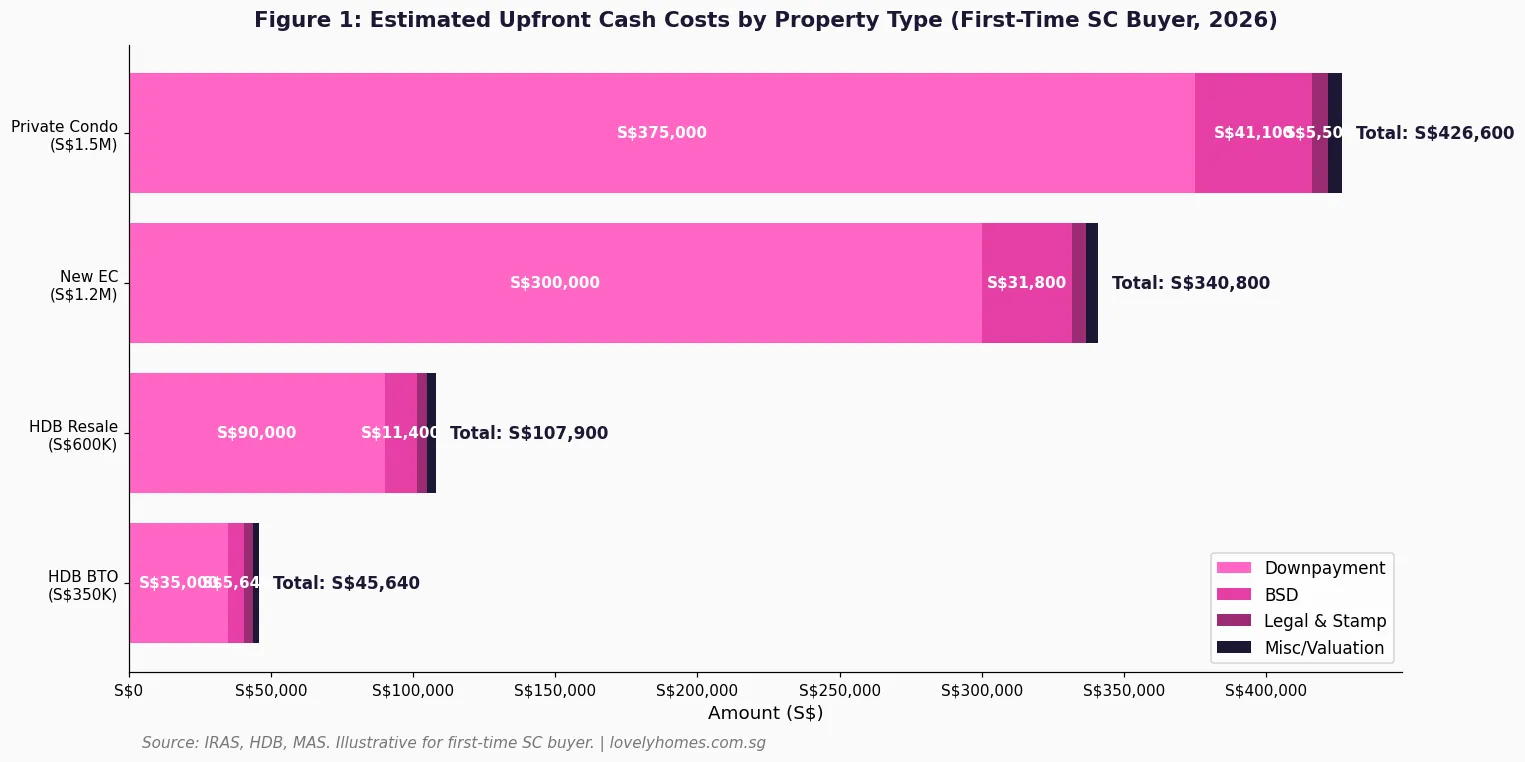
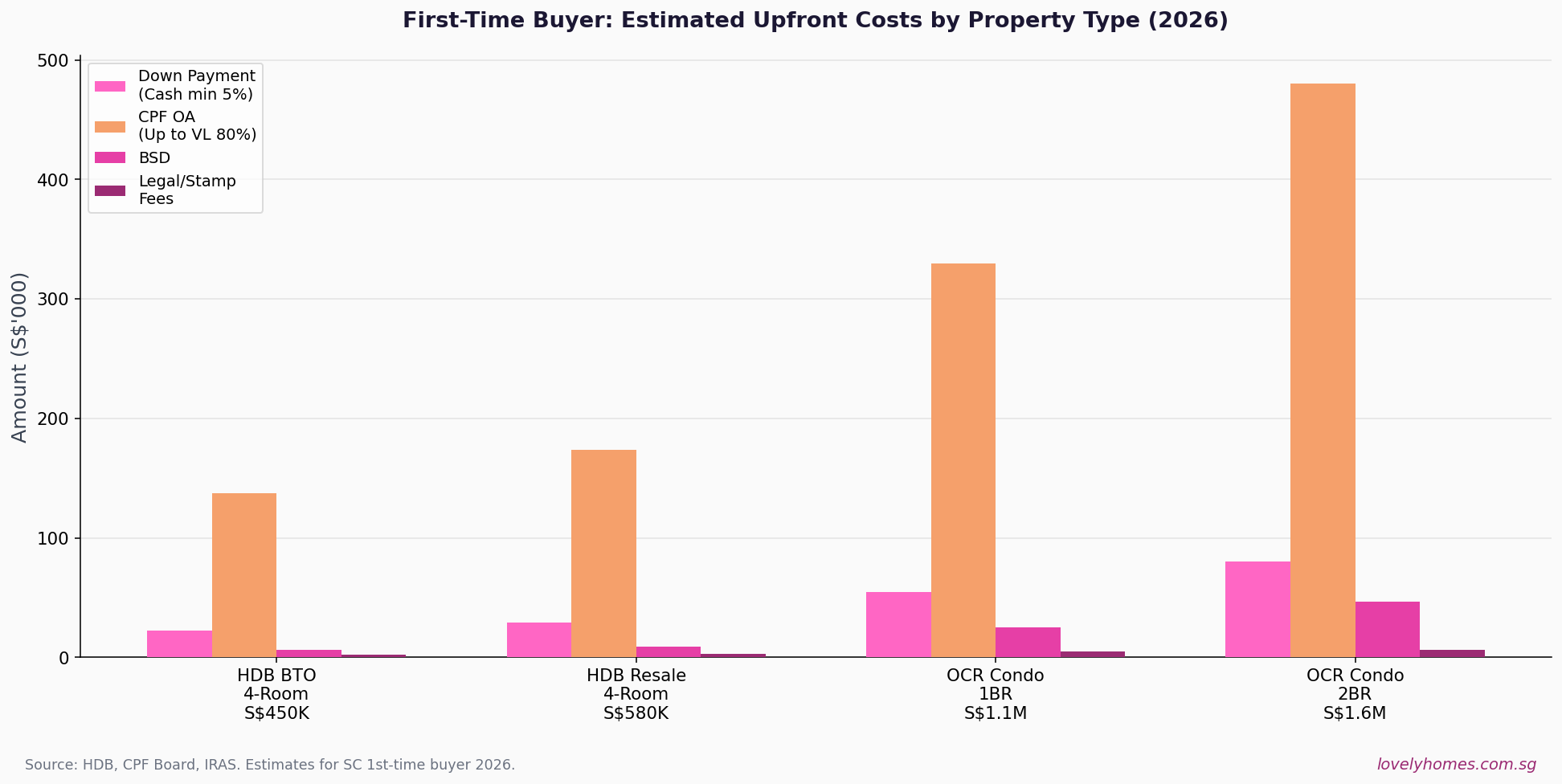
One of the most common surprises for first-time buyers is the quantum of upfront cash required before completion. The chart below shows the estimated upfront costs for a first-time Singapore Citizen buyer across four property types. Note that ABSD is zero for a first-time SC buyer on any property type.

Estimated upfront costs by property type Singapore 2026 — HDB BTO, HDB resale, EC and private condo
Figure 1: Estimated upfront costs by property type for a first-time Singapore Citizen buyer (2026). HDB BTO has the lowest cash requirement; private condo requires the most. Amounts are illustrative and assume a bank loan for EC/private condo. Source: IRAS, HDB, MAS.
Cost Item HDB BTO (~S$350K) HDB Resale (~S$600K) EC (~S$1.2M) Private Condo (~S$1.5M)
Booking fee (1% cash) S$3,500 S$6,000 S$12,000 S$15,000
Exercise fee (4% cash/CPF) S$14,000 S$24,000 S$48,000 S$60,000
BSD (cash or CPF) S$5,640 S$11,400 S$31,800 S$41,100
ABSD (1st SC buyer) S$0 S$0 S$0 S$0
Legal fees (approx) S$2,500 S$3,000 S$4,500 S$5,000
Remaining downpayment From CPF OA From CPF OA S$240,000+ S$300,000+
Est. upfront cash required ~S$4K–6K ~S$6K–10K ~S$60K–80K ~S$75K–100K

Note: BSD payable from CPF OA; ABSD must be in cash. EC 1% booking fee and 4% exercise fee must be in cash (no CPF for downpayment). HDB BTO/Resale downpayment may be entirely from CPF OA if taking HDB loan (no mandatory cash). Assumes first-time SC buyer with no other outstanding loans.

Stage 3: The Legal Process (8–12 Weeks)

After exercising the OTP, your lawyer and the seller’s lawyer prepare the Sale and Purchase Agreement (S&P Agreement), which sets out all terms of the sale, the completion date, and any conditions. The S&P Agreement is typically signed within 2 weeks of the OTP exercise date.

Loan drawdown: Your bank will require the S&P Agreement to be signed before releasing the loan. The bank typically disburses the loan directly to the seller’s conveyancing account at completion. Ensure your loan offer letter has not expired and all conditions (e.g. fire insurance) are met.

Title search: Your lawyer will search the land registry (Singapore Land Authority) to confirm the seller holds clean title, check for any caveats, mortgages, or restrictions registered against the property, and flag any issues that could delay completion.

Completion date: Standard completion is typically 8–12 weeks from the S&P Agreement date for private property. HDB resale completion is set by HDB and typically 8–10 weeks from the HDB appointment.

Stage 4: Completion Day — What Happens on the Day

Completion day is when legal ownership of the property transfers from seller to buyer. Your lawyer coordinates the following:

Balance purchase price payment: The bank transfers the loan funds to the seller’s conveyancer; your CPF is transferred by the CPF Board; your cash balance (if any remains) is transferred from your lawyer’s client account. The seller receives the total price and in turn discharges their mortgage and hands over vacant possession.

Document signing: You will sign the transfer instrument, the mortgage document, and several other legal forms at your lawyer’s office.

Remaining stamp duty: If you have not already stamped all relevant documents, your lawyer will ensure payment is made on completion day.

Title register update: The Singapore Land Authority (SLA) will update the land registry to show you as the new owner. This process takes 2–4 weeks after completion.

Stage 5: After Key Collection — Your Post-Purchase Checklist

Collecting your keys is not the end of the process. Several administrative steps remain.

Property inspection: Conduct a thorough walk-through before accepting the keys. For new property (BTO, new launch condo), this is the formal defects inspection — note all defects in writing and submit the defects list to the developer within the defects liability period (typically 12 months for private property, 1 year for HDB BTO).

Property tax: IRAS will issue your first property tax notice based on the Annual Value (AV) assessed for your property. Owner-occupied residential properties attract a progressive tax rate (0% on first S$8,000 AV, then 4–32% progressively). Update your owner-occupier status with IRAS at iras.gov.sg to ensure you are taxed at the concessionary owner-occupier rate rather than the higher non-owner-occupier rate.

Utilities and services: Transfer or open SP Group electricity and utilities accounts. Set up broadband, cable, and household insurance.

CPF charge registration: Your lawyer will register the CPF charge on the property with SLA to reflect the CPF monies withdrawn. This is automatic as part of the completion process but confirm with your lawyer that it is done.

Fire insurance and mortgage reducing term assurance (MRTA): Fire insurance is mandatory for all mortgaged properties (arranged by the bank). MRTA (which pays off your outstanding loan if you die or are permanently disabled) is not legally required but strongly recommended, especially for the first decade of a long loan tenure when the outstanding balance is at its highest.

Choosing the Right Property Type: HDB, EC, or Private Condo

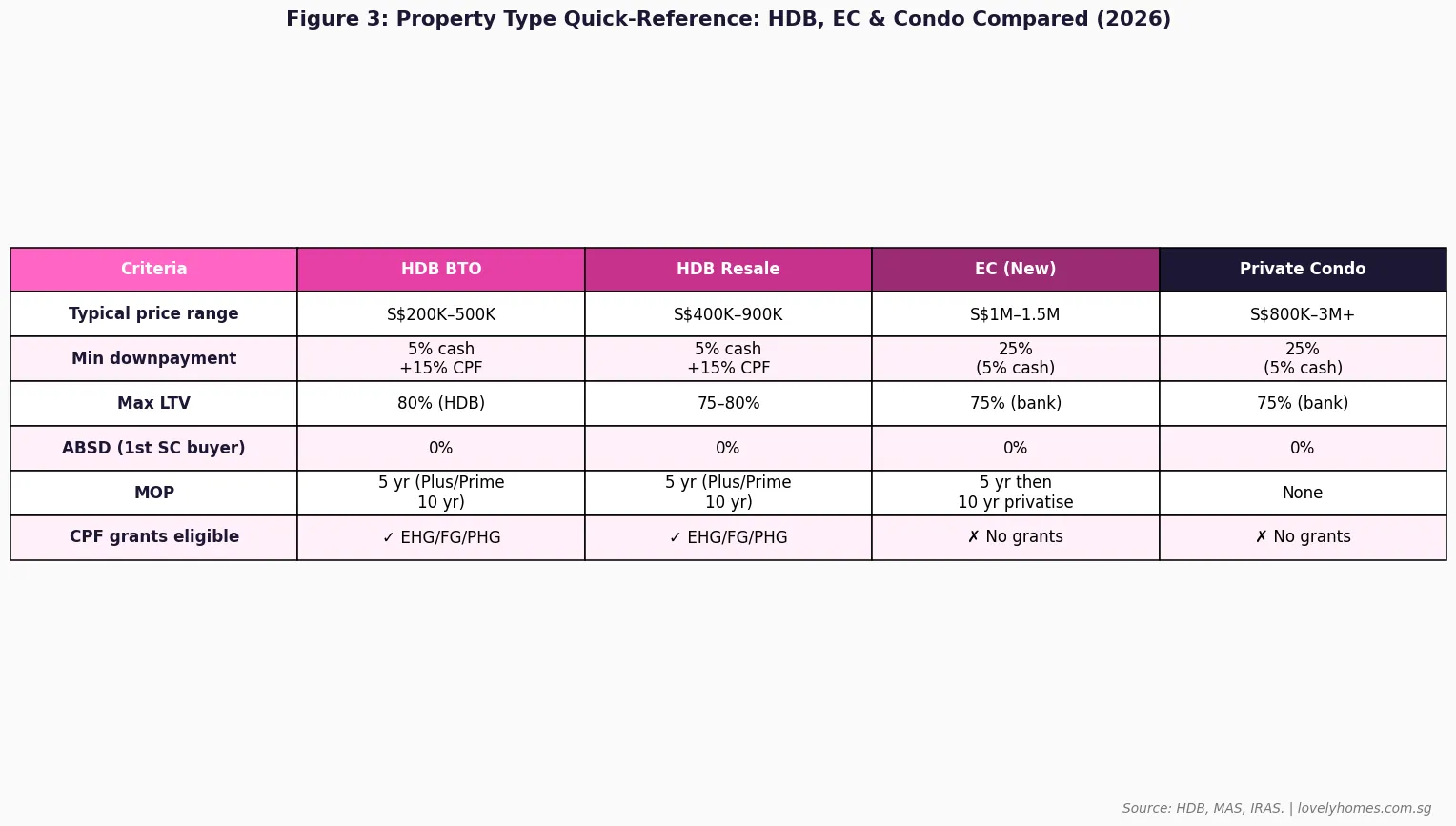
Understanding which property type suits your needs, income, and long-term strategy is the starting point of the whole process. The table below summarises the key differences.

Singapore property type comparison table 2026 — HDB BTO vs HDB resale vs EC vs private condo
Figure 3: Property type comparison 2026 — HDB BTO, HDB resale, EC and private condo. ECs represent a middle ground: subsidised pricing but MOP and privatisation rules apply. Source: HDB, MAS, IRAS.

Worked Example: The Lim Family Buys an HDB Resale Flat

Mr and Mrs Lim, both Singapore Citizens aged 32, have a combined gross monthly income of S$9,000. They wish to buy a 5-room HDB resale flat in Bishan for S$780,000 and take a bank loan.

ABSD: Both are first-time buyers; 0% ABSD. No ABSD cost.

BSD: On S$780,000: first S$180,000 @ 1% = S$1,800; next S$180,000 @ 2% = S$3,600; next S$440,000 @ 3% = S$13,200. Total BSD = S$18,600 (payable from CPF OA).

Bank loan eligibility: MSR 30%: max monthly housing payment at stress-test 4.0% p.a. = S$9,000 × 30% = S$2,700. At 4.0% over 25 years, S$2,700/month ≈ max loan S$517,000. LTV 75%: S$780,000 × 75% = S$585,000. MSR is the binding constraint at S$517,000.

Downpayment: S$780,000 − S$517,000 = S$263,000 (CPF OA: S$200,000; cash: S$63,000).

Monthly repayment (actual rate 3.5% p.a.): S$517,000 at 3.5% over 25 years = approximately S$2,587/month (MSR 28.7% — PASS).

CPF grants: As first-time buyers with income S$9,000/month, they receive Family Grant S$50,000 + PHG S$20,000 (if within 4km of parents) = up to S$70,000, reducing effective loan to S$447,000 and monthly repayment to approximately S$2,237/month.

Total cash at exercise: 1% booking S$7,800 cash + 4% exercise S$31,200 (CPF) + BSD S$18,600 (CPF) + legal S$3,500 = approximately S$10,800 cash at the time of exercising the OTP.

What Might Change in the Singapore Property Buying Process

The MAS and HDB periodically review the rules governing property purchases. In 2026, key items to monitor include: any revision to TDSR or LTV limits (MAS last updated these in September 2022); changes to HDB grant amounts or income ceilings (HDB last revised these in September 2019); and any adjustments to the EC eligibility or income ceiling (currently S$16,000/month). The ABSD framework set on 27 April 2023 remains intact with no announced changes as of August 2026. For the latest cooling measures timeline, see our Property Cooling Measures Timeline.

Summary: Singapore Property Buying Checklist

Stage Key Actions Timeline
1. Pre-purchase HFE Letter or bank IPA; budget check; ABSD profile; CPF balance 1–4 weeks
2. Offer & financing Grant/receive OTP; pay 1% booking; formal loan app; BSD/ABSD within 14 days; engage lawyer 2–4 weeks
3. Legal process Sign S&P Agreement; bank valuation; title search; await completion date 8–12 weeks
4. Completion Pay balance; sign transfer; bank disburses loan; CPF Board transfers funds 1–2 days
5. Post-completion Keys; defects inspection; property tax owner-occupier status; utilities; fire insurance 2–4 weeks

Frequently Asked Questions

What is the Option to Purchase (OTP) and what happens if I do not exercise it?

The Option to Purchase is a legally binding agreement where the seller grants you the exclusive right to buy the property within a specified period (typically 14 days for private property, 21 days for HDB resale). The 1% booking fee is paid when the OTP is granted to you. If you choose not to exercise the OTP within the option period, you forfeit the 1% booking fee but have no further obligation to complete the purchase. The seller may then offer the property to other buyers. If you exercise the OTP, you become contractually committed to completing the purchase, and failing to complete after that point puts your entire deposit (usually 5% to 10% of the purchase price) at risk.

How long does the entire buying process take in Singapore?

For a private resale or new launch condo, the typical timeline from OTP exercise to key collection is 8–16 weeks (some new launches can be longer depending on the developer’s completion date). For an HDB resale flat, the HDB appointment-to-completion timeline is usually 8–10 weeks after HDB grants approval. For an HDB BTO flat, the wait from booking to key collection is typically 3–5 years depending on when the project was launched and the construction schedule. For an EC, the completion wait is also 3–5 years (these are new launches).

Can a foreigner buy an HDB flat or EC in Singapore?

No. Foreigners (non-Singapore Citizens and non-Singapore PRs) are not permitted to buy HDB flats (new BTO or resale) or new ECs (during the 5-year MOP period). ECs are treated as private property after 10 years from the date of issue of the Temporary Occupation Permit, at which point foreigners may buy them on the open market — subject to paying the 60% ABSD. Foreigners may buy private condominiums, apartments, and some landed property with prior approval from the Land Dealings Approval Unit (LDAU), but they pay the significant 60% ABSD surcharge. See our ABSD Singapore Guide 2026 for the full foreigner and FTA national rules.

What is COV (Cash Over Valuation) and does it still apply in 2026?

Cash Over Valuation refers to the amount a buyer pays above the bank’s (or HDB’s) assessed valuation of the property. If you agree to buy a resale flat for S$650,000 but the valuation comes in at S$610,000, the S$40,000 difference is COV and must be paid entirely in cash (no CPF, no loan). COV has reappeared in the HDB resale market during high-demand periods, particularly for popular flat types in mature estates. It adds a significant cash buffer requirement. Before committing to a price, request the seller’s or HDB’s indicative valuation, or commission your own from an IRAS-approved valuer, to reduce the risk of a COV surprise.

What documents do I need to prepare for a home loan application?

The standard document checklist for a Singapore home loan application includes: NRIC (for Singapore Citizens and PRs); proof of income (last 3 months’ payslips, latest CPF contribution history, last 2 years’ Income Tax Notices of Assessment for self-employed borrowers); CPF statement (available on CPF website); existing loan statements (for TDSR calculation); OTP or S&P Agreement; and property particulars (postal address, title number). For foreigners, a passport and work pass (EP/SP) are also required. Banks may request additional documents for variable income earners, commission-based employees, or borrowers with business income.

What is the Minimum Occupation Period (MOP) and does it affect when I can sell?

The MOP is the minimum period you must physically occupy your HDB flat or EC before selling it on the open market or renting it out in its entirety. For standard HDB flats, the MOP is 5 years from the date of key collection. For HDB Plus and Prime flats (under the new 2023 housing classification), the MOP is 10 years. For ECs, the MOP is 5 years, after which you may sell to Singapore Citizens or PRs; full privatisation (open to all including foreigners) occurs at the 10-year mark. The MOP clock starts from the date of key collection (for BTO/EC) or the date of resale completion. Subletting individual rooms is permitted during MOP for HDB flats (subject to HDB’s subletting rules and approvals).

Do I need a buyer’s agent, and will it cost me anything?

Using a buyer’s property agent is optional but often recommended for first-time buyers navigating the process for the first time. Under the Council for Estate Agencies (CEA)’s guidelines, commission is a negotiable item — there is no legally mandated rate. For HDB resale, the conventional buyer’s agent commission is around 1% of the purchase price. For private property, it is also around 1–1.5%. Many developers of new launches offer co-broke arrangements where they pay the buyer’s agent directly, meaning no cost to you. Ensure your agent is CEA-registered (verify at the CEA public register at cea.gov.sg).

Related Articles

Disclaimer

This article is intended as general educational information about the Singapore property buying process and does not constitute legal, financial, or property advice. Eligibility rules, stamp duty rates, loan limits, and grant amounts are subject to change by the relevant government bodies. All figures are indicative and based on information available as of 2 August 2026. Buyers should consult a qualified conveyancing lawyer, licensed mortgage broker, and financial adviser before committing to any property purchase. For HDB eligibility, refer to HDB.gov.sg. For stamp duty, refer to IRAS.gov.sg. For loan rules, refer to MAS.gov.sg.

Singapore First-Time Home Buyer Guide 2026: Grants, Steps and What You Need to Know

Singapore First-Time Home Buyer Guide 2026: Grants, Steps and What You Need to Know

Singapore first-time home buyer guide 2026 hero image – sunset skyline

Quick Answer — Key Takeaways

  • Singapore Citizens buying their first residential property pay 0% ABSD — a significant saving versus second or subsequent purchases.
  • First-time HDB buyers may qualify for up to S$80,000 in CPF housing grants (EHG, Family Grant, Proximity Housing Grant combined).
  • You must obtain an HDB Flat Eligibility (HFE) Letter before booking a BTO flat or viewing HDB resale flats.
  • HDB loans cap at 80% LTV; bank loans cap at 75% LTV for the first property.
  • The Mortgage Servicing Ratio (MSR) is 30% of gross income — the binding constraint for most HDB and EC purchases.
  • The Total Debt Servicing Ratio (TDSR) is 55% of gross income — applies to all property loans including private condos.
  • HDB resale flats take roughly 3–4 months to complete; BTO flats take 4–5 years from ballot to keys.
  • Private property purchases incur Buyer’s Stamp Duty (BSD) starting at 1% on the first S$180,000 of the purchase price.
  • CPF Ordinary Account (OA) savings can fund the down payment and monthly instalments for eligible properties.
  • As a first-time buyer, you are entitled to a longer loan tenure — up to 25 years for bank loans (30 years for HDB loans, subject to age limits).

Who Qualifies as a First-Time Home Buyer in Singapore?

In Singapore, the definition of a first-time home buyer is specific and administered by different agencies depending on the property type you intend to purchase. For HDB purposes, you and your co-purchasers must not have previously owned an HDB flat, received an HDB housing grant, or own any private residential property at the time of application. For private property, the primary significance of being a first-time buyer is that Singapore Citizens (SCs) and Singapore Permanent Residents (SPRs) acquiring their first residential property are exempt from Additional Buyer’s Stamp Duty (ABSD) — or, in the case of SPRs, pay a lower rate than for subsequent purchases.

The Housing and Development Board (HDB) imposes these eligibility rules to ensure that public housing benefits are directed at genuine first-time buyers who need a home to live in, rather than those acquiring additional investment properties. The Inland Revenue Authority of Singapore (IRAS) administers ABSD, which similarly distinguishes between first, second, and third-or-more property acquisitions.

Grant Benefits for First-Time Buyers

The Singapore Government provides several targeted grants to assist first-time buyers of HDB flats. These grants are administered by CPF Board and HDB and are credited directly into the buyer’s CPF Ordinary Account (OA), where they reduce the cash requirement for the purchase.

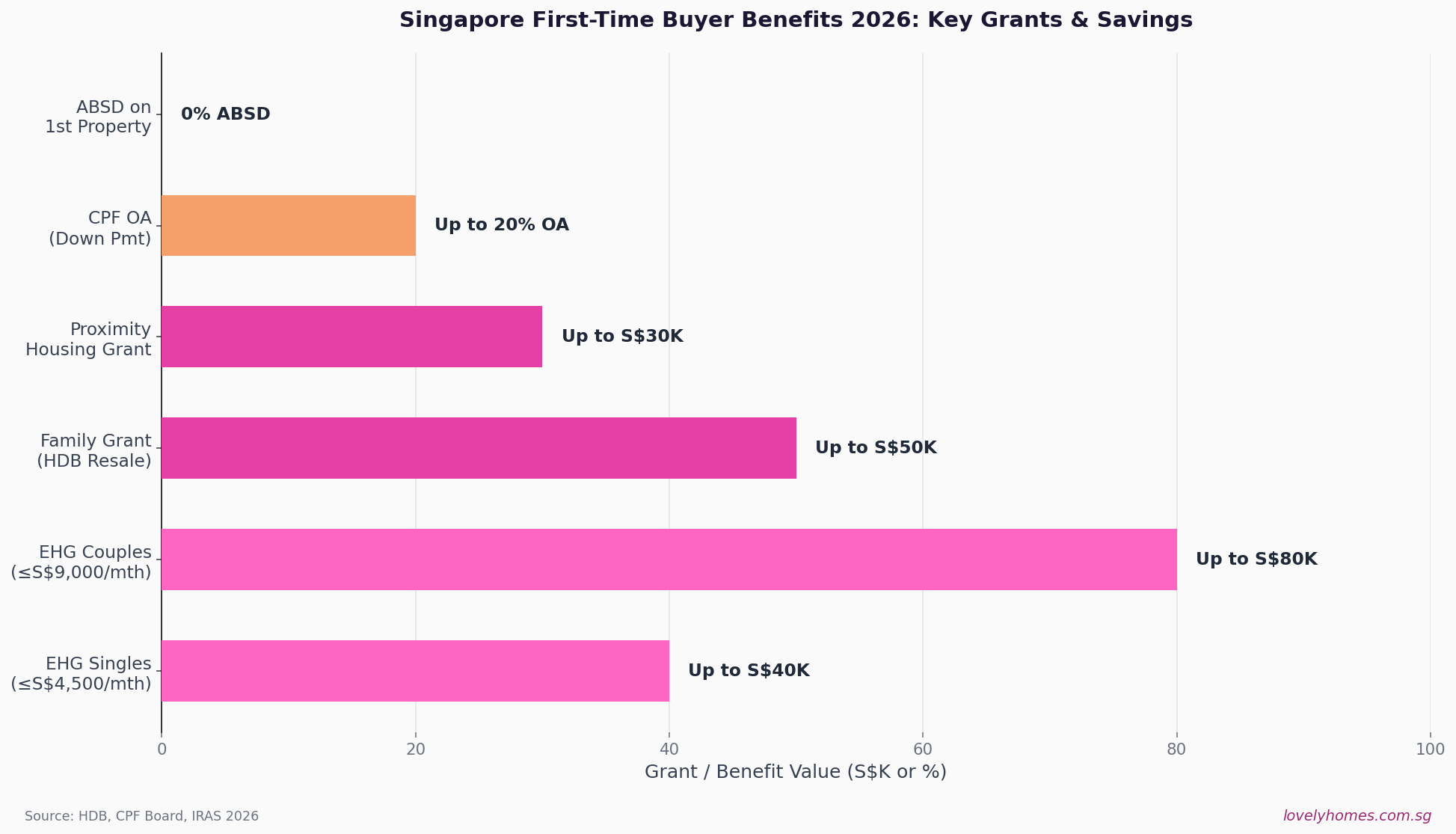
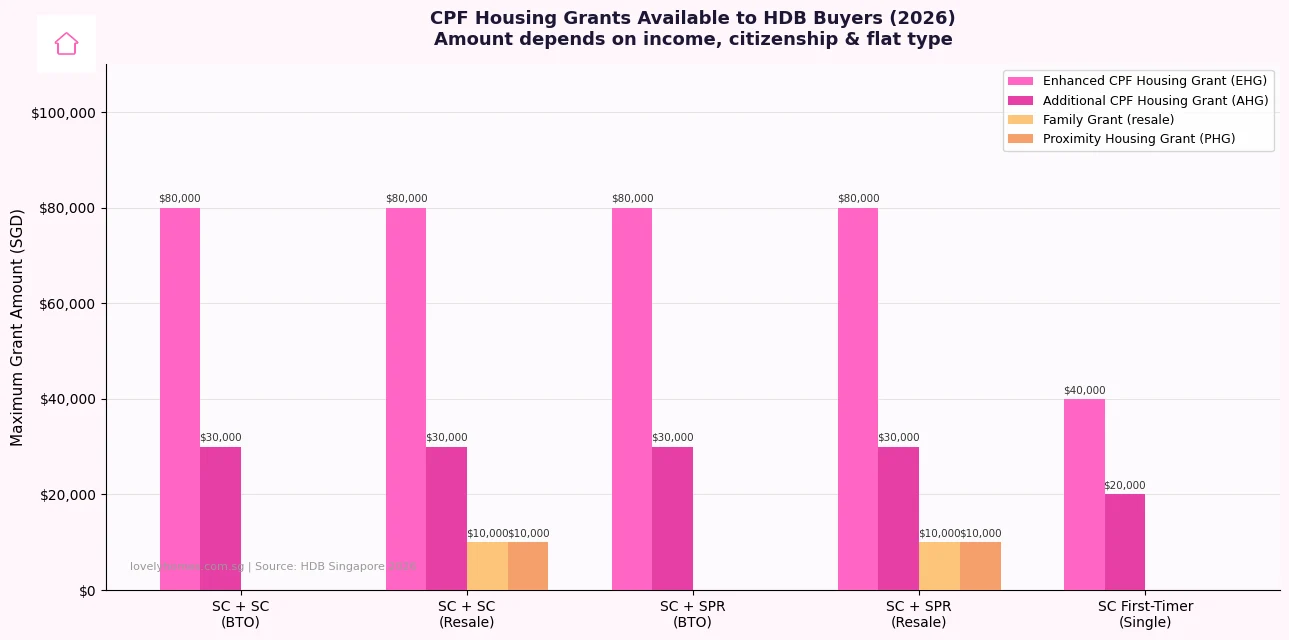
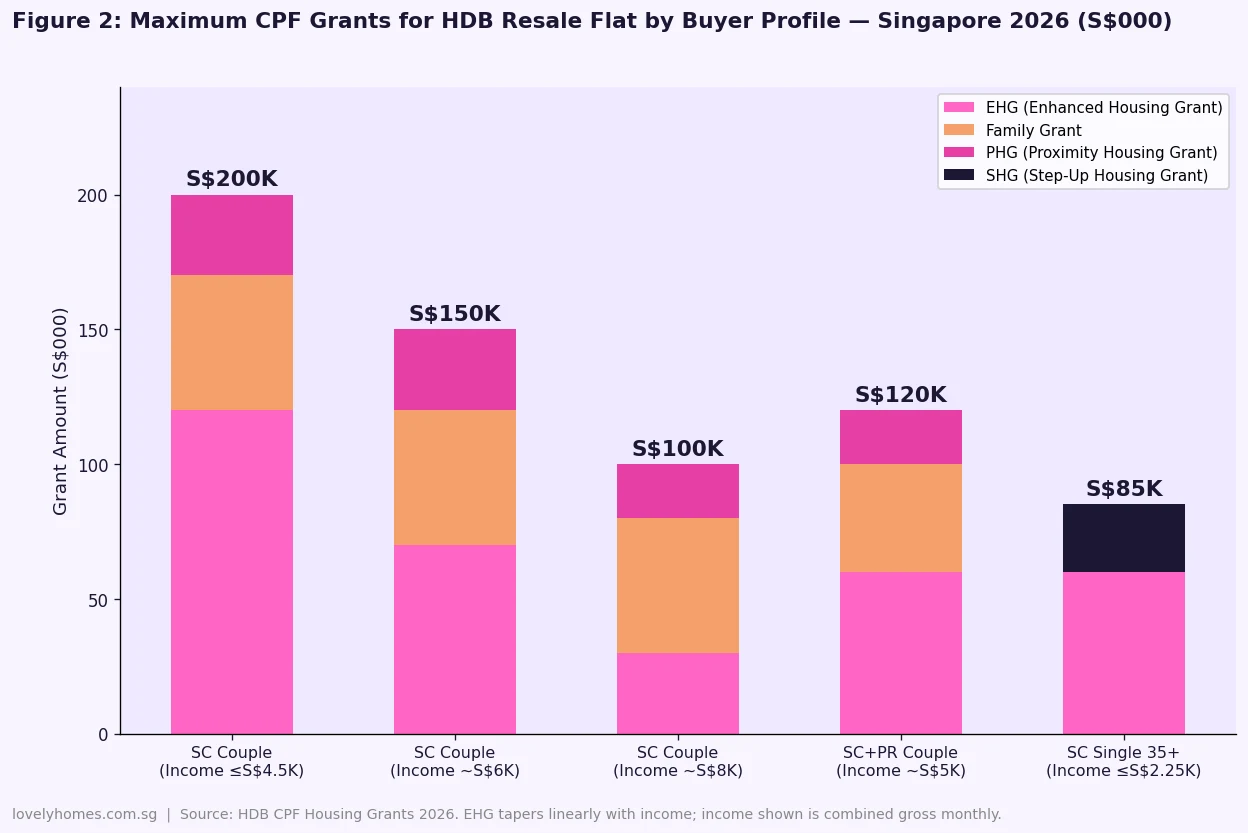
The Enhanced CPF Housing Grant (EHG) — introduced in 2019 and replacing the earlier Additional CPF Housing Grant — is the most generous and broadly available. For couples or families, the EHG provides up to S$80,000 if the household income is S$1,500 per month or below, tapering down in increments as income rises. The grant is zero for households earning above S$9,000 per month. Singles applying for a 2-room Flexi BTO flat in a non-mature estate can receive up to S$40,000, subject to a S$4,500 per month income ceiling. There is no minimum income floor.

The Family Grant applies specifically to resale HDB purchases and supports couples and families buying their first resale flat. An SC-SC couple can receive up to S$50,000, while an SC-SPR couple receives up to S$40,000. The grant is higher for 2-room and 3-room units. The Proximity Housing Grant (PHG) adds up to S$30,000 for those buying a resale flat within 4 kilometres of their parents’ or children’s flat, or up to S$20,000 if buying in the same town.

Singapore first-time buyer grants and benefits 2026 horizontal bar chart
Click image to enlarge
Figure 1: First-time buyer grants and key savings in Singapore (2026). Source: HDB, CPF Board, IRAS.

Step 1 — Obtain Your HDB Flat Eligibility (HFE) Letter

Before you can book a Build-To-Order (BTO) flat or submit an intent to buy for an HDB resale flat, you must hold a valid HDB Flat Eligibility (HFE) Letter. The HFE Letter, introduced in May 2023 as a replacement for the earlier Eligibility Letter, consolidates your housing eligibility, CPF housing grant eligibility, and HDB loan eligibility into a single document. You apply online via the HDB Flat Portal using your Singpass credentials.

The HFE application takes approximately two to three weeks to process. Once issued, the letter is valid for six months for BTO applications and nine months for resale purchases. You will need to reapply if it expires before your purchase is completed. HDB assesses your citizenship status, family nucleus, existing property holdings, and income during the application process. If you are taking an HDB Concessionary Loan, the HFE Letter will also state your approved loan amount based on your income and financial commitments.

Step 2 — Setting Your Budget: Loans, MSR and TDSR

Two key financial ratios govern how much you can borrow for a first-home purchase in Singapore: the Mortgage Servicing Ratio (MSR) and the Total Debt Servicing Ratio (TDSR). These are administered by the Monetary Authority of Singapore (MAS) under MAS Notices 632 and 1115.

For HDB flats and Executive Condominiums (ECs), the MSR caps your monthly home loan repayment at 30% of your gross monthly income. This is the more restrictive of the two ratios for most buyers in the HDB price range. For example, a couple with a combined gross income of S$7,500 per month can service a maximum of S$2,250 per month in mortgage repayments — regardless of how much the bank would otherwise lend.

The TDSR caps total monthly debt obligations at 55% of gross income. This includes all debts: car loans, personal loans, credit card balances and any property loan. For private property purchases (where MSR does not apply), the TDSR is often the binding constraint.

The Loan-to-Value (LTV) ratio determines the maximum percentage of the purchase price (or valuation, whichever is lower) you can borrow. For a first property, an HDB Concessionary Loan offers up to 80% LTV; a bank loan offers up to 75% LTV. The remaining 20–25% must come from cash and/or CPF OA savings, subject to the CPF usage rules.

First-time buyer upfront costs by property type 2026 grouped bar chart
Click image to enlarge
Figure 2: Estimated upfront costs for a first-time buyer by property type (2026). Source: HDB, CPF Board, IRAS.

Step 3 — HDB vs Private Property: Which Is Right for You?

The most fundamental choice for a first-time buyer in Singapore is whether to purchase a public housing (HDB) flat or a private residential property. This choice determines your grant eligibility, loan terms, Minimum Occupation Period (MOP) obligations, and future flexibility.

HDB flats come with significant advantages for first-time buyers: access to CPF housing grants (which are not available for private property), the option of an HDB Concessionary Loan at a lower interest rate (pegged at CPF OA rate + 0.1%, currently 2.6% per annum), and a more affordable entry price in most locations. The trade-off is a 5-year Minimum Occupation Period (MOP) during which you cannot sell or rent out the entire flat, and HDB flats are leasehold (99 years).

Private property — condominiums, apartments and landed homes — offers no MOP (you can sell at any time, though Seller’s Stamp Duty applies if sold within the first three years). Private property can be freehold or leasehold. It does not attract any additional ABSD for a first-time SC buyer. The entry price is substantially higher, and you do not qualify for CPF housing grants on a private purchase. You will need to fund 25% of the purchase price from cash and CPF OA savings (at least 5% in cash), plus Buyer’s Stamp Duty and legal fees.

Executive Condominiums (ECs) occupy a hybrid position: they are developed by private developers but sold by HDB-approved developers at subsidised prices. First-time SC buyers of ECs qualify for CPF housing grants (EHG applies). ECs carry a 5-year MOP and become fully privatised after 10 years. Income ceilings apply: a household income cap of S$16,000 per month (as of 2024) for new EC purchases.

Step 4 — Stamp Duties on Your First Purchase

Buyer’s Stamp Duty (BSD) applies to all property purchases and is administered by IRAS. The rates are progressive: 1% on the first S$180,000 of the purchase price (or market value, whichever is higher), 2% on the next S$180,000, 3% on the next S$640,000, and 4% on the next S$500,000. For residential property above S$1.5 million, additional tiers apply (4% to 6%). BSD is payable within 14 days of signing the Option to Purchase (OTP) or Sales and Purchase Agreement (SPA).

Additional Buyer’s Stamp Duty (ABSD) for a Singapore Citizen purchasing their first residential property: 0%. This is a significant benefit — on a S$800,000 HDB resale flat, a second purchase by an SC would attract S$160,000 in ABSD (at 20%). First-time SPR buyers pay 5% ABSD; first-time foreign buyers pay 60% ABSD. ABSD rates are current as of February 2023 and are subject to revision by MAS and the Ministry of Finance.

Buyer Profile 1st Property ABSD 2nd Property ABSD 3rd+ Property ABSD
Singapore Citizen (SC) 0% 20% 30%
Singapore Permanent Resident (SPR) 5% 30% 35%
Foreigner 60% 60% 60%

Step 5 — CPF Usage for Your First Property

CPF Ordinary Account (OA) savings can be deployed for several aspects of a first-home purchase. For HDB flats, CPF OA funds may cover the down payment, monthly mortgage instalments, stamp duties, and legal fees. For private property, CPF OA covers the down payment (beyond the minimum 5% cash) and monthly instalments, but not stamp duties or legal costs.

For private property, CPF usage is governed by the Valuation Limit (VL) — the lower of the purchase price or market valuation — and the Withdrawal Limit (WL), which is typically 120% of the VL for properties with a remaining lease of at least 60 years. If the property’s remaining lease cannot cover the youngest buyer to age 95, CPF usage is proportionally restricted. Properties with fewer than 30 years remaining lease cannot be purchased using CPF. These rules are set and administered by the CPF Board.

Critically, CPF amounts withdrawn for housing — including monthly instalments — accrue interest at 2.5% per annum. When you sell the property, you must refund the CPF principal withdrawn plus the accrued interest back into your CPF accounts. This is not a penalty; it is a mechanism to preserve your retirement savings. Buyers should model this refund carefully when planning a sale, as the CPF refund obligation reduces your net cash proceeds.

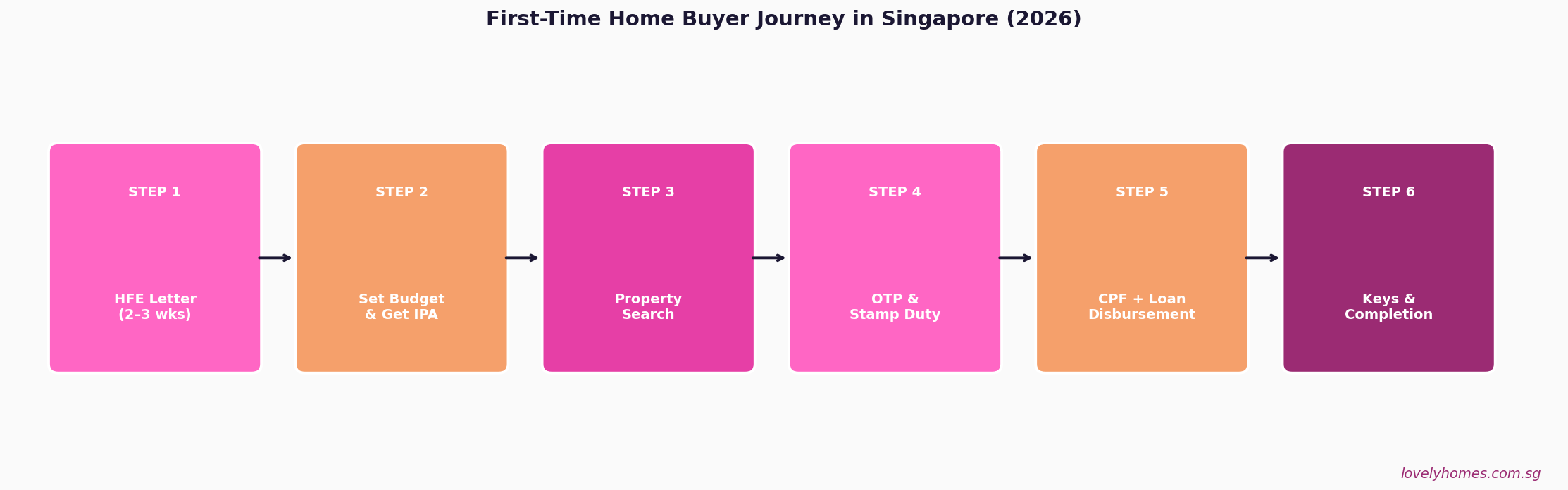
Step 6 — The Buyer’s Journey: Timeline and Key Milestones

The timeline from decision to keys depends heavily on the property type:

HDB BTO: Application → Ballot results (1–3 months) → Flat selection appointment (6–18 months post-ballot) → Agreement for Lease signing → Construction (3–4 years) → Key collection. Total: typically 4–5 years. You pay a booking fee (S$500–S$2,000) and a downpayment at the Agreement for Lease stage, not at ballot.

HDB Resale: Property search → OTP granted (S$1–S$1,000 option fee) → HFE check + financials → Resale application submitted to HDB → HDB inspection + valuation (2–4 weeks) → Completion appointment. Total: approximately 3–4 months from OTP to keys.

Private New Launch (uncompleted): Sales gallery → OTP → Sales and Purchase Agreement within 3 weeks → Deferred Payment Scheme possible → TOP (Temporary Occupation Permit) typically 3–5 years from launch → Legal completion 1 year after TOP. Total: 4–6 years from OTP to keys.

Private Resale: OTP → S&P Agreement (3 weeks) → Legal completion (8–12 weeks). Total: approximately 10–16 weeks from OTP.

Singapore first-time home buyer journey 6 steps flowchart 2026
Click image to enlarge
Figure 3: The first-time home buyer journey in Singapore — 6 key steps from HFE to keys (2026).

Worked Example: The Tan Family Buys a Queenstown Resale HDB

Mr and Mrs Tan are Singapore Citizens in their late 20s, both working, with a combined gross monthly income of S$7,500. They have no existing property and no prior grants received. They want to buy a 4-room HDB resale flat in Queenstown priced at S$600,000.

Grant entitlement:

  • EHG (couples): Income S$7,500 ≤ S$9,000 ceiling → S$40,000
  • Family Grant (SC-SC, 4-room resale): S$50,000
  • PHG: Not applicable (parents not in same town)
  • Total CPF grants: S$90,000 (credited to CPF OA on application)

Financing:

  • Purchase price: S$600,000
  • HDB loan LTV 80%: max loan = S$480,000
  • Minimum cash down payment (5%): S$30,000 (cash)
  • Remaining down payment (15%): S$90,000 — fully covered by CPF grants
  • CPF OA balance remaining for ongoing instalments: any OA savings above the grant drawdown

Stamp duties and fees:

  • BSD: (1% × S$180K) + (2% × S$180K) + (3% × S$240K) = S$1,800 + S$3,600 + S$7,200 = S$12,600
  • ABSD: S$0 (SC, first property)
  • HDB conveyancing fee: approximately S$2,000 (fixed HDB scale)

Monthly instalment check (MSR):

  • Loan: S$480,000 at 2.6% p.a. (HDB Concessionary rate) over 25 years
  • Monthly instalment: approximately S$2,182
  • MSR: S$2,182 ÷ S$7,500 = 29.1% ✓ (below 30% ceiling)
  • TDSR: Assuming no other debts — S$2,182 ÷ S$7,500 = 29.1% ✓ (well below 55%)

Summary — cash outlay on day of completion:

  • Cash down payment: S$30,000
  • BSD (payable at OTP exercise): S$12,600 (cash or CPF OA where applicable, but IRAS requires CPF authorisation; HDB resale allows CPF for BSD)
  • Legal fees: ~S$2,000
  • Total cash needed: approximately S$44,600 (grants cover down payment balance; monthly CPF contributions service the loan)

This illustrates the powerful effect of combining EHG + Family Grant: the Tans effectively halved their cash requirement at purchase while securing a flat in a mature Queenstown estate.

What This Means for First-Time Buyers in 2026

The first-time buyer policy environment in Singapore in 2026 remains one of the most structured and intentionally supportive in the Asia-Pacific region. The 0% ABSD for a first SC purchase, combined with the EHG and Family Grant stack, creates a measurable financial cushion that reduces the entry barrier for younger households. However, the MSR at 30% remains the binding constraint for many buyers targeting HDB resale flats in higher-priced estates — particularly central-region locations where prices have risen significantly since 2020.

For buyers considering private property as their first purchase, the landscape is more demanding. The minimum 5% cash downpayment, BSD, legal fees and the absence of housing grants mean the total upfront cash outlay on a S$1.2M OCR condo could easily exceed S$100,000. TDSR at 55% provides meaningful borrowing headroom for dual-income couples, but rising interest rates in recent years have reduced the effective loan quantum relative to income compared to the low-rate environment of 2018–2021.

What Might Come Next (Looking Ahead)

Property analysts and policy observers have noted that the HDB grant framework has not been materially adjusted since the EHG was last recalibrated in 2021. Should HDB resale prices continue to rise — the HDB resale price index rose by around 4.9% in 2025 — there is a possibility that the income ceilings or grant amounts may be reviewed upward to maintain affordability for median-income households. The Government has in the past adjusted grant quantum in response to resale price escalation.

Separately, MAS periodically reviews the MSR and TDSR thresholds in light of macroeconomic conditions. Neither threshold has changed since 2013 (TDSR) and 2014 (MSR for HDB). Any upward revision — even minor — would meaningfully expand the eligible loan quantum for first-time HDB buyers. This remains speculative and is flagged here as an area to monitor, not a confirmed policy direction.

Frequently Asked Questions

Can I use my CPF OA to buy a private property as my first home?

Yes. CPF OA savings may be used to fund the down payment (beyond the minimum 5% cash) and monthly mortgage instalments on eligible private residential property. However, CPF housing grants — EHG, Family Grant, PHG — are only available for HDB flat purchases. You will also need to comply with CPF Board’s Valuation Limit and Withdrawal Limit rules, and CPF cannot be used for stamp duties or legal fees on a private purchase.

Does buying a property under a family member’s name affect my first-time buyer status?

Yes, it can. HDB checks ownership records for all applicants including co-owners. If you have previously held a financial interest in any HDB flat — even as a co-owner — you may not qualify as a first-time HDB buyer. For ABSD purposes, IRAS assesses each individual owner’s residential property count. Being a co-owner of a property generally counts as ownership for ABSD calculation purposes, even if you did not pay for it directly.

What is the minimum cash downpayment for a first property purchase?

For a first property purchased with a bank loan, the minimum cash component is 5% of the purchase price (the remaining 20% of the 25% minimum downpayment may come from CPF OA). For an HDB Concessionary Loan (where the LTV is 80%), there is no mandatory cash minimum — the full 20% downpayment can be funded from CPF OA or grants, though in practice most buyers have some cash savings beyond this. Stamp duties and legal fees are additional cash or CPF outlays.

Can singles buy an HDB flat as a first-time buyer?

Yes, with conditions. Singapore Citizens aged 35 and above may purchase a new 2-Room Flexi BTO flat in non-mature estates, or a resale HDB flat of any size (as long as they meet income ceilings and eligibility conditions). Singles are also eligible for the EHG (up to S$40,000) and, under certain schemes, may apply for a 5-room or larger resale flat from age 35. The Public Scheme and Single Singapore Citizen Scheme govern these purchases. SPR singles may purchase resale HDB flats only from age 35.

What is the HDB Minimum Occupation Period (MOP) and does it apply to private property?

The Minimum Occupation Period (MOP) for HDB flats is 5 years from the date you collect the keys (BTO) or the date of flat purchase (resale). During the MOP, you cannot sell the flat, sublet the entire flat (you can sublet rooms), or purchase another HDB flat. Executive Condominiums (ECs) also carry a 5-year MOP before privatisation, and a 10-year full privatisation period. Private condominiums and landed property have no MOP — you can sell at any time, though Seller’s Stamp Duty (SSD) applies if sold within 3 years of purchase.

How long does the HFE Letter application take?

The HDB Flat Eligibility (HFE) Letter typically takes approximately 2 to 3 weeks to process after a complete application is submitted via the HDB Flat Portal using Singpass. Processing time may be longer during periods of high BTO exercise volume. The letter is valid for 6 months for BTO applications and 9 months for resale flat purchases. You should apply well in advance of your intended property search to avoid delays.

Related Articles

Disclaimer: This article is produced for general informational and educational purposes only. It does not constitute financial, legal, or property advice. Policies, grant amounts, interest rates, ABSD rates, LTV limits, MSR and TDSR thresholds are subject to change by the relevant Singapore government authorities including HDB, MAS, CPF Board, IRAS and the Ministry of Finance. Figures, examples and calculations are illustrative and based on information available as at 2 August 2026. Readers should verify all information with the official sources — HDB, IRAS, CPF Board, MAS, URA — and seek advice from a licensed financial adviser and conveyancing solicitor before making any property purchase decision.

CPF Housing Grants Complete Guide Singapore 2026: EHG, Family Grant and PHG Explained

CPF Housing Grants Complete Guide Singapore 2026: EHG, Family Grant and PHG Explained

Quick Answer — CPF Housing Grants at a glance (2026)

  • Singapore Citizens buying an HDB flat may qualify for up to S$190,000 in CPF housing grants (EHG + Family Grant + Proximity Housing Grant combined).
  • Grants do not need to be repaid — they are funded by the Government and credited directly against the flat purchase price.
  • The Enhanced CPF Housing Grant (EHG) is the largest grant: up to S$80,000 for couples, up to S$40,000 for eligible singles. It applies to both BTO and resale flats.
  • The Family Grant (up to S$30,000) and Proximity Housing Grant (up to S$30,000) apply to resale flat purchases only.
  • Your grant eligibility is confirmed in your HDB HFE Letter. You must obtain an HFE letter before applying for any HDB flat.
  • Income ceilings: S$9,000/month for EHG (couples); S$14,000/month for Family Grant; no ceiling for PHG.
  • Grants are not transferable to private property — they apply exclusively to HDB flat purchases.

CPF housing grants are one of the most powerful but least understood tools in Singapore’s housing system. For a first-timer couple on a combined income of S$3,000/month buying a resale flat near their parents, total grants can reach S$125,000 — a sum that meaningfully reduces both the flat price and the mortgage they need to service for the next 25 years. Yet many eligible buyers under-claim or miss grants entirely because they do not understand which schemes apply to their specific profile.

This guide covers every CPF housing grant available in 2026, how to calculate what you qualify for, how the grants stack with one another, and how they interact with the HDB concessionary loan. All figures reflect the framework administered by the Housing & Development Board (HDB) and the Central Provident Fund (CPF) Board as at 31 July 2026.

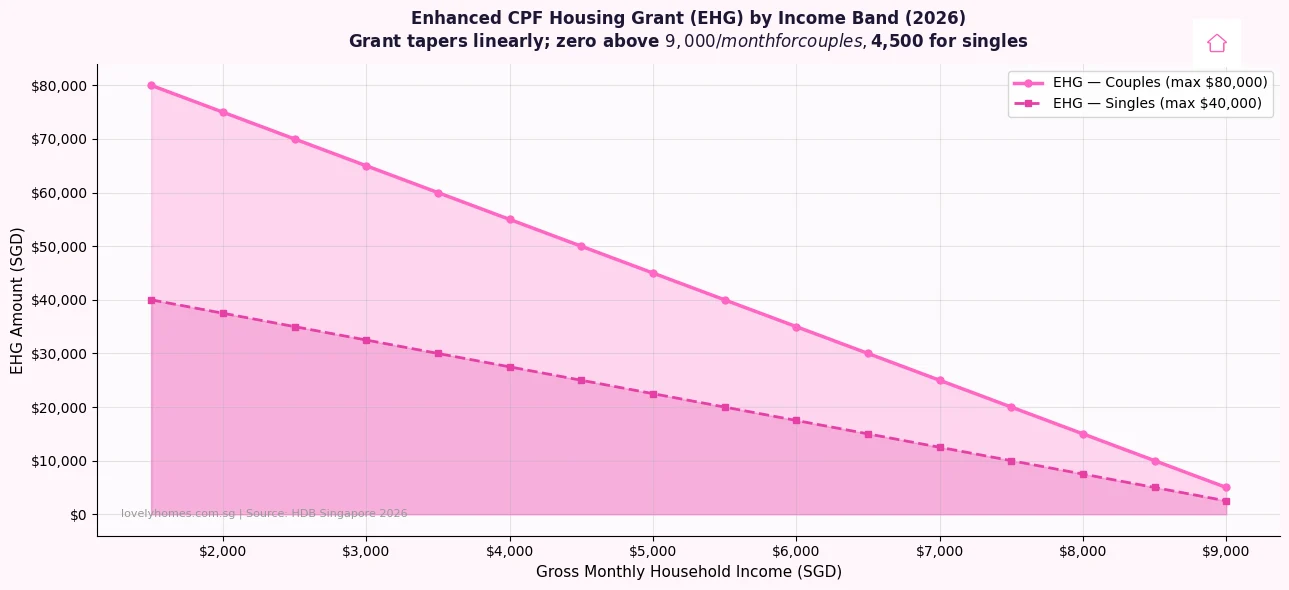
CPF Enhanced Housing Grant EHG by monthly income Singapore 2026 couples singles
Figure 1: EHG amount by gross monthly household income (2026). The grant tapers linearly from S$80,000 at S$1,500/month to S$5,000 near the S$9,000 ceiling for couples.

What Are CPF Housing Grants?

CPF housing grants are direct subsidies paid by the Singapore Government to eligible HDB flat buyers. Unlike the HDB concessionary loan (which must be repaid with interest) or CPF Ordinary Account savings (which are your own money that must be refunded with accrued interest when you sell), grants are free money. They are credited at the point of flat booking or resale completion and applied directly to reduce the purchase price, which in turn reduces the loan quantum you need to service.

Grants are funded from the Singapore Government’s budget allocation for housing affordability and are not drawn from the CPF fund pool itself. Despite being called “CPF housing grants,” the CPF Board administers the disbursement, but the grants are Government expenditure. This distinction matters because grants received do not attract CPF accrued interest — only the CPF OA savings you use toward the flat purchase do.

The Five Main CPF Housing Grants in 2026

1. Enhanced CPF Housing Grant (EHG)

The EHG is the flagship grant, introduced in September 2019 to replace both the Special CPF Housing Grant (SHG) and the Additional CPF Housing Grant (AHG) for new flat buyers. It is now available for both BTO and resale flat purchases, making it the first grant to apply universally regardless of flat type.

The EHG is income-tiered. For first-timer couples earning up to S$9,000/month: the grant ranges from S$5,000 (at the S$9,000 income ceiling) to S$80,000 (at or below S$1,500/month). The formula is linear — every additional S$1,000 in monthly household income reduces the EHG by approximately S$10,000. For eligible singles aged 35 and above under the Single Singapore Citizen scheme, the EHG is half the couple amount: up to S$40,000 for incomes at or below S$4,500/month.

Critical condition: to qualify for EHG, at least one applicant must not have previously received an EHG, SHG, or AHG. There is also a work requirement — at least one applicant must be employed continuously for the 12 months immediately before the flat application.

2. Additional CPF Housing Grant (AHG — Resale Only)

The AHG for resale flats is a legacy grant now superseded for BTO purchases by the EHG. For resale flat purchases only, first-timer families earning at or below S$5,000/month may receive the AHG (up to S$40,000) in addition to the EHG. This stacking of EHG + AHG is specifically designed to support lower-income families who need to buy on the resale market because BTO wait times (3–5 years) are not compatible with their immediate housing needs.

Note: the AHG for resale is distinct from the old AHG that applied to BTO purchases, which was discontinued when the EHG launched.

3. Family Grant

The Family Grant applies exclusively to resale flat purchases by first-timer and second-timer families. The amount depends on citizenship composition:

Buyer Profile Family Grant (Resale) Income Ceiling
SC + SC (first-timer couple) S$30,000 None
SC + SPR (first-timer couple) S$20,000 None
SC or SC+SC (second-timer couple) S$15,000 None
SC + SPR (second-timer couple) S$10,000 None

The Family Grant has no income ceiling, which makes it accessible to all HDB buyers in the resale market regardless of earnings. However, it does require a qualifying family nucleus and that neither applicant previously received a Family Grant or Half-Housing Grant for the same flat type.

4. Proximity Housing Grant (PHG)

The PHG is designed to encourage multi-generational living and reduce inter-generational distance. It applies to resale flat purchases only. The grant is tiered by how close the buyer lives to their parents (or parents-in-law) or children:

Living Arrangement PHG Amount Income Ceiling
Living with parents / parents-in-law (in the same flat) S$30,000 None
Living within 4 km of parents / parents-in-law S$20,000 None
Living with children (in the same flat) S$10,000 None
Living within 4 km of children S$10,000 (same unit) / S$20,000 (within 4 km) None

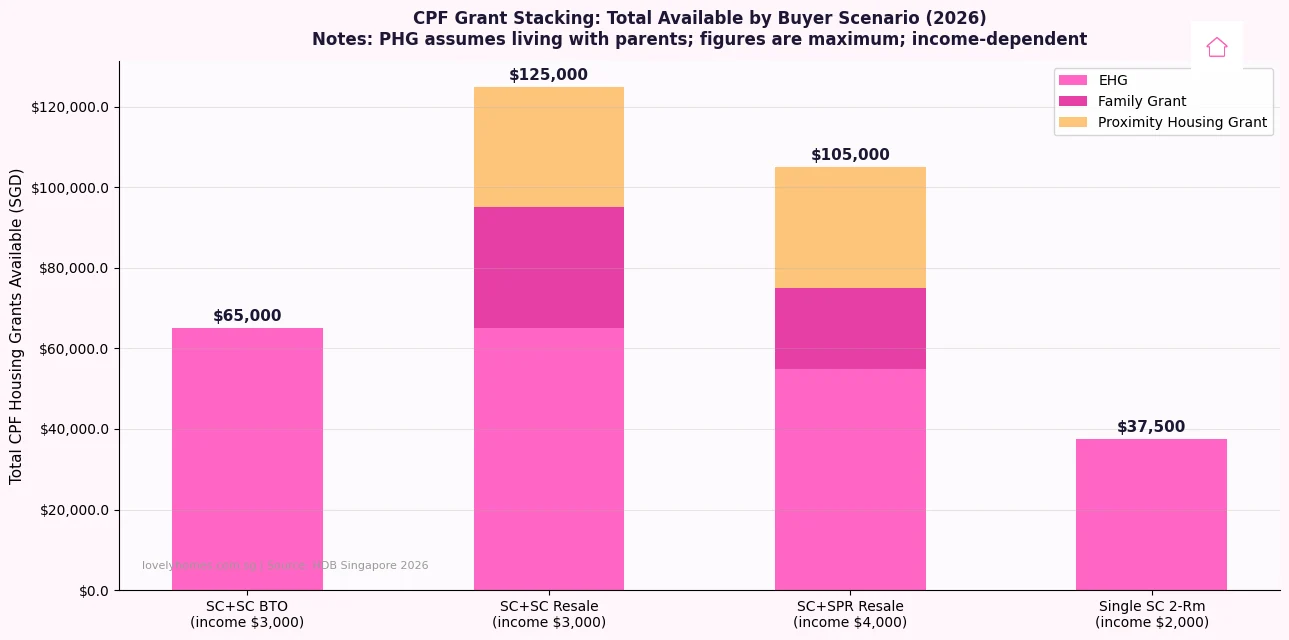
The PHG is stackable with the Family Grant and EHG for resale purchases. A couple buying a resale flat near their parents could receive EHG + Family Grant + PHG simultaneously, bringing total grants to S$80,000 + S$30,000 + S$30,000 = S$140,000 if they are on a low income.

5. Step-Up CPF Housing Grant

The Step-Up Grant (S$15,000) specifically targets second-timer families who currently live in a 2-Room Flexi or smaller HDB flat (bought with housing subsidies) and are upgrading to a 3-Room or larger resale flat. Income ceiling: S$7,000/month. This grant acknowledges that a family’s circumstances improve over time and that the move from a small starter flat to a larger home deserves targeted support. Unlike the Family Grant which is available to all second-timers, the Step-Up Grant is exclusively for this transitional scenario.

CPF housing grants stacking scenarios Singapore 2026 EHG Family Grant PHG
Figure 2: Total CPF grant amounts across four buyer scenarios (2026). A low-income SC+SC couple buying resale near parents can stack up to S$125,000 in grants.

Grant Eligibility Matrix: Which Grant Applies to Which Flat Type

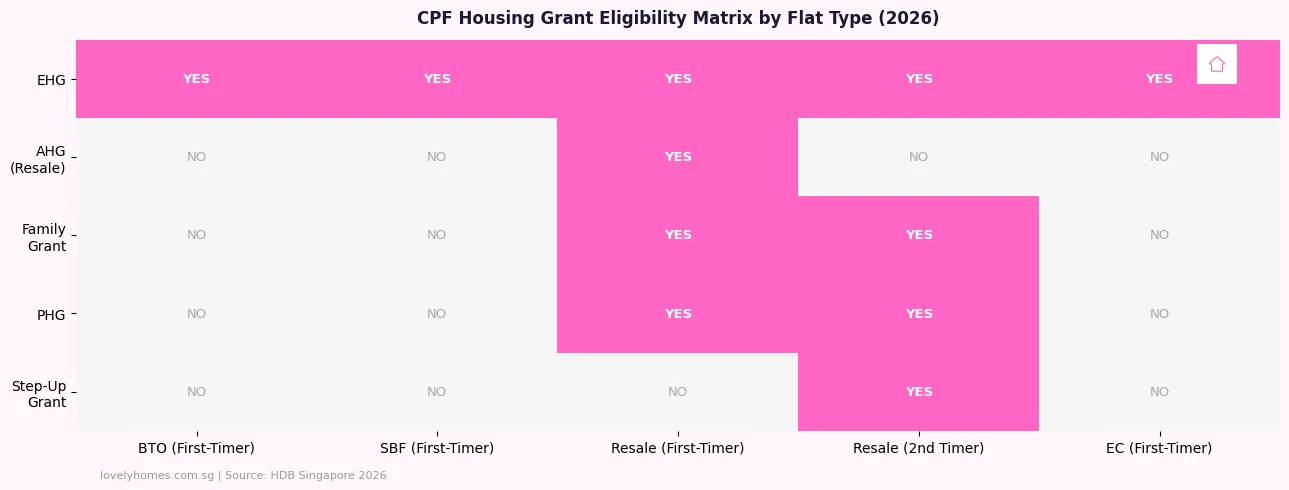
CPF housing grants eligibility matrix flat type BTO resale EC Singapore 2026
Figure 3: CPF housing grant eligibility by flat type. Resale flat buyers have access to the widest range of grants, including Family Grant and PHG not available for BTO.

Summary: All Grants at a Glance

Grant Max Amount BTO? Resale? Income Ceiling Citizenship
Enhanced CPF Housing Grant (EHG) S$80,000 (couples)
S$40,000 (singles)
Yes Yes S$9,000/mth (couples)
S$4,500/mth (singles)
At least 1 SC
AHG (Resale) S$40,000 No Yes S$5,000/mth At least 1 SC
Family Grant S$30,000 (SC+SC) No Yes None At least 1 SC
Proximity Housing Grant (PHG) S$30,000 No Yes None At least 1 SC
Step-Up CPF Housing Grant S$15,000 No Yes (3-Rm+) S$7,000/mth At least 1 SC
EHG (EC) S$30,000 (tiered) EC only No S$9,000/mth At least 1 SC

Worked Example: The Wong Family at S$3,000/month Income

Mr and Mrs Wong are a married Singapore Citizen couple, both first-timers. Their combined gross monthly income is S$3,000. They want to buy a 4-Room resale HDB flat near Mrs Wong’s parents in Tampines (within the same block).

  • EHG: Income S$3,000/month → EHG = S$65,000 (couples, tapering from S$80,000 at S$1,500 to S$5,000 at S$9,000).
  • Family Grant: SC+SC first-timer resale → S$30,000.
  • PHG: Living with parents (same flat) → S$30,000. (Note: the Wongs are buying to live with Mrs Wong’s parents; parents apply for the PHG on their side if they are the purchasers. Here, the Wongs buy the resale flat and the parents move in — PHG of S$30,000 applies to the Wongs’ purchase.)
  • Total grants: S$125,000
  • Flat price (illustrative): S$520,000 → after grants: effective purchase price S$395,000.
  • HDB loan (80% LTV on S$395,000 net): approximately S$316,000 → monthly instalment ~S$1,444/month at 2.6% p.a. over 25 years, payable from CPF OA.
  • Minimum cash required at exercise: 1% OTP deposit = S$5,200. Balance 19% from CPF OA (S$93,800 less grants already applied).

This example demonstrates the transformative effect of grant stacking for lower-income first-timers. Without grants, the Wongs would need to fund S$104,000 (20% of S$520,000) from CPF and cash, plus service a S$416,000 loan at S$1,901/month — an 80% higher monthly payment than the grant-assisted scenario.

How Grants Interact with CPF OA Savings and Accrued Interest

One nuance that many buyers miss: grants reduce the flat price at the point of purchase, but they do not attract CPF accrued interest. Your CPF OA savings used toward the flat, however, do attract the prevailing CPF OA interest rate (2.5% p.a.) on the amount withdrawn, compounded annually. When you eventually sell the flat, the CPF Board requires you to refund the principal withdrawn plus the accrued interest back into your CPF OA before you receive any net cash proceeds.

Because grants are not CPF OA funds but Government subsidies, no accrued interest accumulates on the grant portion. The practical implication: using grants to reduce your flat price is strictly better than using CPF OA savings, because the grant portion carries zero future repayment obligation.

Second-Timer Grant Restrictions and the 30-Month Rule

Second-timer buyers — those who have previously purchased a subsidised HDB flat or received a housing grant — face reduced or nil grant eligibility for a second HDB purchase. HDB’s general rule is that second-timers must wait 30 months from the date of disposal of the first subsidised flat before purchasing another HDB flat with subsidies. Some grant schemes (Family Grant, Step-Up Grant) are available to second-timers under specific conditions; the EHG is not available to second-timers. Always verify your second-timer status via the HDB HFE letter before budgeting on grants.

What Might Come Next: Grant Evolution in Singapore’s Housing Policy

As at July 2026, Singapore’s CPF housing grant framework has been relatively stable since the EHG’s introduction in 2019. However, two policy pressures suggest evolution is possible: rising resale flat prices in prime estates (where even lower-income buyers face S$600,000–S$800,000 price points), and the expanding Prime Location Public Housing (PLH) model which restricts resale to Singapore Citizens only for 10 years. There is ongoing discussion among housing researchers about whether the PHG could be extended to BTO purchases to encourage multi-generational flat selection from the outset. No announcement has been made as at this guide’s publication date.

Related Articles

Frequently Asked Questions

Can I use CPF housing grants to buy a private condominium?

No. CPF housing grants — the EHG, Family Grant, PHG, Step-Up Grant, and all related HDB schemes — apply exclusively to HDB flat purchases. They cannot be used toward a private condominium, landed property, or Executive Condominium after the EC has been privatised. If you are buying a new EC (before privatisation), a scaled-down EHG may apply, but the Family Grant and PHG do not. Private property buyers may still use their CPF Ordinary Account savings toward the purchase, but those savings attract accrued interest obligations, not grants.

Do I need to repay CPF housing grants if I sell my HDB flat?

No. CPF housing grants are non-repayable Government subsidies. Unlike CPF OA savings (which must be refunded with accrued interest to your CPF OA account when you sell), grants do not need to be repaid. However, if you sell a subsidised HDB flat and then buy another subsidised flat, the second purchase will typically not attract the same grants (particularly the EHG), because most grants are available only to first-timers. Selling and buying again does not “reset” your grant entitlement unless HDB explicitly designates a new category for second-timers.

Can singles receive CPF housing grants?

Yes, but with restrictions. Single Singapore Citizens aged 35 and above may receive the EHG for singles (up to S$40,000) when buying a 2-Room Flexi BTO flat or any size resale flat. The income ceiling for singles is S$4,500/month. Singles are not eligible for the Family Grant or PHG (which require a family nucleus), but may apply for a reduced PHG under certain conditions if moving near their parents. The Step-Up Grant is available to eligible singles who own a 2-Room Flexi flat and are upgrading.

What is the income used to calculate CPF housing grants?

HDB uses the gross monthly household income for the 12 months immediately preceding the flat application. This includes all income sources: employment income, self-employment income, rental income, and overseas income. The 12-month average is calculated and compared against the income ceiling. Bonuses, director’s fees, and commission income are included. CPF contributions (both employee and employer) are not deducted for this calculation — HDB uses the gross figure before CPF deduction. Individuals with zero income (e.g., homemakers) are recorded at zero; the total is the combined household figure of all persons listed on the flat application.

Can both the buyer and seller of a resale flat receive grants in the same transaction?

Grant eligibility is assessed independently for buyer and seller. The buyer of a resale flat may receive the EHG, Family Grant, and/or PHG as applicable to their profile. The seller has no grant entitlements in relation to the sale — grants are a buyer-side benefit. If the seller is using their sale proceeds to purchase another subsidised HDB flat, they would apply for grants in that subsequent purchase. The fact that the buyer receives S$125,000 in grants does not affect the sale price negotiation — grants reduce the effective cost to the buyer but do not change what the seller receives.

How are grants disbursed — cash or CPF?

CPF housing grants are credited directly to your CPF Ordinary Account at the point of flat booking (for BTO) or upon completion (for resale). They are not paid in cash. The credited amount is then used toward the flat purchase together with your other CPF OA savings, reducing the loan quantum required. Because grants are added to your CPF OA rather than paid directly to the seller, they are subject to standard CPF housing withdrawal rules — you must have sufficient CPF OA balance to cover the required down payment after the grant is applied. Critically, because grants arrive in your CPF OA, they also carry no accrued interest obligation when the flat is eventually sold.

What happens to my CPF housing grants if my flat application is cancelled?

If you cancel a BTO flat application before booking (i.e., before grants are formally disbursed), your grant entitlement is preserved — cancellation at the application stage does not consume your first-timer grant status. However, if you have already booked a flat and grants have been credited to your CPF OA, then you cancel or forfeit the flat, the situation becomes more complex: HDB will recover the grant from your CPF OA, and depending on the circumstances, your first-timer status and future grant eligibility may be affected. For resale transactions, if the OTP lapses before completion, grants that have not been formally disbursed are simply not paid. Always check with HDB directly if you are in a cancellation scenario.

Disclaimer

This article is for general informational purposes only. CPF housing grant amounts, income ceilings, and eligibility conditions are subject to revision by the Singapore Government. Always verify current grant entitlements directly with the Housing & Development Board (HDB) and the CPF Board through the HDB My Flat Journey portal and your HDB Flat Eligibility (HFE) letter. This article does not constitute financial, legal, or housing advice.

HDB HFE Letter Guide Singapore 2026: How to Apply, Check Status & Use Your Letter

HDB HFE Letter Guide Singapore 2026: How to Apply, Check Status & Use Your Letter

Quick Answer — HDB HFE Letter at a glance

  • The HDB Flat Eligibility (HFE) letter replaced the old HDB Loan Eligibility (HLE) letter from 9 May 2023.
  • You must have a valid HFE letter before submitting a BTO application, selecting a resale flat, or exercising an Option to Purchase (OTP).
  • An HFE letter is issued within 14 working days and is valid for 9 months.
  • It covers in one document: flat eligibility, CPF housing grant eligibility, and HDB concessionary loan eligibility.
  • The application is done entirely online via HDB My Flat Journey (MFJ) using SingPass; all co-applicants must consent.
  • Income ceiling for most grants: S$14,000/month for couples; S$7,000/month for singles (select flat types).
  • HDB concessionary loan LTV: up to 80%; bank loan LTV: up to 75%.

If you are buying an HDB flat in Singapore — whether a new Build-To-Order (BTO) flat, a Sale of Balance Flat (SBF), or a resale flat from the open market — the HDB Flat Eligibility (HFE) letter is the gateway document that determines what you can buy, how much you can borrow from HDB, and how much in CPF housing grants you qualify for. Without it, you cannot proceed to application.

This guide explains exactly what the HFE letter is, who needs it, how to apply step by step, what to do if your application is rejected, and how to use your HFE letter once you have it. All figures reflect the rules administered by the Housing & Development Board (HDB) as at 31 July 2026.

HDB HFE Letter application 5-step process Singapore 2026
Figure 1: The 5 steps to obtaining your HDB HFE Letter — from eligibility check to flat purchase.

What is the HDB HFE Letter?

The HDB Flat Eligibility (HFE) letter is an integrated eligibility assessment issued by HDB. Prior to 9 May 2023, buyers had to obtain separate documents: a Housing Loan Eligibility (HLE) letter for HDB loans, a CPF housing grant eligibility check, and a general flat eligibility check. The HFE letter consolidates all three into a single, time-limited document. HDB administers it; the CPF Board and the Monetary Authority of Singapore (MAS) inform the underlying eligibility rules for grants and loan-to-value (LTV) caps respectively.

The HFE letter tells you three things before you spend a single dollar:

  1. Which HDB flat types you are eligible to purchase (BTO, SBF, resale, or Executive Condominium).
  2. The CPF housing grants you qualify for — the Enhanced CPF Housing Grant (EHG), Additional CPF Housing Grant (AHG, resale), Family Grant, Proximity Housing Grant (PHG), and Step-Up CPF Housing Grant.
  3. Whether you qualify for an HDB concessionary loan and the maximum loan quantum HDB will extend to you based on your income, CPF balances, and existing property.

Who Needs an HFE Letter?

You need a valid HFE letter if you intend to:

  • Apply for a new flat under a BTO, SBF, or Open Booking exercise;
  • Register intent to buy a resale HDB flat; or
  • Exercise an Option to Purchase (OTP) for a resale flat.

You do not need an HFE letter if you are buying a private condominium or landed property — that falls outside HDB’s remit entirely. However, if you intend to use CPF Ordinary Account (OA) savings toward a private property purchase, you will need a CPF withdrawal application separately.

Eligibility Criteria: Who Can Apply?

To be eligible for an HFE letter, you and your co-applicant(s) must meet HDB’s flat eligibility conditions. The core criteria are citizenship and family nucleus requirements — HDB does not sell new flats to individuals; a qualifying family nucleus is the fundamental test. The following applies as at 2026:

Criterion Requirement (General)
Citizenship At least one applicant must be a Singapore Citizen (SC). Co-applicants may be SC or Singapore Permanent Resident (SPR). Foreigners may not purchase HDB flats.
Age All applicants must be at least 21 years old (single or widowed orphan schemes: 35 years old).
Family nucleus Must form a qualifying family nucleus: married couple, fiancé/fiancée couple, parent(s) with child(ren), siblings, or single (35+, specific schemes only).
Property ownership Must not own or have disposed of any HDB flat, DBSS flat, or private residential property in the 30 months before application (resale) or flat application (BTO).
Income ceiling Combined gross monthly household income ≤ S$14,000 for most schemes; ≤ S$7,000 for singles (2-Room Flexi BTO). Executive Condominiums: ≤ S$16,000.
Previous housing subsidies Second-timer restrictions apply if you have previously received a CPF housing grant or purchased a subsidised flat.

CPF Housing Grants Available via the HFE Letter

The HFE letter is the gateway to CPF housing grants. These grants are funded by the Singapore Government and administered through HDB. The amount you receive is calculated based on your household income, citizenship composition, and flat type. Grants are used to offset the purchase price directly — they reduce the amount you need to pay in cash or CPF OA, or they reduce your outstanding mortgage with HDB.

CPF housing grants HDB buyers Singapore 2026 — EHG AHG Family Grant PHG
Figure 2: Maximum CPF housing grant amounts by buyer profile and flat type (2026). Actual amounts depend on income tier.

Enhanced CPF Housing Grant (EHG)

The EHG is the largest grant available and replaced the Special CPF Housing Grant (SHG) and Additional CPF Housing Grant (AHG) for new flat purchases. It is available to first-timer families earning ≤ S$9,000/month. The maximum is S$80,000 for couples earning up to S$1,500/month; the grant tapers to S$5,000 for incomes near the S$9,000 ceiling. Critically, EHG can be used toward both BTO and resale HDB flats — the grant amount is determined at application based on the preceding 12 months’ income.

Additional CPF Housing Grant (AHG — Resale)

The AHG for resale flat purchases (up to S$40,000) applies to first-timer families earning ≤ S$5,000/month who are buying a resale flat. It is used alongside the EHG to give lower-income buyers meaningful purchasing power in the resale market without requiring a new BTO flat.

Family Grant

The Family Grant (up to S$30,000 for SC+SC couples, S$20,000 for SC+SPR couples) applies to resale flat purchases. It does not have an income ceiling but does require a qualifying family nucleus. It is used with the EHG for resale purchases.

Proximity Housing Grant (PHG)

The PHG (up to S$30,000 for living with parents; S$20,000 for living within 4 km of parents) is available for resale flat purchases only. It has no income ceiling. The PHG is designed to encourage multi-generational living and reduce the burden on Singapore’s public transport and caregiving infrastructure.

Step-Up CPF Housing Grant

The Step-Up Grant (S$15,000) is specifically for second-timer families who currently live in a 2-Room or smaller HDB flat and are moving to a 3-Room or larger resale flat. Income ceiling: S$7,000/month. This grant bridges the gap for families who have already used previous housing subsidies.

HDB Concessionary Loan vs Bank Loan: What the HFE Tells You

Once the HFE letter is issued, it also states your eligibility for the HDB concessionary loan. This loan charges an interest rate pegged at 0.1% above the prevailing CPF Ordinary Account (OA) interest rate, which has been 2.5% per annum since 1999 — giving an effective rate of 2.6% p.a. (as at July 2026). This is generally lower than bank mortgage rates, which in mid-2026 have drifted between 3.2–3.7% p.a. for 2-year fixed packages.

Key differences the HFE letter determines:

Feature HDB Concessionary Loan Bank Loan
Max LTV (new flat) 80% of purchase price 75% of purchase price / valuation
Interest rate (Jul 2026) 2.6% p.a. (CPF OA + 0.1%) 3.2–3.7% p.a. (market rates)
Down payment (cash) None required (can be fully CPF) Minimum 5% in cash
Eligibility restriction Must not own private property; income ceiling applies Assessed by lender on TDSR/MSR
Refinancing No — fixed for life of loan Refinanceable after lock-in period
Prepayment penalty None May apply within lock-in

HDB’s LTV cap of 80% means you must fund the remaining 20% from CPF OA savings and/or cash. If your CPF OA balance is sufficient, you may pay no cash at all at the point of purchase — a critical advantage for first-time buyers.

HDB HFE letter income ceiling loan limits eligibility Singapore 2026
Figure 3: HDB HFE letter income ceilings and key borrowing limits at a glance.

How to Apply for the HFE Letter: Step by Step

The entire HFE application process is handled online through HDB’s My Flat Journey (MFJ) portal. There is no physical form, no queue at the HDB Hub, and no in-person interview required for a standard application. Here is the process in full:

  1. Step 1 — Check flat eligibility. Log in to HDB My Flat Journey with SingPass. Use the online self-assessment tool to confirm you meet the basic eligibility criteria before investing time in the full application.
  2. Step 2 — Initiate the HFE application. All co-applicants must log in and give their digital consent via SingPass. HDB will draw on Myinfo data (income records from IRAS, CPF balances, property ownership records) automatically. You do not need to upload payslips separately if your employer reports income through SingPass Myinfo.
  3. Step 3 — Wait for processing. HDB targets a turnaround of 14 working days. Complex cases (self-employed applicants, overseas income, undischarged bankrupts) may take longer. You will be notified via the MFJ portal and by SMS/email when the letter is ready.
  4. Step 4 — Receive and review your HFE letter. The letter will state: (a) flat types you may purchase; (b) grant amounts you qualify for; (c) whether you are eligible for an HDB concessionary loan and the maximum loan ceiling. Review it carefully — the loan ceiling is calculated conservatively and may differ from your actual borrowing capacity under TDSR.
  5. Step 5 — Proceed to flat application or OTP exercise. Your HFE letter is valid for 9 months from the date of issue. You must submit your BTO/SBF application, register intent to buy, or exercise the OTP within this window. If it lapses, you must reapply.

Worked Example: The Lim Family’s HFE Journey

Mr and Mrs Lim are a Singapore Citizen couple, both aged 30, getting married in October 2026. Their combined gross monthly income is S$7,200. They want to apply for a BTO 4-Room flat in Tengah (OCR). Here is how the HFE letter plays out for them:

  • Eligibility: Married couple, both SC, income ≤ S$14,000 — eligible for BTO.
  • EHG: Combined income S$7,200/month → EHG = S$25,000 (grant tapers; full S$80,000 is for ≤ S$1,500/month couples).
  • HDB concessionary loan: Maximum loan quantum is calculated at approximately 30% of monthly income × loan tenure in months. At S$7,200/month income and 25-year tenure: roughly S$720,000 ceiling (subject to TDSR and MSR). The 4-Room BTO in Tengah is estimated at S$490,000 — well within the loan ceiling.
  • Down payment required: 20% × S$490,000 = S$98,000. EHG of S$25,000 offsets the purchase price → effective amount to fund: S$73,000 from CPF OA. If CPF OA balance is sufficient, zero cash required at purchase.
  • Monthly instalment (HDB loan 2.6% p.a., 25 yr): Loan = S$465,000 (S$490,000 less S$25,000 EHG) × 0.8 = S$372,000 → approximately S$1,700/month, payable entirely from CPF OA.

This example illustrates why the HFE letter is not bureaucracy for its own sake — it gives buyers a precise financial picture before they commit to a flat.

Minimum Occupation Period (MOP) and Why It Matters

Once you purchase an HDB flat, you are subject to a Minimum Occupation Period (MOP) before you can sell or rent out the entire flat. The MOP for most HDB flats is 5 years from the date you collect your keys. For new BTO flats in prime locations under the Prime Location Public Housing (PLH) model, the MOP is extended to 10 years. The HFE letter does not state the MOP directly, but the flat type it confirms eligibility for will determine which MOP applies.

Understanding MOP is critical for buyers who may wish to upgrade to a private property in the medium term. The MOP clock starts only from key collection — not from the BTO application date or the signing of the sale agreement. For a BTO flat with a typical 3–5 year construction period, a buyer applying in 2026 might not complete their MOP until 2033 or 2034.

What if Your HFE Letter is Rejected or Shows Lower Entitlements?

An HFE letter may come back with lower grant amounts than expected, or it may indicate ineligibility entirely. Common reasons include: income exceeding the ceiling; a previous HDB flat disposal within the 30-month window; undischarged debts to HDB from a prior flat; or a co-applicant who owns private property. If you believe an error has been made, you may appeal in writing to HDB within 30 days of the letter’s issuance date, providing documentary evidence (IRAS tax assessments, CPF statements, deed of sale for previous property, etc.).

What This Means for You: HFE as a Planning Tool

The HFE letter is best understood not as an obstacle but as a planning tool. By applying early — before you even know which BTO exercise you want to ballot for — you gain five advantages: (1) you know your maximum loan ceiling under the HDB concessionary rate; (2) you have exact grant figures to plug into your financial model; (3) you avoid the risk of exercising an OTP and then discovering you cannot access the loan or grants you assumed; (4) the 9-month validity window gives you two full BTO ballot cycles to use it; and (5) it demonstrates to property agents and sellers that you are a financially ready buyer.

What Might Come Next: HFE and the Evolving HDB Landscape

As at July 2026, HDB has signalled an ambitious BTO pipeline for the remainder of 2026 and into 2027, with projects in Tengah, Kallang/Whampoa, and Queenstown expected in the October 2026 exercise. The PLH model continues to expand to more prime-location sites, which will carry a 10-year MOP and subsidy clawback on resale. Buyers should consider whether PLH restrictions align with their 10–15 year plans before balloting.

There is also ongoing discussion around whether the income ceilings for grants will be adjusted in the next Budget. The S$14,000 combined income ceiling has been in place since 2019; with median household incomes rising, a revision upward has been speculated. No official announcement has been made as at this article’s publication date.

Related Articles

Frequently Asked Questions

Do I need an HFE letter to buy a resale HDB flat?

Yes — you need a valid HFE letter before you can register your Intent to Buy (ITB) on the HDB Resale Portal. The ITB is the first step in the resale process and must be completed before the seller can register their Intent to Sell. Without a valid HFE letter, you cannot proceed with the resale transaction. The HFE letter for resale purchases also confirms your eligibility for the Family Grant, AHG (resale), and PHG.

How long is the HFE letter valid, and can I renew it?

An HFE letter is valid for 9 months from the date of issuance. If you do not complete your purchase or flat application within this window, you must reapply for a new HFE letter. There is no formal “renewal” — each application is a fresh assessment based on current income and circumstances. If your income has changed significantly (promotion, job change, becoming self-employed), your new HFE letter may reflect different grant amounts or loan ceiling figures. There is no fee to apply for or reapply for an HFE letter.

What is the difference between the HFE letter and the old HLE letter?

The Housing Loan Eligibility (HLE) letter was the predecessor document, phased out on 9 May 2023. It covered only HDB loan eligibility and did not include a full grant eligibility assessment or flat eligibility determination. Buyers previously had to navigate three separate checks: HLE, a grant eligibility tool on HDB’s website, and a flat eligibility self-assessment. The HFE letter consolidates all three. One practical difference: the HFE letter requires all co-applicants to give SingPass consent simultaneously, which the HLE did not strictly enforce.

Can singles apply for an HFE letter and purchase an HDB flat?

Yes, but with restrictions. Singapore Citizens aged 35 and above may apply under the Single Singapore Citizen (SSC) scheme for a 2-Room Flexi BTO flat (income ceiling S$7,000/month) or resale flats of any type. The EHG for singles is up to S$40,000. Singles may not purchase 3-Room or larger BTO flats under the SSC scheme. Divorced or widowed Singapore Citizens with children may apply under the Orphan Scheme or other applicable schemes with different eligibility conditions. SPR singles cannot purchase new HDB flats.

Does an HFE letter mean I am guaranteed an HDB concessionary loan?

No — the HFE letter indicates your eligibility for the HDB concessionary loan and the maximum ceiling, but the final loan offer is made only at the point of flat booking (BTO) or after valuation (resale). Between the HFE issuance and your actual flat purchase, your financial circumstances may change (income drop, new liabilities, default on another loan). HDB will re-assess your loan quantum at disbursement. You should also be aware that the HDB loan amount is subject to the Mortgage Servicing Ratio (MSR) cap of 30% of gross monthly income and the Total Debt Servicing Ratio (TDSR) cap of 55%.

What happens to my HFE letter if I miss the BTO ballot or do not find a suitable resale flat?

Nothing happens automatically — the HFE letter simply remains valid until it expires at the end of its 9-month window. You can use it for any number of BTO applications or Intent to Buy registrations during that period. If the HFE letter expires before you complete a purchase, you reapply. There is no penalty for an unused HFE letter, nor is there a limit on how many times you may apply. The only cost is the 14-working-day wait for each new letter.

Can I use an HFE letter for an Executive Condominium (EC)?

Yes. The HFE letter also covers Executive Condominium purchases. However, ECs are developed and sold by private developers under a hybrid scheme — HDB sets eligibility rules, but the developer signs the Sales and Purchase Agreement. The income ceiling for ECs is S$16,000/month. ECs do not qualify for the HDB concessionary loan (you must take a bank loan), but eligible buyers may receive the EHG (capped depending on income). ECs are subject to a 5-year MOP from key collection, after which they may be sold on the open market to Singapore Citizens and PRs, and become fully privatised after 10 years.

Disclaimer

This article is for general informational purposes only and does not constitute legal, financial, or housing advice. Eligibility conditions, grant amounts, income ceilings, loan-to-value limits, and interest rates are subject to change without notice. Always verify current figures directly with the Housing & Development Board (HDB), the Central Provident Fund Board (CPF Board), and the Monetary Authority of Singapore (MAS). For loan-specific advice, consult a licensed financial adviser or mortgage broker.

HDB Resale Flat Eligibility Singapore 2026: Who Can Buy, Income Limits and CPF Grants

HDB Resale Flat Eligibility Singapore 2026: Who Can Buy, Income Limits and CPF Grants

Quick Answer: HDB Resale Flat Eligibility Singapore 2026

  • At least one applicant must be a Singapore Citizen (SC). PR-only households and foreigners cannot buy HDB resale flats.
  • Eligible profiles include SC + SC couples, SC + PR couples, and SC singles aged 35 or above. PR + PR couples may buy only if both have held PR status for at least three years, and they receive no CPF housing grants.
  • There is no income ceiling for the purchase itself — income limits apply only to CPF housing grants, not to eligibility to buy.
  • Maximum CPF grants reach S$200,000 for an SC couple with combined gross monthly income at or below S$4,500 (EHG + Family Grant + Proximity Housing Grant combined).
  • Buyers must not own private property locally or overseas, and must not have disposed of one within the 30 months before the resale application.
  • The resale process typically takes 8–12 weeks from granting the Option to Purchase to key handover.
  • Transaction costs on a S$620,000 4-room resale flat total approximately S$22,390 in one-off fees (BSD, legal, agent, HDB admin, valuation, insurance).

What Is an HDB Resale Flat?

HDB resale flats are public housing units sold on the open market between private buyers and sellers — not by HDB directly — at prices negotiated between the parties. Unlike new Build-To-Order (BTO) flats, which HDB prices at a significant discount to market and allocates by ballot, resale flats are available for immediate purchase without a queue, at market prices that reflect location, condition, remaining lease, and current demand.

Resale flats represent the bulk of Singapore’s secondary residential transaction volume. In the first half of 2026, approximately 12,553 HDB resale transactions were recorded — compared with roughly 4,000–5,000 new BTO flat completions per half-year — making the resale market the primary route to home ownership for buyers who need a flat quickly, who missed a BTO ballot, or who prefer an established neighbourhood over waiting three to five years for a new flat’s completion.

The resale flat market is open to a wider range of buyers than the BTO market. No income ceiling applies to the purchase itself (though grants are income-capped). Certain foreigner-involving family structures — such as an SC married to a non-PR foreigner — are eligible under specific schemes. And the flat can be purchased in any location, any flat type, at any remaining lease length above 20 years (subject to CPF and HDB loan restrictions on shorter leases).

Who Can Buy an HDB Resale Flat? Core Eligibility Conditions

HDB’s eligibility framework for resale flat purchases is built around five core requirements, all of which must be satisfied at the time of application.

1. Singapore Citizenship: At least one applicant must be a Singapore Citizen. Permanent Residents may co-purchase with a SC spouse or parent, or may purchase as a PR couple provided both have held PR status for at least three years. Foreigners — regardless of marital status or length of residence — cannot purchase HDB resale flats.

2. Age: All applicants must be at least 21 years old. SC or PR singles applying under the Single Singapore Citizen Scheme or Joint Singles Scheme must be at least 35 years old at the time of application. Divorcees and widowed persons may apply under the relevant single-person scheme regardless of age, subject to other conditions.

3. Family Nucleus: Applicants must form a recognised family nucleus — typically a married or engaged couple, a parent-child unit, or siblings buying together. SC singles aged 35 or above may purchase a flat of any type except 5-room or larger under the Single Singapore Citizen Scheme.

4. Property Ownership: Applicants must not own any other residential property, whether in Singapore or overseas, at the time of application. If they have disposed of a private property, they must have done so at least 30 months before the HDB resale application date. This rule applies to all applicants listed on the application — including a spouse who owns overseas property.

5. HDB Ownership History: Applicants who have previously purchased a subsidised HDB flat or executive condominium (EC) must have served the full Minimum Occupation Period (MOP) of their current or most recent flat before they can purchase another resale flat. Buyers who have received two or more housing subsidies face additional restrictions.

HDB resale flat eligibility matrix buyer profiles Singapore 2026
Figure 1: HDB resale flat eligibility matrix by buyer profile, Singapore 2026. Pink = eligible; orange = conditional; navy = not eligible. *PR + PR couples require both holders to have held PR for at least three years; no CPF grants apply. Source: HDB 2026.

Income Ceiling: For Grants, Not for Purchase

One of the most common misconceptions about HDB resale flat purchases is that an income ceiling applies to eligibility. It does not. Any household that meets the five core conditions above may purchase a resale flat regardless of income — a household earning S$20,000 per month is just as eligible as one earning S$4,000 per month.

Income ceilings apply only to CPF housing grants. The Enhanced Housing Grant (EHG) — HDB’s most generous grant — is available only to households with a combined gross monthly income at or below S$9,000 (couples) or S$4,500 (singles). The EHG tapers on a sliding scale: at the S$4,500 combined-income threshold, an eligible couple receives the maximum S$120,000; at S$9,000, the grant is S$0. Family Grants and Proximity Housing Grants have no income ceiling.

Higher-income households purchasing resale flats at market prices simply forgo the EHG. They remain fully eligible to purchase and may still receive other grants — notably the Family Grant and Proximity Housing Grant — if they qualify by household composition and proximity to parents.

CPF Grants for HDB Resale Flats

CPF housing grants for resale flat purchases are among the most generous in Singapore’s housing policy toolkit, reflecting the government’s intent to keep resale flat ownership accessible to lower- and middle-income households even as market prices have risen through the 2020s.

CPF housing grants HDB resale flat by buyer profile Singapore 2026 stacked bar chart
Figure 2: Maximum CPF housing grants for HDB resale flat purchases by buyer profile, Singapore 2026. An SC couple on combined income at or below S$4,500/mth may receive up to S$200,000 in total grants. Source: HDB CPF Housing Grants 2026.

The Enhanced Housing Grant (EHG) is the flagship grant: up to S$120,000 for eligible couples and S$60,000 for eligible singles, disbursed into the CPF Ordinary Account and applied towards the purchase price. The EHG is a first-timer grant — it is available only to buyers who have not previously received any HDB housing subsidy. It applies to both new BTO and resale purchases, making it portable across the two markets.

The Family Grant provides S$50,000 to SC couples (or S$40,000 to SC + PR couples) purchasing a resale flat as first-timers. Unlike the EHG, the Family Grant has no income ceiling — it is available to all eligible first-time SC and SC + PR couples regardless of household income. Eligible flat types are 2-room to 5-room (the grant quantum varies slightly by flat size in some schemes).

The Proximity Housing Grant (PHG) rewards buyers who live with or near their parents or children. S$30,000 is available for buyers moving into the same town or within 2 kilometres of a parent’s home; S$20,000 is available for buyers living within 4 kilometres. The PHG is available to both first-timer and second-timer buyers and has no income ceiling.

The Step-Up Housing Grant provides S$15,000 to eligible public rental flat residents purchasing a 2-room Flexi or 3-room resale flat for the first time, supporting the transition from rental to ownership.

The HDB Resale Process: Step by Step

The resale process follows a structured sequence managed primarily through the HDB Flat Portal. Both buyer and seller must complete their respective steps through the portal; HDB acts as regulator and facilitator rather than direct party to the transaction.

Step 1 — Check eligibility: Buyers should verify their eligibility using HDB’s My Flat Dashboard and, if planning to use an HDB loan, obtain an HDB Flat Eligibility (HFE) letter before starting their search. The HFE letter confirms loan eligibility, grant eligibility, and any existing HDB ownership restrictions.

Step 2 — Secure financing: Buyers using a bank loan should obtain an Approval-in-Principle (AIP) from their chosen bank. This confirms the borrowing quantum and demonstrates financial readiness to sellers. Buyers using an HDB loan must have a valid HFE letter.

Step 3 — View flats and negotiate: Buyers may view flats listed on the HDB Flat Portal, PropertyGuru, or other property listing platforms. Negotiation covers the resale price and, where applicable, a cash premium above valuation (Cash Over Valuation, or COV).

Step 4 — Grant the Option to Purchase (OTP): The seller issues an OTP to the buyer on payment of a 1% option fee (negotiable; capped at S$1,000 for flats priced up to S$100,000 and at S$5,000 for higher-priced flats). The OTP grants the buyer an exclusive right to purchase the flat for 21 days.

Step 5 — Exercise the OTP: Within 21 calendar days, the buyer exercises the OTP by paying an additional 4% exercise fee (making 5% total initial payment). At this stage, both parties must register the OTP exercise on the HDB Flat Portal and submit their respective resale applications simultaneously.

Step 6 — HDB processes the application: HDB verifies eligibility, computes the grant amounts, and appoints a resale completion date. This typically takes four to eight weeks. HDB may request additional documents — CPF statements, income proofs, or statutory declarations — during this period.

Step 7 — Resale completion: On the completion date, the balance of the purchase price is paid (via CPF, HDB loan, or bank loan drawdown), BSD is paid (from CPF or cash), and the property title is transferred. The buyer receives the keys.

Total timeline from OTP grant to key handover: typically 8–12 weeks.

HDB Resale Transaction Costs

HDB resale flat transaction costs breakdown S$620000 4-room Singapore 2026
Figure 3: HDB resale flat transaction costs — S$620,000 4-room example, Singapore 2026. Total one-off costs approximately S$22,390. BSD computed on the standard IRAS sliding scale. Agent commission at prevailing market rate. Source: IRAS, HDB 2026.

The Buyer’s Stamp Duty (BSD) is the largest one-off transaction cost. BSD is computed on the purchase price (or market value, whichever is higher) using the IRAS sliding scale: 1% on the first S$180,000, 2% on the next S$180,000, and 3% on the remainder up to S$1,000,000. For a S$620,000 flat, BSD is S$13,200 — payable from CPF Ordinary Account.

Conveyancing fees cover the legal cost of transferring title and registering the mortgage. For a S$620,000 resale flat, these typically run S$2,000–S$3,000 depending on the law firm engaged. HDB charges an administrative fee of S$80 for processing the resale application. A formal valuation, if required by HDB or the bank, costs approximately S$200–S$400.

Agent commission — if a licensed agent is engaged — is typically around 1% of the purchase price paid by the buyer (S$6,200 on a S$620,000 flat), though this is negotiable. Many buyers transact directly through the HDB Flat Portal without an agent, particularly for straightforward resale purchases in familiar estates.

Summary: HDB Resale Eligibility at a Glance

Buyer Profile Eligible? HDB Loan? CPF Grants? Max Grants
SC + SC Couple (first-timer) ✓ Yes ✓ Yes EHG + FG + PHG Up to S$200,000
SC + PR Couple (first-timer) ✓ Yes ✓ Yes EHG + FG + PHG Up to S$180,000
SC Single (35+) ✓ Yes ✓ Yes EHG + SHG Up to S$85,000
PR + PR Couple (both 3yr+ PR) ✓ Yes* ✗ No None S$0
Foreigner (any status) ✗ No ✗ No None N/A
Company or Entity ✗ No ✗ No None N/A

*PR + PR couple: both must have held Permanent Residence for at least three years at time of application. No HDB loan or CPF housing grants available. Bank loan only. Source: HDB 2026.

Worked Example: SC + PR Couple Buying 4-Room Resale in Tampines

Mdm Farah (SC, 30) and her husband Ahmad (SPR, 31) have a combined gross monthly income of S$7,200. They wish to purchase a 4-room resale flat in Tampines at S$560,000 to live near Mdm Farah’s parents in the same town.

Eligibility check: SC + PR couple ✓ • Both aged 21+ ✓ • Married (family nucleus) ✓ • No private property locally or overseas ✓ • First-time buyers ✓. Result: Eligible to purchase.

CPF grants:
EHG: combined income S$7,200 (below S$9,000 ceiling) → approximately S$40,000 (SC + PR couple EHG rate; SC + SC couple would receive slightly more).
Family Grant (SC + PR): S$40,000.
Proximity Housing Grant (PHG): living in same town as Mdm Farah’s parents → S$30,000.
Total grants: S$110,000 (disbursed to CPF OA).

Financing: Combined income S$7,200 — below the HDB loan income ceiling of S$9,000 — so an HDB loan is available. LTV 80%. Loan amount = 80% × S$560,000 = S$448,000. Less grants applied to downpayment: S$110,000 exceeds the S$112,000 downpayment required, so the effective loan is S$560,000 − S$110,000 − S$2,000 (option fee already paid) = approximately S$448,000. Monthly instalment at 2.60% over 25 years: approximately S$2,041. MSR: S$2,041/S$7,200 = 28.3% ✓ PASS (below 30% MSR limit).

Transaction costs:
BSD: S$11,400 (1% × S$180K + 2% × S$180K + 3% × S$200K = S$1,800 + S$3,600 + S$6,000) — payable from CPF OA.
Legal fees: S$2,500. HDB admin fee: S$80. Valuation: S$300. Fire insurance: S$110.
Cash required upfront: approximately S$2,990 (option fee S$5,600 less exercise credit; legal + admin + valuation + insurance).

What Might Come Next

HDB resale prices have posted back-to-back quarterly declines in 2026: the Resale Price Index (RPI) fell -0.1% in Q1 2026 and a further -0.3% in Q2 2026 (flash estimate), the first consecutive decline since 2018–2019. Total Q2 transactions of 6,268 were down from the elevated volumes of 2022–2023, and the 1H 2026 total of 12,553 is 8.3% below the 12-month 2025 pace. Full Q2 2026 HDB resale statistics are expected around 23 July 2026 and will provide a more complete picture of price movements by flat type, town, and transaction tier.

HDB’s expanded BTO supply programme — including the newer Plus and Prime classification of flats in better-located estates — may gradually reduce demand pressure on resale flats in sought-after mature estates as more buyers gain access to subsidised options in those locations. However, the five-year MOP on BTO flats means any supply-side relief from Plus and Prime launches in 2024–2026 will only filter into the resale pool from 2029 onwards.

CPF housing grants are unlikely to be reduced in the near term. The government has consistently maintained and expanded the grant framework as a counterbalance to rising resale prices.

Frequently Asked Questions

Can I buy an HDB resale flat if my spouse is a foreigner (not a PR)?

Yes — under the Non-Citizen Spouse Scheme. A Singapore Citizen may purchase a resale flat with a non-citizen, non-PR spouse provided the couple is legally married. The SC spouse must be listed as the primary applicant. Eligible flat types under this scheme are 2-room Flexi to 5-room; Executive flats may not be purchased. The non-citizen spouse is not eligible for CPF housing grants and cannot use their CPF (if any) to finance the purchase. The family must use a bank loan, as HDB loans are not available under this scheme.

What is Cash Over Valuation (COV), and do I have to pay it?

COV is the amount by which the agreed resale price exceeds HDB’s commissioned valuation of the flat. If a flat is valued at S$580,000 but the seller and buyer agree to a price of S$620,000, the COV is S$40,000. COV must be paid entirely in cash — it cannot be financed by CPF, HDB loan, or bank loan, all of which are based on the valuation figure. COV is negotiable between buyer and seller. If the agreed price is at or below valuation, there is no COV. Buyers are not obliged to agree to COV; they may negotiate the price or walk away from a flat where the COV is unacceptable.

Can I use my CPF Ordinary Account to pay for the entire resale flat?

CPF Ordinary Account funds may be used to pay BSD, the downpayment (excluding the minimum cash portion), and monthly mortgage instalments. They cannot be used to pay the option fee, COV, or conveyancing fees. The minimum cash downpayment is 5% of the purchase price for a bank loan or 10% for an HDB loan (though HDB loan allows 10% from any source including CPF). Additionally, if the remaining lease of the flat at the time of purchase is below 60 years, there are stricter limits on CPF usage for older buyers — the CPF withdrawal limit may be reduced proportionally based on the buyer’s age relative to the flat’s remaining lease.

What is the Minimum Occupation Period (MOP) and how does it affect resale eligibility?

The MOP is the minimum period during which a subsidised HDB flat owner must physically occupy their flat before they are permitted to sell it on the open market or purchase private residential property. For most flats, the MOP is five years from the date of key collection (for new BTO flats) or flat completion. Buyers applying to purchase an HDB resale flat who previously owned a subsidised flat must confirm they have completed the MOP on that earlier flat before their application will be approved. If you are currently within your MOP, you cannot simultaneously purchase a resale flat as an investment or a second property — you would need to sell or wait until the MOP is served.

Are resale flats eligible for HDB loans?

Yes, HDB loans are available for resale flat purchases provided eligibility conditions are met. These include: at least one SC applicant; combined gross monthly household income at or below S$9,000; not having previously taken two or more HDB concessionary interest rate loans; and not owning private property. The HDB loan rate is currently 2.60% per annum — pegged at 0.10% above the prevailing CPF OA interest rate — and is fixed for the life of the loan. The LTV for HDB loans is 80%. Buyers who do not meet HDB loan eligibility must use a bank loan, typically at a floating rate linked to the Singapore Overnight Rate Average (SORA).

Can I buy a resale flat and rent it out immediately?

No. You must physically occupy the resale flat as your principal home for the first five years (the MOP) before you may sublet the entire flat. However, you may sublet individual rooms within the flat immediately after purchase, provided you continue to reside in the flat yourself and obtain prior HDB approval for the subletting arrangement. HDB requires that tenants for the entire flat (post-MOP) or individual rooms must be Singapore Citizens, PRs, or certain non-citizens with valid long-term passes — HDB approval is required and tenant details must be registered with HDB within seven days of commencement of tenancy.

Related Articles

Disclaimer: This article is for general information and educational purposes only. It does not constitute legal, financial, or housing advice. HDB eligibility rules, CPF grant amounts, income ceilings, and loan conditions are correct as at 11 July 2026 but are subject to revision by HDB, CPF Board, MAS, and IRAS. Readers should verify all eligibility conditions and grant amounts directly with HDB at hdb.gov.sg and consult a licensed conveyancing solicitor or HDB-appointed solicitor before transacting. BSD rates are set by IRAS at iras.gov.sg.

×
Enlarged view
Click anywhere to close

Translate »