13,480 HDB Flats Reaching MOP in 2026: What the Supply Wave Means for Buyers and Sellers

13,480 HDB Flats Reaching MOP in 2026: What the Supply Wave Means for Buyers and Sellers

Quick Answer: 13,480 HDB Flats Reaching MOP in 2026 — Key Facts

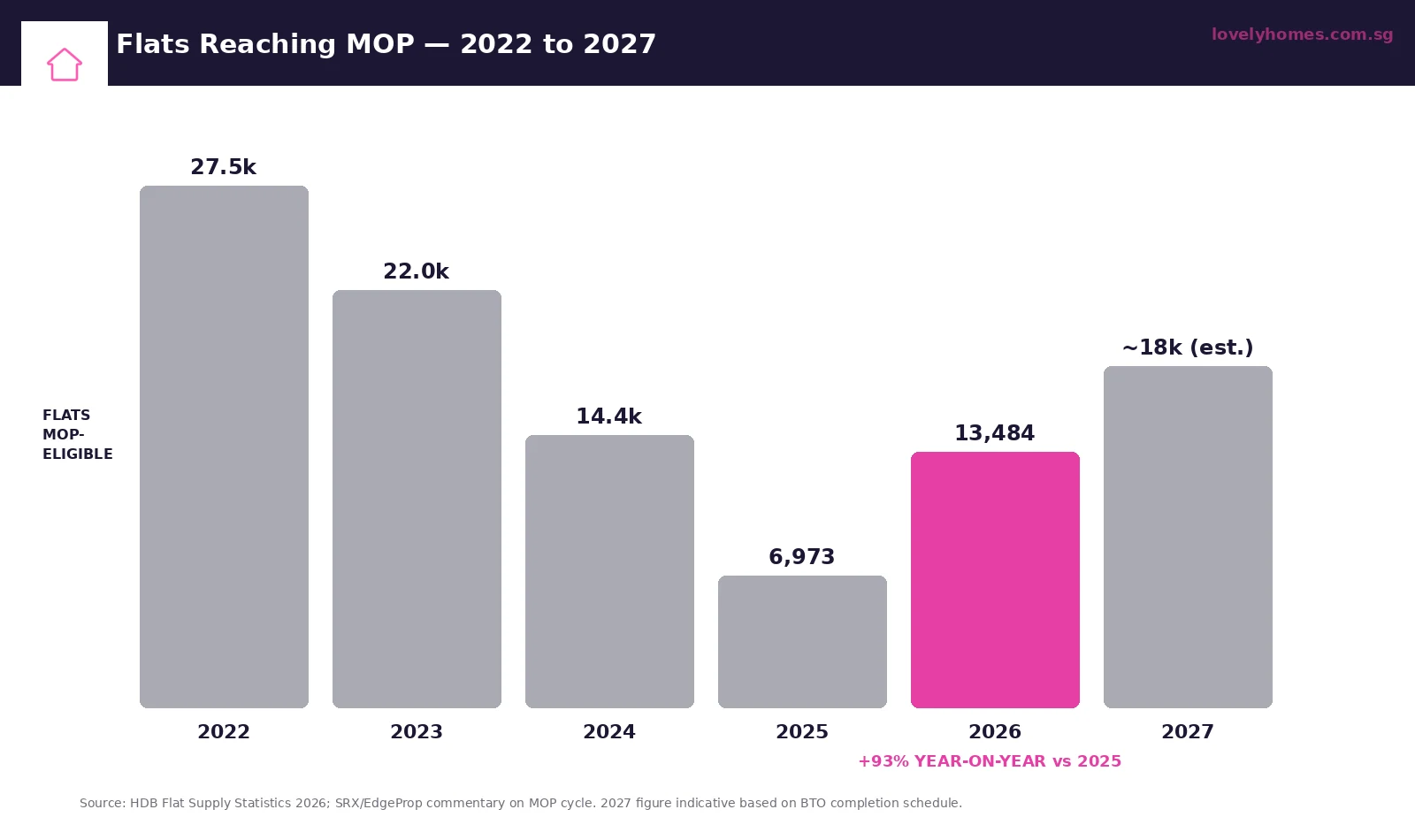
  • Scale: An estimated 13,480 HDB flats will reach their 5-year Minimum Occupation Period (MOP) in 2026 — almost double the ~6,970 that reached MOP in 2025.
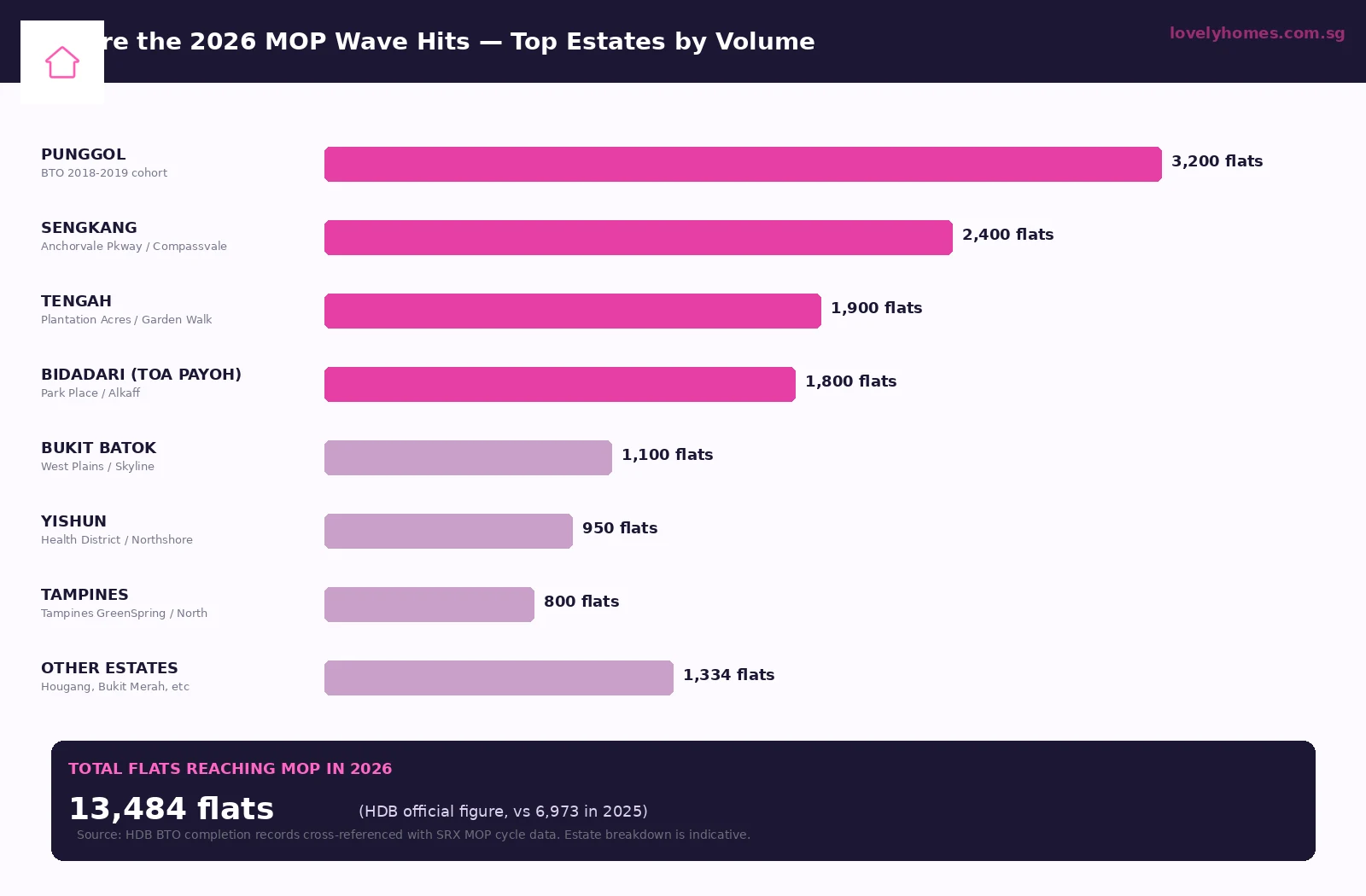
  • Hotspots: Punggol Northshore (~3,200 units), Dawson/Queenstown (~2,400 units), Tengah Phase 1 (~1,800 units), and Bidadari (~1,600 units) are the largest contributors.
  • Market effect: The HDB Resale Price Index (RPI) fell 0.1% in Q1 2026 — its first quarterly decline since Q2 2019, partly attributable to rising MOP-flat supply.
  • For buyers: More choices, reduced bidding urgency, and improved negotiating power — especially in estates with cluster supply.
  • For sellers: Longer time-on-market expected (up from the typical 6–8 weeks to 10–12 weeks in high-supply estates) and more realistic pricing required.
  • For upgraders: Demand for private OCR condos remains firm; OCR prices rose 2.2% in Q1 2026 as MOP-flat sellers redirect proceeds to private property.

The MOP Supply Wave: How We Got Here

The Minimum Occupation Period is the mandatory period — typically five years for standard HDB flats, now extended to ten years for certain Plus and Prime classification flats under HDB’s 2024 reclassification framework — during which an HDB flat owner cannot sell their unit on the open resale market. The MOP clock starts from the date of flat key collection, not the date of purchase application or ballot.

The surge in MOP-eligible supply in 2026 is a direct consequence of the unprecedented BTO construction and completion activity that took place between 2019 and 2021. During those years, HDB launched and completed tens of thousands of flats in new growth areas — particularly Tengah, Punggol Northshore, Bidadari, and the rejuvenated Dawson/Queenstown estates — most of which had key collection dates between late 2020 and mid-2021. Five years later, those keys have become resale eligibility certificates.

Industry data compiled by PropertyGuru and HDB estimates the 2026 cohort at approximately 13,480 MOP-eligible flats — a volume not seen since the BTO ramp-up years of 2013–2015. The comparison with 2025’s ~6,970 MOP-eligible units illustrates just how dramatic the step-change is.

HDB MOP supply wave 2026 flats reaching MOP by estate Punggol Northshore Dawson Queenstown Tengah Bidadari Tampines
Figure 1: Estimated HDB flats reaching 5-year MOP in 2026 by major estate. Punggol Northshore and Dawson/Queenstown lead with over 5,600 combined units. Source: HDB / industry research, 2026.

What the Supply Wave Is Doing to HDB Resale Prices

The most immediate market signal came from HDB’s flash estimate for Q1 2026: the Resale Price Index (RPI) fell by 0.1% quarter-on-quarter, registering 203.3 from 203.5 in Q4 2025. This was the first quarterly decline in the RPI since Q2 2019 — ending a 29-quarter streak of quarterly gains or flat readings that had carried the index from around 131 to its recent high.

To put the decline in context: 0.1% is modest, and the RPI remains 33% higher than its pre-pandemic Q1 2020 level. But the direction of travel is significant. Several forces are converging simultaneously: the MOP supply wave, shorter BTO build times reducing the wait for new flats (increasing substitution options), residual effects of the ABSD cooling measures, and a gradual easing of the buyer urgency that characterised the 2021–2023 market.

HDB Resale Price Index RPI trend Q1 2022 to Q1 2026 first quarterly decline seven years
Figure 2: HDB Resale Price Index Q1 2022–Q1 2026. The Q1 2026 reading of 203.3 marks the first quarterly decline since Q2 2019, after 29 consecutive quarters of gains. Source: HDB flash estimates.

Worked Example: What the MOP Wave Means for a Punggol Seller

Mr Tan bought a 4-room BTO flat in Punggol Northshore in 2021, collecting keys in February 2021. His MOP expires in February 2026, giving him the right to list on the open market from that date onwards.

In early 2024, comparable 4-room resale flats in Punggol Northshore (then still pre-MOP and transacting via sub-sale with special conditions) were fetching around S$720,000–S$740,000. When Mr Tan lists in March 2026, he faces a materially different supply environment: an estimated 200–300 comparable units in the same estate are also newly MOP-eligible in Q1–Q2 2026.

Scenario Indicative Price Time-on-Market
Q1 2024 (pre-MOP cluster, limited supply) ~S$730,000 ~5–6 weeks
Q2 2026 (post-MOP wave, clustered supply) ~S$695,000–S$710,000 ~10–12 weeks
Indicative price softening (2024 vs 2026) ~S$20,000–S$35,000 +4–6 weeks
Original BTO purchase price (2021) ~S$410,000
Estimated capital gain (even at lower price) ~S$285,000–S$300,000

Mr Tan’s capital gain, even after the supply-induced price moderation, remains substantial — roughly 69–73% above his original purchase price over five years. The MOP wave reduces margins at the margin, but does not eliminate them. The more important implication for him is patience: in a supply-heavy quarter, chasing the last S$20,000 with an overpriced listing will cost more in time and negotiating leverage than pricing realistically from day one.

What the MOP Wave Means for HDB Buyers

For buyers in 2026, the supply wave is largely positive. More resale supply in desirable, well-located estates — Dawson, Bidadari, Tengah — means genuine choice where previously the listings were sparse and asking prices aggressive. Buyers who were priced out or crowded out of these estates in 2023–2024 may find that the 2026 MOP cohort opens affordable windows.

Notably, many of the MOP-eligible flats are in mature or near-mature estates with established amenities and shorter HDB wait times (since they are resale, not BTO, there is no wait). For young families who need a flat quickly, the MOP wave is creating the most compelling resale market conditions seen since 2019.

What the MOP Wave Means for Private Property and EC Upgraders

Every MOP-eligible seller is a potential upgrader. The strong demand for Outside Central Region (OCR) private condominiums — OCR prices rose 2.2% in Q1 2026, the strongest regional performer — is partly explained by this upgrader flow. MOP sellers, sitting on capital gains of S$200,000–S$400,000 from their BTO purchases, are redeploying proceeds into OCR condos in the S$900,000–S$1.4M range, often as a second property with ABSD implications or as their primary home after selling the HDB flat.

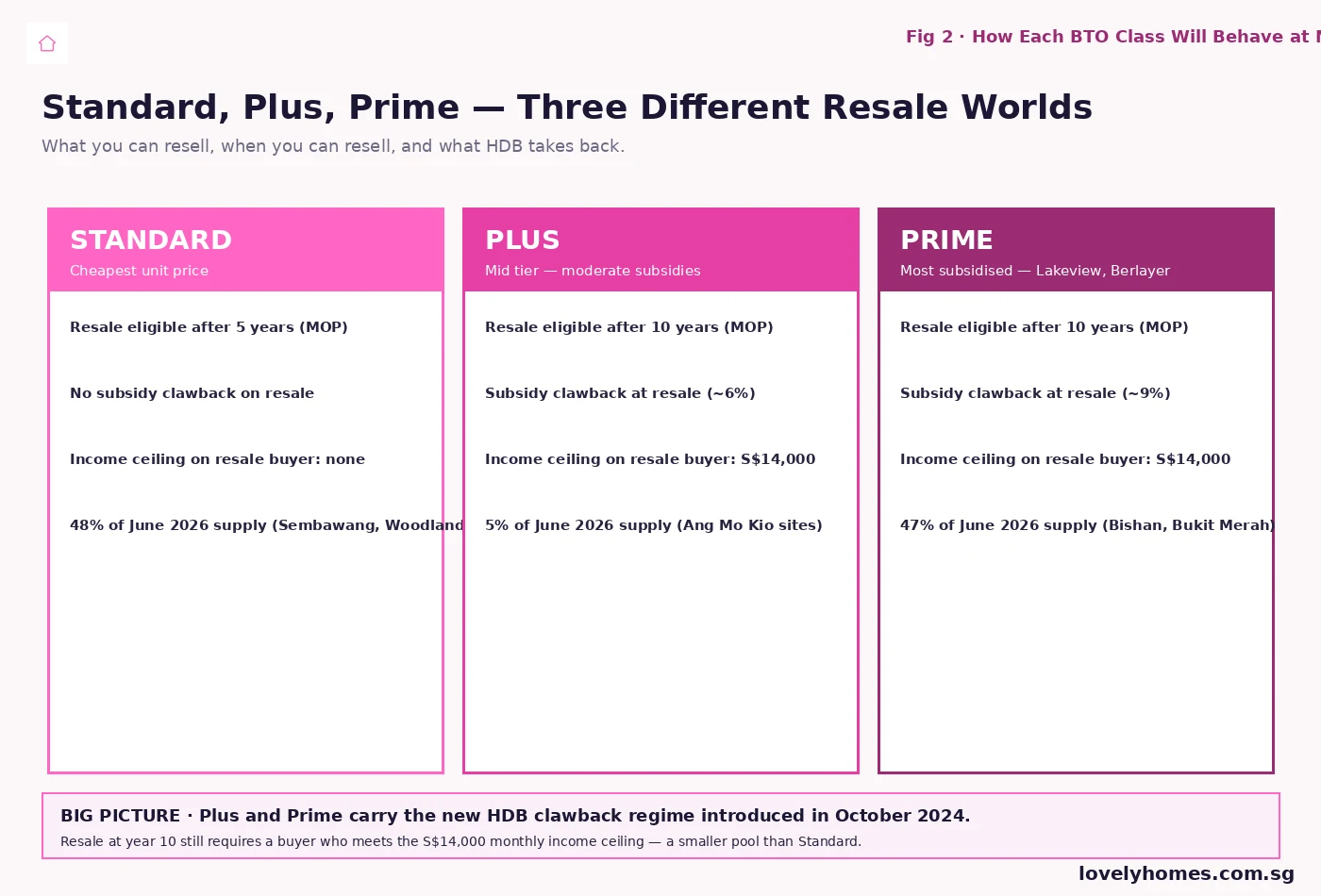
The new 10-year MOP rules for Plus and Prime classification BTO flats (effective from launches from May 2024 onwards) will throttle a future wave of upgrader supply in those categories — but the current 2026 MOP cohort predates those rules, and almost all are standard 5-year MOP flats that feed directly into the upgrader pipeline.

What Might Come Next

The MOP wave is likely to remain elevated through 2026 and into early 2027, as BTO completions from 2021–2022 continue to roll through. HDB’s accelerated build programme — driven by the post-pandemic construction catch-up — means further tranches of completed flats entering the 5-year MOP window. Analysts broadly expect HDB resale price growth to be in the 0–2% range for full-year 2026, a sharp deceleration from the 8–10% growth seen in 2022. The supply-induced softening is a policy success by design — HDB has explicitly timed BTO ramps to moderate resale inflation. Whether prices resume growth in 2027 and 2028 will depend heavily on the pace of upgrader absorption into the private market and any further policy interventions.

Frequently Asked Questions

When exactly does the 5-year MOP start and end?

The MOP clock starts from the date of key collection — not from the date of flat application, ballot, or signing of the Sales of Balance Flat agreement. For BTO flats, this is the date on the key collection acknowledgement letter issued by HDB. The MOP ends exactly five years from that key collection date. Flat owners can check their specific MOP expiry date through the HDB e-Service portal.

Can I rent out my entire flat before MOP?

No. During the MOP, you must physically occupy your HDB flat. You cannot rent out the entire flat. You may, subject to HDB approval, rent out individual bedrooms while continuing to live in the flat. Subletting the entire unit without meeting the post-MOP and quota requirements is a serious breach of HDB’s tenancy rules and can result in compulsory acquisition of the flat.

Does the 10-year MOP apply to all HDB flats bought in 2026?

No. The 10-year MOP applies only to Plus and Prime classification BTO flats launched from May 2024 onwards (under HDB’s new flat classification framework). Standard classification BTO flats retain the 5-year MOP. All resale HDB flats have no MOP obligation for the buyer (the original MOP is with the seller, not the resale purchaser). The current 2026 MOP wave consists entirely of 5-year MOP flats from the pre-2024 launch cohort.

Are the MOP flats from mature or non-mature estates?

The 2026 MOP wave is mixed. Dawson (Queenstown) and Bidadari (Toa Payoh) are in mature estates with strong locational attributes. Punggol Northshore and Tengah are in newer, non-mature estates. The distinction matters for resale pricing: mature estate MOP flats typically command a premium due to established transport, amenities, and school catchments, while non-mature estate flats benefit from newer build quality and larger layouts at lower absolute prices.

Will the MOP wave cause HDB prices to fall significantly?

Industry consensus as at May 2026 expects HDB resale price growth of 0–2% for full-year 2026 — not a significant decline. The Q1 2026 dip of 0.1% is a moderation, not a crash. Singapore’s tight land supply, ongoing population household formation, and strong upgrader demand underpin a structurally supported HDB resale market. A supply wave of 13,480 units — spread across multiple estates over twelve months — is material but not large enough to overwhelm a market that transacts approximately 25,000–27,000 resale flats per year.

Related Articles

Disclaimer: This article is for informational purposes only and does not constitute financial or property advice. MOP unit estimates are based on publicly available industry data and HDB records; exact figures vary by flat and block. Property price data sourced from HDB flash estimates (Q1 2026). Readers should verify MOP expiry dates with HDB directly at www.hdb.gov.sg and consult a licensed property agent or financial adviser before making any purchase or sale decision. References: HDB Q1 2026 Flash Estimates; URA; PropertyGuru; Stacked Homes, May 2026.

S$1.728M HDB Resale Record: City Vue @ Henderson Sets New All-Time High in April 2026

S$1.728M HDB Resale Record: City Vue @ Henderson Sets New All-Time High in April 2026

Click anywhere to close

Quick Answer — S$1.728M Henderson Road HDB Record

  • New record: A 5-room flat at 96A Henderson Road (City Vue @ Henderson) sold for S$1,728,000 in April 2026 — Singapore’s most expensive HDB resale flat on record.
  • Previous record: S$1,700,000 — a 5-room flat at SkyTerrace @ Dawson (92 Dawson Road), transacted in February 2026.
  • Price per square foot: Approximately S$1,421 psf on a 113 sq m (1,216 sq ft) floor area — reflecting the unit’s high floor, long remaining lease (92+ years), and prime city-fringe location.
  • Location premium: City Vue @ Henderson is in District 3/4, Bukit Merah — within walking distance of Redhill MRT and the CBD, straddling Tiong Bahru and the Greater Southern Waterfront redevelopment corridor.
  • Q1 2026 HDB resale market context: HDB resale prices fell 0.1% in Q1 2026 (first quarterly decline since Q2 2019), yet individual record transactions continue in premium projects where lease longevity, height, and location converge.
  • No capital gains tax: The seller pays no tax on the gain — Singapore does not impose capital gains tax on residential property profits (unless IRAS classifies the seller as a property trader).

Singapore’s HDB Resale Record Falls Again — S$1.728M at City Vue @ Henderson

Singapore’s HDB resale market has produced another all-time record. A five-room flat at 96A Henderson Road, in the City Vue @ Henderson development in Bukit Merah, was transacted in April 2026 for S$1,728,000 — eclipsing the previous record of S$1,700,000 set just two months earlier at SkyTerrace @ Dawson in Queenstown. The sale was first reported by EdgeProp Singapore and subsequently confirmed by multiple property media outlets citing HDB resale data.

The unit spans 113 square metres (approximately 1,216 sq ft), placing it at a price per square foot of roughly S$1,421 — significantly above the median resale psf for 5-room HDB flats in mature estates. The block is a high-rise development with the unit reportedly located between the 46th and 48th floor, delivering unobstructed views consistent with the premium that buyers in this market are demonstrably willing to pay.

Singapore HDB resale record price history 2019 to April 2026 bar chart
Figure 1: Singapore HDB resale all-time record price progression from 2019 to April 2026. Source: HDB resale caveats, EdgeProp, media reports. S$ million.

Why City Vue @ Henderson Commands Such a Premium

Several factors distinguish City Vue @ Henderson from other high-value HDB developments. The project’s 99-year lease commenced in 2019, meaning the unit sold in April 2026 still carries approximately 92 years and one month of remaining lease — an unusually long lease for resale HDB stock, and a key driver of bank financing terms (CPF usage and bank LTV are both tied to remaining lease calculations). Buyers’ CPF withdrawals are significantly less restricted on units with long leases, which expands the effective buyer pool and supports higher transaction prices.

The development sits at the nexus of three mature estates — Tiong Bahru, Redhill, and Bukit Merah — with convenient access to Redhill MRT (East-West Line), the Ayer Rajah Expressway, and the emerging Greater Southern Waterfront corridor. The proximity to the CBD (approximately 10–12 minutes by car or 20 minutes by MRT) makes City Vue a compelling alternative to city-fringe private condominiums that now command S$2,500–S$3,000 psf.

The Record in Context: Where Singapore’s HDB Prices Have Travelled

The S$1.728M transaction is the latest milestone in a decade-long upward march in Singapore’s most sought-after HDB units. The first time any HDB flat crossed S$1 million was in 2012, when a Bishan flat changed hands at that landmark price. Since then, the number of million-dollar HDB transactions has grown from a handful per year to 412 in Q1 2026 alone — a quarterly record that LovelyHomes reported in May 2026.

City Vue Henderson HDB record vs comparable high-value HDB resale flats Singapore 2026
Figure 2: The Henderson Road record transaction versus comparable high-value HDB resale flats since 2021. Source: HDB resale caveats, media reports. ★ = current all-time record.

The record has changed hands four times in the past four years: Pinnacle @ Duxton held it for much of 2021–2022, SkyTerrace @ Dawson took over in 2023 and again in February 2026, before City Vue @ Henderson set the current benchmark. All four record-holding projects share a common profile: post-2010 completion, high-rise towers (40+ storeys), long remaining lease, and prime or city-fringe locations.

The Broader Q1 2026 HDB Resale Market — A Paradox

What makes this record particularly striking is its timing. HDB resale prices fell 0.1% in Q1 2026 — the first quarterly decline in nearly seven years, according to HDB’s flash estimate released in April 2026. This retreat reflects the impact of cooling measures (particularly the tightening of HDB loan terms and tighter CPF usage rules on shorter-lease flats), a surge in BTO completions adding resale supply, and broader buyer caution. Yet the top end of the market appears immune to this softening: premium units in iconic developments continue to find buyers willing to pay record prices.

This bifurcation — where aggregate prices soften while individual top-tier transactions set records — reflects a structural feature of Singapore’s HDB resale market. The mass market is sensitive to interest rates, CPF limits, and HDB loan policy. But the sub-segment of luxury-equivalent HDB units (high-floor, long-lease, prime-location) attracts a different buyer profile: affluent upgraders, property investors seeking ABSD-free alternatives, and owner-occupiers prioritising lifestyle over value. For this cohort, S$1.7 million on a 92-year lease in the city fringe competes directly with a S$2.5–3M private condo nearby.

Summary: Key Facts About the Record Transaction

Detail Particulars
Block / Address 96A Henderson Road, Singapore
Development City Vue @ Henderson
Flat type 5-Room (113 sq m / approx. 1,216 sq ft)
Transaction price S$1,728,000
Price per sq ft ~S$1,421 psf
Transaction date April 2026
Remaining lease ~92 years 1 month (lease commenced 2019)
Nearest MRT Redhill MRT (East-West Line)
Previous record S$1,700,000 at SkyTerrace @ Dawson (Feb 2026)

What This Means for HDB Buyers and Sellers

For sellers of similar premium HDB units — high-floor, long-lease, city-fringe — the Henderson Road transaction provides a fresh comparable that may support higher asking prices. For buyers in this sub-segment, the record signals that the ceiling for what the market will pay is still rising, even as aggregate HDB resale prices soften. Buyers should note that at S$1.7M+, they are firmly in competition with suburban private condominiums (and paying significant premiums over mass-market HDB resale) — the decision must weigh the long lease, the ABSD savings versus a private purchase, and the resale liquidity of a premium HDB flat versus a private condo in the same location.

Is S$2 million the next HDB resale milestone? Multiple industry commentators cited in media coverage of this transaction believe so — pointing to the growing supply of post-2015 high-rise HDB blocks with 90+ year remaining leases, rising aspirations for public housing living standards, and the structural ABSD wedge that makes a high-value HDB more economical than a comparable private condo for a second-property buyer. LovelyHomes will track this space closely.

Frequently Asked Questions

Is the seller liable for any taxes on the S$1.728M gain?

Singapore has no capital gains tax, so the seller pays no tax on any profit from the sale. The Seller’s Stamp Duty (SSD) for HDB flats was removed in August 2010 — so unlike private residential property, there is no SSD on HDB resale transactions regardless of the holding period. The seller does have to refund any CPF monies withdrawn for the purchase (plus accrued interest at 2.5% per annum) to their CPF Ordinary Account, and repay any outstanding HDB or bank mortgage from the proceeds. The net cash in hand after those deductions is entirely tax-free.

Can foreigners or PRs buy a resale HDB flat?

Singapore Permanent Residents (SPRs) may purchase resale HDB flats under the Non-Citizen family scheme or the Non-Citizen Spouse scheme, subject to forming an eligible family nucleus and satisfying the Ethnic Integration Policy (EIP) and SPR quota for the block. Foreigners (non-PR, non-citizen) may not purchase HDB resale flats — HDB ownership is restricted to Singapore Citizens and approved SPRs. SPR buyers of resale HDB flats pay the standard buyer’s stamp duty; they do not pay ABSD on the resale HDB flat itself (ABSD applies only to the purchase of private residential property by PRs and foreigners).

Why does remaining lease length matter so much for high-value HDB flats?

Three key mechanisms tie HDB flat value to remaining lease: (1) CPF withdrawal rules — buyers can withdraw CPF savings only up to the portion of the purchase price proportionate to the remaining lease covering the buyer to age 95; flats with shorter leases restrict CPF usage, reducing effective buying power. (2) Bank financing — most banks cap the loan quantum so that the loan tenure does not extend beyond the remaining lease, meaning shorter-lease flats may only qualify for short-term loans at higher monthly repayments. (3) Resale liquidity — flats with very short leases (below 30–40 years) become increasingly difficult to sell, as buyers face compounding restrictions. City Vue @ Henderson’s 92-year remaining lease eliminates all three constraints entirely, making it as financeable as a new-build.

Are there income restrictions on buying a resale HDB flat at this price level?

No income ceiling applies to the purchase of a resale HDB flat — any eligible buyer (regardless of household income) may purchase a resale flat at any price. However, the grants available to help buyers are income-capped. At S$1.728M, the buyer almost certainly has a household income well above the S$9,000/month EHG ceiling and likely above the S$14,000/month Family Grant ceiling, meaning they probably received no CPF housing grants. The HDB Flat Eligibility (HFE) letter — now a mandatory pre-condition for any HDB resale purchase — will confirm a buyer’s grant eligibility before they exercise the OTP.

What is the Greater Southern Waterfront and how does it affect Henderson Road values?

The Greater Southern Waterfront (GSW) is Singapore’s largest urban transformation project — a 30-kilometre stretch of waterfront from Pasir Panjang to Marina East, including the relocation of Pasir Panjang terminal and the redevelopment of the former Keppel shipyard site into approximately 9,000 new homes and mixed commercial uses. Henderson Road sits at the northern fringe of this precinct. As GSW developments materialise over the 2025–2035 period, property analysts expect the surrounding Bukit Merah/Redhill area to benefit from improved amenities, green corridor access, and increased connectivity — providing a structural tailwind to property values in City Vue @ Henderson and similar developments in the area.

Related Articles

Disclaimer: This article is for general informational and editorial purposes only. Transaction data cited is sourced from publicly available HDB resale caveat records and media reports; individual transactions may be subject to verification. Property values, HDB policies, and grant conditions may change. This is not financial or property investment advice. Always consult a licensed property agent and your financial adviser before making any property decision. Official references: HDB, IRAS, URA.

HDB Income Ceiling Singapore 2026: BTO, EC, EHG & Resale Grant Limits Explained

HDB Income Ceiling Singapore 2026: BTO, EC, EHG & Resale Grant Limits Explained

Click anywhere to close

Quick Answer — HDB Income Ceiling Singapore 2026

  • Standard BTO: Household gross income ≤ S$7,000/month (family); S$3,500/month (singles applying for 2-room Flexi).
  • PLH and Plus BTO flats: Higher ceiling of S$14,000/month applies to flats in prime and plus locations (e.g., Pearl’s Hill, Rochor, Tengah Plantation).
  • Executive Condominium (EC): S$16,000/month — the highest income ceiling among subsidised housing schemes, effective 1 January 2025.
  • EHG (Enhanced CPF Housing Grant): S$9,000/month household income ceiling for grant eligibility; the lower your income, the higher the grant (up to S$120,000 for families).
  • Family Grant (resale flats): S$14,000/month ceiling; up to S$80,000 grant for buying a resale flat from a non-related seller.
  • Income is assessed on a household basis — all persons listed in the application must declare their income, including variable pay averaged over 12 months.
  • Investment income is excluded — dividends, capital gains, and interest income are not counted. NS allowance is also excluded.
  • No income ceiling for resale HDB flats — there is no maximum income limit to purchase a resale HDB flat itself, though the grants you can receive are income-capped.

What Is the HDB Income Ceiling?

The HDB income ceiling is the maximum gross monthly household income a family or individual may earn in order to be eligible to purchase a new HDB flat (BTO), an Executive Condominium, or to receive CPF housing grants for a resale flat. The ceilings are set by the Housing and Development Board (HDB) and the Ministry of National Development (MND) as part of Singapore’s public housing means-testing framework, which aims to ensure that subsidised housing resources are directed to households that genuinely need them.

Income ceilings have evolved significantly since HDB first introduced means-testing. The current standard BTO ceiling of S$7,000/month was set in September 2019 when the Enhanced CPF Housing Grant (EHG) was introduced, replacing the earlier S$12,000 cap for non-mature estate BTOs and S$8,000 for mature estate BTOs. The PLH and Plus flat ceilings of S$14,000 were introduced with the new housing classification framework in October 2021 and October 2024 respectively.
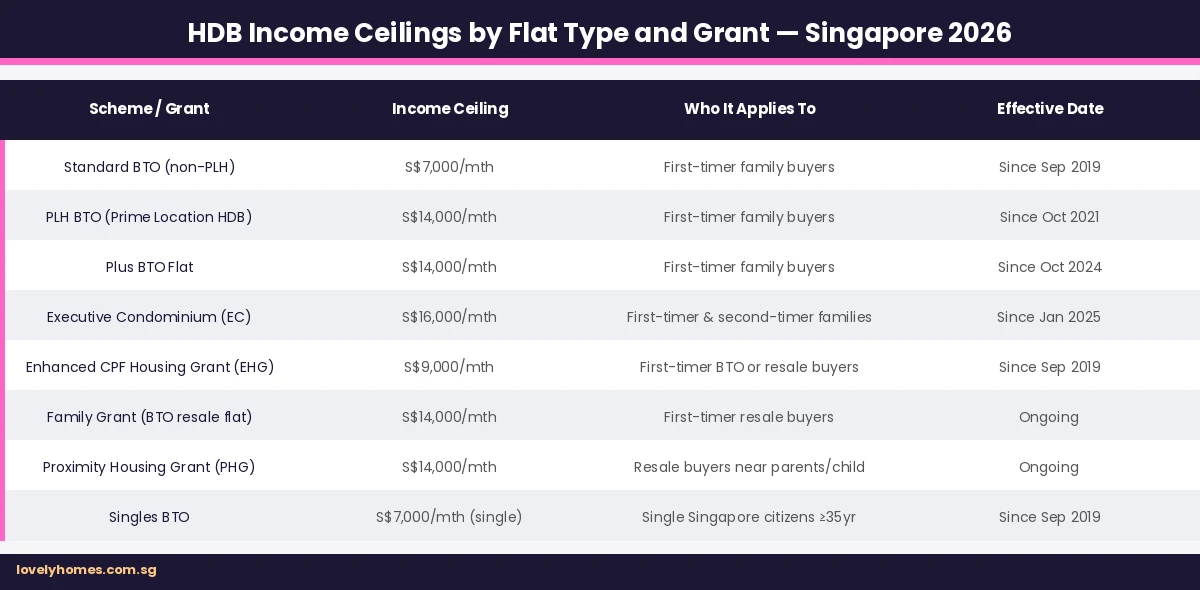
HDB income ceiling by flat type and grant Singapore 2026 comparison table
Figure 1: HDB income ceilings by scheme and grant type, Singapore 2026. All amounts are gross monthly household income. Source: HDB, CPF Board.

Income Ceilings by Flat Type — Full 2026 Breakdown

Standard BTO Flats: S$7,000/Month

For the majority of new HDB BTO flats in non-prime, non-plus locations (classified as “Standard” flats), the household gross income ceiling is S$7,000 per month. This applies to families — defined as a married or engaged couple (or family nucleus including parent/child). Singles applying under the Single Singapore Citizen scheme for a 2-room Flexi flat in the non-mature estates have a ceiling of S$7,000 per person (individual income, not household).

The S$7,000 ceiling is intentionally conservative — it targets the bottom 60–65% of Singapore’s household income distribution. Households above this ceiling are expected to either purchase an EC, a private condominium, or a resale HDB flat (where there is no income ceiling for the purchase itself, though grants are still capped).

PLH and Plus BTO Flats: S$14,000/Month

Introduced under HDB’s new flat classification framework that took effect in October 2024, Plus and Prime Location Housing (PLH) flats carry a higher income ceiling of S$14,000/month. These flats are located in attractive areas close to the city (e.g., Bukit Merah, Queenstown, Toa Payoh for PLH; Woodlands, Tengah for Plus). The higher ceiling reflects the greater demand for these locations and the recognition that buyers in these markets tend to have higher incomes, while still needing a subsidised option. Plus and PLH flats come with stricter resale conditions — a 10-year Minimum Occupation Period (compared to 5 years for Standard), and an income ceiling on resale (buyers of PLH resale flats must also satisfy a S$14,000 income ceiling).

Executive Condominiums: S$16,000/Month

The EC income ceiling was raised from S$14,000 to S$16,000 per month effective 1 January 2025. This makes ECs accessible to a wider band of dual-income professionals who earn too much for standard BTOs but are priced out of private condominiums. An EC is a hybrid housing type — built by private developers but sold at subsidised prices with HDB eligibility rules for the first 10 years, before it privatises and becomes fully marketable. The S$16,000 ceiling targets households at roughly the 80th percentile of Singapore’s income distribution.
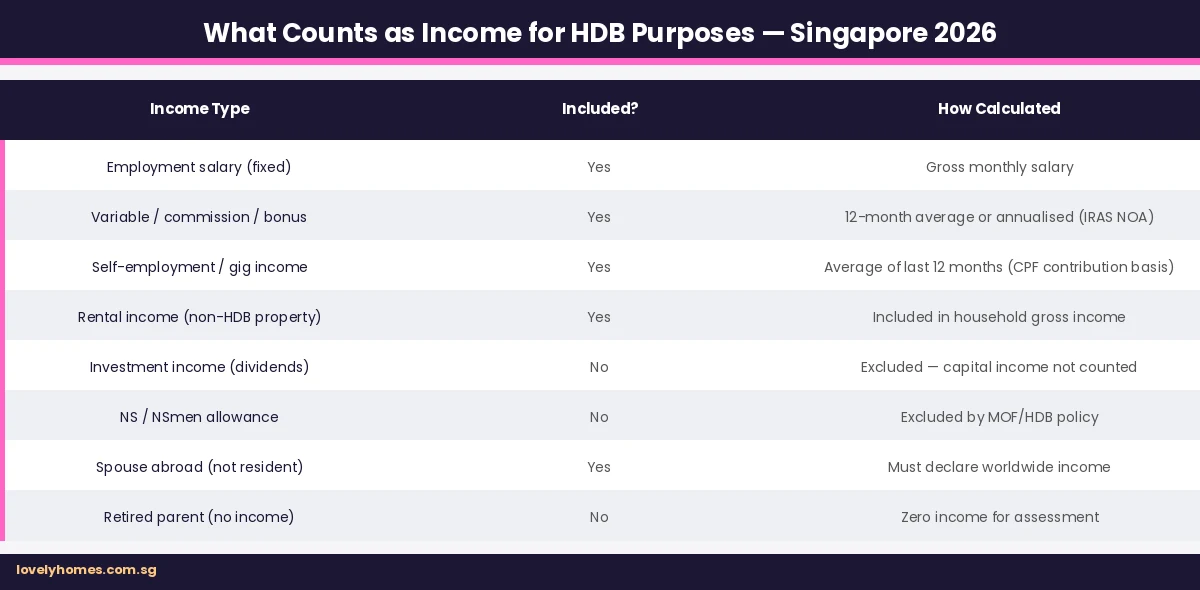
What counts as income for HDB BTO application Singapore 2026
Figure 2: Income types and how they are treated in HDB income ceiling assessment. Source: HDB, CPF Board.

How HDB Calculates Household Income

HDB assesses household income based on the gross monthly income of all persons listed in the flat application (the applicant, occupiers, and any essential occupiers). The income of all listed individuals is summed to arrive at the household total.

Fixed Employment Income

For salaried employees, the assessed income is the gross monthly salary as reflected in the applicant’s payslip or CPF contribution records. Gross salary includes basic pay plus any fixed allowances, and is assessed before deduction of employee CPF contributions, income tax, or other deductions.

Variable, Commission, and Bonus Income

Variable income (commissions, performance bonuses, overtime pay) is averaged over the preceding 12 months. If the applicant has been employed for less than 12 months, the average is calculated over the actual period of employment. Applicants who received a large one-off bonus in a single month cannot exclude it — HDB takes the 12-month average, which will include that month’s higher figure.

Self-Employment and Gig Income

For self-employed persons, freelancers, and gig workers, HDB assesses income based on the average monthly income from the preceding 12 months, typically computed from the latest available Notice of Assessment (NOA) from IRAS, or from CPF contribution records for self-employed persons who make voluntary MediSave contributions. Applicants who have not filed an IRAS tax return may be required to submit a statutory declaration of income.

What Is Excluded

Investment income (dividends, interest, capital gains from shares or property) is explicitly excluded from HDB’s income assessment. National Service (NS) full-time allowances and NSmen in-camp training allowances are also excluded. A family member who is currently on no-pay leave, studying full-time, or retired with zero employment income contributes S$0 to the household total.
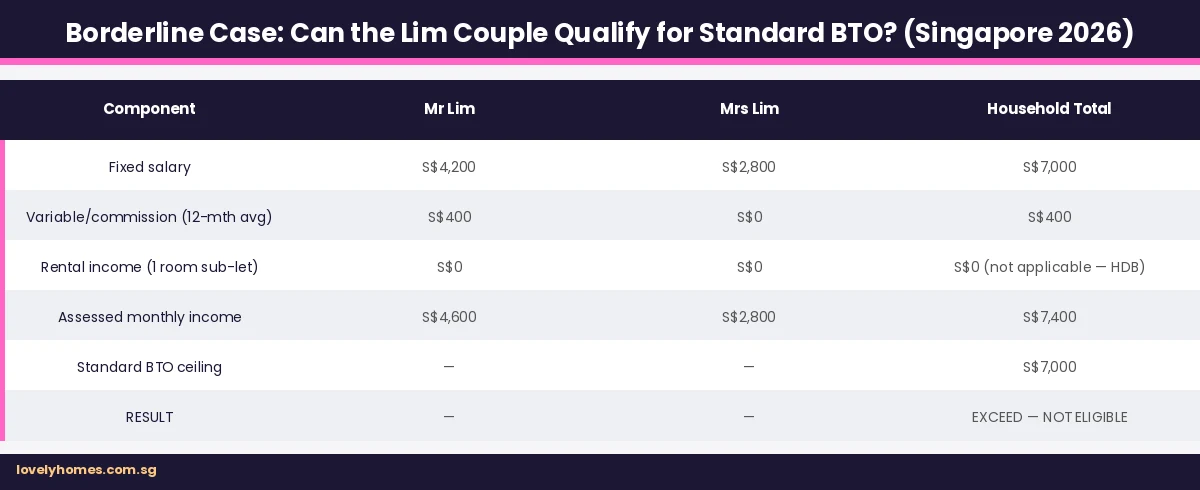
HDB income ceiling worked example Lim couple borderline case Singapore 2026
Figure 3: Worked example — the Lim couple’s borderline income assessment for standard BTO eligibility.

Grant Income Ceilings — EHG, Family Grant, and PHG

Even where a household meets the income ceiling for purchasing a flat, the grants available are separately subject to their own income tests. The Enhanced CPF Housing Grant (EHG) — the largest and most progressive grant — has a ceiling of S$9,000/month for families. Below this ceiling, the EHG scales from S$5,000 (household income S$7,001–S$9,000) up to S$120,000 (household income ≤ S$1,500). Families earning between S$7,001 and S$9,000 can still receive the EHG for a resale flat purchase even though they are ineligible for a standard BTO.

The Family Grant for resale flats (up to S$80,000 for buying from a non-related party) and the Proximity Housing Grant (up to S$30,000 for living near parents or married child) both have a ceiling of S$14,000/month. These grants can be stacked with the EHG where eligibility is met, for a maximum combined grant of S$230,000 on a resale flat.

Summary Table — Income Ceilings and Grant Amounts at a Glance

Scheme / Grant Income Ceiling (Family) Max Amount Notes
Standard BTO (purchase eligibility) S$7,000/mth No income ceiling for resale HDB purchase
PLH / Plus BTO S$14,000/mth 10-yr MOP; resale also income-capped
Executive Condominium (EC) S$16,000/mth Raised from S$14,000 effective Jan 2025
EHG (family) S$9,000/mth S$120,000 Progressive — lower income = higher grant
EHG (singles) S$4,500/mth S$60,000 2-room Flexi BTO or resale
Family Grant (resale) S$14,000/mth S$80,000 Buying from unrelated seller
Proximity Housing Grant (PHG) S$14,000/mth S$30,000 Within 4 km of parents/married child
Max combined grants (resale) Depends S$230,000 EHG + Family Grant + PHG stacked

Worked Example: The Lim Couple’s Borderline Income Situation

Mr Lim, 31, earns S$4,200 basic salary per month as a logistics executive, plus an average of S$400 monthly commission over the past 12 months. Mrs Lim, 29, earns S$2,800 as a primary school teacher. They are first-timer applicants hoping to ballot for a 4-room Standard BTO flat in Sengkang.

Income assessment: Mr Lim’s assessed income = S$4,200 + S$400 = S$4,600/mth. Mrs Lim’s assessed income = S$2,800/mth. Household total = S$4,600 + S$2,800 = S$7,400/mth.

Result: S$7,400 exceeds the S$7,000 standard BTO ceiling — the Lim couple is not eligible for a Standard BTO flat. They have three practical options: (1) apply for a PLH or Plus BTO flat (S$14,000 ceiling) in a prime location; (2) apply for a resale HDB flat (no income ceiling on the purchase itself, though their EHG would be capped at S$9,000 ceiling — which they meet, so they’d receive some EHG); or (3) consider an EC (S$16,000 ceiling). Note that if Mr Lim’s commission is reduced (e.g., in a slow quarter), his income for that 12-month window may average below S$400, potentially bringing the household total to or below S$7,000.

Why Income Ceilings Matter for Singapore’s Housing Market

Income ceilings are the primary demand-management tool for Singapore’s public housing system. By restricting BTO eligibility to lower- and middle-income households, HDB ensures that its heavily subsidised flat supply — which often prices new flats at 20–40% below comparable resale market values — reaches the households that most need the subsidy. Without income ceilings, wealthier households would compete for and crowd out subsidised flats, undermining the social purpose of public housing.

The existence of multiple ceiling tiers (S$7,000, S$14,000, S$16,000) also creates a housing ladder that mirrors Singapore’s income distribution: Standard BTOs for lower-middle income families, Plus/PLH and ECs for upper-middle income families, and the private market for those above S$16,000/month household income.

What Might Change: Income Ceiling Reviews

(This section contains editorial analysis; it does not constitute financial or housing advice.)

HDB reviews income ceilings periodically in line with median household income growth. The last major revision was in September 2019 (standard BTO ceiling reduced from varying rates to a uniform S$7,000 with EHG introduced simultaneously). The EC ceiling was raised from S$14,000 to S$16,000 in January 2025. With Singapore’s median household income having grown approximately 15–20% between 2019 and 2025, some housing analysts expect MND to review the standard BTO ceiling again in the 2026–2028 planning cycle. A rise to S$8,000 or S$8,500 would make a meaningful difference for dual-income couples earning in the S$7,000–S$8,500 range who are currently excluded from BTO eligibility.

Frequently Asked Questions

Is there an income ceiling to buy a resale HDB flat?

No — there is no maximum income ceiling for purchasing a resale HDB flat. Any Singapore Citizen or Permanent Resident who meets the general eligibility conditions (citizenship/PR status, family nucleus or age requirement, ownership restriction) may buy a resale flat regardless of how high their household income is. Income ceilings only apply to new BTO flats and ECs. However, the grants available for resale flat buyers (EHG, Family Grant, PHG) do have income ceilings as described in this article, so higher-earning households buying resale may receive reduced or zero grants.

What happens if my income exceeds the ceiling after I ballot for a BTO flat?

Income eligibility is assessed at the time of flat application (ballot) and again at the time of flat booking (signing the agreement for lease). If your household income exceeds the ceiling at the time of booking, HDB may disqualify the application. However, if income rises after booking but before key collection (completion), you generally remain eligible as the assessment was already made. Applicants should be honest about their income at both key assessment points, as a deliberate misrepresentation can result in disqualification and potentially being barred from future HDB applications.

Does my spouse’s income count if we apply together?

Yes. All persons listed in the HDB flat application — whether as applicants or occupiers — must declare their income, and all declared incomes are summed to form the household income. If your spouse is listed in the application (even as an occupier), their income is included. If your spouse has zero income (e.g., they are a homemaker or full-time student), their contribution to the household total is zero. Couples who are applying under the Fiancé/Fiancée scheme must also include their future spouse’s income.

Can I include rental income from my current property to meet the income threshold for EHG?

Rental income from non-HDB private property is generally included in HDB’s income assessment as it forms part of gross monthly income. However, this question is more often asked in the opposite direction — households trying to keep their income below the ceiling for grant eligibility. If including rental income pushes your household total above the relevant ceiling, you would lose eligibility for that grant tier. IRAS’ Notice of Assessment is the documentary basis for verifying rental income. Rental income from a sub-let HDB room (which is subject to HDB’s sub-letting rules) is also included in gross income.

What is the income ceiling for single Singaporeans buying a BTO?

Single Singapore Citizens aged 35 and above may apply for a 2-room Flexi BTO flat under the Single Singapore Citizen scheme. The income ceiling is S$7,000 per month (individual income, not household). Singles are not eligible for 3-room, 4-room, or larger BTO flats in the open market, though they may apply jointly with parents under the Joint Singles Scheme or with a single sibling. For resale flats, singles may purchase any size flat (from 2-room up to 5-room) without an income ceiling on the purchase, and may receive the EHG for Singles (ceiling S$4,500/month, max S$60,000).

How is income assessed for a person who recently started a new job?

For a person who has been employed for less than 12 months, HDB averages their gross income over the actual period of employment — not a full 12 months. For example, if Mr Tan started his job 6 months ago with a gross salary of S$5,000/month, his assessed income is S$5,000 (the monthly figure, not S$30,000 / 12 = S$2,500). Fixed monthly salary is straightforward; variable pay would be averaged over those 6 months. Someone who recently joined a new employer at a higher salary cannot use the income figure from their previous lower-paying job — HDB uses the current employment’s income for the averaging calculation.

Is the Ethnic Integration Policy (EIP) related to the income ceiling?

No. The Ethnic Integration Policy (EIP) and the SPR Quota are separate eligibility rules that restrict the racial composition of each HDB block and neighbourhood — they ensure no single ethnic group dominates any given HDB block. EIP applies at the point of resale flat purchase (you can only buy in certain blocks depending on your ethnicity and the current racial mix of that block) and has nothing to do with income. The income ceiling and the EIP are independent eligibility checks — a buyer must satisfy both, but they measure completely different things.

Related Articles

Disclaimer: This article is for general informational purposes only and does not constitute financial or housing advice. HDB income ceilings, grant amounts, and eligibility conditions may be revised by HDB, MND, or CPF Board at any time. Always verify the latest eligibility requirements directly with HDB at hdb.gov.sg or via the HDB Flat Portal before submitting any application. Additional references: CPF Board, IRAS.

Singapore New Launch Condo Pipeline May 2026: 17 Projects, OCR-Heavy, and a S$2,120 to S$2,886 PSF Reset

Singapore New Launch Condo Pipeline May 2026: 17 Projects, OCR-Heavy, and a S$2,120 to S$2,886 PSF Reset

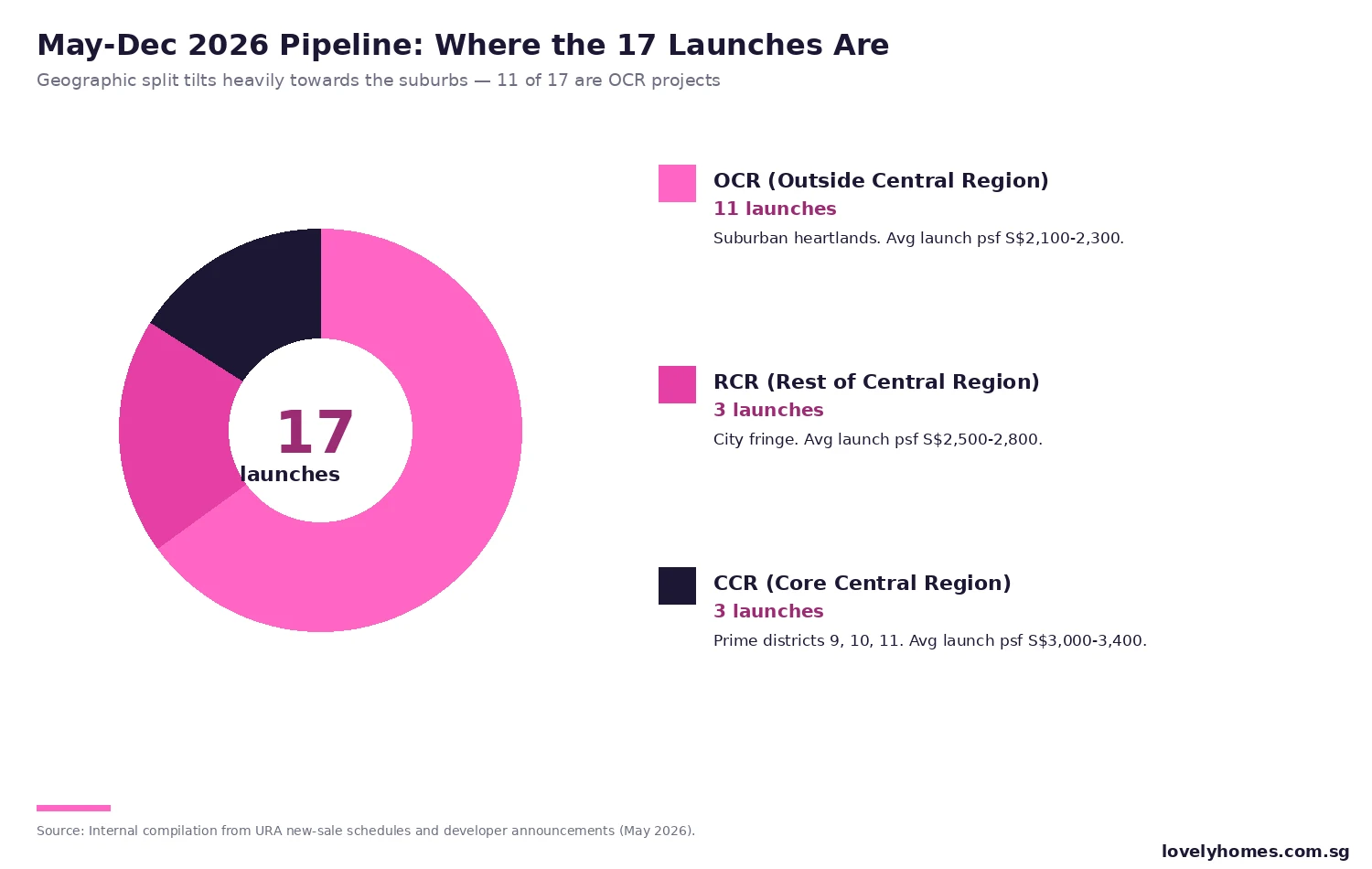
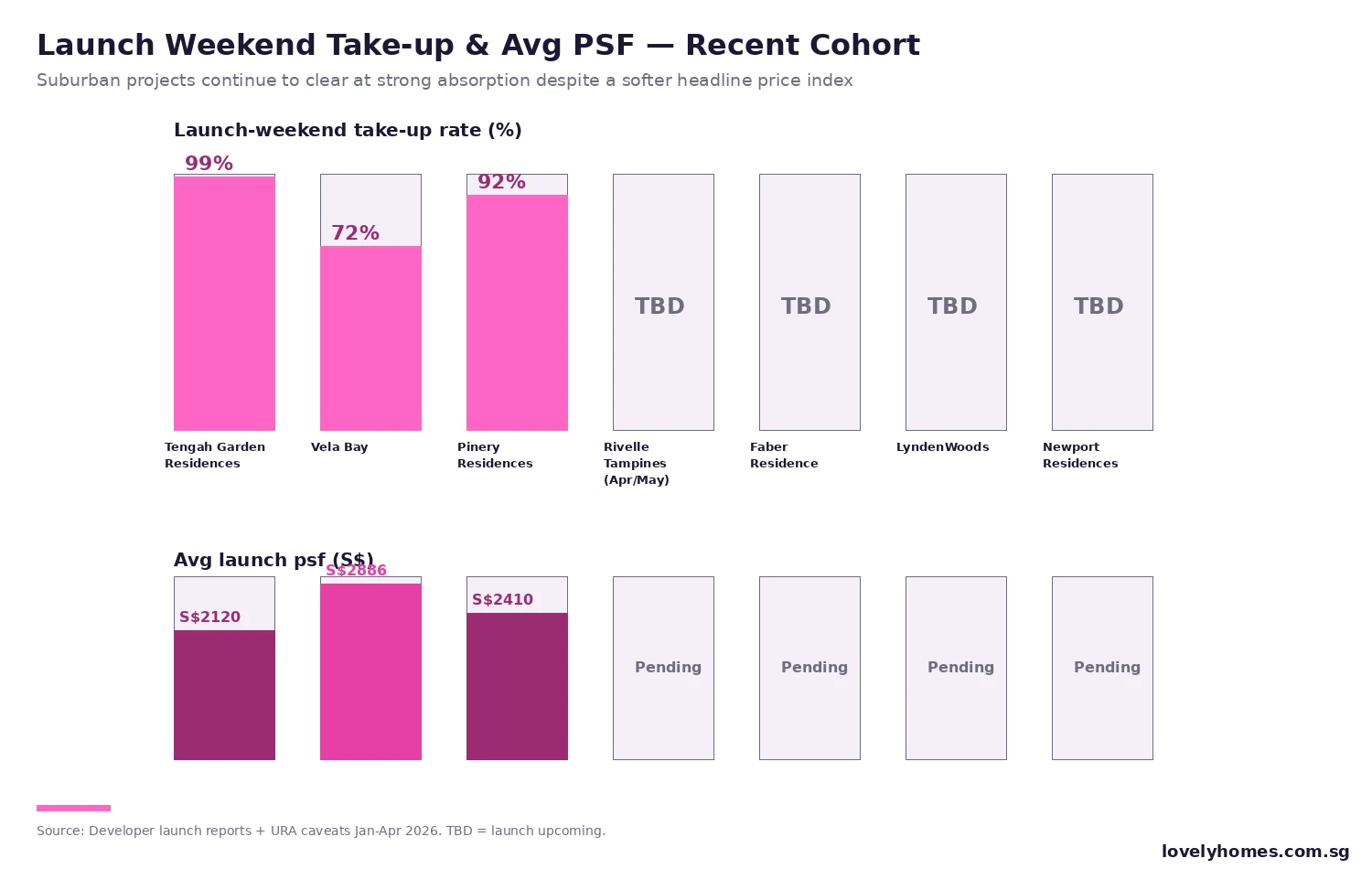
Singapore’s private new-sale market is heading into the second half of 2026 with the heaviest Outside Central Region tilt in recent memory. Of the 17 launches developers have signalled for May through December, 11 sit in the OCR, three in the RCR, and three in the CCR. The recent launch cohort has cleared at strong absorption — Tengah Garden Residences sold ~99% on launch weekend at S$2,120 psf, Vela Bay landed 72% at S$2,886 psf, Pinery Residences moved ~92% at S$2,410 psf — but the price band has compressed materially against the 2024 cohort. This piece walks through where the pipeline sits, what the first launches tell us about pricing power, and what to watch as the URA Q2 2026 flash estimate lands in mid-July.

Quick Answer

  • 17 launches are scheduled May to December 2026 — 65% OCR, 19% RCR, 16% CCR.
  • Recent launch take-up averaged ~88% across Tengah Garden, Vela Bay and Pinery.
  • Launch PSF band has narrowed to S$2,120 to S$2,886 for OCR/RCR projects.
  • Rivelle Tampines EC is the first executive condominium in Tampines West and one of two ECs launching this run.
  • Faber Residence, LyndenWoods and Newport Residences (already published) remain on developer launch calendars for 2026.
  • Q1 2026 URA flash showed +0.3% q-o-q on private prices vs -0.1% q-o-q on HDB resale — first divergence since 2019.
  • Q2 2026 flash estimate is expected mid-July; April new home sales drop with URA’s mid-May release.
Singapore new launch condo pipeline May 2026 hero
LovelyHomes — May 2026 pipeline: 17 condo launches with the OCR doing the heavy lifting.

Where the launches sit geographically

Singapore new launch pipeline distribution by region OCR RCR CCR May 2026
Figure 1: regional split of the May to December 2026 launch pipeline.

The 65% OCR weighting is the structural story of 2026. The OCR cohort (Tampines, Tengah, Sembawang, Punggol, Lentor, Plantation Close) reflects two pipeline drivers: the URA Government Land Sales calendar that emphasised Tampines and West Coast tracts in 2024, and the pace of EC supply rolling out under the dual-track public-private programme. RCR launches sit in the city-fringe corridors — Bukit Merah, Newton, Marine Parade. CCR launches are limited to high-end repositioned plots in Districts 9, 10 and 11 with redevelopment uplift.

From a buyer’s perspective, the OCR concentration means absorption pressure is highest where prices are most affordable on a per-unit basis. A 1-bedroom OCR launch unit at S$2,200 psf and 50 sqm is S$1.18m absolute; a comparable RCR unit at S$2,700 psf is S$1.45m; a CCR unit at S$3,100 psf is S$1.67m. The OCR’s affordability advantage is the clearest reason 99% of Tengah Garden’s units cleared on launch weekend — and the reason the OCR pipeline carries the most consensus risk if buyer demand softens later in the year.

Recent launch take-up and the price band

Singapore new launch take-up rate and avg psf May 2026
Figure 2: launch-weekend take-up and avg psf by region for recent and upcoming cohort projects.

Tengah Garden Residences is the cohort outlier — ~99% take-up at S$2,120 psf on launch weekend established that the OCR continues to clear at heartland-affordable price points. Vela Bay at S$2,886 psf moved 72% — a softer headline number against the Tengah comparison, but still a strong RCR result given the price step-up. Pinery Residences at S$2,410 psf sold ~92%, also OCR. The pattern: OCR launches at S$2,100 to S$2,400 psf are clearing 90%+; the RCR S$2,800+ psf bracket is moving into the 70% band.

Rivelle Tampines EC launches this April/May as the first-ever EC in Tampines West, addressing the upgrader-couple cohort priced out of private OCR projects. EC mechanics — 99-year lease wef approval, 5-year MOP, 30% MSR cap, S$16k income ceiling — make the absolute price ~15% to 20% below comparable private OCR launches.

The PSF reset against 2024

The 2024 cohort saw OCR launches clearing at S$2,400 to S$2,600 psf and RCR launches at S$3,000+. The 2026 cohort has compressed: OCR is at S$2,100 to S$2,400, RCR S$2,500 to S$2,900. Three forces explain the shift: (1) developers have absorbed slightly lower margins to maintain absorption velocity, (2) the URA Q1 2026 flash estimate of +0.3% q-o-q signalled a soft-landing price environment that does not support headline price hikes, (3) the heavy GLS pipeline (Bayshore Drive, Holland Plain, Peck Hay Road, RVG-C, Morrison Lane) keeps developers competing on launch psf to clear inventory before next-cycle units arrive.

Summary table — pipeline at a glance

Project Region Indicative PSF Status
Tengah Garden Residences OCR S$2,120 99% sold launch weekend
Vela Bay RCR S$2,886 72% sold launch weekend
Pinery Residences OCR S$2,410 ~92% sold launch weekend
Rivelle Tampines EC OCR ~S$1,750 (EC) Apr-May 2026 launch
Faber Residence OCR (D05) ~S$2,300 Launch pending
LyndenWoods OCR (D05) ~S$2,400 Launch pending
Newport Residences CCR (D02) ~S$3,200+ Freehold, launch pending

Worked Example: 1-bed OCR launch unit absorbed by an upgrader couple

Profile. Mr Lee, 33, and Mrs Lee, 31, both Singapore Citizens and first-time private buyers (after a recently MOP-completed BTO sold). Combined household income S$13,500/month. Buying a 50 sqm 1-bedroom unit at an OCR launch priced S$2,200 psf — absolute price S$1.10 million.

BSD payable: 1% on first S$180k + 2% on next S$180k + 3% on next S$640k + 4% on remaining S$100k = S$1,800 + S$3,600 + S$19,200 + S$4,000 = S$28,600. ABSD: S$0 (first private, prior HDB sold).

Down-payment: 25% of S$1.10m = S$275,000. Cash component (5% min) = S$55,000; CPF component (20%) = S$220,000. Loan = S$825,000 at 4.0% TDSR-stress.

Day-1 cash out-of-pocket: S$55,000 (cash down) + S$28,600 (BSD) + ~S$3,000 (legal) + ~S$220,000 from CPF OA. Total cash + CPF deployed: S$306,600.

The Lee family clears TDSR comfortably at 28% (mortgage S$3,940 / month vs joint income S$13,500 — well below 55% cap). The 1-bed OCR launch is a credible upgrader anchor for them; reselling in the 6 to 8 year horizon at +25% (typical for a holding period that includes building completion) projects a S$275k+ pre-tax capital gain on the S$275k down — a 100% return on cash before transaction costs.

What this means for buyers

The 65% OCR pipeline weight makes 2026 a buyer-friendlier OCR market than 2024 — psf has compressed, choice has expanded, and ABSD-free first-property purchases (as in the Lee example) sit in a sweet spot. RCR buyers face a tougher arithmetic: prices have not compressed as far, and absorption velocity at S$2,800+ psf depends on a steady upgrader pipeline that the 2026 market is delivering, but with caution.

The CCR cohort remains specialist territory: Newport Residences (freehold, City Developments) sets a high reference point at S$3,200+ psf, and the bare-shelf cooling-measure backdrop (ABSD 60% for foreigners) keeps the demographic narrow. Singapore citizen owner-occupiers and ABSD-remitting upgraders dominate that segment.

What might come next

Three calendar items frame the rest of 2026: (1) URA April 2026 new home sales drop in mid-May — the first read on whether the Tengah/Vela momentum is sustaining; (2) Holland Plain GLS tender closed 7 May 2026 — bid pricing within 1 to 2 weeks tells the market what land cost foundations the late-2026 cohort will be built on; (3) URA Q2 2026 flash estimate in mid-July gives the next quarterly price pulse. If Q2 prints flat or slightly positive on private prices and HDB prices start to recover from the Q1 dip, the heavy OCR pipeline absorbs cleanly into year-end. If Q2 prints negative, expect developers to soften launch pricing further into the September to November window.

FAQ

Why is the OCR getting most of the launches?

It tracks the URA GLS calendar from 2 to 3 years prior. The 2024 to 2025 GLS programme tilted heavily into Tampines, Tengah, Plantation Close, Faber Walk, and Lentor — those tracts are now hitting the launch calendar. The CCR pipeline is structurally smaller because freehold land in prime districts is rarely released through GLS, and en bloc redevelopment fell quiet in 2023 to 2024.

Is 99% take-up unusual for an OCR launch?

It is at the strong end of the cohort. The 2024 to 2025 average launch-weekend take-up across all OCR new sales sat in the 50% to 80% band; 90%+ marks a project where pricing was correctly set against demand. The Tengah Garden 99% result reflects (i) heartland-affordable absolute price points, (ii) the EC neighbour benchmark setting expectations, and (iii) the upgrader couple cohort with a recently-MOP’d BTO behind them.

When does Holland Plain bid pricing become public?

URA typically releases the bid summary within 24 to 72 hours of tender close. Holland Plain closed 7 May 2026; expect the bid table on the URA Land Sales page within the week. The previous Holland Link site sold to Sim Lian at S$1,432 psf ppr in 2024 — a useful comparable for the new tender.

What is driving the Q1 2026 HDB-vs-private divergence?

Q1 2026 was the first quarter since Q2 2019 where HDB resale prices declined while private prices rose. Drivers: (1) the bumper MOP supply through 2026 of 13,484 newly-eligible HDB resale flats softening the heartland resale market, (2) the upgrader cohort skewing private-launch demand and pulling demand out of HDB resale, (3) the BTO build-rate normalisation lowering the resale premium baseline. The divergence is expected to narrow in Q2 to Q3 2026 as MOP supply absorbs.

Is Rivelle Tampines a good buy for upgraders?

For households earning S$14,000 to S$16,000/month with at least one prior subsidised flat MOP-cleared, Rivelle Tampines hits the EC-economics sweet spot: ~20% below comparable private OCR launches, 5-year MOP, full private-property eligibility after 10 years from key collection. The risk is the 5-year hold lock — owner-occupier buyers who may relocate within five years should compare against private resale alternatives.

Will OCR psf compress further?

Probably modestly. The Q1 2026 flash showed a +0.3% q-o-q private-price uptick — too small to support headline psf hikes but consistent with stable launch psf. If Q2 prints flat or negative, expect 1% to 3% softening on launch psf as developers prioritise absorption. If Q2 prints positive, expect launch psf to flatten at S$2,150 to S$2,400 OCR for the rest of 2026.

Where are the CCR opportunities?

The CCR cohort is small but high-quality. Newport Residences (D02, freehold, City Developments) is the highlight — 80 Anson Road levels 23 to 45, BCA Green Mark Platinum SLE certified, mixed-use Newport Plaza adjacency. CCR launches in the rest of 2026 will largely target Singapore citizen owner-occupiers and high-net-worth ABSD-remission buyers, given foreigner ABSD at 60% remains prohibitive.

Related Articles

Disclaimer

This article is general guidance for Singapore property buyers and observers tracking the May to December 2026 new-launch pipeline. Headline transaction and price data sit with URA (private-property index, monthly new-sale tally), HDB (resale price index), and developer launch reports. ABSD and BSD rates sit with IRAS. Worked numerical examples are illustrative; consult a licensed solicitor or financial adviser for transaction-specific advice.

Tags: Singapore new launch, condo pipeline, OCR, RCR, CCR, Tengah Garden Residences, Vela Bay, Pinery Residences, Rivelle Tampines, Faber Residence, LyndenWoods, Newport Residences, URA flash estimate, launch psf, take-up rate, executive condo, Holland Plain GLS.

HDB Resale Procedure Singapore 2026: HFE Letter, OTP, Resale Portal & Key Collection

HDB Resale Procedure Singapore 2026: HFE Letter, OTP, Resale Portal & Key Collection

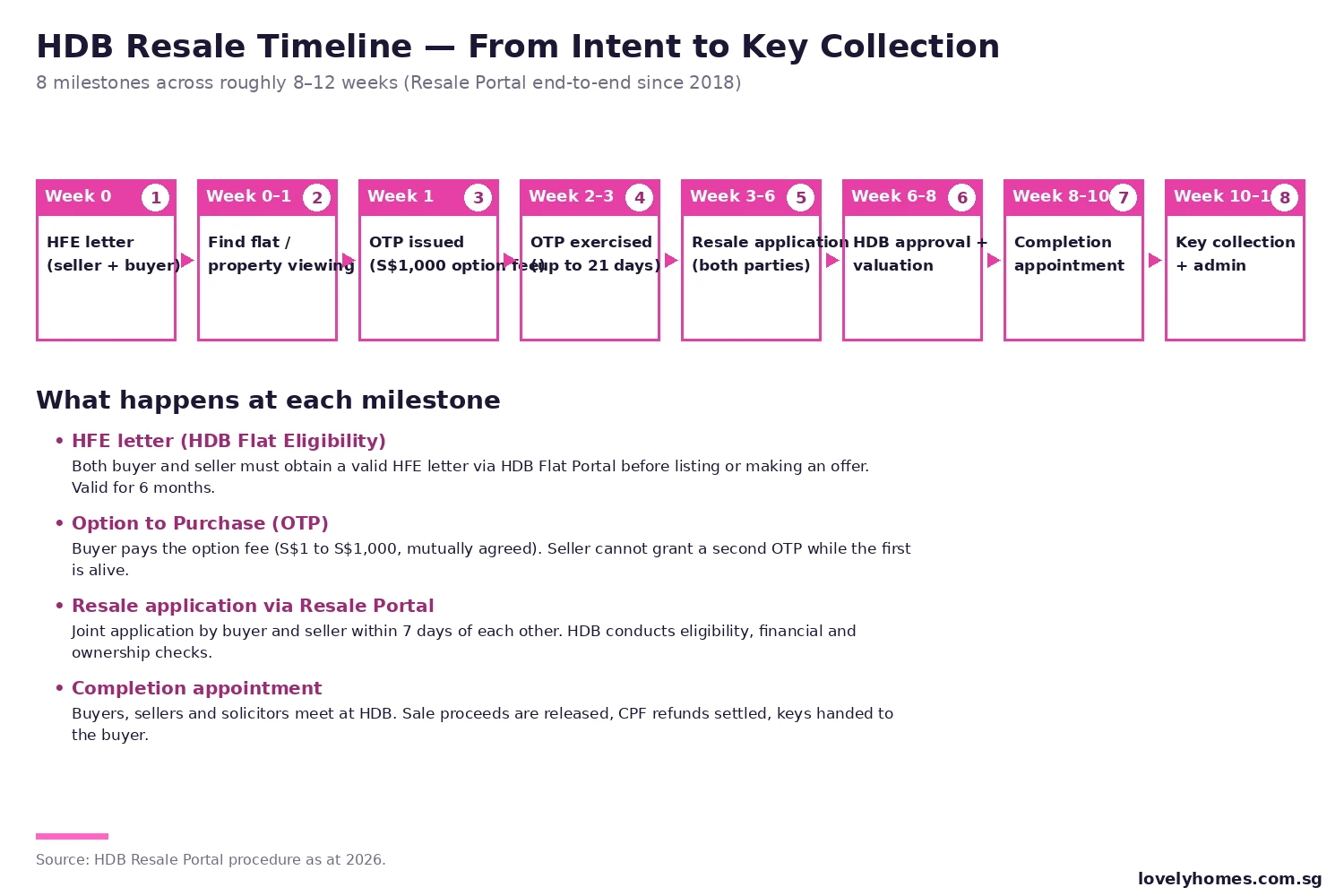
Buying an HDB resale flat is the most common large-ticket transaction Singaporeans ever make outside the BTO ballot — and the procedure has changed materially since the HDB Resale Portal went fully digital in 2018, and again with the HDB Flat Eligibility (HFE) letter taking over from the old HLE / HDB Loan Eligibility letter on 9 May 2023. This guide walks you through the eight milestones, the ~8 to 12-week timeline, the four eligibility schemes, the cash-versus-CPF split for a S$650,000 4-room buyer, and the small-print mistakes that delay completion.

Quick Answer

  • The end-to-end HDB resale runs ~8 to 12 weeks once buyer and seller have a valid HFE letter.
  • The buyer pays a S$1 to S$1,000 option fee for the OTP, then up to a further S$5,000 in option exercise fee within 21 days.
  • Resale applications are filed jointly via the HDB Resale Portal; both parties must submit within 7 days of each other.
  • The buyer’s cost stack on a S$650,000 flat includes a 20% to 25% down-payment, BSD (~S$14,400), legal fees, COV if any, and grant offsets.
  • Eligibility flows through one of five schemes (Public, Fiancé, Single SC, Joint Singles, Non-Citizen Spouse) — each with its own income ceiling and age gate.
  • HDB approval typically issues 2 to 4 weeks after submission; completion appointment is roughly 6 to 8 weeks after approval.
  • The buyer collects the keys at the completion appointment after paying the remaining balance and confirming all CPF refunds and stamp duties are settled.
HDB Resale Procedure Singapore 2026 hero — buyer step-by-step guide
LovelyHomes — the HDB resale procedure broken down for first-time and second-time buyers.

Step 1: HDB Flat Eligibility (HFE) letter

Since 9 May 2023 the HFE letter has consolidated what used to be three separate documents (HLE letter, eligibility-to-buy and CPF housing grant). Both buyer and seller obtain it via the HDB Flat Portal using Singpass, and it tells you in one document: which schemes you qualify under, the maximum HDB-loan amount, the CPF housing grants available, and the time-stamped income ceiling check. The letter is valid for 6 months; if it expires before completion you must reapply (frequent in slow-moving markets).

Sellers get an HFE too, because HDB needs to verify the seller’s MOP status, ownership share, and any outstanding subsidies that affect the next-flat resale levy. If you are about to list and you have not pulled an HFE in the last 6 months, do that first — listings without a valid HFE create the highest rate of completion-stage delays.

Step 2: Searching, viewing, and the OTP

Resale flats are listed on a mix of platforms: HDB’s own listings, classifieds, and private property portals. Once a buyer and seller agree on a price, the seller grants an Option to Purchase (OTP), accompanied by a non-refundable option fee of between S$1 and S$1,000 (mutually agreed; capped by HDB at S$1,000). The OTP locks the flat for 21 days during which the buyer must decide whether to exercise.

If the buyer exercises the OTP, an option exercise fee (option fee + exercise fee combined cannot exceed S$5,000) is paid. The seller is now contractually committed to sell. If the buyer does not exercise within 21 days, the OTP lapses and the option fee is forfeited; the seller is then free to grant a new OTP to another buyer.

HDB resale 8-step timeline Singapore 2026
Figure 1: HDB resale eight-milestone timeline from HFE letter to key collection (~8 to 12 weeks).

Step 3: Resale application via Resale Portal

Both buyer and seller submit a resale application on the HDB Resale Portal, ideally within 7 days of each other. The portal validates eligibility, the OTP details, sale price, financing intent, and the schemes claimed. HDB then runs financial-credibility checks, MOP checks, and ABSD-cross-checks against any other residential property held.

This stage requires both parties to be available digitally (Singpass), to upload supporting documents (NRIC, marriage certificate where applicable, supporting income evidence if claiming grants), and to acknowledge HDB’s resale terms. Most rejections at this stage are administrative — mismatched dates, missing documents, lapsed HFE — so attention to detail saves weeks.

Step 4: Valuation, BSD and stamp duty

HDB’s appointed valuer assesses the flat. Valuation determines the maximum HDB-loan amount and the maximum CPF that can be used. If the agreed sale price exceeds the valuation, the difference is Cash-Over-Valuation (COV), payable in cash by the buyer. COV cannot be loaned, cannot be paid from CPF, and cannot be financed in any way.

Buyer’s Stamp Duty (BSD) is then levied on the higher of price or valuation: 1% on the first S$180,000, 2% on the next S$180,000, 3% on the next S$640,000, and 4% on the balance up to S$1.5m (5% above S$1.5m, 6% above S$3m). For a S$650,000 4-room flat, BSD comes to S$14,400. ABSD applies if the buyer already owns another residential property (5% to 60% depending on profile).

HDB resale buyer cost breakdown S$650k 4-room flat Singapore 2026
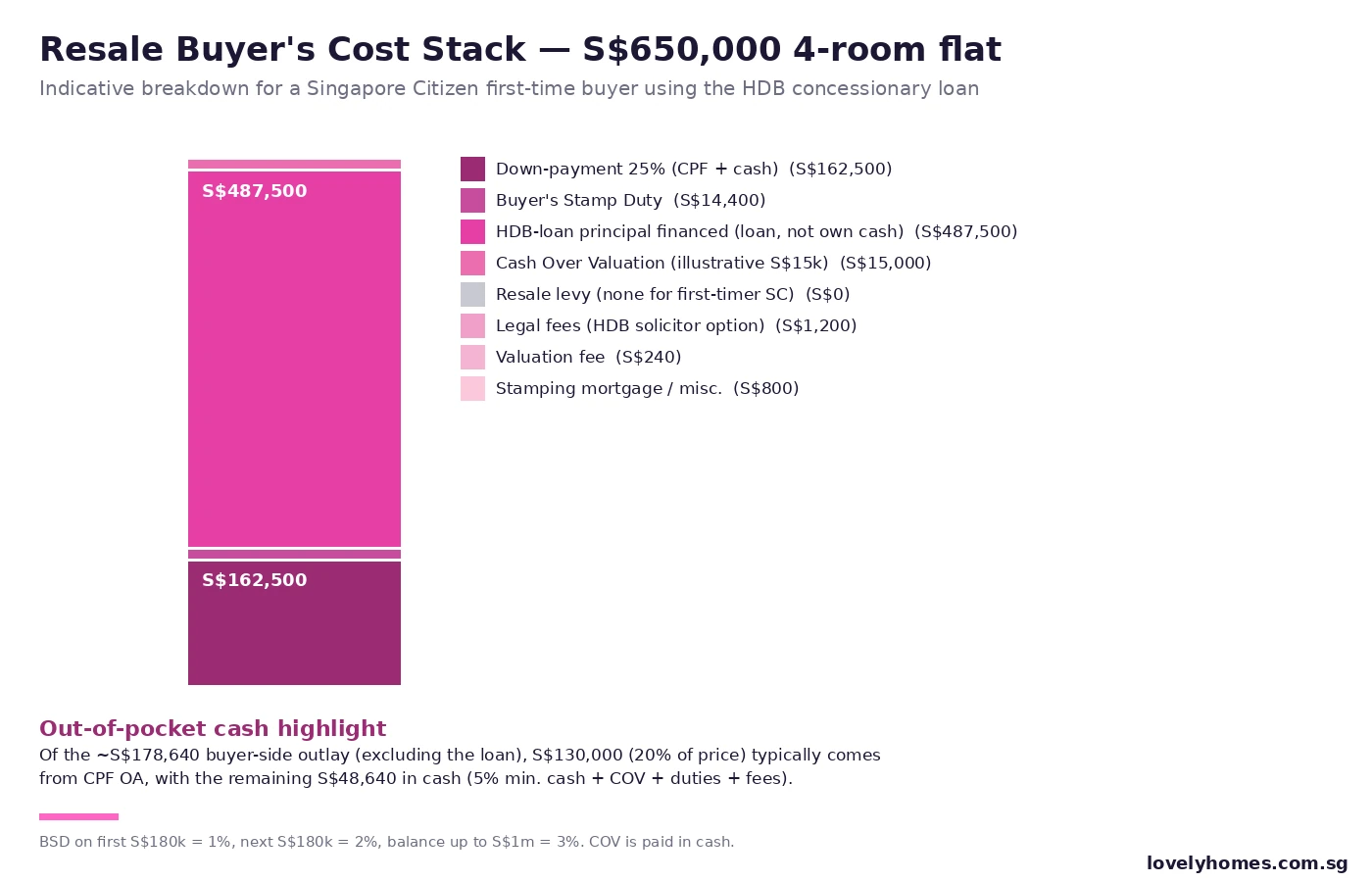
Figure 2: indicative buyer cost stack for a S$650,000 4-room HDB resale (CPF-funded down-payment, BSD, COV, fees).

Step 5: Eligibility schemes

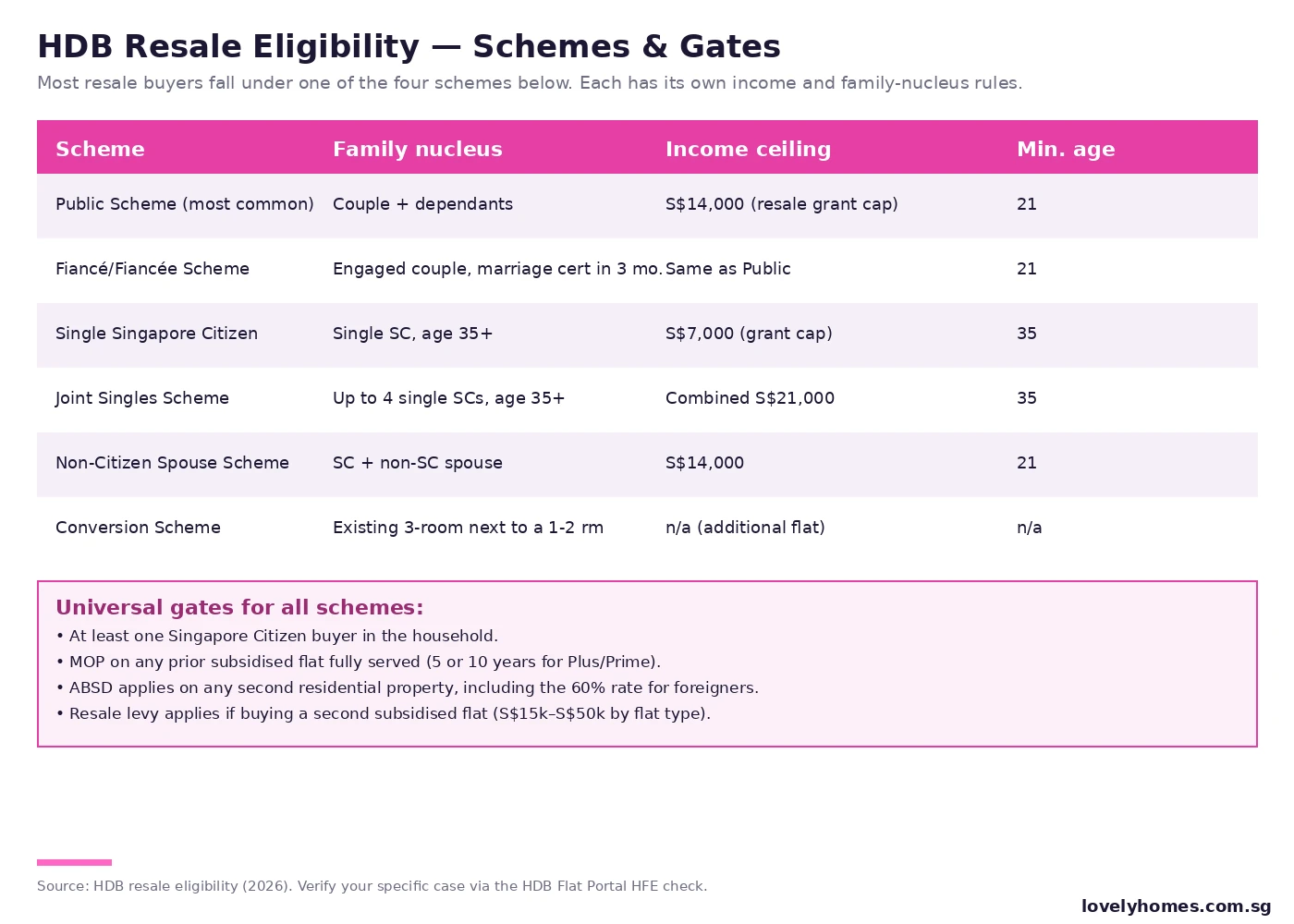
Most resale buyers fall under the Public Scheme (married couple plus dependants, S$14,000 grant income ceiling). Engaged couples use the Fiancé/Fiancée Scheme, with a marriage certificate due within 3 months of key collection. Single Singapore Citizens 35 and above use the Single Singapore Citizen Scheme (S$7,000 grant ceiling) or the Joint Singles Scheme (up to four single SCs aged 35+). The Non-Citizen Spouse Scheme covers a Singapore Citizen plus a foreign or PR spouse.

HDB resale eligibility schemes Singapore 2026
Figure 3: HDB resale eligibility schemes with income ceilings and minimum-age gates.

Step 6: Completion appointment and key collection

Roughly 6 to 8 weeks after HDB approval, both parties attend the completion appointment at HDB Hub. Solicitors are present (most buyers and sellers use HDB’s appointed solicitor for cost efficiency at S$1,200 to S$2,400 typical), and the appointment confirms: full payment of the balance, settlement of any outstanding bank loans on the seller’s side, CPF refunds with accrued interest to the seller’s CPF accounts, BSD payment, and the formal transfer of the lease.

The buyer then receives the keys. The flat is now legally yours, subject to any encumbrances disclosed and survives a “deemed handover” on the completion date.

Summary table — milestone to action

Stage Buyer Action Seller Action Typical Time
HFE letter Apply via HDB Flat Portal Apply via HDB Flat Portal 7–14 days
OTP issued Pay option fee S$1–S$1,000 Issue OTP, lock flat 21 days Day 0
OTP exercised Pay exercise fee (combined ≤S$5k) Receive exercise fee Day 1–21
Resale application Submit on Resale Portal Submit within 7 days Day 21–35
Valuation Cover valuation fee Provide access to flat Week 4–6
HDB approval Receive in-principle approval Receive in-principle approval Week 6–8
Completion appointment Pay balance, receive keys Receive sale proceeds Week 8–12

Worked Example: Tan family, S$650,000 4-room Sengkang resale

Profile. Mr Tan, 32, and Mrs Tan, 30, both Singapore Citizens, both first-time buyers. Combined household income S$11,200/mth, both employed. Buying a S$650,000 4-room resale flat in Sengkang from an upgrader couple. Using the HDB concessionary loan (HFE letter cleared at S$520,000 max loan).

Day 0. OTP issued. Tan family pays S$1,000 option fee.

Day 18. OTP exercised. Tan family pays S$4,000 exercise fee (S$5,000 combined). Resale application submitted to HDB Resale Portal same day. Seller follows on Day 22.

Week 5. Valuation comes in at S$640,000 — i.e. S$10,000 COV due in cash on top of the loan and CPF.

Buyer’s cost breakdown:

  • HDB-loan principal: S$487,500 (75% of price) — HDB pays the seller directly at completion.
  • Down-payment: S$162,500 (25% of price) — typically S$130,000 from CPF OA + S$32,500 cash (5% min cash). Tan family uses S$130,000 CPF OA + S$32,500 cash.
  • BSD: S$14,400 on S$650,000 (1%/2%/3% tiers).
  • COV: S$10,000 in cash.
  • Legal fees (HDB solicitor): ~S$1,200.
  • Valuation + admin fees: ~S$240 + misc.
  • Enhanced CPF Housing Grant: not applicable (income S$11.2k > S$9k ceiling for EHG).
  • Family Grant: S$50,000 (Public Scheme, both first-timers, household income S$11.2k qualifies).

Net cash out-of-pocket on day of completion: S$32,500 (cash down-payment) + S$14,400 (BSD) + S$10,000 (COV) + S$1,200 (legal) + ~S$300 (valuation/misc) = ~S$58,400 cash, plus S$130,000 from CPF OA. The S$50,000 Family Grant lands in the Tan family’s CPF OA after completion, partially refunding the CPF deduction.

What this means for you

The single most expensive mistake first-time resale buyers make is over-reaching on COV in a hot market. COV is paid in cash, not CPF, and it is not loanable. A S$30,000 COV adds ~5% to the immediate cash burden of a S$650,000 flat. Track recent transacted prices for the same block on HDB’s resale price portal and use that — not asking-price averages — as your valuation anchor.

The second most common delay is the HFE letter expiring mid-process. If the seller takes more than 6 months from HFE issuance to completion (rare but happens with disputes or financing delays), the HFE must be reapplied, which can add 1 to 2 weeks. Re-pulling early is cheap insurance.

What might come next

HDB has signalled further digitalisation of the resale workflow over 2026 to 2027, with potential e-conveyancing extensions and a tighter integration between the Resale Portal, IRAS stamp-duty endpoints and CPF Board’s grant-disbursement system. Expect the typical 8 to 12-week timeline to compress towards 6 to 9 weeks for clean cases. Plus and Prime flats coming on the market in the early 2030s will reach this same procedure with the additional 10-year MOP and clawback layers — but the eight-step shape will remain.

FAQ

Do I need an agent to buy a resale flat?

No. The HDB Resale Portal lets buyer and seller transact directly without an agent — many DIY transactions complete cleanly. That said, an experienced conveyancing solicitor is essential at the OTP stage and the completion appointment. Most buyers use HDB’s appointed solicitor (S$1,200 to S$2,400) rather than appointing private counsel.

Can I use CPF for the entire down-payment?

For an HDB-loan buyer, the 25% down-payment can be funded entirely from CPF OA in most cases (5% must be in cash for the first-mortgage 20% CPF route). For a bank-loan buyer, the LTV is 75% and a minimum of 5% must be in cash. The remaining 20% can be CPF OA. The Tan family example uses the standard CPF + 5% cash structure.

What is the resale levy and does it apply to me?

The resale levy applies if you are buying a second subsidised flat (i.e. you have already taken a subsidy from HDB before, whether BTO, SBF, EC, or DBSS). The levy ranges from S$15,000 (2-room) to S$50,000 (Executive). First-time buyers — most of the resale market — pay no levy. The levy is paid at the time of the second purchase, or when the second flat reaches MOP if buying via BTO.

What grants are available for resale buyers?

Singapore Citizen first-timer couples can receive up to S$80,000 in stacked grants: the Family Grant (S$50,000 to S$80,000 by income), the Enhanced CPF Housing Grant (up to S$80,000 for incomes ≤S$9,000), and the Proximity Housing Grant (S$20,000 to S$30,000 for buying near or with parents). The HDB Flat Portal HFE letter shows your exact entitlement.

What if the seller backs out after the OTP is granted?

The seller has contracted to sell. If they renege after the buyer has paid the option fee, the buyer can sue for specific performance (i.e. force the sale to complete) or claim damages. In practice, sellers very rarely renege once the OTP is granted because the legal exposure is real and the option fee is treated as part-consideration of the sale.

Do I pay GST on a resale flat?

No. Residential resale property in Singapore is GST-exempt. Stamp duty (BSD and ABSD where applicable) is paid in cash to IRAS within 14 days of OTP exercise. CPF can also be used to pay stamp duty in some financing structures.

Can I list and buy at the same time?

Yes — and many upgraders do. Sellers transitioning to a private property must take care to plan timing so the sale of the HDB flat completes before key collection of the new home, otherwise ABSD on the second residential property kicks in. ABSD remission is available if the existing HDB flat is sold within six months of the new private completion, but that requires careful sequencing and an experienced solicitor’s eye.

Related Articles

Disclaimer

This article is general guidance for Singapore HDB resale buyers. Verify the latest procedure, eligibility ceilings and grant amounts on the HDB portal and via the HDB Flat Portal HFE letter. Stamp duty rates are governed by IRAS. CPF housing rules sit with the CPF Board. Prices in worked examples are illustrative; consult a licensed solicitor for your specific transaction.

Tags: HDB resale, HFE letter, Resale Portal, OTP, Option to Purchase, Buyer’s Stamp Duty, Cash Over Valuation, COV, Family Grant, Enhanced CPF Housing Grant, Singapore Citizen, eligibility scheme, completion appointment, key collection.

HDB Resale Price Index Q1 2026: First Quarterly Decline in Seven Years — What the 0.1% Dip Actually Means

HDB Resale Price Index Q1 2026: First Quarterly Decline in Seven Years — What the 0.1% Dip Actually Means

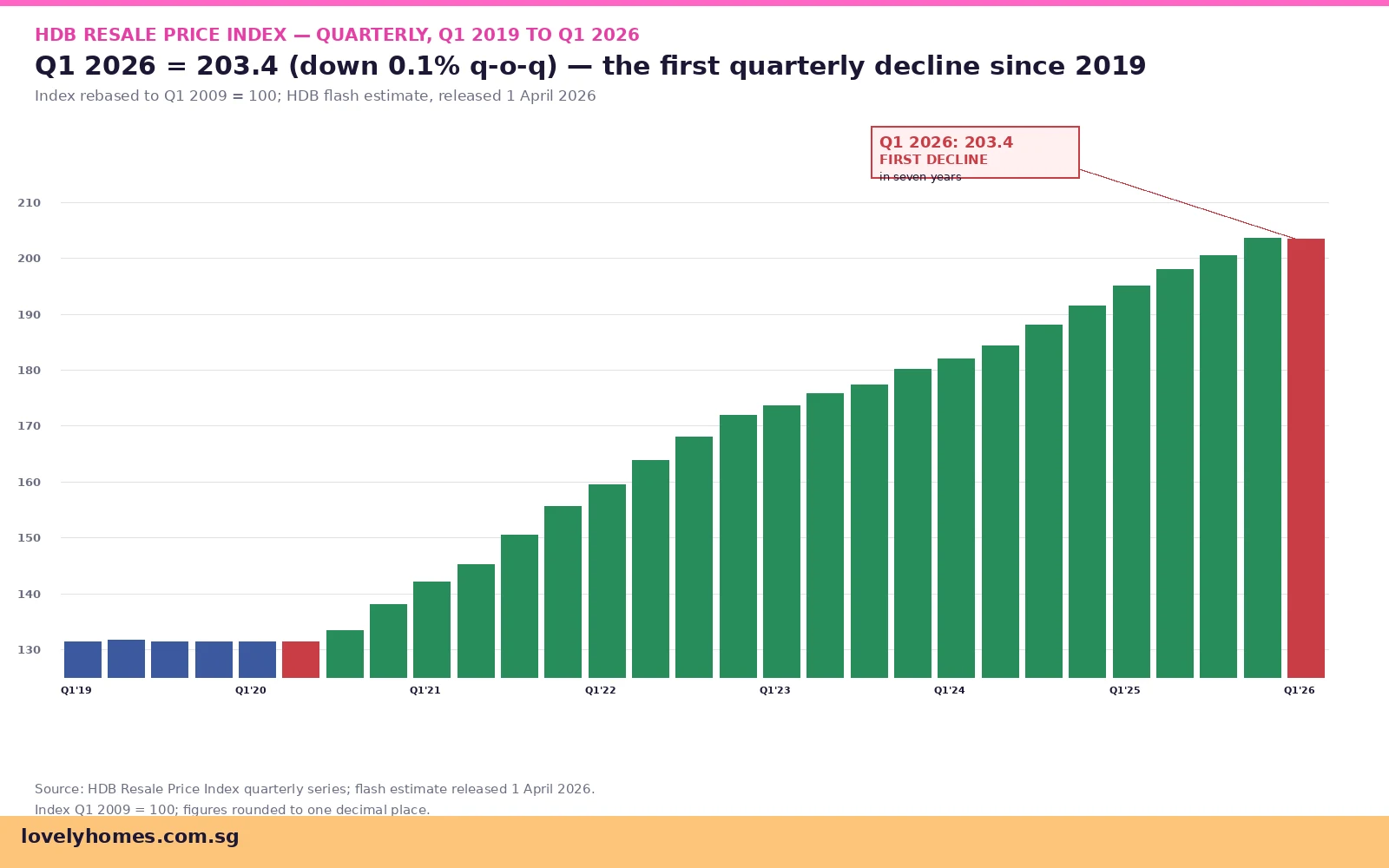
The Housing & Development Board’s flash estimate of the Q1 2026 Resale Price Index (RPI) reads 203.4 — a 0.1 percent dip from the 4Q 2025 reading of 203.6. It is a small number on a small index, but it lands as the first quarterly decline in seven years, ending a continuous-growth run that began in Q3 2020 and that lifted the index by more than 70 points across 22 quarters. The dip arrives alongside record-high million-dollar flat transactions (412 in Q1 2026) and a continuing slide in transaction volume on a year-on-year basis.

Quick Answer

  • HDB RPI Q1 2026 = 203.4, down 0.1 percent from Q4 2025’s 203.6 (HDB flash estimate, released 1 April 2026).
  • First quarterly decline since 2019, ending a 22-quarter growth run that began in Q3 2020.
  • Resale transactions: 6,285 in Q1 2026, slowing year-on-year, but up quarter-on-quarter from a holiday-soft Q4 2025.
  • Million-dollar flats: 412 transactions in Q1 2026 — a record quarterly figure, concentrated in mature estates like Bukit Merah, Toa Payoh and Queenstown.
  • Top-end stays hot, mass-market softens. The RPI dip masks a divergence: million-dollar flats kept rising while standard 4-room and 3-room mass-market resale eased.
  • Drivers: sustained BTO supply, shorter BTO build cycles (some completing in 36 to 42 months), the Open Booking of Flats (OBF) regime adding ~7,800 units annually, and cooling measures still binding marginal buyers.
  • Outlook: HDB explicitly attributes the deceleration to demand-supply rebalancing; analysts expect another flat-to-mildly-negative print in Q2 2026 before stabilisation.

The Number Itself

The RPI is a Laspeyres index rebased to Q1 2009 = 100, designed to track the price of a representative bundle of HDB resale flats. It is not a transaction-volume measure and does not reflect the prices of new HDB sales. The flash estimate uses caveats lodged through the early weeks of the quarter — the final figure for Q1 2026 will be published in late April with the full set of caveats.

The flash reading of 203.4 is 0.1 percent below the Q4 2025 print of 203.6. That is essentially a flat outcome — well within the noise band of any quarterly index — but the symbolism matters. The previous quarterly dip was in Q1 2019 (RPI 131.5, down from Q4 2018’s 131.5 — i.e. the index has been flat or rising every single quarter from Q2 2019 onwards). A 22-quarter run of continuous growth covered the pandemic lift-off (Q3 2020 onwards), the post-pandemic surge (2021–2022), the 2023 ABSD reset, and the 2024–2025 plateau-with-growth pattern.

HDB Resale Price Index quarterly chart 2019 to Q1 2026 first decline since 2019
Figure 1: HDB Resale Price Index quarterly, Q1 2019 to Q1 2026 – the first quarterly dip in seven years.

Why It Happened — Five Pressures

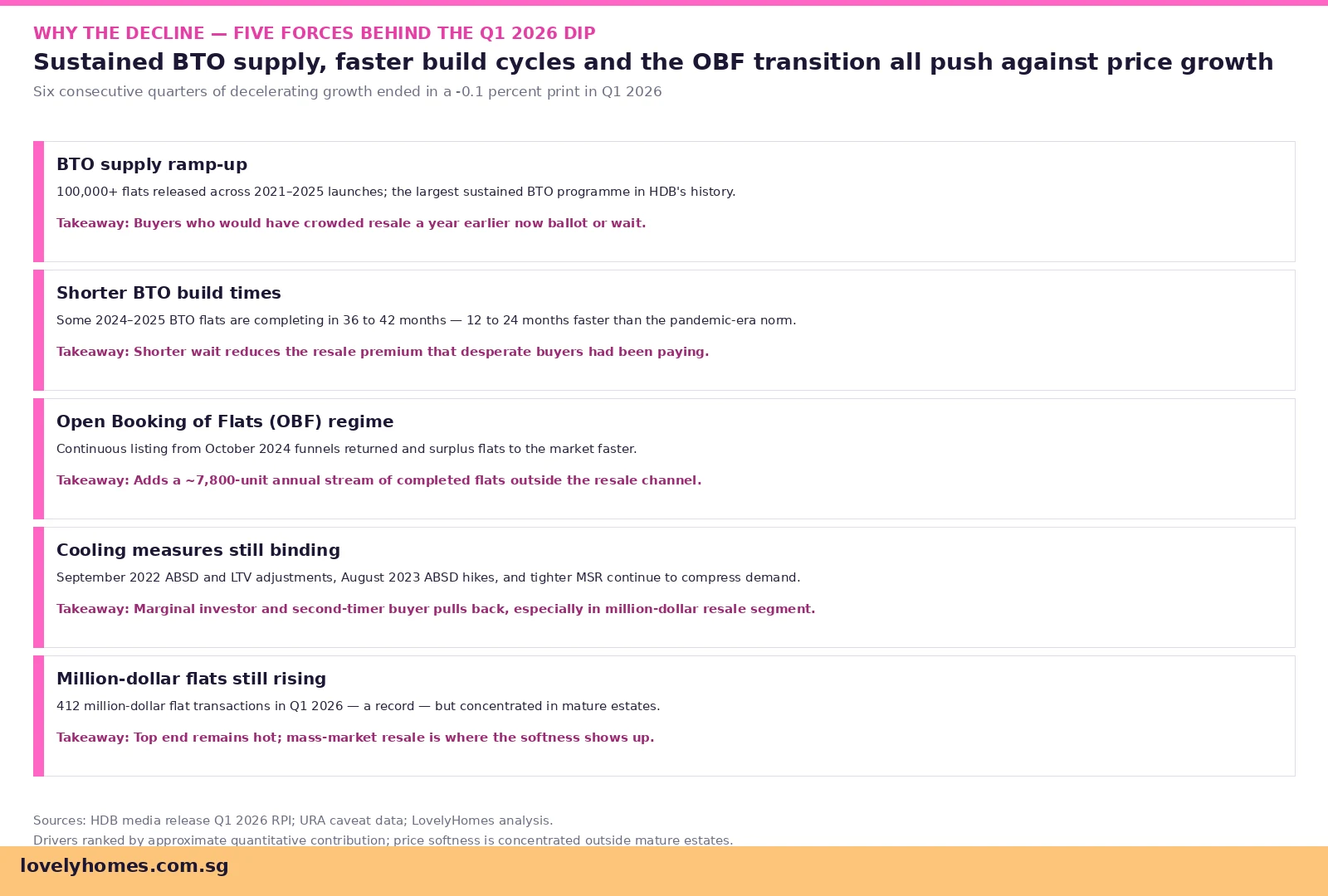
HDB’s own commentary points to a structural rebalancing of supply and demand. Five forces stand out.

BTO supply ramp-up. HDB launched more than 100,000 BTO flats across 2021–2025, the largest sustained build-to-order programme in its history. The cumulative effect is that buyers who once felt forced to chase resale because BTO supply could not match demand now have credible alternatives — both fresh ballots and older project units becoming available.

Shorter BTO build cycles. Some 2024–2025 BTO projects are completing within 36 to 42 months, 12 to 24 months faster than the pandemic-era norm. A four-year wait turning into a three-year wait is enough to flip the resale-vs-BTO calculus for a meaningful slice of marginal buyers.

Open Booking of Flats (OBF). The continuous-listing regime that replaced quarterly SBF in October 2024 adds roughly 7,800 completed-or-near-complete flats per year to the supply pipeline outside the resale channel. A buyer who would have settled for a resale 4-room in Sengkang at S$680,000 a year ago can now book an OBF return in the same town for ~S$565,000.

Cooling measures still binding. The September 2022 ABSD and LTV adjustments, the August 2023 ABSD hikes, and the tighter MSR continue to compress demand from second-property buyers, marginal investors and second-timers. The resale market — especially the high-quantum end — feels this most.

The million-dollar segment is an outlier. 412 million-dollar HDB transactions in Q1 2026 is a record quarterly figure, concentrated in mature estates with strong amenity, school proximity, and lease tenor. The top end is hot. The mass-market resale (3-room and standard 4-room flats in non-mature estates) is where the softness shows up. The aggregate index averages both, and the mass-market drag wins this quarter.

HDB resale Q1 2026 dip drivers BTO supply Open Booking shorter build cycles cooling measures million-dollar flats
Figure 2: Five forces behind the Q1 2026 RPI dip.

Summary — Key Q1 2026 Indicators

Indicator Q4 2025 Q1 2026 Change
RPI 203.6 203.4 -0.1% q-o-q
Resale Transactions ~6,070 6,285 +3.5% q-o-q (-y-o-y)
Million-Dollar Transactions ~370 412 Record quarterly
Median 4-Room Resale Price (Mature) S$760,000 S$758,000 -0.3%
Median 4-Room Resale Price (Non-Mature) S$612,000 S$608,000 -0.7%

Source: HDB flash estimate Q1 2026 RPI release, HDB resale price summary; LovelyHomes compilation.

Worked Example — A Buyer Looking at a 4-Room Resale Right Now

Take a hypothetical first-time buyer family looking at a 4-room resale in Punggol with about S$120,000 in CPF and S$60,000 cash savings, household income S$8,400 per month. Twelve months ago, the same flat traded at roughly S$632,000. Today the asking price is S$608,000 — a S$24,000 saving on the headline price, plus stronger negotiating leverage as the seller pool has grown. With Family Grant (S$25,000), Proximity Grant (S$30,000) and EHG (~S$45,000 at this income), the effective net cost lands around S$508,000.

The same buyer’s BTO option (next launch, October 2026) carries a ~3.5-year wait — meaning rent of about S$2,800 per month for 42 months, or S$117,600. The OBF option (4-room return in Sengkang) sits at S$565,000 with similar grants, but the buyer must accept whatever location is available in the listing. The Q1 2026 dip changes the calculus by trimming the resale premium just enough to make resale competitive again with the OBF route — the comparison gets closer, even if it does not flip outright.

Why This Matters For You

For buyers, the dip is mildly good news but does not change strategy. A 0.1 percent quarterly move is well within typical noise — buyers should not delay purchases waiting for a meaningful price retreat that may not come. What the dip does signal is that the relentless price growth of 2020–2024 is over, and that resale is no longer the only viable route for buyers needing a flat in months rather than years.

For sellers, the message is to price realistically. The Q1 2026 evidence is that listings priced ahead of valuation are sitting longer; price-to-value listings still clear within standard timeframes. Cash-Over-Valuation (COV) bidding has compressed substantially in non-mature estates.

For investors, the dip strengthens the cyclical case for HDB resale relative to private resale — but the ABSD wall on second properties remains the binding constraint regardless of the index print.

What Comes Next

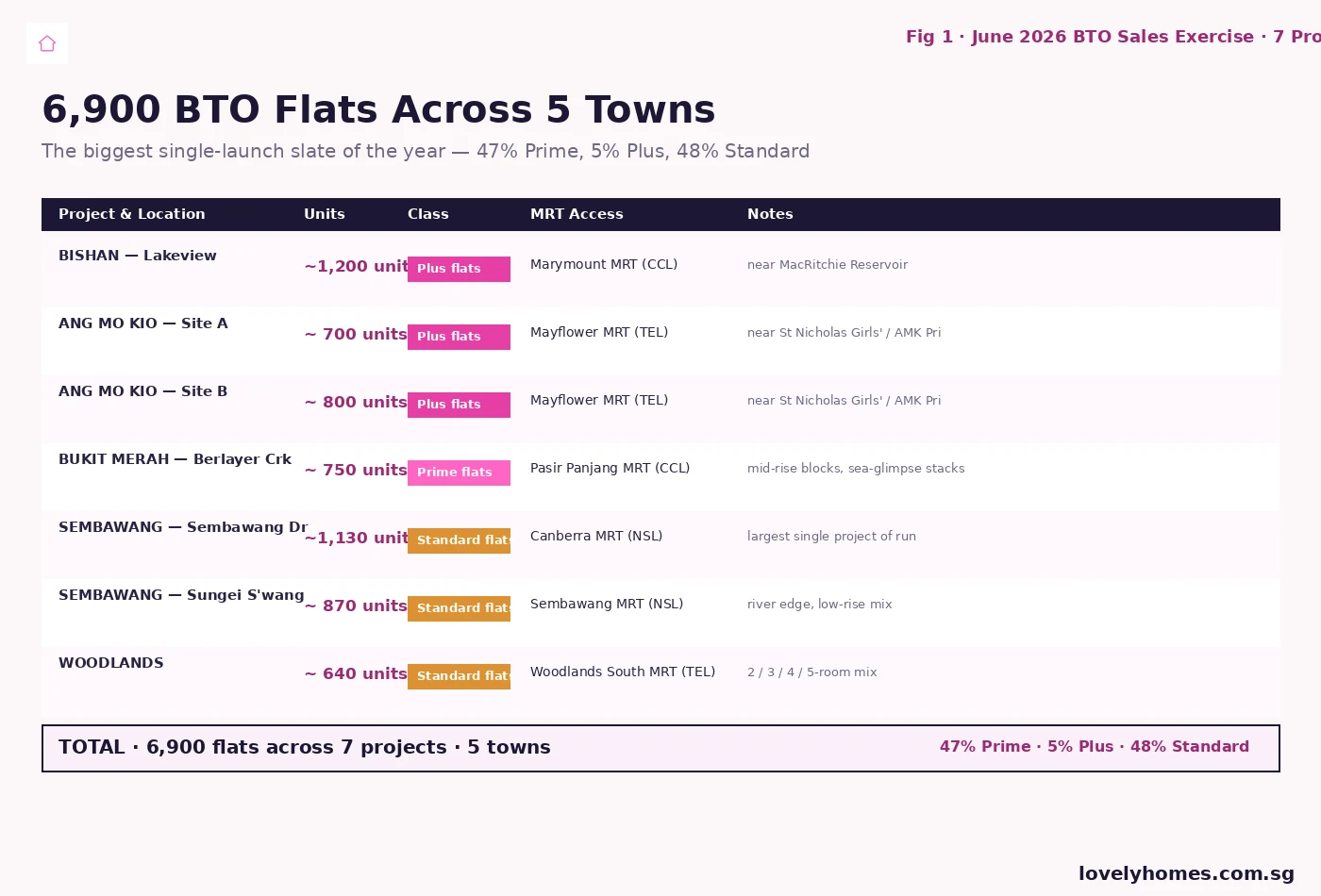
Three things to watch over the coming quarters. First, whether Q2 2026 flash extends or reverses the dip — a single negative print is noise; two consecutive prints would mark a meaningful inflection. Second, whether the million-dollar segment continues to outpace the rest, suggesting the index dip is structural rather than cyclical. Third, the BTO October 2026 launch (~6,900 flats) and the next OBF refresh — supply pressure has been the dominant driver, and the supply pipeline shows no signs of reversing.

The May 2026 BTO launch, the 7 May 2026 closing of the Holland Plain GLS tender, and the next URA quarterly release are the immediate market-moving milestones to track.

Frequently Asked Questions

Is the Q1 2026 RPI dip the start of a crash?

No. A 0.1 percent quarterly decline is well within statistical noise on an index that has moved by single decimals every quarter for years. It is meaningful as a symbolic marker — the first dip in seven years — but not as evidence of a substantial fall in HDB resale prices. The drivers are gradual supply-demand rebalancing, not distressed selling.

If the index fell, why are million-dollar flats hitting records?

Two different segments. The RPI averages all resale flats, weighted by volume. Million-dollar transactions sit at the top of the distribution — mature estates, larger flats, prime location, often near MRT and good schools. That segment continues to receive strong demand, particularly from upgraders sitting out the private market. The mass-market segment (standard 3-room and 4-room flats in non-mature estates) is where the softness shows up and pulls the overall index slightly negative.

Should I delay buying because prices might fall further?

Generally no. A 0.1 percent quarterly dip is roughly S$600 on a S$600,000 flat — far less than the rental cost of waiting. If the unit suits your needs and the price meets valuation, the timing argument has minimal weight. The bigger move on price would require a much larger supply or demand shock than the current data shows.

How does the OBF regime affect resale prices?

Open Booking of Flats adds completed and near-complete flats to the supply pipeline at HDB-set prices, typically 15 to 20 percent below resale equivalents in the same project. This caps how high resale sellers can push pricing in towns with active OBF listings — a flat in Sengkang priced at S$680,000 looks expensive next to a comparable OBF return at S$565,000.

When does the final Q1 2026 RPI come out?

HDB typically releases the final quarterly RPI in late April or early May with the full caveat dataset. The flash estimate (203.4) was published on 1 April 2026; revisions are usually within 0.1 to 0.3 index points. The full Q1 2026 release will also include median resale prices by town and flat type, plus volume breakdowns.

Are private home prices doing the same thing?

No — the URA private residential price index rose 0.9 percent q-o-q in Q1 2026 (revised up from a flash 0.3 percent), led by a 2.2 percent OCR increase. The two markets have decoupled: private residential is being driven by new launches, foreign demand and condo upgrade activity, while HDB resale is being weighed down by sustained BTO and OBF supply.

Related Articles

Disclaimer

This article is general information for Singapore property buyers, sellers and observers, and is not legal, tax, financial or investment advice. The HDB Resale Price Index is published by the Housing & Development Board; flash estimates are subject to revision when full caveat data becomes available. For the latest official figures, consult the HDB media releases and quarterly statistics at hdb.gov.sg. Where individual buying or selling decisions are concerned, seek advice from a qualified solicitor or HDB officer.

Translate »