Singapore Property Agent Commission Fees Guide 2026: What Buyers and Sellers Pay

Singapore Property Agent Commission Fees Guide 2026: What Buyers and Sellers Pay

📌 Quick Answer: Singapore Property Agent Commission 2026

  • No fixed commission rate in Singapore — all fees are negotiable between client and agent.
  • Sellers typically pay 1% for HDB flats and 1.5–2% for private properties (plus 9% GST).
  • Buyers usually pay no commission for resale private properties (co-broking covers the buyer's agent).
  • All agents must be CEA-registered — verify at cea.gov.sg.
  • An Estate Agent Agreement (EAA) must be signed before any marketing begins.
  • Commission is typically paid upon completion of the transaction.
  • GST-registered agencies charge 9% GST on top of the agreed commission.

Buying or selling property in Singapore involves engaging a licensed property agent — and understanding how much you will pay, and who pays, is essential before you sign anything. Unlike many countries, Singapore does not have a government-mandated commission rate. Instead, the Council for Estate Agencies (CEA), the statutory body that regulates Singapore's real estate industry, allows commission to be freely negotiated between the agent (or estate agent firm) and the client.

This guide explains how property agent commission works in Singapore in 2026, covering the typical rates for HDB flats, private condominiums, and landed properties, the CEA rules you need to know, how GST applies, and how to negotiate effectively — with a worked dollar example.

Bar chart showing typical property agent commission rates by property type Singapore 2026
Figure 1: Typical property agent commission rates by property type in Singapore (2026). Rates are indicative and fully negotiable. Source: CEA guidelines, industry practice.

Who Regulates Property Agents in Singapore?

The Council for Estate Agencies (CEA), established under the Estate Agents Act 2010, is Singapore's sole regulatory authority for the real estate industry. CEA licenses estate agent firms (agencies), registers individual salespersons, sets professional standards, and enforces conduct rules. Every individual who carries out estate agency work must hold a valid registration with CEA — there are no exceptions.

Before engaging any agent, you can verify their status on the CEA Public Register at cea.gov.sg. The register shows whether the agent is currently registered, which agency they are with, and their registration number. An unregistered person who carries out estate agency work commits a criminal offence under Section 28 of the Estate Agents Act and can be fined up to S$75,000.

CEA does not fix commission rates. Instead, it mandates that commission must be agreed in writing before any marketing commences. This written agreement, called the Estate Agent Agreement (EAA), protects both parties and forms the legal basis for the agent's entitlement to commission.

Property Agent Commission for HDB Flats

For resale HDB transactions, the long-established industry convention is 1% of the agreed sale price paid by the seller to the seller's agent. This convention is widely followed but not legally mandated — you can negotiate. The buyer's agent in an HDB transaction is typically paid through co-broking, where the seller's 1% is split between both agents (e.g. 0.5% each), or the buyer separately agrees to pay their agent a fee.

For HDB flats, buyers and sellers are free to proceed without any agent at all. HDB's resale portal allows direct transacting, though many parties engage an agent for the process management, paperwork, and negotiation support.

Transaction Party Typical Commission Notes
HDB Seller 1.0% of sale price Industry convention; fully negotiable
HDB Buyer 0% (co-broking) or negotiated Buyer's agent often paid from co-broke split
Rental landlord (HDB) 0.5–1 month rent Varies by lease term; negotiable
Rental tenant (HDB) 0.5 month rent (if engaged) Only if tenant directly engages own agent

Property Agent Commission for Private Properties

For private residential properties — condominiums, executive condominiums (ECs), and landed homes — the commission structure is more nuanced. The seller's agent typically charges between 1.5% and 2% of the sale price, plus 9% GST. For higher-value properties in the Core Central Region (CCR) or for complex transactions involving multiple units or overseas buyers, agents may negotiate towards the higher end of this range.

The buyer's agent commission for private property is also negotiable. In many transactions, the seller agrees to pay the total commission (e.g. 2%), which the agency then splits with the co-broking buyer's agent (e.g. 1% each). This co-broking arrangement means the buyer effectively pays nothing separately to their agent — the seller bears the entire commission cost.

However, some agencies representing buyers do charge a separate buyer's service fee, particularly for new launches where the developer does not offer co-broking terms. Always clarify this in writing before engaging an agent.

Dual panel chart showing agent commission cost HDB and private property Singapore 2026
Figure 2: Agent commission cost at key price points — HDB flat (left, 1% + GST) and private condo (right, 1.5% + GST). Source: Industry practice, LovelyHomes analysis.

Commission for New Launch Condominiums

New launch condominium transactions operate differently. The developer, not the seller, pays the agent's commission. Developers typically offer a standard commission schedule (often 1–3%, depending on the project and launch phase) to CEA-registered salespersons who bring buyers. Because the developer bears this cost, buyers of new launches generally pay zero commission to their agent.

This does not mean buyers should proceed without an agent. An experienced new launch agent provides floor plan analysis, comparisons with competing projects, and negotiation for early-bird pricing or furnishing vouchers — all at no cost to the buyer.

How to Engage a Property Agent: The 5-Step Process

CEA requires that a formal Estate Agent Agreement is signed before any estate agency work commences. Here is the standard process:

5-step flowchart for engaging a CEA-registered property agent in Singapore
Figure 3: The 5-step process for engaging a CEA-registered property agent in Singapore. The signed EAA is mandatory before any marketing activity begins.

The EAA must specify: the type of agency agreement (exclusive or non-exclusive), the duration, the agreed commission rate (in percentage or fixed dollar amount), and whether the commission is inclusive or exclusive of GST. An exclusive agreement means only that agent (and their agency) may market the property; a non-exclusive agreement allows the seller to engage multiple agents simultaneously. Most professional agents prefer exclusive arrangements, which give them incentive to invest in marketing.

GST on Property Agent Commission

CEA-registered estate agent firms that are registered for GST charge 9% GST on their commission (effective 1 January 2024, raised from 8%). This is a statutory requirement — if the agency is GST-registered, GST must be charged. Most established agencies are GST-registered. The GST component is non-negotiable once the agency is registered; only the pre-GST commission rate is negotiable.

Example: You agree to pay 1.5% commission on a S$1.5M condo sale. The pre-GST commission is S$22,500. GST at 9% adds S$2,025. Total payable: S$24,525.

Worked Example: Singapore Dollar Cost Breakdown

Consider Ms Tan, a Singapore Citizen selling her 4-Room resale HDB flat in Tampines for S$580,000, and simultaneously purchasing a 2-bedroom private condo in the OCR for S$1.35M.

HDB Sale — Agent Commission

Sale price S$580,000
Commission (1.0%) S$5,800
GST (9%) S$522
Total commission paid S$6,322

Private Condo Purchase — Agent Commission

Purchase price S$1,350,000
Commission (co-broke — buyer pays 0%) S$0
Total commission paid S$0

Note: Buyer's condo agent is paid via co-broking from the seller's 1.5–2% commission. Ms Tan pays no commission on her purchase.

Ms Tan's total out-of-pocket agent commission for both transactions is S$6,322 — a modest cost for professional representation on a combined S$1.93M transaction.

Why Agent Commission Matters for Your Budget

For buyers, the good news is that most Singapore residential property transactions involve zero out-of-pocket commission (the seller pays). For sellers, commission is a direct deduction from proceeds and should be factored into your net-of-sale calculation alongside Seller's Stamp Duty (SSD, if applicable), legal fees, and CPF refund obligations.

Singapore's commission framework compares favourably with many developed property markets. In the United Kingdom, estate agent fees average 1–2% for sole agency arrangements; in the United States, the National Association of Realtors' historic 5–6% total commission structure is currently under reform. Singapore's co-broking model, where one commission pool covers both agents, keeps overall transaction costs lower.

CEA's mandatory EAA requirement also provides stronger consumer protection than in many markets — you know exactly what you are paying before any work begins, and the agreement is legally enforceable.

What Might Come Next for Agent Regulation in Singapore

CEA has been progressively raising professional standards: mandatory Continuing Professional Development (CPD) hours, stricter enforcement of the CEA Prescribed Estate Agency Agreement, and increased penalties for misconduct. Industry observers expect CEA to introduce more granular disclosure requirements for dual representation situations (where one agent represents both buyer and seller), and potentially mandatory fee schedules for HDB transactions to increase transparency for first-time buyers. These remain proposals and have not been confirmed as of August 2026.

Frequently Asked Questions: Property Agent Commission Singapore

Is there a fixed commission rate set by the government in Singapore?

No. CEA does not prescribe any minimum or maximum commission rate. All commission is freely negotiated between the client and the agent, and must be documented in writing in the Estate Agent Agreement (EAA) before any estate agency work commences. Agents who receive undisclosed referral fees or bonuses outside the agreed EAA may be subject to disciplinary action by CEA.

Does the buyer pay commission in a resale private condo transaction?

In most resale private condo transactions, the buyer pays no direct commission. The seller pays a total commission (typically 1.5–2% + GST) which the listing agency then splits with the buyer's co-broking agency. The buyer's agent is thus compensated from the seller's commission pool. However, the buyer should always confirm this in writing with their agent at the outset — some agents do charge a separate buyer representation fee, particularly in unusual transactions or where no co-broking arrangement is in place.

Can I sell or buy a property without an agent in Singapore?

Yes. There is no legal requirement to use an agent for either HDB or private property transactions. HDB's resale portal supports direct seller-to-buyer transactions, and conveyancing lawyers handle the legal transfer without requiring an agent's involvement. That said, most sellers benefit from professional marketing exposure and negotiation support, and most buyers value having an experienced guide through the Option to Purchase and completion process. For complex transactions, dual representation, or properties subject to cooling measures, professional advice is strongly recommended.

What is co-broking, and how does it work?

Co-broking is the arrangement where the seller's agent agrees to share their commission with the buyer's agent. For example, a seller agrees to pay 2% commission. The listing agent keeps 1% and pays 1% to the buyer's agent through their respective agencies. Co-broking is the standard practice for resale private property in Singapore and incentivises buyer's agents to show the property to their clients. The co-broking split is agreed between the agencies and is not visible to the buyer or seller in most cases.

Is GST always charged on agent commission?

GST at 9% is charged only if the estate agent firm is GST-registered. Most established agencies with annual revenue above S$1M are required to be GST-registered. Sole proprietor agents with lower revenue may not be GST-registered, in which case no GST is added. Always confirm GST registration status at the time of signing the EAA, and ensure the agreed commission is documented as either inclusive or exclusive of GST to avoid disputes at completion.

What happens if the deal falls through? Do I still owe commission?

Commission is typically payable only upon successful completion of the transaction — i.e. when the Option to Purchase is exercised and the sale is legally completed. If the buyer backs out before exercising the Option, or if the transaction fails to complete due to financing issues, the commission obligation generally does not arise. However, the EAA may contain clauses around abortive commission or marketing expense reimbursement — read the agreement carefully and seek legal advice if any clause is unclear.

Related Articles


Disclaimer: The commission rates and guidelines in this article are based on industry practice, CEA regulations, and publicly available information as at August 2026. Commission structures are negotiable and may vary by agency, agent, and transaction type. This article is for general informational purposes only and does not constitute financial, legal, or real estate advisory advice. Readers should engage a CEA-registered property agent and consult qualified legal and financial advisers before making any property-related decisions. For the latest regulations, visit cea.gov.sg.

Singapore Property Selling Guide 2026: HDB & Private Condo

Singapore Property Selling Guide 2026: HDB & Private Condo

⚡ Quick Answer: Selling Your Property in Singapore 2026 — Key Points

  • Agent Commission: Regulated by the Council for Estate Agencies (CEA). For HDB resale, sellers typically pay 1–2% of the sale price. For private property, seller commission is negotiable, commonly 1–2%.
  • Seller’s Stamp Duty (SSD): Applies if you sell within three years of purchase — 12% (Year 1), 8% (Year 2), or 4% (Year 3). No SSD after three years. SSD applies equally to HDB resale and private residential property.
  • CPF Refund Obligation: All CPF principal used plus accrued interest at 2.5% p.a. must be refunded to your CPF Ordinary Account on completion. This can significantly reduce your net cash proceeds.
  • HDB Resale Timeline: From listing to key handover typically takes 16–20 weeks, including the HDB approval process of four to six weeks. Private property transactions are faster at 10–16 weeks.
  • Minimum Occupation Period (MOP): You cannot sell an HDB flat before completing the five-year MOP. Private property has no MOP (though SSD applies within three years).
  • Upgrading / Downsizing and ABSD: If you are selling one property and buying another simultaneously, timing matters for ABSD. SC sellers buying a second property before completing the sale of the first will incur ABSD on the second purchase (currently 20% for SCs), which is refundable only if the first property is sold within six months.
  • HDB Resale Levy: Sellers who have previously received a housing subsidy (e.g., bought a BTO or EC) and are purchasing a second subsidised HDB flat may need to pay a Resale Levy of S$15,000–S$55,000 on the new purchase.
  • Legal Fees: Sellers pay legal fees for conveyancing and loan redemption, typically S$1,500–S$4,000 depending on property type and complexity.
  • URA Flash Q2 Data: Private home prices rose 0.5% in Q2 2026 (URA flash estimate); HDB resale prices fell 0.3%. A moderating market may mean sellers need to price competitively in 2H 2026.
  • Engage a CEA-registered agent: Always verify your agent’s licence via the CEA Public Register before signing any contract. Never pay an upfront fee to an agent.

Overview: The Singapore Property Selling Process

Selling a property in Singapore — whether an HDB resale flat, a private condominium, or a landed home — involves a structured set of legal and administrative steps governed by the Housing Development Board (HDB) for public housing, the Singapore Land Authority (SLA) for titles, and the Council for Estate Agencies (CEA) for estate agent conduct. Understanding the sequence, costs, and obligations is essential to maximising your net proceeds and avoiding unnecessary penalties such as the Seller’s Stamp Duty (SSD).

The selling process broadly follows the same arc for HDB resale and private property: appoint an agent, set a price (backed by a formal valuation), market the property, grant an Option to Purchase (OTP) or sign a Sale and Purchase Agreement (S&P), complete HDB or legal conveyancing, and then attend the completion appointment to hand over the keys. The key differences lie in the involvement of HDB as an approving party (for resale flats), the timeline, legal costs, and the potential Resale Levy.

Figure 1: Singapore property seller cost comparison — HDB resale versus private condo 2026
Figure 1: Singapore Property Seller Cost Comparison — HDB Resale vs Private Condo (2026). Source: HDB, IRAS, CEA 2026.

Step 1: Appoint a CEA-Registered Property Agent

All property agents in Singapore must be registered with the Council for Estate Agencies (CEA). Before signing an Exclusive Estate Agency Agreement or any form of agreement with an agent, verify their registration status on the CEA Public Register. An agent’s salesperson registration number and the estate agency they represent are publicly searchable.

For HDB resale, seller commission of 1–2% of the final sale price is the prevailing market rate, though it is not regulated by a fixed tariff — negotiation is permitted. For private property, commission is similarly negotiable. Agents typically absorb marketing costs (portal listings, print advertisements, open-house events, photography) from their commission. Never pay an upfront marketing fee as a separate charge before a sale is completed.

An Exclusive Estate Agency Agreement (for a defined marketing period, typically four to eight weeks) gives the appointed agent the exclusive right to market your property. Signing with multiple agents on a co-broke basis is also possible but may reduce urgency and accountability. Sellers should clarify commission structure, marketing plan, and co-broke terms in writing before signing.

Figure 2: 8-step Singapore property selling process 2026 — from appointing agent to completion
Figure 2: The 8-Step Singapore Property Selling Process (2026). Source: HDB, CEA, SLA 2026.

Step 2: Price Your Property — The Valuation Anchor

Pricing a property accurately is the most important commercial decision a seller makes. Overpricing lengthens the time-on-market, reduces serious buyer enquiries, and can ultimately result in a lower sale price than if the property had been priced correctly from the outset. Underpricing may result in a quick sale but at a cost to the seller.

For HDB resale flats, registered agents and buyers can check recent transaction prices on the HDB Resale Flat Prices portal. For private property, recent caveat data is available on the URA website and major property portals. A formal valuation — conducted by a licensed appraiser from the Singapore Institute of Surveyors and Valuers (SISV) — provides an independent market value assessment that can support price negotiations and the buyer’s CPF/bank loan application.

For HDB resale flats, there is no official price ceiling — sellers may ask whatever price the market will bear. However, if the agreed price exceeds the HDB valuation, the buyer must fund the COV entirely in cash, which narrows the buyer pool significantly. Pricing at or just above valuation typically maximises qualified interest.

Step 3: Seller’s Stamp Duty — How to Avoid a Costly Mistake

The Seller’s Stamp Duty (SSD) was introduced by the Ministry of Finance in 2010 and most recently revised in March 2017 to its current structure. It applies to both HDB resale flats and private residential properties sold within three years of the date of purchase. The rates are: 12% of the sale price or market value (whichever is higher) if sold in Year 1 (within 12 months); 8% in Year 2 (13–24 months); and 4% in Year 3 (25–36 months). No SSD applies after 36 months of ownership. SSD is administered by the Inland Revenue Authority of Singapore (IRAS) and must be paid within 14 days of executing the S&P Agreement or OTP exercise date.

On a S$1,000,000 property sold within Year 1, the SSD alone amounts to S$120,000 — nearly wiping out typical equity gains if the property was purchased with a standard 25% down payment. Sellers should calculate their SSD exposure carefully before committing to a sale date, and consider whether deferring the sale by a few months would eliminate or reduce the duty.

Figure 3: Seller stamp duty by holding period and worked example of net proceeds Singapore 2026
Figure 3: SSD Rate by Holding Period (left) and Worked Example of Net Proceeds (right). Source: IRAS, HDB, CPF Board 2026.

Step 4: The OTP, Deposit, and Completion Process

Once a buyer is found and a price is agreed, the seller grants the buyer an OTP. For HDB resale, the option fee is capped at S$1,000 (buyer’s initial payment); the balance deposit of up to 5% of the agreed price is paid on exercise of the OTP. For private property, the S&P Agreement (drafted by the seller’s solicitors) typically sets a 1% booking fee and a 4% balance deposit on signing of the S&P. Both buyer and seller then proceed through their respective legal and HDB portal processes until the completion date, which is mutually agreed and typically falls 10–16 weeks (private) or 16–20 weeks (HDB) after the OTP is granted.

On the completion date, the seller’s solicitors (or HDB, in the case of a resale flat) release the net proceeds to the seller after settling: the outstanding mortgage, CPF principal and accrued interest refund, agent commission (if deducted from proceeds), legal fees, and any outstanding property tax. The balance is transferred to the seller by cheque or bank transfer.

Summary Table: HDB Resale vs Private Condo — Key Selling Differences

Factor HDB Resale (Seller) Private Condo / Landed
Who Approves the Transaction HDB (via Resale Portal) Singapore Land Authority (SLA) + solicitors
MOP Before Selling 5 years from key collection None (SSD applies within 3 years)
Agent Commission (Seller) 1–2% (market norm) 1–2% (negotiable)
SSD (Year 1 / 2 / 3) 12% / 8% / 4% 12% / 8% / 4%
Legal Fees (Seller) ~S$1,500–S$2,500 ~S$2,500–S$4,000
CPF Refund Required Yes Yes
Resale Levy (if applicable) S$15,000–S$55,000 Not applicable
Timeline: Listing to Completion ~16–20 weeks ~10–16 weeks
HDB Approval Required Yes (~4–6 weeks) No
Property Tax (Seller’s obligation) Settled pro-rated to completion date Settled pro-rated to completion date

Worked Example: Mr and Mrs Phua Sell Their 5-Room Bishan HDB (7 Years Old)

💼 Worked Example: SC+SC Sellers, 5-Room Bishan HDB Resale

Seller Profile: Mr and Mrs Phua; purchased flat 7 years ago at S$580,000 with HDB loan; now selling to upgrade to a private condo

Agreed Sale Price: S$850,000 (above the 7-year-old BTO original price of S$580,000; no SSD as held >3 years)

Outstanding HDB Loan (approx): S$326,000 (after 7 years of repayments on original S$435,000 loan @ 2.60% over 25 years)

CPF OA Principal Used to Date (est.): S$154,000; Accrued Interest (7 years @ 2.5% p.a., estimated): S$14,600 → Total CPF refund: S$168,600

Cost Breakdown at Completion:

  • Agent Commission (1.5%): S$12,750
  • Legal Fees (HDB-prescribed): S$1,800
  • HDB Admin / Registration Fee: S$80
  • Property Tax (pro-rated, seller’s share): ~S$450
  • SSD: S$0 (held 7 years — no SSD liability)

Calculation of Net Cash Proceeds:

  • Sale Price: S$850,000
  • Less: HDB Loan Settlement: (S$326,000)
  • Less: CPF Refund (principal + interest): (S$168,600)
  • Less: Agent Commission: (S$12,750)
  • Less: Legal + admin fees: (S$2,330)
  • Net Cash Proceeds: ~S$340,320

The CPF refund of S$168,600 goes back to the Phua’s CPF OA — which can immediately be used towards the down payment on their next property purchase. The S$340,320 net cash can supplement the new purchase or be retained as emergency funds.

Note on Upgrading ABSD: If the Phuas buy their private condo before completing the HDB sale, they would face ABSD of 20% on the condo (as SCs buying a 2nd property) — approximately S$200,000–S$300,000 on a typical OCR condo price. This would be remitted only if the HDB is sold within 6 months of the private condo’s Temporary Occupation Permit (TOP) or the condo purchase completion (whichever is later). Sellers are strongly advised to sequence the sale before the purchase where possible, to avoid the upfront ABSD liability.

Why This Matters: Timing Your Sale in a Moderating Market

The Singapore property market in mid-2026 presents a nuanced picture for sellers. HDB resale prices have declined for two consecutive quarters — down 0.1% in Q1 2026 and a further 0.3% in Q2 2026, marking the first back-to-back quarterly decline since 2018. This does not signal a property crash — transaction volumes remain healthy — but it does mean sellers should price realistically and be prepared for longer marketing periods than in 2023 or 2024.

Private condo prices, by contrast, remain firm, with URA flash estimates showing a 0.5% increase in Q2 2026. The full Q2 private property data (due 24 July 2026) and HDB full resale data (~23 July 2026) will provide a sharper picture of which segments are strengthening and which are softening. Sellers of private property in the Core Central Region (CCR) and Rest of Central Region (RCR) may find conditions supportive, while Outside Central Region (OCR) sellers face more competition from newly TOPped projects.

What Might Come Next for Property Sellers

The HDB October 2026 BTO exercise — covering Bedok, Geylang, Sembawang, Tengah, Toa Payoh, and Yishun — will introduce fresh BTO supply and draw first-time buyers away from the resale market in those towns. Resale sellers in those specific areas may find demand softer in the fourth quarter of 2026. Meanwhile, approximately 13,484 HDB flats are reaching their MOP in 2026, expanding the pool of sellers — and the pool of buyers who now qualify to purchase a resale flat using their MOP-unlocked CPF and sale proceeds.

On the private side, the July 2026 launch of Dunearn House (the first Turf City precinct launch) at prices from S$1.475 million could redirect some buyer attention towards new launches in the CCR, adding competitive pressure to resale sellers of CCR condos in the same price bracket.

Frequently Asked Questions

Do I need to pay agent commission as a seller?

For HDB resale flats, the prevailing market norm is for sellers to pay their appointed agent a commission of 1–2% of the agreed sale price upon completion. This is not a fixed statutory rate — it is negotiable between the seller and the agent. CEA regulations require agents to disclose their commission clearly in writing before acting. Buyers may also engage their own buyer’s agent, with commission arrangements negotiated separately. There is no obligation on the seller to pay commission to the buyer’s agent, though co-broke arrangements (where the seller’s agent splits commission with a buyer’s agent) are common and typically absorbed within the seller’s agreed rate.

Can I sell my HDB flat before the MOP ends?

No. HDB flats cannot be sold on the resale market before the five-year Minimum Occupation Period (MOP) is completed. The MOP runs from the date you collect the keys. Breaching the MOP by attempting to sublease the entire flat or transferring ownership is a serious offence under the Housing and Development Act. Exceptional circumstances (such as divorce, financial hardship, or owners who are migrating) may result in HDB-assisted disposal through specific schemes, but these are subject to HDB’s approval and significant restrictions. There is no equivalent MOP for private properties, though the SSD applies within the first three years.

What is the Resale Levy, and when does it apply?

The HDB Resale Levy is a payment required from sellers of a subsidised HDB flat (BTO, Design, Build and Sell Scheme/DBSS, or Executive Condominium at the point of privatisation) who wish to buy a second subsidised HDB flat or EC. It is designed to ensure that the housing subsidy is shared more equitably across the public housing population. The levy amount ranges from S$15,000 (for a 2-room BTO flat) to S$55,000 (for a 5-room/Executive flat). It is payable upon purchase of the next subsidised flat and can be deducted from CPF proceeds or the sale proceeds of the first flat. Resale buyers of a resale flat (buying non-subsidised) do not trigger the Resale Levy.

How is the CPF accrued interest refund calculated?

When you sell your property, all CPF principal withdrawn from your Ordinary Account (OA) for the purchase — plus accrued interest at the CPF OA rate of 2.5% per annum — must be refunded to your CPF OA. The interest compounds annually from the date each withdrawal was made. For example, if you withdrew S$100,000 from CPF OA nine years ago, the accrued interest at 2.5% p.a. (compounded) would be approximately S$24,886. This amount is refunded to your CPF OA, not paid out as cash. The CPF refund can then be used towards your next property purchase. You can check your CPF usage and estimated refund amount via the CPF Board’s member portal.

Can I sell my property and buy another one at the same time to avoid ABSD?

In principle, yes — but the sequencing and timing are critical. If you sell your existing property first and complete the sale before purchasing a new one, you return to a “no-property” position and your next purchase is treated as a first purchase (no ABSD for SC first-timers). If you buy before you sell, you incur ABSD as a second property buyer (20% for SCs), which is refunded only if you sell the first property within six months of the new property’s Temporary Occupation Permit issuance (for new launches) or the completion date (for resale private). The timing window is tight — particularly if you are buying a new launch with a TOP date two to three years away. Bridging loans are available but expensive. Sellers planning to upgrade should work through the ABSD timeline carefully with a solicitor or licensed financial adviser before committing to either transaction.

How long does it take to sell an HDB flat from listing to completion?

The typical timeline for an HDB resale transaction is 16–20 weeks from the date the seller registers the Intent to Sell on the HDB Resale Portal to the completion date. The marketing period (finding a buyer) is not included in this count — it can range from a few days to several months depending on pricing and demand. Once the OTP is exercised, both parties have approximately four to six weeks to await HDB’s processing and approval, followed by a further four to six weeks for the completion appointment to be scheduled. The full process from Intent to Sell registration to key handover is therefore most accurately described as three to five months in total, assuming a buyer is found within the first four to eight weeks of marketing.

What taxes does a seller pay when selling property in Singapore?

The primary tax a seller may face is the Seller’s Stamp Duty (SSD): 12% (Year 1), 8% (Year 2), or 4% (Year 3), NIL thereafter — based on the holding period from the date of purchase to the date the OTP is exercised. There is no Capital Gains Tax (CGT) in Singapore — property gains are not taxed as income. Property tax for the calendar year is apportioned between buyer and seller at the completion date based on the Annual Value (AV) assessed by IRAS. For owner-occupied residential property, the property tax rate is progressive and lower than for non-owner-occupied property. Sellers should pay their outstanding property tax before completion to avoid it being flagged as a caveat on title.

Disclaimer: This article provides general information on the process and costs of selling residential property in Singapore. It does not constitute legal, financial, tax, or property advice. Information reflects publicly available data from the Housing Development Board (HDB), Inland Revenue Authority of Singapore (IRAS), CPF Board, Council for Estate Agencies (CEA), and Singapore Land Authority (SLA) as at July 2026. Stamp duty rates, commission structures, and regulatory requirements are subject to change at any time. Readers should verify all information with the relevant government agencies and seek independent legal and financial advice before proceeding with any property sale. LovelyHomes.com.sg is not affiliated with any government agency.

Singapore Property Agent Guide 2026: CEA Rules, Commissions and Your Rights Explained

Singapore Property Agent Guide 2026: CEA Rules, Commissions and Your Rights Explained

Quick Answer: Singapore Property Agent Guide 2026

  • All estate agents and salespersons in Singapore must be registered with the Council for Estate Agencies (CEA), established under the Estate Agents Act 2010.
  • There are no statutory commission rates in Singapore — fees are market-driven and fully negotiable between client and agent.
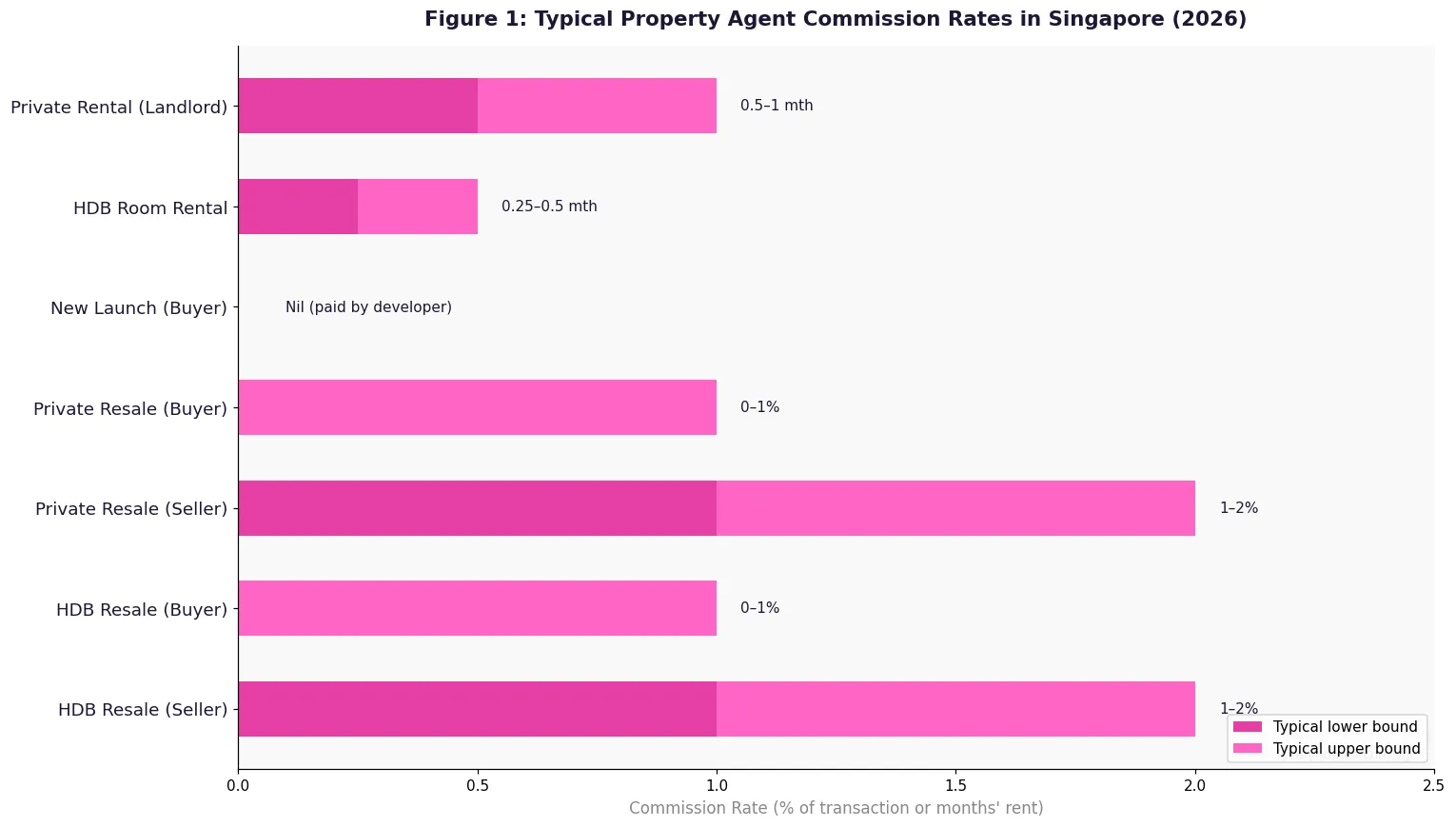
  • Typical seller-side commissions run 1–2% of the transaction price; buyer-side commissions are typically 0–1%; rental landlord fees are 0.5–1 month’s rent.
  • Your agent must issue you a Client Care Letter (CCL) before performing any estate agency work — this is a CEA regulatory requirement.
  • In a co-broking arrangement, your agent and the other party’s agent each represent their own client; a dual-representation arrangement (one agent acting for both) is permitted but must be disclosed in writing.
  • You can verify any agent’s registration, track record, and disciplinary history on the CEA Public Register at cea.gov.sg/public-register.
  • Agents must declare all material facts affecting value, disclose any conflict of interest, and may not receive undisclosed referral fees or kick-backs.
  • A complaint against an agent can be lodged with the CEA; sanctions range from financial penalties to suspension or revocation of registration.

What Is a Property Agent in Singapore — and Who Regulates Them?

A property agent in Singapore is a licensed professional who facilitates the sale, purchase, or rental of residential and commercial real estate on behalf of clients. The industry is regulated by the Council for Estate Agencies (CEA), a statutory board under the Ministry of National Development, established by the Estate Agents Act 2010.

Before the CEA’s formation, the property agency industry operated with minimal oversight, leading to consumer complaints about misleading advice, undisclosed commissions, and conflicts of interest. The CEA fundamentally restructured the profession: today, every estate agency must hold a valid estate agent licence, and every individual salesperson must hold a real estate salesperson (RES) registration. Operating without these credentials is a criminal offence.

Understanding how the CEA framework works — and what your agent is legally required to do and prohibited from doing — puts you in a far stronger position when buying, selling, or renting property in Singapore.

Figure 1: Typical property agent commission rates Singapore 2026 by transaction type
Figure 1: Typical property agent commission rates in Singapore (2026). Note: all rates are negotiable — no statutory minimum or maximum applies.

CEA Registration: Licences, RES Certificates and the Public Register

The CEA maintains a two-tier registration system. At the agency level, an estate agency licence is required — this is the firm through which salespersons operate. At the individual level, every salesperson must hold a current RES registration, which requires passing the two-part RES examination administered by the Singapore Institute of Estate Agents (SREA) or the CEA-approved course providers, and completing continuing professional development (CPD) hours each year to renew.

The CEA Public Register is the most important tool for consumers. It is free, publicly accessible at cea.gov.sg/public-register, and allows any member of the public to:

  • Confirm a salesperson’s registration status (active, suspended, or lapsed).
  • View the agency the salesperson is affiliated with.
  • Check whether any disciplinary actions or court orders have been taken against the individual.
  • Verify the estate agency’s licence number and status.

Before engaging any property agent, run their name and the agency name through the Public Register. An agent who hesitates to provide their registration number is a red flag.

CEA Licence and Registration at a Glance

Item Estate Agency (Firm) Salesperson (Individual)
Credential Required Estate Agent Licence RES Registration
Issued By Council for Estate Agencies (CEA) Council for Estate Agencies (CEA)
Prerequisite Key Executive Officer (KEO) with RES + 3 yrs experience RES examination (2 papers) + background check
Renewal Annual Annual (with CPD requirement)
Public Verification CEA Public Register CEA Public Register
Disciplinary Body CEA Disciplinary Committee CEA Disciplinary Committee
Offence (Unregistered) Fine up to S$100,000 and/or imprisonment Fine up to S$75,000 and/or imprisonment

The Client Care Letter (CCL): Your Most Important Document

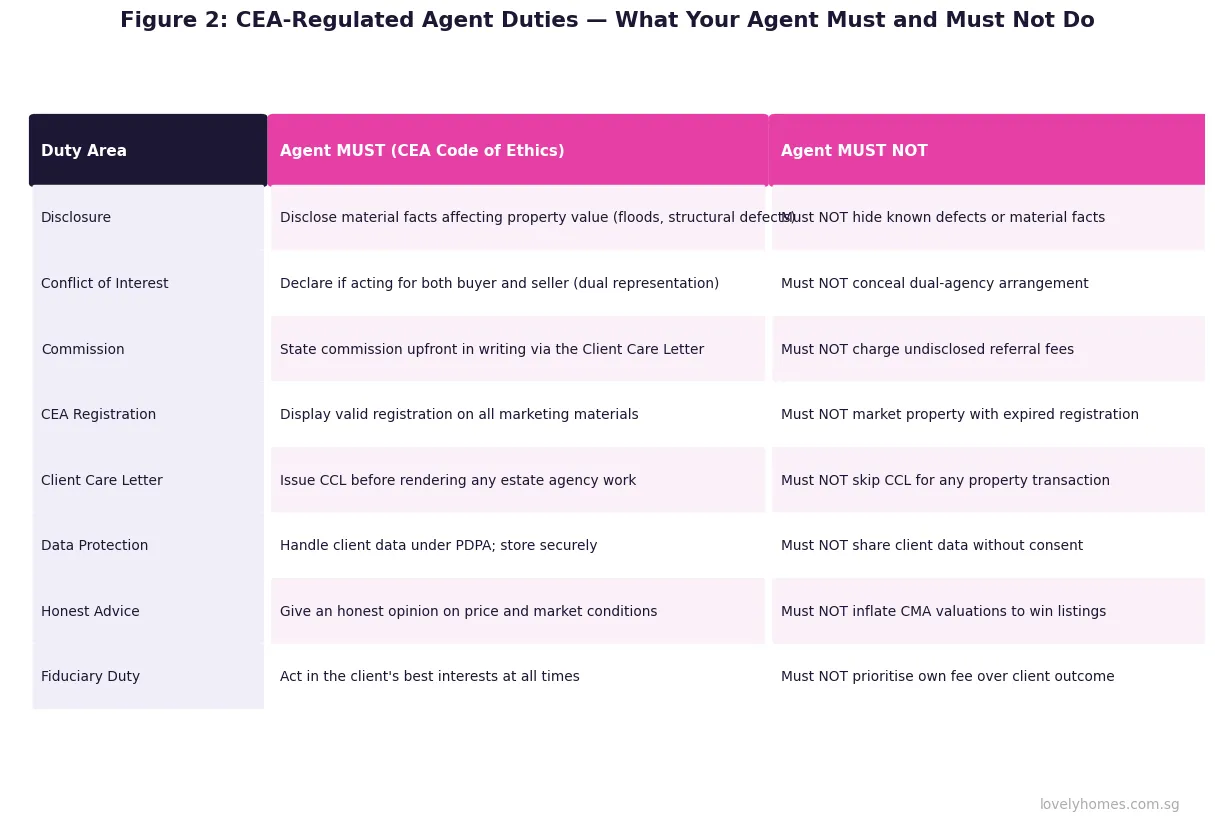
The Client Care Letter is a mandatory document that every CEA-registered salesperson must issue to a client before rendering any estate agency service. Think of it as the formal engagement agreement between you and your agent. The CCL must specify:

  • The scope of estate agency work to be performed.
  • The commission rate or fee, and who pays it.
  • Whether the agent will be representing you only, the other party only, or both parties (dual representation).
  • The duration of the exclusive or non-exclusive engagement (if applicable).
  • The agent’s and agency’s CEA registration numbers.

The CCL exists to protect consumers. If you have signed a CCL, you have a documented record of the agreed terms — and the agent is legally bound by it. Never sign anything or pay any fee before receiving and reviewing the CCL. Any agent who asks you to pay a commission before issuing a CCL is in breach of the CEA Code of Ethics.

Figure 2: CEA-regulated property agent duties Singapore 2026 what agents must and must not do
Figure 2: CEA Code of Ethics — what your Singapore property agent must and must not do in 2026.

Agent Commission in Singapore: How It Works and What You Should Expect to Pay

Singapore has no statutory commission rates — the CEA does not set minimum or maximum fees. This means all commission is negotiable between the client and the agent. In practice, market norms have emerged that give buyers and sellers a clear benchmark.

For private residential resale transactions, the seller’s agent typically earns 1–2% of the sale price, paid by the seller. The buyer’s agent, if engaged, typically earns 0–1%, often paid by the seller as a co-broking fee or by the buyer directly. For HDB resale, the same broad range applies, though some agents charge a fixed fee for lower-priced flats.

For new launch condominiums, the developer pays all agent commissions — buyers typically pay nothing to their agent, though the cost is arguably baked into the launch price. Developers usually pay 2–4% of the purchase price to the selling agency.

For rental transactions, the landlord’s agent typically receives 0.5–1 month’s gross rent per year of tenancy; the tenant’s agent (if engaged separately) may charge the tenant 0.25–0.5 months as well. For room rentals, the commission is typically 0.25–0.5 months.

When negotiating commission, remember that a lower rate does not always mean better value. An experienced agent with a strong track record of achieving above-market prices may deliver a higher net outcome even after a 2% fee than a lower-cost option who settles at asking price.

Co-Broking vs Dual Representation: What Every Buyer and Seller Must Understand

Two structural arrangements govern how agents interact in a Singapore property transaction:

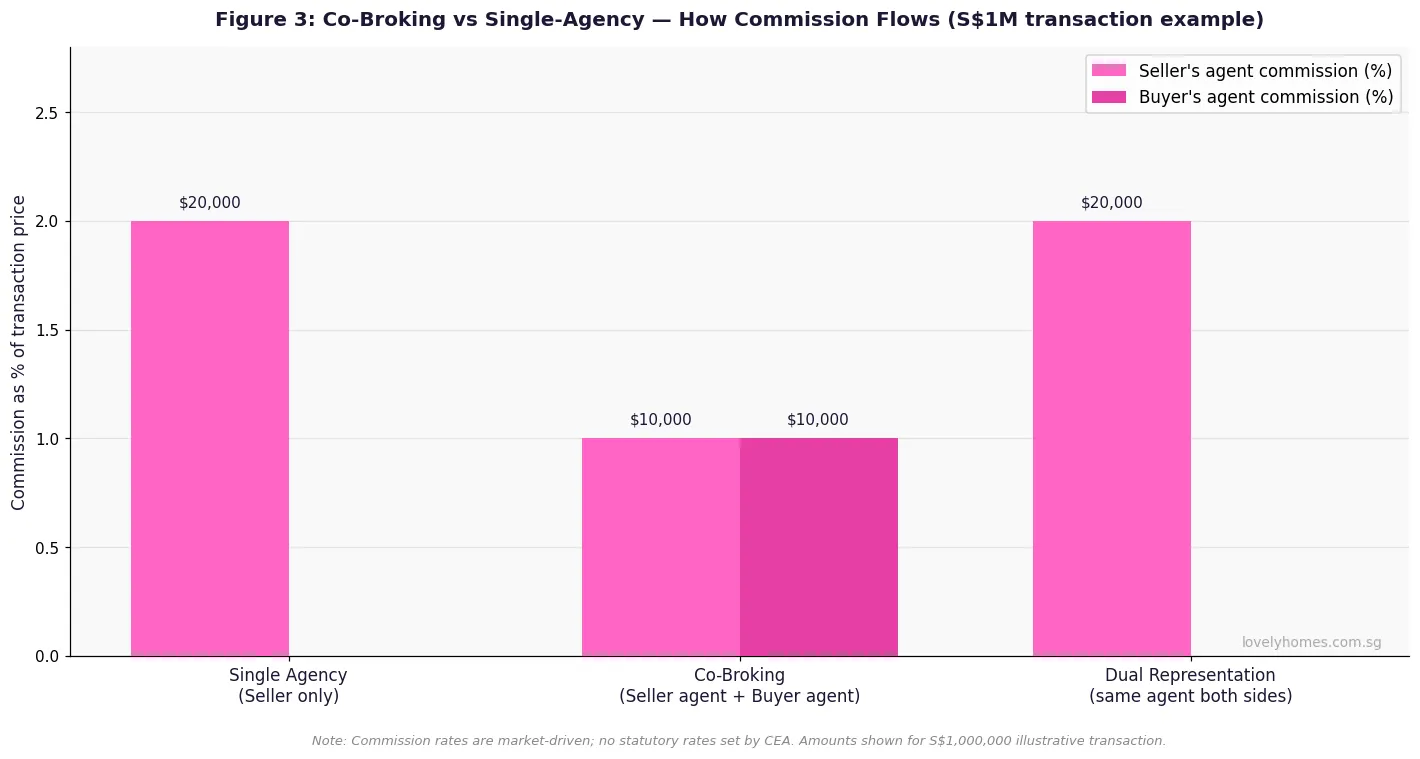
Co-broking is the standard arrangement in which the seller’s agent and the buyer’s agent each represent their own client and split the commission. The seller’s agent acts solely in the seller’s interest; the buyer’s agent acts solely in the buyer’s interest. This is generally the arrangement that offers the strongest protection to both parties, as each has an advocate.

Dual representation occurs when a single salesperson (or two salespersons from the same estate agency) acts for both buyer and seller in the same transaction. This creates an inherent conflict of interest — the same agent cannot truly maximise the price for the seller whilst simultaneously minimising it for the buyer. Under CEA rules, dual representation is permitted but comes with strict disclosure obligations: the agent must obtain written consent from both parties, issue a separate CCL to each, and make clear that they are not acting exclusively for either side.

If you are a buyer and your agent is also acting for the seller, you should understand that their advice on pricing, negotiation, and terms may not be in your exclusive interest. You have the right to engage a separate buyer’s agent, though you may then be responsible for their fee.

Figure 3: Co-broking versus single agency commission structure Singapore property agents 2026
Figure 3: How commission flows under co-broking vs single agency vs dual representation for a S$1,000,000 illustrative transaction in Singapore (2026).

Worked Example: Buying a S$1.35M D15 Resale Condo — Agent Fees from Both Sides

Mr and Mrs Chen are Singaporean citizens buying a three-bedroom resale condominium in District 15 (East Coast/Katong) for S$1,350,000. The seller is represented by Agent A (from Agency X). The Chens engage Agent B (from Agency Y) as their dedicated buyer’s agent. This is a co-broking arrangement.

Seller’s side: The seller has agreed to pay Agent A a commission of 2% of the sale price = S$27,000. The seller also agrees to pay a co-broking fee to Agent B of 1% = S$13,500. Total commission borne by the seller: S$40,500 (3%).

Buyer’s side: The Chens pay Agent B nothing directly — their agent’s co-broking fee is borne by the seller. However, the Chens should note that had the seller not agreed to co-broke, they would have needed to either pay Agent B themselves or negotiate the seller’s agent into a lower price to compensate.

HDB sale scenario: If the Chens had been buying an HDB resale flat at S$680,000 instead, and engaged a buyer’s agent, the seller would typically pay the seller’s agent 2% (S$13,600) whilst the buyer’s agent may charge the Chens 1% (S$6,800) payable by the buyer. Total transaction cost differs significantly from the private market.

Key takeaway: Always clarify upfront, in writing via the CCL, who pays what before agreeing to engage any agent. Ask whether the seller is paying co-broking and at what rate, and whether your agent has any other financial relationships with the other party or agency.

How the CEA Handles Agent Misconduct: The Complaint and Disciplinary Process

The CEA takes a structured approach to consumer complaints. If you believe an agent has breached the Code of Ethics, the Estate Agents Act, or any CEA circular, you can file a complaint via the CEA’s online portal at cea.gov.sg. The CEA investigates and may refer the matter to its Disciplinary Committee (DC).

Sanctions available to the DC range from written warnings and financial penalties up to S$75,000 (individual) or S$100,000 (agency), through to suspension or permanent revocation of registration. In serious cases, criminal prosecution under the Estate Agents Act is possible. All disciplinary decisions are published in the CEA’s enforcement reports and reflected on the Public Register.

Common grounds for complaints include: failure to issue a CCL, misrepresentation of property condition or price, unauthorised receipt of referral fees, failure to disclose dual representation, and staging or fabricating viewings. The CEA’s Code of Ethics and Professional Client Care sets out in detail the full range of obligations.

Why Understanding CEA Rules Protects Your Largest Financial Transaction

Property transactions in Singapore typically represent the single largest financial commitment a household will ever make. A S$1.5M condo purchase involves not only the purchase price but Buyer’s Stamp Duty, possible ABSD, legal fees, mortgage costs, and ongoing maintenance — easily totalling S$1.8M in lifetime costs. In this context, the role of an agent who genuinely acts in your interest (rather than their own) is material.

The CEA framework, while broadly effective, cannot eliminate every conflict of interest or guarantee the quality of every agent. Singapore’s property market is large enough that the range of agent quality is wide. Understanding the rules — particularly dual representation, the CCL requirement, and the Public Register — gives consumers the tools to select wisely and hold agents accountable.

By comparison, markets like Hong Kong (RICS, EAAB) and Australia (state-based licensing) operate similar registration frameworks but typically have higher regulatory barriers to entry and stronger mandatory insurance requirements. Singapore’s framework is robust but continues to evolve: the CEA has periodically tightened CPD requirements and is exploring strengthened buyer-protection measures.

What Might Come Next for CEA Regulation in Singapore

The CEA has signalled ongoing interest in strengthening consumer protection in the estate agency industry. Areas that industry observers expect to be addressed in coming years include: mandatory professional indemnity insurance for individual salespersons (currently required at agency level only), further tightening of dual-representation rules in light of rising transaction complexity, and the potential introduction of a consumer redress fund analogous to those found in insurance and financial advisory sectors. The CEA has also moved toward digitising the CCL process, with a view to making client care documentation more standardised and harder to circumvent.

Frequently Asked Questions

Do I need a buyer’s agent when buying a new launch condo in Singapore?

You do not need to engage your own agent for a new launch purchase — but it costs you nothing to do so, because the developer pays all salesperson commissions (typically 2–4%). Having your own agent means someone is documenting your interest, helping you compare units and price points, and flagging any unusual contractual terms in the Sale and Purchase Agreement. Since you bear no direct cost, the main question is simply whether you trust the developer’s show-suite agent to advise you impartially — they are paid by the developer, not you.

Can I negotiate agent commission on an HDB resale transaction?

Yes, absolutely. There are no statutory rates, and HDB commission is fully negotiable. It is perfectly reasonable to ask for a fixed fee rather than a percentage, particularly for lower-priced flats where a 2% rate results in a disproportionately small workload versus income. Some sellers offer 1.5% for exclusive listings; some buyers’ agents will work for 0.5% co-broking fees. What matters is that the agreed rate is documented in the CCL before any work begins.

What should I do if my agent is not issuing a CCL?

Decline to proceed until the CCL is issued. A salesperson who skips the CCL is in breach of CEA regulations, and you have no documented protection of your agreed terms. If an agent refuses to issue a CCL or insists it is unnecessary, report the matter to the CEA. You can also lodge a complaint after the fact if the agent collected a fee without issuing a CCL. Keep records of all communications, including WhatsApp messages, emails, and any invoices.

What is the difference between exclusive and non-exclusive agency?

An exclusive agency agreement means only the agent you engage can market and transact the property for the agreed period (typically one to three months). You cannot list with other agents during this time. An exclusive arrangement usually motivates the agent to invest more in marketing (professional photos, video walkthroughs, portal placement). A non-exclusive agreement allows you to list with multiple agents simultaneously. The risk is that agents may not invest heavily when competing for the same transaction. Whichever you choose, the exclusivity terms must be clearly stated in the CCL.

Can a Singapore property agent represent a buyer and seller in the same deal?

Yes, but with strict conditions. Under the CEA framework, dual representation is permitted if: (a) the agent discloses the dual representation to both parties in writing before proceeding; (b) both parties provide written consent; and (c) the agent issues a separate CCL to each party. Practically, this situation most commonly arises when a buyer contacts the seller’s listing agent directly without engaging their own agent. Whether to accept dual representation is your choice — you are entitled to insist on having your own agent even if that means bearing the buyer’s agent fee yourself.

How do I file a complaint against a property agent in Singapore?

Visit cea.gov.sg and navigate to the complaint submission portal. You will need the agent’s registration number (verifiable via the Public Register), a description of the alleged breach, and supporting documentation (CCL, email or chat logs, receipts). The CEA investigates and can issue warnings, fines, suspension, or revocation. There is no fee to file a complaint. For disputes over commission or contract terms where no CEA breach is alleged, the Small Claims Tribunal or civil courts are the appropriate avenue.

Does GST apply to agent commission in Singapore?

It depends on whether the estate agency is GST-registered. Large agencies with annual turnover exceeding S$1 million are required to be GST-registered, in which case their commission invoices will include 9% GST (the current rate as of 2026) on top of the agreed commission. Smaller agencies or individual salespersons below the S$1M threshold may not charge GST. Always check the CCL for whether quoted commission rates are inclusive or exclusive of GST, as this affects your total cost materially on high-value transactions.

Related Articles

Disclaimer

This article is intended for general information purposes only and does not constitute legal, financial, or professional advice. Property transactions in Singapore involve complex legal and financial considerations. Commission rates, CEA regulations, and other details described in this article are accurate to the best of our knowledge as at June 2026 but may change. Readers should consult a CEA-registered property agent, a licensed conveyancing solicitor, and where relevant a licensed financial adviser before making any property-related decisions. Official information on CEA registration and the Code of Ethics is available at cea.gov.sg. Stamp duty information is available at iras.gov.sg. HDB loan and eligibility information is available at hdb.gov.sg.

×

Translate »