Singapore Seller’s Stamp Duty (SSD) Guide 2026: Rates, Calculations and When It Applies

Singapore Seller’s Stamp Duty (SSD) Guide 2026: Rates, Calculations and When It Applies

Seller’s Stamp Duty (SSD) is Singapore’s principal tool for discouraging short-term property speculation. Introduced in 2010 and tightened several times since, SSD imposes a tax on sellers who dispose of their residential property within three years of purchase. It is distinct from the Buyer’s Stamp Duty (BSD) paid at purchase and the Additional Buyer’s Stamp Duty (ABSD) — SSD applies solely to the sale side of the transaction and targets holding-period behaviour. For any property investor or owner considering a sale, understanding SSD is essential before signing an Option to Purchase.

Quick Answer: Singapore SSD Key Facts 2026

  • SSD rates (from 27 April 2023): Year 1 — 12%; Year 2 — 8%; Year 3 — 4%; Year 4 and beyond — 0%.
  • Who pays: The seller pays SSD, not the buyer. It is calculated on the higher of the sale price or the market value.
  • Properties covered: Residential properties only — private condos, landed houses, and ECs after privatisation. HDB flats are excluded from SSD (they have the MOP instead).
  • Administered by: IRAS (Inland Revenue Authority of Singapore).
  • Payment deadline: Within 14 days of signing the Option to Purchase (OTP) or agreement.
  • Remissions exist for death, bankruptcy, divorce, en bloc collective sale, and certain compulsory acquisitions.
  • SSD is not deductible against income tax — it is a capital transaction cost.
  • The holding period runs from the date of purchase (completion) to the date of sale (contract).

What Is Seller’s Stamp Duty and Who Administers It?

Seller’s Stamp Duty (SSD) is a stamp duty levied by IRAS on the seller of a residential property when the property is disposed of within three years of acquisition. It was first introduced on 20 February 2010 by the Ministry of Finance as part of a suite of cooling measures designed to curb short-term speculative buying and selling that had contributed to rapid price escalation in the aftermath of the 2009 property boom.

SSD is fundamentally different in purpose from BSD and ABSD. BSD is a transaction tax levied on all buyers regardless of intent. ABSD targets the demand side — discouraging multiple property ownership, especially by foreigners. SSD, by contrast, targets the supply side: it penalises sellers who sell too quickly, making “flipping” — buying property to sell within a short period at a profit — financially unattractive. The policy intent is to encourage genuine owner-occupation and long-term investment rather than short-term trading.

IRAS administers SSD. The seller’s solicitor is responsible for computing, stamping, and remitting the SSD to IRAS before the completion of the sale. SSD is a charge against the proceeds of sale and is typically deducted from the sale proceeds held by the seller’s solicitor before the seller receives the net cash.

Singapore SSD seller's stamp duty rates by holding period 2026 bar chart and table
Figure 1: Singapore SSD Rates by Holding Period 2026 — left panel shows the rate schedule, right panel shows the SSD amount on a S$1.5 million residential property. Source: IRAS 2026.

Current SSD Rates 2026: The Three-Year Window

The current SSD rate schedule, effective from 27 April 2023, applies to residential properties acquired on or after that date. For properties acquired before 27 April 2023, the rates that prevailed at the time of acquisition apply — but since April 2023 is now more than three years ago, virtually all transactions occurring today are within the current rate schedule or have already crossed the three-year SSD-free window.

The rates are straightforward: if you sell within the first year of ownership, SSD is 12% of the higher of the sale price or market value. Between one and two years, the rate drops to 8%. Between two and three years, it is 4%. After three full years from the date of acquisition, SSD falls to zero — the property may be sold without any SSD liability. The holding period is measured from the date the seller legally acquired the property (the date of completion, or in the case of a new launch, the date of the Sales & Purchase Agreement) to the date the seller enters into the agreement to sell (the OTP date for a resale, or the S&P date for a new launch).

For a property valued at S$1.8 million, the SSD exposure is: Year 1 — S$216,000; Year 2 — S$144,000; Year 3 — S$72,000; Year 4+ — S$0. These are substantial sums that fundamentally change the investment calculus for anyone considering a quick exit.

How SSD Is Calculated: The “Higher Of” Rule

A critical nuance that many sellers overlook is that SSD is calculated on the higher of the transacted price or the market value of the property at the time of sale — not simply on the contract price. IRAS may commission its own valuation if it suspects the declared sale price is below market. This prevents sellers from artificially depressing the sale price to reduce SSD. In most arm’s-length transactions the contracted price and market value are the same, but in related-party sales (e.g. selling to a sibling at a discount), IRAS will use the higher market value figure.

The SSD formula: SSD = Applicable Rate × Higher of (Sale Price or Market Value). There are no progressive tiers within each year — the rate applies to the full consideration amount. Sellers should confirm the applicable rate with their solicitor before signing the OTP, since any change in holding-period calculation can significantly alter the tax.

Net proceeds after seller's stamp duty SSD at different holding periods Singapore 2026
Figure 2: Net gain after SSD — S$1.5 million property sold at S$1.65 million (10% appreciation). The SSD at Year 1 (12%) consumes S$198,000, turning a gross gain of S$150,000 into a net loss of S$48,000 before other costs. Source: IRAS, illustrative calculation.

Which Properties Are Subject to SSD?

SSD applies to residential properties in Singapore: these include private condominiums, apartments, landed houses (terrace, semi-detached, detached), and Executive Condominiums (ECs) that have completed their privatisation (i.e. after the 10-year privatisation milestone from TOP). Mixed-use properties where part of the floor area is residential may attract partial SSD depending on the proportion of residential use — this is assessed by IRAS on a case-by-case basis.

Notably, SSD does not apply to HDB flats. HDB flat owners are governed by the Minimum Occupation Period (MOP) instead — a 5-year MOP for standard flats and a 10-year MOP for Plus and Prime classification flats. During the MOP, an HDB owner simply cannot sell. Once the MOP is cleared, HDB resale transactions carry no SSD liability whatsoever. This distinction means that the SSD burden falls exclusively on private property owners.

Commercial and industrial properties are also exempt from SSD — these asset classes have their own regulatory frameworks but do not carry residential SSD exposure. An investor who owns a private residential unit and a shophouse must assess SSD only in respect of the residential unit.

SSD Remissions: When IRAS May Waive or Reduce SSD

IRAS provides remissions (full or partial waivers) for SSD in specific circumstances where the sale is not voluntary or speculative. The key scenarios are as follows. In the case of death, if a property is disposed of by the estate of a deceased owner or transferred to a beneficiary, SSD is remitted — the disposal is not treated as a voluntary sale. For bankruptcy, if the Official Assignee sells the property as part of bankruptcy proceedings, SSD is remitted on the forced-sale transaction. In divorce proceedings, a transfer of property between divorcing spouses pursuant to a court order (Division of Matrimonial Assets) is not subject to SSD. For en bloc / collective sale, when a building or development is sold collectively under the Land Titles (Strata) Act through an en bloc process, SSD is remitted for the individual owners in that collective sale. Similarly, properties acquired compulsorily by the state under the Land Acquisition Act attract full SSD remission.

Remissions are not automatic — they must be claimed. The solicitor managing the transaction should identify whether a remission applies and file the appropriate application with IRAS. Unsolicited sales by genuine owner-occupiers who face sudden hardship (e.g. job loss, medical emergency) do not constitute remission grounds — only the specific categories above qualify. Buyers upgrading from an HDB flat to a private property and needing to sell quickly after ABSD remission are not eligible for SSD remission on the private property side unless their circumstances fall into one of the above categories.

Summary Table: SSD At a Glance 2026

Factor Details
Administered by IRAS (Inland Revenue Authority of Singapore)
Effective from (current rates) 27 April 2023
Year 1 rate (held < 1 year) 12% of sale price or market value (higher)
Year 2 rate (held 1–2 years) 8%
Year 3 rate (held 2–3 years) 4%
Year 4+ (held > 3 years) 0% (no SSD)
Who pays The seller
Payment deadline 14 days from OTP/agreement signing
Properties covered Residential — private condo, landed, privatised EC
HDB flats Exempt (MOP rules apply instead)
Remission scenarios Death, bankruptcy, divorce (court order), en bloc, compulsory acquisition
Tax deductibility Not deductible against income tax

Worked Example: The Full SSD Impact on an Investment Property Sale

Mr Chen purchased a 1,000 sqft condominium unit in the Outside Central Region (OCR) for S$1,400,000 in June 2024. By December 2025 (18 months later), the development has appreciated and he receives an offer of S$1,580,000. He is tempted to sell. Let us calculate the full financial picture.

Holding period: June 2024 to December 2025 = approximately 18 months = Year 2 (1–2 years). SSD rate: 8%.

SSD on S$1,580,000 at 8%: S$126,400.

Other sale costs: agent commission at 2% = S$31,600; legal fees (seller) = S$3,000; property tax adjustment to date of completion = S$1,200. Total other sale costs: S$35,800.

Purchase costs already sunk: BSD at purchase on S$1,400,000 = S$36,600; legal fees at purchase = S$3,500; ABSD if applicable = nil (SC second property was 20% ABSD = S$280,000 — included in total outlay). Let us use a scenario where Mr Chen’s first property was an HDB flat and he sold it within the same week, triggering the ABSD remission window, so effectively 0% ABSD was paid.

Gross gain: S$1,580,000 − S$1,400,000 = S$180,000.

Net position after SSD and sale costs: S$180,000 − S$126,400 (SSD) − S$35,800 (sale costs) = net loss of S$18,200, before factoring in purchase costs (BSD, legal) and financing costs (mortgage interest paid over 18 months — at 2.5% on S$1,050,000, approximately S$26,250 in interest payments).

Conclusion: A sale at 18 months with 12.7% nominal appreciation results in a net loss when SSD, transaction costs, and financing costs are properly accounted for. Mr Chen would need to achieve a sale price of at least S$1,648,000 — a 17.7% appreciation — just to break even at the 18-month mark. If he waits until Month 37 (past the 3-year SSD window), the same appreciation of S$180,000 becomes a net gain of approximately S$144,200 (gross gain less sale costs and BSD, before financing). This illustrates precisely why SSD achieves its policy intent.

SSD vs ABSD: How They Interact for Property Investors

Singapore’s property investor faces a layered stamp duty landscape. At purchase, BSD (1%–6%) and ABSD (0%–65% depending on buyer profile and property count) apply. At sale, SSD (0%–12%) applies for the first three years. These taxes do not offset each other — they are separate liabilities at separate points in time.

An SC buyer of a second property pays 20% ABSD at purchase and up to 12% SSD on an early sale — a combined transactional tax burden of 32% of the purchase price in a worst-case Year 1 sale scenario, on top of BSD. At these levels, property speculation in the short term is essentially economically unviable for individual investors, which is precisely the government’s stated intention. The ABSD remission available to HDB upgraders (where the HDB is sold within 6 months of private purchase) provides relief from ABSD but does not affect SSD — the SSD clock runs from the private property acquisition date regardless.

Singapore seller's stamp duty SSD policy timeline 2010 to 2026
Figure 3: Singapore SSD Policy Timeline 2010–2026 — introduction, successive tightening, 2017 rationalisation, and current position. Source: IRAS, MND, Government Gazette.

What Might Come Next

The SSD framework has been broadly stable since the April 2023 cooling measures, which left SSD rates unchanged while tightening ABSD. Industry observers and research desks generally expect the SSD structure to remain unchanged through the rest of 2026 and into 2027, barring a significant correction in private residential prices. The government has consistently signalled that Singapore’s property cooling measures are not designed as permanent fixtures but as calibrations to market conditions — any future SSD liberalisation is more likely to come alongside ABSD relaxation in a cooling-demand environment, rather than in isolation. Buyers and investors should not plan transactions around expected SSD changes; the base case is status quo.

One area to monitor is the treatment of ECs under SSD as the government’s May 2026 EC MOP extension (from 5 years to 10 years from TOP) works through the pipeline. The interplay between the extended EC MOP and the SSD three-year clock for privatised ECs means buyers of recently privatised ECs face a narrow window where both MOP-based restrictions and SSD restrictions overlap — though by the time privatisation occurs (10 years from TOP), any SSD liability would have long since lapsed.

Frequently Asked Questions

Does SSD apply if I sell my property at a loss?

Yes. SSD is calculated on the higher of the sale price or market value, regardless of whether you make a profit or a loss on the transaction. If you paid S$2 million for a property and sell it for S$1.8 million within Year 1, the SSD is calculated on S$1.8 million (assuming that is the market value), giving an SSD liability of S$216,000 — on top of the S$200,000 capital loss. This makes early distressed sales of recently purchased property extraordinarily costly. The policy deliberately does not provide for an exemption when selling at a loss, as the government’s concern is speculative behaviour rather than the seller’s profit outcome.

When exactly does the SSD holding period start?

For a completed property (resale purchase or a completed development), the holding period starts on the date of completion — typically when the title transfers to the buyer upon payment of the balance purchase price. For a new launch (uncompleted property under progressive payment), IRAS uses the date the Sale and Purchase Agreement (S&P) was signed as the start date, not the TOP date. This means a buyer who signed an S&P in 2022 and received their keys in 2026 has already served well past the three-year window — no SSD applies on a subsequent sale. Conversely, a buyer who signed an S&P in January 2024 and sells the unit in February 2026 (before TOP) would be selling in Year 2 — an 8% SSD applies on the sub-sale price.

Can SSD be paid using CPF?

No. SSD is a charge against sale proceeds and must be paid in cash by the seller’s solicitor from the proceeds of sale. Unlike BSD, which buyers can settle from their CPF Ordinary Account, SSD is on the selling side and is deducted before the net proceeds are released to the seller. If the sale proceeds are insufficient to cover SSD (e.g. the property is heavily mortgaged), the seller must top up in cash.

How does SSD interact with an en bloc sale?

In a collective sale (en bloc) conducted under the Land Titles (Strata) Act, SSD is fully remitted for all owners participating in the collective sale — including owners who might still be within their SSD holding period. The rationale is that en bloc owners are not voluntarily choosing to sell; they are bound by the collective decision once the requisite majority approves the sale. The remission applies to all participating owners regardless of when they acquired their units, provided the collective sale is completed through the prescribed statutory process with IRAS confirmation.

Is SSD the same as the Additional Seller’s Stamp Duty (ASSR)?

There is no instrument in Singapore called “Additional Seller’s Stamp Duty (ASSR).” SSD is the only seller-side stamp duty for residential property. You may occasionally see references to SSD in older documents as distinct from “BSD-SSD” — this simply means the stamp duty payable by the seller, as opposed to the BSD payable by the buyer. Do not confuse SSD with ABSD: ABSD is paid by the buyer (not the seller) and applies based on the buyer’s residential property count, not the holding period.

I gifted my property to a family member — does SSD apply?

Yes, a gift or transfer at undervalue between related parties is still subject to SSD if the holding period has not elapsed. IRAS treats the market value of the property (not the consideration, if any) as the basis for SSD assessment. The only gift-related exemption is a transfer pursuant to a court order in divorce proceedings. A transfer to a child, sibling, or parent — even at nominal S$1 consideration — will attract SSD at the applicable rate on the market value, if the property was acquired within the past three years. This is one of the most common and costly misunderstandings around SSD.

Related Articles

Disclaimer

This article is for general information only and does not constitute legal or tax advice. SSD rates, remission criteria, and payment timelines are subject to change by IRAS and the Ministry of Finance at any time. All figures and rates quoted are as of June 2026. Stamp duty calculations involve factual determinations that depend on the specific circumstances of your transaction. Readers should verify all information with IRAS (www.iras.gov.sg) and consult a licensed conveyancing solicitor before entering into any property transaction. For complex scenarios — en bloc participations, related-party transfers, divorce settlements — professional legal advice is strongly recommended.

×Click image to close

Singapore First-Timer Home Buyer Complete Guide 2026: Grants, BTO vs Resale, HFE and Everything You Need

Singapore First-Timer Home Buyer Complete Guide 2026: Grants, BTO vs Resale, HFE and Everything You Need

Buying your first home in Singapore is one of the biggest financial decisions you will ever make — and the government has designed a system that genuinely rewards first-timers. From priority balloting in the Build-To-Order (BTO) exercise to grants worth up to S$230,000 for resale flat buyers, first-timer status unlocks advantages that second-timers and investors cannot access. This guide covers everything from how HDB defines a first-timer to the full buying timeline, so you can make the right choice with confidence.

Quick Answer: Key Facts for Singapore First-Timer Buyers 2026

  • First-timer status applies to Singapore Citizens (SC) and Permanent Residents (PR) who have never owned a subsidised HDB flat or private residential property in Singapore.
  • CPF housing grants can total up to S$230,000 for SC couple buying an HDB resale flat (EHG + Family Grant + PHG combined).
  • BTO priority balloting: first-timers get two ballot chances for every one chance given to second-timers.
  • HDB Flat Eligibility (HFE) letter is mandatory before you can apply for any BTO or resale HDB flat — validity is 9 months.
  • ABSD: SC buying first property pays 0% ABSD; PR pays 5%; foreigners pay 65%.
  • MSR cap: monthly HDB/EC mortgage must not exceed 30% of gross monthly income.
  • BTO waiting time: 2.5–5 years for standard flats; resale is immediate.
  • New classification (2024 onwards): BTO flats are now categorised Standard, Plus, or Prime — each with different resale restrictions and grant levels.
  • MOP: standard flats require 5-year Minimum Occupation Period; Plus/Prime BTO and new ECs (from May 2026) require 10 years.
  • BSD is payable by all buyers regardless of first-timer status — progressive from 1% to 6% on purchase price.

What Makes You a First-Timer in Singapore’s Property System?

HDB defines a first-timer applicant as someone who has not previously received a housing subsidy from HDB. Practically, you are a first-timer if all the following are true: you have never owned an HDB flat (purchased directly from HDB), you have not previously received an HDB grant, and you have not owned a private residential property in Singapore in the 30 months before your flat application (this 30-month rule applies to resale applications). If you co-own a private property overseas, it does not automatically disqualify you for HDB purposes, but you must divest any Singapore private property.

The key distinction is subsidised housing: inheriting an HDB flat from a deceased parent does not strip your first-timer status, provided you sell it within the required period. Similarly, owning a commercial property or industrial unit does not affect your HDB eligibility. HDB reassesses your status at the point of application, so the 30-month rule runs backwards from the date you submit your HFE application.

First-timer home buyer eligibility and CPF housing grants matrix Singapore 2026
Figure 1: Singapore First-Timer Eligibility and Grant Overview — who qualifies and what grants are available in 2026. Source: HDB 2026.

CPF Housing Grants: What First-Timers Can Claim

The CPF housing grant system is tiered and means-tested. Higher grants are available to buyers with lower household incomes, with most grants phasing out at S$9,000 per month for couples. All grants are disbursed as CPF Ordinary Account (OA) credits — they reduce the cash you need for the purchase, but they accumulate accrued interest at 2.5% per annum that must be refunded to CPF when you sell.

Enhanced CPF Housing Grant (EHG) is the most generous and the most means-tested. For SC couples buying a BTO, EHG ranges from S$5,000 (income S$8,501–S$9,000) up to S$120,000 (income ≤S$1,500). For SC couples buying resale, the EHG is capped at S$80,000 (income ≤S$1,500). Singles aged 35 and above can claim up to S$60,000 for BTO and S$40,000 for resale. The EHG requires that at least one buyer is buying a flat with a remaining lease that can cover the youngest buyer until age 95.

Family Grant applies to resale flats only and is a flat amount: S$80,000 for SC couples, S$60,000 for SC + SPR couples. There is no income ceiling for the Family Grant itself, but the EHG already tapers to zero above S$9,000 household income, so high-income buyers effectively claim only the Family Grant.

Proximity Housing Grant (PHG) rewards buyers who choose a resale flat within 4 km of their parents or children, or who buy in the same town. Amounts range from S$10,000 (living within 4 km of parents) to S$30,000 (living with parents in the same flat). PHG is available to SC buyers only.

Half-Housing Grant: where one buyer is a first-timer and the other is a second-timer, the first-timer can still claim half the Family Grant — S$40,000 for SC + SC, S$30,000 for SC + SPR — on a resale flat purchase.

Maximum CPF housing grants for first-timer buyers by profile Singapore 2026 stacked bar chart
Figure 2: Maximum CPF Housing Grants by First-Timer Buyer Profile 2026. BTO buyers access EHG only; resale buyers can stack EHG + Family Grant + PHG. Source: HDB 2026.

The HDB Flat Eligibility (HFE) Letter: Your First Step

Before you can ballot for a BTO or make an offer on an HDB resale flat, you must obtain an HFE letter from HDB. The HFE replaced the earlier Eligibility Letter (EL) in 2023 and now serves a dual purpose: it confirms your eligibility to purchase, and it indicates the CPF grants and HDB housing loan you may be entitled to. The HFE letter is valid for 9 months from its date of issue.

Applying for an HFE takes roughly 2–3 weeks. You submit an application through the HDB Flat Portal (homes.hdb.gov.sg), providing details of your household members, income documents, and ownership declaration. HDB pulls information from government databases — IRAS for income, SLA for property records — so you do not need to submit separate ownership declarations for most scenarios. If you plan to use an HDB loan, you receive a Loan Eligibility assessment alongside the HFE. If you prefer a bank loan, you should obtain an In-Principle Approval (IPA) from your chosen bank separately.

BTO vs Resale: The Core Decision for Every First-Timer

The most consequential decision for any first-timer is whether to buy a BTO flat or an HDB resale flat. This is not purely a financial decision — it involves trade-offs between price, location, waiting time, grant entitlements, and lifestyle.

BTO flats are sold by HDB directly at subsidised prices — typically 20–40% below the equivalent resale transaction in the same estate. The trade-off is time: you ballot for a flat first, and you wait for it to be built, which takes 2.5–5 years from booking to key collection. In the meantime, you and your partner typically have to continue renting or living with family. BTO flats in Plus and Prime zones (central estates and highly sought-after areas) carry additional resale restrictions under the 2024 classification framework, including a 10-year MOP and a clawback of HDB subsidy on resale.

Resale flats are immediately available and offer greater locational flexibility — you can buy in virtually any HDB estate, at any floor level, and move in within 8–12 weeks of completing the transaction. They are more expensive than BTOs on a per-unit basis, but first-timers can use the full resale grant stack (EHG + Family Grant + PHG), which partially offsets the premium. Resale flats also come with a shorter remaining lease, which affects CPF withdrawal limits and future resale value — so buyers should check that the remaining lease covers the youngest buyer to age 95.

BTO vs HDB resale price and waiting time comparison for first-timer buyers 2026
Figure 3: BTO vs HDB Resale — Price Range and Waiting Time for First-Timer Buyers 2026. BTO prices are after HDB pricing subsidy, before grants. Source: HDB 2026.

Financing Your First Home: LTV, MSR, TDSR and Choosing Your Loan

First-timer buyers have two loan options: an HDB Concessionary Loan or a bank loan. Understanding the constraints and advantages of each is critical, because the choice is largely irreversible — once you switch from an HDB loan to a bank loan, you cannot switch back.

HDB Concessionary Loan: available to SC buyers only (not PR-only households), with a combined household income cap of S$14,000 per month. The interest rate is pegged to the prevailing CPF OA rate plus 0.1%, currently 2.6% per annum. LTV ratio is 80%, and there is no cash down payment requirement beyond the minimum 20% top-up (which can be entirely from CPF). The monthly repayment must not exceed 30% of gross income (MSR rule).

Bank loans: available to all buyers. LTV is 75% for the first property, meaning a minimum 25% down payment (with at least 5% in cash and the remaining 20% from cash or CPF). Bank loan interest rates are tied to the Singapore Overnight Rate Average (SORA) — as of June 2026, the 3-month compounded SORA is approximately 1.07%, with typical bank packages for new HDB purchases ranging from 1.5% to 2.2% on floating-rate terms and 2.4%–2.7% on fixed-rate terms. Bank loans are subject to both MSR (30%) and TDSR (55%).

Stamp Duty for First-Timers

Buyer’s Stamp Duty (BSD) is payable on all property purchases in Singapore, without exception. It is calculated on the higher of the purchase price or the market value at a progressive rate: 1% on the first S$180,000, 2% on the next S$180,000, 3% on the next S$640,000, 4% on the next S$500,000, and 5%–6% on amounts above that. For a S$500,000 HDB resale flat, BSD is approximately S$9,600. For a S$650,000 flat, BSD is approximately S$14,400. BSD is payable within 14 days of signing the Option to Purchase and can be paid from your CPF OA.

Additional Buyer’s Stamp Duty (ABSD) for SC buyers purchasing their first property is 0% — no ABSD applies. PR buyers purchasing their first property pay 5% ABSD, and foreigners pay 65% on any residential property. The ABSD rates announced in the April 2023 cooling measures remain in effect as of June 2026.

Summary Table: First-Timer Home Buying at a Glance

Topic HDB BTO (First-Timer SC Couple) HDB Resale (First-Timer SC Couple)
Max CPF Grants Up to S$120,000 (EHG only) Up to S$230,000 (EHG+FG+PHG)
Income Ceiling (loans/grants) S$14,000/mth (HDB loan); S$9,000/mth for max EHG Same; Family Grant has no separate income ceiling
Waiting Time 2.5–5 years from ballot to keys 8–12 weeks from OTP to keys
Loan Options HDB (2.6%) or bank loan (SORA-based) Same
Min Down Payment 20% (all CPF; 5% cash if bank loan) Same
BSD Payable (from CPF OA) Payable (from CPF OA)
ABSD (SC 1st property) 0% 0%
MOP (Standard) 5 years from key collection 5 years from key collection
MOP (Plus/Prime) 10 years; subsidy clawback on resale N/A (Plus/Prime applies to BTO only)
Ballot Priority 2× chances vs second-timer N/A (open market)

Worked Example: First-Timer Couple Buying Their First HDB Flat

Mr and Mrs Ng are a Singapore Citizen couple. Both are first-timers aged 29. Their combined gross monthly income is S$7,800. They are considering two options: a 4-room BTO flat at a non-mature estate, or a 4-room resale flat in Tampines.

Option A — BTO (non-mature estate, 4-room): Indicative price S$380,000. EHG entitlement at S$7,800/mth income: approximately S$45,000 (income bracket S$7,501–S$8,000, couple BTO). Effective price after EHG: S$335,000. HDB loan at 80% LTV: S$268,000. Monthly repayment at 2.6% over 25 years: S$1,218/mth — MSR = 15.6%, well within the 30% cap. BSD on S$380,000: S$7,100 (payable from CPF). Cash required: essentially S$0 if CPF OA balance is sufficient (S$67,000 down payment + BSD from CPF). Waiting time: approximately 3.5 years.

Option B — Resale (Tampines, 4-room, ~25 years remaining lease): Price S$620,000. Grant entitlement: EHG S$45,000 + Family Grant S$80,000 + PHG S$10,000 (living within 4 km of parents) = S$135,000 total grants. Effective cost after grants: S$485,000 cash/CPF. HDB loan at 80% LTV: S$496,000 (on purchase price; capped to MSR: at S$7,800/mth income, MSR cap S$2,340/mth, loan tenure 25yr @ 2.6% → max loan S$515,000 — CLEAR). Monthly repayment: approximately S$2,250/mth — MSR 28.8% PASS. BSD: S$13,800 from CPF. Cash outlay: S$800 (OTP exercise fee) + legal fees ~S$2,500. Move-in: approximately 10 weeks from OTP.

Decision: Option A is S$240,000 cheaper in sticker price but requires a 3.5-year wait. Option B is immediately available and offers full grant stacking. At S$7,800/mth combined income, both options are financially feasible. The couple should weigh the rental cost during the BTO wait period (estimated S$80,000–S$100,000 over 3.5 years if renting privately) against the S$240,000 BTO price advantage.

What First-Timers Often Get Wrong

The most common mistake is treating the HFE letter as a mere formality — in fact, it is the document that locks in your grant entitlement. Applying for an HFE too early (income changes between HFE and purchase can reduce grants) or too late (HFE takes 2–3 weeks, which can cause you to miss an OTP deadline) both have real financial consequences. A second common error is underestimating CPF accrued interest: every dollar of CPF and grants deployed for the property accumulates 2.5% interest annually, which must be refunded to CPF upon sale. On a S$300,000 CPF drawdown over 10 years, that refund obligation reaches approximately S$85,000 — significantly reducing net cash in hand at sale. Third, first-timers sometimes overlook the BSD timing difference between BTO (payable on exercise of the Sale and Purchase Agreement, typically several years after ballot) and resale (payable within 14 days of signing the OTP) — a BTO purchase technically defers the BSD cash outflow.

What Might Come Next

Industry observers note that the new Standard/Plus/Prime BTO classification, introduced in 2024, is still bedding in. The October 2026 BTO exercise is expected to offer approximately 7,970 flats across Bedok, Geylang, Sembawang, Tengah, Toa Payoh, and Yishun — providing first-timer couples with options across multiple towns. The Bedok Bayshore sites (adjacent to Bayshore MRT) are being watched closely as the first BTO flats in a new waterfront neighbourhood. Policy observers have also been monitoring whether HDB will adjust the EHG income bands as Singapore’s median household income continues to rise, though no changes have been announced as of June 2026. The 15-month Wait-Out Period (WOP) for private property owners who wish to purchase an HDB resale flat — introduced in September 2022 — remains in place, adding a structural floor to HDB resale demand as upgraders are prevented from buying immediately.

Frequently Asked Questions

Can I apply for a BTO as a first-timer if I currently live in a private property?

Yes, provided you are an SC citizen and have never previously purchased a subsidised HDB flat. However, if you (or your spouse) currently own a private residential property in Singapore, you must dispose of it within 6 months of receiving the keys to your BTO flat. Overseas private property does not disqualify you. The 30-month Look-Back Period applies to resale HDB flat applications, not BTO ballot applications — so private property owners can ballot for a BTO flat while still holding their private property, as long as they sell it after receiving keys.

My spouse is a second-timer. Do we still get first-timer benefits?

You are treated as an “essential occupier + first-timer” family unit. For BTO balloting, you get first-timer ballot priority (2 chances). For grants, you can still claim the EHG based on your individual first-timer status. For resale, you can claim the Half-Housing Grant (half the Family Grant amount) rather than the full Family Grant. Your spouse’s second-timer status does not eliminate your personal grant eligibility, but it does reduce the total grant quantum compared to an all-first-timer couple.

How long does the HFE letter application take, and when should I apply?

The HFE letter typically takes 2–3 weeks to process from the date of submission. You should apply before — not after — you identify a flat. For BTO applicants, apply at least 3 weeks before the BTO launch window opens. For resale buyers, apply before you start your flat search, since an OTP seller may ask you to exercise within 14–21 days, and you need your HFE confirmed before you can proceed to the resale portal. The HFE is valid for 9 months; if it expires, you must reapply.

Can I use CPF to pay for the Option to Purchase (OTP) fee and BSD?

No — the OTP option fee (S$500–S$1,000) and the OTP exercise fee (1% of purchase price) must be paid in cash. BSD, however, can be paid from your CPF OA once the Option to Purchase is exercised. Your solicitor will process the CPF withdrawal for BSD after the OTP is exercised and the conveyancing process begins. Cash payments made before CPF is available cannot be reclaimed from CPF later.

What is the Deferred Income Assessment (DIA) and does it affect my grants?

The Deferred Income Assessment (DIA) allows eligible first-timer couples who are full-time students, National Service (NS) personnel, or freelancers with irregular income to defer their income declaration until key collection, when the EHG quantum is then assessed. This prevents buyers from being penalised during a temporarily low-income phase. The DIA is not automatic — you must declare eligibility at the HFE application stage. If your income rises significantly between application and key collection, your EHG may be lower than expected.

What is the Minimum Occupation Period (MOP) and what can I do during it?

The MOP is the minimum period you must live in an HDB flat before you can sell it on the open market. For standard HDB flats purchased from HDB (BTO), the MOP is 5 years from the date you collect your keys. For Plus classification BTO flats, the MOP is 10 years. During the MOP, you cannot rent out the entire flat (you can rent out individual bedrooms, subject to HDB approval and quota rules). You also cannot purchase a private residential property in Singapore until the MOP is cleared, unless you are buying it to upgrade and will sell the HDB flat within 6 months.

How much cash do I actually need to buy my first HDB flat?

For an HDB loan (no bank loan), the minimum cash required is remarkably low. The 20% down payment can come entirely from CPF OA. BSD is payable from CPF. Legal fees (~S$2,000–S$3,000) are payable in cash. The OTP option fee (S$500–S$1,000) and exercise fee (1%) are in cash, but these are modest. Total cash outlay for a S$500,000 BTO with HDB loan and S$80,000 CPF balance: approximately S$6,000–S$8,000 in cash (legal fees + OTP fees). For a bank loan, the minimum 5% cash down payment on S$500,000 is S$25,000 — the largest single cash item.

Related Articles

Disclaimer

This article is for general information only and does not constitute financial, legal, or conveyancing advice. Grant amounts, income ceilings, LTV ratios, and stamp duty rates are subject to change by HDB, IRAS, and MAS at any time. All figures quoted are as of June 2026. Readers should verify all information with official sources — HDB (www.hdb.gov.sg), IRAS (www.iras.gov.sg), MAS (www.mas.gov.sg), and CPF Board (www.cpf.gov.sg) — before making any property purchase decision. For complex situations involving second-timer spouses, foreign co-buyers, or inherited properties, consult a licensed conveyancing lawyer.

×Click image to close

Marine Parade Neighbourhood Guide Singapore 2026: Property Prices, Schools, TEL MRT and Investment Outlook

Marine Parade Neighbourhood Guide Singapore 2026: Property Prices, Schools, TEL MRT and Investment Outlook

Marine Parade is one of Singapore’s most storied residential estates — a coastal enclave in District 15 (D15) that blends Peranakan heritage, East Coast Park living, and a maturing private condo market. Long overlooked because of limited MRT access, the neighbourhood underwent a connectivity transformation in 2023 when the Thomson–East Coast Line (TEL) opened two stations — Marine Parade (TE26) and Marine Terrace (TE27) — directly into the heart of the estate. The result is a neighbourhood now fully linked to the city and, as a consequence, attracting stronger buyer interest than at any point in its history.

This guide covers everything prospective buyers, upgraders, and investors need to know about Marine Parade and the D15 corridor in 2026: property prices, MRT connectivity, schools, lifestyle amenities, rental yields, capital growth data, and a step-by-step buyer worked example.

Quick Answer: Key Facts About Marine Parade

  • District: D15 (Marine Parade, Katong, Siglap, Tanjong Katong)
  • MRT access: TEL Marine Parade (TE26) and Marine Terrace (TE27) since 2023; Paya Lebar EWL–CCL interchange ~1.8km away
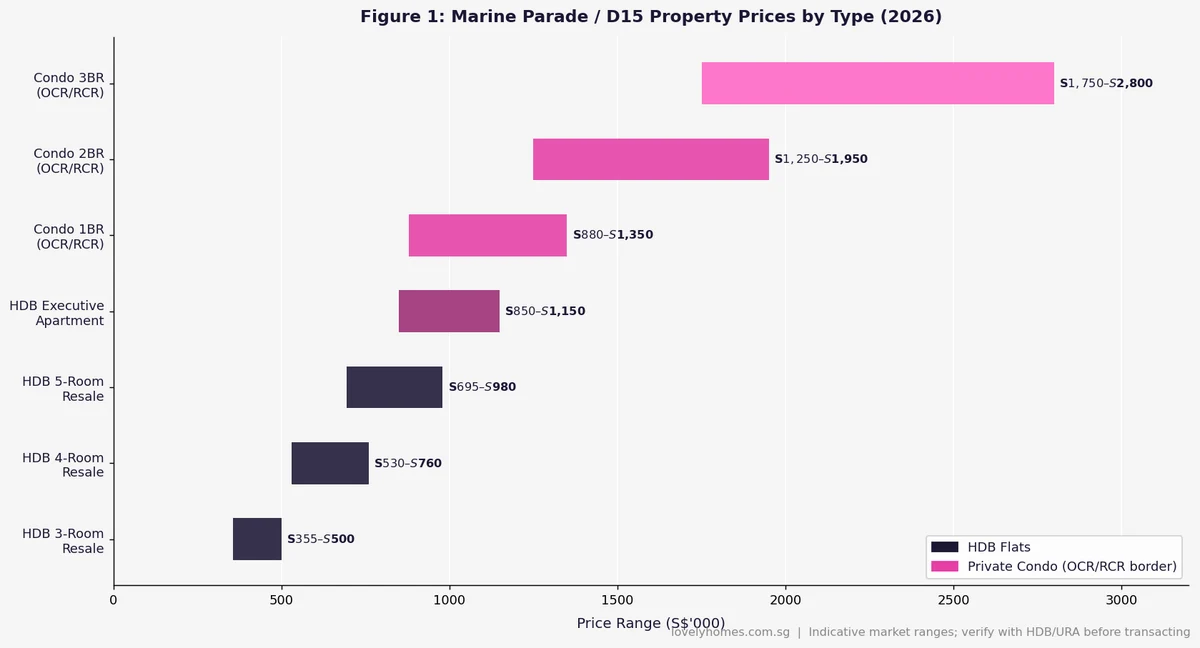
  • HDB resale prices: 3-room S$355,000–S$500,000; 4-room S$530,000–S$760,000; 5-room S$695,000–S$980,000
  • Private condo prices: 1BR S$880,000–S$1,350,000; 2BR S$1,250,000–S$1,950,000; 3BR S$1,750,000–S$2,800,000
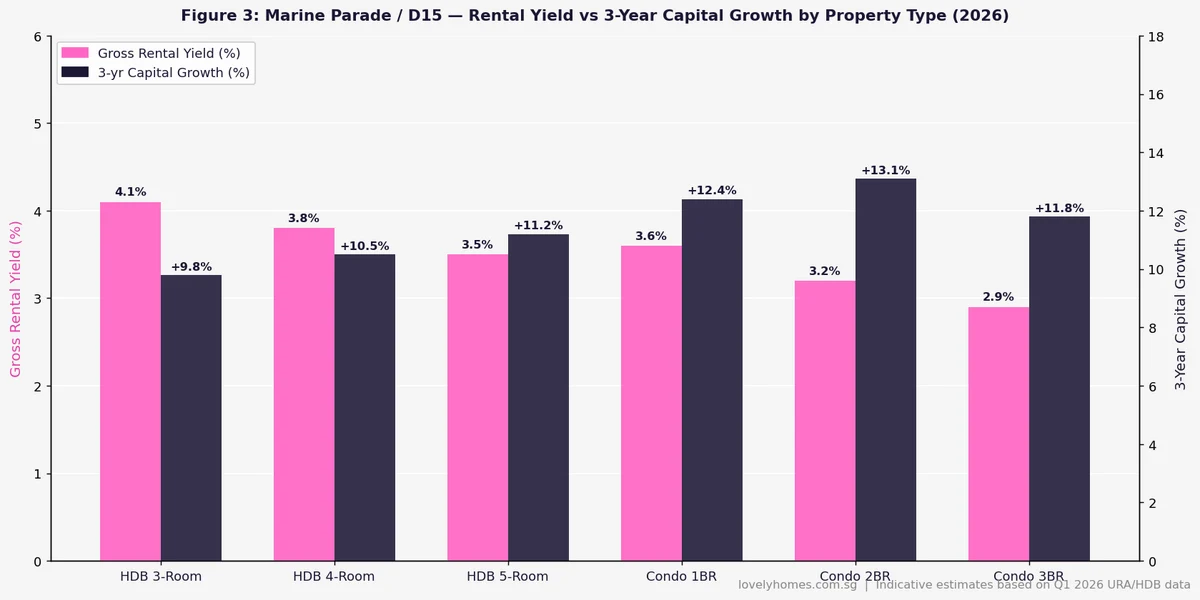
  • Gross rental yield: HDB 3.8–4.1%; condo 2.9–3.6%
  • 3-year capital growth: private condos +9.8–13.1%; HDB flats +10.5–11.2%
  • Notable development: The Continuum (freehold, 816 units, ~S$2,700–S$3,200 psf); Amber Park (fully sold); Tembusu Grand (D15 border)
  • No new BTO supply: D15 is a fully mature private-dominated market — HDB stock is resale-only
  • Buyer profile: Strong expat rental demand (UWCSEA East nearby); Peranakan heritage appeal; upgraders from eastern HDB towns

What Is Marine Parade and Where Is It?

Marine Parade is a planning area administered by the Urban Redevelopment Authority (URA) in Singapore’s East Region. It sits along the southern coastline, bounded by the Kallang area to the west, Bedok to the east, and the Katong/Siglap subzones in between. The area is classified as Outside Central Region (OCR) for most HDB-dominated stretches and borders Paya Lebar’s Rest of Central Region (RCR) on its western flank.

The name “Marine Parade” refers both to the planning area and the prominent arterial road — Marine Parade Road — that runs parallel to East Coast Parkway (ECP). Most residents know the area by its Katong identity: a vibrant Peranakan district famous for laksa, nyonya kueh, and rows of colourful shophouses along East Coast Road and Joo Chiat Road.
Marine Parade D15 property prices by type 2026 — HDB and condo price ranges
Figure 1: Marine Parade / D15 property prices by type, 2026. Source: HDB resale portal, URA REALIS, indicative market data.

MRT Connectivity: The TEL Game-Changer

For decades, Marine Parade’s biggest drawback was the absence of MRT. Residents relied on buses along the congested ECP and Marine Parade Road corridor. That changed on 23 June 2023, when the Land Transport Authority (LTA) opened TEL Stage 3, bringing two new stations directly into the neighbourhood.

Marine Parade MRT (TE26) sits at the junction of Marine Parade Road and Still Road, within walking distance of i12 Katong mall and the East Coast Road food belt. Marine Terrace MRT (TE27) is positioned further east along Marine Terrace, serving the residential precincts near Siglap and Katong Park. Both stations connect directly to the TEL mainline, giving riders one-stop access to Great World (TE15) for the Great World City retail cluster, Orchard (TE14) for ION and Takashimaya, and Marina Bay (TE20/NS27/CE2) for the CBD.

In addition to the TEL, residents can access Paya Lebar MRT — an EWL and CCL interchange — approximately 1.8km away via bus or cycling. The EWL links Paya Lebar to the CBD (City Hall, Raffles Place), Tampines, and Changi Airport, while the CCL provides a circle-line connection to Bishan, one-north, and HarbourFront.

Property Prices in Marine Parade 2026

D15 covers a range of property types and price points. The market broadly divides into three segments: HDB resale (concentrated in Marine Parade proper and Tanjong Rhu), mid-range private condos along the East Coast Road corridor, and premium freehold condos in the Amber Road and Meyer Road micromarkets.

HDB resale flats in Marine Parade trade at a modest premium to the OCR average, reflecting the estate’s maturity, school catchments, and the post-TEL connectivity uplift. A typical 4-room resale flat in the Tanjong Rhu or Marine Parade estate commands S$530,000 to S$760,000 in 2026, with premium blocks (high floor, unblocked sea-facing views) occasionally breaching the S$800,000 mark. Executive Apartments — a Singapore-specific HDB flat type featuring more floor area — trade at S$850,000 to S$1,150,000 in this locale.

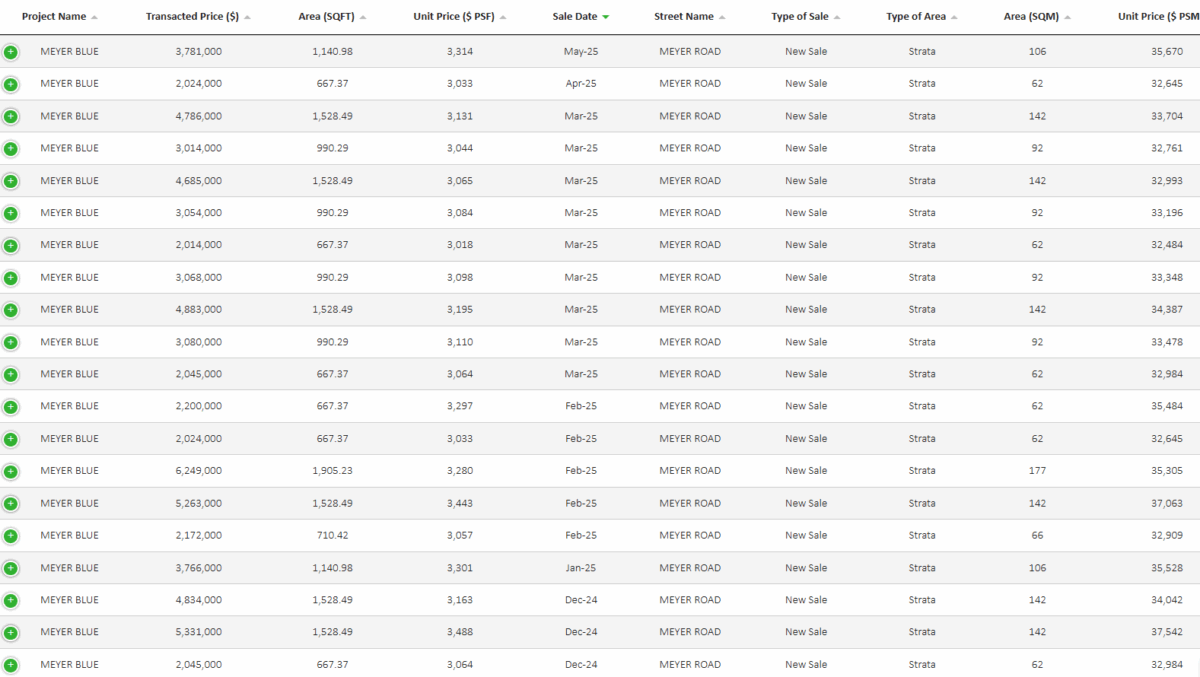
Private condos span a wide PSF range. Older 99-year leasehold projects along Marine Parade Road trade at S$1,300–S$1,600 PSF, while newer freehold developments in the Amber Road and Meyer Road corridors command S$2,200–S$3,200 PSF. The benchmark project is The Continuum (freehold, 816 units), launched in 2023 at an average of approximately S$2,730 PSF and now approaching completion, with secondary market transactions in the S$2,800–S$3,100 PSF range in Q1 2026. Amber Park (fully sold; completed 2023) set a prior record at S$2,500–S$2,800 PSF. For investors, older 99-year leasehold condos such as Waterplace and Marine Blue provide more accessible entry points in the S$1,200–S$1,600 PSF range with correspondingly higher gross yields.
Marine Parade D15 amenities grid — MRT, schools, retail, parks, healthcare, key stats
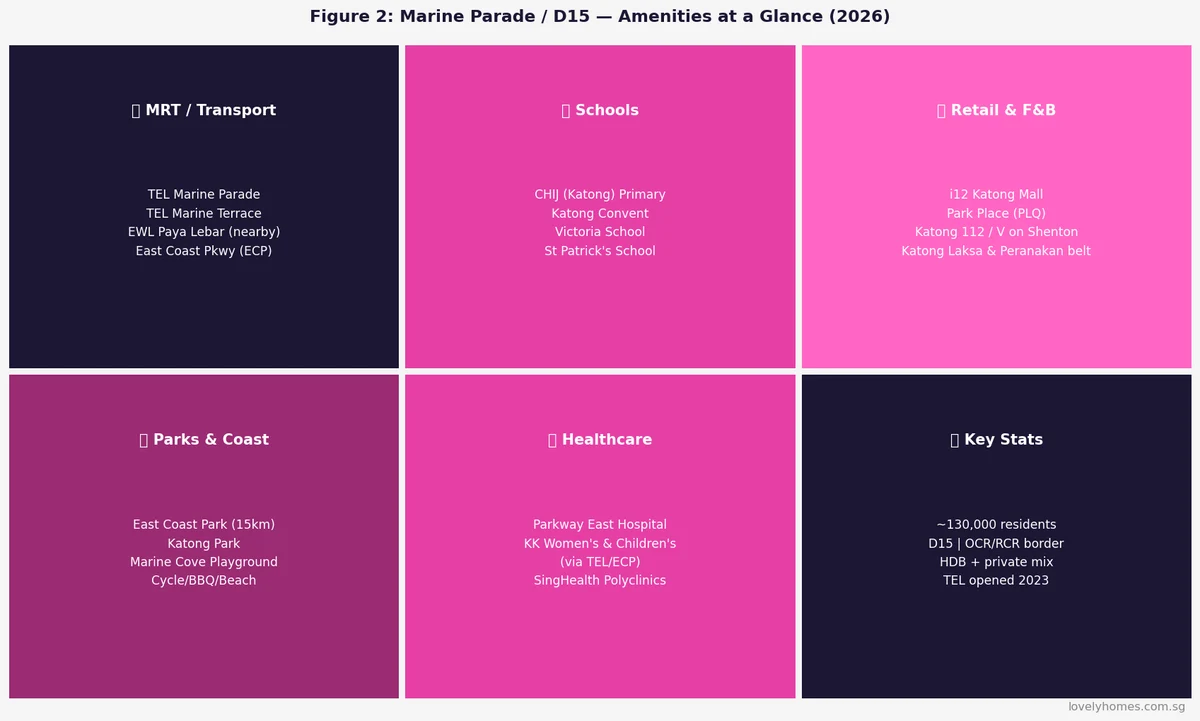
Figure 2: Marine Parade / D15 amenities at a glance — transport, schools, retail, parks and healthcare.

Schools in Marine Parade

D15 is one of Singapore’s strongest school catchment zones for primary and secondary education, which is a significant driver of resale demand from families.

At the primary level, CHIJ (Katong) Primary — an all-girls SAP school administered by the Catholic community — draws buyers willing to pay a premium for the within-1km address advantage. Tao Nan School (a SAP school on Still Road South) is another highly sought-after feeder, with the 1km radius covering parts of Katong. At the secondary level, Victoria School (Siglap Road), St Patrick’s School (Siglap Road), Dunman High School (Tanjong Rhu), and Katong Convent are all established institutions within the planning area. Singapore Management University (SMU), accessible by TEL, adds to the tertiary ecosystem for residents in the estate.

Lifestyle and Amenities

Marine Parade’s quality-of-life proposition is anchored by three distinctive draws: the Peranakan food culture, East Coast Park, and a growing retail cluster.

East Coast Park, stretching 15km along the southern coastline, is Singapore’s most popular recreational park. Residents of Marine Parade enjoy direct cycling and walking access to its beach, barbecue pits, hawker centres, water sports facilities, and Marine Cove Playground. The upcoming Bayshore integrated development — a GLS site near Bedok South MRT (TEL) — will add further coastal amenity and residential supply to the broader East Coast corridor in the late 2020s.

Retail is anchored by i12 Katong (a mid-sized mall with a supermarket, F&B, and lifestyle tenants adjacent to Marine Parade MRT), 112 Katong on East Coast Road, and the heritage Parkway Parade mall in Marine Parade Road, which underwent a major refurbishment. For daily provisions, the Katong and Marine Parade market and food centres remain beloved neighbourhood institutions. Healthcare is served by Parkway East Hospital (a private hospital on East Coast Road) and multiple SingHealth polyclinics.

Rental Yields and Investment Case

Marine Parade has historically been a strong rental market. The estate benefits from proximity to UWCSEA East Campus (Dover Road, ~8km via ECP), generating consistent expat family demand. Post-TEL, the improved connectivity has expanded the catchment of corporate renters commuting to the CBD and Marina Bay financial district.
Marine Parade D15 rental yield vs 3-year capital growth by property type 2026
Figure 3: Marine Parade / D15 — gross rental yield vs 3-year capital growth by property type (2026). Source: indicative estimates based on URA/HDB Q1 2026 data.

HDB 3-room flats in the estate yield approximately 4.1% gross, reflecting a more affordable entry price combined with strong rental demand from young professionals and couples. Private condo yields compress as PSF rises: older 99-year leasehold projects deliver 3.4–3.6% gross, while premium freehold units at S$2,700–S$3,200 PSF yield closer to 2.8–3.0% gross. Capital growth, however, has been robust across all segments: D15 private properties recorded a +12.4% gain on a 3-year basis (condo 2BR benchmark) through Q1 2026, well above the OCR average of +11.3% and reflecting the post-TEL re-rating.

Summary: Marine Parade Property Types at a Glance

Property Type Typical Price Range Median PSF Gross Yield Tenure
HDB 3-Room Resale S$355,000–S$500,000 ~S$510 psf ~4.1% 99-yr (HDB)
HDB 4-Room Resale S$530,000–S$760,000 ~S$560 psf ~3.8% 99-yr (HDB)
HDB 5-Room Resale S$695,000–S$980,000 ~S$590 psf ~3.5% 99-yr (HDB)
Private Condo (1BR) S$880,000–S$1,350,000 S$1,300–S$1,800 psf 3.4–3.6% Mixed 99yr/FH
Private Condo (2BR) S$1,250,000–S$1,950,000 S$1,500–S$2,700 psf 3.0–3.4% Mixed 99yr/FH
Private Condo (3BR) S$1,750,000–S$2,800,000 S$2,200–S$3,200 psf 2.8–3.2% Mainly FH

Worked Example: Upgrader Purchasing a 2BR Condo in Marine Parade

Profile: Mr and Mrs Lim, Singapore Citizens, joint monthly income S$13,500. Currently own a fully paid-up Bedok 4-room HDB. Intending to sell the HDB and purchase a 2BR condo in Marine Parade as their home — first private property purchase.

Target unit: 2BR condo (older 99-year leasehold project on Marine Parade Road), asking price S$1,580,000 (approximately S$1,520 PSF for 1,040 sqft).

  • Buyer’s Stamp Duty (BSD): S$1–S$180,000 @ 1% = S$1,800 + S$180,001–S$360,000 @ 2% = S$3,600 + S$360,001–S$1,000,000 @ 3% = S$19,200 + S$1,000,001–S$1,580,000 @ 4% = S$23,200 = total BSD S$47,800
  • Additional Buyer’s Stamp Duty (ABSD): Nil — SC purchasing first private property (after selling HDB)
  • Loan quantum: 75% LTV (bank loan, no outstanding HDB loan) = S$1,185,000
  • Monthly repayment: S$1,185,000 at 3.0% p.a. over 25 years = approximately S$5,615/month
  • Total Debt Servicing Ratio (TDSR): S$5,615 ÷ S$13,500 = 41.6% — within the 55% TDSR limit
  • Cash/CPF upfront: 5% cash = S$79,000 + 20% CPF/cash = S$316,000 + BSD S$47,800 + legal fees ~S$5,200 = approximately S$448,000 total upfront

The Lims use S$200,000 CPF OA savings and S$248,000 in cash proceeds from the HDB sale. The transaction is feasible, with the monthly repayment well within TDSR and comfortable given their joint income.

Why Marine Parade Matters: The TEL Re-Rating

Marine Parade represents one of Singapore’s clearest examples of infrastructure-driven property re-rating. For 50 years after the estate was developed in the 1970s and 1980s, D15 property traded at a persistent discount to comparable RCR districts because of MRT absence. The TEL stations opened in 2023 have begun to close that gap. Industry data as at Q1 2026 shows that TEL-adjacent condos in D15 have outperformed the broader OCR by approximately 200–300 basis points on capital appreciation over the 24 months since the line opened.

The estate’s enduring appeal — heritage culture, East Coast Park, and school catchments — combined with the new connectivity advantage positions Marine Parade as a structural beneficiary of Singapore’s south-eastern TEL corridor build-out. The Bayshore GLS site (near Bedok South TEL) and the East Coast Plan (ECP) long-term coastal development will further reinforce the area’s desirability through the late 2020s and 2030s.

What Might Come Next for Marine Parade

This section contains forward-looking analysis and should not be construed as a prediction of future prices.

Several factors could drive further upside in D15 over the medium term. First, TEL full-line completion (Stages 4 and 5, connecting to Changi Airport and Tanah Merah) will add more riders to the line and increase throughput at Marine Parade and Marine Terrace stations, enhancing the commercial viability of street-level retail along the corridor. Second, the impending completion of The Continuum (816 units) will provide a fresh benchmark for freehold PSF in the submarket. Third, any announcement of an East Coast masterplan update — particularly relating to the Bayshore precinct — could boost buyer sentiment across D15. Conversely, a surge in completions across the broader TEL corridor (Tanjong Rhu, Katong, Siglap) could moderate near-term price appreciation if supply temporarily exceeds demand.

Frequently Asked Questions

Is Marine Parade a good area to buy property in 2026?

Marine Parade offers a compelling combination of lifestyle amenity (East Coast Park, Peranakan food culture, established schools), post-TEL MRT connectivity, and a strong tenant base. For buyers seeking a mature coastal estate with no new HDB BTO supply (meaning limited competing public housing entering the resale market), D15 is one of Singapore’s more defensible residential choices. The trade-off is price: D15 commands a premium over other OCR markets. First-time buyers on tighter budgets may find better value in Tampines, Jurong West, or Sengkang.

Which MRT stations serve Marine Parade?

Two TEL stations serve the estate directly: Marine Parade (TE26) and Marine Terrace (TE27), both opened in June 2023 as part of TEL Stage 3. The TEL connects directly to Orchard, Marina Bay, Stevens, and (via TEL Stage 4 onward) Bayshore, Bedok South, and Sungei Bedok. The closest EWL station is Kembangan (about 1.5km east) and the EWL–CCL interchange at Paya Lebar is approximately 1.8km to the north-west.

Can a Singapore Permanent Resident (SPR) buy an HDB resale flat in Marine Parade?

Yes. SPRs who meet HDB’s Public Scheme eligibility (SPR + any other SPR or SC family member forming a family nucleus) can purchase HDB resale flats anywhere in Singapore, including Marine Parade. However, SPRs pay a 5% Additional Buyer’s Stamp Duty (ABSD) on their first residential property and a 15% ABSD on their second. Additionally, SPRs must wait 3 years from the date of obtaining PR status before purchasing an HDB resale flat. SPRs cannot purchase HDB BTO flats — those are reserved for SC-led households.

What are the best condos to consider in Marine Parade?

For freehold investment, The Continuum (D15, 816 units, launch ~S$2,730 PSF, near completion) represents the newest benchmark. Amber Park (fully sold but tradeable on the secondary market) and older freehold projects like Silversea and Waterford Residence also trade in the premium tier. For yield-focused buyers on a tighter budget, older 99-year leasehold condos along Marine Parade Road — such as Waterplace, Aquarius by the Park, or Marine Blue — offer more accessible entry prices with yields in the 3.4–3.6% range. Always check remaining lease tenure carefully for leasehold units before committing to CPF usage.

How does Marine Parade compare with Tampines or Bedok for investment?

Marine Parade offers higher capital growth potential and stronger lifestyle appeal, but at significantly higher price points and lower rental yields than Tampines or Bedok. Tampines and Bedok HDB resale flats are typically S$100,000–S$200,000 cheaper than D15 equivalents, and their private condos trade at S$500–S$800 PSF lower. However, D15’s scarcity (no new HDB BTO; limited new condo supply after The Continuum) and the TEL connectivity uplift support a structural premium. Investors seeking high yield typically favour Tampines or Bedok; those seeking long-term capital appreciation in a lifestyle estate may prefer D15.

Is there any new HDB supply coming to Marine Parade?

No. HDB Build-To-Order (BTO) launches are not available in Marine Parade, as the estate is a fully developed mature town with no vacant sites set aside for new public housing. Prospective HDB buyers must purchase resale flats in the open market, subject to the standard Ethnic Integration Policy (EIP) quotas and SPR quotas for the block and neighbourhood. This supply scarcity is one reason why D15 HDB resale flats have maintained their price premium.

What are the ABSD implications for a foreigner buying a condo in Marine Parade?

Foreign individuals (non-citizens, non-PRs) who are not covered by a Free Trade Agreement (FTA) concession pay a 60% Additional Buyer’s Stamp Duty on all residential property purchases in Singapore, including in Marine Parade. At S$1,500,000 for a condo, that is an ABSD of S$900,000 — on top of BSD of approximately S$44,600. The few foreigners who pay reduced ABSD (5%, same as a Singapore Citizen second purchase) are nationals of the United States, Switzerland, Norway, Iceland, and Liechtenstein under their respective FTAs with Singapore. MAS administers the ABSD policy, and rates are updated by ministerial order — always verify the current rates at IRAS.gov.sg before transacting.

Related Articles

Disclaimer

This article is for general informational purposes only and does not constitute financial, legal, or property advice. All property prices, rental yields, and capital growth figures are indicative estimates drawn from URA REALIS data, HDB resale portal transactions, and market analysis as at Q1 2026. Actual transaction prices vary by unit, floor, condition, and prevailing market conditions. ABSD rates, BSD rates, CPF rules, and HDB eligibility criteria are set by the Singapore Government (IRAS, HDB, MAS, CPF Board) and are subject to change. Readers should conduct their own due diligence and consult a licensed property agent, lawyer, and financial adviser before making any property transaction. For authoritative data, refer to URA (ura.gov.sg), HDB (hdb.gov.sg), IRAS (iras.gov.sg), and MAS (mas.gov.sg).
Thomson-East Coast Line Property Guide Singapore 2026: Best Districts & Investment Opportunities

Thomson-East Coast Line Property Guide Singapore 2026: Best Districts & Investment Opportunities

The Thomson-East Coast Line property guide Singapore 2026 is your complete reference for buying, investing, or upgrading along Singapore’s newest MRT trunk line. The TEL, operated by SMRT under the Land Transport Authority’s network, is the first line to run from the deep north of Singapore — Woodlands North — all the way to the eastern seaboard at Sungei Bedok, connecting eight of Singapore’s twenty-eight districts in a single continuous line. For property buyers, the TEL represents both a connectivity premium already priced into northern and eastern districts and a genuine price-growth runway in catchment areas where development is still maturing.

Quick Answer — TEL Property in 2026 at a Glance

  • The TEL runs 43 stations across 5 phases; all phases are operational as of November 2024
  • North segment (D25–D26): entry prices from S$1.2M–S$1.8M for 1–2 bedroom condos; gross yields 3.8–4.3%
  • Prime central segment (D10–D11): average transaction prices S$2,900–S$3,800 psf; yields compress to 2.5–3.2%
  • East Coast segment (D15–D16): sweet spot for yield investors — S$2,200–S$2,600 psf with yields 3.5–4.0%
  • Three active new launches along the TEL corridor in 2026: Springleaf Residence (D26), UPPERHOUSE (D10), and the Kallang Close GLS
  • The TEL’s opening in D15 (Katong, Marine Parade, Tanjong Rhu) added a 6–12% price premium to catchment condos within 500m, per URA caveat analysis
  • Investors should note: TEL East Coast properties fall under the Rest of Central Region (RCR) and Core Central Region (CCR) frameworks for ABSD and LTV calculations
  • The Tanjong Rhu GLS site (D15) — first new land release in the area in 28 years — signals major upcoming supply in a historically undersupplied waterfront node

What Is the Thomson-East Coast Line?

The Thomson-East Coast Line is the sixth MRT line on Singapore’s Mass Rapid Transit network. Planned by the Land Transport Authority and built in five phases, the TEL broke ground in 2015 and reached full network connection in November 2024 when the final phase linking Bedok South to Sungei Bedok opened, completing the 43-station, approximately 43-kilometre corridor. Unlike older lines that were retrofitted through existing urban fabric, the TEL was master-planned as a north-south-east spine: it reaches previously MRT-unserved residential catchments in Woodlands, Upper Thomson, and the East Coast, while also adding new stations in the premium central districts of Stevens, Napier, and Orchard Boulevard.

The LTA’s long-term transport planning has established a clear correlation between MRT station proximity and private residential price premiums. Researchers at the National University of Singapore’s Institute of Real Estate and Urban Studies have documented average premiums of 5–15% for private properties within 500 metres of a station, with new lines generating the strongest uplift in the two to three years around opening. The TEL’s staged opening created sequential pricing events across its catchments, and property investors who tracked the LTA’s construction timeline were able to position ahead of each phase.

The TEL in Five Segments: A Property Investor’s Map

For analytical purposes, the TEL’s 43 stations divide into five investment segments, each with distinct supply, pricing, and yield characteristics.

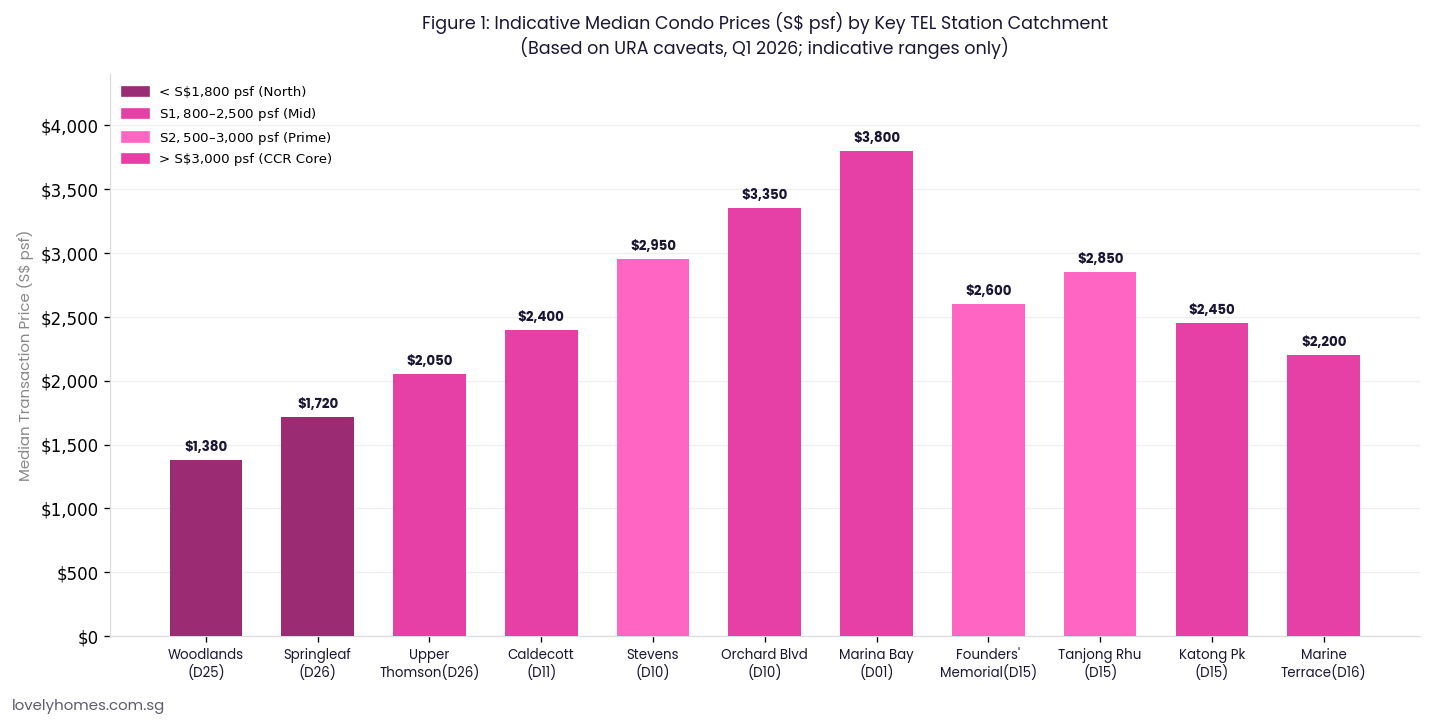
Median condo prices psf by TEL station catchment Singapore 2026 Q1 URA caveats
Figure 1: Indicative median condo transaction prices (S$ psf) by key TEL station catchment area, based on URA caveat data for Q1 2026. The gradient from north (D25–D26) to central CCR reflects Singapore’s established price geography.

Segment 1 — The North (D25–D26): Woodlands to Springleaf

The northern anchor of the TEL serves Woodlands (D25) and Upper Thomson/Mandai (D26). This is the most affordable segment on the line, with median condo transaction prices in the S$1,300–S$1,800 psf range as of Q1 2026 (URA caveats). The key residential projects here are Woodlands-area condos such as The Woodleigh Residences and Canberra Crescent developments, alongside the more recent Springleaf Residence at Upper Thomson. Springleaf Residence — a Wing Tai Holdings and Hong Leong Holdings joint venture — launched at an average S$2,175 psf and achieved 92% sold at launch, validating strong homebuyer demand in the D26 corridor.
Investment fundamentals for the north segment: rental yields are the highest on the TEL, typically 3.8–4.3% gross for 1-bedroom and 2-bedroom units, driven by the presence of international school catchments (Woodlands International School, Singapore Sports School), and the Woodlands Regional Centre transformation under URA’s long-range master plan. Entry prices for 1-bedroom units start from approximately S$850,000–S$1,000,000, making this the most accessible entry point on the line for investors under S$1M. The Woodlands–Johor Bahru RTS Link, due to complete in end-2026, is an additional demand catalyst: cross-border workers commuting from Singapore to the Johor Bahru Bukit Chagar terminus will increasingly seek rental accommodation at or near Woodlands MRT.

Segment 2 — Upper Thomson to Caldecott (D20, D11): The Middle Ground

Between Springleaf and the Orchard stretch, the TEL passes through Upper Thomson Road, the Caldecott interchange (linking to the Circle Line), and Stevens (linking to the Downtown Line). This segment includes Districts 20, 11, and the western edge of D10. Caldecott and Stevens are immediately adjacent to premium private residential estates including Bukit Timah, Holland Road, and the Nassim/Tanglin clusters — traditionally among the most expensive residential districts in Singapore.

The Stevens station, in particular, serves as a gateway to the Good Class Bungalow belt in D10 and the UOL-SingLand UPPERHOUSE at Orchard Boulevard development (101 units, 99-year leasehold, average S$3,350 psf, launched 2024). The connectivity addition of the TEL here — bringing a direct one-seat ride from Stevens all the way to Marina Bay and the East Coast — solidified premium pricing in a corridor that was already well-served by car ownership. For buyers, the TEL has made D10–D11 properties accessible to a broader pool of non-car-owning tenants, improving rental sustainability for high-end CCR units.

Segment 3 — The CCR Core (D01–D10): Orchard to Marina Bay

The TEL’s central stations — Napier, Orchard Boulevard, Great World, Havelock, Outram Park (interchange), Maxwell, Shenton Way, and Marina Bay — traverse the very heart of Singapore’s Core Central Region. Median transaction prices in this segment range from S$2,900 psf (Havelock/Great World catchment) to S$3,800 psf (Orchard Boulevard environs), with top CCR addresses in Orchard exceeding S$4,500 psf. The key driver here is not yield — gross rental yields compress to 2.4–3.0% as capital values are elevated — but capital preservation and long-run appreciation in freehold or near-freehold assets.

The CCR core is where the ABSD differential matters most acutely. Foreigners buying in this segment pay 60% ABSD, which has materially shifted the buyer mix since April 2023 towards Singapore Citizens and PRs on investment purchases. URA Q1 2026 caveats show that CCR transactions remain below their 2021–2022 peak volumes, but median prices have held firm, suggesting that existing CCR owners are not distressed and are holding for long-term appreciation rather than selling at discounts.

Segment 4 — East Coast (D15): Katong to Marine Terrace

The TEL’s East Coast segment — from Tanjong Rhu to Marine Parade and Siglap — is arguably the most exciting investment corridor on the line in 2026. This is a historically low-supply, high-demand residential area. The East Coast has long commanded rental and lifestyle premiums driven by the concentration of international schools (SAS, CIS, UWCSEA East, EtonHouse), the East Coast Park, and a café-and-food-culture character that attracts young expatriate and local professional tenants. Before the TEL, the area had no MRT connectivity at all — residents relied entirely on buses and private transport. The arrival of Katong Park, Marine Parade, and Marine Terrace stations in 2023 was transformative.

URA caveat analysis shows that East Coast condos within 500 metres of the new TEL stations transacted at S$2,400–S$2,700 psf in Q1 2026, representing a 6–12% premium over comparable units further from the stations. Gross rental yields for 1-bedroom units in Katong and Marine Parade run at 3.5–4.1%, benefitting from high expatriate rental demand. The 2025 Tanjong Rhu GLS — the first government land sale in the area in 28 years — will eventually add supply, but the timeline to completion is 3–5 years, leaving the existing stock to absorb near-term rental demand.

Segment 5 — Far East (D16): Bedok to Sungei Bedok

The terminal segment, from Bedok South through Siglap, Bayshore, and Sungei Bedok, represents the TEL’s newest frontier. Bayshore Road — the subject of a significant GLS tender launched by the URA in March 2026, with a S$1.9–2.1B bid estimate and a 1,280-unit mixed-use integrated development — will be the anchor new launch for this segment. This site has MRT integration built into the development brief, meaning future residents will have a covered walk directly from their lobby to Bedok South MRT. The catchment here currently trades at S$1,900–S$2,300 psf, offering the best price-to-TEL-connectivity value on the entire line for medium-term investors who are comfortable with a 2–3 year supply wait.

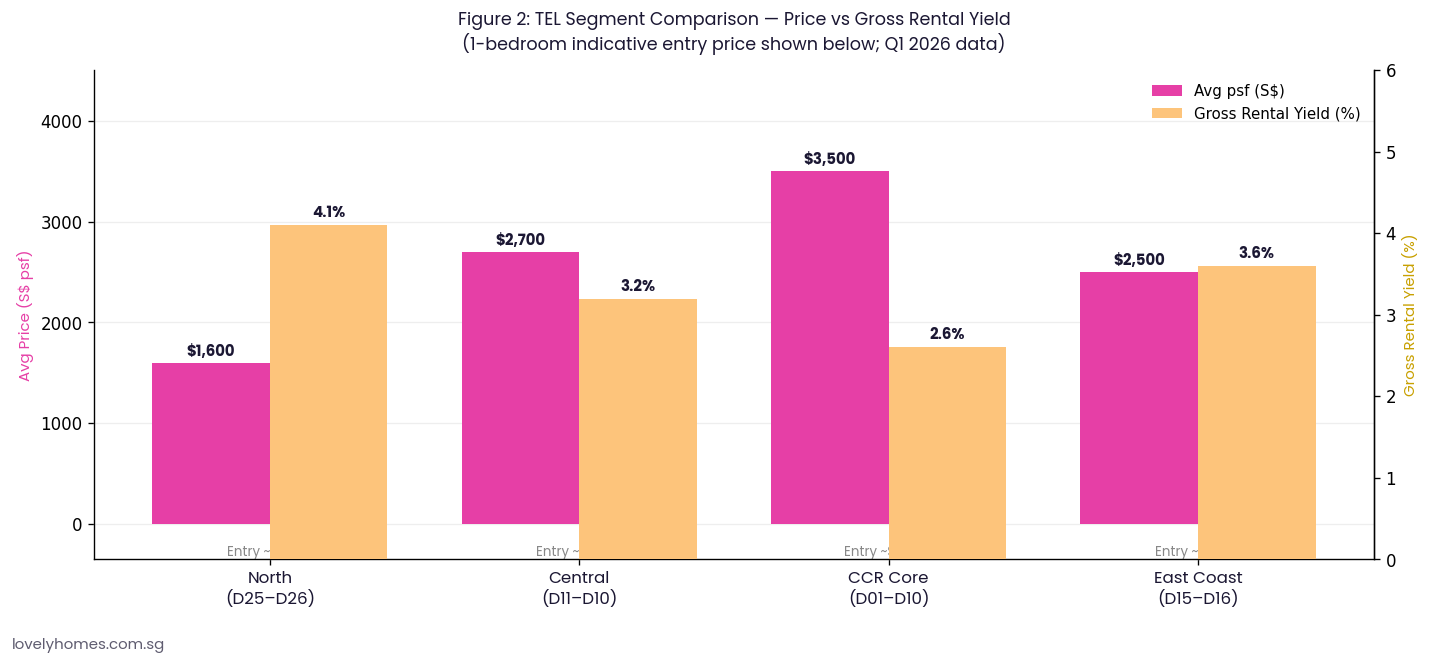
TEL segment comparison price psf versus gross rental yield Singapore condo 2026
Figure 2: TEL segment comparison — average price psf against gross rental yield and indicative 1-bedroom entry price (Q1 2026). The north and east segments offer the superior yield profile; the CCR core delivers capital preservation and prestige.

Summary Table: TEL Segments at a Glance

Segment Districts Median psf (Q1 2026) Gross Yield Entry 1BR (~S$) Best For
North (Woodlands–Springleaf) D25–D26 S$1,300–1,800 3.8–4.3% S$850K–1.0M Yield-focused; RTS uplift play
Mid-North (Thomson–Caldecott) D20–D11 S$2,050–2,400 3.0–3.5% S$1.2M–1.5M Balanced; school proximity
CCR Core (Orchard–Marina Bay) D01–D10 S$3,000–3,800 2.5–3.0% S$2.2M–3.5M Capital preservation; prestige
East Coast (Katong–Marine Parade) D15 S$2,400–2,700 3.5–4.1% S$1.5M–1.8M Expat rental; lifestyle premium
Far East (Bayshore–Sungei Bedok) D16 S$1,900–2,300 3.6–4.0% S$1.1M–1.4M Medium-term upside; Bayshore GLS

Worked Example: Comparing Two TEL Investment Scenarios

To illustrate how the TEL’s price geography affects investor outcomes, consider two hypothetical purchasers buying in April 2026, each with a S$1.8M budget for a 2-bedroom investment unit (Singapore Citizen, first private property, no ABSD).

Option A — East Coast (D15), near Marine Parade MRT: 2BR, 700 sqft at S$2,500 psf = S$1.75M. BSD payable to IRAS: ~S$55,600. Monthly mortgage (75% LTV, S$1.31M at SORA+0.75% = ~3.70%, 25 years): ~S$6,720. Monthly rental income at 3.7% gross yield: ~S$5,390. Net monthly cash flow (before management fee, property tax, sinking fund): −S$1,330 per month. Capital appreciation target: 4–6% per annum over a 7-year hold. Total return (conservative 4% p.a. appreciation + cumulative rental income): estimated IRR of approximately 8–10% over a 7-year hold.

Option B — North (D26), near Springleaf MRT: 2BR, 800 sqft at S$1,850 psf = S$1.48M. BSD payable to IRAS: ~S$43,000. Monthly mortgage (75% LTV, S$1.11M at 3.70%, 25 years): ~S$5,700. Monthly rental at 4.1% gross: ~S$5,060. Net cash flow: −S$640 per month (significantly better than Option A). Capital appreciation at a more conservative 3% p.a. over 7 years. IRR: approximately 7–9%, with a stronger monthly cash flow during the hold period. Option B also leaves S$320K of the budget unused, which could service emergencies or fund a second property later.

Neither option is inherently superior — the trade-off is between location prestige and rental resilience (Option A) versus cash-flow comfort and lower entry risk (Option B). Both outperform a typical fixed deposit or Singapore Savings Bond over a 7-year horizon on a total return basis, based on current market data.

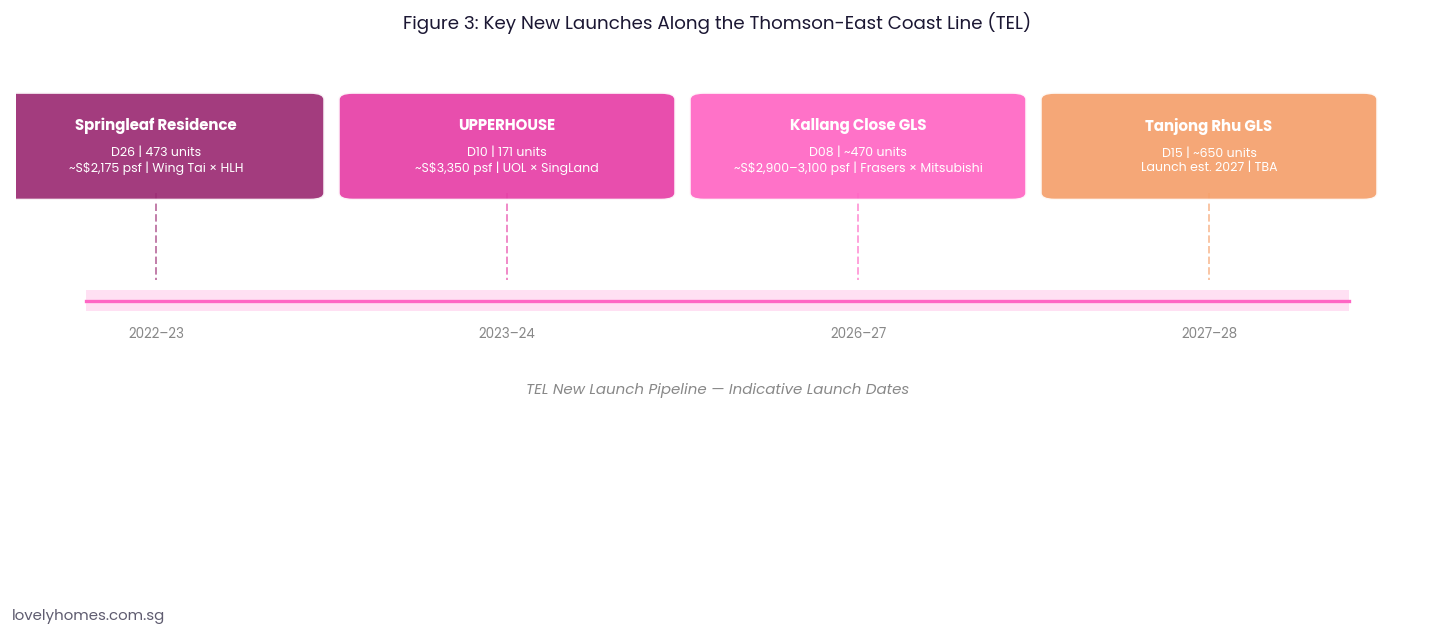
New launch condos along Thomson-East Coast Line TEL pipeline 2026 2027 Singapore
Figure 3: Key new launch projects along the TEL corridor — indicative launch dates and entry pricing. The pipeline includes both live launches and upcoming sites from the Government Land Sales programme.

Why the TEL Matters for Property Investors in 2026

Singapore’s MRT network has historically been the single most reliable infrastructure driver of residential price premiums. The TEL is unique in that it opened across a decade (2019–2024), meaning different catchments are at very different stages of the price-uplift cycle. The north segment is still absorbing the connectivity premium as the Johor Bahru RTS Link nears completion; the East Coast is in the early-mid stage of its premium maturation; and the CCR core stations are fully priced in. For investors, the implication is clear: the North and East Coast segments still offer the better forward-looking return profile relative to entry price.

URA’s Q1 2026 full statistics (released 25 April 2026) showed that private residential prices rose 0.9% quarter on quarter, with the Rest of Central Region — which encompasses much of the East Coast TEL corridor — outperforming the Core Central Region in transaction volume. This divergence suggests that RCR properties, including East Coast condos, are currently absorbing more buyer demand than the premium CCR market, consistent with a pricing cycle where affordability-conscious buyers are moving down the price curve from CCR into RCR catchments along connective infrastructure like the TEL.

What Might Come Next Along the TEL

Looking forward, three developments warrant investor attention. First, the Bayshore Drive GLS (URA tender, closing July 2026) will be the defining new launch for the Far East segment. With 1,280 units and an MRT-integrated brief, the eventual project will set a new price benchmark for D16, potentially pushing neighbouring resale values upward in anticipation. Second, the Tanjong Rhu GLS — where the site was awarded in late 2025 — will bring the first new private development to the Tanjong Rhu waterfront in three decades; market estimates place the launch price at S$3,200–3,500 psf, consistent with D15 premium waterfront comparable transactions. Third, URA’s ongoing Draft Master Plan 2025 consultations include proposals to intensify the East Coast Park corridor and the Katong precinct, which, if implemented, could further bolster lifestyle premiums in the Marine Parade and Siglap catchments.

Frequently Asked Questions

Which TEL station has the best investment value in 2026?

For yield-focused investors, the Upper Thomson and Springleaf catchments (D26) currently offer the best combination of gross yield (3.8–4.3%), reasonable entry price (from S$1.2M for 2BR), and near-term demand catalysts from the Johor Bahru RTS Link. For capital appreciation, Marine Parade and Katong Park (D15) are the standout stations — still absorbing the TEL connectivity premium with a supply shortage that will persist until the Tanjong Rhu GLS project completes circa 2029–2030. For lifestyle owner-occupiers, Stevens and Orchard Boulevard (D10) offer unsurpassed centrality and school proximity at a premium entry point.

How much of a premium do TEL station properties command over non-MRT units?

Research from the Institute of Real Estate and Urban Studies at NUS estimates that properties within 500 metres of a new MRT station command a 5–15% price premium over comparable properties 800–1,500 metres away, with the premium being largest in the first two to three years after the station opens and in areas with low existing MRT coverage (such as the East Coast before the TEL). Properties integrated directly with a station (ground-level covered link) command a further 3–7% premium, per URA caveat analysis. For the East Coast segment, which had zero prior MRT coverage, the observed premium has been at the higher end of the 8–12% range for 500m-radius properties.

Are there new launch condos available along the TEL right now?

As of April 2026, active new launches along the TEL corridor include Springleaf Residence (D26, near Springleaf MRT, 473 units, 92% sold at launch at ~S$2,175 psf by Wing Tai and Hong Leong Holdings) and UPPERHOUSE at Orchard Boulevard (D10, near Orchard Boulevard MRT, 171 units at ~S$3,350 psf by UOL and Singapore Land Group). The Kallang Close GLS site (near Bendemeer MRT, an adjacent north-south TEL interchange station) is expected to launch circa 2027–2028 at S$2,900–3,100 psf by Frasers Property and Mitsubishi Estate. For the East Coast, the Tanjong Rhu waterfront site is in development and expected to preview approximately 2027.

How does ABSD apply to TEL property purchases by foreigners?

Foreigners purchasing any residential property in Singapore — including condos along the TEL — pay 60% ABSD on the full purchase price, regardless of whether it is their first or subsequent property. This applies equally to CCR Orchard Boulevard units and to more affordable East Coast apartments. The 60% rate, introduced in April 2023, has effectively priced most foreign investors out of the Singapore residential market. Singapore Permanent Residents buying their first private property pay 5% ABSD; their second residential property attracts 30% ABSD. Singapore Citizens pay 0% on a first private purchase and 20% on a second. All ABSD is administered by the Inland Revenue Authority of Singapore and is payable within 14 days of exercising the Option to Purchase.

What is the Johor Bahru RTS Link and why does it matter for TEL D25–D26 properties?

The Rapid Transit System (RTS) Link is a cross-border rail connection between Woodlands North MRT (the TEL’s northernmost station) and Bukit Chagar in Johor Bahru, Malaysia, scheduled for completion in late 2026. The RTS Link will allow commuters to travel between Singapore and Johor Bahru in approximately 5 minutes by rail, replacing a congested road crossing that currently takes 30–90 minutes in peak hours. For property investors, the RTS Link is a demand multiplier: Singaporeans working in Johor Bahru’s rapidly developing Iskandar Malaysia economic region, as well as Malaysians working in Singapore who choose to commute rather than rent, both anchor rental demand at or near Woodlands North and Woodlands MRT. Industry data suggests rental demand for 1BR and 2BR units within a 10-minute walk of Woodlands MRT could increase 15–25% once the RTS Link is fully operational.

How do I find resale condos near a specific TEL station?

The most reliable data source for resale condo transactions near any TEL station is the Urban Redevelopment Authority’s real estate information system at URA REIS. You can search by postal district or project name to see actual caveated transaction prices, floor area, and date of transaction. For a broader property search including current listings, URA’s public portal at ura.gov.sg provides planning information and the latest approved development details for each district. Cross-referencing URA caveats with listing prices gives you a reliable indication of the price gap (or premium) being applied by sellers in each catchment.

Related Articles

Disclaimer

This article is for general informational purposes only and does not constitute financial, legal, or property investment advice. All price per square foot figures, yield estimates, and transaction data referenced are indicative, based on publicly available URA caveat records and industry analysis, and are subject to change. Property values may go up or down. ABSD and stamp duty rates are administered by IRAS and are subject to revision. Consult a licensed property professional and a qualified financial adviser before making any investment decision.


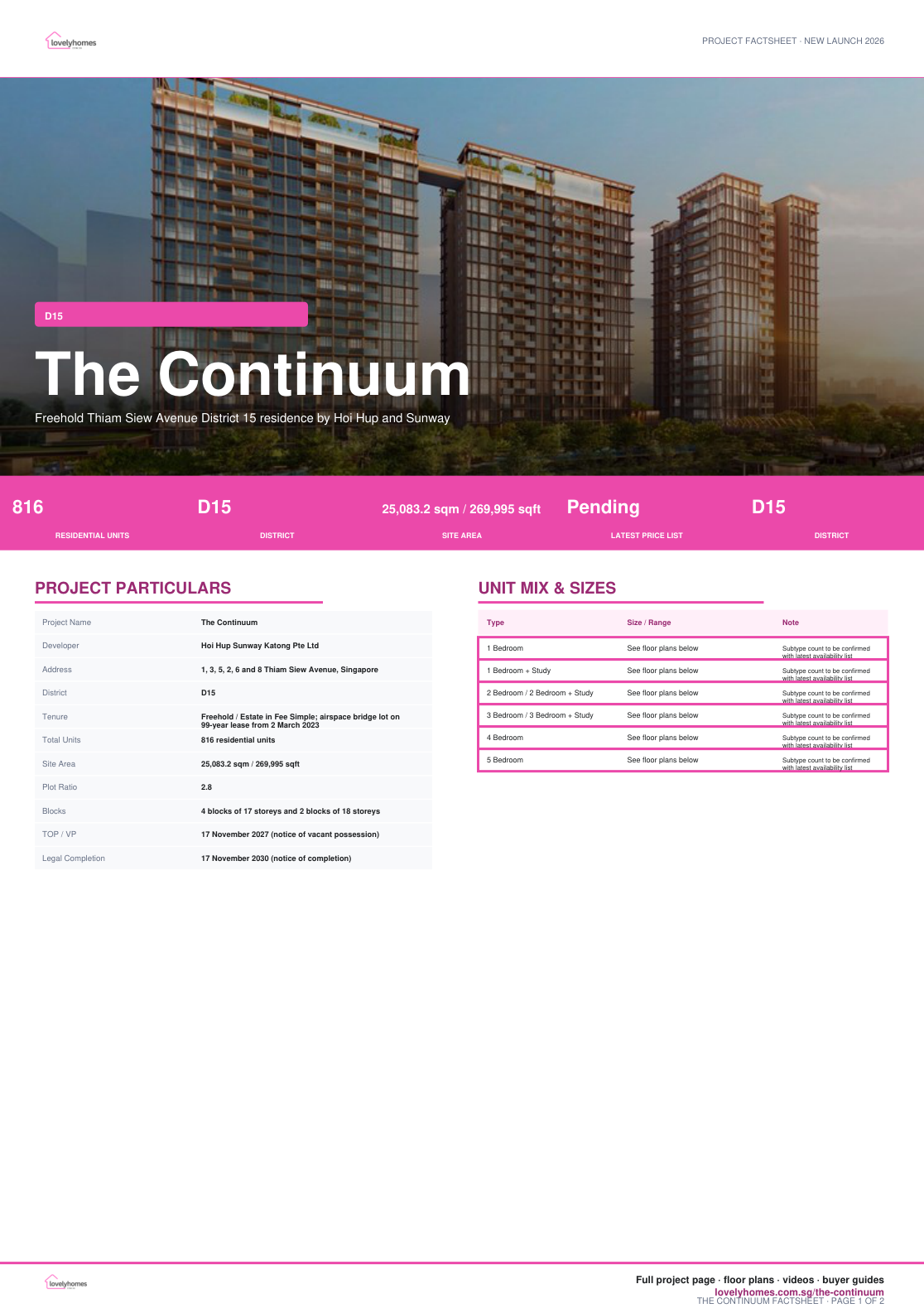
The Continuum

The Continuum


NEW LAUNCH · THIAM SIEW AVENUE · DISTRICT 15

The Continuum

Freehold Thiam Siew Avenue District 15 residence by Hoi Hup and Sunway
D15
District
Freehold / Estate in Fee Simple
Tenure
17 November 2027
TOP / VP
816
Total Units
816
Residential Units
D15
District
25,083.2 sqm / 269,995 sqft
Site Area
From S$1.378M
Current From Price

Why The Continuum

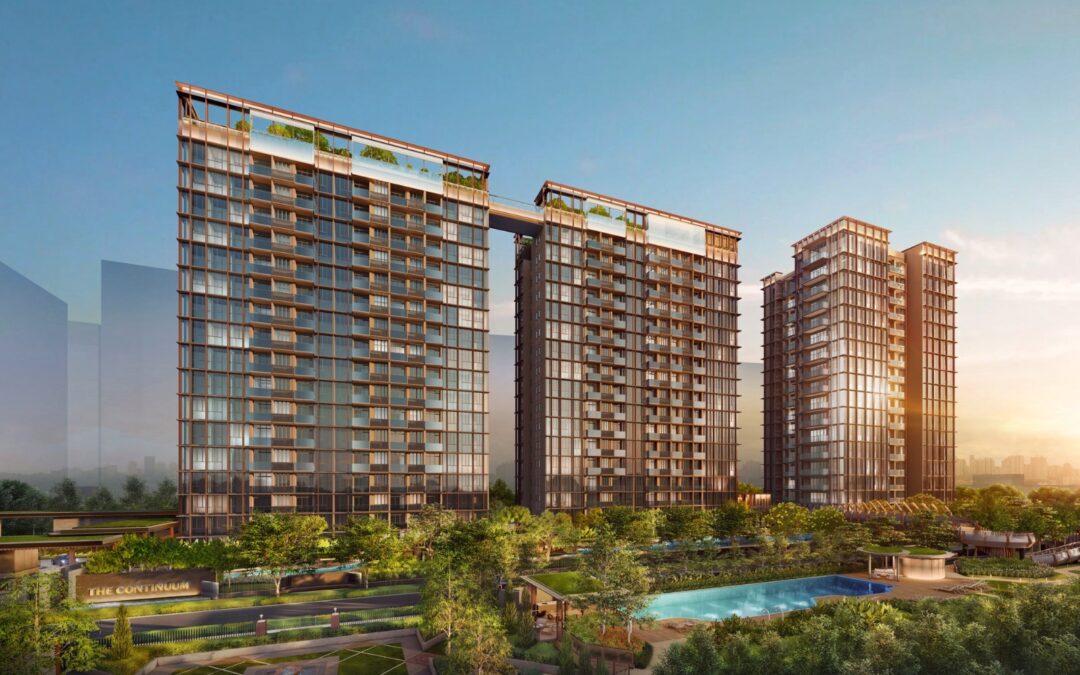
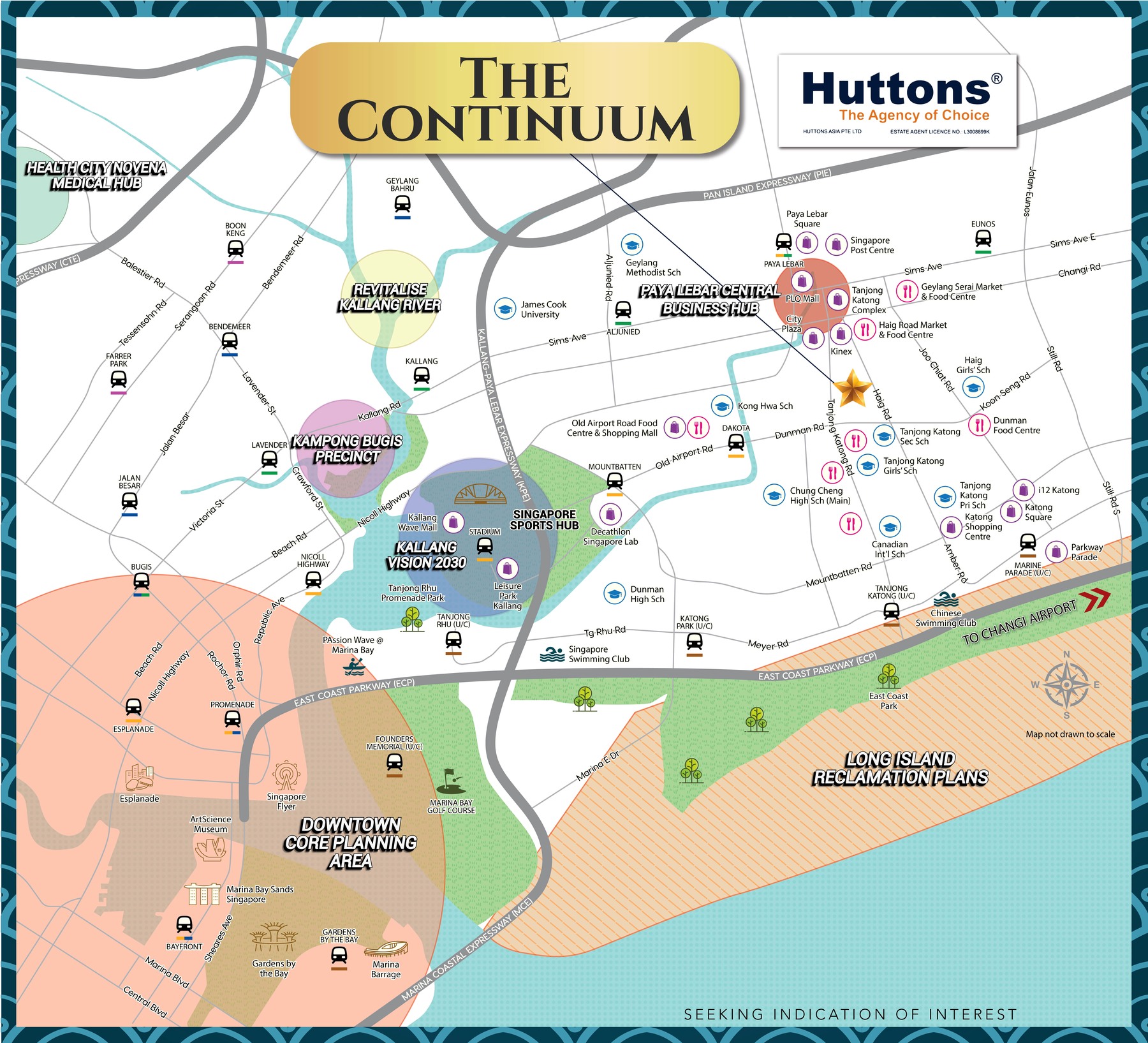
The Continuum The Continuum is a freehold District 15 residence across Thiam Siew Avenue, pairing Katong and Joo Chiat lifestyle access with 816 homes and a broad mix from compact layouts to larger private-lift homes.

01 · Address

D15 Location

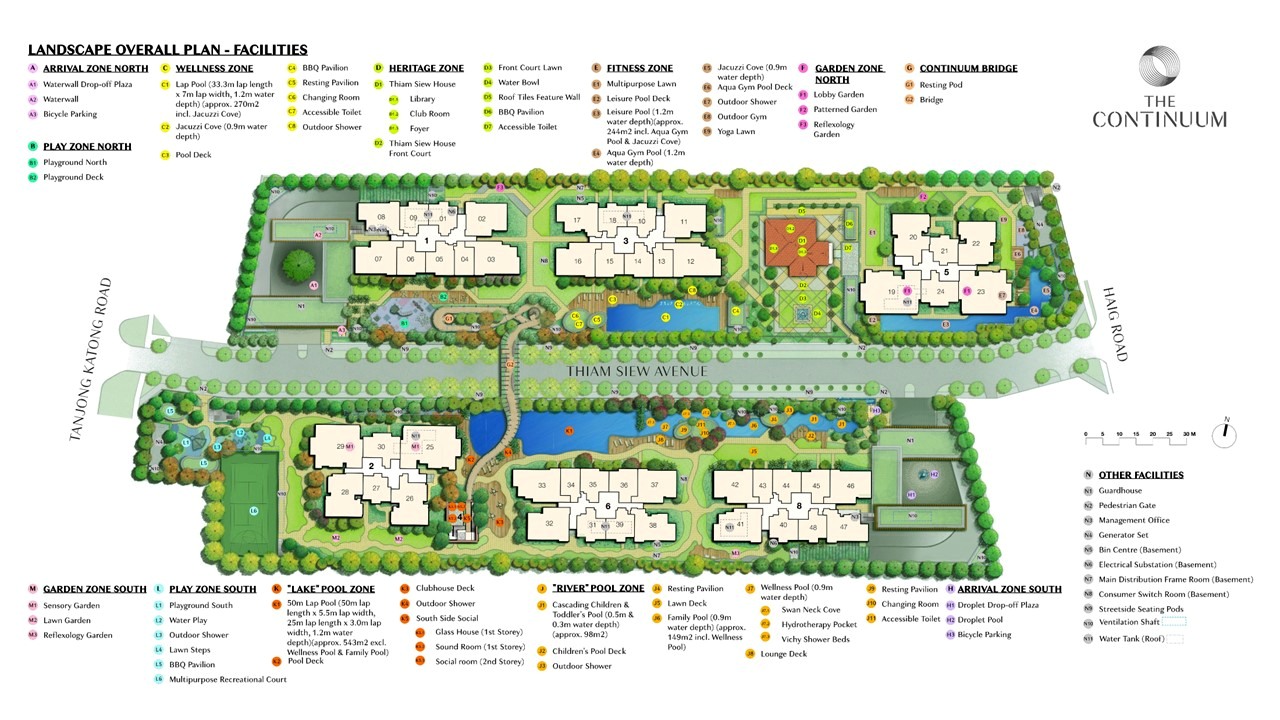
1, 3, 5, 2, 6 and 8 Thiam Siew Avenue, Singapore

02 · Scale

816 residential units

4 blocks of 17 storeys and 2 blocks of 18 storeys

03 · Tenure

Freehold / Estate in Fee Simple; airspace bridge lot on 99-year lease from 2 March 2023

Confirm the latest availability before shortlisting.

Project At-a-Glance

Project Name The Continuum
Developer Hoi Hup Sunway Katong Pte Ltd
Address 1, 3, 5, 2, 6 and 8 Thiam Siew Avenue, Singapore
District D15
Tenure Freehold / Estate in Fee Simple; airspace bridge lot on 99-year lease from 2 March 2023
Total Units 816 residential units
Site Area 25,083.2 sqm / 269,995 sqft
Plot Ratio 2.8
Blocks 4 blocks of 17 storeys and 2 blocks of 18 storeys
TOP / VP 17 November 2027 (notice of vacant possession)
Legal Completion 17 November 2030 (notice of completion)

Viewing Preparation

Use the factsheet, selected floor plans and site plan below to compare the north and south plots, unit positions and larger-format layouts.

Confirm current pricing, stack availability and final specifications before booking.

Unit Mix and Sizes

Bedroom Type Size / Range Availability Note
1 Bedroom See floor plans below Subtype count varies by latest balance-unit list
1 Bedroom + Study See floor plans below Subtype count varies by latest balance-unit list
2 Bedroom / 2 Bedroom + Study See floor plans below Subtype count varies by latest balance-unit list
3 Bedroom / 3 Bedroom + Study See floor plans below Subtype count varies by latest balance-unit list
4 Bedroom See floor plans below Subtype count varies by latest balance-unit list
5 Bedroom See floor plans below Subtype count varies by latest balance-unit list

Unit areas and availability may change. Confirm the latest stack, price and size information before shortlisting.

Indicative Pricing

Entry Units
From S$1.378M

1BR + Study, 560 sqft

3BR Units
From S$2.880M

3BR, 1,076-1,141 sqft

Larger Units
From S$3.653M

4BR; 5BR from S$5.487M

Available units from S$1.378M; 3BR from S$2.880M, 3BR+Study from S$3.372M, 4BR from S$3.653M, 4BR Premier from S$4.481M and 5BR from S$5.487M. Source: The Continuum public price list updated 7 Mar 2026, accessed 29 Apr 2026.

Why Buyers Are Watching

  1. 1
    Freehold District 15 address near the Katong/Joo Chiat lifestyle corridor.
  2. 2
    816 units are planned across six residential blocks.
  3. 3
    Conservation bungalow and proposed overhead bridge are included in the project description.
  4. 4
    Selected 3-, 4- and 5-bedroom homes include private-lift lobby layouts.
  5. 5
    Notice of vacant possession is listed as 17 November 2027.
  6. 6
    The page includes a site plan image and representative floor-plan pages.

Location and Connectivity

MRT

Paya Lebar / Dakota / Katong access

Location material places the project in the East Coast / city-fringe network.

Lifestyle

Katong and Joo Chiat

Dining, conservation streets and East Coast amenities support daily convenience.

Schools

District 15 education options

Verify current school distance bands with OneMap before enrolment planning.

Roads

ECP / PIE / city routes

City and airport routes are accessible through the East Coast road network.

The Continuum location map

Schools Nearby

School Planning Confirm current school distance bands and eligibility with OneMap and MOE before relying on any school-distance claim.

Lifestyle and Amenities

Daily Convenience

Review nearby retail, food, transport and park connections before shortlisting stacks.

Neighbourhood Fit

Compare the surrounding precinct with your commute, school and lifestyle needs.

Viewing Check

Confirm walking routes, traffic patterns and future works during your site visit.

Site Plan

The Continuum actual site plan

Actual site plan showing blocks, facilities, access points and internal landscaping.

Floor Plans (Selected)

Representative actual floor plans by unit type. The full floor-plan PDF belongs in the download button below this section.

The Continuum 1 Bedroom Type A floor plan

1 Bedroom Type A
The Continuum 2 Bedroom + Study Type B floor plan

2 Bedroom + Study Type B
The Continuum 3 Bedroom Type C floor plan

3 Bedroom Type C
The Continuum 4 Bedroom Type D floor plan

4 Bedroom Type D
The Continuum 5 Bedroom Type E floor plan

5 Bedroom Type E
Full Floor Plans PDF
Selected layout pages prepared as a clean PDF download.

Download Full Floor Plan PDF

Elevation and Stack Chart

Refer to the site plan, selected layouts and full floor-plan PDF for stack orientation, floor levels and facing checks.

Facilities (30+)

Pool DeckClubhouseGymLandscape CourtyardsFunction RoomsFamily FacilitiesArrival CourtSmart Home Provisions

Gallery

Developer and Consultant Team

Hoi Hup Sunway Katong Pte Ltd

Before committing, verify the latest developer licence, project account details and contractual documents with the appointed sales team.

Sustainability and Specifications

Specifications, finishes, smart-home provisions and sustainability ratings vary by unit. Refer to the latest developer brochure and sale documents for final approved details.

Project Timeline

Launch / Sales Phase Live new-launch project page
TOP / Vacant Possession 17 November 2027 (notice of vacant possession)
Legal Completion 17 November 2030 (notice of completion)

Project Factsheet

A shareable 2-page PDF snapshot of everything on this page — bring it to viewings, forward it to family.

Download the Full Sales Pack

PDF · Factsheet

The Continuum Factsheet

2-page project factsheet with key facts, unit mix and buyer notes.

Download Factsheet

PDF · Floor Plans

Full Floor Plans

Selected floor-plan pages and layouts for quick comparison.

Download Floor Plans

Image · Site Plan

Site Plan

Site plan showing blocks, facilities and arrival points.

Download Site Plan

Frequently Asked Questions

Where is The Continuum located?
1, 3, 5, 2, 6 and 8 Thiam Siew Avenue, Singapore
Who is the developer?
Hoi Hup Sunway Katong Pte Ltd
How many units are there?
816 residential units
What is the current from-price?
Available units start from S$1.378M based on the public price list updated 7 Mar 2026. Confirm stack-specific pricing, discounts and availability before shortlisting.

Ready to see The Continuum in person?

Request current availability, developer pricing, showflat slots and financing checks.

Enquire Now

Related Buying Guides

ABSD Singapore 2026

Stamp-duty planning before purchase.

Condo Buying Guide

Budget, timeline and financing basics.

Property Investment

Holding cost and exit considerations.

Disclaimer: Prices, availability, areas, specifications and timelines may change without notice. Buyers should verify all details with the developer-appointed sales team and relevant authorities before committing.

Translate »