Renting Out Your HDB Flat 2026: Rules, Quotas, Rental Rates and Step-by-Step Landlord Guide

Renting Out Your HDB Flat 2026: Rules, Quotas, Rental Rates and Step-by-Step Landlord Guide

Renting out HDB flat Singapore 2026 landlord guide rules quotas rental rates
Singapore HDB Rental Landlord Guide 2026 — rules, quotas, rental rates and step-by-step subletting process.
Quick Answer: Renting Out Your HDB Flat 2026 — Key Facts

  • Who can sublet the whole flat? Singapore Citizens (SC) only. Permanent Residents (PR) may only rent out individual bedrooms — not the entire flat.
  • Minimum Occupation Period (MOP): 5 years from the date of key collection before subletting is permitted. Older flats purchased before 30 August 2010 without a grant have a 3-year MOP.
  • Minimum lease term: 6 months per tenancy agreement for whole-flat rental. No minimum for bedroom rental.
  • Non-Citizen Quota: 8% at neighbourhood level and 11% at block level. Applies when any tenant renting the whole flat is a non-Malaysian non-citizen.
  • Occupancy cap (temporarily relaxed): Up to 8 unrelated persons in a 4-room or larger HDB flat (relaxed from 6 until 31 December 2026).
  • HDB approval required: Flat owners must register the subletting with HDB online before tenants move in. Failure is a serious offence.
  • Typical rental rates (Q1 2026): 3-room S$2,200–2,600/mth; 4-room S$2,600–3,200/mth; 5-room S$3,000–3,800/mth.
  • Rental yields: Approximately 5–7% gross depending on flat type and estate.

Can You Rent Out Your HDB Flat?

HDB flats in Singapore can be rented out, but the rules are considerably more prescriptive than for private residential property. The framework is administered by HDB under the Housing and Development Act (Cap 129), and non-compliance can result in severe penalties including compulsory acquisition of the flat. The rules distinguish sharply between who can rent (citizenship status), what can be rented (whole flat versus individual bedrooms), who the tenants can be (nationality quotas), and for how long (minimum tenancy periods).

Before considering subletting, flat owners should also understand how rental income interacts with their CPF, ABSD obligations, and income tax position — particularly if they have moved out to live elsewhere. This guide covers the complete picture for Singapore Citizens and Permanent Residents who own an HDB flat and wish to generate rental income from it.

Who is Eligible to Sublet?

The eligibility rules operate at two levels: (1) who can sublet the entire flat, and (2) who can rent out individual bedrooms.

HDB subletting eligibility Singapore Citizens PR whole flat bedroom rental rules 2026
Figure 2: HDB Subletting Eligibility — Singapore Citizens vs Permanent Residents | Source: HDB

Singapore Citizens (SC) may sublet their entire flat or individual bedrooms, subject to completing the MOP and receiving HDB’s approval for each subletting period. The flat owner does not need to live in the flat during the subletting period — they may reside elsewhere, including in private property, for the duration.

Permanent Residents (PR) may rent out individual bedrooms in their HDB flat, but may NOT sublet the entire flat. If a PR owns an HDB flat, the PR (or at least one listed owner) must continue to reside in the flat at all times while bedrooms are being rented out. PRs who wish to vacate entirely and rent out the whole flat must either sell the flat or apply for an SC-sponsored transfer — there is no exception.

Both SC and PR flat owners must have completed the applicable MOP before any subletting (whole flat or bedroom) is permitted.

Minimum Occupation Period (MOP) Before Subletting

The MOP is the most fundamental gating requirement for HDB subletting. It runs from the date of key collection (not purchase date) and applies to all flats regardless of whether they were purchased directly from HDB (BTO/DBSS) or on the open resale market with a grant:

  • Standard MOP (most flats): 5 years from key collection. Applies to all BTO flats, DBSS, and resale flats purchased with a CPF housing grant.
  • Shortened MOP: 3 years for resale flats purchased before 30 August 2010 without any housing grant. Very few flats remain in this category.
  • Plus and Prime flats: 10-year MOP. These are flats in highly sought-after locations announced under the 2023 HDB classification framework. Subletting the whole flat is not permitted even after the 10-year MOP — only bedroom rental is allowed for Plus and Prime flat owners.

Note that any period during which the flat was unoccupied (e.g., the owner lived overseas for work) may be deducted from the MOP clock by HDB in certain circumstances — check with HDB directly if this situation applies to you.

HDB Rental Rates in 2026

HDB rental rates have risen meaningfully since the pandemic-era demand surge, with median rents across all flat types up approximately 3.2% year-on-year as of Q1 2026. The chart below shows the typical monthly rental range by flat type across Singapore:

HDB median monthly rental range by flat type Singapore Q1 2026 3-room 4-room 5-room executive
Figure 1: HDB Median Monthly Rental Range by Flat Type — Q1 2026 | Source: HDB / data.gov.sg | Bars show range; horizontal line shows median

These are Singapore-wide medians — estate location significantly affects achievable rents. Central estates (Toa Payoh, Bishan, Queenstown) typically command 15–25% premiums over the national median for the same flat type. Outer estates (Woodlands, Sembawang, Choa Chu Kang) trade at 5–15% discounts. The temporary relaxation of the occupancy cap to 8 unrelated persons (until 31 December 2026) has supported demand from shared accommodation arrangements, particularly in the co-living segment.

Non-Citizen Subletting Quota

To maintain the ethnic and community character of HDB estates, HDB imposes a Non-Citizen Quota (NCQ) on whole-flat subletting:

Level Quota What It Means
Neighbourhood 8% No more than 8% of flats in the neighbourhood may be sublet to non-Malaysian non-citizen tenants
Block 11% No more than 11% of flats in the block may be sublet to non-Malaysian non-citizen tenants

Source: HDB | Quota does not apply to bedroom rental — only whole-flat subletting.

Malaysian nationals are excluded from the NCQ calculation — a legacy of the historical close ties between Singapore and Malaysia. If the NCQ for your block or neighbourhood has been reached, you may only sublet your flat to Singaporean or Malaysian tenants. You can check the current NCQ status for any block through the HDB e-Services portal before entering into a tenancy agreement.

The NCQ is particularly relevant in popular expat neighbourhoods (Queenstown, Tiong Bahru, Toa Payoh) and around MRT hubs, where demand from foreign professionals is high. Landlords in these estates should monitor the NCQ status regularly — it changes as tenancy agreements expire and new ones begin.

Occupancy Cap — Temporarily Relaxed Until 31 December 2026

In January 2024, the Government temporarily relaxed the maximum number of unrelated occupants in larger HDB flats and private residential properties to address tight rental market conditions for foreign workers and students. As at 7 June 2026, this relaxation remains in effect:

Property Type Normal Cap Relaxed Cap (until 31 Dec 2026)
HDB 4-room or larger (or private property 90sqm+) 6 unrelated persons 8 unrelated persons
HDB 1-room, 2-room, 3-room (or private property below 90sqm) 6 unrelated persons 6 unrelated persons (no change)

Source: HDB / URA joint press release, January 2024 | Relaxation valid until 31 December 2026.

Landlords of larger flats who wish to maximise occupancy for room-rental models should note that the occupancy cap reverts to 6 persons on 1 January 2027 unless HDB announces a further extension. Co-living operators using HDB flats as their supply base are particularly exposed to this change.

How to Apply — The Subletting Process

The subletting process involves HDB approval before tenants can move in. Here is the step-by-step workflow for a whole-flat subletting:

  1. Confirm MOP has been satisfied: Check your key collection date and ensure 5 years have passed. Do not sign any tenancy agreement until the MOP is complete.
  2. Confirm eligibility: Ensure you are an SC flat owner. Confirm all registered owners consent to the subletting.
  3. Check NCQ status: Log in to HDB e-Services to confirm the NCQ for your block and neighbourhood is not fully utilised if you plan to rent to non-Malaysian non-citizens.
  4. Negotiate and sign a tenancy agreement: The minimum tenancy period for a whole flat is 6 months. You may sublet for up to 3 years at a time, subject to renewal approval from HDB.
  5. Register the subletting with HDB: Submit the subletting application online via HDB e-Services before the tenants move in. Provide tenants’ details (NRIC/FIN, nationality, employment pass type if applicable). This is a statutory requirement — failure to register before tenants move in is a breach of the Housing and Development Act.
  6. Receive HDB approval: HDB will issue a confirmation letter (typically within a few working days for compliant applications). Retain this letter for your records.
  7. Collect rent and manage the tenancy: Issue a proper tenancy agreement. Collect a security deposit (typically 1–2 months rent). Stamp the tenancy agreement via IRAS e-Stamping (stamp duty on rental: 0.4% of total rent for leases exceeding one year).
  8. Renewal: Notify HDB and apply for renewal before each renewal period. HDB re-checks eligibility and NCQ at each renewal.

Rental Yield Analysis — Is Renting Out Worth It?

HDB gross rental yield by flat type Singapore 2026 investment return comparison
Figure 3: Estimated Gross Rental Yield by HDB Flat Type — Q1 2026 | Source: LovelyHomes calculations based on HDB median rents and resale prices

Gross rental yields on HDB flats are among the highest of any property class in Singapore, ranging from approximately 5.1% to 6.9% depending on flat type. Smaller flats (2-room, 3-room) generate higher yields relative to their resale values because rents have not declined proportionately with the relatively lower price points. Larger flats (5-room, Executive) generate lower percentage yields but higher absolute monthly income.

Net yields — after property tax, maintenance fees, and occasional void periods — are typically 0.5–1.0 percentage points lower than gross. At 5–6% net yield, HDB flats compare favourably to private condo yields (typically 3–4% net) and offer a meaningful income return for SC flat owners who have upgraded to private property and retained their HDB flat — a common wealth-building strategy for Singapore families, subject to ABSD on the second property.

Summary Table: HDB Whole-Flat vs Bedroom Rental — Key Differences

Rule Whole-Flat Rental Bedroom Rental
Who can sublet Singapore Citizens only SC and PR flat owners
Owner must reside in flat No — owner may live elsewhere Yes — PR owner must remain in flat
Minimum lease 6 months No statutory minimum
Maximum subletting period 3 years (renewable) No statutory maximum per term
Non-Citizen Quota Yes — 8%/11% (neighbourhood/block) Not applicable
HDB approval required Yes — before tenants move in Yes — must register bedroom tenants
Tenancy stamp duty 0.4% of total rent (IRAS) 0.4% of total rent (IRAS)
Income tax on rental income Yes — reportable to IRAS Yes — reportable to IRAS

Source: HDB / IRAS | As at 7 June 2026.

Worked Example: Mr and Mrs Tan Rent Out Their Toa Payoh HDB Flat

Mr and Mrs Tan, both Singapore Citizens, purchased a 4-room HDB flat in Toa Payoh in June 2018 and collected keys in September 2021. They completed their 5-year MOP in September 2026. Having upgraded to a private condominium in Bishan in April 2026 (paying ABSD as a second property purchase), they wish to sublet their HDB flat for rental income to help service the new mortgage.

Rental market check: A 4-room HDB in Toa Payoh commands S$2,800–S$3,200/mth. They aim for S$3,000/mth.

NCQ check: Their block in Toa Payoh Lorong 2 has NCQ utilisation at 6% (neighbourhood) and 9% (block) — both below the 8%/11% thresholds. They can rent to non-Malaysian non-citizens.

Process: They sign a 12-month tenancy agreement at S$3,000/mth with an expatriate family. Security deposit: S$6,000 (2 months). Tenancy stamp duty: 0.4% x S$3,000 x 12 months = S$144, payable to IRAS. They register the subletting with HDB before the tenants move in.

Financials:

  • Annual rental income: S$36,000
  • Property tax on rented-out flat (annual value ~S$20,400 x 12% owner-occupier rate — no, since it is now non-owner-occupied, higher rates apply: 10–20% on AV): approximately S$2,040–S$4,080/year
  • Maintenance fee: approximately S$70–S$80/mth = S$840–S$960/year
  • Gross yield: S$36,000 / S$780,000 (estimated flat value) = 4.6% gross
  • Net yield (after property tax and maintenance): approximately 3.7–4.0%
  • Annual net rental income (approx.): S$29,000–S$31,000

Mr and Mrs Tan must also declare the rental income in their annual personal income tax returns filed with IRAS. They may deduct allowable expenses (property tax, maintenance fees, mortgage interest if the loan relates to the rented property, insurance, agent fees) from the rental income before tax. There is no Capital Gains Tax in Singapore, so future sale proceeds are not taxed.

Why HDB Rental Income Matters — and What It Means for Flat Owners

For Singapore Citizens who have upgraded to private housing and retained their HDB flat, rental income from the HDB flat is one of Singapore’s most tax-efficient income streams. At yields of 5–7% gross and no CGT, a S$600,000 HDB flat generating S$30,000 per year in net rental income represents a meaningful supplement to household income. The key constraint is that such a strategy requires paying ABSD on the private property (currently 20% for SC second property — see our ABSD guide for full rates), which takes years of rental income to recover. The maths works best for SC couples who are certain they want to hold both properties long term.

For SC flat owners who do not own other property — for example, those who travel frequently for work — the ability to rent out the whole flat while living elsewhere provides genuine flexibility. The 6-month minimum tenancy ensures landlords are not trapped in indefinitely short arrangements, while the 3-year maximum subletting period (renewable) provides medium-term income stability.

What Might Change for HDB Rental Rules

This section reflects editorial analysis and is speculative in nature.

The temporary occupancy cap relaxation (from 6 to 8 unrelated persons in larger flats) is set to expire on 31 December 2026. HDB will assess whether rental market conditions continue to justify the relaxation. If the rental market tightens further — driven by continued foreign workforce growth and an undersupply of completed units — the relaxation may be extended. If the private rental market stabilises, it is more likely to revert to 6 persons. Landlords operating shared-accommodation models should not assume the relaxation will continue beyond year-end without official confirmation.

More broadly, the HDB Plus and Prime classification framework (announced in 2023) will progressively bring more units with 10-year MOPs and whole-flat subletting restrictions into the resale pool as these projects complete. Over the next decade, the supply of freely-sublettable HDB flats (i.e., non-Plus, non-Prime flats with completed MOPs) will remain substantial but may not grow as rapidly as the overall HDB stock.

Frequently Asked Questions

I am a PR and want to rent out my whole HDB flat — is this allowed?

No. Permanent Residents are not permitted to sublet the entire HDB flat. PRs may only rent out individual bedrooms in the flat, and must continue to reside in the flat at all times while bedroom tenants are present. If you are a PR and wish to vacate the flat entirely, you must sell the flat on the open market. There is no exception for this rule. If you become a Singapore Citizen after purchasing your flat, you immediately become eligible to sublet the whole flat (subject to MOP completion) — another advantage of SC status for property owners.

Can a foreigner rent an HDB flat in Singapore?

Yes, foreigners may rent HDB flats as tenants. However, the Non-Citizen Quota (8% neighbourhood / 11% block) limits how many HDB flats in any given area can be rented to non-Malaysian non-citizens. If the quota for a block is reached, only Singaporean or Malaysian tenants are permitted. Foreigners should check with potential landlords whether the quota has been reached before committing to a lease. The quota does not apply to bedroom rental — foreigners may always rent individual bedrooms in HDB flats regardless of quota status.

What happens if I rent out my flat without HDB approval?

Subletting without HDB approval is a serious breach of the Housing and Development Act. Penalties include a fine of up to S$5,000 for first offences, and compulsory acquisition of the flat (forced sale at market value with no premium) for repeat or serious offences. HDB conducts periodic estate checks and receives tip-offs from neighbours, so non-compliant landlords are regularly caught. The financial cost of compulsory acquisition — losing the flat at market value with no recourse to negotiate — far outweighs any short-term rental income gained from operating without approval.

Do I need to pay tax on rental income from my HDB flat?

Yes. Rental income from an HDB flat is taxable income in Singapore and must be declared in your annual Income Tax Return filed with IRAS. The income is taxed at your marginal personal income tax rate (ranging from 0% to 24% for residents). You may deduct allowable expenses from the rental income: mortgage interest (if the loan relates to the rented property), property tax, fire insurance, maintenance fees, and agent commission. Wear and tear (depreciation) is not a deductible expense under Singapore tax rules. You are also entitled to a deemed deduction of 15% of the gross rent in lieu of actual expenses if that is simpler. Speak to a tax adviser if your rental income is material. See the IRAS website for the specific guidelines.

Can I rent out my HDB flat on Airbnb or other short-term platforms?

No. Short-term rentals of HDB flats — defined as any rental period of less than 6 months — are strictly prohibited under HDB rules and the Hotels Licensing Act. Platforms like Airbnb, Booking.com, and similar services facilitate short-term stays that would violate the minimum 6-month tenancy requirement for whole-flat subletting. HDB has prosecuted flat owners for Airbnb violations and the consequences are the same as for any unlicensed subletting: fines and potential compulsory acquisition. This prohibition applies to HDB flats; private residential property is governed by separate URA rules (which also generally prohibit short-term lets of under 3 months for most private properties).

What is the stamp duty on a rental agreement for an HDB flat?

Rental agreements for HDB flats (and private residential property) must be stamped via the IRAS e-Stamping Portal within 14 days of signing. The stamp duty rate is 0.4% of the total rent for leases exceeding one year, and 0.2% of the total rent for leases of one year or less. For a typical 12-month lease at S$2,800/mth, the stamp duty is 0.4% x S$33,600 = S$134.40. The duty is conventionally paid by the tenant (as the party receiving the tenancy document), though landlord and tenant may agree otherwise in the tenancy agreement.

My HDB MOP will be completed in 3 months. Can I start looking for tenants now?

You may market the flat and negotiate tenancy terms before the MOP is completed, but you cannot sign a tenancy agreement or submit the HDB subletting application until the MOP date has passed. In practice, the market is aware of this constraint and tenants are generally willing to allow for a short lead time between signing and move-in. A common approach is to agree on the lease terms and execute the tenancy agreement on the day of (or shortly after) MOP completion, with tenants moving in a week or two later — giving time for HDB approval to be received (typically 3–5 working days for compliant applications).

Related Articles

Disclaimer

This article is for general informational purposes only and does not constitute legal, tax, or financial advice. HDB policies, occupancy cap rules, and rental regulations can change. Always verify current eligibility conditions, quotas, and approval requirements directly with HDB and consult a qualified Singapore property lawyer or tax adviser before making rental decisions. Rental rates, yields, and government policy cited are based on information available as at 7 June 2026.

Singapore Property Investment Guide 2026: How to Buy, Rent and Build Wealth Through Property

Singapore Property Investment Guide 2026: How to Buy, Rent and Build Wealth Through Property

Quick Answer: Singapore Property Investment 2026 — Key Takeaways

  • Price growth: OCR private residential prices rose +2.2% in Q1 2026; RCR +1.6%; CCR -0.3%; HDB resale -0.1% — a stabilising market post-2023 cooling measures.
  • Rental yields: HDB flats generate the highest gross yields at 4.1–5.2%; OCR condos 3.5–3.9%; CCR condos 2.5–2.8%.
  • ABSD is the single biggest cost variable: Singapore Citizens pay 0% on their first property and 20% on the second; foreigners pay 60%. ABSD must factor into every ROI calculation.
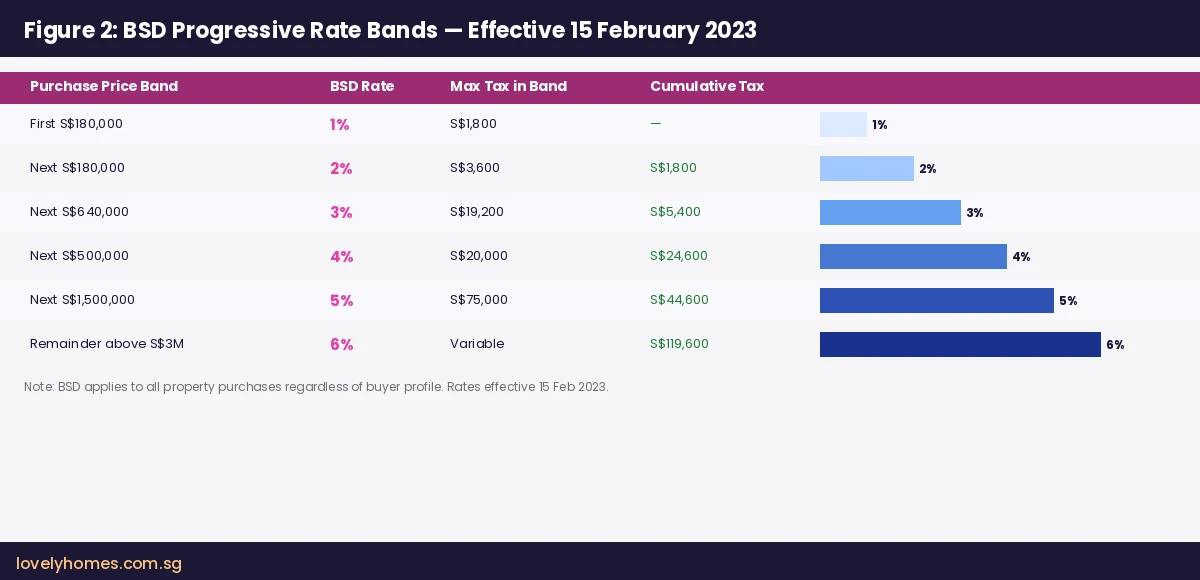
  • BSD starts at 1% and rises progressively to 6% above S$3M. A S$1.5M condo incurs S$44,600 in BSD alone.
  • Financing: TDSR is capped at 55% of gross income; MSR at 30% for HDB and EC purchases. CPF OA can fund downpayment and mortgage instalments but accrues 2.5% interest payable on sale.
  • Capital appreciation: OCR private prices are up ~73% since Q1 2019; HDB resale up ~56%; CCR up ~25%.
  • Pipeline risk: total private residential pipeline stands at ~61,000 units as at Q1 2026 — elevated supply is a medium-term moderating factor.
  • Best entry strategies for most Singapore households: HDB resale (high yield, government grants available) → EC (medium yield, capital gains on privatisation) → OCR condo (growth play, TDSR-permitting).

What is Property Investment in Singapore?

Property investment in Singapore means acquiring residential or commercial real estate with the objective of generating rental income, capital appreciation, or both. Singapore’s property market is one of the most regulated in Asia — by design. The Urban Redevelopment Authority (URA) controls land supply through the Government Land Sales (GLS) programme; the Housing & Development Board (HDB) administers public housing policy; the Monetary Authority of Singapore (MAS) governs financing limits; and the Inland Revenue Authority of Singapore (IRAS) collects stamp duties.

This web of regulation is not accidental. Singapore uses property policy as a macro-prudential tool — adjusting ABSD rates, LTV caps, and supply releases to prevent asset-price bubbles and ensure housing remains accessible. For investors, understanding why each rule exists is as important as knowing the rates themselves, because policy changes (like the April 2023 ABSD hike to 60% for foreigners) can transform return profiles overnight.

This guide covers every dimension a Singapore property investor needs to understand in 2026: property types, buyer profiles, costs, financing, yields, price trends, and entry strategies — all benchmarked against current government data.

Understanding Singapore’s Property Market Structure

Singapore divides its residential market into three broad categories. The HDB market covers public housing flats, which house roughly 80% of Singapore’s resident population. HDB flats are sold by the government at subsidised prices via the Build-To-Order (BTO) scheme or on the open resale market. Singapore Citizens and Permanent Residents may own HDB flats under eligibility rules; foreigners may not. The executive condominium (EC) market is a hybrid tier — EC units are built by private developers on government land, initially subject to HDB eligibility rules, and progressively privatised after 5 years (partial privatisation) and 10 years (full privatisation), at which point foreigners may purchase them. The private property market includes condominiums, apartments, and landed houses, open to all buyer profiles subject to ABSD.

Geographically, URA divides Singapore into three market segments: the Core Central Region (CCR) — the prime districts 9, 10, 11 and Marina Bay — characterised by high absolute prices and lower yields but strong expat demand; the Rest of Central Region (RCR) — inner-ring districts like Queenstown, Toa Payoh, Bishan — offering a balance of capital upside and rental demand; and the Outside Central Region (OCR) — suburban estates like Tampines, Punggol, Jurong East, Woodlands — which offer the highest rental yields and the strongest capital growth over the past five years driven by HDB upgrader demand.

Singapore property rental yields by type Q1 2026 — HDB, condo, EC and landed gross yield comparison chart
Figure 1: Gross rental yields by property type, Singapore Q1 2026. HDB flats continue to generate the highest gross yields at 4.1–5.2%. Source: URA, HDB.

Singapore Property Prices in 2026 — What the Data Says

URA’s Q1 2026 private residential price index recorded an overall increase of +0.9% quarter-on-quarter — a steady but measured pace following the April 2023 ABSD hike that cooled the market materially. By segment, OCR led at +2.2%, reflecting robust HDB upgrader demand for suburban condos; RCR rose +1.6%; while CCR dipped -0.3% as the 60% foreign buyer ABSD continued to suppress transaction volumes in the prime market. The landed residential segment eased -0.4%. HDB resale prices slipped -0.1% — the first quarterly dip after an unbroken run of increases since 2021 — which analysts attribute to increased BTO supply and the dampening effect of PLH and Plus-category resale restrictions.

On a five-year basis, the performance picture differs significantly by segment. OCR private prices are up approximately 73% since Q1 2019 (base year), driven by the work-from-home boom, pent-up upgrader demand, and the record-low supply of new OCR launches between 2020 and 2022. RCR has risen roughly 51%; CCR approximately 25%; and the HDB Resale Price Index approximately 56% over the same period — a remarkable run for public housing given its subsidised entry cost.

Buyer Stamp Duty (BSD) and Additional Buyer’s Stamp Duty (ABSD)

Stamp duties are the single largest transaction cost in Singapore property and cannot be ignored in any investment analysis. Buyer’s Stamp Duty (BSD) applies to all property purchases regardless of buyer profile. It is progressive: 1% on the first S$180,000, 2% on the next S$180,000, 3% on the next S$640,000, 4% on the next S$500,000, 5% on the next S$1.5M, and 6% above S$3M (rates effective 15 February 2023). On a S$1.5M property, BSD amounts to S$44,600.

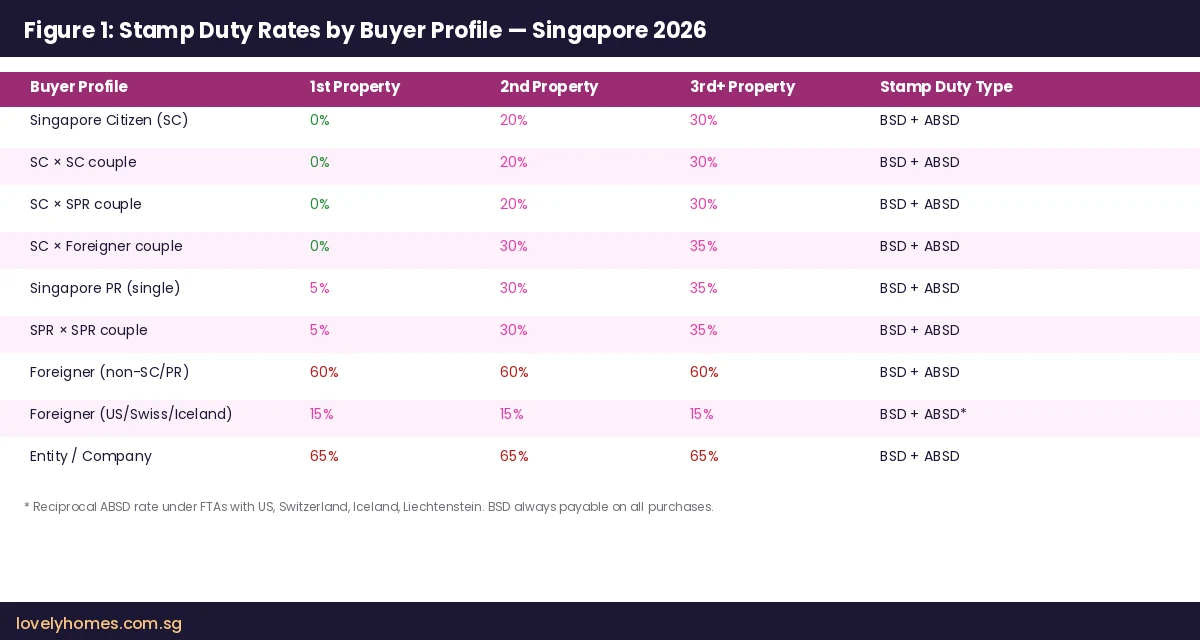
Additional Buyer’s Stamp Duty (ABSD) is the more consequential levy. Rates (effective April 2023) vary by buyer profile and property count: Singapore Citizens pay nil on their first property, 20% on their second, and 30% on their third or subsequent. Singapore Permanent Residents pay 5% on their first, 30% on the second. Foreigners pay a flat 60%; entities (companies) pay 65%. Certain FTA nationals (US, Swiss, and Icelandic/Liechtenstein/Norwegian nationals purchasing residential property) are treated the same as Singapore Citizens for ABSD on their first property under trade agreement provisions.

Singapore property entry costs BSD ABSD by buyer profile at S1.5 million 2026 — Singapore citizen SPR foreigner entity comparison
Figure 2: Total entry costs at S$1.5M including BSD, ABSD, and estimated agent/legal fees by buyer profile. Source: IRAS (BSD 15 Feb 2023; ABSD Apr 2023).

Financing: TDSR, MSR, LTV and CPF Rules

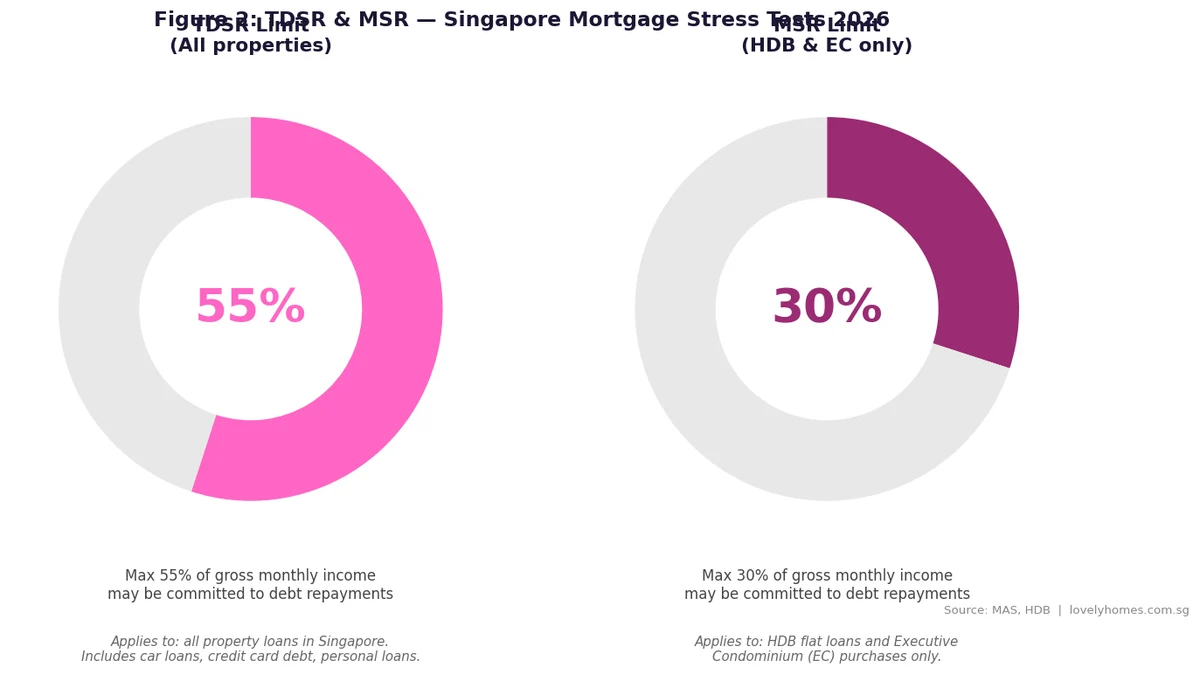
MAS introduced the Total Debt Servicing Ratio (TDSR) framework in June 2013 to prevent household over-leverage. Under TDSR, a borrower’s total monthly debt obligations — including the new property loan, car loans, personal loans, and credit card revolving debt — may not exceed 55% of gross monthly income. For married couples buying jointly, the household income can be combined but the same 55% cap applies to combined obligations. The Mortgage Servicing Ratio (MSR), which is more restrictive, limits monthly repayments on HDB flat loans and EC loans to 30% of gross monthly income.

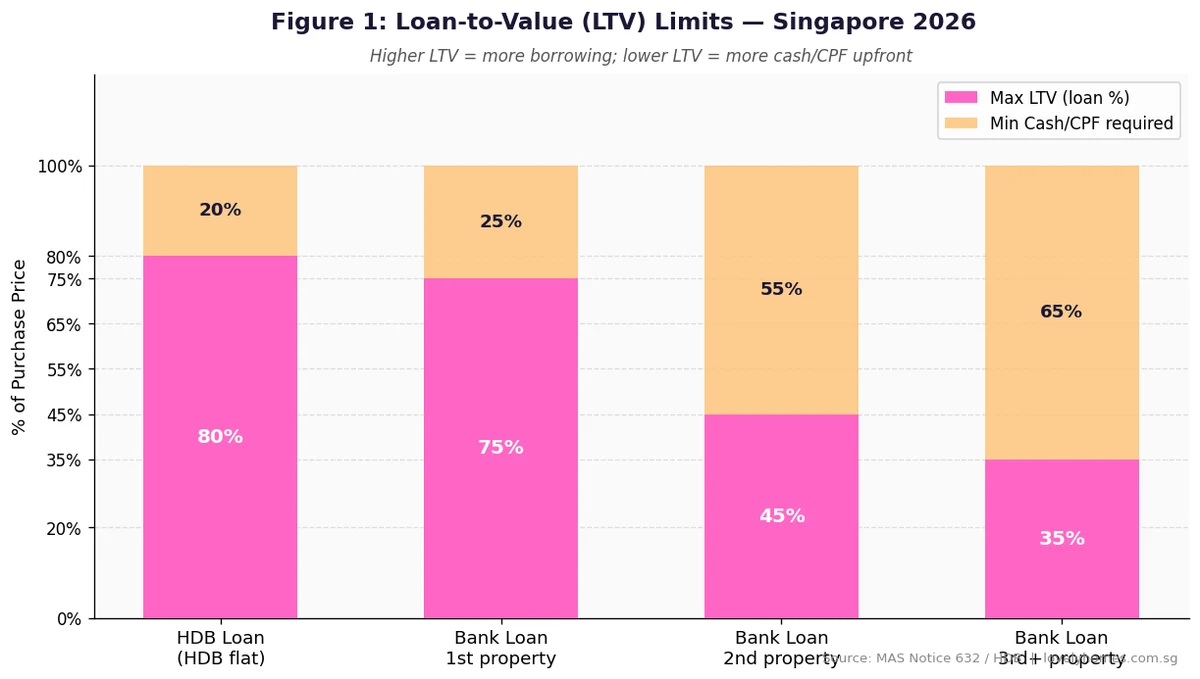
Loan-to-Value (LTV) limits determine maximum loan quantum. For a first property with no outstanding housing loans, HDB concessionary loans allow up to 80% LTV (on purchase price or valuation, whichever is lower) with a minimum 5% cash downpayment. Bank loans for a first property are capped at 75% LTV, also with at least 5% in cash. For a second property, the LTV cap drops to 45% (with at least 25% cash for the downpayment). Third or subsequent properties: 35% LTV.

CPF Ordinary Account (OA) savings, earning a guaranteed 2.5% p.a., can be used for the property downpayment, monthly mortgage instalments, and stamp duties. However, the Valuation Limit (VL) caps total CPF use at the property’s lower of purchase price or market value, while the Withdrawal Limit (WL) — set at 120% of VL — represents the absolute ceiling if the property has at least 60 years of remaining lease. Any CPF drawn must be refunded with 2.5% accrued interest on eventual sale, which can meaningfully reduce net cash proceeds.

Summary: Key Investment Parameters at a Glance

Parameter HDB Flat Executive Condo (EC) OCR Condo CCR Condo
Typical price range S$300k–S$900k S$850k–S$1.4M S$900k–S$2.5M S$1.8M–S$6M+
Gross rental yield 4.1–5.2% 3.2–3.6% 3.4–3.9% 2.3–2.8%
5-year price growth +8–12% (resale) +12–18% (resale) +15–25% +8–14%
Foreign buyer eligible? No Only after 10 yrs Yes (60% ABSD) Yes (60% ABSD)
Max LTV (first property) 80% (HDB loan) 75% (bank loan) 75% (bank loan) 75% (bank loan)
Minimum occupation period 5 yrs (PLH/Plus: 10 yrs) 5 yrs before sale No MOP No MOP
Income ceiling S$14,000/mth S$16,000/mth None (TDSR applies) None (TDSR applies)
Capital gains tax Nil Nil Nil (SSD may apply) Nil (SSD may apply)

Worked Example: SC Household Upgrading from HDB to OCR Condo

Case Study — Mr & Mrs Ong, Singapore Citizens upgrading to a first private property

Household profile: Mr & Mrs Ong, both Singapore Citizens, joint gross income S$14,000/month. They own a 5-room HDB flat in Jurong East which has completed its 5-year MOP, currently valued at S$780,000 (outstanding HDB loan S$220,000; CPF used S$320,000 + S$43,000 accrued interest = S$363,000 total CPF refund on sale). Target: buy an OCR 2BR condo at S$1,350,000.

Step 1 — Sell HDB first: Sale proceeds S$780,000 − HDB loan redemption S$220,000 − CPF refund S$363,000 − agent commission 2% S$15,600 − legal S$2,500 = net cash ~S$178,900. After selling, their ABSD on the new private purchase is nil (first private property, SC). If they buy before selling and hold both simultaneously, the condo purchase would attract 20% ABSD = S$270,000 — avoidable by selling first (or using the SC married couple remission: buy first, sell HDB within 6 months).

Step 2 — Buy OCR condo S$1,350,000: BSD = S$37,400. Minimum cash downpayment = 5% × S$1,350,000 = S$67,500. Balance downpayment 20% total = S$270,000 (S$67,500 cash + S$202,500 CPF). Bank loan: 75% LTV = S$1,012,500 @ 3.0% p.a. 30 years → monthly instalment S$4,268. TDSR check: S$4,268 ÷ S$14,000 = 30.5% — well within 55% PASS. Total upfront cost: S$67,500 (5% cash down) + S$37,400 (BSD) + S$2,800 (legal) = S$107,700 cash. CPF deployed: S$202,500 (balance of 20% down). Net cash from HDB sale S$178,900 covers the full S$107,700 requirement with S$71,200 remaining.

Capital Appreciation: Singapore Property vs Other Asset Classes

Singapore residential property has compounded at an effective annualised rate of roughly 8–10% in OCR markets over the 2019–2026 period — broadly comparable to the Straits Times Index total return of around 6–8% annually, and notably lower than the Nasdaq’s run but with far lower volatility. The critical advantage of property is leverage: a S$270,000 equity stake (20% downpayment on a S$1.35M property) growing at 8% per annum generates capital on the full S$1.35M base, dramatically amplifying the equity return relative to unleveraged assets.

However, leverage cuts both ways. A 15–20% property price correction — comparable to the 2013–2017 period when prices fell roughly 12% following TDSR and cooling measures — would erode a 20% equity buffer significantly. Investors should stress-test their holdings against an interest rate spike (3M SORA remains at approximately 2.4% as at June 2026 but has ranged from 0.05% to 4.0% in the past five years) and against a 12–18 month vacancy period.

Singapore property price index growth 2019 to 2026 — OCR RCR CCR private and HDB resale price index trend chart
Figure 3: Singapore property price index by market segment, Q1 2019 to Q1 2026. OCR leads all segments with ~73% growth over the period. Source: URA, HDB.

Why Singapore Property Remains a Core Investment Asset

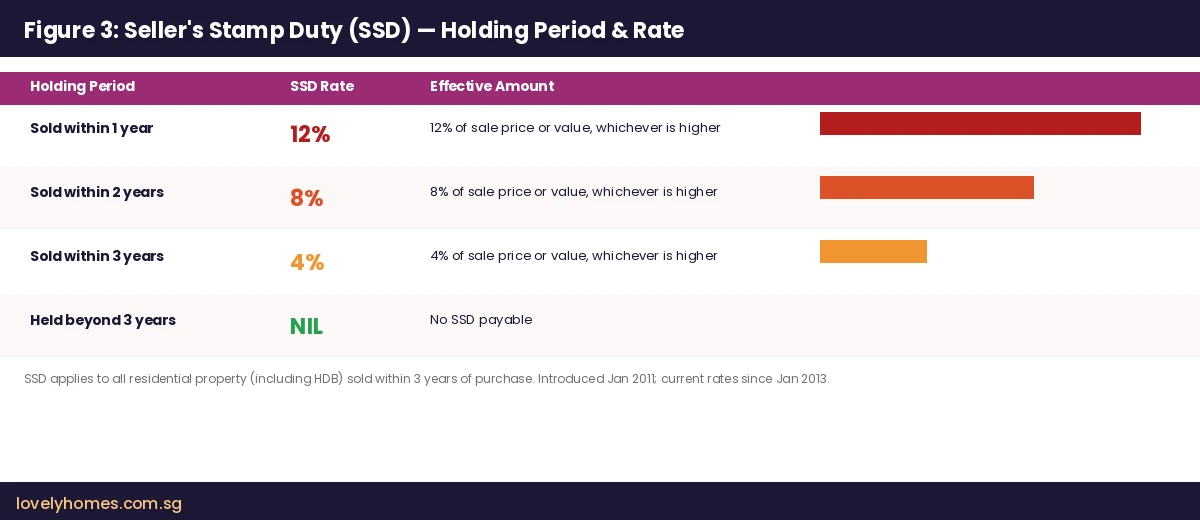
Three structural factors continue to underpin Singapore’s residential market. First, land scarcity: Singapore covers 733 km² and cannot expand its land mass materially beyond ongoing reclamation. The total stock of private residential units stands at roughly 365,000, with a pipeline of ~61,000 units as at Q1 2026. Government control of the GLS programme means supply is managed, not market-driven. Second, strong legal framework: Singapore’s property rights are among the most secure globally — clear title, transparent transactions, an independent judiciary, and efficient land registration through the Singapore Land Authority (SLA). Third, no capital gains tax: Singapore does not levy capital gains tax on property. The Seller’s Stamp Duty (SSD), which applies at 12%, 8%, or 4% for properties sold within 1, 2, or 3 years of purchase respectively, effectively discourages speculative flipping but leaves medium-to-long-term investors entirely unaffected.

Compared to peers in the region, Singapore’s regulatory environment is more transparent than Hong Kong or mainland China, and its legal protections are stronger than most ASEAN markets. For high-net-worth individuals and regional corporates, Singapore residential property serves as both a wealth store and a hedge against currency risk in Southeast Asia’s most stable monetary environment.

What Might Come Next: Outlook for H2 2026 and Beyond

Speculation follows, not government guidance. The 2H2026 Government Land Sales programme announced by URA in June 2026 includes nine Confirmed List sites capable of yielding approximately 4,745 residential units and 735 EC units, alongside the landmark Jurong Lake District white site. The sustained supply pipeline is expected to moderate price growth in the OCR to a 1–2% quarterly range through 2026. The Jurong Region Line opening in phases from approximately 2028 will likely catalyse a re-rating of Jurong, Tengah, and Choa Chu Kang OCR pricing, potentially delivering a 8–15% uplift to proximate properties based on historical MRT-opening precedents.

Interest rate trajectory remains the key macro variable. If 3M SORA retreats to the 1.5–2.0% range by late 2026 as some market observers anticipate, monthly servicing costs for SORA-pegged bank loans could fall materially, broadening the pool of TDSR-eligible buyers and supporting price momentum. Conversely, any renewed MAS tightening — whether via further ABSD increases or LTV reductions — could quickly dampen transaction volumes, as the April 2023 measures demonstrated.

Frequently Asked Questions: Singapore Property Investment 2026

Do Singapore Citizens pay any tax on capital gains from property?

No. Singapore does not levy a capital gains tax on residential property sales. However, the Seller’s Stamp Duty (SSD) applies if you sell within three years of purchase: 12% for sale within the first year, 8% within the second year, and 4% within the third year, calculated on the higher of the sale price or market value. Properties held for more than three years attract zero SSD. This means medium-to-long-term investors retain the full capital gain on sale, making Singapore’s tax environment highly favourable for property investment by global standards.

How does ABSD affect investment property returns?

ABSD fundamentally reshapes the return maths for all but first-time SC buyers. A Singapore Citizen purchasing a second property worth S$1.5M pays 20% ABSD = S$300,000 upfront. To break even on this cost alone — before financing and other expenses — the property must appreciate at least S$300,000 beyond the purchase price (roughly a 20% gross gain) before any net profit is realised. For SPR second-property buyers (30% ABSD) and foreigners (60% ABSD), the bar is even higher. This is precisely why many experienced property investors in Singapore prioritise holding their first property long-term and are extremely cautious about second purchases — the ABSD converts a 10% market gain into a near-breakeven outcome.

Can I use CPF to pay for investment property?

Yes, CPF Ordinary Account (OA) funds can be used for the downpayment and monthly mortgage instalments on a second or investment property. However, CPF usage for a second property is subject to the Valuation Limit (VL) and Withdrawal Limit (WL = 120% of VL), and critically — all CPF drawn must be refunded with 2.5% per annum accrued interest when the property is sold. This means long-holding-period investors will accumulate a substantial refund obligation that directly reduces net sale proceeds. If you have deployed S$400,000 in CPF over 15 years, your refund obligation at 2.5% compound could exceed S$590,000 — a significant deduction from the sale price.

What is the difference between OCR, RCR and CCR for investment purposes?

The three planning regions serve very different investor profiles. The CCR (Core Central Region — Districts 9, 10, 11, Downtown Core, Sentosa) offers prestige, expat rental demand, and freehold tenure, but yields are the lowest at 2.3–2.8% and price growth since 2019 has lagged at ~25%. The RCR (Rest of Central Region — inner suburbs like Queenstown, Toa Payoh, Bishan) offers a middle ground: yields of 3.0–3.5% and solid capital appreciation of ~51% since 2019. The OCR (Outside Central Region — Tampines, Jurong, Woodlands, Punggol) delivers the highest gross yields (3.4–3.9% for condos) and the strongest capital growth (~73% since 2019) driven by HDB upgrader demand. Most Singapore residents with a single investment property budget should look at OCR first.

Is it better to buy an HDB resale flat or a private condo as an investment?

For most Singapore Citizens and PRs within HDB eligibility criteria, HDB resale flats offer compelling investment characteristics: the highest gross rental yields in the market (4.1–5.2%), government grants for eligible buyers, an established tenant pool, and lower absolute entry costs that improve leverage efficiency. The key constraint is the 5-year Minimum Occupation Period (MOP) — 10 years for Plus and Prime flats — during which the flat cannot be rented out entirely and cannot be sold. Private condos offer no MOP, greater flexibility, and exposure to the private price index, but entry costs are significantly higher and yields are lower. For buyers who need immediate rental income and cannot lock up capital for five years, a private condo is the better choice. For patient investors willing to occupy first, HDB offers the most efficient risk-adjusted return in the Singapore market.

What is the Seller’s Stamp Duty (SSD) and when does it apply?

The Seller’s Stamp Duty (SSD) was introduced in February 2010 and last revised in January 2011 to its current three-tier structure. SSD applies to residential properties (and industrial properties, which have a separate regime) sold within three years of purchase. The rates are: 12% if sold within the 1st year of purchase, 8% within the 2nd year, and 4% within the 3rd year. SSD is computed on the higher of the sale price or market value at the date of sale. Inherited properties: SSD runs from the original purchase date of the deceased, not the date of inheritance. For most buy-and-hold investors, SSD is a non-issue, but it effectively eliminates profitable short-term flipping strategies for properties purchased at market rates.

Should I invest in residential property or Singapore REITs?

REITs (Real Estate Investment Trusts) listed on the Singapore Exchange (SGX) offer exposure to commercial, industrial, retail, and hospitality property without the ABSD, TDSR, MOP, and management burden of direct ownership. Singapore REIT distribution yields typically range from 5–7%, compared to 3–4% gross yields for direct residential investment. However, REITs are equity instruments subject to market sentiment volatility and do not carry the leverage benefit of direct property. For investors who cannot qualify for a second property loan under TDSR, or who have already exhausted CPF, REITs offer a capital-light alternative. Most sophisticated investors hold both: direct residential for leverage and capital gains, REITs for yield and liquidity.

Disclaimer: This article is for general educational and informational purposes only and does not constitute financial, investment, legal, or tax advice. Property prices, stamp duty rates, CPF rules, TDSR limits, and government policies are subject to change without notice. All figures and data are sourced from URA, HDB, MAS, IRAS, and CPF Board publications as at June 2026 and are indicative only. Readers should conduct their own due diligence and consult a licensed financial adviser, property agent registered with the Council for Estate Agencies (CEA), and a qualified lawyer or tax professional before making any property investment decision. Past price performance is not indicative of future results.

Singapore Home Loan Complete Guide 2026: HDB Loans, Bank Loans, TDSR, MSR and Best Rates Explained

Singapore Home Loan Complete Guide 2026: HDB Loans, Bank Loans, TDSR, MSR and Best Rates Explained

Quick Answer — Singapore Home Loans at a Glance (2026)

  • Two main options: HDB Concessionary Loan (2.6% p.a., LTV 80%) and Bank Loan (~3.0–3.7% p.a., LTV 75%).
  • MSR caps your HDB or EC loan instalment at 30% of gross income; TDSR caps all debt at 55% of income.
  • Bank loans require a minimum 5% cash downpayment; HDB loans require 5% cash on the 20% downpayment portion.
  • Floating-rate loans are pegged to SORA (Singapore Overnight Rate Average) — 3M SORA ~2.4% at June 2026.
  • A S$1 million loan at 3.5% over 25 years costs S$85,000 more in total interest than at 2.6%.
  • Lock-in periods of 1–3 years are standard on bank fixed-rate packages; exiting early triggers a clawback of ~1.5% of the outstanding loan.
  • Refinancing after the lock-in expires can save tens of thousands; always compare at least 3 banks’ packages.

What Is a Home Loan and Why Does the Structure Matter?

A home loan (or housing loan) is a secured credit facility from a lender — either the Housing and Development Board or a licensed bank — that allows you to finance the purchase of a residential property in Singapore. The property serves as collateral; if you default, the lender can repossess and sell it to recover the outstanding debt.

The structure matters because small differences in interest rate, tenure, and loan-to-value ratio compound dramatically over a 25–30-year horizon. A 0.9 percentage point difference (say, 2.6% vs 3.5%) on a S$600,000 HDB loan over 25 years translates to roughly S$51,000 in additional interest. That is not a minor detail. Beyond the rate, two Monetary Authority of Singapore (MAS) rules govern how much you can borrow: the Mortgage Servicing Ratio (MSR) for HDB and Executive Condominium (EC) purchases, and the Total Debt Servicing Ratio (TDSR) for all property loans.

HDB Concessionary Loan vs Bank Loan — The Key Differences

Every Singapore home buyer faces the same first question: HDB loan or bank loan? Each has distinct advantages and constraints. The comparison below sets out the essential differences.

HDB concessionary loan vs bank loan comparison table 2026 key parameters Singapore
Figure 1: HDB Concessionary Loan vs Bank Loan — Key Parameters (2026). Source: HDB, MAS.

The HDB loan rate of 2.6% p.a. is fixed at 0.1% above the CPF Ordinary Account (OA) rate of 2.5%. It moves only if the CPF OA rate changes — which has not happened since July 1999. Bank loans fluctuate with market rates. At June 2026, the best 2-year fixed bank packages sit at approximately 3.0–3.2% p.a., while SORA-pegged floating packages range from SORA+0.75% to SORA+1.20% (3M SORA ~2.4%, implying ~3.15–3.60% all-in).

HDB Concessionary Loan — Eligibility and Key Rules

To qualify for the HDB loan, at least one buyer must be a Singapore Citizen; the household gross income must not exceed S$14,000 per month (families) or S$7,000 (singles); and no buyer may currently own or have disposed of private property in the 30 months before the flat application. You also need a valid HDB Flat Eligibility (HFE) letter — a mandatory pre-application document from HDB confirming your loan eligibility, CPF grant entitlement and maximum loan quantum (mandatory since May 2023, valid for 9 months).

The maximum loan under the HDB loan is 80% of the lower of the purchase price or valuation. On a S$700,000 flat that is S$560,000. The remaining 20% (S$140,000) is the downpayment — at least 5% (S$35,000) must be cash; the rest may come from CPF OA.

Bank Loans — LTV, Lock-in and SORA

Bank loans allow a longer maximum tenure (30 years vs 25 years), access to all property types, and — potentially — lower rates during low-rate periods. The trade-off is variability and the lock-in period. Most bank fixed rates carry a lock-in of 1–3 years, after which the loan reprices to a floating SORA-pegged rate. The Loan-to-Value (LTV) for a bank loan is 75% if you have no outstanding loans; 45% if you have one; 35% if two or more. SORA replaced SIBOR as the benchmark rate on 1 October 2024 following the MAS phase-out of SIBOR.

MSR and TDSR — How Much Can You Actually Borrow?

The MAS introduced the TDSR framework in June 2013 and has maintained it as the primary constraint on borrowing. For HDB and EC purchases, the MSR applies as a tighter cap.

  • TDSR ≤ 55%: Total monthly debt obligations — home loan plus all other debts — must not exceed 55% of gross monthly income.
  • MSR ≤ 30%: For HDB and EC purchases only — the monthly home loan repayment alone must not exceed 30% of gross monthly income.
Maximum home loan quantum by household income MSR 30 percent TDSR 55 percent comparison chart Singapore 2026
Figure 2: Maximum Loan Quantum by Household Income — MSR (HDB/EC) vs TDSR (private property), 2026.

A household earning S$10,000 per month can borrow up to approximately S$826,000 on an HDB loan (MSR 30% at 2.6% p.a. over 25 years) or up to S$1,514,000 under TDSR on a bank loan for private property (55% at 3.0% p.a. over 30 years). The MSR is the binding constraint for HDB buyers; TDSR is the constraint for private property buyers.

Fixed Rate vs Floating Rate (SORA) — Which Is Better?

Fixed-rate packages offer certainty: the rate is locked for 2–3 years. After the lock-in, the loan reverts to a floating rate and you may reprice or refinance. Breaking the lock-in early triggers a clawback penalty of approximately 1.0–1.75% of the outstanding loan.

Floating-rate packages pegged to 3M compounded SORA move with the market. When rates fall, your instalment falls. When rates rise (as they did sharply in 2022–2023), your instalment rises. Floating packages currently sit at SORA + 0.75%–1.20%.

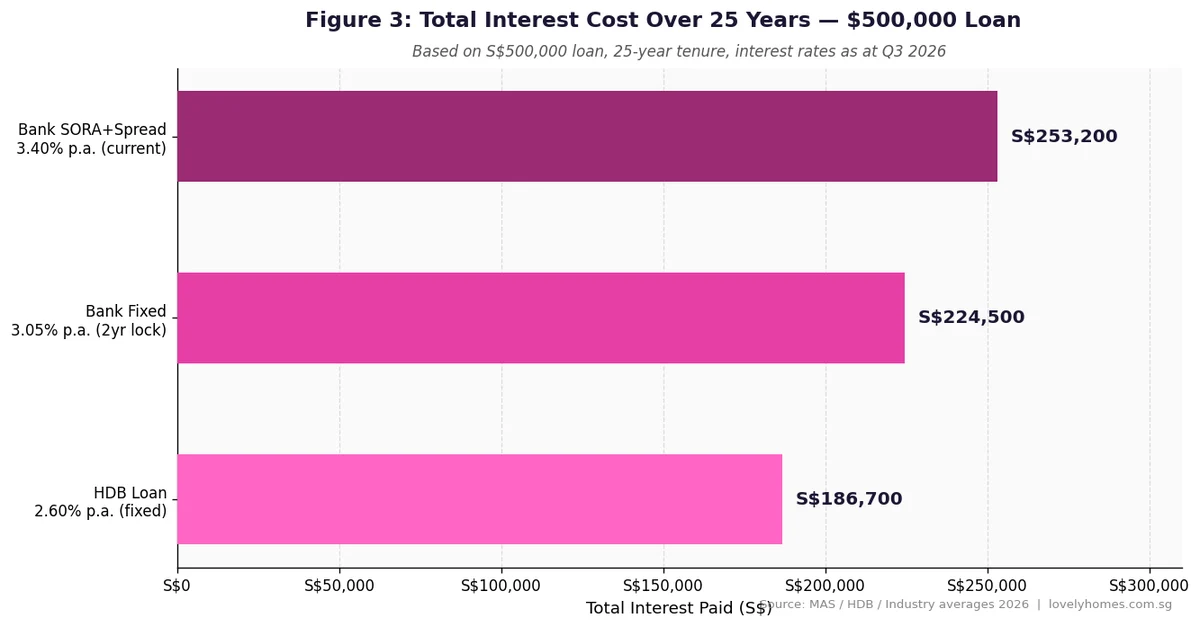
Total interest cost on S$1 million home loan by rate scenario 2026 HDB 2.6 percent bank fixed SORA floating
Figure 3: Total Interest Cost on S$1 Million Loan (25-year tenure) by Rate Scenario. Source: LovelyHomes calculations, indicative June 2026.

The chart shows the cost differential starkly. The HDB loan at 2.6% costs approximately S$377,000 in total interest over 25 years on a S$1 million loan. A bank fixed rate at 3.5% costs S$462,000 — a S$85,000 difference. For buyers of private property or ECs using bank financing, the choice between fixed and floating hinges on your rate outlook and risk tolerance.

CPF and Home Loan Financing

Most Singapore buyers use their CPF Ordinary Account (OA) to service instalments and fund the downpayment. The rules are set by the Central Provident Fund Board under the CPF Act (Cap 36). The key constraints are the Valuation Limit (VL) — the lower of price or valuation — and the Withdrawal Limit (WL), which is 120% of the VL. CPF OA can be used freely up to the VL; above the VL up to the WL only if you have set aside the Basic Retirement Sum (S$106,500 in 2026) in your CPF accounts.

A critical point: when you sell the property, you must refund to CPF the total principal withdrawn plus accrued interest at 2.5% p.a. This is not a penalty — it restores your retirement savings — but it reduces net cash proceeds from sale. See our CPF Property Withdrawal Limits 2026 guide for detail.

Summary Table — Singapore Home Loan Framework 2026

Parameter HDB Concessionary Loan Bank Loan (HDB/EC) Bank Loan (Private)
Rate (Jun 2026) 2.6% p.a. fixed ~3.0–3.7% p.a. ~3.0–3.7% p.a.
Loan-to-Value 80% 75% 75%
MSR Cap ≤ 30% ≤ 30% N/A
TDSR Cap ≤ 55% ≤ 55% ≤ 55%
Max Tenure 25 years (age 65) 30 years (age 65) 30 years (age 65)
Min Cash Down 5% of price 5% of price 5% of price
Lock-in / Clawback None 1–3 yr clawback 1–3 yr clawback
Property Types HDB flats only HDB + EC All types

Worked Example — Mr & Mrs Wong Buying Bishan 4-Room HDB Resale

Mr & Mrs Wong are a Singapore Citizen couple. Joint gross income: S$9,500 per month. They plan to purchase a 4-room HDB resale flat in Bishan at S$680,000. This is their first property. They hold S$90,000 combined CPF OA. They qualify for an Enhanced Housing Grant (EHG) of S$60,000 (income S$9,001–S$10,000) and a Proximity Housing Grant (PHG) of S$30,000 (parents within 4 km). Total housing grants: S$90,000.

  • Purchase price: S$680,000
  • HDB Loan (80% LTV): S$544,000
  • Downpayment (20%): S$136,000 — CPF OA S$90,000 + cash S$46,000
  • Grants applied: S$90,000 (EHG + PHG) — reduces net purchase price
  • Monthly instalment (2.6%, 25yr): S$2,468/month
  • MSR check: S$2,468 ÷ S$9,500 = 26.0% — PASS (threshold 30%)
  • Buyer’s Stamp Duty (BSD): 1% × S$180k + 2% × S$180k + 3% × S$320k = S$15,000
  • Legal fees: ~S$2,800 | HDB caveat: S$64.45
  • ABSD: Nil (SC first property)
  • Total cash outlay: ~S$46,000 (downpayment cash) + S$15,000 (BSD) + S$2,800 (legal) = ~S$63,800

The HDB loan is the clear choice here: the 2.6% fixed rate is materially cheaper than any bank offering in June 2026, the couple meets the S$14,000 income ceiling comfortably, and the S$90,000 grants significantly reduce the net outlay. Total cost of ownership over 25 years at 2.6%: approximately S$680,000 principal + S$200,000 interest + S$63,800 upfront costs = S$943,800 in total expenditure on a flat that, based on OCR HDB price growth of ~10% per year over the past 5 years, may be worth substantially more at resale.

Refinancing and Repricing — When and How

Repricing means switching to a new package with your existing bank; refinancing means moving to a new lender. Refinancing is generally more powerful but involves legal fees of S$1,800–S$3,500 and a valuation fee of S$200–S$500. Most banks offer cashback of S$1,800–S$2,000 to offset these costs. The optimal window to refinance is 3–6 months before your lock-in expires. Never refinance within the lock-in unless savings clearly outweigh the clawback penalty.

What to Watch in H2 2026

3M SORA has been stable at approximately 2.3–2.5% since early 2026 as global central banks paused tightening. The key variable remains the US Federal Reserve: any cut flows through to SORA within weeks. For buyers who value certainty, a 2-year fixed package now locks in June 2026 rates. For buyers expecting rates to fall over the next 12–18 months, a floating SORA package may deliver lower effective payments over the loan lifecycle. The prudent approach regardless: stress-test your affordability at a rate 1.5–2.0 percentage points above your current package rate.

Frequently Asked Questions

Can I switch from an HDB loan to a bank loan after purchasing?

Yes. You can refinance from the HDB loan to a bank loan at any time after the HDB loan is active — there is no lock-in or clawback on the HDB side. You will need a conveyancing lawyer to discharge the HDB mortgage and register the bank mortgage. Bank loans typically cover 75% LTV, so if your outstanding HDB loan balance is below 75% of the current valuation, it can be fully refinanced. Note: once you switch to a bank loan, you cannot switch back to the HDB loan.

What happens if SORA rises sharply on my floating-rate loan?

Floating-rate borrowers bear the full rate risk. A 1 percentage point rise in SORA increases the monthly instalment on a S$600,000 loan (30yr) by approximately S$300. MAS requires banks to stress-test borrowers at a floor of 3.5% or contractual rate plus 1%, whichever is higher — so your loan was approved assuming you can handle a rate rise. Budget a meaningful buffer above your starting instalment.

Can I use CPF to pay stamp duty?

BSD and ABSD must be paid in cash within 14 days of signing the OTP. After payment, you may apply for CPF reimbursement from your OA. The initial cash payment is mandatory. This is a common cash-flow surprise: on a S$680,000 HDB flat, BSD is approximately S$15,000 cash on top of the downpayment.

What is the difference between repricing and refinancing?

Repricing means switching packages with your current lender (processing fee S$0–S$800; limited to that bank’s offerings). Refinancing means moving to a new lender (legal fees S$1,800–S$3,500; access to the full market). Refinancing is generally more effective but involves more paperwork and a 1–3 month processing window. Cashbacks from new lenders typically offset legal costs.

Does my car loan or personal loan reduce how much I can borrow for a home?

Yes — under TDSR, all outstanding debt obligations count against your 55% cap. A car loan of S$1,200/month and personal loan of S$500/month on a S$10,000/month income household reduces the permissible home loan instalment to S$3,800/month (55% × S$10k − S$1,700). MAS allows a 30% haircut on variable income (bonuses, commissions) when computing TDSR.

Can a foreigner get a home loan in Singapore?

Yes — foreigners can obtain bank loans for Singapore private residential property. The HDB loan is available only to eligible Singapore Citizens and Permanent Residents buying HDB flats. Note that foreigners purchasing private residential property pay 60% ABSD as at 2026 — see our ABSD guide for the full rate table. Bank loans for foreigners follow the same LTV and TDSR framework, though some banks may apply slightly stricter income documentation requirements for non-residents.

Related Articles

Disclaimer: This guide is for general information only and does not constitute financial, legal, or mortgage advice. Interest rates, LTV limits, MSR, TDSR, and CPF rules are subject to change. Always verify current rates with your lender or mortgage broker, and consult a licensed financial adviser before making borrowing decisions. Official references: MAS, HDB, CPF Board, IRAS.

Singapore HDB Resale Guide 2026: Complete Guide to Buying and Selling HDB Resale Flats

Singapore HDB Resale Guide 2026: Complete Guide to Buying and Selling HDB Resale Flats

Quick Answer — HDB Resale Singapore 2026: Key Takeaways

  • Who can buy: Singapore Citizens (SC) and Permanent Residents (PR) forming an eligible family nucleus or joining an SC under the Joint Singles Scheme.
  • No income ceiling for eligibility — but grants (EHG up to S$80,000 for families) require household income ≤ S$14,000/mth.
  • Market price, no HDB price control: HDB resale flats are sold at negotiated market prices; Cash Over Valuation (COV) is common in mature estates.
  • HFE letter mandatory since May 2023: All buyers must obtain a valid HDB Flat Eligibility (HFE) letter before submitting any Option to Purchase (OTP).
  • HDB Loan: 2.6% p.a., up to 80% LTV (capped at assessed monthly instalment ≤ 30% MSR); Bank Loan: up to 75% LTV, market rate ~3–4% p.a.
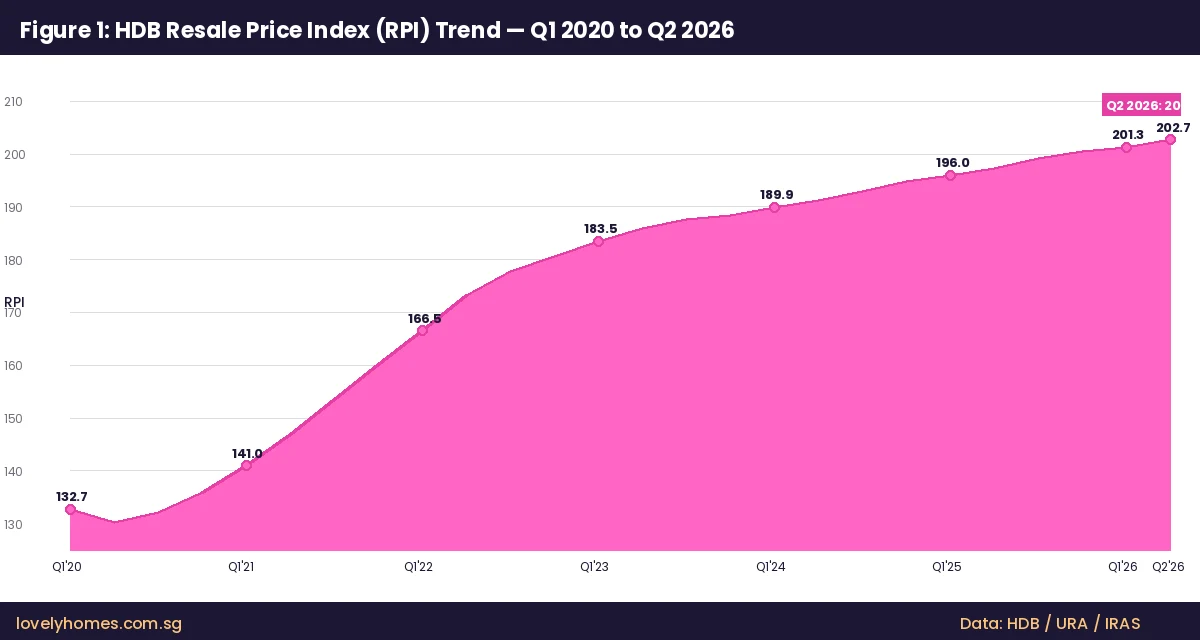
  • Resale prices: The HDB Resale Price Index (RPI) hit 216.3 in Q1 2026 — up 41% since Q1 2021, with growth moderating to +0.9% QoQ in Q1 2026.
  • Process: HFE letter → flat search → OTP (21-day validity) → resale flat application → HDB appointment → completion (typically 8–12 weeks total).
  • MOP: 5 years from key collection before you can sell, rent out entire flat, or buy a private property (10 years for Plus/Prime classification flats bought from HDB directly — not applicable to resale).

HDB resale flats form the backbone of Singapore’s housing market. With over 1.1 million flats across 24 towns and estates, the HDB resale market gives buyers immediate access to established neighbourhoods — complete with MRT stations, schools, hawker centres, and community infrastructure — without the multi-year wait of a Build-To-Order (BTO) exercise.

In 2025, approximately 29,000 HDB resale transactions were completed, a volume broadly consistent with the five-year average. Prices have risen sharply since 2021 — the Resale Price Index surged 41% between Q1 2021 and Q1 2026 — but the pace of growth has eased considerably. Understanding how to navigate the resale market in 2026 requires clarity on eligibility rules, grant quantum, financing limits, and the sequencing of each step in the purchase process.

This guide covers every dimension of Singapore HDB resale — whether you are a first-time buyer seeking a mature estate flat, an upgrader buying a five-room in a choice location, or a seller assessing the right time to exit.

HDB resale price ranges by flat type Singapore 2026 — horizontal bar chart
Figure 1: Singapore HDB Resale Price Ranges by Flat Type, Q1 2026 (indicative OCR prices; CCR/mature estate premiums apply). Source: HDB, URA REALIS.

Who Can Buy an HDB Resale Flat in Singapore?

HDB resale eligibility is governed by the Housing and Development Act (Cap 129) and administered by the Housing and Development Board. The core requirement is that at least one buyer must be a Singapore Citizen, and the buyers must form a qualifying family nucleus. The main eligibility schemes are:

Public Scheme: The most common scheme, open to SCs or SPRs who are married, engaged, or are parent-and-child pairs, siblings, or orphans. At least one SC or SPR is required; if all applicants are SCs, an unrestricted range of unit types and sizes is available. SPR-only families may purchase 3-room or larger resale flats in non-mature towns and estates.

Single Singapore Citizen (SSC) Scheme: SCs aged 35 and above who are single, divorced, or widowed may purchase a 2-room Flexi to 5-room resale flat anywhere in Singapore. This scheme was introduced to support housing access for non-family-nucleus applicants.

Joint Singles Scheme (JSS): Two or more SCs aged 35 and above who are not related may co-purchase an HDB resale flat (3-room or smaller) together.

Non-Citizen Spouse Scheme: A lone SC married to a non-citizen (non-SPR) may purchase a resale flat if the couple does not already own private property.

Fiancé/Fiancée Scheme: Engaged couples may purchase a resale flat before marriage, provided they marry within three months of key collection and register their marriage with HDB.

Importantly, there is no income ceiling to purchase an HDB resale flat — the income limits only affect grant eligibility. This contrasts with BTO where the household income ceiling of S$14,000/mth (or S$21,000/mth for larger flat types) applies to eligibility itself.

Buyers who currently own private property — locally or overseas — generally cannot purchase an HDB resale flat while retaining that private property. SCs and SPRs who own private property may buy an HDB resale flat only after disposing of the private property, with a six-month window to complete the disposal.

HDB Resale Valuation and Cash Over Valuation (COV)

Unlike BTO flats whose prices are set by HDB, resale flat prices are negotiated freely between buyer and seller. HDB appoints an approved valuer to assess the flat’s market value at the point of the resale application; the valuation is typically commissioned two to three weeks after the OTP is exercised.

If the agreed price exceeds the assessed valuation, the difference — the Cash Over Valuation (COV) — must be paid entirely in cash. CPF Ordinary Account funds and housing loans can only cover up to the assessed valuation. COV has ranged from zero to over S$100,000 depending on location, flat type, floor level, facing, and the overall market temperature. In the current market (Q1 2026), median COV in mature estates such as Toa Payoh, Bishan, and Queenstown typically ranges between S$20,000 and S$60,000.

As a practical matter, buyers should budget for potential COV as part of upfront cash requirements, especially when competing for flats in highly sought-after precincts. Sellers should price with awareness that excessive COV requests can deter buyers, who must source that cash component from personal savings, not CPF.

Housing Grants for HDB Resale Flats 2026

The Singapore government offers a generous portfolio of grants to subsidise HDB resale purchases. These are administered by HDB and credited either to the buyer’s CPF Ordinary Account or disbursed as cash at completion.

Enhanced CPF Housing Grant (EHG): The flagship resale grant, available to both first-time families and first-time singles. For first-time families, the EHG ranges from S$25,000 (household income S$10,501–S$12,000/mth) to S$80,000 (household income not exceeding S$3,000/mth). For first-time singles, the quantum is half the family rate at the same income band. The EHG is credited to the buyer’s CPF OA and applied against the purchase price. Critically, the EHG is available regardless of which town, flat type, or remaining lease the resale flat has, provided the flat’s remaining lease covers the youngest buyer to at least age 95.

Proximity Housing Grant (PHG): Introduced in 2015, the PHG rewards buyers who purchase close to their parents or children. Families receive S$30,000 if they purchase within the same town or within 4 km of their parents/children; S$20,000 if within 4 km only. Singles receive S$15,000 (same town or 4 km) or S$10,000 (4 km only). The PHG is credited as cash and disbursed at completion.

Step-Up CPF Housing Grant: Available to second-time buyers who previously lived in a 2-room BTO flat (Standard or Plus in non-mature estates) and are upgrading to a 4-room or smaller resale flat in a non-mature town. The quantum is S$15,000, credited to CPF OA.

CPF Housing Grant for Resale Flats: Applicable under certain conditions for buyers who already received grants under the old AHG/SHG framework before it was superseded by the EHG in 2019. New buyers from 2019 onwards are assessed under the EHG regime instead.

HDB resale housing grants 2026 — EHG and PHG by household income bar chart
Figure 2: HDB Resale Grants 2026 — EHG and PHG quantum by household income tier. EHG up to S$80,000 for families; PHG up to S$30,000. Source: HDB.

Financing Your HDB Resale Purchase

Two financing options are available: the HDB Concessionary Loan and a bank housing loan. The choice has permanent consequences — once you take a bank loan for the current or a prior flat, you cannot subsequently revert to the HDB loan for a future purchase.

The HDB Concessionary Loan carries a rate of 2.6% per annum (0.1 percentage point above the CPF OA rate of 2.5%), fixed by HDB and reviewed quarterly. Its key advantages are stability, a higher LTV limit of 80% (versus 75% for bank loans), and the absence of a mandatory cash down-payment — the full 20% downpayment can be paid from CPF OA. The Mortgage Servicing Ratio (MSR) cap of 30% of gross monthly income applies to both HDB and bank loans on HDB flats.

A bank loan is subject to market rates, which in Q1 2026 range from approximately 3.0–3.8% p.a. depending on loan package type (fixed or floating). The LTV is capped at 75%, and a minimum 5% cash downpayment is mandatory (the remaining 20% of the purchase price can be met with CPF). If you have an outstanding housing loan on any property, the LTV ceiling drops further and TDSR (Total Debt Servicing Ratio, 55% of gross income) applies in addition to MSR.

The HDB Flat Eligibility (HFE) Letter — mandatory since May 2023 — consolidates in a single document the buyer’s eligibility to purchase a resale flat, the CPF housing grants they are entitled to, and the HDB Concessionary Loan quantum they may borrow. The HFE letter is valid for six months and must be obtained before the seller issues any OTP.

HDB Resale vs HDB BTO vs EC — Quick Comparison

Parameter HDB Resale HDB BTO Executive Condo (EC)
Price control Market-driven; COV possible Subsidised by HDB; below market Market-driven; no subsidy
Wait time Immediate (8–12 wks completion) 3–5 years wait 3–4 years (new) or immediate (resale)
Income ceiling None (grants require ≤S$14,000) S$14,000/mth (most types) S$16,000/mth (new EC)
Grants available EHG (up to S$80k) + PHG (up to S$30k) EHG (up to S$80k) AHG/FHG (EC-specific; limited)
MOP 5 years from key collection 5 years (Standard); 10 years (Plus/Prime) 5 years (after TOP) for sale; 10 years for privatisation
Foreigners SC/SPR only SC only (as at least one applicant) SC/SPR only (new EC); anyone after 10 years
CPF usage OA up to VL (Valuation Limit) OA up to VL OA up to VL

The HDB Resale Process Step by Step

The HDB resale process follows a defined sequence governed by HDB’s administrative procedures. From first search to key collection typically spans eight to twelve weeks.

Step 1 — Apply for HFE Letter: Before any flat viewing or negotiation, both buyers must apply jointly for the HDB Flat Eligibility (HFE) letter via the HDB Flat Portal. HDB reviews CPF balances, existing property ownership, and loan history; processing takes five to ten business days. The HFE letter confirms grant entitlements and maximum loan quantum.

Step 2 — Flat Search and Negotiation: Use HDB’s ResaleFlatListings portal or engage a CEA-registered salesperson. Review transaction data on HDB’s website to calibrate a fair offer. Agree price, preferred completion date, and any fixtures to be included. Sellers and buyers can transact without agents under HDB’s direct registration option.

Step 3 — Option to Purchase (OTP): The seller issues an OTP valid for 21 calendar days. The buyer pays the Option fee (≤ S$1,000 for flats priced ≤ S$500,000; ≤ S$2,000 for flats > S$500,000). Within the 21-day window, the buyer decides to exercise by paying the Exercise fee (deducted from the purchase price) and submitting the resale flat application.

Step 4 — Resale Flat Application: Both buyer and seller submit separate portions of the application on HDB’s portal. HDB processes the application, appoints a valuer, and reviews grant eligibility — typically two to three weeks. An Approval-in-Principle (AIP) or Approval letter follows.

Step 5 — HDB Resale Appointment: Both parties attend a scheduled appointment at HDB Hub or via online portal. Documents are signed, CPF withdrawals authorised, and completion legalities confirmed. Stamp duty (BSD) is payable within 14 days of the OTP exercise date.

Step 6 — Completion and Key Collection: On the agreed completion date, HDB transfers the title and the buyer collects the keys. The five-year MOP clock starts from this date.

Worked Example: Mr & Mrs Chan — Tampines 4-Room Resale

Scenario: Mr & Mrs Chan, both Singapore Citizens, joint gross monthly income S$9,200. First-time buyers. Purchasing a 4-room resale flat in Tampines (mature estate), agreed price S$720,000. Mrs Chan’s parents live in Tampines — PHG proximity within 4 km applies. Couple plans to take HDB Concessionary Loan.

Grant entitlement (HFE letter):
EHG (income S$9,001–S$10,500 band): S$35,000 (credited to CPF OA)
PHG (parents within 4 km): S$20,000 (cash disbursed at completion)
Total grants: S$55,000

Stamp duty:
BSD on S$720,000: first S$180k × 1% = S$1,800 + next S$180k × 2% = S$3,600 + remaining S$360k × 3% = S$10,800 = S$16,200 BSD
ABSD: nil (SC purchasing first residential property)

Financing:
HDB Concessionary Loan (LTV 80%): S$720,000 × 80% = S$576,000 loan
Monthly instalment @ 2.6% p.a., 25-year tenure: ≈ S$2,607/mth
MSR: S$2,607 ÷ S$9,200 = 28.3% — PASS (≤30%)

Downpayment (20% = S$144,000):
EHG S$35,000 credited to CPF OA; assume existing CPF OA S$85,000 each (combined S$170,000 + S$35,000 = S$205,000 available in CPF)
S$144,000 covered entirely from CPF OA — no cash downpayment required

Cash upfront (items payable in cash):
BSD S$16,200 (can pay from CPF or cash) + Legal fees ~S$2,500 + Survey fee S$290 + Option Exercise fee ~S$2,000 = ~S$21,000 (most payable from CPF)
PHG cash grant of S$20,000 received at completion partially offsets out-of-pocket costs

HDB Resale Price Index RPI trend Q1 2021 to Q1 2026 Singapore chart
Figure 3: Singapore HDB Resale Price Index (RPI) Q1 2021 to Q1 2026 — 41% cumulative growth; pace moderating to +0.9% QoQ by Q1 2026. Source: HDB Resale Statistics.

Why HDB Resale Prices Matter for Buyers and Sellers in 2026

The HDB Resale Price Index at 216.3 as of Q1 2026 reflects a market that has absorbed significant price appreciation over five years but is now settling into a slower growth phase. The pace of quarterly increase has decelerated from over 3% QoQ at the 2021–2022 peak to under 1% by Q1 2026. This matters for buyers in two ways: the fear of missing out that drove frantic bidding and record COV payments in 2022 has eased, but asking prices remain structurally elevated.

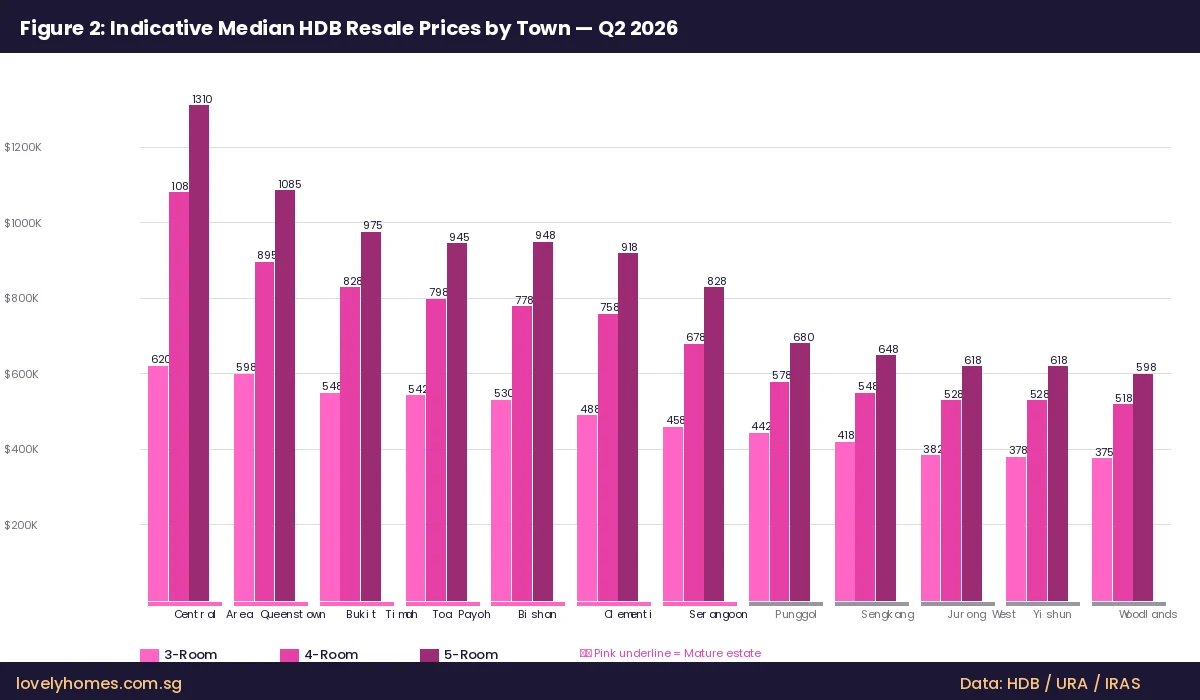
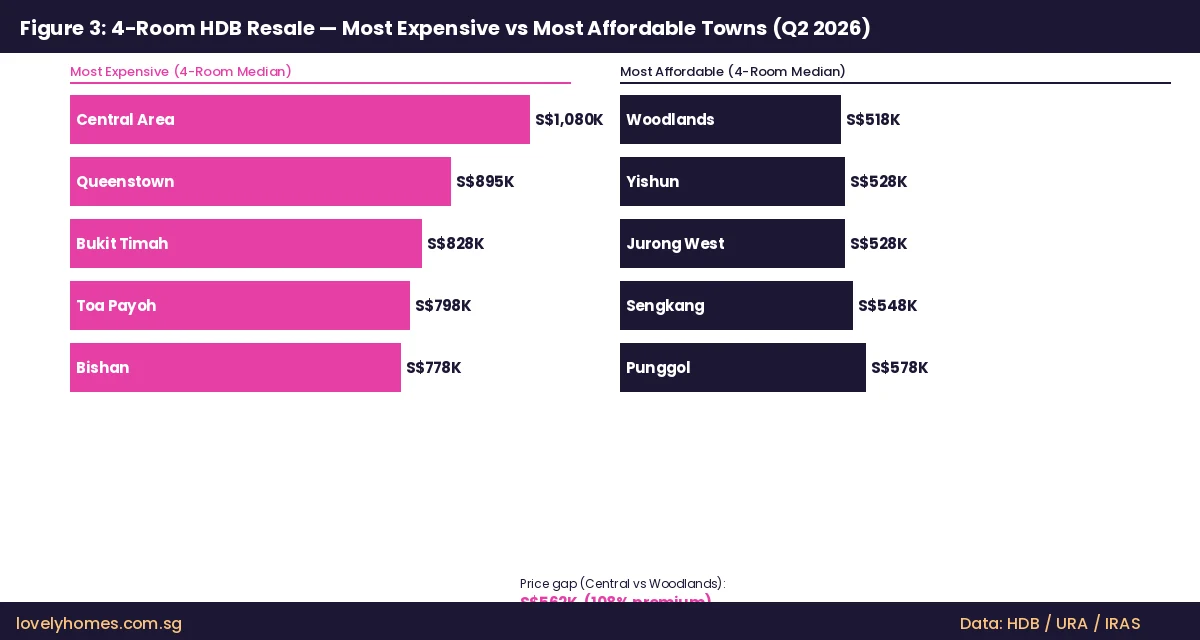
The emergence of million-dollar HDB flats — a rare phenomenon before 2021, now recorded in the hundreds annually — reflects both genuine scarcity of prime-location resale stock and the wider anchor effects of elevated private market pricing. Buyers in mature estates such as Queenstown, Bishan, Bukit Merah, Toa Payoh, and Clementi should model their budget around prices that remain 35–50% above 2019 levels.

For sellers, the moderation in price growth means that extraordinary COV premiums of S$100,000 or more are harder to sustain outside genuinely irreplaceable locations. A well-priced flat at or near valuation with a clean transaction history and a remaining lease comfortably above 65 years will still attract competitive offers.

What Might Come Next — HDB Resale Outlook for H2 2026

The following is analytical perspective, not financial advice. Readers should form their own view and seek professional guidance where appropriate.

Several structural factors point to continued price resilience in the HDB resale market through 2026. BTO supply — while improving, with HDB targeting 19,600 new flats for the year — cannot satisfy immediate demand from buyers with pressing housing timelines. The June 2026 BTO exercise covers 6,900 flats across Ang Mo Kio, Bishan, Bukit Merah, Sembawang, and Woodlands, with application windows opening around 11 June 2026 — but successful applicants will wait three to five years for keys, sustaining demand for resale units throughout that period.

Interest rate policy adds a counterweight. HDB’s concessionary loan rate of 2.6% has remained stable, but bank loan rates at 3–4% represent a meaningful servicing cost for buyers who do not qualify for or prefer not to use the HDB loan. Any prolonged period of elevated rates compresses affordability and exerts a modest downward pressure on resale prices, particularly in less sought-after non-mature estates. The MAS Financial Stability Review 2025 noted the property market as resilient but flagged household debt-servicing burdens as a risk to monitor.

The government’s supply-side response — including the BTO Plus and Prime frameworks and the 2H2026 GLS programme releasing approximately 9,200 new private units — will take several years to materialise as completed stock. In the near term, the HDB resale market is likely to remain a seller’s market in mature estates and a more balanced market in non-mature towns.

Frequently Asked Questions — HDB Resale Singapore 2026

Can I buy an HDB resale flat if I already own a private property?

Generally, no — SCs and SPRs who own a private residential property (local or overseas) are not permitted to purchase an HDB flat without first disposing of the private property. However, there is a six-month disposal window: you may purchase the HDB resale flat first and dispose of the private property within six months of the HDB flat’s completion date. Failure to comply results in HDB taking action under the Housing and Development Act. Note that even if disposal is completed within the window, the Additional Buyer’s Stamp Duty (ABSD) for the HDB purchase is not subject to the standard married-couple remission scheme that applies to private property purchases — the HDB flat is treated as a separate stamp duty regime.

What is the MOP for HDB resale flats, and does it apply to Plus/Prime resale flats too?

The standard Minimum Occupation Period (MOP) for all HDB resale flats is five years from the date of key collection (or the date HDB records as the start of the owner’s occupation). The extended ten-year MOP for Plus and Prime classification flats applies only to flats purchased directly from HDB under a BTO exercise — it does not attach to resale transactions of those flat types. This means a buyer purchasing a Plus or Prime flat on the resale market is subject only to the standard five-year MOP, not the extended ten-year restriction. The PLH resale conditions (sub-sale restrictions and clawback) also do not carry forward to resale purchasers of Plus/Prime flats.

What happens if the agreed resale price is below HDB’s valuation?

If the agreed purchase price is below the HDB-assessed valuation, the buyer benefits — the housing loan amount can still be based on up to 80% of the assessed valuation, giving the buyer access to the same maximum loan quantum as if they had paid valuation. CPF usage is also capped at the assessed valuation (or the Withdrawal Limit, whichever applies), so a below-valuation purchase stretches the buyer’s CPF further. There is no penalty or restriction on transacting below valuation, and sellers sometimes accept below-valuation prices in a slower market or when they need to transact quickly.

How is the Enhanced CPF Housing Grant (EHG) calculated for joint buyers with different nationalities?

For mixed-nationality couples (one SC, one SPR), the grant computation uses the average gross monthly income of both applicants. The same grant table applies. However, SPR-only households are not eligible for the EHG — at least one applicant must be a Singapore Citizen for the EHG to apply. Where one buyer earns significantly more than the other, the blended average income can push the couple into a lower grant tier than the lower-earning partner’s income alone would suggest, so the computational basis of the HFE letter should be reviewed carefully before finalising the purchase decision.

Can I use CPF to pay the Cash Over Valuation (COV) on an HDB resale flat?

No. COV — the amount by which an agreed resale price exceeds HDB’s assessed valuation — must be paid entirely in cash. CPF Ordinary Account funds and housing loan proceeds can only be applied up to the assessed valuation of the flat. This is a hard rule under the CPF Act and the Housing and Development Act. Buyers in competitive markets must therefore budget for COV as a pure cash outlay, separate from the CPF-funded downpayment and the loan amount. Sellers often know this constraint and price accordingly, using COV as a market-clearing mechanism in high-demand areas.

What are the stamp duties payable when buying an HDB resale flat?

Buyer’s Stamp Duty (BSD) applies to all HDB resale purchases. The BSD rate schedule (effective 15 February 2023) is: first S$180,000 at 1%; next S$180,000 at 2%; next S$640,000 at 3%; next S$500,000 at 4%; next S$1,500,000 at 5%; amounts above S$3,000,000 at 6%. For a flat purchased at S$600,000, the BSD works out to S$13,200 (S$1,800 + S$3,600 + S$7,800). Additional Buyer’s Stamp Duty (ABSD) is nil for Singapore Citizens purchasing their first residential property. SPRs purchasing their first property pay 5% ABSD; SPRs purchasing a second property pay 30% ABSD. BSD must be paid within 14 days of exercising the OTP. It can be paid from CPF OA funds if sufficient balance is available.

Related Articles on LovelyHomes

Disclaimer

This article is for general informational purposes only and does not constitute financial, legal, or property advice. HDB policies, grant eligibility criteria, loan limits, stamp duty rates, and market statistics are subject to change by the Housing and Development Board, the Inland Revenue Authority of Singapore (IRAS), the Monetary Authority of Singapore (MAS), and the CPF Board. Readers should verify all figures directly with HDB at www.hdb.gov.sg, IRAS at www.iras.gov.sg, and consult a licensed property salesperson registered with the Council for Estate Agencies (CEA) and/or a licensed financial adviser before making any property transaction decision. Property investment carries risk; past price performance does not guarantee future returns.

×

Home Loan Singapore 2026: HDB Concessionary Loan vs Bank Loan

Home Loan Singapore 2026: HDB Concessionary Loan vs Bank Loan

For most Singaporeans, purchasing a home represents the single largest financial commitment they will ever make. A typical S$500,000 home loan over 25 years will cost between S$180,000 and S$280,000 in interest alone—making the difference between an HDB concessionary loan (fixed at 2.6%) and a bank loan (pegged to SORA, pegged to 3M compounded SORA plus a bank spread) the difference between financial security and prolonged vulnerability to rate shocks. This 2026 guide walks you through both options, the figures that matter, and how to choose the right one for your circumstances.

Quick Answer

HDB Loan: 2.6% fixed for the loan’s life; rate stable; 75% max LTV; no surprises—but higher than current bank rates and you must be eligible (SC or PR, income ≤ S$14,000/month for families).

Bank Loan: Currently cheaper (1.5%–3.0% depending on fixed or floating); rate risk if SORA rises; 75% max LTV; fewer eligibility restrictions—but your monthly repayment could jump 20%+ if rates climb.

Trade-off: HDB = stability + higher cost; Bank = potential savings + rate risk.

HDB Concessionary Loan: How It Works

The HDB concessionary loan is Singapore’s most accessible home financing product. It is pegged to the CPF Ordinary Account (OA) interest rate plus 0.1%—a formula that has held since 1999. For 2026, the OA rate is 2.5%, making the HDB loan rate exactly 2.6% per annum, fixed for the life of the loan (or until you choose to refinance into a bank loan, at which point you cannot switch back).

HDB Loan: Eligibility

  • Citizenship: At least one owner must be a Singapore Citizen (SC). Permanent Residents (PRs) and foreigners cannot apply.
  • Income ceiling (monthly household): S$14,000 for families; S$7,000 for singles under the Young Single Scheme; S$21,000 for extended family schemes. These are hard ceilings—exceed them and you are ineligible, regardless of other factors.
  • Age: At least 21 at the time of the application.
  • Repayment by age 65: Loan tenure is 25 years maximum, or until you reach age 65, whichever is earlier.

HDB Loan: Key Terms

Term HDB Loan
Interest Rate 2.6% p.a. (fixed; CPF OA + 0.1%)
Maximum LTV 75% (lowered from 80% on 20 Aug 2024)
Minimum Down Payment 25% (mix of cash & CPF OA; no mandatory cash minimum)
Maximum Tenure 25 years or age 65, whichever is earlier
MSR Cap 30% of gross monthly income
TDSR Cap 55% of gross monthly income
Rate Lock Rate never increases; locked at 2.6% for life of loan
Early Repayment No penalty; can pay down anytime using CPF or cash
Refinancing to Bank Can refinance to bank loan (one-way; cannot switch back)

Example MSR Calculation: Your gross monthly household income is S$10,000. HDB MSR allows up to 30%, so your maximum monthly loan instalment is S$3,000. On a 2.6% 25-year loan, this translates to a maximum loan amount of roughly S$1,090,000 (before other debt).

Bank Loan: How It Works

Bank loans offer more flexibility than HDB loans but introduce interest-rate risk. Banks offer two primary structures: floating rates (pegged to SORA + spread) and fixed-rate packages (locked for 1–3 years, then typically floating). Check the current 3-month compounded SORA on the MAS domestic interest rates page. Banks typically add a spread of around 0.5%–1.0% on top. Fixed-rate packages range from 1.4% to 1.8% for 1–2-year locks.

Bank Loan: Eligibility

  • Citizenship: SCs, PRs, and even some foreigners can qualify (though foreigner terms are stricter, requiring higher down payments and lower LTV).
  • Income: No hard ceiling, but TDSR and MSR caps apply (see below).
  • Credit & Employment: Banks assess credit history, employment stability, and income verification.
  • Age: At least 21 at the time of application; typically loan must be repaid by age 60–75 (varies by bank).

Bank Loan: Key Terms

Term Bank Loan (HDB) Bank Loan (Condo)
Interest Rate (Floating) 3M SORA + 0.5–1.0% (current ~2.0%) 3M SORA + 0.5–1.0% (current ~2.0%)
Interest Rate (Fixed) 1.4%–1.8% for 1–2 yr lock 1.4%–1.8% for 1–2 yr lock
Maximum LTV (1st property) 75% (with 25-year tenure) 75% (with 30-year tenure)
LTV (2nd property outstanding) 45% max 45% max
Minimum Down Payment 25% (5% cash minimum; rest CPF or cash) 25% (5% cash minimum; rest CPF or cash)
Maximum Tenure 25 years (or to age 65) 30 years (or to age 65)
MSR Cap (HDB only) 30% of gross monthly income N/A
TDSR Cap 55% of gross monthly income 55% of gross monthly income
Interest Rate Floor (TDSR calc) 3% (for calculation only) 4% (for calculation only)
Early Repayment Penalty 1.5% of outstanding balance (typically during lock-in; 2–3 yr lock-in standard) 1.5% of outstanding balance (typically during lock-in)
Rate Risk After lock-in expires, rate floats; monthly payment can increase significantly After lock-in expires, rate floats; monthly payment can increase significantly

Important TDSR Note: Banks use a minimum interest-rate floor when calculating whether you are eligible, even if the actual rate is lower. For HDB loans, the floor is 3%; for private property, it is 4%. So even if a bank offers you 2.0% floating, they assume 3%–4% when working out your TDSR, making the true affordability ceiling lower than the headline rate suggests.

HDB Loan vs Bank Loan side-by-side comparison
Figure 1: The two main home-loan routes in Singapore — compared on rate, eligibility, LTV and flexibility.

Side-by-Side Comparison: HDB vs Bank Loan

Factor HDB Loan Bank Loan
Interest Rate Type Fixed (pegged to CPF OA) Fixed (1–3 years) or Floating (SORA+)
Current 2026 Rate 2.6% 1.5%–1.8% (floating); 1.4%–1.8% (2yr fixed)
Maximum LTV (1st property) 75% 75% (HDB); 75% (Condo)
Min Cash Down 0% (full 25% can be CPF) 5% cash; remainder CPF or cash
Max Tenure 25 yrs or age 65 25 yrs (HDB) / 30 yrs (Condo), or age 65
MSR / TDSR MSR 30%; TDSR 55% TDSR 55% (no MSR for condo)
Rate Stability Locked forever; never increases Floating rate risk after lock-in; monthly payment can jump 20%+
Early Repayment Penalty None 1.5% during lock-in (typically 2–3 yrs)
Switching Flexibility Can refinance to bank (one-way; no switch-back) Can refinance to another bank; cannot switch to HDB
Eligibility Ceiling Income ceiling: S$14,000/mth (families); SC required No income ceiling; open to PRs & some foreigners
Worked example: S$500k loan over 25 years
Figure 2: Three loan paths, same borrower — HDB S$2,268/mo; Bank floating S$2,121/mo; Bank fixed-to-floating S$2,320 → S$2,503/mo.

Worked Example: S$500,000 Loan, 25-Year Tenure

Let’s compare the true cost of an HDB loan versus two bank scenarios: a floating-rate loan and a fixed-then-floating loan.

Scenario 1: HDB Concessionary Loan at 2.6%

Loan Amount: S$500,000
Interest Rate: 2.6% p.a. (fixed for life)
Tenure: 25 years (300 months)
Monthly Instalment: S$2,269
Total Interest Paid: S$180,700
Total Amount Repaid: S$680,700

Scenario 2: Bank Floating Loan (SORA + 0.65%, Current ~2.0%)

Loan Amount: S$500,000
Interest Rate (Current): 2.0% p.a. (floating; SORA ~1.35% + 0.65% spread)
Interest Rate (Assumption: Average over 25 yrs): 3.0% p.a. (to account for expected rate normalisation)
Tenure: 25 years
Monthly Instalment (at 2.0%): S$2,108
Monthly Instalment (at 3.0% average): S$2,372
Total Interest Paid (at 3.0% average): S$210,600
Total Amount Repaid: S$710,600
Life-of-Loan Difference vs HDB: +S$29,900 (approximately 3.5% higher total cost)

Note: The bank loan appears to save S$161/month initially, but that saving evaporates as rates normalise. Over the 25-year life, the HDB loan saves roughly S$30,000 despite starting at a higher rate.

Scenario 3: Bank Fixed (2.8%) for 3 Years, Then Floating (Assume 3.5%)

Years 1–3: 2.8% fixed
Monthly instalment: S$2,294

Years 4–25: 3.5% floating (after lock-in)
Recalculated instalment: S$2,506

Average Monthly Instalment: S$2,404
Total Interest Paid: S$221,200
Total Amount Repaid: S$721,200
Life-of-Loan Difference vs HDB: +S$40,500
Monthly Jump at Year 4: +S$212 (9% increase)

Key Insight: Even if you start with a bank loan at 2.0%–2.8%, the long-term cost edge of the HDB loan (at fixed 2.6%) becomes clear once you account for rate normalisation and the arithmetic of compound interest over 25 years. Moreover, the HDB loan offers psychological and budgetary peace of mind—your monthly repayment is guaranteed never to rise.

Sensitivity: What If Bank Rates Rise to 4.0%?

If 3M SORA drifts back toward 2.5% and bank spreads remain at 0.65%, a floating-rate loan would reset to approximately 3.15% base, but with TDSR floors at 4%, some borrowers would see repayments jump further. At a 4.0% effective rate:

S$500,000 loan, 25 years remaining (worst-case: rate shock in year 1):
Monthly Instalment at 4.0%: S$2,639
vs HDB at 2.6%: S$2,269
Monthly Shock: +S$370 (+16.3%)
Annual Impact: +S$4,440

For a household spending 30% of gross monthly income on the mortgage, a 16% rate shock could push TDSR above 55%, triggering a lender’s demand for early repayment or refinancing—a real risk during volatile rate environments.

Bank loan rate sensitivity stress test
Figure 3: Stress-tested at 2.6%, 3.5% and 4.0% — a rise to 4% adds ~S$111,000 in interest over 25 years vs the HDB baseline.

Which Should You Choose?

Choose HDB Loan If:

  • You are eligible (SC, income ≤ S$14,000/mth for families).
  • Rate stability is a priority. You plan to stay in the home for 15+ years and want zero uncertainty about future payments.
  • You are risk-averse or budget-conscious. Your household income is tight, and a 10%–16% payment jump would strain your finances.
  • You value the psychological benefit of a locked rate and a simpler loan structure.
  • You expect rates to rise. If SORA normalises to 2.5%+ (and spreads remain), HDB’s 2.6% becomes increasingly competitive.

Choose Bank Loan If:

  • You exceed HDB income ceilings (e.g. dual-income household exceeding S$14,000/mth) or are a PR/foreigner.
  • You are comfortable with rate risk and have sufficient financial buffers to absorb a 10%–20% payment increase.
  • You plan to sell or refinance within 5–10 years. Lower initial rates and longer maximum tenures (30 years for condos) offer flexibility.
  • You believe rates will stay low. If you expect SORA averages well below 2.6% over the life of your loan, a floating bank loan saves vs the HDB concessionary rate. If it averages above 2.6%, HDB is cheaper.
  • You want to refinance easily. Bank loans can be refinanced to another bank mid-term; HDB loans, once converted to a bank, cannot be converted back.
  • You own a condo or landed property. Bank loans offer longer tenures (30 years) and higher potential LTV; HDB loans only apply to HDB flats and ECs.

Refinancing: When and Why to Switch

The option to refinance exists at any point in your loan journey. Understanding when and why to refinance is crucial to optimising your loan cost.

HDB to Bank Refinance

If you currently hold an HDB loan at 2.6%, you can refinance to a bank loan. This is a one-way decision—once you switch to a bank, you cannot switch back. Refinancing makes sense if:

  • Bank rates fall significantly below 2.6% and are locked in for an extended term (5+ years).
  • You exceed HDB’s income ceiling due to a salary increase and want to increase your loan amount.
  • You are refinancing to raise cash (e.g. home equity release) against your property.

Give HDB three months’ written notice of your intention to refinance. HDB will calculate the outstanding balance and any adjustment due to CPF contributions.

Bank to Bank Refinance (or HDB → Bank)

If you hold a bank loan, you can refinance to another bank or (once) to HDB, depending on your eligibility. Refinancing makes sense if:

  • Your current fixed-rate lock-in is about to expire and rates have fallen; refinance before the jump.
  • Another bank offers 0.3%–0.5% lower rates or a longer fixed-rate tenure.
  • You want to consolidate multiple loans or restructure your debt.

Typical lock-in periods: 2–3 years. Early repayment within the lock-in incurs a 1.5% penalty on the outstanding balance. After lock-in, partial or full repayments are fee-free.

Lock-In Mechanics

Most bank home loans come with a lock-in clause that penalises early repayment during the initial fixed-rate period. The lock-in typically lasts 2–3 years. Here’s what you need to know:

  • Lock-in Period: Typically 2–3 years from the date of drawdown.
  • Early Repayment Penalty: 1.5% of the outstanding loan balance if you repay (or refinance) before lock-in expires.
  • After Lock-In: You can repay in full or in part without penalty. You can refinance to another bank.
  • Fixed-Rate Lock vs Lock-In: Do not confuse the fixed-rate period (e.g. 2.8% for 2 years) with the lock-in period. A 2-year fixed rate typically comes with a 2–3-year lock-in penalty clause.

Frequently Asked Questions

1. Can I switch from HDB to bank and back?

No. Refinancing from HDB to bank is one-way. Once you switch to a bank loan, you cannot return to HDB financing. Choose carefully before making the switch. If you are considering it, ensure bank rates are significantly lower and locked in for at least 5 years to justify the irreversibility.

2. What happens if I miss an HDB or bank loan payment?

Missing a payment triggers late fees and can damage your credit score, making future refinancing more expensive. For HDB loans, persistent defaults can lead to legal action and, in extreme cases, repossession of the flat. For bank loans, the consequences are similar. Both lenders are empowered to initiate enforcement proceedings if you default for more than three months. Contact your lender immediately if you foresee difficulties; many offer restructuring or deferment options for borrowers facing temporary hardship.

3. Can I use CPF to pay my mortgage?

Yes. You can use CPF Ordinary Account (OA) funds to pay both HDB and bank home loan monthly instalments, subject to: 

  • Your CPF OA balance must be sufficient to cover the instalment.
  • CPF will automatically deduct the monthly instalment from your OA if you have set up standing instructions.
  • If your CPF OA is insufficient, you must pay the balance in cash.
  • You cannot use your CPF Medisave Account (MA) or Special Account (SA) for loan repayment.

After loan maturity, CPF regulations allow you to retain a minimum sum in your Retirement Account (RA) for healthcare and longevity protection; excess funds can be withdrawn.

4. What is SORA, and why does it matter?

SORA stands for Singapore Overnight Rate Average. It is the interest rate at which banks lend to each other overnight in the Singapore money market, published daily by the Monetary Authority of Singapore (MAS). Most bank home loans in Singapore are now pegged to 3-Month Compounded SORA (reviewed quarterly) rather than the older SIBOR benchmark.

Why it matters: Your bank loan interest rate is typically SORA + a bank spread (e.g. 0.65%). As SORA fluctuates, your loan rate (and monthly payment) fluctuates. Historically 3M SORA has moved widely — from well under 1% in 2020–2021, rising above 3% through 2023–2024, and moderating thereafter. Always check the latest rate on the MAS website before committing to a package. Understanding SORA trends helps you forecast your likely repayment path.

5. How does the interest-rate floor affect my loan amount?

When calculating whether you qualify for a loan (TDSR test), banks assume a minimum interest rate, even if the offered rate is lower. For HDB loans, the floor is 3%; for private property, it is 4%. This means:

  • If a bank offers you 2.0% floating but applies a 4% floor for TDSR calculation, you are approved based on 4% affordability, not 2%.
  • If your income is S$10,000/month and TDSR is 55%, your maximum total debt repayment is S$5,500/month.
  • At a 4% rate (the TDSR floor), a S$500,000 loan over 25 years costs ~S$2,639/month.
  • Even though the actual rate might be 2.0%, the lender approves you at 4% to protect against future rate rises.

This floor is a safeguard for lenders and borrowers alike, preventing over-leverage in a low-rate environment.

6. Can I take a joint loan with a family member?

Yes. Both HDB and bank loans can be taken jointly (e.g. spouse, parent, or adult child). Joint applicants must:

  • Both be on the property title (either as joint tenants or tenants-in-common).
  • Both pass the eligibility checks (citizenship, age, credit, income).
  • Both be liable for the loan; if one co-borrower defaults, the lender can pursue either or both.
  • Agree on the split of ownership (50:50 is common; other splits are possible but more complex for tax and CPF purposes).

Joint borrowing increases the combined household income for TDSR/MSR purposes, often allowing a larger loan. However, both parties remain responsible if the other defaults.

7. Is a fixed or floating rate better?

There is no universally correct answer; it depends on your risk appetite and rate outlook.

Fixed Rate (1–3 years): Choose if you want certainty and believe rates will rise. Lock-in at the lowest rate available (currently 1.4%–1.8% for 1–2 years). After lock-in expires, you will refinance or face a floating rate, so you are not truly “locked” for 25 years.

Floating (SORA+): Choose if you believe rates will stay low and you can afford a 20%–30% payment increase. Currently, floating rates are lower than fixed (around 1.5%–2.0% all-in vs 1.4%–1.8% fixed), so you pay a rate-stability premium if you lock in.

In 2026, most experts recommend a 2-year fixed rate as a compromise: you get near-current rates locked in for two years, and then you can reassess when the lock-in expires.

Summary: Making Your Decision

Choosing between an HDB loan and a bank loan is ultimately a question of values: stability vs savings, predictability vs flexibility. The HDB loan offers peace of mind and long-term cost protection but requires eligibility. The bank loan offers potential short-term savings and flexibility but introduces rate risk. Work through the decision tree below to clarify your path:

Start here: Are you a Singapore Citizen with household income ≤ S$14,000/month (families)?

  • Yes: You can access the HDB loan. Proceed to the next question.
  • No: You must use a bank loan. Skip to bank-loan considerations below.

Next: Is rate stability your top priority, or are you comfortable with rate risk?

  • Rate stability: Choose HDB. You cannot beat a fixed 2.6% rate that will not rise for 25 years.
  • Comfortable with risk: Compare HDB (2.6%) with current bank rates (floating 1.5%–2.0%; fixed 1.4%–1.8%). If bank rates are <2.2% and locked in for 5+ years, bank may be worthwhile. If rates are expected to rise to 3%+, HDB’s 2.6% becomes increasingly attractive.

For bank-loan applicants: What is your holding timeline?

  • Short term (5–10 years): Floating or short fixed-rate packages (1–2 years) are fine; refinance or sell before rate shock.
  • Long term (15+ years): Lock in a fixed rate (2.8%–3.0%) for as long as possible (5+ years if available). The certainty is worth 0.3%–0.5% in extra rate cost.

Key Takeaways

  • HDB loans are fixed at 2.6% (pegged to CPF OA + 0.1%). This rate will not increase for the life of the loan—a powerful advantage in a rising-rate environment.
  • Bank loans are currently cheaper (1.5%–2.0% floating; 1.4%–1.8% fixed for 1–2 years) but introduce rate risk. After lock-in expires (typically 2–3 years), your payment can jump 10%–30%.
  • Over a 25-year life, an HDB loan typically costs S$30,000–S$40,000 less than a bank loan that averages 3.0% over the tenor, even though it starts at a higher rate.
  • Eligibility is the first gatekeeper. If you are a SC with income ≤ S$14,000/month, HDB is an option; otherwise, you must use a bank.
  • Refinancing is possible but irreversible. HDB → bank is one-way; bank → bank is flexible. Plan before you switch.
  • Rate floors and TDSR caps mean that your true affordability is often lower than headline rates suggest. Always ask your lender what rate floor they use in their TDSR calculation.
  • In 2026, the optimal strategy for most Singaporeans is: (1) if HDB-eligible, take the HDB loan unless bank rates are locked below 2.2% for 5+ years; (2) if bank-eligible only, lock in a 2-year fixed rate at 1.4%–1.8% as a bridge, then reassess when lock-in expires.

Related Articles

Disclaimer

This guide is for general information only and does not constitute legal, tax, or financial advice. Interest rates, LTV limits, MSR/TDSR caps, and eligibility rules change frequently. Always verify current figures with HDB (hdb.gov.sg), MAS (mas.gov.sg), and your bank before committing to a loan package. For complex situations—mixed-nationality couples, self-employed income, or refinancing decisions—consult a licensed mortgage advisor or conveyancing lawyer. CPF rules, tax treatment, and grant eligibility have edge cases; always verify your specific situation with the relevant authority.


Translate »