Singapore PR Property Buying Guide 2026: HDB Rules, ABSD Rates and What You Can Own

Singapore PR Property Buying Guide 2026: HDB Rules, ABSD Rates and What You Can Own

Quick Answer: Singapore PR Property Buying — Key Facts

  • PRs can buy HDB resale flats but not BTO flats on their own — a BTO application requires at least one Singapore Citizen.
  • A SC–PR married couple qualifies for BTO flats and HDB resale flats immediately (no 3-year wait). A PR–PR couple must each hold PR status for at least 3 continuous years before buying HDB resale.
  • PRs pay 5% ABSD on their first residential property; 30% on the second; and 35% on the third or subsequent.
  • A SC–PR married couple buying their first jointly-owned residential property is remitted to SC rates — effectively 0% ABSD on the first home.
  • PRs can buy all types of private property (condo, apartment, strata-landed) without a waiting period.
  • Landed residential property requires Singapore Land Authority (SLA) approval for PRs; it is not automatically available.
  • PRs use CPF Ordinary Account savings for housing on the same terms as SCs — subject to Valuation Limit and accrued interest rules.
  • HDB concessionary loans are available to PR-inclusive households at 2.6% p.a., up to 80% LTV.
  • There is no income ceiling for private property; the HDB resale income ceiling is S$14,000/month for families.

Becoming a Singapore Permanent Resident opens the door to most of the country’s property market — but not all of it. The Ministry of National Development (MND), the Housing & Development Board (HDB), the Singapore Land Authority (SLA), and the Inland Revenue Authority of Singapore (IRAS) each administer rules that determine what a PR can buy, what additional stamp duties apply, and how CPF may be used.

This guide covers every rule relevant to a PR buyer in 2026: HDB eligibility by household type, Additional Buyer’s Stamp Duty (ABSD) rates effective from 27 April 2023, HDB loan eligibility, the income ceiling, CPF housing rules, and private property access. All figures are current as at 20 August 2026.

Who Counts as a Permanent Resident for Property Purposes?

For property purchase purposes, a Singapore Permanent Resident is any person holding a valid Re-Entry Permit — in practice, anyone whose PR application has been formally approved by the Immigration & Checkpoints Authority (ICA). Foreign professionals on Employment Pass, S Pass, or Work Permit do not qualify as PRs for property purposes; they are treated as foreigners and subject to the 60% foreign ABSD rate.

The ABSD Order classifies buyers into three tiers — Singapore Citizen (SC), Permanent Resident (PR), and Foreigner (FR) — and each tier attracts different rates based on the number of residential properties already owned.

ABSD Rates for PRs in 2026
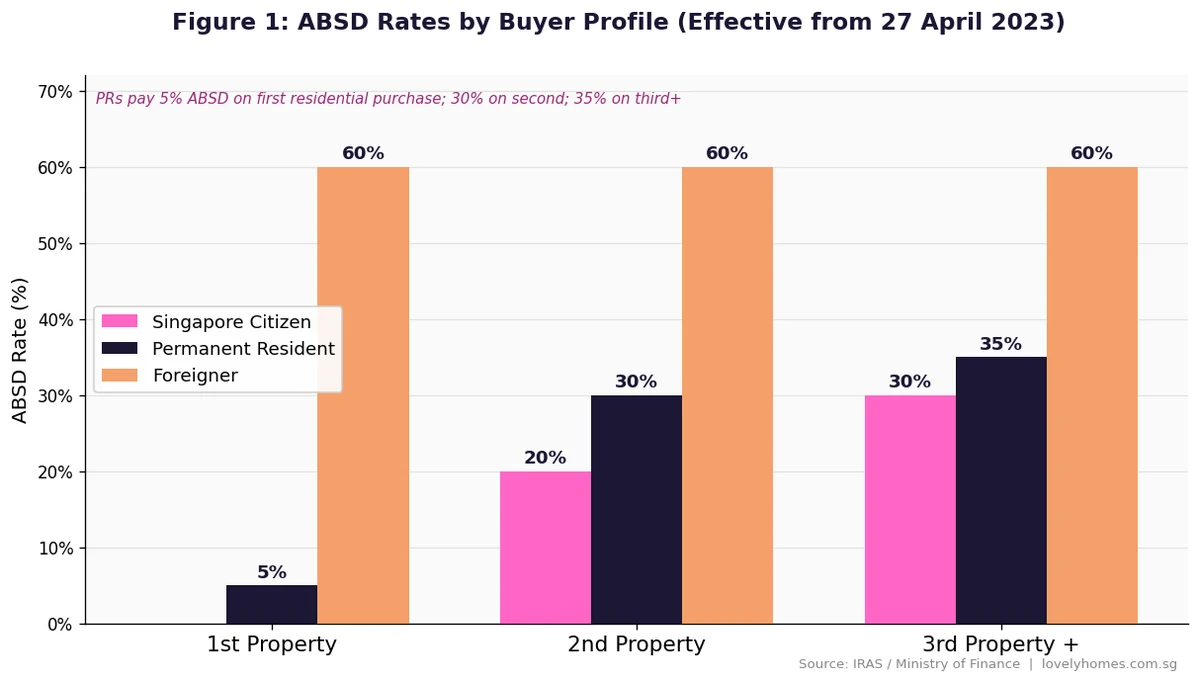
ABSD rates by buyer profile — SC vs PR vs Foreigner for 1st 2nd and 3rd property 2026
Figure 1: ABSD rates effective 27 April 2023. A PR pays 5% on the first property, 30% on the second, and 35% on the third or subsequent. Source: IRAS / Ministry of Finance.

The Additional Buyer’s Stamp Duty (ABSD) was last revised on 27 April 2023 as part of a broader property market cooling package. The current rates applicable to PRs are:

Buyer Profile 1st Residential Property 2nd Property 3rd Property +
Singapore Citizen 0% 20% 30%
Permanent Resident 5% 30% 35%
Foreigner 60% 60% 60%
SC + PR married couple (first jointly-owned property)* 0% (remitted to SC rate)

* Subject to ABSD remission conditions — see below.

An important nuance: for a joint purchase by a SC and a PR, ABSD is ordinarily calculated at the highest profile rate (i.e., 5%). However, a specific remission exists for SC–PR married couples buying their first jointly-owned residential property. Under the Stamp Duties (Residential Properties)(Remission)(No.2) Order, they are remitted to the SC first-property rate of 0% — making that first purchase ABSD-free. The couple must apply for this remission through IRAS, provide a valid marriage certificate, and confirm that neither party has previously held a residential property in Singapore.

No equivalent remission exists for a PR buying alone. A single PR acquires their first property at 5% ABSD.

HDB Flat Eligibility for PRs
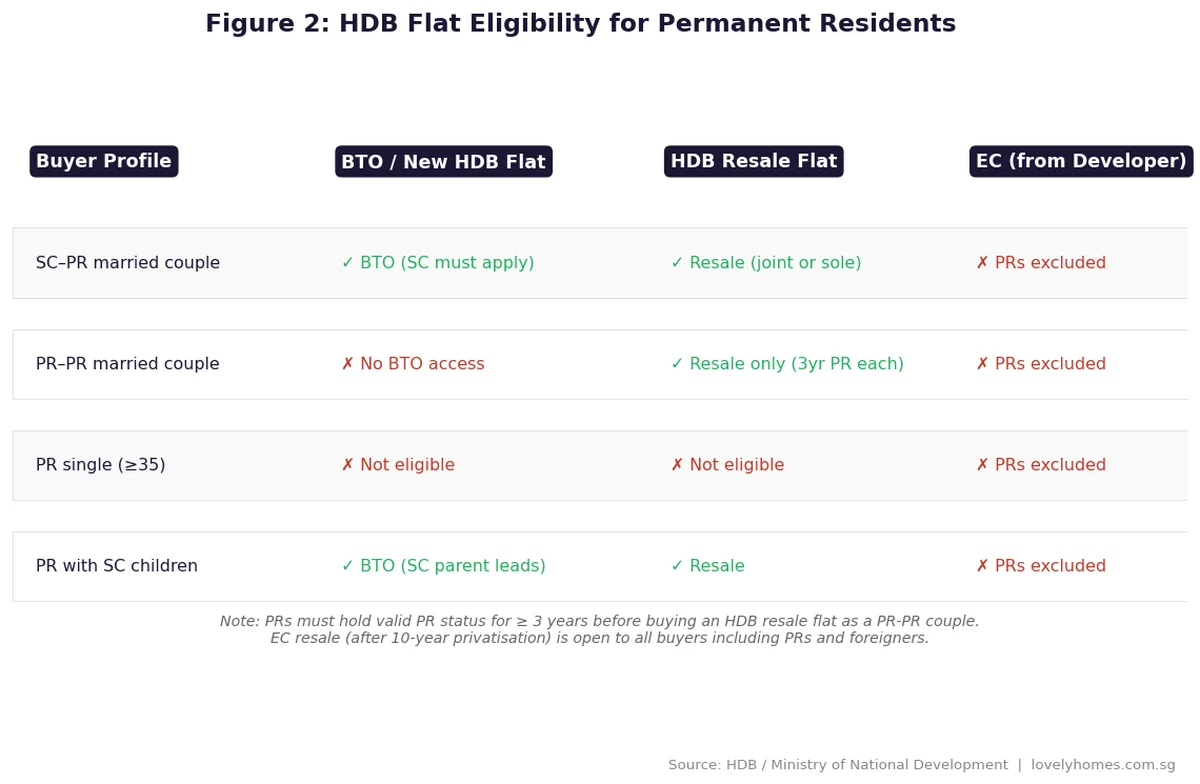
HDB flat eligibility matrix for permanent residents — BTO resale and EC 2026
Figure 2: HDB eligibility by household composition. PRs without an SC family member cannot access BTO flats or new ECs. Source: HDB / Ministry of National Development.

SC–PR Married Couple

This is the most common PR household type engaging with the HDB market. Where one spouse is an SC and the other a PR, the couple may apply for BTO flats under the Family Scheme (the SC must be the main applicant). They may also buy HDB resale flats immediately upon marriage — the 3-year PR holding period does not apply when the household includes an SC. They are also eligible to apply for new Executive Condominiums (ECs) from developers.

PR–PR Couple or Family

Where all buyers in the household are PRs, access is more restricted:

  • BTO flats — not eligible. At least one SC must be in the household.
  • HDB resale flats — eligible, but only after each PR in the household has held continuous PR status for at least 3 years from the date of their Re-Entry Permit.
  • New EC from developer — not eligible. EC first-hand purchases require an SC or an SC–PR household.
  • EC resale (after 10-year privatisation) — open to all buyers including PR–PR households and foreigners.

Single PRs

A single PR — regardless of age — is not eligible to buy any HDB flat, whether BTO or resale, as the sole applicant. There is no PR equivalent of the Single Singapore Citizen Scheme. Single PRs who wish to own residential property must buy private residential property.

HDB Loan Eligibility for PRs

PRs are eligible for the HDB concessionary loan at 2.6% per annum (currently; reviewed quarterly at 0.1 percentage point above the CPF OA interest rate), provided:

  • At least one buyer is a Singapore Citizen or the household meets the PR–PR family nucleus requirements.
  • Gross monthly household income does not exceed S$14,000 (or S$21,000 for extended families).
  • No more than one previous HDB loan has been obtained.
  • The household does not own or recently disposed of private residential property.

The HDB loan covers up to 80% of the purchase price or market value, whichever is lower. The remaining 20% is the downpayment: a minimum of 5% must be in cash; the balance (15%) can be CPF Ordinary Account savings.

Bank loans follow the same loan-to-value (LTV) limits for PRs as for SCs: 75% LTV for a first loan, 45% for a second, and 35% for a third or subsequent loan. The minimum cash portion is 5% for a first bank loan (the remaining 20% can be CPF or cash).

Private Property for PRs

PRs can purchase any type of private residential property — condominiums, private apartments, strata-landed units — from the first day they obtain PR status. There is no waiting period, and no HDB-equivalent income ceiling applies. ABSD at the PR rate (5% first, 30% second) will apply.

Landed residential property (detached, semi-detached, terraced houses) is restricted under the Residential Property Act 1976. PRs and foreigners generally require SLA approval to purchase landed property; approval is discretionary and typically granted only to PRs who have made exceptional economic contributions to Singapore. PRs should not assume landed property is freely available to them.

Commercial property (office, retail, industrial) is not covered by ABSD and is generally open to all buyers including PRs and foreigners, though different stamp duty regimes apply.

CPF for Property — PR Rules

PRs who are CPF members (all PRs employed in Singapore contribute to CPF under the CPF Act) can use their Ordinary Account (OA) savings to purchase residential property on the same terms as SCs. This includes paying option fees, BSD, ABSD, legal fees, the downpayment, and monthly mortgage instalments.

The key rules are:

  • Valuation Limit (VL): Total CPF usage is capped at the lower of the purchase price or the property’s market valuation at the time of purchase.
  • Withdrawal Limit (WL): CPF can be used up to the VL plus accrued interest (i.e., the amount that would have accumulated in OA at 2.5% p.a. had the funds not been withdrawn).
  • On sale: The full CPF principal withdrawn, plus accrued OA interest, must be refunded to the CPF OA before any cash profit is taken.
  • Lease rules: For HDB resale flats, CPF usage is prorated if the remaining lease does not cover the youngest buyer to age 95. If the remaining lease is below 20 years, no CPF may be used.

Cost Comparison: SC vs PR Buying an S$850,000 HDB Resale
Upfront cost comparison SC vs PR buying S$850,000 HDB resale flat 2026
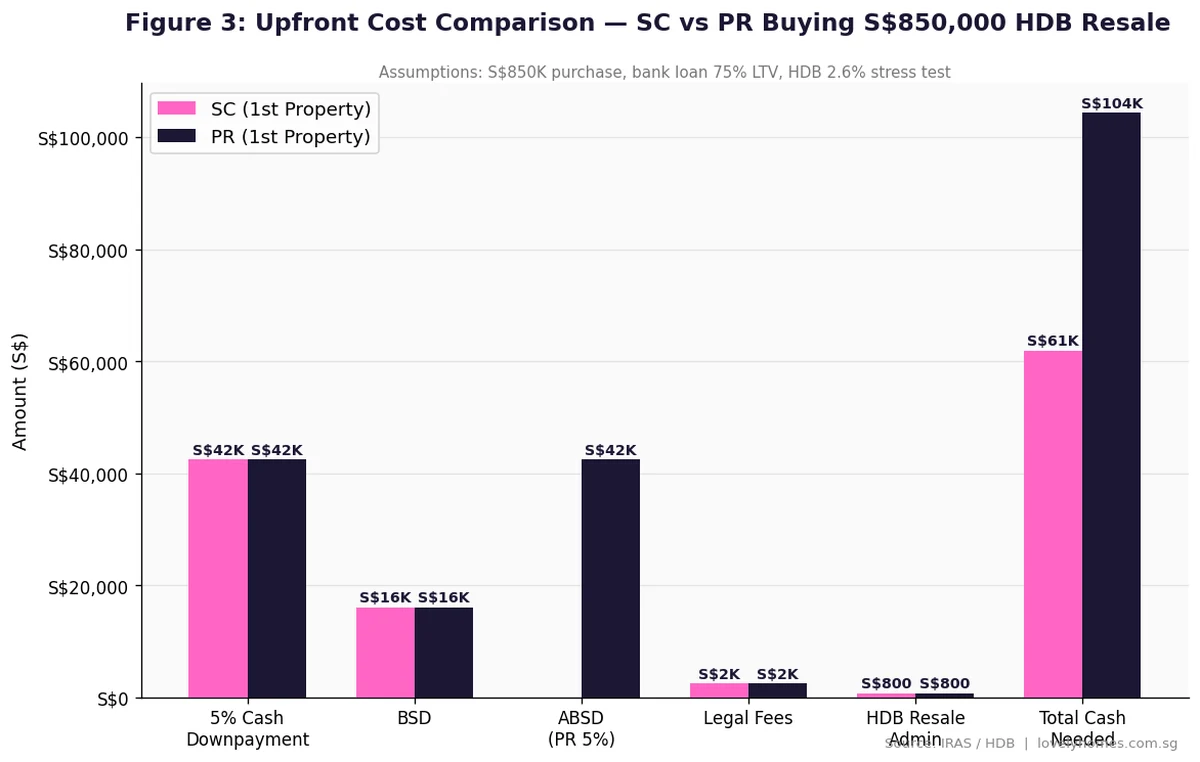
Figure 3: Upfront costs for a S$850,000 HDB resale purchase. A PR buying alone pays S$42,500 more in ABSD than an SC. A SC–PR couple buying jointly as their first property pays 0% ABSD (remitted). Source: IRAS / HDB.
Cost Item SC (Sole, 1st Property) PR–PR Couple (1st Property) SC–PR Couple (1st Joint Property)*
Purchase Price S$850,000 S$850,000 S$850,000
Buyer’s Stamp Duty (BSD) S$16,100 S$16,100 S$16,100
Additional Buyer’s Stamp Duty (ABSD) S$0 (0%) S$42,500 (5%) S$0 (remitted)
HDB Loan (80% LTV) S$680,000 S$680,000 S$680,000
Cash Downpayment (5% min) S$42,500 S$42,500 S$42,500
CPF Downpayment (15%) S$127,500 S$127,500 S$127,500
Legal Fees (est.) S$2,500 S$2,500 S$2,500
HDB Admin Fee S$800 S$800 S$800
Total Cash Needed Upfront S$61,900 S$104,400 S$61,900

* SC–PR married couple, first jointly-owned residential property. ABSD remission subject to IRAS approval and eligibility conditions.

Worked Example: The Patel Household

Mr Arnav Patel holds Singapore PR status (granted 4 years ago). His wife, Mrs Priya Patel, is a Singapore Citizen. They earn a combined gross monthly income of S$12,500. They wish to buy a 4-room HDB resale flat in Tampines for S$850,000. Neither has previously owned any residential property in Singapore.

HDB eligibility check: SC–PR married couple, first purchase — eligible for HDB resale immediately. Income S$12,500 < S$14,000 ceiling — PASS. No prior HDB or private property — no Resale Levy applicable. Mr Patel’s 4-year PR holding period exceeds 3 years — PASS (though the 3-year rule only applies to PR–PR couples; it does not apply to SC–PR couples).

HDB loan assessment: Eligible. Loan amount: 80% × S$850,000 = S$680,000. Monthly instalment at 2.6% p.a. over 25 years: S$3,091. MSR: S$3,091 ÷ S$12,500 = 24.7% — within the 30% MSR cap. TDSR: S$3,091 ÷ S$12,500 = 24.7% — well within the 55% TDSR limit.

ABSD: SC–PR couple, first jointly-owned residential property — ABSD remitted to SC first-property rate = S$0. Mrs Patel will submit the ABSD remission form to IRAS within 6 months of signing the Option to Purchase.

BSD: 1% × S$180,000 + 2% × S$180,000 + 3% × S$490,000 = S$1,800 + S$3,600 + S$14,700 = S$16,100.

Total upfront cash: S$42,500 (5% cash downpayment) + S$16,100 (BSD) + S$2,500 (legal) + S$800 (HDB admin) = S$61,900 cash, plus S$127,500 from CPF OA.

What This Means for PRs Considering Property

The ABSD framework positions PRs as a distinct tier — more favoured than foreigners (60%) but less favoured than SCs (0% first property). For PRs buying property alone, the 5% ABSD on a first purchase is a real additional cost: on a S$1,200,000 condo unit, that is S$60,000 above and beyond BSD and other transaction costs.

The SC–PR married couple remission, however, is a significant policy feature that effectively levels the field for couples on their first jointly-owned home. PRs with SC spouses should ensure they claim this remission through IRAS; it is not automatically applied.

The 3-year waiting period for PR–PR couples to buy HDB resale flats is another meaningful constraint. Newly-minted PRs who are not yet in a relationship — or whose partner is also a PR — will find themselves limited to private property during that initial period.

What Might Come Next

The current ABSD framework has been in place since April 2023. There has been no official signal from MND or MAS of any near-term revision as at August 2026. The property market is broadly stable, and the government has consistently stated that cooling measures will remain in place as long as market conditions warrant.

One area to watch is the PR–PR HDB eligibility rules. As Singapore’s PR population ages and more PR households form, there may be policy review of the 3-year waiting rule — though any liberalisation would likely be modest and conditioned on citizen supply and demand dynamics.

Frequently Asked Questions

Can a PR buy an HDB BTO flat without an SC spouse?

No. BTO flat applications require at least one SC in the household. A PR family nucleus without any SC member cannot apply for BTO flats under any scheme. The only exception is where a SC-PR couple applies under the Family Scheme, with the SC as the main applicant. A PR who has subsequently obtained SC status may then apply as an SC.

Does the 3-year PR waiting period apply to SC–PR couples buying HDB resale?

No. The 3-year continuous PR holding requirement applies only to households where all members are PRs (i.e., PR–PR couples or PR families). Where the household includes at least one SC, the 3-year waiting period does not apply, and the SC–PR couple may purchase an HDB resale flat immediately after marriage registration.

How does ABSD work if a PR already owns a property and buys a second?

A PR buying their second residential property pays 30% ABSD on the full purchase price. On a S$1,500,000 condo, that amounts to S$450,000 in ABSD alone. Unlike SCs, PRs do not receive any ABSD upgrader remission — there is no mechanism to reclaim ABSD paid on the second property after selling the first. PRs considering a second property purchase should factor in this substantial cost.

Can a PR buy landed property in Singapore?

Generally, no — not without SLA approval. Landed residential property (detached houses, semi-detached, terraced houses, and bungalows) is restricted under the Residential Property Act 1976. PRs and foreign nationals must apply to the SLA’s Land Dealings (Approval) Unit for approval. Approval is discretionary and is typically granted to PRs who have made exceptional economic or professional contributions to Singapore. The vast majority of PR applicants for landed property are not approved. Strata-landed units (such as cluster homes within a strata development) are treated like condominiums and are freely available to PRs.

What happens to ABSD if a PR later becomes a Singapore Citizen?

Taking up SC citizenship does not automatically trigger a refund of ABSD previously paid as a PR. However, it resets the buyer’s profile for future purchases. If a PR who owns one property takes up SC, any subsequent purchase will be assessed at SC second-property rates (20%) rather than PR second-property rates (30%). From a tax planning perspective, this can represent a material saving — S$150,000 on a S$1.5M purchase — making the citizenship timing decision financially relevant for property investors.

Can a PR’s CPF be used to pay ABSD?

No. CPF Ordinary Account funds may not be used to pay stamp duties, including ABSD. BSD and ABSD must both be paid in cash. CPF can be used for the downpayment, monthly mortgage payments, legal fees, and certain other qualifying costs — but stamp duties are explicitly excluded from CPF usage under the CPF Housing Schemes.

Disclaimer: This article is for general informational purposes only and does not constitute legal, financial, or tax advice. Property rules, ABSD rates, and HDB eligibility criteria are subject to change by the relevant authorities. All figures are based on publicly available information as at 20 August 2026. Readers should verify all information with the relevant agencies — IRAS (iras.gov.sg), HDB (hdb.gov.sg), SLA (sla.gov.sg), and CPF Board (cpf.gov.sg) — and consult a licensed property agent (CEA-registered) or qualified financial adviser before making any property purchase decision.
×

Click anywhere to close
HDB BTO vs Resale Singapore 2026: Price, Wait Time, Grants and Which Is Right for You

HDB BTO vs Resale Singapore 2026: Price, Wait Time, Grants and Which Is Right for You


Quick Answer: HDB BTO vs Resale Singapore 2026

  • Price: BTO flats are sold at subsidised prices, typically 30–60% below comparable resale flats. A 4-room BTO in Tampines may be priced around S$380,000, versus S$680,000 or more on the resale market.
  • Wait time: BTO construction takes 4–5 years from selection to key collection for standard flats; 5–6 years for PLH Plus/Prime flats. Resale flats can be occupied within 8–12 weeks of exercising the OTP.
  • Grants: Both BTO and resale buyers can access the Enhanced Housing Grant (EHG) of up to S$120,000. Resale buyers additionally qualify for the Family Grant (up to S$50,000) and Proximity Housing Grant (PHG) of up to S$30,000.
  • Minimum Occupation Period (MOP): Standard BTO and resale flats have a 5-year MOP. Plus and Prime (PLH) flats carry a 10-year MOP with permanent restrictions on subletting the entire flat.
  • Location: BTO projects are often in non-mature estates (Tengah, Woodlands, Punggol, Sembawang), while resale gives access to mature estates (Bishan, Queenstown, Tampines, Toa Payoh) immediately.
  • Resale Levy: If you previously received a housing subsidy and buy a second subsidised flat (including BTO), you pay a Resale Levy of S$15,000–S$55,000 depending on the previous flat type.
  • CPF Housing Grants are credited directly to your CPF OA and reduce the loan quantum needed — they do not affect your cash outlay directly.
  • For most first-timer families earning under S$7,000/month, BTO in a non-mature estate offers the best financial outcome. Above S$7,000/month, resale with grants becomes competitive, especially for families needing immediate occupancy.

I. The Choice Every HDB Buyer Faces

Every year, tens of thousands of Singapore households face the same decision: apply for a new HDB Build-to-Order (BTO) flat, or buy an existing HDB resale flat on the open market? It is not a simple question. The financial stakes are large — the price gap between a subsidised BTO and a comparable resale flat in the same town can run to several hundred thousand dollars — and the practical consequences (particularly the 4-to-5-year wait for BTO keys) can affect life decisions around marriage, children, and career.

This guide compares BTO and resale across five critical dimensions: price, wait time, grants, location options, and MOP rules. It concludes with a worked example showing the total lifetime cost of each option for a typical young couple, and a decision framework for choosing which path suits your situation.

II. BTO Flats: Subsidised Pricing and the Ballot

The HDB Build-to-Order (BTO) programme offers new flats directly from HDB at heavily subsidised prices. As of 2026, HDB launches BTO exercises roughly six times per year, each offering several thousand units across multiple towns. Buyers apply through the HDB Flat Portal during the exercise window, and successful applicants are balloted for a queue number. Higher queue numbers wait longer for flat selection, and lower-demand towns naturally move faster.

BTO eligibility at a glance

To apply for a BTO flat, you must meet HDB’s eligibility criteria. At minimum, at least one applicant must be a Singapore Citizen; co-applicants may be SPR. The household must meet the income ceiling: S$14,000 per month for families; S$7,000 for singles applying under the Single Singapore Citizen scheme (applicable only for 2-room Flexi flats in non-mature estates). You must not own any other residential property at the time of application, and must not have previously received two housing subsidies.

Plus and Prime classification

Since the PLH (Plus/Prime Location Public Housing) model was introduced in late 2021 and subsequently evolved into the Plus/Prime classification under the HDB Redesign in 2024, certain BTO flats in well-connected or central locations carry additional restrictions: a 10-year MOP (versus the standard 5 years), permanent restrictions on subletting the entire flat after the MOP, and eligibility restrictions requiring all owners to be Singapore Citizens at the time of resale. These restrictions are designed to keep Plus/Prime flats within reach of genuine owner-occupiers rather than investors. Buyers of Plus/Prime flats should understand these constraints fully before applying — the restrictions run with the flat permanently.

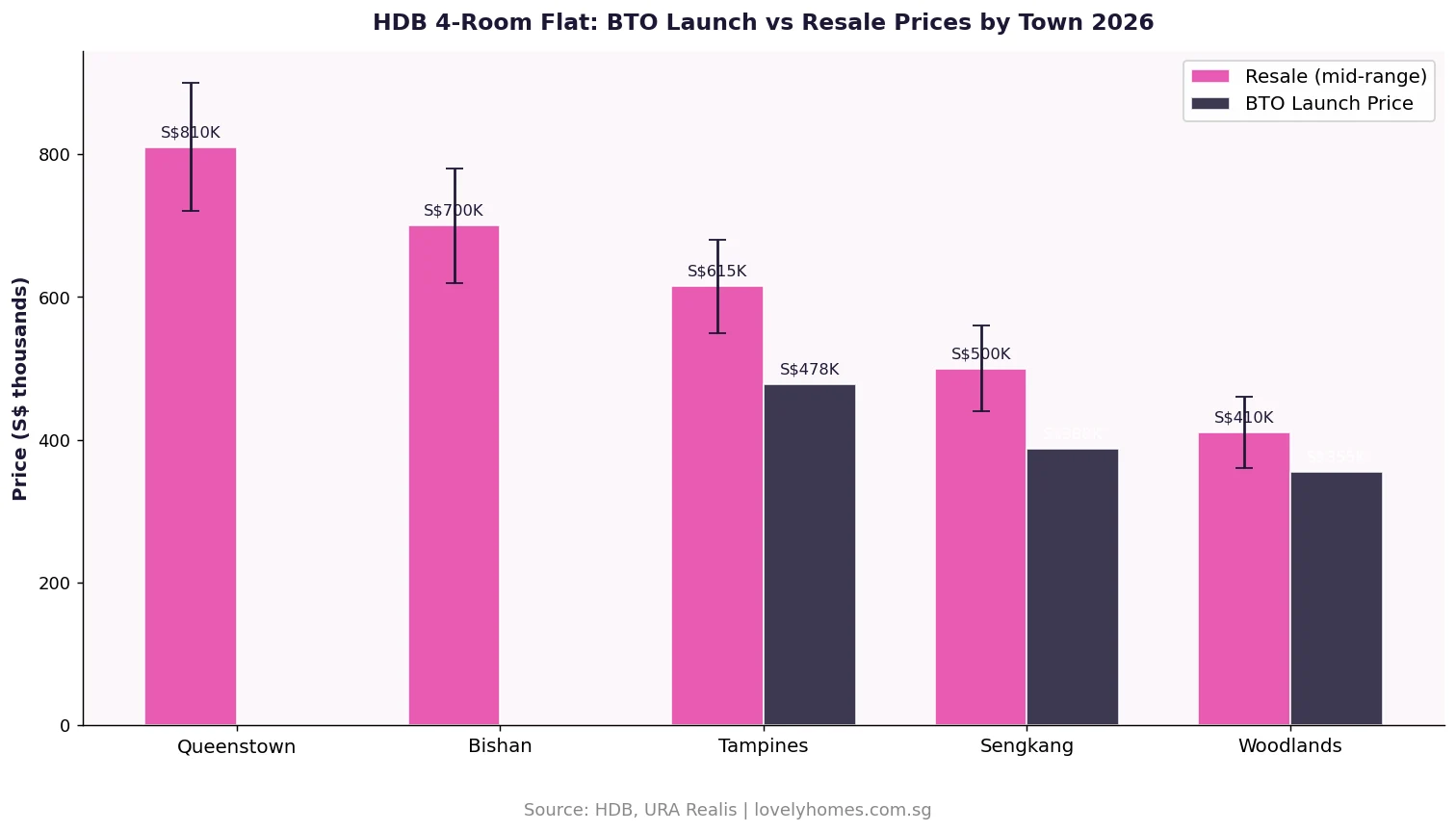
HDB BTO vs resale price comparison by town 4-room flat Singapore 2026
Figure 4: BTO versus resale 4-room flat prices by town, 2026. The resale premium over BTO ranges from 55% (Tampines) to over 77% (Queenstown). Subsidised BTO pricing is set by HDB based on location, flat type, and market conditions — the effective subsidy has grown as resale prices have risen faster than BTO selling prices over the past five years.

III. Resale HDB Flats: Market Pricing and Immediate Occupancy

An HDB resale flat is purchased from its existing owner at a price set by negotiation. Unlike BTO, there is no income ceiling for resale (except where grants are being claimed: the EHG income ceiling is S$9,000/month for families). The transaction follows the private-market model: you find a flat, agree a price, sign an Option to Purchase, and complete the sale through the HDB Resale Portal within a few months. There is no ballot, no construction wait, and no uncertainty about which specific flat you will receive — what you inspect is what you buy.

Cash Over Valuation (COV)

When the agreed purchase price exceeds HDB’s assessed market valuation, the excess is called Cash Over Valuation (COV). COV must be paid in cash — it cannot be financed by an HDB loan, a bank loan, or CPF. COV has been a significant factor in buoyant markets; in H1 2026, median COV for resale 4-room flats in mature estates ran between S$20,000 and S$60,000. Buyers must budget for COV in addition to the standard downpayment. For a flat where the valuation is S$650,000 but the agreed price is S$690,000, the COV of S$40,000 must be in cash — on top of the minimum 5% cash downpayment requirement for bank loans.

HDB Loan vs bank loan for resale

Resale buyers can use either an HDB concessionary loan or a bank loan. The HDB loan offers a rate of 2.6% per annum (pegged at 0.1% above the prevailing CPF OA interest rate), requires no minimum cash downpayment (the entire downpayment can come from CPF OA), and has no income ceiling for the loan itself. Bank loans offer potentially lower rates in favourable interest rate environments, but require a minimum 5% cash downpayment and are subject to the stricter TDSR and LTV limits administered by MAS.

IV. The Price Gap: What You Actually Pay

The BTO subsidy is the most powerful financial argument for the BTO route. HDB sets BTO selling prices with reference to market comparable values, then applies a subsidy — meaning a BTO flat is always priced below what an equivalent resale flat in the same estate trades for. The gap is typically widest in mature estates (where BTO supply is limited and resale demand is high) and narrowest in new towns (Tengah, Punggol) where BTO and resale prices are closer because resale supply in those towns is itself thin.

For a 4-room flat in Tampines in 2026, a comparable BTO selling price would be around S$380,000, while resale 4-room transactions in the same town run at S$650,000–S$720,000. The gap of approximately S$300,000 represents the subsidy, though buyers must deduct any grants received (which reduce both the effective BTO price and, for resale, the net resale cost). The counter-argument from resale buyers is that the S$300,000 premium purchases approximately 4–5 years of immediate occupancy — time that has significant economic value if you are currently renting or living with parents.

V. Wait Time: The Most Practical Differentiator

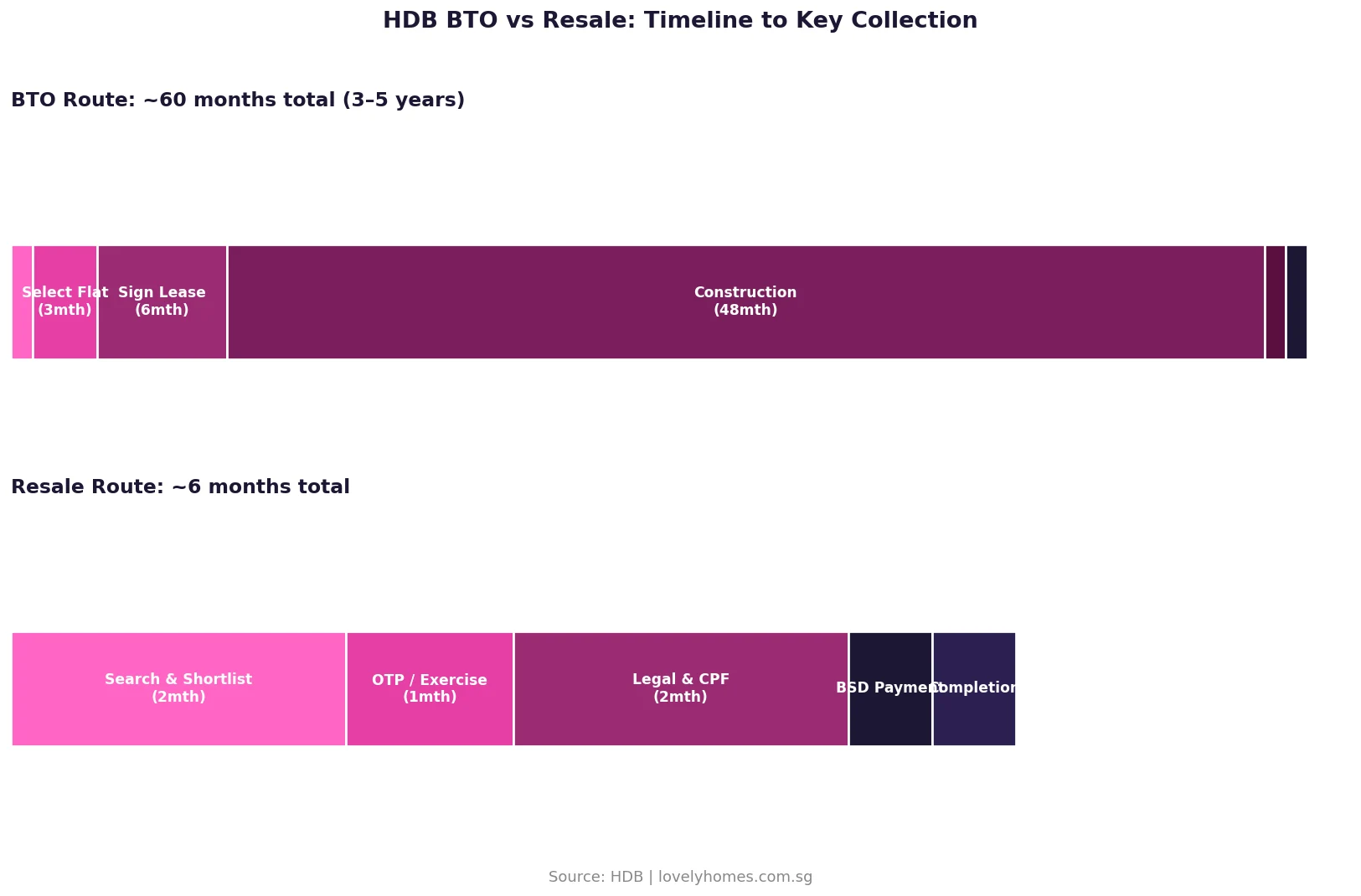
HDB BTO vs resale timeline wait time comparison months Singapore 2026
Figure 5: Timeline to key collection — BTO versus resale. A standard BTO buyer waits an average of 54 months (4.5 years) from HFE application to keys. A resale buyer, whether using an HDB or bank loan, typically collects keys within 4 to 5 months of starting the search. For families with a time-sensitive need — a child starting school, an expiring rental lease, or ageing parents — resale’s speed advantage is decisive.

The wait for a BTO flat is the single biggest practical obstacle for many buyers. From the time you submit your HFE Letter application to the time you collect keys for a new BTO flat, the typical elapsed time is 50–60 months for a standard flat and 60–72 months for a Plus or Prime flat. During this period, most buyers continue renting or living with family — at a cost. A young couple renting a 2-bedroom unit at S$2,500/month for 5 years pays S$150,000 in rent, which meaningfully erodes the financial advantage of the BTO subsidy.

Resale, by contrast, can move very quickly. From first viewing to key collection, a motivated buyer can complete a resale transaction in as little as 10 weeks — though 4 to 5 months is more typical when you account for finding the right flat, negotiating, and completing the HDB administrative process. For families with children already enrolled in nearby schools, or who need to accommodate elderly parents immediately, this speed premium is often worth more than the price differential.

VI. Housing Grants: Who Gets What

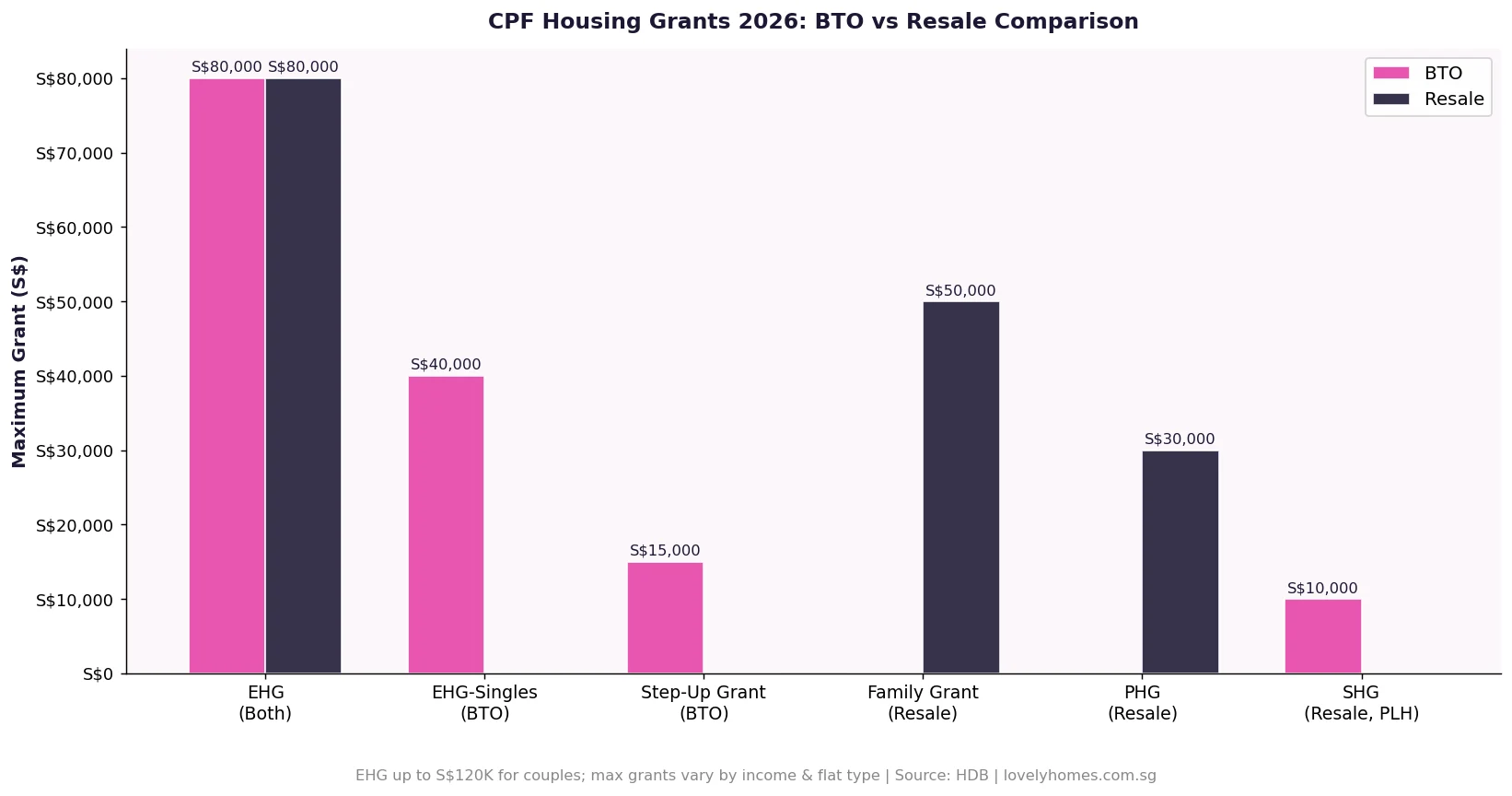
CPF housing grants BTO vs resale comparison EHG Family Grant PHG Singapore 2026
Figure 6: CPF Housing Grants available to BTO and resale buyers in 2026. Both routes offer the Enhanced Housing Grant (EHG) of up to S$120,000 for eligible first-timers. Resale buyers additionally qualify for the Family Grant (up to S$50,000) and the Proximity Housing Grant (PHG, up to S$30,000) — neither of which is available for BTO. All grants are credited to the buyer’s CPF OA and reduce the loan quantum needed.

The Enhanced Housing Grant (EHG) is available to first-timer families earning S$9,000/month or less (up to S$4,500 for singles). The maximum EHG is S$120,000, tapering to S$5,000 for households earning S$8,501–S$9,000. It is available for both BTO and resale flats. All grants are credited to the CPF OA of the buyers, reducing the loan and monthly repayments.

Resale buyers have access to two additional grants that BTO buyers cannot claim. The Family Grant (S$50,000 for a family of at least one SC buying their first resale flat) and the Step-Up CPF Housing Grant (S$15,000, for second-timer families moving from a 2-room Flexi to a larger resale flat). The Proximity Housing Grant (PHG) of up to S$30,000 is available to resale buyers living within 4 km of their parents or vice versa. PHG is also available for BTO flats located near parents under the Married Child Priority Scheme but as a grant only for resale.

The combined maximum grant package for a resale buyer (EHG S$120,000 + Family Grant S$50,000 + PHG S$30,000) is S$200,000 — substantially more than the maximum available to a BTO buyer. However, the BTO subsidy embedded in the lower selling price typically exceeds even the largest resale grant package for comparable flats.

VII. BTO vs Resale: Side-by-Side Summary

Factor BTO Flat Resale HDB
Price level Subsidised (30–60% below resale) Open market (higher)
Wait time 4–6 years (incl. construction) 8–16 weeks
Location choice Limited to launched projects (often non-mature estates) Any town, any flat
Condition Brand new, with defect warranty Existing condition (may need renovation)
EHG grant Up to S$120,000 Up to S$120,000
Family Grant Not applicable Up to S$50,000
PHG grant Not applicable (separate MCPS scheme) Up to S$30,000
COV Not applicable Possible — must be paid in cash
MOP 5 years (standard); 10 years (Plus/Prime) 5 years (standard); 10 years (PLH resale)
CPF usage From selection and loan disbursement From key collection
Renovation cost Full renovation needed from scratch May only need refresh
Resale Levy risk Yes, if previously subsidised flat owned Yes, if previously subsidised flat owned

VIII. Worked Example — Mr & Mrs Goh: BTO versus Resale in Tampines

Scenario: SC married couple, combined income S$8,500/month, first HDB purchase, targeting Tampines 4-room

Option A — BTO (standard, non-PLH):
Selling price: S$385,000. EHG: S$30,000 (income S$8,500/month, tapering scale). Net price after EHG: S$355,000. HDB loan at 2.6% 25yr on S$355,000 = S$1,609/month. MSR = 1,609/8,500 = 18.9% — well under 30% cap. Cash outlay: BSD S$5,550, legal ~S$1,500, total cash ~S$7,050. CPF downpayment: nil required for HDB loan (but couple choose to put S$35,500 CPF as 10% voluntary DP to reduce loan). Wait: 4.5 years. Interim: renting a 2BR at S$2,200/month = S$118,800 in rent over 54 months. True total cost at year 5: S$355,000 (loan) + S$118,800 (rent) + S$7,050 (cash) = S$480,850 — noting the flat is worth around S$650,000 at key collection (estimated).

Option B — Resale (mature estate, Tampines):
Purchase price: S$690,000. HDB valuation: S$660,000. COV: S$30,000 cash. EHG: S$30,000. Family Grant: S$50,000. Net loan: S$690,000 – S$30,000 (EHG OA) – S$50,000 (Family Grant OA) = S$610,000. HDB loan 80% on S$660,000 valuation = S$528,000; excess S$82,000 (= S$610,000 – S$528,000) financed by CPF OA. Monthly repayment at 2.6% 25yr on S$528,000 = S$2,391/month. MSR = 2,391/8,500 = 28.1% — just under 30% cap. Cash outlay: COV S$30,000 + BSD S$14,100 + legal S$2,500 = S$46,600. No rent during wait. True total cost at year 5: Loan serviced over 5 years ~S$143,460 (principal + interest); remaining principal ~S$489,000; total cash spent S$46,600 + S$143,460 = S$190,060 — but the flat is already worth S$690,000+ from day 1.

Verdict: For the Goh family, BTO saves approximately S$305,000 in purchase price but requires S$118,800 in rent and 4.5 years of waiting. The net financial advantage of BTO is approximately S$186,000 — significant but not overwhelming when accounting for the lifestyle and timing cost. If Mrs Goh is pregnant, or they need to move out of their current living situation, the calculus shifts toward resale.

IX. The Decision Framework: Which Should You Choose?

Choose BTO if you:

  • Can wait 4–5 years (ideally newly married, no children yet)
  • Have a lower income (EHG tapering makes BTO far cheaper)
  • Are flexible on location and willing to consider non-mature estates
  • Want a brand-new flat with developer defect warranty
  • Plan to customise the entire interior from scratch

Choose Resale if you:

  • Need to move within 6 months (rental expiry, child’s school enrolment)
  • Must live near parents (PHG + family proximity requirements)
  • Need a specific mature estate (schools, amenities, elderly parents nearby)
  • Are a second-timer and need immediate move-up
  • Have a higher income and the larger grant package bridges the cost gap

X. What May Change: BTO Supply and Policy Outlook

The government’s ramp-up to approximately 100,000 BTO units delivered between 2022 and 2025 has been maintained, with 2025 and 2026 exercises continuing at a pace of roughly 20,000–22,000 units per year. HDB has been strategic about including more BTO exercises in mature estates to meet demand from couples who might otherwise default to resale. The introduction of the 2022 Ballot Category (first-timer families receive two ballots versus one for others) has improved first-timer success rates. However, mature-estate BTO flat supply remains structurally tight given limited land availability.

Resale prices rose modestly through H1 2026, with the HDB Resale Price Index at 202.7 in Q2 2026 — a slight decline of 0.3% QoQ from Q1 2026 (203.0), suggesting the market is cooling at the margins. The government has no stated plans to remove or significantly loosen BTO eligibility criteria, and the Plus/Prime framework is likely to persist. Buyers who have been in the BTO queue since 2022–2023 are beginning to receive their keys in 2026–2027, which may add a modest wave of secondary market supply as some of them sell or upgrade.

XI. Frequently Asked Questions

Can a Singapore Permanent Resident (SPR) apply for a BTO flat?

SPRs cannot apply for a BTO flat on their own. However, an SPR can co-apply with a Singapore Citizen spouse (or parent, sibling, or child under the Public Scheme), provided at least one applicant is an SC. The SC must be the primary applicant. Under the Fiancé/Fiancée Scheme, an SC engaged to an SPR may apply, but the SPR must obtain SC status within six months of key collection. SPRs buying HDB resale flats on their own (without an SC co-applicant) are permitted, but they do not qualify for CPF Housing Grants and must use the Resale application only.

What is the Resale Levy and does it apply to me?

The Resale Levy applies to second-timer households who have previously received a direct subsidy (i.e., a first subsidised BTO or SBF flat), and who are now buying a second subsidised flat (another BTO or an EC from the developer). If you sold your first subsidised flat, HDB deducts the levy from the proceeds of that sale. If you still own it (e.g., you’re buying a concurrent BTO), the levy is paid in cash. The levy amount depends on your first flat type: S$15,000 for a 2-room Flexi, S$30,000 for a 3-room, S$40,000 for a 4-room, S$45,000 for a 5-room or 3Gen, and S$55,000 for an executive flat. Resale Levy does NOT apply if you are buying a resale flat — it only applies to purchases of new subsidised flats from HDB or a developer (EC).

Can I rent out my BTO or resale HDB flat before the MOP ends?

You cannot sublet the entire flat before the MOP expires. However, you may rent out individual bedrooms (not the entire flat) from the date of key collection, subject to HDB’s approval and prevailing subletting guidelines. HDB requires that you (the owner) continue to occupy the flat as your registered address and that the total number of occupants (including tenants) does not exceed the flat’s approved occupancy limit. For a 4-room flat, HDB generally permits renting out up to 3 bedrooms as long as the owner remains in residence. Overseas income earners who are temporarily overseas may apply to HDB for a subletting waiver under specific conditions. Violation of subletting rules is a serious offence — HDB can compulsorily acquire the flat.

How does the Enhanced Housing Grant (EHG) work for resale versus BTO?

The EHG is income-tested: the full S$120,000 is available to households earning S$1,500/month or less; it tapers down to S$5,000 for households earning S$8,501–S$9,000/month. The EHG quantum is identical whether you are buying a BTO or resale flat. It is credited to your CPF OA, from which it is then used toward the purchase price, reducing the loan amount. For BTO, the grant is applied at the time of booking; for resale, it is released at the completion appointment. Critically, for resale, the EHG cannot be used to pay Cash Over Valuation — only the base price (up to the valuation) can be funded from CPF. The COV above valuation is always cash.

What is the ballot priority system for BTO and how do I improve my chances?

HDB’s ballot priority system gives different numbers of ballot chances to different applicant categories. First-timer families applying under the Public Scheme receive two ballot chances per exercise; second-timers receive one. Married Child Priority Scheme (MCPS) applicants who want to live near parents receive an additional ballot. Applicants who have not been successful in three or more exercises may apply for the Married Child Priority Enhanced Ballot, which provides a higher ballot queue number priority. The Parenthood Priority Scheme (PPS) reserves a portion of units (up to 30%) for first-timer married couples with at least one Singapore Citizen child. To maximise your chances, apply in exercises with lower demand-to-supply ratios (typically non-mature estates), apply early to accumulate ballot count, and use all available priority schemes for which you qualify.

Is it possible to use both an HDB loan and a bank loan for the same purchase?

No. You must choose either an HDB concessionary loan or a bank loan — you cannot combine the two for the same property. The distinction matters because they have different LTV limits (HDB: 80% of valuation; bank: 75% on first property), different minimum cash requirements (HDB: zero; bank: minimum 5% cash), and different stress-test rules. You can switch from an HDB loan to a bank loan at any point during the loan tenure (refinancing), but you cannot revert back to an HDB loan once you have switched. The inability to return to the HDB loan is a significant consideration: bank loans, while potentially cheaper in low-interest environments, expose you fully to rate movements, whereas the HDB rate is effectively pegged to the CPF OA rate, which has historically been more stable.

Can I buy a private property while waiting for my BTO to complete?

Yes, with conditions. During the BTO construction period (before key collection), you may purchase private residential property — the MOP does not begin until keys are collected. However, if you own private property at the time of BTO key collection, HDB requires you to dispose of the private property within six months of collecting the BTO keys. If you fail to do so, you are in breach of HDB’s conditions, which can result in compulsory acquisition of the BTO flat. Note also that buying private property before BTO key collection means you will owe ABSD on the private property (since you are treated as already owning the BTO under the Agreement for Lease). The ABSD is 20% for an SC’s second property. Planning your property ladder while in the BTO queue requires careful sequencing with a property lawyer.

Disclaimer: This article is produced by LovelyHomes Editorial and is accurate as at 19 August 2026. HDB eligibility conditions, grant amounts, BTO selling prices, MOP rules, and loan parameters are subject to change at HDB’s and MAS’s discretion. All figures are illustrative and based on published data from HDB, MAS, CPF Board, and IRAS. Nothing in this article constitutes legal, financial, or property advice. Buyers should verify all information directly with HDB and engage a CEA-registered property agent and a licensed conveyancing solicitor for their specific transaction.

×

Click anywhere to close

Singapore Property Buyers Checklist 2026: Complete Step-by-Step Guide for HDB and Private Property Buyers

Singapore Property Buyers Checklist 2026: Complete Step-by-Step Guide for HDB and Private Property Buyers


Quick Answer: Singapore Property Buyers Checklist 2026

  • Singapore property buyers need a valid HDB Flat Eligibility (HFE) Letter (for HDB) or Approval-in-Principle (AIP) (for private) before making any offer.
  • Buyer’s Stamp Duty (BSD) is payable within 14 days of signing the Option to Purchase. For a S$1.5M property, BSD is approximately S$44,600.
  • Additional Buyer’s Stamp Duty (ABSD) applies to second and subsequent properties, and to SPRs on their first purchase. Singapore Citizens buying their first property pay no ABSD.
  • The Total Debt Servicing Ratio (TDSR) cap is 55% of gross monthly income. For HDB loans, the Mortgage Servicing Ratio (MSR) cap is 30%.
  • HDB buyers need a minimum cash outlay of 5% for bank loans; the remainder of the downpayment may be from CPF OA.
  • Private property completions follow a 10- to 12-week timeline from OTP exercise; BTO flats take 4–5 years from selection.
  • Legal fees for a S$1.5M property typically run S$3,500–S$5,000 for conveyancing.
  • Hire a CEA-registered agent (verify at cea.gov.sg) and engage an independent conveyancing solicitor separate from the seller’s.

I. Why a Property Buyers Checklist Matters in 2026

Buying property in Singapore is the largest financial commitment most households will ever make. A typical OCR condominium in 2026 transacts at between S$1.1 million and S$2.0 million; an HDB resale flat in a prime town can breach S$900,000. Yet the buying process involves more than a dozen discrete steps spread across multiple government agencies, financiers, and legal professionals — and missing any single one can cost thousands of dollars in penalties or stamp duties, or forfeit an Option to Purchase.

This checklist consolidates every step that property buyers in Singapore need to complete, from the initial financial health check to the moment keys are handed over. It applies to both HDB (resale and Build-to-Order) and private residential property (new launch and resale). Where rules differ between the two, both are stated explicitly.

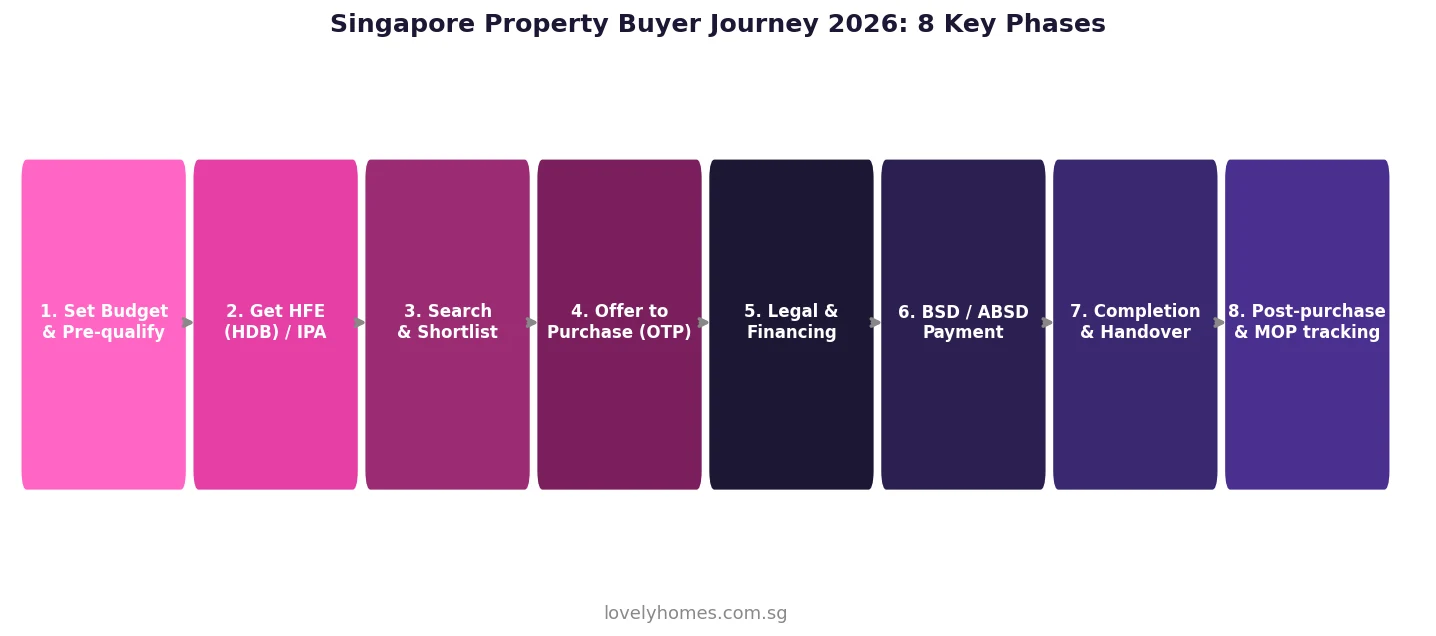
Singapore property buyer journey 8 phases checklist 2026
Figure 1: The eight-phase Singapore property buyer journey — from setting your budget to collecting your keys. BTO buyers face a 4–5 year wait between Phase 1 and Phase 8; resale and private buyers typically complete the full arc in 8–16 weeks.

II. Phase 1 — Set Your Budget and Eligibility

Before viewing a single property, every buyer should run through a financial and eligibility checklist. This phase sets the parameters for everything that follows.

Financial ceiling checks

Your maximum loan quantum is determined by the TDSR (55% of gross monthly income for bank loans) and the MSR (30% for HDB loans on HDB flats). Your CPF Ordinary Account balance, less any accrued interest owed, determines how much CPF you can deploy toward the downpayment and monthly repayments. For private property, the CPF Withdrawal Limit (WL) caps how much you can ever draw from CPF for a given property based on its remaining lease at time of purchase — buyers of leasehold properties with fewer than 60 years remaining face proration.

Stamp duty exposure

Compute your BSD and ABSD before you set your price limit. BSD on a S$1.5M property is S$44,600 (effective rate 2.97%). A Singapore Citizen buying a first property owes nil ABSD; a first-property SPR buyer owes 5% (S$75,000 on S$1.5M). These sums must come from cash or CPF within 14 days of signing the OTP — they cannot be folded into the loan. Budget for them upfront.

Phase 1 Checklist:

  • Calculate maximum loan (TDSR 55% / MSR 30% for HDB)
  • Check CPF OA balance and Ordinary Account statement
  • Compute BSD and ABSD amounts for target price range
  • Confirm citizenship/PR status and ABSD profile
  • Check if HDB MOP has been satisfied (if upgrading from HDB)
  • Confirm Resale Levy position (if buying a second subsidised flat)

III. Phase 2 — Secure Financing and Get Pre-Approval

For HDB flats, buyers must obtain a valid HDB Flat Eligibility (HFE) Letter from HDB before booking or submitting an application. The HFE Letter is digital, valid for 6 months, and confirms your eligibility to buy an HDB flat, the maximum loan quantum from HDB, and any CPF Housing Grants you qualify for. The application is submitted through the HDB Flat Portal and typically takes up to 30 working days.

For bank loans — whether for HDB resale or private property — obtain an Approval-in-Principle (AIP) letter from your chosen bank. The AIP is not binding but gives you a credible upper limit when negotiating. It is typically valid for 30 days and can be renewed. Shop at least two to three banks; interest rate differentials of even 0.2% on a S$1M loan compound to over S$20,000 across a 25-year tenure.

Phase 2 Checklist:

  • Apply for HFE Letter at HDB Flat Portal (allow 30 working days)
  • Obtain AIP from at least 2 banks if taking a bank loan
  • Compare fixed-rate vs floating-rate packages across tenures
  • Check TDSR and MSR at the stress-test rate (AIP rate + 0.5–1%)
  • Confirm CPF usage eligibility for the target property’s lease tenure

IV. Phase 3 — Property Search and Due Diligence

With financing confirmed, begin your search. For HDB BTO, register interest for the exercise that suits your flat type and town preference, noting that Plus and Prime classification flats carry a 10-year Minimum Occupation Period (MOP) versus the standard 5-year MOP. For resale, instruct a CEA-registered agent (verify at cea.gov.sg) or conduct a direct search via the HDB Resale Portal. For private, engage a licensed agent; new launches require a separate appointment and balloting process.

Due diligence for every property should cover: title search at Singapore Land Authority (SLA) to confirm no encumbrances; checking outstanding maintenance arrears with the MCST (for condominiums); verifying the remaining lease term; and inspecting for defects, especially in older HDB blocks and resale condominiums.

Phase 3 Checklist:

  • Verify agent’s CEA registration number at cea.gov.sg
  • Request SLA title search (confirm no caveats, mortgages, or court orders)
  • For condo: request MCST sinking fund balance and outstanding maintenance arrears
  • Check remaining lease (especially for properties below 60 years)
  • Verify HDB eligibility scheme for resale (public scheme, singles, etc.)
  • Run URA property research to see comparable transacted prices

V. Phase 4 — Option to Purchase, BSD and ABSD

When you and the seller agree on price, the seller issues an Option to Purchase (OTP). The OTP is a legal instrument granting you the exclusive right to buy the property at the stated price, within a specified option period (typically 14 days for HDB resale; up to 21 days for private). You pay an option fee (1% for private; S$1,000–S$5,000 for HDB depending on flat type) to secure it. Exercising the OTP requires paying the exercise fee (4% for private, net of option fee; up to 10% for OTP exercise for private).

Both BSD and ABSD are assessed on the higher of the purchase price or market value. IRAS’s e-Stamping portal (iras.gov.sg) must be used to pay. BSD and ABSD are due within 14 days of signing the OTP (or within 30 days of exercising it, for private property completing later). Late payment attracts a penalty of up to 4× the stamp duty payable, so this deadline is absolute.

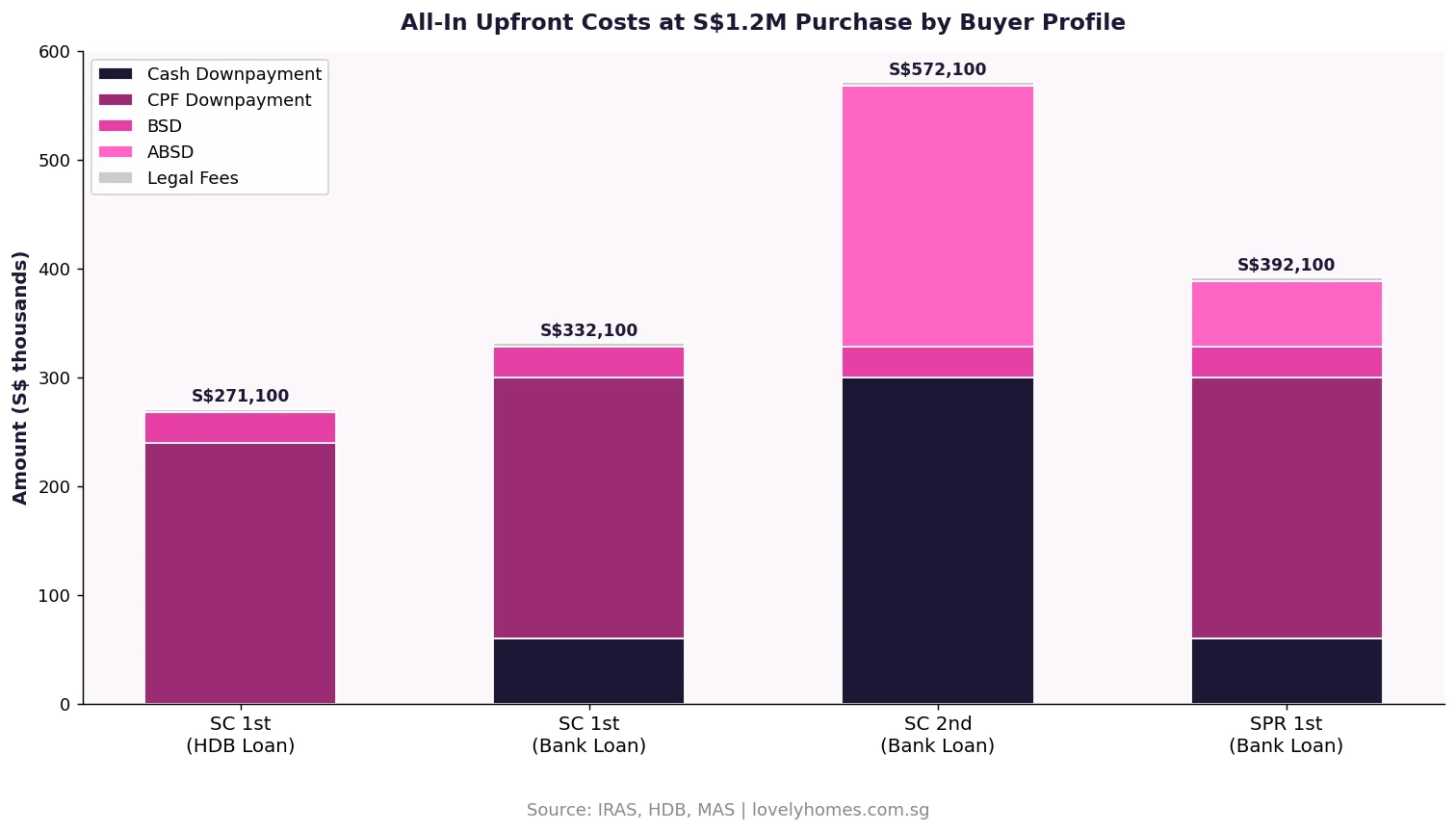
Singapore property upfront costs by buyer profile 2026 cash CPF BSD ABSD
Figure 2: All-in upfront costs at S$1,200,000 purchase price by buyer profile. A Singapore Citizen buying their first property with a bank loan needs approximately S$266,600 (cash + CPF + BSD + legal). A Foreigner buyer owes an additional 60% ABSD on top — over S$1 million in total upfront costs.
Phase 4 Checklist:

  • Review OTP terms (price, completion date, conditions, vacant possession)
  • Pay option fee within agreed deadline to secure OTP
  • Engage conveyancing solicitor (separate from seller’s law firm)
  • Pay BSD via IRAS e-Stamping within 14 days of signing OTP
  • Pay ABSD (if applicable) at same time as BSD
  • Exercise OTP by paying exercise fee within the option period

VI. Phase 5 — Legal Completion and Financing Drawdown

Once the OTP is exercised, your solicitor lodges a caveat with the Singapore Land Authority to protect your interest in the property. For HDB resale, the HDB Resale Portal is the primary platform: both buyer and seller submit their portions, and HDB conducts its eligibility checks before approving the resale. For private property, completion typically follows within 8–12 weeks of OTP exercise, culminating in the legal completion date when ownership transfers.

At legal completion, the bank drawdown funds are used to pay the seller’s outstanding mortgage (if any), with the balance going to the seller. Your solicitor handles the flow of funds. CPF contributions drawn for the purchase are submitted by your solicitor via the CPF Board portal. Ensure your CPF investment account has sufficient OA balance — CPF Board takes 2–3 business days to process withdrawal requests.

Phase 5 Checklist:

  • Confirm loan offer letter terms with bank (lock-in, penalty, package details)
  • Accept bank’s loan offer and arrange fire insurance (mandatory for mortgaged properties)
  • Instruct CPF Board to release CPF OA funds (via solicitor)
  • Caveat lodged by solicitor at SLA
  • For HDB: complete HDB Resale Checklist; attend HDB appointment if required
  • Confirm completion date and prepare for vacant possession inspection

VII. Phase 6 — Pre-Completion Inspection and Key Collection

Before accepting keys, conduct a thorough defect inspection. For new private launches, developers are legally obligated to rectify defects within one year of Temporary Occupation Permit (TOP). For resale properties, the principle is caveat emptor (buyer beware) — inspect carefully and document all defects before signing vacant possession. A professional property inspector typically charges S$400–S$800 for a thorough report.

On the legal completion date (for private) or the HDB appointment date (for resale), keys are handed over and the purchase is complete. Notify relevant parties: inform your employer of your change of address, update NRIC with ICA, apply for conservancy/maintenance fee giro arrangements, and arrange home contents insurance. For HDB buyers, remember that the MOP clock starts from the date of key collection, not from any earlier date.

Phase 6 Checklist:

  • Conduct pre-completion defect inspection; document with photos
  • Confirm all agreed furniture and fittings are present (if furnished sale)
  • Ensure utilities are transferred (SP Group for electricity and gas)
  • Update NRIC address with ICA within 28 days of moving in
  • Note MOP start date (for HDB buyers)
  • Arrange home contents insurance and home protection scheme (for HDB with CPF loan)

VIII. Summary Checklist Table

Phase Key Action Deadline / Authority HDB Private
1. Budget Calculate TDSR/MSR and stamp duty Before any offer Yes Yes
2. Financing HFE Letter / AIP Before OTP / 30 working days HFE via HDB Portal AIP from bank
3. Search SLA title search, MCST check Before offer HDB Resale Portal SLA / conveyancer
4. OTP & Stamp Option fee → BSD/ABSD payment 14 days from OTP signing IRAS e-Stamp IRAS e-Stamp
5. Legal Caveat, CPF drawdown, loan drawdown Before completion HDB appointment Solicitor-led
6. Keys Defect list, NRIC update, MOP date Completion day HDB appointment Completion date

IX. Worked Example — Mr & Mrs Kumar: Buying a Private Condo in Tampines

Scenario: First-property purchase, OCR 3-bedroom condo, S$1,500,000

Buyer profile: Mr & Mrs Kumar, both Singapore Citizens, first property purchase. Combined gross monthly income: S$14,000.

TDSR check: Maximum monthly loan repayment at 55% TDSR = S$7,700/month. Stress-test rate 4.0%. At 4.0% over 30 years, S$7,700/month services a loan of approximately S$1,614,000. Actual loan at 75% LTV = S$1,125,000. Monthly repayment at 3.2% 30yr = S$4,856/month. TDSR = 34.7% — well within 55% cap.

Downpayment: 25% of S$1,500,000 = S$375,000. Minimum 5% cash = S$75,000. Remaining 20% CPF OA = S$300,000.

BSD: First S$180,000 × 1% = S$1,800; next S$180,000 × 2% = S$3,600; next S$640,000 × 3% = S$19,200; next S$500,000 × 4% = S$20,000. Total BSD = S$44,600. ABSD = nil (first property, SC).

Legal fees: approximately S$4,000 (conveyancing) + S$500 (CPF lodgement) = S$4,500.

Total upfront outlay: Cash S$75,000 + CPF S$300,000 + BSD S$44,600 + legal S$4,500 = S$424,100.

Timeline: AIP obtained in 3 days. OTP signed: 1 March 2026. BSD paid: 14 March 2026. OTP exercised: 19 March 2026. Caveat lodged: 20 March 2026. Legal completion: 25 June 2026 (approximately 98 days from OTP).

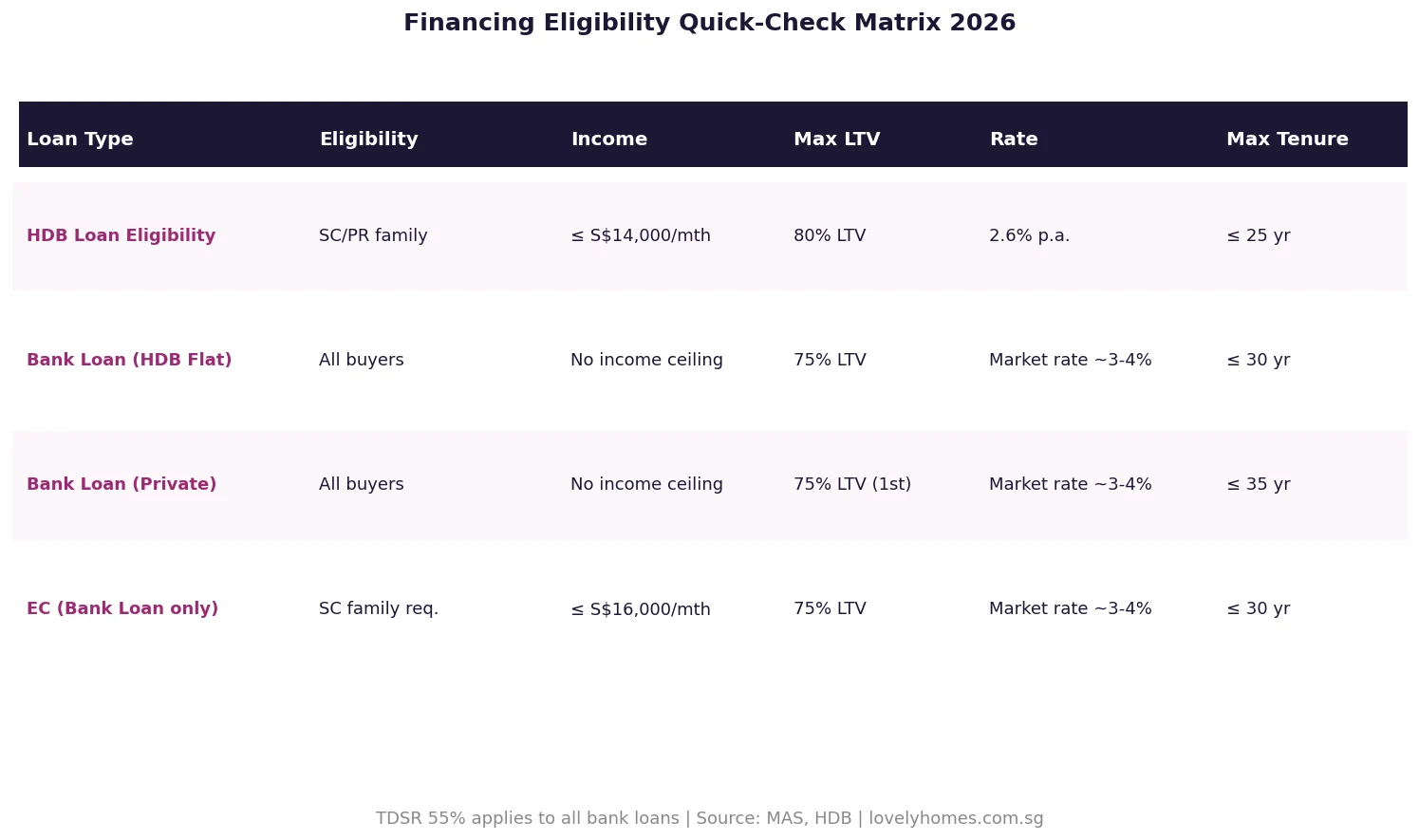
Singapore property financing eligibility matrix HDB loan bank loan TDSR MSR 2026
Figure 3: Financing eligibility quick-check matrix — HDB Loan versus Bank Loan across 9 criteria. HDB loans offer lower minimum cash outlay (zero) and no TDSR, but carry an income ceiling (S$14,000/month for families) and a higher minimum downpayment than many first-time buyers expect.

X. Why This Checklist Matters: The Cost of Missed Steps

Singapore’s stamp duty and property financing rules carry penalties that are disproportionately large relative to the underlying transaction. A buyer who misses the 14-day BSD deadline faces a penalty of up to four times the BSD payable — on a S$1.5M property, that is up to S$178,400 in penalties on top of the S$44,600 BSD itself. An HDB buyer who fails to obtain their HFE Letter before exercising the OTP may forfeit their option fee entirely. A borrower who underestimates their TDSR exposure may find their bank loan offer reduced or withdrawn after the OTP is signed, leaving them in breach of contract.

The 2024 MAS update to LTV limits (HDB loan reduced from 80% to 75% in August 2024) added S$25,000 to the minimum cash requirement on a S$500,000 HDB resale flat. Buyers who had planned their finances before August 2024 and purchased after it sometimes found themselves short at the OTP exercise stage. This underscores why the financial check must be done at current rates, not rates remembered from a friend’s transaction a year earlier.

XI. What May Change in 2027 and Beyond

The MAS’s macro-prudential stance in 2026 remains cautious. Property prices have continued to rise modestly in 2026, and ABSD rates for foreigners remain at 60% following the April 2023 hike. Any easing of cooling measures would require a sustained period of price moderation, which has not yet materialised in the private market. Buyers planning to buy in 2027 should monitor MAS and HDB announcements, particularly around the ABSD remission framework (which is reviewed periodically) and BTO supply pipelines. The government’s target of ~100,000 HDB flats delivered between 2022–2025 is on track; any supply shortfall could push resale prices higher and tighten the BTO-to-resale price gap further.

XII. Frequently Asked Questions

Can I use my CPF to pay BSD and ABSD?

Yes, for residential property, both BSD and ABSD can be paid from your CPF Ordinary Account, provided the payment is made via the IRAS e-Stamping portal and your solicitor requests the CPF release correctly. However, the funds must be available in your OA at the time of payment. If your OA balance is insufficient, you must top it up in cash before the 14-day deadline. Note that payment of BSD and ABSD from CPF OA reduces the balance available for the downpayment and monthly servicing, so plan the sequencing carefully with your solicitor.

What happens if the seller refuses to complete after I have exercised the OTP?

If the seller backs out after the OTP has been exercised, the buyer is entitled to specific performance (a court order compelling the seller to complete the sale) or damages. In practice, specific performance is rarely sought for residential property in Singapore; most buyers negotiate a return of all monies paid plus a penalty sum, which under standard OTP terms is typically the option fee and exercise fee forfeited by the seller plus additional damages. You should engage your solicitor immediately and preserve all correspondence. For HDB resale, HDB’s approval of the resale application is required before completion — if HDB has already approved it, the seller’s refusal may also trigger HDB administrative consequences.

Is there a cooling-off period after I exercise the OTP?

No. Under Singapore law, there is no statutory cooling-off period for residential property purchases. Once you sign the OTP, you are contractually bound to proceed if you exercise it. The option period (typically 14 to 21 days for private property) is the window during which you can choose not to exercise — doing so forfeits only the option fee paid. Once you exercise the OTP by paying the exercise fee, both parties are legally bound to complete the transaction. This is why due diligence — financing, legal review, inspection — must happen during the option period, not after exercise.

Do I need a property agent? Can I buy without one?

You are not legally required to engage a property agent in Singapore. HDB resale buyers can transact directly via the HDB Resale Portal without an agent; private property buyers can negotiate directly with developers or sellers. However, an unrepresented buyer bears full responsibility for due diligence, price negotiation, OTP drafting, and liaison with HDB or the developer. For first-time buyers or those unfamiliar with the process, a CEA-registered agent adds practical value. If you choose to self-transact, engage a conveyancing solicitor early — they handle the legal completion regardless of agent involvement.

How does the ABSD remission work if I sell my existing property?

Singapore Citizens who own one residential property and buy a second before selling the first must pay ABSD of 20% upfront. However, if they sell their first property within 6 months of the new property’s purchase (or completion for new launches), they may apply to IRAS for a remission (refund) of the ABSD paid. The remission is not automatic — a formal application must be made within the stipulated window. Married couples where one spouse is a Singapore Citizen and the other is an SPR or foreigner may also qualify for remission under specific conditions. The remission only applies to the ABSD paid on the second purchase; BSD is not remitted.

What is the fire insurance requirement and is it mandatory?

Fire insurance is mandatory for any property purchased with a bank loan in Singapore. The insured value must cover the reinstatement cost of the building structure (not the market value of the property). Banks typically arrange fire insurance as part of the loan package, and the premium is collected with the first loan repayment. For HDB flats bought with an HDB loan, the HDB Home Protection Scheme (HPS) is compulsory — this is a mortgage-reducing insurance product that settles your outstanding HDB loan if you die, suffer total permanent disability, or contract a terminal illness. The annual HPS premium is deducted from your CPF OA. Home contents insurance (covering your belongings, fixtures, and fittings) is separate and voluntary but strongly recommended.

When does the HDB Minimum Occupation Period (MOP) start?

The MOP for an HDB flat starts from the date you collect the keys — that is, the date of physical possession, not the date of the application, the signing of the Agreement for Lease, or any earlier administrative milestone. For BTO flats, that is the date of key collection at the HDB Hub or branch office. For resale flats, it is the date of the HDB-appointed completion. The standard MOP is 5 years. Flats in Plus or Prime (PLH) classifications have a 10-year MOP. During the MOP, owners cannot sell the flat on the open market, sublet the entire flat, or purchase private residential property. Room rental within the flat is allowed from the date of key collection, subject to HDB’s prevailing subletting rules.

Disclaimer: This checklist is produced by LovelyHomes Editorial and is accurate as at 19 August 2026. Property rules, stamp duty rates, CPF withdrawal limits, loan-to-value ratios, and HDB eligibility conditions change periodically. Always verify the current rules with official sources: IRAS (stamp duties), HDB (eligibility and grants), MAS (financing rules), CPF Board (CPF usage), and SLA (land titles). Nothing in this article constitutes legal, financial, or property advice. Engage a licensed conveyancing solicitor and a CEA-registered property agent for your specific transaction.

×

Click anywhere to close

Singapore HDB Flat Inheritance Guide 2026: CPF Nomination, Transmission and Estate Rules

Singapore HDB Flat Inheritance Guide 2026: CPF Nomination, Transmission and Estate Rules

When a Singapore Housing & Development Board (HDB) flat owner dies, the flat does not automatically pass to surviving family members the way many people assume. Whether the flat is transferred, sold, or administered by a government body depends on whether the owner made a CPF nomination, an HDB Flat Nomination, or neither. Understanding the distinction — and acting on it while still alive — is one of the most important estate-planning steps any HDB flat owner can take.

This guide explains every pathway in plain language, sets out the eligibility rules a beneficiary must satisfy to keep an inherited flat, walks through the transmission process step by step, and answers the questions HDB owners most commonly ask. All information reflects Housing & Development Board rules, CPF Board procedures, and Public Trustee Office (PTO) practice as at 20 August 2026. Always verify current requirements directly with HDB, CPF Board, and the Public Trustee Office.

Quick Answer — HDB Flat Inheritance at a Glance

  • Three pathways exist: CPF nomination (if flat was bought using CPF), HDB Flat Nomination (if flat was bought with cash or the CPF nomination does not cover the flat), and Public Trustee or probate (if no nomination was made).
  • CPF nomination overrides your will for the CPF component of the flat’s value. An HDB Flat Nomination similarly overrides your will for the flat itself.
  • No inheritance tax and no estate duty apply in Singapore. Estate duty was abolished on 15 February 2008.
  • The beneficiary must meet HDB eligibility to keep the flat. A Singapore Citizen or Singapore Permanent Resident with no other private property may generally retain the flat; a foreigner or a beneficiary who owns private property must sell.
  • If the owner dies within the Minimum Occupation Period (MOP), the MOP clock does not restart — it continues from the original purchase date.
  • Multiple beneficiaries may jointly inherit a flat, but all must meet HDB eligibility or the flat must be sold.
  • Typical processing time: 3–9 months for a clear nomination; 6–24 months if the Public Trustee is involved; longer if the estate is contested.

The Three HDB Inheritance Pathways Explained

How an HDB flat is dealt with when its owner dies is determined primarily by whether a valid nomination exists and what kind of nomination it is. The flat does not form part of the deceased’s general estate in the same way a bank account does — it has its own transfer rules that sit alongside, and sometimes override, a will.

Pathway 1 — CPF Nomination

Most HDB flat purchases involve CPF Ordinary Account (OA) savings, either as the down payment, for monthly repayments, or both. When CPF savings are used, the CPF Board becomes a mortgagee. On the owner’s death, the CPF Board pays the outstanding CPF principal plus accrued interest back to the CPF estate (or to the nominated person if a CPF nomination is in place). That CPF money does not go to the flat’s beneficiary directly — it goes to the nominated CPF beneficiary in cash, not as a share of the flat.

What this means in practice: the CPF nomination determines what happens to the CPF money, while the HDB Flat Nomination (or the will, or intestacy rules) determines what happens to the flat itself. The two are separate. A flat owner who used CPF to buy the flat should therefore make both a CPF nomination and an HDB Flat Nomination to ensure both the cash component and the flat are directed as intended.

Pathway 2 — HDB Flat Nomination

The HDB Flat Nomination Scheme, administered by HDB, allows an owner to nominate one or more persons to receive the flat on death. Unlike a will, an HDB nomination is registered directly with HDB and takes effect automatically — it does not need to go through probate. The nominated person (the “nominee”) must be a Singapore Citizen or Permanent Resident who meets HDB’s eligibility criteria at the time of the owner’s death.

An owner can nominate the flat to multiple persons in specified shares, or solely to one person. Where shares are nominated, all nominated persons must jointly meet the eligibility criteria. The nomination can be updated at any time by submitting a new HDB Flat Nomination form; the latest signed nomination supersedes all previous ones.

Pathway 3 — No Nomination: Public Trustee or Probate

Where no valid HDB Flat Nomination exists and the deceased did not leave a will, the Intestate Succession Act (Cap 146) determines who inherits the flat. In this scenario, a family member must either obtain Letters of Administration from the court (which typically takes 6–18 months) or apply to the Public Trustee Office if the estate is straightforward and under the monetary threshold. The PTO will administer the estate, collect the assets, and distribute them according to the intestacy order: spouse first, then children, then parents, then siblings, and so on.

If a will exists but no HDB nomination, the flat passes under the will — but the executor must apply for a Grant of Probate before the flat can be transferred. This is slower and more expensive than an HDB nomination, which bypasses probate entirely for the flat.

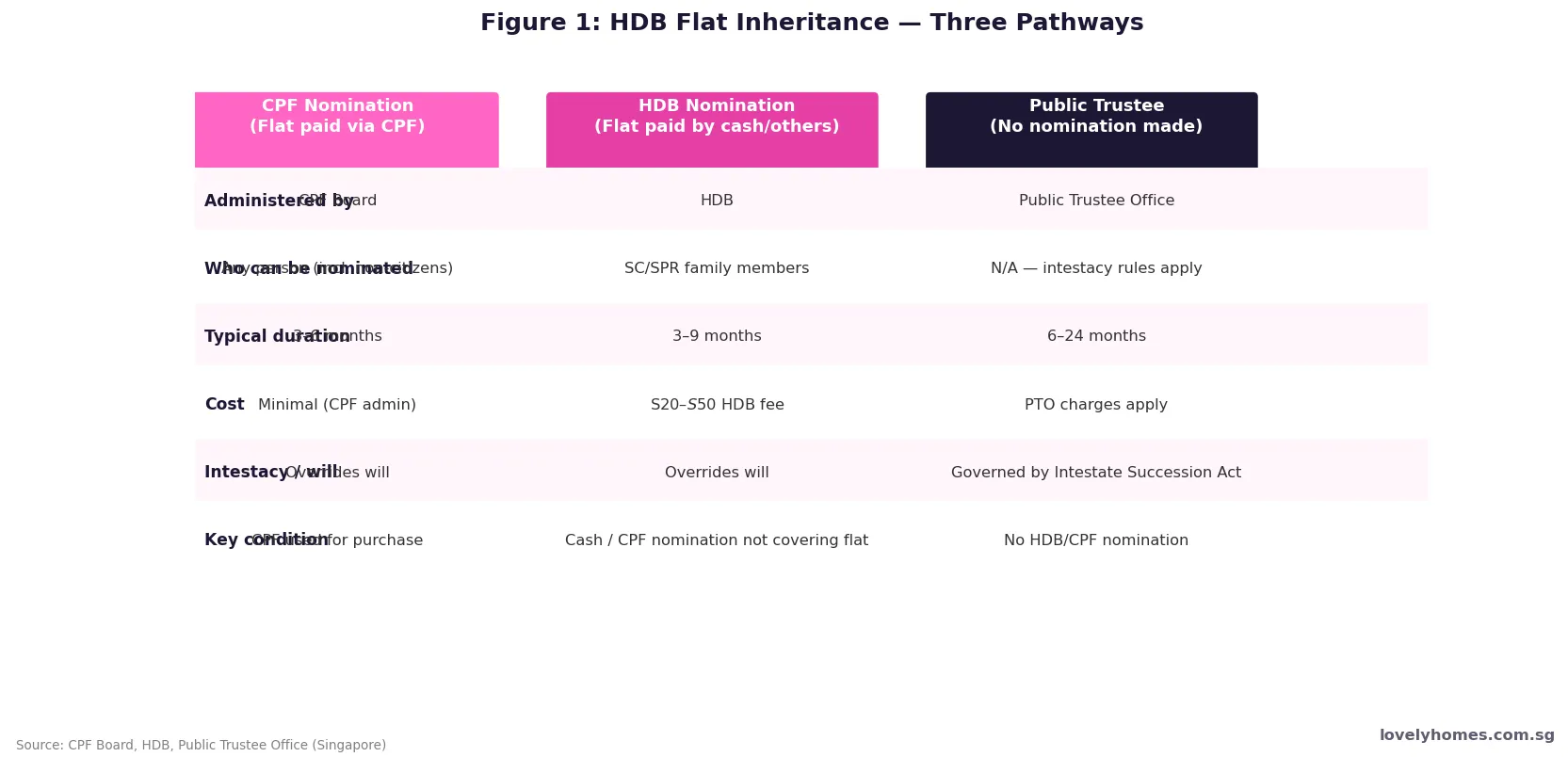
HDB flat inheritance pathways — CPF nomination vs HDB nomination vs Public Trustee
Figure 1: The three HDB flat inheritance pathways and the government body that administers each. Source: CPF Board, HDB, Public Trustee Office.

Timeline: How Long Does Each Pathway Take?

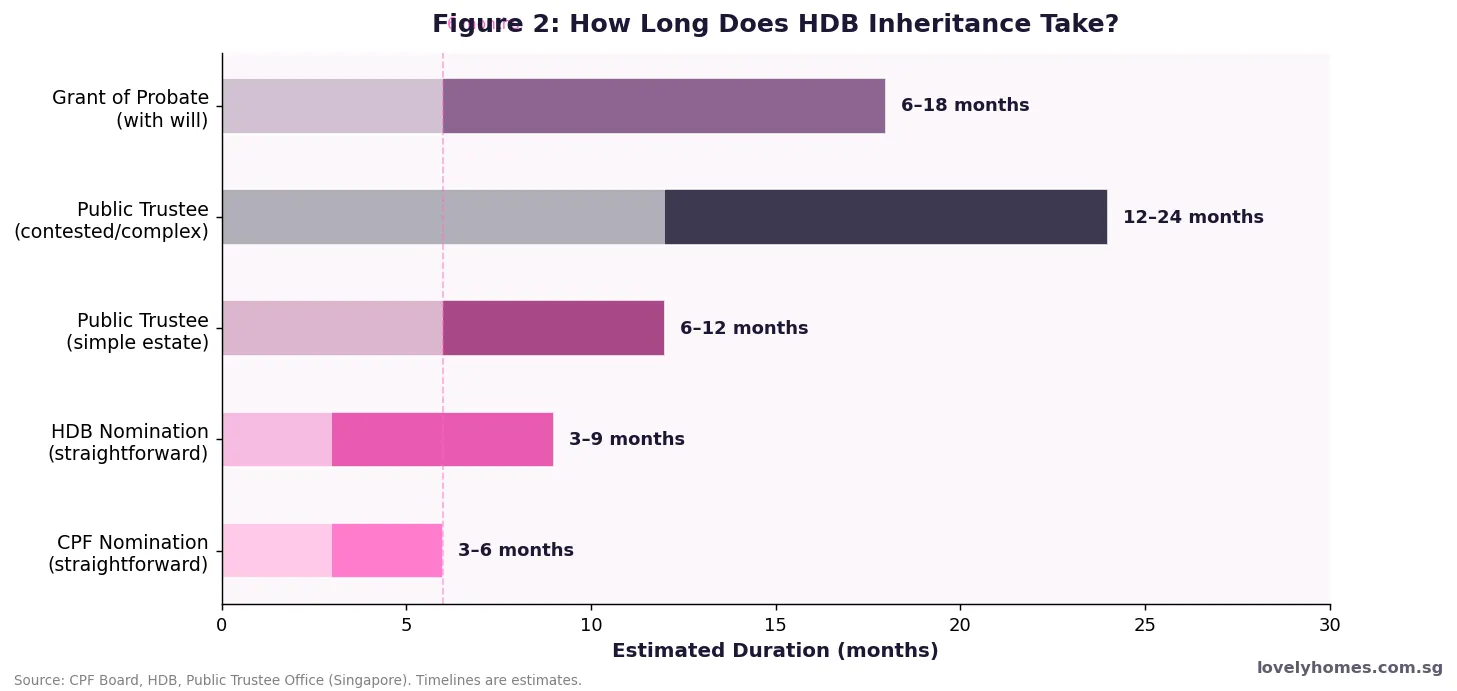
Processing time varies considerably. A clean CPF nomination with a straightforward HDB Flat Nomination can be completed in three to six months from the date of death. The Public Trustee pathway, by contrast, can take six months for a simple, uncontested estate or extend beyond two years if there are disputes, overseas assets, or complex beneficiary situations. The Grant of Probate pathway (testate estate with a will) typically takes six to eighteen months depending on court workload and the complexity of the estate.

During the period of administration, the surviving co-owner (if any) may continue to live in the flat. If the deceased was the sole owner, HDB will generally not require the other occupants to vacate immediately, but the situation should be formally regularised as quickly as possible.

HDB inheritance timeline — how long each pathway takes in months
Figure 2: Estimated processing times by inheritance pathway. Timelines are indicative; complex estates take longer. Source: HDB, Public Trustee Office.

Can the Beneficiary Keep the HDB Flat?

Even where a valid nomination directs the flat to a named beneficiary, that beneficiary must satisfy HDB’s eligibility conditions before HDB will consent to the transfer. If the beneficiary does not qualify, the flat must generally be sold and the proceeds distributed. This is one of the most common surprises families face — a loving parent may have nominated a child who owns a private condominium, only for HDB to require that child to sell one property.

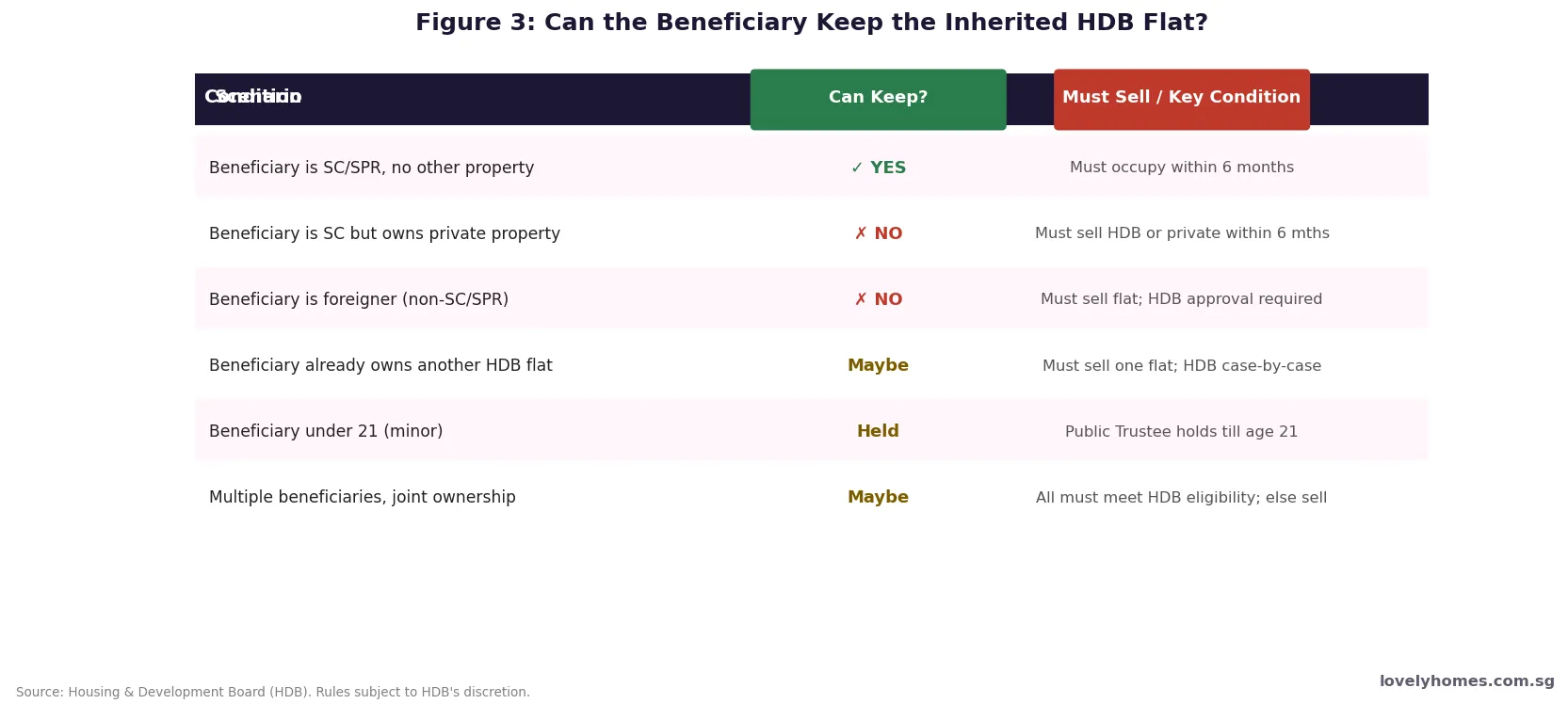
The key eligibility rules as at 2026 are as follows. First, the beneficiary must be a Singapore Citizen or Permanent Resident (foreigners cannot hold HDB flats). Second, the beneficiary must form a valid family nucleus with the deceased or another SC/SPR — for example, a spouse, child, parent, or sibling. Third, if the beneficiary already owns a private residential property in Singapore or overseas, they must sell either the HDB flat or the private property within six months of the flat being transferred to them. Fourth, if the beneficiary is a minor (under 21), the flat is held by the Public Trustee until the minor reaches majority. Fifth, if multiple beneficiaries jointly inherit and not all meet the criteria, HDB assesses the matter on a case-by-case basis and may require a sale.

Can beneficiary keep inherited HDB flat — eligibility rules table
Figure 3: At-a-glance eligibility matrix for common inheritance scenarios. Source: HDB. Always confirm with HDB directly for your specific situation.

The Transmission Process — Step by Step

Once the appropriate documents are in order, the HDB transmission process follows a structured series of steps. The first step is to notify HDB of the death by submitting the death certificate and the relevant supporting documents (the nomination form, or the Grant of Probate, or the Letters of Administration). HDB will then assess the eligibility of the nominated beneficiary. If the beneficiary qualifies, HDB issues a letter of acceptance and the transfer is registered with the Singapore Land Authority (SLA). If the beneficiary does not qualify or chooses to sell, HDB facilitates the sale and disburses the proceeds accordingly.

Administrative costs are modest: HDB charges a conveyancing fee of around S$20 to S$50 for the flat transfer. If the beneficiary engages a private solicitor to manage the estate, legal fees typically range from S$500 to S$3,000 depending on complexity. The PTO charges a sliding-scale fee based on the value of the estate assets administered, which can amount to 1–2.5% of the estate’s gross value.

Estate Duty, Taxes, and the Minimum Occupation Period

Singapore abolished estate duty on 15 February 2008. There is no inheritance tax and no capital gains tax on property in Singapore. A beneficiary who receives an HDB flat pays no tax simply by virtue of inheriting it. If the beneficiary subsequently sells the flat in the open market, the sale proceeds are not subject to income tax. Seller’s Stamp Duty (SSD) does not apply to HDB flat sales (SSD applies only to private residential properties held for four years or fewer).

One important point concerns the Minimum Occupation Period. If the deceased owner died before the MOP expired, the MOP clock does not restart for the beneficiary. The beneficiary must wait out the remaining MOP from the date the flat was first purchased, not from the date of inheritance. A beneficiary who inherits a flat with two years remaining in its MOP must live in the flat for those two years before they are eligible to sell or rent it out.

Scenario Outcome for Beneficiary Key Condition or Restriction
SC beneficiary, no other property May keep flat Must occupy within 6 months of transfer
SC beneficiary, owns private property Must sell one 6-month window to dispose of either HDB or private property
SPR beneficiary, no other property May keep flat (HDB case-by-case) Subject to HDB’s prevailing SPR eligibility rules
Foreigner beneficiary Must sell flat Foreigners cannot hold HDB flats; HDB arranges sale
Minor beneficiary (under 21) PTO holds flat Released to beneficiary upon turning 21; MOP rules apply
Multiple beneficiaries, mixed eligibility HDB case-by-case May require all eligible parties to buy out ineligible parties, or sale
No eligible beneficiary Flat sold by HDB Proceeds distributed under intestacy rules or will

Worked Example

Worked Example: Mr Tan SC Sole Owner, Dies Without HDB Nomination

Situation: Mr Tan, a Singapore Citizen, purchased a 4-room HDB flat in Tampines in 2018 for S$450,000. He paid a S$30,000 CPF down payment and has been making monthly repayments of S$1,500 from CPF OA. By 2026, the outstanding HDB loan is S$280,000, and the CPF principal withdrawn (including monthly repayments) totals S$130,000, with accrued CPF interest of S$18,000. The flat’s current market value is approximately S$680,000. Mr Tan dies in August 2026 without having made an HDB Flat Nomination, but he did make a CPF nomination directing his CPF savings to his wife, Mrs Tan (SC).

What happens:

  • CPF Board pays S$148,000 (S$130,000 principal + S$18,000 accrued interest) from the CPF estate to Mrs Tan per the CPF nomination. This is a cash payment, not a flat transfer.
  • The flat itself — because there is no HDB Flat Nomination — passes under the Intestate Succession Act. Since Mr Tan is survived by a spouse and children, the wife receives half the estate and the children share the other half.
  • Mrs Tan engages a solicitor and applies for Letters of Administration. The process takes approximately 9 months.
  • Mrs Tan is the sole named beneficiary eligible to retain the flat (the children are minors). HDB agrees to transfer the flat solely to Mrs Tan, who satisfies the eligibility criteria.
  • Outstanding HDB loan of S$280,000 is assumed by Mrs Tan; she must meet HDB’s loan-to-value and financial criteria.
  • Total costs: PTO/legal fees approximately S$3,500; HDB conveyancing fee S$38.
  • Lesson: Had Mr Tan made an HDB Flat Nomination directing the flat to Mrs Tan, the 9-month probate process could have been avoided and the estate settled in approximately 4–5 months.

Estate Planning: What HDB Owners Should Do Now

The practical lesson from every case study is the same: make your nominations. An HDB flat owner should make both a CPF nomination (directing the CPF savings) and a separate HDB Flat Nomination (directing the flat itself). The two nominations complement each other and together ensure that neither component of your most valuable asset is left to intestacy rules or a protracted court process.

The CPF nomination is made online at the CPF website or in person at a CPF Service Centre. The HDB Flat Nomination is submitted to HDB — forms are available at HDB Hub or online via the HDB Portal. Both nominations should be reviewed whenever family circumstances change: marriage, divorce, birth of children, death of a nominee. A stale nomination that names a deceased person as the nominee creates exactly the complications it was meant to prevent.

Beyond nominations, flat owners should also consider whether their flat’s ownership structure — joint tenancy versus tenancy-in-common — fits their estate planning intentions. Joint tenancy means the surviving co-owner automatically inherits the flat’s full interest on the other owner’s death (right of survivorship), bypassing both nominations and the will. Tenancy-in-common means each owner holds a defined share that passes according to the nomination or will.

What Might Come Next for HDB Inheritance Rules

HDB’s eligibility rules for inheriting flats have remained broadly stable in recent years, but the policy tension between preserving HDB as a home-ownership scheme for eligible residents and accommodating modern family structures (blended families, overseas beneficiaries, beneficiaries with mixed property portfolios) is an ongoing one. Future rule changes — such as extended time windows for beneficiaries to divest a private property, or relaxed eligibility for SPR beneficiaries — cannot be ruled out. Flat owners with complex family situations should monitor HDB’s circular updates and consult HDB directly rather than relying solely on any published guide.

FAQ — HDB Flat Inheritance

Does a will override an HDB Flat Nomination?

No. An HDB Flat Nomination takes precedence over a will for the flat it covers. If you have nominated Person A in your HDB Flat Nomination but your will says the flat should go to Person B, the flat goes to Person A. This is why estate lawyers in Singapore strongly advise that your HDB nomination and your will be aligned, and that both be updated whenever family circumstances change. CPF nominations similarly override a will for the CPF savings component.

What if the nominated beneficiary dies before the flat owner?

If the sole nominated beneficiary predeceases the flat owner and the owner does not update the nomination, the nomination lapses and the flat falls back into the estate — governed by the will (if any) or the Intestate Succession Act. HDB will not attempt to contact the deceased beneficiary’s family. This is one of the most common pitfalls: owners make a nomination and then forget to update it when the nominated person dies. Review your nomination every few years and after any significant family event.

Can I nominate a non-family member to inherit my HDB flat?

The HDB Flat Nomination Scheme generally requires the nominated person to be a family member who forms a valid family nucleus with the owner — for example, a spouse, parent, child, or sibling. You cannot typically nominate a friend or a colleague. However, a CPF nomination (which covers the cash value of CPF savings used in the flat) can be made in favour of any person, including non-family members. That person would receive the CPF cash, not the flat itself.

What happens if the flat is still under a bank or HDB loan when the owner dies?

The outstanding loan does not disappear on the owner’s death. If the beneficiary inherits and retains the flat, they take over the loan obligations. For an HDB loan, the beneficiary must meet HDB’s loan eligibility criteria to assume the loan. For a bank mortgage, the bank will typically require the estate or the beneficiary to refinance or settle the outstanding amount. Most homeowners should carry term life insurance or mortgage protection insurance precisely to ensure the loan can be discharged if they die unexpectedly.

Does the Minimum Occupation Period restart when a flat is inherited?

No — the MOP does not restart. The clock continues from the date the flat was originally purchased (or the date the keys were collected for a BTO flat). If Mr Tan bought a flat in January 2023 (5-year MOP) and died in January 2026 after only three years, the beneficiary must occupy the flat until at least January 2028 before selling. The beneficiary cannot sublet the whole flat during the remaining MOP either, as the same occupation rules apply.

Are there any taxes payable on an inherited HDB flat?

There is no inheritance tax and no estate duty in Singapore (abolished 15 February 2008). The beneficiary pays no tax on receiving the flat. If the beneficiary later sells the flat, the sale proceeds are not subject to income tax or capital gains tax. Buyer’s Stamp Duty (BSD) would apply to a subsequent buyer of the flat in the normal way, but the seller (the beneficiary) does not bear BSD. Seller’s Stamp Duty (SSD) does not apply to HDB flats.

Disclaimer: This article is for general information only and does not constitute legal, estate-planning, or financial advice. HDB inheritance rules, CPF nomination procedures, and Public Trustee Office requirements are subject to change. Always verify current rules directly with the Housing & Development Board (hdb.gov.sg), the CPF Board (cpf.gov.sg), the Public Trustee Office (pto.mlaw.gov.sg), and a licensed solicitor. Eligibility decisions rest with HDB and are made on a case-by-case basis. LovelyHomes is not responsible for reliance on information in this article.

Singapore Property Renovation Guide 2026: HDB Rules, Costs, Permits and Renovation Loan Explained

Singapore Property Renovation Guide 2026: HDB Rules, Costs, Permits and Renovation Loan Explained

Whether you have just collected the keys to your new HDB flat, completed your MOP and are preparing to resell, or are refreshing a resale condo ahead of moving in, a renovation in Singapore involves navigating a specific set of rules, permits, and cost benchmarks that every homeowner should understand before engaging a contractor. Get it wrong, and you risk fines from HDB, stop-work orders from the Building and Construction Authority (BCA), or a renovation that looks impressive but adds little resale value.

This guide covers the full landscape of Singapore property renovation in 2026: HDB rules and what needs approval, BCA permits for structural work, realistic cost ranges by flat type and scope, the HDB Renovation Loan, timelines to plan around, and an evidence-based look at which renovation types deliver the strongest return on investment (ROI) at resale.

Quick Answer — Singapore Renovation 2026 at a Glance

  • HDB renovations require an HDB-registered contractor and — for certain works — advance written approval from HDB.
  • Structural works (hacking beams, columns, load-bearing walls) are prohibited in HDB flats regardless of approval status.
  • BCA permits are required for additions and alterations to private property that affect the building structure, external appearance, or gross floor area.
  • Costs range from S$18,000 for a basic 2-room HDB refresh to S$185,000+ for a premium condo 3-bedroom renovation.
  • Renovation Loan: up to S$30,000 for HDB flat owners, at interest rates from 5.5%–6.5% p.a. (check with your bank).
  • Duration: typically 8–16 weeks for a full flat; carpentry lead times of 6–10 weeks are the most common schedule bottleneck.
  • Best ROI renovations (by resale uplift relative to cost): kitchen refacing, bathroom remodelling, flooring replacement, and a fresh full repaint.

HDB Renovation Rules: What You Need to Know

HDB renovation rules exist to protect the structural integrity of blocks, ensure the safety of residents above and below, maintain the external facade of the estate, and prevent noise and disruption beyond acceptable hours. The rules apply regardless of whether you own a BTO flat, a resale flat, or a Design, Build and Sell Scheme (DBSS) flat.

The core requirements are:

  • Use an HDB-registered renovation contractor. All HDB renovation work must be carried out by a contractor on HDB’s approved register. Working with an unregistered contractor voids your rights under any HDB dispute resolution process and may result in fines. You can verify registration at the HDB renovation portal.
  • Submit a Renovation Permit application through your contractor’s HDB-registered account before commencing works that require approval.
  • Work hours: Monday–Friday 9:00 am–6:00 pm; Saturday 9:00 am–1:00 pm. No renovation work on Sundays or public holidays.
  • Inform your neighbours at least 3 working days before renovation commences (HDB policy; many MCSTs have their own protocols for private condos).
HDB renovation permit requirements 2026 — permitted, permit required, and prohibited renovation works
Figure 1: HDB renovation works categorised by permit requirement: no permit needed (pink), HDB permit required (orange), and prohibited (navy).
Renovation Type HDB Rule Notes
Painting (walls, ceilings) No permit needed Any colour; no structural impact
Wallpaper / wall panels No permit needed Must not damage structural surfaces
Built-in carpentry (wardrobes, TV console) No permit needed Contractor must be HDB-registered
Kitchen cabinets / countertops No permit needed Replacing like-for-like; plumbing changes need permit
Flooring (overlay, no hacking) No permit needed Vinyl overlay on tiles — no hacking needed
Flooring (hacking and relaying tiles) HDB Permit Required Submit via contractor’s account before starting
Bathroom fittings (sink, WC, shower screen) No permit for like-for-like Moving waste pipes = permit required
Hacking non-structural internal walls HDB Permit Required HDB confirms wall classification first
Hacking structural walls / beams / columns Prohibited No exceptions — structural integrity risk
Window grille installation / replacement HDB Permit Required Must meet HDB bar-spacing standards
Air-conditioning installations No permit for standard split units Outdoor unit placement must comply with HDB guidelines
Electrical rewiring (minor) No permit; must use licensed electrician SP PowerGrid licence required for main panel work

BCA Permits for Private Property Renovation

For private property (condominiums, landed homes, commercial units), the Building and Construction Authority (BCA) administers the approvals framework under the Building Control Act. Unlike HDB rules, which regulate the use of approved contractors and specific work types, BCA permits focus on structural safety, gross floor area, and external facade changes.

Works that typically require a BCA permit (Addition and Alteration, or A&A works) include:

  • Any structural alteration (adding or removing load-bearing elements, changing structural openings)
  • Extensions that increase gross floor area (GFA)
  • Changes to the external facade or roof of landed property
  • Swimming pool installations at landed property
  • Major electrical or mechanical system upgrades in commercial units

For condominium owners, all renovation work must also comply with the Management Corporation Strata Title (MCST) by-laws. Most MCSTs require homeowners to submit renovation plans and obtain written MCST approval before any work begins, and to pay a renovation deposit (typically S$1,000–S$5,000) refunded upon satisfactory completion without damage to common areas.

Renovation Costs by Flat Type and Scope

Renovation costs in Singapore vary enormously depending on the size of the unit, the scope of works, and the finish level targeted. The figures below reflect market rates as at mid-2026 based on indicative quotations from HDB-registered contractors. They exclude furniture, electrical appliances, and curtains, which are typically supplied separately.

Singapore renovation costs 2026 by flat type and scope — HDB and condo renovation cost ranges
Figure 2: Estimated renovation cost ranges (S$) by flat type and renovation scope — Basic (mainly cosmetic), Standard (full wet works and carpentry), and Premium (bespoke finishes throughout).
Property Type Basic Renovation (S$) Standard Renovation (S$) Premium Renovation (S$)
HDB 2-Room (35–45 sqm) 18,000–25,000 30,000–45,000 50,000–70,000
HDB 3-Room (65–75 sqm) 25,000–35,000 45,000–60,000 70,000–100,000
HDB 4-Room (90–100 sqm) 32,000–42,000 58,000–75,000 95,000–130,000
HDB 5-Room / EA (110–145 sqm) 40,000–55,000 72,000–95,000 120,000–160,000
Condo 2-Bedroom (65–80 sqm) 35,000–50,000 65,000–85,000 110,000–150,000
Condo 3-Bedroom (90–120 sqm) 48,000–65,000 85,000–115,000 150,000–220,000

What the tiers mean:

  • Basic renovation covers repainting, vinyl flooring overlay (no hacking), replacement of bathroom fittings and kitchen tap/sink, and basic built-in storage in one or two rooms. Typically 8–10 weeks to complete.
  • Standard renovation includes full hacking and retiling of bathrooms and kitchen, installation of full kitchen cabinetry with solid surface countertop, carpentry throughout all bedrooms, feature wall treatment in living room, false ceiling with LED lighting, and air-conditioning installation. Typically 12–16 weeks.
  • Premium renovation encompasses all standard works plus imported tiles, bespoke joinery with soft-close mechanisms and premium hardware, kitchen island, walk-in wardrobe, feature wall with natural stone or specialty panels, smart home integration, and designer sanitary ware. 16–20 weeks or more.

The HDB Renovation Loan

HDB flat owners who need financing for their renovation can apply for an HDB Renovation Loan through participating financial institutions. Key terms as at August 2026:

  • Maximum loan amount: S$30,000 (or 6 months’ gross household income, whichever is lower)
  • Eligibility: HDB flat owners; at least one applicant must be a Singapore Citizen or Permanent Resident; flat must be under the applicant’s name
  • Loan tenor: up to 5 years
  • Interest rate: typically 5.5%–6.5% p.a. (fixed or floating; compare rates across OCBC, UOB, DBS, Standard Chartered)
  • Monthly repayment example: S$30,000 at 6% p.a. over 5 years = approximately S$580/month
  • Approved works: must be used for renovation works carried out by HDB-registered contractors; loan funds disbursed directly to the contractor after works inspection

Private property owners can use personal loans or renovation loans offered by banks (not HDB), which typically allow borrowing up to 6× monthly income, up to S$30,000, at broadly similar interest rates.

Renovation ROI: Which Works Add the Most Value at Resale

Not all renovation dollars are created equal. A premium renovation that costs S$150,000 does not necessarily add S$150,000 to your resale price — and in the HDB resale market especially, over-renovating above the neighbourhood price ceiling can result in negative ROI, where the renovation cost exceeds the premium buyers are willing to pay.

Singapore property renovation ROI 2026 by renovation type — range from full repaint to full gut renovation
Figure 3: Estimated resale ROI range and typical cost by renovation type. The dot on each range bar indicates the midpoint ROI. A fresh full repaint often delivers the highest ROI relative to cost.

General principles that hold across the Singapore resale market:

  • Kitchens and bathrooms sell flats. Buyers consistently rank clean, functional kitchens and bathrooms as the top priority. A bathroom remodel at S$15,000–S$20,000 typically commands a premium of S$15,000–S$30,000 or more in the HDB resale market, making it one of the highest-ROI renovations in absolute terms.
  • Repainting is the highest-ROI cosmetic upgrade. A full repaint of a 4-room flat costs S$2,500–S$4,500 and can lift perceived value by 5%–12% by making the flat feel newer and well-maintained. At S$550,000 resale, a 5% uplift = S$27,500 on a S$4,000 spend.
  • Flooring matters. Replacing old mosaic tiles with vinyl plank flooring (S$8,000–S$12,000) upgrades the look of the entire flat and appeals strongly to younger buyers. ROI of 8%–18% relative to cost is commonly observed.
  • Over-specified kitchens rarely pay back. A Häfele full-imported kitchen at S$45,000 in a S$450,000 flat is unlikely to recover its cost. Buyers in that price bracket expect a functional kitchen, not a luxury one.
  • Open-plan conversions (hacking the wall between kitchen and living room) are high-risk. They require HDB permit approval, add S$15,000–S$25,000 in costs, and appeal to a subset of buyers. If your buyer prefers a separate kitchen (common among families with elderly members), the conversion may reduce marketability.

Worked Example: Ms Tan — selling her Bishan 4-Room HDB flat after MOP

Ms Tan’s 4-room flat is 12 years old. She purchased it at S$370,000 and is targeting a resale at S$720,000. Market comparables show recently transacted flats in her block at S$700,000–S$740,000 — a standard finish range.

Renovation plan (standard scope, targeting resale within 3 months):

  • Full repaint (4 rooms + common areas): S$3,800
  • Bathroom retiling and new fittings (2 bathrooms): S$22,000
  • Kitchen hacking, retiling, new cabinets with quartz countertop: S$28,000
  • Vinyl plank flooring (bedrooms and living room): S$9,500
  • False ceiling with LED downlights (living and dining): S$5,200
  • Minor carpentry (master bedroom built-in wardrobe): S$6,500
  • Total renovation cost: S$75,000

Resale outcome: After renovation, the flat transacted at S$735,000 — S$35,000 above the pre-renovation comparable median. Net renovation benefit = S$35,000 uplift at an outlay of S$75,000. However, the renovation also allowed Ms Tan to sell at top-of-market speed (16 days on the market vs. average 45 days for unrenovated flats in her block), reducing holding costs and the risk of a prolonged sale at a lower price.

Renovation Loan used: Ms Tan borrowed S$30,000 via UOB Renovation Loan at 6.0% over 3 years (S$913/month), repaid fully on completion of the sale. Total interest paid = approximately S$2,860.

Renovation Timelines and Planning Tips

Renovation projects in Singapore typically follow this sequence:

  • Week 1–2: Hacking (tiles, walls where permitted). Noisiest phase — schedule within HDB allowed hours.
  • Week 2–4: Plumbing, electrical conduit laying, plastering.
  • Week 4–6: Tiling (wet areas first), waterproofing, window grilles.
  • Week 6–10: Carpentry fabrication off-site (cabinets, wardrobes — this is where most delays occur).
  • Week 10–12: Carpentry installation, painting, flooring.
  • Week 12–14: Air-conditioning, light fittings, final touches, snag inspection.

The single most reliable way to compress the schedule is to finalise your carpentry design before the main contractor starts hacking, so fabrication can begin in parallel. Many homeowners also run a parallel procurement track for appliances (ovens, hobs, refrigerators) so delivery aligns with carpentry installation.

Choosing a Renovation Contractor

For HDB flats, all renovation works must be carried out by a contractor registered with HDB. You can search HDB’s renovation contractor directory on the HDB InfoWEB. When shortlisting, ask each contractor for:

  • Proof of HDB registration (registration number and expiry date)
  • A full itemised quotation — not a lump-sum figure
  • References from at least two recent projects in a similar flat type
  • Their renovation permit application timeline and workflow
  • Payment schedule (industry norm: 20% deposit, progress payments, 5%–10% final retention)

Avoid contractors who ask for more than 20%–30% upfront, cannot provide an itemised quotation, or pressure you to sign before the permit is approved.

What Might Change for Renovations in 2026–2027

HDB has been progressively tightening rules around noise levels and renovation hours in high-density estates. In 2025, HDB trialled a decibel monitoring pilot in selected blocks in Punggol and Tengah to identify repeat hacking offenders. Industry observers expect these monitoring standards to be formalised and extended to all HDB towns by 2027, potentially shortening permitted hacking hours or requiring noise-dampening shrouding for heavy hacking works. Homeowners planning major renovations should factor this into their contractor selection — asking specifically about noise control practices.

BCA is also reviewing the A&A permit threshold for landed property additions, with proposed changes to streamline minor facade alterations for terrace and semi-detached homes. These changes are expected to reduce permit processing times from 6–8 weeks to 2–3 weeks for qualifying minor works.

Frequently Asked Questions

Can I start renovation immediately after collecting HDB flat keys?

Not immediately. Your HDB-registered contractor must first obtain the required Renovation Permit(s) from HDB before any chargeable works can begin. The permit application is submitted online by your contractor and typically approved within 3–5 working days for standard works. Painting and minor non-permit works (such as installing curtain rods or shelf brackets) can begin while the permit is pending. Hacking, tiling, and any structural involvement must wait for permit approval.

What happens if I carry out unauthorised renovation works in my HDB flat?

HDB takes unauthorised renovation seriously. Depending on the nature of the breach, penalties can range from written warnings and mandatory rectification (at the owner’s cost) to fines of up to S$5,000 under the Housing and Development Act. For structural breaches — such as hacking a structural wall — HDB may require the owner to engage a Professional Engineer (PE) to assess and remediate the damage at the owner’s full expense, which can easily run to S$30,000–S$80,000. HDB also maintains records of renovation violations, which can affect future applications for flat-related approvals.

Do I need MCST approval for my condo renovation?

Yes. Almost all condo MCSTs require prior written approval before any renovation works begin. The standard process is: submit your renovation plans and contractor details to the managing agent; pay a renovation deposit (S$1,000–S$5,000, refundable); receive written approval specifying permitted hours, noise restrictions, and waste disposal requirements. Works that affect the common property — changing external windows, modifying air-conditioning compressor locations, altering plumbing stacks — typically require additional MCST approval and may need a BCA permit as well.

Can I claim renovation costs against income tax?

No. Renovation costs for your owner-occupied residential property are not deductible for personal income tax purposes in Singapore. However, if you own the property as a rental investment and incur renovation costs to maintain the property in its income-earning condition, those costs may be deductible against rental income under IRAS’s rules for rental expense deductions. Capital expenditure that improves the property beyond its original condition is not deductible; revenue expenditure on repairs and maintenance is. Consult a tax professional or refer to the IRAS rental expense guide for the applicable distinction.

What is the maximum I can borrow on an HDB Renovation Loan?

As at August 2026, the maximum HDB Renovation Loan is S$30,000 or six times your monthly household income, whichever is lower. For a household with a combined income of S$6,000/month, the income cap is S$36,000 — so the S$30,000 cap applies. The loan must be used exclusively for renovation works carried out by an HDB-registered contractor and supported by invoices. The bank disburses funds directly to the contractor, not to you. Applications are processed by participating banks (DBS, OCBC, UOB, Standard Chartered, and others); compare interest rates as they vary by institution and promotion.

How long do I have to complete renovation after collecting BTO keys?

HDB does not set a strict deadline for completing renovation after key collection, but the Renovation Permit has a validity period (typically one year from issuance, extendable). Practically, most BTO buyers complete their renovation within 3–6 months of key collection. If your renovation will take significantly longer — for example, because you are waiting for a customised furniture lead time — ensure your contractor extends the permit validity before it lapses. A lapsed permit means all subsequent work is technically unauthorised until a new permit is obtained.

Disclaimer: This article provides general guidance only and does not constitute professional legal, financial, or construction advice. HDB renovation rules, BCA permit requirements, and renovation loan terms change from time to time. Always verify current HDB rules at hdb.gov.sg, BCA permit requirements at bca.gov.sg, and IRAS rental expense deduction rules at iras.gov.sg before committing to any renovation programme. Renovation costs are indicative estimates; obtain written quotations from at least three HDB-registered contractors before committing.

Translate »