Singapore Property Seller’s Complete Guide 2026: OTP, Timeline, Costs and Proceeds

Singapore Property Seller’s Complete Guide 2026: OTP, Timeline, Costs and Proceeds

Selling a property in Singapore involves a legal process that most people will go through only a handful of times in their lives. Whether you are selling a resale HDB flat, a condominium, or a landed home, the steps from decision to receiving your proceeds follow a structured sequence — one where mistakes at any stage can cost tens of thousands of dollars or delay completion by weeks.

This guide walks you through the complete selling process in 2026: from deciding to sell and appointing a property agent, through the Option to Purchase (OTP) and Sales and Purchase Agreement, all the way to receiving your sale proceeds and understanding exactly what comes back to you after CPF, mortgage repayment, agent commission, and stamp duties.

Quick Answer — Singapore Property Selling: Key Facts 2026

  • The standard selling timeline for resale HDB or private property is 4 to 6 months from decision to completion
  • HDB sellers must satisfy the Minimum Occupation Period (MOP) of 5 years (or 10 years for Prime and Plus classification flats) before selling
  • Seller’s Stamp Duty (SSD) applies to private property sold within 3 years of purchase: 12% (year 1), 8% (year 2), 4% (year 3)
  • Agent commission for HDB sellers: typically 1–2% of sale price; condo: 1–2% (negotiable); landed: 1–2%
  • CPF Ordinary Account funds used for the purchase must be refunded — with accrued interest at 2.5% p.a. — before you receive any cash proceeds
  • The OTP grants the buyer 14 calendar days to decide whether to exercise (HDB: 21 days); the seller is bound for that period
  • Completion (from S&P signing) for resale HDB: approximately 8 weeks; private property: typically 10–12 weeks
  • Legal conveyancing fees: S$2,000–S$4,000 for HDB; S$2,500–S$5,000+ for private property

Step 1: Decide to Sell — and Check Your Eligibility

Before instructing an agent or starting viewings, two eligibility checks must be completed. For HDB sellers, the most critical is the MOP. Under HDB rules, a flat purchased directly from HDB (BTO, DBSS, or direct sale) must be occupied for a minimum of five years from the date the keys are collected before it can be sold on the open resale market. For Prime Location Public Housing (PLH) and Plus model flats introduced from late 2021, the MOP is ten years. Selling before MOP is a criminal offence under the Housing and Development Act and can result in compulsory acquisition of the flat and other penalties.

For private property sellers, the eligibility question is Seller’s Stamp Duty. SSD was calibrated in January 2017 to discourage short-term flipping of residential property. If you sell within three years of purchase, SSD is payable at the rates below.
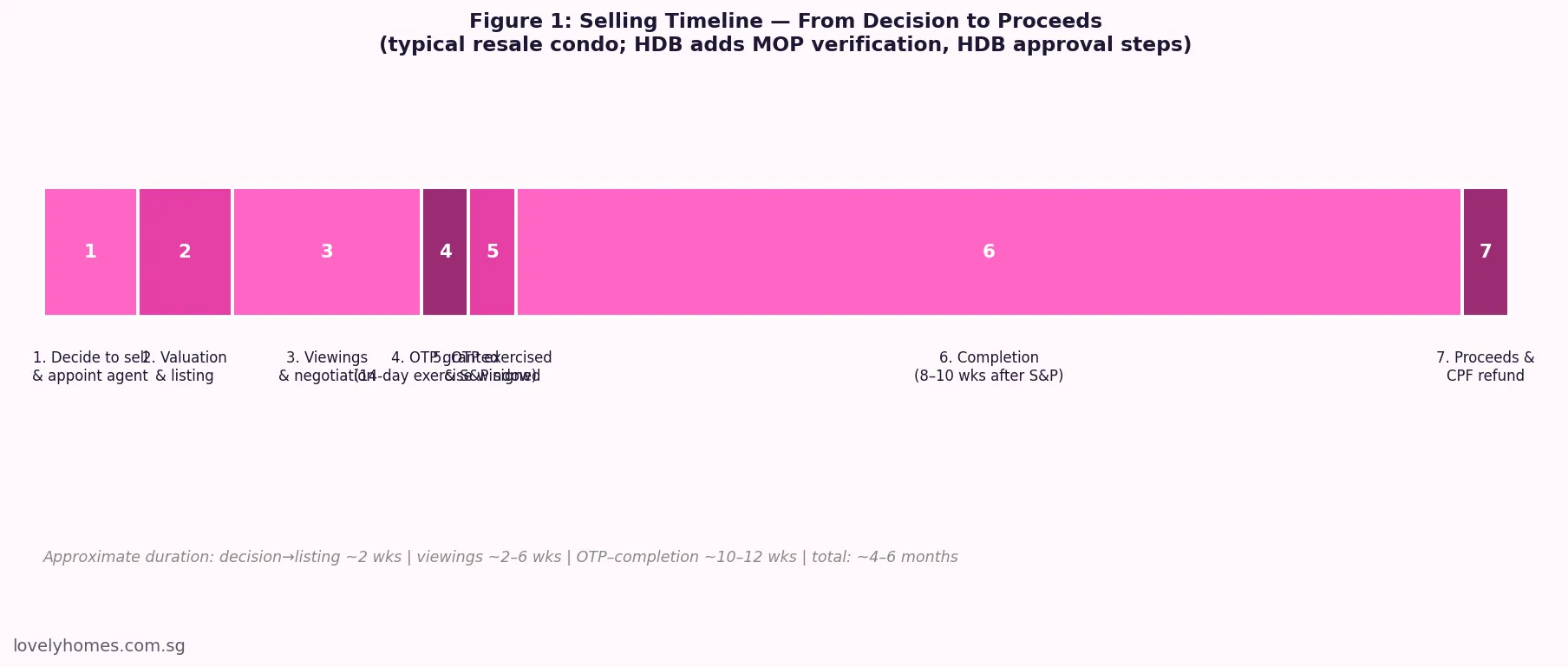
Singapore property selling timeline from decision to proceeds 2026
Figure 1: Typical Singapore property selling timeline — from decision to cash proceeds. HDB resale adds HDB approval steps (HFE Letter verification, HDB resale portal submission) between OTP and completion. Source: HDB, CEA.

Step 2: Valuation and Listing — Setting the Right Price

Pricing accurately is the single most important decision a seller makes. An overpriced listing sits on the market, accrues carrying costs (mortgage, maintenance fees, property tax), and acquires a stigma as buyers wonder what is wrong with it. An underpriced listing leaves money on the table. Getting it right requires a Comparative Market Analysis (CMA) — a structured review of recent transactions for comparable properties in the same estate or district, same flat type or size, and similar age and condition.

For HDB sellers, URA’s HDB Resale Statistics portal provides free access to actual transacted prices by town, flat type, storey range, and month. Use this data to identify the price band for your flat before allowing any agent to quote you a price. Agents sometimes inflate initial price estimates to win the listing — so cross-check every agent’s recommended listing price against the data yourself.

For private property, URA’s Property Data portal contains detailed transaction histories by project. Supplement this with a professional valuation from an IRAS-approved valuer if you are in doubt, particularly for older or unusual properties where comparables are scarce.

Step 3: Seller’s Stamp Duty — Know Your Exposure Before You List

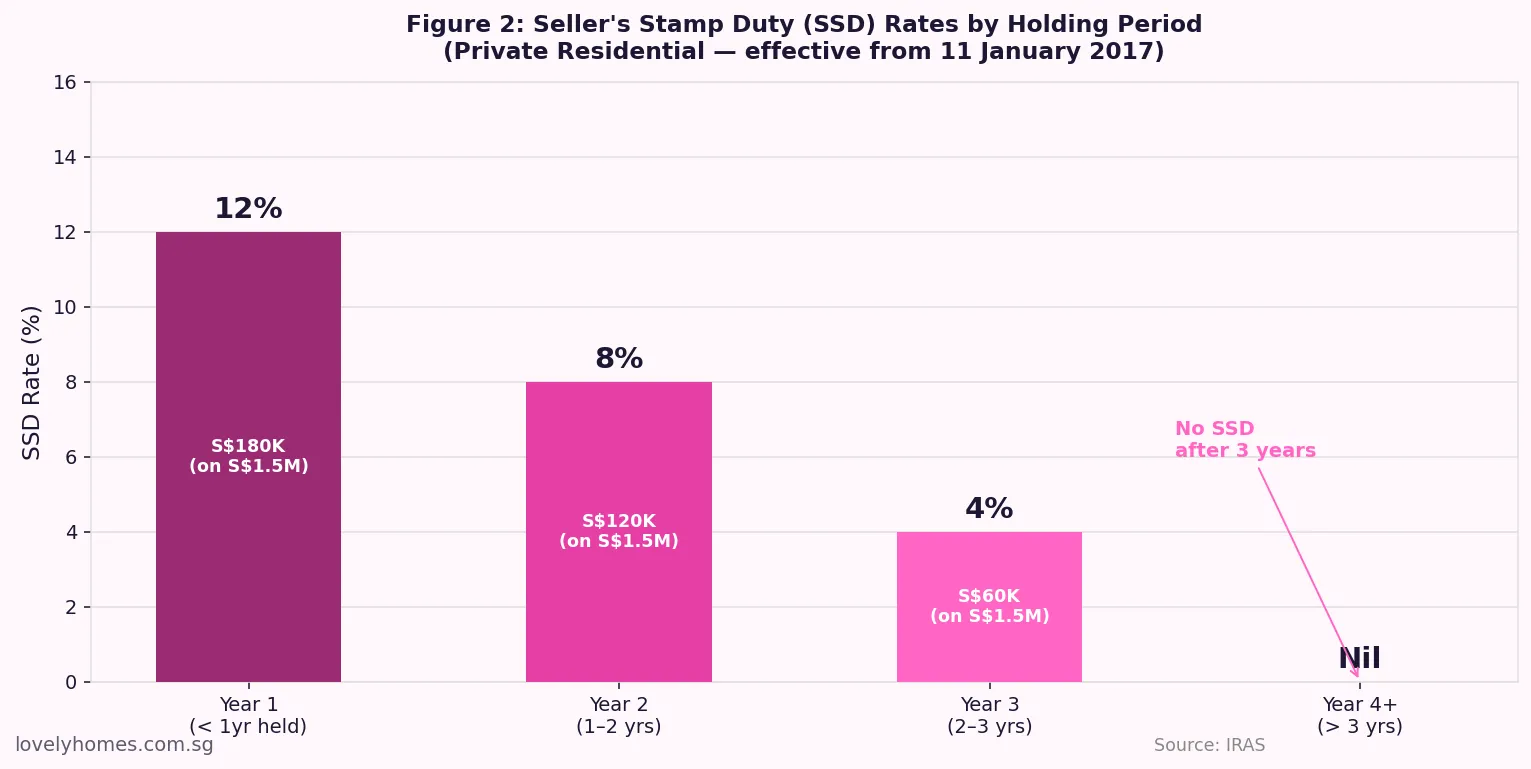
Seller’s Stamp Duty is a critical cost that many sellers either forget or underestimate. It applies to residential properties (private only — HDB resale is not subject to SSD). The rates in force from 11 January 2017 are:
Seller Stamp Duty SSD rates by holding period Singapore 2026
Figure 2: Seller’s Stamp Duty (SSD) rates for private residential property by holding period. Effective 11 January 2017. Source: IRAS.
Holding Period SSD Rate SSD on S$1,500,000 Sale SSD on S$2,500,000 Sale
Up to 1 year 12% S$180,000 S$300,000
More than 1 year, up to 2 years 8% S$120,000 S$200,000
More than 2 years, up to 3 years 4% S$60,000 S$100,000
More than 3 years Nil S$0 S$0

SSD is calculated on the higher of the sale price or market value. It is payable by the seller within 14 days of the date the OTP is exercised or the S&P Agreement is signed. IRAS administers SSD via its Stamp Duty portal. If SSD applies to your planned sale, model it explicitly into your net proceeds calculation before you list — it is a very large number at 12% on a S$2 million property.

Step 4: The Option to Purchase (OTP)

The OTP is the first legally binding document in any resale property transaction. Understanding it is essential for sellers.

When a buyer makes an offer that you accept, you grant them an OTP in exchange for an option fee. For private property, the option fee is negotiated — typically 1% of the purchase price, though it can be less for new launches or more for competitive situations. For HDB resale, HDB caps the option fee at S$1,000. The OTP grants the buyer the exclusive right to purchase your property at the agreed price, within a specified window (14 days for private property, 21 days for HDB).

During the option period, you cannot sell to anyone else or accept another offer. If the buyer exercises the OTP (pays the exercise fee and returns the signed copy), a binding Sale and Purchase Agreement comes into existence. If the buyer does not exercise, the OTP lapses, you keep the option fee, and you are free to sell to another party.

For HDB resale, the seller must obtain an HDB Resale Checklist acceptance before granting the OTP. Both buyer and seller submit declarations via the HDB Resale Portal. After the OTP is exercised, both parties have 8 weeks to register the resale application with HDB.

Step 5: Conveyancing and Completion

Once the OTP is exercised, your conveyancing lawyer takes over to complete the legal transfer of title. For private property, the buyer’s lawyer and seller’s lawyer correspond on the Sale and Purchase Agreement, conduct title searches, address outstanding caveats, and coordinate the CPF and bank discharge of your existing mortgage. Completion typically occurs 10 to 12 weeks after the S&P is signed.

At completion, the following typically happen simultaneously: the buyer pays the balance purchase price (via the bank’s loan drawdown and their own CPF OA funds); your outstanding mortgage is discharged and your mortgagee releases the property; CPF refunds your accrued principal and interest from the buyer’s funds; and after all deductions, the net cash proceeds are remitted to you.

Step 6: Net Proceeds — What You Actually Receive

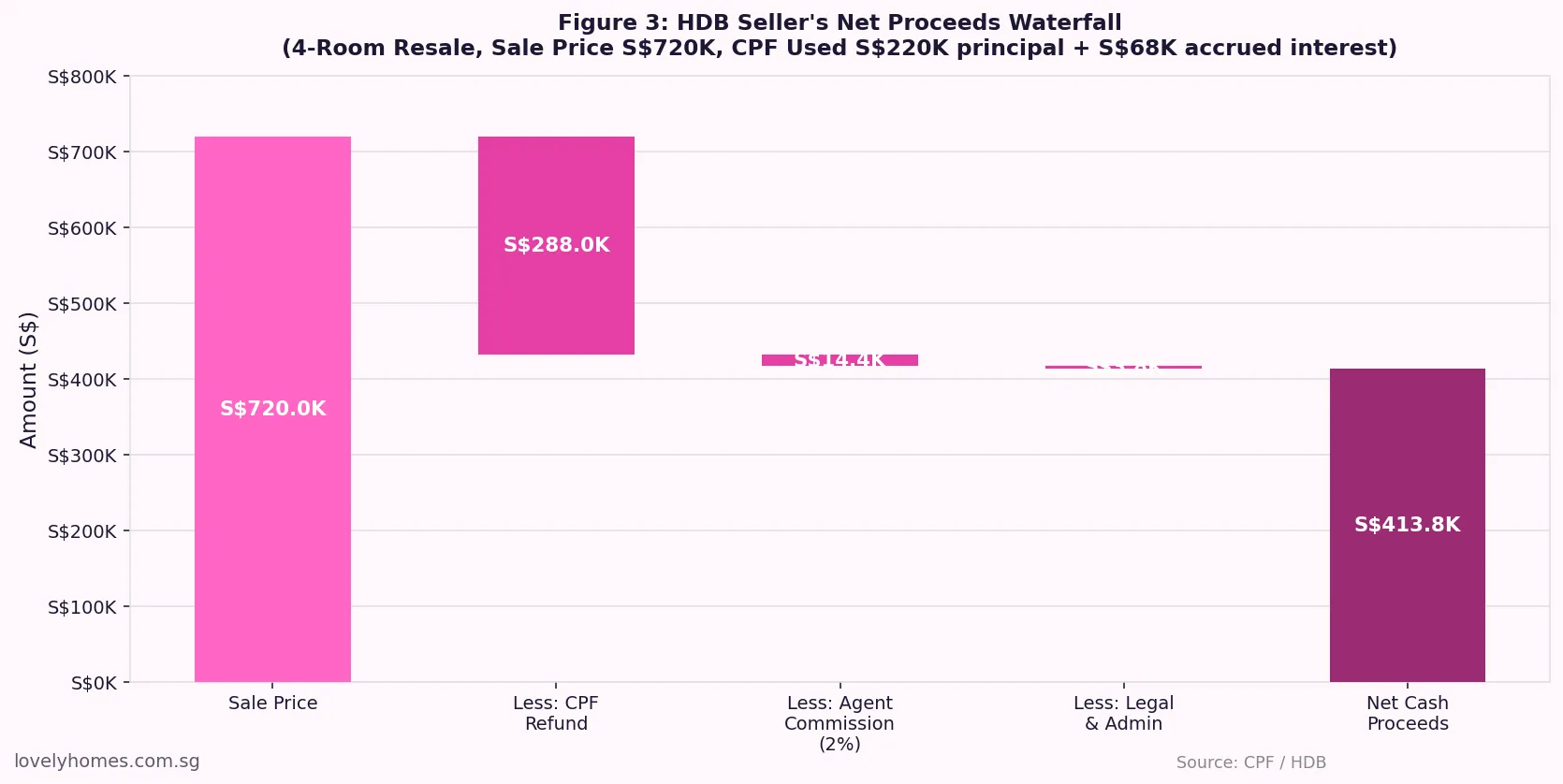
The gap between the headline sale price and the cash you receive in your bank account after completion is often a shock to first-time sellers. Here is how to model it:
HDB seller net proceeds waterfall CPF refund agent commission 2026
Figure 3: Illustrative HDB seller’s net proceeds waterfall. Sale price S$720K, CPF OA principal used S$220K plus accrued interest S$68K. Agent commission 2%. Source: CPF Board / HDB.
Proceeds Component HDB Example (S$720K sale) Private Condo Example (S$1.5M sale)
Gross sale price S$720,000 S$1,500,000
Less: CPF OA refund (principal + accrued interest) (S$288,000) (S$450,000)
Less: Outstanding mortgage discharge (S$0) (fully paid) (S$700,000)
Less: Agent commission (2% + 9% GST) (S$15,696) (S$32,700)
Less: Legal fees (seller’s conveyancing) (S$2,000) (S$3,500)
Less: HDB admin fee / miscellaneous (S$800) (S$0)
Net cash to seller S$413,504 S$313,800

The CPF refund is the item that surprises most sellers. Under CPF rules, all funds withdrawn from your Ordinary Account for housing — the initial downpayment, the monthly mortgage servicing amounts, and any lump-sum top-ups — must be refunded with accrued interest at 2.5% per annum upon sale. This money goes back to your CPF account, not into your bank account. So a seller who used S$220,000 of CPF and held the flat for 15 years might owe S$288,000 back to their CPF account at completion — even if the flat appreciated handsomely, a large portion of the paper gain goes back to CPF, accessible only for retirement or another property purchase.

HDB vs Private: Key Differences for Sellers

The mechanics of selling differ meaningfully between HDB and private property. The table below summarises the most important distinctions:

Factor HDB Resale Private Property (Condo / Landed)
MOP requirement 5 years (10 for PLH/Plus) None
Seller’s Stamp Duty Not applicable 12%/8%/4% if sold within 3 years
OTP option period 21 days 14 days (negotiable)
HDB approval required Yes — HDB Resale Portal submission No
Completion timeline 8 weeks after HDB registration 10–12 weeks after S&P
Valuation required HDB/SRX valuation (for CPF/loan purposes) Bank or IRAS valuation
Resale Levy (if buying subsidised flat next) Yes — S$15,000 to S$50,000 depending on flat type Not applicable
ABSD on next purchase May apply if buying before existing flat is sold May apply — plan carefully with sell-first strategy

Worked Example: Mr and Mrs Tan Sell Their Bishan 4-Room HDB Flat

Mr and Mrs Tan are Singapore Citizens who purchased a 4-room HDB flat in Bishan in June 2020 via the open resale market for S$590,000. They used a bank loan (S$442,500 at 75% LTV) and S$120,000 from their combined CPF OA. They have been servicing S$2,100 per month from CPF OA. As of August 2026 (6 years and 2 months of ownership), the MOP of 5 years has been satisfied.

  • Sale price agreed: S$780,000
  • Outstanding bank loan: S$312,000 (after 74 months of repayment)
  • CPF OA principal used: S$120,000 (downpayment) + S$2,100 × 74 months = S$275,400 total principal
  • CPF accrued interest at 2.5% p.a.: approximately S$34,000
  • Total CPF refund: S$309,400
  • Agent commission (2% + 9% GST): S$17,004
  • Legal fees: S$2,200
  • HDB admin fee: S$800
  • Net cash to Mr and Mrs Tan: S$780,000 – S$312,000 – S$309,400 – S$17,004 – S$2,200 – S$800 = S$138,596
  • CPF account top-up: S$309,400 (returned to their combined OA — available for future property purchase or retirement)

The Tans pocket S$138,596 in cash and have S$309,400 restored to their CPF accounts — a total economic gain of S$447,996 on a property that cost them S$590,000 six years ago, representing a 75.9% nominal return. The cash component, however, is much more modest at 17.8% of the sale price — a reminder that CPF recycling is a significant feature of the Singapore property selling experience.

Agent vs DIY: Should You Sell Without an Agent?

Singapore’s HDB and private resale markets do not legally require a licensed property agent (or Co-Broke Service / CBS for HDB). You can sell your HDB flat directly through the HDB Resale Portal as a DIY transaction, and private property through your conveyancing lawyer. The benefit is saving the agent commission — typically 1–2% of sale price — which on a S$1 million property amounts to S$10,000–S$20,000.

The risks are real, though. Negotiating effectively against buyers represented by experienced agents, writing and managing the OTP correctly, handling viewings and screening serious buyers from time-wasters, and navigating HDB’s administrative submissions are all tasks where professional help has tangible value. DIY is most viable when you have previous experience, when the property is straightforward and in high demand, and when you are willing to invest significant time. For most first-time sellers, the commission is well-spent insurance against costly errors.

What Might Come Next

For sellers active in H2 2026, the market environment is one of moderating prices (particularly for HDB resale and private OCR/RCR) and still-healthy volume. This is a reasonable time to sell if you have held for the requisite period — the market has not collapsed, but the risk of further softening in 2027 as BTO MOP supply increases is real. Private sellers who bought in 2019 to 2021 during the pre-cooling-measures run-up will have seen the strongest gains; those who bought in 2022 to 2024 may need to hold longer to realise meaningful appreciation. SSD for private sellers who bought after mid-2023 remains an active consideration: the three-year clock runs from the date the OTP was granted to you as a buyer, not the date you moved in.

FAQ: When does the Minimum Occupation Period (MOP) start for HDB?

The MOP begins on the date you collect the keys to your flat — not the signing date of the Sales and Purchase Agreement, not the HDB appointment date, and not the date you move in. The five-year MOP period runs from key collection to key collection plus five years. For BTO flats, this is straightforward. For resale flats, the MOP restarts from the date you as the new owner collect the keys after completion of your purchase, regardless of how long the previous owner occupied the flat.

FAQ: Can I rent out my flat during the MOP while planning to sell after?

For whole-flat subletting, you must first satisfy the MOP before applying for HDB’s permission to sublet. Room rental (subletting of individual bedrooms) is permitted during the MOP subject to HDB approval and conditions. You may not use the MOP period to simultaneously rent out the whole flat and purchase another property — that would amount to owning two properties, which violates HDB rules unless you are an approved private property owner who has given up your subsidy.

FAQ: What happens if the buyer pulls out after exercising the OTP?

If a buyer exercises the OTP (that is, pays the exercise fee and returns the signed document), a binding contract exists. If the buyer subsequently defaults — fails to complete on the scheduled completion date — you as the seller have legal remedies including: forfeiture of the deposit paid, specific performance action, and damages. In practice, most failed completions are resolved through negotiation and a revised completion date rather than litigation. Engage your conveyancing lawyer immediately if your buyer signals difficulty completing.

FAQ: Do I pay tax on the profit from selling my property?

Singapore does not impose a capital gains tax on residential property profits for owner-occupiers and most individual investors. The gains are yours to keep, subject to CPF refund obligations. However, if IRAS determines that you are trading in property — buying and selling repeatedly for profit in a manner that constitutes a business — the gains may be taxed as income. This is a case-by-case assessment. Selling one or two properties over a lifetime is almost never caught by this rule; serial short-term flippers may be. Seller’s Stamp Duty (for private property held under 3 years) is a separate tax on the transaction, not on gains.

FAQ: How do I calculate the CPF accrued interest I owe on sale?

CPF accrued interest is calculated at 2.5% per annum (the prevailing Ordinary Account rate) on the principal CPF amounts withdrawn, compounded monthly from the date each withdrawal was made. CPF Board provides an indicative CPF housing refund calculator on their website at cpf.gov.sg. The actual figure is confirmed by CPF Board during the conveyancing process. It is important to model this early — for long-held properties with substantial CPF usage, the accrued interest can exceed S$100,000.

FAQ: Can I sell my HDB flat and immediately buy a private condo?

Yes, provided you have satisfied the MOP on your HDB flat. Once you sell (or even once you have exercised the OTP to sell, provided you notify HDB), you are no longer counted as an HDB flat owner and can purchase private property without triggering the ABSD that would otherwise apply for owning two residential properties simultaneously. Timing is critical: if you buy the private property before your HDB flat is formally sold (OTP exercised by the buyer), you will own two properties simultaneously and ABSD applies. Most upgraders use the sell-first, buy-second approach or the married couple ABSD remission scheme to manage this sequencing.

FAQ: What is the Resale Levy and do I have to pay it?

The Resale Levy is a charge imposed by HDB on sellers of a subsidised flat (BTO or DBSS) who subsequently buy another subsidised flat (a second or third BTO, an EC, or a DBSS). It does not apply if your next purchase is a resale HDB flat or private property. The levy ranges from S$15,000 for a sold two-room flat to S$50,000 for a sold five-room or executive flat. It is payable from the proceeds of the sale at the HDB appointment. If you are selling your first subsidised flat and planning to buy a resale flat instead of a new BTO, no levy applies.

Related Articles

Disclaimer: This guide is for general information only and does not constitute legal, financial, or property advice. CPF rules, stamp duty rates, HDB administrative requirements, and market conditions change over time. Always verify current requirements at hdb.gov.sg, cpf.gov.sg, and iras.gov.sg, and engage a licensed conveyancing lawyer and CEA-registered property agent before proceeding with any transaction.
Singapore TDSR & MSR Borrowing Limits Guide 2026: How Much Can You Borrow?

Singapore TDSR & MSR Borrowing Limits Guide 2026: How Much Can You Borrow?

Quick Answer: TDSR & MSR at a Glance

  • TDSR 55%: The Total Debt Servicing Ratio caps all your monthly debt repayments at 55% of gross monthly income. Introduced by MAS in 2013 and tightened to 55% in September 2022.
  • MSR 30%: The Mortgage Servicing Ratio applies only to HDB and Executive Condominium (EC) loans, capping the housing loan instalment at 30% of gross monthly income.
  • LTV limits: First property (bank loan) 75%; first property (HDB loan) 80%; second property 45%; third and subsequent 35%.
  • Stress-test rates: Bank loan TDSR calculations use the higher of the actual rate or 4% p.a. (floating), or 3% p.a. (fixed). HDB loans are assessed at 2.6% p.a. actual rate.
  • Minimum cash: Bank loans require at least 5% cash for a first property; 25% cash for a second or subsequent property.
  • Both rules stack: For HDB and EC purchases with a bank loan, BOTH TDSR and MSR must be satisfied simultaneously. The binding constraint is whichever gives the lower maximum loan.
  • Variable income: MAS requires lenders to apply a 30% haircut to variable or commission-based income (e.g. bonuses, overtime) when computing TDSR.
  • Existing debt matters: Car loans, personal loans, student loans and outstanding credit card balances all reduce how much you can borrow for a property loan.

What Is TDSR and Why Does It Exist?

The Total Debt Servicing Ratio (TDSR) is a borrowing framework administered by the Monetary Authority of Singapore (MAS) under MAS Notice 632. It was introduced in June 2013 to prevent households from over-borrowing against their incomes, and it applies to all property loans granted by financial institutions in Singapore — including banks, merchant banks and finance companies.

In practical terms, TDSR means that the total of all your monthly debt repayments — your housing loan instalment plus every other loan you service — must not exceed 55% of your gross monthly income. This 55% ceiling was tightened from 60% in September 2022 as part of a broader package of cooling measures aimed at moderating property demand. If your combined debt obligations would breach this threshold, the lender is required to reduce or reject the loan.

The TDSR framework applies to loans for any property purchase: HDB resale flats, private condominiums, landed homes, and commercial property. What changes depending on the property type is whether the Mortgage Servicing Ratio (MSR) also comes into play.

What Is MSR and When Does It Apply?

The Mortgage Servicing Ratio is a tighter, property-specific rule that sits inside the TDSR framework. MSR caps the monthly instalment on a housing loan used to purchase an HDB flat or an Executive Condominium (EC) at no more than 30% of the borrower’s gross monthly income. It applies to both HDB concessionary loans and bank loans where the security is an HDB flat or an EC.

MSR does not apply to private condominium purchases. For private property, only TDSR binds. This is a common source of confusion: many buyers assume a 30% limit applies to all property loans, but in reality the 30% cap is exclusive to the public and EC market. A buyer of a private apartment is free to commit up to 55% of income to total debt servicing, provided the housing loan does not push combined repayments above that ceiling.

If you are buying an EC with a bank loan, you must satisfy both TDSR (55%) and MSR (30%) at the same time. In practice, MSR is almost always the binding constraint for EC buyers, because 30% is more restrictive than 55%.

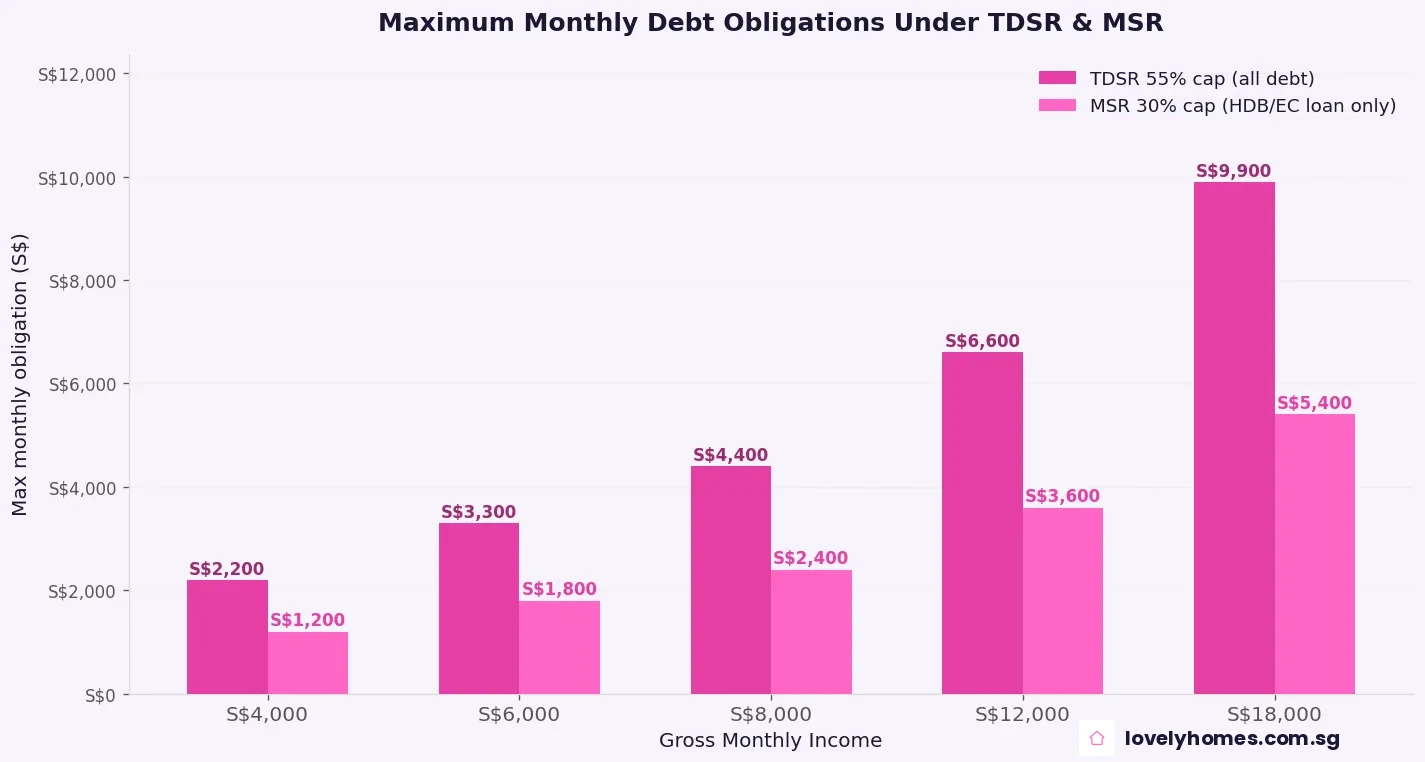
TDSR 55% vs MSR 30% maximum monthly debt obligations by gross monthly income Singapore 2026
Figure 1: Maximum monthly debt obligations under TDSR (55%) and MSR (30%) for gross monthly incomes of S$4,000 to S$18,000. MSR applies only to HDB and EC loans; TDSR applies to all property types.

LTV Limits: How Much Can You Borrow?

The Loan-to-Value (LTV) ratio sets the maximum loan amount as a percentage of the property’s purchase price or market valuation, whichever is lower. LTV rules are set by MAS and the HDB and operate independently of TDSR — both must be satisfied, and the lower of the two maximum loan amounts applies.

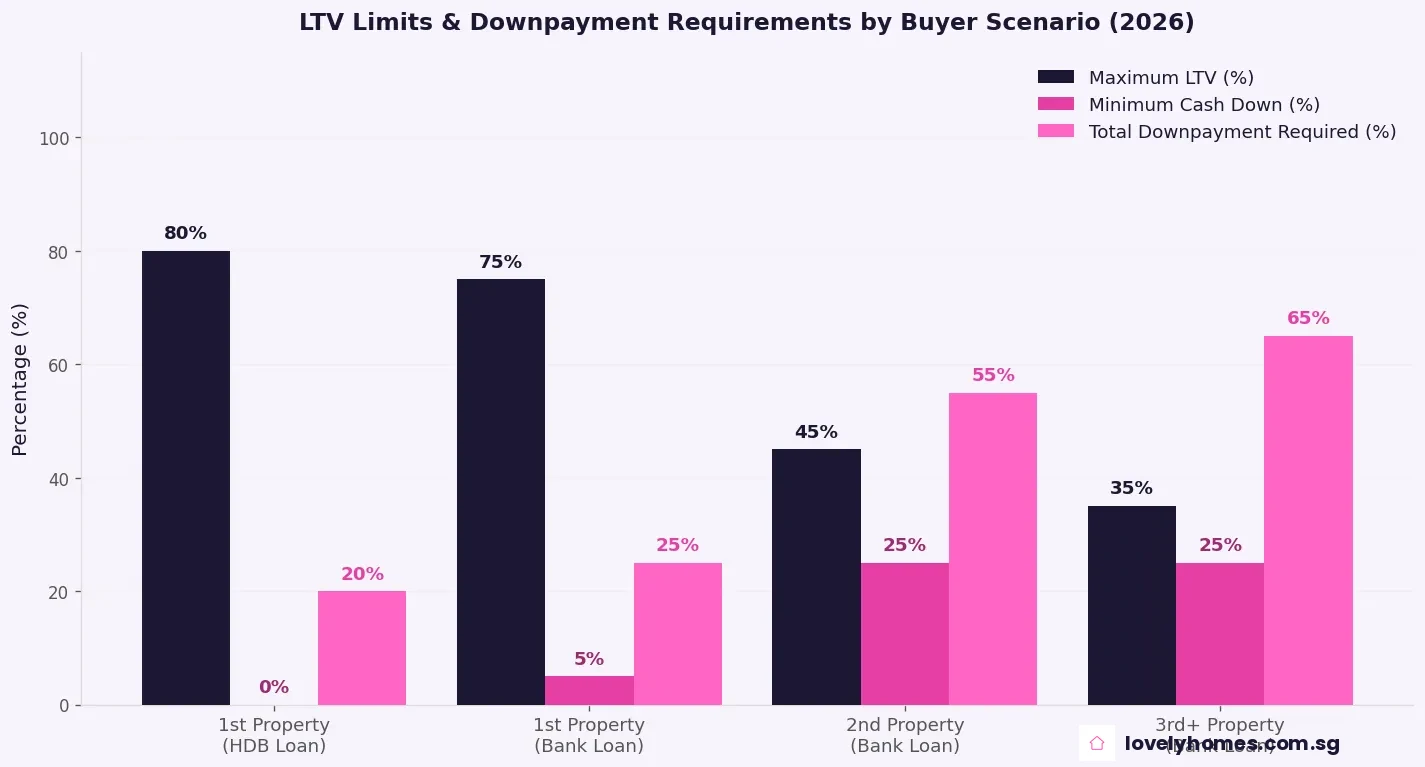
For a first residential property purchased with a bank loan, the LTV limit is 75%, meaning you can borrow up to three-quarters of the property value and must fund the remaining 25% from your own resources. Of that 25%, at least 5% must be paid in cash; the balance can come from CPF Ordinary Account (OA) savings. For second properties, the LTV drops sharply to 45%, with a minimum cash requirement of 25% of the purchase price. For third and subsequent properties, the LTV is 35%.

For HDB concessionary loans, the LTV is 80%, and HDB does not impose a minimum cash downpayment — the entire downpayment can be funded from CPF OA. This makes HDB loans particularly accessible for buyers with limited cash savings but healthy CPF balances.

LTV limits and downpayment requirements by buyer scenario Singapore 2026 first second third property
Figure 2: LTV limits and downpayment requirements by buyer scenario in Singapore 2026. Bank loans require 5% cash for first property and 25% cash for second or subsequent properties.

How TDSR Is Computed: What Counts as Debt?

Understanding what income and debt figures your bank will use is critical to knowing your real borrowing limit. The following guidelines apply under MAS Notice 632.

Income included in TDSR calculation: Fixed monthly salary, regular allowances confirmed by the employer, rental income (after a 30% haircut), and investment income (after a 30% haircut). Variable income such as commissions, bonuses and overtime is eligible but subject to a 30% haircut — meaning only 70% of your average variable income over the past 12 months is recognised.

Debt counted in TDSR: All monthly loan repayments must be included: the proposed housing loan instalment (calculated at the stress-test rate — see below), car loans, personal loans, outstanding credit card balances (counted at 5% of the outstanding balance per month, or the minimum monthly repayment if higher), student loans, and other secured or unsecured borrowings. Investment property loan instalments also count, even if the property is tenanted and generating rental income.

Debt excluded from TDSR: Insurance premiums, utility bills, hire-purchase agreements for vehicles entered into before 26 August 2013, and medisave contributions are excluded from the TDSR computation.

Stress-Test Rates: Why Your Maximum Loan Is Lower Than You Think

Banks do not use the actual prevailing interest rate when computing your TDSR. Instead, MAS requires them to use a stress-test rate — a notional higher rate designed to ensure you can still service the loan if interest rates rise. The stress-test rates currently prescribed under MAS Notice 632 are:

  • For floating-rate loans (e.g. SORA-pegged): the higher of the prevailing floating rate plus 1 percentage point, or 4% p.a.
  • For fixed-rate loans: the higher of the prevailing fixed rate, or 3% p.a.

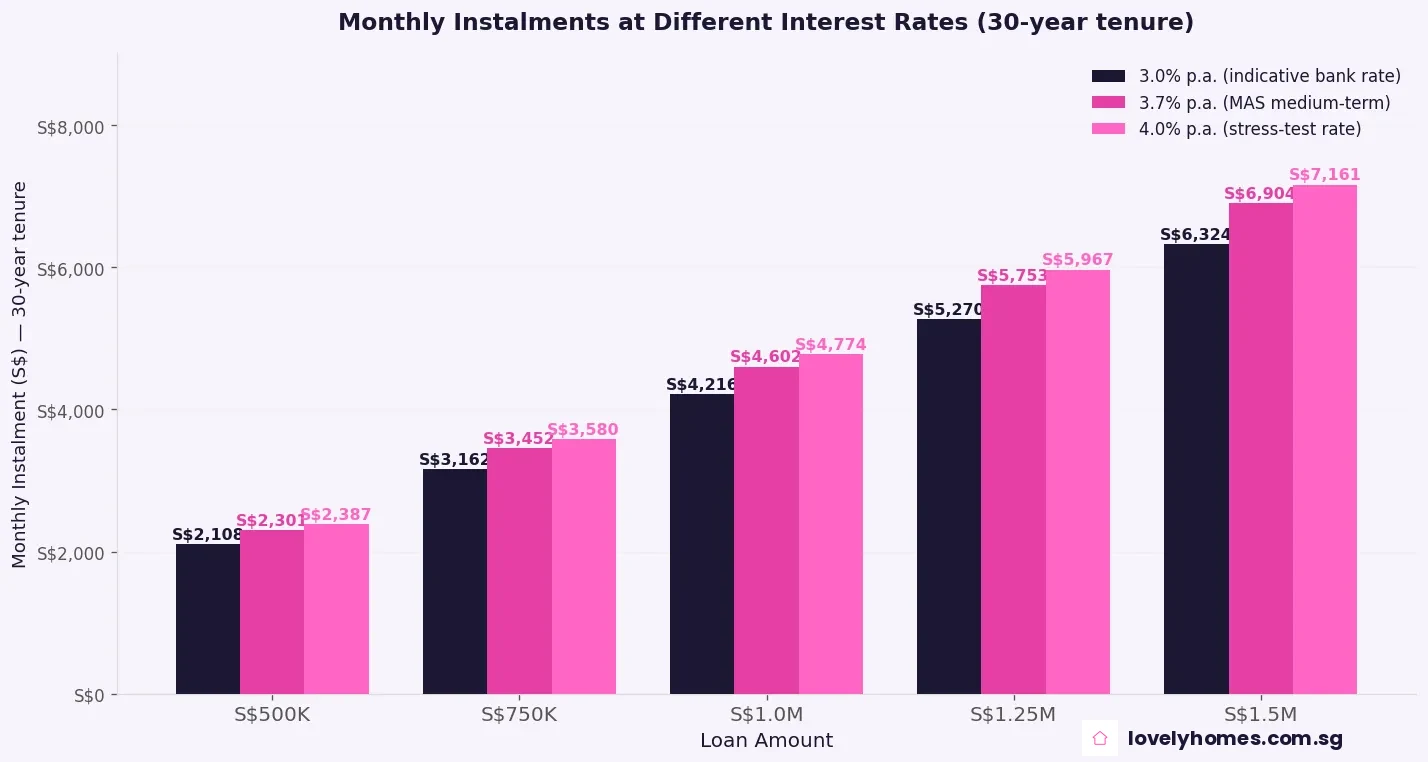
In practice, with SORA currently well below 3%, the 4% floor is the binding constraint for most floating-rate borrowers. This means your maximum eligible loan is calculated assuming you are already paying instalments at 4% p.a., even if the rate on offer today is significantly lower. This is a deliberate policy choice by MAS to build a buffer against rising rates.

Monthly instalments at different interest rates 3% 3.7% 4% stress test Singapore property loan 30-year tenure
Figure 3: Monthly instalments at 3.0% (indicative bank rate), 3.7% (MAS medium-term benchmark) and 4.0% (stress-test rate) for loan amounts from S$500,000 to S$1.5 million on a 30-year tenure. TDSR is assessed at the stress-test rate, not the actual rate.

Summary: TDSR & MSR Rules at a Glance (2026)

Rule Limit Applies To Administered By
TDSR 55% of gross monthly income All property loans (HDB, private, commercial) MAS (Notice 632)
MSR 30% of gross monthly income HDB and EC loan instalments only MAS / HDB
LTV (1st property, bank) 75% of value Bank loan for any property MAS
LTV (1st property, HDB loan) 80% of value HDB concessionary loan only HDB
LTV (2nd property, bank) 45% of value Any second property bank loan MAS
LTV (3rd+ property, bank) 35% of value Third or subsequent property MAS
Minimum cash (1st, bank) 5% of purchase price First property bank loan MAS
Minimum cash (2nd/3rd+, bank) 25% of purchase price Second and subsequent properties MAS

Worked Example: TDSR, MSR and LTV in Action

Mr and Mrs Wong are Singapore Citizens. Their combined gross monthly income is S$11,000 (Mr Wong S$7,000 fixed salary; Mrs Wong S$4,000 fixed salary). They have a car loan with a monthly instalment of S$900. They wish to purchase a 4-room HDB resale flat in Tampines for S$635,000. They are evaluating both an HDB concessionary loan and a bank loan on a 25-year tenure.

HDB concessionary loan scenario:
LTV 80%: maximum loan = S$635,000 x 80% = S$508,000.
Monthly instalment at 2.6% p.a. over 25 years: approximately S$2,305/month.
MSR check: S$2,305 / S$11,000 = 20.9% — well within the 30% MSR limit. PASS.
TDSR check: (S$2,305 + S$900) / S$11,000 = 29.1% — well within the 55% TDSR limit. PASS.
Minimum downpayment: 20% = S$127,000 (can be fully funded from CPF OA; no minimum cash required for HDB loans).

Bank loan scenario:
LTV 75%: maximum loan = S$635,000 x 75% = S$476,250.
Stress-test rate at 4% p.a. over 25 years: monthly instalment = approximately S$2,508/month.
MSR check: S$2,508 / S$11,000 = 22.8% — within 30% MSR limit. PASS.
TDSR check (stress test): (S$2,508 + S$900) / S$11,000 = 30.98% — within 55% TDSR limit. PASS.
Actual instalment at 3.5%: approximately S$2,383/month.
Minimum downpayment: 25% = S$158,750; of which at least 5% cash = S$31,750 (balance S$127,000 from CPF OA).

In this scenario, TDSR and MSR are easily met for both loan types. The practical constraint is the LTV: the HDB loan allows borrowing S$508,000 versus S$476,250 for the bank loan. Buyers who have CPF OA savings but limited cash liquidity will find the HDB loan more accessible (no minimum cash downpayment). Buyers with strong CPF balances and competitive fixed-rate offers from banks may prefer the bank loan to obtain a potentially lower effective rate.

Why These Rules Matter for Singapore Property Buyers

Singapore’s TDSR and MSR framework is among the most comprehensive borrower-protection regimes in the region. The rules serve two distinct purposes. First, they protect households from the financial distress that follows over-borrowing: a borrower who commits 70% of income to debt servicing has almost no buffer for unexpected expenses, job loss, or rising interest rates. Second, they cool speculative demand by making it harder to pyramid property loans across multiple properties without meaningful income growth.

In practice, buyers frequently misjudge how tightly the rules bind. A family with S$12,000 combined gross income and a S$1,500/month car loan can only allocate S$5,100 to housing (TDSR: S$6,600 minus S$1,500 car). At the 4% stress-test rate on a 30-year tenure, that limits the loan to approximately S$1.07 million — well below the 75% LTV on many private condominiums in the Outside Central Region. Knowing your TDSR headroom before you start viewing properties prevents disappointment.

Peer-country context: Hong Kong’s TDSR equivalent caps at 50% (with a 60% ceiling at higher LTV thresholds), and Australia imposes a 3 percentage-point serviceability buffer above the applicable rate under APRA guidelines. Singapore’s 55% TDSR with a 4% stress-test floor is broadly in line with international standards — firm enough to prevent excess, flexible enough not to freeze out creditworthy middle-income buyers.

What Might Change Next: Forward-Looking Considerations

MAS reviews the TDSR stress-test rates periodically. With the global rate cycle having peaked in 2023 and benchmark rates declining through 2025 and into 2026, some commentators have speculated that MAS may soften the 4% floor for floating-rate loans if SORA remains suppressed. However, as at August 2026, MAS has given no indication of adjusting TDSR parameters, and the existing framework is viewed as the appropriate long-term calibration. Buyers should plan on the basis of existing rules rather than anticipated relaxation.

The MSR 30% limit for HDB and EC loans has been stable since its introduction in 2013. Any increase in income ceilings for HDB flats or ECs (currently S$14,000 per month for standard HDB; S$16,000 for ECs) would expand the pool of eligible buyers without adjusting the MSR percentage itself.

Frequently Asked Questions

Does TDSR apply if I am buying a property under a sole name while my spouse has no income?

Yes. TDSR is applied to the borrower or borrowers named on the loan application. If you are the sole borrower, your gross monthly income alone is used. Your spouse’s income is only included if they are a co-borrower on the loan. Adding a co-borrower with income can increase your eligible loan amount, but both parties become jointly liable for the debt. If your spouse has no income and you are the sole earner, only your income is recognised by the lender.

How does rental income affect TDSR?

Rental income from an investment property is recognised in TDSR calculations, but only at 70% of its value (a 30% haircut, consistent with the treatment of other variable income). You will need to provide tenancy agreements, tax documents, or a lender-accepted declaration to have rental income recognised. Note that the full outstanding loan on the tenanted property (including its monthly instalment) still counts as debt in your TDSR calculation, so the net benefit of rental income on your TDSR position depends on the rental yield relative to the loan instalment.

Does MSR apply to EC purchases with a bank loan?

Yes. ECs are classified as public housing for the first 10 years (until privatisation), and MAS applies MSR to any bank loan used to purchase an EC during this period. This means your monthly EC loan instalment must not exceed 30% of gross monthly income, regardless of whether a bank or the developer is financing the purchase. For buyers comparing ECs with private condominiums, this is a material difference: the same gross income unlocks a meaningfully larger private loan under TDSR alone.

What happens to my TDSR if I have an outstanding renovation loan?

Renovation loans are unsecured personal loans and count in full toward your TDSR calculation. If you took a S$50,000 renovation loan repayable over 5 years at S$900/month, that S$900 reduces your TDSR headroom for the proposed mortgage. It is therefore advisable to either fully repay renovation and personal loans before applying for a property loan, or factor them into your borrowing plan from the outset. Most banks will decline or reduce a property loan application where existing debt already consumes a significant portion of the 55% ceiling.

Can I use my CPF savings to reduce the loan amount and improve my TDSR position?

Absolutely. Making a larger CPF downpayment reduces the loan principal, which in turn reduces the monthly instalment and therefore the TDSR ratio. For example, if you put 40% down using CPF OA rather than the minimum 20%, the loan drops from 80% to 60% of the property value, cutting the monthly instalment roughly proportionally. However, note that CPF savings earmark a 2.5% p.a. accrued interest charge: when you sell the property, the CPF board recoups the principal plus all accrued interest, which reduces your net sale proceeds. Using CPF to improve TDSR does not eliminate this cost.

Are there any exemptions from TDSR?

MAS provides a limited TDSR exemption for owner-occupier purchases where the outstanding loan amount does not exceed S$200,000. In practice, very few Singapore properties are priced low enough to benefit from this exemption. There is no general TDSR exemption for first-time buyers, for purchases of HDB flats, or for any particular nationality or residency status. The exemption for purely commercial properties (non-residential) is governed separately under a different MAS notice, and is generally not applicable to residential purchases.

Related Articles

Disclaimer

This article is for general information purposes only and does not constitute financial, legal or mortgage advice. TDSR, MSR and LTV rules are subject to change by MAS and HDB at any time. Borrowing limits depend on your individual financial profile, income documentation, and the specific property and loan product. Always consult a licensed financial adviser and your bank before committing to any property purchase or loan. Official sources: MAS (mas.gov.sg) and HDB (hdb.gov.sg).

Singapore TDSR Guide 2026: Total Debt Servicing Ratio Explained

Singapore TDSR Guide 2026: Total Debt Servicing Ratio Explained

⚡ Quick Answer: TDSR Singapore 2026

  • TDSR stands for Total Debt Servicing Ratio — a MAS rule capping all monthly debt repayments at 55% of gross monthly income.
  • All debts count: mortgage, car loan, personal loan, student loan, credit line, renovation loan — every obligation.
  • HDB and EC buyers face two limits: TDSR 55% (all debts) and MSR 30% (the HDB/EC mortgage alone).
  • Gross income is used, including CPF. Variable income (commission, bonuses) is typically haircut by 30%.
  • TDSR was reduced from 60% to 55% on 30 September 2022 — the tightening that cooled the 2022 market.
  • Banks stress-test at a slightly higher rate than your actual rate to ensure you can cope with rate rises.
  • Exceeding 55% = loan declined — no exceptions under MAS Notice 645 for residential property loans.

What Is TDSR and Why Did MAS Introduce It?

The Total Debt Servicing Ratio (TDSR) is a financial prudential measure introduced by the Monetary Authority of Singapore (MAS) on 29 June 2013 under MAS Notice 645. It requires every MAS-regulated financial institution in Singapore to verify that a borrower’s aggregate monthly debt obligations — across all loans, not just the new mortgage — do not exceed 55% of gross monthly income before extending a property loan.

The policy was created in response to a prolonged low-interest-rate environment that was encouraging households to borrow heavily for property. Without TDSR, a borrower could theoretically obtain a mortgage even if their total monthly repayments consumed 80% or more of their income. TDSR closed that gap by introducing a single universal ceiling enforced across all lenders simultaneously.

On 30 September 2022, MAS tightened the TDSR from 60% to its current 55%, as part of a package of property cooling measures. This 5-percentage-point reduction effectively cut maximum loan sizes by approximately 8-10% and is credited with contributing to the slower price growth seen in 2023 through 2025.

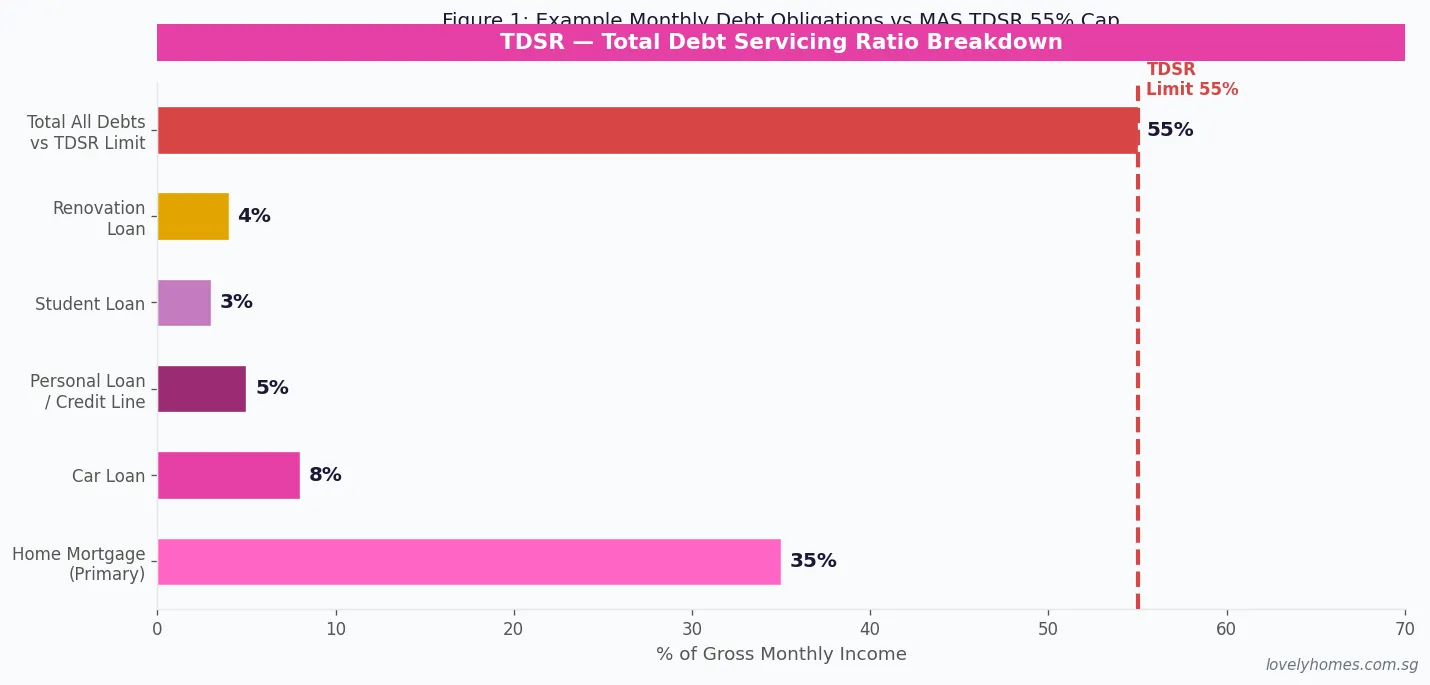
TDSR breakdown: example monthly debt obligations versus MAS 55% cap, Singapore 2026
Figure 1: Illustrative household with S$10,000 gross monthly income. The bars show how individual debts each consume a share of income, and how the 55% TDSR ceiling constrains the total. Source: MAS Notice 645; illustration by LovelyHomes.

How TDSR Is Calculated

The TDSR formula is:

TDSR = Total Monthly Debt Obligations ÷ Gross Monthly Income × 100
Must be ≤ 55% for a residential property loan to be approved under MAS Notice 645.

Gross monthly income includes fixed salary (before CPF deduction), allowances, and discounted variable pay. Variable components — commissions, overtime, bonuses, rental income — are typically reduced by 30% (i.e., the bank counts only 70% of such income). Self-employed borrowers must provide at least two years of IRAS Notices of Assessment; the bank uses the lower of the two-year average or the latest year’s net trade income, often with a further haircut.

Total monthly debt obligations covers: the proposed new property mortgage (at the bank’s applicable stress-test rate, which may be 0.5%–1% above your actual rate), all existing property loans, car hire purchase instalments, personal loan repayments, student loan repayments, credit card minimum payments (typically 5% of outstanding balance per month), and renovation loans.

If you own another property with an outstanding mortgage, that entire monthly repayment is included in your TDSR calculation for any new loan application. This is the key reason why owning multiple properties progressively reduces your borrowable amount on each subsequent purchase.

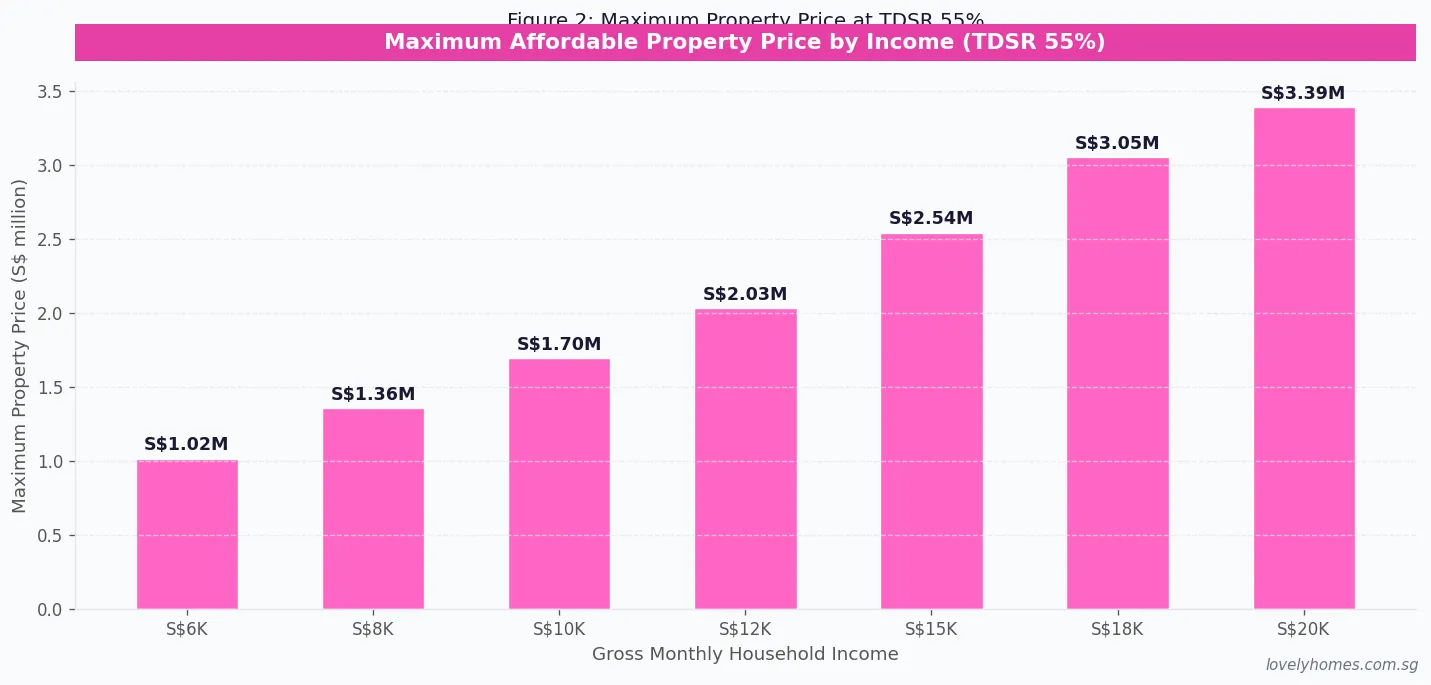
TDSR affordability chart: maximum property price by gross monthly income, Singapore 2026
Figure 2: Maximum property price at TDSR 55% with no other debts, 30-year bank loan at 3.2% p.a., 75% LTV. The chart shows the affordability ceiling for clean-balance-sheet borrowers. Source: LovelyHomes calculation.

TDSR for Different Property Types

The TDSR framework applies to all property loans extended by MAS-regulated financial institutions, but the practical constraints differ by property type:

Private residential (condominiums, apartments, landed homes): TDSR 55% applies. There is no separate MSR restriction. LTV starts at 75% for a first property, falling to 45% and 35% for second and subsequent properties respectively.

HDB resale flats (bank loan): Both TDSR 55% and MSR 30% apply simultaneously. MSR requires that the monthly HDB mortgage payment alone must not exceed 30% of gross income. MSR is usually the binding constraint for most HDB buyers since 30% is typically hit before the 55% TDSR ceiling.

HDB resale flats (HDB loan): The HDB Concessionary Loan is administered by HDB, not subject to MAS Notice 645 in the same way, but HDB applies its own 30% MSR equivalent. The HDB loan rate is pegged at 0.1% above the CPF OA rate, currently 2.6% per annum (effective 1 January 2026).

Executive Condominiums: Both TDSR 55% and MSR 30% apply at point of purchase. After the five-year mark, once an EC is privatised, resale buyers are only subject to TDSR (no MSR restriction).

Commercial and industrial property: TDSR applies but MAS sets the cap for non-residential property loans at 60% — a more lenient threshold than the 55% residential cap.

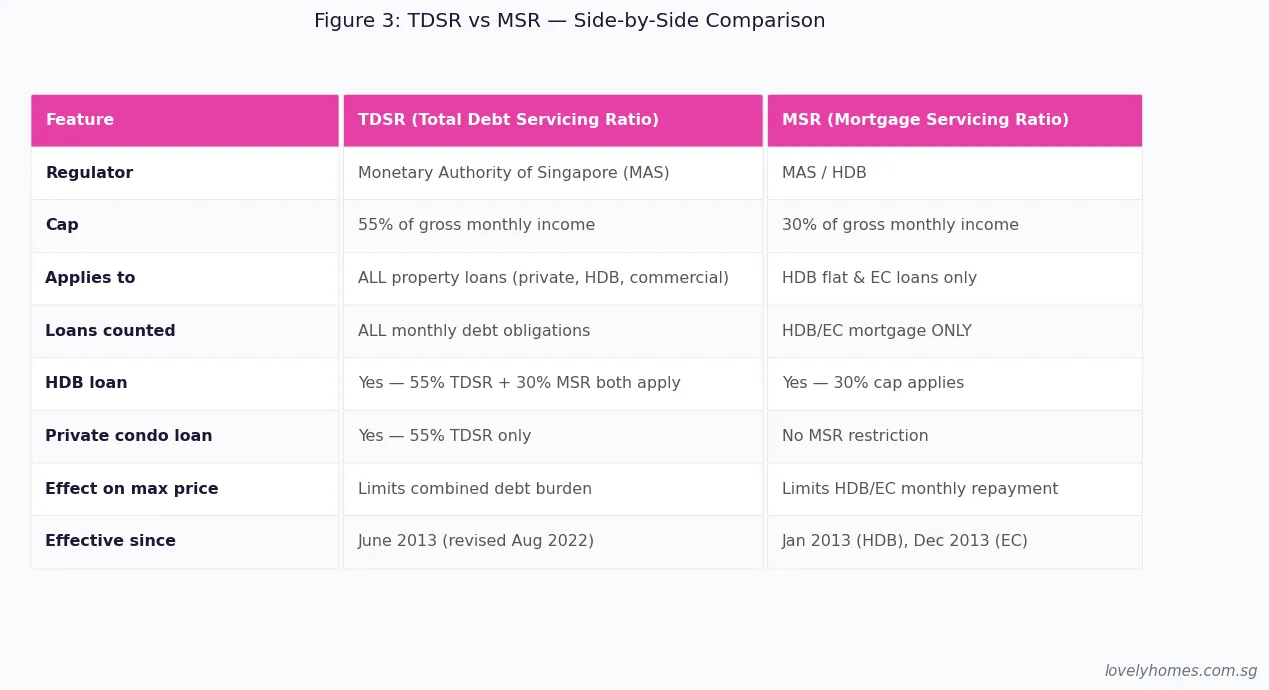
TDSR vs MSR comparison table — Total Debt Servicing Ratio vs Mortgage Servicing Ratio Singapore 2026
Figure 3: TDSR vs MSR side-by-side across eight dimensions. For HDB and EC buyers, both ratios apply simultaneously — the more restrictive constraint governs. Source: MAS Notice 645, MAS Notice 632; LovelyHomes.

TDSR and MSR — Summary Table

Loan / Property Type TDSR Cap MSR Cap LTV (1st Prop.) Notes
Private condo / landed (1st property) 55% None 75% 5% cash + CPF for balance of DP
Private condo / landed (2nd property) 55% None 45% 25% cash mandatory downpayment
Private condo / landed (3rd+ property) 55% None 35% 25% cash mandatory downpayment
HDB resale flat (bank loan) 55% 30% 75% Both caps apply; MSR typically binds first
HDB resale flat (HDB loan) N/A 30% 80% No cash DP required; CPF OA used
Executive Condominium (at launch) 55% 30% 75% 5% cash booking fee; MSR applies
Commercial / industrial property 60% None Up to 70% Higher TDSR cap for non-residential loans

Worked Example: Mr and Mrs Ong Buy Their First Private Condo

Mr and Mrs Ong are a Singapore Citizen couple. Combined gross monthly income: S$12,000 (Mr Ong S$7,500 fixed; Mrs Ong S$4,500, of which S$2,000 is commission).

Existing debts: car hire purchase S$850 per month; personal loan S$300 per month.

Target property: OCR 3-bedroom condo at S$1,500,000. Bank loan 75% LTV = S$1,125,000 over 30 years at 3.2% p.a. Monthly repayment: approximately S$4,862.

Income adjustment: Mrs Ong’s S$2,000 commission is haircut by 30% (bank counts S$1,400). Qualifying income = S$7,500 + S$2,500 fixed + S$1,400 variable = S$11,400 per month.

TDSR calculation: Total obligations = S$4,862 (new mortgage) + S$850 (car) + S$300 (personal) = S$6,012 per month. TDSR = S$6,012 ÷ S$11,400 = 52.7% — below the 55% cap. Loan approved (subject to credit assessment and valuation).

Sensitivity: If the Ongs wished to buy at S$1,700,000 instead (loan S$1,275,000, repayment ~S$5,517), total obligations would rise to S$6,667, giving TDSR = 58.5% — which exceeds 55%. The S$1,700,000 purchase would be declined unless they clear the car loan (saving S$850/mth) or increase their qualifying income.

Lesson: A single car loan can cost you S$200,000+ in purchasing power. Clearing non-housing debts before applying for a mortgage is one of the most effective ways to maximise your TDSR headroom.

Why TDSR Matters: Singapore in Global Context

Singapore’s TDSR framework is widely regarded as one of the most comprehensive income-based mortgage controls in the Asia-Pacific region. Countries like Australia and the UK use similar debt-to-income concepts in their macroprudential toolkits, but Singapore’s version is legally binding on all lenders — there is no discretion to override it for high-net-worth clients or particularly creditworthy borrowers.

The practical effect is a structurally cautious mortgage market. Singapore mortgage arrears remain among the lowest in Asia, and the 2022 cooling measures (which included the TDSR tightening) contributed to a soft-landing scenario rather than a sharp price correction. For buyers, this means the market is protected from speculative excess, but also that stretching to buy at the top of your affordability range carries real interest-rate risk if rates rise post-purchase.

What Might Change in TDSR Policy

MAS reviews the TDSR threshold as part of its broader macroprudential toolkit, typically alongside reviews of LTV limits and stamp duty rates. With the 3-month compounded SORA having eased to approximately 1.0% in early 2026, some market observers have speculated whether MAS might loosen the TDSR to 60% if sustained rate normalisation persists. However, as at June 2026, no public consultation or announcement has been made. Prospective buyers should plan all financing decisions on the current 55% threshold and not rely on any anticipated easing.

Frequently Asked Questions

Does CPF count as income in the TDSR formula?

The gross monthly income used in TDSR is your gross salary before CPF deduction. CPF contributions are not separately added — they are already implicit in the gross figure. However, CPF OA contributions do help service the mortgage (reducing your cash outlay), which gives HDB buyers and those using CPF for loan repayment meaningful payment relief even though the income figure itself is unchanged in the TDSR calculation.

Can I exclude a loan that will be fully paid in six months?

Some banks will exclude short-term residual debt (typically fewer than 6 to 12 months remaining) from the TDSR calculation at their discretion, since such obligations will not affect long-term serviceability. Policies differ by bank. If your car loan has only a few months left, it is worth asking your mortgage banker whether it will be included. Alternatively, fully clearing the loan before applying can improve your TDSR ratio — and often has an outsized positive impact on your maximum loan quantum.

What if my TDSR exceeds 55%?

A bank is required under MAS Notice 645 to decline your application if TDSR exceeds 55%. There is no exception or waiver for residential property loans. Your options are to: (a) make a larger downpayment to reduce the loan amount and therefore the monthly mortgage obligation; (b) clear existing debts before applying; (c) choose a lower-priced property; or (d) add a co-borrower whose income improves the combined TDSR, provided that person’s debts do not make things worse.

How is TDSR calculated for the self-employed?

Banks require at least two years of IRAS Notices of Assessment and, for incorporated businesses, audited or signed financial statements. Qualifying income is typically the lower of the two-year average or the most recent year’s net trade income. Many banks apply an additional haircut of 20–30% on top of this. Self-employed borrowers should expect their qualifying income to be assessed conservatively, which reduces their maximum mortgage relative to a salaried employee with the same stated earnings.

Does TDSR apply when I refinance?

Yes. Refinancing is a new loan application and must satisfy TDSR at the time of application. If your financial circumstances have changed since your original purchase — new debts, a drop in income — you may find you fail the current TDSR test even if you passed it years ago. This is an important practical risk for borrowers on fixed-rate packages coming up for repricing who intend to switch lenders.

Is TDSR the same as DSCR?

No. TDSR is a consumer-lending rule for individuals applying for property loans in Singapore. DSCR (Debt Service Coverage Ratio) is a commercial-lending metric used for corporate or commercial real estate loans; it measures whether a property’s net operating income covers its debt service. A residential buy-to-let investor is subject to TDSR on the individual borrower side; a developer or company owning commercial property typically uses the DSCR framework instead.

Joint purchase — is TDSR calculated on combined income?

Yes. Joint borrowers’ incomes are pooled and their debts are also pooled. This generally allows a couple to qualify for a much larger loan than either could secure individually. However, if one co-borrower carries significant debts (a large car loan, for instance), those debts also enter the combined TDSR calculation and reduce the joint loan quantum. Both parties will need to provide full income and liability documentation.

Related Articles


Disclaimer: This article is for general informational purposes only and does not constitute financial, tax, or legal advice. TDSR rules and MAS policies are subject to change without notice. All borrowers should seek independent advice from a licensed financial adviser or mortgage broker, and verify current rules directly with the Monetary Authority of Singapore at mas.gov.sg and the Housing & Development Board at hdb.gov.sg.

Singapore HDB Room Rental Guide 2026: Complete Guide to Renting Out Your HDB Room

Singapore HDB Room Rental Guide 2026: Complete Guide to Renting Out Your HDB Room

Quick Answer: HDB Room Rental Singapore 2026

  • No MOP required — you can rent out a room in your HDB flat immediately after taking possession; the Minimum Occupation Period applies only to whole-flat subletting.
  • HDB portal approval is required before any tenancy starts, including room rentals to non-citizens.
  • Non-Citizen Quota (NCQ): only 8% of flats in a neighbourhood and 11% in any block may house non-citizen, non-Malaysian tenants at any one time.
  • Malaysian citizens are NCQ-exempt — they may rent from any eligible HDB flat owner regardless of the quota.
  • Minimum tenancy is 6 months; maximum is 2 years per tenancy agreement (renewable).
  • Maximum occupancy for a 4-room or larger flat is 6 unrelated persons across all rooms.
  • All rental income is taxable under the Income Tax Act 1947; deductible expenses include mortgage interest, property tax, and maintenance fees.
  • IRAS filing deadline is 15 April each year for the preceding year’s rental income.

What Is HDB Room Rental and Who Administers It?

Renting out a room in your Housing Development Board (HDB) flat is one of the most tax-efficient ways to generate supplementary income in Singapore. Unlike renting out the entire flat — which requires the flat to have cleared its Minimum Occupation Period (MOP) — room rental has no MOP prerequisite. You can begin renting a spare bedroom the day after you collect your keys, provided you register the tenancy through the HDB e-Service portal and comply with the occupancy and quota rules administered by HDB.

HDB oversees room rental under the Housing and Development Act 1959 (Cap 129) and associated policies. The Inland Revenue Authority of Singapore (IRAS) governs the tax treatment of rental income under the Income Tax Act 1947. Both agencies updated their guidelines in 2024–2025; this guide reflects the rules as at June 2026.

Room rental is distinct from whole-flat subletting, which requires MOP clearance and a distinct approval process. For subletting of the entire flat, refer to our HDB Subletting Guide 2026.

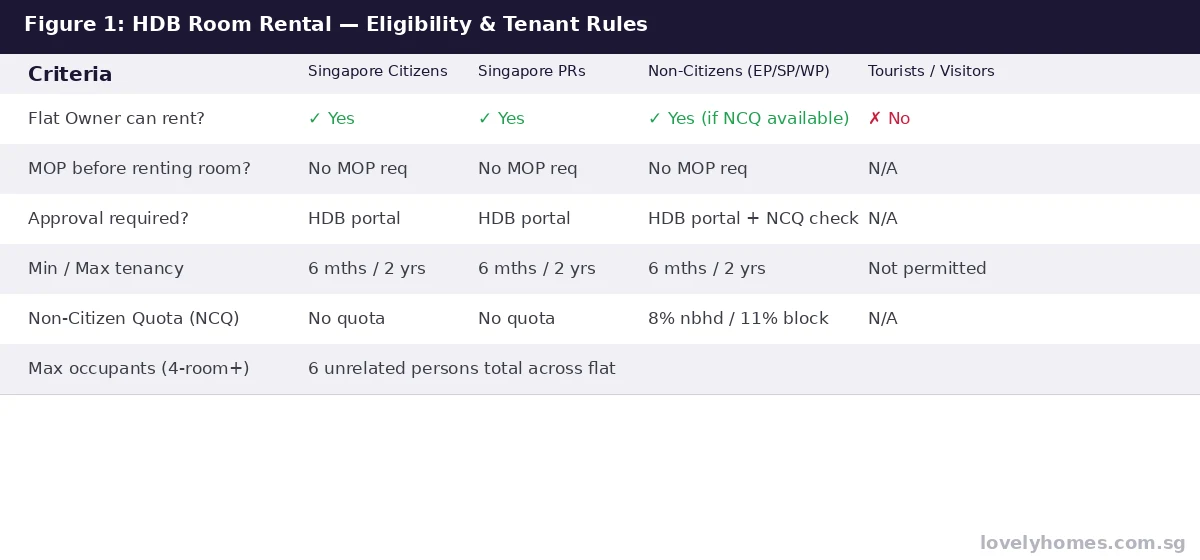
HDB room rental eligibility matrix Singapore 2026 who can rent to whom
Figure 1: HDB room rental eligibility and tenant rules across citizenship categories — including the NCQ.

HDB Room Rental Eligibility Rules

To rent out a room in your HDB flat, you must be a registered owner who satisfies all of the following conditions:

  • Flat ownership: You must be a registered owner of the flat (joint or sole). Tenants of HDB flats cannot sublet rooms.
  • Residency: At least one owner must continue to reside in the flat during the rental period. You cannot rent out all bedrooms and vacate — that constitutes whole-flat subletting and requires separate approval.
  • No MOP restriction for room rental: Unlike whole-flat subletting, there is no MOP period to serve before renting a room. This applies to BTO, resale, and DBSS flats.
  • Citizen/PR ownership: Only Singapore Citizens and Singapore Permanent Residents may own HDB flats.

Who Can Be Your Tenant?

Eligible tenants include Singapore Citizens, Singapore Permanent Residents, and non-citizens holding long-term passes such as Employment Passes (EP), S Passes, Work Permits (WP), Long-Term Visit Passes (LTVP), Student Passes, and Dependent’s Passes. Short-term visitors and tourists are not eligible. Non-citizens are subject to the Non-Citizen Quota (NCQ) — with the important exception that Malaysian citizens are NCQ-exempt.

Before commencing any tenancy with a non-citizen tenant, verify that NCQ slots are available for your block and neighbourhood, then register the tenancy on the HDB e-Service portal. Tenancies with Citizens and PRs do not require quota checks but must still be registered.

The Non-Citizen Quota (NCQ): How It Works

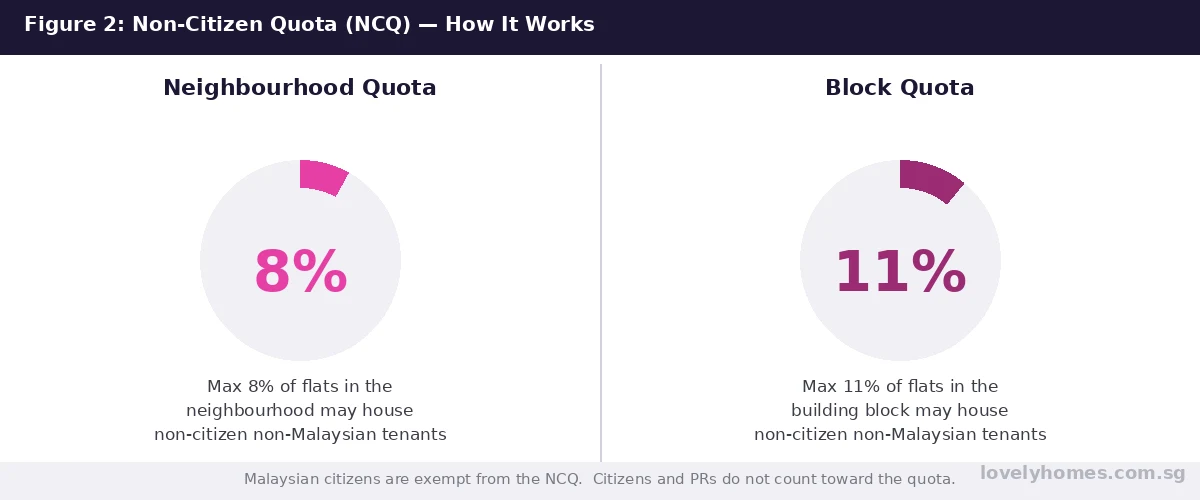
Non-Citizen Quota NCQ HDB room rental Singapore 8 percent neighbourhood 11 percent block
Figure 2: The NCQ caps — 8% neighbourhood, 11% block — apply to all non-citizen, non-Malaysian tenants in HDB room rentals.

The Non-Citizen Quota was introduced by HDB to maintain social integration in public housing estates and prevent over-concentration of foreign nationals in any single block or neighbourhood. Under the NCQ:

  • No more than 8% of all HDB flats in a neighbourhood may be occupied by non-citizen, non-Malaysian tenants at the same time.
  • No more than 11% of all HDB flats in any single block may be occupied by non-citizen, non-Malaysian tenants at the same time.

If either limit is reached, no new tenancy with a non-citizen, non-Malaysian tenant may commence in that neighbourhood or block until an existing occupancy clears. Malaysian citizens are entirely exempt from the NCQ. You can check real-time NCQ availability using the HDB NCQ portal.

Tenancy Duration and Registration

Each room rental tenancy must have a minimum duration of 6 months and a maximum of 2 years per agreement. Tenancies of less than 6 months — including Airbnb-style arrangements — are strictly prohibited and may result in compounding or flat confiscation. Registration is completed online via the HDB e-Service portal within 7 days of the tenancy start date.

Maximum Occupancy Limits

Flat Type Max. Occupants (All Rooms Combined) Notes
1-Room / 2-Room 4 unrelated persons Including the flat owner(s)
3-Room 6 unrelated persons Including the flat owner(s)
4-Room and above 6 unrelated persons Including the flat owner(s)
Executive / DBSS 6 unrelated persons Including the flat owner(s)
Studio Apartment Not eligible for room rental Intended for elderly residents only

The occupancy cap includes the flat owner(s) and all residents. A 4-room flat with two owner-occupiers can therefore accommodate at most 4 additional persons as tenants across all rooms.

Rental Income Tax: What You Must Declare to IRAS

All rental income from HDB room rental is assessable income under the Income Tax Act 1947 administered by IRAS. There are no exemptions for small amounts or casual arrangements. IRAS allows a range of deductible expenses that significantly reduce your net taxable rental income.

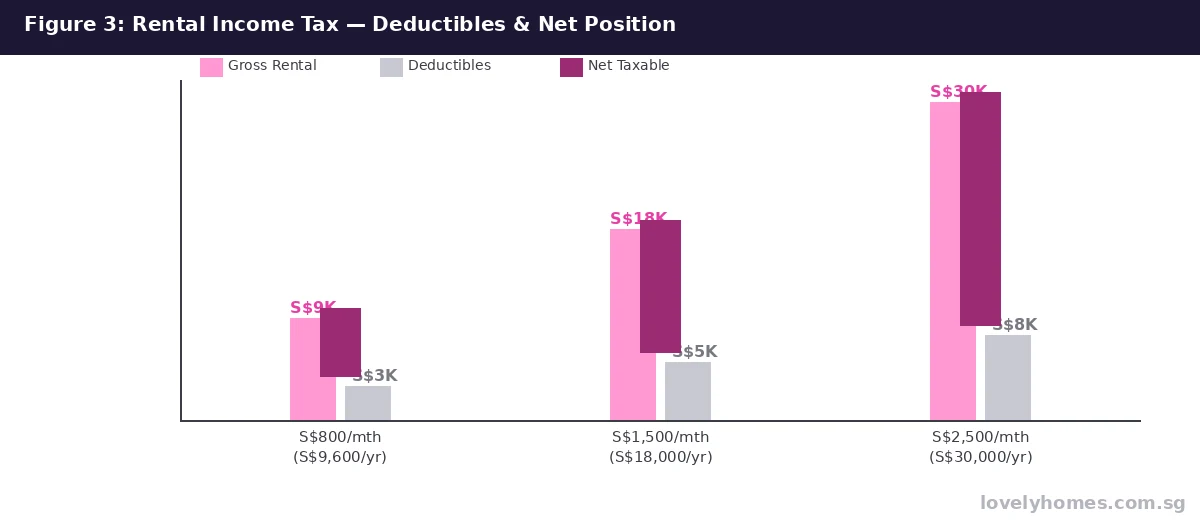
HDB room rental income tax deductibles net taxable Singapore 2026
Figure 3: Gross rental income versus allowable deductibles and the net taxable position at three common rent levels.

What Is Taxable?

Your gross rental income includes all amounts received from tenants: monthly rent, any lump-sum advance payment, and reimbursements for utilities or services. Security deposits are not income when received but become income if forfeited.

Allowable Deductions

Deductible Expense Basis Notes
Mortgage interest Actual interest portion of HDB or bank loan payments Principal repayment is NOT deductible
Property tax Annual property tax paid to IRAS Deductible in full as a cost of letting
Maintenance and conservancy charges Monthly S&CC paid to Town Council Pro-rated to rental period if flat was partly vacant
Repairs and maintenance Revenue repairs to restore lettable condition Capital improvements are NOT deductible
Insurance premiums Fire/content insurance attributable to the rental Home Protection Scheme premiums are NOT deductible
Agent commission Fees to a licensed estate agent for securing the tenancy Deductible in full in the year paid

The net rental income is added to your other income and taxed at Singapore’s progressive personal income tax rates (0% on the first S$20,000 of chargeable income, up to 24% above S$1,000,000 effective from YA 2024).

When and How to File

Rental income must be declared annually in your income tax return via IRAS’s myTax Portal. The filing deadline is 15 April of the following year. Retain receipts and tenancy agreements for at least 5 years as IRAS may audit rental declarations.

Worked Example: The Tan Family, Tampines 4-Room

Mr and Mrs Tan are Singapore Citizens who own a 4-room HDB flat in Tampines. They have one spare room and decide to rent it to a Malaysian work-pass holder at S$1,500 per month from 1 April 2026.

Step 1 — Eligibility: No MOP required. NCQ check: Malaysian citizens are NCQ-exempt. HDB portal registration completed 29 March 2026.

Income calculation (Year of Assessment 2027, calendar year 2026):

  • Gross rental income: S$1,500 x 9 months (Apr–Dec 2026) = S$13,500
  • Mortgage interest (annual S$8,400, pro-rated 9/12): S$6,300
  • Property tax (annual S$720, pro-rated 9/12): S$540
  • Maintenance fees (S&CC S$56 x 9 months): S$504
  • Total allowable deductions: S$7,344
  • Net taxable rental income: S$13,500 minus S$7,344 = S$6,156

Tax impact: Mr Tan earns S$72,000/yr. Adding S$6,156 raises chargeable income to approximately S$78,156. Marginal rate: 7% (S$40K–S$80K band). Incremental tax: approximately S$431. Net monthly cash after all costs and taxes: approximately S$1,014/month.

Why HDB Room Rental Matters for Flat Owners

Singapore has one of the highest rates of homeownership in the world — roughly 90% of residents live in public housing. Room rental offers a way to monetise a spare bedroom without the complexity of selling or refinancing. Industry figures show median room rents ranging from S$900/month in non-mature estates to S$2,200/month in central areas as at early 2026. With Singapore’s economy drawing a continued influx of international professionals, demand for affordable HDB rooms is expected to remain resilient.

For retirees, room rental income can supplement CPF LIFE payouts and reduce dependence on drawing down CPF savings. The Silver Housing Bonus (SHB) scheme, administered by HDB, provides additional cash bonuses of up to S$30,000 for elderly flat owners who right-size to smaller flats.

What Might Come Next: Future Policy Considerations

This section is editorial speculation and does not constitute confirmed government policy.

Short-term rental platforms such as Airbnb remain prohibited in HDB flats, and HDB is expected to continue enforcing this restriction. IRAS is rolling out auto-assessment for rental income by 2027, cross-checking declared rental income against HDB portal tenancy registrations. Flat owners who have not been filing rental income should consider voluntary disclosure via IRAS’s myTax Portal before automated enforcement begins. The NCQ thresholds of 8% and 11% have remained unchanged since 2012 and selective adjustments in newer estates with lower foreign-national density remain a possibility, though no change has been signalled as at June 2026.

Frequently Asked Questions

Can I rent out my HDB room before completing the Minimum Occupation Period?

Yes. The MOP restriction applies only to renting out the entire flat (whole-flat subletting), not to individual rooms. Room rental may commence immediately after the flat is handed over to you, subject to HDB portal registration and compliance with tenant eligibility and NCQ rules. If you are in the MOP period, you must continue to reside in the flat.

My block’s Non-Citizen Quota is full. Can I still rent to my Malaysian colleague?

Yes. Malaysian citizens are entirely exempt from the Non-Citizen Quota. The NCQ applies only to non-citizens who are not Malaysian. Your Malaysian colleague does not count toward the 8% neighbourhood or 11% block quota regardless of the pass type they hold. You can proceed with registration on the HDB portal without a quota check for Malaysian tenants.

Does HDB rental income affect my CPF contributions?

No. Rental income from HDB room rental is not employment income and is not subject to CPF contributions. It is, however, assessable income under the Income Tax Act and must be declared to IRAS. CPF voluntary top-up contributions remain available regardless of whether you earn rental income.

What happens if I rent out my room without registering on the HDB portal?

Renting out a room without HDB portal registration is a breach of the HDB lease. Consequences include a formal warning and compounding fine of up to S$5,000 per breach. Repeated or serious violations can result in HDB compulsorily acquiring the flat at HDB’s assessed valuation, which may be below open-market value. HDB conducts enforcement raids and acts on complaints from neighbours and town councils.

Can I deduct renovation costs or furniture purchases against rental income?

Generally, no. IRAS distinguishes between capital expenditure (acquiring or improving an asset) and revenue expenditure (maintaining the asset in its existing condition). Only revenue repairs are deductible. Furniture purchases are capital in nature and are not deductible. For specific situations, seek advice from a qualified tax practitioner or consult IRAS’s e-Tax Guide on rental income at iras.gov.sg.

How do I calculate the deductible mortgage interest for a joint HDB loan?

For an HDB concessionary loan, your annual statement from HDB shows the principal and interest breakdown for each repayment. Add up the interest components paid during the calendar year — this is your deductible amount. For a bank loan, your bank provides an annual loan statement. If you jointly own the flat, each co-owner may only deduct interest in proportion to their ownership share.

Can I rent a room to a family member who is a foreigner?

Yes, provided the family member holds an eligible pass (EP, S Pass, WP, LTVP, DP, Student Pass) and the NCQ is not exhausted for your block and neighbourhood (unless the family member is Malaysian). You still need to register the tenancy on the HDB portal. Close family ties do not create any exemption from HDB’s room rental registration requirements, though there is no restriction on the commercial terms of the tenancy.

Related Articles

Disclaimer

This article is produced by the LovelyHomes Editorial Team for general information purposes only. It is not legal, tax, or financial advice. HDB rules and IRAS tax regulations are updated periodically; always verify current requirements on hdb.gov.sg and iras.gov.sg before entering into any tenancy agreement. For personalised tax advice, consult a qualified tax practitioner.

HDB Resale Levy Singapore 2026: Complete Guide for Second-Timer Flat Buyers

HDB Resale Levy Singapore 2026: Complete Guide for Second-Timer Flat Buyers

Quick Answer — HDB Resale Levy at a Glance

  • The HDB Resale Levy applies when a second-timer household buys a new BTO flat or a new Executive Condominium (EC) from a developer after previously enjoying a housing subsidy.
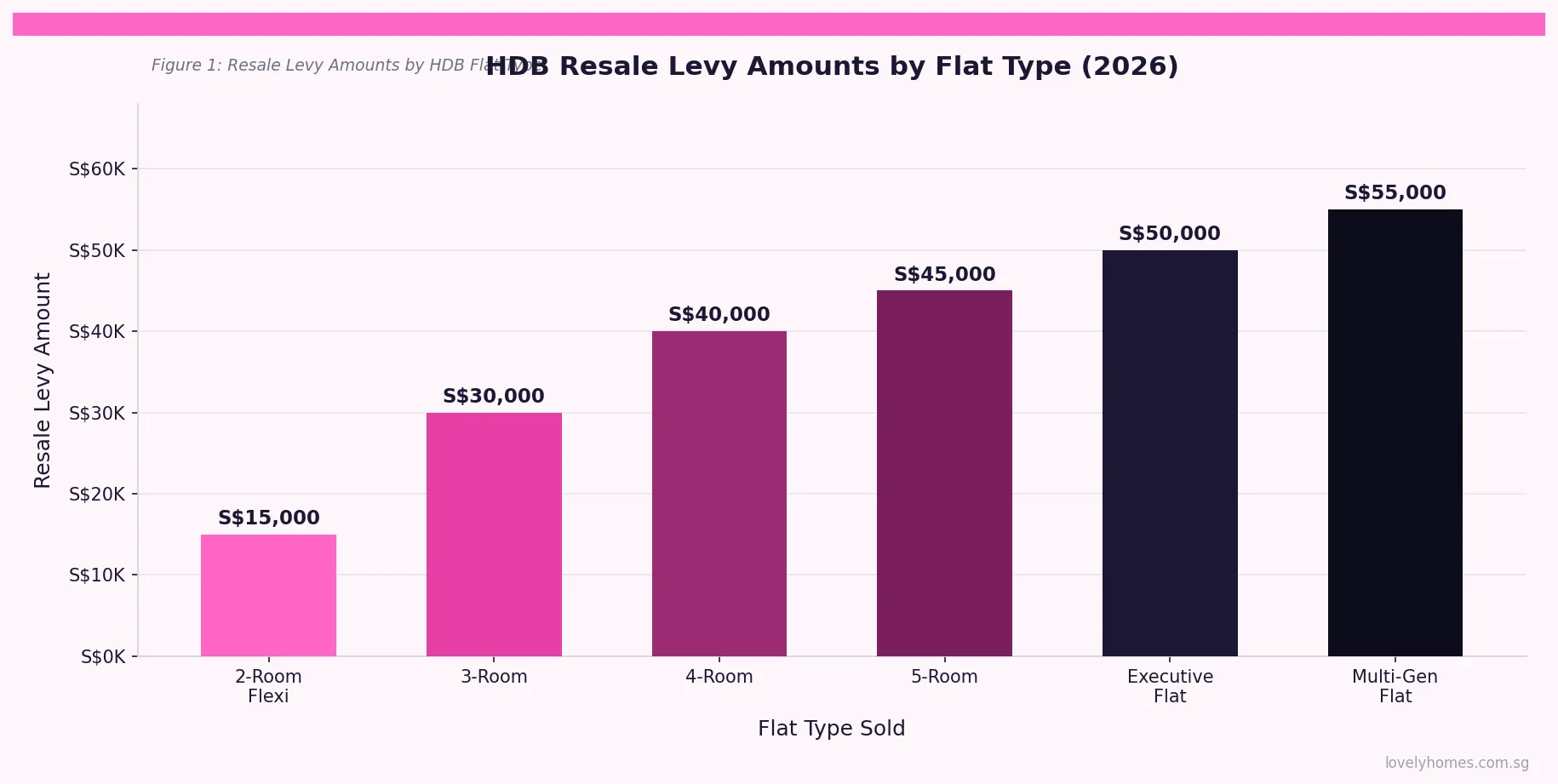
  • Levy amounts range from S$15,000 (2-Room Flexi) to S$55,000 (Multi-Generation flat), based on the flat type you are selling.
  • The levy does not apply if you buy a resale HDB flat on the open market, or if you buy private property.
  • Payment comes from your sale proceeds (CPF refund + cash). If proceeds fall short, you must top up in cash.
  • The policy ensures those who already benefited from a large housing subsidy pay back a portion before receiving a second round of public housing support.
  • If your previous subsidised home was an Executive Condo (EC), the levy is calculated differently: 15% of your net EC resale proceeds, subject to a minimum of S$15,000.
  • Singles under the Single Singapore Citizen (SSC) scheme or Joint Singles Scheme may also be subject to the levy if buying a second subsidised flat.

What Is the HDB Resale Levy?

The HDB Resale Levy is a financial charge levied by the Housing and Development Board (HDB) on households who apply to purchase a second new subsidised flat — either a Build-to-Order (BTO) flat or a new Executive Condominium (EC) sold directly by a developer — after having previously benefited from a public housing subsidy.

The policy exists to uphold the principle of equity in Singapore’s public housing system. New BTO flats and ECs are sold at prices significantly below open-market value, a subsidy funded by taxpayers. HDB’s view is that once a household has enjoyed this advantage, they should not receive the same full quantum of subsidy a second time without contributing back to the system. The resale levy is that contribution.

Introduced in its current fixed-amount form for households that sold their first subsidised flat on or after 3 March 2006, the levy has remained a cornerstone of Singapore’s housing mobility framework. HDB administers the levy directly, collecting it at the point when the second subsidised flat purchase is completed.

HDB Resale Levy amounts by flat type Singapore 2026 bar chart
Figure 1: HDB Resale Levy amounts by flat type — from S$15,000 (2-Room Flexi) to S$55,000 (Multi-Generation). Source: HDB, 2026.

Who Has to Pay the HDB Resale Levy?

The levy applies specifically to second-timer households. HDB classifies a household as a second-timer when at least one applicant has previously:

  • Received a housing subsidy from HDB — including the Enhanced CPF Housing Grant (EHG), the Central Provident Fund Housing Grant (CPF-HG), the Special CPF Housing Grant (SHG), or any earlier-generation grant — when buying a resale flat; or
  • Bought a new BTO, Build-to-Order Sales of Balance Flats (SBF), or EC flat directly from a developer.

If you are a first-timer — meaning you have never previously bought an HDB flat or EC, and have not received a CPF housing grant for a resale purchase — you do not pay the resale levy on your first BTO or EC purchase, regardless of price or flat type.

The levy also applies to Singles buying under the Single Singapore Citizen (SSC) scheme who have previously owned a subsidised flat, and to non-citizen spouses in joint applications where the Singapore Citizen applicant is a second-timer.

Resale Levy Amounts by Flat Type (2026)

The levy is fixed and based on the type of HDB flat you are selling, not on the purchase price of your next flat. This table shows the 2026 schedule:

Flat Type Sold Resale Levy (Fixed) Notes
2-Room Flexi S$15,000 Lowest levy; applies to Type 1 and Type 2 2-room flats
3-Room S$30,000 Applies to 3-room BTO and resale-with-grant flats sold
4-Room S$40,000 Most common flat type; levy payable on proceeds
5-Room S$45,000 Includes 5-room improved and 5-room model A flats
Executive Flat S$50,000 Applies to executive maisonettes and executive apartments
Multi-Generation (Multi-Gen) Flat S$55,000 Highest fixed levy; Multi-Gen flats are rare and targeted at three-generation families
DBSS Flat By flat type equivalent A DBSS 4-room incurs S$40,000; 5-room incurs S$45,000
Executive Condominium (EC) 15% of net resale proceeds (min. S$15,000) Only applies if you previously bought an EC directly from a developer and are now buying a new BTO/EC

Key point on DBSS flats: Design, Build and Sell Scheme (DBSS) flats are treated equivalently to standard HDB flats of the same flat type for levy purposes. The levy on a 4-room DBSS flat sold is S$40,000 — the same as a standard 4-room HDB.

Key point on ECs: Executive Condominiums sold before their 5-year Minimum Occupation Period (MOP) are treated differently. If you sold your EC at the 5-year MOP mark (when it is still classified as an HDB property for resale purposes) and wish to buy another subsidised flat, your levy is calculated at 15% of the net resale price of the EC, not a fixed sum. The minimum levy is S$15,000.

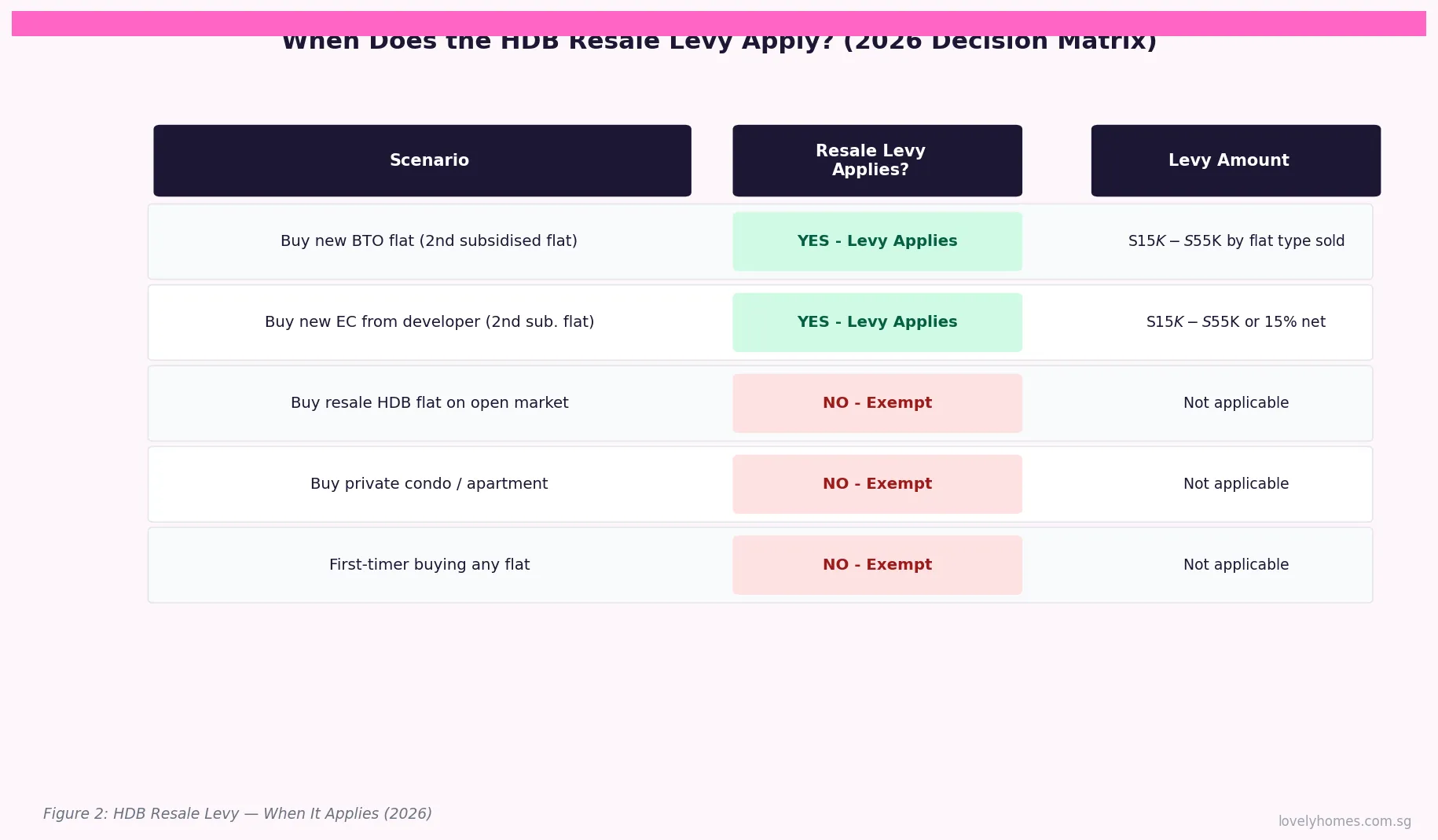
When HDB Resale Levy applies decision matrix Singapore 2026
Figure 2: HDB Resale Levy decision matrix — when the levy applies and when it does not. Source: HDB, 2026.

When Does the Resale Levy Apply?

The trigger for the levy is narrow and precise: it applies only when a second-timer household purchases a new subsidised flat from HDB directly (BTO or SBF exercise) or a new EC from a developer. It does not apply in any of the following scenarios:

  • Buying a resale HDB flat on the open market — even if you are a second-timer, no levy is charged when you buy a resale flat (though you will also receive no EHG or CPF housing grants).
  • Buying private property — the levy is exclusively a feature of the subsidised public housing system.
  • Transferring ownership within the family — an intra-family transfer is not a new subsidised purchase and does not trigger the levy.
  • First-timers — by definition, if you have not previously received a housing subsidy, the levy does not apply.

One nuance worth noting: if you buy a resale HDB flat with a CPF housing grant (making you a subsidised buyer of a resale flat), you become a second-timer for future subsidised flat purchases. Should you later apply for a BTO or new EC, the resale levy will apply at that stage, calculated on the flat you had originally bought with the grant.

How Is the Resale Levy Paid?

The levy is deducted from the proceeds of your flat sale. In practice, HDB coordinates the payment as part of the resale transaction. The sequence is:

  1. You agree to sell your existing flat and apply for a new BTO flat or EC concurrently.
  2. At the point of your existing flat’s resale completion, HDB retains the levy amount from the sale proceeds.
  3. The retained amount is credited to HDB’s account — it is not returned to your CPF Ordinary Account.
  4. If your sale proceeds (after CPF refund) are insufficient to cover the levy, you must make up the shortfall in cash.

Unlike CPF principal and accrued interest (which are refunded to your CPF OA and can be redeployed for the next flat), the resale levy is gone once deducted. It is a one-time levy and cannot be offset against BSD, legal fees, or any other cost of the new purchase.

There is no option to defer the levy or to split it across multiple payment dates. It must be settled in full at the point of sale completion of the existing flat. HDB does not currently offer any hardship waiver or instalment arrangement for the levy.

Net Proceeds After the Levy

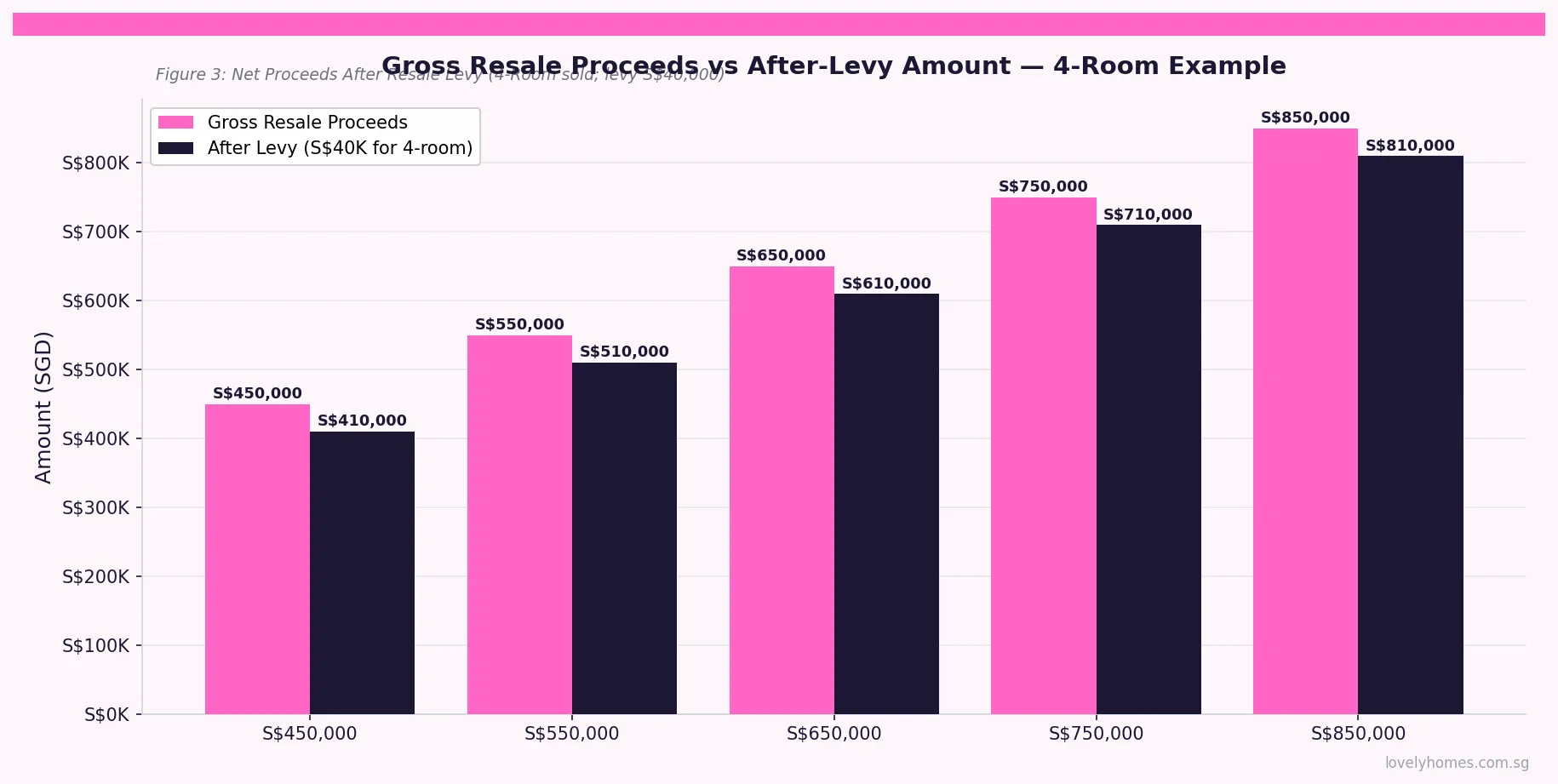
Understanding your effective net proceeds after the levy is deducted helps with financial planning for your next purchase. The chart below illustrates how the S$40,000 levy on a 4-room flat affects gross sale proceeds at five common price points:

HDB resale proceeds after levy deduction 4-room flat Singapore 2026
Figure 3: Gross resale proceeds vs after-levy amount for a 4-room flat at five price points. Levy of S$40,000 deducted at source. Source: HDB; LovelyHomes calculations, 2026.

Critically, the levy reduces the pool of funds available for your CPF Ordinary Account refund and cash portion. If you are relying on the proceeds to fund the downpayment on a new BTO flat, factor the levy deduction in from the outset. A 4-room flat sold at S$550,000 effectively becomes S$510,000 in terms of what flows back to you and HDB.

Resale Levy vs HDB Grants: The Netting Question

A common question from second-timers is whether HDB grants can offset the resale levy. The short answer is no. Grants and the levy operate entirely separately:

  • Second-timers who buy a new BTO flat receive reduced grants compared to first-timers. For example, a second-timer buying a new BTO flat under the Step-Up CPF Housing Grant may receive S$15,000 — far less than the S$80,000–S$120,000 available to first-timer families under the EHG.
  • The resale levy is charged in addition to the reduced grant quantum. It is not deducted from any grant or factored into the BTO price.
  • The combined effect is that second-timers face a higher effective cost of a new BTO purchase: less grant assistance AND an upfront levy payment.

This is the intended design. HDB’s rationale is that second-timers have already benefited significantly from the subsidised housing system and have had the opportunity to accumulate equity in their first flat. The reduced grants and levy together calibrate the subsidy quantum to reflect that prior benefit.

Worked Example: The Yip Family’s Resale Levy Calculation

Scenario: 4-Room Flat Sold, New 4-Room BTO Purchased

Mr and Mrs Yip, both Singapore Citizens, bought a 4-room BTO flat in Punggol in 2014 for S$390,000. They are now selling the flat (estimated market value S$610,000) and applying for a new 4-room BTO flat in Tengah under the Married Child Priority Scheme.

Item Amount
Gross resale price of Punggol 4-room flat S$610,000
CPF principal drawn + accrued interest (estimated) S$320,000 (refunded to CPF OA)
Outstanding HDB mortgage balance S$48,000 (repaid from proceeds)
HDB Resale Levy (4-room sold) S$40,000
Agent commission (1% + 9% GST) S$6,649
Legal fees (seller) S$2,500
Net cash proceeds to Mrs & Mr Yip S$192,851

New Tengah BTO (4-room, estimated S$480,000 — Plus model):

Item Amount
BTO price S$480,000
Step-Up CPF Housing Grant (2nd-timer) -S$15,000
Net payable S$465,000
HDB loan (80% LTV, 2nd-timer eligible) S$372,000 @2.60% 25yr = S$1,682/mth (MSR 18.7% of S$9,000/mth joint income)
Downpayment (20% — CPF OA) S$93,000 from CPF OA refund
BSD (S$480,000) S$8,700
Legal fees (buyer) S$2,500
Remaining CPF OA balance after DP S$227,000 (reserve for mortgage servicing)

MSR check: S$1,682 / S$9,000 = 18.7% — within 30% MSR limit. TDSR not applicable (HDB loan). The S$40,000 resale levy is a sunk cost; Mr and Mrs Yip’s CPF OA reserve of S$227,000 provides strong mortgage cover for the Tengah BTO.

What This Means for Second-Timers Planning to Upgrade

The resale levy is best understood as a built-in “subsidy recapture” mechanism. For households who bought a 3-room or 4-room BTO flat in the 2010s and have watched flat values rise substantially — Tampines 4-rooms regularly changing hands above S$600,000 in 2025–2026 — the S$30,000–S$40,000 levy is relatively modest relative to the capital gain they have made. In such cases, the levy is unlikely to derail the upgrade path.

The levy becomes more financially significant in two scenarios: (a) where the flat was held for a shorter period and appreciation is limited, or (b) where the household plans to buy a new EC priced at the upper end of the income ceiling — here, the reduced grant quantum combined with the levy can meaningfully increase the cash component required at completion.

From a policy perspective, Singapore’s resale levy is notably lighter than comparable mechanisms in other high-density housing markets. Hong Kong’s Home Ownership Scheme imposes resale restrictions rather than monetary levies; Taiwan’s affordable housing schemes cap resale gains outright. Singapore’s fixed-levy approach offers transparency and predictability — households know their exact levy exposure from the moment they decide to sell.

What Might Come Next

The following is editorial speculation based on observed policy trends and should not be relied upon for financial decisions.

HDB has not adjusted the fixed resale levy amounts since the current schedule took effect in 2006. Given that resale flat prices have increased substantially over the past two decades — the HDB Resale Price Index rose from a base of 100 in 1998 to approximately 183 in early 2026 — there is a reasonable argument that the S$15,000–S$55,000 range represents a declining proportion of the subsidy value enjoyed by second-timers.

Industry observers have periodically suggested that HDB may consider indexing levy amounts to flat values or the RPI. A levy pegged at, say, 7%–8% of the median resale price of the flat type sold would automatically adjust over time. Whether HDB will move in this direction is unknown; any change would likely be accompanied by an extended transition period given the direct impact on household finances.

Frequently Asked Questions

I’m selling a 4-room flat but buying a 3-room BTO. Does the levy depend on what I buy or what I sell?

The levy is calculated based on the flat type you are selling, not the flat type you are buying. If you sell a 4-room flat, you pay S$40,000 regardless of whether you buy a 2-room, 3-room, or 5-room BTO next. The type of your next flat does not affect the levy amount.

My spouse is a first-timer but I am a second-timer. Do we pay the resale levy?

Yes. In a joint application, if any one applicant is classified as a second-timer, the household is treated as a second-timer application and the resale levy applies. The levy is calculated on the flat type sold by the second-timer applicant. This is a common scenario for couples where one partner previously owned a subsidised flat before the marriage.

Can I use CPF Ordinary Account funds to pay the resale levy?

No. The resale levy is not a property purchase cost that HDB allows to be paid from CPF. It is deducted from the proceeds of the sale of your existing flat — which includes CPF funds refunded from that sale — but the levy itself flows out of those proceeds before they are returned to your CPF OA. The practical effect is that the levy reduces the CPF amount credited back to your OA, and any shortfall must be topped up in cash. You cannot make a direct CPF OA withdrawal specifically for the levy.

Does the resale levy apply if I sell my HDB flat to buy a private condo?

No. The resale levy only applies when you are purchasing a new subsidised flat (BTO, SBF, or new EC from a developer). If you sell your HDB flat and purchase a private condominium, no resale levy is charged. You may, however, incur ABSD if you own or co-own any other residential property at the time of the private property purchase. The levy and ABSD are separate instruments with separate triggers.

What happens if my resale proceeds are not enough to cover the levy?

If the net proceeds from your flat sale (after repaying the HDB mortgage and refunding CPF principal + accrued interest to your CPF OA) are insufficient to cover the levy, you must pay the shortfall in cash before the resale transaction can be completed. HDB will not approve the new flat application until the levy is settled in full. There is no waiver, reduction, or instalment scheme for the levy, even in cases of genuine financial hardship.

I sold my 4-room flat in 2004. Does the current levy schedule apply to me?

No. The fixed-levy schedule described in this guide applies only to households who sold their first subsidised flat on or after 3 March 2006. If you sold your first subsidised flat before that date, the earlier levy framework applies, which was based on a percentage of the resale price (15% for 3-room and above). If you are uncertain which regime applies to you, contact HDB directly with your transaction details.

My previous flat was a DBSS flat I bought from a developer. Do I pay the levy?

Yes, if the DBSS flat was purchased directly from a developer under HDB’s Design, Build and Sell Scheme, you are considered to have purchased a subsidised flat. When you sell the DBSS flat and apply for a new BTO or EC, the resale levy applies based on the flat type of the DBSS flat sold. A 4-room DBSS attracts S$40,000; a 5-room DBSS attracts S$45,000. The levy is the same as for a standard HDB flat of the equivalent type.

Disclaimer: This article is for general informational purposes only and does not constitute financial, legal, or property advice. HDB policies, levy amounts, and grant quantum are subject to change. Readers should verify current rules directly with HDB at hdb.gov.sg, and with IRAS at iras.gov.sg for stamp duty matters and cpf.gov.sg for CPF withdrawal rules. Worked examples use estimated figures for illustration; actual financial outcomes will vary. Consult a licensed property professional and a qualified financial adviser before making any housing decision.

×

Click anywhere to close

Translate »