HDB Resale Levy Singapore 2026: Amounts, Who Pays, Exemptions and How It Works

HDB Resale Levy Singapore 2026: Amounts, Who Pays, Exemptions and How It Works

HDB resale levy Singapore 2026 complete guide
Figure 0: HDB Resale Levy Singapore 2026 — Complete Guide to Amounts, Exemptions and How It Works

Quick Answer — HDB Resale Levy at a Glance

  • The HDB Resale Levy is a payment required when a second-timer household buys a new subsidised HDB flat or an Executive Condominium (EC) unit after previously enjoying a housing subsidy.
  • Levy amounts range from S$15,000 (for a 2-Room Flexi sold) to S$55,000 (for a DBSS flat sold), with EC buyers paying 5% of resale price (capped at S$55,000).
  • It is paid by deduction from the CPF refund when your first flat is sold — you do not write a cheque.
  • Exemptions apply if you bought your first flat on the resale market without any CPF Housing Grant, inherited the flat, or received it via a court order.
  • The levy does not apply when buying a private property — only a second subsidised HDB flat or EC triggers it.
  • Getting the levy wrong can delay your second flat booking and result in owing HDB cash if your CPF proceeds are insufficient.
  • From 3 March 2006, all levy amounts were fixed at the flat-type level — they are not a percentage of the first flat’s resale price (except for EC).

What Is the HDB Resale Levy?

The HDB Resale Levy is a subsidy recovery mechanism administered by the Housing & Development Board (HDB) under Singapore’s public housing framework. When the government provides a housing subsidy — such as the Central Provident Fund (CPF) Housing Grant, the Additional CPF Housing Grant (AHG), the Special CPF Housing Grant (SHG), or the Enhanced CPF Housing Grant (EHG) — it does so on the understanding that this benefit is tied to one subsidised flat per household. If that household later purchases a second subsidised flat or Executive Condominium unit, they are required to “return” a portion of the earlier subsidy benefit in the form of the resale levy.

The policy was introduced to ensure that public housing subsidies are targeted at households that genuinely need them and to maintain the long-term sustainability of Singapore’s public housing system. HDB administers the levy and collects it automatically at the point of sale of the first flat — it is not a separate bill sent to you but a deduction from your CPF Ordinary Account (OA) proceeds before they are refunded.

As at July 2026, the levy framework has remained stable since the flat-type rate schedule was fixed on 3 March 2006. Understanding it correctly is essential for any second-timer household planning to upgrade or right-size within the public housing system.

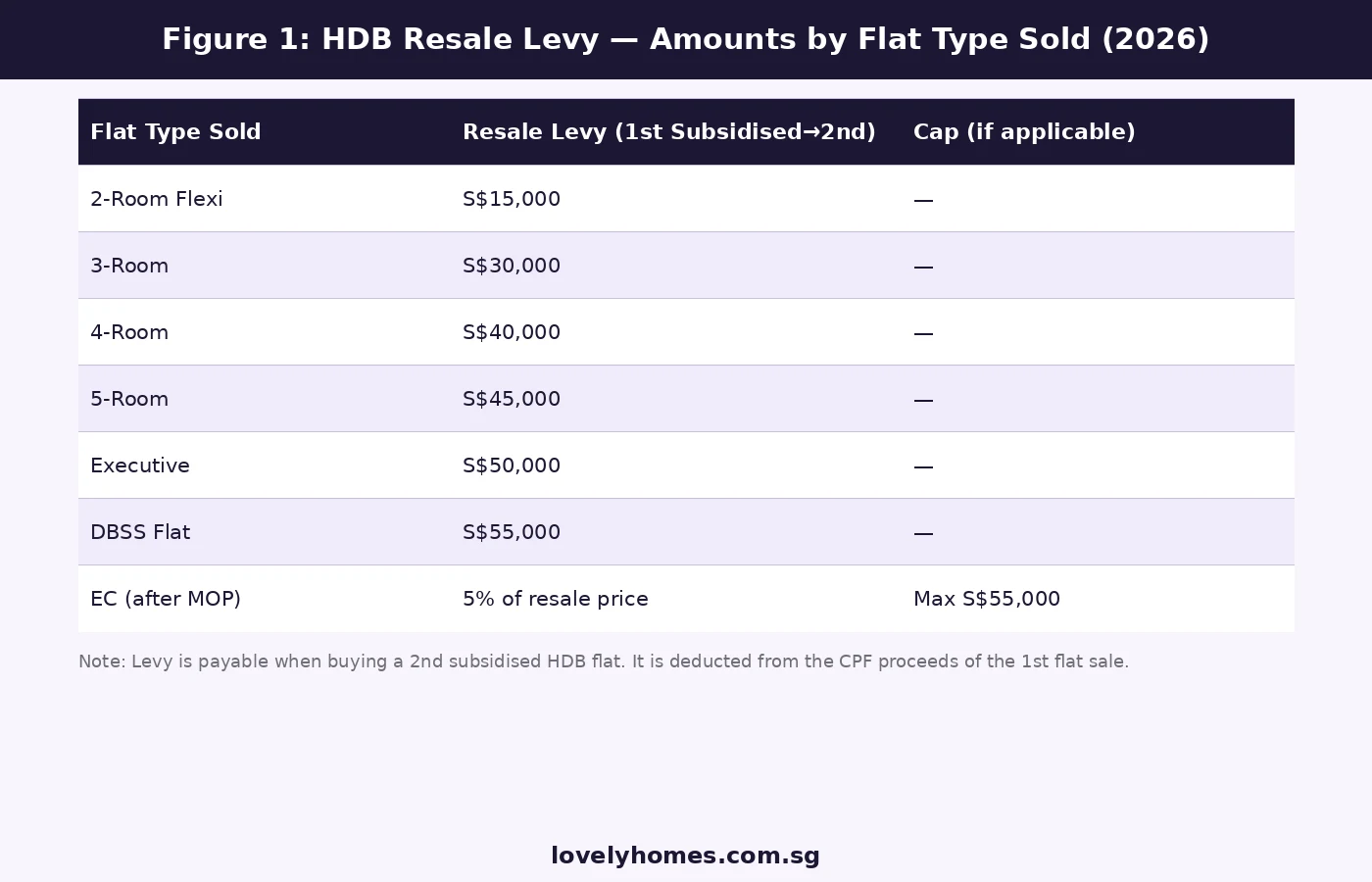
HDB resale levy amounts by flat type 2026 — S$15,000 to S$55,000 table
Figure 1: HDB Resale Levy Amounts by Flat Type Sold (2026). Fixed rates since 3 March 2006; EC applies a 5% rate with S$55,000 cap. Source: HDB Singapore.

Who Pays the HDB Resale Levy?

You are required to pay the resale levy if all three of the following conditions are met:

  1. You (or your co-applicant, spouse, or essential occupier) previously purchased a subsidised HDB flat — meaning you received a CPF Housing Grant, AHG, SHG, EHG, Step-Up CPF Grant, or bought directly from HDB at a subsidised price in a Build-To-Order (BTO) or Selective En-bloc Redevelopment Scheme (SERS) exercise.
  2. You subsequently sold that subsidised flat (or are in the process of doing so).
  3. You are now applying to buy a second subsidised flat from HDB — either a new BTO flat, a SERS flat, a Design, Build and Sell Scheme (DBSS) unit, or an Executive Condominium (EC) unit from a developer.

The key point is that the levy applies to subsidised second-time purchases only. If your second property is a private condominium, a landed home, a resale HDB flat (from the open market), or any commercial property, no resale levy is chargeable. Many upgraders mistakenly believe the levy applies whenever they buy a second property — it does not. It is specifically a tax on accessing public subsidies a second time.

Couples and Joint Applications

For married couples and joint flat buyers, the resale levy status of either party is taken into account. If either the main applicant or the co-applicant previously received a housing subsidy, the levy is applicable to the household. This prevents a household from circumventing the levy simply by swapping the person listed as main applicant on the second purchase. The rule is designed to capture the household’s cumulative subsidy benefit, not merely the individual’s.

Singles

Singles purchasing under the Single Singapore Citizen (SSC) scheme — eligible for 2-Room Flexi BTO flats — are also subject to the levy if they previously benefited from a housing subsidy. As the levy amount for a 2-Room Flexi flat is S$15,000, it is still a meaningful cost for solo buyers planning to upsize.

HDB Resale Levy Amounts (2026)

The levy amount depends on the type of flat you previously sold. Since 3 March 2006, the rates have been fixed at the following flat-type level:

Flat Type Sold (First Flat) Resale Levy Payable Notes
2-Room Flexi S$15,000 Applies to subsidised 2-Room Flexi BTO flats
3-Room S$30,000
4-Room S$40,000 Most common upgrader profile
5-Room S$45,000
Executive Flat S$50,000 HDB Executive flat (not EC)
DBSS Flat S$55,000 Design, Build and Sell Scheme (discontinued)
EC (Executive Condominium) 5% of resale price Capped at S$55,000; applies after the EC’s 5-year MOP when sold on the open market

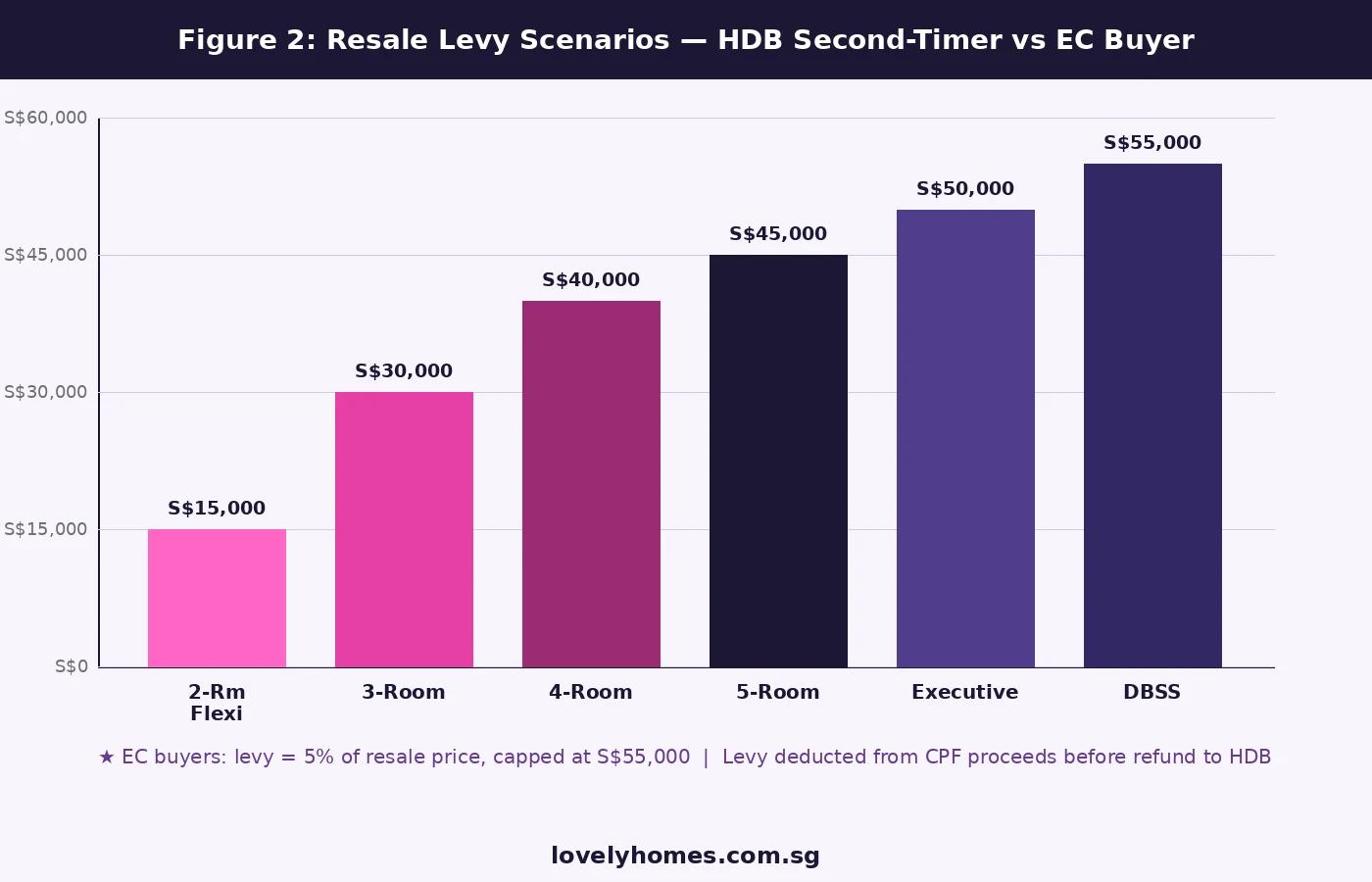
One common source of confusion is that the levy is based on the type of flat you sold, not on its resale price. Whether you sold your 4-Room flat for S$500,000 or S$900,000, the levy is always S$40,000. The EC rule is the sole exception: there the levy is 5% of the EC’s resale price (i.e. the proceeds from selling the EC), subject to a maximum of S$55,000.

HDB resale levy bar chart by flat type Singapore 2026 — S$15,000 to S$55,000
Figure 2: Resale Levy by Flat Type (2026). The levy is flat-based, not price-based — except for EC where it is 5% of resale price, capped at S$55,000. Source: HDB Singapore.

How and When Is the Resale Levy Paid?

The resale levy is settled automatically at the completion of the sale of your first flat. HDB deducts the levy amount from the CPF Ordinary Account (OA) refund you would otherwise receive when the flat sale is completed. You do not receive a separate invoice from HDB and you do not make a cash payment at any counter.

Here is how the sequence works:

  1. Apply to buy second flat: When you apply for a BTO flat or EC as a second-timer, HDB identifies your levy status at the point of application.
  2. HDB confirms levy payable: HDB notifies you of the levy amount in the appointment letter for your second flat booking.
  3. First flat sold: On the day of the legal completion of your first flat sale, the CPF Board refunds your OA principal and accrued interest as usual — but before the refund is credited to you, HDB deducts the levy amount directly from those CPF proceeds.
  4. Balance returned: The net CPF refund (after levy deduction) is credited to your OA account.

What If Your CPF Refund Is Less Than the Levy Amount?

This can happen in rare situations — for instance, if the outstanding HDB loan and CPF accrued interest together consume most of the sale proceeds. In such cases, the shortfall must be made up in cash. HDB will require you to pay the difference out-of-pocket before the second flat booking proceeds. This is one reason why financial planning ahead of an upgrade is important: always model your net CPF position against the levy amount before committing to a second BTO application.

Who Is Exempt from the HDB Resale Levy?

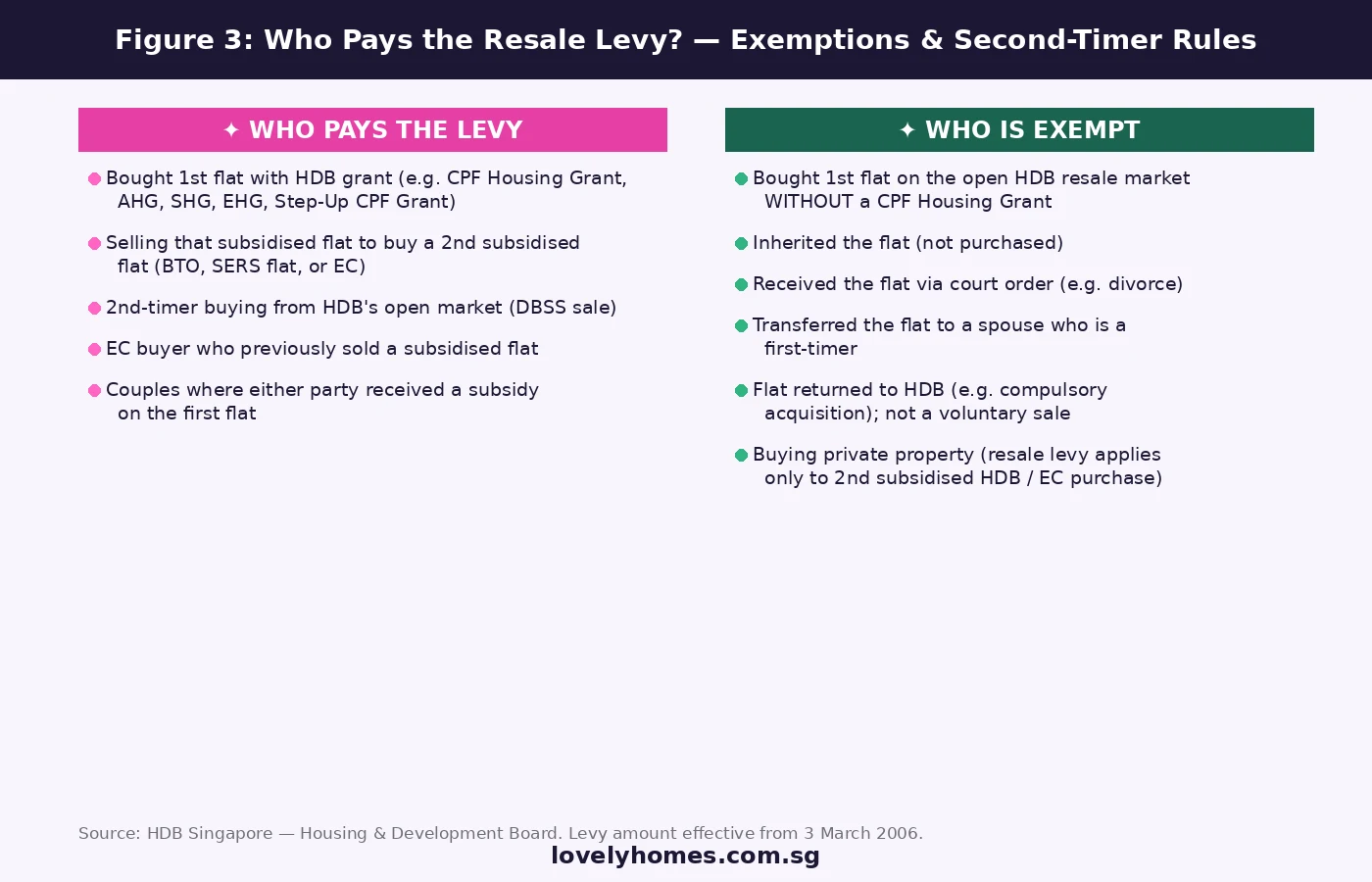
Not everyone who has previously owned an HDB flat will be required to pay the resale levy. Key exemptions include:

  • Resale flat purchased without a CPF Housing Grant: If you bought your first flat on the open HDB resale market and did not receive any CPF Housing Grant (Family Grant, Enhanced Housing Grant, Proximity Housing Grant, or any earlier-generation grant), you are not a “subsidised” flat owner for levy purposes. The levy reflects subsidy recovery — without a subsidy, there is nothing to recover.
  • Inherited flat: If the flat was left to you in a will or through intestacy, you did not receive a direct purchase subsidy, so the levy does not apply.
  • Court order transfer: Flats transferred to one party as part of a divorce settlement are generally exempt because the transfer is not a voluntary purchase attracting a subsidy.
  • Private property purchasers: The levy applies only when the second purchase is a subsidised BTO flat or EC. Upgraders to private property are not subject to the levy — though they face ABSD (Additional Buyer’s Stamp Duty) instead.
  • Flat returned to HDB involuntarily: If your first flat was compulsorily acquired by the government (e.g. for road widening or MRT works), this is not considered a voluntary sale and the levy is not triggered.

HDB resale levy exemptions and second-timer rules Singapore 2026 — who pays vs exempt
Figure 3: Who Pays vs Who Is Exempt — HDB Resale Levy 2026. Source: HDB Singapore.

Worked Example: The Tan Family’s Second BTO Application

Scenario

Mr and Mrs Tan (both Singapore Citizens) purchased a 4-Room BTO flat in Tampines in January 2019 at S$420,000, using a CPF Housing Grant of S$40,000. They have fulfilled the 5-year Minimum Occupation Period (MOP) and sell the flat in July 2026 for S$710,000.

They are applying for a new 5-Room BTO flat in Tengah at a subsidised price of S$620,000 — a second subsidised HDB purchase, making them second-timers.

Levy Calculation

Flat type sold 4-Room
Resale Levy payable S$40,000
Sale price of 1st flat S$710,000
Outstanding HDB loan (est.) S$235,000
CPF principal + accrued interest refund S$278,000
Levy deducted from CPF refund – S$40,000
Net CPF refund after levy S$238,000
Net cash proceeds S$710,000 − S$235,000 (loan) − S$278,000 (CPF) = S$197,000 cash

The Tans’ second flat purchase proceeds normally. The S$40,000 levy is handled automatically by HDB and CPF Board; neither party needs to make a separate payment. The net cash received is S$197,000, which can go toward the downpayment and costs of the new flat.

Special Situations and Edge Cases

EC Owners Selling and Buying a Second BTO

If you bought an EC (fully privatised after 10 years) and now wish to purchase a new BTO flat, you are subject to the resale levy at 5% of the EC’s resale price, subject to a maximum of S$55,000. Because EC prices have risen significantly — many ECs in mature estates now resale at S$1.2M–S$1.8M — the effective levy is almost always the capped S$55,000. For example, an EC sold for S$1.4M would attract a levy of S$70,000 in the absence of the cap; the cap holds it at S$55,000.

SERS Flat Recipients

Households that received a replacement flat under the Selective En-bloc Redevelopment Scheme (SERS) are treated as having received a housing subsidy. If they subsequently wish to buy a second new flat from HDB or an EC, the levy applies based on the type of flat they were re-housed in.

Divorce and Reassignment of Flat Ownership

When a flat is transferred to a divorced spouse under a court order, that spouse is considered a second-timer if the transferred flat was a subsidised purchase. If they later apply for a new BTO flat, the levy will apply. Seeking early legal advice on how divorce asset division affects CPF and HDB subsidy status is advisable.

Concurrent Applications

Some second-timers apply for a BTO flat while still occupying their first flat. HDB allows this — but the levy is held in reserve and deducted at the point of the first flat’s sale completion. You must sell your first flat within 6 months of collecting the keys to the second (this is the standard condition for second-timers purchasing new flats).

Why the Resale Levy Matters for Your Upgrade Strategy

The resale levy is one of several interlocking costs that second-timer households must budget for when planning an upgrade within the public housing system. It is easy to overlook because it is deducted automatically from CPF, making it feel invisible — but it directly reduces the cash and CPF resources available for your second flat.

Consider the total cost of a 4-Room BTO upgrade: beyond the flat price itself, a second-timer household must account for the Buyer’s Stamp Duty (BSD) on the new flat, legal fees, potential income grant reductions (second-timers receive smaller EHG amounts than first-timers), renovation costs, and the S$40,000 resale levy. These costs collectively can reduce the effective CPF buffer you have on hand.

In contrast, upgrading to private property involves no resale levy — but attracts ABSD of 20% as a second property purchase (if you own the HDB flat at the time of buying private, and have not yet sold it). The ABSD on a S$1.5M private property would be S$300,000 — a very different magnitude. Households navigating this choice should consider the full cost picture of each route. Our ABSD Singapore 2026 Complete Guide and HDB Upgrader Guide 2026 cover the private-property upgrade path in detail.

Frequently Asked Questions — HDB Resale Levy 2026

Q1. Can I avoid the resale levy by selling my flat before applying for the BTO?

No. Your levy status is determined by your subsidy history, not by the sequence of sale and purchase. Whether you sell before or after booking the BTO flat, the levy still applies because you previously received a CPF Housing Grant. Selling early may give you more CPF OA funds to draw on, but it does not remove the levy obligation.

Q2. My spouse is a first-timer. Does the household still pay the levy?

Yes. HDB assesses the household as a unit. If either the main applicant or co-applicant has previously received a housing subsidy, the entire household is classified as a second-timer for levy purposes. There is no mechanism to apply as a “first-timer” household if one party is a second-timer. However, in this situation, the household may be eligible for a reduced levy in some cases — consult HDB directly for your specific profile.

Q3. Is the resale levy the same as the CPF accrued interest I must return?

No — these are two completely different obligations. CPF accrued interest (at 2.5% p.a.) is the amount you owe your own CPF account for the OA savings you withdrew to pay for the flat. It is returned to your OA upon sale — you are repaying yourself. The resale levy, in contrast, is paid to HDB as a subsidy recovery charge. Both deductions happen at the point of sale, but they serve entirely different purposes and go to different places.

Q4. Can I use CPF to pay the resale levy, or must it come from cash?

The levy is deducted automatically from the CPF OA refund you receive when your first flat is sold. You do not need to arrange a separate cash payment unless your CPF refund is insufficient to cover the levy — in which case HDB will require the shortfall in cash before releasing the booking fee for your new flat. Always check your estimated CPF refund against the applicable levy amount before committing to a second BTO booking.

Q5. Does the resale levy apply if I buy an EC as a first-time EC buyer but sold an earlier subsidised flat?

Yes. If you are buying an EC and you previously sold a subsidised HDB flat, the resale levy is payable. The EC levy is the higher of: 5% of the resale price of your sold flat or (if you are selling a non-EC subsidised flat) the flat-type levy amount — unless you are selling the EC itself, in which case it is 5% of the EC’s resale price (capped S$55,000). HDB’s levy assessment letter, issued before your EC booking, will specify the exact amount applicable to your situation.

Q6. Has the HDB resale levy changed recently? Will it increase?

The flat-type levy rates have been unchanged since 3 March 2006. As at July 2026, there has been no announcement by HDB or the Ministry of National Development (MND) of any impending change to the levy framework. Given that BTO prices have risen considerably since 2006, some analysts have speculated that a levy increase is overdue — but this is speculative. Decisions on the levy are policy matters resting with MND. Monitor HDB press releases and MND Budget announcements for any changes.

Q7. What happens if I cannot sell my first flat in time to pay the levy before the second flat completion?

Second-timers purchasing a new HDB flat must generally sell their existing flat within 6 months of collecting the keys to the new flat. If you have not sold your first flat by the time you need to complete the purchase of the new flat, HDB may defer key collection or require you to arrange an interim cash payment for the levy amount. Contact HDB directly if your sale is delayed — they may grant a time extension in genuine cases, but this is not guaranteed and is assessed case by case.

Related Articles

Disclaimer: The information in this article is intended for general educational purposes only. HDB policies, levy amounts, and eligibility rules can change. Always verify current requirements directly with the Housing & Development Board (HDB), the CPF Board, and the Ministry of National Development (MND). This article does not constitute financial, legal, or property advice. Consult a licensed property agent (CEA-registered), a qualified financial adviser, or a solicitor for advice specific to your situation.

×

Click anywhere outside to close
Singapore HDB Flat Eligibility Guide 2026: HFE Check, Income Ceilings and What Qualifies You

Singapore HDB Flat Eligibility Guide 2026: HFE Check, Income Ceilings and What Qualifies You

Quick Answer: HDB Flat Eligibility Singapore 2026

  • The HDB Flat Eligibility (HFE) letter replaced the old HDB Loan Eligibility (HLE) letter in May 2023. It is a single document that confirms both your eligibility to buy an HDB flat and your eligibility for an HDB housing loan and CPF housing grants.
  • The HFE letter is mandatory before you can apply for a BTO flat or place an Option to Purchase (OTP) on a resale HDB flat.
  • It is valid for 9 months from the date of issue and can be renewed by reapplying.
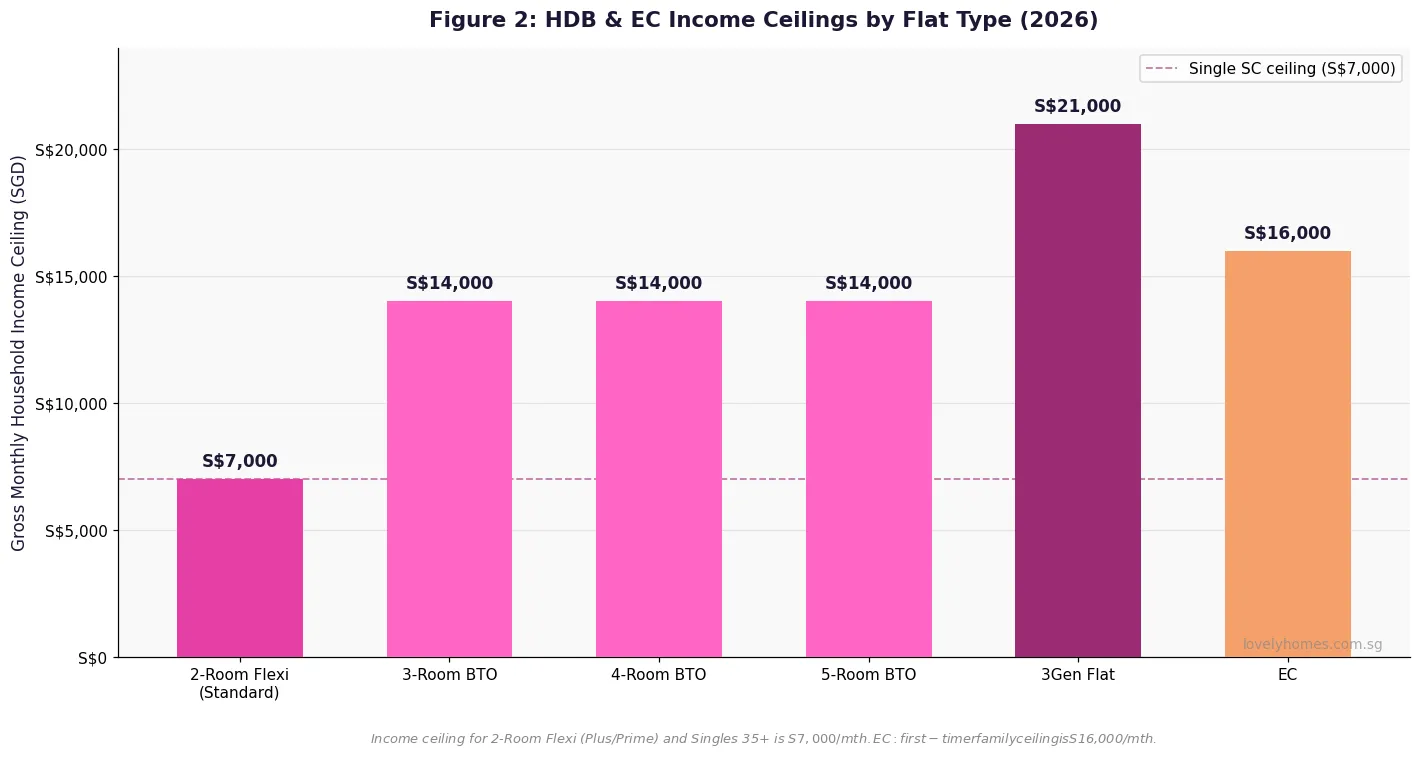
  • The income ceiling for most BTO flat types (excluding Singles schemes) is S$14,000 per month gross household income.
  • For Singles 35+ buying 2-Room Flexi under the Single Singapore Citizen Scheme, the income ceiling is S$7,000/mth.
  • You cannot buy a subsidised HDB flat if you currently own private property or have sold private property within the last 30 months.
  • Permanent Residents (PRs) can buy resale HDB flats but are not eligible for BTO flats or CPF housing grants.
  • For Executive Condominiums (ECs), the income ceiling is S$16,000/mth for first-timer families.

What Is HDB Flat Eligibility — and Why the HFE Letter Matters

Buying an HDB flat in Singapore is not simply a matter of picking a unit and signing a contract. The Housing and Development Board (HDB) administers the most heavily subsidised public housing programme in the world: as of 2026, over 78% of Singapore’s resident population lives in HDB flats, many purchased at significant subsidies relative to market prices. To maintain the fairness and integrity of this system, the HDB enforces a detailed eligibility framework governing who can buy which type of flat, under what conditions, and with what assistance.

The centrepiece of this framework — for buyers — is the HDB Flat Eligibility (HFE) letter, introduced in May 2023. The HFE letter replaced both the old HDB Loan Eligibility (HLE) letter and the separate eligibility self-check that buyers previously performed themselves. Today, a single HFE application, submitted via the HDB Flat Portal, generates a letter that simultaneously confirms your:

  • Eligibility to purchase an HDB flat (including flat type and scheme).
  • Eligibility for an HDB concessionary housing loan and the maximum loan quantum.
  • Eligibility for CPF housing grants and the grant amounts applicable to you.

No HFE letter means no BTO application and no resale OTP. Understanding how to obtain the HFE letter — and what it assesses — is therefore the logical starting point for any prospective HDB buyer in 2026.

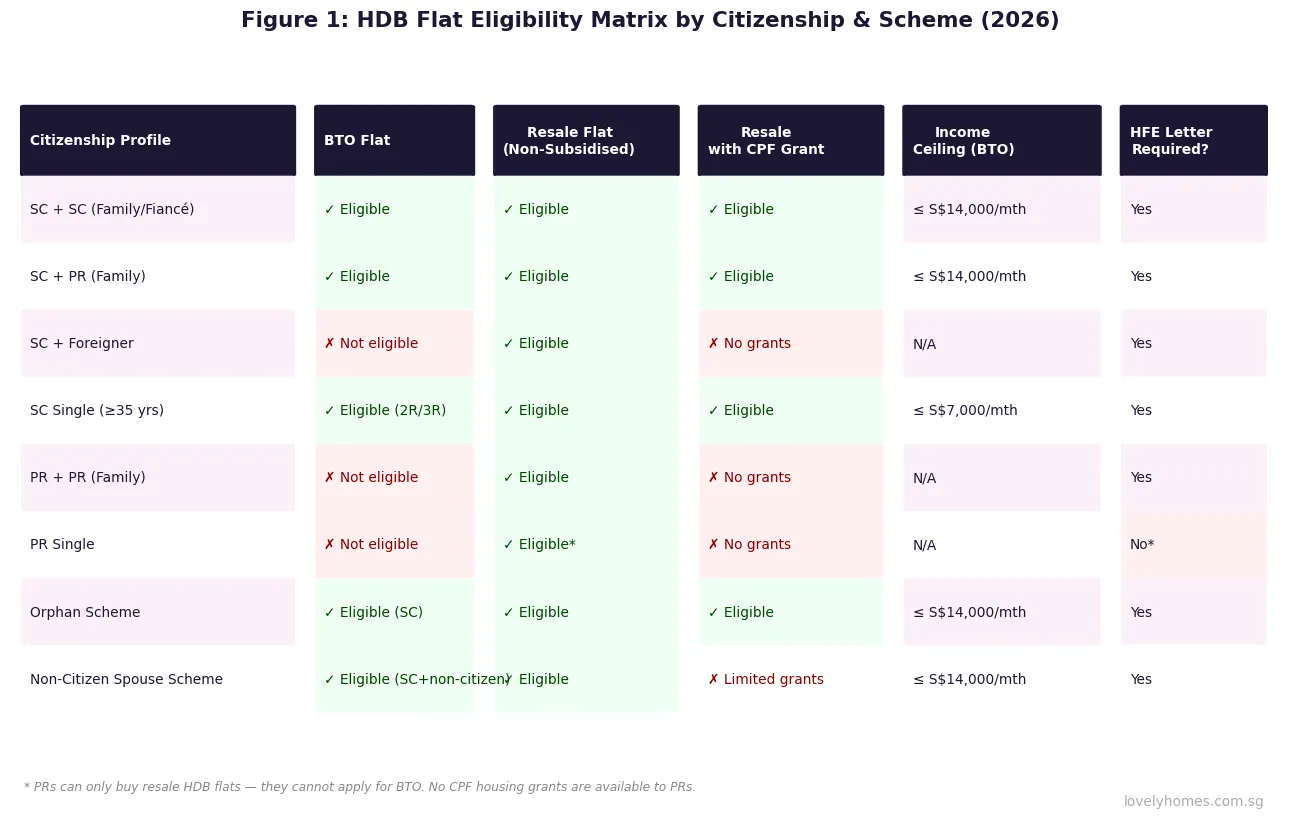
Figure 1: HDB flat eligibility matrix by citizenship and scheme Singapore 2026
Figure 1: HDB flat eligibility by citizenship profile and scheme in Singapore (2026). Green = eligible; red = not eligible for that pathway.

The Seven HDB Eligibility Schemes: Which One Applies to You?

The HDB does not use a single eligibility rule. Instead, it operates seven distinct eligibility schemes, each designed to accommodate a specific family or household configuration. Every applicant must qualify under one of these schemes.

1. Public Scheme: The most common scheme. Requires at least one Singapore Citizen (SC) applicant. The other person(s) in the nucleus (spouse, children, parents, or siblings) can be SCs or Permanent Residents (PRs). This covers the vast majority of married couples and families applying for BTO or resale flats.

2. Fiancé/Fiancée Scheme: Allows SC couples who are not yet married to apply for a BTO flat or book a resale flat together. Both parties must be at least 21 years old and must register their marriage within three months of the resale flat keys being collected, or within three months of the BTO flat booking.

3. Orphan Scheme: For applicants who are single SCs (i.e., unmarried, widowed, or divorced) and whose parents are deceased. The applicant must have at least one sibling who is also unmarried or widowed and who was living with the parents prior to their passing. This scheme allows siblings to pool their eligibility to purchase a flat together.

4. Non-Citizen Spouse Scheme: Allows an SC to buy a flat with a foreign (non-PR, non-SC) spouse. The SC applicant must be the essential occupier; the foreign spouse is named as an occupier. Only a limited selection of HDB flat types is available under this scheme, and CPF grant eligibility is more restricted.

5. Single Singapore Citizen (SSC) Scheme: For SCs aged 35 and above who are single (unmarried, widowed, or divorced). Singles may only purchase 2-Room Flexi flats in non-mature estates under BTO, or any resale flat size. The income ceiling under this scheme is S$7,000 per month.

6. Joint Singles Scheme: Allows two to four single SCs, each aged 35 or above, to buy a flat jointly. The same rules as the SSC Scheme apply; participants must remain as joint owners during the Minimum Occupation Period (MOP).

7. Joint Singles with Widowed/Divorced Persons Scheme: A specific subset allowing a widowed or divorced SC of any age to purchase a resale flat jointly with other single SCs (aged 35+).

Income Ceilings: BTO, Resale and EC

Figure 2: HDB and EC income ceiling by flat type Singapore 2026 BTO eligibility
Figure 2: HDB income ceilings by flat type (2026). Income ceiling for 2-Room Flexi BTO in Plus/Prime classification and Singles 35+ is S$7,000/mth.

Income ceilings for BTO flat purchases exist to ensure subsidised flats are channelled to households that genuinely cannot afford private market alternatives. The ceilings are based on gross monthly household income — the sum of all assessable income of all applicants and essential occupiers listed in the application.

Flat Type / Scheme Income Ceiling (Gross Monthly) Notes
2-Room Flexi BTO (Standard estates) S$14,000 (family) / S$7,000 (singles) Singles 35+ eligible for S$7,000 ceiling
2-Room Flexi BTO (Plus / Prime) S$7,000 (family) Lower ceiling for higher-subsidy estates
3-Room BTO S$14,000 Standard, Plus, and Prime classifications
4-Room BTO S$14,000 Most common flat type
5-Room and 3Gen BTO S$14,000 / S$21,000 (3Gen) 3Gen flats require multi-generational households
HDB Resale (no CPF grant) No income ceiling Any eligible buyer can purchase at market price
HDB Resale (with CPF grants) S$14,000 (family) / S$7,000 (singles) EHG eligibility requires household income check
Executive Condominium (EC) S$16,000 (first-timer family) EC is quasi-private; higher ceiling than HDB BTO

Ownership History and Private Property: The 30-Month Rule

One of the most consequential eligibility rules concerns private property ownership. To prevent higher-income households from simultaneously benefiting from HDB subsidies and private market appreciation, the HDB imposes strict conditions:

  • You and any listed occupier must not currently own private residential property in Singapore or overseas at the time of application.
  • You and any listed occupier must not have disposed of any private residential property (in Singapore or overseas) within the 30 months immediately before the HFE application date (for subsidised BTO or resale with grants). This is the so-called “30-month wait-out period” for private property owners.
  • Owning a commercial property does not affect HDB eligibility, but owning a residential property held through a company or trust may be assessed on a case-by-case basis.

For buyers purchasing a resale flat at market price without any CPF housing grant, the private property ownership rule does not apply — you can own a private property and buy a resale HDB flat simultaneously, subject to paying the applicable stamp duty. However, you would need to sell the private property if you wish to continue owning the HDB flat beyond the applicable occupation period under the terms of the purchase.

MOP Interaction: When Previous Flat Ownership Matters

If you have previously owned an HDB flat, your Minimum Occupation Period (MOP) history affects your eligibility for a subsequent subsidised purchase:

  • You must have fully completed the MOP on your current or most recently sold HDB flat before applying for a new BTO flat.
  • If you are currently within the MOP of an existing HDB flat, you cannot book a new BTO flat — you must wait until the MOP is cleared and the existing flat is sold.
  • Second-timer applicants applying for BTO flats have reduced priority balloting and are subject to a resale levy payable to HDB if they had previously received a housing subsidy on a first subsidised flat.
  • The resale levy ranges from S$15,000 to S$55,000 depending on the flat type of the first subsidised flat, and is payable upon the booking of the second flat.

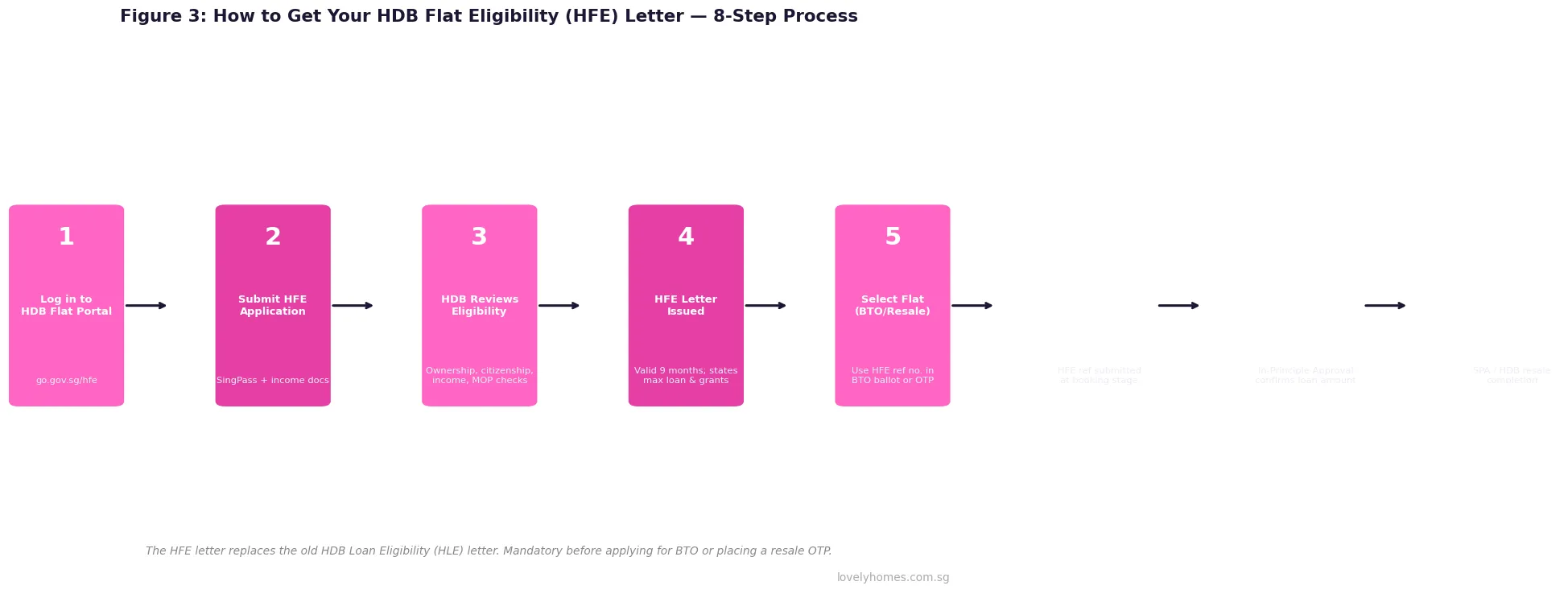
Figure 3: HFE letter 8-step application process flowchart HDB flat eligibility Singapore 2026
Figure 3: The 8-step HDB HFE (Flat Eligibility) letter application process in Singapore (2026). The HFE replaces the old HLE letter and combines loan and grant eligibility in one document.

How to Apply for the HFE Letter: Step-by-Step

Applying for the HFE letter is done entirely online via the HDB Flat Portal at homes.hdb.gov.sg (also accessible at go.gov.sg/hfe). The process requires all applicants to log in via Singpass and provide income documentation. Here is what you need:

  • Singpass login for each applicant.
  • Latest CPF contribution history (auto-retrieved with Singpass consent).
  • Latest payslip(s) for each employed applicant.
  • Income Tax Notice of Assessment (if self-employed or commission-based).
  • Documents for variable income, including bonuses, allowances, and rental income (typically the average over the past 12 months).
  • Details of all outstanding loans (used to assess HDB loan quantum and TDSR/MSR compliance).

Once submitted, HDB typically issues the HFE letter within 5 to 7 working days, though complex applications (e.g., overseas property interests, atypical income structures, or previous flat ownership history) may take longer. The HFE letter is valid for 9 months. If you do not book a flat or sign a resale OTP within this window, you must renew the HFE application.

Worked Example: The Lee Family’s HFE Application and BTO Journey

Mr Lee Jian Ming and Ms Tan Wei Ling are Singaporean citizens, both aged 29, engaged to be married in August 2026. They wish to apply for a 4-Room BTO flat in Bishan under the Fiancé/Fiancée Scheme. Their combined gross monthly income is S$9,200. Neither owns any private property; both are first-time flat buyers.

Step 1 — HFE Application: They apply jointly via the HDB Flat Portal, logging in via Singpass and uploading their payslips. Mr Lee earns S$5,800/mth; Ms Tan earns S$3,400/mth. Combined: S$9,200/mth.

Eligibility check: Income S$9,200 < ceiling S$14,000 ✓. Both are SCs ✓. Neither owns private property ✓. Both are first-timers ✓. Scheme: Fiancé/Fiancée (Public Scheme) ✓.

HFE Letter outcome: Eligible to purchase 4-Room BTO. Eligible for HDB concessionary loan at 2.6% p.a. (pegged to CPF OA rate + 0.1%). Maximum loan quantum: based on TDSR/MSR — HDB assesses their monthly repayment capacity. Eligible for Enhanced CPF Housing Grant (EHG) at S$9,200/mth household income = approximately S$20,000 (tapering scale, family; income ≥ S$9,001 and ≤ S$9,500 band).

At ballot: The Lees apply for a 4-Room flat in Bishan Lakeview (June 2026 BTO exercise, Prime classification). As first-timers under the Fiancé/Fiancée Scheme, they receive a First-Timer Priority ballot advantage. Wait time: approximately 4.5 years (Top in 2031).

Key numbers: BTO price approximately S$680,000 (indicative, Prime D20 4-Room). BSD: S$14,400. No ABSD (first HDB purchase). HDB loan 90% LTV = S$612,000 at 2.6% 25 years = S$2,780/mth. MSR 30%: maximum monthly mortgage S$2,760 — just at the boundary. The couple may consider topping up CPF or adjusting the loan tenure to keep monthly payments within MSR.

Why HFE Matters: Singapore’s Public Housing System and What It Delivers

The HFE framework reflects the extraordinary scope of Singapore’s public housing commitment. The government subsidises HDB flats at prices well below what a private developer would charge for comparable space in comparable locations — a deliberate policy to enable homeownership across virtually all income bands. This subsidy comes with conditions, and the HFE is how those conditions are enforced consistently and fairly.

For buyers, the HFE letter serves another practical function: it gives you certainty before committing. Knowing your exact grant quantum, maximum loan, and MSR headroom before entering the ballot prevents over-commitment and planning failures — a significant improvement over the old system where buyers sometimes discovered eligibility issues only at the booking stage.

By global comparison, few countries provide both a guaranteed right to affordable housing and a structured eligibility framework as rigorous as Singapore’s. The HFE system continues to be refined: the HDB has signalled that digital verification of income will become more automated through MyInfo and CPF integration, reducing the documentation burden on applicants whilst maintaining eligibility integrity.

What Might Change in HDB Eligibility Rules From 2026 Onwards

The HDB and the Ministry of National Development have signalled several potential directions for HDB eligibility policy in the medium term. Observers expect further calibration of the Plus and Prime flat classification framework — introduced in October 2024 — including the possibility of expanding the number of estates with Plus-level restrictions as the scheme matures. The resale levy quantum, last revised in 2006, is overdue for review given the rise in flat prices. The HDB has also mooted reforms to the singles policy, potentially lowering the age threshold below 35 in future BTO launches for certain flat types, in response to demographic changes and the rising number of young singles. Any policy changes would be announced by the Ministry of National Development and take effect for BTO sales exercises from the announcement date.

Frequently Asked Questions

How long is the HFE letter valid, and what happens if it expires?

The HFE letter is valid for 9 months from the date of issue. If you do not apply for a BTO flat or place a resale OTP within this period, you must reapply. The reapplication process is the same as the original application — you log in via the HDB Flat Portal, update your income and financial details, and HDB reassesses your eligibility. Your eligibility may change if your income, property ownership status, or household composition has changed since the last application. There is no limit on the number of times you can renew an HFE application.

Can a Permanent Resident buy a BTO flat in Singapore?

No. Permanent Residents (PRs) are not eligible to apply for BTO flats. PRs may only purchase resale HDB flats, and only if they form a family nucleus with at least one SC (or apply under the PRs-only joint purchase arrangement for resale flats). PRs are not entitled to CPF housing grants. Furthermore, PRs who buy an HDB resale flat must sell the flat before buying or owning any private residential property.

What is the resale levy, and when does it apply?

The resale levy is a payment to HDB made by second-timer applicants who are buying a second subsidised HDB flat (BTO or resale with CPF grants) after having previously received a housing subsidy on a first flat. The levy ranges from S$15,000 (for a previous 2-Room flat) to S$55,000 (for a previous 5-Room or larger flat), indexed to the flat type at time of first subsidy. The levy is intended to reduce the cumulative housing subsidy received by any one household. It is payable at the booking of the second flat and can be paid from CPF OA funds.

Can I apply for the HFE letter if I am currently renting an HDB flat?

Yes. Renting an HDB flat — whether through HDB directly or through a sub-tenancy arrangement from a flat owner — does not disqualify you from applying for the HFE letter or purchasing an HDB flat, provided you meet the other eligibility criteria (citizenship, income, ownership history, age). Your rental status is not assessed as part of the HFE eligibility check. However, note that if you are renting a room in an HDB flat owned by someone else, the owner’s eligibility is what governs the rental — not yours as a tenant.

What happens if my income exceeds the ceiling after I have already booked a BTO flat?

Once you have successfully booked a BTO flat and the booking is confirmed, the income ceiling is assessed at the point of application and booking — not retrospectively at key collection. A temporary increase in income after booking (for example, a salary increment or bonus) does not cause you to lose your booking. However, if you fraudulently misrepresented your income at the time of application, HDB can cancel your booking and take disciplinary action. The CPF grant quantum is fixed at the time the HFE letter is issued; subsequent income changes do not affect the grant amount already confirmed.

Can foreigners buy HDB flats in Singapore?

Foreigners (non-SC, non-PR) cannot buy HDB flats in Singapore under any scheme. They are also ineligible for CPF housing grants. Foreigners may purchase private residential property subject to paying Additional Buyer’s Stamp Duty (ABSD) at 60% of the purchase price (as at 2026). A small category of citizens from countries with bilateral Free Trade Agreements (Iceland, Liechtenstein, Norway, and Switzerland under the EUSFTA/FTA frameworks) may be treated similarly to SCs for ABSD purposes on first purchases, but are still ineligible to purchase HDB flats.

Does the 30-month wait-out period apply if I am giving up my private property through inheritance?

The 30-month wait-out period applies to the disposal of private residential property, not to its acquisition through inheritance. If you inherit private residential property, you are not immediately disqualified from HDB eligibility — however, you must dispose of the inherited private property before your HFE application or BTO booking (within the timeframe specified by HDB). If you are applying for a subsidised BTO flat or resale flat with CPF grants, you cannot hold private property simultaneously. The 30-month clock starts running from the date you legally dispose of the inherited private property, not from the date of inheritance.

Related Articles

Disclaimer

This article is intended for general information purposes only and does not constitute legal, financial, or professional advice. HDB eligibility rules, income ceilings, grant quantum, and related policies described in this article are accurate to the best of our knowledge as at June 2026 but are subject to change by the Housing and Development Board and the Ministry of National Development. Readers should verify all information directly with HDB before making any purchase decisions. Official HDB flat eligibility information is available at hdb.gov.sg. CPF housing grant information is available at cpf.gov.sg. Income tax and stamp duty information is available at iras.gov.sg.

×

Translate »