HDB HFE Letter Guide Singapore 2026: How to Apply, Check Status & Use Your Letter
Quick Answer — HDB HFE Letter at a glance
- The HDB Flat Eligibility (HFE) letter replaced the old HDB Loan Eligibility (HLE) letter from 9 May 2023.
- You must have a valid HFE letter before submitting a BTO application, selecting a resale flat, or exercising an Option to Purchase (OTP).
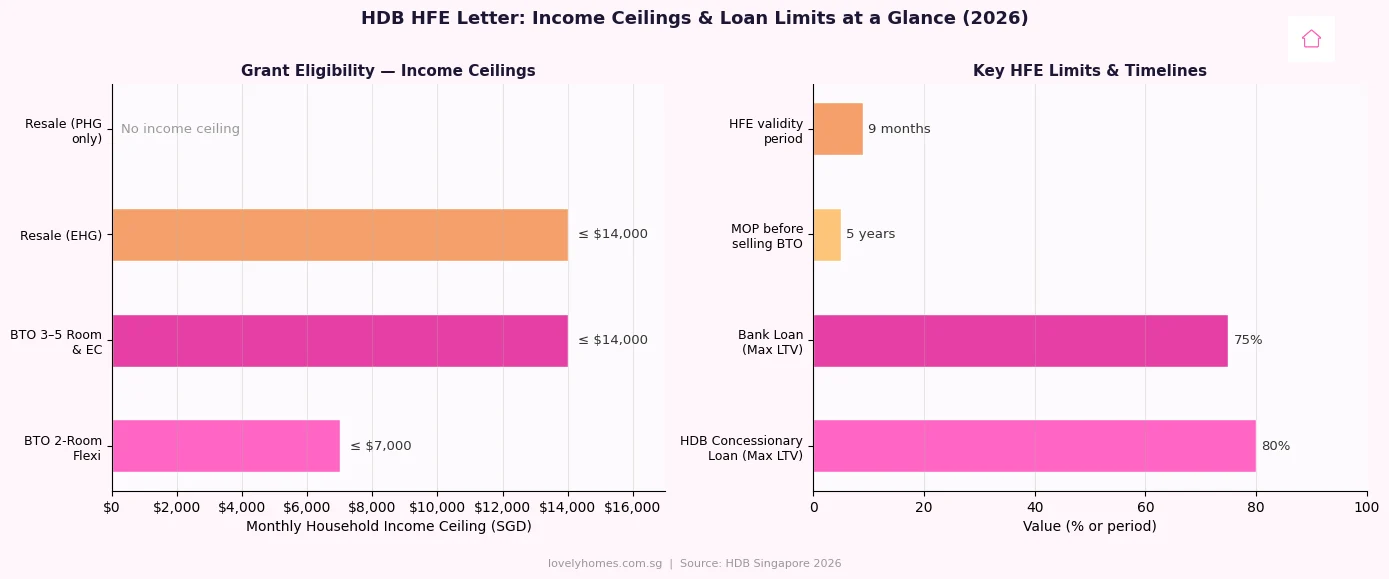
- An HFE letter is issued within 14 working days and is valid for 9 months.
- It covers in one document: flat eligibility, CPF housing grant eligibility, and HDB concessionary loan eligibility.
- The application is done entirely online via HDB My Flat Journey (MFJ) using SingPass; all co-applicants must consent.
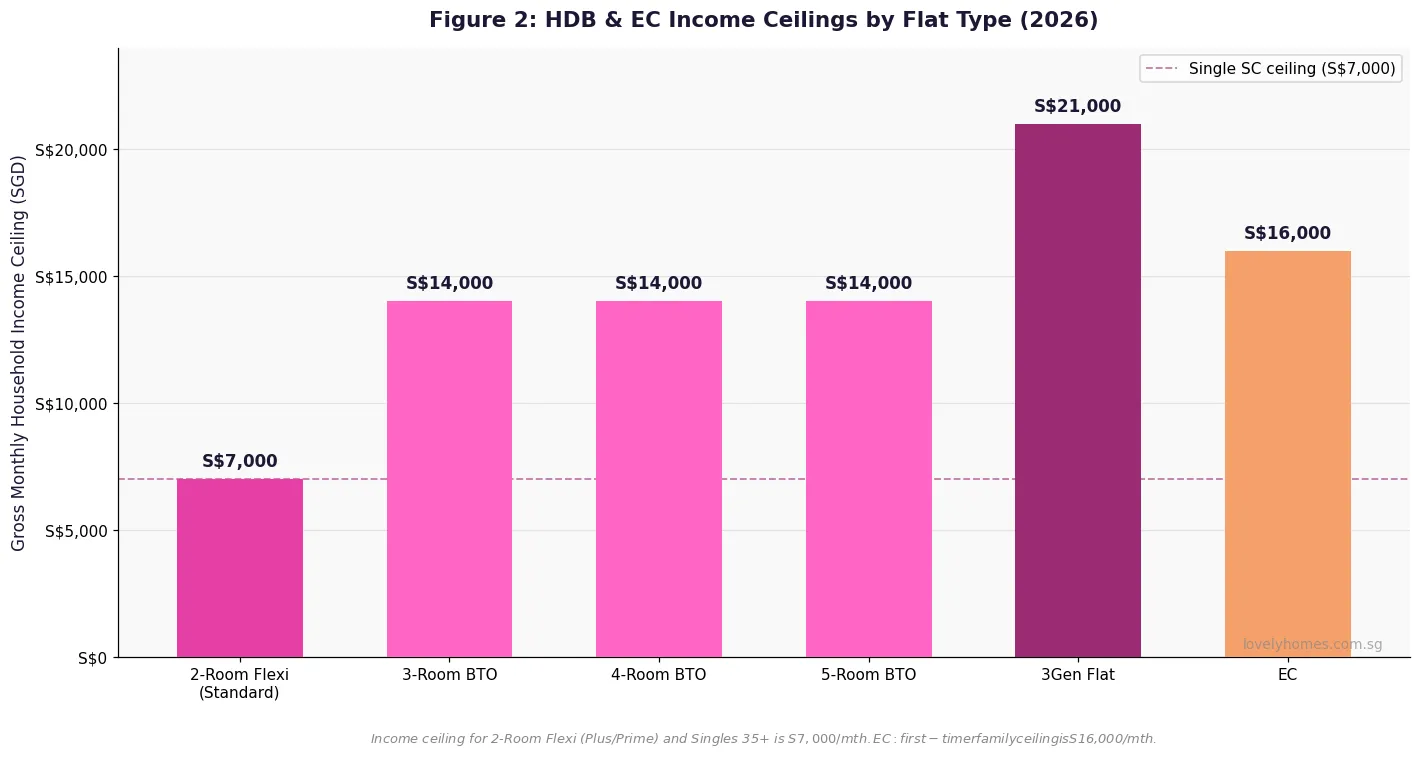
- Income ceiling for most grants: S$14,000/month for couples; S$7,000/month for singles (select flat types).
- HDB concessionary loan LTV: up to 80%; bank loan LTV: up to 75%.
If you are buying an HDB flat in Singapore — whether a new Build-To-Order (BTO) flat, a Sale of Balance Flat (SBF), or a resale flat from the open market — the HDB Flat Eligibility (HFE) letter is the gateway document that determines what you can buy, how much you can borrow from HDB, and how much in CPF housing grants you qualify for. Without it, you cannot proceed to application.
This guide explains exactly what the HFE letter is, who needs it, how to apply step by step, what to do if your application is rejected, and how to use your HFE letter once you have it. All figures reflect the rules administered by the Housing & Development Board (HDB) as at 31 July 2026.
What is the HDB HFE Letter?
The HDB Flat Eligibility (HFE) letter is an integrated eligibility assessment issued by HDB. Prior to 9 May 2023, buyers had to obtain separate documents: a Housing Loan Eligibility (HLE) letter for HDB loans, a CPF housing grant eligibility check, and a general flat eligibility check. The HFE letter consolidates all three into a single, time-limited document. HDB administers it; the CPF Board and the Monetary Authority of Singapore (MAS) inform the underlying eligibility rules for grants and loan-to-value (LTV) caps respectively.
The HFE letter tells you three things before you spend a single dollar:
- Which HDB flat types you are eligible to purchase (BTO, SBF, resale, or Executive Condominium).
- The CPF housing grants you qualify for — the Enhanced CPF Housing Grant (EHG), Additional CPF Housing Grant (AHG, resale), Family Grant, Proximity Housing Grant (PHG), and Step-Up CPF Housing Grant.
- Whether you qualify for an HDB concessionary loan and the maximum loan quantum HDB will extend to you based on your income, CPF balances, and existing property.
Who Needs an HFE Letter?
You need a valid HFE letter if you intend to:
- Apply for a new flat under a BTO, SBF, or Open Booking exercise;
- Register intent to buy a resale HDB flat; or
- Exercise an Option to Purchase (OTP) for a resale flat.
You do not need an HFE letter if you are buying a private condominium or landed property — that falls outside HDB’s remit entirely. However, if you intend to use CPF Ordinary Account (OA) savings toward a private property purchase, you will need a CPF withdrawal application separately.
Eligibility Criteria: Who Can Apply?
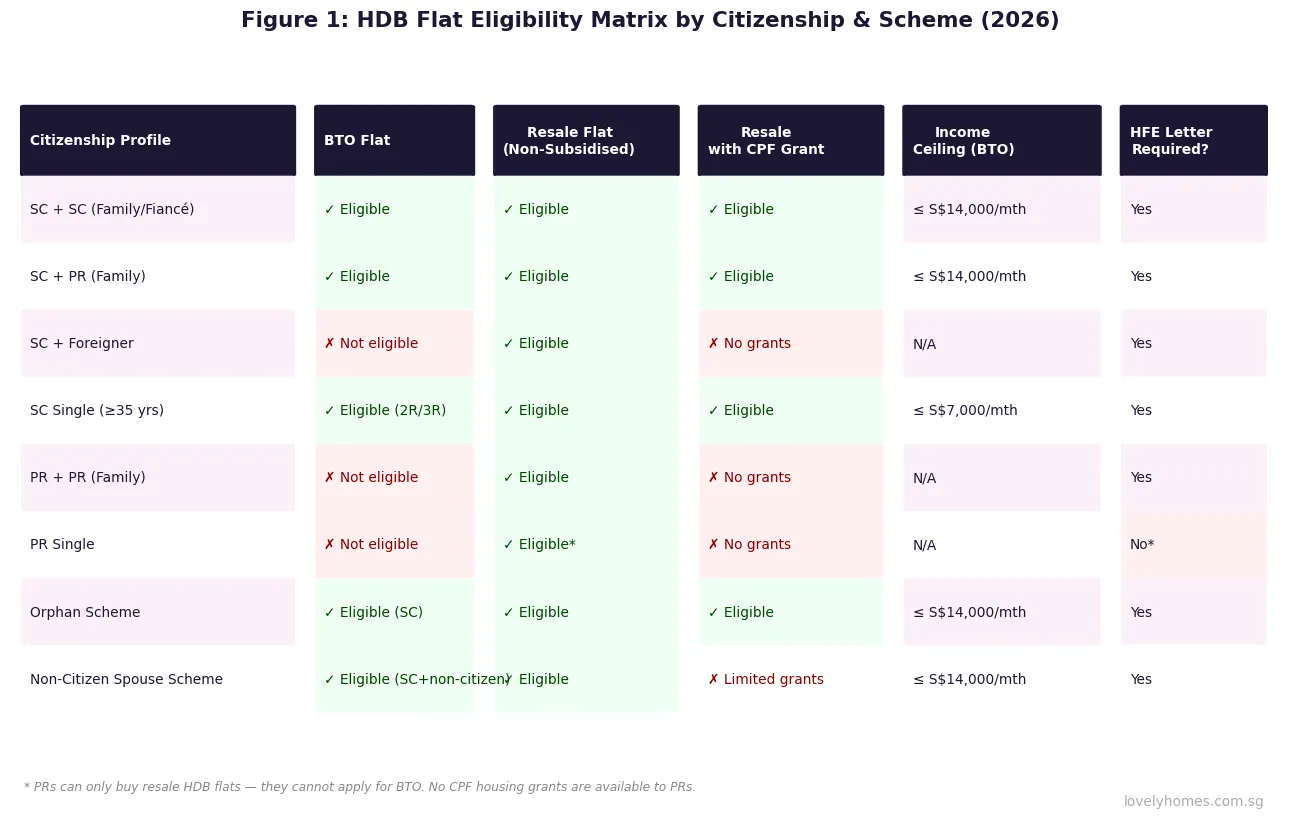
To be eligible for an HFE letter, you and your co-applicant(s) must meet HDB’s flat eligibility conditions. The core criteria are citizenship and family nucleus requirements — HDB does not sell new flats to individuals; a qualifying family nucleus is the fundamental test. The following applies as at 2026:
| Criterion | Requirement (General) |
|---|---|
| Citizenship | At least one applicant must be a Singapore Citizen (SC). Co-applicants may be SC or Singapore Permanent Resident (SPR). Foreigners may not purchase HDB flats. |
| Age | All applicants must be at least 21 years old (single or widowed orphan schemes: 35 years old). |
| Family nucleus | Must form a qualifying family nucleus: married couple, fiancé/fiancée couple, parent(s) with child(ren), siblings, or single (35+, specific schemes only). |
| Property ownership | Must not own or have disposed of any HDB flat, DBSS flat, or private residential property in the 30 months before application (resale) or flat application (BTO). |
| Income ceiling | Combined gross monthly household income ≤ S$14,000 for most schemes; ≤ S$7,000 for singles (2-Room Flexi BTO). Executive Condominiums: ≤ S$16,000. |
| Previous housing subsidies | Second-timer restrictions apply if you have previously received a CPF housing grant or purchased a subsidised flat. |
CPF Housing Grants Available via the HFE Letter
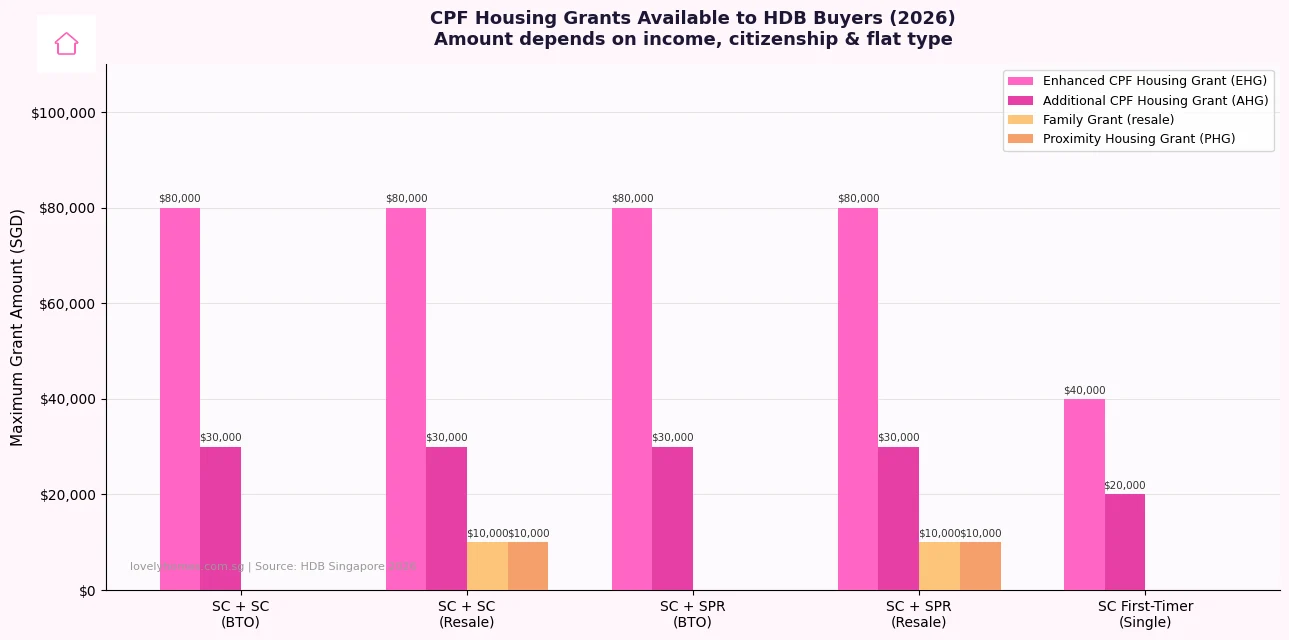
The HFE letter is the gateway to CPF housing grants. These grants are funded by the Singapore Government and administered through HDB. The amount you receive is calculated based on your household income, citizenship composition, and flat type. Grants are used to offset the purchase price directly — they reduce the amount you need to pay in cash or CPF OA, or they reduce your outstanding mortgage with HDB.
Enhanced CPF Housing Grant (EHG)
The EHG is the largest grant available and replaced the Special CPF Housing Grant (SHG) and Additional CPF Housing Grant (AHG) for new flat purchases. It is available to first-timer families earning ≤ S$9,000/month. The maximum is S$80,000 for couples earning up to S$1,500/month; the grant tapers to S$5,000 for incomes near the S$9,000 ceiling. Critically, EHG can be used toward both BTO and resale HDB flats — the grant amount is determined at application based on the preceding 12 months’ income.
Additional CPF Housing Grant (AHG — Resale)
The AHG for resale flat purchases (up to S$40,000) applies to first-timer families earning ≤ S$5,000/month who are buying a resale flat. It is used alongside the EHG to give lower-income buyers meaningful purchasing power in the resale market without requiring a new BTO flat.
Family Grant
The Family Grant (up to S$30,000 for SC+SC couples, S$20,000 for SC+SPR couples) applies to resale flat purchases. It does not have an income ceiling but does require a qualifying family nucleus. It is used with the EHG for resale purchases.
Proximity Housing Grant (PHG)
The PHG (up to S$30,000 for living with parents; S$20,000 for living within 4 km of parents) is available for resale flat purchases only. It has no income ceiling. The PHG is designed to encourage multi-generational living and reduce the burden on Singapore’s public transport and caregiving infrastructure.
Step-Up CPF Housing Grant
The Step-Up Grant (S$15,000) is specifically for second-timer families who currently live in a 2-Room or smaller HDB flat and are moving to a 3-Room or larger resale flat. Income ceiling: S$7,000/month. This grant bridges the gap for families who have already used previous housing subsidies.
HDB Concessionary Loan vs Bank Loan: What the HFE Tells You
Once the HFE letter is issued, it also states your eligibility for the HDB concessionary loan. This loan charges an interest rate pegged at 0.1% above the prevailing CPF Ordinary Account (OA) interest rate, which has been 2.5% per annum since 1999 — giving an effective rate of 2.6% p.a. (as at July 2026). This is generally lower than bank mortgage rates, which in mid-2026 have drifted between 3.2–3.7% p.a. for 2-year fixed packages.
Key differences the HFE letter determines:
| Feature | HDB Concessionary Loan | Bank Loan |
|---|---|---|
| Max LTV (new flat) | 80% of purchase price | 75% of purchase price / valuation |
| Interest rate (Jul 2026) | 2.6% p.a. (CPF OA + 0.1%) | 3.2–3.7% p.a. (market rates) |
| Down payment (cash) | None required (can be fully CPF) | Minimum 5% in cash |
| Eligibility restriction | Must not own private property; income ceiling applies | Assessed by lender on TDSR/MSR |
| Refinancing | No — fixed for life of loan | Refinanceable after lock-in period |
| Prepayment penalty | None | May apply within lock-in |
HDB’s LTV cap of 80% means you must fund the remaining 20% from CPF OA savings and/or cash. If your CPF OA balance is sufficient, you may pay no cash at all at the point of purchase — a critical advantage for first-time buyers.
How to Apply for the HFE Letter: Step by Step
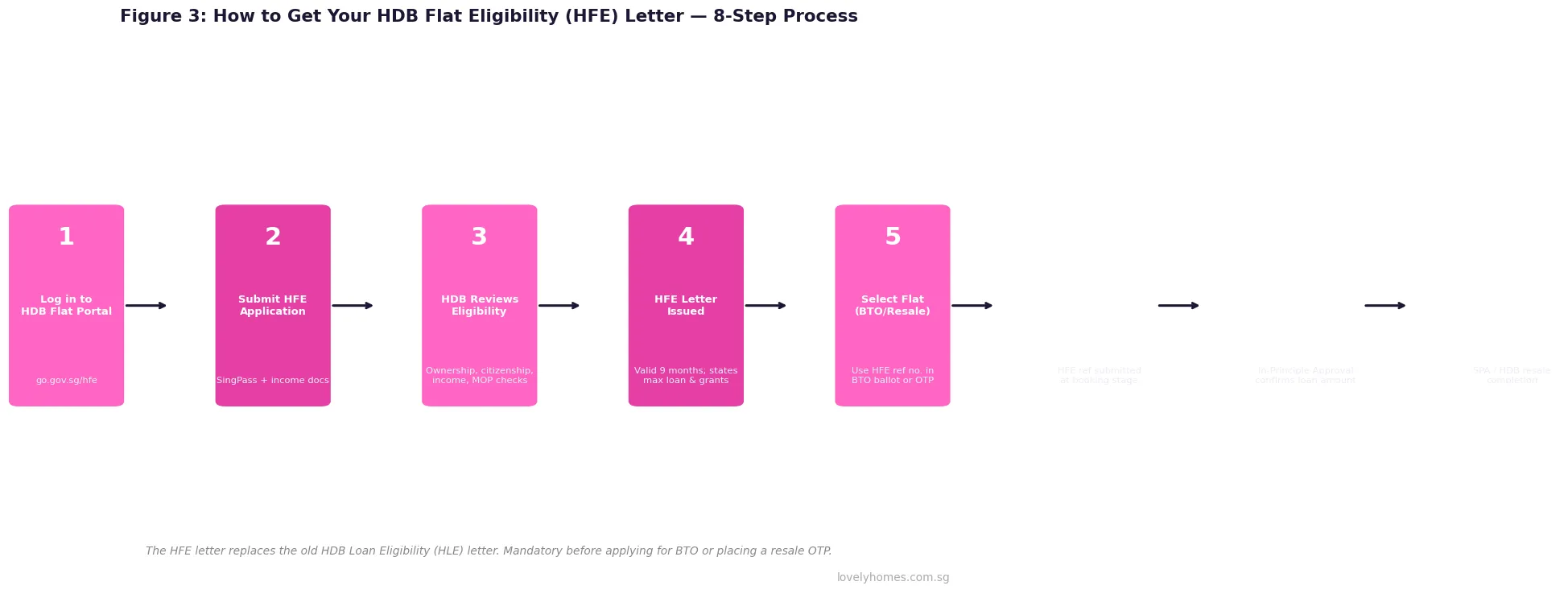
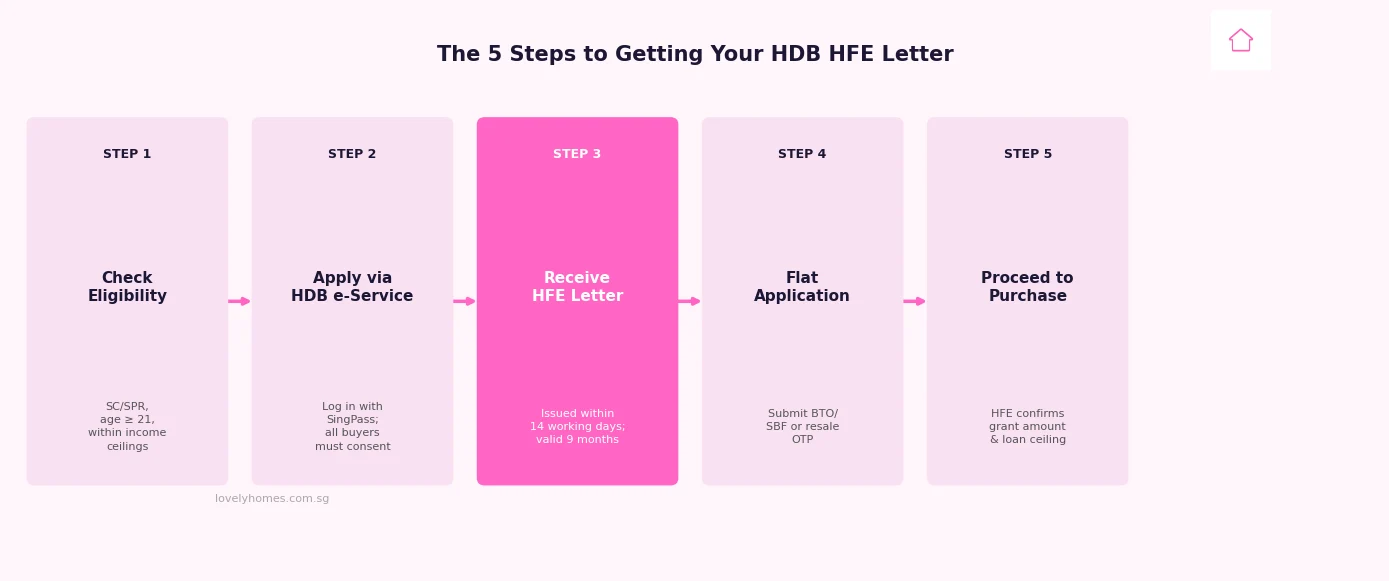
The entire HFE application process is handled online through HDB’s My Flat Journey (MFJ) portal. There is no physical form, no queue at the HDB Hub, and no in-person interview required for a standard application. Here is the process in full:
- Step 1 — Check flat eligibility. Log in to HDB My Flat Journey with SingPass. Use the online self-assessment tool to confirm you meet the basic eligibility criteria before investing time in the full application.
- Step 2 — Initiate the HFE application. All co-applicants must log in and give their digital consent via SingPass. HDB will draw on Myinfo data (income records from IRAS, CPF balances, property ownership records) automatically. You do not need to upload payslips separately if your employer reports income through SingPass Myinfo.
- Step 3 — Wait for processing. HDB targets a turnaround of 14 working days. Complex cases (self-employed applicants, overseas income, undischarged bankrupts) may take longer. You will be notified via the MFJ portal and by SMS/email when the letter is ready.
- Step 4 — Receive and review your HFE letter. The letter will state: (a) flat types you may purchase; (b) grant amounts you qualify for; (c) whether you are eligible for an HDB concessionary loan and the maximum loan ceiling. Review it carefully — the loan ceiling is calculated conservatively and may differ from your actual borrowing capacity under TDSR.
- Step 5 — Proceed to flat application or OTP exercise. Your HFE letter is valid for 9 months from the date of issue. You must submit your BTO/SBF application, register intent to buy, or exercise the OTP within this window. If it lapses, you must reapply.
Worked Example: The Lim Family’s HFE Journey
Mr and Mrs Lim are a Singapore Citizen couple, both aged 30, getting married in October 2026. Their combined gross monthly income is S$7,200. They want to apply for a BTO 4-Room flat in Tengah (OCR). Here is how the HFE letter plays out for them:
- Eligibility: Married couple, both SC, income ≤ S$14,000 — eligible for BTO.
- EHG: Combined income S$7,200/month → EHG = S$25,000 (grant tapers; full S$80,000 is for ≤ S$1,500/month couples).
- HDB concessionary loan: Maximum loan quantum is calculated at approximately 30% of monthly income × loan tenure in months. At S$7,200/month income and 25-year tenure: roughly S$720,000 ceiling (subject to TDSR and MSR). The 4-Room BTO in Tengah is estimated at S$490,000 — well within the loan ceiling.
- Down payment required: 20% × S$490,000 = S$98,000. EHG of S$25,000 offsets the purchase price → effective amount to fund: S$73,000 from CPF OA. If CPF OA balance is sufficient, zero cash required at purchase.
- Monthly instalment (HDB loan 2.6% p.a., 25 yr): Loan = S$465,000 (S$490,000 less S$25,000 EHG) × 0.8 = S$372,000 → approximately S$1,700/month, payable entirely from CPF OA.
This example illustrates why the HFE letter is not bureaucracy for its own sake — it gives buyers a precise financial picture before they commit to a flat.
Minimum Occupation Period (MOP) and Why It Matters
Once you purchase an HDB flat, you are subject to a Minimum Occupation Period (MOP) before you can sell or rent out the entire flat. The MOP for most HDB flats is 5 years from the date you collect your keys. For new BTO flats in prime locations under the Prime Location Public Housing (PLH) model, the MOP is extended to 10 years. The HFE letter does not state the MOP directly, but the flat type it confirms eligibility for will determine which MOP applies.
Understanding MOP is critical for buyers who may wish to upgrade to a private property in the medium term. The MOP clock starts only from key collection — not from the BTO application date or the signing of the sale agreement. For a BTO flat with a typical 3–5 year construction period, a buyer applying in 2026 might not complete their MOP until 2033 or 2034.
What if Your HFE Letter is Rejected or Shows Lower Entitlements?
An HFE letter may come back with lower grant amounts than expected, or it may indicate ineligibility entirely. Common reasons include: income exceeding the ceiling; a previous HDB flat disposal within the 30-month window; undischarged debts to HDB from a prior flat; or a co-applicant who owns private property. If you believe an error has been made, you may appeal in writing to HDB within 30 days of the letter’s issuance date, providing documentary evidence (IRAS tax assessments, CPF statements, deed of sale for previous property, etc.).
What This Means for You: HFE as a Planning Tool
The HFE letter is best understood not as an obstacle but as a planning tool. By applying early — before you even know which BTO exercise you want to ballot for — you gain five advantages: (1) you know your maximum loan ceiling under the HDB concessionary rate; (2) you have exact grant figures to plug into your financial model; (3) you avoid the risk of exercising an OTP and then discovering you cannot access the loan or grants you assumed; (4) the 9-month validity window gives you two full BTO ballot cycles to use it; and (5) it demonstrates to property agents and sellers that you are a financially ready buyer.
What Might Come Next: HFE and the Evolving HDB Landscape
As at July 2026, HDB has signalled an ambitious BTO pipeline for the remainder of 2026 and into 2027, with projects in Tengah, Kallang/Whampoa, and Queenstown expected in the October 2026 exercise. The PLH model continues to expand to more prime-location sites, which will carry a 10-year MOP and subsidy clawback on resale. Buyers should consider whether PLH restrictions align with their 10–15 year plans before balloting.
There is also ongoing discussion around whether the income ceilings for grants will be adjusted in the next Budget. The S$14,000 combined income ceiling has been in place since 2019; with median household incomes rising, a revision upward has been speculated. No official announcement has been made as at this article’s publication date.
Related Articles
- HDB Upgrader’s Guide Singapore 2026: How to Upgrade from HDB to Private Property
- Singapore Property Ownership Types 2026: Tenure, Title & Restrictions
- Buyer’s Stamp Duty (BSD) Singapore: Complete Guide 2026
- ABSD Remission Singapore 2026: Complete Guide to Remissions & Concessions
- ABSD Singapore 2026: Complete Guide to Additional Buyer’s Stamp Duty
- Singapore Freehold vs Leasehold Property Guide 2026
Frequently Asked Questions
Do I need an HFE letter to buy a resale HDB flat?
Yes — you need a valid HFE letter before you can register your Intent to Buy (ITB) on the HDB Resale Portal. The ITB is the first step in the resale process and must be completed before the seller can register their Intent to Sell. Without a valid HFE letter, you cannot proceed with the resale transaction. The HFE letter for resale purchases also confirms your eligibility for the Family Grant, AHG (resale), and PHG.
How long is the HFE letter valid, and can I renew it?
An HFE letter is valid for 9 months from the date of issuance. If you do not complete your purchase or flat application within this window, you must reapply for a new HFE letter. There is no formal “renewal” — each application is a fresh assessment based on current income and circumstances. If your income has changed significantly (promotion, job change, becoming self-employed), your new HFE letter may reflect different grant amounts or loan ceiling figures. There is no fee to apply for or reapply for an HFE letter.
What is the difference between the HFE letter and the old HLE letter?
The Housing Loan Eligibility (HLE) letter was the predecessor document, phased out on 9 May 2023. It covered only HDB loan eligibility and did not include a full grant eligibility assessment or flat eligibility determination. Buyers previously had to navigate three separate checks: HLE, a grant eligibility tool on HDB’s website, and a flat eligibility self-assessment. The HFE letter consolidates all three. One practical difference: the HFE letter requires all co-applicants to give SingPass consent simultaneously, which the HLE did not strictly enforce.
Can singles apply for an HFE letter and purchase an HDB flat?
Yes, but with restrictions. Singapore Citizens aged 35 and above may apply under the Single Singapore Citizen (SSC) scheme for a 2-Room Flexi BTO flat (income ceiling S$7,000/month) or resale flats of any type. The EHG for singles is up to S$40,000. Singles may not purchase 3-Room or larger BTO flats under the SSC scheme. Divorced or widowed Singapore Citizens with children may apply under the Orphan Scheme or other applicable schemes with different eligibility conditions. SPR singles cannot purchase new HDB flats.
Does an HFE letter mean I am guaranteed an HDB concessionary loan?
No — the HFE letter indicates your eligibility for the HDB concessionary loan and the maximum ceiling, but the final loan offer is made only at the point of flat booking (BTO) or after valuation (resale). Between the HFE issuance and your actual flat purchase, your financial circumstances may change (income drop, new liabilities, default on another loan). HDB will re-assess your loan quantum at disbursement. You should also be aware that the HDB loan amount is subject to the Mortgage Servicing Ratio (MSR) cap of 30% of gross monthly income and the Total Debt Servicing Ratio (TDSR) cap of 55%.
What happens to my HFE letter if I miss the BTO ballot or do not find a suitable resale flat?
Nothing happens automatically — the HFE letter simply remains valid until it expires at the end of its 9-month window. You can use it for any number of BTO applications or Intent to Buy registrations during that period. If the HFE letter expires before you complete a purchase, you reapply. There is no penalty for an unused HFE letter, nor is there a limit on how many times you may apply. The only cost is the 14-working-day wait for each new letter.
Can I use an HFE letter for an Executive Condominium (EC)?
Yes. The HFE letter also covers Executive Condominium purchases. However, ECs are developed and sold by private developers under a hybrid scheme — HDB sets eligibility rules, but the developer signs the Sales and Purchase Agreement. The income ceiling for ECs is S$16,000/month. ECs do not qualify for the HDB concessionary loan (you must take a bank loan), but eligible buyers may receive the EHG (capped depending on income). ECs are subject to a 5-year MOP from key collection, after which they may be sold on the open market to Singapore Citizens and PRs, and become fully privatised after 10 years.
Disclaimer
This article is for general informational purposes only and does not constitute legal, financial, or housing advice. Eligibility conditions, grant amounts, income ceilings, loan-to-value limits, and interest rates are subject to change without notice. Always verify current figures directly with the Housing & Development Board (HDB), the Central Provident Fund Board (CPF Board), and the Monetary Authority of Singapore (MAS). For loan-specific advice, consult a licensed financial adviser or mortgage broker.