Singapore Property Selling Guide 2026: Costs, Process and Net Proceeds Explained

Singapore Property Selling Guide 2026: Costs, Process and Net Proceeds Explained

Quick Answer: Selling Property in Singapore 2026

  • The typical private property selling process takes 12–16 weeks from listing to completion. For HDB flats, the HDB-managed resale process adds administrative steps and typically takes 16–24 weeks from Option to Purchase to key handover.
  • Seller’s Stamp Duty (SSD) applies to private residential properties sold within four years of purchase (for properties bought on or after 4 July 2025): 16% in Year 1, 12% in Year 2, 8% in Year 3 and 4% in Year 4. HDB flats are not subject to SSD but must satisfy the Minimum Occupation Period (MOP) before resale.
  • Agent commission for sellers is typically 1% to 2% of the sale price, negotiable. It is not fixed by law but is governed by the Council for Estate Agencies (CEA) Code of Ethics. No commission is payable until a valid transaction is completed.
  • When you sell a property in which CPF Ordinary Account funds were used for the purchase, you must refund the CPF principal used plus accrued interest (at 2.5% p.a. compounded) before any cash proceeds are available to you.
  • Legal fees for a private property sale are typically S$2,500–S$5,000; for HDB resale, S$1,500–S$2,800. Conveyancing lawyers handle the title transfer, mortgage discharge and CPF charge release.
  • There is no capital gains tax in Singapore on property disposals. However, if IRAS determines that a seller is a property trader (buying and selling frequently for profit), gains may be assessed as income and taxed at the applicable income tax rate.
  • Upon completion, your proceeds flow in this order: mortgage redemption → CPF refund with accrued interest → agent commission → legal fees → net cash to seller.

Should You Sell? The Pre-Sale Decision

Deciding to sell a Singapore property involves more than agreeing on an asking price. Before you appoint an agent or list a property, three questions must be answered: Have you satisfied the applicable holding-period rules? What will the net proceeds look like after repaying CPF, the mortgage and transaction costs? And — if you own an HDB flat and plan to purchase a private property after selling — what are the ABSD implications of your next move?

For HDB flat owners, the key holding-period rule is the Minimum Occupation Period (MOP): five years for Standard flats, ten years for Plus and Prime flats introduced under the 2024 classification. You may not list your HDB flat for resale until the MOP is satisfied. Violating the MOP by selling prematurely (including sub-letting the entire flat during the MOP without HDB approval) can result in compulsory acquisition of the flat at the purchase price — a severe financial penalty.

For private residential property owners, the governing holding-period rule is the Seller’s Stamp Duty (SSD). Selling within the prescribed period triggers an SSD bill payable by the seller within 14 days of the disposal. For properties bought before 4 July 2025, the SSD holding period is three years; for those bought on or after 4 July 2025, it is four years. At SSD rates of up to 16%, selling too early can eliminate any capital gain and more.

Singapore property selling costs by property type 2026 — HDB resale, private condo and landed breakdown of agent commission, legal fees and misc
Figure 1: Indicative selling costs by property type — excluding SSD and CPF refund. Source: LovelyHomes estimates based on CEA standard commissions and typical legal fees (2026).

Stage 1: Pre-Sale Preparation

Before listing, you should complete four tasks. First, confirm your MOP or SSD position. For HDB sellers, log in to the HDB Flat Portal to verify the exact MOP end date. For private property owners, calculate the four-year SSD holding period from the date of the Option to Purchase or Sale and Purchase Agreement — not the date of legal completion.

Second, obtain a formal valuation. HDB sellers must submit a Request for Value through the HDB portal — this valuation determines the benchmark for Cash Over Valuation (COV) discussions. Private property sellers typically rely on comparative market analyses from agents and, for bank refinancing purposes, formal valuations commissioned by lenders.

Third, appoint a CEA-registered agent. The Council for Estate Agencies (CEA) maintains the Public Register of property agents (cea.gov.sg/public-register). You should verify your agent’s registration before signing an Exclusive Listing Agreement. The agreement specifies commission rate, exclusivity period, and the agent’s obligations — read it carefully before signing.

Fourth, consider decluttering, repainting and minor repairs. Data from industry surveys consistently shows that well-presented properties sell 10–15% faster and closer to the asking price than properties in poor condition. For HDB flats especially, fresh paint and clean common areas make a material difference in a competitive resale market.

Stage 2: Listing, Marketing and Negotiation

Once listed, your agent will market the property on portals (PropertyGuru, 99.co, SRX) and conduct viewings. A professionally photographed listing — including a virtual tour for private properties — is no longer optional in the current market; buyers routinely shortlist on the basis of photographs before agreeing to a physical viewing.

Negotiations typically proceed through the agent. Buyers will make verbal offers, and you may counter. Key negotiation levers include the asking price, the option fee quantum (typically 1% for private, S$1–S$10,000 for HDB), the option exercise period, the completion timeline, and what fixtures and fittings are included. For private property, it is common for sellers to grant a 14-day Option to Purchase after agreeing on the price and basic terms.

An important discipline: do not accept more than one option fee from different buyers for the same property at the same time. Granting multiple options simultaneously is unlawful. Once you accept an option fee and issue an Option to Purchase, the buyer has the exclusive right to exercise it within the validity period.

Singapore property selling process 2026 — 5 stages from pre-sale preparation through listing, OTP, exercise and completion
Figure 2: The Singapore property selling process — five stages from pre-sale preparation to key handover. Source: LovelyHomes, based on CEA procedures and HDB/URA guidelines (2026).

Stage 3: Granting the Option to Purchase (OTP)

For private property, the Option to Purchase is a bilateral agreement that grants the buyer an exclusive right to purchase at the agreed price within a specified period (typically 14 days). Upon receiving the option fee (usually 1% of the purchase price), you sign and date the OTP. You cannot sell the property to anyone else during the option period. If the buyer does not exercise the option by the deadline, the option lapses and you retain the option fee as compensation.

For HDB resale flats, HDB prescribes a standard OTP format. The seller grants the option after the HDB Flat Eligibility (HFE) letter has been issued to the buyer and the Request for Value submitted. The option fee for HDB is between S$1 and S$1,000 (negotiable), and the option exercise fee is between S$1 and S$5,000 (for 4-room and smaller) or S$1 and S$10,000 (for 5-room and larger). The total of option fee plus exercise fee must not exceed S$5,000 or S$10,000 respectively. The HDB OTP has a 21-day validity: the buyer has 14 days to decide and 7 days after exercise to register the resale application with HDB.

Stage 4: Exercise, S&P Agreement and BSD/ABSD

When the buyer exercises the Option to Purchase, they pay the balance of the agreed deposit (typically 4–9% for private property; the exercise fee for HDB). For private property, the parties then execute a formal Sale and Purchase (S&P) Agreement drafted by the buyer’s conveyancing lawyers. The seller’s lawyers review and negotiate the S&P terms.

The buyer must pay Buyer’s Stamp Duty (BSD) and Additional Buyer’s Stamp Duty (ABSD, if applicable) within 14 days of exercising the Option. This is the buyer’s obligation, not the seller’s — but understanding it matters to sellers because it can affect how quickly a buyer is willing or able to complete the transaction.

For HDB resale, after the buyer exercises the option, both parties submit the resale application through the HDB Resale Portal. HDB verifies eligibility, processes the CPF withdrawals and housing grant (if any), and sets the completion date — typically 8–10 weeks after the resale application is accepted.

Stage 5: Completion and Net Proceeds

Completion day (or key collection day for HDB) is when legal ownership transfers. On completion, the proceeds flow in a prescribed order:

  1. Mortgage redemption — the outstanding loan balance is repaid to the bank (or HDB). The bank simultaneously releases the mortgage charge on the title.
  2. CPF refund — the CPF Board is repaid the principal withdrawn for the property plus accrued interest at 2.5% per annum (compounded annually). This refund goes back into your CPF Ordinary Account, not to you in cash.
  3. Legal fees and disbursements — conveyancing and title search fees paid to your solicitors.
  4. Agent commission — typically deducted from proceeds or paid on completion date.
  5. Net cash to seller — the residual after all the above deductions.

Sellers are sometimes surprised to discover that their CPF refund obligation (including decades of compounded accrued interest) absorbs a substantial portion of the sale proceeds. For a property held for 15 years with CPF heavily used, the CPF refund may exceed the original CPF principal withdrawn by 30–40%.

Singapore property selling net proceeds waterfall 2026 — sale price minus agent commission, legal fees, mortgage discharge and CPF refund with accrued interest
Figure 3: Net proceeds waterfall — selling a S$1.8M private condominium with no SSD and a S$600,000 outstanding loan. Source: LovelyHomes worked example (2026).

Selling Costs at a Glance

Cost Item HDB Resale Private Condo Landed Property Payable By
Agent Commission ~1% (negotiable) ~1–2% (negotiable) ~1–2% (negotiable) Seller
Legal / Conveyancing S$1,500–S$2,800 S$2,500–S$4,500 S$3,500–S$6,000 Seller
HDB Admin Fee S$40 (resale levy admin) Seller
SSD (if within hold period) Nil (HDB exempt) Up to 16% Up to 16% Seller
CPF Refund (principal + interest) Yes — full refund required Yes — full refund required Yes — full refund required Seller (to CPF Board)
Mortgage Early Redemption Nil (no prepayment penalty on HDB loans) Check loan documents; typically nil after lock-in period Check loan documents Seller
Property Agent Registration Both agent and seller must use CEA-registered agents

Worked Example: Selling a Bishan 5-Room HDB Flat

Scenario: Mr and Mrs Lim, both Singapore Citizens, purchased their 5-room HDB flat in Bishan in June 2019 for S$450,000 using an HDB concessionary loan of S$360,000 (fully repaid by 2026) and CPF Ordinary Account withdrawals totalling S$200,000 over the seven-year holding period. In August 2026, they receive an offer of S$780,000. Their MOP was satisfied in June 2024.

CPF refund obligation: CPF principal used = S$200,000. Accrued CPF interest at 2.5% p.a. compounded over 7 years = approximately S$37,500. Total CPF refund to CPF Board: S$237,500. This amount re-enters their CPF Ordinary Account — it is not lost, but it is not available as liquid cash.

Agent commission (1%): 1% × S$780,000 = S$7,800.

Legal fees: approximately S$2,500.

HDB admin fee: S$40.

SSD: Nil — HDB flats are not subject to SSD.

Mortgage outstanding: Nil — fully repaid.

Net cash proceeds calculation:

Item Amount
Sale Price +S$780,000
CPF Refund (principal + interest) −S$237,500
Agent Commission (1%) −S$7,800
Legal Fees −S$2,500
HDB Admin Fee −S$40
Net Cash Proceeds S$532,160

The Lims walk away with S$532,160 in cash, plus S$237,500 back in their CPF OA. Their next move determines ABSD exposure: if they buy a private condo as their sole property (having sold the HDB), they pay 0% ABSD as SC buying a first residential property. If they retain the HDB and buy a private condo as a second property, they pay 20% ABSD — approximately S$300,000 on a S$1.5M condo. Selling first and buying second, with the 6-month overlap remission if needed, is therefore the financially dominant sequence for most upgraders.

Why This Matters: The Upgrade vs. Retain Calculation

The ABSD framework has fundamentally altered the upgrade decision for HDB owners. Before April 2023, a Singapore Citizen buying a second property paid 12% ABSD. At S$1.5 million, that was S$180,000 — significant but potentially manageable for a dual-income household with substantial HDB equity. After April 2023, the same transaction costs S$300,000 in ABSD — roughly equivalent to two years of median household income.

This has driven a structural shift in upgrader behaviour. Increasingly, HDB sellers opt to complete their HDB sale before purchasing their next home, accepting a period of rental tenancy (or temporary stay with family) to avoid the ABSD surcharge. This “sell first, buy later” approach has the incidental effect of increasing HDB resale supply and, by removing one source of demand from the private market, moderating private property prices — which is, of course, precisely the policy intention.

The SSD tightening of July 2025 (extending the holding period from three to four years) similarly reinforces long-term ownership. A private property investor who purchased in 2024 and wishes to exit in 2027 now faces 8% SSD rather than nil — adding a S$100,000–S$200,000 friction cost on a typical mid-market transaction.

What Might Change: Outlook for Sellers in 2026–2027

As at August 2026, no relaxation of SSD or ABSD has been announced. Private residential prices have been rising at a modest pace — 0.9% in Q1 2026 and approximately 0.8% in Q2 2026 — suggesting the government sees no imminent need to stimulate market activity through measure relaxation.

Sellers considering whether to hold or exit in 2026–2027 should note two supply-side dynamics. First, the GLS pipeline remains active: the 2H 2026 Confirmed List contains nine sites, and completions from 2023–2025 launches are adding supply through 2026–2028. Second, the June 2025 revision to the HDB Minimum Occupation Period for Plus and Prime flat types (extended to ten years) will continue to lock in HDB supply for years to come, keeping resale volumes for newer flats subdued.

For sellers who are approaching the end of their SSD holding period on private properties bought in 2022–2023, the fourth year of holding (now relevant for post-July-2025 purchases) may become a timing consideration. Sellers of properties bought in 2021 or earlier who have fully cleared the (then) three-year SSD window are in the most liquid position.

Frequently Asked Questions

Can I sell my HDB flat if I still have an outstanding HDB loan?

Yes. The outstanding HDB loan is repaid on completion using the sale proceeds. The sequence on key handover day is: sale proceeds arrive at the conveyancing account → HDB loan is redeemed in full → CPF principal and accrued interest are refunded to the CPF Board → legal fees and agent commission are deducted → the remaining cash is released to the seller. You do not need to clear the HDB loan before listing the flat for sale. However, you must have satisfied the Minimum Occupation Period (five years for Standard; ten years for Plus/Prime) before you can list. If you have a negative equity situation (unlikely on HDB flats given their price trajectory), you would need to top up the shortfall in cash to complete the sale.

Does selling my HDB flat and buying a private condo trigger ABSD?

No — provided you sell your HDB flat before you purchase the private condominium. A Singapore Citizen with no other property ownership pays 0% ABSD on the purchase of a first private residential property. The sequence matters: if you purchase the condo first and then sell the HDB, you own two properties simultaneously, and you will be assessed 20% ABSD on the condo purchase price. You may subsequently apply for an ABSD remission from IRAS after the HDB sale completes, provided the HDB is sold within six months of the private property’s Temporary Occupation Permit (TOP) or the date of purchase (for completed units). The remission is not automatic — you must file a claim with IRAS.

What happens to my CPF savings when I sell my property?

When a CPF-charged property is sold, the CPF Board must be refunded the full CPF principal withdrawn for that property plus accrued interest at 2.5% per annum (compounded annually from the date each withdrawal was made). This refund is deposited back into your CPF Ordinary Account — it is not a loss, but it is not cash-in-hand. On a property held for many years with large CPF withdrawals, the accrued interest component can be substantial. For example, S$200,000 of CPF used over ten years at 2.5% compounded produces approximately S$55,750 in accrued interest — total refund S$255,750, all back into CPF. You can subsequently use this CPF OA balance for your next property purchase, subject to CPF withdrawal limits.

Is there capital gains tax on property sales in Singapore?

Singapore does not have a capital gains tax. Gains on the sale of residential property are generally not taxable. However, IRAS monitors property transactions and may assess gains as income if it concludes that the seller is engaged in property trading (i.e., buying and selling properties with the primary intention of making a profit, rather than for personal use or long-term investment). Indicators that IRAS considers include frequency of purchases and sales, holding period, financing method, reasons for purchase, and whether the property was self-occupied. If IRAS categorises your gains as trading income, they are taxable at your marginal income tax rate. Most owner-occupiers and genuine long-term investors do not face this risk.

Can I sell a HDB flat before the MOP if I move overseas?

Generally no. The HDB Minimum Occupation Period applies regardless of where you live. You may not sell your flat, rent out the entire flat, or transfer ownership during the MOP without HDB’s approval, and such approval is rarely granted except in exceptional hardship circumstances. If you are posted overseas by your employer, the permitted approach is to sublet your flat (with HDB approval) subject to HDB subletting rules — not to sell it. Selling during MOP results in compulsory acquisition of the flat at the original purchase price, with you forfeiting any grant subsidies received and potentially being barred from applying for another HDB flat for a period.

What is the correct procedure for terminating an Exclusive Listing Agreement with an agent?

An Exclusive Listing Agreement binds the seller to one agent for the exclusivity period stated in the agreement, typically one to three months. To terminate early, you should give written notice to the agent. If the agent has performed their duties (conducting viewings, marketing the property) and you terminate without cause before the exclusivity period ends, you may be liable for a partial commission or reasonable marketing expenses. If the agent has breached the agreement (e.g., failing to conduct viewings, misrepresenting the property) you have grounds to terminate without liability. Disputes between sellers and agents may be referred to the CEA (Council for Estate Agencies) for mediation or adjudication.

Related Articles

Disclaimer: This article is for general informational purposes only and does not constitute legal, tax or financial advice. All figures, timelines, fees and regulatory requirements cited are based on information available as at August 2026 and are subject to change. SSD, ABSD and BSD computations should be verified with IRAS (iras.gov.sg). HDB transaction procedures should be confirmed via the HDB Resale Portal and HDB InfoWEB (hdb.gov.sg). Readers should engage a licensed conveyancing lawyer and a CEA-registered property agent for all property transactions. Official sources: IRAS (iras.gov.sg), HDB (hdb.gov.sg), CEA (cea.gov.sg), CPF Board (cpf.gov.sg), URA (ura.gov.sg).

Singapore Property Cooling Measures 2026: Complete Guide to ABSD, SSD, LTV and TDSR

Singapore Property Cooling Measures 2026: Complete Guide to ABSD, SSD, LTV and TDSR

Quick Answer: Singapore Property Cooling Measures 2026

  • Singapore has deployed five categories of cooling measures since 2009: Additional Buyer’s Stamp Duty (ABSD), Seller’s Stamp Duty (SSD), Loan-to-Value (LTV) limits, Total Debt Servicing Ratio (TDSR) and Mortgage Servicing Ratio (MSR).
  • ABSD rates effective 27 April 2023 remain in force: 0% for Singapore Citizens buying their first home, 20% on the second property, 30% on the third and subsequent; 5%/30%/35% for Permanent Residents; 60% for foreigners; 65% for entities.
  • The Seller’s Stamp Duty (SSD) was tightened on 4 July 2025: private residential properties bought from that date and sold within four years face rates of 16%, 12%, 8% and 4% respectively. Prior SSD covered only three years at 12/8/4%.
  • HDB LTV was cut from 80% to 75% in August 2024, aligned with private-property bank loan limits. The Enhanced CPF Housing Grant (EHG) was raised simultaneously to partially offset the larger downpayment for first-timers.
  • TDSR (Total Debt Servicing Ratio) is capped at 55%, stress-tested at a 4% p.a. floor rate. MSR (for HDB and Executive Condominiums) is capped at 30%.
  • No cooling measure has been relaxed since April 2023. The government has signalled it will keep measures in place until it is confident that market conditions are stable.
  • A Singapore Citizen couple buying a S$1.5 million private condo as their second property pays ABSD of S$300,000 — cash only, non-CPF.

What Are Property Cooling Measures?

Singapore’s property cooling measures are a suite of demand-management policies administered jointly by the Ministry of National Development (MND), the Monetary Authority of Singapore (MAS) and the Inland Revenue Authority of Singapore (IRAS). Their stated purpose is to ensure that residential property prices remain stable and affordable, prevent speculative activity from building up, and align demand with long-term economic fundamentals.

Unlike direct price controls, cooling measures work through the tax and lending system. They raise the cost of speculative purchases, restrict borrowing headroom, and impose holding-period penalties on quick resales. Singapore has been willing to deploy these tools aggressively: between 2009 and 2026, policymakers tightened measures at least 15 times, pausing only briefly in 2017 when they partially eased some rules after a period of price moderation.

The result is a market that has risen in nominal terms — prices roughly doubled between 2009 and 2025 — but has done so far more slowly than peer cities such as Hong Kong or Vancouver, which applied fewer demand constraints. Understanding what each measure does, who it targets, and when it was introduced is essential for any property buyer or investor in Singapore today.

ABSD rates by buyer profile Singapore 2026 — bar chart showing 0% for SC first property to 65% for entities
Figure 1: ABSD Rates by Buyer Profile — effective 27 April 2023. Source: IRAS / Ministry of Finance.

ABSD — Additional Buyer’s Stamp Duty

ABSD is the most consequential cooling measure for most buyers. It is a stamp duty surcharge levied on the purchase price (or market value, whichever is higher) at the time of acquisition. Unlike the basic Buyer’s Stamp Duty (BSD), which applies to all purchases, ABSD is structured by the buyer’s citizenship and property ownership count. It cannot be paid from CPF Ordinary Account balances — it must be settled in cash.

ABSD was first introduced in December 2011 to address a surge in foreign purchases. It has been raised in December 2013, July 2018, December 2021, September 2022 and — most dramatically — in April 2023. The April 2023 round doubled the rate for foreigners from 30% to 60% and raised the SC second-property rate from 12% to 20%.

Buyer Profile 1st Residential Property 2nd Residential Property 3rd & Subsequent
Singapore Citizen (SC) 0% 20% 30%
Singapore PR (SPR) 5% 30% 35%
Foreigner 60% 60% 60%
Entity (company / trust) 65% 65% 65%
SC + SPR couple (co-purchase) 5% (PR rate applies)

ABSD remissions are available in specific circumstances: married SC-and-SC couples buying their first jointly-owned property may claim a remission if they sell their existing HDB flat within six months of the private property’s completion. Developer ABSD (applicable at 35% for unsold units) is remitted if the development is sold out within five years (extended to six or seven years for large sites under the April 2023 framework).

Free Trade Agreement (FTA) provisions grant national treatment to citizens of the United States, Iceland, Liechtenstein, Norway and Switzerland under their respective FTAs with Singapore — those buyers pay SC rates for ABSD.

SSD — Seller’s Stamp Duty

Seller’s Stamp Duty is an exit tax on private residential properties sold within a holding period of the purchase date. It targets short-term flipping and speculative resales. Unlike ABSD, SSD is payable by the seller, not the buyer, and is triggered only when the property is sold (or a deemed sale occurs) within the prescribed holding period. HDB flats are not subject to SSD; SSD applies only to private residential properties.

SSD was first reintroduced in February 2010 (covering one-year holdings) and progressively extended. The most recent tightening on 4 July 2025 extended the holding period from three to four years and raised the rates:

Year of Sale After Purchase SSD Rate — Bought Before 4 Jul 2025 SSD Rate — Bought On or After 4 Jul 2025
Year 1 (within 1 year) 12% 16%
Year 2 (1–2 years) 8% 12%
Year 3 (2–3 years) 4% 8%
Year 4 (3–4 years) Nil 4%
After Year 4 Nil Nil
Seller's Stamp Duty SSD rates before and after 4 July 2025 — 4-year holding period 16/12/8/4% new tiers
Figure 3: SSD rates before and after 4 July 2025. Source: IRAS.

SSD is computed on the higher of the transacted price or market value. For a property sold for S$2 million in Year 2 (bought after 4 July 2025), the SSD bill would be 12% × S$2,000,000 = S$240,000 — a material holding cost that effectively rules out short-term speculation.

LTV — Loan-to-Value Limits

LTV limits cap the maximum amount a buyer may borrow relative to the property’s value (or purchase price, whichever is lower). MAS administers LTV limits for bank loans; HDB administers its own concessionary loan LTV. Reducing LTV forces buyers to bring more cash and CPF funds upfront, cooling demand among highly-leveraged purchasers.

Loan Type 1st Housing Loan 2nd Housing Loan 3rd & Subsequent
Bank loan (private property / EC) 75% LTV, min 5% cash 45% LTV, min 25% cash 35% LTV, min 25% cash
HDB concessionary loan 75% LTV (from Aug 2024; was 80%) Not available Not available

The August 2024 HDB LTV reduction from 80% to 75% was the first change to the HDB loan limit since 2014. On a S$500,000 HDB flat, this means the maximum HDB loan falls from S$400,000 to S$375,000 — buyers must find an extra S$25,000 in cash or CPF. The Enhanced CPF Housing Grant (EHG), raised to S$120,000 for families at the same time, was designed to offset this for first-timers.

TDSR and MSR — Income-Based Limits

The Total Debt Servicing Ratio (TDSR) was introduced in June 2013 by MAS to prevent over-leveraged purchases. It caps the share of a borrower’s gross monthly income that can be committed to all debt repayments (mortgages, car loans, credit card instalments, etc.) at 55%. Lenders must stress-test the mortgage at a floor rate of 4% per annum, regardless of the actual prevailing rate. This means a S$1.5 million loan at 3.5% is assessed as though the repayment were at 4% when computing TDSR headroom.

The Mortgage Servicing Ratio (MSR) applies only to HDB flat purchases and Executive Condominiums (during the first five years before MOP). MSR caps the share of gross monthly income going to mortgage repayments alone at 30%. For a household earning S$9,000 per month, the maximum monthly mortgage is S$2,700 — and MSR generally binds before TDSR for HDB buyers.

The Full Cooling Measures Timeline 2009–2026

Singapore property cooling measures timeline 2009 to 2026 — all major rounds from SSD introduction to July 2025 SSD extension
Figure 2: Singapore Property Cooling Measures Timeline 2009–2026. Sources: MAS, MND, IRAS.

The measures have followed Singapore’s property cycle closely. The first SSD reintroduction in 2010 came as prices rebounded sharply from the 2008–2009 global financial crisis. The introduction of ABSD in December 2011 was a direct response to rising foreign purchases of private property and HDB resale flats. The June 2013 TDSR framework was a structural reform — rather than raising rates again, the government imposed a systemic borrowing limit that continues to govern all property financing to this day.

The 2017 partial relaxation was notable because it was the first time the government unwound any cooling measure — reducing SSD from four years to three, and lowering ABSD for PRs buying their first property and for entities buying residential property. It signalled that measures were calibrated to conditions, not permanent.

The post-COVID acceleration in 2021–2023 produced the sharpest tightening cycle since 2011. By April 2023, the government had raised ABSD three times in 18 months. The July 2025 SSD extension — from three to four years with higher rates — added a further layer of friction for short-term investors in private property.

Worked Example: The Real Cost for a SC Second-Property Buyer

Scenario: Mr and Mrs Chen, both Singapore Citizens, own an HDB flat (MOP cleared). They wish to purchase a S$1.5 million OCR private condominium as a second property for investment and rental income.

BSD (Buyer’s Stamp Duty): First S$180,000 at 1% = S$1,800; next S$180,000 at 2% = S$3,600; next S$640,000 at 3% = S$19,200; next S$500,000 at 4% = S$20,000 (where the BSD schedule tops out at S$1m threshold for SC). Wait — revised BSD rates: S$180k at 1% = S$1,800; S$180k at 2% = S$3,600; S$640k at 3% = S$19,200; remaining S$500k at 4% = S$20,000. Total BSD: S$44,600.

ABSD (Second Property — SC rate 20%): 20% × S$1,500,000 = S$300,000. This must be paid in cash within 14 days of exercising the Option to Purchase. It cannot be funded from CPF or the bank loan.

Bank loan (75% LTV): Maximum loan S$1,125,000. At 3.5% over 25 years, the monthly repayment is approximately S$5,626. TDSR at this income floor (for the loan to clear 55% TDSR) requires gross monthly household income of at least S$10,229.

Total upfront outlay: Down payment 25% = S$375,000 (min 5% cash = S$75,000; remainder CPF or cash) + BSD S$44,600 + ABSD S$300,000 = S$719,600, of which at least S$375,000 must be cash/CPF and S$300,000 must be pure cash.

This worked example illustrates why the April 2023 ABSD hike (which doubled the foreigners’ rate and raised the SC second-property rate from 12% to 20%) materially changed the investment calculus for most local property investors. At the old 12% rate, the Chens would have paid S$180,000 in ABSD — S$120,000 less than the current S$300,000.

Why Singapore Uses Cooling Measures: The Policy Rationale

Singapore’s government has consistently articulated three reasons for maintaining cooling measures: first, housing affordability — ensuring that owner-occupier demand, rather than speculative investment, drives prices; second, financial stability — preventing households from taking on unsustainable mortgage debt; and third, social equity — public housing (HDB) should remain accessible to the broad middle class.

The April 2023 ABSD hike was explicitly framed around the last point. With foreign buyers — particularly from mainland China and the United States — accounting for a disproportionate share of luxury-market transactions, the government raised the foreigners’ ABSD from 30% to 60% to “cool the market and ensure that Singapore’s housing remains primarily for Singaporeans”, as Minister of Finance Lawrence Wong stated in Parliament.

Critics sometimes argue that ABSD is a blunt instrument — it raises the bar for Singaporeans buying a second property as much as it does for foreign speculators. The counter-argument from policymakers is that the market distortion of not intervening is worse: unchecked price rises would erode HDB upgrader pathways and price out first-time buyers entirely.

What Might Come Next for Singapore Cooling Measures

As of August 2026, no relaxation of the April 2023 ABSD rates has been signalled. Government statements have consistently emphasised that the measures will remain until policymakers are confident that the risk of a price spiral has abated. Private residential prices rose 0.9% in Q1 2026 and showed a modest 0.8% increase in Q2 2026 — a pace of appreciation consistent with long-term fundamentals, which may reduce pressure for further tightening.

Potential triggers for partial relaxation include: a sustained period of subdued price growth; a significant cooling in transaction volumes; or a supply glut from completions in the GLS pipeline. Conversely, any resurgence in foreign capital flows — particularly if the Singapore dollar appreciates materially or global equity markets enter a risk-off phase — could prompt the government to tighten further.

The July 2025 SSD extension to four years, applied only to properties purchased from that date, suggests the government is comfortable with the current ABSD regime and is using SSD as an additional supply-side tool. Whether the ABSD foreigners’ rate of 60% proves permanent or is partially wound back as part of broader geopolitical calibration remains the key open question for 2027 and beyond.

Quick-Reference Summary: All Active Measures

Measure Current Rate / Limit Administered By Effective From
ABSD — SC 1st property 0% IRAS 27 Apr 2023
ABSD — SC 2nd property 20% IRAS 27 Apr 2023
ABSD — SC 3rd+ property 30% IRAS 27 Apr 2023
ABSD — PR 1st property 5% IRAS 27 Apr 2023
ABSD — PR 2nd property 30% IRAS 27 Apr 2023
ABSD — Foreigner 60% IRAS 27 Apr 2023
ABSD — Entity 65% IRAS 27 Apr 2023
SSD (bought on/after 4 Jul 2025) 16/12/8/4% (yrs 1–4) IRAS 4 Jul 2025
SSD (bought before 4 Jul 2025) 12/8/4% (yrs 1–3) IRAS Ongoing
LTV — bank loan, 1st loan 75% MAS Ongoing
LTV — bank loan, 2nd loan 45% MAS Ongoing
LTV — HDB concessionary loan 75% HDB / MAS Aug 2024
TDSR 55% of gross income MAS Ongoing
MSR (HDB / EC) 30% of gross income MAS / HDB Ongoing

Frequently Asked Questions

Can I avoid ABSD if I sell my first property before buying the second?

Yes — with conditions. Singapore Citizens who already own a property and wish to buy a replacement first property may purchase the new property first and then sell the existing one. If the existing property is disposed of within six months of the new property’s completion (or purchase, for resale), they may claim an ABSD remission. The remission is not automatic — it must be applied for through IRAS after the sale. This provision does not apply to upgraders buying a permanent second property; it applies only where the first property will be sold and the buyer genuinely intends to own just one residential property.

Does ABSD apply to HDB flats?

ABSD applies to all residential property purchases, including HDB flats. However, Singapore Citizens buying their first HDB flat pay 0% ABSD. The practical impact of ABSD on HDB buyers is mainly felt by PRs (who pay 5% on their first HDB flat) and by SC upgraders buying a second property (who pay 20% ABSD on the private condo or EC even if they retain the HDB flat). Note that HDB regulations separately restrict HDB flat ownership to eligible households — a SC cannot own both an HDB flat and a private property during the HDB Minimum Occupation Period (MOP).

Who pays Seller’s Stamp Duty — the buyer or the seller?

SSD is paid by the seller. It arises on a disposal (sale, transfer, or assignment) of a private residential property within the prescribed holding period. The SSD obligation sits with the vendor, not the purchaser, and is computed on the higher of the sale price or the market value determined by IRAS. It is payable within 14 days of the disposal date. SSD does not apply to HDB flats, which have their own resale restrictions (the five-year Minimum Occupation Period). For private properties bought before 4 July 2025, the SSD holding period is three years (12/8/4%). For those bought on or after 4 July 2025, it is four years (16/12/8/4%).

How does TDSR affect how much I can borrow?

TDSR limits total monthly debt obligations to 55% of gross monthly income. Lenders apply a 4% per annum stress-test rate, regardless of the actual prevailing SORA rate. For a single borrower earning S$10,000 per month, maximum total debt service is S$5,500 per month. If the borrower already has a car loan of S$700 per month, the maximum available for a mortgage is S$4,800 per month. At 3.5% over 25 years, that translates to a maximum loan of approximately S$910,000. The stress test at 4% would further reduce the effective loan capacity, since the lender models repayments at 4% when checking TDSR — not the borrower’s actual rate. This is why borrowers who pass the quoted rate often find their approved loan is smaller than expected.

Are Singapore Citizens who are first-time buyers completely exempt from all cooling measures?

Not entirely. SC first-time buyers pay 0% ABSD on their first residential property — so ABSD is effectively nil. However, LTV limits (75% for bank loans, 75% for HDB loans), TDSR (55%) and MSR (30%, for HDB and EC purchases) all apply regardless of buyer profile or ownership count. The HDB’s five-year Minimum Occupation Period is also a demand management measure in its own right — it prevents first-timer buyers from selling immediately after acquiring a subsidised flat. First-time buyers who use HDB loans and grants benefit from a more generous package, but the income-based borrowing limits still bind.

What is the 15-month wait-out period, and does it still apply?

The 15-month private-property wait-out period was introduced in September 2022. It required private residential property owners (or former private property owners) to wait 15 months after disposing of their private property before they could purchase an HDB resale flat. This was designed to prevent downsizing “arbitrage” — extracting value from a private property sale and using it to compete in the HDB resale market with cash over valuation. The wait-out period was subsequently removed as part of the August 2024 policy package, when HDB LTV was cut from 80% to 75%. As of August 2026, there is no wait-out period for former private property owners buying an HDB resale flat, provided they meet HDB’s standard eligibility criteria.

Does the 60% ABSD for foreigners apply to Singapore Permanent Residents from FTA countries?

No. Citizens (not PRs) of the United States, Iceland, Liechtenstein, Norway and Switzerland are treated as Singapore Citizens for ABSD purposes under Singapore’s Free Trade Agreements with those nations. They pay SC ABSD rates — meaning 0% on a first property, 20% on a second. This FTA exception applies only to citizens of those five countries, not to PRs, and not to passport holders of other nations even if they are resident in Singapore under an Employment Pass or other visa.

Related Articles

Disclaimer: This article is for general informational purposes only and does not constitute legal, tax or financial advice. Stamp duty rates, LTV limits, TDSR/MSR caps and all other figures cited are based on information available as at August 2026 and are subject to change without notice. ABSD, SSD and BSD computations should be verified with IRAS (iras.gov.sg) directly. For purchase or investment decisions, readers should consult a licensed property agent registered with the Council for Estate Agencies (CEA), a qualified lawyer and, where applicable, a licensed financial adviser. Official sources: IRAS (iras.gov.sg), MAS (mas.gov.sg), HDB (hdb.gov.sg), MND (mnd.gov.sg), URA (ura.gov.sg).

Singapore Foreign Buyer Property Guide 2026: ABSD 60%, Eligibility, Property Types and Stamp Duties Explained

Singapore Foreign Buyer Property Guide 2026: ABSD 60%, Eligibility, Property Types and Stamp Duties Explained

Quick Answer: Buying Property in Singapore as a Foreigner

  • ABSD rate: Foreigners (non-PR individuals) pay 60% Additional Buyer’s Stamp Duty on any residential property purchase — effective 27 April 2023.
  • Entities (companies, trusts): Pay 65% ABSD on any residential purchase.
  • FTA nationals (USA, Switzerland, Iceland, Liechtenstein, Norway): Treated as Singapore Citizens for ABSD purposes — 0% on first property, 20% on second.
  • What foreigners can buy: Private condominiums, commercial shophouses, fully privatised Executive Condominiums (over 10 years old), and — with SLA approval — Sentosa Cove landed homes.
  • What foreigners cannot buy: HDB flats (resale or BTO), Housing & Urban Development Company (HUDC) estates, or mainland landed property (bungalows, semi-Ds, terraces).
  • BSD applies too: Buyer’s Stamp Duty at progressive rates from 1–6% is payable on top of ABSD.
  • Bank financing: Foreign buyers can access Singapore bank loans; LTV cap is 75% on first property, repayment period up to 30 years, subject to TDSR 55%.
  • Stamp duty deadline: Both BSD and ABSD must be paid within 14 days of signing the Option to Purchase (OTP) acceptance.

What Makes Singapore Property Law Distinct for Foreign Buyers?

Singapore occupies a rare position in global real estate: its private condominium market is freely accessible to foreign nationals, yet it surrounds that openness with some of the steepest entry costs in Asia. The centrepiece is the Additional Buyer’s Stamp Duty (ABSD), which since 27 April 2023 has stood at 60% for foreigners purchasing any residential property. On a S$2 million condominium, that translates to a stamp duty bill of more than S$1.2 million — before Buyer’s Stamp Duty (BSD) is even counted.

This guide explains, in plain terms, who qualifies as a foreigner under Singapore property law, what you can and cannot purchase, how ABSD and BSD are calculated, how bank financing works for non-residents, and what a realistic buying transaction looks like from OTP signing to key collection. All figures and rules reflect the position as at June 2026.

Governing legislation includes the Stamp Duties Act (Cap 312) administered by IRAS, the Residential Property Act (Cap 274) administered by the Singapore Land Authority (SLA), and the Housing and Development Act (Cap 129) administered by HDB.

ABSD Rates for Foreign Buyers: 60% Since 27 April 2023

The ABSD is a tax layered on top of BSD whenever a residential property in Singapore is purchased. Rates are set by IRAS under the Stamp Duties Act and are tiered by the buyer’s residency status and how many residential properties they already own (globally, not just in Singapore).

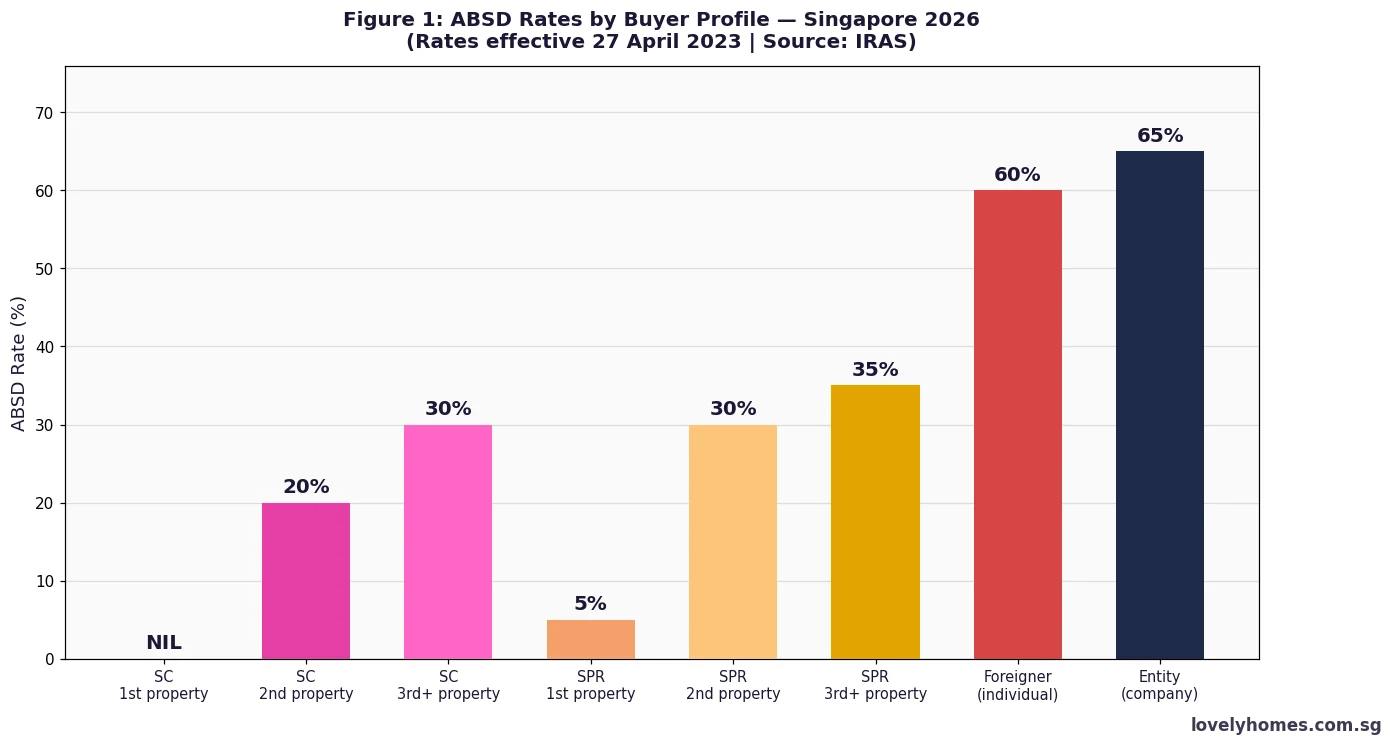
Since the Government’s 27 April 2023 cooling-measure announcement, foreigners purchasing any Singapore residential property — regardless of whether it is their first or fifth — pay a flat 60% ABSD. Entities (companies, trusts) pay 65%.

ABSD rates by buyer profile Singapore 2026 — SC, SPR and foreigner rates table
Figure 1: ABSD Rates by Buyer Profile, Singapore 2026. Source: IRAS, Stamp Duties Act (Cap 312). Rates effective 27 April 2023.

Free Trade Agreement (FTA) Nationals: A Critical Exception

Citizens of a small number of countries are treated as Singapore Citizens for ABSD calculation purposes, by virtue of bilateral Free Trade Agreements. This means they pay 0% ABSD on their first residential property, 20% on the second, and 30% on the third and above — the same schedule as a Singapore Citizen. The qualifying nationalities are:

  • United States nationals (US-Singapore FTA)
  • Swiss nationals (Trans-Pacific Partnership / bilateral treaty)
  • Nationals of Iceland, Liechtenstein, and Norway (Singapore-EFTA FTA)

Citizens of all other countries — including the United Kingdom, France, Germany, Australia, China, India, Japan, and Malaysia — pay the full 60% ABSD on any purchase. The Singapore-EU FTA does not extend to ABSD relief for EU nationals.

The FTA concession applies to the individual’s citizenship, not their work pass or residency status. A French national on an Employment Pass is not eligible; a Norwegian national on a Student’s Pass is.

Key takeaway: If you hold a US, Swiss, Icelandic, Liechtenstein or Norwegian passport, confirm this with your solicitor before paying ABSD — you may be entitled to the Citizen schedule (0% on first property). All other nationalities pay 60% flat, with no exceptions based on employment, tax residency, or length of stay in Singapore.

What Property Can Foreigners Buy in Singapore?

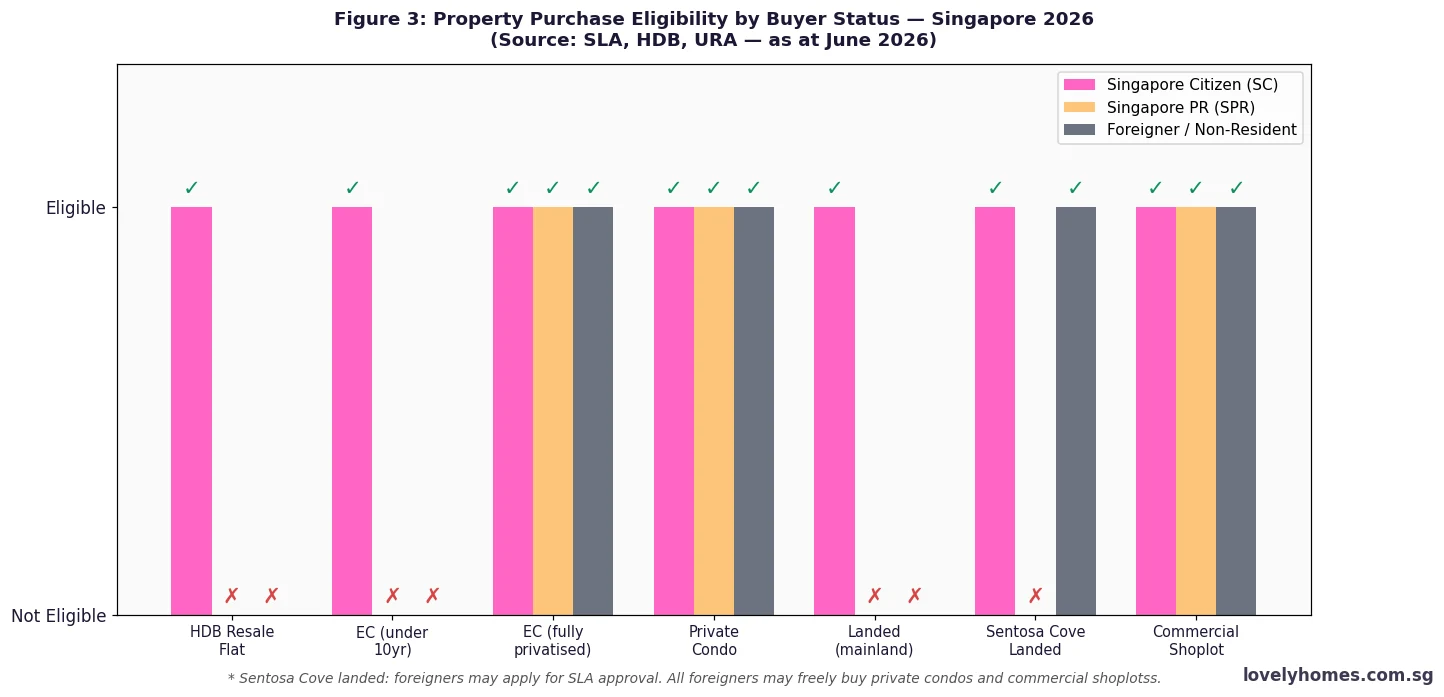
The Residential Property Act (Cap 274) is the key statute governing foreign purchases. Its restrictions apply to “restricted residential property” — essentially, low-rise residential land and housing. Strata-titled properties (condominiums, apartments) are generally unrestricted for foreign purchase. The practical breakdown is as follows:

Property purchase eligibility by buyer status Singapore 2026 — SC, SPR and foreigner comparison
Figure 3: Property Purchase Eligibility by Buyer Status, Singapore 2026. Source: SLA, HDB, URA. ✓ = eligible; ✗ = not eligible.

Permitted: Private Condominiums and Apartments

Any private condominium or apartment (strata-titled, not landed) may be purchased freely by foreign nationals. This includes new launch units sold directly by developers, resale market units, and units in mixed-use developments with a residential component. There is no cap on the number of units a foreigner may own, no minimum value requirement, and no minimum holding period before resale — though the Seller’s Stamp Duty (SSD) regime imposes a financial penalty for sales within three years of purchase (12% in year one, 8% in year two, 4% in year three).

Permitted: Executive Condominiums (ECs) After Full Privatisation

ECs are a hybrid housing type built by private developers on government land with HDB subsidy. They are subject to a staged ownership opening: only eligible Singapore Citizens and PRs may purchase during the first five years; PRs may also purchase in the resale market from the sixth year. Foreign nationals may purchase an EC in the open resale market only after the full 10-year privatisation period, at which point the development is treated as a fully private condominium.

Permitted: Commercial Shophouses and Non-Residential Properties

Commercial and industrial properties — shophouses zoned for commercial or mixed commercial/residential use, office units, retail space, factory space — are generally purchasable by foreign nationals without the ABSD applicable to residential property. However, if the shophouse contains a residential component (for example, a “mixed” shophouse with living quarters on the upper floor), ABSD at the foreigner rate applies to the entire purchase price. Buyers should obtain a URA written permission confirmation before assuming a mixed-use property is exempt from ABSD.

Permitted (with SLA Approval): Sentosa Cove Landed Homes

Sentosa Cove is the only precinct in Singapore where foreigners may apply to purchase landed property. Applications go through the SLA’s Land Dealings Approval Unit (LDAU). Approval is not guaranteed, and conditions may be imposed. Even with SLA approval, the 60% ABSD still applies to the purchase. Sentosa Cove landed homes — primarily bungalows and strata-landed cluster housing — are among the most internationally traded properties in Singapore, with prices typically ranging from S$5 million to S$30 million and above.

Not Permitted: HDB Flats

HDB flats — both the Build-To-Order (BTO) primary market and the open resale market — are reserved exclusively for Singapore Citizens (and, in the resale market, for Singapore Permanent Residents and mixed-nationality couples involving at least one SC or SPR). Foreign nationals on any visa type cannot purchase an HDB flat, regardless of how long they have lived and worked in Singapore.

Not Permitted: Mainland Landed Residential Property

Bungalows (detached houses), semi-detached houses, terrace houses, and strata-landed housing on the Singapore mainland are restricted residential property under the Residential Property Act. Foreign nationals may not purchase these without special approval from the Minister for Law — approval that is rarely granted and typically limited to cases of exceptional economic contribution. This restriction applies irrespective of the buyer’s wealth, tenure in Singapore, or investment intentions.

Buyer’s Stamp Duty (BSD): Rates and Calculation

BSD is payable by every purchaser of Singapore property — residents and foreigners alike — and is calculated on the purchase price or market value, whichever is higher. The progressive BSD tiers as at June 2026 (revised 15 February 2023) are:

Purchase Price Band BSD Rate Maximum Duty in Band
First S$180,000 1% S$1,800
Next S$180,000 (S$180k–S$360k) 2% S$3,600
Next S$640,000 (S$360k–S$1.0M) 3% S$19,200
Next S$500,000 (S$1.0M–S$1.5M) 4% S$20,000
Next S$1,500,000 (S$1.5M–S$3.0M) 5% S$75,000
Amount above S$3,000,000 6% Uncapped

BSD is administered by IRAS and must be paid within 14 days of signing the acceptance of the OTP (for private residential property) or the S&P Agreement. Payment is made via IRAS e-Stamping. Failure to pay on time attracts penalties of up to four times the stamp duty amount.

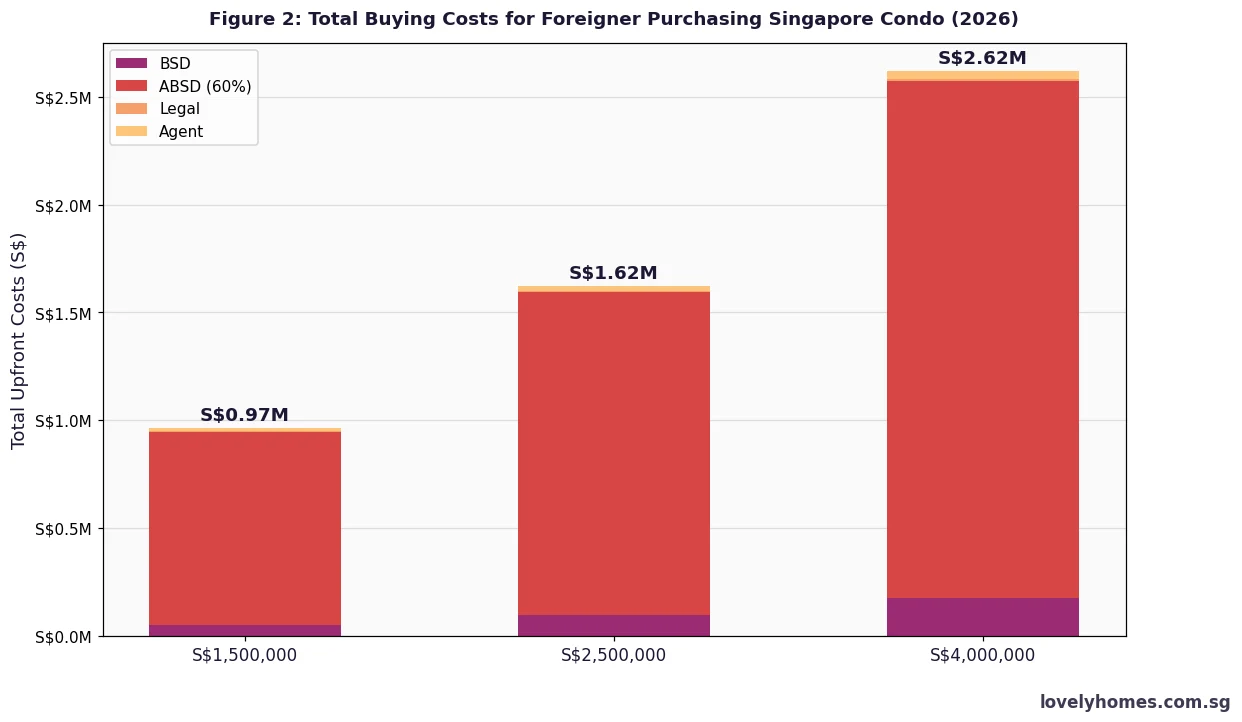
Total buying costs for foreigner purchasing Singapore condo 2026 — BSD, ABSD and fees
Figure 2: Total Buying Costs for a Foreigner Purchasing a Singapore Condominium, at Three Price Points (2026). Includes BSD, 60% ABSD, estimated legal and agent fees.

Bank Financing for Foreign Buyers: LTV, TDSR and Practical Limits

Foreign nationals may borrow from Singapore-licensed banks to finance a property purchase here. The key regulatory parameters are set by MAS (Monetary Authority of Singapore):

  • LTV cap: 75% of purchase price or valuation (whichever is lower) for the first property loan. This falls to 45% for the second and 35% for the third and subsequent loans. Loan amounts above S$1.5 million may attract more conservative lender assessments.
  • TDSR (Total Debt Servicing Ratio): Introduced by MAS in June 2013, TDSR limits total monthly debt obligations (including the proposed new loan) to 55% of gross monthly income. Lenders apply a stressed rate — typically 4.0% p.a. or the contractual rate, whichever is higher — when computing TDSR for variable-rate loans.
  • CPF: Foreign nationals who are not Singapore PRs or citizens do not have CPF accounts and therefore cannot use CPF Ordinary Account funds for the down payment or monthly instalments. All costs must be funded from personal savings or foreign income.
  • Minimum cash down payment: At least 5% of the purchase price must be paid in cash (not CPF). The remaining 20% of the 25% down payment (i.e., the amount not covered by the bank loan) may also be paid in cash.

In practice, a foreign buyer of a S$2 million condominium needs approximately S$500,000 in cash for the down payment alone — before accounting for stamp duties. This effectively means most foreigner purchasers in Singapore are self-funding the ABSD component entirely from liquid savings or overseas wealth.

Step-by-Step Buying Process for Foreign Purchasers

The transactional mechanics are the same as for any private property purchase in Singapore, with the additional stamp duty burden being the primary difference:

  1. Engage a Singapore-licensed solicitor: Choose a law firm experienced in foreign purchaser transactions. Confirm your ABSD status (FTA eligibility check).
  2. Obtain an In-Principle Approval (IPA) from a bank: Singapore banks lend to foreign nationals on Employment Passes or other long-term visas; some will lend to non-residents. IPA confirms your loan quantum and helps set your budget before you negotiate on price.
  3. Issue or accept the OTP: For new launches, developers issue the OTP automatically. For resale, the seller’s agent issues the OTP. You pay the option fee (typically 1% of purchase price) to secure the property.
  4. Exercise the OTP within 21 days: Pay the exercise price (typically 4% further deposit, making 5% total). At this stage the sale is legally binding.
  5. Pay BSD and ABSD within 14 days of OTP exercise: This is the single largest cash outflow for foreign buyers. Payment is through IRAS e-Stamping, and your solicitor handles the process.
  6. Complete the sale: Typically 8–12 weeks after OTP exercise for resale; or on the developer’s progressive payment schedule for new launches. For new launches, BSD and ABSD are typically stamped on the Sales & Purchase Agreement rather than the OTP.
  7. Register the transfer with SLA: Your solicitor lodges the instrument of transfer at the Singapore Land Authority. The Certificate of Title is issued upon completion.

Summary: Key Facts for Foreign Buyers at a Glance

Parameter Detail
ABSD rate (non-FTA foreigner) 60% flat on all residential properties (effective 27 April 2023)
ABSD rate (entity/company) 65% flat on all residential properties
FTA nationals (US, Swiss, EEA-3) Same ABSD schedule as SC: 0% first, 20% second, 30% third+
BSD Progressive 1–6% on purchase price; applies to all buyers
ABSD + BSD deadline 14 days from OTP acceptance or S&P Agreement date
LTV cap (first property) 75% bank loan; no HDB loan available to foreigners
TDSR 55% of gross monthly income (MAS, Jun 2013)
Minimum cash down payment 5% cash + up to 20% cash/CPF; foreigners must fund all from cash
Properties foreigners may freely buy Private condominiums, privatised ECs (10yr+), commercial property
Properties foreigners may NOT buy HDB flats, ECs under 10 years, mainland landed property
Sentosa Cove landed Purchasable with SLA/LDAU approval; ABSD still applies
SSD on resale within 3 years 12% (yr 1), 8% (yr 2), 4% (yr 3) — applies to all buyers

Worked Example: Mr & Mrs Laurent (French Nationals) — Purchasing a 2BR Condo at S$1,800,000

Profile: Mr Laurent (37) and Mrs Laurent (34), both French citizens on Employment Passes, joint gross income S$16,000/month. This is their first Singapore property purchase. They have S$1.8 million in savings and a S$350,000 CPF OA balance between them — however, as foreign nationals, CPF funds are not available for property purchase. All costs must be cash-funded.

Step 1 — BSD calculation on S$1,800,000:

  • 1% × S$180,000 = S$1,800
  • 2% × S$180,000 = S$3,600
  • 3% × S$640,000 = S$19,200
  • 4% × S$500,000 = S$20,000
  • 5% × S$300,000 (S$1.5M–S$1.8M) = S$15,000
  • Total BSD = S$59,600

Step 2 — ABSD calculation:

  • French nationals are not FTA-eligible → 60% ABSD applies
  • 60% × S$1,800,000 = S$1,080,000

Step 3 — Total stamp duties: S$59,600 + S$1,080,000 = S$1,139,600 (payable within 14 days of OTP exercise)

Step 4 — Bank loan and TDSR check:

  • LTV 75%: loan = S$1,800,000 × 75% = S$1,350,000
  • At 3.0% p.a. over 30 years: monthly instalment ≈ S$5,691
  • TDSR = S$5,691 ÷ S$16,000 = 35.6% — PASS (below 55% threshold)
  • Lender will stress-test at 4.0%: S$6,444/mth ÷ S$16,000 = 40.3% — PASS

Step 5 — Cash outlay summary:

Item Amount (S$)
25% down payment (cash — no CPF) S$450,000
BSD S$59,600
ABSD (60%) S$1,080,000
Legal fees (est.) S$4,000
Agent commission (buyer side, 1%) S$18,000
Total cash required upfront S$1,611,600

Note: The Laurents’ S$1.8M savings just covers the total cash outlay, leaving minimal liquidity. Most foreigner buyers at this price point fund the ABSD from offshore savings or liquidity events (asset sales, equity release elsewhere). A US national purchasing the same property would pay 0% ABSD (first property) — total stamp duty just S$59,600, cash upfront S$531,600: a S$1.08M difference.

Why Singapore Charges Foreigners 60% ABSD

Singapore’s property market is one of the most liquid and transparent in the world, and it serves as a preferred wealth-preservation vehicle for a globally mobile, high-net-worth demographic. The Government’s ABSD policy has three stated objectives: to maintain housing affordability for Singaporeans, to ensure a stable and sustainable property market, and to give priority to citizens in the accumulation of residential property assets. Deputy Prime Minister Lawrence Wong, speaking at the April 2023 cooling-measure announcement, described the 60% rate as necessary to prevent the market from being “driven by speculative demand from foreigners”.

The 2023 doubling (from 30% to 60%) had a tangible effect: foreign purchases as a share of total private residential transactions fell from approximately 4–5% in 2022 to around 1–2% in 2024–2025, according to URA caveats data. Despite this, transaction volumes in the luxury CCR (Core Central Region) segment — the typical market for foreign buyers — held firm, suggesting that high-net-worth foreign demand persists even at elevated ABSD levels, though the typical buyer profile has shifted towards those with the most compelling reasons to own Singapore property rather than those treating it as a convenient investment.

Peer-Country Comparison: How Singapore’s Foreign Buyer Policy Stacks Up

Singapore is not unique in restricting or taxing foreign property buyers, but its approach is among the most explicit globally. Australia charges foreign nationals an application fee plus a vacant residential land tax surcharge, and state-level duties in Victoria and New South Wales include foreign purchaser surcharges of 8% and 9% respectively — steep, but still well below Singapore’s 60%. New Zealand outright bans most foreigners from purchasing existing residential property. Canada introduced a two-year ban on foreign residential purchases in 2023. Hong Kong imposes a 15% New Residential Stamp Duty on foreign buyers. Against this backdrop, Singapore’s 60% rate stands out as a revenue-generating deterrent rather than a blanket prohibition, allowing the market to remain open in principle while pricing out all but the most committed foreign purchasers.

What Might Come Next for Foreign Buyer Policy?

This section represents editorial speculation and should not be relied upon for investment decisions. The 60% ABSD rate was set deliberately high, and the Government has indicated that any easing would be considered only if the market has “clearly stabilised”. As at June 2026, private residential prices continue to edge upward — URA’s Q1 2026 Private Residential Property Index rose 2.1% quarter-on-quarter — suggesting there is no near-term pressure on policymakers to reduce the foreign buyer burden.

Some market observers speculate that the Government might introduce a tiered ABSD regime that distinguishes between Singapore Permanent Residents who have been granted PR for over five years (and who contribute economically) and genuinely non-resident foreign investors. Others have suggested that the FTA concession framework could be extended to additional trading partners as Singapore negotiates further bilateral agreements. For now, however, the policy landscape appears settled: 60% ABSD for foreigners, 65% for entities, with FTA relief remaining narrowly targeted.

Frequently Asked Questions

Can a foreigner buy an HDB flat if they are married to a Singapore Citizen?

A foreign national married to a Singapore Citizen (SC) may purchase an HDB flat under the Public Scheme, provided the SC is the primary applicant and the couple meets HDB’s income ceiling (S$14,000/month for standard resale and BTO flats). The foreign national does not count as an SC or SPR, so the household eligibility depends entirely on the SC spouse’s status. The couple would not be eligible for the Enhanced CPF Housing Grant (EHG) if the foreign national has income, and must meet all other HDB eligibility criteria. Under the Citizen-Foreigner Public Scheme, the foreigner spouse is listed as a non-owner occupier, and the SC spouse must bear full ownership. Upon purchasing an HDB flat under this scheme, the SC spouse is treated as owning a first HDB — future HDB or private purchases will be subject to the usual MOP and ABSD implications for the SC owner.

Do Free Trade Agreement (FTA) nationals pay zero ABSD on their first Singapore property?

Yes — qualifying FTA nationals (US, Swiss, Icelandic, Liechtenstein, Norwegian citizens) are treated as Singapore Citizens for ABSD purposes. They pay 0% ABSD on their first residential property, 20% on the second, and 30% on the third and subsequent properties. This does not exempt them from Buyer’s Stamp Duty (BSD), which applies to all purchasers. The FTA concession is tied to citizenship, not to work-pass status, length of stay, or tax residency. A US citizen on an EP purchasing their first Singapore condo pays 0% ABSD; a UK citizen on an EP pays 60%. To claim the concession, the buyer’s solicitor submits proof of citizenship at the IRAS e-Stamping portal when paying stamp duty.

Can foreigners use a Singapore company to buy residential property and save ABSD?

No — and attempting this will result in a higher ABSD bill. Entities (including companies, trusts, and other legal persons) pay a flat 65% ABSD on any residential property purchase, five percentage points higher than the individual foreigner rate of 60%. Singapore’s ABSD framework was specifically designed to close corporate-vehicle loopholes. IRAS also has anti-avoidance provisions in the Stamp Duties Act that allow it to look through arrangements where the substance of the transaction is a residential property purchase, even if structured differently. There is no ABSD exemption for residential properties held through corporate vehicles, except for licensed housing developers who qualify for the conditional remission regime (which requires the developer to complete and sell all units within a prescribed period).

What is the Seller’s Stamp Duty (SSD) and does it apply to foreigners?

SSD is a tax on the seller of a residential property, payable if the property is sold within three years of purchase. The rates are 12% of the sale price or market value (year one), 8% (year two), and 4% (year three). SSD applies to all sellers in Singapore regardless of nationality — there is no foreigner exemption or additional rate. SSD is intended to deter short-term speculation. For a foreigner who buys a S$2 million condominium and sells it 18 months later, the SSD would be 8% × S$2 million = S$160,000, on top of the 60% ABSD they paid on entry. Given these dual costs, most foreigner buyers approach Singapore property as a medium-to-long-term holding rather than a short-term trade.

Can foreigners on a Tourist Pass or Short-Term Visit Pass buy Singapore property?

Yes — there is no requirement to hold a work pass or long-term visa in order to purchase Singapore private residential property. The transaction is governed by the Residential Property Act and the Stamp Duties Act, and the buyer’s immigration status does not affect eligibility to purchase a private condominium. However, practical considerations apply: Singapore banks will not extend a mortgage to someone with no Singapore income or no long-term visa, so cash purchasers are typically the only buyers in this category. Additionally, non-residents purchasing property may be subject to home-country tax reporting and capital controls depending on their jurisdiction of domicile.

Are there minimum income or minimum stay requirements to buy a Singapore condo as a foreigner?

There are no minimum income or minimum stay requirements to purchase a private condominium in Singapore as a foreign national. The Singapore property market does not operate an investors’ visa scheme that ties property purchase to immigration status. Foreign nationals do not receive any immigration benefit from purchasing property here. However, as noted above, if you wish to finance the purchase with a Singapore bank mortgage, you will need to demonstrate sufficient income and financial standing to satisfy the bank’s credit assessment and MAS’s TDSR requirements. Without a Singapore income, banks may require evidence of overseas income, asset statements, or a guarantor.

What happens to ABSD if a foreigner later becomes a Singapore Permanent Resident (SPR)?

ABSD is levied at the point of purchase and is assessed based on the buyer’s status at the time of signing the OTP or S&P Agreement. If a foreign national purchases a property paying 60% ABSD and subsequently becomes an SPR, there is no refund of the excess ABSD already paid. The change in residency status only affects future purchases: as an SPR, any subsequent residential property purchase would attract ABSD at SPR rates (5% on first property, 30% on second). There is also an ABSD refund mechanism for married couples involving a Singapore Citizen, where the couple initially pays ABSD on a second property and then sells the first within six months — but this remission scheme does not apply to foreigners paying the 60% rate on a first purchase.

Disclaimer: This article is intended for general informational purposes only and does not constitute legal, financial, or taxation advice. ABSD rates, BSD tiers, LTV ratios, and property ownership rules are subject to change by the Government at any time. The information in this article reflects the position as at June 2026. Before making any property transaction, readers should consult a Singapore-licensed solicitor, a Monetary Authority of Singapore (MAS)-licensed financial adviser, and the relevant government authorities including IRAS (iras.gov.sg), HDB (hdb.gov.sg), SLA (sla.gov.sg), and URA (ura.gov.sg). LovelyHomes does not accept liability for any loss arising from reliance on information in this article.

Translate »