Jurong East Neighbourhood Guide Singapore 2026: Property Prices, JLD Uplift, Schools and Investment Outlook

Jurong East Neighbourhood Guide Singapore 2026: Property Prices, JLD Uplift, Schools and Investment Outlook

Quick Answer: Jurong East 2026 — What Buyers and Investors Need to Know

  • Location: District 22 (D22), Outside Central Region (OCR). Well-connected on the East-West Line (EWL) and the incoming Jurong Region Line (JRL, ~2028).
  • JLD catalyst: Jurong Lake District (JLD) — 360 hectares — is Singapore’s largest mixed-use development outside the CBD. The URA has designated it as a second Central Business District, with URA’s 2H2026 GLS programme including a landmark JLD white site for tender in July 2026.
  • Property prices: HDB 4-room resale flats trade at S$370,000–S$530,000; OCR condos at S$1,050,000–S$1,480,000 (2BR) as at May 2026.
  • Rental yields: Condos in D22 yield 3.4–3.7% gross; HDB flats deliver higher at 4.3–5.1%.
  • 5-year HDB price growth: approximately +9.5% for 4-room flats — broadly in line with the national OCR trend.
  • JRL uplift thesis: the opening of JRL Phase 1 from approximately 2028 (J1 Jurong East as the key interchange) historically correlates with 8–15% price appreciation in proximate properties based on past MRT openings.
  • Retail and lifestyle: three major malls — JEM, Westgate, and IMM — plus Jurong Point, make Jurong East one of Singapore’s most self-contained suburban retail hubs.
  • Education: Ngee Ann Polytechnic and proximity to NUS and NTU create solid rental demand from students and academic professionals.

Jurong East: Location, Planning Context and Why It Matters

Jurong East is a mature HDB town in Singapore’s west, administered under District 22 of the Outside Central Region (OCR). It sits at the intersection of two major MRT lines — the East-West Line (EWL) at Jurong East station (EW24) and the future Jurong Region Line (JRL) at J1 — making it the gateway interchange for the western catchment. It borders Jurong West to the north-west, Clementi to the east, and Bukit Batok to the north.

What sets Jurong East apart from other OCR towns is the Jurong Lake District (JLD). In its Master Plan, the Urban Redevelopment Authority (URA) has designated the 360-hectare JLD — stretching from Jurong East MRT station to the Chinese and Japanese Gardens — as Singapore’s second CBD. The vision encompasses 100,000 new jobs, 20,000 new homes, a new integrated tourism development, and a network of car-lite streets around Jurong Lake Gardens. The June 2026 Government Land Sales programme confirmed a major JLD white site for tender in July 2026, capable of accommodating up to 1,200 residential units, at least 40,000 sqm of office space, and 44,000 sqm of complementary uses — marking a tangible next step in JLD’s realisation.

For property investors, the JLD story represents a medium-to-long-term structural re-rating of Jurong East and its immediate environs. The comparison most frequently drawn is to the Marina Bay Financial Centre development: Marina Bay residential properties within walking distance of the financial district saw significant price appreciation over the 2008–2018 development period. If JLD develops as planned — and the government’s investment in the JRL, Jurong Lake Gardens, and GLS pipeline suggests strong commitment — Jurong East’s pricing relative to the OCR average could narrow meaningfully over the next decade.

Connectivity: MRT and Public Transport

Jurong East’s transport infrastructure is already strong and improving. The East-West Line (EWL) connects Jurong East (EW24) to Raffles Place in approximately 32 minutes and to Changi Airport via transfer in around 50 minutes. The station is also served by a major integrated bus interchange handling cross-island routes. The Jurong Region Line (JRL), targeted to open in phases from approximately 2028, designates Jurong East as its J1 station — the key interchange with the EWL. The JRL’s three branches (Boon Lay Branch, Choa Chu Kang Branch, and Tengah Branch) will connect an estimated 150,000 residents in the Tengah, Choa Chu Kang, and Boon Lay corridors to Jurong East, substantially increasing footfall through the precinct. A future Jurong–Sembawang Line (JSL) — still in planning — has been identified in URA’s Long-Term Plan as eventually running through Jurong East, offering a cross-island link to the north.

Driving connectivity is similarly well-served. The Ayer Rajah Expressway (AYE), Pan Island Expressway (PIE), and Bukit Timah Expressway (BKE) intersect near Jurong East, providing fast access to the CBD (approximately 20–25 minutes off-peak), Changi (approximately 30–35 minutes), and the Second Link to Malaysia at Tuas. The proximity to the causeway is an important feature for Jurong East’s professional tenant pool, which includes engineers, logistics managers, and workers at Jurong Island’s petrochemical complex.

Jurong East D22 property price ranges 2026 — HDB 3-room to condo 3BR and EC resale horizontal bar chart
Figure 1: Property price ranges in Jurong East (District 22), May 2026. HDB 4-room resale flats trade at S$370k–S$530k; OCR condos at S$1.05M–S$2.0M. Source: HDB, URA.

Property Market: Prices, Types and Investment Profiles

Jurong East’s residential stock is predominantly HDB. The town has a well-established mix of 3-room, 4-room, 5-room, and executive apartment (EA) flats spread across estates like Yuhua, Toh Guan, Bukit Batok East (boundary), and the Jurong East town centre precincts. HDB 4-room resale flats in Jurong East currently trade at approximately S$370,000–S$530,000, with well-positioned units near Jurong East MRT or in high-floor blocks commanding the upper range. 5-room flats trade at S$490,000–S$680,000; executive apartments at S$620,000–S$880,000.

The private condominium supply in D22 is relatively thin compared to adjacent districts, which itself supports pricing. Key developments include J Gateway (99-year leasehold, 738 units, directly above Jurong East MRT), valued at approximately S$1,400–1,600 psf as at mid-2026; Vision (99-year, 294 units, Boon Lay Way/Jurong East Ave 1 corner), valued at approximately S$1,100–1,250 psf; and Lake Grandeur (99-year, 396 units, Jurong Lake area), valued at approximately S$1,050–1,200 psf. The scarcity of private supply in D22 — no new private residential GLS site in the immediate Jurong East precinct since J Gateway’s site was awarded in 2012 — means that the JLD GLS pipeline will be the first significant new supply in over a decade. New-build prices from the JLD white site (if awarded and launched) are expected to set new benchmarks for D22 pricing, potentially in the S$2,200–2,800 psf range based on comparable city-fringe mixed-use projects.

The EC resale market is represented primarily by Westwood Residences (EC, 480 units, Jurong West Ave 1, privatised 2024) trading at S$850,000–S$1,250,000, offering post-privatisation investors a mid-point between HDB and full private pricing.

Jurong East amenities connectivity snapshot 2026 — MRT schools retail parks healthcare D22 statistics
Figure 2: Jurong East key amenities and connectivity snapshot, 2026. JRL opens in phases from approximately 2028. Source: LTA, HDB, SingHealth.

Schools, Education and Family Amenities

Jurong East is well-served for families at all school levels. Within 2 km of the town centre, primary schools include Rulang Primary School (well-regarded, popular in the primary-one registration priority exercise), Shuqun Primary School, Yuhua Primary School, and Fuhua Primary School. Secondary schools include Yuhua Secondary and Chua Chu Kang Secondary. At the tertiary level, Ngee Ann Polytechnic is approximately 2 km east (Clementi Road), while NUS Kent Ridge is approximately 8 km and Nanyang Technological University (NTU) is approximately 10–15 minutes by bus or future JRL. The student rental demand from NTU in particular is a significant driver of D22 condo rental volume, particularly for 1-bedroom and small 2-bedroom units.

For retail, Jurong East is exceptional by suburban Singapore standards. The Jurong Gateway commercial precinct contains three integrated malls: JEM (248,000 sqft, Lendlease REIT), Westgate (342,000 sqft, CapitaLand), and the adjacent IKEA Tampines equivalent replaced by IMM (180,000 sqft factory outlet, Lendlease REIT). A further 4 km down the EWL, Jurong Point (398,000 sqft, Singapore’s largest suburban mall) serves the Boon Lay/Jurong West catchment. The combined retail density within 5 km of Jurong East MRT is among the highest of any OCR town in Singapore.

Healthcare is anchored by Ng Teng Fong General Hospital (NTFGH) — the 700-bed regional hospital replacing the former Alexandra Hospital Jurong for the western region, opened in 2015 — and the co-located Jurong Community Hospital (JCH) (228 beds for intermediate and long-term care). National University Hospital (NUH) is approximately 8 km via AYE, and the Jurong Medical Centre serves polyclinic-level primary healthcare for the precinct.

Rental Market and Investment Case

The Jurong East rental market is underpinned by three distinct tenant pools. First, NTU/NGP students and academic professionals — particularly relevant for 1BR and studio condos, commanding rents of approximately S$2,400–3,200/month for 1BR units. Second, Jurong Island and western industrial workers — engineers, petrochemical and logistics professionals who prefer to rent in the western corridor to minimise their commute. Third, expats from Malaysian corporates and cross-border professionals — Jurong East’s proximity to the Tuas Second Link (approximately 25 minutes by car) attracts a segment of Malaysian professionals and senior managers who commute daily or bi-weekly.

As at Q1 2026, gross rental yields in D22 are approximately: HDB 3-room 5.1%, HDB 4-room 4.7%, HDB 5-room 4.3%, condo 1BR 3.7%, condo 2BR 3.4%, EC resale 3.4%. These are modest compared to D11 medical cluster or D19 student-driven markets, but they are supported by genuine occupational demand rather than speculative vacancy churn. Vacancy rates in D22 private condos are estimated at approximately 4–6%, consistent with the national OCR private average of approximately 5% in Q1 2026.

Summary: Jurong East Investment Snapshot by Property Type

Property Type Price Range Gross Yield 5-Yr Growth Tenure
HDB 3-Room S$280k–S$410k ~5.1% +8.2% 99yr (HDB)
HDB 4-Room S$370k–S$530k ~4.7% +9.5% 99yr (HDB)
HDB 5-Room / EA S$490k–S$880k ~4.2% +9.9% 99yr (HDB)
Condo 1BR S$760k–S$1,050k ~3.7% +11.2% 99yr (leasehold)
Condo 2BR S$1,050k–S$1,480k ~3.4% +12.5% 99yr (leasehold)
Condo 3BR S$1,400k–S$2,000k ~3.1% +13.8% 99yr (leasehold)
EC (resale) S$850k–S$1,250k ~3.4% +10.6% 99yr (privatised)

Worked Example: First-Time Buyer Purchasing a Jurong East HDB 4-Room Resale

Case Study — Mr & Mrs Lim, Singapore Citizens, first-time HDB buyers

Household profile: Mr & Mrs Lim, both Singapore Citizens, joint gross income S$8,500/month. First-time HDB buyers (no prior property ownership). Target: purchase a 4-room HDB resale flat in Jurong East at S$490,000.

Grants: Joint income S$8,500/month qualifies for Enhanced Housing Grant (EHG) of S$25,000 (family income S$7,001–9,000 bracket); Proximity Housing Grant (PHG) of S$30,000 if purchasing within 4 km of parents. Total grants: S$55,000.

Effective purchase price after grants: S$490,000 − S$55,000 = S$435,000 (for CPF/loan computation purposes).

Stamp duties: BSD on S$490,000 = (S$180,000 × 1%) + (S$180,000 × 2%) + (S$130,000 × 3%) = S$1,800 + S$3,600 + S$3,900 = S$9,300. ABSD: nil (SC first property).

Financing: HDB Loan LTV 80% on S$490,000 = S$392,000 loan @ 2.6% p.a. 25 years → monthly instalment S$1,776. MSR check: S$1,776 ÷ S$8,500 = 20.9% — within 30% PASS.

Upfront cash required: 5% cash downpayment on S$490,000 = S$24,500. BSD S$9,300 (payable via CPF). Legal/valuation ~S$2,500. Total cash outlay: approximately S$27,000.

Monthly household finances: Mortgage S$1,776 (20.9% MSR) + conservancy charges ~S$80 + property tax ~S$120 = approximately S$1,976/month total property cost. At S$8,500 gross income, net take-home after CPF (employee contribution 20% = S$1,700) is approximately S$6,800/month, leaving comfortable headroom.

Jurong East D22 rental yield and 5-year capital growth by property type 2026 — HDB condo EC comparison
Figure 3: Jurong East gross rental yield and 5-year capital growth by property type, 2026. Condos have outperformed HDB on capital growth; HDB leads on yield. Source: URA, HDB.

Why Jurong East Matters to Property Investors in 2026

The JLD story is the most compelling single narrative in Singapore’s western residential market. No other OCR town has a comparable government-backed catalyst: a designated second CBD, a new MRT interchange (JRL J1), a landmark GLS white site under active tender, and the surrounding Jurong Lake Gardens — Singapore’s third national garden after Botanic Gardens and Gardens by the Bay — as a lifestyle anchor. Comparable transformations in Singapore’s history — the Marina Bay build-out from 2005 to 2018, the Dhoby Ghaut Circle Line opening in 2009 — consistently delivered residential price appreciation in the 8–20% range over a 3–5 year period following the key infrastructure milestones.

The practical investment case for most buyers today is straightforward: entry-level pricing in D22 remains accessible by OCR standards, yields are supportable, tenant demand is real, and the infrastructure spend committed by the government is unprecedented for any suburban town. The key risks are timeline slippage (JLD’s full development has a 20–30 year horizon) and interest rate sensitivity (a sustained SORA above 3.5% would compress condo yields to less than 2% net, making servicing costs uncomfortable).

What Might Come Next for Jurong East

The July 2026 JLD white site tender result will be the single most watched event in the Singapore western property market for the second half of 2026. A high bid — say S$1,800+ psf ppr — would signal developers’ confidence in JLD pricing and likely prompt a re-rating of existing D22 private condos. A below-expectation result could dampen enthusiasm but would not alter the structural story. The JRL’s opening in phases from approximately 2028, with J1 Jurong East as the key interchange, is widely expected to be the catalytic event for near-station premium appreciation. Investors monitoring the situation should also watch the Tengah New Town development (42,000 HDB flats planned, JRL-served) — as Tengah launches into the market from 2026 onwards, it will compete with Jurong East for western upgrader demand and may moderate Jurong East’s immediate-term HDB resale momentum.

Frequently Asked Questions: Jurong East Neighbourhood Guide 2026

Is Jurong East a good area to buy property in 2026?

Jurong East is one of the most strategically positioned OCR towns in Singapore for medium-to-long-term investors in 2026. The JLD development gives it a structural demand catalyst that most other OCR towns lack. Entry prices remain accessible (HDB 4-room resale at S$370k–S$530k; condo 2BR at S$1.05M–S$1.48M), yields are decent for the OCR, and the JRL interchange opening (~2028) provides a near-term price catalyst. The main caveat is that JLD is a very long-horizon project — buyers expecting a 1–2 year flip will likely be disappointed. The investment case is most compelling for buyers with a 5–10 year holding horizon who are simultaneously living in or near the area.

Which MRT stations serve Jurong East?

Jurong East is currently served by Jurong East MRT (EW24) on the East-West Line (EWL). It is an interchange station with a major bus hub. From July 2028 onwards (approximate), Jurong East will also be served by J1 Jurong East on the Jurong Region Line (JRL) — making it a two-line interchange. The JRL will connect Jurong East north to Choa Chu Kang and west to Boon Lay, significantly expanding the commuter catchment. A future Jurong–Sembawang Line (JSL) is referenced in URA’s Long-Term Plan Review but has no confirmed timeline. The EWL already connects Jurong East to the CBD (Raffles Place EW14) in approximately 32 minutes without a transfer.

Can PRs and foreigners buy property in Jurong East?

Singapore Permanent Residents (PRs) can purchase HDB resale flats in Jurong East subject to HDB eligibility criteria (PR households, no concurrent private property ownership, etc.) with a 5% ABSD on their first property. PRs cannot purchase new HDB BTO flats. For private condos (J Gateway, Vision, Lake Grandeur, Westwood Residences EC post-privatisation), PRs pay 5% ABSD on their first property and 30% on a second. Foreign nationals (non-PR) cannot own HDB flats at all, but may buy private condos at 60% ABSD. Given the 60% ABSD, foreign individual ownership of Jurong East condos is rare and concentrated among those using Singapore property as a long-term currency-diversification vehicle rather than a rental yield play.

What are the best condos to buy in Jurong East?

J Gateway (EW24 directly above station, 738 units, 99yr) is the most frequently cited for its unrivalled transport connectivity — with Jurong East MRT directly underfoot, rental demand from students and young professionals is among the strongest in D22. Vision (Boon Lay Way, 294 units, 99yr) offers a quieter residential setting with slightly lower psf and reasonable EWL access. Lake Grandeur (Jurong Lake area, 396 units, 99yr) is the best-positioned for JLD appreciation — walking distance to Jurong Lake Gardens and the future JLD commercial precinct. For buyers prioritising JLD capital upside over immediate rental yield, Lake Grandeur and the upcoming JLD GLS developments (once launched) represent the strongest bet. Note that all major D22 condos are leasehold (99-year), which affects long-term lease decay considerations for buyers with 30-year horizons.

How does Jurong East compare to Clementi and Bukit Batok for investment?

Clementi (D05 RCR boundary) benefits from NUS proximity, excellent CCL/EWL connectivity, and freehold land scarcity — it typically commands a 20–30% price premium over Jurong East for comparable property types. However, that premium already prices in much of the educational and transport uplift. Bukit Batok (adjacent OCR, D23) is more affordable — HDB 4-room resale at S$310,000–S$450,000 — and will benefit from the JRL Bukit Batok station, but lacks the JLD commercial anchor and has lower condo supply depth. For investors balancing yield, entry price, and structural upside, Jurong East sits in a superior position to Bukit Batok and offers better long-term appreciation potential than either D23 or the already-appreciated Clementi market.

Is there HDB BTO supply available in Jurong East in 2026?

Jurong East’s established HDB stock means BTO supply within the immediate town centre is limited. The 2026 HDB BTO exercise does not include a dedicated Jurong East precinct; the nearest June 2026 BTO projects are in Jurong West and Clementi. The primary acquisition route into Jurong East public housing is therefore the HDB resale market, which offers greater flexibility on flat type, floor, and move-in timeline but at market price (no BTO subsidy). Tengah New Town — a 42,000-flat new town directly adjacent to the JLD catchment — is receiving BTO allocations from 2024 onwards and represents an alternative for buyers seeking subsidised entry into the western corridor’s growth story, though at the cost of a longer wait time and MOP obligation.

Disclaimer: This article is for general educational and informational purposes only and does not constitute financial, investment, legal, or property advice. Property prices, MRT opening timelines, GLS programme details, HDB policies, and government development plans are subject to change without notice. JLD development timelines, JRL opening dates, and JSL plans referenced are based on publicly available URA and LTA announcements as at June 2026 and remain subject to revision. Readers should verify all information directly with the relevant authorities — URA, HDB, LTA, IRAS, and CPF Board — and consult a licensed professional before making any property decision.

Sembawang Neighbourhood Guide Singapore 2026: Property Prices, Schools, MRT and Investment Outlook

Sembawang Neighbourhood Guide Singapore 2026: Property Prices, Schools, MRT and Investment Outlook

Quick Answer — Sembawang at a Glance (2026)

  • District: D27, Outside Central Region (OCR). Predominantly HDB, with a small private condominium and EC segment.
  • MRT: North–South Line (NSL) — Sembawang (NS11), Canberra (NS12), Yishun (NS13). Approximately 15 minutes to Orchard Road.
  • Property prices: HDB 4-room resale S$470k–S$650k; condo 2-bedroom S$900k–S$1.32M; EC 4-bedroom S$1.25M–S$1.62M.
  • Gross rental yield: HDB 4-room ~4.8% p.a.; condo 2-bedroom ~3.2% p.a. — above-average for OCR.
  • 5-year HDB price growth: ~9.8% (4-room) — in line with the broader OCR HDB market.
  • June 2026 BTO: Approximately 2,000 new HDB units in Sembawang as part of the June 2026 exercise, including Nee Soon South Crescent — the largest allocation in the exercise.
  • Investment thesis: Proximity to the Johor Strait, upcoming RTS Link (Woodlands–JB, 2027) spillover, and NSC (Nee Soon Central) urban renewal make Sembawang a watch-list OCR name for long-term buyers.

Where Is Sembawang? A District Overview

Sembawang occupies the northernmost residential area of mainland Singapore, forming part of District 27 alongside neighbouring Yishun. The estate sits on the Johor Strait waterfront — a fact that shaped its character as a former British naval base, the site of HMS Terror and HMS Sultan, before being handed over to Singapore in 1971 and progressively redeveloped as an HDB new town from the 1970s onwards. Sembawang Park, located on the Johor Strait waterfront, preserves a small slice of that colonial-era landscape.

Today, Sembawang is administered by the Housing & Development Board as a mature HDB town, with approximately 60,000 residents housed predominantly in newer BTO flats and upgraded 1980s–1990s blocks. The private residential segment is modest: Parc Canberra EC (496 units, 99-year, launched 2019, MOP October 2024), The Brownstones EC (638 units, fully privatised), and a small cluster of strata-titled condominiums along Sembawang Drive and Admiralty Road West. Sembawang is not a headline district for luxury buyers, but it offers a compelling affordability-and-liveability proposition for first-time HDB buyers and yield-focused investors.

Sembawang Property Prices by Type (Q2 2026)

Prices below reflect Q2 2026 transaction data from the Urban Redevelopment Authority (URA) and HDB resale portal. All figures are indicative ranges and will vary by storey, facing and condition.

Sembawang District 27 property price ranges by type 2026 HDB condo EC Singapore
Figure 1: Sembawang (D27) Property Price Ranges by Type, Q2 2026. Source: URA, HDB.

HDB resale prices in Sembawang remain among the most affordable in the OCR for larger flat types. A 4-room resale flat typically transacts between S$470,000 and S$650,000 depending on storey and location; 5-room flats run S$600,000–S$820,000. Executive Apartments and Multi-Generation flats (where available) can reach S$720,000–S$950,000. The condo segment, dominated by Parc Canberra EC and The Brownstones, trades at S$900,000–S$1,320,000 for 2-bedroom units — pricing that aligns with upgraded OCR condominiums in Woodlands and Yishun rather than the tighter core OCR markets of Tampines or Bedok.

MRT Connectivity, Schools and Key Amenities

Sembawang is served by three North–South Line (NSL) stations — Sembawang (NS11), Canberra (NS12) and Yishun (NS13) — providing direct access to the city. Journey times from Sembawang MRT to Orchard Road (NS22) are approximately 25–28 minutes without interchange; to Woodlands Checkpoint (NS9) approximately 8–10 minutes for those with business or family ties across the Causeway.

The June 2027 opening of the Johor Bahru–Singapore Rapid Transit System (RTS) Link at Woodlands North (2 stops from Sembawang) is expected to increase demand for Sembawang and Woodlands properties from Johor-resident workers and families who commute to Singapore. Historical precedent from the opening of MRT extensions suggests a 5–15% property price uplift in the catchment area within 2 years of a new connectivity announcement materialising.

Sembawang key amenities 2026 MRT connectivity schools shopping parks healthcare Singapore
Figure 2: Sembawang — Key Amenities and Infrastructure at a Glance (2026).

The main retail anchor is Sun Plaza near Sembawang MRT, complemented by the newer Canberra Plaza (opened 2022) which houses a wet market, hawker centre, supermarket and F&B outlets. Northpoint City in neighbouring Yishun — the largest shopping mall in northern Singapore — is approximately 8 minutes by MRT. The Canberra Hawker Centre has quickly become one of northern Singapore’s most popular food destinations since opening in 2020.

For healthcare, Khoo Teck Puat Hospital (KTPH) in Yishun — 5 km from central Sembawang — is the primary acute hospital. The Admiralty Medical Centre (near Admiralty MRT, NS10) and Yishun Polyclinic serve as the primary care network. Schools within the catchment include Sembawang Primary, Canberra Primary, Canberra Secondary, Yishun Town Secondary, CHIJ St Joseph’s Convent and ITE College Central (Yishun campus).

Rental Yield and 5-Year Price Growth

Sembawang’s OCR location means it offers higher rental yields than CCR counterparts, driven by a combination of lower purchase prices and steady demand from NSF families (close to Sembawang Camp and Mandai precinct), Johor-side workers, and younger families priced out of more central estates.

Sembawang District 27 gross rental yield and 5 year price growth by property type 2026
Figure 3: Sembawang D27 — Gross Rental Yield vs 5-Year Price Growth by Property Type (Q2 2026). Source: URA, SRX, HDB.

HDB 3-room flats deliver the highest gross yield at approximately 5.1% p.a., reflecting the strong demand for affordable rental units from singles and young couples. EC units (Parc Canberra post-MOP, The Brownstones) offer a yield of approximately 3.0% — lower than HDB but with superior capital appreciation potential given their condo-equivalent finishes at OCR pricing. 5-year price growth for 4-room HDB flats runs at approximately 9.8%, consistent with the OCR HDB market average reported by HDB’s Resale Price Index (RPI reaching 216.3 in Q1 2026, up 41.2% from Q1 2021).

Sembawang vs Woodlands vs Yishun — Investment Comparison

Sembawang, Woodlands and Yishun form the northern residential triumvirate of Singapore. Each has a distinct investment profile. Woodlands commands a slight premium thanks to its Woodlands Regional Centre designation and the RTS Link station at Woodlands North — but higher prices compress yields. Yishun offers the most diversified amenity mix (Northpoint City, KTPH, Loop & Dine, Yishun Park Hawker Centre) but has a perception overhang that has historically kept prices lower than fundamentals might otherwise support. Sembawang sits between the two: less developed than Woodlands’ commercial node but benefiting from the same RTS Link proximity spillover, with prices that are still among the most affordable in the NSL corridor. For a first-time buyer prioritising yield and manageable entry cost, Sembawang offers a differentiated value proposition relative to the more competitive Tampines or Bishan markets.

Summary Table — Sembawang Property Overview 2026

Property Type Price Range (S$) Approx. PSF Gross Yield 5yr Growth
HDB 3-Room 350k–480k S$410–S$560 ~5.1% ~9.2%
HDB 4-Room 470k–650k S$400–S$550 ~4.8% ~9.8%
HDB 5-Room 600k–820k S$390–S$535 ~4.3% ~10.2%
HDB EA/EM 720k–950k S$370–S$510 ~4.0% ~9.5%
Condo 1-Bedroom 680k–980k S$1,200–S$1,500 ~3.8% ~8.5%
Condo 2-Bedroom 900k–1,320k S$1,150–S$1,450 ~3.2% ~9.0%
Condo 3-Bedroom 1,150k–1,680k S$1,100–S$1,400 ~2.8% ~9.5%
EC 4-Bedroom 1,250k–1,620k S$1,050–S$1,380 ~3.0% ~11.8%

Worked Example — Mr & Mrs Rajan Buying Sembawang 4-Room HDB Resale

Mr & Mrs Rajan are a Singapore Citizen couple. Joint gross income: S$8,200 per month. They plan to buy a 4-room HDB resale flat along Sembawang Drive for S$560,000. This is their first property. Combined CPF OA: S$75,000. They qualify for an Enhanced Housing Grant (EHG) of S$75,000 (income bracket S$8,001–S$9,000, per the HDB EHG schedule) and a Proximity Housing Grant (PHG) of S$30,000 (within 4 km of parents). Total grants: S$105,000.

  • Purchase price: S$560,000
  • HDB Loan (80% LTV): S$448,000
  • Downpayment (20%): S$112,000 — CPF OA S$75,000 + cash S$37,000
  • Grants applied: S$105,000 — EHG S$75,000 + PHG S$30,000 (reduce net outlay)
  • Monthly instalment (HDB loan, 2.6%, 25yr): S$2,028/month
  • MSR check: S$2,028 ÷ S$8,200 = 24.7% — PASS (threshold 30%)
  • BSD: 1% × S$180k + 2% × S$180k + 3% × S$200k = S$1,800 + S$3,600 + S$6,000 = S$11,400
  • ABSD: Nil (SC first property)
  • Legal fees: ~S$2,500
  • Total cash outlay: S$37,000 + S$11,400 + S$2,500 = ~S$50,900

The grants cover more than the CPF OA balance, meaning the Rajans’ effective upfront cash of ~S$51,000 is among the lowest feasible entry costs in the OCR market. At a 4.8% gross yield, a comparable Sembawang 4-room flat rented out would generate approximately S$2,688 per month — well above the S$2,028 monthly HDB loan instalment — confirming the estate’s investment-grade yield profile for future upgraders who may hold the flat as a rental asset post-MOP.

Is Sembawang a Good Place to Buy in 2026?

Sembawang is a solid choice for first-time HDB buyers and long-term OCR investors who prioritise affordability, community amenities and the NSL corridor’s proven long-term price trajectory. The key investment thesis rests on three legs: the RTS Link spillover (Woodlands North station from 2027, benefiting the entire northern corridor), the Nee Soon South urban renewal under HDB’s Remaking Our Heartland programme, and the June 2026 BTO supply absorption which, once MOP-cleared in 2031–2032, will add resale liquidity and benchmark new pricing for the estate. On a pure affordability-per-square-metre basis, Sembawang 4-room flats at S$400–S$550 psf remain significantly below the OCR HDB average of ~S$580–S$640 psf, suggesting room for mean reversion.

Risks to note: the estate’s northern periphery location means commute times to the Central Business District are relatively long (35–40 minutes by MRT). The private residential market is thin — Parc Canberra and The Brownstones are the primary liquid assets — which can widen bid-ask spreads and make exit timing less flexible than more liquid OCR markets like Tampines or Punggol.

Frequently Asked Questions

Is Sembawang a good place to buy property in 2026?

Yes, particularly for first-time HDB buyers and yield-focused investors. Sembawang offers some of the most affordable 4-room and 5-room HDB prices in the OCR corridor, strong grant eligibility (EHG up to S$80,000 for lower-income families), and above-average gross yields of 4.3–5.1% for HDB flat types. The June 2026 BTO exercise’s large Sembawang allocation (~2,000 units) signals HDB’s continued commitment to the estate. The RTS Link at Woodlands North (2027) is a medium-term catalyst for the entire NSL northern corridor.

What MRT stations serve Sembawang?

Three NSL stations cover the Sembawang estate: Sembawang (NS11), Canberra (NS12) and Yishun (NS13). From Sembawang MRT, journey time to Orchard Road (NS22) is approximately 26 minutes direct; to Raffles Place (NS26/EW14 interchange) approximately 35–38 minutes. From Canberra MRT (opened 2019), Orchard is approximately 24 minutes. There is no Downtown Line or Circle Line coverage in Sembawang, so NSL is the sole rail option — a consideration for buyers who work in eastern or western Singapore.

Can PRs and foreigners buy property in Sembawang?

Singapore Permanent Residents can purchase HDB resale flats in Sembawang but are not eligible to buy new BTO flats (only the Fiancé/Fiancée Scheme permits a non-citizen applicant, with restrictions). PRs pay 5% ABSD on their first residential property and 30% on their second. Foreigners can only purchase private residential property — they cannot buy HDB flats at all. For the private market in Sembawang (Parc Canberra, The Brownstones), foreigners pay 60% ABSD on any purchase. This effectively limits foreign buyers to the higher end of the market where yields can absorb the stamp-duty premium.

What are the best condos and ECs in Sembawang?

The most notable private and EC developments are Parc Canberra EC (496 units, 99-year leasehold, completed 2022, MOP cleared October 2024 — now resaleable on open market) and The Brownstones EC (638 units, 99-year, fully privatised). Both are well-maintained and reasonably priced relative to CCR and RCR condominiums. Outside the EC segment, there are limited private condo options within the Sembawang estate boundary — buyers seeking a broader private market choice tend to look at Yishun’s The Criterion EC, Skies Miltonia, or Eight Courtyards.

Sembawang vs Woodlands vs Yishun — which is best for investment?

Each estate has a different risk-reward profile. Woodlands offers the strongest near-term catalyst (RTS Link station directly in Woodlands North, Woodlands Regional Centre designation) but commands a price premium. Yishun has the best amenities (Northpoint City, KTPH) but has historically traded at a slight discount due to reputation. Sembawang offers the most affordable entry price in the corridor, the highest gross yields, and benefits from the same RTS Link spillover without Woodlands’ price premium. For a first-time buyer prioritising affordability and yield, Sembawang is the preferred starting point. For a buyer focused on capital appreciation and prepared to pay up, Woodlands is the stronger choice.

What is the HDB Minimum Occupation Period (MOP) for Sembawang flats?

Standard HDB BTO and resale flats in Sembawang carry a 5-year MOP from the date you collect keys. Plus and Prime classification flats have a 10-year MOP. During the MOP, you cannot sell the flat on the open market or rent out the entire flat (renting individual rooms is permitted under the HDB subletting rules). After MOP, you may sell the flat on the resale market, rent it out in full, or buy a private property whilst retaining the HDB flat (subject to ABSD on the private purchase). HDB flat owners who buy private property before selling the HDB flat are treated as holding two properties and pay SC second-property ABSD of 20%.

Related Articles

Disclaimer: This guide is for general information only and does not constitute financial, legal, or property advice. Property prices, rental yields, and grant eligibility figures are indicative and subject to change. Always verify transaction data on the URA and HDB portals, and consult a licensed property agent or financial adviser before making any purchase decision. HDB grant eligibility should be confirmed via the HDB HFE letter application.
River Valley & Robertson Quay Neighbourhood Guide Singapore 2026: Property Prices, MRT and Investment Outlook

River Valley & Robertson Quay Neighbourhood Guide Singapore 2026: Property Prices, MRT and Investment Outlook

River Valley and Robertson Quay sit at the heart of Singapore’s most coveted residential precinct — District 9 (D09), Core Central Region (CCR). Sandwiched between the Singapore River to the south and the Orchard Road belt to the north, these two sub-precincts offer a rare combination: walkable waterfront lifestyle, genuine city-fringe connectivity (three MRT lines within 600 metres since the Thomson–East Coast Line opened in June 2023), internationally acclaimed schools, and a concentration of freehold and long-tenure leasehold condominiums that rarely appear in the Outside Central Region. This River Valley Robertson Quay neighbourhood guide Singapore 2026 covers property prices, MRT access, top schools, rental yields, capital growth trends, and everything a buyer or investor needs to know before committing to D09.

Quick Answer — River Valley & Robertson Quay at a Glance

  • District 9, CCR — one of Singapore’s three Core Central Region districts alongside D10 and D11.
  • New TEL stations (Great World TE15 and Havelock TE16) opened June 2023, fundamentally improving connectivity without new launches disrupting the area’s streetscape.
  • Private condo prices range from S$1,100,000 for a 1-bedroom to S$6,500,000+ for a 4-bedroom; average PSF runs S$2,600–S$3,200 for freehold stock.
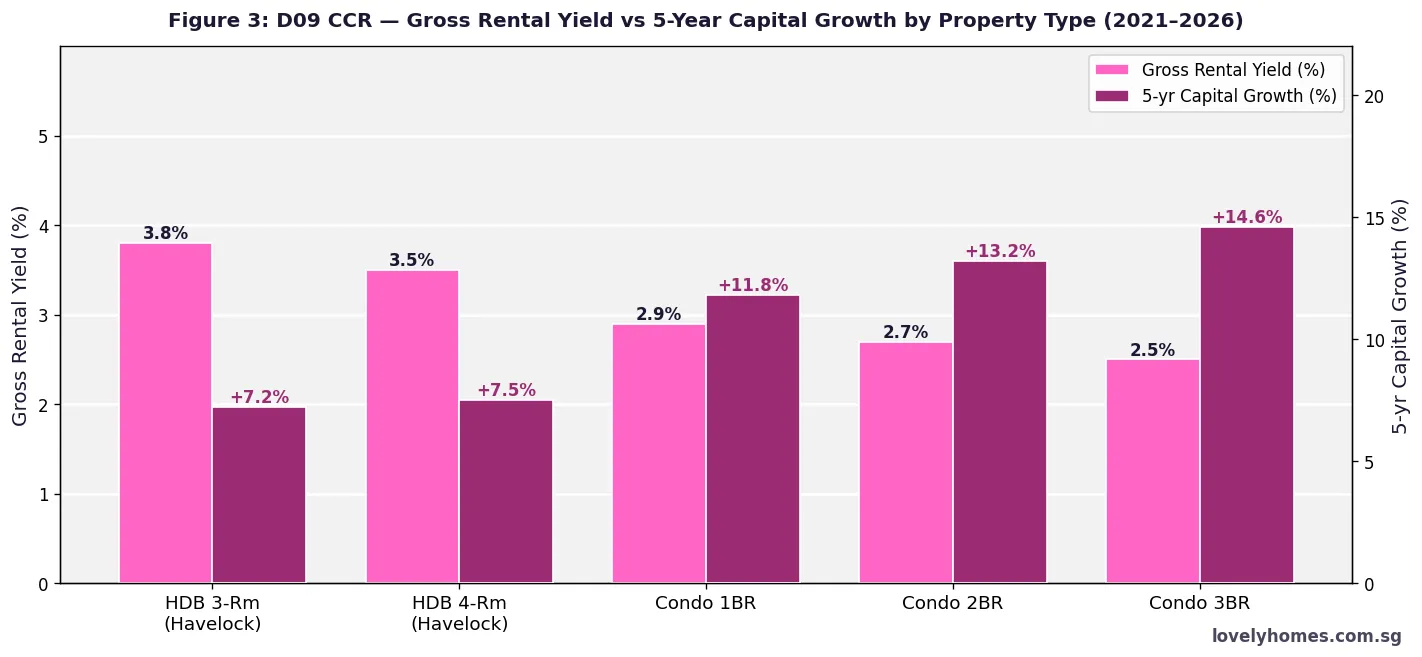
  • Gross rental yields: 2.5%–2.9% for larger units, 3.4%–3.8% for 1-bedrooms — lower than OCR, but sustained by high-income expat tenants in finance, law, and tech.
  • Five-year capital growth (2021–2026): +11.8% to +14.6% across private condos, tracking the broader CCR PPI.
  • No new GLS site has been awarded in the River Valley / Robertson Quay sub-precinct since 2018 — supply scarcity is a structural investment thesis.
  • Singapore Citizens buying their first private property pay 0% ABSD; foreigners pay 60%. ABSD 20% applies for SC second-property purchases.

River Valley Robertson Quay — Where Is It and What Makes It Distinctive?

River Valley and Robertson Quay are planning sub-zones within the Museum Planning Area and River Valley Planning Area of URA’s Master Plan. Geographically, the area stretches from River Valley Road (the main artery) south to the Singapore River, and from Mohamed Sultan Road / Clemenceau Avenue in the west to the Orchard/Somerset boundary in the east.

What makes this precinct genuinely different from Singapore’s other CCR sub-markets (Orchard, Cairnhill, Ardmore) is its character. Where Orchard feels commercial and Ardmore is quiet enclave-landed, River Valley and Robertson Quay have a lived-in, convivial quality — dozens of independent restaurants, riverside bars, weekend arts markets at Clarke Quay, Fort Canning Park’s concert lawn, and a density of international schools and nurseries that reflects the long-established expat tenant community. Many of Singapore’s largest private banks, law firms, and regional headquarters cluster within a 2-kilometre radius, feeding consistent demand for high-specification rental accommodation.

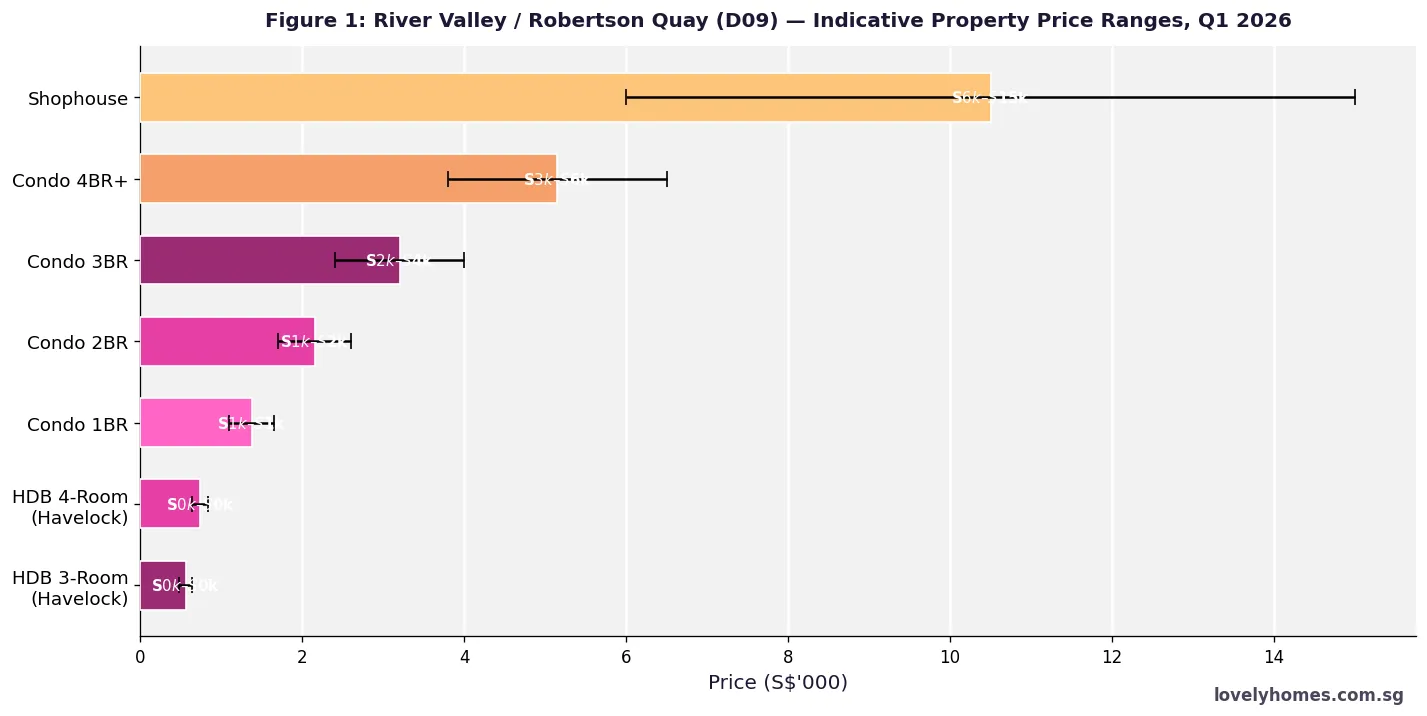
River Valley Robertson Quay D09 property price ranges 2026 — condo 1BR to shophouse, HDB Havelock
Figure 1: Indicative property price ranges in River Valley / Robertson Quay (D09), Q1 2026. Ranges reflect asking and transacted prices; actual pricing varies by unit, floor, and tenure.

MRT Connectivity — Three Lines Within Walking Distance

Prior to June 2023, District 9’s connectivity was widely cited as its one weakness relative to D10 or D11 — the nearest MRT stations (Somerset NS23 and Clarke Quay NE5) required a 10–15 minute walk from many River Valley condominiums. The opening of the Thomson–East Coast Line’s Stage 3 changed the calculus materially:

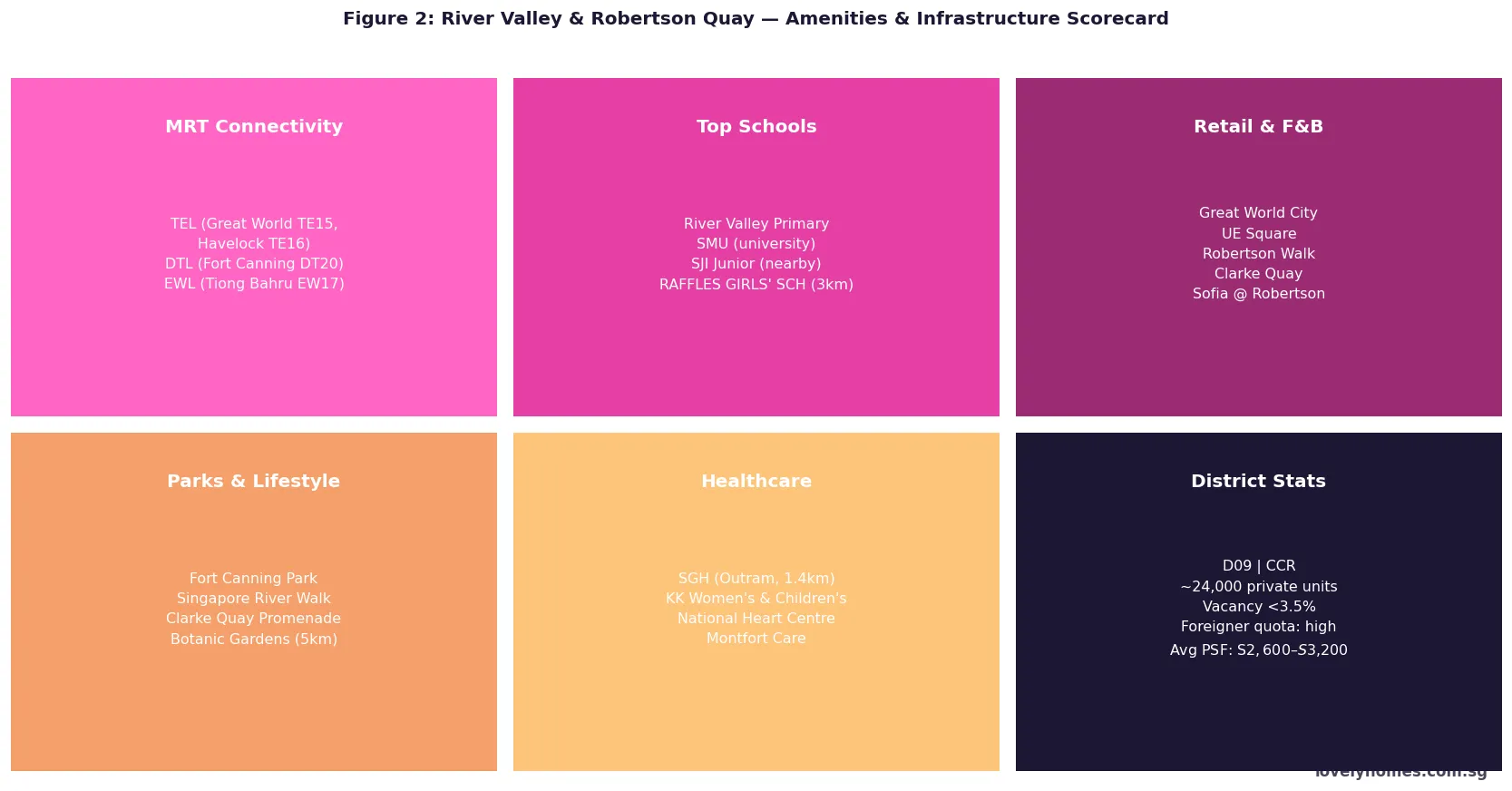
  • Great World (TE15 — TEL): Located on Kim Seng Road, a 5-minute walk from most River Valley condos along Kim Seng Road and Martin Road. Interchange planned with future Jurong Region Line extension in long-range planning; already connects to Orchard (TE14, 1 stop north) and the TEL’s eastern branches toward Marine Parade and Bayshore.
  • Havelock (TE16 — TEL): Serves the Havelock Road and Robertson Quay western edge; useful for residents in River Gate, Aspen Heights, and Havelock View Towers. Connects south toward Outram Park (TE17 — interchange with EWL and NEL) and Cantonment (TE18).
  • Fort Canning (DT20 — DTL): On the Downtown Line, this station is a 7–10 minute walk from Robertson Quay and links directly to Bugis (DT14/EW12), Downtown (DT17), and via interchange to Marina Bay, Buona Vista, and Expo.

For commuters to the CBD (Raffles Place, Shenton Way), the travel time from Great World TE15 to Marina Bay TE20 is approximately 8 minutes on the TEL — comparable to driving at peak hour and far more reliable. For residents working in the Orchard/Somerset belt, it is one stop. The TEL has repositioned River Valley from “slightly inconvenient” to “exceptionally well served”.

Schools in River Valley and Robertson Quay

River Valley Primary School (RVPS), located on River Valley Road, is the district’s anchor primary school and draws families from across Singapore willing to buy or rent in-zone to secure a Phase 2C ballot priority. The school is within the 1-kilometre priority zone for several major condominiums including The Avenir, Rivière, and Martin Modern.

At the secondary level, Gan Eng Seng School and Queenstown Secondary are accessible via the TEL. Singapore Management University (SMU) — one of Singapore’s six autonomous universities — is a 15-minute walk from Robertson Quay via Fort Canning; its proximity contributes to the area’s intellectual and professional character. For international families, the international schools cluster in the broader CCR zone (Orchard, Tanglin, Stevens) is accessible in 10–15 minutes.

River Valley Robertson Quay amenities scorecard 2026 — MRT, schools, retail, parks, healthcare, district statistics
Figure 2: River Valley & Robertson Quay amenities and infrastructure scorecard.

Property Market Overview — D09 CCR Prices and Supply

District 9 is a near-exclusively private residential market. HDB flat supply in the area is negligible — the Havelock HDB estate on the western fringe has a small number of older flats, most of which are past their lease peak, but they represent a tiny fraction of the district’s housing stock. The dominant product is the private condominium — ranging from boutique freehold projects of 30–50 units to larger 99-year leasehold developments of 300–600 units.

Key benchmark projects:

  • The Avenir (freehold, D09, River Valley Close): 376 units across two 36-storey towers. Completed 2024. Benchmark PSF S$2,800–S$3,200. Developed by GuocoLand and Hong Leong Holdings.
  • Rivière (99yr leasehold, Jiak Kim Street): 455 units. Former Zouk site. TEL Great World station at doorstep. Benchmark PSF S$2,400–S$2,900. Frasers Property development.
  • Martin Modern (99yr leasehold, Martin Place): 450 units. GuocoLand. Benchmark PSF S$2,200–S$2,600.
  • The Waterfall, RV Altitude, One Draycott (freehold older stock): PSF S$2,000–S$2,500.

Transaction volume in D09 is thin by Singapore standards — typically 250–400 resale caveats per year — which means individual transactions can move the median PSF meaningfully. Freehold premium over 99-year leasehold in this precinct runs approximately 8–15%, narrower than the national average because the 99-year stock (Rivière, Martin Modern) is of very high quality with TEL access.

Property Type Indicative Price Range Indicative PSF Gross Yield (Est.) Tenure
HDB 3-Room (Havelock) S$480k – S$640k S$560–S$700 3.8% Leasehold (ageing)
HDB 4-Room (Havelock) S$640k – S$840k S$580–S$720 3.5% Leasehold (ageing)
Private Condo 1BR S$1.1M – S$1.65M S$2,400–S$3,000 3.4%–3.8% Freehold / 99yr
Private Condo 2BR S$1.7M – S$2.6M S$2,500–S$3,100 2.9%–3.3% Freehold / 99yr
Private Condo 3BR S$2.4M – S$4.0M S$2,600–S$3,200 2.5%–2.9% Freehold / 99yr
Private Condo 4BR+ S$3.8M – S$6.5M S$2,700–S$3,300 2.3%–2.7% Freehold / 99yr
Shophouse (Heritage) S$6M – S$15M S$5,500–S$9,000 1.8%–2.5% Freehold

Rental Market — Who Rents in River Valley and Robertson Quay?

The D09 rental market is structurally different from OCR precincts. Rather than young professionals on tight budgets seeking HDB rooms or studio apartments, the tenant pool in River Valley and Robertson Quay skews toward:

  • Expatriate finance and legal professionals — private banks, hedge funds, and international law firms cluster in the Marina Bay Financial Centre and Raffles Place, both reachable from Great World TE15 in under 12 minutes. Housing allowances of S$6,000–S$12,000 per month are common.
  • Senior corporate and tech executives — regional headquarters of multinational companies increasingly concentrate in the one-north/Tanjong Pagar corridor, accessible via the TEL.
  • International families — the area’s proximity to the international school belt (Tanglin Trust, UWCSEA East, ISS) makes it attractive to families with school-age children.

Median monthly rents in D09 for a 2-bedroom condominium run approximately S$5,800–S$7,500 (Q1 2026), reflecting a modest correction from the 2022–2023 rental peak of S$7,000–S$9,000 but still well above pre-pandemic levels. Vacancy in the precinct is estimated below 3.5% — reflecting tight supply and durable expat demand.

D09 CCR River Valley Robertson Quay gross rental yield vs 5-year capital growth 2021 to 2026 by property type
Figure 3: Gross rental yield and 5-year capital growth (2021–2026) for D09 CCR by property type. CCR yields are lower than OCR but paired with stronger capital growth for larger units.

🏠 Worked Example: Mr & Mrs Chua — SC Upgraders Buying Martin Modern 2BR

Profile: Mr & Mrs Chua, Singapore Citizens, joint income S$16,000/month. Currently own a Bishan 4-room HDB flat (MOP cleared, sold on 30 April 2026 for S$840,000). Buying a Martin Modern 2BR (99yr leasehold) at S$2,200,000. This is their first private property.

Stamp duty:

  • BSD on S$2,200,000: 1% × S$180k + 2% × S$180k + 3% × S$640k + 4% × S$500k + 5% × S$700k = S$1,800 + S$3,600 + S$19,200 + S$20,000 + S$35,000 = S$79,600
  • ABSD: Nil — SC couple, first private property (HDB sold before OTP granted)

Financing:

  • Purchase price: S$2,200,000 | LTV 75% → Bank loan: S$1,650,000
  • Monthly repayment at 3.0% p.a. 25yr: approximately S$7,832/month
  • TDSR: S$7,832 ÷ S$16,000 = 48.9% — PASS (within 55% limit)

Upfront cash/CPF required:

  • 25% down payment: S$550,000
  • BSD: S$79,600
  • Conveyancing fees: ~S$5,000
  • Total upfront: approximately S$634,600 (can partly draw from CPF OA after HDB CPF refund)

Investment projection: At +13.2% 5-year CCR growth (historical trend), the S$2.2M unit appreciates to approximately S$2.49M by 2031. Combined with net rental income (~S$5,800/month at 2.9% gross, less property tax and maintenance), the total return scenario is approximately S$290k capital + S$174k net rental = ~S$464k over 5 years. Past performance does not guarantee future results — see Disclaimer.

Investment Case — Why River Valley and Robertson Quay in 2026

The structural case for D09 rests on three pillars that are unique to this precinct. First, supply scarcity: unlike OCR planning areas such as Tampines or Sengkang where GLS sites are regularly released, the River Valley and Robertson Quay sub-zones are essentially built-out. URA has not awarded a GLS site in this immediate precinct since the Jiak Kim Street site (Rivière, awarded 2018). Future supply, if any, would likely come from en-bloc redevelopment — a slow, expensive process that takes 5–8 years from acquisition to launch.

Second, the TEL re-rating is still working through property values. Research from URA transaction data suggests that properties within 500 metres of new TEL stations in previously underserved areas have outperformed the broader CCR average by 2–4 percentage points per annum in the two to three years post-opening. The Great World and Havelock stations opened in June 2023, meaning the full impact may not yet be fully priced in.

Third, Singapore’s attraction as a global wealth hub continues to drive demand for the CCR’s top-end rental pool. Despite the 60% ABSD on foreigners (which has effectively removed foreign owner-occupier buyers from the market), Singapore’s population of ultra-high-net-worth individuals — many of whom now hold Permanent Residency or citizenship — continues to grow. Wealthy PRs buying a first or second property in D09 pay 5% or 30% ABSD respectively — meaningful but manageable given the capital quantum. Many still prefer D09 over offshore alternatives for personal use.

What Might Come Next for River Valley and Robertson Quay

This section is editorial opinion and forward-looking speculation, clearly labelled as such.

The URA Draft Master Plan 2025 identified the Greater Southern Waterfront (GSW) — a 2,000-hectare stretch from Pasir Panjang to Marina East — as a long-term transformation zone. River Valley and Robertson Quay sit at the northern edge of this precinct, and the eventual reconfiguration of the Tanjong Pagar port lands (expected 2027–2030 for the first phases) could draw more F&B, cultural, and lifestyle development southward along the Singapore River, extending the Robertson Quay “lifestyle zone” further toward the coast.

On the regulatory side, some market analysts have speculated that ABSD rates for foreigners (currently 60%) could be moderated if the US–Singapore bilateral economic relationship strengthens and if Singapore’s primary residential market cools further following the 60% ABSD introduction. However, there are no signals from the Ministry of National Development or the Ministry of Finance that any such change is imminent.

Frequently Asked Questions

Is River Valley a good place to buy property in Singapore?

River Valley and Robertson Quay offer a compelling combination of lifestyle, connectivity, and capital preservation that justifies the premium over OCR and RCR districts. The TEL opening in June 2023 resolved the precinct’s previous connectivity weakness. The absence of new GLS supply in the sub-zone for over seven years means that any further demand uplift — from population growth, wealth inflows, or the Greater Southern Waterfront transformation — would tighten an already scarce market. For buyers who can absorb the higher entry price (S$1.1M+ for a 1-bedroom) and do not need above-3% yield, D09 River Valley and Robertson Quay represents one of Singapore’s most defensible residential investments. It is not the right choice for buyers seeking high rental yield or affordable entry.

Which MRT stations serve River Valley and Robertson Quay?

Three MRT stations are within comfortable walking distance of the precinct. Great World (TE15, Thomson–East Coast Line) on Kim Seng Road serves the eastern River Valley portion; Havelock (TE16, TEL) serves Robertson Quay’s western side and the Havelock Road corridor. Fort Canning (DT20, Downtown Line) is a 7–10 minute walk from Robertson Quay via River Valley Road and is particularly useful for commuters heading toward Bugis, Promenade, or Buona Vista. Somerset (NS23, North–South Line) is a 12–15 minute walk from the northern edge of River Valley Road and provides access to Orchard and the NSL.

Can foreigners buy property in River Valley and Robertson Quay?

Foreigners can purchase private condominiums, apartments, and commercial shophouses in D09. However, since April 2023, foreigners pay 60% ABSD on any Singapore residential property purchase — a flat rate on the entire purchase price. On a S$2.5M condominium, that is S$1.5M in ABSD alone. Foreigners cannot purchase HDB flats, ECs (within MOP), or landed property (unless on Sentosa Cove or with specific SLA approval). Despite the 60% ABSD, a small number of ultra-high-net-worth foreign buyers continue to transact in CCR — particularly for trophy units above S$5M — typically sourced from family offices and private banking clients who view Singapore residential property as part of a broader wealth-preservation and residency strategy.

What are the best condominiums in River Valley and Robertson Quay?

The benchmark freehold projects in 2026 are The Avenir (River Valley Close, 376 units freehold, completed 2024, PSF S$2,800–S$3,200) and the established older-stock freehold buildings along River Valley Road including RV Altitude and The Grange. For 99-year leasehold, Rivière (Jiak Kim Street, 455 units, Frasers Property, adjacent to Great World TE15 station) and Martin Modern (Martin Place, 450 units, GuocoLand) are the contemporary benchmarks. Rivière in particular benefits from arguably the best direct TEL station access of any condominium in the precinct. Older boutique freehold projects (sub-100 units) can offer attractive value for buyers who prioritise freehold tenure and do not require a gymnasium or full facilities.

How does River Valley compare to Holland Village or Orchard?

All three sub-precincts sit within D09/D10 CCR, but each has a distinct character. River Valley and Robertson Quay offer the most vibrant street-level lifestyle — riverside F&B, Fort Canning Park, and the Singapore River waterfront — but at CCR prices and with smaller absolute retail mall footprints than Orchard. Holland Village (D10) has a village-in-the-city feel, lower density, and proximity to Buona Vista’s biomedical cluster. Orchard (D09/D10 border) offers the greatest retail density and brand-name condominium presence, but the immediate streetscape is less liveable. For families, Holland Village’s proximity to international schools (UWCSEA, AIS) is a draw that River Valley does not fully replicate. For young professionals and empty-nesters prioritising walkable lifestyle and CBD access, River Valley/Robertson Quay tends to win the comparison.

Is there any new HDB BTO supply in River Valley?

No. There is no HDB BTO supply in River Valley or Robertson Quay. The area is designated as a mature private residential precinct under the URA Master Plan. The only HDB stock in the broader D09 area is the existing Havelock Road HDB estate — older flats built in the 1970s and 1980s that transact at S$480,000–S$840,000 on the resale market. These Havelock flats are subject to lease decay risk given their age (remaining leases of 40–55 years as of 2026) and are generally not recommended for buyers seeking CPF-eligible long-tenure financing. For HDB BTO applicants interested in CCR-adjacent living at lower cost, the June 2026 BTO launch in Ang Mo Kio and Bukit Merah is the nearest available option.

Disclaimer: This guide is for general information purposes only and does not constitute financial, legal, or property investment advice. Property prices, rental yields, and market conditions change over time. All price ranges are indicative, based on public caveat data from the URA REALIS system and industry sources as at Q1 2026, and should not be relied upon as a valuation. Stamp duty rates are subject to change — verify current rates on the IRAS Stamp Duty page. Loan calculations are illustrative; consult a licensed mortgage broker and MAS guidelines before proceeding. LovelyHomes does not represent any property developer, agency, or agent.

×

Click anywhere outside the image to close

Jurong West Neighbourhood Guide Singapore 2026: Property Prices, Schools, JRL MRT and Investment Outlook

Jurong West Neighbourhood Guide Singapore 2026: Property Prices, Schools, JRL MRT and Investment Outlook

Jurong West is Singapore’s largest public housing new town by residential population — a sprawling western estate in District 22 (D22) that has evolved from its early industrial-adjacent origins into a well-equipped, MRT-connected community. Long viewed as a budget-friendly OCR option for first-time buyers and HDB upgraders, Jurong West is now attracting a broader investor audience, driven by the transformative Jurong Lake District (JLD) masterplan and the incoming Jurong Region Line (JRL).

This guide covers everything buyers, investors, and tenants need to know about Jurong West property in 2026: HDB and condo prices, MRT network, schools, lifestyle amenities, rental yields, capital growth prospects, and a full buyer worked example.

Quick Answer: Key Facts About Jurong West

  • District: D22 (Jurong West, Boon Lay, Pioneer, Taman Jurong)
  • MRT access: EWL — Lakeside, Chinese Garden, Boon Lay, Pioneer, Joo Koon; JRL opening from 2027; CRL Phase 2 JLD interchange ~2030
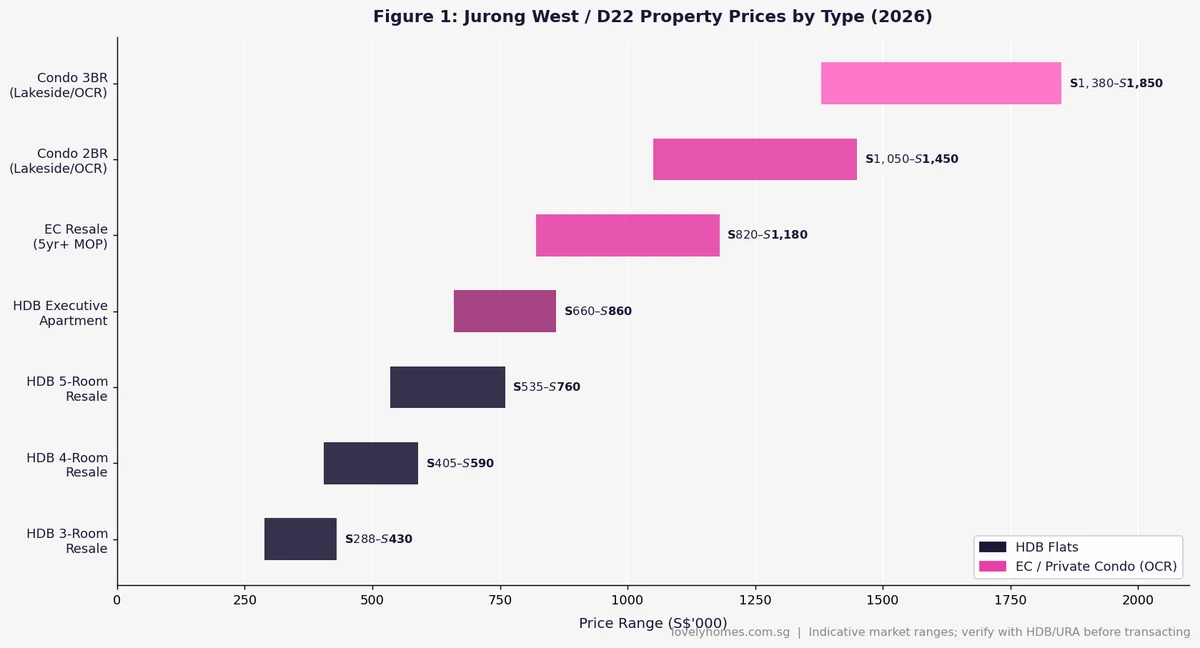
  • HDB resale prices: 3-room S$288,000–S$430,000; 4-room S$405,000–S$590,000; 5-room S$535,000–S$760,000
  • Private/EC prices: EC resale S$820,000–S$1,180,000; condo 2BR S$1,050,000–S$1,450,000; condo 3BR S$1,380,000–S$1,850,000
  • Gross rental yield: HDB 4.1–4.8%; condo/EC 3.4–4.2%
  • 3-year capital growth: private condos +10.5–11.8%; HDB flats +7.2–8.8%
  • JLD uplift catalyst: 100,000 jobs target, S$100B+ investment pipeline; Cross Island Line (CRL) Jurong Lake District interchange ~2030
  • Notable projects: Lake Grande (99yr, D22 flagship); Parc Riviera (99yr); Lakeville (99yr); J’den (JLD adjacent, fully sold)
  • Buyer profile: First-time HDB buyers; NTU/NIE faculty and student tenants; industrial-worker tenants; JLD long-term investors

What Is Jurong West and Where Is It?

Jurong West is a planning area in Singapore’s Western Region, administered by URA. It encompasses the subzones of Boon Lay, Chin Bee, Kian Teck, Taman Jurong, Wenya, Yunnan, and the residential precincts stretching west from Chinese Garden to Joo Koon. The planning area is classified as Outside Central Region (OCR) throughout, making it Singapore’s quintessential value-segment residential market.

The estate was developed from the 1970s onward as Singapore’s answer to housing the industrial workforce of the Jurong Industrial Estate — then the backbone of the nation’s manufacturing economy. Today, Jurong West has matured into a self-sufficient community with comprehensive amenities, though it retains its character as Singapore’s most affordable major HDB town.

Jurong West D22 property prices by type 2026 — HDB, EC and condo price ranges
Figure 1: Jurong West / D22 property prices by type, 2026. Source: HDB resale portal, URA REALIS, indicative market data.

MRT Connectivity: EWL, JRL and the CRL Catalyst

Jurong West is served by five East West Line (EWL) stations — Lakeside (EW26), Chinese Garden (EW25), Boon Lay (EW27), Pioneer (EW28), and Joo Koon (EW29) — giving residents direct westbound access to Jurong East interchange and eastbound access to the CBD (City Hall, Raffles Place) within 35–45 minutes.

The transformative addition is the Jurong Region Line (JRL), a new MRT line opening in phases from 2027. The JRL will provide cross-island connectivity independent of the EWL trunk, serving the Tengah, Jurong Industrial Estate, and Nanyang Technological University (NTU) corridors. Key stations serving Jurong West precincts include Boon Lay JRL (interchange with EWL), and the Taman Jurong and Enterprise nodes. LTA has confirmed JRL Stage 1 (Choa Chu Kang to Boon Lay) targeting completion in mid-2027, with Stage 2 and Stage 3 by 2028.

Looking further ahead, the Cross Island Line (CRL) Phase 2 is planned to include a Jurong Lake District station, creating a future CRL–EWL–JRL interchange at Jurong East — one of the most powerful multimodal nodes outside the CBD. This interchange, expected around 2030, is the single largest infrastructure catalyst underpinning the JLD property investment thesis.

Property Prices in Jurong West 2026

Jurong West offers the most affordable HDB resale flats among Singapore’s mature towns, making it a popular choice for first-time buyers and families on tighter budgets. A 4-room resale flat in Boon Lay or Taman Jurong typically commands S$405,000 to S$590,000 in 2026, with premium blocks in Lakeside precinct (near waterfront and MRT) occasionally reaching S$600,000–S$630,000. Five-room flats trade at S$535,000 to S$760,000, reflecting their larger floor area and suitability for multigenerational families.

The private residential market in D22 is more limited than in eastern or central districts. The flagship developments are the three Jurong lakeside condos — Lake Grande (710 units, 99yr, launched 2016 at ~S$1,350 PSF, now trading at approximately S$1,500–S$1,700 PSF resale), Parc Riviera (752 units, 99yr), and Lakeville (696 units, 99yr). These projects form the benchmark private condo tier for D22 OCR. EC resale — particularly Westwood Residences and The Topiary (both past 5-year MOP) — provides an intermediate option between HDB and private, with transacted prices of S$820,000 to S$1,180,000 for units that have fully privatised.

Jurong West D22 amenities grid — EWL MRT, schools, retail, parks, hospital, key stats
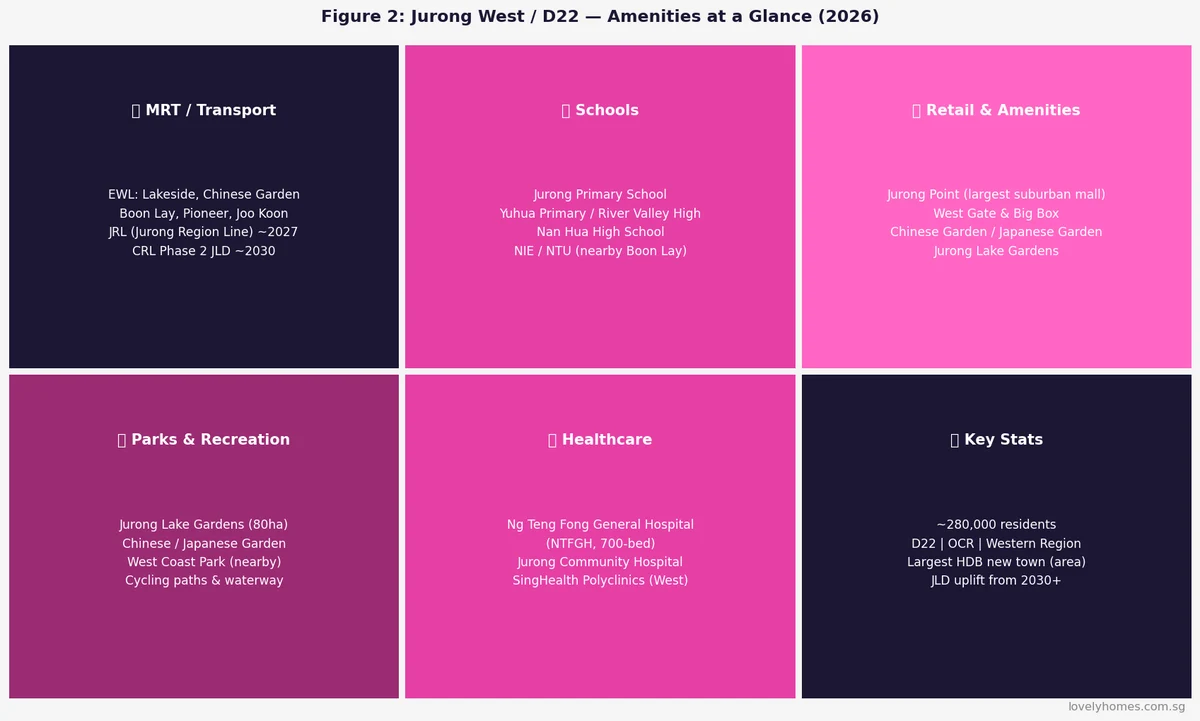
Figure 2: Jurong West / D22 amenities at a glance — transport, schools, retail, parks and healthcare.

Schools in Jurong West

Jurong West is well-stocked with primary schools spread across its precincts, providing good within-1km options for families with young children. Key schools include Jurong West Primary School, Yuhua Primary School, Lakeside Primary School (in the waterfront precinct), and the SAP school Nan Hua Primary School on Clementi Avenue 1 (within reach of the western Clementi–Jurong border).

At secondary level, Nan Hua High School, River Valley High School (a centralised independent school, accessible via EWL), Yuan Ching Secondary, and Jurong Secondary all fall within the D22 ecosystem. For tertiary education, Nanyang Technological University (NTU) and the National Institute of Education (NIE) — both in the adjacent Jurong/Boon Lay area — generate a steady pool of academic-sector tenants, making the estate attractive for buy-to-let investors targeting the education cluster.

Lifestyle, Amenities and the JLD Masterplan

Jurong West’s retail anchor is Jurong Point — Singapore’s largest suburban shopping mall with over 500 tenants — located adjacent to Boon Lay MRT. The nearby WestGate and JEM malls at Jurong East further expand the retail catchment for western residents. For recreation, the Jurong Lake Gardens (an 80-hectare lakeside park opened in 2019) and the iconic Chinese Garden and Japanese Garden heritage parks provide significant green space at the estate’s eastern fringe.

The most consequential transformation for Jurong West buyers, however, is the Jurong Lake District (JLD) masterplan. URA has designated JLD as Singapore’s second Central Business District — a 360-hectare precinct centred on Jurong East, targeting 100,000 jobs and attracting major institutional anchors including the Singapore Tourism Board’s planned Tourism 2.0 hub. The URA masterplan envisions JLD as a mixed-use lakeside precinct with commercial towers, hotels, recreational facilities, and residential developments, all served by the future EWL–JRL–CRL mega-interchange. Healthcare in Jurong West is served by Ng Teng Fong General Hospital (NTFGH) — a 700-bed acute-care hospital opened in 2015 and designated as the western regional hospital — and Jurong Community Hospital on the same campus.

Rental Yields and Investment Case

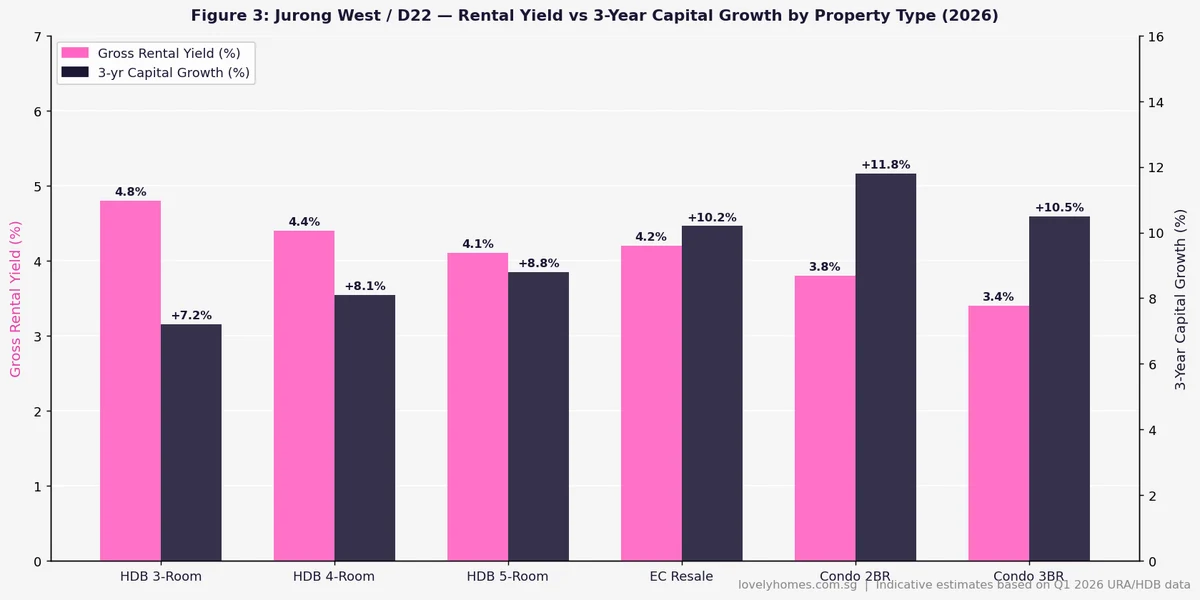
Jurong West’s primary investment draw is its high gross rental yield relative to the rest of Singapore. HDB 3-room flats in the estate yield approximately 4.8% gross, the highest among Singapore’s major HDB towns, driven by affordable entry prices and consistent demand from blue-collar workers, NTU/NIE staff, and junior industrial-sector tenants. Four-room flats yield around 4.4% gross, and 5-room flats approximately 4.1%.

Jurong West D22 rental yield vs 3-year capital growth by property type 2026
Figure 3: Jurong West / D22 — gross rental yield vs 3-year capital growth by property type (2026). Source: indicative estimates based on URA/HDB Q1 2026 data.

Private condo yields in D22 are lower due to higher entry PSF, but the JLD re-rating thesis has driven stronger capital appreciation. Lake Grande 2BR units have appreciated approximately +11.8% on a 3-year basis through Q1 2026, in line with the broader lakeside corridor outperformance. EC resale units — benefiting from their mixed private/HDB character and fully privatised status after MOP — have delivered the strongest combined return profile: yield around 4.2% with 3-year capital growth of approximately +10.2%.

Summary: Jurong West Property Types at a Glance

Property Type Typical Price Range Gross Yield 3yr Capital Growth Tenure
HDB 3-Room Resale S$288,000–S$430,000 ~4.8% +7.2% 99-yr (HDB)
HDB 4-Room Resale S$405,000–S$590,000 ~4.4% +8.1% 99-yr (HDB)
HDB 5-Room Resale S$535,000–S$760,000 ~4.1% +8.8% 99-yr (HDB)
EC Resale (5yr+ MOP) S$820,000–S$1,180,000 ~4.2% +10.2% 99-yr (privatised)
Condo 2BR (Lakeside OCR) S$1,050,000–S$1,450,000 ~3.8% +11.8% 99-yr
Condo 3BR (Lakeside OCR) S$1,380,000–S$1,850,000 ~3.4% +10.5% 99-yr

Worked Example: First-Time Buyer Purchasing an HDB Resale Flat in Jurong West

Profile: Mr and Mrs Rajan, both Singapore Citizens, joint monthly income S$7,200. First-time buyers seeking an HDB resale flat in Jurong West close to Boon Lay MRT for Mr Rajan’s commute to the Jurong Industrial Estate.

Target unit: 4-room resale flat, Boon Lay Drive, asking price S$498,000.

  • CPF Housing Grants available: Enhanced CPF Housing Grant (EHG) — joint income S$7,200, within EHG ceiling of S$9,000; EHG for family = S$30,000. Proximity Housing Grant (PHG) — not applicable (not buying near parents). Total grants: S$30,000.
  • Effective purchase price after grants: S$498,000 − S$30,000 = S$468,000
  • Buyer’s Stamp Duty (BSD): S$1–S$180,000 @ 1% = S$1,800 + S$180,001–S$360,000 @ 2% = S$3,600 + S$360,001–S$468,000 @ 3% = S$3,240 = BSD S$8,640
  • ABSD: Nil — SC first residential property
  • Loan option — HDB Loan: 80% LTV on purchase price = S$398,400 (before EHG offset); effective loan after EHG S$368,400 at 2.6% p.a. over 25 years = approximately S$1,669/month
  • Mortgage Servicing Ratio (MSR): S$1,669 ÷ S$7,200 = 23.2% — well within the 30% MSR cap
  • CPF/cash upfront: 20% downpayment from CPF OA = S$99,600; BSD S$8,640 from CPF; legal fees ~S$2,500 cash; total CPF draw ~S$108,240; cash ~S$2,500

The Rajans are comfortably within MSR at 23.2% and their CPF OA savings (assuming S$120,000 combined) are sufficient for the downpayment. The HDB loan — while carrying a higher interest rate than a bank loan — provides the security of no lock-in penalty and the ability to overpay without fee. Monthly repayments of S$1,669 represent a very sustainable 23.2% of joint income, leaving ample capacity for savings and family expenditure.

Why Jurong West Matters: The JLD Long-Term Thesis

Jurong West’s investment case rests substantially on the Jurong Lake District masterplan, which URA has been developing since 2008 and accelerated post-2020. JLD is Singapore’s most significant decentralisation initiative: the government is deliberately shifting high-value economic activity, including financial services, technology, and medical tourism, from the traditional CBD to the western lakeside precinct. The S$100 billion development pipeline, anchor commitments from major corporations, and the planned CRL–JRL–EWL interchange at Jurong East by 2030 collectively underpin a structural case for western property appreciation that stretches well into the 2030s.

Comparable precedents exist elsewhere in Singapore: the build-out of Marina Bay from the 2000s transformed adjacent Districts 1 and 2 values; the development of Punggol Digital District has re-rated Punggol condos. JLD is a substantially larger initiative by both scale and investment quantum, with government backing and legislative commitment.

What Might Come Next for Jurong West

This section contains forward-looking analysis and should not be construed as a prediction of future prices.

The most significant near-term catalyst is JRL Stage 1 opening in mid-2027. Historically, property values within a 500m radius of new MRT stations have appreciated 3–8% in the 12–24 months around station opening, based on LTA and academic studies of prior line openings. Jurong West precincts near planned JRL stations — particularly Taman Jurong — could see notable uplift. The CRL Phase 2 confirmation (expected from MND/LTA around 2026–2027) will also provide a milestone catalyst for JLD-adjacent properties. Conversely, the large public housing pipeline for Tengah (a new HDB town adjacent to Jurong West, expected to deliver 42,000 homes through the late 2020s) could exert moderate supply-side pressure on Jurong West HDB resale prices in the medium term.

Frequently Asked Questions

Is Jurong West a good area to buy property in 2026?

For value-seeking buyers and yield-focused investors, Jurong West offers the most affordable entry point among Singapore’s MRT-served estates, with the JLD masterplan providing a credible long-term capital appreciation case. The trade-off is a less vibrant lifestyle compared with central or eastern estates, longer commute times to the CBD for non-western employment nodes, and proximity to industrial zones in the southern precincts. For families on moderate incomes buying their first HDB home, or investors seeking the highest gross rental yield, Jurong West is one of Singapore’s more compelling value propositions in 2026.

Which MRT stations serve Jurong West?

Five EWL stations serve Jurong West: Lakeside (EW26), Chinese Garden (EW25), Boon Lay (EW27), Pioneer (EW28), and Joo Koon (EW29). The upcoming JRL (Jurong Region Line), opening from mid-2027, will add further stations in the Boon Lay, Taman Jurong, and Enterprise corridors, providing east–west connectivity independent of the EWL trunk. The CRL Phase 2 Jurong Lake District interchange (~2030) will link the Cross Island Line to both EWL and JRL at Jurong East, making the western node one of Singapore’s best-connected transport hubs outside the city.

What is the Minimum Occupation Period (MOP) for Jurong West HDB flats?

Standard (Open Market) HDB BTO flats in Jurong West carry a 5-year MOP from the date of key collection. During MOP, the flat cannot be sold on the open market, rented out in full (subletting individual rooms is permitted with HDB approval), or used to fulfil CPF accrued interest clawback. Jurong West is classified as a Standard location under HDB’s classification framework — not Plus or Prime — so no extended MOP applies. After MOP, HDB resale flats in Jurong West can be sold freely, and owners can purchase a private property concurrently (though they would pay 20% ABSD if retaining the HDB).

How does Jurong West compare with Tampines or Woodlands?

Jurong West offers the lowest HDB resale prices of the three, reflecting its OCR western location and industrial-adjacent character. Tampines (D18) commands a premium of approximately S$100,000–S$180,000 for equivalent HDB flat types, driven by its mature town status, stronger amenity base, and Tampines Regional Centre employment cluster. Woodlands (D25) is similarly priced to Jurong West but has a different JLD-equivalent catalyst in the Woodlands Regional Centre and the RTS Link to Johor Bahru. For JLD uplift exposure, Jurong West is unique. For established amenity and eastern-facing employment, Tampines is stronger.

Can a Singapore PR buy an HDB resale flat in Jurong West?

Yes. Permanent Residents who meet HDB eligibility — forming a family nucleus with another SPR or SC family member, and having held PR status for at least 3 years — can purchase HDB resale flats in Jurong West. However, SPRs pay a 5% ABSD on their first residential purchase and 15% ABSD on their second. SPRs are also subject to the Ethnic Integration Policy (EIP) quotas and SPR quota (8% per block, 5% per neighbourhood) when purchasing HDB flats.

What is the best precinct in Jurong West to buy?

For capital appreciation potential, the Lakeside precinct (near Lakeside MRT and Jurong Lake Gardens) offers the strongest JLD adjacency and lifestyle amenity. Lake Grande, Parc Riviera, and Lakeville are the benchmark developments here. For rental yield and affordability, the Boon Lay and Taman Jurong precincts offer higher yields from a lower entry base and benefit from Jurong Point’s retail anchor and Boon Lay MRT access. Families prioritising school catchments should focus on precincts within 1km of Nan Hua or Lakeside Primary schools.

How will the Tengah new town affect Jurong West property prices?

HDB’s Tengah new town — Singapore’s newest HDB estate, adjacent to Jurong West’s northern boundary — is expected to add approximately 42,000 public housing units through the late 2020s. In the short to medium term, this supply injection could exert modest downward pressure on Jurong West HDB resale prices, particularly for units competing with similarly priced Tengah BTO flats. However, Tengah BTO flats carry a 5-year MOP and are new-build (typically priced at a discount to resale), limiting direct substitution. The JRL will also serve Tengah, potentially enhancing connectivity of both estates and mitigating resale price pressure.

Related Articles

Disclaimer

This article is for general informational purposes only and does not constitute financial, legal, or property advice. All property prices, rental yields, and capital growth figures are indicative estimates drawn from URA REALIS data, HDB resale portal transactions, and market analysis as at Q1 2026. Actual transaction prices vary by unit, floor, condition, and prevailing market conditions. ABSD, BSD, CPF rules, HDB eligibility, MSR, and TDSR policies are set by the Singapore Government (IRAS, HDB, MAS, CPF Board) and are subject to change. Readers should conduct their own due diligence and consult a licensed property agent, lawyer, and financial adviser before making any property transaction. For authoritative data, refer to URA (ura.gov.sg), HDB (hdb.gov.sg), IRAS (iras.gov.sg), MAS (mas.gov.sg), and CPF Board (cpf.gov.sg).

Marine Parade Neighbourhood Guide Singapore 2026: Property Prices, Schools, TEL MRT and Investment Outlook

Marine Parade Neighbourhood Guide Singapore 2026: Property Prices, Schools, TEL MRT and Investment Outlook

Marine Parade is one of Singapore’s most storied residential estates — a coastal enclave in District 15 (D15) that blends Peranakan heritage, East Coast Park living, and a maturing private condo market. Long overlooked because of limited MRT access, the neighbourhood underwent a connectivity transformation in 2023 when the Thomson–East Coast Line (TEL) opened two stations — Marine Parade (TE26) and Marine Terrace (TE27) — directly into the heart of the estate. The result is a neighbourhood now fully linked to the city and, as a consequence, attracting stronger buyer interest than at any point in its history.

This guide covers everything prospective buyers, upgraders, and investors need to know about Marine Parade and the D15 corridor in 2026: property prices, MRT connectivity, schools, lifestyle amenities, rental yields, capital growth data, and a step-by-step buyer worked example.

Quick Answer: Key Facts About Marine Parade

  • District: D15 (Marine Parade, Katong, Siglap, Tanjong Katong)
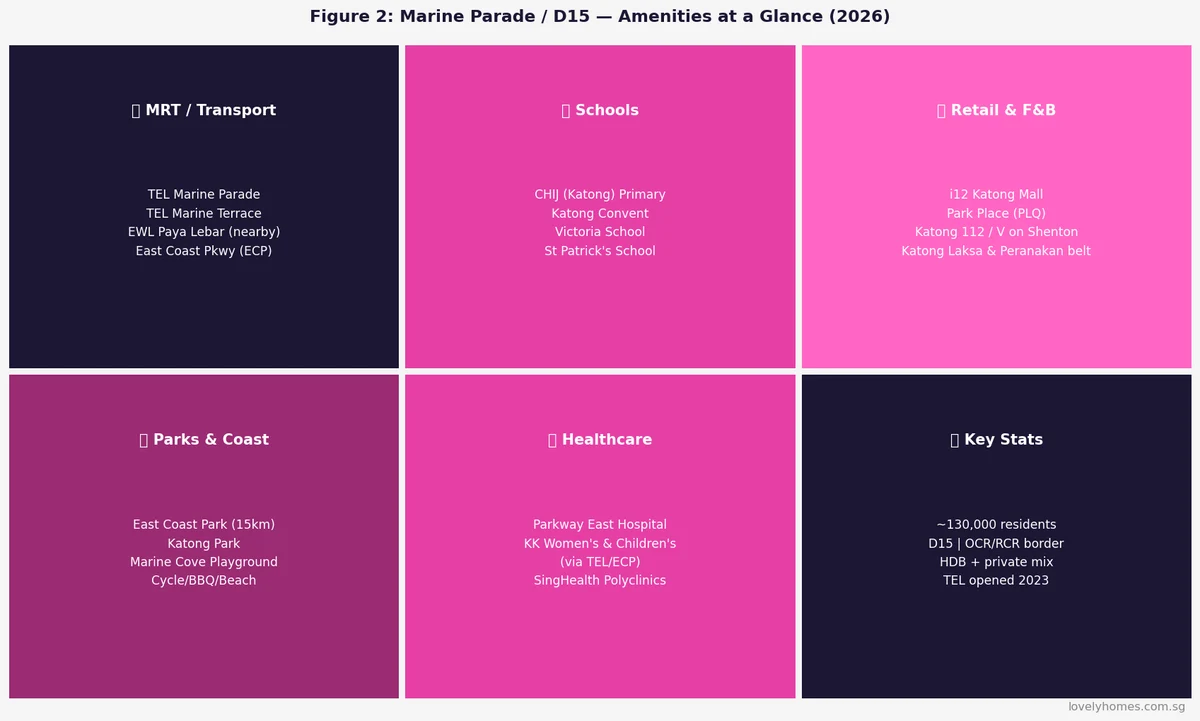
  • MRT access: TEL Marine Parade (TE26) and Marine Terrace (TE27) since 2023; Paya Lebar EWL–CCL interchange ~1.8km away
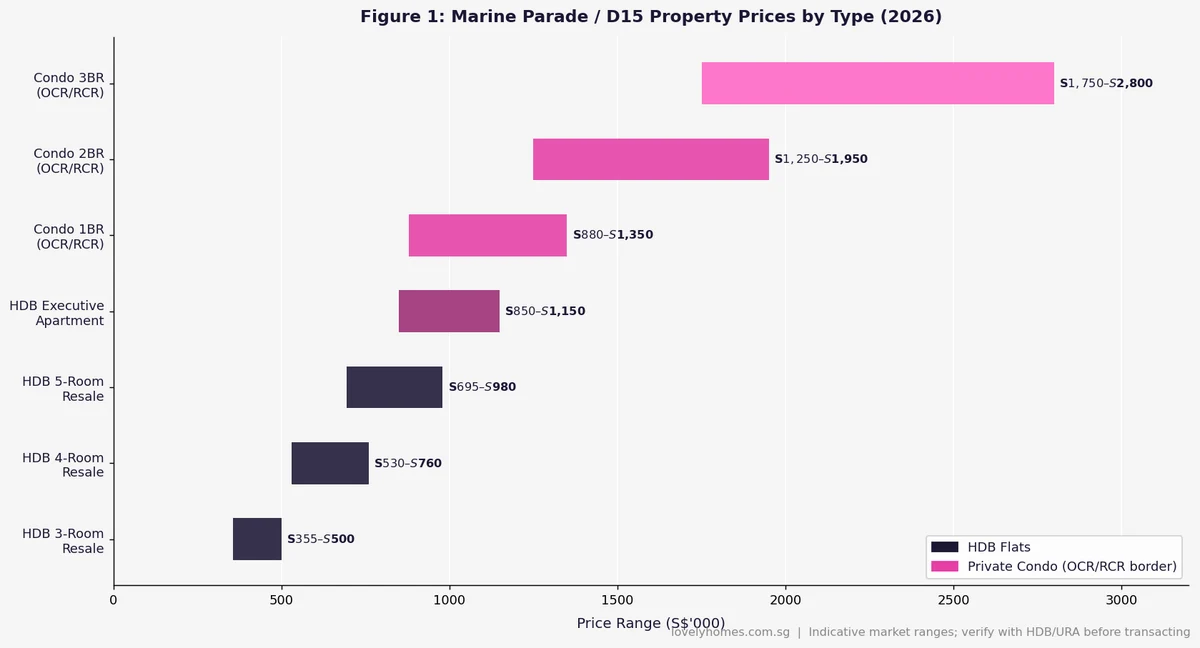
  • HDB resale prices: 3-room S$355,000–S$500,000; 4-room S$530,000–S$760,000; 5-room S$695,000–S$980,000
  • Private condo prices: 1BR S$880,000–S$1,350,000; 2BR S$1,250,000–S$1,950,000; 3BR S$1,750,000–S$2,800,000
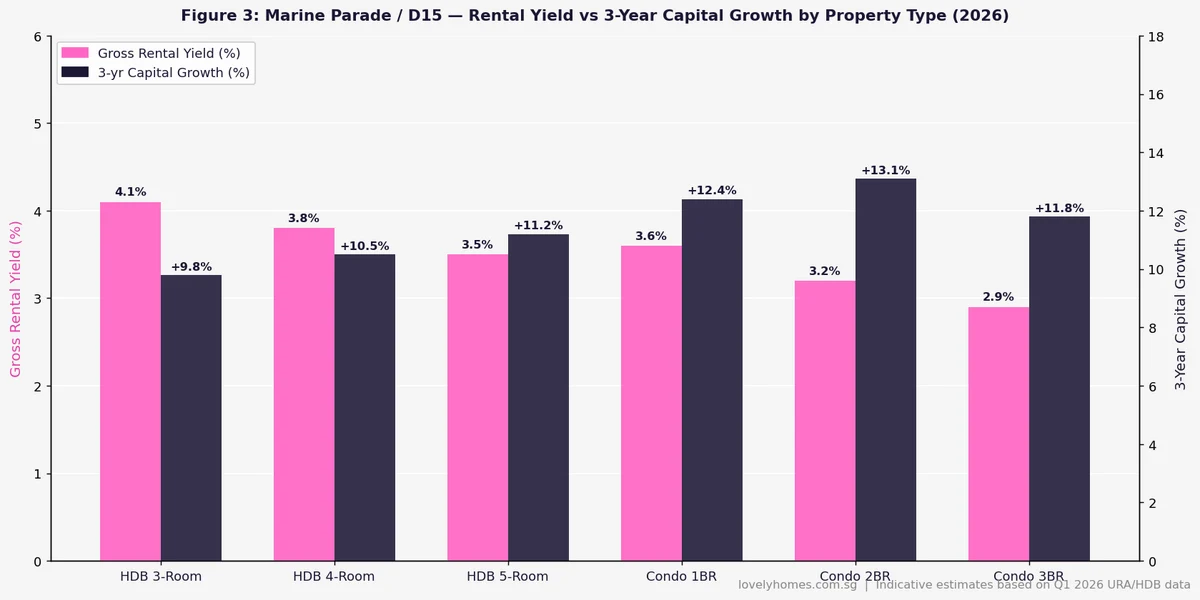
  • Gross rental yield: HDB 3.8–4.1%; condo 2.9–3.6%
  • 3-year capital growth: private condos +9.8–13.1%; HDB flats +10.5–11.2%
  • Notable development: The Continuum (freehold, 816 units, ~S$2,700–S$3,200 psf); Amber Park (fully sold); Tembusu Grand (D15 border)
  • No new BTO supply: D15 is a fully mature private-dominated market — HDB stock is resale-only
  • Buyer profile: Strong expat rental demand (UWCSEA East nearby); Peranakan heritage appeal; upgraders from eastern HDB towns

What Is Marine Parade and Where Is It?

Marine Parade is a planning area administered by the Urban Redevelopment Authority (URA) in Singapore’s East Region. It sits along the southern coastline, bounded by the Kallang area to the west, Bedok to the east, and the Katong/Siglap subzones in between. The area is classified as Outside Central Region (OCR) for most HDB-dominated stretches and borders Paya Lebar’s Rest of Central Region (RCR) on its western flank.

The name “Marine Parade” refers both to the planning area and the prominent arterial road — Marine Parade Road — that runs parallel to East Coast Parkway (ECP). Most residents know the area by its Katong identity: a vibrant Peranakan district famous for laksa, nyonya kueh, and rows of colourful shophouses along East Coast Road and Joo Chiat Road.

Marine Parade D15 property prices by type 2026 — HDB and condo price ranges
Figure 1: Marine Parade / D15 property prices by type, 2026. Source: HDB resale portal, URA REALIS, indicative market data.

MRT Connectivity: The TEL Game-Changer

For decades, Marine Parade’s biggest drawback was the absence of MRT. Residents relied on buses along the congested ECP and Marine Parade Road corridor. That changed on 23 June 2023, when the Land Transport Authority (LTA) opened TEL Stage 3, bringing two new stations directly into the neighbourhood.

Marine Parade MRT (TE26) sits at the junction of Marine Parade Road and Still Road, within walking distance of i12 Katong mall and the East Coast Road food belt. Marine Terrace MRT (TE27) is positioned further east along Marine Terrace, serving the residential precincts near Siglap and Katong Park. Both stations connect directly to the TEL mainline, giving riders one-stop access to Great World (TE15) for the Great World City retail cluster, Orchard (TE14) for ION and Takashimaya, and Marina Bay (TE20/NS27/CE2) for the CBD.

In addition to the TEL, residents can access Paya Lebar MRT — an EWL and CCL interchange — approximately 1.8km away via bus or cycling. The EWL links Paya Lebar to the CBD (City Hall, Raffles Place), Tampines, and Changi Airport, while the CCL provides a circle-line connection to Bishan, one-north, and HarbourFront.

Property Prices in Marine Parade 2026

D15 covers a range of property types and price points. The market broadly divides into three segments: HDB resale (concentrated in Marine Parade proper and Tanjong Rhu), mid-range private condos along the East Coast Road corridor, and premium freehold condos in the Amber Road and Meyer Road micromarkets.

HDB resale flats in Marine Parade trade at a modest premium to the OCR average, reflecting the estate’s maturity, school catchments, and the post-TEL connectivity uplift. A typical 4-room resale flat in the Tanjong Rhu or Marine Parade estate commands S$530,000 to S$760,000 in 2026, with premium blocks (high floor, unblocked sea-facing views) occasionally breaching the S$800,000 mark. Executive Apartments — a Singapore-specific HDB flat type featuring more floor area — trade at S$850,000 to S$1,150,000 in this locale.

Private condos span a wide PSF range. Older 99-year leasehold projects along Marine Parade Road trade at S$1,300–S$1,600 PSF, while newer freehold developments in the Amber Road and Meyer Road corridors command S$2,200–S$3,200 PSF. The benchmark project is The Continuum (freehold, 816 units), launched in 2023 at an average of approximately S$2,730 PSF and now approaching completion, with secondary market transactions in the S$2,800–S$3,100 PSF range in Q1 2026. Amber Park (fully sold; completed 2023) set a prior record at S$2,500–S$2,800 PSF. For investors, older 99-year leasehold condos such as Waterplace and Marine Blue provide more accessible entry points in the S$1,200–S$1,600 PSF range with correspondingly higher gross yields.

Marine Parade D15 amenities grid — MRT, schools, retail, parks, healthcare, key stats
Figure 2: Marine Parade / D15 amenities at a glance — transport, schools, retail, parks and healthcare.

Schools in Marine Parade

D15 is one of Singapore’s strongest school catchment zones for primary and secondary education, which is a significant driver of resale demand from families.

At the primary level, CHIJ (Katong) Primary — an all-girls SAP school administered by the Catholic community — draws buyers willing to pay a premium for the within-1km address advantage. Tao Nan School (a SAP school on Still Road South) is another highly sought-after feeder, with the 1km radius covering parts of Katong. At the secondary level, Victoria School (Siglap Road), St Patrick’s School (Siglap Road), Dunman High School (Tanjong Rhu), and Katong Convent are all established institutions within the planning area. Singapore Management University (SMU), accessible by TEL, adds to the tertiary ecosystem for residents in the estate.

Lifestyle and Amenities

Marine Parade’s quality-of-life proposition is anchored by three distinctive draws: the Peranakan food culture, East Coast Park, and a growing retail cluster.

East Coast Park, stretching 15km along the southern coastline, is Singapore’s most popular recreational park. Residents of Marine Parade enjoy direct cycling and walking access to its beach, barbecue pits, hawker centres, water sports facilities, and Marine Cove Playground. The upcoming Bayshore integrated development — a GLS site near Bedok South MRT (TEL) — will add further coastal amenity and residential supply to the broader East Coast corridor in the late 2020s.

Retail is anchored by i12 Katong (a mid-sized mall with a supermarket, F&B, and lifestyle tenants adjacent to Marine Parade MRT), 112 Katong on East Coast Road, and the heritage Parkway Parade mall in Marine Parade Road, which underwent a major refurbishment. For daily provisions, the Katong and Marine Parade market and food centres remain beloved neighbourhood institutions. Healthcare is served by Parkway East Hospital (a private hospital on East Coast Road) and multiple SingHealth polyclinics.

Rental Yields and Investment Case

Marine Parade has historically been a strong rental market. The estate benefits from proximity to UWCSEA East Campus (Dover Road, ~8km via ECP), generating consistent expat family demand. Post-TEL, the improved connectivity has expanded the catchment of corporate renters commuting to the CBD and Marina Bay financial district.

Marine Parade D15 rental yield vs 3-year capital growth by property type 2026
Figure 3: Marine Parade / D15 — gross rental yield vs 3-year capital growth by property type (2026). Source: indicative estimates based on URA/HDB Q1 2026 data.

HDB 3-room flats in the estate yield approximately 4.1% gross, reflecting a more affordable entry price combined with strong rental demand from young professionals and couples. Private condo yields compress as PSF rises: older 99-year leasehold projects deliver 3.4–3.6% gross, while premium freehold units at S$2,700–S$3,200 PSF yield closer to 2.8–3.0% gross. Capital growth, however, has been robust across all segments: D15 private properties recorded a +12.4% gain on a 3-year basis (condo 2BR benchmark) through Q1 2026, well above the OCR average of +11.3% and reflecting the post-TEL re-rating.

Summary: Marine Parade Property Types at a Glance

Property Type Typical Price Range Median PSF Gross Yield Tenure
HDB 3-Room Resale S$355,000–S$500,000 ~S$510 psf ~4.1% 99-yr (HDB)
HDB 4-Room Resale S$530,000–S$760,000 ~S$560 psf ~3.8% 99-yr (HDB)
HDB 5-Room Resale S$695,000–S$980,000 ~S$590 psf ~3.5% 99-yr (HDB)
Private Condo (1BR) S$880,000–S$1,350,000 S$1,300–S$1,800 psf 3.4–3.6% Mixed 99yr/FH
Private Condo (2BR) S$1,250,000–S$1,950,000 S$1,500–S$2,700 psf 3.0–3.4% Mixed 99yr/FH
Private Condo (3BR) S$1,750,000–S$2,800,000 S$2,200–S$3,200 psf 2.8–3.2% Mainly FH

Worked Example: Upgrader Purchasing a 2BR Condo in Marine Parade

Profile: Mr and Mrs Lim, Singapore Citizens, joint monthly income S$13,500. Currently own a fully paid-up Bedok 4-room HDB. Intending to sell the HDB and purchase a 2BR condo in Marine Parade as their home — first private property purchase.

Target unit: 2BR condo (older 99-year leasehold project on Marine Parade Road), asking price S$1,580,000 (approximately S$1,520 PSF for 1,040 sqft).

  • Buyer’s Stamp Duty (BSD): S$1–S$180,000 @ 1% = S$1,800 + S$180,001–S$360,000 @ 2% = S$3,600 + S$360,001–S$1,000,000 @ 3% = S$19,200 + S$1,000,001–S$1,580,000 @ 4% = S$23,200 = total BSD S$47,800
  • Additional Buyer’s Stamp Duty (ABSD): Nil — SC purchasing first private property (after selling HDB)
  • Loan quantum: 75% LTV (bank loan, no outstanding HDB loan) = S$1,185,000
  • Monthly repayment: S$1,185,000 at 3.0% p.a. over 25 years = approximately S$5,615/month
  • Total Debt Servicing Ratio (TDSR): S$5,615 ÷ S$13,500 = 41.6% — within the 55% TDSR limit
  • Cash/CPF upfront: 5% cash = S$79,000 + 20% CPF/cash = S$316,000 + BSD S$47,800 + legal fees ~S$5,200 = approximately S$448,000 total upfront

The Lims use S$200,000 CPF OA savings and S$248,000 in cash proceeds from the HDB sale. The transaction is feasible, with the monthly repayment well within TDSR and comfortable given their joint income.

Why Marine Parade Matters: The TEL Re-Rating

Marine Parade represents one of Singapore’s clearest examples of infrastructure-driven property re-rating. For 50 years after the estate was developed in the 1970s and 1980s, D15 property traded at a persistent discount to comparable RCR districts because of MRT absence. The TEL stations opened in 2023 have begun to close that gap. Industry data as at Q1 2026 shows that TEL-adjacent condos in D15 have outperformed the broader OCR by approximately 200–300 basis points on capital appreciation over the 24 months since the line opened.

The estate’s enduring appeal — heritage culture, East Coast Park, and school catchments — combined with the new connectivity advantage positions Marine Parade as a structural beneficiary of Singapore’s south-eastern TEL corridor build-out. The Bayshore GLS site (near Bedok South TEL) and the East Coast Plan (ECP) long-term coastal development will further reinforce the area’s desirability through the late 2020s and 2030s.

What Might Come Next for Marine Parade

This section contains forward-looking analysis and should not be construed as a prediction of future prices.

Several factors could drive further upside in D15 over the medium term. First, TEL full-line completion (Stages 4 and 5, connecting to Changi Airport and Tanah Merah) will add more riders to the line and increase throughput at Marine Parade and Marine Terrace stations, enhancing the commercial viability of street-level retail along the corridor. Second, the impending completion of The Continuum (816 units) will provide a fresh benchmark for freehold PSF in the submarket. Third, any announcement of an East Coast masterplan update — particularly relating to the Bayshore precinct — could boost buyer sentiment across D15. Conversely, a surge in completions across the broader TEL corridor (Tanjong Rhu, Katong, Siglap) could moderate near-term price appreciation if supply temporarily exceeds demand.

Frequently Asked Questions

Is Marine Parade a good area to buy property in 2026?

Marine Parade offers a compelling combination of lifestyle amenity (East Coast Park, Peranakan food culture, established schools), post-TEL MRT connectivity, and a strong tenant base. For buyers seeking a mature coastal estate with no new HDB BTO supply (meaning limited competing public housing entering the resale market), D15 is one of Singapore’s more defensible residential choices. The trade-off is price: D15 commands a premium over other OCR markets. First-time buyers on tighter budgets may find better value in Tampines, Jurong West, or Sengkang.

Which MRT stations serve Marine Parade?

Two TEL stations serve the estate directly: Marine Parade (TE26) and Marine Terrace (TE27), both opened in June 2023 as part of TEL Stage 3. The TEL connects directly to Orchard, Marina Bay, Stevens, and (via TEL Stage 4 onward) Bayshore, Bedok South, and Sungei Bedok. The closest EWL station is Kembangan (about 1.5km east) and the EWL–CCL interchange at Paya Lebar is approximately 1.8km to the north-west.

Can a Singapore Permanent Resident (SPR) buy an HDB resale flat in Marine Parade?

Yes. SPRs who meet HDB’s Public Scheme eligibility (SPR + any other SPR or SC family member forming a family nucleus) can purchase HDB resale flats anywhere in Singapore, including Marine Parade. However, SPRs pay a 5% Additional Buyer’s Stamp Duty (ABSD) on their first residential property and a 15% ABSD on their second. Additionally, SPRs must wait 3 years from the date of obtaining PR status before purchasing an HDB resale flat. SPRs cannot purchase HDB BTO flats — those are reserved for SC-led households.

What are the best condos to consider in Marine Parade?

For freehold investment, The Continuum (D15, 816 units, launch ~S$2,730 PSF, near completion) represents the newest benchmark. Amber Park (fully sold but tradeable on the secondary market) and older freehold projects like Silversea and Waterford Residence also trade in the premium tier. For yield-focused buyers on a tighter budget, older 99-year leasehold condos along Marine Parade Road — such as Waterplace, Aquarius by the Park, or Marine Blue — offer more accessible entry prices with yields in the 3.4–3.6% range. Always check remaining lease tenure carefully for leasehold units before committing to CPF usage.

How does Marine Parade compare with Tampines or Bedok for investment?

Marine Parade offers higher capital growth potential and stronger lifestyle appeal, but at significantly higher price points and lower rental yields than Tampines or Bedok. Tampines and Bedok HDB resale flats are typically S$100,000–S$200,000 cheaper than D15 equivalents, and their private condos trade at S$500–S$800 PSF lower. However, D15’s scarcity (no new HDB BTO; limited new condo supply after The Continuum) and the TEL connectivity uplift support a structural premium. Investors seeking high yield typically favour Tampines or Bedok; those seeking long-term capital appreciation in a lifestyle estate may prefer D15.

Is there any new HDB supply coming to Marine Parade?

No. HDB Build-To-Order (BTO) launches are not available in Marine Parade, as the estate is a fully developed mature town with no vacant sites set aside for new public housing. Prospective HDB buyers must purchase resale flats in the open market, subject to the standard Ethnic Integration Policy (EIP) quotas and SPR quotas for the block and neighbourhood. This supply scarcity is one reason why D15 HDB resale flats have maintained their price premium.

What are the ABSD implications for a foreigner buying a condo in Marine Parade?

Foreign individuals (non-citizens, non-PRs) who are not covered by a Free Trade Agreement (FTA) concession pay a 60% Additional Buyer’s Stamp Duty on all residential property purchases in Singapore, including in Marine Parade. At S$1,500,000 for a condo, that is an ABSD of S$900,000 — on top of BSD of approximately S$44,600. The few foreigners who pay reduced ABSD (5%, same as a Singapore Citizen second purchase) are nationals of the United States, Switzerland, Norway, Iceland, and Liechtenstein under their respective FTAs with Singapore. MAS administers the ABSD policy, and rates are updated by ministerial order — always verify the current rates at IRAS.gov.sg before transacting.

Related Articles

Disclaimer

This article is for general informational purposes only and does not constitute financial, legal, or property advice. All property prices, rental yields, and capital growth figures are indicative estimates drawn from URA REALIS data, HDB resale portal transactions, and market analysis as at Q1 2026. Actual transaction prices vary by unit, floor, condition, and prevailing market conditions. ABSD rates, BSD rates, CPF rules, and HDB eligibility criteria are set by the Singapore Government (IRAS, HDB, MAS, CPF Board) and are subject to change. Readers should conduct their own due diligence and consult a licensed property agent, lawyer, and financial adviser before making any property transaction. For authoritative data, refer to URA (ura.gov.sg), HDB (hdb.gov.sg), IRAS (iras.gov.sg), and MAS (mas.gov.sg).

Translate »