Tanjong Pagar Neighbourhood Guide Singapore 2026: D02 Prices, GSW and Investment Outlook

Tanjong Pagar Neighbourhood Guide Singapore 2026: D02 Prices, GSW and Investment Outlook


Quick Answer: Tanjong Pagar (D02) at a Glance

  • Location: District 02, Core Central Region (CCR), southern edge of Singapore’s CBD — Chinatown, Tanjong Pagar, Anson Road corridor
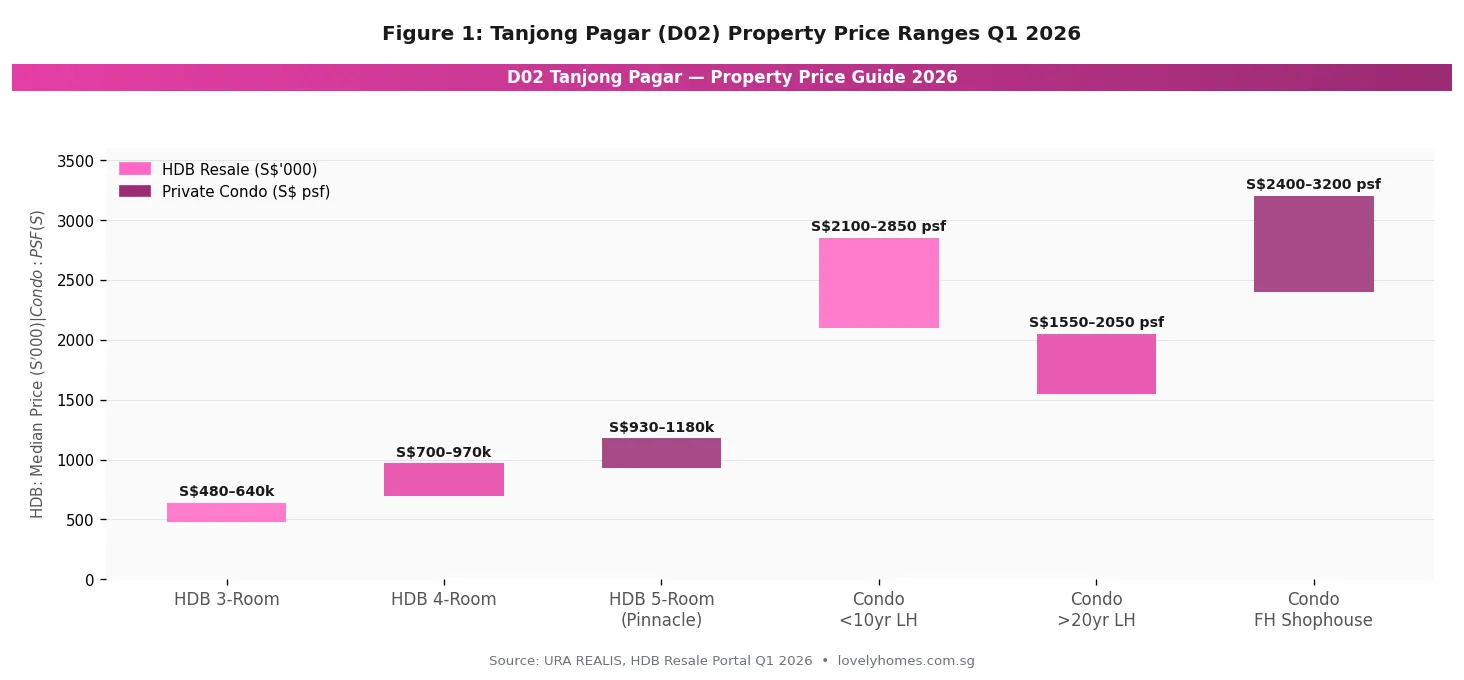
  • HDB resale prices (Q1 2026): 3-room S$480k–S$640k; 4-room S$700k–S$970k; 5-room at Pinnacle@Duxton S$930k–S$1.18M
  • Private condo PSF: S$1,550–S$2,050 (older leasehold) to S$2,100–S$2,850 (newer/freehold)
  • MRT access: Tanjong Pagar EWL (EW15), Shenton Way TEL (TEL17), Cantonment CCL (CC28) — three-line connectivity
  • Rental yield: ~2.6–3.2% gross (CCR typical range); stronger for smaller-format units near CBD
  • Key catalyst: Greater Southern Waterfront (GSW) — ~2,000 ha of land transformation planned over the next two to three decades
  • Who buys here: Expat professionals, CBD workers, upgraders seeking CCR address, investors targeting GSW uplift
  • Watch: Supply is thin — no major new private residential GLS in D02 for several years; scarcity premium is real

Tanjong Pagar is one of Singapore’s most layered neighbourhoods. It is at once a bustling CBD business district, a conserved Peranakan and shophouse enclave, a mature HDB heartland anchored by the globally celebrated Pinnacle@Duxton, and the gateway to Singapore’s most ambitious land transformation project — the Greater Southern Waterfront (GSW). For property buyers and investors in 2026, the neighbourhood presents a rare combination: tight existing supply, a proven rental market, and a long-term government-backed regeneration catalyst that will reshape the southern coast of Singapore over the coming decades.

This guide covers everything you need to know about buying, renting, and investing in Tanjong Pagar — from live Q1 2026 price data across HDB resale and private condominiums, to the eligibility rules that govern who can buy what, a worked cost example, and an honest assessment of what the Greater Southern Waterfront means for property values in D02.

Figure 1: Tanjong Pagar D02 property price ranges 2026 — HDB resale and condo PSF
Figure 1: Tanjong Pagar (D02) property price ranges, Q1 2026. HDB resale prices are medians in S$’000; private condo data reflects median PSF (S$) for non-landed units ≤1,500 sqft. Sources: URA REALIS, HDB Resale Portal.

Where Is Tanjong Pagar and What Makes It Distinctive?

Tanjong Pagar sits in District 02, bounded roughly by Outram Road to the west, Maxwell Road and Neil Road to the north, Keppel Road to the south, and Anson Road to the east. The district is administered within the Outram planning area, and sits firmly within Singapore’s Core Central Region (CCR) — the premium market segment encompassing the traditional prime districts (D9, D10, D11), the CBD core (D1, D2, D6), and Sentosa.

What distinguishes Tanjong Pagar from the rest of the CCR is its mix. Unlike Orchard Road (D9/D10) or Holland Village (D10), which are predominantly private residential, Tanjong Pagar houses approximately 5,400 HDB flats alongside office towers, conserved shophouses, food courts, Chinatown Heritage Centre, and one of Singapore’s most recognisable public housing landmarks. This diversity of tenure and use gives the neighbourhood an urban texture that attracts a broad buyer and tenant base.

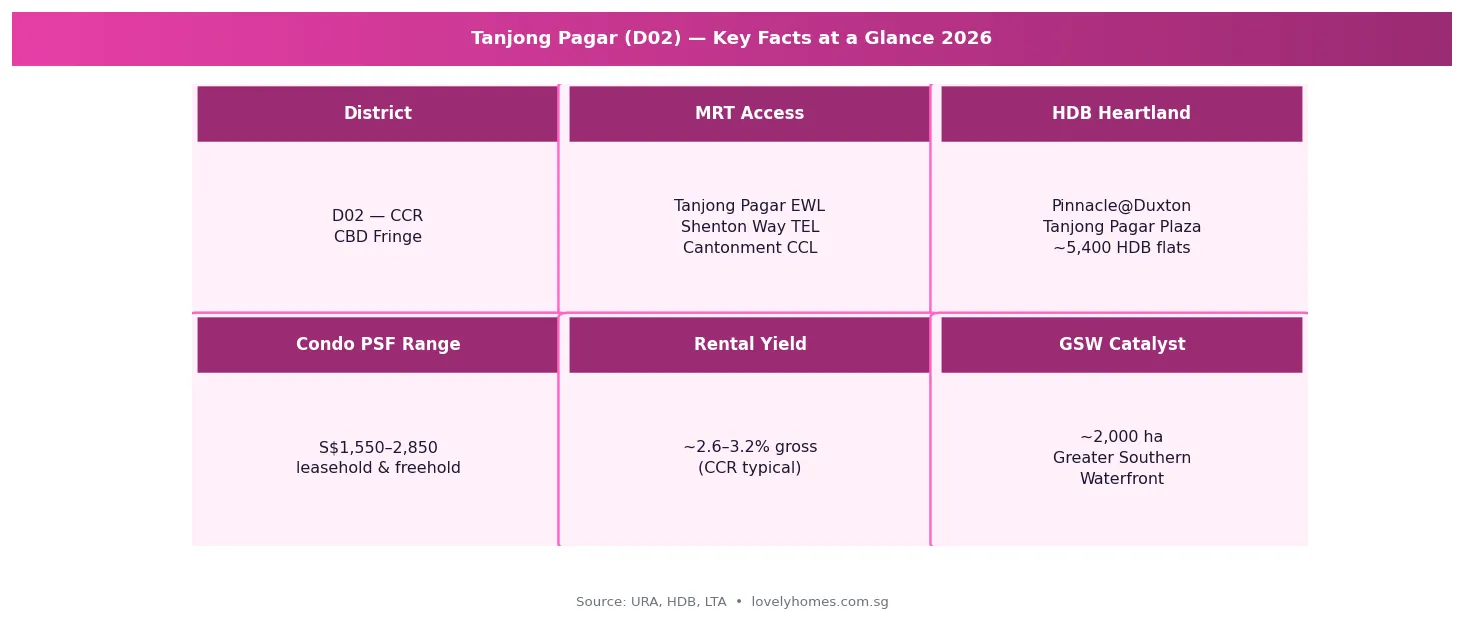
Figure 2: Tanjong Pagar D02 key facts 2026 — district, MRT, HDB, condo, rental yield, GSW
Figure 2: Tanjong Pagar (D02) key facts at a glance, 2026. Sources: URA, HDB, LTA.

Transport Connectivity: Three MRT Lines and Walking-Distance Access

Connectivity is one of D02’s strongest selling points. Residents can access three MRT lines without a bus transfer:

Tanjong Pagar MRT (EW15 — East-West Line): The original station, opened in 1987, connects directly west to Jurong and east to Tampines, Changi Airport, and Pasir Ris. The one-stop hop to Raffles Place (EW14) places the financial district within a two-minute train ride. Outram Park (EW16/NE3/TE17) — one stop west — offers further cross-platform access to the North-East Line and Thomson-East Coast Line.

Shenton Way TEL (TEL17 — Thomson-East Coast Line, Stage 3): Opened in November 2022, Shenton Way TEL sits a short walk north of the Tanjong Pagar residential cluster. The TEL offers seamless one-transfer connectivity to Woodlands (via Orchard and Newton), to East Coast (via Bayshore and Bedok South on TEL Stage 4), and eventually to Sungei Bedok where a cross-platform interchange with the East-West Line will complete the full loop. For Tanjong Pagar residents, the TEL meaningfully reduces commute times to the northern towns and to the Katong/Marine Parade corridor.

Cantonment MRT (CC28 — Circle Line): Opened in September 2022 as part of the Circle Line Stage 6 (closing the loop), Cantonment station sits on Cantonment Road just south of the Pinnacle@Duxton. The Circle Line connects Tanjong Pagar residents directly to one-north, Harbourfront, Dhoby Ghaut, and the eastern nodes of the CCL without going through the city centre interchange.

This three-line connectivity is uncommon even by Singapore standards. Most heartland towns have one or two lines; D02’s triple access gives it a commuting advantage that supports both tenant demand and rental premiums.

HDB Resale Market in Tanjong Pagar: Prices, What to Expect

The HDB resale market in Tanjong Pagar is among the most expensive in Singapore for public housing. The reasons are structural: limited supply (most of the area is private or commercial), exceptional connectivity, and the prestige associated with the Pinnacle@Duxton address. Buyers should expect to pay a meaningful premium over comparable flats in Queenstown or Buona Vista, let alone OCR towns like Tampines or Sengkang.

Flat Type Approx. Floor Area Q1 2026 Median Price Price Range Key Precinct
3-Room ~65–73 sqm S$555,000 S$480k–S$640k Tanjong Pagar Plaza, Cantonment Rd
4-Room ~90–105 sqm S$820,000 S$700k–S$970k Tanjong Pagar Plaza, Pinnacle (lower floors)
5-Room (Pinnacle) ~110–120 sqm S$1,050,000 S$930k–S$1.18M Pinnacle@Duxton exclusively

Pinnacle@Duxton — the seven-tower, 50-storey public housing development completed in 2010 — warrants special mention. Units here, particularly those on higher floors with city and sea views, have consistently transacted above S$1 million since 2021. The development enjoys Minimum Occupation Period (MOP) completed status, and resale units come with the added draw of the iconic sky bridge and rooftop gardens, which are open to the public. Buyers should note: as a leasehold HDB flat with a 99-year tenure commencing 2010, Pinnacle units have approximately 83 years remaining as at 2026 — factoring in lease decay is essential when assessing long-term value.

HDB Eligibility Rules That Apply in D02

The standard HDB resale eligibility framework applies — Singapore Citizens and Permanent Residents who meet the citizenship/family nucleus requirements may purchase. There are no specific restrictions unique to D02, but buyers should note: if any flat in the precinct falls within a Prime classification zone (under HDB’s August 2024 Prime/Plus/Standard framework for BTO), resale of those units after MOP will attract a clawback on subsidies received at purchase. As at 2026, most Tanjong Pagar resale flats are legacy stock not subject to new-framework clawbacks — but prospective buyers should verify the specific block’s classification with HDB before committing.

Private Condo and Freehold Market in D02

D02 Tanjong Pagar has a limited supply of private condominiums compared to neighbouring districts. Development sites are scarce in this dense, mixed-use environment. Notable private residential projects in and around the precinct include Icon (leasehold, completed 2007), One Shenton (leasehold, Shenton Way), V on Shenton (leasehold), 76 Shenton (freehold conservation shophouse redevelopment), and the Artra development at Alexandra View. Freehold conservation shophouses on Club Street, Tanjong Pagar Road, and Duxton Hill command premium valuations as alternative assets.

The PSF range varies significantly by age, tenure, and location within the precinct. As a general guide for Q1 2026:

Property Type Tenure PSF Range (S$) Typical Monthly Rent (2BR) Est. Gross Yield
Condo <10 yr old, LH 99-year S$2,100–S$2,850 S$5,800–S$7,500 ~2.8–3.1%
Condo >15 yr old, LH 99-year S$1,550–S$2,050 S$4,200–S$5,600 ~2.9–3.2%
Freehold shophouse resi Freehold S$2,400–S$3,200 S$6,000–S$9,000 ~2.5–2.9%

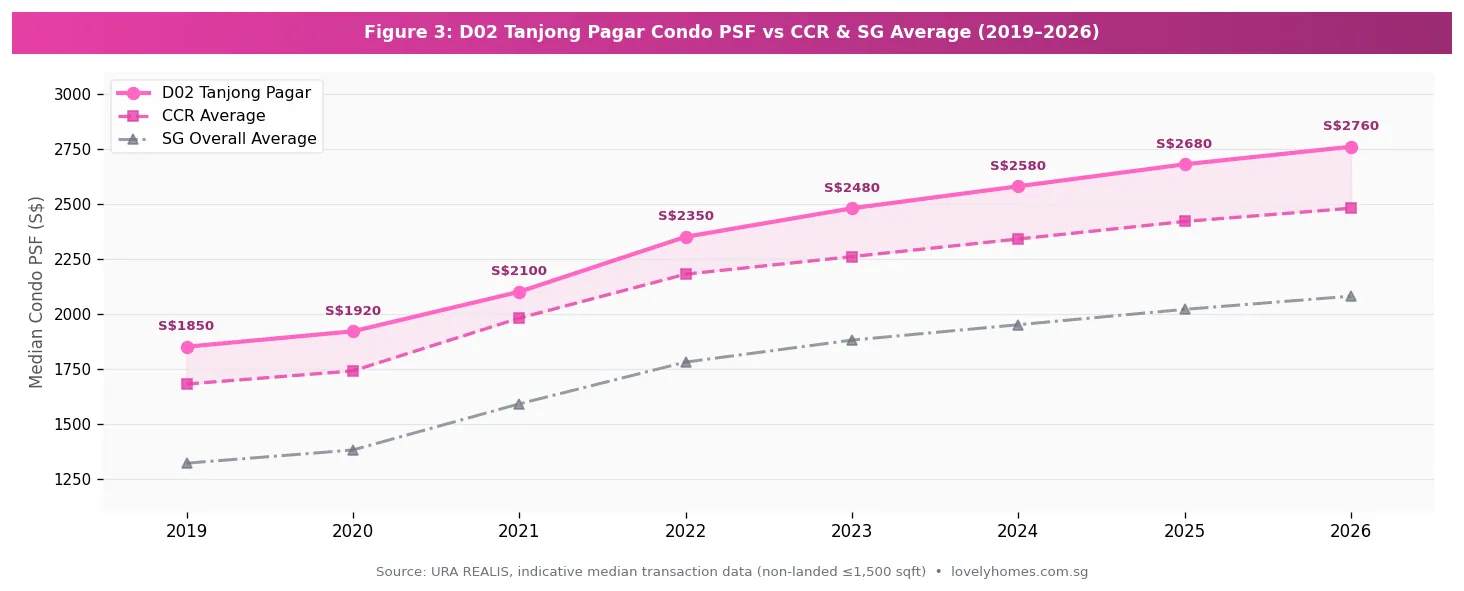
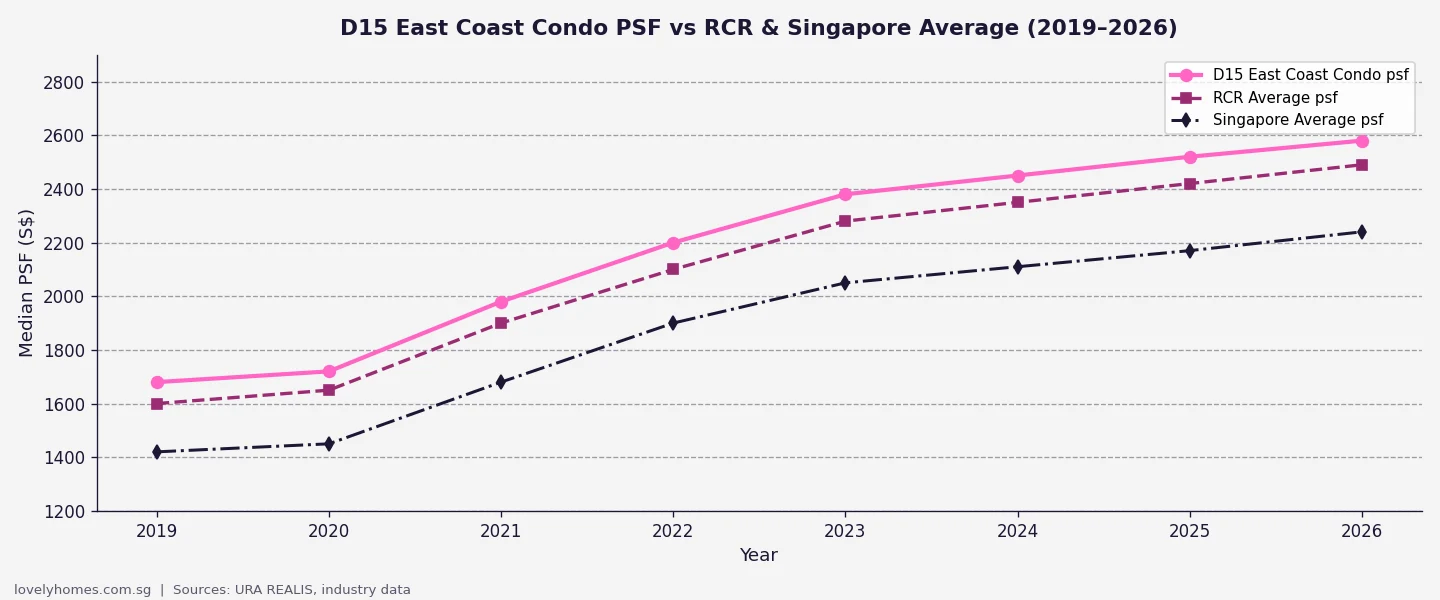
Figure 3: Tanjong Pagar condo PSF trend 2019–2026 versus CCR and Singapore average
Figure 3: D02 Tanjong Pagar median condo PSF (non-landed, ≤1,500 sqft) versus CCR average and Singapore overall, 2019–2026. Sources: URA REALIS, indicative median transaction data.

As Figure 3 illustrates, D02 has consistently traded at a premium above the CCR average — reflecting the district’s CBD-adjacency advantage. The gap widened between 2021 and 2023 as post-pandemic demand for city-fringe living spiked. Since 2024, the gap has stabilised, with D02 running approximately S$250–S$320 psf above the CCR mean. The absence of significant new supply — no major GLS site has been released in D02 in recent years — has supported prices even as broader CCR activity moderated in 2024.

The Greater Southern Waterfront: What It Means for Tanjong Pagar Property

The Greater Southern Waterfront (GSW) is the Singapore Government’s most ambitious urban transformation project south of the city. It encompasses approximately 2,000 hectares of land stretching from Pasir Panjang in the west to Marina East in the east — a stretch of southern coastline currently occupied by port terminals, industrial facilities, golf courses, and government land. As the Tanjong Pagar Port (the world’s largest container port by throughput when it operated) progressively relocates to Tuas by the early 2030s, this vast land bank becomes available for mixed-use development over the following two to three decades.

For Tanjong Pagar property owners, the GSW is both an opportunity and a long-dated one. Key facts that property buyers should understand:

Scale and timeline: At 2,000 ha, the GSW is larger than Marina Bay and Tampines combined. Development will be phased over 20–30 years. The first parcels to emerge will be around Keppel and Telok Blangah; those closest to Tanjong Pagar could see activity within 10–15 years.

Planned character: URA’s masterplan envisions a live-work-play precinct with new residential districts, public green spaces, a new waterfront promenade, cultural institutions, and a potential new MRT connection along the southern coast. The Keppel Club site (approximately 44 ha) was the first major GSW parcel to be tendered, with the winning developer awarded the white site in early 2023 for a mixed-use development that will include over 9,000 residential units — becoming one of Singapore’s largest planned private housing estates.

Property value implications: Historical precedent from Marina Bay and one-north suggests that government-planned transformations deliver measured but real uplift to surrounding residential values — typically concentrated in the 5–10 years before and during initial development. For D02 owners, the GSW catalyst is a hold thesis rather than an immediate trading play.

Key Takeaway: The GSW will materially reshape Singapore’s southern coast but on a multigenerational timeline. Buyers who purchase in Tanjong Pagar for own occupation benefit from the neighbourhood’s current strengths (connectivity, heritage, supply scarcity) and receive the GSW as optionality — not as a near-term flip thesis.

Worked Example: Buying a Tanjong Pagar Condo in 2026

The Scenario: Mr and Mrs Tan (SC/SC), first-time buyers, purchasing a 2-bedroom condo

Property: 2-bedroom leasehold condo near Tanjong Pagar, 700 sqft at S$2,400 psf = S$1,680,000

Stamp duty: Buyer’s Stamp Duty (BSD) = 1% on first S$180k + 2% on next S$180k + 3% on next S$640k + 4% on next S$500k + 5% on remainder
= S$1,800 + S$3,600 + S$19,200 + S$20,000 + S$9,000 = BSD S$53,600

ABSD: S$0 — SC first property, ABSD exempt

LTV and downpayment: With income of S$15,000/mth combined, TDSR ceiling is 55% → max monthly debt S$8,250. Assume 75% LTV bank loan at 3.5% over 25 years:
Loan = S$1,260,000; monthly repayment ≈ S$6,310 → TDSR 42.1% PASS

Cash required upfront:
— 5% cash downpayment: S$84,000 (cash only; CPF cannot cover first 5%)
— 20% balance: S$336,000 (cash or CPF OA)
— BSD: S$53,600
— Legal fees / stamp duty / valuation: ~S$6,000
Total upfront: approx. S$479,600 (depending on CPF OA balance)

Note: SPR or SC second-property buyers would pay ABSD of 5% (SPR first) or 20% (SC second) respectively, materially increasing the total cost. Always compute your personal profile’s ABSD liability before committing.

Why Tanjong Pagar Matters for Property Investors in 2026

In a market where OCR prices have risen sharply since 2020 and the gap between CCR and OCR has narrowed, Tanjong Pagar offers a rare proposition: a CCR address at a price point that, in historical context, is more accessible than it has been. The CCR-to-OCR price differential compressed significantly between 2021 and 2024 as mass-market demand pushed OCR prices upward while CCR remained relatively range-bound.

For long-term holders, D02 has three structural advantages that distinguish it from comparable CCR districts. First, the supply pipeline is thin — no significant new private residential completions are expected in D02 through 2028, meaning existing stock bears no dilution risk from new units coming online. Second, the tenant pool is diversified across CBD professionals, Chinatown heritage seekers, and increasingly, short-stay visitors and digital nomads who value the neighbourhood’s walkable character. Third, the GSW represents a call option on Singapore’s next major urban precinct — one that, unlike speculative GLS bids, requires no premium payment.

Comparable CCR districts (D9 Orchard, D10 Bukit Timah, D11 Novena) all carry higher average PSFs and lower yield profiles. D02’s position as the undervalued cousin of the prime districts has been a persistent feature of the Singapore market, partly because of the neighbourhood’s historic industrial associations and partly because of its relative unfamiliarity to overseas buyers. Both factors are changing.

What Might Come Next for Tanjong Pagar Property

This section reflects editorial analysis and speculation based on current trends. It should not be treated as a forecast or investment advice.

The most consequential near-term catalyst for D02 values is likely the Keppel integrated development — the first major GSW residential project — which, if it proceeds on schedule, could deliver initial units by the late 2020s to early 2030s. When Marina Bay Sands and the Marina Bay Financial Centre arrived, surrounding Districts 1 and 2 saw demonstrable price appreciation driven by improved amenity, connectivity, and perception uplift. A similar dynamic is plausible as the first GSW precincts activate, though the scale and timeline introduce significant uncertainty.

The URA Q2 2026 price index (released 1 July 2026, URA pr26-51) showed the CCR rebounding +2.0% quarter-on-quarter, outperforming the RCR (-1.4%) and OCR (-0.2%). If the CCR rebound is sustained, D02 stands to benefit disproportionately given its supply constraints and improving sentiment around the GSW. That said, global interest rate trajectories and Singapore’s continued vigilance on cooling measures (ABSD rates remain elevated since 2023) remain the key headwinds for any near-term price acceleration.

Frequently Asked Questions: Tanjong Pagar Property

Can a foreigner buy property in Tanjong Pagar?

Foreigners may purchase private condominiums in Tanjong Pagar freely, but may not purchase HDB flats (including Pinnacle@Duxton). Foreign buyers pay a 60% ABSD on their purchase price, on top of BSD. Freehold conservation shophouses classified as strata commercial or strata residential may be available, but restrictions apply — consult a licensed property agent and conveyancing solicitor before proceeding. Singapore Permanent Residents (SPRs) pay 5% ABSD on their first residential property purchase.

What is the MOP for HDB flats in Tanjong Pagar?

HDB resale flats in Tanjong Pagar (including Pinnacle@Duxton) have a standard Minimum Occupation Period of 5 years from the date the seller obtained the keys. You cannot resell or rent out the entire flat during MOP. After MOP, the full flat may be rented out, subject to HDB’s rental eligibility rules. New BTO flats in prime-classified zones carry an extended 10-year MOP under the framework introduced in August 2024.

How does buying a Pinnacle@Duxton flat differ from a standard HDB purchase?

Pinnacle@Duxton units transact as standard HDB resale flats under the HDB resale process — there is no special purchase mechanism. However, buyers should be aware of several unique features: the 50-storey height means piped gas is unavailable above certain floors; the sky bridge and rooftop garden access was previously charged (S$6 for residents) and open to the public; and the premium commanded by higher floors can be substantial. Lease decay is an important consideration: with a 99-year lease commencing 2010, the remaining lease in 2026 is approximately 83 years. HDB’s loan eligibility will be affected by the lease duration — ensure the flat meets the remaining-lease requirement for your desired loan tenure.

Is there a significant COV (Cash Over Valuation) in Tanjong Pagar?

In a tight supply market like D02, COV is common. COV is the amount a buyer pays above the HDB-commissioned bank valuation — it must be paid entirely in cash, not CPF. For popular blocks and high floors at Pinnacle@Duxton, COV of S$30,000–S$80,000 has been observed in recent transactions. Buyers should budget for COV explicitly and factor it into their cash liquidity planning alongside the standard 5% cash downpayment and BSD.

What is the Greater Southern Waterfront and when will it affect property prices?

The Greater Southern Waterfront (GSW) is Singapore’s government-planned transformation of approximately 2,000 hectares of southern coastal land, from Pasir Panjang to Marina East, as the Tanjong Pagar Port relocates to Tuas by the early 2030s. Development will proceed in phases over 20–30 years. The Keppel integrated development (white site awarded 2023) is the first major residential precinct to emerge from the GSW, with an estimated 9,000+ homes planned. Property values in D02 are unlikely to see an immediate step-change from GSW; the effect will be gradual, strongest when the first GSW precincts open and new amenities, waterfront access, and additional MRT nodes materialise. Buyers today are effectively pre-positioning.

What rental income can I expect from a Tanjong Pagar condo?

Based on Q1 2026 rental market data, a 2-bedroom unit (600–800 sqft) in a leasehold condo in D02 typically commands S$4,200–S$7,500 per month, depending on age of the building, floor level, and furnishing. Smaller studio or 1-bedroom units (400–500 sqft) rent in the S$3,200–S$5,000 range and are popular with single CBD professionals. Gross rental yields typically fall in the 2.6–3.2% range for private condos at current price levels — not the highest in Singapore but supported by consistently low vacancy given the CBD tenant base. HDB flats may be rented out after MOP; rental returns on HDB in D02 can be relatively attractive given the lower absolute price relative to nearby private units.

Are there upcoming GLS or new launch condos in Tanjong Pagar?

As at July 2026, there are no confirmed GLS sites in District 02 Tanjong Pagar on the URA Confirmed List for 1H or 2H 2026. The GSW Keppel integrated development is the closest major upcoming supply, but it is physically distinct from the current D02 residential cluster and is expected to be launched as a new growth node rather than a competitor to existing D02 stock. Supply scarcity in D02 proper is expected to persist through at least 2028, which supports both rental and capital values.

Disclaimer: This article is produced for general information and educational purposes only. Price data represents indicative medians drawn from publicly available URA REALIS, HDB Resale Portal, and industry sources for Q1 2026; individual transactions may differ materially. Nothing in this article constitutes financial, investment, legal, or property advice. The Greater Southern Waterfront projections are based on URA planning documents and are subject to change. Readers should conduct their own due diligence and consult a licensed property agent, conveyancing solicitor, and independent financial adviser before making any property purchase decision. Official resources: URA, HDB, IRAS, MAS.
×

Click anywhere to close

Kovan Neighbourhood Guide Singapore 2026: HDB Prices, Condos & Investment Outlook

Kovan Neighbourhood Guide Singapore 2026: HDB Prices, Condos & Investment Outlook

Quick Answer — Kovan / D19 at a Glance

  • District: D19 (Hougang, Kovan, Serangoon North); served by North East Line (NEL) at Kovan (NE13) and Hougang (NE14) stations.
  • HDB resale: 4-room flats range from S$510,000–S$620,000; 5-room from S$660,000–S$760,000 (Q1 2026).
  • Condos: Non-landed private homes trade at S$1,450–S$1,700 psf, a meaningful 25–30% discount to RCR average.
  • Rental yield: Approximately 3.3–3.6% for Kovan-area condos; strong tenant demand from families and young professionals.
  • Schools: Maris Stella High School, CHIJ St Joseph’s Convent, Kovan Primary School and Montfort Secondary within close reach.
  • Investment catalyst: The Cross Island Line (CRL) Serangoon North station (Phase 1, 2030) will add a second MRT line to the broader D19 corridor.
  • Upcoming supply: Limited new-launch condo pipeline in the immediate Kovan/Hougang precinct keeps resale values supported.
  • Buyer profile: HDB upgraders, families seeking mature estate amenities, and investors targeting OCR rental demand.
  • BSD: On a S$1.5M condo, Buyer’s Stamp Duty totals S$44,600; ABSD is S$0 for Singapore Citizens buying their first property.
  • Next step: Apply for HDB Loan Eligibility (HLE) or bank pre-approval; engage a CEA-registered agent to access HDB resale portal.

What Is the Kovan / D19 Neighbourhood?

Kovan is a mature residential precinct in District 19, nestled in the north-eastern quadrant of Singapore between the more bustling Serangoon and the HDB heartlands of Hougang. Administered by the Hougang–Punggol Town Council (under the broader Aljunied GRC and Hougang SMC divisions), D19 spans Hougang, Kovan, Serangoon North and parts of Upper Serangoon — a broad swathe of land that mixes older public housing, low-density walk-up apartments, newer private condominiums and some semi-detached and terrace houses.

The estate gained a reputation for quiet, laid-back living: tree-lined streets, local coffeeshops, community markets and the charming Kovan F&B hub along Upper Serangoon Road. Unlike the more commercially dense Serangoon or Toa Payoh, Kovan retains a neighbourhood feel, making it a consistent favourite among families who want amenity access without city-centre noise and pricing.

The North East Line (NEL) has anchored the estate’s connectivity since 2003. Kovan MRT (NE13) sits roughly in the centre of the precinct, while Hougang MRT (NE14) serves the broader HDB heartland to the north. The upcoming Cross Island Line (CRL) — with a Serangoon North station planned under Phase 1 (expected 2030) — will add a second MRT line to the broader D19 corridor, strengthening connectivity to Pasir Ris, Jurong and the city core.

D19 Kovan HDB resale price ranges by flat type Q1 2026
Figure 1: Kovan / D19 HDB Resale Price Ranges by Flat Type, Q1 2026 (S$’000). Source: HDB, industry transaction data. Ranges reflect lower-to-upper end of transacted prices.

HDB Resale Market in Kovan and Hougang

The bulk of public housing in D19 is concentrated in Hougang estate, one of Singapore’s largest and most established HDB towns. Hougang Central and Hougang Street areas contain mostly 3-room to executive apartment blocks built in the 1980s and 1990s, with a smaller supply of newer 4-room and 5-room flats dating from the 2000s. Kovan itself has limited HDB stock — the precinct is dominated more by walk-up apartments and private condominiums — but buyers seeking HDB ownership in D19 typically look at Hougang Ave 2, Hougang Ave 8, Upper Serangoon Road and the Hougang Central cluster.

As at Q1 2026, median transacted prices in D19 for HDB resale flats are as follows: 3-room flats range between S$330,000 and S$420,000 depending on floor level, facing and lease remaining; 4-room flats fall in the S$510,000–S$620,000 band, with prime upper-floor units in sought-after blocks pushing past S$600,000; 5-room flats and executive apartments trade between S$660,000 and S$760,000, and the very best executive apartments (rare in D19) have tested S$920,000.

The HDB resale market in D19 has been steady rather than spectacular. The estate does not attract the speculative frenzy of D3 (Tiong Bahru) or D10 (Bukit Timah), but precisely this stability makes it appealing to genuine owner-occupiers. Resale flat buyers should note that all purchases are subject to the HDB Ethnic Integration Policy (EIP) and the Singapore Permanent Resident (SPR) quota, both of which limit supply in individual blocks and neighbourhoods and can affect resale timing.

Kovan D19 neighbourhood key facts 2026 at a glance
Figure 2: Kovan / D19 Neighbourhood Key Facts at a Glance (2026). Sources: URA, HDB, MOE school portal.

Private Condominiums in Kovan D19

The private residential market in Kovan is anchored by a cluster of well-regarded condominiums, most built in the 2000s to mid-2010s. Key developments include:

  • The Minton (Hougang St 11, 1,145 units, TOP 2013) — one of the largest private developments in D19; swimming pools, recreational facilities; 4–5 min walk to Hougang MRT.
  • Kovan Melody (Kovan Road, 778 units, TOP 2007) — established estate, good rental demand; 6 min walk to Kovan MRT.
  • Kovan Residences (Upper Serangoon Road, 393 units, TOP 2013) — freehold tenure; one of the area’s premium addresses.
  • The Scala (Serangoon Ave 3, 468 units, TOP 2013) — adjacent to NEX mall and Serangoon MRT interchange; technically D19/D13 border.

Transacted PSF across these developments ranges from S$1,450 to S$1,700 in Q1 2026, with freehold units (notably Kovan Residences) commanding a 12–15% premium over leasehold stock. This represents a roughly 25–30% discount to the RCR average (approximately S$2,300–S$2,500 psf) — a meaningful value proposition for buyers who want private housing without paying CCR or RCR prices.

Rental demand is supported by the estate’s family-friendly character, school proximity and NEL connectivity. A 3-bedroom unit at The Minton or Kovan Melody typically commands S$4,200–S$5,200/mth in 2026, translating to gross rental yields of approximately 3.3–3.6%. These are modest by CCR standards but comparable to other OCR-fringe estates.

Schools and Education

D19’s school roster is one of its strongest selling points for family buyers. Within the 1km registration radius of Kovan MRT or Hougang Central, buyers can access:

School Type Distance from Kovan MRT Notable
Kovan Primary School Primary ~600m SAP school; bilingual programme
Xinghua Primary School Primary ~900m Established, strong CCA programme
CHIJ St Joseph’s Convent Girls’ Primary (mission) ~1.2km MOE school, strong pastoral tradition
Maris Stella High School Independent (boys) ~1.1km Consistently top-ranked independent school
Montfort Secondary School Secondary ~1.4km SAP school; strong performing arts
Serangoon Garden Secondary Secondary ~2km Near Serangoon Gardens precinct

Maris Stella High School in particular has long driven family buyer demand in the Kovan precinct. As an independent all-boys school with direct-admission and talent programmes, it consistently attracts families who prioritise secondary school options at point of primary registration. The 1km radius around Kovan MRT encompasses Maris Stella’s registration zone, making addresses near Upper Serangoon Road and Kovan Road especially sought-after for family buyers.

Amenities and Lifestyle

Kovan’s retail scene is deliberately low-key. The area’s character is defined by its Kovan food enclave — a cluster of independent F&B outlets, local eateries, cafés and neighbourhood shops along Kovan Road and Upper Serangoon Road, stretching roughly between Kovan MRT and Hougang MRT. This strip has gentrified quietly over the past decade and now includes artisan coffee shops, Japanese restaurants, local hawker favourites and weekend farmers’ market pop-ups.

For larger retail needs, residents have quick access to:

  • Heartland Mall Kovan — a medium-sized suburban mall at Kovan MRT, anchored by Fairprice and a mix of F&B and services.
  • Hougang Mall — near Hougang MRT; NTUC FairPrice anchor, cinema and family dining.
  • NEX Mall Serangoon — two stops away on the NEL; one of the largest suburban malls in Singapore with 580,000 sq ft of retail, a rooftop pet pool and family entertainment.

Parks and green spaces include Hougang Stadium, the tree-lined corridors of Kovan Road and the Serangoon Park Connector, which connects to the broader round-island park connector network. The Punggol Waterway is one NEL stop further and provides a riverside recreational option that many D19 residents treat as their extended backyard.

Connectivity: NEL and the Coming CRL Uplift

The North East Line (NEL) is D19’s primary rail artery. From Kovan MRT (NE13), the NEL runs direct to:

  • Serangoon interchange (NE12) — 1 stop, connection to CCL and Bishan
  • Dhoby Ghaut (NE6) — 6 stops, interchange with NSL and CCL (city centre)
  • Outram Park (NE3) — 9 stops, connection to EWL and TEL (city fringe)

Journey time from Kovan to Raffles Place is approximately 25–30 minutes by train — competitive with many CCR and RCR addresses when accounting for door-to-door travel. The NEL’s operational frequency of approximately 2.5 minutes during peak hours makes it one of the more reliable commuter lines.

The transformative catalyst for D19’s medium-term investment story is the Cross Island Line (CRL). CRL Phase 1, currently under construction, includes a Serangoon North station that will sit approximately 1.5km west of Kovan MRT, within the broader D19 corridor. When completed (expected around 2030), this station will offer a direct cross-island rail connection from Hougang / Serangoon North through Punggol, Ang Mo Kio, Bright Hill, Clementi, West Coast and on to Changi — dramatically reducing transfer requirements for residents who currently commute to the north-west or south-west.

Research by the Urban Redevelopment Authority (URA) and independent property analysts consistently shows MRT proximity within 500m commands a 5–12% price premium for private residential properties. The CRL effect, though not yet priced in for Kovan proper (Kovan MRT is NEL, not CRL), is expected to lift values in Serangoon North sub-zones within D19 over the 2027–2032 period as construction activity and station footprints become visible.

D19 Kovan condo PSF trend vs RCR and Singapore average 2019 to 2026
Figure 3: D19 Kovan / Serangoon Condo PSF Trend vs RCR and Singapore Average (2019–2026 estimate). Sources: URA realis, industry transaction data.

Investment Outlook for Kovan D19

From a property investment standpoint, D19 sits in a compelling mid-tier position: established enough to have deep rental demand and school-driven owner-occupier interest, but not yet priced to perfection in the way that D11 (Novena) or D9 (Orchard) are. The PSF discount to RCR (~25–30%) and to CCR (~40–45%) creates a valuation buffer that appeals to value-oriented investors.

The supply picture is favourable. There are no major new-launch condominium sites in the immediate Kovan/Hougang precinct in URA’s 2H 2026 GLS Confirmed List. The most proximate recent supply came from Kovan Jewel and a handful of boutique freehold developments. This supply scarcity, combined with steady rental demand (especially from families with children at Maris Stella and Kovan Primary), supports occupancy rates of 92–95% in well-managed D19 condominiums.

Risks to monitor include: broader Singapore macro headwinds (higher-for-longer interest rates compressing buyer affordability); the ABSD regime (which makes multiple-property investment expensive for Singapore Citizens and essentially prohibitive for Singapore Permanent Residents and foreigners); and the five-year Seller’s Stamp Duty (SSD) holding-period requirement, which locks in investors for a minimum period before tax-free disposal is possible. Buyers should also note that ABSD for a Singapore Citizen’s second property is 20%, significantly raising the cost of entry for investors who already own one property.

Worked Example: Buying a 4-Room HDB Resale Flat in Hougang

Case Study — Lim Couple (SC/SC), First HDB Resale Purchase

Profile: Mr and Mrs Lim, Singapore Citizens, both aged 33, combined gross household income S$7,200/mth, no existing property ownership.

Target: 4-room HDB resale flat, Hougang Ave 8, Blk 418C (5th floor), 92 sqm, lease commencing 1993 (72 years remaining).

Agreed price: S$578,000.

CPF Housing Grants available:

  • Enhanced Housing Grant (EHG): S$30,000 (income S$7,200/mth, both first-timers)
  • Family Grant (resale, SC/SC): S$50,000
  • Total grants: S$80,000

Financing (HDB loan):

  • Purchase price: S$578,000
  • Less grants: S$80,000
  • Net purchase price: S$498,000
  • HDB loan (80% LTV): S$462,400 @ 2.60% p.a. over 25 years
  • Monthly repayment: approximately S$2,099/mth
  • MSR check: S$2,099 / S$7,200 = 29.2% — PASS (must be ≤30%)

Stamp duty:

  • BSD on S$578,000: 1% × S$180k + 2% × S$180k + 3% × S$218k = S$1,800 + S$3,600 + S$6,540 = S$11,940
  • ABSD: S$0 (SC, first property)

Upfront cash required:

  • 20% downpayment (cash + CPF): S$115,600; CPF OA (assumed S$60,000 each) covers S$80,000 → cash S$35,600
  • BSD in cash: S$11,940
  • Legal and admin fees: ~S$2,500
  • Total cash outlay: approximately S$50,040

Note: Actual grant amounts depend on household income, citizenship status and eligibility checks by HDB at point of application. TDSR and MSR calculations are indicative; engage an HDB officer or licensed mortgage broker for a precise assessment.

What the Numbers Mean for Buyers

Kovan / D19 offers a rare combination in Singapore’s property market: school-belt proximity, mature estate amenities, NEL connectivity and pricing that remains accessible to HDB upgraders and first-time private property buyers alike. The Lim couple’s example illustrates how an S$578,000 4-room resale flat — with maximum grants reducing the effective loan to S$462,400 — delivers an MSR of 29.2% at a S$7,200/mth combined income, leaving meaningful financial headroom for living expenses, savings and future property goals.

For investors, the S$1,450–S$1,700 psf price band for Kovan condominiums compares favourably to equivalent-quality stock in D13 (Serangoon) or D14 (Geylang/Eunos), while offering better school catchment and a quieter living environment. The CRL uplift story — though not yet a reality — gives D19 a medium-term catalyst that many other mature OCR estates lack.

What might come next for Kovan? URA’s long-term planning maps indicate densification of the Upper Serangoon Road corridor, with some existing industrial and mixed-use sites potentially rezoned for residential or mixed-development use over the next decade. Any rezoning announcements would act as material catalysts for land value and, consequently, resale prices in the immediate vicinity.

Frequently Asked Questions

Is Kovan a good area to live in Singapore?

Yes, Kovan is consistently rated as one of Singapore’s most liveable mature OCR estates. Its combination of North East Line connectivity, reputable schools (Maris Stella High, Kovan Primary), a vibrant independent F&B scene, low-density residential character and competitive property prices make it particularly popular with families. It lacks the commercial density of Toa Payoh or Tampines but offers a quieter, more residential lifestyle that many owner-occupiers prefer. The upcoming Cross Island Line Serangoon North station (Phase 1, ~2030) will further strengthen its connectivity case.

What are HDB resale flat prices in Hougang / Kovan 2026?

As at Q1 2026, 4-room HDB resale flats in the Hougang / Kovan D19 area are transacting in the range of S$510,000–S$620,000. 5-room flats and executive apartments fetch S$660,000–S$760,000. 3-room flats — increasingly limited in supply — range from S$330,000 to S$420,000. Premium units with long remaining leases (70+ years), high floors or desirable block facings tend to transact at the upper end or occasionally above the range. All HDB resale transactions require an Option to Purchase (OTP) and are subject to EIP and SPR quota restrictions.

Can foreigners buy property in Kovan / D19?

Foreigners (non-Singapore Citizens and non-Permanent Residents) are prohibited from purchasing HDB flats under any circumstances. For private condominiums in D19 — such as The Minton, Kovan Melody or Kovan Residences — foreigners may purchase subject to paying Additional Buyer’s Stamp Duty (ABSD) of 60% of the purchase price (as at January 2024, per IRAS). This is in addition to Buyer’s Stamp Duty (BSD) of approximately S$43,800–S$54,600 on a S$1.5M unit. Singapore Permanent Residents buying their first property pay 5% ABSD. The cost burden makes foreign investment in private condominiums in D19 generally marginal on a yield basis, though some investors still proceed for capital appreciation or estate-planning reasons.

Which condos are near Kovan MRT?

The closest condominiums to Kovan MRT (NE13) include Heartland Mall Kovan (retail, not residential), Kovan Melody (~650m, 778 units, leasehold 99yr, TOP 2007), Kovan Residences (~800m, 393 units, freehold, TOP 2013) and The Scala (~1.2km towards Serangoon). Further along Hougang Ave, The Minton (1,145 units, leasehold, TOP 2013) is approximately 1km from Hougang MRT. There are no major new-launch condominiums currently available for purchase in the immediate Kovan/Hougang precinct as at July 2026; the nearest new-launch pipeline is in Tampines North and the Greater Plantation Loop.

How does the CRL Serangoon North station affect D19 property values?

The Cross Island Line (CRL) Phase 1 Serangoon North station is expected to open around 2030 and will sit approximately 1.5km from Kovan MRT within the broader D19 corridor. Property research consistently shows that MRT stations within 500m of a development command a 5–12% premium over comparable properties without such proximity. Properties directly adjacent to the Serangoon North station box (likely between Upper Serangoon Road and Ang Mo Kio Ave 3) stand to benefit most. Kovan proper (served by the existing NEL) is less directly exposed, but improved network connectivity across D19 broadly supports price floors and rental demand. Buyers who can identify future station catchment areas ahead of station opening often capture the best appreciation.

What CPF Housing Grants are available for HDB resale in D19?

First-timer Singapore Citizens buying an HDB resale flat in D19 may be eligible for the Enhanced Housing Grant (EHG) — up to S$80,000 for individuals or S$160,000 for families depending on household income — and the Family Grant of up to S$50,000 (SC/SC couple) or S$40,000 (SC/SPR couple). The Proximity Housing Grant (PHG) of up to S$30,000 is available when buying within 4km of parents or children. Grants are administered by HDB and disbursed directly against the purchase price or loan. Full details on eligibility conditions, income ceilings and grant stacking rules are covered in our HDB CPF Housing Grant Guide 2026.

What is the Minimum Occupation Period (MOP) for Kovan HDB flats?

All HDB flats in D19 — whether Standard, Plus or Prime classification — are subject to a Minimum Occupation Period (MOP) before the flat can be sold on the open resale market or rented out entirely. For Standard flats in Hougang / Kovan, the MOP is 5 years from date of key collection (or from the date the last occupier moves in, if applicable). Plus flats (a newer classification introduced in August 2024) carry a 10-year MOP. Prime flats have a 10-year MOP with a subsidy clawback on resale. The HDB does not classify existing Hougang and Kovan flats as Prime; they are generally Standard or Plus depending on specific project and location. Full MOP rules are detailed in our HDB MOP Complete Guide 2026.

Related Articles

Disclaimer

The information in this article is provided for general informational purposes only as at July 2026 and does not constitute financial, legal or property investment advice. Property prices, HDB resale figures, PSF data and grant amounts are indicative based on available URA, HDB and industry transaction data and may differ from actual conditions at time of purchase. All property transactions in Singapore are subject to prevailing stamp duty rates (ABSD, BSD, SSD), HDB eligibility rules, CPF Board regulations and financial institution lending criteria. Readers should consult a CEA-registered property agent, a licensed mortgage adviser and where appropriate a qualified lawyer before making any property purchase decision. For authoritative information, refer to the Urban Redevelopment Authority (ura.gov.sg), Housing & Development Board (hdb.gov.sg), Inland Revenue Authority of Singapore (iras.gov.sg) and the Monetary Authority of Singapore (mas.gov.sg).
×

Click anywhere or press Esc to close

Singapore HDB Minimum Occupation Period (MOP) 2026: Complete Guide — Rules, Restrictions and Upgrade Options

Singapore HDB Minimum Occupation Period (MOP) 2026: Complete Guide — Rules, Restrictions and Upgrade Options

Quick Answer: HDB MOP Singapore 2026

  • Standard HDB BTO and resale flats have a 5-year Minimum Occupation Period (MOP) counted from the date you collect the keys (TOP/possession date), not from when you sign the Sales & Purchase agreement.
  • Plus and Prime (PLH) classification flats introduced from the August 2024 BTO exercise have a longer 10-year MOP, reflecting their more desirable locations and heavier subsidy.
  • During MOP, you cannot sell your flat, rent out the entire flat, or purchase any other residential property in Singapore — including private property or an overseas residential investment.
  • You CAN rent out individual HDB bedrooms with prior HDB approval, and run approved home-based businesses from your flat during MOP.
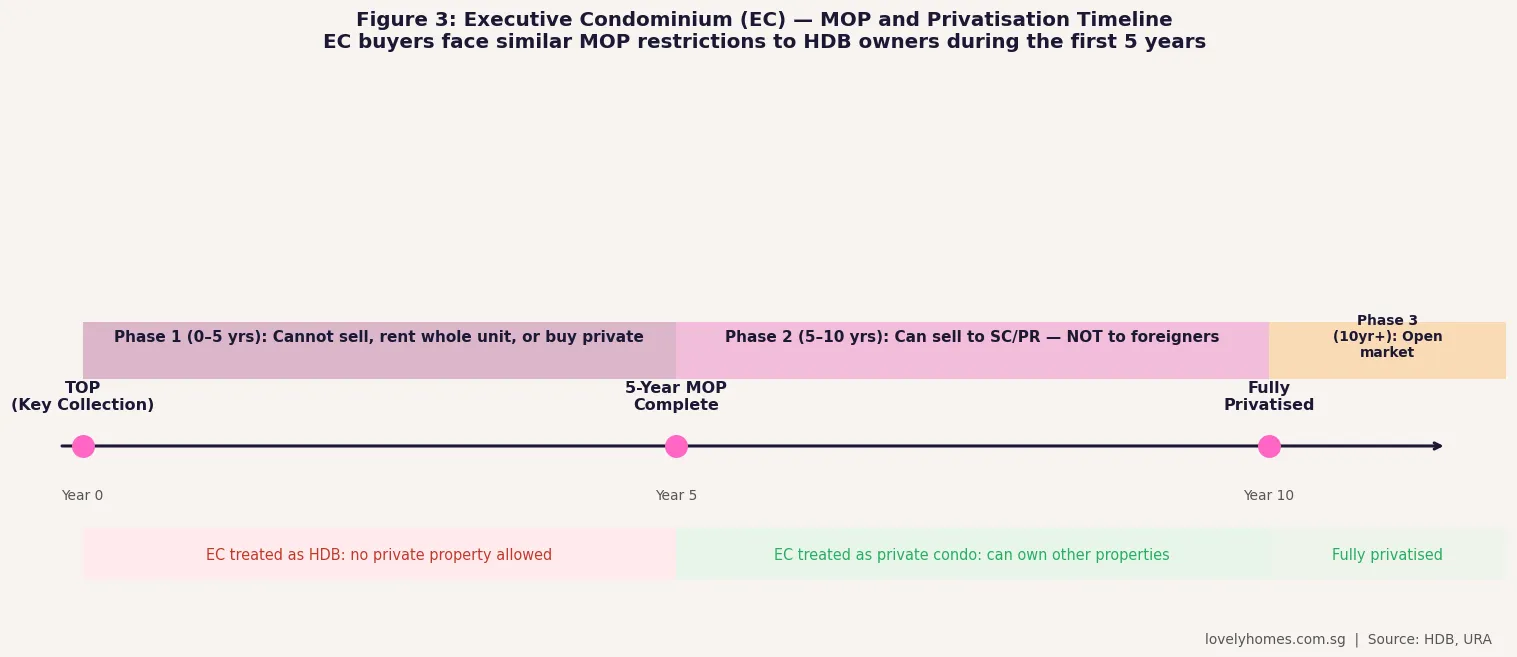
  • Executive Condominiums (ECs) have a 5-year MOP before they can be sold to Singapore Citizens and PRs, and a 10-year window before they are fully privatised and open to foreign buyers.
  • Breaching MOP rules can result in compulsory acquisition of the flat by HDB at a value set by HDB — typically below market value. Criminal penalties may also apply under the Housing & Development Act.
  • After MOP, you can sell the flat, upgrade to a private property, and — for HDB sellers upgrading to private — apply for ABSD remission if you complete the sale within 6 months of purchasing the private property.

What Is the HDB Minimum Occupation Period (MOP)?

The Minimum Occupation Period (MOP) is a statutory rule administered by the Housing & Development Board (HDB) that requires flat owners to physically occupy their HDB flat for a minimum period before they can sell it on the open market, rent it out entirely, or purchase other residential property in Singapore. The MOP is a key plank of Singapore’s public housing philosophy: HDB flats are subsidised national assets intended primarily as homes rather than investment vehicles, and the MOP is one mechanism through which HDB ensures flats remain owner-occupied.

The MOP was first introduced in the 1970s and has been refined multiple times since, most recently in 2024 with the introduction of the Plus and Prime flat classifications under the enhanced HDB framework. Understanding which MOP applies to your flat — and what you can and cannot do during that period — is critical before making any property decisions.

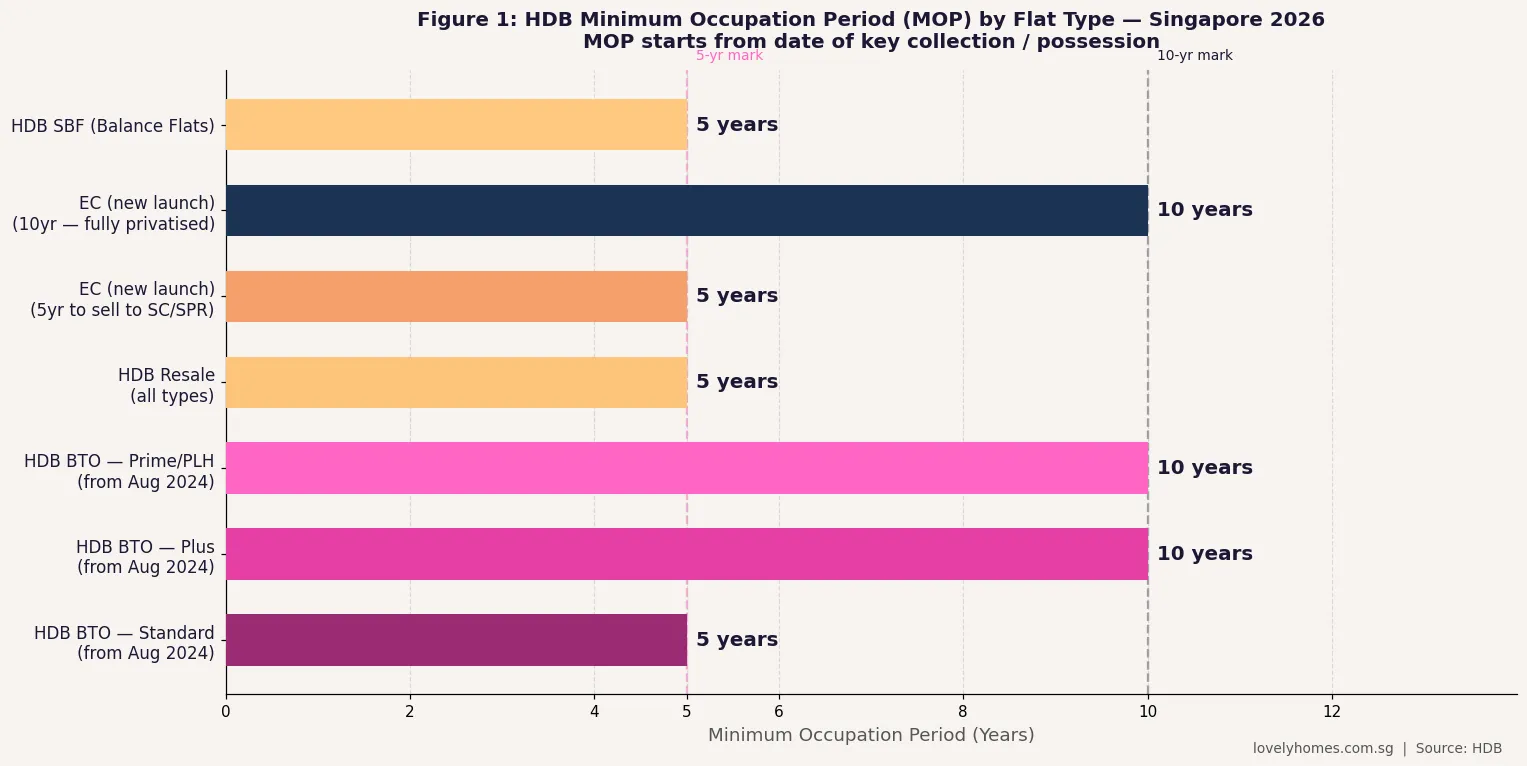
HDB MOP by flat type Singapore 2026 — Standard 5 years, Plus and Prime 10 years, EC 5 then 10 years
Figure 1: HDB Minimum Occupation Period by flat type, Singapore 2026. Plus and Prime classification flats (introduced from August 2024 BTO exercise) carry a 10-year MOP, double the Standard flat MOP. Source: HDB.

MOP Duration by Flat Type (2026)

Flat Type MOP Duration MOP Start Date Notes
Standard BTO Flat 5 years Date of key collection Applies to all pre-Aug 2024 BTO; continued for Standard classification from Aug 2024
Plus Classification BTO Flat 10 years Date of key collection From Aug 2024 BTO exercise; typically near MRT/town centres; subsidy clawback on resale
Prime / PLH Classification BTO Flat 10 years Date of key collection Central-location flats; subsidy clawback ~6–9% of resale price; income ceiling at resale
HDB Resale Flat 5 years Date of resale completion Fresh 5-year MOP runs from the date the resale transaction is completed (not from when the previous owner moved in)
Executive Condominium (EC) 5 years → 10 years Date of TOP At 5yr can sell to SC/PR; at 10yr fully privatised — open to foreigners (60% ABSD applies)
HDB Sale of Balance Flats (SBF) 5 years Date of key collection SBF flats unsold from previous BTO exercises; Standard classification MOP applies

Important note on the Plus and Prime MOP: The new 10-year MOP for Plus and Prime flats applies only to flats launched under the August 2024 BTO exercise onwards. Flats purchased in earlier exercises, even if they are in desirable locations that would now be classified as Plus or Prime, retain their original 5-year MOP. To confirm which classification applies to your flat, check your HDB flat portal or the original flat details under your BTO exercise.

What You Cannot Do During the HDB MOP

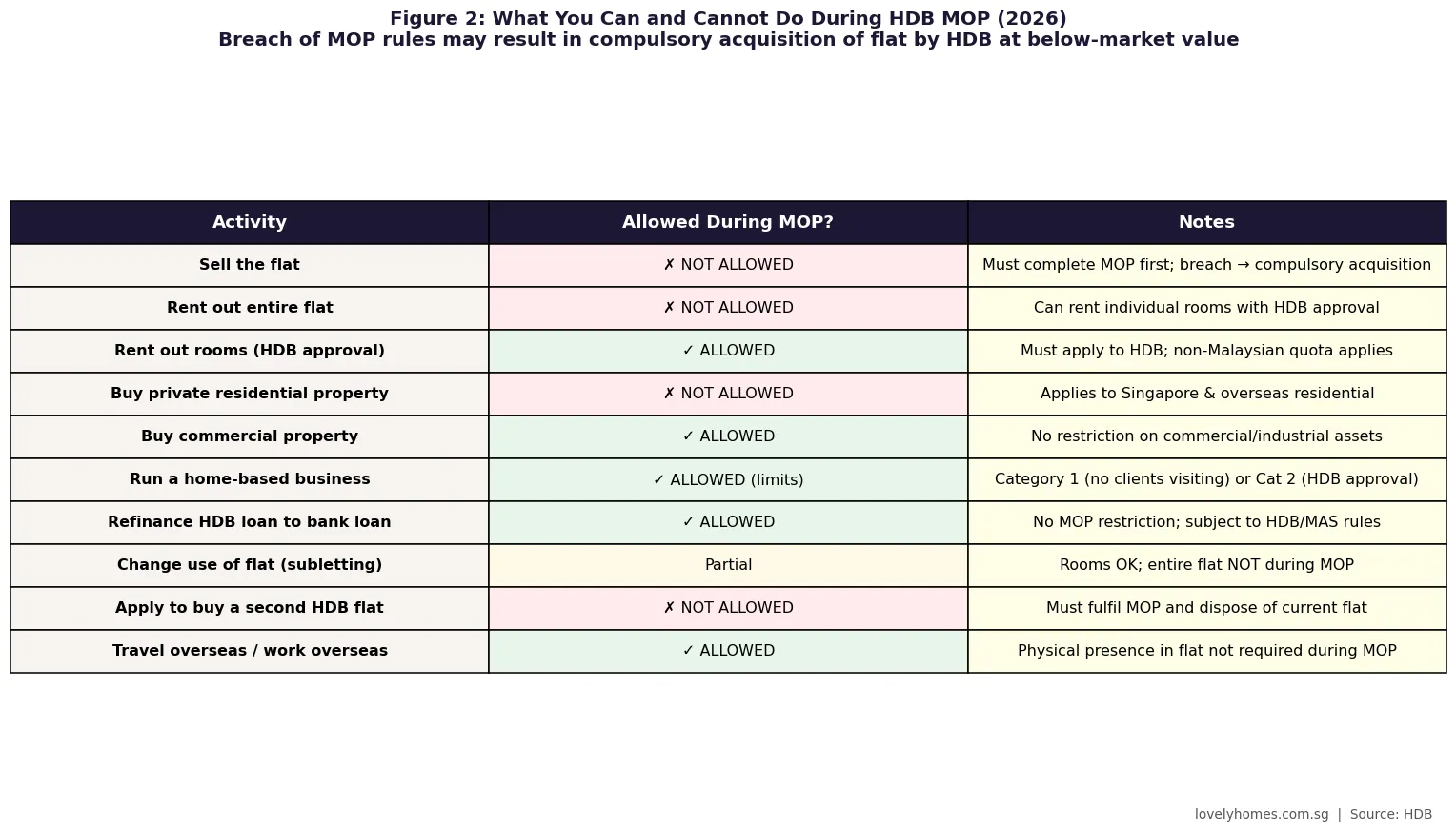
HDB MOP rules matrix 2026 — what you can and cannot do during the minimum occupation period
Figure 2: HDB MOP rules — allowed and prohibited activities during the Minimum Occupation Period. Source: HDB Housing & Development Act.

Selling the Flat

You cannot sell your HDB flat on the open resale market before your MOP is complete. This applies even if you face financial hardship — HDB does not grant MOP exemptions for distressed sellers. The only exception is a compulsory acquisition by HDB or by the State for public purposes, which is not initiated by the flat owner. If you attempt to sell before MOP, the transaction will be rejected by HDB’s system during the eligibility check.

Renting Out the Entire Flat

Renting out the entire flat (as a whole unit) is not allowed during MOP. This applies to both short-term and long-term rental arrangements. Platforms such as Airbnb and similar short-term rental services are also not permitted on HDB flats — the minimum lease tenure for any rental on HDB flats is three consecutive months. After MOP, whole-flat rental is allowed with HDB prior approval and is subject to the non-Malaysian foreign tenant quota.

Purchasing Other Residential Property in Singapore

During MOP, you and your co-owners on the flat cannot purchase any other private residential property in Singapore. This restriction extends to new launch condominiums, resale condominiums, Executive Condominiums (as a new buyer), landed property, and private apartments. Purchasing a second HDB flat is also not allowed during MOP.

Crucially, HDB’s definition of “residential property” in the MOP context refers to Singapore property only. There is no restriction on purchasing overseas residential property during MOP — only Singapore residential property is covered.

Purchasing a Second HDB Flat

HDB’s policy generally allows only one HDB flat per family nucleus at any time. Applying for a second BTO, SBF, or resale flat during MOP is not permitted. Once MOP is fulfilled, you may apply for a second HDB flat under specific schemes (e.g., the Studio Apartment scheme for elderly, or a new BTO after disposing of the first flat).

What You CAN Do During the HDB MOP

Rent Out Individual Rooms

Renting out individual bedrooms in your HDB flat (while you continue to live in the flat) is permitted during MOP, subject to HDB’s prior written approval. You must apply through the HDB Flat Portal before subletting. Each tenancy must be for a minimum of six months (for whole-flat subletting after MOP) or at least three months for room rental. Non-Malaysian foreign tenants are subject to the non-Malaysian quota: a maximum of two non-Malaysian foreign tenants per flat in the same block is the guideline, though HDB publishes real-time quota data by block.

Run Approved Home-Based Businesses

HDB permits flat owners to operate home-based businesses during MOP, subject to type and scale restrictions. Category 1 businesses (no employees visiting, no clients visiting, no signage) are allowed without prior approval. Category 2 businesses (up to two non-resident employees, clients may visit in small numbers) require prior approval from HDB. Manufacturing, food businesses, or any business that involves goods storage, noise, or frequent deliveries is not permitted.

Refinance to a Bank Loan

Switching from an HDB housing loan to a bank loan (or switching between bank loan packages) is allowed during MOP. There is no MOP restriction on refinancing decisions, and many flat owners take advantage of the 5-year MOP period to monitor interest rate movements and refinance when rates are favourable. MAS’s LTV and TDSR rules govern the refinancing terms.

When Does the MOP Start and End?

The MOP starts from the date you collect your keys (for BTO and SBF flats, this is the TOP date; for resale flats, this is the date of completion of the resale transaction — both milestones are reflected in your HDB Flat Portal). The MOP does not start from the date you sign the Sales & Purchase Agreement or from the date you pay the initial booking fee.

You can check your MOP end date in the HDB Flat Portal under “My Flat” → “Purchase Details”. The portal clearly shows whether your MOP has been fulfilled. Do not rely on verbal estimates from agents or CPF advisers — always verify on the portal directly.

One nuance: physical occupation is expected during MOP. HDB conducts periodic checks to ensure flat owners are residing in the flat. Extended overseas absences without HDB’s knowledge have been cited in compulsory acquisition cases. If you must be overseas for an extended period (e.g., for work), inform HDB and keep the flat in a lived-in condition.

Executive Condominium (EC): The Hybrid MOP Rules

Executive Condominium EC MOP and privatisation timeline Singapore 2026 — 5-year and 10-year milestones
Figure 3: Executive Condominium MOP and privatisation timeline. During the first 5 years, EC owners face HDB-equivalent MOP restrictions. At the 5-year mark, ECs can be sold on the open market to SC and PR buyers. At 10 years, ECs are fully privatised and open to foreign buyers (60% ABSD applies). Source: HDB, URA.

Executive Condominiums occupy a hybrid position between public and private housing. They are built by private developers but are sold at a subsidised price to qualifying buyers (income ceiling S$16,000 per month household income as of 2026). From a MOP standpoint, ECs are treated like HDB flats for the first 5 years:

During years 1–5: EC owners cannot sell their unit, rent out the whole unit, or purchase any other Singapore residential property. The rules are identical to HDB MOP. Critically, the 5-year MOP runs from the TOP date, not the booking date — for large EC projects, this can mean a 3–4 year gap between booking and TOP, followed by 5 more years of MOP, making the effective holding period 8–9 years from initial purchase commitment.

After year 5 (first privatisation): The EC can be sold on the open resale market to Singapore Citizens and Singapore PRs. It cannot yet be sold to foreigners, and ECs in the first 5–10 year window are not listed on the private market as “privatised condos” — they trade in a narrower SC/SPR market. ABSD rules for the buyer apply (5% for PR 1st property, 30% for PR 2nd+, etc.).

After year 10 (full privatisation): The EC is fully privatised and treated identically to a private condominium. Foreigners may purchase it, though the 60% foreigner ABSD applies. Owners may also rent the entire unit without prior HDB approval at this stage.

Plus and Prime Flat Additional Restrictions After MOP

The 2024 housing framework introduced substantive additional conditions for Plus and Prime classification flats beyond just the longer 10-year MOP. These are restrictions that run with the flat even after MOP and affect future resale:

Subsidy clawback: When you sell a Plus or Prime flat after your MOP, HDB claws back a portion of the subsidy embedded in the original purchase price — approximately 6–9% of the resale price, payable to HDB. This clawback is calculated as a percentage of the resale transaction price, not the original purchase price, so it increases in dollar terms as the flat appreciates.

Income ceiling for buyers: Buyers of Plus and Prime resale flats are subject to an income ceiling (the ceiling is the same as for BTO buyers — S$14,000/month for 4-room and larger Plus flats as of 2026). This narrows the pool of eligible resale buyers and may dampen price appreciation relative to Standard flats.

Ethnic Integration Policy (EIP): As with all HDB resale flats, EIP quotas apply — both block and neighbourhood levels. Buyers must check the relevant block’s EIP availability before submitting an offer.

After MOP: Your Property Upgrade Options

Once your MOP is fulfilled, your options expand significantly. The most common upgrade path is from HDB flat to private condominium. The timing of this upgrade carries stamp duty implications:

Option A — Sell HDB first, then buy private: You clear the HDB flat, receive sale proceeds (net of CPF refund), and purchase the private property as a “first property” — no ABSD for SC buyers, 5% ABSD for PR buyers. This is the most common and financially efficient path but requires temporary accommodation between the two transactions.

Option B — Buy private first, then sell HDB (concurrent ownership): As an SC buying private property while still owning an HDB flat (post-MOP), you pay 20% ABSD on the private property purchase. You then have six months from the private property’s completion (or from the purchase date for resale private properties) to sell the HDB flat and apply for an ABSD remission from IRAS. If the HDB is sold within six months, IRAS refunds the 20% ABSD. If you miss the six-month window, the 20% ABSD is forfeited.

The six-month window starts from either the issue of Temporary Occupation Permit (TOP) for a new private property or the date of exercise of the OTP for a resale private property. Given the complexity of timing, many HDB upgraders consult a lawyer and financial adviser before committing to Option B.

The 15-Month Wait-Out Period: From Private Back to HDB

The wait-out period is often confused with MOP. They are different rules targeting different situations. The 15-month wait-out period (introduced in September 2022) applies to private property owners who want to purchase an HDB resale flat. If you own or recently disposed of a private property, you must wait 15 months from the date of disposal before you can purchase an HDB resale flat.

This rule does not apply to HDB MOP — it is a separate downstream restriction. For example, if you complete your HDB MOP, sell your HDB flat, buy a private condo, and then later want to downgrade back to HDB, you must wait 15 months after selling the private condo before buying an HDB resale flat. This rule applies to both SC and PR private property owners.

Worked Example: The Tan Family’s Upgrade Journey

Mr and Mrs Tan (both Singapore Citizens) purchased a 4-room BTO flat in Punggol under the Standard classification in September 2019. They collected their keys in August 2021. Their MOP end date is therefore August 2026 — five years from key collection.

In March 2026, Mrs Tan checks the HDB portal and sees MOP will end in 5 months. The couple begin their private condo search. They find a 3-bedroom OCR resale condo in Jurong East priced at S$1.5M in June 2026.

They choose Option B (buy private first). As SC buying a second property: BSD ~S$42,600 + ABSD 20% = S$300,000. They pay S$342,600 in stamp duties. Their flat is still within MOP (keys August 2021, MOP August 2026 — they are just before MOP end), so HDB must confirm MOP end before they list the flat for sale.

After August 2026 (MOP fulfilled), they list their HDB flat. Sell it in October 2026 for S$780,000 — within the 6-month window from the condo OTP exercise date of June 2026. IRAS refunds the S$300,000 ABSD. Net stamp duty retained: S$42,600 BSD only. The family books temporary accommodation for 2 months while bridging the purchase and sale timelines.

Total net proceeds from HDB: S$780,000 − CPF refund S$220,000 (principal + accrued interest) − agent 1% S$7,800 − legal S$2,500 = net S$549,700 cash. The upgrade is financially viable.

Will MOP Rules Change?

The 10-year MOP for Plus and Prime flats is a relatively recent policy (from August 2024) and unlikely to be rolled back in the near term. If anything, the trend in Singapore public housing policy has been toward tightening MOP and adding post-MOP conditions rather than relaxing them, as the government works to ensure HDB flats remain primary homes rather than investment properties. The subsidy clawback mechanism for Plus and Prime flats may be extended to more flat types if HDB determines that Standard flat resale prices are diverging too sharply from BTO prices in certain areas. Buyers should model their long-term exit strategy under current rules and build in buffer for possible tightening.

Frequently Asked Questions

Can I stay overseas during my HDB MOP?

You are expected to physically occupy the flat during MOP, but there is no absolute rule against overseas travel. Extended absences (months or years) without HDB’s knowledge can attract scrutiny, and in confirmed cases of non-occupation, HDB may commence compulsory acquisition proceedings. If you need to relocate overseas temporarily for work (e.g., on a company secondment), inform HDB in writing and keep the flat utilities active. HDB conducts inspection exercises and spot checks and has compulsorily acquired flats where owners were clearly not residing in them during MOP.

Does my MOP reset if I add or remove an owner from the flat?

No — adding or removing an owner (for example, through marriage or divorce) does not reset the MOP clock. The MOP continues to run from the original key collection date. However, any change of ownership within MOP is a restricted transaction and must be approved by HDB. Not all ownership changes are approved during MOP — for example, transferring a flat to an ineligible person would be rejected. Consult HDB or a lawyer before any ownership change within the MOP window.

Can I buy an overseas investment property during MOP?

Yes. The HDB MOP restriction applies only to Singapore residential property. There is no restriction on purchasing overseas property (residential or commercial) during MOP. You are not required to declare overseas property purchases to HDB. However, if you are financing an overseas property purchase with a Singapore bank loan, that loan will be factored into your TDSR for future Singapore loan applications. From a Singapore tax perspective, rental income from overseas property is taxable in Singapore as foreign-sourced income if remitted to Singapore.

What happens if I breach the MOP?

A breach of MOP (typically: selling the flat, subletting the entire flat, or buying other residential property in Singapore without completing MOP) can result in HDB compulsorily acquiring the flat. HDB sets the acquisition price, which is typically the assessed market value minus a penalty deduction — in practice, this means the owner receives significantly less than the open-market value they would have received after MOP. In the most serious cases involving deliberate deception or fraud (e.g., falsely declaring occupancy), criminal charges may be brought under the Housing & Development Act, which carries fines of up to S$5,000 and/or imprisonment.

Does MOP apply to inherited HDB flats?

If you inherit an HDB flat from a deceased owner, the MOP of the original owner does not transfer to you as a fresh 5-year obligation. Instead, the inherited flat is subject to HDB’s estate rules — the eligible inheritor (e.g., a spouse or child who meets eligibility criteria) may retain the flat. If the inheritor already owns a flat, they may need to dispose of one within six months. Inherited flats that have not yet met MOP at the time of death are subject to HDB’s direction — in practice, HDB often allows the eligible inheritor to complete the remaining MOP. Always consult HDB’s estate administration team for inherited flat cases.

Can I buy a private property if my HDB is still within MOP and my spouse is not on the HDB title?

No — the restriction applies to the entire family nucleus (owner and spouse / co-habitant), not just the named owners on the HDB title. If one spouse is within MOP on an HDB flat, the other spouse (even if not on the HDB title) is also restricted from purchasing Singapore residential property. HDB looks at the family nucleus holistically. Attempting to buy private property in a non-owning spouse’s name to circumvent MOP is a known scheme that HDB and IRAS are alert to — it will be scrutinised and may result in both the stamp duty assessment and a referral for investigation.

Is there a MOP for HDB shophouses or commercial units?

No. MOP is specific to HDB residential flat units. HDB shophouses (commercial properties on the ground floor of HDB blocks) are governed by different rules and do not carry a MOP. Commercial properties generally do not have any MOP equivalent — you can sell or rent them freely at any time after purchase. The restrictions and ABSD rules that apply to residential property do not apply to commercial property purchases.

Related Articles

Disclaimer

This article provides general information about HDB MOP rules as at July 2026 and is not legal or financial advice. MOP durations, clawback percentages, and related policy conditions may change. Always verify current MOP status for your flat at hdb.gov.sg and check the specific BTO exercise details in your Lease Agreement. For estate planning, inheritance, and structural ownership changes, consult a Singapore-qualified lawyer. For ABSD remission eligibility, consult IRAS at iras.gov.sg.

HDB CPF Housing Grant Guide 2026: EHG, Family Grant, Step-Up, PHG and Singles Grant Explained

HDB CPF Housing Grant Guide 2026: EHG, Family Grant, Step-Up, PHG and Singles Grant Explained

×

Click outside or press Esc to close

For most Singaporeans, the CPF Housing Grant system is the single most valuable financial lever available when buying an HDB flat. The right grant — or combination of grants — can reduce the purchase price by S$30,000 to S$160,000 and cut the cash outlay needed at the point of sale dramatically. Yet many buyers remain unclear about which grants they qualify for, how the grants interact, and what happens when eligibility conditions change before completion. This guide covers every HDB CPF Housing Grant available in 2026: the Enhanced CPF Housing Grant (EHG), Family Grant, Step-Up CPF Housing Grant, Proximity Housing Grant (PHG), and the Singles Grant — with full eligibility tables, income ceiling rules, and a worked example.

Quick Answer — HDB Grants at a Glance (2026)

  • The Enhanced CPF Housing Grant (EHG) provides up to S$80,000 for first-timer SC couples buying BTO or resale flats (income ceiling S$9,000/mth).
  • The Family Grant provides S$80,000 (SC couple, BTO) to S$50,000 (resale), on top of EHG — making combined grants up to S$160,000 for qualifying couples.
  • The Step-Up CPF Housing Grant gives second-timer SC families S$15,000 towards a 4-room or smaller BTO flat.
  • The Proximity Housing Grant (PHG) provides S$30,000 (living with) or S$20,000 (living near) parents or child — for resale buyers.
  • The Singles Grant gives eligible single SC applicants aged ≥35 up to S$25,000 towards a resale flat or S$25,000 for a 2-room BTO.
  • All grants are administered by HDB and applied via the HDB Flat Portal (homes.hdb.gov.sg) — not through the CPF Board directly.
  • Grants offset the purchase price and reduce the HDB loan quantum required; they are not paid in cash to the buyer.

What Are HDB CPF Housing Grants and Who Administers Them?

HDB CPF Housing Grants are subsidies provided by the Housing and Development Board (HDB) under Singapore’s public housing policy. Despite the “CPF” label, the grants are designed and administered entirely by HDB; the Central Provident Fund (CPF) Board plays a secondary role in that CPF Ordinary Account (OA) savings may be used to fund the portion of the flat price not covered by grants. The grants exist because HDB’s policy mandate — set by the Ministry of National Development (MND) — is to ensure that public housing remains affordable across a wide income range. Grants are structured to taper off as household income rises, so they provide the greatest assistance to lower-income first-time buyers.

Importantly, grants are credited directly to reduce the flat’s purchase price or loan quantum — they are never paid to buyers in cash. This means they reduce the amount you borrow (and therefore the interest you pay over the loan tenure) rather than arriving as a lump sum in your bank account. Understanding this distinction is critical when doing upfront cost planning.

Grant Amounts by Household Income — EHG and Family Grant

HDB CPF Housing Grant EHG and Family Grant amounts by household income 2026
Figure 1: Enhanced CPF Housing Grant (EHG) and Family Grant amounts by average household income — HDB BTO, SC couple first-timer, 2026. Source: HDB.

The EHG is the largest single grant available and applies across a wide income spectrum. Its key feature is that the grant amount decreases as income rises, in S$5,000–S$10,000 steps, from a maximum of S$80,000 for couples earning S$1,500 per month or less, stepping down to S$5,000 for couples earning between S$8,500 and S$9,000 per month. Couples with a gross monthly income above S$9,000 do not qualify for the EHG. Importantly, “household income” for grant purposes is the average gross monthly income of all working persons listed on the flat application, typically the two applicants and any occupants who are working.

Grant Eligibility Matrix — Who Qualifies for What

HDB CPF Housing Grant eligibility matrix 2026 — EHG Family Grant Step-Up PHG Singles
Figure 2: HDB CPF Housing Grant eligibility matrix — key buyer profiles versus grant type (2026). Source: HDB Grant Guide.

The matrix above illustrates how grants are layered across buyer profiles. An SC couple buying a BTO as first-timers can potentially stack the EHG (up to S$80,000) and the Family Grant (S$80,000), for a combined S$160,000 grant — the maximum available under any HDB grant combination. SC/SPR mixed-citizenship couples receive the Family Grant at a lower quantum (S$60,000 for BTO; S$50,000 for resale) and are eligible for the EHG, but at the EHG rate applicable to the SPR-tier income rules. Singles aged 35 and above receive a dedicated Singles Grant and are eligible for a scaled-down EHG.

Deep Dive: The Five Main HDB Grants in 2026

1. Enhanced CPF Housing Grant (EHG)

The EHG replaced the Additional CPF Housing Grant (AHG) and Special CPF Housing Grant (SHG) in September 2019. It is the most broadly applicable grant and covers both BTO and resale applications. Key conditions include: both applicants must have worked continuously for at least 12 months before the application date; the flat must not exceed a purchase price ceiling (for resale, the flat must be valued within the HDB resale price cap for the flat type and town); and applicants must not currently own or have disposed of private residential property within 30 months of application. The EHG applies regardless of flat type or location — a unique feature distinguishing it from the old SHG, which was restricted to non-mature estates.

2. Family Grant (BTO and Resale)

The Family Grant is citizenship-tiered and applies on top of the EHG. For SC-SC couples purchasing a new BTO flat, the Family Grant is S$80,000 regardless of income (subject to the S$14,000/mth income ceiling). For SC-SPR couples, the BTO Family Grant is S$60,000. For resale purchases, the quantum is S$50,000 (SC-SC) or S$40,000 (SC-SPR). The Family Grant can also be claimed by first-timer applicants who are singles applying under the Joint Singles Scheme, though the quantum is halved. There is no separate income ceiling for the Family Grant beyond the general resale/BTO eligibility income ceiling of S$14,000 per month gross household income.

3. Step-Up CPF Housing Grant

The Step-Up Grant is specifically for second-timer SC families — meaning applicants who previously owned or occupied an HDB flat, received a housing subsidy (including previous BTO application grant), or are currently living in a subsidised rental flat. The grant amount is S$15,000 and applies only to the purchase of a 4-room or smaller BTO flat. It is HDB’s way of facilitating the upgrading or right-sizing journey for mature families, while channelling the most significant grants to genuine first-timers. The income ceiling is S$7,000 per month.

4. Proximity Housing Grant (PHG)

The PHG is unique in that it is available for resale flat purchases only — it does not apply to BTO. It rewards buyers who choose to live near their parents or adult children. The quantum is S$30,000 if you buy a resale flat to live with parents or an unmarried child, and S$20,000 if you buy within 4 km of parents or a married child’s home. PHG can be combined with the EHG and Family Grant for resale purchases, making it a powerful stacking grant for families with a proximity reason to choose resale over BTO. There is no income ceiling for the PHG — it is available across all income levels subject to basic HDB eligibility.

5. Singles Grant

The Singles Grant is available to SC singles aged 35 and above applying for a 2-Room Flexi BTO flat or a resale flat. The quantum is S$25,000 for resale (4-room or smaller) and a scaled-down EHG for 2-Room Flexi BTO applications. Since January 2024, singles have been able to apply for 4-room resale flats (previously restricted to 5-room or smaller), broadening the effective pool. Singles who subsequently marry and upgrade to a larger flat may be treated as first-timers for the purposes of the EHG and Family Grant, subject to HDB’s conditions at the time of the subsequent purchase.

Summary Table — 2026 HDB Grant Quantum at a Glance

Grant Max Quantum Income Ceiling BTO / Resale
Enhanced CPF Housing Grant (EHG) S$80,000 S$9,000/mth Both
Family Grant (SC couple, BTO) S$80,000 S$14,000/mth BTO
Family Grant (SC couple, Resale) S$50,000 S$14,000/mth Resale
Family Grant (SC+SPR, BTO) S$60,000 S$14,000/mth BTO
Step-Up CPF Housing Grant S$15,000 S$7,000/mth BTO (4-room or smaller)
Proximity Housing Grant — With S$30,000 No ceiling Resale only
Proximity Housing Grant — Near S$20,000 No ceiling Resale only
Singles Grant (Resale) S$25,000 S$7,000/mth Resale (4-room or smaller)

Grant Impact on Upfront Cost — Three Worked Scenarios

HDB grant impact on upfront cost before and after grants BTO resale 2026
Figure 3: Illustrative upfront cost (downpayment + BSD) before and after applying maximum available grants — three buyer scenarios (2026). Source: LovelyHomes estimates based on HDB data.

Scenario A — BTO 4-Room, SC Couple, S$9,000/mth household income: A 4-room BTO flat in a non-mature estate at S$420,000. Gross monthly income is S$9,000 — at the EHG ceiling, so EHG is S$5,000. Family Grant (BTO, SC couple) is S$80,000. Total grants: S$85,000. Adjusted purchase price for grant purposes: S$335,000. 10% downpayment (HDB loan): S$33,500 cash/CPF. BSD on S$335,000: S$5,350. Estimated upfront: ~S$38,850. Without grants: 10% of S$420,000 = S$42,000 + BSD S$6,900 = ~S$48,900. Grant saving: ~S$10,050 in upfront costs, plus S$85,000 reduction in loan principal.

Scenario B — Resale 4-Room, SC+SPR Couple, S$6,000/mth income: Resale flat at S$560,000. EHG at S$6,000 income = S$35,000; Family Grant (resale, SC+SPR) = S$40,000; PHG (living near parents) = S$20,000. Total grants: S$95,000. Adjusted price: S$465,000. 25% downpayment (bank loan): S$116,250. BSD on S$560,000: S$12,200. Upfront: ~S$128,450. Without grants: 25% of S$560,000 = S$140,000 + BSD S$12,200 = ~S$152,200. Grant saving upfront: ~S$23,750 — largely via reduced loan principal.

Scenario C — Single SC, Aged 38, Resale 4-Room, S$5,000/mth income: Resale flat at S$380,000. Singles Grant: S$25,000. EHG (single, S$5,000 income) = S$40,000. Total: S$65,000. Adjusted price: S$315,000. HDB loan 90% LTV: S$283,500; 10% downpayment cash/CPF: S$31,500. BSD on S$380,000: S$6,300. Upfront: ~S$37,800. Without grants: S$38,000 + S$6,300 = ~S$44,300.

Common Pitfalls and Misconceptions

The most common misconception is that HDB grants are paid out as cash. They are not — they reduce the assessed purchase price or outstanding loan, so the benefit is realised over the loan tenure (less interest) rather than immediately. A second common error is failing to check whether either applicant has previously received a housing subsidy. Any prior CPF Housing Grant, AHG, SHG, or EHG will classify you as a “second-timer” for certain grants, which can significantly reduce your eligible quantum. Third, buyers sometimes conflate the EHG income ceiling (S$9,000/mth) with the general HDB eligibility income ceiling (S$14,000/mth for families; S$7,000/mth for singles buying new 2-room BTO). These are separate thresholds — you can be eligible to buy an HDB flat but not eligible for the EHG if your income exceeds S$9,000/mth.

What Might Change — HDB Grant Policy Outlook (2026–2028)

Editorial analysis — not financial advice or a government forecast. Grant amounts have been periodically revised upward since the EHG’s introduction in 2019 to keep pace with rising HDB resale prices. Given that median resale prices have risen materially since 2021, there is broad industry expectation that the income ceilings and/or grant quanta will be reviewed again in either the FY2026 or FY2027 Budget. The Singles Grant was enhanced in January 2024 to allow 4-room resale access; further extension to cover 5-room flats remains a periodic policy discussion. The PHG’s absence from BTO purchases is another area where advocacy groups have sought extension, particularly for couples who choose resale specifically for proximity to elderly parents.

Frequently Asked Questions

Can I get both the EHG and the Family Grant at the same time?
Yes — the EHG and Family Grant are designed to be stacked. A first-timer SC couple buying a BTO flat can receive both grants simultaneously, for a combined maximum of S$160,000 (S$80,000 EHG + S$80,000 Family Grant) if their household income is S$1,500 per month or below. For most couples in the S$6,000–S$9,000 income range, the combined grant will be in the S$95,000–S$130,000 range. For resale purchases, the EHG (up to S$80,000) and Family Grant (up to S$50,000 for SC-SC couples) can similarly be stacked, and the Proximity Housing Grant can be added on top if proximity conditions are met.
What counts as “household income” for grant eligibility?
HDB uses the “average gross monthly household income” over the 12 months before your HDB application as the reference figure. This includes the gross income of all applicants and any listed occupants who are working. Income from employment (salary, allowances, commissions) and self-employment is included. CPF contributions, rental income from existing property, and investment returns are generally excluded. If one applicant is unemployed, their income is counted as S$0 for averaging purposes — which can actually raise grant eligibility for some couples where only one partner works.
Can permanent residents (SPRs) receive HDB grants?
SPRs cannot receive HDB grants in their own right — grants are tied to Singapore Citizenship status. However, in a SC-SPR couple, the SC spouse’s citizenship status makes the household eligible for the Family Grant (at the SC+SPR quantum: S$60,000 for BTO, S$40,000 for resale) and the EHG. The PHG and Step-Up Grant are also available to SC-SPR couples. Couples where both applicants are SPR receive no CPF Housing Grants and must pay full market price for their HDB flat.
What happens to the grant if I sell the flat within the Minimum Occupation Period (MOP)?
Selling an HDB flat before meeting the Minimum Occupation Period (MOP — typically 5 years for standard BTO/resale, 10 years for Prime/Plus location BTO flats purchased on or after the new classification framework) is not permitted. If you are forced to sell due to approved exceptional circumstances before MOP, HDB may claw back the grant amount. After the MOP, you retain the benefit of the grant — but you will not be eligible for further CPF Housing Grants on your next HDB purchase if you have already been classified as a second-timer.
Does the Proximity Housing Grant apply if I buy near a sibling rather than a parent?
No — the Proximity Housing Grant (PHG) applies only to proximity with parents or an unmarried child living with you, or proximity to a married child’s home. Siblings, grandparents, aunts, uncles, or other relatives are not eligible as the proximity anchor. The “living with” condition means the parents are registered as occupants of the flat you purchase. The “living near” condition means your new resale flat must be within 4 km of the parents’ or child’s current home. HDB verifies proximity using registered addresses.
If I previously took a CPF Housing Grant, can I get another one for my next flat?
Generally, no — once you have received a CPF Housing Grant (including the old AHG, SHG, or the current EHG or Family Grant), you are classified as a “second-timer” for subsequent flat purchases. Second-timers can apply for the Step-Up CPF Housing Grant (S$15,000 for 4-room or smaller BTO), but are not eligible for the EHG or Family Grant again. The Singles Grant and PHG may still be available in specific circumstances. This is why it is important to use your first-timer grant status strategically — ideally for the property where you will stay for the long term.
How do I apply for HDB grants and how long does approval take?
Grant applications are integrated into the HDB Flat Portal (homes.hdb.gov.sg) — you apply for grants as part of the flat application process, not as a separate standalone application. For BTO applications, grant eligibility is assessed after the HDB Letter of Offer (LOO) is issued, typically within 3–5 months of the ballot outcome. For resale transactions, grant eligibility is confirmed at the HDB appointment stage, after the Option to Purchase (OTP) has been granted and exercised. HDB typically completes the eligibility assessment within 2–4 weeks of receiving the required income documents. The grant credit appears on your HDB Resale Completion Appointment confirmation or your BTO Signing of Agreement for Lease document.

Related Articles


Disclaimer: This article is produced by the LovelyHomes Editorial Team for informational purposes only and does not constitute financial, legal, or housing advice. Grant amounts, income ceilings, and eligibility conditions are set by HDB and are subject to change without prior notice. All figures cited are based on publicly available HDB data as at June 2026. Readers should verify current grant eligibility and quantum directly with HDB via the HDB Flat Portal (homes.hdb.gov.sg), the HDB InfoWEB, or by calling the HDB Sales/Resale Enquiry hotline. Consult a licensed financial adviser before making any housing or financial decisions.

East Coast Neighbourhood Guide Singapore 2026: D15 Prices, TEL Impact & Investment Outlook

East Coast Neighbourhood Guide Singapore 2026: D15 Prices, TEL Impact & Investment Outlook

×

Click outside or press Esc to close

District 15 (D15) — Singapore’s East Coast corridor — has long been one of the most sought-after residential addresses in the city-state. Anchored by Katong, Marine Parade, Siglap, Tanjong Katong, and the new Bayshore precinct, D15 blends Peranakan heritage, beachfront lifestyle, and increasingly, world-class MRT connectivity following the Thomson-East Coast Line (TEL) Stage 4 opening. This guide covers D15 property prices, HDB resale data, condo psf trends, TEL impact, investment outlook, and what to know before buying in 2026.

Quick Answer — East Coast D15 at a Glance (2026)

  • District 15 covers Katong, Marine Parade, Siglap, Tanjong Katong, Joo Chiat, and the upcoming Bayshore precinct.
  • HDB 4-room resale flats in D15 typically trade between S$520,000 and S$780,000 in Q1 2026.
  • Condo median psf ranges from ~S$2,100 psf (OCR fringes) to S$2,900+ psf (seafront / TEL-adjacent units).
  • TEL Stage 4 (seven stations opened June 2024) has cut commute times from East Coast to the CBD by 20–30 minutes.
  • Bayshore Road GLS site remains one of the most anticipated future launch sites along the Coast.
  • D15 rental yields for 2-bedroom condos average 3.0–3.8%, underpinned by strong expat and young-professional demand.
  • No freehold supply pipeline — almost all new launches are 99-year leasehold, elevating the premium for freehold pockets like Tanjong Katong Road.

What Is District 15 and Who Administers Property Here?

District 15 is one of Singapore’s 28 traditional postal districts, spanning the eastern corridor from Geylang Serai through Marine Parade, Siglap, and Bayshore to the fringe of D16 (Bedok). The Urban Redevelopment Authority (URA) administers land use planning, while HDB manages the substantial public-housing stock along Marine Parade Road, Siglap Plain, and the Lengkong areas. Marine Parade is one of Singapore’s older HDB towns, built out from the early 1970s on reclaimed land; this heritage gives D15 its unique mix of mature HDB estates, conservation shop-houses, private condos, and landed enclaves.

The district falls within the Rest of Central Region (RCR) under URA’s planning framework, meaning it is neither as expensive as the Core Central Region (CCR) nor as affordable as the Outer Central Region (OCR). This RCR positioning makes D15 attractive to both owner-occupiers who want an urban lifestyle and investors who see a price gap versus Districts 9, 10, and 11.

D15 Property Price Ranges — Q1 2026

East Coast D15 property price ranges by type Q1 2026 HDB resale and condo
Figure 1: D15 East Coast property price ranges by type — Q1 2026. Sources: URA REALIS, HDB Resale Portal.

The D15 market is a tale of two submarkets. On the public housing side, Marine Parade’s mature HDB stock — 3-room, 4-room, and 5-room flats — trades at premiums well above the national median given their central location, sea views, and proximity to the new TEL stations. On the private side, a wide range of condos from 1980s-vintage developments to brand-new launches commands psf rates broadly in line with the RCR average, with TEL-adjacent and seafront addresses commanding a further 10–20% premium.

Property Type Typical Price Range (Q1 2026) Key Driver
HDB 3-Room Resale S$360k – S$520k Location, floor, TEL proximity
HDB 4-Room Resale S$520k – S$780k Sea view, high floor, age
HDB 5-Room Resale S$680k – S$980k Corner units, premium storey
Condo 1-Bedroom S$900k – S$1.4M Rental yield-driven
Condo 2-Bedroom S$1.3M – S$2.1M Most liquid size, expat demand
Condo 3-Bedroom S$1.85M – S$2.9M Family-size demand, school proximity
Condo 4-Bed / Penthouse S$2.8M – S$4.5M+ Scarcity, sea view, freehold tenure

The TEL Effect — How Thomson-East Coast Line Stage 4 Changed Everything

Before the Thomson-East Coast Line (TEL) Stage 4 opened in June 2024, East Coast residents faced a familiar frustration: despite living close to the city geographically, the absence of direct rail meant a bus-heavy commute or a drive. TEL Stage 4 introduced seven stations — Tanjong Rhu, Katong Park, Tanjong Katong, Marine Parade, Marine Terrace, Siglap, and Bayshore — fundamentally re-rating the district’s accessibility from “car-dependent” to “MRT-convenient”.

TEL Stage 4 travel time comparison East Coast to CBD 2026
Figure 2: TEL Stage 4 — indicative travel time reduction on key East Coast routes to the CBD (2026). Sources: LTA, Google Maps estimates.

The connectivity uplift has translated into measurable price momentum. Industry data suggests properties within 500 metres of a TEL Stage 4 station saw median psf appreciation of 8–12% in the 18 months following the line’s opening. The Bayshore precinct in particular — the eastern-most TEL stop in Stage 4 — has been flagged by URA as a future growth node, with rezoning planned for higher-density residential and mixed-use development along Bayshore Road.

Neighbourhood Character: Katong, Marine Parade, Siglap and Bayshore

Katong and Joo Chiat form the cultural heart of D15. Peranakan shop-houses line East Coast Road, with restaurants, heritage shopfronts, and boutique hotels giving the sub-precinct a character found nowhere else in Singapore. Property here — particularly freehold terraces and conservation shop-houses — commands a significant premium and rarely trades. Buyers who can afford the entry price acquire a genuinely irreplaceable asset.

Marine Parade is the most accessible sub-precinct, anchored by Marine Parade Road and its mature HDB precincts. Parkway Parade mall, the iconic East Coast Park, and a well-established network of amenities make this the most family-friendly address in D15. HDB resale prices here have historically tracked 10–20% below equivalent units in Bishan or Queenstown despite the beachfront lifestyle advantage — a gap that has since narrowed following TEL connectivity.

Siglap retains a village atmosphere that residents guard fiercely. Low-rise landed housing, a strong café culture along Upper East Coast Road, and proximity to good schools (CHIJ Katong, St Patrick’s School, Victoria School) make Siglap a perennial favourite for families. The new Siglap TEL station has changed the calculus for buyers who previously shied away due to the bus-only access to the city.

Bayshore is D15’s newest growth story. Located at the eastern fringe before the district transitions into D16, Bayshore benefits from both the East Coast Park Connector and its namesake MRT station. URA’s plans for Bayshore point towards higher-density condo development on the southern fringe, and a future Government Land Sales (GLS) site on Bayshore Road is anticipated to anchor the precinct’s transformation into a vibrant mixed-use node.

Condo PSF Trends — D15 vs RCR and Singapore Average (2019–2026)

D15 East Coast condo PSF trend vs RCR Singapore average 2019 to 2026
Figure 3: D15 East Coast condo median psf vs RCR average and Singapore average (2019–2026). Sources: URA REALIS, industry data.

D15 condo prices have outpaced the Singapore average since 2021, partly driven by the TEL anticipation effect and partly by a shrinking freehold supply pool. By Q1 2026, D15 median psf sits at approximately S$2,580, which is modestly above the RCR average of S$2,490. This premium is structural — D15 has very little land for new development, so supply is constrained to occasional en-bloc rebuilds and infill GLS sites. The scarcity premium is likely to persist through the medium term.

Schools and Amenities in the East Coast

D15 is one of Singapore’s most amenity-rich districts. Key schools within or adjacent to the district include CHIJ Katong Primary, Tao Nan School, Victoria School, St Patrick’s School, Dunman High School, Temasek Secondary, and the Canadian International School (Tanjong Katong campus). The density of well-regarded schools within the 1-km and 2-km radii is a primary reason why family-sized 3- and 4-bedroom condos in D15 command a durable premium over equivalent units in less educationally dense districts.

For daily living, Parkway Parade, i12 Katong, Siglap Centre, and the East Coast Road stretch of independent restaurants, café chains, and hawker centres provide comprehensive retail and dining coverage. East Coast Park — Singapore’s most-used waterfront recreational space — runs the entire southern flank of the district, offering cycling, barbecue, sea sports, and camping facilities that are essentially impossible to replicate in inland districts.

Worked Example — Buying a D15 Condo in 2026

Profile: Ms Lim, Singapore Citizen, first-time buyer, age 33, monthly income S$9,800. She is considering a 2-bedroom resale condo in Tanjong Katong at S$1,680,000.

Cost Item Amount (S$) Notes
Purchase Price 1,680,000 Resale condo, D15
Buyer’s Stamp Duty (BSD) 53,400 Tiered: 1-6% on S$1.68M
ABSD (First Property, SC) 0 First property, SC — ABSD waived
25% Minimum Downpayment 420,000 5% cash + 20% cash/CPF
Bank Loan (75% LTV) 1,260,000 At ~3.8% p.a., 25 yr — est. monthly S$6,512
TDSR Check 66.5% S$6,512 / S$9,800 = 66.4% — FAILS TDSR 55%
Verdict Budget shortfall at S$9,800/mth single income. Ms Lim would need S$11,840/mth or a lower purchase price of ~S$1.3M, or a joint purchase. At S$1.3M: monthly repayment ~S$5,030; TDSR 51.3% — PASS.

This illustrates why D15 private property is increasingly a dual-income or high-income play, and why the HDB resale market remains the entry point of choice for single buyers at the S$8,000–S$10,000 income level.

Investment Case — Why East Coast Remains Compelling

D15’s investment appeal rests on three durable pillars. First, supply scarcity: unlike Jurong, Tengah, or Woodlands — districts where URA can release greenfield GLS sites at scale — D15’s private land is almost entirely built up, limiting new supply to occasional en-bloc redevelopments. This structural supply cap underpins prices even when transaction volumes soften. Second, lifestyle premium: East Coast Park, the coastal cycling paths, and the district’s café/dining culture create a quality-of-life premium that resonates with high-income locals and expats alike, supporting rental demand even when the broader market softens. Third, TEL optionality: the Bayshore precinct is still in the early stages of its transformation; investors who buy ahead of the anticipated GLS site award and subsequent launch are positioning for a significant uplift event in the 2027–2029 window.

What Might Come Next for East Coast (2026–2028)

This section reflects editorial analysis and should not be taken as a forecast or financial advice. The most significant near-term catalyst is the anticipated Bayshore Road GLS site, which is expected to attract developer interest given its direct TEL Bayshore station frontage and sea-view orientation. If awarded at a land rate above S$1,300 psf ppr, it would reset benchmark pricing for the eastern precinct. A second catalyst is the progressive ageing of Marine Parade’s HDB stock — a large cohort of flats are entering or approaching the 40-year mark, which historically triggers either en-bloc potential or Selective En Bloc Redevelopment Scheme (SERS) interest from HDB. Finally, the completion of the Greater Southern Waterfront masterplan, though primarily a D03–D04 story, may redirect some premium coastal living demand eastward to D15 as the western waterfront supply comes online.

Frequently Asked Questions

Is D15 East Coast a good area to buy property in Singapore?
D15 is consistently rated among Singapore’s most liveable districts for owner-occupiers. For investors, the structural supply scarcity, TEL connectivity uplift, and lifestyle premium make it a compelling hold. The principal risk is the high entry price — affordability constraints mean the pool of eligible buyers is thinner than in OCR districts, which can lead to longer marketing periods when selling. Buyers should ensure their holding horizon is at least 5–7 years to ride out any market cycles.
What is the cheapest way to enter the D15 market?
The most affordable entry point is a 3-room HDB resale flat in the Marine Parade or Joo Chiat sub-precincts, which can be acquired from around S$360,000 to S$520,000. For private property, older 99-year leasehold condos in the Tanjong Rhu or Haig Road areas can be found from S$900,000 to S$1.1M for a 1-bedroom unit, though buyers should pay close attention to remaining lease before purchasing, particularly for CPF usage eligibility.
How has TEL Stage 4 affected property prices in East Coast?
Industry data suggests that properties within 500 metres of the seven new TEL Stage 4 stations saw median psf appreciation of 8–12% in the 18 months following the June 2024 opening. The impact was sharpest at Siglap (where the station is the first MRT access ever) and Bayshore (future GLS catalyst). Properties further from the stations — particularly older landed in the Siglap interior — saw more modest appreciation as they were already priced for their lifestyle rather than connectivity premium.
What rental yield can I expect from a D15 condo?
For a 2-bedroom condo in D15 priced at S$1.5M–S$1.8M, gross rental yield is typically in the 3.0–3.8% range (S$4,500–S$5,500/month rent). 1-bedroom units can achieve slightly higher yields (3.5–4.0%) given their lower entry price relative to achievable rents. The East Coast’s popularity with expatriate families and the international school catchment (especially Canadian International School) provides a relatively stable tenant base. Net yield after maintenance fees, property tax, and vacancy periods is typically 2.2–3.0%.
Are there any new launch condos planned for D15?
The supply pipeline is thin, which is precisely the investment case. The most anticipated future launch is on a Bayshore Road GLS site, which remains unawarded as of mid-2026 but is expected to enter the 2H2026 GLS Confirmed or Reserve List. En-bloc redevelopments of older condos along Haig Road and Tanjong Rhu Road are also being quietly monitored by developers, though achieving the 80% owner consent threshold under Singapore’s Land Titles (Strata) Act remains challenging in a rising market where existing owners are reluctant to sell.
Can foreigners buy property in D15?
Foreigners can purchase strata-titled private residential properties (condos and apartments) in D15 without restriction, subject to the 60% Additional Buyer’s Stamp Duty (ABSD) on top of the standard progressive Buyer’s Stamp Duty (BSD). This makes foreign buying in D15 — or anywhere in Singapore — extremely expensive. HDB flats are restricted to Singapore Citizens and qualifying Permanent Residents only. Landed properties in D15 require specific approval from the Singapore Land Authority (SLA) for foreign nationals.
What schools are within 1 km of Marine Parade MRT station?
Marine Parade MRT (TEL) is within or near the 1-km school registration radius of CHIJ Katong Primary and Tao Nan School, both of which are consistently popular with families. Dunman High School and Victoria School (secondary) are also close by. Buyers purchasing specifically for school proximity should verify the precise distance against the Ministry of Education (MOE) school enrollment exercise dates, as the radius is measured from the child’s registered home address to the school gate.

Related Articles


Disclaimer: This article is produced by the LovelyHomes Editorial Team for informational purposes only and does not constitute financial, legal, or real estate advice. Property prices, stamp duty rates, and government policies are subject to change. All figures are indicative and sourced from publicly available data from the Urban Redevelopment Authority (URA), Housing and Development Board (HDB), Inland Revenue Authority of Singapore (IRAS), and the Monetary Authority of Singapore (MAS). Readers should consult a licensed property agent, financial adviser, or solicitor before making any property investment decision. Stamp duty calculations should be verified against the IRAS Tax Calculator at iras.gov.sg.

Translate »