Singapore Joint Property Ownership Guide 2026: Tenancy-in-Common vs Joint Tenancy Explained

Singapore Joint Property Ownership Guide 2026: Tenancy-in-Common vs Joint Tenancy Explained

Quick Answer — Joint Property Ownership Singapore 2026

  • Two legal structures: Joint Tenancy (equal shares, right of survivorship) and Tenancy-in-Common (any split, no survivorship — shares pass via will).
  • ABSD is profile-based: each co-buyer pays ABSD according to their own buyer profile and property count — there is no ABSD discount for buying jointly.
  • CPF is individual: each co-owner draws from their own CPF Ordinary Account (OA) in proportion to their ownership share.
  • TDSR applies jointly: both co-buyers’ incomes are combined, and so are all their existing financial obligations — the 55% TDSR ceiling covers the full loan repayment.
  • Decoupling is possible for properties held as Tenancy-in-Common — one co-owner buys out the other’s share, paying ABSD only on the acquired portion. Not possible for Joint Tenancy without first converting.
  • Right of survivorship in Joint Tenancy automatically transfers the deceased’s share to the surviving owner — bypassing probate. TIC shares fall under the estate and require a will or intestacy rules.
  • Singapore Citizens buying together as first-time buyers pay 0% ABSD. If either buyer already owns a residential property, they pay 20% ABSD on the full price.

What is Joint Property Ownership in Singapore?

When two or more people purchase a residential property together in Singapore, they become co-owners. Singapore law recognises two forms of co-ownership: Joint Tenancy and Tenancy-in-Common. The choice between them affects inheritance, the ability to sell independently, stamp duty strategy, and — crucially — your exposure to the Additional Buyer’s Stamp Duty (ABSD) on future purchases.

Joint ownership is extremely common in Singapore. Most married couples purchasing an HDB flat or private condominium do so as joint owners, combining incomes to pass the Total Debt Servicing Ratio (TDSR) and Mortgage Servicing Ratio (MSR) thresholds set by the Monetary Authority of Singapore (MAS). Unmarried siblings, parents and children, and business partners also frequently co-purchase investment properties.

Understanding the legal and financial mechanics before you sign the Option to Purchase (OTP) is essential. The ownership structure you choose on day one determines what options you have years later — including whether you can decouple to buy a second property without ABSD.

Joint Tenancy vs Tenancy-in-Common: The Core Differences

The two ownership structures share the feature that all co-owners are equally responsible for the mortgage — both are jointly and severally liable to the lender. Beyond that, they diverge significantly.

Joint Tenancy treats the property as a single, indivisible whole. Each owner holds an equal share by law — a married couple in joint tenancy each hold 50%, regardless of how much each contributed to the purchase. If one owner dies, their interest automatically passes to the surviving owner(s) by the right of survivorship, outside of the deceased’s estate. This is why joint tenancy is the default choice for married couples: it avoids probate complications and ensures the family home passes seamlessly.

Tenancy-in-Common, by contrast, allows co-owners to hold defined, unequal shares — for example, 70/30 or 80/20 — reflecting their respective CPF and cash contributions. Each co-owner’s share is a distinct legal interest that they can will to a beneficiary, sell independently (with the other owner’s knowledge but not necessarily consent, depending on the sale structure), or use as a platform for decoupling. There is no right of survivorship: if a Tenancy-in-Common co-owner dies intestate, their share passes under Singapore’s Intestate Succession Act, not automatically to the co-owner.
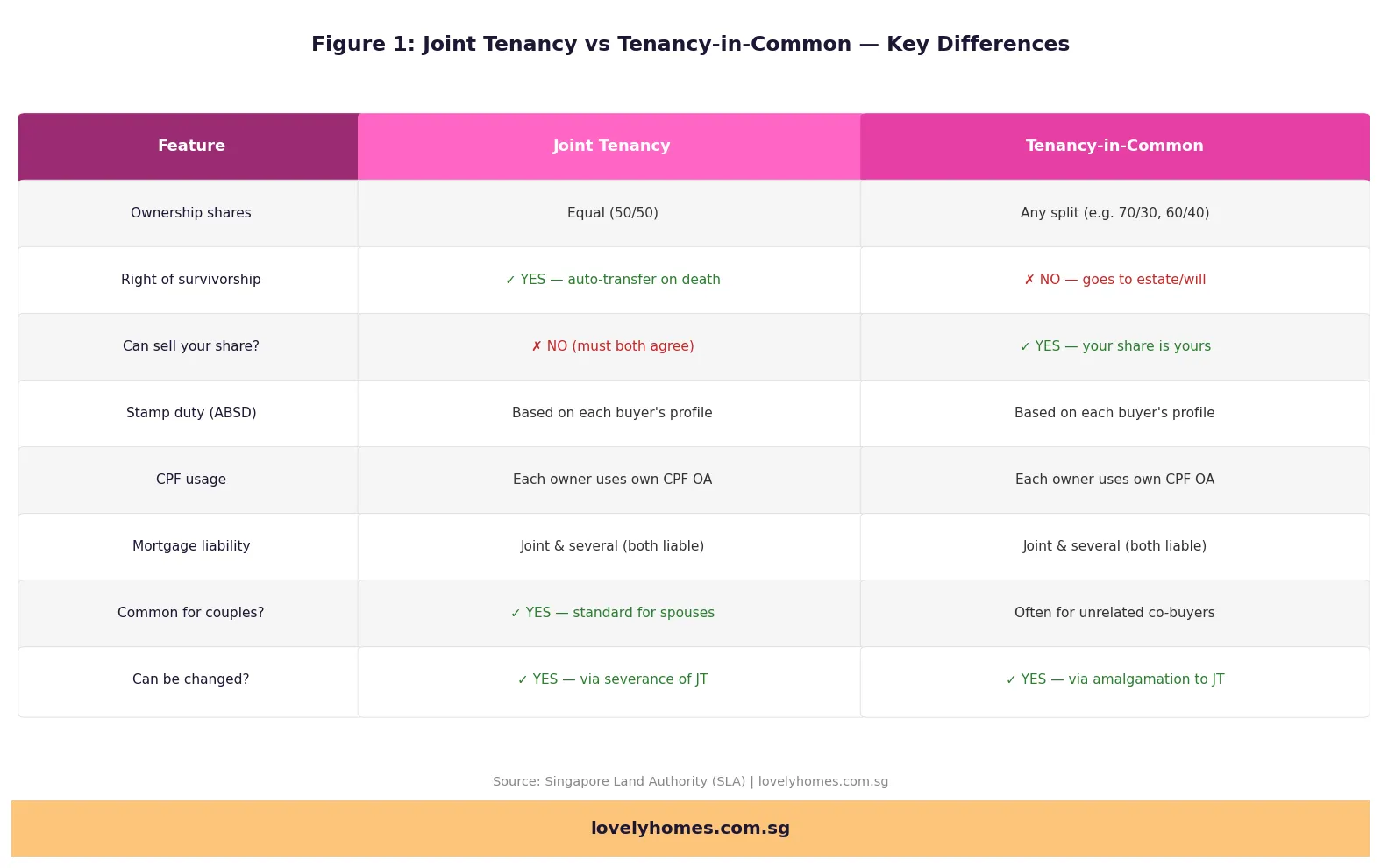
Joint tenancy vs tenancy-in-common comparison table Singapore 2026

Figure 1: Key differences between Joint Tenancy and Tenancy-in-Common in Singapore. Source: Singapore Land Authority (SLA) | lovelyhomes.com.sg

How ABSD Applies to Joint Property Purchases

The Additional Buyer’s Stamp Duty (ABSD), administered by the Inland Revenue Authority of Singapore (IRAS), applies whenever a buyer acquires an additional residential property. For joint purchases, the rule is straightforward but often misunderstood: ABSD is computed based on the profile of the buyer who attracts the higher rate.

This means that if a Singapore Citizen (SC) and a Permanent Resident (PR) buy together, and the PR is deemed to be acquiring a second property (5% ABSD applies to PRs on their first property, 25% on their second), the ABSD rate applicable to that joint purchase reflects the higher-rate buyer’s position. The full ABSD is computed on the full purchase price.

More practically: an SC married couple buying their first property together pay 0% ABSD. But if either spouse already owns a property — even one inherited or received as a gift — the couple faces a 20% ABSD on the full price of the new purchase. At S$1.5 million, that is S$300,000 payable in cash (ABSD cannot be funded from CPF OA). This is the biggest single financial surprise for HDB upgraders who have not sold their flat before exercising an OTP on a new property.
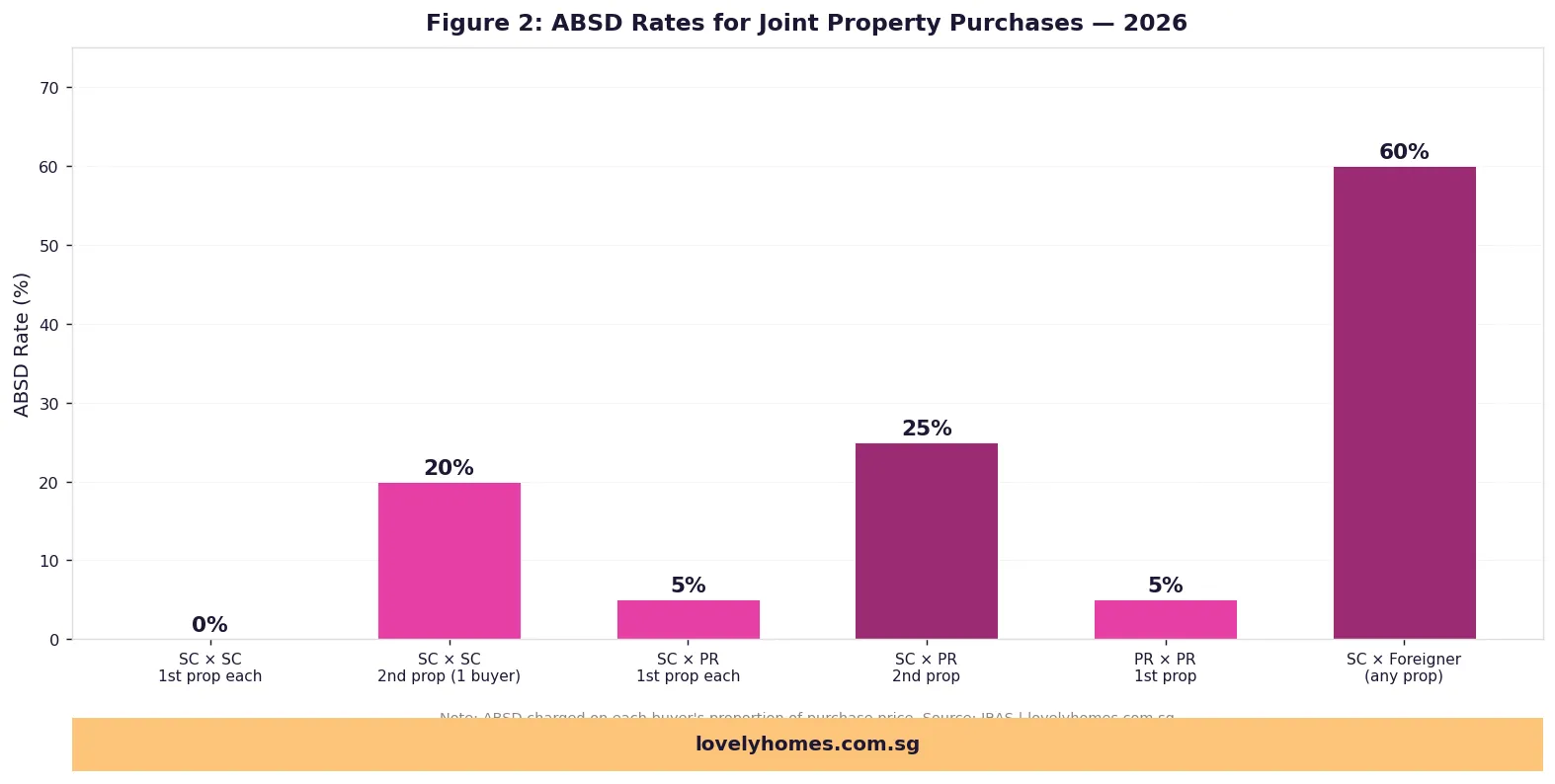
ABSD rates for joint property purchases by buyer profile Singapore 2026

Figure 2: ABSD rates for joint purchases by buyer-profile combination. ABSD is computed on the full purchase price. Source: IRAS | lovelyhomes.com.sg

CPF Usage in Joint Property Purchases

The Central Provident Fund (CPF) Board allows each co-owner to use their own CPF Ordinary Account (OA) savings towards a jointly-owned property, subject to the Valuation Limit and Withdrawal Limit rules. Each co-owner’s CPF usage is capped in proportion to their ownership share.

For HDB properties, this is straightforward: each co-owner uses their OA for the down payment and monthly mortgage servicing, with the Mortgage Servicing Ratio (MSR) capping total repayments at 30% of gross monthly income. For private properties (condominiums, landed homes, ECs post-privatisation), the TDSR cap of 55% of gross monthly income applies. Critically, CPF usage for private property is also subject to the Valuation Limit — once total CPF withdrawn equals the property’s original purchase price or valuation (whichever is lower), further CPF can only be used if the property has at least 60 years’ remaining lease at the time of purchase, and CPF usage may be further pro-rated for properties with shorter leases.

In a Tenancy-in-Common structure, CPF accrued interest — the interest CPF Board charges on OA monies withdrawn for property — must be refunded to each co-owner’s CPF account upon sale, proportionally. This accrued interest accumulates at the CPF OA interest rate (currently 2.5% per annum on the first S$20,000, 3.5% thereafter — effective 1 January 2024) and can significantly reduce the net cash proceeds from a property sale after many years of ownership.

Decoupling: Converting Ownership to Access a Second Property

Decoupling is a legal strategy whereby one co-owner transfers or sells their share in a jointly-owned property to the other, so that the departing co-owner is no longer a property owner and can subsequently purchase a second property as a “first-time buyer” — paying 0% ABSD (for SCs) instead of 20%.

Decoupling requires the property to be held as Tenancy-in-Common. A Joint Tenancy must first be severed (converted to TIC) via a Deed of Severance lodged with the Singapore Land Registry before decoupling can proceed. The process involves: (1) severing the joint tenancy if applicable; (2) the selling co-owner executing a Transfer Instrument conveying their share to the buying co-owner; (3) the buying co-owner paying ABSD on the acquired share’s value (not the full property value, if they already own the remaining share); and (4) legal fees typically S$3,000–S$5,000 per party.

IRAS scrutinises decoupling transactions under anti-avoidance provisions. Where the transfer is purely nominal and consideration is not reflective of market value, IRAS may challenge the arrangement. Always engage a licensed conveyancing solicitor and ensure the transfer price is at or close to open-market value for the share being transferred.

Note: As at 2026, HDB flats cannot be decoupled in the same manner as private residential properties, due to HDB rules prohibiting partial transfers of HDB flat ownership except in specific circumstances (e.g. matrimonial transfers upon divorce, or change in family nucleus for eligibility purposes). The decoupling strategy is therefore most relevant to private residential property owners.

Upfront Cost Comparison: Sole vs Joint Purchase
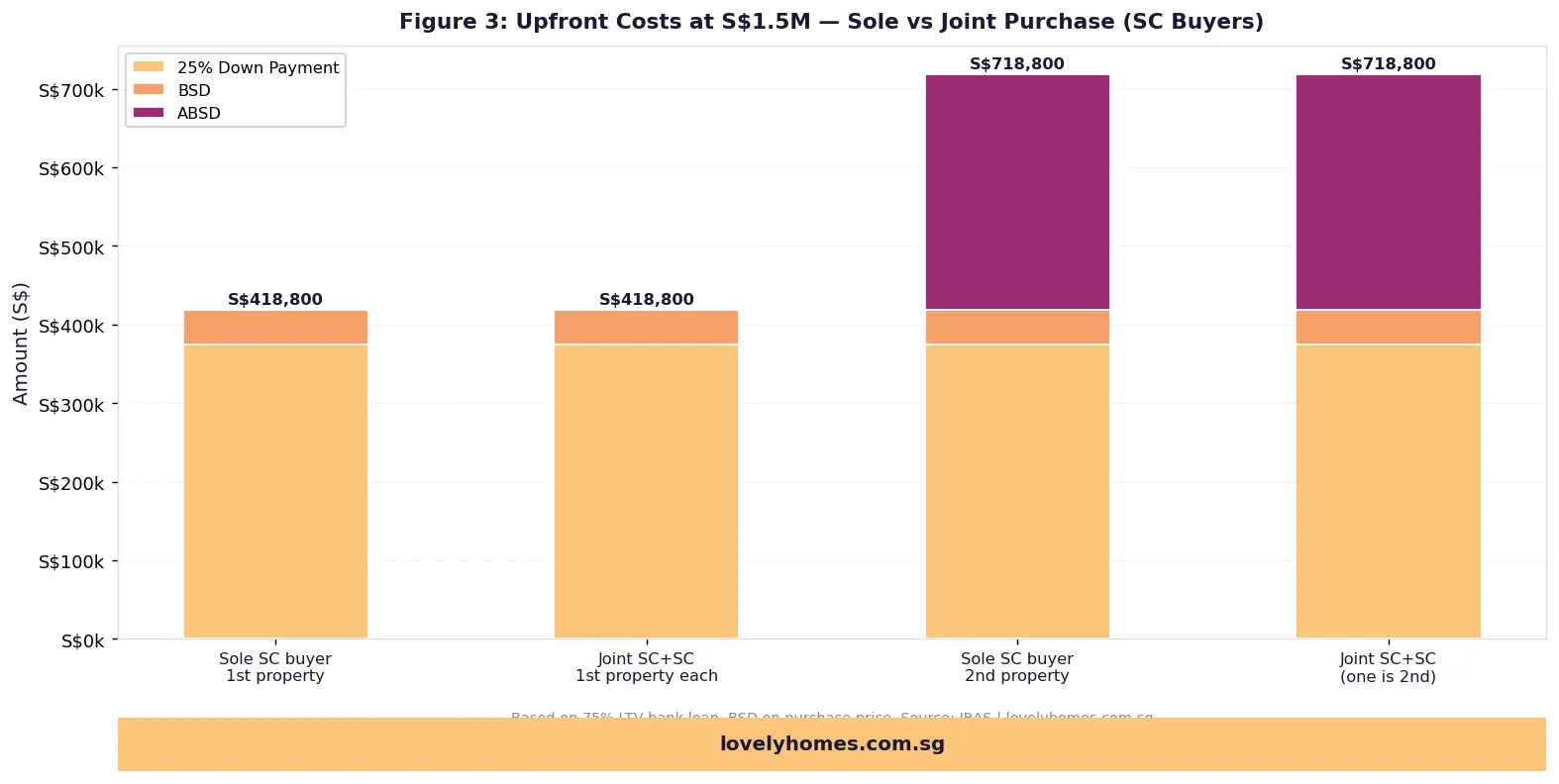
Upfront costs comparison sole vs joint property purchase Singapore 2026 at S$1.5M

Figure 3: Upfront costs for sole vs joint purchase at S$1.5M — SC buyer profiles (25% down payment assumed, bank financing). Source: IRAS | lovelyhomes.com.sg

The upfront cost difference between a joint first-time purchase and a joint purchase where one party already owns a property is substantial. The chart above illustrates the ABSD component: for a couple buying their first property together at S$1.5 million, there is no ABSD. If either party already owns a home, the couple pays S$300,000 in ABSD — entirely in cash — in addition to the 25% down payment of S$375,000 and BSD of approximately S$43,800. Total upfront outlay jumps from roughly S$418,800 to S$718,800.

Summary Table: Joint Ownership at a Glance

Factor Joint Tenancy Tenancy-in-Common
Shares Equal (50/50 by law) Any ratio (e.g. 70/30)
Survivorship Auto-transfer to survivor Passes to estate / will
Independent sale of share Not possible Possible (co-owner’s interest)
Decoupling eligibility Must sever JT first Yes — directly possible
CPF usage Each owner’s OA (50/50) Each owner’s OA (in share ratio)
ABSD profile Higher of two profiles applies Higher of two profiles applies
TDSR calculation Combined income, combined obligations Combined income, combined obligations
Best suited for Married couples, family home Investors, unequal contributors, decoupling strategy

Worked Example: Lim Couple — Joint Purchase with ABSD Implication

Scenario: Mr Lim (SC, 38) and Mrs Lim (SC, 36) are HDB flat owners (4-room in Tampines, purchased 2019 — MOP completed August 2024). They wish to buy a 2-bedroom resale condominium in District 19 for S$1,350,000 as a joint investment property without first selling their HDB flat.

Buyer profiles: Both Mr and Mrs Lim own the HDB flat jointly. A second property purchase makes both of them “second-time buyers”.

ABSD payable: SC buying 2nd residential property = 20% ABSD.

  • ABSD = 20% × S$1,350,000 = S$270,000 (payable in cash within 14 days of OTP exercise)
  • BSD = 1% × S$180,000 + 2% × S$180,000 + 3% × S$640,000 + 4% × S$350,000 = S$1,800 + S$3,600 + S$19,200 + S$14,000 = S$38,600 (can use CPF OA)
  • 25% down payment = S$337,500 (at least 5% in cash, remainder CPF OA)
  • Total upfront ≈ S$646,100 (cash component alone ≈ S$337,500 + S$270,000 = S$607,500)

TDSR check: Bank loan 75% × S$1,350,000 = S$1,012,500 at 4.0% over 25 years → monthly repayment ~S$5,330. Combined gross income S$14,000/month. TDSR = S$5,330 / S$14,000 = 38.1% — well within the 55% cap. ✓

Alternative (sell first): If the Lims sell their HDB flat before exercising the OTP on the condo, their subsequent purchase is as first-time buyers (assuming they have no other property). ABSD = 0%. Total upfront drops by S$270,000. The trade-off: interim accommodation costs and the risk of timing the property market.

Why This Matters: Common Joint-Ownership Mistakes

Joint property ownership mistakes in Singapore typically fall into three categories. The first is choosing the wrong structure: couples who intend to decouple later but buy in Joint Tenancy find they must pay additional legal fees for the severance step — a cost and delay that Tenancy-in-Common would have avoided from the outset.

The second is overlooking the ABSD trigger: many buyers assume that buying jointly means only one of them “owns” the property, or that ownership below 50% is somehow exempt from ABSD. IRAS does not distinguish — any ownership interest in a residential property, however small, counts for ABSD-profile purposes.

The third is CPF accrued interest surprise at exit: couples who have used substantial CPF OA funds over a long holding period are often shocked to discover that the CPF Board requires full refund of withdrawn amounts plus accrued interest upon sale. On a property held for 15 years with S$300,000 CPF withdrawn, accrued interest at 2.5–3.5% per annum compounds to over S$130,000 — meaningfully reducing net cash proceeds.

What Might Come Next: Policy Outlook

The Singapore government has made clear in successive Budget and National Day Rally statements that property cooling measures — including ABSD — remain calibrated to prevent speculative demand and preserve housing affordability. There is no current signal that ABSD rates for joint purchases will be relaxed. If anything, the 2023 rate hikes (to 60% for foreigners and 20% for SC second-time buyers) indicate that the authorities remain willing to tighten when prices surge.

On decoupling, IRAS has not yet announced specific anti-avoidance regulations targeting Tenancy-in-Common transfers between spouses, but practitioners note increased scrutiny on transactions where the transferring price deviates materially from open-market value. Buyers considering decoupling in 2026 should document their transactions carefully and obtain an independent valuation.

The Urban Redevelopment Authority’s (URA) long-run supply pipeline — including the Government Land Sales (GLS) programme’s 4,745-unit Confirmed List for the second half of 2026 — is intended to moderate price growth over the medium term, which may reduce the urgency of complex joint-ownership strategies for buyers who can wait.

Frequently Asked Questions

1. Can a Singapore Citizen and a foreigner buy a property together in Singapore?

Yes, but the ABSD implication is significant. Where one co-buyer is a foreigner (non-SPR), the applicable ABSD rate for the joint purchase is the foreigner rate of 60%, applied to the full purchase price. This applies regardless of which co-owner holds what share. Foreigners purchasing residential property in Singapore are restricted to non-landed residential property (condominiums, apartments) in most cases — landed residential property requires prior approval from the Minister for Law under the Residential Property Act.

2. How does Joint Tenancy affect my estate planning?

In a Joint Tenancy, the right of survivorship overrides any will you have written with regard to that property. If you hold your home in Joint Tenancy and your will directs that the property should go to your children, your will is ineffective on that point — the property passes automatically to the surviving joint tenant(s). If you want to direct your property interest via your will, you must convert your ownership to Tenancy-in-Common first by executing a Deed of Severance. The conversion does not affect the mortgage and can be done at any time without triggering ABSD or BSD.

3. Does adding a co-owner to an existing property trigger ABSD?

Yes. Adding a co-owner to a property that you already own involves a transfer of a partial interest in that property. The new co-owner is treated as acquiring a property interest, and ABSD applies based on their buyer profile and property count — on the market value of the share being transferred. An exception applies for transfers between spouses under certain conditions (e.g., for love and affection or matrimonial transfer), but these require careful legal structuring. Always consult a solicitor before adding a co-owner.

4. Can I use my CPF OA to pay the other co-owner’s share of the purchase price?

No. CPF OA funds can only be used to service your own share of the property — you cannot top up a co-owner’s shortfall using your CPF. Each co-owner’s CPF contribution is limited to their proportional ownership share. For example, in a 70/30 Tenancy-in-Common property priced at S$1,000,000, the 70% owner can withdraw from their CPF OA up to 70% of the Valuation Limit, and the 30% owner up to 30%.

5. What is the ABSD remission for married couples buying their first property together?

There is no ABSD to remit in the first place — Singapore Citizens buying their first residential property pay 0% ABSD regardless of whether they buy jointly or alone. The relevant remission for couples applies when an SC married couple buys a second property together: they can apply for an ABSD remission (refund) if they sell their existing property within 6 months of completing the purchase of the new private property. The remission is not automatic — it must be applied for via IRAS within 6 months of the sale completion of the first property.

6. What happens to a jointly-owned property during a divorce?

Upon divorce, jointly-owned property is subject to the division of matrimonial assets under the Women’s Charter. The court may order the property to be sold and proceeds split, or direct one spouse to transfer their share to the other — with the receiving spouse paying any applicable stamp duty on the transfer. Transfers ordered by the court in matrimonial proceedings may be eligible for ABSD and BSD remission; consult a family law solicitor for the applicable rules, which have specific conditions.

7. Can I decouple if my property has an outstanding HDB concessionary loan?

Decoupling is only relevant for private residential properties — not HDB flats. HDB flats cannot be decoupled in the same way because HDB rules prohibit partial transfers of flat ownership except in prescribed circumstances (divorce, death, change of flat ownership for eligibility purposes, etc.). If you want to apply decoupling strategy, you must first complete your HDB flat’s Minimum Occupation Period, sell the flat, and then purchase two separate private properties — one in each spouse’s name — to avoid the ABSD on a second property.

Related Articles

Disclaimer: This article is for general informational purposes only and does not constitute legal, financial, or tax advice. Property ownership structures, ABSD rates, CPF rules, and HDB regulations are subject to change. Readers should verify information with the relevant authorities — the Inland Revenue Authority of Singapore (IRAS) at iras.gov.sg, the Central Provident Fund Board (CPF) at cpf.gov.sg, the Singapore Land Authority (SLA) at sla.gov.sg, and the Housing & Development Board (HDB) at hdb.gov.sg — and consult a licensed conveyancing solicitor and/or a registered property agent before making any property transaction decisions.
Singapore HDB Inheritance and Transfer Guide 2026: Joint Tenancy, CPF Rules and Who Can Inherit

Singapore HDB Inheritance and Transfer Guide 2026: Joint Tenancy, CPF Rules and Who Can Inherit

Quick Answer: Singapore HDB Inheritance & Transfer Guide 2026

  • HDB flats held under Joint Tenancy (JT) pass automatically to the surviving owner by right of survivorship — no probate required and no Will can override this.
  • Flats held under Tenancy-in-Common (TIC) pass according to the deceased’s Will or, if there is no Will, the Intestate Succession Act (ISA). Muslim estates are governed by the Administration of Muslim Law Act (AMLA) and Faraid rules.
  • The deceased owner’s CPF principal and accrued interest used for the flat is refunded to their CPF account — not to the estate — and distributed to CPF nominees or the CPF Public Trustee.
  • Any outstanding HDB loan on the flat must be assumed by the inheriting owner (subject to HDB approval) or discharged; the flat cannot be retained if the inheritor cannot service the loan.
  • The inheritor must meet HDB eligibility criteria to retain the flat. Ineligible inheritors (including foreigners) must sell within 6 months or HDB may compulsorily acquire the flat.
  • Singapore Citizens generally have the widest inheritance eligibility; SPRs and family members in non-standard situations require case-by-case HDB assessment.
  • The Minimum Occupation Period (MOP) typically restarts from the date of the transfer for the new owner when the flat is transferred (other than via JT survivorship).
  • Making a Will and CPF nomination while alive is the single most important step HDB owners can take to ensure their wishes are carried out on death.

Introduction: When a HDB Owner Passes Away

The death of a Housing & Development Board (HDB) flat owner raises a series of consequential legal and practical questions: Who takes over the flat? What happens to the outstanding mortgage? Are there CPF refunds? How long does the process take? For the 1.1 million HDB households in Singapore, understanding the inheritance and transfer rules is not just academic — it is part of responsible property ownership and estate planning.

Singapore’s framework for HDB flat inheritance is governed by several bodies of law operating concurrently: HDB’s own eligibility and transfer rules, the Conveyancing and Law of Property Act which recognises the right of survivorship for Joint Tenancy, the Intestate Succession Act (ISA) which distributes estates without Wills, and — for Muslim Singaporeans — the Administration of Muslim Law Act (AMLA) and the principles of Faraid Islamic inheritance. The CPF Board administers the refund of CPF monies on death separately from the flat transfer.

HDB Flat Ownership Structures: Joint Tenancy vs Tenancy-in-Common

When two or more people purchase an HDB flat together, they must choose between two forms of co-ownership: Joint Tenancy (JT) or Tenancy-in-Common (TIC). The choice made at purchase has profound consequences on what happens to the flat when one owner dies.

Under Joint Tenancy, all owners hold the flat jointly without defined individual shares. The central legal feature of JT is the right of survivorship: on the death of any one joint tenant, that person’s interest in the flat automatically vests in the surviving joint tenant(s). No probate or letters of administration are required; no Will can override this automatic transfer. HDB flats purchased by couples are registered in Joint Tenancy by default.

Under Tenancy-in-Common, each owner holds a specified, separate share — for example, 50%/50% or 60%/40%. On the death of a TIC owner, their share forms part of their estate and is distributed according to their Will, or the ISA if they die intestate (without a Will). TIC must be specifically elected at the time of purchase or during ownership via a legal severance of the JT arrangement.

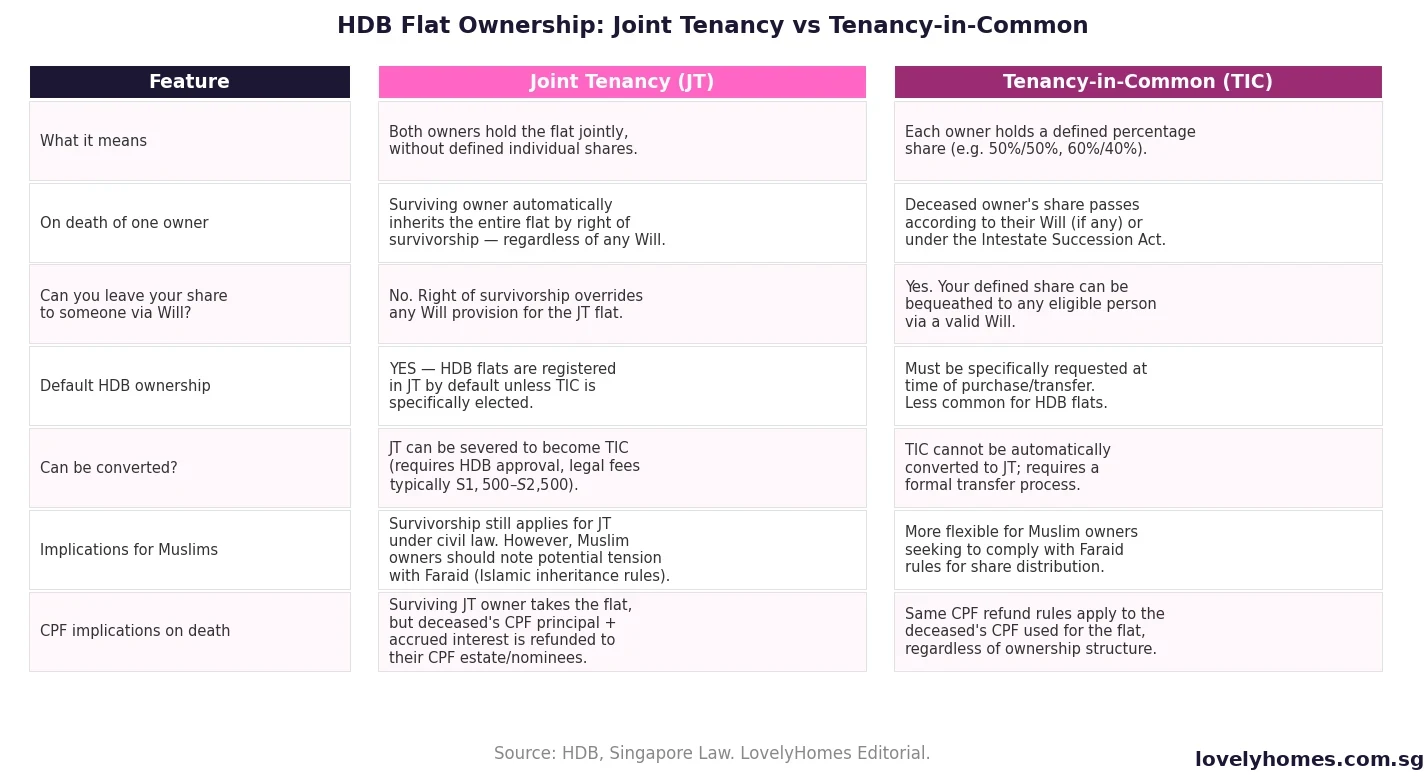
Singapore HDB Joint Tenancy vs Tenancy-in-Common comparison table — right of survivorship inheritance Will implications 2026
Figure 1: Joint Tenancy vs Tenancy-in-Common — seven key differences for HDB flat co-owners. Source: HDB, Singapore Law. Click to enlarge.

The Right of Survivorship: How Joint Tenancy Works on Death

The right of survivorship is a powerful legal mechanism that simplifies the transfer of HDB flats in the common scenario where a married couple owns a flat and one spouse passes away. When the first spouse dies, the surviving spouse automatically becomes the sole owner of the flat — there is no need to go through the courts, apply for probate, or even instruct a solicitor for the transfer itself (though an application must be made to HDB to update the records).

The process involves notifying HDB within 30 days of the death, submitting the death certificate, the original title deeds or relevant HDB documentation, and completing HDB’s survivorship transfer form. HDB will then update its records to reflect the surviving owner as the sole registered proprietor. The entire administrative process typically takes 3–6 weeks once documents are submitted.

The surviving JT owner inherits the flat subject to any outstanding HDB or bank loan. If the deceased was the primary borrower and the surviving spouse does not meet the bank’s income criteria to assume the sole loan, they may need to make other arrangements — including partial repayment, sourcing a guarantor, or selling the flat. It is advisable for couples to ensure both spouses are listed as co-borrowers on any mortgage to avoid this complication.

Tenancy-in-Common and the Intestate Succession Act

For flat owners holding the property under Tenancy-in-Common, the death of one owner requires a formal estate administration process before the flat can be transferred to the inheritor. If the deceased left a valid Will, executors named in the Will apply for a Grant of Probate from the Singapore High Court. If there is no Will, the next-of-kin applies for Letters of Administration. Both processes take 3–6 months on average for uncontested estates, though complex cases can take longer.

Where there is no Will, the ISA prescribes how the estate is distributed based on the family structure. For example, if the deceased leaves a spouse and children, the spouse receives 50% of the estate and the children share the remaining 50% equally. If only a spouse survives (no children, no living parents), the spouse receives the entire estate. The ISA does not apply to Muslim Singaporeans, whose estates are governed by Faraid rules under AMLA, administered through the Syariah Court for distribution certificates.

CPF and HDB on the Death of an Owner

CPF monies used to purchase an HDB flat do not form part of the flat’s transfer on death — they are handled separately by the CPF Board. When an owner dies, all CPF funds used to purchase the flat — including both the original principal withdrawn and the accrued interest at 2.5% p.a. compounded — must be refunded to the deceased’s CPF account. These funds are then distributed to CPF nominees (designated by the deceased via a CPF nomination form before death), or — if there is no nomination — to the Public Trustee for distribution under the Intestate Succession Act.

This CPF refund is separate from the flat’s ownership transfer. The inheritor who takes over the flat does not receive the deceased’s CPF monies as part of the flat — they receive only the flat itself, potentially subject to an outstanding mortgage. The CPF refund may significantly reduce the equity available in the flat if the loan is outstanding, as the CPF monies do not offset the mortgage on death.

If the flat has an outstanding HDB concessionary loan at the time of death, the surviving owner or inheritor must arrange with HDB to either assume the loan (if they qualify) or repay it. In some cases where the deceased had Home Protection Scheme (HPS) insurance (a mortgage-reducing insurance administered by CPF Board), the outstanding HDB loan may be discharged on death, passing the flat to the inheritor debt-free. All HDB flat owners with an outstanding HDB loan are required to maintain HPS cover, making this a meaningful protection for families.

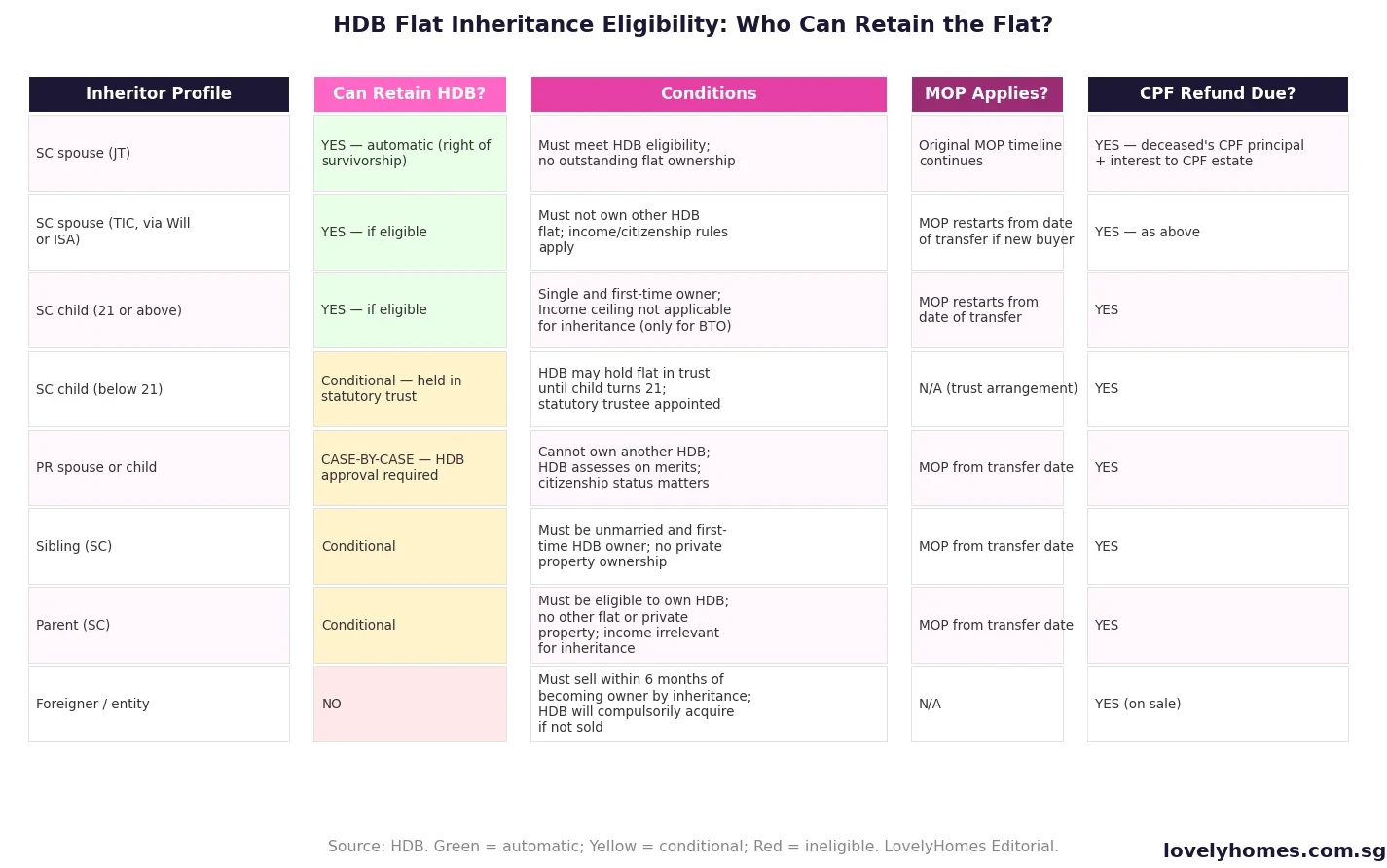
HDB flat inheritance eligibility Singapore 2026 — who can retain an HDB flat SC spouse child PR sibling parents foreigners
Figure 2: HDB Inheritance Eligibility — who can retain an HDB flat and under what conditions. Green = generally eligible; Yellow = conditional/HDB approval required; Red = must sell. Source: HDB. Click to enlarge.

Who Can Retain an Inherited HDB Flat?

The right to retain an inherited HDB flat is subject to HDB’s standard eligibility criteria. The core principle is that HDB flats are public housing meant for Singapore citizens and permanent residents who meet the relevant conditions. Simply inheriting a flat does not guarantee the right to keep it if the inheritor does not meet HDB’s eligibility framework.

Singapore Citizen beneficiaries in a nuclear family context — such as a surviving SC spouse or adult SC children — generally have the widest eligibility to retain an HDB flat. However, they must not already own another HDB flat (subject to the non-concurrent ownership rule) and must not hold any private residential property at the time of inheritance (or must dispose of private property within 6 months). Singapore Permanent Resident inheritors are assessed on a case-by-case basis by HDB and face more restrictions. Foreigners (non-PRs) are not eligible to own HDB flats and must sell any inherited flat within 6 months; failure to do so can result in HDB compulsorily acquiring the flat.

Where a flat is inherited by a minor (below 21), HDB typically holds the flat in a statutory trust arrangement until the child reaches majority. A statutory trustee (often a parent or guardian) is appointed to manage the flat in the interim.

Applying to Transfer or Retain the HDB Flat

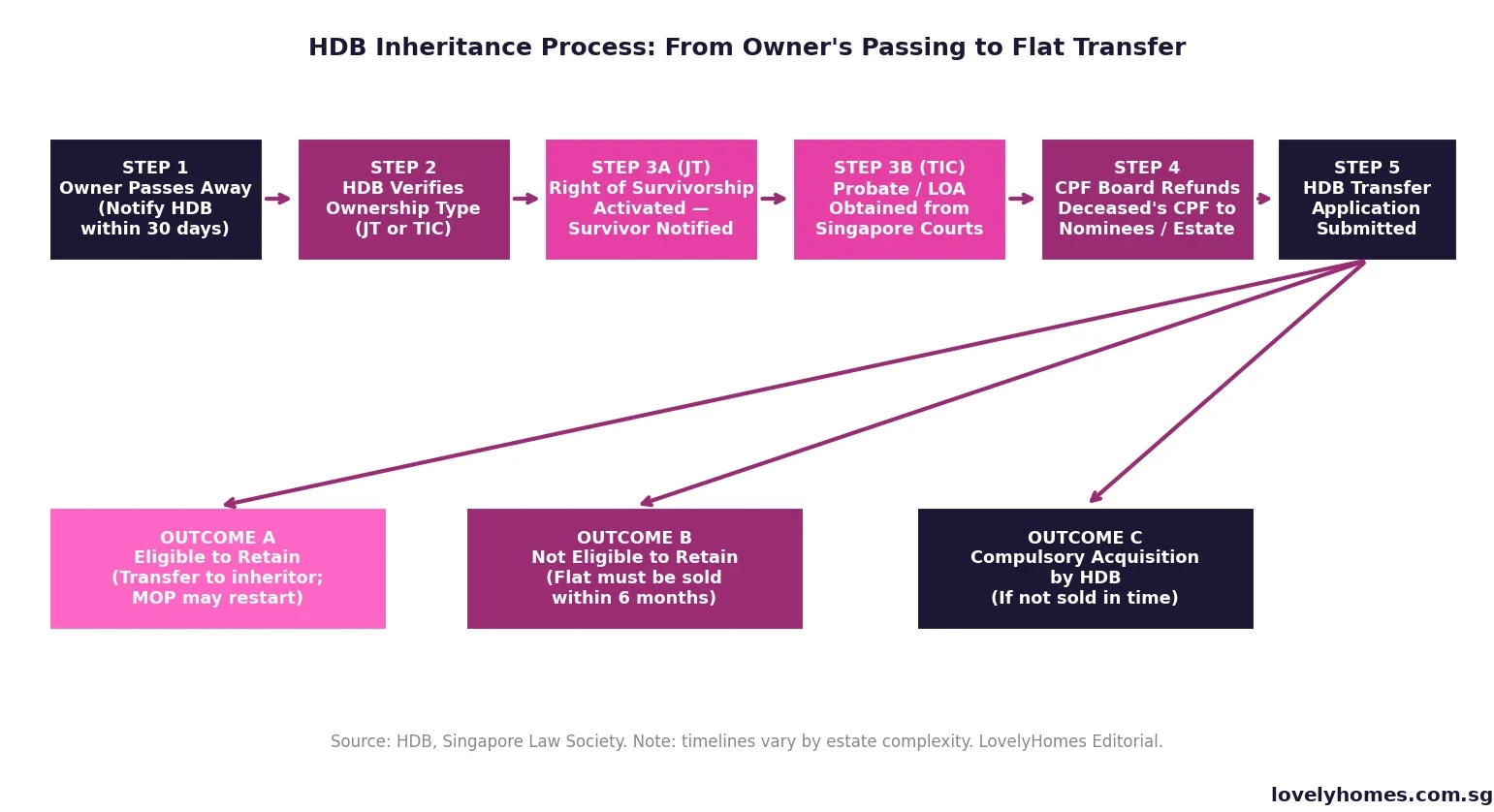
The formal process of applying to retain or transfer an HDB flat after a death involves several steps that typically span 3–9 months depending on the estate complexity, whether probate is required, and HDB’s processing time. The beneficiary or executor must submit an application to HDB with the death certificate, identity documents, Grant of Probate or Letters of Administration (if TIC), and supporting documents evidencing eligibility (e.g. income documents, CPF statement, private property declaration).

HDB will assess the application, verify eligibility, check for any outstanding charges or HDB loans on the flat, and — where the inheritor is taking over a loan — require the inheritor to meet the relevant debt servicing criteria. If approved, the transfer is completed via a legal instrument lodged with the Singapore Land Authority (SLA), and the Land Register is updated to reflect the new owner.

HDB inheritance process flowchart Singapore 2026 — steps from death notification to flat transfer outcomes
Figure 3: HDB Inheritance Process — from the owner’s passing to the three possible outcomes: retention, sale, or compulsory acquisition. Source: HDB, Singapore Law Society. Click to enlarge.

Selling an Inherited HDB Flat

Where the inheritor is ineligible to retain the HDB flat — either because they do not meet HDB’s eligibility criteria or because they choose to liquidate the asset — the flat must be sold on the open HDB resale market. The 6-month timeline begins from when ownership is formally transferred to the ineligible inheritor (not from the date of death), giving families some breathing room to arrange the estate and marketing process.

The sale proceeds are handled as follows: the outstanding HDB loan (if any) is repaid first from the sale price; CPF monies used by all owners over the flat’s ownership history are refunded (with accrued interest) to each respective owner’s CPF account or estate; legal and agent costs are deducted; and the net cash proceeds form part of the estate for distribution. If the flat was sold at the prevailing resale market price, the estate may receive a meaningful cash sum — particularly for flats in mature estates with substantial appreciation.

Scenario Ownership Type Legal Process Required Timeline (est.) MOP Reset?
SC surviving spouse (JT) Joint Tenancy Notify HDB; submit death cert + survivorship docs 3–6 weeks admin No (continuity)
SC child inheriting via Will (TIC) Tenancy-in-Common Grant of Probate + HDB transfer application 4–8 months Yes (from transfer date)
SC child inheriting — intestate (TIC) Tenancy-in-Common Letters of Administration + HDB transfer application 5–10 months Yes
PR beneficiary (TIC or JT estate) Either Probate/LOA + HDB case-by-case assessment 6–12 months Yes
Ineligible beneficiary — must sell Either Transfer to ineligible owner + list for HDB resale Must sell within 6 months of transfer N/A (sold)
Minor inheritor (below 21) Either Statutory trust arrangement via HDB; trustee appointed Until majority Assessed at age 21

Worked Example: The Lim Family — SC Widow Inheriting Under Joint Tenancy

David and Susan Lim are Singapore Citizens who purchased a 4-room HDB flat in Ang Mo Kio in 2015 under Joint Tenancy at S$450,000, financed by an HDB concessionary loan. Their outstanding HDB loan as at June 2026 is S$210,000. David passes away unexpectedly in June 2026 at age 58.

Step 1 — Survivorship: As the flat was held in JT, Susan automatically becomes the sole owner of the flat by right of survivorship. No probate is required. Susan notifies HDB within 30 days and submits the death certificate and survivorship transfer form.

Step 2 — CPF refund: David had used S$180,000 in CPF OA (principal) towards the flat purchase and monthly instalments over 11 years. Accrued interest on these CPF withdrawals at 2.5% p.a. amounts to approximately S$61,000. The total CPF refund of S$241,000 is credited back to David’s CPF account. As David made a CPF nomination naming Susan and their two adult children, the S$241,000 in David’s CPF is distributed per the nomination — not as part of the flat’s transfer.

Step 3 — Mortgage: David maintained Home Protection Scheme (HPS) insurance on the HDB loan. On his death, the outstanding S$210,000 HDB loan is discharged by HPS, passing the flat to Susan debt-free.

Outcome: Susan now owns the flat in sole name, free of mortgage, with the flat’s estimated resale value at ~S$620,000 (based on comparable resale transactions in the area in 2026). The net equity in the flat for Susan is approximately S$620,000 (since the CPF refund went to David’s CPF estate, not reducing the flat’s market value). The HDB admin process took approximately 5 weeks from death notification to registration of Susan as sole owner.

Key lesson: The combination of JT ownership, HPS insurance, and CPF nomination meant that the inheritance process was administratively simple and economically optimal for Susan. Had David not maintained HPS, Susan would have needed to service the S$210,000 loan herself from retirement savings or a new bank loan — a significant burden at age 56.

What This Means for HDB Flat Owners

Estate planning for HDB flat owners in Singapore is not a complex exercise, but it does require deliberate action rather than relying on defaults. The most important steps any HDB owner can take are: first, confirm the current ownership structure of their flat (JT or TIC) and whether it reflects their actual wishes; second, maintain a valid and up-to-date CPF nomination so that CPF monies reach the intended beneficiaries; third, consider making a Will to address any TIC share and other non-CPF assets; and fourth, ensure adequate HPS cover is maintained on any outstanding HDB loan to protect the family from the mortgage burden on death.

Joint Tenancy works well for most married couples as a default — it is simple, automatic, and avoids probate delays. However, for blended families, second marriages, business partners owning flats together, or Muslim families seeking Faraid-compliant distributions, Tenancy-in-Common provides greater flexibility and should be considered with legal advice.

What Might Come Next

There are no announced changes to Singapore’s HDB inheritance framework as at June 2026. The Law Reform Commission has previously considered but not implemented recommendations on simplifying intestate succession for HDB flats, and the Ministry of Law continues to review options for making probate processes faster and less costly for estates with modest assets. The digitisation of the Probate Court and HDB’s integrated estate management platform (accessible via MyHDBPage) has already reduced administrative timelines in recent years. HDB owners and estate practitioners should monitor any future legislative changes to the Probate and Administration Act, the Intestate Succession Act, and HDB’s Housing Policy as Singapore’s population ages and inheritance scenarios become more common.

Frequently Asked Questions: HDB Inheritance & Transfer

Can I change my HDB flat from Joint Tenancy to Tenancy-in-Common?

Yes. A Joint Tenancy in an HDB flat can be severed to become a Tenancy-in-Common through a legal process called a severance of joint tenancy. This involves instructing a solicitor to prepare and lodge the relevant instrument at the Singapore Land Authority. Both owners must consent to the severance. The legal costs typically range from S$1,500 to S$2,500 depending on the complexity. Once severed, each owner’s defined share (usually 50%/50% unless otherwise specified) can be bequeathed to beneficiaries via a Will, bypassing the right of survivorship. HDB’s approval may be required in some cases.

What if the deceased HDB owner did not leave a CPF nomination?

If the deceased did not make a CPF nomination, the CPF Board will transfer the CPF savings (including the refunded flat-related CPF monies) to the Public Trustee’s Office. The Public Trustee distributes these funds according to the Intestate Succession Act — meaning they follow the same intestate distribution rules as other estate assets (e.g., 50% to spouse, 50% to children). This process adds time and cost to the estate administration. It is strongly advisable to make a CPF nomination and to update it whenever family circumstances change.

Does the Minimum Occupation Period (MOP) restart when I inherit an HDB flat?

Generally yes, when a flat is transferred to a new owner via inheritance (other than a Joint Tenancy survivorship transfer, where the surviving owner continues the original MOP timeline), the MOP is assessed from the date the new owner takes legal title of the flat. For example, if you inherit a flat in June 2026, your 5-year MOP (or 10-year MOP for Plus/Prime flats purchased under the new classification rules) begins from June 2026. You must continue to occupy the flat and cannot sublet the whole flat or purchase any other residential property during the MOP period. Always confirm the specific MOP conditions with HDB when applying for the transfer.

What is the Home Protection Scheme (HPS) and is it compulsory?

HPS is a mortgage-reducing insurance administered by CPF Board that covers the outstanding HDB home loan in the event of the insured owner’s death, terminal illness, or total permanent disability. It is compulsory for all HDB flat owners with outstanding HDB concessionary loans who have CPF OA savings. For HDB flat owners with bank loans, HPS cover is not mandatory but CPF Board strongly recommends it. HPS premiums are payable from CPF OA and are relatively affordable. On the insured event (e.g., death), HPS discharges the outstanding loan balance up to the insured amount, passing the flat to the family debt-free. Reviewing your HPS coverage amount (especially if you have refinanced to a bank loan) is an important part of property ownership in Singapore.

Can a Muslim Singaporean’s HDB flat be distributed via Faraid rules?

Under Singapore law, a Muslim person’s estate — including any HDB flat held under Tenancy-in-Common — is governed by Faraid (Islamic inheritance law) as applied by the Syariah Court under the Administration of Muslim Law Act (AMLA), rather than the civil Intestate Succession Act. The Syariah Court issues an Inheritance Certificate specifying the Faraid shares to each beneficiary. For HDB flats under Joint Tenancy, however, the civil right of survivorship technically applies — a tension between civil and religious law that some Muslim families resolve by electing Tenancy-in-Common and making a Will consistent with Faraid requirements. Muslim HDB owners are strongly advised to consult both a Syariah lawyer and HDB to ensure their ownership structure and estate plans align with their religious obligations.

How long does the HDB inheritance transfer process typically take?

The timeline varies significantly by case type. For Joint Tenancy survivorship transfers — the simplest scenario — the HDB administrative process typically takes 3 to 6 weeks once all required documents are submitted. For Tenancy-in-Common cases where probate is needed, the Grant of Probate or Letters of Administration alone typically takes 3–6 months, after which the HDB transfer application takes a further 4–8 weeks. Complex estates involving disputes, overseas beneficiaries, or unusual eligibility circumstances can take 12–24 months or more. Throughout this period, the flat can generally continue to be occupied by eligible family members, though it cannot be sold or rented out until the transfer is completed and any applicable MOP is met.

Disclaimer: This article is produced by LovelyHomes Editorial for informational and educational purposes only. It does not constitute legal, estate planning, or financial advice. HDB eligibility rules, CPF policies, probate procedures, and Islamic inheritance law described are based on information current as at June 2026. These rules can change. In particular, individual circumstances vary greatly — factors including citizenship status, existing property ownership, outstanding loans, and family composition can materially affect outcomes. Always consult a licensed Singapore solicitor (for estate planning and probate matters), a Muslim law practitioner for Syariah-related estates, and refer to HDB, CPF Board, Ministry of Law, and Syariah Court of Singapore official sources.
×

Click anywhere outside to close

Translate »