Geylang Neighbourhood Guide Singapore 2026: Property Prices, Schools, MRT and Investment Outlook

Geylang Neighbourhood Guide Singapore 2026: Property Prices, Schools, MRT and Investment Outlook

Quick Answer — Geylang Neighbourhood Guide 2026

  • Location: District 14 (D14), central Singapore — 10 minutes to the CBD by MRT.
  • HDB prices: 3-room ~S$380k, 4-room ~S$730k, 5-room ~S$850k, executive flat ~S$1.09M.
  • Resale record: S$1.37M for a 5-room at 7 Pine Close (2026).
  • MRT connectivity: Aljunied (EWL), Paya Lebar (EWL+CCL interchange), MacPherson & Mattar (DTL).
  • Rental yields: Among the highest in Singapore at 4.0–5.0% gross for HDB units.
  • Who should buy: Value-seekers wanting central proximity at OCR prices; investors targeting rental yield.
  • Key consideration: Geylang’s lorongs (red-light district) are in a small sub-area and do not affect the majority of residential precincts — always inspect the specific block location.

What Is Geylang and Why Does It Matter for Property Buyers?

Geylang occupies one of Singapore’s most strategically positioned yet frequently misunderstood residential postcodes. Administered by the Urban Redevelopment Authority (URA) as part of Planning Area Geylang and spanning District 14, the estate sits squarely in the middle of the island — flanked by Paya Lebar to the east, Kallang to the west, and the Aljunied and Mattar MRT nodes to the south. With approximately 94,200 HDB residents spread across roughly 29,357 flats, Geylang is a well-established, high-density town that has long delivered above-average rental yields precisely because its central location commands strong tenant demand while its prices remain well below those of the Core Central Region (CCR).

For property buyers in 2026, Geylang presents a genuine value proposition: central Singapore proximity at Outside Central Region pricing. The completion of the Downtown Line (DTL) stations at MacPherson and Mattar significantly improved connectivity, and the Paya Lebar Quarter (PLQ) commercial hub — just minutes away — has attracted major employers including Amazon Web Services and PwC, creating a captive pool of working professionals who rent locally. This guide covers everything you need to know about buying, investing, and renting in Geylang in 2026.

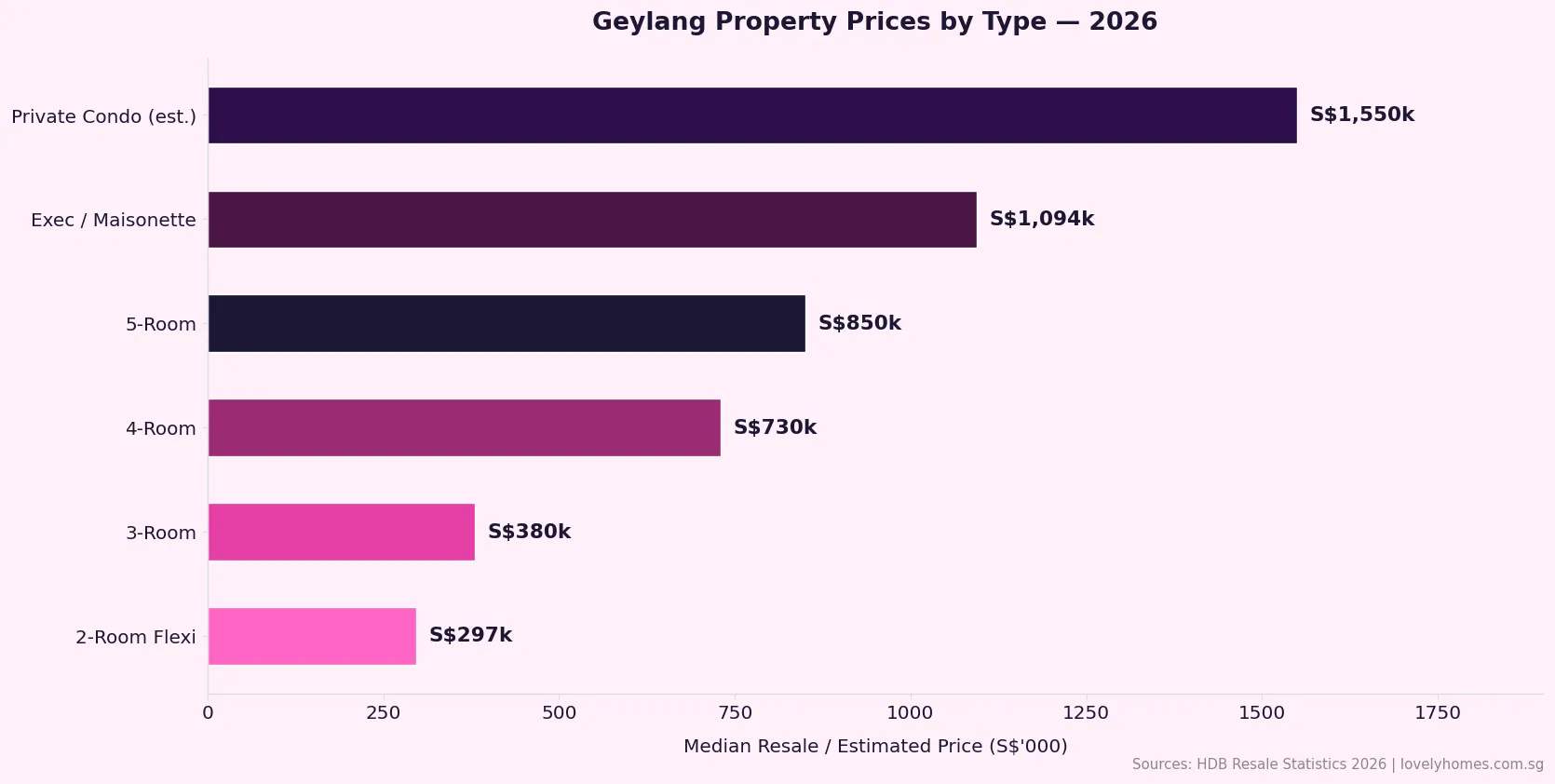
Geylang property prices by type 2026 – HDB 3-room to private condo comparison chart
Figure 1: Geylang median resale and estimated prices by property type (2026). Sources: HDB Resale Statistics 2026.

HDB Resale Market in Geylang 2026

Geylang’s HDB resale market recorded 672 transactions over the past 12 months, with a median transaction price of S$590,000 across all flat types and a median price per square foot (psf) of S$626. The town’s entry point sits at the 2-room Flexi segment at around S$297,000 — well within reach of singles and young couples applying under the Public Scheme. The 4-room segment is the most liquid, with 251 transactions recorded, reflecting broad demand from upgraders and first-time families.

The standout milestone for 2026 was the 5-room flat at 7 Pine Close (Block 7, Geylang East) which changed hands at S$1.37M (S$1,161 psf) — setting a new District 14 resale record and signalling that the estate’s premium blocks command prices competitive with less-central mature towns. Executive flats, which are concentrated in older Geylang precincts, have a median price of S$1.094M, reflecting the scarcity of larger legacy stock.

Flat Type Median Resale Price Approx. PSF Notes
2-Room Flexi S$297,000 ~S$588 psf Entry-level; available to singles
3-Room S$380,000 ~S$607 psf Most affordable family option
4-Room S$730,000 ~S$620 psf Highest transaction volume
5-Room S$850,000 ~S$640 psf Record: S$1.37M (7 Pine Close)
Executive / Maisonette S$1,094,000 ~S$660 psf Scarce legacy stock
Private Condo (est.) ~S$1,550,000 ~S$1,500 psf RCR fringe; Sims Urban Oasis benchmark

HDB flats in Geylang are classified as Standard (5-year Minimum Occupation Period) under the new HDB flat classification framework introduced in 2024. There are no Plus or Prime-class Geylang BTO flats — all new supply entering the resale market will carry the standard 5-year MOP, giving buyers who purchased at launch relatively quick resale flexibility.

MRT Connectivity and Transport Infrastructure

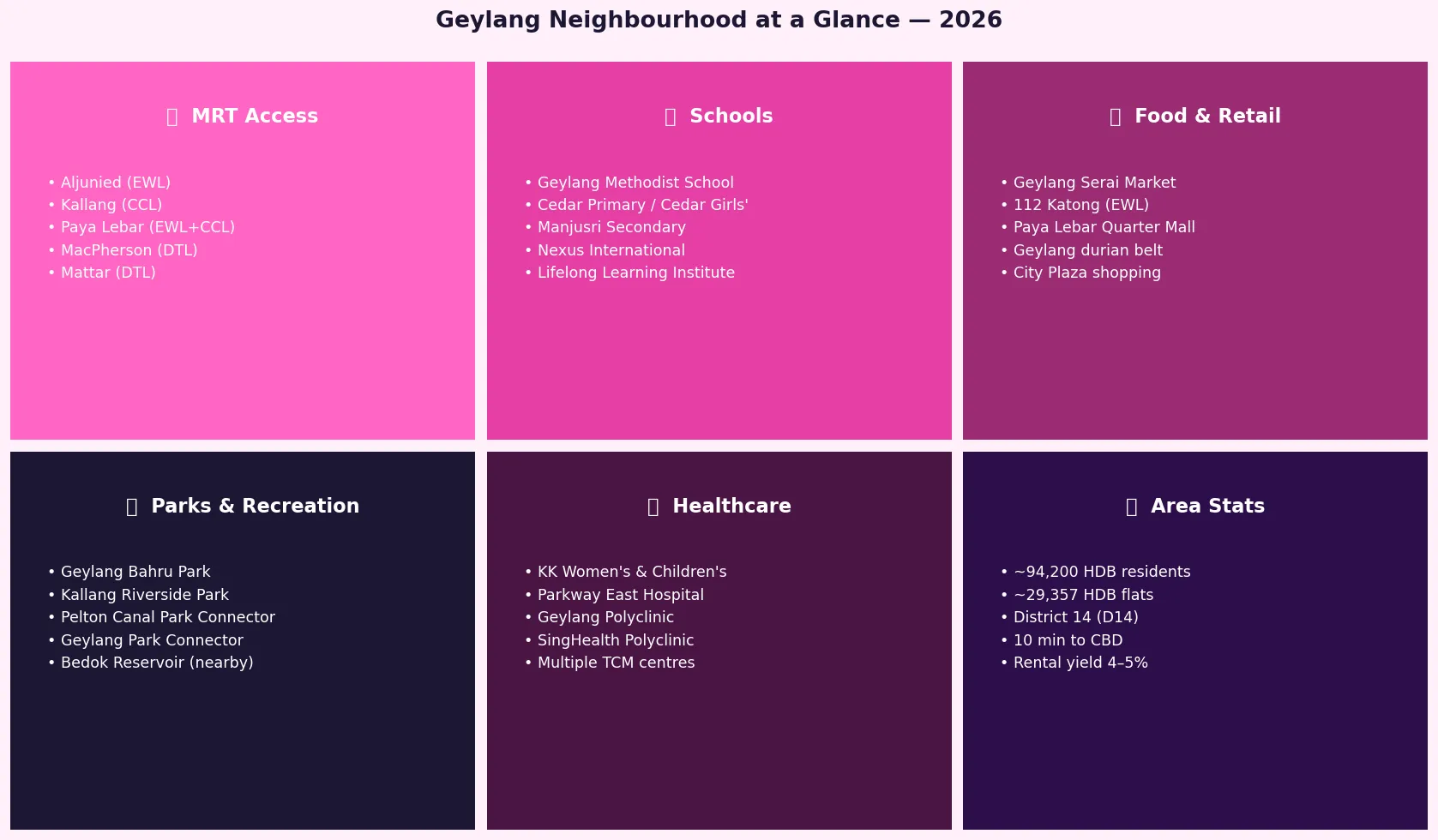
Geylang’s transport network is one of its strongest selling points. The estate is served by five MRT stations across three lines, giving residents genuinely multi-directional access without the need for transfers in most cases.

On the East-West Line (EWL), Aljunied MRT and Eunos MRT bracket the heart of the estate, while the major Paya Lebar MRT interchange (EWL + Circle Line) lies at the eastern boundary — a station that places residents within 14 minutes of the City Hall CBD cluster and 9 minutes of Jurong East. The Downtown Line (DTL) added MacPherson and Mattar MRT stations, connecting Geylang directly to the Botanic Gardens, Buona Vista, and Marina Bay Financial Centre corridor without changing trains. Bus connectivity is extensive, with multiple trunk routes running along Geylang Road, Sims Avenue, and Aljunied Road into the city.

Geylang neighbourhood amenities 2026 – MRT, schools, food, parks, healthcare overview
Figure 2: Geylang neighbourhood amenities at a glance (2026). Data compiled from URA, LTA, and public sources.

Schools, Amenities and the Geylang Serai Ecosystem

Geylang’s school landscape has improved steadily, with Geylang Methodist School (Primary and Secondary) serving as the estate’s anchor school. Cedar Primary and the well-regarded Cedar Girls’ Secondary School are within catchment distance for many Aljunied-side addresses. For families requiring secondary options, Manjusri Secondary and Tanjong Katong Secondary are accessible via public transport. The Lifelong Learning Institute (LLI), operated by the Singapore Workforce Agency, is based within the Paya Lebar precinct and offers adult upskilling programmes relevant for tenants and residents alike.

Retail and dining are Geylang’s most celebrated features. The Geylang Serai Market and Food Centre, gazetted as a heritage site, is among Singapore’s most productive hawker centres and anchors the estate’s Malay cultural identity. The Paya Lebar Quarter (PLQ) Mall — accessible within minutes — brings premium retail, a full-format supermarket, and a cinema. City Plaza on Geylang Road caters to budget clothing and electronics. The estate’s famous durian belt along Geylang Road offers seasonal durian at competitive prices, a draw that brings island-wide visitors and contributes to a uniquely vibrant street food culture.

Geylang Property as an Investment: Rental Yields and Capital Growth

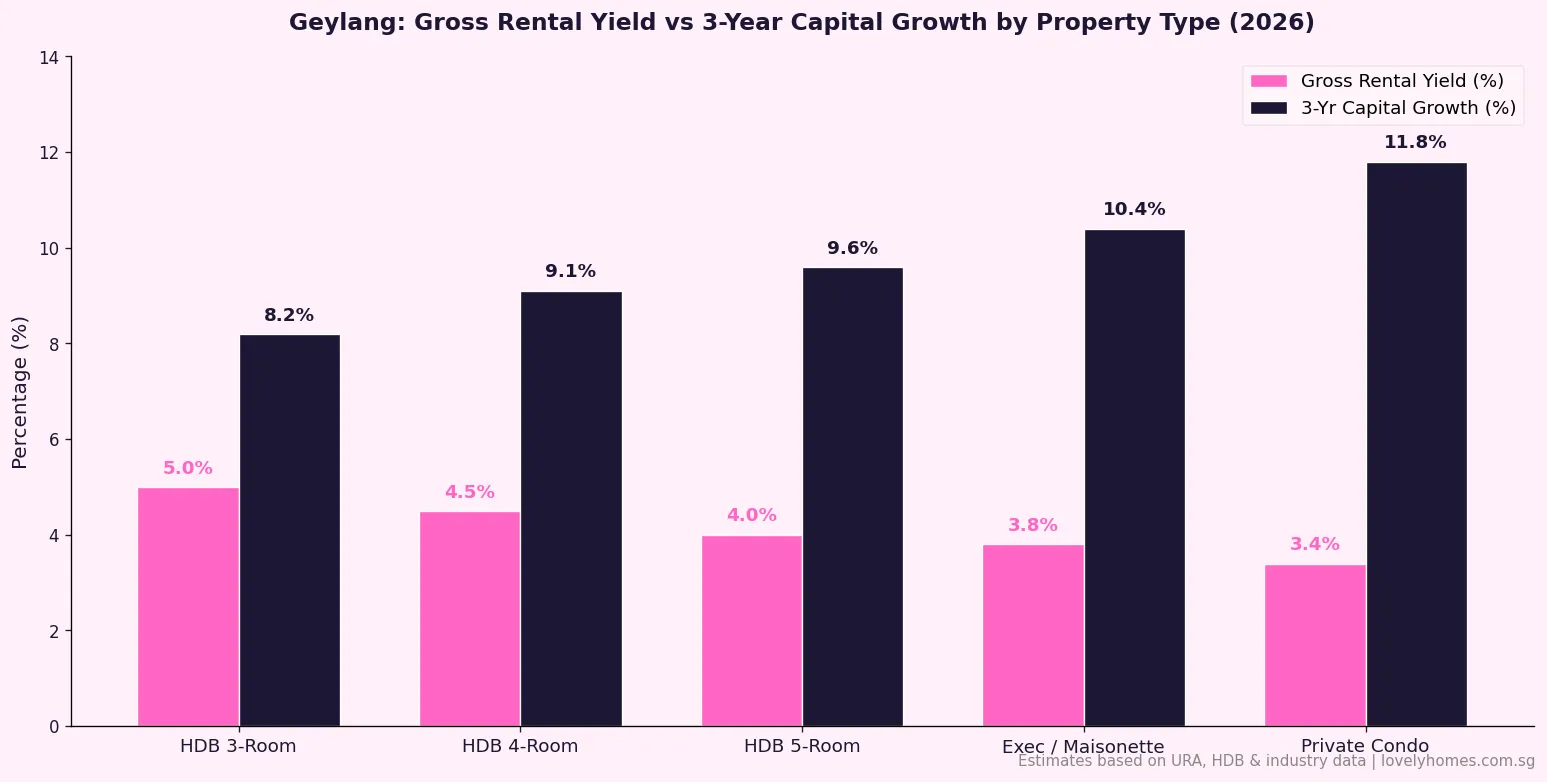
Geylang consistently ranks among the top-five Singapore towns for gross HDB rental yield, a function of the estate’s central location and relatively affordable entry prices. Industry data for 2026 shows 3-room flats yielding approximately 5.0% gross, 4-room flats at 4.5%, and 5-room flats at around 4.0%. These figures compare favourably to the national HDB average of approximately 3.5%, and are driven by sustained demand from working professionals employed at PLQ, Raffles Place, and the Marina Bay Financial Centre — all within a 15-minute commute.

On the capital appreciation side, HDB resale prices in Geylang grew by approximately 8–10% cumulatively over the three years to 2026, broadly in line with the national HDB resale trajectory but anchored by the estate’s scarcity of new supply and growing recognition of its investment fundamentals. Private residential prices at the RCR boundary (Sims Urban Oasis benchmark: ~S$1,500 psf resale) have appreciated by roughly 10–12% over the same period.

Geylang gross rental yield vs 3-year capital growth by property type 2026
Figure 3: Geylang estimated gross rental yield (%) vs 3-year cumulative capital growth (%) by property type, 2026. Estimates based on HDB, URA, and industry data.

Worked Example — Mr & Mrs Ahmad: HDB Upgrader Buying Geylang 4-Room

Mr and Mrs Ahmad are a Singapore Citizen couple with a combined monthly income of S$9,500. They have sold their Tampines 4-room HDB flat (MOP cleared) at S$750,000 and are purchasing a centrally located Geylang 4-room resale flat at S$730,000 as their next family home.

  • Purchase price: S$730,000
  • BSD (Buyer’s Stamp Duty): S$1,800 + S$3,600 + S$11,100 = S$16,500 (1% on first S$180k, 2% on next S$180k, 3% on remaining S$370k)
  • ABSD: S$0 — SC couple purchasing within 6 months of HDB sale, eligible for ABSD remission on first residential property
  • HDB Loan (80% LTV): S$584,000 @ 2.6% p.a. over 25 years → monthly instalment ~S$2,646
  • MSR check: S$2,646 ÷ S$9,500 = 27.9% — within the 30% Mortgage Servicing Ratio cap
  • Upfront cash / CPF needed: 20% down payment S$146,000 + BSD S$16,500 + legal fees ~S$2,500 = ~S$165,000 (can be paid via CPF OA)
  • Net position: Strong. Central location, 10-min CBD commute, gross rental yield ~4.5% if they rent out bedroom(s) after MOP.

What This Means for Buyers and Investors in 2026

Geylang’s property story in 2026 is one of revaluation. For years, the estate’s association with its restricted-entertainment lorongs (a small sub-zone in the central Geylang belt) suppressed buyer sentiment disproportionately relative to its transport and location fundamentals. That discount is narrowing. The S$1.37M resale record at 7 Pine Close is not an outlier — it reflects a broader market re-rating of mature central estates as the supply of well-connected, affordable HDB towns continues to shrink.

For yield-focused investors, Geylang’s 4.0–5.0% gross yields remain difficult to match elsewhere in Singapore without accepting significantly worse transport connectivity. The PLQ commercial district — home to major white-collar employers — sustains rental demand that is structurally durable, not cyclical. Peer comparison: Queenstown (also central) offers lower gross yields of 2.5–3.5% but higher capital growth. Toa Payoh offers similar yields (3.5–4.1%) but with fewer MRT lines. Geylang splits the difference, offering strong income returns and material capital appreciation.

For owner-occupiers, the estate’s lack of recent BTO launches means no large MOP-wave supply is imminent. The resale pool is mature and well-distributed across flat types. Families should focus their search on the Aljunied, Geylang East, and Kampong Ubi sub-zones, which offer the best balance of school proximity, transport, and distance from the restricted-entertainment belt.

What Might Come Next for Geylang (Outlook — Speculative)

This section is editorial speculation and should not be treated as confirmed policy or investment advice.

Industry observers have noted that URA’s long-range planning documents position the Geylang-Paya Lebar sub-region as an evolving live-work cluster, anchored by PLQ’s Phase 2 commercial pipeline and the potential northward extension of the Kallang River revitalisation masterplan. Should URA eventually regularise the restricted-entertainment precincts (a possibility that has been periodically floated in public consultations), the positive effect on surrounding residential values could be material. No official timeline has been announced as of May 2026.

On infrastructure, the Cross Island Line (CRL) Phase 2, scheduled for completion around 2031, is not expected to have a station within Geylang proper — but the Pasir Ris extension will improve east-west connectivity for tenants commuting across the island, indirectly sustaining rental demand at Geylang’s EWL-served addresses.

Frequently Asked Questions — Geylang Property Guide 2026

Is Geylang a good area to buy property in Singapore in 2026?

Yes — for the right buyer profile. Geylang offers central Singapore location (10 minutes to CBD by MRT) at prices well below comparable mature estates in the Rest of Central Region. Gross rental yields of 4.0–5.0% are among the highest in Singapore for centrally located HDB towns. The main consideration is block-level due diligence: flats in the Aljunied, Geylang East, Kampong Ubi, and MacPherson sub-zones are well removed from the restricted-entertainment belt, and buyers should verify the specific block address using URA’s OneMap before committing. The S$1.37M record at 7 Pine Close in 2026 demonstrates that the market is actively repricing Geylang’s fundamentals upward.

Which MRT stations serve Geylang?

Geylang is served by five MRT stations across three lines. On the East-West Line (EWL): Aljunied and Eunos MRT stations serve the central and western parts of the estate; Paya Lebar MRT (EWL + Circle Line interchange) serves the eastern boundary. On the Downtown Line (DTL): MacPherson and Mattar MRT stations provide direct access to the city and the Buona Vista cluster without transfers. The closest station to each residential block varies, so buyers should check the LTA Journey Planner for walking-time estimates to the block of interest.

What are typical HDB resale prices in Geylang in 2026?

Based on HDB resale transaction data for 2026: 2-room Flexi flats transact at a median of around S$297,000; 3-room flats at S$380,000; 4-room flats at S$730,000; 5-room flats at S$850,000; and executive/maisonette flats at S$1.094M. The estate-wide resale record was set in 2026 at S$1.37M for a high-floor 5-room at 7 Pine Close. Prices vary by block, floor, and facing: high-floor Paya Lebar-facing units in Geylang East command a 10–15% premium over equivalent stock in the Kampong Ubi sub-zone.

How does Geylang compare to Queenstown and Toa Payoh for property investment?

Geylang, Queenstown, and Toa Payoh are all mature central estates, but they cater to different investor profiles. Queenstown (District 3) commands the highest prices (4-room ~S$820k–S$1.1M) and the lowest gross yields (2.5–3.5%) but the strongest capital growth driven by MRT-CCR adjacency and the Greater Southern Waterfront catalyst. Toa Payoh (District 12) sits in the middle on prices (4-room ~S$650k–S$900k) and offers yields of 3.5–4.1%. Geylang (District 14) is the most affordable of the three for a 4-room flat and offers the highest yields (4.0–5.0%), but with somewhat more variable per-block desirability. For investors prioritising income return, Geylang is typically the strongest performer of the three; for capital growth, Queenstown leads.

Can foreigners and Permanent Residents buy property in Geylang?

Permanent Residents (PRs) can purchase HDB resale flats in Geylang subject to the standard PR eligibility rules: a minimum of 3 years’ PR status, a valid family nucleus (e.g., spouse or children), and no concurrent HDB ownership. PRs pay Additional Buyer’s Stamp Duty (ABSD) of 5% on their first residential property purchase. Foreigners cannot purchase HDB flats but may purchase private residential properties in Geylang (e.g., Sims Urban Oasis) subject to 65% ABSD. See IRAS’s official ABSD rate table for current rates applicable to your citizenship status.

Are there any upcoming BTO launches or new HDB supply in Geylang?

As of May 2026, HDB has not announced any BTO launches within Geylang. The estate is fully built-out and all new HDB supply entering the resale market consists of existing flats clearing their 5-year MOP. This supply constraint is broadly supportive of resale prices. Buyers looking for new HDB flats in the central region should monitor HDB’s June 2026 BTO exercise (covering Ang Mo Kio, Bishan, Bukit Merah, Sembawang and Woodlands) and future BTO launch announcements at the HDB website.

What is the rental income potential for a Geylang HDB flat?

Geylang HDB flats consistently generate among the highest rental yields in Singapore for a mature central estate. A 4-room flat transacting at S$730,000 and achieving a monthly rent of S$2,750–S$3,000 produces a gross yield of approximately 4.5–4.9%. Rental demand is driven by working professionals at Paya Lebar Quarter (PLQ), the CBD, and the Marina Bay Financial Centre cluster — all within a 15-minute commute. Whole-flat subletting requires MOP completion plus HDB approval; bedroom subletting is permitted during the MOP period subject to the occupancy cap (currently 8 persons for a 4-room or 5-room flat under the temporary relaxation in effect until December 2028). Rental income is subject to income tax; refer to IRAS for allowable deductions including mortgage interest, property tax, and agent fees.

Related Articles

Disclaimer

This article is for general informational purposes only and does not constitute financial, legal, or property advice. Property prices, rental yields, and market conditions are indicative and subject to change; all figures should be independently verified against official sources including the Urban Redevelopment Authority (URA), the Housing & Development Board (HDB), the Inland Revenue Authority of Singapore (IRAS), the Central Provident Fund (CPF) Board, and the Monetary Authority of Singapore (MAS). Buyers and investors should consult a licensed property agent, conveyancing lawyer, and independent financial adviser before making any property purchase decision. LovelyHomes does not receive referral fees from any property agency, developer, or financial institution.

Queenstown Neighbourhood Guide Singapore 2026: Property Prices, Schools, MRT and Investment Outlook

Queenstown Neighbourhood Guide Singapore 2026: Property Prices, Schools, MRT and Investment Outlook

Quick Answer — Queenstown at a Glance

  • Queenstown is Singapore’s first satellite new town, established in 1952, and today one of the most coveted addresses in the Rest of Central Region (RCR), bordering the Core Central Region (CCR).
  • HDB resale prices range from S$520,000 for a 3-room flat to well over S$1 million for a 5-room or EA; private condominiums in the area trade from S$1.8M to S$2.8M, reflecting the premium RCR location.
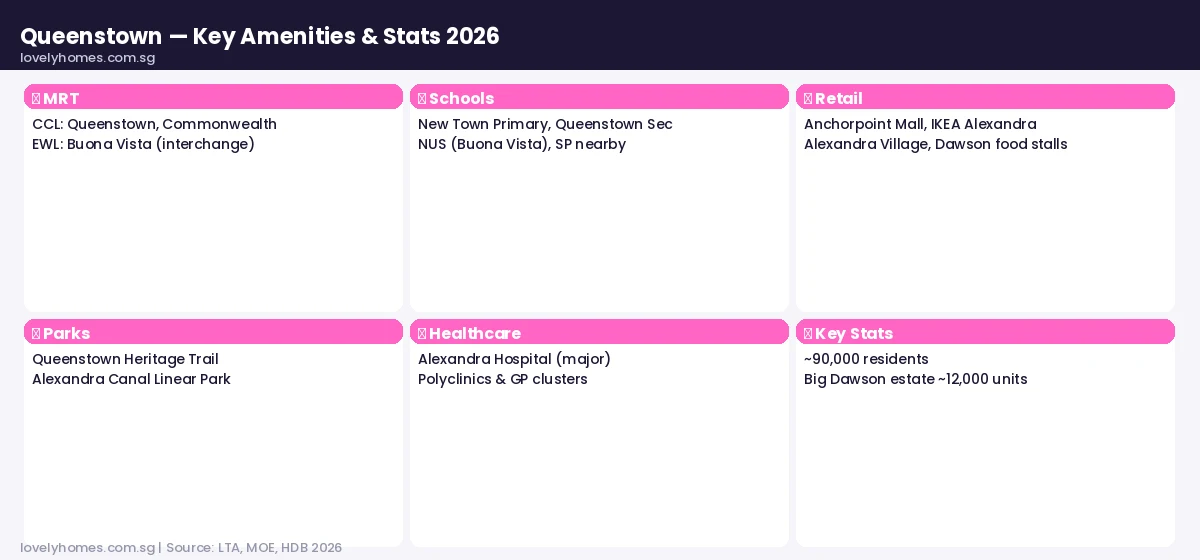
  • Served by Queenstown MRT (EWL/CCL interchange corridor) and Commonwealth MRT (EWL), with Buona Vista MRT (EWL-CCL interchange) a short walk or one stop away.
  • Home to Alexandra Hospital (one of Singapore’s major public hospitals), the massive Dawson estate (~12,000 HDB units), IKEA Alexandra, and Anchorpoint Mall.
  • Gross rental yields range from 2.9–3.8% for HDB flats, while 3-year capital growth for both HDB and private residential has been among the strongest in Singapore at 8–13%.
  • Most HDB flats in Queenstown built post-2015 are classified as Plus under the new system (Dawson estate), carrying a 10-year MOP and subsidy clawback on first sale.
  • ABSD note: Singapore Citizens buying their first property pay 0% ABSD; the 20% second-property rate would add S$440,000 on a typical S$2.2M condo purchase.

Why Queenstown Commands a Premium — Singapore’s First New Town, Still Going Strong

Queenstown carries a distinction no other HDB town can claim: it was Singapore’s very first planned new town, completed in phases from the early 1950s under the Singapore Improvement Trust (SIT) and then expanded by the Housing and Development Board (HDB) from 1960 onwards. Named in honour of the coronation of Queen Elizabeth II in 1953, it was conceived as a model residential township for a newly urbanising Singapore. Today, over seven decades later, Queenstown is anything but a relic — it is one of the most expensive and in-demand HDB estates in the country, prized for its central location, exceptional transport links, and the rich urban fabric that only decades of maturation can produce.

Geographically, Queenstown (Planning Area) occupies the southwestern corner of the Central Region, bounded by the Ayer Rajah Expressway (AYE) to the south, Alexandra Road to the north, and the Buona Vista precinct to the west. Its proximity to the Central Business District (CBD) — approximately 4 km from Tanjong Pagar — and to the one-north research and business hub, as well as the National University of Singapore (NUS) campus, makes it attractive to a broad range of buyers: executives, academics, healthcare professionals, and property investors alike.

Queenstown property prices 2026 by type — HDB 3-room to landed, Singapore neighbourhood guide
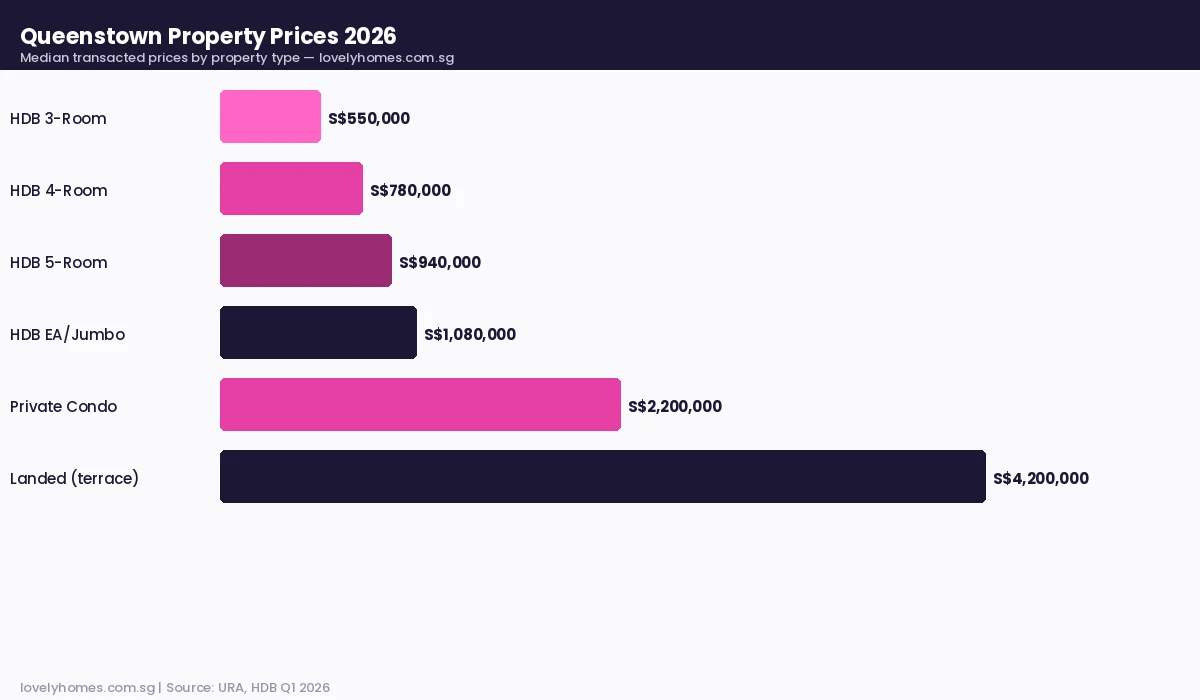
Figure 1: Queenstown property prices 2026 — median transacted values by property type. Source: URA, HDB Q1 2026.

Property Prices in Queenstown — What the Data Shows for 2026

Queenstown is unambiguously premium-priced among Singapore HDB estates, consistently ranking among the top five estates by median resale price per square foot. The figures below reflect transaction data through Q1 2026 for the Queenstown and Commonwealth planning sub-zones.

Property Type Price Range (2026) Median / Typical Notes
HDB 3-Room S$500,000 – S$620,000 ~S$550,000 Older Queenstown Central blocks; buyers pay for location and scarcity
HDB 4-Room S$700,000 – S$900,000 ~S$780,000 Dawson and Margaret Drive units command strong demand from young professionals
HDB 5-Room S$860,000 – S$1,060,000 ~S$940,000 Multiple S$1M+ transactions recorded in Dawson since 2024
HDB EA / Jumbo S$1,000,000 – S$1,200,000 ~S$1,080,000 Scarce; EA units here trade above the S$1M mark routinely
Private Condominium S$1,800,000 – S$2,800,000 ~S$2,200,000 Stirling Residences, Queens Peak, Alexandra View condos; high demand, limited supply
Landed (Terrace) S$3,500,000 – S$5,500,000 ~S$4,200,000 Holland Road / Tanglin fringe terraces — premium CCR-adjacent pricing

The Dawson estate — Singapore’s largest and most architecturally ambitious HDB precinct, developed by HDB from 2009 onwards with sky bridges, sky gardens, and one of the country’s highest density of greenery-integrated public housing — has been a consistent price anchor. Its Plus-classified units (under HDB’s post-2024 classification system) carry a 10-year MOP, but the restrictions have not dampened buyer appetite: Dawson flats continue to transact at a substantial premium over other Queenstown HDB stock, reflecting their design quality and RCR address.

MRT Connectivity — Queenstown’s Transport Advantage

Queenstown’s transport infrastructure is a major competitive advantage. The estate is served by two East-West Line (EWL) stations — Queenstown MRT (EW19) and Commonwealth MRT (EW20) — both within walking distance of the majority of residential blocks. A third key station, Buona Vista MRT (EW21 / CC22), sits at the western edge of the estate and provides interchange access to the Circle Line (CCL), linking residents seamlessly to the Marina Bay and Dhoby Ghaut corridors without changing between lines.

Travel times from Queenstown MRT are notably short: Raffles Place in approximately 12 minutes, Orchard in 8 minutes, and Harbourfront in 15 minutes. The one-north business and research hub — home to Biopolis, Fusionopolis, and major employers including GSK, Grab, and the Infocomm Media Development Authority (IMDA) — is a single stop away at Buona Vista, making Queenstown an exceptionally convenient base for the knowledge-economy workforce that clusters in this corridor.

Schools in Queenstown — Reputable Options in a Central Setting

While Queenstown does not have the same concentration of top-10 primary schools as Toa Payoh or Bishan, it offers respectable school choices and is within bus or MRT reach of a wider range of highly regarded institutions. Within the Queenstown planning area, families can access New Town Primary School and Queenstown Primary School. Secondary school options include Queenstown Secondary School and, for families willing to travel a short distance, Crescent Girls’ School (in the adjacent Tanglin area) and the National University of Singapore High School of Mathematics and Science (NUS High), which occupies the Clementi Road corridor just west of Queenstown.

Singapore Polytechnic and the National University of Singapore main campus are both within 10–15 minutes by MRT or bus, making the estate attractive to academics and NUS-affiliated professionals who value campus proximity. The Ministry of Education’s one-north campus cluster in Buona Vista is also accessible within a short commute.

Queenstown amenities and key statistics 2026 — MRT, schools, retail, parks, healthcare
Figure 2: Queenstown key amenities snapshot 2026. Sources: LTA, MOE, HDB.

Retail, Food, and Community Life in Queenstown

Queenstown’s commercial and food offering is eclectic and mature. Anchorpoint Mall (Alexandra Road) and the adjacent cluster of Alexandra retail shops anchor the estate’s daily commerce needs. The IKEA Alexandra store — Singapore’s flagship IKEA — is a practical draw for residents furnishing or upgrading their homes. Along Alexandra Village, the cluster of zi char restaurants, bakeries, and coffee shops has earned a local following for decades.

The Dawson Road and Margaret Drive hawker centres are the social heart of the Dawson estate. The Commonwealth Crescent Market and Food Centre offers affordable daily fare, while the Mei Ling Street Hawker Centre and the Stirling Road clusters round out the food landscape for residents across the estate’s different precincts.

For green space, the Alexandra Canal Linear Park runs through the estate and connects to the Kallang-Pandan Park Connector network, offering cycling and running routes. Queenstown Stadium (a community sports complex) and several neighbourhood parks complete the recreational picture. The forthcoming Southern Islands ferry hub and Labrador Park improvements are expected to add further lifestyle appeal for Queenstown and Alexandra-area residents over the medium term.

Healthcare — Alexandra Hospital as a Major Asset

Queenstown residents benefit from the presence of Alexandra Hospital, one of Singapore’s major public acute hospitals, operated under the National University Health System (NUHS). Alexandra Hospital was extensively redeveloped and reopened in 2023 with expanded capacity and specialist services, making it a significant draw for healthcare professionals and residents who value medical proximity. The hospital’s campus on Alexandra Road is walkable from multiple Queenstown HDB blocks. Queenstown Polyclinic, operated by the National Healthcare Group (NHG), provides primary care in the estate.

Investment Analysis — Rental Yields and Capital Growth in Queenstown

Queenstown gross rental yield vs 3-year capital growth 2026 by property type
Figure 3: Queenstown — gross rental yield vs 3-year capital growth 2026. Sources: URA, SRX Q1 2026.

Queenstown presents a classic high-entry-cost, high-growth investment profile. The estate’s yields are lower than OCR alternatives because acquisition prices are high — but capital growth has been consistently strong. HDB 4-room flats yielding 3.5–3.8% at a median acquisition cost of S$780,000 compare reasonably to deposits or REITs on a risk-adjusted basis, while private condominiums (yield 2.9–3.2%) are predominantly a capital-growth play rather than an income play.

The three-year capital growth data from URA and SRX is striking. HDB resale prices in Queenstown appreciated approximately 8.5–9.5% over the three years to Q1 2026, driven by the Dawson MOP wave and persistent demand from upgraders and young professionals. Private condo capital growth in the D3 and D10 catchment has been even stronger, at approximately 11–13%, as limited new supply (no major GLS tender in the immediate Queenstown corridor in recent years) has tightened the available resale pool.

For Singaporean buyers and investors, the RCR-CCR boundary positioning means Queenstown condos are priced below CCR benchmarks (Orchard, River Valley) while offering similar connectivity and amenity quality — a structural premium arbitrage that is unlikely to close, given the land constraints of the area.

What This Means for Buyers — The Case for Queenstown in 2026

Queenstown is not an estate for buyers primarily motivated by yield — it is for those who want long-term capital preservation, lifestyle quality, and the peace of mind that comes from owning in one of Singapore’s most consistently liquid residential markets. Buyers who stretched to buy Dawson HDB Plus flats at S$800,000–S$900,000 in 2022–2023 have seen strong paper gains, though the 10-year MOP means realisation is deferred.

For investors in private condominiums, the key question in 2026 is whether the supply pipeline will tighten further. With no confirmed GLS sites in the immediate Queenstown corridor on the URA 1H 2026 Confirmed List, and the broader D3/D4 private supply running well below historical norms, the medium-term supply outlook supports price resilience.

What Might Come Next — Queenstown Looking to 2030

Several longer-horizon catalysts are worth tracking. The Greater Southern Waterfront (GSW) development — a 30-km stretch of former port land being progressively released for mixed-use development from Pasir Panjang to Marina East — runs directly through the southern edge of Queenstown’s catchment. While the GSW is a multi-decade project, its first residential precincts (expected to launch in the early 2030s) will add both supply and vibrancy to the Harbourfront-Queenstown corridor. Second, the one-north Phase 2 expansion will continue to draw knowledge-economy employers to the Buona Vista cluster, sustaining demand for rental and owner-occupied housing in Queenstown. Third, speculation about the long-term fate of the Alexandra Hospital campus and its potential for mixed-use intensification (a common URA Master Plan theme for maturing hospital sites) would, if realised, reshape the northern edge of the estate.

Worked Example — Ms Priya: Singapore PR Buying a Queenstown HDB Resale as a First Property

Ms Priya is a Singapore Permanent Resident (SPR) who has been working in Singapore for 8 years and recently obtained her PR status. She is buying a Queenstown 4-room resale flat at S$820,000 as her first Singapore residential property. As an SPR buying her first property, ABSD is 5%.

  • Purchase price: S$820,000
  • ABSD (5% — SPR, 1st property): S$41,000
  • BSD (progressive on S$820k): S$3,600 + S$4,500 + S$14,400 = S$22,500
  • Total stamp duty payable: S$63,500 (must be paid in cash; cannot use CPF for ABSD)
  • Bank loan (max 75% LTV for SPR buying HDB resale): S$615,000 at 1.90% fixed 2-year
  • Monthly instalment (25-year loan): approximately S$2,572
  • TDSR check (must not exceed 55%): requires gross monthly income of at least S$4,676
  • Cash needed upfront: ABSD S$41,000 + BSD S$22,500 + 5% cash downpayment S$41,000 + legal fees ~S$2,800 = S$107,300
  • Remaining 20% downpayment (S$164,000) can be paid from CPF OA, subject to balance availability

Verdict: The ABSD adds a meaningful S$41,000 upfront cost compared with the equivalent SC transaction, but Queenstown’s long-term capital growth profile makes the premium defensible for a buyer with a 10-year horizon. Ms Priya should also review whether her PR status is likely to progress to citizenship, which would affect future ABSD on any second purchase.

Frequently Asked Questions about Queenstown Property

Is Queenstown a good place to buy property in 2026?

Yes — for buyers who can afford the entry price and are not primarily motivated by yield. Queenstown combines central connectivity, strong school access, one of Singapore’s best hospital facilities, and a diverse lifestyle offer in a mature urban setting. Its RCR positioning means it offers better value-for-connectivity than CCR alternatives while remaining above OCR price levels. The main risk is high entry cost relative to yield, and the 10-year MOP on Dawson-era Plus-classified flats, which defers liquidity for HDB buyers.

What is the Dawson estate, and why are its flats so expensive?

The Dawson estate is a large precinct of HDB public housing developed from 2009 onwards in the Queenstown planning area. It comprises several BTO projects including SkyVille@Dawson and SkyTerrace@Dawson, which feature architectural innovations such as sky bridges, community gardens at height, and generous community spaces. These were designed by internationally recognised firms under the HDB’s Design, Build and Sell Scheme (DBSS) and premium BTO frameworks. Dawson flats are expensive because they combine a central RCR address with design quality that is genuinely superior to standard HDB output, and because their supply is permanently constrained (no new Dawson-equivalent BTO is possible in this location). Flats in Dawson are classified as Plus under HDB’s post-August 2024 flat classification, carrying a 10-year MOP and a subsidy recovery on first resale.

How does Queenstown compare with Buona Vista and Alexandra for property investment?

The three areas are closely adjacent and share similar infrastructure advantages, but differ in their property mix. Queenstown is predominantly HDB resale with a growing private condo segment; Buona Vista (Planning Area) has a larger proportion of private residential and is more influenced by the one-north employment cluster; Alexandra has more commercial and industrial use. For HDB investors, Queenstown offers the best combination of liquidity, transaction volume, and price transparency. For private property investors, the D3 condos (Stirling Residences, Queens Peak) have outperformed on capital growth over the 2020–2026 cycle, partly because of their newer TOP dates and proximity to the EWL network.

Can foreigners buy residential property in Queenstown?

Foreign non-PRs cannot purchase HDB flats anywhere in Singapore. For private condominiums in Queenstown (District 3), foreigners may purchase but are subject to 60% ABSD on any residential property, making private condo ownership extremely costly for foreign nationals. The only exception is citizens of countries with Free Trade Agreements extending National Treatment — specifically citizens of Iceland, Liechtenstein, Norway, Switzerland, and the United States, who are treated equivalently to Singapore Citizens for ABSD purposes. For all other foreigners, the economics are rarely compelling given the 60% upfront ABSD burden.

Are there new BTO flats available in Queenstown?

HDB BTO launches in Queenstown are infrequent, reflecting the limited land available in this fully built-out mature estate. When Queenstown BTOs do launch, they are invariably Plus-classified (given the central, well-connected location), heavily oversubscribed, and priced at a significant premium over OCR BTOs. Buyers who are open to a Plus-classified flat with its 10-year MOP should monitor HDB BTO launch announcements at the HDB website. Alternatively, buyers seeking a faster path to ownership in Queenstown typically opt for the resale market, where transactions close in 8–12 weeks.

What is the Greater Southern Waterfront and how does it affect Queenstown?

The Greater Southern Waterfront (GSW) is a long-term national project to redevelop approximately 2,000 hectares of port and industrial land between Pasir Panjang and Marina East as Singapore’s southern port lands are progressively vacated. The GSW is Singapore’s largest land-use transformation project currently underway, and will eventually add tens of thousands of new homes, parks, waterfront promenades, and employment hubs to the southern corridor. Queenstown’s proximity to the GSW boundary — particularly the Alexandra and Keppel Road edge — means it stands to benefit from improved connectivity, new amenities, and rising land values as the first GSW residential precincts launch in the early 2030s. The URA’s 2025 Master Plan revision indicates that the Keppel Club site (adjacent to the GSW’s Keppel precinct) will include a significant residential component, which will directly serve Queenstown’s catchment area.

What is the ABSD exposure for a Singaporean couple buying a Queenstown condo as a second property?

For a Singapore Citizen (SC) couple who already own one residential property, purchasing a second property (including a private condominium in Queenstown) triggers 20% ABSD on the purchase price. On a typical S$2.2M Queenstown condo, that is S$440,000 of ABSD alone — on top of BSD of approximately S$72,600. Total stamp duty would be approximately S$512,600. This is why many SC upgrader couples choose the sell-first route (selling their first property before completing the new purchase) to avoid the 20% ABSD burden. If eligible, the married-couple ABSD remission scheme allows the new purchase to proceed before the old property is sold, provided the first property is divested within six months of the purchase date.

Related Articles

Disclaimer: This guide is for general information only and does not constitute legal, financial, or property advice. Property prices, stamp duty rates, CPF rules, and HDB policies change over time. Always verify current prices through the URA Real Estate Information System (REALIS) and HDB’s official website, and consult a licensed conveyancing lawyer or financial adviser before entering any property transaction.

Toa Payoh Neighbourhood Guide Singapore 2026: Property Prices, Schools, MRT and Investment Outlook

Toa Payoh Neighbourhood Guide Singapore 2026: Property Prices, Schools, MRT and Investment Outlook

Quick Answer — Toa Payoh at a Glance

  • One of Singapore’s oldest and most established HDB towns, founded in 1966 and now home to approximately 100,000 residents in the Central Region.
  • HDB resale prices range from S$450,000 for a 3-room flat to S$950,000+ for an EA/jumbo, with private condominiums trading at S$1.5M–S$1.8M and above.
  • Served by Toa Payoh MRT and Braddell MRT on the North-South Line (NSL), with the Cross Island Line (CRL) Phase 2 expected around 2031 to further boost connectivity.
  • Home to the HDB headquarters (HDB Hub), Toa Payoh Central, Toa Payoh Town Park, and a dense network of schools including CHIJ Primary (Toa Payoh) and Catholic High Primary (Bishan, adjacent).
  • Gross rental yields range from 3.5–4.1% for HDB flats, while 3-year capital growth for HDB has tracked 7–9% — strong for a mature central estate.
  • Most HDB flats in Toa Payoh are classified as Standard under the new HDB flat classification system, with a 5-year Minimum Occupation Period (MOP), though some newer BTOs in the Bidadari edge are Plus.
  • Additional Buyer’s Stamp Duty (ABSD): Singapore Citizens buying their first residential property pay 0% ABSD; 20% applies on a second property.

Why Toa Payoh Remains One of Singapore’s Most Sought-After Mature Estates

Toa Payoh holds a special place in Singapore’s housing story. Developed from 1966 onwards as one of the Housing and Development Board’s (HDB) earliest planned new towns, it was purpose-built to rehouse residents cleared from kampungs (traditional villages) and fringe urban settlements. More than five decades later, Toa Payoh is not a relic — it is one of the most consistently in-demand estates on the HDB resale market, valued by Singaporeans for its central location, mature infrastructure, and exceptional school choices.

The estate sits in the Central Region of Singapore, bounded broadly by Novena (District 11) to the west, Bishan to the north, Potong Pasir to the east, and Kallang to the south. Its location inside the mature Central Region means demand from buyers willing to pay a premium for proximity to the city centre, and supply that is naturally constrained because no new large-scale HDB development is possible within the existing town footprint.

Toa Payoh property prices 2026 by type — HDB 3-room to landed, Singapore neighbourhood guide
Figure 1: Toa Payoh property prices 2026 — median transacted values by property type. Source: URA, HDB Q1 2026.

Property Prices in Toa Payoh — What You Can Expect to Pay in 2026

Toa Payoh commands a meaningful premium over most OCR (Outside Central Region) estates, reflecting its central location and the scarcity of supply in a fully built-out town. Based on URA and HDB transaction data through Q1 2026, the following price benchmarks apply.

Property Type Price Range (2026) Median / Typical Notes
HDB 3-Room S$430,000 – S$560,000 ~S$480,000 Older blocks near Toa Payoh Central; high floor commands premium
HDB 4-Room S$600,000 – S$800,000 ~S$680,000 Most common transaction type; blocks near HDB Hub attract strong demand
HDB 5-Room S$720,000 – S$960,000 ~S$820,000 Large flats on upper floors can approach or exceed S$1M
HDB EA / Jumbo S$880,000 – S$1,100,000 ~S$950,000 Limited supply; these trade well above median given scarcity
Private Condominium S$1,400,000 – S$2,100,000 ~S$1,650,000 Gem Residences (2019 TOP) and legacy condos in D12/D20
Landed (Terrace) S$2,400,000 – S$3,500,000 ~S$2,800,000 Mainly inter-terrace units along Toa Payoh fringe streets

A particular feature of Toa Payoh’s resale market is that record transactions regularly break the S$1 million mark for 5-room and EA flats. In Q1 2026, at least two 5-room units transacted above S$950,000, reflecting continued appetite from buyers who want central living without private-property stamp duty exposure. The MOP wave releasing approximately 1,200 Toa Payoh-adjacent flats in 2026 is expected to add transactional volume but not necessarily to dampen prices, given the persistent supply deficit in this mature zone.

MRT Connectivity and Getting Around Toa Payoh

Toa Payoh’s primary transport backbone is the North-South Line (NSL), with two stations serving the estate: Toa Payoh MRT (NS19) and Braddell MRT (NS18). Toa Payoh MRT sits directly at the heart of the town’s commercial hub, making it one of the most walkable MRT-to-estate combinations in Singapore. Travel time to Raffles Place is approximately 16 minutes; to Orchard, about 10 minutes.

Beyond the NSL, residents benefit from an extensive network of feeder buses connecting to Bishan (NS-CCL interchange), Novena, and Potong Pasir (NEL). The Land Transport Authority (LTA) has confirmed that Cross Island Line (CRL) Phase 2, expected around 2031, will include a station in the Hougang-Toa Payoh corridor, which analysts at CBRE Research project will add a further 5–8% price uplift to properties within a 500-metre radius of any new CRL station.

Schools in Toa Payoh — One of Singapore’s Premier School Corridors

School proximity is a major driver of buyer demand in Toa Payoh. The estate and its immediate neighbours contain an unusually high concentration of well-regarded primary and secondary schools, including several that are highly sought-after for Primary 1 registration purposes.

Within and directly adjacent to Toa Payoh, families benefit from access to CHIJ Primary (Toa Payoh) — one of Singapore’s most popular girls’ primary schools — as well as Kheng Cheng School, Pei Chun Public School, and Marymount Convent Primary. Secondary options in the vicinity include CHIJ Secondary (Toa Payoh), Catholic High School (Bishan, Phase 2B priority for Toa Payoh addresses), and, at the junior college level, several JCs reachable within 15–20 minutes by MRT.

The Ministry of Education’s (MOE) school registration framework means that within 1 km of a school, Phase 2A and 2B registration confers significant advantage in ballot. Families purchasing specifically for school access should verify school registration zones each year, as boundaries are subject to MOE review.

Toa Payoh amenities and key statistics 2026 — MRT, schools, retail, parks, healthcare
Figure 2: Toa Payoh key amenities snapshot 2026. Sources: LTA, MOE, HDB.

Retail, Food, and Daily Living in Toa Payoh

Toa Payoh Central is one of the best-served HDB town centres in Singapore. HDB Hub, the Housing and Development Board’s own headquarters, sits at the heart of the estate and anchors a retail podium — Toa Payoh Mall — that includes a Cold Storage supermarket, food court, and dozens of specialty retailers. The adjoining Toa Payoh Town Park provides approximately 6.5 hectares of green recreational space within easy reach of most flats, while the Toa Payoh Sports Hub (formerly Toa Payoh Stadium) services community sports needs.

Food options are outstanding: the wet market and hawker centres at Toa Payoh Lorong 1, Lorong 4, and Lorong 7 are among the most established in central Singapore. Residents are also a short bus or MRT ride from the Novena cluster (for major medical facilities and premium retail) and Bishan Junction 8.

Investment Analysis — Rental Yields and Capital Growth Outlook for 2026

Toa Payoh gross rental yield vs 3-year capital growth 2026 by property type
Figure 3: Toa Payoh — gross rental yield vs 3-year capital growth 2026. Sources: URA, SRX Q1 2026.

For investors evaluating Toa Payoh, the key question is whether the premium entry cost is justified by rental income and capital appreciation. On both counts, the data is broadly supportive, though buyers should manage expectations on yield given the higher entry price.

HDB 4-room flats in Toa Payoh command gross rents of approximately S$2,200–S$2,600 per month in 2026, translating to a gross rental yield of around 3.8–4.1% on a median acquisition cost of S$680,000. This compares favourably with OCR estates like Tampines or Pasir Ris, where similar-sized flats yield 3.5–3.8% on higher transacted prices. Private condominiums in the Toa Payoh catchment typically yield 3.2–3.5%, with 1-bedroom units (S$1.4M–S$1.6M) offering the best yield-to-capital ratio.

On capital growth, URA and SRX data show that HDB resale prices in mature central estates like Toa Payoh appreciated approximately 7.2–8.5% over the three years to Q1 2026, outperforming the national HDB resale index (which rose approximately 5.8% over the same period). Private condo capital growth in the D12/D20 catchment has been stronger, at approximately 9–11%, on the back of limited new supply and persistent upgrader demand.

What This Means for Buyers — Toa Payoh as a Long-Term Hold

Toa Payoh is not a speculative play — it is a quality-of-life and long-term capital preservation story. The estate’s age means most HDB flats have a remaining lease of 50–65 years, which has implications for CPF usage (subject to the CPF board’s Lease Buyback rules and pro-rated OA withdrawal cap) and for eventual en-bloc potential in the private residential pockets. Buyers considering HDB should verify the remaining lease and applicable CPF withdrawal limits before budgeting.

For Singapore Citizens using HDB as a stepping-stone — buy a resale flat, benefit from the School Proximity advantage, and then upgrade when ready — Toa Payoh offers a credible path. The estate’s consistent demand means resale liquidity is strong, and the likely CRL Phase 2 uplift adds a forward-looking catalyst.

What Might Come Next — Toa Payoh in 2027 and Beyond

Singapore’s Urban Redevelopment Authority (URA) has not announced major new development plans specific to Toa Payoh in the 2025 Master Plan cycle, which is unsurprising given that it is already a fully built-out mature estate. However, several factors bear watching. First, the CRL Phase 2 alignment and exact station locations will, when confirmed, reprice properties within walking distance of new stations — likely in the 2028–2030 timeframe ahead of actual completion. Second, the broader national trend of HDB flat upgrading — facilitated by the progressive privatisation of Singapore’s housing market — means the pool of buyers willing to pay S$800,000+ for a 5-room flat continues to deepen. Third, the ageing HDB stock in Toa Payoh raises the speculative (but unconfirmed) possibility of Selective En-Bloc Redevelopment Scheme (SERS) designations over the medium term, which would provide a government-administered exit at fair value for affected flat owners.

Worked Example — Mr & Mrs Ong: HDB Upgrader Buying a Toa Payoh 5-Room Resale

Mr & Mrs Ong are a Singapore Citizen couple. They sold their Ang Mo Kio 4-room HDB flat in February 2026 for S$780,000 and are now buying a Toa Payoh 5-room resale flat at S$870,000. Because they sold their first property before completing the purchase, they are buying their new flat as their only property — ABSD = 0%.

  • Purchase price: S$870,000
  • BSD (progressive on S$870k): S$3,600 + S$4,500 + S$15,600 = S$23,700
  • ABSD: S$0 (SC, 1st property at point of purchase)
  • HDB loan (up to 80% of purchase price): S$696,000 at 2.6% p.a.
  • Monthly instalment (25-year loan): approximately S$3,160
  • MSR check (must not exceed 30% of gross monthly income): requires household income of at least S$10,533 — well within the S$14,000 ceiling for 5-room resale
  • Cash needed upfront: BSD S$23,700 + 5% cash downpayment S$43,500 = S$67,200; balance S$130,500 downpayment can come from CPF OA
  • CPF OA balance available from AMK sale: estimated S$280,000 (post-refund, net of original principal)

Verdict: Feasible for a dual-income household earning S$11,000–S$14,000/month. The upgrade from a 4-room AMK flat to a 5-room Toa Payoh flat costs a net outlay of approximately S$90,000 (after CPF proceeds) but gives school-corridor access and improved central connectivity.

Frequently Asked Questions about Toa Payoh Property

Is Toa Payoh a good place to buy property in 2026?

Yes, for most buyer profiles who value central location, school access, and strong resale liquidity. Toa Payoh consistently ranks among the top HDB estates by transaction volume and median price per square foot. The main caveat is the ageing lease profile of older HDB blocks — buyers should check the remaining lease and confirm CPF withdrawal eligibility before committing. For private property investors, the limited supply of condominiums in the estate means capital values are well-supported but entry prices are high.

Which MRT stations serve Toa Payoh?

Toa Payoh is served by two North-South Line (NSL) stations: Toa Payoh MRT (NS19) and Braddell MRT (NS18). Toa Payoh MRT is integrated with the HDB Hub and town centre, making it exceptionally walkable. The Land Transport Authority (LTA) has confirmed Cross Island Line (CRL) Phase 2 for completion around 2031, which will add a new interchange point in the broader corridor. For CCL connectivity, the Bishan interchange is accessible via a short bus ride.

What are HDB resale prices in Toa Payoh in 2026?

Based on URA and HDB Q1 2026 data, typical resale prices are: 3-room S$430,000–S$560,000; 4-room S$600,000–S$800,000; 5-room S$720,000–S$960,000; EA/jumbo S$880,000–S$1,100,000. High-floor, centrally located units in sought-after blocks (particularly near Toa Payoh Central and the HDB Hub) can exceed the upper end of these ranges. The S$1 million threshold for HDB 5-rooms in Toa Payoh has been crossed multiple times in 2025–2026.

How does Toa Payoh compare with Bishan and Ang Mo Kio?

All three are mature central estates, but Toa Payoh commands slightly higher HDB prices than Ang Mo Kio for equivalent flat types, reflecting its proximity to the city core and its school corridor premium. Bishan is broadly comparable to Toa Payoh in pricing and also benefits from the NSL-CCL interchange. Ang Mo Kio prices are typically 8–15% lower than Toa Payoh for equivalent flat sizes, with the gap reflecting the latter’s greater walkability to the CBD. For private condos, the difference is more pronounced: Bishan Sky Habitat-level stock is priced similarly to Toa Payoh private condos, while AMK condos typically trade at a slight discount.

Can foreigners or PRs buy HDB resale flats in Toa Payoh?

Singapore Permanent Residents (SPRs) may purchase HDB resale flats, subject to forming an eligible family nucleus (for example, an SPR married to another SPR, or an SPR with SPR children). However, SPRs must pay 5% ABSD on their first Singapore residential property and cannot apply for CPF Housing Grants on the resale market. Foreigners (non-PRs) are not eligible to purchase HDB flats under any circumstances. For private condominiums in the area, foreigners pay 60% ABSD under the April 2023 cooling measures regime.

Are there any new BTO launches planned for Toa Payoh?

As a fully built-out mature estate, Toa Payoh has very limited capacity for new BTO projects. HDB launches new flats in Toa Payoh only when sites are freed up through redevelopment of existing stock. The most recent HDB BTO in the Toa Payoh area was a small Plus-classified project at the Bidadari boundary in 2025. Buyers interested in new HDB flats in the Central Region should monitor the HDB website for BTO launch announcements, as central-region BTOs are typically heavily oversubscribed.

Is the lease decay a concern for Toa Payoh HDB flats?

Yes, and buyers should take this seriously. Many of Toa Payoh’s HDB blocks were built in the late 1960s and 1970s, meaning remaining leases of 45–60 years as of 2026. Flats with fewer than 60 years remaining are subject to a pro-rated CPF withdrawal cap under the CPF Board’s rules, and banks may apply stricter loan-to-value limits. For older flats (built before 1985), buyers should model their maximum CPF drawdown carefully before signing any OTP, and consult a licensed conveyancing lawyer on the financing structure. The government has introduced several programmes (including the Lease Buyback Scheme and VERS — though VERS details remain under study) to address lease decay in older flats.

Related Articles

Disclaimer: This guide is for general information only and does not constitute legal, financial, or property advice. Property prices, stamp duty rates, CPF rules, and HDB policies change over time. Always verify current prices through the URA Real Estate Information System (REALIS) and HDB’s official website, and consult a licensed conveyancing lawyer or financial adviser before entering any property transaction.

Bishan Neighbourhood Guide Singapore 2026: Property Prices, Schools, MRT and Investment Outlook

Bishan Neighbourhood Guide Singapore 2026: Property Prices, Schools, MRT and Investment Outlook

Quick Answer: Bishan Neighbourhood at a Glance

  • HDB resale prices (2026): 3-room S$480k–S$640k  |  4-room S$680k–S$920k (median S$800k)  |  5-room S$840k–S$1.1M — among Singapore’s most premium HDB estates.
  • Private condo (District 20): S$1.35M–S$2.2M for freehold and 99-year leasehold units in a supply-constrained market with no major new launches since 2021.
  • MRT: North–South Line and Circle Line both pass through Bishan station (double interchange); Marymount (CCL) also serves the estate — exceptional cross-island access.
  • Schools: Raffles Institution (Bishan campus), Catholic High Primary & Secondary, CHIJ Bishan — one of Singapore’s top school corridors, rivalling Queenstown and Toa Payoh.
  • Gross rental yield: HDB 3-room 3.8%  |  private condo 2.9–3.4% — lower than OCR averages, reflecting Bishan’s capital appreciation premium.
  • 3-year capital growth (2023–2026): HDB 5-room +8.9%  |  private condo (2BR) +12.5% — outperforming the national average.
  • June 2026 BTO: HDB will offer new flats in Bishan as part of the June 2026 exercise — likely Plus or Prime classification given the mature estate status and MRT proximity.
  • Supply scarcity: Bishan has approximately 19,665 HDB flats and virtually no land for new private residential GLS — a structural supply constraint that supports long-term price stability.

Introduction: Bishan’s Enduring Premium in Singapore’s Property Market

Bishan is one of Singapore’s most sought-after HDB towns — and arguably the one that most consistently defies the public-housing price ceiling. With a median HDB resale price of approximately S$850,000 across 411 transactions in the first four months of 2026 — including executive and multi-generation flats commanding S$1.27M–S$1.39M — Bishan sits in a property tier that bridges the gap between HDB and private condominium ownership in a way that few other towns manage.

The estate was gazetted in the 1980s on land previously used as the Peck Shan Theng cemetery, and its development was carefully planned around three anchors that have proven durable: first-class MRT connectivity (it hosts one of only four NSL–CCL interchanges in Singapore), a concentrated school corridor anchored by Raffles Institution and Catholic High, and the 62-hectare Bishan–Ang Mo Kio Park — one of Singapore’s largest urban nature parks. These structural advantages have made Bishan one of the most defensible property markets on the island, capable of holding value even during market corrections.

In 2026, three dynamics are shaping Bishan’s market: the continued migration of HDB upgraders from surrounding estates seeking established schools and park proximity; the resurgence of private condo interest in a supply-constrained district where no major new launch has occurred since 2021; and the announcement of the June 2026 BTO exercise, which will add new flats likely classified as Plus under HDB’s new framework — carrying a 10-year MOP and subsidy clawback provisions that will moderate resale supply for a decade.

Bishan property prices 2026 — HDB 3-room to private condo price range by type
Figure 1: Bishan property price ranges by type, 2026. Dots indicate median transaction prices. Source: HDB Resale Portal, URA REALIS caveats May 2026.

Property Market Overview: HDB Resale Prices in Bishan 2026

Bishan’s HDB resale market is characterised by premium pricing relative to most OCR and even many RCR estates, underpinned by genuine demand from school-corridor buyers and MRT interchange seekers. Price growth over the past three years has been moderate but consistent — approximately 7–9% for 4-room and 5-room flats — without the sharp corrections seen in Queenstown (which experienced cooling-measure headwinds in 2023).

Three-room flats, representing an older and less actively traded segment in Bishan, transact at S$480,000–S$640,000, with a median of approximately S$542,000. Four-room flats — the estate’s most traded category with 199 transactions in the first four months of 2026 — record a median of S$800,000 and a range of S$680,000–S$920,000. Five-room units, popular with larger families and CPF-flush upgraders, command S$840,000–S$1.1M. Executive Apartments and multi-generation units, found in blocks like Bishan Street 22 and Street 24, are transacting at S$1.05M–S$1.38M — firmly within the million-dollar flat segment.

On the private residential side, District 20 condominiums including Clover by the Park, Bishan 8, and the freehold Thomson Three have seen prices range from S$1.35M (smaller 1-bedroom units) to S$2.2M (3-bedroom). The median private transacted price is approximately S$1,750 per square foot, reflecting the district’s premium over OCR benchmarks of S$1,100–S$1,400 psf.

Bishan’s Three Subzones: Where Within the Estate Matters

Bishan is divided into three primary subzones: Bishan East, Upper Thomson, and Marymount, each with a distinct character and proximity profile.

Bishan East is the commercial and transport core, centred on Bishan MRT station (NSL and CCL interchange) and Junction 8 shopping mall. Flats in Bishan East command the highest premiums within the estate, typically 8–12% above the town average for equivalent flat types, owing to walkability to the MRT interchange and the concentration of retail, F&B, and services at Junction 8. This subzone is the preferred choice for transport-prioritising buyers and rental investors targeting working professionals.

Upper Thomson spans the northern portion of the estate bordering Marymount Road and Lower Peirce Reservoir. This is Bishan’s most park-proximate subzone, with cycling access to the Lower Peirce Reservoir Trail and a quieter, residential character. Older private condominiums in Upper Thomson — a few are freehold — attract long-term owner-occupiers who value the green-belt surroundings. The Thomson–East Coast Line (TEL) Caldecott station, while technically in Toa Payoh, is a short bus ride from Upper Thomson, providing an additional connectivity layer.

Marymount is served by Marymount MRT (CCL) and is characterised by a mix of relatively newer HDB blocks (1990s–2000s build) and private landed properties along Marymount Lane and Marymount Terrace. Proximity to Thomson Medical Centre and the Catholic High campus makes Marymount a particularly attractive subzone for young families and medical professionals.

Bishan neighbourhood amenities 2026 — MRT, schools, retail, parks, healthcare and key stats
Figure 2: Bishan neighbourhood amenities and key statistics 2026. Source: HDB, LTA, MOE, SingStat, MOH.

MRT Connectivity: The Double-Interchange Advantage

Bishan station is one of the most connected interchange stations on the Singapore MRT network. As an NSL–CCL interchange, it provides direct access to the North–South Corridor (Orchard in 15 minutes, City Hall in 21 minutes) and the Circle Line (one-stop to Braddell and Marymount; direct to one-north, Harbourfront, and Dhoby Ghaut via the CCL loop). The addition of Marymount station, a further CCL stop within the estate, means Bishan has effectively three MRT access points — a density matched only by estates like Queenstown and Outram.

For buyers evaluating Bishan against comparable mature estates like Toa Payoh (NSL only) or Serangoon (NEL and CCL, but no NSL), the double-interchange MRT profile is a structural differentiator that justifies the Bishan price premium. Commute times to major employment nodes — Raffles Place (24 min), one-north (25 min via CCL), Marina Bay (28 min) — are competitive with several RCR estates at substantially higher prices.

School Corridor: One of Singapore’s Most Concentrated

Bishan’s school corridor is one of the most concentrated in Singapore. Within the estate or within a 1-kilometre radius of the HDB heartland, buyers can access Catholic High Primary School (PSLE-top-stream feeder to Catholic High Secondary, which offers the Integrated Programme to Raffles Institution); CHIJ Our Lady of the Nativity (Primary); Raffles Institution (Secondary, Bishan campus — one of the two RI campuses); Bishan Park Secondary; and St Joseph’s Institution (SJI), accessible via the CCL from Bishan station in two stops.

For families who run their housing search on school proximity, the 1-kilometre priority registration boundary around Catholic High Primary or Raffles Institution alone can justify a S$50,000–S$100,000 price premium on Bishan flats over equivalent flat types in neighbouring Ang Mo Kio. The Ministry of Education administers school registration via Phase 2A and Phase 2B ballots, and school proximity continues to be a documented driver of HDB resale premiums in established educational corridors.

Summary Table: Bishan Property at a Glance

Property Type Price Range (2026) Median Price Gross Rental Yield Notes
HDB 3-Room S$480k – S$640k S$542k ~3.8% Older stock; limited supply in Bishan East
HDB 4-Room S$680k – S$920k S$800k ~3.5% Most actively traded (199 txns Q1 2026); strong upgrader demand
HDB 5-Room S$840k – S$1.1M S$970k ~3.2% Near MRT commands top of range; 10-yr MOP for new BTO Plus flats
HDB EA / Multi-Gen S$1.05M – S$1.39M S$1.27M ~2.8% Million-dollar category; limited supply; high demand from multi-gen families
Private Condo (D20) S$1.35M – S$2.2M ~S$1.75M ~2.9–3.4% Freehold premium at Upper Thomson; 99-yr at Bishan East; supply-constrained

Rental Market and Investment Yield

Bishan’s rental market is smaller and more selective than Sengkang or Woodlands, reflecting the estate’s owner-occupier character. However, demand is consistent from two distinct renter pools: professionals and expat families drawn by the school corridor (who are often willing to pay a premium for proximity to Raffles Institution and Catholic High), and working professionals who prioritise the MRT interchange commute access.

Three-room flats achieve S$2,800–S$3,200 per month; four-room S$3,200–S$3,800; five-room S$3,800–S$4,500. Private condominiums achieve S$3,800–S$5,200 for one-bedroom units and S$5,000–S$7,200 for two-bedroom units. Gross yields, at 2.9–3.8%, are below OCR averages — but this reflects the capitally appreciated base price, not weak rental demand. The trade-off is capital appreciation: Bishan private condos have delivered approximately 12.5% three-year capital growth, meaningfully above the OCR average of 9.5–10%.

Bishan gross rental yield vs 3-year capital growth 2023–2026 by property type
Figure 3: Bishan gross rental yield vs 3-year capital growth by property type, 2023–2026. Source: LovelyHomes analysis based on HDB Resale Portal and URA REALIS caveats data.

Worked Example: Mr & Mrs Ng — SC Couple Buying First Private Property in Bishan (D20)

Mr and Mrs Ng are Singapore Citizens. They have sold their Bishan HDB flat (MOP cleared) at S$870,000, netting approximately S$620,000 after repaying HDB loan and CPF accrued interest. They plan to purchase a 2-bedroom 99-year leasehold condo in Bishan East at S$1.48M.

BSD on S$1.48M: First S$180,000 × 1% = S$1,800  |  Next S$180,000 × 2% = S$3,600  |  Next S$640,000 × 3% = S$19,200  |  Remaining S$480,000 × 4% = S$19,200  |  Total BSD = S$43,800

ABSD: Nil — SC couple purchasing their first private property; no ABSD applies to Singapore Citizens on their first residential property purchase under the Stamp Duties Act (Cap. 312).

Bank Loan (75% LTV): S$1,110,000 at 1.80% fixed (2-year) → estimated monthly instalment S$4,603. Total Debt Servicing Ratio (TDSR): assuming household income S$14,000/month → TDSR = 32.9% (within the 55% cap, but approaching the prudent 40% threshold).

Cash outlay: 5% cash down S$74,000 + BSD S$43,800 + legal/conveyancing S$5,500 = approximately S$123,300 cash. Remaining 20% down (S$296,000) via CPF OA from sale proceeds.

Capital growth scenario: At a conservative 8% three-year growth rate (below Bishan’s 2023–2026 actual of 12.5%), the property would be worth approximately S$1.6M by 2029, a paper gain of S$120,000. Gross yield at S$6,200/month rent (market rate) = 5.02% on current price — though net yield after BSD amortisation, maintenance, and tax would be approximately 3.2%.

Why Bishan Commands a Premium: The Scarcity Equation

Bishan’s premium over comparable OCR markets is not simply a function of present amenities — it is a function of structural supply scarcity compounded by high-quality demand anchors. Unlike Tengah, Punggol North, or Woodlands Regional Centre, where URA’s Master Plan has allocated substantial new land for development, Bishan has effectively no large vacant parcels. The estate’s GLS pipeline for private residential under the 1H 2026 Confirmed List does not include any Bishan sites — nor has any Bishan private residential site appeared on the reserve list since 2022.

This supply constraint, when combined with consistently high demand from school-corridor buyers, MRT-interchange seekers, and portfolio investors who appreciate the defensive characteristics of the estate, creates a price floor that has proven resilient across multiple cooling-measure cycles. Bishan HDB resale prices fell by less than 3% during the 2023 policy tightening (15-month wait-out period for private downgraders), compared with declines of 5–8% in Tampines and Pasir Ris.

For investors, the implication is clear: Bishan is not a high-yield market, but it is arguably the most capital-efficient defensive hold in Singapore’s public-housing sector. The combination of school corridor premium, MRT interchange access, park proximity, and supply scarcity makes Bishan uniquely resistant to the demand shocks that afflict more peripheral estates.

What Might Come Next: Bishan in 2027–2030

This section is forward-looking speculation and should not be taken as a guarantee of future performance.

The June 2026 BTO exercise will add new Bishan flats, likely classified as Plus under HDB’s Standard–Plus–Prime framework given the estate’s mature status and proximity to Bishan MRT interchange. Plus classification implies a 10-year MOP and a subsidy clawback on resale for the first eligible buyer — provisions that will suppress the resale supply of these new flats until approximately 2036. In the near term (2026–2031), this means resale supply remains tight, supporting existing Bishan HDB resale prices.

The Thomson–East Coast Line (TEL) is already operational at Caldecott (one stop north of Bishan on the CCL), connecting Bishan to the Orchard–Marina Bay–East Coast corridor without transfers. As TEL’s full extension to Changi Airport East completes by 2027, the indirect accessibility uplift for Bishan buyers will be material — TEL has already catalysed price premiums at stations along the Caldecott–Napier corridor.

On the private market, any new GLS announcement for Bishan — however unlikely — would create a supply shock. The more probable scenario is continued price appreciation of 5–9% over 2026–2028 driven by scarcity and school corridor demand, potentially pushing the median Bishan private condo above S$2,000 psf by 2028.

Is Bishan a good place to buy property in Singapore?

Bishan is one of Singapore’s strongest all-round property estates. It offers premium school corridor access (Raffles Institution, Catholic High), exceptional MRT connectivity (NSL–CCL double interchange), park-proximate living (Bishan–AMK Park), and supply scarcity that underpins long-term price stability. The primary trade-off is price: HDB 4-room flats median at S$800,000 and private condos well above S$1.35M, making Bishan one of the most expensive HDB estates in Singapore. For buyers who can afford entry, the defensive capital appreciation characteristics are arguably unmatched outside the CCR.

What are HDB resale prices in Bishan in 2026?

Based on HDB Resale Portal caveats through April 2026, Bishan HDB resale prices are approximately: 3-room S$480,000–S$640,000 (median S$542,000); 4-room S$680,000–S$920,000 (median S$800,000); 5-room S$840,000–S$1.1M (median S$970,000); EA/Multi-Gen S$1.05M–S$1.39M (median S$1.27M). The overall estate median across all flat types is approximately S$850,000 — placing Bishan among the top five most expensive HDB estates in Singapore alongside Queenstown, Toa Payoh, Clementi, and Buona Vista.

How does Bishan compare to Ang Mo Kio and Toa Payoh for property investment?

All three are mature, centrally located NSL estates with strong amenity profiles. Bishan commands the highest prices due to its CCL interchange and superior school corridor. Ang Mo Kio (median 4-room ~S$650k) offers better affordability with strong amenities and CRL Phase 2 upside (~2031); Toa Payoh (median 4-room ~S$720k) has the added advantage of TEL Caldecott access and proximity to the city fringe. For yield-focused investors, Ang Mo Kio typically offers slightly better gross yields (3.8–4.2% for 4-room) than Bishan (3.5%); for capital appreciation and defensive holding, Bishan’s supply scarcity and demand anchors make it the preferred choice.

Which schools are near Bishan HDB flats?

Within or immediately adjacent to Bishan estate: Catholic High Primary School (Phase 2A feeder to Catholic High Secondary and Raffles Institution IP); CHIJ Our Lady of the Nativity (Primary); Raffles Institution (Secondary, Bishan campus — IP programme, no O-Level); Bishan Park Secondary School. Within a 2-kilometre radius: Marymount Convent School, St Gabriel’s Primary and Secondary, Peirce Secondary. At the junior college level, Raffles Institution’s Year 5–6 (JC equivalent) is on the same campus. Families prioritising Catholic High Primary should note that Priority Phase 2A admission is conditional on a sibling or parent who is an alumnus or active church member of the affiliated parishes.

Will the June 2026 BTO flats in Bishan be classified as Plus or Prime?

HDB has not yet published the June 2026 BTO flat type classifications at the time of this article’s publication (May 2026). However, based on URA’s Master Plan zoning and HDB’s stated criteria — which factor in MRT proximity, amenity density, and mature estate status — Bishan flats near Bishan MRT interchange are likely candidates for Plus classification (10-year MOP, subsidy clawback on resale to eligible buyers) rather than Standard (5-year MOP). Buyers should check HDB’s official BTO portal (homes.hdb.gov.sg) once the exercise launches for confirmed classification. A Plus classification does not affect the flat’s capital appreciation potential but does restrict near-term resale flexibility.

Can foreigners or PRs buy HDB flats in Bishan?

Permanent Residents (PRs) may purchase HDB resale flats in Bishan subject to the standard eligibility conditions: a minimum 3-year PR status, formation of a family nucleus with at least one Singapore Citizen or another PR, and no concurrent ownership of private property. PRs are not eligible to purchase new BTO flats. Foreigners (non-PRs) cannot purchase HDB flats under the Housing and Development Act. Foreigners may purchase private condominiums in Bishan (District 20) subject to 65% ABSD administered by IRAS. There are no additional restrictions specific to Bishan beyond the standard national eligibility framework.

What is Bishan-AMK Park and how does it affect property values?

Bishan–Ang Mo Kio Park is a 62-hectare urban park jointly developed by NParks and the Public Utilities Board (PUB) as part of the Active, Beautiful, Clean Waters (ABC Waters) programme. The park features a naturalised river channel, extensive green space, wetland habitats, and recreational facilities including a swimming complex and multiple playgrounds. Research by academics at the National University of Singapore has documented a statistically significant price premium of 3–6% for HDB flats within 500 metres of Bishan–AMK Park, relative to equivalent flats further from the park boundary. This proximity premium is one of several quantifiable amenity factors that support Bishan’s above-market HDB resale valuations.

Disclaimer: This article is published for general informational purposes only and does not constitute financial, investment, or legal advice. Property transaction prices referenced are based on publicly available HDB Resale Portal and URA REALIS caveats data as at May 2026 and are subject to change. All worked examples are illustrative only. School registration eligibility, BTO flat classifications, and HDB eligibility rules are administered by the Ministry of Education (MOE) and Housing & Development Board (HDB) respectively; please verify current conditions at www.moe.gov.sg and www.hdb.gov.sg. Buyers and sellers should seek professional advice from a CEA-registered licensed estate agent, a qualified solicitor, and a licensed mortgage adviser before making any property decision.

Woodlands Neighbourhood Guide Singapore 2026: Property Prices, Schools, MRT and Investment Outlook

Woodlands Neighbourhood Guide Singapore 2026: Property Prices, Schools, MRT and Investment Outlook

Quick Answer: Woodlands Neighbourhood at a Glance

  • HDB resale prices (2026): 3-room S$290k–S$420k  |  4-room S$420k–S$590k  |  5-room S$560k–S$780k — among the most affordable in Singapore.
  • Private condo: Woodlands Horizon, Parc Rosewood and Woodgrove Edge in the S$1,050k–S$1,450k range; Woodlands Arc EC S$890k–S$1.1M.
  • MRT: Woodlands and Marsiling on the North–South Line (NSL); Woodlands North will join the Johor–Singapore Rapid Transit System (RTS) and a future Jurong Regional Line extension.
  • Schools: Innova Primary, Innova Junior College, St Joseph’s Institution International (Woodlands campus), Republic Polytechnic — a strong school corridor for families.
  • Gross rental yield: HDB 4-room 4.6%  |  private condo 3.5–4.1% — above the national OCR average.
  • 3-year capital growth (2023–2026): HDB 4-room +5.8%  |  private condo +9.1%.
  • Cross-border catalyst: The Johor–Singapore RTS Link (opening ~2027) and Woodlands North MRT station will materially improve Malaysia–Singapore commuter flows, lifting rental demand and property values in Woodlands.
  • June 2026 BTO: HDB will offer new flats in Woodlands as part of the June 2026 Build-To-Order exercise — first-timers should register their interest by the application window.

Introduction: Why Woodlands Stands Apart in Singapore’s North

Woodlands is Singapore’s largest northern residential town, covering approximately 35.7 square kilometres and housing roughly 243,600 residents across 11 subzones including Woodlands East, Woodgrove, Marsiling, and Admiralty. Administered under the Urban Redevelopment Authority’s (URA) Master Plan 2019 and developed over several decades by the Housing & Development Board (HDB), Woodlands has long been associated with affordability — but in 2026 the narrative is shifting.

Three structural catalysts are converging to reshape Woodlands’ investment case. First, the Johor–Singapore Rapid Transit System (RTS Link), under construction since 2020 and targeted to open in 2027, will directly connect Woodlands North station to Bukit Chagar in Johor Bahru. Second, the Jurong Regional Line extension (JRL Phase 2, projected ~2030) will add Woodlands North as an interchange hub. Third, the Woodlands Regional Centre — gazetted under URA’s Master Plan as a major commercial node to complement the Jurong Lake District — is in the early stages of building out office, retail, and mixed-use space. Together, these infrastructure plays make Woodlands the single northern district most directly exposed to the Greater Southern Waterfront–Johor corridor growth story.

Woodlands property prices 2026 — HDB 3-room to private condo price range by type
Figure 1: Woodlands property price ranges by type, 2026. Dots indicate median transaction prices. Source: HDB Resale Portal, URA caveats May 2026.

Property Market Overview: HDB Resale Prices in Woodlands 2026

Woodlands remains one of Singapore’s most accessible property markets. HDB resale prices have grown modestly — roughly 2–4% year-on-year since 2023 — supported by genuine upgrader demand and the RTS catalyst, but without the speculative froth seen in Queenstown or Bishan. This makes Woodlands an attractive entry point for first-time buyers and a stable yield-play for investors.

Based on HDB resale transaction caveats lodged through April 2026, the typical price benchmarks in Woodlands are as follows. Three-room flats transact in the S$290,000–S$420,000 range, with a median around S$355,000. Four-room flats — the most actively traded segment — sit at S$420,000–S$590,000 (median S$505,000). Five-room units, which attract HDB upgraders and larger families, command S$560,000–S$780,000 (median S$670,000). Executive Apartments and jumbo flats, found mostly in the older Marsiling and Woodlands East precincts, transact at S$680,000–S$950,000.

On the private side, 99-year leasehold condominiums including Woodlands Horizon, Woodgrove Edge, and the newer Parc Rosewood range from S$1,050,000 to S$1,450,000 depending on floor and unit type. Woodlands Arc, a privatised executive condominium that passed its 10-year mark, trades at S$890,000–S$1,100,000 — offering a mid-market private-property foothold unavailable in more expensive districts.

Woodlands Precincts: Knowing Where to Buy

Woodlands is not a monolithic town. It is best understood in four distinct sub-areas, each with its own character and price dynamics.

Marsiling (Subzone): The western edge abutting Woodlands Industrial Park. HDB flats here are among the cheapest in Singapore — 3-room units regularly transact below S$350,000 — owing to the industrial surroundings and older stock. However, proximity to Marsiling MRT and the Causeway provides genuine rental demand from logistics and manufacturing workers.

Woodlands Central / Civic: The commercial heart anchored by Causeway Point (450+ retail units), Woodlands Civic Centre, and the MRT interchange. Flats here carry a 5–8% premium over the town average, and rental demand is consistent. Redevelopment of the Woodlands Regional Centre under URA’s Master Plan will add Grade-A commercial space and improve the district’s white-collar employment base over the 2028–2035 horizon.

Woodgrove / Admiralty (North): The precinct most proximate to Woodlands North MRT and the RTS Link terminus. Premium HDB flats, executive condominiums (including Woodlands Arc), and landed enclave Cassia Drive sit in this zone. The RTS catalyst premium is most directly priced in here — and many analysts expect an additional 5–10% uplift on units closest to Woodlands North station once operations commence in 2027.

Woodlands East / Greenridge: Quieter, more residential character. Good school corridor (SVPS, Woodlands Ring Secondary), proximity to Bishan–AMK Park via Mandai Road cycling connections, and Woodlands Waterfront Park. Suitable for owner-occupiers prioritising green space over commercial bustle.

Woodlands neighbourhood amenities 2026 — MRT, schools, retail, parks, healthcare and key stats
Figure 2: Woodlands neighbourhood amenities and key statistics 2026. Source: HDB, LTA, MOE, SingStat.

MRT Connectivity: NSL, RTS and the JRL Factor

Woodlands currently has two North–South Line stations: Woodlands (NS9) and Marsiling (NS8). The NSL gives direct access to Orchard Road in approximately 35 minutes and City Hall in 42 minutes — commute times that are competitive with many RCR condominiums at three times the price.

The Johor–Singapore RTS Link will add a third major station: Woodlands North (NS7.5, informally), which will function as Singapore’s connection point to the RTS system’s Bukit Chagar terminus in Johor Bahru. The Land Transport Authority (LTA) confirmed in April 2026 that tunnelling works are progressing on schedule, with the target operational date remaining 2027. For investors, this matters because daily cross-border commuter volumes of 100,000+ are projected by the JTC-linked Johor–Singapore Special Economic Zone (SEZ) task force — many of whom will need accommodation on the Singapore side of the checkpoint.

The JRL Phase 2 extension to Woodlands North, while confirmed under LTA’s long-term network plan, remains targeted for approximately 2030. Once operational, Woodlands North will be the most connected station in Singapore’s north — providing NSL, RTS, and JRL access from a single interchange, elevating the district to a genuinely multi-modal regional hub.

Schools: A Strong Family Corridor

Education infrastructure in Woodlands is robust for a non-premium estate. At the primary level, Innova Primary School, Marsiling Primary, Sun Yat Sen Memorial Primary (SVPS), Woodlands Primary, and Fuchun Primary provide broad coverage. Secondary options include Woodlands Ring Secondary, Marsiling Secondary, and the integrated programme at Innova Junior College, which offers the IP track without requiring the O-Level examination. For international families, SJI International’s Woodlands campus caters to the growing expatriate community attracted by proximity to the Causeway.

At the tertiary level, Republic Polytechnic’s campus is located in Woodlands, making it a convenient option for students pursuing Polytechnic education and a consistent driver of rental demand from student accommodation seekers.

Summary Table: Woodlands Property at a Glance

Property Type Price Range (2026) Median Price Gross Rental Yield Notes
HDB 3-Room S$290k – S$420k S$355k ~4.8% Older stock in Marsiling; good entry point
HDB 4-Room S$420k – S$590k S$505k ~4.6% Most traded segment; upgrader demand strong
HDB 5-Room S$560k – S$780k S$670k ~4.2% Woodgrove/Admiralty units at top end
HDB EA / Jumbo S$680k – S$950k S$815k ~3.9% Limited supply; older Marsiling blocks
EC (Woodlands Arc) S$890k – S$1.1M S$995k ~3.8% Privatised EC; 99-year lease commenced ~2004
Private Condo S$1.05M – S$1.45M S$1.25M ~3.5–4.1% 99-yr; Woodlands Horizon, Parc Rosewood

Rental Market and Investment Yield

Woodlands’ proximity to the Johor–Singapore Checkpoint, Republic Polytechnic, and Woodlands Industrial Park sustains consistent rental demand across all flat types. Three-room flats command S$2,300–S$2,700 per month; four-room flats S$2,800–S$3,400; five-room units S$3,200–S$3,900. Private condominiums achieve S$3,800–S$5,000 for one-bedroom units and S$4,800–S$6,500 for two-bedroom units.

Gross rental yields for HDB flats range from 3.9% (EA/Jumbo) to 4.8% (3-room), outperforming the Singapore-wide HDB average of approximately 4.2%. Private condo yields sit at 3.5–4.1%, modestly above the OCR average and substantially above CCR private properties (typically 2.5–3.2%). Net yields — after conservatively accounting for property tax, maintenance, and vacancy — are approximately 1.1–1.4 percentage points below gross figures.

Woodlands gross rental yield vs 3-year capital growth 2023–2026 by property type
Figure 3: Woodlands gross rental yield vs 3-year capital growth by property type, 2023–2026. Source: LovelyHomes analysis based on HDB Resale Portal and URA caveats data.

Worked Example: Mr & Mrs Yeo — SC Couple Upgrading from Yishun HDB to Woodlands 5-Room

Mr and Mrs Yeo are Singapore Citizens. They are selling their Yishun 4-room HDB (purchased 2019, MOP clears January 2025) at S$565,000, netting approximately S$420,000 after repaying the outstanding HDB loan and CPF accrued interest. They plan to buy a 5-room HDB flat in Woodlands Admiralty at S$698,000.

BSD on S$698,000: First S$180,000 × 1% = S$1,800  |  Next S$180,000 × 2% = S$3,600  |  Next S$338,000 × 3% = S$10,140  |  Total BSD = S$15,540

ABSD: Nil — SC couple selling existing flat within 6 months of new purchase triggers the married-couple ABSD remission; since this is a resale HDB transaction (HDB-to-HDB), the SC couple is not liable for ABSD on a concurrent second property if the first is disposed of within the stipulated window administered by the Inland Revenue Authority of Singapore (IRAS).

HDB Loan (80% LTV): S$558,400 at 2.6% p.a. over 25 years → estimated monthly instalment S$2,528. Mortgage Servicing Ratio (MSR): assuming household income S$9,800/month → MSR = 25.8% (within the 30% cap).

Cash outlay: 5% cash down S$34,900 + BSD S$15,540 + legal/conveyancing S$2,200 = approximately S$52,640 cash. Balance down payment via CPF OA from sale proceeds.

Why Woodlands Matters for Singapore Property Buyers in 2026

The prevailing narrative that Woodlands is purely an affordability play understates its structural investment merits. The RTS Link positions Woodlands as Singapore’s gateway to the Johor–Singapore Special Economic Zone, where the Malaysian and Singapore governments have jointly announced approximately RM25 billion in planned investment through 2030. That employment and infrastructure activity will translate into sustained demand for housing on both sides of the Causeway — but Singapore-side proximity to the RTS terminus is the most accessible entry point for Singapore-credentialed investors.

On the supply side, Woodlands benefits from a relatively constrained pipeline of new private launches compared with OCR markets like Tampines or Tengah. No major private residential GLS site in Woodlands is on the URA confirmed list for 1H 2026, meaning rental vacancy is contained and HDB upgraders looking to transition into the private segment face limited new competition.

For HDB upgraders specifically, the combination of affordable entry price (median 5-room under S$700,000), strong rental demand, and above-average yields makes Woodlands one of the most compelling hold-and-rent propositions in the Outside Central Region.

What Might Come Next: Woodlands in 2027–2030

This section represents informed market speculation and should not be taken as a guarantee of future performance. Based on confirmed infrastructure timelines and existing market data, several developments could materially affect Woodlands property values over the next four years.

The RTS Link opening (~2027) is the single most watched event. If daily boardings reach 30,000–50,000 within the first 12 months — as modelled by LTA in its 2020 EIA — rental demand for Woodlands North-proximate units could increase by 15–25%, compressing yields even as prices rise. Units within a 10-minute walk of Woodlands North MRT are most exposed to this potential uplift.

The Woodlands Regional Centre buildout (2028–2035) will add Grade-A office space, a potential hospital expansion at Khoo Teck Puat, and mixed-use retail–residential nodes. This mirrors the JLD model, where the announcement of the Cross Island Line and JLD MCP spurred private price growth even before construction completed.

The June 2026 BTO exercise in Woodlands will add new Standard-classified flats to the pipeline. Standard flats carry a 5-year MOP, making them available for resale from approximately 2031. Near-term HDB resale supply is therefore unlikely to increase substantially before 2030, providing a supply floor that supports prices.

Is Woodlands a good place to buy property in Singapore?

Woodlands is a strong choice for buyers seeking affordability combined with meaningful upside from infrastructure catalysts. It offers some of the lowest entry prices for HDB resale and private property in Singapore, a robust school corridor, reliable rental demand from cross-border workers and polytechnic students, and direct exposure to the RTS Link growth story. The caveat is that Woodlands does not share the prestige premium of mature estates like Bishan or Queenstown — buyers prioritising status value over fundamental yield should look elsewhere.

Which MRT stations serve Woodlands?

Woodlands is currently served by two North–South Line (NSL) stations: Woodlands (NS9) and Marsiling (NS8). Woodlands North (NS7.5), under the NSL extension, will serve as the Singapore terminus of the Johor–Singapore RTS Link, targeted to open in 2027. A further JRL Phase 2 extension to Woodlands North is planned for approximately 2030, which will create a three-line interchange — NSL, RTS, and JRL.

What are HDB resale prices in Woodlands in 2026?

Based on caveats lodged through April 2026, Woodlands HDB resale prices are approximately: 3-room S$290,000–S$420,000 (median S$355,000); 4-room S$420,000–S$590,000 (median S$505,000); 5-room S$560,000–S$780,000 (median S$670,000); EA/Jumbo S$680,000–S$950,000. Prices are highest in the Woodgrove and Admiralty subzones, closest to the future RTS Link station. The overall town median resale price of approximately S$505,000 for a 4-room flat makes Woodlands one of the five most affordable HDB towns in Singapore.

How does Woodlands compare to Punggol and Sengkang as an investment?

All three are OCR, predominantly HDB-driven markets with comparable gross rental yields of 3.8–4.8%. The key distinctions are: Punggol is newer stock, higher prices (4-room median ~S$570k), and has the PDD employment catalyst; Sengkang is mid-tier pricing (4-room median ~S$530k) with CRL Phase 2 connectivity upside; Woodlands is the most affordable of the three (4-room median ~S$505k) with the unique RTS Link cross-border catalyst. Investors who prioritise yield and cross-border demand exposure may prefer Woodlands; those prioritising capital growth potential from domestic employment growth may prefer Punggol.

Can foreigners buy property in Woodlands?

Foreigners (non-PRs) cannot purchase HDB resale flats under the Housing and Development Act. They may purchase private condominiums and apartments, subject to Additional Buyer’s Stamp Duty (ABSD) of 65% administered by IRAS. There is no restriction on foreigners buying private residential property in Woodlands specifically. The ABSD rate applies to the purchase price and is payable within 14 days of signing the Sale & Purchase Agreement, or within 14 days of exercising the Option to Purchase, whichever is earlier.

What is the June 2026 BTO exercise in Woodlands?

HDB has confirmed a June 2026 BTO exercise covering approximately 6,900 flats across seven projects, with Woodlands and Sembawang among the northern estates included. The exact project name, flat type breakdown, and application window will be published by HDB on the HDB Flat Portal (homes.hdb.gov.sg) closer to the launch date. First-timer applicants with the Married Child Priority Scheme (MCP) or Parenthood Priority Scheme (PPS) should register early to maximise ballot queue advantage. Flats in the June 2026 exercise will be classified under HDB’s Standard, Plus, or Prime framework, with MOP periods of 5 or 10 years accordingly.

Is Woodlands a good place to rent out an HDB flat?

Subject to MOP completion and HDB’s subletting approval, Woodlands is one of the stronger HDB rental markets outside the central region. Proximity to Woodlands Industrial Park, Republic Polytechnic, and the Johor–Singapore Checkpoint drives consistent demand from both local workers and cross-border commuters. Three-room flats typically achieve S$2,300–S$2,700 per month; four-room S$2,800–S$3,400. Owners must comply with HDB’s subletting rules including the occupancy cap (maximum 6 persons for 3-room flats, 8 for 4-room and above under the temporary relaxation until December 2028), registration with HDB’s HDB My Flat Portal, and IRAS rental income tax obligations.

Disclaimer: This article is published for general informational purposes only and does not constitute financial, investment, or legal advice. Property transaction prices referenced are based on publicly available HDB Resale Portal and URA REALIS caveats data as at May 2026 and are subject to change. All worked examples are illustrative only. Buyers and sellers should seek professional advice from a licensed estate agent (CEA-registered), a qualified solicitor, and a licensed mortgage adviser before making any property decision. ABSD and BSD rates are governed by the Stamp Duties Act (Cap. 312) and administered by the Inland Revenue Authority of Singapore (IRAS); please verify current rates at www.iras.gov.sg. HDB eligibility rules are administered by the Housing & Development Board; please verify at www.hdb.gov.sg.

Punggol Neighbourhood Guide Singapore 2026: Waterfront Living, Digital District and Property Investment Outlook

Punggol Neighbourhood Guide Singapore 2026: Waterfront Living, Digital District and Property Investment Outlook

Quick Answer — Punggol 2026 at a Glance

  • HDB 4-Room median resale price: S$700,000 (2026); 5-Room median ~S$840,000; record transaction S$1.47M for a 5-room flat
  • EC resale: Rivercove Residences ~S$1.05M–S$1.25M psf basis; Northwave EC ~S$1.0M–S$1.2M psf basis
  • Private condo: Watertown and A Treasure Trove resale at ~S$1,150–S$1,500 psf
  • Connectivity: North East Line (NEL) Punggol MRT; Punggol LRT East & West loops; Cross Island Line (CRL) Phase 2 planned ~2031
  • Investment catalyst: Punggol Digital District — 28,000 jobs in tech, media, and design; JTC, SIT Punggol Campus
  • Schools: Waterway Primary, Punggol Primary, North Spring Primary, Punggol Crest Primary, Punggol View Primary
  • Gross rental yields: HDB 3.6–4.3%; EC 3.5%; private condo ~3.1%; 3-year EC capital growth ~13.8%

What and Where Is Punggol?

Punggol is one of Singapore’s youngest and most ambitiously planned new towns, located in the northeastern tip of the main island. Designated by the Housing & Development Board (HDB) as the centrepiece of Singapore’s “next generation” estate development under the Punggol 21 and Punggol 21-Plus master plans, the town is built around the 4.2-kilometre Punggol Waterway — an artificial freshwater channel connecting the Punggol and Serangoon rivers and serving as the spine of the town’s lifestyle and recreational offer.

Under the Urban Redevelopment Authority’s (URA) Master Plan, Punggol sits in Planning Area 22 and is divided into four planning precincts: Northshore, Punggol Field, Punggol Town Centre, and Waterway. The town is home to approximately 160,000 residents in about 52,000 HDB flats, with a population expected to grow to 300,000 as development continues through the 2030s.

What sets Punggol apart from other OCR towns is not just its waterway aesthetic but its role as Singapore’s testbed for smart and sustainable living concepts — intelligent waste management systems, sensor-driven municipal infrastructure, and energy-efficient building designs are woven into the town’s fabric. The opening of Punggol Digital District (PDD) in 2024, housing JTC Corporation’s new campus and Singapore Institute of Technology (SIT)’s Punggol Campus, has added an employment dimension to Punggol’s residential identity that most OCR towns lack.

Punggol property prices 2026 — HDB 4-room 5-room EC private condo median Singapore
Figure 1: Punggol median/typical property prices by type, 2026. HDB figures reflect URA resale transaction data and HDB Resale Portal caveats. EC prices based on post-MOP resale caveat data. Sources: URA, HDB, SRX Singapore.

Punggol Property Market Overview 2026

The Punggol HDB resale market has been one of the most active in Singapore’s OCR over the past three years, driven by a combination of the waterway lifestyle premium, the Punggol Digital District employment catalyst, and a steady flow of BTO flats completing their 5-year Minimum Occupation Period (MOP) and entering the resale pool.

Price trajectory 2026: The median 4-Room HDB resale in Punggol reached S$700,000 in 2026, up from approximately S$540,000 in 2022 — a 3-year appreciation of roughly 30%. Five-room median prices stand at S$840,000. The most remarkable data point for 2026 is the Punggol 5-room record: a unit along Punggol Drive transacted at S$1.47 million (approximately S$929 psf) in early 2026, setting a new HDB record for 5-room flats in the town and signalling the extent of the waterway premium that buyers are willing to pay.

EC resale market: Rivercove Residences (Sengkang Avenue, adjacent to Punggol boundary) and Northwave EC (Woodlands Road) represent the main EC resale supply in the northeast corridor. Post-MOP Rivercove units transact at S$1,050–S$1,250 psf, while Northwave EC commands S$1,000–S$1,200 psf, reflecting its more mature stage of MOP completion. Parc Canberra EC (Sembawang), further from Punggol, provides pricing comparison at S$1,020–S$1,180 psf.

Private condo market: Watertown (Punggol Central, directly above Punggol MRT) commands premium pricing at S$1,250–S$1,500 psf — an integrated retail and residential development that benefits uniquely from the MRT-integrated format. A Treasure Trove (Punggol Walk) transacts at S$1,150–S$1,380 psf as a large-scale 99-year leasehold project. The private condo market in Punggol is constrained by limited supply, which supports pricing but restricts buyer choice.

Punggol Digital District — Singapore’s Largest Employment Catalyst

The Punggol Digital District (PDD) is one of the most significant employment-driven property catalysts in Singapore’s suburban history. Developed by JTC Corporation and announced under the Punggol 21-Plus master plan, the PDD is designed to house 28,000 jobs in the tech, media, creative, and design sectors across approximately 600,000 square metres of gross floor area.

The district hosts JTC Corporation’s new campus and the Singapore Institute of Technology (SIT)’s Punggol Campus, which opened progressively from 2023 to 2024, with a full student and faculty population expected by 2026. SIT’s Punggol Campus offers engineering, applied health sciences, hospitality, and information technology programmes — drawing a population of students and young professionals who rent in the surrounding Punggol HDB estates.

The PDD’s effect on Punggol’s rental market is already visible: rental demand for 2-room and 3-room HDB units within a 15-minute walk of Punggol MRT has strengthened notably since 2024, supporting gross yields of 4.3% for 3-room flats — among the strongest in the OCR for that flat type.

Getting Around — MRT, LRT and Future CRL Phase 2

Punggol’s primary rail connection is the North East Line (NEL) Punggol MRT station (NE17), operated by SBS Transit under the Land Transport Authority’s (LTA) regulatory framework. From Punggol MRT, commuters reach Serangoon (NEL/CCL interchange) in 9 minutes, Dhoby Ghaut in 26 minutes, and HarbourFront in 33 minutes. The station is integrated with the Watertown shopping mall podium, offering a seamless retail and transit experience.

The Punggol LRT system mirrors Sengkang’s in structure, with an East Loop and West Loop running 10 stations from the Punggol MRT interchange. East Loop: Damai, Kadalur, Meridian, Coral Edge, Riviera, Layar, Tongkang, Nasi, Sam Kee. West Loop shares the Cove and Meridian stations. The LRT extends connectivity to waterway-adjacent precincts that would otherwise require a longer walk from the MRT.

The most anticipated infrastructure upgrade is Cross Island Line (CRL) Phase 2 (~2031), which will serve Punggol as a terminus station, offering direct cross-island rail access to Jurong Lake District, one-north, and the eastern end of Singapore via a single continuous line. The CRL’s Punggol connection will dramatically reduce commute times to western Singapore — a major competitive disadvantage of northeastern estates today — and is widely expected to support further HDB and private property price appreciation in Punggol from the mid-2020s.

Punggol amenities 2026 — MRT schools Digital District waterway parks healthcare statistics
Figure 2: Punggol key amenities, schools, employment anchors, parks, healthcare and town statistics 2026. Sources: JTC, SIT, HDB, LTA, MOE, SingStat 2026.

Schools and Education in Punggol

Punggol’s school landscape reflects the town’s relatively young age — many of its primary schools were built in the 2010s to accommodate the rapid population growth from BTO completions. Families in the estate’s earlier precincts (Waterway, Punggol Town Centre) have a wider choice of established schools within the 1-kilometre priority registration radius.

Primary schools: Waterway Primary School (Punggol Waterway), Punggol Primary School (Edgedale Plains), North Spring Primary School (Sengkang, within close proximity), Punggol Crest Primary School, and Punggol View Primary School together cover the estate’s primary school catchment. Demand at these schools in Phase 2B registration rounds reflects the strong family-oriented demographic composition of Punggol.

Secondary and post-secondary: Punggol Secondary School and Greendale Secondary School serve the town. Anderson Serangoon Junior College and Serangoon Garden Secondary are accessible by LRT and bus. The most significant education catalyst is, of course, SIT’s Punggol Campus — which draws tertiary enrolment directly into the district, creating a live-work-learn environment that property investors regard as a long-term demand anchor.

Lifestyle — Waterway, Coney Island and Family Living

Punggol Waterway Park is Punggol’s signature asset — a 2.8-kilometre linear park along the Punggol Waterway offering kayaking pontoons, boardwalks, cycling paths, and F&B pavilions. The waterway connects to Punggol Point Park at the town’s northern tip, where a cluster of seafood restaurants and the Punggol Point Jetty offer a distinctly different urban-meets-nature experience from anywhere else in Singapore’s HDB landscape.

Coney Island Park, accessible via the Samudera LRT station, is a 50-hectare nature reserve and recreational island — one of Singapore’s more unexpected green assets within an HDB estate boundary. The island’s beaches, trails, and wildlife attract weekend visitors from across Singapore, reinforcing Punggol’s lifestyle brand.

Retail is centred on Waterway Point, an integrated shopping mall directly above Punggol MRT with a cinema, supermarket, and extensive F&B. Northshore Plaza I & II in the Northshore precinct provide neighbourhood-scale retail for the newer HDB clusters. The planned commercial component of Punggol Digital District will further expand the estate’s retail and F&B offering as tenancies are filled out through 2026 and beyond.

Punggol HDB Resale — Key Facts Summary

Property Type Typical Price Range (S$) Median 2026 (S$) Key Notes
HDB 3-Room 430,000 – 600,000 510,000 Strong rental demand from PDD and SIT students; good yield entry point
HDB 4-Room 560,000 – 950,000 700,000 Most active transaction segment; waterway units command 15–20% premium
HDB 5-Room 680,000 – 1,470,000 840,000 Record S$1.47M (Punggol Drive, Feb 2026); waterway-facing commands exceptional prices
EC (Rivercove/Northwave resale) 900,000 – 1,400,000 1,100,000 Limited supply post-MOP; strong demand from upgraders
Private Condo (Watertown) 1,100,000 – 1,900,000 1,380,000 MRT-integrated; premium for integrated living; thin resale market

Worked Example — SC Couple Upgrading to Punggol 2026

Mr and Mrs Lim, Singapore Citizens, joint monthly income S$11,500. Selling their Tampines 4-room HDB (MOP cleared) for S$730,000, buying a 4-Room Punggol resale with waterway view at S$880,000 as their second property.

Purchase price (Punggol 4-Room HDB resale) S$880,000
Buyer’s Stamp Duty (BSD, administered by IRAS) S$22,200
ABSD — SC buying 2nd property (administered by IRAS) S$176,000 (20%)
Concurrent ownership note Must sell Tampines flat within 6 months to claim ABSD remission
HDB Loan (80% LTV at 2.6% p.a.) S$704,000
Down payment (20%) S$176,000 (CPF OA eligible)
Conveyancing and caveat fees ~S$3,800
Monthly instalment (30-year HDB loan) S$3,196/month
Mortgage Servicing Ratio (MSR, cap ≤ 30%) 27.8% ✓
Total Debt Servicing Ratio (TDSR, cap ≤ 55%) 27.8% ✓

BSD calculated at IRAS progressive rates: 1% on S$180k + 2% on next S$180k + 3% on balance S$520k = S$22,200. ABSD of 20% applies on the full purchase price as the Lims own an existing HDB flat. Under the SC married-couple ABSD remission, the S$176,000 ABSD may be refunded by IRAS if the Tampines flat is sold within 6 months of purchasing the Punggol flat. MSR capped at 30% of gross monthly income by MAS; TDSR at 55%.

Is Punggol a Good Property Investment in 2026?

Punggol presents one of the most compelling long-term investment narratives in Singapore’s OCR, driven by the convergence of three independent demand drivers: Punggol Digital District employment, CRL Phase 2 connectivity, and the Punggol General Hospital pipeline. Unlike many HDB estates that rely on historical infrastructure and a single MRT line, Punggol’s investment case is forward-looking — its best catalysts are still years away from full realisation.

Yield versus capital growth trade-off: Gross rental yields for Punggol HDB are slightly lower than Sengkang (3.6–4.3% versus 3.9–4.5%) because prices have risen faster than rents. For investors prioritising yield, Sengkang’s more affordable entry points and comparable rental income produce a stronger initial return. For investors prioritising capital growth, Punggol’s combination of PDD employment density, CRL connectivity, and the waterway lifestyle premium makes it the more compelling choice on a 7–10 year horizon.

HDB classification: Punggol BTO flats are classified as Standard under HDB’s 2024 framework, with the exception of units in the Northshore Straits precinct which were designated Plus classification. Buyers should check the classification of specific BTO projects before purchasing, as Plus flats carry a 10-year enhanced MOP and income ceiling at first resale — factors that may affect both exit strategy and buyer pool.

Punggol gross rental yield vs 3-year capital growth 2026 — HDB EC private condo investment Singapore
Figure 3: Punggol gross rental yield versus 3-year capital growth by property type, 2026. Yields based on 2026 median transaction prices and estimated annual market rents. Capital growth reflects 2023–2026 price movement. Sources: URA, HDB Resale Portal, SRX Singapore, EdgeProp.

What Might Come Next for Punggol Property?

The following section reflects the editorial analysis and projections of LovelyHomes as at 19 May 2026. It is speculative in nature and should not be construed as financial or investment advice.

The three most important forward catalysts for Punggol property are well-defined but not yet fully priced in. The Cross Island Line Phase 2 (~2031) is the most transformative: a direct rail link to Jurong Lake District — Singapore’s second CBD — would reduce Punggol’s western commute time by 15–20 minutes, materially expanding the estate’s buyer and tenant catchment. Proximity to a CRL station has historically added 10–15% to residential prices in the 2–3 years before opening based on patterns observed at other MRT lines.

The Punggol General Hospital, announced by the Ministry of Health and expected to open around 2030–2032, will join Sengkang General Hospital as a major healthcare employer in the northeast, further anchoring the corridor’s population base and creating white-collar employment demand for nearby housing. Healthcare workers — a stable, income-regular demographic — are consistent tenants and buyers in proximity to their workplace.

Finally, the continued infilling of Punggol Digital District tenancies as technology companies, media firms, and government agencies take up space in the JTC campus buildings will steadily raise the daytime population and supporting retail demand in Punggol. Each additional large employer anchored in PDD adds a cohort of potential renters to the estate’s rental demand base.

Frequently Asked Questions — Punggol Property 2026

Is Punggol a good place to buy property in 2026?

Punggol is widely regarded as one of Singapore’s strongest long-term OCR investment stories, with a forward-looking infrastructure pipeline (CRL Phase 2, PDD employment, Punggol General Hospital) that justifies its current premium over comparable northeast towns. For owner-occupiers, the waterway lifestyle, newer flats, and strong school cluster make it a highly desirable family location. For investors, the capital growth case is stronger than the yield case — buyers seeking the highest immediate rental returns may find better entry in Sengkang or Woodlands, but those with a 7–10 year horizon targeting capital appreciation have strong reasons to consider Punggol.

How much does a Punggol HDB flat cost in 2026?

Punggol HDB resale prices in 2026 range from approximately S$430,000–S$600,000 for a 3-room flat to S$680,000–S$1,470,000 for a 5-room flat, with waterway-facing units commanding a 15–25% premium over non-waterway-facing units. The median 4-room resale price is S$700,000 and the median 5-room is S$840,000. The record transaction for a Punggol HDB flat stands at S$1.47 million for a 5-room unit along Punggol Drive transacted in February 2026. Buyers should verify current transaction data with the HDB Resale Portal (homes.hdb.gov.sg) and URA’s Realis system before finalising their price assessment.

What is Punggol Digital District and how does it affect property values?

Punggol Digital District (PDD) is a 50-hectare, 600,000 sqm GFA employment cluster developed by JTC Corporation, anchored by JTC’s new campus and Singapore Institute of Technology (SIT)’s Punggol Campus. At full build-out, the PDD is expected to house approximately 28,000 workers in technology, media, creative, and design industries. For property investors, the PDD functions as a direct rental-demand generator — drawing SIT students, young professionals, and tech workers who prefer to live close to their workplace. Market data from 2024–2025 already shows above-average rental demand growth for 2-room and 3-room HDB units within 15 minutes’ walk of Punggol MRT, the gateway to PDD.

What is the Cross Island Line and will it add to Punggol property values?

The Cross Island Line (CRL) is Singapore’s eighth MRT line, being built in phases. CRL Phase 2 will extend the line from its current Phase 1 terminus to include a Punggol terminus, offering direct cross-island connectivity to Jurong Lake District, one-north, and the western half of Singapore from the northeast. Phase 2 is targeted for completion around 2031. The CRL will significantly reduce Punggol’s biggest commute disadvantage — limited westward connectivity — and is widely expected by analysts to provide a measurable uplift to Punggol residential values from around 2028 onwards as the opening approaches. LTA manages MRT construction and operations under the National Land Transport Master Plan.

Are there upcoming BTO launches in Punggol in 2026?

HDB’s confirmed June 2026 BTO exercise does not include Punggol sites (it covers Ang Mo Kio, Bishan, Bukit Merah, Sembawang, and Woodlands). Punggol is likely to feature in subsequent BTO exercises in 2026 or early 2027 as development of the Northshore and Punggol Field precincts continues. Prospective BTO buyers should monitor the HDB website (hdb.gov.sg) for announcements and note that some Punggol precincts may carry Plus classification with its associated 10-year enhanced MOP — an important consideration for buyers who may need to sell within a decade of purchase.

Can a foreigner buy property in Punggol?

Foreigners cannot purchase HDB flats in Punggol under any circumstances — HDB public housing is restricted to Singapore Citizens and, in the resale market, Singapore Permanent Residents (subject to family nucleus and 3-year PR waiting period requirements). Foreigners may purchase private residential properties in Punggol — specifically, condominium units (stratum titles) — but are subject to Additional Buyer’s Stamp Duty (ABSD) of 65% on the purchase price, administered by IRAS. Foreigners may not purchase landed residential properties in Punggol without approval from the Land Dealings Approval Unit. Given the 65% ABSD rate, foreign ownership of Punggol private condos is very limited.

How does Punggol compare with Sengkang for property investment?

Punggol and Sengkang are immediate neighbours with broadly similar demographics but different investment profiles. Sengkang currently offers slightly higher rental yields (4.2–4.5% for 4-room HDB versus Punggol’s 3.6–3.9%) and a slightly lower entry price for equivalent flat types. Punggol offers a stronger capital growth narrative (3-year HDB appreciation ~9.2% versus ~8.1% for Sengkang) driven by PDD employment and CRL Phase 2 anticipation. For buyers choosing between the two in 2026, the decision often hinges on time horizon: short-to-medium term yield optimisation favours Sengkang, while longer-term capital growth targeting favours Punggol.

Related Articles

Disclaimer

This article is intended for general information and educational purposes only and does not constitute financial, investment, legal, or property advice. All property prices, rental yields, market data, and regulatory information are based on sources available as at 19 May 2026 and are subject to change. Buyers, sellers, and investors should verify current information directly with the Housing & Development Board (HDB) at hdb.gov.sg, the Urban Redevelopment Authority (URA) at ura.gov.sg, the Inland Revenue Authority of Singapore (IRAS) at iras.gov.sg for stamp duty matters, and the Monetary Authority of Singapore (MAS) at mas.gov.sg for loan and MSR/TDSR regulations. Always engage a licensed financial adviser, mortgage specialist, and Law Society-accredited conveyancing solicitor before making any property transaction decision.


Click anywhere to close

Translate »