Bishan Neighbourhood Guide Singapore 2026: Property Prices, Schools, MRT and Investment Outlook

Bishan Neighbourhood Guide Singapore 2026: Property Prices, Schools, MRT and Investment Outlook

Quick Answer: Bishan Neighbourhood at a Glance

  • HDB resale prices (2026): 3-room S$480k–S$640k  |  4-room S$680k–S$920k (median S$800k)  |  5-room S$840k–S$1.1M — among Singapore’s most premium HDB estates.
  • Private condo (District 20): S$1.35M–S$2.2M for freehold and 99-year leasehold units in a supply-constrained market with no major new launches since 2021.
  • MRT: North–South Line and Circle Line both pass through Bishan station (double interchange); Marymount (CCL) also serves the estate — exceptional cross-island access.
  • Schools: Raffles Institution (Bishan campus), Catholic High Primary & Secondary, CHIJ Bishan — one of Singapore’s top school corridors, rivalling Queenstown and Toa Payoh.
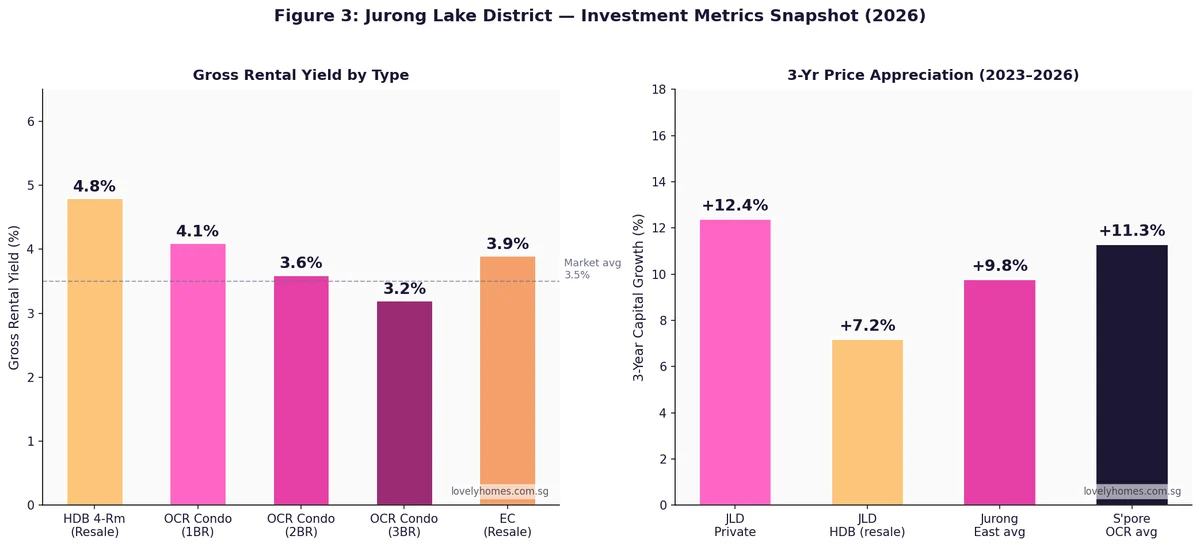
  • Gross rental yield: HDB 3-room 3.8%  |  private condo 2.9–3.4% — lower than OCR averages, reflecting Bishan’s capital appreciation premium.
  • 3-year capital growth (2023–2026): HDB 5-room +8.9%  |  private condo (2BR) +12.5% — outperforming the national average.
  • June 2026 BTO: HDB will offer new flats in Bishan as part of the June 2026 exercise — likely Plus or Prime classification given the mature estate status and MRT proximity.
  • Supply scarcity: Bishan has approximately 19,665 HDB flats and virtually no land for new private residential GLS — a structural supply constraint that supports long-term price stability.

Introduction: Bishan’s Enduring Premium in Singapore’s Property Market

Bishan is one of Singapore’s most sought-after HDB towns — and arguably the one that most consistently defies the public-housing price ceiling. With a median HDB resale price of approximately S$850,000 across 411 transactions in the first four months of 2026 — including executive and multi-generation flats commanding S$1.27M–S$1.39M — Bishan sits in a property tier that bridges the gap between HDB and private condominium ownership in a way that few other towns manage.

The estate was gazetted in the 1980s on land previously used as the Peck Shan Theng cemetery, and its development was carefully planned around three anchors that have proven durable: first-class MRT connectivity (it hosts one of only four NSL–CCL interchanges in Singapore), a concentrated school corridor anchored by Raffles Institution and Catholic High, and the 62-hectare Bishan–Ang Mo Kio Park — one of Singapore’s largest urban nature parks. These structural advantages have made Bishan one of the most defensible property markets on the island, capable of holding value even during market corrections.

In 2026, three dynamics are shaping Bishan’s market: the continued migration of HDB upgraders from surrounding estates seeking established schools and park proximity; the resurgence of private condo interest in a supply-constrained district where no major new launch has occurred since 2021; and the announcement of the June 2026 BTO exercise, which will add new flats likely classified as Plus under HDB’s new framework — carrying a 10-year MOP and subsidy clawback provisions that will moderate resale supply for a decade.
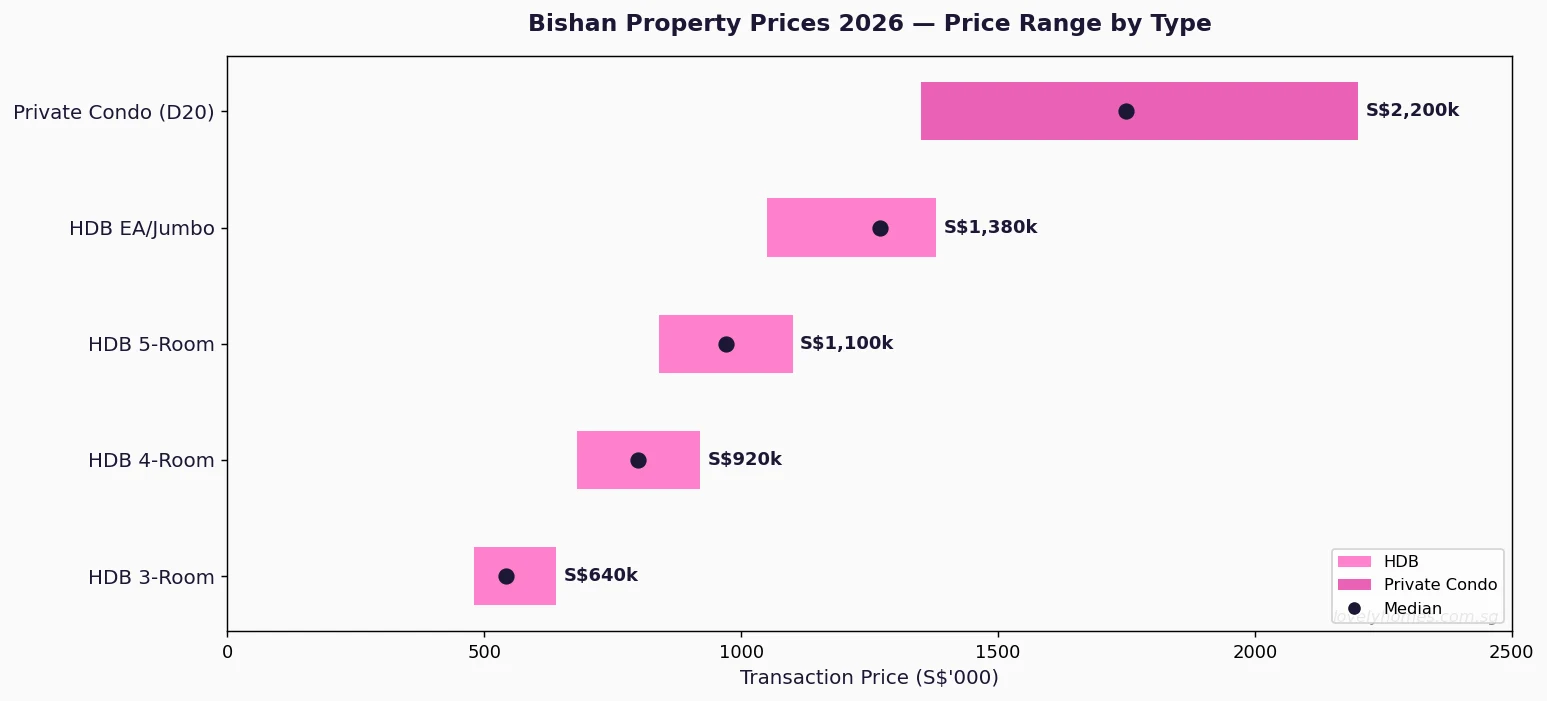
Bishan property prices 2026 — HDB 3-room to private condo price range by type
Figure 1: Bishan property price ranges by type, 2026. Dots indicate median transaction prices. Source: HDB Resale Portal, URA REALIS caveats May 2026.

Property Market Overview: HDB Resale Prices in Bishan 2026

Bishan’s HDB resale market is characterised by premium pricing relative to most OCR and even many RCR estates, underpinned by genuine demand from school-corridor buyers and MRT interchange seekers. Price growth over the past three years has been moderate but consistent — approximately 7–9% for 4-room and 5-room flats — without the sharp corrections seen in Queenstown (which experienced cooling-measure headwinds in 2023).

Three-room flats, representing an older and less actively traded segment in Bishan, transact at S$480,000–S$640,000, with a median of approximately S$542,000. Four-room flats — the estate’s most traded category with 199 transactions in the first four months of 2026 — record a median of S$800,000 and a range of S$680,000–S$920,000. Five-room units, popular with larger families and CPF-flush upgraders, command S$840,000–S$1.1M. Executive Apartments and multi-generation units, found in blocks like Bishan Street 22 and Street 24, are transacting at S$1.05M–S$1.38M — firmly within the million-dollar flat segment.

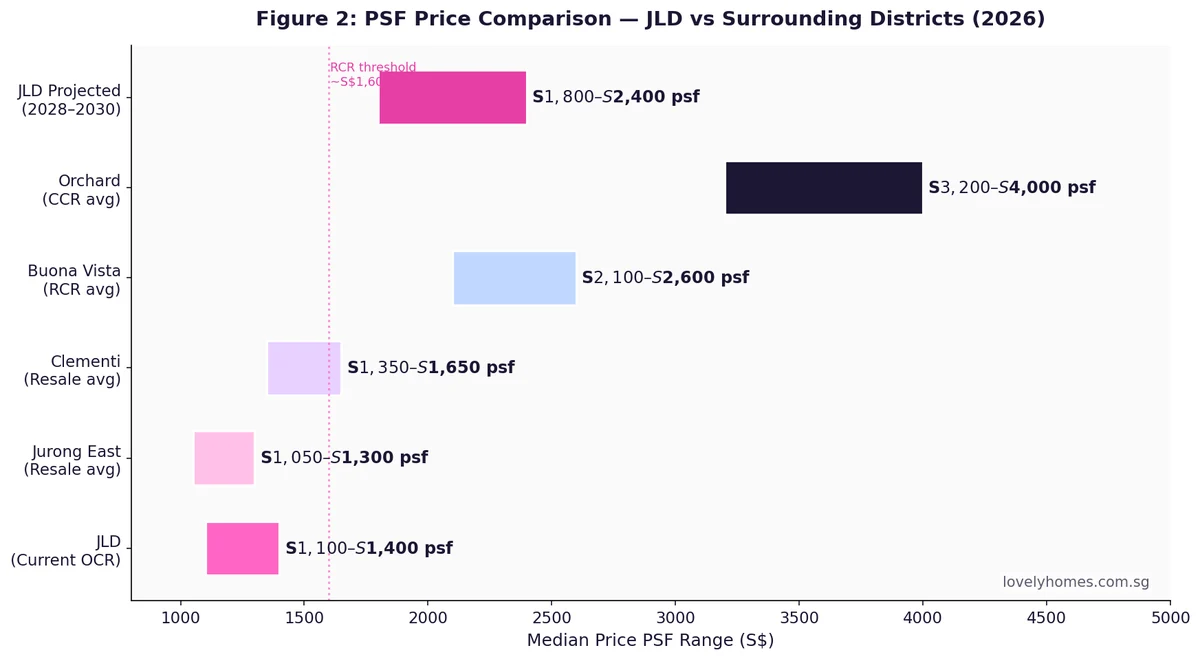
On the private residential side, District 20 condominiums including Clover by the Park, Bishan 8, and the freehold Thomson Three have seen prices range from S$1.35M (smaller 1-bedroom units) to S$2.2M (3-bedroom). The median private transacted price is approximately S$1,750 per square foot, reflecting the district’s premium over OCR benchmarks of S$1,100–S$1,400 psf.

Bishan’s Three Subzones: Where Within the Estate Matters

Bishan is divided into three primary subzones: Bishan East, Upper Thomson, and Marymount, each with a distinct character and proximity profile.

Bishan East is the commercial and transport core, centred on Bishan MRT station (NSL and CCL interchange) and Junction 8 shopping mall. Flats in Bishan East command the highest premiums within the estate, typically 8–12% above the town average for equivalent flat types, owing to walkability to the MRT interchange and the concentration of retail, F&B, and services at Junction 8. This subzone is the preferred choice for transport-prioritising buyers and rental investors targeting working professionals.

Upper Thomson spans the northern portion of the estate bordering Marymount Road and Lower Peirce Reservoir. This is Bishan’s most park-proximate subzone, with cycling access to the Lower Peirce Reservoir Trail and a quieter, residential character. Older private condominiums in Upper Thomson — a few are freehold — attract long-term owner-occupiers who value the green-belt surroundings. The Thomson–East Coast Line (TEL) Caldecott station, while technically in Toa Payoh, is a short bus ride from Upper Thomson, providing an additional connectivity layer.

Marymount is served by Marymount MRT (CCL) and is characterised by a mix of relatively newer HDB blocks (1990s–2000s build) and private landed properties along Marymount Lane and Marymount Terrace. Proximity to Thomson Medical Centre and the Catholic High campus makes Marymount a particularly attractive subzone for young families and medical professionals.
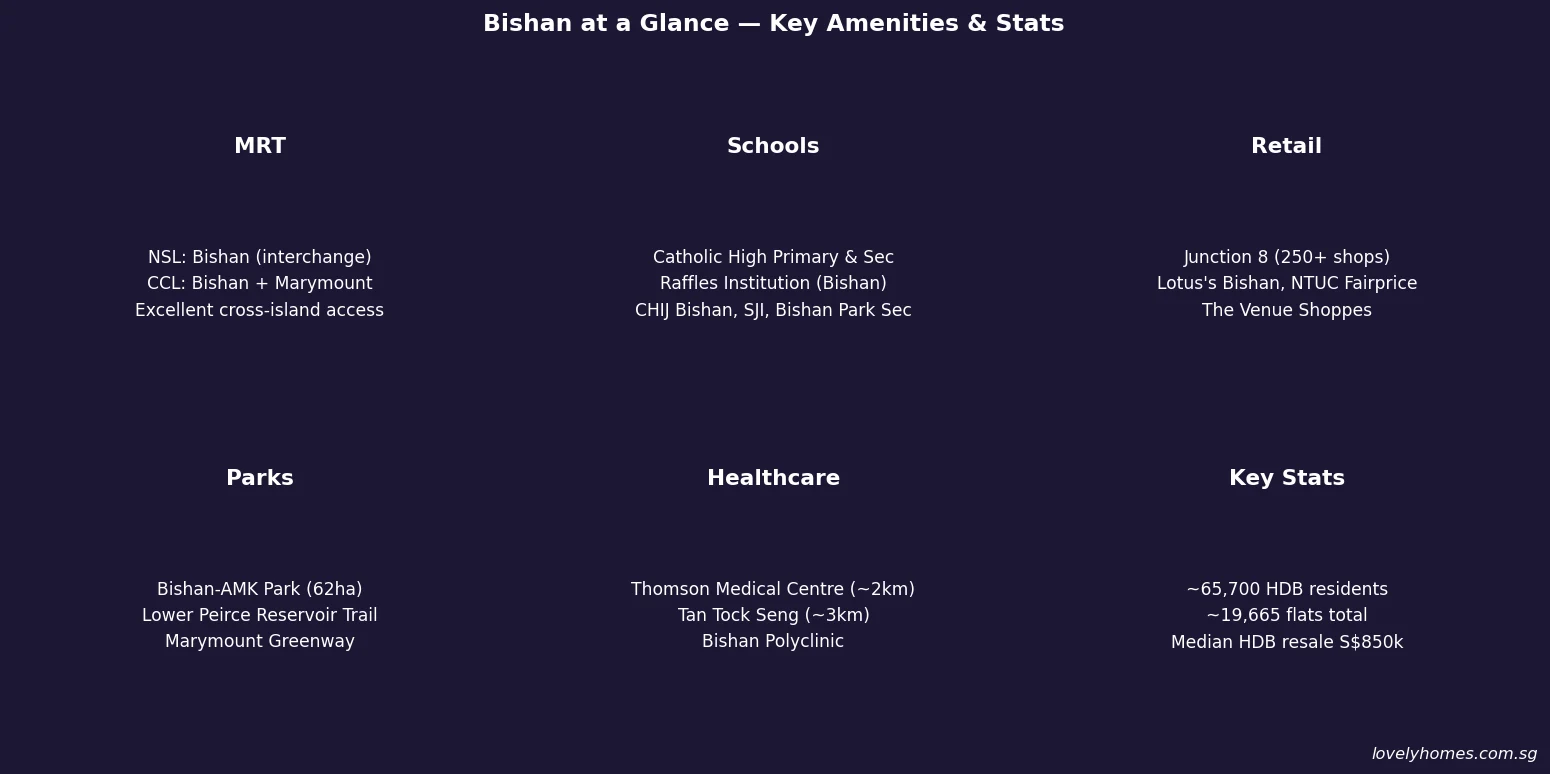
Bishan neighbourhood amenities 2026 — MRT, schools, retail, parks, healthcare and key stats
Figure 2: Bishan neighbourhood amenities and key statistics 2026. Source: HDB, LTA, MOE, SingStat, MOH.

MRT Connectivity: The Double-Interchange Advantage

Bishan station is one of the most connected interchange stations on the Singapore MRT network. As an NSL–CCL interchange, it provides direct access to the North–South Corridor (Orchard in 15 minutes, City Hall in 21 minutes) and the Circle Line (one-stop to Braddell and Marymount; direct to one-north, Harbourfront, and Dhoby Ghaut via the CCL loop). The addition of Marymount station, a further CCL stop within the estate, means Bishan has effectively three MRT access points — a density matched only by estates like Queenstown and Outram.

For buyers evaluating Bishan against comparable mature estates like Toa Payoh (NSL only) or Serangoon (NEL and CCL, but no NSL), the double-interchange MRT profile is a structural differentiator that justifies the Bishan price premium. Commute times to major employment nodes — Raffles Place (24 min), one-north (25 min via CCL), Marina Bay (28 min) — are competitive with several RCR estates at substantially higher prices.

School Corridor: One of Singapore’s Most Concentrated

Bishan’s school corridor is one of the most concentrated in Singapore. Within the estate or within a 1-kilometre radius of the HDB heartland, buyers can access Catholic High Primary School (PSLE-top-stream feeder to Catholic High Secondary, which offers the Integrated Programme to Raffles Institution); CHIJ Our Lady of the Nativity (Primary); Raffles Institution (Secondary, Bishan campus — one of the two RI campuses); Bishan Park Secondary; and St Joseph’s Institution (SJI), accessible via the CCL from Bishan station in two stops.

For families who run their housing search on school proximity, the 1-kilometre priority registration boundary around Catholic High Primary or Raffles Institution alone can justify a S$50,000–S$100,000 price premium on Bishan flats over equivalent flat types in neighbouring Ang Mo Kio. The Ministry of Education administers school registration via Phase 2A and Phase 2B ballots, and school proximity continues to be a documented driver of HDB resale premiums in established educational corridors.

Summary Table: Bishan Property at a Glance

Property Type Price Range (2026) Median Price Gross Rental Yield Notes
HDB 3-Room S$480k – S$640k S$542k ~3.8% Older stock; limited supply in Bishan East
HDB 4-Room S$680k – S$920k S$800k ~3.5% Most actively traded (199 txns Q1 2026); strong upgrader demand
HDB 5-Room S$840k – S$1.1M S$970k ~3.2% Near MRT commands top of range; 10-yr MOP for new BTO Plus flats
HDB EA / Multi-Gen S$1.05M – S$1.39M S$1.27M ~2.8% Million-dollar category; limited supply; high demand from multi-gen families
Private Condo (D20) S$1.35M – S$2.2M ~S$1.75M ~2.9–3.4% Freehold premium at Upper Thomson; 99-yr at Bishan East; supply-constrained

Rental Market and Investment Yield

Bishan’s rental market is smaller and more selective than Sengkang or Woodlands, reflecting the estate’s owner-occupier character. However, demand is consistent from two distinct renter pools: professionals and expat families drawn by the school corridor (who are often willing to pay a premium for proximity to Raffles Institution and Catholic High), and working professionals who prioritise the MRT interchange commute access.

Three-room flats achieve S$2,800–S$3,200 per month; four-room S$3,200–S$3,800; five-room S$3,800–S$4,500. Private condominiums achieve S$3,800–S$5,200 for one-bedroom units and S$5,000–S$7,200 for two-bedroom units. Gross yields, at 2.9–3.8%, are below OCR averages — but this reflects the capitally appreciated base price, not weak rental demand. The trade-off is capital appreciation: Bishan private condos have delivered approximately 12.5% three-year capital growth, meaningfully above the OCR average of 9.5–10%.
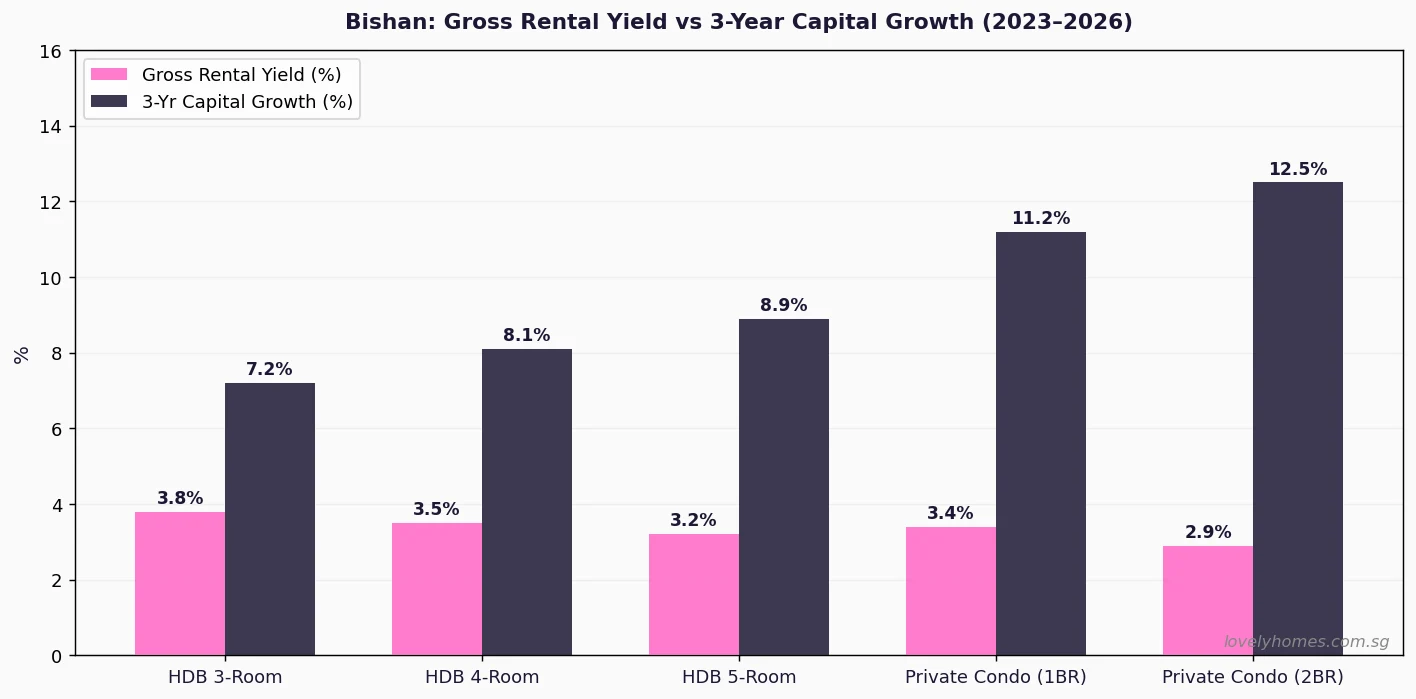
Bishan gross rental yield vs 3-year capital growth 2023–2026 by property type
Figure 3: Bishan gross rental yield vs 3-year capital growth by property type, 2023–2026. Source: LovelyHomes analysis based on HDB Resale Portal and URA REALIS caveats data.

Worked Example: Mr & Mrs Ng — SC Couple Buying First Private Property in Bishan (D20)

Mr and Mrs Ng are Singapore Citizens. They have sold their Bishan HDB flat (MOP cleared) at S$870,000, netting approximately S$620,000 after repaying HDB loan and CPF accrued interest. They plan to purchase a 2-bedroom 99-year leasehold condo in Bishan East at S$1.48M.

BSD on S$1.48M: First S$180,000 × 1% = S$1,800  |  Next S$180,000 × 2% = S$3,600  |  Next S$640,000 × 3% = S$19,200  |  Remaining S$480,000 × 4% = S$19,200  |  Total BSD = S$43,800

ABSD: Nil — SC couple purchasing their first private property; no ABSD applies to Singapore Citizens on their first residential property purchase under the Stamp Duties Act (Cap. 312).

Bank Loan (75% LTV): S$1,110,000 at 1.80% fixed (2-year) → estimated monthly instalment S$4,603. Total Debt Servicing Ratio (TDSR): assuming household income S$14,000/month → TDSR = 32.9% (within the 55% cap, but approaching the prudent 40% threshold).

Cash outlay: 5% cash down S$74,000 + BSD S$43,800 + legal/conveyancing S$5,500 = approximately S$123,300 cash. Remaining 20% down (S$296,000) via CPF OA from sale proceeds.

Capital growth scenario: At a conservative 8% three-year growth rate (below Bishan’s 2023–2026 actual of 12.5%), the property would be worth approximately S$1.6M by 2029, a paper gain of S$120,000. Gross yield at S$6,200/month rent (market rate) = 5.02% on current price — though net yield after BSD amortisation, maintenance, and tax would be approximately 3.2%.

Why Bishan Commands a Premium: The Scarcity Equation

Bishan’s premium over comparable OCR markets is not simply a function of present amenities — it is a function of structural supply scarcity compounded by high-quality demand anchors. Unlike Tengah, Punggol North, or Woodlands Regional Centre, where URA’s Master Plan has allocated substantial new land for development, Bishan has effectively no large vacant parcels. The estate’s GLS pipeline for private residential under the 1H 2026 Confirmed List does not include any Bishan sites — nor has any Bishan private residential site appeared on the reserve list since 2022.

This supply constraint, when combined with consistently high demand from school-corridor buyers, MRT-interchange seekers, and portfolio investors who appreciate the defensive characteristics of the estate, creates a price floor that has proven resilient across multiple cooling-measure cycles. Bishan HDB resale prices fell by less than 3% during the 2023 policy tightening (15-month wait-out period for private downgraders), compared with declines of 5–8% in Tampines and Pasir Ris.

For investors, the implication is clear: Bishan is not a high-yield market, but it is arguably the most capital-efficient defensive hold in Singapore’s public-housing sector. The combination of school corridor premium, MRT interchange access, park proximity, and supply scarcity makes Bishan uniquely resistant to the demand shocks that afflict more peripheral estates.

What Might Come Next: Bishan in 2027–2030

This section is forward-looking speculation and should not be taken as a guarantee of future performance.

The June 2026 BTO exercise will add new Bishan flats, likely classified as Plus under HDB’s Standard–Plus–Prime framework given the estate’s mature status and proximity to Bishan MRT interchange. Plus classification implies a 10-year MOP and a subsidy clawback on resale for the first eligible buyer — provisions that will suppress the resale supply of these new flats until approximately 2036. In the near term (2026–2031), this means resale supply remains tight, supporting existing Bishan HDB resale prices.

The Thomson–East Coast Line (TEL) is already operational at Caldecott (one stop north of Bishan on the CCL), connecting Bishan to the Orchard–Marina Bay–East Coast corridor without transfers. As TEL’s full extension to Changi Airport East completes by 2027, the indirect accessibility uplift for Bishan buyers will be material — TEL has already catalysed price premiums at stations along the Caldecott–Napier corridor.

On the private market, any new GLS announcement for Bishan — however unlikely — would create a supply shock. The more probable scenario is continued price appreciation of 5–9% over 2026–2028 driven by scarcity and school corridor demand, potentially pushing the median Bishan private condo above S$2,000 psf by 2028.

Is Bishan a good place to buy property in Singapore?

Bishan is one of Singapore’s strongest all-round property estates. It offers premium school corridor access (Raffles Institution, Catholic High), exceptional MRT connectivity (NSL–CCL double interchange), park-proximate living (Bishan–AMK Park), and supply scarcity that underpins long-term price stability. The primary trade-off is price: HDB 4-room flats median at S$800,000 and private condos well above S$1.35M, making Bishan one of the most expensive HDB estates in Singapore. For buyers who can afford entry, the defensive capital appreciation characteristics are arguably unmatched outside the CCR.

What are HDB resale prices in Bishan in 2026?

Based on HDB Resale Portal caveats through April 2026, Bishan HDB resale prices are approximately: 3-room S$480,000–S$640,000 (median S$542,000); 4-room S$680,000–S$920,000 (median S$800,000); 5-room S$840,000–S$1.1M (median S$970,000); EA/Multi-Gen S$1.05M–S$1.39M (median S$1.27M). The overall estate median across all flat types is approximately S$850,000 — placing Bishan among the top five most expensive HDB estates in Singapore alongside Queenstown, Toa Payoh, Clementi, and Buona Vista.

How does Bishan compare to Ang Mo Kio and Toa Payoh for property investment?

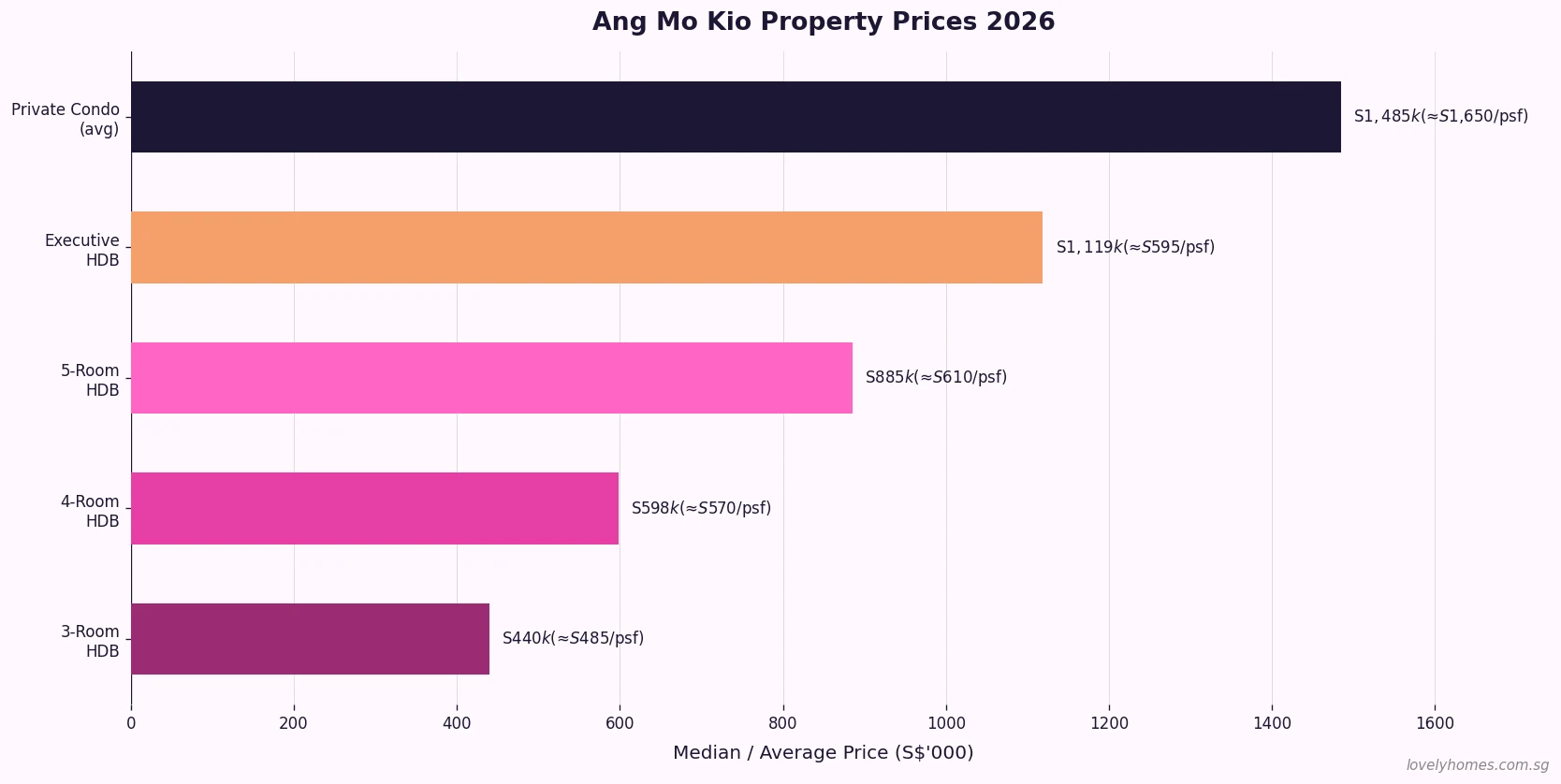
All three are mature, centrally located NSL estates with strong amenity profiles. Bishan commands the highest prices due to its CCL interchange and superior school corridor. Ang Mo Kio (median 4-room ~S$650k) offers better affordability with strong amenities and CRL Phase 2 upside (~2031); Toa Payoh (median 4-room ~S$720k) has the added advantage of TEL Caldecott access and proximity to the city fringe. For yield-focused investors, Ang Mo Kio typically offers slightly better gross yields (3.8–4.2% for 4-room) than Bishan (3.5%); for capital appreciation and defensive holding, Bishan’s supply scarcity and demand anchors make it the preferred choice.

Which schools are near Bishan HDB flats?

Within or immediately adjacent to Bishan estate: Catholic High Primary School (Phase 2A feeder to Catholic High Secondary and Raffles Institution IP); CHIJ Our Lady of the Nativity (Primary); Raffles Institution (Secondary, Bishan campus — IP programme, no O-Level); Bishan Park Secondary School. Within a 2-kilometre radius: Marymount Convent School, St Gabriel’s Primary and Secondary, Peirce Secondary. At the junior college level, Raffles Institution’s Year 5–6 (JC equivalent) is on the same campus. Families prioritising Catholic High Primary should note that Priority Phase 2A admission is conditional on a sibling or parent who is an alumnus or active church member of the affiliated parishes.

Will the June 2026 BTO flats in Bishan be classified as Plus or Prime?

HDB has not yet published the June 2026 BTO flat type classifications at the time of this article’s publication (May 2026). However, based on URA’s Master Plan zoning and HDB’s stated criteria — which factor in MRT proximity, amenity density, and mature estate status — Bishan flats near Bishan MRT interchange are likely candidates for Plus classification (10-year MOP, subsidy clawback on resale to eligible buyers) rather than Standard (5-year MOP). Buyers should check HDB’s official BTO portal (homes.hdb.gov.sg) once the exercise launches for confirmed classification. A Plus classification does not affect the flat’s capital appreciation potential but does restrict near-term resale flexibility.

Can foreigners or PRs buy HDB flats in Bishan?

Permanent Residents (PRs) may purchase HDB resale flats in Bishan subject to the standard eligibility conditions: a minimum 3-year PR status, formation of a family nucleus with at least one Singapore Citizen or another PR, and no concurrent ownership of private property. PRs are not eligible to purchase new BTO flats. Foreigners (non-PRs) cannot purchase HDB flats under the Housing and Development Act. Foreigners may purchase private condominiums in Bishan (District 20) subject to 65% ABSD administered by IRAS. There are no additional restrictions specific to Bishan beyond the standard national eligibility framework.

What is Bishan-AMK Park and how does it affect property values?

Bishan–Ang Mo Kio Park is a 62-hectare urban park jointly developed by NParks and the Public Utilities Board (PUB) as part of the Active, Beautiful, Clean Waters (ABC Waters) programme. The park features a naturalised river channel, extensive green space, wetland habitats, and recreational facilities including a swimming complex and multiple playgrounds. Research by academics at the National University of Singapore has documented a statistically significant price premium of 3–6% for HDB flats within 500 metres of Bishan–AMK Park, relative to equivalent flats further from the park boundary. This proximity premium is one of several quantifiable amenity factors that support Bishan’s above-market HDB resale valuations.
Disclaimer: This article is published for general informational purposes only and does not constitute financial, investment, or legal advice. Property transaction prices referenced are based on publicly available HDB Resale Portal and URA REALIS caveats data as at May 2026 and are subject to change. All worked examples are illustrative only. School registration eligibility, BTO flat classifications, and HDB eligibility rules are administered by the Ministry of Education (MOE) and Housing & Development Board (HDB) respectively; please verify current conditions at www.moe.gov.sg and www.hdb.gov.sg. Buyers and sellers should seek professional advice from a CEA-registered licensed estate agent, a qualified solicitor, and a licensed mortgage adviser before making any property decision.

Woodlands Neighbourhood Guide Singapore 2026: Property Prices, Schools, MRT and Investment Outlook

Woodlands Neighbourhood Guide Singapore 2026: Property Prices, Schools, MRT and Investment Outlook

Quick Answer: Woodlands Neighbourhood at a Glance

  • HDB resale prices (2026): 3-room S$290k–S$420k  |  4-room S$420k–S$590k  |  5-room S$560k–S$780k — among the most affordable in Singapore.
  • Private condo: Woodlands Horizon, Parc Rosewood and Woodgrove Edge in the S$1,050k–S$1,450k range; Woodlands Arc EC S$890k–S$1.1M.
  • MRT: Woodlands and Marsiling on the North–South Line (NSL); Woodlands North will join the Johor–Singapore Rapid Transit System (RTS) and a future Jurong Regional Line extension.
  • Schools: Innova Primary, Innova Junior College, St Joseph’s Institution International (Woodlands campus), Republic Polytechnic — a strong school corridor for families.
  • Gross rental yield: HDB 4-room 4.6%  |  private condo 3.5–4.1% — above the national OCR average.
  • 3-year capital growth (2023–2026): HDB 4-room +5.8%  |  private condo +9.1%.
  • Cross-border catalyst: The Johor–Singapore RTS Link (opening ~2027) and Woodlands North MRT station will materially improve Malaysia–Singapore commuter flows, lifting rental demand and property values in Woodlands.
  • June 2026 BTO: HDB will offer new flats in Woodlands as part of the June 2026 Build-To-Order exercise — first-timers should register their interest by the application window.

Introduction: Why Woodlands Stands Apart in Singapore’s North

Woodlands is Singapore’s largest northern residential town, covering approximately 35.7 square kilometres and housing roughly 243,600 residents across 11 subzones including Woodlands East, Woodgrove, Marsiling, and Admiralty. Administered under the Urban Redevelopment Authority’s (URA) Master Plan 2019 and developed over several decades by the Housing & Development Board (HDB), Woodlands has long been associated with affordability — but in 2026 the narrative is shifting.

Three structural catalysts are converging to reshape Woodlands’ investment case. First, the Johor–Singapore Rapid Transit System (RTS Link), under construction since 2020 and targeted to open in 2027, will directly connect Woodlands North station to Bukit Chagar in Johor Bahru. Second, the Jurong Regional Line extension (JRL Phase 2, projected ~2030) will add Woodlands North as an interchange hub. Third, the Woodlands Regional Centre — gazetted under URA’s Master Plan as a major commercial node to complement the Jurong Lake District — is in the early stages of building out office, retail, and mixed-use space. Together, these infrastructure plays make Woodlands the single northern district most directly exposed to the Greater Southern Waterfront–Johor corridor growth story.

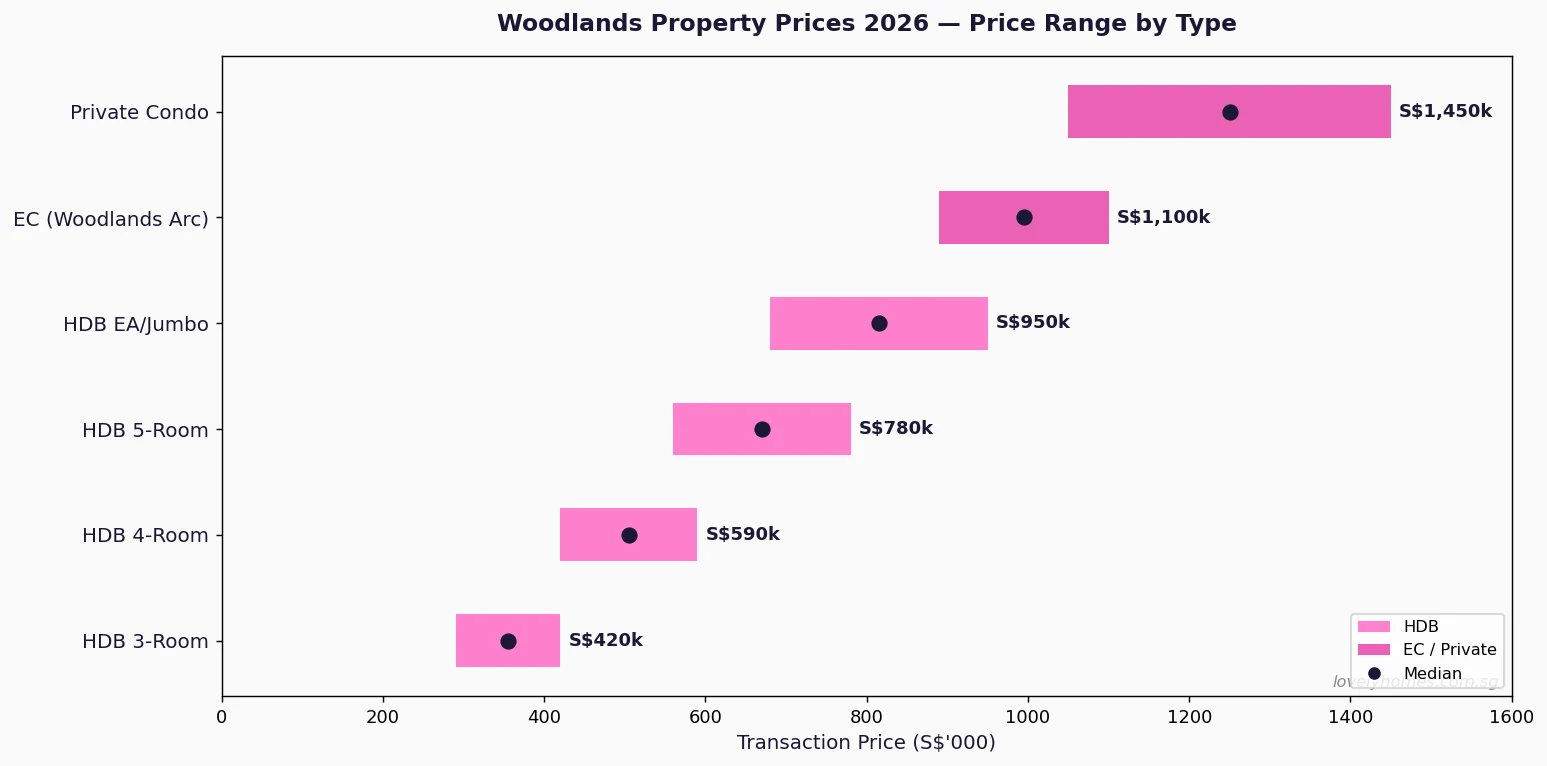
Woodlands property prices 2026 — HDB 3-room to private condo price range by type
Figure 1: Woodlands property price ranges by type, 2026. Dots indicate median transaction prices. Source: HDB Resale Portal, URA caveats May 2026.

Property Market Overview: HDB Resale Prices in Woodlands 2026

Woodlands remains one of Singapore’s most accessible property markets. HDB resale prices have grown modestly — roughly 2–4% year-on-year since 2023 — supported by genuine upgrader demand and the RTS catalyst, but without the speculative froth seen in Queenstown or Bishan. This makes Woodlands an attractive entry point for first-time buyers and a stable yield-play for investors.

Based on HDB resale transaction caveats lodged through April 2026, the typical price benchmarks in Woodlands are as follows. Three-room flats transact in the S$290,000–S$420,000 range, with a median around S$355,000. Four-room flats — the most actively traded segment — sit at S$420,000–S$590,000 (median S$505,000). Five-room units, which attract HDB upgraders and larger families, command S$560,000–S$780,000 (median S$670,000). Executive Apartments and jumbo flats, found mostly in the older Marsiling and Woodlands East precincts, transact at S$680,000–S$950,000.

On the private side, 99-year leasehold condominiums including Woodlands Horizon, Woodgrove Edge, and the newer Parc Rosewood range from S$1,050,000 to S$1,450,000 depending on floor and unit type. Woodlands Arc, a privatised executive condominium that passed its 10-year mark, trades at S$890,000–S$1,100,000 — offering a mid-market private-property foothold unavailable in more expensive districts.

Woodlands Precincts: Knowing Where to Buy

Woodlands is not a monolithic town. It is best understood in four distinct sub-areas, each with its own character and price dynamics.

Marsiling (Subzone): The western edge abutting Woodlands Industrial Park. HDB flats here are among the cheapest in Singapore — 3-room units regularly transact below S$350,000 — owing to the industrial surroundings and older stock. However, proximity to Marsiling MRT and the Causeway provides genuine rental demand from logistics and manufacturing workers.

Woodlands Central / Civic: The commercial heart anchored by Causeway Point (450+ retail units), Woodlands Civic Centre, and the MRT interchange. Flats here carry a 5–8% premium over the town average, and rental demand is consistent. Redevelopment of the Woodlands Regional Centre under URA’s Master Plan will add Grade-A commercial space and improve the district’s white-collar employment base over the 2028–2035 horizon.

Woodgrove / Admiralty (North): The precinct most proximate to Woodlands North MRT and the RTS Link terminus. Premium HDB flats, executive condominiums (including Woodlands Arc), and landed enclave Cassia Drive sit in this zone. The RTS catalyst premium is most directly priced in here — and many analysts expect an additional 5–10% uplift on units closest to Woodlands North station once operations commence in 2027.

Woodlands East / Greenridge: Quieter, more residential character. Good school corridor (SVPS, Woodlands Ring Secondary), proximity to Bishan–AMK Park via Mandai Road cycling connections, and Woodlands Waterfront Park. Suitable for owner-occupiers prioritising green space over commercial bustle.

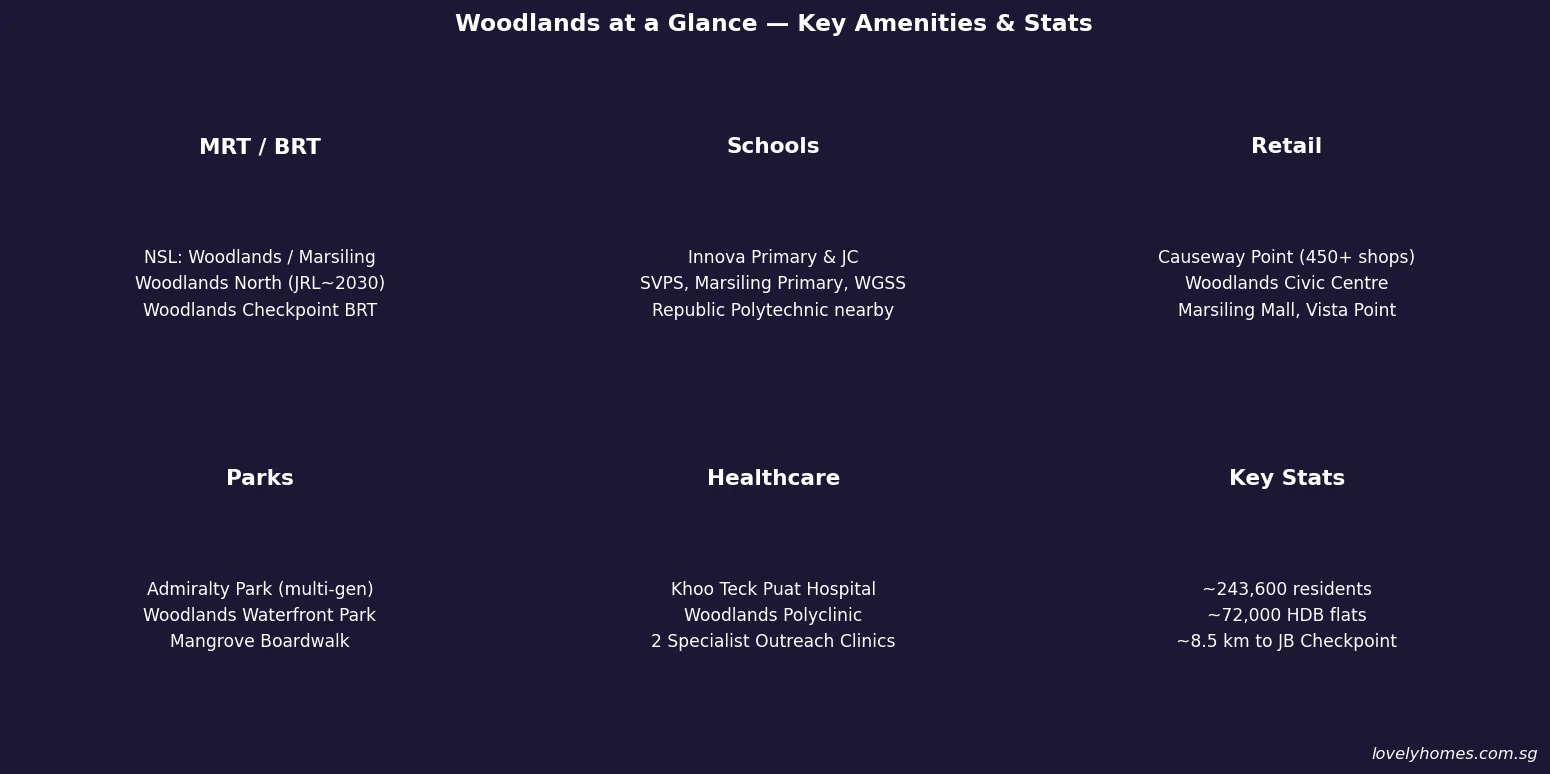
Woodlands neighbourhood amenities 2026 — MRT, schools, retail, parks, healthcare and key stats
Figure 2: Woodlands neighbourhood amenities and key statistics 2026. Source: HDB, LTA, MOE, SingStat.

MRT Connectivity: NSL, RTS and the JRL Factor

Woodlands currently has two North–South Line stations: Woodlands (NS9) and Marsiling (NS8). The NSL gives direct access to Orchard Road in approximately 35 minutes and City Hall in 42 minutes — commute times that are competitive with many RCR condominiums at three times the price.

The Johor–Singapore RTS Link will add a third major station: Woodlands North (NS7.5, informally), which will function as Singapore’s connection point to the RTS system’s Bukit Chagar terminus in Johor Bahru. The Land Transport Authority (LTA) confirmed in April 2026 that tunnelling works are progressing on schedule, with the target operational date remaining 2027. For investors, this matters because daily cross-border commuter volumes of 100,000+ are projected by the JTC-linked Johor–Singapore Special Economic Zone (SEZ) task force — many of whom will need accommodation on the Singapore side of the checkpoint.

The JRL Phase 2 extension to Woodlands North, while confirmed under LTA’s long-term network plan, remains targeted for approximately 2030. Once operational, Woodlands North will be the most connected station in Singapore’s north — providing NSL, RTS, and JRL access from a single interchange, elevating the district to a genuinely multi-modal regional hub.

Schools: A Strong Family Corridor

Education infrastructure in Woodlands is robust for a non-premium estate. At the primary level, Innova Primary School, Marsiling Primary, Sun Yat Sen Memorial Primary (SVPS), Woodlands Primary, and Fuchun Primary provide broad coverage. Secondary options include Woodlands Ring Secondary, Marsiling Secondary, and the integrated programme at Innova Junior College, which offers the IP track without requiring the O-Level examination. For international families, SJI International’s Woodlands campus caters to the growing expatriate community attracted by proximity to the Causeway.

At the tertiary level, Republic Polytechnic’s campus is located in Woodlands, making it a convenient option for students pursuing Polytechnic education and a consistent driver of rental demand from student accommodation seekers.

Summary Table: Woodlands Property at a Glance

Property Type Price Range (2026) Median Price Gross Rental Yield Notes
HDB 3-Room S$290k – S$420k S$355k ~4.8% Older stock in Marsiling; good entry point
HDB 4-Room S$420k – S$590k S$505k ~4.6% Most traded segment; upgrader demand strong
HDB 5-Room S$560k – S$780k S$670k ~4.2% Woodgrove/Admiralty units at top end
HDB EA / Jumbo S$680k – S$950k S$815k ~3.9% Limited supply; older Marsiling blocks
EC (Woodlands Arc) S$890k – S$1.1M S$995k ~3.8% Privatised EC; 99-year lease commenced ~2004
Private Condo S$1.05M – S$1.45M S$1.25M ~3.5–4.1% 99-yr; Woodlands Horizon, Parc Rosewood

Rental Market and Investment Yield

Woodlands’ proximity to the Johor–Singapore Checkpoint, Republic Polytechnic, and Woodlands Industrial Park sustains consistent rental demand across all flat types. Three-room flats command S$2,300–S$2,700 per month; four-room flats S$2,800–S$3,400; five-room units S$3,200–S$3,900. Private condominiums achieve S$3,800–S$5,000 for one-bedroom units and S$4,800–S$6,500 for two-bedroom units.

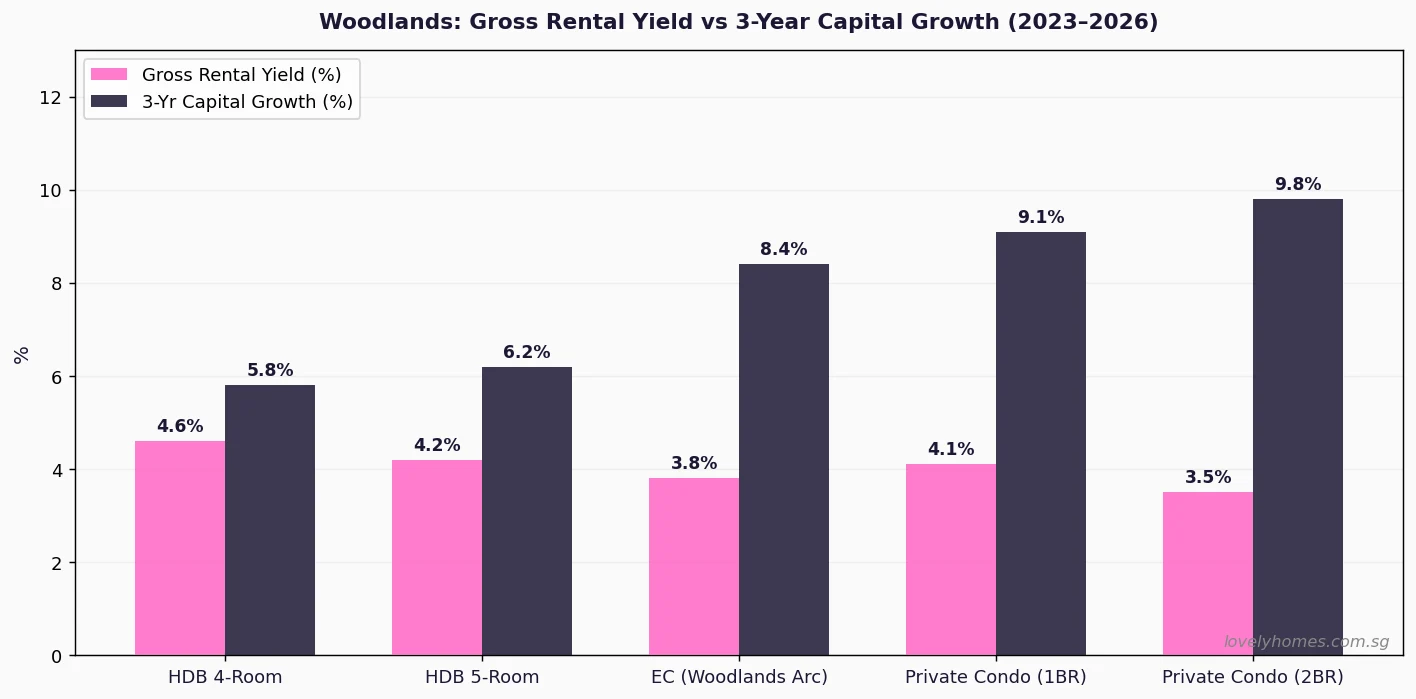
Gross rental yields for HDB flats range from 3.9% (EA/Jumbo) to 4.8% (3-room), outperforming the Singapore-wide HDB average of approximately 4.2%. Private condo yields sit at 3.5–4.1%, modestly above the OCR average and substantially above CCR private properties (typically 2.5–3.2%). Net yields — after conservatively accounting for property tax, maintenance, and vacancy — are approximately 1.1–1.4 percentage points below gross figures.

Woodlands gross rental yield vs 3-year capital growth 2023–2026 by property type
Figure 3: Woodlands gross rental yield vs 3-year capital growth by property type, 2023–2026. Source: LovelyHomes analysis based on HDB Resale Portal and URA caveats data.

Worked Example: Mr & Mrs Yeo — SC Couple Upgrading from Yishun HDB to Woodlands 5-Room

Mr and Mrs Yeo are Singapore Citizens. They are selling their Yishun 4-room HDB (purchased 2019, MOP clears January 2025) at S$565,000, netting approximately S$420,000 after repaying the outstanding HDB loan and CPF accrued interest. They plan to buy a 5-room HDB flat in Woodlands Admiralty at S$698,000.

BSD on S$698,000: First S$180,000 × 1% = S$1,800  |  Next S$180,000 × 2% = S$3,600  |  Next S$338,000 × 3% = S$10,140  |  Total BSD = S$15,540

ABSD: Nil — SC couple selling existing flat within 6 months of new purchase triggers the married-couple ABSD remission; since this is a resale HDB transaction (HDB-to-HDB), the SC couple is not liable for ABSD on a concurrent second property if the first is disposed of within the stipulated window administered by the Inland Revenue Authority of Singapore (IRAS).

HDB Loan (80% LTV): S$558,400 at 2.6% p.a. over 25 years → estimated monthly instalment S$2,528. Mortgage Servicing Ratio (MSR): assuming household income S$9,800/month → MSR = 25.8% (within the 30% cap).

Cash outlay: 5% cash down S$34,900 + BSD S$15,540 + legal/conveyancing S$2,200 = approximately S$52,640 cash. Balance down payment via CPF OA from sale proceeds.

Why Woodlands Matters for Singapore Property Buyers in 2026

The prevailing narrative that Woodlands is purely an affordability play understates its structural investment merits. The RTS Link positions Woodlands as Singapore’s gateway to the Johor–Singapore Special Economic Zone, where the Malaysian and Singapore governments have jointly announced approximately RM25 billion in planned investment through 2030. That employment and infrastructure activity will translate into sustained demand for housing on both sides of the Causeway — but Singapore-side proximity to the RTS terminus is the most accessible entry point for Singapore-credentialed investors.

On the supply side, Woodlands benefits from a relatively constrained pipeline of new private launches compared with OCR markets like Tampines or Tengah. No major private residential GLS site in Woodlands is on the URA confirmed list for 1H 2026, meaning rental vacancy is contained and HDB upgraders looking to transition into the private segment face limited new competition.

For HDB upgraders specifically, the combination of affordable entry price (median 5-room under S$700,000), strong rental demand, and above-average yields makes Woodlands one of the most compelling hold-and-rent propositions in the Outside Central Region.

What Might Come Next: Woodlands in 2027–2030

This section represents informed market speculation and should not be taken as a guarantee of future performance. Based on confirmed infrastructure timelines and existing market data, several developments could materially affect Woodlands property values over the next four years.

The RTS Link opening (~2027) is the single most watched event. If daily boardings reach 30,000–50,000 within the first 12 months — as modelled by LTA in its 2020 EIA — rental demand for Woodlands North-proximate units could increase by 15–25%, compressing yields even as prices rise. Units within a 10-minute walk of Woodlands North MRT are most exposed to this potential uplift.

The Woodlands Regional Centre buildout (2028–2035) will add Grade-A office space, a potential hospital expansion at Khoo Teck Puat, and mixed-use retail–residential nodes. This mirrors the JLD model, where the announcement of the Cross Island Line and JLD MCP spurred private price growth even before construction completed.

The June 2026 BTO exercise in Woodlands will add new Standard-classified flats to the pipeline. Standard flats carry a 5-year MOP, making them available for resale from approximately 2031. Near-term HDB resale supply is therefore unlikely to increase substantially before 2030, providing a supply floor that supports prices.

Is Woodlands a good place to buy property in Singapore?

Woodlands is a strong choice for buyers seeking affordability combined with meaningful upside from infrastructure catalysts. It offers some of the lowest entry prices for HDB resale and private property in Singapore, a robust school corridor, reliable rental demand from cross-border workers and polytechnic students, and direct exposure to the RTS Link growth story. The caveat is that Woodlands does not share the prestige premium of mature estates like Bishan or Queenstown — buyers prioritising status value over fundamental yield should look elsewhere.

Which MRT stations serve Woodlands?

Woodlands is currently served by two North–South Line (NSL) stations: Woodlands (NS9) and Marsiling (NS8). Woodlands North (NS7.5), under the NSL extension, will serve as the Singapore terminus of the Johor–Singapore RTS Link, targeted to open in 2027. A further JRL Phase 2 extension to Woodlands North is planned for approximately 2030, which will create a three-line interchange — NSL, RTS, and JRL.

What are HDB resale prices in Woodlands in 2026?

Based on caveats lodged through April 2026, Woodlands HDB resale prices are approximately: 3-room S$290,000–S$420,000 (median S$355,000); 4-room S$420,000–S$590,000 (median S$505,000); 5-room S$560,000–S$780,000 (median S$670,000); EA/Jumbo S$680,000–S$950,000. Prices are highest in the Woodgrove and Admiralty subzones, closest to the future RTS Link station. The overall town median resale price of approximately S$505,000 for a 4-room flat makes Woodlands one of the five most affordable HDB towns in Singapore.

How does Woodlands compare to Punggol and Sengkang as an investment?

All three are OCR, predominantly HDB-driven markets with comparable gross rental yields of 3.8–4.8%. The key distinctions are: Punggol is newer stock, higher prices (4-room median ~S$570k), and has the PDD employment catalyst; Sengkang is mid-tier pricing (4-room median ~S$530k) with CRL Phase 2 connectivity upside; Woodlands is the most affordable of the three (4-room median ~S$505k) with the unique RTS Link cross-border catalyst. Investors who prioritise yield and cross-border demand exposure may prefer Woodlands; those prioritising capital growth potential from domestic employment growth may prefer Punggol.

Can foreigners buy property in Woodlands?

Foreigners (non-PRs) cannot purchase HDB resale flats under the Housing and Development Act. They may purchase private condominiums and apartments, subject to Additional Buyer’s Stamp Duty (ABSD) of 65% administered by IRAS. There is no restriction on foreigners buying private residential property in Woodlands specifically. The ABSD rate applies to the purchase price and is payable within 14 days of signing the Sale & Purchase Agreement, or within 14 days of exercising the Option to Purchase, whichever is earlier.

What is the June 2026 BTO exercise in Woodlands?

HDB has confirmed a June 2026 BTO exercise covering approximately 6,900 flats across seven projects, with Woodlands and Sembawang among the northern estates included. The exact project name, flat type breakdown, and application window will be published by HDB on the HDB Flat Portal (homes.hdb.gov.sg) closer to the launch date. First-timer applicants with the Married Child Priority Scheme (MCP) or Parenthood Priority Scheme (PPS) should register early to maximise ballot queue advantage. Flats in the June 2026 exercise will be classified under HDB’s Standard, Plus, or Prime framework, with MOP periods of 5 or 10 years accordingly.

Is Woodlands a good place to rent out an HDB flat?

Subject to MOP completion and HDB’s subletting approval, Woodlands is one of the stronger HDB rental markets outside the central region. Proximity to Woodlands Industrial Park, Republic Polytechnic, and the Johor–Singapore Checkpoint drives consistent demand from both local workers and cross-border commuters. Three-room flats typically achieve S$2,300–S$2,700 per month; four-room S$2,800–S$3,400. Owners must comply with HDB’s subletting rules including the occupancy cap (maximum 6 persons for 3-room flats, 8 for 4-room and above under the temporary relaxation until December 2028), registration with HDB’s HDB My Flat Portal, and IRAS rental income tax obligations.

Disclaimer: This article is published for general informational purposes only and does not constitute financial, investment, or legal advice. Property transaction prices referenced are based on publicly available HDB Resale Portal and URA REALIS caveats data as at May 2026 and are subject to change. All worked examples are illustrative only. Buyers and sellers should seek professional advice from a licensed estate agent (CEA-registered), a qualified solicitor, and a licensed mortgage adviser before making any property decision. ABSD and BSD rates are governed by the Stamp Duties Act (Cap. 312) and administered by the Inland Revenue Authority of Singapore (IRAS); please verify current rates at www.iras.gov.sg. HDB eligibility rules are administered by the Housing & Development Board; please verify at www.hdb.gov.sg.

Punggol Neighbourhood Guide Singapore 2026: Waterfront Living, Digital District and Property Investment Outlook

Punggol Neighbourhood Guide Singapore 2026: Waterfront Living, Digital District and Property Investment Outlook

Quick Answer — Punggol 2026 at a Glance

  • HDB 4-Room median resale price: S$700,000 (2026); 5-Room median ~S$840,000; record transaction S$1.47M for a 5-room flat
  • EC resale: Rivercove Residences ~S$1.05M–S$1.25M psf basis; Northwave EC ~S$1.0M–S$1.2M psf basis
  • Private condo: Watertown and A Treasure Trove resale at ~S$1,150–S$1,500 psf
  • Connectivity: North East Line (NEL) Punggol MRT; Punggol LRT East & West loops; Cross Island Line (CRL) Phase 2 planned ~2031
  • Investment catalyst: Punggol Digital District — 28,000 jobs in tech, media, and design; JTC, SIT Punggol Campus
  • Schools: Waterway Primary, Punggol Primary, North Spring Primary, Punggol Crest Primary, Punggol View Primary
  • Gross rental yields: HDB 3.6–4.3%; EC 3.5%; private condo ~3.1%; 3-year EC capital growth ~13.8%

What and Where Is Punggol?

Punggol is one of Singapore’s youngest and most ambitiously planned new towns, located in the northeastern tip of the main island. Designated by the Housing & Development Board (HDB) as the centrepiece of Singapore’s “next generation” estate development under the Punggol 21 and Punggol 21-Plus master plans, the town is built around the 4.2-kilometre Punggol Waterway — an artificial freshwater channel connecting the Punggol and Serangoon rivers and serving as the spine of the town’s lifestyle and recreational offer.

Under the Urban Redevelopment Authority’s (URA) Master Plan, Punggol sits in Planning Area 22 and is divided into four planning precincts: Northshore, Punggol Field, Punggol Town Centre, and Waterway. The town is home to approximately 160,000 residents in about 52,000 HDB flats, with a population expected to grow to 300,000 as development continues through the 2030s.

What sets Punggol apart from other OCR towns is not just its waterway aesthetic but its role as Singapore’s testbed for smart and sustainable living concepts — intelligent waste management systems, sensor-driven municipal infrastructure, and energy-efficient building designs are woven into the town’s fabric. The opening of Punggol Digital District (PDD) in 2024, housing JTC Corporation’s new campus and Singapore Institute of Technology (SIT)’s Punggol Campus, has added an employment dimension to Punggol’s residential identity that most OCR towns lack.

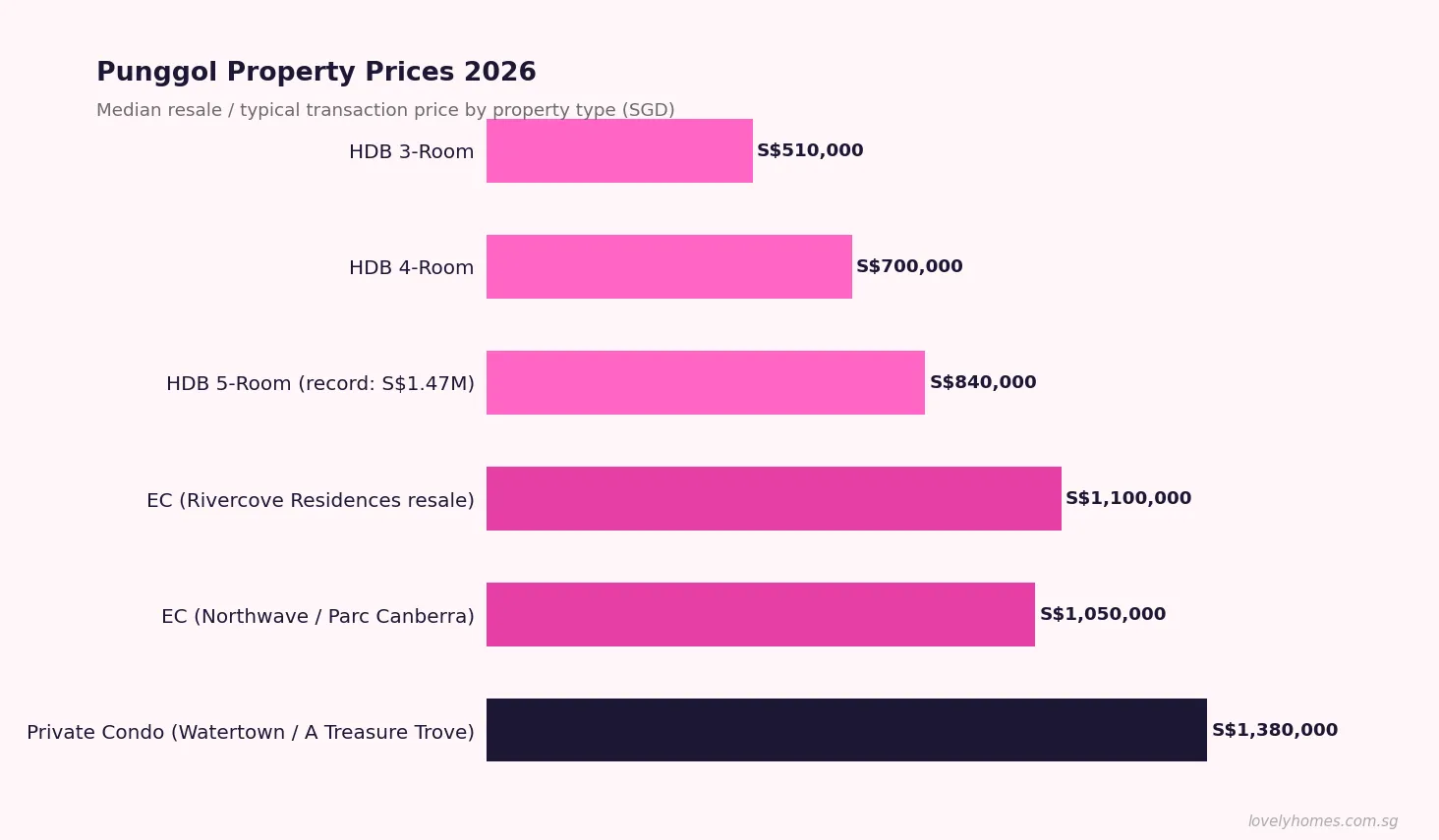
Punggol property prices 2026 — HDB 4-room 5-room EC private condo median Singapore
Figure 1: Punggol median/typical property prices by type, 2026. HDB figures reflect URA resale transaction data and HDB Resale Portal caveats. EC prices based on post-MOP resale caveat data. Sources: URA, HDB, SRX Singapore.

Punggol Property Market Overview 2026

The Punggol HDB resale market has been one of the most active in Singapore’s OCR over the past three years, driven by a combination of the waterway lifestyle premium, the Punggol Digital District employment catalyst, and a steady flow of BTO flats completing their 5-year Minimum Occupation Period (MOP) and entering the resale pool.

Price trajectory 2026: The median 4-Room HDB resale in Punggol reached S$700,000 in 2026, up from approximately S$540,000 in 2022 — a 3-year appreciation of roughly 30%. Five-room median prices stand at S$840,000. The most remarkable data point for 2026 is the Punggol 5-room record: a unit along Punggol Drive transacted at S$1.47 million (approximately S$929 psf) in early 2026, setting a new HDB record for 5-room flats in the town and signalling the extent of the waterway premium that buyers are willing to pay.

EC resale market: Rivercove Residences (Sengkang Avenue, adjacent to Punggol boundary) and Northwave EC (Woodlands Road) represent the main EC resale supply in the northeast corridor. Post-MOP Rivercove units transact at S$1,050–S$1,250 psf, while Northwave EC commands S$1,000–S$1,200 psf, reflecting its more mature stage of MOP completion. Parc Canberra EC (Sembawang), further from Punggol, provides pricing comparison at S$1,020–S$1,180 psf.

Private condo market: Watertown (Punggol Central, directly above Punggol MRT) commands premium pricing at S$1,250–S$1,500 psf — an integrated retail and residential development that benefits uniquely from the MRT-integrated format. A Treasure Trove (Punggol Walk) transacts at S$1,150–S$1,380 psf as a large-scale 99-year leasehold project. The private condo market in Punggol is constrained by limited supply, which supports pricing but restricts buyer choice.

Punggol Digital District — Singapore’s Largest Employment Catalyst

The Punggol Digital District (PDD) is one of the most significant employment-driven property catalysts in Singapore’s suburban history. Developed by JTC Corporation and announced under the Punggol 21-Plus master plan, the PDD is designed to house 28,000 jobs in the tech, media, creative, and design sectors across approximately 600,000 square metres of gross floor area.

The district hosts JTC Corporation’s new campus and the Singapore Institute of Technology (SIT)’s Punggol Campus, which opened progressively from 2023 to 2024, with a full student and faculty population expected by 2026. SIT’s Punggol Campus offers engineering, applied health sciences, hospitality, and information technology programmes — drawing a population of students and young professionals who rent in the surrounding Punggol HDB estates.

The PDD’s effect on Punggol’s rental market is already visible: rental demand for 2-room and 3-room HDB units within a 15-minute walk of Punggol MRT has strengthened notably since 2024, supporting gross yields of 4.3% for 3-room flats — among the strongest in the OCR for that flat type.

Getting Around — MRT, LRT and Future CRL Phase 2

Punggol’s primary rail connection is the North East Line (NEL) Punggol MRT station (NE17), operated by SBS Transit under the Land Transport Authority’s (LTA) regulatory framework. From Punggol MRT, commuters reach Serangoon (NEL/CCL interchange) in 9 minutes, Dhoby Ghaut in 26 minutes, and HarbourFront in 33 minutes. The station is integrated with the Watertown shopping mall podium, offering a seamless retail and transit experience.

The Punggol LRT system mirrors Sengkang’s in structure, with an East Loop and West Loop running 10 stations from the Punggol MRT interchange. East Loop: Damai, Kadalur, Meridian, Coral Edge, Riviera, Layar, Tongkang, Nasi, Sam Kee. West Loop shares the Cove and Meridian stations. The LRT extends connectivity to waterway-adjacent precincts that would otherwise require a longer walk from the MRT.

The most anticipated infrastructure upgrade is Cross Island Line (CRL) Phase 2 (~2031), which will serve Punggol as a terminus station, offering direct cross-island rail access to Jurong Lake District, one-north, and the eastern end of Singapore via a single continuous line. The CRL’s Punggol connection will dramatically reduce commute times to western Singapore — a major competitive disadvantage of northeastern estates today — and is widely expected to support further HDB and private property price appreciation in Punggol from the mid-2020s.

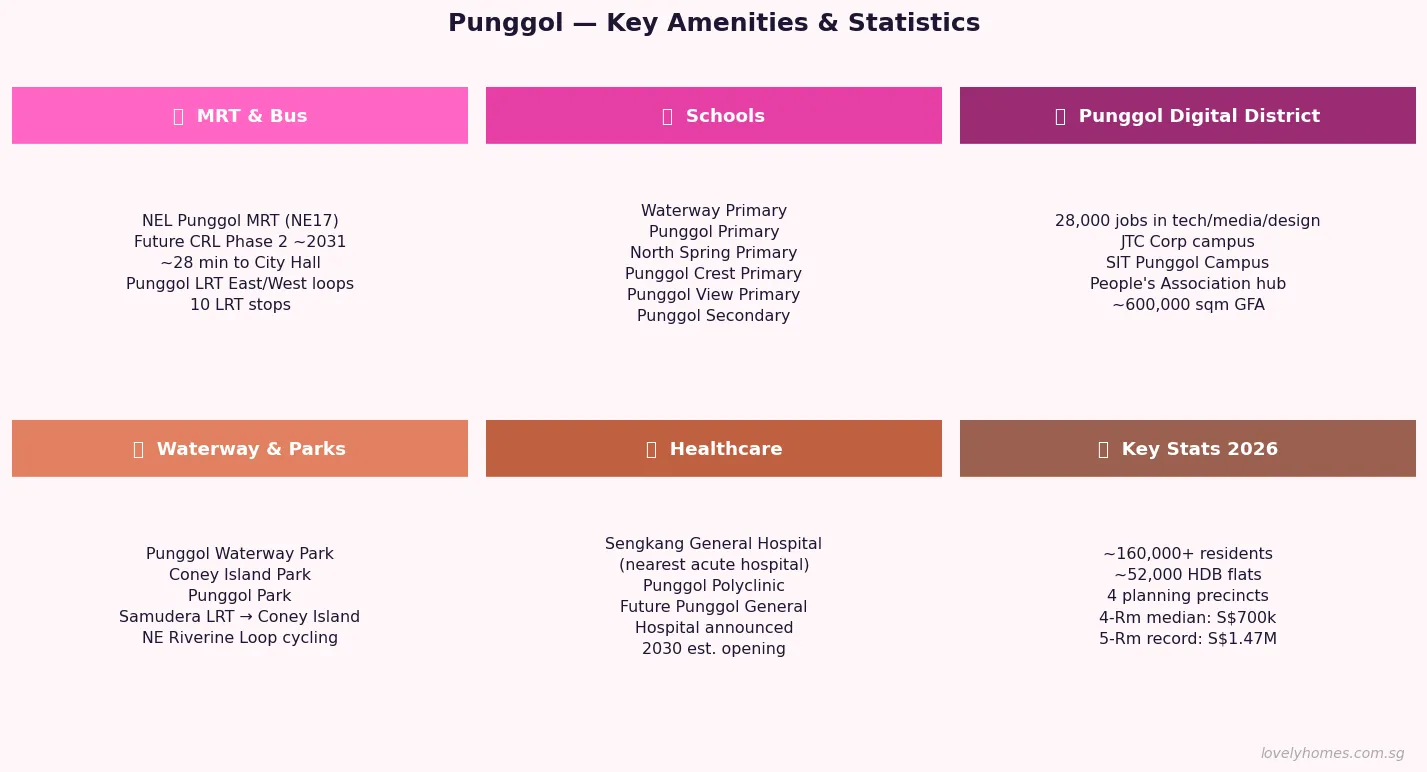
Punggol amenities 2026 — MRT schools Digital District waterway parks healthcare statistics
Figure 2: Punggol key amenities, schools, employment anchors, parks, healthcare and town statistics 2026. Sources: JTC, SIT, HDB, LTA, MOE, SingStat 2026.

Schools and Education in Punggol

Punggol’s school landscape reflects the town’s relatively young age — many of its primary schools were built in the 2010s to accommodate the rapid population growth from BTO completions. Families in the estate’s earlier precincts (Waterway, Punggol Town Centre) have a wider choice of established schools within the 1-kilometre priority registration radius.

Primary schools: Waterway Primary School (Punggol Waterway), Punggol Primary School (Edgedale Plains), North Spring Primary School (Sengkang, within close proximity), Punggol Crest Primary School, and Punggol View Primary School together cover the estate’s primary school catchment. Demand at these schools in Phase 2B registration rounds reflects the strong family-oriented demographic composition of Punggol.

Secondary and post-secondary: Punggol Secondary School and Greendale Secondary School serve the town. Anderson Serangoon Junior College and Serangoon Garden Secondary are accessible by LRT and bus. The most significant education catalyst is, of course, SIT’s Punggol Campus — which draws tertiary enrolment directly into the district, creating a live-work-learn environment that property investors regard as a long-term demand anchor.

Lifestyle — Waterway, Coney Island and Family Living

Punggol Waterway Park is Punggol’s signature asset — a 2.8-kilometre linear park along the Punggol Waterway offering kayaking pontoons, boardwalks, cycling paths, and F&B pavilions. The waterway connects to Punggol Point Park at the town’s northern tip, where a cluster of seafood restaurants and the Punggol Point Jetty offer a distinctly different urban-meets-nature experience from anywhere else in Singapore’s HDB landscape.

Coney Island Park, accessible via the Samudera LRT station, is a 50-hectare nature reserve and recreational island — one of Singapore’s more unexpected green assets within an HDB estate boundary. The island’s beaches, trails, and wildlife attract weekend visitors from across Singapore, reinforcing Punggol’s lifestyle brand.

Retail is centred on Waterway Point, an integrated shopping mall directly above Punggol MRT with a cinema, supermarket, and extensive F&B. Northshore Plaza I & II in the Northshore precinct provide neighbourhood-scale retail for the newer HDB clusters. The planned commercial component of Punggol Digital District will further expand the estate’s retail and F&B offering as tenancies are filled out through 2026 and beyond.

Punggol HDB Resale — Key Facts Summary

Property Type Typical Price Range (S$) Median 2026 (S$) Key Notes
HDB 3-Room 430,000 – 600,000 510,000 Strong rental demand from PDD and SIT students; good yield entry point
HDB 4-Room 560,000 – 950,000 700,000 Most active transaction segment; waterway units command 15–20% premium
HDB 5-Room 680,000 – 1,470,000 840,000 Record S$1.47M (Punggol Drive, Feb 2026); waterway-facing commands exceptional prices
EC (Rivercove/Northwave resale) 900,000 – 1,400,000 1,100,000 Limited supply post-MOP; strong demand from upgraders
Private Condo (Watertown) 1,100,000 – 1,900,000 1,380,000 MRT-integrated; premium for integrated living; thin resale market

Worked Example — SC Couple Upgrading to Punggol 2026

Mr and Mrs Lim, Singapore Citizens, joint monthly income S$11,500. Selling their Tampines 4-room HDB (MOP cleared) for S$730,000, buying a 4-Room Punggol resale with waterway view at S$880,000 as their second property.

Purchase price (Punggol 4-Room HDB resale) S$880,000
Buyer’s Stamp Duty (BSD, administered by IRAS) S$22,200
ABSD — SC buying 2nd property (administered by IRAS) S$176,000 (20%)
Concurrent ownership note Must sell Tampines flat within 6 months to claim ABSD remission
HDB Loan (80% LTV at 2.6% p.a.) S$704,000
Down payment (20%) S$176,000 (CPF OA eligible)
Conveyancing and caveat fees ~S$3,800
Monthly instalment (30-year HDB loan) S$3,196/month
Mortgage Servicing Ratio (MSR, cap ≤ 30%) 27.8% ✓
Total Debt Servicing Ratio (TDSR, cap ≤ 55%) 27.8% ✓

BSD calculated at IRAS progressive rates: 1% on S$180k + 2% on next S$180k + 3% on balance S$520k = S$22,200. ABSD of 20% applies on the full purchase price as the Lims own an existing HDB flat. Under the SC married-couple ABSD remission, the S$176,000 ABSD may be refunded by IRAS if the Tampines flat is sold within 6 months of purchasing the Punggol flat. MSR capped at 30% of gross monthly income by MAS; TDSR at 55%.

Is Punggol a Good Property Investment in 2026?

Punggol presents one of the most compelling long-term investment narratives in Singapore’s OCR, driven by the convergence of three independent demand drivers: Punggol Digital District employment, CRL Phase 2 connectivity, and the Punggol General Hospital pipeline. Unlike many HDB estates that rely on historical infrastructure and a single MRT line, Punggol’s investment case is forward-looking — its best catalysts are still years away from full realisation.

Yield versus capital growth trade-off: Gross rental yields for Punggol HDB are slightly lower than Sengkang (3.6–4.3% versus 3.9–4.5%) because prices have risen faster than rents. For investors prioritising yield, Sengkang’s more affordable entry points and comparable rental income produce a stronger initial return. For investors prioritising capital growth, Punggol’s combination of PDD employment density, CRL connectivity, and the waterway lifestyle premium makes it the more compelling choice on a 7–10 year horizon.

HDB classification: Punggol BTO flats are classified as Standard under HDB’s 2024 framework, with the exception of units in the Northshore Straits precinct which were designated Plus classification. Buyers should check the classification of specific BTO projects before purchasing, as Plus flats carry a 10-year enhanced MOP and income ceiling at first resale — factors that may affect both exit strategy and buyer pool.

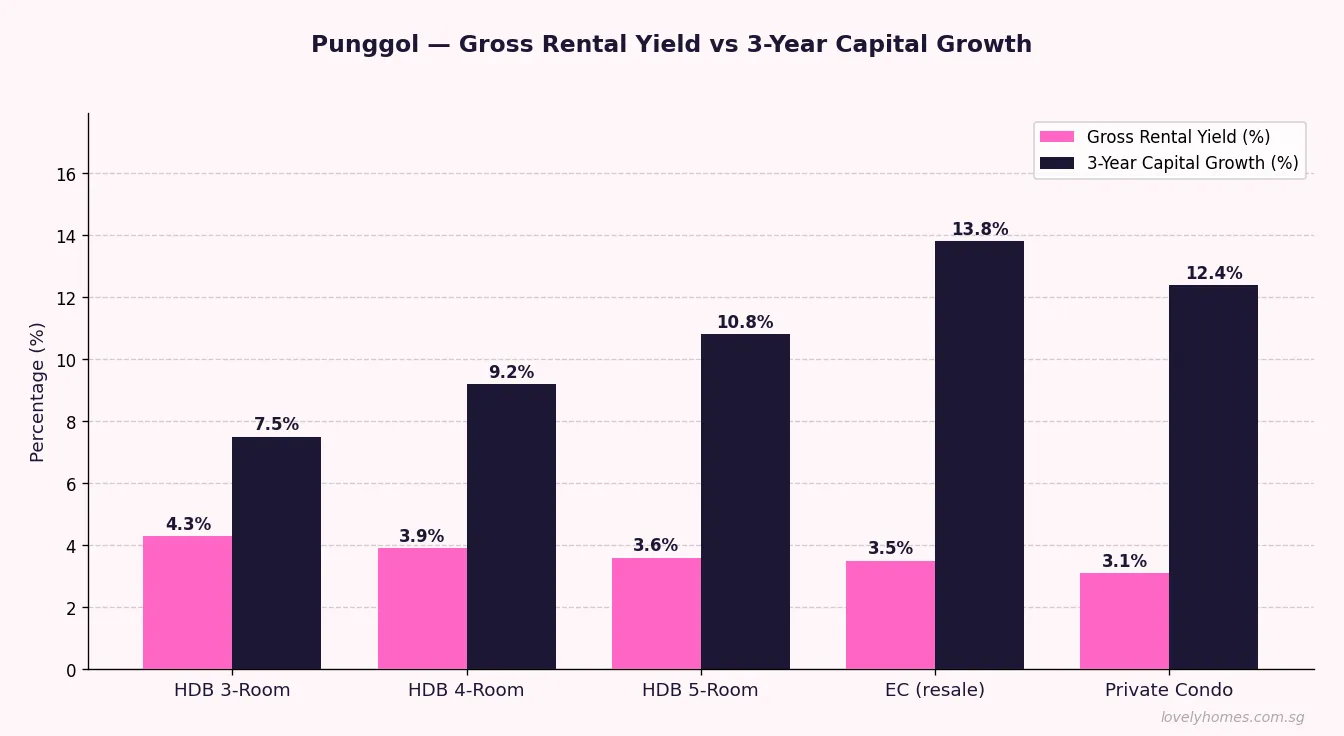
Punggol gross rental yield vs 3-year capital growth 2026 — HDB EC private condo investment Singapore
Figure 3: Punggol gross rental yield versus 3-year capital growth by property type, 2026. Yields based on 2026 median transaction prices and estimated annual market rents. Capital growth reflects 2023–2026 price movement. Sources: URA, HDB Resale Portal, SRX Singapore, EdgeProp.

What Might Come Next for Punggol Property?

The following section reflects the editorial analysis and projections of LovelyHomes as at 19 May 2026. It is speculative in nature and should not be construed as financial or investment advice.

The three most important forward catalysts for Punggol property are well-defined but not yet fully priced in. The Cross Island Line Phase 2 (~2031) is the most transformative: a direct rail link to Jurong Lake District — Singapore’s second CBD — would reduce Punggol’s western commute time by 15–20 minutes, materially expanding the estate’s buyer and tenant catchment. Proximity to a CRL station has historically added 10–15% to residential prices in the 2–3 years before opening based on patterns observed at other MRT lines.

The Punggol General Hospital, announced by the Ministry of Health and expected to open around 2030–2032, will join Sengkang General Hospital as a major healthcare employer in the northeast, further anchoring the corridor’s population base and creating white-collar employment demand for nearby housing. Healthcare workers — a stable, income-regular demographic — are consistent tenants and buyers in proximity to their workplace.

Finally, the continued infilling of Punggol Digital District tenancies as technology companies, media firms, and government agencies take up space in the JTC campus buildings will steadily raise the daytime population and supporting retail demand in Punggol. Each additional large employer anchored in PDD adds a cohort of potential renters to the estate’s rental demand base.

Frequently Asked Questions — Punggol Property 2026

Is Punggol a good place to buy property in 2026?

Punggol is widely regarded as one of Singapore’s strongest long-term OCR investment stories, with a forward-looking infrastructure pipeline (CRL Phase 2, PDD employment, Punggol General Hospital) that justifies its current premium over comparable northeast towns. For owner-occupiers, the waterway lifestyle, newer flats, and strong school cluster make it a highly desirable family location. For investors, the capital growth case is stronger than the yield case — buyers seeking the highest immediate rental returns may find better entry in Sengkang or Woodlands, but those with a 7–10 year horizon targeting capital appreciation have strong reasons to consider Punggol.

How much does a Punggol HDB flat cost in 2026?

Punggol HDB resale prices in 2026 range from approximately S$430,000–S$600,000 for a 3-room flat to S$680,000–S$1,470,000 for a 5-room flat, with waterway-facing units commanding a 15–25% premium over non-waterway-facing units. The median 4-room resale price is S$700,000 and the median 5-room is S$840,000. The record transaction for a Punggol HDB flat stands at S$1.47 million for a 5-room unit along Punggol Drive transacted in February 2026. Buyers should verify current transaction data with the HDB Resale Portal (homes.hdb.gov.sg) and URA’s Realis system before finalising their price assessment.

What is Punggol Digital District and how does it affect property values?

Punggol Digital District (PDD) is a 50-hectare, 600,000 sqm GFA employment cluster developed by JTC Corporation, anchored by JTC’s new campus and Singapore Institute of Technology (SIT)’s Punggol Campus. At full build-out, the PDD is expected to house approximately 28,000 workers in technology, media, creative, and design industries. For property investors, the PDD functions as a direct rental-demand generator — drawing SIT students, young professionals, and tech workers who prefer to live close to their workplace. Market data from 2024–2025 already shows above-average rental demand growth for 2-room and 3-room HDB units within 15 minutes’ walk of Punggol MRT, the gateway to PDD.

What is the Cross Island Line and will it add to Punggol property values?

The Cross Island Line (CRL) is Singapore’s eighth MRT line, being built in phases. CRL Phase 2 will extend the line from its current Phase 1 terminus to include a Punggol terminus, offering direct cross-island connectivity to Jurong Lake District, one-north, and the western half of Singapore from the northeast. Phase 2 is targeted for completion around 2031. The CRL will significantly reduce Punggol’s biggest commute disadvantage — limited westward connectivity — and is widely expected by analysts to provide a measurable uplift to Punggol residential values from around 2028 onwards as the opening approaches. LTA manages MRT construction and operations under the National Land Transport Master Plan.

Are there upcoming BTO launches in Punggol in 2026?

HDB’s confirmed June 2026 BTO exercise does not include Punggol sites (it covers Ang Mo Kio, Bishan, Bukit Merah, Sembawang, and Woodlands). Punggol is likely to feature in subsequent BTO exercises in 2026 or early 2027 as development of the Northshore and Punggol Field precincts continues. Prospective BTO buyers should monitor the HDB website (hdb.gov.sg) for announcements and note that some Punggol precincts may carry Plus classification with its associated 10-year enhanced MOP — an important consideration for buyers who may need to sell within a decade of purchase.

Can a foreigner buy property in Punggol?

Foreigners cannot purchase HDB flats in Punggol under any circumstances — HDB public housing is restricted to Singapore Citizens and, in the resale market, Singapore Permanent Residents (subject to family nucleus and 3-year PR waiting period requirements). Foreigners may purchase private residential properties in Punggol — specifically, condominium units (stratum titles) — but are subject to Additional Buyer’s Stamp Duty (ABSD) of 65% on the purchase price, administered by IRAS. Foreigners may not purchase landed residential properties in Punggol without approval from the Land Dealings Approval Unit. Given the 65% ABSD rate, foreign ownership of Punggol private condos is very limited.

How does Punggol compare with Sengkang for property investment?

Punggol and Sengkang are immediate neighbours with broadly similar demographics but different investment profiles. Sengkang currently offers slightly higher rental yields (4.2–4.5% for 4-room HDB versus Punggol’s 3.6–3.9%) and a slightly lower entry price for equivalent flat types. Punggol offers a stronger capital growth narrative (3-year HDB appreciation ~9.2% versus ~8.1% for Sengkang) driven by PDD employment and CRL Phase 2 anticipation. For buyers choosing between the two in 2026, the decision often hinges on time horizon: short-to-medium term yield optimisation favours Sengkang, while longer-term capital growth targeting favours Punggol.

Related Articles

Disclaimer

This article is intended for general information and educational purposes only and does not constitute financial, investment, legal, or property advice. All property prices, rental yields, market data, and regulatory information are based on sources available as at 19 May 2026 and are subject to change. Buyers, sellers, and investors should verify current information directly with the Housing & Development Board (HDB) at hdb.gov.sg, the Urban Redevelopment Authority (URA) at ura.gov.sg, the Inland Revenue Authority of Singapore (IRAS) at iras.gov.sg for stamp duty matters, and the Monetary Authority of Singapore (MAS) at mas.gov.sg for loan and MSR/TDSR regulations. Always engage a licensed financial adviser, mortgage specialist, and Law Society-accredited conveyancing solicitor before making any property transaction decision.


Click anywhere to close

Sengkang Neighbourhood Guide Singapore 2026: Property Prices, Schools, MRT and Investment Outlook

Sengkang Neighbourhood Guide Singapore 2026: Property Prices, Schools, MRT and Investment Outlook

Quick Answer — Sengkang 2026 at a Glance

  • HDB 4-Room median resale price: S$652,000 (2026); entry-level from ~S$520,000 in non-mature precincts
  • Private condo & EC: EC resale ~S$1.15M–S$1.35M; private condo ~S$1.1M–S$1.5M
  • Connectivity: North East Line (NEL) + Sengkang LRT East & West loops — 10 LRT stops; ~25 minutes to City Hall
  • Schools: Nan Chiau Primary & High, Compassvale Primary, Anchor Green Primary, CHIJ Our Lady of Good Counsel, Holy Innocent’s High School
  • Investment appeal: Gross rental yield ~3.3–4.5%; HDB 3-year capital growth ~8.1%; EC 3-year growth ~12.9%
  • Key anchor: Sengkang General Hospital — a 1,400-bed SingHealth teaching hospital opened 2018
  • MOP note: Sengkang BTOs from 2018–2020 hitting 5-year MOP in 2023–2025, adding resale inventory and buyer choice

What and Where Is Sengkang?

Sengkang is a maturing HDB town in the northeastern region of Singapore, located in Planning Area 23 under the Urban Redevelopment Authority’s (URA) Master Plan. Developed from the late 1990s onwards by the Housing & Development Board (HDB), the estate has grown into one of Singapore’s largest HDB towns, with approximately 182,700 residents and more than 53,400 flats across six planning precincts — Anchorvale, Compassvale, Fernvale, Lorong Halus North, Rivervale, and Sengkang Town Centre.

The estate is bounded by Buangkok to the west, Punggol to the northeast, and the Punggol and Serangoon rivers on its fringes. Its proximity to Punggol Digital District and the planned Cross Island Line (CRL) Phase 2 terminus gives Sengkang an economic gravity that distinguishes it from comparable Outside Central Region (OCR) towns further west.

Under HDB’s classification framework introduced in 2024, Sengkang BTO flats are classified as Standard — preserving the 5-year Minimum Occupation Period (MOP) and allowing unrestricted resale thereafter. This is an important distinction for buyers assessing long-term liquidity, as Standard flats carry no income ceiling at resale and are not subject to the enhanced 10-year MOP that applies to Plus and Prime classifications.

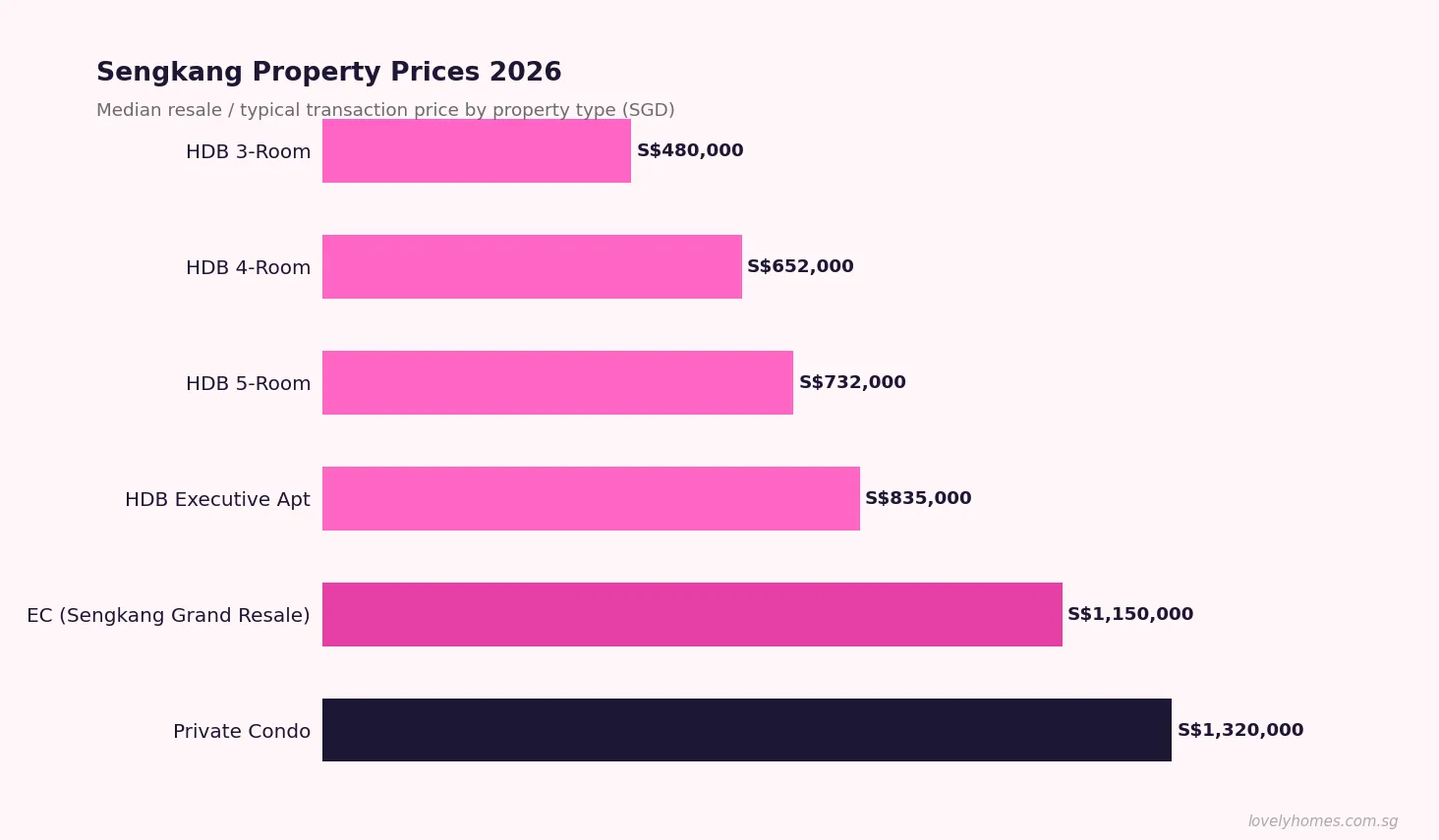
Sengkang property prices 2026 — HDB 3-room 4-room 5-room EC private condo median Singapore
Figure 1: Sengkang median/typical property prices by type, 2026. HDB prices reflect URA resale transaction data; EC and private condo prices reflect caveat-lodged transactions and asking prices. Source: URA, HDB Resale Portal 2026.

Sengkang Property Market Overview 2026

The Sengkang resale market recorded approximately 1,000 HDB transactions in 2025, with the median 4-Room flat transacting at S$652,000 and the median 5-Room at S$732,000 in 2026. While these figures sit at the lower end of the OCR resale spectrum compared with Tampines or Bishan, the estate’s relative affordability — combined with its strong transport network and growing amenities base — underpins steady buyer demand.

HDB resale highlights 2026: Sengkang 5-room resale flats have breached S$900,000 in standout locations with waterway views or high floors. A Rivervale Crescent 5-room flat transacted at S$895,000 in early 2026, reflecting the premium buyers place on units within walking distance of Sengkang MRT interchange. Flats in Fernvale and Anchorvale generally transact at a 10–15% discount to similarly sized Rivervale and Compassvale units, as the LRT adds a transfer hop from the North East Line.

Executive Condominium (EC) resale: Sengkang Grand Residences — the integrated mixed-use EC at Sengkang Central — stands out as Sengkang’s premium EC offering. Resale units transact at S$1,100–S$1,320 per square foot (psf), reflecting the mall podium and direct LRT access. Earlier ECs such as Riverparc Residence and Rivervale Crest trade at S$900–S$1,050 psf.

Private condo: Riverfront Residences (the former Rio Casa en-bloc redevelopment) commands S$1,150–S$1,350 psf. The estate’s limited private condo stock — relative to its HDB scale — creates a thin secondary market, which can amplify both upside and downside price movements. Buyers seeking private housing in this corridor sometimes compare against the neighbouring Hougang or Punggol supply pipelines.

Getting Around — MRT, LRT and Bus Connectivity

Sengkang’s transport backbone is the North East Line (NEL) Sengkang MRT interchange station (NE16), operated by SBS Transit under the Land Transport Authority’s (LTA) regulatory framework. From Sengkang MRT, commuters reach Serangoon (NEL/CCL interchange) in 5 minutes, Dhoby Ghaut (NEL terminus) in 22 minutes, and HarbourFront in 29 minutes. This places the central business district well within the 30-minute commute envelope that is consistently associated with residential price premiums in Singapore.

Unique to Sengkang is the Sengkang LRT system, which operates two loops from the MRT interchange — the East Loop and West Loop — serving 10 LRT stations across the estate. The LRT provides last-mile connectivity to precincts not immediately adjacent to the NEL, including Fernvale, Rivervale, and Lorong Halus North. The LRT runs at 5–10 minute frequency during peak hours and is seamlessly integrated with the MRT fare system.

Bus services connecting Sengkang to Punggol Digital District, Hougang, Ang Mo Kio, and the Woodlands Regional Centre further broaden the estate’s commuter catchment. The planned Cross Island Line (CRL) Phase 2 (~2031), which will serve Punggol at the town’s northeastern boundary, is expected to improve cross-island connectivity for residents in the Fernvale and Lorong Halus North precincts.

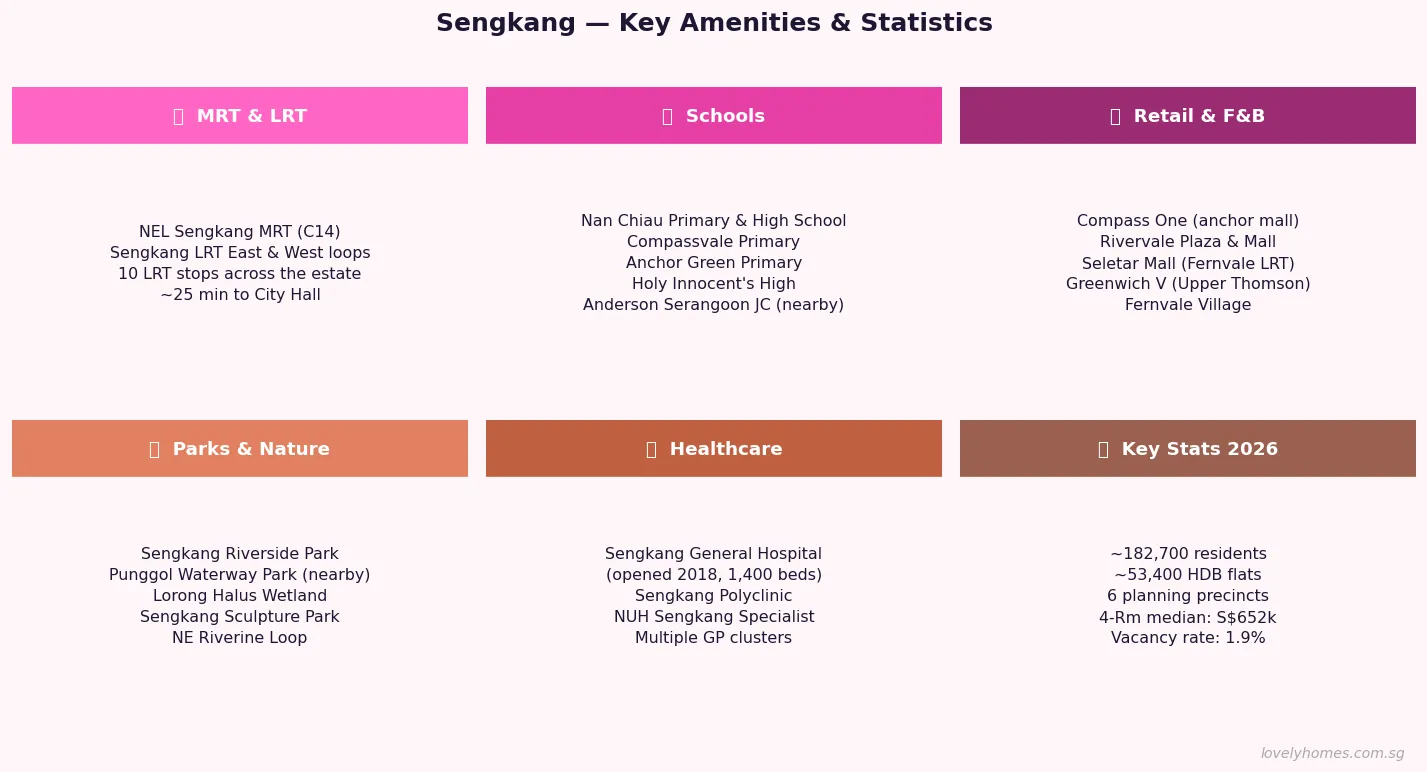
Sengkang amenities 2026 — MRT LRT schools retail parks healthcare statistics Singapore
Figure 2: Sengkang key amenities, schools, retail, parks, healthcare and town statistics 2026. Sources: HDB, LTA, MOE school directory, SingStat 2026.

Schools and Education in Sengkang

Education infrastructure is a significant draw for families choosing Sengkang. The estate is home to a strong cluster of primary and secondary schools within the one-kilometre priority registration radius used by the Ministry of Education (MOE) for Phase 1 and Phase 2A registration balloting.

Primary schools: Nan Chiau Primary School and Nan Chiau High School (Secondary) sit in Compassvale, maintaining a direct feeder-school relationship valued by Chinese-stream families. Compassvale Primary and Anchor Green Primary serve the town-centre and Rivervale precincts respectively. CHIJ Our Lady of Good Counsel (Sengkang) is a popular all-girls primary that consistently draws strong demand in Phase 2B registration rounds.

Secondary and post-secondary: Holy Innocent’s High School (Hougang, within close proximity) and North Vista Secondary serve Sengkang’s secondary-school population. Anderson Serangoon Junior College — formed from the 2020 merger of Anderson JC and Serangoon JC — is located in Ang Mo Kio and within reasonable commuting distance.

The opening of Singapore Institute of Technology (SIT)’s Punggol Campus at the adjacent Punggol Digital District in 2024 has drawn a cohort of tertiary students and young professionals to the northeast corridor — a rental demand segment supporting yields for 2-room and 3-room HDB units in Sengkang.

Retail, Amenities and Lifestyle

Compass One, the anchor shopping mall directly above Sengkang MRT, serves as the town’s retail and F&B hub with a cinema, Cold Storage supermarket, and family-oriented tenants. Rivervale Mall and Rivervale Plaza serve the eastern precincts with neighbourhood-scale supermarkets and clinics. Seletar Mall at Fernvale LRT provides a significant retail node with NTUC FairPrice Finest and lifestyle tenants, drawing residents from the western precincts.

Sengkang Riverside Park, adjacent to the Punggol River, connects to the northeast riverine loop for cyclists and joggers. Lorong Halus Wetland — a former landfill converted into a bird-watching and recreational destination — sits at Sengkang’s northeastern edge and represents one of Singapore’s more unusual ecological assets close to a residential estate.

Healthcare: Sengkang General Hospital, a 1,400-bed acute hospital under the SingHealth cluster, opened in 2018 and is one of Singapore’s newer integrated teaching hospitals. It acts both as a healthcare resource for residents and as a significant employer anchoring the northeast. Sengkang Polyclinic, operated by the National Healthcare Group (NHG), provides primary-care services to residents.

Sengkang HDB Resale — Key Facts Summary

Property Type Typical Price Range (S$) Median 2026 (S$) Key Notes
HDB 3-Room 410,000 – 570,000 480,000 Good entry for investors; strong rental demand from singles and couples
HDB 4-Room 520,000 – 790,000 652,000 Highest transaction volume; premium for Rivervale/Compassvale facing units
HDB 5-Room 620,000 – 920,000 732,000 Records approaching S$900k in prime locations with water or park views
HDB Executive Apt 700,000 – 980,000 835,000 Limited supply; Rivervale Executive Apartments most sought-after
EC (resale, post-MOP) 980,000 – 1,550,000 1,150,000 Sengkang Grand Residences commands integrated-development premium
Private Condo 950,000 – 1,700,000 1,320,000 Thin market; Riverfront Residences dominates secondary supply

Worked Example — SC Couple First Home in Sengkang 2026

Mr and Mrs Tan, Singapore Citizens, combined monthly income S$9,500. Buying a 4-Room HDB resale in Compassvale, Sengkang as their first property.

Purchase price S$670,000
Buyer’s Stamp Duty (BSD, administered by IRAS) S$12,200
Additional BSD (ABSD) — SC buying 1st property Nil (0%)
HDB Loan (80% LTV at 2.6% p.a.) S$536,000
Down payment (20%, CPF-eligible) S$134,000
Conveyancing and caveat fees (est.) ~S$3,200
Monthly instalment (30-year HDB loan) S$2,436/month
Mortgage Servicing Ratio (MSR, MAS cap ≤ 30%) 25.6% ✓
Total Debt Servicing Ratio (TDSR, MAS cap ≤ 55%) 25.6% ✓

BSD computed using IRAS progressive rates: 1% on first S$180,000 + 2% on next S$180,000 + 3% on balance. HDB loan rate of 2.6% p.a. = CPF OA rate (2.5%) + 0.1%. MSR and TDSR administered by MAS; MAS rules limit HDB resale loan tenure to 25 years (bank) or 30 years (HDB loan).

Is Sengkang a Good Property Investment in 2026?

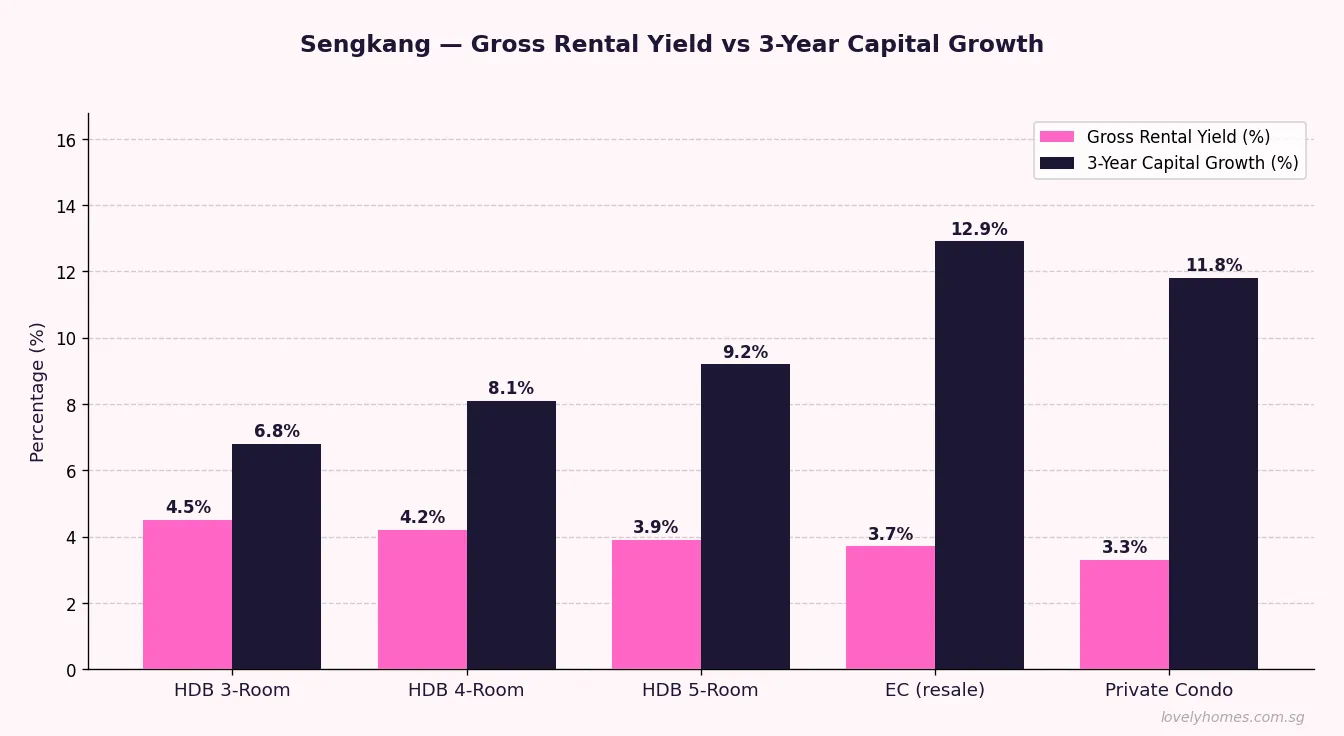
Sengkang occupies a compelling mid-tier position in Singapore’s property investment landscape. For HDB investors and owner-occupiers who value yield, the estate delivers some of the strongest gross rental yields in the OCR — particularly for 3-Room flats, which gross approximately 4.5% at 2026 median prices versus median rents of roughly S$1,800/month for a furnished 3-Room unit near Sengkang MRT.

Capital growth has been moderate-to-solid for HDB but more pronounced for the EC segment. Sengkang EC resale prices have appreciated roughly 12–13% over the past three years, outperforming the island-wide private residential price index growth of approximately 8–9% over the same period. This reflects limited EC supply in the northeast following MOP completions at Riverparc Residence and Rivervale Crest, and the premium commanded by Sengkang Grand Residences’ integrated format.

Risk factors to weigh: The HDB resale supply pipeline is meaningful — Sengkang BTOs from 2018–2020 have been hitting their 5-year MOP, adding inventory. The LRT dependency for Fernvale and Lorong Halus North precincts means transport accessibility is inferior to Compassvale and Rivervale, and prices reflect this discount of 10–15%. Investors should also model the impact of Additional Buyer’s Stamp Duty (ABSD) — at 20% for Singapore Citizens buying a second residential property — on net investment returns before committing.

Sengkang gross rental yield vs 3-year capital growth 2026 — HDB EC private condo investment
Figure 3: Sengkang gross rental yield versus 3-year capital growth by property type, 2026. Yields based on 2026 median prices and estimated market rents. Capital growth reflects 2023–2026 median price movement. Sources: URA, HDB Resale Portal, SRX Singapore.

What Might Come Next for Sengkang Property?

The following section reflects editorial analysis and forward projections by LovelyHomes as at 19 May 2026. It is speculative and should not be construed as financial or investment advice.

Three catalysts are worth watching over the next 3–5 years. First, Punggol Digital District’s employment ramp-up: as the 28,000-job tech, media, and design cluster at the adjacent Punggol Coast matures, rental demand for 2-room and 3-room HDB units in Sengkang’s northeastern precincts is likely to strengthen, narrowing the discount these precincts carry versus Rivervale and Compassvale.

Second, CRL Phase 2 (~2031): the Cross Island Line’s Punggol terminus will offer direct cross-island access to Jurong Lake District via a single transfer. While Sengkang itself is not on the CRL alignment, the improved connectivity of neighbouring Punggol will raise the entire northeast corridor’s accessibility profile with positive price spillover for Sengkang.

Third, HDB’s evolving classification framework: Sengkang’s BTO flats currently classified as Standard carry no enhanced resale restrictions. This is a feature — not a constraint — for resale buyers. If housing policy shifts towards designating more northeast flats as Plus classification, the resale pool could contract, supporting secondary-market prices but reducing liquidity. Buyers who purchase Standard flats today avoid this classification risk entirely.

Frequently Asked Questions — Sengkang Property 2026

Is Sengkang a good place to buy property in 2026?

Sengkang offers a strong combination of affordability, transport connectivity, and amenity density for families and first-time buyers. The 4-Room HDB median price of S$652,000 is meaningfully below comparable sizes in Bishan, Toa Payoh, or Queenstown, yet the North East Line delivers competitive CBD commute times. For investors, gross rental yields of 3.3–4.5% are attractive by Singapore standards. Buyers should factor in Additional Buyer’s Stamp Duty (ABSD), administered by IRAS, when calculating returns if this is not their first property purchase.

Which MRT and LRT stations serve Sengkang?

The main interchange is Sengkang MRT (NE16) on the North East Line, connecting to Serangoon, Dhoby Ghaut, and HarbourFront. The Sengkang LRT system runs two loops from this interchange, operated by SBS Transit under LTA regulation. East Loop stops: Cheng Lim, Farmway, Renjong, and back to Sengkang. West Loop stops: Compassvale, Tongkang, Rumbia, Bakau, Kangkar, Ranggung, and back to Sengkang. Frequency is 5–10 minutes at peak hours.

How does Sengkang compare with Punggol for property buyers in 2026?

Sengkang and Punggol are neighbouring northeast towns with similar demographics and transport corridors, but they differ in maturity and price positioning. Sengkang’s 4-Room median (~S$652,000) currently sits below Punggol’s (~S$700,000), reflecting Punggol’s stronger forward-looking narrative around the Digital District and CRL Phase 2. Sengkang offers a denser current amenity base (Compass One, Sengkang General Hospital) and a more established school cluster. Punggol offers newer flats, waterway-facing units, and a longer-duration growth story. For families valuing schools and healthcare today, Sengkang is often preferred; for younger buyers with longer time horizons, Punggol’s infrastructure pipeline may justify its premium.

Are there upcoming BTO launches in Sengkang in 2026?

HDB’s confirmed June 2026 BTO exercise covers Ang Mo Kio, Bishan, Bukit Merah, Sembawang, and Woodlands — Sengkang is not among the June 2026 sites. HDB typically rotates BTO supply across towns on a 12–18 month cycle; prospective BTO buyers should monitor HDB’s website (hdb.gov.sg) for August and October 2026 announcements. Sengkang BTOs, when launched, are Standard classification with a 5-year MOP and the standard income ceilings: S$14,000 for families, S$7,000 for singles buying 2-Room Flexi flats.

What rental income can I expect from a Sengkang HDB flat in 2026?

Rental income varies by flat type, location, and furnishing. As a guide: furnished 3-Room flats near Sengkang MRT let for approximately S$1,750–S$2,100/month; 4-Room furnished flats command S$2,200–S$2,700/month; 5-Room furnished units achieve S$2,600–S$3,200/month. HDB flat owners must have fulfilled MOP and obtained HDB’s subletting approval before letting. Rental income is subject to Inland Revenue Authority of Singapore (IRAS) taxation; landlords may deduct allowable expenses (mortgage interest, maintenance, agent fees) against gross rental income.

Can a Permanent Resident buy a Sengkang HDB resale flat?

Yes — Singapore Permanent Residents (SPRs) can purchase HDB resale flats in Sengkang subject to HDB’s eligibility criteria. SPRs must form a family nucleus (single SPRs generally cannot buy HDB resale alone), must have held PR status for at least three years, and must not own any other property at the time of purchase. SPRs must use bank financing — the HDB concessionary loan is available only to Singapore Citizens. ABSD of 5% applies to an SPR buying their first residential property in Singapore. HDB’s Ethnic Integration Policy (EIP) quotas also apply.

Which precinct in Sengkang offers the best value?

From a convenience standpoint, Rivervale and Compassvale are the most sought-after precincts, commanding the highest prices. Rivervale units near Sengkang Riverside Park attract waterway premiums; Compassvale benefits from the Nan Chiau school cluster and direct NEL connectivity. Fernvale and Anchorvale offer lower entry prices — attractive for yield-focused investors — with Seletar Mall compensating for the extra LRT transfer. Lorong Halus North offers the most affordable entry in Sengkang but is the most distant from the MRT interchange, making it best suited for buyers whose daily routines do not require CBD commutes.

Related Articles

Disclaimer

This article is intended for general information and educational purposes only and does not constitute financial, investment, legal, or property advice. All property prices, rental yields, market data, and regulatory information are based on sources available as at 19 May 2026 and are subject to change. Buyers, sellers, and investors should verify current information directly with the Housing & Development Board (HDB) at hdb.gov.sg, the Urban Redevelopment Authority (URA) at ura.gov.sg, the Inland Revenue Authority of Singapore (IRAS) at iras.gov.sg for stamp duty matters, and the Monetary Authority of Singapore (MAS) at mas.gov.sg for loan regulations. Always consult a licensed financial adviser, mortgage specialist, and Law Society-accredited conveyancing solicitor before making any property transaction decision.


Click anywhere to close

Jurong Lake District Property Outlook 2026: Prices, Investment Potential and What Is Coming

Jurong Lake District Property Outlook 2026: Prices, Investment Potential and What Is Coming

Jurong Lake District Property Outlook 2026: Prices, Investment Potential and What Is Coming

Quick Answer

  • Jurong Lake District (JLD) is Singapore’s largest mixed-use development outside the city centre, planned by the Urban Redevelopment Authority (URA) to become the country’s second Central Business District.
  • Private condominium prices in the JLD corridor currently range from approximately S$1,100–S$1,600 psf for resale, with new launches in the area reaching S$2,100 psf at LakeGarden Residences.
  • The district sits in the Outside Central Region (OCR) but is transitioning to near-RCR pricing as major commercial anchors — the Jurong Regional Library, JTC’s Jurong Innovation District, the future Cross-Island Line (CRL) interchange, and a new integrated tourism belt — take shape.
  • HDB resale flats in Lakeside, Jurong East, and Boon Lay average S$550–S$750 per flat, offering affordable entry points with strong upgrader demand upstream.
  • Gross rental yields in the JLD corridor range from 3.2%–4.1% for private condominiums and up to 4.8% for HDB flats.
  • A URA Reserve List site at Town Hall Link — capable of yielding approximately 1,200 residential units — adds significant future supply potential once triggered.
  • The Cross-Island Line (CRL) Phase 1, opening in 2030, will connect Jurong directly to the east-west corridor via Aviation Park and Bright Hill, materially improving accessibility and underpinning long-term price support.

What Is the Jurong Lake District?

The Jurong Lake District is a long-term urban transformation project anchored around Jurong East MRT interchange station and the Jurong Lake Gardens — a 90-hectare national garden that opened progressively from 2019. The district spans approximately 410 hectares and is envisaged to accommodate 100,000 workers and 20,000 residents when fully developed. The Urban Redevelopment Authority (URA) gazetted the JLD Special Planning Area in 2008 and has pursued a phased approach to development, with initial commercial anchors followed by progressive residential densification.

JLD is significant not merely as a suburban office cluster but as Singapore’s strategic answer to the decentralisation of its economic activity. With the Central Business District historically concentrated in Raffles Place, Tanjong Pagar, and Marina Bay, JLD represents the government’s most ambitious attempt to create a second major economic hub, offering comparable connectivity and amenity at a fraction of the Central Region’s land cost. For property investors, this long-arc transformation thesis — backed by sustained public capital expenditure — is a key valuation driver.

Figure 1: Jurong Lake District — Property Price Trajectory & Key Projects (2016–2030). Sources: URA, PropertyGuru, LovelyHomes research.

Key Developments Shaping JLD in 2026

Several large-scale developments are advancing concurrently and collectively driving the district’s transformation. The Jurong Innovation District (JID), developed by JTC Corporation on the western fringe near Tengah, is Singapore’s next-generation advanced manufacturing hub, targeting anchor tenants in robotics, aerospace, clean energy, and precision engineering. When fully operational, JID is expected to accommodate over 95,000 jobs — a significant employment base that creates sustained residential rental demand in the surrounding JLD area.

J’den, the 368-unit mixed-use development on the former JCube site along Jurong East Central, set the tone for new-launch pricing in JLD. Launched in late 2023, J’den sold 89% of units in its launch weekend at an average of approximately S$2,100 psf, establishing a new price benchmark for the district. The development integrates directly with Jurong East MRT interchange — providing covered, air-conditioned pedestrian access to the NEL and EWL networks — a connectivity premium that buyers clearly priced in. J’den’s success signals strong latent demand for well-located, transit-integrated new launches in the western corridor.

LakeGarden Residences, a 306-unit condominium on Yuan Ching Road beside Jurong Lake Gardens, offers a different value proposition: lakeside living with garden frontage rather than MRT integration. Sales at an average of S$2,106 psf in 2026 confirm that the lake-facing premium is real. For resale buyers and investors, this pricing sets the ceiling for the immediate sub-market, with older condominiums along the same corridor — Lakepoint Condo, Lake Grande, Parc Riviera — trading at a 30–50% discount on a psf basis.

Price Landscape: Where JLD Sits in the Singapore Market

Figure 2: PSF Price Comparison — JLD vs Surrounding Districts (2026). Sources: URA, SRX, LovelyHomes research.
Property Type Sub-location Typical PSF / Price Range (2026) Notes
New Launch Condo Jurong East (MRT-integrated) S$2,050–S$2,200 psf J’den benchmark
New Launch Condo Lakeside / Yuan Ching S$1,900–S$2,150 psf Lake frontage premium
Resale Condo JLD corridor (freehold/99yr) S$1,100–S$1,600 psf Lake Grande, Parc Riviera
HDB 4-Room (resale) Jurong East / Boon Lay S$500k–S$680k Strong upgrader supply base
HDB 5-Room (resale) Lakeside estate / Jurong West S$620k–S$800k Tenure varies; newer flats command premium
EC (resale, privatised) Tengah / Jurong West S$1,100–S$1,400 psf Cheaper entry vs private

Connectivity: The Cross-Island Line Catalyst

The single most consequential infrastructure project for JLD’s medium-term price trajectory is the Cross-Island Line (CRL). When Phase 1 opens in approximately 2030, the CRL will pass through Jurong Lake District — with Jurong Lake station providing an interchange with the existing East-West Line at Jurong East. This will dramatically reduce travel times between the western corridor and eastern Singapore (Pasir Ris, Tampines, Changi), slashing what is currently a 60–80 minute journey to 25–35 minutes.

Historical data from Singapore’s MRT expansions consistently shows that properties within a 500-metre walk of new MRT stations appreciate by 8–12% in the 18–24 months prior to line opening, as anticipatory buying picks up. With CRL Phase 1 opening approximately 4 years away, properties along the JLD corridor are entering the historical window where this premium typically begins to materialise. This is not a guarantee of appreciation — supply additions, financing conditions, and broader market sentiment all play roles — but it is a structurally bullish factor that distinguishes the JLD sub-market from other OCR locations.

Investment Metrics: Rental Yield and Capital Growth

Figure 3: JLD Investment Metrics — Gross Rental Yield & 3-Year Capital Growth (2026). Sources: URA, SRX, LovelyHomes research.

The JLD rental market benefits from a diversified tenant base: multinational executives relocating to work at Jurong Innovation District or existing MNC campuses (PSA International, FMC Technologies, the International Enterprise Singapore building), students at NUS and NTU (both within a 10–15 minute drive), and young professionals seeking west-side connectivity. This demand breadth provides resilience against sector-specific downturns, differentiating JLD from purely corporate-dependent rental markets.

Gross rental yields for private condominiums in the JLD corridor currently sit between 3.2% and 4.1%, with one-bedroom units commanding the highest yields (4.0–4.1%) due to lower entry prices relative to rents. Two-bedroom units yield approximately 3.6%, while three-bedroom units drop to 3.2–3.5%. These yields compare favourably to the CCR average of approximately 2.8–3.2% and are broadly in line with RCR averages of 3.3–3.7%, suggesting that JLD has already captured much of the yield compression typical of maturing sub-markets while still offering potential capital appreciation upside.

Worked Example: Buying a JLD Resale Condo as Investment

Worked Example: Mr Rajan — SPR Buying S$1.2M JLD Condo (2nd Property)

Mr Rajan is a Singapore Permanent Resident who owns an HDB resale flat in Clementi with his wife. He wishes to purchase a resale two-bedroom condominium in Lake Grande (JLD corridor) at S$1.2M as a rental investment. As a PR buying his second residential property, Mr Rajan pays 30% ABSD in addition to BSD.

Purchase Price (2BR resale condo, ~840 sqft) S$1,200,000
Buyer’s Stamp Duty (BSD) S$33,600
ABSD (SPR 2nd property @ 30%) S$360,000
25% downpayment (bank loan, 75% LTV) S$300,000
Legal fees (estimated) S$4,200
Total Upfront Outlay S$697,800
Monthly mortgage (S$900k @ 2.1%, 25 yrs) ~S$3,900
Estimated monthly rental (2BR, JLD corridor) ~S$3,600–S$4,000
Gross rental yield 3.6–4.0%
Net yield (after mortgage interest, tax, maintenance) ~1.8–2.4%
ABSD breakeven at 2.1% net yield ~25 years

The 30% ABSD severely stretches the investment case for PR buyers. Mr Rajan would likely achieve a better risk-adjusted return by converting his PR to citizenship (removing the 25% ABSD differential for second properties) or by restructuring so that only the SC spouse holds the investment property — subject to legal and financing implications. An independent financial adviser can model the optimal structure for his specific circumstances.

The Reserve List Factor: What 1,200 More Units Mean

The URA’s 1H 2026 GLS Reserve List includes a mixed-use site at Town Hall Link, adjacent to the planned Jurong Lake District commercial core, capable of supporting approximately 1,200 residential units. Reserve List sites are not immediately tendered — they are released only when a qualifying developer submits an application with an acceptable minimum bid price. Given the current pace of JLD commercial development and the strong sales performance of J’den and LakeGarden Residences, some developers may trigger this site within the next 12–24 months.

When triggered, this site would represent a significant addition to JLD’s private residential supply base, potentially exerting modest downward pressure on new-launch prices in the immediate vicinity while providing buyers with a fresh alternative to the existing resale stock. For existing condo owners in the corridor, the key question is whether the new launch is positioned as a super-premium product (which would validate their asset values) or as a more affordable option targeting a different buyer segment. URA’s tendency to bundle commercial and residential uses in JLD sites suggests any new launch will be mixed-use with MRT connectivity — a premium product profile that typically supports, rather than compresses, surrounding prices.

What Might Come Next for JLD

This section reflects editorial opinion based on announced plans and is not investment advice. The JLD narrative is a 20–30 year transformation story; investors entering today are buying into the middle chapter. The most plausible near-term catalysts for price appreciation include: the announcement of a major anchor tenant or institution relocating to JLD (comparable to the National University of Singapore’s role in one-north’s development); the opening of the first CRL stations (2030) converting theoretical connectivity into lived experience; and the phased completion of the Jurong Lake District mixed-use precincts, which will progressively eliminate the “too far from amenities” objection that currently deters some buyers.

The principal risk is execution delay. JLD has been planned since 2008 and has delivered significant infrastructure, but the core commercial precinct has developed more slowly than some early projections suggested. The 2020–2022 pandemic years disrupted anchor tenant negotiations and construction timelines, pushing some milestones back by 2–3 years. Buyers who purchased JLD properties in 2010–2015 on a 5–10 year capital appreciation thesis may have found their holding period extended beyond initial expectations — a realistic scenario to price in for any long-horizon investment thesis today.

Frequently Asked Questions

Is JLD a good place to buy property in Singapore right now?

JLD offers a compelling medium-to-long term investment case underpinned by sustained public sector capital commitment — Jurong Lake Gardens, the Cross-Island Line interchange, the Jurong Innovation District, and the planned second CBD. However, it is not an immediate rental yield or short-term capital gain play. Buyers seeking yield should look for older resale condominiums in the Lake Grande and Parc Riviera generation, which offer 3.5–4% gross yields at lower psf entry prices. Those seeking capital appreciation should focus on assets with direct CRL exposure and a long (10+ year) holding horizon. JLD is best suited to patient capital.

How does JLD compare to one-north as an investment location?

One-north (Buona Vista / Rochester) is the closest comparable precedent — a planned mixed-use district combining research institutions, commercial tenants, and residential uses, developed over 20+ years. One-north is now firmly an RCR location with private condominiums trading at S$2,100–S$2,800 psf. JLD’s ambition is larger in scale and commercial scope. The key difference is that one-north benefited from the early anchor of NUS and A*STAR, which brought a reliable tenant base of researchers and executives quickly. JLD’s employment anchor — the broader western industrial and commercial cluster — is more diffuse, potentially making the residential rental market more volatile in the short term.

What HDB grants are available for buyers in the JLD area?

HDB resale buyers in Jurong East, Lakeside, and Boon Lay can access the full suite of CPF Housing Grants for resale purchases: the Enhanced Housing Grant (EHG) of up to S$120,000 for qualifying first-timer families, the CPF Housing Grant (CHG) of up to S$80,000, and the Proximity Housing Grant (PHG) of up to S$30,000 if living near parents or children. These areas are generally non-mature estates, so the EHG income ceiling and quantum apply in full. For a first-timer couple earning S$6,500/month buying a S$600,000 4-room resale flat, combined grants could reach S$165,000 — effectively reducing the purchase price by over 27% before loan assistance.

Will the CRL really push JLD property prices up?

Historical evidence from Singapore’s MRT network expansion strongly suggests that new MRT connectivity has a measurable positive price impact for properties within 500m of stations, typically emerging 12–24 months before line opening and persisting for 3–5 years post-opening. The Thomson-East Coast Line (TEL) delivered 6–12% resale price premiums for properties near its new stations in the Newton-Orchard and Bright Hill corridors. The CRL’s Jurong Lake interchange should replicate this effect — but the magnitude will depend on timing, supply conditions at the point of opening, and whether broader market sentiment is positive. Buyers who enter 3–4 years before CRL opening are historically positioned in the zone where station proximity premiums begin to appear.

Are there any upcoming JLD new launch condominiums in 2026?

As of May 2026, no new private residential launches within the JLD core precinct are confirmed for the remainder of 2026. The Reserve List site at Town Hall Link remains untriggered. However, the broader Jurong-Tengah corridor has active projects at various stages: Tengah Plantation Close EC (Sim Lian, targeting 3Q 2026 launch under old 5-year MOP rules), and a 575-unit site along Jurong Lakeside Drive that may be developed in the 2026–2027 window. Buyers keen on new-launch pricing should monitor URA tender results and developer announcements closely.

Is JLD considered OCR, RCR, or CCR?

The Jurong Lake District is classified in the Outside Central Region (OCR) by URA, which means it is subject to OCR loan-to-value rules and is generally more accessible to HDB upgraders and owner-occupiers than RCR or CCR properties. However, with new-launch pricing at J’den reaching S$2,100 psf, JLD now overlaps with the lower end of RCR pricing — a convergence that reflects the district’s growing amenity and connectivity profile. URA does not alter regional classifications based on price alone, so JLD remains technically OCR, but buyers and analysts increasingly treat it as a hybrid market sitting between traditional OCR and the city fringe.

Related Articles

Disclaimer: Property price data, rental yield figures, and investment projections in this article are for general informational purposes only and are sourced from publicly available data including URA, JLD.gov.sg, and SRX market indices. Past performance of property prices and rental yields is not indicative of future results. Property investment involves significant financial risk and is subject to market conditions, regulatory changes, and individual circumstances. Readers should seek independent financial and legal advice before making any investment decision. LovelyHomes does not provide financial, legal, or investment advice.

Ang Mo Kio Neighbourhood Guide Singapore 2026: Property Prices, Schools, MRT and Investment Outlook

Ang Mo Kio Neighbourhood Guide Singapore 2026: Property Prices, Schools, MRT and Investment Outlook

Quick Answer — Ang Mo Kio in 60 Seconds

  • HDB resale median prices (2026): 3-room S$440k · 4-room S$598k · 5-room S$885k · Executive S$1.12M
  • Private condo: S$1,600–S$2,600 psf depending on age; AMO Residence (D26) achieved S$2,100–S$2,600 psf at launch
  • MRT: Ang Mo Kio MRT (NS16, NSL) with Cross Island Line interchange planned ~2031 (NS16/CR11)
  • Top schools: CHIJ St Nicholas Girls’ School, Catholic High School, Ai Tong School, Eunoia Junior College, Nanyang Polytechnic
  • Gross rental yield: HDB 3-room ~4.8% · 5-room ~3.9% · private condo ~3.4%
  • June 2026 BTO: Two Plus-class projects launching in AMK (~1,050 units combined)
  • Investment catalyst: CRL Phase 2 station (NS16/CR11) planned; 13,480-unit national MOP wave boosting resale supply
  • Best for: Families prioritising elite schools, upgraders with HDB equity, and long-hold investors banking on CRL uplift

Ang Mo Kio — or AMK as it is universally called — is one of Singapore’s oldest and most self-contained Housing Development Board (HDB) towns. Built out from the 1970s under the Urban Redevelopment Authority (URA) and HDB’s ambitious resettlement programme, the town is today home to roughly 129,000 residents across 363 HDB blocks, a sprawling AMK Hub mall, and one of Singapore’s most storied school corridors. For buyers in 2026 the town presents a notable paradox: property prices that remain meaningfully below the premium of Bishan or Toa Payoh, yet access to schools, green space, and infrastructure that rivals any mature estate on the island.

This guide covers everything you need to know about buying, renting, or investing in Ang Mo Kio property in 2026 — HDB resale and BTO options, private condominiums, rental yields, the June 2026 BTO launch, and the longer-term investment case anchored by the forthcoming Cross Island Line interchange.

Ang Mo Kio Property Market Overview

AMK sits in URA Planning Area D20 — a mature, predominantly public-housing district bookended by Bishan to the south and Yishun/Lower Seletar Reservoir to the north. The HDB resale market recorded roughly 827 transactions in the twelve months to March 2026, with the overall median resale price at S$500,000. The estate’s first million-dollar 4-room flat transacted in January 2026 at S$1.11 million — a milestone that underscores the structural upward drift in AMK values even as the national HDB Resale Price Index dipped 0.1% in Q1 2026 per HDB’s official data.

Ang Mo Kio property prices 2026 — HDB 3-room to private condo median prices and PSF
Figure 1: Ang Mo Kio property prices 2026 — HDB resale medians and private condo average. Sources: HDB Resale Portal, SRX, URA REALIS (Q1 2026).

HDB Resale Market — Prices, Trends and What Drives Them

AMK’s HDB resale market is deep and liquid. The town’s large stock of 3-room flats (the most traded type, accounting for roughly 444 of the town’s annual transactions) keeps entry prices accessible for first-timers. At a median of S$440,000 for a 3-room flat, AMK sits competitively against comparable mature estates such as Toa Payoh (S$475,000) and Serangoon (S$465,000), while offering comparable commute times to the city via the North-South Line.

The 4-room market — median S$598,000 — is where most upgrader activity is concentrated. Blocks in the Ang Mo Kio Court and Avenue 3 cluster command a premium given proximity to CHIJ St Nicholas Girls’ School (1-km radius for priority Phase 2B registration), and it was an Avenue 10 4-room unit that became the estate’s first million-dollar resale transaction in January 2026. The 5-room and Executive markets (medians S$885,000 and S$1.12M respectively) are thinner but attracting growing interest from HDB-to-HDB upgraders who have booked proceeds from Bishan or Ang Mo Kio Avenue 1 mature blocks.

Private Condominium Market

Private residential supply within AMK town proper is limited, which is structurally supportive of prices. The most representative benchmark is AMO Residence (99-year leasehold, launched 2022 by UOL Group), which achieved an average of approximately S$2,110 psf at launch and has sustained resale values in the S$2,050–S$2,200 psf range through Q1 2026. Older condominiums — such as The Calrose and Grandeur 8 — trade between S$1,450 and S$1,700 psf, providing a wider entry range for buyers who are less sensitive to remaining lease.

For investors, the private condo market in AMK competes primarily against Bishan and Thomson given similar school proximity; prices at Thomson Road typically command a 15–20% premium for comparable units. This relative discount, combined with the anticipated Cross Island Line (CRL Phase 2) station at Ang Mo Kio (~2031 expected opening), makes AMK private condos an interesting medium-term hold for yield-and-growth buyers.

Amenities, Connectivity and Schools

Ang Mo Kio amenities and key facts — MRT schools retail parks healthcare 2026
Figure 2: Ang Mo Kio at a glance — key amenities, transport nodes, schools and statistics. Sources: LTA, MOE, HDB (2026).

Ang Mo Kio MRT Station (NS16) sits on the North-South Line (NSL), providing direct access to Orchard Road in approximately 18 minutes and to Raffles Place in 25 minutes. Bishan Station (NS17) is one stop south — useful for connecting to the Circle Line. The transformative addition will be the Cross Island Line (CRL) Phase 2 station at Ang Mo Kio, designated NS16/CR11, expected to open around 2031. When operational, AMK will become a two-line interchange; historically, new interchange status has driven 8–15% appreciation in surrounding HDB resale values within the two years preceding opening.

The school landscape is AMK’s most compelling selling point for family buyers. Within a practical commute of the town sit CHIJ St Nicholas Girls’ School (independent school, 1-km bubble covers AMK), Catholic High School (independent, highly sought-after secondary), Ai Tong School (popular primary with strong ballot demand), Anderson Secondary School, and Eunoia Junior College. At the tertiary level, Nanyang Polytechnic occupies the northern edge of the estate — its presence supports rental demand from students, a structural tailwind for investors in 4-room and 5-room HDB units offering individual room rentals.

Retail is anchored by AMK Hub, one of Singapore’s largest suburban malls with over 200 tenants and direct MRT-level connectivity. Green space is abundant: Bishan-Ang Mo Kio Park — one of Singapore’s largest urban parks at 62 hectares — runs along the Kallang River, offering cycling, kayaking, and active recreation. Lower Peirce Reservoir and its nature trails are within 15 minutes. Healthcare is served by AMK Polyclinic, with Tan Tock Seng Hospital approximately 10 minutes away by car.

Rental Market and Investment Yields

AMK offers a structurally solid rental market driven by three demand segments: international and local professionals priced out of Bishan and Toa Payoh; Nanyang Polytechnic students and lecturers seeking room rentals; and families seeking proximity to the CHIJ–Catholic High school corridor. Gross rental yields in 2026 range from approximately 4.8% for a 3-room HDB to 3.4% for a private condo, with net yields (after property tax and maintenance) typically 0.8–1.2 percentage points lower.

Ang Mo Kio rental yield vs 3-year capital growth by property type 2026
Figure 3: Ang Mo Kio — gross rental yield vs 3-year capital growth (2023–2026). Sources: SRX, URA REALIS, HDB Resale Portal.

Three-room HDB units generate the highest yields on a gross basis, reflecting their lower entry price relative to monthly rents (S$1,700–S$2,200 per month for a whole-unit rental in 2026). Five-room units in the S$880,000–S$940,000 range can achieve S$2,800–S$3,200 per month, delivering a gross yield of approximately 3.9% — still meaningfully above the 3.4% available from a private condo. For investors subject to 20% ABSD on a second residential property, the after-ABSD yield compression needs to be factored into the decision: at 20% ABSD, a S$900,000 HDB resale purchase carries an additional S$180,000 tax burden, reducing the five-year total return by roughly 3 percentage points compared with an ABSD-free first purchase.

Ang Mo Kio Property Summary (2026)

Property Type Median / Avg Price Approx PSF Gross Rental Yield Best For
HDB 3-Room S$440,000 ~S$485/psf ~4.8% First-timers, singles (35+)
HDB 4-Room S$598,000 ~S$570/psf ~4.2% Young families, school-proximity buyers
HDB 5-Room S$885,000 ~S$610/psf ~3.9% Growing families, multi-gen households
HDB Executive S$1,119,000 ~S$595/psf ~3.5% Families requiring extra space
Private Condo (older) S$1,450–S$1,700 psf ~3.6% Private upgraders on tighter budgets
Private Condo (AMO Residence) S$2,050–S$2,200 psf ~3.2% Long-hold CRL play, school-zone investors

Worked Example — HDB Upgrader in Ang Mo Kio

Mr and Mrs Lim are a Singapore Citizen couple in their mid-thirties. They purchased a 4-room BTO flat in AMK in 2019 for S$385,000. Their Minimum Occupation Period (MOP) cleared in October 2024. They are now considering selling and buying a 5-room resale flat within AMK to remain in the CHIJ St Nicholas Girls’ School proximity zone for their daughter.

Estimated sale proceeds (seller’s side): Their 4-room resale in Q1 2026 at the estate median of S$598,000, less outstanding HDB loan S$180,000, less CPF principal refund S$155,000, less CPF accrued interest at 2.5% p.a. over 6 years (~S$24,000), less conveyancing and agent fees (~S$13,000), leaves net cash proceeds of approximately S$226,000.

Buying a 5-room resale at S$880,000: BSD payable = [(1% × S$180k) + (2% × S$180k) + (3% × S$640k)] = S$1,800 + S$3,600 + S$19,200 = S$24,600. ABSD = 0% (SC buying first property after selling existing HDB). Down payment: 10% cash minimum (bank loan, 75% LTV) = S$88,000. Loan amount: S$660,000 at a 1.80% 2-year fixed rate → monthly instalment approximately S$2,820 per month. On a combined household income of S$12,000, TDSR = 23.5% — comfortably within the 55% ceiling.

This example illustrates that an AMK within-estate upgrade is very achievable for dual-income SC couples who have accumulated equity over a five-to-seven-year HDB ownership period, and that the school-zone premium built into AMK prices is well supported by continued family demand.

Why Ang Mo Kio Matters for Buyers in 2026

AMK is not a growth hotspot in the same way Tengah or Bayshore is — it lacks the blank-canvas narrative. But what it offers is arguably more valuable in an uncertain macro environment: depth, liquidity, and infrastructure. The town has bus interchanges, a polyclinic, AMK Hub, and one of the densest concentrations of top primary and secondary schools in any single planning area outside Buona Vista and Queenstown.

Three structurally sound reasons to consider AMK in 2026. First, the CRL interchange effect: historical precedent from Buona Vista (EW21/CC22) and Outram Park (EW16/NE3/TE17) shows that a new interchange station typically adds 8–15% to surrounding HDB resale values in the 24 months before opening. With NS16/CR11 targeted for ~2031, the repricing window is 2028–2031. Second, the June 2026 BTO factor: two new Plus-class BTO projects totalling approximately 1,050 units are launching in the second week of June 2026 — broad media coverage will drive resale enquiries from applicants who prefer immediate occupancy. Third, school proximity demand is structural: Singapore’s primary school registration framework creates permanent, ballot-driven demand for properties within 1-km of top schools.

What Might Come Next

Beyond the near-term CRL and BTO catalysts, URA’s Master Plan 2025 envisions the AMK town as a rejuvenated district-level commercial and leisure hub. Older industrial parcels along Ang Mo Kio Industrial Park are being progressively repositioned under White and Business Park zoning. The longer-term question is whether any GLS sites for private residential will be released within AMK town proper — currently private residential supply is entirely resale, which supports price stability but limits launch-driven price discovery.

On the HDB side, the national MOP supply wave (13,480 flats reaching MOP in 2026 nationally) includes AMK Avenue 1 and Avenue 6 BTO flats from 2019–2021 launches. Their entry into the resale market over 2026–2027 will moderately expand choice and may hold 4-room medians in the S$580,000–S$620,000 range before the CRL premium accrues. Patient buyers who watch for the first wave of post-MOP AMK listings stand to acquire at prices that will likely look attractive in retrospect by 2029–2031.

Frequently Asked Questions — Ang Mo Kio Property 2026

Is Ang Mo Kio a good place to buy property in 2026?

AMK is a strong choice for families prioritising school proximity (CHIJ St Nicholas, Catholic High, Ai Tong, Eunoia JC), and for medium-term investors positioning ahead of the Cross Island Line Phase 2 interchange (~2031). Prices remain moderate compared to Bishan and Toa Payoh for comparable estate profiles, and the deep resale market provides good liquidity at exit. The key near-term risk is the wave of post-MOP resales from 2019–2021 BTO cohorts, which may modestly increase supply in 2026–2027 and limit short-term capital appreciation. Buyers with a five-to-seven-year hold horizon are best positioned.

Which MRT stations serve Ang Mo Kio?

Ang Mo Kio MRT (NS16) on the North-South Line is the primary station, located at AMK Avenue 8 adjacent to AMK Hub. It provides direct access to Orchard (6 stops, ~18 min) and City Hall (7 stops, ~22 min). Bishan MRT (NS17/CC15) is one stop south, serving as a Circle Line interchange. The Cross Island Line Phase 2 station at Ang Mo Kio (NS16/CR11) is expected around 2031, converting AMK MRT into a two-line interchange — a material infrastructure upgrade that should positively impact property values from approximately 2028 onwards.

What is the June 2026 BTO launch in Ang Mo Kio about?

HDB is launching two Plus-class BTO projects in Ang Mo Kio in the June 2026 sales exercise, offering approximately 1,050 units combined. Plus-class classification means a 10-year MOP, resale restricted to Singapore Citizens for the first transaction, and a subsidy clawback on resale proceeds. Indicative pricing is expected in the S$430,000–S$550,000 range for 4-room flats. The application window opens in the second week of June 2026. Full details are covered in the LovelyHomes June 2026 BTO Launch Guide.

How does Ang Mo Kio compare to Bishan and Toa Payoh for property investment?

All three are mature, NSL-served estates with strong school proximities, but AMK is priced meaningfully below both. Bishan 4-room HDB resale medians have consistently run 18–25% above AMK’s (roughly S$740,000 vs S$598,000 in early 2026). Toa Payoh medians are approximately 12–15% above AMK’s. For investors, AMK’s lower absolute entry price gives a higher gross yield and preserves more capital for deployment elsewhere. For owner-occupiers, the value proposition is highly favourable — comparable schools and amenities at a material discount.

Can first-time buyers get an HDB loan for an AMK resale flat?

Yes, provided they meet standard HDB loan eligibility criteria: Singapore Citizen or Permanent Resident, within the income ceiling (S$14,000 gross monthly for families, S$7,000 for singles), with a valid HDB Loan Eligibility (HLE) Letter. For a 4-room AMK resale at S$598,000, the maximum HDB loan (80% LTV) is S$478,400, with a minimum 2.5% cash outlay of S$14,950. At 2.6% over 25 years, monthly instalments are approximately S$2,159 — within the 30% Mortgage Servicing Ratio ceiling for a household earning S$8,600 per month. The Buyer’s Stamp Duty on S$598,000 is S$13,940.

What is the outlook for private condo prices in Ang Mo Kio?

Private residential supply in AMK town proper is limited, as there have been no new GLS launches within the core AMK planning area in recent years. AMO Residence (D26, TOP 2026) is the closest benchmark, with resale pricing broadly supported by strong rental demand and the anticipated CRL uplift. URA’s Q1 2026 data shows OCR non-landed prices rose 2.2% in the quarter — AMK private condos benefit from the same OCR demand dynamics. Industry research from Q2 2026 has cited AMK private condos as among the more compelling OCR plays for the 2026–2031 investment window, specifically on the basis of the CRL interchange premium and limited new supply pipeline.

Related Articles

Disclaimer: This article is provided for general information purposes only and does not constitute financial, investment, legal, or property advice. Property prices, rental yields, and policy details referenced are based on publicly available data from the Urban Redevelopment Authority (URA), Housing and Development Board (HDB), and industry research as at 18 May 2026, and may change without notice. Readers should conduct their own due diligence and consult licensed professionals — including a CEA-registered property agent, licensed bank or mortgage broker, and qualified legal counsel — before making any property transaction decision.

Translate »